Technical Field
This invention relates to a shaped composite article
comprising a substrate and an adherend, which are comprised of
different materials, wherein the adherend is adhered onto the
substrate through an adhesive composition layer comprising as
the main ingredient a conjugated diene polymer having cyclic
structures within the molecule. It further relates to a coating
material comprising a conjugated diene polymer having cyclic
structures within the molecule and having been modified with an
anhydride of an α,β-ethylenically unsaturated carboxylic acid.
Background Art
In many cases, adhesion of a substarte to an adherend
comprised of a material different from the substrate is
difficult.
For example, a shaped article made of a hydrocarbon polymer,
especially a polyolefin resin such as polypropylene or
polyethylene, is used in combination with other different
materials such as metals or fabrics for automobile parts,
household appliances and construction materials. Further, a
polyolefin resin used as a corrosion resistant material and a
light-weight structural material is used as a laminate with a
steel sheet or an aluminum sheet. However, polyolefin resins
such as polypropylene and polyethylene are non-polar and have
a low solubility parameter (small sp value), and hence, are
difficult to adhere to different materials such as metals, for
example, iron and aluminum, and glass, ceramics, fabrics and
polar polymers.
To enhance the adhesion of a non-polar hydrocarbon polymer,
a proposal has been made wherein one or both of the non-polar
hydrocarbon polymer and a different material to be adhered, are
pre-treated, or coated with a primer. However, a high adhesion
strength was difficult to obtain by this proposed method, and,
the adhesion effect varies depending upon the material
compositions of the particular combination of materials to be
adhered, and the applicable adherend materials are limited.
As another attempt for adhesively bonding a polyolefin
resin to a different material without pro-treatment or coating
with a primer, a composite article has been proposed which is
made by adhering a polyolefin shaped article to a different
material having a polar group via an adhesive layer comprised
of chlorinated polypropylene having a chlorine content of 20 to
30% by weight, a styrene-ethylene-butylene-styrene block
copolymer and a hydrogenated terpene resin (Japanese Examined
Patent Publication [hereinafter abbreviated to as "JP-B"] No.
H6-94207). However, in the case when the polyolefin shaped
article to be adhered is made of a crystalline polyolefin resin
such as polyethylene or polypropylene, the adhesion strength is
still not high. Further, in the case when the different material
having a polar group to be adhered to the polyolefin shaped article
has a relatively small sp value such as polyethylene
terephthalate or polymethyl methacrylate, the adhesion strength
is also not satisfactory.
Polyolefin rubbers such as an ethylene-non-conjugated
diene copolymer (EPDM), and polyolefin resins such as
polyethylene and polypropylene are non-polar and have a low
solubility parameter (small sp value), and hence, these
polyolefin rubbers and resins are difficult to adhere to a polar
polymer having a large sp value. Especially crystalline
hydrocarbon polymers such as polypropylene and polyethylene have
a high degree of crystallinity, and hence, are difficult to adhere
to polyolefin elastomers and non-crystalline polyolefin resins
even though these polyolefin elastomers and non-crystalline
polyolefin resins have a sp value approximately equal to those
of the crystalline hydrocarbon polymers.
To enhance the adhesion between polyolefin rubber and resin
compositions, several proposals have been made, which include,
for example, a method wherein an adhesive surface of vulcanized
EPDM rubber is subjected to a blasting treatment to be thereby
roughened, and an adhesive and a thermoplastic resin powder are
applied to the roughened surface, and then, a polyester elastomer
or a polyolefin elastomer is adhered onto the adhesive-applied
surface (Japanese Unexamined Patent Publication [hereinafter
abbreviated to as "JP-A"] No. H6-47816); a method wherein a
carboxyl group-containing compound or talc is incorporated in
a resin composition to be adhered to a polyolefin rubber (JP-A
H9-171351); a method wherein an ethylene-1-octane copolymer is
incorporated in a thermoplastic elastomer, and the resulting
mixture is adhered to a polyolefin rubber (JP-A H9-40814); a
method wherein a resin having a polar group such as a hydroxyl
group is used as the resin composition to be adhered to a
polyolefin elastomer (JP-A H8-244068). However, even though
these proposals are adopted, the adhesion strength is not
sufficiently high and the kind of resin compositions to be adhered
to a polyolefin rubber is limited.
Further, a method has been proposed wherein a polar resin
such as a polyamide resin or an ABS resin is adhesively bonded
to a vulcanized rubber such as isoprene rubber or
ethylene-propylene rubber with an adhesive comprising as the
basic ingredient a mixture of polyvinyl alcohol modified with
an aldehyde, or a resol-type phenolic resin. This proposed
method has a problem such that the adhesion strength is still
not sufficiently high and the phenolic compound is not
satisfactory from a viewpoint of environmental health.
It is known that isoprene rubbers such as natural rubber
and synthetic isoprene rubber are easily cyclized in the presence
of an acid catalyst. Several attempts have been made for applying
the cyclized isoprene rubbers for a coating material.
For example, a printing ink or coating composition applied
for a polyolefin film or shaped article has been proposed which
comprises as a vehicle resin a cyclized rubber made by cyclizing
a conjugated diene polymer or copolymer having a low molecular
weight, and optional ingredients such as a plasticizer and a
dispersing agent (JP-A S51-12827).
Further it is taught in JP-A S51-12827 that, when a surface
of a polyolefin shaped article is treated with a composition
comprising an ingredient selected from a halogenated polyolefin,
a halogenated rubber and a cyclized rubber, and a mixed solvent
containing a terpene solvent, good coatability and printability
and good adhesion to an adherend can be imparted to the surface
thereof.
Another proposal of making a cyclized rubber by cyclizing
a low-molecular-weight diene polymer has been made wherein a
modified isoprene rubber prepared by modifying a
low-molecular-weight isoprene polymer having a high cis-1,4-bond
content with maleic anhydride or its derivatives is used as the
rubber to be cyclized (JP-A S57-145103). It is described in this
patent publication that the resulting cyclized rubber has
improved adhesion to a polyolefin resin and improved
compatibility with a polar resin, and therefore, is suitable for
a printing ink and a coating liquid.
As explained above, a conjugated diene polymer having
cyclic structures and modified polymers thereof have been
proposed for use as a material for a coating liquid or an ink
to be applied for a polyolefin resin. However, the adhesion has
not been improved to the desired extent, and hence, a further
improvement is eagerly desired.
Disclosure of the Invention
A primary object of the present invention is to provide
a shaped composite article comprising a substrate and an adherend,
which are strongly bonded together even without a pre-treatment,
wherein the combination of substrate with adherend is, for
example, a combination of a shaped article of a crystalline
hydrocarbon polymer with a shaped article of a non-crystalline
hydrocarbon polymer, or a combination of a shaped article of a
hydrocarbon polymer with a shaped article of a different material,
or a combination of a hydrocarbon polymer having a small
solubility parameter (sp value) with a polymer having a large
solubility parameter (sp value).
Another object of the present invention is to provide a
coating material exhibiting an improved adhesion to various
resins and resin articles.
The present inventors made extensive researches to solve
the above-mentioned problems of the prior art, and have found
that, by using an adhesive composition comprising as the main
ingredient a conjugated diene polymer having cyclic structures
with a specific range of cyclization degree, a shaped article
of a crystalline hydrocarbon polymer and a shaped article of a
non-crystalline hydrocarbon polymer can be strongly bonded
together; and further that, by using an adhesive composition
comprising as the main ingredient a modified conjugated diene
polymer having cyclic structures with a specific range of
cyclization degree and having added thereto a specific amount
of an α,β-ethylenically unsaturated carboxylic acid compound,
a shaped article of a non-polar hydrocarbon polymer and a shaped
article of a polar polymer, which shaped articles have greatly
different solubility parameters (sp values), can be strongly
bonded together, and further, a shaped article of a hydrocarbon
polymer and a shaped article of a different material other than
a hydrocarbon polymer can also be strongly bonded together. On
the basis of these findings, the present invention can be
completed.
In accordance with the present invention, there is provided
a shaped composite article comprising a substrate and an adherend,
wherein the substrate and the adherend are comprised of different
materials, and the adeherend is adhered onto the substrate
through a layer of an adhesive composition; and said adhesive
composition comprises as the main ingredient (i) a conjugated
diene polymer having cyclic structures which has a degree of
cyclization in the range of 30 to 95%, or (ii) a modified
conjugated diene polymer having cyclic structures which has a
degree of cyclization in the range of 30 to 95%, and having added
thereto 0.1 to 20% by weight of an α,β-ethylenically unsaturated
carboxylic acid compound.
In accordance with the present invention, there is further
provided a coating material comprising a modified conjugated
diene polymer having cyclic structures which has a degree of
cyclization in the range of 30 to 95%, and having added thereto
0.1 to 10% by weight of an anhydride of an α,β-ethylenically
unsaturated carboxylic acid, and the ratio of {amount of
(I)/[amount of (I) + amount of (II)]} is at least 60% by weight,
wherein (I) is an acid anhydride group added and (II) is a
dicarboxylic acid group formed by hydrolysis of an acid anhydride
group (I).
Best Mode for Carrying Out the Invention
I. Shaped Composite Article
The shaped composite article of the present invention
comprises a substrate and an adherend, wherein the substrate and
the adherend are comprised of different materials, and are
adhesively bonded a layer of an adhesive composition comprising
as the main ingredient a conjugated diene polymer having cyclic
structures in the interior of molecule.
I-1. Adhesive Composition
The adhesive composition used for formation of the shaped
composite article of the present invention comprises as the main
ingredient (i) a conjugated diene polymer having cyclic
structures which has a degree of cyclization in the range of 30
to 95% (which polymer is hereinafter referred to as "cyclic
structure-containing conjugated diene polymer (i)" when
appropriate), or (ii) a modified conjugated diene polymer having
cyclic structures which has a degree of cyclization in the range
of 30 to 95%, and having added thereto 0.1 to 20% by weight of
an α,β-ethylenically unsaturated carboxylic acid compound
(which polymer is hereinafter referred to as "modified cyclic
structure-containing conjugated diene polymer (ii)" when
appropriate).
By the term "the main ingredient" as used herein, we mean
that the adhesive composition comprises at least 50% by weight
of the cyclic structure-containing conjugated diene polymer (i)
or the modified cyclic structure-containing conjugated diene
polymer (ii). The content of (i) or (ii) is preferably at least
75% by weight.
The cyclic structure-containing conjugated diene polymer
is obtained by subjecting a conjugated diene polymer to a
cyclization reaction in a publicly known manner. The cyclic
structure-containing conjugated diene polymer (i) and the
modified cyclic structure-containing conjugated diene polymer
(ii) contain cyclic structures in an amount such that the degree
of cyclization is in a specific range. The degree of cyclization
is a figure indicating the ratio of change of the amount of
unsaturated bonds in the conjugated diene polymer due to the
cyclization reaction. The degree of cyclization can be
determined by measuring the amount of unsaturated bonds in the
conjugated diene polymer before and after the cyclization
reaction by proton NMR according to, for example, methods
described in Manfred Gordon et al, Industrial and Engineering
Chemistry, Vol. 43, No. 2, p386 (1951), and Yasuyuki Tanaka et
al, J. Polymer Science: Polymer Chemical Edition, Vol. 17, p.3027
(1979). More specifically, proton peak areas attributed to the
double bonds in the conjugated diene polymer are measured before
and after the cyclization reaction. The degree of cyclization
is calculated according to the following equation.
Degree of cyclization (%) = 100 - X
wherein X is a ratio in percent of the peak area attributed to
the double bonds as measured after the cyclization reaction,
provided that the peak area attributed to the double bonds as
measured before the cyclizatiojn reaction is 100.
The cyclic structure-containing conjugated diene polymer
(i) and the modified cyclic structure-containing conjugated
diene polymer (ii), used in the present invention, have a degree
of cyclization in the range of 30 to 95% by weight, preferably
50 to 90% by weight and more preferably 60 to 85% by weight. When
the degree of cyclization is too small or too large, the adhesive
strength between the substrate and the adherend is poor.
The modified cyclic structure-containing conjugated diene
polymer (ii), used in the present invention, has a structure such
that an α,β-ethylenically unsaturated carboxylio acid compound
has been added thereto. The amount of α,β-ethylenically
unsaturated carboxylic acid compound added is in the range of
0.1 to 20% by weight, preferably 0.2 to 10% by weight and more
preferably 0. 3 to 5% by weight. When the amount of this compound
added is too small or too large, the adhesive strength between
the substrate and the adherend is poor.
The above-mentioned amount of α,β-ethylenically
unsaturated carboxylic acid compound added in the modified cyclic
structure-containing conjugated diene polymer (ii) means the
amount in % by weight of said compound bound in the molecule of
the modified cyclic structure-containing conjugated diene
polymer (ii), which can be calculated according to the following
equation.
Amount added (% by weight) =
[acid value/(molecular weight of potassium hydroxide
[56.11] × 1000)] × (molecular weight of α,β-ethylenically unsaturated carboxylic acid compound/n)
× 100
wherein n is a valence of α,β-ethylenically unsaturated
carboxylic acid compound. The acid value is defined by the weight
(in milli-gram) of potassium hydroxide required for
neutralization of the acid per gram of the modified cyclic
structure-containing conjugated diene polymer (ii), and can be
measured by titration.
The modified cyclic structure-containing conjugated diene
polymer (ii) having an α,β-ethylenically unsaturated
carboxylic acid compound added thereto can be prepared by
modifying either the cyclic structure-containing conjugated
diene polymer (i) or a conjugated diene polymer before
cyclization thereof, with the α,β-ethylenically unsaturated
carboxylic acid compound, or, by copolymerizing the α,β-ethylenically unsaturated carboxylic acid compound with the
other monomers when a conjugated diene polymer is produced. In
other words, the order of cyclization treatment and modification
treatment with the α,β-ethylenically unsaturated carboxylic
acid compound for the preparation of the modified cyclic
structure-containing conjugated diene polymer (ii) is not
particularly limited.
Thus, the modified cyclic structure-containing conjugated
diene polymer (ii), used in the present invention, includes
(ii-1) an addition product obtained by allowing the cyclic
structure-containing conjugated diene polymer (i) to react with
an α,β-ethylenically unsaturated carboxylic acid compound;
(ii-2) a compound obtained by first allowing a conjugated diene
polymer to react with an α,β-ethylenically unsaturated
carboxylic acid compound, and then, cyclizing the thus-obtained
reaction product; and (ii-3) a product obtained by cyclizing an
addition copolymer of a conjugated diene monomer with an α,β-ethylenically unsaturated carboxylic acid compound. Of these,
the addition product (ii-1) of the cyclic structure-containing
conjugated diene polymer (i) obtained by reacting the polymer
(i) with an α,β-ethylenically unsaturated carboxylic acid
compound, and the compound (ii-2) obtained by cyclizing the
conjugated diene polymer having an α,β-ethylenically
unsaturated carboxylic acid compound added thereto are
preferable because the addition of α,β-ethylenically
unsaturated carboxylic acid compound is easy. The former
addition product (ii-1) is especially preferable.
A conjugated diene polymer (hereinafter abbreviated to as
"polymer (a)" when appropriate) constituting the cyclic
structure-containing conjugated diene polymer (i) and the
modified cyclic structure-containing conjugated diene polymer
(ii), used in the present invention, is a polymer comprising units
derived from a conjugated diene monomer as the main structural
units. The polymer (a) includes a homopolymer of a conjugated
diene monomer, a copolymer of at least two conjugated diene
monomers, a copolymer of a conjugated diene monomer and other
copolymerizable monomer, and natural rubber.
The content of conjugated diene monomer units in the
polymer (a) is preferably at least 70% by weight, more preferably
at least 80% by weight and especially preferably at least 95%
by weight.
As specific examples of the conjugated diene monomer, there
can be mentioned 1,3-butadiene, isoprene, 2,3-dimethyl-1,3-butadiene,
2-phenyl-1,3-butadiene, 1,3-pentadiene,
2-methyl-1,3-pentadiene, 1,3-hexadiene, 4,5-diethyl-1,3-octadiene,
3-butyl-1,3-octadiene and chloroprene. Of these,
1,3-butadiene and isoprene are preferable. Isoprene is
especially preferable.
The polymer (a) may be copolymers made by copolymerization
of a conjugated diene monomer with other copolymerizable monomer
or monomers. As specific examples of the monomer copolymerizable
with a conjugated diene monomer, there can be mentioned aromatic
vinyl compounds such as styrene, α-methylstyrene,
p-isopropylstyrens, p-phenylstyrene, p-methoxystyrene,
p-methoxymethylstyrene, p-tert-butoxystyrene,
chloromethylstyrene, 2-fluorostyrene, 3-fluorostyrene,
pentafluorostyrene, vinyltoluene, vinylnaphthalene and
vinylanthracene; olefin compounds such as propylene and
isobutylene; nitrile compounds such as acrylonitrile and
methacrylonitrile; acrylate compounds such as ethyl acrylate,
butyl acrylate and 2-ethylhexyl acrylate; and sulfonic acid
group-containing compounds such as 2-sulfoethyl methacrylate and
2-acrylamide-2-methylpropanesulfonic acid. Of these, aromatic
vinyl compounds are preferable. Styrene and α-methylstyrene
are especially preferable.
The polymer (a) preferably has a weight average molecular
weight in the range of 10,000 to 800,000, more preferably 30,000
to 500,000 and especially preferably 50,000 to 300,000. When
the weight average molecular weight is too small, the adhesive
strength between the substrate and the adherend is poor. In
contrast, when the weight average molecular weight is too large,
an adhesive composition comprising as the main ingredient the
cyclic structure-containing conjugated diene polymer (i) and the
modified cyclic structure-containing conjugated diene polymer
(ii) has a too high viscosity and is often difficult to uniformly
coat as an adhesive on a substrate or an adherend.
The cyclic structure-containing conjugated diene polymer
(i) and the modified cyclic structure-containing conjugated
diene polymer (ii) is obtained by subjecting a conjugated diene
polymer or a conjugated diene polymer having an α,β-ethylenically unsaturated carboxylic acid compound added
thereto, to an internal cyclization reaction. The procedure for
internal cyclization reaction is not particularly limited, and
the internal cyclization reaction can be carried out by a known
procedure wherein the conjugated diene polymer is contacted with
a cyclization catalyst in an inert reaction medium.
As specific examples of the inert reaction medium, there
can be mentioned aromatic hydrocarbons such as benzene, toluene,
xylene and ethylbenzene; saturated hydrocarbons such as
n-pentane, n-hexane, n-heptane, n-octane, n-nonane and n-decane;
and alicyclic hydrocarbons such as cyclopentane, oyclohexane,
cycloheptane and cyolooctane. Of these, hydrocarbons having a
boiling point of at least 70°C are preferable.
As specific examples of the cyclization catalyst, there
can be mentioned sulfuric acid; organic sulfonic acids such as
fluoromethanesulfonic acid, difluoromethanesulfonic acid and
p-toluenesulfonic acid, and other organic sulfonic acid
compounds such as anhydrides and esterified compounds thereof;
Friedel-Crafts catalysts (Lewis acids) such as tin tetrachloride
and titanium tetrachloride; metal halides such as boron
trifluoride, boron trichloride, aluminum chloride,
diethylaluminum monochloride, aluminum bromide, antimony
pentachloride, tungsten hexachloride and iron chloride; and
alkylaluminum halide/halogenated hydrocarbons such as
ethylaluminum dichloride/benzyl chloride. The solvent used for
polymerization for the production of conjugated diene polymer
can be used as it is. That is, an acid catalyst can be added
to a polymerization liquid as obtained upon completion of
polymerization whereby the as-produced polymer is oyclized.
The reaction temperature and time for cyclization
reaction, and the ratio of the polymer to be cyclized to the
cyclization catalyst may be appropriately determined depending
upon the intended degree of cyclization. In general, the
reaction temperature is preferably in the range of 20 to 200°C,
more preferably 50 to 150°C and especially preferably 80 to 100°C.
The reaction time is preferably in the range of 1 to 20 hours,
more preferably 2 to 15 hours and especially preferably 3 to 10
hours.
The process for producing the modified cyclic
structure-containing conjugated diene polymer (ii) used in the
present invention includes, (1) a process wherein the cyclic
structure-containing conjugated diene polymer (i), prepared as
mentioned above, is reacted with an α,β-ethylenically
unsaturated carboxylic acid compound to prepare an addition
product; (2) a process wherein a conjugated diene polymer is
reacted with an α,β-ethylenically unsaturated carboxylic acid
compound to prepare an addition product, and then, the addition
product is cyclized as mentioned above; and (3) a process wherein
a conjugated diene monomer is copolymerized with an α,β-ethylenically unsaturated carboxylic acid compound to prepare
an addition copolymer, and then, the addition copolymer is
cyclized as mentioned above. The procedures and conditions
adopted for cyclizing the addition product in the process (2)
and the procedures and conditions adopted for cyclizing the
addition copolymer in the process (3) are the same as those
mentioned above as for the cyclization of a conjugated diene
polymer.
The procedures and conditions for addition reaction for
the preparation of the addition product in the processes (1) and
(2), and the procedures and conditions for addition
copolymerization in the process (3) will be described below.
In the case when a conjugated diene monomer is
copolymerized with an α,β-ethylenically unsaturated
carboxylic acid compound, a carboxylic acid-containing compound
such as acrylic acid, methacrylic acid and itaconic acid, can
be used as the α,β-ethylenically unsaturated carboxylic acid
compound. The procedures and conditions for the
copolymerization may be conventional.
The addition reaction of a conjugated diene polymer and
a cyclized product thereof is not particularly limited, and
general en-addition reaction and graft-polymerization can be
adopted. The en-addition reaction and graft-polymerization can
be carried out in a solution or an aqueous dispersion, or in a
solid phase.
In the case when the addition reaction is carried out in
a solution, a process can be employed wherein a conjugated diene
polymer is dissolved in a solvent which is inert to the
ethylenically unsaturated carboxylic acid compound, such as
toluene or xylene, and a predetermined amount of the
ethylenically unsaturated carboxylic acid compound is added to
the solution where the addition reaction is carried out under
a stream of nitrogen at a temperature of 80 to 190°C for 1 to
20 hours. As specific examples of the solvent used for the
addition reaction, there can be mentioned those which are recited
above for the cyclization reaction.
In the case of a solid phase reaction, the addition can
be carried out by conducting kneading using a twin screw extruder
or a kneader at a reaction temperature of 180 to 200°C for 2 to
60 minutes. During the kneading, a small amount (i.e., 5 to 10%
by weight, based on the weight of the cyclized product) of a
solvent having a high boiling point can be added, if desired.
The amount of α,β-ethylenically unsaturated carboxylic
acid compound can be determined in consideration of the reaction
efficiency. To promote the addition reaction, about 2 to 10%
by weight, based on the weight of the α,β-ethylenically
unsaturated carboxylic acid compound, of a radical initiator can
be made present in a reaction mixture, if desired. As specific
examples of the radical initiator, there can be mentioned
peroxides such as di-tert-butyl peroxide, tert-butyl
hydroperoxide, dicumyl peroxide, benzoyl peroxide, tert-butyl-peroxybenzoate,
methyl ethyl ketone peroxide and di-tert-butyl-diperoxyphthalate;
and azonitriles such as
azobisisobutyronitrile.
By the term "the α,β-ethylenically unsaturated
carboxylic acid compound" as used in the present invention, we
mean α,β-ethylenically unsaturated carboxylic acids,
anhydrides thereof and esterified products thereof. The α,β-ethylenically unsaturated carboxylic acid compound includes
α,β-ethylenically unsaturated monocarboxylic acids, α,β-ethylenically unsaturated polycarboxylic acids, α,β-ethylenically unsaturated polycarboxylic acid anhydrides,
esters of α,β-ethylenically unsaturated monocarboxylic acids,
partial esters of α,β-ethylenically unsaturated
polycarboxylic acids, and complete eaters of α,β-ethylenically
unsaturated polycarboxylic acids.
As specific examples of the α,β-ethylenically
unsaturated carboxylic acid compound, there can be mentioned
α,β-ethylenically unsaturated monocarboxylic acids such as
acrylic acid, methacrylic acid and crotonic acid; α,β-ethylenically unsaturated polycarboxylic acids such as maleic
acid, fumaric acid and itaconic acid; α,β-ethylenically
unsaturated polycarboxylic acid anhydrides such as maleic
anhydride, itaconic anhydride and aconitic anhydride; esters of
α,β-ethylenically unsaturated monocarboxylic acids such as
ethyl acrylate and butyl acrylate; partial esters of α,β-ethylenically unsaturated polycarboxylic acids such as
monoethyl maleate and monomethyl fumarate; and complete esters
of α,β-ethylenically unsaturated polycarboxylic acids such as
diethyl maleate and dimethyl fumarate.
Of these, α,β-ethylenically unsaturated polycarboxylic
acid anhydrides are preferable. α,β-ethylenically unsaturated
dicarboxylic acid anhydrides are especially preferable. α,β-ethylenically unsaturated dicarboxylic acid anhydrides have a
structure such that two carboxylic acid groups are bound to
adjacent two carbon atoms, respectively, in the molecule, and
form an acid anhydride structure in the molecule. As specific
examples of such α,β-ethylenically unsaturated dicarboxylic
acid anhydrides (B), there can be mentioned maleic anhydride,
itaconic anhydride and aconitic anhydride. Of these, maleic
anhydride is most preferable.
The amount of α,β-ethylenically unsaturated carboxylic
acid compound is in the range of 0.1 to 20% by weight, preferably
0.2 to 10% by weight and more preferably 0.3 to 5% by weight,
as mentioned above. However, in the case when an α,β-ethylenically unsaturated dicarboxylic acid anhydride is used,
its amount added is preferably in the range of 0.1 to 10% by weight,
more preferably 0.2 to 8% by weight and especially preferably
0.3 to 5% by weight, as mentioned above.
In the case when an α,β-ethylenically unsaturated
carboxylic acid is used, the ratio of the amount of acid anhydride
groups (I) added to the sum of the amount of acid anhydride groups
(I) and the amount of dicarboxylic acid groups (II) formed by
hydrolysis of an acid anhydride groups (I) is preferably at least
60% by weight, more preferably at least 70% by weight and
especially preferably at least 80% by weight. The ratio of the
amount of acid anhydride groups (I) can be determined by the ratio
of peak intensity of acid anhydride group and carboxylic acid
group as measured by infrared spectrophotometry. As the ratio
of (I) to the sum of (I) and (II) is large, the adhesive composition
exhibits a larger adhesion as a binder resin.
The cyclic structure-containing conjugated diene polymer
(i) and the modified cyclic structure-containing conjugated
diene polymer (ii), used in the present invention, may be
hydrogenated provided that the effect of the invention can be
substantially obtained.
The procedure for hydrogenation is not particularly
limited and can be conventional. Usually the cyclic structure-containing
conjugated diene polymer (i) and the modified cyclic
structure-containing conjugated diene polymer (ii) are contacted
with hydrogen in the presence of a hydrogenation catalyst.
As the hydrogenation catalyst, those which are generally
used for hydrogenation of olefin compounds can be used. The
hydrogenation catalyst includes, for example, heterogeneous
catalysts including a metal such as nickel, palladium or platinum,
or including solid catalysts comprised of a metal such as nickel,
palladium or platinum, supported on carrier such as carbon,
silica, diatomaceous earth, alumina or titanium oxide; and
homogeneous catalysts including those which contain a metal of
group 8 of the periodic table.
The hydrogenation reaction can be carried out under
appropriate conditions selected from a hydrogen pressure of 1
to 150 atmospheric pressures, and a temperature of 0 to 200°C,
preferably 20 to 150°C.
The cyclic structure-containing conjugated diene polymer
(i) and the modified cyclic structure-containing conjugated
diene polymer (ii) preferably have a weight average molecular
weight in the range of 5,000 to 600,000, more preferably 22,000
to 370,000 and especially preferably 37,000 to 230,000 as
measured by gel permeation chromatography and as expressed in
terms of that of standard polystyrene.
The adhesive composition used in the present invention can
contain, in addition to the cyclic structure-containing
conjugated diene polymer (i) and the modified cyclic structure-containing
conjugated diene polymer (ii), additives which are
widely incorporated in adhesives, according to the need. The
additive includes, for example, a filler such as calcium
carbonate and titanium oxide, a plasticizer, a surface active
agent (leveling agent), an ultraviolet absorber, a light
stabilizer, an antioxidant, a dehydrating agent, an adhesion-imparting
agent, a pot life strengthener (such as acetylacetone,
methanol and methyl orthoacetate) and an anti-cissing agent.
The adhesive composition can further contain, in addition
to the above-mentioned additives, a curing agent. The curing
agent preferably includes compounds having at least two
functional groups capable of reacting with an acid anhydride
group and a carboxyl group, and, as specific examples thereof,
there can be mentioned polyhydroxy compounds such as a polyepoxy
compound, a polyester-polyol and a polyhydroxy-polyolefin.
The amount of the above-mentioned additives and curing
agent is not particularly limited, but, the sum of the additives
and the curing agent is preferably not larger than 100% by weight
based on the weight of cyclic structure-containing conjugated
diene polymer (i) and modified cyclic structure-containing
conjugated diene polymer (ii) (namely not larger than 50% by
weight based on the weight of the adhesive composition), and more
preferably not larger than 50% by weight based on the weight of
polymer (i) or polymer (ii).
The adhesive composition can be diluted with a solvent so
as to control the viscosity thereof at the time of coating, and
the thickness of coating formed from the adhesive composition.
The solvent used for dilution includes, for example, aliphatic
hydrocarbons such as n-heptane and n-hexane; alicyclic
hydrocarbons such as cyclopentane and cyclohexane; aromatic
hydrocarbons such as toluene and xylene; ketones such as methyl
ethyl ketone and metyl isobutyl ketone; alcohols such as
isopropanol and isobutanol; and esters. Of these, aliphatic
hydrocarbons, alicyclic hydrocarbons, aromatic hydrocarbons and
ketones are preferable in view of high solubility of the cyclic
structure-containing polymer and high volatility. These
solvents may be used either alone or as a combination of at least
two thereof. The mixing ratio of the solvent and the amount of
solvent can be appropriately chosen depending upon the particular
kind of substrate and the procedure for making the composite
article.
I-2 Substrate and Adherend, and Adhesion Thereof
A substrate and an adherend, which are adhesively bonded
through the above-mentioned adhesive composition, are not
particularly limited provided that the substrate and the adherend
are comprised of different materials. However, the adhesive
composition used in the present invention exhibits a noticeable
adhesion effect in the case when one of a substrate and an adherend
is a non-polar hydrocarbon polymer.
Typical examples of the combination of a substrate with
an adherend, for which the adhesive composition of the present
invention exhibits an enhanced adhesion effect, are (1) a
combination of a shaped article of a non-polar hydrocarbon
polymer with a shaped article of other different material, (2)
a combination of a shaped article of a crystalline hydrocarbon
polymer with a shaped article of a non-crystalline hydrocarbon
polymer, and (3) a hydrocarbon polymer having a small solubility
parameter (sp value) with a polar polymer having a large
solubility parameter (sp value).
For the above-mentioned substrate/adherend combinations
(1) and (3), an adhesive composition comprising the modified
cyclic structure-containing conjugated diene polymer (ii) as the
main ingredient is especially suitable. For the above-mentioned
substrate/adherend combination (2), an adhesive composition
comprising the cyclic structure-containing conjugated diene
polymer (i) as the main ingredient is especially suitable.
The above-mentioned three substrate/adherend
combinations will be specifically explained.
(1) Adhesion of Combination of Shaped Article of Non-Polar
Hydrocarbon Polymer with Shaped Article of Other Different
Material
The non-polar hydrocarbon polymer used as a shaping
material for one of a substrate and an adherend comprises, as
the main structural units, repeating units derived by
polymerization of a non-polar hydrocarbon compound. As specific
examples of the non-polar hydrocarbon compound, there can be
mentioned chainlike olefins such as ethylene, propylene and
isobutylene; cyclic monoolefins such as cyclopentene and
cyclohexene; conjugated dienes such as butadiene and isoprene;
cyclic conjugated dienes such as cyclopentadiene and
cyclohexadiene; vinyl alicyclic hydrocarbons such as
vinylcyclohexane and vinyl cyclohexene; and vinyl aromatic
hydrocarbons such as styrene.
As specific examples of the non-polar hydrocarbon polymer
used as shaping material for one of a substrate and an adherend,
there can be mentioned hydrocarbon rubbers such as
polyisobutylene, an ethylene-propylene-diene copolymer rubber
and natural rubber; ethylene-α-olefin copolymerized
thermoplastic elastomers such as an ethylene-propylene copolymer
and an ethylene-butene-1 copolymer; chainlike polyolefin resins
such as polyethylene and polypropylene; norbornene resins such
as ring-open polymerized norbornene polymers and hydrogenation
products thereof, and norbornene addition polymers and
copolymers; vinyl cyclic hydrocarbon resins such as
polyvinylcyclohexane, polyvinylcycloheptane and
polyvinylcyclohexene; and cyclic conjugated diene resins such
as polycyclohexadiene and its hydrogenation product. These
shaping materials may be composite materials comprised of a
polymeric material with an organic or inorganic filler.
As specific examples of the different material to be
adhered to the non-polar hydrocarbon polymer, there can be
mentioned metal such as iron, aluminum, copper and silicon;
ceramics such as glass and porcelain; and natural polymeric
materials having a hydroxyl group, an amino group or an amide
group, which are heat-resistant for adhesion, such as wood, paper,
cellulosic fibers, protein fibers and inorganic fibers.
For the above-mentioned combination of a shaped article
of a non-polar hydrocarbon polymer with a shaped article of a
different material, an adhesive composition comprising the
modified cyclic structure-containing conjugated diene polymer
(ii) as the main ingredient is especially suitable.
(2) Adhesion of Shaped Article of Crystalline Hydrocarbon
Polymer to Shaped Article of Non-Crystalline Hydrocarbon Polymer
The crystalline hydrocarbon polymer, used as a shaping
material for one of a substrate and an adherend, has a crystalline
structure. That is, the crystalline hydrocarbon polymer is a
non-polar polymer having a melting point equal to or higher than
room temperature and consisting of carbon atoms and hydrogen atoms,
and, as specific examples thereof, there can be mentioned
polyethlene, polypropylene, polycyclohexene, syndiotactic
polystyrene and syndiotactic 1,2-polybutadiene. These
crystalline hydrocarbon polymers may be used as a composite
material comprised of the crystalline hydrocarbon polymer with
an organic or inorganic filler.
The non-crystalline hydrocarbon polymer, used as a shaping
material for the other of a substrate and an adherend, is a
non-polar polymer which does not have a crystalline structure,
namely, does not have a melting point and consists of carbon atoms
and hydrogen atoms. As specific examples of the non-crystalline
hydrocarbon polymer, there can be mentioned hydrocarbon rubbers
such as polyisobutylene, an ethylene-propylene-diene copolymer
rubber and natural rubber; ethylene-α-olefin copolymerized
thermoplastic elastomers such as an ethylene-propylene copolymer
and an ethylene-butene-1 copolymer; norbornene polymers such as
norbornene ring-open polymers and hydrogenation products thereof,
and norbornene addition polymers and copolymers; vinyl cyclic
hydrocarbon resins such as polyvinylcyclohexane,
polyvinylcycloheptane and polyvinylcyclohexene; and cyclic
conjugated diene polymers such as polycyclohexadiene and its
hydrogenation product. These shaping materials may be used as
a composite material comprised of the non-crystalline
hydrocarbon polymer with an organic or inorganic filler.
For adhesion of a shaped article of a crystalline
hydrocarbon polymer to a shaped article of a non-crystalline
hydrocarbon polymer, an adhesive composition comprising the
cyclic structure-containing conjugated diene polymer (i) as the
main ingredient is suitable. In the case when both of the
crystalline hydrocarbon polymer and the non-crystalline
hydrocarbon polymer are non-polar hydrocarbon polymers
consisting of carbon atoms and hydrogen atoms, an adhesive
composition comprising the cyclic structure-containing
conjugated diene polymer (i) as the main ingredient is suitable.
(3) Adhesion of Hydrocarbon Polymer Having Small
Solubility Parameter(Sp Value) to Polar Polymer Having Large
Solubility Parameter(Sp Value)
The hydrocarbon polymer, used for one of a substrate and
an adherend, comprises, as the main structural units, repeating
units derived by polymerization of a hydrocarbon compound. As
specific examples of the hydrocarbon compound, there can be
mentioned chainlike olefins such as ethylene, propylene and
isobutylene; cyclic monoolefins such as cyclopentene and
cyclohexene; conjugated dienes such as butadiene and isoprene;
cyclic conjugated dienes such as cyclopentadiene and
cyclohexadiene; vinyl alicyclic hydrocarbons such as
vinylcyclohexane and vinyl cyclohexene; vinyl aromatic
hydrocarbons such as stylene; norbornenes such as norbornene,
dicyclopentadiene and tetracyclododecene; and derivatives of the
above-recited hydrocarbon compounds. Of these hydrocarbon
polymers, those which have an sp value in the range of 7.8 to
8.5 (cal/cm3)1/2 are used for the substrate and the adherend.
The sp value means a value (δ) defined by the equation:
δ= (ΔH/V)1/2
wherein ΔH is molar heat of evaporation, and V is molar volume.
dicyclopentadiene and tetraoyclododecene; and derivatives of the The
compatibility of two substances (i.e., solubility of one
substance in the other substance) increases as the difference
of sp values of the two substances decrease. The unit for sp value
adopted in this specification is (cal/cm3)1/2 unless otherwise
specified. The sp values of polymers used in the present invention
are determined according to the method described in High Polymer
Data Handbook-Fundamental Edition, 1986 (Society of Polymer
Science, Japan) and Yujiro Sakurauchi, Polymer Chemistry
Kyoushitsu, second edition, Sankyo Publisher, Japan.
As specific examples of the hydrocarbon polymer having an
sp value in the range of 7.8 to 9.0 (cal/cm3)1/2, there can be
mentioned hydrocarbon rubbers such as polyisobutylene (sp value
= 8.1) and natural rubber (sp value = 8.3); chainlike polyolefin
resins such as polyethylene (sp value = 7.9) and polypropylene
( sp value = 8.2); norbornene resins (sp value = 8.0 to 9.0) such
as ring-open polymers of the above-recited norbornenes and
hydrogenation products thereof, addition polymers of norbornenes
and addition copolymers of the norbornenes with copolymerizable
compounds; vinyl cyclic hydrocarbon resins (sp value - 8.0 to
9.0) such as polyvinylcyclohexane, polyvinyloyoloheptane and
polyvinylcyclohexene; and cyclic conjugated diene resins (sp
value - 8.0 to 9.0) such as polycyclohexadiene and its
hydrogenation product.
The polar polymer having a large sp value, used as shaping
material to be adhered to the hydrocarbon polymer having a small
sp value, has a polar group containing, for example, a halogen
atom, an oxygen atom or a nitrogen atom, an addition to carbon
atoms and hydrogen atoms, and has an sp value in the range of
9.5 to 15.5 (cal/cm3)1/2.
As specific examples of the polar polymer, there can be
mentioned polyvinyl chloride (sp value = 9.7), polymethyl
methacrylate (sp value = 9.5), polyurethane (sp value - 10.0),
an epoxy resin (sp value = 10.9), a phenolic resin (sp value =
11.5), polyvinyl alcohol (sp value = 12.6), nylon (sp value =
13.6) and polyacrylonitrile (sp value = 15.4).
For adhesion of the hydrocarbon polymer having an sp value
of 7.8 to 8.5 (cal/cm3)1/2 to the polar polymer having an sp value
of 9.5 to 15.5 (cal/cm3)1/2, an adhesive composition comprising
the modified cyclic structure-containing conjugated diene
polymer (ii) as the main ingredient is suitable.
A substrate and an adherend are adhesively bonded either
after they are separately shaped into shaped articles, or at a
step of shaping them.
The hydrocarbon polymer and other polymers used as shaping
materials for a substrate and an adherend can be shaped by any
of, for example, a heat-melt shaping method, and a solution
casting method. The heat-melt shaping method includes, for
example, an extrusion shaping method, a press-forming method,
an inflation shaping method, an injection molding method, a
blow-molding method, a draw shaping method and a centrifugal
forming method. To obtain a shaped article having high
mechanical strength and high surface precision, an extrusion
shaping method, a press-forming method and an injection molding
method are preferable. In the case when a different material
other than a polymer, such as, for example, metal or ceramics,
is used as a shaping material for an substrate and an adherend,
an appropriate shaping method can be adopted depending upon the
shape of the shaped article. The shaping method may be a
conventional method, which includes, for example, casting,
dry-pressing, plastic forming, cutting and forging.
The shape of the shaped article includes, for example, a
plate shape, a sheet form, cylindrical shape and square pillar
shape. Preferably at least one of a substrate and an adherend
is a sheet-form shaped article.
The hydrocarbon polymer used as shaping material for an
substrate or an adherend can pre-treated to enhance the adhesive
strength, if desired. The pre-treatment includes, for example,
a plasma treatment.
The adhesion of a shaped article as substrate and a shaped
article as adherend can be carried out by a conventional procedure
wherein an adhesive composition comprising as the main ingredient
the cyclic structure-containing conjugated diene polymer (i) or
the modified cyclic structure-containing conjugated diene
polymer (ii) (which adhesive composition is hereinafter
abbreviated to as "adhesive composition" when appropriate) is
applied on an adhesive surface of at least one of the shaped
articles, and two adhesive surfaces of the shaped articles are
contacted with each other, and bonded together by heating or other
means whereby a shaped composite article is obtained. The shaped
articles may have either similar shapes to each other or different
shapes from each other.
More specifically the adhesion can be conducted by any of
the following procedures. (1) a procedure wherein an adhesive
composition (which may contain a solvent) is applied on an
adhesive surface of at least one of the shaped article as substrate
and the shaped article as adherend, and the adhesive surfaces
of the shaped articles are contacted with each other, and the
applied adhesive composition is solidified (if desired, further
dried and cured) whereby the shaped articles are adhesively
bonded; (2) a procedure wherein an adhesive composition (which
may contain a solvent) is applied on an adhesive surface of at
least one of the shaped article as substrate and the shaped article
as adherend, and the layer of applied adhesive composition is
semi-cured (the applied adhesive composition is not completely
cured and is in a dry state, namely, a state of B-stage), and
then the adhesive surfaces of the shaped articles are contacted
with each other, and the applied adhesive composition is
completely cured whereby the shaped articles are adhesively
bonded; (3) a procedure wherein, when two shaped articles made
of polymers are adhesively bonded, at least one of polymeric
shaped articles and an adhesive composition are heat-melted, and
the two polymeric shaped articles are melt-boded together (for
example, by a co-extrusion method); and (4) an adhesive
composition is shaped into a film, and the filmy adhesive is
sandwiched between a shaped article as substrate and a shaped
article as adherend, and the sandwich assembly is heated whereby
the two shaped articles are bonded together.
The procedure for making the film of adhesive composition
includes (i) a procedure wherein an adhesive composition (free
from a solvent) is shaped into a film by a heat-melt shaping method
such as melt extrusion, press-forming or inflation shaping, and
(ii) a procedure wherein an adhesive composition containing a
solvent is shaped into a film by a solution casting method. In
the latter procedure (ii), a solution of an adhesive composition
is applied onto a substrate having good releasability (for
example, a polytetrafluoroethylene sheet), and the applied
adhesive solution is heated to evaporate the solvent whereby a
dry film is obtained.
The thickness of the film of adhesive composition can be
appropriately chosen depending upon the particular shape of the
shaped articles to be adhered, but the thickness is usually in
the range of 0.5 µm to 1 mm. The melt adhesion of a sandwich
assembly comprised of the shaped articles and the filmy adhesive
composition can be carried out usually at a temperature in the
range of 80 to 200°C, preferably 90 to 150°C and more preferably
100 to 120°C. The melt adhesion can be carried out under pressure.
The layer of adhesive composition in the melt adhered shaped
articles can be cured, if desired.
II. Coating Material
The coating material of the present invention comprises
a modified cyclic structure-containing conjugated diene polymer
(ii'), that is a conjugated diene polymer having cyclic
structures within the molecule which has a degree of cyclization
in the range of 30 to 95%, and having added thereto 0.1 to 10%
by weight of an anhydride of an α,β-ethylenically unsaturated
dicarboxylic acid, and the ratio of {amount of (I)/[amount of
(I) + amount of (II)]} is at least 60% by weight, wherein (I)
is an acid anhydride group added and (II) is a dicarboxylic acid
group formed by hydrolysis of an acid anhydride group (I).
By the term "coating material" as used in the present
invention, we mean a material used for covering or coating at
least part of a surface of a shaped article, which comprises the
above-mentioned adhesive composition. After the coating
material is applied onto a surface of a shaped article, the coating
formed on the shaped article can be fabricated, if desired. The
coating material is not particularly limited, but includes, for
example, an adhesive, a primer, a coating liquid and an ink.
The modified cyclic structure-containing conjugated diene
polymer (ii') constituting the coating material of the present
invention includes (1) an addition product (ii'-1) obtained by
allowing the cyclic structure-containing conjugated diene
polymer (i) to react with an α,β-ethylenically unsaturated
carboxylic acid compound; and (2) a compound (ii'-2) obtained
by first allowing a conjugated diene polymer to react with an
α,β-ethylenically unsaturated carboxylic acid compound, and
then, cyclizing the thus-obtained addition reaction product. Of
these, the former addition product (ii'-1) obtained by allowing
the cyclic structure-containing conjugated diene polymer (i) to
react with an α,β-ethylenically unsaturated carboxylic acid
compound is preferable. The polymer used as a raw material for
the modified cyclic structure-containing conjugated diene
polymer (ii'), and the production process and conditions adopted
therefor are substantially the same as those which are adopted
for the production of the above-mentioned modified cyclic
structure-containing conjugated diene polymer (ii).
However, a conjugated diene polymer used as a raw material
preferably has a weight average molecular weight in the range
of 30,000 to 500,000, more preferably 50,000 to 300,000, as
measured by gel permeation chromatography (GPC) and as expressed
in terms of that of polystyrene. When the weight average
molecular weight is too small, the resulting modified polymer
(ii') tends to exhibit poor adhesion to a polyolefin resin. In
contrast, when the weight average molecular weight is too large,
a solution of the resulting modified polymer (ii') is liable to
have a high viscosity and is difficult to form a uniform coating
at a step of coating.
The modified cyclic structure-containing conjugated diene
polymer (ii') has a degree of cyclization in the range of 30 to
95%, preferably 50 to 90% and more preferably 60 to 85%. The
magnitude (n) of cyclic structure, namely, the number (n) of
connected rings in a cyclic structure is not particularly limited,
but n is usually in the range of 1 to 3.
In the modified cyclic structure-containing conjugated
diene polymer (ii'), the amount of an anhydride of an α,β-ethylenically unsaturated dicarboxylic acid added is in the
range of 0.1 to 10% by weight, preferably 0.2 to 8% by weight
and more preferably 0.3 to 5% by weight. The ratio of the amount
of acid anhydride group (I) to the sum of the amount of (I) and
the amount of dicarboxylic acid group (II) formed by hydrolysis
of acid anhydride group (I) is at least 60% by weight, preferably
at least 70% by weight and more preferably at least 80% by weight.
The ratio of the amount of acid anhydride group (I) can be
determined by the ratio of peak intensity of acid anhydride group
and carboxylic acid group as measured by infrared
spectrophotometry. As the ratio of (I) to the sum of (I) and
(II) is larger provided that the amount of an anhydride of an
α,β-ethylenically unsaturated dicarboxylic acid added is
within the above-specified range, the coating material exhibits
a larger adhesion to a substrate to be adhered.
To obtain a modified cyclic structure-containing
conjugated diene polymer (ii') having an increased amount of acid
anhydride group (I), it is advisable to conduct operations in the
presence of water during a step of the addition reaction or at
a step of collecting a polymer after the addition reaction. When
the dicarboxylic acid group formed by hydrolysis of an acid
anhydride group is heated, it is dehydrated to be thereby
converted to an acid anhydride group. Therefore, a modified
cyclic structure-containing conjugated diene polymer (ii')
having a small proportion of acid anhydride group (I) can be
converted to a modified cyclic structure-containing conjugated
diene polymer (ii') having an increased amount of acid anhydride
group (I) by heating the former modified cyclic structure-containing
conjugated diene polymer (ii'), for example, at a
temperature of 160 to 180°C for 30 minutes to 4 hours, preferably
in an atmosphere of inert gas such as nitrogen or helium or under
a reduced pressure.
The modified cyclic structure-containing conjugated diene
polymer (ii') usually has a weight average molecular weight in
the range of 5,000 to 600,000, preferably 22,000 to 370,000 and
more preferably 37,000 to 230,000, as measured by GPC and as
expressed in terms of that of polystyrene. This weight average
molecular weight is similar to that of the above-mentioned
modified cyclic structure-containing conjugated diene polymer
(ii).
The modified cyclic structure-containing conjugated diene
polymer (ii') may be used as a hydrogenation product, if desired.
The procedure for hydrogenating the modified cyclic
structure-containing conjugated diene polymer is not
particularly limited and the hydrogenation can be carried out
using a known hydrogenation catalyst and under a presence of
hydrogen.
The coating material of the present invention includes,
for example, an adhesive, a primer, a coating liquid or an ink,
as mentioned above.
A primer is an under coating material used for pre-treating
a surface of a shaped article prior to the coating the surface
with other coating material such as general coating liquid or
adhesive. The primer is a composition comprising a binder resin
and optional additives, which are uniformly dissolved or
dispersed in a liquid medium. The primer of the invention is
a composition comprising the modified cyclic structure-containing
conjugated diene polymer (ii') as at least part of
the binder resin, and exhibits an improved adhesion to the shaped
article surface and the coating material to be applied to the
shaped article surface.
The content of the modified cyclic structure-containing
conjugated diene polymer (ii') in the primer is not particularly
limited but usually in the range of 5 to 95% by weight, preferably
10 to 90% by weight and more preferably 15 to 80% by weight. In
the primer, binders other than the modified cyclic
structure-containing conjugated diene polymer (ii'), such as,
for example, an olefin resin, an acrylic resin, an urethane resin,
an epoxy resin, a melamine resin, an alkyd resin, a chlorinated
olefin resin, a silicone rubber and an acrylic rubber can be
incorporated, if desired.
The primer of the present invention may have incorporated
therein additives such as a pigment, a filler, an antioxidant,
an ultraviolet absorber, a defoaming agent, a thickening agent,
a dispersant and a surface active agent. The suitable amount
thereof can be determined appropriately depending upon the
particular kind of additive and object of addition.
The liquid medium used for the primer is not particularly
limited provided that it is capable of dissolving or dispersing
the modified cyclic structure-containing conjugated diene
polymer (ii') and other optional binder resins. The liquid
medium usually includes, aliphatic hydrocarbons, aromatic
hydrocarbons, ketones, alcohols, ethers, halogen-containing
compounds and aqueous mediums. Of these, aliphatic hydrocarbons,
aromatic hydrocarbons, ketones and aqueous mediums are
preferable in view of the volatility and the solubility of the
modified cyclic structure-containing conjugated diene polymer
(ii') and other optional binder resins.
The coating liquid and adhesive to be applied on to the
surface of shaped article, which has been pre-treated with the
primer, is not particularly limited. The coating liquid
preferably includes, for example, an acrylic resin coating liquid,
a polyester coating liquid, an alkyd-melamine resin coating
liquid, a polyurethane coating liquid and a polyester-melamine
resin coating liquid. The adhesive preferably includes, for
example, an epoxy resin adhesive, an urethane adhesive, an
acrylic resin adhesive and an instantaneous (rapidly curable)
cyanoacrylate adhesive.
The coating liquid which is one kind of the coating material
generally comprises a binder resin, a pigment, a liquid medium
and optional additives. The binder resin has a function of fixing
a pigment on a surface of a shaped article. In the case when
the coating liquid contains the modified cyclic structure-containing
conjugated diene polymer (ii') used in the present
invention, a pigment can be firmly fixed to the shaped article
surface. The content of the modified cyclic structure-containing
conjugated diene polymer (ii') in the coating liquid
is not particularly limited but usually in the range of 5 to 95%
by weight, preferably 10 to 90% by weight and more preferably
15 to 80% by weight.
In the primer, binder resins other than the modified cyclic
structure-containing conjugated diene polymer (ii'), such as,
for example, an acrylic resin, an urethane resin, an epoxy resin,
a melamine resin and an alkyd resin can be incorporated, if
desired.
The pigment used for the coating liquid includes, a
colorant such as organic coloring pigments and inorganic coloring
pigments, and rust resisting pigments. The content of pigment
in the coating liquid can be appropriately determined depending
upon the kind of pigment and the depth of color. The liquid medium
in the coating liquid is not particularly limited provided that
it is capable of uniformly dissolving or dispersing the modified
cyclic structure-containing conjugated diene polymer (ii'),
optional binder resins, pigments and optional additives. The
liquid medium includes, for example, those which are recited for
the primer. The additives optionally used for the coating liquid
includes, for example, a thixotropic agent, an antioxidant, an
ultraviolet absorber, a defoaming agent, a thickening agent, a
dispersant and a surface active agent.
The shaped article to which the above-mentioned coating
material is applied is not particularly limited, but, the coating
material is advantageously applied to polyolefin resin shaped
articles. As specific examples of the polyolefin resin, there
can be mentioned polypropylene resins such as a propylene
homopolymer, a propylene-ethylene copolymer, a propylene-butene
copolymer and a propylene-octene copolymer; an ethylene
homopolymer; norbornene polymers and hydrogenation products
thereof; and cyclic conjugated diene polymers and hydrogenation
products thereof.
The primer which is one kind of the coating material of
the present invention has a function of greatly improving the
adhesion between resin shaped articles, especially polyolefin
shaped articles, and a coating liquid or an adhesive. Therefore,
the primer is beneficially used as surface modifiers which are
applied to electrical and electronic parts, automobile parts and
other parts; packaging materials; vessels for beverage and
cosmetics; materials for sport goods such as sport shoes and golf
balls; and construction materials such as gaskets and sealing
materials. The primer is especially suitable for surface
modification of automobile exterior parts such as a bumper, a
mat-guard, a weather-strip and a glass-run-channel, and
automobile interior parts such as an instrument panel, a grommet
and an air-bag.
The invention will now be described specifically by the
following working examples that by no means limit the scope of
the invention. Parts and % in the working examples are by weight
unless otherwise specified.
Properties of polymers and adhesive strength of shaped
composite articles were evaluated by the following methods.
(1) Weight Average Molecular Weight of Polymer
The weight average molecular weight of a polymer was
measured by gel permeation chromatography (GPC) and expressed
in terms of that of standard polystyrene.
(2) Degree of Cyclization of Cyclic Structure-Containing
Conjugated Diene Polymer
Proton peak areas attributed to the double bonds in a
conjugated diene polymer are measured before and after the
cyclization reaction. The degree of cyclization is calculated
according to the following equation.
Degree of cyclization (%) = 100 - X
wherein X is a ratio in percent of the peak area attributed to
the double bonds as measured after the cyclization reaction,
provided that the peak area attributed to the double bonds as
measured before the cyclizatiojn reaction is 100.
(3) Amount of Maleic Anhydride Added and Ratio of Acid
Anhydride Group
The amount of maleic anhydride added in a cyclic
structure-containing conjugated diene polymer is determined as
follows. The acid value of the maleic anhydride-added cyclic
structure-containing conjugated diene polymer is measured by the
method described in Standard Oil and Fat Analyzing Method (Japan
Oil Chemists' Society) 2.4.1-83, immediately after the addition
of maleic anhydride. However, in the case when the acid value
of the maleic anhydride-added cyclic structure-containing
conjugated diene polymer is measured by this method, it is
provided that the mol number of potassium hydroxide consumed for
neutralization of maleic anhydride added is the same as the mol
number of maleic acid added. Therefore, the amount of maleic
anhydride in the maleic anhydride-added cyclic structure-containing
conjugated diene polymer is calculated according to
the above-mentioned equation for the determination of an α,β-ethylenically unsaturated carboxylic acid compound added,
provided that "n" in the equation is 1.
The ratio in % of an acid anhydride group to the sum of
an acid anhydride group and a dicarboxylic acid group is
determined from the content of an acid anhydride group and the
content of a dicarboxylic acid group. The content of an acid
anhydride group and the content of a dicarboxylic acid group are
calculated from the calibrations curves as obtained by
measurement of the peak density attributed to an acid anhydride
group at 1760 to 1780 cm-1 and the peak density attributed to a
dicarboxylic acid group at 1700 cm-1, respectively, by Fourier
transform infrared spectroscopy.
(4) Acid Value and Hydroxyl Value of Polyester
Acid value of a polyester is determined by the method
stipulated in Standard Oil and Fat Analyzing Method (Japan Oil
Chemists' Society) 2.4.1-83. Hydroxyl value of a polyester is
determined by the method stipulated in Standard Oil and Fat
Analyzing Method (Japan Oil Chemists' Society) 2.4.9.2-83.
(5) Adhesive Strength (Tensile Shear Strength)
In the case when a polymer is used as a substrate and/or
an adherend, a test sample (plate-shaped sample) is prepared by
an injection molding method according to JIS K-6850. A laminate
of two plate-shaped samples and an adhesive composition
sandwiched between the samples so that the adhesive surfaces of
the samples confront each other, is made. The laminate is heated
whereby the plate-shaped samples are adhered together. Then the
tensile shear strength of the laminate is measured according to
JIS K-6854.
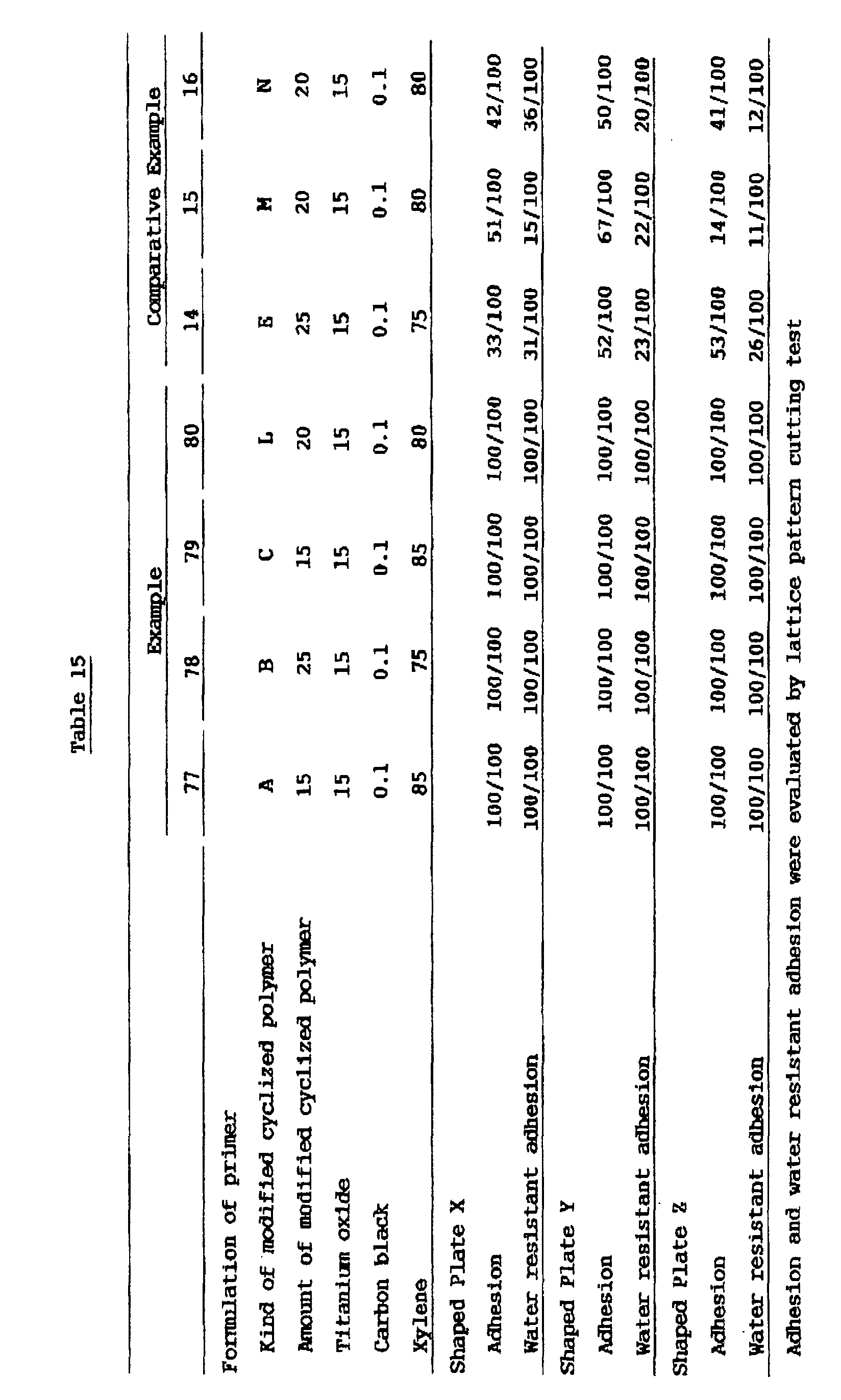
(6) Lattice Pattern Cutting Test (Initial Adhesion Test)
A plate-shaped sample is coated with a coating material,
and the coated surface is notched using a cutting knife with
parallel eleven lines with 2 mm distances and perpendicular
parallel eleven lines with 2 mm distances so that each notching
line cuts the coating and reaches the plate-shaped sample whereby
a lattice pattern composed of 100 squares is formed on the coated
surface. A self-adhesive tape is adhered on the notched coated
surface, and one end of the tape is pinched by fingers and the
tape is peeled at an angle of 45 degree. Initial adhesion of
the coating is evaluated by the number of squares remaining
without separation from the plate per 100 squares.
(7) Water Resistant Adhesion Test
A plate-shaped sample is coated with a coating material,
and the coated sample is immersed in warm water at 40°C for 240
hours. Thereafter the above-mentioned lattice pattern cutting
test is conducted on the coated sample to count the number of
squares remaining without separation from the plate per 100
squares.
(8) Accelerated Weathering Test
Accelerated weathering test is carried out using a carbon
arc sun-shine weatherometer for a stated time. Mirror reflection
(%) of the exposed surface is measured according to JIS K5400,
7.6, at an incident of 60 degree from the light source.
(9) Flowability of Primer and Coating Liquid
Flow down time at 20°C is measured according to the Ford cup No.
4 method stipulated in JIS K5400.
Reference Example 1
Preparation of modified cyclic structure-containing
polymer A
A four-necked flask equipped with a stirrer, a thermometer,
a reflux cooling condenser and a nitrogen gas-introducing tube
was charged with 100 parts of polyisoprene (cis-1,4-structure
isoprene units: 86%, trans-1,4-structure isoprene units: 12%,
3,4-structure isoprene units: 2%, weight average molecular
weight: 136,000) and 1,570 parts of toluene. The inner
atmosphere of the flask was substituted with nitrogen gas, and
the flask was heated to 85°C in an oil bath while the content
was stirred, whereby polyisoprene was completely dissolved in
toluene. Then 3.9 parts of p-toluenesulfonic acid was added and
the mixture was stirred while being maintained at 85°C, to conduct
a cyclization reaction. When 5 hours elapsed, 400 parts of
ion-exchanged water was added to stop the cyclization reaction.
The reaction mixture was allowed to stand for 30 minutes and a
separated oil layer was taken. The oil layer was washed with
400 parts of ion-exchanged water three times, and then subjected
to centrifugal separation at a revolution of 300 rpm to remove
moisture. Further, the oil layer was heated at 130°C to
completely remove moisture.
While the thus-obtained solution of cyclic structure-containing
polyisoprene in toluene was stirred, 2.5 parts of
maleic anhydride was continuously added at a constant rate to
the solution over a period of 5 minutes. The mixture was
maintained at 160°C for 4 hours to conduct a maleic anhydride-addition
reaction. The liquid reaction mixture was poured into
3,000 parts of a solution containing 1% of 2,6-di-tert-butylphenol
in acetone to deposit the cyclic structure-containing
polymer. The deposited polymer was collected and
dried under a reduced pressure to give a maleic anhydride-modified
cyclic structure-containing polymer A. Degree of
Cyclization of the cyclic structure-containing polymer, weight
average molecular weight of the modified cyclic structure-containing
polymer A, and the amount of maleic anhydride added
are shown in Table 1.
Reference Example 2
Preparation of modified cyclic structure-containing
polymer B
The procedures described in Reference Example 1 were
repeated to obtain a maleic anhydride-modified cyclic
structure-containing polymer B wherein polyisoprene
(cis-1,4-structure isoprene units: 73%, trans-1,4-structure
isoprene units: 22%, 3,4-structure isoprene units: 5%, weight
average molecular weight: 107,000) was used and the amount of
p-toluenesulfonic acid was changed to 3.6 parts for the
cyclization reaction, and the amount of maleic anhydride was
changed to 2 parts for the maleic anhydride-addition reaction.
All other conditions remained the same. Degree of cyclization
of the cyclic structure-containing polymer, weight average
molecular weight of the modified cyclic structure-containing
polymer B, and the amount of maleic anhydride added are shown
in Table 1.
Reference Example 3
Preparation of modified cyclic structure-containing
polymer C
The procedures described in Reference Example 1 were
repeated to obtain a maleic anhydride-modified cyclic
structure-containing polymer C wherein polyisoprene
(cis-1,4-structure isoprene units: 30%, trans-1,4-structure
isoprene units: 14%, 3,4-structure isoprene units: 56%, weight
average molecular weight: 252,000) was used and the amount of
p-toluenesulfonic acid was changed to 3 parts for the oyolization
reaction, and the amount of maleic anhydride was changed to 2.8
parts for the maleic anhydride-addition reaction. All other
conditions remained the same. Degree of cyclization of the
cyclic structure-containing polymer, weight average molecular
weight of the modified cyclic structure-containing polymer C,
and the amount of maleic anhydride added are shown in Table 1.
Reference Example 4
Preparation of modified cyclic structure-containing
polymer D
A four-necked flask equipped with a stirrer, a thermometer,
a reflux cooling condenser and a nitrogen gas-introducing tube
was charged with 100 parts of polyisoprene (cis-1,4-structure
isoprene units: 73%, trans-1,4-structure isoprene units: 22%,
3,4-structure isoprene units: 5%, weight average molecular
weight: 107,000, cut to a size of 10 mm square) and 1,570 parts
of toluene. The inner atmosphere of the flask was substituted
with nitrogen gas, and the flask was heated to 80°C in an oil
bath while the content was stirred, whereby polyisoprene was
dissolved in toluene. After polyisoprene was completely
dissolved, 7.2 parts of maleic anhydride was added, and the
mixture was maintained at 180°C for one hour to conduct a maleic
anhydride-addition reaction. The liquid reaction mixture was
poured into 3,000 parts of a solution containing 1% of
2,6-di-tert-butylphenol in acetone to deposit the maleic
acid-modified polymer. The deposited polymer was collected and
dried under a reduced pressure to give a maleic
anhydride-modified isoprene polymer.
100 parts of the maleic anhydride-modified isoprene
polymer was re-dissolved in 300 parts of toluene, and 3.2 parts
of p-toluenesulfonic acid was added, and the mixture was stirred
while being maintained at 85°C, to conduct a cyclization reaction.
When about 5 hours elapsed, 400 parts of ion-exchanged water was
added to stop the cyclization reaction. The reaction mixture
was allowed to stand for 30 minutes and a separated oil layer
was taken. The oil layer was washed with 400 parts of
ion-exchanged water three times, and then was poured into 1,000
parts of a solution containing 1% of 2,6-di-tert-butylphenol in
methanol to deposit the maleic acid-modified polymer. The
deposited polymer was collected and dried under a reduced
pressure to give a maleic anhydride-modified isoprene polymer
D. Degree of cyclization and weight average molecular weight
of the modified cyclic structure-containing polymer, and the
amount of maleic anhydride added are shown in Table 1.
Comparative Reference Example 1
Preparation of modified cyclic structure-containing
polymer E
The procedures described in Reference Example 1 were
repeated to obtain a maleic anhydride-modified cyclic
structure-containing polymer E wherein 1.9 parts of
p-toluenesulfonic acid was used instead of 3.9 parts for the
cyclization reaction, and the amount of maleic anhydride was
changed to 2.0 parts for the maleic anhydride-addition reaction.
All other conditions remained the same. Degree of cyclization
of the cyclic structure-containing polymer, weight average
molecular weight of the modified cyclic structure-containing
polymer E, and the amount of maleic anhydride added are shown
in Table 1.
| | Reference Example | | Co.R.Ex. |
| | 1 | 2 | 3 | 4 | 1 |
| Cyclization degree of Cyclized conjugated diene polymer (%) | 83 | 78 | 68 | 73 | 26 |
| Amount of maleic Anhydride added (%) | 1.8 | 1.3 | 1.5 | 3.9 | 1.6 |
| Weight average molecular weight (Mv) | 103,400 | 73,000 | 215,000 | 88,900 | 121,000 |
| Modified polymer | A | B | C | D | E |
Each of the maleic anhydride-modified cyclic
structure-containing polymers A through E, prepared in Reference
Examples 1 to 4 and Comparative Reference Example 1, was completely
dissolved in toluene to prepare a polymer solution of 20%
concentration in toluene. The polymer solution was allowed to
stand for 24 hours.
A plate specimen of a different material shown in Table 3,
below, was prepared. An adhesive surface of the plate specimen
was coated with the above-mentioned solution of the modified cyclic
structure-containing polymer, and the liquid polymer coating was
dried at 80°C. A plate specimen of a hydrocarbon polymer, shown
in Table 2, below, was superposed on the dried polymer coating of
the plate specimen of different material to prepare a laminate.
The laminate was held between glass pieces and fixed by clips. The
laminate was maintained at 100°C for 15 minutes in an oven to melt
the modified cyclic structure-containing polymer whereby the plate
specimen of hydrocarbon polymer and the plate specimen of different
material were adhesively bonded together. Tensile shear strength
of the laminate was measured. The result is shown in Table 4, below.
Combinations of a hydrocarbon polymer plate and a different
material plate, and a maleic anhydride-modified polymer are shown
in Table 4, below.
| Crystalline hydrocarbon polymer: |
| 1 ○ | Polypropylene resin ("J-3054HP" available from Idemitsu Pet. Chem., sp value: 8.2) |
| 2 ○ | Polyethylene resin ( "J300" available from Asahi Kasei, sp value: 7.9) |
| Non-crystalline hydrocarbon polymer: |
| 3 ○ | Hydrogenation product of polymer made by ring opening polymerization (ethyltetracyclododecene units: 15%, dicylopentadiene units: 85%) Tg: 103°C, Degree of hydrogenation: more than 99%, sp value: 8.5 |
| 4 ○ | Ethylene-octene copolymer ( "Engage 8100" available from Du Pont-Dow |
| | Elastomer Co., MFI (ASTM D-1238): 1.0 dg/min, sp value: 8.3 |
| Shaped plate | Material for shaped plate |
| 5 ○ | Stainless steel SUS 430 W, available from Nippon Metal K.K., out from band steel |
| 6 ○ | Glass plate, slide glass, commercially available |
| 7 ○ | Wood, Japanese cypress, cut from square timber for doorsill |
| 8 ○ | Cotton non-woven fabric, stitch-bond, available from Nippon Woven Fabric K/K. |
Each of the maleic anhydride-modified cyclic
structure-containing polymers A through E, prepared in Reference
Examples 1 to 4 and Comparative Reference Example 1, was dissolved
in toluene to prepare a polymer solution of 20% concentration in
toluene. The polymer solution was coated on a
polytetrafluoroethylene sheet so that a coating having a thickness
of 50 µm (as dried film thickness) was formed. The liquid coating
was allowed to stand to gradually evaporate toluene to form a dry
film. The film was separated.
The film was sandwiched between an adhesive surface of a
plate specimen of a different material shown in Table 3 and an
adhesive surface of a plate specimen of a hydrocarbon polymer shown
in Table 2, to prepare a laminate. The laminate was held between
glass pieces and fixed by clips. The laminate was maintained at
100°C for 15 minutes in an oven to melt the film of modified polymer
whereby the plate specimen of hydrocarbon polymer and the plate
specimen of different material were adhesively bonded together.
Tensile shear strength of the laminate was measured. The result
is shown in Table 5, below.
Combinations of a hydrocarbon polymer plate and a different
material plate, and a maleic anhydride-modified polymer are shown
in Table 5, below.
Polyisoprene (cis-1,4-structure isoprene units: 86%,
trans-1.4-structure isoprene units: 12%, 3,4-structure isoprene
units: 2%, weight average molecular weight: 136,000) used in
Reference Example 1 is referred to as polymer F.
Properties of polymer F are shown in Table 6, below. For
comparison, properties of the maleic anhydride-modified polymers
A through D, prepared in Reference Examples 1 to 4, are also shown
in Table 6, below.
| | Reference Example | Co.Re.Ex. |
| | 1 | 2 | 3 | 4 | 1 |
| Modified polymer | A | B | C | D | F |
| Weight average molecular weight (Mv) | 103,400 | 73,000 | 215,000 | 88,900 | 136,000 |
| Cyclization degree of Cyolized conjugated diene polymer (%) | 83 | 78 | 68 | 73 | - |
| Amount of maleic Anhydride added (%) | 1.8 | 1.3 | 1.5 | 3.9 | - |
Each of the maleic anhydride-modified cyclic
structure-containing polymers A through D, and polymer F was
completely dissolved in toluene to prepare a polymer solution of
20% concentration in toluene. The polymer solution was allowed
to stand for 24 hours.
A plate specimen of a polar polymer shown in Table 7, below,
was prepared. An adhesive surface of the plate specimen was coated
with the above-mentioned solution of the modified cyclic
structure-containing polymer, and the liquid polymer coating was
dried at 80°C. A plate specimen of a hydrocarbon polymer, shown
in Table 2, was made by injection molding according to JIS K6850.
The injection molded hydrocarbon polymer plate specimen was
superposed on the coating of modified polymer formed on the polar
polymer plate. The assembly of the coated polar polymer plate and
the hydrocarbon polymer plate was held between glass pieces and
fixed by clips. The assembly was maintained at 100°C for 5 minutes
in an oven to melt the modified cyclic structure-containing polymer
film whereby the hydrocarbon polymer plate and the polar polymer
plate were adhesively bonded together. Tensile shear strength of
the laminate was measured. The result is shown in Table 8, below.
Each of the maleic anhydride-modified cyclic
structure-containing polymers A through D, prepared in Reference
Examples 1 to 4 and polymer F, prepared in Comparative Reference
Example 2, was dissolved in toluene to prepare a polymer solution
of 20% concentration in toluene in a manner similar to those in
Examples 23-39 and Comparative Examples 7 and 8. The polymer
solution was coated on a polytetrafluoroethylene (PTFE) sheet so
that a coating having a thickness of 50 µm (as dried film thickness)
was formed. The liquid coating was allowed to stand to gradually
evaporate toluene to form a dry film. The film was separated.
The film was sandwiched between an adhesive surface of a plate
specimen of a polar polymer and an adhesive surface of a plate
specimen of a hydrocarbon polymer, to prepare a laminate, according
to the formulation shown in Table 9. The laminate was held between
glass pieces and fixed by clips. The laminate was maintained at
100°C for 15 minutes in an oven to melt the film of modified polymer
whereby the plate specimen of hydrocarbon polymer and the plate
specimen of polar polymer were adhesively bonded together. Tensile
shear strength of the laminate was measured. The result is shown
in Table 9, below.
Combinations of a hydrocarbon polymer plate and a polar
polymer plate, and a maleic anhydride-modified polymer are shown
in Table 9, below.
A four-necked flask equipped with a stirrer, a thermometer,
a reflux cooling condenser and a nitrogen gas-introducing tube was
charged with 100 parts of polyisoprene (cis-1,4-structure isoprene
units: 86%, trans-1,4-structure isoprene units: 12%, 3,4-structure
isoprene units: 2%, weight average molecular weight: 136,000, cut
to a size of 10 mm ×10 mm) and 1, 570 parts of toluene. The inner
atmosphere of the flask was substituted with nitrogen gas, and the
flask was heated to 85°C in an oil bath while the content was stirred,
whereby polyisoprene was completely dissolved in toluene. Then
3.9 parts of p-toluenesulfonic acid was added and the mixture was
stirred while being maintained at 85°C, to conduct a cyclization
reaction. When about 5 hours elapsed, 400 parts of ion-exchanged
water was added to stop the cyclization reaction. The reaction
mixture was allowed to stand for 30 minutes and a separated oil
layer was taken. The oil layer was washed with 400 parts of ion-exchanged
water three times, and then subjected to centrifugal
separation at a revolution of 300 rpm to remove moisture. Further,
the oil layer was heated at 130°C to completely remove moisture.
The obtained liquid was poured into 3,000 parts of a solution
containing 1% of 2,6-di-tert-butylphenol in methanol to deposit
the cyclic structure-containing polymer. The deposited polymer
was collected and dried under a reduced pressure to give a cyclic
structure-containing polymer H. Weight average molecular weight
and degree of cyclization of the cyclic structure-containing
polymer H are shown in Table 10, below.
Reference Example 6
Preparation of cyclic structure-containing polymer I
The procedures described in Reference Example 5 were
repeated to obtain a cyclic structure-containing polymer I wherein
polyisoprene (cis-1,4-structure isoprene units: 73%,
trans-1,4-structure isoprene units: 22%, 3,4-structure isoprene
units: 5%, weight average molecular weight: 107,000) was used and
the amount of p-toluenesulfonic acid was changed to 3.6 parts for
the cyclization reaction. All other conditions remained the same.
Weight average molecular weight and degree of cyclization of the
cyclic structure-containing polymer I are shown in Table 10, below.
Reference Example 7
Preparation of cyclic structure-containing polymer J
The procedures described in Reference Example 5 were
repeated to obtain a cyclic structure-containing polymer J wherein
polyisoprene (cis-1,4-structure isoprene units: 30%,
trans-1,4-structure isoprene units: 14%, 3,4-structure isoprene
units: 56%, weight average molecular weight: 252,000) was used and
the amount of p-toluenesulfonic acid was changed to 3 parts for
the cyclization reaction. All other conditions remained the same.
Weight average molecular weight and degree of cyclization of the
cyclic structure-containing polymer J are shown in Table 10, below.
Reference Example 8
Preparation of cyclic structure-containing polymer K
The procedures described in Reference Example 5 were
repeated to obtain a cyclic structure-containing polymer K wherein
polybutadiene (cis-1,4-structure butadiene units: 26%,
trans-1,4-structure butadiene units: 18%, 1,2-structure butadiene
units: 56%, weight average molecular weight: 210,000) was used
instead of polyisoprene and the amount of tolune was changed to
1.620 parts. Further, a solution of polybutadiene in toluene was
maintained at 23°C and then, 2.78 parts of benzyl chloride and 1.8
parts of ethylaluminum dichloride were added instead of
p-toluenesulfonic acid, and, when 12 minutes elapsed from the
addition of benzyl chloride and ethylaluminum dichloride, 20 parts
of methanol was added to stop the cyclization reaction. All other
conditions remained the same. Weight average molecular weight and
degree of cyclization of the cyclic structure- containing polymer
K are shown in Table 10, below.
| | Reference Example |
| | 5 | 6 | 7 | 8 |
| Cyclization degree of Cyclized conjugated diene polymer (%) | 83 | 78 | 68 | 73 |
| Weight average molecular weight (Mv) | 103,400 | 73,000 | 215,000 | 88,900 |
| Modified polymer | H | I | J | K |
Each of the cyclic structure-containing polymers H through
K, prepared in Reference Examples 5 to 8 was completely dissolved
in toluene to prepare a polymer solution of 20% concentration in
toluene. The polymer solution was allowed to stand for 24 hours.
In Comparative Examples 11 and 12, instead of the solution
of cyclic structure-containing polymer, a 32% solution of
chlorinated polypropylene ("Superchlon 773H" available from Nippon
Paper Ind. Ltd.) was used.
An adhesive surface of a plate of crystalline hydrocarbon
polymer 1 ○ or 2 ○ shown in Table 2 was coated with the
above-mentioned polymer solution, and the liquid polymer coating
was dried at 80°C. A plate of a non-crystalline hydrocarbon polymer
3 ○ or 4 ○, shown in Table 2, was superposed on the dried polymer
coating of the crystalline hydrocarbon polymer plate to prepare
a laminate. The laminate was held between glass pieces and fixed
by clips. The laminate was maintained at 100°C for 15 minutes in
an oven to melt the polymer coating whereby the plate of crystalline
hydrocarbon polymer and the plate of non-crystalline polymer were
adhesively bonded together. Tensile shear strength of the laminate
was measured. The result is shown in Table 11, below.
Combinations of a crystalline hydrocarbon polymer plate and
a non-crystalline hydrocarbon polymer plate, and a cyclic
structure-containing polymer or chlorinated polypropylene are
shown in Table 11, below.
| | Example | Com. Ex. |
| | 57 | 58 | 59 | 60 | 61 | 62 | 63 | 64 | 65 | 66 | 11 | 12 |
| Cycl. polymer | H | I | J | K | H | I | H | I | H | H | Cl-PP |
| Crystal. HC Polymer | 1 ○ | 1 ○ | 1 ○ | 1 ○ | 1 ○ | 1 ○ | 2 ○ | 2 ○ | 2 ○ | 2 ○ | 1 ○ | 2 ○ |
| Non-crystal. HC polymer | 3 ○ | 3 ○ | 3 ○ | 3 ○ | 4 ○ | 4 ○ | 3 ○ | 3 ○ | 4 ○ | 4 ○ | 3 ○ | 4 ○ |
| Tensile shear strength | 215 | 189 | 205 | 156 | 195 | 158 | 226 | 215 | 209 | 231 | 19 | 56 |
| Cycl. Polymer: Cyclized polymer |
| Crystl. HC polymer: Crystalline hydrocarbon polymer |
| Non-orystl. HC polymer: Non-crystalline hydrocarbon polymer |
| Cl-PP: Chlorinated polypropylene |
| Units of tensile shear strength: N/cm2 |
Each of the cyclic structure-containing polymers H through
K, prepared in Reference Examples 5 to 8, was dissolved in toluene
to prepare a 20% polymer solution in toluene in a manner similar
to those in Examples 17-66.
In Comparative Example 13, instead of the cyclic
structure-containing polymer solution, a 32% solution of
chlorinated polypropylene ("Superchlon 773H" available from Nippon
Paper Ind. Ltd.) was used.
Each polymer solution was coated on a
polytetrafluoroethylene sheet so that a coating having a thickness
of 50 µm (as dried film thickness) was formed. The liquid coating
was allowed to stand to gradually evaporate toluene or other solvent
to form a dry polymer film. The polymer film was separated.
The polymer film was sandwiched between an adhesive surface
of a plate of crystalline hydrocarbon polymer 1 ○ or 2 ○ shown in
Table 2 and an adhesive surface of a plate of a non-crystalline
hydrocarbon polymer 3 ○ or 4 ○, shown in Table 2, to prepare a laminate.
The laminate was held between glass pieces and fixed by clips . The
laminate was maintained at 100°C for 15 minutes in an oven to melt
the polymer film whereby the crystalline polymer plate and the
non-crystalline polymer plate were adhesively bonded together.
Tensile shear strength of the laminate was measured. The result
is shown in Table 12, below.
Combinations of a crystalline polymer plate and a
non-crystalline polymer plate, and a cyclized polymer or
chlorinated polypropylene are shown in Table 12, below.
As seen from Tables 11 and 12, in the case when a crystalline
hydrocarbon polymer and a non-crystalline hydrocarbon polymer are
adhesively bonded together using chlorinated polypropylene as an
adhesive, the tensile strength, i.e., tensile shear strength, is
very low. With regard to various combinations of the crystalline
hydrocarbon polymers and the non-crystalline polymers, shown in
Table 11, and combinations of crystalline hydrocarbon polymers and
non-crystalline polymers, which are not recited in Table 11,
adhesion tests were carried out by the same procedures as mentioned
above using chlorinated polypropylene as an adhesive, relatively
good tensile shear strengths could be obtained only for very limited
combinations of crystalline hydrocarbon polymers and
non-crystalline polymers. Therefore, chlorinated polypropylene
cannot be widely used as an adhesive.
In contrast, in the case when an adhesive composition
comprising a cyclic structure-containing conjugated diene polymer
as the main ingredient, the tensile strength, i.e., tensile shear
strength, is very large, and the adhesive composition can be widely
applied for various combinations of hydrocarbon polymers.
| | | Example | Co. Ex. |
| | 67 | 68 | 69 | 70 | 71 | 72 | 73 | 74 | 75 | 76 | 13 |
| Cycl. polymer | H | I | J | K | H | I | H | I | H | H | Cl-PP |
| Crystal. HC Polymer | 1 ○ | 1 ○ | 1 ○ | 1 ○ | 1 ○ | 1 ○ | 2 ○ | 2 ○ | 2 ○ | 2 ○ | 1 ○ |
| Non-crystal. HC polymer | 3 ○ | 3 ○ | 3 ○ | 3 ○ | 4 ○ | 4 ○ | 3 ○ | 3 ○ | 4 ○ | 4 ○ | 3 ○ |
| Tensile shear |
| strength | 206 | 178 | 189 | 136 | 198 | 160 | 218 | 204 | 201 | 216 | 32 |
| Cycl. Polymer: Cyclized polymer |
| Crystl. HC polymer: Crystalline hydrocarbon polymer |
| Non-crystl. HC polymer: Non-crystalline hydrocarbon polymer |
| Cl-PP: Chlorinated polypropylene |
| Units of tensile shear strength: N/cm2 |
The procedures described in Reference Example 1 (preparation
of modified cyclic structure-containing polymer A) were repeated
to obtain a modified cyclic structure-containing polymer L wherein
polybutadiene (cis-1,4-structure butadiene units: 26%,
trans-1,4-structure butadiene units: 18%, 1,2-structure butadiene
units: 56%, weight average molecular weight: 210,000) was used
instead of polyisoprene and the amount of tolune was changed to
1, 620 parts. Further, a solution of polybutadiene in toluene was
maintained at 23°C and then, 2.78 parts of benzyl chloride and 1.8
parts of ethylaluminum dichloride were added instead of
p-toluenesulfonic acid, and, when 12 minutes elapsed from the
addition of benzyl chloride and ethylaluminum dichloride, 20 parts
of methanol was added to stop the cyclization reaction. All other
conditions remained the same. Degree of cyclization of the cyclic
structure-containing polymer, weight average molecular weight of
the modified cyclic structure-containing polymer L, and the amount
of maleic anhydride added and the ratio of acid anhydride group
are shown in Table 13, below.
Comparative Reference Example 3
Preparation of modified cyclic structure-containing polymer
M
In this comparative reference example 3, a modified cyclic
structure-containing polymer was prepared with reference to the
method as taught in JP-A S57-145103.
A four-necked flask equipped with a stirrer, a thermometer,
a reflux cooling condenser and a nitrogen gas-introducing tube was
charged with 100 parts of polyisoprene (cis-1,4-structure isoprene
units: 73%, trans-1,4-structure isoprene units: 22%, 3,4-structure
isoprene units: 5%, weight average molecular weight: 107,000, cut
to a size of 10 mm × 10 mm square) and 1,570 parts of toluene. The
inner atmosphere of the flask was substituted with nitrogen gas,
and the flask was heated to 80°C in an oil bath while the content
was stirred, whereby polyisoprene was dissolved in toluene. After
polyisoprene was completely dissolved, 7.2 parts of maleio
anhydride was added, and the mixture was maintained at 180°C for
one hour to conduct a maleic anhydride-addition reaction. The
liquid reaction mixture was poured into 3, 000 parts of a solution
containing 1% of 2,6-di-tert-butylphenol in acetone to deposit the
maleic acid-modified polymer. The deposited polymer was collected
and dried under a reduced pressure to give a maleic
anhydride-modified isoprene polymer.
100 parts of the maleic anhydride-modified isoprene polymer
was re-dissolved in 300 parts of toluene, and 3.6 parts of
p-toluenesulfonic acid was added, and the mixture was stirred while
being maintained at 85°C, to conduct a cyclization reaction. When
about 5 hours elapsed, 400 parts of ion-exchanged water was added
to stop the cyclization reaction. The reaction mixture was allowed
to stand for 30 minutes and a separated oil layer was taken.
The oil layer was washed with 400 parts of ion-exchanged water
three times, and then was poured into 1,000 parts of a solution
containing 1% of 2,6-di-tert-butylphenol in methanol to deposit
the maleic acid-modified cyclic structure-containing polymer.
The deposited polymer was collected and dried under a reduced
pressure to give a maleic anhydride-modified cyclic
structure-containing isoprene polymer M. Degree of cyclization
and weight average molecular weight of the modified cyclic
structure-containing polymer, and the amount of maleic anhydride
added and the ratio of acid anhydride group are shown in Table 13,
below.
Comparative Reference Example 4
Preparation of modified cyclic structure-containing polymer
N
A four-necked flask equipped with a stirrer, a thermometer,
a reflux cooling condenser and a nitrogen gas-introducing tube was
charged with 100 parts of polyisoprene (cis-1,4-structure isoprene
units: 86%, trans-1,4-structure isoprene units: 12%, 3,4-structure
isoprene units: 2%, weight average molecular weight: 136,000, cut
to a size of 10 mm × 10 mm square) and 1,570 parts of toluene. The
inner atmosphere of the flask was substituted with nitrogen gas,
and the flask was heated to 85°C in an oil bath while the content
was stirred, whereby polyisoprene was dissolved in toluene. After
polyisoprene was completely dissolved, 3.9 parts of
p-toluenesulfonic acid was added, and the mixture was maintained
at 85°C while being stirred to conduct a cyclization reaction. When
about 5 hours elapsed, 400 parts of ion-exchanged water was added
to stop the cyclization reaction . The reaction mixture was allowed
to stand for 30 minutes and a separated oil layer was taken. The
oil layer was washed with 400 parts of ion-exchanged water three
times, and then was subjected to centrifugal separation at a number
of revolution of 300 rpm to remove moisture. The oil layer was
further heated at 130°C to completely remove moisture.
While the thus-obtained liquid containing a cyclic
structure-containing polymer was stirred, 2.0 parts of maleic
anhydride was added to the liquid at a constant rate over a period
of 5 minutes, and the reaction liquid was maintained at 160°C for
4 hours to conduct an acid anhydride-addition reaction. Then the
reaction liquid was poured into 3,000 parts of a mixed liquid of
a solution containing 1% of 2,6-di-tert-butylphenol in acetone and
water (the ratio of the acetone solution/water = 8/2) to deposit
a maleic acid-modified cyclic structure-containing polymer. The
deposited polymer was collected and dried under a reduced pressure
to give a maleic anhydride-modified cyclic structure-containing
isoprene polymer N. Degree of cyclization and weight average
molecular weight of the modified cyclic structure-containing
polymer, and the amount of maleic anhydride added and the ratio
of acid anhydride group are shown in Table 13, below.
For comparison, properties of the maleic anhydride- modified
polymers A, B and C, prepared in Reference Examples 1 to 3, and
the maleic anhydride-modified polymer E, prepared in Comparative
Reference Example 1, are also shown in Table 13, below.
| | Reference Example | Comp.Ref.Ex. |
| | 1 | 2 | 3 | 9 | 1 | 3 | 4 |
| Modified polymer | A | B | C | L | E | M | N |
| Wt. av. MW | 103,400 | 73,000 | 215,000 | 124,000 | 121,000 | 79,100 | 103,500 |
| Cyclization degree (%) | 83 | 78 | 68 | 53 | 26 | 79 | 83 |
| Amt. of maleic anhydride added (%) | 1.8 | 1.3 | 1.5 | 0.8 | 1.6 | 4.1 | 1.5 |
| Ratio of acid anhydride group (%) | 83 | 82 | 80 | 97 | 81 | 7 | 13 |
| Wt. av. MW: Weight average molecular weight |
Using materials shown in Table 14, three kinds of plates X,
Y and Z were made by injection molding, each of which had a size
of 50 mm × 80 mm × 3 mm. The plate Y was made by mixing the three
ingredients (1), (2) and (3) by a Henschel mixer, and kneading and
extruding the mixture through a twin screw extruder to form a pallet,
and injection molding the pellet.
| Plate specimen | Resins constituting plates |
| Molded plate X | Polypropylene resin "J-3054HP" available from Idemitsu Pet. Chem. Co., MFR: 42g/10 min |
| Molded plate Y | (1) Polypropylene resin "J-3054HP" available from Idemitsu Pet. Chem. Co.
(2) Ethylene/butane copolymer "EMB3021" available from JSR Corp.
(3) Talc "JM-209" available from Asada Seifun K.K. (1)/(2)/(3)= 70/23/7 |
| Molded plate Z | Hydrogenation product of polymer made by ring- opening polymerization (ethyltetracyclododecene units: 15%. dicylopentadiene units: 85%), Tg: 103°C, Degree of hydrogenation: more than 99% |
Using as binder resins the modified cyclic structure-containing
polymers A, B, C, L, E, M and N, prepared in Reference
Examples 1-3 and 9, and Comparative Examples 1, 3 and 4, seven kinds
of primers were prepared according to the formulation shown in Table
15. That is, the ingredients according to the formulation shown
in Table 15 were mixed by a high-speed stirrer (diaper) for 10
minutes, and the mixture was diluted with toluene so that a fluidity
corresponding to a flow down time falling within the range of 13
to 14 seconds was obtained.
Each shaped plate of X to Z was thoroughly washed with water
using a spray gun having a nozzle diameter of 1.0 mm at a spraying
pressure of 3.5 to 5.0 MPa, and then, dried. Each primer shown
in Table 15 was sprayed onto the shaped plate so that a film with
a thickness of 10 µm was formed. When 5 minutes elapsed, two-part
urethane metallic coating liquid ("RB-212" base coating liquid,
and "RB-288" clear coating liquid, available from Nihon
Bee-Cheimical), were sprayed using the spray gun as that mentioned
above so that a film with a thickness of 40 µm was formed. Thus,
two-coat coating was conducted. The wet coating was dried at 23°C
for 15 minutes, and then at 80°C for 30 minutes in a non-circular
type drier. The dried coated plate was allowed to stand for 3 days,
and the lattice pattern cutting test and the water resistant
adhesion test were carried out. The results are shown in Table 15.
As seen from Table 15, in the case when a resin shaped article
is pre-treated with (1) a primer comprising a modified cyclic
structure-containing polymer E of Comparative Example 14 having
a cyclization degree smaller than the range stipulated in the
present invention, or (2) a primer comprising a modified cyclic
structure-containing polymer M or N of Comparative Example 15 or
16 having a ratio of an acid anhydride group smaller than the range
stipulated in the present invention, the resulting coating formed
on the pre-treated surface have poor adhesion and water resistant
adhesion.
Example 81
Preparation of Polyester for Coating Material
A four-necked flask equipped with a stirrer, a thermometer,
a reflux cooling condenser and a nitrogen gas-introducing tube was
charged with 800 parts of terephthalic acid, 770 parts of
2-butyl-2-ethyl-1,3-propanediol, 72.7 parts of pentaerythritol
and 0.80 part of monobutyltin oxide. While the content was stirred
and nitrogen gas was introduced, the content was heated to conduct
a reaction. That is, the temperature of the content was elevated
from 200°C to 240°C over a period of 6 hours during which a reaction
was conducted while part of unreacted monomer and water produced
during the reaction are removed. Thereafter, the reaction was
continued for 3 hours while dehydration was carried out at 240°C
under a reduced pressure of 50 mmHg. The thus-obtained polyester
had a weight average molecular weight of 43,000, an acid value of
0.35 mgKOH/g and a hydroxyl value of 46 mgKOH/g.
Preparation of Coating Liquid
50 parts of the above-mentioned polyester, 30 parts of
titanium oxide as white pigment, 25 parts of the modified cyclic
structure-containing polymer A and 125 parts of xylene were mixed
together, and the mixture was kneaded for one hour by a sand grinder
mill. The kneaded mixture was diluted with xylene so that the flow
down time falls within 13 to 14 seconds to obtain a white coating
liquid.
The above-mentioned shaped plate X was washed with water and
thereafter, the white coating liquid was sprayed on the plate X
so that the thickness of coating formed on the plate X was 40 µ
m as a dry film. The wet coating was dried at 23°C for 15 minutes,
and then at 80°C for 30 minutes in a non-circulation type drier.
After the coated plate was allowed to stand at room temperature
for 7 days, a lattice pattern cutting test, a water resistant
adhesion test and an accelerated wearthering test were carried out.
Test results are shown in Table 16.
| | Example | Comp.Ex. |
| | 81 | 82 | 17 |
| Formulation of coating liquid |
| Modified cyclized polymer A | 25 | - | - |
| Modified colized polymer B | - | 25 | - |
| Modified cyclized polymer E | - | - | 25 |
| Adhesion (lattice pattern cutting test) | 100/100 | 100/100 | 45/100 |
| Water resistant adhesion (lattice pattern cutting test) | 100/100 | 100/100 | 33/100 |
| Accelerated weathering test |
| (luster retention %) |
| For 0 hour | 100 | 100 | 100 |
| 100 hours | 97 | 98 | 97 |
| 250 hours | 95 | 96 | 94 |
| 480 hours | 94 | 94 | 91 |
As seen from Table 16, a coating liquid comprising a modified
cyclic structure-containing polymer E of Comparative Example 17
having a cyclization degree smaller than the range stipulated in
the present invention has poor adhesion and water resistant
adhesion to a polyolefin resin shaped article. In contrast, a
coating liquid comprising a modified cyclic structure-containing
containing polymer comprising a modified cyclic structure-containing
polymer of Example 81 or 82 having a cyclization degree
falling within the range stipulated in the present invention
exhibits good adhesion and water resistant adhesion to a polyolefin
resin shaped article, and gives a coating exhibiting good luster
retention for a long period of time.
Industrial Applicability
In the shaped composite article of the present invention,
a substrate and an adherend, which are comprised of different
materials, are strongly bonded together through a layer of an
adhesive composition comprising as the main ingredient a cyclic
structure-containing conjugated diene polymer (i) or a modified
cyclic structure-containing conjugateddiene polymer (ii). Even
when at least one of the substrate and the adherend is comprised
of a non-polar hydrocarbon polymer, the adhesion is strong.
Therefore, the shaped composite article of the present
invention can be used in various fields, which include electrical
and electric parts, information recording mediums, optical parts,
machine parts, automobile parts, packaging materials, and
construction materials. More specifically, the shaped composite
materials are especially suitable for electrical and electronic
parts for liquid crystal displays, plasma displays and organic
electroluminescence displays; electric parts for circuit boards,
semiconductor elements and connectors; information recording
mediums such as optical discs, magnetic discs and hard discs;
optical parts such as optical lenses, optical fibers, phase plates,
diffuse plates and deflector plates; automobile parts such as
vehicle light instruments, vehicle displays and indicators,
automobile interior and exterior parts; vessels for medicines; food
containers, cosmetic containers, tableware; packaging materials
such as packaging films, packaging packs, shrink films (label
films); and construction materials such as waterproof sheet,
sealing sheet and piping materials.
The coating material of the present invention comprising the
modified cyclic structure-containing conjugated diene polymer
(ii') exhibits good adhesion and good water resistant adhesion to
various resin articles, especially for polyolefin resin shaped
articles. Therefore the coating material is suitable for a coating
liquid, an ink, an adhesive and a primer.