EP1447650A1 - Messverfahren zur Bestimmung der effektiven Lichtstärke einer impulsförmig betriebenen LED-Lichtquelle - Google Patents
Messverfahren zur Bestimmung der effektiven Lichtstärke einer impulsförmig betriebenen LED-Lichtquelle Download PDFInfo
- Publication number
- EP1447650A1 EP1447650A1 EP04002381A EP04002381A EP1447650A1 EP 1447650 A1 EP1447650 A1 EP 1447650A1 EP 04002381 A EP04002381 A EP 04002381A EP 04002381 A EP04002381 A EP 04002381A EP 1447650 A1 EP1447650 A1 EP 1447650A1
- Authority
- EP
- European Patent Office
- Prior art keywords
- light
- light source
- led light
- pulse
- pulses
- Prior art date
- Legal status (The legal status is an assumption and is not a legal conclusion. Google has not performed a legal analysis and makes no representation as to the accuracy of the status listed.)
- Ceased
Links
- 238000000034 method Methods 0.000 title claims abstract description 20
- 230000000694 effects Effects 0.000 claims abstract description 9
- 238000011156 evaluation Methods 0.000 claims abstract description 5
- 230000010354 integration Effects 0.000 claims abstract description 5
- 230000035479 physiological effects, processes and functions Effects 0.000 claims description 4
- 238000005259 measurement Methods 0.000 description 5
- 230000001427 coherent effect Effects 0.000 description 2
- 230000008447 perception Effects 0.000 description 2
- 210000001525 retina Anatomy 0.000 description 2
- 230000000630 rising effect Effects 0.000 description 2
- 206010034960 Photophobia Diseases 0.000 description 1
- 230000006978 adaptation Effects 0.000 description 1
- 230000007423 decrease Effects 0.000 description 1
- 238000010586 diagram Methods 0.000 description 1
- 230000006870 function Effects 0.000 description 1
- 230000004313 glare Effects 0.000 description 1
- 230000007794 irritation Effects 0.000 description 1
- 208000013469 light sensitivity Diseases 0.000 description 1
- 238000012423 maintenance Methods 0.000 description 1
- 238000001208 nuclear magnetic resonance pulse sequence Methods 0.000 description 1
- 230000002688 persistence Effects 0.000 description 1
- 230000002207 retinal effect Effects 0.000 description 1
- 230000035945 sensitivity Effects 0.000 description 1
- 230000003595 spectral effect Effects 0.000 description 1
- 230000036962 time dependent Effects 0.000 description 1
- 238000011144 upstream manufacturing Methods 0.000 description 1
Images


Classifications
-
- G—PHYSICS
- G01—MEASURING; TESTING
- G01J—MEASUREMENT OF INTENSITY, VELOCITY, SPECTRAL CONTENT, POLARISATION, PHASE OR PULSE CHARACTERISTICS OF INFRARED, VISIBLE OR ULTRAVIOLET LIGHT; COLORIMETRY; RADIATION PYROMETRY
- G01J1/00—Photometry, e.g. photographic exposure meter
- G01J1/42—Photometry, e.g. photographic exposure meter using electric radiation detectors
-
- G—PHYSICS
- G01—MEASURING; TESTING
- G01J—MEASUREMENT OF INTENSITY, VELOCITY, SPECTRAL CONTENT, POLARISATION, PHASE OR PULSE CHARACTERISTICS OF INFRARED, VISIBLE OR ULTRAVIOLET LIGHT; COLORIMETRY; RADIATION PYROMETRY
- G01J1/00—Photometry, e.g. photographic exposure meter
Definitions
- the invention relates to a measuring method for determining the effective light intensity a pulsed LED light source, the effective Luminous intensity taking into account the physiology of the human eye and especially the receptors of the human eye is measured.
- the signal light source here is the warning light (anti-collision light) of aircraft called, which is operated discontinuously and emits light in pulses.
- Signal light sources relatively narrow light pulses with a length of a few milliseconds (for example 5 milliseconds), which are however quite bright (up to 400 cd).
- Such light sources use the well-known Blondel method and Rey (SCHMIDT-CLAUSEN HANS-JOACHIM: "COMPARISON OF DIFFERENT METHODS FOR THE DETERMINATION OF THE EFFECTIVE LUMINOUS INTENSITY OF SIGNAL LIGHTS IN THE FORM OF MULTIPLE PULSES "CIE J MAY 1982, volume No. 1, May 1982 (1982-05), pages 18 to 22, XP009007847).
- LED technology is being used increasingly for discontinuously operated light sources used.
- the advantage of LED light sources over gas discharge sources is in particular the longer lifespan and the larger one Functional reliability.
- LED light sources you can only do less generate powerful pulses than is the case with gas discharge light sources is. Therefore, one works with LED light sources that are used as warning lamps with double or multiple flashes.
- For their effective light intensity To be able to determine metrologically, you can because of the gas discharge lamps significantly lower light pulse intensity not according to the Measure according to Schmidt-Clausen.
- the invention provides a measuring method for determining the effective light intensity a pulsed LED light source taking into account the physiology of the receptors of the human eye by means of a light-sensitive detector from the LED light source emitted multiple pulse light signal is measured, the light pulses have a time interval from one another that is less than the time for which the afterglow effect of the receptors of the human eye persists, and the measured multiple-pulse light signal by means of an evaluation unit is subjected to an integration, the integration being based on the form factor method he follows.
- the light pulses have from each other a time interval that is less than 140 ms, preferably is less than 100 ms and in particular less than 50 ms.
- the duration of the pulses is expediently at least 100 ms, preferably at least 150 ms.
- the measuring method according to the invention for calculating the effective light intensity a double or multiple light pulse from an LED light source on the physiology of the human eye.
- the reaction of the Receptors regarding the consideration of discontinuous LED light sources the brightness perception is taken into account. It is assumed that the eye reacts sluggishly to time-dependent signals. On the one hand is that when looking at the rising edge of the first pulse Eye surprised. To avoid excessive glare, a Undervalued brightness perception. The impulse appears to the viewer darker.
- the persistence is in the range of 125 ms.
- the afterglow effect is visible.
- the perceived luminance decreases only slightly during this time.
- the double pulse appears a little uneasy, but this affects the signal effect supports the viewer.
- the double pulse can thus be measured be regarded as a coherent signal.
- a discontinuously operated LED light source is used, for example a measurement setup as shown in FIG. 3.
- the measuring device 10 receives the light flashes of an LED light source 12 and includes an evaluation unit 14, which is usually a microprocessor.
- the microprocessor 14 the output signal of a photodetector 16 is fed to the Filter 18 is connected upstream, which only that portion of the LED light source 12 transmits transmitted light to the detector 16, which the corresponds to the spectral light sensitivity of the human eye.
- the intensity curve is first a double or multiple light flash emitted by the LED light source 12 measured.
- the measurement curve is then in the evaluation unit 14 integrated, using the form factor method described above.
Landscapes
- Physics & Mathematics (AREA)
- General Physics & Mathematics (AREA)
- Spectroscopy & Molecular Physics (AREA)
- Photometry And Measurement Of Optical Pulse Characteristics (AREA)
- Investigating Or Analysing Materials By Optical Means (AREA)
Abstract
Description
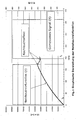
- Fig. 1
- eine schematische Darstellung eines Doppellichtimpulses, dessen effektive Lichtintensität zu berechnen ist,
- Fig. 2
- eine schematische Darstellung einer gemessenen Doppelimpulssequenz und
- Fig. 3
- ein Blockdiagramm, das die wesentlichen Merkmale der Erfindung zeigt.

t = Zeitzähler in [s]
I(t) = Detektiertes Signal in [cd]
i(t) = Netzhautreizfunktion in [cd]


- Is =
- Maximalwert in [cd]
- C =
- Blondel und Rey Konstante (c = 0.2 s)

Claims (3)
- Messverfahren zur Bestimmung der effektiven Lichtstärke einer impulsförmig betriebenen LED-Lichtquelle unter Berücksichtigung der Physiologie der Rezeptoren des menschlichen Auges, bei demmittels eines lichtempfindlichen Detektors ein von der LED-Lichtquelle abgegebenes Mehrfachimpuls-Lichtsignal vermessen wird, dessen Lichtimpulse voneinander einen Zeitabstand aufweisen, der kleiner ist als die Zeit, für die der Nachleuchteffekt der Rezeptoren des menschlichen Auges andauert, undmittels einer Auswerteeinheit das vermessene Mehrfachimpuls-Lichtsignal einer Integration unterzogen wird,wobei die Integration auf Basis der Formfaktormethode erfolgt.
- Messverfahren nach Anspruch 1, dadurch gekennzeichnet, dass die Lichtimpulse voneinander einen Zeitabstand aufweisen, der kleiner als 140 ms, vorzugsweise kleiner als 100 ms und insbesondere kleiner als 50 ms ist.
- Messverfahren nach Anspruch 1 oder 2, dadurch gekennzeichnet, dass die Dauer der Impulse mindestens 100 ms, vorzugsweise mindestens 150 ms beträgt.
Priority Applications (1)
| Application Number | Priority Date | Filing Date | Title |
|---|---|---|---|
| EP04002381A EP1447650A1 (de) | 2003-02-12 | 2004-02-04 | Messverfahren zur Bestimmung der effektiven Lichtstärke einer impulsförmig betriebenen LED-Lichtquelle |
Applications Claiming Priority (3)
| Application Number | Priority Date | Filing Date | Title |
|---|---|---|---|
| EP03003021 | 2003-02-12 | ||
| EP03003021 | 2003-02-12 | ||
| EP04002381A EP1447650A1 (de) | 2003-02-12 | 2004-02-04 | Messverfahren zur Bestimmung der effektiven Lichtstärke einer impulsförmig betriebenen LED-Lichtquelle |
Publications (1)
| Publication Number | Publication Date |
|---|---|
| EP1447650A1 true EP1447650A1 (de) | 2004-08-18 |
Family
ID=32683833
Family Applications (1)
| Application Number | Title | Priority Date | Filing Date |
|---|---|---|---|
| EP04002381A Ceased EP1447650A1 (de) | 2003-02-12 | 2004-02-04 | Messverfahren zur Bestimmung der effektiven Lichtstärke einer impulsförmig betriebenen LED-Lichtquelle |
Country Status (1)
| Country | Link |
|---|---|
| EP (1) | EP1447650A1 (de) |
Cited By (1)
| Publication number | Priority date | Publication date | Assignee | Title |
|---|---|---|---|---|
| DE102008027148A1 (de) | 2008-06-03 | 2009-12-10 | Technisat Digital Gmbh | Verfahren zum Betrieb einer Lichtquelle eines Kraftfahrzeugs |
-
2004
- 2004-02-04 EP EP04002381A patent/EP1447650A1/de not_active Ceased
Non-Patent Citations (3)
| Title |
|---|
| OHNO Y, NAKANO Y: "MINUTES OF CIE D1 D2 JOINT MEETING", MINUTES OF CIE MEETINGS, 6 April 2000 (2000-04-06), Teddington, pages 1-5, XP002235453 * |
| SCHMIDT-CLAUSEN HANS-JOACHIM: "COMPARISON OF DIFFERENT METHODS FOR THE DETERMINATION OF THE EFFECTIVE LUMINOUS INTENSITY OF SIGNAL LIGHTS IN THE FORM OF MULTIPLE PULSES", CIE J MAY 1982, vol. 1, no. 1, May 1982 (1982-05-01), pages 18 - 22, XP009007847 * |
| XP002272425, Retrieved from the Internet <URL:http://web.archive.org/web/20010823124026/http://cie2.nist.gov/meetings/1999_Warsaw/Workshop_Proceeding4.htm> [retrieved on 20010823] * |
Cited By (1)
| Publication number | Priority date | Publication date | Assignee | Title |
|---|---|---|---|---|
| DE102008027148A1 (de) | 2008-06-03 | 2009-12-10 | Technisat Digital Gmbh | Verfahren zum Betrieb einer Lichtquelle eines Kraftfahrzeugs |
Similar Documents
| Publication | Publication Date | Title |
|---|---|---|
| Roufs | Dynamic properties of vision—II. Theoretical relationships between flicker and flash thresholds | |
| DE4301228C1 (de) | Verfahren zur Bestimmung der Sichtweite | |
| WO2000077674A1 (de) | Erkennung eines nutzsignals in einem messsignal | |
| Geisler | Mechanisms of visual sensitivity: backgrounds and early dark adaptation | |
| EP1048263A2 (de) | Verfahren und Anordnung zur Bestimmung von Fluorophoren an Objekten, insbesondere am lebenden Augenhintergrund | |
| DE2420194A1 (de) | Elektro-optisches entfernungsmessgeraet | |
| DE102015120495A1 (de) | Einstellung eines elektronischen Displays auf der Basis von Lichtwahrnehmung | |
| DE102007044878A1 (de) | Verfahren und Vorrichtung zur Prüfung von Wertdokumenten | |
| WO2002041768A1 (de) | Verfahren und anordnung zur optischen stimulation des visuellen systems | |
| WO2014072271A1 (de) | Verfahren und vorrichtung zur bestimmung einer triggerbedingung für ein seltenes signalereignis | |
| EP3822666A1 (de) | Lichtschrankenanordnung | |
| DE112014000494T5 (de) | Vorrichtung zur Bestimmung einer Haftsubstanz | |
| DE102006022056A1 (de) | Spektralanalyse zur zuverlässigeren Bestimmung von Vitalparametern | |
| DE102019131460B3 (de) | Verzögerungsregelung für Lichtlaufzeitmessvorrichtungen | |
| DE1946264B2 (de) | Geraet zur messung der sichtweite bei nebel | |
| DE102014213122B4 (de) | Vorrichtung und Verfahren zur schallbasierten Umfelddetektion | |
| DE102013003186B3 (de) | Verfahren zur Ermittlung eines Abstands eines Objekts zu einem Kraftfahrzeug und PMD-Sensor | |
| EP3036529A1 (de) | Verfahren zur bestimmung einer veränderlichen einer probe | |
| DE10129652B4 (de) | Anordnung und Verfahren zur Bestimmung der zweidimensionalen Verteilung von Funduspigmenten, insbesondere des Makulapigments Xanthophyll | |
| DE102017115037A1 (de) | Verfahren zur Erkennung des möglichen Vorhandenseins von Objekten im Nahbereich eines Ultraschallabstandssensors für Fahrzeuge | |
| Kahneman | Exposure duration and effective figure-ground contrast | |
| DE10319042A1 (de) | Verfahren zur schnellen Bestimmung von Qualitäten/Qualitätsänderungen beliebiger Systeme | |
| DE4205597A1 (de) | Hirnwellen stimulierende vorrichtung | |
| EP2209675B1 (de) | Verfahren zum betreiben eines regensensors insbesondere für kraftfahrzeuge | |
| DE102019110160B4 (de) | Fluoreszenzmikroskop und Verfahren zur Abbildung einer Probe |
Legal Events
| Date | Code | Title | Description |
|---|---|---|---|
| PUAI | Public reference made under article 153(3) epc to a published international application that has entered the european phase |
Free format text: ORIGINAL CODE: 0009012 |
|
| AK | Designated contracting states |
Kind code of ref document: A1 Designated state(s): AT BE BG CH CY CZ DE DK EE ES FI FR GB GR HU IE IT LI LU MC NL PT RO SE SI SK TR |
|
| AX | Request for extension of the european patent |
Extension state: AL LT LV MK |
|
| 17P | Request for examination filed |
Effective date: 20050216 |
|
| 17Q | First examination report despatched |
Effective date: 20050318 |
|
| AKX | Designation fees paid |
Designated state(s): AT BE BG CH CY CZ DE DK EE ES FI FR GB GR HU IE IT LI LU MC NL PT RO SE SI SK TR |
|
| RAP1 | Party data changed (applicant data changed or rights of an application transferred) |
Owner name: GOODRICH LIGHTING SYSTEMS GMBH |
|
| STAA | Information on the status of an ep patent application or granted ep patent |
Free format text: STATUS: THE APPLICATION HAS BEEN REFUSED |
|
| 18R | Application refused |
Effective date: 20060226 |