EP1445350A1 - Method and apparatus for smelting titanium metal - Google Patents
Method and apparatus for smelting titanium metal Download PDFInfo
- Publication number
- EP1445350A1 EP1445350A1 EP02802361A EP02802361A EP1445350A1 EP 1445350 A1 EP1445350 A1 EP 1445350A1 EP 02802361 A EP02802361 A EP 02802361A EP 02802361 A EP02802361 A EP 02802361A EP 1445350 A1 EP1445350 A1 EP 1445350A1
- Authority
- EP
- European Patent Office
- Prior art keywords
- calcium
- titanium metal
- molten salt
- reduction
- reaction vessel
- Prior art date
- Legal status (The legal status is an assumption and is not a legal conclusion. Google has not performed a legal analysis and makes no representation as to the accuracy of the status listed.)
- Granted
Links
Images





Classifications
-
- C—CHEMISTRY; METALLURGY
- C22—METALLURGY; FERROUS OR NON-FERROUS ALLOYS; TREATMENT OF ALLOYS OR NON-FERROUS METALS
- C22B—PRODUCTION AND REFINING OF METALS; PRETREATMENT OF RAW MATERIALS
- C22B34/00—Obtaining refractory metals
- C22B34/10—Obtaining titanium, zirconium or hafnium
- C22B34/12—Obtaining titanium or titanium compounds from ores or scrap by metallurgical processing; preparation of titanium compounds from other titanium compounds see C01G23/00 - C01G23/08
- C22B34/1263—Obtaining titanium or titanium compounds from ores or scrap by metallurgical processing; preparation of titanium compounds from other titanium compounds see C01G23/00 - C01G23/08 obtaining metallic titanium from titanium compounds, e.g. by reduction
- C22B34/1268—Obtaining titanium or titanium compounds from ores or scrap by metallurgical processing; preparation of titanium compounds from other titanium compounds see C01G23/00 - C01G23/08 obtaining metallic titanium from titanium compounds, e.g. by reduction using alkali or alkaline-earth metals or amalgams
-
- C—CHEMISTRY; METALLURGY
- C22—METALLURGY; FERROUS OR NON-FERROUS ALLOYS; TREATMENT OF ALLOYS OR NON-FERROUS METALS
- C22B—PRODUCTION AND REFINING OF METALS; PRETREATMENT OF RAW MATERIALS
- C22B34/00—Obtaining refractory metals
- C22B34/10—Obtaining titanium, zirconium or hafnium
- C22B34/12—Obtaining titanium or titanium compounds from ores or scrap by metallurgical processing; preparation of titanium compounds from other titanium compounds see C01G23/00 - C01G23/08
- C22B34/129—Obtaining titanium or titanium compounds from ores or scrap by metallurgical processing; preparation of titanium compounds from other titanium compounds see C01G23/00 - C01G23/08 obtaining metallic titanium from titanium compounds by dissociation, e.g. thermic dissociation of titanium tetraiodide, or by electrolysis or with the use of an electric arc
-
- C—CHEMISTRY; METALLURGY
- C22—METALLURGY; FERROUS OR NON-FERROUS ALLOYS; TREATMENT OF ALLOYS OR NON-FERROUS METALS
- C22B—PRODUCTION AND REFINING OF METALS; PRETREATMENT OF RAW MATERIALS
- C22B34/00—Obtaining refractory metals
- C22B34/10—Obtaining titanium, zirconium or hafnium
- C22B34/12—Obtaining titanium or titanium compounds from ores or scrap by metallurgical processing; preparation of titanium compounds from other titanium compounds see C01G23/00 - C01G23/08
- C22B34/1295—Refining, melting, remelting, working up of titanium
-
- C—CHEMISTRY; METALLURGY
- C25—ELECTROLYTIC OR ELECTROPHORETIC PROCESSES; APPARATUS THEREFOR
- C25C—PROCESSES FOR THE ELECTROLYTIC PRODUCTION, RECOVERY OR REFINING OF METALS; APPARATUS THEREFOR
- C25C3/00—Electrolytic production, recovery or refining of metals by electrolysis of melts
- C25C3/02—Electrolytic production, recovery or refining of metals by electrolysis of melts of alkali or alkaline earth metals
-
- C—CHEMISTRY; METALLURGY
- C25—ELECTROLYTIC OR ELECTROPHORETIC PROCESSES; APPARATUS THEREFOR
- C25C—PROCESSES FOR THE ELECTROLYTIC PRODUCTION, RECOVERY OR REFINING OF METALS; APPARATUS THEREFOR
- C25C3/00—Electrolytic production, recovery or refining of metals by electrolysis of melts
- C25C3/26—Electrolytic production, recovery or refining of metals by electrolysis of melts of titanium, zirconium, hafnium, tantalum or vanadium
- C25C3/28—Electrolytic production, recovery or refining of metals by electrolysis of melts of titanium, zirconium, hafnium, tantalum or vanadium of titanium
Definitions
- This invention relates to a method for smelting titanium metal which is based on the thermal reduction of titanium oxide (TiO 2 ) to titanium metal (Ti) and is commercially feasible for mass production and to an apparatus therefor.
- Titanium metal has revealed its attractive properties one after another and it has been put to commercial use not only in the aircraft and spacecraft industries for many years but also in consumer goods such as cameras, glasses, watches and golf clubs in recent years; still more, titanium metal is expected to create a demand in the industrial sectors of construction materials and automobiles.
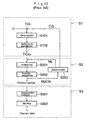
- titanium tetrachloride is reduced to titanium metal in the presence of magnesium metal (Mg) (reduction: S201).
- Mg magnesium metal
- the reduction is conducted by introducing magnesium metal to a hermetically sealed iron vessel, melting the magnesium metal at 975°C and adding titanium tetrachloride in drops to the molten magnesium metal.
- the titanium metal obtained by the reduction of titanium tetrachloride normally occurs as a large lump reproducing the inner shape of the apparatus used for the reduction reaction, for example, as a cylindrical lump; it is a porous solid or the so-called titanium metal sponge and contains the byproduct magnesium chloride and the unreacted magnesium metal; generally, the center of the sponge has dissolved oxygen on the order of 400-600 ppm and is tough while the skin has dissolved oxygen on the order of 800-1000 ppm and is hard.
- This titanium metal sponge is then subjected to vacuum separation where the sponge is heated at 1000 °C or above under reduced pressure of 10 -1 -10 -4 Torr to separate the byproduct magnesium chloride (MgCl 2 ) and the unreacted magnesium metal (vacuum separation: S202).
- the magnesium chloride thus recovered by the vacuum separation is decomposed by electrolysis into magnesium metal and chlorine gas (Cl 2 ) (electrolysis: S203), the magnesium metal recovered here is utilized, together with the unreacted magnesium metal recovered earlier in the vacuum separation (not shown), in the aforementioned reduction of titanium tetrachloride while the recovered chlorine gas is utilized in the aforementioned chlorination of titanium oxide.
- the sponge formed as a large lump is crushed and ground (crushing and grinding treatment) in advance for the preparation of primary electrode briquettes. If circumstances require, the ground sponge is sorted out in consideration of the purpose of use of ingot and the difference in the concentration of dissolved oxygen by site (center or skin); for example, the ground sponge originating mainly from the center is collected in the case where tough titanium metal is required while the ground sponge originating mainly from the skin is collected in the case where hard titanium metal is required.
- the ground titanium metal sponge prepared in this manner is then molded into briquettes in the compression molding step (compression molding: S301) and a plurality of the briquettes are placed one upon another and welded together by the TIG welding process to yield a cylindrical electrode; thereafter the electrode is melted by vacuum arc melting, high frequency melting and the like (melting: S302) and an oxide skin on the surface is cut off to yield the product titanium ingot.
- titanium oxide although used as the raw material, is first converted into low-boiling titanium tetrachloride and then reduced and this procedure extends the manufacturing step; vacuum separation at high temperatures is an essential step in the manufacture of titanium metal sponge; moreover, titanium metal sponge occurring as a large lump must be crushed and ground in the manufacture of the product titanium ingot; still more, the sponge differs markedly in the concentration of dissolved oxygen between the center and the skin and the ground sponge needs to be sorted out to the one originating from the center and that from the skin depending upon the use of the product titanium ingot.
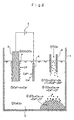
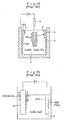
- a reactor consists of a graphite crucible a as an anode and a molybdenum electrode b in the center as a cathode, a mixed molten salt c which is composed of calcium chloride (CaCl 2 ), calcium oxide (CaO) and titanium oxide (TiO 2 ) and kept at 900-1100 °C is charged into the crucible a, the titanium oxide is electrolyzed in an inert atmosphere of argon (not shown) and the titanium ions formed (Ti 4+ ) are deposited on the surface of molybdenum electrode b to give titanium metal d.
- a mixed molten salt c which is composed of calcium chloride (CaCl 2 ), calcium oxide (CaO) and titanium oxide (TiO 2 ) and kept at 900-1100 °C is charged into the crucible a, the titanium oxide is electrolyzed in an inert atmosphere of argon (not shown) and the titanium ions formed (T
- molten calcium chloride c (CaCl 2 ) is charged into a reaction vessel, a graphite electrode a as an anode and a titanium oxide electrode b as a cathode are arranged inside the molten salt c and a voltage is applied between the graphite electrode a and the titanium oxide electrode b thereby extracting oxygen ions (O 2- ) from the titanium oxide cathode b and releasing the oxygen ions as carbon dioxide (CO 2 ) and/or oxygen (O 2 ) at the graphite anode a or reducing the titanium oxide electrode b itself to titanium metal d.
- molten calcium chloride c CaCl 2
- the deposited titanium metal d is kept in continuous contact with calcium oxide of high concentration in the mixed molten salt c and this makes it difficult to produce titanium metal d of excellent toughness by controlling or lowering the concentration of dissolved oxygen in the titanium metal d being produced; moreover, titanium metal forms fine tree-shaped deposits on the surface of the molybdenum electrode b and this makes the mass production difficult.
- the method of Takeuchi and Watanabe is suitable as a commercial method or not.
- the method described in WO 99/64638 has the following problem; the deoxidization requires a long time because oxygen is present in a small amount in the titanium metal d formed at the cathode and its diffusion in solid becomes the rate-determining step.
- the inventors of this invention have conducted studies on a method and apparatus for smelting titanium metal which, unlike the Kroll process, can easily produce titanium metal without requiring the steps for vacuum separation at high temperatures and crushing and grinding of titanium metal sponge and additionally can control easily the concentration of dissolved oxygen in the product titanium metal.
- titanium metal (Ti) continuously by the thermal reduction of titanium oxide in the following manner: a molten salt consisting of calcium chloride (CaCl 2 ) and calcium oxide (CaO) was prepared as a reaction region inside a reaction vessel, the molten salt in the reaction region was electrolyzed to generate monovalent calcium ions (Ca + ) and/or calcium (Ca) thereby converting the molten salt into a strongly reducing molten salt, titanium oxide (TiO 2 ) was supplied to the strongly reducing molten salt and the titanium oxide was reduced and the resulting titanium metal was deoxidized by the monovalent calcium ions (Ca + ) and/or calcium (Ca).
- the inventors have further found it possible not only to produce titanium metal advantageously on a commercial scale but also to control the concentration of dissolved oxygen in titanium metal and completed this invention.
- an object of this invention is to provide a method for smelting titanium metal which is capable of producing titanium metal commercially advantageously.
- Another object of this invention is to provide a method for smelting titanium metal which is capable of producing titanium metal with a controlled concentration of dissolved oxygen commercially advantageously.
- a further object of this invention is to provide an apparatus for smelting titanium metal which is capable of producing titanium metal commercially advantageously.
- a still further object of this invention is to provide an apparatus for smelting titanium metal which is capable of producing titanium metal with a controlled concentration of dissolved oxygen commercially advantageously.
- this invention relates to a method for smelting titanium metal which is based on the thermal reduction of titanium oxide (TiO 2 ) to titanium metal (Ti) and comprises charging a mixed salt of calcium chloride (CaCl 2 ) and calcium oxide (CaO) into a reaction vessel, heating the mixed salt to prepare a molten salt consituting a reaction region, electrolyzing the molten salt in the reaction region thereby converting the molten salt into a strongly reducing molten salt containing monovalent calcium ions (Ca + ) and/or calcium (Ca), supplying titanium oxide to the strongly reducing molten salt and reducing the titanium oxide and deoxidizing the resulting titanium metal by the monovalent calcium ions (Ca + ) and/or calcium (Ca).
- This invention further relates to a method for smelting titanium metal wherein the reaction region constituted by the aforementioned molten salt is divided into an electrolysis zone where the molten salt is electrolyzed and a reduction zone where the titanium oxide is reduced and the resulting titanium metal is deoxidized.
- This invention further relates to an apparatus for smelting titanium metal by the thermal reduction of titanium oxide (TiO 2 ) to titanium metal (Ti) and comprises a reaction vessel for holding a molten salt of calcium chloride (CaCl 2 ) and calcium oxide (CaO) constituting a reaction region, an anode and a cathode which are put in place at a specified interval in the reaction vessel and used in the electrolysis of the molten salt, a gas-introducing device to maintain a part or the whole of the upper part of the reaction region in an atmosphere of inert gas and a raw material supply device from which titanium oxide is supplied to the reaction region in an atmosphere of inert gas.
- a reaction vessel for holding a molten salt of calcium chloride (CaCl 2 ) and calcium oxide (CaO) constituting a reaction region, an anode and a cathode which are put in place at a specified interval in the reaction vessel and used in the electrolysis of the molten salt, a gas-
- This invention still further relates to an apparatus for smelting titanium metal wherein the aforementioned reaction vessel is divided into an electrolysis zone where the molten salt is electrolyzed and a reduction zone where titanium oxide is reduced and the resulting titanium metal is deoxidized and a partitioning device is provided which allows the monovalent calcium ions (Ca + ) and/or calcium (Ca) generated in the electrolysis zone to migrate to the reduction zone and allows the calcium oxide (CaO) formed in the reduction zone to migrate to the electrolysis zone.
- a partitioning device is provided which allows the monovalent calcium ions (Ca + ) and/or calcium (Ca) generated in the electrolysis zone to migrate to the reduction zone and allows the calcium oxide (CaO) formed in the reduction zone to migrate to the electrolysis zone.
- a molten salt consisting of calcium chloride (CaCl 2 ) and calcium oxide (CaO) and/or calcium (Ca) and usually kept at 750-1000 °C is used as a reaction medium constituting the reaction region for the reduction of titanium oxide.
- the molten salt constituting this reaction region may consist of calcium chloride (CaCl 2 ) alone at the start of electrolysis and, in such a case, the electrolysis of calcium chloride generates monovalent calcium ions (Ca + ) and electrons (e) and the formation of calcium oxide (CaO) and calcium (Ca) occurs immediately thereafter.
- the range where calcium and calcium oxide exist in the molten salt is normally 1.5% by weight or less for calcium and 11.0% by weight or less for calcium oxide; for example, when the mixed molten salt exists at a temperature of 900 °C, calcium exists in the range of 0.5-1.5% by weight and calcium oxide in the range of 0.1-5.0% by weight.
- the monovalent calcium ions (Ca + ) and electrons (e) generated by the electrolysis of the aforementioned molten salt are used as a reducing agent and a deoxidizing agent of titanium oxide.
- the composition of the molten salt is adjusted in consideration of the concentration of dissolved oxygen in the titanium metal to be produced.
- a higher concentration ratio Ca/CaO in the molten salt increases the ability to perform reduction and deoxidization but decreases the ability to electrolyze calcium oxide.
- the concentrations of Ca and CaO can be adjusted, for example, by controlling the strength of electric current in the electrolysis and the rate of supply of the raw material titanium oxide.
- the reaction region constituted by the aforementioned molten salt is divided into an electrolysis zone where the molten salt is electrolyzed and a reduction zone where titanium oxide is reduced and the resulting titanium metal is deoxidized; the molten salt is electrolyzed in the electrolysis zone to generate monovalent calcium ions (Ca + ) and/or calcium (Ca) to be used as a reducing agent in the reduction of titanium oxide and as a deoxidizing agent in the deoxidization of the resulting titanium metal and the monovalent calcium ions (Ca + ) and/or calcium (Ca) generated in the electrolysis zone reduce titanium oxide to titanium metal and remove oxygen dissolved in the titanium metal in the reduction zone.
- a device for dividing the aforementioned reaction region into the electrolysis zone and the reduction zone allows the monovalent calcium ions (Ca + ) and/or calcium (Ca) generated in the electrolysis zone to migrate to the reduction zone and allows the calcium oxide formed in the reduction zone to migrate to the electrolysis zone and there is no specific restriction on the device as long as it preferably prevents the raw material titanium oxide supplied to the reduction zone and the titanium metal formed in the reduction zone from migrating to the electrolysis zone.
- the following constructions are conceivable; to provide a partition wall or the like between the two zones, to construct the electrolysis zone and/or the reduction zone by an electrolysis reaction vessel and/or a reduction reaction vessel, to utilize a cathode material as a partition in constructing a cathode face to face with an anode in the electrolysis zone, or to mark off the reduction zone in the center of the reaction region and arrange a cathode material to form the electrolysis zone on both sides of or in the periphery of the reduction zone.
- the anode in the aforementioned electrolysis zone is made of a carbonaceous anode material such as graphite, coke and pitch and it captures oxygen evolving in the electrolysis of calcium oxide in the molten salt and releases it from the reaction region as carbon monoxide and/or carbon dioxide.
- the carbonaceous anode material used here preferably forms a slope shaped like an overhang at least in the portion to be immersed in the molten salt; this will allow carbon dioxide formed on the surface of this carbonaceous anode material to rise along the overhang-shaped slope and escape from the system without unnecessarily dispersing in the molten salt.
- this titanium oxide when titanium oxide is supplied to the molten salt in the reduction zone, this titanium oxide is reduced instantaneously by the monovalent calcium ions in the molten salt and the titanium metal particles formed descend while agglomerating and sintering; during the descent, the amorphous titanium metal particles join together loosely, grow into a coarse porous lump with a size ranging from several millimeters to several tens of millimeters (the so-called titanium metal sponge) and accumulate at the bottom of the reduction zone (or at the bottom of the reduction reaction vessel).
- the titanium metal recovered from the reduction zone is washed with water and/or dilute hydrochloric acid for removal of calcium chloride and calcium oxide adhered to the surface. Washing of titanium metal by water and/or acid is carried out, for example, by a combination of a step for dissolving the adhered salts in a washing tank by applying high-pressure water and a step for recovering titanium metal by a wet cyclone and the like.
- the titanium metal produced in the aforementioned manner is, similarly to the conventional Kroll process, molded into an electrode in the compression molding step and then submitted to the melting step such as vacuum arc melting and high frequency melting and the skin of the molten ingot is adjusted to give the product titanium ingot.
- Fig. 1 is a flow chart illustrating the method of this invention for smelting titanium metal and Fig. 2 is a schematic drawing of the apparatus used in the method for smelting titanium metal of this invention.
- the smelting apparatus of this invention comprises a reaction vessel 1, a molten salt which is prepared by heating a mixture of calcium chloride (CaCl 2 ) and calcium oxide (CaO) at 750-1000 °C and put in the reaction vessel 1 to constitute a reaction region 2, an anode 3 and a cathode 4 which are put in place facing each other in the reaction region 2 and connected to a direct current source 5 to effect the electrolysis of the molten salt (CaCl 2 and/or CaO) and a raw material inlet 6 which is positioned away from the anode 3 with the cathode 4 in between and supplies the raw material titanium oxide to the reaction region 2.
- a direct current source 5 to effect the electrolysis of the molten salt (CaCl 2 and/or CaO)
- a raw material inlet 6 which is positioned away from the anode 3 with the cathode 4 in between and supplies the raw material titanium oxide to the reaction region 2.
- the reaction region 2 consists of an electrolysis zone where the electrolysis is effected by the anode 3 and cathode 4 and a reduction zone where titanium oxide supplied from the raw material inlet 6 is reduced and the resulting titanium metal is deoxidized.
- the anode 3 is made of a consumable carbonaceous anode material such as graphite, coke and pitch and the cathode 4 is made of a nonconsumable cathode material such as iron and titanium.
- the smelting of titanium metal by the use of the reaction vessel 1 is performed as follows. First, a mixture of calcium chloride (CaCl 2 ) and calcium oxide (CaO) is charged into the reaction vessel 1 and melted at 750-1000°C to yield a molten salt which constitutes the reaction region 2.
- calcium chloride (2 ⁇ in Fig. 2) functions as a solvent.
- the calcium ions of calcium chloride is divalent stoichiometrically, but monovalent calcium ions (Ca + ) also exist in the molten calcium chloride and a molten salt in which these monovalent calcium ions (Ca + ) exist forms a homogeneous liquid phase of a three-component system CaCl 2 -CaO-Ca.
- the molten salt constituting the reaction region 2 may consist of calcium chloride alone at the start of the electrolysis and, in such a case, calcium chloride is electrolyzed to generate monovalent calcium ions (Ca + ) and electrons (e) and a part of the monovalent calcium ions forms calcium oxide (CaO) and calcium (Ca) immediately after the start of the electrolysis.
- the ranges of existence of calcium and calcium oxide in the molten salt constituting the reaction region 2 are normally 1.5% by weight or less for calcium and 11.0% by weight or less for calcium oxide; for example, when the temperature of the molten salt is 900°C, the range for calcium is 0.5-1.5% by weight and that for calcium oxide is 0.1-5.0% by weight.
- the monovalent calcium ions in the molten salt are used as a reducing agent and deoxidizing agent of titanium oxide and here the composition of the molten salt is adjusted in consideration of the concentration of dissolved oxygen in the titanium metal to be produced; a higher concentration ratio Ca/CaO in the molten salt increases the ability to perform reduction and deoxidization but decreases the ability to perform electrolysis.
- the concentrations of Ca and CaO are adjusted, for example, by controlling the strength of electric current used for the electrolysis and the rate of supply of the raw material titanium oxide.
- the electrolysis of the aforementioned molten salt generates monovalent calcium ions (Ca + ) and/or calcium (Ca) thereby converting the molten salt into a strongly reducing molten salt and, after the start of the reduction of titanium oxide and deoxidization of the resulting titanium metal, makes up for the monovalent calcium ions (Ca + ) and/or calcium (Ca) consumed in the reduction and deoxidization.
- the electrolysis is conducted at a direct current voltage below the decomposition voltage of calcium chloride (for example, 3.0 V or so) and, as shown by reaction formula 3 ⁇ in Fig.
- the electrons supplied from the cathode 4 made of a nonconsumable electrode material reduce the divalent calcium ions (Ca 2+ ) in the molten salt to monovalent calcium ions and, when the monovalent calcium ions reach their solubility in the molten salt, pure calcium (Ca) starts to separate out.
- the molten salt in the reaction region 2 becomes a strongly reducing molten salt due to the existence therein of the monovalent calcium ions (Ca + ) and/or calcium (Ca) and titanium oxide (TiO 2 , 1 ⁇ in Fig. 2) supplied from the raw material inlet 6 to the reaction region 2 is reduced by the monovalent calcium ions and/or calcium in accordance with reaction formulas 5 ⁇ and 6 ⁇ in Fig. 2 or reaction formulas (4) and (5) below and dissolved oxygen ([O] Ti ) in the titanium metal formed is removed.
- the monovalent calcium ions (Ca + ) near the titanium particles decrease in concetration as they are consumed and, contrarily, the oxygen ions (O 2- ) increase in concentration and so does calcium oxide (CaO).
- titanium oxide is continuously supplied from the raw material inlet 6 to the molten salt in the reaction region 2 and reduced during its descent through the strongly reducing molten salt and the resulting titanium metal is deoxidized; from the point of time when the titanium oxide phase changes into the titanium metal phase, titanium particles grow in size by agglomeration and a slurry containing a high density of the titanium particles with a particle diameter of 0.1-1 mm accumulates at the bottom of the reaction vessel 1.
- the deoxidization reaction of the titanium particles proceeds also in the slurry in accordance with reaction formula 6 ⁇ in Fig. 2 or reaction formula (5) described above.
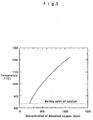
- the equilibrium concentration of oxygen which dissolves in titanium when titanium metal (Ti) exists in equilibrium with pure calcium (Ca) and calcium oxide (CaO) is illustrated in Fig. 3.
- the electrolysis of calcium oxide in calcium chloride between the anode 3 made of a consumable carbonaceous anode material and the cathode 4 made of a nonconsumable cathode material forms calcium-saturated calcium chloride either saturated with dissolved calcium or coexisting with pure calcium in the vicinity of the cathode 4.
- the theoretical decomposition voltage E O here can be expressed as a function of temperature as illustrated in Fig. 5.
- the electrolysis of calcium oxide plays a part of reducing divalent calcium ions (Ca +2 ) of calcium oxide in calcium chloride to monovalent calcium ions (Ca + ), diffusing the monovalent calcium ions into the molten salt and making up for the monovalent calcium ions consumed in the reduction and deoxidization of titanium oxide thereby practically restoring the concentration of calcium to saturation, that is, plays a part of maintaining the strongly reducing molten salt and does not necessarily aim at preparing pure calcium.
- Liquid calcium may separate out when the rate of generation of the monovalent calcium ions in the electrolysis exeeds the rate of consumption of the monovalent calcium ions in the reduction and deoxidization of titanium oxide; however, this does not cause inconvenience in the smelting of titanium according to this invention.
- the titanium metal prepared in the aforementioned manner is normally taken out of the reaction vessel 1 as titanium metal sponge or as a slurry of the sponge and submitted to washing with water and dilute hydrochloric acid as illustrated in Fig. 1.
- the washing of titanium metal with water is carried out by cooling titanium metal, throwing the metal in water and agitating; titanium metal precipitates while calcium chloride adhering to the metal dissolves in water and calcium oxide forms a suspension of calcium hydroxide in water.
- the calcium compounds adhering to the metal dissolve in the acid and are then removed by washing with water.
- the titanium metal dried after washing with water and dilute hydrochloric acid is molded by compression into a briquette by a means such as a press; the briquette is either made into the product titanium ingot by electron beam melting or fabricated into an electrode, melted by vacuum arc melting or high frequency melting and adjusted for the cast skin to yield the product titanium ingot.
- Fig. 6 is a schematic diagram illustrating in outline the apparatus of this invention for smelting titanium metal related to Example 1.
- the smelting apparatus in Example 1 performs the smelting of titanium in the coexistence of an electrolysis zone and a reduction zone in a reaction region 2 and is equipped with a reaction vessel 1 (a vessel made of stainless steel) containing a molten salt consisting of calcium chloride (CaCl 2 ) and calcium oxide (CaO), an airtight vessel 7 holding the reaction vessel 1, a gas-introducing device 8 provided in the airtight vessel 7 for introducing an inert gas such as argon (Ar) to the inside of the aritight vessel 7, and an anode 3 that is a consumable carbonaceous anode material made of a graphite plate and a cathode 4 that is a cathode material made of iron arranged in the molten salt in the reaction vessel 1.
- a reaction vessel 1 a vessel made of stainless steel
- an airtight vessel 7 holding the reaction vessel
- the aforementioned airtight vessel 7 consists of a main body 7a which is made of alumina and holds the reaction vessel 1 and a cover 7b which is made of stainless steel and closes the open end of the main body 7a and the aforementioned gas-introducing device 8 is provided in the cover 7b and consists of a gas inlet 8a and a gas outlet 8b. Furthermore, an electric furnace heating element 9 for heating the molten salt is arranged around the lower part of the main body 7a and a thermocouple 10 enclosed in a protective tube 10a is inserted from an opening in the cover 7b down to the vicinity of the aforementioned reaction vessel 1 to measure the temperature of the molten salt.
- the smelting apparatus of Example 1 is provided with a reduction reaction vessel 11 (a device for supply of raw material) which is made of molybdenum and open in the upper part and contains titanium oxide particles 12; it can be immersed in or pulled out of the molten salt at a place away from the cathode 4 with the anode 3 in between by a hanging line 11a and it allows a strongly reducing molten salt containing monovalent calicum ions to flow in from the open end.
- a reduction reaction vessel 11 a device for supply of raw material
- a reduction reaction vessel 11 which is made of molybdenum and open in the upper part and contains titanium oxide particles 12; it can be immersed in or pulled out of the molten salt at a place away from the cathode 4 with the anode 3 in between by a hanging line 11a and it allows a strongly reducing molten salt containing monovalent calicum ions to flow in from the open end.
- the aforementioned anode 3 and cathode 4 are connected to a direct current source 5 and, further, the cathode 4 is connected to the reaction vessel 1 to keep the two at the same electric potential and a decomposition voltage of, say, 2.9 V is applied to the anode 3, cathode 4 and reaction vessel 1.
- Example 1 an observation hole 13 is provided in the cover 7b of the airtight vessel 7 for observation of the condition inside the reaction vessel 1 and, in addition, a liquid level sensor 14 is provided in the cover 7b to detect the level of the molten salt.
- the direct current source 5 is connected to the cathode 4 and the reaction vessel 1 in parallel to keep the two at the same electric potential.
- Titanium metal can be prepared in the following manner by the use of the smelting apparatus related to Example 1.
- reaction region 2 a calcium chloride bath consisting of a molten mixture of calcium chloride and calcium oxide.
- the anode 3 made of a graphite plate measuring 100 mm ⁇ 50 mm ⁇ 15 mm and the cathode 4 made of an iron plate measuring 60 mm ⁇ 50 mm ⁇ 5 mm are inserted into this reaction region 2 vertically face to face at an interval of 40 mm and the reduction reaction vessel 11 made of molybdenum and containing 20 g of the titanium oxide particles 12 is immersed in the reaction region 2 in the rear of the cathode 4 (on the opposite side of the anode 3) by means of the hanging line 11a.
- an atmosphere of inert gas (Ar) is created inside the reaction vessel 1 with the aid of the gas inlet 8a and the gas outlet 8b of the gas-introducing device 8 and the inside of the reaction vessel 1 is observed through the observation hole 13.
- the electrolysis is carried out at 900 °C with observable release of the bubbles 15 of CO and CO 2 from the vicinity of the anode 3; the monovalent calcium ions (Ca + ) and/or calcium (Ca) generated by the electrolysis reduce titanium oxide contained in the reduction reaction vessel 11 and deoxidize the resulting titanium metal.
- the supply of electric current to the electric furnace heating element 9 is stopped, the reduction reaction vessel 11 is pulled out of the reaction region 2 of the reaction vessel 1, the electric furnace is cooled in this condition, then the reaction vessel 11 is taken out of the airtight vessel 7 and washed successively with water and dilute hydrochloric acid and the titanium metal remaining in the reduction reaction vessel 11 is recovered.
- Fig. 7 is a schematic cross section diagram illustrating in outline the smelting apparatus related to Example 2.
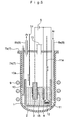
- a reaction vessel 1 has a double structure consisting of a reduction reaction vessel 1a which is made of iron and relatively large in size and in which the reduction reaction of titanium oxide is carried out and an electrolysis reaction vessel 1b which is relatively small in size and placed in the aforementioned reduction reaction vessel 1a at a specified interval and in which the electrolysis of a molten salt is carried out.
- the reaction vessel 1 is put in an airtight vessel 7 consisting of a main body 7a made of stainless steel and a cover 7b closing an open end at the top.
- the aforementioned cover 7b is provided with a cathode lead tube 21 which penetrates the center of the cover 7b and reaches the molten salt inside the aforementioned electrolysis reaction vessel 1b and is connected to a cathode 4 made of iron at the lower end, a gas-introducing device 8 which consists of a gas inlet 8a and a gas outlet 8b, and a raw material supply tube 22 (a device for supply of raw material) which charges titanium oxide into the aforementioned reduction reaction vessel 1a.
- a cathode lead tube 21 which penetrates the center of the cover 7b and reaches the molten salt inside the aforementioned electrolysis reaction vessel 1b and is connected to a cathode 4 made of iron at the lower end
- a gas-introducing device 8 which consists of a gas inlet 8a and a gas outlet 8b
- a raw material supply tube 22 (a device for supply of raw material) which charges titanium oxide into the aforementioned reduction reaction vessel 1a.
- a cover 21a closing an open end at the top of the aforementioned cathode lead tube 21 is provided with an exhaust tube 23 which penetrates the cover 21a and reaches above the molten salt in the electrolysis reaction vessel 1b and discharges a gaseous mixture of CO and CO 2 evolving from a cylindrical graphite anode 3 in the electrolysis reaction vessel 1b.
- a cover 23a closing an open end at the top of the exhaust tube 23 is provided with a salt input tube 24 which penetrates the center of the cover 23a and reaches above the molten salt constituting the reaction region 2 in the electrolysis reaction vessel 1b and charges a mixed salt of calcium chloride and calcium oxide into the electrolysis reaction vessel 1b and is further provided with an exhaust pipe 23b for discharging the gaseous mixture of CO and CO 2 .
- a cylindrical graphite anode 3 is attached to the lower end of the aforementioned salt inlet tube 24 at a specified interval from the aforementioned cathode 4 and the gaseous mixture of CO and CO 2 evolving from the anode 3 is led to the exhaust tube 23 and let out from the exhaust pipe 23b provided in the cover 23a.
- the cathode lead tube 21 penetrating the cover 7b, the exhaust tube 23 penetrating the cover 21a of the cathode lead tube 21, and the salt input tube 24 penetrating the cover 23a of the exhaust tube 23 are respectively insulated electrically by means of an insulator 25. Moreover, a through hole 21b penetrating the side wall of the aforementioned cathode lead tube 21 is provided above the electrolysis reaction vessel 1b in the airtight vessel 7.
- the aforementioned cover 7b is fitted with a thermocouple 10 enclosed in a protective tube 1a and with a stirrer 20 which extends down into the molten salt in the reduction reaction vessel 1a for stirring the molten salt and the salt input tube 24 having the anode 3 at its lower end and the cathode lead tube 21 having the cathode 4 at its lower end are connected to a direct current source (not shown).
- the reaction vessel 1 is divided into the reduction reaction vessel 1a and the electrolysis reaction vessel 1b and this structure divides the reaction region 2 constituted by the molten salt into a reduction zone 2a in the reduction reaction vessel 1a and an electrolysis zone 2b in the electrolysis reaction vessel 1b.
- the air inside the airtight vessel 7 is replaced wholly by argon gas with the aid of the gas-introducing device 8, a mixed salt of calcium chloride and calicum oxide is charged into the electrolysis reaction vessel 1b through the salt inlet tube 24 and the electrolysis reaction vessel 1b and the reduction reaction vessel 1a are kept at a temperature of 900°C by a heating apparatus (not shown).
- a decomposition voltage is applied betwen the anode 3 and the cathode 4 by a direct current source (not shown) to effect the electrolysis of calcium chloride and calcium oxide in the electrolysis reaction vessel 1b.
- Continuous supply of the mixed salt causes the molten salt containing calcium obtained by the electrolysis to overflow the electrolysis reaction vessel 1b as an overflow 2c and enter the reduction reaction vessel 1a which is held in the electrolysis reaction vessel 1b.
- the molten salt supplied to the reduction reaction vessel 1a by the overflow 2c from the electrolysis reaction vessel 1b is agitated by the stirrer 20 and titanium oxide is continuously supplied from the raw material supply tube 22 to the stirred molten salt to effect the reduction of the titanium oxide and deoxidization of the resulting titanium metal by the monovalent calcium ions (Ca + ) and/or calcium (Ca) existing in the molten salt.
- This operation is conducted continuously for, say, three hours and terminated after accumulation of a specified amount of titanium metal in the reduction reaction vessel 1a.
- the cooled reduction reaction vessel 1a is taken out and immersed in water to elute calcium chloride and the precipitated titanium metal particles are separated from suspended calcium hydroxide, washed with dilute hydrochloride acid, then washed with water and dried to recover titanium metal.
- the concentration of dissolved oxygen in the titanium metal particles obtained in Example 2 was 1013 ppm.
- Figs. 8 and 9 are schematic cross section diagrams of the smelting apparatus of this invention related to Example 3.
- the smelting apparatus has a reaction vessel 1 which is a box-shaped steel vessel 1c doubly lined with a 200 mm-thick graphite lining 1d and a stainless steel lining 1e and has an inner space measuring 1 m in length, 0.7 m in width and 1 m in height, an iron cylinder which is provided with a gas-introducing device 8 consisting of a gas inlet 8a and a gas outlet 8b in the upper part for introducing inert argon gas (Ar) and a cover 4a which is electrically insulating and closes an open end at the top and is further provided in the lower periphery with a cathode 4 which is made of titanium metal by cutting up a part of the lower periphery from the bottom upward and has a large number of through holes slanting downward (not shown) at the lower pheriphery, and an anode 3 which is made of a carbonaceous material such as graphite and placed around the cathode 4 with a distance
- a reduction reaction vessel 1a made of titanium metal is placed inside the lower part of the cylindrical cathode 4; the reduction reaction vessel 1a is cylindrical in shape, open at the upper end and put in place with a gap of 5 cm maintained from the surrounding cylindrical cathode 4 and it is provided with a raw material inlet 26 in the upper part for receiving titanium oxide supplied from a raw material supply tube 22 (a device for supply of raw material) which penetrates the center of the cover 4a of the cylindrical cathode 4, an inflow hole 27 which is a relatively large through hole formed in the upper wall, and a storing section 28 which has a large number of relatively small through holes or outflow holes 29 on the lower wall and at the bottom.
- the reduction reaction vessel 1a can be pulled out by a device for pulling up and down (not shown).
- Example 3 the aforementioned anode 3 is immersed in the molten mixed salt face to face with the cathode 4 and provided with a slope 3a, in the shape of an overhang, at an angle of 5-45 degrees from the vertical direction on the side facing the cathode 4; carbon dioxide (CO 2 ) evolving on the slope 3a of the anode 3 rises guided by this overhang.
- an electrolysis zone 50 cm in width and 60 cm in height in counter area, is formed in the portions of the anode 3 and the cathode 4 immersed in the molten mixed salt.
- Example 3 a reaction region 2 is formed in the aforementioned reaction vessel 1 by charging 350 kg of a molten salt prepared in advance by heating calcium chloride (CaCl 2 ) containing 5.5% by weight of calcium oxide (CaO) at 1000 °C and the aforementioned cathode 4, functioning as a partition wall, divides the reaction region 2 into an electrolysis zone 2b between the anode 3 and the cathode 4 and a reduction zone 2a inside the cylindrical cathode 4, particularly inside the reduction reaction vessel 1a.
- CaCl 2 calcium chloride
- CaO calcium oxide
- titanium oxide particles with an average particle diameter of 0.5 ⁇ m are charged together with argon gas through the raw material supply tube 22 into the reduction zone 2a in the raw material inlet 26 of the reduction reaction vessel 1a under the aforementioned condition, the titanium oxide is reduced instantaneously by the monovalent calcium ions (Ca + ) and/or calcium (Ca) with evolution of heat and the titanium metal particles separated descend through the molten mixed salt in the reduction zone 2a while sintering repeatedly and accumulate as titanium metal sponge 30 in the storing section 28 at the bottom of the reduction reaction vessel 1a.
- monovalent calcium ions Ca +
- Ca calcium
- the molten salt constituting the reaction region 2 in the reaction vessel 1 generates a gently rising current by the effect of the rising monovalent calcium ions (Ca + ) and/or calcium (Ca) in the electrolysis zone 2b while the molten salt in the reduction zone 2a, particularly in the reduction reaction vessel 1a, generates a gently descending current by the effect of the descending titanium metal sponge 30; in Fig. 9 which is a partial magnification of Fig. 8, a current of the molten salt gently flowing in the clockwise direction is generated between the electrolysis zone 2b and the reduction zone 2a, particularly the reduction reaction vessel 1a.
- the current of the molten salt having passed through the storing section 28 of the reduction reaction vessel 1a dissolves calcium oxide formed in the reduction of titanium oxide and deoxidization of titanium metal sponge 30 in the reduction zone 2b of the reduction reaction vessel 1a and transfers this calcium oxide into the electrolysis zone 2b through a large number of outflow holes 29 in the storing section 28.
- the reduction reaction vessel 1a is pulled up gently by the device for pulling up and down (not shown) and the titanium metal sponge 30 is taken out of the reduction reaction vessel 1a and recovered.
- Titanium oxide with a purity of 99.8% by weight was charged together with argon gas through the raw material supply tube 22 into the reduction reaction vessel 1a and sprayed together with the argon gas to the whole surface of the molten salt at a supply rate of 11 g/min.
- the electrolysis and supply of titanium oxide were continued for 12 hours, the supply of titanium oxide was stopped and, 3 hours thereafter, the reduction reaction vessel 1a was pulled up at a rate of 6 cm/min, cooled to 300 °C, taken out and allowed to cool to the atmospheric temperature.
- the reduction reaction vessel 1a which had been pulled out and cooled to the atmospheric temperature as described above was immersed in water of 5 °C for 10 minutes to separate the titanium metal sponge 30 from the inner surface of the reduction reaction vessel 1a, then immersed in a 5 mol% aqueous solution of hydrochloric acid with stirring to remove the salts such as calcium chloride adhering to the surface of titanium metal sponge and the titanium metal sponge 30 was taken out from the reduction reaction vessel 1a and dried.
- Example 3 the sum total of titanium oxide supplied to the reduction reaction vessel 1a was 8.2 kg and the amount of titanium metal sponge was 4.8 kg and the yield was 96% by weight.
- the particle diameter of titanium metal sponge ranged widely from 0.2 mm to 30 mm and the sponge sintered relatively loosely and crumbled readily under pressure.
- the impurities or oxygen, carbon, nitrogen, iron and chlorine were determined quantitatively with the following results; oxygen 0.07 wt%, carbon 0.05 wt%, nitrogen 0.01 wt%, iron 0.18 wt% and chlorine 0.16 wt%.
- the pellets thus obtained were welded together by tungsten inert gas welding (TIG welding) to give an electrode bar, 30 mm in diameter and 150 mm in length, and the electrode bar was subjected to vacuum arc remelting (VAR) and the oxide film formed on the cast skin was cut and removed to give a round bar of titanium.
- TIG welding tungsten inert gas welding
- VAR vacuum arc remelting
- the pellets obtained above were packed in the cold hearth of an electron beam melting apparatus (a product of ALD Co., Ltd.) and the pellets in the cold hearth were melted by direct irradiation with electron beams or by electron beam melting (EBM) to give a titanium slab.
- an electron beam melting apparatus a product of ALD Co., Ltd.
- the impurities in titanium after vacuum arc remelting or electron beam melting were determined quantitatively by micro-gas analysis and emission spectroscopic analysis.
- Fig. 10 illustrates the smelting apparatus related to Example 4 of this invention.
- a reaction vessel 1 made of iron contains molten calcium chloride constituting a reaction region 2 and is provided with an anode 3 made of a carbonaceous material such as graphite and a pair of cathodes 4 made of iron and shaped like a crank in cross section, the latter arranged on both sides of the former in the molten salt; cathode 4 respectively divides the reaction region 2 into an electrolysis zone 2b existing between the anode 3 and the cathode 4 and a reduction zone 2a existing outside the cathode 4 (on the opposite side of the anode 3).
- the aforementioned reaction vessel 1 has a raw material supply inlet 32 (a device for supply of raw material) above the respective reduction zone 2a and an accumulating zone 33 in which the titanium metal 30 formed accumulates and which has a takeout port 33a for the accumulated titanium metal 30 below the respective reduction zone 2a.
- titanium oxide supplied from the raw material inlet 32 is reduced to titanium metal 30 by monovalent calcium ions (Ca + ) and/or calcium (Ca) generated in the electrolysis zone 2b; the titanium metal 30 descends the reduction zone 2a and accumulates in the accumulating zone 33 and it is deoxidized in the meantime to attain a specified concentration of dissolved oxygen.
- Ca + monovalent calcium ions
- Ca calcium
- Fig. 11 illustrates the smelting apparatus related to Example 5 of this invention and it is designed for reducing a mixture 34 of titanium oxide (TiO 2 ) and calcium chloride (CaCl 2 ) by calcium vapor (Ca).
- the smelting apparatus has an airtight vessel 7, a first reaction dish 35 which holds the mixture 34 of titanium oxide and calcium chloride, a second reaction dish 37 which is placed inside the aforementioned airtight reaction vessel 7 and holds particulate calcium (Ca) 36, a gas-introducing device 8 which consists of a gas inlet 8a and a gas outlet 8b for letting in and out an inert gas such as argon (Ar) and is used to introduce an inert gas into the airtight vessel 7 in order to maintain the inside of the airtight vessel 7 in an atmosphere of inert gas, and a heating device such as an electric furnace heating element 9 for heating the mixture 34 in the first reaction dish 35 and the particulate calcium 36 in the second reaction dish 37; calcium vapor from mol
- Example 5 the first reaction dish 35 is positioned above the second reaction dish 37 and they are placed in the reaction vessel 1 which is made of stainless steel and fitted with a stainless steel cover 1f.
- the reaction vessel 1 is put between a base plate 38 and a top plate 39 and they are screwed tight by a volt 40 and a nut 41 so that the cover 1f hermetically closes the reaction vessel 1 and the calcium vapor dissolves in the molten salt in the first reaction dish 35 efficiently without dispersing in the whole space of the airtight vessel 7.
- the edge of the upper open end of the reaction vessel 1 is tapered like a knife edge to enhance the airtightness created by the cover 1f.
- the aforementioned airtight vessel 7 consists of a main body 7a and a cover 7b and is equipped with a thermocouple 10 such as an alumel ⁇ chromel thermocuple to measure the temperature inside, particularly, the temperature in the vicinity of the reaction vessel 1.
- a thermocouple 10 such as an alumel ⁇ chromel thermocuple to measure the temperature inside, particularly, the temperature in the vicinity of the reaction vessel 1.
- the contents of the first reaction dish 35 separate into two layers, molten calcium chloride (which constitutes the reaction region) forming the upper layer and solid titanium oxide the lower layer, and titanium oxide is completely covered by molten calcium chloride and shut off from the gas phase outside.
- Calcium vapor evolving from molten calcium (Ca) in the second reaction dish 37 at the bottom fills the reaction vessel 1 and dissolves in molten calcium chloride to reduce titanium oxide and deoxidize the resulting titanium metal.
- the furnace is cooled, the reaction product is taken out of the first reaction dish 35, washed successively with water and dilute hydrochloric acid and titanium metal is recovered and dried.
- Example 5 In the experiments conducted in Example 5, an experimental smelting apparatus containing the reaction vessel 1, 50 mm in internal diameter and 80 mm in height, and the airtight vessel 7, 350 mm in internal diameter and 720 mm in length, was constructed; the reduction and deoxidization of titanium oxide were carried out under the conditioins shown in Table 2 and the titanium metal obtained was determined for its concentration of dissolved oxygen.
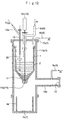
- a reaction vessel 1 which is made of iron and holds a molten salt constituting a reaction region 2 is provided with a discharge mechanism 16 at the bottom; the discharge mechanism 16 consists of a discharge stopper 16a and a stopper drive 16b for opening and closing the discharge stopper.
- the aforementioned reaction vessel 1 consists of a cylinderical section which is a reduction reaction zone and holds a molten salt constituting the reaction region 2 and a funnel-shaped cone section in which the titanium metal (Ti) formed accumulates and the reaction vessel 1 as a whole is held in an airtight vessel 7.
- the titanium metal formed by the reduction in the molten salt in the reaction region 2 descends by gravity and accumulates in the cone section of the reaction vessel 1.
- the titanium metal is subject to continued deoxidization in the cone section and forms a titanium slurry 17.
- the titanium slurry 17 contains the molten salt and shows flowability as a whole; it descends by gravity, accumulates in the cone section of the reaction vessel 1 and is discharged by the aforementioned discharge mechanism 16.
- the aforementioned airtight vessel 7 is wholly made of stainless steel and consists of a main body 7a which is open at both upper and lower ends and has an observation hole 13 for observing the condition of the discharge stopper 16a of the discharge mechanism 16 provided at the lower end of the cone section of the reaction vessel 1, a cover 7b which closes the upper open end of the main body 7a and a bottom part 7c which is provided at the lower open end of the main body 7a.
- the aforementioned discharge mechanism 16 is provided above the cover 7b of the airtight vessel 7 and the stopper drive 16 b, either motor-driven or hand-operated, rotates or moves up and down the discharge stopper 16a located at the lower end of the cone section of the reaction vessel 1 thereby discharging the titanium slurry 17 down to the lower end of the reaction vessel 1.
- the bottom part 7c of the aforementioned airtight vessel 7 is provided with a water cooler (not shown) and additionally with a receiver 18 which is made of stainless steel and receives and cools the titanium slurry 17 discharged from the lower end of the cone section of the reaction vessel 1.
- An external heater capable of heating the reaction vessel 1 and the discharge stopper 16a separately and maintaining them at different temperatures is provided around the airtight vessel 7 and the cover 7b of the airtight vessel 7 is provided with a raw material supply device 19 for charging titanium oxide particles and a gas-introducing device 8 consisting of a gas inlet 8a and a gas outlet 8b. Furthermore, a separate gas inlet 8c is provided in an installation port 13a for the observation hole 13 and, in concert with the gas inlet 8a, maintains the whole inside of the airtight vessel 7 in an atmosphere of inert gas such as argon (Ar).
- inert gas such as argon (Ar).
- the aforementioned raw material supply device 19 extends down to near the surface of the molten salt of the reaction region 2 and is divided into two Y-shaped branches above the cover 7b; a raw material inlet 19a is provided at the end of one branch and a stirrer 20 for stirring and dispersing the titanium oxide particles introduced in the molten salt is provided at the end of another branch.
- the smelting apparatus related to Example 6 is operated in the following manner.
- the discharge stopper 16a at the bottom of the reaction vessel 1 is closed, argon gas is introduced through the gas inlet 8a to the airtight vessel 7 to fill the inside wholly with argon, the reaction vessel 1 is heated by an external heater (not shown) to 900°C which is above the melting point of calcium chloride and the cone section of the reaction vessel 1 where the titanium slurry 17 accumulates is maintained at 700 °C which is below the melting point of calcium chloride.
- the reaction vessel 1 Upon completion of the addition, the reaction vessel 1 is held as it is for 10 hours and, after a lapse of this time, the temperature of the cone section in the reaction vessel 1 is gradually raised by the external heater (not shown); when the temperature exceeded the melting point of calcium chloride, the discharge stopper 16a is opened by activating the stopper drive 16b, the titanium slurry 17 formed by the reduction and deoxidization of titanium oxide is discharged into the receiver 18 below and cooled there.
- the method and apparatus of this invention for smelting titanium metal are suitable for mass production with enhanced productivity as they allow facile production of high-purity titanium metal from titanium oxide of a relatively low purity and low price and further allow a continuous operation in charging of the raw material titanium oxide and discharging of the titanium metal formed; furthermore, the concentration of dissolved oxygen in the product titanium metal can be controlled and this allows commercial production of tianium metal suitable for a variety of applications.
Landscapes
- Chemical & Material Sciences (AREA)
- Engineering & Computer Science (AREA)
- Metallurgy (AREA)
- Organic Chemistry (AREA)
- Materials Engineering (AREA)
- General Life Sciences & Earth Sciences (AREA)
- Life Sciences & Earth Sciences (AREA)
- Environmental & Geological Engineering (AREA)
- Geology (AREA)
- Manufacturing & Machinery (AREA)
- Mechanical Engineering (AREA)
- Electrochemistry (AREA)
- Chemical Kinetics & Catalysis (AREA)
- Manufacture And Refinement Of Metals (AREA)
- Electrolytic Production Of Metals (AREA)
Abstract
Description
| Oxygen | Carbon | Nitrogen | Iron | Chlorine | |
| VAR (wt%) | 0.01 | 0.06 | 0.01 | 0.08 | 0.04 |
| EBM (wt%) | 0.01 | 0.05 | 0.01 | 0.02 | 0.01 |
| Experiment No. | 1 | 2 | 3 | |
| Weight of specimen (g) | TiO2 | 4.6 | 4.6 | 4.6 |
| | 0 | 100 | 100 | |
| Reduction temperature (°C) | 950 | 950 | 950 | |
| Reaction time (hr) | 24 | 1 | 3 | |
| Concentration of dissolved oxygen (wt%) | 1.883 | 0.127 | 0.085 |
Claims (21)
- A method for smelting titanium metal which relates to the thermal reduction of titanium oxide (TiO2) to titanium metal (Ti) and comprises charging a mixed salt of calcium chloride (CaCl2) and calcium oxide (CaO) into a reaction vessel, heating the mixed salt to prepare a molten salt constituting a reaction region, electrolyzing the molten salt in the reaction region thereby converting the molten salt into a strongly reducing molten salt containing monovalent calcium ions (Ca+) and/or calcium (Ca), supplying titanium oxide to the strongly reducing molten salt and reducing the titanium oxide and deoxidizing the resulting titanium metal by the monovalent calcium ions and/or calcium.
- A method for smelting titanium metal as described in claim 1 wherein the molten salt is electrolyzed continuously and titanium oxide is supplied continuously to effect continuously the reduction of the titanium oxide and deoxidization of the resulting titanium metal.
- A method for smelting titanium metal as described in claim 1 or 2 wherein the concentration of dissolved oxygen in titanium metal is controlled by controlling the time for maintaining the titanium metal formed in the molten salt.
- A method for smelting titanium metal as described in any one of claims 1 to 3 wherein the concentration of calcium (Ca) is 1.5% by weight or less and the concentration of calcium oxide (CaO) is 11.0% by weight or less in the molten salt.
- A method for smelting titanium metal as described in any one of claims 1 to 4 wherein the molten salt is electrolyzed by the use of an anode made of a consumable carbonaceous anode material and the oxygen formed by the reduction and deoxidization of titanium oxide is allowed to react with the consumable carbonaceous anode material and escape from the reaction region as carbon monoxide and/or carbon dioxide.
- A method for smelting titanium metal as described in any one of claims 1 to 5 wherein the reaction region constituted by the molten salt is divided into an electrolysis zone where the electrolysis of the molten salt is effected and a reduction zone where the reduction of titanium oxide and deoxidization of the resulting titanium metal are effected.
- A method for smelting titanium metal as described in claim 6 wherein the electrolysis zone and the reduction zone are separated by a partitioning device which allows the monovalent calcium ions and/or calcium generated in the electrolysis zone to migrate to the reduction zone and allows the calcium oxide formed in the reduction zone to migrate to the electrolysis zone.
- A method for smelting titanium metal as described in claim 7 wherein the partitioning device is a partition wall interposed between the electrolysis zone and the reduction zone.
- A method for smelting titanium metal as described in claim 7 wherein the partitioning device is a cathode material constituting the cathode confronting the anode in the electrolysis zone.
- A method for smelting titanium metal as described in any one of claims 6 to 9 wherein a reduction reaction vessel which contains titanium oxide and into which the monovalent calcium ions and/or calcium generated in the electrolysis zone flow is provided in the upper part of the reduction zone, the reduction of titanium oxide and deoxidization of the titanium metal formed are effected in the reduction reaction vessel and, upon completion of the deoxidization, the reduction reaction vessel is pulled out of the reduction zone for recovery of titanium metal.
- A method for smelting titanium metal as described in any one of claims 6 to 9 wherein the reduction zone is constructed of the reduction reaction vessel, the electrolysis zone which is smaller than the reduction reaction vessel and constructed of the electrolysis reaction vessel is put in place at a specified interval from the reduction zone in the reduction reaction vessel; in the aforementioned electrolysis reaction vessel, the molten salt is continuously supplied to the electrolysis reaction vessel to be electrolyzed continuously and the monovalent calcium ions and/or calcium generated in the electrolysis are allowed to overflow; in the aforementioned reduction reaction vessel, titanium oxide is supplied continuously to the molten salt which has overflowed from the electrolysis reaction vessel and collected in the reduction reaction vessel and the titanium oxide is reduced and the resulting titanium metal is deoxidized by the monovalent calcium ions and/or calcium in the molten salt.
- A method for smelting titanium metal as described in any one of claims 1 to 11 wherein the titanium metal recovered from the reaction region grows by agglomeration and sintering to a size ranging from several millimeters to several tens of millimeters and occurs as a porous titanium metal sponge ready to crumble under pressure.
- A method for smelting titanium metal as described in any one of claims 1 to 12 wherein the titanium metal recovered from the reaction region is washed with water and/or dilute hydrochloric acid for removal of the adhered salts before finishing as the product titanium ingot.
- A method for smelting titanium metal which relates to the thermal reduction of titanium oxide (TiO2) to titanium metal (Ti) and comprises a stage where a first reaction dish containing a mixture of titanium oxide and calcium chloride (CaCl2) and a second reaction dish containing particulate calcium (Ca) are arranged in a airtight vessel, a stage where an inert gas is introduced to the airtight vessel and the mixture in the first reaction dish and the particulate calcium in the second reaction dish are heated in an atmosphere of the inert gas thereby melting calcium chloride in the mixture to form a molten salt and letting calcium vapor evolving from the molten calcium in the second reaction vessel dissolve in the molten salt in the first reaction dish to generate monovalent calcium ions (Ca+) and/or calcium (Ca) in the molten salt, and a stage where the titanium oxide in the molten salt is reduced and the resulting titanium metal is deoxidized by the monovalent calcium ions (Ca+) and/or calcium.
- An apparatus for smelting titanium metal which relates to the thermal reduction of titanium oxide (TiO2) to titanium metal (Ti) and comprises a reaction vessel which holds a molten salt consisting of calcium chloride (CaCl2) and calcium oxide (CaO) and constituting a reaction region, an anode and a cathode which are arranged at a specified interval in the reaction vessel and perform the electrolysis of the molten salt, a gas-introducing device for maintaining a part or the whole of the upper part of the reaction region in an atmosphere of inert gas and a raw material supply device for supplying titanium oxide to the reaction region in an atmosphere of inert gas.
- An apparatus for smelting titanium metal as described in claim 15 wherein the reaction vessel is provided with a partitioning device which divides the reaction region into an electrolysis zone where the molten salt is electrolyzed and a reduction zone where titanium oxide is reduced and the resulting titanium metal is deoxidized and allows the monovalent calcium ions (Ca+) and/or calcium (Ca) generated in the electrolysis zone to migrate to the reduction zone and also allows the calcium oxide formed in the reduction zone to migrate to the electrolysis zone.
- An apparatus for smelting titanium metal as described in claim 16 wherein the partitioning device is a partition wall interposed between the electrolysis zone and the reduction zone.
- An apparatus for smelting titanium metal as described in claim 16 wherein the partitioning device is a cathode material constituting the cathode confronting the anode in the electrolysis zone.
- An apparatus for smelting titanium metal as described in any one of claims 16 to 18 wherein a reduction reaction vessel which has an opening at the top for supply of titanium oxide and inflow of the monovalent calcium ions and/or calcium generated in the electrolysis zone and can be pulled out of the reduction zone is provided in the reduction zone.
- An apparatus for smelting titanium metal as described in any one of claims 16 to 18 wherein the reaction vessel consists of a reduction reaction vessel which constitutes a reduction zone and an electrolysis reaction vessel which is smaller than the reduction reaction vessel and placed inside the reduction reaction vessel at a specified interval and constitutes an electrolysis zone; in the aforementioned electrolysis reaction vessel, the electrolysis is effected continuously by supplying the molten salt continuously to the electrolysis reaction vessel and the molten salt containing the monovalent calcium ions and/or calcium generated in the electrolysis is allowed to overflow the electrolysis reaction vessel; in the aforementioned reduction reaction vessel, titanium oxide is supplied continuously to the molten salt which has overflowed the electrolysis reaction vessel and accumulated in the reduction reaction vessel and the titanium oxide is reduced and the resulting titanium metal is deoxidized by the monovalent calcium ions and/or calcium in the molten salt.
- An apparatus for smelting titanium metal which relates to the thermal reduction of titanium oxide (TiO2) to titanium metal (Ti), comprises an airtight vessel in which a first reaction dish containing a mixture of titanium oxide and calcium chloride (CaCl2) and a second reaction dish containing particulate calcium (Ca) are arranged, a gas-introducing device for maintaining the airtight vessel in an atmosphere of inert gas, and a heating device for heating the mixture in the first reaction dish and the particulate calcium in the second reaction dish and is operated by melting the calcium chloride in the mixture to form a molten salt, dissolving calcium vapor evolved from the second reaction dish in the molten salt in the first reaction dish to generate monovalent calcium ions (Ca+) and/or calcium (Ca) in the molten salt and reducing the titanium oxide in the molten salt and deoxidizing the resulting titanium metal by the monovalent calcium ions and/or calcium.
Applications Claiming Priority (3)
| Application Number | Priority Date | Filing Date | Title |
|---|---|---|---|
| JP2001319467A JP2003129268A (en) | 2001-10-17 | 2001-10-17 | Method for smelting metallic titanium and smelter therefor |
| JP2001319467 | 2001-10-17 | ||
| PCT/JP2002/010588 WO2003038156A1 (en) | 2001-10-17 | 2002-10-11 | Method a nd apparatus for smelting titanium metal |
Publications (3)
| Publication Number | Publication Date |
|---|---|
| EP1445350A1 true EP1445350A1 (en) | 2004-08-11 |
| EP1445350A4 EP1445350A4 (en) | 2007-01-17 |
| EP1445350B1 EP1445350B1 (en) | 2009-10-07 |
Family
ID=19137016
Family Applications (1)
| Application Number | Title | Priority Date | Filing Date |
|---|---|---|---|
| EP02802361A Expired - Lifetime EP1445350B1 (en) | 2001-10-17 | 2002-10-11 | Method and apparatus for smelting titanium metal |
Country Status (8)
| Country | Link |
|---|---|
| US (1) | US7264765B2 (en) |
| EP (1) | EP1445350B1 (en) |
| JP (1) | JP2003129268A (en) |
| CN (1) | CN1296520C (en) |
| AT (1) | ATE445032T1 (en) |
| AU (1) | AU2002335251B2 (en) |
| DE (1) | DE60233959D1 (en) |
| WO (1) | WO2003038156A1 (en) |
Cited By (10)
| Publication number | Priority date | Publication date | Assignee | Title |
|---|---|---|---|---|
| EP1581672A4 (en) * | 2002-12-12 | 2006-01-25 | Bhp Billiton Innovation Pty | ELECTROCHEMICAL REDUCTION OF METAL OXIDES |
| EP1726386A3 (en) * | 2005-05-27 | 2007-10-17 | General Electric Company | Method for making and using a rod assembly as feedstock material in a smelting process |
| AU2003286000B2 (en) * | 2002-12-12 | 2009-08-13 | Metalysis Limited | Electrochemical reduction of metal oxides |
| US9725815B2 (en) | 2010-11-18 | 2017-08-08 | Metalysis Limited | Electrolysis apparatus |
| WO2018051104A1 (en) | 2016-09-14 | 2018-03-22 | Metalysis Limited | Composite powder and method of producing composite powder |
| WO2018051105A1 (en) | 2016-09-14 | 2018-03-22 | Metalysis Limited | Method of producing a powder |
| WO2018051106A1 (en) | 2016-09-14 | 2018-03-22 | Metalysis Limited | Method of Producing a Composite Material |
| US10066307B2 (en) | 2012-05-16 | 2018-09-04 | Metalysis Limited | Electrolytic method, apparatus and product |
| US10100386B2 (en) | 2002-06-14 | 2018-10-16 | General Electric Company | Method for preparing a metallic article having an other additive constituent, without any melting |
| US10604452B2 (en) | 2004-11-12 | 2020-03-31 | General Electric Company | Article having a dispersion of ultrafine titanium boride particles in a titanium-base matrix |
Families Citing this family (54)
| Publication number | Priority date | Publication date | Assignee | Title |
|---|---|---|---|---|
| MXPA04008887A (en) * | 2002-03-13 | 2004-11-26 | Bhp Billiton Innovation Pty | Reduction of metal oxides in an electrolytic cell. |
| JP2004052003A (en) * | 2002-07-16 | 2004-02-19 | Cabot Supermetal Kk | Method and apparatus for producing niobium powder or tantalum powder |
| AU2002951962A0 (en) * | 2002-10-09 | 2002-10-24 | Bhp Billiton Innovation Pty Ltd | Electrolytic reduction of metal oxides |
| AU2002952083A0 (en) | 2002-10-16 | 2002-10-31 | Bhp Billiton Innovation Pty Ltd | Minimising carbon transfer in an electrolytic cell |
| AU2003903150A0 (en) * | 2003-06-20 | 2003-07-03 | Bhp Billiton Innovation Pty Ltd | Electrochemical reduction of metal oxides |
| JP4193984B2 (en) * | 2003-08-28 | 2008-12-10 | 株式会社大阪チタニウムテクノロジーズ | Metal manufacturing equipment |
| RU2006114034A (en) * | 2003-09-26 | 2007-11-20 | Би Эйч Пи БИЛЛИТОН ИННОВЕЙШН ПТИ ЛТД (AU) | ELECTROCHEMICAL REDUCTION OF METAL OXIDES |
| JP4513297B2 (en) * | 2003-09-30 | 2010-07-28 | 日本軽金属株式会社 | Metal oxide reduction method and metal oxide reduction apparatus |
| JP4502617B2 (en) * | 2003-09-30 | 2010-07-14 | 日本軽金属株式会社 | Metal oxide reduction method and metal oxide reduction apparatus |
| JP4395386B2 (en) | 2003-10-10 | 2010-01-06 | 株式会社大阪チタニウムテクノロジーズ | Method for producing Ti or Ti alloy by circulating Ca source |
| JP2007509232A (en) * | 2003-10-14 | 2007-04-12 | ビーエイチピー ビリトン イノベーション プロプライアタリー リミテッド | Electrochemical reduction of metal oxides |
| JP4347089B2 (en) * | 2004-03-01 | 2009-10-21 | 株式会社大阪チタニウムテクノロジーズ | Method for producing Ti or Ti alloy by Ca reduction |
| JP2007529631A (en) * | 2004-03-22 | 2007-10-25 | ビーエイチピー ビリトン イノベーション プロプライアタリー リミテッド | Electrochemical reduction of metal oxides |
| CN101006204A (en) * | 2004-06-22 | 2007-07-25 | Bhp比利顿创新公司 | Electrochemical reduction of metal oxides |
| CN101018894A (en) * | 2004-06-28 | 2007-08-15 | Bhp比利顿创新公司 | Production of titanium |
| JP4658053B2 (en) * | 2004-06-30 | 2011-03-23 | 東邦チタニウム株式会社 | Method and apparatus for producing metal by molten salt electrolysis |
| RU2007107083A (en) * | 2004-07-30 | 2008-09-10 | БиЭйчПи БИЛЛИТОН ИННОВЕЙШН ПТИ ЛТД (AU) | ELECTROCHEMICAL REDUCTION OF METAL OXIDES |
| CN101068955A (en) * | 2004-07-30 | 2007-11-07 | Bhp比利顿创新公司 | Electrochemical reduction for metal oxide |
| JP4247792B2 (en) * | 2004-10-12 | 2009-04-02 | 東邦チタニウム株式会社 | Method and apparatus for producing metal by molten salt electrolysis |
| JP4749025B2 (en) * | 2005-04-19 | 2011-08-17 | 学校法人同志社 | Method for collecting fine particles in molten salt |
| AU2006240896A1 (en) * | 2005-04-25 | 2006-11-02 | Toho Titanium Co., Ltd. | Molten salt electrolytic cell and process for producing metal using the same |
| AU2006275304B2 (en) * | 2005-08-01 | 2012-02-02 | Metalysis Limited | Electrochemical reduction of metal oxides |
| EA014138B1 (en) * | 2005-08-01 | 2010-10-29 | БиЭйчПи БИЛЛИТОН ИННОВЕЙШН ПТИ ЛТД. | Electrochemical reduction of metal oxides |
| JPWO2007034605A1 (en) * | 2005-09-21 | 2009-03-19 | 東邦チタニウム株式会社 | Reducing metal molten salt electrolysis apparatus, electrolysis method thereof, and method for producing refractory metal using reducing metal |
| LV13528B (en) * | 2006-09-25 | 2007-03-20 | Ervins Blumbergs | Method and apparatus for continuous producing of metallic tifanium and titanium-bases alloys |
| GB0714021D0 (en) * | 2007-07-18 | 2007-08-29 | Green Metals Ltd | Improvements in anode materials |
| US8597761B2 (en) | 2010-10-29 | 2013-12-03 | Sca Hygiene Products Ab | Stack of interfolded absorbent sheet products |
| US9562296B2 (en) | 2010-11-02 | 2017-02-07 | I'msep Co., Ltd. | Production method for silicon nanoparticles |
| EP2640871B1 (en) * | 2010-11-18 | 2018-10-17 | Metalysis Limited | Method and system for electrlytically reducing a solid feedstock |
| GB201106570D0 (en) * | 2011-04-19 | 2011-06-01 | Hamilton James A | Methods and apparatus for the production of metal |
| KR101284081B1 (en) | 2011-07-19 | 2013-07-10 | 한국지질자원연구원 | The method for manufacturing of Titanium ingot with low oxygen concentration using metal calcium and Vacuum melting |
| RU2504591C2 (en) * | 2011-08-12 | 2014-01-20 | Федеральное государственное автономное образовательное учреждение высшего профессионального образования Уральский федеральный университет им. первого Президента России Б.Н. Ельцина | ELECTROLYSIS UNIT FOR SATURATION OF CaCl2 MELT WITH CALCIUM |
| CN104204306A (en) * | 2011-10-07 | 2014-12-10 | 英菲纽姆股份有限公司 | Methods and apparatuses for efficient metals production and distillation with oxide electrolysis |
| CN102560152B (en) * | 2012-01-18 | 2014-03-26 | 深圳市新星轻合金材料股份有限公司 | Reaction device for producing titanium sponge |
| US9856569B2 (en) * | 2012-07-03 | 2018-01-02 | Field Upgrading Limited | Apparatus and method of producing metal in a nasicon electrolytic cell |
| KR101261211B1 (en) | 2012-11-29 | 2013-05-07 | 한국지질자원연구원 | Anode integrated cell, and electrolytic bath containing the same |
| CN102943182B (en) * | 2012-11-30 | 2014-06-11 | 上海大学 | Electrochemical deoxidization method for refining titanium and titanium alloy solution |
| KR101284571B1 (en) * | 2012-12-14 | 2013-07-11 | 한국지질자원연구원 | Method of manufacturing anode cell for electrolysis with enhanced current density, and furnace containing thereof |
| CN103290433B (en) * | 2013-06-26 | 2016-01-20 | 石嘴山市天和铁合金有限公司 | Device and the technique thereof of pure titanium are prepared in a kind of pair of electrolyzer fused salt electrolysis |
| KR101522707B1 (en) * | 2013-10-10 | 2015-05-26 | 공주대학교 산학협력단 | Deoxidation method of the neodymium metal by metal calcium vapour and apparatus for the same |
| CN107532236B (en) * | 2015-02-09 | 2019-09-17 | 国立大学法人北海道大学 | The manufacturing method of vanadium metal |
| JP6418073B2 (en) * | 2015-06-15 | 2018-11-07 | 新日鐵住金株式会社 | Method for producing calcium titanate and metal Ti |
| CN104999073B (en) * | 2015-07-17 | 2017-12-01 | 中南大学 | A kind of metal vapors reduction prepares the method and device of high-purity low-oxygen titanium valve |
| JP6495142B2 (en) * | 2015-08-28 | 2019-04-03 | 株式会社神戸製鋼所 | Method for producing titanium metal |
| CN107841759A (en) * | 2017-09-25 | 2018-03-27 | 杨家华 | Low-temp methanol washs oxygenerator |
| CN107858708B (en) * | 2017-11-23 | 2019-07-19 | 重庆大学 | A kind of method of molten-salt electrolysis preparation titanium foam |
| KR102037349B1 (en) * | 2017-12-20 | 2019-10-28 | 주식회사 포스코 | Deoxidation apparatus for manufacturing titanium powder |
| CN110093515B (en) * | 2019-04-16 | 2020-11-13 | 北京科技大学 | Method for preparing low-oxygen high-purity titanium ingot by direct distillation-smelting of salt-incorporated titanium crystals |
| US11486048B2 (en) | 2020-02-06 | 2022-11-01 | Velta Holdings US Inc. | Method and apparatus for electrolytic reduction of feedstock elements, made from feedstock, in a melt |
| CN111644610A (en) * | 2020-05-13 | 2020-09-11 | 西南科技大学 | Method for reducing oxygen content in titanium powder |
| KR102390670B1 (en) * | 2020-07-24 | 2022-04-27 | 주식회사 엘오티아이 | Deoxidation method by atmospheric pressure control for manufacturing low-oxygen titanium powder |
| CN112281191A (en) * | 2020-10-28 | 2021-01-29 | 攀钢集团攀枝花钢铁研究院有限公司 | Method for preparing titanium-aluminum alloy from titanium ore |
| KR102508666B1 (en) * | 2021-06-10 | 2023-03-14 | 주식회사 엘오티아이 | Titanium deoxidation system and titanium deoxidation method using thereof |
| CN114016083B (en) * | 2021-11-05 | 2023-11-03 | 澳润新材料科技(宜兴)有限公司 | Method for regenerating alkali metal reducing agent in process of preparing metal by alkali metal thermal reduction of metal oxide |
Family Cites Families (15)
| Publication number | Priority date | Publication date | Assignee | Title |
|---|---|---|---|---|
| BE510568A (en) * | 1951-04-09 | |||
| US2834667A (en) * | 1954-11-10 | 1958-05-13 | Dominion Magnesium Ltd | Method of thermally reducing titanium oxide |
| JPS322357B1 (en) | 1954-12-29 | 1957-04-18 | ||
| BE549070A (en) * | 1955-07-20 | |||
| GB833767A (en) * | 1956-10-19 | 1960-04-27 | Timax Corp | Continuous electrolytic production of titanium |
| US2939823A (en) * | 1957-09-26 | 1960-06-07 | New Jersey Zinc Co | Electrorefining metallic titanium |
| US3014797A (en) * | 1958-10-31 | 1961-12-26 | Sueddeutsche Kalkstickstoff | Preparation of pure metals of the rare earth metals, titanium, zirconium, and hafnium |
| FR2494726A1 (en) * | 1980-11-27 | 1982-05-28 | Armand Marcel | IMPROVED PROCESS FOR THE PREPARATION OF TITANIUM BY ELECTROLYSIS |
| FR2582019B1 (en) * | 1985-05-17 | 1987-06-26 | Extramet Sa | PROCESS FOR THE PRODUCTION OF METALS BY REDUCTION OF METAL SALTS, METALS OBTAINED THEREBY AND DEVICE FOR CARRYING OUT SAME |
| CA2012009C (en) * | 1989-03-16 | 1999-01-19 | Tadashi Ogasawara | Process for the electrolytic production of magnesium |
| JPH0814009B2 (en) * | 1990-08-14 | 1996-02-14 | 京都大学長 | Ultra low oxygen titanium production method |
| AR007955A1 (en) * | 1996-07-24 | 1999-11-24 | Holderbank Financ Glarus | PROCEDURE FOR SEPARATING TITANIUM AND / OR VANADIUM FROM GROSS IRON |
| GB9812169D0 (en) | 1998-06-05 | 1998-08-05 | Univ Cambridge Tech | Purification method |
| JP4198811B2 (en) * | 1999-02-01 | 2008-12-17 | 日鉱金属株式会社 | Manufacturing method of high purity titanium |
| JP3607532B2 (en) * | 1999-06-03 | 2005-01-05 | 住友チタニウム株式会社 | Deoxygenation method for titanium material |
-
2001
- 2001-10-17 JP JP2001319467A patent/JP2003129268A/en active Pending
-
2002
- 2002-10-11 EP EP02802361A patent/EP1445350B1/en not_active Expired - Lifetime
- 2002-10-11 WO PCT/JP2002/010588 patent/WO2003038156A1/en not_active Ceased
- 2002-10-11 US US10/491,293 patent/US7264765B2/en not_active Expired - Fee Related
- 2002-10-11 AU AU2002335251A patent/AU2002335251B2/en not_active Ceased
- 2002-10-11 DE DE60233959T patent/DE60233959D1/en not_active Expired - Fee Related
- 2002-10-11 CN CNB028206061A patent/CN1296520C/en not_active Expired - Fee Related
- 2002-10-11 AT AT02802361T patent/ATE445032T1/en not_active IP Right Cessation
Cited By (11)
| Publication number | Priority date | Publication date | Assignee | Title |
|---|---|---|---|---|
| US10100386B2 (en) | 2002-06-14 | 2018-10-16 | General Electric Company | Method for preparing a metallic article having an other additive constituent, without any melting |
| EP1581672A4 (en) * | 2002-12-12 | 2006-01-25 | Bhp Billiton Innovation Pty | ELECTROCHEMICAL REDUCTION OF METAL OXIDES |
| AU2003286000B2 (en) * | 2002-12-12 | 2009-08-13 | Metalysis Limited | Electrochemical reduction of metal oxides |
| US10604452B2 (en) | 2004-11-12 | 2020-03-31 | General Electric Company | Article having a dispersion of ultrafine titanium boride particles in a titanium-base matrix |
| EP1726386A3 (en) * | 2005-05-27 | 2007-10-17 | General Electric Company | Method for making and using a rod assembly as feedstock material in a smelting process |
| EP2298473A3 (en) * | 2005-05-27 | 2013-12-25 | General Electric Company | Method for making and using a rod assembly as feedstock material in a smelting process |
| US9725815B2 (en) | 2010-11-18 | 2017-08-08 | Metalysis Limited | Electrolysis apparatus |
| US10066307B2 (en) | 2012-05-16 | 2018-09-04 | Metalysis Limited | Electrolytic method, apparatus and product |
| WO2018051104A1 (en) | 2016-09-14 | 2018-03-22 | Metalysis Limited | Composite powder and method of producing composite powder |
| WO2018051105A1 (en) | 2016-09-14 | 2018-03-22 | Metalysis Limited | Method of producing a powder |
| WO2018051106A1 (en) | 2016-09-14 | 2018-03-22 | Metalysis Limited | Method of Producing a Composite Material |
Also Published As
| Publication number | Publication date |
|---|---|
| AU2002335251B2 (en) | 2007-06-14 |
| EP1445350B1 (en) | 2009-10-07 |
| DE60233959D1 (en) | 2009-11-19 |
| ATE445032T1 (en) | 2009-10-15 |
| US20040237711A1 (en) | 2004-12-02 |
| EP1445350A4 (en) | 2007-01-17 |
| JP2003129268A (en) | 2003-05-08 |
| US7264765B2 (en) | 2007-09-04 |
| CN1296520C (en) | 2007-01-24 |
| WO2003038156A1 (en) | 2003-05-08 |
| CN1571866A (en) | 2005-01-26 |
Similar Documents
| Publication | Publication Date | Title |
|---|---|---|
| US7264765B2 (en) | Method and apparatus for smelting titanium metal | |
| Fray et al. | Reduction of titanium and other metal oxides using electrodeoxidation | |
| Fray | Novel methods for the production of titanium | |
| CA2334237C (en) | Removal of oxygen from metal oxides and solid solutions by electrolysis in a fused salt | |
| US2861030A (en) | Electrolytic production of multivalent metals from refractory oxides | |
| US5593566A (en) | Electrolytic production process for magnesium and its alloys | |
| Suzuki | Direct reduction processes for titanium oxide in molten salt | |
| UA65558C2 (en) | A process for the electrolytic production of metals | |
| Abdelkader et al. | Preparation of zirconium metal by the electrochemical reduction of zirconium oxide | |
| EP1666615A1 (en) | Method and apparatus for producing metal | |
| JP2004052003A (en) | Method and apparatus for producing niobium powder or tantalum powder | |
| WO2005080642A1 (en) | PROCESS FOR PRODUCING Ti OR Ti ALLOY BY REDUCTION OF Ca | |
| JP3981601B2 (en) | Titanium metal refining method and refining apparatus | |
| WO2005035805A1 (en) | METHOD FOR PRODUCING Ti OR Ti ALLOY TROUGH REDUCTION BY Ca | |
| WO2005083135A1 (en) | PROCESS FOR PRODUCING Ti OR Ti ALLOY THROUGH Ca REDUCTION | |
| Deura et al. | Titanium powder production by TiCl4 gas injection into magnesium through molten salts | |
| JP4198434B2 (en) | Method for smelting titanium metal | |
| JP2689520B2 (en) | Method for producing metallic titanium | |
| JP2006124813A (en) | METHOD AND APPARATUS FOR PRODUCING Ti BY Ca REDUCTION | |
| JP4513297B2 (en) | Metal oxide reduction method and metal oxide reduction apparatus | |
| WO2006098199A1 (en) | Method of high-melting-point metal separation and recovery | |
| JP2005105374A (en) | Metal oxide reduction method and metal oxide reduction apparatus | |
| JP2004143557A (en) | Consumable carbon anode for titanium metal smelting | |
| JP2006274340A (en) | METHOD FOR PRODUCING Ti OR Ti ALLOY | |
| RU2339710C2 (en) | Method for metal or silicon receiving |
Legal Events
| Date | Code | Title | Description |
|---|---|---|---|
| PUAI | Public reference made under article 153(3) epc to a published international application that has entered the european phase |
Free format text: ORIGINAL CODE: 0009012 |
|
| 17P | Request for examination filed |
Effective date: 20040421 |
|
| AK | Designated contracting states |
Kind code of ref document: A1 Designated state(s): AT BE BG CH CY CZ DE DK EE ES FI FR GB GR IE IT LI LU MC NL PT SE SK TR |
|
| AX | Request for extension of the european patent |
Extension state: AL LT LV MK RO SI |
|
| RIC1 | Information provided on ipc code assigned before grant |
Ipc: C25C 3/28 20060101AFI20030513BHEP Ipc: C22B 5/04 20060101ALI20060726BHEP Ipc: C22B 34/12 20060101ALI20060726BHEP |
|
| A4 | Supplementary search report drawn up and despatched |
Effective date: 20061219 |
|
| 17Q | First examination report despatched |
Effective date: 20070802 |
|
| GRAP | Despatch of communication of intention to grant a patent |
Free format text: ORIGINAL CODE: EPIDOSNIGR1 |
|
| GRAS | Grant fee paid |
Free format text: ORIGINAL CODE: EPIDOSNIGR3 |
|
| GRAA | (expected) grant |
Free format text: ORIGINAL CODE: 0009210 |
|
| AK | Designated contracting states |
Kind code of ref document: B1 Designated state(s): AT BE BG CH CY CZ DE DK EE ES FI FR GB GR IE IT LI LU MC NL PT SE SK TR |
|
| REG | Reference to a national code |
Ref country code: GB Ref legal event code: FG4D |
|
| REG | Reference to a national code |
Ref country code: CH Ref legal event code: EP |
|
| REG | Reference to a national code |
Ref country code: IE Ref legal event code: FG4D |
|
| REF | Corresponds to: |
Ref document number: 60233959 Country of ref document: DE Date of ref document: 20091119 Kind code of ref document: P |
|
| NLV1 | Nl: lapsed or annulled due to failure to fulfill the requirements of art. 29p and 29m of the patents act | ||
| PG25 | Lapsed in a contracting state [announced via postgrant information from national office to epo] |
Ref country code: SE Free format text: LAPSE BECAUSE OF FAILURE TO SUBMIT A TRANSLATION OF THE DESCRIPTION OR TO PAY THE FEE WITHIN THE PRESCRIBED TIME-LIMIT Effective date: 20091007 Ref country code: ES Free format text: LAPSE BECAUSE OF FAILURE TO SUBMIT A TRANSLATION OF THE DESCRIPTION OR TO PAY THE FEE WITHIN THE PRESCRIBED TIME-LIMIT Effective date: 20100118 Ref country code: PT Free format text: LAPSE BECAUSE OF FAILURE TO SUBMIT A TRANSLATION OF THE DESCRIPTION OR TO PAY THE FEE WITHIN THE PRESCRIBED TIME-LIMIT Effective date: 20100208 Ref country code: FI Free format text: LAPSE BECAUSE OF FAILURE TO SUBMIT A TRANSLATION OF THE DESCRIPTION OR TO PAY THE FEE WITHIN THE PRESCRIBED TIME-LIMIT Effective date: 20091007 |
|
| PG25 | Lapsed in a contracting state [announced via postgrant information from national office to epo] |
Ref country code: MC Free format text: LAPSE BECAUSE OF NON-PAYMENT OF DUE FEES Effective date: 20091031 |
|
| REG | Reference to a national code |
Ref country code: CH Ref legal event code: PL |
|
| PG25 | Lapsed in a contracting state [announced via postgrant information from national office to epo] |
Ref country code: BE Free format text: LAPSE BECAUSE OF FAILURE TO SUBMIT A TRANSLATION OF THE DESCRIPTION OR TO PAY THE FEE WITHIN THE PRESCRIBED TIME-LIMIT Effective date: 20091007 Ref country code: AT Free format text: LAPSE BECAUSE OF FAILURE TO SUBMIT A TRANSLATION OF THE DESCRIPTION OR TO PAY THE FEE WITHIN THE PRESCRIBED TIME-LIMIT Effective date: 20091007 |
|
| PG25 | Lapsed in a contracting state [announced via postgrant information from national office to epo] |
Ref country code: DK Free format text: LAPSE BECAUSE OF FAILURE TO SUBMIT A TRANSLATION OF THE DESCRIPTION OR TO PAY THE FEE WITHIN THE PRESCRIBED TIME-LIMIT Effective date: 20091007 Ref country code: NL Free format text: LAPSE BECAUSE OF FAILURE TO SUBMIT A TRANSLATION OF THE DESCRIPTION OR TO PAY THE FEE WITHIN THE PRESCRIBED TIME-LIMIT Effective date: 20091007 Ref country code: DE Free format text: LAPSE BECAUSE OF NON-PAYMENT OF DUE FEES Effective date: 20100501 Ref country code: EE Free format text: LAPSE BECAUSE OF FAILURE TO SUBMIT A TRANSLATION OF THE DESCRIPTION OR TO PAY THE FEE WITHIN THE PRESCRIBED TIME-LIMIT Effective date: 20091007 Ref country code: BG Free format text: LAPSE BECAUSE OF FAILURE TO SUBMIT A TRANSLATION OF THE DESCRIPTION OR TO PAY THE FEE WITHIN THE PRESCRIBED TIME-LIMIT Effective date: 20100107 |
|
| PLBE | No opposition filed within time limit |
Free format text: ORIGINAL CODE: 0009261 |
|
| STAA | Information on the status of an ep patent application or granted ep patent |
Free format text: STATUS: NO OPPOSITION FILED WITHIN TIME LIMIT |
|
| PG25 | Lapsed in a contracting state [announced via postgrant information from national office to epo] |
Ref country code: SK Free format text: LAPSE BECAUSE OF FAILURE TO SUBMIT A TRANSLATION OF THE DESCRIPTION OR TO PAY THE FEE WITHIN THE PRESCRIBED TIME-LIMIT Effective date: 20091007 Ref country code: CZ Free format text: LAPSE BECAUSE OF FAILURE TO SUBMIT A TRANSLATION OF THE DESCRIPTION OR TO PAY THE FEE WITHIN THE PRESCRIBED TIME-LIMIT Effective date: 20091007 |
|
| 26N | No opposition filed |
Effective date: 20100708 |
|
| PG25 | Lapsed in a contracting state [announced via postgrant information from national office to epo] |
Ref country code: CH Free format text: LAPSE BECAUSE OF NON-PAYMENT OF DUE FEES Effective date: 20091031 Ref country code: GR Free format text: LAPSE BECAUSE OF FAILURE TO SUBMIT A TRANSLATION OF THE DESCRIPTION OR TO PAY THE FEE WITHIN THE PRESCRIBED TIME-LIMIT Effective date: 20100108 Ref country code: IE Free format text: LAPSE BECAUSE OF NON-PAYMENT OF DUE FEES Effective date: 20091011 Ref country code: LI Free format text: LAPSE BECAUSE OF NON-PAYMENT OF DUE FEES Effective date: 20091031 |
|
| PG25 | Lapsed in a contracting state [announced via postgrant information from national office to epo] |
Ref country code: IT Free format text: LAPSE BECAUSE OF FAILURE TO SUBMIT A TRANSLATION OF THE DESCRIPTION OR TO PAY THE FEE WITHIN THE PRESCRIBED TIME-LIMIT Effective date: 20091007 |
|
| PG25 | Lapsed in a contracting state [announced via postgrant information from national office to epo] |
Ref country code: LU Free format text: LAPSE BECAUSE OF NON-PAYMENT OF DUE FEES Effective date: 20091011 |
|
| REG | Reference to a national code |
Ref country code: FR Ref legal event code: ST Effective date: 20110502 |
|
| PG25 | Lapsed in a contracting state [announced via postgrant information from national office to epo] |
Ref country code: FR Free format text: LAPSE BECAUSE OF NON-PAYMENT OF DUE FEES Effective date: 20091207 |
|
| PG25 | Lapsed in a contracting state [announced via postgrant information from national office to epo] |
Ref country code: TR Free format text: LAPSE BECAUSE OF FAILURE TO SUBMIT A TRANSLATION OF THE DESCRIPTION OR TO PAY THE FEE WITHIN THE PRESCRIBED TIME-LIMIT Effective date: 20091007 |
|
| PG25 | Lapsed in a contracting state [announced via postgrant information from national office to epo] |
Ref country code: CY Free format text: LAPSE BECAUSE OF FAILURE TO SUBMIT A TRANSLATION OF THE DESCRIPTION OR TO PAY THE FEE WITHIN THE PRESCRIBED TIME-LIMIT Effective date: 20091007 |
|
| PGFP | Annual fee paid to national office [announced via postgrant information from national office to epo] |
Ref country code: GB Payment date: 20110930 Year of fee payment: 10 |
|
| GBPC | Gb: european patent ceased through non-payment of renewal fee |
Effective date: 20121011 |
|
| PG25 | Lapsed in a contracting state [announced via postgrant information from national office to epo] |
Ref country code: GB Free format text: LAPSE BECAUSE OF NON-PAYMENT OF DUE FEES Effective date: 20121011 |