EP1443585A2 - Positive electrode for lithium-sulfur battery and lithium-sulfur battery and article of manufacture including same - Google Patents
Positive electrode for lithium-sulfur battery and lithium-sulfur battery and article of manufacture including same Download PDFInfo
- Publication number
- EP1443585A2 EP1443585A2 EP03004207A EP03004207A EP1443585A2 EP 1443585 A2 EP1443585 A2 EP 1443585A2 EP 03004207 A EP03004207 A EP 03004207A EP 03004207 A EP03004207 A EP 03004207A EP 1443585 A2 EP1443585 A2 EP 1443585A2
- Authority
- EP
- European Patent Office
- Prior art keywords
- lithium
- sulfur
- weight
- binder
- additive
- Prior art date
- Legal status (The legal status is an assumption and is not a legal conclusion. Google has not performed a legal analysis and makes no representation as to the accuracy of the status listed.)
- Granted
Links
Images

Classifications
-
- H—ELECTRICITY
- H01—ELECTRIC ELEMENTS
- H01M—PROCESSES OR MEANS, e.g. BATTERIES, FOR THE DIRECT CONVERSION OF CHEMICAL ENERGY INTO ELECTRICAL ENERGY
- H01M4/00—Electrodes
- H01M4/02—Electrodes composed of, or comprising, active material
- H01M4/36—Selection of substances as active materials, active masses, active liquids
- H01M4/38—Selection of substances as active materials, active masses, active liquids of elements or alloys
-
- H—ELECTRICITY
- H01—ELECTRIC ELEMENTS
- H01M—PROCESSES OR MEANS, e.g. BATTERIES, FOR THE DIRECT CONVERSION OF CHEMICAL ENERGY INTO ELECTRICAL ENERGY
- H01M10/00—Secondary cells; Manufacture thereof
- H01M10/05—Accumulators with non-aqueous electrolyte
- H01M10/052—Li-accumulators
-
- H—ELECTRICITY
- H01—ELECTRIC ELEMENTS
- H01M—PROCESSES OR MEANS, e.g. BATTERIES, FOR THE DIRECT CONVERSION OF CHEMICAL ENERGY INTO ELECTRICAL ENERGY
- H01M4/00—Electrodes
- H01M4/02—Electrodes composed of, or comprising, active material
- H01M4/13—Electrodes for accumulators with non-aqueous electrolyte, e.g. for lithium-accumulators; Processes of manufacture thereof
- H01M4/136—Electrodes based on inorganic compounds other than oxides or hydroxides, e.g. sulfides, selenides, tellurides, halogenides or LiCoFy
-
- H—ELECTRICITY
- H01—ELECTRIC ELEMENTS
- H01M—PROCESSES OR MEANS, e.g. BATTERIES, FOR THE DIRECT CONVERSION OF CHEMICAL ENERGY INTO ELECTRICAL ENERGY
- H01M4/00—Electrodes
- H01M4/02—Electrodes composed of, or comprising, active material
- H01M4/36—Selection of substances as active materials, active masses, active liquids
- H01M4/60—Selection of substances as active materials, active masses, active liquids of organic compounds
-
- H—ELECTRICITY
- H01—ELECTRIC ELEMENTS
- H01M—PROCESSES OR MEANS, e.g. BATTERIES, FOR THE DIRECT CONVERSION OF CHEMICAL ENERGY INTO ELECTRICAL ENERGY
- H01M4/00—Electrodes
- H01M4/02—Electrodes composed of, or comprising, active material
- H01M4/62—Selection of inactive substances as ingredients for active masses, e.g. binders, fillers
-
- H—ELECTRICITY
- H01—ELECTRIC ELEMENTS
- H01M—PROCESSES OR MEANS, e.g. BATTERIES, FOR THE DIRECT CONVERSION OF CHEMICAL ENERGY INTO ELECTRICAL ENERGY
- H01M4/00—Electrodes
- H01M4/02—Electrodes composed of, or comprising, active material
- H01M4/62—Selection of inactive substances as ingredients for active masses, e.g. binders, fillers
- H01M4/621—Binders
-
- Y—GENERAL TAGGING OF NEW TECHNOLOGICAL DEVELOPMENTS; GENERAL TAGGING OF CROSS-SECTIONAL TECHNOLOGIES SPANNING OVER SEVERAL SECTIONS OF THE IPC; TECHNICAL SUBJECTS COVERED BY FORMER USPC CROSS-REFERENCE ART COLLECTIONS [XRACs] AND DIGESTS
- Y02—TECHNOLOGIES OR APPLICATIONS FOR MITIGATION OR ADAPTATION AGAINST CLIMATE CHANGE
- Y02E—REDUCTION OF GREENHOUSE GAS [GHG] EMISSIONS, RELATED TO ENERGY GENERATION, TRANSMISSION OR DISTRIBUTION
- Y02E60/00—Enabling technologies; Technologies with a potential or indirect contribution to GHG emissions mitigation
- Y02E60/10—Energy storage using batteries
Definitions
- the present invention relates to a positive electrode for a lithium-sulfur battery and a lithium-sulfur battery and article of manufacture including the same, and more particularly, to a positive electrode for a lithium-sulfur battery providing a lithium-sulfur battery with a high capacity.
- the recent trend toward more compact and lighter portable electronic equipment has increased a need for a high performance and high capacity battery to provide electric power for portable electronic equipment.
- the low equivalent weight of lithium renders lithium attractive as a battery electrode component for improving weight ratios.
- the low equivalent weight and low cost, as well as the nontoxicity of sulfur, also renders sulfur an attractive candidate for a battery component.
- a lithium-sulfur secondary battery uses a sulfur-based compound with sulfur-sulfur bonds as a positive active material, and lithium metal or a carbon-based compound as a negative active material.
- the carbon-based compound in which intercalation chemistry occurs includes graphite, graphite intercalation compounds, carbonaceous materials, and carbonaceous materials inserted with lithium.
- the requirements for the binder include: an ability to enhance the mechanical integrity of the positive electrode, no reaction with an electrolyte, stability at battery working temperatures, solubility in organic solvents used in slurry, and insolubility in electrolytes.
- binders examples include polyethylene oxide or polyvinyl pyrrolidone.
- polyethylene oxide has poor adhesion
- polyvinyl pyrrolidone has somewhat poor adhesion.
- Such poor adhesion necessitates the use of a large amount of binder, which results in a decrease in the amount of positive active material in the positive electrode, causing a decreased capacity.
- a positive electrode for a lithium-sulfur battery that includes a positive active material, a conductor, an organic binder and an additive.
- One aspect of the present invention is a positive active material that is at least one selected from the group consisting of elemental sulfur, a sulfur-based compound, and a mixture thereof.
- an additive includes a polymer with at least one amino nitrogen group in main chains or side chains.
- the present invention provides a lithium-sulfur battery including the positive electrode, a negative electrode, and an electrolyte.
- a negative electrode includes a negative active material selected from a material in which lithium intercalation reversibly occurs, a material which reacts with lithium ions to form a lithium-containing compound, a lithium metal, or a lithium alloy.
- the present invention relates to an additive used in a positive electrode of a lithium-sulfur battery.
- the additive physically and chemically interacts with a binder to enhance adhesion of the binder.
- the additive acts as an anchoring agent.
- the additive is a watersoluble polymer with a high polarity.
- the polymer has at least one amino nitrogen group in backbones or side chains and is cationic or anionic.
- Polyethyleneimine is an example of an additive.
- Polyethyleneimine has high cationic density, high polarity, and high reactivity, a weight-average molecular weight of 20,000 to 150,000, and preferably 30,000 to 120,000.
- Polyethyleneimine is a polymer containing primary, secondary, and tertiary amino nitrogen and is a water soluble polymer.
- Polyethyleneimine is known to be an adhesion-improving material of water soluble adhesives, for example, polyvinyl alcohol or polyvinylacetate.
- the weight-average molecular weight of polyethyleneimine is 20,000 to 150,000. If polyethyleneimine with a weight-average molecular weight of less than 20,000 or more than 150,000 is used as the additive, a suitable viscosity cannot be obtained for a positive active material composition.
- the generally-used binders for lithium-sulfur batteries have substantially poor adhesion.
- the additive of the present invention improves the adhesion of the binders, causing a positive active material and a conductor with nano size to adhere firmly onto a current collector.
- the positive electrode of the present invention includes a positive active material, a conductor, a binder, and the additive.
- the positive active material includes at least one selected from elemental sulfur (S 8 ), a sulfur-based compound, or a mixture thereof.
- the conductor includes an electrical conductor that facilitates the movement of electrons within the positive electrode with the sulfur-based compound.
- Examples of conductive material for the electrical conductor include, but are not limited to, for example, a graphite-based material, a carbon-based material and a conductive polymer.
- the graphite-based material includes KS 6 (available from TIMCAL CO.), and the carbon-based material includes SUPER P (available from MMA Co.), ketjen black, denca black, acetylene black, or carbon black.
- the conductive polymer includes polyaniline, polythiophene, polyacetylene, or polypyrrol, or a combination thereof.
- the binder may be polyvinyl pyrrolidone, poly(methyl methacrylate), polyvinylidene fluoride, a copolymer of polyhexafluoropropylene and polyvinylidene fluoride (Trademark: Kynar), polyethyl acrylate, polytetrafluoroethylene, polyvinyl chloride, polyacrylonitrile, polycaprolactam, polyethylene terephthalate, polybutadiene, polyisoprene, polyacrylic acid, derivatives thereof, blends thereof, or copolymers thereof.
- the positive electrode preferably includes 5 to 50 parts by weight of the additive based on 100 parts by weight of the binder, and more preferably 10 to 40 parts by weight of the additive based on 100 parts by weight of the binder.
- the additive improves adhesion of the binder, allows an amount of the binder in an active mass (consisting of the positive active material, the binder, and the conductor) to decrease from 20 to 7 wt%, and allows an amount of the positive active material to increase from 60 to 85 wt%.
- the lithium-sulfur battery exhibits high capacity.
- the amount of the additive is less than 5 parts by weight, the adhesion decreases.
- the amount of the additive is more than 50 parts by weight, viscosity of the positive active material composition decreases, and insufficient viscosity exists for coating. Also, excess additive prevents an increase in the amount of the positive active material, and hence limits capacity.
- the positive electrode may further include at least one metal-included additive.
- the metal-included additive may include transition metals, Group IIIA elements, Group IVA elements, sulfur compounds thereof, or alloys thereof.
- the transition metals include Sc, Ti, V, Cr, Mn, Fe, Co, Ni, Cu, Zn, Y, Zr, Nb, Mo, Tc, Ru, Rh, Pd, Ag, Cd, Ta, W, Re, Os, Ir, Pt, Au, and Hg.
- the Group IIIA elements include Al, Ga, In and TI.
- the Group IVA elements include Si, Ge, Sn, and Pb.
- the positive electrode of the present invention exhibits high sulfur utilization and average voltage.
- a positive electrode preparation of the present invention is described below.
- a binder is dissolved in a solvent to prepare a binder liquid. Any solvent may be used, wherein the solvent is capable of homogeneously dispersing a positive active material, the binder, and a conductor.
- Useful solvents include methanol, ethanol, propanol, butanol, tetrahydrofurane, water, isopropyl alcohol, and N-methyl pyrrolidone.
- An additive which physically and chemically interacts with the binder to improve adhesion of the binder is added to the binder liquid and is mixed for at least 1 day to prepare a binder mixing liquid.
- a conductor and a positive active material are added to the binder mixing liquid and are mixed for at least 12 hours to prepare a positive active material composition.
- the resulting positive active material composition has sufficient viscosity to coat.
- the positive active material composition is coated on a current collector and dried to produce a positive electrode.
- the current collector is not limited to, but is preferably made of, a conductive material, for example, stainless steel, aluminum, copper, or titanium.
- a preferable current collector is a carbon-coated aluminum current collector.
- the carbon-coated aluminum current collector adheres readily to the coated layer that includes positive active materials, shows a lower contact resistance, and inhibits corrosion by a polysulfide compared with a bare aluminum current collector.
- FIG. 3 An illustration of a lithium-sulfur battery having a positive electrode produced by the above-mentioned method according to an embodiment of the present invention is shown in FIG. 3.
- the lithium-sulfur battery 10 includes a case 14 containing the positive electrode 11, a negative electrode 12, and a separator 13 interposed between the positive electrode 11 and the negative electrode 12.
- An electrolyte is inserted between the positive electrode 11 and the negative electrode 12.
- other lithium batteries can be constructed using the positive electrode 11 according to the present invention.
- the negative electrode 12 includes a negative active material selected from materials in which lithium intercalation reversibly occurs, a material which reacts with lithium ions to form a lithium-containing compound, a lithium metal or a lithium alloy.
- the materials in which lithium intercalation reversibly occurs are carbon-based compounds. Any carbon-based compound capable of intercalating and deintercalating lithium ions may be used. Examples of suitable carbon material include crystalline carbon, amorphous carbon, or a mixture thereof.
- the material which reacts with lithium ions to form a lithium-containing compound are tin oxide (SnO 2 ), titanium nitrate, and Si.
- the lithium alloy includes an alloy of lithium and a metal selected from Na, K, Rb, Cs, Fr, Be, Mg, Ca, Sr, Ba, Ra, Al, or Sn.
- the negative electrode may include an inorganic protective layer, an organic protective layer, or a mixture thereof on a surface of lithium metal.
- the inorganic protective layer includes Mg, Al, B, C, Sn, Pb, Cd, Si, In, Ga, lithium silicate, lithium borate, lithium phosphate, lithium phosphoronitride, lithium silicosulfide, lithium borosulfide, lithium aluminosulfide, or lithium phosphosulfide.
- the organic protective layer includes a conductive monomer, oligomer, or polymer selected from poly(p-phenylene), polyacetylene, poly(p-phenylene vinylene), polyaniline, polypyrroloe, polythiophene, poly(2,5-ethylene vinylene), acethylene, poly(perinaphthalene), polyacene, or poly(naphthalene-2,6-di-yl).
- the positive active material converts to an inactive material (inactive sulfur), which can be attached to the surface of the negative electrode.
- active sulfur refers to sulfur that has no activity upon repeated electrochemical and chemical reactions, and thus cannot participate in an electrochemical reaction of the positive electrode.
- the inactive sulfur on the surface of the negative electrode acts as a protective layer of the lithium negative electrode. Accordingly, inactive sulfur, for example, lithium sulfide, on the surface of the negative electrode can be used in the negative electrode.
- the electrolyte includes an electrolytic salt and an organic solvent.
- the organic solvent may be a sole solvent or a mixed organic solvent with at least two components.
- the mixed organic solvent includes at least two groups selected from a weak polar solvent group, a strong polar solvent group, or a lithium protection group.
- Some electrolytes include at least one or more solvents selected from the same group.
- weak polar solvent is defined as a solvent which is capable of dissolving elemental sulfur and has a dielectric coefficient of less than 15.
- the weak polar solvent is selected from aryl compounds, bicyclic ether, or acyclic carbonate compounds.
- strong polar solvent is defined as a solvent which is capable of dissolving lithium polysulfide and has a dielectric coefficient of more than 15.
- the strong polar solvent is selected from bicyclic carbonate compounds, sulfoxide compounds, lactone compounds, ketone compounds, ester compounds, sulfate compounds or sulfite compounds.
- lithium protection solvent is defined as a solvent which forms a suitable protective layer, i.e., a stable solid-electrolyte interface (SEI) layer, on a lithium surface, and which shows a cyclic efficiency of at least 50%.
- the lithium protection solvent is selected from saturated ether compounds, unsaturated ether compounds, or heterocyclic compounds including N, O and S.
- weak polar solvents examples include xylene, dimethoxyethane, 2-methyltetrahydrofurane, diethyl carbonate, dimethyl carbonate, toluene, dimethyl ether, diethyl ether, diglym, or tetraglyme.
- strong polar solvents examples include hexamethyl phosphoric triamide, ⁇ -butyrolactone, acetonitrile, ethylene carbonate, propylene carbonate, N-methyl pyrrolidone, 3-methyl-2-oxazolidone, dimethyl formamide, sulfolane, dimethyl acetamide, dimethyl sulfoxide, dimethyl sulfate, ethylene glycol diacetate, dimethyl sulfite, or ethylene glycol sulfite.
- lithium protection solvents examples include tetrahydrofuran, ethylene oxide, 1,3-dioxolane, 3,5-dimethylisoxazole, 2,5-dimethyl furane, furane, 2-methyl furane, 1,4-oxane, and 4-methyldioxolane.
- electrolyte salts which are optional for the battery of this invention include lithium trifluoromethane sulfonimide, lithium triflate, lithium perchlorate, LiPF 6 , LiBF 4 , tetraalkylammonium salts such as tetrabutylammonium tetafuloroborate (TBABF 4 ), liquid state salts at room temperature, e.g. imidazolium salt such as 1-ethyl-3-methylimidazolium Bis-(perfluoroethyl sulfonyl) imide (EMIBeti), or a combination thereof.
- imidazolium salt such as 1-ethyl
- a lithium-sulfur battery was fabricated.
- the electrolyte 1M LiN(CF 3 SO 2 ) 2 in a mixed solvent of dioxolane, dimethoxyethane, and diglyme (2 : 4 : 4 volume ratio) was used.
- a lithium-sulfur battery was fabricated by the same procedure as in Example 1 except that 0.1g of polyethyleneimine (weight-average molecular weight: 75,000, NIPPON SHOKUBAI CO. P-1050) was added to the binder liquid.
- a lithium-sulfur battery was fabricated by the same procedure as in Example 1 except that 0.2g of polyethyleneimine (weight-average molecular weight: 75,000, NIPPON SHOKUBAI CO. P-1050) was added to the binder liquid.
- a lithium-sulfur battery was fabricated by the same procedure as in Example 1 except that 0.4g of polyethyleneimine (weight-average molecular weight: 75,000, NIPPON SHOKUBAI CO. P-1050) was added to the binder liquid.
- a lithium-sulfur battery was fabricated by the same procedure as in Example 1.
- a lithium-sulfur battery was fabricated by the same procedure as in Example 5 except that 0.15g of polyethyleneimine (weight-average molecular weight: 75,000, NIPPON SHOKUBAI CO. P-1050) was added to the binder liquid.
- a lithium-sulfur battery was fabricated by the same procedure as in Example 5 except that 0.3g of polyethyleneimine (weight-average molecular weight: 75,000, NIPPON SHOKUBAI CO. P-1050) was added to the binder liquid.
- a binder liquid 1 g of polyvinyl pyrrolidone binder was dissolved in 80g of an isopropylalcohol organic solvent to prepare a binder liquid. 2g of carbon black and 16g of elemental sulfur (S 8 ) were added to the binder liquid and were distributed to prepare a composite slurry for the positive electrode of a lithium-sulfur battery. The slurry was coated on a carbon-coated Al current collector, and the coated collector was dried at room temperature for 10 hours under ambient atmosphere.
- S 8 elemental sulfur
- a lithium-sulfur battery was fabricated.
- the electrolyte 1 M LiN(CF 3 SO 2 ) 2 in a mixed solvent of dioxolane, dimethoxyethane, and diglyme (2 : 4 : 4 volume ratio) was used.
- a binder liquid 1 g was added to 100g of water to prepare a binder liquid.
- the resulting mixed binder liquid was a colloidal suspension which was not suitable as a binder liquid and had no substantial viscosity.
- a polyvinylalcohol binder 1 g was added to 100g of water to prepare a binder solution.
- the resulting mixture was a colloidal suspension which was not suitable as the binder liquid and had no substantial viscosity.
- a polyvinylacetamide binder 1 g was dissolved in 100g of a dimethylformamide organic solvent.
- the resulting material was a colloidal suspension which was not suitable as the binder liquid.
- 2g of a polyethyleneimine binder (weight-average molecular weight: 75,000, Nippon Shokubai Co P-1050) was dissolved in 80g of an isopropylalcohol organic solvent to prepare a binder liquid.
- the slurry had a very low viscosity and poor adhesion.
- a polyethyleneimine (weight-average molecular weight: 75,000, Nippon Shokubai Co. P-1050) binder was dissolved in 80g of an isopropyl organic solvent to a prepare a binder liquid.
- 2g of carbon black and 16g of elemental sulfur (S 8 ) were added to the binder liquid and were distributed to prepare a composite slurry for the positive electrode of a lithium-sulfur battery.
- the slurry had a very low viscosity and poor adhesion
- the lithium-sulfur cells according to Examples 1 to 7 and Comparative Examples 1 and 2 were evaluated using the charge and discharge protocol.
- the first discharge cycle, the second discharge cycle, the third discharge cycle, the fourth discharge cycle and the fifth discharge cycle, which corresponded to a formation process, were set to constant current densities of 0.2, 0.2, 0.4, 1 and 2 mA/cm 2 , respectively.
- the charge current densities were 0.4 mA/cm 2 .
- the cut-off voltages at charge and discharge were respectively 2.8 and 1.5 V. When a shuttle phenomenon in which an increase of voltage stopped, occurred, the charge was performed at a 110% charge amount based on the nominal capacity. 100% sulfur utilization was considered to be 837.5 mAh/g of capacity.
- the initial 1 st to 5th cycles were considered to be a formation step.
- a substantial charge and discharge cycle result was obtained from the 6 th cycle, and the lifecycle test was started at the 6th cycle, resulting in the 6 th cycle being considered to be a cycle 1 st cycle.
- the discharge current density was 2 mA/cm 2 and the charge current density was 1 mA/cm 2 .
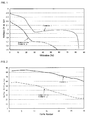
- FIGS. 1 and 2 The charge and discharge curve and the lifecycle characteristic at the cycle 1 st cycle (actual 6 th cycle) of lithium-sulfur cells according to Example 7 and Comparative Example 2 are presented in FIGS. 1 and 2, respectively.
- the cell according to Example 7 with polyethyleneimine exhibited superior sulfur utilization and mid-voltage than the cell according to Comparative Example 2 with polyvinyl pyrrolidone.
- FIG. 2 shows that the cell according to Example 7 exhibited a superior lifecycle characteristic compared to the cell according to Comparative Example 2.
- the slurry according to Examples 1 to 7 had a suitable viscosity for roll-coating, but the slurry according to Comparative Examples 1 and 2 had a low viscosity and was unsuitable for use for roll-coating.
- the binder films produced by using the binder liquid with polyethyleneimine according to Examples 1 to 7 did not dissolve in the electrolyte, but the binder films with polyvinyl pyrrolidone according to Comparative Examples 1 and 2 were slightly dissolved in the electrolyte.
- polyethyleneimine with a weight-average molecular weight of 75,000 (NIPPON SHOKUBAI CO., Trade mark: P-1050) and polyethyleneimine with a weight-average molecular weight of 10,000 ( NIPPON SHOKUBAI CO., Trade mark: SP-200) were used.
- the measurement of viscosity was performed by adding various amounts of polyethyleneimine to a polyvinyl pyrrolidone ethanol solution and shaking for 1 day followed by measuring the viscosity of the resulting solution.
- the weight ratios of polyethyleneimine to polyvinyl pyrrolidone were 5%, 10%, 20% and 50%.
- the viscosities are presented in Table 2.
- Polyvinylpyrrolidone (concentration %) Polyethyleneimine with weight-average molecular weight of 10,000 Polyethyleneimine with weight-average molecular weight of 75,000 Viscosity (cP) 5 0 5 14 5 0 10 25 5 0 20 55 5 0 50 120 5 5 0 4.7 5 10 0 4.7 5 20 0 4.7 5 50 0 4.7 5 0 0 3.1 10 0 0 19
- Polyethyeleneimine interacts with a polyvinylpyrrolidone binder to increase adhesion and viscosity (Examples 1 to 7).
- Polyethyleneimine does not interact with polyethyleneoxide, polyvinylalcohol, and polyvinylacetate binders, and has adverse effects (Comparative Examples 3 to 5).
- the positive electrode of the present invention includes an additive which physically and chemically interacts with a binder to improve the adhesion of the binder.
- the additive renders a decrease in the amount of the binder and an increase in the utilization of sulfur, increasing a capacity per weight of the active mass.
- the positive electrode exhibits an improved lifecycle characteristic.
- the lithium-sulfur battery of the present invention may, for example, be utilized to provide power for an article of manufacture, for example, portable electronic equipment.
- portable electronic equipment includes, but is not limited to, hand-held devices, including organizers, video games, cellular phones, pagers, electronic toys, and the like.
Landscapes
- Chemical & Material Sciences (AREA)
- Chemical Kinetics & Catalysis (AREA)
- Electrochemistry (AREA)
- General Chemical & Material Sciences (AREA)
- Engineering & Computer Science (AREA)
- Manufacturing & Machinery (AREA)
- Inorganic Chemistry (AREA)
- Materials Engineering (AREA)
- Battery Electrode And Active Subsutance (AREA)
- Secondary Cells (AREA)
Abstract
Description
| Polyvinylpyrrolidone (g) | Polyethyeleneimine (g) | Sulfur utilization utilization (%) | Slurry viscosity | Solubility to electrolyte | |
| Example 1 | 1.0 | 0.05 | 81 | Suitable for coating | Insoluble |
| Example 2 | 1.0 | 0.10 | 82 | Suitable for coating | Insoluble |
| Example 3 | 1.0 | 0.20 | 86 | Suitable for coating | Insoluble |
| Example 4 | 1.0 | 0.40 | 78 | Suitable for coating | Insoluble |
| Example 5 | 1.5 | 0.075 | 80 | Suitable for coating | Insoluble |
| Example 6 | 1.0 | 0.15 | 85 | Superior for coating | Insoluble |
| Example 7 | 1.0 | 0.30 | 84 | Superior for coating | Insoluble |
| Comparative Example 1 | 1.0 | 0 | 58 | Very low for coating | Soluble |
| Comparative Example 2 | 2.0 | 0 | 57 | Very low for coating | Soluble |
| Polyvinylpyrrolidone (concentration %) | Polyethyleneimine with weight-average molecular weight of 10,000 | Polyethyleneimine with weight-average molecular weight of 75,000 | Viscosity (cP) |
| 5 | 0 | 5 | 14 |
| 5 | 0 | 10 | 25 |
| 5 | 0 | 20 | 55 |
| 5 | 0 | 50 | 120 |
| 5 | 5 | 0 | 4.7 |
| 5 | 10 | 0 | 4.7 |
| 5 | 20 | 0 | 4.7 |
| 5 | 50 | 0 | 4.7 |
| 5 | 0 | 0 | 3.1 |
| 10 | 0 | 0 | 19 |
Claims (34)
- A positive electrode for a lithium-sulfur battery comprising:a positive active material which is at least one selected from the group consisting of elemental sulfur, a sulfur-based compound, and a mixture thereof;a conductive agent;an organic binder; andan additive including a polymer having at least one amino nitrogen group in main chains or side chains.
- The positive electrode according to claim 1, wherein the additive is polyethyleneimine.
- The positive electrode according to claim 1, wherein the amount of the additive is 5 to 50 parts by weight based on 100 parts by weight of the binder.
- The positive electrode according to claim 3, wherein the amount of the additive is 10 to 40 parts by weight based on 100 parts by weight of the binder.
- The positive electrode according to claim 1, wherein the additive is polyethyleneimine with a weight-average molecular weight of 20,000 to 150,000.
- The positive electrode according to claim 5, wherein the additive is polyethyleneimine with a weight-average molecular weight of 30,000 to 120,000.
- The positive electrode according to claim 1, wherein the positive active material is elemental sulfur or at least one sulfur-based compound selected from the group consisting of Li2Sn (n ≥ 1), Li2Sn (n ≥ 1) dissolved in catholyte, organosulfur compounds, and carbon-sulfur polymers ((C2Sx)n : x = 2.5 to 50, n ≥ 2).
- The positive electrode according to claim 1, wherein the binder is selected from the group consisting of polyvinyl pyrrolidone, poly(methyl methacrylate), polyvinylidene fluoride, a copolymer of polyhexafluoropropylene, polyethyl acrylate, polytetrafluoroethylene, polyvinyl chloride, polyacrylonitrile, polycaprolactam, polyethylene terephthalate, polybutadiene, polyisoprene, polyacrylic acid, derivatives thereof, blends thereof, and copolymers thereof.
- A lithium-sulfur battery comprising:a positive electrode comprising a positive active material which is at least one selected from the group consisting of elemental sulfur, a sulfur-based compound, and a mixture thereof; a conductor; an organic binder; and an additive including a polymer having at least one amino nitrogen group in main chains or side chains;a negative electrode comprising a negative electrode selected from the group consisting of a material in which lithium intercalation reversibly occurs, a material which reacts with lithium ions to form a lithium-containing compound, a lithium metal, and a lithium alloy; andan electrolyte.
- The lithium-sulfur battery according to claim 9, wherein the additive is polyethyleneimine.
- The lithium-sulfur battery according to claim 9, wherein the amount of the additive is 5 to 50 parts by weight based on 100 parts by weight of the binder.
- The lithium-sulfur battery according to claim 11, wherein the amount of the additive is 10 to 40 parts by weight based on 100 parts by weight of the binder.
- The lithium-sulfur battery according to claim 9, wherein the additive is polyethyleneimine with a weight-average molecular weight of 20,000 to 150,000.
- The lithium-sulfur battery according to claim 13, wherein the additive is polyethyleneimine with a weight-average molecular weight of 30,000 to 120,000.
- The lithium-sulfur battery according to claim 9, wherein the positive active material is elemental sulfur or at least one sulfur-based compound selected from the group consisting of Li2Sn (n ≥ 1), Li2Sn (n ≥ 1) dissolved in catholyte, organosulfur compounds, and carbon-sulfur polymers ((C2Sx)n: x = 2.5 to 50, n ≥ 2).
- The lithium-sulfur battery according to claim 9, wherein the binder is selected from the group consisting of polyvinyl pyrrolidone, poly(methyl methacrylate), polyvinylidene fluoride, a copolymer of polyhexafluoropropylene and polyvinylidene fluoride, polyethyl acrylate, polytetrafluoroethylene, polyvinyl chloride, polyacrylonitrile, polycaprolactam, polyethylene terephthalate, polybutadiene, polyisoprene, polyacrylic acid, derivatives thereof, blends thereof, and copolymers thereof.
- A positive electrode for a lithium-sulfur battery comprising:a positive active material which is at least one selected from the group consisting of elemental sulfur, a sulfur-based compound, and a mixture thereof;a conductor;a binder selected from the group consisting of polyvinyl acetate, polyvinyl alcohol, polyvinyl pyrrolidone, poly(methyl methacrylate), polyvinylidene fluoride, a copolymer of polyhexafluoropropylene and polyvinylidene fluoride, polyethyl acrylate, polytetrafluoroethylene, polyvinyl chloride, polyacrylonitrile, polycaprolactam, polyethylene terephthalate, polybutadiene, polyisoprene, polyacrylic acid, derivatives thereof, blends thereof, and copolymers thereof; andan additive comprising polyethyleneimine.
- The positive electrode according to claim 17, wherein the amount of the additive is 5 to 50 parts by weight based on 100 parts by weight of the binder.
- The positive electrode according to claim 18, wherein the amount of the additive is 10 to 40 parts by weight based on 100 parts by weight of the binder.
- The positive electrode according to claim 17, wherein the polyethyleneimine has a weight-average molecular weight of 20,000 to 150,000.
- The positive electrode according to claim 20, wherein the polyethyleneimine has a weight-average molecular weight of 30,000 to 120,000.
- The positive electrode of claim 17, wherein the positive active material is elemental sulfur or at least one selected from the group consisting of Li2Sn (n ≥ 1), Li2Sn (n ≥ 1) dissolved in catholyte, organosulfur compounds, and carbon-sulfur polymers ((C2Sx)n : x = 2.5 to 50, n ≥ 2).
- A lithium-sulfur battery comprising:a positive electrode comprising a positive active material which is at least one selected from the group consisting of elemental sulfur, a sulfur-based compound, and a mixture thereof; a conductor; a binder selected from the group consisting of polyvinyl pyrrolidone, poly(methyl methacrylate), polyvinylidene fluoride, a copolymer of polyhexafluoropropylene and polyvinylidene fluoride, polyethyl acrylate, polytetrafluoroethylene, polyvinyl chloride, polyacrylonitrile, polycaprolactam, polyethylene terephthalate, polybutadiene, polyisoprene, polyacrylic acid, derivatives thereof, blends thereof, and copolymers thereof;a negative electrode comprising a negative active material selected from the group consisting of a material in which lithium intercalation reversibly occurs, a material which reacts with lithium ions to form a lithium-containing compound, a lithium metal and lithium alloy; andan electrolyte.
- The lithium-sulfur battery according to claim 23, wherein the amount of the additive is 5 to 50 parts by weight based on 100 parts by weight of the binder.
- The lithium-sulfur battery according to claim 24, wherein the amount of the additive is 10 to 40 parts by weight based on 100 parts by weight of the binder.
- The lithium-sulfur battery according to claim 23, wherein the polyethyleneimine has a weight-average molecular weight of 20,000 to 150,000.
- The lithium-sulfur battery according to claim 26, wherein the polyethyleneimine with a weight-average molecular weight of 30,000 to 120,000.
- The lithium-sulfur battery according to claim 23, wherein the positive active material is elemental sulfur or at least one selected from the group consisting of Li2Sn (n ≥ 1), Li2Sn (n ≥ 1) dissolved in catholyte, organosulfur compounds, and carbon-sulfur polymers ((C2Sx)n : x =2.5 to 50, n ≥ 2).
- An article of manufacture comprising portable electronic equipment, wherein power is supplied to the portable electronic equipment by a lithium-sulfur battery, the lithium-sulfur battery comprising:a positive electrode comprising a positive active material which is at least one selected from the group consisting of elemental sulfur, a sulfur-based compound, and a mixture thereof; a conductor; a binder selected from the group consisting of polyvinyl pyrrolidone, poly(methyl methacrylate), polyvinylidene fluoride, a copolymer of polyhexafluoropropylene and polyvinylidene fluoride, polyethyl acrylate, polytetrafluoroethylene, polyvinyl chloride, polyacrylonitrile, polycaprolactam, polyethylene terephthalate, polybutadiene, polyisoprene, polyacrylic acid, derivatives thereof, blends thereof, and copolymers thereof;a negative electrode comprising a negative active material selected from the group consisting of a material in which lithium intercalation reversibly occurs, a material which reacts with lithium ions to form a lithium-containing compound, a lithium metal and lithium alloy; andan electrolyte.
- The article of manufacture according to claim 29, wherein the amount of the additive is 5 to 50 parts by weight based on 100 parts by weight of the binder.
- The article of manufacture according to claim 30, wherein the amount of the additive is 10 to 40 parts by weight based on 100 parts by weight of the binder.
- The article of manufacture according to claim 29, wherein the polyethyleneimine has a weight-average molecular weight of 20,000 to 150,000.
- The article of manufacture according to claim 32, wherein the polyethyleneimine has a weight-average molecular weight of 30,000 to 120,000.
- The article of manufacture according to claim 29, wherein the positive active material is elemental sulfur or at least one selected from the group consisting of Li2Sn (n ≥ 1), Li2Sn (n ≥ 1) dissolved in catholyte, organosulfur compounds, and carbon-sulfur polymers ((C2Sx)n : x =2.5 to 50, n ≥ 2).
Applications Claiming Priority (2)
| Application Number | Priority Date | Filing Date | Title |
|---|---|---|---|
| KR10-2002-0054951A KR100477987B1 (en) | 2002-09-11 | 2002-09-11 | Positive electrode for lithium-sulfur battery, and lithium-sulfur battery comprising same |
| KR2002054951 | 2002-09-11 |
Publications (3)
| Publication Number | Publication Date |
|---|---|
| EP1443585A2 true EP1443585A2 (en) | 2004-08-04 |
| EP1443585A3 EP1443585A3 (en) | 2004-08-11 |
| EP1443585B1 EP1443585B1 (en) | 2006-12-27 |
Family
ID=31987390
Family Applications (1)
| Application Number | Title | Priority Date | Filing Date |
|---|---|---|---|
| EP03004207A Expired - Lifetime EP1443585B1 (en) | 2002-09-11 | 2003-02-25 | Positive electrode for lithium-sulfur battery and lithium-sulfur battery and article of manufacture including same |
Country Status (6)
| Country | Link |
|---|---|
| US (1) | US7303837B2 (en) |
| EP (1) | EP1443585B1 (en) |
| JP (1) | JP2004103548A (en) |
| KR (1) | KR100477987B1 (en) |
| CN (1) | CN1314146C (en) |
| DE (1) | DE60310674T2 (en) |
Families Citing this family (44)
| Publication number | Priority date | Publication date | Assignee | Title |
|---|---|---|---|---|
| KR100467454B1 (en) * | 2002-07-10 | 2005-01-24 | 삼성에스디아이 주식회사 | Positive active material composition for lithium sulfur battery and lithium sulfur battery fabricated using binder |
| KR20040025095A (en) * | 2002-09-18 | 2004-03-24 | 삼성에스디아이 주식회사 | An electrode for lithium secondary battery and a lithium secondary battery comprising the same |
| JP4316951B2 (en) * | 2003-07-08 | 2009-08-19 | Tdk株式会社 | Electrode and lithium ion secondary battery |
| US7358012B2 (en) | 2004-01-06 | 2008-04-15 | Sion Power Corporation | Electrolytes for lithium sulfur cells |
| US10297827B2 (en) * | 2004-01-06 | 2019-05-21 | Sion Power Corporation | Electrochemical cell, components thereof, and methods of making and using same |
| US8828610B2 (en) * | 2004-01-06 | 2014-09-09 | Sion Power Corporation | Electrolytes for lithium sulfur cells |
| WO2006077380A2 (en) * | 2005-01-18 | 2006-07-27 | Oxis Energy Limited | Improvements relating to electrolyte compositions for batteries using sulphur or sulphur compounds |
| FR2916905B1 (en) * | 2007-06-04 | 2010-09-10 | Commissariat Energie Atomique | NOVEL COMPOSITION FOR THE PRODUCTION OF ELECTRODES, ELECTRODES AND BATTERIES RESULTING THEREFROM. |
| US8313864B2 (en) * | 2009-05-08 | 2012-11-20 | Robert Bosch Gmbh | Li-ion battery with blended electrode |
| CN102763250A (en) * | 2009-10-29 | 2012-10-31 | 小利兰·斯坦福大学托管委员会 | Devices, systems and methods for advanced rechargeable batteries |
| CN101916849B (en) * | 2010-08-17 | 2012-09-05 | 上海交通大学 | Sulfur-based composite anode material for secondary battery and preparation method thereof |
| EP2609647B1 (en) | 2010-08-24 | 2017-03-15 | Sion Power Corporation | Electrolyte materials for use in electrochemical cells |
| EP2623317A4 (en) * | 2010-09-30 | 2014-07-09 | Mitsubishi Plastics Inc | POROUS LAMINATED FILM, SEPARATOR FOR NONAQUEOUS ELECTROLYTE SECONDARY BATTERY, AND NONAQUEOUS ELECTROLYTE SECONDARY BATTERY |
| KR102123918B1 (en) | 2010-11-09 | 2020-06-17 | 코넬 유니버시티 | Sulfur containing nanoporous materials, nanoparticles, methods and applications |
| CN102208599B (en) * | 2011-05-13 | 2013-01-23 | 北京化工大学 | Positive pole piece of lithium-sulphur battery and preparation method thereof |
| WO2012161989A1 (en) * | 2011-05-24 | 2012-11-29 | Sion Power Corporation | Electrochemical cell, components thereof, and methods of making and using same |
| US8735002B2 (en) | 2011-09-07 | 2014-05-27 | Sion Power Corporation | Lithium sulfur electrochemical cell including insoluble nitrogen-containing compound |
| CN104081566B (en) * | 2011-12-02 | 2017-11-17 | 三菱化学株式会社 | Binder resin for nonaqueous secondary battery electrodes, binder resin composition for nonaqueous secondary battery electrodes, slurry composition for nonaqueous secondary battery electrodes, electrode for nonaqueous secondary batteries, nonaqueous secondary battery electrode Battery |
| US10446850B2 (en) | 2012-01-11 | 2019-10-15 | Mitsubishi Chemical Corporation | Binder resin composition for secondary battery electrodes, slurry for secondary battery electrodes, electrode for secondary batteries, and lithium ion secondary battery |
| CN102569730A (en) * | 2012-01-31 | 2012-07-11 | 中南大学 | Preparation method for positive plate of lithium-sulfur battery |
| WO2013141195A1 (en) | 2012-03-19 | 2013-09-26 | 国立大学法人横浜国立大学 | Alkali metal-sulfur secondary cell |
| CN103427125B (en) * | 2012-05-15 | 2016-04-13 | 清华大学 | The round-robin method of sulfenyl polymer Li-ion battery |
| US9577289B2 (en) | 2012-12-17 | 2017-02-21 | Sion Power Corporation | Lithium-ion electrochemical cell, components thereof, and methods of making and using same |
| CN103915602A (en) * | 2013-01-09 | 2014-07-09 | 厦门大学 | New lithium sulfur battery positive electrode and lithium sulfur battery comprising new lithium sulfur battery positive electrode |
| CN103326027B (en) * | 2013-05-29 | 2017-12-08 | 宁德新能源科技有限公司 | A kind of negative electrode of lithium ion battery and lithium ion battery |
| WO2015006279A1 (en) | 2013-07-08 | 2015-01-15 | Board Of Trustees Of The Leland Stanford Junior University | Stable cycling of lithium sulfide cathodes through strong affinity with multifunctional binders |
| KR101526677B1 (en) * | 2013-08-07 | 2015-06-05 | 현대자동차주식회사 | A sulfur cathod for a lithium sulfur battery |
| US9911975B2 (en) | 2013-10-18 | 2018-03-06 | Lg Chem, Ltd. | Carbon nanotube-sulfur composite comprising carbon nanotube aggregates, and method for preparing same |
| FR3018516B1 (en) * | 2014-03-13 | 2019-08-23 | Blue Solutions | LITHIUM SULFUR BATTERY |
| EP3070765B1 (en) | 2015-03-16 | 2019-05-08 | Heraeus Battery Technology GmbH | Use of pedot/pss in a cathode of a lithium-sulfur electrochemical cell |
| JP6330719B2 (en) * | 2015-04-27 | 2018-05-30 | トヨタ自動車株式会社 | Negative electrode active material and all solid state secondary battery |
| KR20170050078A (en) | 2015-10-29 | 2017-05-11 | 주식회사 엘지화학 | The acrylic binder for the manufacturing of cathode of lithium sulfur secondary battery |
| KR102737631B1 (en) * | 2016-03-03 | 2024-12-02 | 니폰 제온 가부시키가이샤 | Binder composition for non-aqueous secondary battery electrode, conductive paste composition for non-aqueous secondary battery electrode, slurry composition for non-aqueous secondary battery electrode, electrode for non-aqueous secondary battery and non-aqueous secondary battery |
| JP2017195174A (en) * | 2016-04-14 | 2017-10-26 | 株式会社Adeka | Method for producing electrode for non-aqueous electrolyte secondary battery |
| US10312517B2 (en) * | 2016-10-31 | 2019-06-04 | Toyota Motor Engineering & Manufacturing North America, Inc. | In situ formation of sulfur particles using organic acids in the presence of polymer functionalized carbon |
| CN108011076B (en) * | 2017-11-27 | 2020-08-28 | 欣旺达电子股份有限公司 | Lithium ion battery, battery pole piece and preparation method thereof |
| KR102736891B1 (en) * | 2018-03-23 | 2024-11-29 | 니폰 제온 가부시키가이샤 | Binder composition for non-aqueous secondary battery electrode, conductive paste composition for non-aqueous secondary battery electrode, slurry composition for non-aqueous secondary battery electrode, electrode for non-aqueous secondary battery and non-aqueous secondary battery |
| KR102781562B1 (en) * | 2019-07-31 | 2025-03-17 | 주식회사 엘지에너지솔루션 | Binder for improving a adhesion of positive electrode, positive electrode for lithium secondary battery including the same and lithium secondary battery including the positive electrode |
| EP3954655B1 (en) * | 2019-08-13 | 2025-09-17 | LG Energy Solution, Ltd. | Iron oxyhydroxynitrate having phosphoric acid anion-adsorbed surface, preparation method therefor, cathode comprising iron oxyhydroxynitrate having phosphoric acid anion-adsorbed surface for lithium secondary battery, and lithium secondary battery comprising same |
| KR102893453B1 (en) * | 2019-11-06 | 2025-12-02 | 주식회사 엘지에너지솔루션 | Binder for lithium secondary battery electrode, positive electrode for lithium secondary battery and lithium secondary battery comprising the same |
| WO2021091174A1 (en) * | 2019-11-06 | 2021-05-14 | 주식회사 엘지에너지솔루션 | Binder for lithium secondary battery electrode, lithium secondary battery positive electrode comprising same, and lithium secondary battery |
| CN110911668A (en) * | 2019-12-02 | 2020-03-24 | 电子科技大学 | A kind of lithium-sulfur battery PIP@S cathode material and preparation method |
| CN111224166A (en) * | 2019-12-12 | 2020-06-02 | 中国科学院大连化学物理研究所 | A kind of ether electrolyte, its preparation method and its application |
| CN115548341B (en) * | 2022-10-11 | 2026-02-10 | 万向一二三股份公司 | A method for preparing an anti-gelling lithium-supplemented cathode slurry and a lithium-supplemented cathode sheet. |
Family Cites Families (20)
| Publication number | Priority date | Publication date | Assignee | Title |
|---|---|---|---|---|
| US4302520A (en) * | 1980-06-25 | 1981-11-24 | Union Carbide Corporation | Cathode comprising the reaction product of bismuth, sulfur and lead or iron |
| FR2552093B1 (en) | 1983-09-20 | 1985-12-20 | Centre Nat Rech Scient | NOVEL POLYCARBON SULFIDE DERIVATIVES, THEIR PREPARATION AND THEIR APPLICATIONS, ESPECIALLY IN ELECTROCHEMISTRY |
| US5324599A (en) | 1991-01-29 | 1994-06-28 | Matsushita Electric Industrial Co., Ltd. | Reversible electrode material |
| JP3169188B2 (en) | 1991-01-31 | 2001-05-21 | 杏林製薬株式会社 | Carbamic acid derivative and method for producing the same |
| JPH06150932A (en) | 1992-11-10 | 1994-05-31 | Matsushita Electric Ind Co Ltd | Electrode |
| JPH06150910A (en) | 1992-11-10 | 1994-05-31 | Matsushita Electric Ind Co Ltd | Electrode manufacturing method |
| FR2711843B1 (en) | 1993-10-21 | 1995-12-01 | Alsthom Cge Alcatel | Cathodic material for electrochemical generator. |
| TW320784B (en) * | 1994-05-13 | 1997-11-21 | Gould Electronics Inc | |
| JP3734113B2 (en) | 1996-12-27 | 2006-01-11 | 日本ゼオン株式会社 | Binder composition for electrode of lithium ion secondary battery, electrode, and battery |
| JPH11111279A (en) | 1997-10-07 | 1999-04-23 | Hitachi Maxell Ltd | Hydrogen storage alloy electrode and nickel-metal hydride secondary battery using the same |
| JPH11154514A (en) * | 1997-11-20 | 1999-06-08 | Hitachi Maxell Ltd | Alkaline batteries |
| US6703163B2 (en) | 1998-03-31 | 2004-03-09 | Celanese Ventures Gmbh | Lithium battery and electrode |
| JPH11297329A (en) | 1998-04-03 | 1999-10-29 | Nippon Zeon Co Ltd | Binder composition for secondary battery electrode, method for producing the same, slurry for battery electrode, battery electrode, and secondary battery |
| JP4552235B2 (en) | 1998-04-03 | 2010-09-29 | 日本ゼオン株式会社 | Lithium ion secondary battery electrode and secondary battery |
| KR100305669B1 (en) * | 1998-06-17 | 2001-11-30 | 박찬구 | A lithium polymer secondary battery comprising a positive electrode made of a metal composite cathode material |
| US6576370B1 (en) * | 1999-04-26 | 2003-06-10 | Matsushita Electric Industrial Co., Ltd. | Positive electrode and lithium battery using the same |
| US6652440B1 (en) * | 1999-05-04 | 2003-11-25 | Moltech Corporation | Electroactive polymers of high sulfur content for use in electrochemical cells |
| KR100363277B1 (en) * | 2000-06-30 | 2002-11-30 | 주식회사 뉴턴에너지 | Cathode and Energy Storage System Utilizing The Same |
| KR100325326B1 (en) * | 2000-06-30 | 2002-03-06 | 김성욱 | Method For Manufacturing Powder Mixture Of Conductive Polymer And Sulfur-Containing Organic Compound And Method For Manufacturing Cathode Utilizing The Same |
| KR100378007B1 (en) * | 2000-11-22 | 2003-03-29 | 삼성에스디아이 주식회사 | Positive electrode for lithium-sulfur battery and lithium-sulfur battery comprising same |
-
2002
- 2002-09-11 KR KR10-2002-0054951A patent/KR100477987B1/en not_active Expired - Fee Related
-
2003
- 2003-02-24 US US10/370,772 patent/US7303837B2/en not_active Expired - Fee Related
- 2003-02-25 DE DE60310674T patent/DE60310674T2/en not_active Expired - Fee Related
- 2003-02-25 EP EP03004207A patent/EP1443585B1/en not_active Expired - Lifetime
- 2003-03-07 JP JP2003062292A patent/JP2004103548A/en active Pending
- 2003-03-14 CN CNB031205763A patent/CN1314146C/en not_active Expired - Fee Related
Also Published As
| Publication number | Publication date |
|---|---|
| DE60310674T2 (en) | 2007-10-11 |
| DE60310674D1 (en) | 2007-02-08 |
| EP1443585B1 (en) | 2006-12-27 |
| JP2004103548A (en) | 2004-04-02 |
| CN1314146C (en) | 2007-05-02 |
| CN1482693A (en) | 2004-03-17 |
| US7303837B2 (en) | 2007-12-04 |
| KR100477987B1 (en) | 2005-03-23 |
| EP1443585A3 (en) | 2004-08-11 |
| US20040048154A1 (en) | 2004-03-11 |
| KR20040023257A (en) | 2004-03-18 |
Similar Documents
| Publication | Publication Date | Title |
|---|---|---|
| US7303837B2 (en) | Positive electrode for lithium-sulfur battery and lithium-sulfur battery and article of manufacture including same | |
| US6919143B2 (en) | Positive active material composition for lithium-sulfur battery and lithium-sulfur battery fabricated using same | |
| US11876223B2 (en) | Negative electrode for lithium metal battery and lithium metal battery comprising same | |
| CN1331252C (en) | Positive pole for lithium-sulfur cell, its preparation method and lithium-sulfur cell | |
| US20040101753A1 (en) | Positive electrode for lithium-sulfur battery and lithium-sulfur battery comprising same | |
| US9985291B2 (en) | Cathode active material for lithium-sulfur battery and manufacturing method therefor | |
| KR100441514B1 (en) | An electrolyte for lithium-sulfur batteries and lithium-sulfur batteries comprising the same | |
| US20020045102A1 (en) | Lithium-sulfur batteries | |
| KR100560539B1 (en) | Anode for a lithium secondary battery and a lithium secondary battery comprising the same | |
| KR100612227B1 (en) | Positive electrode for lithium sulfur battery and lithium sulfur battery containing same | |
| US20040091776A1 (en) | Positive electrode for lithium sulfur battery and lithium sulfur battery comprising same | |
| US20050095504A1 (en) | Negative electrode for lithium metal battery and lithium metal battery comprising the same | |
| US12237512B2 (en) | Binder composition for negative electrode, negative electrode, and secondary battery | |
| US12278373B2 (en) | Sulfur-carbon composite, and cathode for lithium secondary battery and lithium secondary battery which comprise same | |
| US11545720B2 (en) | Lithium-sulfur battery | |
| JP2013196910A (en) | Nonaqueous electrolyte secondary battery | |
| KR100382302B1 (en) | Positive active material composition for lithium-sulfur battery and lithium-sulfur battery manufactured using same | |
| JP2000021390A (en) | Lithium polymer secondary battery provided with positive electrode containing metal composite positive electrode material | |
| KR20220130199A (en) | Salt additive for sulfur secondary battery | |
| KR100508920B1 (en) | Positive electrode for lithium-sulfur battery and lithium-sulfur battery comprising same | |
| US20250323311A1 (en) | Solid electrolyte and solid state battery comprising the same | |
| JPH04363866A (en) | Nonaqueous solvent secondary battery | |
| CN117413399A (en) | Solid electrolyte and preparation method thereof | |
| KR19990026388A (en) | Tin-organic disulfide composite anode and a secondary battery using the same |
Legal Events
| Date | Code | Title | Description |
|---|---|---|---|
| PUAI | Public reference made under article 153(3) epc to a published international application that has entered the european phase |
Free format text: ORIGINAL CODE: 0009012 |
|
| PUAL | Search report despatched |
Free format text: ORIGINAL CODE: 0009013 |
|
| AK | Designated contracting states |
Kind code of ref document: A2 Designated state(s): AT BE BG CH CY CZ DE DK EE ES FI FR GB GR HU IE IT LI LU MC NL PT SE SI SK TR |
|
| AX | Request for extension of the european patent |
Extension state: AL LT LV MK RO |
|
| AK | Designated contracting states |
Kind code of ref document: A3 Designated state(s): AT BE BG CH CY CZ DE DK EE ES FI FR GB GR HU IE IT LI LU MC NL PT SE SI SK TR |
|
| AX | Request for extension of the european patent |
Extension state: AL LT LV MK RO |
|
| 17P | Request for examination filed |
Effective date: 20050211 |
|
| AKX | Designation fees paid |
Designated state(s): DE FR GB |
|
| 17Q | First examination report despatched |
Effective date: 20050428 |
|
| GRAP | Despatch of communication of intention to grant a patent |
Free format text: ORIGINAL CODE: EPIDOSNIGR1 |
|
| GRAS | Grant fee paid |
Free format text: ORIGINAL CODE: EPIDOSNIGR3 |
|
| GRAA | (expected) grant |
Free format text: ORIGINAL CODE: 0009210 |
|
| AK | Designated contracting states |
Kind code of ref document: B1 Designated state(s): DE FR GB |
|
| REG | Reference to a national code |
Ref country code: GB Ref legal event code: FG4D |
|
| REF | Corresponds to: |
Ref document number: 60310674 Country of ref document: DE Date of ref document: 20070208 Kind code of ref document: P |
|
| ET | Fr: translation filed | ||
| PLBE | No opposition filed within time limit |
Free format text: ORIGINAL CODE: 0009261 |
|
| STAA | Information on the status of an ep patent application or granted ep patent |
Free format text: STATUS: NO OPPOSITION FILED WITHIN TIME LIMIT |
|
| 26N | No opposition filed |
Effective date: 20070928 |
|
| PGFP | Annual fee paid to national office [announced via postgrant information from national office to epo] |
Ref country code: DE Payment date: 20080221 Year of fee payment: 6 Ref country code: GB Payment date: 20080220 Year of fee payment: 6 |
|
| PGFP | Annual fee paid to national office [announced via postgrant information from national office to epo] |
Ref country code: FR Payment date: 20080208 Year of fee payment: 6 |
|
| GBPC | Gb: european patent ceased through non-payment of renewal fee |
Effective date: 20090225 |
|
| REG | Reference to a national code |
Ref country code: FR Ref legal event code: ST Effective date: 20091030 |
|
| PG25 | Lapsed in a contracting state [announced via postgrant information from national office to epo] |
Ref country code: DE Free format text: LAPSE BECAUSE OF NON-PAYMENT OF DUE FEES Effective date: 20090901 |
|
| PG25 | Lapsed in a contracting state [announced via postgrant information from national office to epo] |
Ref country code: GB Free format text: LAPSE BECAUSE OF NON-PAYMENT OF DUE FEES Effective date: 20090225 Ref country code: FR Free format text: LAPSE BECAUSE OF NON-PAYMENT OF DUE FEES Effective date: 20090302 |