EP1443471A2 - Authentication processing system, terminal authentication apparatus, authentication processing method and authentication processing program - Google Patents
Authentication processing system, terminal authentication apparatus, authentication processing method and authentication processing program Download PDFInfo
- Publication number
- EP1443471A2 EP1443471A2 EP04250529A EP04250529A EP1443471A2 EP 1443471 A2 EP1443471 A2 EP 1443471A2 EP 04250529 A EP04250529 A EP 04250529A EP 04250529 A EP04250529 A EP 04250529A EP 1443471 A2 EP1443471 A2 EP 1443471A2
- Authority
- EP
- European Patent Office
- Prior art keywords
- authentication
- portable information
- terminal
- information terminal
- existence
- Prior art date
- Legal status (The legal status is an assumption and is not a legal conclusion. Google has not performed a legal analysis and makes no representation as to the accuracy of the status listed.)
- Withdrawn
Links
Images




Classifications
-
- G—PHYSICS
- G03—PHOTOGRAPHY; CINEMATOGRAPHY; ANALOGOUS TECHNIQUES USING WAVES OTHER THAN OPTICAL WAVES; ELECTROGRAPHY; HOLOGRAPHY
- G03B—APPARATUS OR ARRANGEMENTS FOR TAKING PHOTOGRAPHS OR FOR PROJECTING OR VIEWING THEM; APPARATUS OR ARRANGEMENTS EMPLOYING ANALOGOUS TECHNIQUES USING WAVES OTHER THAN OPTICAL WAVES; ACCESSORIES THEREFOR
- G03B15/00—Special procedures for taking photographs; Apparatus therefor
- G03B15/02—Illuminating scene
-
- G—PHYSICS
- G07—CHECKING-DEVICES
- G07C—TIME OR ATTENDANCE REGISTERS; REGISTERING OR INDICATING THE WORKING OF MACHINES; GENERATING RANDOM NUMBERS; VOTING OR LOTTERY APPARATUS; ARRANGEMENTS, SYSTEMS OR APPARATUS FOR CHECKING NOT PROVIDED FOR ELSEWHERE
- G07C9/00—Individual registration on entry or exit
- G07C9/00174—Electronically operated locks; Circuits therefor; Nonmechanical keys therefor, e.g. passive or active electrical keys or other data carriers without mechanical keys
- G07C9/00309—Electronically operated locks; Circuits therefor; Nonmechanical keys therefor, e.g. passive or active electrical keys or other data carriers without mechanical keys operated with bidirectional data transmission between data carrier and locks
-
- G—PHYSICS
- G07—CHECKING-DEVICES
- G07C—TIME OR ATTENDANCE REGISTERS; REGISTERING OR INDICATING THE WORKING OF MACHINES; GENERATING RANDOM NUMBERS; VOTING OR LOTTERY APPARATUS; ARRANGEMENTS, SYSTEMS OR APPARATUS FOR CHECKING NOT PROVIDED FOR ELSEWHERE
- G07C9/00—Individual registration on entry or exit
- G07C9/00174—Electronically operated locks; Circuits therefor; Nonmechanical keys therefor, e.g. passive or active electrical keys or other data carriers without mechanical keys
- G07C9/00309—Electronically operated locks; Circuits therefor; Nonmechanical keys therefor, e.g. passive or active electrical keys or other data carriers without mechanical keys operated with bidirectional data transmission between data carrier and locks
- G07C2009/00365—Electronically operated locks; Circuits therefor; Nonmechanical keys therefor, e.g. passive or active electrical keys or other data carriers without mechanical keys operated with bidirectional data transmission between data carrier and locks in combination with a wake-up circuit
-
- G—PHYSICS
- G07—CHECKING-DEVICES
- G07C—TIME OR ATTENDANCE REGISTERS; REGISTERING OR INDICATING THE WORKING OF MACHINES; GENERATING RANDOM NUMBERS; VOTING OR LOTTERY APPARATUS; ARRANGEMENTS, SYSTEMS OR APPARATUS FOR CHECKING NOT PROVIDED FOR ELSEWHERE
- G07C9/00—Individual registration on entry or exit
- G07C9/00174—Electronically operated locks; Circuits therefor; Nonmechanical keys therefor, e.g. passive or active electrical keys or other data carriers without mechanical keys
- G07C2009/00579—Power supply for the keyless data carrier
- G07C2009/00587—Power supply for the keyless data carrier by battery
-
- G—PHYSICS
- G07—CHECKING-DEVICES
- G07C—TIME OR ATTENDANCE REGISTERS; REGISTERING OR INDICATING THE WORKING OF MACHINES; GENERATING RANDOM NUMBERS; VOTING OR LOTTERY APPARATUS; ARRANGEMENTS, SYSTEMS OR APPARATUS FOR CHECKING NOT PROVIDED FOR ELSEWHERE
- G07C9/00—Individual registration on entry or exit
- G07C9/00174—Electronically operated locks; Circuits therefor; Nonmechanical keys therefor, e.g. passive or active electrical keys or other data carriers without mechanical keys
- G07C2009/00634—Power supply for the lock
- G07C2009/00642—Power supply for the lock by battery
-
- G—PHYSICS
- G07—CHECKING-DEVICES
- G07C—TIME OR ATTENDANCE REGISTERS; REGISTERING OR INDICATING THE WORKING OF MACHINES; GENERATING RANDOM NUMBERS; VOTING OR LOTTERY APPARATUS; ARRANGEMENTS, SYSTEMS OR APPARATUS FOR CHECKING NOT PROVIDED FOR ELSEWHERE
- G07C2209/00—Indexing scheme relating to groups G07C9/00 - G07C9/38
- G07C2209/60—Indexing scheme relating to groups G07C9/00174 - G07C9/00944
- G07C2209/63—Comprising locating means for detecting the position of the data carrier, i.e. within the vehicle or within a certain distance from the vehicle
Definitions
- the present invention relates to an authentication processing system in which authentication is performed between a portable information terminal and a terminal authentication apparatus and upon success in authentication, predetermined operation is permitted.
- the keyless system which does not require locking and unlocking using a physical key, and can lock and unlock car doors at some distance, has spread.
- a typical keyless system executes an authentication protocol between a key a user has and a radio authentication module installed on a car by using a feeble radio wave having a frequency of 300 MHz or less. If the authentication is successful, the typical keyless system transmits a door locking signal or a door unlocking signal from the radio authentication module to the car.
- Feeble radio wave base stations are stipulated by a law, and they are permitted to send a radio wave within a range of approximately 10mas long as its frequency is approximately 300 MHz without a license for a radio station.
- the user approaches the car. (2) The user searches a pocket or a bag for a key. (3) The user takes out the key. (4) The user depresses a button on the key (unlocking). (5) If the user operates the button, a radio wave is transmitted from a radio module incorporated in the key.
- the radio authentication module installed on the car attempts to receive a radio wave from the key at regular time intervals. Therefore, if the user operates the button on the key and the radio wave sent from the key is received by the radio authentication module, then the authentication protocol is executed and the doors are unlocked (locked). If the button on the key is not operated, the radio wave is not transmitted from the key. Therefore, the life of a battery incorporated in the key (which is in the range of two to five years in typical use) can be lengthened.
- the button operation on the key is operation to suppress the power consumption of the battery on the key and lengthening the life of the battery.
- this operation lowers the user's convenience.
- the user in the case where the user has an umbrella or a pack in a hand of the side of the pocket having the key therein, or in the case where both hands of the user are used to hold packs or the like, the user needs to carry back the umbrella or the pack, or put the packs somewhere.
- a keyless system that makes the button operation unnecessary is also proposed.
- the key side basically the same feeble radio wave as that described above is used, the key side also comes in a radio wave sending mode and a reception mode at regular time intervals. If the car enters a radio wave arrival range for the key, an authentication, protocol is automatically executed and the doors are unlocked.
- an authentication (cryptograph) algorithm used in the authentication protocol for the abowe-described keyless system the common key system is typically used. If a system is constructed by using the most advanced cryptograph algorithm, such as AES, and a key having a sufficiently long key length, it is impossible to find the key in a practical time and unlock the doors by using the calculation capability of existing computers. This also results in a feature that the degree of the safety is higher as compared with ordinary physical keys.
- a product making the most of the cryptograph algorithm and igniting the car engine by using the cryptograph algorithm has also been developed.
- this ignition key system typically called immobilizer
- the user inserts the key in the ignition hole and turns the key so as to reach the predetermined position, and a current signal flows between the key hole and the key, an authentication protocol being executed between an authentication module incorporated in the key and am immobilizer ECU directly coupled to an engine ECU.
- the Bluetooth in which the ISM band around 2.4 GHz and neighboring frequencies are used and the radio license is not necessary like the case of the feeble power radio machine.
- the effective transmission distance range of the conventional radio LAN is at least 100 m.
- the Bluetooth the transmission range is narrow, and accordingly power consumption is low. Therefore, the Bluetooth is suitable for information processing apparatuses, such as portable telephones, having a constraint in battery.
- portable information processing apparatuses such as portable telephones and PDAs, on which Bluetooth communication means is mounted, have begun to be spread.
- specifications can be obtained from the web site, http://www.bluetooth.org/.
- a first problem is power consumption.
- the radio communication apparatus mounted on the portable information terminal is designed with the object of high-rate data transfer.
- power consumption is extremely high. From the viewpoint of the power consumption and the battery life in the portable information terminal, therefore, it is difficult to implement a system in which doors are automatically unlocked when the user has approached thecar.
- the power consumed especially while a specific terminal is searched and a wireless link is established is as large as at least 1.5 times that at ordinary time.
- a second problem is the radio wave arrival range. It is possible to design and implement an ordinary keyless system having an optimum radio wave arrival range of, for example, approximately 10m with the object of unlocking and locking doors.
- the radio communication apparatus in the portable information terminal is designed with the object of data transfer.
- the radio wave arrival range is determined almost completely by radio standards. Therefore, it is difficult to set a radio wave arrival range that is optimum as the keyless system.
- a module according to standards of class 3 is typically mounted on the portable information terminal. However, its radio wave arrival range is effectively as large as approximately 20m. Therefore, even if the user just passes an area within a short distance from a car without the intention of approaching the car, there is a possibility that the authentication protocol will be executed and the doors will be unlocked.
- An object of the present invention is to provide an authentication processing system, a terminal authentication apparatus, an authentication processing method, and authentication processing program capable of reducing power consumption, with high security.
- an authentication processing system comprising:
- an authentication apparatus comprising:
- FIG. 1 is a block diagram showing a general configuration of an authentication processing system according to a first embodiment of the present invention.
- a configuration of a system to implement keyless entry for a vehicle is shown in FIG. 1.
- the authentication processing system shown in FIG. 1 includes a portable information terminal 1, a terminal authentication module 2 which conducts authentication processing with the portable information terminal 1 by radio, and an entry terminal 3 which conducts entry operation for the vehicle when the terminal authentication module 2 has succeeded in the authentication with the portable information terminal 1.
- the portable information terminal 1 includes an existence confirmation signal transmission unit 11 which transmits an existence confirmation signal in order to determine whether or not the terminal authentication module 2 exists, an existence notice signal reception unit 12 which receives an existence notice signal transmitted from the terminal authentication module 2 in response to the existence confirmation signal, a link connection unit 13 which establishes a wireless link with the terminal authentication module 2 that has transmitted the existence notice signal, and a first authentication unit 14 which conducts first authentication with the terminal authentication module 2 via the wireless link.
- the terminal authentication module 2 includes an existence confirmation signal reception unit 21 which receives the existence confirmation signal, an existence notice signal transmission unit 22 which transmits the existence notice signal in response to the existence confirmation signal, a link connection unit 23 which establishes a wireless link with the portable information terminal 1 after the existence notice signal has been received by the portable information terminal 1, a second authentication unit 24 which conducts the first authentication with the portable information terminal 1 via the wireless link, and a control command transmission uni t 25 which transmits a control command to the entry terminal 3 when the first authentication has succeeded.
- the entry terminal 3 includes a control command reception unit 31 which receives the control command, and an entry unit 32 which executes predetermined entry operation on the basis of the control command.
- the predetermined entry operation is operation such as door unlocking or ignition start.
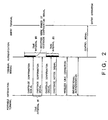
- FIG. 2 is an operation timing diagram of the portable information terminal 1, the terminal authentication module 2 and the entry terminal 3.
- the portable information terminal 1 transmits an existence confirmation signal at time intervals #1.
- the terminal authentication module 2 comes in a reception mode to receive the existence confirmation signal during a time interval #3, which is equal to or longer than the time interval #1, at time intervals #2 ,
- the terminal authentication module 2 receives the existence confirmation signal only when it is set to the reception mode.
- the terminal authentication module 2 does not exist in the radio wave arrival range for the portable information terminal 1. Therefore, even if the portable information terminal transmits the existence confirmation signal during the interval indicated by the dotted line, the terminal authentication module 2 does not transmit an existence notice signal. Therefore, the portable information terminal 1 transmits the existence confirmation signal repetitively.
- the time interval #3 is set equal to or longer than the time interval #1. Therefore if the portable information terminal 1 and the terminal authentication module 2 are located in the radio wave arrival range with each other, the terminal authentication module 2 can receive the existence confirmation signal from the portable information terminal 1 within a predetermined time reliably.
- the portable information terminal 1 and the terminal authentication module 2 conduct the radio wave transmission and reception byusing, for example, the Bluetooth.
- transmission of the existence confirmation signal corresponds to a page mode
- reception of the existence confirmation signal corresponds to a page scan mode. If the page mode or the page scan mode is assumed continuously in time, however, the power consumption in the Bluetooth module becomes large.
- the portable information terminal 1 transmits the existence confirmation signal at the time intervals #1 , and the terminal authentication module 2 is set to the reception mode only during the time interval #3 at the time intervals #2. Therefore, as compared with the case where the existence confirmation signal is transmitted and received continuously in time, the power consumption can be reduced.
- the existence confirmation signal reception unit 21 in the terminal authentication module 2 Upon receiving the existence confirmation signal from the portable information terminal 1, the existence confirmation signal reception unit 21 in the terminal authentication module 2 immediately transmits the existence notice signal to the portable information terminal 1. Upon receiving the existence notice signal from the terminal authentication module 2, the portable information terminal 1 outputs a link connection request to the terminal authentication module 2 by using the link connection unit 13. As a result, a wireless link connection transaction is executed with the link connection unit 23 in the terminal authentication module 2, and a wireless link is established.
- a transaction for bidirectional authentication (the first authentication) is executed between the first authentication unit 14 in the portable information terminal 1 and the second authentication unit 24 in the terminal authentication module 2. If the bidirectional authentication has succeeded, the control command transmission unit 25 in the terminal authentication module 2 is notified that the first authentication has finished normally.
- the control command transmission unit 25 transmits a control command to the control command reception unit 31 in the entry terminal 3.
- the entry terminal 3 conducts predetermined entry operation. For example, if the entry terminal 3 is a car and the entry unit 32 is a door lock control unit, doors are unlocked after the control command has been received.
- the portable information terminal 1 approaches the terminal authentication module 2 at the representative speed in order to conduct entry into an entry terminal 3, which is not illustrated. If in this case the representative radius of the radio wave arrival range is greater than the product of the maximum time indicated by the equation (2) and the representative speed, the portable information terminal 1 can sense the existence of the terminal authentication module 2 before the portable information terminal 1 approaches the entry terminal 3, execute the predetermined authentication protocol, and cause the entry terminal 3 to conduct the entry operation.
- the portable information terminal 1 transmits the existence confirmation signal at the time intervals #1, and the terminal authentication module 2 is set to the reception mode to receive the existence confirmation signal only during the time interval #3 at time intervals #2.
- the power consumption can be reduced in both the portable information terminal 1 and the terminal authentication module 2.
- the terminal authentication module 2 can receive the existence confirmation signal within the predetermined time reliably, and the time required to establish a link between the portable information terminal 1 and the terminal authentication module 2 can be shortened.
- the terminal authentication module 2 transmits the existence confirmation signal and the portable information terminal 1 transmits the existence notice signal.
- FIG. 4 is a block diagram showing a entire configuration of an authentication processing system according to a second embodiment of the present invention.
- components common to those shown in FIG. 1 are denoted by like reference numerals.
- different points will be mainly described.
- the portable information terminal 1 shown in FIG. 4 includes an existence confirmation signal reception unit 15, an existence notice signal transmission unit 16, a link connection unit 13, and a first authentication unit 14.
- the terminal authentication module 2 includes an existence confirmation signal transmission unit 26, an existence notice signal reception unit 27, a link connection unit 23, and a second authentication unit 24.
- the existence confirmation signal transmission unit 26 in the terminal authentication module 2 transmits an existence confirmation signal to the portable information terminal 1 at time intervals #1.
- the portable information terminal 1 is set to a reception mode, in which the portable information terminal 1 can receive an existence confirmation signal, only during the time interval #3 at the time intervals #2. If in this reception mode interval the existence confirmation signal is received by the existence confirmation signal reception unit 15 in the portable information terminal 1, an existence notice signal transmission unit 16 transmits an existence notice signal. If the existence notice signal reception unit 27 in the terminal authentication module 2 receives the existence notice signal, processing of connecting a wireless link is conducted between the portable information terminal 1 and the terminal authentication module 2.
- delivery of the existence confirmation signal is conducted between the portable information terminal 1 and the terminal authentication module 2 at predetermined time intervals. Power consumption can be reduced in both the portable information terminal 1 and the terminal authentication module 2.
- the distance between the portable information terminal 1 and the terminal authentication module 2 is measured.
- FIG. 5 is a block diagram showing a general configuration of an authentication processing system according to a third embodiment of the present invention.
- FIG. 6 is a sequence diagram for the authentication processing system shown in FIG. 5.
- the terminal authentication module 2 in the authentication processing system shown in FIG. 5 further includes a Radio signal intensity measurement unit 28 in addition to the configuration shown in FIG. 1.
- the radio signal intensity measurement unit 28 measures a field intensity of a reference signal transmitted from the portable information terminal 1, and compares a measured value with a preset threshold value (time t1 and t2 shown in FIG. 6) . If the measured value of the field intensity is greater than the threshold value, then theportable information terminal 1 is judged to have approached the terminal authentication module 2, and the field intensity measurement unit 28 notifies the control command transmission unit 25 to that effect. If the first authentication has succeeded and the portable information terminal 1 is judged to have approached the terminal authentication module 2, the control command transmission unit 25 sends a control command to the control command reception unit 31 in the entry terminal 3.
- a preset threshold value time t1 and t2 shown in FIG. 6
- the radio wave arrival range of the portable information terminal 1 and the terminal authentication module 2 is larger than a distance optimum to the operation in the entry terminal 3, it is possible to perform control so as to permit the entry operation in the entry terminal 3 only when the portable information terminal 1 is in the optimum distance.
- the field intensity measurement unit 28 may be provided within the portable information terminal 1 instead of within the terminal authentication module 2.
- a distance measurement unit which measures the distance from the portable information terminal 1 may be provided within the entry terminal 3.
- the distance measurement unit may measure the distance on the basis of the field intensity in the same way as the Radio Signal intensity measurement unit 28, may measure the distance on the basis of a delay time taken until a transmitted radio wave returns, or may measure the distance by using infrared rays or the like.
- the distance measurement unit may sense that the user having the portable information terminal 1 has contacted by using a contact sensing sensor.
- the contact sensing sensor is a touch sensor provided on a door knob or an infrared ray sensor provided in the entry terminal 3.
- the terminal authentication module 2 sends a control command to the entry terminal 3. After the entry terminal 3 has received the control command in the control command reception unit 31, the entry terminal 3 senses approach of the portable information terminal 1 by using the distance measurement unit, and conducts predetermined entry operation.
- sensing is conducted to determine whether or not the portable information terminal 1 has approached, and the entry operation in the entry terminal 3 is permitted only in the case where the portable information terminal 1 has approached within the predetermined distance. Therefore, even if the radio wave arrival range shown in FIG. 3 is wide and the authentication has succeeded although the portable information terminal 1 is distant, the entry operation in the entry terminal 3 can be inhibited until the portable information terminal 1 approaches, resulting in improved security performance.
- the above-described time intervals #1 to #3 are controlled according to the remaining electric capacity in the battery.
- FIG. 7 is a block diagram of a fourth embodiment of an authentication processing system according to the present invention.
- the portable information terminal 1 shown in FIG. 7 includes, in addition to the configuration shown in FIG. 5, a battery 17 which serves as a main power supply for the portable information terminal 1, a battery monitor unit 18 which monitors the remaining electric capacity in the battery 17, and an interval control unit 19 which adjusts the time interval #1 serving as the time interval in transmitting existence confirmation signals.
- the terminal authentication module 2 shown in FIG. 7 includes, in addition to the configuration shown in FIG. 5, a battery 29 serving as a main power supply for the terminal authentication module 2, a battery monitor unit 41 to monitor the remaining electric capacity in the battery 29, and an interval control unit 42.
- the interval control unit 42 adjusts the time length of at least one of the time interval #2 serving as the time intervals at which the reception mode is set to receive the existence confirmation signal, and the time interval #3 serving as the interval for the reception mode.
- FIG. 8 is a flow chart showing a processing procedure conducted in the interval control unit 19 in the portable information terminal 1.
- a wireless link is connected to the terminal authentication module 2 (step S1). If the wireless link is in connection, the processing remains in the step S1. If the wireless link is not in connection, the battery monitor unit 18 confirms the remaining electric capacity in the battery 17 (step S2).
- step S3 it is determined whether or not the remaining electric capacity in the battery 17 is greater than a predetermined threshold value. If the remaining electric capacity in the battery 17 is larger than the predetermined threshold value, it is determined whether or not the time interval #1 is equal to a predetermined value T1 (step S4) . If the time interval #1 is equal to the predetermined value T1, the processing returns to the step S1 without altering the time interval #1. If the time interval #1 is not equal to the predetermined value T1, the time interval #1 is set equal to the predetermined value T1 (step S5) and the processing returns to the step S1.
- step S6 it is determined whether or not the time interval #1 is equal to a predetermined value T2 (step S6) . If the first time interval is equal to the predetermined value T2, the processing returns to the step S1 without altering the time interval #1. If the time interval #1 is not equal to the predetermined value T2, the time interval #1 is set equal to the predetermined value T2 (step S7) and the processing returns to the step S1.
- the interval control unit 19 in the portable information terminal 1 lengthens the time interval #1 and thereby decreases the power consumption in the portable information terminal 1.
- the interval control unit 19 in the portable information terminal 1 lengthens the time interval #1 and thereby decreases the power consumption in the portable information terminal 1.
- the interval control unit 42 in the terminal authentication module 2 also conducts processing similar to that in FIG. 6.
- the interval control unit may be provided in only one of the portable information terminal 1 and the terminal authentication module 2.
- the time interval #1 serving as the transmission interval for the existence confirmation signal might become longer than the time interval #3 serving as the reception mode duration interval for the terminal authentication module 2. In this case, it becomes Impossible for the terminal authentication module 2 to receive an existence confirmation signal from the portable information terminal 1.
- the interval control unit 19 in the portable information terminal 1 needs to adjust the time interval #1 within such a range that the first time interval becomes shorter than or equal to the time interval #3.
- the interval control unit 19 in the portable information terminal 1 and the interval control unit 42 in the terminal authentication module 2 control at least one of the time intervals #1 to #3 according to the remaining electric capacity in the battery 17 and 29. Therefore, it is possible to reduce the power consumption in the portable information terminal 1 and the terminal authentication module 2 when the remaining electric capacity in the battery 17 and 29 has decreased.
- a timer 43 or 44 may be provided in at least one of the portable information terminal 1 and the terminal authentication module 2.
- the timer 43 or 44 measures the time elapsed since, for example, the wireless link is disconnected, and the time intervals #1 to #3 are set on the basis of the measured time elapsed.
- authentication is conducted doubly.
- FIG. 9 is a block diagram showing a general configuration of a fifth embodiment of an authentication processing system according to the present invention.
- the portable information terminal 1 shown in FIG. 9 includes , in addition to the configuration shown in FIG. 1, a third authentication unit 44 which conducts second authentication with the terminal authentication module 2 after the terminal authentication module 2 has transmitted a control command to the entry terminal 3.
- the terminal authentication module 2 shown in FIG. 9 includes, in addition to the configuration shown in FIG. 1, an authentication request reception unit 45 which receives an authentication request from the entry terminal 3, and a fourth authentication unit 46 which conducts second authentication with the portable information terminal 1 after a control command has been transmitted to the entry terminal 3.
- the entry terminal 3 shown in FIG. 9 includes, in addition to the configuration shown in FIG. 1, a contact type approach sensing sensor (contact detection sensor) 33 which detects that the user of the portable information terminal 1 has contacted the entry terminal 3, and an authentication request unit 34 which sends an authentication request to the terminal authentication module 2.
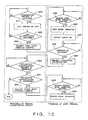
- FIG. 10 is a flow chart showing a processing procedure in the authentication processing system of the fifth embodiment.
- the terminal authentication module 2 assumes the reception mode only during the time interval #3 at the time intervals #2, and determines whether or not an existence confirmation signal has been received from the portable information terminal 1 (step S21) .
- step S22 If the existence confirmation signal has been received, then an existence notice signal is transmitted to the portable information terminal 1, and a wireless link to the portable information terminal 1 is established (step S22), and the second authentication 24 executes link authentication for, for example, the Bluetooth (step S23). If the bidirectional authentication (first authentication) has been confirmed by the link authentication, the control command transmission unit 25 transmits a control command to the entry terminal 3 in order to execute first entry operation in the entry terminal 3 corresponding to the first authentication (step S24).
- the entry terminal 3 Upon receiving the control command from the terminal authentication module 2 (step S25), the entry terminal 3 executes first entry operation (step S26) and simultaneously activates the contact type approach sensing sensor 33 (step S27).
- the first entry operation is, for example, operation to unlock doors of a vehicle. At this point in time, ignition start is not permitted even if doors are unlocked.
- the authentication request unit 34 in the entry terminal 3 sends a second authentication request (application authentication request) to the terminal authentication module 2 (step S29).
- the fourth authentication unit 46 executes application authentication (second authentication or application authentication) in a rank higher than the Bluetooth link (step S30) .
- This application authentication is an authentication procedure that is higher in safety than the authentication conducted by the second authentication unit 24.
- control command transmission unit 25 transmits a control command to the entry terminal 3 in order to execute second entry operation corresponding to the second authentication (step S32).
- step S34 the entry unit 32 executes the secondentry operation (step S34).
- the second entry operation is operation to permit the ignition start.
- the user of the portable information terminal 1 can start the engine of the vehicle by conducting the processing of the step S34.
- the contact type approach sensing sensor 33 is provided in the entry terminal 3.
- the contact type approach sensing sensor may be provided in the terminal authentication module 2.
- a general configuration is represented by a block diagram shown in FIG. 11.
- a contact type approach sensing sensor 47 is provided in the terminal authentication module2. If contact of theportable information terminal 1 is sensed by the contact type approach sensing sensor 47, the fourth authentication unit 46 is notified of the contact, and the fourth authentication unit 46 conducts the second authentication.
- the authentication processing system described above in the embodiments may be implemented by hardware, or may be implemented by software.
- a program to implement the function of the authentication processing system may be stored on a recording medium, such as a floppy disk or a CD-RCM, or may be read by a computer to be executed thereby.
- the recording medium is not limited to a portable medium such as a magnetic disk or an optical disk, but may also be a stationary recording medium such as a hard disk device or a memory.
- a program for implementing the function of the authentication processing program may also be distributed via a communication line (including radio communication) such as the Internet or the like.
- the program may be distributed in such a state that theprogramis encrypted, modulated or compressed, via a wired line, such as the Internet, or a radio line, or in a form stored in a recording medium.
Landscapes
- Physics & Mathematics (AREA)
- General Physics & Mathematics (AREA)
- Engineering & Computer Science (AREA)
- Computer Networks & Wireless Communication (AREA)
- Lock And Its Accessories (AREA)
- Mobile Radio Communication Systems (AREA)
Abstract
Description
- an existence confirmation signal transmission unit
configured to transmit an existence confirmation signal to confirm
whether or not said terminal authentication apparatus exists,
at a
time interval # 1; - an existence notice signal reception unit configured to receive an existence notice signal transmitted from said terminal authentication apparatus in response to said existence confirmation signal;
- a first link connection unit configured to establish a wireless link with said terminal authentication apparatus which has transmitted said existence notice signal when said existence notice signal is received; and
- a first authentication unit configured to conduct a first authentication with said terminal authentication apparatus through said wireless link,
- an existence confirmation signal reception unit set to a
reception mode capable of receiving said existence confirmation
signal at a
time interval # 2 only during atime interval # 3 equal to or longer than saidtime interval # 1; - an existence notice signal reception unit configured to transmit said existence notice signal serving as response of said existence confirmation signal to said portable information terminal when said existence confirmation signal is received;
- a second link connection unit configured to establish a wireless link with said portable information terminal after said portable information terminal receives said existence notice signal;
- a second authentication unit configured to conduct said first authentication with said portable information terminal through said wireless link; and
- a control command transmission unit configured to transmit a control command for said operation apparatus when said first and second authentication units succeed in said first authentication,
- a control command reception unit configured to receive said control command; and
- an operation conduction unit configured to conduct said prescribed operation based on said control command.
Claims (20)
- An authentication processing system, comprising:wherein said portable information terminal includes:a portable information terminal;a terminal authentication apparatus which conducts authentication processing by air; andan operation apparatus which conducts a prescribed operation when said terminal authentication apparatus has succeeded in authentication with said portable information terminal,wherein said terminal authentication apparatus includes:an existence confirmation signal transmission unit configured to transmit an existence confirmation signal to confirm whether or not said terminal authentication apparatus exists, at a first time interval ;an existence notice signal reception unit configured to receive an existence notice signal transmitted from said terminal authentication apparatus in response to said existence confirmation signal;a first link connection unit configured to establish a wireless link with said terminal authentication apparatus which has transmitted said existence notice signal when said existence notice signal is received; anda first authentication unit configured to conduct a first authentication with said terminal authentication apparatus through said wireless link,wherein said operation apparatus includes:an existence confirmation signal reception unit set to a reception mode capable of receiving said existence confirmation signal at a second time interval only during a third time interval equal to or longer than said first time interval;an existence notice signal reception unit configured to transmit said existence notice signal serving as response of said existence confirmation signal to said portable information terminal when said existence confirmation signal is received;a second link connection unit configured to establish a wireless link with said portable information terminal after said portable information terminal receives said existence notice signal;a second authentication unit configured to conduct said first authentication with said portable information terminal through said wireless link; anda control command transmission unit configured to transmit a control command for said operation apparatus when said first and second authentication units succeed in said first authentication,a control command reception unit configured to receive said control command; andan operation conduction unit configured to conduct said prescribed operation based on said control command.
- The authentication processing system according to claim 1, wherein radio wave arrival ranges of said existence confirmation signal and said existence notice signal are longer than a distance obtained by multiplying a sum of said first and second time intervals by an average moving speed of said portable information terminal.
- The authentication processing system according to claim 1, wherein at least one of said portable information terminal and said terminal authentication apparatus has a distance detection unit configured to detect a distance between said portable information terminal and said terminal authentication apparatus; and
said control command transmission unit transmits said control command to said operation apparatus when said first authentication i s succeeded and the distance between said portable information terminal and said terminal authentication apparatus is equal to or less than a prescribed value. - The authentication processing system according to claim 3, wherein said distance detection unit detects the distance based on field intensity of radio wave transmitted between said portable information terminal and said terminal authentication apparatus.
- The authentication processing system according to claim 1, wherein at least one of said terminal authentication apparatus and said operation unit has an approach detector which detects that said portable information terminal or a user thereof has approached; and
said operation conduction unit conducts said prescribed operation when said first authentication is succeeded and said control command is received by said control command reception unit, and said approach detector has detected approach within a prescribed distance. - The authentication processing system according to claim 5, wherein said approach detector is a contact detection sensor which detects that the user of said portable information terminal has contacted said terminal authentication apparatus or said authentication operation conduction apparatus.
- The authentication processing system according to claim 5, wherein at least one of said portable information terminal and said terminal authentication apparatus has an interval controller which controls at least one of said first, second and third time intervals so that said third time interval is longer than said first time interval.
- The authentication processing system according to claim 5, wherein at least one of said portable information terminal and said terminal authentication apparatus has a battery monitor which detects containing electric capacity of a battery; and
said interval controller controls at least one of said first, second and third time intervals so that said first and second time intervals are equal to each other, or said third time interval is longer than said first time interval, in accordance with the remaining electric capacity of the battery detected by said battery monitor. - The authentication processing system according to claim 8, wherein at least one of said portable information terminal and said terminal authentication apparatus has a time measurement unit configured to measure a time elapsed from when it became impossible to detect a communication partner, or a time elapsed from when the wireless link with said terminal authentication apparatus is cut off; and
said interval controller controls at least one of saidfirst, second and third time intervals so that said first and second time intervals are equal to each other, or said third time interval is longer than said first time interval. - The authentication processing system according to claim 1, wherein said portable information terminal has a third authentication unit configured to conduct a second authentication with said terminal authentication apparatus after said terminal authentication apparatus has transmitted said control command to said operation apparatus; and
said terminal authentication apparatus has a fourth authentication unit configured to conduct said second authentication with said portable information terminal after transmitting said control command to said operation apparatus. - The authentication processing system according to claim 10, wherein said first authentication is a link authentication of Bluetooth; and
said second authentication is an authentication by an authentication protocol upper than a link of Bluetooth. - The authentication processing system according to claim 1, wherein said prescribed operation is to lock and unlock a door of a vehicle.
- An authentication apparatus, comprising:an existence confirmation signal receiver which in order to receive an existence confirmation signal outputted from a portable information terminal at a first time interval, is set to a reception mode capable of receiving said existence confirmation signal at a second time interval, only during a third time interval equal to or longer than said first time interval;an existence notice signal transmitter which transmits said existence notice signal serving as response of said existence confirmation signal to said portable information terminal when said existence notice signal is received;a link connection unit configured to establish a wireless link with said portable information terminal after said existence notice signal has been received by said portable information terminal;an authentication unit configured to conduct authentication with said portable information terminal through said wireless link; anda control command transmitter which transmits a control command when said authentication has been succeeded.
- The authentication apparatus according to claim 13, further comprising a distance detection unit configured to detect a distance between said portable information terminal and said terminal authentication apparatus,
wherein said control command transmission unit transmits said control command to said operation apparatus when said first authentication is succeeded and the distance between said portable information terminal and said terminal authentication apparatus is equal to or less than a prescribed value. - The authentication apparatus according to claim 13, further comprising an interval controller which controls at least one of said first, second and third time intervals so that said third time interval is longer than said first time interval.
- The authentication apparatus according to claim 15, further comprising a battery monitor which detects remaining electric capacity of a battery,
wherein said interval controller controls at least one of said first, second and third time intervals so that said first and second time intervals are equal to each other, or said third time interval is longer than said first time interval, in accordance with the remaining electric capacity of the battery detected by said battery monitor. - The authentication apparatus according to claim 16, further comprising a time measurement unit configured to measure a time elapsed from when it became impossible to detect a communication partner, or a time elapsed from when the wireless link with said terminal authentication apparatus is cut off,
wherein said interval controller controls at least one of said first, second and third time intervals so that said first and second time intervals are equal to each other, or said third time interval is longer than said first time interval, - The authentication apparatus according to claim 13, wherein said prescribed operation is to lock and unlock a door of a vehicle.
- An authentication processing method of an authentication processing system comprising a portable information terminal; a terminal authentication apparatus which conducts authentication processing by air; and an operation apparatus which conducts a prescribed operation when said terminal authentication apparatus has succeeded in authentication with said portable information terminal,
wherein said portable information terminal includes:wherein said terminal authentication apparatus includes:transmitting an existence confirmation signal to confirm whether or not said terminal authentication apparatus exists, at a first time interval;receiving an existence notice signal transmitted from said terminal authentication apparatus in response to said existence confirmation signal;establishing a wireless link with said terminal authentication apparatus which has transmitted said existence notice signal when said existence notice signal is received; andconducting a first authentication with said terminal authentication apparatus through said wireless link,wherein said operation apparatus includes:setting to a reception mode capable of receiving said existence confirmation signal at a second time interval only during a third time interval equal to or longer than said first time interval;transmitting said existence notice signal serving as response of said existence confirmation signal to said portable information terminal when said existence confirmation signal is received;establishing a wireless link with said portable information terminal after said portable information terminal receives said existence notice signal;conducting the authentication with said portable information terminal through said wireless link; andtransmitting a control comnand for said operation apparatus when the authentication is succeeded,receiving said control command; andconducting said prescribed operation based on said control command. - An authentication processing program, allows a computer to execute the steps of:in order to an existence confirmation signal outputted from a portable information terminal at first time interval, setting to a reception mode capable of receiving said existence confirmation signal at a second time interval only during a third time interval equal to or longer than said first time interval;transmitting said existence notice signal serving as response of said existence confirmation signal to said portable information terminal when said existence confirmation signal is received;establishing a wireless link with saidportable information terminal after said portable information terminal receives said existence notice signal;conducting the authentication with said portable information terminal through said wireless link; andtransmitting a, control command for said operation apparatus when the authentication is succeeded, in order to allow said operation apparatus to conduct a prescribed operation.
Applications Claiming Priority (2)
| Application Number | Priority Date | Filing Date | Title |
|---|---|---|---|
| JP2003024501 | 2003-01-31 | ||
| JP2003024501A JP3944089B2 (en) | 2003-01-31 | 2003-01-31 | Authentication processing system, terminal authentication device, authentication processing method, and authentication processing program |
Publications (2)
| Publication Number | Publication Date |
|---|---|
| EP1443471A2 true EP1443471A2 (en) | 2004-08-04 |
| EP1443471A3 EP1443471A3 (en) | 2005-10-19 |
Family
ID=32652925
Family Applications (1)
| Application Number | Title | Priority Date | Filing Date |
|---|---|---|---|
| EP04250529A Withdrawn EP1443471A3 (en) | 2003-01-31 | 2004-01-30 | Authentication processing system, terminal authentication apparatus, authentication processing method and authentication processing program |
Country Status (4)
| Country | Link |
|---|---|
| US (1) | US20040205189A1 (en) |
| EP (1) | EP1443471A3 (en) |
| JP (1) | JP3944089B2 (en) |
| KR (1) | KR100573719B1 (en) |
Cited By (5)
| Publication number | Priority date | Publication date | Assignee | Title |
|---|---|---|---|---|
| EP1748396A1 (en) * | 2005-07-28 | 2007-01-31 | Inventio Ag | Data exchange method |
| WO2007128319A3 (en) * | 2006-06-14 | 2008-01-03 | Scandlife Italia Aps | Locking system and remote-controlled entry system |
| EP2760225A1 (en) * | 2013-01-28 | 2014-07-30 | Starkey Laboratories, Inc. | Location based assistance using hearing instruments |
| US9563990B2 (en) | 2011-11-16 | 2017-02-07 | Jaguar Land Rover Limited | Vehicle access system |
| EP3562174A4 (en) * | 2016-12-20 | 2020-01-22 | Denso Corporation | DEVICE FOR DETECTING MOBILE DEVICES AND METHOD FOR DETECTING MOBILE DEVICES |
Families Citing this family (35)
| Publication number | Priority date | Publication date | Assignee | Title |
|---|---|---|---|---|
| US7426569B2 (en) * | 2004-02-25 | 2008-09-16 | Research In Motion Limited | System and method for maintaining a network connection |
| US8380125B2 (en) * | 2004-09-01 | 2013-02-19 | Kyocera Corporation | Systems and methods for bluetooth resource conservation |
| KR100736953B1 (en) * | 2005-01-13 | 2007-07-09 | 주식회사 팬택앤큐리텔 | External device authentication method equipped with Bluetooth module and mobile communication terminal using the same |
| JP4581979B2 (en) * | 2005-03-15 | 2010-11-17 | 株式会社デンソー | Vehicle equipment control system |
| JP4679205B2 (en) * | 2005-03-31 | 2011-04-27 | Necインフロンティア株式会社 | Authentication system, apparatus, method, program, and communication terminal |
| US8731542B2 (en) | 2005-08-11 | 2014-05-20 | Seven Networks International Oy | Dynamic adjustment of keep-alive message intervals in a mobile network |
| JP4750509B2 (en) * | 2005-08-18 | 2011-08-17 | 株式会社サミーネットワークス | Near field communication device, near field communication method and program |
| JP2007201851A (en) * | 2006-01-27 | 2007-08-09 | Hitachi Kokusai Electric Inc | Wireless communication device |
| JP2007206739A (en) * | 2006-01-30 | 2007-08-16 | Toshiba Corp | Information processing apparatus and authentication control method |
| US9215581B2 (en) | 2006-04-14 | 2015-12-15 | Qualcomm Incorported | Distance-based presence management |
| US8886125B2 (en) | 2006-04-14 | 2014-11-11 | Qualcomm Incorporated | Distance-based association |
| US8552903B2 (en) | 2006-04-18 | 2013-10-08 | Qualcomm Incorporated | Verified distance ranging |
| JP4830684B2 (en) * | 2006-07-12 | 2011-12-07 | パナソニック株式会社 | Communication system, radio alarm device and program thereof |
| DE102006042974B4 (en) * | 2006-09-13 | 2009-07-23 | Continental Automotive Gmbh | Method for access control to a vehicle |
| JP5067074B2 (en) * | 2006-10-06 | 2012-11-07 | パナソニック株式会社 | Wireless communication method and program |
| WO2008084794A1 (en) * | 2007-01-12 | 2008-07-17 | Murata Manufacturing Co., Ltd. | Communication system |
| US8837724B2 (en) | 2007-03-27 | 2014-09-16 | Qualcomm Incorporated | Synchronization test for device authentication |
| JP5154135B2 (en) * | 2007-04-24 | 2013-02-27 | 美和ロック株式会社 | Battery level check system |
| US9483769B2 (en) | 2007-06-20 | 2016-11-01 | Qualcomm Incorporated | Dynamic electronic coupon for a mobile environment |
| US9524502B2 (en) | 2007-06-20 | 2016-12-20 | Qualcomm Incorporated | Management of dynamic electronic coupons |
| US9141961B2 (en) | 2007-06-20 | 2015-09-22 | Qualcomm Incorporated | Management of dynamic mobile coupons |
| JP5237909B2 (en) * | 2009-09-16 | 2013-07-17 | 株式会社東海理化電機製作所 | Electronic key |
| DE102010010057B4 (en) * | 2010-03-03 | 2012-09-06 | Continental Automotive Gmbh | Method for controlling a door of a vehicle |
| US8869248B2 (en) * | 2010-08-16 | 2014-10-21 | Blackberry Limited | Communication system providing wireless authentication for private data access and related methods |
| CN102529962B (en) * | 2010-12-08 | 2014-11-05 | 安尼株式会社 | Mobile body anti-collision device and mobile body |
| US10542372B2 (en) | 2011-03-15 | 2020-01-21 | Qualcomm Incorporated | User identification within a physical merchant location through the use of a wireless network |
| KR20140105967A (en) | 2013-02-25 | 2014-09-03 | 삼성전자주식회사 | Lighting control system and controling method for the same |
| US20150102902A1 (en) * | 2013-10-16 | 2015-04-16 | Jie-Fu Chen | Bluetooth Remote-Control Electronic Lock |
| DE102014101198A1 (en) * | 2014-01-31 | 2015-08-06 | Huf Hülsbeck & Fürst Gmbh & Co. Kg | Emblem for a motor vehicle with an optical sensor system and method for this |
| JP6733539B2 (en) * | 2016-12-27 | 2020-08-05 | 株式会社デンソー | Vehicle authentication system |
| KR20180123391A (en) * | 2017-05-08 | 2018-11-16 | (주)에프씨아이 | Method And Apparatus for Controlling Keep Alive Packet Transmission |
| WO2020054333A1 (en) * | 2018-09-11 | 2020-03-19 | ボッシュ株式会社 | Control device and vehicle security system |
| KR102483794B1 (en) * | 2019-06-05 | 2023-01-03 | 주식회사 모카시스템 | Entrance management system and method thereof |
| JP6852777B2 (en) * | 2019-11-29 | 2021-03-31 | ヤマハ株式会社 | Terminal device, terminal device operation method and program |
| JP2023137623A (en) * | 2022-03-18 | 2023-09-29 | パナソニックIpマネジメント株式会社 | Wireless communication system and on-vehicle device |
Family Cites Families (12)
| Publication number | Priority date | Publication date | Assignee | Title |
|---|---|---|---|---|
| JPH08163636A (en) * | 1994-12-09 | 1996-06-21 | Sony Corp | Digital cordless telephone device |
| JPH08277664A (en) * | 1995-04-05 | 1996-10-22 | Oki Electric Ind Co Ltd | Electronic key system |
| JP4167320B2 (en) * | 1998-03-31 | 2008-10-15 | 富士通テン株式会社 | Wireless control device for vehicle and portable device thereof |
| JP2002523833A (en) * | 1998-09-01 | 2002-07-30 | レオポルト・コスタール・ゲゼルシヤフト・ミト・ベシユレンクテル・ハフツング・ウント・コンパニー・コマンデイトゲゼルシヤフト | Method for executing keyless access authorization monitoring and keyless access authorization monitoring device |
| FR2800782B1 (en) * | 1999-11-10 | 2001-12-21 | Valeo Securite Habitacle | MOTOR VEHICLE EQUIPPED WITH A HANDS-FREE ACCESS AND / OR STARTING SYSTEM |
| JP4116212B2 (en) * | 1999-12-28 | 2008-07-09 | 株式会社東芝 | COMMUNICATION DEVICE AND ITS CONTROL METHOD |
| US6873824B2 (en) * | 2000-08-22 | 2005-03-29 | Omega Patents, L.L.C. | Remote control system using a cellular telephone and associated methods |
| JP4187935B2 (en) * | 2000-08-23 | 2008-11-26 | 株式会社東芝 | RADIO COMMUNICATION SYSTEM, TRANSMITTING DEVICE, RECEIVING DEVICE, AND CONTENT DATA TRANSFER METHOD |
| AU2002225768A1 (en) * | 2000-11-28 | 2002-06-11 | Rcd Technology, Inc. | Replacing stored code with user inputting code on the rf id card |
| US6424056B1 (en) * | 2000-11-30 | 2002-07-23 | Telefonaktiebolaget (Lme) | Keyless entry system for a vehicle |
| JP2002353868A (en) * | 2001-05-25 | 2002-12-06 | Minolta Co Ltd | Automatic copying machine and method for display information, automatic copying system and method, and program |
| US7215923B2 (en) * | 2001-08-06 | 2007-05-08 | Broadcom Corporation | System and method for establishing a connection between wireless devices |
-
2003
- 2003-01-31 JP JP2003024501A patent/JP3944089B2/en not_active Expired - Fee Related
-
2004
- 2004-01-30 KR KR1020040006100A patent/KR100573719B1/en not_active Expired - Fee Related
- 2004-01-30 EP EP04250529A patent/EP1443471A3/en not_active Withdrawn
- 2004-01-30 US US10/767,369 patent/US20040205189A1/en not_active Abandoned
Cited By (9)
| Publication number | Priority date | Publication date | Assignee | Title |
|---|---|---|---|---|
| EP1748396A1 (en) * | 2005-07-28 | 2007-01-31 | Inventio Ag | Data exchange method |
| US7664464B2 (en) | 2005-07-28 | 2010-02-16 | Inventio Ag | Method for the exchange of data |
| WO2007128319A3 (en) * | 2006-06-14 | 2008-01-03 | Scandlife Italia Aps | Locking system and remote-controlled entry system |
| US9563990B2 (en) | 2011-11-16 | 2017-02-07 | Jaguar Land Rover Limited | Vehicle access system |
| US10207678B2 (en) | 2011-11-16 | 2019-02-19 | Jaguar Land Rover Limited | Vehicle access system |
| EP2760225A1 (en) * | 2013-01-28 | 2014-07-30 | Starkey Laboratories, Inc. | Location based assistance using hearing instruments |
| US9219966B2 (en) | 2013-01-28 | 2015-12-22 | Starkey Laboratories, Inc. | Location based assistance using hearing instruments |
| EP3562174A4 (en) * | 2016-12-20 | 2020-01-22 | Denso Corporation | DEVICE FOR DETECTING MOBILE DEVICES AND METHOD FOR DETECTING MOBILE DEVICES |
| US10730480B2 (en) | 2016-12-20 | 2020-08-04 | Denso Corporation | Mobile device detection apparatus and mobile device detection method |
Also Published As
| Publication number | Publication date |
|---|---|
| KR100573719B1 (en) | 2006-04-26 |
| EP1443471A3 (en) | 2005-10-19 |
| JP2004236166A (en) | 2004-08-19 |
| KR20040070085A (en) | 2004-08-06 |
| US20040205189A1 (en) | 2004-10-14 |
| JP3944089B2 (en) | 2007-07-11 |
Similar Documents
| Publication | Publication Date | Title |
|---|---|---|
| US20040205189A1 (en) | Authentication processing system, terminal authentication apparatus, authentication processing method and authentication processing program | |
| US8032116B2 (en) | Communication apparatus, portable terminal and communication control program | |
| CN110719591B (en) | Passive keyless entry system | |
| CN108216121B (en) | Secure vehicle access system, key, vehicle and method therefor | |
| US9672671B2 (en) | Relay attack prevention for passive entry/passive start systems | |
| US6850148B2 (en) | Passive entry with anti-theft function | |
| US10559149B1 (en) | Dynamic anchor pre-selection for ranging applications | |
| US20050076242A1 (en) | Wireless access management and control for personal computing devices | |
| EP3318704B1 (en) | Mobile electronic key device and electronic key system | |
| US20050090267A1 (en) | Method and apparatus for enabling a device by proximity | |
| US20070229221A1 (en) | Lock system, unlock device, apparatus, portable terminal device, unlock method, unlock program, and circuit device | |
| JP4542597B2 (en) | Method for reporting LF remote signal strength to an electronic control unit via an RF link | |
| US20030034877A1 (en) | Proximity detection for access control | |
| CN110710117B (en) | Portable device and control method for portable device | |
| JP2000276247A (en) | Mobile terminal security method and mobile terminal | |
| EP2193607B1 (en) | Method and system for locating the sender of a frequency hopping radio signal | |
| JP2007019719A (en) | Portable terminal device, wireless communication unit, and use restriction system | |
| JP4145809B2 (en) | Communication device, mobile terminal, and communication control program | |
| JP2010161676A (en) | Microcomputer with radio communication function and application system therefor | |
| JP5104292B2 (en) | Authentication apparatus, authentication method, and program | |
| KR20250129551A (en) | Method for unlocking at least one vehicle door of a vehicle, vehicle and system comprising at least one vehicle and at least one mobile terminal | |
| US20200101940A1 (en) | In-vehicle authentication device and portable device authentication method | |
| JPH0960368A (en) | Door lock automatic release system | |
| CN120225403A (en) | Remote control key for controlling vehicle functions | |
| JP2017007366A (en) | Communication dishonest establishment prevention system |
Legal Events
| Date | Code | Title | Description |
|---|---|---|---|
| PUAI | Public reference made under article 153(3) epc to a published international application that has entered the european phase |
Free format text: ORIGINAL CODE: 0009012 |
|
| 17P | Request for examination filed |
Effective date: 20040205 |
|
| AK | Designated contracting states |
Kind code of ref document: A2 Designated state(s): AT BE BG CH CY CZ DE DK EE ES FI FR GB GR HU IE IT LI LU MC NL PT RO SE SI SK TR |
|
| AX | Request for extension of the european patent |
Extension state: AL LT LV MK |
|
| PUAL | Search report despatched |
Free format text: ORIGINAL CODE: 0009013 |
|
| AK | Designated contracting states |
Kind code of ref document: A3 Designated state(s): AT BE BG CH CY CZ DE DK EE ES FI FR GB GR HU IE IT LI LU MC NL PT RO SE SI SK TR |
|
| AX | Request for extension of the european patent |
Extension state: AL LT LV MK |
|
| AKX | Designation fees paid |
Designated state(s): DE FR GB |
|
| 17Q | First examination report despatched |
Effective date: 20091204 |
|
| STAA | Information on the status of an ep patent application or granted ep patent |
Free format text: STATUS: THE APPLICATION IS DEEMED TO BE WITHDRAWN |
|
| 18D | Application deemed to be withdrawn |
Effective date: 20100415 |