EP1443310A1 - Procédé et système de guidage géographique de l'utilisateur d'un véhicule - Google Patents
Procédé et système de guidage géographique de l'utilisateur d'un véhicule Download PDFInfo
- Publication number
- EP1443310A1 EP1443310A1 EP04364004A EP04364004A EP1443310A1 EP 1443310 A1 EP1443310 A1 EP 1443310A1 EP 04364004 A EP04364004 A EP 04364004A EP 04364004 A EP04364004 A EP 04364004A EP 1443310 A1 EP1443310 A1 EP 1443310A1
- Authority
- EP
- European Patent Office
- Prior art keywords
- location
- guidance
- terminal
- determined
- vehicle
- Prior art date
- Legal status (The legal status is an assumption and is not a legal conclusion. Google has not performed a legal analysis and makes no representation as to the accuracy of the status listed.)
- Granted
Links
- 238000000034 method Methods 0.000 title claims abstract description 43
- 238000010295 mobile communication Methods 0.000 claims abstract description 11
- 230000001413 cellular effect Effects 0.000 claims description 7
- 230000004044 response Effects 0.000 claims description 4
- 238000001514 detection method Methods 0.000 claims description 3
- 230000002452 interceptive effect Effects 0.000 claims description 3
- 230000011664 signaling Effects 0.000 claims description 3
- 230000008569 process Effects 0.000 abstract description 2
- 230000002123 temporal effect Effects 0.000 abstract 1
- 230000004807 localization Effects 0.000 description 36
- 238000004891 communication Methods 0.000 description 7
- 230000006854 communication Effects 0.000 description 7
- 101000763003 Homo sapiens Two pore channel protein 1 Proteins 0.000 description 4
- 102100026736 Two pore channel protein 1 Human genes 0.000 description 4
- 238000004364 calculation method Methods 0.000 description 4
- 238000010586 diagram Methods 0.000 description 3
- 230000008859 change Effects 0.000 description 2
- 230000003068 static effect Effects 0.000 description 2
- 238000012384 transportation and delivery Methods 0.000 description 2
- 238000005054 agglomeration Methods 0.000 description 1
- 230000002776 aggregation Effects 0.000 description 1
- 230000015572 biosynthetic process Effects 0.000 description 1
- 238000005304 joining Methods 0.000 description 1
- 238000003786 synthesis reaction Methods 0.000 description 1
- 230000001960 triggered effect Effects 0.000 description 1
- 230000001755 vocal effect Effects 0.000 description 1
Images


Classifications
-
- G—PHYSICS
- G08—SIGNALLING
- G08G—TRAFFIC CONTROL SYSTEMS
- G08G1/00—Traffic control systems for road vehicles
- G08G1/09—Arrangements for giving variable traffic instructions
- G08G1/0962—Arrangements for giving variable traffic instructions having an indicator mounted inside the vehicle, e.g. giving voice messages
- G08G1/0968—Systems involving transmission of navigation instructions to the vehicle
- G08G1/096805—Systems involving transmission of navigation instructions to the vehicle where the transmitted instructions are used to compute a route
- G08G1/096811—Systems involving transmission of navigation instructions to the vehicle where the transmitted instructions are used to compute a route where the route is computed offboard
-
- G—PHYSICS
- G01—MEASURING; TESTING
- G01C—MEASURING DISTANCES, LEVELS OR BEARINGS; SURVEYING; NAVIGATION; GYROSCOPIC INSTRUMENTS; PHOTOGRAMMETRY OR VIDEOGRAMMETRY
- G01C21/00—Navigation; Navigational instruments not provided for in groups G01C1/00 - G01C19/00
- G01C21/26—Navigation; Navigational instruments not provided for in groups G01C1/00 - G01C19/00 specially adapted for navigation in a road network
- G01C21/34—Route searching; Route guidance
- G01C21/36—Input/output arrangements for on-board computers
- G01C21/3626—Details of the output of route guidance instructions
- G01C21/3644—Landmark guidance, e.g. using POIs or conspicuous other objects
-
- G—PHYSICS
- G01—MEASURING; TESTING
- G01C—MEASURING DISTANCES, LEVELS OR BEARINGS; SURVEYING; NAVIGATION; GYROSCOPIC INSTRUMENTS; PHOTOGRAMMETRY OR VIDEOGRAMMETRY
- G01C21/00—Navigation; Navigational instruments not provided for in groups G01C1/00 - G01C19/00
- G01C21/26—Navigation; Navigational instruments not provided for in groups G01C1/00 - G01C19/00 specially adapted for navigation in a road network
- G01C21/34—Route searching; Route guidance
- G01C21/36—Input/output arrangements for on-board computers
- G01C21/3679—Retrieval, searching and output of POI information, e.g. hotels, restaurants, shops, filling stations, parking facilities
-
- G—PHYSICS
- G08—SIGNALLING
- G08G—TRAFFIC CONTROL SYSTEMS
- G08G1/00—Traffic control systems for road vehicles
- G08G1/09—Arrangements for giving variable traffic instructions
- G08G1/0962—Arrangements for giving variable traffic instructions having an indicator mounted inside the vehicle, e.g. giving voice messages
- G08G1/0968—Systems involving transmission of navigation instructions to the vehicle
- G08G1/096833—Systems involving transmission of navigation instructions to the vehicle where different aspects are considered when computing the route
- G08G1/096844—Systems involving transmission of navigation instructions to the vehicle where different aspects are considered when computing the route where the complete route is dynamically recomputed based on new data
-
- G—PHYSICS
- G08—SIGNALLING
- G08G—TRAFFIC CONTROL SYSTEMS
- G08G1/00—Traffic control systems for road vehicles
- G08G1/09—Arrangements for giving variable traffic instructions
- G08G1/0962—Arrangements for giving variable traffic instructions having an indicator mounted inside the vehicle, e.g. giving voice messages
- G08G1/0968—Systems involving transmission of navigation instructions to the vehicle
- G08G1/096855—Systems involving transmission of navigation instructions to the vehicle where the output is provided in a suitable form to the driver
- G08G1/096872—Systems involving transmission of navigation instructions to the vehicle where the output is provided in a suitable form to the driver where instructions are given per voice
-
- G—PHYSICS
- G08—SIGNALLING
- G08G—TRAFFIC CONTROL SYSTEMS
- G08G1/00—Traffic control systems for road vehicles
- G08G1/09—Arrangements for giving variable traffic instructions
- G08G1/0962—Arrangements for giving variable traffic instructions having an indicator mounted inside the vehicle, e.g. giving voice messages
- G08G1/0968—Systems involving transmission of navigation instructions to the vehicle
- G08G1/096877—Systems involving transmission of navigation instructions to the vehicle where the input to the navigation device is provided by a suitable I/O arrangement
- G08G1/096883—Systems involving transmission of navigation instructions to the vehicle where the input to the navigation device is provided by a suitable I/O arrangement where input information is obtained using a mobile device, e.g. a mobile phone, a PDA
Definitions
- the invention relates to a method and a guidance system. geographic location of the user of a vehicle.
- One field of application of the invention relates to guidance distance of the user in the vehicle using information sent to a terminal provided on board the vehicle and reproduced acoustically or other.
- a guidance system providing a static roadmap describing the route to be taken by the user from a starting point to an ending point supplied beforehand to the system.
- Another known system plans to guide the user step by step providing an indication of each future change of direction to have the vehicle carry out to make it follow the planned route.
- This guidance step by step requires the use of a display terminal on board the vehicle and a precise geolocation system such as the GPS system, which are complicated and expensive to make.
- the invention aims to obtain a method and a guidance system location of the user of a vehicle, which overcomes the disadvantages of the state of the art and which is easy to implement and use.
- the user receives only the information concerning the part of its route located after its current position between the specified place of departure and place of arrival, i.e. only the information he needs.
- the user thus receives throughout the journey a message or several successive messages, containing a quantity limited information and adapted to its current geographic position, which avoids unnecessary information.
- the invention makes it possible to dispense with having to perform precise geolocation to generate the guidance message thus sent.
- the invention thus makes it possible to improve the service rendered to the user compared to a simple route calculation with generation of a sheet of route and get user guidance, which is technically simple to enforce.
- the invention can thus be used as a service mobile terminal and thus enriches the range of services offered to the user.
- the method and the guiding device 1 according to the invention are implemented using a telecommunication telephone terminal 2 mobile, such as a cellular wireless cell phone.
- a telecommunication telephone terminal 2 mobile such as a cellular wireless cell phone.
- Registration at guidance service is not compulsory. In this case, the user must identify and authenticate to access the service.
- This terminal 2 is arranged inside a vehicle for example automobile such as a passenger car or the like, so that it can be used by a person inside the vehicle such as by example the driver of it.
- Terminal 2 is for example a hands-free mobile phone placed on a support fixed to the switchboard edge of the vehicle near the user's seat so that this the latter is not obliged to hold it.
- Terminal 2 includes means 3 for establishing a dialogue voice with the user, including for example a speaker and a microphone, and means 4 for presenting data, for example under the form of a text display or signage screen.
- Means 3 and / or 4 are customizable by the user from his terminal 2.
- the means 3 and 4 can either be integrated into terminal 2 or be added to it.
- the data presentation means 4 are capable of receiving, data via a wireless data link from a module 6 for delivering MMS messages (Multimedia Messaging Service), i.e. image type, or SMS (Short Messaging Service), that is to say of the abbreviated message type, of a computer 7 connected to the mobile telecommunications network.
- MMS messages Multimedia Messaging Service
- SMS Short Messaging Service
- the means 3 of dialogue are able to send and receive voice messages or information to and from a voice platform or interactive voice server 8 of the computer 7 fixed to the network via a wireless voice link 9.
- the network is a cellular wireless telephone network, for example GSM, GPRS or UMTS type.
- the voice platform 8 comprises for example a voice recognition function for information sent from the voice dialogue module 3 as well as a voice synthesis function of information to be restored by means 3 of voice dialogue.
- Message delivery module 6 and voice platform 8 are supplied with messages or guidance information by a module 10 guide.
- Graphic signage information produced by a module 11 can be added to information or messages from guiding the module 10 for restitution by the means 4 for supplying data from terminal 2 via link 5 and module 6.
- Guidance information or messages are calculated by the guidance module 10 from route information provided by a route calculation engine 12, capable of providing a geographical route, by example of the road type, starting from a starting point and an ending point specified to it.
- a trigger module 13 is also connected to the guidance module 10 to determine the information or the message of guidance which must be generated by module 10 according to the information of route provided by engine 12 and the moment when the message or information thus determined must be transmitted to module 6 or 8 for sending to terminal 2.
- a module 14 can optionally be provided. acquisition of the actual geographic position of terminal 2, or geolocation, thanks, in the example described, to an identification module 15 the cell of the cellular network in which terminal 2 is located. Several localization systems with different degrees of precision can be used to make module 14. It can also be optionally provided with a module 16 for calculating traffic information for recording in a database 17 of traffic information which can be questioned for statistical purposes or to provide information from real-time traffic to users. Motor 12 calculates the route for example also based on the traffic information present in base 17.
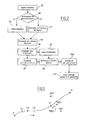
- an initial step E1 the user calls through his terminal 2 to the guidance service via links 5 or 9 to establish a communication with the computer 7.
- the computer 7 then requests in step E2 through the module 6 or the module 8 on the terminal 2 to the user if the latter wishes to perform a geolocation of its terminal 2.
- step E2 a geolocation in step E3 by module 14, which then transmits the location information corresponding to the calculation engine 12 route and to module 16 for calculating traffic information when it is planned. If not after step E2, it is requested during step E4 at terminal 2 the starting address or location of terminal 2, i.e. of the vehicle. The user then provides himself by means 3 and / or 4 on its terminal 2 the starting location information, which is then retransmitted to the computer 7.
- step E3 or E4 the computer 7 requests during step E5 at terminal 2 the arrival address or the place of destination information terminal 2, i.e. the vehicle.
- the user then provides himself by means 3 and / or 4 on its terminal 2 the information of the place of destination, which is then retransmitted to the computer 7.
- the user can optionally provide destination location information from a directory address of its terminal 2.
- step E5 of determining the place of destination can precede step E2.
- the computer 7 requests during step E6 to terminal 2 the type of route it wants, for example the most fast, the shortest route or the highway or other toll-free route.
- the route type has been chosen and has been supplied to computer 7, it is passed on the one hand to step E7 and on the other hand to step E8.
- step E7 the engine 12 calculates a route from the type of route selected in step E6, location information of the specified destination and the determined departure location or the geolocation.
- step E8 the computer requests terminal 2 to choose settings for sending guidance information.
- each user corresponding to each terminal 2, is identified in a database 20 by an ID-Ut identifier which can be for example the telephone number of terminal 2.
- ID1 ..., IDi, ..., IDn are associated with sending parameters Ch equal to 1, 2 and 3.
- the computer 7 asks the user having the identifier IDi of the base 20, which is the one having established the communication during the initial step E1, to choose from the values 1, 2 or 3 of the associated Ch parameter.
- the choice made on terminal 2 by the user is returned to the computer 7.
- Choice 1 corresponds to the definition of a regular time interval, choice 2 at a fixed distance traveled by user and choice 3 at key points in the user's journey, these correspondences being indicated to the user on his terminal 2 by the means 3 and / or 4.
- a time value Tc of comparison equal to a predetermined fixed value.
- This value is set by the user on his terminal 2 or is set by default, for example depending on the type of route chosen during the leg E6 and / or the place of destination and / or departure determined. In a variant, the value is fixed beforehand on a website for configuring the service.
- the calculated instant of determination of location corresponds to the last moment when the vehicle was in the geolocation determined during step E3 or at the last moment when the vehicle was in its starting location determined during step E4, the latter case possibly corresponding to one of the instants execution of steps E4, E5, E6, if it is assumed that the vehicle starts right after this moment.
- the trigger module 13 determines a new location of the vehicle by estimating the distance traveled during the predetermined time value Tc for comparison on the calculated route by the engine 12 from the last location having been determined, that is to say in the previous case of the geolocation obtained in step E3 or the starting location obtained in step E4.
- This determination of the distance traveled uses for example a speed estimate based on the last location determined, a database 30 listing speeds associated with axes truck drivers being, for example, questioned for this purpose.
- This speed estimate consists, for example, in assuming that the vehicle is traveling at a close speed the maximum possible speed at its last determined location or the maximum speed authorized at its last determined location, which is for example in France of 50 km / h in town, 90 km / h or less outside agglomeration and 110 km / h on expressways or 130 km / h on motorways.
- the speed estimate can also be based on statistics of traffic.
- the new location of the vehicle determined by module 13 trigger is sent to the guide module 10, which generates, at from the route calculated by the engine 12 and from this last location, a guidance message for delivery via modules 6 and / or 8 to the terminal 2 and return to the user.
- This guidance message contains at least one guidance information relating to a vehicle route from this new location at at least one intermediate position between said new location and place of destination.
- the guidance information will consist of an indication of the route from this point B to a point located between point B and point H, such as for example C.
- the new location B corresponds to the passage of time Tc from the point A.
- the guidance information is deliberately limited to one information immediately following the new location determined, by example from point B to point C, but not beyond, so as not to give the user superfluous information that could mislead him or her lead to confusion.
- the guidance information corresponds to a portion of the route of a length substantially equal to the speed value estimated vehicle, associated with the last location and multiplied by the comparison time value Tc.
- steps E10 and E11 is repeated from the last location determined by module 13 of trigger instead of being triggered from the geolocation of step E3 or of the starting location of step E4.
- the second location determination is made at from the first B and allows to determine the second location C on the route.
- the guidance information then contains information allowing to go from section C to D on the route.
- time values Tc for comparison successive associated with several new successive locations and several successive guidance information are predetermined by fault according to the calculated route.
- These time values Tc of comparison correspond to several successive sections of the route calculated from a previous location to a next location and can be different from each other.
- the locations thus determined correspond for example to key points determined on the route calculated.
- the route sections thus determined may have different lengths.
- This distance value Di is fixed by the user on his terminal 2 or is fixed by default, for example in depending on the type of route chosen during step E6 and / or the place of destination and / or departure determined. Alternatively, the value is set to prior on a website for setting up the service. For example, may be offered during step E9 to the user to choose a low distance value Di in the city, for example 1 kilometer or 500 meters and significant on motorways, for example 10 kilometers, of your choice of the user.
- the module 13 of triggering uses as time value Tc of comparison the distance value Di divided by the determined speed value.
- the value of distance Di corresponds for example to a number of kilometers which must browse the vehicle.
- the new successive locations A, B, C, D, E, F, G are equidistant on this route.
- the command is executed by the module 14 to provide the location L physics of the user at determined moments of acquisition, for example periodicals.
- a database 40 is planned associating with certain locations L of key points PC with each of which is associated a time value of key point TPC, as represented in FIG. 4.
- TPC time value of key point
- there is no associated PC key point, nor time value TPC of key point at certain locations (L1, L2, L4, L5, L7, Ln) which is indicated by the number zero, while it is associated with each of the locations (L3; L6; Lk; Lj) can be provided by the module 14 respectively one or more key points (PCn; PC1, PC1 '; PCi + 1 and PCi, PCi ', PCi ") and associated time values (TPCn; TPC1; TPC1'; TPCi + 1; TPCi, TPCi ', TPCi ").
- TPC key point time values are estimated journey times of a vehicle from the associated location L at the associated key point PC, which are determined beforehand.
- the calculator 7 selects in base 40 the key points it determines to be on the route calculated by the engine 12. Then the computer 7 checks whether the acquired location L, provided by module 14, corresponds to a key point PC selected.
- the corresponding time value TPCi will then be taken as value time comparison Tc in the trigger module 13 and the new location calculated for the generation of the guidance message at during step E11 will then be taken as being equal to the key point PCi associated.
- the instant of location determination, from which the flow of the comparison time value Tc will be monitored for determine the new location, is then taken as being equal to the instant physical acquisition of the actual geographic position Lj of terminal 2.
- the last determined location Lj corresponds, on the route from A to H determined beforehand by the engine 12, at a key point PCi, which is located slightly downstream from the last location Lj determined and associated along the route and which will be reached according to the estimate after the time TPCi after the instant of determination from the last location Lj.
- a key point PCi which is located slightly downstream from the last location Lj determined and associated along the route and which will be reached according to the estimate after the time TPCi after the instant of determination from the last location Lj.
- the key point PCi is then determined to be the new location.
- the guidance information then relates to the part of the route from the new location PCi to an intermediate point located between it and the place of arrival H, in a similar way to the previous cases.
- the key points PC of the base 40 are for example determined beforehand from terminal 2 by the user before browsing the route or are determined by default, for example depending on the type route chosen during step E6 and / or the place of destination and / or departure determined. As a variant, the key points are defined beforehand on a service setting website.
- the key points correspond for example to places characteristics of the course of a vehicle such as for example crossroads, roundabouts, or any other road signs. It is so provides the user with guidance information near these key points for greater efficiency.
- one or more of the locations, including the location of can be obtained by acknowledgment of the user, i.e. from the user's response on terminal 2 to a message of interrogation sent from the computer 7 via link 5 and / or 9 and received on terminal 2.
- the interrogation message can be limited for example to the question of whether the user is in a specific location, which calls for a yes or no answer.
- the question can be asked by the means 4 and / or means 3, as well as sending the response to the computer 7.
- the computer 7 checks whether the last location thus obtained is on the last route calculated by the engine 12 and, in the negative, causes a new calculation of the route taking as point of departure the last location obtained and as a point of arrival the place of determined destination, so as to correct the guidance information issued to the user.
- the route calculated by the engine 12 includes information identifying for example the route taken and the changes of direction at crossroads.
- the computer selects the guidance information that will be sent to terminal 2.
- the guide module 10 includes a means of comparing information of route produced by engine 12 to the new location produced by the trigger module 13, to determine whether the guidance information corresponding to be produced by the guide module 10 is not relevant or empty.
- Irrelevant or empty guidance information is for example information not signaling a change of direction among several possible directions, due to the fact that on the route section corresponding, the vehicle must not fork or that there is no intersections.
- the guidance module then eliminates so as not to send them irrelevant or empty information thus found and does not send to the terminal 2 as relevant or not empty information. For example, on highway, the guidance information does not correspond to a section route with planned exit from the vehicle will be eliminated.
- the computer applies to the guidance information produced successively by these three modes of determination the selection of relevant or non-empty guidance information, described above.
Landscapes
- Engineering & Computer Science (AREA)
- Radar, Positioning & Navigation (AREA)
- Remote Sensing (AREA)
- Physics & Mathematics (AREA)
- General Physics & Mathematics (AREA)
- Automation & Control Theory (AREA)
- Mathematical Physics (AREA)
- Navigation (AREA)
- Traffic Control Systems (AREA)
Abstract
Description
- on spécifie à partir d'un terminal de communication mobile, situé à bord du véhicule, une information de lieu de destination du véhicule,
- on détermine au moins une localisation de départ du terminal de télécommunication mobile,
- on calcule un itinéraire prévu du véhicule de la localisation de départ au lieu de destination à partir d'une base de données géographiques,
- on restitue à l'utilisateur sur le terminal de communication mobile au moins un message de guidage géographique généré au moins à partir de l'itinéraire calculé,
- l'on détecte si le temps écoulé depuis un instant calculé de détermination de localisation atteint une valeur temporelle prédéterminée de comparaison,
- en cas de détection de la valeur temporelle prédéterminée de comparaison, on détermine une nouvelle localisation du véhicule dépendant de la valeur temporelle prédéterminée de comparaison, de l'itinéraire calculé et de la dernière localisation déterminée,
- on génère pour envoi au terminal de communication mobile, à partir de l'itinéraire calculé et de la nouvelle localisation déterminée, le message de guidage contenant au moins une information de guidage relative à une portion de l'itinéraire calculé, allant de la nouvelle localisation à au moins une position intermédiaire entre ladite nouvelle localisation et le lieu de destination.
- la valeur temporelle de comparaison est une valeur fixe prédéterminée ;
- la nouvelle localisation est déterminée en effectuant une estimation de la distance parcourue pendant la valeur temporelle prédéterminée de comparaison sur l'itinéraire calculé à partir de la dernière localisation déterminée ;
- ladite distance parcourue est déterminée en utilisant une estimation de vitesse obtenue par interrogation, dans une base de données associant des vitesses à des axes routiers, de l'axe routier sur lequel on détermine que se trouve la dernière localisation déterminée ;
- ou la valeur temporelle de comparaison est égale au quotient d'une valeur de distance fixe prédéterminée par une valeur de vitesse prédéterminée en fonction de la dernière localisation ;
- ladite valeur de vitesse est obtenue par interrogation, dans une base de données associant des vitesses à des axes routiers, de l'axe routier sur lequel on détermine que se trouve la dernière localisation déterminée ;
- ou l'on détermine une localisation par acquisition physique de la position géographique réelle du terminal de télécommunication mobile, on sélectionne dans une base de données, associant à des localisations des points-clés à chacun desquels est associée une valeur temporelle de point-clé, les points-clés se trouvant sur l'itinéraire calculé, on recherche si ladite localisation acquise correspond à un point-clé sélectionné dans la base de données de points-clés, et dans l'affirmative, on prédétermine la valeur temporelle de comparaison comme étant égale à ladite valeur temporelle de point-clé associée au point-clé correspondant, l'instant de détermination de localisation comme étant égal à l'instant d'acquisition physique de la position géographique réelle du terminal et on prédétermine la nouvelle localisation comme étant égale au point-clé associé ;
- les valeurs temporelles de point-clé sont des temps estimés de parcours d'un véhicule allant de la localisation L associée au point-clé associé, qui sont déterminés au préalable ;
- l'on sélectionne les informations de guidage générées à envoyer au terminal de télécommunication mobile ;
- pour sélectionner les informations de guidage générées à envoyer au terminal de télécommunication mobile, on compare l'itinéraire calculé à la nouvelle localisation déterminée pour éliminer les informations de guidage correspondantes générées ne signalant aucune bifurcation à effectuer ;
- la nouvelle localisation est déterminée à la fois par les trois modes de détermination décrits ci-dessus ;
- ou la valeur temporelle ou de distance prédéterminée ou des points-clés sont prescrits à partir du terminal de télécommunication mobile ;
- la valeur temporelle ou de distance prédéterminée ou des points-clés sont prescrits par défaut en fonction d'un type d'itinéraire choisi par l'utilisateur sur le terminal de communication mobile et/ou du lieu de destination et/ou de départ déterminé ;
- plusieurs valeurs temporelles de comparaison successives associées à plusieurs nouvelles localisations successives et plusieurs informations de guidage successives sont prescrites par défaut en fonction de l'itinéraire calculé ;
- la valeur temporelle ou de distance prédéterminée ou des points-clés sont prescrits au préalable par l'utilisateur sur un site Internet de paramétrage du service ;
- la valeur temporelle ou de distance prédéterminée ou des points-clés sont prescrits au préalable par l'utilisateur sur un serveur vocal interactif ;
- on prévoit une fonction de choix par le terminal de télécommunication mobile du mode de détermination de la nouvelle localisation parmi les modes de détermination décrits ci-dessus ;
- l'information de guidage correspond à une portion de l'itinéraire calculé d'une longueur sensiblement égale à une valeur de vitesse estimée du véhicule multipliée par la valeur temporelle prédéterminée de comparaison, associée à la nouvelle localisation, ladite vitesse estimée étant obtenue par interrogation, dans une base de données associant des vitesses à des axes routiers, de l'axe routier sur lequel on détermine que se trouve la dernière localisation déterminée ;
- on génère en outre un autre message de guidage pour ledit envoi au terminal de télécommunication mobile, à partir de l'itinéraire calculé et d'une nouvelle localisation du véhicule, obtenue par acquisition de la position géographique réelle du terminal de télécommunication mobile ;
- le terminal de télécommunication mobile est un terminal téléphonique cellulaire, et l'acquisition physique de la position géographique réelle du terminal de télécommunication mobile est effectuée par identification de la cellule du réseau cellulaire dans laquelle se trouve le terminal de télécommunication mobile ;
- on génère en outre un autre message de guidage pour ledit envoi au terminal de télécommunication mobile, à partir d'une nouvelle localisation du véhicule, obtenue à partir de la réponse de l'utilisateur sur le terminal de télécommunication mobile à un message d'interrogation de position émis depuis le calculateur ;
- le terminal de télécommunication mobile est un terminal téléphonique mobile ;
- le terminal de télécommunication mobile est un terminal téléphonique mobile du type GPRS ;
- le message de guidage est restitué vocalement sur le terminal de télécommunication mobile ;
- le message de guidage est restitué visuellement sur le terminal de télécommunication mobile.
- un moyen de réception d'une information de lieu de destination du véhicule spécifiée à partir du terminal de télécommunication mobile situé à bord du véhicule,
- un moyen de détermination d'au moins une localisation de départ du terminal de télécommunication mobile,
- un moyen de calcul d'un itinéraire prévu du véhicule de la localisation de départ au lieu de destination, à partir d'une base de données géographiques,
- un moyen de génération d'au moins un message de guidage géographique sur le terminal de télécommunication mobile,
- un moyen pour détecter si le temps écoulé depuis un instant calculé de détermination de localisation atteint une valeur temporelle prédéterminée de comparaison,
- un moyen de détermination, en cas de détection de ladite valeur temporelle prédéterminée de comparaison, d'une nouvelle localisation du véhicule dépendant de la valeur temporelle prédéterminée de comparaison, de l'itinéraire calculé et de la dernière localisation déterminée,
- le moyen de génération étant tel qu'il génère, pour envoi au terminal de communication mobile, à partir de l'itinéraire calculé et de la nouvelle localisation déterminée, le message de guidage contenant au moins une information de guidage relative à une portion de l'itinéraire calculé, allant de la nouvelle localisation à au moins une position intermédiaire entre ladite nouvelle localisation et le lieu de destination.
- la figure 1 est un synoptique modulaire du système de guidage suivant l'invention ;
- la figure 2 est un organigramme du procédé de guidage suivant l'invention ;
- la figure 3 représente schématiquement une base de données d'utilisateur du système et du procédé de guidage suivant l'invention ;
- la figure 4 est une base de données de points clés utilisés dans le système et le procédé de guidage suivant l'invention ; et
- la figure 5 est un schéma montrant un itinéraire obtenu par le système et le procédé de guidage suivant l'invention.
Claims (26)
- Procédé de guidage géographique de l'utilisateur d'un véhicule, dans lequel :caractérisé en ce que, dans un calculateur distant communiquant avec le terminal de télécommunication mobile :on spécifie à partir d'un terminal de communication mobile, situé à bord du véhicule, une information de lieu de destination du véhicule,on détermine au moins une localisation de départ du terminal de télécommunication mobile,on calcule un itinéraire prévu du véhicule de la localisation de départ au lieu de destination à partir d'une base de données géographiques,on restitue à l'utilisateur sur le terminal de communication mobile au moins un message de guidage géographique généré au moins à partir de l'itinéraire calculé,l'on détecte si le temps écoulé depuis un instant calculé de détermination de localisation atteint une valeur temporelle prédéterminée (Tc) de comparaison,en cas de détection de la valeur temporelle prédéterminée (Tc) de comparaison, on détermine une nouvelle localisation du véhicule dépendant de la valeur temporelle prédéterminée (Tc) de comparaison, de l'itinéraire calculé et de la dernière localisation déterminée,on génère pour envoi au terminal de communication mobile, à partir de l'itinéraire calculé et de la nouvelle localisation déterminée, le message de guidage contenant au moins une information de guidage relative à une portion de l'itinéraire calculé, allant de la nouvelle localisation à au moins une position intermédiaire entre ladite nouvelle localisation et le lieu de destination.
- Procédé de guidage suivant la revendication 1, caractérisé en ce que la valeur temporelle (Tc) de comparaison est une valeur fixe prédéterminée (Ti).
- Procédé de guidage suivant la revendication 1 ou 2, caractérisé en ce que la nouvelle localisation est déterminée en effectuant une estimation de la distance parcourue pendant la valeur temporelle prédéterminée (Tc) de comparaison sur l'itinéraire calculé à partir de la dernière localisation déterminée.
- Procédé de guidage suivant la revendication 3, caractérisé en ce que ladite distance parcourue est déterminée en utilisant une estimation de vitesse obtenue par interrogation, dans une base (30) de données associant des vitesses à des axes routiers, de l'axe routier sur lequel on détermine que se trouve la dernière localisation déterminée.
- Procédé de guidage suivant la revendication 1, caractérisé en ce que la valeur temporelle (Ti) de comparaison est égale au quotient d'une valeur de distance (Di) fixe prédéterminée par une valeur (Vi) de vitesse prédéterminée en fonction de la dernière localisation.
- Procédé de guidage suivant la revendication 5, caractérisé en ce que ladite valeur de vitesse est obtenue par interrogation, dans une base (30) de données associant des vitesses à des axes routiers, de l'axe routier sur lequel on détermine que se trouve la dernière localisation déterminée.
- Procédé de guidage suivant la revendication 1, caractérisé en ce que :l'on détermine une localisation (Lj) par acquisition physique de la position géographique réelle du terminal (2) de télécommunication mobile,on sélectionne dans une base (40) de données, associant à des localisations (L) des points-clés (PCi) à chacun desquels est associée une valeur temporelle de point-clé (TPCi), les points-clés se trouvant sur l'itinéraire calculé,on recherche si ladite localisation (Lj) acquise correspond à un point-clé (PCi) sélectionné dans la base (40) de données de points-clés, etdans l'affirmative, on prédétermine la valeur temporelle (Tc) de comparaison comme étant égale à ladite valeur temporelle (TPCi) de point-clé associée au point-clé (PCi) correspondant, l'instant de détermination de localisation comme étant égal à l'instant d'acquisition physique de la position géographique réelle (Lj) du terminal (2) et on prédétermine la nouvelle localisation comme étant égale au point-clé (PCi) associé.
- Procédé de guidage selon la revendication 7, caractérisé en ce que les valeurs temporelles de point-clé (TPC) sont des temps estimés de parcours d'un véhicule allant de la localisation L associée au point-clé associé (PC), qui sont déterminés au préalable.
- Procédé de guidage suivant l'une quelconque des revendications précédentes, caractérisé en ce que l'on sélectionne les informations de guidage générées à envoyer au terminal (2) de télécommunication mobile.
- Procédé de guidage suivant la revendication 9, caractérisé en ce que pour sélectionner les informations de guidage générées à envoyer au terminal (2) de télécommunication mobile, on compare l'itinéraire calculé à la nouvelle localisation déterminée pour éliminer les informations de guidage correspondantes générées ne signalant aucune bifurcation à effectuer.
- Procédé de guidage suivant l'une quelconque des revendications 2 à 4, l'une quelconque des revendications 5 et 6, l'une quelconque des revendications 7 et 8 et la revendication 10, caractérisé en ce que la nouvelle localisation est déterminée à la fois par le mode (Ch=1 ) de détermination selon l'une quelconque des revendications 2 à 4, le mode (Ch=2) de détermination selon l'une quelconque des revendications 5 et 6, le mode (Ch=3) de détermination selon l'une quelconque des revendications 7 et 8.
- Procédé de guidage suivant l'une quelconque des revendications précédentes, caractérisé en ce que la valeur (Ti, Di) temporelle ou de distance prédéterminée ou des points-clés (PC) sont prescrits à partir du terminal (2) de télécommunication mobile.
- Procédé de guidage suivant l'une quelconque des revendications 1 à 12, caractérisé en ce que la valeur (Ti, Di) temporelle ou de distance prédéterminée ou des points-clés (PC) sont prescrits par défaut en fonction d'un type d'itinéraire choisi par l'utilisateur sur le terminal (2) de communication mobile et/ou du lieu de destination et/ou de départ déterminé.
- Procédé de guidage suivant la revendication 1, caractérisé en ce que plusieurs valeurs (Tc) temporelles de comparaison successives associées à plusieurs nouvelles localisations successives et plusieurs informations de guidage successives sont prescrites par défaut en fonction de l'itinéraire calculé.
- Procédé de guidage suivant l'une quelconque des revendications 1 à 9, caractérisé en ce que la valeur (Ti, Di) temporelle ou de distance prédéterminée ou des points-clés (PC) sont prescrits au préalable par l'utilisateur sur un site Internet de paramétrage du service.
- Procédé de guidage suivant l'une quelconque des revendications 1 à 9, caractérisé en ce que la valeur (Ti, Di) temporelle ou de distance prédéterminée ou des points-clés (PC) sont prescrits au préalable par l'utilisateur sur un serveur vocal interactif (8).
- Procédé de guidage suivant l'une quelconque des revendications 2 à 4, l'une quelconque des revendications 5 et 6, l'une quelconque des revendications 7 et 8, la revendication 13 et la revendication 14, caractérisé en ce que l'on prévoit sur le terminal (2) de télécommunication mobile une fonction (E8, E9) de choix (Ch) de mode de détermination de la nouvelle localisation parmi le mode (Ch=1) de détermination selon l'une quelconque des revendications 2 à 4, le mode (Ch=2) de détermination selon l'une quelconque des revendications 5 et 6, le mode (Ch=3) de détermination selon l'une quelconque des revendications 7 et 8, le mode de détermination selon la revendication 13 et le mode de détermination selon la revendication 14.
- Procédé de guidage selon l'une quelconque des revendications précédentes, caractérisé en ce que l'information de guidage correspond à une portion de l'itinéraire calculé d'une longueur sensiblement égale à une valeur de vitesse estimée du véhicule multipliée par la valeur temporelle prédéterminée de comparaison, associée à la nouvelle localisation, ladite vitesse estimée étant obtenue par interrogation, dans une base (30) de données associant des vitesses à des axes routiers, de l'axe routier sur lequel on détermine que se trouve la dernière localisation déterminée.
- Procédé de guidage selon l'une quelconque des revendications précédentes, caractérisé en ce que l'on génère en outre un autre message de guidage pour ledit envoi au terminal (2) de télécommunication mobile, à partir de l'itinéraire calculé et d'une nouvelle localisation du véhicule, obtenue par acquisition de la position géographique réelle du terminal (2) de télécommunication mobile.
- Procédé de guidage selon l'une quelconque des revendications précédentes, lorsqu'elles dépendent au moins de la revendication 7 ou 19, caractérisé en ce que le terminal (2) de télécommunication mobile est un terminal téléphonique cellulaire, et l'acquisition physique de la position géographique réelle du terminal (2) de télécommunication mobile est effectuée par identification (15) de la cellule du réseau cellulaire dans laquelle se trouve le terminal (2) de télécommunication mobile.
- Procédé de guidage selon l'une quelconque des revendications précédentes, caractérisé en ce que l'on génère en outre un autre message de guidage pour ledit envoi au terminal (2) de télécommunication mobile, à partir d'une nouvelle localisation du véhicule, obtenue à partir de la réponse de l'utilisateur sur le terminal (2) de télécommunication mobile à un message d'interrogation de position émis depuis le calculateur.
- Procédé de guidage selon l'une quelconque des revendications précédentes, caractérisé en ce que le terminal (2) de télécommunication mobile est un terminal téléphonique mobile.
- Procédé de guidage selon l'une quelconque des revendications précédentes, caractérisé en ce que le terminal (2) de télécommunication mobile est un terminal téléphonique mobile du type GPRS.
- Procédé de guidage selon l'une quelconque des revendications précédentes, caractérisé en ce que le message de guidage est restitué vocalement sur le terminal (2) de télécommunication mobile.
- Procédé de guidage selon l'une quelconque des revendications précédentes, caractérisé en ce que le message de guidage est restitué visuellement sur le terminal (2) de télécommunication mobile.
- Système de guidage géographique de l'utilisateur d'un véhicule, pour la mise en oeuvre du procédé de guidage selon l'une quelconque des revendications précédentes, le système de guidage comprenant :caractérisé en ce qu'il comporte, dans un calculateur distant communiquant avec le terminal de télécommunication mobile :un moyen de réception d'une information de lieu de destination du véhicule spécifiée à partir du terminal (2) de télécommunication mobile situé à bord du véhicule,un moyen de détermination d'au moins une localisation de départ du terminal (2) de télécommunication mobile,un moyen de calcul d'un itinéraire prévu du véhicule de la localisation de départ au lieu de destination, à partir d'une base de données géographiques,un moyen de génération d'au moins un message de guidage géographique sur le terminal (2) de télécommunication mobile,un moyen pour détecter si le temps écoulé depuis un instant calculé de détermination de localisation atteint une valeur temporelle (Tc) prédéterminée de comparaison,un moyen de détermination, en cas de détection de ladite valeur temporelle prédéterminée (Tc) de comparaison, d'une nouvelle localisation du véhicule dépendant de la valeur temporelle prédéterminée (Tc) de comparaison, de l'itinéraire calculé et de la dernière localisation déterminée,le moyen de génération étant tel qu'il génère, pour envoi au terminal de communication mobile, à partir de l'itinéraire calculé et de la nouvelle localisation déterminée, le message de guidage contenant au moins une information de guidage relative à une portion de l'itinéraire calculé, allant de la nouvelle localisation à au moins une position intermédiaire entre ladite nouvelle localisation et le lieu de destination.
Applications Claiming Priority (2)
| Application Number | Priority Date | Filing Date | Title |
|---|---|---|---|
| FR0301107 | 2003-01-31 | ||
| FR0301107A FR2850747A1 (fr) | 2003-01-31 | 2003-01-31 | Procede et systeme de guidage geographique de l'utilisateur d'un vehicule |
Publications (2)
| Publication Number | Publication Date |
|---|---|
| EP1443310A1 true EP1443310A1 (fr) | 2004-08-04 |
| EP1443310B1 EP1443310B1 (fr) | 2012-05-09 |
Family
ID=32605975
Family Applications (1)
| Application Number | Title | Priority Date | Filing Date |
|---|---|---|---|
| EP04364004A Expired - Lifetime EP1443310B1 (fr) | 2003-01-31 | 2004-01-27 | Procédé et système de guidage géographique de l'utilisateur d'un véhicule |
Country Status (4)
| Country | Link |
|---|---|
| EP (1) | EP1443310B1 (fr) |
| AT (1) | ATE557262T1 (fr) |
| ES (1) | ES2387483T3 (fr) |
| FR (1) | FR2850747A1 (fr) |
Cited By (1)
| Publication number | Priority date | Publication date | Assignee | Title |
|---|---|---|---|---|
| CN114822066A (zh) * | 2022-04-14 | 2022-07-29 | 北京百度网讯科技有限公司 | 车辆定位方法、装置、电子设备和存储介质 |
Citations (4)
| Publication number | Priority date | Publication date | Assignee | Title |
|---|---|---|---|---|
| US5177685A (en) * | 1990-08-09 | 1993-01-05 | Massachusetts Institute Of Technology | Automobile navigation system using real time spoken driving instructions |
| EP1103787A1 (fr) * | 1999-11-18 | 2001-05-30 | Kabushikikaisha Equos Research | Communication route système de navigation |
| US20010020211A1 (en) * | 2000-02-14 | 2001-09-06 | Kuniharu Takayama | Navigation information presenting apparatus and method thereof |
| US20010029425A1 (en) * | 2000-03-17 | 2001-10-11 | David Myr | Real time vehicle guidance and traffic forecasting system |
-
2003
- 2003-01-31 FR FR0301107A patent/FR2850747A1/fr active Pending
-
2004
- 2004-01-27 EP EP04364004A patent/EP1443310B1/fr not_active Expired - Lifetime
- 2004-01-27 ES ES04364004T patent/ES2387483T3/es not_active Expired - Lifetime
- 2004-01-27 AT AT04364004T patent/ATE557262T1/de active
Patent Citations (4)
| Publication number | Priority date | Publication date | Assignee | Title |
|---|---|---|---|---|
| US5177685A (en) * | 1990-08-09 | 1993-01-05 | Massachusetts Institute Of Technology | Automobile navigation system using real time spoken driving instructions |
| EP1103787A1 (fr) * | 1999-11-18 | 2001-05-30 | Kabushikikaisha Equos Research | Communication route système de navigation |
| US20010020211A1 (en) * | 2000-02-14 | 2001-09-06 | Kuniharu Takayama | Navigation information presenting apparatus and method thereof |
| US20010029425A1 (en) * | 2000-03-17 | 2001-10-11 | David Myr | Real time vehicle guidance and traffic forecasting system |
Cited By (2)
| Publication number | Priority date | Publication date | Assignee | Title |
|---|---|---|---|---|
| CN114822066A (zh) * | 2022-04-14 | 2022-07-29 | 北京百度网讯科技有限公司 | 车辆定位方法、装置、电子设备和存储介质 |
| CN114822066B (zh) * | 2022-04-14 | 2023-06-13 | 北京百度网讯科技有限公司 | 车辆定位方法、装置、电子设备和存储介质 |
Also Published As
| Publication number | Publication date |
|---|---|
| EP1443310B1 (fr) | 2012-05-09 |
| ES2387483T3 (es) | 2012-09-24 |
| ATE557262T1 (de) | 2012-05-15 |
| FR2850747A1 (fr) | 2004-08-06 |
Similar Documents
| Publication | Publication Date | Title |
|---|---|---|
| EP1614992B1 (fr) | Dispositif et systeme de navigation pietonniere, procede et programme de navigation pietonniere | |
| CA2285682C (fr) | Procede interactif d'aide a la navigation et dispositif de mise en oeuvre | |
| CN105743968B (zh) | 管理个性化车辆使用者信息的方法和系统 | |
| US20120054028A1 (en) | Method of advertising to a targeted vehicle | |
| US7904064B2 (en) | Methods and systems for targeted delivery of information based on current location of wireless device | |
| CN103634480B (zh) | 在移动通讯终端中通讯的方法和装置 | |
| JP2004144531A (ja) | 移動体向け情報提供システムおよび情報提供装置 | |
| FR2805641A1 (fr) | Procede de gestion de places de stationnement | |
| CN102037323A (zh) | 数据获取设备、数据获取系统和获取数据的方法 | |
| EP3903069B1 (fr) | Procédé et système de planification d'un trajet | |
| EP3196815B1 (fr) | Procédé de détection de passagers, de gestion et d'optimisation de leurs transports partages | |
| CN109389849A (zh) | 信息提供装置和信息提供系统 | |
| US20080162042A1 (en) | Packaged tours with turn-by-turn navigation | |
| CN102624999A (zh) | 使用基于网络的预付费系统的远程使用者免提呼叫系统 | |
| FR2774468A1 (fr) | Systeme et procedes de guidage dynamique d'un vehicule automobile | |
| WO2010133811A1 (fr) | Systeme de presignalisation pour une population de pietons ou utilisateurs de vehicule | |
| US20090150167A1 (en) | Method for organizing data presented to a user in a vehicle | |
| EP1443310B1 (fr) | Procédé et système de guidage géographique de l'utilisateur d'un véhicule | |
| FR2762700A1 (fr) | Dispositif destine a informer les automobilistes relativement aux places disponibles dans les parkings publics | |
| KR20220109702A (ko) | 산악 라이딩 지도 서비스 시스템 | |
| FR2908210A1 (fr) | Procede et systeme de mise en relation d'abonnes de reseaux de telephonie mobile en vue d'organiser un covoiturage | |
| FR2851042A1 (fr) | Procede et dispositif de guidage geographique d'un utilisateur | |
| FR2901602A1 (fr) | Susteme d'assistance a l'orientation | |
| EP4091150B1 (fr) | Procédé et système pour incorporer des positions géographiques de véhicules disponibles à la réservation dans une carte numérique | |
| FR2832273A1 (fr) | Systeme compact de navigation par satellite et son procede |
Legal Events
| Date | Code | Title | Description |
|---|---|---|---|
| PUAI | Public reference made under article 153(3) epc to a published international application that has entered the european phase |
Free format text: ORIGINAL CODE: 0009012 |
|
| AK | Designated contracting states |
Kind code of ref document: A1 Designated state(s): AT BE BG CH CY CZ DE DK EE ES FI FR GB GR HU IE IT LI LU MC NL PT RO SE SI SK TR |
|
| AX | Request for extension of the european patent |
Extension state: AL LT LV MK |
|
| 17P | Request for examination filed |
Effective date: 20050202 |
|
| AKX | Designation fees paid |
Designated state(s): AT BE BG CH CY CZ DE DK EE ES FI FR GB GR HU IE IT LI LU MC NL PT RO SE SI SK TR |
|
| GRAP | Despatch of communication of intention to grant a patent |
Free format text: ORIGINAL CODE: EPIDOSNIGR1 |
|
| GRAS | Grant fee paid |
Free format text: ORIGINAL CODE: EPIDOSNIGR3 |
|
| GRAA | (expected) grant |
Free format text: ORIGINAL CODE: 0009210 |
|
| AK | Designated contracting states |
Kind code of ref document: B1 Designated state(s): AT BE BG CH CY CZ DE DK EE ES FI FR GB GR HU IE IT LI LU MC NL PT RO SE SI SK TR |
|
| REG | Reference to a national code |
Ref country code: GB Ref legal event code: FG4D Free format text: NOT ENGLISH |
|
| REG | Reference to a national code |
Ref country code: AT Ref legal event code: REF Ref document number: 557262 Country of ref document: AT Kind code of ref document: T Effective date: 20120515 Ref country code: CH Ref legal event code: EP |
|
| REG | Reference to a national code |
Ref country code: IE Ref legal event code: FG4D Free format text: LANGUAGE OF EP DOCUMENT: FRENCH |
|
| REG | Reference to a national code |
Ref country code: DE Ref legal event code: R096 Ref document number: 602004037730 Country of ref document: DE Effective date: 20120705 |
|
| REG | Reference to a national code |
Ref country code: NL Ref legal event code: VDEP Effective date: 20120509 |
|
| REG | Reference to a national code |
Ref country code: ES Ref legal event code: FG2A Ref document number: 2387483 Country of ref document: ES Kind code of ref document: T3 Effective date: 20120924 |
|
| PG25 | Lapsed in a contracting state [announced via postgrant information from national office to epo] |
Ref country code: FI Free format text: LAPSE BECAUSE OF FAILURE TO SUBMIT A TRANSLATION OF THE DESCRIPTION OR TO PAY THE FEE WITHIN THE PRESCRIBED TIME-LIMIT Effective date: 20120509 Ref country code: CY Free format text: LAPSE BECAUSE OF FAILURE TO SUBMIT A TRANSLATION OF THE DESCRIPTION OR TO PAY THE FEE WITHIN THE PRESCRIBED TIME-LIMIT Effective date: 20120509 Ref country code: SE Free format text: LAPSE BECAUSE OF FAILURE TO SUBMIT A TRANSLATION OF THE DESCRIPTION OR TO PAY THE FEE WITHIN THE PRESCRIBED TIME-LIMIT Effective date: 20120509 |
|
| REG | Reference to a national code |
Ref country code: AT Ref legal event code: MK05 Ref document number: 557262 Country of ref document: AT Kind code of ref document: T Effective date: 20120509 |
|
| PG25 | Lapsed in a contracting state [announced via postgrant information from national office to epo] |
Ref country code: PT Free format text: LAPSE BECAUSE OF FAILURE TO SUBMIT A TRANSLATION OF THE DESCRIPTION OR TO PAY THE FEE WITHIN THE PRESCRIBED TIME-LIMIT Effective date: 20120910 Ref country code: GR Free format text: LAPSE BECAUSE OF FAILURE TO SUBMIT A TRANSLATION OF THE DESCRIPTION OR TO PAY THE FEE WITHIN THE PRESCRIBED TIME-LIMIT Effective date: 20120810 Ref country code: SI Free format text: LAPSE BECAUSE OF FAILURE TO SUBMIT A TRANSLATION OF THE DESCRIPTION OR TO PAY THE FEE WITHIN THE PRESCRIBED TIME-LIMIT Effective date: 20120509 |
|
| PG25 | Lapsed in a contracting state [announced via postgrant information from national office to epo] |
Ref country code: SK Free format text: LAPSE BECAUSE OF FAILURE TO SUBMIT A TRANSLATION OF THE DESCRIPTION OR TO PAY THE FEE WITHIN THE PRESCRIBED TIME-LIMIT Effective date: 20120509 Ref country code: AT Free format text: LAPSE BECAUSE OF FAILURE TO SUBMIT A TRANSLATION OF THE DESCRIPTION OR TO PAY THE FEE WITHIN THE PRESCRIBED TIME-LIMIT Effective date: 20120509 Ref country code: RO Free format text: LAPSE BECAUSE OF FAILURE TO SUBMIT A TRANSLATION OF THE DESCRIPTION OR TO PAY THE FEE WITHIN THE PRESCRIBED TIME-LIMIT Effective date: 20120509 Ref country code: EE Free format text: LAPSE BECAUSE OF FAILURE TO SUBMIT A TRANSLATION OF THE DESCRIPTION OR TO PAY THE FEE WITHIN THE PRESCRIBED TIME-LIMIT Effective date: 20120509 Ref country code: NL Free format text: LAPSE BECAUSE OF FAILURE TO SUBMIT A TRANSLATION OF THE DESCRIPTION OR TO PAY THE FEE WITHIN THE PRESCRIBED TIME-LIMIT Effective date: 20120509 Ref country code: DK Free format text: LAPSE BECAUSE OF FAILURE TO SUBMIT A TRANSLATION OF THE DESCRIPTION OR TO PAY THE FEE WITHIN THE PRESCRIBED TIME-LIMIT Effective date: 20120509 Ref country code: CZ Free format text: LAPSE BECAUSE OF FAILURE TO SUBMIT A TRANSLATION OF THE DESCRIPTION OR TO PAY THE FEE WITHIN THE PRESCRIBED TIME-LIMIT Effective date: 20120509 |
|
| PLBE | No opposition filed within time limit |
Free format text: ORIGINAL CODE: 0009261 |
|
| STAA | Information on the status of an ep patent application or granted ep patent |
Free format text: STATUS: NO OPPOSITION FILED WITHIN TIME LIMIT |
|
| 26N | No opposition filed |
Effective date: 20130212 |
|
| REG | Reference to a national code |
Ref country code: DE Ref legal event code: R097 Ref document number: 602004037730 Country of ref document: DE Effective date: 20130212 |
|
| BERE | Be: lapsed |
Owner name: FRANCE TELECOM Effective date: 20130131 |
|
| PG25 | Lapsed in a contracting state [announced via postgrant information from national office to epo] |
Ref country code: BG Free format text: LAPSE BECAUSE OF FAILURE TO SUBMIT A TRANSLATION OF THE DESCRIPTION OR TO PAY THE FEE WITHIN THE PRESCRIBED TIME-LIMIT Effective date: 20120809 |
|
| PG25 | Lapsed in a contracting state [announced via postgrant information from national office to epo] |
Ref country code: MC Free format text: LAPSE BECAUSE OF NON-PAYMENT OF DUE FEES Effective date: 20130131 |
|
| REG | Reference to a national code |
Ref country code: CH Ref legal event code: PL |
|
| REG | Reference to a national code |
Ref country code: IE Ref legal event code: MM4A |
|
| PG25 | Lapsed in a contracting state [announced via postgrant information from national office to epo] |
Ref country code: LI Free format text: LAPSE BECAUSE OF NON-PAYMENT OF DUE FEES Effective date: 20130131 Ref country code: CH Free format text: LAPSE BECAUSE OF NON-PAYMENT OF DUE FEES Effective date: 20130131 Ref country code: BE Free format text: LAPSE BECAUSE OF NON-PAYMENT OF DUE FEES Effective date: 20130131 |
|
| PG25 | Lapsed in a contracting state [announced via postgrant information from national office to epo] |
Ref country code: IE Free format text: LAPSE BECAUSE OF NON-PAYMENT OF DUE FEES Effective date: 20130127 |
|
| PG25 | Lapsed in a contracting state [announced via postgrant information from national office to epo] |
Ref country code: TR Free format text: LAPSE BECAUSE OF FAILURE TO SUBMIT A TRANSLATION OF THE DESCRIPTION OR TO PAY THE FEE WITHIN THE PRESCRIBED TIME-LIMIT Effective date: 20120509 |
|
| PG25 | Lapsed in a contracting state [announced via postgrant information from national office to epo] |
Ref country code: LU Free format text: LAPSE BECAUSE OF NON-PAYMENT OF DUE FEES Effective date: 20130127 Ref country code: HU Free format text: LAPSE BECAUSE OF FAILURE TO SUBMIT A TRANSLATION OF THE DESCRIPTION OR TO PAY THE FEE WITHIN THE PRESCRIBED TIME-LIMIT; INVALID AB INITIO Effective date: 20040127 |
|
| REG | Reference to a national code |
Ref country code: FR Ref legal event code: PLFP Year of fee payment: 13 |
|
| REG | Reference to a national code |
Ref country code: FR Ref legal event code: PLFP Year of fee payment: 14 |
|
| REG | Reference to a national code |
Ref country code: FR Ref legal event code: PLFP Year of fee payment: 15 |
|
| PGFP | Annual fee paid to national office [announced via postgrant information from national office to epo] |
Ref country code: GB Payment date: 20221221 Year of fee payment: 20 Ref country code: FR Payment date: 20221220 Year of fee payment: 20 |
|
| PGFP | Annual fee paid to national office [announced via postgrant information from national office to epo] |
Ref country code: ES Payment date: 20230201 Year of fee payment: 20 |
|
| PGFP | Annual fee paid to national office [announced via postgrant information from national office to epo] |
Ref country code: IT Payment date: 20230103 Year of fee payment: 20 Ref country code: DE Payment date: 20221220 Year of fee payment: 20 |
|
| REG | Reference to a national code |
Ref country code: DE Ref legal event code: R071 Ref document number: 602004037730 Country of ref document: DE |
|
| REG | Reference to a national code |
Ref country code: ES Ref legal event code: FD2A Effective date: 20240202 |
|
| REG | Reference to a national code |
Ref country code: GB Ref legal event code: PE20 Expiry date: 20240126 |
|
| PG25 | Lapsed in a contracting state [announced via postgrant information from national office to epo] |
Ref country code: ES Free format text: LAPSE BECAUSE OF EXPIRATION OF PROTECTION Effective date: 20240128 |
|
| PG25 | Lapsed in a contracting state [announced via postgrant information from national office to epo] |
Ref country code: ES Free format text: LAPSE BECAUSE OF EXPIRATION OF PROTECTION Effective date: 20240128 Ref country code: GB Free format text: LAPSE BECAUSE OF EXPIRATION OF PROTECTION Effective date: 20240126 |