EP1441699B1 - Powder for nasal administration of drugs - Google Patents
Powder for nasal administration of drugs Download PDFInfo
- Publication number
- EP1441699B1 EP1441699B1 EP02801894A EP02801894A EP1441699B1 EP 1441699 B1 EP1441699 B1 EP 1441699B1 EP 02801894 A EP02801894 A EP 02801894A EP 02801894 A EP02801894 A EP 02801894A EP 1441699 B1 EP1441699 B1 EP 1441699B1
- Authority
- EP
- European Patent Office
- Prior art keywords
- drug
- primary particles
- powder
- agglomerates
- diameter
- Prior art date
- Legal status (The legal status is an assumption and is not a legal conclusion. Google has not performed a legal analysis and makes no representation as to the accuracy of the status listed.)
- Expired - Lifetime
Links
- 229940079593 drug Drugs 0.000 title claims abstract description 87
- 239000003814 drug Substances 0.000 title claims abstract description 87
- 239000000843 powder Substances 0.000 title claims description 100
- 239000011164 primary particle Substances 0.000 claims abstract description 86
- 238000000034 method Methods 0.000 claims abstract description 36
- 239000000546 pharmaceutical excipient Substances 0.000 claims description 37
- 239000007787 solid Substances 0.000 claims description 25
- RYYVLZVUVIJVGH-UHFFFAOYSA-N caffeine Chemical compound CN1C(=O)N(C)C(=O)C2=C1N=CN2C RYYVLZVUVIJVGH-UHFFFAOYSA-N 0.000 claims description 24
- 238000002360 preparation method Methods 0.000 claims description 19
- LFQSCWFLJHTTHZ-UHFFFAOYSA-N Ethanol Chemical compound CCO LFQSCWFLJHTTHZ-UHFFFAOYSA-N 0.000 claims description 17
- 238000005096 rolling process Methods 0.000 claims description 15
- 229920001342 Bakelite® Polymers 0.000 claims description 14
- 238000000149 argon plasma sintering Methods 0.000 claims description 14
- 239000004637 bakelite Substances 0.000 claims description 14
- 239000011521 glass Substances 0.000 claims description 14
- 238000012216 screening Methods 0.000 claims description 14
- 239000004094 surface-active agent Substances 0.000 claims description 14
- LPHGQDQBBGAPDZ-UHFFFAOYSA-N Isocaffeine Natural products CN1C(=O)N(C)C(=O)C2=C1N(C)C=N2 LPHGQDQBBGAPDZ-UHFFFAOYSA-N 0.000 claims description 12
- 229960001948 caffeine Drugs 0.000 claims description 12
- VJEONQKOZGKCAK-UHFFFAOYSA-N caffeine Natural products CN1C(=O)N(C)C(=O)C2=C1C=CN2C VJEONQKOZGKCAK-UHFFFAOYSA-N 0.000 claims description 12
- 238000001694 spray drying Methods 0.000 claims description 12
- FBPFZTCFMRRESA-KVTDHHQDSA-N D-Mannitol Chemical compound OC[C@@H](O)[C@@H](O)[C@H](O)[C@H](O)CO FBPFZTCFMRRESA-KVTDHHQDSA-N 0.000 claims description 11
- 229930195725 Mannitol Natural products 0.000 claims description 11
- 239000000594 mannitol Substances 0.000 claims description 11
- 235000010355 mannitol Nutrition 0.000 claims description 11
- 238000005054 agglomeration Methods 0.000 claims description 10
- 230000002776 aggregation Effects 0.000 claims description 10
- -1 dimenidrinate Chemical compound 0.000 claims description 10
- 230000000694 effects Effects 0.000 claims description 10
- 239000002671 adjuvant Substances 0.000 claims description 9
- 235000000346 sugar Nutrition 0.000 claims description 9
- 150000005846 sugar alcohols Polymers 0.000 claims description 9
- 229920002678 cellulose Polymers 0.000 claims description 8
- 235000010980 cellulose Nutrition 0.000 claims description 8
- 229920000642 polymer Polymers 0.000 claims description 8
- 239000003795 chemical substances by application Substances 0.000 claims description 7
- 239000002904 solvent Substances 0.000 claims description 7
- 239000007921 spray Substances 0.000 claims description 7
- 239000000725 suspension Substances 0.000 claims description 7
- BQJCRHHNABKAKU-KBQPJGBKSA-N morphine Chemical compound O([C@H]1[C@H](C=C[C@H]23)O)C4=C5[C@@]12CCN(C)[C@@H]3CC5=CC=C4O BQJCRHHNABKAKU-KBQPJGBKSA-N 0.000 claims description 6
- 102000009025 Endorphins Human genes 0.000 claims description 5
- 108010049140 Endorphins Proteins 0.000 claims description 5
- 229940024606 amino acid Drugs 0.000 claims description 5
- 150000001413 amino acids Chemical class 0.000 claims description 5
- 239000001913 cellulose Substances 0.000 claims description 5
- 150000008163 sugars Chemical class 0.000 claims description 5
- GUBGYTABKSRVRQ-XLOQQCSPSA-N Alpha-Lactose Chemical compound O[C@@H]1[C@@H](O)[C@@H](O)[C@@H](CO)O[C@H]1O[C@@H]1[C@@H](CO)O[C@H](O)[C@H](O)[C@H]1O GUBGYTABKSRVRQ-XLOQQCSPSA-N 0.000 claims description 4
- 229920000858 Cyclodextrin Polymers 0.000 claims description 4
- DHMQDGOQFOQNFH-UHFFFAOYSA-N Glycine Chemical compound NCC(O)=O DHMQDGOQFOQNFH-UHFFFAOYSA-N 0.000 claims description 4
- GUBGYTABKSRVRQ-QKKXKWKRSA-N Lactose Natural products OC[C@H]1O[C@@H](O[C@H]2[C@H](O)[C@@H](O)C(O)O[C@@H]2CO)[C@H](O)[C@@H](O)[C@H]1O GUBGYTABKSRVRQ-QKKXKWKRSA-N 0.000 claims description 4
- RJKFOVLPORLFTN-LEKSSAKUSA-N Progesterone Chemical compound C1CC2=CC(=O)CC[C@]2(C)[C@@H]2[C@@H]1[C@@H]1CC[C@H](C(=O)C)[C@@]1(C)CC2 RJKFOVLPORLFTN-LEKSSAKUSA-N 0.000 claims description 4
- MUMGGOZAMZWBJJ-DYKIIFRCSA-N Testostosterone Chemical compound O=C1CC[C@]2(C)[C@H]3CC[C@](C)([C@H](CC4)O)[C@@H]4[C@@H]3CCC2=C1 MUMGGOZAMZWBJJ-DYKIIFRCSA-N 0.000 claims description 4
- OROGSEYTTFOCAN-DNJOTXNNSA-N codeine Chemical compound C([C@H]1[C@H](N(CC[C@@]112)C)C3)=C[C@H](O)[C@@H]1OC1=C2C3=CC=C1OC OROGSEYTTFOCAN-DNJOTXNNSA-N 0.000 claims description 4
- CYQFCXCEBYINGO-IAGOWNOFSA-N delta1-THC Chemical compound C1=C(C)CC[C@H]2C(C)(C)OC3=CC(CCCCC)=CC(O)=C3[C@@H]21 CYQFCXCEBYINGO-IAGOWNOFSA-N 0.000 claims description 4
- OVBPIULPVIDEAO-LBPRGKRZSA-N folic acid Chemical compound C=1N=C2NC(N)=NC(=O)C2=NC=1CNC1=CC=C(C(=O)N[C@@H](CCC(O)=O)C(O)=O)C=C1 OVBPIULPVIDEAO-LBPRGKRZSA-N 0.000 claims description 4
- NOESYZHRGYRDHS-UHFFFAOYSA-N insulin Chemical compound N1C(=O)C(NC(=O)C(CCC(N)=O)NC(=O)C(CCC(O)=O)NC(=O)C(C(C)C)NC(=O)C(NC(=O)CN)C(C)CC)CSSCC(C(NC(CO)C(=O)NC(CC(C)C)C(=O)NC(CC=2C=CC(O)=CC=2)C(=O)NC(CCC(N)=O)C(=O)NC(CC(C)C)C(=O)NC(CCC(O)=O)C(=O)NC(CC(N)=O)C(=O)NC(CC=2C=CC(O)=CC=2)C(=O)NC(CSSCC(NC(=O)C(C(C)C)NC(=O)C(CC(C)C)NC(=O)C(CC=2C=CC(O)=CC=2)NC(=O)C(CC(C)C)NC(=O)C(C)NC(=O)C(CCC(O)=O)NC(=O)C(C(C)C)NC(=O)C(CC(C)C)NC(=O)C(CC=2NC=NC=2)NC(=O)C(CO)NC(=O)CNC2=O)C(=O)NCC(=O)NC(CCC(O)=O)C(=O)NC(CCCNC(N)=N)C(=O)NCC(=O)NC(CC=3C=CC=CC=3)C(=O)NC(CC=3C=CC=CC=3)C(=O)NC(CC=3C=CC(O)=CC=3)C(=O)NC(C(C)O)C(=O)N3C(CCC3)C(=O)NC(CCCCN)C(=O)NC(C)C(O)=O)C(=O)NC(CC(N)=O)C(O)=O)=O)NC(=O)C(C(C)CC)NC(=O)C(CO)NC(=O)C(C(C)O)NC(=O)C1CSSCC2NC(=O)C(CC(C)C)NC(=O)C(NC(=O)C(CCC(N)=O)NC(=O)C(CC(N)=O)NC(=O)C(NC(=O)C(N)CC=1C=CC=CC=1)C(C)C)CC1=CN=CN1 NOESYZHRGYRDHS-UHFFFAOYSA-N 0.000 claims description 4
- 239000008101 lactose Substances 0.000 claims description 4
- 238000002156 mixing Methods 0.000 claims description 4
- QZAYGJVTTNCVMB-UHFFFAOYSA-N serotonin Chemical compound C1=C(O)C=C2C(CCN)=CNC2=C1 QZAYGJVTTNCVMB-UHFFFAOYSA-N 0.000 claims description 4
- BNRNXUUZRGQAQC-UHFFFAOYSA-N sildenafil Chemical compound CCCC1=NN(C)C(C(N2)=O)=C1N=C2C(C(=CC=1)OCC)=CC=1S(=O)(=O)N1CCN(C)CC1 BNRNXUUZRGQAQC-UHFFFAOYSA-N 0.000 claims description 4
- HDTRYLNUVZCQOY-UHFFFAOYSA-N α-D-glucopyranosyl-α-D-glucopyranoside Natural products OC1C(O)C(O)C(CO)OC1OC1C(O)C(O)C(O)C(CO)O1 HDTRYLNUVZCQOY-UHFFFAOYSA-N 0.000 claims description 3
- SNICXCGAKADSCV-JTQLQIEISA-N (-)-Nicotine Chemical compound CN1CCC[C@H]1C1=CC=CN=C1 SNICXCGAKADSCV-JTQLQIEISA-N 0.000 claims description 3
- DIWRORZWFLOCLC-HNNXBMFYSA-N (3s)-7-chloro-5-(2-chlorophenyl)-3-hydroxy-1,3-dihydro-1,4-benzodiazepin-2-one Chemical compound N([C@H](C(NC1=CC=C(Cl)C=C11)=O)O)=C1C1=CC=CC=C1Cl DIWRORZWFLOCLC-HNNXBMFYSA-N 0.000 claims description 3
- 102000055006 Calcitonin Human genes 0.000 claims description 3
- 108060001064 Calcitonin Proteins 0.000 claims description 3
- FBPFZTCFMRRESA-FSIIMWSLSA-N D-Glucitol Natural products OC[C@H](O)[C@H](O)[C@@H](O)[C@H](O)CO FBPFZTCFMRRESA-FSIIMWSLSA-N 0.000 claims description 3
- FBPFZTCFMRRESA-JGWLITMVSA-N D-glucitol Chemical compound OC[C@H](O)[C@@H](O)[C@H](O)[C@H](O)CO FBPFZTCFMRRESA-JGWLITMVSA-N 0.000 claims description 3
- LEQAKWQJCITZNK-AXHKHJLKSA-N N-[(7S)-1,2-dimethoxy-10-(methylthio)-9-oxo-3-[[(2S,3R,4S,5S,6R)-3,4,5-trihydroxy-6-(hydroxymethyl)-2-oxanyl]oxy]-6,7-dihydro-5H-benzo[a]heptalen-7-yl]acetamide Chemical compound C1([C@@H](NC(C)=O)CCC2=C3)=CC(=O)C(SC)=CC=C1C2=C(OC)C(OC)=C3O[C@@H]1O[C@H](CO)[C@@H](O)[C@H](O)[C@H]1O LEQAKWQJCITZNK-AXHKHJLKSA-N 0.000 claims description 3
- HDTRYLNUVZCQOY-WSWWMNSNSA-N Trehalose Natural products O[C@@H]1[C@@H](O)[C@@H](O)[C@@H](CO)O[C@@H]1O[C@@H]1[C@H](O)[C@@H](O)[C@@H](O)[C@@H](CO)O1 HDTRYLNUVZCQOY-WSWWMNSNSA-N 0.000 claims description 3
- 229930003779 Vitamin B12 Natural products 0.000 claims description 3
- TVXBFESIOXBWNM-UHFFFAOYSA-N Xylitol Natural products OCCC(O)C(O)C(O)CCO TVXBFESIOXBWNM-UHFFFAOYSA-N 0.000 claims description 3
- HDTRYLNUVZCQOY-LIZSDCNHSA-N alpha,alpha-trehalose Chemical compound O[C@@H]1[C@@H](O)[C@H](O)[C@@H](CO)O[C@@H]1O[C@@H]1[C@H](O)[C@@H](O)[C@H](O)[C@@H](CO)O1 HDTRYLNUVZCQOY-LIZSDCNHSA-N 0.000 claims description 3
- 229940035676 analgesics Drugs 0.000 claims description 3
- 239000000730 antalgic agent Substances 0.000 claims description 3
- 230000001062 anti-nausea Effects 0.000 claims description 3
- 239000002111 antiemetic agent Substances 0.000 claims description 3
- 229940125684 antimigraine agent Drugs 0.000 claims description 3
- 239000002282 antimigraine agent Substances 0.000 claims description 3
- 229960004015 calcitonin Drugs 0.000 claims description 3
- BBBFJLBPOGFECG-VJVYQDLKSA-N calcitonin Chemical compound N([C@H](C(=O)N[C@@H](CC(C)C)C(=O)NCC(=O)N[C@@H](CCCCN)C(=O)N[C@@H](CC(C)C)C(=O)N[C@@H](CO)C(=O)N[C@@H](CCC(N)=O)C(=O)N[C@@H](CCC(O)=O)C(=O)N[C@@H](CC(C)C)C(=O)N[C@@H](CC=1NC=NC=1)C(=O)N[C@@H](CCCCN)C(=O)N[C@@H](CC(C)C)C(=O)N[C@@H](CCC(N)=O)C(=O)N[C@@H]([C@@H](C)O)C(=O)N[C@@H](CC=1C=CC(O)=CC=1)C(=O)N1[C@@H](CCC1)C(=O)N[C@@H](CCCNC(N)=N)C(=O)N[C@@H]([C@@H](C)O)C(=O)N[C@@H](CC(N)=O)C(=O)N[C@@H]([C@@H](C)O)C(=O)NCC(=O)N[C@@H](CO)C(=O)NCC(=O)N[C@@H]([C@@H](C)O)C(=O)N1[C@@H](CCC1)C(N)=O)C(C)C)C(=O)[C@@H]1CSSC[C@H](N)C(=O)N[C@@H](CO)C(=O)N[C@@H](CC(N)=O)C(=O)N[C@@H](CC(C)C)C(=O)N[C@@H](CO)C(=O)N[C@@H]([C@@H](C)O)C(=O)N1 BBBFJLBPOGFECG-VJVYQDLKSA-N 0.000 claims description 3
- FDJOLVPMNUYSCM-WZHZPDAFSA-L cobalt(3+);[(2r,3s,4r,5s)-5-(5,6-dimethylbenzimidazol-1-yl)-4-hydroxy-2-(hydroxymethyl)oxolan-3-yl] [(2r)-1-[3-[(1r,2r,3r,4z,7s,9z,12s,13s,14z,17s,18s,19r)-2,13,18-tris(2-amino-2-oxoethyl)-7,12,17-tris(3-amino-3-oxopropyl)-3,5,8,8,13,15,18,19-octamethyl-2 Chemical compound [Co+3].N#[C-].N([C@@H]([C@]1(C)[N-]\C([C@H]([C@@]1(CC(N)=O)C)CCC(N)=O)=C(\C)/C1=N/C([C@H]([C@@]1(CC(N)=O)C)CCC(N)=O)=C\C1=N\C([C@H](C1(C)C)CCC(N)=O)=C/1C)[C@@H]2CC(N)=O)=C\1[C@]2(C)CCC(=O)NC[C@@H](C)OP([O-])(=O)O[C@H]1[C@@H](O)[C@@H](N2C3=CC(C)=C(C)C=C3N=C2)O[C@@H]1CO FDJOLVPMNUYSCM-WZHZPDAFSA-L 0.000 claims description 3
- 229960004193 dextropropoxyphene Drugs 0.000 claims description 3
- XLMALTXPSGQGBX-GCJKJVERSA-N dextropropoxyphene Chemical compound C([C@](OC(=O)CC)([C@H](C)CN(C)C)C=1C=CC=CC=1)C1=CC=CC=C1 XLMALTXPSGQGBX-GCJKJVERSA-N 0.000 claims description 3
- AAOVKJBEBIDNHE-UHFFFAOYSA-N diazepam Chemical compound N=1CC(=O)N(C)C2=CC=C(Cl)C=C2C=1C1=CC=CC=C1 AAOVKJBEBIDNHE-UHFFFAOYSA-N 0.000 claims description 3
- 229960003529 diazepam Drugs 0.000 claims description 3
- 230000001939 inductive effect Effects 0.000 claims description 3
- 229960004391 lorazepam Drugs 0.000 claims description 3
- HEBKCHPVOIAQTA-UHFFFAOYSA-N meso ribitol Natural products OCC(O)C(O)C(O)CO HEBKCHPVOIAQTA-UHFFFAOYSA-N 0.000 claims description 3
- 229960004503 metoclopramide Drugs 0.000 claims description 3
- TTWJBBZEZQICBI-UHFFFAOYSA-N metoclopramide Chemical compound CCN(CC)CCNC(=O)C1=CC(Cl)=C(N)C=C1OC TTWJBBZEZQICBI-UHFFFAOYSA-N 0.000 claims description 3
- 229960005181 morphine Drugs 0.000 claims description 3
- 229960002715 nicotine Drugs 0.000 claims description 3
- SNICXCGAKADSCV-UHFFFAOYSA-N nicotine Natural products CN1CCCC1C1=CC=CN=C1 SNICXCGAKADSCV-UHFFFAOYSA-N 0.000 claims description 3
- QYSPLQLAKJAUJT-UHFFFAOYSA-N piroxicam Chemical compound OC=1C2=CC=CC=C2S(=O)(=O)N(C)C=1C(=O)NC1=CC=CC=N1 QYSPLQLAKJAUJT-UHFFFAOYSA-N 0.000 claims description 3
- 229960002702 piroxicam Drugs 0.000 claims description 3
- 239000000600 sorbitol Substances 0.000 claims description 3
- 235000010356 sorbitol Nutrition 0.000 claims description 3
- 238000002560 therapeutic procedure Methods 0.000 claims description 3
- 229960000287 thiocolchicoside Drugs 0.000 claims description 3
- 239000011715 vitamin B12 Substances 0.000 claims description 3
- 235000019163 vitamin B12 Nutrition 0.000 claims description 3
- 239000000811 xylitol Substances 0.000 claims description 3
- 235000010447 xylitol Nutrition 0.000 claims description 3
- HEBKCHPVOIAQTA-SCDXWVJYSA-N xylitol Chemical compound OC[C@H](O)[C@@H](O)[C@H](O)CO HEBKCHPVOIAQTA-SCDXWVJYSA-N 0.000 claims description 3
- 229960002675 xylitol Drugs 0.000 claims description 3
- JNYAEWCLZODPBN-JGWLITMVSA-N (2r,3r,4s)-2-[(1r)-1,2-dihydroxyethyl]oxolane-3,4-diol Chemical class OC[C@@H](O)[C@H]1OC[C@H](O)[C@H]1O JNYAEWCLZODPBN-JGWLITMVSA-N 0.000 claims description 2
- WZHKXNSOCOQYQX-FUAFALNISA-N (2s)-6-amino-2-[[(2r)-2-[[(2s)-2-[[(2s)-2-[[(2r)-2-[[(2s)-2-amino-3-(1h-imidazol-5-yl)propanoyl]amino]-3-(1h-indol-3-yl)propanoyl]amino]propanoyl]amino]-3-(1h-indol-3-yl)propanoyl]amino]-3-phenylpropanoyl]amino]hexanamide Chemical compound C([C@H](N)C(=O)N[C@H](CC=1C2=CC=CC=C2NC=1)C(=O)N[C@@H](C)C(=O)N[C@@H](CC=1C2=CC=CC=C2NC=1)C(=O)N[C@H](CC=1C=CC=CC=1)C(=O)N[C@@H](CCCCN)C(N)=O)C1=CN=CN1 WZHKXNSOCOQYQX-FUAFALNISA-N 0.000 claims description 2
- VOXZDWNPVJITMN-ZBRFXRBCSA-N 17β-estradiol Chemical compound OC1=CC=C2[C@H]3CC[C@](C)([C@H](CC4)O)[C@@H]4[C@@H]3CCC2=C1 VOXZDWNPVJITMN-ZBRFXRBCSA-N 0.000 claims description 2
- 108010037003 Buserelin Proteins 0.000 claims description 2
- 102000007644 Colony-Stimulating Factors Human genes 0.000 claims description 2
- 108010071942 Colony-Stimulating Factors Proteins 0.000 claims description 2
- 108010091893 Cosyntropin Proteins 0.000 claims description 2
- 206010011224 Cough Diseases 0.000 claims description 2
- 108010000437 Deamino Arginine Vasopressin Proteins 0.000 claims description 2
- CYQFCXCEBYINGO-DLBZAZTESA-N Dronabinol Natural products C1=C(C)CC[C@H]2C(C)(C)OC3=CC(CCCCC)=CC(O)=C3[C@H]21 CYQFCXCEBYINGO-DLBZAZTESA-N 0.000 claims description 2
- 208000010228 Erectile Dysfunction Diseases 0.000 claims description 2
- 229930091371 Fructose Natural products 0.000 claims description 2
- 239000005715 Fructose Substances 0.000 claims description 2
- RFSUNEUAIZKAJO-ARQDHWQXSA-N Fructose Chemical compound OC[C@H]1O[C@](O)(CO)[C@@H](O)[C@@H]1O RFSUNEUAIZKAJO-ARQDHWQXSA-N 0.000 claims description 2
- 102400000321 Glucagon Human genes 0.000 claims description 2
- 108060003199 Glucagon Proteins 0.000 claims description 2
- WQZGKKKJIJFFOK-GASJEMHNSA-N Glucose Natural products OC[C@H]1OC(O)[C@H](O)[C@@H](O)[C@@H]1O WQZGKKKJIJFFOK-GASJEMHNSA-N 0.000 claims description 2
- 239000004471 Glycine Substances 0.000 claims description 2
- 102400000932 Gonadoliberin-1 Human genes 0.000 claims description 2
- BLCLNMBMMGCOAS-URPVMXJPSA-N Goserelin Chemical compound C([C@@H](C(=O)N[C@H](COC(C)(C)C)C(=O)N[C@@H](CC(C)C)C(=O)N[C@@H](CCCN=C(N)N)C(=O)N1[C@@H](CCC1)C(=O)NNC(N)=O)NC(=O)[C@H](CO)NC(=O)[C@H](CC=1C2=CC=CC=C2NC=1)NC(=O)[C@H](CC=1NC=NC=1)NC(=O)[C@H]1NC(=O)CC1)C1=CC=C(O)C=C1 BLCLNMBMMGCOAS-URPVMXJPSA-N 0.000 claims description 2
- 108010069236 Goserelin Proteins 0.000 claims description 2
- 102000018997 Growth Hormone Human genes 0.000 claims description 2
- 108010051696 Growth Hormone Proteins 0.000 claims description 2
- HTTJABKRGRZYRN-UHFFFAOYSA-N Heparin Chemical compound OC1C(NC(=O)C)C(O)OC(COS(O)(=O)=O)C1OC1C(OS(O)(=O)=O)C(O)C(OC2C(C(OS(O)(=O)=O)C(OC3C(C(O)C(O)C(O3)C(O)=O)OS(O)(=O)=O)C(CO)O2)NS(O)(=O)=O)C(C(O)=O)O1 HTTJABKRGRZYRN-UHFFFAOYSA-N 0.000 claims description 2
- 101000987586 Homo sapiens Eosinophil peroxidase Proteins 0.000 claims description 2
- 101000920686 Homo sapiens Erythropoietin Proteins 0.000 claims description 2
- 101500026183 Homo sapiens Gonadoliberin-1 Proteins 0.000 claims description 2
- 101000904173 Homo sapiens Progonadoliberin-1 Proteins 0.000 claims description 2
- 102000004877 Insulin Human genes 0.000 claims description 2
- 108090001061 Insulin Proteins 0.000 claims description 2
- PWWVAXIEGOYWEE-UHFFFAOYSA-N Isophenergan Chemical compound C1=CC=C2N(CC(C)N(C)C)C3=CC=CC=C3SC2=C1 PWWVAXIEGOYWEE-UHFFFAOYSA-N 0.000 claims description 2
- WTDRDQBEARUVNC-LURJTMIESA-N L-DOPA Chemical compound OC(=O)[C@@H](N)CC1=CC=C(O)C(O)=C1 WTDRDQBEARUVNC-LURJTMIESA-N 0.000 claims description 2
- WTDRDQBEARUVNC-UHFFFAOYSA-N L-Dopa Natural products OC(=O)C(N)CC1=CC=C(O)C(O)=C1 WTDRDQBEARUVNC-UHFFFAOYSA-N 0.000 claims description 2
- AGPKZVBTJJNPAG-WHFBIAKZSA-N L-isoleucine Chemical compound CC[C@H](C)[C@H](N)C(O)=O AGPKZVBTJJNPAG-WHFBIAKZSA-N 0.000 claims description 2
- ROHFNLRQFUQHCH-YFKPBYRVSA-N L-leucine Chemical compound CC(C)C[C@H](N)C(O)=O ROHFNLRQFUQHCH-YFKPBYRVSA-N 0.000 claims description 2
- ROHFNLRQFUQHCH-UHFFFAOYSA-N Leucine Natural products CC(C)CC(N)C(O)=O ROHFNLRQFUQHCH-UHFFFAOYSA-N 0.000 claims description 2
- YJPIGAIKUZMOQA-UHFFFAOYSA-N Melatonin Natural products COC1=CC=C2N(C(C)=O)C=C(CCN)C2=C1 YJPIGAIKUZMOQA-UHFFFAOYSA-N 0.000 claims description 2
- DUGOZIWVEXMGBE-UHFFFAOYSA-N Methylphenidate Chemical compound C=1C=CC=CC=1C(C(=O)OC)C1CCCCN1 DUGOZIWVEXMGBE-UHFFFAOYSA-N 0.000 claims description 2
- OVBPIULPVIDEAO-UHFFFAOYSA-N N-Pteroyl-L-glutaminsaeure Natural products C=1N=C2NC(N)=NC(=O)C2=NC=1CNC1=CC=C(C(=O)NC(CCC(O)=O)C(O)=O)C=C1 OVBPIULPVIDEAO-UHFFFAOYSA-N 0.000 claims description 2
- 108010021717 Nafarelin Proteins 0.000 claims description 2
- 208000001132 Osteoporosis Diseases 0.000 claims description 2
- 102400000050 Oxytocin Human genes 0.000 claims description 2
- XNOPRXBHLZRZKH-UHFFFAOYSA-N Oxytocin Natural products N1C(=O)C(N)CSSCC(C(=O)N2C(CCC2)C(=O)NC(CC(C)C)C(=O)NCC(N)=O)NC(=O)C(CC(N)=O)NC(=O)C(CCC(N)=O)NC(=O)C(C(C)CC)NC(=O)C1CC1=CC=C(O)C=C1 XNOPRXBHLZRZKH-UHFFFAOYSA-N 0.000 claims description 2
- 101800000989 Oxytocin Proteins 0.000 claims description 2
- 102000003982 Parathyroid hormone Human genes 0.000 claims description 2
- 108090000445 Parathyroid hormone Proteins 0.000 claims description 2
- 102100024028 Progonadoliberin-1 Human genes 0.000 claims description 2
- 229930006000 Sucrose Natural products 0.000 claims description 2
- CZMRCDWAGMRECN-UGDNZRGBSA-N Sucrose Chemical compound O[C@H]1[C@H](O)[C@@H](CO)O[C@@]1(CO)O[C@@H]1[C@H](O)[C@@H](O)[C@H](O)[C@@H](CO)O1 CZMRCDWAGMRECN-UGDNZRGBSA-N 0.000 claims description 2
- 101000996723 Sus scrofa Gonadotropin-releasing hormone receptor Proteins 0.000 claims description 2
- CYQFCXCEBYINGO-UHFFFAOYSA-N THC Natural products C1=C(C)CCC2C(C)(C)OC3=CC(CCCCC)=CC(O)=C3C21 CYQFCXCEBYINGO-UHFFFAOYSA-N 0.000 claims description 2
- NKANXQFJJICGDU-QPLCGJKRSA-N Tamoxifen Chemical compound C=1C=CC=CC=1C(/CC)=C(C=1C=CC(OCCN(C)C)=CC=1)/C1=CC=CC=C1 NKANXQFJJICGDU-QPLCGJKRSA-N 0.000 claims description 2
- 102000003990 Urokinase-type plasminogen activator Human genes 0.000 claims description 2
- 108090000435 Urokinase-type plasminogen activator Proteins 0.000 claims description 2
- 239000013543 active substance Substances 0.000 claims description 2
- 230000003474 anti-emetic effect Effects 0.000 claims description 2
- 230000001663 anti-spastic effect Effects 0.000 claims description 2
- 230000002180 anti-stress Effects 0.000 claims description 2
- 229940124344 antianaemic agent Drugs 0.000 claims description 2
- 239000003146 anticoagulant agent Substances 0.000 claims description 2
- 229940127219 anticoagulant drug Drugs 0.000 claims description 2
- 239000000935 antidepressant agent Substances 0.000 claims description 2
- 229940005513 antidepressants Drugs 0.000 claims description 2
- 229940125683 antiemetic agent Drugs 0.000 claims description 2
- 229940125715 antihistaminic agent Drugs 0.000 claims description 2
- 239000000739 antihistaminic agent Substances 0.000 claims description 2
- 229940034982 antineoplastic agent Drugs 0.000 claims description 2
- 239000002246 antineoplastic agent Substances 0.000 claims description 2
- VMWNQDUVQKEIOC-CYBMUJFWSA-N apomorphine Chemical compound C([C@H]1N(C)CC2)C3=CC=C(O)C(O)=C3C3=C1C2=CC=C3 VMWNQDUVQKEIOC-CYBMUJFWSA-N 0.000 claims description 2
- 229960004046 apomorphine Drugs 0.000 claims description 2
- WQZGKKKJIJFFOK-VFUOTHLCSA-N beta-D-glucose Chemical compound OC[C@H]1O[C@@H](O)[C@H](O)[C@@H](O)[C@@H]1O WQZGKKKJIJFFOK-VFUOTHLCSA-N 0.000 claims description 2
- RMRJXGBAOAMLHD-IHFGGWKQSA-N buprenorphine Chemical compound C([C@]12[C@H]3OC=4C(O)=CC=C(C2=4)C[C@@H]2[C@]11CC[C@]3([C@H](C1)[C@](C)(O)C(C)(C)C)OC)CN2CC1CC1 RMRJXGBAOAMLHD-IHFGGWKQSA-N 0.000 claims description 2
- 229960001736 buprenorphine Drugs 0.000 claims description 2
- SNPPWIUOZRMYNY-UHFFFAOYSA-N bupropion Chemical compound CC(C)(C)NC(C)C(=O)C1=CC=CC(Cl)=C1 SNPPWIUOZRMYNY-UHFFFAOYSA-N 0.000 claims description 2
- 229960001058 bupropion Drugs 0.000 claims description 2
- CUWODFFVMXJOKD-UVLQAERKSA-N buserelin Chemical compound CCNC(=O)[C@@H]1CCCN1C(=O)[C@H](CCCN=C(N)N)NC(=O)[C@H](CC(C)C)NC(=O)[C@@H](COC(C)(C)C)NC(=O)[C@@H](NC(=O)[C@H](CO)NC(=O)[C@H](CC=1C2=CC=CC=C2NC=1)NC(=O)[C@H](CC=1NC=NC=1)NC(=O)[C@H]1NC(=O)CC1)CC1=CC=C(O)C=C1 CUWODFFVMXJOKD-UVLQAERKSA-N 0.000 claims description 2
- 229960002719 buserelin Drugs 0.000 claims description 2
- IFKLAQQSCNILHL-QHAWAJNXSA-N butorphanol Chemical compound N1([C@@H]2CC3=CC=C(C=C3[C@@]3([C@]2(CCCC3)O)CC1)O)CC1CCC1 IFKLAQQSCNILHL-QHAWAJNXSA-N 0.000 claims description 2
- 229960001113 butorphanol Drugs 0.000 claims description 2
- 229960004126 codeine Drugs 0.000 claims description 2
- ZOEFCCMDUURGSE-SQKVDDBVSA-N cosyntropin Chemical compound C([C@@H](C(=O)N[C@@H](CO)C(=O)N[C@@H](CCSC)C(=O)N[C@@H](CCC(O)=O)C(=O)N[C@@H](CC=1NC=NC=1)C(=O)N[C@@H](CC=1C=CC=CC=1)C(=O)N[C@@H](CCCNC(N)=N)C(=O)N[C@@H](CC=1C2=CC=CC=C2NC=1)C(=O)NCC(=O)N[C@@H](CCCCN)C(=O)N1[C@@H](CCC1)C(=O)N[C@@H](C(C)C)C(=O)NCC(=O)N[C@@H](CCCCN)C(=O)N[C@@H](CCCCN)C(=O)N[C@@H](CCCNC(N)=N)C(=O)N[C@@H](CCCNC(N)=N)C(=O)N1[C@@H](CCC1)C(=O)N[C@@H](C(C)C)C(=O)N[C@@H](CCCCN)C(=O)N[C@@H](C(C)C)C(=O)N[C@@H](CC=1C=CC(O)=CC=1)C(=O)N1[C@@H](CCC1)C(O)=O)NC(=O)[C@@H](N)CO)C1=CC=C(O)C=C1 ZOEFCCMDUURGSE-SQKVDDBVSA-N 0.000 claims description 2
- 229960004281 desmopressin Drugs 0.000 claims description 2
- NFLWUMRGJYTJIN-NXBWRCJVSA-N desmopressin Chemical compound C([C@H]1C(=O)N[C@H](C(N[C@@H](CC(N)=O)C(=O)N[C@@H](CSSCCC(=O)N[C@@H](CC=2C=CC(O)=CC=2)C(=O)N1)C(=O)N1[C@@H](CCC1)C(=O)N[C@@H](CCCNC(N)=N)C(=O)NCC(N)=O)=O)CCC(=O)N)C1=CC=CC=C1 NFLWUMRGJYTJIN-NXBWRCJVSA-N 0.000 claims description 2
- ODQWQRRAPPTVAG-GZTJUZNOSA-N doxepin Chemical compound C1OC2=CC=CC=C2C(=C/CCN(C)C)/C2=CC=CC=C21 ODQWQRRAPPTVAG-GZTJUZNOSA-N 0.000 claims description 2
- 229960005426 doxepin Drugs 0.000 claims description 2
- 229960004242 dronabinol Drugs 0.000 claims description 2
- 229960002680 enalaprilat Drugs 0.000 claims description 2
- LZFZMUMEGBBDTC-QEJZJMRPSA-N enalaprilat (anhydrous) Chemical compound C([C@H](N[C@@H](C)C(=O)N1[C@@H](CCC1)C(O)=O)C(O)=O)CC1=CC=CC=C1 LZFZMUMEGBBDTC-QEJZJMRPSA-N 0.000 claims description 2
- 150000002148 esters Chemical class 0.000 claims description 2
- 229930182833 estradiol Natural products 0.000 claims description 2
- 229960005309 estradiol Drugs 0.000 claims description 2
- 229960000304 folic acid Drugs 0.000 claims description 2
- 235000019152 folic acid Nutrition 0.000 claims description 2
- 239000011724 folic acid Substances 0.000 claims description 2
- MASNOZXLGMXCHN-ZLPAWPGGSA-N glucagon Chemical compound C([C@@H](C(=O)N[C@H](C(=O)N[C@@H](CCC(N)=O)C(=O)N[C@@H](CC=1C2=CC=CC=C2NC=1)C(=O)N[C@@H](CC(C)C)C(=O)N[C@@H](CCSC)C(=O)N[C@@H](CC(N)=O)C(=O)N[C@@H]([C@@H](C)O)C(O)=O)C(C)C)NC(=O)[C@H](CC(O)=O)NC(=O)[C@H](CCC(N)=O)NC(=O)[C@H](C)NC(=O)[C@H](CCCNC(N)=N)NC(=O)[C@H](CCCNC(N)=N)NC(=O)[C@H](CO)NC(=O)[C@H](CC(O)=O)NC(=O)[C@H](CC(C)C)NC(=O)[C@H](CC=1C=CC(O)=CC=1)NC(=O)[C@H](CCCCN)NC(=O)[C@H](CO)NC(=O)[C@H](CC=1C=CC(O)=CC=1)NC(=O)[C@H](CC(O)=O)NC(=O)[C@H](CO)NC(=O)[C@@H](NC(=O)[C@H](CC=1C=CC=CC=1)NC(=O)[C@@H](NC(=O)CNC(=O)[C@H](CCC(N)=O)NC(=O)[C@H](CO)NC(=O)[C@@H](N)CC=1NC=NC=1)[C@@H](C)O)[C@@H](C)O)C1=CC=CC=C1 MASNOZXLGMXCHN-ZLPAWPGGSA-N 0.000 claims description 2
- 229960004666 glucagon Drugs 0.000 claims description 2
- 239000008103 glucose Substances 0.000 claims description 2
- XLXSAKCOAKORKW-AQJXLSMYSA-N gonadorelin Chemical compound C([C@@H](C(=O)NCC(=O)N[C@@H](CC(C)C)C(=O)N[C@@H](CCCNC(N)=N)C(=O)N1[C@@H](CCC1)C(=O)NCC(N)=O)NC(=O)[C@H](CO)NC(=O)[C@H](CC=1C2=CC=CC=C2NC=1)NC(=O)[C@H](CC=1N=CNC=1)NC(=O)[C@H]1NC(=O)CC1)C1=CC=C(O)C=C1 XLXSAKCOAKORKW-AQJXLSMYSA-N 0.000 claims description 2
- XLXSAKCOAKORKW-UHFFFAOYSA-N gonadorelin Chemical compound C1CCC(C(=O)NCC(N)=O)N1C(=O)C(CCCN=C(N)N)NC(=O)C(CC(C)C)NC(=O)CNC(=O)C(NC(=O)C(CO)NC(=O)C(CC=1C2=CC=CC=C2NC=1)NC(=O)C(CC=1NC=NC=1)NC(=O)C1NC(=O)CC1)CC1=CC=C(O)C=C1 XLXSAKCOAKORKW-UHFFFAOYSA-N 0.000 claims description 2
- 229960001442 gonadorelin Drugs 0.000 claims description 2
- 229960002913 goserelin Drugs 0.000 claims description 2
- 239000000122 growth hormone Substances 0.000 claims description 2
- 108010015153 growth hormone releasing hexapeptide Proteins 0.000 claims description 2
- 239000003324 growth hormone secretagogue Substances 0.000 claims description 2
- LNEPOXFFQSENCJ-UHFFFAOYSA-N haloperidol Chemical compound C1CC(O)(C=2C=CC(Cl)=CC=2)CCN1CCCC(=O)C1=CC=C(F)C=C1 LNEPOXFFQSENCJ-UHFFFAOYSA-N 0.000 claims description 2
- 229960002897 heparin Drugs 0.000 claims description 2
- 229920000669 heparin Polymers 0.000 claims description 2
- 229940088597 hormone Drugs 0.000 claims description 2
- 239000005556 hormone Substances 0.000 claims description 2
- 102000044890 human EPO Human genes 0.000 claims description 2
- OROGSEYTTFOCAN-UHFFFAOYSA-N hydrocodone Natural products C1C(N(CCC234)C)C2C=CC(O)C3OC2=C4C1=CC=C2OC OROGSEYTTFOCAN-UHFFFAOYSA-N 0.000 claims description 2
- WVLOADHCBXTIJK-YNHQPCIGSA-N hydromorphone Chemical compound O([C@H]1C(CC[C@H]23)=O)C4=C5[C@@]12CCN(C)[C@@H]3CC5=CC=C4O WVLOADHCBXTIJK-YNHQPCIGSA-N 0.000 claims description 2
- 229960001410 hydromorphone Drugs 0.000 claims description 2
- 229940126904 hypoglycaemic agent Drugs 0.000 claims description 2
- 201000001881 impotence Diseases 0.000 claims description 2
- 230000036512 infertility Effects 0.000 claims description 2
- 229940125396 insulin Drugs 0.000 claims description 2
- 229960000310 isoleucine Drugs 0.000 claims description 2
- AGPKZVBTJJNPAG-UHFFFAOYSA-N isoleucine Natural products CCC(C)C(N)C(O)=O AGPKZVBTJJNPAG-UHFFFAOYSA-N 0.000 claims description 2
- 229960005015 local anesthetics Drugs 0.000 claims description 2
- 229960003987 melatonin Drugs 0.000 claims description 2
- DRLFMBDRBRZALE-UHFFFAOYSA-N melatonin Chemical compound COC1=CC=C2NC=C(CCNC(C)=O)C2=C1 DRLFMBDRBRZALE-UHFFFAOYSA-N 0.000 claims description 2
- 229960001344 methylphenidate Drugs 0.000 claims description 2
- RWHUEXWOYVBUCI-ITQXDASVSA-N nafarelin Chemical compound C([C@@H](C(=O)N[C@H](CC=1C=C2C=CC=CC2=CC=1)C(=O)N[C@@H](CC(C)C)C(=O)N[C@@H](CCCN=C(N)N)C(=O)N1[C@@H](CCC1)C(=O)NCC(N)=O)NC(=O)[C@H](CO)NC(=O)[C@H](CC=1C2=CC=CC=C2NC=1)NC(=O)[C@H](CC=1NC=NC=1)NC(=O)[C@H]1NC(=O)CC1)C1=CC=C(O)C=C1 RWHUEXWOYVBUCI-ITQXDASVSA-N 0.000 claims description 2
- 229960002333 nafarelin Drugs 0.000 claims description 2
- DQCKKXVULJGBQN-XFWGSAIBSA-N naltrexone Chemical compound N1([C@@H]2CC3=CC=C(C=4O[C@@H]5[C@](C3=4)([C@]2(CCC5=O)O)CC1)O)CC1CC1 DQCKKXVULJGBQN-XFWGSAIBSA-N 0.000 claims description 2
- 229960003086 naltrexone Drugs 0.000 claims description 2
- 230000004770 neurodegeneration Effects 0.000 claims description 2
- 208000015122 neurodegenerative disease Diseases 0.000 claims description 2
- 229940005483 opioid analgesics Drugs 0.000 claims description 2
- XNOPRXBHLZRZKH-DSZYJQQASA-N oxytocin Chemical compound C([C@H]1C(=O)N[C@H](C(N[C@@H](CCC(N)=O)C(=O)N[C@@H](CC(N)=O)C(=O)N[C@@H](CSSC[C@H](N)C(=O)N1)C(=O)N1[C@@H](CCC1)C(=O)N[C@@H](CC(C)C)C(=O)NCC(N)=O)=O)[C@@H](C)CC)C1=CC=C(O)C=C1 XNOPRXBHLZRZKH-DSZYJQQASA-N 0.000 claims description 2
- 229960001723 oxytocin Drugs 0.000 claims description 2
- 239000000199 parathyroid hormone Substances 0.000 claims description 2
- 229960001319 parathyroid hormone Drugs 0.000 claims description 2
- WCNLCIJMFAJCPX-UHFFFAOYSA-N pethidine hydrochloride Chemical compound Cl.C=1C=CC=CC=1C1(C(=O)OCC)CCN(C)CC1 WCNLCIJMFAJCPX-UHFFFAOYSA-N 0.000 claims description 2
- 150000003904 phospholipids Chemical class 0.000 claims description 2
- 229920001983 poloxamer Polymers 0.000 claims description 2
- 102000004196 processed proteins & peptides Human genes 0.000 claims description 2
- 108090000765 processed proteins & peptides Proteins 0.000 claims description 2
- 239000000186 progesterone Substances 0.000 claims description 2
- 229960003387 progesterone Drugs 0.000 claims description 2
- 229960003910 promethazine Drugs 0.000 claims description 2
- AQHHHDLHHXJYJD-UHFFFAOYSA-N propranolol Chemical compound C1=CC=C2C(OCC(O)CNC(C)C)=CC=CC2=C1 AQHHHDLHHXJYJD-UHFFFAOYSA-N 0.000 claims description 2
- GZUITABIAKMVPG-UHFFFAOYSA-N raloxifene Chemical compound C1=CC(O)=CC=C1C1=C(C(=O)C=2C=CC(OCCN3CCCCC3)=CC=2)C2=CC=C(O)C=C2S1 GZUITABIAKMVPG-UHFFFAOYSA-N 0.000 claims description 2
- 229960004622 raloxifene Drugs 0.000 claims description 2
- 229940076279 serotonin Drugs 0.000 claims description 2
- 229960003310 sildenafil Drugs 0.000 claims description 2
- 230000000391 smoking effect Effects 0.000 claims description 2
- 239000005720 sucrose Substances 0.000 claims description 2
- KQKPFRSPSRPDEB-UHFFFAOYSA-N sumatriptan Chemical compound CNS(=O)(=O)CC1=CC=C2NC=C(CCN(C)C)C2=C1 KQKPFRSPSRPDEB-UHFFFAOYSA-N 0.000 claims description 2
- 229960003708 sumatriptan Drugs 0.000 claims description 2
- 229960001603 tamoxifen Drugs 0.000 claims description 2
- 229960003604 testosterone Drugs 0.000 claims description 2
- 229960001423 tetracosactide Drugs 0.000 claims description 2
- 229960005356 urokinase Drugs 0.000 claims description 2
- 229960005486 vaccine Drugs 0.000 claims description 2
- 239000011782 vitamin Substances 0.000 claims description 2
- 229930003231 vitamin Natural products 0.000 claims description 2
- 235000013343 vitamin Nutrition 0.000 claims description 2
- 229940088594 vitamin Drugs 0.000 claims description 2
- 235000001014 amino acid Nutrition 0.000 claims 3
- 229920001661 Chitosan Polymers 0.000 claims 2
- 239000000243 solution Substances 0.000 description 36
- 239000002245 particle Substances 0.000 description 31
- 238000009826 distribution Methods 0.000 description 23
- 230000009885 systemic effect Effects 0.000 description 17
- 238000000151 deposition Methods 0.000 description 14
- 239000012634 fragment Substances 0.000 description 14
- 210000001331 nose Anatomy 0.000 description 14
- 229940052404 nasal powder Drugs 0.000 description 11
- 230000008021 deposition Effects 0.000 description 10
- 210000004072 lung Anatomy 0.000 description 10
- 239000000203 mixture Substances 0.000 description 9
- 239000000126 substance Substances 0.000 description 9
- 238000012360 testing method Methods 0.000 description 9
- IIZPXYDJLKNOIY-JXPKJXOSSA-N 1-palmitoyl-2-arachidonoyl-sn-glycero-3-phosphocholine Chemical compound CCCCCCCCCCCCCCCC(=O)OC[C@H](COP([O-])(=O)OCC[N+](C)(C)C)OC(=O)CCC\C=C/C\C=C/C\C=C/C\C=C/CCCCC IIZPXYDJLKNOIY-JXPKJXOSSA-N 0.000 description 8
- 239000000787 lecithin Substances 0.000 description 8
- 235000010445 lecithin Nutrition 0.000 description 8
- 229940067606 lecithin Drugs 0.000 description 8
- 210000002850 nasal mucosa Anatomy 0.000 description 8
- 230000002685 pulmonary effect Effects 0.000 description 8
- XLYOFNOQVPJJNP-UHFFFAOYSA-N water Substances O XLYOFNOQVPJJNP-UHFFFAOYSA-N 0.000 description 8
- 238000010521 absorption reaction Methods 0.000 description 7
- 239000012153 distilled water Substances 0.000 description 7
- 239000008188 pellet Substances 0.000 description 7
- 230000000699 topical effect Effects 0.000 description 7
- 238000013019 agitation Methods 0.000 description 6
- 239000000443 aerosol Substances 0.000 description 5
- 230000015572 biosynthetic process Effects 0.000 description 5
- 210000003928 nasal cavity Anatomy 0.000 description 5
- 229920003091 Methocel™ Polymers 0.000 description 4
- 238000005516 engineering process Methods 0.000 description 4
- 210000004877 mucosa Anatomy 0.000 description 4
- 239000000047 product Substances 0.000 description 4
- RZVAJINKPMORJF-UHFFFAOYSA-N Acetaminophen Chemical compound CC(=O)NC1=CC=C(O)C=C1 RZVAJINKPMORJF-UHFFFAOYSA-N 0.000 description 3
- 241000669298 Pseudaulacaspis pentagona Species 0.000 description 3
- 239000012530 fluid Substances 0.000 description 3
- 239000001828 Gelatine Substances 0.000 description 2
- 239000002775 capsule Substances 0.000 description 2
- 238000010276 construction Methods 0.000 description 2
- 238000002474 experimental method Methods 0.000 description 2
- 238000011049 filling Methods 0.000 description 2
- 229920000159 gelatin Polymers 0.000 description 2
- 235000019322 gelatine Nutrition 0.000 description 2
- 238000000227 grinding Methods 0.000 description 2
- 239000001866 hydroxypropyl methyl cellulose Substances 0.000 description 2
- 235000010979 hydroxypropyl methyl cellulose Nutrition 0.000 description 2
- 229920003088 hydroxypropyl methyl cellulose Polymers 0.000 description 2
- UFVKGYZPFZQRLF-UHFFFAOYSA-N hydroxypropyl methyl cellulose Chemical compound OC1C(O)C(OC)OC(CO)C1OC1C(O)C(O)C(OC2C(C(O)C(OC3C(C(O)C(O)C(CO)O3)O)C(CO)O2)O)C(CO)O1 UFVKGYZPFZQRLF-UHFFFAOYSA-N 0.000 description 2
- 239000007788 liquid Substances 0.000 description 2
- 238000004519 manufacturing process Methods 0.000 description 2
- 239000000463 material Substances 0.000 description 2
- 238000005259 measurement Methods 0.000 description 2
- 230000003094 perturbing effect Effects 0.000 description 2
- 239000008194 pharmaceutical composition Substances 0.000 description 2
- 239000000825 pharmaceutical preparation Substances 0.000 description 2
- 229940127557 pharmaceutical product Drugs 0.000 description 2
- 238000001556 precipitation Methods 0.000 description 2
- 230000009467 reduction Effects 0.000 description 2
- 230000000241 respiratory effect Effects 0.000 description 2
- 238000007910 systemic administration Methods 0.000 description 2
- 238000011200 topical administration Methods 0.000 description 2
- 208000009079 Bronchial Spasm Diseases 0.000 description 1
- 206010006482 Bronchospasm Diseases 0.000 description 1
- 208000000094 Chronic Pain Diseases 0.000 description 1
- 208000002193 Pain Diseases 0.000 description 1
- 230000009471 action Effects 0.000 description 1
- 238000001994 activation Methods 0.000 description 1
- 230000004913 activation Effects 0.000 description 1
- 208000006673 asthma Diseases 0.000 description 1
- 230000006399 behavior Effects 0.000 description 1
- 239000000227 bioadhesive Substances 0.000 description 1
- 239000008280 blood Substances 0.000 description 1
- 210000004369 blood Anatomy 0.000 description 1
- 238000012512 characterization method Methods 0.000 description 1
- 230000001684 chronic effect Effects 0.000 description 1
- 230000000052 comparative effect Effects 0.000 description 1
- 210000002808 connective tissue Anatomy 0.000 description 1
- 230000001186 cumulative effect Effects 0.000 description 1
- 230000003111 delayed effect Effects 0.000 description 1
- 238000011161 development Methods 0.000 description 1
- 239000002552 dosage form Substances 0.000 description 1
- 238000001035 drying Methods 0.000 description 1
- 229920001971 elastomer Polymers 0.000 description 1
- 229960002449 glycine Drugs 0.000 description 1
- 238000002347 injection Methods 0.000 description 1
- 239000007924 injection Substances 0.000 description 1
- 239000013067 intermediate product Substances 0.000 description 1
- 229960003136 leucine Drugs 0.000 description 1
- 210000004185 liver Anatomy 0.000 description 1
- 230000007246 mechanism Effects 0.000 description 1
- 229920000609 methyl cellulose Polymers 0.000 description 1
- 239000001923 methylcellulose Substances 0.000 description 1
- 239000003595 mist Substances 0.000 description 1
- 229940037525 nasal preparations Drugs 0.000 description 1
- 229940023485 nasal product Drugs 0.000 description 1
- 230000007170 pathology Effects 0.000 description 1
- 239000003755 preservative agent Substances 0.000 description 1
- 230000002035 prolonged effect Effects 0.000 description 1
- 210000001533 respiratory mucosa Anatomy 0.000 description 1
- 239000012047 saturated solution Substances 0.000 description 1
- 238000004626 scanning electron microscopy Methods 0.000 description 1
Images


Classifications
-
- A—HUMAN NECESSITIES
- A61—MEDICAL OR VETERINARY SCIENCE; HYGIENE
- A61K—PREPARATIONS FOR MEDICAL, DENTAL OR TOILETRY PURPOSES
- A61K9/00—Medicinal preparations characterised by special physical form
- A61K9/0012—Galenical forms characterised by the site of application
- A61K9/0043—Nose
-
- A—HUMAN NECESSITIES
- A61—MEDICAL OR VETERINARY SCIENCE; HYGIENE
- A61K—PREPARATIONS FOR MEDICAL, DENTAL OR TOILETRY PURPOSES
- A61K9/00—Medicinal preparations characterised by special physical form
- A61K9/14—Particulate form, e.g. powders, Processes for size reducing of pure drugs or the resulting products, Pure drug nanoparticles
- A61K9/16—Agglomerates; Granulates; Microbeadlets ; Microspheres; Pellets; Solid products obtained by spray drying, spray freeze drying, spray congealing,(multiple) emulsion solvent evaporation or extraction
- A61K9/1605—Excipients; Inactive ingredients
- A61K9/1617—Organic compounds, e.g. phospholipids, fats
-
- A—HUMAN NECESSITIES
- A61—MEDICAL OR VETERINARY SCIENCE; HYGIENE
- A61K—PREPARATIONS FOR MEDICAL, DENTAL OR TOILETRY PURPOSES
- A61K9/00—Medicinal preparations characterised by special physical form
- A61K9/14—Particulate form, e.g. powders, Processes for size reducing of pure drugs or the resulting products, Pure drug nanoparticles
- A61K9/16—Agglomerates; Granulates; Microbeadlets ; Microspheres; Pellets; Solid products obtained by spray drying, spray freeze drying, spray congealing,(multiple) emulsion solvent evaporation or extraction
- A61K9/1605—Excipients; Inactive ingredients
- A61K9/1617—Organic compounds, e.g. phospholipids, fats
- A61K9/1623—Sugars or sugar alcohols, e.g. lactose; Derivatives thereof; Homeopathic globules
-
- A—HUMAN NECESSITIES
- A61—MEDICAL OR VETERINARY SCIENCE; HYGIENE
- A61K—PREPARATIONS FOR MEDICAL, DENTAL OR TOILETRY PURPOSES
- A61K9/00—Medicinal preparations characterised by special physical form
- A61K9/14—Particulate form, e.g. powders, Processes for size reducing of pure drugs or the resulting products, Pure drug nanoparticles
- A61K9/16—Agglomerates; Granulates; Microbeadlets ; Microspheres; Pellets; Solid products obtained by spray drying, spray freeze drying, spray congealing,(multiple) emulsion solvent evaporation or extraction
- A61K9/1605—Excipients; Inactive ingredients
- A61K9/1629—Organic macromolecular compounds
- A61K9/1635—Organic macromolecular compounds obtained by reactions only involving carbon-to-carbon unsaturated bonds, e.g. polyvinyl pyrrolidone, poly(meth)acrylates
-
- A—HUMAN NECESSITIES
- A61—MEDICAL OR VETERINARY SCIENCE; HYGIENE
- A61K—PREPARATIONS FOR MEDICAL, DENTAL OR TOILETRY PURPOSES
- A61K9/00—Medicinal preparations characterised by special physical form
- A61K9/14—Particulate form, e.g. powders, Processes for size reducing of pure drugs or the resulting products, Pure drug nanoparticles
- A61K9/16—Agglomerates; Granulates; Microbeadlets ; Microspheres; Pellets; Solid products obtained by spray drying, spray freeze drying, spray congealing,(multiple) emulsion solvent evaporation or extraction
- A61K9/1605—Excipients; Inactive ingredients
- A61K9/1629—Organic macromolecular compounds
- A61K9/1652—Polysaccharides, e.g. alginate, cellulose derivatives; Cyclodextrin
Definitions
- the present invention concerns drug formulae in powder form for nasal administration, insufflators filled with said formulae, and a method for obtaining them. Moreover, the present invention concerns primary particles for the formation of agglomerates contained in the drug formulae for nasal administration.
- the present invention concerns the nasal administration of drugs.
- a pharmaceutical product for nasal topical administration for example a drug intended to "lear" the nose when affected by a cold, is commonly composed of the formula containing the drug and of the insufflator, which deposits the drug in the nasal cavity.
- the insufflating device and the formula are therefore both optimised for reciprocal use and each formula must be suitable for the insufflator used.
- a characteristic required in particular from powders for nasal topical administration is that these should be at the same time fine and coarse: fine to favour their deposition in the nose, coarse to favour their introduction and dosage inside the insufflating device.
- This paradox is typical of all powders for inhaling, whether they be intended for inhaling through the nose or the lungs.
- the nose is often used for the abuse of psychoactive substances, but officially the administration of drugs through the nasal mucosa to obtain a systemic action is little used.
- Most of the nasal preparations in fact contain drugs used for a local (topical) effect on the mucosae. Instead, in order to obtain a systemic effect, the nasal means of administration could allow rapid action to be obtained for drugs that are usually administered by mouth.
- the plasmatic peak time of the drug is shortened.
- the venous blood from the nasal cavities flows directly into the systemic circle, avoiding a possible effect of a first passage through the liver.
- nasal administration also has its limits, these limits are widely known and can be easily respected or overcome. In practice, the only limitations that must be considered require mostly that the administered dose of drug should not be too high and that the therapy should not be chronic.
- nasal formulae analgesic drugs for the treatment of non chronic pain (piroxicam, morphine, dextropropoxyphene, endorphin), tranquillising or sleep-inducing drugs for the treatment of stress pathologies (Diazepam, Lorazepam), antinausea or antiemetic drugs (metoclopramide), antikinetosis drugs (dimenidrinate), vitamin B12, calcitonin, nicotine, myorelaxing agents (thiocolchicoside), antimigraine agents, in any case, though without excluding many others.
- analgesic drugs for the treatment of non chronic pain piroxicam, morphine, dextropropoxyphene, endorphin
- tranquillising or sleep-inducing drugs for the treatment of stress pathologies (Diazepam, Lorazepam), antinausea or antiemetic drugs (metoclopramide), antikinetosis drugs (dimenidrinate), vitamin B12, calcitonin,
- the means of depositing inside the nose depends on the formula, on the insufflator, and in particular on the fluid-dynamic characteristics of the latter, which determine the suspension of the pharmaceutical formula in the flow of conveying gas to produce a cloud of solids. It is clear that, in the absence of a suspension of the formula in the flow of gas, and consequently in the absence of deposition of the formula on the mucosa, there will be no absorption of the substance.
- the use of formulae in powder form, rather than liquids, allows a more controlled dimensional interval of the insufflated substance.
- the stability is increased and the bio-availability of the drug could be favoured.
- the powder After the powder has been deposited on the nasal mucosa it dissolves locally, giving rise to a saturated solution of the drug at the level of the site of absorption, which determines transport through the mucosa at the same rate as the limit flow of the drug.
- bioadhesive materials which allow the time of contact of the powder with the mucosa to be extended.
- powders for nasal administration must possess particular dimensional characteristics: they should be fine so that they can be efficiently conveyed by the flow of gas and so that they can be correctly deposited in the nose, but at the same time they should be coarse to facilitate the introduction of the dose in the insufflating device.
- the insufflator is not loaded with individual pre-established doses of powder, but where an internal mechanism takes the required quantity for each dose one by one from a silo containing the insufflator itself, the powder must also be sufficiently coarse to make dosing efficient and precise at the time of being taken.
- the powder for producing an aerosol (a cloud of solids dispersed in a flow of gas) must be fine
- the powder to be dosed in the containers of an insufflator must be fluid, and fluidity is a typical property of coarse powders.
- Soft pellets are then demolished into the particles making them up through the turbulence in the conveying air flow generated by the aerosol device, substantially restoring the dimensional distribution of the original micronised powder.
- the fact that the dimensional distribution of the original micronised powder is obtained is critical for the aerosol's ability to be breathed into the lungs, since only particles with an aerodynamic diameter smaller than 6.4 microns can penetrate the lungs.
- the objective of the "soft pellets" technology is to make available formulae for pulmonary administration of active principles with a prevalently topical action.
- WO98/41193 A1 discloses additional agglomerated dosage forms for inhalation.
- the soft pellets technique is not applicable in the specific field of nasal powders.
- the main reason is that there is an essential difference between nasal and pulmonary inhalation, consisting of the different required dimension of the particles of product supplied to obtain nasal deposition, in comparison with the pulmonary method.
- the dimension of the powder entering the respiratory apparatus to be deposited in the nose must be at least another of magnitude larger than that intended for the pulmonary route. So for deposition in the nose, the particles must have a diameter at least an order of magnitude larger than 6.4 microns (preferably larger than 10 microns), to avoid their being breathed inadvertently.
- the aim of the present invention is therefore to overcome the problems described above and therefore to provide formulae of drugs in powder form for nasal, preferably systemic, administration.
- a further aim of the present invention is to provide formulae of drugs in powder form for nasal, preferably systemic, administration which are adaptable to the insufflating devices currently available.
- a further aim of the present invention is to provide procedures for obtaining formulae of drugs in powder form for nasal, preferably systemic, administration.
- a further aim of the present invention is to provide insufflators loaded with formulae of drugs in powder form for nasal, preferably systemic, administration.
- a further aim of the present invention is to provide primary particles that can be used for the formation of agglomerates usable in the formulae of drugs in powder form for nasal, preferably systemic, administration.
- claim 15 provides drug formulae in powder form obtainable by the method of claim 1.
- Claim 17 provides a nasal insufflator loaded with a formula according to claim 15.
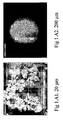
- Figure 1.A1. shows a photo of the primary particles obtained according to example 1
- Figure 1.A2. shows the respective agglomerate obtained from those particles, also according to example 1.
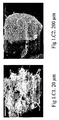
- the length of the white scale marked on each photo corresponds, respectively, to 20 and 200 micron.
- Figure 1.C1. shows a photo of the primary particles obtained according to example 6, while Figure 1.C2. shows the respective agglomerate obtained from those particles, also according to example 6.
- the length of the white scale marked on each photo corresponds, respectively, to 20 and 200 micron.
- Figure 2 shows the dimensional distribution of the fragments of chimerical agglomerates in example 6 supplied with a Valois insufflator, in comparison with the distribution of the agglomerates before supplying.
- the diameter of the agglomerates in micron established by screening
- the cumulative sub-measure expressed as a percentage on the horizontal axis ("x") of Figure 2 is shown the diameter of the agglomerates in micron, established by screening
- y the cumulative sub-measure expressed as a percentage.
- the curve that joins the empty triangles describes the dimensional distribution of the formula according to example 6 before supplying
- the curve that joins the black circles describes the dimensional distribution of the same formula after supplying with a Valois Monopowder P insufflator.
- the present patent application aims to provide remedies to the difficulties identified above and therefore describes new preparations in powder form suitable for the nasal administration of drugs, preferably with a systemic effect, by insufflation, insufflating devices loaded with said new preparations, as well as the technique and the intermediate products necessary for their preparation.
- the present application therefore describes how to make a nasal powder able to satisfy the two different technological requirements for the preparation of the dose and the supply of the prepared substance.
- Claims are therefore made for nasal formulae made with a new technology with which powders may be obtained which, though composed of primary particles having dimensions of a few micron suitable for rapid dissolving on the mucosa and therefore advantageously suited for systemic administration, are presented as agglomerates of said particles, having dimensions of hundreds of microns, and are therefore suitable for dosing of the drug in the insufflator.
- the powder for insufflation described is able to deliver different quantities and numerous types of drugs to the nasal mucosa.
- the present patent application describes the construction of agglomerates from primary particles with small dimensions, held together by weak forces of attraction.
- These agglomerates on account of their specific behaviour at the time of their suspension in the conveying gas flow to form a cloud of solids dispersed in the gas flow, make up a so-called “chimerical” form of the inhaling powder.
- They are in fact prepared from primary particles with micronic dimensions (that is from a few ⁇ m up to a few tens of ⁇ m), in particular having a diameter-volume established by light scattering between 1 and 50 micron, preferably between 1.5 and 29 micron.
- the dimensional distribution of the primary particles is such as to present a median diameter-volume (D 50 ) established by means of light scattering between 3 and 11 micron, 80% of the primary particles falling in the diameter range between 2 micron (D 10 ) and 20 micron (D 90 ), D 10 constituting the lower diameter percentile value, that is the value not reached by 10% of the population of the primary particles, and D 90 constituting the higher diameter percentile value, not reached by 90% of the population of primary particles.
- D 50 median diameter-volume
- the dimensional distribution of the primary particles is such as to present a mean diameter-volume (D 50 ) established by means of light scattering between 4 and 6 micron, 80% of the primary particles falling in the diameter range between 2 micron (D 10 ) and 9 micron (D 90 ), D 10 constituting the lower diameter percentile value, that is the value not reached by 10% of the population of the primary particles, and D 90 constituting the higher diameter percentile value, not reached by 90% of the population of primary particles.
- D 50 mean diameter-volume
- the agglomerates are composed of primary particles as above and they exist only in the phases that precede the supply of the product. These agglomerates have dimensions of hundreds of microns. In particular, these agglomerates have a diameter of at least 106 micron, selected by screening; more preferably their diameter selected by screening is between 106 and 1000 micron, and their shape is generally spherical or roundish. For these reasons the agglomerates are fluid and suitable for the operations of filling the containers with - the dose and for dosing inside the insufflator.
- the air turbulence produced during insufflation that is the conveying gas flow supplied, suspending the formula to create a cloud of dispersed solids, demolishes the agglomerates at least partially to create fragments, giving origin - by reduction of the dimensional distribution of the aggregates - to a new powder (composed of agglomerates and their fragments) with a dimensional distribution having a prevailingly non breathable diameter (> 6.4 ⁇ m), but suitable for nasal deposition.
- the reduction of the initial dimensional distribution of the aggregates according to the present invention for disaggregating in the conveying gas flow takes place uniformly but for a relatively small factor ( ⁇ 8) , preferably between 1.1 and 3 and even more preferably between 1.1 and 2.
- formulae of drugs in powder form are supplied for preferably systemic, nasal administration, by means of a suspension of said powder in a conveying gas flow at the moment of supply from a special insufflator, said powder being composed of agglomerates with a diameter of at least 106 micron selected by screening, composed of homogeneous primary particles comprising the drug and structuring excipients having a diameter-volume established by light scattering between 1 and 50 micron, characterised in that said agglomerates, at the moment of their suspension in the gas flow, are at least partly disaggregated so as to produce, in the cloud of solids dispersed in the gas flow, a fraction of at least 80% in weight, composed of agglomerates and of their fragments, the solids contained in said fraction having a non breathable diameter.
- the present application also describes a procedure for the preparation of a formula of a drug in powder form for nasal administration, which as said above is “chimerical” in that it is presented as composed of agglomerates of small particles (that is “primary” particles), such that once insufflated it is transformed into fragments of such agglomerates, rather than into the original primary particles.
- the primary particles of this powder having dimensions of a few micron, in particular between 1 and 50 micron and preferably between 1.5 and 29 micron (diameter-volume established by light scattering) are obtained with a spray drying technique, applied to a solution of auxiliary substances (structuring excipients and possible additional aids) and drug.
- These particles having dimensions between 1 and 50 micron, or, preferably between 1.5 and 29 micron, are called primary particles, because after their production they are agglomerated directly to obtain soft agglomerates, with dimensions of a few hundred micron, at least 106 micron, and selected by screening. This procedure, which is described in greater detail below, reduces by one step the method described in patent EP1036562 for pulmonary soft pellets.
- these agglomerates are therefore defined "chimerical agglomerates" because their existence, in terms of dimension, is functional only for the dosing of the powder in the insufflator and limited to the production phases that precede insufflation.
- these chimerical agglomerates are fragmented by the turbulence of the conveying gas flow.
- the fragments obtained are not the primary particles, as described in patent EP 1036562 , but still aggregates of the primary particles, though having dimensions smaller than the chimerical aggregates.
- the relatively low disaggregating factor ( ⁇ 8 or preferably between 1.1 and 3, and more preferably between 1.1 and 2) distinguishes the present invention and constitutes a fundamental difference with respect to the "soft pellets" technology, in which one does not seek to obtain a new powder with an intermediate dimension, but one regenerates the primary particles from the agglomerates, obtaining a cloud of particles with a prevalently breathable dimension ( ⁇ 6.4 micron).
- fragments of chimerical agglomerates of the present invention are particularly suitable for the nasal administration of drugs because, after being deposited on the nasal mucosa, since they are weak aggregates of fine primary particles, they do not prevent a fast dissolving of the drug. At the same time they are prevalently sufficiently coarse to prevent their being breathed.
- these "chimerical" agglomerates and their fragments on account of their composition, in the presence of water or of mucous are instantly decomposed or disaggregated into the primary particles, without in this way limiting the dissolving of the drug carried.
- the availability for rapid absorption through the nasal mucosa - which is critical, for example, for a formula with a systemic effect, but may also be contemplated for determined topical applications, when the active principle presents very poor solubility - is therefore not prevented by the agglomeration.
- the primary particles according to the present invention are prepared by means of a spray drying method of a solution comprising the drug and one or more structuring excipients, together with at least one surface - active substance and optional additional adjuvant excipients, for example through the drying of an aqueous or water-alcohol solution of a drug and excipients.
- the structuring excipients are described in more detail below.
- Further adjuvant excipients may be chosen and incorporated in suitable quantity - where necessary - by the expert in this field, from the "usual" excipients in this field, that is from those authorised by the Pharmacopeia.
- a non limiting example for a class of further adjuvant excipients is represented by the various pharmaceutically acceptable preserving agents.
- the structuring excipients necessary for the formation and for the structuring of the primary particles may be used individually or as blends and they are chosen from the group that consists of sugars and polyalcohols. Amino acids, cellulose polymers, cyclodextrines, chitosane, and/or solid polyethylenglycols may additionally be present.
- sugars lactose, sucrose, glucose, trehalose and fructose are to be mentioned.
- amino acids glycine, leucine and isoleucine are to be mentioned.
- the natural or semi-synthetic celluloses are to be mentioned, for example methylcellulose or hydroxypropylmethylcellulose.
- the primary particles are characterised in that the active principle (that is the drugs) contained in them replaces the structuring excipient (or the blend of structuring excipients) in a percentage between 0.1 and 90% and that these drugs are for example chosen from the group that comprises analgesics; anti-cough drugs; tranquillisers; sleep-inducing drugs; drugs used in the therapy to break the habit of smoking, alcohol and opioids; antidepressants; antinausea; antiemetics; antihistamines; anticoagulants; antikinetosis drugs; myorelaxing agents; antispastic agents; antimigraine agents; drugs for the treatment of neurodegenerative diseases, of erectile dysfunctions, of osteoporosis, of sterility; antineoplastic agents; local anaesthetics; antianaemic agents; hypoglycaemic agents; peptides; vaccines; vitamins; hormones and antistress agents.
- the active principle that is the drugs
- these drugs are for example chosen from the group
- these primary particles may be grouped together to form chimerical agglomerates.
- the primary particles are agglomerated by making them roll in a cylindrical or kidney-shaped glass container which rotates on its own base.
- the inventors of the present application have found, however, that, if the rolling container is made of bakelite, the formation of the agglomerates is faster, more reproducible and quantitative, even starting from powders that do not tend to form electrostatic charges.
- the procedure preferred for obtaining formulae of drugs in powder form according to the present invention comprises the following phases:
- the solution comprising the drug, the structuring excipient or the structuring excipients, the at least one surface-active substance and the optional adjuvant excipients is obtained by mixing a first solution of the drug with one or more second solutions of structuring excipients, the at least one surface-active substance and optionally of adjuvant excipients.
- mixing is carried out in such proportions as not to cause precipitations of the solutes.
- solvents are used which are different but which are miscible among each other.
- a further (co-) solvent may be used as a miscibility mediator.
- the said mixing is carried out in such proportions as not to cause precipitations of the solutes.
- the inventors of the present application have discovered that the agglomeration of the primary particles is achieved in an almost quantitative manner when a surface-active substance is included in their composition - in a percentage of weight, with reference to the quantity of the total dry formula, between 0.1% and 10% - as the adjuvant excipient. Instead, in the absence of said surface-active substance, in some cases, the chimerical agglomerates are formed in a minimum quantity, or the powder tends to stick to the bottom of the rotating container due to an excess of electrostatic charges.
- the most suitable surface-active substances for obtaining this result have proved to be phospholipids, for example lecithin, semi-synthetic mono- or diglycerides, sorbitan esters, polyoxyethylensorbitan esters and poloxamers.
- a further important innovation of this invention consists of the fact that the inventors have discovered that the presence of the surface-active substance offers the possibility of constructing primary particles and agglomerates, with any type of drug and with different quantities of the same drug, without altering the yields of the agglomeration method.
- the inventors have been able to find a basic composition, made up essentially of a polyalcohol and a sugar, preferably mannitol or lactose, and a small quantity of surface-active substance, preferably lecithin, able to receive different quantities of active principle or different active principles, simply by replacing in the composition itself a quantity of polyalcohol or sugar with the corresponding quantity of active principle.
- This basic composition which contains a sugar (such as lactose or trehalose) or a polyalcohol (such as mannitol, xylitol, sorbitol or other), can also be transformed into primary particles by spray-drying, in the presence of other excipients or polymers such as chitosane, polyethylenglycols, semi-synthetic celluloses or cyclodextrines, which also perform a structuring activity for the primary particles and for the agglomerates prepared subsequently.
- a sugar such as lactose or trehalose
- a polyalcohol such as mannitol, xylitol, sorbitol or other
- the drug caffeine has been considered for the formula of the chimerical agglomerates in nasal powder described herein, inserting the drug in the basic formula in a quantity between 10 and 70% by weight.
- the basic formula of nasal powder described has proved to be able to receive different quantities of active principle.
- the components of the formula listed here as examples were mannitol between 25 and 95 %, lecithin between 0 and 10%, hydroxypropylmethylcellulose (Methocel E3) between 0 and 2% and polyethylenglycol 6000 between 0 and 5%.
- the powder obtained was composed of particles having a median diameter-volume (D 50 ), established by means of a "light scattering" test, of 4.5 ⁇ m, with a measured yield of 70% with respect to the quantity of solid present in the sprayed solution.
- the dimensional distribution of the powder thus obtained was such that 80% of the powder was in the diameter range between 2.45 ⁇ m (D 10 ) and 7.72 ⁇ m (D 90 ), D 10 being the lowest diameter percentile value, that is not reached by 10% of the population of primary particles, and D 90 being the highest diameter percentile value, that is not reached by 90% of the population of primary particles.
- a quantity of 1 g of powder of primary particles was put into a bakelite cylinder (diameter 5 cm; length 4.4 cm), or alternatively into a kidney-shaped glass container, which was rotated on its own base at a speed of 30 rpm for 30 minutes. During rotation the powder rolled inside the cylinder. As a result of the rolling, the primary particles tended to become electrostatically charged, giving rise to spherical aggregates which grew in diameter with the length of the rolling period.
- the aggregates obtained were selected by screening, separating the fraction between 106-850 ⁇ m which was considered the nasal powder in the form of chimerical agglomerates.
- the yield of this preparation that is the quantity of agglomerates obtained with respect to the original powder, was 80%, both after agglomeration in a glass container and after agglomeration in a bakelite container.
- the powder obtained was composed of particles having a median diameter-volume (D 50 ), established by means of a "light scattering" test, of 4,36 ⁇ m, with a measured yield of 60 % with respect to the quantity of solid present in the sprayed solution.
- the dimensional distribution of the powder thus obtained was such that 80% of the powder was in the diameter range between 4.06 ⁇ m (D 10 ) and 4.93 ⁇ m (D 90 ), D 10 being the lowest diameter percentile value, that is not reached by 10% of the population of primary particles, and D 90 being the highest diameter percentile value, that is not reached by 90% of the population of primary particles.
- a quantity of 1 g of powder of primary particles was put into a bakelite cylinder (diameter 5 cm; length 4.4 cm), or alternatively into a kidney-shaped glass container, which was rotated on its own base at a speed of 30 rpm for 30 minutes. During rotation the powder rolled inside the cylinder. As a result of the rolling, the primary particles tended to become electrostatically charged, giving rise to spherical aggregates which grew in diameter with the length of the rolling period.
- the aggregates obtained were selected by screening, separating the fraction between 106-850 ⁇ m which was considered the nasal powder in the form of chimerical agglomerates.
- the yield of this preparation that is the quantity of agglomerates obtained with respect to the original powder, was 89%, both after agglomeration in a glass container and after agglomeration in a bakelite container.
- a quantity of 1 g of powder of primary particles was put into a bakelite cylinder (diameter 5 cm; length 4.4 cm), or alternatively into a kidney-shaped glass container, which was rotated on its own base at a speed of 30 rpm for 30 minutes.
- the primary particles gave rise to spherical aggregates which grew in diameter with the length of the rolling period.
- the aggregates obtained were selected by screening, separating the fraction between 106-850 ⁇ m, which constituted the nasal powder in the form of chimerical agglomerates.
- the yield of this preparation that is the quantity of agglomerates obtained with respect to the original powder, was 92% in the glass container and 85% in the bakelite one.
- the powder obtained was composed of particles having a median diameter-volume (D 50 ), established by means of a "light scattering" test, of 4.78 ⁇ m, with a measured yield of 42 % with respect to the quantity of solid present in the sprayed solution.
- the dimensional distribution of the powder thus obtained was such that 80% of the powder was in the diameter range between 2.66 ⁇ m (D 10 ) and 7.85 ⁇ m (D 90 ), D 10 being the lowest diameter percentile value, that is not reached by 10% of the population of primary particles, and D 90 being the highest diameter percentile value, that is not reached by 90% of the population of primary particles.
- a quantity of 1 g of powder of primary particles was put into a bakelite cylinder (diameter 5 cm; length 4.4 cm), or alternatively into a kidney-shaped glass container, which was rotated on its own base at a speed of 30 rpm for 30 minutes.
- the primary particles gave rise to spherical aggregates which grew in diameter with the length of the rolling period.
- the aggregates obtained were selected by screening, separating the fraction between 106-850 ⁇ m, which constituted the nasal powder in the form of chimerical agglomerates.
- the yield of this preparation that is the quantity of agglomerates obtained with respect to the original powder, was 80% in the glass container and 83% in the bakelite one.
- the powder obtained was composed of primary particles having a median diameter-volume (D 50 ), established by means of a "light scattering" test, of 5.04 ⁇ m, with a measured yield of 53 % with respect to the quantity of solid present in the sprayed solution.
- the dimensional distribution of the powder thus obtained was such that 80% of the powder was in the diameter range between 2.52 ⁇ m (D 10 ) and 7.74 ⁇ m (D 90 ), D 10 being the lowest diameter percentile value, that is not reached by 10% of the population of primary particles, and D 90 being the highest diameter percentile value, that is not reached by 90% of the population of primary particles.
- a quantity of 1 g of powder of primary particles was put into a bakelite cylinder (diameter 5 cm; length 4.4 cm), or alternatively into a kidney-shaped glass container, which was rotated on its own base at a speed of 30 rpm for 30 minutes.
- the aggregates obtained were selected by screening, separating the fraction between 106-850 ⁇ m, which constituted the nasal powder in the form of chimerical agglomerates.
- the yield of this preparation that is the quantity of agglomerates obtained with respect to the original powder, was rather low, that is 22.4% in the glass container and 26% in the bakelite one.
- the powder obtained was composed of particles having a median diameter-volume (D 50 ), established by means of a "light scattering" test, of 5.29 ⁇ m, with a measured yield of 60 % with respect to the quantity of solid present in the sprayed solution.
- the dimensional distribution of the powder thus obtained was such that 80% of the powder was in the diameter range between 2.87 ⁇ m (D 10 ) and 8.55 ⁇ m (D 90 ), D 10 being the lowest diameter percentile value, that is not reached by 10% of the population of primary particles, and D 90 being the highest diameter percentile value, that is not reached by 90% of the population of primary particles.
- a quantity of 1 g of powder of primary particles was put into a bakelite cylinder (diameter 5 cm; length 4.4 cm), or alternatively into a kidney-shaped glass container, which was rotated on its own base at a speed of 30 rpm for 30 minutes.
- the primary particles gave rise to spherical aggregates which grew in diameter with the length of the rolling period.
- the aggregates obtained were selected by screening, separating the fraction between 106-850 ⁇ m, which constituted the nasal powder in the form of chimerical agglomerates.
- the yield of this preparation that is the quantity of agglomerates obtained with respect to the original powder, was 92% in the glass container and 87% in the bakelite one.
- Morphology of the primary particles and of the chimerical agglomerates is Morphology of the primary particles and of the chimerical agglomerates.
- the primary particles are generally spherical in shape, as are the chimerical agglomerates. However it is not an essential condition that the particles should be spherical in shape, as may be seen from the result of Example 6.
- Figure 1 shows the primary particles and the respective chimerical agglomerates obtained with the formula of Example 1, Example 3 and Example 6.
- a gelatine capsule #2 which constitutes the deposit of the drug dose in a Puvlizer insufflator (Teijin Itd. Tokyo, J).
- This insufflator is composed of a rubber bulb which, when pressed, causes the emission of a jet of air which, passing through the perforated gelatine capsule, carries the powder that it contains towards the nasal adaptor.
- the amount of powder emitted with the two insufflators was substantially different.
- the Valois insufflator was able to emit the whole dose with a single pressure, while the Puvlizer insufflator had to be pressed several times in order to emit the whole loaded dose.
- the Valois insufflator emitted 99.1% of the dose with a single pressure, while the Puvlizer insufflator emitted 91.6% of the dose after being pressed 7 times.
- This result shows that the chimerical agglomerates require a certain force of insufflation to be expelled in a quantitative manner from the drug dose deposit.
- the principal characteristic which nasal powders should possess is to give origin to a cloud of insufflated powder which is deposited in the nasal cavity without the risk of being breathed.
- This objective is achieved by the formula according to the present invention, since the dimensional distribution of the nasal powder is such that at least 80% of the weight of the cloud of solids supplied by the insufflator has a non breathable diameter, that is larger than 6.4 micron.
- the demolition of the chimerical agglomerates according to the present invention therefore leads to the obtaining of fragments which are still composed of aggregates of primary particles, and which as such possess dimensions of some tens or hundreds of micron.
- the result of this measurement is shown in Figure 2 , in comparison with the original dimension of the agglomerates. It may be seen that the emission of the powder (having a mean dimension of about 400 micron) has provoked the breaking up (for a factor of about 2) of the agglomerates into fragments having a mean dimension of about 200 micron, particularly suitable for nasal deposition, since they are still composed of aggregates of primary particles. Moreover, it may be seen from Figure 2 that about 84% of the fragments produced have a diameter larger than 75 micron.
Landscapes
- Health & Medical Sciences (AREA)
- Life Sciences & Earth Sciences (AREA)
- Chemical & Material Sciences (AREA)
- Medicinal Chemistry (AREA)
- Pharmacology & Pharmacy (AREA)
- Epidemiology (AREA)
- Otolaryngology (AREA)
- Animal Behavior & Ethology (AREA)
- General Health & Medical Sciences (AREA)
- Public Health (AREA)
- Veterinary Medicine (AREA)
- Medicinal Preparation (AREA)
- Pharmaceuticals Containing Other Organic And Inorganic Compounds (AREA)
- Medicines That Contain Protein Lipid Enzymes And Other Medicines (AREA)
Abstract
Description
- The present invention concerns drug formulae in powder form for nasal administration, insufflators filled with said formulae, and a method for obtaining them. Moreover, the present invention concerns primary particles for the formation of agglomerates contained in the drug formulae for nasal administration.
- The present invention concerns the nasal administration of drugs.
- A pharmaceutical product for nasal topical administration, for example a drug intended to "lear" the nose when affected by a cold, is commonly composed of the formula containing the drug and of the insufflator, which deposits the drug in the nasal cavity. The insufflating device and the formula (in liquid or solid form) are therefore both optimised for reciprocal use and each formula must be suitable for the insufflator used.
- A characteristic required in particular from powders for nasal topical administration is that these should be at the same time fine and coarse: fine to favour their deposition in the nose, coarse to favour their introduction and dosage inside the insufflating device. This paradox is typical of all powders for inhaling, whether they be intended for inhaling through the nose or the lungs.
- Despite the difficulties as described above, the need to have new ways of administering drugs in order to obtain a rapid effect without having to resort to injection has encouraged researchers to further explore the possibility of using inhalation not only for topical, but also for systemic administration. In fact, in recent years scientific literature has seen a growing interest in administration by inhalation, through nose or lungs, for drugs with a systemic action. This way in fact allows the absorption even of substances with a high molecular weight, when rapid action is desired. The respiratory epithelium is relatively extensive and the connective tissue below is characterised by a thick capillary network. For this reason the respiratory region of the nose is considered a useful site for an absorption which gives rise to a pronounced systemic effect.
- As is known, the nose is often used for the abuse of psychoactive substances, but officially the administration of drugs through the nasal mucosa to obtain a systemic action is little used. Most of the nasal preparations in fact contain drugs used for a local (topical) effect on the mucosae. Instead, in order to obtain a systemic effect, the nasal means of administration could allow rapid action to be obtained for drugs that are usually administered by mouth. In fact, thanks to the high vascularisation of the nasal mucosa, the plasmatic peak time of the drug is shortened. Moreover the venous blood from the nasal cavities flows directly into the systemic circle, avoiding a possible effect of a first passage through the liver. Although nasal administration also has its limits, these limits are widely known and can be easily respected or overcome. In practice, the only limitations that must be considered require mostly that the administered dose of drug should not be too high and that the therapy should not be chronic.
- While in theory all drugs with a systemic effect could be contemplated for nasal administration, in the light of the above considerations, there are nevertheless certain categories of drugs that are more suitable than others for nasal administration. Potential candidates preferred for nasal formulae are analgesic drugs for the treatment of non chronic pain (piroxicam, morphine, dextropropoxyphene, endorphin), tranquillising or sleep-inducing drugs for the treatment of stress pathologies (Diazepam, Lorazepam), antinausea or antiemetic drugs (metoclopramide), antikinetosis drugs (dimenidrinate), vitamin B12, calcitonin, nicotine, myorelaxing agents (thiocolchicoside), antimigraine agents, in any case, though without excluding many others.
- As explained above it is of particular importance for the studies concerning the development of inhaling products that the nasal product should be composed of the formula and of the insufflator or dosing device that allows administration of the formula. According to the directives expressed in the Pharmacopeiae of various countries, the insufflating device and the formula are usually inseparable, in particular in the case of solid formula (powders) and to such an extent that the replacement of the insufflator with another believed similar may (but not necessarily) lead to a variation of bio-availability. This concept is linked to the fact that the nasal absorption of the drug must be preceded by the depositing of the preparation in the nasal cavity. The means of depositing inside the nose depends on the formula, on the insufflator, and in particular on the fluid-dynamic characteristics of the latter, which determine the suspension of the pharmaceutical formula in the flow of conveying gas to produce a cloud of solids. It is clear that, in the absence of a suspension of the formula in the flow of gas, and consequently in the absence of deposition of the formula on the mucosa, there will be no absorption of the substance.
- Anyway, the deposition by insufflation of a drug in the nasal cavity also depends a great deal on its formula. The aerodynamic diameter of the supplied particles is the most important characteristic for the bio-availability of the drug insufflated into the nose. According to a method described in the world's major Pharmacopeiae (see for example the "Glas Impinger test" (Apparatus A) listed in Farmacopea Europea, III Edition 1997, paragraph 2.9.18., page 143), it has been established that particles with a diameter smaller than 6.4 µm, by insufflation, are certainly deposited in the lungs, whereas those with a larger diameter do not reach the lungs, but are deposited along the airways. Consequently, particles with a diameter smaller than 6.4 micron (µm) are generally classified as "breathable". To ensure deposition in the nose instead of in the lungs, the dimensional distribution of substance supplied is therefore a critical factor.
- Generally, the use of formulae in powder form, rather than liquids, allows a more controlled dimensional interval of the insufflated substance. With respect to a solution, the stability is increased and the bio-availability of the drug could be favoured. After the powder has been deposited on the nasal mucosa it dissolves locally, giving rise to a saturated solution of the drug at the level of the site of absorption, which determines transport through the mucosa at the same rate as the limit flow of the drug. Moreover, to facilitate absorption it is possible to use bioadhesive materials which allow the time of contact of the powder with the mucosa to be extended.
- However, as mentioned above, powders for nasal administration must possess particular dimensional characteristics: they should be fine so that they can be efficiently conveyed by the flow of gas and so that they can be correctly deposited in the nose, but at the same time they should be coarse to facilitate the introduction of the dose in the insufflating device. Moreover, in cases where the insufflator is not loaded with individual pre-established doses of powder, but where an internal mechanism takes the required quantity for each dose one by one from a silo containing the insufflator itself, the powder must also be sufficiently coarse to make dosing efficient and precise at the time of being taken. So, while the powder for producing an aerosol (a cloud of solids dispersed in a flow of gas) must be fine, on the other hand the powder to be dosed in the containers of an insufflator must be fluid, and fluidity is a typical property of coarse powders.
- This paradox is typical of all powders for inhaling, whether they be intended for inhaling through the nose or the lungs. A solution to this paradox, described in patent literature (see for example
EP 1 036 562 ) and applied up till now exclusively for powder for inhaling in the lungs, particularly those with a topical effect, has been the construction of aggregates of particles, held together by weak forces of attraction. These aggregates, called "soft pellets", are prepared from micronised particles having a mean diameter smaller than 10 micron, obtained with a powder grinding (micronising) procedure. Soft pellets have dimensions of a few hundred microns and a roundish shape. For these reasons they are perfectly fluid and suitable for the operations of filling the containers with the dose. Soft pellets are then demolished into the particles making them up through the turbulence in the conveying air flow generated by the aerosol device, substantially restoring the dimensional distribution of the original micronised powder. The fact that the dimensional distribution of the original micronised powder is obtained is critical for the aerosol's ability to be breathed into the lungs, since only particles with an aerodynamic diameter smaller than 6.4 microns can penetrate the lungs. Substantially, as appears inEP 1 036 562 , it may be concluded that the objective of the "soft pellets" technology is to make available formulae for pulmonary administration of active principles with a prevalently topical action. -
WO98/41193 A1 - However, there are some cases, especially when a systemic effect is required, in which nasal administration, if feasible, would be preferable by far to pulmonary administration. In fact there are some drugs which can demonstrate perturbing collateral effects in that they irritate the pulmonary airways and thus produce bronchial spasm, a problem which becomes even more accentuated when patients have to be treated who also suffer from attacks of asthma. Instead, as the nasal mucosae are by nature more exposed to exogenous substances of every type, they are far less sensitive and therefore tend less to become sites of perturbing or even painful conditions for the patient.
- Unfortunately, however, the soft pellets technique is not applicable in the specific field of nasal powders. The main reason is that there is an essential difference between nasal and pulmonary inhalation, consisting of the different required dimension of the particles of product supplied to obtain nasal deposition, in comparison with the pulmonary method. In fact, the dimension of the powder entering the respiratory apparatus to be deposited in the nose must be at least another of magnitude larger than that intended for the pulmonary route. So for deposition in the nose, the particles must have a diameter at least an order of magnitude larger than 6.4 microns (preferably larger than 10 microns), to avoid their being breathed inadvertently.
- Besides, a technical solution based simply on the preparation of larger particles could compromise the release of the drug, once the.powder has been deposited on the nasal mucosa. It is known that the speed of dissolving of a drug in powder form depends on the dimensions of the particles: the smaller the particles, the faster they dissolve. While a decrease of the dissolving speed and also the consequent effect of a delayed and maybe prolonged availability may be acceptable or even desirable in the context of the administration of certain highly soluble drugs with a topical effect, this certainly does not apply to drugs with a topical effect that are not very soluble, and even less in cases where a systemic effect is to be obtained.
- Clearly, for systemic nasal administration carried out to obtain rapid action, it would not be logical to propose the administration of particles with large dimensions, as they would lead to a decrease of the dissolving speed and therefore a slow action. So the particles must absolutely be kept within the range of small dimensions, without at the same time causing them to be breathed into the pulmonary tract. Therefore the paradox of powders for inhalation, in the case of nasal powders, is even more complex, since the particles would have to be small in order to dissolve quickly, but not so fine as to risk being breathed. Moreover they must be sufficiently large to be able to be handled during the preparation and dosing of the pharmaceutical product.
- The aim of the present invention is therefore to overcome the problems described above and therefore to provide formulae of drugs in powder form for nasal, preferably systemic, administration.
- A further aim of the present invention is to provide formulae of drugs in powder form for nasal, preferably systemic, administration which are adaptable to the insufflating devices currently available.
- A further aim of the present invention is to provide procedures for obtaining formulae of drugs in powder form for nasal, preferably systemic, administration.
- A further aim of the present invention is to provide insufflators loaded with formulae of drugs in powder form for nasal, preferably systemic, administration.
- A further aim of the present invention is to provide primary particles that can be used for the formation of agglomerates usable in the formulae of drugs in powder form for nasal, preferably systemic, administration.
- These and other aims that will appear more clearly below are achieved by the method for obtaining drug formulae in powder form according to claim 1.
- Moreover, claim 15 provides drug formulae in powder form obtainable by the method of claim 1. Claim 17 provides a nasal insufflator loaded with a formula according to claim 15.
-
-
Figure 1 shows the primary particles of the pharmaceutical formula and the respective agglomerates according to the present invention, both reproduced using the technique of scanning electron microscopy ("sem"). - In particular,
Figure 1.A1. shows a photo of the primary particles obtained according to example 1, whileFigure 1.A2. shows the respective agglomerate obtained from those particles, also according to example 1. The length of the white scale marked on each photo corresponds, respectively, to 20 and 200 micron. -
Figure 1.B1. shows a photo of the primary particles obtained according to example 3, whileFigure 1B2. shows the respective agglomerate obtained from those particles, also according to example 3. The length of the white scale marked on each photo corresponds, respectively, to 10 and 200 micron. -
Figure 1.C1. shows a photo of the primary particles obtained according to example 6, whileFigure 1.C2. shows the respective agglomerate obtained from those particles, also according to example 6. The length of the white scale marked on each photo corresponds, respectively, to 20 and 200 micron. - Instead,
Figure 2 shows the dimensional distribution of the fragments of chimerical agglomerates in example 6 supplied with a Valois insufflator, in comparison with the distribution of the agglomerates before supplying. In particular, on the horizontal axis ("x") ofFigure 2 is shown the diameter of the agglomerates in micron, established by screening, while on the vertical axis ("y") ofFigure 2 is shown the cumulative sub-measure expressed as a percentage. The curve that joins the empty triangles describes the dimensional distribution of the formula according to example 6 before supplying, while the curve that joins the black circles describes the dimensional distribution of the same formula after supplying with a Valois Monopowder P insufflator. - The present patent application aims to provide remedies to the difficulties identified above and therefore describes new preparations in powder form suitable for the nasal administration of drugs, preferably with a systemic effect, by insufflation, insufflating devices loaded with said new preparations, as well as the technique and the intermediate products necessary for their preparation.
- In particular, the preparation of formulae able to overcome the paradox related to the optimum dimensions requires, for nasal application, new technological solutions based on methods and on excipients suitable for the formation of said formulae.
- The present application therefore describes how to make a nasal powder able to satisfy the two different technological requirements for the preparation of the dose and the supply of the prepared substance. Claims are therefore made for nasal formulae made with a new technology with which powders may be obtained which, though composed of primary particles having dimensions of a few micron suitable for rapid dissolving on the mucosa and therefore advantageously suited for systemic administration, are presented as agglomerates of said particles, having dimensions of hundreds of microns, and are therefore suitable for dosing of the drug in the insufflator. The powder for insufflation described is able to deliver different quantities and numerous types of drugs to the nasal mucosa.
- To satisfy not only the paradox of inhaling powders in general, but also and above all the paradox of nasal powders in particular, the present patent application describes the construction of agglomerates from primary particles with small dimensions, held together by weak forces of attraction. These agglomerates, on account of their specific behaviour at the time of their suspension in the conveying gas flow to form a cloud of solids dispersed in the gas flow, make up a so-called "chimerical" form of the inhaling powder. They are in fact prepared from primary particles with micronic dimensions (that is from a few µm up to a few tens of µm), in particular having a diameter-volume established by light scattering between 1 and 50 micron, preferably between 1.5 and 29 micron.
- Preferably, the dimensional distribution of the primary particles (in the diameter-volume interval from 1 to 50 micron) is such as to present a median diameter-volume (D50) established by means of light scattering between 3 and 11 micron, 80% of the primary particles falling in the diameter range between 2 micron (D10) and 20 micron (D90), D10 constituting the lower diameter percentile value, that is the value not reached by 10% of the population of the primary particles, and D90 constituting the higher diameter percentile value, not reached by 90% of the population of primary particles.
- More preferably, the dimensional distribution of the primary particles (in the diameter-volume interval from 1.5 to 29 micron) is such as to present a mean diameter-volume (D50) established by means of light scattering between 4 and 6 micron, 80% of the primary particles falling in the diameter range between 2 micron (D10) and 9 micron (D90), D10 constituting the lower diameter percentile value, that is the value not reached by 10% of the population of the primary particles, and D90 constituting the higher diameter percentile value, not reached by 90% of the population of primary particles.
- Instead, the agglomerates are composed of primary particles as above and they exist only in the phases that precede the supply of the product. These agglomerates have dimensions of hundreds of microns. In particular, these agglomerates have a diameter of at least 106 micron, selected by screening; more preferably their diameter selected by screening is between 106 and 1000 micron, and their shape is generally spherical or roundish. For these reasons the agglomerates are fluid and suitable for the operations of filling the containers with - the dose and for dosing inside the insufflator. The air turbulence produced during insufflation, that is the conveying gas flow supplied, suspending the formula to create a cloud of dispersed solids, demolishes the agglomerates at least partially to create fragments, giving origin - by reduction of the dimensional distribution of the aggregates - to a new powder (composed of agglomerates and their fragments) with a dimensional distribution having a prevailingly non breathable diameter (> 6.4 µm), but suitable for nasal deposition.
- In particular, the mist of solids dispersed in the gas flow at the time of supply from the insufflator contains a fraction of at least 80% in weight, preferably of at least 85% in weight, or even more preferably of 90% or even 95% in weight, of solids having a non breathable diameter (> 6.4 µm). For example, cases are preferred where, in the gaseous suspension composed of agglomerates and their fragments, at least 60% of the weight of the solids has a diameter, selected by screening, larger than 53 micron.
- It should be noted that the reduction of the initial dimensional distribution of the aggregates according to the present invention for disaggregating in the conveying gas flow takes place uniformly but for a relatively small factor (<8) , preferably between 1.1 and 3 and even more preferably between 1.1 and 2.
- In particular, according to a preferred form of the present invention, formulae of drugs in powder form are supplied for preferably systemic, nasal administration, by means of a suspension of said powder in a conveying gas flow at the moment of supply from a special insufflator, said powder being composed of agglomerates with a diameter of at least 106 micron selected by screening, composed of homogeneous primary particles comprising the drug and structuring excipients having a diameter-volume established by light scattering between 1 and 50 micron, characterised in that said agglomerates, at the moment of their suspension in the gas flow, are at least partly disaggregated so as to produce, in the cloud of solids dispersed in the gas flow, a fraction of at least 80% in weight, composed of agglomerates and of their fragments, the solids contained in said fraction having a non breathable diameter.
- The present application also describes a procedure for the preparation of a formula of a drug in powder form for nasal administration, which as said above is "chimerical" in that it is presented as composed of agglomerates of small particles (that is "primary" particles), such that once insufflated it is transformed into fragments of such agglomerates, rather than into the original primary particles. The primary particles of this powder, having dimensions of a few micron, in particular between 1 and 50 micron and preferably between 1.5 and 29 micron (diameter-volume established by light scattering) are obtained with a spray drying technique, applied to a solution of auxiliary substances (structuring excipients and possible additional aids) and drug. These particles, having dimensions between 1 and 50 micron, or, preferably between 1.5 and 29 micron, are called primary particles, because after their production they are agglomerated directly to obtain soft agglomerates, with dimensions of a few hundred micron, at least 106 micron, and selected by screening. This procedure, which is described in greater detail below, reduces by one step the method described in patent
EP1036562 for pulmonary soft pellets. - Now, returning to the agglomerates of the present invention, these agglomerates are therefore defined "chimerical agglomerates" because their existence, in terms of dimension, is functional only for the dosing of the powder in the insufflator and limited to the production phases that precede insufflation. After insufflation with an air jet device (or, more generally, with a "conveying gas flow", and therefore independently of the type of gas used to obtain the jet), these chimerical agglomerates are fragmented by the turbulence of the conveying gas flow. However, due to the relatively low disaggregating factor (<8, preferably between 1.1 and 3, and more preferably between 1.1 and 2), the fragments obtained are not the primary particles, as described in patent
EP 1036562 , but still aggregates of the primary particles, though having dimensions smaller than the chimerical aggregates. In other words, the relatively low disaggregating factor (<8 or preferably between 1.1 and 3, and more preferably between 1.1 and 2) distinguishes the present invention and constitutes a fundamental difference with respect to the "soft pellets" technology, in which one does not seek to obtain a new powder with an intermediate dimension, but one regenerates the primary particles from the agglomerates, obtaining a cloud of particles with a prevalently breathable dimension (< 6.4 micron). - The fragments of chimerical agglomerates of the present invention are particularly suitable for the nasal administration of drugs because, after being deposited on the nasal mucosa, since they are weak aggregates of fine primary particles, they do not prevent a fast dissolving of the drug. At the same time they are prevalently sufficiently coarse to prevent their being breathed.
- While the disaggregating of given chimerical agglomerates of the present invention depends, to a certain extent, also on the fluid-dynamic characteristics of the insufflator used, the experiments carried out by the inventors of the present application have demonstrated that a turbulent conveying gas flow with a speed between 5l/min and 15l/min and with a total supplied volume between 5ml and 80ml is able to suspend and to disaggregate adequately, according to the present invention, a dose composed of between 0.5 mg and 40mg of nearly all the samples chosen from a vast range of different formulae (that is comprising different combinations between mean dimensions of primary particles and of aggregates) according to the present invention. While these fluid-dynamic conditions are exemplary only for insufflators by Valois (model Monopowder P), Miat (Miat spa, Milan, Italy) and Puvlizer (Teijin Ltd. Tokyo, Japan), it was found that the disaggregating of the formulae of the present invention was still adequate even in extreme conditions, that is at gas flow rates created artificially with external sources and between 2l/min and 60l/min. The possibility of the operation at much slower or much faster flow rates than those prescribed further confirms the versatility of nasal powders according to the present invention. In particular, in the case of slow supply (for example with the Puvlizer insufflator), despite the need for several activations until the complete dose has been supplied, no substantial impact was found on the dimensional distribution of the supplied cloud of solids which always fell within the criteria of the present invention. Moreover, the experiments have demonstrated that even a gas flow rate much higher than the one usually generated in the insufflators currently on the market does not regenerate the primary particles, but maintains the dimensional distribution of the supplied cloud of solids within the range contemplated by the present invention.
- Consequently, it has been demonstrated that the formulae of drugs in powder form according to the present invention are suitable for use with all the nasal insufflators currently on the market (or are easily adaptable by the expert in the field, by selecting a suited combination of the size of the primary particles and of their agglomerates).
- It has thus been seen how the new technology described in the present application is able to control the dimension of an agglomerate of primary particles during supply and guarantees that an aerosol will be obtained that is suitable for depositing the drug at the level of the nasal mucosa after insufflation in the nostrils. In this way the possibility of the supplied material entering the lungs is very slight. The peculiar formula of the primary particles and the method adopted for preparing them ensure that these primary particles give rise to agglomerates which, when subjected to a turbulent jet of conveying gas, produce fragments larger than the primary particles. Moreover, these "chimerical" agglomerates and their fragments, on account of their composition, in the presence of water or of mucous are instantly decomposed or disaggregated into the primary particles, without in this way limiting the dissolving of the drug carried. Thus, the availability for rapid absorption through the nasal mucosa - which is critical, for example, for a formula with a systemic effect, but may also be contemplated for determined topical applications, when the active principle presents very poor solubility - is therefore not prevented by the agglomeration.
- In particular, the primary particles according to the present invention are prepared by means of a spray drying method of a solution comprising the drug and one or more structuring excipients, together with at least one surface - active substance and optional additional adjuvant excipients, for example through the drying of an aqueous or water-alcohol solution of a drug and excipients. The structuring excipients are described in more detail below. Further adjuvant excipients may be chosen and incorporated in suitable quantity - where necessary - by the expert in this field, from the "usual" excipients in this field, that is from those authorised by the Pharmacopeia. A non limiting example for a class of further adjuvant excipients is represented by the various pharmaceutically acceptable preserving agents.
- The method according to the present invention allows primary particles to be obtained directly in the desired dimensional interval, avoiding subsequent grinding operations.
- The structuring excipients necessary for the formation and for the structuring of the primary particles may be used individually or as blends and they are chosen from the group that consists of sugars and polyalcohols. Amino acids, cellulose polymers, cyclodextrines, chitosane, and/or solid polyethylenglycols may additionally be present.
- In particular, among the polyalcohols, mannitol, sorbitol and xylitol are to be mentioned.
- In particular, among the sugars, lactose, sucrose, glucose, trehalose and fructose are to be mentioned.
- In particular, among the amino acids, glycine, leucine and isoleucine are to be mentioned.
- In particular, among the semi-synthetic cellulose polymers the natural or semi-synthetic celluloses are to be mentioned, for example methylcellulose or hydroxypropylmethylcellulose.
- The primary particles (and also the agglomerates subsequently obtained from them) are characterised in that the active principle (that is the drugs) contained in them replaces the structuring excipient (or the blend of structuring excipients) in a percentage between 0.1 and 90% and that these drugs are for example chosen from the group that comprises analgesics; anti-cough drugs; tranquillisers; sleep-inducing drugs; drugs used in the therapy to break the habit of smoking, alcohol and opioids;
antidepressants; antinausea; antiemetics; antihistamines; anticoagulants; antikinetosis drugs; myorelaxing agents; antispastic agents; antimigraine agents; drugs for the treatment of neurodegenerative diseases, of erectile dysfunctions, of osteoporosis, of sterility; antineoplastic agents; local anaesthetics; antianaemic agents; hypoglycaemic agents; peptides; vaccines; vitamins; hormones and antistress agents. - Preferably the drugs are chosen from the group that comprises piroxicam, dextropropoxyphene, endorphin, diazepam, dimenidrinate, thiocolchicoside, alnitidan, apomorphine, buprenorphine, bupropion, buserelin, butorphanol, calcitonin, codeine, desmopressin, dihydroergothamin, L-dopa, doxepin, enalaprilate, dronabinol, recombinant human erythropoietin, folic acid, G-CSF (Granulocite Colony Stimulating Factor), growth hormone secretagogues (GHRP-6), glucagon, gonadorelin, goserelin, aloperidol, heparin, hydromorphon, growth hormone, insulin, LHRH, lorazepam, lidocain, lipressin, melatonin, meperidin, methylphenidate, metoclopramide, midazolan, morphine, nafarelin, nalbufin, naltrexone, nicotine, estradiol, oxytocin, progesterone, prometazin, propanolol, parathyroid hormone, raloxifene, serotonin, sildenafil, tamoxifene, testosterone, tetracosactide, derivatives of delta-9-tetrahydrocannabinol, sumatriptan, urokinase, vitamin B12, endorphins, thiocolchicosides and caffeine.
- Depending on the composition and on the presence of the structuring excipients as above, these primary particles may be grouped together to form chimerical agglomerates. The primary particles are agglomerated by making them roll in a cylindrical or kidney-shaped glass container which rotates on its own base. The inventors of the present application have found, however, that, if the rolling container is made of bakelite, the formation of the agglomerates is faster, more reproducible and quantitative, even starting from powders that do not tend to form electrostatic charges.
- In particular, the procedure preferred for obtaining formulae of drugs in powder form according to the present invention comprises the following phases:
- the preparation of a solution comprising the drug, the structuring excipients, at least one surface-active substance, and optional adjuvant excipients,
- spray drying to give the primary particles,
- agglomeration of the primary particles by rolling,
- selection of the agglomerates with a diameter of at least 106 micron.
- In cases where the drug and the structuring excipient (or the surface-active substance or one of the optional adjuvant excipients) are not soluble in the same solvent, the solution comprising the drug, the structuring excipient or the structuring excipients, the at least one surface-active substance and the optional adjuvant excipients is obtained by mixing a first solution of the drug with one or more second solutions of structuring excipients, the at least one surface-active substance and optionally of adjuvant excipients. Preferably, mixing is carried out in such proportions as not to cause precipitations of the solutes. Preferably, to obtain the different solutions, solvents are used which are different but which are miscible among each other. In cases where this is not possible and there is very poor reciprocal miscibility of the various solvents used, a further (co-) solvent may be used as a miscibility mediator. Preferably, the said mixing is carried out in such proportions as not to cause precipitations of the solutes.
- Moreover, the inventors of the present application have discovered that the agglomeration of the primary particles is achieved in an almost quantitative manner when a surface-active substance is included in their composition - in a percentage of weight, with reference to the quantity of the total dry formula, between 0.1% and 10% - as the adjuvant excipient. Instead, in the absence of said surface-active substance, in some cases, the chimerical agglomerates are formed in a minimum quantity, or the powder tends to stick to the bottom of the rotating container due to an excess of electrostatic charges. In particular, the most suitable surface-active substances for obtaining this result have proved to be phospholipids, for example lecithin, semi-synthetic mono- or diglycerides, sorbitan esters, polyoxyethylensorbitan esters and poloxamers.
- A further important innovation of this invention consists of the fact that the inventors have discovered that the presence of the surface-active substance offers the possibility of constructing primary particles and agglomerates, with any type of drug and with different quantities of the same drug, without altering the yields of the agglomeration method. In fact, the inventors have been able to find a basic composition, made up essentially of a polyalcohol and a sugar, preferably mannitol or lactose, and a small quantity of surface-active substance, preferably lecithin, able to receive different quantities of active principle or different active principles, simply by replacing in the composition itself a quantity of polyalcohol or sugar with the corresponding quantity of active principle. This basic composition, which contains a sugar (such as lactose or trehalose) or a polyalcohol (such as mannitol, xylitol, sorbitol or other), can also be transformed into primary particles by spray-drying, in the presence of other excipients or polymers such as chitosane, polyethylenglycols, semi-synthetic celluloses or cyclodextrines, which also perform a structuring activity for the primary particles and for the agglomerates prepared subsequently.
- Below are listed some preparations which illustrate the composition and the creation of the primary particles and of the corresponding chimerical agglomerates. The examples listed highlight the importance of some substances for the success of the preparation for nasal application. Firstly a basic formula is described, composed of a sugar or of polyalcohol combined with a surface-active substance.
- As an example, without any limiting intention, the drug caffeine has been considered for the formula of the chimerical agglomerates in nasal powder described herein, inserting the drug in the basic formula in a quantity between 10 and 70% by weight. The basic formula of nasal powder described has proved to be able to receive different quantities of active principle.
- Without wishing to limit in any way the possibility of using other excipients to prepare primary particles and chimerical agglomerates from them, the components of the formula listed here as examples were mannitol between 25 and 95 %, lecithin between 0 and 10%, hydroxypropylmethylcellulose (Methocel E3) between 0 and 2% and polyethylenglycol 6000 between 0 and 5%.
- 95 g of mannitol were dissolved in 2500 ml of distilled water, kept in agitation at 40°C. 5 g of lecithin dissolved in 400 ml of ethanol were dispersed in the solution obtained. The solution obtained was spray-dried using a spray-drying device (Mini Spray Dryer Buchi Model B-191), in the following operative conditions:
- input air temperature: 90°C;
- output air temperature: 38-40°C;
- solution flow rate: 6.5 ml/min;
- nozzle diameter: 1.0 mm;
- air flow rate: 600 I/h.
- The powder obtained was composed of particles having a median diameter-volume (D50), established by means of a "light scattering" test, of 4.5 µm, with a measured yield of 70% with respect to the quantity of solid present in the sprayed solution. The dimensional distribution of the powder thus obtained was such that 80% of the powder was in the diameter range between 2.45 µm (D10) and 7.72 µm (D90), D10 being the lowest diameter percentile value, that is not reached by 10% of the population of primary particles, and D90 being the highest diameter percentile value, that is not reached by 90% of the population of primary particles.
- A quantity of 1 g of powder of primary particles was put into a bakelite cylinder (diameter 5 cm; length 4.4 cm), or alternatively into a kidney-shaped glass container, which was rotated on its own base at a speed of 30 rpm for 30 minutes. During rotation the powder rolled inside the cylinder. As a result of the rolling, the primary particles tended to become electrostatically charged, giving rise to spherical aggregates which grew in diameter with the length of the rolling period. The aggregates obtained were selected by screening, separating the fraction between 106-850 µm which was considered the nasal powder in the form of chimerical agglomerates. The yield of this preparation, that is the quantity of agglomerates obtained with respect to the original powder, was 80%, both after agglomeration in a glass container and after agglomeration in a bakelite container.
- 10 g of caffeine and 83.3 g of mannitol were dissolved in 2500 ml of distilled water, kept in agitation at 40°C. 6.7 g of lecithin dissolved in 400 ml of ethanol were dispersed in the solution obtained. The solution obtained was spray-dried using a spray-drying device (Mini Spray Dryer Buchi Model B-191), in the following operative conditions:
- input air temperature: 90°C;
- output air temperature: 38-40°C;
- solution flow rate: 6.5 ml/min;
- nozzle diameter: 1.0 mm;
- air flow rate: 600 l/h.
- The powder obtained was composed of particles having a median diameter-volume (D50), established by means of a "light scattering" test, of 4,36 µm, with a measured yield of 60 % with respect to the quantity of solid present in the sprayed solution. The dimensional distribution of the powder thus obtained was such that 80% of the powder was in the diameter range between 4.06 µm (D10) and 4.93 µm (D90), D10 being the lowest diameter percentile value, that is not reached by 10% of the population of primary particles, and D90 being the highest diameter percentile value, that is not reached by 90% of the population of primary particles.
- A quantity of 1 g of powder of primary particles was put into a bakelite cylinder (diameter 5 cm; length 4.4 cm), or alternatively into a kidney-shaped glass container, which was rotated on its own base at a speed of 30 rpm for 30 minutes. During rotation the powder rolled inside the cylinder. As a result of the rolling, the primary particles tended to become electrostatically charged, giving rise to spherical aggregates which grew in diameter with the length of the rolling period. The aggregates obtained were selected by screening, separating the fraction between 106-850 µm which was considered the nasal powder in the form of chimerical agglomerates. The yield of this preparation, that is the quantity of agglomerates obtained with respect to the original powder, was 89%, both after agglomeration in a glass container and after agglomeration in a bakelite container.
- 65.1 g of caffeine, 2 g of Methocel E3 and 27.9 g of mannitol were dissolved in 3500 ml of distilled water, kept in agitation at 40°C. 5 g of lecithin dissolved in 400 ml of ethanol were dispersed in the solution obtained. The solution obtained was spray-dried using a spray-drying device (Mini Spray Dryer Buchi Model B-191) in the following operative conditions:
- input air temperature: 90°C;
- output air temperature: 38-40°C;
- solution flow rate: 6.5 ml/min;
- nozzle diameter: 1.0 mm;
- air flow rate: 600 l/h.
- The powder obtained was composed of particles having a median diameter-volume (D50), established by means of a "light scattering" test, of 10.48 µm, with a measured yield of 64% with respect to the quantity of solid present in the sprayed solution. The dimensional distribution of the powder thus obtained was such that 80% of the powder was in the diameter range between 4.46 µm (D10) and 19.6 µm (D90), D10 being the lowest diameter percentile value, that is not reached by 10% of the population of primary particles, and D90 being the highest diameter percentile value, that is not reached by 90% of the population of primary particles.
- A quantity of 1 g of powder of primary particles was put into a bakelite cylinder (diameter 5 cm; length 4.4 cm), or alternatively into a kidney-shaped glass container, which was rotated on its own base at a speed of 30 rpm for 30 minutes.
- As a result of rolling, the primary particles gave rise to spherical aggregates which grew in diameter with the length of the rolling period. The aggregates obtained were selected by screening, separating the fraction between 106-850 µm, which constituted the nasal powder in the form of chimerical agglomerates. The yield of this preparation, that is the quantity of agglomerates obtained with respect to the original powder, was 92% in the glass container and 85% in the bakelite one.
- 61.6 g of caffeine, 2 g of Methocel E3, 5 g of polyethylenglycol 6000 and 26.4 g of mannitol were dissolved in 3500 ml of distilled water, kept in agitation at 40°C. 5 g of lecithin dissolved in 400 ml of ethanol were dispersed in the solution obtained. The solution obtained was spray-dried using a spray-drying device (Mini Spray Dryer Buchi Model B-191), in the following operative conditions:
- input air temperature: 90°C;
- output air temperature: 38-40°C;
- solution flow rate: 6.5 ml/min;
- nozzle diameter: 1.0 mm;
- air flow rate: 600 l/h.
- The powder obtained was composed of particles having a median diameter-volume (D50), established by means of a "light scattering" test, of 4.78 µm, with a measured yield of 42 % with respect to the quantity of solid present in the sprayed solution. The dimensional distribution of the powder thus obtained was such that 80% of the powder was in the diameter range between 2.66 µm (D10) and 7.85 µm (D90), D10 being the lowest diameter percentile value, that is not reached by 10% of the population of primary particles, and D90 being the highest diameter percentile value, that is not reached by 90% of the population of primary particles.
- A quantity of 1 g of powder of primary particles was put into a bakelite cylinder (diameter 5 cm; length 4.4 cm), or alternatively into a kidney-shaped glass container, which was rotated on its own base at a speed of 30 rpm for 30 minutes.
- As a result of rolling, the primary particles gave rise to spherical aggregates which grew in diameter with the length of the rolling period. The aggregates obtained were selected by screening, separating the fraction between 106-850 µm, which constituted the nasal powder in the form of chimerical agglomerates. The yield of this preparation, that is the quantity of agglomerates obtained with respect to the original powder, was 80% in the glass container and 83% in the bakelite one.
- 65.1 g of caffeine, 2 g of Methocel E3, 5 g of polyethylenglycol 6000 and 27.9 g of mannitol were dissolved in 3500 ml of distilled water, kept in agitation at 40°C. The solution obtained was spray-dried using a spray-drying device (Mini Spray Dryer Buchi Model B-191), in the following operative conditions:
- input air temperature: 130°C;
- output air temperature: 45-50°C;
- solution flow rate: 6.5 ml/min;
- nozzle diameter: 1.0 mm;
- air flow rate: 600 l/h.
- The powder obtained was composed of primary particles having a median diameter-volume (D50), established by means of a "light scattering" test, of 5.04 µm, with a measured yield of 53 % with respect to the quantity of solid present in the sprayed solution. The dimensional distribution of the powder thus obtained was such that 80% of the powder was in the diameter range between 2.52 µm (D10) and 7.74 µm (D90), D10 being the lowest diameter percentile value, that is not reached by 10% of the population of primary particles, and D90 being the highest diameter percentile value, that is not reached by 90% of the population of primary particles.
- A quantity of 1 g of powder of primary particles was put into a bakelite cylinder (diameter 5 cm; length 4.4 cm), or alternatively into a kidney-shaped glass container, which was rotated on its own base at a speed of 30 rpm for 30 minutes. As a result of rolling, the primary particles tended to give rise with difficulty to spherical aggregates. The aggregates obtained were selected by screening, separating the fraction between 106-850 µm, which constituted the nasal powder in the form of chimerical agglomerates. The yield of this preparation, that is the quantity of agglomerates obtained with respect to the original powder, was rather low, that is 22.4% in the glass container and 26% in the bakelite one.
- 66.5 g of caffeine and 28.5 g of mannitol were dissolved in 3500 ml of distilled water, kept in agitation at 40°C. 5 g of lecithin dissolved in 400 ml of ethanol were dispersed in the solution obtained. The solution obtained was spray-dried using a spray-drying device (Mini Spray Dryer Buchi Model B-191), in the following operative conditions:
- input air temperature: 90°C;
- output air temperature: 38-40°C;
- solution flow rate: 6.5 ml/min;
- nozzle diameter: 1.0 mm;
- air flow rate: 600 l/h.
- The powder obtained was composed of particles having a median diameter-volume (D50), established by means of a "light scattering" test, of 5.29 µm, with a measured yield of 60 % with respect to the quantity of solid present in the sprayed solution. The dimensional distribution of the powder thus obtained was such that 80% of the powder was in the diameter range between 2.87 µm (D10) and 8.55 µm (D90), D10 being the lowest diameter percentile value, that is not reached by 10% of the population of primary particles, and D90 being the highest diameter percentile value, that is not reached by 90% of the population of primary particles.
- A quantity of 1 g of powder of primary particles was put into a bakelite cylinder (diameter 5 cm; length 4.4 cm), or alternatively into a kidney-shaped glass container, which was rotated on its own base at a speed of 30 rpm for 30 minutes. As a result of rolling, the primary particles gave rise to spherical aggregates which grew in diameter with the length of the rolling period. The aggregates obtained were selected by screening, separating the fraction between 106-850 µm, which constituted the nasal powder in the form of chimerical agglomerates. The yield of this preparation, that is the quantity of agglomerates obtained with respect to the original powder, was 92% in the glass container and 87% in the bakelite one.
- Various measurements and tests were carried out on the chimerical agglomerates in order to check their quality and performance for nasal deposition. In particular, the morphology of the primary particles and of the agglomerates was determined. On the latter, the dissolving speed of the active principle caffeine was then determined. Finally, using insufflators available on the pharmaceutical market, the supply of the agglomerates was studied, determining the quantity of powder supplied and the quality of the aerosol produced. In particular, as regards the last property, the dimensional distribution of the powder before and after supply was determined.
- The primary particles are generally spherical in shape, as are the chimerical agglomerates. However it is not an essential condition that the particles should be spherical in shape, as may be seen from the result of Example 6. As an example,
Figure 1 shows the primary particles and the respective chimerical agglomerates obtained with the formula of Example 1, Example 3 and Example 6. - A certain number of chimerical agglomerates, corresponding to a dose of 20 mg, were introduced in the dose depositing container of a Valois insufflator for nasal powders (model Monopowder P), which is activated by a pump which, by causing an excess air pressure, produces the sudden emission of the dose stored in the deposit. For the purpose of comparison, the same dose was introduced in a gelatine capsule #2 which constitutes the deposit of the drug dose in a Puvlizer insufflator (Teijin Itd. Tokyo, J). This insufflator is composed of a rubber bulb which, when pressed, causes the emission of a jet of air which, passing through the perforated gelatine capsule, carries the powder that it contains towards the nasal adaptor.
- The amount of powder emitted with the two insufflators was substantially different. In fact the Valois insufflator was able to emit the whole dose with a single pressure, while the Puvlizer insufflator had to be pressed several times in order to emit the whole loaded dose. For example, with the formula of Example 6 the Valois insufflator emitted 99.1% of the dose with a single pressure, while the Puvlizer insufflator emitted 91.6% of the dose after being pressed 7 times. This result shows that the chimerical agglomerates require a certain force of insufflation to be expelled in a quantitative manner from the drug dose deposit.
- In any case, the principal characteristic which nasal powders should possess is to give origin to a cloud of insufflated powder which is deposited in the nasal cavity without the risk of being breathed. This objective is achieved by the formula according to the present invention, since the dimensional distribution of the nasal powder is such that at least 80% of the weight of the cloud of solids supplied by the insufflator has a non breathable diameter, that is larger than 6.4 micron. The demolition of the chimerical agglomerates according to the present invention therefore leads to the obtaining of fragments which are still composed of aggregates of primary particles, and which as such possess dimensions of some tens or hundreds of micron.
- The powder of chimerical agglomerates obtained according to example 6, emitted by the Valois insufflator, was therefore collected from a series of screens, in order to determine the dimensional distribution of the cloud of powder supplied. The result of this measurement is shown in
Figure 2 , in comparison with the original dimension of the agglomerates. It may be seen that the emission of the powder (having a mean dimension of about 400 micron) has provoked the breaking up (for a factor of about 2) of the agglomerates into fragments having a mean dimension of about 200 micron, particularly suitable for nasal deposition, since they are still composed of aggregates of primary particles. Moreover, it may be seen fromFigure 2 that about 84% of the fragments produced have a diameter larger than 75 micron. Moreover, to measure the fraction of fine (breathable) particles in the cloud of solids emitted by the Valois (Monopowder P) insufflator, the formulae according to examples 1-6 were subjected to the "Glas Impinger test (Apparatus A)" as listed in the European Pharmacopeia, edition III 1997, paragraph 2.9.18., page 143. The values of fractions of breathable particles (<6.4 micron) measured on the different formulae according to the examples 1-6 were in all cases less than 5% of the weight. - The presence in the supplied products of fragments of some hundreds of micron is desirable to ensure deposition in the nose, but at the same time it must no limit the dissolving of caffeine by the primary particles. To check this, 50 mg of chimerical agglomerates obtained according to example 6 were put into a container of distilled water at 37°C, kept constantly agitating. At set intervals of time, an amount of solution was analysed to determine the quantity of dissolved caffeine. The result obtained showed that the whole dose of powder was dissolved in less than one minute.
Claims (19)
- Method for obtaining drug formulae in powder form consisting of the following phases:- the preparation of a solution comprising a drug, at least one structuring excipients selected from the groups consisting of sugars and polyalcohol, at least one surface-active substance, and optionally at least one other polymer or excipient performing a structuring activity selected from the group consisting of: chitosan, solid polyethylenglychols, semisynthetic cellulose or cyclodextrines, and aminoacids- spray drying to give homogeneous primary particles having a diameter-volume established by light-scattering comprised between 1 and 50 micron,- agglomeration of the primary particles by rolling,- selection of the agglomerates with a diameter of between 106 and 1000 micron.
- Method according to claim 1 wherein the solution comprising the drug, the structuring excipient, the surface-active substance and the optional polymer or excipient performing the structuring activity is obtained by mixing a first solution of the drug with one or more second solutions of structuring excipients, surface active agent and optional polymers or excipients performing a structuring activity.
- Method according to claim 2 wherein the first solution and the second solution or the second solutions are obtained using different solvents which can be mixed with each other.
- Method according to claim 3 wherein the first solution and the second solution or the second solutions are obtained using different solvents with the addition of a further (co-) solvent as a miscibility mediator.
- Method according to one of the previous claims, characterised in that the drugs replace the structuring excipient in a percentage between 0.1 and 90% by weight and are chosen from the group that comprises analgesics; anti-cough drugs; tranquillisers; sleep-inducing drugs, drugs used in the therapy to break the habit of smoking, alcohol and opioids; antidepressants; antinausea; antiemetics; antihistamines; anticoagulants; antikinetosis drugs; myorelaxing agents; antispastic agents; antimigraine agents; drugs for the treatment of neurodegenerative diseases, of erectile dysfunctions, of osteoporosis, of sterility; antineoplastic agents; local anaesthetics; antianaemic agents; hypoglycaemic agents; peptides; vaccines; vitamins; hormones and antistress agents.
- Method according to one of the previous claims, characterised in that the drugs are chosen from the group that comprises piroxicam, dextropropoxyphene, endorphin, diazepam, dimenidrinate, thiocolchicoside, alnitidan, apomorphine, buprenorphine, bupropion, buserelin, butorphanol, calcitonin, codeine, desmopressin, dihydroergothamin, L-dopa, doxepin, enalaprilate, dronabinol, recombinant human erythropoietin, folic acid, G-CSF (Granulocite Colony Stimulating Factor), growth hormone secretagogues (GHRP-6), glucagon, gonadorelin, goserelin, aloperidol, heparin, hydromorphon, growth hormone, insulin, LHRH, lorazepam, lidocain, lipressin, melatonin, meperidin, methylphenidate, metoclopramide, midazolan, morphine, nafarelin, nalbufin, naltrexone, nicotine, estradiol, oxytocin, progesterone, prometazin, propanolol, parathyroid hormone, raloxifene, serotonin, sildenafil, tamoxifene, testosterone, tetracosactide, derivatives of delta-9-tetrahydrocannabinol, sumatriptan, urokinase, vitamin B12, endorphins, thiocolchicosides and caffeine.
- Method according to any one of claims 1-6, characterised in that the polyalcohols are chosen from the group that consists of mannitol, sorbitol and xylitol.
- Method according to any one of claims 1-6 characterised in that the sugars are chosen from the group that consists of lactose, sucrose, glucose, trehalose and fructose.
- Method according to anyone of claims 1-8, characterised in that the amino acids are chosen from the group that consists of glycine, leucine and isoleucine.
- Method according to anyone of claims 1-9, characterised in that the cellulose polymers comprise natural or semi-synthetic celluloses.
- Method according to claim 10, characterised in that the adjuvant excipients, for example surface-active substances, are present in a percentage of weight, with reference to the quantity of the total dry formula, between 0.1 % and 10% and are chosen from the group that consists of phospholipids, semi-synthetic mono- or diglycerides, sorbitan esters, polyoxyethylensorbitan esters and poloxamers.
- Method according to one or more of the preceding claims, wherein spray drying is carried out with a Mini Spray Dryer Buechi Model B-191 device in the following operative conditions:input air temperature: 90°C;output air temperature: 38-40°C;solution flow rate: 6.5 ml/min:nozzle diameter: 1.0 mm;air flow rate: 600l/h.
- Method according to anyone of the preceding claims wherein rolling for agglomeration of the primary particles is carried out in a cylindrical or kidney-shaped bakelite or glass container which rotates on its own base.
- Method according to anyone of the preceding claims wherein the selection of the agglomerates is carried out by screening.
- Drug formulae in powder form for nasal administration, said powder being composed of agglomerates with a diameter of between 106 and 1000 micron selected by screening, composed of homogeneous primary particles comprising the drug, at least one structuring excipient selected from the groups consisting of sugars and polyalcohol, and at least one surface-active substance, and optionally at least one other polymer or excipient performing a structuring activity selected from the group consisting of: chitosan, solid polyethylenglychols, semisynthetic cellulose or cyclodextrines, and aminoacids, and having a diameter-volume established by light scattering comprised between 1 and 50 micron, and wherein said agglomerates are obtainable by the method of any of the claims 1-14.
- Drug formulae in powder form according to claim 16, characterised in that homogeneous primary particles comprising the drug and structuring excipients have a diameter-volume established by light scattering between 1.5 and 29 micron.
- Nasal insufflator, filled with a drug formula according to claims 15 and 16.
- Nasal insufflator according to claim 17, able to generate a conveying gas flow having a speed between 5l/min and 15l/min for the suspension of the drug formulae in powder form and to give a cloud of solids dispersed in the gas flow.
- Nasal insufflator according to claim 18, chosen from the group that consists of the Puvlizer, Miat and Valois insufflator.
Applications Claiming Priority (3)
| Application Number | Priority Date | Filing Date | Title |
|---|---|---|---|
| ITMI20012174 | 2001-10-18 | ||
| IT2001MI002174A ITMI20012174A1 (en) | 2001-10-18 | 2001-10-18 | POWDER FOR NASAL DRUG ADMINISTRATION |
| PCT/EP2002/011628 WO2003035034A2 (en) | 2001-10-18 | 2002-10-17 | Powder for nasal administration of drugs |
Publications (2)
| Publication Number | Publication Date |
|---|---|
| EP1441699A2 EP1441699A2 (en) | 2004-08-04 |
| EP1441699B1 true EP1441699B1 (en) | 2009-12-30 |
Family
ID=11448525
Family Applications (1)
| Application Number | Title | Priority Date | Filing Date |
|---|---|---|---|
| EP02801894A Expired - Lifetime EP1441699B1 (en) | 2001-10-18 | 2002-10-17 | Powder for nasal administration of drugs |
Country Status (7)
| Country | Link |
|---|---|
| US (1) | US20050019411A1 (en) |
| EP (1) | EP1441699B1 (en) |
| AT (1) | ATE453382T1 (en) |
| AU (1) | AU2002357457A1 (en) |
| DE (1) | DE60234945D1 (en) |
| IT (1) | ITMI20012174A1 (en) |
| WO (1) | WO2003035034A2 (en) |
Cited By (1)
| Publication number | Priority date | Publication date | Assignee | Title |
|---|---|---|---|---|
| US11806314B2 (en) | 2013-12-09 | 2023-11-07 | Respira Therapeutics, Inc. | PDE5 inhibitor powder formulations and methods relating thereto |
Families Citing this family (24)
| Publication number | Priority date | Publication date | Assignee | Title |
|---|---|---|---|---|
| CN1176649C (en) * | 2002-10-16 | 2004-11-24 | 上海医药工业研究院 | Sumatriptan dry powder inhalation and preparation method thereof |
| GB0327723D0 (en) | 2003-09-15 | 2003-12-31 | Vectura Ltd | Pharmaceutical compositions |
| US20060246129A1 (en) * | 2005-04-29 | 2006-11-02 | Linardakis Nikos M | Composition for use in treatment of sleep problems and method for same |
| WO2007022345A2 (en) * | 2005-08-17 | 2007-02-22 | Fleming And Company, Pharmaceuticals | Vitamin b12 nasal spray and method of use |
| WO2009052869A1 (en) * | 2007-10-26 | 2009-04-30 | Universita' Degli Studi Di Parma | Compositions in powder form made of soft agglomerates of a micronized drug and of a two-components excipient, and process for their preparation |
| GB0721394D0 (en) * | 2007-10-31 | 2007-12-12 | Vectura Group Plc | Compositions for trating parkinson's disease |
| US20120222979A1 (en) | 2011-03-04 | 2012-09-06 | Elwha LLC, a limited liability company of the State of Delaware | Glassy compositions |
| ITMI20112042A1 (en) * | 2011-11-10 | 2013-05-11 | Eratech S R L | POWDER TO RECONSTITUTE BEFORE INCLUDING MELATONIN AND INJECTABLE PREPARATION OBTAINABLE FROM SUCH POWDER. |
| AU2015338717B2 (en) | 2014-10-31 | 2018-12-20 | Glaxosmithkline Intellectual Property Development Limited | Powder formulation |
| US10149844B2 (en) | 2015-09-16 | 2018-12-11 | Philip Morris Products S.A. | Inhalable nicotine formulations, and methods of making and using thereof |
| US9585835B1 (en) * | 2015-09-16 | 2017-03-07 | Sansa Corporation (Barbados) Inc. | Inhalable nicotine formulations and methods of making and using the same |
| WO2017146994A1 (en) * | 2016-02-24 | 2017-08-31 | Merck Sharp & Dohme Corp. | Controlled agglomeration of micronized drug or drug-excipient mixtures |
| CA3048677A1 (en) * | 2017-03-07 | 2018-09-13 | Philip Morris Products S.A. | Inhalable nicotine formulations, and methods of making and using thereof |
| US10729687B1 (en) | 2019-07-09 | 2020-08-04 | Orexo Ab | Pharmaceutical composition for nasal delivery |
| US10653690B1 (en) * | 2019-07-09 | 2020-05-19 | Orexo Ab | Pharmaceutical composition for nasal delivery |
| SMT202200411T1 (en) | 2020-05-18 | 2022-11-18 | Orexo Ab | New pharmaceutical composition for drug delivery |
| EP3991573A1 (en) | 2020-11-03 | 2022-05-04 | Patrick Faber | Nasal application compositions |
| AU2022395920A1 (en) | 2021-11-25 | 2024-05-30 | Orexo Ab | Pharmaceutical composition comprising adrenaline |
| GB202117016D0 (en) | 2021-11-25 | 2022-01-12 | Orexo Ab | New pharmaceutical device |
| US12005185B2 (en) | 2021-12-17 | 2024-06-11 | Belhaven BioPharma Inc. | Medical counter measures including dry powder formulations and associated methods |
| GB202212116D0 (en) | 2022-08-19 | 2022-10-05 | Beckley Psytech Ltd | Pharmaceutically acceptable salts and Compositions thereof |
| US12264131B2 (en) | 2022-08-19 | 2025-04-01 | Beckley Psytech Limited | Pharmaceutically acceptable salts and compositions thereof |
| US12246005B2 (en) | 2023-06-13 | 2025-03-11 | Beckley Psytech Limited | 5-methoxy-n,n-dimethyltryptamine (5-MeO-DMT) formulations |
| US12303604B1 (en) | 2024-10-16 | 2025-05-20 | Currax Pharmaceuticals Llc | Pharmaceutical formulations comprising naltrexone and/or bupropion |
Family Cites Families (6)
| Publication number | Priority date | Publication date | Assignee | Title |
|---|---|---|---|---|
| US5654007A (en) * | 1995-06-07 | 1997-08-05 | Inhale Therapeutic Systems | Methods and system for processing dispersible fine powders |
| US6503537B2 (en) * | 1997-03-20 | 2003-01-07 | Schering Corporation | Preparation of powder agglomerates |
| DE69828155T2 (en) * | 1997-03-20 | 2005-12-22 | Schering Corp. | PREPARATION OF POWDER AGGLOMERATES |
| US6565885B1 (en) * | 1997-09-29 | 2003-05-20 | Inhale Therapeutic Systems, Inc. | Methods of spray drying pharmaceutical compositions |
| KR20010032303A (en) * | 1997-12-03 | 2001-04-16 | 후지야마 아키라 | Soft-pellet drug and process for the preparation thereof |
| IT1309592B1 (en) * | 1999-03-05 | 2002-01-24 | Chiesi Farma Spa | VEHICLE PARTICLES MODIFIED FOR USE IN THE PREPARATION OF PHARMACEUTICAL FORMULATIONS IN THE FORM OF POLYMERS FOR INHALATION AND |
-
2001
- 2001-10-18 IT IT2001MI002174A patent/ITMI20012174A1/en unknown
-
2002
- 2002-10-17 WO PCT/EP2002/011628 patent/WO2003035034A2/en not_active Ceased
- 2002-10-17 US US10/492,816 patent/US20050019411A1/en not_active Abandoned
- 2002-10-17 AU AU2002357457A patent/AU2002357457A1/en not_active Abandoned
- 2002-10-17 AT AT02801894T patent/ATE453382T1/en not_active IP Right Cessation
- 2002-10-17 DE DE60234945T patent/DE60234945D1/en not_active Expired - Lifetime
- 2002-10-17 EP EP02801894A patent/EP1441699B1/en not_active Expired - Lifetime
Cited By (2)
| Publication number | Priority date | Publication date | Assignee | Title |
|---|---|---|---|---|
| US11806314B2 (en) | 2013-12-09 | 2023-11-07 | Respira Therapeutics, Inc. | PDE5 inhibitor powder formulations and methods relating thereto |
| US12364701B2 (en) | 2013-12-09 | 2025-07-22 | Respira Therapeutics, Inc. | PDE5 inhibitor powder formulations and methods relating thereto |
Also Published As
| Publication number | Publication date |
|---|---|
| DE60234945D1 (en) | 2010-02-11 |
| EP1441699A2 (en) | 2004-08-04 |
| WO2003035034A3 (en) | 2004-03-11 |
| ATE453382T1 (en) | 2010-01-15 |
| US20050019411A1 (en) | 2005-01-27 |
| WO2003035034A2 (en) | 2003-05-01 |
| AU2002357457A1 (en) | 2003-05-06 |
| ITMI20012174A1 (en) | 2003-04-18 |
Similar Documents
| Publication | Publication Date | Title |
|---|---|---|
| US20050019411A1 (en) | Powder for nasal administration of drugs | |
| JP3530532B2 (en) | Controlled release blown carrier for pharmaceuticals | |
| US7625865B2 (en) | Insulin highly respirable microparticles | |
| EP0895473B1 (en) | Polysaccharide microspheres for the pulmonary delivery of drugs | |
| US5707644A (en) | Small particle compositions for intranasal drug delivery | |
| CN100400031C (en) | Powder preparation and its preparation method | |
| ES2389156T3 (en) | Lung administration of levodopa | |
| MXPA05006322A (en) | Novel dry powder inhalation system for transpulmonary administration. | |
| Vanbever et al. | Sustained release of insulin from insoluble inhaled particles | |
| AU2003218308B2 (en) | hGH (human growth hormone) formulations for pulmonary administration | |
| JP2003530344A (en) | Treatment of respiratory diseases | |
| JPH09507049A (en) | Improvement of carrier particles used in dry powder inhaler | |
| EP1309369A1 (en) | Electro-powder | |
| US20040184995A1 (en) | Novel dry powder inhalation for lung-delivery and manufacturing method thereof | |
| AU2001282743A1 (en) | Electro-powder | |
| RU2371171C2 (en) | Pharmaceutical drug forms containing low-dosage active component for dry powder inhalators | |
| EP1486204A1 (en) | Powdery medicinal compositions for inhalation and process for producing the same | |
| KR102452773B1 (en) | Pharmaceutical composition for inhalation | |
| RU2850472C1 (en) | Powder composition based on microparticles with incorporated nanoparticles for delivery of therapeutic/diagnostic compounds | |
| US20030003057A1 (en) | Methods for administering leuprolide by inhalation | |
| JP2002284703A (en) | Powder preparation | |
| Lalan et al. | Inhalation Drug Therapy: Emerging Trends in Nasal and Pulmonary Drug | |
| TWI327073B (en) | Dry powder inhale system for pulmonary administration | |
| CN119925311A (en) | Dry powder inhalation type pharmaceutical composition and preparation method thereof | |
| IT202000021292A1 (en) | COMPOSITION IN THE FORM OF POWDER BASED ON MICROPARTICLES INCORPORATING NANOPARTICLES FOR THE DELIVERY OF THERAPEUTIC/DIAGNOSTIC COMPOUNDS |
Legal Events
| Date | Code | Title | Description |
|---|---|---|---|
| PUAI | Public reference made under article 153(3) epc to a published international application that has entered the european phase |
Free format text: ORIGINAL CODE: 0009012 |
|
| 17P | Request for examination filed |
Effective date: 20040514 |
|
| AK | Designated contracting states |
Kind code of ref document: A2 Designated state(s): AT BE BG CH CY CZ DE DK EE ES FI FR GB GR IE IT LI LU MC NL PT SE SK TR |
|
| AX | Request for extension of the european patent |
Extension state: AL LT LV MK RO SI |
|
| 17Q | First examination report despatched |
Effective date: 20060720 |
|
| 17Q | First examination report despatched |
Effective date: 20060720 |
|
| GRAP | Despatch of communication of intention to grant a patent |
Free format text: ORIGINAL CODE: EPIDOSNIGR1 |
|
| GRAS | Grant fee paid |
Free format text: ORIGINAL CODE: EPIDOSNIGR3 |
|
| GRAA | (expected) grant |
Free format text: ORIGINAL CODE: 0009210 |
|
| AK | Designated contracting states |
Kind code of ref document: B1 Designated state(s): AT BE BG CH CY CZ DE DK EE ES FI FR GB GR IE IT LI LU MC NL PT SE SK TR |
|
| AX | Request for extension of the european patent |
Extension state: SI |
|
| REG | Reference to a national code |
Ref country code: GB Ref legal event code: FG4D |
|
| REG | Reference to a national code |
Ref country code: CH Ref legal event code: EP |
|
| REG | Reference to a national code |
Ref country code: IE Ref legal event code: FG4D |
|
| REF | Corresponds to: |
Ref document number: 60234945 Country of ref document: DE Date of ref document: 20100211 Kind code of ref document: P |
|
| PG25 | Lapsed in a contracting state [announced via postgrant information from national office to epo] |
Ref country code: SE Free format text: LAPSE BECAUSE OF FAILURE TO SUBMIT A TRANSLATION OF THE DESCRIPTION OR TO PAY THE FEE WITHIN THE PRESCRIBED TIME-LIMIT Effective date: 20091230 Ref country code: FI Free format text: LAPSE BECAUSE OF FAILURE TO SUBMIT A TRANSLATION OF THE DESCRIPTION OR TO PAY THE FEE WITHIN THE PRESCRIBED TIME-LIMIT Effective date: 20091230 |
|
| REG | Reference to a national code |
Ref country code: NL Ref legal event code: VDEP Effective date: 20091230 |
|
| PG25 | Lapsed in a contracting state [announced via postgrant information from national office to epo] |
Ref country code: AT Free format text: LAPSE BECAUSE OF FAILURE TO SUBMIT A TRANSLATION OF THE DESCRIPTION OR TO PAY THE FEE WITHIN THE PRESCRIBED TIME-LIMIT Effective date: 20091230 |
|
| PG25 | Lapsed in a contracting state [announced via postgrant information from national office to epo] |
Ref country code: PT Free format text: LAPSE BECAUSE OF FAILURE TO SUBMIT A TRANSLATION OF THE DESCRIPTION OR TO PAY THE FEE WITHIN THE PRESCRIBED TIME-LIMIT Effective date: 20100430 Ref country code: EE Free format text: LAPSE BECAUSE OF FAILURE TO SUBMIT A TRANSLATION OF THE DESCRIPTION OR TO PAY THE FEE WITHIN THE PRESCRIBED TIME-LIMIT Effective date: 20091230 Ref country code: ES Free format text: LAPSE BECAUSE OF FAILURE TO SUBMIT A TRANSLATION OF THE DESCRIPTION OR TO PAY THE FEE WITHIN THE PRESCRIBED TIME-LIMIT Effective date: 20100410 Ref country code: NL Free format text: LAPSE BECAUSE OF FAILURE TO SUBMIT A TRANSLATION OF THE DESCRIPTION OR TO PAY THE FEE WITHIN THE PRESCRIBED TIME-LIMIT Effective date: 20091230 Ref country code: BG Free format text: LAPSE BECAUSE OF FAILURE TO SUBMIT A TRANSLATION OF THE DESCRIPTION OR TO PAY THE FEE WITHIN THE PRESCRIBED TIME-LIMIT Effective date: 20100330 |
|
| PG25 | Lapsed in a contracting state [announced via postgrant information from national office to epo] |
Ref country code: SK Free format text: LAPSE BECAUSE OF FAILURE TO SUBMIT A TRANSLATION OF THE DESCRIPTION OR TO PAY THE FEE WITHIN THE PRESCRIBED TIME-LIMIT Effective date: 20091230 Ref country code: CZ Free format text: LAPSE BECAUSE OF FAILURE TO SUBMIT A TRANSLATION OF THE DESCRIPTION OR TO PAY THE FEE WITHIN THE PRESCRIBED TIME-LIMIT Effective date: 20091230 Ref country code: BE Free format text: LAPSE BECAUSE OF FAILURE TO SUBMIT A TRANSLATION OF THE DESCRIPTION OR TO PAY THE FEE WITHIN THE PRESCRIBED TIME-LIMIT Effective date: 20091230 |
|
| PG25 | Lapsed in a contracting state [announced via postgrant information from national office to epo] |
Ref country code: GR Free format text: LAPSE BECAUSE OF FAILURE TO SUBMIT A TRANSLATION OF THE DESCRIPTION OR TO PAY THE FEE WITHIN THE PRESCRIBED TIME-LIMIT Effective date: 20100331 Ref country code: CY Free format text: LAPSE BECAUSE OF FAILURE TO SUBMIT A TRANSLATION OF THE DESCRIPTION OR TO PAY THE FEE WITHIN THE PRESCRIBED TIME-LIMIT Effective date: 20091230 |
|
| PLBE | No opposition filed within time limit |
Free format text: ORIGINAL CODE: 0009261 |
|
| STAA | Information on the status of an ep patent application or granted ep patent |
Free format text: STATUS: NO OPPOSITION FILED WITHIN TIME LIMIT |
|
| 26N | No opposition filed |
Effective date: 20101001 |
|
| PG25 | Lapsed in a contracting state [announced via postgrant information from national office to epo] |
Ref country code: DK Free format text: LAPSE BECAUSE OF FAILURE TO SUBMIT A TRANSLATION OF THE DESCRIPTION OR TO PAY THE FEE WITHIN THE PRESCRIBED TIME-LIMIT Effective date: 20091230 |
|
| PG25 | Lapsed in a contracting state [announced via postgrant information from national office to epo] |
Ref country code: MC Free format text: LAPSE BECAUSE OF NON-PAYMENT OF DUE FEES Effective date: 20101031 |
|
| REG | Reference to a national code |
Ref country code: CH Ref legal event code: PL |
|
| GBPC | Gb: european patent ceased through non-payment of renewal fee |
Effective date: 20101017 |
|
| PG25 | Lapsed in a contracting state [announced via postgrant information from national office to epo] |
Ref country code: CH Free format text: LAPSE BECAUSE OF NON-PAYMENT OF DUE FEES Effective date: 20101031 Ref country code: FR Free format text: LAPSE BECAUSE OF NON-PAYMENT OF DUE FEES Effective date: 20101102 Ref country code: LI Free format text: LAPSE BECAUSE OF NON-PAYMENT OF DUE FEES Effective date: 20101031 |
|
| REG | Reference to a national code |
Ref country code: FR Ref legal event code: ST Effective date: 20110630 |
|
| PG25 | Lapsed in a contracting state [announced via postgrant information from national office to epo] |
Ref country code: GB Free format text: LAPSE BECAUSE OF NON-PAYMENT OF DUE FEES Effective date: 20101017 |
|
| REG | Reference to a national code |
Ref country code: DE Ref legal event code: R119 Ref document number: 60234945 Country of ref document: DE Effective date: 20110502 |
|
| PG25 | Lapsed in a contracting state [announced via postgrant information from national office to epo] |
Ref country code: IE Free format text: LAPSE BECAUSE OF NON-PAYMENT OF DUE FEES Effective date: 20101017 |
|
| PG25 | Lapsed in a contracting state [announced via postgrant information from national office to epo] |
Ref country code: LU Free format text: LAPSE BECAUSE OF NON-PAYMENT OF DUE FEES Effective date: 20101017 |
|
| PG25 | Lapsed in a contracting state [announced via postgrant information from national office to epo] |
Ref country code: TR Free format text: LAPSE BECAUSE OF FAILURE TO SUBMIT A TRANSLATION OF THE DESCRIPTION OR TO PAY THE FEE WITHIN THE PRESCRIBED TIME-LIMIT Effective date: 20091230 |
|
| PG25 | Lapsed in a contracting state [announced via postgrant information from national office to epo] |
Ref country code: DE Free format text: LAPSE BECAUSE OF NON-PAYMENT OF DUE FEES Effective date: 20110502 |
|
| PGFP | Annual fee paid to national office [announced via postgrant information from national office to epo] |
Ref country code: IT Payment date: 20180920 Year of fee payment: 17 |
|
| PG25 | Lapsed in a contracting state [announced via postgrant information from national office to epo] |
Ref country code: IT Free format text: LAPSE BECAUSE OF NON-PAYMENT OF DUE FEES Effective date: 20191017 |