EP1440858A1 - System for connecting the push rod to the brake pedal of a vehicle - Google Patents
System for connecting the push rod to the brake pedal of a vehicle Download PDFInfo
- Publication number
- EP1440858A1 EP1440858A1 EP03380010A EP03380010A EP1440858A1 EP 1440858 A1 EP1440858 A1 EP 1440858A1 EP 03380010 A EP03380010 A EP 03380010A EP 03380010 A EP03380010 A EP 03380010A EP 1440858 A1 EP1440858 A1 EP 1440858A1
- Authority
- EP
- European Patent Office
- Prior art keywords
- brake pedal
- push rod
- connecting part
- ball
- vehicle
- Prior art date
- Legal status (The legal status is an assumption and is not a legal conclusion. Google has not performed a legal analysis and makes no representation as to the accuracy of the status listed.)
- Withdrawn
Links
- 230000002787 reinforcement Effects 0.000 claims abstract description 14
- 210000002105 tongue Anatomy 0.000 claims abstract description 5
- 238000004873 anchoring Methods 0.000 claims description 2
- 230000002093 peripheral effect Effects 0.000 claims description 2
- 230000000717 retained effect Effects 0.000 abstract description 3
- 238000000926 separation method Methods 0.000 abstract description 2
- 239000007787 solid Substances 0.000 abstract 1
- 239000002184 metal Substances 0.000 description 4
- 239000000463 material Substances 0.000 description 2
- 238000005452 bending Methods 0.000 description 1
- 230000000295 complement effect Effects 0.000 description 1
- 230000000994 depressogenic effect Effects 0.000 description 1
- 230000000694 effects Effects 0.000 description 1
- 230000005489 elastic deformation Effects 0.000 description 1
- 238000000605 extraction Methods 0.000 description 1
- 230000014759 maintenance of location Effects 0.000 description 1
- 230000006641 stabilisation Effects 0.000 description 1
- 238000011105 stabilization Methods 0.000 description 1
Images



Classifications
-
- G—PHYSICS
- G05—CONTROLLING; REGULATING
- G05G—CONTROL DEVICES OR SYSTEMS INSOFAR AS CHARACTERISED BY MECHANICAL FEATURES ONLY
- G05G1/00—Controlling members, e.g. knobs or handles; Assemblies or arrangements thereof; Indicating position of controlling members
- G05G1/30—Controlling members actuated by foot
- G05G1/46—Means, e.g. links, for connecting the pedal to the controlled unit
-
- B—PERFORMING OPERATIONS; TRANSPORTING
- B60—VEHICLES IN GENERAL
- B60T—VEHICLE BRAKE CONTROL SYSTEMS OR PARTS THEREOF; BRAKE CONTROL SYSTEMS OR PARTS THEREOF, IN GENERAL; ARRANGEMENT OF BRAKING ELEMENTS ON VEHICLES IN GENERAL; PORTABLE DEVICES FOR PREVENTING UNWANTED MOVEMENT OF VEHICLES; VEHICLE MODIFICATIONS TO FACILITATE COOLING OF BRAKES
- B60T11/00—Transmitting braking action from initiating means to ultimate brake actuator without power assistance or drive or where such assistance or drive is irrelevant
- B60T11/10—Transmitting braking action from initiating means to ultimate brake actuator without power assistance or drive or where such assistance or drive is irrelevant transmitting by fluid means, e.g. hydraulic
- B60T11/16—Master control, e.g. master cylinders
- B60T11/18—Connection thereof to initiating means
-
- B—PERFORMING OPERATIONS; TRANSPORTING
- B60—VEHICLES IN GENERAL
- B60T—VEHICLE BRAKE CONTROL SYSTEMS OR PARTS THEREOF; BRAKE CONTROL SYSTEMS OR PARTS THEREOF, IN GENERAL; ARRANGEMENT OF BRAKING ELEMENTS ON VEHICLES IN GENERAL; PORTABLE DEVICES FOR PREVENTING UNWANTED MOVEMENT OF VEHICLES; VEHICLE MODIFICATIONS TO FACILITATE COOLING OF BRAKES
- B60T15/00—Construction arrangement, or operation of valves incorporated in power brake systems and not covered by groups B60T11/00 or B60T13/00
- B60T15/02—Application and release valves
- B60T15/04—Driver's valves
- B60T15/043—Driver's valves controlling service pressure brakes
-
- B—PERFORMING OPERATIONS; TRANSPORTING
- B60—VEHICLES IN GENERAL
- B60T—VEHICLE BRAKE CONTROL SYSTEMS OR PARTS THEREOF; BRAKE CONTROL SYSTEMS OR PARTS THEREOF, IN GENERAL; ARRANGEMENT OF BRAKING ELEMENTS ON VEHICLES IN GENERAL; PORTABLE DEVICES FOR PREVENTING UNWANTED MOVEMENT OF VEHICLES; VEHICLE MODIFICATIONS TO FACILITATE COOLING OF BRAKES
- B60T7/00—Brake-action initiating means
- B60T7/02—Brake-action initiating means for personal initiation
- B60T7/04—Brake-action initiating means for personal initiation foot actuated
- B60T7/06—Disposition of pedal
-
- F—MECHANICAL ENGINEERING; LIGHTING; HEATING; WEAPONS; BLASTING
- F16—ENGINEERING ELEMENTS AND UNITS; GENERAL MEASURES FOR PRODUCING AND MAINTAINING EFFECTIVE FUNCTIONING OF MACHINES OR INSTALLATIONS; THERMAL INSULATION IN GENERAL
- F16C—SHAFTS; FLEXIBLE SHAFTS; ELEMENTS OR CRANKSHAFT MECHANISMS; ROTARY BODIES OTHER THAN GEARING ELEMENTS; BEARINGS
- F16C11/00—Pivots; Pivotal connections
- F16C11/04—Pivotal connections
- F16C11/06—Ball-joints; Other joints having more than one degree of angular freedom, i.e. universal joints
- F16C11/0685—Manufacture of ball-joints and parts thereof, e.g. assembly of ball-joints
- F16C11/069—Manufacture of ball-joints and parts thereof, e.g. assembly of ball-joints with at least one separate part to retain the ball member in the socket; Quick-release systems
-
- G—PHYSICS
- G05—CONTROLLING; REGULATING
- G05G—CONTROL DEVICES OR SYSTEMS INSOFAR AS CHARACTERISED BY MECHANICAL FEATURES ONLY
- G05G1/00—Controlling members, e.g. knobs or handles; Assemblies or arrangements thereof; Indicating position of controlling members
- G05G1/30—Controlling members actuated by foot
Definitions
- the present invention relates to a system for connecting the push rod to the brake pedal of a vehicle, based on the use of an intermediate part to which the push rod is fitted elastically, said intermediate part having means for its attachment on the brake pedal.
- the object of the invention is to supply the automobile sector with a system by means of which the assembly and disassembly of the push rod with respect to the brake pedal is achieved in a very fast and simple way, without requiring complex manipulations or tools.
- a push rod which performs said operation when the brake pedal is depressed.
- the latter is generally provided on its end with a ball which fits, elastically, in a pan-shaped housing provided for this purpose on the brake pedal, in such a way that the connection is achieved by the simple pushing of the rod against the elastic means provided in said housing.
- the intermediate part is attached to the brake pedal by means of lateral tabs, which fit in windows provided on the pedal, said intermediate part not being detachable, so that when a repair is necessary, the disassembly of the brake pedal is very complicated.
- European Patent 0896162 proposes a solution which has been conceived to allow the quick disassembly of the brake pedal, for which the elastic means are provided with an independent connecting part, which is assembled onto the intermediate part by means of tabs which allow disassembling the connecting part, along with the push rod, from the intermediate part, which remains fixed to the brake pedal.
- the connecting part is ring-shaped and has a radial opening that allows the subsequent extraction of the push rod.
- the system of the invention is based on the premise that the attachment of the connecting part to the brake pedal is achieved by turning said connecting part one quarter of a revolution, thereby allowing a quick and simple attachment of the push rod to the brake pedal, and a disassembly which is just as simple, merely by reversing the quarter turn.
- the connecting part presents a flat base, through which it remains abutted against the brake pedal under pressure, having extensions at the ends defining tabs of a sort meant to be housed, by the mere turn of the connecting part, in grooves which are provided on the brake pedal.
- the base of the connecting part presents an opening for the passage of the push rod's ball that will remain housed in a cap-shaped protuberance provided in the brake pedal, the push rod being retained by the ball with elastic tabs belonging to the connecting part.
- Elastic flaps are provided on the flat base of the connecting part acting as pressure elements between the connecting part and the brake pedal, thereby achieving a stable attachment between the two parts. In this way, the assembly and disassembly is achieved with great ease and speed, as it will be sufficient to place the connecting part between the lateral wings of the brake pedal and turn the connecting part until its attachment tabs are housed in the grooves of the brake pedal.
- the mounting of the push rod onto the connecting part is achieved beforehand by introducing the ball-shaped end through the orifice in the base of the connecting part, bending the elastic tabs provided for such purpose on said part; after having surpassed the ball these elastic tabs constitute the means of retention of the connecting part and thus of the push rod, in its hinged assembly between the brake pedal and the brake cylinder housed in the engine compartment.
- the link between the connecting part and the brake pedal has been established by a U-shaped intermediate reinforcement part whose lateral wings externally embrace the brake pedal, being welded onto it, while its intermediate branch remains abutted beneath the brake pedal and presents, at its extremes, corresponding inferior attachment tongues placed in opposite directions and slightly displaced with respect to the medial branch of the reinforcement part, in such a way that they form corresponding grooves in which are housed the attachment tabs provided for this purpose in the connecting part.
- the intermediate branch incorporates a cap-shaped protuberance for housing the push rod.
- an anti-friction bushing formed by means of a hemispherical pan, made of plastic or similar material, provided with a flat peripheral wing, which is meant to reduce the wear and tear of the ball against the metal reinforcement part.
- the system for connecting the push rod (1) to the brake pedal (2) of a vehicle is achieved by means of a connecting part (4), which presents a flat base (11) having a orifice (12) and being provided at its ends with corresponding extensions (13) defining tabs for attachment and anchoring on grooves (9) established on the brake pedal (2).
- the base (11) of the connecting part (4) has, in addition, elastic flaps (16) which collaborate in the stable attachment of the said part (4) on the brake pedal (2), the base (11) being likewise provided with additional elastic flaps (17) which are manually actuated to bend the elastic tabs (15), as described hereinafter.
- the ball-shaped end (19) of the rod (1) is introduced through the orifice (12) of the connecting part (4), using sufficient pressure to achieve an elastic deformation of the tabs (15) of said part (4), until the ball (19) passes through the orifice (12) and positions itself in the cap-shaped pan (5) of the brake pedal (3), at which time the tabs (15) recover their position and retain the ball (19) as shown in figure 2.
- the connecting part is positioned beneath the brake pedal (2), and the connecting part is turned until the attachment tabs (13) are housed and remain anchored in the grooves (9) of the brake pedal, achieving the stabilization of the attachment by means of the flaps (16).
- Disassembly will be achieved by turning the connecting part (4) in the opposite direction, so that the attachment tabs (13) are released from the grooves (9), thus freeing said part (4) along with the push rod (1) of the brake pedal (2), allowing the subsequent separation of said push rod (1) from the connecting part (4) by acting on the elastic flaps (17) so that the tabs (15) allow the exit of the ball (14) or its release from said connecting part (4).
- a reinforcement part (3) is also used which is joined to the brake pedal (2) and is embodied as a "U"-shaped metal part, having two side branches (10) by which it is attached to the brake pedal (2) and an intermediate branch beneath which the connecting part (4) is fitted, said intermediate branch being provided with a cap (5) for housing the ball (19) of the push rod (1).
- the intermediate branch presents lateral tongues (8) projecting in opposite directions and slightly displaced downwards with respect to the intermediate branch to define grooves (9) for assembling the connecting part (4).
- an anti-friction bushing (20) in the shape of a cap can be provided so that it adapts to the concavity of the configuration (5) of the part (3), in such a way that a ring-shaped wing complement (21) of said anti-friction cap (20) reduces the wear and tear of the ball (19) on the metal reinforcement part (3).
Landscapes
- Engineering & Computer Science (AREA)
- Mechanical Engineering (AREA)
- Transportation (AREA)
- Physics & Mathematics (AREA)
- General Physics & Mathematics (AREA)
- Automation & Control Theory (AREA)
- General Engineering & Computer Science (AREA)
- Braking Elements And Transmission Devices (AREA)
- Mechanical Control Devices (AREA)
Abstract
The system is based on the solid attachment of a reinforcement part
(3) on the corresponding brake pedal (2) of a vehicle, the part (3) being
provided with flexible lateral tongues (8) which determine grooves (9) on
which a connection part (4) is positioned and is anchored after a 90° turn,
over which is retained the ball (19) corresponding to the push rod (1) which
connects the brake pedal (2) with the brake drum of the automobile. The
connection part (4) is provided with an orifice (12) for passage of the ball (19)
of the rod (1) and with elastic tabs (15), which retain said ball (19) once the
orifice (12) has been passed, the ball (19) being positioned in a cap-shaped
concavity (5) belonging to the reinforcement part (3). The 90° turn in either
sense of the part (4) with respect to the part (3) allows the easy assembly
and disassembly of the rod (1) and the separation of the brake pedal (2) from
it to allow its interchangeability.
Description
- The present invention relates to a system for connecting the push rod to the brake pedal of a vehicle, based on the use of an intermediate part to which the push rod is fitted elastically, said intermediate part having means for its attachment on the brake pedal.
- The object of the invention is to supply the automobile sector with a system by means of which the assembly and disassembly of the push rod with respect to the brake pedal is achieved in a very fast and simple way, without requiring complex manipulations or tools.
- Between the brake pedal located in the interior of the vehicle, on which the driver's foot presses, and the brake cylinder located in the engine compartment there is a push rod which performs said operation when the brake pedal is depressed. To achieve a jointed union between the brake pedal itself and the push rod, the latter is generally provided on its end with a ball which fits, elastically, in a pan-shaped housing provided for this purpose on the brake pedal, in such a way that the connection is achieved by the simple pushing of the rod against the elastic means provided in said housing.
- To this effect, various solutions are known allowing an elastic assembly of the push rod and the brake pedal, such as the device described in European Patent No 0148670, in which the brake pedal presents a pan-shaped housing aided by an elastic collar which holds the ball-shaped extremity of the push rod. The problem with this type of configuration is that the pan is obtained in the brake pedal itself, so that depending on the type of vehicle or the required braking forces, it may be necessary to configure a specific part or brake pedal for each case.
- In European Patents No 0229350 and 0896162 solutions are proposed to solve the aforementioned problem which are based on providing an intermediate part which is attached to the brake pedal and which incorporates the elastic means to connect the ball to the push rod.
- Specifically, in European Patent 0229350 the intermediate part is attached to the brake pedal by means of lateral tabs, which fit in windows provided on the pedal, said intermediate part not being detachable, so that when a repair is necessary, the disassembly of the brake pedal is very complicated.
- European Patent 0896162 proposes a solution which has been conceived to allow the quick disassembly of the brake pedal, for which the elastic means are provided with an independent connecting part, which is assembled onto the intermediate part by means of tabs which allow disassembling the connecting part, along with the push rod, from the intermediate part, which remains fixed to the brake pedal. The connecting part is ring-shaped and has a radial opening that allows the subsequent extraction of the push rod.
- In view of the state of the art defined in the previous section, the system of the invention is based on the premise that the attachment of the connecting part to the brake pedal is achieved by turning said connecting part one quarter of a revolution, thereby allowing a quick and simple attachment of the push rod to the brake pedal, and a disassembly which is just as simple, merely by reversing the quarter turn.
- The connecting part presents a flat base, through which it remains abutted against the brake pedal under pressure, having extensions at the ends defining tabs of a sort meant to be housed, by the mere turn of the connecting part, in grooves which are provided on the brake pedal.
- The base of the connecting part presents an opening for the passage of the push rod's ball that will remain housed in a cap-shaped protuberance provided in the brake pedal, the push rod being retained by the ball with elastic tabs belonging to the connecting part.
- Elastic flaps are provided on the flat base of the connecting part acting as pressure elements between the connecting part and the brake pedal, thereby achieving a stable attachment between the two parts.
In this way, the assembly and disassembly is achieved with great ease and speed, as it will be sufficient to place the connecting part between the lateral wings of the brake pedal and turn the connecting part until its attachment tabs are housed in the grooves of the brake pedal. - The mounting of the push rod onto the connecting part is achieved beforehand by introducing the ball-shaped end through the orifice in the base of the connecting part, bending the elastic tabs provided for such purpose on said part; after having surpassed the ball these elastic tabs constitute the means of retention of the connecting part and thus of the push rod, in its hinged assembly between the brake pedal and the brake cylinder housed in the engine compartment.
- For disassembly, it will suffice to turn the connecting part in the opposite direction until the connecting tabs are free with respect to the grooves of the brake pedal, allowing to separate the push rod once this is achieved from the connecting part.
- To increase the sturdiness of the connection, the link between the connecting part and the brake pedal has been established by a U-shaped intermediate reinforcement part whose lateral wings externally embrace the brake pedal, being welded onto it, while its intermediate branch remains abutted beneath the brake pedal and presents, at its extremes, corresponding inferior attachment tongues placed in opposite directions and slightly displaced with respect to the medial branch of the reinforcement part, in such a way that they form corresponding grooves in which are housed the attachment tabs provided for this purpose in the connecting part. The intermediate branch incorporates a cap-shaped protuberance for housing the push rod.
- Between the connecting part and the cap housing the ball of the push rod may be established an anti-friction bushing, formed by means of a hemispherical pan, made of plastic or similar material, provided with a flat peripheral wing, which is meant to reduce the wear and tear of the ball against the metal reinforcement part.
- The present description is complemented by a set of drawings of a preferred embodiment of the invention, in order to aid a better understanding of the characteristics of the invention, where for purposes of illustration only and in a non-limiting sense the following is shown:
- Figure 1. Shows a side elevation view of the assembly of the push rod on the brake pedal of a vehicle, providing a lateral view of the metal reinforcement as well as the connecting part, which preferably will be made of plastic material.
- Figure 2. Shows a longitudinal sectional view of the assembly of the previous figure, showing manner in which the ball provided on the end of the push rod is precisely placed and retained on the brake pedal.
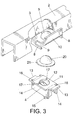
- Figure 3. Shows an exploded view of a portion of the brake pedal to which the reinforcement part is joined, with the connecting part and the optional anti-friction bushing being shown separated.
- Figure 4. Shows a perspective view of the assembly of the previous figure in an assembled position.
- Figure 5. Shows a general perspective view of the reinforcement part.
- Figure 6. Shows, lastly, an additional perspective view of the connecting part, in this case of its bottom area.
- Figure 7. Shows a perspective view of the brake pedal with the grooves for assembling the connecting part and the cap for housing the push rod ball when the intermediate reinforcement part is not used.
-
- In view of the figures, the system for connecting the push rod (1) to the brake pedal (2) of a vehicle is achieved by means of a connecting part (4), which presents a flat base (11) having a orifice (12) and being provided at its ends with corresponding extensions (13) defining tabs for attachment and anchoring on grooves (9) established on the brake pedal (2).
- From the internal face of the base (11) of the part (4) derive two parallel wings (14) escorting the orifice (12), between which are placed the elastic tabs (15) for attaching the ball-shaped end (19) of the push rod (1).
- The base (11) of the connecting part (4) has, in addition, elastic flaps (16) which collaborate in the stable attachment of the said part (4) on the brake pedal (2), the base (11) being likewise provided with additional elastic flaps (17) which are manually actuated to bend the elastic tabs (15), as described hereinafter.
- Firstly, the ball-shaped end (19) of the rod (1) is introduced through the orifice (12) of the connecting part (4), using sufficient pressure to achieve an elastic deformation of the tabs (15) of said part (4), until the ball (19) passes through the orifice (12) and positions itself in the cap-shaped pan (5) of the brake pedal (3), at which time the tabs (15) recover their position and retain the ball (19) as shown in figure 2.
- Once the push rod has been attached to the connecting part, the latter is positioned beneath the brake pedal (2), and the connecting part is turned until the attachment tabs (13) are housed and remain anchored in the grooves (9) of the brake pedal, achieving the stabilization of the attachment by means of the flaps (16).
- Disassembly will be achieved by turning the connecting part (4) in the opposite direction, so that the attachment tabs (13) are released from the grooves (9), thus freeing said part (4) along with the push rod (1) of the brake pedal (2), allowing the subsequent separation of said push rod (1) from the connecting part (4) by acting on the elastic flaps (17) so that the tabs (15) allow the exit of the ball (14) or its release from said connecting part (4).
- In a preferred embodiment, as shown in figures 1 to 5, a reinforcement part (3) is also used which is joined to the brake pedal (2) and is embodied as a "U"-shaped metal part, having two side branches (10) by which it is attached to the brake pedal (2) and an intermediate branch beneath which the connecting part (4) is fitted, said intermediate branch being provided with a cap (5) for housing the ball (19) of the push rod (1).
- The intermediate branch presents lateral tongues (8) projecting in opposite directions and slightly displaced downwards with respect to the intermediate branch to define grooves (9) for assembling the connecting part (4).
- Optionally, between the reinforcement part (3) and the connecting part (4) an anti-friction bushing (20) in the shape of a cap can be provided so that it adapts to the concavity of the configuration (5) of the part (3), in such a way that a ring-shaped wing complement (21) of said anti-friction cap (20) reduces the wear and tear of the ball (19) on the metal reinforcement part (3).
Claims (5)
- System for connecting the push rod to the brake pedal of a vehicle, meant to allow a simple and quick assembly and disassembly of the push rod (1) with respect to the brake pedal (2), in which the push rod ends in a ball (19) which fits elastically in a connecting part which is either attached to the brake pedal directly or through an intermediate part (10), characterised in that the connecting part is provided with extensions at its ends (13) which define tabs to be positioned by means of a simple turn in grooves (9) provided on the brake pedal, the connecting part being provided with an orifice for passage of the ball (19) of the push rod (1), the latter being housed in a cap (5) provided on the brake pedal.
- System for connecting the push rod to the brake pedal of a vehicle, according to claim 1, characterised in that the connecting part (4) presents a flat base (11), on which the orifice (12) is provided for passage of the ball (19) of the push rod (1), having two lateral wings (14) between which two flexible tongues (15) are provided for retaining the ball (19), so that end extensions (13) are provided in said rectangular base (11).
- System for connecting the push rod to the brake pedal of a vehicle, according to previous claims characterised in that the base (11) of the connecting part (4) is provided with elastic flaps (16) that collaborate in the stable attachment of the connecting part (4).
- System for connecting the push rod to the brake pedal of a vehicle, according to claim 1, characterised in that the connecting part (4) is mounted, by means of a simple turn, on an intermediate reinforcement part (3) which is integrally joined to the brake pedal and has a U-shaped configuration with lateral branches (10) that remain laterally abutted against the brake pedal (2), while its intermediate branch remains abutted beneath the brake pedal (2) and presents, at its extremities, corresponding lateral tongues (8), oriented in a position slightly displaced downwards with respect to the medial branch to determine corresponding grooves (9) for anchoring the end extensions (13) of the connecting part, such that the medial branch of the reinforcement part incorporates a cap-shaped protuberance (5) for housing the ball (19) of the push rod.
- System for connecting the push rod to the brake pedal of a vehicle, according to previous claims, characterised in that between the connecting part (4) and the cap (5), an anti-friction bushing (20) is provided having a peripheral wing (21) to prevent the wear and tear of the ball (19).
Priority Applications (1)
| Application Number | Priority Date | Filing Date | Title |
|---|---|---|---|
| EP03380010A EP1440858A1 (en) | 2003-01-27 | 2003-01-27 | System for connecting the push rod to the brake pedal of a vehicle |
Applications Claiming Priority (1)
| Application Number | Priority Date | Filing Date | Title |
|---|---|---|---|
| EP03380010A EP1440858A1 (en) | 2003-01-27 | 2003-01-27 | System for connecting the push rod to the brake pedal of a vehicle |
Publications (1)
| Publication Number | Publication Date |
|---|---|
| EP1440858A1 true EP1440858A1 (en) | 2004-07-28 |
Family
ID=32524279
Family Applications (1)
| Application Number | Title | Priority Date | Filing Date |
|---|---|---|---|
| EP03380010A Withdrawn EP1440858A1 (en) | 2003-01-27 | 2003-01-27 | System for connecting the push rod to the brake pedal of a vehicle |
Country Status (1)
| Country | Link |
|---|---|
| EP (1) | EP1440858A1 (en) |
Cited By (19)
| Publication number | Priority date | Publication date | Assignee | Title |
|---|---|---|---|---|
| FR2878803A1 (en) * | 2004-12-08 | 2006-06-09 | Peugeot Citroen Automobiles Sa | Self-locking connection system for motor vehicle, has lock with U shape part having two lateral braches with bosses to maintain joint translation, and pusher with housing having base, slides and grooves to block lock along three directions |
| FR2887836A1 (en) * | 2005-07-01 | 2007-01-05 | Peugeot Citroen Automobiles Sa | Locking element for connecting the end of a brake booster control rod to a pedal lever has base with central aperture and at least two flexible lugs |
| FR2889567A1 (en) * | 2005-08-04 | 2007-02-09 | Peugeot Citroen Automobiles Sa | Motor vehicle`s brake pedal arm and braking control rod connection device, has spiral spring returning blocking unit in angular position, such that notch is situated at opening of cuts towards section of brake pedal arm |
| EP1787878A1 (en) * | 2005-11-16 | 2007-05-23 | Lisi Automotive Rapid | Mounting device in particular for a push rod of the power brake to the brake pedal of a motor vehicle |
| FR2900206A1 (en) * | 2006-04-21 | 2007-10-26 | Peugeot Citroen Automobiles Sa | Brake servo unit control rod and brake pedal connecting device for motor vehicle, has arm with elastic tabs moving hook away from cage to maintain studs supported on corresponding edges of recesses in which studs are engaged |
| FR2900618A1 (en) * | 2006-05-04 | 2007-11-09 | Peugeot Citroen Automobiles Sa | Brake servo unit`s control rod end and brake pedal arm connecting device for motor vehicle, has fitting including paddle supporting contactor of brake light and provided opposite to contactor, when fitting occupies fitting position |
| FR2901375A1 (en) * | 2006-05-16 | 2007-11-23 | Peugeot Citroen Automobiles Sa | Clutch pedal i.e. lever, and transmitting rod connecting device for motor vehicle, has connecting unit subsisting degree of freedom between lever and rod, around one axis using two surfaces which are supported against each other by lock |
| FR2902730A1 (en) * | 2006-06-27 | 2007-12-28 | Peugeot Citroen Automobiles Sa | Servo brake controlling rod and brake pedal connecting device for motor vehicle, has two circular contour plates integrated to end of controlling rod and to free end of connecting rod, and defining two support surfaces, respectively |
| ES2324384A1 (en) * | 2008-02-04 | 2009-08-05 | Batz, S.Coop. | Pedal for motor vehicles (Machine-translation by Google Translate, not legally binding) |
| US7895915B2 (en) | 2007-12-15 | 2011-03-01 | Kia Motors Corporation | Organ type accelerator pedal assembly |
| US7946192B2 (en) | 2008-06-02 | 2011-05-24 | Hyundai Motor Company | Organ type accelerator pedal apparatus |
| US7984664B2 (en) * | 2006-10-04 | 2011-07-26 | Donghee Industrial Co., Ltd. | Organ type accelerator pedal for vehicle |
| ES2364907A1 (en) * | 2008-10-10 | 2011-09-16 | Batz, S. Coop. | Locking device of an operating rod to a pedal |
| CN102207745A (en) * | 2010-03-30 | 2011-10-05 | 通用汽车环球科技运作有限责任公司 | Pedal arrangement |
| WO2012055556A3 (en) * | 2010-10-28 | 2012-10-26 | Volkswagen Aktiengesellschaft | Actuating device comprising a pedal and a push rod articulated thereon |
| CN110562217A (en) * | 2018-06-05 | 2019-12-13 | 塑料元件与组件汽车股份公司 | Connecting device for connecting a push rod to a control member, such as a control pedal of a vehicle |
| CN114274926A (en) * | 2021-12-27 | 2022-04-05 | 湖北工程学院 | A quick-release ball cage structure |
| US11619962B2 (en) | 2020-01-30 | 2023-04-04 | Ventra Group Co. | Retainer for brake booster rod |
| WO2026015107A1 (en) * | 2024-07-10 | 2026-01-15 | Aka Otomotiv San. Tic. A.S | A brake connection device for use in vehicles |
Citations (7)
| Publication number | Priority date | Publication date | Assignee | Title |
|---|---|---|---|---|
| EP0148670A2 (en) | 1983-12-27 | 1985-07-17 | Automobiles Peugeot | Pneumatic brake booster fixation means on a motor-car |
| EP0229350A2 (en) | 1986-01-15 | 1987-07-22 | Volkswagen Aktiengesellschaft | Actuation device with pedal and hinged push rod |
| GB2244324A (en) * | 1990-05-26 | 1991-11-27 | Ford Motor Co | A foot pedal arrangement, eg. for vehicles |
| FR2713729A1 (en) * | 1993-12-07 | 1995-06-16 | Valeo Vision | Ball mounting for reflector in motor vehicle headlamp with adjusting rod |
| DE19542071A1 (en) * | 1995-11-11 | 1997-05-15 | Trw Fahrwerksyst Gmbh & Co | Ball joint |
| US5653548A (en) * | 1996-02-07 | 1997-08-05 | Illinois Tool Works Inc. | Method and apparatus for a ball and socket joint |
| EP0896162A1 (en) | 1997-08-07 | 1999-02-10 | S.I.V. S.p.A. | Locking device for the brake pedal of a vehicle to the pressure rod of a power brake |
-
2003
- 2003-01-27 EP EP03380010A patent/EP1440858A1/en not_active Withdrawn
Patent Citations (7)
| Publication number | Priority date | Publication date | Assignee | Title |
|---|---|---|---|---|
| EP0148670A2 (en) | 1983-12-27 | 1985-07-17 | Automobiles Peugeot | Pneumatic brake booster fixation means on a motor-car |
| EP0229350A2 (en) | 1986-01-15 | 1987-07-22 | Volkswagen Aktiengesellschaft | Actuation device with pedal and hinged push rod |
| GB2244324A (en) * | 1990-05-26 | 1991-11-27 | Ford Motor Co | A foot pedal arrangement, eg. for vehicles |
| FR2713729A1 (en) * | 1993-12-07 | 1995-06-16 | Valeo Vision | Ball mounting for reflector in motor vehicle headlamp with adjusting rod |
| DE19542071A1 (en) * | 1995-11-11 | 1997-05-15 | Trw Fahrwerksyst Gmbh & Co | Ball joint |
| US5653548A (en) * | 1996-02-07 | 1997-08-05 | Illinois Tool Works Inc. | Method and apparatus for a ball and socket joint |
| EP0896162A1 (en) | 1997-08-07 | 1999-02-10 | S.I.V. S.p.A. | Locking device for the brake pedal of a vehicle to the pressure rod of a power brake |
Cited By (24)
| Publication number | Priority date | Publication date | Assignee | Title |
|---|---|---|---|---|
| FR2878803A1 (en) * | 2004-12-08 | 2006-06-09 | Peugeot Citroen Automobiles Sa | Self-locking connection system for motor vehicle, has lock with U shape part having two lateral braches with bosses to maintain joint translation, and pusher with housing having base, slides and grooves to block lock along three directions |
| FR2887836A1 (en) * | 2005-07-01 | 2007-01-05 | Peugeot Citroen Automobiles Sa | Locking element for connecting the end of a brake booster control rod to a pedal lever has base with central aperture and at least two flexible lugs |
| FR2889567A1 (en) * | 2005-08-04 | 2007-02-09 | Peugeot Citroen Automobiles Sa | Motor vehicle`s brake pedal arm and braking control rod connection device, has spiral spring returning blocking unit in angular position, such that notch is situated at opening of cuts towards section of brake pedal arm |
| EP1787878A1 (en) * | 2005-11-16 | 2007-05-23 | Lisi Automotive Rapid | Mounting device in particular for a push rod of the power brake to the brake pedal of a motor vehicle |
| FR2900206A1 (en) * | 2006-04-21 | 2007-10-26 | Peugeot Citroen Automobiles Sa | Brake servo unit control rod and brake pedal connecting device for motor vehicle, has arm with elastic tabs moving hook away from cage to maintain studs supported on corresponding edges of recesses in which studs are engaged |
| EP1850017A2 (en) | 2006-04-21 | 2007-10-31 | Peugeot Citroën Automobiles S.A. | Self-locking link between a flat piece and a rod with a spherical end |
| EP1850017A3 (en) * | 2006-04-21 | 2008-12-31 | Peugeot Citroën Automobiles S.A. | Self-locking link between a flat piece and a rod with a spherical end |
| FR2900618A1 (en) * | 2006-05-04 | 2007-11-09 | Peugeot Citroen Automobiles Sa | Brake servo unit`s control rod end and brake pedal arm connecting device for motor vehicle, has fitting including paddle supporting contactor of brake light and provided opposite to contactor, when fitting occupies fitting position |
| FR2901375A1 (en) * | 2006-05-16 | 2007-11-23 | Peugeot Citroen Automobiles Sa | Clutch pedal i.e. lever, and transmitting rod connecting device for motor vehicle, has connecting unit subsisting degree of freedom between lever and rod, around one axis using two surfaces which are supported against each other by lock |
| FR2902730A1 (en) * | 2006-06-27 | 2007-12-28 | Peugeot Citroen Automobiles Sa | Servo brake controlling rod and brake pedal connecting device for motor vehicle, has two circular contour plates integrated to end of controlling rod and to free end of connecting rod, and defining two support surfaces, respectively |
| US7984664B2 (en) * | 2006-10-04 | 2011-07-26 | Donghee Industrial Co., Ltd. | Organ type accelerator pedal for vehicle |
| US7895915B2 (en) | 2007-12-15 | 2011-03-01 | Kia Motors Corporation | Organ type accelerator pedal assembly |
| ES2324384B1 (en) * | 2008-02-04 | 2010-05-25 | Batz, S.Coop. | PEDAL FOR MOTOR VEHICLES. |
| ES2324384A1 (en) * | 2008-02-04 | 2009-08-05 | Batz, S.Coop. | Pedal for motor vehicles (Machine-translation by Google Translate, not legally binding) |
| US7946192B2 (en) | 2008-06-02 | 2011-05-24 | Hyundai Motor Company | Organ type accelerator pedal apparatus |
| ES2364907A1 (en) * | 2008-10-10 | 2011-09-16 | Batz, S. Coop. | Locking device of an operating rod to a pedal |
| CN102207745A (en) * | 2010-03-30 | 2011-10-05 | 通用汽车环球科技运作有限责任公司 | Pedal arrangement |
| CN102207745B (en) * | 2010-03-30 | 2014-10-22 | 通用汽车环球科技运作有限责任公司 | Pedal arrangement |
| US9139181B2 (en) | 2010-03-30 | 2015-09-22 | GM Global Technology Operations LLC | Pedal arrangement |
| WO2012055556A3 (en) * | 2010-10-28 | 2012-10-26 | Volkswagen Aktiengesellschaft | Actuating device comprising a pedal and a push rod articulated thereon |
| CN110562217A (en) * | 2018-06-05 | 2019-12-13 | 塑料元件与组件汽车股份公司 | Connecting device for connecting a push rod to a control member, such as a control pedal of a vehicle |
| US11619962B2 (en) | 2020-01-30 | 2023-04-04 | Ventra Group Co. | Retainer for brake booster rod |
| CN114274926A (en) * | 2021-12-27 | 2022-04-05 | 湖北工程学院 | A quick-release ball cage structure |
| WO2026015107A1 (en) * | 2024-07-10 | 2026-01-15 | Aka Otomotiv San. Tic. A.S | A brake connection device for use in vehicles |
Similar Documents
| Publication | Publication Date | Title |
|---|---|---|
| EP1440858A1 (en) | System for connecting the push rod to the brake pedal of a vehicle | |
| US6112616A (en) | Brake pedal mechanism for automotive vehicles | |
| US7735849B1 (en) | Compact fifth wheel locking mechanism | |
| US5002159A (en) | Drum brake in a motor vehicle comprising a parking brake with detachably connected cable | |
| US7441478B2 (en) | Pedal with fastening clip for push rod | |
| US3807253A (en) | Brake pedal for a driver instruction vehicle | |
| US10259523B2 (en) | Hydraulic operating system | |
| EP1215070A3 (en) | Vehicle master cylinder attachment structure | |
| US20100107804A1 (en) | Fixed pedal assembly with multi-piece support bracket and captive pivot | |
| KR20090086258A (en) | Unit brake | |
| US6260435B1 (en) | Brake lever for security brake mechanisms of motor vehicles | |
| EP1108916A2 (en) | Brake cable mounting structure for a drum brake | |
| US20030025389A1 (en) | Control device for the braking system of a motor vehicle | |
| US10384741B2 (en) | Bicycle hydraulic operating device | |
| JP4613001B2 (en) | Pedal module | |
| US6953228B2 (en) | Actuating device for a brake unit of an electronically controlled vehicle brake system | |
| CN106103215B (en) | Actuating device for parking brake | |
| JPH11115699A (en) | Pedal mechanism | |
| US20110239811A1 (en) | Pedal arrangement | |
| KR200219123Y1 (en) | Assistance power apparatus for vehicles | |
| US7247805B2 (en) | Switch actuation method and mechanism | |
| EP1184274A3 (en) | Bicycle | |
| KR950006088Y1 (en) | Auxiliary Pedal Fixture for Transportation Machinery | |
| JPS5810643Y2 (en) | Caster with brake | |
| JP2005344833A (en) | Drum brake back plate for vehicles |
Legal Events
| Date | Code | Title | Description |
|---|---|---|---|
| PUAI | Public reference made under article 153(3) epc to a published international application that has entered the european phase |
Free format text: ORIGINAL CODE: 0009012 |
|
| AK | Designated contracting states |
Kind code of ref document: A1 Designated state(s): AT BE BG CH CY CZ DE DK EE ES FI FR GB GR HU IE IT LI LU MC NL PT SE SI SK TR |
|
| AX | Request for extension of the european patent |
Extension state: AL LT LV MK RO |
|
| 17P | Request for examination filed |
Effective date: 20041118 |
|
| AKX | Designation fees paid |
Designated state(s): AT BE BG CH CY CZ DE DK EE ES FI FR GB GR HU IE IT LI LU MC NL PT SE SI SK TR |
|
| STAA | Information on the status of an ep patent application or granted ep patent |
Free format text: STATUS: THE APPLICATION IS DEEMED TO BE WITHDRAWN |
|
| 18D | Application deemed to be withdrawn |
Effective date: 20090801 |