EP1439732A2 - Verfahren zum Betreiben eines Hörhilfegerätes und Hörhilfegerät - Google Patents
Verfahren zum Betreiben eines Hörhilfegerätes und Hörhilfegerät Download PDFInfo
- Publication number
- EP1439732A2 EP1439732A2 EP04002550A EP04002550A EP1439732A2 EP 1439732 A2 EP1439732 A2 EP 1439732A2 EP 04002550 A EP04002550 A EP 04002550A EP 04002550 A EP04002550 A EP 04002550A EP 1439732 A2 EP1439732 A2 EP 1439732A2
- Authority
- EP
- European Patent Office
- Prior art keywords
- signal
- path
- main
- output
- gain
- Prior art date
- Legal status (The legal status is an assumption and is not a legal conclusion. Google has not performed a legal analysis and makes no representation as to the accuracy of the status listed.)
- Granted
Links
Images

Classifications
-
- H—ELECTRICITY
- H04—ELECTRIC COMMUNICATION TECHNIQUE
- H04R—LOUDSPEAKERS, MICROPHONES, GRAMOPHONE PICK-UPS OR LIKE ACOUSTIC ELECTROMECHANICAL TRANSDUCERS; ELECTRIC HEARING AIDS; PUBLIC ADDRESS SYSTEMS
- H04R25/00—Electric hearing aids
- H04R25/50—Customised settings for obtaining desired overall acoustical characteristics
- H04R25/505—Customised settings for obtaining desired overall acoustical characteristics using digital signal processing
-
- H—ELECTRICITY
- H04—ELECTRIC COMMUNICATION TECHNIQUE
- H04R—LOUDSPEAKERS, MICROPHONES, GRAMOPHONE PICK-UPS OR LIKE ACOUSTIC ELECTROMECHANICAL TRANSDUCERS; ELECTRIC HEARING AIDS; PUBLIC ADDRESS SYSTEMS
- H04R2460/00—Details of hearing devices, i.e. of ear- or headphones covered by H04R1/10 or H04R5/033 but not provided for in any of their subgroups, or of hearing aids covered by H04R25/00 but not provided for in any of its subgroups
- H04R2460/03—Aspects of the reduction of energy consumption in hearing devices
-
- H—ELECTRICITY
- H04—ELECTRIC COMMUNICATION TECHNIQUE
- H04R—LOUDSPEAKERS, MICROPHONES, GRAMOPHONE PICK-UPS OR LIKE ACOUSTIC ELECTROMECHANICAL TRANSDUCERS; ELECTRIC HEARING AIDS; PUBLIC ADDRESS SYSTEMS
- H04R25/00—Electric hearing aids
- H04R25/50—Customised settings for obtaining desired overall acoustical characteristics
- H04R25/502—Customised settings for obtaining desired overall acoustical characteristics using analog signal processing
-
- H—ELECTRICITY
- H04—ELECTRIC COMMUNICATION TECHNIQUE
- H04S—STEREOPHONIC SYSTEMS
- H04S2420/00—Techniques used stereophonic systems covered by H04S but not provided for in its groups
- H04S2420/05—Application of the precedence or Haas effect, i.e. the effect of first wavefront, in order to improve sound-source localisation
Definitions
- the present invention is related to a method to operate a hearing device according to the pre-characterizing part of claim 1 as well as to a hearing device according to the pre-characterizing part of claim 10.
- Digital hearing devices can be divided up into two classes: Those applying algorithms in the frequency-domain and those applying algorithms in the time-domain.
- a transformation from the time domain into the frequency domain must be performed of a signal to be processed, as for example by a Fast Fourier Transformation (FFT).
- FFT Fast Fourier Transformation
- a frequency-domain filter bank is used to process the signal in several frequency bands.
- the number of frequency bands used is rather high.
- no transformation takes place in the second-mentioned class but a direct processing is performed of an input signal in the time domain using time-domain filter banks.
- the number of frequency bands, in which the time-domain filter banks are applied is clearly lower.
- Time-domain filter banks are also characterized in that they usually process the input signal either sample-by-sample or in analog domain, whereas frequency-domain filter banks or transformation-based filter banks, respectively, usually process a number of samples at a time in a block, a so-called frame. The time required to buffer the samples for such a block of data adds to the higher group delay inherent for transformation-based filter banks.
- the frequency-domain filter bank algorithms allow a much higher performance.
- the frequency-domain algorithms possess greater groups delay than the time-domain algorithms.
- the term "group delay" is defined as the delay of a signal wave front by processing steps in comparison with the unprocessed signal. Therefore, an unprocessed signal is delay less.
- hearing devices with time-domain filter bank algorithms usually possess a group delay of 0.5 to 2ms
- the frequency-domain filter bank algorithms may have group delays of 5 to 10ms. Examples for corresponding commercially available products are CLARO of the company Phonak AG, NEXUS of the company Unitron Inc. and CANTA7 of the company GN Resound.
- the present invention has the following advantages: By processing the input signal in a side signal path to obtain a side path output signal and by superimposing the side path output signal to the output signal of the main signal path, wherein a group delay of a signal traveling through the side signal path is smaller than a group delay of a signal traveling through the main signal path, the localization problems are eliminated. At the same time, the hearing device according to the present invention can still have a very high performance. In short terms, a "zero-delay-high-performance" hearing device has been created by the present invention.
- the method according to the present invention makes it possible to reproduce the correct localization result without throwing away the benefits of an algorithm applied in the frequency domain, e.g. an FFT-based algorithm.
- SNR signal-to-noise level
- a side signal path having a smaller group delay than the main signal path, is switched in parallel to the main signal path.
- the gain of the side signal path is thereby not higher than the gain in the main signal path, i.e. the gain generated by the frequency-domain filter bank.
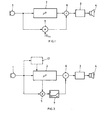
- a block diagram of a hearing device is depicted.
- An acoustic signal is picked-up by an input transducer 1, e.g. a microphone, by which an electrical signal is generated from the acoustic signal.
- an analog-to-digital converter must be provided to convert the analog output signal of the input transducer 1 into a digital signal. Having said this, it is pointed out that the present invention is not only directed to digital hearing devices but is very well suitable to be implemented in analog hearing devices without leaving the scope of the present invention. Obviously, the analog-to-digital converter is not necessary for analog hearing devices.
- the block diagram generally consists of two forward signal paths, the first being called main signal path and the second being called side signal path.
- the main signal path comprises a signal processing unit 2 and concludes with an adder unit 6 which unite the two signal paths.
- the side signal path comprises a gain unit 5 which is, on its output side, connected to the adder unit 6.
- the output signal of the input transducer 1 or the analog-to-digital converter, respectively is processed according to rules and demands generally known in hearing device technology. This particularly includes the use of a number of different hearing programs for specific acoustic situation, the automatic selection of a best suitable hearing program, preferably by using classifiers as disclosed in WO 01/20 965, for example.
- frequency-domain filter bank algorithms in the main signal path is superior regarding flexibility and quality of the obtained results in comparison with the use of time-domain filter bank algorithms.
- an implementation of frequency-domain filter bank algorithms result in rather high group delays due to extensive calculations in the processing unit 2, i.e. in the main signal path.
- the side signal path contains no filter bank and thus there is no group delay for a signal through this side signal path. Because of complete absence of a filter bank in the side signal path, there is not even a low group delay as must be dealt with when using a time domain filter bank.
- a gain applied in the side signal path by the gain unit 5 is in a simple embodiment of the present invention as depicted in fig. 1 a preset value G fix .
- the gain is adjusted in the side signal path such that on overall gain from the input transducer 1 through the side signal path to an output transducer 4 is approximately equal to one.
- the gain is computed from an existing gain model applied in the main signal path, preferably in the signal processing unit 2. Therefore, the signal processing unit 2 is operatively connected to the gain unit 5 of the side signal path.
- the value for the applied gain in the gain unit 5 is, for example, computed as a function of the existing band gains applied in the main signal path. Thereby, at least one band gain of the main signal path is used to determine the value for the gain applied in the gain unit 5.
- a further embodiment consists in combining and weighting several band gains of the main signal path in order to determine the value for the gain in the side signal path. It is further proposed to adjust the value for the gain in the side path gain unit 10 to 20dB lower than the gain in the main path for high gain values of around 50 to 80dB, but only a few dB lower for low gain values of around 0 to 20dB.
- the final gain of the main path is preferably used to derive the gain for the side path. This final gain in the main path may already include the effects of e.g. a noise canceller, limiters, etc., albeit with probably higher resolution.
- hearing device users with severe hearing loss do not perceive the group delay anymore at all.
- Fig. 3 shows gain as a function of an input level in Decibel to illustrate the adjustment of the gain G SB in the side signal path calculated from one or several band gains of the main signal path for a severe hearing loss.
- the gain of the side signal path has a relatively slow time constant compared to the rise time of transients, i.e. of first wave fronts. Transients therefore are so fast that they will be treated with a linear gain. In effect, a transient will be heard by the hearing device user via the side signal path without or extremely low group delay. Localization is thus not impeded. Even more, the brain does not perceive the delayed processed signal as a separate echo but fuses it with the undelayed signal.
- Fig. 4 again shows gain as a function of an input level in Decibel to illustrate the adjustment of the gain G SB in the side signal path calculated from several band gains of the main signal path for a mild hearing loss.
- a feedback canceller and its effect therefore is not needed; likewise beamformers and noise cancellers have only a minor effect.
- the effect of an elaborate gain model with many bands and sophisticated gain determination is not as well noticable due to the small differences over frequency and input level.
- the gain in the side signal path may be much closer to the normal gain and therefore even more significant. This situation also corresponds to a setting provided by a fitter who will listen to an instrument and determine its sound quality.
- a filter unit 7 is additionally provided in the side signal path between the gain unit 5 and the adder unit 6.
- the filter unit 7 consists of a simple 1 st or 2 nd order high pass filter, for example.
- the filter pole may get fitted to the individual hearing loss of the hearing device user.
- the side signal path becomes very similar to a simple single channel analog hearing device regarding group delay and adaptability of the gain function. Only the gain itself is somewhat lower than needed for full loudness restorations.
- a further embodiment of the present invention may have a side signal path realized by using analog circuit components while the main signal path is realized by using digital circuit components or by using a digital signal processing unit, respectively.
- filter unit 7 is only present in fig. 2 showing a side signal path with an adjustable gain, a corresponding filter unit can also be implemented in the embodiment having a preset value for the gain as shown in fig. 1.
- a limiting unit 3 is provided to limit the output signal coming from the adder unit 6, i.e. the summation of the signals from the main signal path and the side signal path.
- the limiting unit 3 which is inherently a sample based function, is also seen by the side signal path.
- the side signal path is computationally extremely simple. It consists only of the gain unit 5 and possibly of the filter unit 7, being a 1 st or 2 nd order high pass filter or a simple time-domain filter bank, and the adder unit 6 to add the signals of the side signal path and the main signal path.
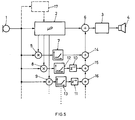
- Fig. 5 schematically shows a further embodiment of the present invention in a block diagram in which two further side signal paths are provided each having a further gain unit 8 or 9, a further filter unit 12 or 13 and a delay unit 10 or 11, respectively, in addition to the side signal unit already provided in the embodiments depicted in figs. 1 and 2.
- the side signal path and the further side signal paths are connected in parallel to the main signal path comprising the signal processing unit 2, i.e. the output signal of the input transducer 1 is fed to the signal processing unit 2, to the gain unit 5 as well as to the further gain units 8 and 9, and the output signal of the main signal path, the side signal path as well as of the further side signal paths are added together to form the input signal for the limiting unit 3.
- the effect of the precedence effect is improved, especially in case the signal through the further side signal paths get additionally delayed by a small amount, for example by 1/3 to 2/3 of the filter bank delay of the main signal path.
- a third, forth, etc. output signal with a delay somewhere in between the zero- or minimum-delay and the maximum-delay output signal.
- a silence detector unit 17 is depicted in dashed lines.
- the silence detector unit 17 is, on its input side, operatively connected to the input transducer 1 and, on the silence detector unit 17 output side, operatively connected to the signal processing unit 2.
- Typical hearing device users are elderly people, often sitting alone in their old age homes. Thus, they are significantly often in quiet environments. In such an environment, the whole sophisticated processing as performed in the main signal path - including a filter bank, beamformers, noise cancellers, an elaborate gain model, a classifier, etc. - is superfluous.
- a simple silence detector unit 17 may get used to switch off the entire main signal path and leave only the side signal path active. Therefore, the output signal of the input transducer 1 is also fed to the silence detector unit 17 which is, on its output side, connected to the signal processing unit 2 in order to provide information about significant sound activity to the signal processing unit 2. As soon as sound activity drops below a preset level, the power supply to the signal processing unit 2 can be reduced.
- the signal processing unit 2 consumes significantly less power, thereby increasing the battery life time considerably. All states within the main signal path get frozen. Thus, the gain in the gain unit 5 in the side signal path gets frozen as well to the value needed for this low input level there, i.e. below the knee point. If sound reappears, the silence detector unit 17 will again switch on the main signal path immediately, for example within the same frame, and all states will continue from where they have been before entering the mute state.
- the silence detector unit 17 will contain a parametrizable level threshold of preferably 40dB and a time constant, such that only quiet periods of preferably longer than 5s will lead to a switch off of the main signal path.
- the corresponding function for a silence detector unit 17 can be realized by a so-called ZASTA-(Zero Attack Short Term Averager)-circuit, i.e. a dual slope averager with 0s rise time and a preset release time of 5s, for example.
- the switching may of course get performed in a soft manner, i.e. such that no eventual click is perceivable by the hearing device user.
- a silence detector unit 17 in connection with embodiments of the invention related to the precedence effect, the functions and advantages of using silent detector unit 17 in connection with a main signal path and a side signal path can be obtained independently of features related to the precedence effect.
- a hearing device with a main signal path, in which rather high processing power is needed, and a side signal path, in which rather low processing power is needed it is possible to significantly reduce overall power consumption in the hearing device by adding a simple silence detector unit 17 to control the main signal path in the sense that the main signal path is switched off while there is little acoustic activity in the acoustic surrounding.
- a normal hearing impression can be provided to the hearing device user over the side signal path although this hearing impression might be of lower quality, e.g. a slightly wrong signal level due to the fixed gain.
- the main signal path i.e. the signal processing unit in which high quality and high performance algorithms are processed, is switched on again.
- output transducer 4 there is a loudspeaker-often called receiver in the hearing device technology-depicted in the figs. 1, 2 and 5 as output transducer 4, it is as well feasible that other output transducers can be used without leaving the scope of the present invention.
- Another output transducer might be used for implantable hearing devices having, for example, implementing a direct stimulus of the nerves in the inner ear.
- the present invention can very well be applied to binaural hearing devices which comprise two hearing device parts connected by a wire or wirelessly.
- hearing device cannot only be used in connection with a correction of a hearing impairment.
- the techniques disclosed can very well be used in connection with any wired or wireless communication device.
- hearing device must be understood as hearing aid, be it introduced in the ear canal or implanted into a patient, to correct a hearing impairment as well as to any communication device used to facilitate or improve communication.
Landscapes
- Health & Medical Sciences (AREA)
- General Health & Medical Sciences (AREA)
- Neurosurgery (AREA)
- Otolaryngology (AREA)
- Physics & Mathematics (AREA)
- Engineering & Computer Science (AREA)
- Acoustics & Sound (AREA)
- Signal Processing (AREA)
- Tone Control, Compression And Expansion, Limiting Amplitude (AREA)
- Circuit For Audible Band Transducer (AREA)
- Stereophonic System (AREA)
Priority Applications (7)
| Application Number | Priority Date | Filing Date | Title |
|---|---|---|---|
| DE602004022210T DE602004022210D1 (de) | 2004-02-05 | 2004-02-05 | Verfahren zum Betreiben eines Hörhilfegerätes und Hörhilfegerät |
| DK07117834T DK1868413T3 (da) | 2004-02-05 | 2004-02-05 | Fremgangsmåde til drift af en höreanordning samt en höreanordning |
| EP07117834A EP1868413B1 (de) | 2004-02-05 | 2004-02-05 | Verfahren zum Betreiben eines Hörhilfegerätes und Hörhilfegerät |
| US10/772,605 US7248710B2 (en) | 2004-02-05 | 2004-02-05 | Embedded internet for hearing aids |
| DK04002550T DK1439732T3 (da) | 2004-02-05 | 2004-02-05 | Fremgangsmåde til drift af et höreapparat og et höreapparat |
| EP04002550A EP1439732B1 (de) | 2004-02-05 | 2004-02-05 | Verfahren zum Betreiben eines Hörhilfegerätes und Hörhilfegerät |
| DE602004010317T DE602004010317T2 (de) | 2004-02-05 | 2004-02-05 | Verfahren zum Betreiben eines Hörhilfegerätes und Hörhilfegerät |
Applications Claiming Priority (2)
| Application Number | Priority Date | Filing Date | Title |
|---|---|---|---|
| US10/772,605 US7248710B2 (en) | 2004-02-05 | 2004-02-05 | Embedded internet for hearing aids |
| EP04002550A EP1439732B1 (de) | 2004-02-05 | 2004-02-05 | Verfahren zum Betreiben eines Hörhilfegerätes und Hörhilfegerät |
Related Child Applications (1)
| Application Number | Title | Priority Date | Filing Date |
|---|---|---|---|
| EP07117834A Division EP1868413B1 (de) | 2004-02-05 | 2004-02-05 | Verfahren zum Betreiben eines Hörhilfegerätes und Hörhilfegerät |
Publications (3)
| Publication Number | Publication Date |
|---|---|
| EP1439732A2 true EP1439732A2 (de) | 2004-07-21 |
| EP1439732A3 EP1439732A3 (de) | 2005-01-05 |
| EP1439732B1 EP1439732B1 (de) | 2007-11-28 |
Family
ID=34921298
Family Applications (2)
| Application Number | Title | Priority Date | Filing Date |
|---|---|---|---|
| EP07117834A Expired - Lifetime EP1868413B1 (de) | 2004-02-05 | 2004-02-05 | Verfahren zum Betreiben eines Hörhilfegerätes und Hörhilfegerät |
| EP04002550A Expired - Lifetime EP1439732B1 (de) | 2004-02-05 | 2004-02-05 | Verfahren zum Betreiben eines Hörhilfegerätes und Hörhilfegerät |
Family Applications Before (1)
| Application Number | Title | Priority Date | Filing Date |
|---|---|---|---|
| EP07117834A Expired - Lifetime EP1868413B1 (de) | 2004-02-05 | 2004-02-05 | Verfahren zum Betreiben eines Hörhilfegerätes und Hörhilfegerät |
Country Status (4)
| Country | Link |
|---|---|
| US (1) | US7248710B2 (de) |
| EP (2) | EP1868413B1 (de) |
| DE (2) | DE602004010317T2 (de) |
| DK (2) | DK1439732T3 (de) |
Cited By (2)
| Publication number | Priority date | Publication date | Assignee | Title |
|---|---|---|---|---|
| WO2006114015A3 (en) * | 2006-05-19 | 2007-04-05 | Phonak Ag | Method for manufacturing an audio signal |
| EP1881602A1 (de) * | 2006-07-17 | 2008-01-23 | Vestel Elektronik Sanayi ve Ticaret A.S. | Verfahren und Schaltung zum Stummschalten eines Audio Ausgangs |
Families Citing this family (4)
| Publication number | Priority date | Publication date | Assignee | Title |
|---|---|---|---|---|
| US6687187B2 (en) * | 2000-08-11 | 2004-02-03 | Phonak Ag | Method for directional location and locating system |
| KR20100024659A (ko) * | 2008-08-26 | 2010-03-08 | 주식회사 팬택 | 오디오 출력 제어 방법과 장치, 및 이를 적용한 이동 단말 장치 |
| US9749755B2 (en) * | 2014-12-29 | 2017-08-29 | Gn Hearing A/S | Hearing device with sound source localization and related method |
| US12160709B2 (en) | 2022-08-23 | 2024-12-03 | Sonova Ag | Systems and methods for selecting a sound processing delay scheme for a hearing device |
Family Cites Families (11)
| Publication number | Priority date | Publication date | Assignee | Title |
|---|---|---|---|---|
| DE3131193A1 (de) * | 1981-08-06 | 1983-02-24 | Siemens AG, 1000 Berlin und 8000 München | Geraet zur kompensation von gehoerschaeden |
| US4879749A (en) * | 1986-06-26 | 1989-11-07 | Audimax, Inc. | Host controller for programmable digital hearing aid system |
| US4887299A (en) * | 1987-11-12 | 1989-12-12 | Nicolet Instrument Corporation | Adaptive, programmable signal processing hearing aid |
| GB9211756D0 (en) * | 1992-06-03 | 1992-07-15 | Gerzon Michael A | Stereophonic directional dispersion method |
| US5524056A (en) * | 1993-04-13 | 1996-06-04 | Etymotic Research, Inc. | Hearing aid having plural microphones and a microphone switching system |
| US6310556B1 (en) * | 2000-02-14 | 2001-10-30 | Sonic Innovations, Inc. | Apparatus and method for detecting a low-battery power condition and generating a user perceptible warning |
| AU2001273209A1 (en) * | 2000-07-03 | 2002-01-30 | Audia Technology, Inc. | Power management for hearing aid device |
| AU2002228743A1 (en) * | 2000-10-23 | 2002-05-06 | Audia Technology, Inc. | Method and system for remotely upgrading a hearing aid device |
| WO2001020965A2 (de) * | 2001-01-05 | 2001-03-29 | Phonak Ag | Verfahren zur bestimmung einer momentanen akustischen umgebungssituation, anwendung des verfharens und ein hörgerät |
| EP1442628A2 (de) * | 2001-11-09 | 2004-08-04 | Phonak Ag | Verfahren zum betrieb eines hörgerätes sowie ein hörgerät |
| DE10211364B4 (de) * | 2002-03-14 | 2004-02-05 | Siemens Audiologische Technik Gmbh | Abschalten von Signalverarbeitungsvorrichtungen eines Hörgeräts |
-
2004
- 2004-02-05 DK DK04002550T patent/DK1439732T3/da active
- 2004-02-05 US US10/772,605 patent/US7248710B2/en not_active Expired - Lifetime
- 2004-02-05 EP EP07117834A patent/EP1868413B1/de not_active Expired - Lifetime
- 2004-02-05 DE DE602004010317T patent/DE602004010317T2/de not_active Expired - Lifetime
- 2004-02-05 DK DK07117834T patent/DK1868413T3/da active
- 2004-02-05 EP EP04002550A patent/EP1439732B1/de not_active Expired - Lifetime
- 2004-02-05 DE DE602004022210T patent/DE602004022210D1/de not_active Expired - Lifetime
Cited By (2)
| Publication number | Priority date | Publication date | Assignee | Title |
|---|---|---|---|---|
| WO2006114015A3 (en) * | 2006-05-19 | 2007-04-05 | Phonak Ag | Method for manufacturing an audio signal |
| EP1881602A1 (de) * | 2006-07-17 | 2008-01-23 | Vestel Elektronik Sanayi ve Ticaret A.S. | Verfahren und Schaltung zum Stummschalten eines Audio Ausgangs |
Also Published As
| Publication number | Publication date |
|---|---|
| EP1439732B1 (de) | 2007-11-28 |
| DK1868413T3 (da) | 2009-09-21 |
| DK1439732T3 (da) | 2008-03-03 |
| DE602004010317T2 (de) | 2008-10-16 |
| EP1868413B1 (de) | 2009-07-22 |
| DE602004022210D1 (de) | 2009-09-03 |
| DE602004010317D1 (de) | 2008-01-10 |
| US7248710B2 (en) | 2007-07-24 |
| US20050175199A1 (en) | 2005-08-11 |
| EP1439732A3 (de) | 2005-01-05 |
| EP1868413A1 (de) | 2007-12-19 |
Similar Documents
| Publication | Publication Date | Title |
|---|---|---|
| US10957301B2 (en) | Headset with active noise cancellation | |
| US10575104B2 (en) | Binaural hearing device system with a binaural impulse environment detector | |
| US7330557B2 (en) | Hearing aid, method, and programmer for adjusting the directional characteristic dependent on the rest hearing threshold or masking threshold | |
| Laurence et al. | A comparison of behind-the-ear high-fidelity linear hearing aids and two-channel compression aids, in the laboratory and in everyday life | |
| US7978868B2 (en) | Adaptive dynamic range optimization sound processor | |
| AU2004203135B2 (en) | Hearing Aid, as well as a Method for Operation of a Hearing Aid having a Microphone System in which Different Directional Characteristics can be Set | |
| US10334369B2 (en) | Signal processor for a hearing device and method for operating a hearing device | |
| EP2885872B1 (de) | Hörgerät mit pegel- und frequenzabhängiger verstärkung | |
| EP1784047A3 (de) | Schallverarbeitungsstrategie für Innenohrimplantate | |
| CN105769385B (zh) | 耳蜗植入物及其运行方法 | |
| CN103747403A (zh) | 用于依赖于声音环境分类缓解耳鸣的声音富集 | |
| EP3600528B1 (de) | Bimodales gehörstimulationssystem | |
| McDermott | A programmable sound processor for advanced hearing aid research | |
| EP1439732B1 (de) | Verfahren zum Betreiben eines Hörhilfegerätes und Hörhilfegerät | |
| EP4035420B1 (de) | Verfahren zum betrieb eines audiosystems auf ohrebene und audiosystem auf ohrebene | |
| US20250310701A1 (en) | Hearing system | |
| Moore | Hearing Aids: What Works Well and What Can Be Improved | |
| EP2835983A1 (de) | Hörgerät mit Darstellung der Umweltgeräusche | |
| CN121418745A (zh) | 用于运行听力设备的方法 | |
| CN120018041A (zh) | 具有软通风口的助听器 | |
| CN121099246A (zh) | 运行听力设备的方法和听力设备 | |
| WESTERMANN et al. | From analog to digital hearing aids |
Legal Events
| Date | Code | Title | Description |
|---|---|---|---|
| PUAI | Public reference made under article 153(3) epc to a published international application that has entered the european phase |
Free format text: ORIGINAL CODE: 0009012 |
|
| AK | Designated contracting states |
Kind code of ref document: A2 Designated state(s): AT BE BG CH CY CZ DE DK EE ES FI FR GB GR HU IE IT LI LU MC NL PT RO SE SI SK TR |
|
| AX | Request for extension of the european patent |
Extension state: AL LT LV MK |
|
| PUAL | Search report despatched |
Free format text: ORIGINAL CODE: 0009013 |
|
| AK | Designated contracting states |
Kind code of ref document: A3 Designated state(s): AT BE BG CH CY CZ DE DK EE ES FI FR GB GR HU IE IT LI LU MC NL PT RO SE SI SK TR |
|
| AX | Request for extension of the european patent |
Extension state: AL LT LV MK |
|
| 17P | Request for examination filed |
Effective date: 20041126 |
|
| AKX | Designation fees paid |
Designated state(s): CH DE DK LI |
|
| R17C | First examination report despatched (corrected) |
Effective date: 20061207 |
|
| GRAP | Despatch of communication of intention to grant a patent |
Free format text: ORIGINAL CODE: EPIDOSNIGR1 |
|
| GRAS | Grant fee paid |
Free format text: ORIGINAL CODE: EPIDOSNIGR3 |
|
| GRAA | (expected) grant |
Free format text: ORIGINAL CODE: 0009210 |
|
| AK | Designated contracting states |
Kind code of ref document: B1 Designated state(s): CH DE DK LI |
|
| REG | Reference to a national code |
Ref country code: CH Ref legal event code: NV Representative=s name: TROESCH SCHEIDEGGER WERNER AG Ref country code: CH Ref legal event code: EP |
|
| REF | Corresponds to: |
Ref document number: 602004010317 Country of ref document: DE Date of ref document: 20080110 Kind code of ref document: P |
|
| REG | Reference to a national code |
Ref country code: DK Ref legal event code: T3 |
|
| PLBE | No opposition filed within time limit |
Free format text: ORIGINAL CODE: 0009261 |
|
| STAA | Information on the status of an ep patent application or granted ep patent |
Free format text: STATUS: NO OPPOSITION FILED WITHIN TIME LIMIT |
|
| 26N | No opposition filed |
Effective date: 20080829 |
|
| PGFP | Annual fee paid to national office [announced via postgrant information from national office to epo] |
Ref country code: DK Payment date: 20180223 Year of fee payment: 15 Ref country code: CH Payment date: 20180227 Year of fee payment: 15 |
|
| REG | Reference to a national code |
Ref country code: DE Ref legal event code: R084 Ref document number: 602004010317 Country of ref document: DE |
|
| REG | Reference to a national code |
Ref country code: DK Ref legal event code: EBP Effective date: 20190228 |
|
| REG | Reference to a national code |
Ref country code: CH Ref legal event code: PL |
|
| PG25 | Lapsed in a contracting state [announced via postgrant information from national office to epo] |
Ref country code: CH Free format text: LAPSE BECAUSE OF NON-PAYMENT OF DUE FEES Effective date: 20190228 Ref country code: LI Free format text: LAPSE BECAUSE OF NON-PAYMENT OF DUE FEES Effective date: 20190228 |
|
| PG25 | Lapsed in a contracting state [announced via postgrant information from national office to epo] |
Ref country code: DK Free format text: LAPSE BECAUSE OF NON-PAYMENT OF DUE FEES Effective date: 20190228 |
|
| PGFP | Annual fee paid to national office [announced via postgrant information from national office to epo] |
Ref country code: DE Payment date: 20230223 Year of fee payment: 20 |
|
| REG | Reference to a national code |
Ref country code: DE Ref legal event code: R071 Ref document number: 602004010317 Country of ref document: DE |