EP1436914B1 - Method and apparatus for common packet channel access in mobile satellite communication system - Google Patents
Method and apparatus for common packet channel access in mobile satellite communication system Download PDFInfo
- Publication number
- EP1436914B1 EP1436914B1 EP02788886A EP02788886A EP1436914B1 EP 1436914 B1 EP1436914 B1 EP 1436914B1 EP 02788886 A EP02788886 A EP 02788886A EP 02788886 A EP02788886 A EP 02788886A EP 1436914 B1 EP1436914 B1 EP 1436914B1
- Authority
- EP
- European Patent Office
- Prior art keywords
- access
- preamble
- channel
- collision
- common packet
- Prior art date
- Legal status (The legal status is an assumption and is not a legal conclusion. Google has not performed a legal analysis and makes no representation as to the accuracy of the status listed.)
- Expired - Lifetime
Links
Images




Classifications
-
- H—ELECTRICITY
- H04—ELECTRIC COMMUNICATION TECHNIQUE
- H04W—WIRELESS COMMUNICATION NETWORKS
- H04W74/00—Wireless channel access
- H04W74/08—Non-scheduled access, e.g. ALOHA
-
- H—ELECTRICITY
- H04—ELECTRIC COMMUNICATION TECHNIQUE
- H04B—TRANSMISSION
- H04B7/00—Radio transmission systems, i.e. using radiation field
- H04B7/14—Relay systems
- H04B7/15—Active relay systems
- H04B7/185—Space-based or airborne stations; Stations for satellite systems
- H04B7/1853—Satellite systems for providing telephony service to a mobile station, i.e. mobile satellite service
- H04B7/18539—Arrangements for managing radio, resources, i.e. for establishing or releasing a connection
-
- H—ELECTRICITY
- H04—ELECTRIC COMMUNICATION TECHNIQUE
- H04B—TRANSMISSION
- H04B7/00—Radio transmission systems, i.e. using radiation field
- H04B7/14—Relay systems
- H04B7/15—Active relay systems
- H04B7/204—Multiple access
- H04B7/216—Code division or spread-spectrum multiple access [CDMA, SSMA]
-
- H—ELECTRICITY
- H04—ELECTRIC COMMUNICATION TECHNIQUE
- H04W—WIRELESS COMMUNICATION NETWORKS
- H04W48/00—Access restriction; Network selection; Access point selection
- H04W48/08—Access restriction or access information delivery, e.g. discovery data delivery
- H04W48/12—Access restriction or access information delivery, e.g. discovery data delivery using downlink control channel
-
- H—ELECTRICITY
- H04—ELECTRIC COMMUNICATION TECHNIQUE
- H04W—WIRELESS COMMUNICATION NETWORKS
- H04W52/00—Power management, e.g. Transmission Power Control [TPC] or power classes
- H04W52/04—Transmission power control [TPC]
- H04W52/30—Transmission power control [TPC] using constraints in the total amount of available transmission power
- H04W52/32—TPC of broadcast or control channels
-
- H—ELECTRICITY
- H04—ELECTRIC COMMUNICATION TECHNIQUE
- H04W—WIRELESS COMMUNICATION NETWORKS
- H04W84/00—Network topologies
- H04W84/02—Hierarchically pre-organised networks, e.g. paging networks, cellular networks, WLAN [Wireless Local Area Network] or WLL [Wireless Local Loop]
- H04W84/04—Large scale networks; Deep hierarchical networks
- H04W84/06—Airborne or Satellite Networks
Definitions
- the present invention relates to a method and apparatus for common packet channel (CPCH) access for transmitting data packets having bursty traffic from a mobile terminal to a satellite access network in a code division multiple access (CDMA) mobile satellite communication system.
- CPCH common packet channel
- Common packet channel is a channel used for transmitting packet data which is too big to be transmitted through an uplink random access channel (RACH) and too small to be transmitted through an uplink dedicated channel, such as one for voice service.
- RACH uplink random access channel
- the CPCH is usually used for transmitting packet data of middle-length less than 50 frames.
- CPCH structure and CPCH access/control procedures are disclosed in the specification documents of 25.211 and 25.214, drawn by the Technical Specification Group (TS) of the 3 rd Generation Partnership Project (3GPP).
- TS Technical Specification Group
- 3GPP 3 rd Generation Partnership Project
- the CPCH is related to a downlink dedicated channel that provides power control and transmission control commands with respect to each CPCH.
- the CPCH is characterized by initial collision risk and inner loop power control.
- RACH uplink random access channel
- a mobile terminal transmits an access preamble to the satellite access network through an access channel before transmitting a data packet, in order to obtain data transmit grant.
- the mobile terminal transmits a collision-detection preamble additionally to avoid any collision.
- the mobile terminal transmits the user data packet, which is the main packet, through an allowed uplink common packet channel.
- the satellite access network performs transmission control, such as commanding transmission start, transmission stop, and power control with respect to each uplink packet channel, using a downlink dedicated channel corresponding to each uplink common packet channel.
- the satellite access network Since the access preamble contains a signature which indicates a common packet channel (in case that a channel is not assigned, hereinafter, which is referred as "a channel unassignment mode") that the mobile terminal selects for packet transmission (in case of a channel unassignment mode), or (in case that a channel is assigned, hereinafter, which is referred as "a channel assignment mode") indicates a transmission rate, the satellite access network recognizes the request of the mobile terminal by detecting the signature in the access preamble.
- a channel unassignment mode indicates a common packet channel
- a channel assignment mode indicates a transmission rate
- the collision-detection preamble is used for avoiding the collision of the packets transmitted by two or more than mobile terminals at the same time.
- the collision-detection preamble is used for preventing different mobile terminals from using the same common packet channel, when the mobile terminals transmit access preambles using the same signature at the same time.
- the mobile terminals can transmit access preambles using the same signature, if a collision-detection preamble is transmitted using a signature selected by each mobile terminal independently again (the selected signature may or may not be the same as the signature of the access preamble), the satellite access network can discriminate collision-detection preambles and select any one of the collision-detection preambles. The satellite access network, then, transmits an acknowledgement corresponding to the selected collision-detection preamble in order to allow data transmission to a mobile terminal. The mobile terminal that receives the acknowledgement can obtain the grant for using the common packet channel and transmit data packets. Therefore, the collision between data packets transmitted by the different mobile terminals can be avoided.
- the propagation delay is no more than one millisecond (ms) in a cell of the terrestrial system
- the delay is more than tens of milliseconds in the satellite system, even in case of a low earth orbit (LEO) satellite system. Therefore, the access delay spent in the two processes of transmitting preambles for access and channel requests is relatively very long, compared with that of the terrestrial system.
- the probability of successful reception of the preamble is relatively low because of poor link characteristics, such as long distance and fading.
- Doppler shift occurs up to tens of Khz.
- a downlink dedicated channel for controlling packet transmission and transmit power is assigned to each uplink packet channel, and in a case where a plurality of packet channels are used, the terrestrial system should use the same number of downlink dedicated control channels as there are assigned packet channels.
- the packet channels and control channels control each others transmit power levels using closed loop power control.
- the ratio of transmission power loss between mobile terminals in the satellite system is relatively smaller than that in the terrestrial system. That is, in case of the satellite system, the transmit power difference required to the mobile terminals within a satellite beam is smaller than the one in the terrestrial system. Therefore, in the satellite communication, even though the closed loop power control is performed by a downlink control channel corresponding to each packet channel, power efficiency is not enhanced. Accordingly, if downlink dedicated control channels are assigned to the terrestrial system, this leads to unnecessary channel assignment and power loss; and causes the problem of spreading code limitation.
- the propagation delay between a base station and a mobile terminal is short and thus fast power control can be used for each mobile terminal.
- the power control is performed every slot in the downlink dedicated control channel. Meanwhile, in the satellite system, such fast power control is impossible due to the longer propagation delay in the satellite link.
- UMTS Universal Mobile Telecommunications Systems
- FDD Physical layer procedures
- ETSI TS 125 214 "ETSI STANDARDS, US, SOPHIA ANTIPOLIS CEDEX, FRANCE, vol. 3-R1, no. V4.2.0, 1 September 2001 (2001-09-01), XP014008404ISSN: 0000-0001 and Universal Mobile Telecommunications System (UMTS); Physical channels and mapping of transport channels onto physical channels (FDD) (3GPP TS 25.211 version 4.2.0 Release 4); ETSI TS 125 211 "ETSI STANDARDS, LES, SOPHIA ANTIPOLIS CEDEX, FRANCE, vol. 3-R1, no.
- XP014008341ISSN 0000-0001 disclose arrangements in which a method for accessing a common packet channel shared by a plurality of mobile terminals includes transmitting data packets in a mobile satellite communication system, comprising the steps of:
- an object of the present invention to provide a method and apparatus for common packet channel access that can reduce the access delay spent in a mobile satellite communication system.
- a method for accessing a common packet channel shared by a plurality of mobile terminals to transmit data packets in a mobile stallite communication system comprising the steps of: a) receiving an access preamble generated based on an access signature, and a collision-detection preamble generated based on a collision-detection signature, which are transmitted together from the mobile terminals; and b) transmitting an acknowledgement to the access preamble and the collision-detection preamble to the mobile terminals through a preamble acknowledgement channel, characterised in that the access preamble and the collision-detection preamble are transmitted together from the mobile terminals.
- a method for accessing a common packet channel shared by a plurality of mobile terminals in a mobile satellite communication system comprising the steps of: a) transmitting an access preamble and a collision-detection preamble successively to a satellite access network; b) receiving an acknowledgement to the access preamble and the collision-detection preamble from the satellite access network through a preamble acknowledgement channel; and c) retransmitting the access preamble and the collision-detection preamble, or transmitting a data packet through the common packet channel, according to the acknowledgement, characterised in that the access preamble and the collision-detection preamble are transmitted together from the mobile terminals.
- an apparatus for accessing a common packet channel which is shared by a plurality of mobile terminals to transmit data packet in a mobile satellite communication system comprising: a channel determining unit for determining if there is a common packet channel available or a common packet channel group available according to common packet channel information broadcasted from a satellite access network, and selecting one of channels or groups available; a transmission resource determining unit for selecting an access frame for transmitting an access preamble having a plurality of sub-access preambles and a collision-detection preamble, a sub-access frame in the access frame, a transmission offset time, an access signature code for generating the access preamble, a collision-detection signature code for generating the collision-detection preamble, and a spreading code corresponding to the selected sub-access frame; a generation unit for generating the access preamble and the collision-detection preamble based on the access signature code, the collision-detection signature code and the spreading code;
- an apparatus for accessing a common packet channel shared by a plurality of mobile terminals to transmit data packet comprising: a reception unit for receiving an access preamble including an access signature code and a collision-detection preamble including a collision-detection signature code, which are transmitted together from the mobile terminal; an acknowledgement generating unit for generating any one among a positive acknowledgement allowing the mobile terminal to access the common packet channel, a disagreement acknowledgement allowing another mobile terminal to access the common packet channel, and a negative acknowledgement indicating that the common packet channel or the common packet channel group requested by the access preamble cannot be used currently; and a transmission unit for transmitting the acknowledgement to mobile terminals.
- an access preamble and a collision-detection preamble are transmitted together at one time in order to reduce access delay in the procedure of the common packet channel access.
- sub-preambles containing the same signature are transmitted repeatedly.
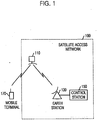
- Fig. 1 is a schematic diagram illustrating the mobile satellite communication environment of a satellite access network and a mobile terminal in accordance with the present invention.
- the mobile satellite communication environment of the present invention comprises a mobile terminal 170 which generates user data, and transmits preambles and user data through a common packet channel, and a satellite access network 100 which determines whether to allow common packet channel access based on the preamble received from the mobile terminal 170, and relays the user data to the terrestrial network (not shown).
- the satellite access network 100 includes a control station 150 which controls the satellite access network 100 and performs internetworking with the terrestrial network, a satellite 110, and an earth station 130, thereby providing a connection between the mobile terminal 170 and the terrestrial network (not shown).
- Fig. 2 is a block diagram describing the functional structure of the mobile terminal of Fig. 1 in accordance with an embodiment of the present invention.
- the mobile terminal 170 of the present invention transmits an access preamble and a collision-detection preamble to the satellite access network 100 successively in an access frame, and it includes a mobile terminal transmitter/receiver 177 which receives an acknowledgement of the access preamble and the collision-detection preamble from the satellite access network 100.
- the mobile terminal transmitter/receiver 177 receives a common packet channel control command that is broadcasted by the satellite access network 100 through a downlink common control channel.
- the mobile terminal transmitter/receiver 177 can transmit the access preamble and the collision-detection preamble with a predetermined transmission offset time To from the staring point of an access frame.
- the mobile terminal 170 includes a data packet processing unit 171 that converts user data into data packets that can be transmitted through the common packet channel.
- the mobile terminal 170 further includes a transmission resource determining unit 173 which selects an access frame for transmitting the access preamble and the collision-detection preamble, an access signature code for generating the access preamble, and a collision-detection signature code for generating the collision-detection preamble.
- the transmission resource determining unit 173 of each mobile terminal that desires to access the common packet channel can select the access frame independently, and the access frame can be set larger than the maximum difference of round trip delays for mobile terminals in a satellite beam. In the mean time, the transmission resource determining unit 173 performs data transmission control and transmit power control based on the common packet channel control command received from the satellite access network 100.
- the mobile terminal 170 also, generates an access preamble and a collision-detection preamble using the access signature code and collision-detection signature code, respectively.
- the mobile terminal 170 includes a transmission unit 175 that receives the data packet from the data packet processing unit 171 and converts the data packet into a signal that is suitable for the common packet channel. Accordingly, the transmission unit 175 has a preamble generating unit and a data packet generating unit (not shown).
- the mobile terminal 170 includes a transmission determining unit 179 that determines whether to retransmit the access preamble and the collision-detection preamble or to transmit the data packet through the common packet channel, based on the acknowledgement that the mobile terminal transmitter/receiver 177 has received from the satellite access network 100.
- the transmission determining unit 179 includes a channel determining unit (not shown) which determines if there are common packet channels available (in case of a channel unassignment mode) or common packet channel groups available (in case of a channel assignment mode), and selects a common packet channel or a common packet channel group.
- the transmission determining unit 179 in case that there is no acknowledgement received from the satellite access network 100, activates the transmission resource determining unit 173 and the transmission unit 175 to increase power and retransmit the access preamble and the collision-detection preamble until it receives any acknowledgement. Also, the transmission determining unit 179 activates the transmission resource determining unit 173 and the transmission unit 175 to retransmit the access preamble and the collision-detection preamble after a predetermined time, in case where either disagreement acknowledgement or negative acknowledgement is received from the satellite access network 100, which will be described later on.
- the transmission determining unit 179 also, activates the transmission unit 175 to transmit a data packet through a common packet channel (in case of channel unassignment mode) which is selected when the acknowledgement from the satellite access network 100 is a positive acknowledgement, which will be described later, or a common packet channel (in case of channel assignment mode) assigned by the positive acknowledgement.
- a common packet channel in case of channel unassignment mode
- a positive acknowledgement which will be described later
- a common packet channel in case of channel assignment mode assigned by the positive acknowledgement.
- the channel determining unit in the transmission determining unit 170 determines if there are available common packet channels or available common packet channel groups based on the channel information obtained from the satellite access network 100 through a channel status broadcasting channel, and updates parameters related to common packet channel access based on the channel information obtained through the channel status broadcasting channel.
- Fig. 3 is a block diagram depicting the structure of a common packet channel access apparatus employed in the earth station or satellite of Fig. 1 in accordance with the embodiment of the present invention.
- the common packet channel access apparatus of the present invention can be embodied in either the satellite 110 or the earth station 130.
- the common packet channel access apparatus comprises a satellite system transmitter/receiver 131 for receiving an access preamble, a collision-detection preamble, and a data packet received from a plurality of mobile terminals, and transmitting acknowledgements to the mobile terminals, and a data packet transmitter/receiver 131 for relaying the data packet to the terrestrial network.
- the common packet channel access apparatus further comprises an acknowledgement generating unit 135 for generating an acknowledgement to an access preamble and a collision-detection preamble received from the satellite system transmitter/receiver 131 in accordance with the present invention, and a common packet channel control command generating unit 137 for generating a control command with respect to the common packet channel, which will be transmitted through a downlink common control channel.
- an acknowledgement generating unit 135 for generating an acknowledgement to an access preamble and a collision-detection preamble received from the satellite system transmitter/receiver 131 in accordance with the present invention
- a common packet channel control command generating unit 137 for generating a control command with respect to the common packet channel, which will be transmitted through a downlink common control channel.
- the channel status broadcasting channel is for the satellite access network 100 transmitting information on the current status of the common packet channel, whether it is used or not, to the mobile terminal 170.
- the mobile terminal 170 checks out the status of the common packet channel 407, by receiving information from the satellite access network 100 through a channel status broadcasting channel, and then transmits an access preamble 415 and a collision-detection preamble 425 to the satellite access network 100 through the preamble transmission channel 405 in order to access the common packet channel 407.
- the preamble transmission channel 405 is for transmitting an access preamble 415 and a collision-detection preamble 425 before the data packet is transmitted.
- the preamble transmission channel 405 is for transmitting an access preamble 415 and a collision-detection preamble 425 before the data packet is transmitted.
- there are a plurality of preamble transmission channels and each preamble transmission channel is distinguished by the spreading code used therefor.
- the satellite access network 100 After the satellite access network 100 receives the access preamble 415 and the collision-detection preamble 425, and then transmitting information 413 and 423 on whether preambles are successfully received and whether to allow data packet transmission to the mobile terminal 170, through the preamble acknowledgement channel 403.
- the mobile terminal 170 can transmit the data packet to the satellite access network 100 through the allowed common packet channel 407. Consequently, the satellite access network 100 can control the data packet transmission through the common control channel.
- Fig. 4 is a timing diagram of frames and packets describing a method for common packet channel access in accordance with a preferred embodiment of the present invention.
- PCCH physical common packet channel
- the transmission of the access preamble 415 and collision-detection preamble 425 is distinguished from the transmission of the data packet 417 by different spreading codes.
- the same spreading code can be used for all of the access and collision-detection preambles 415 and 425 and the data packet 417 in order to reduce the system complexity. However, this may lead to high collision risk among packets transmitted by mobile terminals. Since it is obvious to those skilled in the art of the invention that whether or not the same spreading code is to be used wholly depends on the choice of a system designer, it should be understood that this invention is not limited to the case that the preamble transmission channel 405 and the common packet channel 407 are distinguished by the selection of spreading codes.
- the mobile terminal 170 within the satellite coverage acquires timing of the radio frame 421 and the access frame 433 by receiving the common control channel 401.
- the reception time becomes a timing basis for the preamble acknowledgement channel 403, the preamble transmission channel 405, and the common packet channel 407.
- the common control channel 401 and the common packet channel 407 include radio frames 421 of the same length.
- the preamble acknowledgement channel 403 and the preamble transmission channel 405 include access frames 433 having a length twice as long as the radio frame 421.
- the length of the access frame 433 is set larger than the maximum difference between round trip delays in a satellite beam.
- the mobile terminals 170 determine the start time of the access frame 433 based on the radio frame 421 of the common control channel 401. Therefore, although the mobile terminals 170 receive the same radio frame 421, reception time difference exists due to the different distance between the satellite 110 and the mobile terminals 170. Moreover, although the mobile terminals 170 transmit the preambles 415 and 425 to the satellite 110 using the same access frame 433, there is a difference on the reception time at the satellite access network 100 due to the different distance.
- the access frame 433 should be set longer than the maximum difference between round trip delays so that the satellite access network 100 knows which the access frame 433 is used for the preambles 415 and 425 by the mobile terminal 170.
- radio frame 421 and the access frame 433, as shown in the drawing may be selected variously according to the mobile satellite communication environment and system. Therefore, it should be understood that this invention is not limited to the selection of the radio frame 421 and the access frame 433 illustrated in the drawing.
- the mobile terminal 170 receives the channel status broadcasting channel transmitted by the satellite access network 100, and checks if there is a common packet channel available (in case of a channel unassignment mode) or a common packet channel group available (in case of the channel assignment mode), prior to the transmission of the preambles 415 and 425 to access the common packet channel 407.
- the channel status broadcasting channel is used for the satellite access network 100 transmitting information on the current status of the common packet channel, i.e., whether it is used or not, to the mobile terminal 170.
- the mobile terminal 170 selects a common packet channel 407 among ones available.
- the mobile terminal 170 selects a packet channel group among ones available. If the mobile terminal 170 successfully obtains the grant of the common packet channel access, the satellite access network 100 assigns one packet channel 407 in the packet channel group selected.
- Fig. 5 is a timing diagram of access/collision-detection preamble describing a method for common packet channel access in accordance with the preferred embodiment of the present invention.
- the mobile terminal 170 transmits the access preamble 415 and the collision-detection preamble 425 through the preamble transmission channel 405 as shown in Figs. 4 and 5 .
- Each mobile terminal 170 determines the starting point of the access frame 433 based on the radio frame 421 of the common control channel 401, and transmits the preambles 415 and 425 at the selected access frame 433.
- the length of the preambles 415 and 425 is shorter than that of the access frame 433.
- the length of the preambles 415 and 425 can be varied depending on the mobile satellite communication environment and system. Therefore, it should be understood that this invention is not limited to the length of the preambles 415 and 425 illustrated in the drawing.
- the preambles 415 and 425 are transmitted with a transmission offset time To from the starting point of the selected access frame 433.
- T 0 is randomly selected in the time range of -T 0,MAX to T 0,MAX given by a predetermined maximum transmission offset T 0,MAX .
- the transmission offset time is desirable for the following reason.
- the satellite access network 100 receives the preambles 415 and 425 almost at the same time, and thus they affect each other as interference.
- the preambles 415 and 425 transmitted from a plurality of mobile terminals in the same access frame 433 are received by the satellite access network 100, they concentrate in a particular time period, and the concentrated time period depends on the difference between round trip delays. In case where the delay difference is much shorter than the time length of the access frame 433, the preambles 413 and 425 are received concentrating in a corresponding time period, causing serious interference.
- Another embodiment of the present invention spreads the reception time of the preambles in the satellite access network 100.
- the length of the access frame 433 is longer than that of the radio frame 421, one access frame 433 is divided into a plurality of sub-access frames.
- the mobile terminal 170 selects one of the sub-access frames and transmits the preambles 415 and 425.
- the mobile terminal 170 selects an access frame 433, selects one among sub-access frames within the selected access frame 433 again.
- the mobile terminal 170 begins to transmit the preambles 415 and 425 at the starting point of the selected sub-access frame.
- a spreading code S Pre can be selected to distinguish the preamble transmission channel and the sub-access frame, and accordingly, the preambles transmitted in the same access frame 433 but different sub-access frame can be distinguished in the satellite access network 100.
- the access preamble 415 is composed of N p -1 sub-preambles 511a to 511N p -1 all of which have the identical spreading code C Pre to enhance the detection probability at the satellite access network 100, and the last sub-preamble 511N p that has an inverse code - C Pre of the previous sub-preamble C Pre to notify the termination of the access preamble 415.
- Each of the sub-preambles 511a to 511N p includes a specific signature code C s . Based on the signature code, the satellite access network 100 distinguishes the access preamble of a desired mobile terminal from access preambles of other mobile terminals.
- each mobile terminal 170 selects and transmits one signature code that corresponds to a desired packet channel (in case of a channel unassignment mode) or a packet channel group (in case of a channel assignment mode), among signature codes available.
- a sub-preamble C Pre is expressed as Equation 1.
- C Pre S Pre , i ⁇ C s ,where S Pre,i is a spreading code for a preamble transmission channel i, and C S is a signature code.
- the mobile terminal 170 selects one sub-access frame and transmits the preambles 415 and 425 in the selected sub-access frame, and the S Pre,i is a spreading code for the preamble transmission channel and the selected sub-access frame i.
- Signature is a sequence consisting of a plurality of symbols and there is orthogonality among different signatures. Therefore, the satellite access network 100 can distinguish preambles received from different mobile terminals from their signatures, if the mobile terminals uses different signatures. Generally, Hadamad sequence can be used for the signature.
- sub-preambles 511a to 511N P are repeated N P times in an access preamble 415, and the length of each sub-preamble is L S chips.
- the last; sub-preamble 511N P of an access preamble 415 has an inverse code -C Pre of the previous sub-preamble code C Pre .
- the signature code may be repeated within the sub-preamble.
- the last sub-preamble 511N P of the access preamble 415 may have a conjugate code C Pre * of the previous sub-preamble C Pre , instead of the inverse code -C Pre of the previous sub-preamble C Pre .
- the conjugate code C Pre * can be obtained by conjugating the spreading code S Pre,i .
- Signature codes available are defined according to the common packet channel 407 to be used, and the mobile terminal 170 selects one among signature codes corresponding to the common packet channel 407.
- signature codes there may be 16 signature codes corresponding to 16 common packet channels.
- signature groups each group contains four signature codes
- the signature group may or may not include the same signature code as in the other group.
- the mapping relations between the packet channel and the signature code depends on the choice of a system designer.
- the collision-detection preamble 425 which is transmitted along with the access preamble 415, is used for avoiding collision.
- the mobile terminal 170 selects a signature code for the collision-detection preamble 425.
- the selected signature code may or may not be different from that of the access preamble 415.
- an access preamble 415 is transmitted alone, a collision may happen in the data packet transmission on the common packet channel.
- the mobile terminal 170 may recognize the acknowledgement to another mobile terminal as one for itself, and thus it may attempt to transmit its data packet through the common packet channel 407 even though its access preamble 415 could not be received successfully by the satellite access network. This leads to collision in the common packet channel.
- the collision-detection preamble 425 is transmitted along with the access preamble 415.
- the collision-detection preamble 425 is transmitted once and is not repeated, unlike in the access preamble. This is because the sub-preamble has already been repeated in order to improve the detection probability at the satellite access network 100. Therefore, the collision-detection preamble 425 needs not to be repeated.
- the probability of packet transmission collision which may be caused by the use of the same signature code in the access preamble 415, can be reduced by transmitting a plurality of collision-detection preambles 425 with signature codes selected independently.
- the length of collision-detection preamble 425 is identical to the length of the sub-preambles 511a to 511N p in the access preamble 415, that is, L S chips. Therefore, the preambles 415 and 425 has a length of L S ⁇ (N P +1) chips.
- collision-detection preamble 425 having the same length of L S chips is illustrated in Fig. 5 to describe the preferred embodiment of the present invention, it is possible to form a plurality of collision-detection preambles 425.
- a preamble acknowledgement channel 403 is used for transmitting an acknowledgement to the preambles 415 and 425 received from the mobile terminals 170. It transmits an acknowledgement to each user, using a signal pattern corresponding to the signature code used in the received preamble.
- the acknowledgement signal includes a pair of acknowledgements; an acknowledgement 413 to the access preamble, and an acknowledgement 423 to the collision-detection preamble.
- an access frame 433 is divided into a plurality of slots, and a preamble acknowledgement signal including two acknowledgements 413 and 423 is transmitted in a slot.
- the mobile terminal 170 determines whether to transmit data packet based on the acknowledgement signal 413 and 423 received in the access frame 433, which is located T P time away from the starting point of the access frame 433 in which its preambles 415 and 425 are transmitted, as illustrated in Fig. 4 .
- Table 1 presents signature codes used in the acknowledgement signal transmitted through the preamble acknowledgement channel 403. It is assumed that the mobile terminal 170 uses signature codes, C s , A and C s , R , while the satellite access network 100 uses signature codes, D, s , A and D s , R .
- the C s , A and C s , R denote signature codes used for the access preamble and the collision-detection preamble.
- the D s , A and D s , R denotes signature codes corresponding to C s,A and one corresponding to C s,R , respectively.
- the satellite access network 100 successfully receives the preambles 415 and 425 , it transmits acknowledgement signal through the preamble acknowledgement channel 403, using signature codes D s,A and D s,R that correspond to the signature codes of the access preamble 415 and the collision-detection preamble 425, respectively.
- the acknowledgement signal 413 and 423 also, includes information indicating a specific common packet channel 407. If the mobile terminal 170 receives a positive acknowledgement, it starts to transmit data packet in the selected or assigned common packet channel 407, from the starting point of the radio frame that is located T m time (see Fig. 4 ) away from the starting point of the access frame 433 in which the preambles 415 and 425 are transmitted.
- the time T m is predetermined by the system.
- the satellite access network 100 has received the preambles 415 and 425 successfully, if a packet channel (in case of channel assignment mode) or a packet channel group (in case of channel unassignment mode) indicated by a signature code of the access preamble 415 is used by another mobile terminal or out of service, the satellite access network 100 transmits the negative acknowledgement signal 413 having an inverse signature code (-D s,A ) in reply to the signature code of the access preamble 415, thus notifying that the requested packet channel or packet channel group is not available.
- a packet channel in case of channel assignment mode
- a packet channel group in case of channel unassignment mode
- the mobile terminal 170 that has received the negative acknowledgement considers that the packet channel or the packet channel group is in use, and after waiting for a predetermined time, it tries transmitting the preambles 415 and 425 again.
- the mobile terminal 170 receives an acknowledgement signal 413 and 423 that has a signature code D s,A corresponding to the signature code of the access preamble 415, but that has a signature code (D' s,R or D' s,R ⁇ D s,R ) not corresponding to the signature code of the collision-detection preamble 425 (that is, disagreement acknowledgement), it considers that the requested channel is allowed to another mobile terminal 170. After waiting for a predetermined time, it tries transmitting the preambles 415 and 425 again.
- Fig. 6 is a schematic diagram describing common packet channel control in accordance with the present invention.
- the radio frame 421 includes N slots 411a to 411N, and each of the slots 411a to 411N is associated with each of the common packet channels 407a to 407N. Therefore, it is possible to control the packet transmission in N common packet channels.
- the mobile terminal 170 that is allowed to transmit data packet starts packet transmission through the selected common packet channel 407 (in case of channel unassignment mode) or the assigned channel (in case of channel assignment mode).
- the packet transmission in the common packet channel 407 is performed according to a pair of control commands 411, which are a power control command and a transmission control command.
- Each radio frame 421 in the common control channel 401, as illustrated in Fig. 4 is divided into a plurality of slots 411a to 411N.
- Each of the slots 411a to 411N includes control commands, that is, a transmission control command and a power control command, for its associated packet channel 407a to 407N.
- the transmission control command may indicate transmission initiation and transmission stop.
- the power control command is used for adjusting the transmit power of the common packet channel 407.
- control command on each of the packet channels 407a to 40TN is periodically transmitted to the mobile terminal once a radio frame 421.
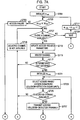
- Figs. 7A and 7B are flow charts showing the method for common packet channel access in accordance with the preferred embodiment of the present invention.
- the mobile terminal 170 selects a common packet channel 407 to which it desires to access, and transmits the preambles 415 and 425 using a signature that corresponds to the selected common packet channel 407. If the satellite access network 100 transmits an acknowledgement signal 413 and 423 in reply to the received preambles 415 and 425, the mobile terminal 170 transmits data packet 417 through the selected common packet channel 407.
- the mobile terminal 170 sets the retransmission number counter m retx as zero.
- the retransmission can be performed at most a maximum retransmission number M retx .
- the logic flow goes to step S705 where the access process is failed.
- step S707 it is determined if there is a common packet channel available by checking the status of packet channels received through the channel status broadcasting channel.
- step S707 if all the channels are not available, at step S709, the mobile terminal waits for a predetermined time. After the predetermined time, at step S711, the mobile terminal increases the retransmission number counter m retx by 1, and it repeats the processes from the step S703.
- step S713 the mobile terminal updates parameters related to the access process.
- Table 2 presents these parameters. These parameters can be changed variously according to the mobile satellite communication environment and a system designer. Therefore, it should be understood that this invention is not limited to the set-up of the parameters related to the access process in Table 2.
- a common packet channel is selected.
- a persistence test is performed.
- a random number between 0 and 1 is generated. If the generated number is larger than the persistence test probability (P), in other words, if it does not satisfy the persistence test at step S717, it is considered that the selected channel is not available, at step S719, and the logic flow goes to the step S707 and repeats the processes.
- P persistence test probability
- the persistence test if the generated number is equal to or smaller than the persistence test probability (P), that is, if the persistence test is satisfied at step S717, a preamble retransmission number m ramp is initialized, at step S721.
- P persistence test probability
- retransmissions of the preamble can be performed at most the maximum preamble retransmission number M ramp .
- an access frame 433, a signature code for the access preamble 415, a signature code for the collision-detection preamble 425, and an initial transmission offset time To are selected.
- the access frame 433 is divided into a plurality of sub-access frames
- one of the sub-access frames is selected.
- the reference time for transmitting the preambles 415 and 425 is the starting point of the selected sub-access frame.
- a spreading code S Pre can be used for discriminating different preamble transmission channels and different sub-access frames.
- the spreading code is associated with the preamble transmission channel and the sub-access frame. These associated spreading codes are broadcasted to the mobile terminal 170in the channel status broadcasting channel.
- the mobile terminal 170 checks out the status of the selected packet channel again.
- step S725 if the selected channel is not available, the logic flow goes to the step S707 and repeats the processes.
- step S725 if the selected channel is available, the access preamble 415 and the collision-detection preamble 425 are transmitted at step S727.
- step S729 after waiting T p time from the starting point of the access frame 433 used for transmitting the preambles 415 and 425, the mobile terminal 170 determines the access status by checking the acknowledgement signal 413 and 423 received in the preamble acknowledgement channel 403.
- the mobile terminal 170 If the mobile terminal 170 has received a negative acknowledgement at the step 729 (in case where the selected common packet channel is already occupied by another mobile terminal, or it is out of service), it waits for a predetermined time at step S731. The mobile terminal, then, recognizes that the selected channel is not available at step S719, and goes to the step S707 to repeat the processes.
- the mobile terminal 170 If the mobile terminal 170 receives a disagreement acknowledgement at step S732 (in case where the selected common packet channel is assigned to another mobile terminal), it waits for a predetermined time at step S709. The mobile terminal, then, increases the retransmission number counter m retx by 1 at step S711, and goes to the step S703 to repeat the process for a new retransmission period.
- the mobile terminal 170 If the mobile terminal 170 receives a positive acknowledgementat step S733, it starts transmitting data packet 417 in the selected common packet channel 407 from the radio frame 433, which is T m time away from the starting point of the access frame 433 in which the last transmission of the preambles 415 and 425 is performed.
- the T m time is predefined by the system.
- the packet transmission in the common packet channel 407 is controlled by a pair of control commands 411: a power control command and a transmission control command.
- the mobile terminal 170 If the mobile terminal 170 does not receive any acknowledgement signal of the positive one, the negative one or the disagreement one, it reduces the preamble retransmission number counter m ramp by 1 at step S735, andit determines whether the reduced preamble retransmission number counter m ramp is larger than zero at step S737.
- the transmit power of the preambles 415 and 425 is increased at step S739, and the logic flow goes to the step S723 to repeat the processes.
- the mobile terminal 170 waits for a predetermined time at step S709. It, then, increases the retransmission number counter m retx by 1 at step S711, and repeats the processes for a new retransmission period from the step S703.
- Figs. 8A and 8B are flow charts showing the method for common packet channel access in accordance with another preferred embodiment of the present invention.
- the mobile terminal 170 selects a signature code corresponding to a common packet channel group, and it transmits the preambles 415 and 425 using the selected signature code.
- the satellite access network 100 transmits an acknowledgement signal 413 and 423 in reply to the preambles 415 and 425, and the acknowledgement signal includes the information on which common packet channel is assigned.
- the mobile terminal 170 transmits data packets through the assigned common packet channel.
- the mobile terminal 170 sets the retransmission number counter m retx as zero.
- the retransmission can be performed at most a maximum retransmission number M retx .
- the retransmission number counter m retx exceeds the maximum retransmission number M retx (that is, m retx > M retx )
- the access process is failed at step S805.
- the mobile terminal 170 checks the status of the packet channel group which is broadcasted in the channel status broadcasting channel and it determines if there is a common packet channel group available.
- the mobile terminal 170 does not select a specific packet channel.
- the satellite access network 100 assigns a channel.
- the mobile terminal 170 waits for a predetermined time at step S809. The mobile terminal 170, then, increases the retransmission number counter m retx by 1 at step S811, and it repeats the process for a new retransmission period from the step S803.
- the mobile terminal 170 updates the parameters related to the access process at step S813. These parameters are the same as those described in Table 2 in the case of channel unassignment mode. However, these parameters can be changed depending on the mobile satellite communication environment and system design.
- a common packet channel group is selected.
- a persistence test is performed.
- the mobile terminal 170 recognizes that the selected channel group is not available at step S819, and returns the step S807 to repeat the process.
- the persistence test at step S817 is satisfied. Therefore, at step S821, the preamble retransmission number counter m ramp is initialized.
- an access frame 433 for transmitting the preambles 415 and 425, a signature code for the access preamble 415, a signature code for the collision-detection preamble 425, and an initial transmission offset time To are selected.
- the access frame 433 is divided into a plurality of sub-access frames
- one of the sub-access frames in the selected access frame is selected.
- the reference time for transmitting the preambles 415 and 425 is the starting point of the selected sub-access frame.
- a spreading code S Pre can be used for discriminating different preamble transmission channels and different sub-access frames.
- the spreading code is associated with the preamble transmission channel and the sub-access frame. These associated spreading codes are broadcasted to the mobile terminal 170 in the channel status broadcasting channel.
- the signature code used for the access preamble 415 is associated with the transmission rate of the common packet channel.
- the mobile terminal 170 Prior to the transmission of the preambles 415 and 425, at step S825, the mobile terminal 170 checks the status of the selected packet channel group again.
- the mobile terminal 170 recognizes that the selected channel group is not available at step S819. The mobile terminal, then, repeats the processes from the step S807.
- the access preamble 415 and the collision-detection preamble 425 are transmitted at step S827.
- the mobile terminal 170 checks out for an acknowledgement signal 413 and 423 received in the preamble acknowledgement channel 403, and determines the access status, at step S829.
- the mobile terminal 170 receives a negative acknowledgement signal in the preamble acknowledgement channel 403, that is, if the whole packet channel group is occupied by another mobile terminal and thus there is no channel available, it waits for a predetermined time at step S831. The mobile terminal, then, increases the retransmission number counter m retx by 1 at step S811, and it repeats the processes for a new retransmission period from the step S803.
- the mobile terminal 170 receives a disagreement acknowledgement, that is, if the selected common packet channel group is assigned to another mobile terminal, it waits for a predetermined time at step S809. The mobile terminal, then, increases the retransmission number counter m retx by 1 at step S811, and it repeats the processes for a new retransmission period from the step S803.
- the mobile terminal 170 In case where the mobile terminal 170 receives a positive acknowledgement, at step S837, it starts transmitting data packet 417, from the radio frame that is located T m time (see Fig. 4 ) away from the starting point of the access frame 433in which the last preambles 415 and 425 are transmitted.
- the transmission of data packet 417 in the packet channel 407 is controlled by a pair of control commands 411, which is a power control command and a transmission control command, as shown in Figs. 4 and 6 .
- the mobile terminal 170 does not receive any acknowledgement signal of the positive one, the negative one or the disagreement one, it decreases the preamble retransmission number counter m ramp by 1 at step S839, and it determines whether the reduced preamble retransmission number counter m ramp is larger than zero at step S841.
- the transmit power of the preambles 415 and 425 is increased and the logic flow returns to the step S823 to repeat the processes.
- the mobile terminal 170 waits for a predetermined time at step S809. The mobile terminal 170, then, increases the retransmission number counter m retx by 1 at step S811, and it repeats the process for a new retransmission period from the step S803.
- the method of the present invention can improve the preamble detection probability at the satellite access network by using preambles suitable for mobile satellite communication system environment.
- the method of the present invention can reduce transmission delay by transmitting the collision-detection preamble along with the access preamble.
- the collision-avoidance capability can be improved, by transmitting a plurality of collision-detection preambles.
- the probability for collision is reduced exponentially, as a collision-detection preamble is added.
- the method of the present invention can reduce further transmit power and the number of used spreading codes for the downlink control channel, by using a common control channel to control the packet transmission of each mobile terminal, so as to be suitable for the mobile satellite communication environment. Further, the method of the present invention can control the transmit power of the common packet channel only with one slot in the radio frame of the common control channel, so as to be suitable for a mobile satellite communication environment.
Landscapes
- Engineering & Computer Science (AREA)
- Computer Networks & Wireless Communication (AREA)
- Signal Processing (AREA)
- Physics & Mathematics (AREA)
- Astronomy & Astrophysics (AREA)
- General Physics & Mathematics (AREA)
- Aviation & Aerospace Engineering (AREA)
- Computer Security & Cryptography (AREA)
- Mobile Radio Communication Systems (AREA)
- Radio Relay Systems (AREA)
Abstract
Description
- The present invention relates to a method and apparatus for common packet channel (CPCH) access for transmitting data packets having bursty traffic from a mobile terminal to a satellite access network in a code division multiple access (CDMA) mobile satellite communication system.
- Common packet channel (CPCH) is a channel used for transmitting packet data which is too big to be transmitted through an uplink random access channel (RACH) and too small to be transmitted through an uplink dedicated channel, such as one for voice service. The CPCH is usually used for transmitting packet data of middle-length less than 50 frames.
- The CPCH structure and CPCH access/control procedures are disclosed in the specification documents of 25.211 and 25.214, drawn by the Technical Specification Group (TS) of the 3rd Generation Partnership Project (3GPP).
- The CPCH is related to a downlink dedicated channel that provides power control and transmission control commands with respect to each CPCH. The CPCH is characterized by initial collision risk and inner loop power control.
- In case where data is one to two frames long, it is transmitted through uplink random access channel (RACH). If a length of the data is 50 frames or more, such as voice data, it is transmitted through the uplink dedicated channel.
- In a satellite mobile communication system for IMT-2000 service, a mobile terminal transmits an access preamble to the satellite access network through an access channel before transmitting a data packet, in order to obtain data transmit grant.
- If the satellite access network acknowledges the acquisition of the access preamble, the mobile terminal transmits a collision-detection preamble additionally to avoid any collision.
- If the satellite access network acknowledges the successful reception of the collision-detection preamble and sends an acknowledgement for channel assignment, the mobile terminal transmits the user data packet, which is the main packet, through an allowed uplink common packet channel.
- The satellite access network performs transmission control, such as commanding transmission start, transmission stop, and power control with respect to each uplink packet channel, using a downlink dedicated channel corresponding to each uplink common packet channel.
- Since the access preamble contains a signature which indicates a common packet channel (in case that a channel is not assigned, hereinafter, which is referred as "a channel unassignment mode") that the mobile terminal selects for packet transmission (in case of a channel unassignment mode), or (in case that a channel is assigned, hereinafter, which is referred as "a channel assignment mode") indicates a transmission rate, the satellite access network recognizes the request of the mobile terminal by detecting the signature in the access preamble.
- The collision-detection preamble is used for avoiding the collision of the packets transmitted by two or more than mobile terminals at the same time.
- Since the number of signatures used for the access preamble is restricted, two or more mobile terminals may transmit their access preambles using the identical signature at the same time. Therefore, the collision-detection preamble is used for preventing different mobile terminals from using the same common packet channel, when the mobile terminals transmit access preambles using the same signature at the same time.
- Although the mobile terminals can transmit access preambles using the same signature, if a collision-detection preamble is transmitted using a signature selected by each mobile terminal independently again (the selected signature may or may not be the same as the signature of the access preamble), the satellite access network can discriminate collision-detection preambles and select any one of the collision-detection preambles. The satellite access network, then, transmits an acknowledgement corresponding to the selected collision-detection preamble in order to allow data transmission to a mobile terminal. The mobile terminal that receives the acknowledgement can obtain the grant for using the common packet channel and transmit data packets. Therefore, the collision between data packets transmitted by the different mobile terminals can be avoided.
- However, there are some problems in applying the common packet channel access method used in the terrestrial system to the satellite system.
- First, although the propagation delay is no more than one millisecond (ms) in a cell of the terrestrial system, the delay is more than tens of milliseconds in the satellite system, even in case of a low earth orbit (LEO) satellite system. Therefore, the access delay spent in the two processes of transmitting preambles for access and channel requests is relatively very long, compared with that of the terrestrial system.
- Second, in the satellite system the probability of successful reception of the preamble is relatively low because of poor link characteristics, such as long distance and fading. Moreover, in case of using a low earth orbit (LEO) satellite system, Doppler shift occurs up to tens of Khz.
- Third, in the terrestrial system, a downlink dedicated channel for controlling packet transmission and transmit power is assigned to each uplink packet channel, and in a case where a plurality of packet channels are used, the terrestrial system should use the same number of downlink dedicated control channels as there are assigned packet channels. The packet channels and control channels control each others transmit power levels using closed loop power control.
- However, the ratio of transmission power loss between mobile terminals in the satellite system is relatively smaller than that in the terrestrial system. That is, in case of the satellite system, the transmit power difference required to the mobile terminals within a satellite beam is smaller than the one in the terrestrial system. Therefore, in the satellite communication, even though the closed loop power control is performed by a downlink control channel corresponding to each packet channel, power efficiency is not enhanced. Accordingly, if downlink dedicated control channels are assigned to the terrestrial system, this leads to unnecessary channel assignment and power loss; and causes the problem of spreading code limitation.
- Fourth, in the terrestrial system, the propagation delay between a base station and a mobile terminal is short and thus fast power control can be used for each mobile terminal. The power control is performed every slot in the downlink dedicated control channel. Meanwhile, in the satellite system, such fast power control is impossible due to the longer propagation delay in the satellite link.
- Universal Mobile Telecommunications Systems (UMTS); Physical layer procedures (FDD) (3GPP TS 25.214 version 4.2.0 Release 4); ETSI TS 125 214 "ETSI STANDARDS, US, SOPHIA ANTIPOLIS CEDEX, FRANCE, vol. 3-R1, no. V4.2.0, 1 September 2001 (2001-09-01), XP014008404ISSN: 0000-0001 and Universal Mobile Telecommunications System (UMTS); Physical channels and mapping of transport channels onto physical channels (FDD) (3GPP TS 25.211 version 4.2.0 Release 4);ETSI TS 125 211 "ETSI STANDARDS, LES, SOPHIA ANTIPOLIS CEDEX, FRANCE, vol. 3-R1, no. V4.2.0, 1 September 2001 (2001-09-01), XP014008341ISSN: 0000-0001 disclose arrangements in which a method for accessing a common packet channel shared by a plurality of mobile terminals includes transmitting data packets in a mobile satellite communication system, comprising the steps of:
- a) receiving an access preamble generated based on an access signature, and a collision-detection preamble generated based on a collision-detection signature; and
- b) transmitting an acknowledgement to the access preamble and an acknowledgement to the collision-detection preamble to the mobile terminals through a preamble acknowledgement channel.>
- It is, therefore, an object of the present invention to provide a method and apparatus for common packet channel access that can reduce the access delay spent in a mobile satellite communication system.
- It is another object of the present invention to provide a method and apparatus for common packet channel access that can improve the probability of a satellite access network receiving preambles transmitted from a mobile terminal in a mobile satellite communication system.
- It is still another object of the present invention to provide a method and apparatus for the common packet channel access that can control a plurality of common packet channels using a common control channel in a mobile satellite communication system.
- It is still another object of the present invention to provide a method and apparatus for common packet channel access that can control the transmit power of a common packet channel using a slot in the frame of the common control channel.
- In accordance with one aspect of the present invention, there is provided a method for accessing a common packet channel shared by a plurality of mobile terminals to transmit data packets in a mobile stallite communication system, comprising the steps of: a) receiving an access preamble generated based on an access signature, and a collision-detection preamble generated based on a collision-detection signature, which are transmitted together from the mobile terminals; and b) transmitting an acknowledgement to the access preamble and the collision-detection preamble to the mobile terminals through a preamble acknowledgement channel, characterised in that the access preamble and the collision-detection preamble are transmitted together from the mobile terminals.
- In accordance with another aspect of the present invention, there is provided a method for accessing a common packet channel shared by a plurality of mobile terminals in a mobile satellite communication system, comprising the steps of: a) transmitting an access preamble and a collision-detection preamble successively to a satellite access network; b) receiving an acknowledgement to the access preamble and the collision-detection preamble from the satellite access network through a preamble acknowledgement channel; and c) retransmitting the access preamble and the collision-detection preamble, or transmitting a data packet through the common packet channel, according to the acknowledgement, characterised in that the access preamble and the collision-detection preamble are transmitted together from the mobile terminals.
- Disclosed herein is an apparatus for accessing a common packet channel which is shared by a plurality of mobile terminals to transmit data packet in a mobile satellite communication system, comprising: a channel determining unit for determining if there is a common packet channel available or a common packet channel group available according to common packet channel information broadcasted from a satellite access network, and selecting one of channels or groups available; a transmission resource determining unit for selecting an access frame for transmitting an access preamble having a plurality of sub-access preambles and a collision-detection preamble, a sub-access frame in the access frame, a transmission offset time, an access signature code for generating the access preamble, a collision-detection signature code for generating the collision-detection preamble, and a spreading code corresponding to the selected sub-access frame; a generation unit for generating the access preamble and the collision-detection preamble based on the access signature code, the collision-detection signature code and the spreading code; a transmission unit for transmitting the access preamble and the collision-detection preamble successively, after the selected transmission offset time is passed from a starting point of the access frame or the sub-access frame; a reception unit for receiving an acknowledgement to the access preamble and the collision-detection preamble from the satellite access network; and a transmission determining unit for determining whether to transmit the access preamble and the collision-detection preamble, or to transmit data packet through the common packet channel, according to the acknowledgement.
- Also disclosed herein is an apparatus for accessing a common packet channel shared by a plurality of mobile terminals to transmit data packet, comprising: a reception unit for receiving an access preamble including an access signature code and a collision-detection preamble including a collision-detection signature code, which are transmitted together from the mobile terminal; an acknowledgement generating unit for generating any one among a positive acknowledgement allowing the mobile terminal to access the common packet channel, a disagreement acknowledgement allowing another mobile terminal to access the common packet channel, and a negative acknowledgement indicating that the common packet channel or the common packet channel group requested by the access preamble cannot be used currently; and a transmission unit for transmitting the acknowledgement to mobile terminals.
- According to the present invention, an access preamble and a collision-detection preamble are transmitted together at one time in order to reduce access delay in the procedure of the common packet channel access.
- To enhance the probability of detecting access preambles, sub-preambles containing the same signature are transmitted repeatedly.
- By using a common control channel to control packet transmission in common packet channels, the transmit power and the number of spreading codes required for the control channel are reduced.
- Further, it becomes possible to perform closed loop power control on the common packet channel by using a slot in the radio frame of the common control channel.
- The above and other objects and features of the present invention will become apparent from the following description of the preferred embodiments given in conjunction with the accompanying drawings, in which:
-
Fig. 1 is a schematic diagram illustrating the mobile satellite communication environment of a satellite access network and a mobile terminal in accordance with the present invention; -
Fig. 2 is a block diagram describing the functional structure of the mobile terminal ofFig. 1 in accordance with an embodiment of the present invention; -
Fig. 3 is a block diagram depicting the structure of a common packet channel access apparatus employed in either an earth station or a satellite ofFig. 1 in accordance with the embodiment of the present invention; -
Fig. 4 is a timing diagram of frames and packets describing a method for common packet channel access in accordance with a preferred embodiment of the present invention; -
Fig. 5 is a timing diagram of access/collision detecting preamble describing a method for common packet channel access in accordance with a preferred embodiment of the present invention; -
Fig. 6 is a schematic diagram describing common packet channel control in accordance with the present invention; -
Figs. 7A and7B are flow charts showing the method for common packet channel access in accordance with the preferred embodiment of the present invention; and -
Figs. 8A and8B are flow charts showing the method for common packet channel access in accordance with another preferred embodiment of the present invention. - Other objects and aspects of the invention will become apparent from the following description of the embodiments with reference to the accompanying drawings, which is set forth hereinafter. The same reference number is given to the same element in different drawings. Also, in case where detailed description on the related art blurs the point of the present invention, the description will be omitted.
-
Fig. 1 is a schematic diagram illustrating the mobile satellite communication environment of a satellite access network and a mobile terminal in accordance with the present invention. As shown in the drawing, the mobile satellite communication environment of the present invention comprises amobile terminal 170 which generates user data, and transmits preambles and user data through a common packet channel, and asatellite access network 100 which determines whether to allow common packet channel access based on the preamble received from themobile terminal 170, and relays the user data to the terrestrial network (not shown). Thesatellite access network 100 includes acontrol station 150 which controls thesatellite access network 100 and performs internetworking with the terrestrial network, asatellite 110, and anearth station 130, thereby providing a connection between themobile terminal 170 and the terrestrial network (not shown). -
Fig. 2 is a block diagram describing the functional structure of the mobile terminal ofFig. 1 in accordance with an embodiment of the present invention. As shown in the drawing, themobile terminal 170 of the present invention transmits an access preamble and a collision-detection preamble to thesatellite access network 100 successively in an access frame, and it includes a mobile terminal transmitter/receiver 177 which receives an acknowledgement of the access preamble and the collision-detection preamble from thesatellite access network 100. In accordance with the present invention, the mobile terminal transmitter/receiver 177 receives a common packet channel control command that is broadcasted by thesatellite access network 100 through a downlink common control channel. The mobile terminal transmitter/receiver 177, as will be described later, can transmit the access preamble and the collision-detection preamble with a predetermined transmission offset time To from the staring point of an access frame. - Also, the
mobile terminal 170 includes a datapacket processing unit 171 that converts user data into data packets that can be transmitted through the common packet channel. - In addition, the
mobile terminal 170 further includes a transmissionresource determining unit 173 which selects an access frame for transmitting the access preamble and the collision-detection preamble, an access signature code for generating the access preamble, and a collision-detection signature code for generating the collision-detection preamble. The transmissionresource determining unit 173 of each mobile terminal that desires to access the common packet channel can select the access frame independently, and the access frame can be set larger than the maximum difference of round trip delays for mobile terminals in a satellite beam. In the mean time, the transmissionresource determining unit 173 performs data transmission control and transmit power control based on the common packet channel control command received from thesatellite access network 100. - The
mobile terminal 170, also, generates an access preamble and a collision-detection preamble using the access signature code and collision-detection signature code, respectively. Themobile terminal 170 includes atransmission unit 175 that receives the data packet from the datapacket processing unit 171 and converts the data packet into a signal that is suitable for the common packet channel. Accordingly, thetransmission unit 175 has a preamble generating unit and a data packet generating unit (not shown). - Finally, the
mobile terminal 170 includes atransmission determining unit 179 that determines whether to retransmit the access preamble and the collision-detection preamble or to transmit the data packet through the common packet channel, based on the acknowledgement that the mobile terminal transmitter/receiver 177 has received from thesatellite access network 100. Thetransmission determining unit 179 includes a channel determining unit (not shown) which determines if there are common packet channels available (in case of a channel unassignment mode) or common packet channel groups available (in case of a channel assignment mode), and selects a common packet channel or a common packet channel group. Thetransmission determining unit 179, in case that there is no acknowledgement received from thesatellite access network 100, activates the transmissionresource determining unit 173 and thetransmission unit 175 to increase power and retransmit the access preamble and the collision-detection preamble until it receives any acknowledgement. Also, thetransmission determining unit 179 activates the transmissionresource determining unit 173 and thetransmission unit 175 to retransmit the access preamble and the collision-detection preamble after a predetermined time, in case where either disagreement acknowledgement or negative acknowledgement is received from thesatellite access network 100, which will be described later on. Thetransmission determining unit 179, also, activates thetransmission unit 175 to transmit a data packet through a common packet channel (in case of channel unassignment mode) which is selected when the acknowledgement from thesatellite access network 100 is a positive acknowledgement, which will be described later, or a common packet channel (in case of channel assignment mode) assigned by the positive acknowledgement. - The channel determining unit in the
transmission determining unit 170 determines if there are available common packet channels or available common packet channel groups based on the channel information obtained from thesatellite access network 100 through a channel status broadcasting channel, and updates parameters related to common packet channel access based on the channel information obtained through the channel status broadcasting channel. -
Fig. 3 is a block diagram depicting the structure of a common packet channel access apparatus employed in the earth station or satellite ofFig. 1 in accordance with the embodiment of the present invention. - The common packet channel access apparatus of the present invention can be embodied in either the
satellite 110 or theearth station 130. As illustrated in the drawing, the common packet channel access apparatus comprises a satellite system transmitter/receiver 131 for receiving an access preamble, a collision-detection preamble, and a data packet received from a plurality of mobile terminals, and transmitting acknowledgements to the mobile terminals, and a data packet transmitter/receiver 131 for relaying the data packet to the terrestrial network. - Meanwhile, the common packet channel access apparatus further comprises an
acknowledgement generating unit 135 for generating an acknowledgement to an access preamble and a collision-detection preamble received from the satellite system transmitter/receiver 131 in accordance with the present invention, and a common packet channel controlcommand generating unit 137 for generating a control command with respect to the common packet channel, which will be transmitted through a downlink common control channel. - In accordance with the present invention, there are a plurality of
preamble transmission channels 405 andcommon packet channels 407 for the uplink (reverse link), which is from themobile terminal 170 to thesatellite access network 100, and there are a channel status broadcasting channel, apreamble acknowledgement channel 403, and acommon control channel 401 for the downlink (forward link), which is from thesatellite access network 100 to themobile terminal 170. - The channel status broadcasting channel is for the
satellite access network 100 transmitting information on the current status of the common packet channel, whether it is used or not, to themobile terminal 170. Themobile terminal 170 checks out the status of thecommon packet channel 407, by receiving information from thesatellite access network 100 through a channel status broadcasting channel, and then transmits anaccess preamble 415 and a collision-detection preamble 425 to thesatellite access network 100 through thepreamble transmission channel 405 in order to access thecommon packet channel 407. - The
preamble transmission channel 405 is for transmitting anaccess preamble 415 and a collision-detection preamble 425 before the data packet is transmitted. Depending on the channel definition in a system, there are a plurality of preamble transmission channels, and each preamble transmission channel is distinguished by the spreading code used therefor. - After the
satellite access network 100 receives theaccess preamble 415 and the collision-detection preamble 425, and then transmittinginformation mobile terminal 170, through thepreamble acknowledgement channel 403. - Accordingly, if the
mobile terminal 170 is allowed to transmit the data packet, it can transmit the data packet to thesatellite access network 100 through the allowedcommon packet channel 407. Consequently, thesatellite access network 100 can control the data packet transmission through the common control channel. -
Fig. 4 is a timing diagram of frames and packets describing a method for common packet channel access in accordance with a preferred embodiment of the present invention. - The
preamble transmission channel 405 and thecommon packet channel 407 which appear throughout this specification as well as inFig. 4 , are mapped to a physical common packet channel (PCPCH), which is a physical channel. The transmission of theaccess preamble 415 and collision-detection preamble 425 is distinguished from the transmission of thedata packet 417 by different spreading codes. - The same spreading code can be used for all of the access and collision-
detection preambles data packet 417 in order to reduce the system complexity. However, this may lead to high collision risk among packets transmitted by mobile terminals. Since it is obvious to those skilled in the art of the invention that whether or not the same spreading code is to be used wholly depends on the choice of a system designer, it should be understood that this invention is not limited to the case that thepreamble transmission channel 405 and thecommon packet channel 407 are distinguished by the selection of spreading codes. - The
mobile terminal 170 within the satellite coverage acquires timing of theradio frame 421 and theaccess frame 433 by receiving thecommon control channel 401. The reception time becomes a timing basis for thepreamble acknowledgement channel 403, thepreamble transmission channel 405, and thecommon packet channel 407. - Here, in
Fig. 4 , which describes a preferred embodiment of the present invention, thecommon control channel 401 and thecommon packet channel 407 include radio frames 421 of the same length. Thepreamble acknowledgement channel 403 and thepreamble transmission channel 405 include access frames 433 having a length twice as long as theradio frame 421. - The length of the
access frame 433 is set larger than the maximum difference between round trip delays in a satellite beam. - The
mobile terminals 170 determine the start time of theaccess frame 433 based on theradio frame 421 of thecommon control channel 401. Therefore, although themobile terminals 170 receive thesame radio frame 421, reception time difference exists due to the different distance between thesatellite 110 and themobile terminals 170. Moreover, although themobile terminals 170 transmit thepreambles satellite 110 using thesame access frame 433, there is a difference on the reception time at thesatellite access network 100 due to the different distance. - Therefore, the
access frame 433 should be set longer than the maximum difference between round trip delays so that thesatellite access network 100 knows which theaccess frame 433 is used for thepreambles mobile terminal 170. - However, it is obvious to those skilled in the art of the present invention that the
radio frame 421 and theaccess frame 433, as shown in the drawing, may be selected variously according to the mobile satellite communication environment and system. Therefore, it should be understood that this invention is not limited to the selection of theradio frame 421 and theaccess frame 433 illustrated in the drawing. - The
mobile terminal 170 receives the channel status broadcasting channel transmitted by thesatellite access network 100, and checks if there is a common packet channel available (in case of a channel unassignment mode) or a common packet channel group available (in case of the channel assignment mode), prior to the transmission of thepreambles common packet channel 407. - As described above, the channel status broadcasting channel is used for the
satellite access network 100 transmitting information on the current status of the common packet channel, i.e., whether it is used or not, to themobile terminal 170. - In case of the channel unassignment mode, the
mobile terminal 170 selects acommon packet channel 407 among ones available. - In case of the channel assignment mode, the
mobile terminal 170 selects a packet channel group among ones available. If themobile terminal 170 successfully obtains the grant of the common packet channel access, thesatellite access network 100 assigns onepacket channel 407 in the packet channel group selected. -
Fig. 5 is a timing diagram of access/collision-detection preamble describing a method for common packet channel access in accordance with the preferred embodiment of the present invention. - The
mobile terminal 170 transmits theaccess preamble 415 and the collision-detection preamble 425 through thepreamble transmission channel 405 as shown inFigs. 4 and5 . Eachmobile terminal 170 determines the starting point of theaccess frame 433 based on theradio frame 421 of thecommon control channel 401, and transmits thepreambles access frame 433. - In the preferred embodiment, the length of the
preambles access frame 433. However, it is obvious to those skilled in the art of this invention that the length of thepreambles preambles - Meanwhile, the
preambles access frame 433. Here, T0 is randomly selected in the time range of -T0,MAX to T0,MAX given by a predetermined maximum transmission offset T0,MAX. - The transmission offset time is desirable for the following reason. When
mobile terminals 170 located close to each other transmit thepreambles same access frame 433, thesatellite access network 100 receives thepreambles preambles same access frame 433 are received by thesatellite access network 100, they concentrate in a particular time period, and the concentrated time period depends on the difference between round trip delays. In case where the delay difference is much shorter than the time length of theaccess frame 433, thepreambles - Therefore, if additional time difference is artificially generated by an arbitrary transmission offset time To, this makes the overlapped time period larger, thereby reducing the interference due to the overlapped reception.
- Another embodiment of the present invention, although it is not shown in the drawing, spreads the reception time of the preambles in the
satellite access network 100. When the length of theaccess frame 433 is longer than that of theradio frame 421, oneaccess frame 433 is divided into a plurality of sub-access frames. Themobile terminal 170 selects one of the sub-access frames and transmits thepreambles preambles mobile terminal 170 selects anaccess frame 433, selects one among sub-access frames within the selectedaccess frame 433 again. Themobile terminal 170, then, begins to transmit thepreambles - In this case, a spreading code SPre can be selected to distinguish the preamble transmission channel and the sub-access frame, and accordingly, the preambles transmitted in the
same access frame 433 but different sub-access frame can be distinguished in thesatellite access network 100. - Referring to
Fig. 5 , theaccess preamble 415 is composed of Np-1sub-preambles 511a to 511Np-1 all of which have the identical spreading code CPre to enhance the detection probability at thesatellite access network 100, and the last sub-preamble 511Np that has an inverse code - CPre of the previous sub-preamble CPre to notify the termination of theaccess preamble 415. - Each of the sub-preambles 511a to 511Np includes a specific signature code Cs. Based on the signature code, the
satellite access network 100 distinguishes the access preamble of a desired mobile terminal from access preambles of other mobile terminals. - When the access preamble is transmitted, each
mobile terminal 170 selects and transmits one signature code that corresponds to a desired packet channel (in case of a channel unassignment mode) or a packet channel group (in case of a channel assignment mode), among signature codes available. A sub-preamble CPre is expressed asEquation 1.
,where SPre,i is a spreading code for a preamble transmission channel i, and CS is a signature code. - As described above, in case where an
access frame 433 is divided into a plurality of sub-access frames, themobile terminal 170 selects one sub-access frame and transmits thepreambles - Signature is a sequence consisting of a plurality of symbols and there is orthogonality among different signatures. Therefore, the
satellite access network 100 can distinguish preambles received from different mobile terminals from their signatures, if the mobile terminals uses different signatures. Generally, Hadamad sequence can be used for the signature. - As illustrated in
Fig. 5 , sub-preambles 511a to 511NP are repeated NP times in anaccess preamble 415, and the length of each sub-preamble is LS chips. The last; sub-preamble 511NP of anaccess preamble 415 has an inverse code -CPre of the previous sub-preamble code CPre. In case that the length of signature code CS is shorter than that of the sub-preamble, the signature code may be repeated within the sub-preamble. - Meanwhile, the last sub-preamble 511NP of the
access preamble 415 may have a conjugate code CPre* of the previous sub-preamble CPre, instead of the inverse code -CPre of the previous sub-preamble CPre. The conjugate code CPre* can be obtained by conjugating the spreading code SPre,i. - Signature codes available are defined according to the
common packet channel 407 to be used, and themobile terminal 170 selects one among signature codes corresponding to thecommon packet channel 407. - For example, there may be 16 signature codes corresponding to 16 common packet channels. Also, there may be four signature groups (each group contains four signature codes) mapped to the four channels. The signature group may or may not include the same signature code as in the other group. The mapping relations between the packet channel and the signature code depends on the choice of a system designer.
- It is, however, obvious to those skilled in the art that the repetition number of sub-preambles 511a to 511NP and mapping of the signature code to the packet channel, which are illustrated in the drawing, can be changed variously according to the mobile satellite communication environment and system. Therefore, it should be understood that this invention is not limited to the repetition number and the mapping of the signature code as shown in the drawing.
- The collision-
detection preamble 425, which is transmitted along with theaccess preamble 415, is used for avoiding collision. As in theaccess preamble 425, themobile terminal 170 selects a signature code for the collision-detection preamble 425. The selected signature code may or may not be different from that of theaccess preamble 415. - If an
access preamble 415 is transmitted alone, a collision may happen in the data packet transmission on the common packet channel. When differentmobile terminals 170 transmitaccess preambles 415 using the same signature code in the same access frame, themobile terminal 170 may recognize the acknowledgement to another mobile terminal as one for itself, and thus it may attempt to transmit its data packet through thecommon packet channel 407 even though itsaccess preamble 415 could not be received successfully by the satellite access network. This leads to collision in the common packet channel. In order to avoid such collision, the collision-detection preamble 425 is transmitted along with theaccess preamble 415. - In this embodiment, the collision-
detection preamble 425 is transmitted once and is not repeated, unlike in the access preamble. This is because the sub-preamble has already been repeated in order to improve the detection probability at thesatellite access network 100. Therefore, the collision-detection preamble 425 needs not to be repeated. - Meanwhile, the probability of packet transmission collision, which may be caused by the use of the same signature code in the
access preamble 415, can be reduced by transmitting a plurality of collision-detection preambles 425 with signature codes selected independently. - In
Fig. 5 , as an embodiment of the present invention, the length of collision-detection preamble 425 is identical to the length of the sub-preambles 511a to 511Np in theaccess preamble 415, that is, LS chips. Therefore, thepreambles - As described above, although a collision-
detection preamble 425 having the same length of LS chips is illustrated inFig. 5 to describe the preferred embodiment of the present invention, it is possible to form a plurality of collision-detection preambles 425. In this case, the collision probability can be reduced as shown inEquation 2.
- A
preamble acknowledgement channel 403 is used for transmitting an acknowledgement to thepreambles mobile terminals 170. It transmits an acknowledgement to each user, using a signal pattern corresponding to the signature code used in the received preamble. - The acknowledgement signal includes a pair of acknowledgements; an
acknowledgement 413 to the access preamble, and anacknowledgement 423 to the collision-detection preamble. In thepreamble acknowledgement channel 403, anaccess frame 433 is divided into a plurality of slots, and a preamble acknowledgement signal including twoacknowledgements - The
mobile terminal 170 determines whether to transmit data packet based on theacknowledgement signal access frame 433, which is located TP time away from the starting point of theaccess frame 433 in which itspreambles Fig. 4 . - Table 1 presents signature codes used in the acknowledgement signal transmitted through the
preamble acknowledgement channel 403. It is assumed that themobile terminal 170 uses signature codes, Cs,A and Cs,R, while thesatellite access network 100 uses signature codes, D,s,A and Ds,R. The Cs,A and Cs,R denote signature codes used for the access preamble and the collision-detection preamble. The Ds,A and Ds,R denotes signature codes corresponding to Cs,A and one corresponding to Cs,R, respectively.[Table 1] Signature Code Used in Acknowledgement of Access Preamble Signature Code Used in Acknowledgement of Collision-detection Preamble Content of Acknowledgement Ds,A Ds,R Positive Acknowledgement(Data Packet Transmission Allowance) Ds,A D's,R Disagreement Acknowledgement (D's,R ≠ Ds,R) -Ds,A Ds,R or D's,R Negative Acknowledgement (D's,R ≠ Ds,R) Others No Acknowledgement - As shown in Table 1, if the
satellite access network 100 successfully receives thepreambles preamble acknowledgement channel 403, using signature codes Ds,A and Ds,R that correspond to the signature codes of theaccess preamble 415 and the collision-detection preamble 425, respectively. In case of channel assignment mode, if data transmission is allowed, theacknowledgement signal common packet channel 407. If themobile terminal 170 receives a positive acknowledgement, it starts to transmit data packet in the selected or assignedcommon packet channel 407, from the starting point of the radio frame that is located Tm time (seeFig. 4 ) away from the starting point of theaccess frame 433 in which thepreambles - Although the
satellite access network 100 has received thepreambles access preamble 415 is used by another mobile terminal or out of service, thesatellite access network 100 transmits thenegative acknowledgement signal 413 having an inverse signature code (-Ds,A) in reply to the signature code of theaccess preamble 415, thus notifying that the requested packet channel or packet channel group is not available. - The
mobile terminal 170 that has received the negative acknowledgement considers that the packet channel or the packet channel group is in use, and after waiting for a predetermined time, it tries transmitting thepreambles - In case where the
mobile terminal 170 receives anacknowledgement signal access preamble 415, but that has a signature code (D's,R or D's,R ≠ Ds,R) not corresponding to the signature code of the collision-detection preamble 425 (that is, disagreement acknowledgement), it considers that the requested channel is allowed to anothermobile terminal 170. After waiting for a predetermined time, it tries transmitting thepreambles -
Fig. 6 is a schematic diagram describing common packet channel control in accordance with the present invention. InFig. 6 , theradio frame 421 includes N slots 411a to 411N, and each of the slots 411a to 411N is associated with each of thecommon packet channels 407a to 407N. Therefore, it is possible to control the packet transmission in N common packet channels. - The
mobile terminal 170 that is allowed to transmit data packet starts packet transmission through the selected common packet channel 407 (in case of channel unassignment mode) or the assigned channel (in case of channel assignment mode). The packet transmission in thecommon packet channel 407 is performed according to a pair of control commands 411, which are a power control command and a transmission control command. - Each
radio frame 421 in thecommon control channel 401, as illustrated inFig. 4 , is divided into a plurality of slots 411a to 411N. Each of the slots 411a to 411N includes control commands, that is, a transmission control command and a power control command, for its associatedpacket channel 407a to 407N. - The transmission control command may indicate transmission initiation and transmission stop. The power control command is used for adjusting the transmit power of the
common packet channel 407. - Accordingly, the control command on each of the
packet channels 407a to 40TN is periodically transmitted to the mobile terminal once aradio frame 421. -
Figs. 7A and7B are flow charts showing the method for common packet channel access in accordance with the preferred embodiment of the present invention. - In the channel unassignment mode, the
mobile terminal 170 selects acommon packet channel 407 to which it desires to access, and transmits thepreambles common packet channel 407. If thesatellite access network 100 transmits anacknowledgement signal preambles mobile terminal 170 transmitsdata packet 417 through the selectedcommon packet channel 407. - At step S701, the
mobile terminal 170 sets the retransmission number counter mretx as zero. - In the following access process, the retransmission can be performed at most a maximum retransmission number Mretx. At step S703, if the retransmission number counter mretx exceeds the maximum retransmission number Mretx (that is, mretx > Mretx), the logic flow goes to step S705 where the access process is failed.
- As far as the maximum retransmission number Mretx is not exceeded, at step S707, it is determined if there is a common packet channel available by checking the status of packet channels received through the channel status broadcasting channel.
- As a result of the step S707, if all the channels are not available, at step S709, the mobile terminal waits for a predetermined time. After the predetermined time, at step S711, the mobile terminal increases the retransmission number counter mretx by 1, and it repeats the processes from the step S703.
- As a result of the step S707, if there is a common packet channel available, at step S713, the mobile terminal updates parameters related to the access process. Table 2 presents these parameters. These parameters can be changed variously according to the mobile satellite communication environment and a system designer. Therefore, it should be understood that this invention is not limited to the set-up of the parameters related to the access process in Table 2.
[Table 2] Spreading Code of Packet Channel Spreading Code of Common Control Channel Spreading Code of Channel Status Broadcasting Channel Spreading Code of Preamble Acknowledgement Channel Spreading Code of Preamble Transmission Channel Available Access Frame Group for Each Packet Channel Available Access Signature Group for Each Packet Channel Available Request Signature Set Slot of Common Control Channel Corresponding to Each Packet Channel Persistence Test Probability (P) Parameters for Computing Initial Preamble Transmission Power Preamble Transmission Power Increase Value Transmission Power Difference between Preamble Transmission and Data Packet Transmission Maximum Retransmission Number (Mretx) Maximum Preamble Retransmission Number (Mramp) Delay Time Range for Arbitrary Time Backoff Predefined Backoff Delay Time Maximum Transmission Offset Time Preamble Acknowledgement Signal Waiting Time Packet Transmission Waiting Time - Subsequently, at step S715, a common packet channel is selected. At step S717, a persistence test is performed.
- In the persistence test, a random number between 0 and 1 is generated. If the generated number is larger than the persistence test probability (P), in other words, if it does not satisfy the persistence test at step S717, it is considered that the selected channel is not available, at step S719, and the logic flow goes to the step S707 and repeats the processes.
- In the persistence test, if the generated number is equal to or smaller than the persistence test probability (P), that is, if the persistence test is satisfied at step S717,a preamble retransmission number mramp is initialized, at step S721.
- In every retransmission number mretx, retransmissions of the preamble can be performed at most the maximum preamble retransmission number Mramp.
Fig. 7 shows an embodiment where the preamble retransmission number mramp is initialized as the maximum preamble retransmission number Mramp (that is, mramp = Mramp)· - Subsequently, at step S723, an
access frame 433, a signature code for theaccess preamble 415, a signature code for the collision-detection preamble 425, and an initial transmission offset time To (see thepreamble transmission channel 405 ofFig. 4 ) are selected. - In accordance with another embodiment of the present invention, in case where the
access frame 433 is divided into a plurality of sub-access frames, one of the sub-access frames is selected. In this case, the reference time for transmitting thepreambles - At step S725, prior to the transmission of the
access preamble 415 and the collision-detection preamble 425, themobile terminal 170 checks out the status of the selected packet channel again. - At step S725, if the selected channel is not available, the logic flow goes to the step S707 and repeats the processes.
- At step S725, if the selected channel is available, the
access preamble 415 and the collision-detection preamble 425 are transmitted at step S727. - Subsequently, at step S729, after waiting Tp time from the starting point of the
access frame 433 used for transmitting thepreambles mobile terminal 170 determines the access status by checking theacknowledgement signal preamble acknowledgement channel 403. - If the
mobile terminal 170 has received a negative acknowledgement at the step 729 (in case where the selected common packet channel is already occupied by another mobile terminal, or it is out of service), it waits for a predetermined time at step S731. The mobile terminal, then, recognizes that the selected channel is not available at step S719, and goes to the step S707 to repeat the processes. - If the
mobile terminal 170 receives a disagreement acknowledgement at step S732 (in case where the selected common packet channel is assigned to another mobile terminal), it waits for a predetermined time at step S709. The mobile terminal, then, increases the retransmission number counter mretx by 1 at step S711, and goes to the step S703 to repeat the process for a new retransmission period. - If the
mobile terminal 170 receives a positive acknowledgementat step S733, it starts transmittingdata packet 417 in the selectedcommon packet channel 407 from theradio frame 433, which is Tm time away from the starting point of theaccess frame 433 in which the last transmission of thepreambles - Referring to
Fig. 4 again, the packet transmission in thecommon packet channel 407 is controlled by a pair of control commands 411: a power control command and a transmission control command. - If the
mobile terminal 170 does not receive any acknowledgement signal of the positive one, the negative one or the disagreement one, it reduces the preamble retransmission number counter mramp by 1 at step S735, andit determines whether the reduced preamble retransmission number counter mramp is larger than zero at step S737. - If the preamble retransmission number counter mramp is larger than zero, the transmit power of the
preambles - If the preamble retransmission number counter mramp is equal to zero, , the
mobile terminal 170 waits for a predetermined time at step S709. It, then, increases the retransmission number counter mretx by 1 at step S711, and repeats the processes for a new retransmission period from the step S703. -
Figs. 8A and8B are flow charts showing the method for common packet channel access in accordance with another preferred embodiment of the present invention. - In case of channel assignment mode, the
mobile terminal 170 selects a signature code corresponding to a common packet channel group, and it transmits thepreambles - The
satellite access network 100 transmits anacknowledgement signal preambles mobile terminal 170 transmits data packets through the assigned common packet channel. - At step S801, the
mobile terminal 170 sets the retransmission number counter mretx as zero. - In the following access process, the retransmission can be performed at most a maximum retransmission number Mretx. At step S803, if the retransmission number counter mretx exceeds the maximum retransmission number Mretx (that is, mretx > Mretx), the access process is failed at step S805.
- If the maximum retransmission period counter does not exceed to the maximum retransmission number Mretx, at step S807 the
mobile terminal 170 checks the status of the packet channel group which is broadcasted in the channel status broadcasting channel and it determines if there is a common packet channel group available. - In the channel assignment mode, the
mobile terminal 170 does not select a specific packet channel. When themobile terminal 170 requests for an access to a packet channel group, thesatellite access network 100 assigns a channel. - As a result of the determination at the step S807, if all the channel groups are not available, the
mobile terminal 170 waits for a predetermined time at step S809. Themobile terminal 170, then, increases the retransmission number counter mretx by 1 at step S811, and it repeats the process for a new retransmission period from the step S803. - As a result of the step S807, if there is a common packet channel group available, the
mobile terminal 170 updates the parameters related to the access process at step S813. These parameters are the same as those described in Table 2 in the case of channel unassignment mode. However, these parameters can be changed depending on the mobile satellite communication environment and system design. - Subsequently, at step S815, a common packet channel group is selected. At step S817, a persistence test is performed.
- In the persistence test, a random number between 0 and 1 is generated.If the generated value is larger than the persistence test probability (P), that is, if the persistence test is not satisfied , the
mobile terminal 170 recognizes that the selected channel group is not available at step S819, and returns the step S807 to repeat the process. - If the generated random number in the persistence test is equal to or smaller than the persistence test probability (P), the persistence test at step S817 is satisfied. Therefore, at step S821, the preamble retransmission number counter mramp is initialized.
- The retransmissions of the preamble in each retransmission number mretx can be performed at most the maximum preamble retransmission number Tramp.
Fig. 8 shows an embodiment where the preamble retransmission number counter mramp is set by the Maximum preamble retransmission number counter Mramp (that is, mramp = Mramp). - Subsequently, at step S823, an
access frame 433 for transmitting thepreambles access preamble 415, a signature code for the collision-detection preamble 425, and an initial transmission offset time To (seeFig. 4 ) are selected. - In another embodiment, where the
access frame 433 is divided into a plurality of sub-access frames, one of the sub-access frames in the selected access frame is selected. In this case, the reference time for transmitting thepreambles mobile terminal 170 in the channel status broadcasting channel. The signature code used for theaccess preamble 415 is associated with the transmission rate of the common packet channel. - Prior to the transmission of the
preambles mobile terminal 170 checks the status of the selected packet channel group again. - If the selected channel group is not available at the S825, the
mobile terminal 170 recognizes that the selected channel group is not available at step S819. The mobile terminal, then, repeats the processes from the step S807. - If the selected channel group is available at the step S825, the
access preamble 415 and the collision-detection preamble 425 are transmitted at step S827. - Subsequently, after waiting Tp time (see
Fig. 4 ) from the starting point of theaccess frame 433 used for transmitting theaccess preamble 415 and the collision-detection preamble 425, themobile terminal 170 checks out for anacknowledgement signal preamble acknowledgement channel 403, and determines the access status, at step S829. - In case where the
mobile terminal 170 receives a negative acknowledgement signal in thepreamble acknowledgement channel 403, that is, if the whole packet channel group is occupied by another mobile terminal and thus there is no channel available, it waits for a predetermined time at step S831. The mobile terminal, then, increases the retransmission number counter mretx by 1 at step S811, and it repeats the processes for a new retransmission period from the step S803. - In case where the
mobile terminal 170 receives a disagreement acknowledgement, that is, if the selected common packet channel group is assigned to another mobile terminal, it waits for a predetermined time at step S809. The mobile terminal, then, increases the retransmission number counter mretx by 1 at step S811, and it repeats the processes for a new retransmission period from the step S803. - In case where the
mobile terminal 170 receives a positive acknowledgement, at step S837, it starts transmittingdata packet 417, from the radio frame that is located Tm time (seeFig. 4 ) away from the starting point of the access frame 433in which thelast preambles - The transmission of
data packet 417 in thepacket channel 407 is controlled by a pair of control commands 411, which is a power control command and a transmission control command, as shown inFigs. 4 and6 . - If the
mobile terminal 170 does not receive any acknowledgement signal of the positive one, the negative one or the disagreement one, it decreases the preamble retransmission number counter mramp by 1 at step S839, and it determines whether the reduced preamble retransmission number counter mramp is larger than zero at step S841. - If the preamble retransmission number counter mramp is larger than zero, the transmit power of the
preambles - If the preamble retransmission number counter mramp is equal to zero, the
mobile terminal 170 waits for a predetermined time at step S809. Themobile terminal 170, then, increases the retransmission number counter mretx by 1 at step S811, and it repeats the process for a new retransmission period from the step S803. - As described above, the method of the present invention can improve the preamble detection probability at the satellite access network by using preambles suitable for mobile satellite communication system environment.
- In addition, the method of the present invention can reduce transmission delay by transmitting the collision-detection preamble along with the access preamble.
- The collision-avoidance capability can be improved, by transmitting a plurality of collision-detection preambles.In accordance with the present invention, the probability for collision is reduced exponentially, as a collision-detection preamble is added.
- Also, the method of the present invention can reduce further transmit power and the number of used spreading codes for the downlink control channel, by using a common control channel to control the packet transmission of each mobile terminal, so as to be suitable for the mobile satellite communication environment. Further, the method of the present invention can control the transmit power of the common packet channel only with one slot in the radio frame of the common control channel, so as to be suitable for a mobile satellite communication environment.
- While the present invention has been described with respect to certain preferred embodiments, it will be apparent to those skilled in the art that various changes and modifications may be made without departing from the scope of the invention as defined in the following claims.
Claims (15)
- A method for accessing a common packet channel (407) shared by a plurality of mobile terminals (170) to transmit data packets in a mobile satellite communication system (100), comprising the steps of:a) receiving an access preamble (415) generated based on an access signature, and a collision-detection preamble (425) generated based on a collision-detection signature; andb) transmitting an acknowledgement to the access preamble (415) and an acknowledgement to the collision-detection preamble (425) to the mobile terminals (170) through a preamble acknowledgement channel (403), characterised in that the access preamble (415) and the collision-detection preamble (425) are transmitted together from the mobile terminals (170).
- The method as recited in Claim 1, wherein transmission timings of the access preamble (415), the collision-detection preamble (425), and the acknowledgements are defined by an access frame (433) of a predetermined length, and wherein the access preamble (415) and the collision-detection preamble (425) are transmitted at a starting point of the access frame (433) selected by the mobile terminals (170) or after a transmission offset time To selected by the mobile terminal (170) is passed from the starting point of the selected access frame (433).
- The method as recited in Claim 2, wherein the timing of the access frame (433) is time-aligned with the timing of a radio frame (421) received at each of the mobile terminals (170) and the radio frame (421) is broadcast from a satellite access network.
- The method as recited in Claim 2, wherein the access frame (433) is larger than a maximum time difference of round trip delays in a satellite beam.
- The method as recited in Claim 1, wherein the access preamble (415) includes N sub-access preambles (511 a-511NP-1, 511NP), generated based on an access signature code Cs corresponding to a common packet channel or a common packet channel group, where N is an integer larger than 2.
- The method as recited in Claim 1, wherein the acknowledgement is one among:a positive acknowledgement (DS,A, DS,R) allowing the mobile terminal (170) to access the common packet channel (407);a disagreement acknowledgement (DS,A, D'S,R) allowing another mobile terminal (170) to access the common packet channel (407); anda negative acknowledgement (-DS,A, DS,R or D'S,R) indicating that the common packet channel (407) or the common packet channel group requested by the access preamble (415) is not available to the mobile terminal (170) at present.
- The method as recited in Claim 1, further comprising the steps of:c) receiving a data packet transmitted from the mobile terminals (170) that are allowed to access a common packet channel (407) of a plurality of common packet channels (407a-407N); andd) broadcasting control commands (411), which include a transmit power control command and a transmission control command for the packet transmission on the allowed common packet channel (407), through a common control channel, on a slot by slot basis,wherein a radio frame of the common control channel includes a plurality of slots and each slot contains broadcasting control commands on each common packet channel (407a-407N).
- A method for accessing a common packet channel (407) shared by a plurality of mobile terminals (170) in a mobile satellite communication system, comprising the steps of:a) transmitting an access preamble (415) and a collision-detection preamble (425) to a satellite access network (100);b) receiving an acknowledgement to the access preamble (415) and the collision-detection preamble (425) from the satellite access network (100) through a preamble acknowledgement channel (403); andc) retransmitting the access preamble (415) and the collision-detection preamble (425), or transmitting a data packet (417) through the common packet channel (407), according to the acknowledgement, characterised in that the access preamble (415) and the collision-detection preamble (425) are transmitted together from the mobile terminals (170).
- The method as recited in Claim 8, wherein transmission timings of the access preamble (415), the collision-detection preamble (425) and the acknowledgements are defined by an access frame (433) of a predetermined length, and wherein the access preamble (415) and the collision-detection preamble (425) are transmitted at a starting point of an access frame selected by each mobile terminal of the plurality of mobile terminals or after a transmission offset time selected by the mobile terminal (170) is passed from the starting point of the selected access frame.
- The method as recited in Claim 9, wherein the timing of the access frame (433) is time-aligned with a timing of a radio frame (421) received at each of the mobile terminals (170) and the radio frame (421) is broadcast from the satellite access network (100).
- The method as recited in Claim 9, wherein the time length of the access frame (433) is larger than the maximum difference of round trip delays in a satellite beam.
- The method as recited in Claim 8, wherein the access preamble (415) includes N number of sub-access preambles (511 a-511 NP-1, 511 NP), which are generated based on an access signature code Cs selected by each of the mobile terminal systems from a set of signature codes corresponding to a common packet channel or a common packet channel group, where N is an integer larger than 2.
- The method as recited in Claim 9, wherein the access preamble (415) and the collision-detection preamble (425) are generated by a spreading code (SPre,i) corresponding to a transmission channel of the preambles or a spreading code associated with the selected access frame.
- The method as recited in Claim 8, wherein the acknowledgement is one among:a positive acknowledgement (DS,A, DS,R) allowing the mobile terminal (170) to access the common packet channel (407);a disagreement acknowledgement (DS,A, D'S,R) allowing another mobile terminal to access the common packet channel; anda negative acknowledgement (-DS,A, DS,R or D'S,R) indicating that the common packet channel (407) or the common packet channel group requested by the access preamble (415) is not available to the mobile terminal (170) at present.
- The method as recited in Claim 8, further comprising the steps of:d) transmitting a data packet (417) to the satellite access network through the common packet channel (407) allowed to be accessed currently;e) receiving control commands (411) that include a transmit power control command and a transmission control command which are broadcast by the access network (100) through a common control channel and included in a slot every radio frame (421); andf) controlling transmit power and data packet transmission according to the control commands (411),
wherein the period of broadcasting the control commands is equal to the length of the radio frame (421) of the common control channel (407).
Applications Claiming Priority (3)
| Application Number | Priority Date | Filing Date | Title |
|---|---|---|---|
| KR10-2001-0064917A KR100452639B1 (en) | 2001-10-20 | 2001-10-20 | Common Packet Channel Access Method for Mobile Satellite Communication System |
| KR2001064917 | 2001-10-20 | ||
| PCT/KR2002/001972 WO2003036821A1 (en) | 2001-10-20 | 2002-10-21 | Method and apparatus for common packet channel access in mobile satellite communication system |
Publications (3)
| Publication Number | Publication Date |
|---|---|
| EP1436914A1 EP1436914A1 (en) | 2004-07-14 |
| EP1436914A4 EP1436914A4 (en) | 2009-08-19 |
| EP1436914B1 true EP1436914B1 (en) | 2012-04-11 |
Family
ID=19715285
Family Applications (1)
| Application Number | Title | Priority Date | Filing Date |
|---|---|---|---|
| EP02788886A Expired - Lifetime EP1436914B1 (en) | 2001-10-20 | 2002-10-21 | Method and apparatus for common packet channel access in mobile satellite communication system |
Country Status (5)
| Country | Link |
|---|---|
| US (1) | US7701961B2 (en) |
| EP (1) | EP1436914B1 (en) |
| KR (1) | KR100452639B1 (en) |
| AT (1) | ATE553553T1 (en) |
| WO (1) | WO2003036821A1 (en) |
Families Citing this family (56)
| Publication number | Priority date | Publication date | Assignee | Title |
|---|---|---|---|---|
| US7295509B2 (en) | 2000-09-13 | 2007-11-13 | Qualcomm, Incorporated | Signaling method in an OFDM multiple access system |
| US9130810B2 (en) | 2000-09-13 | 2015-09-08 | Qualcomm Incorporated | OFDM communications methods and apparatus |
| EP1547419B1 (en) * | 2002-09-27 | 2007-06-13 | Telefonaktiebolaget LM Ericsson (publ) | Requesting and controlling access in a wireless communications network |
| KR100567211B1 (en) * | 2003-12-11 | 2006-04-03 | 한국전자통신연구원 | Random transmission data transmission system and method for orthogonal frequency division multiple access |
| US9148256B2 (en) | 2004-07-21 | 2015-09-29 | Qualcomm Incorporated | Performance based rank prediction for MIMO design |
| US9137822B2 (en) | 2004-07-21 | 2015-09-15 | Qualcomm Incorporated | Efficient signaling over access channel |
| US9246560B2 (en) | 2005-03-10 | 2016-01-26 | Qualcomm Incorporated | Systems and methods for beamforming and rate control in a multi-input multi-output communication systems |
| US9154211B2 (en) | 2005-03-11 | 2015-10-06 | Qualcomm Incorporated | Systems and methods for beamforming feedback in multi antenna communication systems |
| US8446892B2 (en) | 2005-03-16 | 2013-05-21 | Qualcomm Incorporated | Channel structures for a quasi-orthogonal multiple-access communication system |
| US9520972B2 (en) | 2005-03-17 | 2016-12-13 | Qualcomm Incorporated | Pilot signal transmission for an orthogonal frequency division wireless communication system |
| US9461859B2 (en) | 2005-03-17 | 2016-10-04 | Qualcomm Incorporated | Pilot signal transmission for an orthogonal frequency division wireless communication system |
| US9143305B2 (en) | 2005-03-17 | 2015-09-22 | Qualcomm Incorporated | Pilot signal transmission for an orthogonal frequency division wireless communication system |
| US9184870B2 (en) | 2005-04-01 | 2015-11-10 | Qualcomm Incorporated | Systems and methods for control channel signaling |
| US9408220B2 (en) | 2005-04-19 | 2016-08-02 | Qualcomm Incorporated | Channel quality reporting for adaptive sectorization |
| US9036538B2 (en) | 2005-04-19 | 2015-05-19 | Qualcomm Incorporated | Frequency hopping design for single carrier FDMA systems |
| US8879511B2 (en) | 2005-10-27 | 2014-11-04 | Qualcomm Incorporated | Assignment acknowledgement for a wireless communication system |
| US8611284B2 (en) | 2005-05-31 | 2013-12-17 | Qualcomm Incorporated | Use of supplemental assignments to decrement resources |
| US8565194B2 (en) | 2005-10-27 | 2013-10-22 | Qualcomm Incorporated | Puncturing signaling channel for a wireless communication system |
| US8462859B2 (en) | 2005-06-01 | 2013-06-11 | Qualcomm Incorporated | Sphere decoding apparatus |
| US8599945B2 (en) | 2005-06-16 | 2013-12-03 | Qualcomm Incorporated | Robust rank prediction for a MIMO system |
| US9179319B2 (en) | 2005-06-16 | 2015-11-03 | Qualcomm Incorporated | Adaptive sectorization in cellular systems |
| US8885628B2 (en) | 2005-08-08 | 2014-11-11 | Qualcomm Incorporated | Code division multiplexing in a single-carrier frequency division multiple access system |
| US20070041457A1 (en) | 2005-08-22 | 2007-02-22 | Tamer Kadous | Method and apparatus for providing antenna diversity in a wireless communication system |
| US9209956B2 (en) | 2005-08-22 | 2015-12-08 | Qualcomm Incorporated | Segment sensitive scheduling |
| US20070064665A1 (en) * | 2005-08-23 | 2007-03-22 | Interdigital Technology Corporation | Method and apparatus for accessing an uplink random access channel in a single carrier frequency division multiple access system |
| US8644292B2 (en) | 2005-08-24 | 2014-02-04 | Qualcomm Incorporated | Varied transmission time intervals for wireless communication system |
| US9136974B2 (en) | 2005-08-30 | 2015-09-15 | Qualcomm Incorporated | Precoding and SDMA support |
| WO2007043815A1 (en) * | 2005-10-12 | 2007-04-19 | Samsung Electronics Co., Ltd. | Method and apparatus for transmitting and receiving data in a code division multiple access system |
| US8477684B2 (en) * | 2005-10-27 | 2013-07-02 | Qualcomm Incorporated | Acknowledgement of control messages in a wireless communication system |
| US9210651B2 (en) | 2005-10-27 | 2015-12-08 | Qualcomm Incorporated | Method and apparatus for bootstraping information in a communication system |
| US8582509B2 (en) | 2005-10-27 | 2013-11-12 | Qualcomm Incorporated | Scalable frequency band operation in wireless communication systems |
| US8693405B2 (en) | 2005-10-27 | 2014-04-08 | Qualcomm Incorporated | SDMA resource management |
| US8045512B2 (en) | 2005-10-27 | 2011-10-25 | Qualcomm Incorporated | Scalable frequency band operation in wireless communication systems |
| US9225416B2 (en) | 2005-10-27 | 2015-12-29 | Qualcomm Incorporated | Varied signaling channels for a reverse link in a wireless communication system |
| US9144060B2 (en) | 2005-10-27 | 2015-09-22 | Qualcomm Incorporated | Resource allocation for shared signaling channels |
| US9225488B2 (en) | 2005-10-27 | 2015-12-29 | Qualcomm Incorporated | Shared signaling channel |
| US9172453B2 (en) | 2005-10-27 | 2015-10-27 | Qualcomm Incorporated | Method and apparatus for pre-coding frequency division duplexing system |
| US9088384B2 (en) | 2005-10-27 | 2015-07-21 | Qualcomm Incorporated | Pilot symbol transmission in wireless communication systems |
| GB2445336B (en) * | 2005-11-04 | 2010-12-08 | Nec Corp | Wireless communication system and method of controlling a transmission power |
| US8582548B2 (en) | 2005-11-18 | 2013-11-12 | Qualcomm Incorporated | Frequency division multiple access schemes for wireless communication |
| US8000341B2 (en) * | 2006-03-08 | 2011-08-16 | Alcatel Lucent | Methods and systems for detecting collisions in access/utilization of resources of contention |
| US8125921B2 (en) | 2006-11-17 | 2012-02-28 | Telefonaktiebolaget Lm Ericsson (Publ) | Mobile station communicating with a base station via a separate uplink when the parameters of channel quality fall below the predefined thresholds |
| US8427971B2 (en) * | 2007-06-19 | 2013-04-23 | Lg Electronics Inc. | Enhancement of LTE random access procedure |
| KR101412383B1 (en) * | 2007-08-10 | 2014-06-27 | 후지쯔 가부시끼가이샤 | Method of random access in radio communication system, radio communication system, radio terminal and base station apparatus |
| US8825050B2 (en) * | 2008-01-24 | 2014-09-02 | Lg Electronics Inc. | Random access channel preamble detection |
| KR101580325B1 (en) * | 2009-07-01 | 2015-12-23 | 삼성전자주식회사 | Frame Structure and Method for Piconet Master Node On / Off Scheduling |
| KR101288252B1 (en) * | 2010-10-11 | 2013-07-26 | 삼성전기주식회사 | Channel access method in wireless network |
| US20130003886A1 (en) * | 2011-07-01 | 2013-01-03 | Electonics And Telecommunications Research Institute | Method for generating and detecting preamble, and digital communication system based on the same |
| EP3605877B1 (en) | 2012-09-21 | 2021-11-03 | Myriota Pty Ltd | Multi-access communication system |
| JP6509853B2 (en) * | 2013-11-19 | 2019-05-08 | エルジー エレクトロニクス インコーポレイティド | How to perform a random access procedure |
| KR101553805B1 (en) * | 2014-09-15 | 2015-09-17 | 아주대학교산학협력단 | Random Access Method and Apparatus based on Analog Network Coding for Two-way Relay Channel |
| US11956688B2 (en) * | 2018-09-24 | 2024-04-09 | Sony Corporation | Telecommunications apparatus and methods |
| WO2020116949A1 (en) * | 2018-12-07 | 2020-06-11 | 삼성전자주식회사 | Method and apparatus for performing ranging in wireless communication system |
| US12255698B2 (en) | 2020-03-25 | 2025-03-18 | Atc Technologies, Llc | Intelligent packet repetition in mobile satellite service (MSS) links to overcome channel blockages |
| WO2021195203A1 (en) * | 2020-03-25 | 2021-09-30 | Atc Technologies Llc | Intelligent packet repetition in mobile satellite service (mss) links to overcome channel blockages |
| US12231220B1 (en) * | 2021-06-04 | 2025-02-18 | Apple Inc. | Multiple user access channel |
Family Cites Families (34)
| Publication number | Priority date | Publication date | Assignee | Title |
|---|---|---|---|---|
| US4888763A (en) * | 1988-03-11 | 1989-12-19 | Codenoll Technology Corporation | Method and apparatus for detecting the collision of data packets utilizing a preassigned transceiver code in the preamble |
| JPH04108238A (en) * | 1990-08-28 | 1992-04-09 | Matsushita Electric Works Ltd | Collision control system at terminal equipment of network |
| US5822359A (en) * | 1994-10-17 | 1998-10-13 | Motorola, Inc. | Coherent random access channel in a spread-spectrum communication system and method |
| US5673259A (en) * | 1995-05-17 | 1997-09-30 | Qualcomm Incorporated | Random access communications channel for data services |
| DE69636918T2 (en) * | 1995-09-20 | 2007-12-06 | Ntt Mobile Communications Network Inc. | Access method, mobile station and base station for CDMA mobile communication system |
| US5734833A (en) * | 1996-03-12 | 1998-03-31 | Hewlett-Packard Company | Shared communications channel with enhanced reservation and collision resolution protocols allows any subset of stations to transmit data after collision occured in contention slot |
| US5828662A (en) * | 1996-06-19 | 1998-10-27 | Northern Telecom Limited | Medium access control scheme for data transmission on code division multiple access (CDMA) wireless systems |
| US5963557A (en) * | 1997-04-11 | 1999-10-05 | Eng; John W. | High capacity reservation multiple access network with multiple shared unidirectional paths |
| US6597675B1 (en) * | 1997-04-30 | 2003-07-22 | Telefonaktiebolaget Lm Ericsson (Publ) | Random access in a mobile telecommunications system |
| US6442153B1 (en) * | 1997-10-23 | 2002-08-27 | Telefonaktiebolaget Lm Ericsson (Publ) | Random access in a mobile telecommunications system |
| JPH11239088A (en) * | 1998-02-23 | 1999-08-31 | Nec Saitama Ltd | Transmission method and transmission reservation method in satellite mobile communication system, and base station apparatus for satellite mobile communication system |
| JP2002508620A (en) * | 1998-03-23 | 2002-03-19 | サムスン エレクトロニクス カンパニー リミテッド | Power control apparatus and method for reverse link common channel in code division multiple access communication system |
| US6665282B1 (en) * | 1998-12-04 | 2003-12-16 | Telefonaktiebolaget L M Ericsson (Publ) | Method and apparatus for configuring a RAKE receiver |
| KR100327104B1 (en) * | 1998-12-05 | 2002-07-31 | 한국전자통신연구원 | Arbitrary connection apparatus and method of reverse common channel in code division multiple access method |
| US6169759B1 (en) * | 1999-03-22 | 2001-01-02 | Golden Bridge Technology | Common packet channel |
| US6574267B1 (en) * | 1999-03-22 | 2003-06-03 | Golden Bridge Technology, Inc. | Rach ramp-up acknowledgement |
| MY128734A (en) * | 1999-03-22 | 2007-02-28 | Golden Bridge Tech Inc | Common packet channel |
| DE60033327T2 (en) * | 1999-07-07 | 2007-06-06 | Samsung Electronics Co., Ltd., Suwon | Device and method for channel allocation for a common packet channel in a mobile WCDMA communication system |
| KR100662267B1 (en) * | 1999-09-22 | 2007-01-02 | 엘지전자 주식회사 | Base station transmitting and receiving apparatus for receiving packet through common packet channel allocation method and common packet channel |
| US6643318B1 (en) * | 1999-10-26 | 2003-11-04 | Golden Bridge Technology Incorporated | Hybrid DSMA/CDMA (digital sense multiple access/code division multiple access) method with collision resolution for packet communications |
| JP4108238B2 (en) | 1999-11-10 | 2008-06-25 | 三井化学株式会社 | Vapor phase polymerization method and vapor phase polymerization apparatus, and polymer mass crushing apparatus therefor |
| WO2001039452A1 (en) * | 1999-11-29 | 2001-05-31 | Golden Bridge Technology, Inc. | Closed loop power control for common downlink transport channels |
| US6757319B1 (en) * | 1999-11-29 | 2004-06-29 | Golden Bridge Technology Inc. | Closed loop power control for common downlink transport channels |
| EP1109326A1 (en) * | 1999-12-15 | 2001-06-20 | Lucent Technologies Inc. | Peamble detector for a CDMA receiver |
| KR100767659B1 (en) * | 2000-02-02 | 2007-10-17 | 엘지전자 주식회사 | Transmission Method of Common Packet Channel |
| JP2001251667A (en) * | 2000-02-02 | 2001-09-14 | Lg Electronics Inc | Assignment method of common packet channel |
| EP1313332B1 (en) * | 2000-02-17 | 2006-03-22 | Samsung Electronics Co., Ltd. | Methods for assigning a common packet channel in a CDMA communication system |
| US7079507B2 (en) * | 2000-02-25 | 2006-07-18 | Nokia Corporation | Method and apparatus for common packet channel assignment |
| KR100735334B1 (en) * | 2000-02-26 | 2007-07-04 | 삼성전자주식회사 | Channel Allocation Method and Apparatus for Common Packet Channel in Code Division Multiple Access Communication System |
| KR100594145B1 (en) * | 2000-04-07 | 2006-06-28 | 삼성전자주식회사 | Allocation Method of Common Packet Channel in Code Division Multiple Access Communication System |
| GB0008488D0 (en) * | 2000-04-07 | 2000-05-24 | Koninkl Philips Electronics Nv | Radio communication system and method of operating the system |
| CA2372557C (en) * | 2000-04-10 | 2008-08-05 | Samsung Electronics Co., Ltd. | Method for measuring confusion rate of a common packet channel in a cdma communication system |
| BR0204487A (en) * | 2001-03-17 | 2003-03-11 | Koninkl Philips Electronics Nv | Network, base station on a wireless network, terminal for a wireless network, and method of exchanging payload data and control data on a network. |
| US6700867B2 (en) * | 2001-12-20 | 2004-03-02 | Motorola, Inc. | Method and system for reduced memory hybrid automatic repeat request |
-
2001
- 2001-10-20 KR KR10-2001-0064917A patent/KR100452639B1/en not_active Expired - Fee Related
-
2002
- 2002-10-21 AT AT02788886T patent/ATE553553T1/en active
- 2002-10-21 WO PCT/KR2002/001972 patent/WO2003036821A1/en not_active Ceased
- 2002-10-21 EP EP02788886A patent/EP1436914B1/en not_active Expired - Lifetime
- 2002-10-21 US US10/493,276 patent/US7701961B2/en not_active Expired - Fee Related
Also Published As
| Publication number | Publication date |
|---|---|
| EP1436914A1 (en) | 2004-07-14 |
| KR100452639B1 (en) | 2004-10-14 |
| KR20030034293A (en) | 2003-05-09 |
| US20040252655A1 (en) | 2004-12-16 |
| EP1436914A4 (en) | 2009-08-19 |
| US7701961B2 (en) | 2010-04-20 |
| ATE553553T1 (en) | 2012-04-15 |
| WO2003036821A1 (en) | 2003-05-01 |
Similar Documents
| Publication | Publication Date | Title |
|---|---|---|
| US7701961B2 (en) | Method and apparatus for common packet channel access in mobile satellite communication system | |
| KR100496156B1 (en) | Random Access Channel Access Apparatus for Mobile Satellite Communication System and Method Therefor | |
| US7076262B1 (en) | Message access for radio telecommunications system | |
| EP1062829B1 (en) | Signalling configuration in a radio communication system | |
| EP1044514B1 (en) | Radio communication system | |
| EP1275212B1 (en) | Radio communication system and method of controlling downlink transmission power or bit rate | |
| JP4241395B2 (en) | Method in mobile communication system with smart antenna | |
| US7899404B2 (en) | Random access burst transmission scheme | |
| EP0840988B1 (en) | Connection establishment method and radio system | |
| KR20010090437A (en) | Random access in a mobile telecommunication system | |
| KR100693930B1 (en) | A wireless communication system comprising one first station and a plurality of second stations, and a method of operating such a wireless communication system | |
| WO2008004098A1 (en) | A relay | |
| KR100240643B1 (en) | Connection method between terminal and base station in cdam system | |
| KR20020039122A (en) | Method for Accessing randomly in Time Division Duplex Mode | |
| Batsios et al. | Performance evaluation of CDMA/PRMA techniques for LEO constellations | |
| HK1070495B (en) | Primary station and secondary station for use in a radio communication system |
Legal Events
| Date | Code | Title | Description |
|---|---|---|---|
| PUAI | Public reference made under article 153(3) epc to a published international application that has entered the european phase |
Free format text: ORIGINAL CODE: 0009012 |
|
| 17P | Request for examination filed |
Effective date: 20040424 |
|
| AK | Designated contracting states |
Kind code of ref document: A1 Designated state(s): AT BE BG CH CY CZ DE DK EE ES FI FR GB GR IE IT LI LU MC NL PT SE SK TR |
|
| AX | Request for extension of the european patent |
Extension state: AL LT LV MK RO SI |
|
| A4 | Supplementary search report drawn up and despatched |
Effective date: 20090721 |
|
| 17Q | First examination report despatched |
Effective date: 20100121 |
|
| GRAP | Despatch of communication of intention to grant a patent |
Free format text: ORIGINAL CODE: EPIDOSNIGR1 |
|
| GRAS | Grant fee paid |
Free format text: ORIGINAL CODE: EPIDOSNIGR3 |
|
| GRAA | (expected) grant |
Free format text: ORIGINAL CODE: 0009210 |
|
| AK | Designated contracting states |
Kind code of ref document: B1 Designated state(s): AT BE BG CH CY CZ DE DK EE ES FI FR GB GR IE IT LI LU MC NL PT SE SK TR |
|
| REG | Reference to a national code |
Ref country code: GB Ref legal event code: FG4D |
|
| REG | Reference to a national code |
Ref country code: CH Ref legal event code: EP |
|
| REG | Reference to a national code |
Ref country code: AT Ref legal event code: REF Ref document number: 553553 Country of ref document: AT Kind code of ref document: T Effective date: 20120415 |
|
| REG | Reference to a national code |
Ref country code: IE Ref legal event code: FG4D |
|
| REG | Reference to a national code |
Ref country code: DE Ref legal event code: R096 Ref document number: 60242649 Country of ref document: DE Effective date: 20120606 |
|
| REG | Reference to a national code |
Ref country code: NL Ref legal event code: VDEP Effective date: 20120411 |
|
| REG | Reference to a national code |
Ref country code: AT Ref legal event code: MK05 Ref document number: 553553 Country of ref document: AT Kind code of ref document: T Effective date: 20120411 |
|
| PG25 | Lapsed in a contracting state [announced via postgrant information from national office to epo] |
Ref country code: CY Free format text: LAPSE BECAUSE OF FAILURE TO SUBMIT A TRANSLATION OF THE DESCRIPTION OR TO PAY THE FEE WITHIN THE PRESCRIBED TIME-LIMIT Effective date: 20120411 Ref country code: FI Free format text: LAPSE BECAUSE OF FAILURE TO SUBMIT A TRANSLATION OF THE DESCRIPTION OR TO PAY THE FEE WITHIN THE PRESCRIBED TIME-LIMIT Effective date: 20120411 Ref country code: SE Free format text: LAPSE BECAUSE OF FAILURE TO SUBMIT A TRANSLATION OF THE DESCRIPTION OR TO PAY THE FEE WITHIN THE PRESCRIBED TIME-LIMIT Effective date: 20120411 |
|
| PG25 | Lapsed in a contracting state [announced via postgrant information from national office to epo] |
Ref country code: PT Free format text: LAPSE BECAUSE OF FAILURE TO SUBMIT A TRANSLATION OF THE DESCRIPTION OR TO PAY THE FEE WITHIN THE PRESCRIBED TIME-LIMIT Effective date: 20120813 Ref country code: GR Free format text: LAPSE BECAUSE OF FAILURE TO SUBMIT A TRANSLATION OF THE DESCRIPTION OR TO PAY THE FEE WITHIN THE PRESCRIBED TIME-LIMIT Effective date: 20120712 |
|
| PG25 | Lapsed in a contracting state [announced via postgrant information from national office to epo] |
Ref country code: BE Free format text: LAPSE BECAUSE OF FAILURE TO SUBMIT A TRANSLATION OF THE DESCRIPTION OR TO PAY THE FEE WITHIN THE PRESCRIBED TIME-LIMIT Effective date: 20120411 |
|
| PG25 | Lapsed in a contracting state [announced via postgrant information from national office to epo] |
Ref country code: EE Free format text: LAPSE BECAUSE OF FAILURE TO SUBMIT A TRANSLATION OF THE DESCRIPTION OR TO PAY THE FEE WITHIN THE PRESCRIBED TIME-LIMIT Effective date: 20120411 Ref country code: DK Free format text: LAPSE BECAUSE OF FAILURE TO SUBMIT A TRANSLATION OF THE DESCRIPTION OR TO PAY THE FEE WITHIN THE PRESCRIBED TIME-LIMIT Effective date: 20120411 Ref country code: SK Free format text: LAPSE BECAUSE OF FAILURE TO SUBMIT A TRANSLATION OF THE DESCRIPTION OR TO PAY THE FEE WITHIN THE PRESCRIBED TIME-LIMIT Effective date: 20120411 Ref country code: NL Free format text: LAPSE BECAUSE OF FAILURE TO SUBMIT A TRANSLATION OF THE DESCRIPTION OR TO PAY THE FEE WITHIN THE PRESCRIBED TIME-LIMIT Effective date: 20120411 Ref country code: CZ Free format text: LAPSE BECAUSE OF FAILURE TO SUBMIT A TRANSLATION OF THE DESCRIPTION OR TO PAY THE FEE WITHIN THE PRESCRIBED TIME-LIMIT Effective date: 20120411 Ref country code: AT Free format text: LAPSE BECAUSE OF FAILURE TO SUBMIT A TRANSLATION OF THE DESCRIPTION OR TO PAY THE FEE WITHIN THE PRESCRIBED TIME-LIMIT Effective date: 20120411 |
|
| PLBE | No opposition filed within time limit |
Free format text: ORIGINAL CODE: 0009261 |
|
| STAA | Information on the status of an ep patent application or granted ep patent |
Free format text: STATUS: NO OPPOSITION FILED WITHIN TIME LIMIT |
|
| PG25 | Lapsed in a contracting state [announced via postgrant information from national office to epo] |
Ref country code: IT Free format text: LAPSE BECAUSE OF FAILURE TO SUBMIT A TRANSLATION OF THE DESCRIPTION OR TO PAY THE FEE WITHIN THE PRESCRIBED TIME-LIMIT Effective date: 20120411 |
|
| 26N | No opposition filed |
Effective date: 20130114 |
|
| PG25 | Lapsed in a contracting state [announced via postgrant information from national office to epo] |
Ref country code: ES Free format text: LAPSE BECAUSE OF FAILURE TO SUBMIT A TRANSLATION OF THE DESCRIPTION OR TO PAY THE FEE WITHIN THE PRESCRIBED TIME-LIMIT Effective date: 20120722 |
|
| REG | Reference to a national code |
Ref country code: DE Ref legal event code: R097 Ref document number: 60242649 Country of ref document: DE Effective date: 20130114 |
|
| PG25 | Lapsed in a contracting state [announced via postgrant information from national office to epo] |
Ref country code: MC Free format text: LAPSE BECAUSE OF NON-PAYMENT OF DUE FEES Effective date: 20121031 |
|
| REG | Reference to a national code |
Ref country code: CH Ref legal event code: PL |
|
| GBPC | Gb: european patent ceased through non-payment of renewal fee |
Effective date: 20121021 |
|
| REG | Reference to a national code |
Ref country code: IE Ref legal event code: MM4A |
|
| REG | Reference to a national code |
Ref country code: FR Ref legal event code: ST Effective date: 20130628 |
|
| PG25 | Lapsed in a contracting state [announced via postgrant information from national office to epo] |
Ref country code: LI Free format text: LAPSE BECAUSE OF NON-PAYMENT OF DUE FEES Effective date: 20121031 Ref country code: IE Free format text: LAPSE BECAUSE OF NON-PAYMENT OF DUE FEES Effective date: 20121021 Ref country code: CH Free format text: LAPSE BECAUSE OF NON-PAYMENT OF DUE FEES Effective date: 20121031 Ref country code: GB Free format text: LAPSE BECAUSE OF NON-PAYMENT OF DUE FEES Effective date: 20121021 Ref country code: BG Free format text: LAPSE BECAUSE OF FAILURE TO SUBMIT A TRANSLATION OF THE DESCRIPTION OR TO PAY THE FEE WITHIN THE PRESCRIBED TIME-LIMIT Effective date: 20120711 |
|
| PG25 | Lapsed in a contracting state [announced via postgrant information from national office to epo] |
Ref country code: FR Free format text: LAPSE BECAUSE OF NON-PAYMENT OF DUE FEES Effective date: 20121031 |
|
| PG25 | Lapsed in a contracting state [announced via postgrant information from national office to epo] |
Ref country code: TR Free format text: LAPSE BECAUSE OF FAILURE TO SUBMIT A TRANSLATION OF THE DESCRIPTION OR TO PAY THE FEE WITHIN THE PRESCRIBED TIME-LIMIT Effective date: 20120411 |
|
| PG25 | Lapsed in a contracting state [announced via postgrant information from national office to epo] |
Ref country code: LU Free format text: LAPSE BECAUSE OF NON-PAYMENT OF DUE FEES Effective date: 20121021 |
|
| PGFP | Annual fee paid to national office [announced via postgrant information from national office to epo] |
Ref country code: DE Payment date: 20140924 Year of fee payment: 13 |
|
| REG | Reference to a national code |
Ref country code: DE Ref legal event code: R119 Ref document number: 60242649 Country of ref document: DE |
|
| PG25 | Lapsed in a contracting state [announced via postgrant information from national office to epo] |
Ref country code: DE Free format text: LAPSE BECAUSE OF NON-PAYMENT OF DUE FEES Effective date: 20160503 |