EP1435398A1 - Tunsten wire, cathode heater, and filament for vibration service lamp - Google Patents
Tunsten wire, cathode heater, and filament for vibration service lamp Download PDFInfo
- Publication number
- EP1435398A1 EP1435398A1 EP02800792A EP02800792A EP1435398A1 EP 1435398 A1 EP1435398 A1 EP 1435398A1 EP 02800792 A EP02800792 A EP 02800792A EP 02800792 A EP02800792 A EP 02800792A EP 1435398 A1 EP1435398 A1 EP 1435398A1
- Authority
- EP
- European Patent Office
- Prior art keywords
- wire
- tungsten
- point
- tungsten wire
- heating
- Prior art date
- Legal status (The legal status is an assumption and is not a legal conclusion. Google has not performed a legal analysis and makes no representation as to the accuracy of the status listed.)
- Granted
Links
Images


Classifications
-
- H—ELECTRICITY
- H01—ELECTRIC ELEMENTS
- H01J—ELECTRIC DISCHARGE TUBES OR DISCHARGE LAMPS
- H01J1/00—Details of electrodes, of magnetic control means, of screens, or of the mounting or spacing thereof, common to two or more basic types of discharge tubes or lamps
- H01J1/02—Main electrodes
- H01J1/13—Solid thermionic cathodes
- H01J1/14—Solid thermionic cathodes characterised by the material
- H01J1/146—Solid thermionic cathodes characterised by the material with metals or alloys as an emissive material
-
- B—PERFORMING OPERATIONS; TRANSPORTING
- B21—MECHANICAL METAL-WORKING WITHOUT ESSENTIALLY REMOVING MATERIAL; PUNCHING METAL
- B21C—MANUFACTURE OF METAL SHEETS, WIRE, RODS, TUBES, PROFILES OR LIKE SEMI-MANUFACTURED PRODUCTS OTHERWISE THAN BY ROLLING; AUXILIARY OPERATIONS USED IN CONNECTION WITH METAL-WORKING WITHOUT ESSENTIALLY REMOVING MATERIAL
- B21C1/00—Manufacture of metal sheets, wire, rods, tubes or like semi-manufactured products by drawing
- B21C1/003—Drawing materials of special alloys so far as the composition of the alloy requires or permits special drawing methods or sequences
-
- B—PERFORMING OPERATIONS; TRANSPORTING
- B21—MECHANICAL METAL-WORKING WITHOUT ESSENTIALLY REMOVING MATERIAL; PUNCHING METAL
- B21C—MANUFACTURE OF METAL SHEETS, WIRE, RODS, TUBES, PROFILES OR LIKE SEMI-MANUFACTURED PRODUCTS OTHERWISE THAN BY ROLLING; AUXILIARY OPERATIONS USED IN CONNECTION WITH METAL-WORKING WITHOUT ESSENTIALLY REMOVING MATERIAL
- B21C37/00—Manufacture of metal sheets, rods, wire, tubes, profiles or like semi-manufactured products, not otherwise provided for; Manufacture of tubes of special shape
- B21C37/04—Manufacture of metal sheets, rods, wire, tubes, profiles or like semi-manufactured products, not otherwise provided for; Manufacture of tubes of special shape of rods or wire
- B21C37/045—Manufacture of wire or rods with particular section or properties
-
- B—PERFORMING OPERATIONS; TRANSPORTING
- B22—CASTING; POWDER METALLURGY
- B22F—WORKING METALLIC POWDER; MANUFACTURE OF ARTICLES FROM METALLIC POWDER; MAKING METALLIC POWDER; APPARATUS OR DEVICES SPECIALLY ADAPTED FOR METALLIC POWDER
- B22F5/00—Manufacture of workpieces or articles from metallic powder characterised by the special shape of the product
- B22F5/12—Manufacture of workpieces or articles from metallic powder characterised by the special shape of the product of wires
-
- C—CHEMISTRY; METALLURGY
- C22—METALLURGY; FERROUS OR NON-FERROUS ALLOYS; TREATMENT OF ALLOYS OR NON-FERROUS METALS
- C22C—ALLOYS
- C22C27/00—Alloys based on rhenium or a refractory metal not mentioned in groups C22C14/00 or C22C16/00
- C22C27/04—Alloys based on tungsten or molybdenum
-
- H—ELECTRICITY
- H01—ELECTRIC ELEMENTS
- H01J—ELECTRIC DISCHARGE TUBES OR DISCHARGE LAMPS
- H01J1/00—Details of electrodes, of magnetic control means, of screens, or of the mounting or spacing thereof, common to two or more basic types of discharge tubes or lamps
- H01J1/02—Main electrodes
- H01J1/13—Solid thermionic cathodes
- H01J1/14—Solid thermionic cathodes characterised by the material
-
- H—ELECTRICITY
- H01—ELECTRIC ELEMENTS
- H01J—ELECTRIC DISCHARGE TUBES OR DISCHARGE LAMPS
- H01J1/00—Details of electrodes, of magnetic control means, of screens, or of the mounting or spacing thereof, common to two or more basic types of discharge tubes or lamps
- H01J1/02—Main electrodes
- H01J1/13—Solid thermionic cathodes
- H01J1/20—Cathodes heated indirectly by an electric current; Cathodes heated by electron or ion bombardment
- H01J1/22—Heaters
-
- H—ELECTRICITY
- H01—ELECTRIC ELEMENTS
- H01J—ELECTRIC DISCHARGE TUBES OR DISCHARGE LAMPS
- H01J9/00—Apparatus or processes specially adapted for the manufacture, installation, removal, maintenance of electric discharge tubes, discharge lamps, or parts thereof; Recovery of material from discharge tubes or lamps
- H01J9/02—Manufacture of electrodes or electrode systems
- H01J9/04—Manufacture of electrodes or electrode systems of thermionic cathodes
-
- H—ELECTRICITY
- H01—ELECTRIC ELEMENTS
- H01J—ELECTRIC DISCHARGE TUBES OR DISCHARGE LAMPS
- H01J9/00—Apparatus or processes specially adapted for the manufacture, installation, removal, maintenance of electric discharge tubes, discharge lamps, or parts thereof; Recovery of material from discharge tubes or lamps
- H01J9/02—Manufacture of electrodes or electrode systems
- H01J9/08—Manufacture of heaters for indirectly-heated cathodes
-
- H—ELECTRICITY
- H01—ELECTRIC ELEMENTS
- H01K—ELECTRIC INCANDESCENT LAMPS
- H01K1/00—Details
- H01K1/02—Incandescent bodies
-
- H—ELECTRICITY
- H01—ELECTRIC ELEMENTS
- H01K—ELECTRIC INCANDESCENT LAMPS
- H01K3/00—Apparatus or processes adapted to the manufacture, installing, removal, or maintenance of incandescent lamps or parts thereof
- H01K3/02—Manufacture of incandescent bodies
-
- B—PERFORMING OPERATIONS; TRANSPORTING
- B21—MECHANICAL METAL-WORKING WITHOUT ESSENTIALLY REMOVING MATERIAL; PUNCHING METAL
- B21B—ROLLING OF METAL
- B21B1/00—Metal-rolling methods or mills for making semi-finished products of solid or profiled cross-section; Sequence of operations in milling trains; Layout of rolling-mill plant, e.g. grouping of stands; Succession of passes or of sectional pass alternations
- B21B1/16—Metal-rolling methods or mills for making semi-finished products of solid or profiled cross-section; Sequence of operations in milling trains; Layout of rolling-mill plant, e.g. grouping of stands; Succession of passes or of sectional pass alternations for rolling wire rods, bars, merchant bars, rounds wire or material of like small cross-section
- B21B1/18—Metal-rolling methods or mills for making semi-finished products of solid or profiled cross-section; Sequence of operations in milling trains; Layout of rolling-mill plant, e.g. grouping of stands; Succession of passes or of sectional pass alternations for rolling wire rods, bars, merchant bars, rounds wire or material of like small cross-section in a continuous process
-
- B—PERFORMING OPERATIONS; TRANSPORTING
- B21—MECHANICAL METAL-WORKING WITHOUT ESSENTIALLY REMOVING MATERIAL; PUNCHING METAL
- B21B—ROLLING OF METAL
- B21B15/00—Arrangements for performing additional metal-working operations specially combined with or arranged in, or specially adapted for use in connection with, metal-rolling mills
- B21B15/0035—Forging or pressing devices as units
-
- B—PERFORMING OPERATIONS; TRANSPORTING
- B21—MECHANICAL METAL-WORKING WITHOUT ESSENTIALLY REMOVING MATERIAL; PUNCHING METAL
- B21B—ROLLING OF METAL
- B21B3/00—Rolling materials of special alloys so far as the composition of the alloy requires or permits special rolling methods or sequences ; Rolling of aluminium, copper, zinc or other non-ferrous metals
- B21B2003/006—Powder metal alloys
-
- B—PERFORMING OPERATIONS; TRANSPORTING
- B21—MECHANICAL METAL-WORKING WITHOUT ESSENTIALLY REMOVING MATERIAL; PUNCHING METAL
- B21B—ROLLING OF METAL
- B21B15/00—Arrangements for performing additional metal-working operations specially combined with or arranged in, or specially adapted for use in connection with, metal-rolling mills
- B21B2015/0028—Drawing the rolled product
-
- B—PERFORMING OPERATIONS; TRANSPORTING
- B22—CASTING; POWDER METALLURGY
- B22F—WORKING METALLIC POWDER; MANUFACTURE OF ARTICLES FROM METALLIC POWDER; MAKING METALLIC POWDER; APPARATUS OR DEVICES SPECIALLY ADAPTED FOR METALLIC POWDER
- B22F2998/00—Supplementary information concerning processes or compositions relating to powder metallurgy
- B22F2998/10—Processes characterised by the sequence of their steps
-
- H—ELECTRICITY
- H01—ELECTRIC ELEMENTS
- H01J—ELECTRIC DISCHARGE TUBES OR DISCHARGE LAMPS
- H01J2201/00—Electrodes common to discharge tubes
- H01J2201/28—Heaters for thermionic cathodes
- H01J2201/2889—Characterised by material
Definitions
- the present invention relates to tungsten wire, and in particular relates to a tungsten wire and a cathode heater with extensive elongation under conditions of high temperature, capable of exhibiting excellent shock resistance and durability (longevity) when used as a component of a vibration service lamp filament or a cathode heater.
- tungsten wires have been widely used as components for discharge electrodes, contact elements, high temperature structural elements, filament material for use in lighting for home electrical appliances or automobile lamps, and cathode heaters for electron guns used in televisions.
- tungsten wire which includes a fixed amount of rhenium (Re) is widely used as a filament material for vibration service lamps and electronic tube heaters, because of its high temperature strength and ductility (shock resistance) after recrystallization.
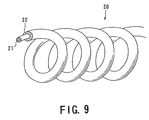
- Fig. 9 is a partial perspective diagram illustrating a component example of a cathode heater 20 which is used in image receiving tubes, and has a construction wherein a tungsten wire (W wire) 21 having a wire diameter of approximately 30 to 50 ⁇ m is wound in a spiral as a heating element, with the perimeter thereof coated with an insulation of ceramics film 22. Applying electricity to this cathode heater heats the cathode of the image receiving tube to a high temperature, whereby electrons in the atoms making up the cathode are freed, thereby yielding thermionic discharge.
- W wire tungsten wire
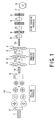
- Tungsten wires for the construction of the above-described cathode heaters and the like in general have been manufactured using a manufacturing process similar to the description in Fig. 2. That is, a bar of green compact is formed by pressure molding tungsten powder which includes a fixed amount of Re or dopant such as Al, Si, and K, and tungsten sintered compact 1 is prepared by using each end of this green compact as a terminal, passing electricity through and sintering.
- tungsten wire 7 having a predetermined wire diameter was finally manufactured.
- the manufactured tungsten wire 7 is wound in a form of coil by means of a winding apparatus 8.
- the tungsten wires manufactured using the above-described conventional manufacturing process containing for example approximately 3% by mass of rhenium (Re), in a case wherein the wire diameter was 40 ⁇ m, after the heating process was completed at a temperature range of approximately 2000 to 2500°C (equivalent to electricity application heating of 48 to 65% of electricity applied of the fusion current (FC)), the measured value showed the elongation to be 1% or greater. In contrast, however, in a case wherein the heating process was completed at a much higher temperature (for example, a heating process conducted at a temperature above 67% of the FC or higher), the measured value showed the elongation to be 1% or lower.
- the wire diameter is large, such as 0.39 mm
- the elongation after completing heat treatment for 2 minutes at a temperature range of 1090°C to 2390°C was 5% or greater.
- tungsten wires with a large diameter yielded sufficient elongation, even when the wires were subjected to high temperatures.
- tungsten wire with a wire diameter 40 ⁇ m made of a rhenium-tungsten (Re-W) alloy which includes a predetermined amount of rhenium is used as a component for constituting a cathode heater used in a Braun tube.
- Examples of uses where the W wire temperature during use (or during the manufacturing process) reaches 1000°C or higher, or even exceeds 2500°C include vibration service lamp filaments used in fields which accompany locomotive movement or vibration, such as do automobiles or pachinko machines.
- a manufacturing process wherein the W wire temperature exceeds 2500°C may include flushing operation after coiling and so forth.
- the heat treatment temperature applied to the W raw materials during manufacture of the above cathode heater and so forth is generally a high temperature of 1500°C or higher, and depending on the situation can exceed 2500°C, and it is desirable for the materials heat-treated at this temperature to possess a large ductility (elongation, stretching), in order to maintain durability and longevity even within this temperature environment.
- thin wires made from Re-W alloy manufactured using conventional manufacturing processes had the difficulties of losing its elongation when heat treated at 2500°C or higher, or the elongation gradually decreasing as a cathode heater was used for long periods of time, and problems occurred where the heater elements were damaged by minor impact or vibration in the cathode heater and longevity was decreased. Therefore, there is great demand for the development of tungsten wire that possesses excellent durability even when used in conditions of high temperature in this technical field.
- the tungsten wire raw material is prepared by repeating the heat treatment and swaging processing treatment for a predetermined size and length of tungsten sintered compact (sintered body).
- the processing rate (working ratio) for processing with the swaging apparatus is at most a low value of 10 to 30%. Therefore, in order to process the fixed tungsten thin wire raw material from a tungsten sintered compact, it is necessary to perform numerous repetitions of heat treatment and swaging processing as illustrated in Fig.
- the present invention has been made to solve the above problems, and it is an object thereof to provide a highly reliable cathode heater and vibration service lamp filament, and to provide tungsten wire which can be manufactured efficiently, and which can exhibit excellent durability when used as a component for cathode heaters, vibration service lamps, and so forth, which are used under conditions of high temperatures or exposed to high temperatures during the manufacturing process.
- tungsten wire having high elongation properties even in an environment using high temperatures can be efficiently manufactured by means of adding the process of rolling at a high process rate of 40 to 75% after providing one heating treatment to swaging process of a tungsten sintered compact, and by precisely controlling the heating temperature when performing electrical heating treatment of a predetermined wire diameter, i.e. the ratio of the heating current value to the fusion current (FC), and thus have completed the present invention.
- the tungsten wire according to the present invention is a tungsten wire containing 1 to 10% by mass of rhenium, and having a point which indicates a 2% elongation within a quadrangle formed by joining points with straight lines, where the values of x and y are point (20, 75), point (20, 87), point (90, 75), and point (90, 58), in this order, wherein the wire diameter of the tungsten wire is represented by x ⁇ m, and the elongation of the tungsten wire is 2% after electrically heating with an electrical current which is a ratio of y% to the fusion current (FC) at the wire diameter x ⁇ m, and wherein a semi-logarithmic system of coordinates is expressed by means of a horizontal axis using a logarithmic scale of the wire diameter x and a vertical axis using a normal scale of ratio y to the fusion current.
- FC fusion current
- another tungsten wire according to the present invention is a tungsten wire containing 1 to 10% by mass of rhenium, and having a point which indicates a 5% elongation within a quadrangle formed by joining points with straight lines, where the values of x and y are point (20, 73), point (20, 83), point (90, 72), and point (90, 56), in this order, wherein the wire diameter of the tungsten wire is represented by x ⁇ m, and the elongation of the tungsten wire is 5% after electrically heating with an electrical current which is a ratio of y% to the fusion current (FC) at the wire diameter x ⁇ m, and wherein a semi-logarithmic system of coordinates is expressed by means of a horizontal axis using a logarithmic scale of the wire diameter x and a vertical axis using a normal scale of ratio y to the fusion current.
- FC fusion current
- another tungsten wire according to the present invention is a tungsten wire containing more than 10% by mass but 30% by mass or less of rhenium, and having a point which indicates a 2% elongation within a quadrangle formed by joining points with straight lines, where the values of x and y are point (20, 55), point (20, 63), point (90, 51), and point (90, 39), in this order, wherein the wire diameter of the tungsten wire is represented by x ⁇ m, and the elongation of the tungsten wire is 2% after electrically heating with an electrical current which is a ratio of y% to the fusion current (FC) at the wire diameter x ⁇ m, and wherein a semi-logarithmic system of coordinates is expressed by means of a horizontal axis using a logarithmic scale of the wire diameter x and a vertical axis using a normal scale of ratio y to the fusion current.
- FC fusion current
- another tungsten wire according to the present invention is a tungsten wire containing more than 10% by mass but 30% by mass or less of rhenium, and having a point which indicates a 5% elongation within a quadrangle formed by joining points with straight lines, where the values of x and y are point (20, 53), point (20, 60), point (90, 48), and point (90, 37), in this order, wherein the wire diameter of the tungsten wire is represented by x ⁇ m, and the elongation of the tungsten wire is 5% after electrically heating with an electrical current which is a ratio of y% to the fusion current (FC) at the wire diameter x ⁇ m, and wherein a semi-logarithmic system of coordinates is expressed by means of a horizontal axis using a logarithmic scale of the wire diameter x and a vertical axis using a normal scale of ratio y to the fusion current.
- FC fusion current
- the tungsten wire contains 40 to 100 ppm of potassium (K).
- the cathode heater according to the present invention is configured of the above tungsten wire.
- the manufacturing method of the tungsten wire relating to the present invention comprises: a process of heating and rolling a tungsten sintered compact containing 1 to 30% by mass of rhenium; a process of heating and swaging the rolled sintered compact after a recrystallization heating treatment; and a process of heating and wire drawing the swaged sintered compact; wherein the rolling process, establishing the process rate (working ratio) of performing a rolling operation for one heating as 40 to 75%.
- the process rate (working ratio) is defined as the value of the difference between before processing and after processing of a cross-sectional area of materials processed, divided by a cross-sectional area before processing.
- heating treatment at a temperature of 2300°C or less is preferably performed at the point that the wire diameter of the tungsten wire, formed by the swaging process or wire drawing process, becomes 100 ⁇ m or less.
- the tungsten wire relating to the present invention is formed from a material using tungsten (W) as a base, and comprising 70 to 99% by mass of tungsten materials, and preferably 90 to 99% by mass.
- W tungsten
- a specific component example can be given in a Re-W alloy, where the tungsten comprises 1 to 30% by mass of Re. Also, 0.001 to 1% by mass of a dopant element of Al, Si, K, and so forth may be included as necessary.
- alloys including an alloy containing a third component such as Re-Mo-W alloy which includes 1 to 10% by mass of Re and 1 to 10% by mass of Mo, or the like may be also used.
- a Re-W alloy including 40 to 100 ppm of K with solid dispersion of a predetermined amount of Re is preferable from the viewpoints of high strength properties (tensile strength) and hardness (anti-friction, wear-resistance) and improving processing ability (workability) by heightening ductility.
- the tungsten wire contains less than 1% by mass of rhenium, the resistance value of the wire decreases, and the heat-generating properties required as a heater when used as a cathode heater cannot be obtained.
- the amount contained in the wire is more than 30% by mass, not only the effect of adding additional Re cannot be obtained but also this further becomes a reason for increased costs because Re is expensive as compared with W. Therefore, the amount of Re contained is set in the range of 1 to 30% by mass, but especially for a W wire for the purpose of a cathode heater, the range of 2 to 5% by mass is more preferable. Also, the same case holds for vibration service lamp filaments.
- the amount of potassium contained in a tungsten wire is less than 40 ppm, forming the crystal grains of the tungsten so that they elongate long and thin in the direction of the axis becomes difficult, the strength properties of the tungsten wire is decreased and deformation becomes greater, and when used for example as a cathode heater the strength is lacking, the heater is easily damaged, and durability of the heater is disadvantageously decreased.
- the amount of potassium contained is too large, so as to exceed 100 ppm, dope pores increase too much, and in the instance of processing fine wires, the workability readily deteriorates and the manufacturing yield of the W wire decreases.
- the tungsten wire relating to the present invention is not manufactured solely by performing conventional swaging processing and wire drawing processing of the above-described material (sintered compact), whereof the base is tungsten, but is manufactured by an additional rolling process as a preliminary process to the swaging processing and wire drawing process.
- the processing rate working ratio, cross-section reduction rate
- a processing rate of 40 to 75% by means of swaging processing instead of rolling is also effective, but the apparatus becomes complicated (for example, a higher load of swaging such as 4 directional swaging must be performed) and so this cannot be the most preferable manufacturing method.
- the recrystallization temperature of the tungsten wire increases, and it becomes possible to improve the elongation of a tungsten wire of a final wire diameter of 0.020 to 0.090 mm to be 2% or even 5% after heating by applying electricity with a current of which the ratio to fusion current is 37 to 87%. Therefore, due to the result of the peak temperature of elongation after the electricity application heating treatment being shifted towards a higher temperature side, a tungsten wire ideal for components of a cathode heater or vibration service lamp used at higher operating temperatures, or manufactured at a higher processing temperature, can be effectively obtained.
- the processing rate at the rolling process is specified to a range of 40 to 75%, but the range of 50 to 75% is more preferable.
- the tungsten wire according to the present invention is manufactured through the manufacturing processes illustrated specifically in Fig. 1. That is, a tungsten sintered compact (W sintered body) 1 comprising a fixed composition is heated to 1200 to 1500°C in a heating apparatus 9 for rolling, then afterwards a rolling processing is performed in a rolling unit 10.
- a 2-directional roll rolling unit or a 3-directional roll rolling unit or a die roll rolling unit can be used.
- the above rolling process can proceed at a high speed, and multiple stands of rolling processing can be completed before the temperature of the sintered compact 1 drops. That is to say, by simply performing one round of the heating process for tungsten sintered compact 1, a high processing rate of 40 to 75% can be obtained. Therefore, as compared to the conventional manufacturing method of manufacturing tungsten wire of a fixed wire diameter by performing only swaging and wire drawing processes on tungsten sintered compact 1, it becomes possible to greatly increase the manufacturing efficiency of tungsten wire.
- the tungsten wire raw material 1a completed the rolling process is heated to above secondary recrystallization temperature (1800 to 2000°C) in heat processing furnace 4, so as to remove strain and is sent to the swaging apparatus 3 after undergoing the recrystallization process.
- W wire raw material 1a is subjected to the repeated process of swaging by means of dice from surrounding directions (dice are pushed using a hammer) and the process of heating by the heating apparatus 2 for swaging use, and thus becomes a fine wire under the predetermined processing rate.
- this swaging apparatus 3 it is difficult to set the processing speed high, and the processing rate capable of processing in 1 round of heat treatment is approximately 10 to 30%.
- Tungsten wire with a wire diameter of 40 ⁇ m prepared in this manner is provided with ideal strength and durability as a component for cathode heaters or vibration service lamps, as the elongation after electricity application heating for 2 minutes with a current at a ratio of 64 to 76% to the fusion current is 5% or greater.
- the object of the present invention is a tungsten wire in the ideal wire diameter range of approximately 20 to 90 ⁇ m as component material particularly suitable for vibration service lamp filament and cathode heaters.
- Vibration service lamps mean lamps used in an environment that accompanies transferring motion or vibration, such as automobiles or pachinko machines and so forth.
- an annealing processing is performed several times, for example at a wire diameter of 400 ⁇ m or below (for example, the heat processing temperature in the heating apparatus for wire drawing 5 shown in Fig. 2 was 800 to 1000°C).
- the wire diameter of the tungsten wire formed by the swaging processing or wire drawing processing is 100 ⁇ m or smaller, and when a strain removal heat processing at a temperature of 1200 to 2300°C is performed, so that the hardening of the tungsten wire can be prevented and a wire material of a small wire diameter can be obtained without causing a breakage damage to the dice for wire drawing.
- the above heat processing enables shifting the recrystallization temperature of the tungsten wire to the side of higher temperatures, and is preferable because the elongation, flexibility, shock resistance, and heat shock resistance of the tungsten wire is improved.
- the above strain removal heat processing may be performed at a temperature of 1200 to 2300°C in the heating apparatus for wire drawing 5 shown in Fig. 1, or may be performed by additionally providing a strain removal heat processing apparatus.
- the tungsten (3% Re-W alloy) wire obtained through the processing as described above can have a tungsten wire elongation of 2% after the electricity application heating processing, wherein the electricity application heating processing temperature to the tungsten wire having each wire diameter (x ⁇ m), i.e. the ratio y of the heating current to the fusion current (FC) is set at a value within the range of the shaded portion shown in Fig. 3.
- tungsten wire elongation of 5% can be realized after the electricity application heating processing, wherein the electricity application heating processing temperature to the tungsten wire having each wire diameter (x ⁇ m), i.e. the ratio y of the heating current to the fusion current (FC) is fixed at a value within the range of the shaded portion shown in Fig. 4.
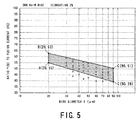
- the tungsten (26% Re-W alloy) wire obtained through the processing as described above can have a tungsten wire elongation of 2% after the electricity application heating processing, wherein the electricity application heating processing temperature to the tungsten wire having each wire diameter (x ⁇ m), i.e. the ratio y of the heating current to the fusion current (FC) is set at a value within the range of the shaded portion shown in Fig. 5.
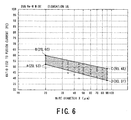
- tungsten wire elongation of 5% can be realized after the electricity application heating processing, wherein the electricity application heating processing temperature to the tungsten wire having each wire diameter (x ⁇ m), i.e. the ratio y of the heating current to the fusion current (FC) is fixed at a value within the range of the shaded portion shown in Fig. 6.
- tungsten wire relating to the present invention which possesses excellent elongation even in cases of electricity application heating processing being performed, wherein wire diameter and heating current is set to the values within the range of the shaded portions indicated by Fig. 3 through Fig. 6, the elongation thereof does not decline in comparison with those of the conventional articles even in cases of heating processing being added to the manufacturing process for the purpose of obtaining cathode heaters and so forth from the tungsten, or even in cases of use at higher temperatures, and as the wire material thereof, the durability (lifespan) can be improved when using for cathode wires or vibration service lamp filament.
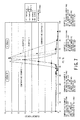
- the fusion current (FC) of the tungsten wire used in the present invention is defined as below. That is, within a bell jar wherein hydrogen or ammonolysis gas is flowed at a flow rate of 1.7 x 10 -4 m 3 /s, a tungsten wire possessing the subject wire diameter is fixed so that the terminal-to-terminal length is 100 mm, electricity application heating is performed while the current value flowing between the terminals rises at an ascension rate of approximately 1A/s, and the current value when the tungsten wire fuses is taken as the fusion current. Further, FC% indicated in Fig. 7 and Fig. 8 represents the percentage of the actual electricity application current value to the fusion current (FC). Now, Fig. 7 and Fig.
- FC% 8 illustrate the relationship between the FC% and elongation, and ratio y (%) of the electricity application heating current value to the fusion current (FC) corresponding to each respective elongation can be read from the FC% value which gives the sought elongation, wherein the side of the current is greater than the position indicating the peak elongation value.
- the elongation peak of tungsten wire according to the present invention is at or above 2%, or even at or above 5%.
- the elongation of tungsten wire can be measured using the following measurement method. That is, a tungsten wire was subjected to electricity application heating for 2 minutes at a current value of a fixed ratio to the fusion current, and the tungsten wire of a wire diameter to be the object of a tension tester is fixed so that the object measurement length (gage length) is 50 mm, a tension test is performed under the conditions of tension speed 10 mm/min, the elongation is measured until the tungsten wire ruptures.
- the reason for using 2 minutes for the electricity application heating time is that the electricity application time (holding time) is defined as 2 minutes in the recrystallization temperature measurement method (Table 2) of TMIAS0201: 1999 "Tungsten-Molybdenum wire and bar testing methods" (Tungsten-Molybdenum Industry Society Publishing). Further, for the tungsten wire of the present invention, the electricity application heating is not an essential component, but was included as an evaluation method.
- tungsten wire relating to the present invention because tungsten fine wire is prepared after rolling which provides a high processing rate of 40 to 75% with one heating treatment for a tungsten sintered compact, recrystallization temperature can be raised effectively, and compared to conventional material, peak elongation after the electricity application heating treatment can be shifted towards a higher temperature side, and tungsten wire is obtained providing ideal strength and durability as a component material for cathode heater wires and vibration service lamp filaments which are used or processed at higher temperatures.
- the processing rate for swaging/wire drawing processes after the rolling can be made relatively small, and because the number of repetition of swaging/wire drawing processes can be reduced, the manufacturing process of tungsten wire can be simplified, and the manufacturing efficiency of tungsten wire is capable of being greatly improved.
- the tungsten wire of the present invention as a cathode heater or a vibration service lamp filament, a cathode heater or vibration service lamp filament having a high reliability can be obtained even in cases of use or processing at a higher temperature.
- the tungsten wire of the present invention may be also used in a probe pin or a general vacuum bulb filament as well.
- the heating temperature in rolling heating apparatus 9 for the rolling process was set to 1300°C, while the processing rate was set at 50%.
- the recrystallization temperature in the heat processing furnace 4 was set to 1900°C
- the heating temperature in the swaging heating apparatus 2 for the swaging processing was set to 1300°C, and the processing rate was set to 18%.
- the heating temperature in the wire drawing heating apparatus 5 for the wire drawing process was set at 800°C, and the processing rate was set at 20%.
- Example 1 a tungsten wire which had been subjected to 1 second of strain removing heat processing (running annealing) at a temperature of 2300°C at the point wherein the wire diameter became 100 ⁇ m during the swaging/wire drawing processes, was taken as Example 1.
- Example 2 a tungsten wire which had been subjected to 1 second of strain removing heat processing (running annealing) at a temperature of 1200°C at the point wherein the wire diameter became 100 ⁇ m, was taken called Example 2.
- a manufacturing process solely comprising a swaging process and a wire drawing process was carried out without providing a rolling process by the rolling unit 10, and the heating temperature at the swaging process and the wire drawing process was fixed identically with Example 1, while the processing rate for each heating operation was fixed at 20% and the swaging / recrystallization / wire drawing processing were each repeated. Further, by performing 1 second of strain removing heat processing (running annealing) at a temperature of 2300°C at the point wherein the wire diameter became 100 ⁇ m, whereby a tungsten wire with a nominal wire diameter of 20 to 90 ⁇ m according to the Comparative Example 1 was prepared.
- tungsten wire was prepared in the same manner as Example 1 except that the temperature for strain removing heat processing was set to 2500°C, which is outside the preferable range according to the present invention.
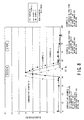
- Fig. 7 is a graph denoting the relationship between the elongation and the FC% of the heat processing time of the tungsten wire relating to each of the Example and Comparative Examples each having the wire diameter of 44 ⁇ m. According to the tungsten wires relating to each of the present Examples, as compared with the conventional Comparative Examples, it can be confirmed that the temperature range exhibiting high elongation particularly after heat processing can be expanded towards higher temperature side, thereby exhibiting excellent heat resistance structural properties.
- Rhenium (Re) powder having an average grain diameter of 2 ⁇ m was added to the tungsten (W) powder having an average grain diameter of 3 ⁇ m at a ratio of 26 ⁇ 0.5 % by mass without doping potassium. Then the blended materials were uniformly mixed for 2 to 20 hours so as to prepare raw material mixtures. Then, each of the raw material mixtures was subjected to molding treatment and the electricity application sintering treatment as the same manner as that in Example 1, whereby W sintered bodies each having a weight of 1.5 kg was prepared.
- each of the W sintered bodies was processed in the order of rotting, recrystallization, swaging, and wire drawing in accordance with the manufacturing process illustrated in Fig. 1, so that tungsten wires 7 relating to the example having the final nominal wire diameter of 20 to 90 ⁇ m were manufactured.
- the heating temperature in rolling heating apparatus 9 of the rolling process was set to 1300°C, while the processing rate was set to 50%.
- the recrystallization temperature in heat processing furnace 4 was set to 1900°C
- the heating temperature in swaging heating apparatus 2 of the swaging processing was set to 1300°C, and the processing rate was set to 18%.
- the heating temperature in wire drawing heating apparatus 5 in the wire drawing process was set to 800°C, and the processing rate was set to 20%.
- Example 3 a tungsten wire which had been subjected to 1 second of strain removing heat processing (running annealing) at a temperature of 2300°C at the point wherein the wire diameter became 100 ⁇ m during the swaging/wire drawing processes was taken as Example 3.
- Example 4 a tungsten wire which had been subjected to 1 second of strain removing heat processing (running annealing) at a temperature of 1200°C at the point wherein the wire diameter became 100 ⁇ m was taken as Example 4.
- a manufacturing process solely comprising a swaging process and a wire drawing process was carried out without providing a rolling process by the rolling unit 10, and the heating temperature of the swaging process and the wire drawing process was set to the same as in Example 1, while the processing rate for each heat treatment was fixed at 20% and the swaging / recrystallization / wire drawing processing were each repeated, and further, the strain removing heat processing (running annealing) for 1 second was performed at a temperature of 2300°C at the point wherein the wire diameter became 100 ⁇ m, so that a tungsten wire with a nominal wire diameter of 20 to 90 ⁇ m according to the Comparative Example 3 was prepared.
- Fig. 8 is a graph denoting the relationship between the elongation and the FC% of the heat processing time of the tungsten wire relating to each Examples and Comparative Example, wherein the wire diameter is 30 ⁇ m. According to the tungsten wire relating to the present Examples, compared with the conventional Comparative Example, it can be confirmed that the temperature range exhibiting high elongation particularly after heat processing can be expanded towards higher temperature side, thereby exhibiting excellent heat resistance structural properties.
- tungsten wires according to the Examples since a high processing rate can be obtained through the rolling process, the tungsten wire manufacturing process can be simplified and manufacturing efficiency can be greatly improved, and it becomes possible to significantly lower the number of repetitions of the swaging processing and wire drawing processing necessary to obtain the fixed fine wire diameter.
- Example 1 a vibration service lamp filament with wire diameter 3.7MG (35 ⁇ m) was manufactured. With respect to each filament, an IEC810 "Wide Range Vibration Test" was conducted, wherein vibration was applied to the filament while the bulb is lit, and the survival rate of each tungsten wire (filament) was measured. The results show a high survival rate of 75% for that of Example 1, as compared to a survival rate of approximately 30% for Comparative Example 1.
- Example 1 an alumina (Al 2 O 3 ) coating with a thickness of 0.2 mm was provided onto the tungsten wire according to Example 1 and Comparative Example 1, whereby a cathode heater 20 such as indicated in Fig. 9 was manufactured.
- a vibration test similar to that of the vibration service lamp filament was performed. The results show an extremely high survival rate of 90% for the cathode heater according to Example 1, and exhibited excellent durability, whereas the survival rate of the cathode heater formed with a tungsten wire according to Comparative Example 1 was only 60%.
- the elongation of the tungsten wire after a high temperature heating process can be further improved, and there can be obtained the tungsten wire and cathode heaters and vibration service lamp filament having ideal strength and durability suitable for a component material constituting the cathode heater wire and vibration service lamp filament or the like.
Landscapes
- Engineering & Computer Science (AREA)
- Mechanical Engineering (AREA)
- Manufacturing & Machinery (AREA)
- Chemical & Material Sciences (AREA)
- Materials Engineering (AREA)
- Metallurgy (AREA)
- Organic Chemistry (AREA)
- Resistance Heating (AREA)
- Powder Metallurgy (AREA)
- Metal Extraction Processes (AREA)
- Solid Thermionic Cathode (AREA)
Abstract
Description
- 1
- tungsten sintered compact (W sintered body)
- 1a, 1
- btungsten wire raw material
- 2
- heating apparatus for use in swaging
- 3
- swaging apparatus
- 4
- heat processing furnace
- 5
- heating apparatus for use in wire drawing
- 6
- wire drawing unit (wire drawing dice)
- 7
- tungsten wire
- 8
- winding apparatus
- 9
- heating apparatus for use in rolling
- 10
- rolling unit
- 20
- cathode heater
- 21
- heating element, filament (tungsten wire)
- 22
- ceramics film (ceramics coating)
Claims (9)
- A tungsten wire containing 1 to 10% by mass of rhenium; said tungsten wire having a point which indicates a 2% elongation within a quadrangle formed by joining points with straight lines, where the values of x and y are point (20, 75), point (20, 87), point (90, 75), and point (90, 58), in this order, wherein the wire diameter of said tungsten wire is represented by x µm, and the elongation of the tungsten wire is 2% after electrically heating with an electrical current which is a ratio of y% to the fusion current (FC) at said wire diameter x µm, and wherein a semi-logarithmic system of coordinates is expressed by means of a horizontal axis using a logarithmic scale of said wire diameter x and a vertical axis using a normal scale of ratio y to said fusion current.
- A tungsten wire containing 1 to 10% by mass of rhenium; said tungsten wire having a point which indicates a 5% elongation within a quadrangle formed by joining points with straight lines, where the values of x and y are point (20, 73), point (20, 83), point (90, 72), and point (90, 56), in this order, wherein the wire diameter of said tungsten wire is represented by x µm, and the elongation of the tungsten wire is 5% after electrically heating with an electrical current which is a ratio of y% to the fusion current (FC) at said wire diameter x µm, and wherein a semi-logarithmic system of coordinates is expressed by means of a horizontal axis using a logarithmic scale of said wire diameter x and a vertical axis using a normal scale of ratio y to said fusion current.
- A tungsten wire containing more than 10% by mass but 30% by mass or less of rhenium; said tungsten wire having a point which indicates a 2% elongation within a quadrangle formed by joining points with straight lines, where the values of x and y are point (20, 55), point (20, 63), point (90, 51), and point (90, 39), in this order, wherein the wire diameter of said tungsten wire is represented by x µm, and the elongation of the tungsten wire is 2% after electrically heating with an electrical current which is a ratio of y% to the fusion current (FC) in said wire diameter x µm, and wherein a semi-logarithmic system of coordinates is expressed by means of a horizontal axis using a logarithmic scale of said wire diameter x and a vertical axis using a normal scale of ratio y to said fusion current.
- A tungsten wire containing more than 10% by mass but 30% by mass or less of rhenium; said tungsten wire having a point which indicates a 5% elongation within a quadrangle formed by joining points with straight lines, where the values of x and y are point (20, 53), point (20, 60), point (90, 48), and point (90, 37), in that order, wherein the wire diameter of said tungsten wire is represented by x µm, and the elongation of the tungsten wire is 5% after electrically heating with an electrical current which is a ratio of y% to the fusion current (FC) at said wire diameter x µm, and wherein a semi-logarithmic system of coordinates is expressed by means of a horizontal axis using a logarithmic scale of said wire diameter x and a vertical axis using a normal scale of ratio y to said fusion current.
- A tungsten wire according to any one of Claims 1 through 4, wherein said tungsten wire is formed from a tungsten alloy containing 40 to 100 ppm of potassium (K).
- A cathode heater configured of said tungsten wire according to any one of Claims 1 through 5.
- A vibration service lamp filament configured of said tungsten wire according to any one of Claims 1 through 5.
- A manufacturing method of tungsten wire comprising: a process of heating and rolling a tungsten sintered body containing 1 to 30% by mass of rhenium; a process of heating and swaging the rolled sintered body after a recrystallization heating treatment; and a process of heating and wire drawing the swaged sintered body; wherein said rolling process establishes the process rate of performing a rolling operation for one heating as 40 to 75%.
- A manufacturing method of tungsten wire according to Claim 8, said method further comprising a process of performing a heating treatment to said tungsten wire at a temperature of 2300°C or less at a time when the diameter of the tungsten wire formed by said swaging process or wire drawing process becomes 100 µm or less.
Applications Claiming Priority (3)
| Application Number | Priority Date | Filing Date | Title |
|---|---|---|---|
| JP2001311533 | 2001-10-09 | ||
| JP2001311533 | 2001-10-09 | ||
| PCT/JP2002/010474 WO2003031668A1 (en) | 2001-10-09 | 2002-10-09 | Tunsten wire, cathode heater, and filament for vibration service lamp |
Publications (3)
| Publication Number | Publication Date |
|---|---|
| EP1435398A1 true EP1435398A1 (en) | 2004-07-07 |
| EP1435398A4 EP1435398A4 (en) | 2005-01-26 |
| EP1435398B1 EP1435398B1 (en) | 2007-11-28 |
Family
ID=19130353
Family Applications (1)
| Application Number | Title | Priority Date | Filing Date |
|---|---|---|---|
| EP02800792A Expired - Lifetime EP1435398B1 (en) | 2001-10-09 | 2002-10-09 | Tunsten wire, cathode heater, and filament for vibration service lamp |
Country Status (6)
| Country | Link |
|---|---|
| US (3) | US20040244879A1 (en) |
| EP (1) | EP1435398B1 (en) |
| JP (1) | JP4263098B2 (en) |
| KR (1) | KR100576901B1 (en) |
| CN (2) | CN101350286B (en) |
| WO (1) | WO2003031668A1 (en) |
Cited By (6)
| Publication number | Priority date | Publication date | Assignee | Title |
|---|---|---|---|---|
| EP1555331A1 (en) * | 2004-01-16 | 2005-07-20 | General Electric Company | High ductility, high hot tensile strength tungsten wire and method of manufacture |
| EP1534048A3 (en) * | 2003-11-19 | 2007-03-28 | E.G.O. Elektro-Gerätebau GmbH | Heating device, in particular radiant halogen heater. |
| EP1801247A1 (en) * | 2005-12-23 | 2007-06-27 | Plansee Metall GmbH | Process of production of high-density semi-finished or finished product |
| EP2159581A4 (en) * | 2007-06-06 | 2011-06-29 | Tanaka Precious Metal Ind | MATERIAL FOR PROBE POINT |
| CN102341515B (en) * | 2009-03-02 | 2014-12-03 | 株式会社东芝 | Rhenium tungsten wire, method for producing same, and medical needle comprising same |
| CN116940422A (en) * | 2021-02-17 | 2023-10-24 | 株式会社东芝 | Tungsten wire, method for processing tungsten wire using same, and electrolytic wire |
Families Citing this family (23)
| Publication number | Priority date | Publication date | Assignee | Title |
|---|---|---|---|---|
| US7888872B2 (en) * | 2004-09-30 | 2011-02-15 | Koninklijke Philips Electronics N.V. | Electric lamp |
| CN100395363C (en) * | 2004-11-11 | 2008-06-18 | 厦门虹鹭钨钼工业有限公司 | Tungsten-rhenium alloy rod for ion source of ion implanter and preparation method thereof |
| WO2006123271A2 (en) * | 2005-05-19 | 2006-11-23 | Koninklijke Philips Electronics N.V. | Lamp having molybdenum alloy lamp components |
| JP5236814B2 (en) * | 2009-10-08 | 2013-07-17 | 株式会社アルバック | Filament for electron gun and manufacturing method thereof |
| JP6043476B2 (en) * | 2011-10-12 | 2016-12-14 | 株式会社日立ハイテクノロジーズ | Ion source and ion beam apparatus using the same |
| CN103177914A (en) * | 2011-12-21 | 2013-06-26 | 中国科学院电子学研究所 | Process for preparing melting heater assembly for thermionic cathode |
| US9103731B2 (en) * | 2012-08-20 | 2015-08-11 | Unison Industries, Llc | High temperature resistive temperature detector for exhaust gas temperature measurement |
| CN103247500A (en) * | 2013-04-28 | 2013-08-14 | 江苏达胜加速器制造有限公司 | Filament for electron gun |
| CN105396894B (en) * | 2015-11-12 | 2017-05-17 | 中国工程物理研究院激光聚变研究中心 | Preparing method for non-bending ultrathin tungsten wires for Z-pinch torispherical wire array |
| JP6249319B1 (en) * | 2017-03-30 | 2017-12-20 | パナソニックIpマネジメント株式会社 | Saw wire and cutting device |
| JP7223964B2 (en) * | 2017-05-10 | 2023-02-17 | パナソニックIpマネジメント株式会社 | Saw wire and cutting equipment |
| JP7113365B2 (en) * | 2017-05-10 | 2022-08-05 | パナソニックIpマネジメント株式会社 | Saw wire and cutting equipment |
| JP7241294B2 (en) * | 2017-05-10 | 2023-03-17 | パナソニックIpマネジメント株式会社 | Saw wire and cutting equipment |
| CN108315624B (en) * | 2018-01-09 | 2020-03-27 | 安泰天龙钨钼科技有限公司 | High-performance tungsten alloy bar and preparation method thereof |
| JP6751900B2 (en) * | 2018-01-29 | 2020-09-09 | パナソニックIpマネジメント株式会社 | Metal wire and saw wire |
| JP7223967B2 (en) * | 2018-12-26 | 2023-02-17 | パナソニックIpマネジメント株式会社 | tungsten wire and saw wire |
| CN113728119A (en) * | 2019-04-26 | 2021-11-30 | 松下知识产权经营株式会社 | Tungsten wire and tungsten product |
| WO2021081237A1 (en) * | 2019-10-22 | 2021-04-29 | Cedars-Sinai Medical Center | Mesh chopping of neural progenitor cell aggregates |
| JP7630086B2 (en) * | 2020-11-27 | 2025-02-17 | パナソニックIpマネジメント株式会社 | Metal Wire |
| CN116964235B (en) * | 2021-03-09 | 2026-04-24 | 株式会社特殊陶业材料 | rhenium-tungsten wire rods and thermocouples using them |
| JP7741616B2 (en) * | 2021-07-28 | 2025-09-18 | 株式会社Niterra Materials | Tungsten wire, tungsten wire processing method using same, and electrolytic wire manufacturing method |
| CN116786615A (en) * | 2023-07-28 | 2023-09-22 | 浙江创特新材科技有限公司 | Mobile heating module using heating block and high-strength fine tungsten wire drawing equipment |
| CN120095151B (en) * | 2025-05-12 | 2025-07-18 | 崇义章源钨业股份有限公司 | A high-strength tungsten alloy wire and preparation method thereof |
Family Cites Families (10)
| Publication number | Priority date | Publication date | Assignee | Title |
|---|---|---|---|---|
| GB1053020A (en) * | 1964-07-08 | 1966-12-30 | Gen Electric | Improvements in tungsten-rhenium alloy filament lamps |
| JPS5739152A (en) * | 1980-08-18 | 1982-03-04 | Matsushita Electronics Corp | Tungsten material for light bulb |
| JP2839542B2 (en) * | 1989-04-05 | 1998-12-16 | 株式会社東芝 | Vibration-resistant tungsten wire, filament and halogen bulb using the same |
| JP2637255B2 (en) * | 1990-01-23 | 1997-08-06 | 株式会社東芝 | Rhenium-tungsten alloy material excellent in workability and method for producing the same |
| CN1073724A (en) * | 1991-12-19 | 1993-06-30 | 清华大学 | A kind of manufacture method of osram |
| US6066019A (en) * | 1998-12-07 | 2000-05-23 | General Electric Company | Recrystallized cathode filament and recrystallization method |
| US6419758B1 (en) * | 1999-09-10 | 2002-07-16 | General Electric Company | Cathode wire filament for x-ray tube applications |
| JP3764315B2 (en) * | 2000-02-10 | 2006-04-05 | 株式会社アライドマテリアル | Tungsten material and manufacturing method thereof |
| JP4987181B2 (en) | 2000-08-23 | 2012-07-25 | 株式会社東芝 | Rhenium tungsten wire, probe pin using the same, corona discharge charge wire, filament for fluorescent display tube, and manufacturing method thereof |
| JP4659972B2 (en) * | 2000-12-05 | 2011-03-30 | 株式会社東芝 | Tungsten alloy wire for probe pin and manufacturing method thereof |
-
2002
- 2002-10-09 EP EP02800792A patent/EP1435398B1/en not_active Expired - Lifetime
- 2002-10-09 CN CN2008101087204A patent/CN101350286B/en not_active Expired - Lifetime
- 2002-10-09 WO PCT/JP2002/010474 patent/WO2003031668A1/en not_active Ceased
- 2002-10-09 JP JP2003534637A patent/JP4263098B2/en not_active Expired - Lifetime
- 2002-10-09 KR KR1020047005148A patent/KR100576901B1/en not_active Expired - Lifetime
- 2002-10-09 CN CNB028244877A patent/CN100426445C/en not_active Expired - Lifetime
- 2002-10-09 US US10/491,793 patent/US20040244879A1/en not_active Abandoned
-
2009
- 2009-12-07 US US12/632,348 patent/US20100084055A1/en not_active Abandoned
-
2012
- 2012-05-15 US US13/471,733 patent/US9236212B2/en not_active Expired - Fee Related
Cited By (9)
| Publication number | Priority date | Publication date | Assignee | Title |
|---|---|---|---|---|
| EP1534048A3 (en) * | 2003-11-19 | 2007-03-28 | E.G.O. Elektro-Gerätebau GmbH | Heating device, in particular radiant halogen heater. |
| EP1555331A1 (en) * | 2004-01-16 | 2005-07-20 | General Electric Company | High ductility, high hot tensile strength tungsten wire and method of manufacture |
| EP1801247A1 (en) * | 2005-12-23 | 2007-06-27 | Plansee Metall GmbH | Process of production of high-density semi-finished or finished product |
| EP2159581A4 (en) * | 2007-06-06 | 2011-06-29 | Tanaka Precious Metal Ind | MATERIAL FOR PROBE POINT |
| CN102341515B (en) * | 2009-03-02 | 2014-12-03 | 株式会社东芝 | Rhenium tungsten wire, method for producing same, and medical needle comprising same |
| US9161752B2 (en) | 2009-03-02 | 2015-10-20 | Kabushiki Kaisha Toshiba | Rhenium tungsten wire, method of manufacturing the wire and medical needle using the wire |
| CN116940422A (en) * | 2021-02-17 | 2023-10-24 | 株式会社东芝 | Tungsten wire, method for processing tungsten wire using same, and electrolytic wire |
| EP4295973A4 (en) * | 2021-02-17 | 2025-06-18 | Kabushiki Kaisha Toshiba | TUNGSTEN WIRE, TUNGSTEN WIRE PROCESSING METHOD USING SAME, AND ELECTROLYSIS WIRE |
| US12606890B2 (en) | 2021-02-17 | 2026-04-21 | Niterra Materials Co., Ltd. | Tungsten wire, tungsten wire processing method using the same, and electrolyzed wire |
Also Published As
| Publication number | Publication date |
|---|---|
| JP4263098B2 (en) | 2009-05-13 |
| CN1606631A (en) | 2005-04-13 |
| WO2003031668A1 (en) | 2003-04-17 |
| US9236212B2 (en) | 2016-01-12 |
| US20100084055A1 (en) | 2010-04-08 |
| JPWO2003031668A1 (en) | 2005-01-27 |
| CN101350286A (en) | 2009-01-21 |
| KR100576901B1 (en) | 2006-05-03 |
| CN101350286B (en) | 2010-12-22 |
| US20120285586A1 (en) | 2012-11-15 |
| EP1435398A4 (en) | 2005-01-26 |
| EP1435398B1 (en) | 2007-11-28 |
| CN100426445C (en) | 2008-10-15 |
| KR20040037262A (en) | 2004-05-04 |
| US20040244879A1 (en) | 2004-12-09 |
Similar Documents
| Publication | Publication Date | Title |
|---|---|---|
| US9236212B2 (en) | Tungsten wire, cathode heater and vibration service lamp filament | |
| CN103261460A (en) | Copper alloy wire and copper alloy spring | |
| JP7753481B2 (en) | Probe pins, thermocouples, and electron tube heaters | |
| JP4659972B2 (en) | Tungsten alloy wire for probe pin and manufacturing method thereof | |
| JP2024164258A (en) | Medical needles, probe pins and ReW wire for electron tube heaters | |
| JP4987181B2 (en) | Rhenium tungsten wire, probe pin using the same, corona discharge charge wire, filament for fluorescent display tube, and manufacturing method thereof | |
| US3661536A (en) | Tungsten materials | |
| JPH03219039A (en) | Rhenium-tungsten alloy material excellent in workability and its manufacture | |
| JP2002356732A (en) | Rhenium tungsten wire, probe pin and inspection device having the same | |
| JP2002226935A (en) | Thorium tungsten alloy, thorium tungsten wire, method for producing the same, thorium tungsten wire coil, and cathode assembly for electron tube | |
| KR20140023476A (en) | High strength copper alloy pipe with good workability and manufacturing method thereof | |
| JP2839542B2 (en) | Vibration-resistant tungsten wire, filament and halogen bulb using the same | |
| US4863527A (en) | Process for producing doped tungsten wire with low strength and high ductility | |
| JP2002235141A (en) | Molybdenum wire | |
| JP2009102670A (en) | Rhenium tungsten ribbon and manufacturing method thereof | |
| JP2001152274A (en) | Tungsten material for secondary processing | |
| JP4582866B2 (en) | Tungsten wire and manufacturing method thereof | |
| JP3769008B2 (en) | Tungsten material for secondary processing | |
| JPH0129863B2 (en) | ||
| CN117894649A (en) | A potassium-doped tungsten anode and its preparation method and application | |
| JPH0448863B2 (en) | ||
| JP2670274B2 (en) | Tungsten wire for vapor deposition element | |
| JPH0250187B2 (en) |
Legal Events
| Date | Code | Title | Description |
|---|---|---|---|
| PUAI | Public reference made under article 153(3) epc to a published international application that has entered the european phase |
Free format text: ORIGINAL CODE: 0009012 |
|
| 17P | Request for examination filed |
Effective date: 20040406 |
|
| AK | Designated contracting states |
Kind code of ref document: A1 Designated state(s): AT BE BG CH CY CZ DE DK EE ES FI FR GB GR IE IT LI LU MC NL PT SE SK TR |
|
| A4 | Supplementary search report drawn up and despatched |
Effective date: 20041215 |
|
| RIC1 | Information provided on ipc code assigned before grant |
Ipc: 7B 22F 3/24 B Ipc: 7B 22F 5/12 B Ipc: 7H 01J 35/06 B Ipc: 7C 22C 1/04 B Ipc: 7B 21J 5/06 B Ipc: 7C 22C 27/04 A Ipc: 7H 01J 1/22 B Ipc: 7H 01K 1/08 B |
|
| RA4 | Supplementary search report drawn up and despatched (corrected) |
Effective date: 20041221 |
|
| REG | Reference to a national code |
Ref country code: DE Ref legal event code: 8566 |
|
| 17Q | First examination report despatched |
Effective date: 20050624 |
|
| GRAP | Despatch of communication of intention to grant a patent |
Free format text: ORIGINAL CODE: EPIDOSNIGR1 |
|
| GRAS | Grant fee paid |
Free format text: ORIGINAL CODE: EPIDOSNIGR3 |
|
| GRAA | (expected) grant |
Free format text: ORIGINAL CODE: 0009210 |
|
| AK | Designated contracting states |
Kind code of ref document: B1 Designated state(s): AT |
|
| PLBE | No opposition filed within time limit |
Free format text: ORIGINAL CODE: 0009261 |
|
| STAA | Information on the status of an ep patent application or granted ep patent |
Free format text: STATUS: NO OPPOSITION FILED WITHIN TIME LIMIT |
|
| 26N | No opposition filed |
Effective date: 20080829 |
|
| PGFP | Annual fee paid to national office [announced via postgrant information from national office to epo] |
Ref country code: AT Payment date: 20210928 Year of fee payment: 20 |
|
| REG | Reference to a national code |
Ref country code: AT Ref legal event code: MK07 Ref document number: 379695 Country of ref document: AT Kind code of ref document: T Effective date: 20221009 |