EP1435350A1 - Norbornene derivative and norbornene polymer obtained therefrom through ring-opening polymerization - Google Patents
Norbornene derivative and norbornene polymer obtained therefrom through ring-opening polymerization Download PDFInfo
- Publication number
- EP1435350A1 EP1435350A1 EP02777813A EP02777813A EP1435350A1 EP 1435350 A1 EP1435350 A1 EP 1435350A1 EP 02777813 A EP02777813 A EP 02777813A EP 02777813 A EP02777813 A EP 02777813A EP 1435350 A1 EP1435350 A1 EP 1435350A1
- Authority
- EP
- European Patent Office
- Prior art keywords
- general formula
- represented
- group
- norbornene
- groups
- Prior art date
- Legal status (The legal status is an assumption and is not a legal conclusion. Google has not performed a legal analysis and makes no representation as to the accuracy of the status listed.)
- Withdrawn
Links
Images








Classifications
-
- C—CHEMISTRY; METALLURGY
- C07—ORGANIC CHEMISTRY
- C07C—ACYCLIC OR CARBOCYCLIC COMPOUNDS
- C07C69/00—Esters of carboxylic acids; Esters of carbonic or haloformic acids
- C07C69/76—Esters of carboxylic acids having a carboxyl group bound to a carbon atom of a six-membered aromatic ring
-
- C—CHEMISTRY; METALLURGY
- C07—ORGANIC CHEMISTRY
- C07C—ACYCLIC OR CARBOCYCLIC COMPOUNDS
- C07C69/00—Esters of carboxylic acids; Esters of carbonic or haloformic acids
- C07C69/74—Esters of carboxylic acids having an esterified carboxyl group bound to a carbon atom of a ring other than a six-membered aromatic ring
- C07C69/753—Esters of carboxylic acids having an esterified carboxyl group bound to a carbon atom of a ring other than a six-membered aromatic ring of polycyclic acids
-
- C—CHEMISTRY; METALLURGY
- C08—ORGANIC MACROMOLECULAR COMPOUNDS; THEIR PREPARATION OR CHEMICAL WORKING-UP; COMPOSITIONS BASED THEREON
- C08G—MACROMOLECULAR COMPOUNDS OBTAINED OTHERWISE THAN BY REACTIONS ONLY INVOLVING UNSATURATED CARBON-TO-CARBON BONDS
- C08G61/00—Macromolecular compounds obtained by reactions forming a carbon-to-carbon link in the main chain of the macromolecule
- C08G61/02—Macromolecular compounds containing only carbon atoms in the main chain of the macromolecule, e.g. polyxylylenes
- C08G61/04—Macromolecular compounds containing only carbon atoms in the main chain of the macromolecule, e.g. polyxylylenes only aliphatic carbon atoms
- C08G61/06—Macromolecular compounds containing only carbon atoms in the main chain of the macromolecule, e.g. polyxylylenes only aliphatic carbon atoms prepared by ring-opening of carbocyclic compounds
-
- C—CHEMISTRY; METALLURGY
- C08—ORGANIC MACROMOLECULAR COMPOUNDS; THEIR PREPARATION OR CHEMICAL WORKING-UP; COMPOSITIONS BASED THEREON
- C08G—MACROMOLECULAR COMPOUNDS OBTAINED OTHERWISE THAN BY REACTIONS ONLY INVOLVING UNSATURATED CARBON-TO-CARBON BONDS
- C08G61/00—Macromolecular compounds obtained by reactions forming a carbon-to-carbon link in the main chain of the macromolecule
- C08G61/02—Macromolecular compounds containing only carbon atoms in the main chain of the macromolecule, e.g. polyxylylenes
- C08G61/04—Macromolecular compounds containing only carbon atoms in the main chain of the macromolecule, e.g. polyxylylenes only aliphatic carbon atoms
- C08G61/06—Macromolecular compounds containing only carbon atoms in the main chain of the macromolecule, e.g. polyxylylenes only aliphatic carbon atoms prepared by ring-opening of carbocyclic compounds
- C08G61/08—Macromolecular compounds containing only carbon atoms in the main chain of the macromolecule, e.g. polyxylylenes only aliphatic carbon atoms prepared by ring-opening of carbocyclic compounds of carbocyclic compounds containing one or more carbon-to-carbon double bonds in the ring
-
- C—CHEMISTRY; METALLURGY
- C07—ORGANIC CHEMISTRY
- C07C—ACYCLIC OR CARBOCYCLIC COMPOUNDS
- C07C2602/00—Systems containing two condensed rings
- C07C2602/36—Systems containing two condensed rings the rings having more than two atoms in common
- C07C2602/42—Systems containing two condensed rings the rings having more than two atoms in common the bicyclo ring system containing seven carbon atoms
-
- C—CHEMISTRY; METALLURGY
- C07—ORGANIC CHEMISTRY
- C07C—ACYCLIC OR CARBOCYCLIC COMPOUNDS
- C07C2603/00—Systems containing at least three condensed rings
- C07C2603/02—Ortho- or ortho- and peri-condensed systems
- C07C2603/04—Ortho- or ortho- and peri-condensed systems containing three rings
- C07C2603/06—Ortho- or ortho- and peri-condensed systems containing three rings containing at least one ring with less than six ring members
- C07C2603/10—Ortho- or ortho- and peri-condensed systems containing three rings containing at least one ring with less than six ring members containing five-membered rings
- C07C2603/12—Ortho- or ortho- and peri-condensed systems containing three rings containing at least one ring with less than six ring members containing five-membered rings only one five-membered ring
- C07C2603/18—Fluorenes; Hydrogenated fluorenes
-
- C—CHEMISTRY; METALLURGY
- C07—ORGANIC CHEMISTRY
- C07C—ACYCLIC OR CARBOCYCLIC COMPOUNDS
- C07C2603/00—Systems containing at least three condensed rings
- C07C2603/02—Ortho- or ortho- and peri-condensed systems
- C07C2603/04—Ortho- or ortho- and peri-condensed systems containing three rings
- C07C2603/22—Ortho- or ortho- and peri-condensed systems containing three rings containing only six-membered rings
- C07C2603/24—Anthracenes; Hydrogenated anthracenes
-
- C—CHEMISTRY; METALLURGY
- C07—ORGANIC CHEMISTRY
- C07C—ACYCLIC OR CARBOCYCLIC COMPOUNDS
- C07C2603/00—Systems containing at least three condensed rings
- C07C2603/56—Ring systems containing bridged rings
- C07C2603/86—Ring systems containing bridged rings containing four rings
Definitions
- the present invention relates to a precursor monomer compound for a cyclic olefin-based polymer which combines excellent transparency and a low birefringence.
- the present invention relates to a norbornene-based ring opening polymer which combines excellent transparency and a low birefringence.
- transparent resins are used as the materials for molded products which typically require transparency such as automobile components, illumination equipment and electrical components.
- these resins are used as optical materials, in which the optical properties are important, continues to progress.
- transparent resins which can be ideally applied to such applications include polycarbonate-based resins and acrylic-based resins.
- acrylic-based resins offer excellent transparency, they have problems in terms of heat resistance and water resistance.
- polycarbonate-based resins offer superior performance to acrylic resins in terms of heat resistance and water resistance, but suffer from different problems such as a high birefringence.
- Polymers synthesized using cyclic olefins as monomers are amorphous due to the presence of bulky alicyclic structures on the principal chain skeleton, display excellent transparency and heat resistance, and moreover also offer other characteristics such as little optical distortion, low water absorption, acid and alkali resistance, and a high level of electrical insulation, and consequently they have been developed for display applications (such as retardation films, diffusion films, liquid crystal substrates, films for touch panels and light guide plates), optical lens applications, optical disk applications (such as CD, MD, CD-R and DVD), optical fiber applications, optical film/sheet applications, optical semiconductor sealing applications, printed wiring board applications (such as rigid printed wiring boards, flexible printed wiring boards and multi layer printed wiring boards), and as substrates for transparent conductive films.
- display applications such as retardation films, diffusion films, liquid crystal substrates, films for touch panels and light guide plates
- optical lens applications such as CD, MD, CD-R and DVD
- optical fiber applications such as CD, MD, CD-R and DVD
- optical film/sheet applications such as CD
- Cyclic olefin-based polymers such as those described above are typically converted to products by fabrication using molding methods such as injection molding and molten extrusion molding, although with conventional cyclic olefin-based polymers, the birefringence which develops due to the polymer orientation during the molding process has not always satisfied the demanded characteristics, and as a result, the optical characteristics of the generated optical product also failed to meet the demanded characteristics.
- the improvements in electronic technology in recent years the development of a material which retains the excellent transparency and heat resistance characteristics of conventional cyclic olefin-based polymers, but enables a reduction in the birefringence which develops due to the polymer orientation has been keenly sought, although until now, such a material had yet to be discovered.
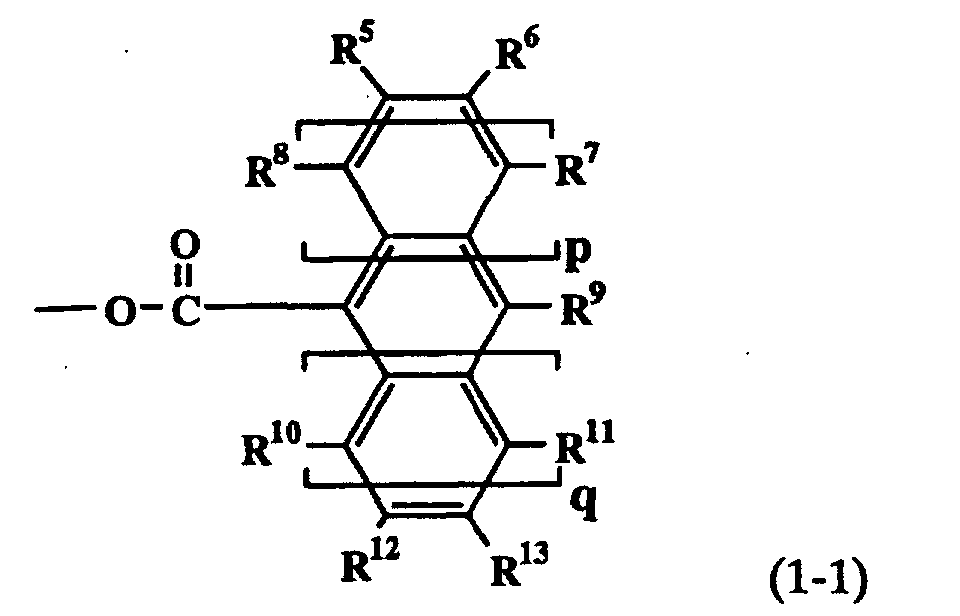
- a first aspect of the present invention provides a norbornene derivative represented by a general formula (1m) shown below: [wherein, at least one of R 1 to R 4 is a group selected from the group consisting of an aromatic ring-containing group represented by a general formula (1-1) shown below and an aromatic ring-containing group represented by a general formula (1-2) shown below, any remaining groups among R 1 , R 2 , R 3 and R 4 , where present, represent, independently, a hydrogen atom; a halogen atom; a substituted or unsubstituted monovalent hydrocarbon group of 1 to 30 carbon atoms which may contain a linkage group containing oxygen, nitrogen, sulfur or silicon; or a monovalent polar group, and m and n each represent, independently, an integer from 0 to 2]; [wherein, R 5 to R 13 each represent, independently, a hydrogen atom; a halogen atom; a substituted or unsubstituted monovalent hydrocarbon group of 1 to 30 carbon atoms which may
- a fourth aspect of the present invention provides a method of producing a norbornene-based ring opening polymer with a structural unit (1) represented by the general formula (1) shown above (and in which X is a group represented by the formula -CH 2 CH 2 -), wherein a norbornene-based monomer comprising a norbornene derivative represented by the general formula (1m) shown above is subjected to ring opening polymerization.
- a norbornene derivative of the present invention is a compound represented by a general formula (1m) shown below.
- R 1 to R 4 is a group selected from the group consisting of an aromatic ring-containing group represented by a general formula (1-1) shown below and an aromatic ring-containing group represented by a general formula (1-2) shown below, any remaining groups among R 1 , R 2 , R 3 and R 4 , where present, represent, independently, a hydrogen atom; a halogen atom; a substituted or unsubstituted monovalent hydrocarbon group of 1 to 30 carbon atoms which may contain a linkage group containing oxygen, nitrogen, sulfur or silicon; or a monovalent polar group, and m and n each represent, independently, an integer from 0 to 2];
- R 5 to R 13 each represent, independently, a hydrogen atom; a halogen atom; a substituted or unsubstituted monovalent hydrocarbon group of 1 to 30 carbon atoms which may contain a linkage group containing oxygen
- R 1 to R 13 , Z, R A and R B from the aforementioned general formula (1m), the general formula (1-1) and the general formula (1-2), each of which represent a hydrogen atom; a halogen atom; a substituted or unsubstituted monovalent hydrocarbon group of 1 to 30 carbon atoms which may contain a linkage group containing oxygen, nitrogen, sulfur or silicon; or a monovalent polar group.
- halogen atoms include fluorine atoms, chlorine atoms and bromine atoms.
- Examples of monovalent hydrocarbon groups of 1 to 30 carbon atoms include alkyl groups such as methyl groups, ethyl groups and propyl groups; cycloalkyl groups such as cyclopentyl groups and cyclohexyl groups; alkenyl groups such as vinyl groups and allyl groups; alkylidene groups such as ethylidene groups and propylidene groups; and aromatic groups such as phenyl groups.
- These hydrocarbon groups may be substituted, and suitable substituent groups include halogen atoms such as fluorine, chlorine and bromine, phenylsulfonyl groups and cyano groups and the like.
- linkage groups include bivalent hydrocarbon groups of 1 to 10 carbon atoms (such as alkylene groups represented by -(CH 2 ) m - (wherein m is an integer of 1 to 10)); and linkage groups comprising oxygen, nitrogen, sulfur or silicon (such as carbonyl groups (-CO-), carbonyloxy groups (-COO-), oxycarbonyl groups (-OCO-), sulfonyl groups (-SO 2 -), ether linkages (-O-), thioether linkages (-S-), imino groups (-NH-), amide linkages (-NHCO-), and siloxane linkages (-Si(R) 2 O- (wherein R represents an alkyl group such as a methyl group or an ethyl group), or linkage groups incorporating a combination of two or more of these link
- Examples of monovalent polar groups include hydroxy groups, and alkoxy groups of 1 to 10 carbon atoms, carbonyloxy groups, alkoxycarbonyl groups, aryloxycarbonyl groups, cyano groups, amide groups, imide groups, triorganosiloxy groups, triorganosilyl groups, amino groups, acyl groups, alkoxysilyl groups, sulfonic acid groups and carboxyl groups.
- alkoxy groups such as methoxy groups and ethoxy groups
- carbonyloxy groups including alkylcarbonyloxy groups such as acetoxy groups and propionyloxy groups as well as arylcarbonyloxy groups such as benzoyloxy groups
- alkoxycarbonyl groups such as methoxycarbonyl groups and ethoxycarbonyl groups
- aryloxycarbonyl groups such as phenoxycarbonyl groups, naphthyloxycarbonyl groups, fluorenyloxycarbonyl groups and biphenylyloxycarbonyl groups
- triorganosiloxy groups such as trimethylsiloxy groups and triethylsiloxy groups
- triorganosilyl groups such as trimethylsilyl groups and triethylsilyl groups
- amino groups such as primary amino groups
- alkoxysilyl groups such as trimethoxysilyl groups and triethoxysilyl groups.
- R 6 and R 9 are bonded together and form a benzene ring, and R 5 , R 12 and R 13 are hydrogen atoms, then the group represented by the general formula (1-1) becomes a 2-naphthalenecarbonyloxy group.
- R 6 and R 9 , and/or R 13 and R 9 are mutually bonded together in pairs, forming ring structures, are partially shown below.
- R represents a hydrocarbon group of 1 to 20 carbon atoms, including alkyl groups such as methyl groups, ethyl groups and propyl groups, aryl groups such as phenyl groups, and aralkyl groups such as benzyl groups.
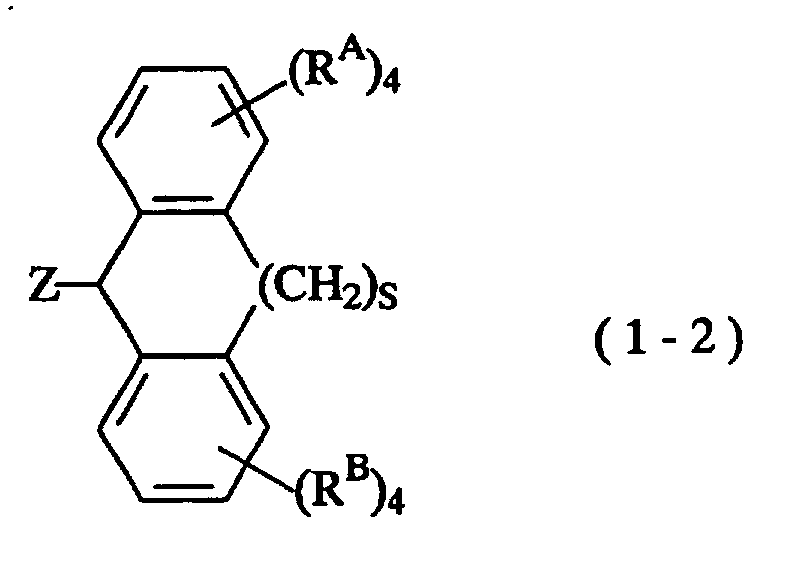
- s is either 0 or an integer of 1 or greater, although is preferably from 0 to 2, and even more preferably 0.
- the endo form/exo form molar ratio in the stereoisomers of the substituent group represented by the general formula (1-1) or the general formula (1-2) is typically within a range from 10/90 to 100/0, and preferably from 25/75 to 100/0, and even more preferably from 50/50 to 100/0.
- An example of a norbornene derivative of the present invention is the ester compound produced by the reaction of a norbornene alcohol and an aromatic carboxylic acid, and more specific examples include the compounds shown below.
- use of either 5-(2-naphthalenecarbonyloxy)bicyclo[2.2.1]hept-2-ene or 5-(4-biphenylcarbonyloxy)bicyclo[2.2.1]hept-2-ene produces a polymer that is effective in producing molded products with excellent low birefringence.
- a norbornene derivative of the present invention can be converted to a desired polymer by a ring opening polymerization, a ring opening polymerization followed by a hydrogenation reaction, an addition polymerization, a radical polymerization, a cationic polymerization or an anionic polymerization or the like. Furthermore, where necessary, copolymers can also be produced by copolymerization with an arbitrary copolymerizable compound. Polymers synthesized from a norbornene derivative of the present invention display excellent transparency, low water absorption and a low birefringence.
- a norbornene-based ring opening polymer of the present invention comprises a structural unit (1) represented by a general formula (1) shown below as an essential structural unit, although in some cases, the polymer may also comprise a structural unit (2) represented by a general formula (2) shown below.
- t and u each represent, independently, an integer from 0 to 2
- the groups R 1 to R 4 in the general formula (1) are the same as the groups R 1 to R 4 in the general formula (1m) of the norbornene derivative described above.
- the hydrogen atom; halogen atom; substituted or unsubstituted monovalent hydrocarbon group of 1 to 30 carbon atoms which may contain a linkage group containing oxygen, nitrogen, sulfur or silicon; or monovalent polar group represented by a to d are the same as the examples given for the halogen atom; substituted or unsubstituted monovalent hydrocarbon group of 1 to 30 carbon atoms which may contain a linkage group containing oxygen, nitrogen, sulfur or silicon; or monovalent polar group represented by R 1 to R 4 in the general formula (1m) relating to the aforementioned norbornene derivative.
- a and b, b and c, and c and d may be mutually bonded in pairs and form a carbon homocyclic ring or a heterocyclic ring (this carbon homocyclic ring or heterocyclic ring may be a single ring structure, or may form a polycyclic structure by condensation with another ring).
- Each carbon homocyclic ring or heterocyclic ring thus formed may be either an aromatic ring or a non-aromatic ring. Examples in which a ring structure is formed are partially shown below.
- R represents a hydrocarbon group of 1 to 20 carbon atoms, including alkyl groups such as methyl groups, ethyl groups and propyl groups, aryl groups such as phenyl groups, and aralkyl groups such as benzyl groups.
- the proportion of the structural unit (2) relative to the combined total of the structural unit (1) and the structural unit (2) is preferably no more than 95% by weight. More specifically, the ratio of structural unit (1)/structural unit (2), expressed as a weight ratio, is typically within a range from 100/0 to 5/95, and preferably from 100/0 to 30/70, and even more preferably from 100/0 to 50/50.
- a norbornene-based ring opening polymer of the present invention may also incorporate other structural units in addition to the structural unit (1) and the structural unit (2). These structural units are described in the production methods below in terms of raw material monomers that can be used arbitrarily.
- a norbornene-based ring opening polymer of the present invention can be produced by a ring opening polymerization of a norbornene-based monomer (hereafter termed the "monomer (1)”) represented by a general formula (1m) shown below, sometimes together with a norbornene-based monomer (hereafter termed the "monomer (2)”) represented by a general formula (2m) shown below.
- a norbornene-based monomer hereafter termed the "monomer (2)
- m, n, R 1 , R 2 , R 3 and R 4 are as defined above in relation to the general formula (1m) of the aforementioned norbornene derivative.
- t, u, a, b, c and d are as defined above in relation to the general formula (2).
- the quantities of the monomers used during this polymerization is typically within a range from 100/0 to 5/95, and preferably from 100/0 to 30/70, and even more preferably from 100/0 to 50/50.
- the ring opening polymerization described above enables the production of a norbornene-based ring opening polymer of the present invention containing the structural unit (1), and in those cases in which the monomer (2) is used, also containing the structural unit (2).
- Examples of the monomer (1) used in the present invention include, for example, ester compounds produced by the reaction of a norbornene alcohol and an aromatic carboxylic acid, and more specifically, the compounds listed above in relation to the aforementioned norbomene derivative.
- the compounds listed can be used either singularly, or in combinations of two or more compounds.
- use of either 5-(2-naphthalenecarbonyloxy)bicyclo[2.2.1]hept-2-ene or 5-(4-biphenylcarbonyloxy)bicyclo[2.2.1]hept-2-ene is effective in producing molded products with low birefringence.
- structural unit (2) used in the present invention include the following:
- norbornene-based monomers may be used in combination with the monomer (1), either singularly or in combinations of two or more compounds.
- norbornene-based monomers in which at least one of a to d in the general formula (2m) is a carboxylate ester residue represented by -(CH 2 ) k COOR 22 (wherein, R 22 is a hydrocarbon group of 1 to 20 carbon atoms, and k is an integer from 0 to 10) are preferred.
- R 22 is a hydrocarbon group of 1 to 20 carbon atoms, and k is an integer from 0 to 10.
- Examples of the hydrocarbon group of 1 to 20 carbon atoms represented by the aforementioned R 22 include alkyl groups such as methyl groups, ethyl groups and propyl groups, aryl groups such as phenyl groups, and aralkyl groups such as benzyl groups. Methyl groups, ethyl groups and phenyl groups are preferred, and methyl groups are particularly desirable.
- examples of copolymerizable monomers which can be used other than the monomer (1) and the monomer (2) include cycloolefins such as cyclobutene, cyclopentene, cyclooctene, and cyclodecene, as well as non-conjugated cyclic polyolenes such as 1,5-cyclooctadiene and cyclododecatriene.
- the aforementioned ring opening polymerization may also be conducted in the presence of polybutadiene, polyisoprene, styrene-butadiene, ethylene-non-conjugated diene polymers and unhydrogenated ring opening (co)polymers of other norbornene-based monomers.
- a ring opening polymerization catalyst used in the present invention utilizes a metathesis catalyst of the type described below.
- This metathesis catalyst is a combination of (a) at least one compound selected from the group consisting of W, Mo and Re compounds, and (b) at least one compound selected from compounds of a group IA element (such as Li, Na or K), a group IIA element (such as Mg or Ca), a group IIB element (such as Zn, Cd or Hg), a group IIIB element (such as B or Al), a group IVA element (such as Ti or Zr) or a group IVB element (such as Si, Sn or Pb) of the Deming periodic table, which contain at least one bond between the aforementioned element and carbon, or between the aforementioned element and hydrogen.
- a group IA element such as Li, Na or K
- a group IIA element such as Mg or Ca
- a group IIB element such as Zn, Cd or Hg
- a group IIIB element such as B or Al
- an additive (c) described below may also be added.
- W, Mo and Re compound of the constituent (a) include those compounds disclosed in Japanese Laid-open publication (kokai) No. 1-240517 (JP1-240517A) such as WCl 6 , MoCl 5 and ReOCl 3 .
- constituent (b) include those compounds disclosed in Japanese Laid-open publication (kokai) No. 1-240517 (JP1-240517A) such as n-C 4 H 9 Li, (C 2 H 5 ) 3 Al, (C 2 H 5 ) 2 AlCl, (C 2 H 5 ) 1.5 AlCl 1.5 , (C 2 H 5 )AlCl 2 , methyl alumoxane and LiH.
- constituent (c) include alcohols, aldehydes, ketones and amines, as well as those compounds disclosed in Japanese Laid-open publication (kokai) No. 1-240517 (JP1-240517A).
- the amount of the metathesis catalyst used should typically result in a molar ratio between the aforementioned constituent (a) and the specified monomers (that is, the monomer (1) and the monomer (2)), namely the ratio of constituent (a):specified monomers, within a range from 1:500 to 1:50,000, and preferably within a range from 1:1000 to 1:10,000.
- the relative proportions of the constituent (a) and the constituent (b) should produce a metal atom ratio (a):(b) within a range from 1:1 to 1:50, and preferably from 1:2 to 1:30.
- the relative proportions of the constituent (a) and the constituent (c) should produce a molar ratio (c):(a) within a range from 0.005:1 to 15:1, and preferably from 0.05:1 to 7:1.
- Regulation of the molecular weight of the ring opening polymer can also be achieved through controlling the polymerization temperature, the type of catalyst and the type of solvent, although in the present invention the molecular weight is preferably regulated by adding a molecular weight regulating agent to the reaction system.
- suitable molecular weight regulating agents include ⁇ -olefins such as ethylene, propene, 1-butene, 1-pentene, 1-hexene, 1-heptene, 1-octene, 1-nonene and 1-decene, as well as styrene, and of these, 1-butene and 1-hexene are particularly preferred.
- This molecular weight regulating agent may utilize a single compound, or a mixture of two or more different regulating agents.
- the amount of the molecular weight regulating agent used should be from 0.005 to 0.6 mols per 1 mol of the specified monomer (1) supplied to the ring opening polymerization reaction, with quantities from 0.02 to 0.5 mols being preferred.
- suitable solvents for use in the ring opening polymerization reaction include alkanes such as pentane, hexane, heptane, octane, nonane and decane; cycloalkanes such as cyclohexane, cycloheptane, cyclooctane, decalin and norbomane; aromatic hydrocarbons such as benzene, toluene, xylene, ethylbenzene and cumene; halogenated hydrocarbon compounds such as chlorobutane, bromohexane, methylene chloride, dichloroethane, hexamethylene dibromide, chlorobenzene, chloroform and tetrachloroethylene; saturated carboxylate esters such as ethyl acetate, n-butyl acetate, iso-
- a ring opening polymer obtained in the above manner can be used, as is, although from the viewpoint of heat resistance stability, the use of a hydrogenated polymer, which has undergone hydrogenation, is preferred.
- a hydrogenated product or hydrogenated polymer in the present invention refers to compounds in which the olefin-based unsaturated bonds within the principal chain of the polymer produced by the ring opening polymerization of either the monomer (1), or the monomer (1) and the monomer (2), have been hydrogenated, and the side chain aromatic rings based on the monomer (1) or the monomer (2) have undergone essentially no hydrogenation.
- the hydrogenation reaction must be performed under conditions wherein the side chain aromatic rings based on the monomer (1) or the monomer (2) undergo essentially no hydrogenation.
- a hydrogenation catalyst is added to the ring opening polymer solution, and reaction is then conducted with hydrogen gas at a pressure within a range from normal pressure to 300 atmospheres, and preferably from 3 to 200 atmospheres, and at a temperature within a range from 0 to 200°C, and preferably from 20 to 180°C.
- Examples of the hydrogenation catalyst include those catalysts typically used in hydrogenation reactions of olefin-based compounds. These known hydrogenation catalysts include both heterogeneous catalysts and homogeneous catalysts. Examples of suitable heterogeneous catalysts include solid catalysts comprising a noble metal catalytic material such as palladium, platinum, nickel, rhodium or ruthenium supported by a carrier such as carbon, silica, alumina or titania.
- a noble metal catalytic material such as palladium, platinum, nickel, rhodium or ruthenium supported by a carrier such as carbon, silica, alumina or titania.
- Suitable homogeneous catalysts include nickel naphthenate/triethyl aluminum, nickel acetylacetonate/triethyl aluminum, cobalt octenate/n-butyl lithium, titanocene dichloride/diethyl aluminum monochloride, rhodium acetate, chlorotris(triphenylphosphine)rhodium, dichlorotris(triphenylphosphine)ruthenium, chlorohydrocarbonyltris(triphenylphosphine)ruthenium, and dichlorocarbonyltris(triphenylphosphine)ruthenium.
- the catalysts may be in powdered or granulated form.
- the quantity of the hydrogenation catalyst added must be regulated to ensure that the side chain aromatic rings based on the monomer (1) undergo essentially no. hydrogenation, although typically a quantity is used which produces a ring opening polymer:hydrogenation catalyst ratio (weight ratio) within a range from 1:1x10 -6 to 1:2.
- a hydrogenated product of a ring opening polymer produced in the present invention at least 99.0% of the olefin-based unsaturated bonds within the principal chain of the polymer produced by the ring opening polymerization are preferably hydrogenated, whereas the side chain aromatic rings remain essentially unhydrogenated.
- the intrinsic viscosity ( ⁇ inh ) of a ring opening polymer of the present invention or a hydrogenated product thereof, measured using an Ubbelohde viscometer, is typically within a range from 0.25 to 5.0, and preferably from 0.3 to 4.0, and even more preferably from 0.35 to 2.0.
- the number average molecular weight (Mn) is typically within a range from 1000 to 500,000, and preferably from 2000 to 300,000, and even more preferably from 3000 to 100,000
- the weight average molecular weight (Mw) is typically within a range from 5000 to 2,000,000, and preferably from 10,000 to 1,000,000, and even more preferably from 30,000 to 500,000. If ⁇ inh is less than 0.2, Mn is less than 1000, or Mw is less than 5000, then the strength of the molded product deteriorates markedly.
- melt viscosity or the solution viscosity of the ring opening polymer or the hydrogenated product thereof becomes overly high, and obtaining the desired molded product may be difficult.
- additives can be added to a ring opening polymer of the present invention or a hydrogenated product thereof.
- additives include phenol-based or hydroquinone-based antioxidants such as 2,6-di-t-butyl-4-methylphenol, 2,2-methylenebis(4-ethyl-6-t-butylphenol), 2,5-di-t-butylhydroquinone, tetrakis[methylene-3-(3,5-di-t-butyl-4-hydroxyphenyl)propionate]methane, 4,4-thiobis-(6-t-butyl-3methylphenol), 1,4-bis(4-hydroxyphenyl)cyclohexane and octadecyl-3-(3,5-di-t-butyl-4-hydroxyphenyl)propionate, as well as phosphorus-based antioxidants such as tris(4-methoxy-3,5-diphenyl)phosphite, tris(nony
- UV absorbing agents such as 2,4-dihydroxybenzophenone, 2-hydroxy-4-methoxybenzophenone and 2,2-methylenebis[4-(1,1,3,3-tetramethylbutyl)-6-[(2H-benzotriazol-2-yl)phenol]
- the light resistance can be improved.
- Additives such as lubricants may also be added to improve the workability.
- a norbornene-based polymer of the present invention displays excellent transparency, low water absorption and a low birefringence, and moreover generates a uniform retardation.
- a polymer of the present invention is useful within fields such as optics, and electrical and electronic materials.
- the polymers can be ideally applied to use as molding materials for optical disks, magneto-optical disks, optical lenses (such as F ⁇ lenses, pickup lenses, laser printer lenses and camera lenses), spectacle lenses, optical films or sheets (such as display films, retardation films, polarizing films, polarizing plate protective films, diffusion films, antireflective films, liquid crystal substrates, EL substrates, electronic paper substrates, touch panel substrates and PDP front plates), transparent conductive film substrates, optical fibers, light guide plates, light diffusion plates, optical cards, optical mirrors, IC, LSI and LED sealing materials.
- optical films or sheets such as display films, retardation films, polarizing films, polarizing plate protective films, diffusion films, antireflective films, liquid crystal substrates, EL substrates, electronic paper substrates, touch panel substrates and PDP front plates
- transparent conductive film substrates such as display films, retardation films, polarizing films, polarizing plate protective films, diffusion films, antireflective films, liquid crystal substrates, EL substrates, electronic
- Monomer purity was determined using a high performance liquid chromatography (HPLC) device manufactured by Tosoh Corporation, and using methanol as the solvent.
- HPLC high performance liquid chromatography
- Mw polystyrene equivalent weight average molecular weight
- Mw/Mn molecular weight distribution
- DSC differential scanning calorimeter
- a polymer obtained by polymerization was pelletized, and an optical disk substrate of external diameter 130 mm and internal diameter 15 mm was then formed by injection molding under conditions including a resin temperature of 270°C and a die temperature of 110°C using an injection molding device (DISK-3, manufactured by Sumitomo Heavy Industries, Ltd.).
- the retardation of the 130 mm diameter optical disk substrate was measured by a double pulse method (perpendicular incidence) with a light source wavelength of 633 nm, using a birefringence automatic measurement apparatus (manufactured by Nippon Densi Kogaku co., ltd.), and this retardation value was used as the value for birefringence evaluation. As this retardation value decreases, the molded material can be considered as displaying a lower birefringence.
- protons bonded to the carbons at positions 2 and 3 of the bicyclo[2.2.1]hept-2-ene structure were observed at 6.1 ppm and 6.4 ppm respectively, and the protons bonded to the biphenyl rings were observed within a range from 7.3 to 8.0 ppm, enabling the above compound to be identified.
- reaction in the same manner as the example 1 yielded 46 g of a white solid of 5-(2-naphthalenecarbonyloxy)bicyclo[2.2.1]hept-2-ene.
- Analysis of the product monomer by HPLC revealed a purity of 99%.
- reaction in the same manner as the example 2 yielded 43.8 g of a transparent liquid of 5-(1-naphthalenecarbonyloxy)bicyclo[2.2.1]hept-2-ene.
- Analysis of the product monomer by HPLC revealed a purity of 98%.
- reaction in the same manner as the example 4 yielded 14.0 g of a yellow colored solid of 5-(9-fluorenecarbonyloxy)bicyclo[2.2.1]hept-2-ene.
- Analysis of the product monomer by HPLC revealed a purity of 98%.
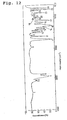
- the 1 H-NMR spectrum of the product polymer is shown in FIG. 11, and the infrared absorption (IR) spectrum is shown in FIG. 12.
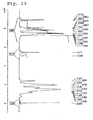
- the 1 H-NMR spectrum of the product polymer is shown in FIG. 13, and the infrared absorption (IR) spectrum is shown in FIG. 14.
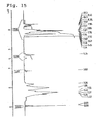
- the 1 H-NMR spectrum of the product polymer is shown in FIG. 15, and the infrared absorption (IR) spectrum is shown in FIG. 16.
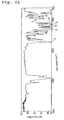
- the 1 H-NMR spectrum of the product polymer is shown in FIG. 17, and the infrared absorption (IR) spectrum is shown in FIG. 18.
- the infrared absorption (IR) spectrum of the product polymer is shown in FIG. 19.
- Example Retardation value (nm) Glass transition temperature (°C)
- Example 6 2 97.5
- Example 8 3 82.4
- Example 9 4 126.0
- Example 10 5 116.0
- Example 11 5 103.0 Comparative Example 1 20 167.0
- a polymer and a hydrogenated product thereof produced from a norbornene derivative of the present invention retain excellent transparency and heat resistance, and a low level of water absorption, while displaying a lower birefringence than conventional cyclic olefin resins. Accordingly, the norbornene derivatives of the present invention are extremely useful optical resin precursor monomers.
- polymers and hydrogenated products thereof according to the present invention retain excellent transparency, heat resistance, and water resistance, while displaying a low birefringence, they can be applied to optical materials which require extremely precise optical design such as optical disks, magneto-optical disks, optical lenses (such as F ⁇ lenses, pickup lenses, laser printer lenses and camera lenses), spectacle lenses, optical films or sheets (such as display films, retardation films, polarizing films, polarizing plate protective films, diffusion films, antireflective films, liquid crystal substrates, EL substrates, electronic paper substrates, touch panel substrates and PDP front plates), transparent conductive film substrates, optical fibers, light guide plates, optical cards, optical mirrors, IC, LSI and LED sealing materials.
- optical disks magneto-optical disks
- optical lenses such as F ⁇ lenses, pickup lenses, laser printer lenses and camera lenses
- spectacle lenses optical films or sheets (such as display films, retardation films, polarizing films, polarizing plate protective films, diffusion films, antireflective films, liquid crystal substrates, EL
Landscapes
- Chemical & Material Sciences (AREA)
- Organic Chemistry (AREA)
- Health & Medical Sciences (AREA)
- Chemical Kinetics & Catalysis (AREA)
- Medicinal Chemistry (AREA)
- Polymers & Plastics (AREA)
- Polyoxymethylene Polymers And Polymers With Carbon-To-Carbon Bonds (AREA)
- Organic Low-Molecular-Weight Compounds And Preparation Thereof (AREA)
Abstract
A novel norbornene derivative represented by a general formula (1m) shown
below is provided. By conducting a ring opening polymerization of this norbornene
derivative, or by performing a subsequent hydrogenation following the ring opening
polymerization, a ring opening polymer or a hydrogenated product thereof with an
excellent low birefringence can be obtained.
 [wherein, at least one of R1 to R4 is a group selected from the group consisting of groups
represented by a general formula (1-1) shown below and groups represented by a general
formula (1-2) shown below]
[wherein, at least one of R1 to R4 is a group selected from the group consisting of groups
represented by a general formula (1-1) shown below and groups represented by a general
formula (1-2) shown below]
 [wherein, at least one of RA, RB and Z is a group represented by the formula -C(O)O-].
Description
The present invention relates to a precursor monomer compound for a cyclic
olefin-based polymer which combines excellent transparency and a low birefringence.
In addition, the present invention relates to a norbornene-based ring opening
polymer which combines excellent transparency and a low birefringence.
Conventionally, transparent resins are used as the materials for molded products
which typically require transparency such as automobile components, illumination
equipment and electrical components. Particularly in recent years, the application of these
resins as optical materials, in which the optical properties are important, continues to
progress. Examples of known transparent resins which can be ideally applied to such
applications include polycarbonate-based resins and acrylic-based resins. However,
although acrylic-based resins offer excellent transparency, they have problems in terms of
heat resistance and water resistance. In contrast, polycarbonate-based resins offer superior
performance to acrylic resins in terms of heat resistance and water resistance, but suffer
from different problems such as a high birefringence.
As a result, recently, cyclic polyolefin-based resins which combine transparency,
water resistance (low water absorption), a low birefringence, and heat resistance have
started to be used as the transparent resins for optical materials.
Polymers synthesized using cyclic olefins as monomers are amorphous due to the
presence of bulky alicyclic structures on the principal chain skeleton, display excellent
transparency and heat resistance, and moreover also offer other characteristics such as
little optical distortion, low water absorption, acid and alkali resistance, and a high level of
electrical insulation, and consequently they have been developed for display applications
(such as retardation films, diffusion films, liquid crystal substrates, films for touch panels
and light guide plates), optical lens applications, optical disk applications (such as CD,
MD, CD-R and DVD), optical fiber applications, optical film/sheet applications, optical
semiconductor sealing applications, printed wiring board applications (such as rigid
printed wiring boards, flexible printed wiring boards and multi layer printed wiring
boards), and as substrates for transparent conductive films. Amongst such cyclic olefins,
development has centered around cyclic olefin-based polymers with highly reactive
norbornenes as precursors.
Cyclic olefin-based polymers such as those described above are typically
converted to products by fabrication using molding methods such as injection molding and
molten extrusion molding, although with conventional cyclic olefin-based polymers, the
birefringence which develops due to the polymer orientation during the molding process
has not always satisfied the demanded characteristics, and as a result, the optical
characteristics of the generated optical product also failed to meet the demanded
characteristics. With the improvements in electronic technology in recent years, the
development of a material which retains the excellent transparency and heat resistance
characteristics of conventional cyclic olefin-based polymers, but enables a reduction in the
birefringence which develops due to the polymer orientation has been keenly sought,
although until now, such a material had yet to be discovered.
A first aspect of the present invention provides a norbornene derivative represented
by a general formula (1m) shown below:
 [wherein, at least one of R1 to R4 is a group selected from the group consisting of an
aromatic ring-containing group represented by a general formula (1-1) shown below and
an aromatic ring-containing group represented by a general formula (1-2) shown below,
any remaining groups among R1, R2, R3 and R4, where present, represent, independently, a
hydrogen atom; a halogen atom; a substituted or unsubstituted monovalent hydrocarbon
group of 1 to 30 carbon atoms which may contain a linkage group containing oxygen,
nitrogen, sulfur or silicon; or a monovalent polar group, and m and n each represent,
independently, an integer from 0 to 2];
[wherein, at least one of R1 to R4 is a group selected from the group consisting of an
aromatic ring-containing group represented by a general formula (1-1) shown below and
an aromatic ring-containing group represented by a general formula (1-2) shown below,
any remaining groups among R1, R2, R3 and R4, where present, represent, independently, a
hydrogen atom; a halogen atom; a substituted or unsubstituted monovalent hydrocarbon
group of 1 to 30 carbon atoms which may contain a linkage group containing oxygen,
nitrogen, sulfur or silicon; or a monovalent polar group, and m and n each represent,
independently, an integer from 0 to 2];
 [wherein, R5 to R13 each represent, independently, a hydrogen atom; a halogen atom; a
substituted or unsubstituted monovalent hydrocarbon group of 1 to 30 carbon atoms which
may contain a linkage group containing oxygen, nitrogen, sulfur or silicon; or a
monovalent polar group, and p and q each represent, independently an integer from 0 to 2,
provided that in a case in which p=q=0, R6 and R9, and/or R13 and R9, are bonded to each
other to form a carbon homocyclic ring or a heterocyclic ring (this carbon homocyclic ring
or heterocyclic ring may be a single ring structure, or may form a polycyclic structure by
condensation with at least one other ring), or alternatively at least one of R5, R6, R9, R12
and R13 is a substituted or unsubstituted aromatic group ];
[wherein, R5 to R13 each represent, independently, a hydrogen atom; a halogen atom; a
substituted or unsubstituted monovalent hydrocarbon group of 1 to 30 carbon atoms which
may contain a linkage group containing oxygen, nitrogen, sulfur or silicon; or a
monovalent polar group, and p and q each represent, independently an integer from 0 to 2,
provided that in a case in which p=q=0, R6 and R9, and/or R13 and R9, are bonded to each
other to form a carbon homocyclic ring or a heterocyclic ring (this carbon homocyclic ring
or heterocyclic ring may be a single ring structure, or may form a polycyclic structure by
condensation with at least one other ring), or alternatively at least one of R5, R6, R9, R12
and R13 is a substituted or unsubstituted aromatic group ];
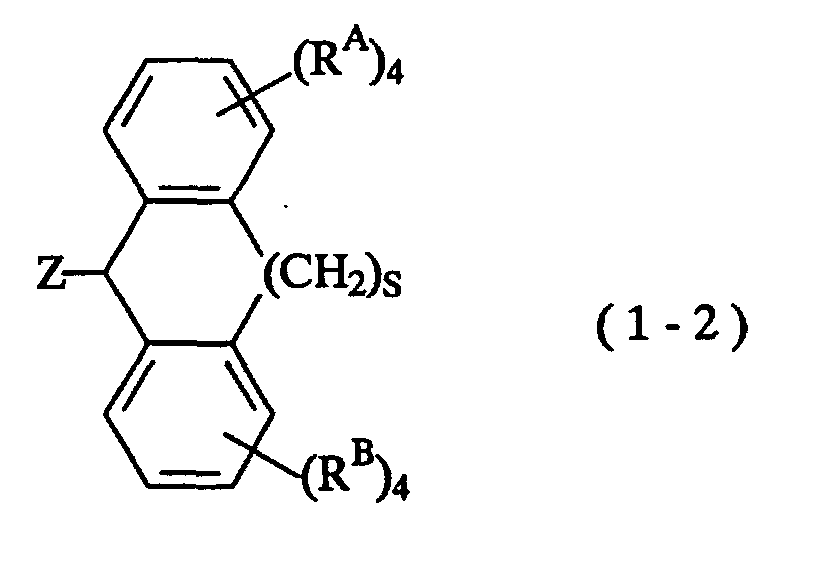 [wherein, Z, RA and RB each represent, independently, a hydrogen atom; a halogen atom; a
substituted or unsubstituted monovalent hydrocarbon group of 1 to 30 carbon atoms which
may contain a linkage group containing oxygen, nitrogen, sulfur or silicon; or a
monovalent polar group, provided that one of RA, RB and Z is a group represented by a
formula -C(O)O- in which the carbonyl group side is bonded to a carbon atom of a ring
structure within the formula (1-2), and s represents an integer of 0 or greater].
[wherein, Z, RA and RB each represent, independently, a hydrogen atom; a halogen atom; a
substituted or unsubstituted monovalent hydrocarbon group of 1 to 30 carbon atoms which
may contain a linkage group containing oxygen, nitrogen, sulfur or silicon; or a
monovalent polar group, provided that one of RA, RB and Z is a group represented by a
formula -C(O)O- in which the carbonyl group side is bonded to a carbon atom of a ring
structure within the formula (1-2), and s represents an integer of 0 or greater].
A second aspect of the present invention provides a norbornene-based ring opening
polymer comprising a structural unit represented by a general formula (1) shown below:
 [wherein, X is a group represented by a formula -CH=CH- or a group represented by a
formula -CH2CH2-, and m, n, R1, R2, R3 and R4 are as defined above in relation to the
general formula (1m)],
[wherein, X is a group represented by a formula -CH=CH- or a group represented by a
formula -CH2CH2-, and m, n, R1, R2, R3 and R4 are as defined above in relation to the
general formula (1m)],
wherein the plurality of X groups which exist may be the same or different.
wherein the plurality of X groups which exist may be the same or different.
A third aspect of the present invention provides a method of producing a
norbornene-based ring opening polymer with a structural unit (1) represented by the
general formula (1) shown above (and in which X is a group represented by the formula
-CH=CH-), wherein a norbornene-based monomer comprising a norbornene derivative
represented by the general formula (1m) shown above is subjected to ring opening
polymerization.
In addition, a fourth aspect of the present invention provides a method of
producing a norbornene-based ring opening polymer with a structural unit (1) represented
by the general formula (1) shown above (and in which X is a group represented by the
formula -CH2CH2-), wherein a norbornene-based monomer comprising a norbornene
derivative represented by the general formula (1m) shown above is subjected to ring
opening polymerization.
As follows is a more detailed description of the present invention.
A norbornene derivative of the present invention is a compound represented by a
general formula (1m) shown below.
 [wherein, at least one of R1 to R4 is a group selected from the group consisting of an
aromatic ring-containing group represented by a general formula (1-1) shown below and
an aromatic ring-containing group represented by a general formula (1-2) shown below,
any remaining groups among R1, R2, R3 and R4, where present, represent, independently, a
hydrogen atom; a halogen atom; a substituted or unsubstituted monovalent hydrocarbon
group of 1 to 30 carbon atoms which may contain a linkage group containing oxygen,
nitrogen, sulfur or silicon; or a monovalent polar group, and m and n each represent,
independently, an integer from 0 to 2];
[wherein, at least one of R1 to R4 is a group selected from the group consisting of an
aromatic ring-containing group represented by a general formula (1-1) shown below and
an aromatic ring-containing group represented by a general formula (1-2) shown below,
any remaining groups among R1, R2, R3 and R4, where present, represent, independently, a
hydrogen atom; a halogen atom; a substituted or unsubstituted monovalent hydrocarbon
group of 1 to 30 carbon atoms which may contain a linkage group containing oxygen,
nitrogen, sulfur or silicon; or a monovalent polar group, and m and n each represent,
independently, an integer from 0 to 2];
 [wherein, R5 to R13 each represent, independently, a hydrogen atom; a halogen atom; a
substituted or unsubstituted monovalent hydrocarbon group of 1 to 30 carbon atoms which
may contain a linkage group containing oxygen, nitrogen, sulfur or silicon; or a
monovalent polar group, and p and q each represent, independently an integer from 0 to 2,
provided that in a case in which p=q=0, R6 and R9, and/or R13 and R9, are bonded to each
other to form a carbon homocyclic ring or a heterocyclic ring (this carbon homocyclic ring
or heterocyclic ring may be a single ring structure, or may form a polycyclic structure by
condensation with another ring), or alternatively at least one of R5, R6, R9, R12 and R13 is a
substituted or unsubstituted aromatic group];
[wherein, R5 to R13 each represent, independently, a hydrogen atom; a halogen atom; a
substituted or unsubstituted monovalent hydrocarbon group of 1 to 30 carbon atoms which
may contain a linkage group containing oxygen, nitrogen, sulfur or silicon; or a
monovalent polar group, and p and q each represent, independently an integer from 0 to 2,
provided that in a case in which p=q=0, R6 and R9, and/or R13 and R9, are bonded to each
other to form a carbon homocyclic ring or a heterocyclic ring (this carbon homocyclic ring
or heterocyclic ring may be a single ring structure, or may form a polycyclic structure by
condensation with another ring), or alternatively at least one of R5, R6, R9, R12 and R13 is a
substituted or unsubstituted aromatic group];
 [wherein, Z, RA and RB each represent, independently, a hydrogen atom; a halogen atom; a
substituted or unsubstituted monovalent hydrocarbon group of 1 to 30 carbon atoms which
may contain a linkage group containing oxygen, nitrogen, sulfur or silicon; or a
monovalent polar group, provided that one of RA, RB and Z is a group represented by a
formula -C(O)O- in which the carbonyl group side is bonded to a carbon atom of a ring
structure within the formula (1-2), and s represents an integer of 0, or 1 or greater].
[wherein, Z, RA and RB each represent, independently, a hydrogen atom; a halogen atom; a
substituted or unsubstituted monovalent hydrocarbon group of 1 to 30 carbon atoms which
may contain a linkage group containing oxygen, nitrogen, sulfur or silicon; or a
monovalent polar group, provided that one of RA, RB and Z is a group represented by a
formula -C(O)O- in which the carbonyl group side is bonded to a carbon atom of a ring
structure within the formula (1-2), and s represents an integer of 0, or 1 or greater].
As follows is a description of the groups R1 to R13, Z, RA and RB from the
aforementioned general formula (1m), the general formula (1-1) and the general formula
(1-2), each of which represent a hydrogen atom; a halogen atom; a substituted or
unsubstituted monovalent hydrocarbon group of 1 to 30 carbon atoms which may contain
a linkage group containing oxygen, nitrogen, sulfur or silicon; or a monovalent polar
group.
Examples of halogen atoms include fluorine atoms, chlorine atoms and bromine
atoms.
Examples of monovalent hydrocarbon groups of 1 to 30 carbon atoms include
alkyl groups such as methyl groups, ethyl groups and propyl groups; cycloalkyl groups
such as cyclopentyl groups and cyclohexyl groups; alkenyl groups such as vinyl groups
and allyl groups; alkylidene groups such as ethylidene groups and propylidene groups; and
aromatic groups such as phenyl groups. These hydrocarbon groups may be substituted,
and suitable substituent groups include halogen atoms such as fluorine, chlorine and
bromine, phenylsulfonyl groups and cyano groups and the like.
Furthermore, the aforementioned substituted or unsubstituted hydrocarbon group
may be either bonded directly to the ring structure, or bonded via a linkage group.
Examples of suitable linkage groups include bivalent hydrocarbon groups of 1 to 10
carbon atoms (such as alkylene groups represented by -(CH2)m- (wherein m is an integer
of 1 to 10)); and linkage groups comprising oxygen, nitrogen, sulfur or silicon (such as
carbonyl groups (-CO-), carbonyloxy groups (-COO-), oxycarbonyl groups (-OCO-),
sulfonyl groups (-SO2-), ether linkages (-O-), thioether linkages (-S-), imino groups (-NH-),
amide linkages (-NHCO-), and siloxane linkages (-Si(R)2O- (wherein R represents an
alkyl group such as a methyl group or an ethyl group), or linkage groups incorporating a
combination of two or more of these linkages.
Examples of monovalent polar groups include hydroxy groups, and alkoxy groups
of 1 to 10 carbon atoms, carbonyloxy groups, alkoxycarbonyl groups, aryloxycarbonyl
groups, cyano groups, amide groups, imide groups, triorganosiloxy groups, triorganosilyl
groups, amino groups, acyl groups, alkoxysilyl groups, sulfonic acid groups and carboxyl
groups. Specific examples include alkoxy groups such as methoxy groups and ethoxy
groups; carbonyloxy groups including alkylcarbonyloxy groups such as acetoxy groups
and propionyloxy groups as well as arylcarbonyloxy groups such as benzoyloxy groups;
alkoxycarbonyl groups such as methoxycarbonyl groups and ethoxycarbonyl groups;
aryloxycarbonyl groups such as phenoxycarbonyl groups, naphthyloxycarbonyl groups,
fluorenyloxycarbonyl groups and biphenylyloxycarbonyl groups; triorganosiloxy groups
such as trimethylsiloxy groups and triethylsiloxy groups; triorganosilyl groups such as
trimethylsilyl groups and triethylsilyl groups; amino groups such as primary amino
groups; and alkoxysilyl groups such as trimethoxysilyl groups and triethoxysilyl groups.
As described above, in the general formula (1-1), in the case in which p=q=0, R6
and R9, and/or R13 and R9, are mutually bonded together in pairs and form a carbon
homocyclic ring or a heterocyclic ring (this carbon homocyclic ring or heterocyclic ring
may be a single ring structure, or may form a polycyclic structure by condensation with
another ring. Furthermore, the formed carbon homocyclic ring or heterocyclic ring may
be aromatic or non-aromatic), or alternatively at least one of R5, R6, R9, R12 and R13 is a
substituted or unsubstituted aromatic group. Examples of substituent groups on this
aromatic group include cyano groups, alkoxy groups, carbonyloxy groups, alkoxycarbonyl
groups, amide groups, imide groups, amino groups, acyl groups and halogen atoms.
In the case described above in which p=q=0, if for example R6 and R9 are bonded
together and form a benzene ring, and R5, R12 and R13 are hydrogen atoms, then the group
represented by the general formula (1-1) becomes a 2-naphthalenecarbonyloxy group.
Examples in which R6 and R9, and/or R13 and R9 are mutually bonded together in pairs,
forming ring structures, are partially shown below.
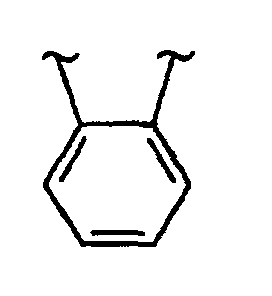

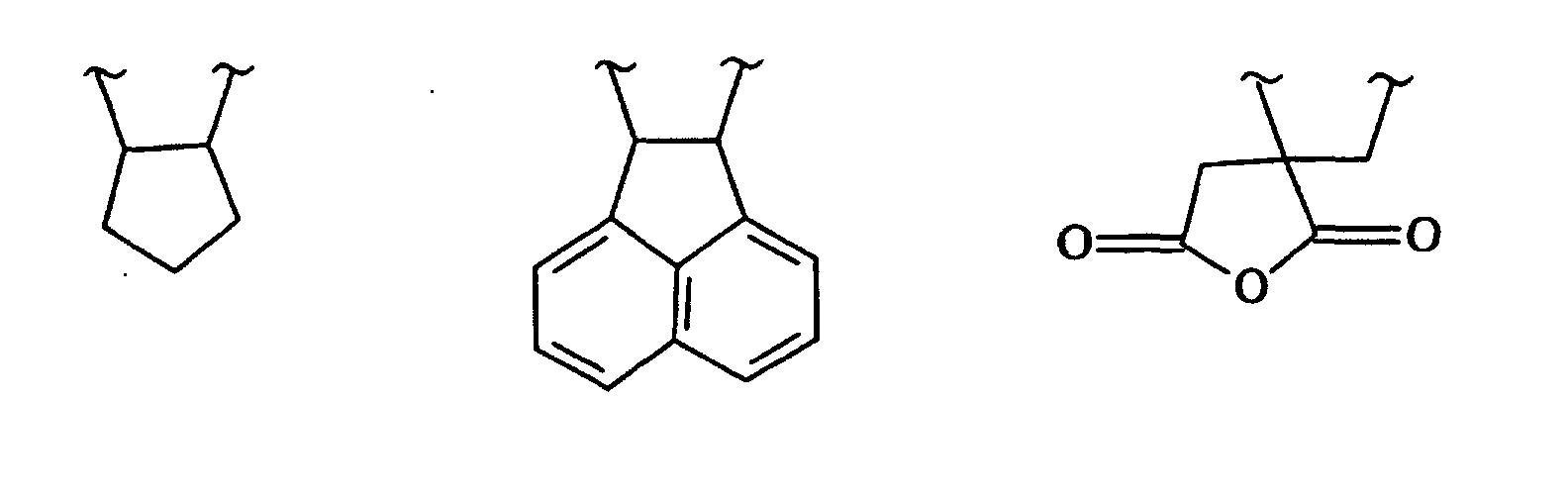
 [In the above formulas, R represents a hydrocarbon group of 1 to 20 carbon atoms,
including alkyl groups such as methyl groups, ethyl groups and propyl groups, aryl groups
such as phenyl groups, and aralkyl groups such as benzyl groups.]
[In the above formulas, R represents a hydrocarbon group of 1 to 20 carbon atoms,
including alkyl groups such as methyl groups, ethyl groups and propyl groups, aryl groups
such as phenyl groups, and aralkyl groups such as benzyl groups.]
Furthermore, in the aforementioned general formula (1-2), s is either 0 or an
integer of 1 or greater, although is preferably from 0 to 2, and even more preferably 0.
In the general formula (1m), in the case in which n=0, and m=0 or 1, the structure
must comprise at least 10 mol%, and preferably at least 25 mol%, and even more
preferably at least 50 mol%, of stereoisomers in which at least one of the groups selected
from the group consisting of substituent groups represented by the general formula (1-1)
and the general formula (1-2) is bonded to an α position shown in the partial structural
formula represented by a formula (3) shown below. If this proportion is less than 10
mol%, then when the polymer is formed, a reduction in birefringence cannot be expected.

Furthermore in a similar manner, in the general formula (1m), in the case in which
n=0, and m=0 or 1, then for only one of the groups among R1 to R4, the endo form/exo
form molar ratio in the stereoisomers of the substituent group represented by the general
formula (1-1) or the general formula (1-2) is typically within a range from 10/90 to 100/0,
and preferably from 25/75 to 100/0, and even more preferably from 50/50 to 100/0.
As follows is a more specific description of the norbornene derivative represented
by the general formula (1m), although the invention is not restricted to the examples
presented here.
An example of a norbornene derivative of the present invention is the ester
compound produced by the reaction of a norbornene alcohol and an aromatic carboxylic
acid, and more specific examples include the compounds shown below.
Of these, norbornene derivatives wherein in the general formula (1m), m=1 and
n=0, and three of R1 to R4 are hydrogen atoms and the remaining one group of R1 to R4 is
a group represented by either the general formula (1-1) or the general formula (1-2)
produce polymers with high heat deformation resistance and low water absorption and are
consequently preferred. In addition, use of either 5-(2-naphthalenecarbonyloxy)bicyclo[2.2.1]hept-2-ene
or 5-(4-biphenylcarbonyloxy)bicyclo[2.2.1]hept-2-ene
produces a polymer that is effective in
producing molded products with excellent low birefringence.
A norbornene derivative of the present invention can be converted to a desired
polymer by a ring opening polymerization, a ring opening polymerization followed by a
hydrogenation reaction, an addition polymerization, a radical polymerization, a cationic
polymerization or an anionic polymerization or the like. Furthermore, where necessary,
copolymers can also be produced by copolymerization with an arbitrary copolymerizable
compound. Polymers synthesized from a norbornene derivative of the present invention
display excellent transparency, low water absorption and a low birefringence.
A norbornene-based ring opening polymer of the present invention comprises a
structural unit (1) represented by a general formula (1) shown below as an essential
structural unit, although in some cases, the polymer may also comprise a structural unit (2)
represented by a general formula (2) shown below.
 [wherein, X is a group represented by a formula -CH=CH- or a group represented by a
formula -CH2CH2-, and m, n, R1, R2, R3 and R4 are as defined above in relation to the
general formula (1m) of the aforementioned norbornene derivative.]
[wherein, X is a group represented by a formula -CH=CH- or a group represented by a
formula -CH2CH2-, and m, n, R1, R2, R3 and R4 are as defined above in relation to the
general formula (1m) of the aforementioned norbornene derivative.]
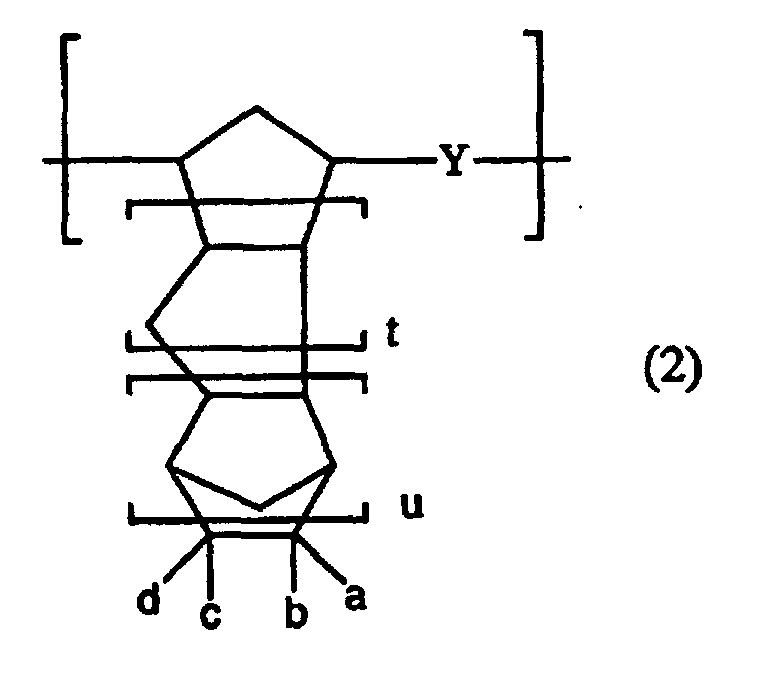 [wherein, t and u each represent, independently, an integer from 0 to 2, Y is a group
represented by a formula -CH=CH- or a group represented by a formula -CH2CH2-, a, b, c
and d each represent, independently, a hydrogen atom; a halogen atom; a substituted or
unsubstituted monovalent hydrocarbon group of 1 to 30 carbon atoms which may contain
a linkage group containing oxygen, nitrogen, sulfur or silicon; or a monovalent polar
group, or alternatively a and b, b and c, or c and d may be bonded to each other to form a
carbon homocyclic ring or a heterocyclic ring (this carbon homocyclic ring or heterocyclic
ring may be a single ring structure, or may form a polycyclic structure by condensation
with another ring).]
[wherein, t and u each represent, independently, an integer from 0 to 2, Y is a group
represented by a formula -CH=CH- or a group represented by a formula -CH2CH2-, a, b, c
and d each represent, independently, a hydrogen atom; a halogen atom; a substituted or
unsubstituted monovalent hydrocarbon group of 1 to 30 carbon atoms which may contain
a linkage group containing oxygen, nitrogen, sulfur or silicon; or a monovalent polar
group, or alternatively a and b, b and c, or c and d may be bonded to each other to form a
carbon homocyclic ring or a heterocyclic ring (this carbon homocyclic ring or heterocyclic
ring may be a single ring structure, or may form a polycyclic structure by condensation
with another ring).]
The groups R1 to R4 in the general formula (1) are the same as the groups R1 to R4
in the general formula (1m) of the norbornene derivative described above.
In the general formula (2), the hydrogen atom; halogen atom; substituted or
unsubstituted monovalent hydrocarbon group of 1 to 30 carbon atoms which may contain
a linkage group containing oxygen, nitrogen, sulfur or silicon; or monovalent polar group
represented by a to d, are the same as the examples given for the halogen atom; substituted
or unsubstituted monovalent hydrocarbon group of 1 to 30 carbon atoms which may
contain a linkage group containing oxygen, nitrogen, sulfur or silicon; or monovalent
polar group represented by R1 to R4 in the general formula (1m) relating to the
aforementioned norbornene derivative.
Furthermore, in the general formula (2), a and b, b and c, and c and d may be
mutually bonded in pairs and form a carbon homocyclic ring or a heterocyclic ring (this
carbon homocyclic ring or heterocyclic ring may be a single ring structure, or may form a
polycyclic structure by condensation with another ring). Each carbon homocyclic ring or
heterocyclic ring thus formed may be either an aromatic ring or a non-aromatic ring.
Examples in which a ring structure is formed are partially shown below.
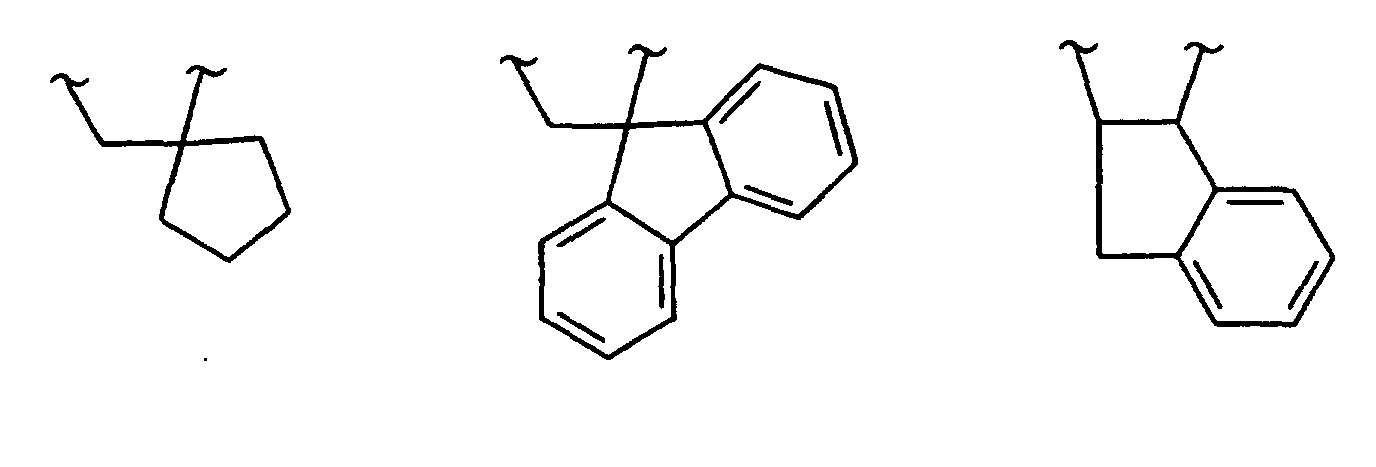

 [In the above formulas, R represents a hydrocarbon group of 1 to 20 carbon atoms,
including alkyl groups such as methyl groups, ethyl groups and propyl groups, aryl groups
such as phenyl groups, and aralkyl groups such as benzyl groups.]
[In the above formulas, R represents a hydrocarbon group of 1 to 20 carbon atoms,
including alkyl groups such as methyl groups, ethyl groups and propyl groups, aryl groups
such as phenyl groups, and aralkyl groups such as benzyl groups.]
In those cases in which a norbornene-based ring opening polymer comprises a
structural unit (1) and a structural unit (2), the proportion of the structural unit (2) relative
to the combined total of the structural unit (1) and the structural unit (2) is preferably no
more than 95% by weight. More specifically, the ratio of structural unit (1)/structural unit
(2), expressed as a weight ratio, is typically within a range from 100/0 to 5/95, and
preferably from 100/0 to 30/70, and even more preferably from 100/0 to 50/50.
A norbornene-based ring opening polymer of the present invention may also
incorporate other structural units in addition to the structural unit (1) and the structural
unit (2). These structural units are described in the production methods below in terms of
raw material monomers that can be used arbitrarily.
A norbornene-based ring opening polymer of the present invention can be
produced by a ring opening polymerization of a norbornene-based monomer (hereafter
termed the "monomer (1)") represented by a general formula (1m) shown below,
sometimes together with a norbornene-based monomer (hereafter termed the "monomer
(2)") represented by a general formula (2m) shown below.
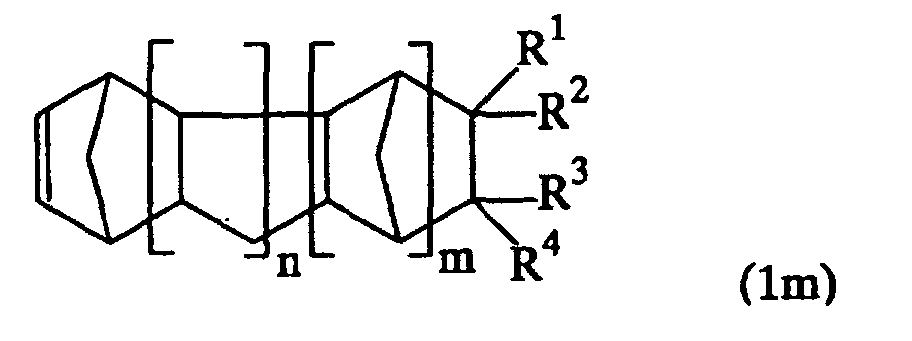 [wherein, m, n, R1, R2, R3 and R4 are as defined above in relation to the general formula
(1m) of the aforementioned norbornene derivative.]
[wherein, m, n, R1, R2, R3 and R4 are as defined above in relation to the general formula
(1m) of the aforementioned norbornene derivative.]
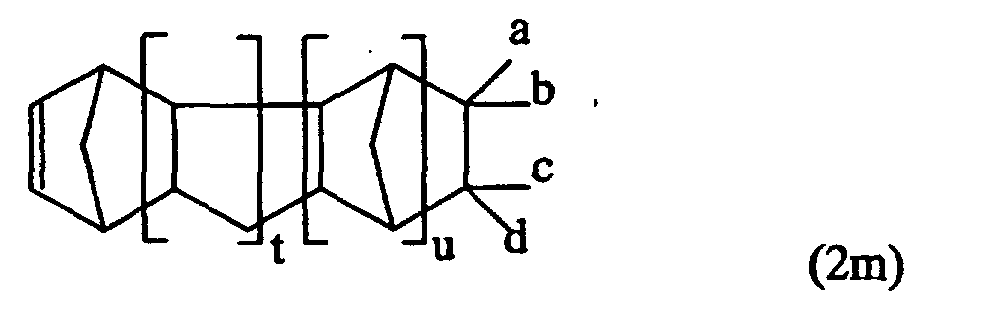 [wherein, t, u, a, b, c and d are as defined above in relation to the general formula (2).]
The quantities of the monomers used during this polymerization, expressed as a
weight ratio of the monomer (1) and the monomer (2) is typically within a range from
100/0 to 5/95, and preferably from 100/0 to 30/70, and even more preferably from 100/0
to 50/50.
The ring opening polymerization described above enables the production of a
norbornene-based ring opening polymer of the present invention containing the structural
unit (1), and in those cases in which the monomer (2) is used, also containing the
structural unit (2). In this case, both the X group in the structural unit (1) and the Y group
in the structural unit (2) are unsaturated groups represented by the formula -CH=CH-.
If a norbornene-based ring opening polymer obtained in this manner is
subsequently hydrogenated, then the aforementioned ethylene-based unsaturated group is
hydrogenated, and the aforementioned X and Y groups are converted to a group
represented by the formula -CH2-CH2-.
As follows is a more specific description of the monomer (1) and (2), although the
invention is not restricted to the examples presented here.
Examples of the monomer (1) used in the present invention include, for example,
ester compounds produced by the reaction of a norbornene alcohol and an aromatic
carboxylic acid, and more specifically, the compounds listed above in relation to the
aforementioned norbomene derivative. The compounds listed can be used either
singularly, or in combinations of two or more compounds.
Of the compounds, norbornene-based monomers wherein in the general formula
(1m), m=1 and n=0, and three of R1 to R4 are hydrogen atoms and the remaining one
group of R1 to R4 is a group represented by either the general formula (1-1) or the general
formula (1-2) described in relation to the general formula (1m) of the aforementioned
norbornene derivative produce polymers with high heat resistance and low water
absorption and are consequently preferred. In addition, use of either 5-(2-naphthalenecarbonyloxy)bicyclo[2.2.1]hept-2-ene
or 5-(4-biphenylcarbonyloxy)bicyclo[2.2.1]hept-2-ene
is effective in producing molded products
with low birefringence.
Specific examples of the structural unit (2) used in the present invention include
the following:
These norbornene-based monomers may be used in combination with the
monomer (1), either singularly or in combinations of two or more compounds.
Of these monomers, from the viewpoint of achieving a copolymer with a balance
between heat resistance, water absorption, and adhesion and bonding with other materials,
norbornene-based monomers in which at least one of a to d in the general formula (2m) is
a carboxylate ester residue represented by -(CH2)kCOOR22 (wherein, R22 is a hydrocarbon
group of 1 to 20 carbon atoms, and k is an integer from 0 to 10) are preferred. In addition,
8-methyl-8-methoxycarbonyltetracyclo[4.4.0.12,5.17,10]-3-dodecene is particularly
preferred as the production method is simple.
Examples of the hydrocarbon group of 1 to 20 carbon atoms represented by the
aforementioned R22 include alkyl groups such as methyl groups, ethyl groups and propyl
groups, aryl groups such as phenyl groups, and aralkyl groups such as benzyl groups.
Methyl groups, ethyl groups and phenyl groups are preferred, and methyl groups are
particularly desirable.
In a production method of the present invention, examples of copolymerizable
monomers which can be used other than the monomer (1) and the monomer (2) include
cycloolefins such as cyclobutene, cyclopentene, cyclooctene, and cyclodecene, as well as
non-conjugated cyclic polyolenes such as 1,5-cyclooctadiene and cyclododecatriene.
In the present production method, the aforementioned ring opening polymerization
may also be conducted in the presence of polybutadiene, polyisoprene, styrene-butadiene,
ethylene-non-conjugated diene polymers and unhydrogenated ring opening (co)polymers
of other norbornene-based monomers.
As follows is a further description of the polymerization conditions.
A ring opening polymerization catalyst used in the present invention utilizes a
metathesis catalyst of the type described below. This metathesis catalyst is a combination
of (a) at least one compound selected from the group consisting of W, Mo and Re
compounds, and (b) at least one compound selected from compounds of a group IA
element (such as Li, Na or K), a group IIA element (such as Mg or Ca), a group IIB
element (such as Zn, Cd or Hg), a group IIIB element (such as B or Al), a group IVA
element (such as Ti or Zr) or a group IVB element (such as Si, Sn or Pb) of the Deming
periodic table, which contain at least one bond between the aforementioned element and
carbon, or between the aforementioned element and hydrogen.
In order to raise the activity of the catalyst, an additive (c) described below may
also be added.
Representative examples of the W, Mo and Re compound of the constituent (a)
include those compounds disclosed in Japanese Laid-open publication (kokai) No. 1-240517
(JP1-240517A) such as WCl6, MoCl5 and ReOCl3.
Specific examples of the constituent (b) include those compounds disclosed in
Japanese Laid-open publication (kokai) No. 1-240517 (JP1-240517A) such as n-C4H9Li,
(C2H5)3Al, (C2H5)2AlCl, (C2H5)1.5AlCl1.5, (C2H5)AlCl2, methyl alumoxane and LiH.
Representative examples of the constituent (c) include alcohols, aldehydes, ketones
and amines, as well as those compounds disclosed in Japanese Laid-open publication
(kokai) No. 1-240517 (JP1-240517A).
The amount of the metathesis catalyst used should typically result in a molar ratio
between the aforementioned constituent (a) and the specified monomers (that is, the
monomer (1) and the monomer (2)), namely the ratio of constituent (a):specified
monomers, within a range from 1:500 to 1:50,000, and preferably within a range from
1:1000 to 1:10,000. The relative proportions of the constituent (a) and the constituent (b)
should produce a metal atom ratio (a):(b) within a range from 1:1 to 1:50, and preferably
from 1:2 to 1:30. The relative proportions of the constituent (a) and the constituent (c)
should produce a molar ratio (c):(a) within a range from 0.005:1 to 15:1, and preferably
from 0.05:1 to 7:1.
Regulation of the molecular weight of the ring opening polymer can also be
achieved through controlling the polymerization temperature, the type of catalyst and the
type of solvent, although in the present invention the molecular weight is preferably
regulated by adding a molecular weight regulating agent to the reaction system. Examples
of suitable molecular weight regulating agents include α-olefins such as ethylene, propene,
1-butene, 1-pentene, 1-hexene, 1-heptene, 1-octene, 1-nonene and 1-decene, as well as
styrene, and of these, 1-butene and 1-hexene are particularly preferred. This molecular
weight regulating agent may utilize a single compound, or a mixture of two or more
different regulating agents. The amount of the molecular weight regulating agent used
should be from 0.005 to 0.6 mols per 1 mol of the specified monomer (1) supplied to the
ring opening polymerization reaction, with quantities from 0.02 to 0.5 mols being
preferred.
Examples of suitable solvents for use in the ring opening polymerization reaction
(the solvent for dissolving the specified monomers, the metathesis catalyst and the
molecular weight regulating agent) include alkanes such as pentane, hexane, heptane,
octane, nonane and decane; cycloalkanes such as cyclohexane, cycloheptane, cyclooctane,
decalin and norbomane; aromatic hydrocarbons such as benzene, toluene, xylene,
ethylbenzene and cumene; halogenated hydrocarbon compounds such as chlorobutane,
bromohexane, methylene chloride, dichloroethane, hexamethylene dibromide,
chlorobenzene, chloroform and tetrachloroethylene; saturated carboxylate esters such as
ethyl acetate, n-butyl acetate, iso-butyl acetate and methyl propionate; and ethers such as
dibutyl ether, tetrahydrofuran and dimethoxyethane, and these solvents may be used
singularly, or in combinations of two or more solvents. Of the above solvents, the
aromatic hydrocarbons are preferred. The amount of solvent used should typically result
in a solvent:specified monomers ratio (weight ratio) within a range from 1:1 to 10:1, with
ratios from 1:1 to 5:1 being preferred.
A ring opening polymer obtained in the above manner can be used, as is, although
from the viewpoint of heat resistance stability, the use of a hydrogenated polymer, which
has undergone hydrogenation, is preferred. What is described as a hydrogenated product
or hydrogenated polymer in the present invention refers to compounds in which the olefin-based
unsaturated bonds within the principal chain of the polymer produced by the ring
opening polymerization of either the monomer (1), or the monomer (1) and the monomer
(2), have been hydrogenated, and the side chain aromatic rings based on the monomer (1)
or the monomer (2) have undergone essentially no hydrogenation.
The hydrogenation reaction must be performed under conditions wherein the side
chain aromatic rings based on the monomer (1) or the monomer (2) undergo essentially no
hydrogenation. Typically, a hydrogenation catalyst is added to the ring opening polymer
solution, and reaction is then conducted with hydrogen gas at a pressure within a range
from normal pressure to 300 atmospheres, and preferably from 3 to 200 atmospheres, and
at a temperature within a range from 0 to 200°C, and preferably from 20 to 180°C.
Examples of the hydrogenation catalyst include those catalysts typically used in
hydrogenation reactions of olefin-based compounds. These known hydrogenation
catalysts include both heterogeneous catalysts and homogeneous catalysts. Examples of
suitable heterogeneous catalysts include solid catalysts comprising a noble metal catalytic
material such as palladium, platinum, nickel, rhodium or ruthenium supported by a carrier
such as carbon, silica, alumina or titania. Examples of suitable homogeneous catalysts
include nickel naphthenate/triethyl aluminum, nickel acetylacetonate/triethyl aluminum,
cobalt octenate/n-butyl lithium, titanocene dichloride/diethyl aluminum monochloride,
rhodium acetate, chlorotris(triphenylphosphine)rhodium,
dichlorotris(triphenylphosphine)ruthenium,
chlorohydrocarbonyltris(triphenylphosphine)ruthenium, and
dichlorocarbonyltris(triphenylphosphine)ruthenium. The catalysts may be in powdered or
granulated form. The quantity of the hydrogenation catalyst added must be regulated to
ensure that the side chain aromatic rings based on the monomer (1) undergo essentially no.
hydrogenation, although typically a quantity is used which produces a ring opening
polymer:hydrogenation catalyst ratio (weight ratio) within a range from 1:1x10⁻⁶ to 1:2.
In a hydrogenated product of a ring opening polymer produced in the present
invention, at least 99.0% of the olefin-based unsaturated bonds within the principal chain
of the polymer produced by the ring opening polymerization are preferably hydrogenated,
whereas the side chain aromatic rings remain essentially unhydrogenated.
The intrinsic viscosity (ηinh) of a ring opening polymer of the present invention or
a hydrogenated product thereof, measured using an Ubbelohde viscometer, is typically
within a range from 0.25 to 5.0, and preferably from 0.3 to 4.0, and even more preferably
from 0.35 to 2.0. Furthermore, in molecular weight measurements using gel permeation
chromatography (GPC, tetrahydrofuran solution, polystyrene equivalence), the number
average molecular weight (Mn) is typically within a range from 1000 to 500,000, and
preferably from 2000 to 300,000, and even more preferably from 3000 to 100,000, and the
weight average molecular weight (Mw) is typically within a range from 5000 to 2,000,000,
and preferably from 10,000 to 1,000,000, and even more preferably from 30,000 to
500,000. If ηinh is less than 0.2, Mn is less than 1000, or Mw is less than 5000, then the
strength of the molded product deteriorates markedly. In contrast, if ηinh is greater than
0.5, Mn is greater than 500,000, or Mw is greater than 2,000,000, then the melt viscosity
or the solution viscosity of the ring opening polymer or the hydrogenated product thereof
becomes overly high, and obtaining the desired molded product may be difficult.
A variety of known additives can be added to a ring opening polymer of the
present invention or a hydrogenated product thereof. Examples of such additives include
phenol-based or hydroquinone-based antioxidants such as 2,6-di-t-butyl-4-methylphenol,
2,2-methylenebis(4-ethyl-6-t-butylphenol), 2,5-di-t-butylhydroquinone,
tetrakis[methylene-3-(3,5-di-t-butyl-4-hydroxyphenyl)propionate]methane, 4,4-thiobis-(6-t-butyl-3methylphenol),
1,4-bis(4-hydroxyphenyl)cyclohexane and octadecyl-3-(3,5-di-t-butyl-4-hydroxyphenyl)propionate,
as well as phosphorus-based antioxidants such as
tris(4-methoxy-3,5-diphenyl)phosphite, tris(nonylphenyl)phosphite and tris(2,4-di-t-butylphenyl)phosphite,
and by adding either one, or two or more of these antioxidants, the
oxidation stability of the ring opening polymer or the hydrogenated product thereof can be
improved. In addition, by adding ultraviolet absorbing agents such as 2,4-dihydroxybenzophenone,
2-hydroxy-4-methoxybenzophenone and 2,2-methylenebis[4-(1,1,3,3-tetramethylbutyl)-6-[(2H-benzotriazol-2-yl)phenol]],
the light resistance can be
improved. Additives such as lubricants may also be added to improve the workability.
A norbornene-based polymer of the present invention displays excellent
transparency, low water absorption and a low birefringence, and moreover generates a
uniform retardation. As a result, a polymer of the present invention is useful within fields
such as optics, and electrical and electronic materials. For example, the polymers can be
ideally applied to use as molding materials for optical disks, magneto-optical disks, optical
lenses (such as F lenses, pickup lenses, laser printer lenses and camera lenses), spectacle
lenses, optical films or sheets (such as display films, retardation films, polarizing films,
polarizing plate protective films, diffusion films, antireflective films, liquid crystal
substrates, EL substrates, electronic paper substrates, touch panel substrates and PDP front
plates), transparent conductive film substrates, optical fibers, light guide plates, light
diffusion plates, optical cards, optical mirrors, IC, LSI and LED sealing materials.
As follows is a more detailed description of the present invention using a series of
examples. However, the present invention is in no way limited to the examples presented
below.
The various measurements and evaluations within the examples and the
comparative examples were conducted in the manner described below.
Monomer purity was determined using a high performance liquid chromatography
(HPLC) device manufactured by Tosoh Corporation, and using methanol as the solvent.
The polystyrene equivalent weight average molecular weight (Mw), and the
molecular weight distribution (Mw/Mn) were measured using an HLC-8020 gel
permeation chromatography (GPC) device manufactured by Tosoh Corporation, and using
tetrahydrofuran (THF) as the solvent. Mn represents the number average molecular
weight.
Using a differential scanning calorimeter (DSC) manufactured by Seiko
Instruments Inc., the glass transition temperature was measured under a nitrogen
atmosphere, with a rate of temperature increase of 20°C per minute.
A polymer obtained by polymerization was pelletized, and an optical disk substrate
of external diameter 130 mm and internal diameter 15 mm was then formed by injection
molding under conditions including a resin temperature of 270°C and a die temperature of
110°C using an injection molding device (DISK-3, manufactured by Sumitomo Heavy
Industries, Ltd.). Using the thus formed optical disk substrate, the retardation of the 130
mm diameter optical disk substrate, within a range from a radius of 30 to 60 mm from the
center of the substrate, was measured by a double pulse method (perpendicular incidence)
with a light source wavelength of 633 nm, using a birefringence automatic measurement
apparatus (manufactured by Nippon Densi Kogaku co., ltd.), and this retardation value
was used as the value for birefringence evaluation. As this retardation value decreases, the
molded material can be considered as displaying a lower birefringence.
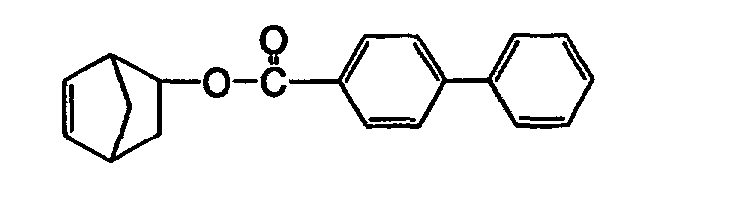
28 g (253.9 mmol) of norbornene alcohol (endo form/exo form molar ratio of 8/1)
was measured into a 500 mL flask equipped with a dropping funnel, and the air in the
system was replace with nitrogen. 41 mL (507.8 mmol) of pyridine was then added
dropwise, and stirred well with a stirrer to dissolve the pyridine. Subsequently, with the
temperature of the reaction system maintained at 4±2°C using an ice bath, and with
adequate stirring, 50 g (230.8 mmol) of 4-phenylbenzoyl chloride dissolved in 200 mL of
THF (tetrahydrofuran) was gradually added dropwise. Following completion of this
dropwise addition, stirring was continued for 1 hour with the reaction system still in the
ice bath, and then for a further 1 hour at room temperature, and finally the reaction system
was refluxed for 30 minutes. Following cooling to room temperature, the generated
pyridine salts were removed by filtration, and the reaction mixture was thoroughly washed
with distilled water. The solvent was then removed under reduced pressure, with heating,
and the thus obtained crystals were repeatedly recrystallized from n-hexane, yielding 63 g
of white crystals of 5-(4-biphenylcarbonyloxy)bicyclo[2.2.1]hept-2-ene (monomer).
Analysis of the product crystals by HPLC revealed a purity of 98%.
The 1H-NMR spectrum and the infrared absorption (IR) spectrum of the product
monomer are shown in FIG. 1 and FIG. 2.
In the 1H-NMR spectrum shown in FIG. 1, the endo type proton bonded to the
carbon at position 5 of the bicyclo[2.2.1]hept-2-ene structure was observed at 4.9 ppm,
and the exo type proton was observed at 5.5 ppm, and from the relative intensities, the
stereoisomeric ratio (the endo type/exo type molar ratio) for the 4-biphenylcarbonyloxy
group within the compound was identified as 8/1. In addition, the protons bonded to the
carbons at positions 2 and 3 of the bicyclo[2.2.1]hept-2-ene structure were observed at 6.1
ppm and 6.4 ppm respectively, and the protons bonded to the biphenyl rings were
observed within a range from 7.3 to 8.0 ppm, enabling the above compound to be
identified.
In the infrared absorption (IR) spectrum shown in FIG. 2, the stretching vibration
absorption for the CH groups of the benzene rings was observed within the vicinity of
3055 cm-1, and the stretching vibration absorption for the CO group within the ester
carbonyl group was observed within the vicinity of 1710 cm-1.

With the exceptions of using 44 g (230.8 mmol) of 2-naphthoyl chloride instead of
4-phenylbenzoyl chloride, and purifying the reactants using a column (filler: Al2O3,
developing solvent: hexane), reaction in the same manner as the example 1 yielded 46 g of
a white solid of 5-(2-naphthalenecarbonyloxy)bicyclo[2.2.1]hept-2-ene. Analysis of the
product monomer by HPLC revealed a purity of 99%.
Analysis of the 1H-NMR spectrum in the same manner as described above for the
example 1 revealed a stereoisomeric ratio (the endo type/exo type molar ratio) for the
substituent group within the monomer of 8/1. Furthermore, in the infrared absorption (IR)
spectrum, the stretching vibration absorption for the CH groups of the aromatic rings was
observed within the vicinity of 3050 cm-1, and the stretching vibration absorption for the
CO group within the ester carbonyl group was observed within the vicinity of 1710 to
1730 cm-1.
The 1H-NMR spectrum and the infrared absorption (IR) spectrum of the product
monomer are shown in FIG. 3 and FIG. 4.
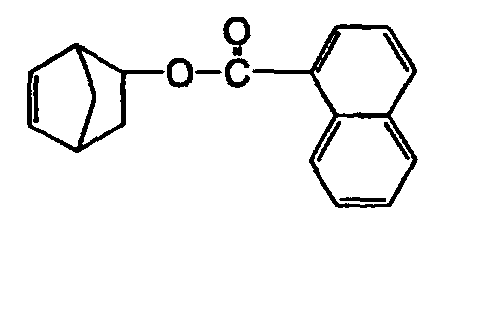
With the exception of using 44 g (230.8 mmol) of 1-naphthoyl chloride instead of
2-naphthoyl chloride, reaction in the same manner as the example 2 yielded 43.8 g of a
transparent liquid of 5-(1-naphthalenecarbonyloxy)bicyclo[2.2.1]hept-2-ene. Analysis of
the product monomer by HPLC revealed a purity of 98%.
Analysis of the 1H-NMR spectrum in the same manner as described above for the
example 1 revealed a stereoisomeric ratio (the endo type/exo type molar ratio) for the
substituent group within the monomer of 8/1. Furthermore, in the infrared absorption (IR)
spectrum, the stretching vibration absorption for the CH groups of the aromatic rings was
observed within the vicinity of 3050 cm-1, and the stretching vibration absorption for the
CO group within the ester carbonyl group was observed within the vicinity of 1710 to
1730 cm-1.
The 1H-NMR spectrum and the infrared absorption (IR) spectrum of the product
monomer are shown in FIG. 5 and FIG. 6.

With the exceptions of using 55.5 g (230.8 mmol) of 9-anthracenoyl chloride
instead of 4-phenylbenzoyl chloride, purifying the reactants using a column (filler: Al2O3,
developing solvent: hexane), and performing recrystallization using a hexane/methylene
chloride mixed solvent, reaction in the same manner as the example 1(1) yielded 25.9 g of
a light yellow colored solid of 5-(9-anthracenecarbonyloxy)bicyclo[2.2.1]hept-2-ene.
Analysis of the product monomer by HPLC revealed a purity of 98%.
Analysis of the 1H-NMR spectrum in the same manner as described above for the
example 1 revealed a stereoisomeric ratio (the endo type/exo type molar ratio) for the
substituent group within the monomer of 8/1. Furthermore, in the infrared absorption (IR)
spectrum, the stretching vibration absorption for the CH groups of the aromatic rings was
observed within the vicinity of 3050 cm-1, and the stretching vibration absorption for the
CO group within the ester carbonyl group was observed within the vicinity of 1710 to
1730 cm-1.
The 1H-NMR spectrum and the infrared absorption (IR) spectrum of the product
monomer are shown in FIG. 7 and FIG. 8.
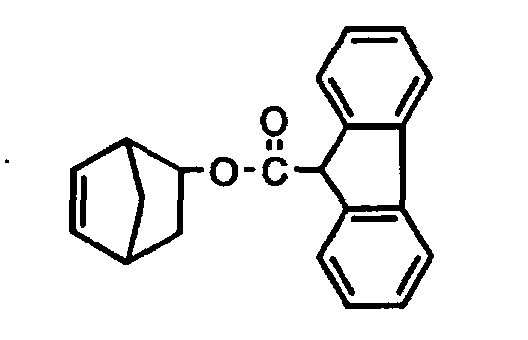
With the exception of using 52.8 g (230.8 mmol) of 9-fluorenoyl chloride instead
of 9-anthracenoyl chloride, reaction in the same manner as the example 4 yielded 14.0 g of
a yellow colored solid of 5-(9-fluorenecarbonyloxy)bicyclo[2.2.1]hept-2-ene. Analysis of
the product monomer by HPLC revealed a purity of 98%.
Analysis of the 1H-NMR spectrum in the same manner as described above for the
example 1 revealed a stereoisomeric ratio (the endo type/exo type molar ratio) for the
substituent group within the monomer of 8/1. Furthermore, in the infrared absorption (IR)
spectrum, the stretching vibration absorption for the CH groups of the aromatic rings was
observed within the vicinity of 3050 cm-1, and the stretching vibration absorption for the
CO group within the ester carbonyl group was observed within the vicinity of 1710 to
1730 cm-1.
The 1H-NMR spectrum and the infrared absorption (IR) spectrum of the product
monomer are shown in FIG. 9 and FIG. 10.
14 g of 5-(4-biphenylcarbonyloxy)bicyclo[2.2.1]hept-2-ene as the specified
monomer, 0.2 g of 1-hexene as a molecular weight regulating agent, and 28 g of toluene
were combined in a reaction vessel in which the air had been replaced with nitrogen gas,
and were then heated to 80°C. To this reaction mixture was added 0.17 ml of a toluene
solution of triethyl aluminum (0.6 mol/L) and 0.38 ml of a methanol modified WCl6
toluene solution (0.025 mol/L), and a polymer was obtained by reaction for 3 hours at
80°C. A polymer with a weight average molecular weight (Mw) of 9.3 × 10⁴ and a
molecular weight distribution (Mw/Mn) = 2.32 was obtained.
The thus obtained polymer solution was placed in an autoclave, and a further 28 g
of toluene was added. A hydrogenation catalyst RuHCl(CO)[P(C6H5)]3 was added at a
ratio of 500 ppm relative to the quantity of added monomer, and reaction was then
conducted for 3 hours under a hydrogen gas pressure of 9 to 10 MPa and at a temperature
of 160 to 165°C. Following completion of the reaction, the hydrogenated product [weight
average molecular weight (Mw) = 10.3 × 10⁴, molecular weight distribution (Mw/Mn) =
2.13, intrinsic viscosity (ηinh) = 0.58, and glass transition temperature (Tg) = 97.5°C] was
obtained by precipitation within a large volume of isopropanol. Determination of the
hydrogenation ratio of the hydrogenated product using 400 MHz 1H-NMR measurements
revealed that at least 99.0% of the olefin-based unsaturated bonds within the principal
chain had been hydrogenated, whereas the side chain aromatic rings were essentially
unhydrogenated. Furthermore, using this hydrogenated product, a disk was formed under
the conditions described in the "Measurement of Retardation" section above, and
measurement of the retardation revealed a maximum of 2 nm.
The 1H-NMR spectrum of the product polymer is shown in FIG. 11, and the
infrared absorption (IR) spectrum is shown in FIG. 12.
In a similar manner to the example 6,14 g of 5-(1-naphthalenecarbonyloxy)bicyclo[2.2.1]hept-2-ene
as the specified monomer, 0.2 g of 1-hexene
as a molecular weight regulating agent, and 28 g of toluene were combined in a
reaction vessel in which the air had been replaced with nitrogen gas, and were then heated
to 80°C. To this reaction mixture was added 0.17 ml of a toluene solution of triethyl
aluminum (0.6 mol/L) and 0.38 ml of a methanol modified WCl6 toluene solution (0.025
mol/L), and a polymer was obtained by reaction for 3 hours at 80°C. A polymer with a
weight average molecular weight (Mw) of 17.0 × 10⁴ and Mw/Mn = 4.00 was obtained. A
hydrogenation reaction was also conducted in a similar manner to the example 6, and a
corresponding hydrogenated product [weight average molecular weight (Mw) = 16.1 × 10⁴,
molecular weight distribution (Mw/Mn) = 3.20, intrinsic viscosity (ηinh) = 0.74, and glass
transition temperature (Tg) = 74.0°C] was obtained. Determination of the hydrogenation
ratio of the hydrogenated product using 400 MHz 1H-NMR measurements revealed that at
least 99.0% of the olefin-based unsaturated bonds within the principal chain had been
hydrogenated, whereas the side chain aromatic rings were essentially unhydrogenated.
Furthermore, using this hydrogenated product, a disk was formed under the conditions
described in the "Measurement of Retardation" section above, and measurement of the
retardation revealed a maximum of 9 nm.
The 1H-NMR spectrum of the product polymer is shown in FIG. 13, and the
infrared absorption (IR) spectrum is shown in FIG. 14.
In a similar manner to the example 6, 14 g of 5-(2-naphthalenecarbonyloxy)bicyclo[2.2.1]hept-2-ene
as the specified monomer, 0.2 g of 1-hexene
as a molecular weight regulating agent, and 28 g of toluene were combined in a
reaction vessel in which the air had been replaced with nitrogen gas, and were then heated
to 80°C. To this reaction mixture was added 0.17 ml of a toluene solution of triethyl
aluminum (0.6 mol/L) and 0.38 ml of a methanol modified WCl6 toluene solution (0.025
mol/L), and a polymer was obtained by reaction for 3 hours at 80°C. A polymer with a
weight average molecular weight (Mw) of 13.0 × 10⁴ and a molecular weight distribution
(Mw/Mn) = 3.25 was obtained. A hydrogenation reaction was also conducted in a similar
manner to the example 6, and a corresponding hydrogenated product [weight average
molecular weight (Mw) = 11.9 × 10⁴, molecular weight distribution (Mw/Mn) = 2.64,
intrinsic viscosity (ηinh) = 0.66, and glass transition temperature (Tg) = 82.4°C] was
obtained. Determination of the hydrogenation ratio of the hydrogenated product using 400
MHz 1H-NMR measurements revealed that at least 99.0% of the olefin-based unsaturated
bonds within the principal chain had been hydrogenated, whereas the side chain aromatic
rings were essentially unhydrogenated. Furthermore, using this hydrogenated product, a
disk was formed under the conditions described in the "Measurement of Retardation"
section above, and measurement of the retardation revealed a maximum of 3 nm.
The 1H-NMR spectrum of the product polymer is shown in FIG. 15, and the
infrared absorption (IR) spectrum is shown in FIG. 16.
30 g of 5-(4-biphenylcarbonyloxy)bicyclo[2.2.1]hept-2-ene and 20 g of 8-methoxycarbonyl-8-methyltetracyclo[4.4.0.12,5.17,10]-3-dodecene
of the formula shown
below as the specified monomers,
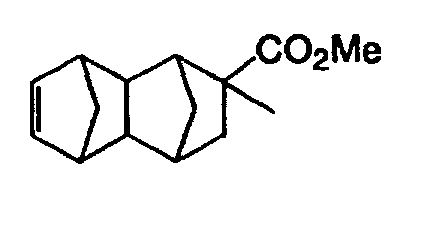 1.2 g of 1-hexene as a molecular weight regulating agent, and 100 g of toluene were
combined in a reaction vessel in which the air had been replaced with nitrogen gas, and
were then heated to 80°C. To this reaction mixture was added 0.5 ml of a toluene solution
of triethyl aluminum (0.6 mol/L) and 1.52 ml of a methanol modified WCl6 toluene
solution (0.025 mol/L), and a polymer was obtained by reaction for 3 hours at 80°C. A
hydrogenation reaction was then conducted in a similar manner to the example 6, and a
corresponding hydrogenated product [weight average molecular weight (Mw) = 17.4 × 10⁴,
molecular weight distribution (Mw/Mn) = 3.21, intrinsic viscosity (ηinh) = 0.77, and glass
transition temperature (Tg) = 126°C] was obtained. Determination of the hydrogenation
ratio of the hydrogenated product using 400 MHz 1H-NMR measurements revealed that at
least 99.0% of the olefin-based unsaturated bonds within the principal chain had been
hydrogenated, whereas the side chain aromatic rings were essentially unhydrogenated.
Furthermore, using this hydrogenated product, a disk was formed under the conditions
described in the "Measurement of Retardation" section above, and measurement of the
retardation revealed a maximum of 4 nm.
1.2 g of 1-hexene as a molecular weight regulating agent, and 100 g of toluene were
combined in a reaction vessel in which the air had been replaced with nitrogen gas, and
were then heated to 80°C. To this reaction mixture was added 0.5 ml of a toluene solution
of triethyl aluminum (0.6 mol/L) and 1.52 ml of a methanol modified WCl6 toluene
solution (0.025 mol/L), and a polymer was obtained by reaction for 3 hours at 80°C. A
hydrogenation reaction was then conducted in a similar manner to the example 6, and a
corresponding hydrogenated product [weight average molecular weight (Mw) = 17.4 × 10⁴,
molecular weight distribution (Mw/Mn) = 3.21, intrinsic viscosity (ηinh) = 0.77, and glass
transition temperature (Tg) = 126°C] was obtained. Determination of the hydrogenation
ratio of the hydrogenated product using 400 MHz 1H-NMR measurements revealed that at
least 99.0% of the olefin-based unsaturated bonds within the principal chain had been
hydrogenated, whereas the side chain aromatic rings were essentially unhydrogenated.
Furthermore, using this hydrogenated product, a disk was formed under the conditions
described in the "Measurement of Retardation" section above, and measurement of the
retardation revealed a maximum of 4 nm.
The 1H-NMR spectrum of the product polymer is shown in FIG. 17, and the
infrared absorption (IR) spectrum is shown in FIG. 18.
6.0 g of 5-(9-anthracenecarbonyloxy)bicyclo[2.2.1]hept-2-ene and 4.4 g of 8-methoxycarbonyl-8-methyltetracyclo[4.4.0.12,5.17,10]-3-dodecene
as the specified
monomers, 0.24 g of 1-hexene as a molecular weight regulating agent, and 21 g of toluene
were combined in a reaction vessel in which the air had been replaced with nitrogen gas,
and were then heated to 80°C. To this reaction mixture was added 0.1 ml of a toluene
solution of triethyl aluminum (0.6 mol/L) and 0.31 ml of a methanol modified WCl6
toluene solution (0.025 mol/L), and a polymer was obtained by reaction for 3 hours at
80°C. A hydrogenation reaction was then conducted in a similar manner to the example 6,
and a corresponding hydrogenated product [glass transition temperature (Tg) = 116°C]
was obtained. Determination of the hydrogenation ratio of the hydrogenated product
using 400 MHz 1H-NMR measurements revealed that at least 99.0% of the olefin-based
unsaturated bonds within the principal chain had been hydrogenated, whereas the side
chain aromatic rings were essentially unhydrogenated. Furthermore, using this
hydrogenated product, a disk was formed under the conditions described in the
"Measurement of Retardation" section above, and measurement of the retardation revealed
a maximum of 5 nm.
The infrared absorption (IR) spectrum of the product polymer is shown in FIG. 19.
4.3 g of 5-(9-fluorenecarbonyloxy)bicyclo[2.2.1]hept-2-ene and 3.3 g of 8-methoxycarbonyl-8-methyltetracyclo[4.4.0.12,5.17,10]-3-dodecene
as the specified
monomers, 0.18 g of 1-hexene as a molecular weight regulating agent, and 15 g of toluene
were combined in a reaction vessel in which the air had been replaced with nitrogen gas,
and were then heated to 80°C. To this reaction mixture was added 0.07 ml of a toluene
solution of triethyl aluminum (0.6 mol/L) and 0.23 ml of a methanol modified WCl6
toluene solution (0.025 mol/L), and a polymer was obtained by reaction for 3 hours at
80°C. A hydrogenation reaction was then conducted in a similar manner to the example 6,
and a corresponding hydrogenated product [glass transition temperature (Tg) = 103°C]
was obtained. Determination of the hydrogenation ratio of the hydrogenated product
using 400 MHz 1H-NMR measurements revealed that at least 99.0% of the olefin-based
unsaturated bonds within the principal chain had been hydrogenated, whereas the side
chain aromatic rings were essentially unhydrogenated. Furthermore, using this
hydrogenated product, a disk was formed under the conditions described in the
"Measurement of Retardation" section above, and measurement of the retardation revealed
a maximum of 5 nm.
The infrared absorption (IR) spectrum of the product polymer is shown in FIG. 20.
[Comparative Example 1]
50g of 8-methoxycarbonyl-8-methyltetracyclo[4.4.0.12,5.17,10]-3-dodecene as the
specified monomer, 3.6 g of 1-hexene as a molecular weight regulating agent, and 100 g
of toluene were combined in a reaction vessel in which the air had been replaced with
nitrogen gas, and were then heated to 80°C. To this reaction mixture was added 0.09 ml
of a toluene solution of triethyl aluminum (0.6 mol/L) and 0.29 ml of a methanol modified
WCl6 toluene solution (0.025 mol/L), and a polymer was obtained by reaction for 3 hours
at 80°C. A hydrogenation reaction was then conducted in a similar manner to the example
6, and a corresponding hydrogenated product [glass transition temperature (Tg) = 164°C,
weight average molecular weight (Mw) = 56,000, molecular weight distribution (Mw/Mn)
= 3.2] was obtained. Determination of the hydrogenation ratio of the hydrogenated
product using 400 MHz 1H-NMR measurements revealed that at least 99.0% of the olefin-based
unsaturated bonds within the principal chain had been hydrogenated. Furthermore,
using this hydrogenated product, a disk was formed under the conditions described in the
"Measurement of Retardation" section above, and measurement of the retardation revealed
a maximum of 20 nm.
The results of the retardation measurements for the examples 6 to 11 and the
comparative example 1, and the glass transition temperatures for the hydrogenated
products, are shown in Table 1.
| Example | Retardation value (nm) | Glass transition temperature (°C) |
| Example 6 | 2 | 97.5 |
| Example 7 | 9 | 74.0 |
| Example 8 | 3 | 82.4 |
| Example 9 | 4 | 126.0 |
| Example 10 | 5 | 116.0 |
| Example 11 | 5 | 103.0 |
| Comparative Example 1 | 20 | 167.0 |
A polymer and a hydrogenated product thereof produced from a norbornene
derivative of the present invention retain excellent transparency and heat resistance, and a
low level of water absorption, while displaying a lower birefringence than conventional
cyclic olefin resins. Accordingly, the norbornene derivatives of the present invention are
extremely useful optical resin precursor monomers. Because polymers and hydrogenated
products thereof according to the present invention retain excellent transparency, heat
resistance, and water resistance, while displaying a low birefringence, they can be applied
to optical materials which require extremely precise optical design such as optical disks,
magneto-optical disks, optical lenses (such as F lenses, pickup lenses, laser printer lenses
and camera lenses), spectacle lenses, optical films or sheets (such as display films,
retardation films, polarizing films, polarizing plate protective films, diffusion films,
antireflective films, liquid crystal substrates, EL substrates, electronic paper substrates,
touch panel substrates and PDP front plates), transparent conductive film substrates,
optical fibers, light guide plates, optical cards, optical mirrors, IC, LSI and LED sealing
materials.
Claims (11)
- A norbornene derivative represented by a general formula (1m) shown below:wherein, at least one of R1 to R4 is a group selected from the group consisting of an aromatic ring-containing group represented by a general formula (1-1) shown below and an aromatic ring-containing group represented by a general formula (1-2) shown below, any remaining groups among R1, R2, R3 and R4, where present, represent, independently, a hydrogen atom; a halogen atom; a substituted or unsubstituted monovalent hydrocarbon group of 1 to 30 carbon atoms which may contain a linkage group containing oxygen, nitrogen, sulfur or silicon; or a monovalent polar group, and m and n each represent, independently, an integer from 0 to 2;
 wherein, R5 to R13 each represent, independently, a hydrogen atom; a halogen atom; a substituted or unsubstituted monovalent hydrocarbon group of 1 to 30 carbon atoms which may contain a linkage group containing oxygen, nitrogen, sulfur or silicon; or a monovalent polar group, and p and q each represent, independently an integer from 0 to 2, provided that in a case in which p=q=0, R6 and R9, and/or R13 and R9, are bonded to each other to form a carbon homocyclic ring or a heterocyclic ring, said carbon homocyclic ring or heterocyclic ring being a single ring structure, or forming a polycyclic structure by condensation with at least one other ring, or alternatively at least one of R5, R6, R9, R12 and R13 is a substituted or unsubstituted aromatic group;
 [wherein, Z, RA and RB each represent, independently, a hydrogen atom; a halogen atom; a substituted or unsubstituted monovalent hydrocarbon group of 1 to 30 carbon atoms which may contain a linkage group containing oxygen, nitrogen, sulfur or silicon; or a monovalent polar group, provided that one of RA, RB and Z is a group represented by a formula -C(O)O- in which the carbonyl group side is bonded to a carbon atom of a ring structure within said formula (1-2), and s represents an integer of 0 or greater].
- The norbornene derivative according to claim 1, wherein in said general formula (1m), n is 0, and m is either 0 or 1.
- The norbornene derivative according to claim 1, wherein in said general formula (1-1), p is either 0 or 1, and q is either 0 or 1, and in said general formula (1-2), s is either 0 or 1.
- The norbornene derivative according to claim 2, comprising at least 10 mol% of stereoisomers in which at least one of said groups selected from the group consisting of groups represented by said general formula (1-1) and groups represented by said general formula (1-2) is bonded to an α position shown in a partial structural formula represented by a formula (3) shown below.

- A norbomene-based ring opening polymer comprising a structural unit (1) represented by a general formula (1) shown below:[wherein, X is a group represented by a formula -CH=CH- or a group represented by a formula -CH2-CH2-, and m, n, R1, R2, R3 and R4 are as defined above in relation to said general formula (1m) in claim 1],

wherein a plurality of X groups which exist may be either identical or different. - The norbornene-based ring opening polymer according to claim 5, further comprising a structural unit (2) represented by a general formula (2) shown below:[wherein, t and u each represent, independently, an integer from 0 to 2, Y is a group represented by a formula -CH=CH- or a group represented by a formula -CH2-CH2-, a, b, c and d each represent, independently, a hydrogen atom; a halogen atom; a substituted or unsubstituted monovalent hydrocarbon group of 1 to 30 carbon atoms which may contain a linkage group containing oxygen, nitrogen, sulfur or silicon; or a monovalent polar group, or alternatively a and b, b and c, or c and d may be bonded to each other to form a carbon homocyclic ring or a heterocyclic ring (and said carbon homocyclic ring or heterocyclic ring may be a single ring structure, or may form a polycyclic structure by condensation with another ring)],

wherein a plurality of Y groups which exist may be either identical or different. - The norbornene-based ring opening polymer according to claim 6, wherein a proportion of said structural unit (2) relative to a combined total of said structural unit (1) and said structural unit (2) is no more than 95% by weight.
- A method of producing a norbornene-based ring opening polymer with a structural unit (1) represented by said general formula (1) in claim 5 in which X is a group represented by a formula -CH=CH-, wherein a norbornene-based monomer comprising a norbornene derivative represented by a general formula (1m) shown below is subjected to ring opening polymerization:[wherein, m, n, R1, R2, R3 and R4 are as defined above in relation to said general formula (1m) in claim 1].

- The method of producing a norbomene-based ring opening polymer according to claim 8, wherein said norbornene-based monomer comprises a norbornene-based monomer represented by a general formula (2m) shown below in addition to said norbornene derivative represented by said general formula (1m), and said norbomene-based ring opening polymer comprises a structural unit (1) represented by said general formula (1) in which X is a group represented by a formula -CH=CH-, and a structural unit (2) represented by said general formula (2) in claim 6 in which Y is a group represented by a formula -CH=CH-:wherein, t, u, a, b, c and d are as defined above in relation to said general formula (2) in claim 6.
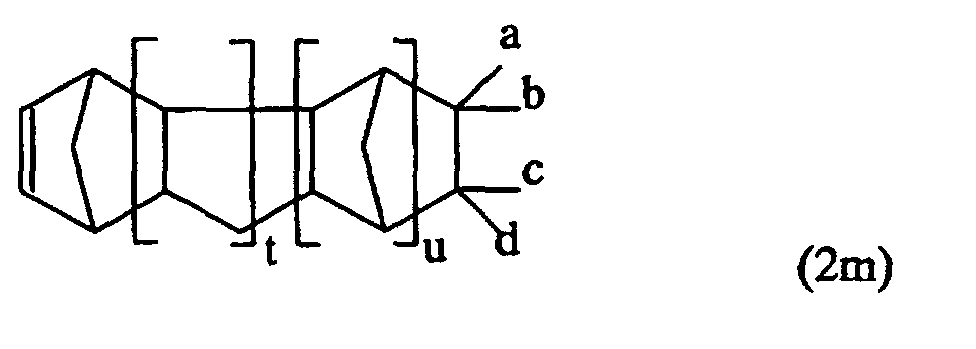
- A method of producing a norbornene-based ring opening polymer with a structural unit (1) represented by said general formula (1) according to claim 5 (in which X is a group represented by a formula -CH2-CH2-), wherein a norbornene-based monomer comprising a norbornene derivative represented by a general formula (1m) shown below is subjected to ring opening polymerization:[wherein, m, n, R1, R2, R3 and R4 are as defined above in relation to said general formula (1m) according to claim 1].
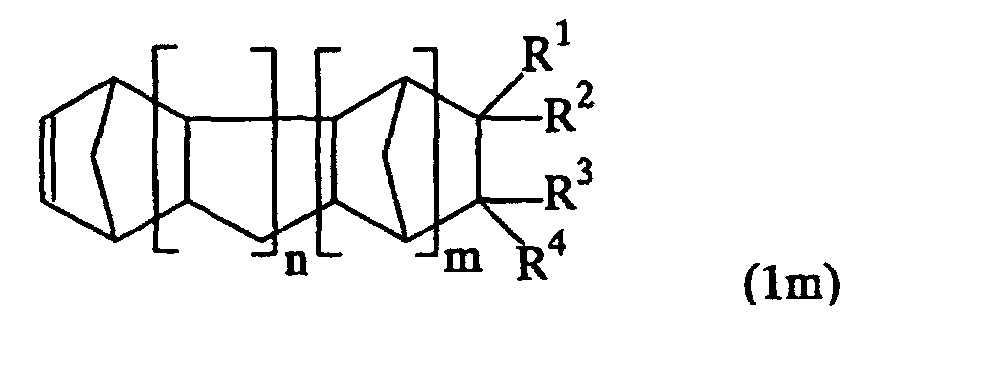
- The method of producing a norbornene-based ring opening polymer according to claim 10, wherein said norbornene-based monomer comprises a norbornene-based monomer represented by a general formula (2m) shown below in addition to said norbornene derivative represented by said general formula (1m), and said norbornene-based ring opening polymer comprises a structural unit (1) represented by said general formula (1) (in which X is a group represented by a formula -CH2-CH2-), and a structural unit (2) represented by said general formula (2) according to claim 6 (in which Y is a group represented by a formula -CH2-CH2-):[wherein, t, u, a, b, c and d are as defined above in relation to said general formula (2) according to claim 6].

Applications Claiming Priority (7)
| Application Number | Priority Date | Filing Date | Title |
|---|---|---|---|
| JP2001313178 | 2001-10-10 | ||
| JP2001313178 | 2001-10-10 | ||
| JP2002039120A JP3975770B2 (en) | 2002-02-15 | 2002-02-15 | Norbornene derivative |
| JP2002039120 | 2002-02-15 | ||
| JP2002049481 | 2002-02-26 | ||
| JP2002049481 | 2002-02-26 | ||
| PCT/JP2002/010433 WO2003033454A1 (en) | 2001-10-10 | 2002-10-08 | Norbornene derivative and norbornene polymer obtained therefrom through ring-opening polymerization |
Publications (2)
| Publication Number | Publication Date |
|---|---|
| EP1435350A1 true EP1435350A1 (en) | 2004-07-07 |
| EP1435350A4 EP1435350A4 (en) | 2006-02-08 |
Family
ID=27347671
Family Applications (1)
| Application Number | Title | Priority Date | Filing Date |
|---|---|---|---|
| EP02777813A Withdrawn EP1435350A4 (en) | 2001-10-10 | 2002-10-08 | Norbornene derivative and norbornene polymer obtained therefrom through ring-opening polymerization |
Country Status (7)
| Country | Link |
|---|---|
| US (1) | US6846890B2 (en) |
| EP (1) | EP1435350A4 (en) |
| KR (2) | KR100929966B1 (en) |
| CN (1) | CN1321971C (en) |
| CA (1) | CA2459384A1 (en) |
| TW (1) | TWI232856B (en) |
| WO (1) | WO2003033454A1 (en) |
Cited By (1)
| Publication number | Priority date | Publication date | Assignee | Title |
|---|---|---|---|---|
| CN105418863A (en) * | 2014-09-12 | 2016-03-23 | Jsr株式会社 | Block copolymer and preparation method thereof and membrane |
Families Citing this family (36)
| Publication number | Priority date | Publication date | Assignee | Title |
|---|---|---|---|---|
| CN1298762C (en) * | 2002-11-14 | 2007-02-07 | Jsr株式会社 | Norbornene open-ring polymers |
| WO2005057530A1 (en) * | 2003-11-28 | 2005-06-23 | Zeon Corporation | Thin film transistor integrated circuit device, active matrix display device, and manufacturing method of the same |
| KR100581179B1 (en) * | 2003-12-12 | 2006-05-17 | 금호석유화학 주식회사 | Novorene monomers and polymers for blue light emitting materials |
| JP2005274725A (en) * | 2004-03-23 | 2005-10-06 | Nippon Zeon Co Ltd | Optical laminate, optical element, and liquid crystal display device |
| JP4336232B2 (en) * | 2004-03-29 | 2009-09-30 | 富士通コンポーネント株式会社 | Touch panel |
| US7554736B2 (en) * | 2004-04-02 | 2009-06-30 | Konica Minolta Opto, Inc. | Objective lens and optical pickup apparatus |
| KR20070094825A (en) * | 2005-01-05 | 2007-09-21 | 제이에스알 가부시끼가이샤 | Thermoplastic Compositions, Optical Films, and Film Manufacturing Methods |
| US20090176950A1 (en) * | 2005-05-25 | 2009-07-09 | Jsr Corporation | Metal hydride complex, method of hydrogenating ring-opening polymerization polymer of cycloolefin, and process for producing product of hydrogenation of ring-opening polymerization polymer of cycloolefin |
| KR100873779B1 (en) * | 2006-06-26 | 2008-12-15 | 주식회사 엘지화학 | Method for producing norbornene monomer composition, norbornene polymer prepared therefrom, optical film comprising the norbornene polymer, and method for producing the norbornene polymer |
| JP2008031292A (en) * | 2006-07-28 | 2008-02-14 | Fujifilm Corp | Norbornene polymer film, and retardation film, polarizing plate and liquid crystal display device using the same |
| EP2510036A2 (en) * | 2009-12-11 | 2012-10-17 | Promerus LLC | Norbornene-type polymers having quaternary ammonium functionality |
| US8765894B2 (en) | 2009-12-11 | 2014-07-01 | Promerus, Llc | Norbornene-type polymers having quaternary ammonium functionality |
| US9469733B2 (en) | 2014-05-30 | 2016-10-18 | Pall Corporation | Self-assembled structure and membrane comprising block copolymer and process for producing the same by spin coating (IVa) |
| US9592476B2 (en) | 2014-05-30 | 2017-03-14 | Pall Corporation | Membrane comprising self-assembled block copolymer and process for producing the same by hybrid casting (IIb) |
| US9616395B2 (en) | 2014-05-30 | 2017-04-11 | Pall Corportaion | Membrane comprising self-assembled block copolymer and process for producing the same by spray coating (Ic) |
| US9169361B1 (en) | 2014-05-30 | 2015-10-27 | Pall Corporation | Self-assembling polymers—VI |
| US9441078B2 (en) | 2014-05-30 | 2016-09-13 | Pall Corporation | Self-assembling polymers—I |
| US9162189B1 (en) | 2014-05-30 | 2015-10-20 | Pall Corporation | Membrane comprising self-assembled block copolymer and process for producing the same by spin coating (Ia) |
| US9593219B2 (en) | 2014-05-30 | 2017-03-14 | Pall Corporation | Membrane comprising self-assembled block copolymer and process for producing the same by spin coating (IIa) |
| US9598543B2 (en) | 2014-05-30 | 2017-03-21 | Pall Corporation | Self-assembled structure and membrane comprising block copolymer and process for producing the same by spin coating (VIa) |
| US9604181B2 (en) | 2014-05-30 | 2017-03-28 | Pall Corporation | Membrane comprising self-assembled block copolymer and process for producing the same by spray coating (IIc) |
| US9193835B1 (en) | 2014-05-30 | 2015-11-24 | Pall Corporation | Self-assembling polymers—IV |
| US9592477B2 (en) | 2014-05-30 | 2017-03-14 | Pall Corporation | Membrane comprising self-assembled block copolymer and process for producing the same by hybrid casting (Ib) |
| US9328206B2 (en) | 2014-05-30 | 2016-05-03 | Pall Corporation | Self-assembling polymers—III |
| US9765171B2 (en) | 2014-05-30 | 2017-09-19 | Pall Corporation | Self-assembling polymers—V |
| US9593218B2 (en) | 2014-05-30 | 2017-03-14 | Pall Corporation | Self-assembled structure and membrane comprising block copolymer and process for producing the same by spin coating (IIIa) |
| US9593217B2 (en) | 2014-05-30 | 2017-03-14 | Pall Corporation | Self-assembled structure and membrane comprising block copolymer and process for producing the same by spin coating (Va) |
| US9163122B1 (en) | 2014-05-30 | 2015-10-20 | Pall Corporation | Self-assembling polymers—II |
| US9962662B2 (en) | 2014-06-30 | 2018-05-08 | Pall Corporation | Fluorinated polymer and use thereof in the preparation of hydrophilic membranes (vi) |
| US9718924B2 (en) | 2014-06-30 | 2017-08-01 | Pall Corporation | Hydrophilic block copolymers and membranes prepared therefrom (II) |
| US9394407B2 (en) | 2014-06-30 | 2016-07-19 | Pall Corporation | Hydrophilic block copolymers and membranes prepared therefrom (I) |
| US9260569B2 (en) | 2014-06-30 | 2016-02-16 | Pall Corporation | Hydrophilic block copolymers and method of preparation thereof (III) |
| US9309367B2 (en) | 2014-06-30 | 2016-04-12 | Pall Corporation | Membranes comprising cellulosic material and hydrophilic block copolymer (V) |
| US9254466B2 (en) | 2014-06-30 | 2016-02-09 | Pall Corporation | Crosslinked cellulosic membranes |
| US9303133B2 (en) | 2014-06-30 | 2016-04-05 | Pall Corporation | Hydrophilic membranes and method of preparation thereof (IV) |
| CN116333218B (en) * | 2023-03-27 | 2025-08-26 | 歌尔光学科技有限公司 | Cyclic olefin copolymer, optical products and electronic equipment |
Family Cites Families (17)
| Publication number | Priority date | Publication date | Assignee | Title |
|---|---|---|---|---|
| GB1086021A (en) * | 1964-01-22 | 1967-10-04 | Ici Ltd | Process for the production of aromatic polyketones |
| US3489792A (en) * | 1966-03-14 | 1970-01-13 | Hooker Chemical Corp | Halogenated bicycloheptenyl compounds |
| US3729503A (en) * | 1969-04-28 | 1973-04-24 | Monsanto Co | Aromatic esters of terpene alcohols |
| DE2731263A1 (en) * | 1976-07-13 | 1978-01-26 | Japan Synthetic Rubber Co Ltd | PROCESS FOR THE PRODUCTION OF A POLYMER OR MIXED POLYMER FROM A NORBORN DERIVATIVE AND A CATALYST FOR IT |
| GB1567293A (en) * | 1977-02-24 | 1980-05-14 | Asahi Chemical Ind | Polyester type powder coating composition |
| JPS56164109A (en) * | 1980-05-21 | 1981-12-17 | Nippon Petrochem Co Ltd | Perfume composition |
| US4487954A (en) * | 1980-09-19 | 1984-12-11 | Chisso Corporation | Carboxylic acid cyclohexyl ester derivatives |
| EP0436680B1 (en) * | 1989-06-29 | 1994-09-07 | Ciba-Geigy Ag | Heterocyclic compounds |
| TW387904B (en) * | 1994-12-28 | 2000-04-21 | Hoechst Ag | Cycloolefin copolymer composition |
| AU768535B2 (en) | 1998-11-30 | 2003-12-18 | Nanosphere, Inc. | Nanoparticles with polymer shells |
| JP3944669B2 (en) * | 1999-05-19 | 2007-07-11 | 信越化学工業株式会社 | Ester compound |
| JP3642228B2 (en) * | 1999-05-19 | 2005-04-27 | 信越化学工業株式会社 | Resist material and pattern forming method |
| KR100425442B1 (en) * | 1999-08-24 | 2004-03-30 | 삼성전자주식회사 | Photosensitive polymer and chemically amplified photoresist composition containing the same |
| CN1249119C (en) * | 2000-04-13 | 2006-04-05 | 三井化学株式会社 | Hydrogenated ring-opening metathesis copolymer and process for producing the same |
| US6429272B1 (en) * | 2001-09-20 | 2002-08-06 | Eastman Chemical Company | Hydrocarbon resins from aryl norbornene derivatives |
| JP4178810B2 (en) * | 2001-12-25 | 2008-11-12 | Jsr株式会社 | Thermoplastic norbornene resin-based optical film |
| US6997039B2 (en) * | 2004-02-24 | 2006-02-14 | Clemson University | Carbon nanotube based resonant-circuit sensor |
-
2002
- 2002-10-08 US US10/488,096 patent/US6846890B2/en not_active Expired - Fee Related
- 2002-10-08 KR KR1020047004151A patent/KR100929966B1/en not_active Expired - Fee Related
- 2002-10-08 EP EP02777813A patent/EP1435350A4/en not_active Withdrawn
- 2002-10-08 KR KR1020097020202A patent/KR100969086B1/en not_active Expired - Fee Related
- 2002-10-08 CN CNB02819988XA patent/CN1321971C/en not_active Expired - Fee Related
- 2002-10-08 CA CA002459384A patent/CA2459384A1/en not_active Abandoned
- 2002-10-08 WO PCT/JP2002/010433 patent/WO2003033454A1/en not_active Ceased
- 2002-10-09 TW TW091123331A patent/TWI232856B/en not_active IP Right Cessation
Cited By (2)
| Publication number | Priority date | Publication date | Assignee | Title |
|---|---|---|---|---|
| CN105418863A (en) * | 2014-09-12 | 2016-03-23 | Jsr株式会社 | Block copolymer and preparation method thereof and membrane |
| CN105418863B (en) * | 2014-09-12 | 2019-01-18 | Jsr株式会社 | Block copolymer and its manufacturing method and film |
Also Published As
| Publication number | Publication date |
|---|---|
| US20040242824A1 (en) | 2004-12-02 |
| US6846890B2 (en) | 2005-01-25 |
| CN1568302A (en) | 2005-01-19 |
| TWI232856B (en) | 2005-05-21 |
| WO2003033454A1 (en) | 2003-04-24 |
| CA2459384A1 (en) | 2003-04-24 |
| KR20090115231A (en) | 2009-11-04 |
| KR100969086B1 (en) | 2010-07-09 |
| EP1435350A4 (en) | 2006-02-08 |
| CN1321971C (en) | 2007-06-20 |
| KR20040050066A (en) | 2004-06-14 |
| KR100929966B1 (en) | 2009-12-04 |
Similar Documents
| Publication | Publication Date | Title |
|---|---|---|
| US6846890B2 (en) | Norbornene derivative and norbornene polymer obtained therefrom through ring opening polymerization | |
| US7759437B2 (en) | Norbornene derivative, norbornene polymer produced by ring-opening (co)polymerization, and process for producing the polymer by ring-opening (co)polymerization | |
| JP4356528B2 (en) | Norbornene-based ring-opening (co) polymer and process for producing the same | |
| KR100969433B1 (en) | Norbornene-based ring-opening polymer | |
| JP4395732B2 (en) | Norbornene ring-opening polymer | |
| JP4148107B2 (en) | Norbornene ring-opening polymer | |
| JP3975770B2 (en) | Norbornene derivative | |
| JP4039194B2 (en) | Norbornene ring-opening polymer | |
| JP5104089B2 (en) | Method for producing cyclic olefin-based ring-opening polymer hydrogenated product and cyclic olefin-based ring-opened polymer hydrogenated product obtained by the production method | |
| JP4356516B2 (en) | Norbornene ring-opening polymer | |
| JP4356527B2 (en) | Norbornene-based ring-opening (co) polymer, process for producing the same and molded article | |
| JP2005263995A (en) | Norbornene ring-opening polymer | |
| JP4193672B2 (en) | Norbornene resin and process for producing the same | |
| JP2008069358A (en) | Optical film | |
| JP4356532B2 (en) | Method for producing norbornene-based ring-opening polymer and method for adjusting wavelength dispersion of retardation of molded product thereof | |
| JP2003165828A (en) | Cyclic olefin ring-opening copolymer and its hydrogenated product | |
| JP2007204731A (en) | Cyclic olefin-based ring-opening copolymer, optical component comprising cyclic olefin-based ring-opening copolymer, film and use thereof | |
| JP2006137959A (en) | Process for producing hydrogenated cyclic olefin ring-opening copolymer | |
| JP2006137958A (en) | Method for producing hydrogenated cyclic olefin ring-opening copolymer | |
| JP2003183360A (en) | Cyclic olefin ring-opening copolymer and its hydrogenated product |
Legal Events
| Date | Code | Title | Description |
|---|---|---|---|
| PUAI | Public reference made under article 153(3) epc to a published international application that has entered the european phase |
Free format text: ORIGINAL CODE: 0009012 |
|
| 17P | Request for examination filed |
Effective date: 20031007 |
|
| AK | Designated contracting states |
Kind code of ref document: A1 Designated state(s): AT BE BG CH CY CZ DE DK EE ES FI FR GB GR IE IT LI LU MC NL PT SE SK TR |
|
| AX | Request for extension of the european patent |
Extension state: AL LT LV MK RO SI |
|
| A4 | Supplementary search report drawn up and despatched |
Effective date: 20051223 |
|
| STAA | Information on the status of an ep patent application or granted ep patent |
Free format text: STATUS: THE APPLICATION HAS BEEN WITHDRAWN |
|
| 18W | Application withdrawn |
Effective date: 20150918 |