EP1434007B1 - Gas turbine can annular combustor - Google Patents
Gas turbine can annular combustor Download PDFInfo
- Publication number
- EP1434007B1 EP1434007B1 EP03078548.9A EP03078548A EP1434007B1 EP 1434007 B1 EP1434007 B1 EP 1434007B1 EP 03078548 A EP03078548 A EP 03078548A EP 1434007 B1 EP1434007 B1 EP 1434007B1
- Authority
- EP
- European Patent Office
- Prior art keywords
- burner
- insert
- combustor
- support
- liner
- Prior art date
- Legal status (The legal status is an assumption and is not a legal conclusion. Google has not performed a legal analysis and makes no representation as to the accuracy of the status listed.)
- Expired - Lifetime
Links
- 238000002485 combustion reaction Methods 0.000 claims description 68
- 239000000446 fuel Substances 0.000 claims description 41
- 238000011144 upstream manufacturing Methods 0.000 claims description 16
- 239000000203 mixture Substances 0.000 claims description 12
- 239000012530 fluid Substances 0.000 claims description 11
- 238000004891 communication Methods 0.000 claims description 3
- 230000007246 mechanism Effects 0.000 claims description 2
- 239000007800 oxidant agent Substances 0.000 description 33
- 239000007789 gas Substances 0.000 description 20
- 239000003570 air Substances 0.000 description 13
- 238000001816 cooling Methods 0.000 description 9
- 238000002156 mixing Methods 0.000 description 7
- 239000000567 combustion gas Substances 0.000 description 5
- 238000009792 diffusion process Methods 0.000 description 5
- 238000004519 manufacturing process Methods 0.000 description 4
- 239000012720 thermal barrier coating Substances 0.000 description 3
- IJGRMHOSHXDMSA-UHFFFAOYSA-N Atomic nitrogen Chemical compound N#N IJGRMHOSHXDMSA-UHFFFAOYSA-N 0.000 description 2
- PXHVJJICTQNCMI-UHFFFAOYSA-N Nickel Chemical compound [Ni] PXHVJJICTQNCMI-UHFFFAOYSA-N 0.000 description 2
- 239000012080 ambient air Substances 0.000 description 2
- 230000015572 biosynthetic process Effects 0.000 description 2
- 239000003779 heat-resistant material Substances 0.000 description 2
- 238000002347 injection Methods 0.000 description 2
- 239000007924 injection Substances 0.000 description 2
- VNWKTOKETHGBQD-UHFFFAOYSA-N methane Chemical compound C VNWKTOKETHGBQD-UHFFFAOYSA-N 0.000 description 2
- 238000003466 welding Methods 0.000 description 2
- 229910000531 Co alloy Inorganic materials 0.000 description 1
- 229910045601 alloy Inorganic materials 0.000 description 1
- 239000000956 alloy Substances 0.000 description 1
- 230000008859 change Effects 0.000 description 1
- 230000008602 contraction Effects 0.000 description 1
- 238000013016 damping Methods 0.000 description 1
- 238000007599 discharging Methods 0.000 description 1
- 239000000295 fuel oil Substances 0.000 description 1
- 229910000856 hastalloy Inorganic materials 0.000 description 1
- 238000009434 installation Methods 0.000 description 1
- 238000003754 machining Methods 0.000 description 1
- 239000000463 material Substances 0.000 description 1
- 230000013011 mating Effects 0.000 description 1
- 238000000034 method Methods 0.000 description 1
- 239000003345 natural gas Substances 0.000 description 1
- 229910052759 nickel Inorganic materials 0.000 description 1
- 229910052757 nitrogen Inorganic materials 0.000 description 1
- 230000010355 oscillation Effects 0.000 description 1
- 238000011084 recovery Methods 0.000 description 1
- 238000007789 sealing Methods 0.000 description 1
Images


Classifications
-
- F—MECHANICAL ENGINEERING; LIGHTING; HEATING; WEAPONS; BLASTING
- F23—COMBUSTION APPARATUS; COMBUSTION PROCESSES
- F23R—GENERATING COMBUSTION PRODUCTS OF HIGH PRESSURE OR HIGH VELOCITY, e.g. GAS-TURBINE COMBUSTION CHAMBERS
- F23R3/00—Continuous combustion chambers using liquid or gaseous fuel
- F23R3/02—Continuous combustion chambers using liquid or gaseous fuel characterised by the air-flow or gas-flow configuration
- F23R3/04—Air inlet arrangements
- F23R3/10—Air inlet arrangements for primary air
- F23R3/12—Air inlet arrangements for primary air inducing a vortex
- F23R3/14—Air inlet arrangements for primary air inducing a vortex by using swirl vanes
-
- F—MECHANICAL ENGINEERING; LIGHTING; HEATING; WEAPONS; BLASTING
- F23—COMBUSTION APPARATUS; COMBUSTION PROCESSES
- F23R—GENERATING COMBUSTION PRODUCTS OF HIGH PRESSURE OR HIGH VELOCITY, e.g. GAS-TURBINE COMBUSTION CHAMBERS
- F23R3/00—Continuous combustion chambers using liquid or gaseous fuel
- F23R3/28—Continuous combustion chambers using liquid or gaseous fuel characterised by the fuel supply
- F23R3/286—Continuous combustion chambers using liquid or gaseous fuel characterised by the fuel supply having fuel-air premixing devices
-
- F—MECHANICAL ENGINEERING; LIGHTING; HEATING; WEAPONS; BLASTING
- F23—COMBUSTION APPARATUS; COMBUSTION PROCESSES
- F23R—GENERATING COMBUSTION PRODUCTS OF HIGH PRESSURE OR HIGH VELOCITY, e.g. GAS-TURBINE COMBUSTION CHAMBERS
- F23R3/00—Continuous combustion chambers using liquid or gaseous fuel
- F23R3/28—Continuous combustion chambers using liquid or gaseous fuel characterised by the fuel supply
- F23R3/34—Feeding into different combustion zones
- F23R3/343—Pilot flames, i.e. fuel nozzles or injectors using only a very small proportion of the total fuel to insure continuous combustion
-
- F—MECHANICAL ENGINEERING; LIGHTING; HEATING; WEAPONS; BLASTING
- F23—COMBUSTION APPARATUS; COMBUSTION PROCESSES
- F23R—GENERATING COMBUSTION PRODUCTS OF HIGH PRESSURE OR HIGH VELOCITY, e.g. GAS-TURBINE COMBUSTION CHAMBERS
- F23R3/00—Continuous combustion chambers using liquid or gaseous fuel
- F23R3/42—Continuous combustion chambers using liquid or gaseous fuel characterised by the arrangement or form of the flame tubes or combustion chambers
- F23R3/54—Reverse-flow combustion chambers
-
- F—MECHANICAL ENGINEERING; LIGHTING; HEATING; WEAPONS; BLASTING
- F23—COMBUSTION APPARATUS; COMBUSTION PROCESSES
- F23R—GENERATING COMBUSTION PRODUCTS OF HIGH PRESSURE OR HIGH VELOCITY, e.g. GAS-TURBINE COMBUSTION CHAMBERS
- F23R3/00—Continuous combustion chambers using liquid or gaseous fuel
- F23R3/42—Continuous combustion chambers using liquid or gaseous fuel characterised by the arrangement or form of the flame tubes or combustion chambers
- F23R3/60—Support structures; Attaching or mounting means
-
- F—MECHANICAL ENGINEERING; LIGHTING; HEATING; WEAPONS; BLASTING
- F23—COMBUSTION APPARATUS; COMBUSTION PROCESSES
- F23R—GENERATING COMBUSTION PRODUCTS OF HIGH PRESSURE OR HIGH VELOCITY, e.g. GAS-TURBINE COMBUSTION CHAMBERS
- F23R2900/00—Special features of, or arrangements for continuous combustion chambers; Combustion processes therefor
- F23R2900/00014—Reducing thermo-acoustic vibrations by passive means, e.g. by Helmholtz resonators
-
- F—MECHANICAL ENGINEERING; LIGHTING; HEATING; WEAPONS; BLASTING
- F23—COMBUSTION APPARATUS; COMBUSTION PROCESSES
- F23R—GENERATING COMBUSTION PRODUCTS OF HIGH PRESSURE OR HIGH VELOCITY, e.g. GAS-TURBINE COMBUSTION CHAMBERS
- F23R2900/00—Special features of, or arrangements for continuous combustion chambers; Combustion processes therefor
- F23R2900/03044—Impingement cooled combustion chamber walls or subassemblies
Definitions
- This invention relates to the field of gas turbine engines, and more particularly, to a can combustor for use in a gas turbine engine.
- Gas turbine engines are known to include a compressor for compressing air; a combustor for producing a hot gas by burning fuel in the presence of the compressed air produced by the compressor, and a turbine for expanding the hot gas to extract shaft power.
- the combustion process in many older gas turbine engines is dominated by diffusion flames burning at or near stoichiometric conditions with flame temperatures exceeding 1,649 °C (3,000 °F). Such combustion will produce a high level of oxides of nitrogen (NOx).
- Current emissions regulations have greatly reduced the allowable levels of NOx emissions, requiring improvements in combustors to reduce undesirable NOx production.
- Gas turbine engines using annular combustion systems typically include a plurality of individual burners disposed in a ring about an axial centerline for providing a mixture of fuel and air to an annular combustion chamber disposed upstream of the annular turbine inlet vanes.
- the combustion process of the several burners will interact in the combustion chamber since all burners discharge the combustible mixture to the single annulus. Consequently, combustion processes in one burner may affect the combustion processes in the other burners.
- Other gas turbines use can-annular combustors wherein individual burner cans feed hot combustion gas into respective individual portions of the arc of the turbine inlet vanes.
- Each can includes a plurality of main burners disposed in a ring around a central pilot burner, as illustrated in United States patent 6,082,111 .
- Can annular combustors are generally more expensive to fabricate as a result of the use of multiple burners within each of the multiple combustor cans which may include cross flame tubes connecting combustor baskets.
- US 5 450 725 A discloses a gas turbine combustor comprising a cylindrical outer casing having one end closed by a header plate.
- a combustor liner is provided with an inner combustion chamber which is divided into a first-stage combustion region on a side of the header plate and a second-stage combustion region formed on a downstream side of the first-stage combustion region.
- a first-stage fuel supply unit is mounted to the header plate for injecting a first-stage fuel to the first-stage combustion region and a second-stage fuel supply unit is mounted to the header plate for injecting a second-stage fuel previously mixed in a lean fuel state.
- the first-stage fuel supply unit includes a first-stage fuel nozzle assembly, which supplies the first-stage fuel, formed by combining a diffusion combustion nozzle and a pre-mixture combustion nozzle.
- the pre-mixture combustion nozzle has, at an intermediate portion thereof, a pre-mixing portion for preliminarily mixing the first-stage fuel with air, the pre-mixing portion having a diameter in a downstream portion thereof smaller than that of an upstream portion thereof so as to form a pre-mixed flow into a contraction flow.
- the pre-mixing fuel nozzle of the first stage fuel nozzle assembly is disposed so as to surround the diffusion combustion nozzle disposed in a central portion thereof.
- a combustor comprising: a cylindrical basket having an axis; a burner assembly disposed within the basket and separated from the basket by an annular space, the burner assembly configured to discharge a fuel/air mixture into a combustion chamber downstream of the burner assembly; and a burner insert disposed in the annular space, the insert having a downstream face exposed to the combustion chamber and perpendicular to the axis of the basket, wherein the combustor further comprises: a fluid flow path defined between at least a portion of the basket and a concentric casing spaced radially away from the basket for directing air in a direction opposite from a direction of flow of the air/fuel mixture through the burner assembly; a flow reversal region, in fluid communication with the fluid flow path, proximate an inlet of the burner assembly for redirecting the air into the inlet of the burner assembly; and a fuel delivery mechanism disposed in the flow reversal region, wherein the cylindrical basket comprises a liner for the combustion chamber and, upstream of
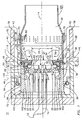
- FIG. 1 illustrates a cross section of an improved gas turbine engine featuring a combustor 10 having only one main burner 12.
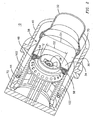
- FIG. 2 is a cut-away perspective view of the can annular combustor 10 of FIG. 1 .
- the combustor 10 includes a combustor basket 146, the single main burner 12 disposed within the basket 146, and a casing 40 surrounding and spaced away from the basket 146.
- the basket 146 further includes a downstream combustion chamber liner 32 and an upstream liner support 72.
- each combustor typically includes a plurality of main burners disposed in a ring around a pilot burner.
- can annular combustors are generally more complex and expensive to fabricate and maintain because of the use of multiple burners within each of the combustors.
- a single main burner 12, instead of a plurality of burners, can reduce the complexity and expense of fabricating a can annular combustor, while additionally providing reduced NOx emissions.
- the single main burner 12 includes a single main burner swirler 58.
- the main burner swirler 58 includes mixing vanes 60 having fuel injection openings 62 for providing a flow of a fuel/oxidizer mixture 22 into a combustion chamber 30.
- the combustion chamber 30 is defined by the combustion chamber liner 32 positioned downstream of the main burner 12 and receives the fuel/oxidizer mixture 22 from the main burner 12.
- the combustion chamber liner 32 has a larger inside diameter, D1, than a diameter, D2, of the outlet end 24 of the main burner 12, thereby forming an annular space between the main burner 12 and the combustion chamber liner 32.
- Each combustor 10 may also include a central pilot burner 26, wherein pilot fuel 74 may be premixed with an oxidizer, such as air, and passed through pilot mixing vanes 64 to provide a stable, low emission pilot flame near an outlet end 24 of the main burner 12.
- the central pilot burner 26 may be operated as a diffusion burner, a partially premixed burner, or a premixed burner.
- the pilot burner 26 may be operated as a diffusion burner at low turbine load conditions, and operated as a premix burner at high turbine load conditions.
- the main burner 12 is positioned within the liner support 72.
- the liner support 72 may be attached to the casing 40, for example, at an upstream end 142.
- the liner support 72 may include a number of spaced apart struts 102, so that a first portion of the oxidizer flow 18 can flow through the liner support 72 in a flow reversal region 118.
- the combustion chamber liner 32 may be attached to the liner support 72 with removable fasteners, for example, by bolting an upstream end 116 of the liner 32 to a downstream end 112 of the support 72, for ease of installation and removal.
- the combustion chamber liner 32 may further be provided with one or more resonators 70 for damping combustion pressure oscillations within the combustion chamber 32.
- the resonator 70 may include a number of resonator openings 80 in the combustion chamber liner 32 in fluid communication with a resonator cavity 82 positioned around an exterior portion of the combustion chamber liner 32.
- the resonator 70 may extend circumferentially around the combustion chamber liner 32 downstream of the outlet end 24.
- the combustor 10 of FIG. 1 includes an oxidizer flow path 38 defined by the casing 40 disposed around and spaced away from the main burner 12 and the combustion chamber liner 32.
- the oxidizer flow path 38 is configured to receive an oxidizer flow 42, such as compressed air, at an upstream end 78 of the flow path 38 and discharge a first portion of the oxidizer flow 18 into a flow reversing region 118 near an inlet end 20 of the main burner 12. Accordingly, in the flow reversing region 118, the first portion of the oxidizer flow 18 discharged from the flow path 38 is turned to flow in a direction 180 degrees opposite from a flow direction in the flow path 38.
- an oxidizer flow 42 such as compressed air
- a fuel outlet 44 such as a fuel injection ring, or a "tophat” type fuel injector, as known in the art, is positioned in the flow reversing region 118 for premixing a secondary fuel flow 46 into the oxidizer flow 42 before it is delivered to the main burner 12.
- the fuel outlet 44 may include an annular ring having an inlet opening 84 for receiving the secondary fuel flow 46, and a plurality of outlet openings, for example, circumferentially distributed in the fuel outlet 44, for discharging the secondary fuel flow 46 into the oxidizer flow 42.
- Positioning of the fuel outlet 44 in the flow reversing region 118 near the inlet end 20 of the main burner 12 provides a less restricted flow around the fuel outlet 44 than placing the fuel outlet 44, for example, near the upstream end 78 of the oxidizer flow path 38.
- This position advantageously results in a smaller pressure differential between the oxidizer flow 42 upstream of the fuel outlet 44 and downstream of the fuel outlet 44 compared to a position of the fuel outlet 44 in an area of the flow path 38 having a smaller cross sectional area than the flow reversing region 118. Accordingly, positioning of the fuel outlet in the flow reversing region can minimize oxidizer flow 42 pressure build-up upstream of the fuel outlet 44.
- An essentially flat (i.e. perpendicular to the axial direction of airflow) burner insert assembly 88 is provided at the outlet end 24 of the main burner 12 to prevent the oxidizer flow 38 from bypassing the main 12 burner.
- the flat geometry of the burner insert assembly 88 provides an abrupt diameter change from the outlet end 24 of the main burner 12 to the combustion chamber 30, which causes a flow vortex 76 just downstream of the burner insert assembly 88 within the combustion chamber 30.
- the flow vortex 76 promotes mixing and appears to improve combustion performance.
- the inventors have experimentally determined that the flat geometry of the burner insert assembly 88 advantageously provides reduced NOx formation compared to other geometries, such as a tapered shape.
- the burner insert assembly 88 is constructed of two portions - an annular burner insert 34 having a hot side surface 36 that is exposed to the hot combustion gas, and a burner insert support 48 that is protected from the hot combustion products produced in the combustion chamber 30.
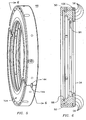
- FIG. 3 is a plan view of the burner insert 34 and FIG. 4 is a cross-sectional view of the insert as seen along plane 4-4 of FIG. 3 .
- the insert 34 of FIGs. 3 and 4 is supported in position in a gas turbine combustor 10 by the insert support 48 illustrated in FIG. 5 .
- the insert 34 is a relatively simple geometry that can be relatively inexpensive to manufacture. The insert 34 is easily removed from the insert support 48 and replaced in the event of combustion-induced damage or wear with minimal disassembly of the combustor 10.
- the insert support 48 is protected from the combustion environment by the burner insert 34.
- the insert support 48 is designed for an extended period of operation without the need for replacement.
- the insert support 48 may be a relatively expensive component to manufacture because it utilizes cast shapes and extensive machining.
- the insert 34 and the insert support 48 may be formed of different materials in order to optimize the value of the respective component. Thus, it is only the inexpensive, easily removable component, the burner insert 34 that is exposed to the combustion environment.
- the burner insert 34 may be formed from a heat resistant material alloy, such as Hastelloy® (a registered trademark of Haynes International, Incorporated) or other high temperature nickel-based or cobalt-based alloy, and the hot side surface 36 may be coated with a heat resistant material such as a thermal barrier coating (TBC) to withstand hot combustion products in the combustion chamber 30.
- a thermal barrier coating such as a thermal barrier coating (TBC) to withstand hot combustion products in the combustion chamber 30.
- TBC thermal barrier coating
- the burner insert 34 may have a generally "J" shaped cross-section 90 forming a circumferential mounting lip 92 for attaching the burner insert 34 to the support 48.
- the outside diameter, D3, of the burner insert 34 may be slightly smaller than the inside diameter D1 of the combustion chamber liner 32 so that a second portion of the oxidizer flow 42 can flow into the combustion chamber 30 around the burner insert 34.
- D3 may be about 0.4 millimeters (0.016 inches) less than D1.
- the burner insert 34 may also include a number of raised spacing tabs 94 extending a radial distance further than the outside diameter, D3, of the burner insert 34, and spaced apart around the outer periphery 110 of the burner insert 34 for keeping the burner insert spaced away from the inside diameter, D1, of the combustion chamber liner 32.
- each spacing tab 94 may extend a radial distance of 0.2 millimeters (0.008 inches) further than D3.
- the burner insert support 48 supports the burner insert 34 by receiving the mounting lip 92 of the burner insert 34 in a mounting recess 96 formed in the burner insert support 48.
- the burner insert support 48 may be constructed of two portions, connectable, for example, along section line 6-6, so that the burner insert support 48 can be easily disassembled for removal and replacement of the burner insert 34.
- Each portion may include a connection seal recess 144 for accepting a seal (not shown) for sealing between mating surfaces where the two portions are joined.
- the burner insert support 48 may also include a seal recess 98 for receiving a seal 100 to seal around the main burner 12 as shown in FIG. 1 .
- the burner insert support may include a number of cooling passages 50 oriented parallel with a direction of axial flow and spaced around the periphery 110 of the insert support 48 for conveying a second portion of the oxidizer flow 52.
- the insert support 48 may further include an impingement plate 54 as shown in FIG. 6 .
- the impingement plate 54 includes impingement cooling holes 56 for allowing passage of the second portion of the oxidizer flow 52 therethrough to provide impingement cooling of the burner insert 34.
- the impingement plate 54 is attached, for example, by welding, to the downstream face 104 of the insert support 48, and may be spaced away from the insert support 48 to form an impingement cooling plenum 106 between the impingement plate 54 and the downstream face 104 of the burner insert support 48.
- the second portion of the oxidizer flow 52 may pass through the internal cooling passages 50 of the insert support 48 into the impingement cooling plenum 106, and then through the impingement cooling holes 56 to impinge upon an upstream face 68 of the burner insert 34 to cool the insert 34.
- FIG. 7 is a partial cross-sectional view of the combustor of FIG. 1 showing details of the burner insert assembly 88 and oxidizer flows 42, 52, 66 in the vicinity of the burner insert assembly 88.
- the burner insert assembly 88 may be installed around the main burner 12 with a seal 100, such as a split ring, positioned in the seal recess 98 to seal against the main burner 12 and prevent the second portion of the oxidizer flow 52 from flowing between the main burner 12 and the burner insert assembly 88.
- the mounting lip 92 of the burner insert 34 is supported by the burner insert support 48 in the mounting recess 96.
- standoff tabs 108 are provided at a downstream end 112 of the liner support 72 to further support the burner insert 34 and maintain a gap between an upstream face 68 of the burner insert 34 for impingement cooling.
- the standoff tabs 108 are spaced apart to allow the second portion of the oxidizer flow 52 that has impinged on the burner insert 34 to flow between the downstream end 112 of the liner support 72 and the upstream face 68 of the burner insert 34.
- the standoff tabs 108 are circumferentially spaced apart around the downstream end 112 of the liner support 72 so that the standoff 108 tabs support the burner insert 34, and spaces between the standoff tabs 108 allow passage of the second portion of the oxidizer flow 52.
- the second portion of the oxidizer flow 52 can then flow past the downstream end 112 of the liner support and between the spacing tabs 94 formed in the periphery 110 of the burner insert 34 into the combustion chamber 30 near the upstream end of the combustion chamber liner 32.
- about 0.3% of the oxidizer flow 42 provided to the combustor 10 may be used in the second portion of the oxidizer flow 52.
- the combustor 10 may further feature passageways 114, such as combustor liner openings, in the upstream end 116 of the combustion chamber liner 32 near the periphery 110 of the burner insert 34 for allowing passage of a third portion of the oxidizer flow 66 into the combustion chamber 30.
- the passageways 114 may be distributed uniformly around the combustion chamber liner 32 near the burner insert 34, or at different distances apart.
- the passageways 114 may be sized, shaped, and angled to provide a desired flow path through the combustion chamber liner 32 into the combustion chamber 30.
- the passageways 114 may be configured so that the third portion of the oxidizer flow 66 flowing through the passageways 114 is about 2.0% of the oxidizer flow 42 provided to the combustor 10. Experimental tests have demonstrated that this third portion of the oxidizer flow 66 flowing into the combustion chamber 30 appears to reduce emissions of NOx during the combustion process due, it is believed, to improved dynamic pressure stability.
- FIG. 8 illustrates a gas turbine engine 120 featuring the combustor 10 as described above.
- the gas turbine engine includes a compressor 122 for receiving a flow of filtered ambient air 124 and for producing a flow of compressed air 126.
- the compressed air 126 is mixed with a flow of a combustible fuel 130, such as natural gas or fuel oil for example, provided by a fuel source 128, to create a fuel-oxidizer mixture flow 132 prior to introduction into the combustor 10.
- the fuel-oxidizer mixture flow 132 is combusted in the combustor 10 to create a hot combustion gas 136.
- a turbine 136 receives the hot combustion gas 134, where it is expanded to extract mechanical shaft power.
- a common shaft 138 interconnects the turbine 136 with the compressor 122, as well as an electrical generator (not shown) to provide mechanical power for compressing the ambient air 124 and for producing electrical power, respectively.
- the expanded combustion gas 140 may be exhausted directly to the atmosphere or it may be routed through additional heat recovery systems (not shown).
- the gas turbine engine 10 provides improved manufacturing, maintainability and, reduced NOx formation as a result of features of the combustor 10 described above and shown more clearly in FIGs. 1-7 .
Landscapes
- Engineering & Computer Science (AREA)
- Chemical & Material Sciences (AREA)
- Combustion & Propulsion (AREA)
- Mechanical Engineering (AREA)
- General Engineering & Computer Science (AREA)
- Pre-Mixing And Non-Premixing Gas Burner (AREA)
Description
- This invention relates to the field of gas turbine engines, and more particularly, to a can combustor for use in a gas turbine engine.
- Gas turbine engines are known to include a compressor for compressing air; a combustor for producing a hot gas by burning fuel in the presence of the compressed air produced by the compressor, and a turbine for expanding the hot gas to extract shaft power. The combustion process in many older gas turbine engines is dominated by diffusion flames burning at or near stoichiometric conditions with flame temperatures exceeding 1,649 °C (3,000 °F). Such combustion will produce a high level of oxides of nitrogen (NOx). Current emissions regulations have greatly reduced the allowable levels of NOx emissions, requiring improvements in combustors to reduce undesirable NOx production.
- Gas turbine engines using annular combustion systems typically include a plurality of individual burners disposed in a ring about an axial centerline for providing a mixture of fuel and air to an annular combustion chamber disposed upstream of the annular turbine inlet vanes. The combustion process of the several burners will interact in the combustion chamber since all burners discharge the combustible mixture to the single annulus. Consequently, combustion processes in one burner may affect the combustion processes in the other burners. Other gas turbines use can-annular combustors wherein individual burner cans feed hot combustion gas into respective individual portions of the arc of the turbine inlet vanes. Each can includes a plurality of main burners disposed in a ring around a central pilot burner, as illustrated in United States patent
6,082,111 . Can annular combustors are generally more expensive to fabricate as a result of the use of multiple burners within each of the multiple combustor cans which may include cross flame tubes connecting combustor baskets. - The demand to decrease exhaust emissions continues, thus improved techniques for economically controlling the combustion conditions of a gas turbine engine are needed.
-
US 5 450 725 A discloses a gas turbine combustor comprising a cylindrical outer casing having one end closed by a header plate. A combustor liner is provided with an inner combustion chamber which is divided into a first-stage combustion region on a side of the header plate and a second-stage combustion region formed on a downstream side of the first-stage combustion region. A first-stage fuel supply unit is mounted to the header plate for injecting a first-stage fuel to the first-stage combustion region and a second-stage fuel supply unit is mounted to the header plate for injecting a second-stage fuel previously mixed in a lean fuel state. The first-stage fuel supply unit includes a first-stage fuel nozzle assembly, which supplies the first-stage fuel, formed by combining a diffusion combustion nozzle and a pre-mixture combustion nozzle. The pre-mixture combustion nozzle has, at an intermediate portion thereof, a pre-mixing portion for preliminarily mixing the first-stage fuel with air, the pre-mixing portion having a diameter in a downstream portion thereof smaller than that of an upstream portion thereof so as to form a pre-mixed flow into a contraction flow. The pre-mixing fuel nozzle of the first stage fuel nozzle assembly is disposed so as to surround the diffusion combustion nozzle disposed in a central portion thereof. - According to the present invention there is provided a combustor comprising: a cylindrical basket having an axis; a burner assembly disposed within the basket and separated from the basket by an annular space, the burner assembly configured to discharge a fuel/air mixture into a combustion chamber downstream of the burner assembly; and a burner insert disposed in the annular space, the insert having a downstream face exposed to the combustion chamber and perpendicular to the axis of the basket, wherein the combustor further comprises: a fluid flow path defined between at least a portion of the basket and a concentric casing spaced radially away from the basket for directing air in a direction opposite from a direction of flow of the air/fuel mixture through the burner assembly; a flow reversal region, in fluid communication with the fluid flow path, proximate an inlet of the burner assembly for redirecting the air into the inlet of the burner assembly; and a fuel delivery mechanism disposed in the flow reversal region, wherein the cylindrical basket comprises a liner for the combustion chamber and, upstream of the liner, a support for the liner, wherein the liner support includes a plurality of standoff tabs to space the burner insert away from a downstream end of the liner support, the standoff tabs being spaced apart and extending away from the downstream end of the liner support for allowing air to flow around the downstream end of the liner support between the standoff tabs.
- The invention will be more apparent from the following description in view of the drawings that show:
-
FIG. 1 is an axial cross-sectional view of a gas turbine engine combustor as seen along the direction of flow through the combustor. -
FIG. 2 is a cut-away perspective view of the gas turbine engine combustor ofFIG. 1 . -
FIG. 3 is a plan view of a burner insert for a gas turbine engine combustor. -
FIG. 4 is a cross-sectional view of the burner insert ofFIG. 2 as seen along plane 4-4 ofFIG. 3 . -
FIG. 5 is a perspective view of an insert support for use with the burner insert ofFIG. 3 . -
FIG. 6 is a cross-sectional view of the insert support ofFIG. 5 as seen along plane 6-6 ofFIG. 5 . -
FIG. 7 is a partial cross-sectional view of the gas turbine engine combustor ofFIG. 1 . -
FIG. 8 illustrates a combustion turbine engine including the combustor ofFIG. 1 . -
FIG. 1 illustrates a cross section of an improved gas turbine engine featuring acombustor 10 having only onemain burner 12.FIG. 2 is a cut-away perspective view of the canannular combustor 10 ofFIG. 1 . Generally, thecombustor 10 includes acombustor basket 146, the singlemain burner 12 disposed within thebasket 146, and acasing 40 surrounding and spaced away from thebasket 146. Thebasket 146 further includes a downstreamcombustion chamber liner 32 and anupstream liner support 72. - In conventional can annular gas turbine engine configurations, each combustor typically includes a plurality of main burners disposed in a ring around a pilot burner. However, such can annular combustors are generally more complex and expensive to fabricate and maintain because of the use of multiple burners within each of the combustors. A single
main burner 12, instead of a plurality of burners, can reduce the complexity and expense of fabricating a can annular combustor, while additionally providing reduced NOx emissions. - The single
main burner 12 includes a singlemain burner swirler 58. Themain burner swirler 58 includes mixingvanes 60 havingfuel injection openings 62 for providing a flow of a fuel/oxidizer mixture 22 into acombustion chamber 30. Thecombustion chamber 30 is defined by thecombustion chamber liner 32 positioned downstream of themain burner 12 and receives the fuel/oxidizer mixture 22 from themain burner 12. Thecombustion chamber liner 32 has a larger inside diameter, D1, than a diameter, D2, of theoutlet end 24 of themain burner 12, thereby forming an annular space between themain burner 12 and thecombustion chamber liner 32. Eachcombustor 10 may also include acentral pilot burner 26, whereinpilot fuel 74 may be premixed with an oxidizer, such as air, and passed throughpilot mixing vanes 64 to provide a stable, low emission pilot flame near anoutlet end 24 of themain burner 12. Thecentral pilot burner 26 may be operated as a diffusion burner, a partially premixed burner, or a premixed burner. For example, thepilot burner 26 may be operated as a diffusion burner at low turbine load conditions, and operated as a premix burner at high turbine load conditions. - The
main burner 12 is positioned within theliner support 72. Theliner support 72 may be attached to thecasing 40, for example, at anupstream end 142. Theliner support 72 may include a number of spaced apartstruts 102, so that a first portion of theoxidizer flow 18 can flow through theliner support 72 in a flowreversal region 118. Thecombustion chamber liner 32 may be attached to theliner support 72 with removable fasteners, for example, by bolting anupstream end 116 of theliner 32 to adownstream end 112 of thesupport 72, for ease of installation and removal. - The
combustion chamber liner 32 may further be provided with one ormore resonators 70 for damping combustion pressure oscillations within thecombustion chamber 32. For example, theresonator 70 may include a number ofresonator openings 80 in thecombustion chamber liner 32 in fluid communication with aresonator cavity 82 positioned around an exterior portion of thecombustion chamber liner 32. In another aspect, theresonator 70 may extend circumferentially around thecombustion chamber liner 32 downstream of theoutlet end 24. - The
combustor 10 ofFIG. 1 includes anoxidizer flow path 38 defined by thecasing 40 disposed around and spaced away from themain burner 12 and thecombustion chamber liner 32. Theoxidizer flow path 38 is configured to receive anoxidizer flow 42, such as compressed air, at anupstream end 78 of theflow path 38 and discharge a first portion of theoxidizer flow 18 into aflow reversing region 118 near aninlet end 20 of themain burner 12. Accordingly, in theflow reversing region 118, the first portion of theoxidizer flow 18 discharged from theflow path 38 is turned to flow in a direction 180 degrees opposite from a flow direction in theflow path 38. - A
fuel outlet 44, such as a fuel injection ring, or a "tophat" type fuel injector, as known in the art, is positioned in theflow reversing region 118 for premixing asecondary fuel flow 46 into theoxidizer flow 42 before it is delivered to themain burner 12. Thefuel outlet 44 may include an annular ring having an inlet opening 84 for receiving thesecondary fuel flow 46, and a plurality of outlet openings, for example, circumferentially distributed in thefuel outlet 44, for discharging thesecondary fuel flow 46 into theoxidizer flow 42. - Positioning of the
fuel outlet 44 in theflow reversing region 118 near theinlet end 20 of themain burner 12 provides a less restricted flow around thefuel outlet 44 than placing thefuel outlet 44, for example, near theupstream end 78 of theoxidizer flow path 38. This position advantageously results in a smaller pressure differential between theoxidizer flow 42 upstream of thefuel outlet 44 and downstream of thefuel outlet 44 compared to a position of thefuel outlet 44 in an area of theflow path 38 having a smaller cross sectional area than theflow reversing region 118. Accordingly, positioning of the fuel outlet in the flow reversing region can minimizeoxidizer flow 42 pressure build-up upstream of thefuel outlet 44. - An essentially flat (i.e. perpendicular to the axial direction of airflow)
burner insert assembly 88 is provided at theoutlet end 24 of themain burner 12 to prevent theoxidizer flow 38 from bypassing the main 12 burner. The flat geometry of theburner insert assembly 88 provides an abrupt diameter change from theoutlet end 24 of themain burner 12 to thecombustion chamber 30, which causes aflow vortex 76 just downstream of theburner insert assembly 88 within thecombustion chamber 30. Theflow vortex 76 promotes mixing and appears to improve combustion performance. The inventors have experimentally determined that the flat geometry of theburner insert assembly 88 advantageously provides reduced NOx formation compared to other geometries, such as a tapered shape. - The
burner insert assembly 88 is constructed of two portions - anannular burner insert 34 having ahot side surface 36 that is exposed to the hot combustion gas, and aburner insert support 48 that is protected from the hot combustion products produced in thecombustion chamber 30.FIG. 3 is a plan view of theburner insert 34 andFIG. 4 is a cross-sectional view of the insert as seen along plane 4-4 ofFIG. 3 . Theinsert 34 ofFIGs. 3 and 4 is supported in position in agas turbine combustor 10 by theinsert support 48 illustrated inFIG. 5 . Theinsert 34 is a relatively simple geometry that can be relatively inexpensive to manufacture. Theinsert 34 is easily removed from theinsert support 48 and replaced in the event of combustion-induced damage or wear with minimal disassembly of thecombustor 10. In particular, if theliner 32 is bolted to theliner support 72, no welding needs to be broken to replace theinsert 34. Theinsert support 48 is protected from the combustion environment by theburner insert 34. Theinsert support 48 is designed for an extended period of operation without the need for replacement. Theinsert support 48 may be a relatively expensive component to manufacture because it utilizes cast shapes and extensive machining. Theinsert 34 and theinsert support 48 may be formed of different materials in order to optimize the value of the respective component. Thus, it is only the inexpensive, easily removable component, theburner insert 34 that is exposed to the combustion environment. - The
burner insert 34 may be formed from a heat resistant material alloy, such as Hastelloy® (a registered trademark of Haynes International, Incorporated) or other high temperature nickel-based or cobalt-based alloy, and thehot side surface 36 may be coated with a heat resistant material such as a thermal barrier coating (TBC) to withstand hot combustion products in thecombustion chamber 30. In one aspect, the TBC may be about 1.6 mm thick. Theburner insert 34 may have a generally "J" shapedcross-section 90 forming a circumferential mountinglip 92 for attaching theburner insert 34 to thesupport 48. The outside diameter, D3, of theburner insert 34 may be slightly smaller than the inside diameter D1 of thecombustion chamber liner 32 so that a second portion of theoxidizer flow 42 can flow into thecombustion chamber 30 around theburner insert 34. For example, D3 may be about 0.4 millimeters (0.016 inches) less than D1. Theburner insert 34 may also include a number of raisedspacing tabs 94 extending a radial distance further than the outside diameter, D3, of theburner insert 34, and spaced apart around theouter periphery 110 of theburner insert 34 for keeping the burner insert spaced away from the inside diameter, D1, of thecombustion chamber liner 32. For example, eachspacing tab 94 may extend a radial distance of 0.2 millimeters (0.008 inches) further than D3. - The
burner insert support 48, depicted inFIGs. 5 and 6 , supports theburner insert 34 by receiving the mountinglip 92 of theburner insert 34 in a mountingrecess 96 formed in theburner insert support 48. In an embodiment, theburner insert support 48 may be constructed of two portions, connectable, for example, along section line 6-6, so that theburner insert support 48 can be easily disassembled for removal and replacement of theburner insert 34. Each portion may include aconnection seal recess 144 for accepting a seal (not shown) for sealing between mating surfaces where the two portions are joined. Theburner insert support 48 may also include aseal recess 98 for receiving aseal 100 to seal around themain burner 12 as shown inFIG. 1 . To provide cooling for theburner insert 34, the burner insert support may include a number ofcooling passages 50 oriented parallel with a direction of axial flow and spaced around theperiphery 110 of theinsert support 48 for conveying a second portion of theoxidizer flow 52. - The
insert support 48 may further include animpingement plate 54 as shown inFIG. 6 . Theimpingement plate 54 includes impingement cooling holes 56 for allowing passage of the second portion of theoxidizer flow 52 therethrough to provide impingement cooling of theburner insert 34. Theimpingement plate 54 is attached, for example, by welding, to thedownstream face 104 of theinsert support 48, and may be spaced away from theinsert support 48 to form animpingement cooling plenum 106 between theimpingement plate 54 and thedownstream face 104 of theburner insert support 48. Accordingly, the second portion of theoxidizer flow 52 may pass through theinternal cooling passages 50 of theinsert support 48 into theimpingement cooling plenum 106, and then through the impingement cooling holes 56 to impinge upon anupstream face 68 of theburner insert 34 to cool theinsert 34. -
FIG. 7 is a partial cross-sectional view of the combustor ofFIG. 1 showing details of theburner insert assembly 88 and oxidizer flows 42, 52, 66 in the vicinity of theburner insert assembly 88. As shown inFIG. 7 , theburner insert assembly 88 may be installed around themain burner 12 with aseal 100, such as a split ring, positioned in theseal recess 98 to seal against themain burner 12 and prevent the second portion of theoxidizer flow 52 from flowing between themain burner 12 and theburner insert assembly 88. The mountinglip 92 of theburner insert 34 is supported by theburner insert support 48 in the mountingrecess 96. Near theperiphery 110 of theburner insert 34,standoff tabs 108 are provided at adownstream end 112 of theliner support 72 to further support theburner insert 34 and maintain a gap between anupstream face 68 of theburner insert 34 for impingement cooling. Thestandoff tabs 108 are spaced apart to allow the second portion of theoxidizer flow 52 that has impinged on theburner insert 34 to flow between thedownstream end 112 of theliner support 72 and theupstream face 68 of theburner insert 34. Thestandoff tabs 108 are circumferentially spaced apart around thedownstream end 112 of theliner support 72 so that thestandoff 108 tabs support theburner insert 34, and spaces between thestandoff tabs 108 allow passage of the second portion of theoxidizer flow 52. The second portion of theoxidizer flow 52 can then flow past thedownstream end 112 of the liner support and between thespacing tabs 94 formed in theperiphery 110 of theburner insert 34 into thecombustion chamber 30 near the upstream end of thecombustion chamber liner 32. For example, about 0.3% of theoxidizer flow 42 provided to thecombustor 10 may be used in the second portion of theoxidizer flow 52. Experimental tests have demonstrated that this second portion of theoxidizer flow 52 flowing into thecombustion chamber 30 appears to help suppress NOx emissions. - The
combustor 10 may further featurepassageways 114, such as combustor liner openings, in theupstream end 116 of thecombustion chamber liner 32 near theperiphery 110 of theburner insert 34 for allowing passage of a third portion of theoxidizer flow 66 into thecombustion chamber 30. For example, thepassageways 114 may be distributed uniformly around thecombustion chamber liner 32 near theburner insert 34, or at different distances apart. Thepassageways 114 may be sized, shaped, and angled to provide a desired flow path through thecombustion chamber liner 32 into thecombustion chamber 30. Accordingly, thepassageways 114 may be configured so that the third portion of theoxidizer flow 66 flowing through thepassageways 114 is about 2.0% of theoxidizer flow 42 provided to thecombustor 10. Experimental tests have demonstrated that this third portion of theoxidizer flow 66 flowing into thecombustion chamber 30 appears to reduce emissions of NOx during the combustion process due, it is believed, to improved dynamic pressure stability. -
FIG. 8 illustrates agas turbine engine 120 featuring thecombustor 10 as described above. The gas turbine engine includes acompressor 122 for receiving a flow of filteredambient air 124 and for producing a flow ofcompressed air 126. Thecompressed air 126 is mixed with a flow of acombustible fuel 130, such as natural gas or fuel oil for example, provided by afuel source 128, to create a fuel-oxidizer mixture flow 132 prior to introduction into thecombustor 10. The fuel-oxidizer mixture flow 132 is combusted in thecombustor 10 to create ahot combustion gas 136. - A
turbine 136, receives thehot combustion gas 134, where it is expanded to extract mechanical shaft power. In one embodiment, acommon shaft 138 interconnects theturbine 136 with thecompressor 122, as well as an electrical generator (not shown) to provide mechanical power for compressing theambient air 124 and for producing electrical power, respectively. The expandedcombustion gas 140 may be exhausted directly to the atmosphere or it may be routed through additional heat recovery systems (not shown). Thegas turbine engine 10 provides improved manufacturing, maintainability and, reduced NOx formation as a result of features of thecombustor 10 described above and shown more clearly inFIGs. 1-7 .
Claims (7)
- A combustor (10) comprising:a cylindrical basket (146) having an axis;a burner assembly (12) disposed within the basket (146) and separated from the basket (146) by an annular space, the burner assembly (12) configured to discharge a fuel/air mixture into a combustion chamber (30) downstream of the burner assembly (12); anda burner insert (34) disposed in the annular space, the insert (34) having a downstream face (36) exposed to the combustion chamber (30) and perpendicular to the axis of the basket (146),wherein the combustor (10) further comprises:a fluid flow path (38) defined between at least a portion of the basket (146) and a concentric casing (40) spaced radially away from the basket (146) for directing air in a direction opposite from a direction of flow of the air/fuel mixture through the burner assembly (12);a flow reversal region (118), in fluid communication with the fluid flow path (38), proximate an inlet (20) of the burner assembly (12) for redirecting the air into the inlet (20) of the burner assembly (12); anda fuel delivery mechanism (44) disposed in the flow reversal region (118),wherein the cylindrical basket (146) comprises a liner (32) for the combustion chamber (30) and, upstream of the liner (32), a support (72) for the liner (32), characterized in that includesthe liner support (72) includes a plurality of standoff tabs (108) to space the burner insert (34) away from a downstream end of the liner support (72), the standoff tabs (108) being spaced apart and extending away from the downstream end of the liner support (72) for allowing air to flow around the downstream end of the liner support (72) between the standoff tabs (108).
- The combustor (10) of claim 1, wherein the liner support (72) is attached to the casing (40), and the combustion chamber liner (32) is attached to the liner support (72) with removable fasteners.
- The combustor (10) of claim 1, further comprising an insert support (48) for supporting the burner insert (34), the insert support (48) being disposed on a side of the burner insert (34) opposed to the combustion a chamber (30) and protected from exposure to hot combustion products by the burner insert (34).
- The combustor (10) of claim 3, further comprising a passage (50) formed through the insert support (48) for conveying a fluid to cool the burner insert (34).
- The combustor (10) of claim 4, wherein the insert support (48) further comprises an impingement plate (54) defining a plenum (106) for receiving the fluid and further comprising a plurality of holes (56) for directing the fluid to impinge on a face (68) of the burner insert (34) opposed the combustion chamber (30).
- The combustor (10) of claim 1, wherein the burner insert (34) further comprises an outside diameter (D3) smaller than an inside diameter (D1) of the basket (146) so that an annular gap is formed at least along a portion of a circumference of the burner insert (34) between the burner insert (34) and the basket (146) for allowing a fluid to flow into the downstream combustion chamber (30).
- The combustor (10) of claim 1, wherein the basket (146) further comprises a plurality of passageways (114) circumferentially positioned proximate to and downstream of the burner insert (34) for allowing air to flow into the combustion chamber (30) proximate the burner insert (34).
Applications Claiming Priority (4)
| Application Number | Priority Date | Filing Date | Title |
|---|---|---|---|
| US43622802P | 2002-12-23 | 2002-12-23 | |
| US436228P | 2002-12-23 | ||
| US667263 | 2003-09-19 | ||
| US10/667,263 US7080515B2 (en) | 2002-12-23 | 2003-09-19 | Gas turbine can annular combustor |
Publications (3)
| Publication Number | Publication Date |
|---|---|
| EP1434007A2 EP1434007A2 (en) | 2004-06-30 |
| EP1434007A3 EP1434007A3 (en) | 2006-01-04 |
| EP1434007B1 true EP1434007B1 (en) | 2013-05-29 |
Family
ID=32474672
Family Applications (1)
| Application Number | Title | Priority Date | Filing Date |
|---|---|---|---|
| EP03078548.9A Expired - Lifetime EP1434007B1 (en) | 2002-12-23 | 2003-11-06 | Gas turbine can annular combustor |
Country Status (2)
| Country | Link |
|---|---|
| US (1) | US7080515B2 (en) |
| EP (1) | EP1434007B1 (en) |
Cited By (1)
| Publication number | Priority date | Publication date | Assignee | Title |
|---|---|---|---|---|
| EP2837883A1 (en) | 2013-08-16 | 2015-02-18 | ALSTOM Technology Ltd | Premixed second stage can annular combustor with mixing lobes for of a sequential gas turbine |
Families Citing this family (58)
| Publication number | Priority date | Publication date | Assignee | Title |
|---|---|---|---|---|
| EP1482246A1 (en) * | 2003-05-30 | 2004-12-01 | Siemens Aktiengesellschaft | Combustion chamber |
| US8192614B2 (en) * | 2004-09-09 | 2012-06-05 | Kellogg Brown & Root Llc | Self-stripping FCC riser cyclone |
| US7581402B2 (en) * | 2005-02-08 | 2009-09-01 | Siemens Energy, Inc. | Turbine engine combustor with bolted swirlers |
| US20080016876A1 (en) * | 2005-06-02 | 2008-01-24 | General Electric Company | Method and apparatus for reducing gas turbine engine emissions |
| EP1767855A1 (en) | 2005-09-27 | 2007-03-28 | Siemens Aktiengesellschaft | Combustion Chamber and Gas Turbine Plant |
| US7461719B2 (en) * | 2005-11-10 | 2008-12-09 | Siemens Energy, Inc. | Resonator performance by local reduction of component thickness |
| US20070204624A1 (en) * | 2006-03-01 | 2007-09-06 | Smith Kenneth O | Fuel injector for a turbine engine |
| US7762074B2 (en) * | 2006-04-04 | 2010-07-27 | Siemens Energy, Inc. | Air flow conditioner for a combustor can of a gas turbine engine |
| US7836677B2 (en) * | 2006-04-07 | 2010-11-23 | Siemens Energy, Inc. | At least one combustion apparatus and duct structure for a gas turbine engine |
| JP5147037B2 (en) * | 2006-04-14 | 2013-02-20 | 三菱マテリアル株式会社 | Ni-base heat-resistant alloy for gas turbine combustor |
| US7631499B2 (en) * | 2006-08-03 | 2009-12-15 | Siemens Energy, Inc. | Axially staged combustion system for a gas turbine engine |
| US7975487B2 (en) * | 2006-09-21 | 2011-07-12 | Solar Turbines Inc. | Combustor assembly for gas turbine engine |
| US8061141B2 (en) * | 2007-09-27 | 2011-11-22 | Siemens Energy, Inc. | Combustor assembly including one or more resonator assemblies and process for forming same |
| US8122725B2 (en) * | 2007-11-01 | 2012-02-28 | General Electric Company | Methods and systems for operating gas turbine engines |
| US8549859B2 (en) * | 2008-07-28 | 2013-10-08 | Siemens Energy, Inc. | Combustor apparatus in a gas turbine engine |
| US8516820B2 (en) * | 2008-07-28 | 2013-08-27 | Siemens Energy, Inc. | Integral flow sleeve and fuel injector assembly |
| US8528340B2 (en) * | 2008-07-28 | 2013-09-10 | Siemens Energy, Inc. | Turbine engine flow sleeve |
| EP2161500A1 (en) * | 2008-09-04 | 2010-03-10 | Siemens Aktiengesellschaft | Combustor system and method of reducing combustion instability and/or emissions of a combustor system |
| EP2182285A1 (en) | 2008-10-29 | 2010-05-05 | Siemens Aktiengesellschaft | Burner insert for a gas turbine combustion chamber and gas turbine |
| GB0902221D0 (en) * | 2009-02-11 | 2009-03-25 | Edwards Ltd | Pilot |
| US9127842B2 (en) * | 2009-05-27 | 2015-09-08 | Siemens Aktiengesellschaft | Burner, operating method and assembly method |
| US8336312B2 (en) * | 2009-06-17 | 2012-12-25 | Siemens Energy, Inc. | Attenuation of combustion dynamics using a Herschel-Quincke filter |
| US8387393B2 (en) * | 2009-06-23 | 2013-03-05 | Siemens Energy, Inc. | Flashback resistant fuel injection system |
| US8607569B2 (en) * | 2009-07-01 | 2013-12-17 | General Electric Company | Methods and systems to thermally protect fuel nozzles in combustion systems |
| DE102009046066A1 (en) * | 2009-10-28 | 2011-05-12 | Man Diesel & Turbo Se | Burner for a turbine and thus equipped gas turbine |
| WO2011054760A1 (en) | 2009-11-07 | 2011-05-12 | Alstom Technology Ltd | A cooling scheme for an increased gas turbine efficiency |
| WO2011054757A2 (en) | 2009-11-07 | 2011-05-12 | Alstom Technology Ltd | Reheat burner injection system with fuel lances |
| EP2496883B1 (en) | 2009-11-07 | 2016-08-10 | Alstom Technology Ltd | Premixed burner for a gas turbine combustor |
| EP2496880B1 (en) | 2009-11-07 | 2018-12-05 | Ansaldo Energia Switzerland AG | Reheat burner injection system |
| WO2011054766A2 (en) | 2009-11-07 | 2011-05-12 | Alstom Technology Ltd | Reheat burner injection system |
| EP2330349B1 (en) * | 2009-12-01 | 2018-10-24 | Siemens Aktiengesellschaft | Pilot burner of a gas turbine engine, combustor, and gas turbine engine |
| US8438852B2 (en) | 2010-04-06 | 2013-05-14 | General Electric Company | Annular ring-manifold quaternary fuel distributor |
| US8418468B2 (en) * | 2010-04-06 | 2013-04-16 | General Electric Company | Segmented annular ring-manifold quaternary fuel distributor |
| US9810081B2 (en) * | 2010-06-11 | 2017-11-07 | Siemens Energy, Inc. | Cooled conduit for conveying combustion gases |
| US8991187B2 (en) * | 2010-10-11 | 2015-03-31 | General Electric Company | Combustor with a lean pre-nozzle fuel injection system |
| EP2698582B1 (en) * | 2011-03-16 | 2017-11-22 | Mitsubishi Hitachi Power Systems, Ltd. | Gas turbine combustor and gas turbine |
| US8733106B2 (en) * | 2011-05-03 | 2014-05-27 | General Electric Company | Fuel injector and support plate |
| US8966903B2 (en) * | 2011-08-17 | 2015-03-03 | General Electric Company | Combustor resonator with non-uniform resonator passages |
| US9388738B2 (en) * | 2011-10-04 | 2016-07-12 | Siemens Energy, Inc. | Casing for a gas turbine engine |
| US20130091848A1 (en) * | 2011-10-14 | 2013-04-18 | General Electric Company | Annular flow conditioning member for gas turbomachine combustor assembly |
| US20140311151A1 (en) * | 2011-11-16 | 2014-10-23 | Mitsubishi Hitachi Power Systems, Ltd. | Gas turbine combustor |
| TW201339505A (en) * | 2012-03-22 | 2013-10-01 | Pro Iroda Ind Inc | Flame combustion device |
| US9121613B2 (en) | 2012-06-05 | 2015-09-01 | General Electric Company | Combustor with brief quench zone with slots |
| US9021812B2 (en) | 2012-07-27 | 2015-05-05 | Honeywell International Inc. | Combustor dome and heat-shield assembly |
| RU2618801C2 (en) * | 2013-01-10 | 2017-05-11 | Дженерал Электрик Компани | Fuel nozzle, end fuel nozzle unit, and gas turbine |
| US9709279B2 (en) * | 2014-02-27 | 2017-07-18 | General Electric Company | System and method for control of combustion dynamics in combustion system |
| EP3186558B1 (en) | 2014-08-26 | 2020-06-24 | Siemens Energy, Inc. | Film cooling hole arrangement for acoustic resonators in gas turbine engines |
| CN106796034A (en) | 2014-09-05 | 2017-05-31 | 西门子公司 | Cross-fire duct |
| JP6267085B2 (en) * | 2014-09-05 | 2018-01-24 | 三菱日立パワーシステムズ株式会社 | Gas turbine combustor |
| US10168051B2 (en) | 2015-09-02 | 2019-01-01 | General Electric Company | Combustor assembly for a turbine engine |
| US9976746B2 (en) * | 2015-09-02 | 2018-05-22 | General Electric Company | Combustor assembly for a turbine engine |
| US11402097B2 (en) | 2018-01-03 | 2022-08-02 | General Electric Company | Combustor assembly for a turbine engine |
| CN109185923B (en) * | 2018-08-03 | 2023-09-12 | 新奥能源动力科技(上海)有限公司 | Combustion chamber head device, combustion chamber and gas turbine |
| CN109185924B (en) * | 2018-08-03 | 2023-09-12 | 新奥能源动力科技(上海)有限公司 | Combustion chamber head device, combustion chamber and gas turbine |
| DE102019217983A1 (en) * | 2019-11-21 | 2021-05-27 | Siemens Aktiengesellschaft | Burner insert, process for its production and use of such a burner insert |
| DE102020200583A1 (en) * | 2020-01-20 | 2021-07-22 | Siemens Aktiengesellschaft | Resonator ring for combustion chamber systems |
| DE102020116245B4 (en) * | 2020-06-19 | 2024-03-07 | Man Energy Solutions Se | Gas turbine assembly with combustion chamber air bypass |
| US11994293B2 (en) * | 2020-08-31 | 2024-05-28 | General Electric Company | Impingement cooling apparatus support structure and method of manufacture |
Family Cites Families (38)
| Publication number | Priority date | Publication date | Assignee | Title |
|---|---|---|---|---|
| US3866413A (en) * | 1973-01-22 | 1975-02-18 | Parker Hannifin Corp | Air blast fuel atomizer |
| US4112676A (en) * | 1977-04-05 | 1978-09-12 | Westinghouse Electric Corp. | Hybrid combustor with staged injection of pre-mixed fuel |
| US4265085A (en) * | 1979-05-30 | 1981-05-05 | United Technologies Corporation | Radially staged low emission can-annular combustor |
| US4263780A (en) * | 1979-09-28 | 1981-04-28 | General Motors Corporation | Lean prechamber outflow combustor with sets of primary air entrances |
| US4322945A (en) * | 1980-04-02 | 1982-04-06 | United Technologies Corporation | Fuel nozzle guide heat shield for a gas turbine engine |
| US4875969A (en) | 1988-10-07 | 1989-10-24 | Eastman Kodak Company | Method of making a fiber optic array |
| EP0402693B1 (en) * | 1989-06-10 | 1996-03-20 | Mtu Motoren- Und Turbinen-Union MàNchen Gmbh | Gasturbine with mixed-flow compressor |
| GB9018014D0 (en) * | 1990-08-16 | 1990-10-03 | Rolls Royce Plc | Gas turbine engine combustor |
| GB2247522B (en) * | 1990-09-01 | 1993-11-10 | Rolls Royce Plc | Gas turbine engine combustor |
| JPH0579631A (en) * | 1991-09-19 | 1993-03-30 | Hitachi Ltd | Combustor equipment |
| CH684963A5 (en) * | 1991-11-13 | 1995-02-15 | Asea Brown Boveri | Annular combustion chamber. |
| US5237812A (en) * | 1992-10-07 | 1993-08-24 | Westinghouse Electric Corp. | Auto-ignition system for premixed gas turbine combustors |
| US5361586A (en) * | 1993-04-15 | 1994-11-08 | Westinghouse Electric Corporation | Gas turbine ultra low NOx combustor |
| US5359847B1 (en) * | 1993-06-01 | 1996-04-09 | Westinghouse Electric Corp | Dual fuel ultra-flow nox combustor |
| JP3335713B2 (en) * | 1993-06-28 | 2002-10-21 | 株式会社東芝 | Gas turbine combustor |
| US5623826A (en) * | 1993-07-30 | 1997-04-29 | Hitachi, Ltd. | Combustor having a premix chamber with a blade-like structural member and method of operating the combustor |
| US5444982A (en) * | 1994-01-12 | 1995-08-29 | General Electric Company | Cyclonic prechamber with a centerbody |
| US5491970A (en) * | 1994-06-10 | 1996-02-20 | General Electric Co. | Method for staging fuel in a turbine between diffusion and premixed operations |
| DE4427222A1 (en) * | 1994-08-01 | 1996-02-08 | Bmw Rolls Royce Gmbh | Heat shield for a gas turbine combustor |
| US5943866A (en) * | 1994-10-03 | 1999-08-31 | General Electric Company | Dynamically uncoupled low NOx combustor having multiple premixers with axial staging |
| DE4444961A1 (en) * | 1994-12-16 | 1996-06-20 | Mtu Muenchen Gmbh | Device for cooling in particular the rear wall of the flame tube of a combustion chamber for gas turbine engines |
| US5623827A (en) * | 1995-01-26 | 1997-04-29 | General Electric Company | Regenerative cooled dome assembly for a gas turbine engine combustor |
| US5722230A (en) * | 1995-08-08 | 1998-03-03 | General Electric Co. | Center burner in a multi-burner combustor |
| US5822992A (en) * | 1995-10-19 | 1998-10-20 | General Electric Company | Low emissions combustor premixer |
| US5974781A (en) * | 1995-12-26 | 1999-11-02 | General Electric Company | Hybrid can-annular combustor for axial staging in low NOx combustors |
| JP2858104B2 (en) * | 1996-02-05 | 1999-02-17 | 三菱重工業株式会社 | Gas turbine combustor |
| GB9611235D0 (en) | 1996-05-30 | 1996-07-31 | Rolls Royce Plc | A gas turbine engine combustion chamber and a method of operation thereof |
| FR2753779B1 (en) * | 1996-09-26 | 1998-10-16 | AERODYNAMIC INJECTION SYSTEM FOR A FUEL AIR MIXTURE | |
| JP3619626B2 (en) * | 1996-11-29 | 2005-02-09 | 株式会社東芝 | Operation method of gas turbine combustor |
| TW362128B (en) | 1997-09-30 | 1999-06-21 | Westinghouse Electric Corp | Ultra-low NOx combustor |
| US6109038A (en) * | 1998-01-21 | 2000-08-29 | Siemens Westinghouse Power Corporation | Combustor with two stage primary fuel assembly |
| US6038861A (en) * | 1998-06-10 | 2000-03-21 | Siemens Westinghouse Power Corporation | Main stage fuel mixer with premixing transition for dry low Nox (DLN) combustors |
| US6082111A (en) * | 1998-06-11 | 2000-07-04 | Siemens Westinghouse Power Corporation | Annular premix section for dry low-NOx combustors |
| DE19839085C2 (en) * | 1998-08-27 | 2000-06-08 | Siemens Ag | Burner arrangement with primary and secondary pilot burner |
| US6871503B1 (en) | 1999-10-20 | 2005-03-29 | Hitachi, Ltd. | Gas turbine combustor with fuel-air pre-mixer and pre-mixing method for low nox combustion |
| US6351947B1 (en) * | 2000-04-04 | 2002-03-05 | Abb Alstom Power (Schweiz) | Combustion chamber for a gas turbine |
| US6546733B2 (en) * | 2001-06-28 | 2003-04-15 | General Electric Company | Methods and systems for cooling gas turbine engine combustors |
| US6871501B2 (en) * | 2002-12-03 | 2005-03-29 | General Electric Company | Method and apparatus to decrease gas turbine engine combustor emissions |
-
2003
- 2003-09-19 US US10/667,263 patent/US7080515B2/en not_active Expired - Lifetime
- 2003-11-06 EP EP03078548.9A patent/EP1434007B1/en not_active Expired - Lifetime
Cited By (2)
| Publication number | Priority date | Publication date | Assignee | Title |
|---|---|---|---|---|
| EP2837883A1 (en) | 2013-08-16 | 2015-02-18 | ALSTOM Technology Ltd | Premixed second stage can annular combustor with mixing lobes for of a sequential gas turbine |
| US9829200B2 (en) | 2013-08-16 | 2017-11-28 | Ansaldo Energia Switzerland AG | Burner arrangement and method for operating a burner arrangement |
Also Published As
| Publication number | Publication date |
|---|---|
| US7080515B2 (en) | 2006-07-25 |
| EP1434007A3 (en) | 2006-01-04 |
| US20050016178A1 (en) | 2005-01-27 |
| EP1434007A2 (en) | 2004-06-30 |
Similar Documents
| Publication | Publication Date | Title |
|---|---|---|
| US7080515B2 (en) | Gas turbine can annular combustor | |
| AU2021257969B2 (en) | Fuel nozzle assembly | |
| US10724441B2 (en) | Segmented annular combustion system | |
| US6920758B2 (en) | Gas turbine and the combustor thereof | |
| US7874138B2 (en) | Segmented annular combustor | |
| EP4174379B1 (en) | Methods of operating a turbomachine combustor on hydrogen | |
| EP2728263B1 (en) | A combustor | |
| JP2019509458A (en) | Fuel injection module for segmented annular combustion system | |
| US7131273B2 (en) | Gas turbine engine carburetor with flat retainer connecting primary and secondary swirlers | |
| US20140352312A1 (en) | Injector for introducing a fuel-air mixture into a combustion chamber | |
| US12560327B2 (en) | Multi-stage axial fuel injection system with discrete air supplies | |
| EP3309457B1 (en) | Combustion dynamics mitigation system | |
| EP3988846B1 (en) | Integrated combustion nozzle having a unified head end | |
| US12379108B2 (en) | Method of operating gas turbine combustor with multiple fuel stages | |
| US12631334B2 (en) | Gas turbine combustor with multiple fuel stages and method of operation | |
| US20230003384A1 (en) | Fuel nozzle tip having improved durability | |
| JP2025116829A (en) | Fuel injection assembly for a combustor and axial fuel staging combustor including the fuel injection assembly - Patents.com | |
| WO2025037503A1 (en) | Fuel supply pipe assembly, gas turbine combustor, and gas turbine |
Legal Events
| Date | Code | Title | Description |
|---|---|---|---|
| PUAI | Public reference made under article 153(3) epc to a published international application that has entered the european phase |
Free format text: ORIGINAL CODE: 0009012 |
|
| AK | Designated contracting states |
Kind code of ref document: A2 Designated state(s): AT BE BG CH CY CZ DE DK EE ES FI FR GB GR HU IE IT LI LU MC NL PT RO SE SI SK TR |
|
| AX | Request for extension of the european patent |
Extension state: AL LT LV MK |
|
| PUAL | Search report despatched |
Free format text: ORIGINAL CODE: 0009013 |
|
| RAP1 | Party data changed (applicant data changed or rights of an application transferred) |
Owner name: SIEMENS POWER GENERATION, INC. |
|
| AK | Designated contracting states |
Kind code of ref document: A3 Designated state(s): AT BE BG CH CY CZ DE DK EE ES FI FR GB GR HU IE IT LI LU MC NL PT RO SE SI SK TR |
|
| AX | Request for extension of the european patent |
Extension state: AL LT LV MK |
|
| 17P | Request for examination filed |
Effective date: 20060609 |
|
| AKX | Designation fees paid |
Designated state(s): DE FR GB IT |
|
| 17Q | First examination report despatched |
Effective date: 20070605 |
|
| RAP1 | Party data changed (applicant data changed or rights of an application transferred) |
Owner name: SIEMENS ENERGY, INC. |
|
| GRAP | Despatch of communication of intention to grant a patent |
Free format text: ORIGINAL CODE: EPIDOSNIGR1 |
|
| RIC1 | Information provided on ipc code assigned before grant |
Ipc: F23R 3/60 20060101ALI20121213BHEP Ipc: F23R 3/14 20060101ALI20121213BHEP Ipc: F23R 3/28 20060101AFI20121213BHEP Ipc: F23R 3/34 20060101ALI20121213BHEP |
|
| GRAS | Grant fee paid |
Free format text: ORIGINAL CODE: EPIDOSNIGR3 |
|
| GRAA | (expected) grant |
Free format text: ORIGINAL CODE: 0009210 |
|
| RIN1 | Information on inventor provided before grant (corrected) |
Inventor name: PRADE, BERND Inventor name: KARGETTA, DAVID Inventor name: DAHLKE, STEFAN Inventor name: SCHMITZ, UDO Inventor name: MARKOVITZ, SCOTT J. Inventor name: GLESSNER, JOHN CARL Inventor name: WASIF, SAMER P. Inventor name: RAIMER, STEPHEN A. Inventor name: BLAND, ROBERT Inventor name: JORDAN, KARSTEN |
|
| AK | Designated contracting states |
Kind code of ref document: B1 Designated state(s): DE FR GB IT |
|
| REG | Reference to a national code |
Ref country code: GB Ref legal event code: FG4D |
|
| REG | Reference to a national code |
Ref country code: DE Ref legal event code: R096 Ref document number: 60344160 Country of ref document: DE Effective date: 20130725 |
|
| PLBE | No opposition filed within time limit |
Free format text: ORIGINAL CODE: 0009261 |
|
| STAA | Information on the status of an ep patent application or granted ep patent |
Free format text: STATUS: NO OPPOSITION FILED WITHIN TIME LIMIT |
|
| 26N | No opposition filed |
Effective date: 20140303 |
|
| REG | Reference to a national code |
Ref country code: DE Ref legal event code: R097 Ref document number: 60344160 Country of ref document: DE Effective date: 20140303 |
|
| REG | Reference to a national code |
Ref country code: FR Ref legal event code: PLFP Year of fee payment: 13 |
|
| REG | Reference to a national code |
Ref country code: FR Ref legal event code: PLFP Year of fee payment: 14 |
|
| REG | Reference to a national code |
Ref country code: FR Ref legal event code: PLFP Year of fee payment: 15 |
|
| PGFP | Annual fee paid to national office [announced via postgrant information from national office to epo] |
Ref country code: FR Payment date: 20171120 Year of fee payment: 15 |
|
| PGFP | Annual fee paid to national office [announced via postgrant information from national office to epo] |
Ref country code: GB Payment date: 20171113 Year of fee payment: 15 Ref country code: IT Payment date: 20171128 Year of fee payment: 15 |
|
| PGFP | Annual fee paid to national office [announced via postgrant information from national office to epo] |
Ref country code: DE Payment date: 20180119 Year of fee payment: 15 |
|
| REG | Reference to a national code |
Ref country code: DE Ref legal event code: R119 Ref document number: 60344160 Country of ref document: DE |
|
| GBPC | Gb: european patent ceased through non-payment of renewal fee |
Effective date: 20181106 |
|
| PG25 | Lapsed in a contracting state [announced via postgrant information from national office to epo] |
Ref country code: DE Free format text: LAPSE BECAUSE OF NON-PAYMENT OF DUE FEES Effective date: 20190601 Ref country code: IT Free format text: LAPSE BECAUSE OF NON-PAYMENT OF DUE FEES Effective date: 20181106 Ref country code: FR Free format text: LAPSE BECAUSE OF NON-PAYMENT OF DUE FEES Effective date: 20181130 |
|
| PG25 | Lapsed in a contracting state [announced via postgrant information from national office to epo] |
Ref country code: GB Free format text: LAPSE BECAUSE OF NON-PAYMENT OF DUE FEES Effective date: 20181106 |