EP1431413A2 - Shielded system with a housing having a high atomic number metal coating applied by thermal spray technique - Google Patents
Shielded system with a housing having a high atomic number metal coating applied by thermal spray technique Download PDFInfo
- Publication number
- EP1431413A2 EP1431413A2 EP03028470A EP03028470A EP1431413A2 EP 1431413 A2 EP1431413 A2 EP 1431413A2 EP 03028470 A EP03028470 A EP 03028470A EP 03028470 A EP03028470 A EP 03028470A EP 1431413 A2 EP1431413 A2 EP 1431413A2
- Authority
- EP
- European Patent Office
- Prior art keywords
- housing
- component
- susceptible
- radiation
- electronic
- Prior art date
- Legal status (The legal status is an assumption and is not a legal conclusion. Google has not performed a legal analysis and makes no representation as to the accuracy of the status listed.)
- Granted
Links
Images

Classifications
-
- G—PHYSICS
- G21—NUCLEAR PHYSICS; NUCLEAR ENGINEERING
- G21F—PROTECTION AGAINST X-RADIATION, GAMMA RADIATION, CORPUSCULAR RADIATION OR PARTICLE BOMBARDMENT; TREATING RADIOACTIVELY CONTAMINATED MATERIAL; DECONTAMINATION ARRANGEMENTS THEREFOR
- G21F3/00—Shielding characterised by its physical form, e.g. granules, or shape of the material
-
- H—ELECTRICITY
- H10—SEMICONDUCTOR DEVICES; ELECTRIC SOLID-STATE DEVICES NOT OTHERWISE PROVIDED FOR
- H10W—GENERIC PACKAGES, INTERCONNECTIONS, CONNECTORS OR OTHER CONSTRUCTIONAL DETAILS OF DEVICES COVERED BY CLASS H10
- H10W42/00—Arrangements for protection of devices
- H10W42/20—Arrangements for protection of devices protecting against electromagnetic or particle radiation, e.g. light, X-rays, gamma-rays or electrons
-
- B—PERFORMING OPERATIONS; TRANSPORTING
- B05—SPRAYING OR ATOMISING IN GENERAL; APPLYING FLUENT MATERIALS TO SURFACES, IN GENERAL
- B05B—SPRAYING APPARATUS; ATOMISING APPARATUS; NOZZLES
- B05B7/00—Spraying apparatus for discharge of liquids or other fluent materials from two or more sources, e.g. of liquid and air, of powder and gas
- B05B7/16—Spraying apparatus for discharge of liquids or other fluent materials from two or more sources, e.g. of liquid and air, of powder and gas incorporating means for heating or cooling the material to be sprayed
- B05B7/20—Spraying apparatus for discharge of liquids or other fluent materials from two or more sources, e.g. of liquid and air, of powder and gas incorporating means for heating or cooling the material to be sprayed by flame or combustion
- B05B7/201—Spraying apparatus for discharge of liquids or other fluent materials from two or more sources, e.g. of liquid and air, of powder and gas incorporating means for heating or cooling the material to be sprayed by flame or combustion downstream of the nozzle
- B05B7/205—Spraying apparatus for discharge of liquids or other fluent materials from two or more sources, e.g. of liquid and air, of powder and gas incorporating means for heating or cooling the material to be sprayed by flame or combustion downstream of the nozzle the material to be sprayed being originally a particulate material
-
- H—ELECTRICITY
- H10—SEMICONDUCTOR DEVICES; ELECTRIC SOLID-STATE DEVICES NOT OTHERWISE PROVIDED FOR
- H10W—GENERIC PACKAGES, INTERCONNECTIONS, CONNECTORS OR OTHER CONSTRUCTIONAL DETAILS OF DEVICES COVERED BY CLASS H10
- H10W42/00—Arrangements for protection of devices
- H10W42/20—Arrangements for protection of devices protecting against electromagnetic or particle radiation, e.g. light, X-rays, gamma-rays or electrons
- H10W42/261—Arrangements for protection of devices protecting against electromagnetic or particle radiation, e.g. light, X-rays, gamma-rays or electrons characterised by their shapes or dispositions
- H10W42/276—Arrangements for protection of devices protecting against electromagnetic or particle radiation, e.g. light, X-rays, gamma-rays or electrons characterised by their shapes or dispositions the arrangements being on an external surface of the package, e.g. on the outer surface of an encapsulation
-
- Y—GENERAL TAGGING OF NEW TECHNOLOGICAL DEVELOPMENTS; GENERAL TAGGING OF CROSS-SECTIONAL TECHNOLOGIES SPANNING OVER SEVERAL SECTIONS OF THE IPC; TECHNICAL SUBJECTS COVERED BY FORMER USPC CROSS-REFERENCE ART COLLECTIONS [XRACs] AND DIGESTS
- Y10—TECHNICAL SUBJECTS COVERED BY FORMER USPC
- Y10T—TECHNICAL SUBJECTS COVERED BY FORMER US CLASSIFICATION
- Y10T428/00—Stock material or miscellaneous articles
- Y10T428/12—All metal or with adjacent metals
- Y10T428/12493—Composite; i.e., plural, adjacent, spatially distinct metal components [e.g., layers, joint, etc.]
Definitions
- the invention relates to a system and method for shielding components that are susceptible to damage from external ionizing radiation.
- the invention provides a system and method of shielding an electronic, organic, or micro-mechanical component from external ionizing radiation with a housing where the housing is coated with a metal layer of high atomic number.
- the invention relates to a radiation-shielded system with a housing having a high atomic number metal layer deposited by a thermal spray technique.
- Steps that are employed during design and production of electronic systems and, to some extent, organic, micro-mechanical, and various memory systems in order to protect those systems from unwanted environmental influences are known as system hardening practices.
- a key aspect of systems hardening is the attenuation of external ionizing radiation sources by virtue of dedicated radiation shielding. Through a combination of shield material mass, density, and thickness, external ionizing radiation environments may be reduced by several orders of magnitude, thereby reducing the possibility of damage to radiation-susceptible systems.
- housings for electronic and other equipment aboard air, space, and ground vehicles are most often designed with the primary considerations of space and weight limitations.
- housings for electronics which must be closely packed within physical structures are often shaped and sized to most efficiently match the structure in or on which the electronics are mounted.
- housings for electronics used on aircraft and spacecraft are designed to be as lightweight as possible with the thickness, size, and density of the housing only as large as is necessary for structural or thermal protection of the electronics.
- housings for electronics and other components that may be susceptible to damage from ionizing radiation are not are typically designed with weight and size considerations in mind, they are not often well suited to provide protection from external ionizing radiation.
- radiation shielding of unprotected components has traditionally been provided as dedicated housings constructed of high atomic number materials having large mass.
- Radiation shielding enclosures are typically fabricated from high atomic number metals using specialized stamping, forming, milling, and welding processes which greatly add to the weight and size of the housing. Not only do the radiation attenuating properties of the enclosures require relatively heavy and dense materials, but the enclosures must often allow for design margins due to the lack of availability of precisely sized metal materials with which to construct the enclosures.
- the invention is a system and method of making a system comprised of component(s) susceptible to damage or disruption from exposure to ionizing radiation, such as electronic, organic, piezo-electronic, electro-magnetic, micro-mechanical, or memory components (collectively “susceptible components") contained within a rigid housing coated with a radiation-attenuating high atomic number metal layer deposited thereon by a thermal spray deposition technique.
- ionizing radiation such as electronic, organic, piezo-electronic, electro-magnetic, micro-mechanical, or memory components (collectively "susceptible components") contained within a rigid housing coated with a radiation-attenuating high atomic number metal layer deposited thereon by a thermal spray deposition technique.
- the housing provides structural protection to the susceptible component while the high atomic number metal layer attenuates external ionizing radiation such that the internal components are protected from external sources of radiation.
- the system allows the modification of pre-existing unhardened housings, such as those that may have been provided with the susceptible components from a vendor.
- the unhardened housings may be coated with the required high atomic number metal material so that a housing of heavy metal material does not need to be fabricated from scratch.
- Metallic housings are provided in a wide variety of sizes, shapes, and weights, and metallic housings aboard flight systems such as aircraft, spacecraft, and missiles are almost always designed with weight in mind.
- the housings are most often constructed from aluminum, or low density metals.
- the thickness and reinforcement of the housing is dictated by the structural and thermal protection necessary for protection of the susceptible components.
- the shape of the housing is dictated by the space limitations of the vehicle or other physical location in which the housing resides. Housings that are installed within confined spaces must often be formed into unconventional shapes.
- a high atomic number metal coating is applied to the housing with a thermal spray technique.
- Thermal spray deposition techniques such as High Velocity Oxygen Fuel (HVOF) and variations of the Plasma Arc Spray (PAS), are methods of projecting metal particles towards a substrate at supersonic velocities in a molten or plastic state such that the particles impact upon a substrate and form a unitary coating layer thereon.
- Thermal spray has traditionally been used to provide corrosion control and wear resistant coatings.
- thermal spray techniques may be used to apply a high atomic number metal layer, such as tantalum, tungsten, and lead to the exterior surfaces of a pre-existing rigid housing.
- the high atomic number metal may be applied to the housing as a high density and low porosity coating, which provides excellent attenuation of ionizing radiation.
- the coating may be applied more economically than with previous methods of plating. Also, hazardous chemicals associated with plating are eliminated, since the HVOF process only requires oxygen, a fuel that is combusted during the process, and metal powder, which may be recycled if not applied to the housing, and the PAS process only requires a plasma gas, such as argon, nitrogen, hydrogen, or helium, a high-voltage electric current, and metal powder, which may be recycled if not applied to the housing.
- a plasma gas such as argon, nitrogen, hydrogen, or helium
- Another advantage of using a thermal spray technique to apply the high atomic number metal coating to a pre-existing housing is that a new housing does not have to be fabricated from scratch.
- the high atomic number metal may be applied directly to the housing regardless of shape, size, or orientation.
- the entire housing would have to be constructed of a high atomic number metal material or of multiple dedicated high atomic number shields. Fabrication of high atomic number metal housings or shields, especially those with unconventional shapes and sizes was both expensive and time consuming.
- the high atomic number metal coating may be applied to the precise thickness designed to provide adequate radiation protection without unnecessary weight or bulk from unneeded shielding material.
- the invention provides a time efficient and economical method of coating housings and thereby creating systems, particularly electronic systems, that are effectively shielded from external ionizing radiation.
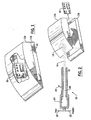
- a susceptible component 10 is contained within a rigid housing 12, which may optionally be comprised of multiple segments 12a, 12b joined together to form a unitary housing for protection of the susceptible component 10.
- electronic components are used as exemplary components that may be susceptible to damage or disruption by ionizing radiation. It is to be understood that radiation shielded systems described herein with respect to electronic components are equally applicable to other components susceptible to damage or disruption caused by exposure to ionizing radiation, including but not limited to micro-mechanical devices, piezo-electronic devices, magnetic memory components, optical memory components, electronic memory components, organic memory components, optical devices and living organisms including humans.
- An electronic component 10 may be any type of board or panel-type structure with electronic parts and/or electronic, mechanical, electromechanical elements, mounted thereupon, including printed wiring assemblies or boards, transducers, and multifunctional parts with embedded electronics.
- the invention contemplates electronic components 10 which are designed to perform at least one computational function, and wherein those electronic components are susceptible to interruption of that computational function upon exposure to external ionizing radiation.
- the housing 12 may contain multiple electronic components 10 and may also contain components, which are not electronic in nature and which may not be susceptible to disruption by ionizing radiation, such as structural components.
- a metallic layer 14 is deposited upon the housing 12 using a thermal spray technique.
- the high atomic number coating is typically applied prior to installation of the components or after the components have been removed from the housing. If, however, the electronic components 10 are designed to endure the thermal and mechanical conditions associated with environments such as the thermal spray process, it is conceivable that a housing 12 may be satisfactorily coated while the electronics remain within the housing.
- the housing is coated using a thermal spray technique which projects particles of high atomic number metals, such as those selected from tantalum, tungsten, platinum, lead, and combinations thereof toward the housing at high velocity in a molten or plastic state.
- particles of high atomic number metals such as those selected from tantalum, tungsten, platinum, lead, and combinations thereof toward the housing at high velocity in a molten or plastic state.
- the metal particles impact the surface of the housing, the metal particles form a unitary metallic coating upon the surface of the housing which is very dense, minimally porous, and of a uniform and precisely controlled thickness.
- thermal spray techniques capable of forming such a coating are industrially available, and are generally described in Davis, J.R., Davis and Associates. Hardfacing, Weld Cladding, and Dissimilar Metal Joining, ASM Handbook - Welding, Brazing, and Soldering, Vol. 6. 10 th ed. OH: ASM Metals Park, 1993.
- the spray techniques include electric arc spraying (EAS), high velocity oxygen fuel (HVOF), and plasma arc spraying (PAS).
- EAS electric arc spraying
- HVOF high velocity oxygen fuel
- PAS plasma arc spraying
- Particularly useful techniques for use in coating the housing 12 are the HVOF and PAS techniques because of their ability to produce high-density coatings.
- the HVOF process is a flame spray coating deposition process that can apply a dense, very low porosity coating.
- the controlled thermal output and high gas velocity of an HVOF apparatus imparts both thermal and kinetic energy to the metallic powder particles.
- One spraying apparatus of this type is disclosed in U.S. Pat. No. 4,999,225 to Rotolico incorporated herein by reference, and is available from the Perkin Elmer Corporation of Norwolk, Conn.
- Another variation of an HVOF apparatus specifically designed for use in depositing high-density coatings such as those utilized in this invention is disclosed in U.S. Pat. No. 6,245,390 B1.
- Other HVOF and similar PAS spraying apparatuses of this general type are available in the market place and are known to those of ordinary skill in the art.
- an HVOF thermal spraying apparatus 30 is positioned relative to the surface of a housing 12a, 12b for delivering a spray of metallic particles 16 and thereby creating a metallic coating 14 upon the surface of the housing.
- FIG. 2 an exemplary simplified version of an HVOF spray nozzle is shown in Figure 2 in which fuel 20 such as but not limited to hydrogen, propane, methane, or kerosene, is combined with oxygen 22 and combusted within a combustion chamber 24.
- fuel 20 such as but not limited to hydrogen, propane, methane, or kerosene
- oxygen 22 and combusted within a combustion chamber 24.
- the combustion of the fuel creates a supersonic velocity jet of gas, which travels down the length and out of the end of the nozzle 26.
- Metal particles are projected into the nozzle at an entry point 28 downstream of the combustion chamber 24.
- the metallic particles are projected at supersonic velocity toward an object to be coated.
- coatings of precise thickness may be applied.
- the thickness of the coating depends upon the quantity of metallic powder applied to the surface of the housing and the density with which that metal powder is compacted upon the surface.
- the coating For purposes of proper radiation shielding, it is desired that the coating have a low porosity such that it approaches the theoretical density of the metals and a near zero oxide content.
- the desired thickness and density of the coating will be predetermined and will be based upon the design characteristics of the electronics contained within the coated housing, the level of radiation expected to be encountered by the housing/electronics, and the radiation shielding previously provided by the underlying housing material.
- a new, dedicated, radiation-attenuating housing does not need to be produced in order to provide radiation shielding for the electronic components.
- lightweight housings had to be surrounded by dedicated housings capable of protecting the electronics from ionizing radiation.
- the old housing typically constructed from low atomic number metals, may be used as a base material on which to form a thicker, heavier shielding layer of metal.
- thermal spray process applies a uniform layer of metal upon the preexisting housing without the need to machine, mold, or otherwise form a dedicated housing from high atomic number materials.
- the thermal spray technique is capable of coating materials which may not be combinable using conventional fabricating techniques.
- the ability to coat housings with coatings of dissimilar materials is tremendously valuable in the production of radiation shields because it allows high atomic number metals such as tungsten to be coated upon lightweight housings constructed of other materials.
- the housing 12 is typically formed from metal but may be formed from any rigid material capable of withstanding short-term heating of 200°F or greater.
- Preferred housing materials include aluminum, aluminum alloys, titanium, titanium alloys, beryllium, beryllium alloys, and any combinations thereof.
- Such housing materials also include polymeric materials, such as thermoplastics having T m > 200°F.
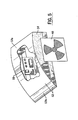
- a uniform coating 14 of high atomic number metal is applied to a housing 12 using the thermal spray technique, after which the susceptible components are installed in the high atomic number coated housing 50.
- the electronics 10 Once enclosed within the coated housing 50, the electronics 10 have improved shielding from external radiation 40, and are capable of withstanding radiation of a predetermined magnitude without interference of the operation of the electronic components.
- the shielded housing 50 may be installed within the appropriate vehicle or equipment for which it was originally designed, including aircraft, spacecraft, unmanned launch vehicles such as missiles, and space bound satellites. Of course, the system is equally applicable to stationary systems, and mobile land and sea based systems.
- the embodiment of Figure 3 provides radiation shielding from all directions and is applicable to those situations in which the direction of a potential source of radiation is unknown.
- a region 14 coated with a high atomic number metal layer may be provided on the housing 12 without covering the entire housing 12.
- the high atomic number metal 14 need only be disposed between the source of radiation 40 and those components 10 within the housing that are susceptible to damage or disruption by exposure to the radiation.
- a housing might be used in a medical environment, such as a hospital, where electronics or other susceptible components might be exposed to x-rays on a regular basis. In such a situation, that portion of a housing could be coated upon the surface of the housing which faces the radiation source without the need to coat the entire housing.
Landscapes
- Engineering & Computer Science (AREA)
- Chemical & Material Sciences (AREA)
- Combustion & Propulsion (AREA)
- Physics & Mathematics (AREA)
- General Engineering & Computer Science (AREA)
- High Energy & Nuclear Physics (AREA)
- Shielding Devices Or Components To Electric Or Magnetic Fields (AREA)
- Coating By Spraying Or Casting (AREA)
- Casings For Electric Apparatus (AREA)
- Manufacturing Of Electric Cables (AREA)
Abstract
Description
Claims (18)
- A radiation shielded system comprising
at least one component (10) susceptible to disruption upon exposure to ionizing radiation (40);
a rigid housing (12, 50) which substantially surrounds the at least one susceptible component (10); and
a metallic coating layer (14), preferably a thermally-sprayed metallic layer, deposited on at least a portion of the rigid housing. - The shielded system of claim 1, wherein the at least one component (10) susceptible to disruption is selected from the group consisting of electronic components, living organisms, micro-mechanical devices, piezo-electronic components, magnetic memory systems, optical memory systems, electronic memory systems, organic memory systems, and combinations thereof.
- The shielded system of claim 2, wherein the at least one component (10) susceptible to disruption is an electronic component.
- The shielded system of claim 3, wherein the at least one electronic component (10) is designed to perform at least one computational function and wherein the electronic component (10) is susceptible to interruption of the at least one computational function upon exposure to external ionizing radiation (40).
- The shielded system of any of claims 1 to 4, wherein the metallic coating layer (14) is comprised of a high atomic number metal, in particular of a metal selected from the group consisting of tantalum, tungsten, lead, and combinations thereof.
- The shielded system of any of claims 1 to 5, wherein the metallic coating layer (14) has an actual density of 97 % to 100 % of the theoretical density of the metal.
- The shielded system of any of claims 1 to 6, wherein the rigid housing (12, 50) is comprised of a material selected from the group consisting of aluminum, aluminum alloy, titanium, titanium alloy, beryllium, beryllium alloy, plastics, and combinations thereof.
- The shielded system of any of claims 1 to 7, wherein the metallic coating layer (14) is deposited using a thermal spray technique selected from the group consisting of High Velocity Oxygen Fuel (HVOF) thermal spray and Plasma Arc Spray (PAS).
- The shielded system of any of claims 1 to 8,
wherein said at least one component (10) is an electronic component substantially surrounded by said rigid housing (12, 50) acting as a radiation shield. - Use of the shielded system of any of claims 1 to 9, for attenuating radiation external to the susceptible component (10), wherein the radiation is attenuated by the rigid housing (12, 50) and deposited metal layer (14) prior to encountering the susceptible component (10).
- Use of the shielded system of any of claims 1 to 9 for incorporating into the electronic systems of a vehicle, in particular into the electronic systems of an aircraft, a spacecraft, a land vehicle, an aquatic vessel, or a missile.
- A process of providing a radiation shielded enclosure for an electronic component (10) comprising:providing a rigid housing (12, 50);depositing a metallic coating layer (14) upon at least a portion of the surface of the housing (12, 50) using a thermal spray technique; andpositioning the coated housing (12, 50) around a component (10) that is susceptible to disruption upon exposure to radiation (40), such that the housing (12, 50) substantially surrounds the susceptible component (10).
- The process of claim 12, wherein the metallic coating layer (14) is comprised of a high atomic number metal selected from the group consisting of tantalum, tungsten, lead, and combinations thereof.
- The process of claim 12 or 13, wherein the metallic coating layer (14) has an actual density of 97 % to 100 % of the theoretical density of the metal.
- The process of any of claims 12 to 14, wherein the rigid housing (12, 50) is comprised of a material selected from the group consisting of aluminum, aluminum alloy, titanium, titanium alloy, beryllium, beryllium alloy, plastics, and combinations thereof.
- The process of any of claims 12 to 15, wherein the metallic coating layer (12, 50) is deposited using a thermal spray technique selected from the group consisting of High Velocity Oxygen Fuel (HVOF) thermal spray and Plasma Arc Spray (PAS).
- The process of any of claims 12 to 16, wherein the component (10) susceptible to disruption is selected from the group consisting of electronic components, living organisms, micro-mechanical devices, piezo-electronic components, magnetic memory systems, optical memory systems, electronic memory systems, organic memory systems, and combinations thereof.
- The process of claim 17, wherein the component (10) susceptible to disruption is an electronic component.
Applications Claiming Priority (2)
| Application Number | Priority Date | Filing Date | Title |
|---|---|---|---|
| US325989 | 1999-06-04 | ||
| US10/325,989 US7163752B2 (en) | 2002-12-19 | 2002-12-19 | Shielded system with a housing having a high atomic number metal coating applied by thermal spray technique |
Publications (3)
| Publication Number | Publication Date |
|---|---|
| EP1431413A2 true EP1431413A2 (en) | 2004-06-23 |
| EP1431413A3 EP1431413A3 (en) | 2007-08-29 |
| EP1431413B1 EP1431413B1 (en) | 2009-05-06 |
Family
ID=32393111
Family Applications (1)
| Application Number | Title | Priority Date | Filing Date |
|---|---|---|---|
| EP03028470A Expired - Lifetime EP1431413B1 (en) | 2002-12-19 | 2003-12-12 | Shielded system with a housing having a high atomic number metal coating applied by thermal spray technique |
Country Status (6)
| Country | Link |
|---|---|
| US (2) | US7163752B2 (en) |
| EP (1) | EP1431413B1 (en) |
| JP (1) | JP2004198431A (en) |
| KR (1) | KR101047745B1 (en) |
| AT (1) | ATE430815T1 (en) |
| DE (1) | DE60327505D1 (en) |
Cited By (3)
| Publication number | Priority date | Publication date | Assignee | Title |
|---|---|---|---|---|
| WO2007027726A3 (en) * | 2005-08-31 | 2007-04-19 | Honeywell Int Inc | Conformal coverings for electronic devices |
| WO2007030468A3 (en) * | 2005-09-06 | 2008-01-31 | Honeywell Int Inc | Medical devices incorporating radio-opaque and biocompatible coatings |
| WO2008048235A3 (en) * | 2005-09-06 | 2009-04-09 | Honeywell Int Inc | Radio-opaque coatings used as shielding for radiation sources |
Families Citing this family (7)
| Publication number | Priority date | Publication date | Assignee | Title |
|---|---|---|---|---|
| US8492762B2 (en) * | 2006-06-27 | 2013-07-23 | General Electric Company | Electrical interface for a sensor array |
| US20100080921A1 (en) * | 2008-09-30 | 2010-04-01 | Beardsley M Brad | Thermal spray coatings for reduced hexavalent and leachable chromuim byproducts |
| JP6113973B2 (en) * | 2012-08-03 | 2017-04-12 | トーカロ株式会社 | Method for manufacturing gamma-ray radioactive substance containing member |
| KR20180002351U (en) | 2017-01-25 | 2018-08-02 | 송용호 | Coupling for pipe |
| US11887742B2 (en) | 2021-01-19 | 2024-01-30 | Worcester Polytechnic Institute | Cold sprayed radiation shielding |
| CN117441227A (en) * | 2022-05-23 | 2024-01-23 | 株式会社日立高新技术 | Recycling method of interior wall components |
| WO2025125550A2 (en) * | 2023-12-15 | 2025-06-19 | Mtdlab Space Division S.A. | Space radiation shielding enclosure for electronics |
Family Cites Families (17)
| Publication number | Priority date | Publication date | Assignee | Title |
|---|---|---|---|---|
| US4235943A (en) * | 1979-02-22 | 1980-11-25 | United Technologies Corporation | Thermal spray apparatus and method |
| US4529616A (en) * | 1982-08-25 | 1985-07-16 | Alloy Metals, Inc. | Method of forming corrosion resistant coating |
| FR2597652B1 (en) * | 1986-04-16 | 1988-07-29 | Aerospatiale | ELECTRONIC CIRCUIT PROTECTION BOX, HARDENED AGAINST X-RAYS |
| JPH01208446A (en) * | 1988-02-17 | 1989-08-22 | Hitachi Zosen Corp | Neutron-absorptive aluminum alloy |
| US4999225A (en) * | 1989-01-05 | 1991-03-12 | The Perkin-Elmer Corporation | High velocity powder thermal spray method for spraying non-meltable materials |
| FR2668847B1 (en) * | 1990-11-07 | 1994-06-03 | Alcatel Espace | METHOD FOR PROTECTING ELECTRONIC COMPONENTS OF A CIRCUIT AGAINST RADIATION AND DEVICE USING THE SAME. |
| US6455864B1 (en) * | 1994-04-01 | 2002-09-24 | Maxwell Electronic Components Group, Inc. | Methods and compositions for ionizing radiation shielding |
| US5518683A (en) * | 1995-02-10 | 1996-05-21 | General Electric Company | High temperature anti-fretting wear coating combination |
| US5998867A (en) * | 1996-02-23 | 1999-12-07 | Honeywell Inc. | Radiation enhanced chip encapsulant |
| US5915743A (en) * | 1997-06-30 | 1999-06-29 | The Boeing Company | Metal spray tool repair system |
| US20010001042A1 (en) * | 1998-04-07 | 2001-05-10 | Sinatra Raymond J. | Method for depositing braze alloy |
| US6245390B1 (en) * | 1999-09-10 | 2001-06-12 | Viatcheslav Baranovski | High-velocity thermal spray apparatus and method of forming materials |
| JP3645460B2 (en) * | 1999-12-28 | 2005-05-11 | 株式会社東芝 | Accident response robot system |
| US6749337B1 (en) * | 2000-01-26 | 2004-06-15 | Varian Medical Systems, Inc. | X-ray tube and method of manufacture |
| JP2002050889A (en) * | 2000-07-31 | 2002-02-15 | Furukawa Electric Co Ltd:The | Electronic component built-in type housing |
| US6605818B1 (en) * | 2002-03-28 | 2003-08-12 | The Boeing Company | Method for protecting against ionizing radiation using a sprayed protective coating, and a protected structure |
| KR100488244B1 (en) * | 2002-04-09 | 2005-05-06 | 재단법인서울대학교산학협력재단 | Membrane structure arrangement for higher hydrogen-partial-pressure control, apparatus for lower hydrogen-partial-pressure control and method for controlling the hydrogen-partial-pressure using said arrangement and apparatus to suppress the corrosion and environmentally assisted cracking of structural materials in cooling water of pressurized water reactors |
-
2002
- 2002-12-19 US US10/325,989 patent/US7163752B2/en not_active Expired - Lifetime
-
2003
- 2003-12-12 EP EP03028470A patent/EP1431413B1/en not_active Expired - Lifetime
- 2003-12-12 AT AT03028470T patent/ATE430815T1/en not_active IP Right Cessation
- 2003-12-12 DE DE60327505T patent/DE60327505D1/en not_active Expired - Lifetime
- 2003-12-18 JP JP2003421245A patent/JP2004198431A/en active Pending
- 2003-12-18 KR KR1020030093167A patent/KR101047745B1/en not_active Expired - Lifetime
-
2006
- 2006-12-08 US US11/608,289 patent/US20070087128A1/en not_active Abandoned
Cited By (4)
| Publication number | Priority date | Publication date | Assignee | Title |
|---|---|---|---|---|
| WO2007027726A3 (en) * | 2005-08-31 | 2007-04-19 | Honeywell Int Inc | Conformal coverings for electronic devices |
| WO2007030468A3 (en) * | 2005-09-06 | 2008-01-31 | Honeywell Int Inc | Medical devices incorporating radio-opaque and biocompatible coatings |
| WO2008048235A3 (en) * | 2005-09-06 | 2009-04-09 | Honeywell Int Inc | Radio-opaque coatings used as shielding for radiation sources |
| EP2050475A3 (en) * | 2005-09-06 | 2009-05-13 | Honeywell International Inc. | Medical devices incorporating radio-opaque and biocompatible coatings |
Also Published As
| Publication number | Publication date |
|---|---|
| KR20040054571A (en) | 2004-06-25 |
| ATE430815T1 (en) | 2009-05-15 |
| EP1431413B1 (en) | 2009-05-06 |
| KR101047745B1 (en) | 2011-07-07 |
| EP1431413A3 (en) | 2007-08-29 |
| JP2004198431A (en) | 2004-07-15 |
| US20040121194A1 (en) | 2004-06-24 |
| US7163752B2 (en) | 2007-01-16 |
| DE60327505D1 (en) | 2009-06-18 |
| US20070087128A1 (en) | 2007-04-19 |
Similar Documents
| Publication | Publication Date | Title |
|---|---|---|
| EP1431413B1 (en) | Shielded system with a housing having a high atomic number metal coating applied by thermal spray technique | |
| Champagne et al. | The unique abilities of cold spray deposition | |
| Champagne Jr et al. | Practical cold spray | |
| King et al. | An experimental and finite element study of cold spray copper impact onto two aluminum substrates | |
| US4755422A (en) | Multilayered electronics protection system | |
| US11076516B2 (en) | Methods of making Z-shielding | |
| US8173911B2 (en) | Electronic package | |
| EP2102380A2 (en) | Amorphous metal formulations and structured coatings for corrosion and wear resistance | |
| Belous et al. | High velocity microparticles in space: influence mechanisms and mitigating effects of electromagnetic irradiation | |
| US8367963B2 (en) | Method and apparatus for microplasma spray coating a portion of a turbine vane in a gas turbine engine | |
| US7763823B2 (en) | Method and apparatus for microplasma spray coating a portion of a compressor blade in a gas turbine engine | |
| Adkins et al. | Design and optimization of a high thrust density air-breathing pulsed plasma thruster array | |
| Saito et al. | Direct copper metallization of carbon fiber-reinforced thermoplastic polymers for lightning strike protection using low-pressure cold spray | |
| US6605818B1 (en) | Method for protecting against ionizing radiation using a sprayed protective coating, and a protected structure | |
| US6919576B2 (en) | Composite neutron absorbing coatings for nuclear criticality control | |
| US5095052A (en) | Low impulse coatings | |
| US12051516B1 (en) | Method of manufacturing advanced composites and coatings for radiation environment shielding | |
| Champagne Jr et al. | Material Properties | |
| Купряшов | Multifunctional coating in modern rocket and space technology | |
| US20070281102A1 (en) | Magnetic separation of devitrified particles from corrosion-resistant iron-based amorphous metal powders | |
| Belous et al. | Problems with Obtaining Materials for the Protection of Integrated Circuits from High-Velocity Streams of Microparticles and Possible Solutions | |
| Dai et al. | Experimental investigation on ablation characteristics of coated and uncoated steel under 30/80 μ s impulse current | |
| Belous et al. | High Velocity Microparticles in Space | |
| Naire et al. | „Full Metal Blanket “, a 100% metallic high temperature thermal protection for the Solar Orbiter High Gain Antenna Major Assembly at 0.28 AU from the Sun | |
| Cour-Palais | The long-term effects of the micrometeoroid and orbital debris environments on materials used in space |
Legal Events
| Date | Code | Title | Description |
|---|---|---|---|
| PUAI | Public reference made under article 153(3) epc to a published international application that has entered the european phase |
Free format text: ORIGINAL CODE: 0009012 |
|
| AK | Designated contracting states |
Kind code of ref document: A2 Designated state(s): AT BE BG CH CY CZ DE DK EE ES FI FR GB GR HU IE IT LI LU MC NL PT RO SE SI SK TR |
|
| AX | Request for extension of the european patent |
Extension state: AL LT LV MK |
|
| PUAL | Search report despatched |
Free format text: ORIGINAL CODE: 0009013 |
|
| AK | Designated contracting states |
Kind code of ref document: A3 Designated state(s): AT BE BG CH CY CZ DE DK EE ES FI FR GB GR HU IE IT LI LU MC NL PT RO SE SI SK TR |
|
| AX | Request for extension of the european patent |
Extension state: AL LT LV MK |
|
| 17P | Request for examination filed |
Effective date: 20080202 |
|
| 17Q | First examination report despatched |
Effective date: 20080313 |
|
| AKX | Designation fees paid |
Designated state(s): AT BE BG CH CY CZ DE DK EE ES FI FR GB GR HU IE IT LI LU MC NL PT RO SE SI SK TR |
|
| GRAP | Despatch of communication of intention to grant a patent |
Free format text: ORIGINAL CODE: EPIDOSNIGR1 |
|
| GRAP | Despatch of communication of intention to grant a patent |
Free format text: ORIGINAL CODE: EPIDOSNIGR1 |
|
| GRAS | Grant fee paid |
Free format text: ORIGINAL CODE: EPIDOSNIGR3 |
|
| GRAA | (expected) grant |
Free format text: ORIGINAL CODE: 0009210 |
|
| AK | Designated contracting states |
Kind code of ref document: B1 Designated state(s): AT BE BG CH CY CZ DE DK EE ES FI FR GB GR HU IE IT LI LU MC NL PT RO SE SI SK TR |
|
| REG | Reference to a national code |
Ref country code: GB Ref legal event code: FG4D |
|
| REG | Reference to a national code |
Ref country code: CH Ref legal event code: EP |
|
| REG | Reference to a national code |
Ref country code: IE Ref legal event code: FG4D |
|
| REF | Corresponds to: |
Ref document number: 60327505 Country of ref document: DE Date of ref document: 20090618 Kind code of ref document: P |
|
| PG25 | Lapsed in a contracting state [announced via postgrant information from national office to epo] |
Ref country code: ES Free format text: LAPSE BECAUSE OF FAILURE TO SUBMIT A TRANSLATION OF THE DESCRIPTION OR TO PAY THE FEE WITHIN THE PRESCRIBED TIME-LIMIT Effective date: 20090817 Ref country code: FI Free format text: LAPSE BECAUSE OF FAILURE TO SUBMIT A TRANSLATION OF THE DESCRIPTION OR TO PAY THE FEE WITHIN THE PRESCRIBED TIME-LIMIT Effective date: 20090506 Ref country code: AT Free format text: LAPSE BECAUSE OF FAILURE TO SUBMIT A TRANSLATION OF THE DESCRIPTION OR TO PAY THE FEE WITHIN THE PRESCRIBED TIME-LIMIT Effective date: 20090506 Ref country code: PT Free format text: LAPSE BECAUSE OF FAILURE TO SUBMIT A TRANSLATION OF THE DESCRIPTION OR TO PAY THE FEE WITHIN THE PRESCRIBED TIME-LIMIT Effective date: 20090906 |
|
| NLV1 | Nl: lapsed or annulled due to failure to fulfill the requirements of art. 29p and 29m of the patents act | ||
| PG25 | Lapsed in a contracting state [announced via postgrant information from national office to epo] |
Ref country code: SI Free format text: LAPSE BECAUSE OF FAILURE TO SUBMIT A TRANSLATION OF THE DESCRIPTION OR TO PAY THE FEE WITHIN THE PRESCRIBED TIME-LIMIT Effective date: 20090506 Ref country code: NL Free format text: LAPSE BECAUSE OF FAILURE TO SUBMIT A TRANSLATION OF THE DESCRIPTION OR TO PAY THE FEE WITHIN THE PRESCRIBED TIME-LIMIT Effective date: 20090506 Ref country code: SE Free format text: LAPSE BECAUSE OF FAILURE TO SUBMIT A TRANSLATION OF THE DESCRIPTION OR TO PAY THE FEE WITHIN THE PRESCRIBED TIME-LIMIT Effective date: 20090806 |
|
| PG25 | Lapsed in a contracting state [announced via postgrant information from national office to epo] |
Ref country code: CZ Free format text: LAPSE BECAUSE OF FAILURE TO SUBMIT A TRANSLATION OF THE DESCRIPTION OR TO PAY THE FEE WITHIN THE PRESCRIBED TIME-LIMIT Effective date: 20090506 Ref country code: DK Free format text: LAPSE BECAUSE OF FAILURE TO SUBMIT A TRANSLATION OF THE DESCRIPTION OR TO PAY THE FEE WITHIN THE PRESCRIBED TIME-LIMIT Effective date: 20090506 Ref country code: EE Free format text: LAPSE BECAUSE OF FAILURE TO SUBMIT A TRANSLATION OF THE DESCRIPTION OR TO PAY THE FEE WITHIN THE PRESCRIBED TIME-LIMIT Effective date: 20090506 Ref country code: RO Free format text: LAPSE BECAUSE OF FAILURE TO SUBMIT A TRANSLATION OF THE DESCRIPTION OR TO PAY THE FEE WITHIN THE PRESCRIBED TIME-LIMIT Effective date: 20090506 |
|
| PG25 | Lapsed in a contracting state [announced via postgrant information from national office to epo] |
Ref country code: SK Free format text: LAPSE BECAUSE OF FAILURE TO SUBMIT A TRANSLATION OF THE DESCRIPTION OR TO PAY THE FEE WITHIN THE PRESCRIBED TIME-LIMIT Effective date: 20090506 Ref country code: BE Free format text: LAPSE BECAUSE OF FAILURE TO SUBMIT A TRANSLATION OF THE DESCRIPTION OR TO PAY THE FEE WITHIN THE PRESCRIBED TIME-LIMIT Effective date: 20090506 |
|
| PLBE | No opposition filed within time limit |
Free format text: ORIGINAL CODE: 0009261 |
|
| STAA | Information on the status of an ep patent application or granted ep patent |
Free format text: STATUS: NO OPPOSITION FILED WITHIN TIME LIMIT |
|
| PG25 | Lapsed in a contracting state [announced via postgrant information from national office to epo] |
Ref country code: BG Free format text: LAPSE BECAUSE OF FAILURE TO SUBMIT A TRANSLATION OF THE DESCRIPTION OR TO PAY THE FEE WITHIN THE PRESCRIBED TIME-LIMIT Effective date: 20090806 |
|
| 26N | No opposition filed |
Effective date: 20100209 |
|
| PG25 | Lapsed in a contracting state [announced via postgrant information from national office to epo] |
Ref country code: MC Free format text: LAPSE BECAUSE OF NON-PAYMENT OF DUE FEES Effective date: 20100701 |
|
| REG | Reference to a national code |
Ref country code: CH Ref legal event code: PL |
|
| PG25 | Lapsed in a contracting state [announced via postgrant information from national office to epo] |
Ref country code: LI Free format text: LAPSE BECAUSE OF NON-PAYMENT OF DUE FEES Effective date: 20091231 Ref country code: CH Free format text: LAPSE BECAUSE OF NON-PAYMENT OF DUE FEES Effective date: 20091231 Ref country code: GR Free format text: LAPSE BECAUSE OF FAILURE TO SUBMIT A TRANSLATION OF THE DESCRIPTION OR TO PAY THE FEE WITHIN THE PRESCRIBED TIME-LIMIT Effective date: 20090807 Ref country code: IE Free format text: LAPSE BECAUSE OF NON-PAYMENT OF DUE FEES Effective date: 20091212 |
|
| PG25 | Lapsed in a contracting state [announced via postgrant information from national office to epo] |
Ref country code: LU Free format text: LAPSE BECAUSE OF NON-PAYMENT OF DUE FEES Effective date: 20091212 |
|
| PG25 | Lapsed in a contracting state [announced via postgrant information from national office to epo] |
Ref country code: HU Free format text: LAPSE BECAUSE OF FAILURE TO SUBMIT A TRANSLATION OF THE DESCRIPTION OR TO PAY THE FEE WITHIN THE PRESCRIBED TIME-LIMIT Effective date: 20091107 |
|
| PG25 | Lapsed in a contracting state [announced via postgrant information from national office to epo] |
Ref country code: TR Free format text: LAPSE BECAUSE OF FAILURE TO SUBMIT A TRANSLATION OF THE DESCRIPTION OR TO PAY THE FEE WITHIN THE PRESCRIBED TIME-LIMIT Effective date: 20090506 |
|
| PG25 | Lapsed in a contracting state [announced via postgrant information from national office to epo] |
Ref country code: CY Free format text: LAPSE BECAUSE OF FAILURE TO SUBMIT A TRANSLATION OF THE DESCRIPTION OR TO PAY THE FEE WITHIN THE PRESCRIBED TIME-LIMIT Effective date: 20090506 |
|
| REG | Reference to a national code |
Ref country code: FR Ref legal event code: PLFP Year of fee payment: 13 |
|
| REG | Reference to a national code |
Ref country code: FR Ref legal event code: PLFP Year of fee payment: 14 |
|
| PG25 | Lapsed in a contracting state [announced via postgrant information from national office to epo] |
Ref country code: IT Free format text: LAPSE BECAUSE OF NON-PAYMENT OF DUE FEES Effective date: 20151212 |
|
| PG25 | Lapsed in a contracting state [announced via postgrant information from national office to epo] |
Ref country code: IT Free format text: LAPSE BECAUSE OF NON-PAYMENT OF DUE FEES Effective date: 20151212 |
|
| PGRI | Patent reinstated in contracting state [announced from national office to epo] |
Ref country code: IT Effective date: 20170710 |
|
| REG | Reference to a national code |
Ref country code: FR Ref legal event code: PLFP Year of fee payment: 15 |
|
| PGFP | Annual fee paid to national office [announced via postgrant information from national office to epo] |
Ref country code: GB Payment date: 20221227 Year of fee payment: 20 Ref country code: FR Payment date: 20221227 Year of fee payment: 20 |
|
| PGFP | Annual fee paid to national office [announced via postgrant information from national office to epo] |
Ref country code: IT Payment date: 20221221 Year of fee payment: 20 Ref country code: DE Payment date: 20221228 Year of fee payment: 20 |
|
| P01 | Opt-out of the competence of the unified patent court (upc) registered |
Effective date: 20230503 |
|
| REG | Reference to a national code |
Ref country code: DE Ref legal event code: R071 Ref document number: 60327505 Country of ref document: DE |
|
| REG | Reference to a national code |
Ref country code: GB Ref legal event code: PE20 Expiry date: 20231211 |
|
| PG25 | Lapsed in a contracting state [announced via postgrant information from national office to epo] |
Ref country code: GB Free format text: LAPSE BECAUSE OF EXPIRATION OF PROTECTION Effective date: 20231211 |
|
| PG25 | Lapsed in a contracting state [announced via postgrant information from national office to epo] |
Ref country code: GB Free format text: LAPSE BECAUSE OF EXPIRATION OF PROTECTION Effective date: 20231211 |