EP1431258A2 - Procede de fabrication d'un composite a matrice ceramique et a fibres de carbure de silicium et composite ainsi obtenu - Google Patents
Procede de fabrication d'un composite a matrice ceramique et a fibres de carbure de silicium et composite ainsi obtenu Download PDFInfo
- Publication number
- EP1431258A2 EP1431258A2 EP03104846A EP03104846A EP1431258A2 EP 1431258 A2 EP1431258 A2 EP 1431258A2 EP 03104846 A EP03104846 A EP 03104846A EP 03104846 A EP03104846 A EP 03104846A EP 1431258 A2 EP1431258 A2 EP 1431258A2
- Authority
- EP
- European Patent Office
- Prior art keywords
- composite
- compact
- powder
- process according
- sic
- Prior art date
- Legal status (The legal status is an assumption and is not a legal conclusion. Google has not performed a legal analysis and makes no representation as to the accuracy of the status listed.)
- Withdrawn
Links
- 239000002131 composite material Substances 0.000 title claims abstract description 107
- HBMJWWWQQXIZIP-UHFFFAOYSA-N silicon carbide Chemical compound [Si+]#[C-] HBMJWWWQQXIZIP-UHFFFAOYSA-N 0.000 title claims abstract description 73
- 229910010271 silicon carbide Inorganic materials 0.000 title claims abstract description 70
- 238000000034 method Methods 0.000 title claims abstract description 64
- 238000004519 manufacturing process Methods 0.000 title claims abstract description 14
- 239000000835 fiber Substances 0.000 title claims description 52
- 239000011153 ceramic matrix composite Substances 0.000 title claims description 5
- 239000000919 ceramic Substances 0.000 claims abstract description 25
- 238000000280 densification Methods 0.000 claims abstract description 22
- IJGRMHOSHXDMSA-UHFFFAOYSA-N Atomic nitrogen Chemical compound N#N IJGRMHOSHXDMSA-UHFFFAOYSA-N 0.000 claims abstract description 21
- 239000011159 matrix material Substances 0.000 claims abstract description 21
- OKTJSMMVPCPJKN-UHFFFAOYSA-N Carbon Chemical compound [C] OKTJSMMVPCPJKN-UHFFFAOYSA-N 0.000 claims abstract description 14
- XUIMIQQOPSSXEZ-UHFFFAOYSA-N Silicon Chemical compound [Si] XUIMIQQOPSSXEZ-UHFFFAOYSA-N 0.000 claims abstract description 14
- 229910052799 carbon Inorganic materials 0.000 claims abstract description 14
- 229910052710 silicon Inorganic materials 0.000 claims abstract description 13
- 239000010703 silicon Substances 0.000 claims abstract description 13
- 229910052757 nitrogen Inorganic materials 0.000 claims abstract description 10
- QVGXLLKOCUKJST-UHFFFAOYSA-N atomic oxygen Chemical compound [O] QVGXLLKOCUKJST-UHFFFAOYSA-N 0.000 claims abstract description 9
- 239000001301 oxygen Substances 0.000 claims abstract description 9
- 229910052760 oxygen Inorganic materials 0.000 claims abstract description 9
- 239000000843 powder Substances 0.000 claims description 68
- 238000009694 cold isostatic pressing Methods 0.000 claims description 22
- 239000008187 granular material Substances 0.000 claims description 22
- 238000005469 granulation Methods 0.000 claims description 20
- 230000003179 granulation Effects 0.000 claims description 20
- 238000010438 heat treatment Methods 0.000 claims description 18
- 238000005245 sintering Methods 0.000 claims description 17
- 238000007906 compression Methods 0.000 claims description 14
- 230000006835 compression Effects 0.000 claims description 14
- 239000000463 material Substances 0.000 claims description 11
- 238000000227 grinding Methods 0.000 claims description 9
- 230000008595 infiltration Effects 0.000 claims description 9
- 238000001764 infiltration Methods 0.000 claims description 9
- 238000005470 impregnation Methods 0.000 claims description 8
- 238000002360 preparation method Methods 0.000 claims description 8
- 238000001513 hot isostatic pressing Methods 0.000 claims description 7
- 239000007789 gas Substances 0.000 claims description 6
- 238000001725 laser pyrolysis Methods 0.000 claims description 6
- 239000002243 precursor Substances 0.000 claims description 6
- 238000007873 sieving Methods 0.000 claims description 6
- 239000013078 crystal Substances 0.000 claims description 4
- 238000001035 drying Methods 0.000 claims description 3
- 229920000642 polymer Polymers 0.000 claims description 3
- XKRFYHLGVUSROY-UHFFFAOYSA-N Argon Chemical compound [Ar] XKRFYHLGVUSROY-UHFFFAOYSA-N 0.000 description 16
- 239000000203 mixture Substances 0.000 description 16
- PZNSFCLAULLKQX-UHFFFAOYSA-N Boron nitride Chemical compound N#B PZNSFCLAULLKQX-UHFFFAOYSA-N 0.000 description 11
- RTAQQCXQSZGOHL-UHFFFAOYSA-N Titanium Chemical compound [Ti] RTAQQCXQSZGOHL-UHFFFAOYSA-N 0.000 description 8
- 229910052786 argon Inorganic materials 0.000 description 8
- 239000004816 latex Substances 0.000 description 8
- 229920000126 latex Polymers 0.000 description 8
- 238000001228 spectrum Methods 0.000 description 8
- 229910052582 BN Inorganic materials 0.000 description 6
- 238000002441 X-ray diffraction Methods 0.000 description 6
- 239000000126 substance Substances 0.000 description 6
- 230000000295 complement effect Effects 0.000 description 5
- 239000008188 pellet Substances 0.000 description 5
- 238000007872 degassing Methods 0.000 description 4
- 239000006185 dispersion Substances 0.000 description 4
- 230000005669 field effect Effects 0.000 description 4
- 229910052719 titanium Inorganic materials 0.000 description 4
- 239000010936 titanium Substances 0.000 description 4
- QGZKDVFQNNGYKY-UHFFFAOYSA-N Ammonia Chemical compound N QGZKDVFQNNGYKY-UHFFFAOYSA-N 0.000 description 3
- 229910052581 Si3N4 Inorganic materials 0.000 description 3
- BLRPTPMANUNPDV-UHFFFAOYSA-N Silane Chemical compound [SiH4] BLRPTPMANUNPDV-UHFFFAOYSA-N 0.000 description 3
- 230000015572 biosynthetic process Effects 0.000 description 3
- 238000005520 cutting process Methods 0.000 description 3
- 238000011065 in-situ storage Methods 0.000 description 3
- 230000003993 interaction Effects 0.000 description 3
- 239000004570 mortar (masonry) Substances 0.000 description 3
- 239000002245 particle Substances 0.000 description 3
- 238000007789 sealing Methods 0.000 description 3
- RZVAJINKPMORJF-UHFFFAOYSA-N Acetaminophen Chemical compound CC(=O)NC1=CC=C(O)C=C1 RZVAJINKPMORJF-UHFFFAOYSA-N 0.000 description 2
- VGGSQFUCUMXWEO-UHFFFAOYSA-N Ethene Chemical compound C=C VGGSQFUCUMXWEO-UHFFFAOYSA-N 0.000 description 2
- 229910004298 SiO 2 Inorganic materials 0.000 description 2
- 238000007792 addition Methods 0.000 description 2
- 230000008901 benefit Effects 0.000 description 2
- 230000005540 biological transmission Effects 0.000 description 2
- 238000003486 chemical etching Methods 0.000 description 2
- 238000005553 drilling Methods 0.000 description 2
- 230000000694 effects Effects 0.000 description 2
- 229920001971 elastomer Polymers 0.000 description 2
- 239000000806 elastomer Substances 0.000 description 2
- 238000011049 filling Methods 0.000 description 2
- 238000002156 mixing Methods 0.000 description 2
- 238000005086 pumping Methods 0.000 description 2
- 239000005297 pyrex Substances 0.000 description 2
- 239000011541 reaction mixture Substances 0.000 description 2
- 230000003014 reinforcing effect Effects 0.000 description 2
- 230000035939 shock Effects 0.000 description 2
- 229910000077 silane Inorganic materials 0.000 description 2
- HQVNEWCFYHHQES-UHFFFAOYSA-N silicon nitride Chemical compound N12[Si]34N5[Si]62N3[Si]51N64 HQVNEWCFYHHQES-UHFFFAOYSA-N 0.000 description 2
- 238000001694 spray drying Methods 0.000 description 2
- 238000005507 spraying Methods 0.000 description 2
- 239000000725 suspension Substances 0.000 description 2
- 238000003786 synthesis reaction Methods 0.000 description 2
- GUVRBAGPIYLISA-UHFFFAOYSA-N tantalum atom Chemical compound [Ta] GUVRBAGPIYLISA-UHFFFAOYSA-N 0.000 description 2
- 230000000930 thermomechanical effect Effects 0.000 description 2
- 239000005977 Ethylene Substances 0.000 description 1
- 244000043261 Hevea brasiliensis Species 0.000 description 1
- 241001465754 Metazoa Species 0.000 description 1
- ISWSIDIOOBJBQZ-UHFFFAOYSA-N Phenol Chemical compound OC1=CC=CC=C1 ISWSIDIOOBJBQZ-UHFFFAOYSA-N 0.000 description 1
- ZLMJMSJWJFRBEC-UHFFFAOYSA-N Potassium Chemical compound [K] ZLMJMSJWJFRBEC-UHFFFAOYSA-N 0.000 description 1
- CDBYLPFSWZWCQE-UHFFFAOYSA-L Sodium Carbonate Chemical compound [Na+].[Na+].[O-]C([O-])=O CDBYLPFSWZWCQE-UHFFFAOYSA-L 0.000 description 1
- 241001639412 Verres Species 0.000 description 1
- 239000000654 additive Substances 0.000 description 1
- 238000005054 agglomeration Methods 0.000 description 1
- 230000002776 aggregation Effects 0.000 description 1
- XAGFODPZIPBFFR-UHFFFAOYSA-N aluminium Chemical compound [Al] XAGFODPZIPBFFR-UHFFFAOYSA-N 0.000 description 1
- 229910052782 aluminium Inorganic materials 0.000 description 1
- 229910021529 ammonia Inorganic materials 0.000 description 1
- 229940095054 ammoniac Drugs 0.000 description 1
- 238000004458 analytical method Methods 0.000 description 1
- 239000010425 asbestos Substances 0.000 description 1
- 230000033558 biomineral tissue development Effects 0.000 description 1
- 239000003153 chemical reaction reagent Substances 0.000 description 1
- 239000013626 chemical specie Substances 0.000 description 1
- 238000005253 cladding Methods 0.000 description 1
- 239000000470 constituent Substances 0.000 description 1
- 230000007547 defect Effects 0.000 description 1
- 230000018109 developmental process Effects 0.000 description 1
- 238000002474 experimental method Methods 0.000 description 1
- YAGKRVSRTSUGEY-UHFFFAOYSA-N ferricyanide Chemical compound [Fe+3].N#[C-].N#[C-].N#[C-].N#[C-].N#[C-].N#[C-] YAGKRVSRTSUGEY-UHFFFAOYSA-N 0.000 description 1
- 239000011521 glass Substances 0.000 description 1
- 238000007731 hot pressing Methods 0.000 description 1
- 239000011261 inert gas Substances 0.000 description 1
- 230000009916 joint effect Effects 0.000 description 1
- 239000007788 liquid Substances 0.000 description 1
- 239000012705 liquid precursor Substances 0.000 description 1
- 239000000314 lubricant Substances 0.000 description 1
- 150000001247 metal acetylides Chemical class 0.000 description 1
- 238000005272 metallurgy Methods 0.000 description 1
- 239000002159 nanocrystal Substances 0.000 description 1
- 229920003052 natural elastomer Polymers 0.000 description 1
- 229920001194 natural rubber Polymers 0.000 description 1
- 150000004767 nitrides Chemical class 0.000 description 1
- 238000005121 nitriding Methods 0.000 description 1
- 229910000069 nitrogen hydride Inorganic materials 0.000 description 1
- 238000012856 packing Methods 0.000 description 1
- 229910021420 polycrystalline silicon Inorganic materials 0.000 description 1
- 229910052700 potassium Inorganic materials 0.000 description 1
- 239000011591 potassium Substances 0.000 description 1
- 238000004663 powder metallurgy Methods 0.000 description 1
- 238000000197 pyrolysis Methods 0.000 description 1
- 239000011226 reinforced ceramic Substances 0.000 description 1
- 239000012783 reinforcing fiber Substances 0.000 description 1
- 229910052895 riebeckite Inorganic materials 0.000 description 1
- 239000002904 solvent Substances 0.000 description 1
- 241000894007 species Species 0.000 description 1
- 230000002194 synthesizing effect Effects 0.000 description 1
- 229910052715 tantalum Inorganic materials 0.000 description 1
- 231100000331 toxic Toxicity 0.000 description 1
- 230000002588 toxic effect Effects 0.000 description 1
- 239000011882 ultra-fine particle Substances 0.000 description 1
- 238000002604 ultrasonography Methods 0.000 description 1
- 238000003826 uniaxial pressing Methods 0.000 description 1
- XLYOFNOQVPJJNP-UHFFFAOYSA-N water Substances O XLYOFNOQVPJJNP-UHFFFAOYSA-N 0.000 description 1
- 238000009941 weaving Methods 0.000 description 1
Images




Classifications
-
- C—CHEMISTRY; METALLURGY
- C04—CEMENTS; CONCRETE; ARTIFICIAL STONE; CERAMICS; REFRACTORIES
- C04B—LIME, MAGNESIA; SLAG; CEMENTS; COMPOSITIONS THEREOF, e.g. MORTARS, CONCRETE OR LIKE BUILDING MATERIALS; ARTIFICIAL STONE; CERAMICS; REFRACTORIES; TREATMENT OF NATURAL STONE
- C04B35/00—Shaped ceramic products characterised by their composition; Ceramics compositions; Processing powders of inorganic compounds preparatory to the manufacturing of ceramic products
- C04B35/622—Forming processes; Processing powders of inorganic compounds preparatory to the manufacturing of ceramic products
- C04B35/62227—Forming processes; Processing powders of inorganic compounds preparatory to the manufacturing of ceramic products obtaining fibres
- C04B35/62272—Forming processes; Processing powders of inorganic compounds preparatory to the manufacturing of ceramic products obtaining fibres based on non-oxide ceramics
- C04B35/62277—Fibres based on carbides
- C04B35/62281—Fibres based on carbides based on silicon carbide
-
- B—PERFORMING OPERATIONS; TRANSPORTING
- B82—NANOTECHNOLOGY
- B82Y—SPECIFIC USES OR APPLICATIONS OF NANOSTRUCTURES; MEASUREMENT OR ANALYSIS OF NANOSTRUCTURES; MANUFACTURE OR TREATMENT OF NANOSTRUCTURES
- B82Y30/00—Nanotechnology for materials or surface science, e.g. nanocomposites
-
- C—CHEMISTRY; METALLURGY
- C04—CEMENTS; CONCRETE; ARTIFICIAL STONE; CERAMICS; REFRACTORIES
- C04B—LIME, MAGNESIA; SLAG; CEMENTS; COMPOSITIONS THEREOF, e.g. MORTARS, CONCRETE OR LIKE BUILDING MATERIALS; ARTIFICIAL STONE; CERAMICS; REFRACTORIES; TREATMENT OF NATURAL STONE
- C04B35/00—Shaped ceramic products characterised by their composition; Ceramics compositions; Processing powders of inorganic compounds preparatory to the manufacturing of ceramic products
- C04B35/515—Shaped ceramic products characterised by their composition; Ceramics compositions; Processing powders of inorganic compounds preparatory to the manufacturing of ceramic products based on non-oxide ceramics
- C04B35/56—Shaped ceramic products characterised by their composition; Ceramics compositions; Processing powders of inorganic compounds preparatory to the manufacturing of ceramic products based on non-oxide ceramics based on carbides or oxycarbides
- C04B35/5603—Shaped ceramic products characterised by their composition; Ceramics compositions; Processing powders of inorganic compounds preparatory to the manufacturing of ceramic products based on non-oxide ceramics based on carbides or oxycarbides with a well-defined oxygen content, e.g. oxycarbides
-
- C—CHEMISTRY; METALLURGY
- C04—CEMENTS; CONCRETE; ARTIFICIAL STONE; CERAMICS; REFRACTORIES
- C04B—LIME, MAGNESIA; SLAG; CEMENTS; COMPOSITIONS THEREOF, e.g. MORTARS, CONCRETE OR LIKE BUILDING MATERIALS; ARTIFICIAL STONE; CERAMICS; REFRACTORIES; TREATMENT OF NATURAL STONE
- C04B35/00—Shaped ceramic products characterised by their composition; Ceramics compositions; Processing powders of inorganic compounds preparatory to the manufacturing of ceramic products
- C04B35/515—Shaped ceramic products characterised by their composition; Ceramics compositions; Processing powders of inorganic compounds preparatory to the manufacturing of ceramic products based on non-oxide ceramics
- C04B35/56—Shaped ceramic products characterised by their composition; Ceramics compositions; Processing powders of inorganic compounds preparatory to the manufacturing of ceramic products based on non-oxide ceramics based on carbides or oxycarbides
- C04B35/565—Shaped ceramic products characterised by their composition; Ceramics compositions; Processing powders of inorganic compounds preparatory to the manufacturing of ceramic products based on non-oxide ceramics based on carbides or oxycarbides based on silicon carbide
- C04B35/575—Shaped ceramic products characterised by their composition; Ceramics compositions; Processing powders of inorganic compounds preparatory to the manufacturing of ceramic products based on non-oxide ceramics based on carbides or oxycarbides based on silicon carbide obtained by pressure sintering
- C04B35/5755—Shaped ceramic products characterised by their composition; Ceramics compositions; Processing powders of inorganic compounds preparatory to the manufacturing of ceramic products based on non-oxide ceramics based on carbides or oxycarbides based on silicon carbide obtained by pressure sintering obtained by gas pressure sintering
-
- C—CHEMISTRY; METALLURGY
- C04—CEMENTS; CONCRETE; ARTIFICIAL STONE; CERAMICS; REFRACTORIES
- C04B—LIME, MAGNESIA; SLAG; CEMENTS; COMPOSITIONS THEREOF, e.g. MORTARS, CONCRETE OR LIKE BUILDING MATERIALS; ARTIFICIAL STONE; CERAMICS; REFRACTORIES; TREATMENT OF NATURAL STONE
- C04B35/00—Shaped ceramic products characterised by their composition; Ceramics compositions; Processing powders of inorganic compounds preparatory to the manufacturing of ceramic products
- C04B35/515—Shaped ceramic products characterised by their composition; Ceramics compositions; Processing powders of inorganic compounds preparatory to the manufacturing of ceramic products based on non-oxide ceramics
- C04B35/58—Shaped ceramic products characterised by their composition; Ceramics compositions; Processing powders of inorganic compounds preparatory to the manufacturing of ceramic products based on non-oxide ceramics based on borides, nitrides, i.e. nitrides, oxynitrides, carbonitrides or oxycarbonitrides or silicides
- C04B35/584—Shaped ceramic products characterised by their composition; Ceramics compositions; Processing powders of inorganic compounds preparatory to the manufacturing of ceramic products based on non-oxide ceramics based on borides, nitrides, i.e. nitrides, oxynitrides, carbonitrides or oxycarbonitrides or silicides based on silicon nitride
- C04B35/593—Shaped ceramic products characterised by their composition; Ceramics compositions; Processing powders of inorganic compounds preparatory to the manufacturing of ceramic products based on non-oxide ceramics based on borides, nitrides, i.e. nitrides, oxynitrides, carbonitrides or oxycarbonitrides or silicides based on silicon nitride obtained by pressure sintering
- C04B35/5935—Shaped ceramic products characterised by their composition; Ceramics compositions; Processing powders of inorganic compounds preparatory to the manufacturing of ceramic products based on non-oxide ceramics based on borides, nitrides, i.e. nitrides, oxynitrides, carbonitrides or oxycarbonitrides or silicides based on silicon nitride obtained by pressure sintering obtained by gas pressure sintering
-
- C—CHEMISTRY; METALLURGY
- C04—CEMENTS; CONCRETE; ARTIFICIAL STONE; CERAMICS; REFRACTORIES
- C04B—LIME, MAGNESIA; SLAG; CEMENTS; COMPOSITIONS THEREOF, e.g. MORTARS, CONCRETE OR LIKE BUILDING MATERIALS; ARTIFICIAL STONE; CERAMICS; REFRACTORIES; TREATMENT OF NATURAL STONE
- C04B35/00—Shaped ceramic products characterised by their composition; Ceramics compositions; Processing powders of inorganic compounds preparatory to the manufacturing of ceramic products
- C04B35/622—Forming processes; Processing powders of inorganic compounds preparatory to the manufacturing of ceramic products
- C04B35/626—Preparing or treating the powders individually or as batches ; preparing or treating macroscopic reinforcing agents for ceramic products, e.g. fibres; mechanical aspects section B
- C04B35/62605—Treating the starting powders individually or as mixtures
- C04B35/62695—Granulation or pelletising
-
- C—CHEMISTRY; METALLURGY
- C04—CEMENTS; CONCRETE; ARTIFICIAL STONE; CERAMICS; REFRACTORIES
- C04B—LIME, MAGNESIA; SLAG; CEMENTS; COMPOSITIONS THEREOF, e.g. MORTARS, CONCRETE OR LIKE BUILDING MATERIALS; ARTIFICIAL STONE; CERAMICS; REFRACTORIES; TREATMENT OF NATURAL STONE
- C04B35/00—Shaped ceramic products characterised by their composition; Ceramics compositions; Processing powders of inorganic compounds preparatory to the manufacturing of ceramic products
- C04B35/71—Ceramic products containing macroscopic reinforcing agents
- C04B35/78—Ceramic products containing macroscopic reinforcing agents containing non-metallic materials
- C04B35/80—Fibres, filaments, whiskers, platelets, or the like
-
- C—CHEMISTRY; METALLURGY
- C04—CEMENTS; CONCRETE; ARTIFICIAL STONE; CERAMICS; REFRACTORIES
- C04B—LIME, MAGNESIA; SLAG; CEMENTS; COMPOSITIONS THEREOF, e.g. MORTARS, CONCRETE OR LIKE BUILDING MATERIALS; ARTIFICIAL STONE; CERAMICS; REFRACTORIES; TREATMENT OF NATURAL STONE
- C04B2235/00—Aspects relating to ceramic starting mixtures or sintered ceramic products
- C04B2235/02—Composition of constituents of the starting material or of secondary phases of the final product
- C04B2235/30—Constituents and secondary phases not being of a fibrous nature
- C04B2235/38—Non-oxide ceramic constituents or additives
- C04B2235/3817—Carbides
- C04B2235/3826—Silicon carbides
- C04B2235/3834—Beta silicon carbide
-
- C—CHEMISTRY; METALLURGY
- C04—CEMENTS; CONCRETE; ARTIFICIAL STONE; CERAMICS; REFRACTORIES
- C04B—LIME, MAGNESIA; SLAG; CEMENTS; COMPOSITIONS THEREOF, e.g. MORTARS, CONCRETE OR LIKE BUILDING MATERIALS; ARTIFICIAL STONE; CERAMICS; REFRACTORIES; TREATMENT OF NATURAL STONE
- C04B2235/00—Aspects relating to ceramic starting mixtures or sintered ceramic products
- C04B2235/02—Composition of constituents of the starting material or of secondary phases of the final product
- C04B2235/30—Constituents and secondary phases not being of a fibrous nature
- C04B2235/38—Non-oxide ceramic constituents or additives
- C04B2235/3852—Nitrides, e.g. oxynitrides, carbonitrides, oxycarbonitrides, lithium nitride, magnesium nitride
- C04B2235/3856—Carbonitrides, e.g. titanium carbonitride, zirconium carbonitride
-
- C—CHEMISTRY; METALLURGY
- C04—CEMENTS; CONCRETE; ARTIFICIAL STONE; CERAMICS; REFRACTORIES
- C04B—LIME, MAGNESIA; SLAG; CEMENTS; COMPOSITIONS THEREOF, e.g. MORTARS, CONCRETE OR LIKE BUILDING MATERIALS; ARTIFICIAL STONE; CERAMICS; REFRACTORIES; TREATMENT OF NATURAL STONE
- C04B2235/00—Aspects relating to ceramic starting mixtures or sintered ceramic products
- C04B2235/02—Composition of constituents of the starting material or of secondary phases of the final product
- C04B2235/30—Constituents and secondary phases not being of a fibrous nature
- C04B2235/38—Non-oxide ceramic constituents or additives
- C04B2235/3852—Nitrides, e.g. oxynitrides, carbonitrides, oxycarbonitrides, lithium nitride, magnesium nitride
- C04B2235/3873—Silicon nitrides, e.g. silicon carbonitride, silicon oxynitride
-
- C—CHEMISTRY; METALLURGY
- C04—CEMENTS; CONCRETE; ARTIFICIAL STONE; CERAMICS; REFRACTORIES
- C04B—LIME, MAGNESIA; SLAG; CEMENTS; COMPOSITIONS THEREOF, e.g. MORTARS, CONCRETE OR LIKE BUILDING MATERIALS; ARTIFICIAL STONE; CERAMICS; REFRACTORIES; TREATMENT OF NATURAL STONE
- C04B2235/00—Aspects relating to ceramic starting mixtures or sintered ceramic products
- C04B2235/02—Composition of constituents of the starting material or of secondary phases of the final product
- C04B2235/30—Constituents and secondary phases not being of a fibrous nature
- C04B2235/38—Non-oxide ceramic constituents or additives
- C04B2235/3895—Non-oxides with a defined oxygen content, e.g. SiOC, TiON
-
- C—CHEMISTRY; METALLURGY
- C04—CEMENTS; CONCRETE; ARTIFICIAL STONE; CERAMICS; REFRACTORIES
- C04B—LIME, MAGNESIA; SLAG; CEMENTS; COMPOSITIONS THEREOF, e.g. MORTARS, CONCRETE OR LIKE BUILDING MATERIALS; ARTIFICIAL STONE; CERAMICS; REFRACTORIES; TREATMENT OF NATURAL STONE
- C04B2235/00—Aspects relating to ceramic starting mixtures or sintered ceramic products
- C04B2235/02—Composition of constituents of the starting material or of secondary phases of the final product
- C04B2235/50—Constituents or additives of the starting mixture chosen for their shape or used because of their shape or their physical appearance
- C04B2235/52—Constituents or additives characterised by their shapes
- C04B2235/5208—Fibers
- C04B2235/5216—Inorganic
- C04B2235/524—Non-oxidic, e.g. borides, carbides, silicides or nitrides
- C04B2235/5244—Silicon carbide
-
- C—CHEMISTRY; METALLURGY
- C04—CEMENTS; CONCRETE; ARTIFICIAL STONE; CERAMICS; REFRACTORIES
- C04B—LIME, MAGNESIA; SLAG; CEMENTS; COMPOSITIONS THEREOF, e.g. MORTARS, CONCRETE OR LIKE BUILDING MATERIALS; ARTIFICIAL STONE; CERAMICS; REFRACTORIES; TREATMENT OF NATURAL STONE
- C04B2235/00—Aspects relating to ceramic starting mixtures or sintered ceramic products
- C04B2235/02—Composition of constituents of the starting material or of secondary phases of the final product
- C04B2235/50—Constituents or additives of the starting mixture chosen for their shape or used because of their shape or their physical appearance
- C04B2235/52—Constituents or additives characterised by their shapes
- C04B2235/5276—Whiskers, spindles, needles or pins
-
- C—CHEMISTRY; METALLURGY
- C04—CEMENTS; CONCRETE; ARTIFICIAL STONE; CERAMICS; REFRACTORIES
- C04B—LIME, MAGNESIA; SLAG; CEMENTS; COMPOSITIONS THEREOF, e.g. MORTARS, CONCRETE OR LIKE BUILDING MATERIALS; ARTIFICIAL STONE; CERAMICS; REFRACTORIES; TREATMENT OF NATURAL STONE
- C04B2235/00—Aspects relating to ceramic starting mixtures or sintered ceramic products
- C04B2235/02—Composition of constituents of the starting material or of secondary phases of the final product
- C04B2235/50—Constituents or additives of the starting mixture chosen for their shape or used because of their shape or their physical appearance
- C04B2235/52—Constituents or additives characterised by their shapes
- C04B2235/5296—Constituents or additives characterised by their shapes with a defined aspect ratio, e.g. indicating sphericity
-
- C—CHEMISTRY; METALLURGY
- C04—CEMENTS; CONCRETE; ARTIFICIAL STONE; CERAMICS; REFRACTORIES
- C04B—LIME, MAGNESIA; SLAG; CEMENTS; COMPOSITIONS THEREOF, e.g. MORTARS, CONCRETE OR LIKE BUILDING MATERIALS; ARTIFICIAL STONE; CERAMICS; REFRACTORIES; TREATMENT OF NATURAL STONE
- C04B2235/00—Aspects relating to ceramic starting mixtures or sintered ceramic products
- C04B2235/02—Composition of constituents of the starting material or of secondary phases of the final product
- C04B2235/50—Constituents or additives of the starting mixture chosen for their shape or used because of their shape or their physical appearance
- C04B2235/54—Particle size related information
- C04B2235/5418—Particle size related information expressed by the size of the particles or aggregates thereof
- C04B2235/5454—Particle size related information expressed by the size of the particles or aggregates thereof nanometer sized, i.e. below 100 nm
-
- C—CHEMISTRY; METALLURGY
- C04—CEMENTS; CONCRETE; ARTIFICIAL STONE; CERAMICS; REFRACTORIES
- C04B—LIME, MAGNESIA; SLAG; CEMENTS; COMPOSITIONS THEREOF, e.g. MORTARS, CONCRETE OR LIKE BUILDING MATERIALS; ARTIFICIAL STONE; CERAMICS; REFRACTORIES; TREATMENT OF NATURAL STONE
- C04B2235/00—Aspects relating to ceramic starting mixtures or sintered ceramic products
- C04B2235/60—Aspects relating to the preparation, properties or mechanical treatment of green bodies or pre-forms
- C04B2235/604—Pressing at temperatures other than sintering temperatures
-
- C—CHEMISTRY; METALLURGY
- C04—CEMENTS; CONCRETE; ARTIFICIAL STONE; CERAMICS; REFRACTORIES
- C04B—LIME, MAGNESIA; SLAG; CEMENTS; COMPOSITIONS THEREOF, e.g. MORTARS, CONCRETE OR LIKE BUILDING MATERIALS; ARTIFICIAL STONE; CERAMICS; REFRACTORIES; TREATMENT OF NATURAL STONE
- C04B2235/00—Aspects relating to ceramic starting mixtures or sintered ceramic products
- C04B2235/60—Aspects relating to the preparation, properties or mechanical treatment of green bodies or pre-forms
- C04B2235/608—Green bodies or pre-forms with well-defined density
-
- C—CHEMISTRY; METALLURGY
- C04—CEMENTS; CONCRETE; ARTIFICIAL STONE; CERAMICS; REFRACTORIES
- C04B—LIME, MAGNESIA; SLAG; CEMENTS; COMPOSITIONS THEREOF, e.g. MORTARS, CONCRETE OR LIKE BUILDING MATERIALS; ARTIFICIAL STONE; CERAMICS; REFRACTORIES; TREATMENT OF NATURAL STONE
- C04B2235/00—Aspects relating to ceramic starting mixtures or sintered ceramic products
- C04B2235/60—Aspects relating to the preparation, properties or mechanical treatment of green bodies or pre-forms
- C04B2235/614—Gas infiltration of green bodies or pre-forms
-
- C—CHEMISTRY; METALLURGY
- C04—CEMENTS; CONCRETE; ARTIFICIAL STONE; CERAMICS; REFRACTORIES
- C04B—LIME, MAGNESIA; SLAG; CEMENTS; COMPOSITIONS THEREOF, e.g. MORTARS, CONCRETE OR LIKE BUILDING MATERIALS; ARTIFICIAL STONE; CERAMICS; REFRACTORIES; TREATMENT OF NATURAL STONE
- C04B2235/00—Aspects relating to ceramic starting mixtures or sintered ceramic products
- C04B2235/60—Aspects relating to the preparation, properties or mechanical treatment of green bodies or pre-forms
- C04B2235/616—Liquid infiltration of green bodies or pre-forms
-
- C—CHEMISTRY; METALLURGY
- C04—CEMENTS; CONCRETE; ARTIFICIAL STONE; CERAMICS; REFRACTORIES
- C04B—LIME, MAGNESIA; SLAG; CEMENTS; COMPOSITIONS THEREOF, e.g. MORTARS, CONCRETE OR LIKE BUILDING MATERIALS; ARTIFICIAL STONE; CERAMICS; REFRACTORIES; TREATMENT OF NATURAL STONE
- C04B2235/00—Aspects relating to ceramic starting mixtures or sintered ceramic products
- C04B2235/65—Aspects relating to heat treatments of ceramic bodies such as green ceramics or pre-sintered ceramics, e.g. burning, sintering or melting processes
- C04B2235/656—Aspects relating to heat treatments of ceramic bodies such as green ceramics or pre-sintered ceramics, e.g. burning, sintering or melting processes characterised by specific heating conditions during heat treatment
-
- C—CHEMISTRY; METALLURGY
- C04—CEMENTS; CONCRETE; ARTIFICIAL STONE; CERAMICS; REFRACTORIES
- C04B—LIME, MAGNESIA; SLAG; CEMENTS; COMPOSITIONS THEREOF, e.g. MORTARS, CONCRETE OR LIKE BUILDING MATERIALS; ARTIFICIAL STONE; CERAMICS; REFRACTORIES; TREATMENT OF NATURAL STONE
- C04B2235/00—Aspects relating to ceramic starting mixtures or sintered ceramic products
- C04B2235/65—Aspects relating to heat treatments of ceramic bodies such as green ceramics or pre-sintered ceramics, e.g. burning, sintering or melting processes
- C04B2235/66—Specific sintering techniques, e.g. centrifugal sintering
- C04B2235/661—Multi-step sintering
-
- C—CHEMISTRY; METALLURGY
- C04—CEMENTS; CONCRETE; ARTIFICIAL STONE; CERAMICS; REFRACTORIES
- C04B—LIME, MAGNESIA; SLAG; CEMENTS; COMPOSITIONS THEREOF, e.g. MORTARS, CONCRETE OR LIKE BUILDING MATERIALS; ARTIFICIAL STONE; CERAMICS; REFRACTORIES; TREATMENT OF NATURAL STONE
- C04B2235/00—Aspects relating to ceramic starting mixtures or sintered ceramic products
- C04B2235/70—Aspects relating to sintered or melt-casted ceramic products
- C04B2235/74—Physical characteristics
- C04B2235/77—Density
Definitions
- the present invention relates to a method of manufacturing a composite in particular nanostructured, consisting of a ceramic matrix and silicon carbide (SiC) and composite fibers thus obtained.
- This composite is characterized by remarkable mechanical properties, especially in terms of hardness, toughness, wear resistance and resistance to mechanical and thermal shock.
- Ceramics reinforced with fibers, and in particular by silicon carbide fibers, are known to exhibit mechanical properties significantly better than those of ceramics monolithic, especially at high temperatures.
- reinforcing fibers silicon carbide there are two types of reinforcing fibers silicon carbide: polycrystalline fibers on the one hand, the length of which can reach a few hundreds of meters for a diameter of about ten microns, and monocrystalline fibers on the other hand, whose length does not exceed, in principle, some hundreds of microns for a diameter close to one micron. These monocrystalline fibers are commonly designated by the Anglo-Saxon term "whiskers”.
- infiltration processes or impregnation of a fibrous preform are usually long and expensive because of the multiplicity of steps they entail and cost fibers. Indeed, several cycles of treatment (infiltration / impregnation + heat treatment) are needed to gradually increase the density of the material and the number of cycles is all the more high that the thickness of the layers to be densified is higher important. For example, the densification of fibrous preforms of great thickness may require several months of treatment.
- Processes are also known for reinforcing ceramics by SiC whiskers, by growing them in situ , that is to say during the process of manufacturing said ceramics.
- One of these methods aims at obtaining the in situ growth of SiC whiskers in a silicon nitride matrix and consists of preparing a mixture of Si 3 N 4 powders, carbon and sinter additions, and then to submit this mixture with a heat treatment to grow the whiskers before sintering said mixture by hot pressing, the densification of the composite being completed by isostatic or uniaxial compression hot.
- the other of these methods is also aimed at obtaining the in situ growth of SiC whiskers in a silicon nitride matrix, but it comprises the preparation of a compact from a mixture of Si, SiO 2 and SiO 2 powders. carbon, the heat treatment at 1350 ° C, under argon, of this compact to obtain the formation of SiC particles, its nitriding by heating at 1400 ° C under nitrogen, impregnation with phenol and heating at 1600 ° C, under argon, to induce the growth of whiskers and, finally, its densification by uniaxial pressing at 1800 ° C.
- EP-A-1 116 704 It is also known from EP-A-1 116 704 a method for making a cutting tool consisting of a sub-micrometric ⁇ -silicon nitride matrix enhanced by ultrafine particles (less than 200 nm size) of silicon carbide.
- This method consists in subjecting to cold isostatic pressing a granulate obtained by atomization-drying of a mixture containing a powder of ⁇ -Si 3 N 4 and less than 30% by weight of an SiC powder, in the presence of sintering additions and various additives, and then sintering the resulting product at a temperature of 1800 to 1900 ° C, under pressure of an inert gas (Ar) or reagent (N 2 ).
- the material thus obtained is mainly composed of ⁇ -Si 3 N 4 and does not contain fibers, but particles of silicon carbide.
- the invention is intended to provide a process that allows make reinforced ceramic matrix composites by silicon carbide fibers, which is disadvantages presented by the processes of art prior art, in particular that it is free from any handling of SiC fibers and in that it can be implemented without mixing the powders or use such a mixture, thus guaranteeing perfectly homogeneous composites and, consequently, high mechanical performance.
- the invention also aims to provide a process which also makes it possible to achieve easily and quickly composites large dimensions and at a cost low enough for this process is applicable to a mass production of such composites.
- SiC fibers which includes a operation of growing SiC fibers in a compact containing silicon, carbon, nitrogen and oxygen and containing SiC in the form of crystals, as well as a densification operation of this compact, and wherein said growth operation SiC fibers are carried out simultaneously at the stage densification of said compact.
- the inventors have, in fact, noted that by submitting a compact, which contains silicon, carbon, nitrogen and oxygen and that contains SiC in the form of crystals, to a treatment appropriate, it is possible to induce SiC fiber growth in this compact and its densification.
- the operation of growth of SiC fibers and the operation of densification of the compact are preferably carried out by subjecting this compact to compression sintering isostatic hot.
- Hot Isostatic Pressing is a technique commonly used in the fields of ceramics and powder metallurgy, which consists in exerting, most often by means of a gas, a identical pressure in all directions on a rigid enclosure in which there is a compacted or compacted powder, after degassing of this powder to eliminate volatile species and hermetic closure of the enclosure, the powder being simultaneously heated to a temperature greater than 100 ° C and, generally, between 500 and 2000 ° C.
- the method comprises, prior to compact sintering, a step in the preparation of this compact, which consists of subjecting granules, that contain silicon, carbon, nitrogen and of oxygen and which contain SiC in the form of crystals, with cold isostatic compression.
- CIP Cold Isostatic Pressing
- the compact preparation by CIP is preferably made by filling granules with a sheath made of an elastomer or any other material able to deform at room temperature under the effect high pressures without tearing, then after pellet packing, pumping and sealing sheath, applying on the latter a pressure of 3000 to 13000 bars.
- the sheath is a sheath of natural rubber whose inner wall has been covered with a lubricant such as boron nitride, to facilitate the stripping of the compact at the end of the CIP.
- a lubricant such as boron nitride
- a pressure of 13000 bars will preferably be reached in about fifteen minutes, and reduced to 0 in the same time order.
- the step of preparation of the compact can be renewed one or several times if necessary, for example, in case of breaking of the compact, in which case the latter is crushed, the crushed and the resulting granules are again subject to an IPC.
- granules of average diameter from 0.1 to 500 ⁇ m and more preferably from 1 to 400 ⁇ m.
- these granules are obtained by granulation of a nanometric powder Composite Si / C / N / O, with a SiC mass at least equal to 50%.
- the method according to the invention therefore comprises moreover, prior to the preparation of the compact, a granulation step of a nanometric powder Si / C / N / O composite which has a mass content SiC at least equal to 50%.
- nanoscale powder Si / C / N / O a powder whose grains have a mean diameter at least equal to 10 nm and less than 100 nm, and all of which elements were introduced during its synthesis.
- the composite nanoscale powder Si / C / N / O from which are prepared the granules is, from preferably a powder synthesized by laser pyrolysis.
- This powder synthesis technique whose principle is based on the interaction in cross-flows between the emission of a CO 2 power laser and a reaction mixture consisting of gaseous or liquid precursors, makes it possible, in fact, to adjust the characteristics of the powders. powders obtained, both in terms of composition, structure and grain size. It is thus possible to obtain, by this technique, a powder having exactly the particle size, the Si / C / N / O mass proportions and the desired SiC mass content and, from there, a composite having exactly the characteristics sought.
- laser pyrolysis allows the production of powders at production rates hours and at reasonable costs, so that that the use of powders synthesized by this technique in the process according to the invention allows to consider an application of the latter to the mass production of composites and, in particular, large composites.
- the Si / C / N / O composite powder from which are prepared the granules has grains with a mean diameter of 10 to 100 nm and present a SiC mass content of at least 70% and, better still, of the order of 80 to 90%.
- granulation of this powder can be carried out both by dry than wet, the purpose of this granulation being to get as compact a stack as possible grains of powder.
- the dry route it is preferably performed by subjecting the powder to a CIP, followed by a grinding, manual or mechanical, of the resulting product and one or more sieves of the ground material thus obtained, to keep only the granules of desired size.
- This CIP is advantageously conducted in filling with powder a sheath consisting of a elastomer or any other material capable of deforming at room temperature under the effect of pressures raised without tearing, then, after this powder, pumping and sealing of the sheath, applying on the latter a pressure of 50 to 13000 bars and preferably 500 to 3500 bars.
- wet granulating the powder is preferably carried out by spray-drying ( "spray drying” in English), that is to say by dispersing this powder in a solvent and spraying the suspension thus obtained in a room covered by a hot air current.
- spray-drying “spray drying” in English
- the powder suspension can be subjected, before spraying, to a treatment with ultrasound to increase the dispersion of the powder grains and thus promote their subsequent stacking.
- the granulation step of the powder can be repeated one or more times, if necessary.
- dense compact more than 50% that is to say has a density greater than 50% of its density the latter being defined as the density presented by a piece of the same shape as this compact, which would consist of the same powder nanometric composite as that from which it is obtained, but which would not include any porosity.
- compact densities obtained in the prior art from powders nanoscale carbide or nitride powders are generally around 30 to 40% of their theoretical density.
- step c that is to say the sintering of the compact, to temperatures lower than those needed for lower densities and, in particular, to use, within the above-mentioned temperature range, temperatures of the order of 1600-2000 ° C.
- the method of manufacturing a matrix composite ceramic and silicon carbide fiber, object of the invention still presents those of being simple and quick to implement, requiring only equipment commonly used in the fields of ceramics and metallurgy of powders, and lead to obtaining composites with properties particularly remarkable mechanical terms of hardness, toughness, wear resistance and resistance to mechanical and thermal shock.
- the invention therefore also relates to a composite with ceramic matrix and SiC fibers, likely to be obtained by the process as previously defined.
- this composite consists of silicon, carbon, nitrogen and oxygen, present a mass content of SiC of at least 50%, and the SiC fibers have an aspect ratio greater than 5 and less than 500.
- the term " aspect ratio" of a fiber the ratio between the length and the width of this fiber.
- the composite has a mass content of SiC not less than 70% and better still, of the order of 80 to 90%, and the SiC fibers it contains a higher aspect ratio than 10 and less than 100.
- the SiC fibers present in the composite can easily be revealed by observing scanning electron microscope (SEM), with a field or not, samples of this composite after have subjected these samples to a chemical attack of Murakami type, which is usually used to reveal the carbides.
- SEM scanning electron microscope
- the samples, previously polished or not, are soaked in Murakami mixture (1/3 of water + 1/3 of soda + 1/3 of ferricyanide of potassium, all brought to a boil) ten minutes.
- Murakami mixture (1/3 of water + 1/3 of soda + 1/3 of ferricyanide of potassium, all brought to a boil
- the SiC fibers of the composite can also be revealed by observing under the microscope electronic transmission (TEM) samples obtained by mortar grinding of a 1 mm pellet thickness of this composite. In this case, no Chemical etching of the composite is not performed.
- TEM microscope electronic transmission
- the composite preferably has a density greater than 50% of its theoretical density.
- the composite according to the invention is likely to find many mechanical and thermomechanical applications, particularly in the automotive, aerospace, space and nuclear energy, and in particular in production of cutting or drilling tools, and the shielding.
- the invention further comprises other provisions which will come out from the following additional description, which refers to examples of implementation of the method according to the invention and composites obtained by this process.
- Figure 1 shows three images taken at SEM on a polished surface, having been subjected to chemical attack, of a composite obtained by the process according to the invention, part A of this figure corresponding to a magnification of 1000, part B to a magnification of 1460 and part C to a growth of 19600.
- Figure 2 shows an image, corresponding at a magnification of 500000, taken under a microscope electronic transmission (MET) on a pellet milled from a composite obtained by the process according to the invention.
- MET microscope electronic transmission
- Figure 3 shows the spectra of X-ray diffraction of a composite obtained by the process according to the invention and composite powder If / C / N / O from which this composite was made, part A corresponding to the spectrum of the composite, the Part B to the spectrum of the powder. In both cases, the presence of SiC nanocrystals is revealed.
- Figure 4 shows an image, corresponding at a magnification of 5000, taken at SEM field on a polished surface, having been subjected to a chemical attack, of a composite obtained by the process according to the invention and having undergone a heat treatment complementary to 1800 ° C, for 5 hours and under argon.
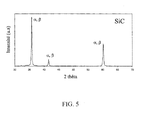
- Figure 5 shows the spectrum of X-ray diffraction of the composite whose microstructure is shown in Figure 4.
- Figure 6 shows an image, corresponding at a magnification of 50, taken at SEM field effect on a polished surface of a composite obtained by the method according to the invention and having undergone a treatment additional heat at 2100 ° C for 5 hours and under argon.
- Figure 7 shows the spectrum of X-ray diffraction of the composite whose microstructure is shown in Figure 6.
- the composite thus obtained is 70% dense.
- Figure 1 shows images taken at SEM field effect on a polished surface of this composite, after subjecting this surface to a chemical attack Murakami type.
- Part A of Figure 1 corresponds at a magnification of 1000, part B at a increase of 1400, and part C to a growth of 19600.
- Figure 2 she, shows an image, corresponding to a growth of 500000 taken at MET on a sample obtained by grinding a 1 mm thick pellet of the composite.
- the composite presents many ultra-thin SiC fibers, short and partially oriented, among which find nanocrystalline fibers, formed of grains nanometric (of the order of 15 to 25 nm).
- Figure 3 shows the spectrum x-ray diffraction pattern of the composite (Part A) and that of the nanoscale composite powder from which it was manufactured (part B).
- the peaks marked Al correspond to the signals coming from of the aluminum analysis support.
- the size SiC grains remain weak (less than 100 nm) in the composite.
- the composite thus obtained is 77% dense.
- Example 1 The ceramic matrix composite and SiC fibers elaborated in Example 1 was submitted to a complementary heat treatment at 1800 ° C, for 5 hours and under argon.
- the resulting composite is dense at 53.3%.
- the X-ray diffraction spectrum of the composite obtained in this example highlights a growth in the size of carbide grains silicon compared to the composite developed in Example 1
- Example 1 The ceramic matrix composite and SiC fibers elaborated in Example 1 was submitted to a complementary heat treatment at 2100 ° C, for 5 hours and under argon.
- the resulting composite is 52.8% dense.
- the X-ray diffraction spectrum of the composite obtained in this example highlights a growth in the size of carbide grains silicon compared to the composites obtained in Examples 1 and 3.
Landscapes
- Chemical & Material Sciences (AREA)
- Engineering & Computer Science (AREA)
- Ceramic Engineering (AREA)
- Manufacturing & Machinery (AREA)
- Materials Engineering (AREA)
- Structural Engineering (AREA)
- Organic Chemistry (AREA)
- Nanotechnology (AREA)
- Inorganic Chemistry (AREA)
- Chemical Kinetics & Catalysis (AREA)
- Physics & Mathematics (AREA)
- Composite Materials (AREA)
- Condensed Matter Physics & Semiconductors (AREA)
- General Physics & Mathematics (AREA)
- Crystallography & Structural Chemistry (AREA)
- Ceramic Products (AREA)
Abstract
Description
- des procédés qui consistent à réaliser une préforme fibreuse poreuse (c'est-à-dire un renfort de fibres de SiC, de la forme et aux dimensions de la pièce à fabriquer) et à soumettre cette préforme à un frittage, soit par infiltration d'un gaz précurseur de la matrice céramique dans un four de température élevée, soit par imprégnation d'une solution d'un polymère précurseur de ladite matrice, suivie d'une pyrolyse à haute température ; et
- des procédés qui consistent à compacter un mélange entre une matrice céramique et des fibres de SiC pour obtenir un compact poreux et à soumettre ce compact à un frittage par compression isostatique ou uniaxiale à chaud, ou à un frittage réactif.
- en plaçant le compact, par exemple en titane ou en tantale, de préférence après l'avoir recouvert d'une couche de nitrure de bore et d'une feuille de papier carbone afin d'éviter toute interaction avec l'élément de gainage, ou dans une gaine en verre du type Pyrex®,
- en dégazant le compact par chauffage à une température de l'ordre de 500 à 700°C, puis, après fermeture hermétique de la gaine,
- en chauffant le compact à une température de 1500 à 2000°C et en appliquant sur la gaine une pression de 1000 à 4000 bars et, de préférence, au moins égale à 2000 bars, de manière à obtenir une densification satisfaisante en un laps de temps pouvant aller d'un 1/4 d'heure à quelques heures.
- une étape de minéralisation de la poudre nanométrique composite Si/C/N/O par traitement thermique, en particulier à des températures de 600 à 1500°C, en vue d'éliminer de cette poudre certaines espèces chimiques susceptibles de nuire ultérieurement à la densification du compact ; et/ou
- une étape de traitement thermique du composite, en particulier à des températures de 1500 à 2500°C, sous atmosphère inerte (argon par exemple) ou réactive, en vue d'en consolider la microstructure et/ou d'induire une croissance additionnelle des fibres de SiC ; et/ou
- une étape d'infiltration du composite par un gaz précurseur de la matrice céramique, ou d'imprégnation du composite par une solution d'un polymère précurseur de la matrice céramique, en vue d'augmenter la densité du composite, cette étape d'infiltration/imprégnation pouvant être effectuée, soit sur le composite tel qu'obtenu à l'issue de la densification du compact, soit après avoir soumis ce composite à un traitement thermique complémentaire tel qu'évoqué ci-dessus.
Claims (23)
- Procédé de fabrication d'un composite à matrice céramique et à fibres de carbure de silicium (SiC), qui comprend une opération de croissance des fibres de SiC dans un compact renfermant du silicium, du carbone, de l'azote et de l'oxygène et contenant du SiC sous forme de cristaux, ainsi qu'une opération de densification de ce compact, et dans lequel ladite opération de croissance des fibres de SiC est réalisée simultanément à l'étape de densification dudit compact.
- Procédé selon la revendication 1, dans lequel la croissance des fibres de SiC et la densification du compact sont obtenues en soumettant ce compact à un frittage par compression isostatique à chaud (HIP).
- Procédé selon la revendication 2, dans lequel le frittage du compact est réalisé à une température de 1500 à 2000°C et en utilisant une pression de 1000 à 4000 bars et, de préférence, au moins égale à 2000 bars.
- Procédé selon l'une quelconque des revendications précédentes, qui comprend une étape de préparation du compact, laquelle consiste à soumettre des granulés renfermant du silicium, du carbone, de l'azote et de l'oxygène et contenant du SiC sous forme de grains, à une compression isostatique à froid (CIP).
- Procédé selon la revendication 4, dans lequel la compression isostatique à froid des granulés est réalisée à température ambiante et en utilisant une pression de 3000 à 13000 bars.
- Procédé selon la revendication 4 ou la revendication 5, dans lequel les granulés ont un diamètre moyen allant de 0,1 à 500 µm et, de préférence, de 1 à 400 µm.
- Procédé selon l'une quelconque des revendications 4 à 6, dans lequel les granulés sont obtenus à partir d'une poudre nanométrique composite Si/C/N/O, présentant une teneur massique en carbure de silicium au moins égale à 50%.
- Procédé selon l'une quelconque des revendications précédentes, qui comprend une étape de granulation d'une poudre nanométrique composite Si/C/N/O, présentant une teneur massique en carbure de silicium au moins égale à 50%.
- Procédé selon la revendication 7 ou la revendication 8, dans lequel la poudre nanométrique composite Si/C/N/O est une poudre synthétisée par pyrolyse laser.
- Procédé selon l'une quelconque des revendications 7 à 9, dans lequel le diamètre moyen des grains de la poudre nanométrique composite Si/C/N/O est de 10 à 100 nm.
- Procédé selon l'une quelconque des revendications 7 à 10, dans lequel la poudre nanométrique composite Si/C/N/O présente une teneur massique en SiC au moins égale à 70% et, de préférence, de 80 à 90%.
- Procédé selon l'une quelconque des revendications 8 à 11, dans lequel la granulation de la poudre nanométrique composite Si/C/N/O est réalisée en soumettant cette poudre à une compression isostatique à froid (CIP), suivie d'un broyage du produit résultant et d'un tamisage du broyat ainsi obtenu.
- Procédé selon la revendication 12, dans lequel la compression isostatique à froid de la poudre est réalisée à température ambiante et en utilisant une pression de 50 à 13000 bars et, de préférence, de 500 à 3500 bars.
- Procédé selon l'une quelconque des revendications 8 à 12, dans lequel la granulation de la poudre nanométrique composite Si/C/N/O est réalisée en soumettant cette poudre à une atomisation-séchage.
- Procédé selon l'une quelconque des revendications précédentes, comprenant les étapes suivantes :les étapes a) et b) pouvant être reconduites une ou plusieurs fois.a) soumettre une poudre nanométrique composite Si/C/N/O, synthétisée par pyrolyse laser et présentant une teneur massique en SiC au moins égale à 50%, à une compression isostatique à froid, à température ambiante et à une pression de 50 à 13000 bars, suivie d'un broyage du produit résultant et d'un tamisage du broyat ainsi obtenu, pour obtenir des granulés d'un diamètre moyen de 0,1 à 500 µm ;b) préparer un compact en soumettant ces granulés à une compression isostatique à froid, à température ambiante et en utilisant une pression de 3000 à 13000 bars ; etc) fritter ce compact en le soumettant à une compression isostatique à chaud, à une température de 1500 à 2000°C et en utilisant une pression de 1000 à 4000 bars ;
- Procédé selon l'une quelconque des revendications 8 à 15, qui comprend de plus, préalablement à l'étape de granulation de la poudre nanométrique composite Si/C/N/O, une étape de traitement thermique de cette poudre à une température de 600 à 1500°C.
- Procédé selon l'une quelconque des revendications précédentes, qui comprend de plus, postérieurement à la densification du compact, une étape de traitement thermique du composite résultant de cette densification à une température de 1500 à 2500°C.
- Procédé selon l'une quelconque des revendications précédentes, qui comprend de plus, postérieurement à la densification du compact, une étape d'infiltration du composite par un gaz précurseur de la matrice céramique, ou d'imprégnation de ce composite par une solution d'un polymère précurseur de la matrice céramique, ladite étape d'infiltration/imprégnation étant éventuellement effectuée après avoir soumis ledit composite à un traitement thermique à une température de 1500 à 2500°C.
- Composite à matrice céramique et à fibres de carbure de silicium susceptible d'être obtenu par un procédé tel que défini dans l'une quelconque des revendications 1 à 18.
- Composite selon la revendication 19, qui se compose de silicium, carbone, azote et oxygène et présente une teneur massique en carbure de silicium au moins égale à 50%, et dans lequel les fibres de carbure de silicium présentent un aspect ratio supérieur à 5 et inférieur à 500.
- Composite selon la revendication 19 ou la revendication 20, qui présente une teneur massique en SiC au moins égale à 70% et, de préférence, de 80 à 90%.
- Composite selon l'une quelconque des revendications 19 à 21, dans lequel les fibres de carbure de silicium présentent un aspect ratio supérieur à 10 et inférieur à 100.
- Composite selon l'une quelconque des revendications 19 à 22, qui présente une densité supérieure à 50% de sa densité théorique.
Applications Claiming Priority (2)
| Application Number | Priority Date | Filing Date | Title |
|---|---|---|---|
| FR0216181A FR2849022B1 (fr) | 2002-12-19 | 2002-12-19 | Procede de fabrication d'un composite a matrice ceramique et a fibres de carbure de silicium et composite ainsi obtenu |
| FR0216181 | 2002-12-19 |
Publications (2)
| Publication Number | Publication Date |
|---|---|
| EP1431258A2 true EP1431258A2 (fr) | 2004-06-23 |
| EP1431258A3 EP1431258A3 (fr) | 2011-02-23 |
Family
ID=32338941
Family Applications (1)
| Application Number | Title | Priority Date | Filing Date |
|---|---|---|---|
| EP03104846A Withdrawn EP1431258A3 (fr) | 2002-12-19 | 2003-12-19 | Procede de fabrication d'un composite a matrice ceramique et a fibres de carbure de silicium et composite ainsi obtenu |
Country Status (2)
| Country | Link |
|---|---|
| EP (1) | EP1431258A3 (fr) |
| FR (1) | FR2849022B1 (fr) |
Cited By (2)
| Publication number | Priority date | Publication date | Assignee | Title |
|---|---|---|---|---|
| CN105108461A (zh) * | 2015-09-24 | 2015-12-02 | 湖北三江航天江北机械工程有限公司 | C/SiC材料产品内螺纹超声振动加工方法 |
| CN118652121A (zh) * | 2024-05-30 | 2024-09-17 | 西北工业大学 | 一种基于激光近净成形制备的Cf-SiCnws/SiC陶瓷基复合材料及方法 |
Family Cites Families (3)
| Publication number | Priority date | Publication date | Assignee | Title |
|---|---|---|---|---|
| US5128285A (en) * | 1988-04-14 | 1992-07-07 | Ngk Spark Plug Co., Ltd. | Silicon oxynitride sintered body |
| JPH035374A (ja) * | 1989-06-01 | 1991-01-11 | Mitsubishi Gas Chem Co Inc | 窒化ケイ素―炭化ケイ素複合焼結体およびその製造法 |
| JP2974473B2 (ja) * | 1991-10-30 | 1999-11-10 | 日本碍子株式会社 | 複合セラミックスおよびその製造法 |
-
2002
- 2002-12-19 FR FR0216181A patent/FR2849022B1/fr not_active Expired - Fee Related
-
2003
- 2003-12-19 EP EP03104846A patent/EP1431258A3/fr not_active Withdrawn
Non-Patent Citations (1)
| Title |
|---|
| None |
Cited By (3)
| Publication number | Priority date | Publication date | Assignee | Title |
|---|---|---|---|---|
| CN105108461A (zh) * | 2015-09-24 | 2015-12-02 | 湖北三江航天江北机械工程有限公司 | C/SiC材料产品内螺纹超声振动加工方法 |
| CN105108461B (zh) * | 2015-09-24 | 2017-10-03 | 湖北三江航天江北机械工程有限公司 | C/SiC材料产品内螺纹超声振动加工方法 |
| CN118652121A (zh) * | 2024-05-30 | 2024-09-17 | 西北工业大学 | 一种基于激光近净成形制备的Cf-SiCnws/SiC陶瓷基复合材料及方法 |
Also Published As
| Publication number | Publication date |
|---|---|
| FR2849022B1 (fr) | 2005-07-01 |
| FR2849022A1 (fr) | 2004-06-25 |
| EP1431258A3 (fr) | 2011-02-23 |
Similar Documents
| Publication | Publication Date | Title |
|---|---|---|
| EP2964590B1 (fr) | Procede de preparation d'un revetement multicouche de ceramiques carbures sur, et eventuellement dans, une piece en un materiau carbone, par une technique d'infiltration reactive a l'etat fondu rmi | |
| EP2253604B1 (fr) | Piece à base de matériau composite c/c et procédé pour sa fabrication | |
| FR2653763A1 (fr) | Materiau composite contenant un materiau fibreux. | |
| EP3330240B1 (fr) | Procede pour la siliciuration surfacique de graphite | |
| EP3250538B1 (fr) | Particules de composite de diamant lié par une céramique friable et procédés pour leur production | |
| EP3169648B1 (fr) | Procédé de fabrication d'une pièce en matériau composite par synthèse par réaction auto-entretenue a haute température | |
| FR2458510A1 (fr) | Procede et appareil de fabrication de nitrure de bore cubique a partir de nitrure de bore hexagonal et produits obtenus | |
| FR2528823A1 (fr) | Procede de fabrication d'articles en carbone ou en graphite contenant du carbure de silicium lie par reaction | |
| WO2012055865A1 (fr) | Procédé pour revêtir une pièce d'un revêtement de protection contre l'oxydation. | |
| EP2347037A1 (fr) | Procede pour former un revetement anti-adherent a base de carbure de silicium | |
| FR2671797A1 (fr) | Procede de densification d'un substrat poreux par une matrice contenant du carbone. | |
| EP1019338B1 (fr) | Procede servant a produire des grains abrasifs et grains abrasifs produits au moyen de ce procede | |
| EP1343600B1 (fr) | Procede de fabrication de films minces en composite metal/ceramique | |
| EP2922803A1 (fr) | Materiau composite a matrice en aluminosilicate, notamment en aluminosilicate de baryum " bas '' renforcee par des renforts en oxyde de metal, et son procede de preparation | |
| FR2933972A1 (fr) | Procede de preparation d'une piece en carbure de silicium ne necessitant pas l'usage d'ajouts de frittage | |
| EP2943598B1 (fr) | Procédé d'élaboration d'un matériau nanocomposite al-tic | |
| EP4504440A1 (fr) | Procede de fabrication d'un composant horloger ou de bijouterie et ledit composant horloger ou de bijouterie | |
| EP1708975A1 (fr) | Nanopoudre ceramique apte au frittage et son procede de synthese | |
| WO2015036974A1 (fr) | Substrat à revêtement peu perméable pour solidification de silicium | |
| FR2849022A1 (fr) | Procede de fabrication d'un composite a matrice ceramique et a fibres de carbure de silicium et composite ainsi obtenu | |
| FR2853562A1 (fr) | Procede de fabrication de granules semiconducteurs | |
| EP1391444B1 (fr) | Procédé de fabrication d'un materiau réfractaire, revêtement protecteur susceptible d'être obtenu par ce procédé et leurs utilisations | |
| EP0751911B1 (fr) | Plaquettes a base de nitrure d'aluminium, procede de preparation et utilisations | |
| FR2886289A1 (fr) | Produit d'alumine frittee transparent au rayonnement infrarouge | |
| WO2011073556A1 (fr) | Polymetallosilazane pour la preparation de nanocomposites a proprietes decoratives, pouvant se presenter sous la forme d'objets massifs |
Legal Events
| Date | Code | Title | Description |
|---|---|---|---|
| PUAI | Public reference made under article 153(3) epc to a published international application that has entered the european phase |
Free format text: ORIGINAL CODE: 0009012 |
|
| AK | Designated contracting states |
Kind code of ref document: A2 Designated state(s): AT BE BG CH CY CZ DE DK EE ES FI FR GB GR HU IE IT LI LU MC NL PT RO SE SI SK TR |
|
| AX | Request for extension of the european patent |
Extension state: AL LT LV MK |
|
| RAP1 | Party data changed (applicant data changed or rights of an application transferred) |
Owner name: COMMISSARIAT A L'ENERGIE ATOMIQUE |
|
| RAP1 | Party data changed (applicant data changed or rights of an application transferred) |
Owner name: COMMISSARIAT A L'ENERGIE ATOMIQUE ET AUX ENERGIES |
|
| PUAL | Search report despatched |
Free format text: ORIGINAL CODE: 0009013 |
|
| AK | Designated contracting states |
Kind code of ref document: A3 Designated state(s): AT BE BG CH CY CZ DE DK EE ES FI FR GB GR HU IE IT LI LU MC NL PT RO SE SI SK TR |
|
| AX | Request for extension of the european patent |
Extension state: AL LT LV MK |
|
| RIC1 | Information provided on ipc code assigned before grant |
Ipc: C04B 35/626 20060101ALI20110119BHEP Ipc: C04B 35/622 20060101ALI20110119BHEP Ipc: C04B 35/593 20060101ALI20110119BHEP Ipc: C04B 35/56 20060101ALI20110119BHEP Ipc: C04B 35/81 20060101ALI20110119BHEP Ipc: C04B 35/80 20060101ALI20110119BHEP Ipc: C04B 35/575 20060101AFI20040128BHEP |
|
| 17P | Request for examination filed |
Effective date: 20110727 |
|
| AKX | Designation fees paid |
Designated state(s): DE IT SK |
|
| 17Q | First examination report despatched |
Effective date: 20120515 |
|
| STAA | Information on the status of an ep patent application or granted ep patent |
Free format text: STATUS: THE APPLICATION IS DEEMED TO BE WITHDRAWN |
|
| 18D | Application deemed to be withdrawn |
Effective date: 20130924 |