EP1431057A1 - Verfahren zum Einbringen einer Markierung in Glas - Google Patents
Verfahren zum Einbringen einer Markierung in Glas Download PDFInfo
- Publication number
- EP1431057A1 EP1431057A1 EP03023011A EP03023011A EP1431057A1 EP 1431057 A1 EP1431057 A1 EP 1431057A1 EP 03023011 A EP03023011 A EP 03023011A EP 03023011 A EP03023011 A EP 03023011A EP 1431057 A1 EP1431057 A1 EP 1431057A1
- Authority
- EP
- European Patent Office
- Prior art keywords
- glass
- film
- laser beam
- color pigments
- melted
- Prior art date
- Legal status (The legal status is an assumption and is not a legal conclusion. Google has not performed a legal analysis and makes no representation as to the accuracy of the status listed.)
- Granted
Links
- 239000011521 glass Substances 0.000 title claims abstract description 56
- 238000000034 method Methods 0.000 title claims abstract description 25
- 239000000049 pigment Substances 0.000 claims abstract description 13
- 239000007791 liquid phase Substances 0.000 claims abstract description 6
- 239000012790 adhesive layer Substances 0.000 claims description 4
- 239000005336 safety glass Substances 0.000 claims description 2
- 239000011888 foil Substances 0.000 description 4
- 238000005342 ion exchange Methods 0.000 description 2
- 238000004519 manufacturing process Methods 0.000 description 2
- 238000007600 charging Methods 0.000 description 1
- 239000003086 colorant Substances 0.000 description 1
- 238000010276 construction Methods 0.000 description 1
- 238000005336 cracking Methods 0.000 description 1
- 238000009792 diffusion process Methods 0.000 description 1
- 238000007786 electrostatic charging Methods 0.000 description 1
- 239000000499 gel Substances 0.000 description 1
- 238000010438 heat treatment Methods 0.000 description 1
- 229910021645 metal ion Inorganic materials 0.000 description 1
- 239000002245 particle Substances 0.000 description 1
- 238000001228 spectrum Methods 0.000 description 1
- 230000003068 static effect Effects 0.000 description 1
Images
Classifications
-
- B—PERFORMING OPERATIONS; TRANSPORTING
- B41—PRINTING; LINING MACHINES; TYPEWRITERS; STAMPS
- B41M—PRINTING, DUPLICATING, MARKING, OR COPYING PROCESSES; COLOUR PRINTING
- B41M5/00—Duplicating or marking methods; Sheet materials for use therein
- B41M5/26—Thermography ; Marking by high energetic means, e.g. laser otherwise than by burning, and characterised by the material used
-
- C—CHEMISTRY; METALLURGY
- C03—GLASS; MINERAL OR SLAG WOOL
- C03C—CHEMICAL COMPOSITION OF GLASSES, GLAZES OR VITREOUS ENAMELS; SURFACE TREATMENT OF GLASS; SURFACE TREATMENT OF FIBRES OR FILAMENTS MADE FROM GLASS, MINERALS OR SLAGS; JOINING GLASS TO GLASS OR OTHER MATERIALS
- C03C23/00—Other surface treatment of glass not in the form of fibres or filaments
-
- C—CHEMISTRY; METALLURGY
- C03—GLASS; MINERAL OR SLAG WOOL
- C03C—CHEMICAL COMPOSITION OF GLASSES, GLAZES OR VITREOUS ENAMELS; SURFACE TREATMENT OF GLASS; SURFACE TREATMENT OF FIBRES OR FILAMENTS MADE FROM GLASS, MINERALS OR SLAGS; JOINING GLASS TO GLASS OR OTHER MATERIALS
- C03C23/00—Other surface treatment of glass not in the form of fibres or filaments
- C03C23/0005—Other surface treatment of glass not in the form of fibres or filaments by irradiation
- C03C23/0025—Other surface treatment of glass not in the form of fibres or filaments by irradiation by a laser beam
-
- B—PERFORMING OPERATIONS; TRANSPORTING
- B41—PRINTING; LINING MACHINES; TYPEWRITERS; STAMPS
- B41M—PRINTING, DUPLICATING, MARKING, OR COPYING PROCESSES; COLOUR PRINTING
- B41M1/00—Inking and printing with a printer's forme
- B41M1/26—Printing on other surfaces than ordinary paper
- B41M1/34—Printing on other surfaces than ordinary paper on glass or ceramic surfaces
-
- B—PERFORMING OPERATIONS; TRANSPORTING
- B41—PRINTING; LINING MACHINES; TYPEWRITERS; STAMPS
- B41M—PRINTING, DUPLICATING, MARKING, OR COPYING PROCESSES; COLOUR PRINTING
- B41M5/00—Duplicating or marking methods; Sheet materials for use therein
- B41M5/26—Thermography ; Marking by high energetic means, e.g. laser otherwise than by burning, and characterised by the material used
- B41M5/262—Thermography ; Marking by high energetic means, e.g. laser otherwise than by burning, and characterised by the material used recording or marking of inorganic surfaces or materials, e.g. glass, metal, or ceramics
-
- B—PERFORMING OPERATIONS; TRANSPORTING
- B41—PRINTING; LINING MACHINES; TYPEWRITERS; STAMPS
- B41M—PRINTING, DUPLICATING, MARKING, OR COPYING PROCESSES; COLOUR PRINTING
- B41M5/00—Duplicating or marking methods; Sheet materials for use therein
- B41M5/26—Thermography ; Marking by high energetic means, e.g. laser otherwise than by burning, and characterised by the material used
- B41M5/267—Marking of plastic artifacts, e.g. with laser
-
- C—CHEMISTRY; METALLURGY
- C03—GLASS; MINERAL OR SLAG WOOL
- C03C—CHEMICAL COMPOSITION OF GLASSES, GLAZES OR VITREOUS ENAMELS; SURFACE TREATMENT OF GLASS; SURFACE TREATMENT OF FIBRES OR FILAMENTS MADE FROM GLASS, MINERALS OR SLAGS; JOINING GLASS TO GLASS OR OTHER MATERIALS
- C03C2217/00—Coatings on glass
- C03C2217/70—Properties of coatings
- C03C2217/72—Decorative coatings
Definitions
- the invention relates to a method for introducing a marking into glass, in particular in glass window panes.
- the use of foils to make a mark in the glass Advantage that pastes or gels or the like are not applied to the glass in a complex manner have to be removed after the marking has been made or to be washed off.
- the film can be marked with simple means Area of the glass to be attached and after performing the Marking procedure be pulled off the glass.
- the invention is therefore based on the object of a simple method for marking Propose glass using foils.
- a film is first, which color pigments has attached in the area to be marked on the glass. Then using a laser beam melted the surface of the glass adjacent to the film. At the same time, color pigments detach from the film and become detached from the liquid phase of the Glases included. If the laser beam is now removed from the film or from the glass, cools the liquid phase with the enclosed color particles and the film can from be subtracted from the marked area of the glass.
- the laser beam can be generated by a neodymium-YAG laser.
- Neodymium-YAG lasers are highly efficient and cover you Wavelength range, namely one in the red to the visible light spectrum adjacent area, which is particularly suitable for the method according to the invention.
- the surface of the glass is deep of 4 ⁇ m melted.
- the glass is only slightly destroyed, so that none permanent damage occurs.
- the melted areas of the glass therefore form no starting points for cracking or the like.
- the glass which is marked by means of the method according to the invention can for example, laminated safety glass (VSG) or single-pane glass (ESG), as it is used for example in automobile construction.
- VSG laminated safety glass
- ESG single-pane glass
- the film can have an adhesive layer, by means of which the film is glued to the glass.
- the adhesive layer can already be used the film contain the color pigments. It is also possible that the film is electrostatically charged and by means of electrostatic charging on the glass is attached.
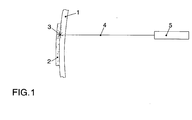
- one of a neondymium-YAG laser device 5 generated laser beam 4 on a glass pane 1 directed.
- the neondymium YAG laser device 5 is on this glass pane facing side of the glass pane 1 by means of static charging attached a film 2.
- Color pigments are contained in this film 2.
- the focus 3 of the laser beam is on the surface of the glass 1 which faces the film 2. This will make the Glass pane 1 melted on this surface.
Landscapes
- Chemical & Material Sciences (AREA)
- Materials Engineering (AREA)
- Physics & Mathematics (AREA)
- Optics & Photonics (AREA)
- Engineering & Computer Science (AREA)
- Chemical Kinetics & Catalysis (AREA)
- General Chemical & Material Sciences (AREA)
- Life Sciences & Earth Sciences (AREA)
- Geochemistry & Mineralogy (AREA)
- Organic Chemistry (AREA)
- Health & Medical Sciences (AREA)
- Toxicology (AREA)
- Surface Treatment Of Glass (AREA)
- Laser Beam Processing (AREA)
- Joining Of Glass To Other Materials (AREA)
- Glass Compositions (AREA)
- Thermal Transfer Or Thermal Recording In General (AREA)
Abstract
Description
- 1
- Glasscheibe
- 2
- Folie
- 3
- Fokus
- 4
- Laserstrahl
- 5
- Lasereinrichtung
Claims (8)
- Verfahren zum Einbringen einer Markierung in Glas (1), insbesondere in Fensterscheiben aus Glas, umfassend folgende Schritte:zunächst wird eine Folie (2) mit Farbpigmenten in dem zu markierenden Bereich an dem Glas (1) angebracht;dann wird mittels eines Laserstrahls (4) die zu der Folie (2) benachbarte Oberfläche des Glases (1) angeschmolzen;dabei werden sich von der Folie (2) lösende Farbpigmente von der flüssigen Phase des Glases (1) eingeschlossen;schließlich wird nach dem Entfernern des Laserstrahls (4) die Folie (2) von dem Glas (1) abgelöst.
- Verfahren nach dem vorhergehenden Anspruch, dadurch gekennzeichnet, dass der Laserstrahl (4) von einer Neodym-YAG Lasereinrichtung (5) erzeugt wird.
- Verfahren nach einem der vorhergehenden Ansprüche, dadurch gekennzeichnet, dass die Oberfläche des Glases (1) in einer Tiefe von bis 4 µm angeschmolzen wird.
- Verfahren nach einem der vorhergehenden Ansprüche, dadurch gekennzeichnet, dass das Glas (1) ein Verbundsicherheitsglas (VSG) ist.
- Verfahren nach einem der vorhergehenden Ansprüche 1 bis 3, dadurch gekennzeichnet, dass das Glas (1) ein Einscheibenglas (ESG) ist.
- Verfahren nach einem der vorhergehenden Ansprüche, dadurch gekennzeichnet, dass die Folie (2) eine Klebstoffschicht aufweist, mittels welcher die Folie (2) an dem Glas (1) angeklebt wird.
- Verfahren nach dem vorhergehenden Anspruch, dadurch gekennzeichnet, dass die Klebstoffschicht die Farbpigmente enthält.
- Verfahren nach einem der Ansprüche 1 bis 5, dadurch gekennzeichnet, dass die Folie (2) elektrostatisch aufgeladen wird und mittels der elektrostatischen Aufladung an dem Glas (1) angebracht wird.
Applications Claiming Priority (2)
| Application Number | Priority Date | Filing Date | Title |
|---|---|---|---|
| DE10259006 | 2002-12-16 | ||
| DE10259006A DE10259006A1 (de) | 2002-12-16 | 2002-12-16 | Verfahren zum Einbringen einer Markierung in Glas |
Publications (2)
| Publication Number | Publication Date |
|---|---|
| EP1431057A1 true EP1431057A1 (de) | 2004-06-23 |
| EP1431057B1 EP1431057B1 (de) | 2007-05-30 |
Family
ID=32336405
Family Applications (1)
| Application Number | Title | Priority Date | Filing Date |
|---|---|---|---|
| EP03023011A Expired - Lifetime EP1431057B1 (de) | 2002-12-16 | 2003-10-11 | Verfahren zum Einbringen einer Markierung in Glas |
Country Status (4)
| Country | Link |
|---|---|
| EP (1) | EP1431057B1 (de) |
| AT (1) | ATE363399T1 (de) |
| DE (2) | DE10259006A1 (de) |
| ES (1) | ES2287398T3 (de) |
Cited By (2)
| Publication number | Priority date | Publication date | Assignee | Title |
|---|---|---|---|---|
| EP2191975A1 (de) * | 2008-12-01 | 2010-06-02 | tesa SE | Verfahren zum Markieren oder Beschriften eines Werkstücks |
| CN101733547A (zh) * | 2008-11-21 | 2010-06-16 | 蒂萨公司 | 用高能辐射加工材料的方法 |
Families Citing this family (1)
| Publication number | Priority date | Publication date | Assignee | Title |
|---|---|---|---|---|
| DE102008058556A1 (de) * | 2008-11-21 | 2010-05-27 | Pröstler, Karl-Heinz, Dipl.-Ing. | Verfahren zur Trockenbeschichtung |
Citations (3)
| Publication number | Priority date | Publication date | Assignee | Title |
|---|---|---|---|---|
| DD215776A1 (de) * | 1983-05-31 | 1984-11-21 | Geraberg Thermometer | Verfahren zur herstellung farbiger bilder auf glas |
| DE10118876A1 (de) * | 2001-04-18 | 2002-10-24 | Sator Laser Gmbh | Verfahren zur Herstellung farbiger Strukturen eines Glases |
| DE10119302A1 (de) * | 2001-04-19 | 2002-10-31 | Bora Glas Gmbh C O Fachbereich | Verfahren zum laserstrahlgestützten Eintrag von Metallionen in Glas zur Erzeugung von farblosen und farbigen Pixeln |
Family Cites Families (6)
| Publication number | Priority date | Publication date | Assignee | Title |
|---|---|---|---|---|
| DD216837A1 (de) * | 1983-06-13 | 1984-12-19 | Mittweida Ing Hochschule | Einschmelzen von absorbierenden teilchen in transparente stoffe |
| DD221401A1 (de) * | 1983-09-09 | 1985-04-24 | Univ Schiller Jena | Verfahren zur oberflaechenstrukturierung beliebiger materialien |
| AU584563B2 (en) * | 1986-01-31 | 1989-05-25 | Ciba-Geigy Ag | Laser marking of ceramic materials, glazes, glass ceramics and glasses |
| DD278130A1 (de) * | 1988-12-19 | 1990-04-25 | Medizin Labortechnik Veb K | Verfahren zum beschriften von glasrohren |
| CZ277944B6 (en) * | 1990-12-03 | 1993-06-16 | Kvapil Jiri | Method of marking and decorating transparent materials by neodymium lasers |
| EP0861155B1 (de) * | 1996-09-19 | 2000-10-18 | Koninklijke Philips Electronics N.V. | Herstellungsverfahren einer gemusterten oberfläche auf einem transparenten körper |
-
2002
- 2002-12-16 DE DE10259006A patent/DE10259006A1/de not_active Withdrawn
-
2003
- 2003-10-11 DE DE50307363T patent/DE50307363D1/de not_active Expired - Lifetime
- 2003-10-11 AT AT03023011T patent/ATE363399T1/de not_active IP Right Cessation
- 2003-10-11 ES ES03023011T patent/ES2287398T3/es not_active Expired - Lifetime
- 2003-10-11 EP EP03023011A patent/EP1431057B1/de not_active Expired - Lifetime
Patent Citations (3)
| Publication number | Priority date | Publication date | Assignee | Title |
|---|---|---|---|---|
| DD215776A1 (de) * | 1983-05-31 | 1984-11-21 | Geraberg Thermometer | Verfahren zur herstellung farbiger bilder auf glas |
| DE10118876A1 (de) * | 2001-04-18 | 2002-10-24 | Sator Laser Gmbh | Verfahren zur Herstellung farbiger Strukturen eines Glases |
| DE10119302A1 (de) * | 2001-04-19 | 2002-10-31 | Bora Glas Gmbh C O Fachbereich | Verfahren zum laserstrahlgestützten Eintrag von Metallionen in Glas zur Erzeugung von farblosen und farbigen Pixeln |
Cited By (4)
| Publication number | Priority date | Publication date | Assignee | Title |
|---|---|---|---|---|
| CN101733547A (zh) * | 2008-11-21 | 2010-06-16 | 蒂萨公司 | 用高能辐射加工材料的方法 |
| CN101733547B (zh) * | 2008-11-21 | 2014-08-20 | 德莎欧洲公司 | 用高能辐射加工材料的方法 |
| EP2191975A1 (de) * | 2008-12-01 | 2010-06-02 | tesa SE | Verfahren zum Markieren oder Beschriften eines Werkstücks |
| US8487212B2 (en) | 2008-12-01 | 2013-07-16 | Tesa Se | Method of marking or inscribing a workpiece |
Also Published As
| Publication number | Publication date |
|---|---|
| DE10259006A1 (de) | 2004-06-24 |
| EP1431057B1 (de) | 2007-05-30 |
| ES2287398T3 (es) | 2007-12-16 |
| ATE363399T1 (de) | 2007-06-15 |
| DE50307363D1 (de) | 2007-07-12 |
Similar Documents
| Publication | Publication Date | Title |
|---|---|---|
| EP0962331B1 (de) | Verwendung eines lasersensiblen Lacks zur Herstellung einer laserbeschriftbaren Glasscheibe | |
| DE69423466T2 (de) | Verbundglasscheibe mit einem sichtbaren (motiv) muster | |
| DE4316575C1 (de) | Verfahren zur Herstellung einer gebogenen Verbundglasscheibe, insbesondere Autoglasscheibe | |
| EP3110771A1 (de) | Verfahren zur herstellung einer vogelschutzvorrichtung und vogelschutzvorrichtung | |
| DE69835587T2 (de) | Verfahren zur erzeugung einer farbfilterschicht auf einer flachen schirmanzeigestruktur | |
| DE60128511T2 (de) | Verfahren zur Herstellung einer Verbundglasscheibe mit einer transparenten korrosionsgeschützten Oberflächebeschichtung, sowie eine Verbundglasscheibe | |
| DE4432235A1 (de) | Kratzfeste Beschichtung auf einem thermisch beständigen Substrat und Verfahren zu ihrer Herstellung | |
| DE102018207181B4 (de) | Verfahren zum Markieren von Glastafeln, vorzugsweise von Einscheiben-Sicherheitsglastafeln | |
| DE102019109578A1 (de) | Fahrzeugverbundglas | |
| EP1431057B1 (de) | Verfahren zum Einbringen einer Markierung in Glas | |
| DE3344958C1 (de) | Verfahren zum Verloeten eines Stromanschlusselementes mit dem Stromzufuehrungsleiter einer heizbaren Glasscheibe | |
| EP4007745B1 (de) | Entschichtungseinrichtung und -verfahren zum entschichten von glasscheiben, sowie verfahren zur herstellung von glasscheiben für stufenglas, stufenglas und stufenglasfenster und verwendung der glasscheibe für eine isolierverglasung, insbesondere für ein stufenglas eines stufenglasfensters | |
| DE4212831A1 (de) | Vorzugsweise transparentes Formteil mit kratzfesten und Anti-Beschlag-Eigenschaften und Verfahren zu dessen Herstellung | |
| DE10133479C1 (de) | Mit einer Kennzeichnung versehene Solarkollektorröhre und Verfahren zum Aufbringen der Kennzeichnung | |
| DE19951404B4 (de) | Verfahren zur Herstellung der Deckplatte einer Leuchtreklame | |
| EP1379477A1 (de) | Verfahren zur herstellung farbiger strukturen eines glases | |
| DE202004020708U1 (de) | Glasoberfläche mit instandgesetzten Kratzern | |
| CH704838B1 (de) | Tastbares Schild als Orientierungshilfe. | |
| DE202016106851U1 (de) | Verbesserter Automobilglasverdunklungsbereich | |
| DE4438536A1 (de) | Verfahren zum selektiven, bereichsweise Beschichten einer transparenten Trägerplatte mit einer Wirkschicht unter Verwendung eines Ätzverfahrens | |
| DE19804150B4 (de) | Verfahren zur Aufbringung von Farbfiltern und/oder Abdeckmatrizen aus Fotoemulsionsschichten sowie Laminat zum Aufbringen mit Fotoemulsionsschichten | |
| DE102007060658A1 (de) | Verfahren zum Herstellen von Bauelementen und Einrichtung zum Durchführen des Verfahrens | |
| DE3914015C2 (de) | Verfahren zum Verbinden von Silizium-Einkristall-Bauteilen | |
| DE2548904C3 (de) | Verfahren zur Herstellung von lichtfiltrierendem, Wärme bzw. Radiostrahlen reflektierendem oder elektrisch beheizbarem organischen Triplexglas | |
| DE102022001636B4 (de) | Herstellungsverfahren zur Erzeugung einer Fahrzeugscheibe mit mindestens einer Antenneneinrichtung |
Legal Events
| Date | Code | Title | Description |
|---|---|---|---|
| PUAI | Public reference made under article 153(3) epc to a published international application that has entered the european phase |
Free format text: ORIGINAL CODE: 0009012 |
|
| AK | Designated contracting states |
Kind code of ref document: A1 Designated state(s): AT BE BG CH CY CZ DE DK EE ES FI FR GB GR HU IE IT LI LU MC NL PT RO SE SI SK TR |
|
| AX | Request for extension of the european patent |
Extension state: AL LT LV MK |
|
| 17P | Request for examination filed |
Effective date: 20041223 |
|
| AKX | Designation fees paid |
Designated state(s): AT BE BG CH CY CZ DE DK EE ES FI FR GB GR HU IE IT LI LU MC NL PT RO SE SI SK TR |
|
| 17Q | First examination report despatched |
Effective date: 20050609 |
|
| GRAP | Despatch of communication of intention to grant a patent |
Free format text: ORIGINAL CODE: EPIDOSNIGR1 |
|
| GRAS | Grant fee paid |
Free format text: ORIGINAL CODE: EPIDOSNIGR3 |
|
| GRAA | (expected) grant |
Free format text: ORIGINAL CODE: 0009210 |
|
| AK | Designated contracting states |
Kind code of ref document: B1 Designated state(s): AT BE BG CH CY CZ DE DK EE ES FI FR GB GR HU IE IT LI LU MC NL PT RO SE SI SK TR |
|
| PG25 | Lapsed in a contracting state [announced via postgrant information from national office to epo] |
Ref country code: FI Free format text: LAPSE BECAUSE OF FAILURE TO SUBMIT A TRANSLATION OF THE DESCRIPTION OR TO PAY THE FEE WITHIN THE PRESCRIBED TIME-LIMIT Effective date: 20070530 |
|
| REG | Reference to a national code |
Ref country code: GB Ref legal event code: FG4D Free format text: NOT ENGLISH |
|
| REG | Reference to a national code |
Ref country code: CH Ref legal event code: EP |
|
| REG | Reference to a national code |
Ref country code: IE Ref legal event code: FG4D Free format text: LANGUAGE OF EP DOCUMENT: GERMAN |
|
| REF | Corresponds to: |
Ref document number: 50307363 Country of ref document: DE Date of ref document: 20070712 Kind code of ref document: P |
|
| PG25 | Lapsed in a contracting state [announced via postgrant information from national office to epo] |
Ref country code: SE Free format text: LAPSE BECAUSE OF FAILURE TO SUBMIT A TRANSLATION OF THE DESCRIPTION OR TO PAY THE FEE WITHIN THE PRESCRIBED TIME-LIMIT Effective date: 20070830 |
|
| GBT | Gb: translation of ep patent filed (gb section 77(6)(a)/1977) |
Effective date: 20070822 |
|
| ET | Fr: translation filed | ||
| NLV1 | Nl: lapsed or annulled due to failure to fulfill the requirements of art. 29p and 29m of the patents act | ||
| REG | Reference to a national code |
Ref country code: ES Ref legal event code: FG2A Ref document number: 2287398 Country of ref document: ES Kind code of ref document: T3 |
|
| REG | Reference to a national code |
Ref country code: HU Ref legal event code: AG4A Ref document number: E002054 Country of ref document: HU |
|
| REG | Reference to a national code |
Ref country code: IE Ref legal event code: FD4D |
|
| PG25 | Lapsed in a contracting state [announced via postgrant information from national office to epo] |
Ref country code: SI Free format text: LAPSE BECAUSE OF FAILURE TO SUBMIT A TRANSLATION OF THE DESCRIPTION OR TO PAY THE FEE WITHIN THE PRESCRIBED TIME-LIMIT Effective date: 20070530 Ref country code: NL Free format text: LAPSE BECAUSE OF FAILURE TO SUBMIT A TRANSLATION OF THE DESCRIPTION OR TO PAY THE FEE WITHIN THE PRESCRIBED TIME-LIMIT Effective date: 20070530 Ref country code: BG Free format text: LAPSE BECAUSE OF FAILURE TO SUBMIT A TRANSLATION OF THE DESCRIPTION OR TO PAY THE FEE WITHIN THE PRESCRIBED TIME-LIMIT Effective date: 20070830 Ref country code: PT Free format text: LAPSE BECAUSE OF FAILURE TO SUBMIT A TRANSLATION OF THE DESCRIPTION OR TO PAY THE FEE WITHIN THE PRESCRIBED TIME-LIMIT Effective date: 20071030 Ref country code: DK Free format text: LAPSE BECAUSE OF FAILURE TO SUBMIT A TRANSLATION OF THE DESCRIPTION OR TO PAY THE FEE WITHIN THE PRESCRIBED TIME-LIMIT Effective date: 20070530 Ref country code: IE Free format text: LAPSE BECAUSE OF FAILURE TO SUBMIT A TRANSLATION OF THE DESCRIPTION OR TO PAY THE FEE WITHIN THE PRESCRIBED TIME-LIMIT Effective date: 20070530 |
|
| PG25 | Lapsed in a contracting state [announced via postgrant information from national office to epo] |
Ref country code: SK Free format text: LAPSE BECAUSE OF FAILURE TO SUBMIT A TRANSLATION OF THE DESCRIPTION OR TO PAY THE FEE WITHIN THE PRESCRIBED TIME-LIMIT Effective date: 20070530 |
|
| PLBE | No opposition filed within time limit |
Free format text: ORIGINAL CODE: 0009261 |
|
| STAA | Information on the status of an ep patent application or granted ep patent |
Free format text: STATUS: NO OPPOSITION FILED WITHIN TIME LIMIT |
|
| BERE | Be: lapsed |
Owner name: VOLKSWAGEN A.G. Effective date: 20071031 |
|
| PG25 | Lapsed in a contracting state [announced via postgrant information from national office to epo] |
Ref country code: IT Free format text: LAPSE BECAUSE OF FAILURE TO SUBMIT A TRANSLATION OF THE DESCRIPTION OR TO PAY THE FEE WITHIN THE PRESCRIBED TIME-LIMIT Effective date: 20070530 Ref country code: GR Free format text: LAPSE BECAUSE OF FAILURE TO SUBMIT A TRANSLATION OF THE DESCRIPTION OR TO PAY THE FEE WITHIN THE PRESCRIBED TIME-LIMIT Effective date: 20070831 |
|
| 26N | No opposition filed |
Effective date: 20080303 |
|
| PG25 | Lapsed in a contracting state [announced via postgrant information from national office to epo] |
Ref country code: RO Free format text: LAPSE BECAUSE OF FAILURE TO SUBMIT A TRANSLATION OF THE DESCRIPTION OR TO PAY THE FEE WITHIN THE PRESCRIBED TIME-LIMIT Effective date: 20070530 Ref country code: MC Free format text: LAPSE BECAUSE OF NON-PAYMENT OF DUE FEES Effective date: 20071031 |
|
| REG | Reference to a national code |
Ref country code: CH Ref legal event code: PL |
|
| PG25 | Lapsed in a contracting state [announced via postgrant information from national office to epo] |
Ref country code: CH Free format text: LAPSE BECAUSE OF NON-PAYMENT OF DUE FEES Effective date: 20071031 Ref country code: LI Free format text: LAPSE BECAUSE OF NON-PAYMENT OF DUE FEES Effective date: 20071031 |
|
| PG25 | Lapsed in a contracting state [announced via postgrant information from national office to epo] |
Ref country code: BE Free format text: LAPSE BECAUSE OF NON-PAYMENT OF DUE FEES Effective date: 20071031 |
|
| PG25 | Lapsed in a contracting state [announced via postgrant information from national office to epo] |
Ref country code: EE Free format text: LAPSE BECAUSE OF FAILURE TO SUBMIT A TRANSLATION OF THE DESCRIPTION OR TO PAY THE FEE WITHIN THE PRESCRIBED TIME-LIMIT Effective date: 20070530 |
|
| PG25 | Lapsed in a contracting state [announced via postgrant information from national office to epo] |
Ref country code: AT Free format text: LAPSE BECAUSE OF NON-PAYMENT OF DUE FEES Effective date: 20071011 |
|
| PG25 | Lapsed in a contracting state [announced via postgrant information from national office to epo] |
Ref country code: CY Free format text: LAPSE BECAUSE OF FAILURE TO SUBMIT A TRANSLATION OF THE DESCRIPTION OR TO PAY THE FEE WITHIN THE PRESCRIBED TIME-LIMIT Effective date: 20070530 |
|
| PG25 | Lapsed in a contracting state [announced via postgrant information from national office to epo] |
Ref country code: LU Free format text: LAPSE BECAUSE OF NON-PAYMENT OF DUE FEES Effective date: 20071011 |
|
| PG25 | Lapsed in a contracting state [announced via postgrant information from national office to epo] |
Ref country code: TR Free format text: LAPSE BECAUSE OF FAILURE TO SUBMIT A TRANSLATION OF THE DESCRIPTION OR TO PAY THE FEE WITHIN THE PRESCRIBED TIME-LIMIT Effective date: 20070530 |
|
| PGFP | Annual fee paid to national office [announced via postgrant information from national office to epo] |
Ref country code: GB Payment date: 20090914 Year of fee payment: 7 |
|
| PGFP | Annual fee paid to national office [announced via postgrant information from national office to epo] |
Ref country code: HU Payment date: 20090925 Year of fee payment: 7 |
|
| GBPC | Gb: european patent ceased through non-payment of renewal fee |
Effective date: 20101011 |
|
| PG25 | Lapsed in a contracting state [announced via postgrant information from national office to epo] |
Ref country code: HU Free format text: LAPSE BECAUSE OF NON-PAYMENT OF DUE FEES Effective date: 20101012 |
|
| PG25 | Lapsed in a contracting state [announced via postgrant information from national office to epo] |
Ref country code: GB Free format text: LAPSE BECAUSE OF NON-PAYMENT OF DUE FEES Effective date: 20101011 |
|
| REG | Reference to a national code |
Ref country code: DE Ref legal event code: R082 Ref document number: 50307363 Country of ref document: DE |
|
| REG | Reference to a national code |
Ref country code: FR Ref legal event code: PLFP Year of fee payment: 13 |
|
| PGFP | Annual fee paid to national office [announced via postgrant information from national office to epo] |
Ref country code: ES Payment date: 20151126 Year of fee payment: 13 Ref country code: CZ Payment date: 20151008 Year of fee payment: 13 Ref country code: FR Payment date: 20151030 Year of fee payment: 13 |
|
| REG | Reference to a national code |
Ref country code: FR Ref legal event code: ST Effective date: 20170630 |
|
| PG25 | Lapsed in a contracting state [announced via postgrant information from national office to epo] |
Ref country code: CZ Free format text: LAPSE BECAUSE OF NON-PAYMENT OF DUE FEES Effective date: 20161011 Ref country code: FR Free format text: LAPSE BECAUSE OF NON-PAYMENT OF DUE FEES Effective date: 20161102 |
|
| PGFP | Annual fee paid to national office [announced via postgrant information from national office to epo] |
Ref country code: DE Payment date: 20171031 Year of fee payment: 15 |
|
| PG25 | Lapsed in a contracting state [announced via postgrant information from national office to epo] |
Ref country code: ES Free format text: LAPSE BECAUSE OF NON-PAYMENT OF DUE FEES Effective date: 20161012 |
|
| REG | Reference to a national code |
Ref country code: ES Ref legal event code: FD2A Effective date: 20181123 |
|
| REG | Reference to a national code |
Ref country code: DE Ref legal event code: R119 Ref document number: 50307363 Country of ref document: DE |
|
| PG25 | Lapsed in a contracting state [announced via postgrant information from national office to epo] |
Ref country code: DE Free format text: LAPSE BECAUSE OF NON-PAYMENT OF DUE FEES Effective date: 20190501 |