EP1430960A1 - Method of recycling process cartridge and method of recycling metal materials constituting process cartridge containing toner - Google Patents
Method of recycling process cartridge and method of recycling metal materials constituting process cartridge containing toner Download PDFInfo
- Publication number
- EP1430960A1 EP1430960A1 EP03029180A EP03029180A EP1430960A1 EP 1430960 A1 EP1430960 A1 EP 1430960A1 EP 03029180 A EP03029180 A EP 03029180A EP 03029180 A EP03029180 A EP 03029180A EP 1430960 A1 EP1430960 A1 EP 1430960A1
- Authority
- EP
- European Patent Office
- Prior art keywords
- materials
- process cartridge
- toner
- treatment
- parts
- Prior art date
- Legal status (The legal status is an assumption and is not a legal conclusion. Google has not performed a legal analysis and makes no representation as to the accuracy of the status listed.)
- Granted
Links
Images



Classifications
-
- B—PERFORMING OPERATIONS; TRANSPORTING
- B29—WORKING OF PLASTICS; WORKING OF SUBSTANCES IN A PLASTIC STATE IN GENERAL
- B29B—PREPARATION OR PRETREATMENT OF THE MATERIAL TO BE SHAPED; MAKING GRANULES OR PREFORMS; RECOVERY OF PLASTICS OR OTHER CONSTITUENTS OF WASTE MATERIAL CONTAINING PLASTICS
- B29B17/00—Recovery of plastics or other constituents of waste material containing plastics
- B29B17/04—Disintegrating plastics, e.g. by milling
-
- B—PERFORMING OPERATIONS; TRANSPORTING
- B03—SEPARATION OF SOLID MATERIALS USING LIQUIDS OR USING PNEUMATIC TABLES OR JIGS; MAGNETIC OR ELECTROSTATIC SEPARATION OF SOLID MATERIALS FROM SOLID MATERIALS OR FLUIDS; SEPARATION BY HIGH-VOLTAGE ELECTRIC FIELDS
- B03B—SEPARATING SOLID MATERIALS USING LIQUIDS OR USING PNEUMATIC TABLES OR JIGS
- B03B9/00—General arrangement of separating plant, e.g. flow sheets
- B03B9/06—General arrangement of separating plant, e.g. flow sheets specially adapted for refuse
- B03B9/061—General arrangement of separating plant, e.g. flow sheets specially adapted for refuse the refuse being industrial
-
- B—PERFORMING OPERATIONS; TRANSPORTING
- B09—DISPOSAL OF SOLID WASTE; RECLAMATION OF CONTAMINATED SOIL
- B09B—DISPOSAL OF SOLID WASTE NOT OTHERWISE PROVIDED FOR
- B09B3/00—Destroying solid waste or transforming solid waste into something useful or harmless
- B09B3/30—Destroying solid waste or transforming solid waste into something useful or harmless involving mechanical treatment
- B09B3/35—Shredding, crushing or cutting
-
- B—PERFORMING OPERATIONS; TRANSPORTING
- B29—WORKING OF PLASTICS; WORKING OF SUBSTANCES IN A PLASTIC STATE IN GENERAL
- B29B—PREPARATION OR PRETREATMENT OF THE MATERIAL TO BE SHAPED; MAKING GRANULES OR PREFORMS; RECOVERY OF PLASTICS OR OTHER CONSTITUENTS OF WASTE MATERIAL CONTAINING PLASTICS
- B29B17/00—Recovery of plastics or other constituents of waste material containing plastics
- B29B17/02—Separating plastics from other materials
-
- C—CHEMISTRY; METALLURGY
- C22—METALLURGY; FERROUS OR NON-FERROUS ALLOYS; TREATMENT OF ALLOYS OR NON-FERROUS METALS
- C22B—PRODUCTION AND REFINING OF METALS; PRETREATMENT OF RAW MATERIALS
- C22B7/00—Working up raw materials other than ores, e.g. scrap, to produce non-ferrous metals and compounds thereof; Methods of a general interest or applied to the winning of more than two metals
- C22B7/001—Dry processes
-
- B—PERFORMING OPERATIONS; TRANSPORTING
- B09—DISPOSAL OF SOLID WASTE; RECLAMATION OF CONTAMINATED SOIL
- B09B—DISPOSAL OF SOLID WASTE NOT OTHERWISE PROVIDED FOR
- B09B2101/00—Type of solid waste
- B09B2101/02—Gases or liquids enclosed in discarded articles, e.g. aerosol cans or cooling systems of refrigerators
-
- B—PERFORMING OPERATIONS; TRANSPORTING
- B29—WORKING OF PLASTICS; WORKING OF SUBSTANCES IN A PLASTIC STATE IN GENERAL
- B29K—INDEXING SCHEME ASSOCIATED WITH SUBCLASSES B29B, B29C OR B29D, RELATING TO MOULDING MATERIALS OR TO MATERIALS FOR MOULDS, REINFORCEMENTS, FILLERS OR PREFORMED PARTS, e.g. INSERTS
- B29K2705/00—Use of metals, their alloys or their compounds, for preformed parts, e.g. for inserts
- B29K2705/02—Aluminium
-
- B—PERFORMING OPERATIONS; TRANSPORTING
- B29—WORKING OF PLASTICS; WORKING OF SUBSTANCES IN A PLASTIC STATE IN GENERAL
- B29K—INDEXING SCHEME ASSOCIATED WITH SUBCLASSES B29B, B29C OR B29D, RELATING TO MOULDING MATERIALS OR TO MATERIALS FOR MOULDS, REINFORCEMENTS, FILLERS OR PREFORMED PARTS, e.g. INSERTS
- B29K2705/00—Use of metals, their alloys or their compounds, for preformed parts, e.g. for inserts
- B29K2705/08—Transition metals
- B29K2705/12—Iron
-
- B—PERFORMING OPERATIONS; TRANSPORTING
- B29—WORKING OF PLASTICS; WORKING OF SUBSTANCES IN A PLASTIC STATE IN GENERAL
- B29L—INDEXING SCHEME ASSOCIATED WITH SUBCLASS B29C, RELATING TO PARTICULAR ARTICLES
- B29L2031/00—Other particular articles
- B29L2031/767—Printing equipment or accessories therefor
- B29L2031/7678—Ink or toner cartridges
-
- Y—GENERAL TAGGING OF NEW TECHNOLOGICAL DEVELOPMENTS; GENERAL TAGGING OF CROSS-SECTIONAL TECHNOLOGIES SPANNING OVER SEVERAL SECTIONS OF THE IPC; TECHNICAL SUBJECTS COVERED BY FORMER USPC CROSS-REFERENCE ART COLLECTIONS [XRACs] AND DIGESTS
- Y02—TECHNOLOGIES OR APPLICATIONS FOR MITIGATION OR ADAPTATION AGAINST CLIMATE CHANGE
- Y02P—CLIMATE CHANGE MITIGATION TECHNOLOGIES IN THE PRODUCTION OR PROCESSING OF GOODS
- Y02P10/00—Technologies related to metal processing
- Y02P10/20—Recycling
-
- Y—GENERAL TAGGING OF NEW TECHNOLOGICAL DEVELOPMENTS; GENERAL TAGGING OF CROSS-SECTIONAL TECHNOLOGIES SPANNING OVER SEVERAL SECTIONS OF THE IPC; TECHNICAL SUBJECTS COVERED BY FORMER USPC CROSS-REFERENCE ART COLLECTIONS [XRACs] AND DIGESTS
- Y02—TECHNOLOGIES OR APPLICATIONS FOR MITIGATION OR ADAPTATION AGAINST CLIMATE CHANGE
- Y02W—CLIMATE CHANGE MITIGATION TECHNOLOGIES RELATED TO WASTEWATER TREATMENT OR WASTE MANAGEMENT
- Y02W30/00—Technologies for solid waste management
- Y02W30/50—Reuse, recycling or recovery technologies
- Y02W30/52—Mechanical processing of waste for the recovery of materials, e.g. crushing, shredding, separation or disassembly
-
- Y—GENERAL TAGGING OF NEW TECHNOLOGICAL DEVELOPMENTS; GENERAL TAGGING OF CROSS-SECTIONAL TECHNOLOGIES SPANNING OVER SEVERAL SECTIONS OF THE IPC; TECHNICAL SUBJECTS COVERED BY FORMER USPC CROSS-REFERENCE ART COLLECTIONS [XRACs] AND DIGESTS
- Y02—TECHNOLOGIES OR APPLICATIONS FOR MITIGATION OR ADAPTATION AGAINST CLIMATE CHANGE
- Y02W—CLIMATE CHANGE MITIGATION TECHNOLOGIES RELATED TO WASTEWATER TREATMENT OR WASTE MANAGEMENT
- Y02W30/00—Technologies for solid waste management
- Y02W30/50—Reuse, recycling or recovery technologies
- Y02W30/62—Plastics recycling; Rubber recycling
-
- Y—GENERAL TAGGING OF NEW TECHNOLOGICAL DEVELOPMENTS; GENERAL TAGGING OF CROSS-SECTIONAL TECHNOLOGIES SPANNING OVER SEVERAL SECTIONS OF THE IPC; TECHNICAL SUBJECTS COVERED BY FORMER USPC CROSS-REFERENCE ART COLLECTIONS [XRACs] AND DIGESTS
- Y10—TECHNICAL SUBJECTS COVERED BY FORMER USPC
- Y10T—TECHNICAL SUBJECTS COVERED BY FORMER US CLASSIFICATION
- Y10T29/00—Metal working
- Y10T29/49—Method of mechanical manufacture
- Y10T29/49751—Scrap recovering or utilizing
-
- Y—GENERAL TAGGING OF NEW TECHNOLOGICAL DEVELOPMENTS; GENERAL TAGGING OF CROSS-SECTIONAL TECHNOLOGIES SPANNING OVER SEVERAL SECTIONS OF THE IPC; TECHNICAL SUBJECTS COVERED BY FORMER USPC CROSS-REFERENCE ART COLLECTIONS [XRACs] AND DIGESTS
- Y10—TECHNICAL SUBJECTS COVERED BY FORMER USPC
- Y10T—TECHNICAL SUBJECTS COVERED BY FORMER US CLASSIFICATION
- Y10T29/00—Metal working
- Y10T29/49—Method of mechanical manufacture
- Y10T29/49751—Scrap recovering or utilizing
- Y10T29/49753—Metalworking to consolidate scrap
-
- Y—GENERAL TAGGING OF NEW TECHNOLOGICAL DEVELOPMENTS; GENERAL TAGGING OF CROSS-SECTIONAL TECHNOLOGIES SPANNING OVER SEVERAL SECTIONS OF THE IPC; TECHNICAL SUBJECTS COVERED BY FORMER USPC CROSS-REFERENCE ART COLLECTIONS [XRACs] AND DIGESTS
- Y10—TECHNICAL SUBJECTS COVERED BY FORMER USPC
- Y10T—TECHNICAL SUBJECTS COVERED BY FORMER US CLASSIFICATION
- Y10T29/00—Metal working
- Y10T29/49—Method of mechanical manufacture
- Y10T29/49751—Scrap recovering or utilizing
- Y10T29/49755—Separating one material from another
-
- Y—GENERAL TAGGING OF NEW TECHNOLOGICAL DEVELOPMENTS; GENERAL TAGGING OF CROSS-SECTIONAL TECHNOLOGIES SPANNING OVER SEVERAL SECTIONS OF THE IPC; TECHNICAL SUBJECTS COVERED BY FORMER USPC CROSS-REFERENCE ART COLLECTIONS [XRACs] AND DIGESTS
- Y10—TECHNICAL SUBJECTS COVERED BY FORMER USPC
- Y10T—TECHNICAL SUBJECTS COVERED BY FORMER US CLASSIFICATION
- Y10T29/00—Metal working
- Y10T29/49—Method of mechanical manufacture
- Y10T29/49751—Scrap recovering or utilizing
- Y10T29/49755—Separating one material from another
- Y10T29/49757—Separating one material from another by burning or heating
Definitions
- the present invention relates to a method of recycling metal materials contained in materials constituting a process cartridge used in an image forming device of a copying machine, a printer, etc.
- the invention relates to a method of recycling metal materials contained in materials constituting a process cartridge containing a toner.
- Japanese Patent Laid-Open No. 05-301222 discloses techniques related to the recycling of thermoplastic resin materials used in the parts of office equipment, such as coping machines, printers, facsimiles and televisions, and electrical machinery and apparatus.
- parts constituted by multiple kinds of materials such as metal materials and rubber materials, for example, a charging roller and a cleaning blade be subjected to crushing treatment in the primary crushing process to such an extent that the above-described parts, i.e., rubber materials can be separated from the containers of the process cartridges without destroying their shapes.
- the crushed state of crushed matter in the primary crushing process of process cartridges is such that metal materials, rubber materials and resin materials coexist.
- the task of the present invention is to recover metal materials which are recycled from a used process cartridge with high purities, thereby to reduce the cost of recycling.
- a method of recycling a process cartridge containing a toner wherein in a crushing process of a process cartridge containing a recovered toner, a container shape of the process cartridge is subjected to disassembly treatment to an extent of main component parts, the toner is recovered by suction in a step of disassembly treatment, metal materials, such as ferrous materials and aluminum materials, in component materials of the process cartridge are subjected to separation treatment after the step of disassembly treatment, and each of the materials is subjected to melting treatment thereby to change the materials to forms capable of reuse as ferrous materials and aluminum materials.
- Another aspect of the invention is to provide a method of recycling metal materials constituting a process cartridge containing a toner, wherein photosensitive drum parts, charging roller parts, cleaning blade parts and development sleeve parts which constitute the process cartridge and container parts made of a resin material containing each of the materials as well, are disassembled to a state separated from the container parts while performing the recovery of the toner by suction in a crushing process, metal materials are thereafter extracted from the parts by separating dissimilar materials by use of magnetic separation means, eddy current separation means and gravity separation means, and the extracted materials are recycled.
- a further aspect of the invention is to provide a method of recycling metal materials constituting a process cartridge containing a toner, wherein in a crushing process the process cartridge is crushed to such an extent that a structural form of the process cartridge is disassembled, and the toner is recovered by suction, and in a step of separating a container portion made of a resin material, a charging roller, a cleaning blade, a development sleeve and a photosensitive drum which constitute the process cartridge for each component material, separation treatment is performed for each component material and metal materials separated from the step of separation are reused.
- FIG. 1 is an explanatory drawing of the steps of recycling a process cartridge in order to carry out the invention.
- FIG. 2 is an explanatory drawing of part of the makeup of an example of process cartridge to which the invention is applied.
- a process cartridge constituted by multiple materials is subjected to crushing treatment to an extent capable of separation from a container of the process cartridge in the shapes of parts, i.e., in a state in which rubber materials are not crushed.
- the container of the process cartridge is subjected to crushing treatment to the level of component parts, a toner in the container is recovered by suction during this crushing treatment, and after this crushing step, by use of primary metal separation means, such as magnet separation means and eddy current separation means, parts constituted by a plurality of component materials, such as ferrous materials, metal materials such as aluminum, rubber materials and resign materials, are subjected to separation treatment in a state of parts in which rubber materials, resin materials and metal materials are coexist.
- primary metal separation means such as magnet separation means and eddy current separation means
- the above-described parts subjected to the separation treatment in which rubber materials, resin materials and resin materials coexist are subjected to secondary separation treatment by use of secondary separation means, whereby rubber materials, resin materials, etc. are separated from ferrous materials and aluminum materials.
- secondary separation means such as magnetic separation means and eddy current separation means
- high-purity ferrous materials and aluminum materials are obtained.
- the ferrous materials and aluminum materials are each subjected to melting treatment thereby to change the materials into forms capable of reuse as ferrous materials and aluminum materials.
- FIG. 2 is an explanatory drawing of the makeup of a process cartridge as a material to be recycled to which the present invention is applied.
- a process cartridge 1 is constituted by a container portion 2 made of a resin material, which is the main body part, and a photosensitive drum 4, a charging roller 6, a cleaning blade 8, a development sleeve 10, etc., which are assembled within the container.
- the container portion 2 comprises a toner housing portion 1a to house a toner, which is a transfer residue, from the photosensitive drum in the process cartridge.
- the photosensitive drum 4 is fabricated by applying a photosensitive layer to an aluminum drum surface, and a driving gear made of a resin material etc. are attached to an end of the photosensitive drum.
- a roller is formed by wrapping an iron shaft member with rubber.
- a blade member made of urethane rubber is fixed to an iron substrate member.
- a magnet made of a resin material is provided within a sleeve made of aluminum.
- ferrous materials As described above, in the parts which constitute the process cartridge, ferrous materials, aluminum materials, metal materials such as stainless materials, rubber materials, resin materials, tape materials for bonding parts, etc., are used as component materials.
- FIG. 3 is an explanatory drawing of the makeup of part of a crushing device of primary crushing means adopted in this embodiment.
- the numeral 20 denotes the crushing device.
- This crushing device is constituted by an iron crusher container 22, a rotary blade for crushing 24, a shaft 26, a driving motor 28, etc.
- the numeral 30 denotes a toner separation chamber which communicates with the above-described crushing device 22.
- This toner separation chamber is constituted by an impact member 32 which causes an impact force to act on parts crushed by the above-described crushing device, a motor 34, a shaft member 36, etc.
- the numerals 22a, 30a denote an opening and closing door of the chamber.
- the numerals 40, 40A, 40B denote an inert gas supply device, and each of the supply devices supplies an inert gas such as nitrogen gas to the above-described crushing device 22 and toner separation chamber 30 via supply pipes.
- the numerals 42, 44 denote means for recovering a toner floating within the crusher container 22 and the toner separation chamber 30.
- the recovery means suck and recover the toner along with the nitrogen gas in the crusher container and separation chamber by use of suction means 42A, 44A.
- the numerals 46, 48 denote a concentration measuring sensor which measures the oxygen concentration within the above-described crusher container 22 and toner separation chamber 30.
- the supply volume of nitrogen gas is adjusted by introducing measurement signals of the sensors into control means (not shown) and the oxygen concentration in the container is adjusted thereby to prevent an induction of a dust explosion.
- a plurality of process cartridges recovered into a crusher container of the above-described makeup the oxygen concentration within the container is adjusted to not more than 10% by supplying nitrogen gas, and the rotary blade for crushing is driven.
- the process cartridges are raised and thrown against the inner wall of the container by the rotary blade, with the result that the container portion made of a resin material is crushed by an impact force.
- the toner is simultaneously scattered within the crusher container, the toner, along with nitrogen gas, is sucked and discharged to outside the crushing device by use of suction recovery means. Therefore, a dust explosion by the toner in the crusher container is avoided.
- the extent of crushing of a process cartridge in the above-described crusher container 22 is such that the process carriage is disassembled to each of the parts which constitute the process cartridge and, at the same time, the component materials of each part are deformed.
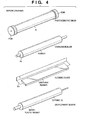
- FIG. 4 schematically shows the state of each of the above-described parts assembled in a process cartridge before the crushing
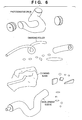
- FIG. 5 schematically shows the state of each of the parts when the crushing process is completed.
- the crushing treatment in the crushing process is such that for the component materials of each part, each of the part materials is not finely crushed. That is, the shape of each part containing each metal material is in a deformation state which maintains the original shape and in a crushed state in which the disassembly of the parts is mainly aimed at, and the crushed things of parts which are constituted by metal and rubber maintain the shapes of the parts, i.e., maintain a state in which rubber is not crushed, under such crushing conditions that permit separation from the process cartridge container.
- the crushed things which have been treated by the above-described primary crushing device as described above are caused to fall into the toner separation chamber 30.
- the crushed things in the toner separation chamber are subjected to an impact action by the impact means.
- the unrecovered toner is separated from the crushed things and sucked and recovered by the recovery means.
- the crushed things are subjected to the separation of parts containing ferrous materials from the crushed things by use of the magnetic separation means and eddy current separation means and the separation of parts containing aluminum.
- the separation means may be used in random order.
- FIG. 6 shows the crushed state of portions of each part which are constituted by metal when crushed things, for which the separation work of materials other than the above-described metal materials has been finished, have been transferred to the secondary crushing step.
- the secondary crushing step it is possible to use the crushing device used in the primary crushing step.
- the crushing conditions such as crushing time are set so that the separation of metals, rubber, etc. can be completely performed.
- the crushed things are transferred into the separation chamber (secondary separation treatment) and separation treatment is performed as required.
- high-purity ferrous materials can be recovered by separating ferrous materials by use of the magnetic separation means.
- each part assumes a form quite different from its original form, metal materials undergo plastic deformation and other composite members other than metals are separated from the metals.
- the deformation of metal materials is absolutely plastic deformation and fracture such as cutting should not occur.
- FIG. 6 shows this crushed state.
- the crushed state is such that the sleeve-like drum is longitudinally deformed and component parts such as the gear parts are detached.
- the crushed state is such that the rubber members are removed from the iron shaft member which has undergone plastic deformation by bending.
- metal materials of high-purity iron and aluminum could be obtained at low cost as recycled materials of recovered metal materials.
Landscapes
- Engineering & Computer Science (AREA)
- Environmental & Geological Engineering (AREA)
- Mechanical Engineering (AREA)
- Chemical & Material Sciences (AREA)
- General Life Sciences & Earth Sciences (AREA)
- Manufacturing & Machinery (AREA)
- Geology (AREA)
- Materials Engineering (AREA)
- Life Sciences & Earth Sciences (AREA)
- Metallurgy (AREA)
- Organic Chemistry (AREA)
- Processing Of Solid Wastes (AREA)
- Electrophotography Configuration And Component (AREA)
- Manufacture And Refinement Of Metals (AREA)
Abstract
Description
Claims (5)
- A method of recycling a process cartridge containing a toner, wherein in a crushing process of a process cartridge containing a recovered toner, a container shape of said process cartridge is subjected to disassembly treatment to an extent of main component parts, said toner is recovered by suction in a step of disassembly treatment, metal materials, such as ferrous materials and aluminum materials, in component materials of said process cartridge are subjected to separation treatment after said step of disassembly treatment, and each of the materials is subjected to melting treatment thereby to change the materials to forms capable of reuse as ferrous materials and aluminum materials.
- The method of recycling a process cartridge containing a toner according to claim 1, wherein after said step of disassembly treatment of the process cartridge, disassembled members of the process cartridge subjected to the disassembly treatment are transferred to a toner separation chamber adjacent to a disassembly treatment chamber, by causing an impact force to act on said disassembled members of the process cartridge in said toner separation chamber, said toner is separated from said disassembled members and, at the same time, recovery of the toner by suction is performed, metal materials are thereafter extracted from said disassembled members by use of magnetic separation means and eddy current separation means, and the extracted metal materials are melted and taken out.
- The method of recycling a process cartridge including a toner according to claim 2, wherein the purity of said metal materials in said step of separation treatment is not less than 90%.
- A method of recycling metal materials constituting a process cartridge containing a toner, wherein photosensitive drum parts, charging roller parts, cleaning blade parts and development sleeve parts which constitute said process cartridge and container parts made of a resin material containing each of the materials as well, are disassembled to a state separated from said container parts while performing the recovery of the toner by suction in a crushing process, metal materials are thereafter extracted from said parts by separating dissimilar materials by use of magnetic separation means, eddy current separation means and gravity separation means, and the extracted materials are recycled.
- A method of recycling metal materials constituting a process cartridge containing a toner, wherein in a crushing process said process cartridge is crushed to such an extent that a structural form of said process cartridge is disassembled, and the toner is recovered by suction, and in a step of separating a container portion made of a resin material, a charging roller, a cleaning blade, a development sleeve and a photosensitive drum which constitute said process cartridge for each component material, separation treatment is performed for each component material and metal materials separated from said step of separation are reused.
Applications Claiming Priority (2)
| Application Number | Priority Date | Filing Date | Title |
|---|---|---|---|
| JP2002368255 | 2002-12-19 | ||
| JP2002368255A JP4366072B2 (en) | 2002-12-19 | 2002-12-19 | Method for recycling metal material of process cartridge containing toner |
Publications (3)
| Publication Number | Publication Date |
|---|---|
| EP1430960A1 true EP1430960A1 (en) | 2004-06-23 |
| EP1430960A8 EP1430960A8 (en) | 2004-10-13 |
| EP1430960B1 EP1430960B1 (en) | 2012-04-25 |
Family
ID=32376296
Family Applications (1)
| Application Number | Title | Priority Date | Filing Date |
|---|---|---|---|
| EP20030029180 Expired - Lifetime EP1430960B1 (en) | 2002-12-19 | 2003-12-18 | Method of recycling process cartridge and method of recycling metal materials constituting process cartridge containing toner |
Country Status (3)
| Country | Link |
|---|---|
| US (1) | US7162785B2 (en) |
| EP (1) | EP1430960B1 (en) |
| JP (1) | JP4366072B2 (en) |
Cited By (2)
| Publication number | Priority date | Publication date | Assignee | Title |
|---|---|---|---|---|
| EP2033714A1 (en) | 2007-08-30 | 2009-03-11 | Toshiba TEC Europe Imaging Systems S.A. | Method and installation for the recycling of ink-cartridges |
| EP2087936A1 (en) * | 2008-01-31 | 2009-08-12 | Anlagenbau Umwelt + Technik Chemnitz GmbH | Recycling device and recycling method for toner cartridges |
Families Citing this family (7)
| Publication number | Priority date | Publication date | Assignee | Title |
|---|---|---|---|---|
| JP4103494B2 (en) * | 2002-08-20 | 2008-06-18 | 富士ゼロックス株式会社 | Method and apparatus for reproducing parts for image forming apparatus, and reproducing parts for image forming apparatus |
| CN101670355B (en) * | 2009-09-25 | 2013-03-13 | 湖南万容科技股份有限公司 | Method and device for harmless treatment and high-efficiency resource recycling of waste refrigerator |
| JP6024316B2 (en) * | 2012-09-07 | 2016-11-16 | 株式会社リコー | Toner manufacturing apparatus and toner manufacturing method |
| HK1177381A2 (en) * | 2012-12-21 | 2013-08-23 | Ltg Green-Tech R&D Company Limited | A system and method for processing objects having contaminating particles |
| HK1177382A2 (en) * | 2012-12-21 | 2013-08-23 | Ltg Green-Tech R&D Company Limited | A system and method for processing objects having chemical contaminates |
| DE102013017125A1 (en) | 2013-10-15 | 2015-04-16 | Project.7-Rostock Ug (Haftungsbeschränkt) | Apparatus and method for the thermal treatment of dusts in closed containers |
| DE102014007857A1 (en) | 2014-05-24 | 2015-11-26 | Ralf Grötschel | Process for recycling toner cartridges or cartridges |
Citations (3)
| Publication number | Priority date | Publication date | Assignee | Title |
|---|---|---|---|---|
| DE19821545A1 (en) * | 1998-05-14 | 1999-11-18 | Manfred Bahnemann | Recovery of valuable materials from ink jet printer cartridges |
| JP2001205245A (en) * | 2000-01-27 | 2001-07-31 | Canon Chemicals Inc | Method and apparatus for separating toner from used toner cartridge |
| WO2003106938A1 (en) * | 2002-06-13 | 2003-12-24 | Close The Loop Technologies Pty Ltd | Method and apparatus for extracting toner from toner cartridges |
Family Cites Families (12)
| Publication number | Priority date | Publication date | Assignee | Title |
|---|---|---|---|---|
| US3615084A (en) * | 1969-01-08 | 1971-10-26 | Fidelis J Wasinger | Process and apparatus for salvaging junk material |
| US3605243A (en) * | 1969-03-18 | 1971-09-20 | Ford Motor Co | Scrap recovery process |
| US3905556A (en) * | 1974-05-20 | 1975-09-16 | Air Prod & Chem | Method and apparatus for recovery of metals from scrap |
| ZA886696B (en) * | 1987-09-11 | 1989-04-26 | Alcan Int Ltd | Method of separating metal alloy particles |
| JPH05301222A (en) | 1992-04-27 | 1993-11-16 | Isuzu Motors Ltd | How to recycle plastic products |
| IE73274B1 (en) * | 1994-03-24 | 1997-05-21 | Dataproducts Tech Ltd | A method for manufacturing a printer cartridge |
| JP3650669B2 (en) | 1995-09-26 | 2005-05-25 | 株式会社リコー | Image forming apparatus disposal method |
| JP2845395B2 (en) | 1996-02-06 | 1999-01-13 | マテックス株式会社 | Powdering machine |
| JPH11156224A (en) | 1997-12-01 | 1999-06-15 | Hosokawa Micron Corp | Closed circuit crusher |
| JP2000159900A (en) | 1998-11-26 | 2000-06-13 | Ricoh Co Ltd | Recycled molded product and method for producing the same |
| JP4365984B2 (en) | 1999-05-14 | 2009-11-18 | キヤノン株式会社 | Manufacturing method of recycled plastic material |
| JP4343519B2 (en) * | 2002-11-26 | 2009-10-14 | キヤノン株式会社 | Process cartridge plastic material recycling method |
-
2002
- 2002-12-19 JP JP2002368255A patent/JP4366072B2/en not_active Expired - Fee Related
-
2003
- 2003-12-18 EP EP20030029180 patent/EP1430960B1/en not_active Expired - Lifetime
- 2003-12-19 US US10/739,146 patent/US7162785B2/en not_active Expired - Fee Related
Patent Citations (3)
| Publication number | Priority date | Publication date | Assignee | Title |
|---|---|---|---|---|
| DE19821545A1 (en) * | 1998-05-14 | 1999-11-18 | Manfred Bahnemann | Recovery of valuable materials from ink jet printer cartridges |
| JP2001205245A (en) * | 2000-01-27 | 2001-07-31 | Canon Chemicals Inc | Method and apparatus for separating toner from used toner cartridge |
| WO2003106938A1 (en) * | 2002-06-13 | 2003-12-24 | Close The Loop Technologies Pty Ltd | Method and apparatus for extracting toner from toner cartridges |
Non-Patent Citations (2)
| Title |
|---|
| PATENT ABSTRACTS OF JAPAN vol. 1997, no. 10 31 October 1997 (1997-10-31) * |
| PATENT ABSTRACTS OF JAPAN vol. 2000, no. 24 11 May 2001 (2001-05-11) * |
Cited By (2)
| Publication number | Priority date | Publication date | Assignee | Title |
|---|---|---|---|---|
| EP2033714A1 (en) | 2007-08-30 | 2009-03-11 | Toshiba TEC Europe Imaging Systems S.A. | Method and installation for the recycling of ink-cartridges |
| EP2087936A1 (en) * | 2008-01-31 | 2009-08-12 | Anlagenbau Umwelt + Technik Chemnitz GmbH | Recycling device and recycling method for toner cartridges |
Also Published As
| Publication number | Publication date |
|---|---|
| US20050076487A1 (en) | 2005-04-14 |
| EP1430960A8 (en) | 2004-10-13 |
| US7162785B2 (en) | 2007-01-16 |
| JP2004198799A (en) | 2004-07-15 |
| EP1430960B1 (en) | 2012-04-25 |
| JP4366072B2 (en) | 2009-11-18 |
Similar Documents
| Publication | Publication Date | Title |
|---|---|---|
| EP1430960B1 (en) | Method of recycling process cartridge and method of recycling metal materials constituting process cartridge containing toner | |
| US20100028042A1 (en) | Process cartridge and method for removing processing means from process cartridge | |
| US8985339B2 (en) | Method and equipment for conditioning low-metal plastic scrap | |
| US5067659A (en) | Method of treating refuse scrap | |
| CA2010187A1 (en) | Electrostatic waste separation process | |
| US7252250B2 (en) | Method and apparatus for extracting toner from toner cartridges | |
| US10702874B2 (en) | Apparatus for recycling waste raw material | |
| CN100393419C (en) | Method for disintegrating container containing powder and disintegrator | |
| JPH0657352B2 (en) | Automatic shredding method | |
| JP4663665B2 (en) | Waste toner processing method and solid fuel production method using waste toner | |
| JP2001187406A (en) | Method for producing coke oven raw material from plastic waste | |
| JP2742670B2 (en) | How to treat used steel cans | |
| JP3552566B2 (en) | Recycling of waste plastic | |
| US7603055B2 (en) | Cover for image forming apparatus to facilitate parts recycling | |
| US7736827B2 (en) | Developer recycling method | |
| CN102129209A (en) | Method for recovering photosensitive drum | |
| KR101337507B1 (en) | Asr molding apparatus | |
| JP2002059025A (en) | Cullet processing method | |
| JP3679607B2 (en) | Method and apparatus for removing soft body member | |
| WO2025053205A1 (en) | Floating and sinking selection device, sorting system, and control program | |
| JP2003290870A (en) | Recycling method of foundry sand | |
| WO2025053200A1 (en) | Separation system, separation method, and control program | |
| WO2025053202A1 (en) | Separation system, separation method, and control program | |
| JP2891396B2 (en) | Composite material separation and recovery method | |
| WO2025053204A1 (en) | Separation system, separation method, and control program |
Legal Events
| Date | Code | Title | Description |
|---|---|---|---|
| PUAI | Public reference made under article 153(3) epc to a published international application that has entered the european phase |
Free format text: ORIGINAL CODE: 0009012 |
|
| AK | Designated contracting states |
Kind code of ref document: A1 Designated state(s): AT BE BG CH CY CZ DE DK EE ES FI FR GB GR HU IE IT LI LU MC NL PT RO SE SI SK TR |
|
| AX | Request for extension of the european patent |
Extension state: AL LT LV MK |
|
| RIN1 | Information on inventor provided before grant (corrected) |
Inventor name: KAYAHASHI, TOSHIO,C/O CANON KABUSHIKI KAISHA Inventor name: KOUMURA, NOBORU,C/O CANON KABUSHIKI KAISHA |
|
| 17P | Request for examination filed |
Effective date: 20041223 |
|
| AKX | Designation fees paid |
Designated state(s): CH DE FR GB IT LI |
|
| GRAP | Despatch of communication of intention to grant a patent |
Free format text: ORIGINAL CODE: EPIDOSNIGR1 |
|
| GRAS | Grant fee paid |
Free format text: ORIGINAL CODE: EPIDOSNIGR3 |
|
| GRAA | (expected) grant |
Free format text: ORIGINAL CODE: 0009210 |
|
| AK | Designated contracting states |
Kind code of ref document: B1 Designated state(s): CH DE FR GB IT LI |
|
| REG | Reference to a national code |
Ref country code: GB Ref legal event code: FG4D |
|
| RIN1 | Information on inventor provided before grant (corrected) |
Inventor name: KAYAHASHI, TOSHIO Inventor name: KOUMURA, NOBORU |
|
| REG | Reference to a national code |
Ref country code: CH Ref legal event code: EP |
|
| REG | Reference to a national code |
Ref country code: DE Ref legal event code: R096 Ref document number: 60340709 Country of ref document: DE Effective date: 20120621 |
|
| PG25 | Lapsed in a contracting state [announced via postgrant information from national office to epo] |
Ref country code: IT Free format text: LAPSE BECAUSE OF FAILURE TO SUBMIT A TRANSLATION OF THE DESCRIPTION OR TO PAY THE FEE WITHIN THE PRESCRIBED TIME-LIMIT Effective date: 20120425 |
|
| PLBE | No opposition filed within time limit |
Free format text: ORIGINAL CODE: 0009261 |
|
| STAA | Information on the status of an ep patent application or granted ep patent |
Free format text: STATUS: NO OPPOSITION FILED WITHIN TIME LIMIT |
|
| 26N | No opposition filed |
Effective date: 20130128 |
|
| REG | Reference to a national code |
Ref country code: DE Ref legal event code: R097 Ref document number: 60340709 Country of ref document: DE Effective date: 20130128 |
|
| REG | Reference to a national code |
Ref country code: CH Ref legal event code: PL |
|
| PG25 | Lapsed in a contracting state [announced via postgrant information from national office to epo] |
Ref country code: CH Free format text: LAPSE BECAUSE OF NON-PAYMENT OF DUE FEES Effective date: 20121231 Ref country code: LI Free format text: LAPSE BECAUSE OF NON-PAYMENT OF DUE FEES Effective date: 20121231 |
|
| REG | Reference to a national code |
Ref country code: FR Ref legal event code: PLFP Year of fee payment: 13 |
|
| PGFP | Annual fee paid to national office [announced via postgrant information from national office to epo] |
Ref country code: GB Payment date: 20151218 Year of fee payment: 13 |
|
| PGFP | Annual fee paid to national office [announced via postgrant information from national office to epo] |
Ref country code: DE Payment date: 20151231 Year of fee payment: 13 |
|
| REG | Reference to a national code |
Ref country code: FR Ref legal event code: PLFP Year of fee payment: 14 |
|
| REG | Reference to a national code |
Ref country code: DE Ref legal event code: R119 Ref document number: 60340709 Country of ref document: DE |
|
| GBPC | Gb: european patent ceased through non-payment of renewal fee |
Effective date: 20161218 |
|
| PG25 | Lapsed in a contracting state [announced via postgrant information from national office to epo] |
Ref country code: DE Free format text: LAPSE BECAUSE OF NON-PAYMENT OF DUE FEES Effective date: 20170701 Ref country code: GB Free format text: LAPSE BECAUSE OF NON-PAYMENT OF DUE FEES Effective date: 20161218 |
|
| REG | Reference to a national code |
Ref country code: FR Ref legal event code: PLFP Year of fee payment: 15 |
|
| PGFP | Annual fee paid to national office [announced via postgrant information from national office to epo] |
Ref country code: FR Payment date: 20171229 Year of fee payment: 15 |
|
| PG25 | Lapsed in a contracting state [announced via postgrant information from national office to epo] |
Ref country code: FR Free format text: LAPSE BECAUSE OF NON-PAYMENT OF DUE FEES Effective date: 20181231 |