EP1429264A2 - Verfahren zur perzeptuellen Beschreibung von 3D-Formen und Verfahren und Anordnung zur Recherche in einer 3D-Grafikmodelldatenbank unter Verwendung des Beschreibungsverfahrens - Google Patents
Verfahren zur perzeptuellen Beschreibung von 3D-Formen und Verfahren und Anordnung zur Recherche in einer 3D-Grafikmodelldatenbank unter Verwendung des Beschreibungsverfahrens Download PDFInfo
- Publication number
- EP1429264A2 EP1429264A2 EP03257600A EP03257600A EP1429264A2 EP 1429264 A2 EP1429264 A2 EP 1429264A2 EP 03257600 A EP03257600 A EP 03257600A EP 03257600 A EP03257600 A EP 03257600A EP 1429264 A2 EP1429264 A2 EP 1429264A2
- Authority
- EP
- European Patent Office
- Prior art keywords
- model
- nodes
- query
- perceptual
- shape
- Prior art date
- Legal status (The legal status is an assumption and is not a legal conclusion. Google has not performed a legal analysis and makes no representation as to the accuracy of the status listed.)
- Granted
Links
Images



Classifications
-
- G—PHYSICS
- G06—COMPUTING OR CALCULATING; COUNTING
- G06T—IMAGE DATA PROCESSING OR GENERATION, IN GENERAL
- G06T17/00—Three-dimensional [3D] modelling for computer graphics
- G06T17/10—Constructive solid geometry [CSG] using solid primitives, e.g. cylinders, cubes
-
- G—PHYSICS
- G06—COMPUTING OR CALCULATING; COUNTING
- G06F—ELECTRIC DIGITAL DATA PROCESSING
- G06F16/00—Information retrieval; Database structures therefor; File system structures therefor
- G06F16/50—Information retrieval; Database structures therefor; File system structures therefor of still image data
- G06F16/56—Information retrieval; Database structures therefor; File system structures therefor of still image data having vectorial format
-
- G—PHYSICS
- G06—COMPUTING OR CALCULATING; COUNTING
- G06T—IMAGE DATA PROCESSING OR GENERATION, IN GENERAL
- G06T17/00—Three-dimensional [3D] modelling for computer graphics
- G06T17/30—Polynomial surface description
-
- G—PHYSICS
- G06—COMPUTING OR CALCULATING; COUNTING
- G06V—IMAGE OR VIDEO RECOGNITION OR UNDERSTANDING
- G06V10/00—Arrangements for image or video recognition or understanding
- G06V10/40—Extraction of image or video features
- G06V10/42—Global feature extraction by analysis of the whole pattern, e.g. using frequency domain transformations or autocorrelation
- G06V10/422—Global feature extraction by analysis of the whole pattern, e.g. using frequency domain transformations or autocorrelation for representing the structure of the pattern or shape of an object therefor
- G06V10/426—Graphical representations
-
- G—PHYSICS
- G06—COMPUTING OR CALCULATING; COUNTING
- G06V—IMAGE OR VIDEO RECOGNITION OR UNDERSTANDING
- G06V20/00—Scenes; Scene-specific elements
- G06V20/60—Type of objects
- G06V20/64—Three-dimensional [3D] objects
Definitions
- the present invention relates to a 3-dimensional (3D) graphics, and more particularly to, a method of perceptual 3D shape description and a method and apparatus for searching a 3D graphics model database established using the description method to retrieve the similar models to a query model.
- Shape3D is suggested and adopted as an international standard for 3D shape description and database searching.
- 3D graphics models are expressed as polygonal meshes that consist of vertices and faces.
- Shape3D defines the shape spectrum of such polygonal meshes, which is the histogram of shape indices calculated on the whole surface of a mesh model.
- FIG. 1 illustrates an example of limited shape discriminability of Shape3D.
- (a) and (b) denote 3D objects
- (c) and (d) show the shape spectra of the objects (a) and (b), respectively.
- 'android' model and 'crocodile' model have distinct shapes.
- their shape spectra are very similar to each other as shown in (b) and (d) of FIG. 1.
- a quantitative difference between the shape spectra of the 'android' and 'crocodile' models is merely 0.025981.
- the 'crocodile' object may be undesirably retrieved as one of the most similar objects, i.e., with a high similarity rank among the searched results.
- the searched shape has no similarity with the actual query shape. Therefore, using Shape3D is unsuitable for searching with a query by sketch or a query by editing, since there is no coherence between the actual shape and its shape spectrum.
- a method of perceptual 3D shape description including: generating nodes that respectively correspond to parts of a part-based representation of a 3D shape model, the nodes including unary attributes of the parts; generating edges that include relational attributes between the nodes; and generating an attributed relational graph of the 3D shape model that is comprised of the nodes and the edges.
- the present invention provides an efficient method of perceptual 3-dimensional (3D) shape description that can be applied to the management of a 3D graphics model database.
- each of the nodes may be expressed as an ellipsoid parameterized by a volume, a convexity, and two eccentricities.
- the unary attributes of the nodes may include at least a volume, eccentricities, and a convexity.
- the unary attributes of each of the nodes may include variances that correspond to the degrees of distribution of voxels forming the ellipsoid on 3D principal axes, the origin of the ellipsoid, and the transformation of the node in an object-oriented coordinated system.
- the relational attributes may include at least the distance between nodes, the angle between the first principal axes of ellipsoids, and the angle between the second principal axes of the ellipsoids.
- the unary attributes of the nodes may be quantized into a predetermined number of bits.
- a computer readable medium having a perceptual 3D shape descriptor formed by the above method.
- the searching method including: receiving a input 3D graphics model; transforming the received 3D graphics model into a perceptual 3D shape descriptor; and comparing the perceptual 3D shape descriptor with each of the perceptual 3D shape descriptors of the graphics models stored in the database to retrieve the 3D graphic models that are similar to the input.
- the present invention also provides a method and apparatus for searching a 3D graphics model database that is built up using the above method to retrieve the similar models to a query model.
- the receiving of the input 3D graphics model may include a user designing and inputting a 3D graphics model by means of an interactive tool.
- the transforming of the received 3D graphic models into the perceptual 3D shape descriptor may include a user editing the transformed 3D shape descriptor if required.
- the comparing of the perceptual 3D shape descriptor with each of the perceptual 3D shape descriptors of the 3D graphics models to retrieve the 3D graphic models may include: defining the volumes of the nodes as weights; and comparing the transformed perceptual 3D shape descriptor with each of the perceptual 3D shape descriptors of the 3D graphics models stored in the database using the Double EMD (earth mover's distance) method to retrieve the 3D graphic models similar to the perceptual 3D shape descriptor.
- Double EMD arth mover's distance
- the Double EMD method includes: generating a distance matrix between query nodes of a query graph and model nodes of a model graph (Inner EMD); and measuring the similarity between the query graph and the model graph by calculating the amount of work required to move the weight (weight transition) from the query nodes to the model nodes based on the distance matrix (Outer EMD).
- the generating of the distance matrix in the Inner EMD method may include: extracting the query nodes of the query graph of the perceptual 3D shape descriptor and the model nodes of the model graph of each of the 3D graphics models stored in the database and setting combinations of a particular query node and a particular model node to be compared with each other; and generating the distance matrix by measuring the distance between the query and model nodes of each of the combinations.
- the generating of the distance matrix by measuring the distance between the query and model nodes of each of the combinations may include: constructing a first distance matrix of the absolute values of differences between attribute vectors of the query and model nodes to calculate the distance between the query and model nodes of each of the combinations; constructing vector spaces with axes parameterized by relational attributes of the nodes; expressing the query nodes and the model nodes as sets of points in the respective vector spaces; setting an imaginary node in each of the vector spaces, the imaginary node being spaced an equal distance apart from all of the points; constructing a second distance matrix by calculating the Euclidian distances between the points in the vector spaces; and summing the first and second distance matrices to generate the distance matrix.
- the measuring of the similarity between the query graph and the model graph in the Outer EMD method may comprise: calculating the amount of work required to move the weight (weight transition) from the query nodes to the model nodes based on the distance matrix and the weights of the query nodes and the model nodes; and calculating as the similarity a total amount of work for all of the nodes.
- a computer readable medium having embodied thereon a computer program for the above method of searching the perceptual 3D graphics model database.
- an apparatus for searching a database of 3D graphics models described by the description method including: a query input unit that receives a query that is a 3D graphics model; a model/shape descriptor transforming unit that transforms the 3D graphic model received as the query into a perceptual 3D shape descriptor; a matching unit that compares the perceptual 3D shape descriptor with each of the perceptual 3D shape descriptors of the 3D graphics models stored in the database to retrieve the models that are similar to the perceptual 3D shape descriptor; and a model output unit that outputs the retrieved models.
- the query input unit may allow a user to design and input the 3D graphics model by means of an interactive tool.
- the model/shape descriptor transforming unit may include a shape editor that allows a user to edit the perceptual 3D shape descriptor if required.
- the matching unit may include: a weight converter that defines the weights of the nodes as weights; and a model searcher that compares the perceptual 3D shape descriptor of a query model with each of the perceptual 3D shape descriptors of the 3D graphics models stored in the database using a Double EMD method to retrieve the models from the database that are similar to the perceptual 3D shape descriptor.
- the generation of the perceptual shape descriptor will now be described.
- the part-based representation of 3D shapes enable perceptual recognition of an object and is independent of rotation, translation, inhomogeneous scaling, transformation, partial deletion, etc.
- This part-based representation is applied to an intermediate step for high-quality 3D object shape representation.
- Various conventional algorithms developed so far may be categorized roughly into morphology-based decomposition and skeleton-based decomposition.
- a new algorithm is utilized to decompose the shape of a 3D object into parts.
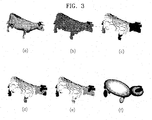
- This decomposition algorithm involves recursively performing constrained morphological decomposition (CMD) using calculated mathematical morphology and weighted convexity. Next, it is determined whether to merge decomposed adjacent parts based on a weighted convexity difference (WCD). As such, the shape of the 3D object can be more adaptively and simply represented using the decomposition algorithm.
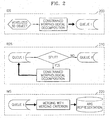
- the decomposition algorithm includes three stages as illustrated in FIG. 2. In FIG. 2, the arrows indicate the processing flow of binary images.
- a recursive decomposition stage (RDS) 210 follows an initial decomposition stage (IDS) 200 and is continued until QUEUE I is empty.
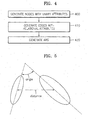
- FIG. 4 is a flowchart of a method of perceptual 3D shape description according to an embodiment of the present invention.
- the method roughly includes generating nodes (step 400), generating edges (step 410), and generating an ARG (step 420).
- step 400 nodes that correspond to the parts of a 3D shape model in a part-based representation, respectively, and include unary attributes of the corresponding parts are generated.
- step 410 edges that define relational attributes between the nodes are generated.
- an ARG that consists of the nodes and the edges is represented.
- the perceptual 3D shape description for a given 3D model is achieved based on the above-described part-based representation.
- the perceptual 3D shape descriptor is represented as an ARG that consists of node and edges.
- the nodes of the ARG represent the decomposed parts of the 3D model and the unary attributes of the parts, and the edges represent the relational attributes between the nodes.
- the perceptual 3D shape descriptor utilizes four unary attributes and three relational attributes that are derived from the geometric relation between the principal axes of connected nodes.
- a node is represented as an ellipsoid parameterized by a volume v, a convexity c, and eccentricities e1 and e2.
- the convexity c is defined as the ratio of volume to convex hull of the node.
- edge attributes are extracted based on the geometric relation between the two ellipsoids in FIG. 5.
- the distance between the centers of the two ellipsoids, the angle between the first principal axes of the ellipsoids, and the angle between the second principal axes of the ellipsoids are utilized as the edge attributes.
- the unary attributes of the respective nodes and the relational attributes in the edges are normalized to be within the range of from 0 to 1.
- FIG. 6 is a table of binary representation form for the perceptual 3D shape (P3DS) descriptor.
- volume, center, partial transform in an object-oriented coordinate system, variance on each principal axis, and convexity form unary node attributes.
- the variance implies the degree of distribution of voxels that form an ellipsoid on each 3D principal axis.
- the maximum number of nodes (Nnodes) that the P3DS descriptor can have was set to 32.
- each of the unary attributes was quantized into a predetermined number of bits, preferably 8 bits. With the assumption that all attributes are quantized into 8 bits as in the example of FIG.
- the P3DS descriptor has a size of only 72 bytes. Alternatively, different numbers of quantization bits may be assigned to attributes.
- the data of a 3D shape described by the perceptual 3D shape description method according to the present invention may be recorded in a computer readable medium.
- the 3D graphics model database stores 3D graphics models described using the above P3DS descriptor.
- FIG. 7 is a block diagram of an apparatus for searching a database of 3D graphics models according to an embodiment of the present invention.
- the apparatus of FIG. 7 includes a query input unit 700, a model/shape descriptor transforming unit 710, a matching unit 720, and a model output unit 730.
- the query input unit 700 receives a query that is a 3D graphics model.
- a user may design and input a 3D graphics model by means of an interactive tool.
- the model/shape descriptor transforming unit 710 transforms the 3D graphics model input as the query into the P3DS descriptor.
- the model/shape descriptor transforming unit 710 may include a shape editor 705 to allow the user to edit the transformed shape descriptor if necessary.
- the matching unit 720 compares the transformed P3DS descriptor with each perceptual 3D shape descriptors of the 3D graphics model stored in the database to find the similar models to the transformed P3DS descriptor.
- the matching unit 720 includes a weight converter 722 and a model searcher 724.
- the weight converter 722 defines the volumes of nodes as weights.
- the model searcher 724 compares the transformed P3SD descriptor with each of the perceptual 3D graphics models in the database using a double earth mover's distance (EMD) method to find the similar model to the transformed perceptual 3D shape descriptor.
- EMD earth mover's distance
- FIG. 8 is a flowchart of searching a 3D model database in the above apparatus according to the present invention.
- a query 3D graphics model is received (step 800).
- a user may draw and input a 3D graphics model as a query by means of an interactive tool (step 810).
- the 3D graphics model is transformed into the P3DS descriptor (step 820). If the user wants to edit the transformed P3DS descriptor (step 830), the transformed P3DS descriptor may be edited (step 840).
- the transformed P3DS descriptor is compared with each of the perceptual 3D shape descriptors of the 3D graphics models stored in the database to find similar models (step 850).
- the found similar models are output (step 860).
- FIG. 9 is a flowchart of calculating the similarity between the query and model graphs.
- Step 850 of searching the database for the similar models includes receiving a pair of graphs (step 900), defining the volumes of the nodes as weights (step 910), comparing the transformed P3DS descriptor with each of the perceptual graphics models using the double EMD method (step 920), and finding the models that are similar to the transformed P3DS descriptor (step 930).
- Step 920 of the comparison using the double EMD method includes an inner EMD step of generating a distance matrix of the distances between query nodes of the query graph and model nodes of the model graph (step 922) and an outer EMD step of measuring the similarity between the query and model graphs based on the node attributes in the distant matrix (step 924).
- the inner EMD step 922 includes extracting the query nodes of the query graph of the P3DS descriptor and the model nodes of the model graph of each of the perceptual 3D shape descriptors of the 3D graphics models stored in the database, setting combinations of the query and model nodes to be compared with each other (step 926), and measuring the Euclidian distance for each of the combinations to generate the distance matrix (step 928).
- Step 928 of generating the distance matrix includes constructing a first distance matrix of the absolute values of differences between attribute vectors of the query and model nodes (step 933), constructing vector spaces with axes parameterized by relational attributes that are defined by the edge attributes of each of the graphs (step 934), expressing the query nodes and model nodes as respective sets of points in the vector spaces (step 936), designating an imaginary node in each of the vector spaces that is spaced the same distance apart from each of the points (step 938), calculating the Euclidian distances in the vector spaces to construct a second distance matrix (step 940), and combining the first and second distance matrices into one distance matrix (step 942).
- Step 924 performed using the outer EMD includes calculating the amount of work required to transform the query graph into the model graph for each of the nodes based on the distance matrix and the weights of the nodes (step 930) and measuring the similarity between the query and model graphs by calculating a total amount of work for all of the nodes (step 932).
- the double EMD method used to match the query graph with a model graph stored in the database will now be described in detail.
- General graph matching techniques involve three steps.
- the first step is to construct a distance matrix between the query nodes of the query graph and the model nodes of the model graph based on the difference in unary attribute or relational attribute between each pair of the query and model nodes.
- the second step is to establish the correspondence between the query and model nodes based on the distance matrix constructed in the first step. If a one-to-one mapping relation is established in the second step, generally, a bipartite matching technique is used.
- the last step is to extract the dissimilarity between the query and model graphs based on the differences between the corresponding query and model nodes.
- the volume which is one of the unary attributes of the nodes, is defined as a weight in order to determine the dissimilarity between the query and model graphs using an EMD.
- the distance matrix that defines the correspondence of the query and model nodes is constructed using another EMD.
- the former EMD used to determine the dissimilarity between the query and model graphs is referred to as an outer EMD, and the latter EMD used to construct the distance matrix is referred to as an inner EMD.
- This matching technique involving the two steps conducted using the above EMDs is referred to as a double EMD method.
- a process of measuring the similarity between the query and model graphs using the double EMD method is as follows.
- the inner EMD is defined as follows.
- the distance between an arbitrary query node N q (see FIG. 10) of a query graph and an arbitrary model node N m of the model graph is calculated as the sum of two different distances.
- a distance matrix is constructed of the absolute values of differences between attribute vectors of the query and mode nodes to calculate the similarity between the graphs from the node attributes.
- vector spaces with axes parameterized by relational attributes that are defined by the edge attributes of the nodes of the corresponding graphs are constructed in order to calculate the similarity between the graphs from the edge attributes.
- the three axes of the coordinate system in FIG. 10 are parameterized by one distance and two angles, which belong to the relational attributes of the nodes.
- the distance matrix as shown in FIG. 11 is comprised of the Euclidian distances defined in the vector spaces. The distance between the arbitrary query and model nodes N q and N m can be calculated based on the weights of the nodes in FIG. 10 and the distance matrix of FIG. 11.
- the amount of work required to move the weight (weight transition) from the query nodes to the model nodes based on the distance matrix is calculated.
- the dissimilarity between the query and model graphs is defined as a total amount of work for all of the nodes.
- Functions of the P3DS descriptor used in the present invention to retrieve the similar 3D models from a database are superior to conventional methods.
- the most significant feature of the P3DS descriptor used in the present invention lies in that it perfectly matches the human shape cognition mechanism. Accordingly, it is possible to describe the topological shapes of 3D models using the P3DS descriptor according to the present invention and obtain proper search results. For example, if the P3DS descriptor contains information on an object that is comprised of 6 parts, for example, including a part for head, four parts for legs, and a part for tail, the object described by the P3DS descriptor may be recognized as having an animal shape and animal shapes may be retrieved from a database.
- the human readability of the P3DS descriptor enables various types of shape search based on, for example, a query by sketch, a query by editing, etc.
- part-based representation that is easy to build up and edit, it is allowed for a user to construct a query with more ease by expressing parts as spheres, ellipsoids, boxes, cylinders, etc, and establishing their connection relation.
- This constructed query is directly transformed into a P3DS descriptor and transferred to a search engine.
- the P3DS descriptor may be edited by the user in an interactive manner and applied to another type of search.
- FIG. 12 shows an example of a search system that utilizes sketched queries, in which (a) shows a sketched query, (b) shows the results of a retrieval that include the most similar, 1 st ranked model, and (c) shows the ARG form of the retrieved model in (b).
- FIG. 12 shows an example of a search system that utilizes sketched queries, in which (a) shows a sketched query, (b) shows the results of a retrieval that include the most similar, 1 st ranked model, and (c) shows the ARG form of the retrieved model in (b).
- the user may sketch a simple topological structure by clicking on the positions of desired nodes with a mouse.
- the example of FIG. 12 confirms the usefulness and feasibility of the P3DS descriptor that allows the use of a sketched query.
- FIG. 13 shows original 3D mesh object models and their P3DS descriptors expressed in ARG forms.
- FIG. 14 there are perceptual coherences between the mesh models and P3DS descriptors. In other words, a man or a helicopter can be accurately perceived from their P3DS descriptors.
- FIG. 14 (a) and (b) are enlarged and reduced versions of the 3D object (f) in FIG. 13, respectively. However, they are expressed as the same P3DS descriptor shown in (c) of FIG. 14, independent of their sizes.
- FIG. 14 shows the same P3DS descriptor shown in (c) of FIG. 14, independent of their sizes.
- FIG. 15 shows examples of P3DS descriptors when an object includes a noise component and is transformed.
- the object in (a) of FIG. 15 has a noise-containing vertex compared to the original 3D object in (f) of FIG. 13, the object in (b) of FIG. 15 has a longer horn than the original 3D object, and the object in (c) of FIG. 15 has longer legs than the original 3D object.
- the generated P3DS descriptors reflect the transformations from the original object well such a degree that the original object can be analogized from the P3DS descriptors.
- the P3DS descriptor according to the present invention can accurately describe the shape of a 3D object independent of size variation, noise, and transformation and is perceptually coherent with the original object.
- the ARG representation of the P3DS descriptor can be utilized to search a 3D model database and provide searched results that coincide with the human visual perception mechanism.
- a method of searching a P3DS model database will now be described.
- a database search test was conducted using a database that is currently used by MEPG-7.
- the database used included 3,903 3D graphics models categorized in a 4-hierarchical structure that includes 8 top categories and 102 leaf categories. Bull's eye performance (BEP) and average normalized marching retrieval rate (ANMRR) used by MPEG-7 were applied as performance evaluation measures.
- a leaf category which a query model belongs to was used as a true value.
- a higher BEP score and a lower ANMPP score mean a more effective performance.
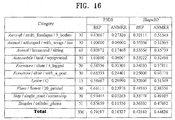
- FIG. 16 comparatively shows the search performance between the P3DS descriptor according to the present invention and a conventional Shape3D descriptor for a set of 366 query models.
- the query models used belong to 10 selected leaf categories.
- the performance of the P3DS descriptor according to the present invention as measured by BEP and ANMRR are excellent absolutely and over the conventional Shape3D descriptor.
- a double EMD technique is applied to the matching of query and model representations so that a model graph similar to a query graph can be retrieved more accurately from a database.
- both geometric information and topological information are utilized, and the performance of the search system can be improved through many-to-many mapping of nodes between query and model graphs.
- the invention may be embodied in a general purpose digital computer by running a program from a computer readable medium, including but not limited to storage media such as magnetic storage media (e.g., ROM's, floppy disks, hard disks, etc.), optically readable media (e.g., CD-ROMs, DVDs, etc.) and carrier waves (e.g., transmissions over the Internet).
- storage media such as magnetic storage media (e.g., ROM's, floppy disks, hard disks, etc.), optically readable media (e.g., CD-ROMs, DVDs, etc.) and carrier waves (e.g., transmissions over the Internet).
Landscapes
- Engineering & Computer Science (AREA)
- Physics & Mathematics (AREA)
- General Physics & Mathematics (AREA)
- Theoretical Computer Science (AREA)
- Geometry (AREA)
- Multimedia (AREA)
- Computer Graphics (AREA)
- Software Systems (AREA)
- Computer Vision & Pattern Recognition (AREA)
- Databases & Information Systems (AREA)
- Data Mining & Analysis (AREA)
- General Engineering & Computer Science (AREA)
- Algebra (AREA)
- Mathematical Analysis (AREA)
- Mathematical Optimization (AREA)
- Mathematical Physics (AREA)
- Pure & Applied Mathematics (AREA)
- Information Retrieval, Db Structures And Fs Structures Therefor (AREA)
- Processing Or Creating Images (AREA)
- Image Generation (AREA)
Applications Claiming Priority (6)
| Application Number | Priority Date | Filing Date | Title |
|---|---|---|---|
| US43097402P | 2002-12-05 | 2002-12-05 | |
| US430974P | 2002-12-05 | ||
| US51014703P | 2003-10-14 | 2003-10-14 | |
| US510147P | 2003-10-14 | ||
| KR10-2003-0084215A KR100513735B1 (ko) | 2002-12-05 | 2003-11-25 | 지각적 인식이 가능한 3차원 형상의 기술방법과 이를이용한 3차원 그래픽 모델의 데이터베이스 검색 방법 및장치 |
| KR2003084215 | 2003-11-25 |
Publications (3)
| Publication Number | Publication Date |
|---|---|
| EP1429264A2 true EP1429264A2 (de) | 2004-06-16 |
| EP1429264A3 EP1429264A3 (de) | 2006-04-05 |
| EP1429264B1 EP1429264B1 (de) | 2016-06-29 |
Family
ID=32329666
Family Applications (1)
| Application Number | Title | Priority Date | Filing Date |
|---|---|---|---|
| EP03257600.1A Expired - Lifetime EP1429264B1 (de) | 2002-12-05 | 2003-12-03 | Verfahren zur perzeptuellen Beschreibung von 3D-Formen und Verfahren und Anordnung zur Recherche in einer 3D-Grafikmodelldatenbank unter Verwendung des Beschreibungsverfahrens |
Country Status (3)
| Country | Link |
|---|---|
| EP (1) | EP1429264B1 (de) |
| JP (1) | JP4166678B2 (de) |
| CN (1) | CN1527251A (de) |
Cited By (5)
| Publication number | Priority date | Publication date | Assignee | Title |
|---|---|---|---|---|
| GB2415520A (en) * | 2004-06-25 | 2005-12-28 | Myriad Vision Ltd | Hierarchical 3D data system |
| US7876317B2 (en) * | 2004-12-13 | 2011-01-25 | Samsung Electronics Co., Ltd. | Apparatus and method of producing 3D structural sketch and computer-readable recording medium on which compute program for executing the method is recorded |
| EP2924599A1 (de) * | 2014-03-28 | 2015-09-30 | Fujitsu Limited | Rechenprogramm, Rechenvorrichtung und Rechenverfahren |
| CN114463396A (zh) * | 2022-01-07 | 2022-05-10 | 武汉大学 | 一种利用平面形状和拓扑图投票的点云配准方法 |
| CN119357425A (zh) * | 2024-12-25 | 2025-01-24 | 北京达美盛软件股份有限公司 | 一种相似几何体快速匹配查找的实现方法 |
Families Citing this family (7)
| Publication number | Priority date | Publication date | Assignee | Title |
|---|---|---|---|---|
| CN101084498A (zh) * | 2004-12-31 | 2007-12-05 | 富士通株式会社 | 三维模型的检索方法和装置 |
| CN100456300C (zh) * | 2006-10-27 | 2009-01-28 | 北京航空航天大学 | 基于二维草图的三维模型检索方法 |
| CN101201845B (zh) * | 2007-09-24 | 2012-01-11 | 覃征 | 基于中轴点集分层螺旋信息的三维模型检索方法 |
| WO2013044484A1 (en) * | 2011-09-29 | 2013-04-04 | Thomson Licensing | Method and apparatus for robust similarity comparison of 3d models |
| JP6311404B2 (ja) * | 2014-03-31 | 2018-04-18 | 富士通株式会社 | 管理プログラム、管理装置および管理方法 |
| KR101814727B1 (ko) | 2016-08-01 | 2018-01-05 | 상명대학교산학협력단 | 3d 메쉬 모델의 기술자 생성 방법 및 포즈 변형된 3d 메쉬 모델 인식 방법 |
| CN108717424B (zh) * | 2018-04-25 | 2021-06-11 | 鹰霆(天津)科技有限公司 | 一种基于分解式图匹配的三维模型检索方法 |
-
2003
- 2003-12-03 EP EP03257600.1A patent/EP1429264B1/de not_active Expired - Lifetime
- 2003-12-05 CN CNA2003101147325A patent/CN1527251A/zh active Pending
- 2003-12-05 JP JP2003406743A patent/JP4166678B2/ja not_active Expired - Lifetime
Non-Patent Citations (4)
| Title |
|---|
| BISCHOFF S ET AL: "Streaming 3D geometry data over lossy communication channels" 26 August 2002 (2002-08-26), MULTIMEDIA AND EXPO, 2002. ICME '02. PROCEEDINGS. 2002 IEEE INTERNATIONAL CONFERENCE ON LAUSANNE, SWITZERLAND 26-29 AUG. 2002, PISCATAWAY, NJ, USA,IEEE, US, PAGE(S) 361-364 , XP010604381 ISBN: 0-7803-7304-9 * abstract * * figures 1,3 * * page 361, left-hand column, 2nd paragraph" * * |
| EURIPIDES G.M. PETRAKIS: "Content-Based Retrieval of Medical Images" INTERNATIONAL JOURNAL OF COMPUTER RESEARCH, vol. 11, no. 2, 30 June 2002 (2002-06-30), pages 171-182, XP008053199 Nova Science Publishers, NY, USA. * |
| KENONG WU ET AL: "RECOVERING PARAMETRIC GEONS FROM MULTIVIEW RANGE DATA", PROCEEDINGS OF THE COMPUTER SOCIETY CONFERENCE ON COMPUTER VISION AND PATTERN RECOGNITION. SEATTLE, JUNE 21 - 23, 1994; [PROCEEDINGS OF THE COMPUTER SOCIETY CONFERENCE ON COMPUTER VISION AND PATTERN RECOGNITION], LOS ALAMITOS, IEEE COMP. SOC. PRESS,, 21 June 1994 (1994-06-21), pages 159-166, XP000515836, ISBN: 978-0-8186-5827-3 * |
| ZAHARIA T ET AL: "3D-shape-based retrieval within the MPEG-7 framework" PROCEEDINGS OF THE SPIE - THE INTERNATIONAL SOCIETY FOR OPTICAL ENGINEERING SPIE-INT. SOC. OPT. ENG USA, vol. 4304, 2001, pages 133-145, XP002346970 ISSN: 0277-786X * |
Cited By (6)
| Publication number | Priority date | Publication date | Assignee | Title |
|---|---|---|---|---|
| GB2415520A (en) * | 2004-06-25 | 2005-12-28 | Myriad Vision Ltd | Hierarchical 3D data system |
| US7876317B2 (en) * | 2004-12-13 | 2011-01-25 | Samsung Electronics Co., Ltd. | Apparatus and method of producing 3D structural sketch and computer-readable recording medium on which compute program for executing the method is recorded |
| EP2924599A1 (de) * | 2014-03-28 | 2015-09-30 | Fujitsu Limited | Rechenprogramm, Rechenvorrichtung und Rechenverfahren |
| CN114463396A (zh) * | 2022-01-07 | 2022-05-10 | 武汉大学 | 一种利用平面形状和拓扑图投票的点云配准方法 |
| CN114463396B (zh) * | 2022-01-07 | 2024-02-06 | 武汉大学 | 一种利用平面形状和拓扑图投票的点云配准方法 |
| CN119357425A (zh) * | 2024-12-25 | 2025-01-24 | 北京达美盛软件股份有限公司 | 一种相似几何体快速匹配查找的实现方法 |
Also Published As
| Publication number | Publication date |
|---|---|
| EP1429264A3 (de) | 2006-04-05 |
| EP1429264B1 (de) | 2016-06-29 |
| CN1527251A (zh) | 2004-09-08 |
| JP2004185626A (ja) | 2004-07-02 |
| JP4166678B2 (ja) | 2008-10-15 |
Similar Documents
| Publication | Publication Date | Title |
|---|---|---|
| US7171060B2 (en) | Method of perceptual 3D shape description and method and apparatus for searching 3D graphics model database using the description method | |
| US8429174B2 (en) | Methods, systems, and data structures for performing searches on three dimensional objects | |
| Tam et al. | Deformable model retrieval based on topological and geometric signatures | |
| US6801661B1 (en) | Method and system for archival and retrieval of images based on the shape properties of identified segments | |
| Sprenger et al. | H-blob: a hierarchical visual clustering method using implicit surfaces | |
| CN119669455B (zh) | 基于多模态知识图谱的船舶设计知识检索方法及系统 | |
| EP1429264A2 (de) | Verfahren zur perzeptuellen Beschreibung von 3D-Formen und Verfahren und Anordnung zur Recherche in einer 3D-Grafikmodelldatenbank unter Verwendung des Beschreibungsverfahrens | |
| Biasotti et al. | Mathematical tools for shape analysis and description | |
| CN115115745A (zh) | 自主创作型的数字艺术的生成方法、系统、存储介质及电子设备 | |
| Theologou et al. | A review on 3D object retrieval methodologies using a part-based representation | |
| CN117218286A (zh) | 三维模型生成方法、装置、计算机设备和存储介质 | |
| Demirci et al. | Efficient many-to-many feature matching under the l1 norm | |
| Mahmoudi et al. | A probabilistic approach for 3D shape retrieval by characteristic views | |
| CN112329179B (zh) | 一种基于点云数据的零件特征快速识别方法 | |
| Pu et al. | Invariant feature extraction for 3D model retrieval: An adaptive approach using Euclidean and topological metrics | |
| CN120088027A (zh) | 基于提示和用户历史来重新生成视图 | |
| CN114547363B (zh) | 一种基于注意力机制和成对马尔科夫随机场形状检索方法 | |
| Kim et al. | A new mpeg-7 standard: Perceptual 3-d shape descriptor | |
| CN119537968A (zh) | 数据匹配方法、装置、计算机设备及计算机可读存储介质 | |
| Hou et al. | Dynamic query interface for 3D shape search | |
| Smith | 3D data representation, storage and processing | |
| Yang et al. | Unsupervised co-segmentation of 3d shapes based on components | |
| Icke | Content based 3d shape retrieval, a survey of state of the art | |
| CN109272013A (zh) | 基于学习的相似性度量方法 | |
| Saffi et al. | Auto-DBPA: Density-Aware Ball-Pivoting Algorithm with Adaptive Radius Using Contextual Bandits for Object and Scene Reconstruction |
Legal Events
| Date | Code | Title | Description |
|---|---|---|---|
| PUAI | Public reference made under article 153(3) epc to a published international application that has entered the european phase |
Free format text: ORIGINAL CODE: 0009012 |
|
| 17P | Request for examination filed |
Effective date: 20031222 |
|
| AK | Designated contracting states |
Kind code of ref document: A2 Designated state(s): AT BE BG CH CY CZ DE DK EE ES FI FR GB GR HU IE IT LI LU MC NL PT RO SE SI SK TR |
|
| AX | Request for extension of the european patent |
Extension state: AL LT LV MK |
|
| RIC1 | Information provided on ipc code assigned before grant |
Ipc: 7G 06F 17/30 A Ipc: 7G 06T 9/20 B Ipc: 7G 06T 17/40 B |
|
| PUAL | Search report despatched |
Free format text: ORIGINAL CODE: 0009013 |
|
| AK | Designated contracting states |
Kind code of ref document: A3 Designated state(s): AT BE BG CH CY CZ DE DK EE ES FI FR GB GR HU IE IT LI LU MC NL PT RO SE SI SK TR |
|
| AX | Request for extension of the european patent |
Extension state: AL LT LV MK |
|
| 17Q | First examination report despatched |
Effective date: 20061031 |
|
| AKX | Designation fees paid |
Designated state(s): DE FR GB NL |
|
| RAP1 | Party data changed (applicant data changed or rights of an application transferred) |
Owner name: SAMSUNG ELECTRONICS CO., LTD. Owner name: SEOUL NATIONAL UNIVERSITY INDUSTRY FOUNDATION |
|
| REG | Reference to a national code |
Ref country code: DE Ref legal event code: R079 Ref document number: 60349077 Country of ref document: DE Free format text: PREVIOUS MAIN CLASS: G06F0017300000 Ipc: G06T0017300000 |
|
| GRAP | Despatch of communication of intention to grant a patent |
Free format text: ORIGINAL CODE: EPIDOSNIGR1 |
|
| RIC1 | Information provided on ipc code assigned before grant |
Ipc: G06T 17/10 20060101ALI20160120BHEP Ipc: G06T 17/30 20060101AFI20160120BHEP Ipc: G06K 9/46 20060101ALI20160120BHEP Ipc: G06F 17/30 20060101ALI20160120BHEP Ipc: G06K 9/68 20060101ALI20160120BHEP |
|
| INTG | Intention to grant announced |
Effective date: 20160209 |
|
| GRAR | Information related to intention to grant a patent recorded |
Free format text: ORIGINAL CODE: EPIDOSNIGR71 |
|
| GRAS | Grant fee paid |
Free format text: ORIGINAL CODE: EPIDOSNIGR3 |
|
| GRAA | (expected) grant |
Free format text: ORIGINAL CODE: 0009210 |
|
| GRAJ | Information related to disapproval of communication of intention to grant by the applicant or resumption of examination proceedings by the epo deleted |
Free format text: ORIGINAL CODE: EPIDOSDIGR1 |
|
| GRAP | Despatch of communication of intention to grant a patent |
Free format text: ORIGINAL CODE: EPIDOSNIGR1 |
|
| GRAS | Grant fee paid |
Free format text: ORIGINAL CODE: EPIDOSNIGR3 |
|
| AK | Designated contracting states |
Kind code of ref document: B1 Designated state(s): DE FR GB NL |
|
| INTG | Intention to grant announced |
Effective date: 20160525 |
|
| REG | Reference to a national code |
Ref country code: GB Ref legal event code: FG4D |
|
| INTG | Intention to grant announced |
Effective date: 20160525 |
|
| REG | Reference to a national code |
Ref country code: DE Ref legal event code: R096 Ref document number: 60349077 Country of ref document: DE |
|
| REG | Reference to a national code |
Ref country code: NL Ref legal event code: MP Effective date: 20160629 |
|
| REG | Reference to a national code |
Ref country code: FR Ref legal event code: PLFP Year of fee payment: 14 |
|
| PG25 | Lapsed in a contracting state [announced via postgrant information from national office to epo] |
Ref country code: NL Free format text: LAPSE BECAUSE OF FAILURE TO SUBMIT A TRANSLATION OF THE DESCRIPTION OR TO PAY THE FEE WITHIN THE PRESCRIBED TIME-LIMIT Effective date: 20160629 |
|
| REG | Reference to a national code |
Ref country code: DE Ref legal event code: R097 Ref document number: 60349077 Country of ref document: DE |
|
| PLBE | No opposition filed within time limit |
Free format text: ORIGINAL CODE: 0009261 |
|
| STAA | Information on the status of an ep patent application or granted ep patent |
Free format text: STATUS: NO OPPOSITION FILED WITHIN TIME LIMIT |
|
| 26N | No opposition filed |
Effective date: 20170330 |
|
| REG | Reference to a national code |
Ref country code: FR Ref legal event code: PLFP Year of fee payment: 15 |
|
| PGFP | Annual fee paid to national office [announced via postgrant information from national office to epo] |
Ref country code: GB Payment date: 20221121 Year of fee payment: 20 Ref country code: FR Payment date: 20221121 Year of fee payment: 20 Ref country code: DE Payment date: 20220615 Year of fee payment: 20 |
|
| P01 | Opt-out of the competence of the unified patent court (upc) registered |
Effective date: 20230530 |
|
| REG | Reference to a national code |
Ref country code: DE Ref legal event code: R071 Ref document number: 60349077 Country of ref document: DE |
|
| REG | Reference to a national code |
Ref country code: GB Ref legal event code: PE20 Expiry date: 20231202 |
|
| PG25 | Lapsed in a contracting state [announced via postgrant information from national office to epo] |
Ref country code: GB Free format text: LAPSE BECAUSE OF EXPIRATION OF PROTECTION Effective date: 20231202 |
|
| PG25 | Lapsed in a contracting state [announced via postgrant information from national office to epo] |
Ref country code: GB Free format text: LAPSE BECAUSE OF EXPIRATION OF PROTECTION Effective date: 20231202 |