EP1428855A1 - Wrapping film and shrink film each comprising butene polymer - Google Patents
Wrapping film and shrink film each comprising butene polymer Download PDFInfo
- Publication number
- EP1428855A1 EP1428855A1 EP02799471A EP02799471A EP1428855A1 EP 1428855 A1 EP1428855 A1 EP 1428855A1 EP 02799471 A EP02799471 A EP 02799471A EP 02799471 A EP02799471 A EP 02799471A EP 1428855 A1 EP1428855 A1 EP 1428855A1
- Authority
- EP
- European Patent Office
- Prior art keywords
- butene
- base polymer
- film
- mass
- olefin
- Prior art date
- Legal status (The legal status is an assumption and is not a legal conclusion. Google has not performed a legal analysis and makes no representation as to the accuracy of the status listed.)
- Withdrawn
Links
Classifications
-
- C—CHEMISTRY; METALLURGY
- C08—ORGANIC MACROMOLECULAR COMPOUNDS; THEIR PREPARATION OR CHEMICAL WORKING-UP; COMPOSITIONS BASED THEREON
- C08L—COMPOSITIONS OF MACROMOLECULAR COMPOUNDS
- C08L23/00—Compositions of homopolymers or copolymers of unsaturated aliphatic hydrocarbons having only one carbon-to-carbon double bond; Compositions of derivatives of such polymers
- C08L23/02—Compositions of homopolymers or copolymers of unsaturated aliphatic hydrocarbons having only one carbon-to-carbon double bond; Compositions of derivatives of such polymers not modified by chemical after-treatment
- C08L23/18—Homopolymers or copolymers of hydrocarbons having four or more carbon atoms
- C08L23/20—Homopolymers or copolymers of hydrocarbons having four or more carbon atoms having four to nine carbon atoms
-
- B—PERFORMING OPERATIONS; TRANSPORTING
- B32—LAYERED PRODUCTS
- B32B—LAYERED PRODUCTS, i.e. PRODUCTS BUILT-UP OF STRATA OF FLAT OR NON-FLAT, e.g. CELLULAR OR HONEYCOMB, FORM
- B32B27/00—Layered products comprising a layer of synthetic resin
- B32B27/32—Layered products comprising a layer of synthetic resin comprising polyolefins
-
- C—CHEMISTRY; METALLURGY
- C08—ORGANIC MACROMOLECULAR COMPOUNDS; THEIR PREPARATION OR CHEMICAL WORKING-UP; COMPOSITIONS BASED THEREON
- C08F—MACROMOLECULAR COMPOUNDS OBTAINED BY REACTIONS ONLY INVOLVING CARBON-TO-CARBON UNSATURATED BONDS
- C08F10/00—Homopolymers and copolymers of unsaturated aliphatic hydrocarbons having only one carbon-to-carbon double bond
- C08F10/04—Monomers containing three or four carbon atoms
- C08F10/08—Butenes
-
- C—CHEMISTRY; METALLURGY
- C08—ORGANIC MACROMOLECULAR COMPOUNDS; THEIR PREPARATION OR CHEMICAL WORKING-UP; COMPOSITIONS BASED THEREON
- C08J—WORKING-UP; GENERAL PROCESSES OF COMPOUNDING; AFTER-TREATMENT NOT COVERED BY SUBCLASSES C08B, C08C, C08F, C08G or C08H
- C08J5/00—Manufacture of articles or shaped materials containing macromolecular substances
- C08J5/18—Manufacture of films or sheets
-
- C—CHEMISTRY; METALLURGY
- C08—ORGANIC MACROMOLECULAR COMPOUNDS; THEIR PREPARATION OR CHEMICAL WORKING-UP; COMPOSITIONS BASED THEREON
- C08L—COMPOSITIONS OF MACROMOLECULAR COMPOUNDS
- C08L23/00—Compositions of homopolymers or copolymers of unsaturated aliphatic hydrocarbons having only one carbon-to-carbon double bond; Compositions of derivatives of such polymers
- C08L23/02—Compositions of homopolymers or copolymers of unsaturated aliphatic hydrocarbons having only one carbon-to-carbon double bond; Compositions of derivatives of such polymers not modified by chemical after-treatment
-
- C—CHEMISTRY; METALLURGY
- C08—ORGANIC MACROMOLECULAR COMPOUNDS; THEIR PREPARATION OR CHEMICAL WORKING-UP; COMPOSITIONS BASED THEREON
- C08L—COMPOSITIONS OF MACROMOLECULAR COMPOUNDS
- C08L23/00—Compositions of homopolymers or copolymers of unsaturated aliphatic hydrocarbons having only one carbon-to-carbon double bond; Compositions of derivatives of such polymers
- C08L23/02—Compositions of homopolymers or copolymers of unsaturated aliphatic hydrocarbons having only one carbon-to-carbon double bond; Compositions of derivatives of such polymers not modified by chemical after-treatment
- C08L23/10—Homopolymers or copolymers of propene
-
- C—CHEMISTRY; METALLURGY
- C08—ORGANIC MACROMOLECULAR COMPOUNDS; THEIR PREPARATION OR CHEMICAL WORKING-UP; COMPOSITIONS BASED THEREON
- C08F—MACROMOLECULAR COMPOUNDS OBTAINED BY REACTIONS ONLY INVOLVING CARBON-TO-CARBON UNSATURATED BONDS
- C08F110/00—Homopolymers of unsaturated aliphatic hydrocarbons having only one carbon-to-carbon double bond
- C08F110/04—Monomers containing three or four carbon atoms
- C08F110/08—Butenes
-
- C—CHEMISTRY; METALLURGY
- C08—ORGANIC MACROMOLECULAR COMPOUNDS; THEIR PREPARATION OR CHEMICAL WORKING-UP; COMPOSITIONS BASED THEREON
- C08F—MACROMOLECULAR COMPOUNDS OBTAINED BY REACTIONS ONLY INVOLVING CARBON-TO-CARBON UNSATURATED BONDS
- C08F210/00—Copolymers of unsaturated aliphatic hydrocarbons having only one carbon-to-carbon double bond
- C08F210/04—Monomers containing three or four carbon atoms
- C08F210/08—Butenes
-
- C—CHEMISTRY; METALLURGY
- C08—ORGANIC MACROMOLECULAR COMPOUNDS; THEIR PREPARATION OR CHEMICAL WORKING-UP; COMPOSITIONS BASED THEREON
- C08J—WORKING-UP; GENERAL PROCESSES OF COMPOUNDING; AFTER-TREATMENT NOT COVERED BY SUBCLASSES C08B, C08C, C08F, C08G or C08H
- C08J2323/00—Characterised by the use of homopolymers or copolymers of unsaturated aliphatic hydrocarbons having only one carbon-to-carbon double bond; Derivatives of such polymers
- C08J2323/02—Characterised by the use of homopolymers or copolymers of unsaturated aliphatic hydrocarbons having only one carbon-to-carbon double bond; Derivatives of such polymers not modified by chemical after treatment
-
- C—CHEMISTRY; METALLURGY
- C08—ORGANIC MACROMOLECULAR COMPOUNDS; THEIR PREPARATION OR CHEMICAL WORKING-UP; COMPOSITIONS BASED THEREON
- C08J—WORKING-UP; GENERAL PROCESSES OF COMPOUNDING; AFTER-TREATMENT NOT COVERED BY SUBCLASSES C08B, C08C, C08F, C08G or C08H
- C08J2323/00—Characterised by the use of homopolymers or copolymers of unsaturated aliphatic hydrocarbons having only one carbon-to-carbon double bond; Derivatives of such polymers
- C08J2323/02—Characterised by the use of homopolymers or copolymers of unsaturated aliphatic hydrocarbons having only one carbon-to-carbon double bond; Derivatives of such polymers not modified by chemical after treatment
- C08J2323/18—Homopolymers or copolymers of hydrocarbons having four or more carbon atoms
- C08J2323/20—Homopolymers or copolymers of hydrocarbons having four or more carbon atoms having four to nine carbon atoms
-
- C—CHEMISTRY; METALLURGY
- C08—ORGANIC MACROMOLECULAR COMPOUNDS; THEIR PREPARATION OR CHEMICAL WORKING-UP; COMPOSITIONS BASED THEREON
- C08L—COMPOSITIONS OF MACROMOLECULAR COMPOUNDS
- C08L2314/00—Polymer mixtures characterised by way of preparation
- C08L2314/06—Metallocene or single site catalysts
-
- Y—GENERAL TAGGING OF NEW TECHNOLOGICAL DEVELOPMENTS; GENERAL TAGGING OF CROSS-SECTIONAL TECHNOLOGIES SPANNING OVER SEVERAL SECTIONS OF THE IPC; TECHNICAL SUBJECTS COVERED BY FORMER USPC CROSS-REFERENCE ART COLLECTIONS [XRACs] AND DIGESTS
- Y10—TECHNICAL SUBJECTS COVERED BY FORMER USPC
- Y10T—TECHNICAL SUBJECTS COVERED BY FORMER US CLASSIFICATION
- Y10T428/00—Stock material or miscellaneous articles
- Y10T428/31504—Composite [nonstructural laminate]
- Y10T428/31855—Of addition polymer from unsaturated monomers
- Y10T428/31909—Next to second addition polymer from unsaturated monomers
- Y10T428/31913—Monoolefin polymer
-
- Y—GENERAL TAGGING OF NEW TECHNOLOGICAL DEVELOPMENTS; GENERAL TAGGING OF CROSS-SECTIONAL TECHNOLOGIES SPANNING OVER SEVERAL SECTIONS OF THE IPC; TECHNICAL SUBJECTS COVERED BY FORMER USPC CROSS-REFERENCE ART COLLECTIONS [XRACs] AND DIGESTS
- Y10—TECHNICAL SUBJECTS COVERED BY FORMER USPC
- Y10T—TECHNICAL SUBJECTS COVERED BY FORMER US CLASSIFICATION
- Y10T428/00—Stock material or miscellaneous articles
- Y10T428/31504—Composite [nonstructural laminate]
- Y10T428/31855—Of addition polymer from unsaturated monomers
- Y10T428/31938—Polymer of monoethylenically unsaturated hydrocarbon
Definitions
- the present invention relates to a wrap film for business use or home use, particularly to a wrap film which does not contain chlorine and is soft to the environment and excellent in a safety and which can satisfy characteristics required to a wrap film, such as a wrapping property, a transparency and a deformation restoring property.
- the present invention relates to a shrink film used for packaging and others, particularly to a shrink film which does not contain chlorine and is soft to the environment and excellent in a safety, a transparency and a glossiness and which can package an article with a good appearance without causing deformation of the wrapped article even when the article to be wrapped is relatively weak in a low temperature shrink packaging property, particularly a strength.
- Vegetables and fruits, meat, fishes or processed foods thereof and cooked foods such as daily dishes have so far been sold at department stores, supermarkets and food stores with the goods put on light-weight foamed resin-made trays and wrapped with films. Also in homes, foods are put in a vessel and wrapped with a film in preserving by freezing and refrigerating or in heating in an electric oven.
- Characteristics such as a see-through property, a wrap-finishing appearance, a wrapping efficiency, a sticking resistance and a deformation restoring property in pushing with a finger are required to this wrapping film.
- a large amount of polyvinyl chloride base resins such as polyvinyl chloride (PVC) and polyvinylidene chloride (PVDC) is usually used for films which can satisfy these wrapping characteristics.
- polyvinyl chloride base resins such as polyvinyl chloride (PVC) and polyvinylidene chloride (PVDC) contain chlorine in a molecular structure, and therefore it has been regarded as a problem from an environmental point of view that they generate harmful hydrogen chloride gas by incinerating treatment carried out after used and disposed. Further, elution of plasticizers blended in a large quantity in order to soften wrap films is also regarded as a problem from a safety point of view.
- PVC polyvinyl chloride
- PVDC polyvinylidene chloride
- a polyethylene base film and a polypropylene base film are tried to be used in order to solve these problems, and a part thereof is put to practical use.
- a polyethylene base film has a good low temperature characteristic but is low in a heat resistance
- a polypropylene base film has a high heat resistance but is low in a low temperature characteristic.
- both of the polyethylene base film and the polypropylene base film have the problem that they are unsatisfactory in an adhesive strength to a tray and an adhesive strength between the films themselves.
- a polypropylene base resin is blended with an ethylene-propylene rubber, a styrene-ethylene-butylene-styrene block copolymer, modified polyolefin, polybutene, a hydrocarbon resin and a tackifying aid.
- these blending compounds are not necessarily sufficiently compatible with a polypropylene base resin, and there are new problems such as roughness on the surface, a reduction in the transparency, a reduction in the film-making property and bleeding of a low molecular weight compound which is a tackifying aid.
- a wrap film formed from a resin composition comprising 50 to 98 mass parts of a polypropylene base resin (A) and 2 to 50 mass parts of an ethylene- ⁇ -olefin copolymer (B) having a density of 0.900 g/cm 3 or less is disclosed in Japanese Patent Application Laid-Open No. 29967/1999, and a wrap film comprising a resin composition comprising 100 mass parts of a polypropylene base resin (A) and 1 to 15 mass parts of an oil & fat (B) is disclosed in Japanese Patent Application Laid-Open No. 29968/1999.
- a low molecular weight compound such as polybutene and an oil & fat has to be substantially added in order to secure an adhesive property of a wrap film, and therefore they are not different from conventional methods.
- a film comprising a soft polypropylene base resin comprising 20 to 60 mass % of (a) a polypropylene component having an isotactic index of 80 or more and 40 to 80 mass % of (b) a copolymer component which is a copolymer component of ethylene and olefin having 4 or more carbon atoms comprising 50 to 95 mass % of ethylene and which comprises 25 to 95 mass % of a crystal component (I) containing crystalline polyethylene insoluble in xylene at 25°C and 5 to 75 mass % of an amorphous component (II) soluble in xylene at 25°C.
- a soft polypropylene base resin comprising 20 to 60 mass % of (a) a polypropylene component having an isotactic index of 80 or more and 40 to 80 mass % of (b) a copolymer component which is a copolymer component of ethylene and olefin having 4 or more carbon atoms comprising 50 to
- the polypropylene base resin is not substantially efficiently used, and also the transparency thereof does not reach a satisfactory level.
- wrap films comprising a polyolefin base resin containing no chlorine can solve the problem of an environmental resistance but do not reach the level of a wrap film of a polyvinyl chloride base resin, and it is the existing situation that a wrap film comprising a polyvinyl chloride base resin is still widely used.
- heat shrink packaging in which a film (shrink film) having a heat shrink property is used to package an article to be packaged and which the packaged article is then passed through a heating furnace to shrink the above film to thereby stick the film closely onto the article to be packaged or tie plural articles to be packaged is used for outer packaging of cap noodles and integrated packaging for notes and tissue paper in many cases.
- Stretched films comprising polyvinyl chloride base resins such as polyvinyl chloride (PVC) and polyvinylidene chloride (PVDC), polyethylene base resins and polypropylene base resins are used at present as a shrink film used in the heat shrink packaging field.
- PVC polyvinyl chloride
- PVDC polyvinylidene chloride
- Polyethylene base resins and polypropylene base resins are used at present as a shrink film used in the heat shrink packaging field.
- Required to the shrink film are a heat shrink property in a packaging work, a melt-breaking resistance, a heat fusion sealing property, a hot slipping property, a transparency after packaging, a high glossiness, a mechanical strength and an appearance after packaging (edges are stuck closely well without having wrinkles).
- a shrink film comprising a polyvinyl chloride base resin has so far been usually used as a film satisfying these characteristics.
- polyvinyl chloride base resins such as polyvinyl chloride (PVC) and polyvinylidene chloride (PVDC) contain chlorine in a molecular structure, and therefore it has been regarded as a problem from an environmental point of view that they generate harmful hydrogen chloride gas by incinerating treatment after used and disposed. Further, elution of plasticizers blended in a large quantity in order to soften wrap films is also regarded as a problem from a safety point of view. Also, a polyvinyl chloride base resin generates an offensive odor at a shrinking step in heat shrink packaging, so that an improvement thereof is required from the viewpoint of packaging work environment.
- PVC polyvinyl chloride
- PVDC polyvinylidene chloride
- a polyethylene base film and a polypropylene base film are tried to be used in order to solve these problems and put to practical use.
- the problems that the polyethylene base film has a good low temperature characteristic but is low in a heat resistance and inferior in a melt fusion resistance and that the polypropylene base film has a high heat resistance but is inferior in a low temperature characteristic and an article to be packaged is deformed by a heat shrink stress as a heating temperature is elevated at a shrinking step, whereby the appearance after packaging is deteriorated and the product value is reduced.
- they are inferior to a polyvinyl chloride base resin in terms of a transparency and a glossiness, and it is the existing situation that the use fields thereof are restricted.
- a polyolefin base resin-stretched shrink film having a specific physical property comprising a random copolymer containing 0.01 to 5 mass % of a polybutene component, 1 to 70 mass % of a polypropylene component and 25 to 98.99 mass % of a propylene-ethylene random copolymer component, wherein the above propylene-ethylene random copolymer component contains 10 to 40 mole % of a monomer unit based on ethylene and 90 to 60 mole % of a monomer unit based on propylene.
- a shrink film comprising a principal component of crystalline polypropylene in which a peak temperature in an eluting curve obtained by a temperature programmed elution fractioning method using orthodichlorobenzene as a solvent is 90 to 110°C and in which an elution integrating mass ratio calculated from the above eluting curve is 0 to 10 mass % at 20°C or lower, 60 to 80 mass % at 20 to 100°C and 10 to 40 mass % at 100 to 130°C.
- a block copolymer comprising (a) 1 to 70 mass % of a propylene base random copolymer comprising more than 90 mole % of a polypropylene component or a monomer unit based on propylene and (b) 30 to 99 mass % of a propylene base random copolymer comprising 10 to 40 mole % of a monomer unit based on ethylene.
- a stretched film using a propylene base random copolymer which is a random copolymer of propylene and ethylene, wherein a content of an ethylene unit in the copolymer, a melt index, a boiling diethyl ether-extracting amount and a melting point satisfy a specific relation, and an isotactic triad fraction is 98 mole % or more.
- All of these propylene base resins comprise a copolymer of ethylene and the other ⁇ -olefins as a principal component and is improved in terms of that a stretching temperature can be reduced, that is, a heating temperature in shrink packaging can be lowered.
- a stretching temperature can be reduced
- a heating temperature in shrink packaging can be lowered.
- the transparency and the gloss are not still satisfactory, and they do not reach the level of polyvinyl chloride resins which have so far been used in many case from the viewpoint of a product value of the packaged articles.
- An object of the present invention is to provide a wrap film which has characteristics of a wrap film, such as a wrapping property, a transparency, a deformation restoring property and a sticking resistance, which does not contain chlorine and is not likely to generate harmful substances such as hydrogen chloride originating in chlorine in disposing and incinerating and which is soft to the global environment.
- an object of the present invention is to provide a shrink film comprising an olefin base resin, which has a good heat shrink property required to a shrink film and can be shrunk at a low temperature, which is further improved in a transparency and a glossiness endowed to conventional polypropylene resins and has characteristics comparable with those of a polyvinyl chloride base resin, which does not contain chlorine and is not likely to generate harmful substances such as hydrogen chloride in disposing and incinerating and which is soft to the global environment.
- the present invention provides the following wrap film.
- the present invention provides the following shrink film.
- the 1-butene base polymer [1] used in the wrap film or the shrink film of the present invention, the production process [2] for the same, the wrap film [3] and the shrink film [4] shall be explained below in details.
- the 1-butene base polymer used in the present invention is a polymer having the following items (1) to (4), (1') to (4') or (5) and (6) as requisites [hereinafter they shall be referred to as the 1-butene base polymer (I), the 1-butene base polymer (II) and the 1-butene base polymer (III)]:
- the melting point (Tm-D) is not observed by means of the differential scanning calorimeter (DSC)" means that a crystallizing speed in DSC measurement is very slow, so that a crystal melting peak can not substantially be observed.
- the crystalline resin means a resin in which at least either peak of Tm-P and Tm-D is observed.
- the 1-butene base polymer (I) or (II) used in the present invention is provided with an excellent balance between an amount of a sticky component, a low elastic modulus and a transparency in the resulting wrap film or shrink film by satisfying the relation of the items (1) to (4) or (1') to (4') described above. That is, it has the advantage that it is low in an elastic modulus, excellent in a soft property (referred to as a flexibility), low in a sticky component, excellent in surface characteristics (for example, represented by less bleeding and less transferring of the sticky component onto the other products) and excellent as well in a transparency.
- the 1-butene base polymer [III] according to the present invention has the advantage that it does not have a change in physical properties with the passage of time caused by crystal modification and does not cause a shrinkage in the wrap film or the shrink film by satisfying the items (5) and (6) described above.
- the mesopentad fraction (mmmm) and the abnormal insertion content (1,4 insertion fraction) were determined according to methods proposed in ⁇ Polymer Journal, 16, 717 (1984) ⁇ reported by Asakura et al, ⁇ Macromol. Chem. Phys., C29, 201 (1989) ⁇ reported by J. Randal et al and ⁇ Macromol. Chem. Phys., 198, 1257 (1987) ⁇ reported by V Busico et al.
- the signals of a methylene group and a methine group were measured by means of a 13 C nuclear magnetic resonance spectrum to determine a mesopentad fraction (mmmm) and an abnormal insertion content in a poly(1-butene) molecule.
- the 13 C nuclear magnetic resonance spectrum was measured on the following conditions by means of the following apparatus:
- the stereospecific index ⁇ (mmmm)/(mmrr + rmmr) ⁇ was calculated from values obtained by measuring (mmmm), (mmrr) and (rmmr) by the method described above. Further, the racemitriad fraction (rr) was calculated by the method described above.
- the 1-butene homopolymer (I) or (II) used in the present invention has a stereospecific index ⁇ (mmmm)/(mmrr + rmmr) ⁇ of 20 or less, preferably 18 or less and more preferably 15 or less. If the stereospecific index exceeds 20, a reduction in the flexibility, the low temperature heat sealing property and the hot tacking property is brought about.
- the 1-butene homopolymer (I) or (II) used in the present invention has, in addition to the requisite described above, a molecular weight distribution (Mw/Mn) of 4.0 or less, preferably 3.5 or less and particularly preferably 3.0 or less which is measured by the GPC method. If the molecular weight distribution (Mw/Mn) exceeds 4.0, stickiness is caused in a certain case.
- Mw/Mn molecular weight distribution
- the 1-butene polymer [I] or [II] used in the present invention has, in addition to the requisites described above, a weight average molecular weight (Mw) of 10,000 to 1,000,000, preferably 100,000 to 1,000,000 and more preferably 100,000 to 600,000 which is measured by the GPC method. If Mw is less than 10,000, stickiness is caused in a certain case. On the other hand, if it exceeds 1,000,000, the fluidity is reduced, so that the molding property is inferior in a certain case.
- Mw weight average molecular weight
- Mw/Mn described above is a value calculated from the weight average molecular weight (Mw) and the number average molecular weight (Mn) in terms of polystyrene, which is measured on the following conditions according to the GPC method by means of the following apparatus.
- the 1-butene polymer (I) used in the present invention has to be a crystalline resin having a melting point (Tm-D) of 0 to 100°C, preferably 0 to 80°C from the viewpoint of the soft property, which is measured by means of a differential scanning calorimeter (DSC).
- Tm-D is determined by DSC measurement. That is, a peak top of a peak observed at a highest temperature side in a melting endothermic curve obtained by holding 10 mg of a sample at -10°C for 5 minutes under nitrogen atmosphere by means of the differential scanning calorimeter (DSC) and then elevating the temperature at 10°C/minute is the melting point: Tm-D.
- ⁇ H-D is an index showing whether or not the polymer is soft, and if this value grows larger, it means that the elastic modulus is high and the soft property is reduced.
- ⁇ H-D is determined by a method described later.
- the 1-butene homopolymer (II) used in the present invention has to be a crystalline resin in which a melting point (Tm-P) is not observed by means of the differential scanning calorimeter (DSC) or is 0 to 100°C from the viewpoint of the soft property, and if the melting point is observed, it is preferably 0 to 80°C. Tm-P is determined by DSC measurement.
- a peak top of a peak observed at a highest temperature side in a melting endothermic curve obtained by melting 10 mg of a sample at 190°C for 5 minutes under nitrogen atmosphere by means of the differential scanning calorimeter (DSC), then lowering the temperature down to -10°C at 5°C/minute, holding the sample at -10°C for 5 minutes and then elevating the temperature at 10°C/minute is the melting point: Tm-P.
- ⁇ H-D is an index showing whether or not the polymer is soft, and if this value grows larger, it means that the elastic modulus is high and the soft property is reduced. ⁇ H-D is determined by the following method.
- a melting endothermic amount obtained by melting 10 mg of a sample at 190°C for 5 minutes under nitrogen atmosphere by means of the differential scanning calorimeter (DSC), then lowering the temperature down to -10°C at 5°C/minute, holding the sample at -10°C for 5 minutes and then elevating the temperature at 10°C/minute is ⁇ H-P.
- the 1-butene homopolymer (I) or (II) used in the present invention has a mesopentad fraction (mmmm) of preferably 20 to 90 %, more preferably 30 to 85 % and most preferably 30 to 80 %. If the mesopentad fraction is less than 20 %, stickiness on the surface of the molded article and a reduction in the transparency are likely to be brought about. On the other and, if it exceeds 90 %, a reduction in the flexibility, the low temperature heat sealing property and the hot tacking property is brought about in a certain case.
- mmmm mesopentad fraction
- the 1-butene homopolymer (I) or (II) used in the present invention satisfies preferably the relation of (mmmm) ⁇ 90-2 ⁇ (rr), more preferably the relation of (mmmm) ⁇ 87-2 ⁇ (rr). If this relation is not satisfied, stickiness on the surface of the molded article and a reduction in the transparency are likely to be brought about.
- the 1-butene homopolymer (I) or (II) used in the present invention has preferably a 1,4 insertion fraction of 5 % or less. If it exceeds 5 %, a composition distribution of the polymer is expanded, and therefore an adverse effect is likely to be exerted on the physical properties.
- a II type crystal ratio (CII) obtained by melting it at 190°C for 5 minutes, rapidly cooling with ice and water and solidifying, leaving standing at a room temperature for one hour and then analyzing by X ray diffraction has to be 50 % or less, preferably 20 % or less and more preferably 0 %.
- the II type crystal ratio (CII) was determined according to a method proposed in ⁇ Polymer, 7, 23 (1966) ⁇ proposed by A. Turner Jones et al. That is, a peak in a I type crystal state and a peak in a II type crystal state were measured by X ray diffraction analysis to determine a II type crystal ratio (CII) in the crystal of the 1-butene base homopolymer.
- X ray diffraction analysis WAXD was carried out on the following conditions by means of anticathode type Rotorflex RU-200 manufactured by Rigaku Denki Co., Ltd.
- the 1-butene homopolymer (III) used in the present invention has a weight average molecular weight (Mw) of preferably 10,000 to 1,000,000 which is measured by the GPC method, as the other requisite (7) in addition to the requisites described above. It is more preferably 100,000 to 1,000,000 and further preferably 100,000 to 600,000. If Mw is less than 10,000, stickiness is caused in a certain case. On the other hand, if it exceeds 1,000,000, the fluidity is reduced, so that the molding property is inferior in a certain case. Mw/Mn and Mw described above are measured by the same measuring methods as described above.
- the 1-butene homopolymer (I), (II) or (III) used in the present invention has a tensile elastic modulus of preferably 500 MPa or less, more preferably 300 MPa or less which is measured by a tensile test according to JIS K-7113. If it exceeds 500 MPa, the satisfactory soft property is not obtained in a certain case.
- the 1-butene base copolymer used in the present invention is a copolymer of 1-butene and ethylene and/or ⁇ -olefin having 3 to 20 carbon atoms (excluding 1-butene) having the above items (1) to (4), (1') to (4') or (5) and (6) as the requisites [hereinafter they shall be referred to as the 1-butene base copolymer (I), the 1-butene base copolymer (II) and the 1-butene base copolymer (III)], and it is preferably a copolymer of 1-butene and ⁇ -olefin having 3 to 20 carbon atoms.
- the 1-butene base copolymer (I) or (II) used in the present invention is preferably a random copolymer.
- a structural unit obtained from 1-butene accounts for preferably 90 mole % or more, more preferably 95 mole % or more. If the structural unit originating in 1-butene accounts for less than 90 mole %, stickiness on the surface of the molded article and a reduction in the transparency are likely to be brought about.
- the stereospecific index ⁇ (mmmm)/(mmrr + rmmr) ⁇ obtained from a (mmmm) fraction and a (mmrr + rmmr) fraction of a 1-butene chain part has to be 20 or less, preferably 18 or less and more preferably 15 or less. If the stereospecific index exceeds 20, a reduction in the flexibility, the low temperature heat sealing property and the hot tacking property is brought about.
- the 1-butene base copolymer (I) or (II) used in the present invention has a molecular weight distribution (Mw/Mn) of 4.0 or less, preferably 3.5 or less and particularly preferably 3.0 or less which is measured by the gel permeation chromatography (GPC) method. If the molecular weight distribution (Mw/Mn) exceeds 4.0, stickiness is caused in a certain case.
- Mw/Mn molecular weight distribution
- the 1-butene base copolymer (I) or (II) used in the present invention has a weight average molecular weight Mw of 10,000 to 1,000,000, preferably 100,000 to 1,000,000 and more preferably 100,000 to 600,000 which is measured by the gel permeation chromatography (GPC) method. If the weight average molecular weight is less than 10,000, stickiness is caused, and if it exceeds 1,000,000, the fluidity is reduced, so that the molding property is inferior in a certain case. Mw/Mn and Mw described above are measured by the same measuring methods as described above.
- a melting point (Tm-P) does not have to be observed by means of the differential scanning calorimeter (DSC) or has to be 0 to 100°C from the viewpoint of the soft property, and when the melting point is observed, it is preferably 0 to 80°C.
- the 1-butene base copolymer (II) has to have a melting point (Tm-D) of 0 to 100°C, preferably 0 to 80°C. Tm-P and Tm-D are determined by the DSC measurement described above.
- the 13 C nuclear magnetic resonance spectrum was measured on the following conditions by means of a JNM-EX400 type 13 C-NMR apparatus manufactured by Nippon Electron Co., Ltd. to calculate the butene content by the following method:
- the stereospecific index was measured by the method described above. Particularly in the ethylene butene copolymer, a peak of side chain methylene carbon originating in a BEE chain was overlapped on a peak of rmmr + mmrr, and therefore a peak intensity of rmmr + mmrr was corrected by deducting a component value of a peak in T ⁇ ⁇ carbon of 37.5 to 37.2 from an overlapped intensity of the peak of rmmr + mmrr and the peak of side chain methylene carbon originating in the BEE chain.
- the 13 C nuclear magnetic resonance spectrum was measured on the following conditions by means of the JNM-EX400 type 13 C-NMR apparatus manufactured by Nippon Electron Co., Ltd. to calculate the butene content by the following method:
- the 13 C nuclear magnetic resonance spectrum was measured on the following conditions by means of the JNM-EX400 type 13 C-NMR apparatus manufactured by Nippon Electron Co., Ltd. to calculate the butene content by the following method:
- a structural unit originating in 1-butene has to account for 90 mole % or more, preferably 95 mole % or more [the 1-butene base polymer (III) is preferably a homopolymer].
- a II type crystal ratio (CII) obtained by melting it at 190°C for 5 minutes, rapidly cooling with ice and water and solidifying, leaving standing at a room temperature for one hour and then analyzing by X ray diffraction has to be 50 % or less, preferably 20 % or less and more preferably 0 %.
- the II type crystal ratio (CII) is measured by the same method as described above.
- the 1-butene base copolymer (III) used in the present invention has a weight average molecular weight (Mw) of preferably 10,000 to 1,000,000 which is measured by the GPC method, as a requisite (7) in addition to the requisites described above.
- Mw weight average molecular weight
- This weight average molecular weight is more preferably 100,000 to 1,000,000 and further preferably 100,000 to 600,000. If Mw is less than 10,000, stickiness is caused in a certain case. On the other hand, if it exceeds 1,000,000, the fluidity is reduced, so that the molding property is inferior in a certain case.
- Mw/Mn and Mw described above are measured by the same methods as described above.
- the ⁇ -olefin having 3 to 20 carbon atoms includes propylene, 1-pentene, 4-methyl-1-pentene, 1-hexene, 1-octene, 1-decene, 1-dodecene, 1-tetradecene, 1-hexadecene, 1-octadecene and 1-eicosene, and at least one of them can be used in the present invention.
- the 1-butene base copolymer used in the present invention has a tensile elastic modulus of preferably 500 MPa or less, more preferably 300 MPa or less which is measured by the tensile test according to JIS K-7113. If it exceeds 500 MPa, the satisfactory soft property is not obtained in a certain case.
- Production processes for the 1-butene homopolymer (a) and the 1-butene base copolymer (a') used in the present invention include a process in which a catalyst system called a metallocene catalyst is used to homopolymerize 1-butene and a process in which 1-butene is copolymerized with ethylene and/or ⁇ -olefin having 3 to 20 carbon atoms (excluding 1-butene) in the presence of the above catalyst.
- a catalyst system called a metallocene catalyst
- the metallocene catalyst includes transition metal compounds having one or two of a cyclopentadienyl group, a substituted cyclopentadienyl group, an indenyl group and a substituted indenyl group as ligands and catalysts obtained by combining transition metal compounds in which the above ligands are geometrically controlled with promoters, which are described in Japanese Patent Application Laid-Open No. 19309/1983, Japanese Patent Application Laid-Open No. 130314/1986, Japanese Patent Application Laid-Open No. 163088/1991, Japanese Patent Application Laid-Open No. 300887/1992, Japanese Patent Application Laid-Open No. 211694/1992 and Japanese Patent Application Laid-Open (through PCT) No. 502036/1989.
- catalysts comprising transition metal compounds in which ligands form a cross-linking structure via cross-linking groups
- a catalyst for polymerization comprising a component selected from:
- M represents a metal element of the 3rd to 10th groups or a lanthanoid series in the periodic table, and the specific examples thereof include titanium, zirconium, hafnium, yttrium, vanadium, chromium, manganese, nickel, cobalt, palladium and lanthanoid series metals, and among them, titanium, zirconium and hafnium are suited in terms of the olefin polymerization activity.
- E 1 and E 2 each represent ligands selected from a substituted cyclopentadienyl group, an indenyl group, a substituted indenyl group, a heterocyclopentadienyl group, a substituted heterocyclopentadienyl group, an amide group (-N ⁇ ), a phosphine group (-P ⁇ ), a hydrocarbon group (>CR-, >C ⁇ ) and a silicon-containing group (>SiR-, >Si ⁇ ) (provided that R is hydrogen, a hydrocarbon group having 1 to 20 carbon atoms or a hetero atom-containing group), and they form a cross-linking structure via A 1 and A 2 .
- E 1 and E 2 may be the same as or different from each other. These E 1 and E 2 are preferably a substituted cyclopentadienyl group; an indenyl group or a substituted indenyl group.
- X represents a ⁇ -bonding ligand, and when plural X's are present, plural X's may be the same or different and may cross-link with other X, E 1 , E 2 or Y.
- the specific examples of above X include a halogen atom, a hydrocarbon group having 1 to 20 carbon atoms, an alkoxy group having 1 to 20 carbon atoms, an aryloxy group having 6 to 20 carbon atoms, an amide group having 1 to 20 carbon atoms, a silicon-containing group having 1 to 20 carbon atoms, a phosphide group having 1 to 20 carbon atoms, a sulfide group having 1 to 20 carbon atoms and an acyl group having 1 to 20 carbon atoms.
- Y represents a Lewis base, and when plural Y's are present, plural Ys may be the same or different and may cross-link with other Y, E 1 , E 2 or X.
- the specific examples of the Lewis base of above Y include amines, ethers, phosphines and thioethers.
- a 1 and A 2 are divalent cross-linking groups combining two ligands and represent a hydrocarbon group having 1 to 20 carbon atoms, a halogen-containing hydrocarbon group having 1 to 20 carbon atoms, a silicon-containing group, a germanium-containing group, a tin-containing group, -O-, -CO-, -S-, -SO 2 -, -Se-, -NR 1 -, -PR 1 -, -P(O)R 1 -, -BR 1 - or -AlR 1 -, in which R 1 represents a hydrogen atom, a halogen atom, a hydrocarbon group having 1 to 20 carbon atoms or a halogen-containing hydrocarbon group having 1 to 20 carbon atoms, and they may be the same as or different from each other.
- ethylene, isopropylidene and dimethylsilylene are suited.
- the code q
- transition metal compounds represented by Formula (I) preferred is a transition metal compound comprising a double cross-liking type biscyclopentadienyl derivative represented by Formula (II) as a ligand:
- X 1 represents a ⁇ -bonding ligand, and when plural X 1 's are present, plural X 1 's may be the same or different and may cross-link with other X 1 or Y 1 .
- Y 1 represents a Lewis base, and when plural Y 1' s are present, plural Y 1' s may be the same or different and may cross-link with other Y 1 or X 1 .
- R 4 to R 9 each represent a hydrogen atom, a halogen atom, a hydrocarbon group having 1 to 20 carbon atoms, a halogen-containing hydrocarbon group having 1 to 20 carbon atoms, a silicon-containing group or a hetero atom-containing group, and at least one of them does not have to be a hydrogen atom.
- R 4 to R 9 may be the same as or different from each other, and the adjacent groups themselves may be combined with each other to form a ring. Among them, R 6 and R 7 preferably form a ring, and R 8 and R 9 preferably form a ring.
- a group containing a hetero atom such as oxygen, halogen and silicon is preferred as R 4 and R 5 since the polymerization activity grows high.
- This transition metal compound comprising a double cross-liking type biscyclopentadienyl derivative as a ligand is preferably a compound containing silicon in a cross-linking group between the ligands.
- transition metal compound represented by Formula (I) are (1,2'-ethylene)(2,1'-ethylene)-bis(indenyl)zirconium dichloride, (1,2'-methylene)(2, 1'-methylene)-bis(indenyl)zirconium dichloride, (1,2'-isopropylidene)(2,1'-isopropylidene)-bis(indenyl)zirconium dichloride, (1,2'-ethylene)(2,1'-ethylene)-bis(3-methylindenyl)-zirconium dichloride, (1,2'-ethylene)(2,1'-ethylene)-bis(4,5-benzoindenyl)zirconium dichloride, (1,2'-ethylene)(2,1'-ethylene)-bis(4-isopropylindenyl)-zirconium dichloride, (1,2'-ethylene)(2,1'-ethylene)-bis(5,6-dimethylinden
- (1,1'-)(2,2'-) may be (1,2'-)(2,1'-), and (1,2'-),(2,1'-) may be (1,1'-)(2,2'-).
- any compounds can be used as the (B-1) component in the component (B) as long as they can be reacted with the transition metal compound of the component (A) described above to form an ionic complex, and compounds represented by the following Formulas (III) and (IV) can suitably be used: ([L 1 -R 10 ] k+ ) a ([Z] - ) b ([L 2 ] k+ ) a ([Z] - ) b (provided that L 2 is M 2 , R 11 R 12 M 3 , R 13 3 C or R 14 M 3 ) [in Formulas (III) and (IV), L 1 represents a Lewis base; [Z] - represents non-coordinate anions [Z 1 ] - and [Z 2 ] - , wherein [Z 1 ] - represents an anion in which plural groups are combined with an element, that is, [M 1 G 1 G 2 ⁇ G f ] - (in which M 1 represents a 5th to 15th group
- L 1 Capable of being given as the specific examples of L 1 are ammonia, amines such as methylamine, aniline, dimethylamine, diethylamine, N-methylaniline, diphenylamine, N,N-dimethylaniline, trimethylamine, triethylamine, tri-n-butylamine, methyldiphenylamine, pyridine, p-bromo-N,N-dimethylaniline and p-nitro-N,N-dimethylaniline, phosphines such as triethylphosphine, triphenylphosphine and diphenylphosphine, thioethers such as tetrahydrothiophene, esters such as ethyl benzoate and nitriles such as acetonitrile and benzonitrile.
- amines such as methylamine, aniline, dimethylamine, diethylamine, N-methylaniline, diphenylamine, N,N-
- R 10 are hydrogen, methyl, ethyl, benzyl and trityl, and capable of being given as the specific examples of R 11 and R 12 are cyclopentadienyl, methylcyclopentadienyl, ethylcyclopentadienyl and pentamethylcyclopentadienyl.
- Phenyl, p-tolyl and p-methoxyphenyl can be given as the specific examples of R 13
- tetraphenylporphyrin, phthalocyanine, allyl and methallyl can be given as the specific examples of R 14 .
- Li, Na, K, Ag, Cu, Br, I and I 3 can be given as the specific examples of M 2 .
- Mn, Fe, Co, Ni and Zn can be given as the specific examples of M 3 .
- the specific examples of M 1 include B, Al, Si, P, As and Sb, preferably B and Al.
- the specific examples of G 1 , G 2 to G f include a dialkylamino group such as dimethylamino and diethylamino, an alkoxy group or an aryloxy group such as methoxy, ethoxy, n-butoxy and phenoxy, a hydrocarbon group such as methyl, ethyl, n-propyl, isopropyl, n-butyl, isobutyl, n-octyl, n-eicosyl, phenyl, p-tolyl, benzyl, 4-t-butylphenyl and 3,5-dimethylphenyl, a halogen atom such as fluorine, chlorine, bromine and iodine, a hetero atom-containing group such as
- the conjugate base [Z 2 ]- of a Brensted acid alone in which pKa is -10 or less or a combination of a Brensted acid and a Lewis acid are a trifluoromethanesulfonic acid anion (CF 3 SO 3 ) - , a bis(trifluoromethanesulfonyl)methyl anion, a bis(trifluoromethanesulfonyl)benzyl anion, bis(trifluoromethanesulfonyl)amide, a perchloric acid anion (ClO 4 ) - , a trifluoroacetic acid anion (CF 3 CO 2 ) - , a hexafluoroantimony anion (SbF 6 ) - , a fluorosulfonic acid anion (FSO 3 ) - , a chlorosulfonic acid anion (Cl
- the (B-1) component compound are triethylammonium tetraphenylborate, tri-n-buthylammonium tetraphenylborate, trimethylammonium tetraphenylborate, tetraethylammonium tetraphenylborate, methyl(tri-n-butyl)ammonium tetraphenylborate, benzyl(tri-n-butyl)ammonium tetraphenylborate, dimethyldiphenylammonium tetraphenylborate, triphenyl(methyl)ammonium tetraphenylborate, trimethylanilinium tetraphenylborate, methylpyridinium tetraphenylborate, benzylpyridinium
- the compounds (B-1) may be used alone or in combination of two or more kinds thereof.
- aluminoxane of the (B-2) component capable of being given as aluminoxane of the (B-2) component are straight chain aluminoxane represented by Formula (V): (wherein R 15 represents a hydrocarbon group such as an alkyl group having 1 to 20, preferably 1 to 12 carbon atoms, an alkenyl group, an aryl group and an arylalkyl group or a hydrogen atom; w represents an average polymerization degree and is an integer of usually 2 to 50, preferably 2 to 40; respective R 15 may be the same of different) and cyclic aluminoxane represented by Formula (VI): (wherein R 15 and w are the same as those in Formula (V)).
- R 15 represents a hydrocarbon group such as an alkyl group having 1 to 20, preferably 1 to 12 carbon atoms, an alkenyl group, an aryl group and an arylalkyl group or a hydrogen atom
- w represents an average polymerization degree and is an
- a production process for the aluminoxane described above includes a process in which alkylaluminum is brought into contact with a condensing agent such as water, but the means therefor shall not specifically be restricted, and the reaction may be carried out according to a publicly known process.
- It includes, for example, (1) a process in which an organic aluminum compound is dissolved in an organic solvent and in which this is brought into contact with water, (2) a process in which an organic aluminum compound is added at the beginning of polymerization and in which water is then added thereto, (3) a process in which crystal water contained in metal salts or water adsorbed on inorganic substances and organic substances is reacted with an organic aluminum compound and (4) a process in which tetraalkyldialuminoxane is reacted with trialkylaluminum and in which water is further reacted therewith.
- Aluminoxane which is insoluble in toluene may be used.
- aluminoxanes may be used alone or in combination of two or more kinds thereof.
- a use proportion of the catalyst component (A) to the catalyst component (B) falls in arrange of preferably 10 : 1 to 1 : 100, more preferably 2 : 1 to 1 : 10 in terms of a mole ratio when the compound (B-1) is used as the catalyst component (B). If the proportion deviates from the range described above, the catalyst cost per a unit mass polymer grows high and is not practical. Also, when the compound (B-2) is used, the use proportion falls in arrange of preferably 1 : 1 to 1 : 1000000, more preferably 1 : 10 to 1 : 10000 in terms of a mole ratio. If the proportion deviates from this range, the catalyst cost per a unit mass polymer grows high and is not practical.
- the compounds (B-1) and (B-2) can be used alone or in combination of two or more kinds thereof for the catalyst component (B).
- an organic aluminum compound can be used as a component (C) in addition to the component (A) and the component (B).
- R 16 v AlJ 3-v (wherein R 16 represents an alkyl group having 1 to 10; J represents a hydrogen atom, an alkoxy group having 1 to 20 carbon atoms, an aryl group having 6 to 20 carbon atoms or a halogen atom; and v is an integer of 1 to 3).
- the specific examples of the compound represented by Formula (VII) described above include trimethylaluminum, triethylaluminum, triisopropylaluminum, triisobutylaluminum, dimethylaluminum chloride, diethylaluminum chloride, methylaluminum dichloride, ethylaluminum dichloride, dimethylaluminum fluoride, diisobutylaluminum hydride, diethylaluminum hydride and diethylaluminum sesquichloride.
- organic aluminum compounds may be used alone or in combination of two or more kinds thereof.
- preliminary contact can be carried out by using the component (A), the component (B) and the component (C).
- the preliminary contact can be carried out by bringing the component (A) into contact with, for example, the component (B), but the method thereof shall not specifically be restricted, and publicly known methods can be used.
- This preliminary contact is effective for reducing the catalyst cost such as a rise in the catalyst activity and a reduction in a use proportion of the component (B) which is a promoter.
- a molecular weight rise effect in addition to the effect described above is obtained by bringing the component (A) into contact with the component (B-2).
- the preliminary contact temperature is usually -20 to 200°C, preferably -10 to 150°C and more preferably 0 to 80°C.
- aliphatic hydrocarbons and aromatic hydrocarbons can be used as an inert hydrocarbon solvent. Among them, aliphatic hydrocarbons are particularly preferred.
- a use proportion of the catalyst component (A) to the catalyst component (C) falls in arrange of preferably 1 : 1 to 1 : 10000, more preferably 1 : 5 to 1 : 2000 and further preferably 1 : 10 to 1 : 1000 in terms of a mole ratio.
- the polymerization activity per the transition metal can be elevated by using the above catalyst component (C), but if it is too much, the organic aluminum compound is in vain and remains in the polymer in a large amount, which is not preferred.
- At least one of the catalyst components can be carried on a suitable carrier and used.
- the kind of the above carrier shall not specifically be restricted, and any of inorganic oxide carriers, the other inorganic carriers and organic carriers. In particular, the inorganic oxide carriers and the other inorganic carriers are preferred.
- the inorganic oxide carriers include, to be specific, SiO 2 , Al 2 O 3 , MgO, ZrO 2 , TiO 2 , Fe 2 O 3 , B 2 O 3 , CaO, ZnO, BaO, ThO 2 and mixtures thereof, for example, silica ⁇ alumina, zeolite, ferrite and glass fiber. Among them, SiO 2 and Al 2 O 3 are particularly preferred.
- the inorganic oxide carriers described above may contain a small amount of carbonates, nitrates and sulfates.
- a magnesium compound represented by a formula MgR 17 x X 1 y which is represented by MgCl 2 and Mg(OC 2 H 5 ) 2 can be given as the carrier other than those described above, in which R 17 represents an alkyl group having 1 to 20 carbon atoms, an alkoxy group having 1 to 20 carbon atoms or an aryl group having 6 to 20 carbon atoms; X 1 represents a halogen atom or an alkyl group having 1 to 20 carbon atoms; x is 0 to 2; y is 0 to 2, and x + y is 2; respective R 17 and respective X 1 may be the same or different.
- organic carrier polymer such as polystyrene, styrene-divinylbenzene copolymers, polyethylene, poly(1-butene), substituted polystyrene and polyallylate, starch and carbon.
- MgCl 2 , MgCl(OC 2 H 5 ), Mg(OC 2 H 5 ) 2 , SiO 2 and Al 2 O 3 are preferred as the carrier used in the present invention.
- the properties of the carrier are varied according to the kind and the production process thereof, and the average particle diameter is usually 1 to 300 ⁇ m, preferably 10 to 200 ⁇ m and more preferably 20 to 100 ⁇ m.
- the particle diameter is small, fine powders in the polymer are increased, and if the particle diameter is large, coarse particles in the polymer are increased, which causes a reduction in the bulk density and clogging of a hopper.
- the carrier has a specific surface area of usually 1 to 1000 m 2 /g, preferably 50 to 500 m 2 /g and a pore volume of usually 0.1 to 5 cm 3 /g, preferably 0.3 to 3 cm 3 /g.
- the catalyst activity is reduced in a certain case.
- the specific surface area and the pore volume can be determined, for example, from a volume of nitrogen gas adsorbed according to a BET method.
- the carrier described above is the inorganic oxide carrier, it is preferably used after incinerated at usually 150 to 1000°C, preferably 200 to 800°C.
- At least one of the catalyst components is carried on the carrier described above, at least one of the component (A) and the component (B), preferably both of the component (A) and the component (B) are preferably carried thereon.
- a method for carrying at least one of the component (A) and the component (B) on the above carrier shall not specifically be restricted, and capable of being used are, for example, (1) a method in which at least one of the component (A) and the component (B) is mixed with the carrier, (2) a method in which the carrier is treated with an organic aluminum compound or a halogen-containing silicon compound and in which at least one of the component (A) and the component (B) is then mixed with the carrier in an inert solvent, (3) a method in which the carrier and the component (A) and/or the component (B) are reacted with an organic aluminum compound or a halogen-containing silicon compound, (4) a method in which the component (A) or the component (B) is carried on the carrier and in which it is then mixed with the component (A) or the component (B), (5) a method in which a catalytic reaction product of the component (A) and the component (B) is mixed with the carrier and (6) a method in which the carrier is allowed to coexist in the
- the organic aluminum compound of the component (C) can be added in the reactions in the methods (4), (5) and (6).
- the catalyst may be prepared while irradiating with an elastic wave in bringing the components (A), (B) and (C) into contact.
- the elastic wave included usually a sonic wave, particularly preferably a supersonic wave. To be specific, it includes a supersonic wave having a frequency of 1 to 1000 kHz, preferably 10 to 500 kHz.
- the catalyst thus obtained may be taken out in the form of a solid mater after distilling the solvent off and then used for polymerization or may be used for polymerization as it is.
- the operation of carrying at least one of the component (A) and the component (B) on the carrier can be carried out in the polymerization system to thereby form the catalyst.
- Capable of being used is, for example, a method in which at least one of the component (A) and the component (B) and the carrier and, if necessary, the organic aluminum compound of the component (C) described above are added and in which olefin such as ethylene is added at an atmospheric pressure to 2 MPa (gauge) to carry out preliminary reaction at -20 to 200°C for one minute to 2 hours to thereby form catalyst particles.
- a use proportion of the component (B-1) to the carrier is preferably 1 : 5 to 1 : 10000, more preferably 1 : 10 to 1 : 500 in terms of a mass ratio
- a use proportion of the component (B-2) to the carrier is preferably 1 : 0.5 to 1 : 10000, more preferably 1: 1 to 1 : 50 in terms of a mass ratio.
- a use proportion of the respective components (B) to the carrier falls preferably in the ranges described above.
- a use proportion of the component (A) to the carrier is preferably 1 : 5 to 1 : 10000, more preferably 1 : 10 to 1 : 500 in terms of a mass ratio.
- the catalyst for polymerization thus prepared has an average particle diameter of usually 2 to 200 ⁇ m, preferably 10 to 150 ⁇ m and particularly preferably 20 to 100 ⁇ m and a specific surface area of usually 20 to 1000 m 2 /g, preferably 50 to 500 m 2 /g. If the particle diameter is less than 2 ⁇ m, fine powders in the polymer are increased in a certain case. On the other hand, if it exceeds 200 ⁇ m, coarse particles in the polymer are increased in a certain case.
- an amount of the transition metal contained in the catalyst is usually 0.05 to 10 g, particularly preferably 0.1 to 2 g per 100 g of the carrier. If an amount of the transition metal falls outside the range described above, the activity is reduced in a certain case.
- the polymer which is industrially advantageous and which has a high bulk density and an excellent particle diameter distribution can be obtained by carrying the components on the carrier in the manner described above.
- the 1-butene base polymer used in the present invention is produced by homopolymerizing 1-butene or copolymerizing 1-butene with ethylene and/or ⁇ -olefin (excluding 1-butene) using the catalyst for polymerization described above.
- the polymerization method shall not specifically be restricted, and any method of a slurry polymerization method, a gas phase polymerization method, a bulk polymerization method, a solution polymerization method and a suspension polymerization method may be used.
- the slurry polymerization method and the gas phase polymerization method are particularly preferred.
- the polymerizing temperature is usually -100 to 250°C, preferably -50 to 200°C and more preferably 0 to 130°C.
- the raw material monomer/the component (A) described above is preferably 1 to 10 8 , particularly preferably 100 to 10 5 .
- the polymerizing time is usually 5 minutes to 10 hours, and the polymerizing pressure is preferably an atmospheric pressure to 20 MPa (gauge), more preferably an atmospheric pressure to 10 MPa (gauge).
- a method for controlling a molecular weight of the polymer includes selection of the kind, a use amount and a polymerizing temperature of the respective catalyst components and polymerization in the presence of hydrogen.
- a polymerization solvent capable of being used are, for example, aromatic hydrocarbons such as benzene, toluene, xylene and ethylbenzene, alicyclic hydrocarbons such as cyclopentane, cyclohexane and methylcyclohexane, aliphatic hydrocarbons such as pentane, hexane, heptane and octane and halogenated hydrocarbons such as chloroform and dichloromethane. These solvents may be used alone or in combination of two or more kinds thereof. A monomer such as ⁇ -olefin may be used as the solvent.
- the polymerization can be carried out in the absence of the solvent depending on the polymerization method.
- preliminary polymerization can be carried out using the catalyst for polymerization described above.
- the preliminary polymerization can be carried out by bringing the solid catalyst component into contact with, for example, a small amount of olefin, but the method therefor shall not specifically be restricted, and publicly known methods can be used.
- the olefin used for the preliminary polymerization shall not specifically be restricted, and the same ones as given above as the examples, for example, ethylene, ⁇ -olefins having 3 to 20 carbon atoms or a mixture thereof can be given. However, the same olefin as the olefin used in the above polymerization is advantageously used.
- the preliminary polymerization temperature is usually -20 to 200°C, preferably -10 to 130°C and more preferably 0 to 80°C.
- aliphatic hydrocarbons, aromatic hydrocarbons and monomers can be used as a solvent. Among them, the aliphatic hydrocarbons are particularly preferred.
- the preliminary polymerization may be carried out in the absence of the solvent.
- the conditions are preferably controlled so that the preliminary polymerization product has a limiting viscosity [ ⁇ ] (measured in decalin of 135°C) of 0.2 deciliter/g or more, particularly 0.5 deciliter/g or more and an amount of the preliminary polymerization product per millimole of the transition metal contained in the catalyst is 1 to 10000 g, particularly 10 to 1000 g.
- the olefin base polymer which is the other component includes polypropylene, propylene- ⁇ -olefin copolymers, propylene-ethylene-diene copolymers, high-pressure low density polyethylene, high density polyethylene, ethylene- ⁇ -olefin copolymers having a density of 850 to 940 kg/m 3 , ethylene-vinyl acetate copolymers, styrene base elastomers such as ethylene-styrene copolymers, styrene-butadiene diblock copolymers, styrene-butadiene-styrene triblock copolymers, styrene-isoprene diblock copolymers and styrene-isoprene-styrene triblock copolymers; and hydrogenated styrene base elastomers such as
- polypropylene, propylene- ⁇ -olefin copolymers and ethylene- ⁇ -olefin copolymers having a density of 850 to 940 kg/m 3 are preferred, and a plurality of these olefin base polymers can be used.
- the olefin base polymer is particularly preferably a propylene base polymer.
- the resin composition constituting the wrap film of the present invention comprises 1 to 99 mass % of the 1-butene base polymer (I), (II) or (III) described above and 99 to 1 mass % of the olefin base polymer, preferably 25 to 96 mass % of the 1-butene base polymer (I), (II) or (III) described above and 75 to 4 mass % of the olefin base polymer, more preferably 40 to 92 mass % of the 1-butene base polymer (I), (II) or (III) described above and 60 to 8 mass % of the olefin base polymer and most preferably 50 to 90 mass % of the 1-butene base polymer (I), (II) or (III) described above and 50 to 10 mass % of the olefin base polymer.
- the wrap film is reduced in performances such as a flexibility, a transparency, a deformation restoring property and a wrapping property.
- the film is inferior in a film-making stability, and it becomes difficult in a certain case to stably produce the film at a good productivity.
- the blending proportion thereof can suitably be selected primarily based on a wrapping property considering, for example, a mesopentad ratio and [ ⁇ ] of the 1-butene base polymer (I), (II) or (III) used and the kind, a molecular weight and a melt viscosity of the olefin base polymer.
- additives blended if desired include a heat resistant stabilizer, a weatherability stabilizer, an antioxidant, a neutralizing agent, a slipping agent, an antiblocking agent, a defogging agent, a lubricant, a nucleating agent, a filler, a tackifier and an antistatic agent.
- a heat resistant stabilizer e.g., a heat resistant stabilizer, a weatherability stabilizer, an antioxidant, a neutralizing agent, a slipping agent, an antiblocking agent, a defogging agent, a lubricant, a nucleating agent, a filler, a tackifier and an antistatic agent.
- the antioxidant includes, for example, phosphorus base antioxidants, phenol base antioxidants and sulfur base antioxidants.
- the specific example of the phosphorus base antioxidants include trisnonylphenyl phosphite, tris(2,4-di-t-buthylphenyl) phosphite, distearylpentaerythritol diphosphite, bis(2,4-di-t-buthylphenyl)pentaerythritolphosphite, bis(2,6-di-t-buthyl-4-methylphenyl)pentaerythritol phosphite, 2,2-methylenebis(4,6-di-t-buthylphenyl)octyl phosphite, tetrakis(2,4-di-t-buthylphenyl)-4,4-biphenylene-di-phosphonite, Adekastab 1178 (manufactured by Asahi Denka Co., Ltd.), Sumilizer TNP (manufactured by Sumi
- phenol base antioxidants include 2,6-di-t-buthyl-4-methylphenol, n-octadecyl-3-(3',5'-di-t-buthyl-4'-hydroxyphenyl)propionate, tetrakis[methylene-3-(3,5-di-t-buthyl-4-hydi-oxyphenyl)propionate]methane, tris(3,5-di-t-buthyl-4-hydroxybenzyl)isocyanurate, 4,4'-butylidenebis-(3-methyl-6-t-buthylphenol), triethylene glycol-bis[3-(3-t-buthyl-4-hydroxy-5-methylphenyl)propionate], 3,9-bis ⁇ 2-[3-(3-t-buthyl-4-hydroxy-5-methylphenyl)piropioniloxy]-1,1-dimethylethyl ⁇ -2,4,8,10-tetraox
- Yoshinox BB manufactured by Yoshitomi Seiyaku Co., Ltd.
- Antage W-300 manufactured by Kawaguchi Chemical Industry Co., Ltd.
- Irganox 245 manufactured by Ciba Specialty Chemicals Co., Ltd.
- Adekastab AO-70 manufactured by Asahi Denka Co., Ltd.
- Tominox 917 manufactured by Yoshitomi Seiyaku Co., Ltd.
- Adekastab AO-80 manufactured by Asahi Denka Co., Ltd.
- Smilizer GA-80 manufactured by Sumitomo Chemical Co., Ltd.
- sulfur base antioxidants include dilauryl-3,3'-thiodipropionate, dimyristyl-3,3'-thiodipropionate, distearyl-3,3'-thiodipropionate, pentaerysritoltetrakis(3-laurylthiopropionate), Smilizer TPL (manufactured by Sumitomo Chemical Ind. Co., Ltd.), Yoshinox DLTP (manufactured by Yoshitomi Seiyaku Co., Ltd.), Antiox L (manufactured by NOF Corporation), Smilizer TPM (manufactured by Sumitomo Chemical Ind.
- Yoshinox DSTP manufactured by Yoshitomi Seiyaku Co., Ltd.
- Antiox S manufactured by NOF Corporation
- Adekastab AO-412S manufactured by Asahi Denka Co., Ltd.
- SEENOX 412S manufactured by Sipro Chemicals Co., Ltd.
- Smilizer TPS manufactured by Sumitomo Chemical Ind. Co., Ltd.
- Irganox1010 material name: pentaerythrityl-tetrakis[3-(3,5-di-t-buthyl-4-hydroxyphenyl)-propionate
- Irgafos 168 material name: tris(2,4-di-t-buthylphenyl)phosphite
- Irganox 1076 material name: octadecyl-3-(3,5-di-t-buthyl-4-hydroxyphenyl)propionate
- Irganox 1330 material name: 1,3,5-trimethyl-2,4,6-tris(3,5,-di-t-buthyl-4-hydroxybenzyl)benzene
- Irganox 3114 material name: tris(3,5-di-t-buthyl-4-hydroxybenzyl)isocyanurate
- P-EPQ material name: tetrakis(2,4-di-t-but
- the antioxidant when used in the present invention, it is added preferably in an amount of 0.001 to 1 mass part per 100 mass parts of the sum of the 1-butene base polymer and the olefin base polymer. This can prevent yellowing and therefore is preferred.
- Example 1 Irganox 1010 1,000 ppm PEP-Q 1,000 ppm
- Example 2 Irganox 1076 1,200 ppm PEP-Q 600 ppm Irgafos 168 800 ppm
- Example 3 Irganox 1010 400 to 1,000 ppm Irgafos 168 700 to 1,500 ppm
- the neutralizing agent are calcium stearate, zinc stearate, magnesium stearate and hydrotalcite (DHT-4A): composition formula: Mg 4.5 Al 2 (OH) 13 CO 3 ⁇ 3.5 H 2 O, Li 2 Al 4 (OH) 12 CO 3 ⁇ 3 H 2 O ( ⁇ Mizukalac H-1 ⁇ manufactured by Mizusawa Chemical Co., Ltd.).
- antiblocking agent particularly preferred as the antiblocking agent are ⁇ Silysial ⁇ : synthetic silica manufactured by Fuji Silysia Co., Ltd. and ⁇ Mizukasil ⁇ : synthetic silica manufactured by Mizusawa Chemical Co., Ltd.
- slipping agent particularly preferred as the slipping agent are erucamide, oleamide, stearamide, behenamide, ethylenebisstearamide, ethylenebisoleamide, stearylerucamide and oleylpalmitamide.
- glycerin fatty acid ester compounds such as (di)glycerin mono(di, tri)oleate, (di)glycerin mono(di, tri)stearate, (di)glycerin mono(di)palmitate and (di)glycerin mono(di)laurate, sorbitan fatty acid ester compounds such as sorbitan laurate, sorbitan palmitate, sorbitan (tri)stearate and sorbitan (tri)oleate, ethylene oxide adducts such as polyoxyethylene alkyl(phenyl) ether, polyoxyethylene sorbitan monooleate and polyoxyethylene glycerin monostearate and propylene glycol fatty acid ester compounds such as propylene glycol monolaurate, propylene glycol monopalmitate, propylene glycol monostearate and propylene glycol monooleate.
- a plurality of these sorbitan fatty acid ester compounds such
- an addition amount of the nucleating agent falls in a range of usually 10 ppm or more, preferably 10 to 10,000 ppm, more preferably 10 to 5,000 ppm and further preferably 10 to 2,500 ppm based on the resin composition comprising the 1-butene base polymer (I), (II) or (III).
- a petroleum resin, a terpene resin, a coumarone-indene resin, a rosin base resin or a hydrogenated derivative thereof can be added as the tackifier. Addition of these tackifiers makes it easy to control a stickiness in the wrap film.
- the petroleum resin includes alicyclic petroleum resins formed from cyclopentadiene or a dimer thereof and aromatic petroleum resins formed from C9 components
- the terpene resin includes terpene resins prepared from ⁇ -pinene and terpene-phenol resins.
- the rosin base resin are rosin resins such as gum rosin and wood rosin and esterified rosin resins which are modified with glycerin and pentaerythritol.
- the hydrogenated derivative includes hydrogenated aromatic hydrocarbon resins, hydrogenated aliphatic hydrocarbon resins, hydrogenated alicyclic hydrocarbon resins, hydrogenated aliphatic-alicyclic hydrocarbon resins and hydrogenated aliphatic ⁇ aromatic hydrocarbon resins.
- it includes hydrogenated terpene resins, hydrogenated polycyclopentadiene resins and hydrogenated ⁇ -methylstyrene ⁇ vinyltoluene resins.
- the resin composition forming the wrap film of the present invention can be produced by a method in which the specific 1-butene base polymer (I), (II) or (III) described above, the olefin base polymer and various additives added if necessary are added in the prescribed amounts and in which the mixture is pelletized by a conventional method, for example, by means of a melt-blending machine such as an extrusion-molding machine and a Banbury mixer.
- a melt-blending machine such as an extrusion-molding machine and a Banbury mixer.
- a T die molding method, an inflation molding method and a calendar molding method can be used as a method for forming the wrap film of the present invention using the composition pellets thus obtained.
- the resin is heated at a molding resin temperature of 190 to 270°C, extruded and cooled, whereby the film is produced. Either of air cooling and water cooling can be used as the cooling method.
- the wrap film of the present invention is a non-stretched film, it has sufficiently a function as a wrap film. However, it can be biaxially stretched, if necessary, by a publicly known method. This stretching makes it possible to enhance a cutting property of the wrap film.
- the wrap film of the present invention has a thickness falling in a range of usually 5 to 40 ⁇ m, preferably 10 to 20 ⁇ m, and it is suitably determined considering the uses and the use forms of the wrap film.
- the wrap film of the present invention is based on a single layer film comprising the resin composition described above, but it can be a multilayer film having at least one layer comprising this resin composition.
- the above multilayer film may be a multilayer film falling in the range of the requisites of the specific 1-butene base polymer (I), (II) or (III) used in the present invention or may be a multilayer film comprising the resin composition in which the requisites and the composition ratio are the same and in which the additive prescription is different.
- the wrap film of the present invention can be a multilayer film comprising the resin composition layer forming the wrap film of the present invention and at least one layer formed from a resin suitably selected from the other olefin base resins.
- a proportion of the layer comprising the resin composition containing the specific 1-butene base polymer (I), (II) or (III) falls in a range of 1 to 99 %, preferably 20 to 80 %.
- the wrap film of the present invention may be a multilayer film which has at least one layer comprising only the 1-butene base polymer (I), (II) or (III) and in which the other olefin base resin layer is laminated on one face or both faces thereof.
- a resin suitably selected from those given as the examples in the olefin base polymer used in producing the wrap film described above can be used for the other olefin base resin in the multilayer film.
- Lamination of the other olefin base resin layer controls a viscoelastic characteristic of the film, improves a molding processability, an appearance, a flexibility and a tensile characteristic of the film to result in showing suited stretching and improves stretching at a low temperature.
- the multilayer film may be constituted from two or more layers.
- the wrap film has preferably a two kind-three layer structure in which the resin layer comprising the 1-butene base polymer (I), (II) or (III) is an intermediate layer and in which both surface layers are the polyolefin base resin layers.
- polystyrene base resin material laminated low density polyethylene, very low density polyethylene (copolymer of ethylene and ⁇ -olefin), ethylene-vinyl acetate copolymers (EVA), ethylene-alkyl acrylate copolymers, ethylene-alkyl methacrylate copolymers, ethylene-acrylic acid copolymers, ethylene-methacrylic acid copolymers, ionomer resins and propylene base elastomer materials.
- EVA ethylene-vinyl acetate copolymers
- EVA ethylene-alkyl acrylate copolymers
- ethylene-alkyl methacrylate copolymers ethylene-acrylic acid copolymers
- ethylene-methacrylic acid copolymers ethylene-methacrylic acid copolymers
- ionomer resins and propylene base elastomer materials propylene base elastomer materials.
- EVA and/or straight chain ethylene- ⁇ -olefin copolymers can suitably be used for the wrap film, and the proportion thereof in mixing may be optional.
- Suited as this EVA is a resin having a vinyl acetate content of 5 to 25 mass %, preferably 10 to 20 mass % and a melt flow rate (MFR) of 0.1 to 20 g/10 minutes, preferably 0.5 to 10 g/10 minutes which is measured at a temperature of 190°C and a load of 21.2N according to JIS K-7210.
- MFR melt flow rate
- the vinyl acetate content is less than 5 mass %, the resulting film is hard and reduced in a flexibility and an elasticity restoring property, and the surface adhesive property is less liable to be revealed in a certain case.
- it exceeds 25 mass % the surface adhesive property becomes too strong, and the film is liable to be reduced in a winding-off property and an appearance in a certain case.
- Suited as the straight chain ethylene- ⁇ -olefin copolymer is a polymer having an ⁇ -olefin content of 1 to 40 mass %, preferably 2 to 30 mass % and a melt flow rate (MFR) of 0.1 to 20 g/10 minutes, preferably 0.5 to 10 g/10 minutes which is measured at a temperature of 190°C and a load of 21.2N according to JIS K-7210.
- MFR melt flow rate
- the ⁇ -olefin is preferably 1-butene, 1-hexene, 4-methyl-1-pentene and 1-octene which have 4 to 8 carbon atoms. They can be used alone or in combination of two or more kinds thereof. If both of EVA and the straight chain ethylene- ⁇ -olefin copolymer have an MFR of less than 0.1 g/10 minutes, the extrusion processability is reduced. On the other hand, if it exceeds 20 g/10 minutes, the film-making stability is reduced, and thickness unevenness and a reduction and a dispersion in the dynamic strength are liable to be brought about.
- additives blended if desired include a heat resistant stabilizer, a weatherability stabilizer, an antioxidant, a neutralizing agent, a slipping agent, an antiblocking agent, a defogging agent, a lubricant, a nucleating agent, a filler, a tackifier and an antistatic agent.
- a heat resistant stabilizer e.g., a heat resistant stabilizer, a weatherability stabilizer, an antioxidant, a neutralizing agent, a slipping agent, an antiblocking agent, a defogging agent, a lubricant, a nucleating agent, a filler, a tackifier and an antistatic agent.
- a heat resistant stabilizer e.g., a weatherability stabilizer, an antioxidant, a neutralizing agent, a slipping agent, an antiblocking agent, a defogging agent, a lubricant, a nucleating agent, a filler, a tackifier and an antistatic agent.
- the wrap film can be provided with a strong adhesive property on an external layer by adding 3 to 6 mass % of a liquid rubber such as polybutene as a tackifier to L-LDPE (linear low density polyethylene) or EVA forming the other external layer, and therefore it is suited.
- a liquid rubber such as polybutene
- L-LDPE linear low density polyethylene
- EVA ethylene-vinyl-ethylene
- a petroleum resin, a terpene resin, a coumarone-indene resin, a rosin base resin or a hydrogenated derivative thereof can be added as the tackifier. Addition of these tackifiers makes it easy to control a stickiness in the wrap film.
- the petroleum resin includes alicyclic petroleum resins formed from cyclopentadiene or a dimer thereof and aromatic petroleum resins formed from C9 components
- the terpene resin includes terpene resins prepared from ⁇ -pinene and terpene-phenol resins.
- the rosin base resin are rosin resins such as gum rosin and wood rosin and esterified rosin resins which are modified with glycerin and pentaerythritol.
- the hydrogenated derivative includes hydrogenated aromatic hydrocarbon resins, hydrogenated aliphatic hydrocarbon resins, hydrogenated alicyclic hydrocarbon resins, hydrogenated aliphatic-alicyclic hydrocarbon resins and hydrogenated aliphatic-aromatic hydrocarbon resins. To be specific, it includes hydrogenated terpene resins, hydrogenated polycyclopentadiene resins and hydrogenated ⁇ -methylstyrene-vinyltoluene resins.
- the multilayer wrap film of the present invention has a thickness of 8 to 30 ⁇ m, preferably 10 to 20 ⁇ m.
- a proportion of the layer comprising the resin composition containing the 1-butene base polymer (I), (II) or (III) described above falls in a range of 1 to 99 %, preferably 20 to 80 %, and it is more preferably 30 to 70 % in terms of various characteristics and the economical efficiency.
- the multilayer wrap film of the present invention is obtained by co-extruding by a multilayer die in a layer structure of a two kind-two layer, preferably two kind-three layer by means of plural extruding machines and molding by a T die molding method or an inflation molding method.
- the composition of a non-stretching state may be used as it is or the film may be molded by molding a raw film comprising a laminated matter and then biaxially stretching this film in both longitudinal and lateral directions.
- either longitudinal or lateral stretching may be carried out first, or longitudinal and lateral stretching may be carried out at the same time.
- the film is biaxially stretched in longitudinal and lateral directions at a stretching magnification of 2 to 5 times, preferably 2.5 to 4.5 times respectively. If this stretching magnification is less than 2 times, a cutting property of the film is unsatisfactory. On the other hand, if it is larger than 5 times, the stretching property is reduced to cause breakage or stretching unevenness on the film. Further, heat fixing may be carried out, if necessary, after stretching.
- the inflation molding method is a molding method in which a resin composition is molten and extruded from an ring die, and in this case, the blow-up ratio (valve ratio/die diameter) is preferably 4 or more, particularly preferably 5 to 7.
- Acooling method in melt-extruding may be either of a method for cooling from an external face of a tube and a method for cooling from both of an external face and an internal face of a tube.
- the wrap film of the present invention thus obtained is excellent in a safety, a flexibility, a wrapping property (an adhesive property), a transparency, a deformation restoring property, a sticking resistance and a cutting property, and it does not discharge harmful substances in disposing and incinerating and is soft to the global environment. Accordingly, the wrap film of the present invention can suitably be used as a wrap film for business use and home use in packaging resin-foamed trays for foods and preserving by freezing and refrigerating.
- the olefin base polymer which is the other component includes the same ones as in the case of the wrap film. That is, the olefin base polymer includes polypropylene, propylene- ⁇ -olefin copolymers, propylene-ethylene-diene copolymers, high-pressure low density polyethylene, high density polyethylene, ethylene- ⁇ -olefin copolymers having a density of 850 to 940 kg/m 3 , ethylene-vinyl acetate copolymers and hydrogenated styrene base elastomers.
- polypropylene, propylene- ⁇ -olefin copolymers and ethylene- ⁇ -olefin copolymers having a density of 850 to 940 kg/m 3 are preferred, and a plurality of these olefin base polymers can be used.
- the olefin base polymer is particularly preferably a propylene base polymer.
- the resin composition constituting the shrink film of the present invention comprises 1 to 99 mass % of the 1-butene base polymer (I), (II) or (III) described above and 99 to 1 mass % of the olefin base polymer, preferably 20 to 96 mass % of the 1-butene base polymer (I), (II) or (III) described above and 80 to 4 mass % of the olefin base polymer, more preferably 30 to 94 mass % of the 1-butene base polymer (I), (II) or (III) described above and 70 to 6 mass % of the olefin base polymer and most preferably 40 to 92 mass % of the 1-butene base polymer (I), (II) or (III) described above and 60 to 8 mass % of the olefin base polymer.
- the blending proportion thereof can suitably be selected primarily based on a packaging property, a film-making property and a stretching property considering, for example, a mesopentad fraction and [ ⁇ ] of the 1-butene base polymer (I), (II) or (III) used and the kind, a molecular weight and a melt viscosity of the olefin base polymer.
- additives blended if desired include an antioxidant, a neutralizing agent, a slipping agent, an antiblocking agent, a defogging agent, a lubricant, a nucleating agent or an antistatic agent. These additives may be used alone or in combination of two or more kinds thereof.
- the antioxidant includes, for example, phosphorus base antioxidants, phenol base antioxidants and sulfur base antioxidants.
- the specific examples of the phosphorus base antioxidants, the phenol base antioxidants and the sulfur base antioxidants include the same ones as those given as the examples in the explanations of the wrap film.
- the same ones as in the wrap film shall apply to the specific examples of the preferred antioxidant; a use amount of the antioxidant and the specific use examples of the antioxidant.
- an addition amount of the defogging agent falls, as is the case with the wrap film, in a range of usually 10 ppm or more, preferably 10 to 10,000 ppm, more preferably 10 to 5,000 ppm and further preferably 10 to 2,500 ppm based on the resin composition comprising the 1-butene base polymer (I), (II) or (III) and the olefin base polymer.
- the resin composition constituting the shrink film of the present invention can be produced by a method in which the specific 1-butene base polymer (I), (II) or (III) described above, the olefin base polymer and various additives added if necessary are added in the prescribed amounts and in which the mixture is pelletized by a conventional method, for example, by means of a melt-blending machine such as an extrusion-molding machine and a Banbury mixer.
- a melt-blending machine such as an extrusion-molding machine and a Banbury mixer.
- the shrink film of the present invention can be obtained by producing a raw film for stretching by a publicly known melt extrusion-molding method using the compositional pellets thus obtained and then stretching this raw film in two longitudinal and lateral directions.
- a T die cast film-making method or an inflation film-making method is used for this melt extrusion-molding method to produce a raw film for stretching having a thickness falling in a range of 100 to 700 ⁇ m, preferably 200 to 500 ⁇ m.
- the molding method for the raw film the film is produced by heating the resin at a molding resin temperature of 190 to 270 °C, extruding and cooling it. Either of air cooling and water cooling can be used as the cooling method.
- this raw film for stretching is stretched in two longitudinal and lateral directions, that is, biaxially by a tenter method when using the T die cast film-making method and a tubular method when using the inflation film-making method.
- the film may be biaxially stretched in two longitudinal and lateral directions at the same time in the case of the tenter method or may be stretched by a multistage biaxial stretching method in which the film is stretched separately in a longitudinal direction and a lateral direction.
- the stretching magnifications in the longitudinal and lateral directions each are 1.5 to 20 times, preferably 2 to 17 times and more preferably 3 to 15 times.
- the conditions in stretching such as a heating condition and a stretching speed are suitably selected considering various physical properties of the 1-butene base polymer (I), (II) or (III), various physical properties of the olefin base polymer, a blending proportion of both polymers, a melting characteristic of the composition and a thickness and a stretching magnification of the raw film for stretching.
- the shrink film of the present invention can be subjected as well, if necessary, to heat treatment on suitable conditions after biaxially stretched.
- the shrink film of the present invention is based on a single layer film comprising the resin composition described above, but it can be a multilayer film having at least one layer comprising this resin composition.
- the above multilayer film may be a multilayer film falling in the range of the requisites of the specific 1-butene base polymer (I), (II) or (III) used in the present invention or may be a multilayer film comprising the resin composition in which the requisites and the composition ratio are the same and in which the additive prescription is different.
- it can be a multilayer film comprising the resin composition layer forming the shrink film of the present invention and at least one layer formed from a resin suitably selected from the other olefin base resins.
- a proportion of the layer comprising the resin composition containing the specific 1-butene base polymer (I), (II) or (III) falls in a range of 1 to 99 %, preferably 20 to 80 %.
- the characteristics of the present invention can efficiently be used by providing this layer on one external layer, and therefore it is preferred.
- a resin suitably selected from those given as the examples in the olefin base polymer used in producing the shrink film of the present invention can be used for the other olefin base resin in the multilayer film.
- the shrink film of the present invention thus obtained is excellent in a heat shrinkability, a heat melt-sealing property, a hot slipping property, a safety, a flexibility, a shrink packaging appearance, a transparency and a breakage resistance of a wrapped article, and it does not discharge harmful substances originating in chlorine in disposing and incinerating and is soft to the global environment. Accordingly, the shrink film of the present invention can suitably be used for packaging of individual foods such as cap noodle, multiple batch packaging of yogurt put in a container, fruit-processed foods and dairy products, multiple batch packaging of canned beer and canned juice and heat shrink packaging of various articles such as notes and stationeries.
- a lithium salt 3.0 g (6.97 millimole) of (1,2'-dimethylsilylene)(2,1'-dimethylsilylene)-bis(indene) was dissolved in 50 ml of THF in a Shrenk bottle, and the solution was cooled to -78°C.
- Iodomethyltrimethylsilane 2.1 ml (14.2 millimole) was slowly dropwise added thereto and stirred at a room temperature for 12 hours. The solvent was distilled off, and 50 ml of ether was added thereto, followed by washing the solution with a saturated ammonium chloride solution.
- the lithium salt obtained above was dissolved in 50 ml of toluene under nitrogen flow.
- the solution was cooled to -78°C, and a toluene (20 ml) suspension of 1.2 g (5.1 millimole) of zirconium tetrachloride which was cooled in advance to -78°C was dropwise added thereto. After dropwise added, the solution was stirred at a room temperature for 6 hours.
- ⁇ H-P Designated as ⁇ H-P was a melting endothermic amount obtained by melting 10 mg of the sample at 190°C for 5 minutes under nitrogen atmosphere by means of a differential scanning calorimeter (DSC-7 manufactured by Perkin Elmer Co., Ltd.), then lowering the temperature down to -10°C at 5°C/minute, holding the sample at -10°C for 5 minutes and then elevating the temperature at 10°C/minute.
- a peak top of a peak observed at a highest temperature side in the melt endothermic curve thus obtained was designated as the melting point: Tm-P.
- ⁇ H-D Designated as ⁇ H-D was a melting endothermic amount obtained by holding 10 mg of the sample at -10°C for 5 minutes under nitrogen atmosphere by means of the differential scanning calorimeter (DSC-7 manufactured by Perkin Elmer Co., Ltd.) and then elevating the temperature at 10°C/minute. A peak top of a peak observed at a highest temperature side in the melt endothermic curve thus obtained was designated as the melting point: Tm-D.
- a phenol base antioxidant: Irganox 1010: 500 ppm and a phosphorus base antioxidant: Irgafos 168:1000 ppm were added to the 1-butene polymer obtained above, and the polymer was extrusion-molded at a resin temperature of 200°C by means of a uniaxial extrusion-molding machine (TLC35-20 type, manufactured by Tsukada Juki Mfg. Co., Ltd.) to obtain pellets.
- TLC35-20 type manufactured by Tsukada Juki Mfg. Co., Ltd.
- the pellets obtained in (1) described above were dry-blended with IDEMITSU PP (polypropylene) F-704NP (melt flow rate: 7 g/10 minutes) and F-734NP (melt flow rate: 6 g/10 minutes) manufactured by Idemitsu Petrochemical Co., Ltd. in a proportion shown in Table 1.
- IDEMITSU PP polypropylene
- F-704NP melt flow rate: 7 g/10 minutes
- F-734NP melt flow rate: 6 g/10 minutes
- a stainless vat (inner dimension: 125 ⁇ 180 ⁇ depth: 70 mm) was wrapped with the wrap film cut to 160 ⁇ 220 mm.
- the wrap film cut to 160 ⁇ 170 mm was put on the mouth of the vat described above apart from the short side by 30 mm and 50 mm to stick the edge of the film closely to the angular vat. Subsequently, the film was drawn in order from the central end part to try to cover the aperture part. A case in which wrapping was succeeded in both of 30 mm and 50 mm and could be completed was judged as o ⁇ ; a case in which wrapping was succeeded only in 30 was judged as ⁇ ; and a case in which wrapping was failed in both was judged as ⁇ .
- the angular vat was wrapped with the film as was the case with the wrapping property 1, and subsequently the central part thereof was slowly stuck with a finger. A case in which the film was not broken until the finger reached the bottom of the angular vat was judged as o ⁇ , and a case other than it was judged as ⁇ .
- a dice having a side of 45 mm was put on the central part of the same angular vat as used in the wrapping property 1, and the vat was wrapped by the same procedure as in the wrapping property 1. Subsequently, the central part of the film was slowly stuck with a finger, and when the finger reached the dice put on the bottom, the finger was separated from the film to observe the state after 3 minutes. A case in which the film was restored as it was before was judged as o ⁇ , and a case in which a bag-like mark remained was judged as ⁇ .
- the phenol base antioxidant: Irganox 1010: 500 ppm was added to the 1-butene polymer obtained in Production Example 1, and the polymer was extrusion-molded at a resin temperature of 200°C by means of a biaxial extrusion-molding machine (laboplast mill, manufactured by Toyo Seiki Mfg. Co., Ltd.) to obtain pellets.
- EVA ethylene-vinyl acetate copolymer
- V425 MFR: 9 g/10 minutes, vinyl acetate content: 10 mass %
- IDEMITSU PP polypropylene
- F-744NP MFR: 7 g/10 minutes
- the material for forming both surface layers and the material for forming an intermediate layer were introduced into separate uniaxial extruding machines (a surface layer extruding machine: manufactured by Tanabe Plastic Co., Ltd. and an intermediate layer extruding machine: manufactured by Rikua Co., Ltd.) to plasticize and knead the respective raw materials by heating, and then they were co-extruded from a co-extrusion three layer T die.
- the laminated film extruded was received by means of a haul off equipment so that a laminated film of a thickness 15 ⁇ m having a constitution shown in Table 2 was obtained to prepare a two kind-three layer film.
- the film-making conditions are described below.
- All the wrap films thus obtained were conditioned at a temperature of 23 ⁇ 2°C and a humidity of 50 ⁇ 10 % for 16 hours or longer to evaluate the items other than a permanent elongation percentage by the same methods as described above and the permanent elongation percentage by a method described below at the same temperature and the same humidity.
- the evaluation results are shown in Table 2.
- the films prepared in Examples 5 to 7 have a good molding property, and the films obtained have a low permanent elongation percentage and are excellent in a deformation restoring property and an adhesive property.
- Example 5 The same pellets as used in Example 5 were used to prepare a film by a monolayer T die method, but winding on the roll was caused, and a film having a thickness of 15 ⁇ m could not be prepared.
- the phenol base antioxidant: Irganox 1010 (manufactured by Ciba Specialty Chemicals Co., Ltd.): 1000 ppm and a phosphorus base antioxidant: P-EPQ (manufactured by Ciba Specialty Chemicals Co., Ltd.): 500 ppm were added to the 1-butene polymer obtained in Production Example 1, and the polymer was extrusion-molded at a resin temperature of 200°C by means of the uniaxial extrusion-molding machine (TLC35-20 type, manufactured by Tsukada Juki Mfg. Co., Ltd.) to obtain pellets.
- TLC35-20 type manufactured by Tsukada Juki Mfg. Co., Ltd.
- a tubular raw film having a thickness of 240 ⁇ m was produced at a die outlet temperature of 230°C by means of three 40 mm ⁇ extruding machines and a one kind-three layer down-blowing water-cooled film-making machine equipped with a 50 mm ⁇ circular dice.
- the raw film obtained in (2) described above was biaxially stretched at the same time at a stretching temperature of 100 to 120°C and a stretching magnification of 6 times in a longitudinal direction and 5 times in a lateral direction by means of a tubular type simultaneous biaxial stretching film-making machine in which two sets of upper and lower nip rolls were disposed and in which a heating furnace comprising a pre-heater and a main heater was provided between the upper and lower nip rolls to produce a stretched film. Further, the stretched film thus obtained was subjected to heat treatment at 70°C for 10 seconds by means of the stretching apparatus described above to obtain a shrink film having a thickness of 12 ⁇ m. The shrink film was evaluated by the following methods. The evaluation results thereof are shown in Table 3.
- a commercial rectangular ready-to-eat Chinese noodle (chow mein) was packaged with the shrink film obtained above leaving a little space to seal an aperture part by hot fusing. This was put on a conveyor and passed through an NS-350 type hot air circulating type heating furnace manufactured by Kyowa Electric Co., Ltd. to shrink the film. A size of the edge-rising part after heat shrink and an amount of wrinkles generated at the corner part were visually evaluated.
- Comparative Example 4 a film was produced from IDEMITSU PP F-300S alone manufactured by Idemitsu Petrochemical Co., Ltd. as a polypropylene resin.
- Comparative Example 5 a film was produced from R-PP alone used in Examples 10 and 11.
- the wrap film of the present invention is not likely to generate toxic substances such as hydrogen chloride originating in chlorine in disposing and incinerating and is soft to the global environment and safe, and it is equal in a transparency, a sticking resistance and a deformation restoring property to a wrapping film made of a polyvinyl chloride resin which is used in a large quantity at present or more excellent in characteristics such as a sticking resistance and a deformation restoring property than the above wrapping film.
- the shrink film of the present invention does not contain chlorine and therefore is not likely to generate toxic substances such as hydrogen chloride originating in chlorine in disposing and incinerating. Further, it does not use a plasticizer and therefore does not cause troubles by elution of the plasticizer in use, so that it is safe and soft to the global environment. Also, it is excellent in a heat shrink property in a packaging work, a low temperature shrink property, a solvent-breaking resistance, a heat melt-sealing property, a hot slipping property and a package appearance after packaging (no wrinkles produced and fine sticking at edges).
Landscapes
- Chemical & Material Sciences (AREA)
- Health & Medical Sciences (AREA)
- Chemical Kinetics & Catalysis (AREA)
- Medicinal Chemistry (AREA)
- Polymers & Plastics (AREA)
- Organic Chemistry (AREA)
- Engineering & Computer Science (AREA)
- Manufacturing & Machinery (AREA)
- Materials Engineering (AREA)
- Manufacture Of Macromolecular Shaped Articles (AREA)
- Addition Polymer Or Copolymer, Post-Treatments, Or Chemical Modifications (AREA)
- Compositions Of Macromolecular Compounds (AREA)
Abstract
Description


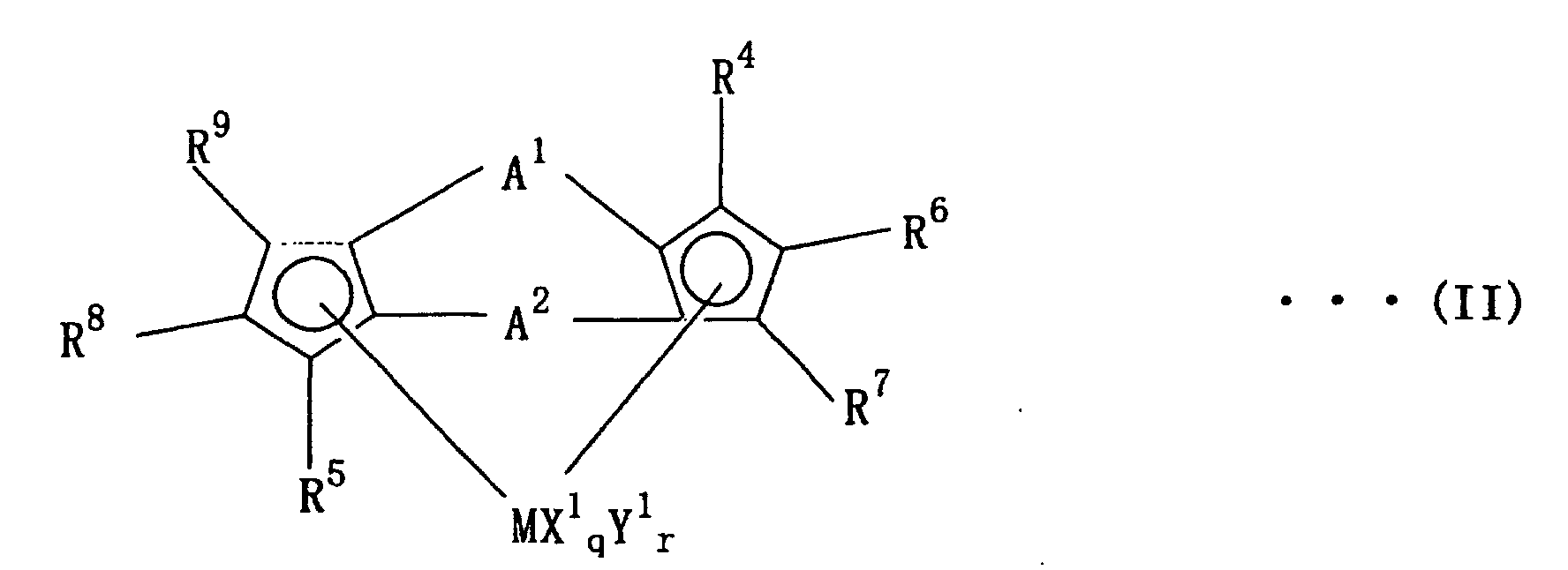
[in Formulas (III) and (IV), L1 represents a Lewis base; [Z]- represents non-coordinate anions [Z1]- and [Z2]-, wherein [Z1]- represents an anion in which plural groups are combined with an element, that is, [M1G1G2···Gf]- (in which M1 represents a 5th to 15th group element in the periodic table, preferably a 13th to 15th group element in the periodic table; G1 to Gf each represent a hydrogen atom, a halogen atom, an alkyl group having 1 to 20 carbon atoms, a dialkylamino group having 2 to 40 carbon atoms, an alkoxy group having 1 to 20 carbon atoms, an aryl group having 6 to 20 carbon atoms, an aryloxy group having 6 to 20 carbon atoms, an alkylaryl group having 7 to 40 carbon atoms, a halogen-substituted hydrocarbon group having 1 to 20 carbon atoms, an acyloxy group having 1 to 20 carbon atoms, an organic metalloid group or a hetero atom-containing group having 2 to 20 carbon atoms; two or more of G1 to Gf may form a ring; and f represents an integer of [(a valence of central metal M1) + 1]); [Z2]- represents a Brensted acid alone in which a logarithm (pKa) of an inverse number of an acid dissociation constant is -10 or less, a conjugate base comprising a combination of a Brensted acid and a Lewis acid or a conjugate base of an acid usually defined as a superstrong acid; and a Lewis base may be coordinated therewith; R10 represents a hydrogen atom, an alkyl group having 1 to 20 carbon atoms, an aryl group having 6 to 20 carbon atoms, an alkylaryl group or an arylalkyl group; R11 and R12 each represent a cyclopentadienyl group, a substituted cyclopentadienyl group, an indenyl group or a fluorenyl group; R13 represents an alkyl group having 1 to 20 carbon atoms, an aryl group, an alkylaryl group or an arylalkyl group; R14 represents a macrocyclic ligand such as tertaphenylporphyrin and phthalocyanine; k is an ionic valence of [L1-R10] and [L2] represents an integer of 1 to 3; a represents an integer of 1 or more; b is k × a; M2 contains a 1st to 3rd, 11th to 13th and 17th group element in the periodic table; and M3 represents a 7th to 12th group element in the periodic table].
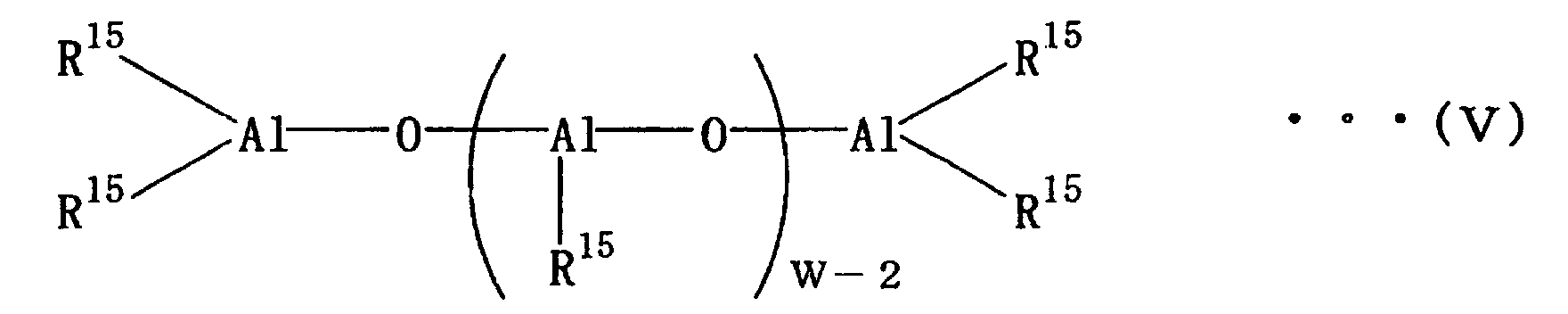

| Example 1 | Irganox 1010 | 1,000 ppm |
| PEP-Q | 1,000 ppm | |
| Example 2 | Irganox 1076 | 1,200 ppm |
| PEP-Q | 600 ppm | |
| Irgafos 168 | 800 ppm | |
| Example 3 | Irganox 1010 | 400 to 1,000 ppm |
| Irgafos 168 | 700 to 1,500 ppm |
δ 0.04 (s, 18H, trimethylsilyl), 0.48 (s, 12H, dimethylsilylen), 1.10 (t, 6H, methyl), 2.59 (s, 4H, methylene), 3.38 (q, 4H, methylene), 6.2-7.7 (m, 8H, Ar-H).
δ 0.0 (s, 18H, trimethylsilyl), 1.02, 1.12 (s, 12H, dimethylsilylene), 2.51 (dd, 4H, methylene), 7.1-7.6 (m, 8H, Ar-H).
| Mesopentad fraction (mmmm): mol % | 71.6 |
| Racemitriad fraction (rr): mol % | 4.6 |
| 91-2 × (rr) | 80.8 |
| Abnormal insertion amount (1,4 insertion fraction): mol % | 0 |
| Stereospecific index (mmmm)/(mmrr + rmmr) | 8 |
| Weight average molecular weight (Mw) | 51 × 104 |
| Molecular weight distribution (Mw/Mn) | 2.0 |
| Melting point (Tm-P: DSC measurement): °C | not observed |
| Melt endothermic amount (ΔH-P): J/g | not observed |
| Melting point (Tm-D: DSC measurement): °C | 73 |
| Melt endothermic amount (ΔH-D): J/g | 35 |
| CII:% | 0 |
| Composition ratio (mass %) | Example | Comparative Example 1 | ||||
| 1 | 2 | 3 | 4 | |||
| 1-Butene polymer | 70 | 70 | 90 | 50 | ― | |
| Olefin base polymer | F-704NP | 30 | ― | 10 | 50 | ― |
| F-734NP | ― | 30 | ― | ― | ― | |
| Evaluation of wrap film | Haze (%) | 0.4 | 0.4 | 0.6 | 0.6 | 0.3 |
| Tensile elastic modulus (MPa) | 210 | 210 | 180 | 320 | 1250 | |
| Tensile yield strength (MPa) | 10.2 | 9.8 | 8.9 | 12.5 | ||
| Wrapping property 1 | o ○ | o ○ | o ○ | o ○ | o ○ | |
| Wrapping property 2 | o ○ | o ○ | o ○ | ○ | × | |
| Sticking resistance | o ○ | o ○ | o ○ | o ○ | × | |
| Deformation restoring property | o ○ | o ○ | o ○ | o ○ | × |
| Example | Comparative Example 2 | ||||
| 5 | 6 | 7 | |||
| Both surface layer | EVA | EVA | EVA | EVA | |
| Composition ratio of intermediate layer (mass %) | Pellet of (1) | 100 | 68 | 30 | ― |
| PP | 0 | 32 | 70 | 100 | |
| Thickness (µm) of respective layers (surface layer/intermediate layer/ surface layer) | 5/5/5 | 5/5/5 | 5/5/5 | 5/5/5 | |
| Evaluation of wrap film | Tensile elastic modulus (MPa) | 134 | 149 | 173 | 177 |
| Permanent elongation percentage (%) | 9 | 10 | 11 | 14 | |
| Wrapping property 1 | o ○ | o ○ | o ○ | o ○ | |
| Wrapping property 2 | o ○ | o ○ | ○ | × | |
| Sticking resistance | o ○ | o ○ | o ○ | × | |
| Deformation restoring property | Δ | Δ | Δ | × |
| Composition ratio (mass %) | Example | Comparative Example | |||||
| 8 | 9 | 10 | 11 | 4 | 5 | ||
| 1-Butene polymer | 70 | 50 | 70 | 50 | - | - | |
| Olefin base polymer | F-300S | 30 | 50 | - | - | 100 | - |
| R-PP | - | - | 30 | 50 | 100 | ||
| Evaluation of shrink film | Haze (%) | 0.5 | 0.4 | 0.6 | 0.4 | 0.5 | 2.0 |
| Gloss (%) | 148 | 147 | 142 | 140 | 146 | 127 | |
| Shrink packaging appearance | Good | Good | Good | Good | Bad | Good | |
| Hot slipping property | Good | Good | Good | Good | Good | Good | |
| Heat shrink stress | ○ | ○ | ○ | ○ | × | × |
Claims (14)
- A wrap film formed from a resin composition comprising 1 to 99 mass % of a 1-butene base polymer satisfying the following items (1) to (4):and 99 to 1 mass % of an olefin base polymer.(1) a crystalline resin in which a melting point (Tm-D) defined as a peak top of a peak observed at a highest temperature side in a melting endothermic curve obtained by holding a sample at -10°C for 5 minutes under nitrogen atmosphere by means of a differential scanning calorimeter (DSC) and then elevating the temperature at 10°C/minute is 0 to 100°C;(2) a stereospecific index {(mmmm)/(mmrr + rmmr)} is 20 or less;(3) a molecular weight distribution (Mw/Mn) measured by a gel permeation chromatography (GPC) method is 4.0 or less; and(4) a weight average molecular weight (Mw) measured by the GPC method is 10,000 to 1,000,000
- A wrap film formed from a resin composition comprising 1 to 99 mass % of a 1-butene base polymer satisfying the following items (1') to (4'):and 99 to 1 mass % of an olefin base polymer.(1') a crystalline resin in which a melting point (Tm-P) defined as a peak top of a peak observed at a highest temperature side in a melting endothermic curve obtained by melting a sample at 190°C for 5 minutes under nitrogen atmosphere by means of a differential scanning calorimeter (DSC), then lowering the temperature down to -10°C at 5°C/minute, holding the sample at -10°C for 5 minutes and then elevating the temperature at 10°C/minute is not observed or 0 to 100°C;(2') a stereospecific index {(mmmm)/(mmrr + rmmr)} is 20 or less;(3') a molecular weight distribution (Mw/Mn) measured by a gel permeation chromatography (GPC) method is 4.0 or less; and(4') a weight average molecular weight (Mw) measured by the GPC method is 10,000 to 1,000,000
- A wrap film formed from a resin composition comprising 1 to 99 mass % of a 1-butene base polymer satisfying the following items (5) and (6):and 99 to 1 mass % of an olefin base polymer.(5) a 1-butene homopolymer or a copolymer of 1-butene and ethylene and/or α-olefin having 3 to 20 carbon atoms (excluding 1-butene), wherein a structural unit originating in 1-butene accounts for 90 mole % or more and(6) a II type crystal ratio (CII) obtained by melting a sample at 190°C for 5 minutes, rapidly cooling it with ice and water and solidifying, leaving standing at a room temperature for one hour and then analyzing by X ray diffraction is 50 % or less
- A shrink film formed from a resin composition comprising 1 to 99 mass % of a 1-butene base polymer satisfying the following items (1) to (4):and 99 to 1 mass % of an olefin base polymer.(1) a crystalline resin in which a melting point (Tm-D) defined as a peak top of a peak observed at a highest temperature side in a melting endothermic curve obtained by holding a sample at -10°C for 5 minutes under nitrogen atmosphere by means of a differential scanning calorimeter (DSC) and then elevating the temperature at 10°C/minute is 0 to 100°C;(2) a stereospecific index {(mmmm)/(mmrr + rmmr)} is 20 or less;(3) a molecular weight distribution (Mw/Mn) measured by a gel permeation chromatography (GPC) method is 4.0 or less; and(4) a weight average molecular weight (Mw) measured by the GPC method is 10,000 to 1,000,000
- A shrink film formed from a resin composition comprising 1 to 99 mass % of a 1-butene base polymer satisfying the following items (1') to (4'):and 99 to 1 mass % of an olefin base polymer.(1') a crystalline resin in which a melting point (Tm-P) defined as a peak top of a peak observed at a highest temperature side in a melting endothermic curve obtained by melting a sample at 190°C for 5 minutes under nitrogen atmosphere by means of a differential scanning calorimeter (DSC), then lowering the temperature down to -10°C at 5°C/minute, holding the sample at -10°C for 5 minutes and then elevating the temperature at 10°C/minute is not observed or 0 to 100°C;(2') a stereospecific index {(mmmm)/(mmrr + rmmr)} is 20 or less;(3') a molecular weight distribution (Mw/Mn) measured by a gel permeation chromatography (GPC) method is 4.0 or less; and(4') a weight average molecular weight (Mw) measured by the GPC method is 10,000 to 1,000,000
- A shrink film formed from a resin composition comprising 1 to 99 mass % of a 1-butene base polymer satisfying the following items (5) and (6):and 99 to 1 mass % of an olefin base polymer.(5) a 1-butene homopolymer or a copolymer of 1-butene and ethylene and/or α-olefin having 3 to 20 carbon atoms (excluding 1-butene), wherein a structural unit originating in 1-butene accounts for 90 mole % or more and(6) a II type crystal ratio (CII) obtained by melting a sample at 190°C for 5 minutes, rapidly cooling it with ice and water and solidifying, leaving standing at a room temperature for one hour and then analyzing by X ray diffraction is 50 % or less
- The wrap film as described in any of claims 1 to 3, wherein the 1-butene base polymer is polymerized using a metallocene catalyst comprising a transition metal compound in which a cross-linking structure is formed via two cross-linking groups and a promoter.
- The wrap film as described in any of claims 1 to 3, wherein the olefin base polymer is a propylene base polymer.
- A multilayer wrap film having at least one layer comprising the resin composition as described in any of claims 1 to 3.
- A multilayer film having at least one layer comprising the 1-butene polymer as described in any of claims 1 to 3.
- A wrap film comprising the multilayer film as described in claim 10.
- The shrink film as described in any of claims 4 to 6, wherein the 1-butene base polymer is polymerized using a metallocene catalyst comprising a transition metal compound in which a cross-linking structure is formed via two cross-linking groups and a promoter.
- The shrink film as described in any of claims 4 to 6, wherein the olefin base polymer is a propylene base polymer.
- A multilayer shrink film having at least one layer comprising the resin composition as described in any of claims 4 to 6.
Applications Claiming Priority (7)
| Application Number | Priority Date | Filing Date | Title |
|---|---|---|---|
| JP2001285506 | 2001-09-19 | ||
| JP2001285506 | 2001-09-19 | ||
| JP2001285507A JP4880842B2 (en) | 2001-09-19 | 2001-09-19 | Shrink film |
| JP2001285507 | 2001-09-19 | ||
| JP2002142465 | 2002-05-17 | ||
| JP2002142465A JP4198389B2 (en) | 2001-09-19 | 2002-05-17 | Wrap film |
| PCT/JP2002/009500 WO2003027179A1 (en) | 2001-09-19 | 2002-09-17 | Wrapping film and shrink film each comprising butene polymer |
Publications (2)
| Publication Number | Publication Date |
|---|---|
| EP1428855A1 true EP1428855A1 (en) | 2004-06-16 |
| EP1428855A4 EP1428855A4 (en) | 2005-09-14 |
Family
ID=27347534
Family Applications (1)
| Application Number | Title | Priority Date | Filing Date |
|---|---|---|---|
| EP02799471A Withdrawn EP1428855A4 (en) | 2001-09-19 | 2002-09-17 | PACKAGING FILM AND RETRACTABLE FILM COMPRISING A BUTENE POLYMER |
Country Status (3)
| Country | Link |
|---|---|
| US (1) | US20050031883A1 (en) |
| EP (1) | EP1428855A4 (en) |
| WO (1) | WO2003027179A1 (en) |
Cited By (4)
| Publication number | Priority date | Publication date | Assignee | Title |
|---|---|---|---|---|
| EP1520864A1 (en) * | 2003-08-29 | 2005-04-06 | Idemitsu Kosan Company Limited | Higher alpha-olefin copolymers and process for preparation thereof |
| WO2006067043A1 (en) * | 2004-12-21 | 2006-06-29 | Basell Poliolefine Italia S.R.L. | Polyolefin compositions and permeable films therefrom |
| US7524903B2 (en) | 2004-12-20 | 2009-04-28 | Basell Poliolefine Italia S.R.L. | Process and apparatus for the polymerization of propylene |
| CN107531966A (en) * | 2015-04-22 | 2018-01-02 | 三井化学株式会社 | Poly- 1 butylene resin composition and formed body therefrom |
Families Citing this family (1)
| Publication number | Priority date | Publication date | Assignee | Title |
|---|---|---|---|---|
| WO2003070788A1 (en) | 2002-02-21 | 2003-08-28 | Idemitsu Petrochemical Co., Ltd. | Highly flowable 1-butene polymer and process for producing the same |
Family Cites Families (27)
| Publication number | Priority date | Publication date | Assignee | Title |
|---|---|---|---|---|
| US4568713A (en) * | 1984-05-30 | 1986-02-04 | Shell Oil Company | Hot melt poly(butylene/ethylene) adhesives |
| AU588321B2 (en) * | 1985-05-30 | 1989-09-14 | Shell Oil Company | Film for food wrap |
| US5128414A (en) * | 1985-06-28 | 1992-07-07 | Shell Oil Company | Polymer packaging film and sheet capable of forming peelable seals made from ethylenic and butene-1 polymers |
| US4830926A (en) * | 1987-10-30 | 1989-05-16 | Shell Oil Company | Poly-1-butene blend adhesives for laminar structure |
| FI98524C (en) * | 1987-11-09 | 1997-07-10 | Shell Oil Co | Poly-1-butene resin composition and water-resistant wafer prepared therefrom |
| US5277988A (en) * | 1987-12-15 | 1994-01-11 | Mitsui Petrochemical Industries, Ltd. | Easily openable heat seal material |
| JPH0759641B2 (en) * | 1987-12-28 | 1995-06-28 | 出光石油化学株式会社 | Butene-1 polymer film and laminated film thereof |
| JPH01246708A (en) * | 1988-03-29 | 1989-10-02 | Hitachi Cable Ltd | Readily exfoliative semiconducting resin composition |
| US5635261A (en) * | 1989-10-10 | 1997-06-03 | Viskase Corporation | Thermoplastic film incorporating high melt index resins |
| JPH05104624A (en) * | 1991-10-21 | 1993-04-27 | Mitsubishi Petrochem Co Ltd | Film for packing |
| EP0573173B1 (en) * | 1992-05-20 | 1997-03-05 | Mitsui Petrochemical Industries, Ltd. | Heat-resistant overwrap film |
| JP3193963B2 (en) * | 1992-08-04 | 2001-07-30 | 三菱樹脂株式会社 | Adhesive film for packaging |
| JP3140195B2 (en) * | 1992-08-31 | 2001-03-05 | 昭和電工株式会社 | Stretch film for food packaging |
| JP3299320B2 (en) * | 1992-10-27 | 2002-07-08 | リケンテクノス株式会社 | Wrap film |
| JPH06306224A (en) * | 1993-04-22 | 1994-11-01 | Mitsui Petrochem Ind Ltd | Highly shrinkable packaging film |
| JP3540431B2 (en) * | 1994-12-20 | 2004-07-07 | 三井化学株式会社 | Method for producing poly 1-butene |
| US6008148A (en) * | 1996-04-15 | 1999-12-28 | Ato Findley, Inc. | Oil resistant polybutylene based hot melt adhesive |
| WO1997042258A1 (en) * | 1996-05-06 | 1997-11-13 | Montell Technology Company B.V. | Polyolefin compositions for heat-sealable films having controlled peel strength |
| JPH10272747A (en) * | 1997-03-31 | 1998-10-13 | Kohjin Co Ltd | Laminated stretch shrink film |
| CN1121466C (en) * | 1997-04-30 | 2003-09-17 | 阿托芬德利公司 | High Peel and High Shear Strength Hot Melt Adhesives for Nonwovens |
| JPH1143564A (en) * | 1998-03-25 | 1999-02-16 | Idemitsu Petrochem Co Ltd | Film and laminate |
| JP3403666B2 (en) * | 1998-06-08 | 2003-05-06 | 旭化成株式会社 | Soft polyolefin resin composition |
| US6706343B1 (en) * | 1999-06-10 | 2004-03-16 | Pechiney Emballage Flexible Europe | Polymeric film structures useful as shrink bags |
| US6930160B2 (en) * | 2000-08-22 | 2005-08-16 | Idemitsu Petrochemical Co. Ltd. | 1-Butene polymer and molded product consisting of the polymer |
| TWI263645B (en) * | 2000-08-22 | 2006-10-11 | Idemitsu Kosan Co | 1-butene based polymer and product formed therefrom |
| KR100719403B1 (en) * | 2003-01-31 | 2007-05-17 | 듀폰-미츠이 폴리케미칼 가부시키가이샤 | Heat-sealable laminated film and package |
| US20060172143A1 (en) * | 2003-07-23 | 2006-08-03 | Breese David R | Extrusion coating process and coated substrates having improved heat seal properties |
-
2002
- 2002-09-17 EP EP02799471A patent/EP1428855A4/en not_active Withdrawn
- 2002-09-17 WO PCT/JP2002/009500 patent/WO2003027179A1/en not_active Ceased
- 2002-09-17 US US10/488,940 patent/US20050031883A1/en not_active Abandoned
Cited By (8)
| Publication number | Priority date | Publication date | Assignee | Title |
|---|---|---|---|---|
| EP1520864A1 (en) * | 2003-08-29 | 2005-04-06 | Idemitsu Kosan Company Limited | Higher alpha-olefin copolymers and process for preparation thereof |
| US7019091B2 (en) | 2003-08-29 | 2006-03-28 | Idemitsu Kosan Co., Ltd. | Higher α-olefin copolymers and process for preparation thereof |
| US7109283B2 (en) | 2003-08-29 | 2006-09-19 | Idemitsu Kosan Co., Ltd. | Higher α-olefin copolymers and process for preparation thereof |
| US7524903B2 (en) | 2004-12-20 | 2009-04-28 | Basell Poliolefine Italia S.R.L. | Process and apparatus for the polymerization of propylene |
| WO2006067043A1 (en) * | 2004-12-21 | 2006-06-29 | Basell Poliolefine Italia S.R.L. | Polyolefin compositions and permeable films therefrom |
| US8202611B2 (en) | 2004-12-21 | 2012-06-19 | Basell Poliolefine Italia, s.r.l. | Process compositions and permeable films therefrom |
| CN107531966A (en) * | 2015-04-22 | 2018-01-02 | 三井化学株式会社 | Poly- 1 butylene resin composition and formed body therefrom |
| CN107531966B (en) * | 2015-04-22 | 2020-11-06 | 三井化学株式会社 | Poly-1-butene resin composition and molded body obtained therefrom |
Also Published As
| Publication number | Publication date |
|---|---|
| EP1428855A4 (en) | 2005-09-14 |
| US20050031883A1 (en) | 2005-02-10 |
| WO2003027179A1 (en) | 2003-04-03 |
Similar Documents
| Publication | Publication Date | Title |
|---|---|---|
| US6913834B2 (en) | Polyolefin resin composition, film, and multilayer structure | |
| KR100733191B1 (en) | 1-butene polymer and a molded article made of the polymer | |
| CN1322034C (en) | Polypropylene film and laminate made therefrom | |
| EP2960259A1 (en) | Propylene-type polymer and hot-melt adhesive agent | |
| US6930160B2 (en) | 1-Butene polymer and molded product consisting of the polymer | |
| EP1288249B1 (en) | Film | |
| JP2004082469A (en) | Laminated film for stretch packaging | |
| US7067604B2 (en) | 1-butene polymer and molded product consisting of the polymer | |
| US20050031883A1 (en) | Wrapping film and shrink film each comprising butene polymer | |
| JP4902050B2 (en) | Polyolefin resin composition, molded product and film thereof | |
| US8044144B2 (en) | Resin composition, transparent film or sheet having elasticity recovering property, and wrap film | |
| JP2002146130A (en) | Surface-protecting film or sheet | |
| JP5199524B2 (en) | Shrink film | |
| JP4198389B2 (en) | Wrap film | |
| JP4880842B2 (en) | Shrink film | |
| JP4418099B2 (en) | Polyolefin resin multilayer laminate | |
| JP4693276B2 (en) | Wrap film | |
| JP2002136308A (en) | Slide fastener and packaging bag with slide fastener | |
| JP5015479B2 (en) | Molded body made of propylene resin composition | |
| JP2002136307A (en) | Slide fastener and packaging bag with slide fastener | |
| JP2009013424A (en) | Propylene polymer and composition containing the same | |
| HK1118067A (en) | Resin composition, transparent film or sheet having elasticity recovering property, and wrap film |
Legal Events
| Date | Code | Title | Description |
|---|---|---|---|
| PUAI | Public reference made under article 153(3) epc to a published international application that has entered the european phase |
Free format text: ORIGINAL CODE: 0009012 |
|
| 17P | Request for examination filed |
Effective date: 20040313 |
|
| AK | Designated contracting states |
Kind code of ref document: A1 Designated state(s): AT BE BG CH CY CZ DE DK EE ES FI FR GB GR IE IT LI LU MC NL PT SE SK TR |
|
| RAP1 | Party data changed (applicant data changed or rights of an application transferred) |
Owner name: IDEMITSU KOSAN CO., LTD. |
|
| A4 | Supplementary search report drawn up and despatched |
Effective date: 20050728 |
|
| RIC1 | Information provided on ipc code assigned before grant |
Ipc: 7C 08L 23/20 A Ipc: 7C 08F 4/642 B Ipc: 7B 32B 27/32 B Ipc: 7C 08J 5/18 B |
|
| 17Q | First examination report despatched |
Effective date: 20070716 |
|
| STAA | Information on the status of an ep patent application or granted ep patent |
Free format text: STATUS: THE APPLICATION IS DEEMED TO BE WITHDRAWN |
|
| 18D | Application deemed to be withdrawn |
Effective date: 20110705 |