EP1427247A2 - Baffle vibrating reducing - Google Patents
Baffle vibrating reducing Download PDFInfo
- Publication number
- EP1427247A2 EP1427247A2 EP03102533A EP03102533A EP1427247A2 EP 1427247 A2 EP1427247 A2 EP 1427247A2 EP 03102533 A EP03102533 A EP 03102533A EP 03102533 A EP03102533 A EP 03102533A EP 1427247 A2 EP1427247 A2 EP 1427247A2
- Authority
- EP
- European Patent Office
- Prior art keywords
- transducer
- baffle
- driver
- vibration
- pass filter
- Prior art date
- Legal status (The legal status is an assumption and is not a legal conclusion. Google has not performed a legal analysis and makes no representation as to the accuracy of the status listed.)
- Granted
Links
Images


Classifications
-
- H—ELECTRICITY
- H04—ELECTRIC COMMUNICATION TECHNIQUE
- H04R—LOUDSPEAKERS, MICROPHONES, GRAMOPHONE PICK-UPS OR LIKE ACOUSTIC ELECTROMECHANICAL TRANSDUCERS; ELECTRIC HEARING AIDS; PUBLIC ADDRESS SYSTEMS
- H04R1/00—Details of transducers, loudspeakers or microphones
- H04R1/20—Arrangements for obtaining desired frequency or directional characteristics
- H04R1/22—Arrangements for obtaining desired frequency or directional characteristics for obtaining desired frequency characteristic only
- H04R1/28—Transducer mountings or enclosures modified by provision of mechanical or acoustic impedances, e.g. resonator, damping means
- H04R1/2869—Reduction of undesired resonances, i.e. standing waves within enclosure, or of undesired vibrations, i.e. of the enclosure itself
- H04R1/2873—Reduction of undesired resonances, i.e. standing waves within enclosure, or of undesired vibrations, i.e. of the enclosure itself for loudspeaker transducers
-
- B—PERFORMING OPERATIONS; TRANSPORTING
- B60—VEHICLES IN GENERAL
- B60R—VEHICLES, VEHICLE FITTINGS, OR VEHICLE PARTS, NOT OTHERWISE PROVIDED FOR
- B60R11/00—Arrangements for holding or mounting articles, not otherwise provided for
- B60R11/02—Arrangements for holding or mounting articles, not otherwise provided for for radio sets, television sets, telephones, or the like; Arrangement of controls thereof
- B60R11/0217—Arrangements for holding or mounting articles, not otherwise provided for for radio sets, television sets, telephones, or the like; Arrangement of controls thereof for loud-speakers
-
- B—PERFORMING OPERATIONS; TRANSPORTING
- B60—VEHICLES IN GENERAL
- B60R—VEHICLES, VEHICLE FITTINGS, OR VEHICLE PARTS, NOT OTHERWISE PROVIDED FOR
- B60R13/00—Elements for body-finishing, identifying, or decorating; Arrangements or adaptations for advertising purposes
- B60R13/02—Internal Trim mouldings ; Internal Ledges; Wall liners for passenger compartments; Roof liners
- B60R13/0237—Side or rear panels
- B60R13/0243—Doors
-
- B—PERFORMING OPERATIONS; TRANSPORTING
- B60—VEHICLES IN GENERAL
- B60R—VEHICLES, VEHICLE FITTINGS, OR VEHICLE PARTS, NOT OTHERWISE PROVIDED FOR
- B60R13/00—Elements for body-finishing, identifying, or decorating; Arrangements or adaptations for advertising purposes
- B60R13/02—Internal Trim mouldings ; Internal Ledges; Wall liners for passenger compartments; Roof liners
- B60R13/0268—Rear parcel liners
-
- B—PERFORMING OPERATIONS; TRANSPORTING
- B60—VEHICLES IN GENERAL
- B60R—VEHICLES, VEHICLE FITTINGS, OR VEHICLE PARTS, NOT OTHERWISE PROVIDED FOR
- B60R13/00—Elements for body-finishing, identifying, or decorating; Arrangements or adaptations for advertising purposes
- B60R13/02—Internal Trim mouldings ; Internal Ledges; Wall liners for passenger compartments; Roof liners
- B60R2013/0287—Internal Trim mouldings ; Internal Ledges; Wall liners for passenger compartments; Roof liners integrating other functions or accessories
-
- H—ELECTRICITY
- H04—ELECTRIC COMMUNICATION TECHNIQUE
- H04R—LOUDSPEAKERS, MICROPHONES, GRAMOPHONE PICK-UPS OR LIKE ACOUSTIC ELECTROMECHANICAL TRANSDUCERS; ELECTRIC HEARING AIDS; PUBLIC ADDRESS SYSTEMS
- H04R1/00—Details of transducers, loudspeakers or microphones
- H04R1/20—Arrangements for obtaining desired frequency or directional characteristics
- H04R1/22—Arrangements for obtaining desired frequency or directional characteristics for obtaining desired frequency characteristic only
- H04R1/227—Arrangements for obtaining desired frequency or directional characteristics for obtaining desired frequency characteristic only using transducers reproducing the same frequency band
-
- H—ELECTRICITY
- H04—ELECTRIC COMMUNICATION TECHNIQUE
- H04R—LOUDSPEAKERS, MICROPHONES, GRAMOPHONE PICK-UPS OR LIKE ACOUSTIC ELECTROMECHANICAL TRANSDUCERS; ELECTRIC HEARING AIDS; PUBLIC ADDRESS SYSTEMS
- H04R1/00—Details of transducers, loudspeakers or microphones
- H04R1/20—Arrangements for obtaining desired frequency or directional characteristics
- H04R1/22—Arrangements for obtaining desired frequency or directional characteristics for obtaining desired frequency characteristic only
- H04R1/28—Transducer mountings or enclosures modified by provision of mechanical or acoustic impedances, e.g. resonator, damping means
- H04R1/2807—Enclosures comprising vibrating or resonating arrangements
- H04R1/2815—Enclosures comprising vibrating or resonating arrangements of the bass reflex type
- H04R1/2819—Enclosures comprising vibrating or resonating arrangements of the bass reflex type for loudspeaker transducers
-
- H—ELECTRICITY
- H04—ELECTRIC COMMUNICATION TECHNIQUE
- H04R—LOUDSPEAKERS, MICROPHONES, GRAMOPHONE PICK-UPS OR LIKE ACOUSTIC ELECTROMECHANICAL TRANSDUCERS; ELECTRIC HEARING AIDS; PUBLIC ADDRESS SYSTEMS
- H04R2209/00—Details of transducers of the moving-coil, moving-strip, or moving-wire type covered by H04R9/00 but not provided for in any of its subgroups
- H04R2209/027—Electrical or mechanical reduction of yoke vibration
-
- H—ELECTRICITY
- H04—ELECTRIC COMMUNICATION TECHNIQUE
- H04R—LOUDSPEAKERS, MICROPHONES, GRAMOPHONE PICK-UPS OR LIKE ACOUSTIC ELECTROMECHANICAL TRANSDUCERS; ELECTRIC HEARING AIDS; PUBLIC ADDRESS SYSTEMS
- H04R2499/00—Aspects covered by H04R or H04S not otherwise provided for in their subgroups
- H04R2499/10—General applications
- H04R2499/13—Acoustic transducers and sound field adaptation in vehicles
Definitions
- the present invention relates in general to baffle vibration reducing and more particularly concerns novel apparatus and techniques for reducing vibration transmitted to structures attached to loudspeaker drivers.
- an electroacoustic transducer such as a loudspeaker driver
- a structure such as a package shelf, the door of a vehicle, the wall of an enclosure, other wall or other baffle, where attachment is usually on the periphery of the transducer frame
- an energized transducer motor develops forces in response to an energizing electrical signal.
- the forces generated by the motor cause the diaphragm of the transducer to move relative to the transducer frame.
- These forces will also be transmitted through the frame to the structure through the attachment points of the frame.
- Package shelves and door panels of vehicles are often made of thin material, such as thin sheet metal.
- Such structures typically have insufficient stiffness to resist vibration and are typically lightly damped. As a result, forces applied to the structure around modal resonance frequencies of the structure may result in excessive vibration of the structure, acoustically perceived as unwanted buzzes and rattles, or degraded frequency response of the radiated sound.
- a first electroacoustical transducer incorporating a movable diaphragm is seated in and structurally coupled to a panel.
- the transducer is mechanically connected to a device containing a compensating moveable mass driven out of phase with the movement of the diaphragm of the first electroacoustical transducer, to significantly reduce the resultant force applied to the panel.
- the device with compensating mass is a second electroacoustical transducer identical to the first transducer.
- the acoustic output from the first side of the first transducer is directly coupled to a listening environment, such as a vehicle passenger compartment or living room.
- the acoustic output from the side of the second transducer facing away from the first transducer is also coupled to the listening environment through an acoustical element or elements such as compliant volume and/or port so that the acoustical output into the vehicle compartment from the facing away side of the second transducer is effectively in phase with the output into the vehicle compartment from the first side of the first transducer, over a desired frequency range.
- the acoustic elements are arranged such that the output from the away facing side of the second transducer is not acoustically coupled to the output from the second side of the first transducer or the output from the first side of the second transducer.
- FIG. 1 there is shown a diagrammatic representation of an embodiment of the invention with structure carried by infinite baffle 11, typically a vehicle rear shelf or door panel carrying a first transducer, such as loudspeaker driver 12, mechanically connected to a second transducer, such as loudspeaker driver 13, preferably identical to loudspeaker driver 12, through mechanical link 14.
- the two transducers are ideally mounted in substantially parallel planes such that the diaphragms move in the same axial direction.
- the front side of transducer 12 is directly coupled to listening area 18. If baffle 11 is the rear package shelf of a vehicle, listening area 18 will be the passenger compartment of the vehicle.
- the second side of transducer 12 is coupled to volume 30, which would be the vehicle trunk if baffle 11 is the rear package shelf.
- the second side of diaphragm 22 of driver 13 is coupled to the listening area 18 through compliant column 15 and port tube 16.
- the front of diaphragm 22 of transducer 13 is coupled to volume 30.
- Power amplifier 17 energizes first loudspeaker driver 12 and second loudspeaker driver 13 with the same signal but drives them in opposite polarity.
- the system is arranged such that when diaphragm 21 of first driver 12 is moving up, diaphragm 22 of second driver 13 is moving down, which significantly reduces the forces applied to and unwanted resultant vibrations of baffle 11.
- the output from the rear of second driver 13 is coupled by compliant volume 15 and port tube 16 for emission substantially in phase with the output from the front surface of first driver 12.
- the output from the rear of second driver 13 could also be coupled through a conduit of substantially constant or smoothly varying cross section to listening area 18 without loss of generality.
- the second transducer need not be an identical transducer. All that is required for significant reduction in vibration is for the moving mass and generated motor force of the second transducer to approximately equal the moving mass and generated motor force of the second transducer to approximately equal the moving mass and generated motor force of the first transducer. Such a component could be made at lower cost than the cost of a transducer identical to the first transducer. It is still desirable for the frames of the two transducers to be similar so that the second transducer may be attached to the first transducer at the same attachment points where the first transducer is attached to the baffle. An alternative means of assembly would be to rigidly attach the top of the motor structure of the first driver to the rear of the motor structure of the second driver, using a rigid connecting member such as a threaded metal rod.
- FIG. 3 shows an alternative construction.
- Driver 13 is now physically inverted with respect to driver 12.
- FIG. 3 shows the rear of the motor structure of driver 12 rigidly attached to the rear of the motor structure of driver 13 through spacer 20, although spacer 20 is not required.
- Structural coupling of the two transducers could also be accomplished through attachment around the periphery of the transducer frames, as shown in the system of FIG. 1.
- the arrangement of FIG. 3 would also work equally well if each of transducers 12 and 13 were inverted compared to what is shown. In this case, structural connection would be more easily accomplished through attachment around the periphery of the transducer frames.
- driver 12 and 13 are physically inverted with respect to each other, cancellation of vibration will occur when signals of the same relative polarity are applied to each transducer.
- Each driver is attached to the output of amplifier 17 such that when the signal provided to driver 12 causes diaphragm 21 of driver 12 to move down, signal output from amplifier 17 which is connected to driver 13 causes diaphragm 22 of driver 13 to move up, in the opposite direction to the motion of diaphragm 21.
- the frequency response of the combined system may exhibit a comb filter behavior with the first null occurring when the path length difference between the front of the first transducer and the listening position and the rear of the second transducer and the listening position is a half wavelength.
- One approach for reducing the effects of this comb filter behavior is by using a low-pass filter to restrict the spectral components delivered to both drivers to spectral components below the first null and using other transducers for reproducing higher frequency spectral components.
- the low-pass filters used could be identical for both drivers, or they may have different orders and/or corner frequencies.
- the output from one of the drivers could be restricted to being below a predetermined cutoff frequency while the other was allowed to operate over a wider frequency range.
- the first transducer operates over a wider frequency range than the second transducer.
- This result can be achieved by placing a low-pass filter in the signal path of the second transducer only, or by having a low-pass filter in the signal path of the first transducer with a higher comer frequency and/or lower order than a low-pass filter in the second transducer signal path.
- the result can also be achieved either in combination with or solely by the appropriate design of the acoustic elements connecting the second driver to the listening region such that the acoustic elements, in combination, form a low pass filter.
- a low-pass filter in the signal path of the second transducer and a complementary all-pass filter in the signal path of the first transducer.
- a complementary all-pass filter has the same phase response as a function of frequency as a corresponding low-pass filter. This feature can be accomplished, for example, by using a second order critically damped low-pass filter in the second transducer signal path, and a first order all-pass filter in the first transducer signal path, where the comer frequencies of the low-pass and all-pass filters are substantially identical.
- a fourth order low-pass filter in the second transducer signal path and a second order all-pass filter in the first transducer signal path may be used.
- Other examples of complementary all-pass filter/low-pass filter combinations will be evident to those skilled in the art.
- FIG. 2 there is shown a graphical representation of force upon a baffle as a function of frequency for various structures.
- Curve 21 shows the resultant response of using two Bose eight-inch Nd drivers in an acoustic system having a low-pass filter.
- Curve 22 shows the applied force when using only a single eight-inch Nd driver with a low-pass filter.
- Curve 23 shows the applied force when using just two eight-inch Nd loudspeaker drivers connected according to the invention without the low-pass filter.
- Curve 24 shows the applied force with just a single eight-inch Nd loudspeaker driver.
- FIGS. 1 and 3 show use with infinite baffle 11. Although the arrangements are described having region 18 as the listening area, this is not required. The invention can be adapted to work equally well with volume 30 or region 18 operating as the listening area without loss of generality.
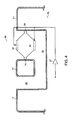
- FIG. 4 shows use of the invention with transducers of an alternate construction.
- Transducers 32 and 33 have motor structures that are inverted with respect to the motor structures of transducers 12 and 13.
- FIG. 4 shows transducers 32 and 33 physically inverted with respect to each other, use of inverted motor structure transducers is not limited to the orientation shown. Any of the previous arrangements described for non-inverted motor transducers is also applicable for transducers with inverted motor structures.
- Use of inverted motor structure transducers in the current invention can significantly reduce the overall thickness of the multiple transducer assembly, which can reduce intrusion into a vehicle trunk or allow a system to fit within a wall space where an arrangement using traditional transducers would not fit.
- mechanical links 14 can be made much thinner than links 14 shown in FIG. 1 in the embodiment using transducers without inverted motor structures.
Landscapes
- Engineering & Computer Science (AREA)
- Signal Processing (AREA)
- Health & Medical Sciences (AREA)
- Otolaryngology (AREA)
- Physics & Mathematics (AREA)
- Acoustics & Sound (AREA)
- Mechanical Engineering (AREA)
- Fittings On The Vehicle Exterior For Carrying Loads, And Devices For Holding Or Mounting Articles (AREA)
- Details Of Audible-Bandwidth Transducers (AREA)
- Audible-Bandwidth Dynamoelectric Transducers Other Than Pickups (AREA)
- Apparatuses For Generation Of Mechanical Vibrations (AREA)
- Circuit For Audible Band Transducer (AREA)
- Obtaining Desirable Characteristics In Audible-Bandwidth Transducers (AREA)
Abstract
Description
- The present invention relates in general to baffle vibration reducing and more particularly concerns novel apparatus and techniques for reducing vibration transmitted to structures attached to loudspeaker drivers.
- When an electroacoustic transducer, such as a loudspeaker driver, is mounted to a structure, such as a package shelf, the door of a vehicle, the wall of an enclosure, other wall or other baffle, where attachment is usually on the periphery of the transducer frame, an energized transducer motor develops forces in response to an energizing electrical signal. The forces generated by the motor cause the diaphragm of the transducer to move relative to the transducer frame. These forces will also be transmitted through the frame to the structure through the attachment points of the frame. Package shelves and door panels of vehicles are often made of thin material, such as thin sheet metal. Such structures typically have insufficient stiffness to resist vibration and are typically lightly damped. As a result, forces applied to the structure around modal resonance frequencies of the structure may result in excessive vibration of the structure, acoustically perceived as unwanted buzzes and rattles, or degraded frequency response of the radiated sound.
- It is an important object of the invention to reduce these structurally transmitted vibrations.
- According to the invention, a first electroacoustical transducer incorporating a movable diaphragm is seated in and structurally coupled to a panel. The transducer is mechanically connected to a device containing a compensating moveable mass driven out of phase with the movement of the diaphragm of the first electroacoustical transducer, to significantly reduce the resultant force applied to the panel. Typically the device with compensating mass is a second electroacoustical transducer identical to the first transducer. According to another feature of the invention, the acoustic output from the first side of the first transducer is directly coupled to a listening environment, such as a vehicle passenger compartment or living room. The acoustic output from the side of the second transducer facing away from the first transducer is also coupled to the listening environment through an acoustical element or elements such as compliant volume and/or port so that the acoustical output into the vehicle compartment from the facing away side of the second transducer is effectively in phase with the output into the vehicle compartment from the first side of the first transducer, over a desired frequency range. The acoustic elements are arranged such that the output from the away facing side of the second transducer is not acoustically coupled to the output from the second side of the first transducer or the output from the first side of the second transducer. Thus, the invention achieves both significant reduction in unwanted mechanical vibration of the supporting structure with enhanced acoustic output from the second transducer.
- Other features, objects and advantages of the invention will become apparent from the following description when read in connection with the accompanying drawing in which:
-
- FIG. 1 is a diagrammatic representation of an embodiment of the invention with the assembly carried by an infinite baffle, such as a vehicle rear deck or door; and
- FIG 2 is a graphical representation showing the force exerted on the structure as a function of frequency for various systems; and
- FIG 3 is a diagrammatic representation of an alternative embodiment of the invention with the assembly carried by an infinite baffle, such as a vehicle rear deck or door; and
- FIG 4 is a diagrammatic representation of an alternative embodiment of the invention with the assembly carried by an infinite baffle, such as a vehicle rear deck or door, incorporating transducers with inverted motor structures.
-
- With reference now to the drawing and more particularly FIG. 1 thereof, there is shown a diagrammatic representation of an embodiment of the invention with structure carried by
infinite baffle 11, typically a vehicle rear shelf or door panel carrying a first transducer, such asloudspeaker driver 12, mechanically connected to a second transducer, such asloudspeaker driver 13, preferably identical toloudspeaker driver 12, throughmechanical link 14. The two transducers are ideally mounted in substantially parallel planes such that the diaphragms move in the same axial direction. The front side oftransducer 12 is directly coupled tolistening area 18. Ifbaffle 11 is the rear package shelf of a vehicle,listening area 18 will be the passenger compartment of the vehicle. The second side oftransducer 12 is coupled tovolume 30, which would be the vehicle trunk ifbaffle 11 is the rear package shelf. The second side ofdiaphragm 22 ofdriver 13 is coupled to thelistening area 18 throughcompliant column 15 andport tube 16. The front ofdiaphragm 22 oftransducer 13 is coupled tovolume 30.Power amplifier 17 energizesfirst loudspeaker driver 12 andsecond loudspeaker driver 13 with the same signal but drives them in opposite polarity. The system is arranged such that whendiaphragm 21 offirst driver 12 is moving up,diaphragm 22 ofsecond driver 13 is moving down, which significantly reduces the forces applied to and unwanted resultant vibrations ofbaffle 11. Meanwhile, the output from the rear ofsecond driver 13 is coupled bycompliant volume 15 andport tube 16 for emission substantially in phase with the output from the front surface offirst driver 12. The output from the rear ofsecond driver 13 could also be coupled through a conduit of substantially constant or smoothly varying cross section tolistening area 18 without loss of generality. - The second transducer need not be an identical transducer. All that is required for significant reduction in vibration is for the moving mass and generated motor force of the second transducer to approximately equal the moving mass and generated motor force of the second transducer to approximately equal the moving mass and generated motor force of the first transducer. Such a component could be made at lower cost than the cost of a transducer identical to the first transducer. It is still desirable for the frames of the two transducers to be similar so that the second transducer may be attached to the first transducer at the same attachment points where the first transducer is attached to the baffle. An alternative means of assembly would be to rigidly attach the top of the motor structure of the first driver to the rear of the motor structure of the second driver, using a rigid connecting member such as a threaded metal rod.
- FIG. 3 shows an alternative construction.
Driver 13 is now physically inverted with respect to driver 12. FIG. 3 shows the rear of the motor structure ofdriver 12 rigidly attached to the rear of the motor structure ofdriver 13 throughspacer 20, althoughspacer 20 is not required. Structural coupling of the two transducers could also be accomplished through attachment around the periphery of the transducer frames, as shown in the system of FIG. 1. The arrangement of FIG. 3 would also work equally well if each oftransducers - Since
drivers amplifier 17 such that when the signal provided to driver 12 causesdiaphragm 21 ofdriver 12 to move down, signal output fromamplifier 17 which is connected todriver 13 causesdiaphragm 22 ofdriver 13 to move up, in the opposite direction to the motion ofdiaphragm 21. - Above a certain frequency, output from the second transducer will not be in phase with the output from the first transducer. The frequency response of the combined system may exhibit a comb filter behavior with the first null occurring when the path length difference between the front of the first transducer and the listening position and the rear of the second transducer and the listening position is a half wavelength.
- One approach for reducing the effects of this comb filter behavior is by using a low-pass filter to restrict the spectral components delivered to both drivers to spectral components below the first null and using other transducers for reproducing higher frequency spectral components. The low-pass filters used could be identical for both drivers, or they may have different orders and/or corner frequencies. The output from one of the drivers could be restricted to being below a predetermined cutoff frequency while the other was allowed to operate over a wider frequency range. Preferably, the first transducer operates over a wider frequency range than the second transducer. This result can be achieved by placing a low-pass filter in the signal path of the second transducer only, or by having a low-pass filter in the signal path of the first transducer with a higher comer frequency and/or lower order than a low-pass filter in the second transducer signal path. The result can also be achieved either in combination with or solely by the appropriate design of the acoustic elements connecting the second driver to the listening region such that the acoustic elements, in combination, form a low pass filter.
- It may also be advantageous to include a low-pass filter in the signal path of the second transducer and a complementary all-pass filter in the signal path of the first transducer. A complementary all-pass filter has the same phase response as a function of frequency as a corresponding low-pass filter. This feature can be accomplished, for example, by using a second order critically damped low-pass filter in the second transducer signal path, and a first order all-pass filter in the first transducer signal path, where the comer frequencies of the low-pass and all-pass filters are substantially identical.
- According to another embodiment, a fourth order low-pass filter in the second transducer signal path and a second order all-pass filter in the first transducer signal path may be used. Other examples of complementary all-pass filter/low-pass filter combinations will be evident to those skilled in the art.
- The use of complementary all-pass filters and low-pass filters as described above can be combined with other signal processing as disclosed in U.S. Patent No. 5,023,914, incorporated by reference herein, to simultaneously achieve improved system frequency response and reduce vibration.
- Referring to FIG. 2, there is shown a graphical representation of force upon a baffle as a function of frequency for various structures.
Curve 21 shows the resultant response of using two Bose eight-inch Nd drivers in an acoustic system having a low-pass filter.Curve 22 shows the applied force when using only a single eight-inch Nd driver with a low-pass filter.Curve 23 shows the applied force when using just two eight-inch Nd loudspeaker drivers connected according to the invention without the low-pass filter.Curve 24 shows the applied force with just a single eight-inch Nd loudspeaker driver. These graphical representations demonstrations the significant reduction in force applied to the baffle with the invention and the advantage of incorporating the low-pass filter into the system. - The embodiments shown in FIGS. 1 and 3 show use with
infinite baffle 11. Although the arrangements are described havingregion 18 as the listening area, this is not required. The invention can be adapted to work equally well withvolume 30 orregion 18 operating as the listening area without loss of generality. - FIG. 4 shows use of the invention with transducers of an alternate construction. Transducers 32 and 33 have motor structures that are inverted with respect to the motor structures of
transducers mechanical links 14 can be made much thinner thanlinks 14 shown in FIG. 1 in the embodiment using transducers without inverted motor structures. - It is evident that those skilled in the art may now make numerous uses and modifications of and departures from the specific apparatus and techniques herein disclosed without departing from the inventive concepts. Consequently, the invention is to be construed as embracing each and every novel feature and novel combination of features present in or possessed by the apparatus and techniques herein disclosed and limited only by the spirit and scope of the appended claims.
Claims (1)
- Vibration reducing apparatus comprising,
a baffle subject to vibration,
a first electroacoustical transducer characterized by a first mass seated in said baffle,
a second electromechanical transducer mechanically connected to said first transducer or said baffle in the vicinity of the periphery of said first transducer,
wherein rear sides of the diaphragms of said first and said second transducer are not connected to the listening area,
said first transducer and said second transducer constructed and arranged to receive a common electrical signal so that the movable element in said first transducer and the movable element in said second transducer move in phase opposition in response to the common electrical signal to significantly reduce the vibrating force imparted to said baffle.
Applications Claiming Priority (2)
| Application Number | Priority Date | Filing Date | Title |
|---|---|---|---|
| US10/226,507 US6985593B2 (en) | 2002-08-23 | 2002-08-23 | Baffle vibration reducing |
| US226507 | 2002-08-23 |
Publications (3)
| Publication Number | Publication Date |
|---|---|
| EP1427247A2 true EP1427247A2 (en) | 2004-06-09 |
| EP1427247A3 EP1427247A3 (en) | 2004-07-21 |
| EP1427247B1 EP1427247B1 (en) | 2012-01-04 |
Family
ID=31887248
Family Applications (1)
| Application Number | Title | Priority Date | Filing Date |
|---|---|---|---|
| EP03102533A Expired - Lifetime EP1427247B1 (en) | 2002-08-23 | 2003-08-14 | Baffle vibrating reducing |
Country Status (4)
| Country | Link |
|---|---|
| US (1) | US6985593B2 (en) |
| EP (1) | EP1427247B1 (en) |
| JP (2) | JP2004135303A (en) |
| CN (1) | CN100556201C (en) |
Cited By (2)
| Publication number | Priority date | Publication date | Assignee | Title |
|---|---|---|---|---|
| EP1679936A3 (en) * | 2004-11-30 | 2008-05-21 | Bose Corporation | Baffle vibration reduction in a loudspeaker housing |
| US8180076B2 (en) | 2008-07-31 | 2012-05-15 | Bose Corporation | System and method for reducing baffle vibration |
Families Citing this family (25)
| Publication number | Priority date | Publication date | Assignee | Title |
|---|---|---|---|---|
| US7277552B2 (en) * | 2004-08-09 | 2007-10-02 | Graber Curtis E | Increased LF spectrum power density loudspeaker system |
| US7992673B2 (en) * | 2006-08-01 | 2011-08-09 | William Francis Petrie | On-wall loudspeaker and mounting apparatus |
| US20080101645A1 (en) * | 2006-10-20 | 2008-05-01 | Rosen Michael D | Low frequency electroacoustical transducing in a vehicle |
| US7881488B2 (en) | 2006-11-01 | 2011-02-01 | Bose Corporation | In-plane speaker |
| US8048412B2 (en) * | 2008-02-11 | 2011-11-01 | Danisco Us Inc. | Enzyme with microbial lysis activity from Trichoderma reesei |
| US8189841B2 (en) * | 2008-03-27 | 2012-05-29 | Bose Corporation | Acoustic passive radiating |
| US8031897B2 (en) | 2008-04-11 | 2011-10-04 | Bose Corporation | System and method for reduced baffle vibration |
| KR101547639B1 (en) * | 2009-05-22 | 2015-08-27 | 삼성전자 주식회사 | Apparatus and Method for sound focusing |
| US8280073B2 (en) * | 2010-03-08 | 2012-10-02 | Bose Corporation | Correcting engine noise cancellation microphone disturbances |
| EP2974356B1 (en) | 2013-03-13 | 2020-05-06 | THX Ltd | Slim profile loudspeaker |
| CN105453483B (en) * | 2013-06-13 | 2019-05-31 | 维萨国际服务协会 | Method and apparatus for image-based key derivation |
| CN105025421A (en) * | 2014-04-17 | 2015-11-04 | 有限会社左尔佐 | Loudspeaker |
| EP2941011B1 (en) * | 2014-04-29 | 2018-11-14 | Alpine Electronics, Inc. | A vehicle installation structure comprising a loudspeaker device for attaching to a vehicle panel |
| US10550654B2 (en) | 2015-02-26 | 2020-02-04 | Halliburton Energy Services, Inc. | Downhole activation of seismic tools |
| EP3409022A4 (en) | 2016-01-26 | 2019-09-18 | Harman International Industries, Inc. | VIBRATION CANCELLATION SPEAKER ARRANGEMENT |
| US10110991B2 (en) | 2016-07-06 | 2018-10-23 | Apple Inc. | Electronic device having mechanically out-of-phase speakers |
| JP6799323B2 (en) * | 2017-04-04 | 2020-12-16 | 有限会社ゾルゾ | Speaker |
| CN108966090B (en) * | 2017-05-18 | 2022-05-24 | 哈曼国际工业有限公司 | Loudspeaker systems and configurations for directional and decentralized control |
| FR3067206B1 (en) * | 2017-05-30 | 2019-07-26 | Devialet | ASSEMBLY COMPRISING A MOTOR VEHICLE ROOF STRUCTURE AND A SOUND RESTITUTION SYSTEM |
| US10631096B1 (en) | 2019-03-07 | 2020-04-21 | Apple Inc. | Force cancelling transducer |
| US11356757B2 (en) | 2020-03-09 | 2022-06-07 | Bose Corporation | Individually assignable transducers to modulate sound output in open ear form factor |
| JP2021145204A (en) * | 2020-03-11 | 2021-09-24 | ヤマハ株式会社 | Headphone and speaker |
| US11564033B2 (en) | 2021-06-09 | 2023-01-24 | Apple Inc. | Vibration and force cancelling transducer assembly having a passive radiator |
| US11570547B2 (en) | 2021-06-09 | 2023-01-31 | Apple Inc. | Vibration and force cancelling transducer assembly |
| CN113993050B (en) * | 2021-08-26 | 2022-05-27 | 地球山(北京)科技有限公司 | MEMS speaker unit, MEMS digital speaker and electronic terminal |
Citations (1)
| Publication number | Priority date | Publication date | Assignee | Title |
|---|---|---|---|---|
| US4783820A (en) | 1985-01-03 | 1988-11-08 | Lyngdorf Johan P | Loudspeaker unit |
Family Cites Families (26)
| Publication number | Priority date | Publication date | Assignee | Title |
|---|---|---|---|---|
| US2768702A (en) * | 1952-02-07 | 1956-10-30 | Lowry Charles Ariel Larmer | Sound reproducing systems |
| US2993091A (en) * | 1957-04-02 | 1961-07-18 | Guss Reuben | Variable dynamic infinite damping loudspeaker enclosure device |
| US3202773A (en) * | 1962-01-24 | 1965-08-24 | Leonard H King | Electromagnetically damped speaker system |
| US3688864A (en) * | 1970-04-16 | 1972-09-05 | Talbot American Corp | Infinite dynamic damping loudspeaker systems |
| GB1500711A (en) * | 1974-01-26 | 1978-02-08 | Tiefenbrun I | Loudspeaker systems |
| US4182931A (en) * | 1978-04-25 | 1980-01-08 | Kenner Samuel K | 360 Degree speakers |
| US4213008A (en) * | 1978-11-22 | 1980-07-15 | Helffrich Edmund R | Loudspeaker enclosure for mid-wall location |
| US4325454A (en) * | 1980-09-29 | 1982-04-20 | Humphrey Theodore J | Speaker system which inverts and redirects the speaker backwave |
| US4882760A (en) * | 1983-12-02 | 1989-11-21 | Yee Raymond M | Sound reproduction system |
| US4875546A (en) * | 1988-06-02 | 1989-10-24 | Teledyne Industries, Inc. | Loudspeaker with acoustic band-pass filter |
| US4903300A (en) * | 1989-01-05 | 1990-02-20 | Polk Investment Corporation | Compact and efficient sub-woofer system and method for installation in structural partitions |
| JP2673002B2 (en) * | 1989-03-31 | 1997-11-05 | 株式会社ケンウッド | Speaker system |
| EP0410352B1 (en) | 1989-07-24 | 1994-09-28 | Matsushita Electric Industrial Co., Ltd. | Loudspeaker system |
| US5092424A (en) * | 1990-12-03 | 1992-03-03 | Bose Corporation | Electroacoustical transducing with at least three cascaded subchambers |
| JP3266401B2 (en) * | 1993-12-28 | 2002-03-18 | 三菱電機株式会社 | Composite speaker device and driving method thereof |
| US5664020A (en) * | 1994-01-18 | 1997-09-02 | Bsg Laboratories | Compact full-range loudspeaker system |
| US5537479A (en) * | 1994-04-29 | 1996-07-16 | Miller And Kreisel Sound Corp. | Dual-driver bass speaker with acoustic reduction of out-of-phase and electronic reduction of in-phase distortion harmonics |
| JP3144230B2 (en) * | 1994-09-01 | 2001-03-12 | 松下電器産業株式会社 | Bass reproduction speaker |
| EP0755045B1 (en) * | 1995-07-20 | 2002-10-02 | Harman Audio Electronic Systems GmbH | Sound wave cancellation arrangement |
| JP3454005B2 (en) * | 1996-04-03 | 2003-10-06 | 松下電器産業株式会社 | Speaker device and sound reproducing device |
| US6353670B1 (en) * | 1996-07-02 | 2002-03-05 | Donald R. Gasner | Actively control sound transducer |
| JP3517325B2 (en) | 1996-12-18 | 2004-04-12 | 株式会社デノン | Speaker device |
| JPH1127784A (en) | 1997-07-07 | 1999-01-29 | Sony Corp | Speaker and speaker device |
| JP2001352592A (en) * | 2000-06-08 | 2001-12-21 | Fujitsu Ten Ltd | Loudspeaker structure |
| JP4064160B2 (en) * | 2002-06-07 | 2008-03-19 | 富士通テン株式会社 | Speaker device |
| CN1388729A (en) * | 2002-07-01 | 2003-01-01 | 斯贝克电子(嘉善)有限公司 | Loudspeaker with two symmetrical magnetic paths, two coils and two centering support fins |
-
2002
- 2002-08-23 US US10/226,507 patent/US6985593B2/en not_active Expired - Lifetime
-
2003
- 2003-08-14 EP EP03102533A patent/EP1427247B1/en not_active Expired - Lifetime
- 2003-08-21 JP JP2003297251A patent/JP2004135303A/en active Pending
- 2003-08-23 CN CNB031470335A patent/CN100556201C/en not_active Expired - Fee Related
-
2007
- 2007-05-16 JP JP2007003528U patent/JP3137080U/en not_active Expired - Lifetime
Patent Citations (1)
| Publication number | Priority date | Publication date | Assignee | Title |
|---|---|---|---|---|
| US4783820A (en) | 1985-01-03 | 1988-11-08 | Lyngdorf Johan P | Loudspeaker unit |
Cited By (5)
| Publication number | Priority date | Publication date | Assignee | Title |
|---|---|---|---|---|
| US7551749B2 (en) | 2002-08-23 | 2009-06-23 | Bose Corporation | Baffle vibration reducing |
| US7983436B2 (en) | 2002-08-23 | 2011-07-19 | Bose Corporation | Baffle vibration reducing |
| US8396240B2 (en) | 2002-08-23 | 2013-03-12 | Bose Corporation | Baffle vibration reducing |
| EP1679936A3 (en) * | 2004-11-30 | 2008-05-21 | Bose Corporation | Baffle vibration reduction in a loudspeaker housing |
| US8180076B2 (en) | 2008-07-31 | 2012-05-15 | Bose Corporation | System and method for reducing baffle vibration |
Also Published As
| Publication number | Publication date |
|---|---|
| CN100556201C (en) | 2009-10-28 |
| CN1496187A (en) | 2004-05-12 |
| JP3137080U (en) | 2007-11-15 |
| US20040035635A1 (en) | 2004-02-26 |
| JP2004135303A (en) | 2004-04-30 |
| EP1427247B1 (en) | 2012-01-04 |
| EP1427247A3 (en) | 2004-07-21 |
| US6985593B2 (en) | 2006-01-10 |
Similar Documents
| Publication | Publication Date | Title |
|---|---|---|
| US6985593B2 (en) | Baffle vibration reducing | |
| EP2087768B1 (en) | In-plane speaker | |
| US7983436B2 (en) | Baffle vibration reducing | |
| EP2974356B1 (en) | Slim profile loudspeaker | |
| JP2009159120A (en) | Car speaker | |
| US10667039B2 (en) | Acoustic device having an electro-acoustic transducer mounted to a passive radiator diaphragm | |
| EP3726849B1 (en) | Loudspeaker arrangement | |
| EP2077680B1 (en) | Loudspeaker system with double chamber enclosure | |
| US11082760B2 (en) | Vibration cancelling speaker arrangement | |
| GB2122051A (en) | Loudspeaker systems | |
| EP3718311B1 (en) | Loudspeaker arrangement | |
| JP2013183451A (en) | Speaker system | |
| JP2021019265A (en) | Acoustic device | |
| Unruh et al. | Linear Array Transducer Technology | |
| JPH02150199A (en) | In-vehicle standing wave suppression device |
Legal Events
| Date | Code | Title | Description |
|---|---|---|---|
| PUAI | Public reference made under article 153(3) epc to a published international application that has entered the european phase |
Free format text: ORIGINAL CODE: 0009012 |
|
| PUAL | Search report despatched |
Free format text: ORIGINAL CODE: 0009013 |
|
| AK | Designated contracting states |
Kind code of ref document: A2 Designated state(s): AT BE BG CH CY CZ DE DK EE ES FI FR GB GR HU IE IT LI LU MC NL PT RO SE SI SK TR |
|
| AX | Request for extension of the european patent |
Extension state: AL LT LV MK |
|
| AK | Designated contracting states |
Kind code of ref document: A3 Designated state(s): AT BE BG CH CY CZ DE DK EE ES FI FR GB GR HU IE IT LI LU MC NL PT RO SE SI SK TR |
|
| AX | Request for extension of the european patent |
Extension state: AL LT LV MK |
|
| RIC1 | Information provided on ipc code assigned before grant |
Ipc: 7H 04R 1/22 A |
|
| 17P | Request for examination filed |
Effective date: 20050117 |
|
| AKX | Designation fees paid |
Designated state(s): DE FR |
|
| 17Q | First examination report despatched |
Effective date: 20070212 |
|
| GRAP | Despatch of communication of intention to grant a patent |
Free format text: ORIGINAL CODE: EPIDOSNIGR1 |
|
| GRAS | Grant fee paid |
Free format text: ORIGINAL CODE: EPIDOSNIGR3 |
|
| GRAA | (expected) grant |
Free format text: ORIGINAL CODE: 0009210 |
|
| AK | Designated contracting states |
Kind code of ref document: B1 Designated state(s): DE FR |
|
| REG | Reference to a national code |
Ref country code: DE Ref legal event code: R096 Ref document number: 60339589 Country of ref document: DE Effective date: 20120308 |
|
| PLBE | No opposition filed within time limit |
Free format text: ORIGINAL CODE: 0009261 |
|
| STAA | Information on the status of an ep patent application or granted ep patent |
Free format text: STATUS: NO OPPOSITION FILED WITHIN TIME LIMIT |
|
| 26N | No opposition filed |
Effective date: 20121005 |
|
| REG | Reference to a national code |
Ref country code: DE Ref legal event code: R097 Ref document number: 60339589 Country of ref document: DE Effective date: 20121005 |
|
| REG | Reference to a national code |
Ref country code: FR Ref legal event code: PLFP Year of fee payment: 14 |
|
| REG | Reference to a national code |
Ref country code: FR Ref legal event code: PLFP Year of fee payment: 15 |
|
| REG | Reference to a national code |
Ref country code: FR Ref legal event code: PLFP Year of fee payment: 16 |
|
| PGFP | Annual fee paid to national office [announced via postgrant information from national office to epo] |
Ref country code: DE Payment date: 20190828 Year of fee payment: 17 Ref country code: FR Payment date: 20190826 Year of fee payment: 17 |
|
| REG | Reference to a national code |
Ref country code: DE Ref legal event code: R119 Ref document number: 60339589 Country of ref document: DE |
|
| PG25 | Lapsed in a contracting state [announced via postgrant information from national office to epo] |
Ref country code: FR Free format text: LAPSE BECAUSE OF NON-PAYMENT OF DUE FEES Effective date: 20200831 Ref country code: DE Free format text: LAPSE BECAUSE OF NON-PAYMENT OF DUE FEES Effective date: 20210302 |