EP1426439A1 - Method of detecting toxic substance - Google Patents

Method of detecting toxic substance Download PDF

Info

Publication number
EP1426439A1
EP1426439A1 EP02760723A EP02760723A EP1426439A1 EP 1426439 A1 EP1426439 A1 EP 1426439A1 EP 02760723 A EP02760723 A EP 02760723A EP 02760723 A EP02760723 A EP 02760723A EP 1426439 A1 EP1426439 A1 EP 1426439A1
Authority
EP
European Patent Office
Prior art keywords
yeast
genes
polynucleotide
polynucleotide according
cells
Prior art date
Legal status (The legal status is an assumption and is not a legal conclusion. Google has not performed a legal analysis and makes no representation as to the accuracy of the status listed.)
Ceased
Application number
EP02760723A
Other languages
German (de)
French (fr)
Other versions
EP1426439A4 (en
Inventor
Hitoshi Iwahashi
Yuko Momose
Emiko Kitagawa
Junko Takahashi
Current Assignee (The listed assignees may be inaccurate. Google has not performed a legal analysis and makes no representation or warranty as to the accuracy of the list.)
Daikin Industries Ltd
Original Assignee
Daikin Industries Ltd
National Institute of Advanced Industrial Science and Technology AIST
Priority date (The priority date is an assumption and is not a legal conclusion. Google has not performed a legal analysis and makes no representation as to the accuracy of the date listed.)
Filing date
Publication date
Application filed by Daikin Industries Ltd, National Institute of Advanced Industrial Science and Technology AIST filed Critical Daikin Industries Ltd
Priority to EP07016747A priority Critical patent/EP1921157B1/en
Publication of EP1426439A1 publication Critical patent/EP1426439A1/en
Publication of EP1426439A4 publication Critical patent/EP1426439A4/en
Ceased legal-status Critical Current

Links

Classifications

    • CCHEMISTRY; METALLURGY
    • C12BIOCHEMISTRY; BEER; SPIRITS; WINE; VINEGAR; MICROBIOLOGY; ENZYMOLOGY; MUTATION OR GENETIC ENGINEERING
    • C12QMEASURING OR TESTING PROCESSES INVOLVING ENZYMES, NUCLEIC ACIDS OR MICROORGANISMS; COMPOSITIONS OR TEST PAPERS THEREFOR; PROCESSES OF PREPARING SUCH COMPOSITIONS; CONDITION-RESPONSIVE CONTROL IN MICROBIOLOGICAL OR ENZYMOLOGICAL PROCESSES
    • C12Q1/00Measuring or testing processes involving enzymes, nucleic acids or microorganisms; Compositions therefor; Processes of preparing such compositions
    • C12Q1/68Measuring or testing processes involving enzymes, nucleic acids or microorganisms; Compositions therefor; Processes of preparing such compositions involving nucleic acids
    • C12Q1/6897Measuring or testing processes involving enzymes, nucleic acids or microorganisms; Compositions therefor; Processes of preparing such compositions involving nucleic acids involving reporter genes operably linked to promoters

Definitions

  • This invention relates to biology-based processes for detecting toxic substances. It also relates to polynucleotides, vectors, and cells as used for the processes.
  • a toxic substance activates the promoter of a particular yeast gene to induce the transcription of mRNA from the polynucleotide encoding a marker protein operably linked to the promoter, and accomplished the present invention.
  • the invention of the present application relates, as the first embodiment, to a polynucleotide which comprises a polynucleotide sequence operably linked to a polynucleotide encoding a marker protein, wherein the polynucleotide sequence comprises a promoter from yeast genes that is selected from a group consisting of the following, or a promoter from a gene that is homologous to the yeast genes and is derived from other species; YBR072W, YCR102C, YCR107W, YDL218W, YDL243C, YDR453C, YDR533C, YFL014W, YFL056C, YFL057C, YGR110W, YJR155W, YKL071W, YKR076W, YLL060C, YLR460C, YMR090W, YNL331C, YNL332W, YNL335W,
  • the base sequences and the amino acid sequences of the yeast genes are disclosed in public databases such as MIPS in Germany: Kunststoff Information Center for Protein Sequence, and SGD in USA: Saccharomyces Genome Database, and are known via the internet.
  • the sequences of promoters are also disclosed in a public database of SCPD: The Promoter Database of Saccharomyces cerevisiae.
  • promoters from a gene that is homologous to the yeast genes and is derived from other species may be used in the invention.
  • a gene that is homologous to the yeast genes means a gene that comprises a base sequence having a 50% or more, preferably 80% or more of the base sequences of yeast genes, wherein the base sequence encodes a protein having the same functions as the proteins encoded by the yeast genes.
  • a polynucleotide encoding a marker protein is operably linked to a polynucleotide of a promoter from the gene as described above so as to provide a polynucleotide construct.
  • Processes to link a polynucleotide encoding a protein operably to a promoter is well known in the art. See, for example, R. W. Old, S. B. Primrose Principles of Gene Manipulation 5th Ed., BAIFUKAN CO., LTD, pp 138-165, pp.234-263,2000.
  • marker proteins include GFP (Green Fluorescence Protein) (Heim, R., Cubitt, A. B. and Tsien, R. Y. (1995) Nature 373, 663-664; Heim, R., Prasher DC. and Tsien, R. Y. (1994) Proc. Natl. Acad. Sci., 91, 12501-12504; Warg, S. and Hazerigg, T. (1994) Nature 639, 400-403; Youvan, D.C. and Michel-Beyerle, M.E. (1996) Nature Biotechnology 14 1219-1220; Chalfie, M., Tu, Y., Eusmün, G., Ward, W. W. and Prasher, D.C.
  • GFP Green Fluorescence Protein
  • the present invention also relates to a vector that comprises a polynucleotide construct as described above.
  • a polynucleotide comprising a promoter sequence from yeast genes is obtained by preparing a primer that transcribes a likely necessary portion on the basis of the base sequence of the yeast genes as known in the public database, and amplifying the same by PCR using the genomic DNA of yeast as a template. Further, a plasmid that is capable of replicating in an intended cell is selected, and a base sequence of a marker protein is introduced into the plasmid. The polynucleotide comprising a promoter sequence as shown above is inserted upstream the marker gene to obtain an intended vector.
  • the present invention also relates to a host cell that is transformed with the vector as described above. It is natural to use preferably human cells as a host cell, and cells from other mammalian such as mouse may be used. Also, cells from fishes, nematode or the like as used in bioassay so far may be used in view of environmental toxic evaluation. Further, it is preferred to use microbiological cells since cultivation of them are easy. It is more preferred to use yeast cells because the present method is based on the use of genes from yeast cells, and because yeast is grown irrespective of variable environmental conditions such as salt concentration. Transformation of cells are well known.
  • the invention also relates to a process for detecting a toxic compound in a test material, which comprises:
  • the step to contact a test material to a cell comprises for example culturing the transformed cell in liquid at an appropriate condition for the cultivation of the cell, and adding the test material directly to the culture liquid.
  • the expression level of a marker protein or a mRNA encoding the protein is determined.
  • the determination of the expression level of a marker protein may be conducted by destroying the cells, obtaining an extract containing the protein, and determining the level of marker protein in the extract. For example, when a marker protein is GFP, the fluorescence level in the protein extract is determined with a spectrofluorometer. Also, even when the cells are not destroyed, it is possible to determine them by observation and image processing with fluorescence microscopes and laser microscopes, determination with flow cytometry, and detection with evanescent lights.
  • the level of an expressed mRNA may be detected by 1) northern blotting (OGATA Nobukuni, NOJIMA Hiroshi: Genetic Engineering Keywords Book, revised 2nd ed., Yodosha, co.jp, 2000, pp299-301), 2) reverse transcription-PCR (RT-PCR) (NAKABEPPU Yusaku,et al.: Cell Technology, suppl. Tips series, Modified PCR Tips, Shujunsha Co.Ltd., 1999, pp25-43) and the like.
  • OGATA Nobukuni NOJIMA Hiroshi: Genetic Engineering Keywords Book, revised 2nd ed., Yodosha, co.jp, 2000, pp299-301
  • RT-PCR reverse transcription-PCR
  • Procedures of northern blotting comprises electrophoresing the RNA, transferring the pattern to a filter, and hybridizing it with a specific probe labeled with an isotope, thereby analyzing the presences and the amount of mRNA in the sample as well as the length of the same.
  • RT-PCR is a procedure for detection and quantitative determination of an intended RNA in a form of the amplified cDNA, which comprises forming cDNA from the RNA by reverse-transcription with reverse transcriptase, and conducting PCR using the cDNA as a starting material as well as specific primer sets and a thermostable DNA polymerase.
  • Toxic substances to be detected according to the present invention include, but are not limited to, Na 2 As, CdCl 2 , HgCl 2 , PbCl 2 , 4-nitroquinolin-N-oxide, 2,4,5-trichlorophenol, ⁇ -hexachlorocyclohexane, manganese ethylenebis(dithiocarbamate), 2,4,5,6-tetrachloro-1,3-benzenedicarbonitrile, tetramethylthiuram disulfide, zinc N,N'-ethylenebis(dithiocarbamate), 8-methyl-N-vanillyl-6-nonenamide, gingerol, acrolein, dimethylsulfoxide, Roundup (trademark, herbicide) (N-(phosphomethyl) glycinate ammonium 41.0%, surfactant 59.0%), sodium dodecylbenzosulfonate, sodium lauryl sulfate , 2,4-dichlorophenoxyacetic acid,
  • YLL057C can be used as a yeast gene promoter to detect 2,4-dichlorophenoxyacetic acid, arsenious acid or a salt thereof, cadmium salt, and cyanide or a salt thereof
  • YLR303W can be used as a yeast gene promoter to detect 2,4-dichlorophenoxyacetic acid, arsenious acid or a salt thereof, cadmium salt, cyanide or a salt thereof, benzo(a)pyrene, formaldehyde, manganese ethylenebis (dithiocarbamate), and a mercuric salt.
  • a marker protein when for example the expression of a marker protein is induced by using YLR303W as yeast gene, and not induced by YLL057C, then toxic substances are identified as benzo(a)pyrene, mercuric salt, manganese ethylenebis(dithiocarbamate) or formaldehyde.
  • toxic substances are identified as 2,4-dichlorophenoxyacetic acid, arsenious acid or a salt thereof, cadmium salt, or cyanide or a salt thereof.
  • Yeast Saccharomyces cerevisiae S288C (a SUC2ma1 me1 gap2 CUP1) were cultured at 25°C on YPD medium (yeast extract 1%, polypepton 2%, glucose 2%). One of toxic chemical substances was added to the cell at logarithmic growth phase, and the cell was further cultured for two hours. Cell was cultured without any chemical substance in the same condition, and was used as control. Concentrations of the chemical substances were defined to inhibit the growth of the yeast but not lead to death.
  • the culture was centrifuged to collect the cells.
  • sodium acetate buffer 50mM sodium acetate, 10mM EDTA, 1% SDS
  • the mixture was shaken at 65°C for five minutes, followed by returning to room temperature, and obtaining the supernatant, which procedure was repeated two times.
  • 1/2 amount of a solution of phenol/chloroform was added, and the mixture was centrifuged to give a supernatant, which was added with an equal amount of chloroform, and the mixture was centrifuged to give a supernatant.
  • a polynucleotide having a poly T structure which was immobilized on the surface of latex beads was used to trap the mRNA, and then the mRNA was washed and eluted with spine column (Oligotex-dT30 ⁇ Super>mRNA Purification Kit, Takara).
  • Reverse transcription of the mRNA was conducted with a reverse transcriptase (Super Script II Reverse Transcriptase; catalogue No. 18064-014, GibcoBRL) using fluorescence-labeled nucleotides to give cDNAs that were introduced with Cy3-dUTP or Cy5-dUTP during the reverse transcription.
  • the labeled cDNAs were dissolved in TE buffer (10mM Tris-HCl/1mM EDTA, pH8.0), and the solution was dropped on the DNA chip containing the whole genes of yeast (DNA Chip Research Inc. Japan) so that the cDNAs were hybridized on the DNA chip at 65°C for over 12 hours.
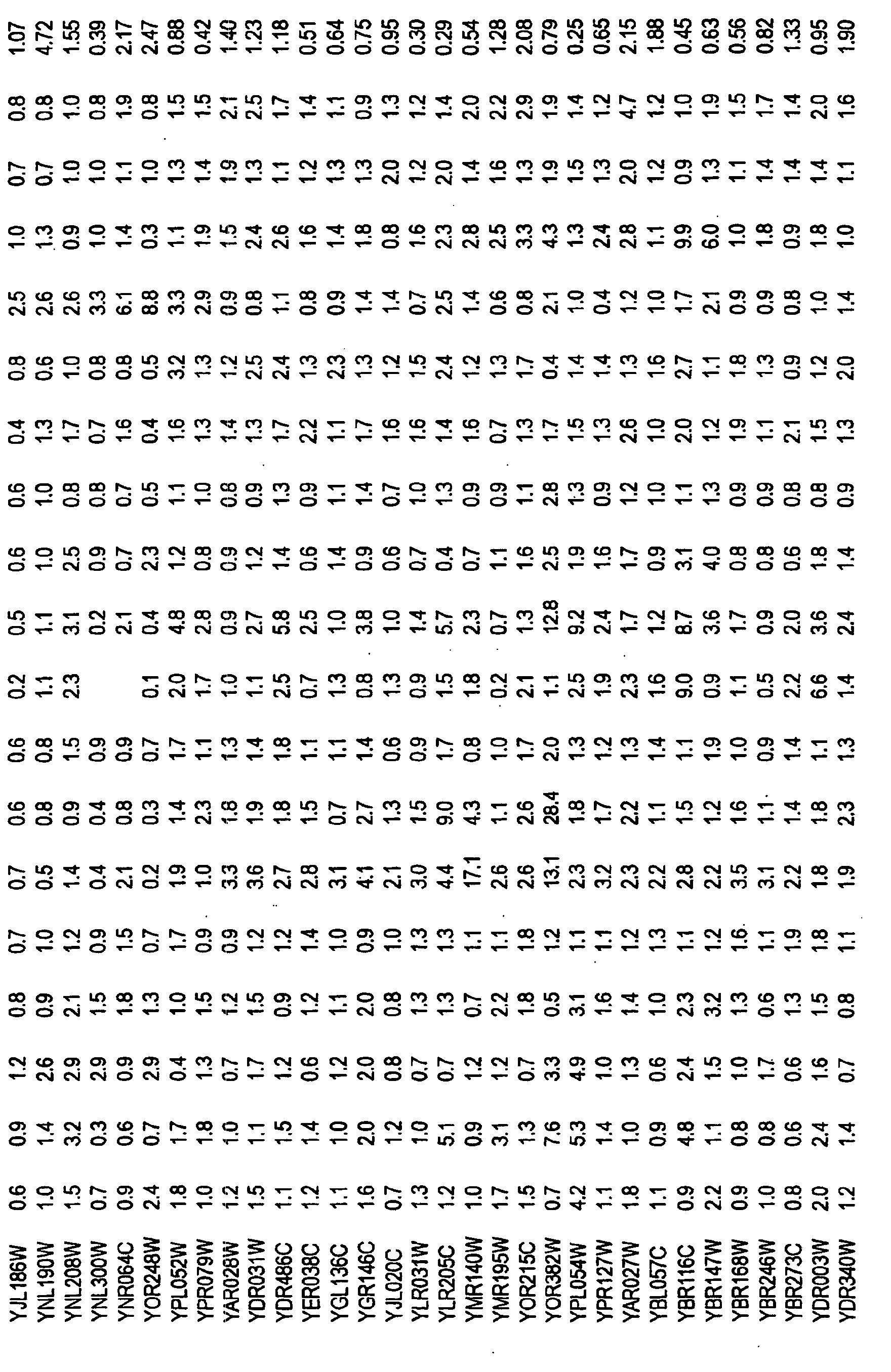
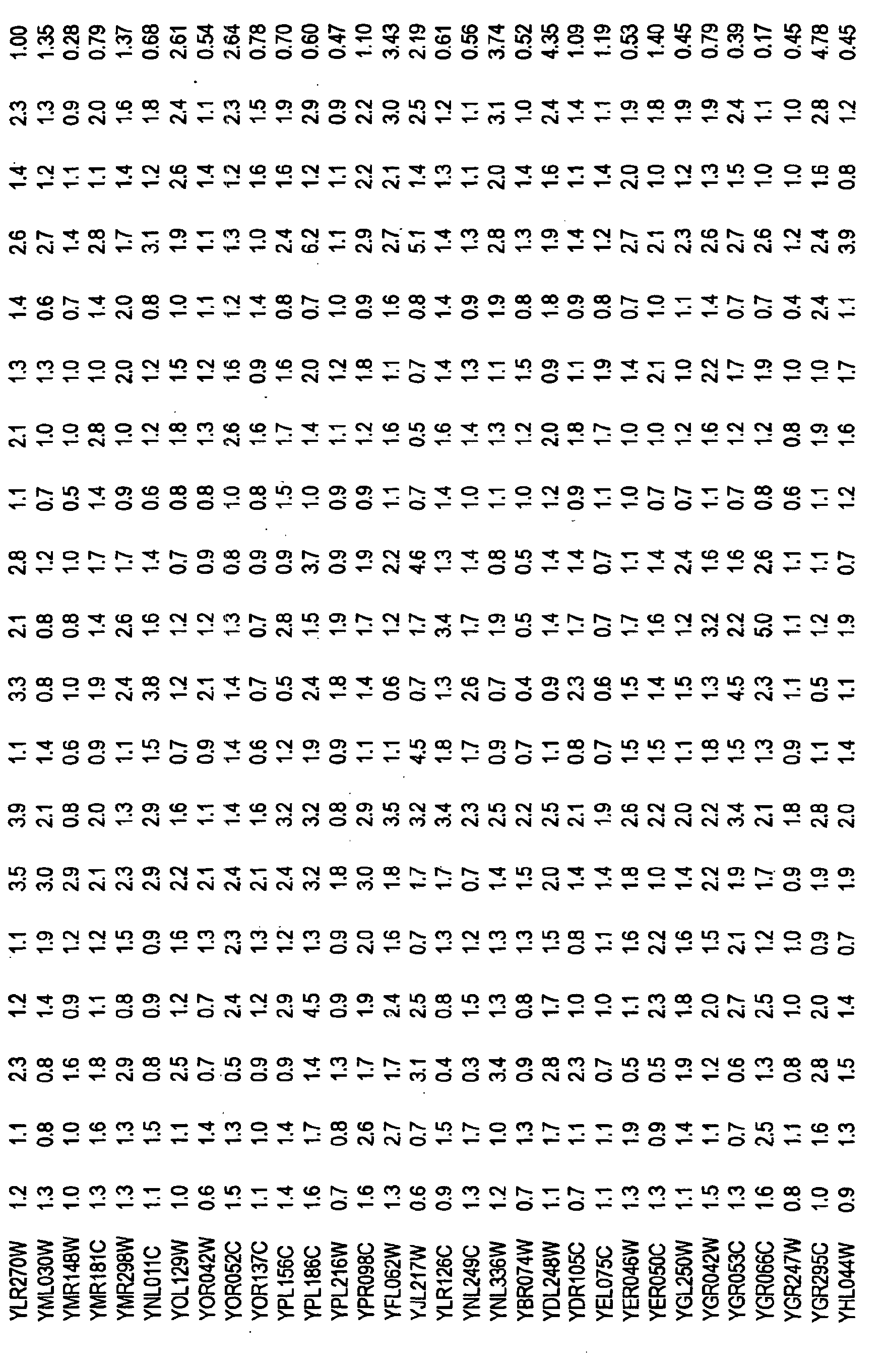
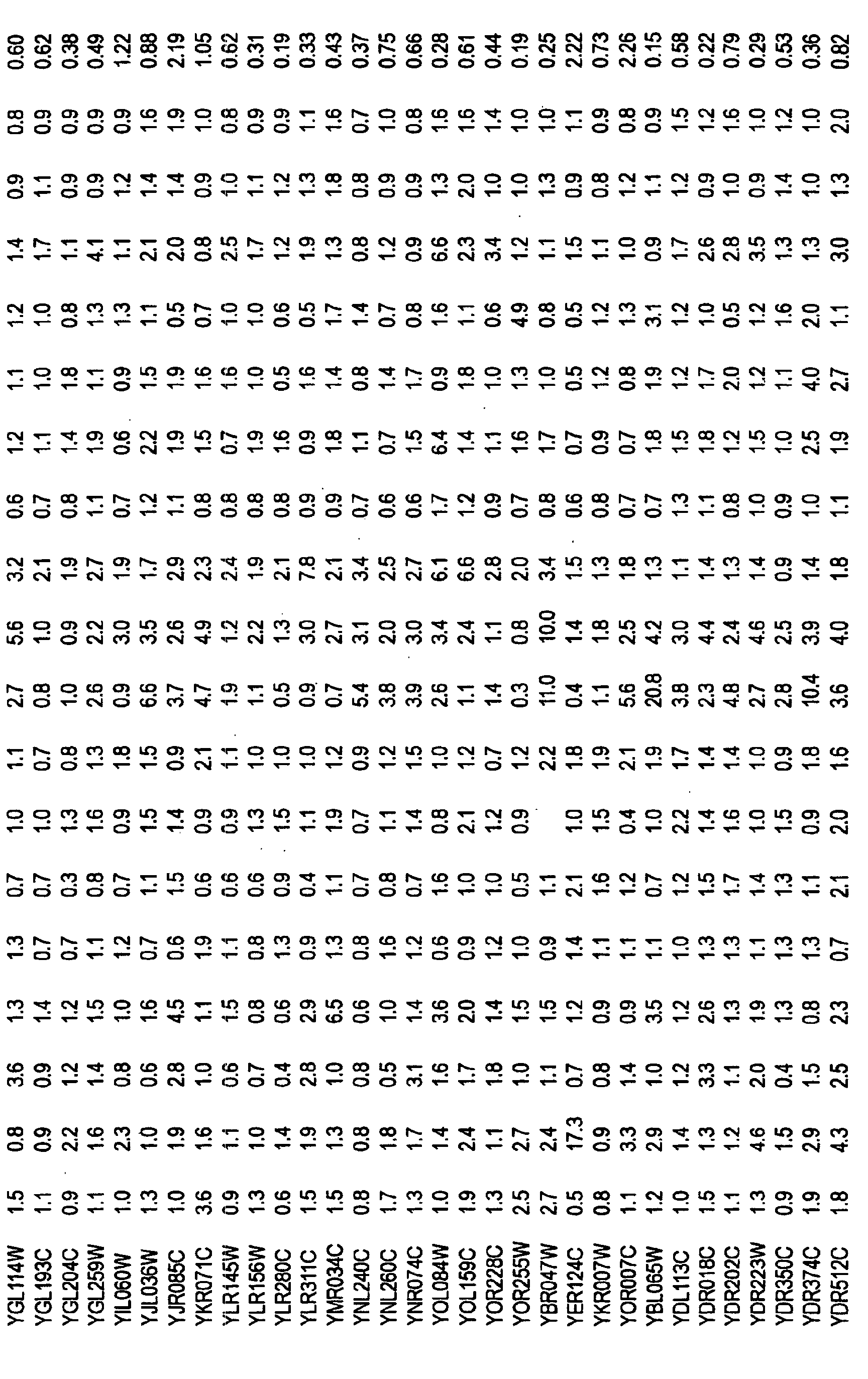
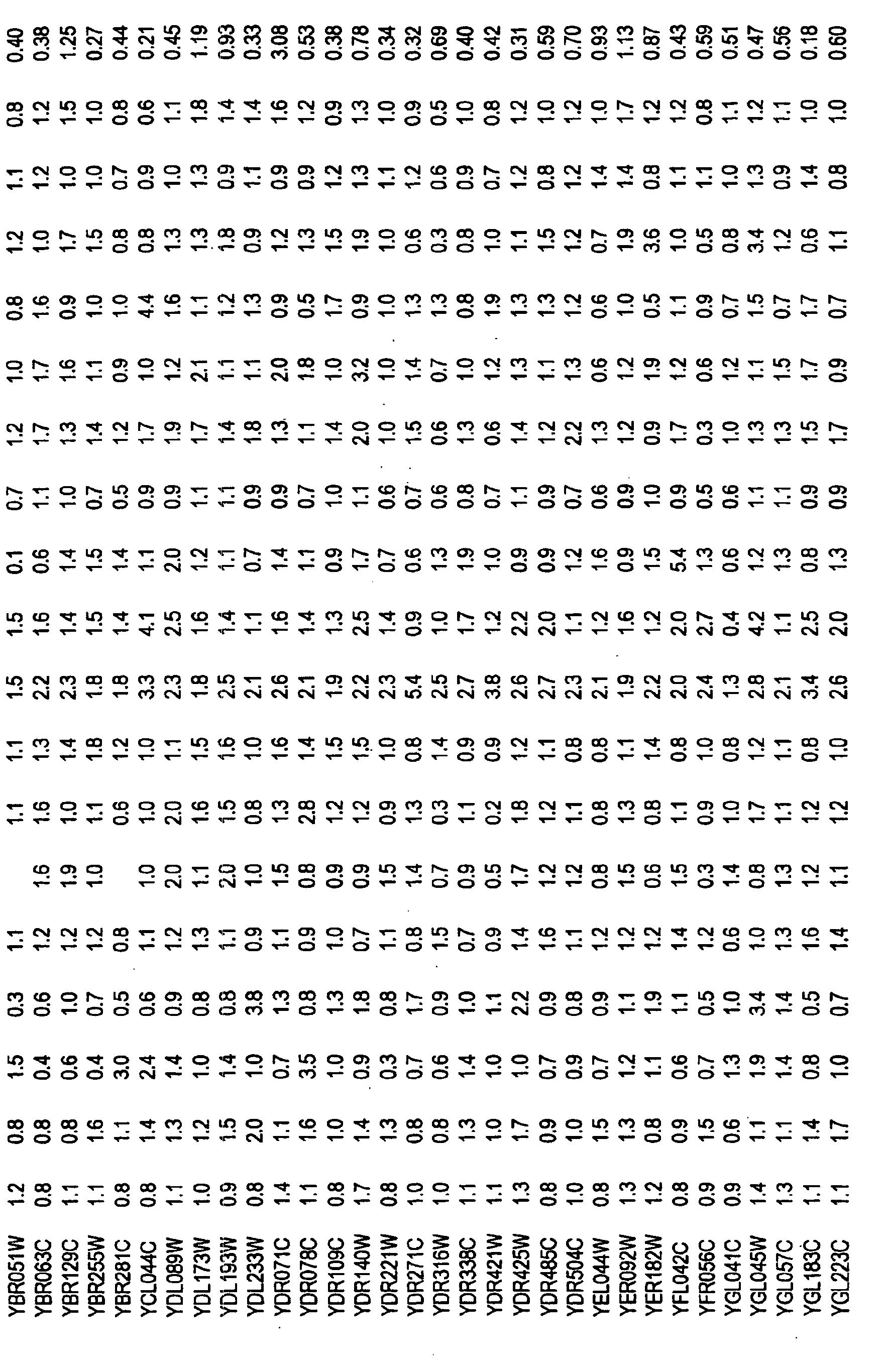
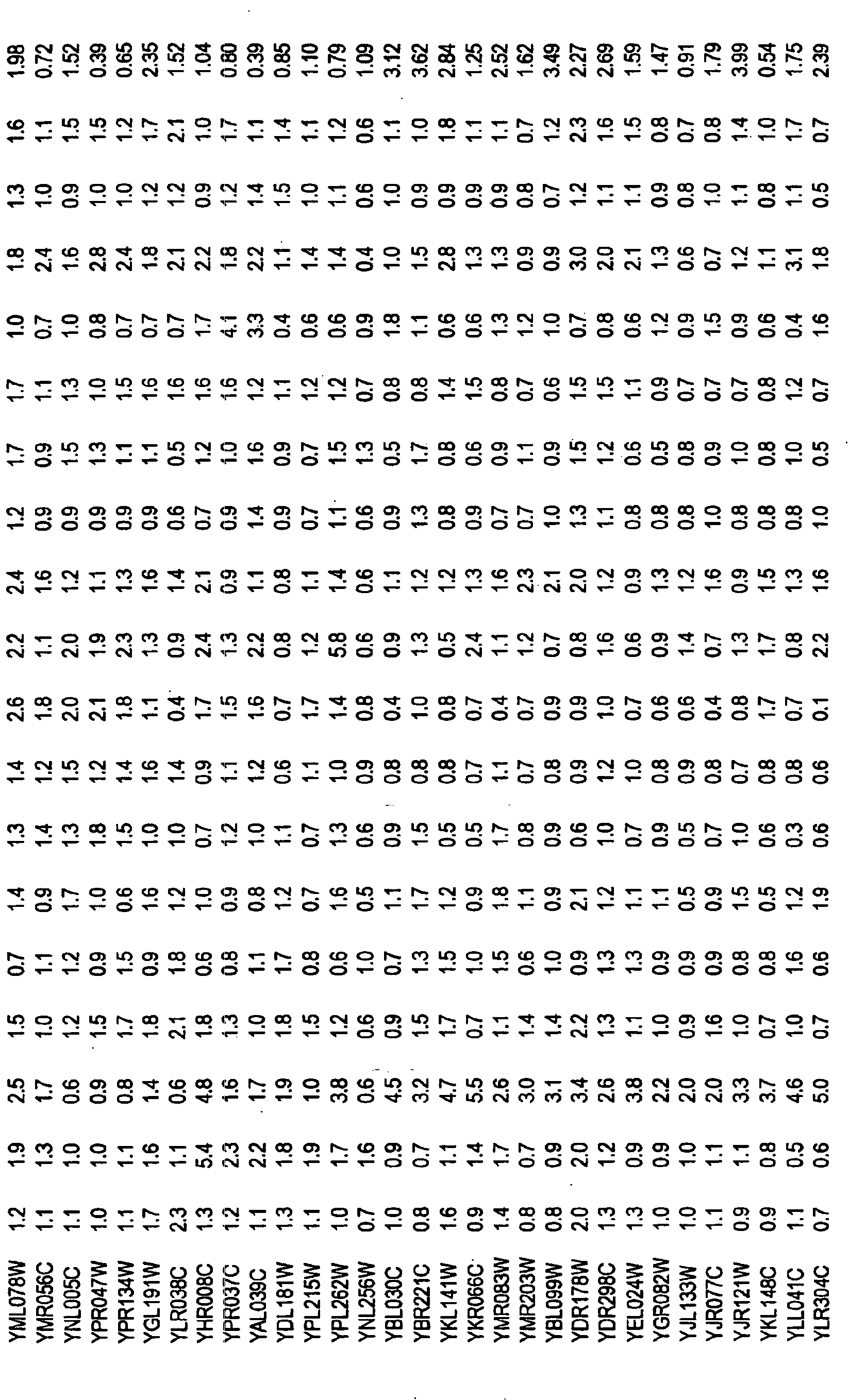
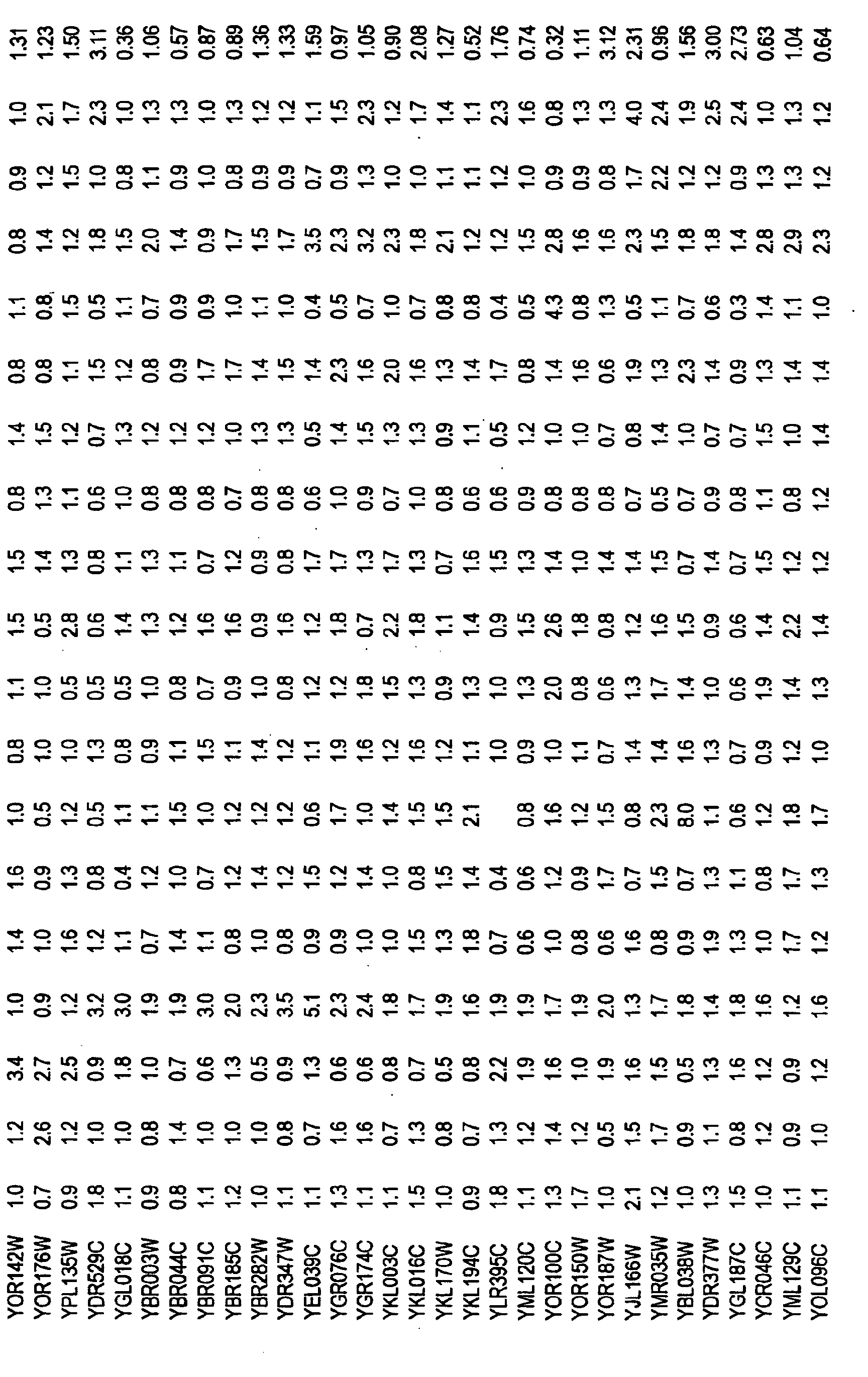
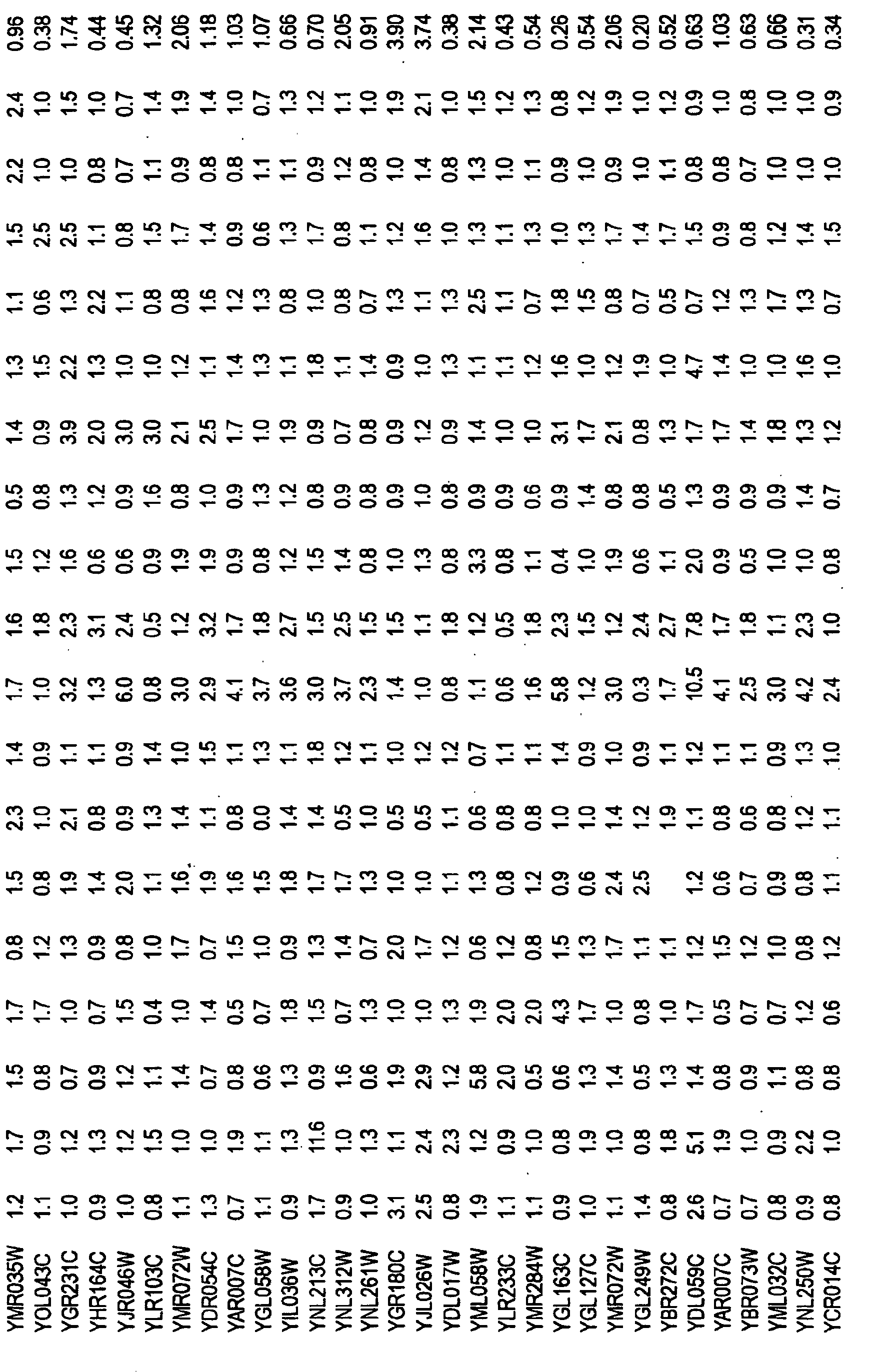
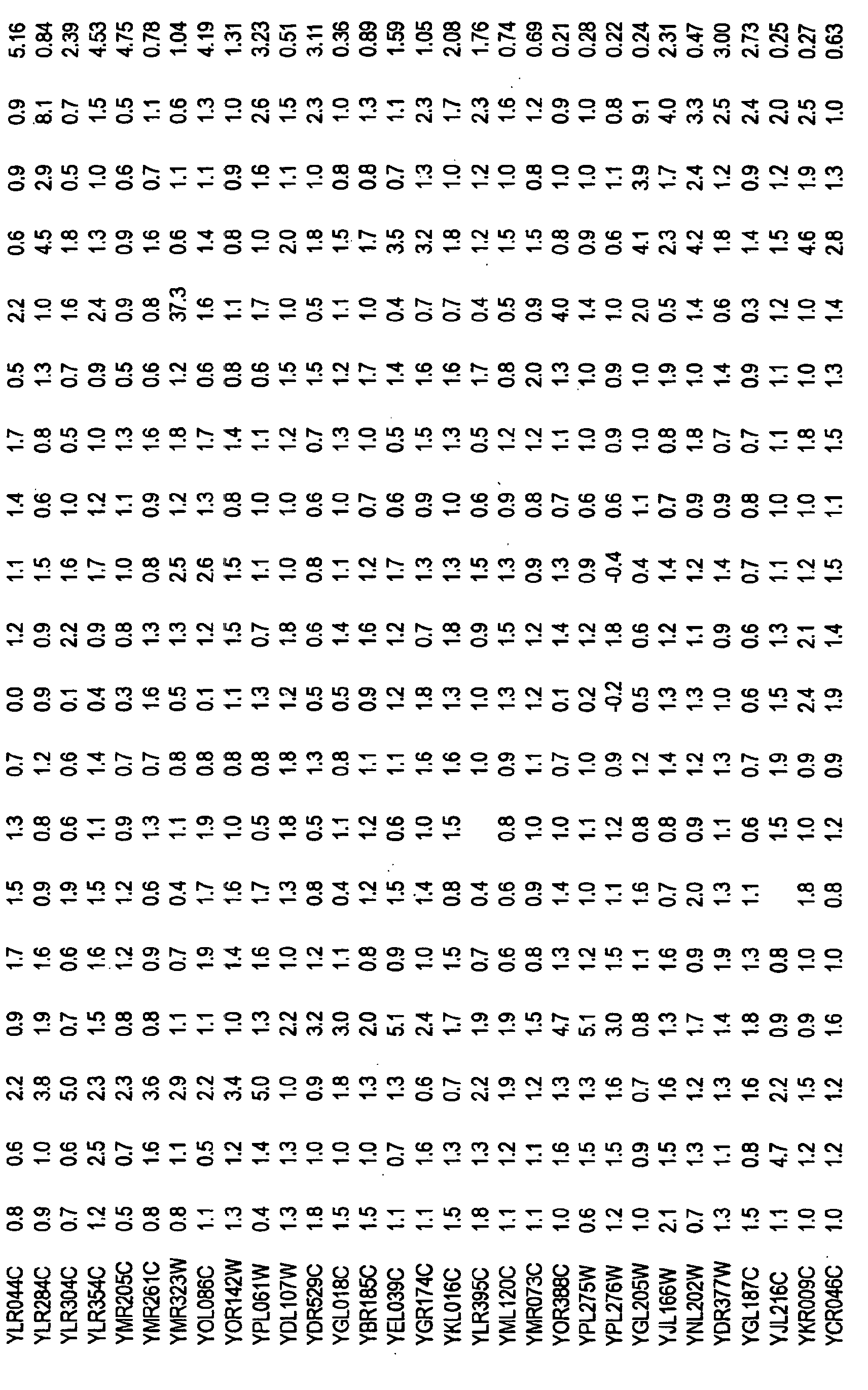
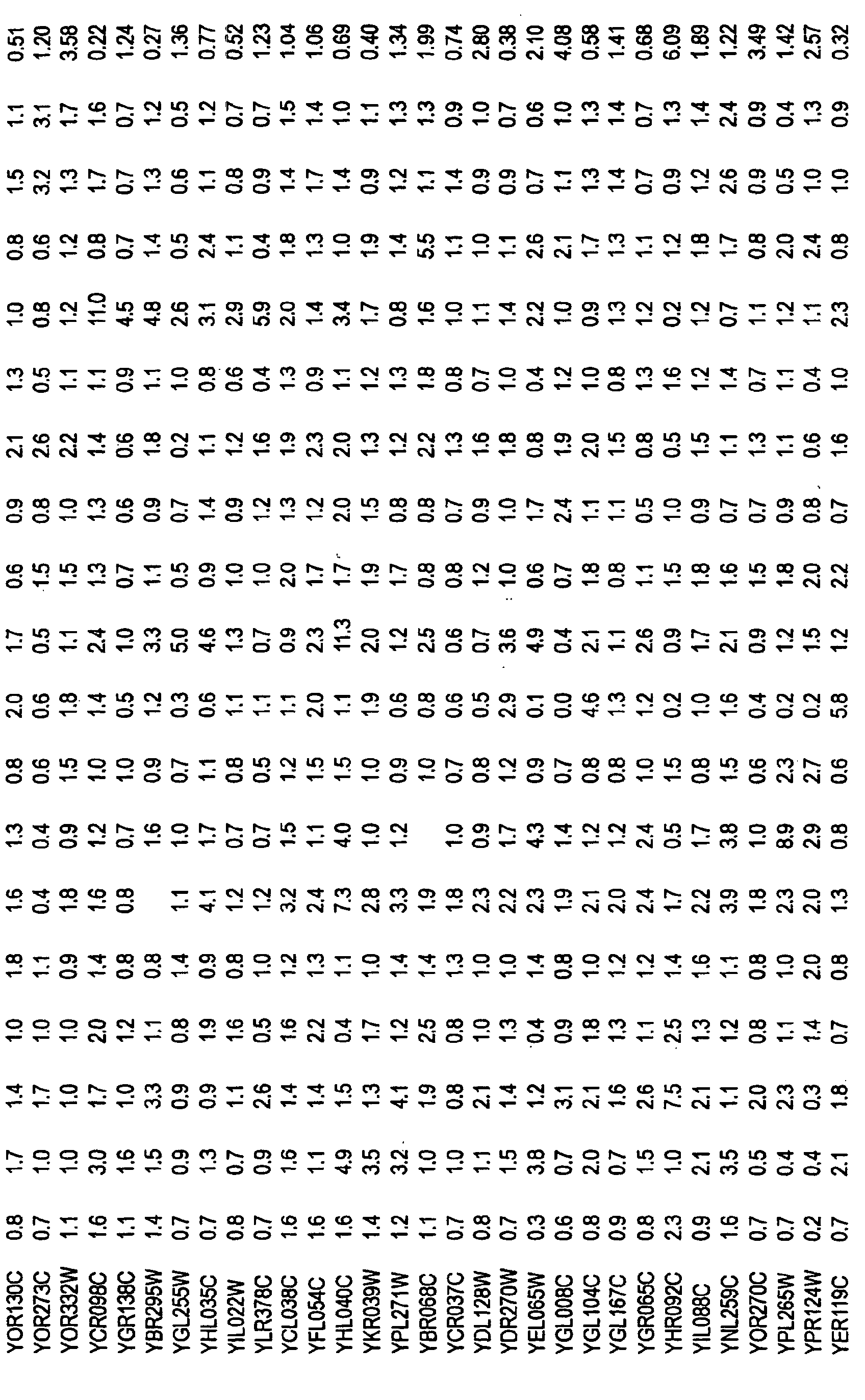
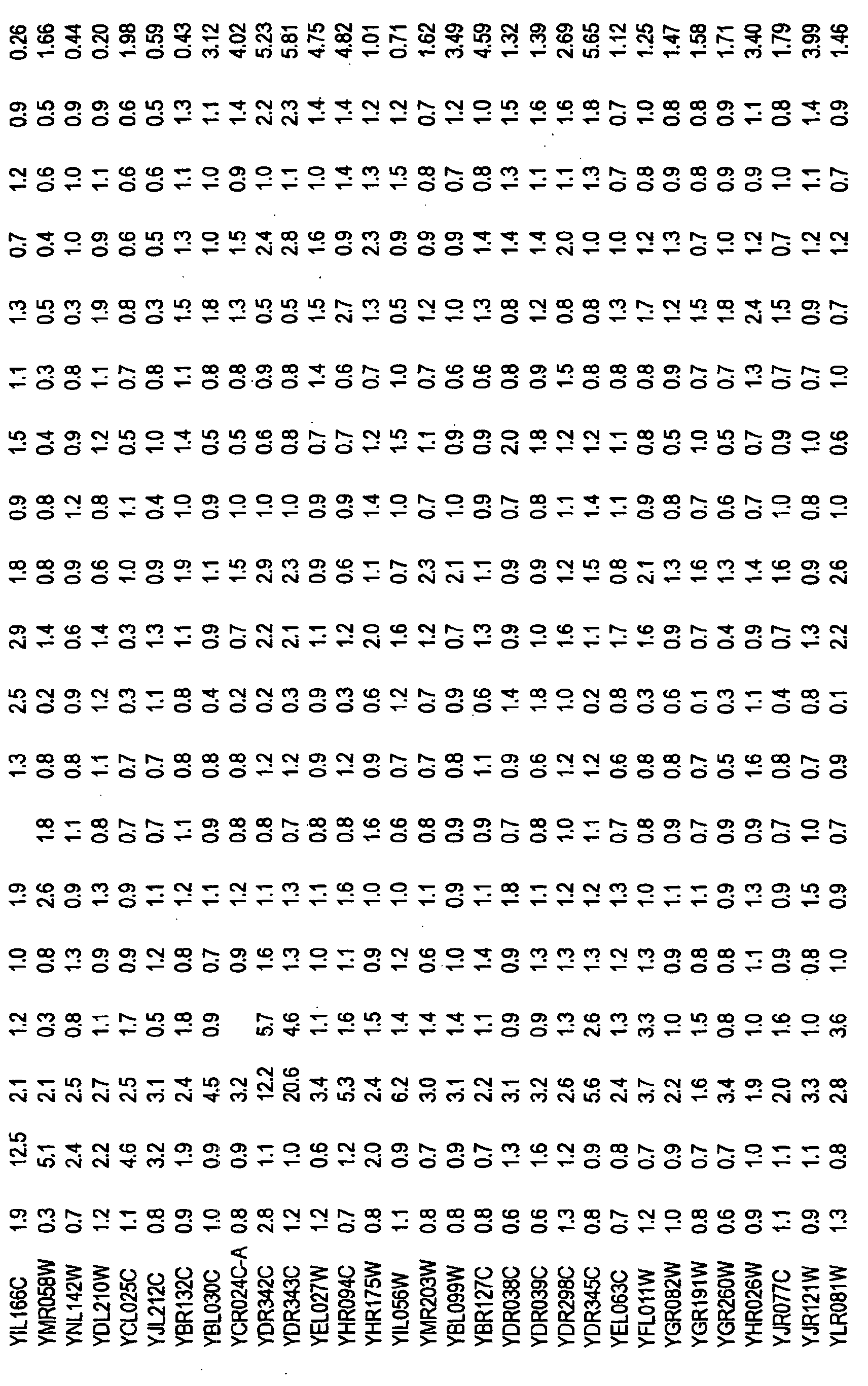
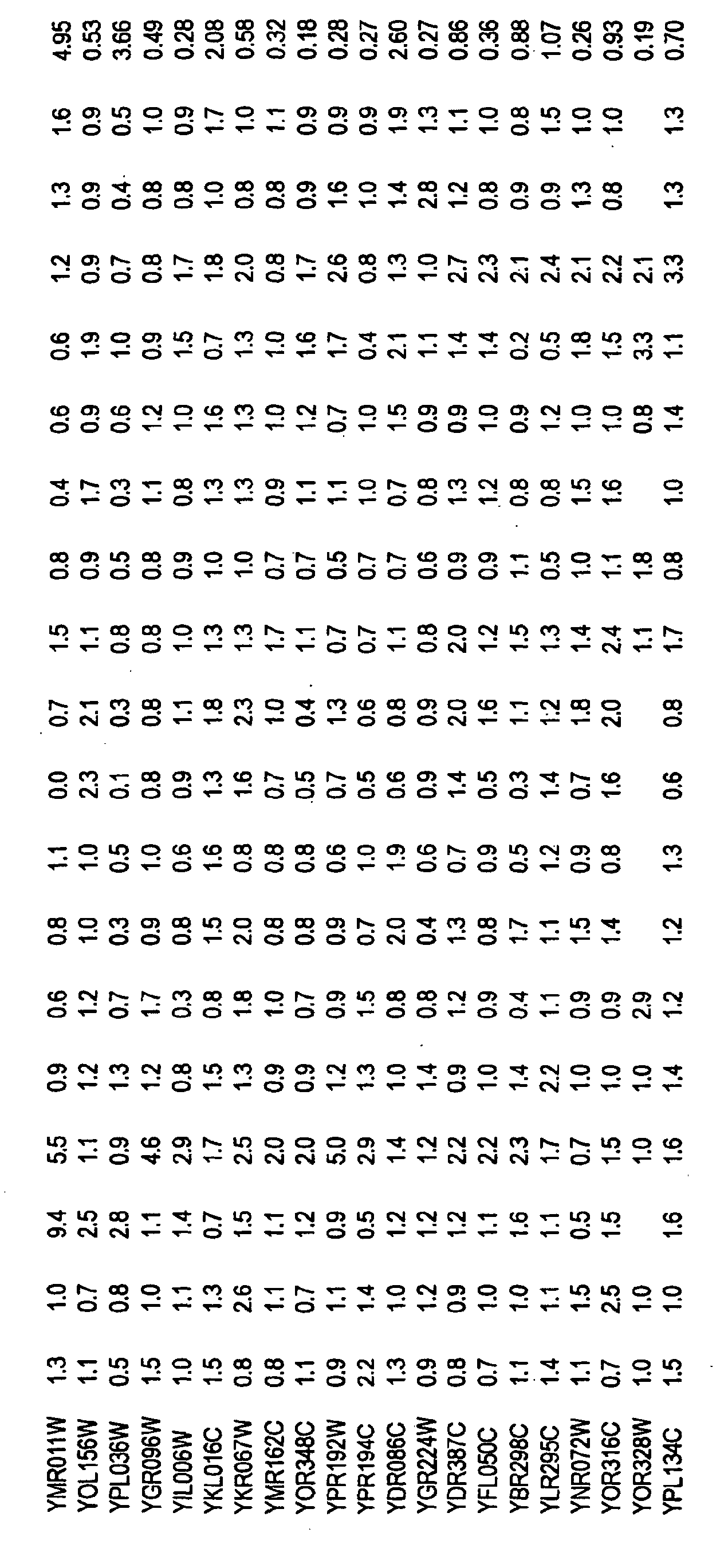
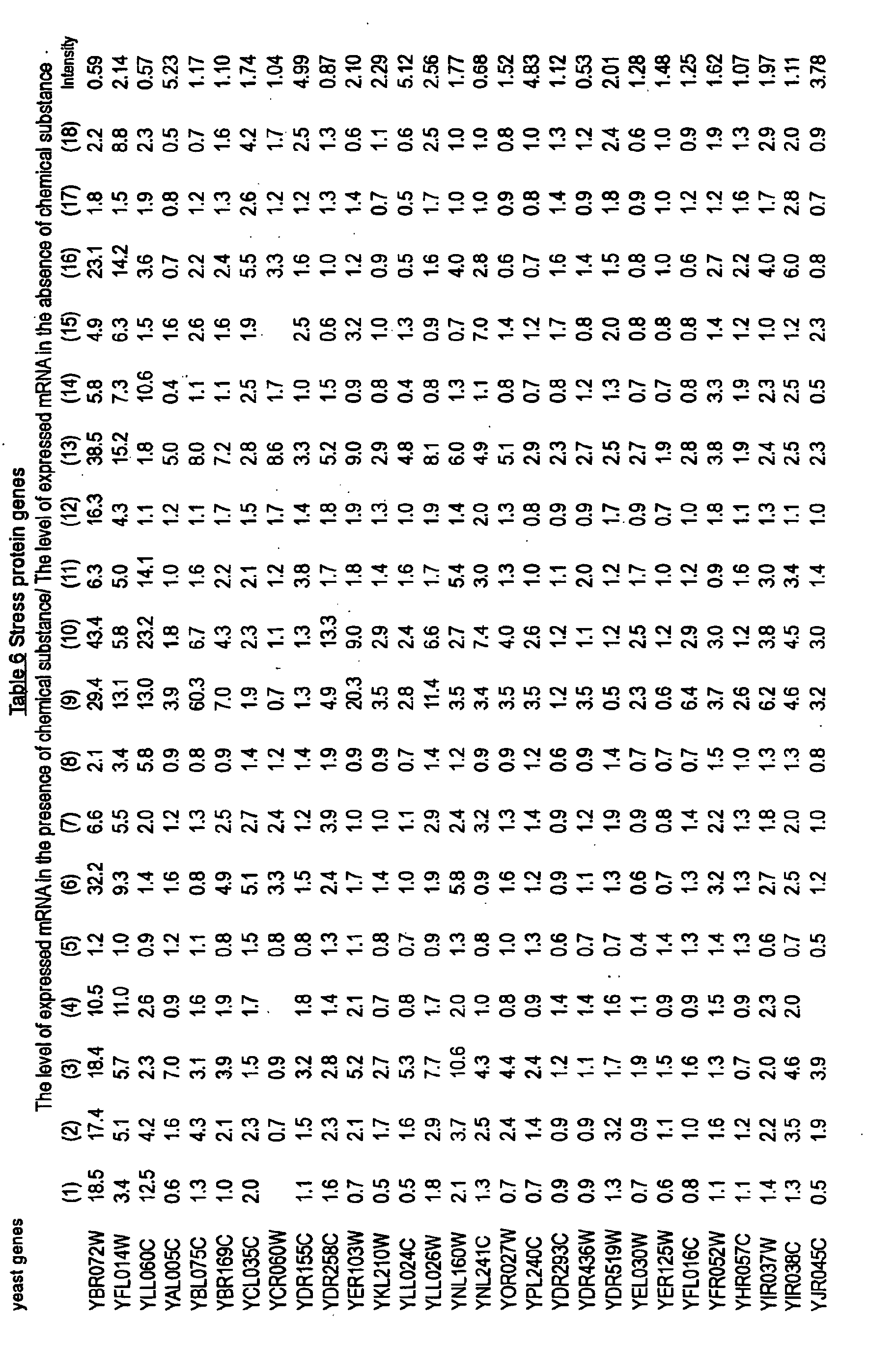
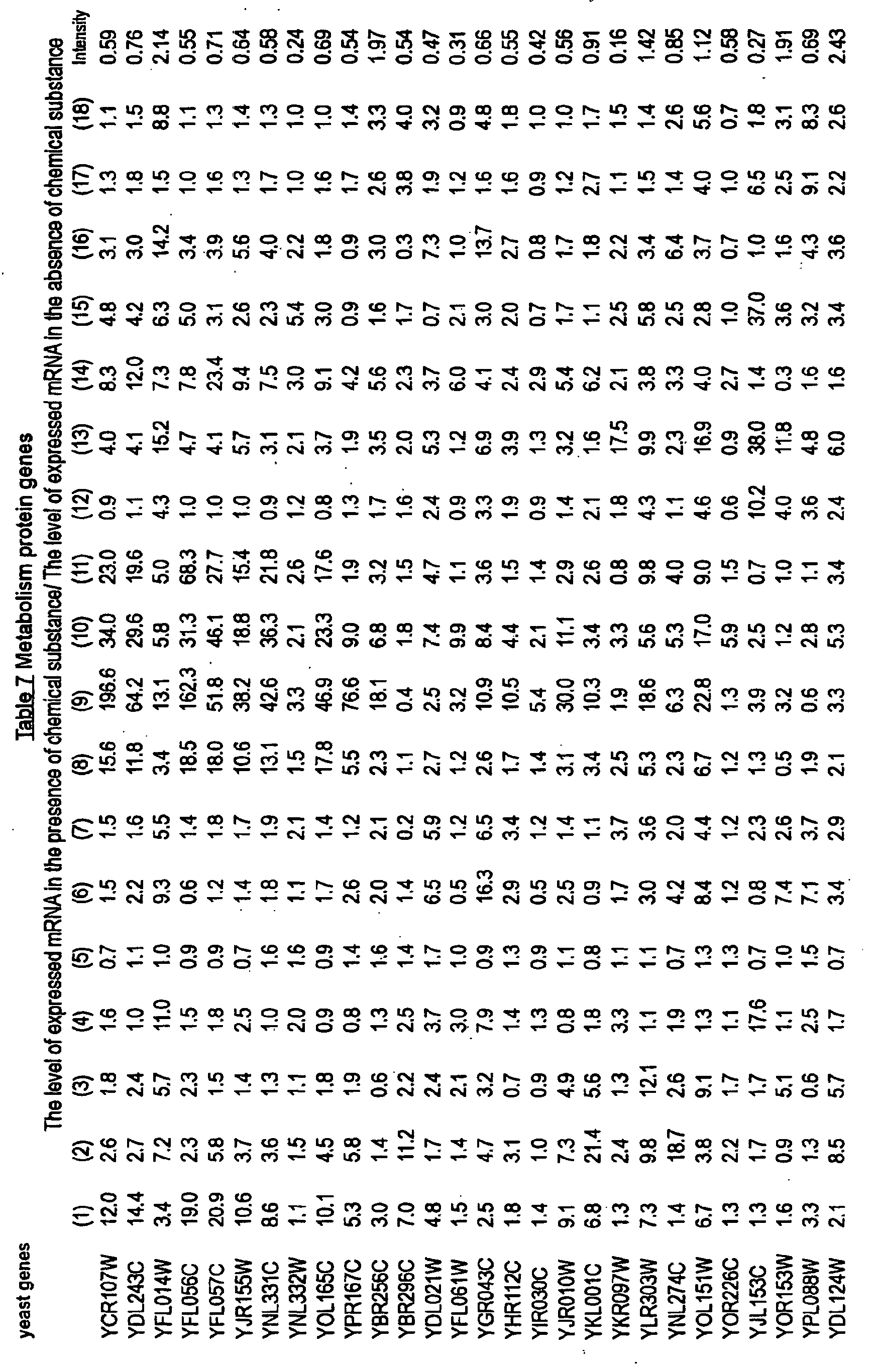
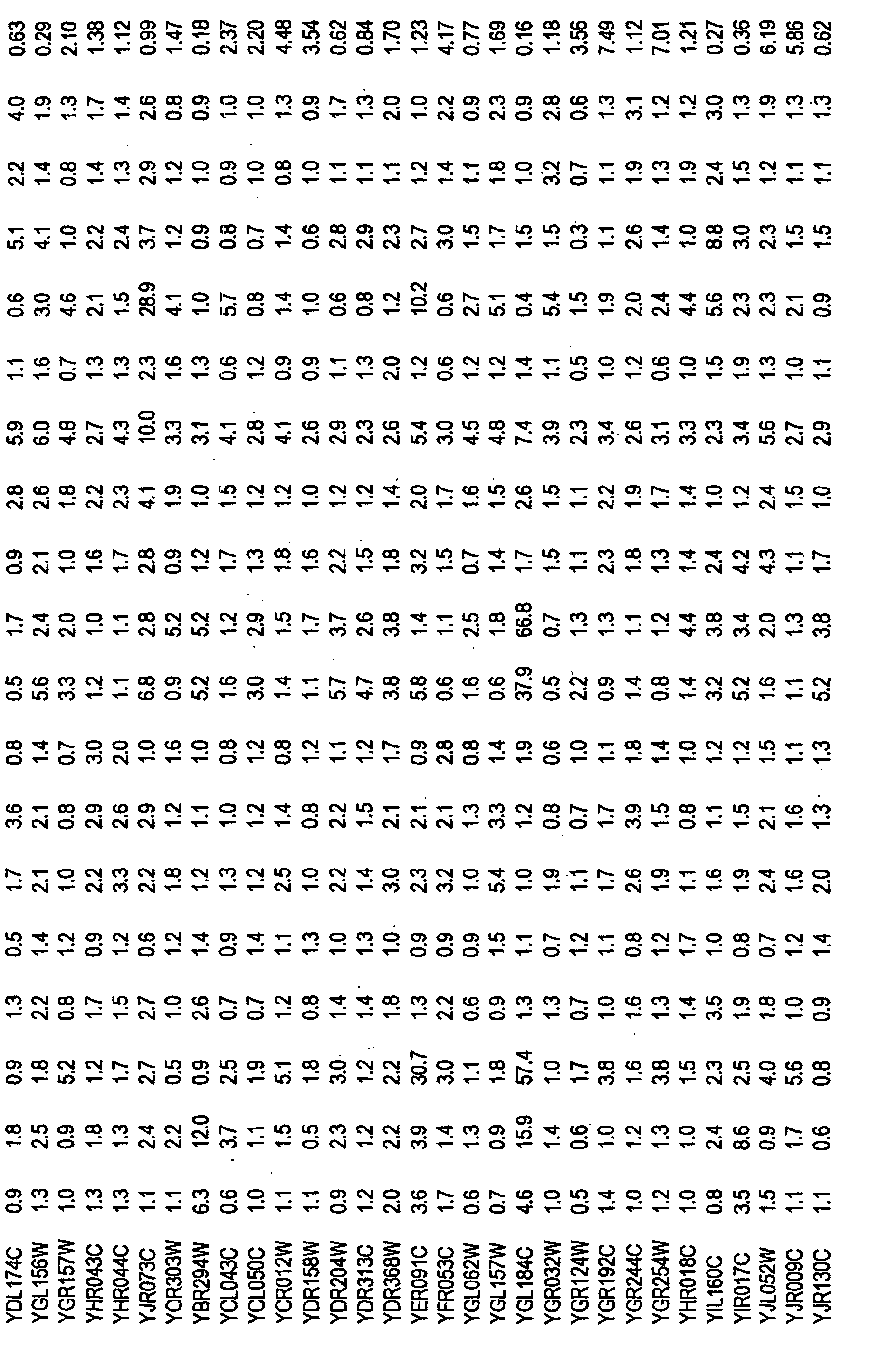
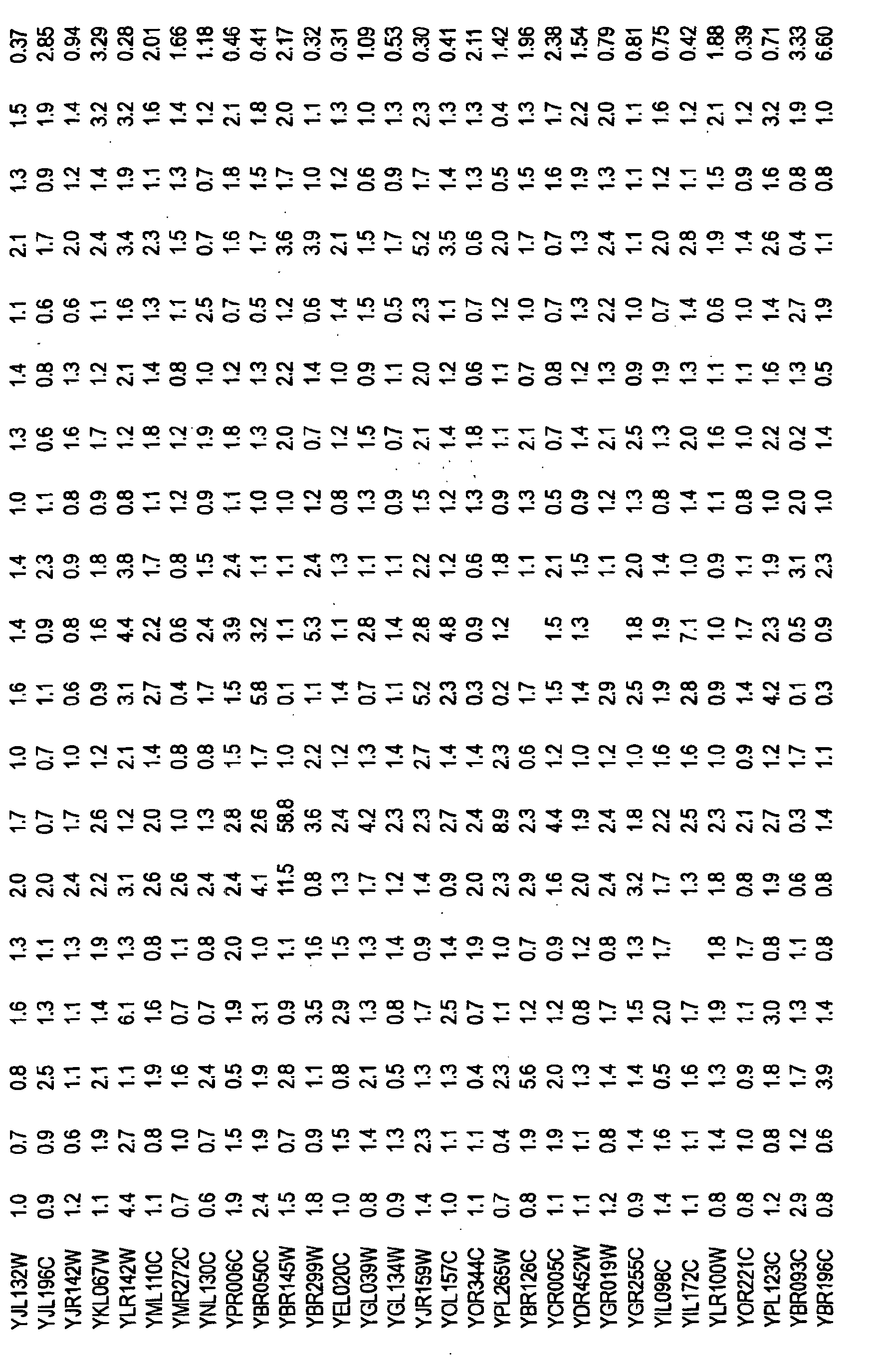
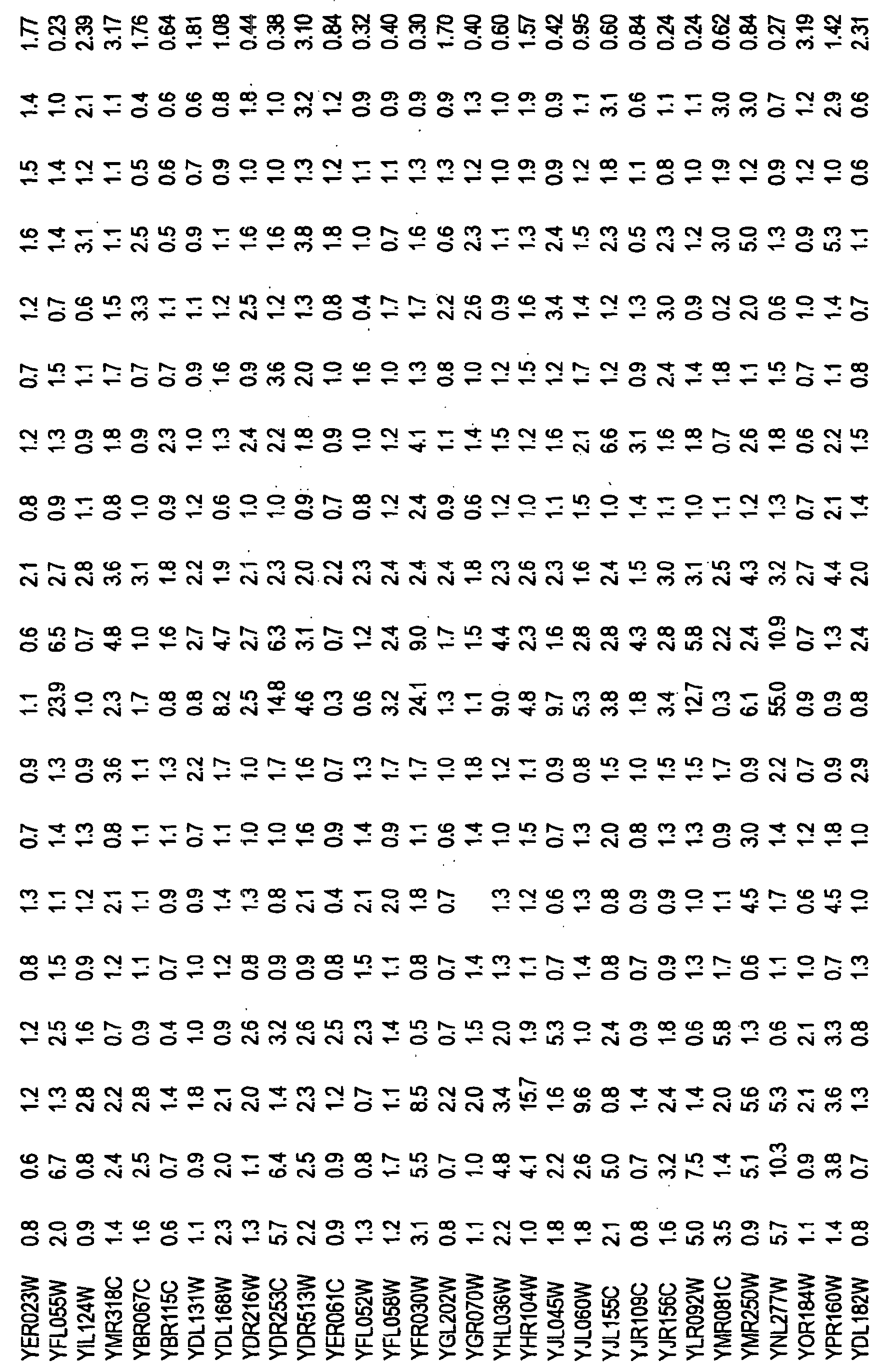
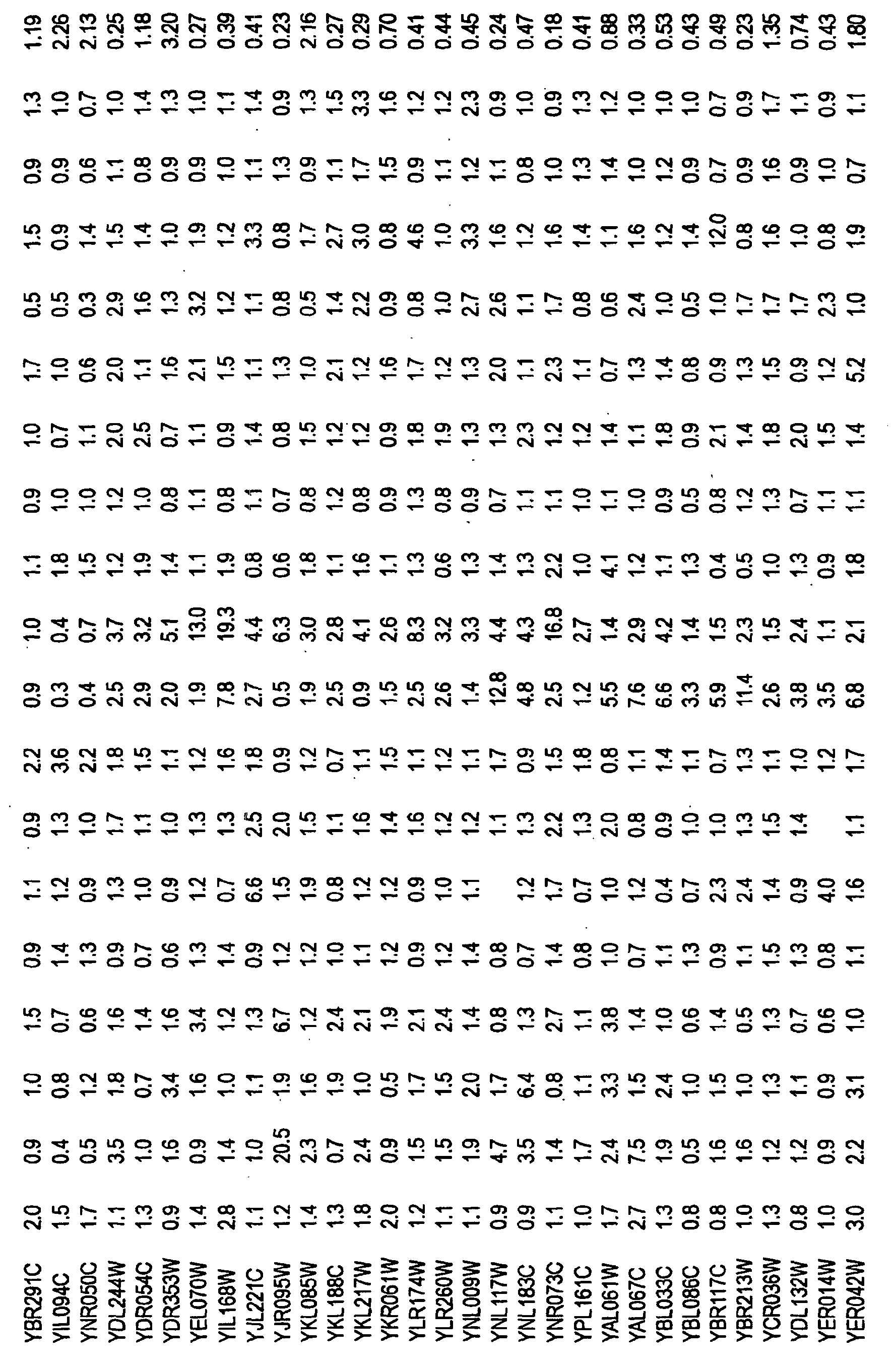
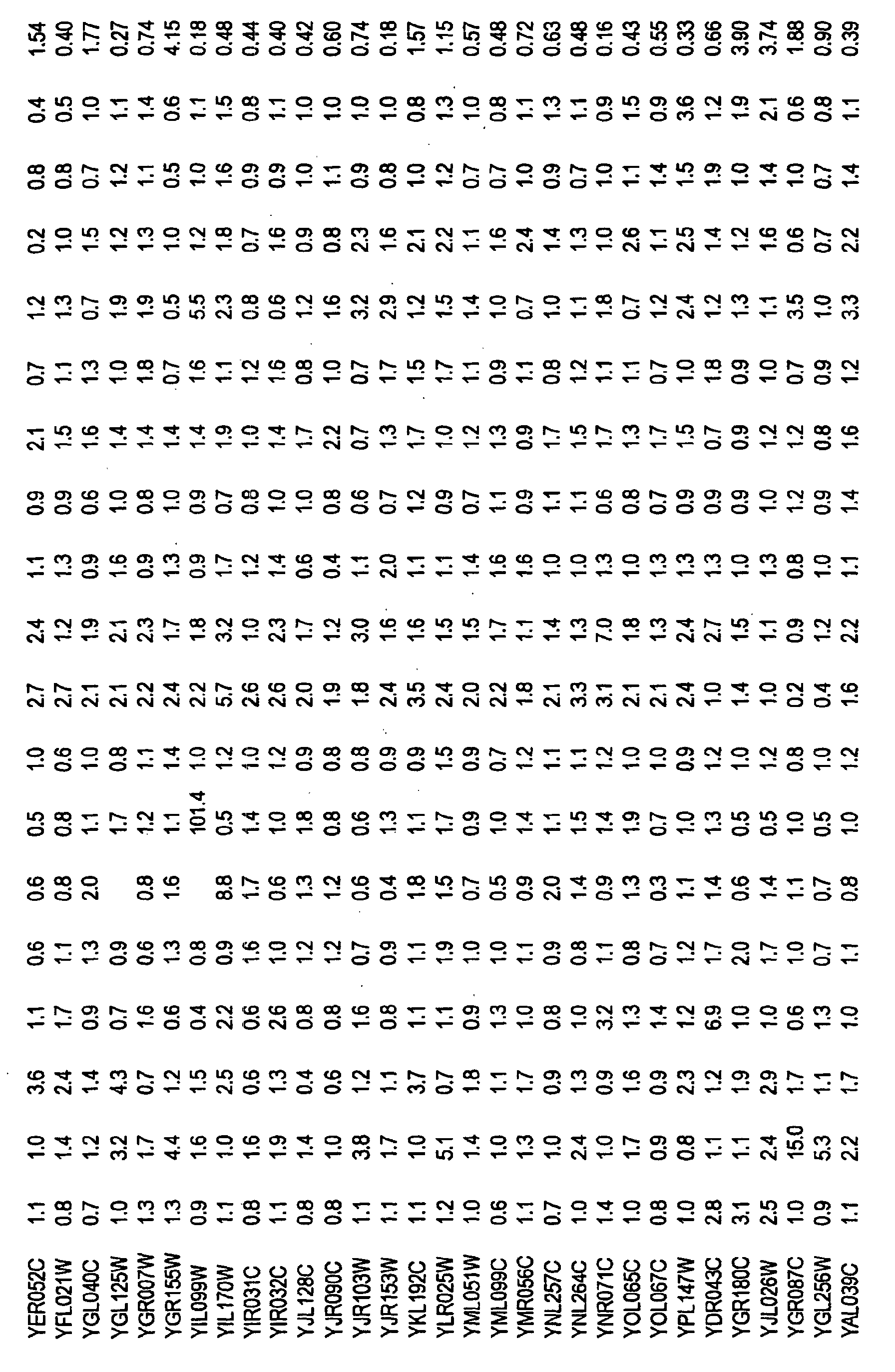
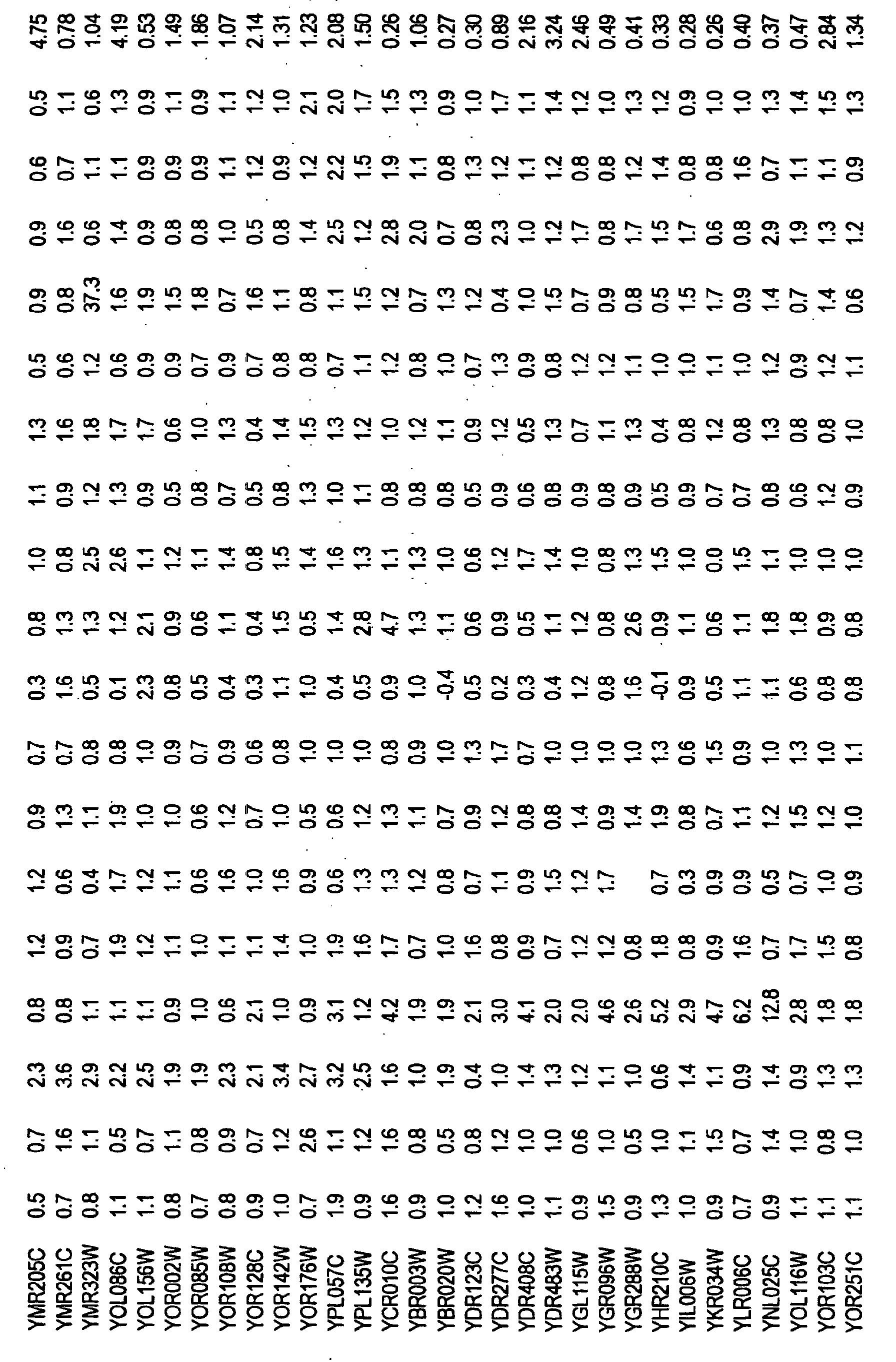
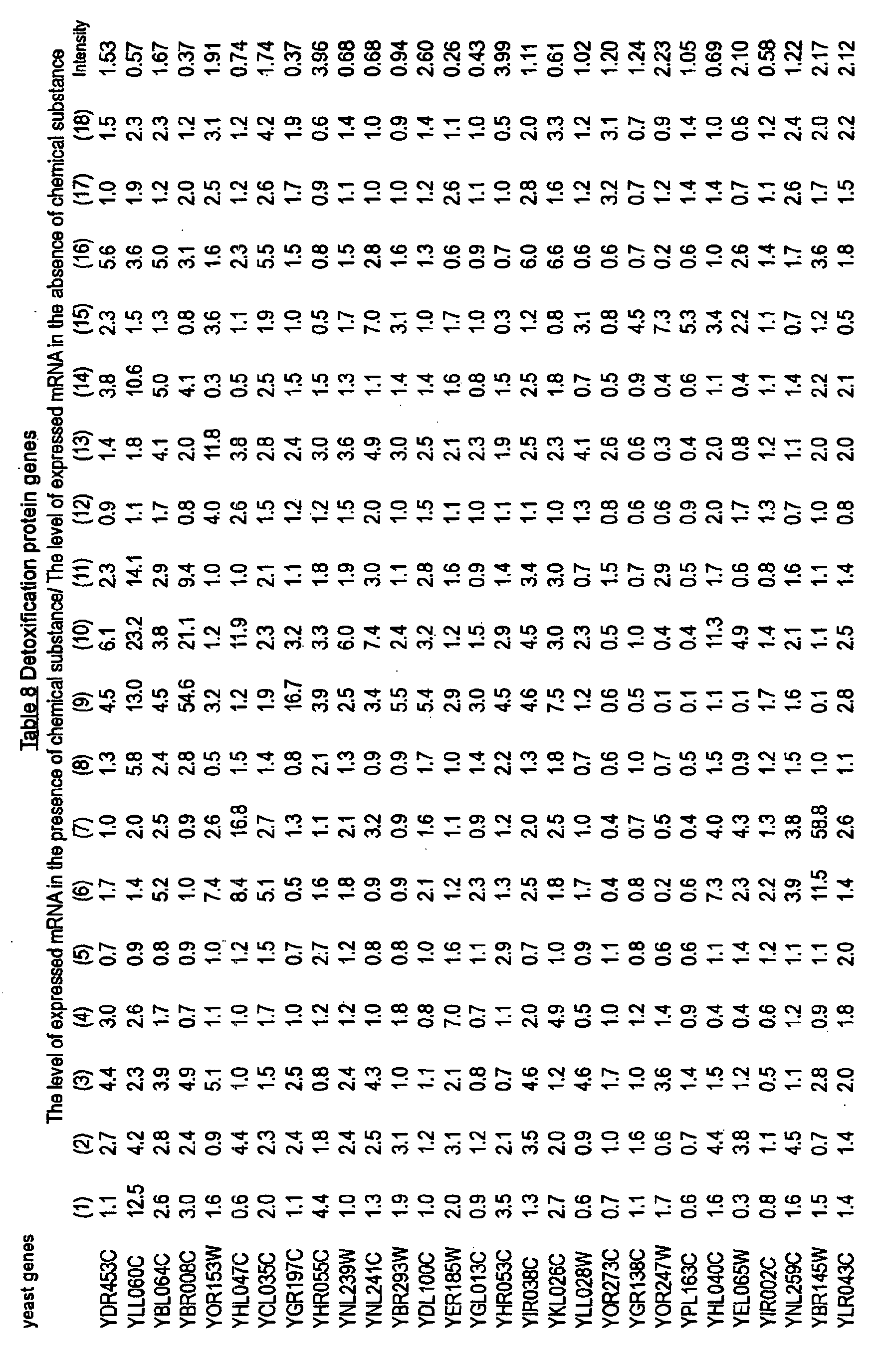
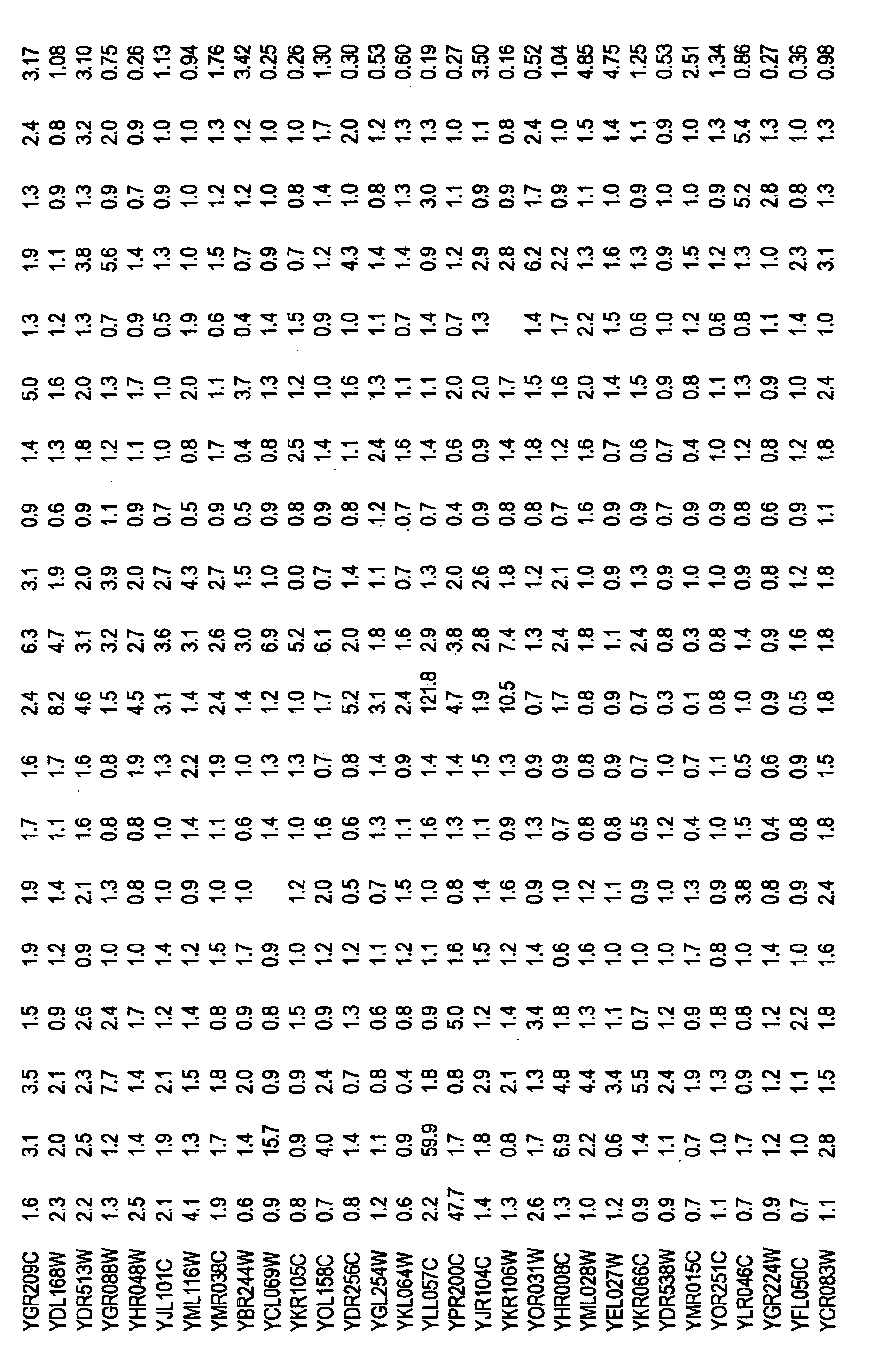
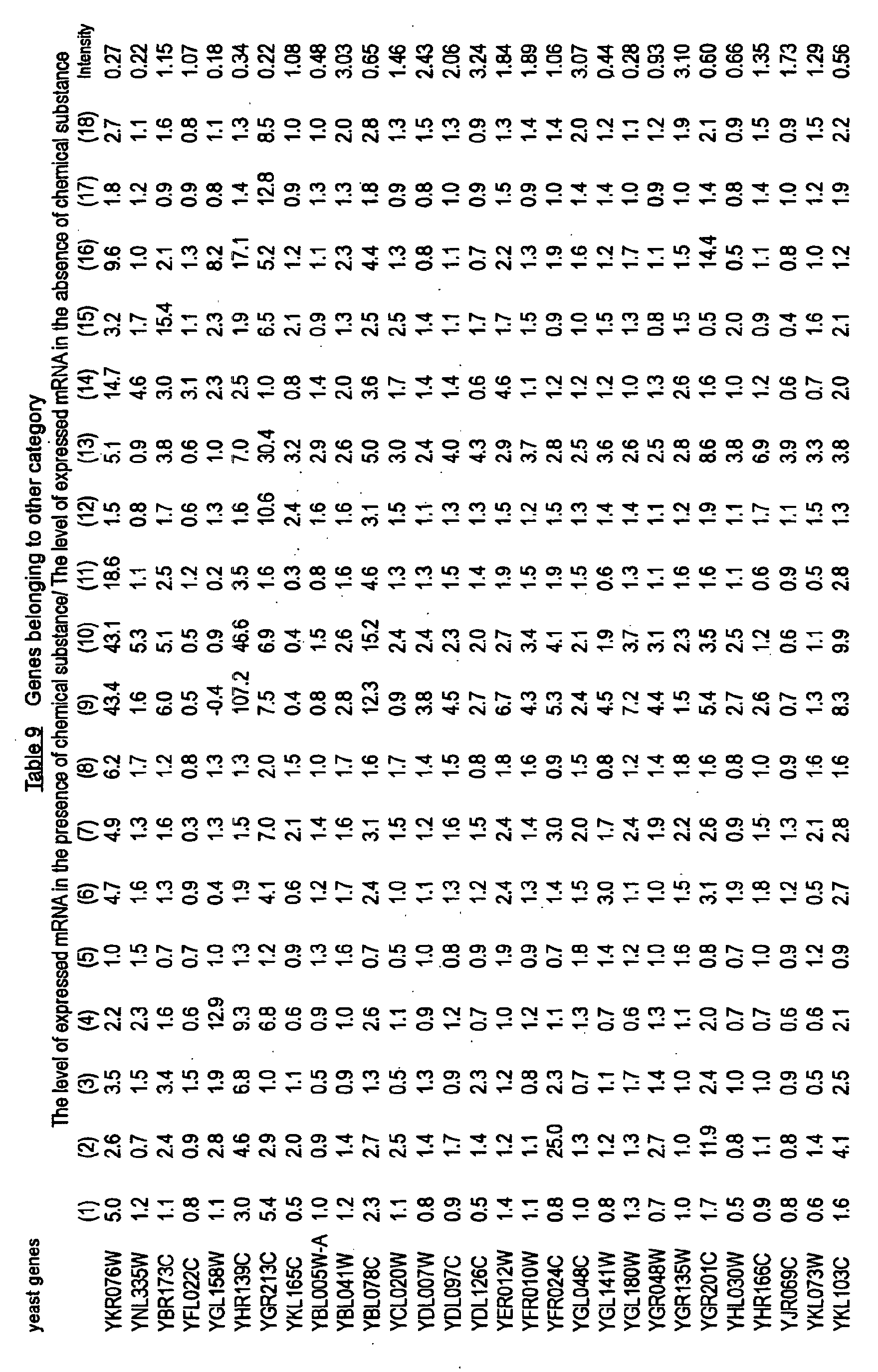
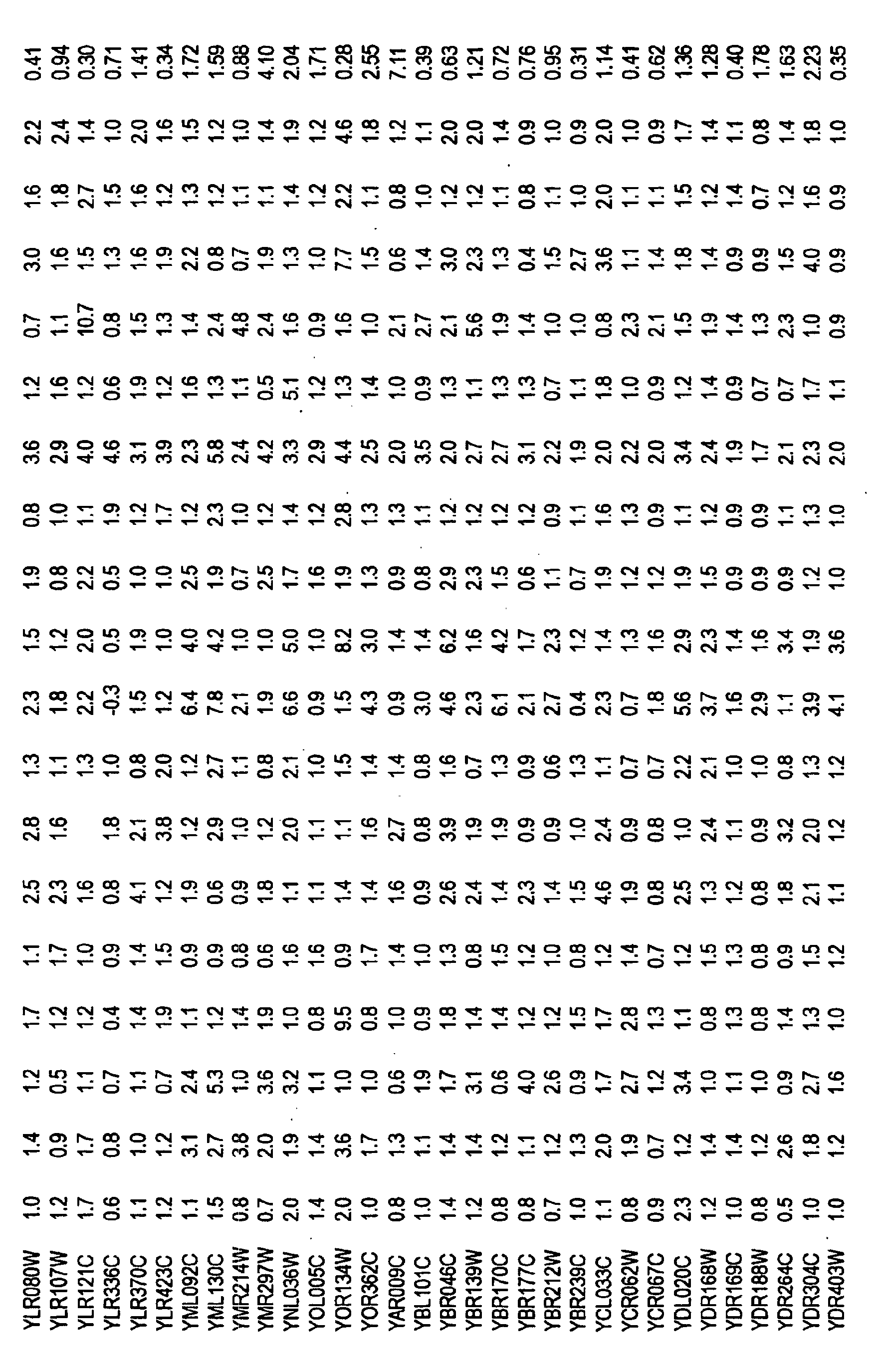
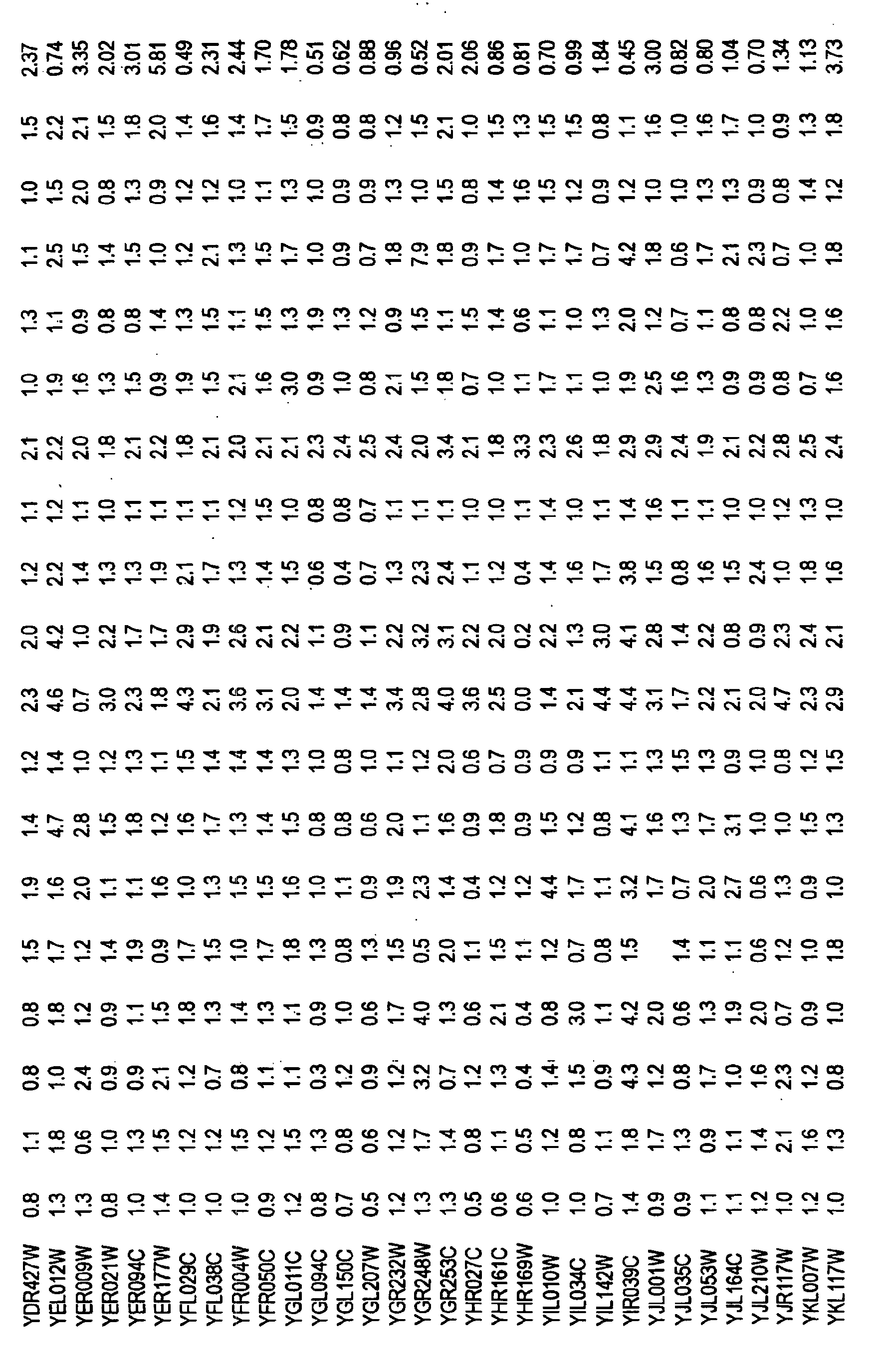
  • the fluoresces intensity of the DNA chip was read with a scanner, and the ratio relative to the fluorescence intensity resulting from the absence of chemical substance was estimated as the following, which is shown in Tables 1 to 9:
  • the level of expressed mRNA in the presence of chemical substance The level of expressed mRNA in the absence of chemical substance
  • "Intensity" indicated in the rightmost column is a value of the level of expressed mRNA of each gene in control cells as divided by the average level of the expressions of the whole genes.
  • a gene of which mRNA level is lower in control, and is higher in cases of addition of chemical substance, is especially useful in the detection of toxic substances.
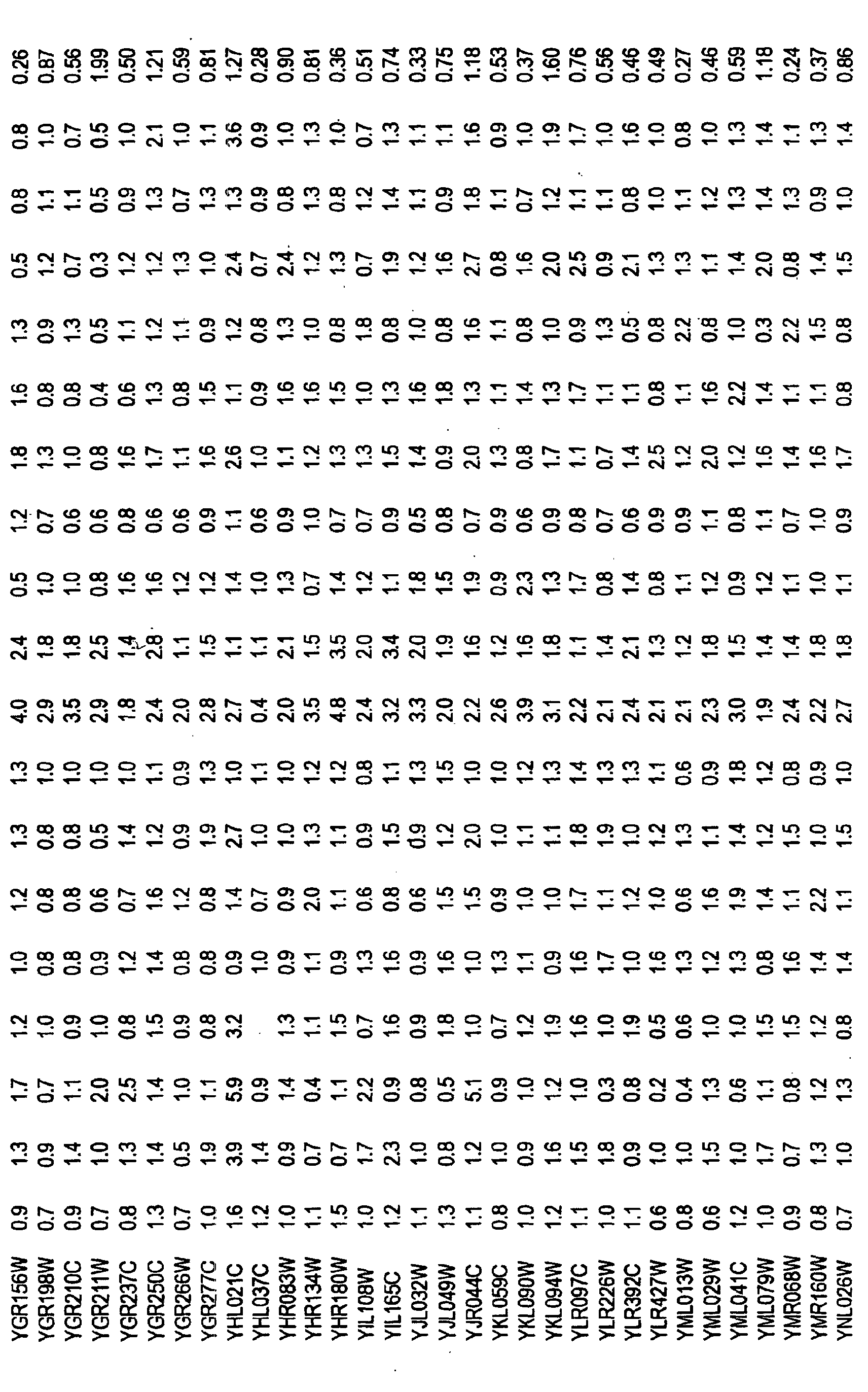
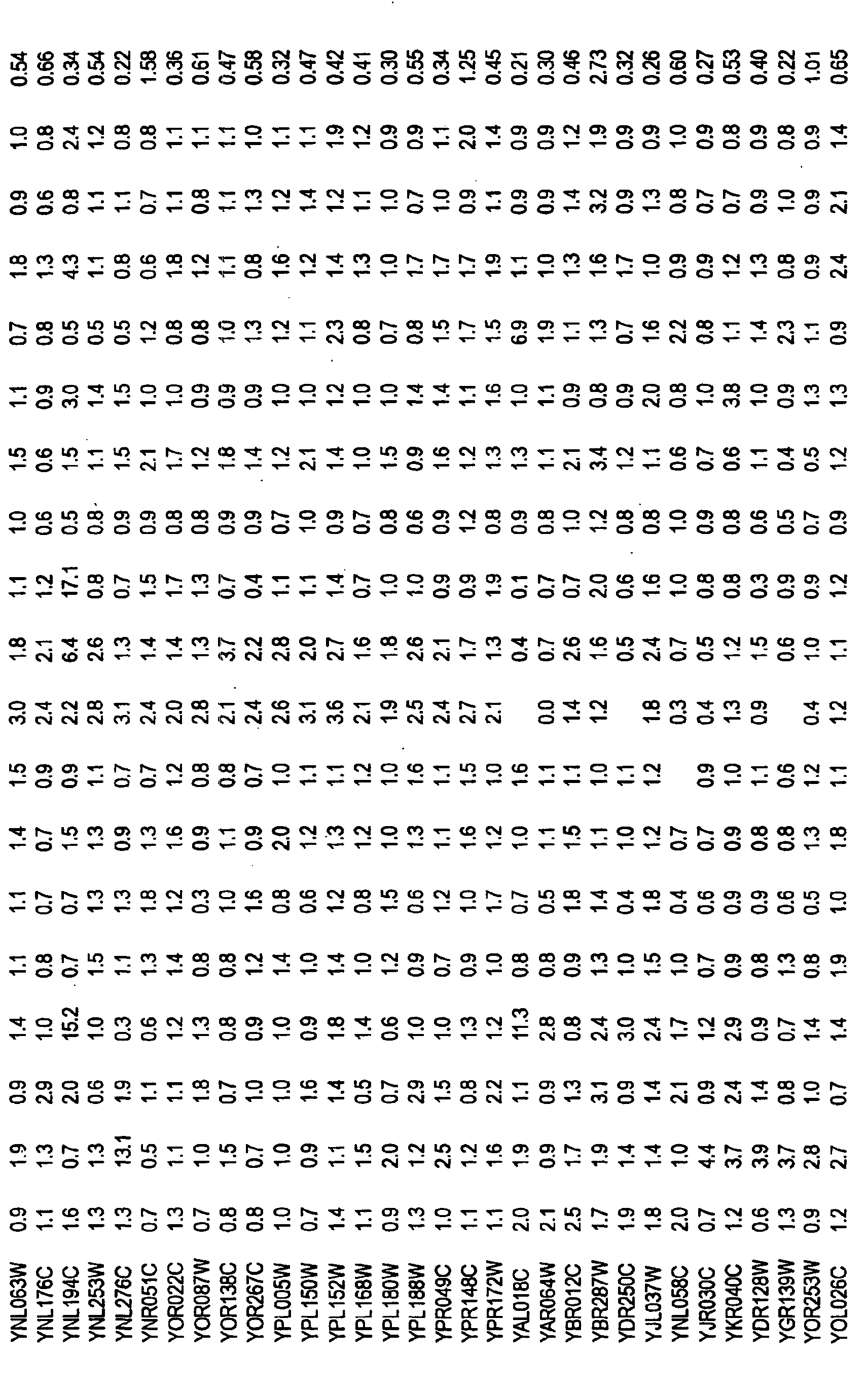
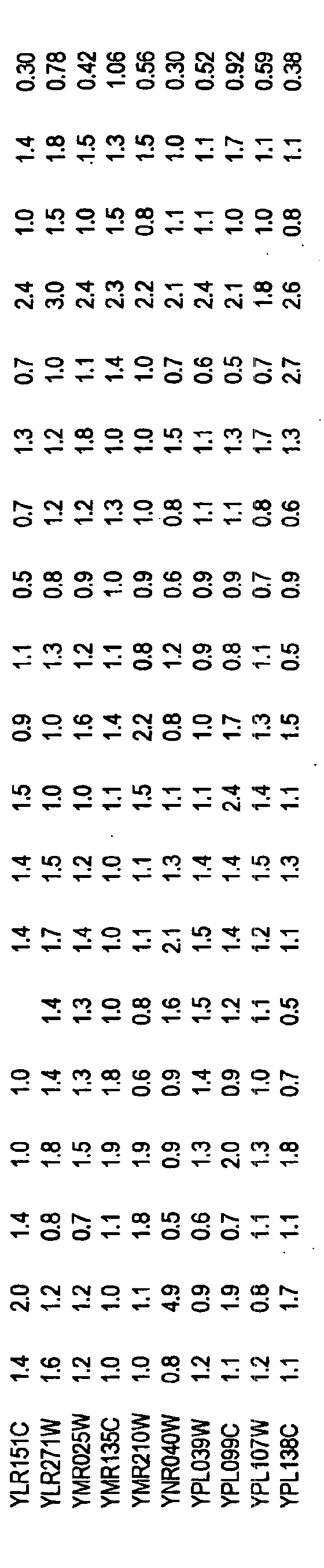
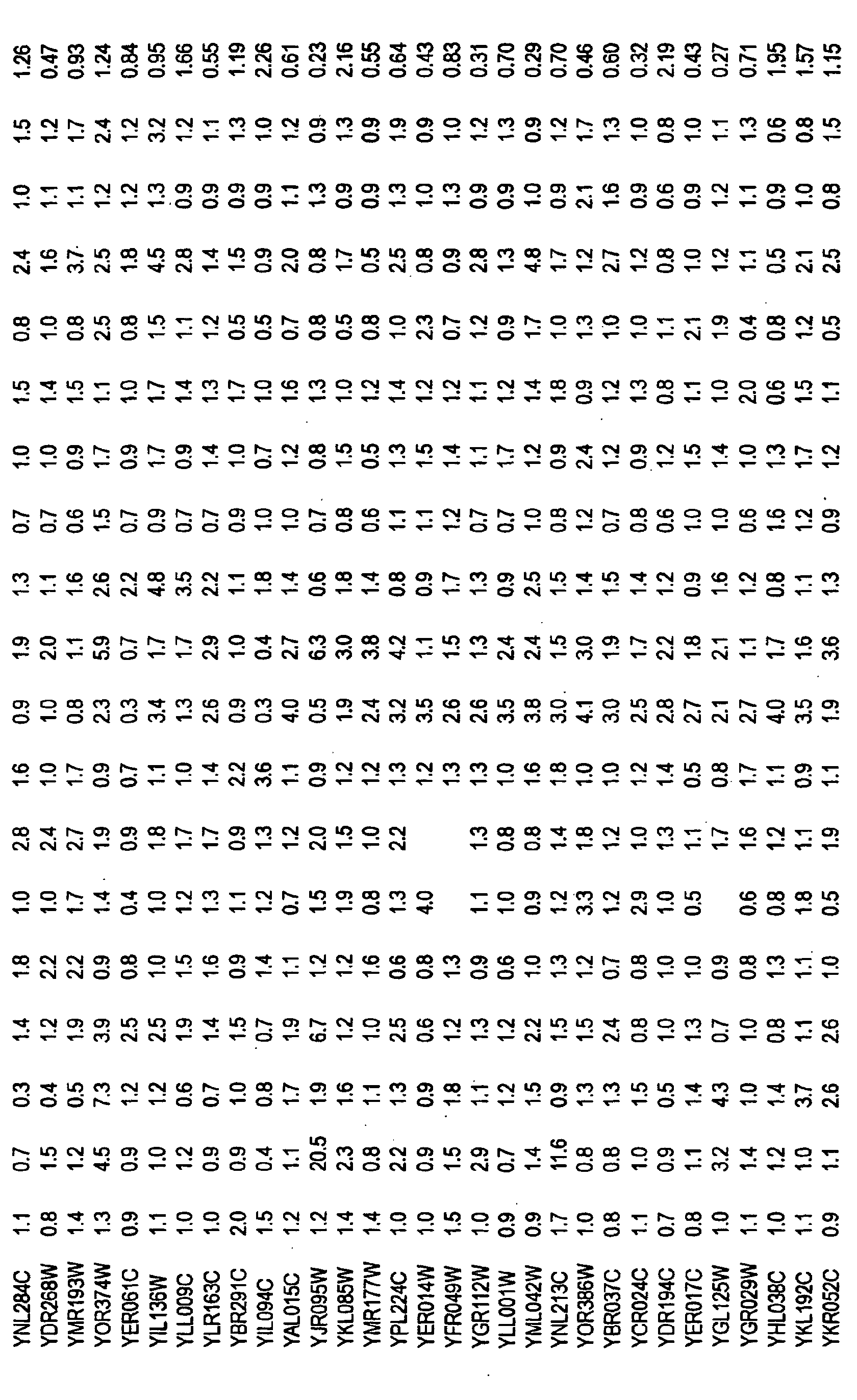
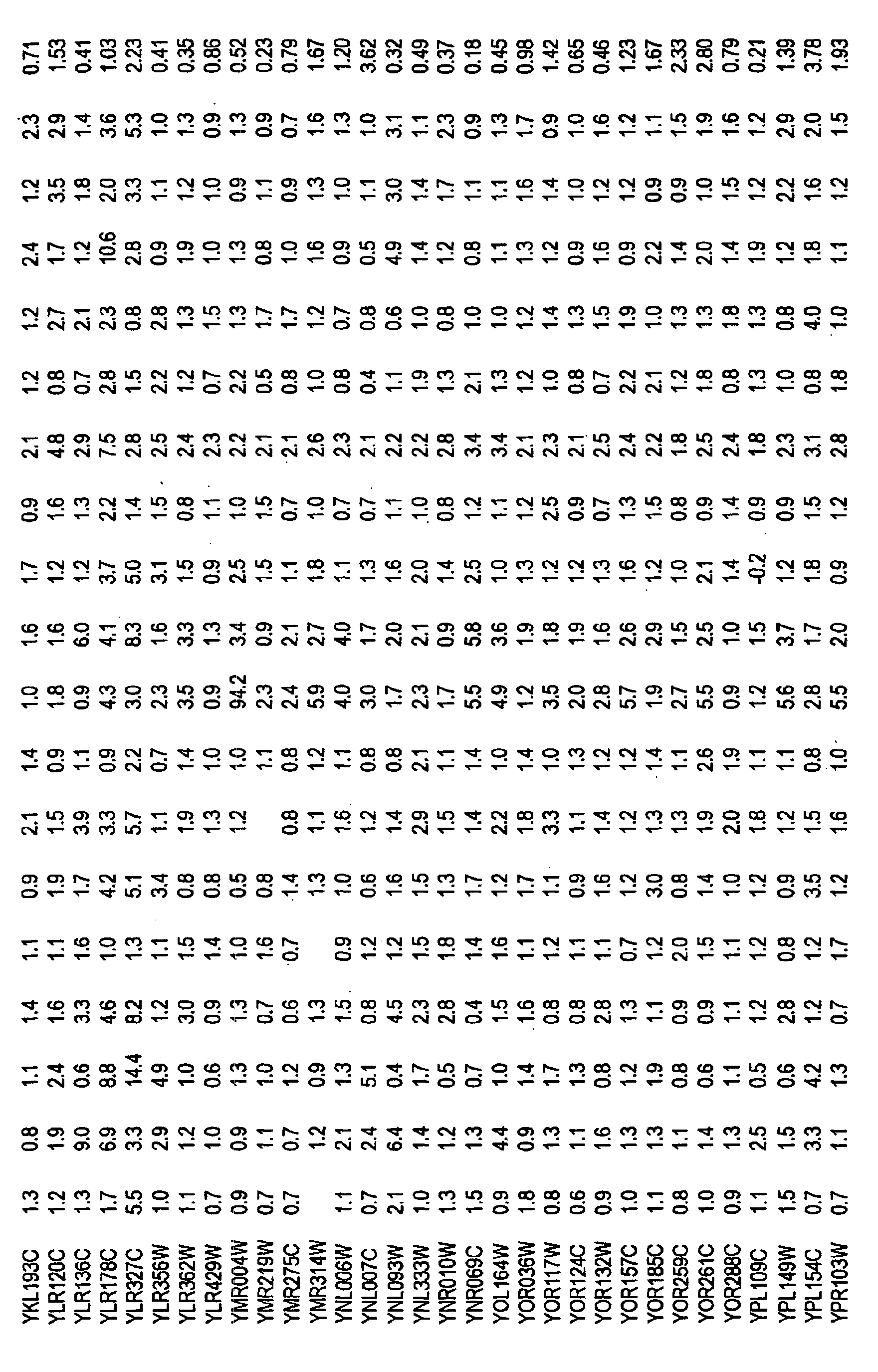
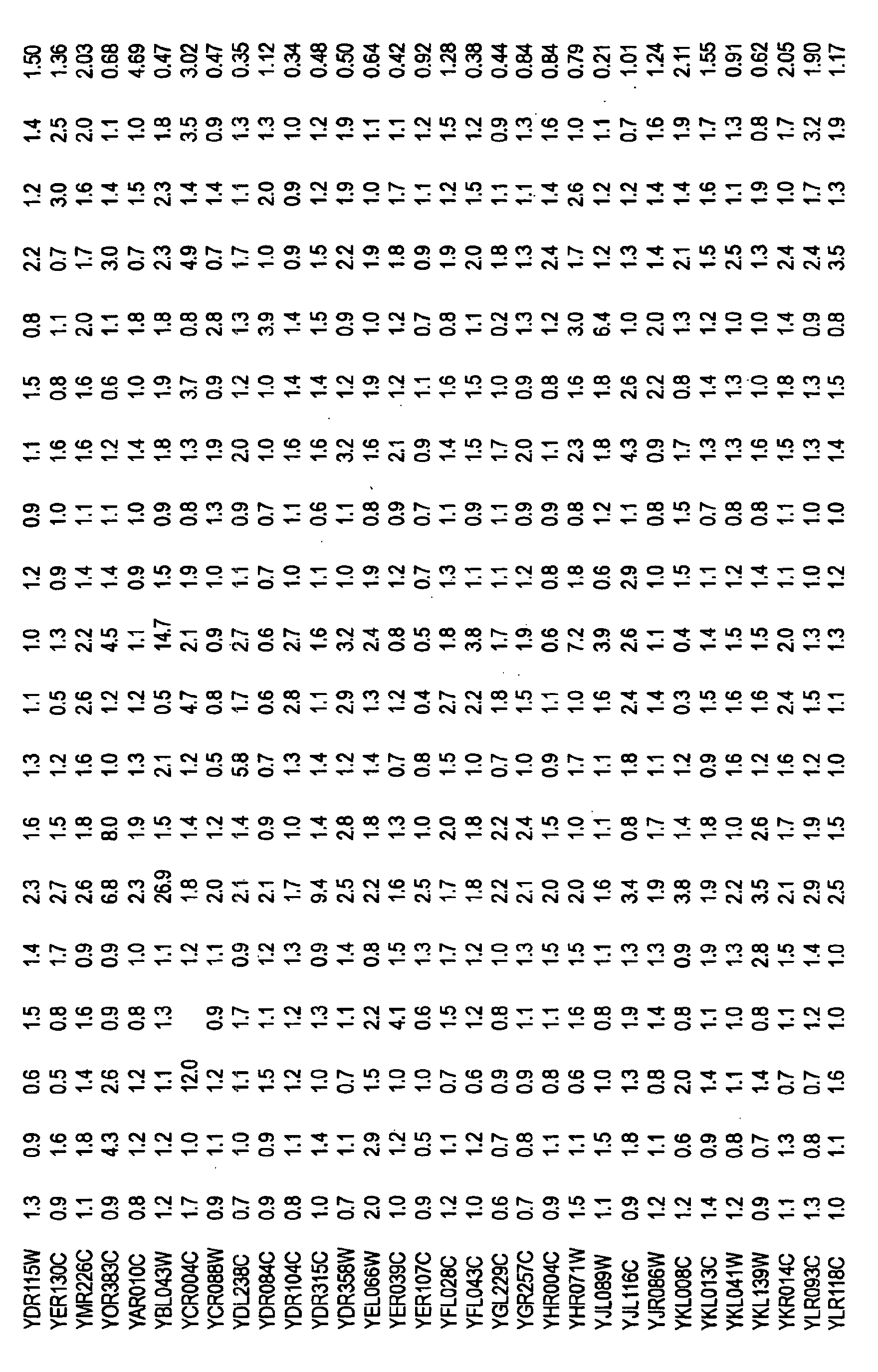
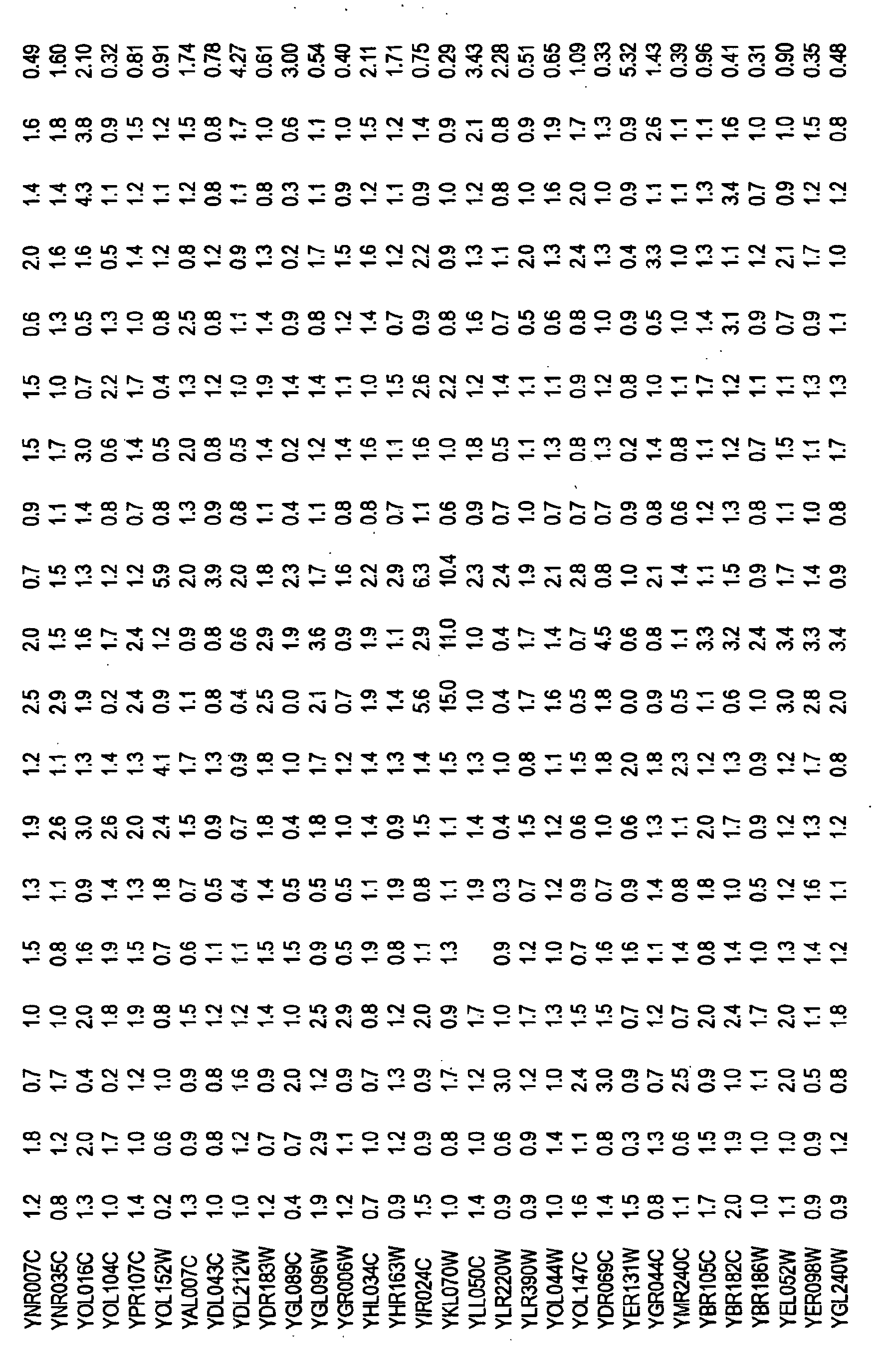
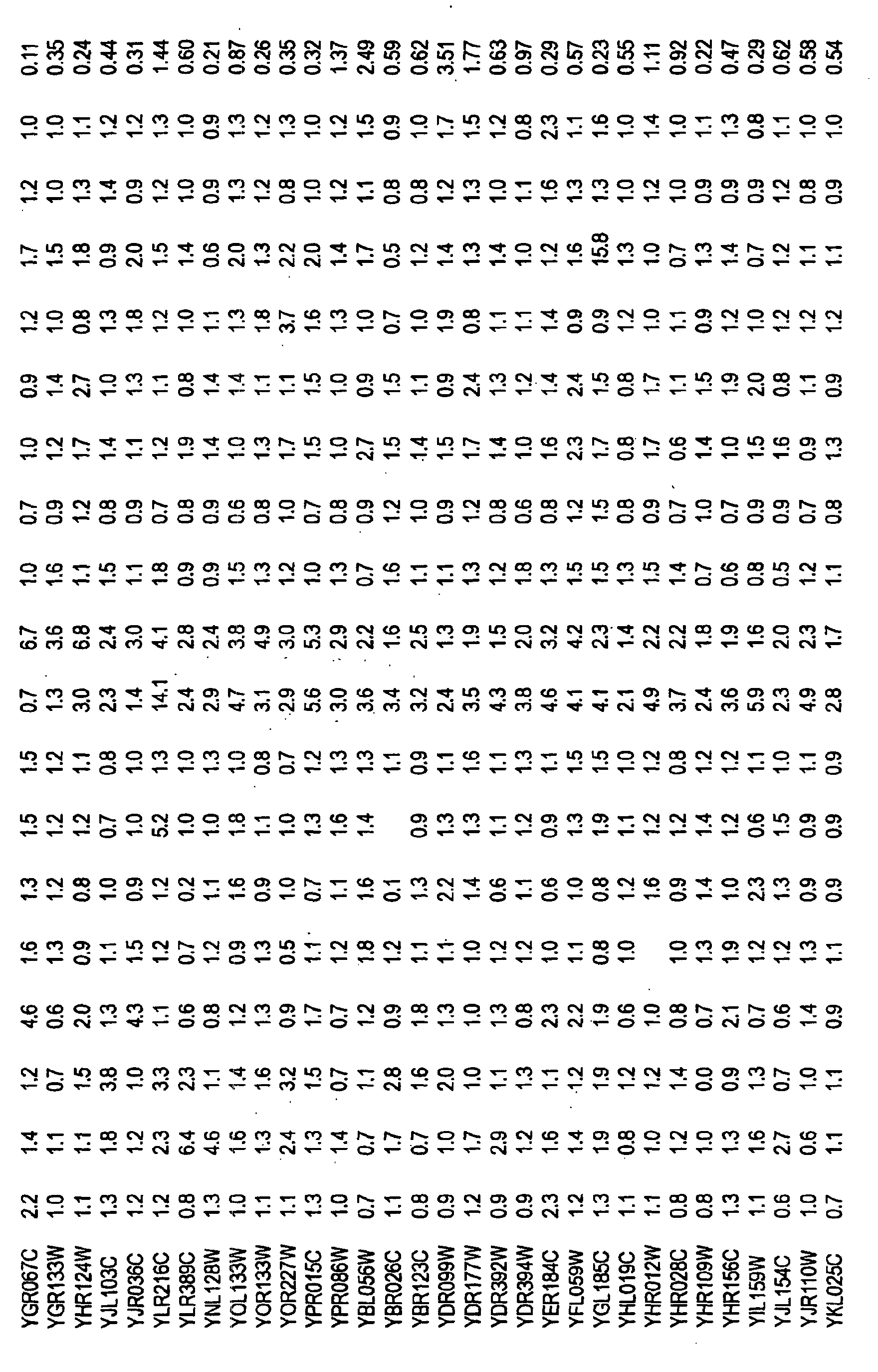
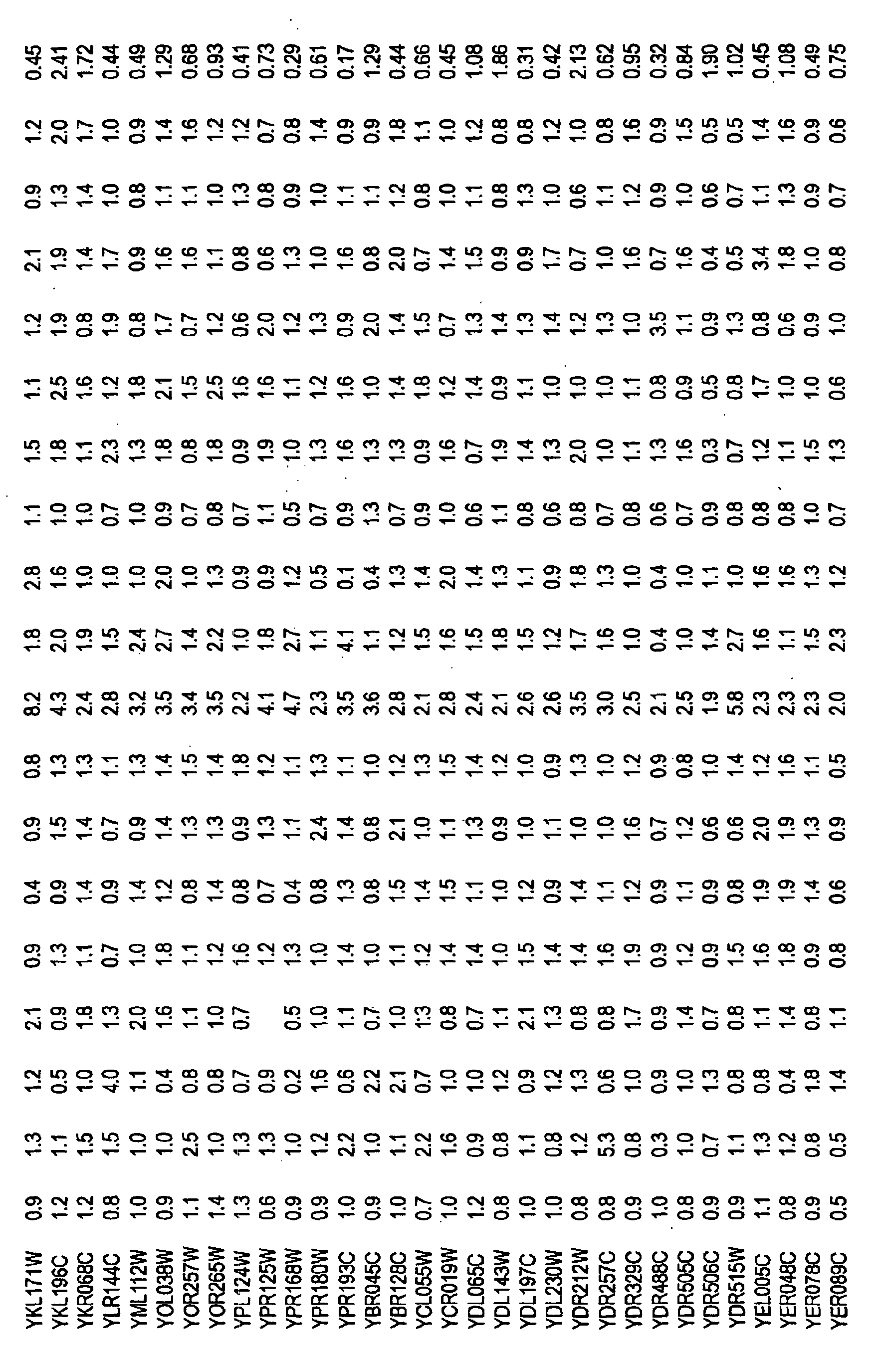
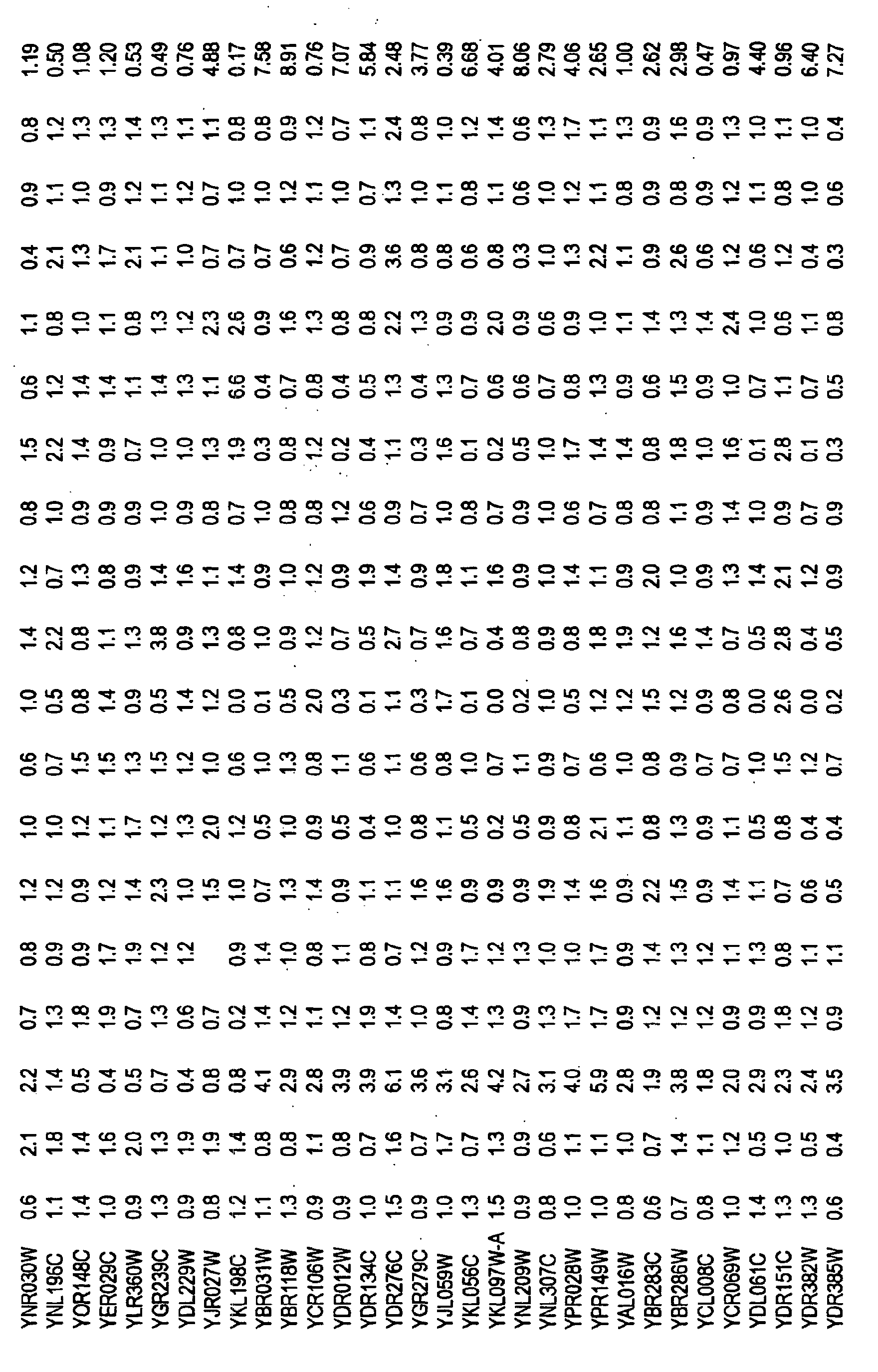
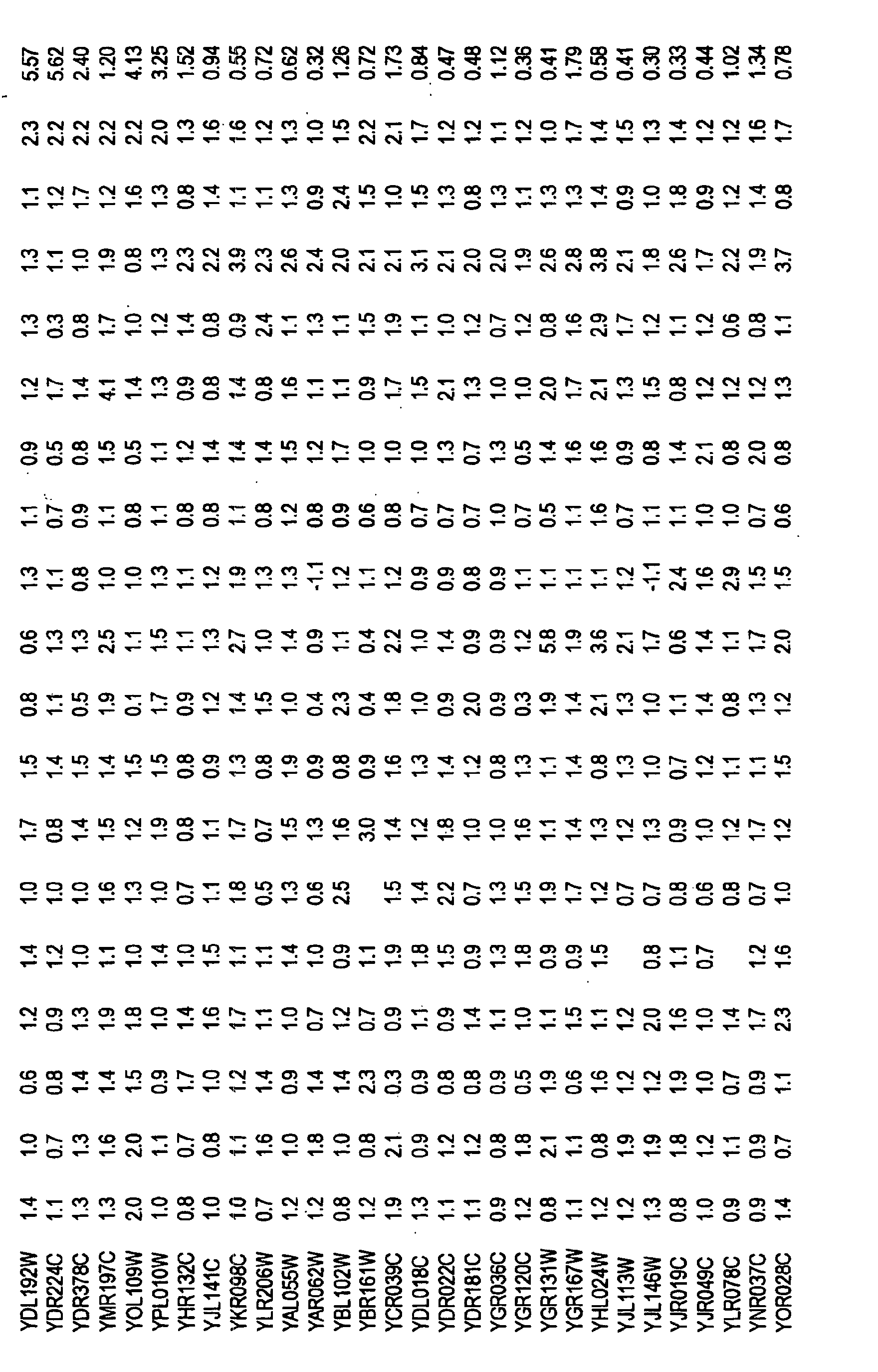
  • the tables show that the expressed mRNA of about 700 of 2400 unknown yeast genes was induced by any one of chemical substances such as heavy metals, agricultural chemicals, surfactants (Table 1), as well as the expressed mRNA of 167 mitochondria-located genes (Table 2), 52 DNA repair genes (Table 3), 161 energy genes (Table 4), 142 transport facilitation protein genes (Table 5), 90 stress protein genes (Table 6), 142 metabolism genes (Table 7), 60 detoxification genes (Table 8), and 507 genes belonging to other category (Table 9).
  • Table 9 when the value of the following is 2 or more, then it is considered significant: The level of expressed mRNA in the presence of chemical substance The level of expressed mRNA in the absence of chemical substance.
  • the inventors of the present application understood that the induction of certain yeast genes by toxic substances is caused by the activation of the promoters of the genes by the toxic substances.
  • the inventors prepared a vector that comprised a polynucleotide sequence comprising the promoter of the yeast gene, which sequence is operably linked to a polynucleotide encoding a marker protein; and transformed yeast cells with the vector.
  • Such cells enable us to detect readily toxic substances by detecting the expressed marker proteins (hereinafter, such detection may be referred to as "promoter assay”.).
  • the working examples hereinafter illustrate the preparation of such vectors, transformation of yeast cells by use of said vectors, and the detection of toxic substances by use of the transformed cells.
  • Promoter assay is a method for determining variations of the level of intracellular genes without destroying cells on the basis of the level of expressed marker genes instead of the expressed mRNA.
  • the gene selected to detect a chemical substance is expressed in the absence of chemical substances, and thus a marker protein also occurs in the absence of chemical substances.
  • the behavior of yeast genes on the addition of test materials is determined on the basis of the level of expressed marker protein so that the presence or the absence, and the kind of toxic chemical substances are predicted.
  • the production of marker proteins is lower in the absence of chemical substances, and the production of marker proteins is higher in the presence of chemical substances.
  • yeast gene as used in promoter assay is selected, of which intensity (level of expressed gene in control cells/average level of expressed whole genes) is preferably 1.5 or less, more preferably 1 or less, even more preferably 0.5 or less, and of which expression magnification (expressed mRNA in the presence of chemical substance/expressed mRNA in the absence of chemical substance) is preferably 3 or more, more preferably 10 or more, even more preferably 20 or more.
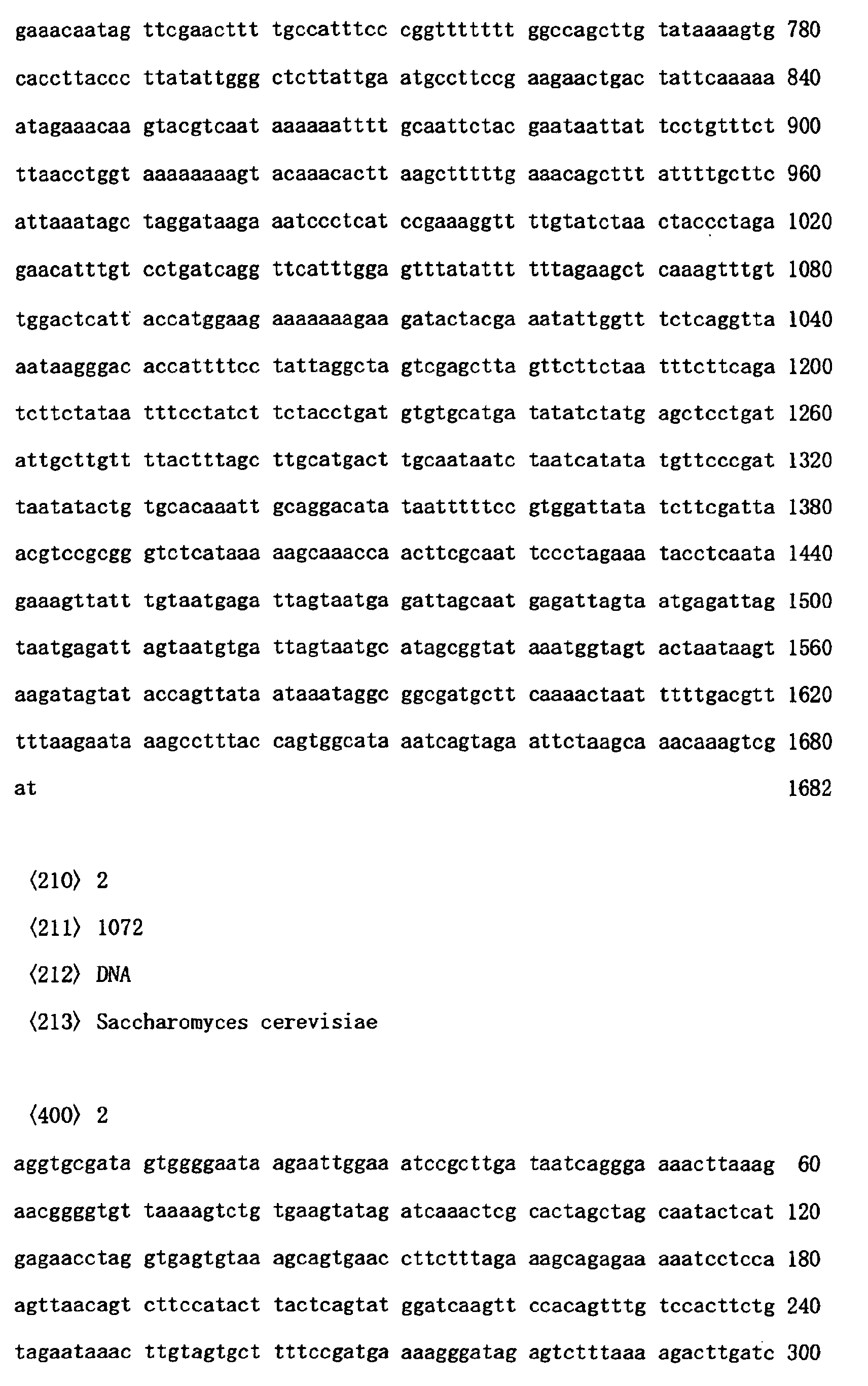
  • Primers for PCR to amplify the polynucleotide comprising the promoter of yeast gene YKL071w were prepared. Primers were designed using a primer design software, Oligo4.0-S, Sequencher I Mackintosh version. The base sequence of the upper primer was: whereas the base sequence of the lower primer was:
  • yeast chromosome Saccharomyces cerevisiae S288C, Cat.40802, Research Genetics, Inc.
  • KOD DNA Polymerase Code KOD-101, Toyobo
  • Type YEp shuttle vector pYES2 (pYES2, Cat no: V825-20, Invirtogen Corporation, USA), which can be replicated both in E.coli . and yeast was used as vector (R. W. Old, S. B. Primrose Principles of Gene Manipulation 5th Ed., BAIFUKAN CO., LTD, pp138-165, pp.234-263, 2000).
  • the portion of vector pQBI 63 (Cat no.54-0082, Wako Pure Chemical Industries, Ltd.) corresponding to a marker protein GFP was used as the polynucleotide encoding GFP (SEQ ID No: 6).
  • the GFP polynucleotide was inserted into the multiple cloning sites of pYES2 to give a vector. Thereafter, the GAL1 promoter of pYES2 was replaced with the polynucleotide comprising the promoter sequence of the intended yeast gene YKL071w (SEQ ID No: 1) to give an intended plasmid vector. Suitable restriction enzymes were selected, and the insertion of the polynucleotide comprising GFP and the promoter sequence was conducted.
  • yeast Saccharomyces cerevisiae W303 was transformed with the resultant plasmid vector according to the following procedures:
  • the transformed yeast cells named SC-YKL071w-pQBI has been deposited as the International Deposition at National Institute of Advanced Industrial Science and Technology, International Patent Organism Depositary of Tsukuba Central 6, 1-1-1 Higashi, Tsukuba, Ibaraki, Japan under Accession No. FERM BP-8161 on August 19, 2002.
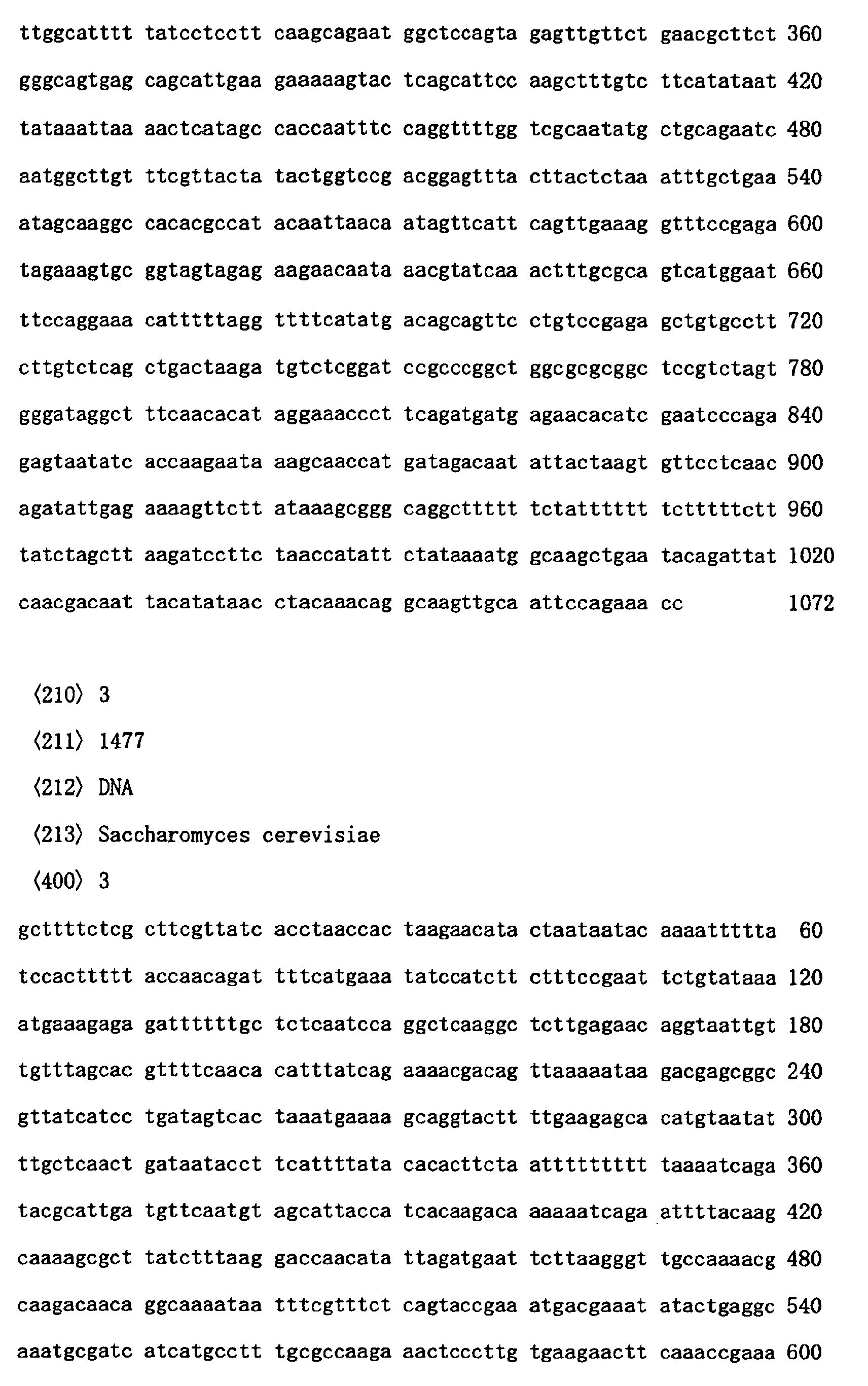
  • Primers for PCR to amplify the polynucleotide comprising the promoter of yeast gene YCR102c were prepared. Primers were designed using a primer design software, Oligo4.0-S, Sequencher I Mackintosh version. The base sequence of the upper primer was: whereas the base sequence of the lower primer was:
  • yeast chromosome Saccharomyces cerevisiae S288C, Cat.40802, Research Genetics, Inc.
  • KOD DNA Polymerase Code KOD-101, Toyobo
  • Type YEp shuttle vector pYES2 (pYES2, Cat no: V825-20, Invirtogen Corporation, USA), which can be replicated both in E.coli. and yeast was used as vector (R. W. Old, S. B. Primrose Principles of Gene Manipulation 5th Ed., BAIFUKAN CO., LTD, pp138-165, pp.234-263, 2000).
  • the portion of vector pQBI 63 (Cat no.54-0082, Wako Pure Chemical Industries, Ltd.) corresponding to a marker protein GFP was used as the polynucleotide encoding GFP (SEQ ID No: 6).
  • the GFP polynucleotide was inserted into the multiple cloning sites of pYES2 to give a vector. Thereafter, the GAL1 promoter of pYES2 was replaced with the polynucleotide comprising the promoter sequence of the intended yeast gene YCR102c (SEQ ID No: 2) to give an intended plasmid vector. Suitable restriction enzymes were selected, and the insertion of the polynucleotide comprising GFP and the promoter sequence was conducted.
  • yeast Saccharomyces cerevisiae W303 was transformed with the resultant plasmid vector according to the following procedures:
  • the transformed yeast cells named SC-YCR102c-pQBI has been deposited as the International Deposition at National Institute of Advanced Industrial Science and Technology, International Patent Organism Depositary of Tsukuba Central 6, 1-1-1 Higashi, Tsukuba, Ibaraki, Japan under Accession No. FERM BP-8159 on August 19, 2002.
  • Primers for PCR to amplify the polynucleotide comprising the promoter of yeast gene YOR382w were prepared. Primers were designed using a primer design software, Oligo4.0-S, Sequencher I Mackintosh version. The base sequence of the upper primer was: whereas the base sequence of the lower primer was:
  • yeast chromosome Saccharomyces cerevisiae S288C, Cat.40802, Research Genetics, Inc.
  • KOD DNA Polymerase Code KOD-101, Toyobo
  • Type YEp shuttle vector pYES2 (pYES2, Cat no: V825-20, Invirtogen Corporation, USA), which can be replicated both in E. coli. and yeast was used as vector (R. W. Old, S. B. Primrose Principles of Gene Manipulation 5th Ed., BAIFUKAN CO., LTD, pp 138-165, pp.234-263, 2000).
  • the portion of vector pQBI 63 (Cat no.54-0082, Wako Pure Chemical Industries, Ltd.) corresponding to a marker protein GFP was used as the polynucleotide encoding GFP (SEQ ID No: 6).
  • the GFP polynucleotide was inserted into the multiple cloning sites of pYES2 to give a vector. Thereafter, the GAL1 promoter of pYES2 was replaced with the polynucleotide comprising the promoter sequence of the intended yeast gene YOR382w (SEQ ID No: 3) to give an intended plasmid vector. Suitable restriction enzymes were selected, and the insertion of the polynucleotide comprising GFP and the promoter sequence was conducted.
  • yeast Saccharomyces cerevisiae W303 was transformed with the resultant plasmid vector according to the following procedures:
  • the transformed yeast cells named SC-YOR382W-pQBI has been deposited as the International Deposition at National Institute of Advanced Industrial Science and Technology, International Patent Organism Depositary of Tsukuba Central 6, 1-1-1 Higashi, Tsukuba, Ibaraki, Japan under Accession No. FERM BP-8160 on August 19, 2002.
  • Primers for PCR to amplify the polynucleotide comprising the promoter of yeast gene YLL057c were prepared. Primers were designed using a primer design software, Oligo4.0-S, Sequencher I Mackintosh version. The base sequence of the upper primer was: whereas the base sequence of the lower primer was:
  • yeast chromosome Saccharomyces cerevisiae S288C, Cat.40802, Research Genetics, Inc.
  • KOD DNA Polymerase Code KOD-101, Toyobo
  • Type YEp shuttle vector pYES2 (pYES2, Cat no: V825-20, Invirtogen Corporation, USA), which can be replicated both in E.coli . and yeast was used as vector (R. W. Old, S. B. Primrose Principles of Gene Manipulation 5th Ed., BAIFUKAN CO., LTD, pp 138-165, pp.234-263, 2000).
  • the portion of vector pQBI 63 (Cat no.54-0082, Wako Pure Chemical Industries, Ltd.) corresponding to a marker protein GFP was used as the polynucleotide encoding GFP (SEQ ID No: 6).
  • the GFP polynucleotide was inserted into the multiple cloning sites of pYES2 to give a vector. Thereafter, the GAL1 promoter of pYES2 was replaced with the polynucleotide comprising the promoter sequence of the intended yeast gene YLL057c (SEQ ID No: 4) to give an intended plasmid vector. Suitable restriction enzymes were selected, and the insertion of the polynucleotide comprising GFP and the promoter sequence was conducted.
  • yeast Saccharomyces cerevisiae W303 was transformed with the resultant plasmid vector according to the following procedures:
  • the transformed yeast cells named SC-YLL057C-pQBI was deposited at National Institute of Advanced Industrial Science and Technology, International Patent Organism Depositary of Tsukuba Central 6, 1-1-1 Higashi, Tsukuba, Ibaraki, Japan under Accession No. PERM P-18439 on July 27, 2001, and then transferred into the International Deposition under Budapest Treaty as PERM BP-8158 on August 19, 2002.
  • Primers for PCR to amplify the polynucleotide comprising the promoter of yeast gene YLR303w were prepared. Primers were designed using a primer design software, Oligo4.0-S, Sequencher I Mackintosh version. The base sequence of the upper primer was: whereas the base sequence of the lower primer was:
  • yeast chromosome Saccharomyces cerevisiae S288C, Cat.40802, Research Genetics, Inc.
  • KOD DNA Polymerase Code KOD-101, Toyobo
  • Type YEp shuttle vector pYES2 (pYES2, Cat no: V825-20, Invirtogen Corporation, USA), which can be replicated both in E . coli . and yeast was used as vector (R. W. Old, S. B. Primrose Principles of Gene Manipulation 5th Ed., BAIFUKAN CO., LTD, pp138-165, pp.234-263, 2000).
  • the portion of vector pQBI 63 (Cat no.54-0082, Wako Pure Chemical Industries, Ltd.) corresponding to a marker protein GFP was used as the polynucleotide encoding GFP (SEQ ID No: 6).
  • the GFP polynucleotide was inserted into the multiple cloning sites of pYES2 to give a vector. Thereafter, the GAL1 promoter of pYES2 was replaced with the polynucleotide comprising the promoter sequence of the intended yeast gene YLR303w (SEQ ID No: 5) to give an intended plasmid vector. Suitable restriction enzymes were selected, and the insertion of the polynucleotide comprising GFP and the promoter sequence was conducted.
  • yeast Saccharomyces cerevisiae W303 was transformed with the resultant plasmid vector according to the following procedures:
  • the transformed yeast cells named SC-YLR303W-pQBI was deposited at National Institute of Advanced Industrial Science and Technology, International Patent Organism Depositary of Tsukuba Central 6, 1-1-1 Higashi, Tsukuba, Ibaraki, Japan under Accession No. FERM P-18438 on July 27, 2001, and then transferred into the International Deposition under Budapest Treaty as FERM BP-8157 on August 19, 2002.
  • the cells of SC-YKL071W-pQBI as prepared in Example 2 were contacted to one of the following compounds.
  • the yeast cells SC-YKL071W-pQBI were incubated at 25 °C in SD medium (Yeast nitrogen base without amino acids (Difco 0919-15) + glucose + amino acids (adenine, histidine, tryptophan)).
  • SD medium Yeast nitrogen base without amino acids (Difco 0919-15) + glucose + amino acids (adenine, histidine, tryptophan)
  • One of toxic chemical substances as shown below was added to the cells at logarithmic growth phase, and then the cells were further incubated for two hours. Cells were incubated without any chemical substance in the same condition, and was used as control.
  • the yeast cells were washed once with physiological saline, and then immobilized with a physiological saline containing 5% formalin, after which the fluorescence was determined by flow cytometry (EPICS XL: BECKMAN COULTER). Fluorometric range of the control was first defined. When the number of the cells having a higher fluorescence than the control was under 1%, "-" was indicated as not showing any fluorescence, whereas when the number was between 1% and 2%, and 2% or more, then "+" and "++” were indicated as showing a fluorescence, respectively. The results are shown in Table 10.
  • Table 10 shows that tetramethylthiuram disulfide induced the expression of GFP.
  • the cells of SC-YCR102C-pQBI as prepared in Example 3 were contacted to one of the following compounds.
  • the yeast cells SC-YCR102C-pQBI were incubated at 25 °C in SD medium (Yeast nitrogen base without amino acids (Difco 0919-15) + glucose + amino acids (adenine, histidine, tryptophan)).
  • SD medium Yeast nitrogen base without amino acids (Difco 0919-15) + glucose + amino acids (adenine, histidine, tryptophan)
  • One of toxic chemical substances as shown below was added to the cells at logarithmic growth phase, and then the cells were further incubated for two hours. Cells were incubated without any chemical substance in the same condition, and was used as control.
  • the yeast cells were washed once with physiological saline, and then immobilized with a physiological saline containing 5% formalin, after which the fluorescence was determined by flow cytometry (EPICS XL: BECKMAN COULTER). Fluorometric range of the control was first defined. When the number of the cells having a higher fluorescence than the control was under 1%, "-" was indicated as not showing any fluorescence, whereas when the number was between 1% and 2%, and 2% or more, then "+” and "++” were indicated as showing a fluorescence, respectively. The results are shown in Table 11.
  • Table 11 shows that tetramethylthiuram disulfide induced the expression of GFP.
  • the cells of SC-YOR382W-pQBI as prepared in Example 4 were contacted to one of the following compounds.
  • the yeast cells SC-YOR382W-pQBI were incubated at 25 ° C in SD medium (Yeast nitrogen base without amino acids (Difco 0919-15) + glucose + amino acids (adenine, histidine, tryptophan)).
  • SD medium Yeast nitrogen base without amino acids (Difco 0919-15) + glucose + amino acids (adenine, histidine, tryptophan)
  • One of toxic chemical substances as shown below was added to the cells at logarithmic growth phase, and then the cells were further incubated for two hours. Cells were incubated without any chemical substance in the same condition, and was used as control.
  • the yeast cells were washed once with physiological saline, and then immobilized with a physiological saline containing 5% formalin, after which the fluorescence was determined by flow cytometry (EPICS XL: BECKMAN COULTER). Fluorometric range of the control was first defined. When the number of the cells having a higher fluorescence than the control was under 1%, "-" was indicated as not showing any fluorescence, whereas when the number was between 1% and 2%, and 2% or more, then "+" and "++” were indicated as showing a fluorescence, respectively. The results are shown in Table 12.
  • Table 12 shows that 2,4-dichlorophenoxyacetic acid, 4-nitroquinolin-N-oxide, p-nonylphenol, 2,4,5-trichlorophenol, Trp-P-2 (acetate) , malathon, manganese ethylenebis(dithiocarbamate), nickel (II) chloride, potassium bichromate, phenol, and dimethylsulfoxide induced the expression of GFP.
  • the cells of SC-YLL057C-pQBI as prepared in Example 5 were contacted to one of the following compounds.
  • the yeast cells SC-YLL057C-pQBI were incubated at 25 °C in SD medium (Yeast nitrogen base without amino acids (Difco 0919-15) + glucose + amino acids (adenine, histidine, tryptophan)).
  • SD medium Yeast nitrogen base without amino acids (Difco 0919-15) + glucose + amino acids (adenine, histidine, tryptophan)
  • One of toxic chemical substances as shown below was added to the cells at logarithmic growth phase, and then the cells were further incubated for two hours. Cells were incubated without any chemical substance in the same condition, and was used as control.
  • the yeast cells were washed once with physiological saline, and then immobilized with a physiological saline containing 5% formalin, after which the fluorescence was determined by flow cytometry (EPICS XL: BECKMAN COULTER). Fluorometric range of the control was first defined. When the number of the cells having a higher fluorescence than the control was under 1%, "-" was indicated as not showing any fluorescence, whereas when the number was between 1% and 2%, and 2% or more, then "+" and "++” were indicated as showing a fluorescence, respectively. The results are shown in Table 13.
  • Table 13 shows that 2,4-dichlorophenoxyacetic acid, sodium arsenite, cadmium chloride, and potassium cyanide induced the expression of GFP.
  • the cells of SC-YCR303W-pQBI as prepared in Example 6 were contacted to one of the following compounds.
  • the yeast cells SC-YCR303W-pQBI were incubated at 25 °C in SD medium (Yeast nitrogen base without amino acids (Difco 0919-15) + glucose + amino acids (adenine, histidine, tryptophan)).
  • SD medium Yeast nitrogen base without amino acids (Difco 0919-15) + glucose + amino acids (adenine, histidine, tryptophan)
  • One of toxic chemical substances as shown below was added to the cells at logarithmic growth phase, and then the cells were further incubated for two hours. Cells were incubated without any chemical substance in the same condition, and was used as control.
  • the yeast cells were washed once with physiological saline, and then immobilized with a physiological saline containing 5% formalin, after which the fluorescence was determined by flow cytometry (EPICS XL: BECKMAN COULTER). Fluorometric range of the control was first defined. When the number of the cells having a higher fluorescence than the control was under 1%, "-" was indicated as not showing any fluorescence, whereas when the number was between 1% and 2%, and 2% or more, then "+" and "++” were indicated as showing a fluorescence, respectively. The results are shown in Table 14.
  • Table 14 shows that benzo(a)pyrene, 2,4-dichlorophenoxyacetic acid, formaldehyde, sodium arsenite, cadmium chloride, manganese ethylenebis(dithiocarbamate), mercury(II) chloride, and potassium cyanide induced the expression of GFP.

Landscapes

  • Chemical & Material Sciences (AREA)
  • Organic Chemistry (AREA)
  • Life Sciences & Earth Sciences (AREA)
  • Health & Medical Sciences (AREA)
  • Genetics & Genomics (AREA)
  • Zoology (AREA)
  • Wood Science & Technology (AREA)
  • Proteomics, Peptides & Aminoacids (AREA)
  • Engineering & Computer Science (AREA)
  • Analytical Chemistry (AREA)
  • Immunology (AREA)
  • Microbiology (AREA)
  • Molecular Biology (AREA)
  • Biotechnology (AREA)
  • Biophysics (AREA)
  • Physics & Mathematics (AREA)
  • Biochemistry (AREA)
  • Bioinformatics & Cheminformatics (AREA)
  • General Engineering & Computer Science (AREA)
  • General Health & Medical Sciences (AREA)
  • Measuring Or Testing Involving Enzymes Or Micro-Organisms (AREA)
  • Micro-Organisms Or Cultivation Processes Thereof (AREA)

Abstract

Biology-based processes for detecting toxic substances are provided. The processes comprise transforming cells with a vector comprising a polynucleotide which comprises a promoter of certain yeast gene operably linked to a polynucleotide encoding a marker protein; contacting the transformed cells to test sample; and detecting the expression of mRNA encoding the marker protein, thus detecting a toxic compound in the test sample.

Description

FILED OF THE INVENTION
This invention relates to biology-based processes for detecting toxic substances. It also relates to polynucleotides, vectors, and cells as used for the processes.
BACKGROUND ART
Environmental chemical fate search has been conducted every year for 24 years from 1974 through 1998 by Environment Agency, and revealed that about 40% of 775 chemical substances that have been searched so far are emitted into the environment. Chemical substances that are industrially produced at the present in Japan are estimated about 50,000, and the production scale and the kinds of chemical substances are increasing year by year. It is known that chemical substances that are accidentally produced by water treatment with chlorine and incineration pollute the environment. Although such facts allow us to predict that there are a large number of chemical substances that have been accumulated in the environment, it is extremely difficult to search and examine individually the all chemical substances.
Conventional bioassays (approaches to evaluate the harmful effects on biological materials on the basis of their responses) wherein inhibited growth and particular biological responses in individuals and cells of fishes, daphnia and shellfish are used as indicators make it possible to determine the presence or absence of the toxicity of chemical substances in the environment, but neither possible to evaluate the characters nor origins of the toxicity. The evaluation methods based on the activity of nitrite-forming bacteria or nitrate-forming bacteria (Japanese Patent Publication (kokai) No. 123705/ 1994, Japanese Patent Publication (kokai) No. 2000-206087) and the activity of iron bacteria have been proposed, and devices such as Acute toxiciants monitor (Fuji Electric Corporate Research and Development, Ltd. Japan) are marketed. In foreign countries, the devices for evaluation based on emission intensity of luminous bacteria are commercially available (MICROTOX, azur, Co., USA; LUMIS, drlange, Co. Germany). However, those devices still involve conventional bioassays, and never provide any detailed information of toxic chemical substances.
In Japan, the risk control of chemical substances is reconsidered every time a chemical substance pollution is newly found, and official regulations and self-imposed regulations are combined to organize the system for risk control. However, any system has not been yet organized that could quickly respond to the present complicated and diversified conditions including accidental productions and environmental emission of toxic chemical substance as typified by trihalomethane and dioxin. Animal experiments as used in the method for evaluation of toxic substance of "Law Concerning Examination and Manufacture, etc. of Chemical Substances" are expensive and time-consuming, and are not accepted across the world. Although, as such, the control system has been continuously discussed, it has not been successfully accomplished because there is no way to dissolve the problem. Thus, a method for detect readily chemical substances occurring in the environment is desired.
DISCLOSURE OF THE INVENTION
The inventors of the present application found that a toxic substance activates the promoter of a particular yeast gene to induce the transcription of mRNA from the polynucleotide encoding a marker protein operably linked to the promoter, and accomplished the present invention.
Specifically, the invention of the present application relates, as the first embodiment, to a polynucleotide which comprises a polynucleotide sequence operably linked to a polynucleotide encoding a marker protein, wherein the polynucleotide sequence comprises a promoter from yeast genes that is selected from a group consisting of the following, or a promoter from a gene that is homologous to the yeast genes and is derived from other species; YBR072W, YCR102C, YCR107W, YDL218W, YDL243C, YDR453C, YDR533C, YFL014W, YFL056C, YFL057C, YGR110W, YJR155W, YKL071W, YKR076W, YLL060C, YLR460C, YMR090W, YNL331C, YNL332W, YNL335W, YOL150C, YOL165C, YPL171C, YPR167C, YBL048W, YBL064C, YBL107C, YBR008C, YBR173C, YBR256C, YBR296C, YDL021W, YFL022C, YFL024C, YFL061W, YGL121C, YGL158W, YGR043C, YHR029C, YHR112C, YHR139C, YHR179W, YHR209W, YIR030C, YJR010W, YJR048W, YKL001C, YKL107W, YKR075C, YKR097W, YLL056C, YLR297W, YLR303W, YML087C, YMR096W, YNL274C, YOL151W, YOR226C, YOR338W, YOR391C, YPL280W, YDR406W, YJL153C, YLR346C, YOR049C, YOR153W, YPL088W, YAL034C, YDL124W, YDL174C, YDR476C, YGL156W, YGR035C, YGR157W, YGR213C, YGR281W, YGR284C, YHL047C, YHR043C, YHR044C, YHR054C, YJR073C, YKL165C, YLR008C, YMR315W, YNL211C, YOL031C, YOL101C, YOR303W, YAL005C, YAR031W, YBL005W-A, YBL022C, YBL041W, YBL049W, YBL075C, YBL078C, YBR062C, YBR169C, YBR294W, YCL020W, YCL035C, YCL043C, YCL050C, YCL057W, YCR012W, YCR013C, YCR060W, YDL007W, YDL027C, YDL097C, YDL110C, YDL126C, YDL169C, YDR070C, YDR155C, YDR158W, YDR204W, YDR210W, YDR214W, YDR258C, YDR313C, YDR368W, YDR435C, YER012W, YER037W, YER091C, YER103W, YFL044C, YFR003C, YFR010W, YFR020W, YFR024C, YFR044C, YFR053C, YGL006W, YGL048C, YGL062W, YGL141W, YGL157W, YGL163C, YGL180W, YGL184C, YGR010W, YGR028W, YGR032W, YGR048W, YGR124W, YGR135W, YGR142W, YGR161C, YGR192C, YGR197C, YGR201C, YGR212W, YGR231C, YGR244C, YGR254W, YGR268C, YHL030W, YHR016C, YHR018C, YHR055C, YHR087W, YHR166C, YIL160C, YIR017C, YJL034W, YJL048C, YJL052W, YJL144W, YJL163C, YJR009C, YJR069C, YJR074W, YJR130C, YJR149W, YKL065C, YKL073W, YKL103C, YKL142W, YKL210W, YKL218C, YKR011C, YKR018C, YKR046C, YKR049C, YLL024C, YLL026W, YLR027C, YLR080W, YLR107W, YLR121C, YLR132C, YLR133W, YLR155C, YLR158C, YLR161W, YLR195C, YLR217W, YLR328W, YLR336C, YLR345W, YLR370C, YLR423C, YML004C, YML092C, YML128C, YML130C, YML131W, YMR040W, YMR118C, YMR214W, YMR251W, YMR297W, YMR322C, YNL036W, YNL055C, YNL071W, YNL094W, YNL134C, YNL155W, YNL160W, YNL239W, YNL241C, YOL005C, YOR020C, YOR027W, YOR037W, YOR059C, YOR120W, YOR134W, YOR152C, YOR173W, YOR289W, YOR362C, YPL240C, YPR030W, YAL008W, YAL023C, YAL060W, YAL062W, YAR009C, YBL101C, YBR006W, YBR046C, YBR052C, YBR053C, YBR056W, YBR099C, YBR137W, YBR139W, YBR149W, YBR170C, YBR177C, YBR203W, YBR207W, YBR212W, YBR239C, YBR284W, YBR293W, YCL018W, YCL033C, YCL040W, YCL049C, YCR062W, YCR067C, YCR082W, YDL010W, YDL020C, YDL024C, YDL054C, YDL095W, YDL100C, YDL115C, YDL144C, YDL198C, YDL223C, YDL245C, YDL246C, YDR001C, YDR032C, YDR058C, YDR072C, YDR127W, YDR168W, YDR169C, YDR188W, YDR231C, YDR261C, YDR264C, YDR272W, YDR293C, YDR304C, YDR330W, YDR403W, YDR411C, YDR427W, YDR436W, YDR497C, YDR511W, YDR516C, YDR519W, YDR545W, YEL012W, YEL030W, YER004W, YER009W, YER021W, YER035W, YER053C, YER079W, YER094C, YER096W, YER125W, YER158C, YER163C, YER175C, YER177W, YER178W, YER185W, YFL006W, YFL010C, YFL016C, YFL029C, YFL030W, YFL031W, YFL032W, YFL038C, YFL041W, YFR004W, YFR047C, YFR050C, YFR052W, YGL011C, YGL013C, YGL037C, YGL047W, YGL053W, YGL091C, YGL094C, YGL127C, YGL150C, YGL199C, YGL207W, YGL248W, YGR008C, YGR037C, YGR055W, YGR101W, YGR130C, YGR154C, YGR194C, YGR221C, YGR232W, YGR248W, YGR253C, YGR256W, YHL008C, YHR027C, YHR053C, YHR057C, YHR111W, YHR138C, YHR161C, YHR164C, YHR169W, YHR174W, YHR176W, YHR199C, YIL010W, YIL034C, YIL041W, YIL045W, YIL087C, YIL107C, YIL142W, YIL155C, YIR034C, YIR036C, YIR037W, YIR038C, YIR039C, YJL001W, YJL031C, YJL035C, YJL053W, YJL057C, YJL066C, YJL068C, YJL082W, YJL099W, YJL102W, YJL151C, YJL152W, YJL161W, YJL164C, YJL171C, YJL172W, YJL210W, YJL219W, YJR008W, YJR045C, YJR046W, YJR106W, YJR117W, YJR137C, YKL007W, YKL026C, YKL035W, YKL091C, YKL104C, YKL117W, YKL145W, YKL146W, YKL151C, YKL152C, YKL153W, YKL193C, YKL195W, YKL213C, YKL215C, YLL028W, YLL039C, YLL058W, YLR054C, YLR103C, YLR120C, YLR136C, YLR149C, YLR152C, YLR178C, YLR259C, YLR299W, YLR324W, YLR327C, YLR348C, YLR350W, YLR356W, YLR362W, YLR387C, YLR429W, YML054C, YML070W, YML100W, YML117W, YML125C, YMR004W, YMR008C, YMR009W, YMR020W, YMR067C, YMR089C, YMR097C, YMR102C, YMR105C, YMR107W, YMR152W, YMR180C, YMR184W, YMR191W, YMR219W, YMR271C, YMR275C, YMR295C, YMR314W, YMR316W, YNL006W, YNL007C, YNL012W, YNL044W, YNL045W, YNL074C, YNL092W, YNL093W, YNL104C, YNL115C, YNL156C, YNL231C, YNL234W, YNL237W, YNL281W, YNL305C, YNL333W, YNR010W, YNR019W, YNR033W, YNR059W, YNR068C, YNR069C, YOL032W, YOL036W, YOL047C, YOL071W, YOL082W, YOL083W, YOL117W, YOL119C, YOL126C, YOL131W, YOL153C, YOL162W, YOL163W, YOL164W, YOR019W, YOR035C, YOR036W, YOR099W, YOR117W, YOR124C, YOR130C, YOR132W, YOR157C, YOR185C, YOR197W, YOR259C, YOR261C, YOR273C, YOR288C, YOR332W, YOR336W, YOR347C, YPL017C, YPL087W, YPL106C, YPL109C, YPL149W, YPL154C, YPL196W, YPL206C, YPL222W, YPR023C, YPR024W, YPR026W, YPR067W, YPR103W, YPR108W, YPR151C, YAL012W, YBR029C, YBR222C, YCL009C, YCL027W, YCL064C, YCR098C, YDL222C, YDR055W, YDR077W, YDR502C, YEL001C, YEL042W, YER026C, YER106W, YGR136W, YGR138C, YHR137W, YHR142W, YIL023C, YIL153W, YJL073W, YJR004C, YJR054W, YKL039W, YKL086W, YKL163W, YKR091W, YLR109W, YLR194C, YLR250W, YMR095C, YMR189W, YNL106C, YNL169C, YNL322C, YOR181W, YOR198C, YOR208W, YOR247W, YPL089C, YAL038W, YAL053W, YBR023C, YBR214W, YBR295W, YCR048W, YDL072C, YDL204W, YDR085C, YDR098C, YDR259C, YDR380W, YDR388W, YDR391C, YDR432W, YDR481C, YDR510W, YER069W, YGL022W, YGL126W, YGL209W, YGL255W, YGR189C, YGR282C, YHL035C, YHR030C, YIL022W, YIL024C, YIL117C, YIL123W, YIL140W, YIL154C, YJL088W, YJL108C, YJL149W, YJL159W, YJL186W, YJR148W, YKL096W, YLR180W, YLR273C, YLR300W, YLR307W, YLR378C, YLR391W, YMR094W, YMR104C, YMR276W, YMR296C, YNL190W, YNL208W, YNL300W, YNR064C, YOL013C, YOL058W, YOR248W, YOR355W, YPL052W, YPL163C, YPR079W, YAR028W, YBR146W, YBR183W, YCL038C, YCR071C, YDL008W, YDR019C, YDR031W, YDR115W, YDR486C, YER038C, YER130C, YFL054C, YGL136C, YGR146C, YGR207C, YHL040C, YIL167W, YJL020C, YKR039W, YLR031W, YLR205C, YMR072W, YMR140W, YMR173W, YMR195W, YMR226C, YNL037C, YNR002C, YOL143C, YOR136W, YOR215C, YOR382W, YOR383C, YPL054W, YPL271W, YPR127W, YAL044C, YAL054C, YAR010C, YAR027W, YAR071W, YBL001C, YBL043W, YBL057C, YBR014C, YBR024W, YBR035C, YBR068C, YBR111C, YBR116C, YBR147W, YBR168W, YBR246W, YBR273C, YCR004C, YCR021C, YCR037C, YCR088W, YDL022W, YDL128W, YDL238C, YDR003W, YDR009W, YDR033W, YDR084C, YDR104C, YDR270W, YDR315C, YDR340W, YDR357C, YDR358W, YDR396W, YDR405W, YDR410C, YDR434W, YDR482C, YDR487C, YDR520C, YDR534C, YDR539W, YEL011W, YEL065W, YEL066W, YER039C, YER044C, YER067W, YER080W, YER107C, YFL020C, YFL028C, YFL043C, YFR015C, YGL001C, YGL008C, YGL068W, YGL073W, YGL104C, YGL113W, YGL154C, YGL167C, YGL229C, YGL242C, YGL249W, YGL253W, YGR052W, YGR060W, YGR065C, YGR106C, YGR111W, YGR220C, YGR257C, YHL023C, YHL048W, YHR004C, YHR037W, YHR071W, YHR092C, YHR190W, YIL007C, YIL033C, YIL070C, YIL088C, YIL111W, YIR002C, YIR016W, YIR035C, YIR043C, YJL012C, YJL083W, YJL089W, YJL116C, YJL131C, YJL132W, YJL196C, YJR061W, YJR086W, YJR142W, YJR161C, YKL008C, YKL013C, YKL041W, YKL067W, YKL138C, YKL139W, YKL150W, YKL175W, YKR006C, YKR014C, YKR070W, YLL023C, YLR023C, YLR093C, YLR118C, YLR142W, YLR225C, YLR241W, YLR251W, YLR252W, YLR270W, YML030W, YML110C, YMR021C, YMR027W, YMR148W, YMR181C, YMR262W, YMR272C, YMR298W, YNL011C, YNL130C, YNL214W, YNL259C, YOL129W, YOR042W, YOR052C, YOR137C, YOR149C, YOR165W, YOR270C, YOR285W, YOR367W, YPL018W, YPL156C, YPL186C, YPL203W, YPL216W, YPL255W, YPR006C, YPR073C, YPR098C, YBR050C, YBR145W, YBR299W, YDR518W, YEL020C, YFL062W, YGL039W, YGL134W, YJL217W, YJR159W, YLR126C, YNL249C, YNL284C, YNL336W, YOL157C, YOR344C, YOR381W, YPL265W, YPR124W, YBR074W, YBR109C, YBR126C, YBR201W, YCR005C, YDL248W, YDR041W, YDR105C, YDR268W, YDR452W, YEL075C, YER046W, YER050C, YER136W, YER159C, YGL250W, YGR019W, YGR042W, YGR053C, YGR066C, YGR247W, YGR255C, YGR295C, YHL044W, YHR145C, YIL058W, YIL065C, YIL083C, YIL098C, YIL172C, YJL030W, YJL185C, YJL213W, YJR029W, YJR099W, YJR122W, YJR125C, YKL190W, YKR020W, YLL025W, YLL051C, YLR043C, YLR090W, YLR100W, YLR108C, YLR290C, YML068W, YMR051C, YMR139W, YMR178W, YMR193W, YNL015W, YNL079C, YNL122C, YNL223W, YNL285W, YNL293W, YNR007C, YNR035C, YNR061C, YOL016C, YOL104C, YOR220W, YOR221C, YOR374W, YPL123C, YPR077C, YPR107C, YPR147C, YBR093C, YBR196C, YEL041W, YEL047C, YER023W, YER119C, YFL055W, YGR209C, YIL124W, YKL187C, YLL055W, YMR318C, YOL152W, YAL007C, YBR067C, YBR115C, YBR285W, YBR292C, YDL043C, YDL123W, YDL131W, YDL168W, YDL212W, YDR056C, YDR132C, YDR154C, YDR183W, YDR216W, YDR253C, YDR295C, YDR494W, YDR513W, YEL072W, YER045C, YER061C, YER181C, YFL052W, YFL058W, YFR030W, YGL089C, YGL096W, YGL114W, YGL193C, YGL202W, YGL204C, YGL259W, YGR006W, YGR070W, YGR088W, YHL034C, YHL036W, YHR048W, YHR104W, YHR163W, YIL060W, YIL136W, YIR024C, YJL036W, YJL045W, YJL060W, YJL101C, YJL155C, YJR085C, YJR109C, YJR156C, YKL070W, YKL161C, YKL221W, YKR071C, YLL009C, YLL050C, YLR092W, YLR145W, YLR156W, YLR163C, YLR220W, YLR280C, YLR311C, YLR390W, YML116W, YMR034C, YMR038C, YMR081C, YMR250W, YNL240C, YNL260C, YNL277W, YNR074C, YOL044W, YOL084W, YOL147C, YOL159C, YOR184W, YOR228C, YOR255W, YPL223C, YPR160W, YDL182W, YBR047W, YBR054W, YBR291C, YDR069C, YER124C, YER131W, YGR044C, YIL094C, YKR007W, YMR240C, YNR050C, YOR007C, YAL015C, YBL065W, YBR105C, YBR182C, YBR186W, YBR244W, YBR272C, YCL069W, YDL025C, YDL059C, YDL085W, YDL113C, YDL244W, YDR018C, YDR054C, YDR202C, YDR223W, YDR350C, YDR353W, YDR374C, YDR512C, YEL052W, YEL070W, YER098W, YFR017C, YGL046W, YGL067W, YGL098W, YGL117W, YGL146C, YGL240W, YGR011W, YGR067C, YGR133W, YGR153W, YGR223C, YHR116W, YHR124W, YIL097W, YIL168W, YJL103C, YJL221C, YJR036C, YJR095W, YKL085W, YKL133C, YKL162C, YKL188C, YKL217W, YKR061W, YKR105C, YLL062C, YLR174W, YLR216C, YLR247C, YLR260W, YLR267W, YLR389C, YML007W, YMR041C, YMR177W, YMR253C, YNL009W, YNL117W, YNL128W, YNL183C, YNR073C, YOL133W, YOL158C, YOR133W, YOR225W, YOR227W, YPL161C, YPL166W, YPL202C, YPL224C, YPR015C, YPR086W, YPR201W, YAL061W, YAL067C, YAR007C, YBL033C, YBL056W, YBL086C, YBR026C, YBR073W, YBR101C, YBR117C, YBR123C, YBR213W, YBR269C, YBR280C, YCR036W, YDL132W, YDL149W, YDL200C, YDL234C, YDL242W, YDR099W, YDR177W, YDR256C, YDR392W, YDR394W, YDR531W, YEL071W, YER014W, YER042W, YER090W, YER184C, YFL059W, YFR042W, YFR046C, YFR049W, YGL026C, YGL058W, YGL185C, YGL227W, YGL252C, YGL254W, YGR089W, YGR112W, YGR134W, YGR276C, YHL019C, YHR012W, YHR017W, YHR028C, YHR106W, YHR109W, YHR156C, YIL036W, YIL046W, YIL143C, YIL152W, YIL159W, YIL164C, YJL071W, YJL094C, YJL154C, YJR056C, YJR072C, YJR110W, YJR139C, YKL025C, YKL034W, YKL064W, YKL171W, YKL196C, YKR012C, YKR068C, YKR069W, YLL001W, YLL057C, YLL061W, YLR064W, YLR070C, YLR099C, YLR144C, YLR157C, YLR160C, YLR164W, YLR364W, YLR421C, YML032C, YML042W, YML112W, YML118W, YMR114C, YMR115W, YMR258C, YNL181W, YNL191W, YNL212W, YNL213C, YNL250W, YNL265C, YNL312W, YNR032W, YOL038W, YOL049W, YOL064C, YOR088W, YOR155C, YOR257W, YOR265W, YOR377W, YOR386W, YPL031C, YPL113C, YPL124W, YPL151C, YPL249C, YPL260W, YPL274W, YPR048W, YPR061C, YPR093C, YPR125W, YPR158W, YPR168W, YPR169W, YPR174C, YPR180W, YPR193C, YPR200C, YAL014C, YAL017W, YAL049C, YBL019W, YBL058W, YBR001C, YBR013C, YBR018C, YBR037C, YBR045C, YBR051W, YBR063C, YBR128C, YBR129C, YBR204C, YBR241C, YBR255W, YBR281C, YCL044C, YCL055W, YCR014C, YCR019W, YCR024C, YCR105W, YDL065C, YDL089W, YDL143W, YDL173W, YDL193W, YDL197C, YDL206W, YDL230W, YDL233W, YDR040C, YDR071C, YDR078C, YDR109C, YDR140W, YDR194C, YDR212W, YDR221W, YDR257C, YDR271C, YDR287W, YDR294C, YDR316W, YDR329C, YDR338C, YDR369C, YDR421W, YDR425W, YDR485C, YDR488C, YDR504C, YDR505C, YDR506C, YDR515W, YEL005C, YEL037C, YEL044W, YER017C, YER048C, YER052C, YER078C, YER089C, YER092W, YER100W, YER162C, YER182W, YFL021W, YFL042C, YFR045W, YFR051C, YFR056C, YGL040C, YGL041C, YGL045W, YGL057C, YGL093W, YGL105W, YGL125W, YGL166W, YGL181W, YGL183C, YGL215W, YGL216W, YGL221C, YGL223C, YGR007W, YGR029W, YGR155W, YGR156W, YGR186W, YGR198W, YGR210C, YGR211W, YGR237C, YGR250C, YGR258C, YGR266W, YGR270W, YGR274C, YGR277C, YHL021C, YHL037C, YHL038C, YHR082C, YHR083W, YHR134W, YHR160C, YHR171W, YHR180W, YHR205W, YIL062C, YIL072W, YIL075C, YIL099W, YIL108W, YIL165C, YIL170W, YIR009W, YIR018W, YIR031C, YIR032C, YJL032W, YJL049W, YJL128C, YJL165C, YJR044C, YJR052W, YJR090C, YJR091C, YJR103W, YJR104C, YJR153W, YKL059C, YKL079W, YKL090W, YKL094W, YKL192C, YKL209C, YKR052C, YKR102W, YKR106W, YLL054C, YLR025W, YLR097C, YLR200W, YLR226W, YLR248W, YLR266C, YLR392C, YLR427W, YML013W, YML029W, YML041C, YML051W, YML078W, YML079W, YML088W, YML099C, YMR056C, YMR068W, YMR091C, YMR110C, YMR160W, YMR186W, YMR255W, YNL005C, YNL026W, YNL039W, YNL063W, YNL064C, YNL077W, YNL083W, YNL147W, YNL176C, YNL194C, YNL253W, YNL257C, YNL261W, YNL264C, YNL276C, YNR006W, YNR034W, YNR047W, YNR051C, YNR071C, YOL065C, YOL067C, YOR005C, YOR008C, YOR022C, YOR023C, YOR058C, YOR069W, YOR087W, YOR138C, YOR229W, YOR256C, YOR267C, YPL005W, YPL020C, YPL022W, YPL105C, YPL147W, YPL150W, YPL152W, YPL164C, YPL168W, YPL180W, YPL188W, YPL194W, YPR025C, YPR047W, YPR049C, YPR066W, YPR081C, YPR134W, YPR140W, YPR148C, YPR155C, YPR172W, YPR185W, YAL018C, YAR064W, YBR012C, YBR076W, YBR287W, YDR043C, YDR250C, YDR373W, YFR014C, YGL191W, YGR180C, YHR136C, YJL026W, YJL037W, YLR038C, YNL058C, YOR031W, YGR087C, YIL166C, YHR008C, YIL129C, YGL256W, YJR030C, YMR077C, YBR264C, YPL177C, YKR040C, YGL056C, YDR128W, YGR139W, YBL101W-A, YOR253W, YOL026C, YDR278C, YHR095W, YCL042W, YNL200C, YPL221W, YLR415C, YMR058W, YPR037C, YER072W, YML028W, YOR325W, YAL039C, YMR112C, YJR107W, YGL088W, YJR058C, YNL142W, YDR090C, YMR071C, YBL093C, YGR293C, YML055W, YDL017W, YDL210W, YGL055W, YCL025C, YDR080W, YDL181W, YNR030W, YJL017W, YIL127C, YDR281C, YDR366C, YFR026C, YJL212C, YPL215W, YEL019C, YBR132C, YHL018W, YNL196C, YPL038W, YAR047C, YPL262W, YHL006C, YPL225W, YBR124W, YOR148C, YKR053C, YBL044W, YER029C, YLR360W, YCL056C, YCR007C, YGR239C, YNL256W, YPR146C, YLR377C, YKL097C, YBR066C, YLR338W, YDL229W, YBR253W, YJR027W, YKL198C, YBL030C, YBR031W, YBR118W, YBR162C, YBR221C, YCR024C-A, YCR106W, YDL046W, YDR012W, YDR133C, YDR134C, YDR276C, YDR342C, YDR343C, YEL027W, YEL034W, YGR038W, YGR243W, YGR279C, YHR094C, YHR105W, YHR175W, YHR181W, YIL056W, YIL162W, YJL059W, YJL097W, YJL158C, YJR105W, YKL051W, YKL056C, YKL097W-A, YKL100C, YKL141W, YKR066C, YLR134W, YLR258W, YLR339C, YML058W, YMR083W, YMR203W, YNL209W, YNL307C, YOL030W, YOR178C, YPL028W, YPR028W, YPR113W, YPR149W, YPR150W, YPR183W, YAL016W, YBL099W, YBL100C, YBR011C, YBR096W, YBR100W, YBR127C, YBR283C, YBR286W, YCL008C, YCL058C, YCR030C, YCR034W, YCR069W, YDL015C, YDL023C, YDL061C, YDL086W, YDR038C, YDR039C, YDR050C, YDR151C, YDR178W, YDR233C, YDR284C, YDR298C, YDR345C, YDR359C, YDR382W, YDR385W, YDR400W, YDR407C, YDR538W, YEL024W, YEL033W, YEL063C, YER057C, YER081W, YER120W, YFL011W, YGL012W, YGL206C, YGR022C, YGR026W, YGR082W, YGR107W, YGR172C, YGR191W, YGR204W, YGR260W, YHL005C, YHL046C, YHR025W, YHR026W, YHR123W, YHR126C, YHR143W, YIL011W, YIL015W, YIL018W, YIL157C, YIR041W, YJL016W, YJL121C, YJL133W, YJL138C, YJL191W, YJR018W, YJR047C, YJR077C, YJR119C, YJR121W, YJR123W, YJR143C, YJR145C, YKL060C, YKL147C, YKL148C, YKL157W, YKL164C, YKL169C, YKR033C, YLL041C, YLL064C, YLR041W, YLR044C, YLR056W, YLR058C, YLR081W, YLR089C, YLR110C, YLR177W, YLR264W, YLR284C, YLR304C, YLR340W, YLR354C, YLR372W, YLR388W, YML022W, YMR007W, YMI2011W, YMR015C, YMR092C, YMR101C, YMR156C, YMR205C, YMR215W, YMR261C, YMR323W, YNL069C, YNL135C, YNL195C, YNR076W, YOL039W, YOL073C, YOL086C, YOL120C, YOL156W, YOL161C, YOR002W, YOR009W, YOR010C, YOR085W, YOR108W, YOR128C, YOR129C, YOR142W, YOR161C, YOR176W, YOR230W, YOR298W, YPL004C, YPL036W, YPL048W, YPL057C, YPL059W, YPL061W, YPL135W, YPL179W, YPL218W, YPL220W, YPL246C, YPL272C, YPR063C, YPR080W, YPR181C, YBR290W, YCR010C, YCR091W, YDL107W, YDL129W, YDR066C, YDR529C, YFL026W, YGL018C, YGL059W, YNL144C, YOR003W, YAL037W, YAR023C, YBR003W, YBR020W, YBR044C, YBR091C, YBR185C, YBR282W, YCR015C, YCR038C, YCR043C, YDL119C, YDL146W, YDL220C, YDR057W, YDR123C, YDR125C, YDR222W, YDR225W, YDR277C, YDR286C, YDR347W, YDR408C, YDR438W, YDR479C, YDR483W, YEL039C, YEL057C, YEL073C, YER066W, YER076C, YER084W, YER121W, YER189W, YFL017C, YFL046W, YFR006W, YFR008W, YGL115W, YGL208W, YGL214W, YGL218W, YGR021W, YGR023W, YGR024C, YGR064W, YGR076C, YGR096W, YGR108W, YGR174C, YGR182C, YGR236C, YGR288W, YHL042W, YHR195W, YHR210C, YIL006W, YIL012W, YIL028W, YIL050W, YIL057C, YIL089W, YIL102C, YIL113W, YIL122W, YJL100W, YJL169W, YJL199C, YJR039W, YJR050W, YJR101W, YKL003C, YKL016C, YKL061W, YKL093W, YKL121W, YKL160W, YKL170W, YKL194C, YKR034W, YKR067W, YLR006C, YLR016C, YLR030W, YLR036C, YLR112W, YLR125W, YLR128W, YLR204W, YLR211C, YLR233C, YLR257W, YLR288C, YLR326W, YLR334C, YLR395C, YLR408C, YLR414C, YLR444C, YML050W, YML107C, YML120C, YMR031C, YMR053C, YMR073C, YMR162C, YMR204C, YMR206W, YMR284W, YNL010W, YNL025C, YNL127W, YNL139C, YNL217W, YOL116W, YOL118C, YOR053W, YOR100C, YOR103C, YOR122C, YOR150W, YOR187W, YOR251C, YOR312C, YOR327C, YOR348C, YOR352W, YOR388C, YOR394W, YPL001W, YPL033C, YPL066W, YPL148C, YPL230W, YPL275W, YPL276W, YPR005C, YPR014C, YPR192W, YPR194C, YBR005W, YER025W, YFL027C, YGL080W, YGL205W, YHL028W, YHR185C, YIL076W, YJL166W, YLR046C, YMR035W, YMR238W, YMR252C, YNL192W, YNL202W, YOL108C, YOR385W, YPR165W, YAR033W, YBL038W, YBR009C, YBR010W, YBR151W, YCL067C, YCR096C, YDL137W, YDL192W, YDR073W, YDR086C, YDR224C, YDR377W, YDR378C, YER015W, YGL187C, YHR162W, YJL167W, YJL216C, YKR009C, YLR165C, YMR197C, YNL157W, YOL002C, YOL109W, YOR180C, YPL010W, YPL233W, YBR036C, YDR297W, YGR149W, YGR224W, YNL043C, YPL067C, YPL170W, YCR046C, YDR387C, YFL050C, YGL051W, YHR132C, YIL112W, YJL141C, YKR098C, YLR052W, YLR206W, YML129C, YNL203C, YNR014W, YOL043C, YOL096C, YPR184W, YAL028W, YAL055W, YAR062W, YBL095W, YBL102W, YBR122C, YBR157C, YBR161W, YBR251W, YBR298C, YCR039C, YCR083W, YDL018C, YDL067C, YDL078C, YDL091C, YDL215C, YDL216C, YDR022C, YDR067C, YDR079W, YDR181C, YDR186C, YDR196C, YDR262W, YDR306C, YDR319C, YER188W, YGL004C, YGL035C, YGR036C, YGR062C, YGR120C, YGR131W, YGR141W, YGR167W, YGR287C, YHL024W, YHR080C, YHR097C, YIL077C, YJL046W, YJL070C, YJL096W, YJL113W, YJL146W, YJL180C, YJR019C, YJR049C, YKR058W, YLL005C, YLR078C, YLR151C, YLR271W, YLR295C, YLR351C, YLR375W, YMR023C, YMR025W, YMR135C, YMR210W, YMR267W, YMR278W, YMR293C, YNL073W, YNR037C, YNR040W, YNR072W, YOR028C, YOR316C, YOR328W, YOR363C, YPL039W, YPL040C, YPL099C, YPL107W, YPL134C, YPL138C, YPL140C.
The base sequences and the amino acid sequences of the yeast genes are disclosed in public databases such as MIPS in Germany: Munich Information Center for Protein Sequence, and SGD in USA: Saccharomyces Genome Database, and are known via the internet. The sequences of promoters are also disclosed in a public database of SCPD: The Promoter Database of Saccharomyces cerevisiae.
In addition to the promoters from yeast genes as described above, promoters from a gene that is homologous to the yeast genes and is derived from other species may be used in the invention. In this context, "a gene that is homologous to the yeast genes" means a gene that comprises a base sequence having a 50% or more, preferably 80% or more of the base sequences of yeast genes, wherein the base sequence encodes a protein having the same functions as the proteins encoded by the yeast genes.
A polynucleotide encoding a marker protein is operably linked to a polynucleotide of a promoter from the gene as described above so as to provide a polynucleotide construct. Processes to link a polynucleotide encoding a protein operably to a promoter is well known in the art. See, for example, R. W. Old, S. B. Primrose Principles of Gene Manipulation 5th Ed., BAIFUKAN CO., LTD, pp 138-165, pp.234-263,2000.
Examples of marker proteins include GFP (Green Fluorescence Protein) (Heim, R., Cubitt, A. B. and Tsien, R. Y. (1995) Nature 373, 663-664; Heim, R., Prasher DC. and Tsien, R. Y. (1994) Proc. Natl. Acad. Sci., 91, 12501-12504; Warg, S. and Hazerigg, T. (1994) Nature 639, 400-403; Youvan, D.C. and Michel-Beyerle, M.E. (1996) Nature Biotechnology 14 1219-1220; Chalfie, M., Tu, Y., Euskirchen, G., Ward, W. W. and Prasher, D.C. (1994) Science 263, 802-805), β-galactosidase (Canestro C, Albalat R, Escriva H, Gonzalez-Duarte R. Endogenous beta-galactosidase activity in amphioxus: a useful histochemical marker for the digestive system.Dev Genes Evol 2001 Mar 211(3):154-6), luciferases (Arch Toxicol 2002 Jun;76(5-6):257-61, Estrogenic activity of UV filters determined by an in vitro reporter gene assay and an in vivo transgenic zebrafish assay.Schreurs R, Lanser P, Seinen W, Van Der Burg B.), and acetyltransferase (J Recept Signal Transduct Res 2001 Feb;21(1):71-84, A simplified method for large scale quantification of ranscriptional activity and its use in studies of steroids and steroid receptors. Zhang S, Lu J, Iyama K, Lo SC, Danielsen M.).
The present invention also relates to a vector that comprises a polynucleotide construct as described above.
A polynucleotide comprising a promoter sequence from yeast genes is obtained by preparing a primer that transcribes a likely necessary portion on the basis of the base sequence of the yeast genes as known in the public database, and amplifying the same by PCR using the genomic DNA of yeast as a template. Further, a plasmid that is capable of replicating in an intended cell is selected, and a base sequence of a marker protein is introduced into the plasmid. The polynucleotide comprising a promoter sequence as shown above is inserted upstream the marker gene to obtain an intended vector.
The present invention also relates to a host cell that is transformed with the vector as described above. It is natural to use preferably human cells as a host cell, and cells from other mammalian such as mouse may be used. Also, cells from fishes, nematode or the like as used in bioassay so far may be used in view of environmental toxic evaluation. Further, it is preferred to use microbiological cells since cultivation of them are easy. It is more preferred to use yeast cells because the present method is based on the use of genes from yeast cells, and because yeast is grown irrespective of variable environmental conditions such as salt concentration. Transformation of cells are well known. For example, see Kaiser C, Michaelis S, Mitchell A: Lithium acetate yeast transformation, Methods in Yeast Genetics, A Cold Spring Harbor Laboratory Course Manual 1994 edition (Cold Spring Harbor Laboratory Press) pp.133-134,1994. The purpose may be attained without vector when the encoding region of the yeast gene is replaced with a polynucleotide sequence encoding a marker protein. The polynucleotide construct can be directly introduced into cells, and the method therefore is also well known.
The invention also relates to a process for detecting a toxic compound in a test material, which comprises:
  • (1) contacting the test material to the transformed cells as described above, and
  • (2) detecting the expression of mRNA encoding a marker protein.
  • The step to contact a test material to a cell comprises for example culturing the transformed cell in liquid at an appropriate condition for the cultivation of the cell, and adding the test material directly to the culture liquid.
    Then, the expression level of a marker protein or a mRNA encoding the protein is determined.
    The determination of the expression level of a marker protein may be conducted by destroying the cells, obtaining an extract containing the protein, and determining the level of marker protein in the extract. For example, when a marker protein is GFP, the fluorescence level in the protein extract is determined with a spectrofluorometer. Also, even when the cells are not destroyed, it is possible to determine them by observation and image processing with fluorescence microscopes and laser microscopes, determination with flow cytometry, and detection with evanescent lights.
    The level of an expressed mRNA may be detected by 1) northern blotting (OGATA Nobukuni, NOJIMA Hiroshi: Genetic Engineering Keywords Book, revised 2nd ed., Yodosha, co.jp, 2000, pp299-301), 2) reverse transcription-PCR (RT-PCR) (NAKABEPPU Yusaku,et al.: Cell Technology, suppl. Tips series, Modified PCR Tips, Shujunsha Co.Ltd., 1999, pp25-43) and the like.
    Procedures of northern blotting comprises electrophoresing the RNA, transferring the pattern to a filter, and hybridizing it with a specific probe labeled with an isotope, thereby analyzing the presences and the amount of mRNA in the sample as well as the length of the same. RT-PCR is a procedure for detection and quantitative determination of an intended RNA in a form of the amplified cDNA, which comprises forming cDNA from the RNA by reverse-transcription with reverse transcriptase, and conducting PCR using the cDNA as a starting material as well as specific primer sets and a thermostable DNA polymerase.
    Toxic substances to be detected according to the present invention include, but are not limited to, Na2As, CdCl2, HgCl2, PbCl2, 4-nitroquinolin-N-oxide, 2,4,5-trichlorophenol, γ-hexachlorocyclohexane, manganese ethylenebis(dithiocarbamate), 2,4,5,6-tetrachloro-1,3-benzenedicarbonitrile, tetramethylthiuram disulfide, zinc N,N'-ethylenebis(dithiocarbamate), 8-methyl-N-vanillyl-6-nonenamide, gingerol, acrolein, dimethylsulfoxide, Roundup (trademark, herbicide) (N-(phosphomethyl) glycinate ammonium 41.0%, surfactant 59.0%), sodium dodecylbenzosulfonate, sodium lauryl sulfate , 2,4-dichlorophenoxyacetic acid, potassium cyanide, benzo(a)pyrene, formaldehyde, bisphenol-A, 2,5-dichlorophenol, methylmercury chloride, p-nonylphenol, pentachlorophenol, nickel (II) chloride, potassium bichromate , triphenyltin chloride, phenol, S-4-chlorobenzyl-N,N-diethylcarbamate, hexachlorophene, triclosan, and copper sulfate.
    When the method as described above is conducted using two or more cells, both of which are transformed with a vector comprising a polynucleotide of a promoter from different yeast genes operably linked to a polynucleotide encoding a marker protein, then toxic substances can be further examined. For example, as shown in the working examples hereinafter, YLL057C can be used as a yeast gene promoter to detect 2,4-dichlorophenoxyacetic acid, arsenious acid or a salt thereof, cadmium salt, and cyanide or a salt thereof, and YLR303W can be used as a yeast gene promoter to detect 2,4-dichlorophenoxyacetic acid, arsenious acid or a salt thereof, cadmium salt, cyanide or a salt thereof, benzo(a)pyrene, formaldehyde, manganese ethylenebis (dithiocarbamate), and a mercuric salt. Accordingly, when for example the expression of a marker protein is induced by using YLR303W as yeast gene, and not induced by YLL057C, then toxic substances are identified as benzo(a)pyrene, mercuric salt, manganese ethylenebis(dithiocarbamate) or formaldehyde. When the expression of a marker protein is induced by using both yeast genes, then toxic substances are identified as 2,4-dichlorophenoxyacetic acid, arsenious acid or a salt thereof, cadmium salt, or cyanide or a salt thereof.
    The following examples are presented for purpose of further illustration of the invention, and such examples are not intended to be limiting the invention in any respect.
    EXAMPLES Example 1
    The following experiment was conducted to examine which yeast gene is useful for the detection of a toxic substance.
    Yeast (Saccharomyces cerevisiae S288C (a SUC2ma1 me1 gap2 CUP1)) were cultured at 25°C on YPD medium (yeast extract 1%, polypepton 2%, glucose 2%). One of toxic chemical substances was added to the cell at logarithmic growth phase, and the cell was further cultured for two hours. Cell was cultured without any chemical substance in the same condition, and was used as control. Concentrations of the chemical substances were defined to inhibit the growth of the yeast but not lead to death.
    Chemical Substances Concentrations
    (1) Na2As 0.3mM
    (2) CdCl2 0.3mM
    (3) HgCl2 0.7mM
    (4) PbCl2 2mM
    (5) 4-nitroquinolin-N-oxide 0.2µM
    (6) 2,4,5-trichlorophenol 16µM
    (7) γ-hexachlorocyclohexane 1.3mM
    (8) manganese ethylenebis(dithiocarbamate) 2ppm
    (9) 2,4,5,6-tetrachloro-1,3- benzenedicarbonitrile 10µM
    (10) Tetramethylthiuram disulfide 75µM
    (11) zinc N,N'-ethylenebis(dithiocarbamate) 2ppm
    (12) 8-methyl-N-vanillyl-6-nonenamide 0.82mM
    ( 13) gingerol 1.36mM
    (14) acrolein 0.20mM
    (15) dimethylsulfoxide 1.41 M
    (16) Roundup (trademark, herbicide) 1500-fold dilution
    (17) sodium dodecylbenzosulfonate 0.02%
    (18) sodium lauryl sulfate 0.01%
    After the completion of cultivation, the culture was centrifuged to collect the cells. To the cells, sodium acetate buffer (50mM sodium acetate, 10mM EDTA, 1% SDS) was added, and the mixture was shaken at 65°C for five minutes, followed by returning to room temperature, and obtaining the supernatant, which procedure was repeated two times. To the supernatant, 1/2 amount of a solution of phenol/chloroform was added, and the mixture was centrifuged to give a supernatant, which was added with an equal amount of chloroform, and the mixture was centrifuged to give a supernatant. To the supernatant, an equal amount of isopropanol containing 0.3 M sodium acetate was added, and the mixture was allowed to stand at room temperature for 30 minutes, after which the mixture was centrifuged to give a sediment of the whole RNAs. Seventy % ethanol was added to the sediment, and the mixture was again centrifuged to give a sediment, which was then dried and dissolved in water. mRNA was isolated from the whole RNAs as followings. In view of the fact that a poly A chain is attached to the 3' terminus of mRNA, a polynucleotide having a poly T structure which was immobilized on the surface of latex beads was used to trap the mRNA, and then the mRNA was washed and eluted with spine column (Oligotex-dT30<Super>mRNA Purification Kit, Takara). Reverse transcription of the mRNA was conducted with a reverse transcriptase (Super Script II Reverse Transcriptase; catalogue No. 18064-014, GibcoBRL) using fluorescence-labeled nucleotides to give cDNAs that were introduced with Cy3-dUTP or Cy5-dUTP during the reverse transcription.
    The labeled cDNAs were dissolved in TE buffer (10mM Tris-HCl/1mM EDTA, pH8.0), and the solution was dropped on the DNA chip containing the whole genes of yeast (DNA Chip Research Inc. Japan) so that the cDNAs were hybridized on the DNA chip at 65°C for over 12 hours. The fluoresces intensity of the DNA chip was read with a scanner, and the ratio relative to the fluorescence intensity resulting from the absence of chemical substance was estimated as the following, which is shown in Tables 1 to 9: The level of expressed mRNA in the presence of chemical substance The level of expressed mRNA in the absence of chemical substance In the Tables, "Intensity" indicated in the rightmost column is a value of the level of expressed mRNA of each gene in control cells as divided by the average level of the expressions of the whole genes. A gene of which mRNA level is lower in control, and is higher in cases of addition of chemical substance, is especially useful in the detection of toxic substances.
    Figure 00260001
    Figure 00270001
    Figure 00280001
    Figure 00290001
    Figure 00300001
    Figure 00310001
    Figure 00320001
    Figure 00330001
    Figure 00340001
    Figure 00350001
    Figure 00360001
    Figure 00370001
    Figure 00380001
    Figure 00390001
    Figure 00400001
    Figure 00410001
    Figure 00420001
    Figure 00430001
    Figure 00440001
    Figure 00450001
    Figure 00460001
    Figure 00470001
    Figure 00480001
    Figure 00490001
    Figure 00500001
    Figure 00510001
    Figure 00520001
    Figure 00530001
    Figure 00540001
    Figure 00550001
    Figure 00560001
    Figure 00570001
    Figure 00580001
    Figure 00590001
    Figure 00600001
    Figure 00610001
    Figure 00620001
    Figure 00630001
    Figure 00640001
    Figure 00650001
    Figure 00660001
    Figure 00670001
    Figure 00680001
    Figure 00690001
    Figure 00700001
    Figure 00710001
    Figure 00720001
    Figure 00730001
    Figure 00740001
    Figure 00750001
    Figure 00760001
    Figure 00770001
    Figure 00780001
    Figure 00790001
    Figure 00800001
    Figure 00810001
    Figure 00820001
    Figure 00830001
    Figure 00840001
    Figure 00850001
    Figure 00860001
    Figure 00870001
    Figure 00880001
    Figure 00890001
    Figure 00900001
    Figure 00910001
    Figure 00920001
    Figure 00930001
    Figure 00940001
    Figure 00950001
    Figure 00960001
    Figure 00970001
    Figure 00980001
    Figure 00990001
    Figure 01000001
    Figure 01010001
    Figure 01020001
    Figure 01030001
    Figure 01040001
    Figure 01050001
    The tables show that the expressed mRNA of about 700 of 2400 unknown yeast genes was induced by any one of chemical substances such as heavy metals, agricultural chemicals, surfactants (Table 1), as well as the expressed mRNA of 167 mitochondria-located genes (Table 2), 52 DNA repair genes (Table 3), 161 energy genes (Table 4), 142 transport facilitation protein genes (Table 5), 90 stress protein genes (Table 6), 142 metabolism genes (Table 7), 60 detoxification genes (Table 8), and 507 genes belonging to other category (Table 9). Here, when the value of the following is 2 or more, then it is considered significant: The level of expressed mRNA in the presence of chemical substance The level of expressed mRNA in the absence of chemical substance.
    The inventors of the present application understood that the induction of certain yeast genes by toxic substances is caused by the activation of the promoters of the genes by the toxic substances. Thus, the inventors prepared a vector that comprised a polynucleotide sequence comprising the promoter of the yeast gene, which sequence is operably linked to a polynucleotide encoding a marker protein; and transformed yeast cells with the vector. Such cells enable us to detect readily toxic substances by detecting the expressed marker proteins (hereinafter, such detection may be referred to as "promoter assay".). The working examples hereinafter illustrate the preparation of such vectors, transformation of yeast cells by use of said vectors, and the detection of toxic substances by use of the transformed cells.
    Promoter assay is a method for determining variations of the level of intracellular genes without destroying cells on the basis of the level of expressed marker genes instead of the expressed mRNA. The gene selected to detect a chemical substance is expressed in the absence of chemical substances, and thus a marker protein also occurs in the absence of chemical substances. In the method according to the present invention, the behavior of yeast genes on the addition of test materials is determined on the basis of the level of expressed marker protein so that the presence or the absence, and the kind of toxic chemical substances are predicted. Thus, it is desired that the production of marker proteins is lower in the absence of chemical substances, and the production of marker proteins is higher in the presence of chemical substances. Under the circumstance, yeast gene as used in promoter assay is selected, of which intensity (level of expressed gene in control cells/average level of expressed whole genes) is preferably 1.5 or less, more preferably 1 or less, even more preferably 0.5 or less, and of which expression magnification (expressed mRNA in the presence of chemical substance/expressed mRNA in the absence of chemical substance) is preferably 3 or more, more preferably 10 or more, even more preferably 20 or more.
    Example 2
    Primers for PCR to amplify the polynucleotide comprising the promoter of yeast gene YKL071w were prepared. Primers were designed using a primer design software, Oligo4.0-S, Sequencher I Mackintosh version. The base sequence of the upper primer was:
    Figure 01080001
    whereas the base sequence of the lower primer was:
    Figure 01080002
    For PCR, yeast chromosome (Saccharomyces cerevisiae S288C, Cat.40802, Research Genetics, Inc.) was used as template, and the commercially available kit (KOD DNA Polymerase; Code KOD-101, Toyobo) was used as reagents.
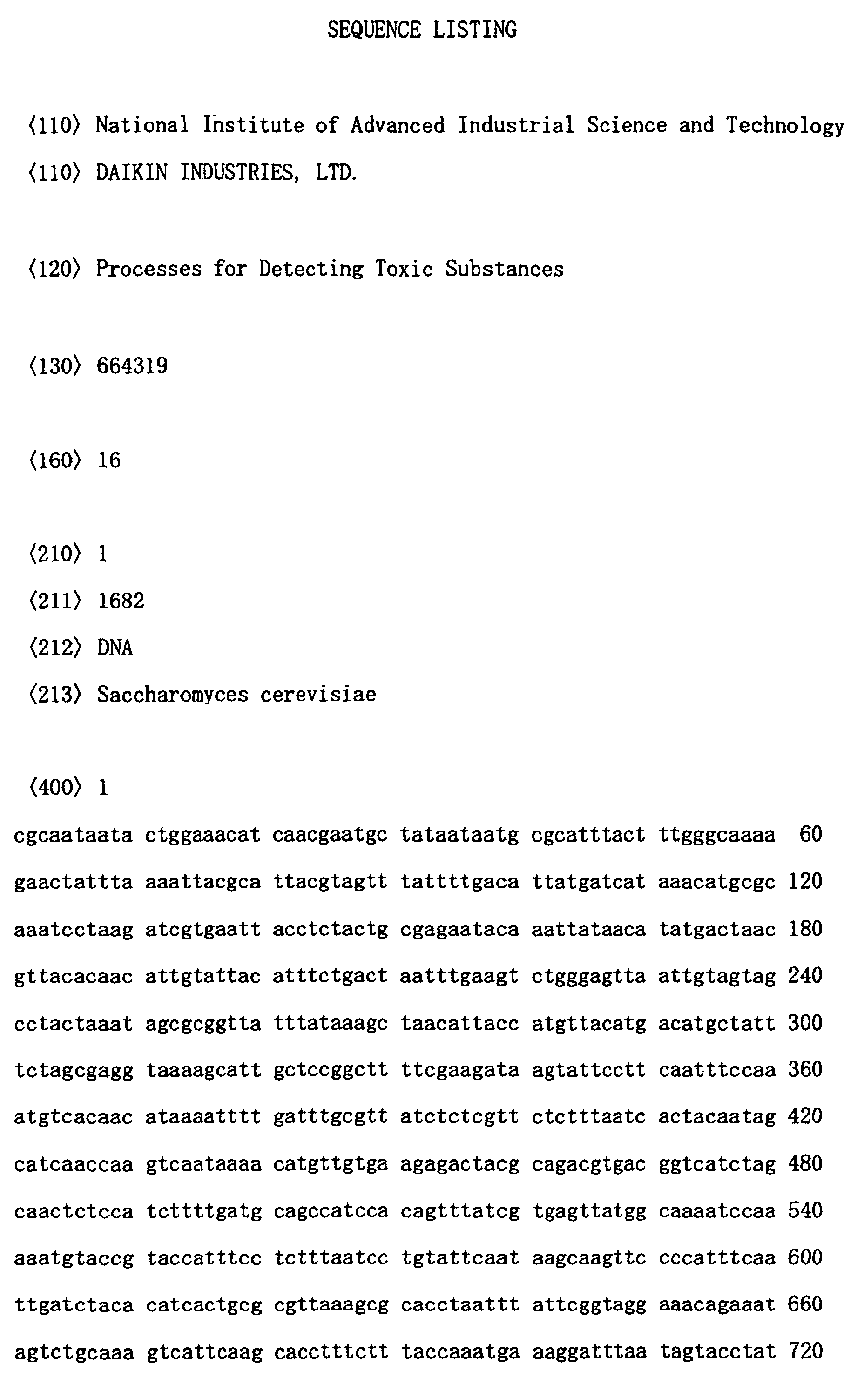
    Type YEp shuttle vector pYES2 (pYES2, Cat no: V825-20, Invirtogen Corporation, USA), which can be replicated both in E.coli. and yeast was used as vector (R. W. Old, S. B. Primrose Principles of Gene Manipulation 5th Ed., BAIFUKAN CO., LTD, pp138-165, pp.234-263, 2000). The portion of vector pQBI 63 (Cat no.54-0082, Wako Pure Chemical Industries, Ltd.) corresponding to a marker protein GFP was used as the polynucleotide encoding GFP (SEQ ID No: 6). First, the GFP polynucleotide was inserted into the multiple cloning sites of pYES2 to give a vector. Thereafter, the GAL1 promoter of pYES2 was replaced with the polynucleotide comprising the promoter sequence of the intended yeast gene YKL071w (SEQ ID No: 1) to give an intended plasmid vector. Suitable restriction enzymes were selected, and the insertion of the polynucleotide comprising GFP and the promoter sequence was conducted.
    Next, the yeast Saccharomyces cerevisiae W303 was transformed with the resultant plasmid vector according to the following procedures:
  • 1) Incubating the yeast Saccharomyces cerevisiae W303 in 200 ml of SD medium under shaking until OD 660 reaches 0.5;
  • 2) Suspending the collected cells in 5ml of TE-buffer;
  • 3) Adding 250 µL of 2.5M lithium acetate;
  • 4) Dispending each 300 µl, adding 10µl of above plasmid vector thereto, then incubating the suspensions at 30 ° C for 30 minutes;
  • 5) Adding 700 µl of 50% PEG4000, and incubating the mixture under shaking at 30 ° C for 60 minutes;
  • 6) Giving heat shock (42°C, 5 minutes), and then immediately cooling the mixture;
  • 7) Washing the mixture twice with 1M sorbitol; and
  • 8) Seeding it on agar plates made of minimum essential medium.
  • The transformations were confirmed on selective medium (SD medium (Yeast nitrogen base without amino acids (Difco 0919-15) + glucose + amino acids (adenine, histidine, tryptophan)). Colonies that were grown on agar plate of selective medium were further checked for auxotrophy for amino acids.
    The transformed yeast cells named SC-YKL071w-pQBI has been deposited as the International Deposition at National Institute of Advanced Industrial Science and Technology, International Patent Organism Depositary of Tsukuba Central 6, 1-1-1 Higashi, Tsukuba, Ibaraki, Japan under Accession No. FERM BP-8161 on August 19, 2002.
    Example 3
    Primers for PCR to amplify the polynucleotide comprising the promoter of yeast gene YCR102c were prepared. Primers were designed using a primer design software, Oligo4.0-S, Sequencher I Mackintosh version. The base sequence of the upper primer was:
    Figure 01100001
    whereas the base sequence of the lower primer was:
    Figure 01100002
    For PCR, yeast chromosome (Saccharomyces cerevisiae S288C, Cat.40802, Research Genetics, Inc.) was used as template, and the commercially available kit (KOD DNA Polymerase; Code KOD-101, Toyobo) was used as reagents.
    Type YEp shuttle vector pYES2 (pYES2, Cat no: V825-20, Invirtogen Corporation, USA), which can be replicated both in E.coli. and yeast was used as vector (R. W. Old, S. B. Primrose Principles of Gene Manipulation 5th Ed., BAIFUKAN CO., LTD, pp138-165, pp.234-263, 2000). The portion of vector pQBI 63 (Cat no.54-0082, Wako Pure Chemical Industries, Ltd.) corresponding to a marker protein GFP was used as the polynucleotide encoding GFP (SEQ ID No: 6). First, the GFP polynucleotide was inserted into the multiple cloning sites of pYES2 to give a vector. Thereafter, the GAL1 promoter of pYES2 was replaced with the polynucleotide comprising the promoter sequence of the intended yeast gene YCR102c (SEQ ID No: 2) to give an intended plasmid vector. Suitable restriction enzymes were selected, and the insertion of the polynucleotide comprising GFP and the promoter sequence was conducted.
    Next, the yeast Saccharomyces cerevisiae W303 was transformed with the resultant plasmid vector according to the following procedures:
  • 1) Incubating the yeast Saccharomyces cerevisiae W303 in 200 ml of SD medium under shaking until OD 660 reaches 0.5;
  • 2) Suspending the collected cells in 5ml of TE-buffer;
  • 3) Adding 250 µL of 2.5M lithium acetate;
  • 4) Dispending each 300 µl, adding 10µl of above plasmid vector thereto, then incubating the suspensions at 30°C for 30 minutes;
  • 5) Adding 700 µl of 50% PEG4000, and incubating the mixture under shaking at 30 °C for 60 minutes;
  • 6) Giving heat shock (42°C, 5 minutes), and then immediately cooling the mixture;
  • 7) Washing the mixture twice with 1M sorbitol; and
  • 8) Seeding it on agar plates made of minimum essential medium.
  • The transformations were confirmed on selective medium (SD medium (Yeast nitrogen base without amino acids (Difco 0919-15) + glucose + amino acids (adenine, histidine, tryptophan)). Colonies that were grown on agar plate of selective medium were further checked for auxotrophy for amino acids.
    The transformed yeast cells named SC-YCR102c-pQBI has been deposited as the International Deposition at National Institute of Advanced Industrial Science and Technology, International Patent Organism Depositary of Tsukuba Central 6, 1-1-1 Higashi, Tsukuba, Ibaraki, Japan under Accession No. FERM BP-8159 on August 19, 2002.
    Example 4
    Primers for PCR to amplify the polynucleotide comprising the promoter of yeast gene YOR382w were prepared. Primers were designed using a primer design software, Oligo4.0-S, Sequencher I Mackintosh version. The base sequence of the upper primer was:
    Figure 01120001
    whereas the base sequence of the lower primer was:
    Figure 01120002
    For PCR, yeast chromosome (Saccharomyces cerevisiae S288C, Cat.40802, Research Genetics, Inc.) was used as template, and the commercially available kit (KOD DNA Polymerase; Code KOD-101, Toyobo) was used as reagents.
    Type YEp shuttle vector pYES2 (pYES2, Cat no: V825-20, Invirtogen Corporation, USA), which can be replicated both in E. coli. and yeast was used as vector (R. W. Old, S. B. Primrose Principles of Gene Manipulation 5th Ed., BAIFUKAN CO., LTD, pp 138-165, pp.234-263, 2000). The portion of vector pQBI 63 (Cat no.54-0082, Wako Pure Chemical Industries, Ltd.) corresponding to a marker protein GFP was used as the polynucleotide encoding GFP (SEQ ID No: 6). First, the GFP polynucleotide was inserted into the multiple cloning sites of pYES2 to give a vector. Thereafter, the GAL1 promoter of pYES2 was replaced with the polynucleotide comprising the promoter sequence of the intended yeast gene YOR382w (SEQ ID No: 3) to give an intended plasmid vector. Suitable restriction enzymes were selected, and the insertion of the polynucleotide comprising GFP and the promoter sequence was conducted.
    Next, the yeast Saccharomyces cerevisiae W303 was transformed with the resultant plasmid vector according to the following procedures:
  • 1) Incubating the yeast Saccharomyces cerevisiae W303 in 200 ml of SD medium under shaking until OD 660 reaches 0.5;
  • 2) Suspending the collected cells in 5ml of TE-buffer;
  • 3) Adding 250 µL of 2.5M lithium acetate;
  • 4) Dispending each 300 µl, adding 10µl of above plasmid vector thereto, then incubating the suspensions at 30°C for 30 minutes;
  • 5) Adding 700 µl of 50% PEG4000, and incubating the mixture under shaking at 30 °C for 60 minutes;
  • 6) Giving heat shock (42°C, 5 minutes), and then immediately cooling the mixture;
  • 7) Washing the mixture twice with 1M sorbitol; and
  • 8) Seeding it on agar plates made of minimum essential medium.
  • The transformations were confirmed on selective medium (SD medium (Yeast nitrogen base without amino acids (Difco 0919-15) + glucose + amino acids (adenine, histidine, tryptophan)). Colonies that were grown on agar plate of selective medium were further checked for auxotrophy for amino acids.
    The transformed yeast cells named SC-YOR382W-pQBI has been deposited as the International Deposition at National Institute of Advanced Industrial Science and Technology, International Patent Organism Depositary of Tsukuba Central 6, 1-1-1 Higashi, Tsukuba, Ibaraki, Japan under Accession No. FERM BP-8160 on August 19, 2002.
    Example 5
    Primers for PCR to amplify the polynucleotide comprising the promoter of yeast gene YLL057c were prepared. Primers were designed using a primer design software, Oligo4.0-S, Sequencher I Mackintosh version. The base sequence of the upper primer was:
    Figure 01140001
    whereas the base sequence of the lower primer was:
    Figure 01140002
    For PCR, yeast chromosome (Saccharomyces cerevisiae S288C, Cat.40802, Research Genetics, Inc.) was used as template, and the commercially available kit (KOD DNA Polymerase; Code KOD-101, Toyobo) was used as reagents.
    Type YEp shuttle vector pYES2 (pYES2, Cat no: V825-20, Invirtogen Corporation, USA), which can be replicated both in E.coli. and yeast was used as vector (R. W. Old, S. B. Primrose Principles of Gene Manipulation 5th Ed., BAIFUKAN CO., LTD, pp 138-165, pp.234-263, 2000). The portion of vector pQBI 63 (Cat no.54-0082, Wako Pure Chemical Industries, Ltd.) corresponding to a marker protein GFP was used as the polynucleotide encoding GFP (SEQ ID No: 6). First, the GFP polynucleotide was inserted into the multiple cloning sites of pYES2 to give a vector. Thereafter, the GAL1 promoter of pYES2 was replaced with the polynucleotide comprising the promoter sequence of the intended yeast gene YLL057c (SEQ ID No: 4) to give an intended plasmid vector. Suitable restriction enzymes were selected, and the insertion of the polynucleotide comprising GFP and the promoter sequence was conducted.
    Next, the yeast Saccharomyces cerevisiae W303 was transformed with the resultant plasmid vector according to the following procedures:
  • 1) Incubating the yeast Saccharomyces cerevisiae W303 in 200 ml of SD medium under shaking until OD 660 reaches 0.5;
  • 2) Suspending the collected cells in 5ml of TE-buffer;
  • 3) Adding 250 µL of 2.5M lithium acetate;
  • 4) Dispending each 300 µl, adding 10µl of above plasmid vector thereto, then incubating the suspensions at 30°C for 30 minutes;
  • 5) Adding 700 µl of 50% PEG4000, and incubating the mixture under shaking at 30 °C for 60 minutes;
  • 6) Giving heat shock (42°C, 5 minutes), and then immediately cooling the mixture;
  • 7) Washing the mixture twice with 1M sorbitol; and
  • 8) Seeding it on agar plates made of minimum essential medium.
  • The transformations were confirmed on selective medium (SD medium (Yeast nitrogen base without amino acids (Difco 0919-15) + glucose + amino acids (adenine, histidine, tryptophan)). Colonies that were grown on agar plate of selective medium were further checked for auxotrophy for amino acids.
    The transformed yeast cells named SC-YLL057C-pQBI was deposited at National Institute of Advanced Industrial Science and Technology, International Patent Organism Depositary of Tsukuba Central 6, 1-1-1 Higashi, Tsukuba, Ibaraki, Japan under Accession No. PERM P-18439 on July 27, 2001, and then transferred into the International Deposition under Budapest Treaty as PERM BP-8158 on August 19, 2002.
    Example 6
    Primers for PCR to amplify the polynucleotide comprising the promoter of yeast gene YLR303w were prepared. Primers were designed using a primer design software, Oligo4.0-S, Sequencher I Mackintosh version. The base sequence of the upper primer was:
    Figure 01160001
    whereas the base sequence of the lower primer was:
    Figure 01160002
    For PCR, yeast chromosome (Saccharomyces cerevisiae S288C, Cat.40802, Research Genetics, Inc.) was used as template, and the commercially available kit (KOD DNA Polymerase; Code KOD-101, Toyobo) was used as reagents.
    Type YEp shuttle vector pYES2 (pYES2, Cat no: V825-20, Invirtogen Corporation, USA), which can be replicated both in E.coli. and yeast was used as vector (R. W. Old, S. B. Primrose Principles of Gene Manipulation 5th Ed., BAIFUKAN CO., LTD, pp138-165, pp.234-263, 2000). The portion of vector pQBI 63 (Cat no.54-0082, Wako Pure Chemical Industries, Ltd.) corresponding to a marker protein GFP was used as the polynucleotide encoding GFP (SEQ ID No: 6). First, the GFP polynucleotide was inserted into the multiple cloning sites of pYES2 to give a vector. Thereafter, the GAL1 promoter of pYES2 was replaced with the polynucleotide comprising the promoter sequence of the intended yeast gene YLR303w (SEQ ID No: 5) to give an intended plasmid vector. Suitable restriction enzymes were selected, and the insertion of the polynucleotide comprising GFP and the promoter sequence was conducted.
    Next, the yeast Saccharomyces cerevisiae W303 was transformed with the resultant plasmid vector according to the following procedures:
  • 1) Incubating the yeast Saccharomyces cerevisiae W303 in 200 ml of SD medium under shaking until OD 660 reaches 0.5;
  • 2) Suspending the collected cells in 5ml of TE-buffer;
  • 3) Adding 250 µL of 2.5M lithium acetate;
  • 4) Dispending each 300 µl, adding 10µl of above plasmid vector thereto, then incubating the suspensions at 30°C for 30 minutes;
  • 5) Adding 700 µl of 50% PEG4000, and incubating the mixture under shaking at 30 ° C for 60 minutes;
  • 6) Giving heat shock (42°C, 5 minutes), and then immediately cooling the mixture;
  • 7) Washing the mixture twice with 1M sorbitol; and
  • 8) Seeding it on agar plates made of minimum essential medium.
  • The transformations were confirmed on selective medium (SD medium (Yeast nitrogen base without amino acids (Difco 0919-15) + glucose + amino acids (adenine, histidine, tryptophan)). Colonies that were grown on agar plate of selective medium were further checked for auxotrophy for amino acids.
    The transformed yeast cells named SC-YLR303W-pQBI was deposited at National Institute of Advanced Industrial Science and Technology, International Patent Organism Depositary of Tsukuba Central 6, 1-1-1 Higashi, Tsukuba, Ibaraki, Japan under Accession No. FERM P-18438 on July 27, 2001, and then transferred into the International Deposition under Budapest Treaty as FERM BP-8157 on August 19, 2002.
    Example 7
    The cells of SC-YKL071W-pQBI as prepared in Example 2 were contacted to one of the following compounds. The yeast cells SC-YKL071W-pQBI were incubated at 25 °C in SD medium (Yeast nitrogen base without amino acids (Difco 0919-15) + glucose + amino acids (adenine, histidine, tryptophan)). One of toxic chemical substances as shown below was added to the cells at logarithmic growth phase, and then the cells were further incubated for two hours. Cells were incubated without any chemical substance in the same condition, and was used as control.
    (1) benzo(a)pyrene, (2) bisphenol-A, (3) (2-ethylhexyl)phthalate, (4) 2,5-dichlorophenol, (5) 2,4-dichlorophenoxyacetic acid, (6) formaldehyde, (7) methylmercury chloride, (8) 4-nitroquinolin-N-oxide, (9) p-nonylphenol, (10) pentachlorophenol, (11) sodium arsenite, (12) Tetramethylthiuram disulfide, (13) tributyltin chloride, (14) 2,4,5-trichlorophenol, (15) Trp-P-2 (acetate), (16) paraquat, (17) cadmium chloride, (18) γ-hexachlorocyclohexane, (19) malathon, (20) manganese ethylenebis(dithiocarbamate), (21) nickel (II) chloride, (22) potassium bichromate, (23) triphenyltin chloride, (24) phenol, (25) S-4-Chlorobenzyl-N,N-diethylthiocarbamate, (26) hexachlorophene, (27) triclosan, (28) mercury(II) chloride, (29) copper sulfate (II), (30) potassium cyanide, and (31) dimethylsulfoxide.
    After contacted, the yeast cells were washed once with physiological saline, and then immobilized with a physiological saline containing 5% formalin, after which the fluorescence was determined by flow cytometry (EPICS XL: BECKMAN COULTER). Fluorometric range of the control was first defined. When the number of the cells having a higher fluorescence than the control was under 1%, "-" was indicated as not showing any fluorescence, whereas when the number was between 1% and 2%, and 2% or more, then "+" and "++" were indicated as showing a fluorescence, respectively. The results are shown in Table 10.
    Chemical substances Concentrations Fluorescens
    (1) benzo(a)pyrene 0.2 mM -
    (2) bisphenol-A 0.4 mM -
    (3) (2-ethylhexyl)phthalate 83.3 mM -
    (4) 2,5-dichlorophenol 0.3 mM -
    (5) 2,4-dichlorophenoxyacetic acid 0.3 mM -
    (6) formaldehyde 0.2 mM -
    (7) methylmercury chloride 0.2 µM -
    (8) 4-nitroquinolin-N-oxide 0.6 µM -
    (9) p-nonylphenol 10 µM -
    (10) pentachlorophenol 50 µM -
    (11) sodium arsenite 0.3 mM -
    (12) Tetramethylthiuram disulfide 20 µM +
    (13) tributyltin chloride 0.4 µM -
    (14) 2,4,5-trichlorophenol 30 mM -
    (15) Trp-P-2 (acetate) 0.2 mM -
    (16) paraquat 16.7 mM -
    (17) cadmium chloride 40 µM -
    (18) γ-hexachlorocyclohexane 6.7 mM -
    (19) malathon 22.2 mM -
    (20) manganese ethylenebis (dithiocarbamate) 0.8 mM -
    (21) nickel (II) chloride 3.3 mM -
    (22) potassium bichromate 0.3 mM -
    (23) triphenyltin chloride 10 µM -
    (24) phenol 5.6 mM -
    (25) S-4-Chlorobenzyl-N,N-diethylthiocarbamate 0.7 mM -
    (26) hexachlorophene 30 µM -
    (27) triclosan 730 µM -
    (28) mercury(II) chloride 50 µM -
    (29) copper sulfate (II) 3.3 mM -
    (30) potassium cyanide 16.7 mM -
    (31) dimethylsulfoxide 3.7 % -
    Table 10 shows that tetramethylthiuram disulfide induced the expression of GFP.
    Example 8
    The cells of SC-YCR102C-pQBI as prepared in Example 3 were contacted to one of the following compounds. The yeast cells SC-YCR102C-pQBI were incubated at 25 °C in SD medium (Yeast nitrogen base without amino acids (Difco 0919-15) + glucose + amino acids (adenine, histidine, tryptophan)). One of toxic chemical substances as shown below was added to the cells at logarithmic growth phase, and then the cells were further incubated for two hours. Cells were incubated without any chemical substance in the same condition, and was used as control.
    (1) benzo(a)pyrene, (2) bisphenol-A, (3) (2-ethylhexyl)phthalate, (4) 2,5-dichlorophenol, (5) 2,4-dichlorophenoxyacetic acid, (6) formaldehyde, (7) methylmercury chloride, (8) 4-nitroquinolin-N-oxide, (9) p-nonylphenol, (10) pentachlorophenol, (11) sodium arsenite, (12) Tetramethylthiuram disulfide, (13) tributyltin chloride, (14) 2,4,5-trichlorophenol, (15) Trp-P-2 (acetate), (16) paraquat, (17) cadmium chloride, (18) γ-hexachlorocyclohexane, (19) malathon, (20) manganese ethylenebis(dithiocarbamate), (21) nickel (II) chloride, (22) potassium bichromate, (23) triphenyltin chloride, (24) phenol, (25) S-4-Chlorobenzyl-N,N-diethylthiocarbamate, (26) hexachlorophene, (27) triclosan, (28) mercury(II) chloride, (29) copper sulfate (II), (30) potassium cyanide, and (31) dimethylsulfoxide.
    After contacted, the yeast cells were washed once with physiological saline, and then immobilized with a physiological saline containing 5% formalin, after which the fluorescence was determined by flow cytometry (EPICS XL: BECKMAN COULTER). Fluorometric range of the control was first defined. When the number of the cells having a higher fluorescence than the control was under 1%, "-" was indicated as not showing any fluorescence, whereas when the number was between 1% and 2%, and 2% or more, then "+" and "++" were indicated as showing a fluorescence, respectively. The results are shown in Table 11.
    Chemical substances Concentrations Fluorescence
    (1) benzo(a)pyrene 0.2 mM -
    (2) bisphenol-A 0.4 mM -
    (3) (2-ethylhexyl)phthalate 83.3 mM -
    (4) 2,5-dichlorophenol 0.3 mM -
    (5) 2,4-dichlorophenoxyacetic acid 0.3 mM -
    (6) formaldehyde 0.2 mM -
    (7) methylmercury chloride 0.2 µM -
    (8) 4-nitroquinolin-N-oxide 0.6 µM -
    (9) p-nonylphenol 10 µM -
    (10) pentachlorophenol 50 µM -
    (11) sodium arsenite 0.3 mM -
    (12) Tetramethylthiuram disulfide 20 µM +
    (13) tributyltin chloride 0.4 µM -
    (14) 2,4,5-trichlorophenol 30 mM -
    (15) Trp-P-2 (acetate) 0.2 mM -
    (16) paraquat 16.7 mM -
    (17) cadmium chloride 40 µM -
    (18) γ-hexachlorocyclohexane 6.7 mM -
    (19) malathon 22.2 mM -
    (20) manganese ethylenebis (dithiocarbamate) 0.8 mM -
    (21) nickel (II) chloride 3.3 mM -
    (22) potassium bichromate 0.3 mM -
    (23) triphenyltin chloride 10 µM -
    (24) phenol 5.6 mM -
    (25) S-4-Chlorobenzyl-N,N-diethylthiocarbamate 0.7 mM -
    (26) hexachlorophene 30 µM -
    (27) triclosan 730 µM -
    (28) mercury(II) chloride 50 µM -
    (29) copper sulfate (II) 3.3 mM -
    (30) potassium cyanide 16.7 mM -
    (31) dimethylsulfoxide 3.7 % -
    Table 11 shows that tetramethylthiuram disulfide induced the expression of GFP.
    Example 9
    The cells of SC-YOR382W-pQBI as prepared in Example 4 were contacted to one of the following compounds. The yeast cells SC-YOR382W-pQBI were incubated at 25 ° C in SD medium (Yeast nitrogen base without amino acids (Difco 0919-15) + glucose + amino acids (adenine, histidine, tryptophan)). One of toxic chemical substances as shown below was added to the cells at logarithmic growth phase, and then the cells were further incubated for two hours. Cells were incubated without any chemical substance in the same condition, and was used as control.
    (1) benzo(a)pyrene, (2) bisphenol-A, (3) (2-ethylhexyl)phthalate, (4) 2,5-dichlorophenol, (5) 2,4-dichlorophenoxyacetic acid, (6) formaldehyde, (7) methylmercury chloride, (8) 4-nitroquinolin-N-oxide, (9) p-nonylphenol, (10) pentachlorophenol, (11) sodium arsenite, (12) Tetramethylthiuram disulfide, (13) tributyltin chloride, ( 14) 2,4,5-trichlorophenol, (15) Trp-P-2 (acetate), (16) paraquat, (17) cadmium chloride , (18) γ-hexachlorocyclohexane, (19) malathon, (20) manganese ethylenebis(dithiocarbamate), (21) nickel (II) chloride, (22) potassium bichromate, (23) triphenyltin chloride, (24) phenol, (25) S-4-Chlorobenzyl-N,N-diethylthiocarbamate, (26) hexachlorophene, (27) triclosan, (28) mercury(II) chloride, (29) copper sulfate (II), (30) potassium cyanide, and (31) dimethylsulfoxide.
    After contacted, the yeast cells were washed once with physiological saline, and then immobilized with a physiological saline containing 5% formalin, after which the fluorescence was determined by flow cytometry (EPICS XL: BECKMAN COULTER). Fluorometric range of the control was first defined. When the number of the cells having a higher fluorescence than the control was under 1%, "-" was indicated as not showing any fluorescence, whereas when the number was between 1% and 2%, and 2% or more, then "+" and "++" were indicated as showing a fluorescence, respectively. The results are shown in Table 12.
    Chemical sbstances Concentrations Fluorescence
    (1) benzo(a)pyrene 0.2 mM -
    (2) bisphenol-A 0.4 mM -
    (3) (2-ethylhexyl)phthalate 83.3 mM -
    (4) 2,5-dichlorophenol 0.3 mM ++
    (5) 2,4-dichlorophenoxyacetic acid 0.3 mM -
    (6) formaldehyde 0.2 mM -
    (7) methylmercury chloride 0.2 µM -
    (8) 4-nitroquinolin-N-oxide 0.6 µM ++
    (9) p-nonylphenol 10 µM ++
    (10) pentachlorophenol 50 µM -
    (11) sodium arsenite 0.3 mM -
    (12) Tetramethylthiuram disulfide 20 µM -
    (13) tributyltin chloride 0.4 µM -
    (14) 2,4,5-trichlorophenol 30 mM ++
    (15) Trp-P-2 (acetate) 0.2 mM ++
    (16) paraquat 16.7 mM -
    ( 17) cadmium chloride 40 µM -
    (18) γ-hexachlorocyclohexane 6.7 mM -
    (19) malathon 22.2 mM ++
    (20) manganese ethylenebis (dithiocarbamate) 0.8 mM ++
    (21) nickel (II) chloride 3.3 mM ++
    (22) potassium bichromate 0.3 mM ++
    (23) triphenyltin chloride 10 µM -
    (24) phenol 5.6 mM ++
    (25) S-4-Chlorobenzyl-N,N-diethylthiocarbamate 0.7 mM -
    (26) hexachlorophene 30 µM -
    (27) triclosan 730 µM -
    (28) mercury(II) chloride 50 µM -
    (29) copper sulfate (II) 3.3 mM -
    (30) potassium cyanide 16.7 mM -
    (31) dimethylsulfoxide 3.7 % ++
    Table 12 shows that 2,4-dichlorophenoxyacetic acid, 4-nitroquinolin-N-oxide, p-nonylphenol, 2,4,5-trichlorophenol, Trp-P-2 (acetate) , malathon, manganese ethylenebis(dithiocarbamate), nickel (II) chloride, potassium bichromate, phenol, and dimethylsulfoxide induced the expression of GFP.
    Example 10
    The cells of SC-YLL057C-pQBI as prepared in Example 5 were contacted to one of the following compounds. The yeast cells SC-YLL057C-pQBI were incubated at 25 °C in SD medium (Yeast nitrogen base without amino acids (Difco 0919-15) + glucose + amino acids (adenine, histidine, tryptophan)). One of toxic chemical substances as shown below was added to the cells at logarithmic growth phase, and then the cells were further incubated for two hours. Cells were incubated without any chemical substance in the same condition, and was used as control.
    (1) benzo(a)pyrene, (2) bisphenol-A, (3) (2-ethylhexyl)phthalate, (4) 2,5-dichlorophenol, (5) 2,4-dichlorophenoxyacetic acid, (6) formaldehyde, (7) methylmercury chloride, (8) 4-nitroquinolin-N-oxide, (9) p-nonylphenol, (10) pentachlorophenol, (11) sodium arsenite, (12) Tetramethylthiuram disulfide, (13) tributyltin chloride, (14) 2,4,5-trichlorophenol, (15) Trp-P-2 (acetate), (16) paraquat, (17) cadmium chloride, (18) γ-hexachlorocyclohexane, (19) malathon, (20) manganese ethylenebis(dithiocarbamate), (21) nickel (II) chloride, (22) potassium bichromate, (23) triphenyltin chloride, (24) phenol, (25) S-4-Chlorobenzyl-N,N-diethylthiocarbamate, (26) hexachlorophene, (27) triclosan, (28) mercury(II) chloride, (29) copper sulfate (II), (30) potassium cyanide, and (31) dimethylsulfoxide.
    After contacted, the yeast cells were washed once with physiological saline, and then immobilized with a physiological saline containing 5% formalin, after which the fluorescence was determined by flow cytometry (EPICS XL: BECKMAN COULTER). Fluorometric range of the control was first defined. When the number of the cells having a higher fluorescence than the control was under 1%, "-" was indicated as not showing any fluorescence, whereas when the number was between 1% and 2%, and 2% or more, then "+" and "++" were indicated as showing a fluorescence, respectively. The results are shown in Table 13.
    Chemical substances Concentrations Fluorescence
    (1) benzo(a)pyrene 0.2 mM -
    (2) bisphenol-A 0.4 mM -
    (3) (2-ethylhexyl)phthalate 83.3 mM -
    (4) 2,5-dichlorophenol 0.3 mM -
    (5) 2,4-dichlorophenoxyacetic acid 0.3 mM ++
    (6) formaldehyde 0.2 mM -
    (7) methylmercury chloride 0.2 µM -
    (8) 4-nitroquinolin-N-oxide 0.6 µM -
    (9) p-nonylphenol 10 µM -
    (10) pentachlorophenol 50 µM -
    (11) sodium arsenite 0.3 mM ++
    (12) Tetramethylthiuram disulfide 20 µM -
    (13) tributyltin chloride 0.4 µM -
    (14) 2,4,5-trichlorophenol 30 mM -
    (15) Trp-P-2 (acetate) 0.2 mM -
    (16) paraquat 16.7 mM -
    (17) cadmium chloride 40 µM ++
    (18) γ-hexachlorocyclohexane 6.7 mM -
    (19) malathon 22.2 mM -
    (20) manganese ethylenebis (dithiocarbamate) 0.8 mM -
    (21) nickel (II) chloride 3.3 mM -
    (22) potassium bichromate 0.3 mM -
    (23) triphenyltin chloride 10 µM -
    (24) phenol 5.6 mM -
    (25) S-4-Chlorobenzyl-N,N-diethylthiocarbamate 0.7 mM -
    (26) hexachlorophene 30 µM -
    (27) triclosan 730 µM -
    (28) mercury(II) chloride 50 µM -
    (29) copper sulfate (II) 3.3 mM -
    (30) potassium cyanide 16.7 mM ++
    (31) dimethylsulfoxide 3.7 % -
    Table 13 shows that 2,4-dichlorophenoxyacetic acid, sodium arsenite, cadmium chloride, and potassium cyanide induced the expression of GFP.
    Example 11
    The cells of SC-YCR303W-pQBI as prepared in Example 6 were contacted to one of the following compounds. The yeast cells SC-YCR303W-pQBI were incubated at 25 °C in SD medium (Yeast nitrogen base without amino acids (Difco 0919-15) + glucose + amino acids (adenine, histidine, tryptophan)). One of toxic chemical substances as shown below was added to the cells at logarithmic growth phase, and then the cells were further incubated for two hours. Cells were incubated without any chemical substance in the same condition, and was used as control.
    (1) benzo(a)pyrene, (2) bisphenol-A, (3) (2-ethylhexyl)phthalate, (4) 2,5-dichlorophenol, (5) 2,4-dichlorophenoxyacetic acid, (6) formaldehyde, (7) methylmercury chloride, (8) 4-nitroquinolin-N-oxide, (9) p-nonylphenol, (10) pentachlorophenol, (11) sodium arsenite, (12) Tetramethylthiuram disulfide, (13) tributyltin chloride, (14) 2,4,5-trichlorophenol, (15) Trp-P-2 (acetate), (16) paraquat, (17) cadmium chloride, (18) γ-hexachlorocyclohexane, (19) malathon, (20) manganese ethylenebis(dithiocarbamate), (21) nickel (II) chloride, (22) potassium bichromate, (23) triphenyltin chloride, (24) phenol, (25) S-4-Chlorobenzyl-N,N-diethylthiocarbamate, (26) hexachlorophene, (27) triclosan, (28) mercury(II) chloride, (29) copper sulfate (II), (30) potassium cyanide, and (31) dimethylsulfoxide.
    After contacted, the yeast cells were washed once with physiological saline, and then immobilized with a physiological saline containing 5% formalin, after which the fluorescence was determined by flow cytometry (EPICS XL: BECKMAN COULTER). Fluorometric range of the control was first defined. When the number of the cells having a higher fluorescence than the control was under 1%, "-" was indicated as not showing any fluorescence, whereas when the number was between 1% and 2%, and 2% or more, then "+" and "++" were indicated as showing a fluorescence, respectively. The results are shown in Table 14.
    Chemical substances Concentrations Fluorescence
    (1) benzo(a)pyrene 0.2 mM ++
    (2) bisphenol-A 0.4 mM -
    (3) (2-ethylhexyl)phthalate 83.3 mM -
    (4) 2,5-dichlorophenol 0.3 mM -
    (5) 2,4-dichlorophenoxyacetic acid 0.3 mM ++
    (6) formaldehyde 0.2 mM ++
    (7) methylmercury chloride 0.2 µM -
    (8) 4-nitroquinolin-N-oxide 0.6 µM -
    (9) p-nonylphenol 10 µM -
    (10) pentachlorophenol 50 µM -
    (11) sodium arsenite 0.3 mM ++
    (12) Tetramethylthiuram disulfide 20 µM -
    (13) tributyltin chloride 0.4 µM -
    (14) 2,4,5-trichlorophenol 30 mM -
    (15) Trp-P-2 (acetate) 0.2 mM -
    (16) paraquat 16.7 mM -
    (17) cadmium chloride 40 µM ++
    (18) γ-hexachlorocyclohexane 6.7 mM -
    (19) malathon 22.2 mM -
    (20) manganese ethylenebis (dithiocarbamate) 0.8 mM +
    (21) nickel (II) chloride 3.3 mM -
    (22) potassium bichromate 0.3 mM -
    (23) triphenyltin chloride 10 µM -
    (24) phenol 5.6 mM -
    (25) S-4-Chlorobenzyl-N,N-diethylthiocarbamate 0.7 mM -
    (26) hexachlorophene 30 µM -
    (27) triclosan 730 µM -
    (28) mercury(II) chloride 50 µM ++
    (29) copper sulfate (II) 3.3 mM -
    (30) potassium cyanide 16.7 mM ++
    (31) dimethylsulfoxide 3.7 % -
    Table 14 shows that benzo(a)pyrene, 2,4-dichlorophenoxyacetic acid, formaldehyde, sodium arsenite, cadmium chloride, manganese ethylenebis(dithiocarbamate), mercury(II) chloride, and potassium cyanide induced the expression of GFP.
    Figure 01320001
    Figure 01330001
    Figure 01340001
    Figure 01350001
    Figure 01360001
    Figure 01370001
    Figure 01380001
    Figure 01390001
    Figure 01400001

    Claims (22)

    1. A polynucleotide which comprises a polynucleotide sequence operably linked to a polynucleotide encoding a marker protein, wherein the polynucleotide sequence comprises a promoter from yeast genes that is selected from a group consisting of the following, or a promoter from a gene that is homologous to the yeast genes and is derived from other species:
      YBR072W, YCR102C, YCR107W, YDL218W, YDL243C, YDR453C, YDR533C, YFL014W, YFL056C, YFL057C, YGR110W, YJR155W, YKL071W, YKR076W, YLL060C, YLR460C, YMR090W, YNL331C, YNL332W, YNL335W, YOL150C, YOL165C, YPL171C, YPR167C, YBL048W, YBL064C, YBL107C, YBR008C, YBR173C, YBR256C, YBR296C, YDL021W, YFL022C, YFL024C, YFL061W, YGL121C, YGL158W, YGR043C, YHR029C, YHR112C, YHR139C, YHR179W, YHR209W, YIR030C, YJR010W, YJR048W, YKL001C, YKL107W, YKR075C, YKR097W, YLL056C, YLR297W, YLR303W, YML087C, YMR096W, YNL274C, YOL151W, YOR226C, YOR338W, YOR391C, YPL280W, YDR406W, YJL153C, YLR346C, YOR049C, YOR153W, YPL088W, YAL034C, YDL124W, YDL174C, YDR476C, YGL156W, YGR035C, YGR157W, YGR213C, YGR281W, YGR284C, YHL047C, YHR043C, YHR044C, YHR054C, YJR073C, YKL165C, YLR008C, YMR315W, YNL211C, YOL031C, YOL101C, YOR303W, YAL005C, YAR031W, YBL005W-A, YBL022C, YBL041W, YBL049W, YBL075C, YBL078C, YBR062C, YBR169C, YBR294W, YCL020W, YCL035C, YCL043C, YCL050C, YCL057W, YCR012W, YCR013C, YCR060W, YDL007W, YDL027C, YDL097C, YDL110C, YDL126C, YDL169C, YDR070C, YDR155C, YDR158W, YDR204W, YDR210W, YDR214W, YDR258C, YDR313C, YDR368W, YDR435C, YER012W, YER037W, YER091C, YER103W, YFL044C, YFR003C, YFR010W, YFR020W, YFR024C, YFR044C, YFR053C, YGL006W, YGL048C, YGL062W, YGL141W, YGL157W, YGL163C, YGL180W, YGL184C, YGR010W, YGR028W, YGR032W, YGR048W, YGR124W, YGR135W, YGR142W, YGR161C, YGR192C, YGR197C, YGR201C, YGR212W, YGR231C, YGR244C, YGR254W, YGR268C, YHL030W, YHR016C, YHR018C, YHR055C, YHR087W, YHR166C, YIL160C, YIR017C, YJL034W, YJL048C, YJL052W, YJL144W, YJL163C, YJR009C, YJR069C, YJR074W, YJR130C, YJR149W, YKL065C, YKL073W, YKL103C, YKL142W, YKL210W, YKL218C, YKR011C, YKR018C, YKR046C, YKR049C, YLL024C, YLL026W, YLR027C, YLR080W, YLR107W, YLR121C, YLR132C, YLR133W, YLR155C, YLR158C, YLR161W, YLR195C, YLR217W, YLR328W, YLR336C, YLR345W, YLR370C, YLR423C, YML004C, YML092C, YML128C, YML130C, YML131W, YMR040W, YMR118C, YMR214W, YMR251W, YMR297W, YMR322C, YNL036W, YNL055C, YNL071W, YNL094W, YNL134C, YNL155W, YNL160W, YNL239W, YNL241C, YOL005C, YOR020C, YOR027W, YOR037W, YOR059C, YOR120W, YOR134W, YOR152C, YOR173W, YOR289W, YOR362C, YPL240C, YPR030W, YAL008W, YAL023C, YAL060W, YAL062W, YAR009C, YBL101C, YBR006W, YBR046C, YBR052C, YBR053C, YBR056W, YBR099C, YBR137W, YBR139W, YBR149W, YBR170C, YBR177C, YBR203W, YBR207W, YBR212W, YBR239C, YBR284W, YBR293W, YCL018W, YCL033C, YCL040W, YCL049C, YCR062W, YCR067C, YCR082W, YDL010W, YDL020C, YDL024C, YDL054C, YDL095W, YDL100C, YDL115C, YDL144C, YDL198C, YDL223C, YDL245C, YDL246C, YDR001C, YDR032C, YDR058C, YDR072C, YDR127W, YDR168W, YDR169C, YDR188W, YDR231C, YDR261C, YDR264C, YDR272W, YDR293C, YDR304C, YDR330W, YDR403W, YDR411C, YDR427W, YDR436W, YDR497C, YDR511W, YDR516C, YDR519W, YDR545W, YEL012W, YEL030W, YER004W, YER009W, YER021W, YER035W, YER053C, YER079W, YER094C, YER096W, YER125W, YER158C, YER163C, YER175C, YER177W, YER178W, YER185W, YFL006W, YFL010C, YFL016C, YFL029C, YFL030W, YFL031W, YFL032W, YFL038C, YFL041W, YFR004W, YFR047C, YFR050C, YFR052W, YGL011C, YGL013C, YGL037C, YGL047W, YGL053W, YGL091C, YGL094C, YGL127C, YGL150C, YGL199C, YGL207W, YGL248W, YGR008C, YGR037C, YGR055W, YGR101W, YGR130C, YGR154C, YGR194C, YGR221C, YGR232W, YGR248W, YGR253C, YGR256W, YHL008C, YHR027C, YHR053C, YHR057C, YHR111W, YHR138C, YHR161C, YHR164C, YHR169W, YHR174W, YHR176W, YHR199C, YIL010W, YIL034C, YIL041W, YIL045W, YIL087C, YIL107C, YIL142W, YIL155C, YIR034C, YIR036C, YIR037W, YIR038C, YIR039C, YJL001W, YJL031C, YJL035C, YJL053W, YJL057C, YJL066C, YJL068C, YJL082W, YJL099W, YJL102W, YJL151C, YJL152W, YJL161W, YJL164C, YJL171C, YJL172W, YJL210W, YJL219W, YJR008W, YJR045C, YJR046W, YJR106W, YJR117W, YJR137C, YKL007W, YKL026C, YKL035W, YKL091C, YKL104C, YKL117W, YKL145W, YKL146W, YKL151C, YKL152C, YKL153W, YKL193C, YKL195W, YKL213C, YKL215C, YLL028W, YLL039C, YLL058W, YLR054C, YLR103C, YLR120C, YLR136C, YLR149C, YLR152C, YLR178C, YLR259C, YLR299W, YLR324W, YLR327C, YLR348C, YLR350W, YLR356W, YLR362W, YLR387C, YLR429W, YML054C, YML070W, YML100W, YML117W, YML125C, YMR004W, YMR008C, YMR009W, YMR020W, YMR067C, YMR089C, YMR097C, YMR102C, YMR105C, YMR107W, YMR152W, YMR180C, YMR184W, YMR191W, YMR219W, YMR271C, YMR275C, YMR295C, YMR314W, YMR316W, YNL006W, YNL007C, YNL012W, YNL044W, YNL045W, YNL074C, YNL092W, YNL093W, YNL104C, YNL115C, YNL156C, YNL231C, YNL234W, YNL237W, YNL281W, YNL305C, YNL333W, YNR010W, YNR019W, YNR033W, YNR059W, YNR068C, YNR069C, YOL032W, YOL036W, YOL047C, YOL071W, YOL082W, YOL083W, YOL117W, YOL119C, YOL126C, YOL131W, YOL153C, YOL162W, YOL163W, YOL164W, YOR019W, YOR035C, YOR036W, YOR099W, YOR117W, YOR124C, YOR130C, YOR132W, YOR157C, YOR185C, YOR197W, YOR259C, YOR261C, YOR273C, YOR288C, YOR332W, YOR336W, YOR347C, YPL017C, YPL087W, YPL106C, YPL109C, YPL149W, YPL154C, YPL196W, YPL206C, YPL222W, YPR023C, YPR024W, YPR026W, YPR067W, YPR103W, YPR108W, YPR151C, YAL012W, YBR029C, YBR222C, YCL009C, YCL027W, YCL064C, YCR098C, YDL222C, YDR055W, YDR077W, YDR502C, YEL001C, YEL042W, YER026C, YER106W, YGR136W, YGR138C, YHR137W, YHR142W, YIL023C, YIL153W, YJL073W, YJR004C, YJR054W, YKL039W, YKL086W, YKL163W, YKR091W, YLR109W, YLR194C, YLR250W, YMR095C, YMR189W, YNL106C, YNL169C, YNL322C, YOR181W, YOR198C, YOR208W, YOR247W, YPL089C, YAL038W, YAL053W, YBR023C, YBR214W, YBR295W, YCR048W, YDL072C, YDL204W, YDR085C, YDR098C, YDR259C, YDR380W, YDR388W, YDR391C, YDR432W, YDR481C, YDR510W, YER069W, YGL022W, YGL126W, YGL209W, YGL255W, YGR189C, YGR282C, YHL035C, YHR030C, YIL022W, YIL024C, YIL117C, YIL123W, YIL140W, YIL154C, YJL088W, YJL108C, YJL149W, YJL159W, YJL186W, YJR148W, YKL096W, YLR180W, YLR273C, YLR300W, YLR307W, YLR378C, YLR391W, YMR094W, YMR104C, YMR276W, YMR296C, YNL190W, YNL208W, YNL300W, YNR064C, YOL013C, YOL058W, YOR248W, YOR355W, YPL052W, YPL163C, YPR079W, YAR028W, YBR146W, YBR183W, YCL038C, YCR071C, YDL008W, YDR019C, YDR031W, YDR115W, YDR486C, YER038C, YER130C, YFL054C, YGL136C, YGR146C, YGR207C, YHL040C, YIL167W, YJL020C, YKR039W, YLR031W, YLR205C, YMR072W, YMR140W, YMR173W, YMR195W, YMR226C, YNL037C, YNR002C, YOL143C, YOR136W, YOR215C, YOR382W, YOR383C, YPL054W, YPL271W, YPR127W, YAL044C, YAL054C, YAR010C, YAR027W, YAR071W, YBL001C, YBL043W, YBL057C, YBR014C, YBR024W, YBR035C, YBR068C, YBR111C, YBR116C, YBR147W, YBR168W, YBR246W, YBR273C, YCR004C, YCR021C, YCR037C, YCR088W, YDL022W, YDL128W, YDL238C, YDR003W, YDR009W, YDR033W, YDR084C, YDR104C, YDR270W, YDR315C, YDR340W, YDR357C, YDR358W, YDR396W, YDR405W, YDR410C, YDR434W, YDR482C, YDR487C, YDR520C, YDR534C, YDR539W, YEL011W, YEL065W, YEL066W, YER039C, YER044C, YER067W, YER080W, YER107C, YFL020C, YFL028C, YFL043C, YFR015C, YGL001C, YGL008C, YGL068W, YGL073W, YGL104C, YGL113W, YGL154C, YGL167C, YGL229C, YGL242C, YGL249W, YGL253W, YGR052W, YGR060W, YGR065C, YGR106C, YGR111W, YGR220C, YGR257C, YHL023C, YHL048W, YHR004C, YHR037W, YHR071W, YHR092C, YHR190W, YIL007C, YIL033C, YIL070C, YIL088C, YIL111W, YIR002C, YIR016W, YIR035C, YIR043C, YJL012C, YJL083W, YJL089W, YJL116C, YJL131C, YJL132W, YJL196C, YJR061W, YJR086W, YJR142W, YJR161C, YKL008C, YKL013C, YKL041W, YKL067W, YKL138C, YKL139W, YKL150W, YKL175W, YKR006C, YKR014C, YKR070W, YLL023C, YLR023C, YLR093C, YLR118C, YLR142W, YLR225C, YLR241W, YLR251W, YLR252W, YLR270W, YML030W, YML110C, YMR021C, YMR027W, YMR148W, YMR181C, YMR262W, YMR272C, YMR298W, YNL011C, YNL130C, YNL214W, YNL259C, YOL129W, YOR042W, YOR052C, YOR137C, YOR149C, YOR165W, YOR270C, YOR285W, YOR367W, YPL018W, YPL156C, YPL186C, YPL203W, YPL216W, YPL255W, YPR006C, YPR073C, YPR098C, YBR050C, YBR145W, YBR299W, YDR518W, YEL020C, YFL062W, YGL039W, YGL134W, YJL217W, YJR159W, YLR126C, YNL249C, YNL284C, YNL336W, YOL157C, YOR344C, YOR381W, YPL265W, YPR124W, YBR074W, YBR109C, YBR126C, YBR201W, YCR005C, YDL248W, YDR041W, YDR105C, YDR268W, YDR452W, YEL075C, YER046W, YER050C, YER136W, YER159C, YGL250W, YGR019W, YGR042W, YGR053C, YGR066C, YGR247W, YGR255C, YGR295C, YHL044W, YHR145C, YIL058W, YIL065C, YIL083C, YIL098C, YIL172C, YJL030W, YJL185C, YJL213W, YJR029W, YJR099W, YJR122W, YJR125C, YKL190W, YKR020W, YLL025W, YLL051C, YLR043C, YLR090W, YLR100W, YLR108C, YLR290C, YML068W, YMR051C, YMR139W, YMR178W, YMR193W, YNL015W, YNL079C, YNL122C, YNL223W, YNL285W, YNL293W, YNR007C, YNR035C, YNR061C, YOL016C, YOL104C, YOR220W, YOR221C, YOR374W, YPL123C, YPR077C, YPR107C, YPR147C, YBR093C, YBR196C, YEL041W, YEL047C, YER023W, YER119C, YFL055W, YGR209C, YIL124W, YKL187C, YLL055W, YMR318C, YOL152W, YAL007C, YBR067C, YBR115C, YBR285W, YBR292C, YDL043C, YDL123W, YDL131W, YDL168W, YDL212W, YDR056C, YDR132C, YDR154C, YDR183W, YDR216W, YDR253C, YDR295C, YDR494W, YDR513W, YEL072W, YER045C, YER061C, YER181C, YFL052W, YFL058W, YFR030W, YGL089C, YGL096W, YGL114W, YGL193C, YGL202W, YGL204C, YGL259W, YGR006W, YGR070W, YGR088W, YHL034C, YHL036W, YHR048W, YHR104W, YHR163W, YIL060W, YIL136W, YIR024C, YJL036W, YJL045W, YJL060W, YJL101C, YJL155C, YJR085C, YJR109C, YJR156C, YKL070W, YKL161C, YKL221W, YKR071C, YLL009C, YLL050C, YLR092W, YLR145W, YLR156W, YLR163C, YLR220W, YLR280C, YLR311C, YLR390W, YML116W, YMR034C, YMR038C, YMR081C, YMR250W, YNL240C, YNL260C, YNL277W, YNR074C, YOL044W, YOL084W, YOL147C, YOL159C, YOR184W, YOR228C, YOR255W, YPL223C, YPR160W, YDL182W, YBR047W, YBR054W, YBR291C, YDR069C, YER124C, YER131W, YGR044C, YIL094C, YKR007W, YMR240C, YNR050C, YOR007C, YAL015C, YBL065W, YBR105C, YBR182C, YBR186W, YBR244W, YBR272C, YCL069W, YDL025C, YDL059C, YDL085W, YDL113C, YDL244W, YDR018C, YDR054C, YDR202C, YDR223W, YDR350C, YDR353W, YDR374C, YDR512C, YEL052W, YEL070W, YER098W, YFR017C, YGL046W, YGL067W, YGL098W, YGL117W, YGL146C, YGL240W, YGR011W, YGR067C, YGR133W, YGR153W, YGR223C, YHR116W, YHR124W, YIL097W, YIL168W, YJL103C, YJL221C, YJR036C, YJR095W, YKL085W, YKL133C, YKL162C, YKL188C, YKL217W, YKR061W, YKR105C, YLL062C, YLR174W, YLR216C, YLR247C, YLR260W, YLR267W, YLR389C, YML007W, YMR041C, YMR177W, YMR253C, YNL009W, YNL117W, YNL128W, YNL183C, YNR073C, YOL133W, YOL158C, YOR133W, YOR225W, YOR227W, YPL161C, YPL166W, YPL202C, YPL224C, YPR015C, YPR086W, YPR201W, YAL061W, YAL067C, YAR007C, YBL033C, YBL056W, YBL086C, YBR026C, YBR073W, YBR101C, YBR117C, YBR123C, YBR213W, YBR269C, YBR280C, YCR036W, YDL132W, YDL149W, YDL200C, YDL234C, YDL242W, YDR099W, YDR177W, YDR256C, YDR392W, YDR394W, YDR531W, YEL071W, YER014W, YER042W, YER090W, YER184C, YFL059W, YFR042W, YFR046C, YFR049W, YGL026C, YGL058W, YGL185C, YGL227W, YGL252C, YGL254W, YGR089W, YGR112W, YGR134W, YGR276C, YHL019C, YHR012W, YHR017W, YHR028C, YHR106W, YHR109W, YHR156C, YIL036W, YIL046W, YIL143C, YIL152W, YIL159W, YIL164C, YJL071W, YJL094C, YJL154C, YJR056C, YJR072C, YJR110W, YJR139C, YKL025C, YKL034W, YKL064W, YKL171W, YKL196C, YKR012C, YKR068C, YKR069W, YLL001W, YLL057C, YLL061W, YLR064W, YLR070C, YLR099C, YLR144C, YLR157C, YLR160C, YLR164W, YLR364W, YLR421C, YML032C, YML042W, YML112W, YML118W, YMR114C, YMR115W, YMR258C, YNL181W, YNL191W, YNL212W, YNL213C, YNL250W, YNL265C, YNL312W, YNR032W, YOL038W, YOL049W, YOL064C, YOR088W, YOR155C, YOR257W, YOR265W, YOR377W, YOR386W, YPL031C, YPL113C, YPL124W, YPL151C, YPL249C, YPL260W, YPL274W, YPR048W, YPR061C, YPR093C, YPR125W, YPR158W, YPR168W, YPR169W, YPR174C, YPR180W, YPR193C, YPR200C, YAL014C, YAL017W, YAL049C, YBL019W, YBL058W, YBR001C, YBR013C, YBR018C, YBR037C, YBR045C, YBR051W, YBR063C, YBR128C, YBR129C, YBR204C, YBR241C, YBR255W, YBR281C, YCL044C, YCL055W, YCR014C, YCR019W, YCR024C, YCR105W, YDL065C, YDL089W, YDL143W, YDL173W, YDL193W, YDL197C, YDL206W, YDL230W, YDL233W, YDR040C, YDR071C, YDR078C, YDR109C, YDR140W, YDR194C, YDR212W, YDR221W, YDR257C, YDR271C, YDR287W, YDR294C, YDR316W, YDR329C, YDR338C, YDR369C, YDR421W, YDR425W, YDR485C, YDR488C, YDR504C, YDR505C, YDR506C, YDR515W, YEL005C, YEL037C, YEL044W, YER017C, YER048C, YER052C, YER078C, YER089C, YER092W, YER100W, YER162C, YER182W, YFL021W, YFL042C, YFR045W, YFR051C, YFR056C, YGL040C, YGL041C, YGL045W, YGL057C, YGL093W, YGL105W, YGL125W, YGL166W, YGL181W, YGL183C, YGL215W, YGL216W, YGL221C, YGL223C, YGR007W, YGR029W, YGR155W, YGR156W, YGR186W, YGR198W, YGR210C, YGR211W, YGR237C, YGR250C, YGR258C, YGR266W, YGR270W, YGR274C, YGR277C, YHL021C, YHL037C, YHL038C, YHR082C, YHR083W, YHR134W, YHR160C, YHR171W, YHR180W, YHR205W, YIL062C, YIL072W, YIL075C, YIL099W, YIL108W, YIL165C, YIL170W, YIR009W, YIR018W, YIR031C, YIR032C, YJL032W, YJL049W, YJL128C, YJL165C, YJR044C, YJR052W, YJR090C, YJR091C, YJR103W, YJR104C, YJR153W, YKL059C, YKL079W, YKL090W, YKL094W, YKL192C, YKL209C, YKR052C, YKR102W, YKR106W, YLL054C, YLR025W, YLR097C, YLR200W, YLR226W, YLR248W, YLR266C, YLR392C, YLR427W, YML013W, YML029W, YML041C, YML051W, YML078W, YML079W, YML088W, YML099C, YMR056C, YMR068W, YMR091C, YMR110C, YMR160W, YMR186W, YMR255W, YNL005C, YNL026W, YNL039W, YNL063W, YNL064C, YNL077W, YNL083W, YNL147W, YNL176C, YNL194C, YNL253W, YNL257C, YNL261W, YNL264C, YNL276C, YNR006W, YNR034W, YNR047W, YNR051C, YNR071C, YOL065C, YOL067C, YOR005C, YOR008C, YOR022C, YOR023C, YOR058C, YOR069W, YOR087W, YOR138C, YOR229W, YOR256C, YOR267C, YPL005W, YPL020C, YPL022W, YPL105C, YPL147W, YPL150W, YPL152W, YPL164C, YPL168W, YPL180W, YPL188W, YPL194W, YPR025C, YPR047W, YPR049C, YPR066W, YPR081C, YPR134W, YPR140W, YPR148C, YPR155C, YPR172W, YPR185W, YAL018C, YAR064W, YBR012C, YBR076W, YBR287W, YDR043C, YDR250C, YDR373W, YFR014C, YGL191W, YGR180C, YHR136C, YJL026W, YJL037W, YLR038C, YNL058C, YOR031W, YGR087C, YIL166C, YHR008C, YIL129C, YGL256W, YJR030C, YMR077C, YBR264C, YPL177C, YKR040C, YGL056C, YDR128W, YGR139W, YBL101W-A, YOR253W, YOL026C, YDR278C, YHR095W, YCL042W, YNL200C, YPL221W, YLR415C, YMR058W, YPR037C, YER072W, YML028W, YOR325W, YAL039C, YMR112C, YJR107W, YGL088W, YJR058C, YNL142W, YDR090C, YMR071C, YBL093C, YGR293C, YML055W, YDL017W, YDL210W, YGL055W, YCL025C, YDR080W, YDL181W, YNR030W, YJL017W, YIL127C, YDR281C, YDR366C, YFR026C, YJL212C, YPL215W, YEL019C, YBR132C, YHL018W, YNL196C, YPL038W, YAR047C, YPL262W, YHL006C, YPL225W, YBR124W, YOR148C, YKR053C, YBL044W, YER029C, YLR360W, YCL056C, YCR007C, YGR239C, YNL256W, YPR146C, YLR377C, YKL097C, YBR066C, YLR338W, YDL229W, YBR253W, YJR027W, YKL198C, YBL030C, YBR031W, YBR118W, YBR162C, YBR221C, YCR024C-A, YCR106W, YDL046W, YDR012W, YDR133C, YDR134C, YDR276C, YDR342C, YDR343C, YEL027W, YEL034W, YGR038W, YGR243W, YGR279C, YHR094C, YHR105W, YHR175W, YHR181W, YIL056W, YIL162W, YJL059W, YJL097W, YJL158C, YJR105W, YKL051W, YKL056C, YKL097W-A, YKL100C, YKL141W, YKR066C, YLR134W, YLR258W, YLR339C, YML058W, YMR083W, YMR203W, YNL209W, YNL307C, YOL030W, YOR178C, YPL028W, YPR028W, YPR113W, YPR149W, YPR150W, YPR183W, YAL016W, YBL099W, YBL100C, YBR011C, YBR096W, YBR100W, YBR127C, YBR283C, YBR286W, YCL008C, YCL058C, YCR030C, YCR034W, YCR069W, YDL015C, YDL023C, YDL061C, YDL086W, YDR038C, YDR039C, YDR050C, YDR151C, YDR178W, YDR233C, YDR284C, YDR298C, YDR345C, YDR359C, YDR382W, YDR385W, YDR400W, YDR407C, YDR538W, YEL024W, YEL033W, YEL063C, YER057C, YER081W, YER120W, YFL011W, YGL012W, YGL206C, YGR022C, YGR026W, YGR082W, YGR107W, YGR172C, YGR191W, YGR204W, YGR260W, YHL005C, YHL046C, YHR025W, YHR026W, YHR123W, YHR126C, YHR143W, YIL011W, YIL015W, YIL018W, YIL157C, YIR041W, YJL016W, YJL121C, YJL133W, YJL138C, YJL191W, YJR018W, YJR047C, YJR077C, YJR119C, YJR121W, YJR123W, YJR143C, YJR145C, YKL060C, YKL147C, YKL148C, YKL157W, YKL164C, YKL169C, YKR033C, YLL041C, YLL064C, YLR041W, YLR044C, YLR056W, YLR058C, YLR081W, YLR089C, YLR110C, YLR177W, YLR264W, YLR284C, YLR304C, YLR340W, YLR354C, YLR372W, YLR388W, YML022W, YMR007W, YMR011W, YMR015C, YMR092C, YMR101C, YMR156C, YMR205C, YMR215W, YMR261C, YMR323W, YNL069C, YNL135C, YNL195C, YNR076W, YOL039W, YOL073C, YOL086C, YOL120C, YOL156W, YOL161C, YOR002W, YOR009W, YOR010C, YOR085W, YOR108W, YOR128C, YOR129C, YOR142W, YOR161C, YOR176W, YOR230W, YOR298W, YPL004C, YPL036W, YPL048W, YPL057C, YPL059W, YPL061W, YPL135W, YPL179W, YPL218W, YPL220W, YPL246C, YPL272C, YPR063C, YPR080W, YPR181C, YBR290W, YCR010C, YCR091W, YDL107W, YDL129W, YDR066C, YDR529C, YFL026W, YGL018C, YGL059W, YNL144C, YOR003W, YAL037W, YAR023C, YBR003W, YBR020W, YBR044C, YBR091C, YBR185C, YBR282W, YCR015C, YCR038C, YCR043C, YDL119C, YDL146W, YDL220C, YDR057W, YDR123C, YDR125C, YDR222W, YDR225W, YDR277C, YDR286C, YDR347W, YDR408C, YDR438W, YDR479C, YDR483W, YEL039C, YEL057C, YEL073C, YER066W, YER076C, YER084W, YER121W, YER189W, YFL017C, YFL046W, YFR006W, YFR008W, YGL115W, YGL208W, YGL214W, YGL218W, YGR021W, YGR023W, YGR024C, YGR064W, YGR076C, YGR096W, YGR108W, YGR174C, YGR182C, YGR236C, YGR288W, YHL042W, YHR195W, YHR210C, YIL006W, YIL012W, YIL028W, YIL050W, YIL057C, YIL089W, YIL102C, YIL113W, YIL122W, YJL100W, YJL169W, YJL199C, YJR039W, YJR050W, YJR101W, YKL003C, YKL016C, YKL061W, YKL093W, YKL121W, YKL160W, YKL170W, YKL194C, YKR034W, YKR067W, YLR006C, YLR016C, YLR030W, YLR036C, YLR112W, YLR125W, YLR128W, YLR204W, YLR211C, YLR233C, YLR257W, YLR288C, YLR326W, YLR334C, YLR395C, YLR408C, YLR414C, YLR444C, YML050W, YML107C, YML120C, YMR031C, YMR053C, YMR073C, YMR162C, YMR204C, YMR206W, YMR284W, YNL010W, YNL025C, YNL127W, YNL139C, YNL217W, YOL116W, YOL118C, YOR053W, YOR100C, YOR103C, YOR122C, YOR150W, YOR187W, YOR251C, YOR312C, YOR327C, YOR348C, YOR352W, YOR388C, YOR394W, YPL001W, YPL033C, YPL066W, YPL148C, YPL230W, YPL275W, YPL276W, YPR005C, YPR014C, YPR192W, YPR194C, YBR005W, YER025W, YFL027C, YGL080W, YGL205W, YHL028W, YHR185C, YIL076W, YJL166W, YLR046C, YMR035W, YMR238W, YMR252C, YNL192W, YNL202W, YOL108C, YOR385W, YPR165W, YAR033W, YBL038W, YBR009C, YBR010W, YBR151W, YCL067C, YCR096C, YDL137W, YDL192W, YDR073W, YDR086C, YDR224C, YDR377W, YDR378C, YER015W, YGL187C, YHR162W, YJL167W, YJL216C, YKR009C, YLR165C, YMR197C, YNL157W, YOL002C, YOL109W, YOR180C, YPL010W, YPL233W, YBR036C, YDR297W, YGR149W, YGR224W, YNL043C, YPL067C, YPL170W, YCR046C, YDR387C, YFL050C, YGL051W, YHR132C, YIL112W, YJL141C, YKR098C, YLR052W, YLR206W, YML129C, YNL203C, YNR014W, YOL043C, YOL096C, YPR184W, YAL028W, YAL055W, YAR062W, YBL095W, YBL102W, YBR122C, YBR157C, YBR161W, YBR251W, YBR298C, YCR039C, YCR083W, YDL018C, YDL067C, YDL078C, YDL091C, YDL215C, YDL216C, YDR022C, YDR067C, YDR079W, YDR181C, YDR186C, YDR196C, YDR262W, YDR306C, YDR319C, YER188W, YGL004C, YGL035C, YGR036C, YGR062C, YGR120C, YGR131W, YGR141W, YGR167W, YGR287C, YHL024W, YHR080C, YHR097C, YIL077C, YJL046W, YJL070C, YJL096W, YJL113W, YJL146W, YJL180C, YJR019C, YJR049C, YKR058W, YLL005C, YLR078C, YLR151C, YLR271W, YLR295C, YLR351C, YLR375W, YMR023C, YMR025W, YMR135C, YMR210W, YMR267W, YMR278W, YMR293C, YNL073W, YNR037C, YNR040W, YNR072W, YOR028C, YOR316C, YOR328W, YOR363C, YPL039W, YPL040C, YPL099C, YPL107W, YPL134C, YPL138C, and YPL140C.
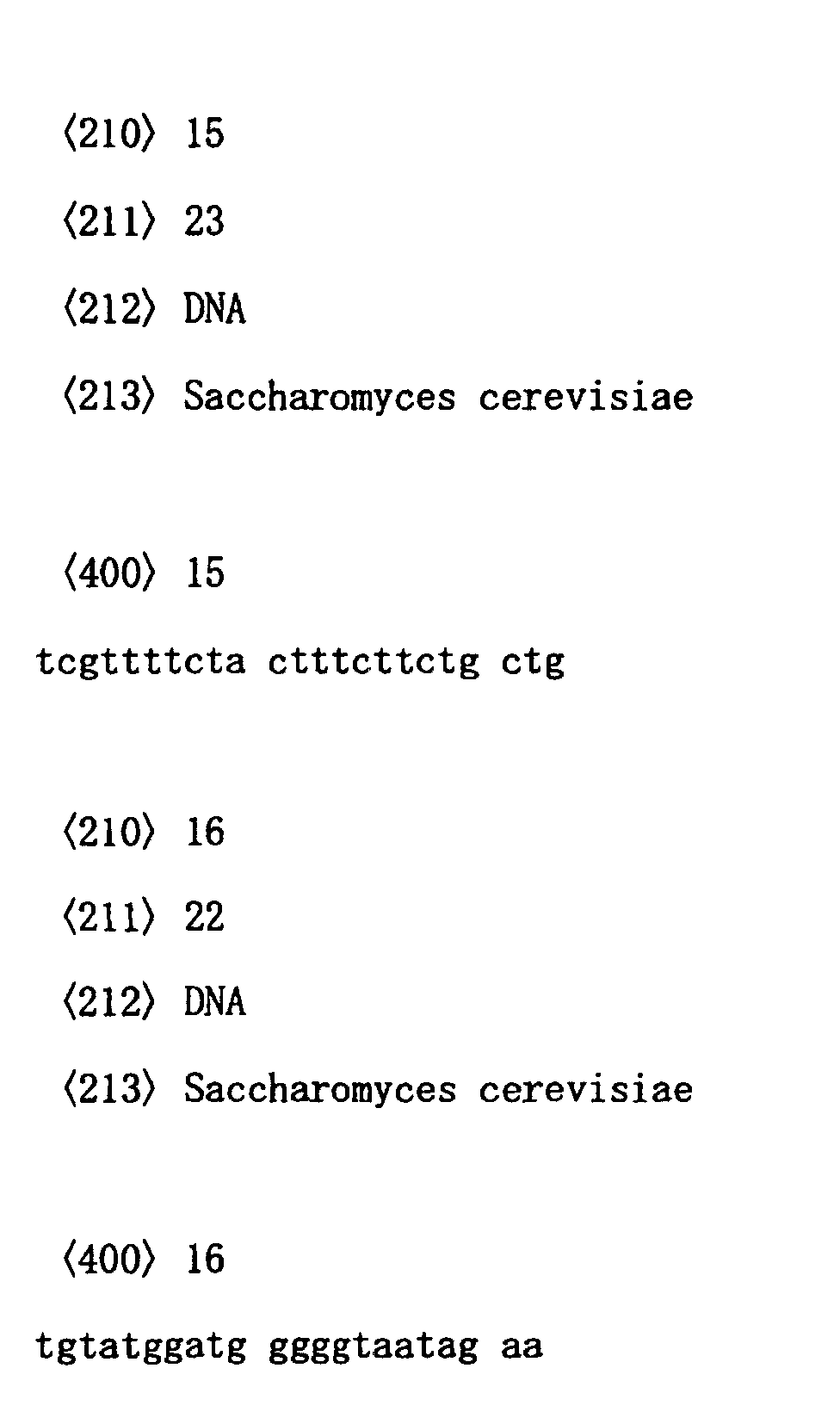
    2. The polynucleotide according to claim 1, wherein the yeast gene belongs to a category of unknown yeast genes.
    3. The polynucleotide according to claim 1, wherein the yeast gene belongs to a category of mitochondria genes.
    4. The polynucleotide according to claim 1, wherein the yeast gene belongs to a category of DNA repair genes.
    5. The polynucleotide according to claim 1, wherein the yeast gene belongs to a category of energy genes.
    6. The polynucleotide according to claim 1, wherein the yeast gene belongs to a category of transport facilitation genes.
    7. The polynucleotide according to claim 1, wherein the yeast gene belongs to a category of stress protein genes.
    8. The polynucleotide according to claim 1, wherein the yeast gene belongs to a category of metabolism genes.
    9. The polynucleotide according to claim 1, wherein the yeast gene belongs to a category of detoxification genes.
    10. The polynucleotide according to claim 2, wherein the unknown yeast gene is YKL071W.
    11. The polynucleotide according to claim 2, wherein the unknown yeast gene is YCR102C.
    12. The polynucleotide according to claim 2, wherein the unknown yeast gene is YOR382W.
    13. The polynucleotide according to claim 8, wherein the metabolism genes is YLR303W.
    14. The polynucleotide according to claim 9, wherein the detoxification genes is YLL057C.
    15. A vector that comprises the polynucleotide according to any one of claims 1 to 14.
    16. A cell that is transformed with the polynucleotide according to any one of claims 1 to 14 or the vector according to claim 15.
    17. A process for detecting a toxic compound in a test material, which comprises:
      (1) contacting the test material to the cells according to claim 16, and
      (2) detecting the expression of mRNA encoding a marker protein.
    18. The process according to claim 17, wherein the expression of mRNA is confirmed by the expression of a marker protein.
    19. The process according to claim 17, wherein the expression of mRNA is detected by northern blotting.
    20. The process according to claim 17, wherein mRNA is amplified by reverse transcription-PCR (RT-PCR), and the expression of mRNA is detected.
    21. A process of identifying a toxic compound, which comprises conducting the process according to any one of claims 17 to 20 against each of two or more of the cell according to claim 16.
    22. The process according to claim 21, wherein two or more of the cell according to claim 16 is selected from a group consisting of YLL057C, YLR303W, YKL071W, YCR102C, and YOR382W.
    EP02760723A 2001-08-24 2002-08-23 METHOD FOR DETECTING A TOXIC SUBSTANCE Ceased EP1426439A4 (en)

    Priority Applications (1)

    Application Number Priority Date Filing Date Title
    EP07016747A EP1921157B1 (en) 2001-08-24 2002-08-23 Processes for detecting toxic substances

    Applications Claiming Priority (3)

    Application Number Priority Date Filing Date Title
    JP2001255379 2001-08-24
    JP2001255379 2001-08-24
    PCT/JP2002/008495 WO2003018792A1 (en) 2001-08-24 2002-08-23 Method of detecting toxic substance

    Related Child Applications (1)

    Application Number Title Priority Date Filing Date
    EP07016747A Division EP1921157B1 (en) 2001-08-24 2002-08-23 Processes for detecting toxic substances

    Publications (2)

    Publication Number Publication Date
    EP1426439A1 true EP1426439A1 (en) 2004-06-09
    EP1426439A4 EP1426439A4 (en) 2005-08-10

    Family

    ID=19083355

    Family Applications (2)

    Application Number Title Priority Date Filing Date
    EP07016747A Expired - Lifetime EP1921157B1 (en) 2001-08-24 2002-08-23 Processes for detecting toxic substances
    EP02760723A Ceased EP1426439A4 (en) 2001-08-24 2002-08-23 METHOD FOR DETECTING A TOXIC SUBSTANCE

    Family Applications Before (1)

    Application Number Title Priority Date Filing Date
    EP07016747A Expired - Lifetime EP1921157B1 (en) 2001-08-24 2002-08-23 Processes for detecting toxic substances

    Country Status (5)

    Country Link
    US (1) US20050112573A1 (en)
    EP (2) EP1921157B1 (en)
    JP (2) JP4836403B2 (en)
    DE (1) DE60236559D1 (en)
    WO (1) WO2003018792A1 (en)

    Cited By (1)

    * Cited by examiner, † Cited by third party
    Publication number Priority date Publication date Assignee Title
    CN108359616A (en) * 2018-02-14 2018-08-03 天津大学 The application of YEL013W genes and YER042W genes

    Families Citing this family (6)

    * Cited by examiner, † Cited by third party
    Publication number Priority date Publication date Assignee Title
    EP1921157B1 (en) * 2001-08-24 2010-05-26 Daikin Industries, Ltd. Processes for detecting toxic substances
    JP4379419B2 (en) * 2003-12-02 2009-12-09 ダイキン工業株式会社 Chemical substance testing method using gene-disrupted strains
    US20080064061A1 (en) * 2004-08-06 2008-03-13 Juridical Foundation The Chemo-Sero-Therapeutic Research Institute Yeast Promoter
    US7872115B2 (en) * 2004-09-15 2011-01-18 Schering Corporation Reporter assay screens for protein targets in Saccharomyces cerevisiae
    JP2007312750A (en) * 2006-05-29 2007-12-06 Daikin Ind Ltd Improved chemical detection method
    JP2009039132A (en) * 2008-10-14 2009-02-26 Daikin Ind Ltd Improved chemical detection method

    Family Cites Families (7)

    * Cited by examiner, † Cited by third party
    Publication number Priority date Publication date Assignee Title
    ITTO970751A1 (en) * 1997-08-20 1999-02-22 Giorgio Mangiarotti USE OF THE GENETICALLY ENGINEERED AND NOT GENETICALLY DICTYOSTELIUM DISCOIDEUM FOR THE DETECTION AND IDENTIFICATION OF SPECIFIC TOXIC SUBSTANCES
    CA2310621A1 (en) * 1997-11-20 1999-06-03 Smithkline Beecham Corporation Methods for identifying the toxic/pathologic effect of environmental stimuli on gene transcription
    CA2340589A1 (en) * 1998-08-28 2000-03-09 Incyte Pharmaceuticals, Inc. Toxicological response markers
    AU3931300A (en) * 1999-03-31 2000-10-16 Rosetta Inpharmatics, Inc. Methods for identifying pathway-specific reporters and target genes, and uses thereof
    FR2798392B1 (en) * 1999-09-13 2005-07-15 Exonhit Therapeutics Sa GENETIC MARKERS OF TOXICITY, PREPARATION AND USES
    JP4022610B2 (en) * 2000-04-07 2007-12-19 独立行政法人産業技術総合研究所 Toxicity assessment method for chemical substances
    EP1921157B1 (en) * 2001-08-24 2010-05-26 Daikin Industries, Ltd. Processes for detecting toxic substances

    Cited By (2)

    * Cited by examiner, † Cited by third party
    Publication number Priority date Publication date Assignee Title
    CN108359616A (en) * 2018-02-14 2018-08-03 天津大学 The application of YEL013W genes and YER042W genes
    CN108359616B (en) * 2018-02-14 2020-11-03 天津大学 Application of YEL013W gene and YER042W gene

    Also Published As

    Publication number Publication date
    JP5071807B2 (en) 2012-11-14
    JPWO2003018792A1 (en) 2004-12-09
    EP1426439A4 (en) 2005-08-10
    EP1921157A2 (en) 2008-05-14
    JP2009089709A (en) 2009-04-30
    EP1921157B1 (en) 2010-05-26
    JP4836403B2 (en) 2011-12-14
    DE60236559D1 (en) 2010-07-08
    WO2003018792A1 (en) 2003-03-06
    EP1921157A3 (en) 2008-05-21
    US20050112573A1 (en) 2005-05-26

    Similar Documents

    Publication Publication Date Title
    Lorang et al. Green fluorescent protein is lighting up fungal biology
    Singh et al. Differentiation of members of the Anopheles fluviatilis species complex by an allele-specific polymerase chain reaction based on 28S ribosomal DNA sequences
    US11255830B2 (en) Biosensor exhibiting sensitivity to trinitrotoluene
    van West et al. Green fluorescent protein (GFP) as a reporter gene for the plant pathogenic oomycete Phytophthora palmivora
    Jansson et al. Quantification of the presence and activity of specific microorganisms in nature
    JP5071807B2 (en) Method for detecting toxic substances
    US20100041089A1 (en) Improved method for detecting chemical substances
    US8192962B2 (en) Processes for detecting toxic substances
    Smalla Culture‐independent microbiology
    US7704692B1 (en) Process for detecting toxic substances
    Zhang et al. Green fluorescent protein expression in Pseudogymnoascus destructans to study its abiotic and biotic lifestyles
    JP4935134B2 (en) Improved promoter assay method
    JP2006174802A (en) Polynucleotide, probe, DNA microarray and method for evaluating soil contamination using soil nematode for detecting heavy metal responsive genes in soil nematode
    JP5397666B2 (en) Enzyme gene screening method
    Hogg et al. Biodiversity genomics: monitoring restoration efforts using DNA barcoding and environmental DNA
    JP4323844B2 (en) Bioassay device
    JP4501346B2 (en) Method for detecting chemical substances using microorganisms
    JP4674374B2 (en) 16S rRNA gene, RNA or DNA probe, method for detecting, quantifying and identifying petroleum degrading bacteria.
    JP2009039132A (en) Improved chemical detection method
    Junier et al. An Intersection between Iron Availability and Candida albicans Invasive Filamentation
    JP2004248604A5 (en)
    Swain et al. Environmental DNA: A Potential Tool in Biodiversity Conservation
    JP2006042817A (en) Methods for detecting and quantifying specific functional microorganisms and their genes from the natural environment
    Besnard et al. A broad mutational target explains an evolutionary trend
    Douglas Molecular and genetic analysis of ribosomal genes in Tephritid species

    Legal Events

    Date Code Title Description
    PUAI Public reference made under article 153(3) epc to a published international application that has entered the european phase

    Free format text: ORIGINAL CODE: 0009012

    17P Request for examination filed

    Effective date: 20040310

    AK Designated contracting states

    Kind code of ref document: A1

    Designated state(s): AT BE BG CH CY CZ DE DK EE ES FI FR GB GR IE IT LI LU MC NL PT SE SK TR

    A4 Supplementary search report drawn up and despatched

    Effective date: 20050628

    RAP1 Party data changed (applicant data changed or rights of an application transferred)

    Owner name: DAIKIN INDUSTRIES, LTD.

    APBN Date of receipt of notice of appeal recorded

    Free format text: ORIGINAL CODE: EPIDOSNNOA2E

    APAF Appeal reference modified

    Free format text: ORIGINAL CODE: EPIDOSCREFNE

    APBT Appeal procedure closed

    Free format text: ORIGINAL CODE: EPIDOSNNOA9E

    STAA Information on the status of an ep patent application or granted ep patent

    Free format text: STATUS: THE APPLICATION HAS BEEN REFUSED

    18R Application refused

    Effective date: 20080116