EP1424359A1 - ELASTOMER COMPOSITION AND PRESSURE−SENSITIVE ADHESIVES MADE BY USING THE SAME - Google Patents
ELASTOMER COMPOSITION AND PRESSURE−SENSITIVE ADHESIVES MADE BY USING THE SAME Download PDFInfo
- Publication number
- EP1424359A1 EP1424359A1 EP02765359A EP02765359A EP1424359A1 EP 1424359 A1 EP1424359 A1 EP 1424359A1 EP 02765359 A EP02765359 A EP 02765359A EP 02765359 A EP02765359 A EP 02765359A EP 1424359 A1 EP1424359 A1 EP 1424359A1
- Authority
- EP
- European Patent Office
- Prior art keywords
- pressure
- sensitive adhesive
- weight
- aromatic vinyl
- isoprene
- Prior art date
- Legal status (The legal status is an assumption and is not a legal conclusion. Google has not performed a legal analysis and makes no representation as to the accuracy of the status listed.)
- Granted
Links
Classifications
-
- C—CHEMISTRY; METALLURGY
- C09—DYES; PAINTS; POLISHES; NATURAL RESINS; ADHESIVES; COMPOSITIONS NOT OTHERWISE PROVIDED FOR; APPLICATIONS OF MATERIALS NOT OTHERWISE PROVIDED FOR
- C09J—ADHESIVES; NON-MECHANICAL ASPECTS OF ADHESIVE PROCESSES IN GENERAL; ADHESIVE PROCESSES NOT PROVIDED FOR ELSEWHERE; USE OF MATERIALS AS ADHESIVES
- C09J153/00—Adhesives based on block copolymers containing at least one sequence of a polymer obtained by reactions only involving carbon-to-carbon unsaturated bonds; Adhesives based on derivatives of such polymers
- C09J153/02—Vinyl aromatic monomers and conjugated dienes
-
- C—CHEMISTRY; METALLURGY
- C08—ORGANIC MACROMOLECULAR COMPOUNDS; THEIR PREPARATION OR CHEMICAL WORKING-UP; COMPOSITIONS BASED THEREON
- C08F—MACROMOLECULAR COMPOUNDS OBTAINED BY REACTIONS ONLY INVOLVING CARBON-TO-CARBON UNSATURATED BONDS
- C08F297/00—Macromolecular compounds obtained by successively polymerising different monomer systems using a catalyst of the ionic or coordination type without deactivating the intermediate polymer
- C08F297/02—Macromolecular compounds obtained by successively polymerising different monomer systems using a catalyst of the ionic or coordination type without deactivating the intermediate polymer using a catalyst of the anionic type
- C08F297/04—Macromolecular compounds obtained by successively polymerising different monomer systems using a catalyst of the ionic or coordination type without deactivating the intermediate polymer using a catalyst of the anionic type polymerising vinyl aromatic monomers and conjugated dienes
-
- C—CHEMISTRY; METALLURGY
- C08—ORGANIC MACROMOLECULAR COMPOUNDS; THEIR PREPARATION OR CHEMICAL WORKING-UP; COMPOSITIONS BASED THEREON
- C08F—MACROMOLECULAR COMPOUNDS OBTAINED BY REACTIONS ONLY INVOLVING CARBON-TO-CARBON UNSATURATED BONDS
- C08F297/00—Macromolecular compounds obtained by successively polymerising different monomer systems using a catalyst of the ionic or coordination type without deactivating the intermediate polymer
- C08F297/02—Macromolecular compounds obtained by successively polymerising different monomer systems using a catalyst of the ionic or coordination type without deactivating the intermediate polymer using a catalyst of the anionic type
- C08F297/04—Macromolecular compounds obtained by successively polymerising different monomer systems using a catalyst of the ionic or coordination type without deactivating the intermediate polymer using a catalyst of the anionic type polymerising vinyl aromatic monomers and conjugated dienes
- C08F297/044—Macromolecular compounds obtained by successively polymerising different monomer systems using a catalyst of the ionic or coordination type without deactivating the intermediate polymer using a catalyst of the anionic type polymerising vinyl aromatic monomers and conjugated dienes using a coupling agent
-
- C—CHEMISTRY; METALLURGY
- C08—ORGANIC MACROMOLECULAR COMPOUNDS; THEIR PREPARATION OR CHEMICAL WORKING-UP; COMPOSITIONS BASED THEREON
- C08L—COMPOSITIONS OF MACROMOLECULAR COMPOUNDS
- C08L53/00—Compositions of block copolymers containing at least one sequence of a polymer obtained by reactions only involving carbon-to-carbon unsaturated bonds; Compositions of derivatives of such polymers
-
- C—CHEMISTRY; METALLURGY
- C08—ORGANIC MACROMOLECULAR COMPOUNDS; THEIR PREPARATION OR CHEMICAL WORKING-UP; COMPOSITIONS BASED THEREON
- C08L—COMPOSITIONS OF MACROMOLECULAR COMPOUNDS
- C08L53/00—Compositions of block copolymers containing at least one sequence of a polymer obtained by reactions only involving carbon-to-carbon unsaturated bonds; Compositions of derivatives of such polymers
- C08L53/02—Compositions of block copolymers containing at least one sequence of a polymer obtained by reactions only involving carbon-to-carbon unsaturated bonds; Compositions of derivatives of such polymers of vinyl-aromatic monomers and conjugated dienes
-
- C—CHEMISTRY; METALLURGY
- C08—ORGANIC MACROMOLECULAR COMPOUNDS; THEIR PREPARATION OR CHEMICAL WORKING-UP; COMPOSITIONS BASED THEREON
- C08L—COMPOSITIONS OF MACROMOLECULAR COMPOUNDS
- C08L2666/00—Composition of polymers characterized by a further compound in the blend, being organic macromolecular compounds, natural resins, waxes or and bituminous materials, non-macromolecular organic substances, inorganic substances or characterized by their function in the composition
- C08L2666/02—Organic macromolecular compounds, natural resins, waxes or and bituminous materials
-
- C—CHEMISTRY; METALLURGY
- C08—ORGANIC MACROMOLECULAR COMPOUNDS; THEIR PREPARATION OR CHEMICAL WORKING-UP; COMPOSITIONS BASED THEREON
- C08L—COMPOSITIONS OF MACROMOLECULAR COMPOUNDS
- C08L2666/00—Composition of polymers characterized by a further compound in the blend, being organic macromolecular compounds, natural resins, waxes or and bituminous materials, non-macromolecular organic substances, inorganic substances or characterized by their function in the composition
- C08L2666/02—Organic macromolecular compounds, natural resins, waxes or and bituminous materials
- C08L2666/04—Macromolecular compounds according to groups C08L7/00 - C08L49/00, or C08L55/00 - C08L57/00; Derivatives thereof
-
- C—CHEMISTRY; METALLURGY
- C08—ORGANIC MACROMOLECULAR COMPOUNDS; THEIR PREPARATION OR CHEMICAL WORKING-UP; COMPOSITIONS BASED THEREON
- C08L—COMPOSITIONS OF MACROMOLECULAR COMPOUNDS
- C08L2666/00—Composition of polymers characterized by a further compound in the blend, being organic macromolecular compounds, natural resins, waxes or and bituminous materials, non-macromolecular organic substances, inorganic substances or characterized by their function in the composition
- C08L2666/02—Organic macromolecular compounds, natural resins, waxes or and bituminous materials
- C08L2666/24—Graft or block copolymers according to groups C08L51/00, C08L53/00 or C08L55/02; Derivatives thereof
-
- C—CHEMISTRY; METALLURGY
- C08—ORGANIC MACROMOLECULAR COMPOUNDS; THEIR PREPARATION OR CHEMICAL WORKING-UP; COMPOSITIONS BASED THEREON
- C08L—COMPOSITIONS OF MACROMOLECULAR COMPOUNDS
- C08L9/00—Compositions of homopolymers or copolymers of conjugated diene hydrocarbons
Definitions
- the present invention relates to an elastomer composition and to a pressure-sensitive adhesive composition. More particularly, the invention relates to a pressure-sensitive adhesive composition which is excellent in tackiness at low temperatures, peel strength at ordinary temperatures, and holding power at high temperatures and which is, when applied to pressure-sensitive adhesive labels, excellent in both pressure-sensitive adhesive properties and die-cuttability, and relates to an elastomer composition for providing the pressure-sensitive adhesive composition.
- Pressure-sensitive adhesive tapes such as packing tapes and surface-protective tapes and pressure-sensitive adhesive labels, seals, sheets, etc. for industrial and office use are produced by applying a pressure-sensitive adhesive composition mainly comprising an elastomer and a tackifier resin onto a backing support such as kraft paper, polyester cloth and polyethylene film.
- Pressure-sensitive adhesive compositions are required to have excellent pressure-sensitive adhesive properties such as tackiness, peel strength and holding power. Particularly, demand exists for a pressure-sensitive adhesive composition which is excellent in the tackiness at low temperatures, the peel strength at ordinary temperatures and the holding power at high temperatures. Extensive studies have been made to enhance these pressure-sensitive adhesive properties.
- Japanese Patent Application Laid-Open Nos. 63-178187 and 63-178188 disclose a pressure-sensitive adhesive composition containing a styrene-isoprene-styrene block copolymer and a styrene-isoprene diblock copolymer.
- the disclosed pressure-sensitive adhesive composition exhibits a relatively high peel strength at ordinary temperatures, but is unsatisfactory in the tackiness at low temperature or the holding power at high temperatures.
- the production of a pressure-sensitive adhesive label generally includes a step of die-cutting a pressure-sensitive adhesive sheet adhered to a releasing sheet into the shape of intended pressure-sensitive adhesive label.
- a pressure-sensitive adhesive composition having poor die-cuttability is employed in this step, the cutting of the pressure-sensitive adhesive sheet cannot be attained successfully.
- the resultant pressure-sensitive adhesive labels become stuck to one another, thereby considerably reducing the product value, and in addition, the pressure-sensitive adhesive composition adheres to the die, thereby adversely affecting the subsequent cutting operations.
- US Patent No. 5,290,842 proposes a pressure-sensitive adhesive composition containing a styrene-isoprene-styrene block copolymer and a styrene-butadiene-styrene block copolymer.
- Japanese Patent Application Laid-Open No. 2001-504519 discloses a pressure-sensitive adhesive composition comprising a styrene-isoprene-styrene block copolymer, a styrene-isoprene diblock copolymer and a tackifier resin, which exhibits a single glass transition temperature.
- the proposed pressure-sensitive adhesive compositions are insufficient in the improvement of die-cuttability or reduced in the pressure-sensitive adhesive properties, thereby failing to be excellent in both the pressure-sensitive adhesive properties and the die-cuttability.
- an object of the present invention is to provide a pressure-sensitive adhesive composition which is excellent in the tackiness at low temperatures, the peel strength at ordinary temperatures and the holding power at high temperatures, and which is, when applied to pressure-sensitive adhesive labels, excellent in both the pressure-sensitive adhesive properties and the die-cuttability.
- Another object of the invention is to provide an elastomer composition for producing the pressure-sensitive adhesive composition.
- an elastomer composition and a pressure-sensitive adhesive composition for attaining the above objects can be obtained by employing an elastomer composition comprising a specific aromatic vinyl-isoprene block copolymer and polyisoprene having a specific weight average molecular weight and by regulating the content of the aromatic vinyl monomer unit in the composition within a specific range.
- the present invention has been accomplished on the basis of this finding.
- the present invention provides an elastomer composition which comprises 33.5 to 95% by weight of an aromatic vinyl-isoprene block copolymer (a) having two or more poly(aromatic vinyl) blocks, 0 to 47.5% by weight of an aromatic vinyl-isoprene diblock copolymer (b), and 5 to 33% by weight of polyisoprene (c) having a weight average molecular weight of 20,000 to 100,000, and which has a content of aromatic vinyl monomer unit of 14 to 50% by weight based on the total amount of the components (a), (b) and (c).
- an aromatic vinyl-isoprene block copolymer (a) having two or more poly(aromatic vinyl) blocks, 0 to 47.5% by weight of an aromatic vinyl-isoprene diblock copolymer (b), and 5 to 33% by weight of polyisoprene (c) having a weight average molecular weight of 20,000 to 100,000, and which has a content of aromatic vinyl monomer unit of 14 to 50%
- the present invention also provides a pressure-sensitive adhesive composition comprising the elastomer composition and a tackifier resin.
- the aromatic vinyl-isoprene block copolymer (a) (hereinafter maybe referred to as "component (a)") used in the present invention has two or more poly(aromatic vinyl) blocks.
- component (a) an aromatic vinyl-isoprene block copolymer having two poly(aromatic vinyl) blocks; i.e., a poly(aromatic vinyl)-polyisoprene-poly(aromatic vinyl) triblock copolymer is preferred.
- the poly(aromatic vinyl) block in the component (a) is a portion of the polymer chain mainly comprising an aromatic vinyl monomer unit as the constitutional unit.
- the content of the aromatic vinyl monomer unit in the poly(aromatic vinyl) block is preferably 80% by weight or more, more preferably 100%. If excessively small, the resultant pressure-sensitive adhesive composition may exhibit a poor holding power at high temperatures.
- aromatic vinyl monomers for forming the poly(aromatic vinyl) block of the component (a) include styrene, ⁇ -methylstyrene, o-methylstyrene, m-methylstyrene, p-methylstyrene, 2,4-dimethylstyrene, ethylstyrene, and p-tert-butylstyrene, with styrene being preferred.
- the poly(aromatic vinyl) block of the component (a) may be a copolymer of the aromatic vinyl monomer and another monomer copolymerizable with the aromatic vinyl monomer, so long as the effect of the present invention is not substantially affected.
- Preferred examples of the monomers copolymerizable with the aromatic vinyl monomer include conjugated diene monomers such as 1,3-butadiene, isoprene, 2,3-dimethyl-1,3-butadiene, and 1,3-pentadiene.
- the weight average molecular weight of the poly(aromatic vinyl) block of the component (a) is preferably 5,000 to 100,000, more preferably 10,000 to 80,000, particularly preferably 12,000 to 70,000. If excessively small, the pressure-sensitive adhesive composition may exhibit a poor holding power at high temperatures, whereas the melt viscosities of the elastomer composition and the pressure-sensitive adhesive composition tend to increase to make the handling thereof difficult, if excessively large.
- the ratio (Mw/Mn) of the poly(aromatic vinyl) block in the component (a), wherein Mw is the weight average molecular weight thereof and Mn is the number average molecular weight thereof, is preferably 2 or less, more preferably 1.5 or less. A small ratio gives a pressure-sensitive adhesive composition exhibiting a more excellent holding power at high temperatures.
- the polyisoprene block in the component (a) is a portion of the polymer chain mainly comprising an isoprene unit as the constitutional unit.
- the content of isoprene unit in the polyisoprene block is preferably 80% by weight or more, more preferably 100%. If excessively small, the pressure-sensitive adhesive composition may exhibit a poor tackiness at low temperatures.
- the polyisoprene block in the component (a) may be a copolymer of isoprene and another monomer copolymerizable with isoprene, so long as the effect of the present invention is not substantially affected.
- Preferred Examples of the monomers polymerizable with isoprene include the aromatic vinyl monomers mentioned above and conjugated diene monomers other than isoprene such as 1,3-butadiene, 2,3-dimethyl-1,3-butadiene and 1,3-pentadiene.
- the content of aromatic vinyl monomer unit in the whole component (a) is generally 15 to 75% by weight, preferably 17 to 50% by weight, more preferably 20 to 40% by weight.
- the content of unit having a pendant vinyl bond in the isoprene unit of the component (a) is not specifically limited, and generally 50% by weight or less, preferably 20% by weight or less, and more preferably 5 to 10% by weight. Within the above range, a pressure-sensitive adhesive composition exhibiting a more excellent tackiness at low temperatures can be produced.
- the weight average molecular weight of the component (a) is preferably 120,000 to 1,200,000, more preferably 140,000 to 1,000,000, particularly preferably 140,000 to 800,000. If excessively small, the pressure-sensitive adhesive composition may exhibit a poor holding power at high temperatures, whereas the melt viscosity tends to increase to make the handling of the composition difficult, if excessively large.
- the ratio (Mw/Mn) of the component (a), wherein Mw is the weight average molecular weight thereof and Mn is the number average molecular weight thereof, is preferably 2 or less, more preferably 1.5 or less. A small ratio gives a pressure-sensitive adhesive composition exhibiting a more excellent holding power at high temperatures.
- the content of component (a) in the elastomer composition is 33.5 to 95% by weight, preferably 40 to 85% by weight, more preferably 45 to 80% by weight.
- the content is excessively small, the holding power of the pressure-sensitive adhesive composition at high temperatures is poor, whereas when the content is excessively large, the tackiness and die-cuttability thereof are poor.
- the aromatic vinyl-isoprene diblock copolymer (b) (hereinafter maybe referred to as “component (b)") is a block copolymer having only one poly(aromatic vinyl) block and only one polyisoprene block.
- the poly(aromatic vinyl) block in the component (b) is a portion of the polymer chain mainly comprising an aromatic vinyl monomer unit as the constitutional unit.
- the content of aromatic vinyl monomer unit in the poly(aromatic vinyl) block is preferably 80% by weight or more, more preferably 100%. If excessively small, the resultant pressure-sensitive adhesive composition may exhibit a poor holding power at high temperatures.
- aromatic vinyl monomers for forming the poly(aromatic vinyl) block of the component (b) include those mentioned in relation to the aromatic vinyl monomers for forming the poly(aromatic vinyl) block of the component (a), with styrene being preferred.
- the poly(aromatic vinyl) block of the component (b) may be a copolymer of the aromatic vinyl monomer and another monomer copolymerizable with the aromatic vinyl monomer, so long as the effect of the present invention is not substantially affected.
- Preferred examples of the monomers copolymerizable with the aromatic vinyl monomer include conjugated diene monomers such as 1,3-butadiene, isoprene, 2,3-dimethyl-1,3-butadiene, and 1,3-pentadiene.
- the weight average molecular weight of the poly(aromatic vinyl) block of the component (b) is preferably 5,000 to 100,000, more preferably 10,000 to 80,000, particularly preferably 10,000 to 70,000. If excessively small, the pressure-sensitive adhesive composition may exhibit a poor holding power at high temperatures, whereas the melt viscosities of the elastomer composition and the pressure-sensitive adhesive composition tend to increase to make the handling thereof difficult, if excessively large.
- the ratio (Mw/Mn) of the poly(aromatic vinyl) block in the component (b), wherein Mw is the weight average molecular weight thereof and Mn is the number average molecular weight thereof, is preferably 2 or less, more preferably 1.5 or less. A small ratio gives a pressure-sensitive adhesive composition exhibiting a more excellent holding power at high temperatures.
- the polyisoprene block in the component (b) is a portion of the polymer chain mainly comprising an isoprene unit as the constitutional unit.
- the content of isoprene unit in the polyisoprene block is preferably 80% by weight or more, more preferably 100%. If excessively small, the pressure-sensitive adhesive composition may exhibit a poor tackiness at low temperatures.
- the polyisoprene block in the component (b) may be a copolymer of isoprene and another monomer copolymerizable with isoprene, so long as the effect of the present invention is not substantially affected.
- Preferred Examples of the monomers polymerizable with isoprene include the aromatic vinyl monomers mentioned above and conjugated diene monomers other than isoprene such as 1,3-butadiene, 2,3-dimethyl-1,3-butadiene and 1,3-pentadiene.
- the content of aromatic vinyl monomer unit in the whole component (b) is generally 15 to 75% by weight, preferably 16 to 55% by weight, more preferably 17 to 50% by weight.
- the content of unit having a pendant vinyl bond in the isoprene unit of the component (b) is not specifically limited, and generally 50% by weight or less, preferably 20% by weight or less, and more preferably 5 to 10% by weight. Within the above range, a pressure-sensitive adhesive composition exhibiting an excellent tackiness at low temperatures can be produced.
- the weight average molecular weight of the component (b) is preferably 60,000 to 250,000, more preferably 70,000 to 230,000, particularly preferably 80,000 to 220,000. If excessively small, the pressure-sensitive adhesive composition may exhibit a poor holding power at high temperatures, whereas the melt viscosity tends to increase to make the handling of the composition difficult, if excessively large.
- the ratio (Mw/Mn) of the component (b), wherein Mw is the weight average molecular weight thereof and Mn is the number average molecular weight thereof, is preferably 2 or less, more preferably 1.5 or less. A small ratio gives a pressure-sensitive adhesive composition exhibiting a more excellent holding power at high temperatures.
- the content of component (b) in the elastomer composition is 0 to 47.5% by weight, preferably 1 to 40% by weight, more preferably 2 to 30% by weight. Within the above range, the resultant pressure-sensitive adhesive composition is excellent in both the holding power at high temperatures and the die-cuttability.
- the method for producing the component (a) is not specifically limited, and any conventionally known method can be employed.
- any conventionally known method can be employed.
- the method for producing the component (b) is not specifically limited, and any conventionally known method can be employed.
- any conventionally known method can be employed.
- the components (a) and (b) may be produced separately in the above manner. Alternatively, as mentioned below, the respective polymerization steps may be combined to produce the components (a) and (b) as a mixture by a single step of anionic living polymerization.
- a poly(aromatic vinyl) block having a living active terminal is produced by polymerizing an aromatic vinyl monomer in a polymerization solvent in the presence of an anionic polymerization initiator.
- an aromatic vinyl-isoprene diblock copolymer having a living active terminal is produced by polymerizing isoprene from the living active terminal of the poly(aromatic vinyl) block.
- a coupled aromatic vinyl-isoprene-aromatic vinyl block copolymer (corresponding to the component (a)) is produced by reacting a portion of the aromatic vinyl-isoprene diblock copolymer having a living active terminal with a coupling agent.
- an aromatic vinyl-isoprene diblock copolymer (corresponding to the component (b)) is produced by deactivating the living active terminal of the rest of the aromatic vinyl-isoprene diblock copolymer having a living active terminal by a polymerization inhibitor.
- a poly(aromatic vinyl) block having a living active terminal is produced by polymerizing an aromatic vinyl monomer in a polymerization solvent in the presence of an anionic polymerization initiator.
- the polymerization solvent is not specifically limited so long as it is inert to the polymerization initiator.
- linear hydrocarbon solvents examples include n-butane, isobutane, n-hexane, 1-butene, isobutylene, trans-2-butene, cis-2-butene, 1-pentene, trans-2-pentene, cis-2-pentene, n-pentane, trans-2-pentane, neo-pentane, and mixtures thereof.
- cyclic hydrocarbon solvents examples include benzene, toluene, xylene, and cyclohexane.
- a mixture of the linear hydrocarbon solvent and the cyclic hydrocarbon solvent is preferably used, because the polymerization temperature and the molecular weight of polymer can be easily controlled.
- the mixing ratio by weight is preferably 5 : 95 to 50 : 50, more preferably 10 : 90 to 40 : 60.
- the overall amount of the polymerization solvent used through the first to fourth steps is generally 100 to 1,000 parts by weight, preferably 150 to 400 parts by weight based on the 100 parts by weight of the total amount of the monomers used.
- the anionic polymerization initiator is not specifically limited, and any known initiator for use in the polymerization of an aromatic vinyl monomer and isoprene may be used. Examples thereof include organic monolithium initiators such as methyllithium, n-propyllithium, n-butyllithium, and sec-butyllithium, with n-butyllithium being preferred.
- the amount of the polymerization initiator may be appropriately determined by a known method so as to produce a polymer having a predetermined weight average molecular weight.
- the polymerization is preferably carried out in the presence of a polar compound, because the polymerization rate can be easily controlled to produce a polymer having a narrow molecular weight distribution.
- the polar compound referred to herein is a compound preferably having a relative dielectric constant of 2.5 to 5.0 at 25°C, and is preferably an aromatic ether, an aliphatic ether or a tertiary amine.
- polar compounds examples include aromatic ethers such as diphenyl ether and anisole; aliphatic ethers such as diethyl ether and dibutyl ether; tertiary monoamines such as trimethylamine, triethylamine and tripropylamine; and tertiary polyamines such as tetramethylethylenediamine and tetraethylethylenediamine, with tetramethylethylenediamine being preferred.
- aromatic ethers such as diphenyl ether and anisole
- aliphatic ethers such as diethyl ether and dibutyl ether
- tertiary monoamines such as trimethylamine, triethylamine and tripropylamine
- tertiary polyamines such as tetramethylethylenediamine and tetraethylethylenediamine, with tetramethylethylenediamine being preferred.
- the amount of the polar compound to be used is preferably 0.05 to 0.5 mol, more preferably 0.01 to 0.1 mol based on one mole of the anionic polymerization initiator.
- an aromatic vinyl-isoprene diblock copolymer having a living active terminal is produced by polymerizing isoprene from the living active terminal of the poly(aromatic vinyl) block.
- the polymerization is preferably carried out by continuously adding isoprene in order to prevent abrupt generation of the reaction heat.
- a coupled aromatic vinyl-isoprene-aromatic vinyl block copolymer (corresponding to the component (a)) is produced by reacting a portion of the aromatic vinyl-isoprene diblock copolymer having a living active terminal with a coupling agent.
- the coupling agent is a compound having two or more sites which can be bonded to polymer molecules by the reaction with the living active terminals of the polymer molecules.
- bi-functional coupling agents having two reactive functionalities include bi-functional halosilanes such as dichlorosilane, monomethyldichlorosilane, and dimethyldichlorosilane; bi-functional alkoxysilanes such as diphenyldimethoxysilane and diphenyldiethoxysilane; bi-functional haloalkanes such as dichloroethane, dibromoethane, methylene chloride, and dibromomethane; and bi-functional tin halides such as dichlorotin, monomethyldichlorotin, dimethyldichlorotin, monoethyldichlorotin, diethyldichlorotin, monobutyldichlorotin, and dibutyldichlorotin; benzoic acid; CO; and 2-chloropropene.
- bi-functional halosilanes such as dichlorosilane, monomethyldichlorosilane, and
- tri- or more functional coupling agents having three or more reactive sites include tri-functional haloalkanes such as trichloroethane and trichloropropane; tetra-functional halosilane such as tetrachlorosilane and tetrabromosilane; tetra-functional alkoxysilanes such as tetramethoxysilane, tetraethoxysilane, and phenyltrimethoxysilane; and tetra-functional tin compounds such as tetrachlorotin and tetrabromotin.
- tri-functional haloalkanes such as trichloroethane and trichloropropane
- halosilane such as tetrachlorosilane and tetrabromosilane
- alkoxysilanes such as tetramethoxysilane, tetraethoxysilane, and phenyl
- the bi-functional coupling agents are preferred, with dimethyldichlorosilane being more preferred.
- the amount of the coupling agent to be used may be appropriately determined so as to produce the coupled aromatic vinyl-isoprene-aromatic vinyl block copolymer (corresponding to the component (a)) in a desired amount.
- an aromatic vinyl-isoprene diblock copolymer (corresponding to the component (b)) is produced by deactivating the living active terminal of the rest of the aromatic vinyl-isoprene diblock copolymer having a living active terminal by a polymerization inhibitor.
- Any polymerization inhibitor generally used in anionic living polymerization may be used, and examples thereof include water; alcohols such as methyl alcohol and ethyl alcohol; inorganic acids and organic acids such as hydrochloric acid and acetic acid.
- a solution containing the components (a) and (b) is produced.
- An antioxidant may be added to the solution, if necessary.
- the resultant polymers are separated from the solution by a known polymer separation method such as steam stripping and then dried thereby to obtain a mixture of the components (a) and (b).
- the above production of the mixture of the components (a) and (b) is preferably carried out while controlling the ratio of the component (a) to the total of the components (a) and (b) within 50% by weight or more, preferably 60% by weight or more, and particularly preferably 70% by weight or more.
- an elastomer composition having a desired chemical composition is produced without adding a separately prepared component (a).
- the ratio may be controlled by changing the amount of coupling agent used.
- the weight average molecular weight of the polyisoprene (c) used in the present invention (hereinafter maybe referred to as "component (c)”) is 20,000 to 100,000, preferably 25,000 to 95,000, more preferably 30,000 to 90,000. If excessively small, the resultant pressure-sensitive adhesive composition is poor in the holding power at high temperatures and die-cuttability, whereas the pressure-sensitive adhesive composition is poor in the die-cuttability and the melt viscosities of the elastomer composition and the pressure-sensitive adhesive composition increase to make the handling thereof difficult, if excessively large.
- the ratio (Mw/Mn) of the component (c), wherein Mw is the weight average molecular weight thereof and Mn is the number average molecular weight thereof, is preferably 2 or less, more preferably 1.5 or less. A small ratio gives a pressure-sensitive adhesive composition exhibiting a more excellent holding power at high temperatures.
- the polymer chain of the component (c) contains the isoprene unit as the main constitutional unit.
- the content of isoprene unit of the component (c) is preferably 80% by weight or more, more preferably 100%. If excessively small, the resultant pressure-sensitive adhesive composition may exhibit a poor tackiness at low temperatures.
- the component (c) is preferably an isoprene homopolymer.
- the component (c) may be a copolymer of isoprene and another monomer copolymerizable with isoprene, so long as the effect of the present invention is not substantially affected.
- preferred monomers polymerizable with isoprene include the aromatic vinyl monomers mentioned above and conjugated diene monomers other than isoprene such as butadiene and 1,3-pentadiene.
- the content of unit having a pendant vinyl bond in the isoprene unit of the component (c) is not specifically limited, and generally 50% by weight or less, preferably 20% by weight or less, and more preferably 5 to 10% by weight. Within the above range, a pressure-sensitive adhesive composition exhibiting a more excellent tackiness at low temperatures can be produced.
- the method for producing the component (c) is not particularly limited, and any conventionally known method can be employed. For example, there can be employed a method where isoprene is polymerized in a polymerization solvent in the presence of the anionic polymerization initiator described above.
- the content of component (c) in the elastomer composition is 5 to 33% by weight, preferably 10 to 31.5% by weight, more preferably 15 to 30% by weight. If excessively small, the die-cuttability are poor and the melt viscosity of the pressure-sensitive adhesive composition increases to make the handling thereof difficult, whereas the pressure-sensitive adhesive composition exhibits a poor holding power at high temperatures, if excessively large.
- the content of aromatic vinyl monomer unit therein is 14 to 50% by weight based on the total amount of the components (a), (b), and (c).
- the content is preferably 15 to 35% by weight, more preferably 17 to 25% by weight.
- the method for producing the elastomer composition of the present invention is not particularly limited. For example, there can be employed a method where the components (a), (b), and (c) each having been separately produced or obtained are kneaded in predetermined proportions; a method where the components (a), (b), and (c) are mixed in the form of solution in predetermined proportions, and then the polymers are separated by a known method and dried; and a method where the components (a) and (b) are mixed and the resultant mixture is kneaded with the component (c) which is separately produced or obtained.
- the elastomer composition of the present invention may contain, if necessary, a conventionally known additive such as antioxidants, UV-absorbers, anti-blocking agents, fillers and pigments in a desired amount.
- a conventionally known additive such as antioxidants, UV-absorbers, anti-blocking agents, fillers and pigments in a desired amount.
- the pressure-sensitive adhesive composition of the present invention comprises the above elastomer composition and a tackifier resin.
- the tackifier resin is not specifically limited, and known natural resin-based and synthetic resin-based tackifier resins which are conventionally used in pressure-sensitive adhesive compositions may be employed.
- Examples of natural resin-based tackifier resins include rosin-based resins and terpene-based resins.
- Examples of the rosin-based resins include rosins such as gum rosin, tall rosin and wood rosin; modified rosins such as hydrogenated rosin, disproportionated rosin and polymerized rosin; and rosin esters such as glycerin or pentaerythritol esters of modified rosin.
- terpene-based resins examples include terpene resins based on ⁇ -pinene, ⁇ -pinene, or dipentene (limonene); aromatic-modified terpene resins; hydrogenated terpene resins; and terpene-phenol resins.
- the synthetic resin-based tackifier resins are roughly classified into addition polymerization-type resins and polycondensation-type resins.
- the addition polymerization-type resins include petroleum resins such as aliphatic (C5) petroleum resins, aromatic (C9) petroleum resins, copolymer (C5-C9) petroleum resins, hydrogenated petroleum resins and alicyclic petroleum resins; cumarone-indene resins; and pure monomer petroleum resins such as styrene resin and substituted styrene resin.
- Examples of the polycondensation-type resins include phenol resins such as alkylphenol resins and rosin-modified phenol resins; and xylene resins.
- tackifier resins preferred are the petroleum resins, more preferred are the aliphatic petroleum resins and the copolymer petroleum resins having an aromatic monomer content of 30% by weight or less; and particularly preferred are the copolymer petroleum resins having an aromatic monomer content of 25% by weight or less.
- the blending amount of the tackifier resin is 10 to 500 parts by weight, preferably 50 to 350 parts by weight, more preferably 70 to 250 parts by weight based on 100 parts by weight of the elastomer composition.
- the pressure-sensitive adhesive composition of the present invention may contain an elastomer other than the elastomer composition in a desired amount, so long as the effect of the present invention is not substantially affected.
- elastomers other than the elastomer composition examples include styrene-butadiene-styrene block copolymers, styrene-ethylene-butylene-styrene block copolymers, styrene-ethylene-propylene-styrene block copolymers, polybutadiene rubbers, polyisoprene rubbers, and natural rubbers.
- the pressure-sensitive adhesive composition of the present invention may contain, if necessary, a softner, an antioxidant, a UV-absorber, or a filler.
- the softners include extension oils such as aromatic process oil, paraffin process oil and naphthene process oil; and liquid polymers such as polybutene and polyisobutylene, with extension oils such as paraffin process oil and naphthene process oil being preferred.
- the blending amount of the softner is preferably 5 to 500 parts by weight, more preferably 10 to 300 parts by weight, particularly preferably 10 to 150 parts by weight based on 100 parts by weight of the elastomer composition. If excessively small, the melt viscosity of the pressure-sensitive adhesive composition tends to increase to make the handling thereof difficult, whereas the softner tends to easily bleed, if excessively large.
- antioxidants examples include hindered phenol compounds such as 2,6-di-tert-butyl-p-cresol and pentaerythrityl tetrakis[3-(3,5-di-tert-butyl-4-hydroxyphenyl)propionate]; thiodicarboxylate esters such as dilauryl thiodipropionate and distearyl thiodipropionate; and phosphites such as tris(nonylphenyl)phosphite and 4,4'-butylidene-bis(3-methyl-6-tert-butylphenyl)ditridecylphosphite.
- the amount of the antioxidant to be blended may be appropriately determined depending on the characteristics of the antioxidant and the characteristics of the intended pressure-sensitive adhesive composition.
- the frequency giving a tan ⁇ value of 1 at 25°C is preferably 3 Hz or less, more preferably 2 Hz or less. If the frequency is low, the die-cuttability of the pressure-sensitive adhesive composition is made more excellent thereby to allow the composition to be suitably used for pressure-sensitive adhesive labels.
- the pressure-sensitive adhesive composition of the present invention is produced by mixing the components as described above.
- the production method thereof is not particularly limited, and conventionally known methods may be employed.
- the pressure-sensitive adhesive composition of the present invention is generally applied to a backing support for its use.
- the backing supports include, but not particularly limited thereto, papers such as kraft paper, Japanese paper, quality paper and synthetic paper; cloths such as cotton cloth, staple fiber cloth and polyester cloth; resin films such as cellophane film, poly(vinyl chloride) film, polypropylene film and polyethylene film; metal foils such as aluminum foil and copper foil; and non-woven fabrics such as polyester non-woven fabric and rayon non-woven fabric.
- papers such as kraft paper, Japanese paper, quality paper and synthetic paper
- cloths such as cotton cloth, staple fiber cloth and polyester cloth
- resin films such as cellophane film, poly(vinyl chloride) film, polypropylene film and polyethylene film
- metal foils such as aluminum foil and copper foil
- non-woven fabrics such as polyester non-woven fabric and rayon non-woven fabric.
- the surface of the backing support may be pretreated by corona discharge or may be coated with a primer.
- the method of applying the pressure-sensitive adhesive composition is not specifically limited, and conventional application methods may be employed. For example, there may be employed a method where a solution of the pressure-sensitive adhesive composition in an organic solvent is applied; a method where a heat-melted pressure-sensitive adhesive composition is directly applied; and a method where an emulsion of the pressure-sensitive adhesive composition in water prepared using an emulsifier is applied, with the direct application method utilizing the heat melting being preferred.
- organic solvents for dissolving the pressure-sensitive adhesive composition include aliphatic hydrocarbons such as n-hexane and cyclohexane; aromatic hydrocarbons such as benzene, toluene, and xylene; and halogenated compounds thereof.
- the weight average molecular weight of each polymer was determined as a value calibrated by polystyrene standard by high performance liquid gel permeation chromatography using tetrahydrofuran carrier.
- the ratio of the component (a) to the component (b) was determined from the peak areas of the components obtained in the high performance liquid gel permeation chromatography.
- the tackiness at low temperatures was evaluated by the peeling-off property at 5°C as follows. At least three hours before the test, a pressure-sensitive adhesive tape cut to 25 mm ⁇ 70 mm, a corrugated carton board serving as an adherend and a 500-g metal roller were placed in a thermostatic chamber of 5°C to stabilize their temperatures. In the thermostatic chamber kept at 5°C, the test pressure-sensitive adhesive tape was adhered to the corrugated carton board by rolling the metal roller forth and back once on the test tape stacked to the corrugated carton board. Immediately thereafter, the test pressure-sensitive adhesive tape was peeled quickly at an angle of 90°.
- the amount of paper fiber adhered to the peeled test pressure-sensitive adhesive tape was rated into five ranks where rank 5 is adhesion of paper fiber to the whole surface of the test tape and rank 1 is no adhesion of paper fiber. The test was repeated five times for each test sample and the results are shown by the average of the measured values.
- the peel strength (N/m) at ordinary temperatures was determined at 23°C using a stainless steel as the adherend in accordance with PSTC-1 (180° peel strength test prescribed by the American Pressure Sensitive Tape Committee).
- the rolling ball tack (mm) was determined at 23°C according to PSTC-6 (tackiness test prescribed by the American Pressure Sensitive Tape Committee).
- the holding power at high temperatures was determined using a test pressure-sensitive adhesive tape having a width of 10 mm and a stainless steel as the adherend in accordance with PSTC-7 (holding power test prescribed by the American Pressure Sensitive Tape Committee) in which the time (min) taken to cause peeling was measured under the conditions of a bonded area of 10 mm ⁇ 25 mm, a load of 3.92 ⁇ 10 4 Pa and a measuring temperature of 50°C.
- PSTC-7 holding power test prescribed by the American Pressure Sensitive Tape Committee
- the shear adhesion failure temperature was determined using a stainless steel as the adherend under the conditions of a bonded area of 10 mm ⁇ 25 mm, a load of 3.92 ⁇ 10 4 Pa and a temperature elevation rate of 0.5°C/min.
- the loop tack was determined in accordance with FINAT-1991 FTM-9 (quick-stick tack measurement).
- the dynamic viscoelasticity was determined on the 8-mm parallel test tape with an initial gap of 2 mm and a strain of 0.1%.
- the scanning was carried out while changing the frequency from 1 to 10 Hz by a 1 Hz increment and changing the temperature from -10 to 50°C by a 5°C increment.
- the reference temperature (T 0 ) was set at 25°C.
- the obtained data were converted into a master curve using time-temperature-superposition (TTS) method.
- TTS time-temperature-superposition
- a cyclohexane solution of the aromatic vinyl-isoprene block copolymer composition I having a polymer concentration of 30% were added under mixing 20 parts by weight of a 30% cyclohexane solution of polyisoprene i and 0.3 part of 2,6-di-tert-butyl-p-cresol as an antioxidant to prepare a solution.
- the solution was added little by little to hot water heated to 85 to 95°C to vaporize the solvent.
- the resultant deposit was pulverized and dried at 85°C by hot air to obtain an elastomer composition.
- the chemical composition of the elastomer composition is shown in Table 2.
- a paddle kneader Into a paddle kneader, was charged 100 parts by weight of the elastomer composition, into which 100 parts by weight of aliphatic petroleum resin (Quintone M100 (trade name), product of Zeon Corporation) as a tackifier resin, 20 parts by weight of naphthene process oil (Shellflex 371 (trade name), product of Shell Chemicals Ltd.) as a softner and one part by weight of Irganox 1010 (trade name, product of Ciba Specialty Chemicals Inc.) as an antioxidant were added.
- aliphatic petroleum resin Quintone M100 (trade name), product of Zeon Corporation
- naphthene process oil Shellflex 371 (trade name), product of Shell Chemicals Ltd.)
- Irganox 1010 trade name, product of Ciba Specialty Chemicals Inc.
- each elastomer composition of the blending formulation shown in Table 2 was prepared. Then, each pressure-sensitive adhesive composition was prepared in the same manner as in Example 1, and the pressure-sensitive adhesive properties thereof were measured. The results are shown in Table 2.
- the styrene-isoprene-styrene block copolymer XIII (components (a) + (b) in Table 2) was a commercially available Kraton TR1107 (product of Kraton Polymers Ltd.) having a styrene block content of 15%, a polystyrene-calibrated weight average molecular weight (Mw) of 199,000 and a percent coupling of 80.6%.
- the "n.d.” in Table 2 is "not determined.”
- the pressure-sensitive adhesive composition of Comparative Example 1 not containing the component (c) was poor in all the tackiness at low temperatures, the peel strength at ordinary temperatures, and the holding power at high temperatures.
- the holding power at high temperatures was poor although the tackiness at low temperatures and the peel strength at ordinary temperatures were good.
- the pressure-sensitive adhesive compositions of Examples 1 to 3 according to the present invention were excellent in all the tackiness at low temperatures, the peel strength at ordinary temperatures and the holding power at high temperatures. Furthermore, the pressure-sensitive adhesive compositions of the present invention raised no practical problems in the melt viscosity, etc.
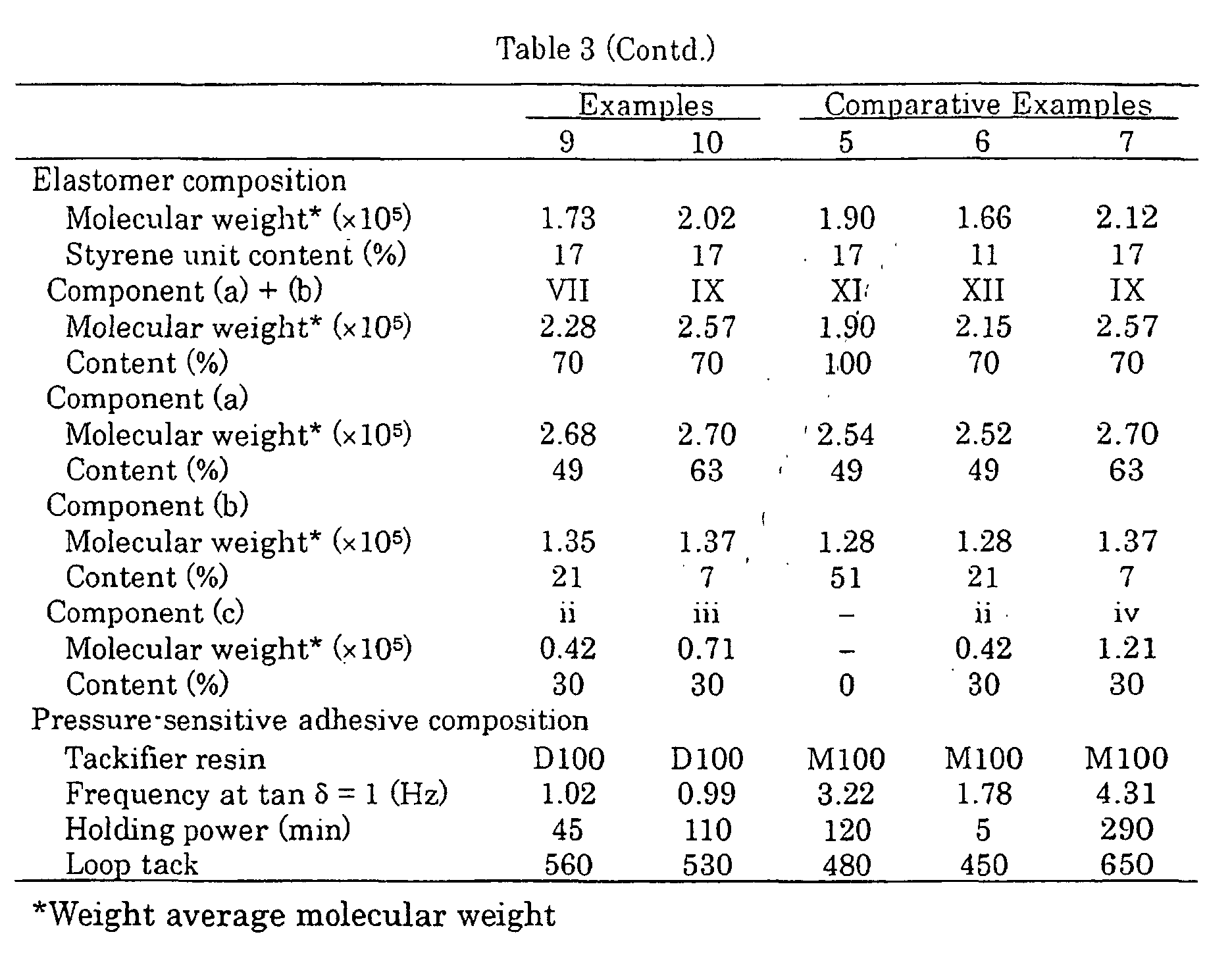
- each elastomer composition and pressure-sensitive adhesive composition were prepared in the blending formulation shown in Table 3.
- the chemical compositions of the elastomer compositions and the evaluation results of the pressure-sensitive adhesive properties and dynamic viscoelasticity of the pressure-sensitive adhesive compositions are shown in Table 3.
- Example 4 The procedure of Example 4 was repeated except for changing the tackifier resin to Quintone D100 (trade name, copolymer-type (C5-C9) petroleum resin produced by Zeon Corporation). The results are shown in Table 3.
- Example 7 The procedure of Example 7 was repeated except for changing the tackifier resin to Quintone D100 (trade name, copolymer-type (C5-C9) petroleum resin produced by Zeon Corporation). The results are shown in Table 3.
- the pressure-sensitive adhesive composition of Comparative Example 5 prepared from an elastomer composition not containing the component (c) was high in the frequency at which tan ⁇ was 1 and poor in both the die-cuttability and the loop tack.
- the pressure-sensitive adhesive composition of Comparative Example 6 prepared from an elastomer composition having a small content of aromatic vinyl monomer unit were poor in the holding power and the loop tack.
- the pressure-sensitive adhesive composition of Comparative Example 7 containing a component (c) having a large molecular weight was high in the frequency at which tan ⁇ was 1 and poor in the die-cuttability.
- the pressure-sensitive adhesive compositions of Examples 4 to 10 according to the present invention was low in the frequency at which tan ⁇ was 1 and excellent in the holding power, the loop tack and the die-cuttability.
- a pressure-sensitive adhesive composition which is excellent in the tackiness at low temperatures, the peel strength at ordinary temperatures and the holding power at high temperatures, and which are, when applied to adhesive labels, excellent in both the pressure-sensitive adhesive properties and the die-cuttability.
- an elastomer composition for producing the pressure-sensitive adhesive composition is provided. With its excellent pressure-sensitive adhesive properties in a wide temperature range, the pressure-sensitive adhesive composition is applicable to pressure-sensitive adhesive tapes, sheets or labels for packing use, office use, double-coated tape use, masking use or electrical insulation use and to dust rollers. Particularly, the pressure-sensitive adhesive composition is suitably applied to pressure-sensitive adhesive labels because of its excellent die-cuttability.
Landscapes
- Chemical & Material Sciences (AREA)
- Chemical Kinetics & Catalysis (AREA)
- Organic Chemistry (AREA)
- Health & Medical Sciences (AREA)
- Medicinal Chemistry (AREA)
- Polymers & Plastics (AREA)
- Inorganic Chemistry (AREA)
- Adhesives Or Adhesive Processes (AREA)
- Compositions Of Macromolecular Compounds (AREA)
- Adhesive Tapes (AREA)
Abstract
Description


Claims (10)
- An elastomer composition which comprises 33.5 to 95% by weight of an aromatic vinyl-isoprene block copolymer (a) having two or more poly(aromatic vinyl) blocks, 0 to 47.5% by weight of an aromatic vinyl-isoprene diblock copolymer (b), and 5 to 33% by weight of polyisoprene (c) having a weight average molecular weight of 20,000 to 100,000, and which has a content of aromatic vinyl monomer unit of 14 to 50% by weight based on the total amount of the components (a), (b) and (c).
- The elastomer composition according to Claim 1, wherein a weight average molecular weight of the aromatic vinyl-isoprene block copolymer (a) is 120,000 to 1,200,000.
- The elastomer composition according to Claim 1, wherein a content of aromatic vinyl monomer unit in the aromatic vinyl-isoprene block copolymer (a) is 17 to 50% by weight.
- The elastomer composition according to Claim 1, wherein a weight average molecular weight of the aromatic vinyl-isoprene diblock copolymer (b) is 60,000 to 250,000.
- The elastomer composition according to Claim 1, wherein a content of aromatic vinyl monomer unit in the aromatic vinyl-isoprene diblock copolymer (b) is 16 to 55% by weight.
- The elastomer composition according to Claim 1, wherein a content of vinyl bond in isoprene unit of the polyisoprene (c) is 20% by weight or less.
- A pressure-sensitive adhesive composition comprising an elastomer composition as defined in Claim 1 and a tackifier resin.
- The pressure-sensitive adhesive composition according to Claim 7, wherein the tackifier resin is contained in an amount of 10 to 500 parts by weight based on 100 parts by weight of the elastomer composition.
- The pressure-sensitive adhesive composition according to Claim 7, wherein the tackifier resin is a petroleum resin.
- The pressure-sensitive adhesive composition according to Claim 7, which is used for producing a pressure-sensitive adhesive label.
Applications Claiming Priority (5)
| Application Number | Priority Date | Filing Date | Title |
|---|---|---|---|
| JP2001260193 | 2001-08-29 | ||
| JP2001260193 | 2001-08-29 | ||
| JP2002184833 | 2002-06-25 | ||
| JP2002184833 | 2002-06-25 | ||
| PCT/JP2002/008634 WO2003020825A1 (en) | 2001-08-29 | 2002-08-28 | Elastomer composition and pressure-sensitive adhesives made by using the same |
Publications (3)
| Publication Number | Publication Date |
|---|---|
| EP1424359A1 true EP1424359A1 (en) | 2004-06-02 |
| EP1424359A4 EP1424359A4 (en) | 2005-07-06 |
| EP1424359B1 EP1424359B1 (en) | 2013-02-27 |
Family
ID=26621252
Family Applications (1)
| Application Number | Title | Priority Date | Filing Date |
|---|---|---|---|
| EP02765359A Expired - Lifetime EP1424359B1 (en) | 2001-08-29 | 2002-08-28 | Elastomer composition and pressure-sensitive adhesives made by using the same |
Country Status (4)
| Country | Link |
|---|---|
| US (2) | US20040242775A1 (en) |
| EP (1) | EP1424359B1 (en) |
| JP (1) | JP4175256B2 (en) |
| WO (1) | WO2003020825A1 (en) |
Cited By (1)
| Publication number | Priority date | Publication date | Assignee | Title |
|---|---|---|---|---|
| US10174230B2 (en) | 2014-09-30 | 2019-01-08 | Zeon Corporation | Block copolymer composition, adhesive composition, and adhesive sheet |
Families Citing this family (21)
| Publication number | Priority date | Publication date | Assignee | Title |
|---|---|---|---|---|
| GB2407608A (en) * | 2003-10-27 | 2005-05-04 | Wt | Barrier for sub-floor ventilator of a building |
| JP4501441B2 (en) * | 2004-01-30 | 2010-07-14 | 日本ゼオン株式会社 | Damping material for soundproofing and soundproofing sheet using the same |
| JP5179640B2 (en) * | 2005-04-08 | 2013-04-10 | 日東電工株式会社 | Foam member |
| JP4878869B2 (en) * | 2005-04-08 | 2012-02-15 | 日東電工株式会社 | Foamed members, foamed member laminates, and electrical / electronic devices using the foamed members |
| JPWO2008032678A1 (en) * | 2006-09-11 | 2010-01-28 | 救急薬品工業株式会社 | Patch |
| CN101688394A (en) * | 2007-03-20 | 2010-03-31 | 胡安·加西亚 | for universal barrier systems |
| JP5129556B2 (en) * | 2007-12-14 | 2013-01-30 | サンスター技研株式会社 | Adhesive composition |
| JP5374898B2 (en) * | 2008-03-26 | 2013-12-25 | Dic株式会社 | Adhesive composition and adhesive tape |
| WO2009123089A1 (en) | 2008-03-31 | 2009-10-08 | 日本ゼオン株式会社 | Block copolymer composition, method for producing the same, and film of the same |
| WO2010074267A1 (en) | 2008-12-26 | 2010-07-01 | 日本ゼオン株式会社 | Block copolymer composition and hot-melt adhesive composition |
| WO2010074270A1 (en) | 2008-12-26 | 2010-07-01 | 日本ゼオン株式会社 | Block copolymer composition, film, and process for producing block copolymer composition |
| US8578852B2 (en) | 2009-02-27 | 2013-11-12 | Zeon Corporation | Block copolymer composition for flexographic printing plates |
| JP5494650B2 (en) | 2009-03-31 | 2014-05-21 | 日本ゼオン株式会社 | Elastic film composition |
| CN102361949B (en) | 2009-03-31 | 2014-08-20 | 日本瑞翁株式会社 | Adhesive composition for labels |
| EP2450396B1 (en) | 2009-06-30 | 2015-02-25 | Zeon Corporation | Composition for stretchable film |
| EP2540747B1 (en) * | 2010-02-26 | 2014-10-08 | Zeon Corporation | Conjugated diene rubber, rubber composition, crosslinked rubber, tire, and process for production of conjugated diene rubber |
| JP6064679B2 (en) * | 2013-02-28 | 2017-01-25 | 日本ゼオン株式会社 | Adhesive for surface protective material and surface protective material |
| JP6060751B2 (en) * | 2013-03-18 | 2017-01-18 | 日本ゼオン株式会社 | Method for producing hot melt adhesive |
| WO2017057050A1 (en) | 2015-09-30 | 2017-04-06 | 日本ゼオン株式会社 | Block copolymer composition and adhesive composition |
| JP7156030B2 (en) * | 2016-11-10 | 2022-10-19 | 日本ゼオン株式会社 | synthetic polyisoprene latex |
| JP7210969B2 (en) * | 2018-09-27 | 2023-01-24 | 日本ゼオン株式会社 | Adhesive composition and adhesive composition for labels |
Family Cites Families (14)
| Publication number | Priority date | Publication date | Assignee | Title |
|---|---|---|---|---|
| JPS53102938A (en) | 1977-02-21 | 1978-09-07 | Kuraray Co Ltd | Pressure sensitive adhesive composition |
| JPS60223880A (en) * | 1984-04-23 | 1985-11-08 | Nitto Electric Ind Co Ltd | pressure sensitive adhesive composition |
| JPS60226578A (en) * | 1984-04-25 | 1985-11-11 | Japan Synthetic Rubber Co Ltd | Hot-melt type adhesive composition |
| JPH0765021B2 (en) | 1987-01-19 | 1995-07-12 | 株式会社クラレ | Adhesive composition |
| JP2647414B2 (en) * | 1988-02-22 | 1997-08-27 | 株式会社クラレ | Adhesive composition |
| US5143968A (en) * | 1989-08-11 | 1992-09-01 | The Dow Chemical Company | Polystyrene-polyisoprene-polystyrene block copolymers, hot melt adhesive compositions, and articles produced therefrom |
| US5286781A (en) * | 1991-04-18 | 1994-02-15 | Sekisui Chemical Co., Ltd. | Pressure sensitive adhesive composition and pressure sensitive adhesive tape or sheet making use of the same |
| US5468237A (en) * | 1991-08-20 | 1995-11-21 | Minnesota Mining And Manufacturing Company | Pressure-sensitive adhesive and disposable diaper closure system |
| US5500293A (en) | 1993-02-05 | 1996-03-19 | Minnesota Mining And Manufacturing Company | Adhesive compositions with improved plasticizer resistance |
| CN1216953A (en) | 1996-02-23 | 1999-05-19 | 阿托·芬德利公司 | Improved pressure sensitive labeling adhesive |
| US5885908A (en) * | 1996-10-04 | 1999-03-23 | Minnesota Mining And Manufacturing Co. | Anisotropic elastic films |
| US5891957A (en) * | 1996-10-24 | 1999-04-06 | Shell Oil Company | Adhesive composition for skin adhesion and bandage applications |
| US5869562A (en) | 1997-03-28 | 1999-02-09 | H. B. Fuller Licensing & Financing, Inc. | Hot melt pressure sensitive adhesive designed for use on high density spun polyolefin film |
| US20050013996A1 (en) * | 2002-03-08 | 2005-01-20 | Hatfield Stephen F. | Hot melt pressure sensitive adhesives for disposable articles |
-
2002
- 2002-08-28 WO PCT/JP2002/008634 patent/WO2003020825A1/en not_active Ceased
- 2002-08-28 JP JP2003525089A patent/JP4175256B2/en not_active Expired - Fee Related
- 2002-08-28 EP EP02765359A patent/EP1424359B1/en not_active Expired - Lifetime
- 2002-08-28 US US10/487,881 patent/US20040242775A1/en not_active Abandoned
-
2008
- 2008-01-22 US US12/017,965 patent/US7674856B2/en not_active Expired - Fee Related
Cited By (1)
| Publication number | Priority date | Publication date | Assignee | Title |
|---|---|---|---|---|
| US10174230B2 (en) | 2014-09-30 | 2019-01-08 | Zeon Corporation | Block copolymer composition, adhesive composition, and adhesive sheet |
Also Published As
| Publication number | Publication date |
|---|---|
| US7674856B2 (en) | 2010-03-09 |
| EP1424359A4 (en) | 2005-07-06 |
| JP4175256B2 (en) | 2008-11-05 |
| US20080125545A1 (en) | 2008-05-29 |
| JPWO2003020825A1 (en) | 2004-12-16 |
| US20040242775A1 (en) | 2004-12-02 |
| WO2003020825A1 (en) | 2003-03-13 |
| EP1424359B1 (en) | 2013-02-27 |
Similar Documents
| Publication | Publication Date | Title |
|---|---|---|
| US7674856B2 (en) | Elastomer composition and pressure-sensitive adhesives made by using same | |
| JP4427773B2 (en) | Block copolymer composition, method for producing the same, and pressure-sensitive adhesive composition | |
| JP3947105B2 (en) | Adhesive and adhesive and block copolymer suitable for it | |
| JP4130983B2 (en) | Aromatic vinyl-isoprene block copolymer mixture, process for producing the same, and adhesive composition containing the same | |
| US7211627B2 (en) | Elastomer composition and pressure-sensitive adhesive compositions | |
| JPWO1999058605A1 (en) | Block copolymer composition, its method of production and pressure-sensitive adhesive composition | |
| EP2415846B1 (en) | Adhesive composition for labels | |
| EP3202844B1 (en) | Block copolymer composition, adhesive composition, and adhesive sheet | |
| US20070299195A1 (en) | Low Viscosity, Hot-Melt Stable Adhesive Compositions | |
| JP6321207B2 (en) | Adhesive composition comprising a block copolymer having polymyrcene | |
| JP2000219860A (en) | Adhesive composition | |
| JP6794991B2 (en) | Block copolymer composition and pressure-sensitive adhesive composition | |
| JPWO2019167745A1 (en) | Tetrablock copolymers, polymer compositions, and hot-melt adhesive compositions using them. | |
| JP3203759B2 (en) | Hot melt type pressure sensitive adhesive composition | |
| JPWO1999058604A1 (en) | Polyaromatic vinyl compound-polyisoprene block copolymer composition, method for producing same, and pressure-sensitive adhesive composition |
Legal Events
| Date | Code | Title | Description |
|---|---|---|---|
| PUAI | Public reference made under article 153(3) epc to a published international application that has entered the european phase |
Free format text: ORIGINAL CODE: 0009012 |
|
| 17P | Request for examination filed |
Effective date: 20040227 |
|
| AK | Designated contracting states |
Kind code of ref document: A1 Designated state(s): AT BE BG CH CY CZ DE DK EE ES FI FR GB GR IE IT LI LU MC NL PT SE SK TR |
|
| A4 | Supplementary search report drawn up and despatched |
Effective date: 20050524 |
|
| RIC1 | Information provided on ipc code assigned before grant |
Ipc: 7C 08L 9/10 B Ipc: 7C 08L 53/02 A Ipc: 7C 09J 153/02 B |
|
| 17Q | First examination report despatched |
Effective date: 20090827 |
|
| GRAP | Despatch of communication of intention to grant a patent |
Free format text: ORIGINAL CODE: EPIDOSNIGR1 |
|
| GRAS | Grant fee paid |
Free format text: ORIGINAL CODE: EPIDOSNIGR3 |
|
| GRAA | (expected) grant |
Free format text: ORIGINAL CODE: 0009210 |
|
| AK | Designated contracting states |
Kind code of ref document: B1 Designated state(s): AT BE BG CH CY CZ DE DK EE ES FI FR GB GR IE IT LI LU MC NL PT SE SK TR |
|
| REG | Reference to a national code |
Ref country code: GB Ref legal event code: FG4D |
|
| REG | Reference to a national code |
Ref country code: CH Ref legal event code: EP |
|
| REG | Reference to a national code |
Ref country code: AT Ref legal event code: REF Ref document number: 598523 Country of ref document: AT Kind code of ref document: T Effective date: 20130315 |
|
| REG | Reference to a national code |
Ref country code: IE Ref legal event code: FG4D |
|
| REG | Reference to a national code |
Ref country code: DE Ref legal event code: R096 Ref document number: 60244576 Country of ref document: DE Effective date: 20130425 |
|
| REG | Reference to a national code |
Ref country code: AT Ref legal event code: MK05 Ref document number: 598523 Country of ref document: AT Kind code of ref document: T Effective date: 20130227 |
|
| PG25 | Lapsed in a contracting state [announced via postgrant information from national office to epo] |
Ref country code: ES Free format text: LAPSE BECAUSE OF FAILURE TO SUBMIT A TRANSLATION OF THE DESCRIPTION OR TO PAY THE FEE WITHIN THE PRESCRIBED TIME-LIMIT Effective date: 20130607 Ref country code: SE Free format text: LAPSE BECAUSE OF FAILURE TO SUBMIT A TRANSLATION OF THE DESCRIPTION OR TO PAY THE FEE WITHIN THE PRESCRIBED TIME-LIMIT Effective date: 20130227 Ref country code: BG Free format text: LAPSE BECAUSE OF FAILURE TO SUBMIT A TRANSLATION OF THE DESCRIPTION OR TO PAY THE FEE WITHIN THE PRESCRIBED TIME-LIMIT Effective date: 20130527 Ref country code: AT Free format text: LAPSE BECAUSE OF FAILURE TO SUBMIT A TRANSLATION OF THE DESCRIPTION OR TO PAY THE FEE WITHIN THE PRESCRIBED TIME-LIMIT Effective date: 20130227 |
|
| REG | Reference to a national code |
Ref country code: NL Ref legal event code: VDEP Effective date: 20130227 |
|
| PG25 | Lapsed in a contracting state [announced via postgrant information from national office to epo] |
Ref country code: GR Free format text: LAPSE BECAUSE OF FAILURE TO SUBMIT A TRANSLATION OF THE DESCRIPTION OR TO PAY THE FEE WITHIN THE PRESCRIBED TIME-LIMIT Effective date: 20130528 Ref country code: FI Free format text: LAPSE BECAUSE OF FAILURE TO SUBMIT A TRANSLATION OF THE DESCRIPTION OR TO PAY THE FEE WITHIN THE PRESCRIBED TIME-LIMIT Effective date: 20130227 Ref country code: PT Free format text: LAPSE BECAUSE OF FAILURE TO SUBMIT A TRANSLATION OF THE DESCRIPTION OR TO PAY THE FEE WITHIN THE PRESCRIBED TIME-LIMIT Effective date: 20130627 Ref country code: BE Free format text: LAPSE BECAUSE OF FAILURE TO SUBMIT A TRANSLATION OF THE DESCRIPTION OR TO PAY THE FEE WITHIN THE PRESCRIBED TIME-LIMIT Effective date: 20130227 |
|
| PG25 | Lapsed in a contracting state [announced via postgrant information from national office to epo] |
Ref country code: CZ Free format text: LAPSE BECAUSE OF FAILURE TO SUBMIT A TRANSLATION OF THE DESCRIPTION OR TO PAY THE FEE WITHIN THE PRESCRIBED TIME-LIMIT Effective date: 20130227 Ref country code: SK Free format text: LAPSE BECAUSE OF FAILURE TO SUBMIT A TRANSLATION OF THE DESCRIPTION OR TO PAY THE FEE WITHIN THE PRESCRIBED TIME-LIMIT Effective date: 20130227 Ref country code: DK Free format text: LAPSE BECAUSE OF FAILURE TO SUBMIT A TRANSLATION OF THE DESCRIPTION OR TO PAY THE FEE WITHIN THE PRESCRIBED TIME-LIMIT Effective date: 20130227 Ref country code: EE Free format text: LAPSE BECAUSE OF FAILURE TO SUBMIT A TRANSLATION OF THE DESCRIPTION OR TO PAY THE FEE WITHIN THE PRESCRIBED TIME-LIMIT Effective date: 20130227 Ref country code: NL Free format text: LAPSE BECAUSE OF FAILURE TO SUBMIT A TRANSLATION OF THE DESCRIPTION OR TO PAY THE FEE WITHIN THE PRESCRIBED TIME-LIMIT Effective date: 20130227 |
|
| PGFP | Annual fee paid to national office [announced via postgrant information from national office to epo] |
Ref country code: DE Payment date: 20130821 Year of fee payment: 12 |
|
| PG25 | Lapsed in a contracting state [announced via postgrant information from national office to epo] |
Ref country code: CY Free format text: LAPSE BECAUSE OF FAILURE TO SUBMIT A TRANSLATION OF THE DESCRIPTION OR TO PAY THE FEE WITHIN THE PRESCRIBED TIME-LIMIT Effective date: 20130227 |
|
| PGFP | Annual fee paid to national office [announced via postgrant information from national office to epo] |
Ref country code: IT Payment date: 20130819 Year of fee payment: 12 |
|
| PLBE | No opposition filed within time limit |
Free format text: ORIGINAL CODE: 0009261 |
|
| STAA | Information on the status of an ep patent application or granted ep patent |
Free format text: STATUS: NO OPPOSITION FILED WITHIN TIME LIMIT |
|
| 26N | No opposition filed |
Effective date: 20131128 |
|
| REG | Reference to a national code |
Ref country code: DE Ref legal event code: R097 Ref document number: 60244576 Country of ref document: DE Effective date: 20131128 |
|
| REG | Reference to a national code |
Ref country code: CH Ref legal event code: PL |
|
| GBPC | Gb: european patent ceased through non-payment of renewal fee |
Effective date: 20130828 |
|
| PG25 | Lapsed in a contracting state [announced via postgrant information from national office to epo] |
Ref country code: MC Free format text: LAPSE BECAUSE OF FAILURE TO SUBMIT A TRANSLATION OF THE DESCRIPTION OR TO PAY THE FEE WITHIN THE PRESCRIBED TIME-LIMIT Effective date: 20130227 Ref country code: LI Free format text: LAPSE BECAUSE OF NON-PAYMENT OF DUE FEES Effective date: 20130831 Ref country code: CH Free format text: LAPSE BECAUSE OF NON-PAYMENT OF DUE FEES Effective date: 20130831 |
|
| REG | Reference to a national code |
Ref country code: IE Ref legal event code: MM4A |
|
| PG25 | Lapsed in a contracting state [announced via postgrant information from national office to epo] |
Ref country code: GB Free format text: LAPSE BECAUSE OF NON-PAYMENT OF DUE FEES Effective date: 20130828 Ref country code: IE Free format text: LAPSE BECAUSE OF NON-PAYMENT OF DUE FEES Effective date: 20130828 |
|
| REG | Reference to a national code |
Ref country code: DE Ref legal event code: R119 Ref document number: 60244576 Country of ref document: DE |
|
| PG25 | Lapsed in a contracting state [announced via postgrant information from national office to epo] |
Ref country code: IT Free format text: LAPSE BECAUSE OF NON-PAYMENT OF DUE FEES Effective date: 20140828 |
|
| REG | Reference to a national code |
Ref country code: DE Ref legal event code: R119 Ref document number: 60244576 Country of ref document: DE Effective date: 20150303 |
|
| REG | Reference to a national code |
Ref country code: FR Ref legal event code: PLFP Year of fee payment: 14 |
|
| PG25 | Lapsed in a contracting state [announced via postgrant information from national office to epo] |
Ref country code: TR Free format text: LAPSE BECAUSE OF FAILURE TO SUBMIT A TRANSLATION OF THE DESCRIPTION OR TO PAY THE FEE WITHIN THE PRESCRIBED TIME-LIMIT Effective date: 20130227 |
|
| PG25 | Lapsed in a contracting state [announced via postgrant information from national office to epo] |
Ref country code: LU Free format text: LAPSE BECAUSE OF NON-PAYMENT OF DUE FEES Effective date: 20130828 Ref country code: DE Free format text: LAPSE BECAUSE OF NON-PAYMENT OF DUE FEES Effective date: 20150303 |
|
| REG | Reference to a national code |
Ref country code: FR Ref legal event code: PLFP Year of fee payment: 15 |
|
| REG | Reference to a national code |
Ref country code: FR Ref legal event code: PLFP Year of fee payment: 16 |
|
| REG | Reference to a national code |
Ref country code: FR Ref legal event code: PLFP Year of fee payment: 17 |
|
| PGFP | Annual fee paid to national office [announced via postgrant information from national office to epo] |
Ref country code: FR Payment date: 20180712 Year of fee payment: 17 |
|
| PG25 | Lapsed in a contracting state [announced via postgrant information from national office to epo] |
Ref country code: FR Free format text: LAPSE BECAUSE OF NON-PAYMENT OF DUE FEES Effective date: 20190831 |