EP1424345B1 - Verfahren zum extrahieren von in wärmebehandelten und nichtwärmebehandelten nahrungsmitteln enthaltenem gluten, das mit einem enzyme-linked immunosorbent assay kompatibel ist, zusammensetzung und kits, die die zusammensetzung enthalten - Google Patents
Verfahren zum extrahieren von in wärmebehandelten und nichtwärmebehandelten nahrungsmitteln enthaltenem gluten, das mit einem enzyme-linked immunosorbent assay kompatibel ist, zusammensetzung und kits, die die zusammensetzung enthalten Download PDFInfo
- Publication number
- EP1424345B1 EP1424345B1 EP02730303A EP02730303A EP1424345B1 EP 1424345 B1 EP1424345 B1 EP 1424345B1 EP 02730303 A EP02730303 A EP 02730303A EP 02730303 A EP02730303 A EP 02730303A EP 1424345 B1 EP1424345 B1 EP 1424345B1
- Authority
- EP
- European Patent Office
- Prior art keywords
- gluten
- composition
- sample
- heat
- processed
- Prior art date
- Legal status (The legal status is an assumption and is not a legal conclusion. Google has not performed a legal analysis and makes no representation as to the accuracy of the status listed.)
- Expired - Lifetime
Links
Images
Classifications
-
- G—PHYSICS
- G01—MEASURING; TESTING
- G01N—INVESTIGATING OR ANALYSING MATERIALS BY DETERMINING THEIR CHEMICAL OR PHYSICAL PROPERTIES
- G01N33/00—Investigating or analysing materials by specific methods not covered by groups G01N1/00 - G01N31/00
- G01N33/02—Food
-
- G—PHYSICS
- G01—MEASURING; TESTING
- G01N—INVESTIGATING OR ANALYSING MATERIALS BY DETERMINING THEIR CHEMICAL OR PHYSICAL PROPERTIES
- G01N33/00—Investigating or analysing materials by specific methods not covered by groups G01N1/00 - G01N31/00
- G01N33/48—Biological material, e.g. blood, urine; Haemocytometers
- G01N33/50—Chemical analysis of biological material, e.g. blood, urine; Testing involving biospecific ligand binding methods; Immunological testing
- G01N33/68—Chemical analysis of biological material, e.g. blood, urine; Testing involving biospecific ligand binding methods; Immunological testing involving proteins, peptides or amino acids
-
- G—PHYSICS
- G01—MEASURING; TESTING
- G01N—INVESTIGATING OR ANALYSING MATERIALS BY DETERMINING THEIR CHEMICAL OR PHYSICAL PROPERTIES
- G01N2333/00—Assays involving biological materials from specific organisms or of a specific nature
- G01N2333/415—Assays involving biological materials from specific organisms or of a specific nature from plants
Definitions
- This invention in general, relates to the analysis of foodstuffs for celiac patients and, especially, to a method for extracting gluten from foodstuffs, compatible with an enzyme-linked immunosorbent assay (ELISA), to compositions suitable for carrying out this method, to kits comprising said compositions and to a method for quantifying the gluten contained in the foodstuffs by ELISA.
- ELISA enzyme-linked immunosorbent assay
- CD Celiac disease
- Gluten comprises a complex mixture of proteins and, until the toxic component or components responsible for CD are discovered, the temporary solution consists in eliminating all gluten components from the diet of these patients.
- the only truly effective treatment of celiac disease is to follow a strict gluten-free diet. It is, therefore, essential to be able to precisely quantify the amount of gluten in foodstuffs to be ingested by celiac patients.
- the routine protocol for gluten analysis in foodstuffs for celiac patients, both for heat-processed and non heat-processed items, consists in extracting gluten with a 60% aqueous solution of ethanol (60% ethanol/water) followed by quantification by ELISA.
- the invention faces the challenge of developing a method for a quantitative extraction of the gluten content of foodstuffs, which is compatible with ELISA tests currently available for quantifying the gluten contents of foodstuffs.
- the solution provided by this invention is based on the inventors' observation that the use of a composition comprising a disulfide reducing agent and a dissociating agent in a buffer with a pH between 7 and 8, before extracting gluten with an aqueous ethanol solution of 60% solubilizes the toxic gluten fractions, permitting the gluten contents of the foodstuffs to be analysed quantitatively.
- the yield of gluten extraction from foodstuffs attained by the method developed by this invention is much higher than that obtained by the conventional gluten extraction system based only on the use of 60% ethanol/water, as shown in Tables 1 and 2 (see Examples 1 and 3).
- the recovery of gluten both from heat-processed and from non heat-processed foodstuffs is practically quantitative, as shown in Figure 1 (see Example 2).
- Disclosed herein is a method for extracting gluten from foodstuffs compatible with ELISA, that comprises the extraction of gluten with an aqueous solution of ethanol in the presence of a composition containing a disulfide reducing agent and a dissociating agent in a buffer with a pH between
- composition useful for carrying out said method for extracting gluten from foodstuffs.
- An additional object is a method for quantifying by ELISA the gluten contained in a food sample that comprises the previous extraction of the gluten contents of the sample by the above-mentioned gluten extraction method.
- kits that comprises this composition useful for carrying out said method for extracting gluten from foodstuffs, or its components separately.
- This kit can be used to extract the gluten contents in a foodstuff as a previous step to quantification by ELISA of the gluten contents of a foodstuff.
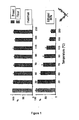
- Figure 1 is a bar chart that represents the percentage recovery of gluten in breads processed at different temperatures and also in the flour used to make these breads, extracted using the gluten-extraction method provided by this invention (INVENTION) or by a reference method (60% ETHANOL) (see Example 2).
- composition A that comprises a disulfide reducing agent and a dissociating agent, in a buffer with a pH between 7 and 8.
- the disulfide reducing agent can be any compound capable of reducing disulfide groups such as, 2-mercaptoethanol (2-ME), dithiotreitol, etc. and mixtures of these.
- concentration of the disulfide reducing agent in composition A can vary within a wide range depending, among other factors, on the disulfide reducing agent employed.
- the dissociating agent can be any compound with the ability to open the protein conformation making specific regions of the polypeptide chain more accessible to external reagents and antibodies, for example, guanidine hydrochloride, urea etc. and mixtures of these.
- concentration of the dissociating agent in composition A can vary within a wide interval depending, among other factors, on the dissociating agent employed.
- the dissociating agent is guanidine hydrochloride and the concentration of this compound in composition A lies between 1 and 6 M.
- the dissociating agent is urea and the concentration of this compound in composition A lies between 1 and 5 M.
- the buffer can be any solution that regulates the pH of a solution buffering the pH value between 7 and 8, such as phosphate buffered saline
- the disulfide reducing agent is 2-ME
- the dissociating agent is guanidine hydrochloride
- the buffer is PBS with a pH between 7 and 8.
- composition A for gluten extraction (that contains a disulfide reducing agent and a dissociating agent in a buffer with a specific pH) does not adversely affect the ELISA quantification of the gluten contents of a foodstuff.
- the invention also provides a method for extracting gluten from a food sample, from hereon called the method of the invention, that comprises extracting the gluten contents from this sample with an aqueous solution of ethanol in the presence of composition A.
- the method of the invention that comprises extracting gluten with an aqueous solution of ethanol and separating the supernatant that contains the extracted gluten, is characterised in that before the extraction with this aqueous ethanol solution, the sample to be tested is mixed with composition A, incubated at a temperature between 37°C and 50°C for a period of time between 30 and 60 minutes and cooled to room temperature.
- the ethanol concentration in the aqueous ethanol solution can vary within a wide interval. In one specific embodiment this aqueous ethanol solution has an ethanol concentration of between 50 and 70%.
- the food sample to be tested is prepared by conventional methods including, where relevant, grinding the sample and placing it in an appropriate recipient such as a propylene tube. Then, composition A is added, the recipient is closed and the resulting mixture is stirred. Advantageously, the recipient containing the mixture is sealed, for example with parafilm, to avoid evaporation of this mixture by heat.
- the sample with composition A is incubated at a temperature of 50°C for 40 minutes. After the incubation, the resulting mixture is left to cool to room temperature (between 15 and 25°C).
- an aqueous ethanol solution such as a 60% aqueous ethanol solution
- a suitable temperature for example, at room temperature for 1 hour while stirring.
- the reaction mixture is centrifuged, the supernatant is removed (containing the extracted gluten) and, finally, the gluten contents are quantified by an ELISA technique of the type usually used to quantify gluten in food.
- composition A is thought to act by opening the conformation of proteins constituting the gluten, specifically its toxic fraction, consequently favouring its solubility in the extraction medium. Indeed, during the heat processing of foodstuffs, the gluten fractions ( ⁇ -, ⁇ -, and ⁇ -gliadins) are denatured, the disulfide bridges break and, consequently, insoluble aggregates form that cannot be extracted with 60% ethanol/water.
- composition A Owing to the combined effect of the components of composition A (i) the insoluble aggregate can be extracted with an aqueous ethanol solution (50-70% ethanol/water) and quantified by ELISA and (ii) the conformation of the gluten molecules increases leaving the antigenic determinants more exposed to the antibodies, causing the ELISA signal to increase.
- the method of the invention therefore appears to constitute a general gluten extraction method from heat-processed and non heat-processed foodstuffs, especially developed for celiac patients, that solubilizes the toxic fractions of gluten permitting the gluten in this type of food product to be analyzed quantitatively.
- the invention also provides a method for quantifying by ELISA the gluten present in a food sample that comprises extracting the gluten contents from this sample using the method of the invention and then quantifying by ELISA the previously extracted gluten.
- the disclosure also provides a kit that comprises composition A or the components of this composition partially mixed or separated.
- This kit can be used to extract the gluten contents of a heat-processed or non heat-processed food product, or to extract the gluten as a previous step to quantification by ELISA in order to determine the gluten contents of the food sample studied.
- the kit can also contain the other reagents required for the gluten extraction i.e. the aqueous solution of ethanol or its components separately, and/or the reagents required to perform ELISA to quantify the gluten contents of a foodstuff, totally or partially mixed together or separately.
- the reference method is the method currently used to extract gluten that uses a 60% aqueous solution of ethanol.
- the samples are centrifuged for 10 min at 3,500 rpm (2,500g), at room temperature (5810 Eppendorf centrifuge), and the supernatant is transferred to clean 10 ml propylene tubes and then analysed by an ELISA based on a single R5 monoclonal antibody, used as the capture antibody and conjugated to a horse-radish peroxidase (this ELISA is similar to the one described by L.
- the ELISA sandwich is based on a single monoclonal antibody used as the capture antibody and conjugated to a horse-radish peroxidase; this ELISA permits gluten from wheat, barley and rye to be quantified with a detection sensitivity of 1.5 ppm].
- the 60% aqueous ethanol solution is prepared by mixing, for example in a test-tube, 300 ml of ethanol (Scharlau Nv 121) and 200 ml of milli-Q water (resistivity 18 M ⁇ cm) and kept in a glass flask.
- the method of the invention consists in extracting gluten using a 60% aqueous ethanol solution in the presence of a reducing agent and a dissociating agent and in the presence of a buffer of pH 7-8.
- reaction mixture After the incubation, the reaction mixture is left to cool to room temperature and 3.75 ml of an aqueous solution of 80% ethanol are added to the reaction mixture which is incubated for 1 hour at room temperature in a rotary stirrer (LABINCO BV model (position 2-3)). Then, the samples are centrifuged for 10 minutes at 3,500 rpm (2,500 g) at room temperature (5810 Eppendorf Centrifuge), the supernatant is transferred to clean 10 ml propylene tubes and then analysed by ELISA.
- LABINCO BV model position 2-3
- the 80% aqueous ethanol solution is prepared by mixing, for example in a test tube, 400 ml of ethanol (Scharlau Nv 121) and 100 ml of milli-Q water (resistivity 18 M ⁇ cm) and kept in a glass flask.
- composition or extraction cocktail consisting of 250 mM of 2-ME, 2 M hydrochloride and 0.1 x PBS, is prepared, for example by weighing 3.8 g of guanidine hydrochloride Mr 95.53 (Fluka 50940) and by adding 15-18 ml of a solution of PBS (0.1 x). Next, 349 ⁇ l of 14.29 M 2-ME are added (Sigma M-6250), this is made up to 20 ml with PBS (0.1 x) solution and stirred until completely dissolved.
- the 0.1 x PBS solution can be prepared by diluting 1:100 of a 10 x PBS solution. To do this, 1 ml of 10 x PBS is added to a test-tube and made up to 100 ml with milli-Q water (resistivity 18 M ⁇ cm). The resulting solution must have a pH between 7 and 8.
- the 10 x PBS solution can be prepared by mixing and dissolving 80 g NaCl, 2 g KCl, 14.4 g Na 2 HPO 4 and 2.4 g KH 2 PO 4 in 900-950 ml of distilled water, in a 11 beaker with a magnetic stirrer and making up the resulting solution to 1,000 ml with distilled water in a volumetric flask. The solution obtained is stored at room temperature.
- Table 1 shows the ELISA values of 23 food samples ("without gluten” but contaminated with gluten, foodstuffs containing gluten, and starches contaminated with gluten) that have been treated at high temperatures and 3 food controls "without gluten” not contaminated with gluten.
- This experiment illustrates the quantitative recovery of gluten, obtained by the method of the invention, in foods treated at different temperatures compared to the non-quantitative recovery of gluten obtained using the usual extraction method with 60% ethanol (Reference method).
- the reference method used is that currently used to extract gluten using a 60% aqueous ethanol solution (see Example 1.2).
- the method of the invention consists in extracting gluten using and aqueous ethanol solution of 60% in the presence of a reducing agent and a dissociating agent and in the presence of a buffer of pH 7-8 (see Example 1.3).
- Figure 1 represents the percentage of gluten recovery in breads processed at different temperatures and in the flour with which these breads are made, and extracted by the reference method or by the method of the invention.
- the abscissa shows the temperatures at which the breads are processed and the ordinate represents the percentage gluten recovery taking the percentage recovery in the flours used to make the breads as 100%.
- Figure 1 clearly shows the quantitative recovery of gluten in breads processed at different temperatures (almost 100% at any of the bread processing temperatures) when using the method of the invention compared to the non-quantitative recovery obtained using the reference method (60% ethanol). In this case, a continuous and progressive reduction of gluten recovery was observed (gluten recovery decreases proportionally as the temperature at which the bread is processed increases).
- the reference method is the method currently used to extract gluten using an aqueous ethanol solution of 60% (see Example 1.2).
- the method of the invention consists in extracting gluten using an aqueous ethanol solution of 60% in the presence of a reducing agent and a dissociating agent and in the presence of a buffer of pH 7-8 [see Example 1.3].
- Table 2 shows the ELISA values of 8 food samples not treated with heat. This Table 2 clearly shows an increased percentage of gluten extracted with the method of the invention in the 8 samples studied. The increase in this value ranges from approximately 12% to approximately 47% in all foods studied including controls. The mean percentage of the increased gluten value in these foods is 27.3%.
- Table 2 Gluten analysis in non heat-processed foodstuffs extracted with 60% ethanol and with the extraction cocktail. Sample 60% Extraction cocktail % ethanol increase Wh I 5.6 8.2 46.4 Wh II 3.2 3.6 12.5 Wh III 5.6 8.1 44.6 Wh IV 5.2 6.1 17.3 Wh V 4.3 5.1 18.6 Wh VI 8.1 9.5 17.3 Wh VII 1.4 1.8 28.6 R I 7.3 9.7 32.9 27.3
Landscapes
- Life Sciences & Earth Sciences (AREA)
- Health & Medical Sciences (AREA)
- Engineering & Computer Science (AREA)
- Chemical & Material Sciences (AREA)
- Immunology (AREA)
- Food Science & Technology (AREA)
- General Health & Medical Sciences (AREA)
- Physics & Mathematics (AREA)
- Pathology (AREA)
- General Physics & Mathematics (AREA)
- Molecular Biology (AREA)
- Urology & Nephrology (AREA)
- Biochemistry (AREA)
- Biomedical Technology (AREA)
- Medicinal Chemistry (AREA)
- Hematology (AREA)
- Analytical Chemistry (AREA)
- Biotechnology (AREA)
- Proteomics, Peptides & Aminoacids (AREA)
- Microbiology (AREA)
- Cell Biology (AREA)
- Peptides Or Proteins (AREA)
- Investigating Or Analysing Biological Materials (AREA)
- Preparation Of Compounds By Using Micro-Organisms (AREA)
- Measuring Or Testing Involving Enzymes Or Micro-Organisms (AREA)
Claims (14)
- Verfahren zum Extrahieren von Gluten aus einer Nahrungsmittelprobe, umfassend das Extrahieren des Glutengehalts dieser Probe mit einer wässrigen Ethanollösung in Gegenwart einer Zusammensetzung, die ein Disulfidreduktionsmittel und ein Protein dissozierendes Mittel enthält in einem Puffer mit einem pH-Wert zwischen 7 und 8.
- Verfahren zum Extrahieren von Gluten aus einer Lebensmittelprobe gemäß Anspruch 1, in dem das Disulfidreduktionsmittel ausgewählt ist aus 2-Mercaptoethanol, Dithiothreitol und Gemischen hiervon.
- Verfahren zum Extrahieren von Gluten aus einer Lebensmittelprobe gemäß Anspruch 1 oder Anspruch 2, in dem das Proteindissozierungsmittel ausgewählt ist aus Guanidinhydrochlorid, Harnstoff und Gemischen hiervon.
- Verfahren zum Extrahieren von Gluten aus einer Lebensmittelprobe nach einem der Ansprüche 1 bis 3, wobei das Disulfidreduktionsmittel 2-Mercaptoethanol und das Proteindissozierungsmittel Guanidinhydrochlorid ist.
- Verfahren zum Extrahieren von Gluten aus einer Lebensmittelsprobe nach einem der Ansprüche 1 bis 4, in dem der Puffer einer Phosphat gepufferte Salzlösung (PBS) mit einem pH-Wert zwischen 7 und 8 ist oder Tris mit einem pH-Wert zwischen 7 und 8.
- Verfahren nach einem der Ansprüche 1 bis 5, in dem die wässrige Ethanollösung einen Ethanolgehalt zwischen 50 und 70% hat.
- Verfahren nach einem der Ansprüche 1 bis 6, umfassend:- Vermischen der zu untersuchenden Probe mit einer Zusammensetzung, die ein Disulfidreduktionsmittel und ein Proteindissozierungsmittel in einem Puffer mit einem pH-Wert zwischen 7 und 8 enthält;- Inkubieren des hierbei erhaltenen Gemisches bei einer Temperatur zwischen 37 und 50°C für einen Zeitraum im Bereich von 30 bis 60 Minuten;- Abkühlen auf Raumtemperatur;- Zufügen einer wässrigen Ethanollösung und- Entfernen des Überstands, der das extrahierte Gluten enthält.
- Verfahren nach Anspruch 7, in dem das erhaltene Gemisch bei einer Temperatur von 50°C für 40 Minuten inkubiert wird.
- Verfahren nach Anspruch 7 oder Anspruch 8, in dem die wässrige Ethanollösung eine 60%-ige wässrige Ethanollösung ist.
- Verfahren nach einem der Ansprüche 7 bis 9, wobei das Gemisch, das die zu untersuchende Probe enthält, die Zusammensetzung, die ein Disulfidreduktionsmittel enthält und ein Proteindissozierungsmittel in einem Puffer mit einem pH-Wert zwischen 7 und 8 und die wässrige Ethanollösung bei Raumtemperatur für eine Stunde inkubiert wird.
- Verfahren zum Quantifizieren des Glutens, das in einer Lebensmittelprobe vorliegt, umfassend das Extrahieren des Glutengehalts dieser Probe unter Verwendung eines Verfahrens nach einem der Ansprüche 1 bis 10 und anschließend Quantifizieren des Glutens, das über ELISA extrahiert wurde.
- Kit zum Extrahieren und Quantifizieren der Glutenanteile einer Lebensmittelprobe umfassend (i) eine Zusammensetzung, die ein Disulfidreduktionsmittel und ein Proteindissozierungsmittel in einem Puffer mit einem pH-Wert zwischen 7 und 8 enthält, oder die Komponenten dieser Zusammensetzung teils gemischt oder getrennt (ii) eine wässrige Ethanollösung oder die Komponenten dieser wässrigen Ethanollösung getrennt und (iii) monoklonale oder polyklonale Antikörper zum Quantifizieren des Glutengehalts mittels ELISA.
- Kit nach Anspruch 12, wobei das Disulfidreduktionsmittel 2-Mercapthoethanol und das Proteindissozierungsmittel Guanidinhydrochlorid ist.
- Kit zum Extrahieren und Quantifizieren der Glutenanteile einer Lebensmittelprobe umfassend (i) eine Zusammensetzung, die 2-Mercapthoethanol als Disulfidreduktionsmittel enthält und Guanidinhydrochlorid als Proteindissozierungsmittel in einem Puffer mit einem pH-Wert zwischen 7 und 8, oder die Komponenten dieser Zusammensetzung teilweise gemischt oder getrennt und (ii) monoklonale oder polyklonale Antikörper zum Quantifizieren des Glutenanteils über ELISA.
Applications Claiming Priority (3)
| Application Number | Priority Date | Filing Date | Title |
|---|---|---|---|
| ES200101098 | 2001-05-14 | ||
| ES200101098A ES2182698B1 (es) | 2001-05-14 | 2001-05-14 | Procedimiento para la extraccion cuantitativa de gluten en alimentos procesados o no procesados por calor, y composicion solubilizante de proteinas de gluten o un kit comercial que la contenga necesarios para su puesta en practica. |
| PCT/ES2002/000208 WO2002092633A1 (es) | 2001-05-14 | 2002-05-03 | Procedimiento para la extracción de gluten en alimentos, procesados y no procesados por calor, compatible con elisa, composición y kits que comprenden dicha composición |
Publications (2)
| Publication Number | Publication Date |
|---|---|
| EP1424345A1 EP1424345A1 (de) | 2004-06-02 |
| EP1424345B1 true EP1424345B1 (de) | 2010-09-15 |
Family
ID=8497712
Family Applications (1)
| Application Number | Title | Priority Date | Filing Date |
|---|---|---|---|
| EP02730303A Expired - Lifetime EP1424345B1 (de) | 2001-05-14 | 2002-05-03 | Verfahren zum extrahieren von in wärmebehandelten und nichtwärmebehandelten nahrungsmitteln enthaltenem gluten, das mit einem enzyme-linked immunosorbent assay kompatibel ist, zusammensetzung und kits, die die zusammensetzung enthalten |
Country Status (9)
| Country | Link |
|---|---|
| US (1) | US7585529B2 (de) |
| EP (1) | EP1424345B1 (de) |
| AT (1) | ATE481423T1 (de) |
| CA (1) | CA2447085C (de) |
| DE (1) | DE60237695D1 (de) |
| DK (1) | DK1424345T3 (de) |
| ES (2) | ES2182698B1 (de) |
| PT (1) | PT1424345E (de) |
| WO (1) | WO2002092633A1 (de) |
Families Citing this family (15)
| Publication number | Priority date | Publication date | Assignee | Title |
|---|---|---|---|---|
| ES2217931B1 (es) * | 2002-07-01 | 2006-02-16 | Universidad De Barcelona | Metodo de diagnostico de la evolucion de la masa intestinal absortiva en un individuo. |
| JP3600231B1 (ja) * | 2003-09-30 | 2004-12-15 | 森永製菓株式会社 | イムノアッセイ |
| ES2239545B1 (es) * | 2004-03-15 | 2006-12-16 | Consejo Sup. Investig. Cientificas | Elisa competitivo para la deteccion de gluten hidrolizado y sus aplicaciones. |
| WO2007104825A1 (es) * | 2006-03-16 | 2007-09-20 | Consejo Superior De Investigaciones Científicas | Procedimiento para la extracción de gluten en alimentos procesados por calor basado en la utilización de detergentes iónicos y no iónicos. |
| ES2349915B1 (es) * | 2008-08-07 | 2011-11-15 | Universitat Rovira I Virgili | Procedimientos para la extraccion de prolaminas toxicas del gluten enceliaquia. |
| ES2351021B1 (es) * | 2009-07-13 | 2011-12-27 | Consejo Superior De Investigaciones Científicas (Csic) | Método para la extracción de gluten nativo e hidrolizado. |
| ES2392412B1 (es) * | 2010-11-03 | 2013-09-13 | Biomedal S L | Solución para extracción de gluten y métodos de uso. |
| CN102809657B (zh) * | 2012-08-29 | 2015-07-29 | 沃克(天津)生物科技有限公司 | 食物不耐受血清特异性IgG检测试剂盒及其制备方法 |
| US10466236B2 (en) | 2013-03-29 | 2019-11-05 | Nima Labs, Inc. | System and method for detecting target substances |
| US10249035B2 (en) | 2013-03-29 | 2019-04-02 | Nima Labs, Inc. | System and method for detecting target substances |
| CN105209912B (zh) | 2013-03-29 | 2018-04-17 | 第6感传感器实验室公司 | 用于有害物质的检测的便携式装置 |
| US10254279B2 (en) | 2013-03-29 | 2019-04-09 | Nima Labs, Inc. | System and method for detection of target substances |
| EP3524983A1 (de) | 2018-02-08 | 2019-08-14 | R-Biopharm Aktiengesellschaft | Verfahren zur quantifizierung von gesamtgluten aus getreide in lebensmittelproben |
| FR3104260B1 (fr) | 2019-12-04 | 2025-01-17 | Commissariat Energie Atomique | Procédé de détection d'une espèce allergène, contaminante ou de nature frauduleuse dans un échantillon agro-alimentaire |
| FR3143127A1 (fr) | 2022-12-07 | 2024-06-14 | Commissariat à l'Energie Atomique et aux Energies Alternatives | Procédé de détection d'une espèce allergène, contaminante ou de nature frauduleuse dans un échantillon agro-alimentaire |
Family Cites Families (3)
| Publication number | Priority date | Publication date | Assignee | Title |
|---|---|---|---|---|
| US4658830A (en) * | 1984-08-08 | 1987-04-21 | Survival Technology, Inc. | Method and apparatus for initiating reperfusion treatment by an unattended individual undergoing heart attack symptoms |
| GB2207921B (en) * | 1987-07-08 | 1991-05-29 | Commw Scient Ind Res Org | Monoclonal antibody to omega-gliadin and hybridoma thereof |
| GB8823027D0 (en) * | 1988-09-30 | 1988-11-09 | Agricultural & Food Res | Determining cereal quality |
-
2001
- 2001-05-14 ES ES200101098A patent/ES2182698B1/es not_active Expired - Fee Related
-
2002
- 2002-05-03 WO PCT/ES2002/000208 patent/WO2002092633A1/es not_active Ceased
- 2002-05-03 DK DK02730303.1T patent/DK1424345T3/da active
- 2002-05-03 CA CA2447085A patent/CA2447085C/en not_active Expired - Lifetime
- 2002-05-03 AT AT02730303T patent/ATE481423T1/de active
- 2002-05-03 DE DE60237695T patent/DE60237695D1/de not_active Expired - Lifetime
- 2002-05-03 US US10/477,935 patent/US7585529B2/en not_active Expired - Lifetime
- 2002-05-03 EP EP02730303A patent/EP1424345B1/de not_active Expired - Lifetime
- 2002-05-03 ES ES02730303T patent/ES2353862T3/es not_active Expired - Lifetime
- 2002-05-03 PT PT02730303T patent/PT1424345E/pt unknown
Non-Patent Citations (3)
| Title |
|---|
| GARCIA E. ET AL: "Development of a general procedure for complete extraction of gliadins for heat processed and unheated foods.", EUROPEAN JOURNAL OF GASTROENTEROLOGY & HEPATOLOGY, ENGLAND, vol. 17, no. 5, May 2005 (2005-05-01), pages 529 - 539 * |
| MILSTONE L.M.: "Isolation and characterization of two polypeptides that form intermediate filaments in bovine esophageal epithelium", THE JOURNAL OF CELL BIOLOGY, vol. 88, no. 2, February 1981 (1981-02-01), UNITED STATES, pages 317 - 322 * |
| SAMBROOK J; FRITSCH E F; MANIATIS T: "Molecular cloning, a laboratory manual, second edition, vol. 1.", 1989, SAMBROOK, J., E. F. FRITSCH AND T. MANIATIS. MOLECULAR CLONING: A LABORATORY MANUAL, SECOND EDITION, VOL. 1. COLD SPRING HARBOR LABORATORY PRESS: COLD SPRING HARBOR, NEW YORK, USA. * |
Also Published As
| Publication number | Publication date |
|---|---|
| DE60237695D1 (de) | 2010-10-28 |
| CA2447085C (en) | 2013-07-09 |
| CA2447085A1 (en) | 2002-11-21 |
| EP1424345A1 (de) | 2004-06-02 |
| US20040137137A1 (en) | 2004-07-15 |
| PT1424345E (pt) | 2010-12-22 |
| ES2353862T3 (es) | 2011-03-07 |
| ES2182698A1 (es) | 2003-03-01 |
| ES2182698B1 (es) | 2004-09-16 |
| WO2002092633A1 (es) | 2002-11-21 |
| ATE481423T1 (de) | 2010-10-15 |
| US7585529B2 (en) | 2009-09-08 |
| DK1424345T3 (da) | 2011-01-24 |
Similar Documents
| Publication | Publication Date | Title |
|---|---|---|
| EP1424345B1 (de) | Verfahren zum extrahieren von in wärmebehandelten und nichtwärmebehandelten nahrungsmitteln enthaltenem gluten, das mit einem enzyme-linked immunosorbent assay kompatibel ist, zusammensetzung und kits, die die zusammensetzung enthalten | |
| Méndez et al. | Report of a collaborative trial to investigate the performance of the R5 enzyme linked immunoassay to determine gliadin in gluten-free food | |
| Rekowski et al. | Determination of soluble wheat protein fractions using the Bradford assay | |
| Gomaa et al. | Simultaneous detection of multi-allergens in an incurred food matrix using ELISA, multiplex flow cytometry and liquid chromatography mass spectrometry (LC–MS) | |
| Van Eckert et al. | Towards a new gliadin reference material–isolation and characterisation | |
| EP2400301B1 (de) | Allergenerkennungsverfahren mithilfe von immunchromatographie | |
| Walczyk et al. | Peanut protein extraction conditions strongly influence yield of allergens Ara h 1 and 2 and sensitivity of immunoassays | |
| US20090215198A1 (en) | Immunological Latex Turbidimetry Method and Reagent Therefor | |
| Gerrard et al. | Maillard crosslinking of food proteins II: the reactions of glutaraldehyde, formaldehyde and glyceraldehyde with wheat proteins in vitro and in situ | |
| Kanerva et al. | Analysis of barley contamination in oats using R5 and ω-gliadin antibodies | |
| Mena et al. | Analytical tools for gluten detection: Policies and regulation | |
| JP2022103148A (ja) | 食物アレルゲンを定量する方法 | |
| AU2015261919B2 (en) | Method for determination of a protein | |
| JP6778086B2 (ja) | チョコレート試料中のアレルゲンの検出方法 | |
| Garber et al. | Enzyme-linked immunosorbent assay detection of melamine in infant formula and wheat food products | |
| JP2018072209A (ja) | チョコレート試料中の小麦アレルゲンの検出方法 | |
| JP2004239885A (ja) | イオン性界面活性剤存在下における免疫測定法 | |
| EP2003448A1 (de) | Verfahren zur glutenextraktion aus prozessierten und nichtprozessierten lebensmitteln mittels wärme auf der grundlage der verwendung ionischer und nichtionischer detergentien | |
| CN105987884B (zh) | 蛋白检测方法及蛋白检测试剂盒 | |
| AU2019218334B2 (en) | Method for the quantification of the total gluten content of grains in food samples | |
| Engelbrecht | Gluten quantification methods and their compliance with the food safety legislation of South Africa. | |
| Satsuki-Murakami et al. | An optimized extraction method for gluten analysis in cacao-containing products using an extraction buffer with polyvinylpyrrolidone | |
| EP2327711A1 (de) | Verfahren zur entfernung von für menschen mit zöliakie giftigen prolaminen aus getreide | |
| Chernukha et al. | Qualimetric assessment of methods for the determination of allergens in meat products | |
| JP2019189557A (ja) | モノクローナル抗体を用いた検査法に適したアレルゲンの抽出液 |
Legal Events
| Date | Code | Title | Description |
|---|---|---|---|
| PUAI | Public reference made under article 153(3) epc to a published international application that has entered the european phase |
Free format text: ORIGINAL CODE: 0009012 |
|
| 17P | Request for examination filed |
Effective date: 20040309 |
|
| AK | Designated contracting states |
Kind code of ref document: A1 Designated state(s): AT BE CH CY DE DK ES FI FR GB GR IE IT LI LU MC NL PT SE TR |
|
| AX | Request for extension of the european patent |
Extension state: AL LT LV MK RO SI |
|
| 17Q | First examination report despatched |
Effective date: 20050523 |
|
| GRAJ | Information related to disapproval of communication of intention to grant by the applicant or resumption of examination proceedings by the epo deleted |
Free format text: ORIGINAL CODE: EPIDOSDIGR1 |
|
| GRAP | Despatch of communication of intention to grant a patent |
Free format text: ORIGINAL CODE: EPIDOSNIGR1 |
|
| GRAP | Despatch of communication of intention to grant a patent |
Free format text: ORIGINAL CODE: EPIDOSNIGR1 |
|
| RIN1 | Information on inventor provided before grant (corrected) |
Inventor name: LOPEZ VILLAR, ELENA Inventor name: MENDEZ CORMAN, ENRIQUE Inventor name: LLORENTE GOMEZ, MERCEDES |
|
| GRAS | Grant fee paid |
Free format text: ORIGINAL CODE: EPIDOSNIGR3 |
|
| GRAA | (expected) grant |
Free format text: ORIGINAL CODE: 0009210 |
|
| AK | Designated contracting states |
Kind code of ref document: B1 Designated state(s): AT BE CH CY DE DK ES FI FR GB GR IE IT LI LU MC NL PT SE TR |
|
| REG | Reference to a national code |
Ref country code: GB Ref legal event code: FG4D Ref country code: CH Ref legal event code: EP |
|
| REG | Reference to a national code |
Ref country code: IE Ref legal event code: FG4D |
|
| REF | Corresponds to: |
Ref document number: 60237695 Country of ref document: DE Date of ref document: 20101028 Kind code of ref document: P |
|
| REG | Reference to a national code |
Ref country code: PT Ref legal event code: SC4A Free format text: AVAILABILITY OF NATIONAL TRANSLATION Effective date: 20101215 |
|
| REG | Reference to a national code |
Ref country code: CH Ref legal event code: NV Representative=s name: ISLER & PEDRAZZINI AG |
|
| REG | Reference to a national code |
Ref country code: SE Ref legal event code: TRGR |
|
| REG | Reference to a national code |
Ref country code: NL Ref legal event code: T3 |
|
| REG | Reference to a national code |
Ref country code: DK Ref legal event code: T3 |
|
| PG25 | Lapsed in a contracting state [announced via postgrant information from national office to epo] |
Ref country code: CY Free format text: LAPSE BECAUSE OF FAILURE TO SUBMIT A TRANSLATION OF THE DESCRIPTION OR TO PAY THE FEE WITHIN THE PRESCRIBED TIME-LIMIT Effective date: 20100915 |
|
| REG | Reference to a national code |
Ref country code: ES Ref legal event code: FG2A Effective date: 20110223 |
|
| PLBE | No opposition filed within time limit |
Free format text: ORIGINAL CODE: 0009261 |
|
| STAA | Information on the status of an ep patent application or granted ep patent |
Free format text: STATUS: NO OPPOSITION FILED WITHIN TIME LIMIT |
|
| 26N | No opposition filed |
Effective date: 20110616 |
|
| REG | Reference to a national code |
Ref country code: DE Ref legal event code: R097 Ref document number: 60237695 Country of ref document: DE Effective date: 20110616 |
|
| PG25 | Lapsed in a contracting state [announced via postgrant information from national office to epo] |
Ref country code: MC Free format text: LAPSE BECAUSE OF NON-PAYMENT OF DUE FEES Effective date: 20110531 |
|
| PG25 | Lapsed in a contracting state [announced via postgrant information from national office to epo] |
Ref country code: LU Free format text: LAPSE BECAUSE OF NON-PAYMENT OF DUE FEES Effective date: 20110503 |
|
| REG | Reference to a national code |
Ref country code: GR Ref legal event code: EP Ref document number: 20100402962 Country of ref document: GR Effective date: 20110119 |
|
| REG | Reference to a national code |
Ref country code: FR Ref legal event code: PLFP Year of fee payment: 15 |
|
| REG | Reference to a national code |
Ref country code: FR Ref legal event code: PLFP Year of fee payment: 16 |
|
| REG | Reference to a national code |
Ref country code: FR Ref legal event code: PLFP Year of fee payment: 17 |
|
| PGFP | Annual fee paid to national office [announced via postgrant information from national office to epo] |
Ref country code: DE Payment date: 20210617 Year of fee payment: 20 Ref country code: FR Payment date: 20210521 Year of fee payment: 20 Ref country code: FI Payment date: 20210518 Year of fee payment: 20 Ref country code: GR Payment date: 20210518 Year of fee payment: 20 Ref country code: IT Payment date: 20210531 Year of fee payment: 20 Ref country code: NL Payment date: 20210519 Year of fee payment: 20 Ref country code: PT Payment date: 20210503 Year of fee payment: 20 |
|
| PGFP | Annual fee paid to national office [announced via postgrant information from national office to epo] |
Ref country code: GB Payment date: 20210526 Year of fee payment: 20 Ref country code: CH Payment date: 20210525 Year of fee payment: 20 Ref country code: DK Payment date: 20210521 Year of fee payment: 20 Ref country code: ES Payment date: 20210618 Year of fee payment: 20 Ref country code: IE Payment date: 20210519 Year of fee payment: 20 Ref country code: SE Payment date: 20210521 Year of fee payment: 20 Ref country code: AT Payment date: 20210518 Year of fee payment: 20 Ref country code: BE Payment date: 20210519 Year of fee payment: 20 Ref country code: TR Payment date: 20210426 Year of fee payment: 20 |
|
| REG | Reference to a national code |
Ref country code: DE Ref legal event code: R071 Ref document number: 60237695 Country of ref document: DE |
|
| REG | Reference to a national code |
Ref country code: NL Ref legal event code: MK Effective date: 20220502 |
|
| REG | Reference to a national code |
Ref country code: DK Ref legal event code: EUP Expiry date: 20220503 |
|
| REG | Reference to a national code |
Ref country code: CH Ref legal event code: PL |
|
| REG | Reference to a national code |
Ref country code: BE Ref legal event code: MK Effective date: 20220503 |
|
| REG | Reference to a national code |
Ref country code: GB Ref legal event code: PE20 Expiry date: 20220502 |
|
| REG | Reference to a national code |
Ref country code: AT Ref legal event code: MK07 Ref document number: 481423 Country of ref document: AT Kind code of ref document: T Effective date: 20220503 |
|
| REG | Reference to a national code |
Ref country code: IE Ref legal event code: MK9A |
|
| REG | Reference to a national code |
Ref country code: FI Ref legal event code: MAE |
|
| PG25 | Lapsed in a contracting state [announced via postgrant information from national office to epo] |
Ref country code: PT Free format text: LAPSE BECAUSE OF EXPIRATION OF PROTECTION Effective date: 20220511 Ref country code: IE Free format text: LAPSE BECAUSE OF EXPIRATION OF PROTECTION Effective date: 20220503 Ref country code: GB Free format text: LAPSE BECAUSE OF EXPIRATION OF PROTECTION Effective date: 20220502 |
|
| REG | Reference to a national code |
Ref country code: ES Ref legal event code: FD2A Effective date: 20220902 |
|
| PG25 | Lapsed in a contracting state [announced via postgrant information from national office to epo] |
Ref country code: ES Free format text: LAPSE BECAUSE OF EXPIRATION OF PROTECTION Effective date: 20220504 |