EP1424331A1 - Process for the epoxidation of olefins - Google Patents
Process for the epoxidation of olefins Download PDFInfo
- Publication number
- EP1424331A1 EP1424331A1 EP02026241A EP02026241A EP1424331A1 EP 1424331 A1 EP1424331 A1 EP 1424331A1 EP 02026241 A EP02026241 A EP 02026241A EP 02026241 A EP02026241 A EP 02026241A EP 1424331 A1 EP1424331 A1 EP 1424331A1
- Authority
- EP
- European Patent Office
- Prior art keywords
- acid
- stream
- propene
- product
- methanol
- Prior art date
- Legal status (The legal status is an assumption and is not a legal conclusion. Google has not performed a legal analysis and makes no representation as to the accuracy of the status listed.)
- Withdrawn
Links
- 238000000034 method Methods 0.000 title claims abstract description 70
- 238000006735 epoxidation reaction Methods 0.000 title claims abstract description 62
- 150000001336 alkenes Chemical class 0.000 title claims abstract description 28
- IJGRMHOSHXDMSA-UHFFFAOYSA-N Atomic nitrogen Chemical compound N#N IJGRMHOSHXDMSA-UHFFFAOYSA-N 0.000 claims abstract description 84
- QQONPFPTGQHPMA-UHFFFAOYSA-N Propene Chemical compound CC=C QQONPFPTGQHPMA-UHFFFAOYSA-N 0.000 claims abstract description 80
- 239000003054 catalyst Substances 0.000 claims abstract description 57
- 239000002904 solvent Substances 0.000 claims abstract description 46
- 229910052757 nitrogen Inorganic materials 0.000 claims abstract description 43
- 150000002897 organic nitrogen compounds Chemical class 0.000 claims abstract description 30
- QJGQUHMNIGDVPM-UHFFFAOYSA-N nitrogen group Chemical group [N] QJGQUHMNIGDVPM-UHFFFAOYSA-N 0.000 claims abstract description 25
- 239000010936 titanium Substances 0.000 claims abstract description 23
- 229910052719 titanium Inorganic materials 0.000 claims abstract description 23
- RTAQQCXQSZGOHL-UHFFFAOYSA-N Titanium Chemical compound [Ti] RTAQQCXQSZGOHL-UHFFFAOYSA-N 0.000 claims abstract description 22
- 239000002798 polar solvent Substances 0.000 claims abstract description 22
- 230000003197 catalytic effect Effects 0.000 claims abstract description 11
- 239000010457 zeolite Substances 0.000 claims abstract description 10
- 229910021536 Zeolite Inorganic materials 0.000 claims abstract description 9
- HNPSIPDUKPIQMN-UHFFFAOYSA-N dioxosilane;oxo(oxoalumanyloxy)alumane Chemical compound O=[Si]=O.O=[Al]O[Al]=O HNPSIPDUKPIQMN-UHFFFAOYSA-N 0.000 claims abstract description 9
- 238000004064 recycling Methods 0.000 claims abstract description 8
- OKKJLVBELUTLKV-UHFFFAOYSA-N Methanol Chemical group OC OKKJLVBELUTLKV-UHFFFAOYSA-N 0.000 claims description 192
- MHAJPDPJQMAIIY-UHFFFAOYSA-N Hydrogen peroxide Chemical compound OO MHAJPDPJQMAIIY-UHFFFAOYSA-N 0.000 claims description 88
- 239000000047 product Substances 0.000 claims description 61
- ATUOYWHBWRKTHZ-UHFFFAOYSA-N Propane Chemical compound CCC ATUOYWHBWRKTHZ-UHFFFAOYSA-N 0.000 claims description 32
- GOOHAUXETOMSMM-UHFFFAOYSA-N Propylene oxide Chemical compound CC1CO1 GOOHAUXETOMSMM-UHFFFAOYSA-N 0.000 claims description 32
- 238000006243 chemical reaction Methods 0.000 claims description 32
- XLYOFNOQVPJJNP-UHFFFAOYSA-N water Substances O XLYOFNOQVPJJNP-UHFFFAOYSA-N 0.000 claims description 30
- QGZKDVFQNNGYKY-UHFFFAOYSA-N Ammonia Chemical compound N QGZKDVFQNNGYKY-UHFFFAOYSA-N 0.000 claims description 25
- 238000004821 distillation Methods 0.000 claims description 20
- 238000000605 extraction Methods 0.000 claims description 19
- JRZJOMJEPLMPRA-UHFFFAOYSA-N olefin Natural products CCCCCCCC=C JRZJOMJEPLMPRA-UHFFFAOYSA-N 0.000 claims description 19
- 230000002378 acidificating effect Effects 0.000 claims description 18
- OAKJQQAXSVQMHS-UHFFFAOYSA-N Hydrazine Chemical compound NN OAKJQQAXSVQMHS-UHFFFAOYSA-N 0.000 claims description 16
- 239000001294 propane Substances 0.000 claims description 16
- 238000010306 acid treatment Methods 0.000 claims description 15
- QTBSBXVTEAMEQO-UHFFFAOYSA-N Acetic acid Natural products CC(O)=O QTBSBXVTEAMEQO-UHFFFAOYSA-N 0.000 claims description 14
- 238000000926 separation method Methods 0.000 claims description 14
- 239000002253 acid Substances 0.000 claims description 13
- 238000000895 extractive distillation Methods 0.000 claims description 13
- 229910021529 ammonia Inorganic materials 0.000 claims description 12
- 238000005984 hydrogenation reaction Methods 0.000 claims description 11
- 239000000203 mixture Substances 0.000 claims description 10
- NBIIXXVUZAFLBC-UHFFFAOYSA-N Phosphoric acid Chemical compound OP(O)(O)=O NBIIXXVUZAFLBC-UHFFFAOYSA-N 0.000 claims description 6
- QAOWNCQODCNURD-UHFFFAOYSA-N sulfuric acid group Chemical group S(O)(O)(=O)=O QAOWNCQODCNURD-UHFFFAOYSA-N 0.000 claims description 6
- 150000001732 carboxylic acid derivatives Chemical class 0.000 claims description 4
- 229910052500 inorganic mineral Inorganic materials 0.000 claims description 4
- 239000011707 mineral Substances 0.000 claims description 4
- 229910000147 aluminium phosphate Inorganic materials 0.000 claims description 3
- 229910006069 SO3H Inorganic materials 0.000 claims description 2
- 239000007795 chemical reaction product Substances 0.000 claims description 2
- 125000000896 monocarboxylic acid group Chemical group 0.000 claims description 2
- 125000000020 sulfo group Chemical group O=S(=O)([*])O[H] 0.000 claims description 2
- FGUUSXIOTUKUDN-IBGZPJMESA-N C1(=CC=CC=C1)N1C2=C(NC([C@H](C1)NC=1OC(=NN=1)C1=CC=CC=C1)=O)C=CC=C2 Chemical compound C1(=CC=CC=C1)N1C2=C(NC([C@H](C1)NC=1OC(=NN=1)C1=CC=CC=C1)=O)C=CC=C2 FGUUSXIOTUKUDN-IBGZPJMESA-N 0.000 claims 1
- 125000000218 acetic acid group Chemical group C(C)(=O)* 0.000 claims 1
- 125000003158 alcohol group Chemical group 0.000 claims 1
- 239000011541 reaction mixture Substances 0.000 abstract description 17
- 238000010626 work up procedure Methods 0.000 abstract description 8
- 230000009849 deactivation Effects 0.000 abstract description 5
- 239000007788 liquid Substances 0.000 description 11
- 150000002500 ions Chemical class 0.000 description 10
- 150000002924 oxiranes Chemical class 0.000 description 8
- 239000007791 liquid phase Substances 0.000 description 7
- DNIAPMSPPWPWGF-UHFFFAOYSA-N monopropylene glycol Natural products CC(O)CO DNIAPMSPPWPWGF-UHFFFAOYSA-N 0.000 description 7
- 239000000243 solution Substances 0.000 description 7
- IKHGUXGNUITLKF-UHFFFAOYSA-N Acetaldehyde Chemical compound CC=O IKHGUXGNUITLKF-UHFFFAOYSA-N 0.000 description 6
- VYPSYNLAJGMNEJ-UHFFFAOYSA-N Silicium dioxide Chemical compound O=[Si]=O VYPSYNLAJGMNEJ-UHFFFAOYSA-N 0.000 description 6
- 238000009835 boiling Methods 0.000 description 6
- 238000010992 reflux Methods 0.000 description 6
- OKTJSMMVPCPJKN-UHFFFAOYSA-N Carbon Chemical compound [C] OKTJSMMVPCPJKN-UHFFFAOYSA-N 0.000 description 5
- 239000000654 additive Substances 0.000 description 5
- 150000001412 amines Chemical class 0.000 description 5
- 239000006227 byproduct Substances 0.000 description 5
- 238000009833 condensation Methods 0.000 description 5
- 230000005494 condensation Effects 0.000 description 5
- 238000001816 cooling Methods 0.000 description 5
- 230000000694 effects Effects 0.000 description 5
- 229910017464 nitrogen compound Inorganic materials 0.000 description 5
- 150000002830 nitrogen compounds Chemical class 0.000 description 5
- -1 nitrogen containing compound Chemical class 0.000 description 5
- 238000011084 recovery Methods 0.000 description 5
- LYCAIKOWRPUZTN-UHFFFAOYSA-N Ethylene glycol Chemical compound OCCO LYCAIKOWRPUZTN-UHFFFAOYSA-N 0.000 description 4
- UFHFLCQGNIYNRP-UHFFFAOYSA-N Hydrogen Chemical compound [H][H] UFHFLCQGNIYNRP-UHFFFAOYSA-N 0.000 description 4
- GWEVSGVZZGPLCZ-UHFFFAOYSA-N Titan oxide Chemical compound O=[Ti]=O GWEVSGVZZGPLCZ-UHFFFAOYSA-N 0.000 description 4
- 235000011054 acetic acid Nutrition 0.000 description 4
- XKMRRTOUMJRJIA-UHFFFAOYSA-N ammonia nh3 Chemical compound N.N XKMRRTOUMJRJIA-UHFFFAOYSA-N 0.000 description 4
- 150000001728 carbonyl compounds Chemical class 0.000 description 4
- 239000007789 gas Substances 0.000 description 4
- 239000001257 hydrogen Substances 0.000 description 4
- 229910052739 hydrogen Inorganic materials 0.000 description 4
- TZIHFWKZFHZASV-UHFFFAOYSA-N methyl formate Chemical compound COC=O TZIHFWKZFHZASV-UHFFFAOYSA-N 0.000 description 4
- 238000002156 mixing Methods 0.000 description 4
- 238000012856 packing Methods 0.000 description 4
- 239000012071 phase Substances 0.000 description 4
- 231100000572 poisoning Toxicity 0.000 description 4
- 230000000607 poisoning effect Effects 0.000 description 4
- WWZKQHOCKIZLMA-UHFFFAOYSA-N Caprylic acid Natural products CCCCCCCC(O)=O WWZKQHOCKIZLMA-UHFFFAOYSA-N 0.000 description 3
- LFQSCWFLJHTTHZ-UHFFFAOYSA-N Ethanol Chemical compound CCO LFQSCWFLJHTTHZ-UHFFFAOYSA-N 0.000 description 3
- OFOBLEOULBTSOW-UHFFFAOYSA-N Malonic acid Chemical compound OC(=O)CC(O)=O OFOBLEOULBTSOW-UHFFFAOYSA-N 0.000 description 3
- MUBZPKHOEPUJKR-UHFFFAOYSA-N Oxalic acid Chemical compound OC(=O)C(O)=O MUBZPKHOEPUJKR-UHFFFAOYSA-N 0.000 description 3
- 150000001298 alcohols Chemical class 0.000 description 3
- 239000007864 aqueous solution Substances 0.000 description 3
- 239000011230 binding agent Substances 0.000 description 3
- 150000001875 compounds Chemical class 0.000 description 3
- 238000000354 decomposition reaction Methods 0.000 description 3
- 239000012535 impurity Substances 0.000 description 3
- 230000003647 oxidation Effects 0.000 description 3
- 238000007254 oxidation reaction Methods 0.000 description 3
- 150000002923 oximes Chemical class 0.000 description 3
- 150000002978 peroxides Chemical class 0.000 description 3
- 150000003141 primary amines Chemical class 0.000 description 3
- 235000013772 propylene glycol Nutrition 0.000 description 3
- 239000000377 silicon dioxide Substances 0.000 description 3
- 239000003381 stabilizer Substances 0.000 description 3
- ARXJGSRGQADJSQ-UHFFFAOYSA-N 1-methoxypropan-2-ol Chemical compound COCC(C)O ARXJGSRGQADJSQ-UHFFFAOYSA-N 0.000 description 2
- CSCPPACGZOOCGX-UHFFFAOYSA-N Acetone Chemical compound CC(C)=O CSCPPACGZOOCGX-UHFFFAOYSA-N 0.000 description 2
- FERIUCNNQQJTOY-UHFFFAOYSA-N Butyric acid Chemical compound CCCC(O)=O FERIUCNNQQJTOY-UHFFFAOYSA-N 0.000 description 2
- VZCYOOQTPOCHFL-OWOJBTEDSA-N Fumaric acid Chemical compound OC(=O)\C=C\C(O)=O VZCYOOQTPOCHFL-OWOJBTEDSA-N 0.000 description 2
- VEXZGXHMUGYJMC-UHFFFAOYSA-N Hydrochloric acid Chemical compound Cl VEXZGXHMUGYJMC-UHFFFAOYSA-N 0.000 description 2
- AVXURJPOCDRRFD-UHFFFAOYSA-N Hydroxylamine Chemical compound ON AVXURJPOCDRRFD-UHFFFAOYSA-N 0.000 description 2
- 238000007696 Kjeldahl method Methods 0.000 description 2
- WYURNTSHIVDZCO-UHFFFAOYSA-N Tetrahydrofuran Chemical compound C1CCOC1 WYURNTSHIVDZCO-UHFFFAOYSA-N 0.000 description 2
- MCMNRKCIXSYSNV-UHFFFAOYSA-N Zirconium dioxide Chemical compound O=[Zr]=O MCMNRKCIXSYSNV-UHFFFAOYSA-N 0.000 description 2
- 150000007513 acids Chemical class 0.000 description 2
- WNLRTRBMVRJNCN-UHFFFAOYSA-N adipic acid Chemical compound OC(=O)CCCCC(O)=O WNLRTRBMVRJNCN-UHFFFAOYSA-N 0.000 description 2
- 150000003863 ammonium salts Chemical class 0.000 description 2
- 229910052799 carbon Inorganic materials 0.000 description 2
- 239000012876 carrier material Substances 0.000 description 2
- 238000009903 catalytic hydrogenation reaction Methods 0.000 description 2
- 229910052681 coesite Inorganic materials 0.000 description 2
- 230000000052 comparative effect Effects 0.000 description 2
- 239000000110 cooling liquid Substances 0.000 description 2
- 238000005260 corrosion Methods 0.000 description 2
- 230000007797 corrosion Effects 0.000 description 2
- 229910052906 cristobalite Inorganic materials 0.000 description 2
- 238000002425 crystallisation Methods 0.000 description 2
- 230000008025 crystallization Effects 0.000 description 2
- XBDQKXXYIPTUBI-UHFFFAOYSA-N dimethylselenoniopropionate Natural products CCC(O)=O XBDQKXXYIPTUBI-UHFFFAOYSA-N 0.000 description 2
- POULHZVOKOAJMA-UHFFFAOYSA-N dodecanoic acid Chemical compound CCCCCCCCCCCC(O)=O POULHZVOKOAJMA-UHFFFAOYSA-N 0.000 description 2
- 238000004817 gas chromatography Methods 0.000 description 2
- 239000007792 gaseous phase Substances 0.000 description 2
- 239000008187 granular material Substances 0.000 description 2
- 150000007857 hydrazones Chemical class 0.000 description 2
- 150000002443 hydroxylamines Chemical class 0.000 description 2
- 239000003112 inhibitor Substances 0.000 description 2
- 238000004255 ion exchange chromatography Methods 0.000 description 2
- 229910052751 metal Inorganic materials 0.000 description 2
- 239000002184 metal Substances 0.000 description 2
- BDAGIHXWWSANSR-UHFFFAOYSA-N methanoic acid Natural products OC=O BDAGIHXWWSANSR-UHFFFAOYSA-N 0.000 description 2
- 150000002823 nitrates Chemical class 0.000 description 2
- 150000002825 nitriles Chemical class 0.000 description 2
- LQNUZADURLCDLV-UHFFFAOYSA-N nitrobenzene Chemical compound [O-][N+](=O)C1=CC=CC=C1 LQNUZADURLCDLV-UHFFFAOYSA-N 0.000 description 2
- 229910000510 noble metal Inorganic materials 0.000 description 2
- FBUKVWPVBMHYJY-UHFFFAOYSA-N nonanoic acid Chemical compound CCCCCCCCC(O)=O FBUKVWPVBMHYJY-UHFFFAOYSA-N 0.000 description 2
- 150000002894 organic compounds Chemical class 0.000 description 2
- VLTRZXGMWDSKGL-UHFFFAOYSA-N perchloric acid Chemical compound OCl(=O)(=O)=O VLTRZXGMWDSKGL-UHFFFAOYSA-N 0.000 description 2
- 229910052707 ruthenium Inorganic materials 0.000 description 2
- 239000007787 solid Substances 0.000 description 2
- 239000007858 starting material Substances 0.000 description 2
- 229910052682 stishovite Inorganic materials 0.000 description 2
- 238000004448 titration Methods 0.000 description 2
- VZCYOOQTPOCHFL-UHFFFAOYSA-N trans-butenedioic acid Natural products OC(=O)C=CC(O)=O VZCYOOQTPOCHFL-UHFFFAOYSA-N 0.000 description 2
- 229910052905 tridymite Inorganic materials 0.000 description 2
- ZDPHROOEEOARMN-UHFFFAOYSA-N undecanoic acid Chemical compound CCCCCCCCCCC(O)=O ZDPHROOEEOARMN-UHFFFAOYSA-N 0.000 description 2
- NQPDZGIKBAWPEJ-UHFFFAOYSA-N valeric acid Chemical compound CCCCC(O)=O NQPDZGIKBAWPEJ-UHFFFAOYSA-N 0.000 description 2
- DNIAPMSPPWPWGF-VKHMYHEASA-N (+)-propylene glycol Chemical compound C[C@H](O)CO DNIAPMSPPWPWGF-VKHMYHEASA-N 0.000 description 1
- DNIAPMSPPWPWGF-GSVOUGTGSA-N (R)-(-)-Propylene glycol Chemical compound C[C@@H](O)CO DNIAPMSPPWPWGF-GSVOUGTGSA-N 0.000 description 1
- YPFDHNVEDLHUCE-UHFFFAOYSA-N 1,3-propanediol Substances OCCCO YPFDHNVEDLHUCE-UHFFFAOYSA-N 0.000 description 1
- RYHBNJHYFVUHQT-UHFFFAOYSA-N 1,4-Dioxane Chemical compound C1COCCO1 RYHBNJHYFVUHQT-UHFFFAOYSA-N 0.000 description 1
- GYSCBCSGKXNZRH-UHFFFAOYSA-N 1-benzothiophene-2-carboxamide Chemical compound C1=CC=C2SC(C(=O)N)=CC2=C1 GYSCBCSGKXNZRH-UHFFFAOYSA-N 0.000 description 1
- RTBFRGCFXZNCOE-UHFFFAOYSA-N 1-methylsulfonylpiperidin-4-one Chemical compound CS(=O)(=O)N1CCC(=O)CC1 RTBFRGCFXZNCOE-UHFFFAOYSA-N 0.000 description 1
- ZWEHNKRNPOVVGH-UHFFFAOYSA-N 2-Butanone Chemical compound CCC(C)=O ZWEHNKRNPOVVGH-UHFFFAOYSA-N 0.000 description 1
- XNWFRZJHXBZDAG-UHFFFAOYSA-N 2-METHOXYETHANOL Chemical compound COCCO XNWFRZJHXBZDAG-UHFFFAOYSA-N 0.000 description 1
- POAOYUHQDCAZBD-UHFFFAOYSA-N 2-butoxyethanol Chemical compound CCCCOCCO POAOYUHQDCAZBD-UHFFFAOYSA-N 0.000 description 1
- ZNQVEEAIQZEUHB-UHFFFAOYSA-N 2-ethoxyethanol Chemical compound CCOCCO ZNQVEEAIQZEUHB-UHFFFAOYSA-N 0.000 description 1
- OSWFIVFLDKOXQC-UHFFFAOYSA-N 4-(3-methoxyphenyl)aniline Chemical compound COC1=CC=CC(C=2C=CC(N)=CC=2)=C1 OSWFIVFLDKOXQC-UHFFFAOYSA-N 0.000 description 1
- AWQSAIIDOMEEOD-UHFFFAOYSA-N 5,5-Dimethyl-4-(3-oxobutyl)dihydro-2(3H)-furanone Chemical compound CC(=O)CCC1CC(=O)OC1(C)C AWQSAIIDOMEEOD-UHFFFAOYSA-N 0.000 description 1
- QGZKDVFQNNGYKY-UHFFFAOYSA-O Ammonium Chemical compound [NH4+] QGZKDVFQNNGYKY-UHFFFAOYSA-O 0.000 description 1
- VHUUQVKOLVNVRT-UHFFFAOYSA-N Ammonium hydroxide Chemical compound [NH4+].[OH-] VHUUQVKOLVNVRT-UHFFFAOYSA-N 0.000 description 1
- GHVNFZFCNZKVNT-UHFFFAOYSA-N Decanoic acid Natural products CCCCCCCCCC(O)=O GHVNFZFCNZKVNT-UHFFFAOYSA-N 0.000 description 1
- 229910002651 NO3 Inorganic materials 0.000 description 1
- NHNBFGGVMKEFGY-UHFFFAOYSA-N Nitrate Chemical compound [O-][N+]([O-])=O NHNBFGGVMKEFGY-UHFFFAOYSA-N 0.000 description 1
- GRYLNZFGIOXLOG-UHFFFAOYSA-N Nitric acid Chemical compound O[N+]([O-])=O GRYLNZFGIOXLOG-UHFFFAOYSA-N 0.000 description 1
- IOVCWXUNBOPUCH-UHFFFAOYSA-M Nitrite anion Chemical compound [O-]N=O IOVCWXUNBOPUCH-UHFFFAOYSA-M 0.000 description 1
- 239000004793 Polystyrene Substances 0.000 description 1
- 239000007868 Raney catalyst Substances 0.000 description 1
- NPXOKRUENSOPAO-UHFFFAOYSA-N Raney nickel Chemical compound [Al].[Ni] NPXOKRUENSOPAO-UHFFFAOYSA-N 0.000 description 1
- 229910000564 Raney nickel Inorganic materials 0.000 description 1
- 229910019891 RuCl3 Inorganic materials 0.000 description 1
- KDYFGRWQOYBRFD-UHFFFAOYSA-N Succinic acid Natural products OC(=O)CCC(O)=O KDYFGRWQOYBRFD-UHFFFAOYSA-N 0.000 description 1
- DKGAVHZHDRPRBM-UHFFFAOYSA-N Tert-Butanol Chemical compound CC(C)(C)O DKGAVHZHDRPRBM-UHFFFAOYSA-N 0.000 description 1
- YDONNITUKPKTIG-UHFFFAOYSA-N [Nitrilotris(methylene)]trisphosphonic acid Chemical group OP(O)(=O)CN(CP(O)(O)=O)CP(O)(O)=O YDONNITUKPKTIG-UHFFFAOYSA-N 0.000 description 1
- 238000010521 absorption reaction Methods 0.000 description 1
- 238000009825 accumulation Methods 0.000 description 1
- 238000010669 acid-base reaction Methods 0.000 description 1
- 230000000996 additive effect Effects 0.000 description 1
- 239000001361 adipic acid Substances 0.000 description 1
- 235000011037 adipic acid Nutrition 0.000 description 1
- 230000001476 alcoholic effect Effects 0.000 description 1
- OBETXYAYXDNJHR-UHFFFAOYSA-N alpha-ethylcaproic acid Natural products CCCCC(CC)C(O)=O OBETXYAYXDNJHR-UHFFFAOYSA-N 0.000 description 1
- 229910052782 aluminium Inorganic materials 0.000 description 1
- PNEYBMLMFCGWSK-UHFFFAOYSA-N aluminium oxide Inorganic materials [O-2].[O-2].[O-2].[Al+3].[Al+3] PNEYBMLMFCGWSK-UHFFFAOYSA-N 0.000 description 1
- 150000001414 amino alcohols Chemical class 0.000 description 1
- 238000004458 analytical method Methods 0.000 description 1
- JFCQEDHGNNZCLN-UHFFFAOYSA-N anhydrous glutaric acid Natural products OC(=O)CCCC(O)=O JFCQEDHGNNZCLN-UHFFFAOYSA-N 0.000 description 1
- PYKYMHQGRFAEBM-UHFFFAOYSA-N anthraquinone Natural products CCC(=O)c1c(O)c2C(=O)C3C(C=CC=C3O)C(=O)c2cc1CC(=O)OC PYKYMHQGRFAEBM-UHFFFAOYSA-N 0.000 description 1
- 150000004056 anthraquinones Chemical class 0.000 description 1
- 239000008346 aqueous phase Substances 0.000 description 1
- QVGXLLKOCUKJST-UHFFFAOYSA-N atomic oxygen Chemical compound [O] QVGXLLKOCUKJST-UHFFFAOYSA-N 0.000 description 1
- GONOPSZTUGRENK-UHFFFAOYSA-N benzyl(trichloro)silane Chemical compound Cl[Si](Cl)(Cl)CC1=CC=CC=C1 GONOPSZTUGRENK-UHFFFAOYSA-N 0.000 description 1
- 230000015572 biosynthetic process Effects 0.000 description 1
- KDYFGRWQOYBRFD-NUQCWPJISA-N butanedioic acid Chemical compound O[14C](=O)CC[14C](O)=O KDYFGRWQOYBRFD-NUQCWPJISA-N 0.000 description 1
- 125000004432 carbon atom Chemical group C* 0.000 description 1
- 150000003857 carboxamides Chemical class 0.000 description 1
- 150000001735 carboxylic acids Chemical class 0.000 description 1
- 239000002738 chelating agent Substances 0.000 description 1
- 239000003795 chemical substances by application Substances 0.000 description 1
- 229910017052 cobalt Inorganic materials 0.000 description 1
- 239000010941 cobalt Substances 0.000 description 1
- GUTLYIVDDKVIGB-UHFFFAOYSA-N cobalt atom Chemical compound [Co] GUTLYIVDDKVIGB-UHFFFAOYSA-N 0.000 description 1
- 230000001143 conditioned effect Effects 0.000 description 1
- 239000000470 constituent Substances 0.000 description 1
- 239000002826 coolant Substances 0.000 description 1
- 229910052802 copper Inorganic materials 0.000 description 1
- 229910052593 corundum Inorganic materials 0.000 description 1
- 239000012043 crude product Substances 0.000 description 1
- 150000004292 cyclic ethers Chemical class 0.000 description 1
- 150000001991 dicarboxylic acids Chemical class 0.000 description 1
- NKDDWNXOKDWJAK-UHFFFAOYSA-N dimethoxymethane Chemical compound COCOC NKDDWNXOKDWJAK-UHFFFAOYSA-N 0.000 description 1
- 238000005265 energy consumption Methods 0.000 description 1
- 238000001704 evaporation Methods 0.000 description 1
- 230000008020 evaporation Effects 0.000 description 1
- 238000001125 extrusion Methods 0.000 description 1
- 238000009477 fluid bed granulation Methods 0.000 description 1
- 235000019253 formic acid Nutrition 0.000 description 1
- 239000001530 fumaric acid Substances 0.000 description 1
- 150000002334 glycols Chemical class 0.000 description 1
- 238000009904 heterogeneous catalytic hydrogenation reaction Methods 0.000 description 1
- WGCNASOHLSPBMP-UHFFFAOYSA-N hydroxyacetaldehyde Natural products OCC=O WGCNASOHLSPBMP-UHFFFAOYSA-N 0.000 description 1
- 150000002484 inorganic compounds Chemical class 0.000 description 1
- 229910010272 inorganic material Inorganic materials 0.000 description 1
- 229910052741 iridium Inorganic materials 0.000 description 1
- 229910052742 iron Inorganic materials 0.000 description 1
- 230000001788 irregular Effects 0.000 description 1
- 150000002576 ketones Chemical class 0.000 description 1
- VZCYOOQTPOCHFL-UPHRSURJSA-N maleic acid Chemical compound OC(=O)\C=C/C(O)=O VZCYOOQTPOCHFL-UPHRSURJSA-N 0.000 description 1
- 239000011976 maleic acid Substances 0.000 description 1
- 239000000463 material Substances 0.000 description 1
- 239000012528 membrane Substances 0.000 description 1
- 229910044991 metal oxide Inorganic materials 0.000 description 1
- 150000004706 metal oxides Chemical class 0.000 description 1
- 150000002739 metals Chemical class 0.000 description 1
- FUZZWVXGSFPDMH-UHFFFAOYSA-N n-hexanoic acid Natural products CCCCCC(O)=O FUZZWVXGSFPDMH-UHFFFAOYSA-N 0.000 description 1
- 229910052759 nickel Inorganic materials 0.000 description 1
- PXHVJJICTQNCMI-UHFFFAOYSA-N nickel Substances [Ni] PXHVJJICTQNCMI-UHFFFAOYSA-N 0.000 description 1
- 229910017604 nitric acid Inorganic materials 0.000 description 1
- 125000004971 nitroalkyl group Chemical class 0.000 description 1
- 125000004433 nitrogen atom Chemical group N* 0.000 description 1
- 125000001477 organic nitrogen group Chemical group 0.000 description 1
- 229920000620 organic polymer Polymers 0.000 description 1
- 235000006408 oxalic acid Nutrition 0.000 description 1
- 239000001301 oxygen Substances 0.000 description 1
- 229910052760 oxygen Inorganic materials 0.000 description 1
- 229910052763 palladium Inorganic materials 0.000 description 1
- 239000008188 pellet Substances 0.000 description 1
- PTMHPRAIXMAOOB-UHFFFAOYSA-N phosphoramidic acid Chemical class NP(O)(O)=O PTMHPRAIXMAOOB-UHFFFAOYSA-N 0.000 description 1
- 229910052697 platinum Inorganic materials 0.000 description 1
- 229920001467 poly(styrenesulfonates) Polymers 0.000 description 1
- 229920000642 polymer Polymers 0.000 description 1
- 229920001296 polysiloxane Polymers 0.000 description 1
- 229920002223 polystyrene Polymers 0.000 description 1
- 229920000166 polytrimethylene carbonate Polymers 0.000 description 1
- 239000000843 powder Substances 0.000 description 1
- 238000002360 preparation method Methods 0.000 description 1
- 125000002924 primary amino group Chemical group [H]N([H])* 0.000 description 1
- 235000019260 propionic acid Nutrition 0.000 description 1
- 238000000746 purification Methods 0.000 description 1
- 239000012264 purified product Substances 0.000 description 1
- IUVKMZGDUIUOCP-BTNSXGMBSA-N quinbolone Chemical compound O([C@H]1CC[C@H]2[C@H]3[C@@H]([C@]4(C=CC(=O)C=C4CC3)C)CC[C@@]21C)C1=CCCC1 IUVKMZGDUIUOCP-BTNSXGMBSA-N 0.000 description 1
- 229910052703 rhodium Inorganic materials 0.000 description 1
- YBCAZPLXEGKKFM-UHFFFAOYSA-K ruthenium(iii) chloride Chemical compound [Cl-].[Cl-].[Cl-].[Ru+3] YBCAZPLXEGKKFM-UHFFFAOYSA-K 0.000 description 1
- 150000003335 secondary amines Chemical class 0.000 description 1
- 238000007086 side reaction Methods 0.000 description 1
- 229910052710 silicon Inorganic materials 0.000 description 1
- 229910052709 silver Inorganic materials 0.000 description 1
- 238000001179 sorption measurement Methods 0.000 description 1
- 238000001694 spray drying Methods 0.000 description 1
- 239000000725 suspension Substances 0.000 description 1
- 150000003512 tertiary amines Chemical class 0.000 description 1
- YLQBMQCUIZJEEH-UHFFFAOYSA-N tetrahydrofuran Natural products C=1C=COC=1 YLQBMQCUIZJEEH-UHFFFAOYSA-N 0.000 description 1
- 229910001845 yogo sapphire Inorganic materials 0.000 description 1
- 229910052726 zirconium Inorganic materials 0.000 description 1
Classifications
-
- C—CHEMISTRY; METALLURGY
- C07—ORGANIC CHEMISTRY
- C07D—HETEROCYCLIC COMPOUNDS
- C07D301/00—Preparation of oxiranes
- C07D301/02—Synthesis of the oxirane ring
- C07D301/03—Synthesis of the oxirane ring by oxidation of unsaturated compounds, or of mixtures of unsaturated and saturated compounds
- C07D301/12—Synthesis of the oxirane ring by oxidation of unsaturated compounds, or of mixtures of unsaturated and saturated compounds with hydrogen peroxide or inorganic peroxides or peracids
-
- Y—GENERAL TAGGING OF NEW TECHNOLOGICAL DEVELOPMENTS; GENERAL TAGGING OF CROSS-SECTIONAL TECHNOLOGIES SPANNING OVER SEVERAL SECTIONS OF THE IPC; TECHNICAL SUBJECTS COVERED BY FORMER USPC CROSS-REFERENCE ART COLLECTIONS [XRACs] AND DIGESTS
- Y02—TECHNOLOGIES OR APPLICATIONS FOR MITIGATION OR ADAPTATION AGAINST CLIMATE CHANGE
- Y02P—CLIMATE CHANGE MITIGATION TECHNOLOGIES IN THE PRODUCTION OR PROCESSING OF GOODS
- Y02P20/00—Technologies relating to chemical industry
- Y02P20/50—Improvements relating to the production of bulk chemicals
- Y02P20/584—Recycling of catalysts
Definitions
- the present invention relates to an improved process for the epoxidation of olefins using a titanium containing zeolite catalyst whereby the deactivation of the catalyst upon recycling of the solvent has been considerably reduced.
- olefins can be converted with hydrogen peroxide to epoxides when a titanium containing zeolite is used as catalyst.
- the reaction is preferably carried out in the presence of a polar solvent which dissolves both the olefin and the hydrogen peroxide in the reaction mixture.
- Methanol is preferably used as solvent.
- Nitrogen containing compounds are frequently introduced into the process as components of the starting materials, as additives to the epoxidation reaction or as additives or auxiliaries during the work-up of the reaction mixture.
- Nitrogen containing compounds may be introduced with the hydrogen peroxide used.
- Commercial hydrogen peroxide solutions often contain nitrogen containing compounds as peroxide stabilizers or as corrosion inhibitors.
- nitrogen containing compounds as peroxide stabilizers or as corrosion inhibitors.
- One example is Aminotrimethylenephosphonic acid used as a stabilizer.
- Nitrogen containing compounds can be added to the epoxidation reaction to improve the propylene oxide selectivity.
- a large range of nitrogen containing compounds has been described for this purpose: Ammonia, ammonium salts and nitrates in EP-A 230 949 and EP-A 712 852, organic nitrogen bases such as amines in EP-A 1 072 599 and W0 00/17178, amine oxides in W0 00/17178, carboxylic acid amides in EP-A 940 393 and WO 01/92242 and nitriles in WO 01/68623.
- nitrogen containing chelating agents have been added to the epoxidation mixture to suppress the decomposition of hydrogen peroxide as described in EP-A 757 045.
- the recycled solvent may also contain impurities poisoning the epoxidation catalyst which leads to lower catalytic activity and a more rapid deactivation of the epoxidation catalyst when the recycled solvent is used in the epoxidation reaction.
- the inventors have observed such a catalyst poisoning when one or several nitrogen containing compounds were introduced at some stage of the oxidation process.
- the known methods for recovering and recycling the solvent have not addressed the problem of catalysts poisoning and offer no solution to this problem.
- the treatment in step iii) is an acid treatment.
- the object is furthermore achieved by a process for the catalytic epoxidation of propene, wherein one or more nitrogen containing compounds are introduced at some stage of the process and
- one or more nitrogen containing compounds are introduced at some stage of the process. If several nitrogen containing compounds are introduced they may be introduced either at the same stage or at different stages of the process. Introduction of the nitrogen containing compounds may be both on purpose or unintentionally.
- An unintentional introduction of one or more nitrogen containing compounds occurs if at least one of the starting materials olefin and hydrogen peroxide or the polar solvent used in the epoxidation reaction contains a nitrogen containing compound.
- a nitrogen containing compound is the use of a commercial hydrogen peroxide containing a nitrogen containing compound as an additive.
- Such additives are for example aminophosphonic acids used as peroxide stabilizers or nitrate salts used as corrosion inhibitors.
- Nitrogen containing compounds may also be introduced to the process for a certain purpose. Additives, such as ammonia, amines, amine oxides, carboxamides or nitriles may be introduced into the epoxidation reaction to improve epoxide selectivity. Nitrogen containing chelating compounds may be introduced at the same stage to reduce peroxide decomposition. Nitrogen containing compounds may also be introduced during the work-up of the reaction mixture as solvents for example in extraction steps or extractive distillations. Nitrogen containing compounds containing an unsubstituted NH 2 group, preferably hydrazine, can be used during work-up to convert carbonyl compounds to less volatile products.
- Additives such as ammonia, amines, amine oxides, carboxamides or nitriles may be introduced into the epoxidation reaction to improve epoxide selectivity.
- Nitrogen containing chelating compounds may be introduced at the same stage to reduce peroxide decomposition. Nitrogen containing compounds may also be
- the nitrogen containing compounds introduced to the process may be converted to other nitrogen containing compounds by chemical reactions within the process. Such a reaction can be the oxidation with hydrogen peroxide both uncatalysed or catalysed by the titanium containing zeolite.
- Ammonia may be oxidized to hydroxylamine, nitrite or nitrate.
- Primary amines may be oxidized to substituted hydroxylamines, oximes or nitroalkanes.
- Secondary amines may be oxidized to substituted hydroxylamines.
- Tertiary amines may be oxidized to amine oxides.
- Ammonia or primary amines may also react with epoxides to give amino alcohols which in turn can be further oxidized.
- Hydroxylamine may react with carbonyl compounds formed in side reactions from the epoxide to give oximes. In a similar way hydrazine will react with carbonyl compounds to give hydrazones and azines. If the work-up of the reaction mixture contains a hydrogenation stage, oximes, hydrazones and azines will be converted to primary amines.
- a stream comprising the polar solvent recovered from the epoxidation reaction mixture may contain a wide range of organic nitrogen compounds even if only inorganic nitrogen containing compounds are introduced into the process. Due to the large number of reactions and the complex network of reactions it is not possible to predict per se which organic nitrogen compounds will be present and in what amount.
- the inventors have observed that surprisingly the recycling of the recovered polar solvent to the epoxidation step leads to a reduced activity of the epoxidation catalyst and a more rapid catalyst deactivation when one or more nitrogen containing compounds are introduced at some stage of the epoxidation process with a titanium containing zeolite catalyst.
- the recovered stream is treated to contain less than 30 wppm, more preferably less than 15 wppm and most preferably less than 10 wppm nitrogen in the form organic nitrogen compounds.
- Organic nitrogen compounds are understood as being compounds that contain a covalent bond between a carbon and a nitrogen atom.
- the amount of nitrogen in the form of organic nitrogen compounds is preferably determined as the difference between the total amount of nitrogen and the amount of nitrogen in the form of inorganic nitrogen compounds.
- the total amount of nitrogen is preferably determined by the Kjeldahl method as described in DIN 53625.
- the amount of nitrogen in the form of inorganic nitrogen compounds is preferably determined by ion chromatography detecting the individual inorganic nitrogen compounds.
- the determination of nitrogen in the form of organic nitrogen compounds can be performed both continuously or discontinuously. When the determination is done at intervals, these can be both periodical intervals or irregular intervals. Usually it will be sufficient to determine the amount of nitrogen in the form of organic nitrogen compounds only when process parameters have changed.
- the treatment of the recovered stream to contain less than 50 wppm nitrogen in the form of organic nitrogen compounds may comprise of separation steps or chemical reactions.
- the treatment may also combine several separation steps or may combine separation steps with one or more chemical reactions.
- Suitable separation steps for the treatment are for example distillation, crystallization, extraction, absorption or membrane separations.
- Suitable chemical reactions for the treatment are acid base reactions, selective oxidation of organic nitrogen compounds or selective reduction of organic nitrogen compounds.
- the treatment comprises an acid treatment of the recovered solvent stream.
- the treatment of the recovered stream is by an acid treatment comprising adding an acid to the recovered stream and subjecting the obtained mixture to a distillation step.
- a distillate is withdrawn comprising the polar solvent and containing less than 50 wppm nitrogen in the form of organic nitrogen compounds.
- the treatment of the recovered stream is an acid treatment comprising subjecting the recovered stream to a continuously operated distillation and feeding a stream comprising an acid at a point above the feed point of the recovered stream to the distillation column.
- a product stream comprising the polar solvent and containing less than 50 wppm nitrogen in the form of organic nitrogen compounds is withdrawn from the distillation column at a point above the feed point of the acid comprising stream, preferably at the top of the column.
- the acid treatment of the recovered stream may be affected by any suitable acid such as a mineral acid, a carboxylic acid or an acidic ion exchanger in its protonated form.
- suitable mineral acids are nitric acid, sulfuric acid, hydrochloric acid, phosphoric acid or perchloric acid.
- Preferred mineral acids are sulfuric acid and phosphoric acid.
- Carboxylic acids are preferably selected from C1 to C12 mono or dicarboxylic acids such as formic acid, acetic acid, propionic acid, butyric acid, pentanoic acid, hexanoic acid, heptanoic acid, octanoic acid, nonanoic acid, decanoic acid, undecanoic acid or dodecanoic acid, oxalic acid, malonic acid, succinic acid, glutaric acid, adipic acid, maleic acid or fumaric acid.
- the most preferred carboxylic acid is acetic acid.
- both strongly acidic ion exchangers and weakly acidic ion exchangers can be used.
- Preferred are strongly acidic ion exchangers containing SO 3 H groups and weakly acidic ion exchangers containing COOH groups.
- the acidic ion exchanger is preferably based on an organic polymer, such as crosslinked polystyrene, or an organic inorganic hybrid polymer, such as a polysiloxane.
- the acidic ion exchanger may be either a liquid, a gel type solid or a macroporous solid.
- the treatment is effected by passing the recovered solvent stream through a fixed bed containing the acidic ion exchanger.
- any olefin can be epoxidized, in particular olefins with 2 to 6 carbon atoms.
- the process according to the invention is most particularly suitable for the epoxidation of propene to propene oxide.
- propene for economic reasons it would be preferred for an industrial scale process to use propene not in a pure form but as a technical mixture with propane that as a rule contains 1 to 15 vol.% of propane.
- the olefin may be fed as a liquid as well as in gaseous form into the reaction system.
- Hydrogen peroxide is preferably used as an aqueous solution containing 1 to 90% by weight, preferably 10 to 70 % by weight of hydrogen peroxide.
- a hydrogen peroxide crude product obtained from the extraction step of the anthraquinone process and containing 30 to 45 % by weight of hydrogen peroxide is most preferably used.
- hydrogen peroxide solutions in alcohols, preferably in methanol can be used. These alcoholic solutions can be prepared by reaction of hydrogen and oxygen in the presence of a noble metal catalyst and the alcohol.
- titanium-containing zeolites preferably those of the composition (TiO 2 ) x (SiO 2 ) 1-x where x is from 0.001 to 0.05 and having a MFI or MEL crystalline structure, known as titanium silicalite-1 and titanium silicalite-2, are suitable as catalysts for the epoxidation process according to the invention.
- Such catalysts may be produced for example according to the process described in US-A 4,410,501.
- the titanium silicalite catalyst may be employed as a shaped catalyst in the form of granules, extrudates or shaped bodies.
- the catalyst may contain 1 to 99% of a binder or carrier material, all binders and carrier materials being suitable that do not react with hydrogen peroxide or with the epoxide under the reaction conditions employed for the epoxidation. Extrudates with a diameter of 1 to 5 mm are preferably used as fixed bed catalysts.
- the reaction is carried out in the presence of a polar solvent in order to increase the solubility of the olefin, preferably propene, in the liquid phase.
- a polar solvent preferably all polar solvents that are not oxidised or are oxidised only to a slight extent by hydrogen peroxide under the chosen reaction conditions, and that dissolve in an amount of more than 10 wt.% in water.
- Preferred are solvents that are completely miscible with water.
- Suitable solvents include alcohols such as methanol, ethanol or tert.-butanol; glycols such as for example ethylene glycol, 1,2-propanediol or 1,3-propanediol; cyclic ethers such as for example tetrahydrofuran, dioxane or propylene oxide; glycol ethers such as for example ethylene glycol monomethyl ether, ethylene glycol monoethyl ether, ethylene glycol monobutyl ether or propylene glycol monomethyl ether, and ketones such as for example acetone or 2-butanone. Alcohols are preferred as solvents, methanol is particularly preferred.
- the olefin, the hydrogen peroxide solution and the polar solvent may be introduced into the reactor as independent feeds or one or more of these feeds may be mixed prior to introduction into the reactor.
- the olefin is preferably employed in excess relative to the hydrogen peroxide in order to achieve a significant consumption of hydrogen peroxide, the molar ratio of olefin, preferably propene, to hydrogen peroxide preferably being chosen in the range from 1.1 to 30.
- the solvent is preferably added in a weight ratio of 0.5 to 20 relative to the amount of hydrogen peroxide solution used.
- the amount of catalyst employed may be varied within wide limits and is preferably chosen so that a hydrogen peroxide consumption of more than 90%, preferably more than 95%, is achieved within 1 minute to 5 hours under the employed reaction conditions.
- the titanium silicalite catalyst is suspended in the reaction mixture during the reaction.
- the catalyst is then used in the form of a powder or in the form of a suspendable granular material that has been produced by forming in a manner known per se , for example by spray drying or fluidised bed granulation.
- mixing reactors for example stirred tank reactors or recycle reactors, as well as non-mixing flow reactors, for example tubular flow reactors, may be used for the reaction.
- a cascade consisting of one to three mixing reactors and a non-mixing flow reactor connected downstream is preferably used.
- the titanium silicalite catalyst is used as a fixed bed over which a mixture of the feedstock materials is passed.
- the catalyst is then used in the form of shaped bodies that have been produced in a manner known per se, for example by extrusion with the addition of binders.
- reactors with bubble column characteristics can be used, i.e. the reactor contains a continuous liquid phase and a dispersed gaseous phase flows through the reactor in up-flow mode.
- reactors with trickle bed characteristics can be used, i.e. the reactor contains a gas phase and a liquid phase flows through the reactor in down-flow mode.
- the process is conducted in a fixed bed reactor and the following flow conditions are selected to maintain the catalyst bed in a trickle bed state: G/ ⁇ ⁇ 2000 m/h and L ⁇ ⁇ 50 m/h, wherein
- the epoxidation reaction is preferably carried out at temperatures between 0 and 80°C, more preferably between 40 and 65°C. According to a most preferred embodiment of the present invention the epoxidation reaction is carried out in a fixed bed reactor equipped with cooling means and the temperature profile within the reactor is maintained such that the cooling medium temperature of the cooling means is at least 30°C and the maximum temperature within the catalyst bed is 60°C at the most, preferably 55°C.
- the epoxidation reaction can be carried out at ambient or at elevated pressure depending on the olefin to be epoxidized. If the boiling point of the olefin is below the temperature chosen for the epoxidation reaction, the pressure is usually maintained at 5 to 50 bar, preferably 15 to 30 bar.
- the conditions for the epoxidation reaction that is temperature, pressure and the amounts of olefin, hydrogen peroxide and solvent, are chosen to obtain a multiphase reaction mixture comprising a liquid aqueous hydrogen peroxide rich phase containing the polar solvent and a liquid organic olefin rich phase.
- a second liquid organic olefin rich phase the amount of olefin has to be selected in excess of the amount soluble in the aqueous phase comprising water, hydrogen peroxide and solvent at the chosen temperature and pressure. Maintaining two immiscible liquid phases during the epoxidation reaction leads to improved epoxide selectivity.
- ammonia is added to the epoxidation stage to improve the epoxide selectivity in an amount of 100 to 3000 ppm, preferably 300 to 2000 ppm based on the weight of hydrogen peroxide.
- the recovery of the polar solvent from the epoxidation reaction mixture may be performed by any suitable separation method or combination of separation methods, such as distillation, crystallization, extraction, adsorption or the like. Preferably, a combination of distillation steps is used for the recovery. Preferably, unreacted olefin and the epoxide product are separated from the solvent stream during the recovery process. Some of the water contained in the solvent stream may be separated as well during the solvent recovery.
- the recovered solvent stream, that is treated to contain less than 50 wppm nitrogen in the form of organic compounds, may comprise further components, such as water, unreacted hydrogen peroxide or byproducts from the epoxidation process.
- a preferred embodiment of the invention is directed towards an improved process for the catalytic epoxidation of propene with hydrogen peroxide in the presence of a titanium silicalite catalyst and a solvent comprising methanol.
- the improved process integrates the inventive treatment and recycle of the solvent into the workup of the reaction mixture to provide propene oxide with a minimum of separation steps and a low energy requirement while at the same time maintaining high catalytic activity and a long catalyst lifetime.
- Epoxidation of propene is carried out as described above using a solvent comprising methanol.
- the pressure of the propene epoxidation reaction mixture is preferably released in a pressure release stage to the pressure employed in the working up of the propene oxide.
- Part of the propene dissolved in the reaction mixture and possibly propane is gassed out.
- the resultant gas is recompressed via a compressor to the pressure prevailing in the reactor and is returned to the reaction.
- the reaction mixture is then separated in a pre-evaporator into an overhead product containing propene, possibly propane, propene oxide and methanol, and into a bottom product containing methanol, water, higher boiling point byproducts, such as for example propylene glycol, unreacted hydrogen peroxide and possibly suspended titanium silicalite catalyst.
- the pre-evaporator according to the invention has less than 20, preferably at most 10 theoretical separation steps and is preferably designed so that the rectification section corresponds to a single distillation stage and the remaining separation effect is achieved in the stripping section.
- the pre-evaporator is operated at a reflux ratio of at most 1.5 and if desired may also be operated totally without reflux.
- the pressure in the pre-evaporator is preferably chosen in the range from 1.5 to less than 3 bar in order to avoid decomposition of hydrogen peroxide.
- the pre-evaporator is operated so that between 20 and 60% of the amount of solvent fed in with the reaction mixture is removed with the overhead product and the balance remains in the bottom product.
- more than 95%, more preferably, more than 98% and most preferably, more than 99% of the propene oxide fed in is contained in the overhead product, and preferably, more than 90%, more preferably, more than 97% of the water fed in is contained in the bottom product.
- the product stream fed to the pre-evaporator preferably contains 0.5 to 20 % by weight of propene, 0 to 4 % by weight of propane, 5 to 35% by weight of propene oxide, 35 to 80 % by weight of methanol, 5 to 40% by weight of water, 0.1 to 8 % by weight of higher boiling point byproducts, 0.1 to 5 % by weight hydrogen peroxide and 0 to 5 % by weight of titanium silicalite catalyst.
- This product stream is preferably separated in the pre-evaporator into an overhead product containing 1 to 40 % by weight of propene, 0 to 10 % by weight of propane, 15 to 75 % by weight of propene oxide, 20 to 85 % by weight of methanol and 0 to 5 % by weight of water, and into a bottom product containing 0 to 2 % by weight of propene oxide, 30 to 80 % by weight of methanol, 15 to 65 % by weight of water, 0.1 to 10 % by weight of higher boiling point byproducts, 0.1 to 5 % by weight of hydrogen peroxide, 0 to 10 % by weight of titanium silicalite catalyst and more than 50 wppm nitrogen in the form of organic nitrogen compounds.
- At least a part and preferably all of the bottom product of the pre-evaporator comprising methanol and water is treated to contain less than 50 wppm nitrogen in the form of organic nitrogen compounds. At least a part and preferably all of the resulting treated product is then recycled to the epoxidation reaction. Preferably at least a part of the water contained in the bottom product of the pre-evaporator is removed before the recycle stream is fed to the epoxidation stage. Removal of water may be performed before the treatment, after the treatment or combined with the treatment into a single process stage.
- the treatment of the recovered methanol to contain less than 50 wppm nitrogen in the form of organic nitrogen compounds may be performed by all methods described above as suitable for the treatment of a recovered polar solvent stream.
- the treatment comprises an acid treatment of the recovered methanol stream.
- the same embodiments of the acid treatment are employed as described above as preferred embodiments for the acid treatment of the solvent stream.
- the overhead product from the pre-evaporator is at least partially condensed to give a condensate containing 0 to 12 % by weight of propene, 0 to 5 % by weight of propane, 15 to 75% by weight of propene oxide, 20 to 85% by weight of methanol and 0 to 8% by weight of water.
- the overhead product is only partially condensed and the uncondensed propene, possibly mixed with propane, is recompressed via a compressor to the pressure prevailing in the reaction part and is recycled to the reaction.
- the propene still dissolved in the condensate and possibly propane are preferably stripped out from the condensate in a C3 stripper.
- the stripped-out gas is recycled to the partial condenser.
- the partial condensation is performed in two steps.
- the overhead product from the pre-evaporator is partially condensed in a first condenser and the gaseous effluent from the first condenser is condensed in a second condenser maintained at a temperature below the temperature of the first condenser.
- the temperature within the first condenser is maintained at 40 to 70°C and the temperature within the second condenser is maintained at 20 to 35°C.
- the condensates of both condensers are passed to the C3 stripper to remove constituents having a boiling point that is lower than that of propene oxide, whereby the gaseous effluent from the stripper is partially condensed in the second condenser and the condensate is recycled to the C3 stripper.
- the condensate obtained by at least partially condensing the overhead product from the pre-evaporator and optionally stripping it in a C3 stripper is then subjected to an extractive distillation with an aqueous extraction solvent.
- the condensate is fed to the middle section of a continuously operated distillation column.
- the aqueous extraction solvent is added to the extractive distillation column at a point above the point at which the condensate enters the column.
- a purified propene oxide is withdrawn at the top of the column.
- a bottom product containing methanol and water is obtained. This bottom product is combined with the bottom product from the pre-evaporator and the combined product is subjected to the treatment to remove organic nitrogen compounds.
- the extraction solvent is preferably an aqueous hydrazine solution containing from 0.5 to 5% by weight hydrazine.
- an aqueous hydrazine solution is used as the extraction solvent, the extractive distillation not only removes methanol but also acetaldehyde and other carbonyl compounds from the propene oxide and provides a purified propene oxide containing less than 50 ppm methanol and less than 50 ppm acetaldehyde in a single purification step.
- the amount of the extraction solvent fed to the extractive distillation column is preferably chosen so that the mass ratio of the extraction solvent feed relative to the amount of methanol contained in the pre-evaporator condensate is in the range from 0.1 to 10.
- the extractive distillation is preferably operated at an absolute pressure from 1 to 5 bar, more preferably at an absolute pressure from 1.5 to 2.5 bar.
- the reflux ratio is preferably chosen in the range from 1 to 5.
- the distillation column used for the extractive distillation comprises a stripping section between the column bottoms and the feed point of the pre-evaporator condensate, an extraction section between the feed point of pre-evaporator condensate and the feed point of the extraction solvent and a rectifying section between the feed point of the extraction solvent and the point where the purified propene oxide is withdrawn.
- a distillation column is used that has a separation efficiency of 10 to 30 theoretical stages in both the stripping section and the extraction section and a separation efficiency of 20 to 60 theoretical stages in the rectifying section.
- the distillation column can be a tray column containing discrete trays such as sieve trays or bubble cap trays.
- the distillation column can also be a packed column and both random packings as well as structured packings, such as metal gauze packings can be used.
- the distillation column may also combine sections with discrete trays and sections with packings.
- the extraction section is preferably designed with discrete trays.
- the bottom product from the pre-evaporator or the combined bottom products from the pre-evaporator and the extractive distillation are subjected to a catalytic hydrogenation step before being subjected to the treatment to remove organic nitrogen compounds.
- the additional hydrogenation step reduces the accumulation of byproducts, such as methyl formate and dimethoxymethane, in the solvent recycle and improves the purity of the propene oxide recovered with the process.
- the catalytic hydrogenation is preferably carried out as a heterogeneous catalytic hydrogenation at a hydrogen partial pressure of 0.5 to 30 MPa. It is particularly preferred to conduct the hydrogenation step at a temperature in the range of 80°C and 150°C, preferably 100°C to 180°C and at a hydrogen partial pressure of 1 to 25 MPa.
- Suitable hydrogenation catalysts are selected from supported catalysts comprising one or more of metals selected from the group consisting of Ru, Rh, Pd, Pt, Ag, Ir, Fe, Cu, Ni and Co.
- Raney Nickel and Raney Cobalt both optionally being doped with one or more of the above mentioned can be used.
- the catalyst support is preferably selected from activated carbon and metal oxides selected from SiO 2 , TiO 2 , ZrO 2 and Al 2 O 3 , mixed oxides comprising at least two of Si, Al, Ti and Zr and mixtures thereof.
- the hydrogenation can be carried out continuously or batch-wise e.g., in a suspension method or a fixed-bed method. It is especially preferred to use a trickle-bed reactor.
- the fixed-bed catalysts to be used therein are preferably pellets with a diameter of 0.5 to 5 mm, especially 1 to 3 mm and with a length of 1 to 10 mm.
- the noble-metal content is in the customary range, preferably 0.5 to 5% by weight.
- Epoxidation was carried out continuously in a tubular reactor of 300 ml volume filled with silica bonded titanium-silicalite extrudates with a diameter of 3 mm.
- the equipment was furthermore comprised of three containers for liquids and relevant pumps and a liquid separating vessel.
- the three containers for liquids comprised methanol, 60 wt-% aqueous H 2 O 2 and propene.
- the 60% H 2 O 2 was adjusted with ammonia to a pH of 4.5.
- the reaction temperature was controlled via an aqueous cooling liquid circulating in a cooling jacket whereby the cooling liquid temperature was controlled by a thermostat.
- the reactor pressure was 25 bar absolute.
- Mass flow of the feeding pumps was adjusted to result in a propene feed concentration of 21.5 wt-%, a methanol feed concentration of 57 wt-% and an H 2 O 2 feed concentration of 9.4 wt-%.
- the reactor was operated in down-flow operation mode.
- the cooling jacket temperature was 41°C
- the total mass flow was 0.35 kg/h
- the maximum temperature was 59°C.
- Product output was determined by gas chromatography and the H 2 O 2 conversion by redox titration.
- the catalyst selectivity was calculated on the basis of gas chromatographical analysis of the propene oxygenates as the ratio of the amount of propene oxide formed relative to the amount of all propene oxygenates formed. Initial H 2 O 2 conversion was 96% at a catalyst selectivity of 96%.
- the reaction mixture obtained from the reaction after release of pressure was separated in a pre-evaporation stage into an overhead product containing propene, propane, propene oxide and methanol, and a bottom product containing methanol, propylene glycol monomethyl ethers, propylene glycol, water, high boiling point compounds and non-converted hydrogen peroxide.
- a liquid condensate that contains propene oxide and methanol as well as propene and propane dissolved therein was obtained from the vapour state overhead product.
- the propene and propane dissolved in the condensate were stripped from the latter in a C3 stripper and returned in the vapour state together with the pre-evaporator overhead stream to the partial condensation stage.
- the stripped condensate stream which consisted substantially of propene oxide and methanol and had been freed from propene and propane, was separated in an extractive distillation in which a 1.5 wt-% aqueous solution of hydrazine was fed in as extraction agent immediately underneath the head of the column, into a propene oxide purified product and into a bottom product that consisted substantially of methanol and water.
- the bottom product was combined with the bottom product obtained in the pre-evaporator and subjected to hydrogenation in a trickle-bed reactor for continuous hydrogenation.
- the hydrogenation reactor had an interior volume of 150 ml and was filled with a hydrogenation catalyst in form of extrudates with 2.3 mm diameter comprising 2% Ru on activated carbon (The catalyst was prepared according to the incipient wetness method using RuCl 3 , "Preparation of Catalyst", Demon, B. et al., Elsevier, Amsterdam, 1976, page 13). The hydrogenation was performed at 140°C and 40 bar abs. at a hydrogen flow rate of 10 ml/h.
- the hydrogenated product was fed at a rate of 3.5 kg/h to the middle section of a methanol distillation column with 35 theoretical stages and was continuously distilled at a pressure of 2 bar abs. with a reflux ratio of 2.
- 2.5 kg/h of a methanol stream was obtained which contained more than 99 wt-% methanol, 0.13 wt-% water, 55 wppm total nitrogen and less than 5 wppm nitrogen from ammonia.
- Total nitrogen content was determined by the Kjeldahl method of DIN 53625, ammonia nitrogen by ion chromatography. From the difference of total nitrogen and ammonia nitrogen the nitrogen content from organic nitrogen compounds was calculated as between 50 and 55 wppm.
- the recovered methanol was reused for the epoxidation of propene in a laboratory apparatus consisting of two tubular reactors in series with a diameter of 18 mm and a length of 300 mm each, each containing 8 g of the same catalyst as used in the first epoxidation.
- the catalyst had been previously conditioned by using it for propene epoxidation for more than 3000 h.
- the reactors were operated in up-flow mode at a pressure of 25 bar abs. and a temperature of 36°C in the first reactor and 44°C in the second reactor. Three feed streams were simultaneously introduced into the reactor.
- Feed 1 was a mixture of 715 g 60 wt-% aqueous hydrogen peroxide and 1420 g fresh methanol, the methanol containing no detectable amounts of nitrogen compounds, and was introduced at a rate of 22.5 g/h.
- Feed 2 was a mixture of 1284 g recovered methanol and 1.335 g 32 wt-% aqueous ammonia, introduced at a rate of 14.8 g/h.
- Feed 3 was propene, introduced at a rate of 23 g/h.
- Example 1 was repeated with the variation, that a 10 wt-% solution of acetic acid in methanol was fed to the reflux stream of the methanol distillation column at a rate of 81 g/h.
- the methanol stream withdrawn at the top of the column contained more than 98 wt-% methanol, 1.6 wt-% water, 33 wppm total nitrogen and 7 wppm nitrogen from ammonia. From the difference of total nitrogen and ammonia nitrogen the nitrogen content from organic nitrogen compounds was calculated as 26 wppm.
- Reuse of the recovered methanol for the epoxidation of propene as in example 1 gave the results shown in table 1.
- Example 1 was repeated with the variation, that a 10 wt-% aqueous solution of acetic acid was fed to the reflux stream of the methanol distillation column at a rate of 98 g/h.
- the methanol stream withdrawn at the top of the column contained more than 97 wt-% methanol, 2 wt-% water, 14 wppm total nitrogen and less than 4 wppm nitrogen from ammonia. From the difference of total nitrogen and ammonia nitrogen the nitrogen content from organic nitrogen compounds was calculated as between 10 and 14 wppm. Reuse of the recovered methanol for the epoxidation of propene as in example 1 gave the results shown in table 1.
- Example 1 was repeated and a methanol stream containing more than 97 wt-% methanol, 2.5 wt-% water and 110 wppm total nitrogen was withdrawn from the top of the methanol column. 1000 ml of this recovered methanol were treated with 10 ml Dowex 50X8 strongly acidic ion exchanger in the H + -form at room temparature for 3 days with occasional shaking. The treated methanol contained 1.9 wppm total nitrogen. This treated recovered methanol was reused for the epoxidation of propene as described in example 1 with the difference, that recovered methanol was used in feed 1 in place of fresh methanol. The results are shown in table 1.
Landscapes
- Chemical & Material Sciences (AREA)
- Organic Chemistry (AREA)
- Inorganic Chemistry (AREA)
- Epoxy Compounds (AREA)
- Catalysts (AREA)
- Low-Molecular Organic Synthesis Reactions Using Catalysts (AREA)
- Vaporization, Distillation, Condensation, Sublimation, And Cold Traps (AREA)
Abstract
The present invention refers to a process for the catalytic epoxidation
of olefins in the presence of a titanium containing zeolite catalyst and
a polar solvent whereby the deactivation of the catalyst upon recycling
of the solvent has been considerably reduced. In the process one or more
nitrogen containing compounds are introduced at some stage, a solvent
stream is recovered, treated to contain less than 50 wppm nitrogen in
the form of organic nitrogen compounds and at least a part of it is
recycled to the epoxidation step. The invention is also directed towards
a process for the catalytic epoxidation of propene which integrates the
inventive treatment and recycle of the solvent into the workup of the
reaction mixture.
Description
The present invention relates to an improved process for the epoxidation
of olefins using a titanium containing zeolite catalyst whereby the
deactivation of the catalyst upon recycling of the solvent has been
considerably reduced.
From EP-A 100 118 it is known that olefins can be converted with
hydrogen peroxide to epoxides when a titanium containing zeolite is used
as catalyst. The reaction is preferably carried out in the presence of a
polar solvent which dissolves both the olefin and the hydrogen peroxide
in the reaction mixture. Methanol is preferably used as solvent.
Nitrogen containing compounds are frequently introduced into the process
as components of the starting materials, as additives to the epoxidation
reaction or as additives or auxiliaries during the work-up of the
reaction mixture.
Nitrogen containing compounds may be introduced with the hydrogen
peroxide used. Commercial hydrogen peroxide solutions often contain
nitrogen containing compounds as peroxide stabilizers or as corrosion
inhibitors. One example is Aminotrimethylenephosphonic acid used as a
stabilizer.
Nitrogen containing compounds can be added to the epoxidation reaction
to improve the propylene oxide selectivity. A large range of nitrogen
containing compounds has been described for this purpose: Ammonia,
ammonium salts and nitrates in EP-A 230 949 and EP-A 712 852, organic
nitrogen bases such as amines in EP-A 1 072 599 and W0 00/17178, amine
oxides in W0 00/17178, carboxylic acid amides in EP-A 940 393 and
WO 01/92242 and nitriles in WO 01/68623. In a similar fashion, nitrogen
containing chelating agents have been added to the epoxidation mixture
to suppress the decomposition of hydrogen peroxide as described in
EP-A 757 045.
An example for introducing a nitrogen containing compound during the
work-up of the epoxidation mixture is disclosed in W0 99/14208 where
nitrobenzene is described as the solvent for the extraction of the
olefin oxide from the reaction mixture.
When the epoxidation process is performed on an industrial scale the
polar solvent used in the epoxidation reaction has to be recovered in
the work-up of the reaction mixture and recycled to the epoxidation
reaction for economic reasons. Processes for the recovery of the solvent
have been described in W0 99/07690, W0 99/08985, W0 99/11639,
W0 02/02544, W0 02/02545, W0 02/14298, W0 02/00635, W0 99/14208,
W0 99/23052, W0 02/00634, US 5,599,955, W0 01/57009 and W0 01/57010.
When the solvent is recycled, impurities contained in the recycled
solvent may accumulate in the recycle up to undesirable levels. This
problem has been addressed for the impurity acetaldehyde in W0 99/07690
and W0 99/08985 and for methyl formate in W0 02/02544 and W0 02/02545.
The recycled solvent may also contain impurities poisoning the
epoxidation catalyst which leads to lower catalytic activity and a more
rapid deactivation of the epoxidation catalyst when the recycled solvent
is used in the epoxidation reaction. The inventors have observed such a
catalyst poisoning when one or several nitrogen containing compounds
were introduced at some stage of the oxidation process. The known
methods for recovering and recycling the solvent have not addressed the
problem of catalysts poisoning and offer no solution to this problem.
Therefore it is an object of the present invention to improve a process
for the catalytic epoxidation of olefins in the presence of a titanium
containing zeolite catalyst wherein one or more nitrogen containing
compounds are introduced at some stage of the process to achieve an
improved activity of the epoxidation catalyst when solvent is recovered
and recycled to the epoxidation stage.
This object has been attained by a process for the catalytic epoxidation
of olefins, wherein one or more nitrogen containing compounds are
introduced at some stage of the process, by
In a preferred embodiment of the process the treatment in step iii) is
an acid treatment.
The object is furthermore achieved by a process for the catalytic
epoxidation of propene, wherein one or more nitrogen containing
compounds are introduced at some stage of the process and
In the process for the catalytic epoxidation of olefins according to the
invention one or more nitrogen containing compounds are introduced at
some stage of the process. If several nitrogen containing compounds are
introduced they may be introduced either at the same stage or at
different stages of the process. Introduction of the nitrogen containing
compounds may be both on purpose or unintentionally.
An unintentional introduction of one or more nitrogen containing
compounds occurs if at least one of the starting materials olefin and
hydrogen peroxide or the polar solvent used in the epoxidation reaction
contains a nitrogen containing compound. One example is the use of a
commercial hydrogen peroxide containing a nitrogen containing compound
as an additive. Such additives are for example aminophosphonic acids
used as peroxide stabilizers or nitrate salts used as corrosion
inhibitors.
Nitrogen containing compounds may also be introduced to the process for
a certain purpose. Additives, such as ammonia, amines, amine oxides,
carboxamides or nitriles may be introduced into the epoxidation reaction
to improve epoxide selectivity. Nitrogen containing chelating compounds
may be introduced at the same stage to reduce peroxide decomposition.
Nitrogen containing compounds may also be introduced during the work-up
of the reaction mixture as solvents for example in extraction steps or
extractive distillations. Nitrogen containing compounds containing an
unsubstituted NH2 group, preferably hydrazine, can be used during work-up
to convert carbonyl compounds to less volatile products.
The nitrogen containing compounds introduced to the process may be
converted to other nitrogen containing compounds by chemical reactions
within the process. Such a reaction can be the oxidation with hydrogen
peroxide both uncatalysed or catalysed by the titanium containing
zeolite. Ammonia may be oxidized to hydroxylamine, nitrite or nitrate.
Primary amines may be oxidized to substituted hydroxylamines, oximes or
nitroalkanes. Secondary amines may be oxidized to substituted
hydroxylamines. Tertiary amines may be oxidized to amine oxides. Ammonia
or primary amines may also react with epoxides to give amino alcohols
which in turn can be further oxidized. Hydroxylamine may react with
carbonyl compounds formed in side reactions from the epoxide to give
oximes. In a similar way hydrazine will react with carbonyl compounds to
give hydrazones and azines. If the work-up of the reaction mixture
contains a hydrogenation stage, oximes, hydrazones and azines will be
converted to primary amines.
From the above it is evident that a stream comprising the polar solvent
recovered from the epoxidation reaction mixture may contain a wide range
of organic nitrogen compounds even if only inorganic nitrogen containing
compounds are introduced into the process. Due to the large number of
reactions and the complex network of reactions it is not possible to
predict per se which organic nitrogen compounds will be present and in
what amount.
The inventors have observed that surprisingly the recycling of the
recovered polar solvent to the epoxidation step leads to a reduced
activity of the epoxidation catalyst and a more rapid catalyst
deactivation when one or more nitrogen containing compounds are
introduced at some stage of the epoxidation process with a titanium
containing zeolite catalyst.
It has now been found that the activity of the epoxidation catalyst can
be increased and the catalyst deactivation can be reduced by treating
the recovered stream comprising the polar solvent to contain less than
50 wppm nitrogen in the form organic nitrogen compounds before recycling
it to the epoxidation step (wppm = weight parts per million = mg/kg).
Preferably, the recovered stream is treated to contain less than
30 wppm, more preferably less than 15 wppm and most preferably less than
10 wppm nitrogen in the form organic nitrogen compounds.
Organic nitrogen compounds are understood as being compounds that
contain a covalent bond between a carbon and a nitrogen atom. The amount
of nitrogen in the form of organic nitrogen compounds is preferably
determined as the difference between the total amount of nitrogen and
the amount of nitrogen in the form of inorganic nitrogen compounds. The
total amount of nitrogen is preferably determined by the Kjeldahl method
as described in DIN 53625. The amount of nitrogen in the form of
inorganic nitrogen compounds is preferably determined by ion
chromatography detecting the individual inorganic nitrogen compounds.
When the recovered solvent stream has been subjected to a destillation
step before recycling it to the epoxidation stage it will usually
contain no inorganic compounds other than ammonia. Therefore it will be
sufficient for practical purposes to determine the amount of nitrogen in
the form inorganic nitrogen compounds by determination of ammonium,
either as such or in the form of ammonium salts.
For the purpose of the invention the determination of nitrogen in the
form of organic nitrogen compounds can be performed both continuously or
discontinuously. When the determination is done at intervals, these can
be both periodical intervals or irregular intervals. Usually it will be
sufficient to determine the amount of nitrogen in the form of organic
nitrogen compounds only when process parameters have changed.
The treatment of the recovered stream to contain less than 50 wppm
nitrogen in the form of organic nitrogen compounds may comprise of
separation steps or chemical reactions. The treatment may also combine
several separation steps or may combine separation steps with one or
more chemical reactions. Suitable separation steps for the treatment are
for example distillation, crystallization, extraction, absorption or
membrane separations. Suitable chemical reactions for the treatment are
acid base reactions, selective oxidation of organic nitrogen compounds
or selective reduction of organic nitrogen compounds. Preferably the
treatment comprises an acid treatment of the recovered solvent stream.
In a preferred embodiment of the process the treatment of the recovered
stream is by an acid treatment comprising adding an acid to the
recovered stream and subjecting the obtained mixture to a distillation
step. In the distillation step a distillate is withdrawn comprising the
polar solvent and containing less than 50 wppm nitrogen in the form of
organic nitrogen compounds.
In another preferred embodiment of the process the treatment of the
recovered stream is an acid treatment comprising subjecting the
recovered stream to a continuously operated distillation and feeding a
stream comprising an acid at a point above the feed point of the
recovered stream to the distillation column. A product stream comprising
the polar solvent and containing less than 50 wppm nitrogen in the form
of organic nitrogen compounds is withdrawn from the distillation column
at a point above the feed point of the acid comprising stream,
preferably at the top of the column.
The acid treatment of the recovered stream may be affected by any
suitable acid such as a mineral acid, a carboxylic acid or an acidic ion
exchanger in its protonated form. Suitable mineral acids are nitric
acid, sulfuric acid, hydrochloric acid, phosphoric acid or perchloric
acid. Preferred mineral acids are sulfuric acid and phosphoric acid.
Carboxylic acids are preferably selected from C1 to C12 mono or
dicarboxylic acids such as formic acid, acetic acid, propionic acid,
butyric acid, pentanoic acid, hexanoic acid, heptanoic acid, octanoic
acid, nonanoic acid, decanoic acid, undecanoic acid or dodecanoic acid,
oxalic acid, malonic acid, succinic acid, glutaric acid, adipic acid,
maleic acid or fumaric acid. The most preferred carboxylic acid is
acetic acid.
For the acid treatment with an acidic ion exchanger in its protonated
form, both strongly acidic ion exchangers and weakly acidic ion
exchangers can be used. Preferred are strongly acidic ion exchangers
containing SO3H groups and weakly acidic ion exchangers containing COOH
groups. The acidic ion exchanger is preferably based on an organic
polymer, such as crosslinked polystyrene, or an organic inorganic hybrid
polymer, such as a polysiloxane. The acidic ion exchanger may be either
a liquid, a gel type solid or a macroporous solid. In a preferred
embodiment the treatment is effected by passing the recovered solvent
stream through a fixed bed containing the acidic ion exchanger.
Using the process according to the invention any olefin can be
epoxidized, in particular olefins with 2 to 6 carbon atoms. The process
according to the invention is most particularly suitable for the
epoxidation of propene to propene oxide. For economic reasons it would
be preferred for an industrial scale process to use propene not in a
pure form but as a technical mixture with propane that as a rule
contains 1 to 15 vol.% of propane. The olefin may be fed as a liquid as
well as in gaseous form into the reaction system.
Hydrogen peroxide is preferably used as an aqueous solution containing
1 to 90% by weight, preferably 10 to 70 % by weight of hydrogen
peroxide. A hydrogen peroxide crude product obtained from the extraction
step of the anthraquinone process and containing 30 to 45 % by weight of
hydrogen peroxide is most preferably used. Alternatively, hydrogen
peroxide solutions in alcohols, preferably in methanol can be used.
These alcoholic solutions can be prepared by reaction of hydrogen and
oxygen in the presence of a noble metal catalyst and the alcohol.
Crystalline, titanium-containing zeolites, preferably those of the
composition (TiO2)x(SiO2)1-x where x is from 0.001 to 0.05 and having a MFI
or MEL crystalline structure, known as titanium silicalite-1 and
titanium silicalite-2, are suitable as catalysts for the epoxidation
process according to the invention. Such catalysts may be produced for
example according to the process described in US-A 4,410,501. The
titanium silicalite catalyst may be employed as a shaped catalyst in the
form of granules, extrudates or shaped bodies. For the forming process
the catalyst may contain 1 to 99% of a binder or carrier material, all
binders and carrier materials being suitable that do not react with
hydrogen peroxide or with the epoxide under the reaction conditions
employed for the epoxidation. Extrudates with a diameter of 1 to 5 mm
are preferably used as fixed bed catalysts.
The reaction is carried out in the presence of a polar solvent in order
to increase the solubility of the olefin, preferably propene, in the
liquid phase. Suitable as solvent are all polar solvents that are not
oxidised or are oxidised only to a slight extent by hydrogen peroxide
under the chosen reaction conditions, and that dissolve in an amount of
more than 10 wt.% in water. Preferred are solvents that are completely
miscible with water. Suitable solvents include alcohols such as
methanol, ethanol or tert.-butanol; glycols such as for example ethylene
glycol, 1,2-propanediol or 1,3-propanediol; cyclic ethers such as for
example tetrahydrofuran, dioxane or propylene oxide; glycol ethers such
as for example ethylene glycol monomethyl ether, ethylene glycol
monoethyl ether, ethylene glycol monobutyl ether or propylene glycol
monomethyl ether, and ketones such as for example acetone or 2-butanone.
Alcohols are preferred as solvents, methanol is particularly preferred.
The olefin, the hydrogen peroxide solution and the polar solvent may be
introduced into the reactor as independent feeds or one or more of these
feeds may be mixed prior to introduction into the reactor. The olefin is
preferably employed in excess relative to the hydrogen peroxide in order
to achieve a significant consumption of hydrogen peroxide, the molar
ratio of olefin, preferably propene, to hydrogen peroxide preferably
being chosen in the range from 1.1 to 30. The solvent is preferably
added in a weight ratio of 0.5 to 20 relative to the amount of hydrogen
peroxide solution used. The amount of catalyst employed may be varied
within wide limits and is preferably chosen so that a hydrogen peroxide
consumption of more than 90%, preferably more than 95%, is achieved
within 1 minute to 5 hours under the employed reaction conditions.
In one embodiment of the invention the titanium silicalite catalyst is
suspended in the reaction mixture during the reaction. The catalyst is
then used in the form of a powder or in the form of a suspendable
granular material that has been produced by forming in a manner known
per se, for example by spray drying or fluidised bed granulation. When
using a suspended catalyst, mixing reactors, for example stirred tank
reactors or recycle reactors, as well as non-mixing flow reactors, for
example tubular flow reactors, may be used for the reaction. A cascade
consisting of one to three mixing reactors and a non-mixing flow reactor
connected downstream is preferably used.
In another embodiment of the invention the titanium silicalite catalyst
is used as a fixed bed over which a mixture of the feedstock materials
is passed. The catalyst is then used in the form of shaped bodies that
have been produced in a manner known per se, for example by extrusion
with the addition of binders.
When using a fixed bed catalyst, reactors with bubble column
characteristics can be used, i.e. the reactor contains a continuous
liquid phase and a dispersed gaseous phase flows through the reactor in
up-flow mode. Alternatively, reactors with trickle bed characteristics
can be used, i.e. the reactor contains a gas phase and a liquid phase
flows through the reactor in down-flow mode.
In a particularly preferred embodiment of the present invention the
process is conducted in a fixed bed reactor and the following flow
conditions are selected to maintain the catalyst bed in a trickle bed
state:
G/λ < 2000 m/h
and
Lψ < 50 m/h,
wherein

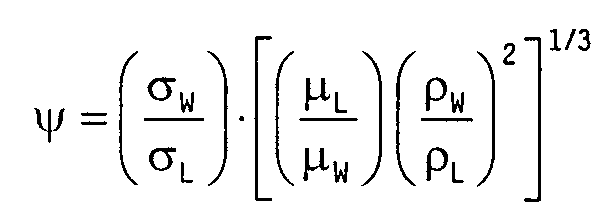
- ρG
- is the density of the gaseous phase in g/cm3,
- ρL
- is the density of the liquid phase in g/cm3,
- ρW
- is the density of water in g/cm3,
- ρAir
- is the density of air in g/cm3,
- σW
- is the surface tension of water in dyn/cm,
- σL
- is the surface tension of the liquid phase in dyn/cm,
- µL
- is the viscosity of the liquid phase in centipoise,
- µW
- is the viscosity of water in centipoise.
The epoxidation reaction is preferably carried out at temperatures
between 0 and 80°C, more preferably between 40 and 65°C. According to a
most preferred embodiment of the present invention the epoxidation
reaction is carried out in a fixed bed reactor equipped with cooling
means and the temperature profile within the reactor is maintained such
that the cooling medium temperature of the cooling means is at least
30°C and the maximum temperature within the catalyst bed is 60°C at the
most, preferably 55°C.
The epoxidation reaction can be carried out at ambient or at elevated
pressure depending on the olefin to be epoxidized. If the boiling point
of the olefin is below the temperature chosen for the epoxidation
reaction, the pressure is usually maintained at 5 to 50 bar, preferably
15 to 30 bar.
In a preferred embodiment of the invention the conditions for the
epoxidation reaction, that is temperature, pressure and the amounts of
olefin, hydrogen peroxide and solvent, are chosen to obtain a multiphase
reaction mixture comprising a liquid aqueous hydrogen peroxide rich
phase containing the polar solvent and a liquid organic olefin rich
phase. To ensure the formation of a second liquid organic olefin rich
phase the amount of olefin has to be selected in excess of the amount
soluble in the aqueous phase comprising water, hydrogen peroxide and
solvent at the chosen temperature and pressure. Maintaining two
immiscible liquid phases during the epoxidation reaction leads to
improved epoxide selectivity.
In a preferred embodiment of the invention ammonia is added to the
epoxidation stage to improve the epoxide selectivity in an amount of 100
to 3000 ppm, preferably 300 to 2000 ppm based on the weight of hydrogen
peroxide.
The recovery of the polar solvent from the epoxidation reaction mixture
may be performed by any suitable separation method or combination of
separation methods, such as distillation, crystallization, extraction,
adsorption or the like. Preferably, a combination of distillation steps
is used for the recovery. Preferably, unreacted olefin and the epoxide
product are separated from the solvent stream during the recovery
process. Some of the water contained in the solvent stream may be
separated as well during the solvent recovery. The recovered solvent
stream, that is treated to contain less than 50 wppm nitrogen in the
form of organic compounds, may comprise further components, such as
water, unreacted hydrogen peroxide or byproducts from the epoxidation
process.
A preferred embodiment of the invention is directed towards an improved
process for the catalytic epoxidation of propene with hydrogen peroxide
in the presence of a titanium silicalite catalyst and a solvent
comprising methanol. The improved process integrates the inventive
treatment and recycle of the solvent into the workup of the reaction
mixture to provide propene oxide with a minimum of separation steps and
a low energy requirement while at the same time maintaining high
catalytic activity and a long catalyst lifetime.
Epoxidation of propene is carried out as described above using a solvent
comprising methanol.
Before the working up stage the pressure of the propene epoxidation
reaction mixture is preferably released in a pressure release stage to
the pressure employed in the working up of the propene oxide. Part of
the propene dissolved in the reaction mixture and possibly propane is
gassed out. The resultant gas is recompressed via a compressor to the
pressure prevailing in the reactor and is returned to the reaction.
The reaction mixture is then separated in a pre-evaporator into an
overhead product containing propene, possibly propane, propene oxide and
methanol, and into a bottom product containing methanol, water, higher
boiling point byproducts, such as for example propylene glycol,
unreacted hydrogen peroxide and possibly suspended titanium silicalite
catalyst. The pre-evaporator according to the invention has less than
20, preferably at most 10 theoretical separation steps and is preferably
designed so that the rectification section corresponds to a single
distillation stage and the remaining separation effect is achieved in
the stripping section. The pre-evaporator is operated at a reflux ratio
of at most 1.5 and if desired may also be operated totally without
reflux. The pressure in the pre-evaporator is preferably chosen in the
range from 1.5 to less than 3 bar in order to avoid decomposition of
hydrogen peroxide. The pre-evaporator is operated so that between 20 and
60% of the amount of solvent fed in with the reaction mixture is removed
with the overhead product and the balance remains in the bottom product.
Preferably, more than 95%, more preferably, more than 98% and most
preferably, more than 99% of the propene oxide fed in is contained in
the overhead product, and preferably, more than 90%, more preferably,
more than 97% of the water fed in is contained in the bottom product.
The product stream fed to the pre-evaporator preferably contains 0.5 to
20 % by weight of propene, 0 to 4 % by weight of propane, 5 to 35% by
weight of propene oxide, 35 to 80 % by weight of methanol, 5 to 40% by
weight of water, 0.1 to 8 % by weight of higher boiling point
byproducts, 0.1 to 5 % by weight hydrogen peroxide and 0 to 5 % by
weight of titanium silicalite catalyst. This product stream is
preferably separated in the pre-evaporator into an overhead product
containing 1 to 40 % by weight of propene, 0 to 10 % by weight of
propane, 15 to 75 % by weight of propene oxide, 20 to 85 % by weight of
methanol and 0 to 5 % by weight of water, and into a bottom product
containing 0 to 2 % by weight of propene oxide, 30 to 80 % by weight of
methanol, 15 to 65 % by weight of water, 0.1 to 10 % by weight of higher
boiling point byproducts, 0.1 to 5 % by weight of hydrogen peroxide, 0
to 10 % by weight of titanium silicalite catalyst and more than 50 wppm
nitrogen in the form of organic nitrogen compounds.
At least a part and preferably all of the bottom product of the pre-evaporator
comprising methanol and water is treated to contain less than
50 wppm nitrogen in the form of organic nitrogen compounds. At least a
part and preferably all of the resulting treated product is then
recycled to the epoxidation reaction. Preferably at least a part of the
water contained in the bottom product of the pre-evaporator is removed
before the recycle stream is fed to the epoxidation stage. Removal of
water may be performed before the treatment, after the treatment or
combined with the treatment into a single process stage.
The treatment of the recovered methanol to contain less than 50 wppm
nitrogen in the form of organic nitrogen compounds may be performed by
all methods described above as suitable for the treatment of a recovered
polar solvent stream. Preferably the treatment comprises an acid
treatment of the recovered methanol stream. Most preferably, the same
embodiments of the acid treatment are employed as described above as
preferred embodiments for the acid treatment of the solvent stream.
In a preferred embodiment of the propene epoxidation process the
overhead product from the pre-evaporator is at least partially condensed
to give a condensate containing 0 to 12 % by weight of propene, 0 to 5 %
by weight of propane, 15 to 75% by weight of propene oxide, 20 to 85%
by weight of methanol and 0 to 8% by weight of water. Preferably the
overhead product is only partially condensed and the uncondensed
propene, possibly mixed with propane, is recompressed via a compressor
to the pressure prevailing in the reaction part and is recycled to the
reaction. The propene still dissolved in the condensate and possibly
propane are preferably stripped out from the condensate in a
C3 stripper. Preferably the stripped-out gas is recycled to the partial
condenser. Preferably the partial condensation is performed in two
steps. The overhead product from the pre-evaporator is partially
condensed in a first condenser and the gaseous effluent from the first
condenser is condensed in a second condenser maintained at a temperature
below the temperature of the first condenser. Preferably the temperature
within the first condenser is maintained at 40 to 70°C and the
temperature within the second condenser is maintained at 20 to 35°C. By
using a two step condensation the amount of valuable propene oxide that
can not be recovered is considerably reduced and the energy consumption
for cooling is reduced compared to a one step condensation. When
applying the two step condensation the condensates of both condensers
are passed to the C3 stripper to remove constituents having a boiling
point that is lower than that of propene oxide, whereby the gaseous
effluent from the stripper is partially condensed in the second
condenser and the condensate is recycled to the C3 stripper.
The condensate, obtained by at least partially condensing the overhead
product from the pre-evaporator and optionally stripping it in a
C3 stripper is then subjected to an extractive distillation with an
aqueous extraction solvent. The condensate is fed to the middle section
of a continuously operated distillation column. The aqueous extraction
solvent is added to the extractive distillation column at a point above
the point at which the condensate enters the column. A purified propene
oxide is withdrawn at the top of the column. At the bottom of the
extractive distillation column a bottom product containing methanol and
water is obtained. This bottom product is combined with the bottom
product from the pre-evaporator and the combined product is subjected to
the treatment to remove organic nitrogen compounds.
The extraction solvent is preferably an aqueous hydrazine solution
containing from 0.5 to 5% by weight hydrazine. When an aqueous
hydrazine solution is used as the extraction solvent, the extractive
distillation not only removes methanol but also acetaldehyde and other
carbonyl compounds from the propene oxide and provides a purified
propene oxide containing less than 50 ppm methanol and less than 50 ppm
acetaldehyde in a single purification step.
The amount of the extraction solvent fed to the extractive distillation
column is preferably chosen so that the mass ratio of the extraction
solvent feed relative to the amount of methanol contained in the pre-evaporator
condensate is in the range from 0.1 to 10. The extractive
distillation is preferably operated at an absolute pressure from 1 to
5 bar, more preferably at an absolute pressure from 1.5 to 2.5 bar. The
reflux ratio is preferably chosen in the range from 1 to 5.
The distillation column used for the extractive distillation comprises a
stripping section between the column bottoms and the feed point of the
pre-evaporator condensate, an extraction section between the feed point
of pre-evaporator condensate and the feed point of the extraction
solvent and a rectifying section between the feed point of the
extraction solvent and the point where the purified propene oxide is
withdrawn. Preferably a distillation column is used that has a
separation efficiency of 10 to 30 theoretical stages in both the
stripping section and the extraction section and a separation efficiency
of 20 to 60 theoretical stages in the rectifying section. The
distillation column can be a tray column containing discrete trays such
as sieve trays or bubble cap trays. The distillation column can also be
a packed column and both random packings as well as structured packings,
such as metal gauze packings can be used. The distillation column may
also combine sections with discrete trays and sections with packings.
The extraction section is preferably designed with discrete trays.
In a preferred embodiment of the epoxidation process the bottom product
from the pre-evaporator or the combined bottom products from the pre-evaporator
and the extractive distillation are subjected to a catalytic
hydrogenation step before being subjected to the treatment to remove
organic nitrogen compounds. The additional hydrogenation step reduces
the accumulation of byproducts, such as methyl formate and
dimethoxymethane, in the solvent recycle and improves the purity of the
propene oxide recovered with the process.
The catalytic hydrogenation is preferably carried out as a heterogeneous
catalytic hydrogenation at a hydrogen partial pressure of 0.5 to 30 MPa.
It is particularly preferred to conduct the hydrogenation step at a
temperature in the range of 80°C and 150°C, preferably 100°C to 180°C
and at a hydrogen partial pressure of 1 to 25 MPa.
Suitable hydrogenation catalysts are selected from supported catalysts
comprising one or more of metals selected from the group consisting of
Ru, Rh, Pd, Pt, Ag, Ir, Fe, Cu, Ni and Co. Alternatively Raney Nickel
and Raney Cobalt both optionally being doped with one or more of the
above mentioned can be used. The catalyst support is preferably selected
from activated carbon and metal oxides selected from SiO2, TiO2, ZrO2 and
Al2O3, mixed oxides comprising at least two of Si, Al, Ti and Zr and
mixtures thereof.
The hydrogenation can be carried out continuously or batch-wise e.g., in
a suspension method or a fixed-bed method. It is especially preferred
to use a trickle-bed reactor. The fixed-bed catalysts to be used therein
are preferably pellets with a diameter of 0.5 to 5 mm, especially 1 to
3 mm and with a length of 1 to 10 mm. The noble-metal content is in the
customary range, preferably 0.5 to 5% by weight.
The advantages of the present invention will be apparent in view of the
following examples.
Epoxidation was carried out continuously in a tubular reactor of 300 ml
volume filled with silica bonded titanium-silicalite extrudates with a
diameter of 3 mm. The equipment was furthermore comprised of three
containers for liquids and relevant pumps and a liquid separating
vessel. The three containers for liquids comprised methanol, 60 wt-%
aqueous H2O2 and propene. The 60% H2O2 was adjusted with ammonia to a pH
of 4.5. The reaction temperature was controlled via an aqueous cooling
liquid circulating in a cooling jacket whereby the cooling liquid
temperature was controlled by a thermostat. The reactor pressure was
25 bar absolute. Mass flow of the feeding pumps was adjusted to result
in a propene feed concentration of 21.5 wt-%, a methanol feed
concentration of 57 wt-% and an H2O2 feed concentration of 9.4 wt-%. The
reactor was operated in down-flow operation mode. The cooling jacket
temperature was 41°C, the total mass flow was 0.35 kg/h and the maximum
temperature was 59°C. Product output was determined by gas
chromatography and the H2O2 conversion by redox titration. The catalyst
selectivity was calculated on the basis of gas chromatographical
analysis of the propene oxygenates as the ratio of the amount of propene
oxide formed relative to the amount of all propene oxygenates formed.
Initial H2O2 conversion was 96% at a catalyst selectivity of 96%.
The reaction mixture obtained from the reaction after release of
pressure was separated in a pre-evaporation stage into an overhead
product containing propene, propane, propene oxide and methanol, and a
bottom product containing methanol, propylene glycol monomethyl ethers,
propylene glycol, water, high boiling point compounds and non-converted
hydrogen peroxide. A liquid condensate that contains propene oxide and
methanol as well as propene and propane dissolved therein was obtained
from the vapour state overhead product. The uncondensed stream, which
substantially consisted of propene and propane, was returned to the
epoxidation reaction. The propene and propane dissolved in the
condensate were stripped from the latter in a C3 stripper and returned
in the vapour state together with the pre-evaporator overhead stream to
the partial condensation stage. The stripped condensate stream, which
consisted substantially of propene oxide and methanol and had been freed
from propene and propane, was separated in an extractive distillation in
which a 1.5 wt-% aqueous solution of hydrazine was fed in as extraction
agent immediately underneath the head of the column, into a propene
oxide purified product and into a bottom product that consisted
substantially of methanol and water. The bottom product was combined
with the bottom product obtained in the pre-evaporator and subjected to
hydrogenation in a trickle-bed reactor for continuous hydrogenation. The
hydrogenation reactor had an interior volume of 150 ml and was filled
with a hydrogenation catalyst in form of extrudates with 2.3 mm diameter
comprising 2% Ru on activated carbon (The catalyst was prepared
according to the incipient wetness method using RuCl3, "Preparation of
Catalyst", Demon, B. et al., Elsevier, Amsterdam, 1976, page 13). The
hydrogenation was performed at 140°C and 40 bar abs. at a hydrogen flow
rate of 10 ml/h.
The hydrogenated product was fed at a rate of 3.5 kg/h to the middle
section of a methanol distillation column with 35 theoretical stages and
was continuously distilled at a pressure of 2 bar abs. with a reflux
ratio of 2. At the top of the column 2.5 kg/h of a methanol stream was
obtained which contained more than 99 wt-% methanol, 0.13 wt-% water,
55 wppm total nitrogen and less than 5 wppm nitrogen from ammonia. Total
nitrogen content was determined by the Kjeldahl method of DIN 53625,
ammonia nitrogen by ion chromatography. From the difference of total
nitrogen and ammonia nitrogen the nitrogen content from organic nitrogen
compounds was calculated as between 50 and 55 wppm.
The recovered methanol was reused for the epoxidation of propene in a
laboratory apparatus consisting of two tubular reactors in series with a
diameter of 18 mm and a length of 300 mm each, each containing 8 g of
the same catalyst as used in the first epoxidation. The catalyst had
been previously conditioned by using it for propene epoxidation for more
than 3000 h. The reactors were operated in up-flow mode at a pressure of
25 bar abs. and a temperature of 36°C in the first reactor and 44°C in
the second reactor. Three feed streams were simultaneously introduced
into the reactor. Feed 1 was a mixture of 715 g 60 wt-% aqueous hydrogen
peroxide and 1420 g fresh methanol, the methanol containing no
detectable amounts of nitrogen compounds, and was introduced at a rate
of 22.5 g/h. Feed 2 was a mixture of 1284 g recovered methanol and
1.335 g 32 wt-% aqueous ammonia, introduced at a rate of 14.8 g/h.
Feed 3 was propene, introduced at a rate of 23 g/h.
The reactor effluents were analyzed for propylene oxide by gas
chromatography and for hydrogen peroxide by redox titration. Propylene
oxide yield was calculated on the amount of hydrogen peroxide fed. The
results are shown in table 1.
Example 1 was repeated with the variation, that a 10 wt-% solution of
acetic acid in methanol was fed to the reflux stream of the methanol
distillation column at a rate of 81 g/h. The methanol stream withdrawn
at the top of the column contained more than 98 wt-% methanol, 1.6 wt-%
water, 33 wppm total nitrogen and 7 wppm nitrogen from ammonia. From the
difference of total nitrogen and ammonia nitrogen the nitrogen content
from organic nitrogen compounds was calculated as 26 wppm. Reuse of the
recovered methanol for the epoxidation of propene as in example 1 gave
the results shown in table 1.
Example 1 was repeated with the variation, that a 10 wt-% aqueous
solution of acetic acid was fed to the reflux stream of the methanol
distillation column at a rate of 98 g/h. The methanol stream withdrawn
at the top of the column contained more than 97 wt-% methanol, 2 wt-%
water, 14 wppm total nitrogen and less than 4 wppm nitrogen from
ammonia. From the difference of total nitrogen and ammonia nitrogen the
nitrogen content from organic nitrogen compounds was calculated as
between 10 and 14 wppm. Reuse of the recovered methanol for the
epoxidation of propene as in example 1 gave the results shown in
table 1.
Example 1 was repeated and a methanol stream containing more than
97 wt-% methanol, 2.5 wt-% water and 110 wppm total nitrogen was
withdrawn from the top of the methanol column. 1000 ml of this recovered
methanol were treated with 10 ml Dowex 50X8 strongly acidic ion
exchanger in the H+-form at room temparature for 3 days with occasional
shaking. The treated methanol contained 1.9 wppm total nitrogen. This
treated recovered methanol was reused for the epoxidation of propene as
described in example 1 with the difference, that recovered methanol was
used in feed 1 in place of fresh methanol. The results are shown in
table 1.
| Example | Nitrogen in recovered methanol [mg/kg] | H2O2 conversion [%] | Propene oxide yield [%] | ||
| Total | Ammonia | Organic | |||
| 1 | 55 | < 5 | 50-55 | 26 | 18 |
| 2 | 33 | 7 | 26 | 49 | 36 |
| 3 | 14 | < 4 | 10-14 | 54 | 42 |
| 4 | 1.9 | n.d. | < 1.9 | 55 | 41 |
| n.d.: not determined |
In comparative example 1 poisoning of the catalyst by the recycled
methanol leads to low hydrogen peroxide conversion and low propene oxide
yield. The use of a recovered methanol with a low content of nitrogen in
the form of organic compounds in examples 2 to 4 results in increased
catalyst activity as can be seen by the increased hydrogen peroxide
conversion and propene oxide yield.
Claims (21)
- Process for the catalytic epoxidation of olefins, wherein one or more nitrogen containing compounds are introduced at some stage of the process, by(i) reacting an olefin with hydrogen peroxide in the presence of a titanium containing zeolite catalyst and a polar solvent,(ii) recovering a stream comprising the polar solvent from the reaction product of step i),(iii) treating the stream recovered in step ii) to contain less than 50 wppm nitrogen in the form of organic nitrogen compounds and(iv) recycling at least part of the treated stream of step iii) to the epoxidation step i).
- The process of claim 1, wherein
the stream recycled in step iv) contains less than 10 wppm nitrogen in the form of organic nitrogen compounds. - The process of any of the preceding claims, wherein
the polar solvent is an alcohol and preferably is methanol. - The process of any of the preceding claims, wherein
the olefin is propene. - The process of any of the preceding claims, wherein
the titanium containing zeolite catalyst is a titanium silicalite with MFI or MEL structure. - The process of any of the preceding claims, wherein
the epoxidation reaction of step i) is conducted in the presence of 100 to 3000 ppm ammonia, preferably 300 to 2000 ppm based on the weight of hydrogen peroxide. - The process of any of the preceding claims, wherein
the treatment in step iii) is an acid treatment. - The process of claim 7, wherein
the acid treatment comprisesa) adding an acid to the stream recovered in step ii);b) subjecting the mixture of step a) to distillation andc) withdrawing a distillate comprising the polar solvent and containing less than 50 wppm nitrogen in the form of organic nitrogen compounds. - The process of claim 7, wherein
the acid treatment comprisesa) subjecting the stream recovered in step ii) to a continuously operated distillation;b) feeding a stream comprising an acid at a point above the feed point of the stream recovered in step ii) andc) withdrawing a product stream comprising the polar solvent and containing less than 50 wppm nitrogen in the form of organic nitrogen compounds at a point above the feed point of the acid comprising stream. - The process of any of claims 7 to 9, characterized in that
the acid is a mineral acid and preferably is selected from sulfuric acid and phosphoric acid. - The process of any of claims 7 to 9, characterized in that
the acid is a carboxylic acid and preferably is acetic acid. - The process of claim 7, wherein
the acid treatment comprises treating the stream recovered in step ii) with an acidic ion exchanger in its protonated form. - The process of claim 12, wherein
the stream recovered in step ii) is passed through a fixed bed containing the acidic ion exchanger. - The process of claims 12 or 13, wherein
the acidic ion exchanger is a strongly acidic ion exchanger, preferably an acidic ion exchanger containing SO3H groups. - The process of claims 12 or 13, wherein
the acidic ion exchanger is a weakly acidic ion exchanger, preferably an acidic ion exchanger containing COOH groups. - Process for the catalytic epoxidation of propene, wherein one or more nitrogen containing compounds are introduced at some stage of the process anda) in a reaction step propene is reacted with hydrogen peroxide in the presence of a titanium silicalite catalyst and a solvent comprising methanol,b) the product stream from the reaction step is optionally passed to a pressure release step,c) the product stream is then separated in a pre-evaporator having less than 20 theoretical separation stages into an overhead product containing propene, propene oxide and methanol, and into a bottom product containing methanol and water, 20 to 60% of the total amount of methanol introduced with the product stream being removed with the overhead product and the residue remaining in the bottom product,d) at least a part of the bottom product from step c) is treated to contain less than 50 wppm nitrogen in the form of organic nitrogen compounds and, optionally after partially removing water,e) at least a part of the treated product from step d) is recycled to the reaction step a).
- The process of claim 16, wherein
the treatment in step d) is an acid treatment. - The process of claim 17, wherein
the acid treatment is performed according to any of claims 8 to 15. - The process of any of claims 16 to 18, whereinf) the overhead product from step c) is at least partially condensed, the condensate containing, optionally after stripping out propene and any propane present
0 - 12 wt.% propene, 0 - 5 wt.% propane, 15 - 75 wt.% propene oxide, 20 - 85 wt.% methanol and 0 - 8 wt.% water, g) the condensate from step f) is subjected to an extractive distillation, whereing1) the condensate is added to a middle section of an extractive distillation column,g2) an aqueous extraction solvent is added to the extractive distillation column at a point above the point at which the condensate enters,g3) propene oxide is distilled off at the head of the column,g4) a bottom product containing methanol and water is removed, andh) the bottom product from step c) is combined with the bottom product from step g4) before subjecting it to step d). - The process of claim 19, wherein
the extraction solvent in step g2) is an aqueous hydrazine solution containing from 0.5 to 5 % by weight hydrazine. - The process of any of claims 16 to 20, wherein
in step d) the bottom product of step c) or the combined product of the bottom product of step c) and the product of step g4) is subjected to hydrogenation before subjecting it to the treatment to remove organic nitrogen compounds.
Priority Applications (14)
| Application Number | Priority Date | Filing Date | Title |
|---|---|---|---|
| EP02026241A EP1424331A1 (en) | 2002-11-26 | 2002-11-26 | Process for the epoxidation of olefins |
| MYPI20034450A MY136051A (en) | 2002-11-26 | 2003-11-20 | Process for the epoxidation of olefins |
| AU2003288162A AU2003288162A1 (en) | 2002-11-26 | 2003-11-25 | Process for the epoxidation of olefins |
| PL376956A PL216046B1 (en) | 2002-11-26 | 2003-11-25 | Process for the epoxidation of olefins |
| RU2005120165/04A RU2327694C2 (en) | 2002-11-26 | 2003-11-25 | Method of epoxidation of olefins |
| BRPI0316539-6B1A BR0316539B1 (en) | 2002-11-26 | 2003-11-25 | olefin epoxidation process |
| CNB200380104194XA CN100447138C (en) | 2002-11-26 | 2003-11-25 | Olefin epoxidation method |
| KR1020057009305A KR100950888B1 (en) | 2002-11-26 | 2003-11-25 | Epoxylation of Olefin |
| HUE03780046A HUE041339T2 (en) | 2002-11-26 | 2003-11-25 | Process for the epoxidation of olefins |
| CA2507068A CA2507068C (en) | 2002-11-26 | 2003-11-25 | Process for the epoxidation of olefins in the presence of nitrogen-containing compounds |
| JP2004554450A JP4718186B2 (en) | 2002-11-26 | 2003-11-25 | Olefin epoxidation process |
| EP03780046.3A EP1565449B1 (en) | 2002-11-26 | 2003-11-25 | Process for the epoxidation of olefins |
| PCT/EP2003/013213 WO2004048354A1 (en) | 2002-11-26 | 2003-11-25 | Process for the epoxidation of olefins |
| ZA200504278A ZA200504278B (en) | 2002-11-26 | 2005-05-25 | Process for the epoxidation of olefins |
Applications Claiming Priority (1)
| Application Number | Priority Date | Filing Date | Title |
|---|---|---|---|
| EP02026241A EP1424331A1 (en) | 2002-11-26 | 2002-11-26 | Process for the epoxidation of olefins |
Publications (1)
| Publication Number | Publication Date |
|---|---|
| EP1424331A1 true EP1424331A1 (en) | 2004-06-02 |
Family
ID=32241264
Family Applications (2)
| Application Number | Title | Priority Date | Filing Date |
|---|---|---|---|
| EP02026241A Withdrawn EP1424331A1 (en) | 2002-11-26 | 2002-11-26 | Process for the epoxidation of olefins |
| EP03780046.3A Expired - Lifetime EP1565449B1 (en) | 2002-11-26 | 2003-11-25 | Process for the epoxidation of olefins |
Family Applications After (1)
| Application Number | Title | Priority Date | Filing Date |
|---|---|---|---|
| EP03780046.3A Expired - Lifetime EP1565449B1 (en) | 2002-11-26 | 2003-11-25 | Process for the epoxidation of olefins |
Country Status (13)
| Country | Link |
|---|---|
| EP (2) | EP1424331A1 (en) |
| JP (1) | JP4718186B2 (en) |
| KR (1) | KR100950888B1 (en) |
| CN (1) | CN100447138C (en) |
| AU (1) | AU2003288162A1 (en) |
| BR (1) | BR0316539B1 (en) |
| CA (1) | CA2507068C (en) |
| HU (1) | HUE041339T2 (en) |
| MY (1) | MY136051A (en) |
| PL (1) | PL216046B1 (en) |
| RU (1) | RU2327694C2 (en) |
| WO (1) | WO2004048354A1 (en) |
| ZA (1) | ZA200504278B (en) |
Families Citing this family (24)
| Publication number | Priority date | Publication date | Assignee | Title |
|---|---|---|---|---|
| DE102006017700A1 (en) * | 2006-04-15 | 2007-10-25 | Degussa Gmbh | Silicon-titanium mixed oxide containing dispersion for the production of titanium-containing zeolites |
| TWI523689B (en) * | 2010-03-25 | 2016-03-01 | 陶氏全球科技公司 | Process for producing propylene oxide using a pretreated epoxidation catalyst |
| JP2011246423A (en) * | 2010-05-31 | 2011-12-08 | Sumitomo Chemical Co Ltd | Method for producing olefin oxide |
| US9169226B2 (en) | 2010-07-14 | 2015-10-27 | Dow Global Technologies Llc | Process and assembly for producing alkylene oxides and glycol ethers |
| CN102441430B (en) * | 2010-10-11 | 2013-06-12 | 中国石油化工股份有限公司 | Catalyst, preparation method thereof and alkene epoxidation method |
| CN104803953B (en) * | 2014-01-28 | 2017-09-29 | 中国石油化工股份有限公司 | A kind of olefin epoxidation method |
| CN103920531B (en) * | 2014-03-24 | 2016-01-20 | 华东师范大学 | A kind of titanium-silicon molecular sieve catalyst and its preparation method and application |
| HUE046136T2 (en) | 2015-11-25 | 2020-02-28 | Evonik Operations Gmbh | Method for the production of 1,2-propane diol from propene and hydrogen peroxide |
| KR102022226B1 (en) * | 2015-11-26 | 2019-09-18 | 에보닉 데구사 게엠베하 | Process for Purifying Propene Oxide |
| ES2873407T3 (en) * | 2015-11-26 | 2021-11-03 | Evonik Operations Gmbh | Process and reactor for the epoxidation of propene |
| PL3380459T3 (en) | 2015-11-26 | 2020-06-01 | Evonik Operations Gmbh | Process for the epoxidation of an olefin |
| TWI707847B (en) * | 2015-11-26 | 2020-10-21 | 德商贏創運營有限公司 | Process for the epoxidation of propene |
| ES2746159T3 (en) | 2015-11-26 | 2020-03-04 | Evonik Operations Gmbh | Process for epoxidation of propene |
| HUE048978T2 (en) | 2015-12-02 | 2020-09-28 | Evonik Operations Gmbh | Process for the epoxidation of propene |
| CN108473453B (en) | 2016-01-19 | 2020-08-04 | 赢创运营有限公司 | Epoxidation method of olefins |
| HUE052019T2 (en) | 2016-03-21 | 2021-04-28 | Evonik Operations Gmbh | Process for the epoxidation of propene |
| EP3246323A1 (en) | 2016-05-17 | 2017-11-22 | Evonik Degussa GmbH | Integrated process for making propene oxide from propane |
| WO2018205244A1 (en) | 2017-05-12 | 2018-11-15 | Evonik Degussa Gmbh | Process for the epoxidation of propene |
| EP3406603A1 (en) | 2017-05-22 | 2018-11-28 | Evonik Degussa GmbH | Process for the epoxidation of propene |
| EP3438101A1 (en) | 2017-08-01 | 2019-02-06 | Evonik Degussa GmbH | Process for the epoxidation of propene |
| HUE061260T2 (en) * | 2020-10-21 | 2023-05-28 | Evonik Operations Gmbh | A method for the preparation of 1,2-propanediol |
| ES2929792T3 (en) * | 2020-10-21 | 2022-12-01 | Evonik Operations Gmbh | A method for the preparation of 1,2-propanediol, dipropylene glycol and tripropylene glycol |
| PT4288420T (en) | 2021-02-03 | 2025-09-16 | Evonik Operations Gmbh | Process for the epoxidation of propene |
| HUE071346T2 (en) | 2021-05-10 | 2025-08-28 | Evonik Operations Gmbh | Integrated equipment and integrated process for the production of propene oxide |
Citations (9)
| Publication number | Priority date | Publication date | Assignee | Title |
|---|---|---|---|---|
| EP0712852A1 (en) * | 1994-11-16 | 1996-05-22 | ARCO Chemical Technology, L.P. | Improved process for titanium silicalite-catalyzed epoxidation |
| US5599955A (en) * | 1996-02-22 | 1997-02-04 | Uop | Process for producing propylene oxide |
| EP0757043A1 (en) * | 1995-08-01 | 1997-02-05 | Degussa Aktiengesellschaft | Process for preparing epoxides from olefins |
| EP0940393A1 (en) * | 1998-03-05 | 1999-09-08 | Enichem S.p.A. | Process for the preparation of olefinic epoxides |
| WO2000017178A1 (en) * | 1998-09-22 | 2000-03-30 | Arco Chemical Technology L.P. | Improved epoxidation process |
| EP1072599A1 (en) * | 1999-07-27 | 2001-01-31 | Enichem S.p.A. | Process for the preparation of olefin oxides |
| EP1085017A1 (en) * | 1999-09-18 | 2001-03-21 | Degussa-Hüls Aktiengesellschaft | Process for the preparation of epoxides from olefins |
| WO2001057009A1 (en) * | 2000-02-07 | 2001-08-09 | Degussa Ag | Process for the epoxidation of olefins |
| WO2001068623A1 (en) * | 2000-03-10 | 2001-09-20 | Solvay (Société Anonyme) | Method for making an oxirane |
Family Cites Families (8)
| Publication number | Priority date | Publication date | Assignee | Title |
|---|---|---|---|---|
| ES2033693T3 (en) * | 1986-01-28 | 1993-04-01 | Eniricerche S.P.A. | A PROCEDURE FOR THE EXPOSURE OF OLEPHINE COMPOUNDS. |
| US5384418A (en) * | 1994-01-25 | 1995-01-24 | Arco Chemical Technology, L.P. | Integrated process for epoxide production |
| US5591875A (en) * | 1995-08-02 | 1997-01-07 | Chang; Te | Epoxidation Process |
| DE69929415T2 (en) * | 1999-08-06 | 2006-09-21 | Repsol Quimica S.A. | Process for the continuous production of propylene oxide and other alkene oxides |
| EP1122248A1 (en) * | 2000-02-07 | 2001-08-08 | Degussa AG | Process for the epoxidation of olefines |
| IT1318682B1 (en) * | 2000-08-11 | 2003-08-27 | Enichem Spa | INTEGRATED PROCEDURE FOR THE PREPARATION OF OLEFINIC OXIDES. |
| IT1318681B1 (en) * | 2000-08-11 | 2003-08-27 | Enichem Spa | INTEGRATED PROCEDURE FOR THE PREPARATION OF EPOXY. |
| JP3747239B2 (en) * | 2001-02-28 | 2006-02-22 | 独立行政法人産業技術総合研究所 | Propylene oxide production method |
-
2002
- 2002-11-26 EP EP02026241A patent/EP1424331A1/en not_active Withdrawn
-
2003
- 2003-11-20 MY MYPI20034450A patent/MY136051A/en unknown
- 2003-11-25 AU AU2003288162A patent/AU2003288162A1/en not_active Abandoned
- 2003-11-25 PL PL376956A patent/PL216046B1/en unknown
- 2003-11-25 BR BRPI0316539-6B1A patent/BR0316539B1/en not_active IP Right Cessation
- 2003-11-25 CA CA2507068A patent/CA2507068C/en not_active Expired - Fee Related
- 2003-11-25 RU RU2005120165/04A patent/RU2327694C2/en active
- 2003-11-25 JP JP2004554450A patent/JP4718186B2/en not_active Expired - Fee Related
- 2003-11-25 EP EP03780046.3A patent/EP1565449B1/en not_active Expired - Lifetime
- 2003-11-25 HU HUE03780046A patent/HUE041339T2/en unknown
- 2003-11-25 KR KR1020057009305A patent/KR100950888B1/en not_active Expired - Fee Related
- 2003-11-25 CN CNB200380104194XA patent/CN100447138C/en not_active Expired - Lifetime
- 2003-11-25 WO PCT/EP2003/013213 patent/WO2004048354A1/en not_active Ceased
-
2005
- 2005-05-25 ZA ZA200504278A patent/ZA200504278B/en unknown
Patent Citations (9)
| Publication number | Priority date | Publication date | Assignee | Title |
|---|---|---|---|---|
| EP0712852A1 (en) * | 1994-11-16 | 1996-05-22 | ARCO Chemical Technology, L.P. | Improved process for titanium silicalite-catalyzed epoxidation |
| EP0757043A1 (en) * | 1995-08-01 | 1997-02-05 | Degussa Aktiengesellschaft | Process for preparing epoxides from olefins |
| US5599955A (en) * | 1996-02-22 | 1997-02-04 | Uop | Process for producing propylene oxide |
| EP0940393A1 (en) * | 1998-03-05 | 1999-09-08 | Enichem S.p.A. | Process for the preparation of olefinic epoxides |
| WO2000017178A1 (en) * | 1998-09-22 | 2000-03-30 | Arco Chemical Technology L.P. | Improved epoxidation process |
| EP1072599A1 (en) * | 1999-07-27 | 2001-01-31 | Enichem S.p.A. | Process for the preparation of olefin oxides |
| EP1085017A1 (en) * | 1999-09-18 | 2001-03-21 | Degussa-Hüls Aktiengesellschaft | Process for the preparation of epoxides from olefins |
| WO2001057009A1 (en) * | 2000-02-07 | 2001-08-09 | Degussa Ag | Process for the epoxidation of olefins |
| WO2001068623A1 (en) * | 2000-03-10 | 2001-09-20 | Solvay (Société Anonyme) | Method for making an oxirane |
Also Published As
| Publication number | Publication date |
|---|---|
| JP2006515575A (en) | 2006-06-01 |
| WO2004048354A1 (en) | 2004-06-10 |
| BR0316539B1 (en) | 2013-07-23 |
| MY136051A (en) | 2008-08-29 |
| CA2507068A1 (en) | 2004-06-10 |
| AU2003288162A8 (en) | 2004-06-18 |
| CA2507068C (en) | 2011-07-26 |
| KR100950888B1 (en) | 2010-04-06 |
| PL376956A1 (en) | 2006-01-09 |
| RU2005120165A (en) | 2006-05-10 |
| EP1565449B1 (en) | 2018-09-05 |
| AU2003288162A1 (en) | 2004-06-18 |
| PL216046B1 (en) | 2014-02-28 |
| BR0316539A (en) | 2005-10-04 |
| RU2327694C2 (en) | 2008-06-27 |
| JP4718186B2 (en) | 2011-07-06 |
| CN100447138C (en) | 2008-12-31 |
| ZA200504278B (en) | 2006-08-30 |
| EP1565449A1 (en) | 2005-08-24 |
| KR20050083980A (en) | 2005-08-26 |
| CN1717399A (en) | 2006-01-04 |
| HUE041339T2 (en) | 2019-05-28 |
Similar Documents
| Publication | Publication Date | Title |
|---|---|---|
| CA2507068C (en) | Process for the epoxidation of olefins in the presence of nitrogen-containing compounds | |
| CA2507071C (en) | Process for the purification of crude propylene oxide by extractive distillation | |
| CA2483447C (en) | Process for the epoxidation of olefins with hydrogen peroxide | |
| KR102532377B1 (en) | Method for epoxidation of propene | |
| US7169945B2 (en) | Process for the epoxidation of olefins | |
| US7141683B2 (en) | Process for the epoxidation of olefins | |
| RU2853621C1 (en) | Method for epoxidation of propene | |
| US11873285B2 (en) | Process for making propene oxide | |
| KR20230142715A (en) | Method for epoxidation of propene | |
| EA044186B1 (en) | PROPENE EPOXIDATION METHOD | |
| HK40019857A (en) | Process for the epoxidation of propene | |
| WO2019025184A1 (en) | Process for the epoxidation of propene |
Legal Events
| Date | Code | Title | Description |
|---|---|---|---|
| PUAI | Public reference made under article 153(3) epc to a published international application that has entered the european phase |
Free format text: ORIGINAL CODE: 0009012 |
|
| AK | Designated contracting states |
Kind code of ref document: A1 Designated state(s): AT BE BG CH CY CZ DE DK EE ES FI FR GB GR IE IT LI LU MC NL PT SE SK TR |
|
| AX | Request for extension of the european patent |
Extension state: AL LT LV MK RO SI |
|
| AKX | Designation fees paid | ||
| REG | Reference to a national code |
Ref country code: DE Ref legal event code: 8566 |
|
| STAA | Information on the status of an ep patent application or granted ep patent |
Free format text: STATUS: THE APPLICATION IS DEEMED TO BE WITHDRAWN |
|
| 18D | Application deemed to be withdrawn |
Effective date: 20041203 |