EP1422781A1 - Boron-containing compound, ion-conductive polymer and polyelectrolyte for electrochemical devices - Google Patents
Boron-containing compound, ion-conductive polymer and polyelectrolyte for electrochemical devices Download PDFInfo
- Publication number
- EP1422781A1 EP1422781A1 EP03026140A EP03026140A EP1422781A1 EP 1422781 A1 EP1422781 A1 EP 1422781A1 EP 03026140 A EP03026140 A EP 03026140A EP 03026140 A EP03026140 A EP 03026140A EP 1422781 A1 EP1422781 A1 EP 1422781A1
- Authority
- EP
- European Patent Office
- Prior art keywords
- battery
- boron
- formula
- group
- containing compound
- Prior art date
- Legal status (The legal status is an assumption and is not a legal conclusion. Google has not performed a legal analysis and makes no representation as to the accuracy of the status listed.)
- Granted
Links
- 150000001875 compounds Chemical class 0.000 title claims abstract description 74
- ZOXJGFHDIHLPTG-UHFFFAOYSA-N Boron Chemical compound [B] ZOXJGFHDIHLPTG-UHFFFAOYSA-N 0.000 title claims abstract description 67
- 229910052796 boron Inorganic materials 0.000 title claims abstract description 67
- 229920000867 polyelectrolyte Polymers 0.000 title claims abstract description 51
- 229920001940 conductive polymer Polymers 0.000 title description 3
- 150000003839 salts Chemical class 0.000 claims abstract description 40
- 229920000642 polymer Polymers 0.000 claims abstract description 19
- -1 methacryloyl group Chemical group 0.000 claims description 45
- 239000000203 mixture Substances 0.000 claims description 37
- 229910001496 lithium tetrafluoroborate Inorganic materials 0.000 claims description 28
- 125000005702 oxyalkylene group Chemical group 0.000 claims description 23
- 125000004432 carbon atom Chemical group C* 0.000 claims description 20
- 125000003647 acryloyl group Chemical group O=C([*])C([H])=C([H])[H] 0.000 claims description 16
- 125000001183 hydrocarbyl group Chemical group 0.000 claims description 15
- 125000000962 organic group Chemical group 0.000 claims description 15
- 229910001290 LiPF6 Inorganic materials 0.000 claims description 12
- QSZMZKBZAYQGRS-UHFFFAOYSA-N lithium;bis(trifluoromethylsulfonyl)azanide Chemical compound [Li+].FC(F)(F)S(=O)(=O)[N-]S(=O)(=O)C(F)(F)F QSZMZKBZAYQGRS-UHFFFAOYSA-N 0.000 claims description 11
- 230000000379 polymerizing effect Effects 0.000 claims description 7
- 239000000126 substance Substances 0.000 claims description 7
- AMXOYNBUYSYVKV-UHFFFAOYSA-M lithium bromide Chemical compound [Li+].[Br-] AMXOYNBUYSYVKV-UHFFFAOYSA-M 0.000 claims 4
- 229910010820 Li2B10Cl10 Inorganic materials 0.000 claims 2
- 229910001540 lithium hexafluoroarsenate(V) Inorganic materials 0.000 claims 2
- HSZCZNFXUDYRKD-UHFFFAOYSA-M lithium iodide Inorganic materials [Li+].[I-] HSZCZNFXUDYRKD-UHFFFAOYSA-M 0.000 claims 2
- MHCFAGZWMAWTNR-UHFFFAOYSA-M lithium perchlorate Chemical compound [Li+].[O-]Cl(=O)(=O)=O MHCFAGZWMAWTNR-UHFFFAOYSA-M 0.000 claims 2
- 229910001486 lithium perchlorate Inorganic materials 0.000 claims 2
- HSFDLPWPRRSVSM-UHFFFAOYSA-M lithium;2,2,2-trifluoroacetate Chemical compound [Li+].[O-]C(=O)C(F)(F)F HSFDLPWPRRSVSM-UHFFFAOYSA-M 0.000 claims 2
- 239000003792 electrolyte Substances 0.000 abstract description 47
- 230000000052 comparative effect Effects 0.000 description 67
- 229910052782 aluminium Inorganic materials 0.000 description 43
- XAGFODPZIPBFFR-UHFFFAOYSA-N aluminium Chemical compound [Al] XAGFODPZIPBFFR-UHFFFAOYSA-N 0.000 description 43
- 239000005001 laminate film Substances 0.000 description 41
- 238000000034 method Methods 0.000 description 39
- KGBXLFKZBHKPEV-UHFFFAOYSA-N boric acid Chemical compound OB(O)O KGBXLFKZBHKPEV-UHFFFAOYSA-N 0.000 description 29
- 239000004327 boric acid Substances 0.000 description 29
- 230000032050 esterification Effects 0.000 description 19
- 238000005886 esterification reaction Methods 0.000 description 19
- WRECIMRULFAWHA-UHFFFAOYSA-N trimethyl borate Chemical compound COB(OC)OC WRECIMRULFAWHA-UHFFFAOYSA-N 0.000 description 19
- 229910001220 stainless steel Inorganic materials 0.000 description 18
- 239000010935 stainless steel Substances 0.000 description 18
- 239000005518 polymer electrolyte Substances 0.000 description 16
- 239000012528 membrane Substances 0.000 description 15
- OZAIFHULBGXAKX-UHFFFAOYSA-N 2-(2-cyanopropan-2-yldiazenyl)-2-methylpropanenitrile Chemical compound N#CC(C)(C)N=NC(C)(C)C#N OZAIFHULBGXAKX-UHFFFAOYSA-N 0.000 description 14
- 125000002887 hydroxy group Chemical group [H]O* 0.000 description 11
- 238000003756 stirring Methods 0.000 description 10
- 238000005809 transesterification reaction Methods 0.000 description 10
- 238000010521 absorption reaction Methods 0.000 description 9
- 238000000862 absorption spectrum Methods 0.000 description 9
- 230000008034 disappearance Effects 0.000 description 9
- 239000012298 atmosphere Substances 0.000 description 8
- 238000007599 discharging Methods 0.000 description 8
- 229920001343 polytetrafluoroethylene Polymers 0.000 description 7
- 239000004810 polytetrafluoroethylene Substances 0.000 description 7
- RTZKZFJDLAIYFH-UHFFFAOYSA-N Diethyl ether Chemical compound CCOCC RTZKZFJDLAIYFH-UHFFFAOYSA-N 0.000 description 6
- JLGLQAWTXXGVEM-UHFFFAOYSA-N triethylene glycol monomethyl ether Chemical compound COCCOCCOCCO JLGLQAWTXXGVEM-UHFFFAOYSA-N 0.000 description 6
- OLQFXOWPTQTLDP-UHFFFAOYSA-N 2-(2-hydroxyethoxy)ethyl 2-methylprop-2-enoate Chemical compound CC(=C)C(=O)OCCOCCO OLQFXOWPTQTLDP-UHFFFAOYSA-N 0.000 description 5
- XNWFRZJHXBZDAG-UHFFFAOYSA-N 2-METHOXYETHANOL Chemical compound COCCO XNWFRZJHXBZDAG-UHFFFAOYSA-N 0.000 description 5
- WAEVWDZKMBQDEJ-UHFFFAOYSA-N 2-[2-(2-methoxypropoxy)propoxy]propan-1-ol Chemical compound COC(C)COC(C)COC(C)CO WAEVWDZKMBQDEJ-UHFFFAOYSA-N 0.000 description 5
- 239000003999 initiator Substances 0.000 description 5
- 239000002002 slurry Substances 0.000 description 5
- 229920002818 (Hydroxyethyl)methacrylate Polymers 0.000 description 4
- ZKLMKZINKNMVKA-UHFFFAOYSA-N 2-(2-hydroxypropoxy)propan-1-ol;2-methylprop-2-enoic acid Chemical compound CC(=C)C(O)=O.CC(O)COC(C)CO ZKLMKZINKNMVKA-UHFFFAOYSA-N 0.000 description 4
- BTBUEUYNUDRHOZ-UHFFFAOYSA-N Borate Chemical compound [O-]B([O-])[O-] BTBUEUYNUDRHOZ-UHFFFAOYSA-N 0.000 description 4
- WOBHKFSMXKNTIM-UHFFFAOYSA-N Hydroxyethyl methacrylate Chemical compound CC(=C)C(=O)OCCO WOBHKFSMXKNTIM-UHFFFAOYSA-N 0.000 description 4
- SECXISVLQFMRJM-UHFFFAOYSA-N N-Methylpyrrolidone Chemical compound CN1CCCC1=O SECXISVLQFMRJM-UHFFFAOYSA-N 0.000 description 4
- 238000007600 charging Methods 0.000 description 4
- 229920000620 organic polymer Polymers 0.000 description 4
- UHOVQNZJYSORNB-UHFFFAOYSA-N Benzene Chemical compound C1=CC=CC=C1 UHOVQNZJYSORNB-UHFFFAOYSA-N 0.000 description 3
- 229940126062 Compound A Drugs 0.000 description 3
- NLDMNSXOCDLTTB-UHFFFAOYSA-N Heterophylliin A Natural products O1C2COC(=O)C3=CC(O)=C(O)C(O)=C3C3=C(O)C(O)=C(O)C=C3C(=O)OC2C(OC(=O)C=2C=C(O)C(O)=C(O)C=2)C(O)C1OC(=O)C1=CC(O)=C(O)C(O)=C1 NLDMNSXOCDLTTB-UHFFFAOYSA-N 0.000 description 3
- 238000006243 chemical reaction Methods 0.000 description 3
- 230000003247 decreasing effect Effects 0.000 description 3
- JKWMSGQKBLHBQQ-UHFFFAOYSA-N diboron trioxide Chemical compound O=BOB=O JKWMSGQKBLHBQQ-UHFFFAOYSA-N 0.000 description 3
- 238000011156 evaluation Methods 0.000 description 3
- 239000011244 liquid electrolyte Substances 0.000 description 3
- 238000002156 mixing Methods 0.000 description 3
- 239000012299 nitrogen atmosphere Substances 0.000 description 3
- LVTJOONKWUXEFR-FZRMHRINSA-N protoneodioscin Natural products O(C[C@@H](CC[C@]1(O)[C@H](C)[C@@H]2[C@]3(C)[C@H]([C@H]4[C@@H]([C@]5(C)C(=CC4)C[C@@H](O[C@@H]4[C@H](O[C@H]6[C@@H](O)[C@@H](O)[C@@H](O)[C@H](C)O6)[C@@H](O)[C@H](O[C@H]6[C@@H](O)[C@@H](O)[C@@H](O)[C@H](C)O6)[C@H](CO)O4)CC5)CC3)C[C@@H]2O1)C)[C@H]1[C@H](O)[C@H](O)[C@H](O)[C@@H](CO)O1 LVTJOONKWUXEFR-FZRMHRINSA-N 0.000 description 3
- XLYOFNOQVPJJNP-UHFFFAOYSA-N water Substances O XLYOFNOQVPJJNP-UHFFFAOYSA-N 0.000 description 3
- BVKZGUZCCUSVTD-UHFFFAOYSA-L Carbonate Chemical compound [O-]C([O-])=O BVKZGUZCCUSVTD-UHFFFAOYSA-L 0.000 description 2
- RYGMFSIKBFXOCR-UHFFFAOYSA-N Copper Chemical compound [Cu] RYGMFSIKBFXOCR-UHFFFAOYSA-N 0.000 description 2
- LYCAIKOWRPUZTN-UHFFFAOYSA-N Ethylene glycol Chemical compound OCCO LYCAIKOWRPUZTN-UHFFFAOYSA-N 0.000 description 2
- HBBGRARXTFLTSG-UHFFFAOYSA-N Lithium ion Chemical compound [Li+] HBBGRARXTFLTSG-UHFFFAOYSA-N 0.000 description 2
- 239000002033 PVDF binder Substances 0.000 description 2
- LWMFAFLIWMPZSX-UHFFFAOYSA-N bis[2-(4,5-dihydro-1h-imidazol-2-yl)propan-2-yl]diazene Chemical compound N=1CCNC=1C(C)(C)N=NC(C)(C)C1=NCCN1 LWMFAFLIWMPZSX-UHFFFAOYSA-N 0.000 description 2
- 229910052799 carbon Inorganic materials 0.000 description 2
- 150000001768 cations Chemical class 0.000 description 2
- 239000011248 coating agent Substances 0.000 description 2
- 238000000576 coating method Methods 0.000 description 2
- 238000010280 constant potential charging Methods 0.000 description 2
- 238000010277 constant-current charging Methods 0.000 description 2
- 239000011889 copper foil Substances 0.000 description 2
- 238000007606 doctor blade method Methods 0.000 description 2
- 239000011888 foil Substances 0.000 description 2
- FVIZARNDLVOMSU-UHFFFAOYSA-N ginsenoside K Natural products C1CC(C2(CCC3C(C)(C)C(O)CCC3(C)C2CC2O)C)(C)C2C1C(C)(CCC=C(C)C)OC1OC(CO)C(O)C(O)C1O FVIZARNDLVOMSU-UHFFFAOYSA-N 0.000 description 2
- 229910002804 graphite Inorganic materials 0.000 description 2
- 150000002500 ions Chemical class 0.000 description 2
- 229910052744 lithium Inorganic materials 0.000 description 2
- 229910001416 lithium ion Inorganic materials 0.000 description 2
- 239000000463 material Substances 0.000 description 2
- 229910052751 metal Inorganic materials 0.000 description 2
- 239000002184 metal Substances 0.000 description 2
- 125000002496 methyl group Chemical group [H]C([H])([H])* 0.000 description 2
- 239000000178 monomer Substances 0.000 description 2
- 125000006353 oxyethylene group Chemical group 0.000 description 2
- 239000003505 polymerization initiator Substances 0.000 description 2
- 238000006116 polymerization reaction Methods 0.000 description 2
- 229920002981 polyvinylidene fluoride Polymers 0.000 description 2
- 238000002360 preparation method Methods 0.000 description 2
- 238000010526 radical polymerization reaction Methods 0.000 description 2
- 239000007784 solid electrolyte Substances 0.000 description 2
- 239000002904 solvent Substances 0.000 description 2
- 239000007858 starting material Substances 0.000 description 2
- KDGNCLDCOVTOCS-UHFFFAOYSA-N (2-methylpropan-2-yl)oxy propan-2-yl carbonate Chemical compound CC(C)OC(=O)OOC(C)(C)C KDGNCLDCOVTOCS-UHFFFAOYSA-N 0.000 description 1
- NALFRYPTRXKZPN-UHFFFAOYSA-N 1,1-bis(tert-butylperoxy)-3,3,5-trimethylcyclohexane Chemical compound CC1CC(C)(C)CC(OOC(C)(C)C)(OOC(C)(C)C)C1 NALFRYPTRXKZPN-UHFFFAOYSA-N 0.000 description 1
- UICXTANXZJJIBC-UHFFFAOYSA-N 1-(1-hydroperoxycyclohexyl)peroxycyclohexan-1-ol Chemical compound C1CCCCC1(O)OOC1(OO)CCCCC1 UICXTANXZJJIBC-UHFFFAOYSA-N 0.000 description 1
- JPOUDZAPLMMUES-UHFFFAOYSA-N 2,2-bis(tert-butylperoxy)octane Chemical compound CCCCCCC(C)(OOC(C)(C)C)OOC(C)(C)C JPOUDZAPLMMUES-UHFFFAOYSA-N 0.000 description 1
- DMWVYCCGCQPJEA-UHFFFAOYSA-N 2,5-bis(tert-butylperoxy)-2,5-dimethylhexane Chemical compound CC(C)(C)OOC(C)(C)CCC(C)(C)OOC(C)(C)C DMWVYCCGCQPJEA-UHFFFAOYSA-N 0.000 description 1
- JGBAASVQPMTVHO-UHFFFAOYSA-N 2,5-dihydroperoxy-2,5-dimethylhexane Chemical compound OOC(C)(C)CCC(C)(C)OO JGBAASVQPMTVHO-UHFFFAOYSA-N 0.000 description 1
- AVTLBBWTUPQRAY-UHFFFAOYSA-N 2-(2-cyanobutan-2-yldiazenyl)-2-methylbutanenitrile Chemical compound CCC(C)(C#N)N=NC(C)(CC)C#N AVTLBBWTUPQRAY-UHFFFAOYSA-N 0.000 description 1
- XMNIXWIUMCBBBL-UHFFFAOYSA-N 2-(2-phenylpropan-2-ylperoxy)propan-2-ylbenzene Chemical compound C=1C=CC=CC=1C(C)(C)OOC(C)(C)C1=CC=CC=C1 XMNIXWIUMCBBBL-UHFFFAOYSA-N 0.000 description 1
- XMJBDTDLTXVBRA-UHFFFAOYSA-N 2-[(1-amino-1-benzylimino-2-methylpropan-2-yl)diazenyl]-n'-benzyl-2-methylpropanimidamide;dihydrochloride Chemical compound Cl.Cl.C=1C=CC=CC=1CNC(=N)C(C)(C)N=NC(C)(C)C(=N)NCC1=CC=CC=C1 XMJBDTDLTXVBRA-UHFFFAOYSA-N 0.000 description 1
- LDQYWNUWKVADJV-UHFFFAOYSA-N 2-[(1-amino-2-methyl-1-oxopropan-2-yl)diazenyl]-2-methylpropanamide;dihydrate Chemical compound O.O.NC(=O)C(C)(C)N=NC(C)(C)C(N)=O LDQYWNUWKVADJV-UHFFFAOYSA-N 0.000 description 1
- MYECVPCGFLCGQX-UHFFFAOYSA-N 2-[(1-amino-2-methyl-1-phenyliminopropan-2-yl)diazenyl]-2-methyl-n'-phenylpropanimidamide;dihydrochloride Chemical compound Cl.Cl.C=1C=CC=CC=1NC(=N)C(C)(C)N=NC(C)(C)C(=N)NC1=CC=CC=C1 MYECVPCGFLCGQX-UHFFFAOYSA-N 0.000 description 1
- JSXJQCUORJYVDN-UHFFFAOYSA-N 2-[(1-amino-2-methyl-1-prop-2-enyliminopropan-2-yl)diazenyl]-2-methyl-n'-prop-2-enylpropanimidamide;dihydrochloride Chemical compound Cl.Cl.C=CCNC(=N)C(C)(C)N=NC(C)(C)C(=N)NCC=C JSXJQCUORJYVDN-UHFFFAOYSA-N 0.000 description 1
- VUDVPVOIALASLB-UHFFFAOYSA-N 2-[(2-cyano-1-hydroxypropan-2-yl)diazenyl]-3-hydroxy-2-methylpropanenitrile Chemical compound OCC(C)(C#N)N=NC(C)(CO)C#N VUDVPVOIALASLB-UHFFFAOYSA-N 0.000 description 1
- PFHOSZAOXCYAGJ-UHFFFAOYSA-N 2-[(2-cyano-4-methoxy-4-methylpentan-2-yl)diazenyl]-4-methoxy-2,4-dimethylpentanenitrile Chemical compound COC(C)(C)CC(C)(C#N)N=NC(C)(C#N)CC(C)(C)OC PFHOSZAOXCYAGJ-UHFFFAOYSA-N 0.000 description 1
- WYGWHHGCAGTUCH-UHFFFAOYSA-N 2-[(2-cyano-4-methylpentan-2-yl)diazenyl]-2,4-dimethylpentanenitrile Chemical compound CC(C)CC(C)(C#N)N=NC(C)(C#N)CC(C)C WYGWHHGCAGTUCH-UHFFFAOYSA-N 0.000 description 1
- QRGNGVOBMOHGED-UHFFFAOYSA-N 2-[2-[2-(5-hydroxy-1,4,5,6-tetrahydropyrimidin-2-yl)propan-2-yldiazenyl]propan-2-yl]-1,4,5,6-tetrahydropyrimidin-5-ol;dihydrochloride Chemical compound Cl.Cl.N=1CC(O)CNC=1C(C)(C)N=NC(C)(C)C1=NCC(O)CN1 QRGNGVOBMOHGED-UHFFFAOYSA-N 0.000 description 1
- FLKBKUFGKQPPRY-UHFFFAOYSA-N 2-[2-[2-[2-[1-(2-hydroxyethyl)-4,5-dihydroimidazol-2-yl]propan-2-yldiazenyl]propan-2-yl]-4,5-dihydroimidazol-1-yl]ethanol;dihydrochloride Chemical compound Cl.Cl.N=1CCN(CCO)C=1C(C)(C)N=NC(C)(C)C1=NCCN1CCO FLKBKUFGKQPPRY-UHFFFAOYSA-N 0.000 description 1
- DKESBEUCKHTHLQ-UHFFFAOYSA-N 2-[[1-amino-1-(2-hydroxyethylimino)-2-methylpropan-2-yl]diazenyl]-n'-(2-hydroxyethyl)-2-methylpropanimidamide;dihydrochloride Chemical compound Cl.Cl.OCCNC(=N)C(C)(C)N=NC(C)(C)C(=N)NCCO DKESBEUCKHTHLQ-UHFFFAOYSA-N 0.000 description 1
- BMROYLZOZRHCAI-UHFFFAOYSA-N 2-[[1-amino-1-(4-chlorophenyl)imino-2-methylpropan-2-yl]diazenyl]-n'-(4-chlorophenyl)-2-methylpropanimidamide;dihydrochloride Chemical compound Cl.Cl.C=1C=C(Cl)C=CC=1NC(=N)C(C)(C)N=NC(C)(C)C(=N)NC1=CC=C(Cl)C=C1 BMROYLZOZRHCAI-UHFFFAOYSA-N 0.000 description 1
- CKSAKVMRQYOFBC-UHFFFAOYSA-N 2-cyanopropan-2-yliminourea Chemical compound N#CC(C)(C)N=NC(N)=O CKSAKVMRQYOFBC-UHFFFAOYSA-N 0.000 description 1
- WFUGQJXVXHBTEM-UHFFFAOYSA-N 2-hydroperoxy-2-(2-hydroperoxybutan-2-ylperoxy)butane Chemical compound CCC(C)(OO)OOC(C)(CC)OO WFUGQJXVXHBTEM-UHFFFAOYSA-N 0.000 description 1
- RTEZVHMDMFEURJ-UHFFFAOYSA-N 2-methylpentan-2-yl 2,2-dimethylpropaneperoxoate Chemical compound CCCC(C)(C)OOC(=O)C(C)(C)C RTEZVHMDMFEURJ-UHFFFAOYSA-N 0.000 description 1
- BIISIZOQPWZPPS-UHFFFAOYSA-N 2-tert-butylperoxypropan-2-ylbenzene Chemical compound CC(C)(C)OOC(C)(C)C1=CC=CC=C1 BIISIZOQPWZPPS-UHFFFAOYSA-N 0.000 description 1
- FRIBMENBGGCKPD-UHFFFAOYSA-N 3-(2,3-dimethoxyphenyl)prop-2-enal Chemical compound COC1=CC=CC(C=CC=O)=C1OC FRIBMENBGGCKPD-UHFFFAOYSA-N 0.000 description 1
- VFXXTYGQYWRHJP-UHFFFAOYSA-N 4,4'-azobis(4-cyanopentanoic acid) Chemical compound OC(=O)CCC(C)(C#N)N=NC(C)(CCC(O)=O)C#N VFXXTYGQYWRHJP-UHFFFAOYSA-N 0.000 description 1
- OPPHXULEHGYZRW-UHFFFAOYSA-N 4-methoxy-2,4-dimethyl-2-phenyldiazenylpentanenitrile Chemical compound COC(C)(C)CC(C)(C#N)N=NC1=CC=CC=C1 OPPHXULEHGYZRW-UHFFFAOYSA-N 0.000 description 1
- IFFCENKANLEONZ-UHFFFAOYSA-N 5-methyl-2-propan-2-yl-4,5-dihydro-1h-imidazole;dihydrochloride Chemical compound Cl.Cl.CC(C)C1=NCC(C)N1 IFFCENKANLEONZ-UHFFFAOYSA-N 0.000 description 1
- IJGRMHOSHXDMSA-UHFFFAOYSA-N Atomic nitrogen Chemical compound N#N IJGRMHOSHXDMSA-UHFFFAOYSA-N 0.000 description 1
- 239000004342 Benzoyl peroxide Substances 0.000 description 1
- OMPJBNCRMGITSC-UHFFFAOYSA-N Benzoylperoxide Chemical compound C=1C=CC=CC=1C(=O)OOC(=O)C1=CC=CC=C1 OMPJBNCRMGITSC-UHFFFAOYSA-N 0.000 description 1
- CPELXLSAUQHCOX-UHFFFAOYSA-M Bromide Chemical compound [Br-] CPELXLSAUQHCOX-UHFFFAOYSA-M 0.000 description 1
- OKTJSMMVPCPJKN-UHFFFAOYSA-N Carbon Chemical compound [C] OKTJSMMVPCPJKN-UHFFFAOYSA-N 0.000 description 1
- VEXZGXHMUGYJMC-UHFFFAOYSA-M Chloride anion Chemical compound [Cl-] VEXZGXHMUGYJMC-UHFFFAOYSA-M 0.000 description 1
- GPVWBVCNRDWZCR-UHFFFAOYSA-N Cl.Cl.C=1C=CC=CC=1CC(C)(C(=N)NO)N=NC(C(=N)NO)(C)CC1=CC=CC=C1 Chemical compound Cl.Cl.C=1C=CC=CC=1CC(C)(C(=N)NO)N=NC(C(=N)NO)(C)CC1=CC=CC=C1 GPVWBVCNRDWZCR-UHFFFAOYSA-N 0.000 description 1
- MYMOFIZGZYHOMD-UHFFFAOYSA-N Dioxygen Chemical compound O=O MYMOFIZGZYHOMD-UHFFFAOYSA-N 0.000 description 1
- WHXSMMKQMYFTQS-UHFFFAOYSA-N Lithium Chemical compound [Li] WHXSMMKQMYFTQS-UHFFFAOYSA-N 0.000 description 1
- 229920003171 Poly (ethylene oxide) Polymers 0.000 description 1
- 239000004698 Polyethylene Substances 0.000 description 1
- 239000002202 Polyethylene glycol Substances 0.000 description 1
- ZMZDMBWJUHKJPS-UHFFFAOYSA-M Thiocyanate anion Chemical compound [S-]C#N ZMZDMBWJUHKJPS-UHFFFAOYSA-M 0.000 description 1
- LXEKPEMOWBOYRF-UHFFFAOYSA-N [2-[(1-azaniumyl-1-imino-2-methylpropan-2-yl)diazenyl]-2-methylpropanimidoyl]azanium;dichloride Chemical compound Cl.Cl.NC(=N)C(C)(C)N=NC(C)(C)C(N)=N LXEKPEMOWBOYRF-UHFFFAOYSA-N 0.000 description 1
- KYIKRXIYLAGAKQ-UHFFFAOYSA-N abcn Chemical compound C1CCCCC1(C#N)N=NC1(C#N)CCCCC1 KYIKRXIYLAGAKQ-UHFFFAOYSA-N 0.000 description 1
- 125000002723 alicyclic group Chemical group 0.000 description 1
- 125000001931 aliphatic group Chemical group 0.000 description 1
- 229910052783 alkali metal Inorganic materials 0.000 description 1
- 229910003481 amorphous carbon Inorganic materials 0.000 description 1
- 150000001450 anions Chemical class 0.000 description 1
- 239000012300 argon atmosphere Substances 0.000 description 1
- 125000002029 aromatic hydrocarbon group Chemical group 0.000 description 1
- 229910052788 barium Inorganic materials 0.000 description 1
- 238000005452 bending Methods 0.000 description 1
- 235000019400 benzoyl peroxide Nutrition 0.000 description 1
- 230000015572 biosynthetic process Effects 0.000 description 1
- WPKWPKDNOPEODE-UHFFFAOYSA-N bis(2,4,4-trimethylpentan-2-yl)diazene Chemical compound CC(C)(C)CC(C)(C)N=NC(C)(C)CC(C)(C)C WPKWPKDNOPEODE-UHFFFAOYSA-N 0.000 description 1
- NBXSIUSZCHNKCZ-UHFFFAOYSA-N bis[2-(1,4,5,6-tetrahydropyrimidin-2-yl)propan-2-yl]diazene;dihydrochloride Chemical compound Cl.Cl.N=1CCCNC=1C(C)(C)N=NC(C)(C)C1=NCCCN1 NBXSIUSZCHNKCZ-UHFFFAOYSA-N 0.000 description 1
- GSZJXKXRHCJVCI-UHFFFAOYSA-N bis[2-(4,5,6,7-tetrahydro-1h-1,3-diazepin-2-yl)propan-2-yl]diazene;dihydrochloride Chemical compound Cl.Cl.N=1CCCCNC=1C(C)(C)N=NC(C)(C)C1=NCCCCN1 GSZJXKXRHCJVCI-UHFFFAOYSA-N 0.000 description 1
- 150000001639 boron compounds Chemical class 0.000 description 1
- BXIQXYOPGBXIEM-UHFFFAOYSA-N butyl 4,4-bis(tert-butylperoxy)pentanoate Chemical compound CCCCOC(=O)CCC(C)(OOC(C)(C)C)OOC(C)(C)C BXIQXYOPGBXIEM-UHFFFAOYSA-N 0.000 description 1
- 125000000484 butyl group Chemical group [H]C([*])([H])C([H])([H])C([H])([H])C([H])([H])[H] 0.000 description 1
- 229910052792 caesium Inorganic materials 0.000 description 1
- 229910052791 calcium Inorganic materials 0.000 description 1
- 239000003990 capacitor Substances 0.000 description 1
- 150000001721 carbon Chemical group 0.000 description 1
- 239000002800 charge carrier Substances 0.000 description 1
- JNGZXGGOCLZBFB-IVCQMTBJSA-N compound E Chemical compound N([C@@H](C)C(=O)N[C@@H]1C(N(C)C2=CC=CC=C2C(C=2C=CC=CC=2)=N1)=O)C(=O)CC1=CC(F)=CC(F)=C1 JNGZXGGOCLZBFB-IVCQMTBJSA-N 0.000 description 1
- 239000004020 conductor Substances 0.000 description 1
- 229920001577 copolymer Polymers 0.000 description 1
- 239000002178 crystalline material Substances 0.000 description 1
- 125000000113 cyclohexyl group Chemical group [H]C1([H])C([H])([H])C([H])([H])C([H])(*)C([H])([H])C1([H])[H] 0.000 description 1
- 125000001511 cyclopentyl group Chemical group [H]C1([H])C([H])([H])C([H])([H])C([H])(*)C1([H])[H] 0.000 description 1
- 238000000354 decomposition reaction Methods 0.000 description 1
- 125000002704 decyl group Chemical group [H]C([H])([H])C([H])([H])C([H])([H])C([H])([H])C([H])([H])C([H])([H])C([H])([H])C([H])([H])C([H])([H])C([H])([H])* 0.000 description 1
- 230000018044 dehydration Effects 0.000 description 1
- 238000006297 dehydration reaction Methods 0.000 description 1
- 238000013461 design Methods 0.000 description 1
- LSXWFXONGKSEMY-UHFFFAOYSA-N di-tert-butyl peroxide Chemical compound CC(C)(C)OOC(C)(C)C LSXWFXONGKSEMY-UHFFFAOYSA-N 0.000 description 1
- 229910001873 dinitrogen Inorganic materials 0.000 description 1
- 238000004090 dissolution Methods 0.000 description 1
- GKCPCPKXFGQXGS-UHFFFAOYSA-N ditert-butyldiazene Chemical compound CC(C)(C)N=NC(C)(C)C GKCPCPKXFGQXGS-UHFFFAOYSA-N 0.000 description 1
- 229940071161 dodecylbenzenesulfonate Drugs 0.000 description 1
- 238000010894 electron beam technology Methods 0.000 description 1
- 230000008030 elimination Effects 0.000 description 1
- 238000003379 elimination reaction Methods 0.000 description 1
- 125000001495 ethyl group Chemical group [H]C([H])([H])C([H])([H])* 0.000 description 1
- 125000000524 functional group Chemical group 0.000 description 1
- 239000007789 gas Substances 0.000 description 1
- 239000011521 glass Substances 0.000 description 1
- 239000010439 graphite Substances 0.000 description 1
- 125000003187 heptyl group Chemical group [H]C([*])([H])C([H])([H])C([H])([H])C([H])([H])C([H])([H])C([H])([H])C([H])([H])[H] 0.000 description 1
- 125000004051 hexyl group Chemical group [H]C([H])([H])C([H])([H])C([H])([H])C([H])([H])C([H])([H])C([H])([H])* 0.000 description 1
- WGCNASOHLSPBMP-UHFFFAOYSA-N hydroxyacetaldehyde Natural products OCC=O WGCNASOHLSPBMP-UHFFFAOYSA-N 0.000 description 1
- XMBWDFGMSWQBCA-UHFFFAOYSA-M iodide Chemical compound [I-] XMBWDFGMSWQBCA-UHFFFAOYSA-M 0.000 description 1
- 238000012690 ionic polymerization Methods 0.000 description 1
- 125000001449 isopropyl group Chemical group [H]C([H])([H])C([H])(*)C([H])([H])[H] 0.000 description 1
- 229910052749 magnesium Inorganic materials 0.000 description 1
- 238000004519 manufacturing process Methods 0.000 description 1
- 238000005259 measurement Methods 0.000 description 1
- 229910021645 metal ion Inorganic materials 0.000 description 1
- ZQMHJBXHRFJKOT-UHFFFAOYSA-N methyl 2-[(1-methoxy-2-methyl-1-oxopropan-2-yl)diazenyl]-2-methylpropanoate Chemical compound COC(=O)C(C)(C)N=NC(C)(C)C(=O)OC ZQMHJBXHRFJKOT-UHFFFAOYSA-N 0.000 description 1
- 230000004048 modification Effects 0.000 description 1
- 238000012986 modification Methods 0.000 description 1
- VXRNYQMFDGOGSI-UHFFFAOYSA-N n-(1,3-dihydroxy-2-methylpropan-2-yl)-2-[[1-[(1,3-dihydroxy-2-methylpropan-2-yl)amino]-2-methyl-1-oxopropan-2-yl]diazenyl]-2-methylpropanamide Chemical compound OCC(C)(CO)NC(=O)C(C)(C)N=NC(C)(C)C(=O)NC(C)(CO)CO VXRNYQMFDGOGSI-UHFFFAOYSA-N 0.000 description 1
- WVFLGSMUPMVNTQ-UHFFFAOYSA-N n-(2-hydroxyethyl)-2-[[1-(2-hydroxyethylamino)-2-methyl-1-oxopropan-2-yl]diazenyl]-2-methylpropanamide Chemical compound OCCNC(=O)C(C)(C)N=NC(C)(C)C(=O)NCCO WVFLGSMUPMVNTQ-UHFFFAOYSA-N 0.000 description 1
- BUGISVZCMXHOHO-UHFFFAOYSA-N n-[1,3-dihydroxy-2-(hydroxymethyl)propan-2-yl]-2-[[1-[[1,3-dihydroxy-2-(hydroxymethyl)propan-2-yl]amino]-2-methyl-1-oxopropan-2-yl]diazenyl]-2-methylpropanamide Chemical compound OCC(CO)(CO)NC(=O)C(C)(C)N=NC(C)(C)C(=O)NC(CO)(CO)CO BUGISVZCMXHOHO-UHFFFAOYSA-N 0.000 description 1
- 125000001624 naphthyl group Chemical group 0.000 description 1
- 125000001400 nonyl group Chemical group [H]C([*])([H])C([H])([H])C([H])([H])C([H])([H])C([H])([H])C([H])([H])C([H])([H])C([H])([H])C([H])([H])[H] 0.000 description 1
- 125000002347 octyl group Chemical group [H]C([*])([H])C([H])([H])C([H])([H])C([H])([H])C([H])([H])C([H])([H])C([H])([H])C([H])([H])[H] 0.000 description 1
- 150000001451 organic peroxides Chemical class 0.000 description 1
- 239000001301 oxygen Substances 0.000 description 1
- 229910052760 oxygen Inorganic materials 0.000 description 1
- 125000001147 pentyl group Chemical group C(CCCC)* 0.000 description 1
- VLTRZXGMWDSKGL-UHFFFAOYSA-M perchlorate Chemical compound [O-]Cl(=O)(=O)=O VLTRZXGMWDSKGL-UHFFFAOYSA-M 0.000 description 1
- 125000001997 phenyl group Chemical group [H]C1=C([H])C([H])=C(*)C([H])=C1[H] 0.000 description 1
- 229920001223 polyethylene glycol Polymers 0.000 description 1
- 229910052700 potassium Inorganic materials 0.000 description 1
- 125000001436 propyl group Chemical group [H]C([*])([H])C([H])([H])C([H])([H])[H] 0.000 description 1
- 229910052701 rubidium Inorganic materials 0.000 description 1
- 238000007493 shaping process Methods 0.000 description 1
- 229910052708 sodium Inorganic materials 0.000 description 1
- 239000007787 solid Substances 0.000 description 1
- OPQYOFWUFGEMRZ-UHFFFAOYSA-N tert-butyl 2,2-dimethylpropaneperoxoate Chemical compound CC(C)(C)OOC(=O)C(C)(C)C OPQYOFWUFGEMRZ-UHFFFAOYSA-N 0.000 description 1
- CIHOLLKRGTVIJN-UHFFFAOYSA-N tert‐butyl hydroperoxide Chemical compound CC(C)(C)OO CIHOLLKRGTVIJN-UHFFFAOYSA-N 0.000 description 1
- 238000012360 testing method Methods 0.000 description 1
- 125000005425 toluyl group Chemical group 0.000 description 1
Images
Classifications
-
- H—ELECTRICITY
- H01—ELECTRIC ELEMENTS
- H01M—PROCESSES OR MEANS, e.g. BATTERIES, FOR THE DIRECT CONVERSION OF CHEMICAL ENERGY INTO ELECTRICAL ENERGY
- H01M10/00—Secondary cells; Manufacture thereof
- H01M10/05—Accumulators with non-aqueous electrolyte
- H01M10/056—Accumulators with non-aqueous electrolyte characterised by the materials used as electrolytes, e.g. mixed inorganic/organic electrolytes
- H01M10/0564—Accumulators with non-aqueous electrolyte characterised by the materials used as electrolytes, e.g. mixed inorganic/organic electrolytes the electrolyte being constituted of organic materials only
- H01M10/0565—Polymeric materials, e.g. gel-type or solid-type
-
- C—CHEMISTRY; METALLURGY
- C07—ORGANIC CHEMISTRY
- C07F—ACYCLIC, CARBOCYCLIC OR HETEROCYCLIC COMPOUNDS CONTAINING ELEMENTS OTHER THAN CARBON, HYDROGEN, HALOGEN, OXYGEN, NITROGEN, SULFUR, SELENIUM OR TELLURIUM
- C07F5/00—Compounds containing elements of Groups 3 or 13 of the Periodic Table
- C07F5/02—Boron compounds
- C07F5/04—Esters of boric acids
-
- C—CHEMISTRY; METALLURGY
- C08—ORGANIC MACROMOLECULAR COMPOUNDS; THEIR PREPARATION OR CHEMICAL WORKING-UP; COMPOSITIONS BASED THEREON
- C08F—MACROMOLECULAR COMPOUNDS OBTAINED BY REACTIONS ONLY INVOLVING CARBON-TO-CARBON UNSATURATED BONDS
- C08F30/00—Homopolymers or copolymers of compounds having one or more unsaturated aliphatic radicals, each having only one carbon-to-carbon double bond, and containing phosphorus, selenium, tellurium or a metal
- C08F30/04—Homopolymers or copolymers of compounds having one or more unsaturated aliphatic radicals, each having only one carbon-to-carbon double bond, and containing phosphorus, selenium, tellurium or a metal containing a metal
- C08F30/06—Homopolymers or copolymers of compounds having one or more unsaturated aliphatic radicals, each having only one carbon-to-carbon double bond, and containing phosphorus, selenium, tellurium or a metal containing a metal containing boron
-
- C—CHEMISTRY; METALLURGY
- C08—ORGANIC MACROMOLECULAR COMPOUNDS; THEIR PREPARATION OR CHEMICAL WORKING-UP; COMPOSITIONS BASED THEREON
- C08G—MACROMOLECULAR COMPOUNDS OBTAINED OTHERWISE THAN BY REACTIONS ONLY INVOLVING UNSATURATED CARBON-TO-CARBON BONDS
- C08G65/00—Macromolecular compounds obtained by reactions forming an ether link in the main chain of the macromolecule
- C08G65/02—Macromolecular compounds obtained by reactions forming an ether link in the main chain of the macromolecule from cyclic ethers by opening of the heterocyclic ring
- C08G65/32—Polymers modified by chemical after-treatment
- C08G65/321—Polymers modified by chemical after-treatment with inorganic compounds
- C08G65/328—Polymers modified by chemical after-treatment with inorganic compounds containing other elements
-
- C—CHEMISTRY; METALLURGY
- C08—ORGANIC MACROMOLECULAR COMPOUNDS; THEIR PREPARATION OR CHEMICAL WORKING-UP; COMPOSITIONS BASED THEREON
- C08G—MACROMOLECULAR COMPOUNDS OBTAINED OTHERWISE THAN BY REACTIONS ONLY INVOLVING UNSATURATED CARBON-TO-CARBON BONDS
- C08G79/00—Macromolecular compounds obtained by reactions forming a linkage containing atoms other than silicon, sulfur, nitrogen, oxygen, and carbon with or without the latter elements in the main chain of the macromolecule
- C08G79/08—Macromolecular compounds obtained by reactions forming a linkage containing atoms other than silicon, sulfur, nitrogen, oxygen, and carbon with or without the latter elements in the main chain of the macromolecule a linkage containing boron
-
- H—ELECTRICITY
- H01—ELECTRIC ELEMENTS
- H01B—CABLES; CONDUCTORS; INSULATORS; SELECTION OF MATERIALS FOR THEIR CONDUCTIVE, INSULATING OR DIELECTRIC PROPERTIES
- H01B1/00—Conductors or conductive bodies characterised by the conductive materials; Selection of materials as conductors
- H01B1/06—Conductors or conductive bodies characterised by the conductive materials; Selection of materials as conductors mainly consisting of other non-metallic substances
- H01B1/12—Conductors or conductive bodies characterised by the conductive materials; Selection of materials as conductors mainly consisting of other non-metallic substances organic substances
- H01B1/122—Ionic conductors
-
- H—ELECTRICITY
- H01—ELECTRIC ELEMENTS
- H01M—PROCESSES OR MEANS, e.g. BATTERIES, FOR THE DIRECT CONVERSION OF CHEMICAL ENERGY INTO ELECTRICAL ENERGY
- H01M10/00—Secondary cells; Manufacture thereof
- H01M10/05—Accumulators with non-aqueous electrolyte
- H01M10/052—Li-accumulators
- H01M10/0525—Rocking-chair batteries, i.e. batteries with lithium insertion or intercalation in both electrodes; Lithium-ion batteries
-
- H—ELECTRICITY
- H01—ELECTRIC ELEMENTS
- H01M—PROCESSES OR MEANS, e.g. BATTERIES, FOR THE DIRECT CONVERSION OF CHEMICAL ENERGY INTO ELECTRICAL ENERGY
- H01M6/00—Primary cells; Manufacture thereof
- H01M6/14—Cells with non-aqueous electrolyte
- H01M6/18—Cells with non-aqueous electrolyte with solid electrolyte
- H01M6/181—Cells with non-aqueous electrolyte with solid electrolyte with polymeric electrolytes
-
- Y—GENERAL TAGGING OF NEW TECHNOLOGICAL DEVELOPMENTS; GENERAL TAGGING OF CROSS-SECTIONAL TECHNOLOGIES SPANNING OVER SEVERAL SECTIONS OF THE IPC; TECHNICAL SUBJECTS COVERED BY FORMER USPC CROSS-REFERENCE ART COLLECTIONS [XRACs] AND DIGESTS
- Y02—TECHNOLOGIES OR APPLICATIONS FOR MITIGATION OR ADAPTATION AGAINST CLIMATE CHANGE
- Y02E—REDUCTION OF GREENHOUSE GAS [GHG] EMISSIONS, RELATED TO ENERGY GENERATION, TRANSMISSION OR DISTRIBUTION
- Y02E60/00—Enabling technologies; Technologies with a potential or indirect contribution to GHG emissions mitigation
- Y02E60/10—Energy storage using batteries
Definitions
- the present invention relates to a boron-containing compound, a polymerizable composition and an ion-conductive polyelectrolyte which are for electro-chemical devices.
- liquid electrolyte As an electrolyte that constitutes an electro-chemical device such as a battery, capacitor, sensor or the like, a liquid electrolyte has been used from the viewpoint of ion-conductive properties.
- the liquid electrolyte however, has been disadvantageous, for example, in that its leakage tends to damage an apparatus.
- Organic polymers are expected to be developed, for example, because in general, they are excellent in processability and moldability, give an electrolyte having flexibility and processability in bending, and improve the degree of freedom of design of a device obtained by the use of the organic polymer.
- organic polymers described above are inferior to other materials in ion-conductive properties.
- a material obtained by incorporating a poly(ethylene oxide) with a specific alkali metal salt, as a polyelectrolyte for instance, JP-A-2002-158039.
- JP-A-2001-72877 discloses a copolymer of a boron-containing polymerizable monomer and another polymerizable monomer.
- This polymer is an ion-conductive material capable of improving the transference number of charge carriers, and the above reference discloses a polyelectrolyte and an electrochemical device which are obtained by the use of said polymer.
- the present invention was made in view of such conditions and is intended to provide a novel boron-containing compound and a novel boron-containing ion-conductive polyelectrolyte that has both a high safety and a high ionic conductivity.
- the present invention provides a boron-containing compound represented by (formula 1) and an ion-conductive polyelectrolyte: wherein B is a boron atom; Z 1 , Z 2 and Z 3 are independently an organic group having an acryloyl or methacryloyl group, or a hydrocarbon group of 1 to 10 carbon atoms, provided that one or two of Z 1 , Z 2 and Z 3 are organic groups having an acryloyl or methacryloyl group; AOs are independently an oxyalkylene group of 1 to 6 carbon atoms and are of one or more kinds; and l, m and n are independently an average number of moles of the oxyalkylene group(s) added of less than 4 and more than 0, provided that l + m + n is 1 or more.
- B is a boron atom
- Z 1 , Z 2 and Z 3 are independently an organic group having an acryloyl or methacryloyl group, or a hydrocarbon group
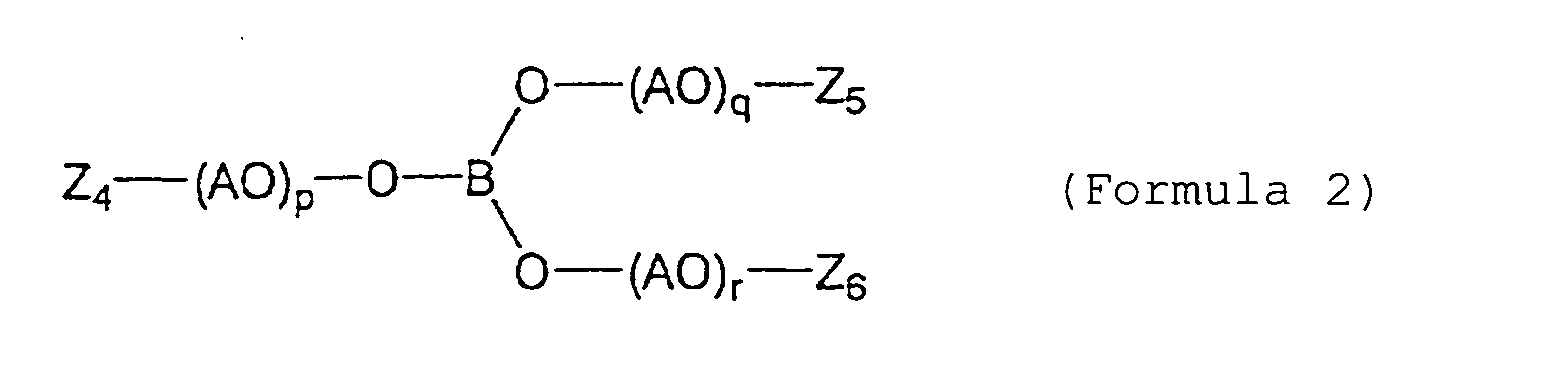
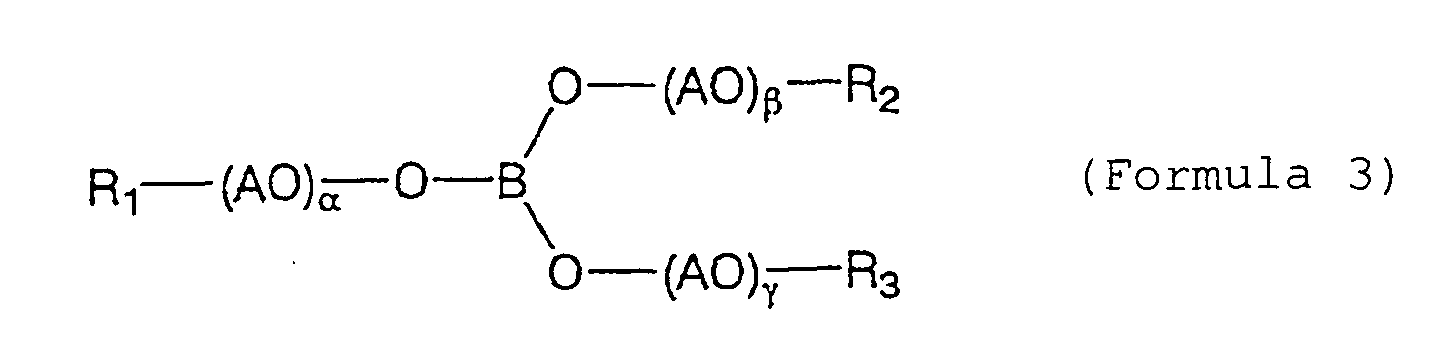
- the present invention also provides a polymerizable composition of boron-containing compounds represented by (formula 2) and (formula 3), respectively, and an ion-conductive polyelectrolyte: wherein B is a boron atom; Z 4 , Z 5 and Z 6 are independently an organic group having an acryloyl or methacryloyl group, or a hydrocarbon group of 1 to 10 carbon atoms, provided that at least one of Z 4 , Z 5 and Z 6 is an organic group having an acryloyl or methacryloyl group; R 1, R 2 and R 3 are independently a hydrocarbon group of 1 to 10 carbon atoms; AOs are independently an oxyalkylene group of 1 to 6 carbon atoms and are of one or more kinds; and p, q, r, ⁇ , ⁇ and ⁇ are independently an average number of moles of the oxyalkylene group(s) added of less than 4 and more than 0, provided that each of the sum p + q + r and
- the number of moles of the added oxyalkylene group(s) is small, so that lithium ions coordinating with the ether oxygen(s) can easily move, resulting in a high ionic conductivity.
- the compounds of (formula 1), (formula 2) and (formula 3) according to the present invention have one or more oxyalkylene groups of 1 to 6 carbon atoms.
- the oxyalkylene group(s) in the molecule one or more kinds of oxyalkylene groups may be used.
- the oxyalkylene group(s) includes, for example, oxyethylene group, oxypropylene group, oxybutylene group and oxytetramethylene group.
- the oxyalkylene group(s) is preferably that having 2 to 4 carbon atoms, in particular, oxyethylene group or oxypropylene group.
- Z 1 , Z 2 and Z 3 in (formula 1) are organic groups having an acryloyl or methacryloyl group, and the one or two others are hydrocarbon groups of 1 to 10 carbon atoms.
- Each of Z 4 , Z 5 and Z 6 in (formula 2) is an organic group having an acryloyl or methacryloyl group, or a hydrocarbon group of 1 to 10 carbon atoms.
- One or more, preferably all, of them are organic groups having an acryloyl or methacryloyl group.
- the organic group having an acryloyl or methacryloyl group is that having an acryloyl or methacryloyl group at the end. Preferable examples thereof are acryloyl group and methacryloyl group.
- An electrolyte goodness in electrical characteristics and handleability can be obtained by keeping the organic group(s) having a polymerizable double bond, in the scope of the present invention.
- Each of R 1 , R 2 and R 3 in (formula 3) is a hydrocarbon group of 1 to 10 carbon atoms.
- the number of carbon atoms of the hydrocarbon group is 1 to 10, and the hydrocarbon group includes, for example, aliphatic hydrocarbon groups such as methyl, ethyl, propyl, butyl, pentyl, hexyl, heptyl, octyl, nonyl, decyl, etc.; aromatic hydrocarbon groups such as phenyl, toluyl, naphthyl, etc.; and alicyclic hydrocarbon groups such as cyclopentyl, cyclohexyl, methylcyclohexyl, dimethylcyclohexyl, etc.
- hydrocarbon groups of 4 or less carbon atoms are preferable, and methyl group having one carbon atom is especially preferable.
- Each of l, m and n in (formula 1) is an average number of moles of added oxyalkylene group(s).
- Each of l, m and n is less than 4 and more than 0, preferably 1 to 3.
- the sum l + m + n is 1 or more, preferably 3 to 9.
- Each of p, q, r, ⁇ , ⁇ and ⁇ in (formula 2) and (formula 3) is an average number of moles of added oxyalkylene group(s).
- Each of p, q, r, ⁇ , ⁇ and ⁇ is less than 4 and more than 0, preferably 1 to 3.
- Each of the sum p + q + r and the sum ⁇ + ⁇ + ⁇ is 1 or more, preferably 3 to 9.
- Each of the boron-containing compounds of (formula 1), (formula 2) and (formula 3) can be produced by either a well-known process or the following process.
- Each boron-containing compound can be obtained by adding a boron compound such as boric acid, boric anhydride, alkyl borate or the like to an oxyalkylene compound having a hydroxyl group, and carrying out boric acid esterification at 50 to 200°C under reduced pressure while introducing a dry gas.
- the boron-containing compound is produced, for example, by carrying out the esterification with stirring for 2 to 12 hours at a reaction temperature of 60 to 120°C while introducing a proper amount of dry air, and carrying out dehydration or elimination of a volatile matter under a reduced pressure of 1.33 to 66.7 kPa (10 to 500 mmHg).
- the boron-containing compound is preferably produced by using a trialkyl borate, in particular, trimethyl borate.
- the boron-containing compound is preferably produced by using the trialkyl borate in an amount of 1.0 mol to 10 mols per 3.0 mols of an oxyalkylene compound having a hydroxyl group, and distilling off the volatile matter produced by the boric acid transesterification and the excess trialkyl borate.
- the molar ratio [(the number of moles of the compound of (formula 3))/(the number of moles of the compound of (formula 2))] is 0.1 to 9, preferably 0.5 to 4, more preferably 0.5 to 3, in particular, 1 to 2.5.
- the mechanical strength is increased and the flexibility is deteriorated, so that shaping of an electrolyte membrane becomes difficult.
- the molar ratio is more than 9, the mechanical strength is decreased, and formation of the solid polyelectrolyte is difficult.
- the mechanical strength is decreased, resulting in difficult handling.
- Each of a polymer of the boron-containing compound of (formula 1) and a polymer of a mixture of the compound of (formula 2) and the compound of (formula 3) can be obtained by a well-known process. It is possible to use, for example, the energy of visible light, ultraviolet light, electron beams, heat or the like, and optionally a polymerization initiator and the like. Each of the above-mentioned polymers can be obtained by either ionic polymerization or radical polymerization.
- a polymerization initiator may be or need not be used for producing the polymer from the boron-containing compound of (formula 1) or a mixture of the boron-containing compounds of (formula 2) and (formula 3).
- Thermal radical polymerization using a free-radical initiator is preferable from the viewpoint of work efficiency and polymerization rate.
- the free-radical initiator includes organic peroxides such as t-butyl peroxypivalate, t-hexyl peroxypivalate, methyl ethyl ketone peroxide, cyclohexanone peroxide, 1,1-bis(t-butylperoxy)-3,3,5-trimethylcyclohexane, 2,2-bis(t-butylperoxy)octane, n-butyl-4,4-bis(t-butylperoxy)-valerate, t-butyl hydroperoxide, cumene hydroperoxide, 2,5-dimethylhexane-2,5-dihydroperoxide, di-t-butyl peroxide, t-butylcumyl peroxide, dicumyl peroxide, ⁇ , ⁇ '-bis(t-butylperoxy-m-isopropyl)benzene, 2,5-dimethyl-2,5-di(t-butyl
- the production of the polymer by the use of the free-radical initiator can be carried out in a conventional temperature range by employing a conventional polymerization time.
- a free-radical initiator whose 10-hours half-life temperature range as an indication of decomposition temperature and rate is 30 to 90°C.
- the proportion of the initiator in the present invention is not more than 10 mol% and not less than 0.01 mol%, preferably not more than 5 mol% and not less than 0.1 mol%, based on the amount of the above-mentioned polymerizable functional group(s).
- any electrolytic salt may be used so long as it is soluble in the boron-containing compound having at least one oxyalkylene group of the present invention or a polymer of said compound.
- the electrolytic salt are compounds composed of a metal cation and an anion selected from chlorine ion, bromine ion, iodine ion, perchlorate ion, thiocyanate ion, tetrafluoroborate ion, hexafluorophosphate ion, trifluoromethanesulfonidimidate ion, stearylsulfonate ion, octylsulfonate ion, dodecylbenzenesulfonate ion, naphthalenesulfonate ion, dodecylnaphthalenesulfonate ion, 7,7,8,8-tetracyano-p-quinodimethane i
- the metal cation includes Li, Na, K, Rb, Cs, Mg, Ca and Ba metal ions.
- concentration of the electrolytic salt relative to the total number of moles of ether oxygen atoms in oxyalkylene groups in the ion-conductive polymer ranges preferably from 0.0001 to 1, preferably from 0.001 to 0.5. When the molar ratio is more than 1, the processability, the moldability and the mechanical strength of the resulting polyelectrolyte are deteriorated.
- the polyelectrolyte of the present invention is useful particularly as an electrolyte for secondary battery.
- a circular membrane with a diameter of 1 cm was cut, and then held between a pair of stainless-steel electrodes, after which its ionic conductivity was determined at 25°C by adopting the above-mentioned ionic conductivity measuring method.
- the ionic conductivity was 1.1 mS/cm, namely, a higher ionic conductivity could be attained as compared with Comparative Examples 1 and 2 described hereinafter.
- the solution was cast on the positive electrode and negative electrode produced by the above-mentioned method, and kept at 80°C for 6 hours to produce polymer electrolytes on the positive electrode and the negative electrode. Furthermore, these positive electrode and negative electrode were put one upon another, and these were stuck together by keeping them at 80°C for 6 hours under application of a load of 0.1 MPa.
- a polyelectrolyte and battery were obtained in exactly the same manner as in Example 1 except for using LiPF 6 as electrolytic salt in place of LiBF 4 . Its ionic conductivity was determined by adopting the same measuring method as in Example 1. The ionic conductivity was 1.2 mS/cm, namely, a higher ionic conductivity could be attained as compared with Comparative Examples 1 and 2 described hereinafter.
- the initial discharge capacity of the battery was 1.0 mAh, and the cycle characteristic was 138 times. Furthermore, high rate discharge characteristic was 80%, and the battery was superior to those obtained in Comparative Examples 1 and 2 in initial discharge capacity, cycle characteristics and high rate discharge characteristics. When the aluminum laminate film of the battery was stripped off, there was recognized no flow of the electrolyte in the battery.
- a polyelectrolyte and battery were obtained in exactly the same manner as in Example 1 except for using LiN(CF 3 SO 2 ) 2 as electrolytic salt in place of LiBF 4 . Its ionic conductivity was determined by adopting the same measuring method as in Example 1. The ionic conductivity was 1.4 mS/cm, namely, a higher ionic conductivity could be attained as compared with Comparative Examples 1 and 2 described hereinafter.
- the initial discharge capacity of the battery was 1.0 mAh, and the cycle characteristic was 138 times. Furthermore, high rate discharge characteristic was 80%, and the battery was superior to those obtained in Comparative Examples 1 and 2 in initial discharge capacity, cycle characteristics and high rate discharge characteristics. When the aluminum laminate film of the battery was stripped off, there was recognized no flow of the electrolyte in the battery.
- a circular membrane with a diameter of 1 cm was cut, and then held between a pair of stainless-steel electrodes, after which its ionic conductivity was determined at 25°C by adopting the above-mentioned ionic conductivity measuring method.
- the ionic conductivity was 1.4 mS/cm, namely, a higher ionic conductivity could be attained as compared with Comparative Examples 1 and 2 described hereinafter.
- the solution was cast on the positive electrode and the negative electrode produced by the above-mentioned method, and kept at 80°C for 6 hours to produce polymer electrolytes on the positive electrode and the negative electrode. Furthermore, these positive electrode and negative electrode were put one upon another, and these were stuck together by keeping them at 80°C for 6 hours under application of a load of 0.1 MPa.
- a polyelectrolyte and battery were obtained in exactly the same manner as in Example 4 except for using LiPF 6 as electrolytic salt in place of LiBF 4 . Its ionic conductance was determined by adopting the same measuring method as in Example 4. The ionic conductivity was 1.4 mS/cm, namely, a higher ionic conductivity could be attained as compared with Comparative Examples 1 and 2 described hereinafter.
- the initial discharge capacity of the battery was 1.0 mAh, and the cycle characteristic was 140 times. Furthermore, the high rate discharge characteristic was 85%, and the battery was superior to those obtained in Comparative Examples 1 and 2 in initial discharge capacity, cycle characteristics and high rate discharge characteristics. When the aluminum laminate film of the battery was stripped off, there was recognized no flow of the electrolyte in the battery.
- a polyelectrolyte and battery were obtained in exactly the same manner as in Example 4 except for using LiN (CF 3 SO 2 ) 2 as electrolytic salt in place of LiBF 4 . Its ionic conductivity was determined by adopting the same measuring method as in Example 4. The ionic conductivity was 1.5 mS/cm, namely, a higher ionic conductivity could be attained as compared with Comparative Examples 1 and 2 described hereinafter.
- the initial discharge capacity of the battery was 1.0 mAh, and the cycle characteristic was 140 times. Furthermore, the high rate discharge characteristic was 85%, and the battery was superior to those obtained in Comparative Examples 1 and 2 in initial discharge capacity, cycle characteristics and high rate discharge characteristics. When the aluminum laminate film of the battery was stripped off, there was recognized no flow of the electrolyte in the battery.
- a circular membrane with a diameter of 1 cm was cut, and then held between a pair of stainless-steel electrodes, after which its ionic conductivity was determined at 25°C by adopting the above-mentioned ionic conductivity measuring method.
- the ionic conductivity was 1.6 mS/cm, namely, a higher ionic conductivity could be attained as compared with Comparative Examples 1 and 2 described hereinafter.
- the solution was cast on the positive electrode and the negative electrode produced by the above-mentioned method, and kept at 80°C for 6 hours to produce polymer electrolytes on the positive electrode and the negative electrode. Furthermore, these positive electrode and negative electrode were put one upon another, and these were stuck together by keeping them at 80°C for 6 hours under application of a load of 0.1 MPa.
- a polyelectrolyte and battery were obtained in exactly the same manner as in Example 7 except for using LiPF 6 as electrolytic salt in place of LiBF 4 . Its ionic conductance was determined by adopting the same measuring method as in Example 7. The ionic conductivity was 1.8 mS/cm, namely, a higher ionic conductivity could be attained as compared with Comparative Examples 1 and 2 described hereinafter.
- the initial discharge capacity of the battery was 1.0 mAh, and the cycle characteristic was 150 times. Furthermore, the high rate discharge characteristic was 85%, and the battery was superior to those obtained in Comparative Examples 1 and 2 in initial discharge capacity, cycle characteristics and high rate discharge characteristics. When the aluminum laminate film of the battery was stripped off, there was recognized no flow of the electrolyte in the battery.
- a polyelectrolyte and battery were obtained in exactly the same manner as in Example 7 except for using LiN(CF 3 SO 2 ) 2 as electrolytic salt in place of LiBF 4 . Its ionic conductance was determined by adopting the same measuring method as in Example 7. The ionic conductivity was 2.0 mS/cm, namely, a higher ionic conductivity could be attained as compared with Comparative Examples 1 and 2 described hereinafter.
- the initial discharge capacity of the battery was 1.0 mAh, and the cycle characteristic was 150 times. Furthermore, the high rate discharge characteristic was 85%, and the battery was superior to those obtained in Comparative Examples 1 and 2 in initial discharge capacity, cycle characteristics and high rate discharge characteristics. When the aluminum laminate film of the battery was stripped off, there was recognized no flow of the electrolyte in the battery.
- a circular membrane with a diameter of 1 cm was cut, and then held between a pair of stainless-steel electrodes, after which its ionic conductivity was determined at 25°C by adopting the above-mentioned ionic conductivity measuring method.
- the ionic conductivity was 1.1 mS/cm, namely, a higher ionic conductivity could be attained as compared with Comparative Examples 1 and 2 described hereinafter.
- the solution was cast on the positive electrode and the negative electrode produced by the above-mentioned method, and kept at 80°C for 6 hours to produce polymer electrolytes on the positive electrode and the negative electrode. Furthermore, these positive electrode and negative electrode were put one upon another, and these were stuck together by keeping at 80°C for 6 hours under application of a load of 0.1 MPa.
- a polyelectrolyte and battery were obtained in exactly the same manner as in Example 10 except for using LiPF 6 as electrolytic salt in place of LiBF 4 . Its ionic conductance was determined by adopting the same measuring method as in Example 10. The ionic conductivity was 1.1 mS/cm, namely, a higher ionic conductivity could be attained as compared with Comparative Examples 1 and 2 described hereinafter.
- the initial discharge capacity of the battery was 1.1 mAh, and the cycle characteristic was 175 times. Furthermore, the high rate discharge characteristic was 88%, and the battery was superior to those obtained in Comparative Examples 1 and 2 in initial discharge capacity, cycle characteristics and high rate discharge characteristics. When the aluminum laminate film of the battery was stripped off, there was recognized no flow of the electrolyte in the battery.
- a polyelectrolyte and battery were obtained in exactly the same manner as in Example 10 except for using LiN(CF 3 SO 2 ) 2 as electrolytic salt in place of LiBF 4 . Its ionic conductivity was determined by adopting the same measuring method as in Example 10. The ionic conductivity was 1.1 mS/cm, namely, a higher ionic conductivity could be attained as compared with Comparative Examples 1 and 2 described hereinafter.
- the initial discharge capacity of the battery was 1.1 mAh, and the cycle characteristic was 175 times. Furthermore, the high rate discharge characteristic was 88%, and the battery was superior to those obtained in Comparative Examples 1 and 2 in initial discharge capacity, cycle characteristics and high rate discharge characteristics. When the aluminum laminate film of the battery was stripped off, there was recognized no flow of the electrolyte in the battery.
- the resulting solution was poured into a polytetrafluoroethylene die and maintained at 80°C for 6 hours to obtain a polyelectrolyte.
- a circular membrane with a diameter of 1 cm was cut, and then held between a pair of stainless-steel electrodes, after which its ionic conductivity was determined at 25°C by adopting the above-mentioned ionic conductivity measuring method.
- the ionic conductivity was 1.2 mS/cm, namely, a higher ionic conductivity could be attained as compared with Comparative Examples 1 and 2 described hereinafter.
- the solution was cast on the positive electrode and the negative electrode produced by the above-mentioned method, and kept at 80°C for 6 hours to produce polymer electrolytes on the positive electrode and the negative electrode. Furthermore, these positive electrode and negative electrode were put one upon another, and these were stuck together by keeping at 80°C for 6 hours under application of a load of 0.1 MPa.
- a polyelectrolyte and battery were obtained in exactly the same manner as in Example 13 except for using LiPF 6 as electrolytic salt in place of LiBF 4 . Its ionic conductance was determined by adopting the same measuring method as in Example 13. The ionic conductivity was 1.2 mS/cm, namely, a higher ionic conductivity could be attained as compared with Comparative Examples 1 and 2 described hereinafter.
- the initial discharge capacity of the battery was 1.2 mAh, and the cycle characteristic was 188 times. Furthermore, the high rate discharge characteristic was 90%, and the battery was superior to those obtained in Comparative Examples 1 and 2 in initial discharge capacity, cycle characteristics and high rate discharge characteristics. When the aluminum laminate film of the battery was stripped off, there was recognized no flow of the electrolyte in the battery.
- a polyelectrolyte and battery were obtained in exactly the same manner as in Example 13 except for using LiN(CF 3 SO 2 ) 2 as electrolytic salt in place of LiBF 4 . Its ionic conductivity was determined by adopting the same measuring method as in Example 13. The ionic conductivity was 1.2 mS/cm, namely, a higher ionic conductivity could be attained as compared with Comparative Examples 1 and 2 described hereinafter.
- the initial discharge capacity of the battery was 1.2 mAh, and the cycle characteristic was 188 times. Furthermore, the high rate discharge characteristic was 90%, and the battery was superior to those obtained in Comparative Examples 1 and 2 in initial discharge capacity, cycle characteristics and high rate discharge characteristics. When the aluminum laminate film of the battery was stripped off, there was recognized no flow of the electrolyte in the battery.
- a circular membrane with a diameter of 1 cm was cut, and then held between a pair of stainless-steel electrodes, after which its ionic conductivity was determined at 25°C by adopting the above-mentioned ionic conductivity measuring method.
- the ionic conductivity was 1.3 mS/cm, namely, a higher ionic conductivity could be attained as compared with Comparative Examples 1 and 2 described hereinafter.
- the solution was cast on the positive electrode and the negative electrode produced by the above-mentioned method, and kept at 80°C for 6 hours to produce polymer electrolytes on the positive electrode and the negative electrode. Furthermore, these positive electrode and negative electrode were put one upon another, and these were stuck together by keeping them at 80°C for 6 hours under application of a load of 0.1 MPa.
- a polyelectrolyte and battery were obtained in exactly the same manner as in Example 16 except for using LiPF 6 as electrolytic salt in place of LiBF 4 . Its ionic conductance was determined by adopting the same measuring method as in Example 16. The ionic conductivity was 1.3 mS/cm, namely, a higher ionic conductivity could be attained as compared with Comparative Examples 1 and 2 described hereinafter.
- the initial discharge capacity of the battery was 1.3 mAh, and the cycle characteristic was 190 times. Furthermore, the high rate discharge characteristic was 92%, and thus the battery was superior to those obtained in Comparative Examples 1 and 2 in initial discharge capacity, cycle characteristics and high rate discharge characteristics. When the aluminum laminate film of the battery was stripped off, there was recognized no flow of the electrolyte in the battery.
- a polyelectrolyte and battery were obtained in exactly the same manner as in Example 16 except for using LiN(CF 3 SO 2 ) 2 as electrolytic salt in place of LiBF 4 . Its ionic conductivity was determined by adopting the same measuring method as in Example 16. The ionic conductivity was 1.3 mS/cm, namely, a higher ionic conductivity could be attained as compared with Comparative Examples 1 and 2 described hereinafter.
- the initial discharge capacity of the battery was 1.3 mAh, and the cycle characteristic was 190 times. Furthermore, the high rate discharge characteristic was 92%, and thus the battery was superior to those obtained in Comparative Examples 1 and 2 in initial discharge capacity, cycle characteristics and high rate discharge characteristics. When the aluminum laminate film of the battery was stripped off, there was recognized no flow of the electrolyte in the battery.
- a polyelectrolyte and battery were obtained in exactly the same manner as in Example 10 except for changing the amount of the boron-containing compound (the boric acid esterification product of tributylene glycol monomethyl ether) E blended from 7.52 g (10 mmol) to 15.0 g (20 mmol).
- the boron-containing compound the boric acid esterification product of tributylene glycol monomethyl ether
- a circular membrane with a diameter of 1 cm was cut, and then held between a pair of stainless-steel electrodes, after which its ionic conductivity was determined at 25°C by adopting the above-mentioned ionic conductivity measuring method.
- the ionic conductivity was 1.4 mS/cm, namely, a higher ionic conductivity could be attained as compared with Comparative Examples 1 and 2 described hereinafter.
- the initial discharge capacity of the battery was 1.4 mAh, and the cycle characteristic was 210 times. Furthermore, the high rate discharge characteristic was 92%, and thus the battery was superior to those obtained in Comparative Examples 1 and 2 in initial discharge capacity, cycle characteristics and high rate discharge characteristics. When the aluminum laminate film of the battery was stripped off, there was recognized no flow of the electrolyte in the battery.
- a polyelectrolyte and battery were obtained in exactly the same manner as in Example 19 except for using LiPF 6 as electrolytic salt in place of LiBF 4 . Its ionic conductance was determined by adopting the same measuring method as in Example 19. The ionic conductivity was 1.4 mS/cm, namely, a higher ionic conductivity could be attained as compared with Comparative Examples 1 and 2 described hereinafter.
- the initial discharge capacity of the battery was 1.4 mAh, and the cycle characteristic was 210 times. Furthermore, the high rate discharge characteristic was 92%, and thus the battery was superior to those obtained in Comparative Examples 1 and 2 in initial discharge capacity, cycle characteristics and high rate discharge characteristics. When the aluminum laminate film of the battery was stripped off, there was recognized no flow of the electrolyte in the battery.
- a polyelectrolyte and battery were obtained in exactly the same manner as in Example 19 except for using LiN(CF 3 SO 2 ) 2 as electrolytic salt in place of LiBF 4 . Its ionic conductivity was determined by adopting the same measuring method as in Example 19. The ionic conductivity was 1.6 mS/cm, namely, a higher ionic conductivity could be attained as compared with Comparative Examples 1 and 2 described hereinafter.
- the initial discharge capacity of the battery was 1.6 mAh, and the cycle characteristic was 215 times. Furthermore, the high rate discharge characteristic was 95%, and thus the battery was superior to those obtained in Comparative Examples 1 and 2 in initial discharge capacity, cycle characteristics and high rate discharge characteristics. When the aluminum laminate film of the battery was stripped off, there was recognized no flow of the electrolyte in the battery.
- a polyelectrolyte and battery were obtained in exactly the same manner as in Example 13 except for changing the amount of the boron-containing compound (the boric acid esterification product of tripropylene glycol monomethyl ether) G blended from 6.26 g (10 mmol) to 12.5 g (20 mmol).
- the boron-containing compound the boric acid esterification product of tripropylene glycol monomethyl ether
- the ionic conductivity was 1.6 mS/cm, namely, a higher ionic conductivity could be attained as compared with Comparative Examples 1 and 2 described hereinafter.
- the initial discharge capacity of the battery was 1.6 mAh, and the cycle characteristic was 215 times. Furthermore, the high rate discharge characteristic was 95%, and thus the battery was superior to those obtained in Comparative Examples 1 and 2 in initial discharge capacity, cycle characteristics and high rate discharge characteristics. When the aluminum laminate film of the battery was stripped off, there was recognized no flow of the electrolyte in the battery.
- a polyelectrolyte and battery were obtained in exactly the same manner as in Example 22 except for using LiPF 6 as electrolytic salt in place of LiBF 4 . Its ionic conductance was determined by adopting the same measuring method as in Example 22. The ionic conductivity was 1.6 mS/cm, namely, a higher ionic conductivity could be attained as compared with Comparative Examples 1 and 2 described hereinafter.
- the initial discharge capacity of the battery was 1.6 mAh, and the cycle characteristic was 225 times. Furthermore, the high rate discharge characteristic was 95%, and thus the battery was superior to those obtained in Comparative Examples 1 and 2 in initial discharge capacity, cycle characteristics and high rate discharge characteristics. When the aluminum laminate film of the battery was stripped off, there was recognized no flow of the electrolyte in the battery.
- a polyelectrolyte and battery were obtained in exactly the same manner as in Example 22 except for using LiN(CF 3 SO 2 ) 2 as electrolytic salt in place of LiBF 4 . Its ionic conductivity was determined by adopting the same measuring method as in Example 22. The ionic conductivity was 1.8 mS/cm, namely, a higher ionic conductivity could be attained as compared with Comparative Examples 1 and 2 described hereinafter.
- the initial discharge capacity of the battery was 1.8 mAh, and the cycle characteristic was 225 times. Furthermore, the high rate discharge characteristic was 95%, and thus the battery was superior to those obtained in Comparative Examples 1 and 2 in initial discharge capacity, cycle characteristics and high rate discharge characteristics. When the aluminum laminate film of the battery was stripped off, there was recognized no flow of the electrolyte in the battery.
- a polyelectrolyte and battery were obtained in exactly the same manner as in Example 16 except for changing the amount of the boron-containing compound (the boric acid esterification product of triethylene glycol monomethyl ether) I blended from 5.00 g (10 mmol) to 10.0 g (20 mmol).
- the boron-containing compound the boric acid esterification product of triethylene glycol monomethyl ether
- the ionic conductivity was 1.8 mS/cm, namely, a higher ionic conductivity could be attained as compared with Comparative Examples 1 and 2 described hereinafter.
- the initial discharge capacity of the battery was 1.8 mAh, and the cycle characteristic was 240 times. Furthermore, the high rate discharge characteristic was 95%, and thus the battery was superior to those obtained in Comparative Examples 1 and 2 in initial discharge capacity, cycle characteristics and high rate discharge characteristics. When the aluminum laminate film of the battery was stripped off, there was recognized no flow of the electrolyte in the battery.
- a polyelectrolyte and battery were obtained in exactly the same manner as in Example 25 except for using LiPF 6 as electrolytic salt in place of LiBF 4 . Its ionic conductance was determined by adopting the same measuring method as in Example 25. The ionic conductivity was 1.8 mS/cm, namely, a higher ionic conductivity could be attained as compared with Comparative Examples 1 and 2 described hereinafter.
- the initial discharge capacity of the battery was 1.8 mAh, and the cycle characteristic was 240 times. Furthermore, the high rate discharge characteristic was 95%, and thus the battery was superior to those obtained in Comparative Examples 1 and 2 in initial discharge capacity, cycle characteristics and high rate discharge characteristics. When the aluminum laminate film of the battery was stripped off, there was recognized no flow of the electrolyte in the battery.
- a polyelectrolyte and battery were obtained in exactly the same manner as in Example 25 except for using LiN (CF 3 SO 2 ) 2 as electrolytic salt in place of LiBF 4 . Its ionic conductivity was determined by adopting the same measuring method as in Example 25. The ionic conductivity was 2.0 mS/cm, namely, a higher ionic conductivity could be attained as compared with Comparative Examples 1 and 2 described hereinafter.
- the initial discharge capacity of the battery was 1.8 mAh, and the cycle characteristic was 250 times. Furthermore, the high rate discharge characteristic was 95%, and thus the battery was superior to those obtained in Comparative Examples 1 and 2 in initial discharge capacity, cycle characteristics and high rate discharge characteristics. When the aluminum laminate film of the battery was stripped off, there was recognized no flow of the electrolyte in the battery.
- a polymer electrolyte and a battery were produced in the same manner as in Example 16, except that the amount of the polymerizable boron-containing compound H (an esterification product of boric acid with diethylene glycol monomethacrylate) was 1.59 g (10 mmol) instead of 5.30 g (3 mmol), and the amount of the polymerizable boron-containing compound I (an esterification product of boric acid with triethylene glycol monomethyl ether) was 8.5 g (17 mmol) instead of 5.00 g (10 mmol).
- the ionic conductivity of the polymer electrolyte was 2.1 mS/cm, which was higher than that obtained in Comparative Examples 1 and 2 given hereinafter.
- the initial discharge capacity of the battery was 1.9 mAh, and the cycle characteristic was 255 times. Furthermore, the high rate discharge characteristic was 96%, and thus the battery was superior to those obtained in Comparative Examples 1 and 2 in initial discharge capacity, cycle characteristics and high rate discharge characteristics. When the aluminum laminate film of the battery was stripped off, there was recognized no flow of the electrolyte in the battery.
- a polymer electrolyte and a battery were produced in the same manner as in Example 28, except that LiPF 6 was used in place of LiBF 4 as the electrolytic salt.
- the ionic conductivity of the polymer electrolyte was 2.1 mS/cm, which was higher than that obtained in Comparative Examples 1 and 2 given hereinafter.
- the initial discharge capacity of the battery was 1.9 mAh, and the cycle characteristic was 255 times. Furthermore, the high rate discharge characteristic was 96%, and thus the battery was superior to those obtained in Comparative Examples 1 and 2 in initial discharge capacity, cycle characteristics and high rate discharge characteristics. When the aluminum laminate film of the battery was stripped off, there was recognized no flow of the electrolyte in the battery.
- a polymer electrolyte and a battery were produced in the same manner as in Example 28, except that LiN (CF 3 SO 2 ) 2 was used in place of LiBF 4 as the electrolytic salt.
- the ionic conductivity of the polymer electrolyte was 2.0 mS/cm, which was higher than that obtained in Comparative Examples 1 and 2 given hereinafter.
- the initial discharge capacity of the battery was 1.3 mAh, and the cycle characteristic was 260 times. Furthermore, the high rate discharge characteristic was 96%, and thus the battery was superior to those obtained in Comparative Examples 1 and 2 in initial discharge capacity, cycle characteristics and high rate discharge characteristics. When the aluminum laminate film of the battery was stripped off, there was recognized no flow of the electrolyte in the battery.
- BLEMMER PE-350 polyethylene glycol(350) monomethacrylate, mfd. by NOF CORPORATION
- boric anhydride 34.8 g (0.5 mol) of boric anhydride.
- the resulting mixture was heated to 70°C under a dry air atmosphere. After the temperature reached 70°C, the pressure in the system was gradually reduced. While the pressure was maintained at 2.67 kPa (20 mmHg) or less for 15 hours, water produced with the progress of the reaction was removed.
- the solution was cast on the positive electrode and the negative electrode produced by the above-mentioned method, and kept at 80°C for 6 hours to produce polymer electrolytes on the positive electrode and the negative electrode. Furthermore, these positive electrode and negative electrode were put one upon another, and these were stuck together by keeping them at 80°C for 6 hours under application of a load of 0.1 MPa.
- the residue was filtered to obtain a boron-containing compound K.
- 2.00 g of the polymerizable boron-containing compound J was mixed with 2.00 g of the boron-containing compound K, followed by adding thereto 2.81 g of LiN(CF 3 SO 2 ) 2 as electrolytic salt. After they were subjected to uniform dissolution, the ionic conductivity off the solution was measured in the same manner as in Example 1. The ionic conductivity was 0.020 mS/cm.
- the solution was cast on the positive electrode and the negative electrode produced by the above-mentioned method, and kept at 80°C for 6 hours to produce polymer electrolytes on the positive electrode and the negative electrode. Furthermore, these positive electrode and negative electrode were put one upon another, and these were stuck together by keeping them at 80°C for 6 hours under application of a load of 0.1 MPa.
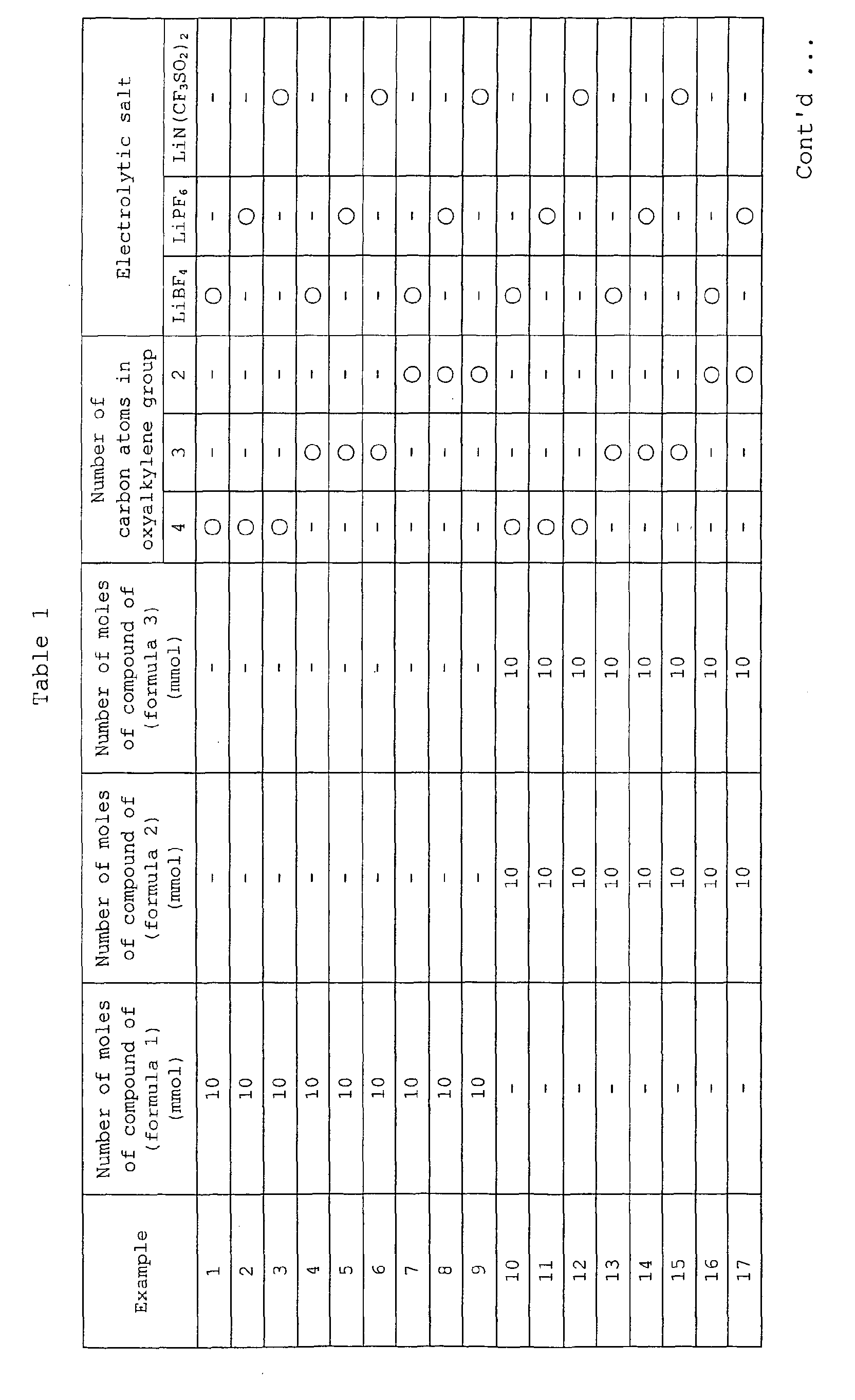
- Table 2 shows the results of evaluation obtained for the examples and comparative examples described above.
- a highly ion-conductive polyelectrolyte can be obtained.
Landscapes
- Chemical & Material Sciences (AREA)
- Chemical Kinetics & Catalysis (AREA)
- Organic Chemistry (AREA)
- General Chemical & Material Sciences (AREA)
- Engineering & Computer Science (AREA)
- Medicinal Chemistry (AREA)
- Health & Medical Sciences (AREA)
- Polymers & Plastics (AREA)
- Electrochemistry (AREA)
- Manufacturing & Machinery (AREA)
- Inorganic Chemistry (AREA)
- Physics & Mathematics (AREA)
- Dispersion Chemistry (AREA)
- General Physics & Mathematics (AREA)
- Condensed Matter Physics & Semiconductors (AREA)
- Spectroscopy & Molecular Physics (AREA)
- Materials Engineering (AREA)
- Secondary Cells (AREA)
- Conductive Materials (AREA)
- Addition Polymer Or Copolymer, Post-Treatments, Or Chemical Modifications (AREA)
- Macromonomer-Based Addition Polymer (AREA)
Abstract
Description


Furthermore, the high rate discharge characteristic was 80%, and the battery was superior to those obtained in Comparative Examples 1 and 2 in initial discharge capacity, cycle characteristics and high rate discharge characteristics. When the aluminum laminate film of the battery was stripped off, there was recognized no flow of the electrolyte in the battery.
When the aluminum laminate film of the battery was stripped off, there was recognized no flow of the electrolyte in the battery.
| Example | Ionic conductivity (mS/cm) | Initial discharge capacity (mAh) | Cycle performance (cycle number) | High-rate discharge characteristics (%) |
| 1 | 1.1 | 1 | 138 | 80 |
| 2 | 1.2 | 1 | 138 | 80 |
| 3 | 1.4 | 1 | 138 | 80 |
| 4 | 1.4 | 1 | 140 | 80 |
| 5 | 1.4 | 1 | 140 | 85 |
| 6 | 1.5 | 1 | 140 | 85 |
| 7 | 1.6 | 1 | 150 | 85 |
| 8 | 1.8 | 1 | 150 | 85 |
| 9 | 2.0 | 1 | 150 | 85 |
| 10 | 1.1 | 1.1 | 150 | 88 |
| 11 | 1.1 | 1.1 | 175 | 88 |
| 12 | 1.1 | 1.1 | 175 | 88 |
| 13 | 1.2 | 1.2 | 175 | 88 |
| 14 | 1.2 | 1.2 | 188 | 90 |
| 15 | 1.2 | 1.2 | 188 | 90 |
| 16 | 1.3 | 1.3 | 188 | 90 |
| 17 | 1.3 | 1.3 | 190 | 92 |
| 18 | 1.3 | 1.3 | 200 | 92 |
| 19 | 1.4 | 1.4 | 210 | 92 |
| 20 | 1.4 | 1.4 | 210 | 92 |
| 21 | 1.6 | 1.6 | 215 | 95 |
| 22 | 1.6 | 1.6 | 215 | 95 |
| 23 | 1.6 | 1.6 | 225 | 95 |
| 24 | 1.8 | 1.8 | 225 | 95 |
| 25 | 1.8 | 1.8 | 240 | 95 |
| 26 | 1.8 | 1.8 | 240 | 95 |
| 27 | 2.0 | 1.8 | 250 | 95 |
| 28 | 2.1 | 1.9 | 255 | 96 |
| 29 | 2.1 | 1.9 | 255 | 96 |
| 30 | 2.2 | 1.3 | 260 | 96 |
| Comparative Example 1 | 0.025 | 0.00009 | 3 | 5 |
| Comparative Example 2 | 0.020 | 0.0009 | 10 | 10 |
Claims (11)
- A polymerizable boron-containing compound for electrochemical device represented by (formula 1):wherein B is a boron atom; Z1, Z2 and Z3 are independently an organic group having an acryloyl or methacryloyl group, or a hydrocarbon group of 1 to 10 carbon atoms, provided that one or two of Z1, Z2 and Z3 are organic groups having an acryloyl or methacryloyl group; AOs are independently an oxyalkylene group of 1 to 6 carbon atoms and are of one or more kinds; and ℓ, m and n are independently an average number of moles of the oxyalkylene group(s) added of less than 4 and more than 0, provided that ℓ + m + n is 1 or more.

- An ion-conductive polyelectrolyte for electrochemical device comprising a polymer obtained by polymerizing a boron-containing compound according to claim 1.
- An ion-conductive polyelectrolyte for electrochemical device comprising a polymer obtained by polymerizing a boron-containing compound according to claim 1 and at least one electrolytic salt.
- A polymerizable composition for electro-chemical device comprising a boron-containing compound represented by (formula 2) and a boron-containing compound represented by (formula 3) so that the molar ratio between the compound of (formula 2) and the compound of (formula 3) [(the number of moles of the compound of (formula 3))/(the number of moles of the compound of (formula 2))] is 0.1 to 9:
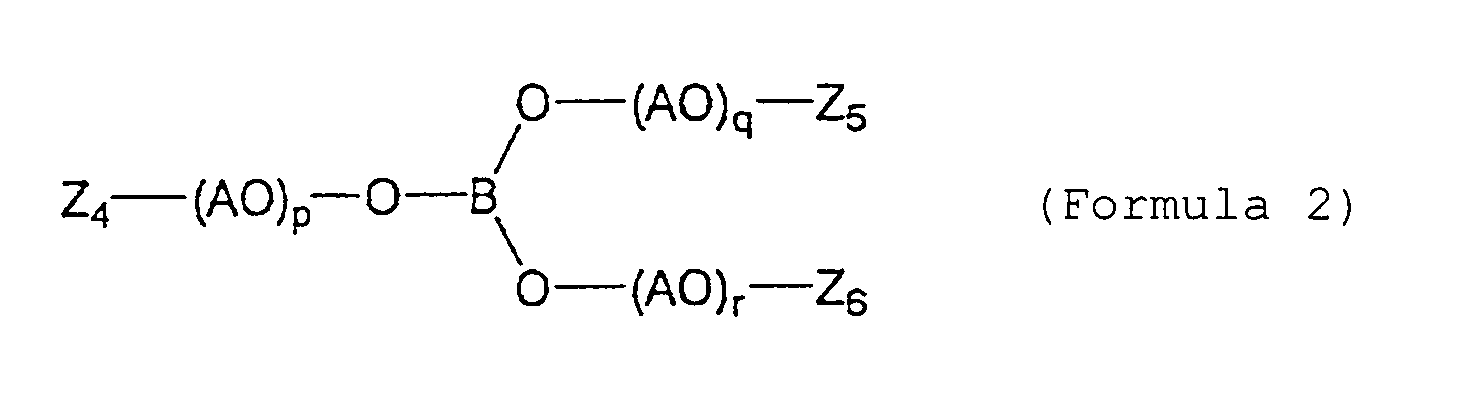 wherein B is a boron atom; Z4, Z5 and Z6 are independently an organic group having an acryloyl or methacryloyl group, or a hydrocarbon group of 1 to 10 carbon atoms, provided that at least one of Z4, Z5 and Z6 is an organic group having an acryloyl or methacryloyl group; R1, R2 and R3 are independently a hydrocarbon group of 1 to 10 carbon atoms; AOs are independently an oxyalkylene group of 1 to 6 carbon atoms and are of one or more kinds; and p, q, r, α, β and γ are independently an average number of moles of the oxyalkylene group(s) added of less than 4 and more than 0, provided that each of the sum p + q + r and the sum α + β + γ is 1 or more.
- A polymerizable composition for electrochemical device comprising a boron-containing compound represented by (formula 2) and a boron-containing compound represented by (formula 3) so that the molar ratio between the compound of (formula 2) and the compound of (formula 3) [(the number of moles of the compound of (formula 3))/(the number of moles of the compound of (formula 2))] is 0.1 to 4:
 wherein B is a boron atom; Z4, Z5 and Z6 are independently an organic group having an acryloyl or methacryloyl group, or a hydrocarbon group of 1 to 10 carbon atoms, provided that at least one of Z4, Z5 and Z6 is an organic group having an acryloyl or methacryloyl group; R1, R2 and R3 are independently a hydrocarbon group of 1 to 10 carbon atoms; AOs are independently an oxyalkylene group of 1 to 6 carbon atoms and are of one or more kinds; and p, q, r, α, β and γ are independently an average number of moles of the oxyalkylene group(s) added of less than 4 and more than 0, provided that each of the sum p + q + r and the sum α + β + γ is 1 or more.
- An ion-conductive polyelectrolyte for electrochemical device comprising a polymer obtained by polymerizing a polymerizable composition according to claim 4.
- An ion-conductive polyelectrolyte for electrochemical device comprising a polymer obtained by polymerizing a polymerizable composition according to claim 5.
- An ion-conductive polyelectrolyte for electrochemical device comprising a polymer obtained by polymerizing a polymerizable composition according to claim 4 and at least one electrolytic salt.
- An ion-conductive polyelectrolyte for electrochemical device comprising a polymer obtained by polymerizing a polymerizable composition according to claim 5 and at least one electrolytic salt.
- An ion-conductive polyelectrolyte for electrochemical device according to claim 3, wherein said electrolytic salt is selected from the group consisting of LiPF6, LiN(CF3SO2)2, LiClO4, LiBF4, LiAsF6, LiI, LiBr, LiSCN, Li2B10Cl10 and LiCF3CO2.
- An ion-conductive polyelectrolyte for electrochemical device according to claim 7, wherein said electrolytic salt is selected from the group consisting of LiPF6, LiN(CF3SO2)2, LiClO4, LiBF4, LiAsF6, LiI, LiBr, LiSCN, Li2B10Cl10 and LiCF3CO2.
Priority Applications (1)
| Application Number | Priority Date | Filing Date | Title |
|---|---|---|---|
| EP03026140A EP1422781B1 (en) | 2002-11-21 | 2003-11-13 | Boron-containing compound, ion-conductive polymer and polyelectrolyte for electrochemical devices |
Applications Claiming Priority (5)
| Application Number | Priority Date | Filing Date | Title |
|---|---|---|---|
| JP2002337789 | 2002-11-21 | ||
| JP2002337789 | 2002-11-21 | ||
| EP03013841 | 2003-06-18 | ||
| EP03013841 | 2003-06-18 | ||
| EP03026140A EP1422781B1 (en) | 2002-11-21 | 2003-11-13 | Boron-containing compound, ion-conductive polymer and polyelectrolyte for electrochemical devices |
Publications (2)
| Publication Number | Publication Date |
|---|---|
| EP1422781A1 true EP1422781A1 (en) | 2004-05-26 |
| EP1422781B1 EP1422781B1 (en) | 2009-08-19 |
Family
ID=32732674
Family Applications (1)
| Application Number | Title | Priority Date | Filing Date |
|---|---|---|---|
| EP03026140A Expired - Lifetime EP1422781B1 (en) | 2002-11-21 | 2003-11-13 | Boron-containing compound, ion-conductive polymer and polyelectrolyte for electrochemical devices |
Country Status (7)
| Country | Link |
|---|---|
| US (1) | US7230057B2 (en) |
| EP (1) | EP1422781B1 (en) |
| JP (1) | JP4563668B2 (en) |
| KR (1) | KR100939306B1 (en) |
| CN (1) | CN100424116C (en) |
| DE (1) | DE60328861D1 (en) |
| TW (1) | TWI244787B (en) |
Families Citing this family (15)
| Publication number | Priority date | Publication date | Assignee | Title |
|---|---|---|---|---|
| US20040101758A1 (en) * | 2002-11-21 | 2004-05-27 | Takefumi Okumura | Lithium secondary battery |
| KR100599719B1 (en) * | 2004-11-24 | 2006-07-12 | 삼성에스디아이 주식회사 | Polymer electrolyte membrane for fuel cell and fuel cell system comprising same |
| JP4451768B2 (en) * | 2004-12-17 | 2010-04-14 | 株式会社日立製作所 | Polymerizable boron compound for electrochemical devices, method for producing the same, polymerizable composition, and ion conductive polymer electrolyte |
| JP4820104B2 (en) * | 2005-03-18 | 2011-11-24 | 株式会社日立製作所 | Gel electrolyte and secondary battery |
| JP2006339011A (en) * | 2005-06-01 | 2006-12-14 | Hitachi Ltd | Lithium ion secondary battery |
| JP5145941B2 (en) * | 2006-01-27 | 2013-02-20 | 日本ゼオン株式会社 | Electrolyte composition for secondary battery, electrolyte film, and secondary battery |
| KR100736909B1 (en) * | 2006-02-02 | 2007-07-10 | 한국과학기술원 | Non-aqueous electrolyte solution for lithium batteries and lithium secondary battery comprising same |
| KR100788162B1 (en) * | 2006-08-24 | 2007-12-21 | 성균관대학교산학협력단 | Electrolyte for lithium secondary battery containing high temperature stability additive and lithium secondary battery employing same |
| KR100794385B1 (en) * | 2006-09-26 | 2008-01-15 | 한국과학기술원 | Polymer electrolyte and lithium secondary battery for lithium secondary battery containing boron compound |
| US8629294B2 (en) * | 2011-08-25 | 2014-01-14 | Honeywell International Inc. | Borate esters, boron-comprising dopants, and methods of fabricating boron-comprising dopants |
| CN104868160A (en) * | 2015-05-05 | 2015-08-26 | 东莞市凯欣电池材料有限公司 | Electrolyte additive and lithium secondary battery |
| CN112038690B (en) * | 2019-06-04 | 2022-12-06 | 北京卫蓝新能源科技有限公司 | Boron-containing polymer solid electrolyte and application thereof |
| CN114188595B (en) * | 2020-09-15 | 2024-06-25 | 珠海冠宇电池股份有限公司 | A solid polymer electrolyte and a lithium ion battery comprising the same |
| US12570773B2 (en) | 2020-09-15 | 2026-03-10 | Zhuhai Cosmx Battery Co., Ltd. | Polymer, solid-state electrolyte, gel electrolyte, and battery |
| WO2022107450A1 (en) * | 2020-11-17 | 2022-05-27 | パナソニックIpマネジメント株式会社 | Solid electrolyte, battery and method for producing solid electrolyte |
Citations (9)
| Publication number | Priority date | Publication date | Assignee | Title |
|---|---|---|---|---|
| US3697575A (en) * | 1969-12-22 | 1972-10-10 | Basf Ag | Boric acid esters of 2-vinylthioethanol |
| US3743686A (en) * | 1971-06-18 | 1973-07-03 | Horizons Inc | Unsaturated polyester resins which cure in the presence of water and which contain at least one dehydro monomer |
| JPS4860183A (en) * | 1971-11-30 | 1973-08-23 | ||
| JPS61215610A (en) * | 1985-03-22 | 1986-09-25 | Mitsubishi Rayon Co Ltd | Neutron capture transparent resin material and its manufacturing method |
| JPS62201913A (en) * | 1986-02-28 | 1987-09-05 | Hitachi Chem Co Ltd | Optical resin material |
| SU1730091A1 (en) * | 1990-08-06 | 1992-04-30 | Научно-исследовательский институт химии и технологии полимеров им.акад.В.А.Каргина с опытным заводом | Method of producing opaque materials |
| EP1160268A1 (en) * | 1999-09-02 | 2001-12-05 | Dai-Ichi Kogyo Seiyaku Co., Ltd. | Ionically conductive polymer, polymer electrolyte, and electrical device |
| JP2002158039A (en) * | 2000-11-21 | 2002-05-31 | Nof Corp | Electrolyte for secondary battery and secondary battery |
| WO2003031453A1 (en) * | 2001-09-28 | 2003-04-17 | Nof Corporation | Process for producing boric ester compound, electrolyte for electrochemical device, and secondary battery |
Family Cites Families (9)
| Publication number | Priority date | Publication date | Assignee | Title |
|---|---|---|---|---|
| JP3557961B2 (en) * | 1999-09-02 | 2004-08-25 | 第一工業製薬株式会社 | Novel ion conductive polymer, polymer electrolyte and electrochemical device using the same |
| JP3557962B2 (en) | 1999-09-02 | 2004-08-25 | 第一工業製薬株式会社 | Polymer electrolyte and electrochemical device using the same |
| JP3557960B2 (en) | 1999-09-02 | 2004-08-25 | 第一工業製薬株式会社 | Novel ion conductive polymer, polymer electrolyte and electrochemical device using the same |
| JP3557959B2 (en) | 1999-09-02 | 2004-08-25 | 第一工業製薬株式会社 | Novel ion conductive polymer, polymer electrolyte and electrochemical device using the same |
| EP1258938B1 (en) * | 1999-11-24 | 2010-08-25 | Nof Corporation | Electrolyte for secondary battery and secondary battery |
| JP2002056895A (en) * | 2000-08-08 | 2002-02-22 | Japan Storage Battery Co Ltd | Non-aqueous electrolyte battery |
| JP4582740B2 (en) * | 2000-12-12 | 2010-11-17 | 独立行政法人科学技術振興機構 | Proton conductive material |
| JP2002216844A (en) * | 2001-01-19 | 2002-08-02 | Hitachi Ltd | Lithium secondary battery |
| JP4052159B2 (en) * | 2002-03-29 | 2008-02-27 | 日油株式会社 | Method for producing high purity borate compound for electrolyte |
-
2003
- 2003-11-12 TW TW092131678A patent/TWI244787B/en not_active IP Right Cessation
- 2003-11-13 EP EP03026140A patent/EP1422781B1/en not_active Expired - Lifetime
- 2003-11-13 DE DE60328861T patent/DE60328861D1/en not_active Expired - Lifetime
- 2003-11-19 JP JP2003389159A patent/JP4563668B2/en not_active Expired - Lifetime
- 2003-11-20 KR KR1020030082461A patent/KR100939306B1/en not_active Expired - Fee Related
- 2003-11-20 CN CNB2003101180126A patent/CN100424116C/en not_active Expired - Fee Related
- 2003-11-21 US US10/717,645 patent/US7230057B2/en not_active Expired - Fee Related
Patent Citations (9)
| Publication number | Priority date | Publication date | Assignee | Title |
|---|---|---|---|---|
| US3697575A (en) * | 1969-12-22 | 1972-10-10 | Basf Ag | Boric acid esters of 2-vinylthioethanol |
| US3743686A (en) * | 1971-06-18 | 1973-07-03 | Horizons Inc | Unsaturated polyester resins which cure in the presence of water and which contain at least one dehydro monomer |
| JPS4860183A (en) * | 1971-11-30 | 1973-08-23 | ||
| JPS61215610A (en) * | 1985-03-22 | 1986-09-25 | Mitsubishi Rayon Co Ltd | Neutron capture transparent resin material and its manufacturing method |
| JPS62201913A (en) * | 1986-02-28 | 1987-09-05 | Hitachi Chem Co Ltd | Optical resin material |
| SU1730091A1 (en) * | 1990-08-06 | 1992-04-30 | Научно-исследовательский институт химии и технологии полимеров им.акад.В.А.Каргина с опытным заводом | Method of producing opaque materials |
| EP1160268A1 (en) * | 1999-09-02 | 2001-12-05 | Dai-Ichi Kogyo Seiyaku Co., Ltd. | Ionically conductive polymer, polymer electrolyte, and electrical device |
| JP2002158039A (en) * | 2000-11-21 | 2002-05-31 | Nof Corp | Electrolyte for secondary battery and secondary battery |
| WO2003031453A1 (en) * | 2001-09-28 | 2003-04-17 | Nof Corporation | Process for producing boric ester compound, electrolyte for electrochemical device, and secondary battery |
Non-Patent Citations (6)
| Title |
|---|
| DATABASE CA [online] CHEMICAL ABSTRACTS SERVICE, COLUMBUS, OHIO, US; ARZHAKOV, SERGEJ A. ET AL: "Method of producing opaque methacrylate block polymer", XP002256332, retrieved from STN Database accession no. 119:96438 * |
| DATABASE CA [online] CHEMICAL ABSTRACTS SERVICE, COLUMBUS, OHIO, US; IDA, KOZO ET AL: "Neutron-shielding transparent resin", XP002256334, retrieved from STN Database accession no. 106:85925 * |
| DATABASE CA [online] CHEMICAL ABSTRACTS SERVICE, COLUMBUS, OHIO, US; KATO, YOSHIYUKI ET AL: "Heat- and moisture-resistant resins for optical materials with high refractive index", XP002256333, retrieved from STN Database accession no. 108:95821 * |
| DATABASE CA [online] CHEMICAL ABSTRACTS SERVICE, COLUMBUS, OHIO, US; YOKOYAMA, SHOICHI ET AL: "Manufacture of borate ester compound, electrolyte for electrochemical device, and secondary battery", XP002256331, retrieved from STN Database accession no. 138:324031 * |
| DATABASE CA [online] CHEMICAL ABSTRACTS SERVICE, COLUMBUS, OHIO, US; YOSHINO, TSUNEO ET AL: "Polymerizing acrylonitrile", XP002256335, retrieved from STN Database accession no. 80:49101 * |
| PATENT ABSTRACTS OF JAPAN vol. 2002, no. 09 4 September 2002 (2002-09-04) * |
Also Published As
| Publication number | Publication date |
|---|---|
| US20040147697A1 (en) | 2004-07-29 |
| KR20040045322A (en) | 2004-06-01 |
| DE60328861D1 (en) | 2009-10-01 |
| KR100939306B1 (en) | 2010-01-28 |
| CN100424116C (en) | 2008-10-08 |
| TWI244787B (en) | 2005-12-01 |
| JP4563668B2 (en) | 2010-10-13 |
| CN1502644A (en) | 2004-06-09 |
| US7230057B2 (en) | 2007-06-12 |
| TW200419834A (en) | 2004-10-01 |
| EP1422781B1 (en) | 2009-08-19 |
| JP2004182982A (en) | 2004-07-02 |
Similar Documents
| Publication | Publication Date | Title |
|---|---|---|
| US7230057B2 (en) | Boron-containing compound, ion-conductive polymer and polyelectrolyte for electrochemical devices | |
| US5874184A (en) | Solid polymer electrolyte, battery and solid-state electric double layer capacitor using the same as well as processes for the manufacture thereof | |
| KR102675772B1 (en) | Polymer electrolyte, preparing method thereof, and lithium metal battery including the same | |
| CA2244857A1 (en) | Polymeric gel electrolyte | |
| US7473492B2 (en) | Lithium secondary battery | |
| EP1123948B1 (en) | Solid crosslinked-polymer electrolyte and use thereof | |
| CN107925127A (en) | Solid electrolyte and battery | |
| US7923580B2 (en) | Polymerizable boric compounds, methods of producing the same, polymerizable compositions and ionic-conductive polymeric electrolytes | |
| EP0811029B1 (en) | Solid polymer electrolyte, battery and solid-state electric double layer capacitor using the same as well as processes for the manufacture thereof | |
| US6833220B1 (en) | Electrolyte for secondary battery and secondary battery | |
| JP4951809B2 (en) | Secondary battery electrolyte and secondary battery | |
| JP4820104B2 (en) | Gel electrolyte and secondary battery | |
| JP4403275B2 (en) | Terminal hyperbranched polymer solid electrolyte | |
| JP5083146B2 (en) | Electrolyte for lithium secondary battery and lithium secondary battery using the same | |
| JP5909343B2 (en) | Positive electrode protective agent for lithium secondary battery, electrolytic solution for lithium secondary battery, lithium secondary battery, and production method thereof | |
| JP4470250B2 (en) | Secondary battery electrolyte and secondary battery | |
| JP4783962B2 (en) | Secondary battery electrolyte and secondary battery | |
| CN107851837A (en) | Silicone copolymers and the solid polymer electrolyte for including this silicone copolymers | |
| JP2007012340A (en) | Secondary battery electrolyte and secondary battery using the same |
Legal Events
| Date | Code | Title | Description |
|---|---|---|---|
| PUAI | Public reference made under article 153(3) epc to a published international application that has entered the european phase |
Free format text: ORIGINAL CODE: 0009012 |
|
| AK | Designated contracting states |
Kind code of ref document: A1 Designated state(s): AT BE BG CH CY CZ DE DK EE ES FI FR GB GR HU IE IT LI LU MC NL PT RO SE SI SK TR |
|
| AX | Request for extension of the european patent |
Extension state: AL LT LV MK |
|
| 17P | Request for examination filed |
Effective date: 20040625 |
|
| AKX | Designation fees paid |
Designated state(s): DE FR |
|
| 17Q | First examination report despatched |
Effective date: 20061013 |
|
| RIC1 | Information provided on ipc code assigned before grant |
Ipc: C08F 30/06 20060101ALI20081121BHEP Ipc: C08G 65/328 20060101ALI20081121BHEP Ipc: H01M 10/40 20060101ALI20081121BHEP Ipc: H01B 1/12 20060101ALI20081121BHEP Ipc: C07F 5/04 20060101AFI20081121BHEP Ipc: C08G 79/08 20060101ALI20081121BHEP Ipc: H01M 6/18 20060101ALI20081121BHEP |
|
| GRAP | Despatch of communication of intention to grant a patent |
Free format text: ORIGINAL CODE: EPIDOSNIGR1 |
|
| GRAS | Grant fee paid |
Free format text: ORIGINAL CODE: EPIDOSNIGR3 |
|
| GRAA | (expected) grant |
Free format text: ORIGINAL CODE: 0009210 |
|
| AK | Designated contracting states |
Kind code of ref document: B1 Designated state(s): DE FR |
|
| REF | Corresponds to: |
Ref document number: 60328861 Country of ref document: DE Date of ref document: 20091001 Kind code of ref document: P |
|
| PLBE | No opposition filed within time limit |
Free format text: ORIGINAL CODE: 0009261 |
|
| STAA | Information on the status of an ep patent application or granted ep patent |
Free format text: STATUS: NO OPPOSITION FILED WITHIN TIME LIMIT |
|
| 26N | No opposition filed |
Effective date: 20100520 |
|
| PGFP | Annual fee paid to national office [announced via postgrant information from national office to epo] |
Ref country code: DE Payment date: 20141105 Year of fee payment: 12 Ref country code: FR Payment date: 20141110 Year of fee payment: 12 |
|
| REG | Reference to a national code |
Ref country code: DE Ref legal event code: R119 Ref document number: 60328861 Country of ref document: DE |
|
| REG | Reference to a national code |
Ref country code: FR Ref legal event code: ST Effective date: 20160729 |
|
| PG25 | Lapsed in a contracting state [announced via postgrant information from national office to epo] |
Ref country code: DE Free format text: LAPSE BECAUSE OF NON-PAYMENT OF DUE FEES Effective date: 20160601 |
|
| PG25 | Lapsed in a contracting state [announced via postgrant information from national office to epo] |
Ref country code: FR Free format text: LAPSE BECAUSE OF NON-PAYMENT OF DUE FEES Effective date: 20151130 |