EP1420234B1 - Method for selecting a binder for a thermal indicator in a gas turbine system - Google Patents
Method for selecting a binder for a thermal indicator in a gas turbine system Download PDFInfo
- Publication number
- EP1420234B1 EP1420234B1 EP03257148.1A EP03257148A EP1420234B1 EP 1420234 B1 EP1420234 B1 EP 1420234B1 EP 03257148 A EP03257148 A EP 03257148A EP 1420234 B1 EP1420234 B1 EP 1420234B1
- Authority
- EP
- European Patent Office
- Prior art keywords
- indicator
- binder
- substrate
- turbine
- temperature
- Prior art date
- Legal status (The legal status is an assumption and is not a legal conclusion. Google has not performed a legal analysis and makes no representation as to the accuracy of the status listed.)
- Expired - Lifetime
Links
Images


Classifications
-
- G—PHYSICS
- G01—MEASURING; TESTING
- G01K—MEASURING TEMPERATURE; MEASURING QUANTITY OF HEAT; THERMALLY-SENSITIVE ELEMENTS NOT OTHERWISE PROVIDED FOR
- G01K11/00—Measuring temperature based upon physical or chemical changes not covered by groups G01K3/00, G01K5/00, G01K7/00 or G01K9/00
- G01K11/06—Measuring temperature based upon physical or chemical changes not covered by groups G01K3/00, G01K5/00, G01K7/00 or G01K9/00 using melting, freezing, or softening
-
- F—MECHANICAL ENGINEERING; LIGHTING; HEATING; WEAPONS; BLASTING
- F02—COMBUSTION ENGINES; HOT-GAS OR COMBUSTION-PRODUCT ENGINE PLANTS
- F02C—GAS-TURBINE PLANTS; AIR INTAKES FOR JET-PROPULSION PLANTS; CONTROLLING FUEL SUPPLY IN AIR-BREATHING JET-PROPULSION PLANTS
- F02C9/00—Controlling gas-turbine plants; Controlling fuel supply in air- breathing jet-propulsion plants
Definitions
- the invention relates to a method and system for monitoring a combustion system with a selected binder. More particularly, the invention is directed to an indicator in a selected binder.
- a gas turbine engine includes in serial flow communication, one or more compressors followed in turn by combustors and high and low pressure turbines disposed about a longitudinal axial centerline within an annular outer casing.
- the compressors are driven by the turbine to compress air, which is mixed with fuel and ignited in the combustors to generate hot combustion gases.
- the combustion gases flow downstream through the high and low pressure turbines to extract energy to drive the compressors to produce output power either as shaft power or thrust.
- a thermal barrier coating system includes an environmentally-resistant bond coating and a thermal barrier coating (TBC) of a ceramic material applied as a topcoat over a bond coat.
- Bond coats are typically formed of an oxidation-resistant alloy such as MCrAIY where M is iron, cobalt and/or nickel, or a diffusion aluminide or platinum aluminide. At high temperature, these bond coats form an oxide layer or scale that chemically bonds the ceramic layer to the underlying component.
- Maximum power output of a gas turbine is achieved by heating the gas flowing through the combustion section to as high a temperature as is feasible.
- the heated gas also heats the various turbine components as it flows through the turbine. These components may be critical components that have a direct impact on the operation and efficiency of the turbine. With time, continued flow of excessively high temperature air wears down the component protective TBC layer.
- So called "smart materials” have been proposed to monitor and detect on-line wear due to high temperature operation and other effects of operation in a corrosive environment.
- a smart material senses a change in an environment, and then using a feedback system, makes a useful response.
- Hanneman, U.S. 4,327,155 and Siemers et al., U.S. 4,327,120 provide examples of smart materials.
- Hanneman teaches a substrate that has a protective metallic or ceramic coating. The substrate is subject to a high degree of surface erosion that eventually wears away the protective coating.
- the protective coating can be periodically renewed or replaced by plasma or flame spraying with a powdered metal or a powdered metal oxide blend.
- Hanneman proposes a smart coating that includes a UV sensitive phosphor.
- the UV sensitive material-containing coating emits UV sensitive material as it wears. Monitoring the emission of UV sensitive material can indicate when additional plasma or flame spraying of the metal substrate with powdered metal or powdered metal oxide should be undertaken. Siemers et al. teaches that the particulate size of the phosphor component of the UV sensitive indicating material should be sized according to an Energy of Melting formula.
- the Hanneman and Siemers et al. materials can be used in systems to estimate parts life.
- life monitoring takes the form of detecting UV sensitive material and relating a quantity of detected material over a period of time to a data base that includes relationships of material over time with coating wear.
- detected material over time and wear relationship data is not available for new systems or, for that matter, for most old systems.
- known indicators are applied to a component in a non-uniform manner. In this case, detected indicators do not accurately reflect wear or other operational effects.
- Some coating life monitoring methods are based on average effects of stress and temperature profiles of all the parts. These methods are unable to focus on individual parts because they do not take into account the exposure circumstances of a particular part or section of a part. A particular part or section of a part may uniquely encounter wear or damage caused by foreign objects, varying operating conditions from site to site and occasional turbine over-firing. Such circumstances can uniquely influence coating and part life.
- the present invention provides a method according to claim 1 and system according to claim 5 to sense and monitor indicator emissions from a coating to provide accurate, particular location information to determine wear, maintenance scheduling and to reduce noxious emissions.
- the invention provides a method of monitoring a gas turbine system comprising selecting a binder to monitor temperature by emitting an indicator within a temperature range determined to permit subjecting a substrate in the system to high temperature operation up to less than a critical turbine substrate deterioration temperature; combining the indicator and the binder; and applying the combined indicator and binder to the substrate to form the monitoring deposit, wherein the binder releases the indicator into a exhaust gas stream when the operating temperature reaches a melting point of the binder.
- the invention is a system for monitoring a gas turbine engine comprising a substrate; a combined indicator and binder applied onto the substrate, wherein the binder emits the indicator within a temperature range determined to permit subjecting the substrate to high temperature operation up to less than a critical substrate deterioration temperature, and an exhaust gas collector in fluid communication with the turbine substrate, whereby the collector samples a portion of an exhaust gas that passes over the substrate.
- luminescence means a light emission that cannot be attributed merely to the temperature of an emitting body, but results from such causes as chemical reactions at ordinary temperatures, electron bombardment, electromagnetic radiation or electric fields.
- a "phosphor” is a substance that converts part of an absorbed primary energy into emitted luminescent radiation.
- the term “indicator” includes a phosphor compound that exhibits fluorescence and non-luminescent materials that can be detected in a gas stream after release from a binder.
- the invention provides a particular binder and indicator combination monitoring deposit to a part that permits indicator release within a critical temperature range that is high enough to assure efficient turbine engine operation while avoiding excessively high temperatures that will deteriorate engine parts.
- the binder/indicator deposit comprises a binder that melts within the critical temperature range to release the indicator for detection.
- An embodiment of the invention relates to an "on-line" assessment method in which a gas turbine part is tagged with a monitoring deposit that includes a selected customized binder containing a specific indicator.
- the binder is selected according to a critical temperature of the part on which the binder/indicator composition is applied.
- the indicator is selected to specifically and uniquely identify its applied part as a source part to a down stream detector. At the critical temperature, the binder melts to release the unique indicator. When detected downstream, the indicator identifies the source part and its degree of deterioration.
- This information provides improved "on-line” knowledge of a coated part's condition and determines a replacement and repair strategy to improve machine operational up-time. "Online” means that the assessment is determined without interrupting the operation of the turbine.
- a preferred embodiment of invention includes smart binder/indicator compositions that serve as online indicators of the degree of wear and damage of gas turbine section parts.
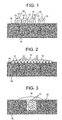
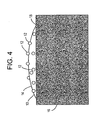
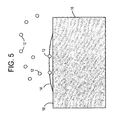
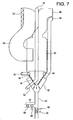
- FIGURES 1 to 4 of the figures are schematic representations of indicator and binder combination monitoring deposits applied onto a substrate and FIG. 5 is a schematic representation of an indicator releasing from the binder of a combination monitoring deposit.
- binder/indicator composition 10 includes indicator 12 combined into binder 14 and applied onto substrate 16.
- FIGURE 1 shows a composition 10 in the form of indicator 12 particles that have been pre-coated with binder 14 and then applied to an upper surface 18 of the substrate 16.
- FIGURE 2 shows a composition 10 that has been formed by first applying indicator 12 particles to an upper surface 18 of the substrate 16 followed by application of binder 14 to encompass the indicator 12 particles.
- a well 20 is first formed into the substrate 16. Indicator 12 particles are deposited into the well 20, which is subsequently capped by the binder 14.
- Indicator 12 can be either a chemical compound or element. As shown, the indicator 12 is doped into the binder 14 or applied to a substrate 16 and covered by the binder 14. The indicator is detected upon release from the binder 14 when the binder begins to melt when a critical operating temperature is reached. The indicator is identified to indicate that a particular part has reached the critical temperature. In a preferred embodiment, hereinafter described in detail, different binder/indicator compositions are applied to different sets of parts of a gas turbine. Released indicators are in an exhaust stream, indicating wear or damage to particular turbine parts.
- the indicator is selected to be stable and relatively inactive with respect to diffusion at the high turbine operating temperatures involved, and to not have a deleterious effect on coating and turbine performance.
- the indicator is selected to retain fluorescence upon exposure to high temperatures for extended periods.
- the indicator will not react with or dissolve in the binder material. It is easily detected by a fluorescent particle sampling technique.
- the indicator is reliably detectable in small concentrations.
- Suitable fluorescent indicators are available commercially. For example, a variety of inorganic fluorescent indicators catalogue # SFP-0010, (white), #SFP-0013 (green) and SFP-0018 (red) are available from Spectra Systems Corporation, 321 South Main Street, Buffalo, RI 02903.
- a variety of binders is suitable in the invention.
- the binder must not chemically react or corrode the substrate material.
- the binder must not degrade physically during operation.
- the binder must melt at a characteristic temperature that is of interest and in the process, release the fluorescent particles into the turbine exhaust.
- the binder must be non-hazardous and non-toxic.
- the binder must not be prohibitively expensive.
- the binder must not react with, dissolve or degrade the fluorescent particles.
- TABLE 1 provides a list of binders and their associated melting points.
- a eutectic binder mixture can be used as the binder in another embodiment of the invention.
- the eutectic LiCl with 40 mol% KCI melts at 350 °C.
- a LiCl/NaCl mixture melts between 552 °C and 819 °C, depending on the ratio of the two components.
- a eutectic permits a combination to be customized for application to numerous parts sections wherein each is sensitive to a different temperature effect.
- An additional advantage of the eutectic binder is that variables related to chemical reactivity, physical erosion, corrosion etc., are roughly equivalent while the characteristic melting point can be varied for use in connection with a variety of turbine engine parts.
- the binder/indicator composition 10 can be applied in a number of different ways.
- the binder and indicator can be blended together, then melted and applied as spots at various locations on an airfoil.
- a small well is drilled into the surface of the airfoil, the well filled with an indicator such as fluorescent particles and a molten binder is applied to seal the well at the airfoil surface. Combinations of these techniques can be used.
- Suitable indicator materials include yttrium oxide doped with +3 europium, Ce 1XY La X Tb Y MgAl 11 O 19 , where O ⁇ X ⁇ 0.2 and 0.2 ⁇ Y ⁇ 0.4, cerium magnesium aluminate doped with +3 terbium, or yttrium oxide doped with +3 europium, especially Ce 0.7 Tb 0.3 MgAl 11 O 19 (CAT) and the like.
- CAT Ce 0.7 Tb 0.3 MgAl 11 O 19
- indicators include Zn 2 SiO 4 doped with Mn or As, La 2 O 2 S doped with Tb, Y 2 O 2 S doped with Eu, CaWO 4 , and Gd 2 O 2 S doped with Tb, LaPO 4 doped with Ce and Tb, LaPO 4 with Eu.
- indicators may be selected from radioactive isotopes or certain metal indicators such as Cr or Co.
- Some exemplary binder/indicator combinations include the binders of TABLE 1 and inorganic fluorescent indicators.
- Preferred binders include Na 2 O ⁇ Al 2 O 3 4 ⁇ SiO 3 , K 2 SiO 3 and K 2 Ca(SO 4 ) 2 in combination with organometallic indicators such as SFP-0010 (white) and SFP-0013 (green) and SFP-0018 (red) available from Spectra Systems Corporation, 321 South Main Street, Buffalo, RI 02903.
- a europium chelate indicator such as SFP-0008 (red) is a preferred indicator.
- the indicator can be present in the binder/indicator combination in any proportion so long as integrity of the composition is maintained until a critical temperature is reached at which the binder melts to release the indicator. Broadly, the indicator can be present in percent by weight of the composition in a range of 1% to 99%, desirably 25% to 95% and preferably 80% to 90%.
- the indicator and binder combination can be applied to any substrate in need of temperature monitoring in a deleterious operating environment.
- the substrate is a part of a gas turbine that is prone to wear or damage.
- the turbine parts include combustors, transition pieces and high pressure turbine airfoils.
- the substrate can be another turbine engine part as well, such as a first stage high pressure turbine blade. Coatings of the preferred embodiments of the invention may be applied to the entire surface of these parts, or alternatively, to a portion of these parts.
- the indicators are doped into layers or interfaces of coatings that are present in turbine parts that are subject to wear and damage, erosion, oxidation, and corrosion.
- a preferred substrate is a coating for insulating a gas turbine part.
- thermal barrier coating a ceramic insulating layer, referred to as a thermal barrier coating (TBC).
- TBC thermal barrier coating
- the heat-diffusible indicator can be applied to any substrate subject to exposure to a deleterious thermal environment.
- Metal substrates such as steel, for example valve seats, turbine buckets, turbine blades, vanes, combustor liners, transition pieces, nozzles, reaction vessels, pressure vessels, boilers and various other surfaces are among the substrates that can be monitored in accordance with the invention for differential erosion or corrosion.
- Suitable ceramic substrates include alumina shafts that are subject to differential wear or differential erosion or corrosion.
- FIGURE 6 is a perspective view of a turbine engine collection device 20 for collecting indicators from an exhaust stream of a turbine engine
- FIGURE 7 is a schematic cross-sectional view of the device 20 of FIGURE 6 .
- These figures depict a single tube 22 that has multiple open ends 24 that face directly into the exhaust gas stream indicated generally by 26.
- the tube 22 collects a small percentage sample of the exhaust stream 26 and delivers its exhaust sample via duct 28 to a separator 30 such as a cyclone separator.
- the separator 30 concentrates the particulate matter while the sampled exhaust stream 26 cools.
- the concentrated output of separator 30 is directed to a water-gas separator 32 that comprises a cone-shaped surface 34 (shown in FIGURE 7 ).
- a stream of water 36 passing from a rinse water inlet 38 flows over the surface 34 to capture the concentrated particles.
- the stream of water 36 then flows down water outlet 40 shown at the bottom of FIGURE 7 .
- Thermocouple 42 measures the temperature of the exhaust gas stream 26.
- a manifold 44 can be provided to distribute water stream 36 completely around the cone-shaped surface 34 circumference.
- the exhaust stream 26 exits separator 30 via primary exhaust return 46 or secondary exhaust return 48.
- the water stream is filtered by a particle filter 50 to recover a particulate indicator-containing fraction and the stream 36 is circulated to inlet 38.
- particles separated from the exhaust stream by the separator 32 are carried by exhaust gas to a compartment 62, which is lined with compartment filter 64 and is connected to the separator 32 for periodic retrieval and analysis.
- closing valve 66 and opening valve 68 causes indicator-containing particles to be deposited in compartment 62 by way of deposition on compartment filter 64.
- the collection device 20 is depicted by icon 20 in FIGURE 8 .
- tubes 22 face directly into an exhaust gas stream 26 of turbine 50.
- the tubes 22 are in fluid communication with separator 30.
- Rinse water containing exhaust particles leaves the separator 30 at outlet 40 and proceeds to particle filter 50.
- Pump 54 continually forces rinse water back to separator inlet 38.
- the filter 50 is removed and the filtered particles are subjected to elemental analysis by analyzer 56 to assay for the presence of an indicator array 58.
- the individual indicators of array 58 are determined.
- a positive indication of the presence of an indicator associated with a particular turbine part generates a wear indicator signal 60 for that part.
- Analysis 56 of the particulate indicator-containing fraction can be accomplished by a number of methods including plasma flame spectrometry and mass spectrometry.
- a slurry of SFP-0010, white fluorescent particle material is prepared in distilled water. The slurry is introduced into the holes by means of a syringe. The water is evaporated by gentle heating.
- Na 2 O ⁇ Al 2 O 3 4 ⁇ SiO 3 (100 g, m.p. 1000 °C) binder is placed in a syringe and is melted by a hot glue gun. The melted binder is introduced as small droplet particles into the holes. Excess binder material is removed by attrition with fine emory paper so that the wells are flush with the airfoil surface.
- the airfoil is then re-introduced into service.
- a surface temperature of the airfoil reaches the melting point of the binder (1832 F)
- the binder melts, releasing the fluorescent particle material an exhaust stream.
- the material is captured by the device illustrated in FIGURES 6 and 7 .
- the material is detected and identified by plasma flame spectrometry to indicate that the location of the pattern is subjected to a local temperature of at least 1000 °C.
Landscapes
- Engineering & Computer Science (AREA)
- Chemical & Material Sciences (AREA)
- Combustion & Propulsion (AREA)
- Physics & Mathematics (AREA)
- General Physics & Mathematics (AREA)
- Mechanical Engineering (AREA)
- General Engineering & Computer Science (AREA)
- Turbine Rotor Nozzle Sealing (AREA)
- Investigating Or Analyzing Non-Biological Materials By The Use Of Chemical Means (AREA)
- Control Of Turbines (AREA)
Applications Claiming Priority (2)
| Application Number | Priority Date | Filing Date | Title |
|---|---|---|---|
| US294727 | 1989-01-06 | ||
| US10/294,727 US7052737B2 (en) | 2002-11-15 | 2002-11-15 | Forming a monitoring deposit on a substrate |
Publications (2)
| Publication Number | Publication Date |
|---|---|
| EP1420234A1 EP1420234A1 (en) | 2004-05-19 |
| EP1420234B1 true EP1420234B1 (en) | 2015-09-02 |
Family
ID=32176193
Family Applications (1)
| Application Number | Title | Priority Date | Filing Date |
|---|---|---|---|
| EP03257148.1A Expired - Lifetime EP1420234B1 (en) | 2002-11-15 | 2003-11-12 | Method for selecting a binder for a thermal indicator in a gas turbine system |
Country Status (5)
| Country | Link |
|---|---|
| US (1) | US7052737B2 (enExample) |
| EP (1) | EP1420234B1 (enExample) |
| JP (1) | JP4439243B2 (enExample) |
| KR (1) | KR100825142B1 (enExample) |
| CN (1) | CN1510415B (enExample) |
Families Citing this family (23)
| Publication number | Priority date | Publication date | Assignee | Title |
|---|---|---|---|---|
| US7270890B2 (en) * | 2002-09-23 | 2007-09-18 | Siemens Power Generation, Inc. | Wear monitoring system with embedded conductors |
| DE202004007476U1 (de) * | 2004-03-26 | 2004-09-02 | Stabila-Meßgeräte Gustav Ullrich GmbH | Vorrichtung zum Abbilden einer linienförmigen optischen Markierung |
| US7123031B2 (en) * | 2004-12-20 | 2006-10-17 | Siemens Power Generation, Inc. | System for on-line assessment of the condition of thermal coating on a turbine vane |
| US20060263613A1 (en) * | 2005-05-20 | 2006-11-23 | General Electric Company | Temperature dependent transparent optical coatings for high temperature absorption |
| US20060263209A1 (en) * | 2005-05-20 | 2006-11-23 | General Electric Company | Temperature dependent transparent optical coatings for high temperature reflection |
| US8247018B2 (en) * | 2005-06-20 | 2012-08-21 | Authentiform Technologies, Llc | Methods for quality control |
| US7874489B2 (en) * | 2005-06-20 | 2011-01-25 | Authentiform Technologies, Llc | Product authentication |
| WO2007002009A2 (en) * | 2005-06-20 | 2007-01-04 | Johnson & Johnson | Product authentication |
| US7632012B2 (en) * | 2005-09-01 | 2009-12-15 | Siemens Energy, Inc. | Method of measuring in situ differential emissivity and temperature |
| WO2009126802A1 (en) * | 2008-04-09 | 2009-10-15 | Battelle Memorial Institute | Corrosion detection product and method |
| US8490474B2 (en) * | 2010-12-30 | 2013-07-23 | General Electric Company | Methods, systems and apparatus for detecting material defects in combustors of combustion turbine engines |
| US8158428B1 (en) * | 2010-12-30 | 2012-04-17 | General Electric Company | Methods, systems and apparatus for detecting material defects in combustors of combustion turbine engines |
| US20120169326A1 (en) * | 2010-12-30 | 2012-07-05 | General Electric Company | Methods, systems and apparatus for detecting material defects in combustors of combustion turbine engines |
| WO2014070958A1 (en) | 2012-10-30 | 2014-05-08 | Certirx Corporation | Product, image, or document authentication, verification, and item identification |
| CA2893672C (en) * | 2013-01-09 | 2019-06-25 | Cidra Corporate Services Inc. | Smart pipe concept based on embedded taggant-sensor and/or color-encoded elements to monitor liner wear in lined pipelines, including urethane lined pipe |
| US20150125681A1 (en) * | 2013-11-06 | 2015-05-07 | United Technologies Corporation | High Temperature Imaging Media for Digital Image Correlation |
| US9804058B2 (en) | 2014-02-27 | 2017-10-31 | Pratt & Whitney Canada Corp. | Method of facilitating visual detection of a crack in a component of a gas turbine engine |
| US9790834B2 (en) | 2014-03-20 | 2017-10-17 | General Electric Company | Method of monitoring for combustion anomalies in a gas turbomachine and a gas turbomachine including a combustion anomaly detection system |
| JP2016138672A (ja) * | 2015-01-26 | 2016-08-04 | 住友重機械工業株式会社 | 流動床反応炉 |
| US9791351B2 (en) | 2015-02-06 | 2017-10-17 | General Electric Company | Gas turbine combustion profile monitoring |
| US9453727B1 (en) | 2015-08-03 | 2016-09-27 | Siemens Energy, Inc. | Nondestructive detection of dimensional changes in a substrate using subsurface markers |
| EP4175930A1 (en) * | 2020-07-03 | 2023-05-10 | Raytheon Technologies Corporation | Dislocator chemistries for turbine abradable or machinable coating systems |
| CN119978878B (zh) * | 2025-01-06 | 2025-11-18 | 北京航空航天大学 | 一种磷光测温涂层及其制备方法 |
Family Cites Families (12)
| Publication number | Priority date | Publication date | Assignee | Title |
|---|---|---|---|---|
| US4272988A (en) * | 1975-04-15 | 1981-06-16 | Westinghouse Electric Corp. | Multiple signal thermoparticulating coating |
| US4327155A (en) | 1980-12-29 | 1982-04-27 | General Electric Company | Coated metal structures and method for making |
| US4327120A (en) | 1981-01-28 | 1982-04-27 | General Electric Company | Method for coating a metal substrate |
| CA1163872A (en) * | 1982-01-21 | 1984-03-20 | Rodney E. Hanneman | Coated metal structures and method for making |
| DE3638265C1 (en) * | 1986-11-10 | 1988-03-03 | Mtu Muenchen Gmbh | Temperature/time indicator |
| DE3638266A1 (de) * | 1986-11-10 | 1988-05-19 | Mtu Muenchen Gmbh | Temperatur-indikator |
| DE3737502A1 (de) * | 1986-11-10 | 1988-05-19 | Mtu Muenchen Gmbh | Temperatur-indikator |
| US5578828A (en) * | 1994-11-15 | 1996-11-26 | General Electric Company | Flame sensor window coating compensation |
| US5865598C1 (en) * | 1997-07-02 | 2001-01-02 | Siemens Westinghouse Power | Hot spot detection system for vanes or blades of a combustion turbine |
| EP1105550B1 (en) | 1998-07-27 | 2003-03-12 | Imperial College Of Science, Technology & Medicine | Thermal barrier coating with thermoluminescent indicator material embedded therein |
| US6062811A (en) | 1998-08-06 | 2000-05-16 | Siemens Westinghouse Power Corporation | On-line monitor for detecting excessive temperatures of critical components of a turbine |
| US6644917B2 (en) * | 2001-08-14 | 2003-11-11 | General Electric Company | Smart coating system with chemical taggants for coating condition assessment |
-
2002
- 2002-11-15 US US10/294,727 patent/US7052737B2/en not_active Expired - Lifetime
-
2003
- 2003-11-12 EP EP03257148.1A patent/EP1420234B1/en not_active Expired - Lifetime
- 2003-11-14 JP JP2003385258A patent/JP4439243B2/ja not_active Expired - Fee Related
- 2003-11-14 KR KR1020030080532A patent/KR100825142B1/ko not_active Expired - Fee Related
- 2003-11-15 CN CN2003101198488A patent/CN1510415B/zh not_active Expired - Fee Related
Also Published As
| Publication number | Publication date |
|---|---|
| CN1510415A (zh) | 2004-07-07 |
| US20040096314A1 (en) | 2004-05-20 |
| CN1510415B (zh) | 2010-04-28 |
| KR20040042895A (ko) | 2004-05-20 |
| JP2004169698A (ja) | 2004-06-17 |
| EP1420234A1 (en) | 2004-05-19 |
| KR100825142B1 (ko) | 2008-04-24 |
| JP4439243B2 (ja) | 2010-03-24 |
| US7052737B2 (en) | 2006-05-30 |
Similar Documents
| Publication | Publication Date | Title |
|---|---|---|
| EP1420234B1 (en) | Method for selecting a binder for a thermal indicator in a gas turbine system | |
| CA2950548C (en) | Coating inspection method | |
| US6943357B2 (en) | Thermal barrier coatings, components, method and apparatus for determining past-service conditions and remaining life thereof | |
| EP1660757A1 (en) | Coatings and a method of optically detecting corrosion in coatings | |
| US9365932B2 (en) | Erosion and corrosion resistant coatings for exhaust gas recirculation based gas turbines | |
| CN101205833A (zh) | 隔热涂层 | |
| JP2002511943A (ja) | 燃焼タービンの静翼または動翼の高温箇所検知装置 | |
| US20120304733A1 (en) | Luminescent wear sensing | |
| Wenglarz et al. | Chemical aspects of deposition/corrosion from coal-water fuels under gas turbine conditions | |
| CN106917094A (zh) | 保护制品使其可抗硫酸盐腐蚀的方法以及具有改进的抗硫酸盐腐蚀性能的制品 | |
| JP4986730B2 (ja) | 高温用金属製品のコーティング劣化度判定方法 | |
| Cheruvu et al. | In-service degradation and life prediction of coatings for advanced land-based gas turbine buckets | |
| Nakamori et al. | Hot corrosion and its prevention in high temperature heavy oil firing gas turbines | |
| Pilgrim et al. | Thermal barrier sensor coatings-sensing damage and ageing in critical components | |
| US20120190118A1 (en) | Component having a protective layer that can be monitored magnetically and method for operating a component | |
| Wada et al. | Degradation of gas turbine blade materials in integrated coal-gasification combined cycle plant | |
| Birks et al. | Study of the Erosion Corrosion of Alloys and Coatings. | |
| Wenglarz et al. | Chemical Aspects of Deposition/Corrosion From Coal-Water Fuels Under Gas Turbine Conditions | |
| Srivastava et al. | Method And Apparatus For Determining Health Of Thermal Barrier Coatings | |
| Kobayashi et al. | Development of thermally sprayed coating applied for boiler tube | |
| Hahn | Hot Corrosion of Stage 1 Nozzles in an Industrial Gas Turbine | |
| Stanglmaier et al. | Mineral-Metal, Multiphase Coatings to Protect Combustion Chamber Components Against | |
| Simms et al. | Hot Corrosion of Coated Single Crystal Superalloys |
Legal Events
| Date | Code | Title | Description |
|---|---|---|---|
| PUAI | Public reference made under article 153(3) epc to a published international application that has entered the european phase |
Free format text: ORIGINAL CODE: 0009012 |
|
| AK | Designated contracting states |
Kind code of ref document: A1 Designated state(s): AT BE BG CH CY CZ DE DK EE ES FI FR GB GR HU IE IT LI LU MC NL PT RO SE SI SK TR |
|
| AX | Request for extension of the european patent |
Extension state: AL LT LV MK |
|
| 17P | Request for examination filed |
Effective date: 20041119 |
|
| AKX | Designation fees paid |
Designated state(s): CH DE FR GB IT LI |
|
| 17Q | First examination report despatched |
Effective date: 20100908 |
|
| GRAP | Despatch of communication of intention to grant a patent |
Free format text: ORIGINAL CODE: EPIDOSNIGR1 |
|
| INTG | Intention to grant announced |
Effective date: 20150407 |
|
| GRAS | Grant fee paid |
Free format text: ORIGINAL CODE: EPIDOSNIGR3 |
|
| GRAA | (expected) grant |
Free format text: ORIGINAL CODE: 0009210 |
|
| AK | Designated contracting states |
Kind code of ref document: B1 Designated state(s): CH DE FR GB IT LI |
|
| REG | Reference to a national code |
Ref country code: GB Ref legal event code: FG4D |
|
| REG | Reference to a national code |
Ref country code: CH Ref legal event code: EP |
|
| REG | Reference to a national code |
Ref country code: DE Ref legal event code: R096 Ref document number: 60347985 Country of ref document: DE |
|
| REG | Reference to a national code |
Ref country code: FR Ref legal event code: PLFP Year of fee payment: 13 |
|
| REG | Reference to a national code |
Ref country code: DE Ref legal event code: R097 Ref document number: 60347985 Country of ref document: DE |
|
| PLBE | No opposition filed within time limit |
Free format text: ORIGINAL CODE: 0009261 |
|
| STAA | Information on the status of an ep patent application or granted ep patent |
Free format text: STATUS: NO OPPOSITION FILED WITHIN TIME LIMIT |
|
| 26N | No opposition filed |
Effective date: 20160603 |
|
| REG | Reference to a national code |
Ref country code: FR Ref legal event code: PLFP Year of fee payment: 14 |
|
| REG | Reference to a national code |
Ref country code: FR Ref legal event code: PLFP Year of fee payment: 15 |
|
| REG | Reference to a national code |
Ref country code: FR Ref legal event code: PLFP Year of fee payment: 16 |
|
| PGFP | Annual fee paid to national office [announced via postgrant information from national office to epo] |
Ref country code: DE Payment date: 20181023 Year of fee payment: 16 |
|
| PGFP | Annual fee paid to national office [announced via postgrant information from national office to epo] |
Ref country code: IT Payment date: 20181023 Year of fee payment: 16 Ref country code: CH Payment date: 20181030 Year of fee payment: 16 Ref country code: FR Payment date: 20181024 Year of fee payment: 16 Ref country code: GB Payment date: 20181024 Year of fee payment: 16 |
|
| REG | Reference to a national code |
Ref country code: DE Ref legal event code: R119 Ref document number: 60347985 Country of ref document: DE |
|
| REG | Reference to a national code |
Ref country code: CH Ref legal event code: PL |
|
| PG25 | Lapsed in a contracting state [announced via postgrant information from national office to epo] |
Ref country code: LI Free format text: LAPSE BECAUSE OF NON-PAYMENT OF DUE FEES Effective date: 20191130 Ref country code: CH Free format text: LAPSE BECAUSE OF NON-PAYMENT OF DUE FEES Effective date: 20191130 |
|
| GBPC | Gb: european patent ceased through non-payment of renewal fee |
Effective date: 20191112 |
|
| PG25 | Lapsed in a contracting state [announced via postgrant information from national office to epo] |
Ref country code: FR Free format text: LAPSE BECAUSE OF NON-PAYMENT OF DUE FEES Effective date: 20191130 Ref country code: GB Free format text: LAPSE BECAUSE OF NON-PAYMENT OF DUE FEES Effective date: 20191112 Ref country code: IT Free format text: LAPSE BECAUSE OF NON-PAYMENT OF DUE FEES Effective date: 20191112 Ref country code: DE Free format text: LAPSE BECAUSE OF NON-PAYMENT OF DUE FEES Effective date: 20200603 |