EP1418612A2 - Metal vapor discharge lamp, floodlight projector and metal vapor discharge lamp lighting device - Google Patents
Metal vapor discharge lamp, floodlight projector and metal vapor discharge lamp lighting device Download PDFInfo
- Publication number
- EP1418612A2 EP1418612A2 EP03256340A EP03256340A EP1418612A2 EP 1418612 A2 EP1418612 A2 EP 1418612A2 EP 03256340 A EP03256340 A EP 03256340A EP 03256340 A EP03256340 A EP 03256340A EP 1418612 A2 EP1418612 A2 EP 1418612A2
- Authority
- EP
- European Patent Office
- Prior art keywords
- discharge lamp
- light
- metal vapor
- vapor discharge
- visible
- Prior art date
- Legal status (The legal status is an assumption and is not a legal conclusion. Google has not performed a legal analysis and makes no representation as to the accuracy of the status listed.)
- Withdrawn
Links
Images




Classifications
-
- B—PERFORMING OPERATIONS; TRANSPORTING
- B60—VEHICLES IN GENERAL
- B60Q—ARRANGEMENT OF SIGNALLING OR LIGHTING DEVICES, THE MOUNTING OR SUPPORTING THEREOF OR CIRCUITS THEREFOR, FOR VEHICLES IN GENERAL
- B60Q1/00—Arrangement of optical signalling or lighting devices, the mounting or supporting thereof or circuits therefor
- B60Q1/02—Arrangement of optical signalling or lighting devices, the mounting or supporting thereof or circuits therefor the devices being primarily intended to illuminate the way ahead or to illuminate other areas of way or environments
- B60Q1/04—Arrangement of optical signalling or lighting devices, the mounting or supporting thereof or circuits therefor the devices being primarily intended to illuminate the way ahead or to illuminate other areas of way or environments the devices being headlights
- B60Q1/14—Arrangement of optical signalling or lighting devices, the mounting or supporting thereof or circuits therefor the devices being primarily intended to illuminate the way ahead or to illuminate other areas of way or environments the devices being headlights having dimming means
-
- F—MECHANICAL ENGINEERING; LIGHTING; HEATING; WEAPONS; BLASTING
- F21—LIGHTING
- F21S—NON-PORTABLE LIGHTING DEVICES; SYSTEMS THEREOF; VEHICLE LIGHTING DEVICES SPECIALLY ADAPTED FOR VEHICLE EXTERIORS
- F21S41/00—Illuminating devices specially adapted for vehicle exteriors, e.g. headlamps
- F21S41/10—Illuminating devices specially adapted for vehicle exteriors, e.g. headlamps characterised by the light source
- F21S41/12—Illuminating devices specially adapted for vehicle exteriors, e.g. headlamps characterised by the light source characterised by the type of emitted light
- F21S41/13—Ultraviolet light; Infrared light
-
- F—MECHANICAL ENGINEERING; LIGHTING; HEATING; WEAPONS; BLASTING
- F21—LIGHTING
- F21S—NON-PORTABLE LIGHTING DEVICES; SYSTEMS THEREOF; VEHICLE LIGHTING DEVICES SPECIALLY ADAPTED FOR VEHICLE EXTERIORS
- F21S41/00—Illuminating devices specially adapted for vehicle exteriors, e.g. headlamps
- F21S41/10—Illuminating devices specially adapted for vehicle exteriors, e.g. headlamps characterised by the light source
- F21S41/14—Illuminating devices specially adapted for vehicle exteriors, e.g. headlamps characterised by the light source characterised by the type of light source
- F21S41/17—Discharge light sources
- F21S41/172—High-intensity discharge light sources
-
- H—ELECTRICITY
- H01—ELECTRIC ELEMENTS
- H01J—ELECTRIC DISCHARGE TUBES OR DISCHARGE LAMPS
- H01J61/00—Gas-discharge or vapour-discharge lamps
- H01J61/02—Details
- H01J61/12—Selection of substances for gas fillings; Specified operating pressure or temperature
- H01J61/125—Selection of substances for gas fillings; Specified operating pressure or temperature having an halogenide as principal component
-
- H—ELECTRICITY
- H01—ELECTRIC ELEMENTS
- H01J—ELECTRIC DISCHARGE TUBES OR DISCHARGE LAMPS
- H01J61/00—Gas-discharge or vapour-discharge lamps
- H01J61/82—Lamps with high-pressure unconstricted discharge having a cold pressure > 400 Torr
- H01J61/827—Metal halide arc lamps
-
- H—ELECTRICITY
- H01—ELECTRIC ELEMENTS
- H01J—ELECTRIC DISCHARGE TUBES OR DISCHARGE LAMPS
- H01J61/00—Gas-discharge or vapour-discharge lamps
- H01J61/84—Lamps with discharge constricted by high pressure
- H01J61/86—Lamps with discharge constricted by high pressure with discharge additionally constricted by close spacing of electrodes, e.g. for optical projection
-
- F—MECHANICAL ENGINEERING; LIGHTING; HEATING; WEAPONS; BLASTING
- F21—LIGHTING
- F21S—NON-PORTABLE LIGHTING DEVICES; SYSTEMS THEREOF; VEHICLE LIGHTING DEVICES SPECIALLY ADAPTED FOR VEHICLE EXTERIORS
- F21S41/00—Illuminating devices specially adapted for vehicle exteriors, e.g. headlamps
- F21S41/60—Illuminating devices specially adapted for vehicle exteriors, e.g. headlamps characterised by a variable light distribution
- F21S41/68—Illuminating devices specially adapted for vehicle exteriors, e.g. headlamps characterised by a variable light distribution by acting on screens
- F21S41/683—Illuminating devices specially adapted for vehicle exteriors, e.g. headlamps characterised by a variable light distribution by acting on screens by moving screens
Definitions
- the present invention relates to a metal vapor discharge lamp for mainly performing near-infrared radiation, a projector equipped with the lamp, and a lighting device for metal vapor discharge lamps.
- Such monitoring or detection is realized by photographing subjects or objects using, for example, a CCD camera.
- a CCD camera To photograph them, near-infrared radiation, which cannot be sensed by human beings, is widely utilized, since if visible light is used, the existence of a camera can be known, and the light may be dazzling and make them feel uncomfortable.
- the low-pressure rare-gas discharge lamp of this publication employs a relatively long glass bulb. Therefore, when this lamp is used as a near-infrared illuminator or in a near-infrared photographing device, if it is fixed in a certain position indoors or outdoors, no problems will occur. However, if the lamp is used in a mobile unit, such as a vehicle, it disadvantageously requires a large space. Further, if the lamp uses coiled thin filaments as electrodes, the filaments may be easily broken since they do not show a high resistance against impact or vibration. This means that stable light emission cannot be expected for a long time.
- the inventors of the present application have recently paid attention to a metal vapor discharge lamp used as a headlamp for, for example, vehicles.
- This lamp emits a large amount of near-infrared light and can be made as small as an electric bulb.
- halogen lamps are generally used as headlamps for vehicles in order to enhance the forward visibility for safety during the night or in tunnels.
- high-pressure metal vapor discharge lamps such as metal halide lamps of a short arc type, have recently been employed, which emit light of a higher intensity and larger quantity than halogen lamps and have electrodes of a high resistance against impact or vibration.
- Metal vapor discharge lamps can illuminate a larger area than conventional halogen lamps since the former lamps emit higher intensity light, thereby enabling drivers to have a higher visibility and show a quicker response.
- a high-pressure metal vapor discharge lamp used as, for example, the headlamp of a vehicle or a monitor lamp in a banking facility, which can irradiate pedestrians or customers with near-infrared light and visible light of moderate intensity.
- the present invention has been developed in light of the above circumstances, and aims to provide a metal vapor discharge lamp capable of emitting a larger amount of near-infrared light than conventional high-pressure discharge lamps, a projector equipped with the lamp, and a metal vapor discharge lamp lighting device.
- a metal vapor discharge lamp according to a first embodiment comprises:
- This lamp is a high-pressure discharge lamp in which the ratio of the total near-infrared (750 - 1100 nm) radiation output to the total visible radiation output is 50% or more. Therefore, this lamp is inferior in visibility, but its main radiation is near-infrared radiation.
- This lamp includes a lamp that does not provide visible radiation.
- the first embodiment is characterized in that no mercury is sealed. If mercury is sealed together with a material (CsI, RbI, KI) that mainly radiates near-infrared light, mercury generates a high vapor pressure, and much radiation of mercury is observed in the visible and ultraviolet regions. This is opposed to the case where if mercury is sealed together with ScI 3 , NaI, etc., Sc and Na radiate much visible light, which significantly suppresses visible and ultraviolet radiation of mercury. Ultraviolet radiation of mercury damages a headlamp (in particular, a headlamp made of plastic), therefore an upper limit is set on the amount of ultraviolet radiation.
- a material CsI, RbI, KI
- the visible region and near-infrared region mean the wavelength ranges of 380 - 780 nm and 750 - 1100 nm, respectively.
- the overlapping range of 750 - 780 nm exhibits a low visibility and hence the light of this range is not dazzling.
- CCD cameras show a high sensitivity to the light of this range, therefore it is used as the near-infrared radiation.
- the refractory and light-transmitting hermetic vessel that forms a light emission tube is generally called a bulb, and is made of hard glass, such as quartz glass, alumina silicate glass, etc., or a light-transmitting ceramics such as alumina, etc.
- the sealing portion provided at an end of the light emission tube can be formed by pressure sealing or shrinkage if the light emission tube is made of glass.
- the disk or cap can be sealed by, for example, a compound.
- a sealing portion may be provided on one end or on each of the opposite ends.
- a chamber formed in the vessel may be cylindrical, elliptic, spherical, or a combination thereof.
- the hermetic vessel should be airtightly sealed.
- the hermetic vessel may have a single tube structure, or a double tube structure in which a light emission tube is contained in a light-transmitting outer tube, and these tubes are coupled to each other at their opposite ends, or a multi-tube structure in which a protector tube is provided in addition to the light emission tube and outer tube.
- the interior of the outer tube with the light emission tube contained therein may be kept in a vacuum state or an inert gas atmosphere, or communicate with the outside air.
- the metal vapor discharge lamp may be formed of, for example, a short-arc type metal halide lamp.
- the discharge medium sealed in the hermetic vessel emits light when energy is applied thereto.
- the discharge medium contains a halide which is a halide of at least one metal selected from sodium (Na), scandium (Sc), and rare earth metals, such as dysprosium (Dy), thulium (Tm), Holmium (Ho), neodymium (Nd), etc that emit visible light.
- a halide which is a halide of at least one metal selected from sodium (Na), scandium (Sc), and rare earth metals, such as dysprosium (Dy), thulium (Tm), Holmium (Ho), neodymium (Nd), etc that emit visible light.
- the discharge medium contains a halide which is a halide of at least one metal selected from potassium (K), cesium (Cs) and rubidium (Rb) that emit near-infrared.
- a halide which is a halide of at least one metal selected from potassium (K), cesium (Cs) and rubidium (Rb) that emit near-infrared.
- a halide containing aluminum Al or zinc Zn that generates a relatively high vapor pressure, and whose metal emits a smaller amount of visible light than the above-mentioned visible-light generating materials can be sealed instead of Hg.
- a lamp that does not contain Hg is stable in electrical characteristics and it is of course environmentally friendly.
- substantially disusing mercury is intended to mean that no mercury is contained, and also to permit the existence of Hg if the amount of Hg per cc of the hermetic vessel is less than 0.3 mg, preferably 0.2 mg or less.
- iodine I, bromine Br or chlorine Cl can be used as the halogen in the halide, in the form of, for example, an iodide or bromide.
- xenon Xe, argon Ar, krypton Kr, etc. can be used as the rare gas. If the sealed pressure is set to approx. 1 ⁇ 10 2 kPa or more, at maximum, approx. 15 ⁇ 10 2 kPa, the start-up characteristic of the luminous flux can be enhanced, which is suitable for, for example, the headlamps of vehicles.
- the material of the light emission tube and the material and quantity of the sealed discharge medium can be appropriately selected in accordance with the required characteristics and the type of discharge lamp.
- the pair of electrodes may be formed of a bar of, for example, pure tungsten, or formed by winding the electrode bars with coils or by attaching a sintered product to the electrode bars.
- the tips of the electrode bars may serve as electrodes. If the distance between the pair of electrodes falls within a range of 1 mm to 6 mm, the electrodes form point light sources, thereby enhancing the light focusing characteristics. Further, if lighting is performed using alternating current, the electrodes may have the same structure. However, in the case of direct-current lighting, the temperature of the anode is abruptly increased, therefore it is preferable that the radiation section of the anode is made larger than the cathode.
- the discharge lamp can be lit using either alternating current or direct current, and may have any type of circuit structure.
- alternating current or direct current may have any type of circuit structure.
- using a direct current from a battery enables the circuit structure to be simplified.
- the lighting circuit is constructed such that it supplies a current three times or more a rated lamp current after the metal vapor discharge lamp is lit, and reduces the current with a lapse of time, the start-up characteristic of the luminous flux can be enhanced. This is preferable when the lamp is used as the headlamp of a vehicle.
- a metal vapor discharge lamp according to a second embodiment comprises:
- This discharge lamp is suitable for a single lamp used for both visible radiation and near-infrared radiation.
- the near-infrared radiation (750 - 1100 nm) power (output) is 1
- the visible radiation (380 - 780 nm) power (output) is 0.5 to 4.0.
- the near-infrared radiation power is 1/4 to twice the visible radiation power.
- the ratio of the near-infrared radiation power (output) to the visible radiation power (output) is less than 1/4, the near-infrared radiation power is too low to be used for, for example, an infrared recognition device. On the other hand, if the ratio exceeds 2, the visible radiation power is too low to be used for, for example, the headlamp of a vehicle.
- the visible and near-infrared radiation power outputs are measured (computed) in the following manner. Firstly, in the visible region, the discharge lamp is lit in the integrating sphere, as in the case of standard illumination lamps, thereby measuring the power (W) of radiation of each wavelength in the visible region. Subsequently, the relative radiation power between 200 - 2000 nm is measured by spectroscopy. As a result of these two measurements, the power (W) of radiation of each wavelength in the range of 200 - 2000 nm is obtained.
- the first halide contains at least one of sodium (Na), scandium (Sc) and a rare earth metal which radiate visible light (380 - 780 nm).
- These light-emitting materials are limited to metal halides whose metals radiate visible light of a predetermined wavelength region and ultraviolet light of a predetermined wavelength region, and which are suitable for general purposes in light of the emission efficiency and color rendering properties. Any one or more of the halides can be used.
- a metal vapor discharge lamp according to a third embodiment of the invention is characterized in that the halide contains at least one of a halide of potassium (K), cesium (Cs) and rubidium (Rb) which radiate light of near-infrared wavelengths (750 - 1100 nm).
- K potassium
- Cs cesium
- Rb rubidium
- the spectral lines of potassium (K) exist at 766.4 nm, 769.8 nm, 1168.9 nm and 1177.1 nm.
- those of cesium (Cs) exist at 760.9 nm, 801.5 nm, 807.9 nm, 852.1 nm, 876.1 nm, 894.3 nm, 917.2 nm, 920.8 nm, 1002.0 nm and 1012.0 nm.
- Those of rubidium (Rb) exist at 775.7 nm, 775.9 nm, 761.9 nm, 780.0 nm, 794.7 nm and 887.3 nm.
- these light emission materials provide high radiation power outputs in the near-infrared region of approx. 750 - 1100 nm.
- a metal vapor discharge lamp according to a fourth embodiment of the invention is characterized in that the discharge medium includes:
- the halide employed in the third embodiment which is of at least one metal selected from the group consisting of sodium (Na), scandium (Sc) and a rare earth metal that emit visible light, and the vapor pressure of a halide of which is not so high when the lamp is lit, is sealed as the first halide.
- the sealed second halide is a halide whose vapor pressure when the lamp is lit is relatively high, and whose metal is of at least one metal selected from the group consisting of magnesium Mg, iron (Fe), cobalt (Co), chrome (Cr), zinc (Zn), nickel (Ni), mangan (Mn), aluminum (Al), antimony (Sb), beryllium (Be) , rhenium (Re), gallium (Ga), titanium (Ti), zirconium (Zr), hafnium (Hf), tin (Sn), etc., which less easily radiates visible light than the metal contained in the first halide.
- the metal is of at least one metal selected from the group consisting of magnesium Mg, iron (Fe), cobalt (Co), chrome (Cr), zinc (Zn), nickel (Ni), mangan (Mn), aluminum (Al), antimony (Sb), beryllium (Be) , rhenium (Re), gallium (Ga), titanium (Ti), zi
- high vapor pressure means a pressure lower than a mercury vapor lamp pressure, and preferably the pressure in the hermetic vessel when the lamp is lit is approx. 5 atoms or less. Further, the expression “less easily radiating visible light than the metal contained the first halide” does not mean that the absolute visible radiation amount is small, but means that the visible radiation amount is relatively small.
- iron (Fe) and nickel (Ni) radiate a larger amount of ultraviolet light than visible light
- titanium (Ti), aluminum (Al), zinc (Zn), etc. radiate a larger amount of visible light.
- the metals that radiate a large amount of visible light are made to individually radiate, all of them radiate a large amount visible light since the energy applied to them concentrates thereon.
- the metal of the second halide less easily radiates light than the metal of the first halide because the energy level required for the former to radiate is higher than the latter, when the first and second halides coexist, energy concentrates on the first halide, and the amount of radiation of the metal of the second halide becomes small.
- the vapor pressure of most halides is lower than that of mercury, and the adjustment range of the lamp voltage is narrower than in the case of mercury.
- the adjustment range of the lamp voltage can be widened by appropriately sealing some of the halides.
- the second halide is not inhibited from radiating visible light, but may radiate visible light if the ratio of the visible radiation amount to the total radiation amount of the lamp is small and the influence of the visible radiation is small.
- substantially disusing mercury is intended to mean that no mercury is contained, and also to permit the existence of Hg if the amount of Hg per cc of the hermetic vessel is less than 0.3 mg, preferably 0.2 mg or less.
- the third halide contains at least one of potassium (K), cesium (Cs) and rubidium (Rb) which radiate near-infrared light as specified in the fourth embodiment.
- the discharge lamp is sealed with three types of halide, i.e., the first halide comprising a metal that radiates visible light of a predetermined wavelength range, the second halide the vapor pressure of which is relatively high and comprising a metal which less easily radiates visible light than the metal of the first halide, the second halide being sealed instead of mercury, and the third halide comprising a metal which radiates near-infrared light of a predetermined wavelength range.
- the first halide comprising a metal that radiates visible light of a predetermined wavelength range
- the second halide the vapor pressure of which is relatively high and comprising a metal which less easily radiates visible light than the metal of the first halide
- the second halide being sealed instead of mercury
- the third halide comprising a metal which radiates near-infrared light of a predetermined wavelength range.
- this discharge lamp the evaporation of the sealed second halide provides a predetermined lamp voltage. Further, this discharge lamp is environmentally friendly because it contains no or little mercury.
- the metal vapor discharge lamp of the invention can operate with mercury substantially excluded, and have substantially the same electrical and emission characteristics as conventional lamps sealed with mercury.
- the lamp may be sealed with Hg or be free of Hg.
- Hg-free lamp is desirable.
- ELV End of Life Vehicles
- GRE Groupe de Rapporteuss le Eclairage
- a metal vapor discharge lamp according to a fifth embodiment is characterized by a visible-light blocking filter.
- the visible-light blocking filter is provided in a bulb itself that forms the hermetic vessel, or on a surface of the bulb, thereby reducing or blocking visible radiation to enhance the ratio of near-infrared radiation.
- the bulb material is mixed with a material that reduces or blocks visible radiation, or a surface of the bulb is covered with a film that blocks visible-light and permits near-infrared light to pass therethrough, utilizing interference, the film being formed by alternately stacking high and low refraction factor films.
- a metal vapor discharge lamp according to a sixth embodiment is characterized in that its wattage rating is 100 W or less. This lamp is most suitable for the headlamp or projector of vehicles.
- a metal vapor discharge lamp according to a seventh embodiment is characterized in that the distance between a pair of electrodes falls within a range of 1 mm to 6 mm. This lamp is most suitable for the headlamp or projector of vehicles.
- a metal vapor discharge lamp according to an eighth embodiment is characterized in that the rare gas is Xe of five atoms or more. Increase of the Xe pressure quickens the start-up of luminous flux. In other words, stable radiation can be obtained in a short time. This is especially important if the lamp is used as the headlamp of a vehicle.
- a first embodiments of a projector of the present invention is characterized by comprising: a reflector; a metal vapor discharge lamp as specified in any one of the first to eighth embodiments, the metal vapor discharge lamp being provided on the reflector; and a light control member covering a front surface of the reflector.
- the metal vapor discharge lamp in which the visible radiation is reduced or blocked and the near-infrared radiation is relatively increased is provided in a reflector, and a light control member, such as a lens or globe, is provided at an opening in the reflector.
- the light control member controls the visible and near-infrared radiation from the discharge lamp, thereby providing a predetermined light distribution and preventing the discharge lamp in the reflector from being broken or contaminated by, for example, dust.
- the light control member is not limited to a member for controlling the radiation distribution, but also includes, for example, a globe just for protection of the discharge lamp and reflector.
- the projector can irradiate light of a wide wavelength range from the near-infrared region to the visible region, and is used as an illumination or monitoring device installed indoors or outdoors, or as the headlamp of vehicles, such as automobiles or trains.
- the projector can be incorporated in a near-infrared photography system in which the discharge lamp of the projector applies near-infrared light to a subject (person), and a near-infrared photography device being sensitive to the near-infrared region catches the near-infrared light reflected from the subject to recognize it.
- This near-infrared photography system can record comings and goings of visitors and/or monitor/detect intruders for security in banking facilities, defense facilities, airports, highways, etc.
- a projector according to a second embodiment is characterized in that a visible-light blocking filter is provided on at least one of front and rear surfaces of the light control member.
- the light control member may be formed by adding a material that reduces or blocks the visible region.
- a surface of the light contact member may be formed of a visible-region blocking filter comprising a multi-layer interference film.
- a visible-region blocking filter may be attached to the outer or inner surface of the light control member.
- the visible-region blocking filter may be stationary or movable relative to the light control member.
- a projector according to a third embodiment of the invention is characterized in that the projector of the first or second embodiment is installed in a vehicle.
- Vehicles equipped with the projector can use the projector as the headlamp and irradiate both visible light and infrared light.
- the vehicle headlamp irradiates a subject (person) with infrared light, and a CCD camera or infrared detecting device, etc. receives infrared light reflected from the subject (person) and forms its image.
- the driver can recognize the existence of an obstacle (person) on the road from the image, an alarm indicative of the obstacle, etc., therefore can take a quick countermeasure.
- This headlamp is suitable for a vehicle headlamp whose wattage rating is 100 W or less, and may be used only for detection utilizing infrared radiation, or used for both illumination utilizing visible radiation and detection utilizing infrared radiation. Of course, even if the lamp is dedicated to detection utilizing infrared radiation, some visible light may be emitted.
- a projector is characterized by comprising visible-light blocking means for blocking visible radiation and passing infrared radiation therethrough in a high beam mode, and means for removing the visible-light blocking means from the radiation direction of the lamp in a low beam mode.
- a pair of halogen lamps are used as the light sources in the high beam mode, and a pair of metal vapor discharge lamps are used as the light sources in the low beam mode.
- the metal vapor discharge lamp is lit in the high beam mode, and the visible-light blocking means blocks visible light, thereby enabling an infrared recognition device to sense infrared light.
- the visible-light blocking means blocks visible light, thereby enabling an infrared recognition device to sense infrared light.
- the visible-light blocking means is removed to irradiate visible light used as the low beam.
- the halogen lamps usually used in the high beam mode may be temporarily used in the low beam mode.
- these lamps may be used in the following manner.
- the high beam mode visible light is irradiated as the high beam.
- light adjustment may be performed or the lamps themselves may be modified.
- the low beam mode the visible-light blocking means is operated to block visible light, thereby operating the infrared recognition device.
- the image obtained by a CCD camera will be fogged by halation. This is because usual CCD cameras also show high sensitivity to visible light, as is illustrated in FIG. 8. If the detection level of the CCD camera is reduced to avoid it, its infrared recognition capability is reduced.
- the visible light may be used as the low beam, without removing the visible-light blocking means.
- visible-light blocking is intended to mean “complete blocking of visible light” or “reduction of visible light”.
- a metal vapor discharge lamp lighting device is characterized by comprising a metal vapor discharge lamp according to any one of the first to eighth embodiments; and a lighting circuit which supplies a current three times or more a rated lamp current after the metal vapor discharge lamp is lit, and reduces the current with a lapse of time.
- the lighting circuit constructed as the above satisfies the start-up characteristics of the luminous flux and infrared radiation required for, for example, the headlamps of vehicles.
- the lighting circuit may be operated by either alternating current or direct current.
- USP 6,353,289 is incorporated herein by reference for the lighting circuit.
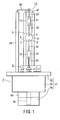
- FIG. 1 is a front view illustrating a single-head metal tubular bulb L1 of a double-tube structure in which a light emission tube formed of a metal vapor discharge lamp is airtightly contained in an outer tube.
- a light emission tube L is formed of, for example, a small metal vapor discharge lamp of a short-arc type is airtightly contained in an outer tube 4.
- reference numeral 1 denotes a refractory, light-transmitting airtight bulb that has a substantially spherical or elliptic chamber 11 swollen at a central position.
- a pair of sealing sections 12 formed by melting and pressing glass tube sections are provided at the opposite ends of the chamber 11.
- Each sealing section 12 airtightly contains a metal leaf 21 formed of, for example, molybdenum.
- An electrode bar 22 mainly formed of tungsten extends from one end of each metal leaf 21 into the chamber 11, while an external lead wire 23 formed of, for example, molybdenum and extending to the outside of the bulb 1 is coupled to the other end of each metal leaf 12 by, for example, welding.
- the respective tips of the electrode bars 22 serve as discharge electrodes 3, and oppose each other with a predetermined gap in the chamber 11.
- the chamber 11 is sealed with a halide metal and predetermined rare gas as mediums of discharge, described later.
- the outer tube 4 is a quartz glass cylinder, and has a joint 41 at which an end of the bulb 1 having its opposite ends contained therein is formed integral with the outer tube 4 by, for example, heating/contraction.
- This welding may be airtight welding that makes the outer tube 4 contain a vacuum or rare gas atmosphere, or may be non-airtight welding that makes the tube 4 communicate with the outside air.
- a substantially rectangular metal casing 5 is provided at the lower end of the cylindrical outer tube 4 such that the sides of the casing 5 surround the lower end.
- the metal casing 5 is attached to the outer tube 4 such that the former surrounds the latter, by welding their edges (not shown) to each other. Further, a plurality of chips (not shown) provided at the metal casing 5 are secured, by welding, on the upper surface of a fixing member (not shown).
- Reference numeral 7 denotes a cap having a main unit 71 that has three outer diameters and comprises a large-diameter flange section 72 formed of a heat-resistant, electrically insulating synthetic resin, such as polyphenylamide or polyethylimide, a main unit section 73 and a small-diameter terminal-forming section 74.
- the above-mentioned metal casing 5 with the outer tube 4 is fitted in an opening (not shown) formed in the main unit 71, together with a fixing member (not shown).
- the resultant structure is fixed by a mechanical engagement means or heat resistant adhesive.
- the external lead wire 23 led from the upper end of the outer tube 4 is connected to a lead wire 25.
- the lead wire 25 is passed through the guide hole of the cap 7 and connected to a plate-like terminal section 78 provided in the terminal-forming section 74.
- the outer lead wire 23 led from the lower end is connected to a pin-shaped terminal section 79 provided in the terminal-forming section 74.
- Reference numeral 26 denotes an insulated tube formed of, for example, ceramic and covering the exposed portion of the lead wire 25.
- the outer tube 4 and cap 7 are secured to each other after the discharge electrodes 3, the flange section 72 of the cap 7, etc. are positioned.
- the metal vapor discharge lamp L1 of the embodiment when the cap 7 is connected to a socket (not shown) connected to a lighting circuit device having, for example, a ballast, and is turned on, a predetermined voltage is applied to the discharge electrodes 3 via the external lead wires 23, metal leaves 21 and electrode bars 22 also serving as internal lead wires, which are electrically connected to the terminal sections 78 and 79 (one of the external lead wires 23 is electrically connected via the lead wire 25). As a result of the voltage application, a discharge occurs between the electrodes 3 in the light emission tube 1, and stable lighting is performed by the lighting circuit device.
- 1A - 1D denote lamps (light emission tubes L) containing materials that exhibit relatively high radiation power (output) in the near-infrared region (750 - 1100 nm).
- the wattage rating is 35 W
- the entire length of the airtight bulb, including both the sealing sections 12, is approx. 50 mm
- the outer and inner diameters of the maximum-diameter portion of the substantially elliptic chamber 11 having its central portion swollen is approx. 6 mm and approx. 2.7 mm, respectively
- the inner volume of the chamber 11 is approx. 0.05 cc
- the pair of discharge electrodes 3 oppose each other with a distance of approx. 4 mm.
- Table 1 illustrates the radiation power outputs (W) of each light emission tube L (1A - 1D) in the visible region V (380 - 780 nm) and the near-infrared region R (750 - 1100 nm), and the power ratio V/R.
- 1H in Table 1 represents a conventional halogen bulb of 35 W for comparison.
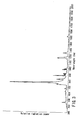
- FIG. 2 shows the spectroscopic distribution (300 - 2000 nm) characteristic of the light emission tube 1A (sealed with CsI) in Table 1 (the abscissa indicates “wavelength” (nm), and the ordinate indicates “relative radiation power”). It is understood from FIG. 2 that most of the light output by the light emission tube 1A is in the near-infrared wavelength range of 800 - 1000 nm, i.e., around 900 nm.
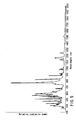
- FIG. 3 shows the spectroscopic distribution (300 - 2000 nm) characteristic of the light emission tube 1B (sealed with KI) in Table 1 (the abscissa indicates “wavelength” (nm), and the ordinate indicates “relative radiation power”). It is understood from FIG. 3 that most of the light output by the light emission tube 1B is the light of potassium (K) with a wavelength of 766.4 and 769.8 nm.
- the light emission tube 1C (sealed with RbI) irradiates strong light in the near-infrared wavelength range of 770 - 800 nm (its spectroscopic distribution characteristic is not shown).
- the radiation power in the near-infrared region is much higher than that in the visible region, and most of the radiation power output when the tubes are ON is in the near-infrared region. Furthermore, the radiation power of the tubes 1A - 1E is higher than that of the conventional halogen bulb 1H by approx. 40%.
- 2A - 2G denote lamps (light emission tubes L) containing materials that exhibit almost the same radiation power (output) between the visible region (380 - 780 nm) and near-infrared region (750 - 1100 nm). These lamps are suitable to be simultaneously used as illumination light sources for headlamps and as infrared light sources for infrared recognition devices, which will be described later.
- the wattage rating (input) is 40 W
- the entire length of the airtight bulb, including both the sealing sections 12, is approx. 50 mm
- the outer and inner diameters of the maximum-diameter portion of the substantially elliptic chamber 11 having its central portion swollen is approx. 6 mm and approx. 2.7 mm, respectively
- the inner volume of the chamber 11 is approx. 0.05 cc
- the pair of discharge electrodes 3 oppose each other with a distance of approx. 4 mm.
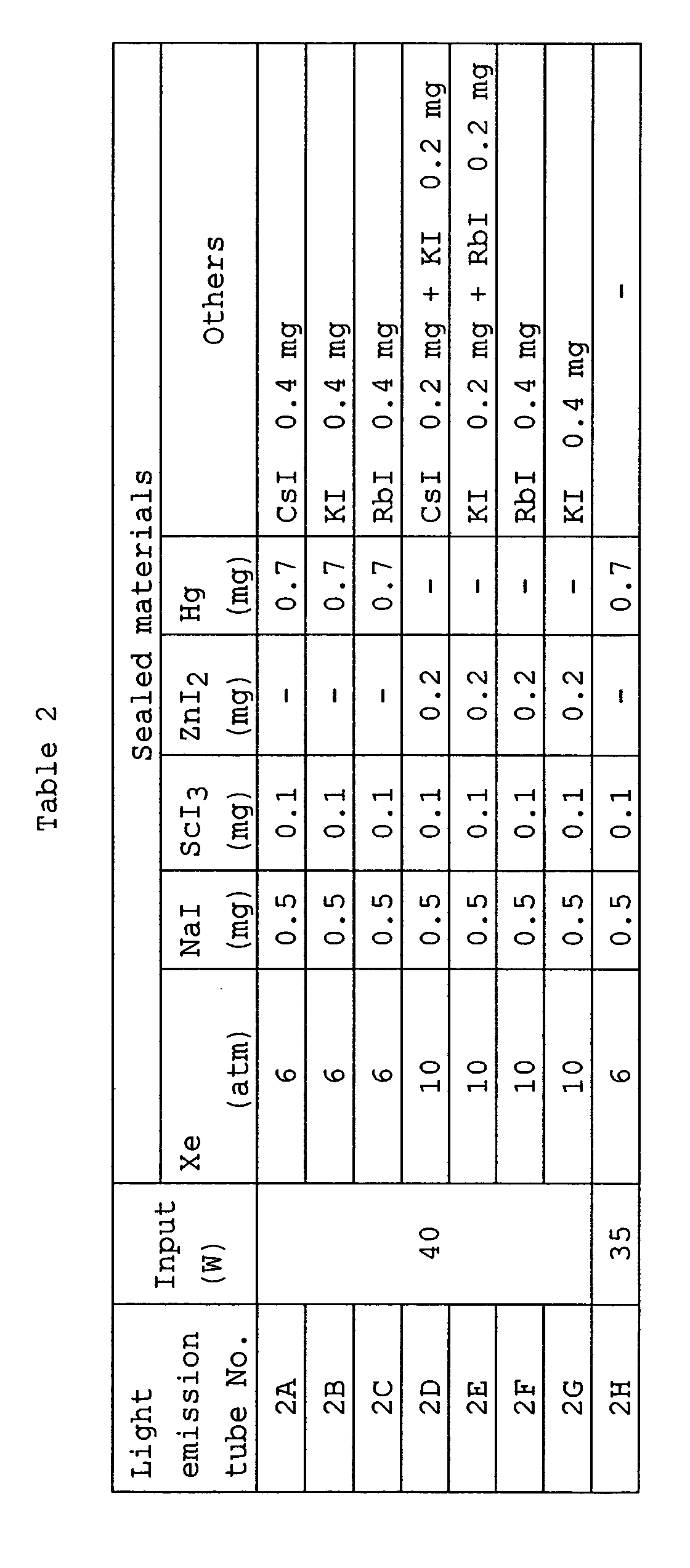
- chambers 11 of the light emission tubes L (2A - 2G) are sealed with the materials shown in Table 2.
- FIG. 4 shows the spectroscopic distribution (300 - 2000 nm) characteristic of the light emission tube 2A (sealed with NaI + ScI 3 + Hg + CsI + Xe) appearing in Table 2.
- FIG. 5 shows the spectroscopic distribution (300 - 2000 nm) characteristic of the light emission tube 2B (sealed with NaI + ScI 3 + Hg + KI + Xe) appearing in Table 2.
- the light emission tube 2A exhibits the same characteristic as the conventional tube 2H in the visible region, and the same characteristic as the above-described light emission tube 1A in the near-infrared region. Further, the light emission tube 2B exhibits the same characteristic as the conventional tube 2H in the visible region, and the same characteristic as the above-described light emission tube 1B in the near-infrared region.
- the sealed mercury (Hg) radiates weak light in the visible region.
- the light emission tubes 2D - 2G are sealed, instead of Hg, with zinc iodide (ZnI 2 ) as an alternative. Therefore, in the light emission tubes 2D - 2G, zinc (Zn) radiates weak light in the visible region.
- the spectroscopic characteristics of the light emission tubes 2A - 2C and 2H are similar to those of the light emission tubes 2D - 2G.
- Table 3 illustrates the radiation power outputs (W) of each light emission tube L (2A - 2G) in the visible region V (380 - 780 nm) and the near-infrared region R (750 - 1100 nm), the power ratios V/R, and the total luminous flux values.
- 2H in Table 2 represents a conventional discharge lamp of 35 W for comparison.
- each light emission tube L (2A - 2G) is set to 40 W, although the tubes (2A - 2H) are set to have the same size.
- the tubes 2A - 2H have almost the same life. This is because potassium K, cesium Cs, rubidium Rb, etc. requires a low ionization voltage, which reduces arc temperature required for arc discharge.
- the ratio of the total radiation power (output) of a light emission tube (lamp) (this lamp irradiates both visible light and near-infrared light) in the visible region (380 - 780 nm) to that in the near-infrared region (750 - 1100 nm).
- this lamp if 40 W is supplied to the lamp, this lamp provides a total luminous flux of approx. 1900 lm and a total radiation power output of 10 W or more in the near-infrared region. This is satisfactory.
- the wattage rating is set to more than 40 W.
- FIG. 6 a projector according to an embodiment of the invention will be described.
- This projector is a lamp instrument 8 serving as a headlamp for vehicles.
- FIG. 6 is a longitudinal sectional partly-broken view of the head lamp.
- elements similar to those shown in FIG. 1 are denoted by corresponding reference numerals, and no description is given thereof.
- reference numeral 81 denotes a reflector (mirror) formed by attaching a reflection film (not shown) made of, for example, aluminum to the inner surface of a reflector body 82 made of a heat-resistant synthetic resin, hard glass or metal plate.
- a light control member 83 represented by a lens that is designed to exhibit a predetermined light distribution characteristic is provided at the front opening of the reflector 81.
- the flange section 72 of the above-described discharge lamp L1 is inserted into and positioned in the through hole of a holder 84 provided at a central portion of the back surface of the reflector body 82. As a result, the flange section 72 is held from behind by the holder 84 through a spring member 85, thereby completing the lamp instrument 8.
- the lamp instrument 8 constructed as the above, since the lamp L1 having a high accuracy dimensional and positional relationship between the light source section and cap 7 is employed, a predetermined light distribution characteristic, in which the range of variations is small, can be obtained when a socket 9 is connected to the cap 7 and the lamp instrument is turned on by a lighting circuit device connected thereto via the socket 9.
- FIG. 7 is a schematic explaining an infrared photography system for sensing light of near-infrared wavelengths irradiated from the headlamp of a vehicle.
- reference numeral 7A denotes the pattern of light irradiated from the lamp L1 of the example 1 provided in the lamp instrument 8 as the headlamp of a vehicle
- reference symbol M denotes a pedestrian walking on a road R approx. 100 m away from the vehicle and irradiated by the headlamp 8 of the vehicle.
- Reference numeral 61 denotes a CCD camera designed to sense 400 - 1200 nm radiation
- reference numeral 63 an alarm for alarming that the pedestrian M is passing, using, for example, sound.
- reference numeral 8F denotes a filter that filters out visible light and passes near-infrared light. This filter may be opened and closed in synchrony with switching between the high beam and low beam.
- the CCD camera 61 is a well-known one and exhibits the sensitivity characteristic shown in FIG. 8.
- the abscissa indicates the wavelength (nm) of light, and the ordinate indicates the voltage (V) corresponding to the sensitivity.
- the shown sensitivity corresponds to that of the lamp L1 of example 1 or 2 which is highly sensitive to near-infrared radiation.
- a vehicle emits light from the discharge lamp L1 of the headlamp 8, which shows the same spectroscopic distribution characteristic as example 1, the object irradiated with the light being photographed by the CCD camera 61, displayed on the monitor 62 and monitored by the driver.
- the road itself is displayed.
- near-infrared light is applied to the pedestrian M, and their image is caught by the CCD camera 61 and displayed on the monitor 62, thereby stimulating the driver to pay attention to the pedestrian and to, for example, reduce the speed in order to avoid an accident.
- Drivers may be informed of an obstacle, pedestrian, etc. by the alarm generated by the alarm signal generator 63, as well as the image displayed on the monitor 62. Further, they may be displayed on the screen of a car navigator.
- the wavelengths of near-infrared light irradiated by the discharge lamp L1 of the example 1 fall within a range in which the CCD camera 61 widely used exhibits a high sensitivity. Accordingly, when the discharge lamp L1 of the example 1 is used as the light source of the infrared photography system shown in FIG. 7, the recognition range of the infrared photography system is longer than in the case of using the conventional halogen bulb 1H.
- the recognition range was approx. 90 m.
- the recognition range was approx. 180 m, i.e., a double. This enables drivers to quickly recognize the situation and avoid an accident.
- the life of the halogen bulb 1H is approx. 800 hours, while that of the discharge lamps 1A - 1D is 3000 hours or more even if they are frequently turned on and off, thereby significantly reducing the maintenance cost and effort.
- the discharge lamps 1A - 1D for irradiating near-infrared light are very suitable for the sensitivity characteristic of CCD cameras, and can be used as long-life, easy-maintenance light sources for, for example, infrared photography systems.
- the light generated by the above-described discharge lamp L1 of the example 2 has high intensities in both the visible region and near-infrared region. Therefore, the discharge lamp L1 of the example 2 can be used simultaneously as the headlamp of a vehicle that emits bright visible light, and as a light source for, for example, an infrared photography system. This is more advantageous in light of cost than a light source serving as either a headlamp or a light source for an infrared photography system.
- the discharge lamps of the embodiment can be made compact, and exhibit a high resistance against vibration or impact since the electrodes do not incorporate a filament coil. Accordingly, they can provide a compact long-life projector that has a high efficiency and high resistance against vibrations, compared to the low-pressure gas discharge lamp disclosed in the above-mentioned publication, Jpn. Pat. Appln. KOKOKU Publication No. 4-70736.
- a visible-region blocking filter may be provided which is obtained by mixing a material for reducing or blocking visible light, with the material of the airtight bulb 1 or light control member 83.
- the surface of the airtight bulb 1 or light control member 83 may be coated with a single film of a material for reducing or blocking visible light, or with a multi-interference film.
- a filter for reducing or blocking visible light may be secured to the radiation side of the light control member 83.
- a movable filter may be provided so that it can be moved between a position in which the lamp can serve as a headlamp for irradiating visible light, and a position in which the lamp irradiates infrared light.
- a plate-like filter 8F is provided between the light control member 83 and discharge lamp L1.
- the filter 8F is arranged vertically to obtain infrared radiation and horizontally to obtain visible radiation.
- the plate-like filter 8F may be also foldable so that it is opened and folded for blocking of light and passing of light, respectively.
- the lamp L1 of the embodiment is used as both a headlamp and light source for near-infrared radiation, or used as a headlamp for both long-range radiation and short-range radiation
- the lamp may be movable between a visible-light-filtering position and standard position. In this case, the lamp can be easily moved by an electromagnetic valve or the negative pressure generated by the engine.
- the present invention is not limited to the above-described embodiments.
- the infrared photography system is employed in the headlamp of a vehicle, such as an automobile, it can also be used for security in banking facilities, airports, highways, etc.
Landscapes
- Engineering & Computer Science (AREA)
- General Engineering & Computer Science (AREA)
- Mechanical Engineering (AREA)
- Discharge Lamp (AREA)
- Non-Portable Lighting Devices Or Systems Thereof (AREA)
- Vessels And Coating Films For Discharge Lamps (AREA)
- Lighting Device Outwards From Vehicle And Optical Signal (AREA)
Abstract
Description


Claims (19)
- A metal vapor discharge lamp characterized by comprising:a refractory and light-transmitting hermetic vessel (1);a pair of electrode (3) fixed to said hermetic vessel;a discharge medium sealed in the hermetic vessel, the discharge medium containing a halide, a rare gas and substantially disusing mercury; andmost of light irradiated from the metal vapor discharge lamp having near-infrared wavelengths (750 - 1100 nm).
- The metal vapor discharge lamp according to claim 1, characterized in that the halide contains a halide of at least one of potassium (K), cesium (Cs) and rubidium (Rb) which radiate light of near-infrared wavelengths (750 - 1100 nm).
- The metal vapor discharge lamp according to claim 1, characterized by further comprising a visible-light blocking filter.
- The metal vapor discharge lamp according to claim 1, characterized in that a wattage rating of the metal vapor discharge lamp is 100 W or less.
- The metal vapor discharge lamp according to claim 1, characterized in that a distance between the pair of electrodes falls within a range of 1 mm to 6 mm.
- A metal vapor discharge lamp characterized by comprising:a refractory and light-transmitting hermetic vessel (1);a pair of electrode (3) fixed to said hermetic vessel;a discharge medium sealed in the hermetic vessel, the discharge medium containing a first halide and a rare gas, the first halide containing a halide of at least one of sodium (Na), scandium (Sc) and a rare earth metal which radiate visible light (380 - 780 nm); anda ratio of visible-radiation power (380 -780 nm) to near-infrared radiation power (750 - 1100 nm) falling within a range of 0.5 : 1 to 4.0 : 1, the visible-radiation power and the near-infrared radiation power being output when the metal vapor discharge lamp is in an ON state.
- The metal vapor discharge lamp according to claim 6, characterized in that the discharge medium includes:a second halide which generates a relatively high vapor pressure and being a halide of at least one metal which emits a visible light less than that emitted by the metal of the first halide;a third halide containing a halide of at least one metal which radiates near-infrared light; andthe discharge medium substantially disusing mercury.
- The metal vapor discharge lamp according to claim 6, characterized in that the discharge medium contains a halide of at least one of potassium (K), cesium (Cs) and rubidium (Rb) which radiate light of near-infrared wavelengths (750 - 1100 nm).
- The metal vapor discharge lamp according to claim 6, characterized by further comprising a visible-light blocking filter.
- The metal vapor discharge lamp according to claim 6, characterized in that a wattage rating of the metal vapor discharge lamp is 100 W or less.
- The metal vapor discharge lamp according to claim 6, characterized in that a distance between the pair of electrodes falls within a range of 1 mm to 6 mm.
- The metal vapor discharge lamp according to claim 6, characterized in that the rare gas is Xe, Xe of five atoms or more being sealed in the hermetic vessel.
- A projector characterized by comprising:a reflector (81);a metal vapor discharge lamp (L1) as specified in any one of claims 1 to 12, the metal vapor discharge lamp being provided on the reflector; anda light control member (83) covering a front surface of the reflector.
- The projector according to claim 13, characterized in that the projector is installed in a vehicle and used as a headlamp.
- The projector according to claim 13, characterized by further comprising visible-light blocking means (8F) for blocking visible light and passing near-infrared light therethrough in a high beam mode, and means for removing the visible-light blocking means from a radiation direction of the metal vapor discharge lamp in a low beam mode.
- The projector according to claim 13, characterized by further comprising a visible-light blocking filter (8F) provided on at least one of front and rear surfaces of the light control member.
- The projector according to claim 16, characterized in that the projector is installed in a vehicle and used as a headlamp.
- The projector according to claim 17, characterized in that the visible-light blocking filter (8F) blocks visible light and passes near-infrared light therethrough in a high beam mode, and further comprising means for removing the visible-light blocking filter from a radiation direction of the metal vapor discharge lamp in a low beam mode.
- A metal vapor discharge lamp lighting device
characterized by comprising:a metal vapor discharge lamp as specified in any one of claims 1 to 12; anda lighting circuit which supplies a current three times or more a rated lamp current after the metal vapor discharge lamp is lit, and reduces the current with a lapse of time.
Applications Claiming Priority (2)
| Application Number | Priority Date | Filing Date | Title |
|---|---|---|---|
| JP2002294617A JP2004134100A (en) | 2002-10-08 | 2002-10-08 | Metal vapor discharge lamps, floodlights, vehicle headlamps and metal vapor discharge lamp lighting devices |
| JP2002294617 | 2002-10-08 |
Publications (2)
| Publication Number | Publication Date |
|---|---|
| EP1418612A2 true EP1418612A2 (en) | 2004-05-12 |
| EP1418612A3 EP1418612A3 (en) | 2006-11-08 |
Family
ID=32064100
Family Applications (1)
| Application Number | Title | Priority Date | Filing Date |
|---|---|---|---|
| EP03256340A Withdrawn EP1418612A3 (en) | 2002-10-08 | 2003-10-08 | Metal vapor discharge lamp, floodlight projector and metal vapor discharge lamp lighting device |
Country Status (4)
| Country | Link |
|---|---|
| US (1) | US7388332B2 (en) |
| EP (1) | EP1418612A3 (en) |
| JP (1) | JP2004134100A (en) |
| CN (1) | CN1321434C (en) |
Cited By (1)
| Publication number | Priority date | Publication date | Assignee | Title |
|---|---|---|---|---|
| EP1530231A3 (en) * | 2003-11-07 | 2006-05-31 | Harison Toshiba Lighting Corporation | Metal halide lamp used for both of vehicle headlight and infrared night imaging vision equipment, and metal halide lamp lighting apparatus |
Families Citing this family (16)
| Publication number | Priority date | Publication date | Assignee | Title |
|---|---|---|---|---|
| EP1576648A2 (en) * | 2002-12-12 | 2005-09-21 | Philips Intellectual Property & Standards GmbH | Lamp with infrared reflecting coating |
| US7583030B2 (en) * | 2003-07-21 | 2009-09-01 | Advanced Lighting Technologies, Inc. | Dopant-free tungsten electrodes in metal halide lamps |
| JP2006019049A (en) * | 2004-06-30 | 2006-01-19 | Ichikoh Ind Ltd | Vehicle lighting |
| JP4618793B2 (en) * | 2005-05-31 | 2011-01-26 | 株式会社小糸製作所 | Mercury-free arc tube for discharge bulb |
| KR20060130506A (en) * | 2005-06-14 | 2006-12-19 | 도시바 라이텍쿠 가부시키가이샤 | High-pressure discharge lamp, high-pressure discharge lamp operating apparatus, and illuminating apparatus |
| US7615929B2 (en) * | 2005-06-30 | 2009-11-10 | General Electric Company | Ceramic lamps and methods of making same |
| DE102006025947A1 (en) * | 2006-06-02 | 2007-12-06 | Patent-Treuhand-Gesellschaft für elektrische Glühlampen mbH | Metal halide filling for a high pressure electric discharge lamp and associated lamp |
| JP4872611B2 (en) * | 2006-11-09 | 2012-02-08 | トヨタ自動車株式会社 | Vehicle lighting device |
| US20090153053A1 (en) * | 2007-12-18 | 2009-06-18 | General Electric Company | Low mercury ceramic metal halide lamp |
| JP5138517B2 (en) * | 2008-09-08 | 2013-02-06 | 株式会社小糸製作所 | Vehicle headlamp, control method for vehicle headlamp |
| DE102009052624A1 (en) * | 2009-11-10 | 2011-05-12 | Osram Gesellschaft mit beschränkter Haftung | Single ended high pressure discharge lamp |
| CN102205136B (en) * | 2010-03-31 | 2014-02-05 | 海尔集团公司 | Broadband light-wave sterilizing lamp |
| JP5056903B2 (en) * | 2010-06-03 | 2012-10-24 | ウシオ電機株式会社 | Ultra high pressure mercury lamp and method of manufacturing the ultra high pressure mercury lamp |
| CN102169806A (en) * | 2010-12-31 | 2011-08-31 | 王凯 | High-pressure gas discharge lamp |
| US20170083892A1 (en) * | 2015-09-17 | 2017-03-23 | Toshiba Tec Kabushiki Kaisha | Checkout apparatus |
| FR3090073B1 (en) * | 2018-12-12 | 2022-10-07 | Valeo Vision | Motor vehicle light module |
Family Cites Families (16)
| Publication number | Priority date | Publication date | Assignee | Title |
|---|---|---|---|---|
| DE133614C (en) | ||||
| DD133614A1 (en) * | 1977-11-04 | 1979-01-10 | Amlong Uwe Jens | DISCHARGE LAMP WITH GAS AND / OR METAL POWDER HIGH PRESSURE |
| JPS5987748A (en) | 1982-11-12 | 1984-05-21 | Mitsubishi Electric Corp | Near-infrared radiation high pressure discharge lamp |
| JPS59167949A (en) | 1983-03-15 | 1984-09-21 | Mitsubishi Electric Corp | High pressure metal vapor discharge lamp |
| JPS59167948A (en) | 1983-03-15 | 1984-09-21 | Mitsubishi Electric Corp | High pressure metal vapor discharge lamp |
| DE3485543D1 (en) * | 1984-05-09 | 1992-04-09 | Mitsubishi Electric Corp | NEAR INFRARED LIGHTING DEVICE AND USE OF SUCH A DEVICE. |
| US4870316A (en) * | 1987-04-16 | 1989-09-26 | Mitsubishi Denki Kabushiki Kaisha | Pulsed alkali metal vapor discharge lamp with ceramics outer envelope |
| JPS63281343A (en) | 1987-05-13 | 1988-11-17 | Mitsubishi Electric Corp | Infrared ray lamp |
| JPS63281344A (en) | 1987-05-13 | 1988-11-17 | Mitsubishi Electric Corp | Infrared ray lamp |
| JPS63281345A (en) | 1987-05-13 | 1988-11-17 | Mitsubishi Electric Corp | Infrared ray lamp |
| JP2982014B2 (en) | 1990-07-12 | 1999-11-22 | キヤノン株式会社 | Film projector |
| FR2667284B1 (en) * | 1990-10-02 | 1992-12-04 | Peugeot | PROJECTOR DEVICE FOR A MOTOR VEHICLE. |
| JPH11238488A (en) | 1997-06-06 | 1999-08-31 | Toshiba Lighting & Technology Corp | Metal halide discharge lamp, metal halide discharge lamp lighting device and lighting device |
| JP2001060403A (en) | 1999-08-20 | 2001-03-06 | Stanley Electric Co Ltd | Headlamp using visible light cut-off shade and vehicle night-vision apparatus using the headlamp as illumination source |
| JP2001332215A (en) | 2000-05-19 | 2001-11-30 | Ushio Inc | Photodynamic therapy and photodynamic diagnostic lamps |
| JP2003257367A (en) * | 2002-03-06 | 2003-09-12 | Koito Mfg Co Ltd | Lamp unit and infrared ray night vision system with usage of it |
-
2002
- 2002-10-08 JP JP2002294617A patent/JP2004134100A/en not_active Abandoned
-
2003
- 2003-10-08 CN CNB2003101196162A patent/CN1321434C/en not_active Expired - Fee Related
- 2003-10-08 US US10/680,896 patent/US7388332B2/en not_active Expired - Fee Related
- 2003-10-08 EP EP03256340A patent/EP1418612A3/en not_active Withdrawn
Cited By (1)
| Publication number | Priority date | Publication date | Assignee | Title |
|---|---|---|---|---|
| EP1530231A3 (en) * | 2003-11-07 | 2006-05-31 | Harison Toshiba Lighting Corporation | Metal halide lamp used for both of vehicle headlight and infrared night imaging vision equipment, and metal halide lamp lighting apparatus |
Also Published As
| Publication number | Publication date |
|---|---|
| JP2004134100A (en) | 2004-04-30 |
| CN1321434C (en) | 2007-06-13 |
| CN1497658A (en) | 2004-05-19 |
| EP1418612A3 (en) | 2006-11-08 |
| US20040070322A1 (en) | 2004-04-15 |
| US7388332B2 (en) | 2008-06-17 |
Similar Documents
| Publication | Publication Date | Title |
|---|---|---|
| US7388332B2 (en) | Metal vapor discharge lamp, floodlight projector and metal vapor discharge lamp lighting device | |
| EP1548798B1 (en) | Metal halide lamp and metal halide lamp lighting device for near-infrared imaging | |
| US20080116780A1 (en) | Lamp | |
| JPH11238488A (en) | Metal halide discharge lamp, metal halide discharge lamp lighting device and lighting device | |
| JP4317908B2 (en) | Metal halide lamp and metal halide lamp lighting device combined with automotive headlamp and infrared night vision device | |
| JP2003242933A (en) | Metal halide lamps and headlights for automobiles | |
| JP2005123112A (en) | Metal halide lamp and lighting device | |
| JP3437493B2 (en) | Discharge lamp for automotive headlight and automotive headlight | |
| EP0982760B1 (en) | Discharge lamp for automobile headlight and the automobile headlight | |
| JP4208222B2 (en) | Short arc metal halide lamp for headlamp, metal halide lamp lighting device and headlamp | |
| JP4362155B2 (en) | Metal halide discharge lamp for DC lighting, metal halide discharge lamp lighting device and lighting device for DC lighting | |
| JPH11111219A (en) | Short arc type metal halide discharge lamp, metal halide discharge lamp device and lighting device | |
| JP4208251B2 (en) | Metal halide discharge lamp, metal halide discharge lamp lighting device and lighting device | |
| JP2004220880A (en) | High pressure discharge lamps and vehicle headlights | |
| JP2002324518A (en) | Metal halide lamp, metal halide lamp lighting device, and automotive headlight device | |
| JP2001102001A (en) | Short arc type metal halide discharge lamp, metal halide discharge lamp device and lighting device | |
| JP2008140693A (en) | Headlamp and infrared night vision device and system | |
| JP2005142170A (en) | Metal halide discharge lamp, metal halide discharge lamp lighting device and lighting device | |
| JP2006313755A (en) | Metal halide discharge lamp, metal halide discharge lamp lighting device and lighting device | |
| JP2000285851A (en) | Metal halide discharge lamp and lighting system for AC lighting | |
| JP2005203375A (en) | Metal halide discharge lamp, metal halide discharge lamp lighting device and lighting device | |
| JP2004206980A (en) | Metal halide lamps and headlights for automobiles | |
| JP2018085222A (en) | Discharge lamp, vehicular lamp, and vehicular lighting device | |
| KR20050023451A (en) | Lamp | |
| JP2005019421A (en) | Metal halide discharge lamp |
Legal Events
| Date | Code | Title | Description |
|---|---|---|---|
| PUAI | Public reference made under article 153(3) epc to a published international application that has entered the european phase |
Free format text: ORIGINAL CODE: 0009012 |
|
| 17P | Request for examination filed |
Effective date: 20031023 |
|
| AK | Designated contracting states |
Kind code of ref document: A2 Designated state(s): AT BE BG CH CY CZ DE DK EE ES FI FR GB GR HU IE IT LI LU MC NL PT RO SE SI SK TR |
|
| AX | Request for extension of the european patent |
Extension state: AL LT LV MK |
|
| PUAL | Search report despatched |
Free format text: ORIGINAL CODE: 0009013 |
|
| AK | Designated contracting states |
Kind code of ref document: A3 Designated state(s): AT BE BG CH CY CZ DE DK EE ES FI FR GB GR HU IE IT LI LU MC NL PT RO SE SI SK TR |
|
| AX | Request for extension of the european patent |
Extension state: AL LT LV MK |
|
| 17Q | First examination report despatched |
Effective date: 20070410 |
|
| AKX | Designation fees paid |
Designated state(s): DE FR GB |
|
| STAA | Information on the status of an ep patent application or granted ep patent |
Free format text: STATUS: THE APPLICATION IS DEEMED TO BE WITHDRAWN |
|
| 18D | Application deemed to be withdrawn |
Effective date: 20120503 |