EP1418323A2 - A method in an internal combustion engine - Google Patents
A method in an internal combustion engine Download PDFInfo
- Publication number
- EP1418323A2 EP1418323A2 EP02025182A EP02025182A EP1418323A2 EP 1418323 A2 EP1418323 A2 EP 1418323A2 EP 02025182 A EP02025182 A EP 02025182A EP 02025182 A EP02025182 A EP 02025182A EP 1418323 A2 EP1418323 A2 EP 1418323A2
- Authority
- EP
- European Patent Office
- Prior art keywords
- engine
- ignition
- crankshaft
- stroke
- angular distance
- Prior art date
- Legal status (The legal status is an assumption and is not a legal conclusion. Google has not performed a legal analysis and makes no representation as to the accuracy of the status listed.)
- Granted
Links
Images







Classifications
-
- F—MECHANICAL ENGINEERING; LIGHTING; HEATING; WEAPONS; BLASTING
- F02—COMBUSTION ENGINES; HOT-GAS OR COMBUSTION-PRODUCT ENGINE PLANTS
- F02D—CONTROLLING COMBUSTION ENGINES
- F02D41/00—Electrical control of supply of combustible mixture or its constituents
- F02D41/008—Controlling each cylinder individually
- F02D41/0087—Selective cylinder activation, i.e. partial cylinder operation
-
- F—MECHANICAL ENGINEERING; LIGHTING; HEATING; WEAPONS; BLASTING
- F02—COMBUSTION ENGINES; HOT-GAS OR COMBUSTION-PRODUCT ENGINE PLANTS
- F02D—CONTROLLING COMBUSTION ENGINES
- F02D13/00—Controlling the engine output power by varying inlet or exhaust valve operating characteristics, e.g. timing
- F02D13/02—Controlling the engine output power by varying inlet or exhaust valve operating characteristics, e.g. timing during engine operation
-
- F—MECHANICAL ENGINEERING; LIGHTING; HEATING; WEAPONS; BLASTING
- F02—COMBUSTION ENGINES; HOT-GAS OR COMBUSTION-PRODUCT ENGINE PLANTS
- F02D—CONTROLLING COMBUSTION ENGINES
- F02D13/00—Controlling the engine output power by varying inlet or exhaust valve operating characteristics, e.g. timing
- F02D13/02—Controlling the engine output power by varying inlet or exhaust valve operating characteristics, e.g. timing during engine operation
- F02D13/06—Cutting-out cylinders
-
- F—MECHANICAL ENGINEERING; LIGHTING; HEATING; WEAPONS; BLASTING
- F02—COMBUSTION ENGINES; HOT-GAS OR COMBUSTION-PRODUCT ENGINE PLANTS
- F02D—CONTROLLING COMBUSTION ENGINES
- F02D37/00—Non-electrical conjoint control of two or more functions of engines, not otherwise provided for
- F02D37/02—Non-electrical conjoint control of two or more functions of engines, not otherwise provided for one of the functions being ignition
-
- F—MECHANICAL ENGINEERING; LIGHTING; HEATING; WEAPONS; BLASTING
- F02—COMBUSTION ENGINES; HOT-GAS OR COMBUSTION-PRODUCT ENGINE PLANTS
- F02D—CONTROLLING COMBUSTION ENGINES
- F02D41/00—Electrical control of supply of combustible mixture or its constituents
- F02D41/0097—Electrical control of supply of combustible mixture or its constituents using means for generating speed signals
-
- F—MECHANICAL ENGINEERING; LIGHTING; HEATING; WEAPONS; BLASTING
- F02—COMBUSTION ENGINES; HOT-GAS OR COMBUSTION-PRODUCT ENGINE PLANTS
- F02P—IGNITION, OTHER THAN COMPRESSION IGNITION, FOR INTERNAL-COMBUSTION ENGINES; TESTING OF IGNITION TIMING IN COMPRESSION-IGNITION ENGINES
- F02P9/00—Electric spark ignition control, not otherwise provided for
- F02P9/002—Control of spark intensity, intensifying, lengthening, suppression
- F02P9/005—Control of spark intensity, intensifying, lengthening, suppression by weakening or suppression of sparks to limit the engine speed
-
- F—MECHANICAL ENGINEERING; LIGHTING; HEATING; WEAPONS; BLASTING
- F02—COMBUSTION ENGINES; HOT-GAS OR COMBUSTION-PRODUCT ENGINE PLANTS
- F02D—CONTROLLING COMBUSTION ENGINES
- F02D41/00—Electrical control of supply of combustible mixture or its constituents
- F02D41/0002—Controlling intake air
- F02D2041/001—Controlling intake air for engines with variable valve actuation
-
- F—MECHANICAL ENGINEERING; LIGHTING; HEATING; WEAPONS; BLASTING
- F02—COMBUSTION ENGINES; HOT-GAS OR COMBUSTION-PRODUCT ENGINE PLANTS
- F02D—CONTROLLING COMBUSTION ENGINES
- F02D41/00—Electrical control of supply of combustible mixture or its constituents
- F02D41/0002—Controlling intake air
- F02D2041/001—Controlling intake air for engines with variable valve actuation
- F02D2041/0012—Controlling intake air for engines with variable valve actuation with selective deactivation of cylinders
-
- Y—GENERAL TAGGING OF NEW TECHNOLOGICAL DEVELOPMENTS; GENERAL TAGGING OF CROSS-SECTIONAL TECHNOLOGIES SPANNING OVER SEVERAL SECTIONS OF THE IPC; TECHNICAL SUBJECTS COVERED BY FORMER USPC CROSS-REFERENCE ART COLLECTIONS [XRACs] AND DIGESTS
- Y02—TECHNOLOGIES OR APPLICATIONS FOR MITIGATION OR ADAPTATION AGAINST CLIMATE CHANGE
- Y02T—CLIMATE CHANGE MITIGATION TECHNOLOGIES RELATED TO TRANSPORTATION
- Y02T10/00—Road transport of goods or passengers
- Y02T10/10—Internal combustion engine [ICE] based vehicles
- Y02T10/12—Improving ICE efficiencies
Definitions
- the present invention relates to a method in an internal combustion engine, comprising individually controllable valves.
- the invention also relates to an internal combustion engine system comprising an internal combustion engine and a control device, the engine comprising a number of cylinders, air and fuel input means for each cylinder, and a crankshaft including a number of crankshaft journals, the air and fuel input means being adapted to receive for their activation control signals from the control device.
- Fuel consumption of internal combustion engines is something that receives a lot of attention in the vehicle industry.
- a number of methods are known reduce fuel consumption.
- Fuel consumption can be reduced even further by the use of multi stroke operation, i.e. adapting the stroke mode of the engine to speed and load requirements at hand.
- the higher stroke modes show deterioration in the NVH (Noise Vibration and Harshness) behavior of the engine. In turn, this restricts the operation area for the specific modes to smaller areas of the speed and load operation span, depending on the manufacturers' threshold values for customer acceptance.
- NVH Noise Vibration and Harshness
- six stroke mode is the stroke mode with the largest area of applicability.
- Engines with an odd number of cylinders, having one, three, five, seven or more cylinders, are advantageous in that they by nature can achieve four, six and eight stroke modes, all with equal crankshaft rotation angular distances between the ignitions of the engine.
- engines with an even number of cylinder can not be run in four stroke mode, and alternatively in six stroke mode, achieving equal crankshaft rotation angular distances between the ignitions of the engine in both stroke modes.
- An object of the invention is to reduce fuel consumption of internal combustion engines with an even number of cylinders.
- Another object of the invention is to allow in a vehicle an engine with an even number of cylinders to operate in different stroke modes, without compromising comfort for driver and passengers of the vehicle.
- Another object of the invention is to allow in a vehicle an engine with an even number of cylinders to operate in different stroke modes, without compromising the drivability of the vehicle.
- combustion loads can be adapted to compensate unequal engine ignition intervals, so that where intervals are large, combustion loads are large, and vice versa.
- This will provide a more continuous output torque of the engine, which in turn supports comfort to drivers and passengers in a vehicle in which the engine is operating.
- a continuous output torque will also support the drivability of such a vehicle.
- the method step of adjusting a combustion load comprises adjusting the combustion load at the first ignition at least partly on the basis of the angular distance of the crankshaft rotation between the first ignition and an immediately preceding ignition of the engine, and/or the angular distance of the crankshaft rotation between the first ignition and an immediately subsequent ignition of the engine.
- the angular distances of the crankshaft rotation between consecutive ignitions of the engine in a time region around the first ignition are unequal and are based on positions of crankshaft journals of a crankshaft of the engine.
- a crankshaft can be provided that have journal positions that are optimized for other requirements than equal engine ignition intervals in a certain stroke mode, e.g. optimized for minimal ignition intervals in two or more stroke modes.
- a suitable crankshaft design and a suitable control of the combustion loads can be used to obtain an engine which gives a good operational performance in two or mode stroke modes.
- the expression “stroke cycle” refers to the working cycle in each cylinder of a engine.
- a four stroke cycle includes the strokes compression (ignition), expansion, expulsion and induction.
- the expression “stroke mode” refers to the operational mode of the engine regarding the stroke cycle in which the cylinders work. For example, if the cylinders work in a four stroke cycle, then the engine is in four stroke mode.
- engine ignition interval refers to the interval between two consecutive ignitions in the engine. In normal operation, these consecutive ignitions each occur in different cylinders of the engine.
- Fig. 1 shows schematically an arrangement at a cylinder 11 of an inline six cylinder internal combustion engine.
- a piston 12 is connected to a crankshaft (not shown) via a piston rod 13.
- a two, three, four, five or more valves are provided at each cylinder.
- fig 1 only two valves 14, 15 are shown, an exhaust valve 14 and an intake valve 15.
- the movement of each valve can be controlled individually by a control device 16.
- Activation of the valves can be done with hydraulic, pneumatic, electromagnetic, piezoelectric or any other known activation aid.
- valves can be moved independently of the crankshaft.
- the engine can be run in different stroke modes, and the possibility to control the valves independently of the crankshaft is advantageous for facilitating different stroke modes of the engine.
- certain types of stroke modes e.g. four and eight stroke mode, can be achieved with traditionally camshaft activated valves. In the latter case well known cylinder deactivation techniques are being used.
- Air and fuel input means comprising a fuel injector 17 are provided for each cylinder and controllable by the control device 16.
- the combustion load at each ignition can be controlled.
- a combustion load is a load resulting from a combustion at an ignition in the engine.
- the value of the combustion load can be determined with any known method. For example, it can be determined as an integral of the pressure over the change of volume in the cylinder ( ⁇ PdV ), known as IMEP (Indicated Mean Effective Pressure), or as the net chemical energy released due to the combustion.
- the fuel injector 17 can be located in the intake part at the cylinder, as depicted in fig. 1, or in the combustion chamber of the cylinder.
- the intake valve 15 could be part of the air and fuel input means and used to control the amount of gas inducted.
- the air and fuel input means could comprise a butterfly valve in the intake to the cylinder. Thereby, throttling can be performed with the butterfly valve, or with a combined use of the butterfly valve and the intake valve 15.
- Fig. 1 also depicts igniting means 18 in each cylinder, comprising a spark plug.
- the invention is also applicable to a compression ignition engine operation.
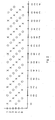
- the diagram in fig. 2 indicates, with the letter X, ignitions in each cylinder, 1-6, of the six cylinder engine as a function of the crankshaft angle, at a four stroke mode of the engine.
- the cylinders are numbered according to their relative spatial position.
- the letter "O” indicates a position in each cylinder of the respective piston near the Top Dead Center (TDC), at which no ignition takes place, in a four stroke cycle typically at a transition from the expulsion to the induction stroke. It can be seen that the ignition sequence is 123456. However, other sequences are possible.
- the crankshaft is arranged so that there is 120 degrees of angular distance between the positions of the crankshaft journals, i.e. the junctions between the crankshaft and the connecting rods.
- the crankshaft in order for the inline six cylinder engine to be adapted to a six stroke mode, the crankshaft should be arranged so that there is 180 degrees of angular distance between the positions of the junctions between the crankshaft and the connecting rods.
- crankshaft since the design of the crankshaft has to be fixed, in a six cylinder engine adapted to a four stroke mode it is not possible to achieve a six stroke mode. This is the case in all engines with an even number of cylinders, regardless if the cylinders are arranged in an inline or a "V" manner. However, the angular distances between the positions of the junctions between the crankshaft and the connecting rods are different in a "V" type engine than in an inline engine.
- FIG. 3 shows a diagram corresponding to the one in fig. 2, and illustrating an eight stroke mode in the engine.
- the efficiency will be low, among other things due to a low combustion temperature. For this reason, in some engine operating situations, the requested output torque is such that, when run in a four stroke mode, the combustion load is too low at each ignition for the efficiency to reach a desired level.
- a way to improve the efficiency in these situations would be to allow more crankshaft rotation between each ignition and increasing the combustion load at each ignition, achieving the same output torque, but with more efficiency.
- the engine could be run in a higher stroke mode.
- an eight stroke mode is achievable in a six cylinder engine adapted to four stroke mode, but the operational situation could be that increased combustion loads can not compensate for the longer ignition intervals, and the requested output torque can not be achieved. In such a case a six stroke mode would be desirable.
- the fuel input means 17 of each cylinder can be controlled so that in the respective cylinder one or more consecutive four stroke cycles are followed by one or more consecutive eight stroke cycles. Further, a sequence of altering groups of four stroke cycles and groups of eight stroke cycles can be achieved, whereby each group consists of at least one cycle.
- Fig. 4 illustrates an example of an operation with such an altering of cycles.
- one four stroke cycle is altered with one eight stroke cycle.
- this type of stroke mode is referred to as altering four and eight stroke mode.
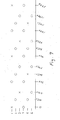
- Fig. 5 shows a diagram with each ignition of the engine, marked with an "X”, as a function of the crankshaft angle, at four, eight and altering four and eight stroke modes, indicated “4", "8", and “Alt-4-8", respectively. It can be seen that at a four stroke mode, 36 ignitions occurs in 4320 degrees of crankshaft rotation. At the altering four and eight stroke mode, 24 ignitions occurs in the same angular interval. This means a mean value of 180° of crankshaft rotation per ignition, which corresponds to a six stroke mode.
- a combustion load at a first ignition which could be any ignition during operation, is adjusted at least partly on the basis of the angular distance of the crankshaft rotation between the first ignition and an immediately subsequent ignition of the engine.
- the combustion load at the first ignition is adjusted at least partly on the basis of the angular distance of the crankshaft rotation between the first ignition and an immediately preceding ignition of the engine.
- the combustion load at the first ignition is adjusted at least partly on the basis of the angular distances of the crankshaft rotation between the first ignition and an immediately preceding ignition of the engine, and an immediately subsequent ignition as well.
- the effects of the unequal ignition intervals can be compensated for by controlling the combustion loads at each ignition, so that an essentially continuous torque is achieved, and the advantages of the six stroke mode obtained.
- F denotes a combustion load factor according to one alternative of the invention. It should be noted that the load factor in fig. 5 is a mathematical value not taking into consideration calibration adjustments, that could be required in a practical utilization of the invention. It can be seen that where an ignition is followed by 120° of crankshaft rotation until an immediately following ignition, F equals 1. Where an ignition is followed by 240° of crankshaft rotation until an immediately following ignition, F equals 2.
- a stroke mode comparable to six stroke mode has been described.
- the method described above is also applicable to situations where higher stroke modes are desired.
- a stroke mode comparable to a "pure" twelve stroke mode can be achieved by creating an altering eight and sixteen stroke mode, in a similar manner as achieving a altering four and eight stroke mode.
- An engine with an even number of cylinders can be adapted, as in the example above, to a four stroke mode with equal ignition intervals.
- an engine with an odd number of cylinders four, six stroke and other stroke modes are all possible with equal distances between ignitions, as described in the patent application , filed by the applicant, having the same priority date as the present application, and included herein by reference.
- An engine with an even number of cylinders can alternatively to what has been described above be adapted, be adapted to a six stroke mode with equal ignition intervals.
- the crankshaft has to be designed so that there is 180 degrees of angular distance between the positions of the crankshaft journals, i.e.
- an engine with an even number of cylinders can be adapted to be operated in two "neighboring" stroke modes, at which both modes present unequal distances between the ignitions.
- deviations in each mode from the optimal equal ignition interval operation are results of considerations concerning the predicted use of the engine. For example, where the engine is used to drive a vehicle, a predicted high load operation of the engine could result in the desire to obtain a four stroke operation with more level ignition intervals, than in the six stroke case. Where the vehicle is predicted to be used so that the engine operates mostly in low load situations, it can be desirable to create more level ignition intervals in the six stroke mode, at the cost of obtaining more unequal ignition intervals in the four stroke mode.
- Fig. 6 shows a diagram depicting the angular locations of the crankshaft journals of a crankshaft of an inline six cylinder engine.
- the diagram indicates the positions of journals of each cylinder, numbered 1 to 6.
- the angular distance between the journals of cylinders 1 and 4 and the journals of cylinders 2 and 5 is approximately 105,4 degrees.
- the same angular distance is presented between the journals of cylinders 2 and 5 and the journals of cylinders 3 and 6.
- the angular distance between the journals of cylinders 3 and 6 and the journals of cylinders 1 and 4 is approximately 149,2 degrees.
- Figures 7-9 show diagrams depicting ignitions (marked X) and TDC positions with no ignitions (marked O) at a four stroke mode operation of the engine with the crankshaft with journals indicated in fig. 6.
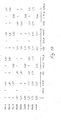
- Fig. 10 shows a diagram with combustion load factors for ignitions of the operation modes of fig. 7-9.
- load factors in fig. 10 are mathematical values not taking into consideration calibration adjustments, that could be required in a practical utilization of the invention.
- this operational mode can be referred to as a six stroke mode, since the six cylinders on average complete one cycle in 1080°CA, although no ignitions take place in cylinders 2 and 5.
- this six stroke mode a cyclic alteration of an interval of 149,2° and an interval of 210,8° takes place.
- the combustion load factors, FA16 according to the first alternative for the case of the six stroke mode are shown. At each ignition, FA16 is set proportional to the ratio between the interval following the ignition and the shortest interval of the four stroke operation mode, i.e.
- this operational mode can be referred to as a eight stroke mode, since the six cylinders on average complete one cycle in 1440°CA, although no ignitions take place in cylinders 2, 4 and 6.
- this eight stroke mode a cyclic alteration of two long intervals of 254,6° and a shorter interval of 210,8° takes place.
- the combustion load at each ignition is determined based on the ignition interval immediately preceding the ignition.
- the fourth, fifth and sixth row in the diagram in fig. 10 show combustion load factors, FA24, FA26 and FA28, respectively, set according to the second alternative for a four, six and eight stroke mode, respectively.
- the combustion load at each ignition is determined based on the ignition interval immediately preceding the ignition, and the ignition interval immediately following the ignition.
- the seventh, eighth and ninth row in the diagram in fig. 10 show combustion load factors, FA34, FA36 and FA38, respectively, set according to the third alternative for a four, six and eight stroke mode, respectively.
- An advantage with the third alternative is that each combustion load is determined based on events both before and after the ignition, which makes the determination more accurate, and provides for a smoother operation of the engine.
- the determination of a combustion load is based both on the preceding ignition interval and the subsequent, but these intervals are weighted differently in the determination, so that the combustion load is not equally dependent upon them.
- the determination of a combustion load is based both on engine ignition intervals in a time region around the time of the ignition related to the combustion load, which time region is larger than that covered by the two intervals being closest to the ignition.
- Fig. 11 shows a diagram depicting the angular positions of the crankshaft journals in an inline six cylinder engine, which positions have been determined according to a procedure, where deviations from optimal equal engine ignition intervals in each of a four, six and eight stroke mode are considered, as well as weighting factors for these modes.
- Figures 12-14 show diagrams depicting four, six and eight stroke modes, respectively, of the engine.
- the procedure includes deciding weighting factors for different stroke modes.
- the engine is determined to be operated in certain stroke modes, and a weighting factor can be set for each stroke mode to reflect, based on assumptions concerning the utilization of the engine, the importance of the stroke mode in relation to other stroke modes of the engine. For example, it can be decided that the engine will operate in four, six or eight stroke mode, depending or current operating conditions. Based on the relative importance of the stroke modes, weighting factors are determined for each stroke mode. In this example the weighting factor for the four stroke mode is set to 55%, for the six stroke mode is set to 40% and for the eight stroke mode 5%.
- the maximum difference between the crankshaft angles of the ignitions and optimal crankshaft angles of the ignitions is 38° for the four stroke mode, 31° for the six stroke mode and 36° for the eight stroke mode.
- An advantage with the procedure described above is that it produces an engine in which ignition intervals in more than one stroke mode have relatively similar sizes, which in combination with the control of combustion loads as described above will result in a good operation of the engine with an essentially continuous output torque more than one stroke mode.
- Another advantage with the procedure described above is that the inclusion of weighting factors for different stroke modes gives more control in adapting the engine to given operational specifications.
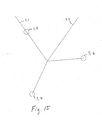
- Fig. 15 shows a diagram depicting the angular positions of the crankshaft journals for cylinders 1-6 in a V-type six cylinder engine.
- the angular positions of the cylinder rows are indicated with the lines 21 and 22. Since the journals for six cylinders are distributed over three angular positions, to achieve a four stroke mode with equal engine ignition intervals, the cylinder rows have to be separated by 120°. However, in most applications this in unpractical, and a smaller distance between the rows are used. In fig. 15 there is 70° between the cylinder rows.
- the ignition to crankshaft angle relation for a four, six and eight stroke mode of the V-engine can be seen in fig. 16, 17 and 18, respectively.
- a combustion load is determined based on the ignition interval preceding the ignition and the interval following the ignition. Thereby, a mean value of these intervals is determined, and a combustion load factor is determined by dividing the mean value with a reference value, in this example the optimal engine ignition interval for a four stroke mode, 120°.
- a reference value in this example the optimal engine ignition interval for a four stroke mode, 120°.
- combustion load factors, F4, F6 and F8 are indicated for the four, six and eight stroke mode, respectively.
Landscapes
- Engineering & Computer Science (AREA)
- Chemical & Material Sciences (AREA)
- Combustion & Propulsion (AREA)
- Mechanical Engineering (AREA)
- General Engineering & Computer Science (AREA)
- Electrical Control Of Ignition Timing (AREA)
- Combined Controls Of Internal Combustion Engines (AREA)
- Electrical Control Of Air Or Fuel Supplied To Internal-Combustion Engine (AREA)
Abstract
Description
- fig. 1 shows schematically a cross-sectional view of an arrangement at a cylinder of an internal combustion engine, the cross-section being oriented in the longitudinal direction of the cylinder,
- fig. 2-4 show diagrams indicating ignitions in each cylinder of a six cylinder engine as a function of the crankshaft angle, at different stroke modes,
- fig. 5 shows a diagram indicating ignitions in the six cylinder engine as a function of the crankshaft angle, at different stroke modes,
- fig. 6 shows a diagram depicting the angular locations of the crankshaft journals of a crankshaft of an inline six cylinder engine,
- figures 7-9 show diagrams depicting ignitions at a four, six and eight stroke mode operation, respectively, of the engine with the crankshaft with journals indicated in fig. 6,
- fig. 10 shows a diagram with combustion load factors for ignitions of the operation modes of fig. 7-9,
- fig. 11 shows a diagram depicting the angular locations of the crankshaft journals of a crankshaft of an inline six cylinder engine,
- figures 12-14 show diagrams depicting ignitions at a four, six and eight stroke mode operation, respectively, of the engine with the crankshaft with journals indicated in fig. 11,
- fig. 15 shows a diagram depicting the angular locations of the crankshaft journals of a crankshaft of a V-type six cylinder engine,
- figures 16-18 show diagrams depicting ignitions at a four, six and eight stroke mode operation, respectively, of the engine with the crankshaft with journals indicated in fig. 15, and
- fig. 19 shows a diagram with combustion load factors for ignitions of the operation modes of fig. 16-18.
Claims (14)
- A method in an internal combustion engine, comprising individually controllable valves (14, 15), the method comprising adjusting a combustion load at a first ignition at least partly on the basis of at least one interval between two ignitions of the engine.
- A method according to claim 1, wherein the step of adjusting a combustion load comprises adjusting the combustion load at the first ignition at least partly on the basis ofthe angular distance of the crankshaft rotation between the first ignition and an immediately preceding ignition of the engine, and/orthe angular distance of the crankshaft rotation between the first ignition and an immediately subsequent ignition of the engine.
- A method according to claim 2, wherein the step of adjusting a combustion load comprises adjusting the combustion load at the first ignition at least partly on the basis of the mean value of the angular distance of the crankshaft rotation between the first ignition and the immediately preceding ignition of the engine, and the angular distance of the crankshaft rotation between the first ignition and the immediately subsequent ignition of the engine.
- A method according to claim 1, 2 or 3, whereby the angular distance of the crankshaft rotation between the first ignition and the immediately preceding ignition of the engine, and the angular distance of the crankshaft rotation between the first ignition and the immediately subsequent ignition of the engine correspond to angular distances between two consecutive ignitions of the engine at two different stroke modes of the engine, each stroke mode presenting essentially equal distances of the crankshaft rotation between consecutive ignitions of the engine.
- A method according to claim 4, whereby the engine has an even number of cylinders and the two stroke modes are four and eight stroke modes.
- A method according to claim 1, 2 or 3, whereby the angular distances of the crankshaft rotation between consecutive ignitions of the engine in a time region around the first ignition are unequal and are based on positions of crankshaft journals of a crankshaft of the engine.
- A method according to claim 6, comprising providing a crankshaft on which the positions of the crankshaft journals are adapted so as for the engine ignition intervals of the engine to present minimal deviations from equal engine ignition intervals in at least two different stroke modes of the engine.
- A method according to claim 6 or 7, wherein the engine presents cylinders in two rows arranged in a V-configuration, the positions of the crankshaft journals being adapted to the angular distance between the two rows of cylinders.
- An internal combustion engine system comprising an internal combustion engine and a control device (16), the engine comprising a number of cylinders, air and fuel input means (17) for each cylinder, and a crankshaft including a number of crankshaft journals, the air and fuel input means (17) being adapted to receive for their activation control signals from the control device (16), characterized in that the control device (16) is adapted to send at least one control signal so as to control a combustion load at a first ignition, the combustion load being determined at least partly on the basis of at least one interval between two ignitions of the engine.
- An internal combustion engine system according to claim 9, whereby the combustion load is determined at least partly on the basis of the angular distance of the crankshaft rotation between the first ignition and an immediately preceding ignition of the engine, and/or the angular distance of the crankshaft rotation between the first ignition and an immediately subsequent ignition of the engine.
- An internal combustion engine system according to claim 10, wherein the combustion load is determined at least partly on the basis of the mean value of the angular distance of the crankshaft rotation between the first ignition and the immediately preceding ignition of the engine, and the angular distance of the crankshaft rotation between the first ignition and the immediately subsequent ignition of the engine.
- An internal combustion engine system according to any of the claims 9-11, whereby the positions of the crankshaft journals are adapted so as for the engine ignition intervals of the engine to present minimal deviations from equal engine ignition intervals in at least two different stroke modes of the engine.
- An internal combustion engine system according to any of the claims 9-11, whereby the cylinders are arranged in two rows in a V-configuration, the positions of the crankshaft journals being adapted to the angular distance between the two rows of cylinders.
- An internal combustion engine system according to any of the claims 9-13, whereby the number of cylinders is even.
Priority Applications (2)
| Application Number | Priority Date | Filing Date | Title |
|---|---|---|---|
| DE60232978T DE60232978D1 (en) | 2002-11-11 | 2002-11-11 | A method in an internal combustion engine |
| EP02025182A EP1418323B1 (en) | 2002-11-11 | 2002-11-11 | A method in an internal combustion engine |
Applications Claiming Priority (1)
| Application Number | Priority Date | Filing Date | Title |
|---|---|---|---|
| EP02025182A EP1418323B1 (en) | 2002-11-11 | 2002-11-11 | A method in an internal combustion engine |
Publications (3)
| Publication Number | Publication Date |
|---|---|
| EP1418323A2 true EP1418323A2 (en) | 2004-05-12 |
| EP1418323A3 EP1418323A3 (en) | 2006-09-06 |
| EP1418323B1 EP1418323B1 (en) | 2009-07-15 |
Family
ID=32103929
Family Applications (1)
| Application Number | Title | Priority Date | Filing Date |
|---|---|---|---|
| EP02025182A Expired - Lifetime EP1418323B1 (en) | 2002-11-11 | 2002-11-11 | A method in an internal combustion engine |
Country Status (2)
| Country | Link |
|---|---|
| EP (1) | EP1418323B1 (en) |
| DE (1) | DE60232978D1 (en) |
Cited By (1)
| Publication number | Priority date | Publication date | Assignee | Title |
|---|---|---|---|---|
| WO2006017870A3 (en) * | 2004-08-19 | 2008-11-27 | Avl List Gmbh | Method for the operation of an internal combustion engine |
Family Cites Families (5)
| Publication number | Priority date | Publication date | Assignee | Title |
|---|---|---|---|---|
| DE3129078A1 (en) * | 1981-07-23 | 1983-02-03 | Daimler-Benz Ag, 7000 Stuttgart | METHOD FOR THE INTERRUPTION CONTROL OF A PERIODICALLY WORKING INTERNAL COMBUSTION ENGINE |
| JPH0262443A (en) * | 1988-08-26 | 1990-03-02 | Hino Motors Ltd | Crank shaft of v-type 8 cylinder internal combustion engine |
| DE19859018A1 (en) * | 1998-12-21 | 2000-06-29 | Bosch Gmbh Robert | Cylinder balancing for internal combustion engine involves influencing filling of cylinders with air or fresh gas on individual cylinder basis depending on detected torque contributions |
| SE521741C2 (en) * | 1999-06-24 | 2003-12-02 | Volvo Personvagnar Ab | Method for controlling a multi-stroke engine |
| DE19951582A1 (en) * | 1999-10-27 | 2001-05-03 | Bosch Gmbh Robert | Method and device for synchronizing at least two power control elements of an internal combustion engine |
-
2002
- 2002-11-11 EP EP02025182A patent/EP1418323B1/en not_active Expired - Lifetime
- 2002-11-11 DE DE60232978T patent/DE60232978D1/en not_active Expired - Lifetime
Cited By (1)
| Publication number | Priority date | Publication date | Assignee | Title |
|---|---|---|---|---|
| WO2006017870A3 (en) * | 2004-08-19 | 2008-11-27 | Avl List Gmbh | Method for the operation of an internal combustion engine |
Also Published As
| Publication number | Publication date |
|---|---|
| EP1418323A3 (en) | 2006-09-06 |
| DE60232978D1 (en) | 2009-08-27 |
| EP1418323B1 (en) | 2009-07-15 |
Similar Documents
| Publication | Publication Date | Title |
|---|---|---|
| US7066136B2 (en) | Output control system for internal combustion engine | |
| US6647947B2 (en) | Strategy and control system for deactivation and reactivation of cylinders of a variable displacement engine | |
| US7231907B2 (en) | Variable incremental activation and deactivation of cylinders in a displacement on demand engine | |
| US5975052A (en) | Fuel efficient valve control | |
| US5467748A (en) | Internal combustion engine with intake port throttling and exhaust camshaft phase shifting for cylinder deactivation | |
| US7357119B2 (en) | Variable valve type internal combustion engine and control method thereof | |
| US20140069378A1 (en) | Effective cylinder count control systems and methods | |
| US20070131183A1 (en) | Multi-stage variable displacement engine | |
| JPH07208221A (en) | Cylinder synchronous activating device synchronously activating plurality of cylinder in variable displacement internal combustion engine | |
| US9556811B2 (en) | Firing pattern management for improved transient vibration in variable cylinder deactivation mode | |
| US9677525B2 (en) | Method of determining the injection pattern in the compression stroke of the combustion cycle of the cylinders of a direct-injection internal combustion engine | |
| JP4335663B2 (en) | 4-cycle reciprocating internal combustion engine | |
| US20160333801A1 (en) | Four-cylinder engine and method of operating four-cylinder engine | |
| US8042513B2 (en) | Internal combustion engine camshaft scheduling strategy for maximum pumping loss reduction | |
| EP1418323B1 (en) | A method in an internal combustion engine | |
| US20050279320A1 (en) | Method and means for improved efficiency of cylinder deactivation (DODTM) engines | |
| JP6816341B2 (en) | System for variable operation of valves in internal combustion engines | |
| JP6798092B2 (en) | System for variable operation of valves in internal combustion engines | |
| US9523292B2 (en) | Valve control system for internal combustion engines and method of operation thereof | |
| KR100992402B1 (en) | Vehicle's Pause Engine System | |
| JP4602383B2 (en) | Control device for variable valve internal combustion engine | |
| US10436243B2 (en) | Crank shaft for an inline internal combustion engine and an inline internal combustion engine | |
| EP1418330B1 (en) | A method of controlling an internal combustion engine | |
| JP2000337182A (en) | Control device for cylinder deactivated internal combustion engine | |
| EP1063392A2 (en) | Automotive internal combustion engine. |
Legal Events
| Date | Code | Title | Description |
|---|---|---|---|
| PUAI | Public reference made under article 153(3) epc to a published international application that has entered the european phase |
Free format text: ORIGINAL CODE: 0009012 |
|
| AK | Designated contracting states |
Kind code of ref document: A2 Designated state(s): AT BE BG CH CY CZ DE DK EE ES FI FR GB GR IE IT LI LU MC NL PT SE SK TR |
|
| AX | Request for extension of the european patent |
Extension state: AL LT LV MK RO SI |
|
| PUAL | Search report despatched |
Free format text: ORIGINAL CODE: 0009013 |
|
| AK | Designated contracting states |
Kind code of ref document: A3 Designated state(s): AT BE BG CH CY CZ DE DK EE ES FI FR GB GR IE IT LI LU MC NL PT SE SK TR |
|
| AX | Request for extension of the european patent |
Extension state: AL LT LV MK RO SI |
|
| 17P | Request for examination filed |
Effective date: 20070305 |
|
| 17Q | First examination report despatched |
Effective date: 20070412 |
|
| AKX | Designation fees paid |
Designated state(s): DE GB SE |
|
| RAP1 | Party data changed (applicant data changed or rights of an application transferred) |
Owner name: FORD GLOBAL TECHNOLOGIES, LLC |
|
| GRAP | Despatch of communication of intention to grant a patent |
Free format text: ORIGINAL CODE: EPIDOSNIGR1 |
|
| GRAS | Grant fee paid |
Free format text: ORIGINAL CODE: EPIDOSNIGR3 |
|
| GRAA | (expected) grant |
Free format text: ORIGINAL CODE: 0009210 |
|
| AK | Designated contracting states |
Kind code of ref document: B1 Designated state(s): DE GB SE |
|
| REG | Reference to a national code |
Ref country code: GB Ref legal event code: FG4D |
|
| REF | Corresponds to: |
Ref document number: 60232978 Country of ref document: DE Date of ref document: 20090827 Kind code of ref document: P |
|
| REG | Reference to a national code |
Ref country code: SE Ref legal event code: TRGR |
|
| PLBE | No opposition filed within time limit |
Free format text: ORIGINAL CODE: 0009261 |
|
| STAA | Information on the status of an ep patent application or granted ep patent |
Free format text: STATUS: NO OPPOSITION FILED WITHIN TIME LIMIT |
|
| 26N | No opposition filed |
Effective date: 20100416 |
|
| REG | Reference to a national code |
Ref country code: GB Ref legal event code: 732E Free format text: REGISTERED BETWEEN 20111020 AND 20111025 |
|
| REG | Reference to a national code |
Ref country code: DE Ref legal event code: R082 Ref document number: 60232978 Country of ref document: DE Representative=s name: HOFFMANN - EITLE, DE |
|
| REG | Reference to a national code |
Ref country code: DE Ref legal event code: R082 Ref document number: 60232978 Country of ref document: DE Representative=s name: HOFFMANN - EITLE PATENT- UND RECHTSANWAELTE PA, DE Effective date: 20120207 Ref country code: DE Ref legal event code: R081 Ref document number: 60232978 Country of ref document: DE Owner name: VOLVO CAR CORPORATION, SE Free format text: FORMER OWNER: FORD GLOBAL TECHNOLOGIES, LLC, DEARBORN, MICH., US Effective date: 20120207 |
|
| PGFP | Annual fee paid to national office [announced via postgrant information from national office to epo] |
Ref country code: DE Payment date: 20141117 Year of fee payment: 13 Ref country code: SE Payment date: 20141126 Year of fee payment: 13 Ref country code: GB Payment date: 20141119 Year of fee payment: 13 |
|
| REG | Reference to a national code |
Ref country code: DE Ref legal event code: R119 Ref document number: 60232978 Country of ref document: DE |
|
| GBPC | Gb: european patent ceased through non-payment of renewal fee |
Effective date: 20151111 |
|
| PG25 | Lapsed in a contracting state [announced via postgrant information from national office to epo] |
Ref country code: SE Free format text: LAPSE BECAUSE OF NON-PAYMENT OF DUE FEES Effective date: 20151112 |
|
| PG25 | Lapsed in a contracting state [announced via postgrant information from national office to epo] |
Ref country code: DE Free format text: LAPSE BECAUSE OF NON-PAYMENT OF DUE FEES Effective date: 20160601 Ref country code: GB Free format text: LAPSE BECAUSE OF NON-PAYMENT OF DUE FEES Effective date: 20151111 |