EP1418079A2 - Control apparatus and method for taking failure countermeasure for hybrid vehicular drive system - Google Patents
Control apparatus and method for taking failure countermeasure for hybrid vehicular drive system Download PDFInfo
- Publication number
- EP1418079A2 EP1418079A2 EP03025445A EP03025445A EP1418079A2 EP 1418079 A2 EP1418079 A2 EP 1418079A2 EP 03025445 A EP03025445 A EP 03025445A EP 03025445 A EP03025445 A EP 03025445A EP 1418079 A2 EP1418079 A2 EP 1418079A2
- Authority
- EP
- European Patent Office
- Prior art keywords
- motor
- generator
- engine
- brake
- run mode
- Prior art date
- Legal status (The legal status is an assumption and is not a legal conclusion. Google has not performed a legal analysis and makes no representation as to the accuracy of the status listed.)
- Granted
Links
Images



Classifications
-
- B—PERFORMING OPERATIONS; TRANSPORTING
- B60—VEHICLES IN GENERAL
- B60W—CONJOINT CONTROL OF VEHICLE SUB-UNITS OF DIFFERENT TYPE OR DIFFERENT FUNCTION; CONTROL SYSTEMS SPECIALLY ADAPTED FOR HYBRID VEHICLES; ROAD VEHICLE DRIVE CONTROL SYSTEMS FOR PURPOSES NOT RELATED TO THE CONTROL OF A PARTICULAR SUB-UNIT
- B60W20/00—Control systems specially adapted for hybrid vehicles
-
- B—PERFORMING OPERATIONS; TRANSPORTING
- B60—VEHICLES IN GENERAL
- B60K—ARRANGEMENT OR MOUNTING OF PROPULSION UNITS OR OF TRANSMISSIONS IN VEHICLES; ARRANGEMENT OR MOUNTING OF PLURAL DIVERSE PRIME-MOVERS IN VEHICLES; AUXILIARY DRIVES FOR VEHICLES; INSTRUMENTATION OR DASHBOARDS FOR VEHICLES; ARRANGEMENTS IN CONNECTION WITH COOLING, AIR INTAKE, GAS EXHAUST OR FUEL SUPPLY OF PROPULSION UNITS IN VEHICLES
- B60K6/00—Arrangement or mounting of plural diverse prime-movers for mutual or common propulsion, e.g. hybrid propulsion systems comprising electric motors and internal combustion engines
- B60K6/20—Arrangement or mounting of plural diverse prime-movers for mutual or common propulsion, e.g. hybrid propulsion systems comprising electric motors and internal combustion engines the prime-movers consisting of electric motors and internal combustion engines, e.g. HEVs
- B60K6/22—Arrangement or mounting of plural diverse prime-movers for mutual or common propulsion, e.g. hybrid propulsion systems comprising electric motors and internal combustion engines the prime-movers consisting of electric motors and internal combustion engines, e.g. HEVs characterised by apparatus, components or means specially adapted for HEVs
- B60K6/36—Arrangement or mounting of plural diverse prime-movers for mutual or common propulsion, e.g. hybrid propulsion systems comprising electric motors and internal combustion engines the prime-movers consisting of electric motors and internal combustion engines, e.g. HEVs characterised by apparatus, components or means specially adapted for HEVs characterised by the transmission gearings
- B60K6/365—Arrangement or mounting of plural diverse prime-movers for mutual or common propulsion, e.g. hybrid propulsion systems comprising electric motors and internal combustion engines the prime-movers consisting of electric motors and internal combustion engines, e.g. HEVs characterised by apparatus, components or means specially adapted for HEVs characterised by the transmission gearings with the gears having orbital motion
-
- B—PERFORMING OPERATIONS; TRANSPORTING
- B60—VEHICLES IN GENERAL
- B60K—ARRANGEMENT OR MOUNTING OF PROPULSION UNITS OR OF TRANSMISSIONS IN VEHICLES; ARRANGEMENT OR MOUNTING OF PLURAL DIVERSE PRIME-MOVERS IN VEHICLES; AUXILIARY DRIVES FOR VEHICLES; INSTRUMENTATION OR DASHBOARDS FOR VEHICLES; ARRANGEMENTS IN CONNECTION WITH COOLING, AIR INTAKE, GAS EXHAUST OR FUEL SUPPLY OF PROPULSION UNITS IN VEHICLES
- B60K6/00—Arrangement or mounting of plural diverse prime-movers for mutual or common propulsion, e.g. hybrid propulsion systems comprising electric motors and internal combustion engines
- B60K6/20—Arrangement or mounting of plural diverse prime-movers for mutual or common propulsion, e.g. hybrid propulsion systems comprising electric motors and internal combustion engines the prime-movers consisting of electric motors and internal combustion engines, e.g. HEVs
- B60K6/42—Arrangement or mounting of plural diverse prime-movers for mutual or common propulsion, e.g. hybrid propulsion systems comprising electric motors and internal combustion engines the prime-movers consisting of electric motors and internal combustion engines, e.g. HEVs characterised by the architecture of the hybrid electric vehicle
- B60K6/44—Series-parallel type
- B60K6/445—Differential gearing distribution type
-
- B—PERFORMING OPERATIONS; TRANSPORTING
- B60—VEHICLES IN GENERAL
- B60W—CONJOINT CONTROL OF VEHICLE SUB-UNITS OF DIFFERENT TYPE OR DIFFERENT FUNCTION; CONTROL SYSTEMS SPECIALLY ADAPTED FOR HYBRID VEHICLES; ROAD VEHICLE DRIVE CONTROL SYSTEMS FOR PURPOSES NOT RELATED TO THE CONTROL OF A PARTICULAR SUB-UNIT
- B60W10/00—Conjoint control of vehicle sub-units of different type or different function
- B60W10/02—Conjoint control of vehicle sub-units of different type or different function including control of driveline clutches
-
- B—PERFORMING OPERATIONS; TRANSPORTING
- B60—VEHICLES IN GENERAL
- B60W—CONJOINT CONTROL OF VEHICLE SUB-UNITS OF DIFFERENT TYPE OR DIFFERENT FUNCTION; CONTROL SYSTEMS SPECIALLY ADAPTED FOR HYBRID VEHICLES; ROAD VEHICLE DRIVE CONTROL SYSTEMS FOR PURPOSES NOT RELATED TO THE CONTROL OF A PARTICULAR SUB-UNIT
- B60W10/00—Conjoint control of vehicle sub-units of different type or different function
- B60W10/04—Conjoint control of vehicle sub-units of different type or different function including control of propulsion units
- B60W10/06—Conjoint control of vehicle sub-units of different type or different function including control of propulsion units including control of combustion engines
-
- B—PERFORMING OPERATIONS; TRANSPORTING
- B60—VEHICLES IN GENERAL
- B60W—CONJOINT CONTROL OF VEHICLE SUB-UNITS OF DIFFERENT TYPE OR DIFFERENT FUNCTION; CONTROL SYSTEMS SPECIALLY ADAPTED FOR HYBRID VEHICLES; ROAD VEHICLE DRIVE CONTROL SYSTEMS FOR PURPOSES NOT RELATED TO THE CONTROL OF A PARTICULAR SUB-UNIT
- B60W10/00—Conjoint control of vehicle sub-units of different type or different function
- B60W10/04—Conjoint control of vehicle sub-units of different type or different function including control of propulsion units
- B60W10/08—Conjoint control of vehicle sub-units of different type or different function including control of propulsion units including control of electric propulsion units, e.g. motors or generators
-
- B—PERFORMING OPERATIONS; TRANSPORTING
- B60—VEHICLES IN GENERAL
- B60W—CONJOINT CONTROL OF VEHICLE SUB-UNITS OF DIFFERENT TYPE OR DIFFERENT FUNCTION; CONTROL SYSTEMS SPECIALLY ADAPTED FOR HYBRID VEHICLES; ROAD VEHICLE DRIVE CONTROL SYSTEMS FOR PURPOSES NOT RELATED TO THE CONTROL OF A PARTICULAR SUB-UNIT
- B60W10/00—Conjoint control of vehicle sub-units of different type or different function
- B60W10/10—Conjoint control of vehicle sub-units of different type or different function including control of change-speed gearings
- B60W10/11—Stepped gearings
- B60W10/115—Stepped gearings with planetary gears
-
- B—PERFORMING OPERATIONS; TRANSPORTING
- B60—VEHICLES IN GENERAL
- B60W—CONJOINT CONTROL OF VEHICLE SUB-UNITS OF DIFFERENT TYPE OR DIFFERENT FUNCTION; CONTROL SYSTEMS SPECIALLY ADAPTED FOR HYBRID VEHICLES; ROAD VEHICLE DRIVE CONTROL SYSTEMS FOR PURPOSES NOT RELATED TO THE CONTROL OF A PARTICULAR SUB-UNIT
- B60W10/00—Conjoint control of vehicle sub-units of different type or different function
- B60W10/18—Conjoint control of vehicle sub-units of different type or different function including control of braking systems
-
- F—MECHANICAL ENGINEERING; LIGHTING; HEATING; WEAPONS; BLASTING
- F16—ENGINEERING ELEMENTS AND UNITS; GENERAL MEASURES FOR PRODUCING AND MAINTAINING EFFECTIVE FUNCTIONING OF MACHINES OR INSTALLATIONS; THERMAL INSULATION IN GENERAL
- F16H—GEARING
- F16H3/00—Toothed gearings for conveying rotary motion with variable gear ratio or for reversing rotary motion
- F16H3/44—Toothed gearings for conveying rotary motion with variable gear ratio or for reversing rotary motion using gears having orbital motion
- F16H3/72—Toothed gearings for conveying rotary motion with variable gear ratio or for reversing rotary motion using gears having orbital motion with a secondary drive, e.g. regulating motor, in order to vary speed continuously
- F16H3/727—Toothed gearings for conveying rotary motion with variable gear ratio or for reversing rotary motion using gears having orbital motion with a secondary drive, e.g. regulating motor, in order to vary speed continuously with at least two dynamo electric machines for creating an electric power path inside the gearing, e.g. using generator and motor for a variable power torque path
- F16H3/728—Toothed gearings for conveying rotary motion with variable gear ratio or for reversing rotary motion using gears having orbital motion with a secondary drive, e.g. regulating motor, in order to vary speed continuously with at least two dynamo electric machines for creating an electric power path inside the gearing, e.g. using generator and motor for a variable power torque path with means to change ratio in the mechanical gearing
-
- B—PERFORMING OPERATIONS; TRANSPORTING
- B60—VEHICLES IN GENERAL
- B60K—ARRANGEMENT OR MOUNTING OF PROPULSION UNITS OR OF TRANSMISSIONS IN VEHICLES; ARRANGEMENT OR MOUNTING OF PLURAL DIVERSE PRIME-MOVERS IN VEHICLES; AUXILIARY DRIVES FOR VEHICLES; INSTRUMENTATION OR DASHBOARDS FOR VEHICLES; ARRANGEMENTS IN CONNECTION WITH COOLING, AIR INTAKE, GAS EXHAUST OR FUEL SUPPLY OF PROPULSION UNITS IN VEHICLES
- B60K1/00—Arrangement or mounting of electrical propulsion units
- B60K1/02—Arrangement or mounting of electrical propulsion units comprising more than one electric motor
-
- B—PERFORMING OPERATIONS; TRANSPORTING
- B60—VEHICLES IN GENERAL
- B60W—CONJOINT CONTROL OF VEHICLE SUB-UNITS OF DIFFERENT TYPE OR DIFFERENT FUNCTION; CONTROL SYSTEMS SPECIALLY ADAPTED FOR HYBRID VEHICLES; ROAD VEHICLE DRIVE CONTROL SYSTEMS FOR PURPOSES NOT RELATED TO THE CONTROL OF A PARTICULAR SUB-UNIT
- B60W2510/00—Input parameters relating to a particular sub-units
- B60W2510/18—Braking system
-
- B—PERFORMING OPERATIONS; TRANSPORTING
- B60—VEHICLES IN GENERAL
- B60W—CONJOINT CONTROL OF VEHICLE SUB-UNITS OF DIFFERENT TYPE OR DIFFERENT FUNCTION; CONTROL SYSTEMS SPECIALLY ADAPTED FOR HYBRID VEHICLES; ROAD VEHICLE DRIVE CONTROL SYSTEMS FOR PURPOSES NOT RELATED TO THE CONTROL OF A PARTICULAR SUB-UNIT
- B60W2710/00—Output or target parameters relating to a particular sub-units
- B60W2710/08—Electric propulsion units
- B60W2710/081—Speed
-
- F—MECHANICAL ENGINEERING; LIGHTING; HEATING; WEAPONS; BLASTING
- F16—ENGINEERING ELEMENTS AND UNITS; GENERAL MEASURES FOR PRODUCING AND MAINTAINING EFFECTIVE FUNCTIONING OF MACHINES OR INSTALLATIONS; THERMAL INSULATION IN GENERAL
- F16H—GEARING
- F16H37/00—Combinations of mechanical gearings, not provided for in groups F16H1/00 - F16H35/00
- F16H37/02—Combinations of mechanical gearings, not provided for in groups F16H1/00 - F16H35/00 comprising essentially only toothed or friction gearings
- F16H37/06—Combinations of mechanical gearings, not provided for in groups F16H1/00 - F16H35/00 comprising essentially only toothed or friction gearings with a plurality of driving or driven shafts; with arrangements for dividing torque between two or more intermediate shafts
- F16H37/08—Combinations of mechanical gearings, not provided for in groups F16H1/00 - F16H35/00 comprising essentially only toothed or friction gearings with a plurality of driving or driven shafts; with arrangements for dividing torque between two or more intermediate shafts with differential gearing
- F16H37/10—Combinations of mechanical gearings, not provided for in groups F16H1/00 - F16H35/00 comprising essentially only toothed or friction gearings with a plurality of driving or driven shafts; with arrangements for dividing torque between two or more intermediate shafts with differential gearing at both ends of intermediate shafts
- F16H2037/103—Power-split transmissions with each end of a CVT connected or connectable to a planetary gear set having four or more connections, e.g. a Ravigneaux set
-
- F—MECHANICAL ENGINEERING; LIGHTING; HEATING; WEAPONS; BLASTING
- F16—ENGINEERING ELEMENTS AND UNITS; GENERAL MEASURES FOR PRODUCING AND MAINTAINING EFFECTIVE FUNCTIONING OF MACHINES OR INSTALLATIONS; THERMAL INSULATION IN GENERAL
- F16H—GEARING
- F16H61/00—Control functions within control units of change-speed- or reversing-gearings for conveying rotary motion ; Control of exclusively fluid gearing, friction gearing, gearings with endless flexible members or other particular types of gearing
- F16H61/12—Detecting malfunction or potential malfunction, e.g. fail safe ; Circumventing or fixing failures
- F16H2061/1224—Adapting to failures or work around with other constraints, e.g. circumvention by avoiding use of failed parts
-
- F—MECHANICAL ENGINEERING; LIGHTING; HEATING; WEAPONS; BLASTING
- F16—ENGINEERING ELEMENTS AND UNITS; GENERAL MEASURES FOR PRODUCING AND MAINTAINING EFFECTIVE FUNCTIONING OF MACHINES OR INSTALLATIONS; THERMAL INSULATION IN GENERAL
- F16H—GEARING
- F16H2200/00—Transmissions for multiple ratios
- F16H2200/20—Transmissions using gears with orbital motion
- F16H2200/2002—Transmissions using gears with orbital motion characterised by the number of sets of orbital gears
- F16H2200/2005—Transmissions using gears with orbital motion characterised by the number of sets of orbital gears with one sets of orbital gears
-
- F—MECHANICAL ENGINEERING; LIGHTING; HEATING; WEAPONS; BLASTING
- F16—ENGINEERING ELEMENTS AND UNITS; GENERAL MEASURES FOR PRODUCING AND MAINTAINING EFFECTIVE FUNCTIONING OF MACHINES OR INSTALLATIONS; THERMAL INSULATION IN GENERAL
- F16H—GEARING
- F16H2200/00—Transmissions for multiple ratios
- F16H2200/20—Transmissions using gears with orbital motion
- F16H2200/202—Transmissions using gears with orbital motion characterised by the type of Ravigneaux set
- F16H2200/2025—Transmissions using gears with orbital motion characterised by the type of Ravigneaux set using a Ravigneaux set with 5 connections
-
- F—MECHANICAL ENGINEERING; LIGHTING; HEATING; WEAPONS; BLASTING
- F16—ENGINEERING ELEMENTS AND UNITS; GENERAL MEASURES FOR PRODUCING AND MAINTAINING EFFECTIVE FUNCTIONING OF MACHINES OR INSTALLATIONS; THERMAL INSULATION IN GENERAL
- F16H—GEARING
- F16H61/00—Control functions within control units of change-speed- or reversing-gearings for conveying rotary motion ; Control of exclusively fluid gearing, friction gearing, gearings with endless flexible members or other particular types of gearing
- F16H61/12—Detecting malfunction or potential malfunction, e.g. fail safe ; Circumventing or fixing failures
-
- Y—GENERAL TAGGING OF NEW TECHNOLOGICAL DEVELOPMENTS; GENERAL TAGGING OF CROSS-SECTIONAL TECHNOLOGIES SPANNING OVER SEVERAL SECTIONS OF THE IPC; TECHNICAL SUBJECTS COVERED BY FORMER USPC CROSS-REFERENCE ART COLLECTIONS [XRACs] AND DIGESTS
- Y02—TECHNOLOGIES OR APPLICATIONS FOR MITIGATION OR ADAPTATION AGAINST CLIMATE CHANGE
- Y02T—CLIMATE CHANGE MITIGATION TECHNOLOGIES RELATED TO TRANSPORTATION
- Y02T10/00—Road transport of goods or passengers
- Y02T10/60—Other road transportation technologies with climate change mitigation effect
- Y02T10/62—Hybrid vehicles
-
- Y—GENERAL TAGGING OF NEW TECHNOLOGICAL DEVELOPMENTS; GENERAL TAGGING OF CROSS-SECTIONAL TECHNOLOGIES SPANNING OVER SEVERAL SECTIONS OF THE IPC; TECHNICAL SUBJECTS COVERED BY FORMER USPC CROSS-REFERENCE ART COLLECTIONS [XRACs] AND DIGESTS
- Y10—TECHNICAL SUBJECTS COVERED BY FORMER USPC
- Y10S—TECHNICAL SUBJECTS COVERED BY FORMER USPC CROSS-REFERENCE ART COLLECTIONS [XRACs] AND DIGESTS
- Y10S903/00—Hybrid electric vehicles, HEVS
- Y10S903/902—Prime movers comprising electrical and internal combustion motors
- Y10S903/903—Prime movers comprising electrical and internal combustion motors having energy storing means, e.g. battery, capacitor
- Y10S903/947—Characterized by control of braking, e.g. blending of regeneration, friction braking
Definitions
- the present invention relates to a technical field on such a fail-safe or fail-soft as a failure countermeasure control apparatus and method for a hybrid vehicular drive system, the hybrid vehicular drive system having an engine and two motors/generators (motors functioning as generators and vice versa) as power sources (or drive sources).
- a Japanese Patent Application First Publication No. 2000-102106 published on April 7, 2003 exemplifies a previously proposed hybrid vehicle.
- the engine, two planetary gear sets, and the two motor/generators which control sun gears of the two planetary gear sets, a carrier of one of the two planetary gear sets being coupled to the engine, and a ring gear of one of the two planetary gear sets being coupled to the road wheels.
- an object of the present invention to provide control apparatus and method for taking failure countermeasure for a hybrid vehicular drive system which is capable of making a limp form establish during an output abnormality of any one or two of the engine, the first motor/generator, and the second motor/generator which serve as drive sources of the vehicle.
- a control apparatus for taking failure countermeasure for a hybrid vehicular drive system comprising: a planetary gear mechanism to which four elements of an engine, a first motor/generator, a second motor/generator, and an output member are linked in such a manner that, on a lever diagram of the planetary gear mechanism, a revolution speed order is the first motor/generator, the engine, the output member, and the second motor/generator; first and second clutching sections that are arranged at one and the other ends of the lever diagram with the output member as an intermediate position on the lever diagram, each of the first and second clutching section prescribing e a speed line according to a clutching thereof; a drive source output abnormality detecting section that detects an output abnormality of each of the engine, the first motor/generator, and the second motor/generator which are drive sources; and a drive source failure countermeasure control section that, with one of the first and second clutching sections clutched, enables a vehicular
- control method for taking failure countermeasure for a hybrid vehicular drive system comprising: a planetary gear mechanism to which four elements of an engine, a first motor/generator, a second motor/generator, and an output member are linked in such a manner that, on a lever diagram of the planetary gear mechanism, a revolution speed order is the first motor/generator, the engine, the output member, and the second motor/generator; and first and second clutching sections that are arranged at one and the other ends of the lever diagram with the output member as an intermediate position on the lever diagram, each of the first and second clutching section prescribing a speed line according to a clutching thereof and the control method comprising: detecting an output abnormality of each of the engine, the first motor/generator, and the second motor/generator which are drive sources; and, with one of the first and second clutching sections clutched, enabling a vehicular run using at least one of the drive sources whose output
- first motor/generator and the second motor/generator may be two independent motors/generators or may be constituted by a common stator and two rotors which, on function, serve as two motors/generators although, on an outer appearance, they are formed in a single motor/generator.
- the planetary gear mechanism is a mechanism constituted by a planetary gear set having at least four revolvable elements in order to link four elements of the engine, the first motor/generator, and the second motor/generator.
- the planetary gear set used herein is constituted by, for example, a Ravigneaux type compound planetary gear set (train).
- the drive source output abnormality detecting section does not mean that the section detects the abnormality in the motor/generator itself and includes the abnormality detection for the inverter and the battery required for the drive sources to be functioned.
- the first clutching section is arranged in one side with the output member on the lever diagram sandwiched, is a section to prescribe a speed line according to the clutching thereof, for example, is arranged in the position coincident with a revolution speed axis of the first motor/generator on the lever diagram, and is constituted by a high-clutch to fix a gear ratio according to the clutching thereof.
- the second clutching section is arranged on the other side with the output member on the lever diagram sandwiched, a section which prescribes the speed line according to the clutching thereof, and arranged at a position between the revolution speed axles of the output member and the second motor/generators on the lever diagram, for example, is arranged at a position between the revolution speed axis of the output member and the revolution speed axis of the second motor/generator, and is a low-brake to fix a gear ratio according to its the clutching thereof.
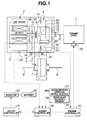
- Fig. 1 is a whole system configuration of a hybrid (vehicular drive) system to which a control apparatus for taking failure countermeasure for the hybrid vehicular drive system in a first preferred embodiment according to the present invention is applicable.
- Fig. 2 is an operational flowchart executed by a hybrid controller shown in Fig. 1 for representing a control procedure of taking failure countermeasure for the hybrid vehicular drive system shown in Fig. 1.
- Fig. 3 is an explanatory view for representing drive system failure patterns corresponding to run modes and trouble locations in the control apparatus for taking failure countermeasure for the hybrid vehicular drive system in the first embodiment shown in Fig. 1.
- Fig. 4 is an explanatory view for explaining the trouble locations and the contents of the failure determination in the control apparatus for taking failure countermeasure for the hybrid vehicular drive system in the first embodiment shown in Fig. 1.
- Fig. 5 is a motor control block diagram in a direct power distribution control (run) mode in the hybrid controller in the case of the control apparatus for taking failure countermeasure for the hybrid vehicular drive system in the first embodiment shown in Fig. 1.
- Fig. 6 is a lever diagram in the direct power distribution control (run) mode in the control apparatus for taking failure countermeasure for the hybrid vehicular drive system in the first embodiment.
- Fig. 7 is a lever diagram in an A pattern drive system failure countermeasure action in the control apparatus for taking failure countermeasure for the hybrid vehicular drive system in the first embodiment shown in Fig. 1.
- Fig. 8 is a lever diagram in a B pattern drive system failure countermeasure action for the hybrid vehicular drive system in the first embodiment shown in Fig. 1.
- Fig. 9 is a lever diagram in a C pattern drive system failure countermeasure action in the control apparatus for taking failure countermeasure for the hybrid vehicular drive system in the first embodiment shown in Fig. 1.
- Fig. 10 is a lever diagram in a D pattern drive system failure countermeasure action in the control apparatus for taking failure countermeasure for the hybrid vehicular drive system in the first embodiment shown in Fig. 1.
- Fig. 11 is a lever diagram in an E pattern drive system failure countermeasure action in the control apparatus for taking failure countermeasure for the hybrid vehicular drive system in the first embodiment shown in Fig. 1.
- Fig. 12 is an operational flowchart for explaining a flow of an engine start procedure in an F pattern drive system failure countermeasure action in the control apparatus for taking failure countermeasure for the hybrid vehicular drive system in the first embodiment shown in Fig. 1.
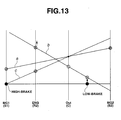
- Fig. 13 is a lever diagram in the F pattern drive system failure countermeasure action in the control apparatus for taking failure countermeasure for the hybrid vehicular drive system in the first embodiment shown in Fig. 1.
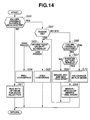
- Fig. 14 is an operational flowchart executed by the hybrid controller for representing the drive system failure countermeasure control procedure in a second preferred embodiment of the control apparatus for taking failure countermeasure for the hybrid vehicular drive system.
- Fig. 15 is a lever diagram for explaining the drive system failure countermeasure action by means of a two-stage gear transmission in the control apparatus for taking failure countermeasure for the hybrid vehicular drive system.
- Fig. 1 shows a structure of a whole hybrid vehicular drive system configuration to which a failure countermeasure control apparatus (or a control apparatus for taking failure countermeasure for a hybrid vehicular drive system) in a first preferred embodiment according to the present invention is applicable.
- a drive system of the hybrid vehicle includes: an engine 1, a coaxial multiple layer motor (first motor/generator and second motor/generator), a Ravigneux (type) compound planetary gear set (planetary gear mechanism), an output gear (output member) 4, a counter gear 5, a drive gear 6, a differential 7, drive shafts 8 and 8, a motor and gear casing 9, an engine output axle 10, a first motor/generator output axle 11, a second motor/generator output axle 12, a motor chamber 13, a gear chamber 14, a clutch 15, a high-brake 16, and a low-brake 17.
- an engine 1 a coaxial multiple layer motor (first motor/generator and second motor/generator), a Ravigneux (type) compound planetary gear set (planetary gear mechanism), an output gear (output member) 4, a counter gear 5, a drive gear 6, a differential 7, drive shafts 8 and 8, a motor and gear casing 9, an engine output axle 10, a first motor/generator output axle 11, a second motor/generator output axle
- Coaxial multiple layer motor 2 is fixed to motor and gear casing 9 and is constituted by a stator S as a stationary armature on which a coil is wound, an outer rotor OR arranged at an outside of stator S and in which a permanent magnet (not shown) is buried, and an inner rotor IR arranged at an inside of stator S and in which another permanent magnet (not shown) is buried, these stator S and inner and outer rotors IR and OR being coaxially arranged.
- stator S + inner rotor IR is called a first motor/generator MG1
- stator S + outer rotor OR is called a second motor/generator MG2.
- Ravigneaux type compound planetary gear set 3 has five revolvable elements including a common carrier C supporting mutually meshed first pinion P1 and second pinion P2, a first sun gear S1 which is meshed with first pinion P1, a second sun gear S2 which is meshed with second pinion P2, a first ring gear R1 which is meshed with first pinion P1, and a second ring gear R2 which is meshed with second pinion P2.
- a hybrid drive system is constituted by linking second ring gear R2 to engine output axle 10 via clutch 15, linking first sun gear S1 with first motor/generator output axle 11, and linking second sun gear S2 with second motor/generator output axle 12, and linking an output gear 4 to common carrier C.
- Ravigneaux type compound planetary gear set 3 is constituted by a double pinion type planetary gear set having first sun gear S1, first pinion P1, second pinion P2, and second ring gear R2.
- This double pinion type planetary gear set indicates an S-R-C alignment or R-C-S alignment on a lever diagram thereof. Therefore, four revolvable elements of engine 1, first motor/generator MG1, and second motor/generator MG2 linked to Ravigneaux type compound planetary gear set 3 are linked in such a manner that, on the lever diagram as shown in Fig. 7, the revolution speed order is as follows: first motor generator MG1 (fastest), engine 1, output gear 4, and second motor/generator MG2.
- the lever diagram is a speed line diagram used in a method of deriving a drawing which is more simple and easier to understand in place of mathematical equations in a case where a gear ratio of the planetary gear is considered.
- a longitudinal axis assumes a revolution speed and, on a lateral axis, the ring gear, the carrier, and the sun gear are arranged in such a manner that each interval provides a gear teeth number ratio between the sun gear and the ring gear.
- a revolution speed axis of the carrier is arranged to place it in a center position. Since, in the case of the double pinion planetary gear set, the sun gear is revolved in the same direction as the ring gear, the revolution speed axle of the carrier is arranged at an outer position than that of the sun gear and the ring gear.
- High-brake 16 is arranged in the lever diagram at a position which is made coincident with the revolution speed axis of first motor/generator MG1 on the lever diagram so that the transfer of clutching fixes the gear ratio to a high gear ratio at an overdrive side as shown in Fig. 7.
- High-brake 16 in the first embodiment is arranged at a position at which first sun gear S1 is fixable to the motor and gear casing 9.
- Low-brake 17 is arranged at a position between a revolution axle of output gear 4 and a revolution axle of second motor/generator MG2 and a change in the clutching causes low-brake 17 to be fixed to an overdrive high gear ratio (refer to Fig. 7).
- High-brake 18 in the first embodiment is positioned at a position that enables the first sun gear to be fixed to the motor and gear casing 9.
- a reference numeral 21 denotes an engine controller
- a reference numeral 22 denotes a throttle valve actuator
- a reference numeral 23 denotes a motor controller
- a reference numeral 24 denotes an inverter
- a reference numeral 25 denotes a battery (DC power supply)
- a reference numeral 26 denotes a hybrid controller
- a reference numeral 27 denotes an accelerator opening angle sensor
- a reference numeral 29 denotes a motor temperature sensor
- a reference numeral 30 denotes an engine speed sensor 30.
- Engine controller 21 outputs a command to control a revolution speed of engine 1 in accordance with a command issued from hybrid controller 26 to a throttle valve actuator 22. That is to say, a detected value of the engine speed from engine speed sensor 30 is used to control an open and closure of a throttle valve as a feedback information.
- Motor controller 23 outputs a command to inverter 24 to control revolution speed N1 and a torque T1 of first motor/generator MG1 and revolution speed N2 and torque T2 of the second motor/generator MG2, independently of each other.
- Inverter 24 is connected with stator S of co-axial multiple layer motor 3 produces a compound current (AC) which is a composite (superposition) of drive current flowing through inner rotor IR and drive current flowing through outer rotor OR.
- AC compound current
- Hybrid controller 26 receives accelerator opening angle sensor 27, vehicular speed sensor 28, motor temperature sensor 29, and engine speed sensor 30 and carries out predetermined arithmetic operation processes.
- An engine control program outputting a control command in accordance with a result of the predetermined arithmetic operation results to engine controller 21 and a motor control program outputting a motor control program outputting a control command in accordance with the result of the predetermined arithmetic operation to motor controller 23.
- hybrid controller 26 has a trouble location determining section to specify the trouble location. Furthermore, in the failure corresponding run mode selecting portion of hybrid controller 26, the corresponding run control method is determined in accordance with the trouble location and the run mode.
- hybrid controller 26 and engine controller 21 and hybrid controller 26 and motor controller 23 are interconnected, respectively, via bidirectional communication lines.
- two-rotor-one-stator co-axial multiple layer motor 2 has bee adopted.
- two lines of magnetic force are created with outer rotor magnetic force line and inner rotor magnetic force line.
- coil (in stator S) and inverter 24 can commonly be used with respect to two inner rotor IR and outer rotor OR
- the drive currents for inner rotor IR and for outer rotor OR are superposed to form the compound current.
- the compound current is applied to a single coil so that two rotors of IR and OR are respectively independently controlled.
- this structure of motor/generator is a single coaxial multiple layer motor 2, a combination of the same or different kinds of functions is combined.
- such a coaxial multiple layer motor 2 has advantages in terms of a cost (the number of parts can be reduced, a reduction in a current rating of the inverter, a reduction of permanent magnet, a size reduction (a miniaturization due to a coaxial structure and a reduction of the inverter size), and an efficiency (iron loss reduction and inverter loss reduction).
- a control over the compound current permits not only a use of " motor + generator” but also permits a use of " motor + motor “ and “ generator + generator”.
- a high selection degree of freedom is provided.
- a most effective or most efficient combination can be selected in accordance with a vehicle state from among these many selection candidates.
- one of various types of planetary gear mechanisms can be adopted if at least four revolvable elements are provided in order to line the four elements.
- Ravigneaux type compound planetary gear set 3 is a width dimension of the two-row planetary gear sets
- four planetary gear sets (two parallel longitudinal planetary gear sets and two crossed forward-rearward directional planetary gear) can be represented.
- an extremely axial direction size can be shortened.
- a range of the drive can be widened. That is to say, a value which is a multiplication of the respective motor powers causes all regions equal to or below a power maximum value (constant value) to be a drive enabling range. Such a combination that one of the two motors has a small power and the other motor has a large power can be used.
- Fig. 2 shows an operational flowchart representing a flow of process on a drive system failure countermeasure control procedure in the first embodiment described above executed by hybrid controller 26.
- hybrid controller 26 determines whether the drive system has failed. If Yes at step S30, the routine goes to a step S32. If No at step S30, the routine goes to a step S31.
- hybrid controller 26 selects an optimum run mode in accordance with a vehicular state or a running state, for example, the direct power distribution control (run) mode or EV (Electric Vehicle) run mode. In the hybrid vehicle, the running control during the drive system normal operation is executed in the selected run mode.
- step S32 hybrid controller 26 determines if engine 1 is in the drive state. If the engine is in the drive state (Yes) at step S32, the routine goes to a step S33.
- step S40 hybrid controller 26 determines if low-brake 17 should be engaged. In details, hybrid controller 26 determines if this is the time at which a low-brake clutching running mode with engine 1 as the drive source. If Yes at step S33, the routine goes to a step S37. If No at step S33, the routine goes to a step S34. At step S34, hybrid controller 26 determines if a location of the trouble (failure) is the motor/generator system or the engine system. If the trouble location is in the motor/generator system (MG) at step S34, the routine goes to a step S35. If the trouble location is in the engine system (ENG), the routine goes to a step S36.
- MG motor/generator system
- ENG engine system
- hybrid controller 26 fixes a high-brake clutching run mode with the engine 1 as the drive source in accordance with a pattern A of Fig. 3 according to the determinations of run mode at steps S32 and S33 and according to the trouble location at step S34, during the direct power supply distribution run mode by means of a brake release with engine 1, the first motor/generator MG1, and second motor/generator MG2 as the drive sources, or during a high-brake clutching run mode with engine 1 as the drive source, and when an output of at least one of the first motor/generator MG1 and second motor/generator MG2 is detected that an abnormality occurs.
- hybrid controller 26 fixes a high-brake clutching run mode with the engine 1 as the drive source in accordance with a pattern C of Fig. 3 according to the determinations of run mode at steps S32 and S33 and according to the trouble location at step 534, during the direct power supply distribution run mode by means of a brake release with engine 1, the first motor/generator MG1, and second motor/generator MG2 as the drive sources, or during the high-brake clutching run mode with second motor/generator MG2 as the drive source, and when an output of engine 1 is detected that an abnormality occurs.
- hybrid controller 26 determines if the trouble location is in the motor/generator system or the engine system. If the trouble location is in the motor/generator system (MG) at step S37, the routine goes to a step S38. If the trouble location is in the engine system (ENG) at step S37, the routine goes to a step S39.
- MG motor/generator system
- ENG engine system
- hybrid controller 26 fixes the mode to a low-brake clutching run mode which is a drive source of at least engine 1 in accordance with a B pattern shown in Fig. 3 according to the results of running mode determinations at steps S32 and S33, the determination of the trouble location at step S37, during the low-brake clutching mode with engine 1 as the drive source and when the output of at least one of the first and second motors/generators MG1 and MG2 has the abnormality.
- a low-brake clutching run mode which is a drive source of at least engine 1 in accordance with a B pattern shown in Fig. 3 according to the results of running mode determinations at steps S32 and S33, the determination of the trouble location at step S37, during the low-brake clutching mode with engine 1 as the drive source and when the output of at least one of the first and second motors/generators MG1 and MG2 has the abnormality.
- the trouble response run mode according to the B pattern shown in Fig. 3 is depending upon a specific failure location of the motor/generator system. (1) At the time of failure in first motor/generator MG1, Low-brake clutching and engine (+ second motor/generator MG2). (2) At the time of failure of second motor/generator MG2. Low-brake clutching and engine (+ first motor/generator MG1). (3) At the time of failure in inverter 24 or battery 25, Low-brake clutching and engine. As described above, the trouble response run mode can precisely be determined.
- hybrid controller 26 fixes the run mode to low-brake clutching run mode in which the first and second motors/generators MG1 and MG2 are drive sources in accordance with a D pattern of Fig. 3 according to the results of determinations at steps S32 and S33 and trouble location determination at step S37, and when the output of engine 1 has some abnormality during the low-brake clutching run mode with engine 1 as the drive source.
- hybrid controller 26 determines if the trouble location is in the motor/generator system or the engine system when EV run is determined at step S32. If the trouble location is in the motor/generator system, the routine goes to a step S41. If the trouble location is in the engine system, the routine goes to a step S44. At a step S41, hybrid controller 26 determines whether, from among the failure in the motor/generator system, the trouble location is a failure in inverter 24 or battery 25. If it is not other than inverter failure nor battery failure (No), the routine goes to a step S42. If either the inverter failure or battery failure (Yes) at step S41, the routine goes to a step S43.
- hybrid controller 26 starts engine 1 with high-brake 16 or low-brake 17 clutched and with at least one of the motors/generators MG1 or MG2 which is normal as the drive source in accordance with an E pattern in Fig. 3 when the output abnormality is detected to occur in an output of either the first motor/generator MG1 or second motor/generator MG2 during a run mode in which at least one of the first motor/generator MG1 and the second motor/generator MG2 is the drive source according to the run mode determination at step S32 and the trouble location determination at steps S40 and S41.
- failure countermeasure mode according to E pattern of Fig. 3 is precisely determined according to the run mode and the specific failure position of motor/generator system.
- hybrid controller 26 starts engine 1 utilizing a vehicular inertia with high-brake 16 or low-brake 17 engaged (clutched) in accordance with an F pattern shown in Fig. 3 when abnormalities of both outputs of the first and second motor/generators MG1 and MG2 occur during the run mode in which at least one of first and second motors/generators MG1 and MG2 is the drive source with engine 1 stopped according to the run mode determination at step S32 and the determinations of the trouble location at steps S40 and S41.
- hybrid controller 26 determines that the run mode is EV run at step S32 and at step S40 the trouble location is determined to be in the engine system, the EV run mode is maintained without modification of the run mode.
- the failure therein is determined as follows: 1) determines the inverter failure according to a failure signal issued from motor controller 23.
- the failure therein is determined as follows: 1) determines a battery error (abnormality) according to the failure signal from a battery controller (usually motor controller 23 function as the battery controller). 2) determines the battery error (abnormality) by comprising an accumulated value of the hybrid controller 26 with the battery output voltage.
- step S30 an optimum run mode in accordance with the vehicle state and the run state is selected and a vehicular run control during the normality of the drive system is executed.
- the direct power distribution mode is a run mode in which one of first and second motors/generators MG1 and MG2 is used as a power motor and the other is used as a power generator, the revolution speeds N1 and N2 and torques T1 and T2 of the respective motors/generators are determined and controlled so that an income-and-outgo of both first and second motors/generators MG1 and MG2 becomes zeroed.
- Fig. 5 shows a block diagram of the direct power distribution control block diagram. In fig.
- a reference numeral 50 denotes a target drive torque determining section
- a reference numeral 51 denotes an output axle revolution speed calculating section
- a reference numeral 52 a target power calculating section 53
- a reference numeral 54 denotes an optimum fuel consumption engine revolution speed determining section
- a reference numeral 55 denotes an engine revolution speed & engine torque calculating section
- a reference numeral 56 denotes a motor operating point calculating section.
- Target drive torque determining section 50 determines a target drive torque To ⁇ on the basis of accelerator opening angle detection value APS, the vehicular velocity detection value Vsp, and the target drive torque map.
- Output axle revolution speed calculating section 51 calculates output axle revolution speed No using vehicular velocity detection value Vsp and conversion coefficient K1.
- Target power calculating section 52 calculates a target engine power Pe ⁇ using target drive torque To ⁇ from target drive torque determining section 50 and an output axle revolution speed No from output axle revolution speed calculating section 51, and conversion coefficient k2.
- Target engine power calculating section 53 calculates target engine power Pe ⁇ using target power Po ⁇ and a mechanical efficiency ⁇ m.
- Optimum fuel consumption engine speed determining section 54 determines an optimum fuel consumption engine speed Ne ⁇ using an engine output map by means of optimum fuel economy lines.
- Engine revolution speed and engine torque calculating section 55 calculates engine torque Te according to engine power Pe ⁇ and the engine speed Ne.
- a lever diagram of the direct power distribution run mode is as shown in Fig. 6.
- the battery load is zero, while securing a preferable fuel consumption performance, revolution speed N1 of first motor/generator MG1 and that N2 of second motor/generator MG2 are controlled so that a wide gear ratio from the underdrive to the overdrive can be achieved.
- the direct power distribution mode the following merits are provided.
- the output of at least one of first motor/generator MG1 and second motor/generator MG2 is detected to have the abnormality.
- the flow such as step S30 ⁇ step S32 ⁇ step S33 ⁇ Step S34 ⁇ step S35 is advanced.
- the hybrid vehicular drive system is fixed to the high-brake clutching run mode with engine 1 as drive source.
- second motor/generator MG2 when high-brake 16 is clutched, second motor/generator MG2 is used so that the lever can be moved so as not to change the output revolution speed during the high-brake clutching. In this case, a variation in the output driving force can extremely be reduced.
- the flow in the flowchart of Fig. 2 is such as step S30 ⁇ step S37 ⁇ step S38.
- the low-brake clutching run mode is fixed in which at least engine 1 is the drive source in accordance with the B pattern of Fig. 3.
- the run mode can be maintained at it is.
- the drive source can be taken (engine 1 plus normally operated one of the two motors/generators MG1 and MG2).
- the routine advances as step S30 ⁇ step S32 ⁇ step S33 ⁇ step S34 ⁇ step 536. Then, the run mode is fixed top the high-brake clutching run mode with second motor/generator MG2 as the drive source in accordance with pattern C of Fig. 3.
- step S30 When, during the low-brake clutching run mode with engine 1 as the drive source, the output of engine 1 is detected to have abnormality, the flow in the flowchart of Fig. 2 is as follows: step S30 ⁇ step S32 ⁇ step S33 ⁇ step S37 ⁇ step S39.
- the run mode is fixed to low-brake clutching run mode with first and second motor/generators MG1 and MG2 as the drive sources.
- ⁇ 1 A case wherein, during the EV run mode with first and second motors/generators MG1 and MG2 as the drive sources, the trouble location is first motor/generator MG1.
- second motor/generator MG2 which is detected to be normal is used as engine starting motor.
- second motor/generator MG2 is revolved in a normal (positive) direction to start engine 1 (refer to a of Fig. 11).
- second motor/generator MG2 is revolved in a reverse direction to start engine 1 (refer to b in Fig. 11).
- second motor/generator MG2 Since the trouble location is first motor/generator MG1, with the clutching of high-brake 16 maintained, second motor/generator MG2 which is detected to be normally operated is used as the engine start motor. In other words, with high-brake 16 clutched, second motor/generator MG2 revolved in the normal direction, engine 1 is started (refer to a of Fig. 11).
- ⁇ 3 A case wherein, during the EV run mode due to the clutching of low-brake 17, the trouble location is MG1.
- the trouble location is the first motor/generator MG1.
- second motor/generator MG2 is used which is detected to be normally operated is used as engine start motor.
- second motor/generator MG2 is revolved in the reverse direction to start engine 1 (refer to b in Fig. 11).
- ⁇ 4 > A case wherein, in the EV run mode, the trouble location is MG2.
- the trouble location is second motor/generator MG2.
- first motor/generator MG1 which is detected to be normal is used as engine start motor.
- first motor/generator MG1 is revolved in the normal direction to start engine 1 (refer to c in Fig. 11).
- the start of engine 1 is secured in the patterns of ⁇ 1 > through ⁇ 4 > described above. After the start of engine 1 is secured, the vehicle can run at the two-stage gear shift between the low gear ratio with low-brake 17 clutched and the high gear ratio with high-brake 16 clutched. Consequently, the limp form is established.
- engine 1 serves as the drive source and the vehicle can run with the two-stage gear shift between the low gear ratio with low-brake 17 clutched and the high gear ratio with high-brake 16 clutched. Consequently, the limp form is established.
- Fig. 12 shows an operational flowchart for explaining a start method of engine 1 with low-brake 17 clutched.
- hybrid controller 26 determines whether an output axle revolution speed No is equal to or higher than zero (No ⁇ 0). If No ⁇ 0 (Yes) at step S50, the routine goes to step S51. If No ⁇ 0, the routine goes to a step S54. At step S51, hybrid controller 26 starts the clutching of low-brake 17 and engages clutch 15. Then, the routine goes to a step S52. At step S52, hybrid controller 26 determines whether engine speed Ne is equal to or higher than an idling speed Neidl.
- Ne ⁇ Neidl (Yes) at step S52 the routine goes to a step S56. If Ne ⁇ Neidl (No) at step S52, the routine goes to a step S56.
- step S53 hybrid controller 26 releases low-brake 17 and clutches high-brake 16 since engine 1 is completely burned (complete combustion).
- step S54 hybrid controller 26 engages clutch 15 and, at the next step S55, stops the vehicle.
- step S56 hybrid controller 26 releases clutch 15.
- the vehicle is stopped.
- step S50 ⁇ step S54 ⁇ step S55.
- step S55 With clutch 15 engaged, engine 1 is stopped and the vehicle is stopped safely.
- step S50 ⁇ step S51 ⁇ step S52 ⁇ step S56 ⁇ step S57. With clutch 15 released, the vehicle is stopped safely.
- the drive source failure countermeasure control section provides means for fixing the run mode to the high-brake clutching run mode with engine 1 as drive source during the direct power distribution run mode due to the release of brake, with engine 1, first motor/generator MG1, and second motor/generator MG2 as drive sources, or when the output abnormality of at least one output of first motor/generator MG1 and second motor/generator MG2 is detected during the high-brake clutching run mode with engine 1 as the drive source, the vehicular run after the occurrence in the failure can safely be assured while the influence of a driving force variation in engine 1 due to the clutching of high-brake 16 is being reduced.
- the drive source failure countermeasure control section provides means for fixing the run mode to the low-brake clutching run mode with at least engine 1 as the drive source when the abnormality in at least one output of first motor/generator MG1 and second motor/generator MG2 is detected to occur during the low-brake clutching run mode with engine 1 as drive source, the driving force variation in engine 1 permits the clutching of low-brake 17 to give less influence on the vehicle. Then, the vehicular run after the occurrence of the above-described failure can be assured.
- the drive source failure countermeasure control section provides means for fixing the run mode to the high-brake clutching run mode with second motor/generator MG2 as the drive source during the direct power distribution run mode with engine 1, first motor/generator MG1, and second motor/generator MG2 as the drive sources and with the brake released or during the high-brake clutching run mode with engine 1 as the drive source, the vehicular run after the occurrence of failure can safely be assured as the EV vehicle in which the gear ratio is fixed at high gear ratio during the occurrence of failure in engine 1.
- the drive source failure countermeasure control section provides means for fixing the run mode to the low-brake clutching run mode with first motor/generator MG1 and second motor/generator MG2 as driving sources when the abnormality in the output of engine 1 is detected to occur during the low-brake clutching run mode with engine 1 as the drive source, the abnormal run after the occurrence of failure can safely be assured as EV vehicle fixed at the low gear ratio during the occurrence of failure in engine 1.
- the drive source failure countermeasure control section provides means for starting engine 1 with one of first motor/generator MG1 and second motor/generator MG2 which is normal serves as the drive source and with either high-brake 16 or low-brake 17 clutched to start engine 1 when the abnormality in the output of at least one of first motor/generator MG1 and MG2 is detected to occur, the start of engine 1 which is stopped immediately after the occurrence of failure can be carried out without use of an engine start exclusively used motor.
- the drive source failure countermeasure control section provides means for starting engine 1 due to the vehicular inertia with high-brake 16 or low-brake 17 clutched when the abnormality in the outputs of both of first motor/generator MG1 and second motor/generator MG2 is detected to occur during the run mode with at least one of first motor/generator MG1 and second motor/generator MG2 as the drive source during the stop of engine 1, the start of engine 1 can be carried out which is stopped immediately after the occurrence of failure without use of the engine start exclusively used motor.
- first motor/generator MG1 and second motor/generator MG2 are constituted by a coaxial multiple layer motor 2 having stator S as an stationary armature on which the coil is wound, an outer rotor OR arranged at an outside of stator S and in which a permanent magnet is buried, an inner rotor IR arranged at an inside of stator S and in which another permanent magnet is buried, inverter 24 which produces a compound current which is a composite of a drive current for inner rotor IR and that for outer rotor OR, battery 25 connected to inverter 24, the advantages in terms of a cost (reduced number of parts, a reduction in current rating of inverter 24, and a reduction in permanent magnet), a size (miniaturization due to the coaxial structure, a size reduction of inverter 24), and an efficiency (reduction in iron loss and reduction in inverter loss) can be obtained.
- the planetary gear mechanism is constituted by Ravigneaux (type) compound planetary gear set 3 having five revolvable elements of a common carrier C which supports mutually meshed first pinion P1 and second pinion P2, first sun gear S1 meshed with first pinion P1, second sun gear S2 meshed with second pinion P2, first ring gear R1 meshed with first pinion P2, and ring gear R2 meshed with second pinion P2, and second ring gear R2 and engine output axle 10 are linked via clutch 15, first sun gear S1 and first motor/generator output axle 11 are linked together, second sun gear S2 is linked with second motor/generator output axle 12, and output gear 4 (Out) is linked to common carrier C so that, on the lever diagram, the revolution speed order is such that first motor/generator MG1, engine 1, output gear 4, and second motor/generator MG2, the high-brake 16 is arranged at the position at which first sun gear S1 is fixable to motor and gear casing 9, and the low-brake 17 is arranged at the
- the abnormality in one of the outputs of first motor/generator MG1 and MG2 is detected to occur although engine 1 is normal, engine 1 serves as the drive source of the vehicle and such a run mode at the two-stage gear ratio between the low gear ratio due to the low-brake clutching with engine 1 as the drive source and the high gear ratio due to the high-brake clutching with engine 1 as the drive source is achieved.
- the structure in the second embodiment is the same as that in the first embodiment. Hence, detailed description thereof will be omitted with reference to the drawings thereon.
- Fig. 14 shows a flowchart representing a stream of the drive system failure countermeasure control process executed by hybrid controller 26 in the second embodiment.
- hybrid controller 26 determines if the drive system failure occurs. If Yes at step S60, the routine goes to a step S62. If No at step S60, the routine goes to a step S61. At step S61, hybrid controller 26 selects an optimum run mode in accordance with the vehicular state or in accordance with the running state, for example, selects the direct power distribution run mode or EV (Electric Vehicle) run mode or EV (Electric Vehicle) run mode and executes the vehicular run control during a normality in the drive system in the selected run mode. At step S62, hybrid controller 26 determines if engine 1 is operated (ON). If Yes at step S62, the routine goes to a step S63.
- step S66 hybrid controller 26 determines if a driving point of the vehicle is present in a low gear ratio region or in a high gear ratio region thereon using a shift schedule in which the whole drive region is divided into the high gear ratio region and the low gear ratio region. If the driving point is present in the high gear ratio region, the routine goes to a step S64. if the driving point is present in the low gear ratio region, the routine goes to a step S65.
- hybrid controller 26 fixes the run mode to the high-brake clutching run mode with engine 1 as the drive source on the basis of the gear ratio region determination at step S62.
- hybrid controller 26 fixes the run mode to the low-brake clutching run mode with engine 1 as the drive source on the basis of the gear ratio region determination at step S62.
- hybrid controller 26 determines whether the trouble location is in the motor/generator system or in the engine system since the vehicle is determined to run in the EV run mode at step S62. If the trouble location is in the motor/generator system, the routine goes to a step S67. if the trouble location is in the engine system, the routine goes to a step S70. At step S67, hybrid controller 26 determines if the trouble location is inverter 24 or battery 24 from among the failures in the motor/generator system. If the failure of neither inverter 24 nor battery 24 is determined to occur (No) at step S67, the routine goes to a step S68.
- step S67 If the failure of either inverter 24 or battery 25 is determined to occur (Yes) at step S67, the routine goes to a step S69.
- step S68 hybrid controller 26 starts engine 1 with high-brake 16 or low-brake 17 clutched and with one of first motor/generator MG1 and second motor/generator MG2 which is normal as the drive source when the abnormality in one of the outputs of first motor/generator MG1 and second motor/generator MG2 is detected to occur during the run mode in which at least one of first motor/generator MG1 and second motor/generator MG2 serves as the drive source with engine 1 stopped.
- hybrid controller 26 starts engine 1 according to the vehicular inertia with either high-brake 16 or low-brake 17 clutched when the abnormality in the outputs of both of the first and second motor/generators MG1 and MG2 is detected to occur during the run mode with the stop of engine 1 and with at least one of first and second motor/generators MG1 and MG2 as the drive source. Then, the routine jumps to step S63.
- hybrid controller 26 maintains the EV run mode without change in the run mode in a case where the vehicle is determined to run in the EV run mode at step S62 and determines that the trouble location is in the engine system without change in the run mode.
- step S60 the flow in the flowchart shown in Fig. 14 is step S60 ⁇ step S62 ⁇ step S63.
- hybrid controller 26 determines whether the driving point on the shift schedule is present in the high gear ratio region or in the low gear ratio region. If the driving point is determined to be present in the high gear ratio region, the routine of Fig. 14 goes to step S64 in which the run mode is fixed to high-brake clutching run mode with engine 1 as the drive source. On the other hand, if the driving point is determined to be present in the low gear ratio region at step S63, the routine goes to step S65, the run mode is fixed to the low-brake clutching run mode with engine 1 as the drive source.
- step S60 when, in the EV run mode, the abnormality in at least one of the outputs of first motor/generator MG1 and second motor/generator MG2 is detected to occur, the flow in the flowchart shown in Fig. 14 is step S60 ⁇ step S62 ⁇ step S66 ⁇ step S67 ⁇ step S68.
- step S68 engine 1 is started with one of first motor/generator MG1 and second motor/generator MG2 which is normal as the drive source and with high-brake 16 or low-brake 17 clutched.
- the routine of Fig. 14 goes to step S65.
- step S60 when, in the EV run mode, the abnormalities of both outputs of first motor/generator MG1 and second motor/generator MG2 are detected to occur, the flow of the flowchart shown in Fig. 14 is step S60 ⁇ step S62 ⁇ step S63 ⁇ step S67 ⁇ step S68.
- step S68 engine 1 is started according to the vehicular inertia with one of first motor/generator MG1 and second motor/generator MG2 which is normal as the drive source and with high-brake 16 or low-brake 17 clutched.
- the routine goes to step S63.
- step S60 ⁇ step S62 ⁇ step S66 ⁇ step S67 ⁇ step S69.
- step S69 with high-brake 16 or low-brake 17 clutched, engine 1 is started due to the vehicular inertia.
- the routine shown in Fig. 14 goes to step S63.
- step S63 the routine goes to step S64 in which the run mode is fixed to the high-brake clutching run mode with engine 1 as the drive source. Then, if, at step S63, the driving point is determined to he present in the low gear ratio region, the routine goes to a step S65 in which the run mode is fixed to the low-brake clutching run mode with engine 1 as the driving source. For example, if motor/generator in the lever state as denoted by the lever state of a in Fig. 15 has failed during the direct power distribution run mode, the run mode is fixed to the high-brake clutching run mode with engine 1 as the drive source.
- the lever state of a in Fig. 15 is transferred to the lever state of b in Fig. 15.
- the run mode is fixed to the low-brake clutching run mode with engine 1 as the drive source.
- the run mode is transferred to the lever state denoted by the lever state of c shown in Fig. 15.
- the vehicle can run with the transmission causing the two-stage gear ratios. Consequently, the limp form is established.
- the drive source failure counter measure control section provides means for achieving the run mode at the two-stage gear ratio between the low gear ratio caused by the low-brake clutching with engine 1 as the drive source and the high gear ratio caused by the high-brake clutching with engine 1 as the drive source when engine 1 is normal but the abnormality in at least one of the outputs of first motor/generator MG1 and second motor/generator MG2 is detected to occur, the vehicular run after the failure can safely be assured as an engine drive vehicle in which the two-stage transmission is mounted using the high-brake 16 and low-brake 17 during the failure in the motor/generator system.
- the first and second motor/generators MG1 and MG2 are constituted by a common stator S and two separate rotors which, on appearance, are a single motor/generator but are an application example of the co-axial multiple layer motor 2 functionally achieving two motors/generators.
- the planetary gear mechanism is constituted by Ravigneaux (type) compound planetary gear set 3.
- the planetary gear mechanism may be not limited to Ravigneaux (type) compound planetary gear provided that the planetary gear mechanism may be constituted by such a planetary gear mechanism having at least four revolvable elements to link four elements of engine, first motor/generator, second motor/generator, and the output member.
- Ravigneaux type
- the planetary gear mechanism may be constituted by such a planetary gear mechanism having at least four revolvable elements to link four elements of engine, first motor/generator, second motor/generator, and the output member.
Landscapes
- Engineering & Computer Science (AREA)
- Chemical & Material Sciences (AREA)
- Combustion & Propulsion (AREA)
- Mechanical Engineering (AREA)
- Transportation (AREA)
- General Engineering & Computer Science (AREA)
- Automation & Control Theory (AREA)
- Hybrid Electric Vehicles (AREA)
- Electric Propulsion And Braking For Vehicles (AREA)
- Control Of Transmission Device (AREA)
Abstract
Description
Claims (23)
- A control apparatus for taking failure countermeasure for a hybrid vehicular drive system, comprising:a planetary gear mechanism (3) to which four elements of an engine (1), a first motor/generator (MG1), a second motor/generator (MG2), and an output member (4) are linked in such a manner that, on a lever diagram of the planetary gear mechanism, a revolution speed order is the first motor/generator, the engine, the output member, and the second motor/generator;first and second clutching sections (16, 17) that are arranged at one and the other ends of the lever diagram with the output member as an intermediate position on the lever diagram, each of the first and second clutching section prescribing e a speed line according to a clutching thereof;a drive source output abnormality detecting section (26) that detects an output abnormality of each of the engine, the first motor/generator, and the second motor/generator which are drive sources; anda drive source failure countermeasure control section (26) that, with one of the first and second clutching sections clutched, enables a vehicular run using at least one of the drive sources whose output is detected to be normal when the drive source output abnormality detecting section detects that the output abnormalities in any one or two of the drive sources occur.
- A control apparatus for taking failure countermeasure for a hybrid vehicular drive system as claimed in claim 1, wherein the first clutching section is a high-brake (16) arranged at a position on the lever diagram coincident with a revolution speed axle of first motor/generator to fix a gear ratio when clutched and the second clutching section is a low-brake (17) arranged at a position on the lever diagram between the revolution speed axle of the output member and the revolution speed axle of the second motor/generator to fix the gear ratio when clutched.
- A control apparatus for taking failure countermeasure for a hybrid vehicular drive system as claimed in claim 2, wherein the drive source failure countermeasure control section (26) fixes a run mode of the vehicle to a high-brake clutching run mode with the engine as the drive source when the output abnormality in at least one of the outputs of the first motor/generator and the second motor/generator is detected to occur during a brake release run mode with the engine, the first motor/generator, and the second motor/generator as the drive sources.
- A control apparatus for taking failure countermeasure for a hybrid vehicular drive system as claimed in claim 2, wherein the drive source failure countermeasure control section (26) fixes the run mode of the vehicle to a low-brake clutching run mode with at least engine as the drive source when the abnormality in at least one of the outputs of the first motor/generator and the second motor/generator is detected to occur during the low-brake clutching run mode with the engine as the drive source.
- A control apparatus for taking failure countermeasure for a hybrid vehicular drive system as claimed in claim 2, wherein the drive source failure countermeasure control section (26) fixes the run mode of the vehicle to the high-brake clutching run mode with the second motor/generator as the drive source when the abnormality in the output of the engine is detected to occur during the brake release run mode with the engine, the first motor/generator, and the second motor/generator as the drive sources.
- A control apparatus for taking failure countermeasure for a hybrid vehicular drive system as claimed in claim 2, wherein the drive source failure countermeasure control section (26) fixes the run mode to the low-brake clutching run mode with both of the first motor/generator and the second motor/generator as the drive sources when the abnormality of the output of the engine is detected to occur during the low-brake clutching run mode with the engine as the drive source.
- A control apparatus for taking failure countermeasure for a hybrid vehicular drive system as claimed in claim 2, wherein the drive source failure countermeasure control section (26) starts the engine (1) with at least one of the high-brake and the low-brake clutched and with one of the first and second motors/generators which is detected to be normal as the drive source when the abnormality in at least one of the outputs of the first and second motors/generators is detected to occur during the run mode with at least one of the first and second motor/generator as the drive source and with a stop of the engine.
- A control apparatus for taking failure countermeasure for a hybrid vehicular drive system as claimed in claim 2, wherein the drive source failure countermeasure control section (26) starts the engine (1) utilizing a vehicular inertia with at least one of the high-brake and the low-brake clutched when the abnormality in the outputs of both of the first and second motors/generators is detected to occur during the run mode with at least one of the first and second motors/generators as the drive source and with a stop of the engine.
- A control apparatus for taking failure countermeasure for a hybrid vehicular drive system as claimed in claim 2, wherein the drive source failure countermeasure control section (26) achieves a two-stage gear ratio run mode between a low gear ratio by means of the clutching of the low-brake with the engine as the drive source and a high gear ratio by means of the clutching of the high-brake with the engine as the drive source when the engine is detected to be normal but the abnormality in at least one output of the first motor/generator and the second motor/generator is detected to occur.
- A control apparatus for taking failure countermeasure for a hybrid vehicular drive system as claimed in any one of the preceding claims 1 through 9, wherein the first and second motors/generators comprises a coaxial multiple layer motor (2) including a stator (S) as a stationary armature in which at least one coil is wound; an outer rotor (OR) arranged at an outside of the stator and in which a permanent magnet is buried; an inner rotor (IR) arranged at an inside of the stator and in which another permanent magnet is buried; an inverter (24) connected to the coil of the stator that produces a compound current which is a composite of a drive current for the inner rotor and another drive current for the outer rotor; and a battery (25) connected to the inverter.
- A control apparatus for taking failure countermeasure for a hybrid vehicular drive system as claimed in any one of the preceding claims 2 through 10, wherein the planetary gear mechanism comprises a Ravigeaux compound planetary gear set (3) including five revolvable elements of: a common carrier (C) that supports mutually meshed first pinion (P1) and second pinion (P2); a first sun gear (S1) meshed with a first pinion (P1); a second sun gear (S2) meshed with a second pinion (P2); a first ring gear (R1) meshed with the first pinion (P1); and a second ring gear (R2) meshed with the second pinion (P2) and wherein the second ring gear is linked with an output axle of the engine via a clutch, the first sun gear is linked to an output axle of the first motor/generator, the second sun gear is linked to an output axle of the second motor/generator, and the common carrier is linked with the output member, the revolvable elements of the Ravigneaux compound planetary gear set are linked in such the manner that the revolution speed order on the lever diagram is the first motor/generator, the engine, the output member, and the second motor/generator, the high-brake is arranged at a position at which the first sun gear is enabled to be fixed to a casing (9), and the low-brake is arranged at a position at which the first ring gear is enabled to be fixed to the casing.
- A control apparatus for taking failure countermeasure for a hybrid vehicular drive system as claimed in claim 2, wherein the drive source failure countermeasure control section (26) fixes a run mode of the vehicle to a high-brake clutching run mode with the engine as the drive source when the output abnormality in at least one of the outputs of the first motor/generator and the second motor/generator is detected to occur during the high-brake clutching run mode with the engine as the drive source.
- A control apparatus for taking failure countermeasure for a hybrid vehicular drive system as claimed in claim 2, wherein the drive source failure countermeasure control section (26) fixes the run mode of the vehicle to the high-brake clutching run mode with the second motor/generator as the drive source when the abnormality in the output of the engine is detected to occur during the high-brake clutching run mode with the engine as the drive source.
- A control method for taking failure countermeasure for a hybrid vehicular drive system, the hybrid vehicular drive system comprising: a planetary gear mechanism (3) to which four elements of an engine (1), a first motor/generator (MG1), a second motor/generator (MG2), and an output member (4) are linked in such a manner that, on a lever diagram of the planetary gear mechanism, a revolution speed order is the first motor/generator, the engine, the output member, and the second motor/generator; and first and second clutching sections (16, 17) that are arranged at one and the other ends of the lever diagram with the output member as an intermediate position on the lever diagram, each of the first and second clutching section prescribing a speed line according to a clutching thereof and the control method comprising:detecting (26) an output abnormality of each of the engine, the first motor/generator, and the second motor/generator which are drive sources; and,with one of the first and second clutching sections clutched, enabling (26) a vehicular run using at least one of the drive sources whose output is detected to be normal when detecting that the output abnormalities in any one or two of the drive sources occur.
- A control method for taking failure countermeasure for a hybrid vehicular drive system as claimed in claim 14, wherein the first clutching section is a high-brake (16) arranged at a position on the lever diagram coincident with a revolution speed axle of first motor/generator to fix a gear ratio when clutched and the second clutching section is a low-brake (17) arranged at a position on the lever diagram between the revolution speed axle of the output member and the revolution speed axle of the second motor/generator to fix the gear ratio when clutched.
- A control method for taking failure countermeasure for a hybrid vehicular drive system as claimed in claim 15, wherein, at a time of enabling a vehicular run using at least one of the drive sources whose output is detected to be normal when detecting that the output abnormalities in any one or two of the drive sources occur, fixing (26) a run mode of the vehicle to a high-brake clutching run mode with the engine as the drive source when the output abnormality in at least one of the outputs of the first motor/generator and the second motor/generator is detected to occur during a brake release run mode with the engine, the first motor/generator, and the second motor/generator as the drive sources.
- A control method for taking failure countermeasure for a hybrid vehicular drive system as claimed in claim 16, wherein , at a time of enabling a vehicular run using at least one of the drive sources whose output is detected to be normal when detecting that the output abnormalities in any one or two of the drive sources occur, fixing (26) the run mode of the vehicle to a low-brake clutching run mode with at least engine as the drive source when the abnormality in at least one of the outputs of the first motor/generator and the second motor/generator is detected to occur during the low-brake clutching run mode with the engine as the drive source.
- A control method for taking failure countermeasure for a hybrid vehicular drive system as claimed in claim 16, wherein, at a time of enabling a vehicular run using at least one of the drive sources whose output is detected to be normal when detecting that the output abnormalities in any one or two of the drive sources occur, fixing (26) the run mode of the vehicle to the high-brake clutching run mode with the second motor/generator as the drive source when the abnormality in the output of the engine is detected to occur during the brake release run mode with the engine, the first motor/generator, and the second motor/generator as the drive sources.
- A control method for taking failure countermeasure for a hybrid vehicular drive system as claimed in claim 16, wherein, at a time of enabling a vehicular run using at least one of the drive sources whose output is detected to be normal when detecting that the output abnormalities in any one or two of the drive sources occur, fixing (26) the run mode to the low-brake clutching run mode with both of the first motor/generator and the second motor/generator as the drive sources when the abnormality of the output of the engine is detected to occur during the low-brake clutching run mode with the engine as the drive source.
- A control method for taking failure countermeasure for a hybrid vehicular drive system as claimed in claim 16, wherein, at a time of enabling a vehicular run using at least one of the drive sources whose output is detected to be normal when detecting that the output abnormalities in any one or two of the drive sources occur, starting (26) the engine (1) with at least one of the high-brake and the low-brake clutched and with one of the first and second motors/generators which is detected to be normal as the drive source when the abnormality in at least one of the outputs of the first and second motors/generators is detected to occur during the run mode with at least one of the first and second motor/generator as the drive source and with a stop of the engine.
- A control method for taking failure countermeasure for a hybrid vehicular drive system as claimed in claim 16, wherein, at a time of enabling a vehicular run using at least one of the drive sources whose output is detected to be normal when detecting that the output abnormalities in any one or two of the drive sources occur, achieving (26) a two-stage gear ratio run mode between a low gear ratio by means of the clutching of the low-brake with the engine as the drive source and a high gear ratio by means of the clutching of the high-brake with the engine as the drive source when the engine is detected to be normal but the abnormality in at least one output of the first motor/generator and the second motor/generator is detected to occur.
- A control method for taking failure countermeasure for a hybrid vehicular drive system as claimed in claim 16, wherein, at a time of enabling a vehicular run using at least one of the drive sources whose output is detected to be normal when detecting that the output abnormalities in any one or two of the drive sources occur, fixing (26) a run mode of the vehicle to a high-brake clutching run mode with the engine as the drive source when the output abnormality in at least one of the outputs of the first motor/generator and the second motor/generator is detected to occur during the high-brake clutching run mode with the engine as the drive source.
- A control method for taking failure countermeasure for a hybrid vehicular drive system as claimed in claim 16, wherein, at a time of enabling a vehicular run using at least one of the drive sources whose output is detected to be normal when detecting that the output abnormalities in any one or two of the drive sources occur, fixing (26) the run mode of the vehicle to the high-brake clutching run mode with the second motor/generator as the drive source when the abnormality in the output of the engine is detected to occur during the high-brake clutching run mode with the engine as the drive source.
Applications Claiming Priority (2)
| Application Number | Priority Date | Filing Date | Title |
|---|---|---|---|
| JP2002322045 | 2002-11-06 | ||
| JP2002322045A JP4015923B2 (en) | 2002-11-06 | 2002-11-06 | Hybrid system fail compatible controller |
Publications (3)
| Publication Number | Publication Date |
|---|---|
| EP1418079A2 true EP1418079A2 (en) | 2004-05-12 |
| EP1418079A3 EP1418079A3 (en) | 2006-12-13 |
| EP1418079B1 EP1418079B1 (en) | 2009-09-30 |
Family
ID=32105445
Family Applications (1)
| Application Number | Title | Priority Date | Filing Date |
|---|---|---|---|
| EP03025445A Expired - Lifetime EP1418079B1 (en) | 2002-11-06 | 2003-11-05 | Control apparatus and method for taking failure countermeasure for hybrid vehicular drive system |
Country Status (4)
| Country | Link |
|---|---|
| US (1) | US7117965B2 (en) |
| EP (1) | EP1418079B1 (en) |
| JP (1) | JP4015923B2 (en) |
| DE (1) | DE60329451D1 (en) |
Cited By (6)
| Publication number | Priority date | Publication date | Assignee | Title |
|---|---|---|---|---|
| WO2010034637A3 (en) * | 2008-09-24 | 2010-06-17 | Robert Bosch Gmbh | Method for diagnosing an operating status of a drive device, and diagnostic device and drive system |
| CN102062177A (en) * | 2009-11-12 | 2011-05-18 | 现代自动车株式会社 | Transmission for hybrid vehicle |
| WO2012048764A1 (en) * | 2010-10-13 | 2012-04-19 | Audi Ag | Vehicle having a hybrid drive |
| CN102941801A (en) * | 2012-11-30 | 2013-02-27 | 长城汽车股份有限公司 | Drive device of hybrid car |
| WO2014111749A1 (en) * | 2013-01-16 | 2014-07-24 | Toyota Jidosha Kabushiki Kaisha | Control device for hybrid vehicle, hybrid vehicle provided with same, and control method for hybrid vehicle |
| WO2015082166A1 (en) * | 2013-12-06 | 2015-06-11 | Zf Friedrichshafen Ag | Transmission, hybrid drivetrain and drivetrain for an electric vehicle |
Families Citing this family (66)
| Publication number | Priority date | Publication date | Assignee | Title |
|---|---|---|---|---|
| US7160224B2 (en) * | 2004-05-14 | 2007-01-09 | General Motors Corporation | Single motor recovery for an electrically variable transmission |
| JP2005333690A (en) * | 2004-05-18 | 2005-12-02 | Denso Corp | Control device for hybrid vehicle |
| JP4144572B2 (en) * | 2004-07-06 | 2008-09-03 | 日産自動車株式会社 | Mode transition control device for hybrid vehicle |
| JP4239923B2 (en) * | 2004-08-02 | 2009-03-18 | 日産自動車株式会社 | Electric power transmission device |
| JP4691982B2 (en) * | 2004-12-14 | 2011-06-01 | 日産自動車株式会社 | Mode change control device for hybrid transmission |
| JP4892991B2 (en) | 2006-01-27 | 2012-03-07 | トヨタ自動車株式会社 | Electric motor drive device and vehicle equipped with the same |
| JP2007246011A (en) * | 2006-03-17 | 2007-09-27 | Mitsubishi Fuso Truck & Bus Corp | Control device for hybrid electric vehicle |
| US7543665B2 (en) * | 2006-03-31 | 2009-06-09 | Caterpillar Inc. | Power system |
| JP4784478B2 (en) * | 2006-04-20 | 2011-10-05 | 株式会社デンソー | Control device for multiphase rotating electrical machine |
| JP4243304B2 (en) * | 2006-10-25 | 2009-03-25 | 本田技研工業株式会社 | Power equipment |
| JP4315186B2 (en) * | 2006-11-03 | 2009-08-19 | トヨタ自動車株式会社 | Hybrid vehicle inspection system and inspection method |
| JP4997986B2 (en) * | 2007-01-19 | 2012-08-15 | トヨタ自動車株式会社 | Control device for hybrid vehicle |
| JP4337884B2 (en) * | 2007-01-31 | 2009-09-30 | 株式会社日立製作所 | Inverter control device |
| JP4305541B2 (en) * | 2007-03-28 | 2009-07-29 | トヨタ自動車株式会社 | Control device for hybrid vehicle |
| US7803085B2 (en) * | 2007-07-19 | 2010-09-28 | Hamilton Sundstrand Corporation | Electrically driven parallel shaft transmission that maintains delivered power while shifting |
| KR20090013872A (en) * | 2007-08-03 | 2009-02-06 | 현대자동차주식회사 | Engine clutch controller Hydraulic system for lymph clutch running and lymph clutch driving of hybrid electric vehicle when failing |
| JP4333795B2 (en) * | 2007-11-12 | 2009-09-16 | トヨタ自動車株式会社 | Control device for hybrid vehicle |
| DE102008000046A1 (en) * | 2008-01-14 | 2009-07-16 | Zf Friedrichshafen Ag | Method for operating a drive train |
| RU2384423C2 (en) * | 2008-03-11 | 2010-03-20 | Олег Анатольевич Цыганов | Vehicle hybrid drive |
| KR100921061B1 (en) * | 2008-03-27 | 2009-10-08 | 현대자동차주식회사 | How to protect your battery in a hybrid vehicle |
| JP4759589B2 (en) * | 2008-04-24 | 2011-08-31 | 本田技研工業株式会社 | Power equipment |
| JP4505521B2 (en) * | 2008-07-09 | 2010-07-21 | 本田技研工業株式会社 | Power equipment |
| JP2010075036A (en) * | 2008-08-22 | 2010-04-02 | Fuji Heavy Ind Ltd | Controlling apparatus of electric automobile |
| US8491431B2 (en) * | 2008-12-19 | 2013-07-23 | Caterpillar Inc. | Reconfigurable hybrid gear train |
| US7998016B2 (en) * | 2008-12-19 | 2011-08-16 | Caterpillar Inc. | Universal gear train |
| JP5456699B2 (en) * | 2009-01-14 | 2014-04-02 | トヨタ自動車株式会社 | Hybrid vehicle control device and hybrid vehicle control method |
| US8706346B2 (en) * | 2010-11-01 | 2014-04-22 | GM Global Technology Operations LLC | Robust motor torque performance diagnostics algorithm for electric drive systems in hybrid vehicles |
| KR101251255B1 (en) * | 2010-12-03 | 2013-04-10 | 기아자동차주식회사 | Method for protecting high voltage battery in hybrid electric vehicle |
| GB2490109B (en) | 2011-04-14 | 2016-10-12 | Ford Global Tech Llc | A method and apparatus for controlling an engine of a motor vehicle |
| KR20130002712A (en) * | 2011-06-29 | 2013-01-08 | 현대자동차주식회사 | Controlling method of powertrain for hybrid vehicle |
| US9610941B2 (en) | 2012-03-21 | 2017-04-04 | Toyota Jidosha Kabushiki Kaisha | Drive control device for hybrid vehicle |
| JPWO2013140542A1 (en) * | 2012-03-21 | 2015-08-03 | トヨタ自動車株式会社 | Drive control apparatus for hybrid vehicle |
| EP2832611A4 (en) * | 2012-03-26 | 2015-09-30 | Toyota Motor Co Ltd | DRIVE CONTROL DEVICE FOR HYBRID VEHICLE |
| JP5700000B2 (en) * | 2012-08-27 | 2015-04-15 | トヨタ自動車株式会社 | vehicle |
| US9067484B2 (en) * | 2013-10-23 | 2015-06-30 | Dezhou David Zhao | Electric vehicle control systems |
| JP5929940B2 (en) | 2014-02-06 | 2016-06-08 | 株式会社デンソー | Hybrid vehicle |
| JP6128155B2 (en) | 2015-03-25 | 2017-05-17 | トヨタ自動車株式会社 | Hybrid car |
| JP2017043299A (en) * | 2015-08-28 | 2017-03-02 | トヨタ自動車株式会社 | Hybrid vehicle |
| JP6641215B2 (en) * | 2016-03-29 | 2020-02-05 | 株式会社Subaru | Hybrid vehicle system, hybrid vehicle system control device, and hybrid vehicle system control method |
| JP6606453B2 (en) * | 2016-03-29 | 2019-11-13 | 株式会社Subaru | Hybrid vehicle control system and motor control unit |
| JP6546967B2 (en) * | 2017-07-10 | 2019-07-17 | 本田技研工業株式会社 | Power plant |
| KR102347763B1 (en) * | 2017-10-25 | 2022-01-05 | 현대자동차주식회사 | Fail safe control method of hybrid electric vehicle |
| JP6982543B2 (en) * | 2018-05-15 | 2021-12-17 | 本田技研工業株式会社 | Hybrid vehicle drive |
| US10968985B2 (en) | 2019-04-16 | 2021-04-06 | Deere & Company | Bi-directional integrated starter-generator device |
| US10975938B2 (en) | 2019-04-16 | 2021-04-13 | Deere & Company | Multi-mode integrated starter-generator device with electromagnetic actuation assembly |
| US10920733B2 (en) | 2019-04-16 | 2021-02-16 | Deere & Company | Multi-mode integrated starter-generator device with preloaded clutch |
| US11156270B2 (en) | 2019-04-16 | 2021-10-26 | Deere & Company | Multi-mode integrated starter-generator device with transmission assembly mounting arrangement |
| US11060496B2 (en) | 2019-04-16 | 2021-07-13 | Deere & Company | Multi-mode integrated starter-generator device |
| US10920730B2 (en) | 2019-04-16 | 2021-02-16 | Deere & Company | Multi-mode integrated starter-generator device with dog clutch arrangement |
| US10948054B2 (en) | 2019-04-16 | 2021-03-16 | Deere & Company | Multi-mode integrated starter-generator device with solenoid cam actuation apparatus |
| US10933731B2 (en) | 2019-04-16 | 2021-03-02 | Deere & Company | Multi-mode integrated starter-generator device with magnetic cam assembly |
| US10975937B2 (en) | 2019-04-16 | 2021-04-13 | Deere & Company | Multi-mode integrated starter-generator device with cam arrangement |
| JP7278201B2 (en) * | 2019-11-27 | 2023-05-19 | 日立Astemo株式会社 | vehicle control system |
| US10900454B1 (en) * | 2020-04-03 | 2021-01-26 | Deere & Company | Integrated starter-generator device with unidirectional clutch actuation utilizing a biased lever assembly |
| CN111572530B (en) * | 2020-05-19 | 2021-12-17 | 东风汽车有限公司 | Hybrid electric vehicle failure guarantee method and electronic equipment |
| US11415199B2 (en) | 2020-05-29 | 2022-08-16 | Deere & Company | Bi-directional multi-speed drive |
| US11193560B1 (en) | 2020-05-29 | 2021-12-07 | Deere & Company | Work vehicle multi-speed drive assembly with bifurcated clutches |
| US12043981B2 (en) | 2020-09-25 | 2024-07-23 | Deere & Company | Work vehicle drive with multiple electric machines and torque combining assembly |
| US11326570B1 (en) | 2020-10-26 | 2022-05-10 | Deere & Company | Multi-mode integrated starter-generator device with unidirectional input |
| US11624170B2 (en) | 2021-02-25 | 2023-04-11 | Deere & Company | Work vehicle multi-speed drive assembly with clutch retention mechanism |
| US11866910B2 (en) | 2021-02-25 | 2024-01-09 | Deere & Company | Work vehicle multi-speed drive assembly with output control clutch |
| US11719209B2 (en) | 2021-03-29 | 2023-08-08 | Deere & Company | Integrated starter-generator device with unidirectional clutch actuation utilizing biased lever assembly |
| US11761515B2 (en) | 2021-05-20 | 2023-09-19 | Deere & Company | Work vehicle multi-speed drive assembly with guided dog clutch |
| US11686374B2 (en) | 2021-07-23 | 2023-06-27 | Deere & Company | Work vehicle multi-speed drive assembly providing multiple gear ratios at same step ratio |
| US20230099321A1 (en) * | 2021-09-20 | 2023-03-30 | Dana Belgium N.V. | Electric driveline system and electric driveline system operating method |
| JP7601044B2 (en) * | 2022-04-01 | 2024-12-17 | トヨタ自動車株式会社 | Vehicle control device |
Family Cites Families (16)
| Publication number | Priority date | Publication date | Assignee | Title |
|---|---|---|---|---|
| JP3173319B2 (en) * | 1995-04-28 | 2001-06-04 | 株式会社エクォス・リサーチ | Hybrid vehicle |
| JP3216501B2 (en) * | 1995-10-13 | 2001-10-09 | トヨタ自動車株式会社 | Hybrid drive |
| JP3144390B2 (en) | 1998-09-07 | 2001-03-12 | トヨタ自動車株式会社 | Hybrid drive |
| CA2259771C (en) * | 1998-02-19 | 2003-04-01 | Hitachi, Ltd. | Transmission, and vehicle and bicycle using the same |
| JP3637870B2 (en) * | 1998-04-28 | 2005-04-13 | 株式会社日立製作所 | Transmission and vehicle using the same |
| JP3494008B2 (en) | 1998-05-07 | 2004-02-03 | トヨタ自動車株式会社 | Power output device and control method thereof |
| JP3559891B2 (en) * | 1998-06-22 | 2004-09-02 | 日産自動車株式会社 | Cooling structure of multilayer motor |
| DE19909424A1 (en) * | 1999-02-23 | 2000-08-24 | Peter Tenberge | Hybrid gearing for vehicle |
| JP2000324857A (en) * | 1999-03-11 | 2000-11-24 | Toyota Motor Corp | Multi-type power supply device, equipment and motor drive device equipped with this power supply device, and hybrid vehicle |
| JP2001102106A (en) | 1999-10-01 | 2001-04-13 | Yazaki Corp | Insulation structure of insulation displacement terminal |
| JP2001320806A (en) | 2000-05-10 | 2001-11-16 | Toyota Motor Corp | Moving object and control method thereof |
| JP3702749B2 (en) * | 2000-05-24 | 2005-10-05 | トヨタ自動車株式会社 | Hybrid vehicle and control method thereof |
| JP3951562B2 (en) * | 2000-06-28 | 2007-08-01 | アイシン・エィ・ダブリュ株式会社 | Hybrid type vehicle |
| JP2002051407A (en) * | 2000-08-03 | 2002-02-15 | Toyota Motor Corp | Power train control device |
| JP3569210B2 (en) * | 2000-08-11 | 2004-09-22 | 本田技研工業株式会社 | Power transmission device for hybrid vehicle and control method therefor |
| US6490511B1 (en) * | 2000-11-10 | 2002-12-03 | Ford Motor Company | Torque-based monitor in a hybrid electric vehicle |
-
2002
- 2002-11-06 JP JP2002322045A patent/JP4015923B2/en not_active Expired - Fee Related
-
2003
- 2003-10-09 US US10/681,309 patent/US7117965B2/en not_active Expired - Fee Related
- 2003-11-05 EP EP03025445A patent/EP1418079B1/en not_active Expired - Lifetime
- 2003-11-05 DE DE60329451T patent/DE60329451D1/en not_active Expired - Lifetime
Cited By (8)
| Publication number | Priority date | Publication date | Assignee | Title |
|---|---|---|---|---|
| WO2010034637A3 (en) * | 2008-09-24 | 2010-06-17 | Robert Bosch Gmbh | Method for diagnosing an operating status of a drive device, and diagnostic device and drive system |
| US9211788B2 (en) | 2008-09-24 | 2015-12-15 | Robert Bosch Gmbh | Method for diagnosing an operating status of a drive device, and diagnostic device and drive system |
| CN102062177A (en) * | 2009-11-12 | 2011-05-18 | 现代自动车株式会社 | Transmission for hybrid vehicle |
| WO2012048764A1 (en) * | 2010-10-13 | 2012-04-19 | Audi Ag | Vehicle having a hybrid drive |
| CN102941801A (en) * | 2012-11-30 | 2013-02-27 | 长城汽车股份有限公司 | Drive device of hybrid car |
| WO2014111749A1 (en) * | 2013-01-16 | 2014-07-24 | Toyota Jidosha Kabushiki Kaisha | Control device for hybrid vehicle, hybrid vehicle provided with same, and control method for hybrid vehicle |
| CN104718115A (en) * | 2013-01-16 | 2015-06-17 | 丰田自动车株式会社 | Control device for hybrid vehicle, hybrid vehicle having the control device, and control method for the hybrid vehicle |
| WO2015082166A1 (en) * | 2013-12-06 | 2015-06-11 | Zf Friedrichshafen Ag | Transmission, hybrid drivetrain and drivetrain for an electric vehicle |
Also Published As
| Publication number | Publication date |
|---|---|
| JP4015923B2 (en) | 2007-11-28 |
| US7117965B2 (en) | 2006-10-10 |
| EP1418079A3 (en) | 2006-12-13 |
| EP1418079B1 (en) | 2009-09-30 |
| US20040084234A1 (en) | 2004-05-06 |
| JP2004159412A (en) | 2004-06-03 |
| DE60329451D1 (en) | 2009-11-12 |
Similar Documents
| Publication | Publication Date | Title |
|---|---|---|
| US7117965B2 (en) | Control apparatus and method for taking failure countermeasure for hybrid vehicular drive system | |
| US7219757B2 (en) | Mode transfer control apparatus and method for hybrid vehicle | |
| US7331897B2 (en) | Active shift transmission, transmission control unit and automobile | |
| EP1663687B1 (en) | Method and apparatus for power flow management in electro-mechanical transmission | |
| EP1350650B1 (en) | Shift control device for hybrid vehicle | |
| JP4274117B2 (en) | Vehicle drive device | |
| US8215426B2 (en) | Power output apparatus, vehicle equipped with power output apparatus, and control method of power output apparatus | |
| US6971968B2 (en) | Hybrid transmission control system | |
| CN101801752B (en) | Controller for hybrid driver | |
| US20100000814A1 (en) | Power output apparatus, vehicle equipped with power output apparatus, and control method of power output apparatus | |
| US20060289212A1 (en) | Hybrid vehicle control operation | |
| US20100051361A1 (en) | Power output apparatus, vehicle equipped with power output apparatus, and control method of power output apparatus | |
| US20100032217A1 (en) | Power output apparatus, vehicle equipped with power output apparatus, and control method of power output apparatus | |
| US20080300082A1 (en) | Power unit | |
| JP6743617B2 (en) | Power transmission device | |
| JP4151635B2 (en) | Vehicle drive device | |
| JP2007022483A (en) | Mode transition control method for hybrid transmission | |
| JP3922264B2 (en) | Shift control device for power failure in hybrid transmission | |
| JP2005016570A (en) | Hybrid vehicle mode transition control device | |
| JP3988765B2 (en) | Vehicle drive device | |
| JP4430653B2 (en) | Vehicle, vehicle control method, program for causing computer to execute vehicle control method, and recording medium recorded with computer-readable program | |
| JP2004159393A (en) | Drive source abnormality detection device for hybrid system | |
| JP2005121090A (en) | Motor generator rotation speed control device for hybrid transmission | |
| JP2006183841A (en) | Control device for hybrid vehicle |
Legal Events
| Date | Code | Title | Description |
|---|---|---|---|
| PUAI | Public reference made under article 153(3) epc to a published international application that has entered the european phase |
Free format text: ORIGINAL CODE: 0009012 |
|
| 17P | Request for examination filed |
Effective date: 20031105 |
|
| AK | Designated contracting states |
Kind code of ref document: A2 Designated state(s): AT BE BG CH CY CZ DE DK EE ES FI FR GB GR HU IE IT LI LU MC NL PT RO SE SI SK TR |
|
| AX | Request for extension of the european patent |
Extension state: AL LT LV MK |
|
| RAP1 | Party data changed (applicant data changed or rights of an application transferred) |
Owner name: NISSAN MOTOR COMPANY, LIMITED Owner name: RENAULT S.A.S. SOCIETE PAR ACTIONS SIMPLIFIEE |
|
| RIN1 | Information on inventor provided before grant (corrected) |
Inventor name: KARGAR, KEYVAN Inventor name: PICHON, YVES Inventor name: MINAGAWA, YUUSUKE Inventor name: YATABE, KAZUO |
|
| PUAL | Search report despatched |
Free format text: ORIGINAL CODE: 0009013 |
|
| AK | Designated contracting states |
Kind code of ref document: A3 Designated state(s): AT BE BG CH CY CZ DE DK EE ES FI FR GB GR HU IE IT LI LU MC NL PT RO SE SI SK TR |
|
| AX | Request for extension of the european patent |
Extension state: AL LT LV MK |
|
| RIC1 | Information provided on ipc code assigned before grant |
Ipc: F16H 3/66 20060101ALI20061109BHEP Ipc: F16H 3/72 20060101ALI20061109BHEP Ipc: F16H 61/16 20060101ALI20061109BHEP Ipc: B60K 6/04 20060101AFI20031202BHEP |
|
| AKX | Designation fees paid |
Designated state(s): DE FR GB |
|
| 17Q | First examination report despatched |
Effective date: 20071102 |
|
| RIC1 | Information provided on ipc code assigned before grant |
Ipc: B60K 6/445 20071001AFI20090216BHEP Ipc: F16H 61/16 20060101ALI20090216BHEP Ipc: B60W 20/00 20060101ALI20090216BHEP Ipc: F16H 3/72 20060101ALI20090216BHEP |
|
| GRAP | Despatch of communication of intention to grant a patent |
Free format text: ORIGINAL CODE: EPIDOSNIGR1 |
|
| GRAS | Grant fee paid |
Free format text: ORIGINAL CODE: EPIDOSNIGR3 |
|
| GRAA | (expected) grant |
Free format text: ORIGINAL CODE: 0009210 |
|
| AK | Designated contracting states |
Kind code of ref document: B1 Designated state(s): DE FR GB |
|
| REG | Reference to a national code |
Ref country code: GB Ref legal event code: FG4D |
|
| REF | Corresponds to: |
Ref document number: 60329451 Country of ref document: DE Date of ref document: 20091112 Kind code of ref document: P |
|
| PLBE | No opposition filed within time limit |
Free format text: ORIGINAL CODE: 0009261 |
|
| STAA | Information on the status of an ep patent application or granted ep patent |
Free format text: STATUS: NO OPPOSITION FILED WITHIN TIME LIMIT |
|
| 26N | No opposition filed |
Effective date: 20100701 |
|
| PGFP | Annual fee paid to national office [announced via postgrant information from national office to epo] |
Ref country code: GB Payment date: 20131030 Year of fee payment: 11 Ref country code: FR Payment date: 20131108 Year of fee payment: 11 Ref country code: DE Payment date: 20131030 Year of fee payment: 11 |
|
| REG | Reference to a national code |
Ref country code: DE Ref legal event code: R119 Ref document number: 60329451 Country of ref document: DE |
|
| GBPC | Gb: european patent ceased through non-payment of renewal fee |
Effective date: 20141105 |
|
| REG | Reference to a national code |
Ref country code: FR Ref legal event code: ST Effective date: 20150731 |
|
| PG25 | Lapsed in a contracting state [announced via postgrant information from national office to epo] |
Ref country code: DE Free format text: LAPSE BECAUSE OF NON-PAYMENT OF DUE FEES Effective date: 20150602 Ref country code: GB Free format text: LAPSE BECAUSE OF NON-PAYMENT OF DUE FEES Effective date: 20141105 |
|
| PG25 | Lapsed in a contracting state [announced via postgrant information from national office to epo] |
Ref country code: FR Free format text: LAPSE BECAUSE OF NON-PAYMENT OF DUE FEES Effective date: 20141201 |