EP1417951A1 - Composition cosmétique de maquillage pour les fibres kératiniques - Google Patents
Composition cosmétique de maquillage pour les fibres kératiniques Download PDFInfo
- Publication number
- EP1417951A1 EP1417951A1 EP03292163A EP03292163A EP1417951A1 EP 1417951 A1 EP1417951 A1 EP 1417951A1 EP 03292163 A EP03292163 A EP 03292163A EP 03292163 A EP03292163 A EP 03292163A EP 1417951 A1 EP1417951 A1 EP 1417951A1
- Authority
- EP
- European Patent Office
- Prior art keywords
- composition according
- wax
- weight
- composition
- equal
- Prior art date
- Legal status (The legal status is an assumption and is not a legal conclusion. Google has not performed a legal analysis and makes no representation as to the accuracy of the status listed.)
- Granted
Links
Classifications
-
- A—HUMAN NECESSITIES
- A61—MEDICAL OR VETERINARY SCIENCE; HYGIENE
- A61K—PREPARATIONS FOR MEDICAL, DENTAL OR TOILETRY PURPOSES
- A61K8/00—Cosmetics or similar toiletry preparations
- A61K8/18—Cosmetics or similar toiletry preparations characterised by the composition
- A61K8/92—Oils, fats or waxes; Derivatives thereof, e.g. hydrogenation products thereof
-
- A—HUMAN NECESSITIES
- A61—MEDICAL OR VETERINARY SCIENCE; HYGIENE
- A61K—PREPARATIONS FOR MEDICAL, DENTAL OR TOILETRY PURPOSES
- A61K8/00—Cosmetics or similar toiletry preparations
- A61K8/18—Cosmetics or similar toiletry preparations characterised by the composition
- A61K8/72—Cosmetics or similar toiletry preparations characterised by the composition containing organic macromolecular compounds
- A61K8/84—Cosmetics or similar toiletry preparations characterised by the composition containing organic macromolecular compounds obtained by reactions otherwise than those involving only carbon-carbon unsaturated bonds
- A61K8/89—Polysiloxanes
- A61K8/891—Polysiloxanes saturated, e.g. dimethicone, phenyl trimethicone, C24-C28 methicone or stearyl dimethicone
- A61K8/894—Polysiloxanes saturated, e.g. dimethicone, phenyl trimethicone, C24-C28 methicone or stearyl dimethicone modified by a polyoxyalkylene group, e.g. cetyl dimethicone copolyol
-
- A—HUMAN NECESSITIES
- A61—MEDICAL OR VETERINARY SCIENCE; HYGIENE
- A61K—PREPARATIONS FOR MEDICAL, DENTAL OR TOILETRY PURPOSES
- A61K8/00—Cosmetics or similar toiletry preparations
- A61K8/02—Cosmetics or similar toiletry preparations characterised by special physical form
- A61K8/04—Dispersions; Emulsions
- A61K8/044—Suspensions
-
- A—HUMAN NECESSITIES
- A61—MEDICAL OR VETERINARY SCIENCE; HYGIENE
- A61K—PREPARATIONS FOR MEDICAL, DENTAL OR TOILETRY PURPOSES
- A61K8/00—Cosmetics or similar toiletry preparations
- A61K8/18—Cosmetics or similar toiletry preparations characterised by the composition
- A61K8/30—Cosmetics or similar toiletry preparations characterised by the composition containing organic compounds
- A61K8/33—Cosmetics or similar toiletry preparations characterised by the composition containing organic compounds containing oxygen
- A61K8/36—Carboxylic acids; Salts or anhydrides thereof
- A61K8/361—Carboxylic acids having more than seven carbon atoms in an unbroken chain; Salts or anhydrides thereof
-
- A—HUMAN NECESSITIES
- A61—MEDICAL OR VETERINARY SCIENCE; HYGIENE
- A61K—PREPARATIONS FOR MEDICAL, DENTAL OR TOILETRY PURPOSES
- A61K8/00—Cosmetics or similar toiletry preparations
- A61K8/18—Cosmetics or similar toiletry preparations characterised by the composition
- A61K8/72—Cosmetics or similar toiletry preparations characterised by the composition containing organic macromolecular compounds
- A61K8/81—Cosmetics or similar toiletry preparations characterised by the composition containing organic macromolecular compounds obtained by reactions involving only carbon-to-carbon unsaturated bonds
- A61K8/8141—Compositions of homopolymers or copolymers of compounds having one or more unsaturated aliphatic radicals, each having only one carbon-to-carbon double bond, and at least one being terminated by only one carboxyl radical, or of salts, anhydrides, esters, amides, imides or nitriles thereof; Compositions of derivatives of such polymers
- A61K8/8158—Homopolymers or copolymers of amides or imides, e.g. (meth) acrylamide; Compositions of derivatives of such polymers
-
- A—HUMAN NECESSITIES
- A61—MEDICAL OR VETERINARY SCIENCE; HYGIENE
- A61K—PREPARATIONS FOR MEDICAL, DENTAL OR TOILETRY PURPOSES
- A61K8/00—Cosmetics or similar toiletry preparations
- A61K8/18—Cosmetics or similar toiletry preparations characterised by the composition
- A61K8/92—Oils, fats or waxes; Derivatives thereof, e.g. hydrogenation products thereof
- A61K8/922—Oils, fats or waxes; Derivatives thereof, e.g. hydrogenation products thereof of vegetable origin
-
- A—HUMAN NECESSITIES
- A61—MEDICAL OR VETERINARY SCIENCE; HYGIENE
- A61K—PREPARATIONS FOR MEDICAL, DENTAL OR TOILETRY PURPOSES
- A61K8/00—Cosmetics or similar toiletry preparations
- A61K8/18—Cosmetics or similar toiletry preparations characterised by the composition
- A61K8/92—Oils, fats or waxes; Derivatives thereof, e.g. hydrogenation products thereof
- A61K8/927—Oils, fats or waxes; Derivatives thereof, e.g. hydrogenation products thereof of insects, e.g. shellac
-
- A—HUMAN NECESSITIES
- A61—MEDICAL OR VETERINARY SCIENCE; HYGIENE
- A61Q—SPECIFIC USE OF COSMETICS OR SIMILAR TOILETRY PREPARATIONS
- A61Q1/00—Make-up preparations; Body powders; Preparations for removing make-up
- A61Q1/02—Preparations containing skin colorants, e.g. pigments
- A61Q1/10—Preparations containing skin colorants, e.g. pigments for eyes, e.g. eyeliner, mascara
Definitions
- the present invention relates to the makeup of keratinous fibers, like eyelashes, eyebrows and hair, and more particularly, to eyelash makeup.
- Makeup compositions for the eyes are generally constituted a wax or mixture of waxes dispersed with at least one surfactant in a aqueous phase containing, moreover, water-soluble polymers and pigments.
- the present invention aims more particularly at proposing a composition useful for making a thick makeup of keratin fibers and in particular eyelashes, said still makeup charging.
- keratinous fibers covers the hair, eyelashes and eyebrows and also extends to hairpieces and false eyelashes synthetic.
- this effect is generally obtained by superimposing several layers of the composition of makeup at the level of keratin fibers and more particularly eyelashes. Otherwise, in the particular case of eyelashes, this effect is very often associated with an agglomeration of several eyelashes between them, that is to say a non-individualisation of the eyelashes.
- compositions claimed although having a increased dry matter content compared to conventional compositions, maintain a rigidity modulus Gp plateau suitable for the deformation required for their homogeneous application by a brush or a comb on the surface of the keratin fibers and especially eyelashes.
- the invention thus has, according to one of its aspects, a composition cosmetic composition of keratin fibers, comprising a waxy phase containing at least one aqueous dispersion of wax particles (s) characterized in that it possesses a modulus of rigidity plateau Gp greater than or equal to 4000 Pa and less than 60 000 Pa and in the wax particles of said waxy phase have a size expressed in terms of mean "effective" diameter in volume D [4.3] less than or equal to 1 ⁇ m.
- the present invention also relates to a fiber-making process keratinous, characterized in that a composition is applied to said fibers according to the invention.
- composition in accordance with the invention also relates to the use of a composition in accordance with the invention to obtain makeup charging, and where appropriate, separating fibers keratin and in particular eyelashes and eyebrows.
- compositions having a modulus of high rigidity that is to say higher or equal to 4000 Pa, in particular greater than or equal to 5500 Pa and in particular greater than or equal to 7000 Pa thanks to the implementation, in these compositions, of a system of specific emulsifier and the formulation of the waxy phase in the form of a dispersion of particles of determined size.
- composition according to the invention may have a module of rigidity plateau less than 60 000 Pa, so as to give it deformability sufficient for its application on the surface to be made up.
- the dry matter content ie the non-volatile matter content
- the amount of dry matter is measured by heating of the sample by infrared rays of 2 ⁇ m to 3.5 ⁇ m wavelength.
- Dry extract 100 x (dry mass / wet mass).
- compositions according to the invention are characterized in particular by a in dry matter greater than or equal to 42% by weight, in particular greater than or equal to 45.5% by weight, or even greater than 48% by weight relative to the total weight of the composition.
- compositions according to the invention are also characterized by a in dry matter less than or equal to 85% by weight, in particular less than or equal to 75% by weight and in particular less than or equal to 65% by weight.
- compositions according to the invention are characterized by a viscoelastic behavior.
- a material is said to be viscoelastic when, under the effect of shear, it has both the characteristics of a purely elastic material, it is to say able to store energy and characteristics of a purely material viscous, ie able to dissipate energy.
- the viscoelastic behavior of the compositions in accordance with the invention can be characterized by its stiffness modulus G, its elasticity ⁇ and its flow threshold ⁇ c ; these parameters are in particular defined in the book "Initiation to rheology", G. Couarraze and JL Grossiord, 2nd edition, 1991, Edition Lavoisier-Tec 1 Doc.
- Dynamic measurements are performed by applying a harmonic variation of the constraint.
- the amplitudes of the shear, the speed of shear and stress are low so as to stay within the domain boundaries linear viscoelastic of the material (conditions for evaluating the characteristics rheological composition of rest).
- the viscoelastic linear domain is generally defined by the fact that the material response (i.e. deformation) is at any time directly proportional to the value of the applied force (i.e. stress).
- the constraints applied are weak and the material undergoes deformations without modifying its structure microscopic. Under these conditions, the material is studied "at rest” and in a non destructive.
- the composition thus sheared undergoes a stress ⁇ (t) and responds according to a deformation ⁇ (t) corresponding to micro deformations for which the modulus of rigidity varies little depending on the imposed constraint.
- the modulus of rigidity G (corresponding to the ratio of ⁇ o over ⁇ o ) and the elasticity ⁇ (corresponding to the phase shift angle of the stress applied with respect to the measured strain) are thus measured as a function of the stress ⁇ (t) applied.
- the deformation of the composition is measured for the stress zone in which the variation of modulus of rigidity G and of elasticity ⁇ is less than 7% (area of microdeformations) and the so-called "plateau" parameters Gp are thus determined. and ⁇ p .
- the viscoelastic behavior of the compositions according to the invention is in particular characterized by a rigidity module Gp plateau greater than or equal to 4000 Pa, which may in particular be greater than or equal to 5500 Pa, and in particular which may be greater than or equal to 7000 Pa, or even greater than or equal to 10 000 Pa.
- compositions according to the invention have a rigidity plateau Gp less than 60 000 Pa, or even less than 50 000 Pa, especially lower at 40,000 Pa and in particular less than 30,000 Pa.
- compositions according to the invention may have a plateau elasticity ⁇ p ranging from 1 ° to 45 °, and more preferably from 5 ° to 30 °.
- compositions in accordance with the invention may also have a yield point ⁇ c ranging from 5 Pa to 3500 Pa, and preferably ranging from 20 Pa to 1000 Pa, which means that the composition according to the invention does not have does not flow under its own weight but it is necessary to apply to the composition a minimum stress to cause its flow.
- compositions according to the invention comprise a waxy phase containing at least one aqueous dispersion of particles of a wax or a mixture of waxes.
- wax phase the wax or the mixture of waxes present in the composition according to the invention will be referred to as the general term "waxy phase".
- the wax considered in the context of the present invention is in a manner general a lipophilic compound, solid at room temperature (25 ° C.), with a change of state solid / liquid reversible, having a melting point greater than or equal to 30 ° C can go up to 120 ° C.
- the waxes that are suitable for the invention may have a point of melting above 45 ° C, and in particular above 55 ° C.
- the melting point of the wax can be measured using a calorimeter differential scanning (D.S.C.), for example the calorimeter sold under the name DSC 30 by the company METLER.
- D.S.C. calorimeter differential scanning
- the waxes that may be used in the compositions according to the invention are chosen from waxes, solid and rigid at room temperature, of animal origin, vegetable, mineral or synthetic and their mixtures.
- the wax may also have a hardness of from 0.05 MPa to 15 MPa, and preferably ranging from 6 MPa to 15 MPa. Hardness is determined by measuring the force in compression measured at 20 ° C using the texturometer sold under the name TA-TX2i by the company RHEO, equipped with a stainless steel cylinder with a diameter of 2 mm moving at the measuring speed of 0.1 mm / s, and penetrating the wax to a depth of 0.3 mm penetration.
- hydrocarbon-based waxes such as beeswax, lanolin wax, and insect waxes from China; rice wax, carnauba wax, wax of Candellila, Ouricurry wax, Alfa wax, cork fiber wax, cane wax sugar, Japanese wax and sumac wax; montan wax, microcrystalline waxes, paraffins and ozokerite; polyethylene waxes, waxes obtained by the synthesis of Fisher-Tropsch and waxy copolymers as well as their esters.
- waxes obtained by catalytic hydrogenation of oils animal or vegetable with fatty chains linear or branched, C8-C32.
- hydrogenated jojoba oil oil isomerized jojoba such as isomerized partially hydrogenated jojoba oil manufactured or marketed by the company Désert Whale under the commercial reference ISO-JOJOBA-50®, hydrogenated sunflower oil, hydrogenated castor oil, hydrogenated coconut oil and hydrogenated lanolin oil, di- (1,1,1-trimethylol) tetrastearate propane) sold under the name "HEST 2T-4S" by the company HETERENE, the di- (1,1,1-trimethylolpropane) tetraprenate sold under the trade name HEST 2T-4B by the company HETERENE.
- silicone waxes and fluorinated waxes.
- composition according to the invention generally contains from 0.1 to 40% by weight of wax (es), in particular it may contain from 5 to 40%, more particularly from 20 to 40% and better 30 to 40% by weight relative to the total weight of the composition.
- the wax or the mixture of waxes or the waxy phase is present in the compositions according to the invention in particular in the form of an aqueous dispersion of particles whose size expressed in mean "effective" diameter by volume D [4,3] such that defined below is less than or equal to 1 .mu.m.
- the wax particles may have various shapes. They can especially be spherical.
- Particle sizes can be measured by different techniques, can be mentioned in particular light scattering techniques (dynamic and static), Coulter counter methods, sedimentation rate measurements (related to size via the Stokes law) and microscopy. These techniques make it possible to measure a particle diameter and for some of them a particle size distribution.
- the sizes and particle size distributions of the compositions according to the invention are measured by static scattering of the light at using a MasterSizer 2000 type commercial granulometer from Malvern.
- the Data are processed on the basis of Mie scattering theory.
- This theory exact for isotropic particles, makes it possible to determine in the case of spherical, "effective" diameter of particles. This theory is particularly described in the work of Van de Hulst, H.C., "Light Scattering by Small Particles," Chapters 9 and 10, Wiley, New York, 1957.
- composition is characterized by its average "effective" diameter in volume D [4.3], defined as follows: where V i represents the volume of particles of effective diameter d i . This parameter is described in particular in the technical documentation of the granulometer.
- the measurements are carried out at 25 ° C., on a diluted dispersion of particles, obtained from the composition as follows: 1) 100 fold dilution with water, 2) homogenization of the solution, 3) rest of the solution during 18 hours, 4) recovery of the whitish homogeneous supernatant.
- the "effective" diameter is obtained by taking a refractive index of 1.33 for water and an average refractive index of 1.42 for the particles.
- the wax particles (s) of the waxy phase in the compositions according to the invention can be characterized by a size expressed in "effective" diameter volume average D [4.3] less than or equal to 1 ⁇ m, in particular less than or equal to 0.75 microns and better still less than or equal to 0.55 microns.
- Particle size is mainly related to the nature of the system emulsifier used to make the dispersion.
- a suitably chosen emulsifier is generally used. suitable for obtaining an oil-in-water emulsion.
- emulsifier having at 25 ° C an HLB balance (hydrophilic-lipophilic balance) at sense of GRIFFIN, greater than or equal to 8.
- HLB value is defined in J. Soc. Cosm. Chem. 1954 (Volume 5), pp. 249-256.
- compositions according to the invention may in particular contain agents emulsifying surfactants present in particular in a proportion ranging from 0.1 to 40% weight, and better still from 0.5% to 20% by weight relative to the total weight of the composition.
- surfactants may be chosen from nonionic, anionic, cationic, amphoteric surfactants or surfactant emulsifiers.
- this emulsifying system can comprise at least one ionic surfactant and / or one nonionic surfactant having a HLB greater than or equal to 8 at 25 ° C or at least one of these two surfactants combined with minus a gelling polymer.
- the EO / PO polycondensates are more particularly copolymers consisting of polyethylene glycol and polypropylene glycol blocks, such as, for example, polyethylene glycol / polypropylene glycol / polyethylene glycol triblock polycondensates.
- These triblock polycondensates have, for example, the following chemical structure: H- (O-CH 2 -CH 2 ) a - (O-CH (CH 3 ) -CH 2 ) b - (O-CH 2 -CH 2 ) a -OH, formula in which a ranges from 2 to 120, and b ranges from 1 to 100.
- the EO / PO polycondensate preferably has a weight average molecular weight ranging from 1000 to 15000, and better from 2000 to 13000.
- said polycondensate OE / OP has a cloud temperature, at 10 g / l in distilled water, higher or equal to 20 ° C, preferably greater than or equal to 60 ° C.
- the cloud temperature is measured according to ISO 1065.
- EO / PO polycondensate suitable for the invention may be mentioned polyethylene glycol / polypropylene triblock polycondensates glycol / polyethylene glycol sold under the names "SYNPERONIC” as the “SYNPERONIC PE / L44" and "SYNPERONIC PE / F127" by the company ICI.
- nonionic surfactant of HLB greater than or equal to 8 it may be the case optionally be associated with one or more nonionic surfactants of HLB less than 8, at 25 ° C.
- the amount of nonionic surfactant is generally adjusted to obtain a composition having the parameters as defined above. The determination of this quantity is within the skill of those skilled in the art.
- this amount of nonionic surfactant of HLB greater than or equal to 8 may range from 0.01 to 40% by weight, in particular from 0.1 to 20% or even from 0.5 to 15%, and more preferably from 0.5 to 10% by weight relative to to the total weight of the composition.
- the claimed composition contains a surfactant ionic especially in combination with at least one nonionic surfactant of HLB greater than or equal to 8 and / or at least one gelling polymer.
- ionic surfactants used in the context of the present invention can be anionic or cationic. However, generally, the choice of at least one anionic surfactant is preferred.
- triethanolamine stearate is especially suitable for the invention. This The latter is usually obtained by simple mixing of stearic acid and triethanolamine.
- compositions according to the invention may also contain one or more amphoteric surfactants such as N-acylamino acids such as N-alkylaminoacetates and disodium cocoamphodiacetate and amine oxides such as oxide stearamine or silicone surfactants such as dimethicone copolyols phosphates such as that sold under the name "PECOSIL PS 100" by the company PHOENIX CHEMICAL.
- amphoteric surfactants such as N-acylamino acids such as N-alkylaminoacetates and disodium cocoamphodiacetate
- amine oxides such as oxide stearamine
- silicone surfactants such as dimethicone copolyols phosphates such as that sold under the name "PECOSIL PS 100" by the company PHOENIX CHEMICAL.
- compositions according to the invention may contain from 0.01 to 30% by weight, in particular from 0.1 to 15% by weight and even from 0.5 to 10% by weight of ionic surfactant relative to the total weight of the composition.
- compositions according to the invention may also contain at least one gelling polymer.
- gelling polymer means a polymer able to gel the continuous phase, generally aqueous, of the compositions according to the invention.
- This concentration can vary widely depending on the nature of the gelling agent considered.
- this concentration is between 1 and 2% by weight for a copolymer acrylamide / acrylamido-2-methyl propane sulfonate sodium emulsion inverse to 40% in polysorbate 80 / I-C16 as that marketed under the denomination "Simulgel 600" by the company SEPPIC, and is about 0.5% by weight for an ethoxylated (250E) cetyl ether / cetyl methacrylate copolymer crosslinked by trimethylolpropane triacrylate (TMPA).
- TMPA trimethylolpropane triacrylate
- the gelling polymer may be a water-soluble polymer and is therefore present in the aqueous phase of the composition in solubilized form.
- the gelling polymer is generally present in the composition at a sufficient to adjust the rigidity modulus to a value greater than or equal to 4000 Pa, in particular greater than or equal to 5500 Pa, or even greater than or equal to 7000 Pa.
- the gelling polymer may be present in the composition according to the invention in a dry matter content ranging from 0.1% to 60% by weight, preferably from 0.5% to 40% by weight, more preferably from 1% to 30% by weight, or even from 5% to 20% by weight. weight relative to the total weight of the composition.
- this quantity may also vary depending on whether said polymer is associated or not with an ionic and / or nonionic surfactant and / or an agent film-makers which themselves are likely to act on the consistency of said composition.
- composition according to the invention may further comprise an agent film.
- film-forming polymer means a polymer capable of forming on its own or in the presence of an auxiliary filming agent, a film continuous and adherent on a support, especially on keratin materials.
- film-forming polymers that can be used in the composition of this invention, there may be mentioned synthetic polymers, radical type or type polycondensate, polymers of natural origin and their mixtures.
- the film-forming polymers of the radical type may in particular be polymers, or copolymers, vinylic, in particular acrylic polymers.
- Vinyl film-forming polymers can result from the polymerization of ethylenically unsaturated monomers having at least one acidic group and / or esters of these acidic monomers and / or amides of these acidic monomers such as the acids unsaturated carboxylic acids ⁇ , ⁇ -ethylenic such as acrylic acid, methacrylic acid, crotonic acid, maleic acid, itaconic acid.
- Vinyl-forming polymers can also result from homopolymerization or copolymerization of monomers chosen from esters such as vinyl acetate, vinyl neodecanoate, vinyl pivalate, vinyl vinyl benzoate and vinyl t-butyl benzoate and styrene monomers such as styrene and alpha-methyl styrene.
- esters such as vinyl acetate, vinyl neodecanoate, vinyl pivalate, vinyl vinyl benzoate and vinyl t-butyl benzoate
- styrene monomers such as styrene and alpha-methyl styrene.
- film-forming polycondensates mention may be made of polyurethanes, polyesters, polyesters amides, polyamides, and polyureas.
- Polymers of natural origin can be selected from shellac resin, sandaraque gum, dammars, elemis, copals, cellulosic polymers, and mixtures thereof.
- the film-forming polymer may be present in the form of particles in aqueous dispersion, generally known as latex or pseudolatex.
- aqueous dispersion generally known as latex or pseudolatex.
- the Techniques for preparing these dispersions are well known to those skilled in the art.
- composition according to the invention may also comprise an agent film forming auxiliary promoting the formation of a film with the film-forming polymer.
- compositions according to the invention are based on water or a aqueous medium, that is to say a mixture of water with at least one organic solvent.
- the aqueous medium of the composition may thus comprise a mixture of water and of water-miscible organic solvent such as lower monoalcohols having from 1 to 5 carbon atoms such as ethanol, isopropanol and glycols having from 2 to 5 carbon atoms. to 8 carbon atoms such as glycerin, propylene glycol, ethylene glycol, 1,3-butylene glycol, dipropylene glycol, ketones of C 3 -C 4, the C 2 -C 4 aldehydes.
- the aqueous medium water and optionally the water-miscible organic solvent
- compositions may also contain ingredients commonly used in the field of makeup keratin fibers.
- composition according to the invention may in particular comprise one or more oils.
- the oil may be chosen from volatile oils and / or non-volatile oils, and their mixtures.
- the composition advantageously comprises at least one volatile oil.
- volatile oil means an oil capable of evaporate on contact with the skin or keratin fiber in less than one hour, room temperature and atmospheric pressure.
- the volatile organic solvent (s) and the volatile oils of the invention are organic solvents and volatile cosmetic oils which are liquid at ambient temperature and have a non-zero vapor pressure at ambient temperature and atmospheric pressure, in particular ranging from 0 to 13 Pa at 40 000 Pa (10 -3 to 300 mm Hg), in particular ranging from 1.3 Pa to 13 000 Pa (0.01 to 100 mm Hg), and more particularly ranging from 1.3 Pa at 1300 Pa (0.01 to 10 mmHg).
- non-volatile oil is meant an oil remaining on the skin or the keratinous fiber at room temperature and atmospheric pressure for at least several hours and having in particular a vapor pressure of less than 10 -3 mmHg (0.13 Pa). .
- oils may be hydrocarbon oils, silicone oils, fluorinated oils, or mixtures thereof.
- hydrocarbon oil means an oil containing mainly hydrogen and carbon atoms and possibly oxygen, nitrogen, sulfur, phosphorus.
- the volatile hydrocarbon oils may be chosen from hydrocarbon oils having from 8 to 16 carbon atoms, and in particular alkanes branched C8-C16 as the C8-C16 isoalkanes of petroleum origin (also called isoparaffins) such as isododecane (also called 2,2,4,4,6-pentamethylheptane), isodecane, isohexadecane, and for example the oils sold under the trade names Isopars' or permetyls, branched C8-C16 esters, isohexyl neopentanoate, and their mixtures.
- Other volatile hydrocarbon oils such as petroleum distillates, especially those sold under the name Shell Solt by Shell, may also be used.
- the volatile solvent is chosen from volatile oils hydrocarbon compounds having 8 to 16 carbon atoms and mixtures thereof.
- volatile oils for example volatile linear or cyclic silicone oils, especially those having a viscosity ⁇ 8 centistokes (8 10 -6 m 2 / s), and having in particular from 2 to 7 silicon atoms, these silicones optionally having alkyl or alkoxy groups having from 1 to 10 carbon atoms.
- volatile silicone oil that can be used in the invention, there may be mentioned in particular octamethylcyclotetrasiloxane, decamethylcyclopentasiloxane, dodecamethylcyclohexasiloxane, heptamethylhexyltrisiloxane, heptamethyloctyltrisiloxane, hexamethylisiloxane, octamethyltrisiloxane and decamethyl tetrasiloxane, dodecamethylpentasiloxane and mixtures thereof.
- volatile fluorinated solvents such as nonafluoromethoxybutane or perfluoromethylcyclopentane.
- the volatile oil may be present in the composition according to the invention in one content ranging from 0.1% to 60% by weight, relative to the total weight of the composition, of preferably from 0.1% to 30% by weight.
- composition may also comprise at least one non-volatile oil, and in particular chosen from hydrocarbon oils and / or silicone and / or fluorinated non volatile.
- the non-volatile silicone oils that can be used in the composition according to the invention may be non-volatile polydimethylsiloxanes (PDMSs), polydimethylsiloxanes having alkyl or alkoxy groups, during and / or in end of the silicone chain, groups each having from 2 to 24 carbon atoms, phenyl silicones such as phenyl trimethicones, phenyl dimethicones, phenyl trimethylsiloxy diphenylsiloxanes, diphenyl dimethicones, diphenyl methyldiphenyl trisiloxanes, 2-phenylethyl trimethylsiloxysilicates;
- PDMSs non-volatile polydimethylsiloxanes
- phenyl silicones such as phenyl trimethicones, phenyl dimethicones, phenyl trimethylsiloxy diphenylsiloxanes, diphenyl dimethicones, di
- the fluorinated oils that can be used in the invention are in particular oils fluorosilicones, fluorinated polyethers, fluorinated silicones as described in US Pat. EP-A-847752.
- Nonvolatile oils may be present in the composition according to the invention in a content ranging from 0.1 to 20% by weight, preferably from 0.1% to 12% by weight. weight, relative to the total weight of the composition.
- composition may further include other ingredients usually used in cosmetics.
- ingredients may be, in particular, agents of coalescence, fillers, dyestuffs such as pigments, pearlescent agents or liposoluble or water-soluble dyes, goniochromatic dyes, preservatives, oils, moisturizers, fragrances, and mixtures thereof, which are well known from the state of the art.
- the pigments may be white or colored, mineral and / or organic; they are insoluble in the physiologically acceptable medium of the composition.
- inorganic pigments titanium dioxide, optionally surface-treated, oxides of zirconium or cerium, as well as oxides of iron or chromium, violet manganese, ultramarine blue, chromium hydrate, ferric blue, and mixtures thereof.
- organic pigments mention may be made of carbon black, D type pigments C, and lacquers based on cochineal carmine, barium, strontium, calcium, aluminum and their mixtures. It is also possible to use pigments with a particular optical effect such as glass particles coated with metal, especially gold, silver and platinum.
- Nacres or pearlescent pigments are iridescent particles, especially produced by certain shellfish in their shell or synthesized, insoluble in the medium physiologically acceptable composition. They can be chosen from white pearlescent pigments such as mica coated with titanium, or bismuth oxychloride, colored pearlescent pigments such as titanium mica with iron oxides, titanium mica with notably ferric blue or chromium oxide, titanium mica with a pigment organic material of the aforementioned type as well as pearlescent pigments based on bismuth oxychloride and their mixtures. It is also possible to use interferential pigments, especially liquid crystal or multilayer.
- the dyestuffs may represent from 0.01 to 30% by weight, preferably from 0.1 to 25% by weight and better still from 1 to 20% by weight relative to the total weight of the composition.
- the fillers can be chosen from those well known to the man of the and commonly used in cosmetic compositions.
- Charges can be mineral or organic, lamellar or spherical.
- talc such as Nylon® (Orgasol from Atochem), of poly- ⁇ -alanine and polyethylene, tetrafluoroethylene polymer powders such as Teflon®, lauroyl-lysine, starch, boron nitride, hollow microspheres polymers such as those of polyvinylidene chloride / acrylonitrile as ExpanceL® (Nobel Industry), acrylic powders such as polytrap® (Dow Coming), the polymethyl methacrylate particles and the microbeads of silicone (Toshiba's Tospearls®, for example), precipitated calcium carbonate, carbonate and magnesium hydro-carbonate, hydroxyapatite, silica microspheres (SILICA BEADS® from MAPRECOS
- the fillers can represent from 0.1 to 25%, and better still from 1 to 20% by weight. of the total weight of the composition.
- composition according to the invention may further comprise fibers which may allow an improvement of the lengthening effect.
- fiber is meant an object of length L and diameter D such that L is much greater than D, where D is the diameter of the circle in which the section of the fiber.
- L / D ratio (or form factor) is chosen from the range of from 3.5 to 2500, especially from 5 to 500, and in particular from 5 to 150.
- the fibers that can be used in the composition of the invention may be fibers of synthetic or natural origin, mineral or organic. They can be short or long, unitary or organized, for example braided, hollow or full. Their shape can be arbitrary and in particular of circular or polygonal section (square, hexagonal or octagonal) depending on the specific application envisaged. In particular, their ends are blunt and / or polished to avoid injury.
- the fibers have a length ranging from 1 ⁇ m to 10 mm, preferably from 0.1 mm to 5 mm and more preferably from 1 mm to 3.5 mm.
- Their section can be understood in a circle with a diameter ranging from 2 nm to 500 ⁇ m, preferably ranging from 100 nm to 100 ⁇ m and better from 1 ⁇ m to 50 ⁇ m.
- the weight or title of the fibers is often given in denier or decitex and represents the weight in gram for 9 km of yarn.
- the fibers can have a chosen title in the range of 0.15 to 30 denier and better from 0.18 to 18 deniers.
- the fibers can be those used in the manufacture of textiles and silk fibers, cotton, wool, flax, cellulose fibers - for example example extracted from wood, vegetables or seaweed -, from rayon, from polyamide (Nylon®, viscose, acetate especially rayon acetate, poly- (p-phenylene terephthalamide) (or aramid) including Kevlar®, acrylic polymer in particular of polymethyl methacrylate or poly 2-hydroxyethyl methacrylate, polyolefin and especially polyethylene or polypropylene, glass, silica, carbon, especially in graphite form, polytetrafluoroethylene (such as Teflon®), insoluble collagen, polyesters, polyvinyl chloride or vinylidene, alcohol polyvinyl, polyacrylonitrile, chitosan, polyurethane, polyethylene phthalate, fibers formed from a mixture of polymers such as those mentioned above, like polyamide / polyester fibers.
- Fibers used in surgery such as fibers can also be used resorbable synthetics prepared from glycolic acid and caprolactone ("Monocryl” from Johnson &Johnson); resorbable synthetic fibers of the copolymer type lactic acid and glycolic acid (“Vicryl” from Johnson &Johnson); the fibers of terephthalic polyester (“Ethibond” from Johnson & Johnson) and steel wires stainless steel (“Steel” from Johnson & Johnson).
- the fibers may or may not be treated on the surface, coated or not.
- fibers of synthetic origin and in particular organic fibers such as those used in surgery.
- insoluble fibers it is possible to use insoluble fibers in water.
- the fibers that can be used in the composition according to the invention can be polyamide, cellulose, poly-p-phenylene terephthalamide fibers or of polyethylene.
- Their length (L) can range from 0.1 mm to 5 mm, in particular from 0.25 mm to 1.6 mm and their average diameter may range from 1 ⁇ m to 50 ⁇ m.
- polyamide fibers marketed by Etableaus P. Bonte under the name of "Polyamide 0.9 Dtex 3 mm", having a mean diameter of 6 ⁇ m, a title of about 0.9 dtex and a length ranging from 0.3 mm to 5 mm.
- cellulosic fibers or of rayon having an average diameter of 50 ⁇ m and a length ranging from 0.5 mm to 6 mm like those sold under the name "Natural Ray Flock fiber RC1BE - N003 - M04" by Claremont Flock.
- Polyethylene fibers can also be used as those sold under the name “Shurt Stuff 13,099 F” by the company Mini Fibers.
- composition according to the invention may also comprise so-called fibers "rigid”, as opposed to the fibers mentioned above, which are not rigid fibers.
- the rigid fibers initially substantially straight, when placed in a dispersing medium, do not see their shape substantially modified.
- the rigid fibers may be selected from the fibers of a polymer synthetic material selected from polyesters, polyurethanes, acrylic polymers, polyolefins, polyamides, in particular non-aromatic polyamides and aromatic polyimide amides.
- Particularly advantageous rigid fibers are polymide-amide fibers aromatics.
- Polyimide-amide yarns or fibers which can be used for compositions according to the invention are described, for example, in the document by R. PIGEON and P. ALLARD, Applied Macromolecular Chemistry, 40/41 (1974), pages 139-158 (No 600), or else in the documents US-A-3 802 841, FR-A-2 079 785, EP-A1-0 360 728, EP-A-0 549 494, to which reference may be made.
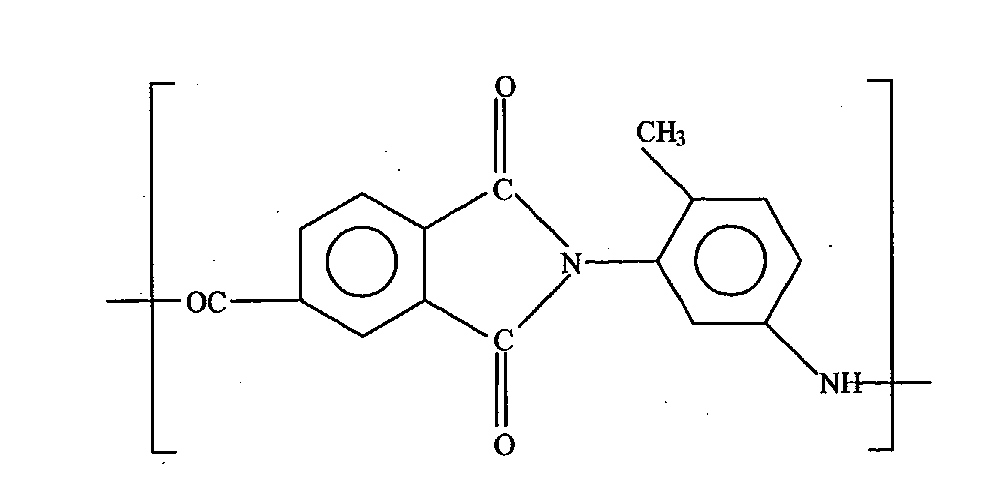
- aromatic polyimide-amide fibers may be polyimide-amide fibers comprising repeating units of formula: obtained by polycondensation of toluylene diisocyanate and trimellitic anhydride.
- the fibers may be present in the composition according to the invention in one content ranging from 0.01 to 10% by weight, especially from 0.05 to 5% by weight relative to total weight of the composition.
- compositions according to the invention may also contain one or more usual adjuvants such as perfumes, preservatives, alkalizing agents or acidifying agents, texturizing agents, spreading additives, plasticizers and water-soluble active ingredients usually used in cosmetic preparations for keratinous fibers.
- adjuvants such as perfumes, preservatives, alkalizing agents or acidifying agents, texturizing agents, spreading additives, plasticizers and water-soluble active ingredients usually used in cosmetic preparations for keratinous fibers.
- compositions according to the invention are generally obtained in a standard by hot formation of an emulsion.
- these compositions are obtained by heating the wax and or the surfactant (s) considered of HLB ⁇ 8 at a temperature above the temperature melting point of the wax and not higher than 100 ° C, until the wax melts completely, and then gradually adding water, and if necessary the gelling polymer and / or surfactants HLB> 8, brought to a temperature at least equal to the previous temperature, stirring until returned to room temperature.
- Fat-soluble ingredients for example ceramides, are generally added to the wax before making the emulsion.
- Water soluble ingredients can be added to the water used to carry out the emulsion, or in the emulsion finally obtained.
- compositions of the invention can be applied to the eyelashes, using a brush or a comb.
- the thickening effect sought in the context of the present invention can to be reinforced by specifically selecting the device for the application of said composition.
- Triethanolamine stearate is prepared in situ by mixing stearic acid and 99% triethanolamine.
- Formulation A 2-amino-2-methyl-1,3-propanediol 0.21 stearic acid (6-18: 50/50) 2.49 carnauba wax 5.77 D-panthenol 0.50 black iron oxide (CI: 77499) 3.00 Overseas blue (CI: 77007) 4.14 hydroxyethyl cellulose quaternized with 2,3-epoxypropyltrimethylammonium chloride 0.10 hydroxyethyl cellulose 0.88 mixture of polydimethylsiloxane and hydrated silica 0.15 poly sodium methacrylate in water 25% unstabilized Gum arabic; polysaccharides; 5.00 arabinose / galactose / rhamnose / glucuronic acid 3.38 Propyl p-hydroxybenzoate 0.20 Methyl p-hydroxybenzoate 0.25 99% triethanolamine 1.02 oxyethylenated (20 EO) oxypropylene (20 PO) polydi
- Formulation B mino-2-methyl-2 propane di-ol-1,3 0.21 carnauba wax 5.77 D-panthenol 0.50 black iron oxide (CI: 77499) 3.00 Overseas blue (CI: 77007) 4.14 hydroxyethyl cellulose quaternized with 2,3-epoxypropyltrimethylammonium chloride 0.10 hydroxyethyl cellulose 0.88 mixture of polydimethylsiloxane and hydrated silica 0.15 poly sodium methacrylate in water 25% unstabilized 5.00 gum arabic ; polysaccharides; arabinose / galactose / rhamnose / glucuronic acid 3.38 Glyceryl monostearate oxyethylene (30 EO) 1.00 Propyl p-hydroxybenzoate 0.20 Methyl p-hydroxybenzoate 0.25 polydimethylsi
- Formulation C 2-amino-2-methyl-1,3-propanediol 0.21 stearic acid (c16-18: 50/50) 2.49 carnauba wax 3.00 D-panthenol 0.50 2-phenoxy ethanol 0.50 black iron oxide (CI: 77499) 3.00 Overseas blue (CI: 77007) 4.14 hydroxyethyl cellulose quaternized with 2,3-epoxypropyltrimethylammonium chloride 0.10 hydroxyethyl cellulose 0.88 mixture of polydimethylsiloxane and hydrated silica 0.15 poly sodium methacrylate in water 25% unstabilized 5.00 gum arabic ; polysaccharides; arabinose / galactose / rhamnose / glucuronic acid 3.38 pure white beeswax 2.50 Glycerin 3.00 Propyl p-hydroxybenzoate 0.20 Methyl p-hydroxybenzo
- Formulation D 2-amino-2-methyl-1,3-propanediol 0.21 stearic acid (C16-18: 50/50) 2.49 carnauba wax 3.00 D-panthenol 0.50 2-phenoxyethanol 0.50 black iron oxide (CI: 77499) 3.00 Overseas blue (CI: 77007) 4.14 hydroxyethyl cellulose quaternized with 2,3-epoxypropyltrimethylammonium chloride 0.10 hydroxyethyl cellulose 0.88 mixture of polydimethylsiloxane and hydrated silica 0.15 poly sodium methacrylate in water at 25% unstabilized 5.00 gum arabic ; polysaccharides; arabinose / galactose / rhamnose / glucuronic acid 3.38 pure white beeswax 6.50 Glycerin 2.00 Propyl p-hydroxybenzoate 0.20 Methyl p-hydroxybenz
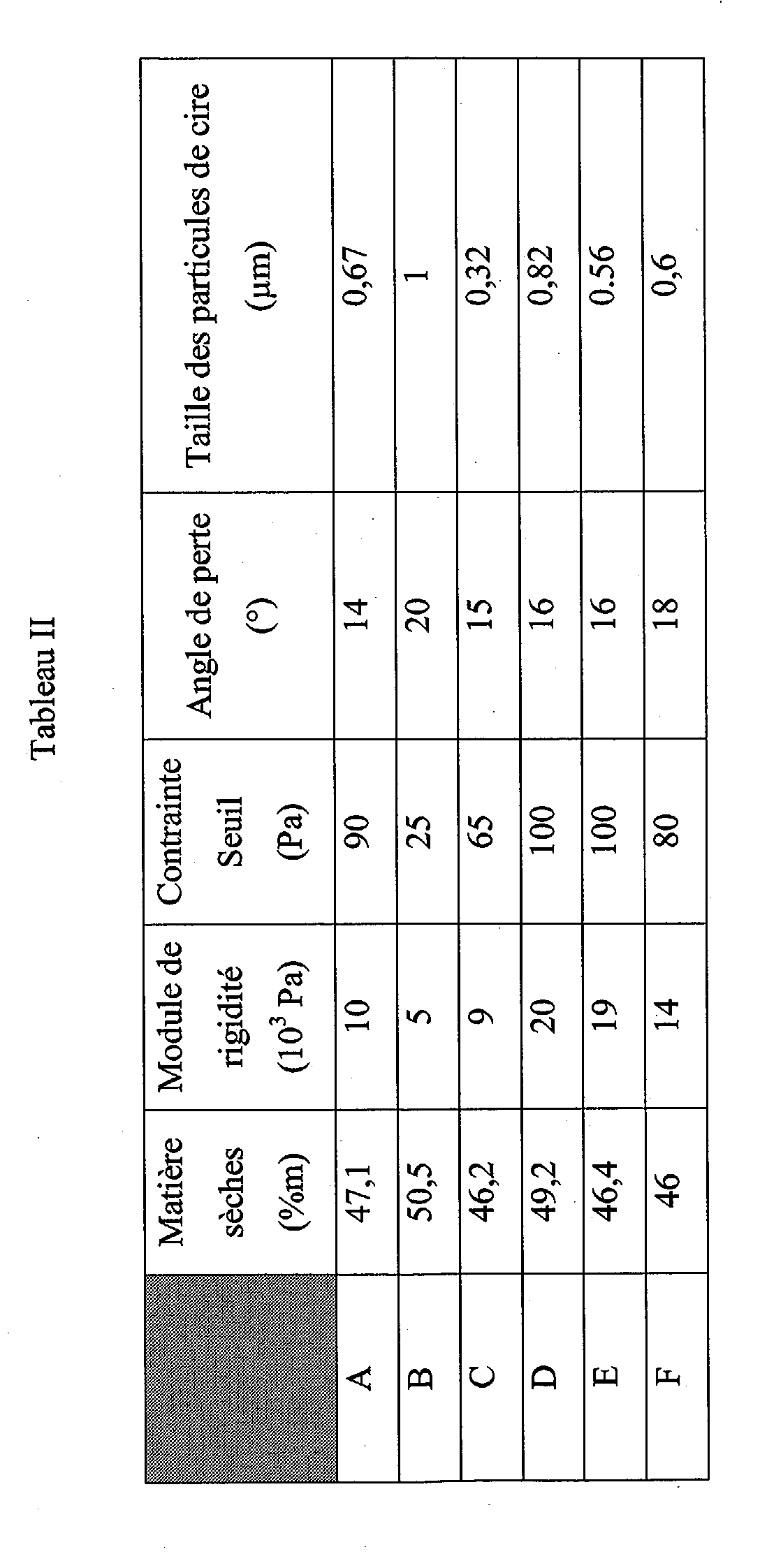
- the formulation has a creamy texture particularly suitable for application by brush and allows to obtain a good thick makeup eyelashes (mascara charging).
- Formulation E 2-amino-2-methyl-1,3-propanediol 0.21 stearic acid (C16-18: 50/50) 2.49 carnauba wax 3.00 D-panthenol 0.50 2-phenoxyethanol 0.50 black iron oxide (CI: 77499) 3.00 Overseas blue (CI: 77007) 4.14 hydroxyethyl cellulose quaternized with chloride 2.30 epoxypropyl trimethylammonium 0.10 hydroxyethyl cellulose 0.88 mixture of polydimethylsiloxane and hydrated silica 0.15 poly sodium methacrylate in water 25% unstabilized 5.00 gum arabic ; polysaccharides; arabinose / galactose / rhamnose / glucuronic acid 3.38 pure white beeswax 5.50 Glycerin 3.00 Propyl p-hydroxybenzoate 0.20
- Formulation F Amino-2-methyl-2-propanediol-1,3 0.21 Stearic acid (triple pressure) (C16-18: 50/50) 2.49 Carnauba Wax 3.00 D-panthenol 0.50 Phenoxy-2 ethanol 0.50 Black iron oxide (CI: 77499) 5.07 Overseas blue (CI: 77007) 2.07 Hydroxyethyl cellulose quaternized with 2,3-epoxypropyltrimethylammonium chloride 0.10 Hydroxyethyl cellulose 0.88 Mixture of poly dimethylsiloxane and hydrated silica 0.15 Sodium polymethacrylate in 25% unstabilized water 5.00 Gum arabic ; polysaccharides; arabinose / galactose / rhamnose / glucuronic acid 3.38 Pure white beeswax 5.50 Glycerin 3.00 propyl p-
- the corresponding formulation has a creamy texture and allows to get a thick makeup eyelashes.
Landscapes
- Life Sciences & Earth Sciences (AREA)
- Health & Medical Sciences (AREA)
- Veterinary Medicine (AREA)
- Animal Behavior & Ethology (AREA)
- General Health & Medical Sciences (AREA)
- Public Health (AREA)
- Birds (AREA)
- Epidemiology (AREA)
- Chemical & Material Sciences (AREA)
- Oil, Petroleum & Natural Gas (AREA)
- Insects & Arthropods (AREA)
- Zoology (AREA)
- Dispersion Chemistry (AREA)
- Emergency Medicine (AREA)
- Cosmetics (AREA)
Abstract
Description

- les éthers oxyéthylénés et/ou oxypropylénés (pouvant comporter de 1 à 150 groupes oxyéthylénés et/ou oxypropylénés) de glycérol ;
- les éthers oxyéthylénés et/ou oxypropylénés (pouvant comporter de 1 à 150 groupes oxyéthylénés et/ou oxypropylénés) d'alcools gras (notamment d'alcool en C8-C24, et de préférence en C12-C18) tels que l'éther oxyéthyléné de l'alcool cétéarylique à 30 groupes oxyéthylénés (nom CTFA "Ceteareth-30 ") et l'éther oxyéthyléné du mélange d'alcools gras en C12-C15 comportant 7 groupes oxyéthylénés (nom CTFA "C12-15 Pareth-7" commercialisé sous la dénomination « NEODOL 25-7 ® » par SHELL CHEMICALS,
- les esters d'acide gras (notamment d'acide en C8-C24, et de préférence en C16-C22) et de polyéthylène glycol (pouvant comprendre de 1 à 150 motifs d'éthylèneglycol) tels que le stéarate de PEG-50 et le monostéarate de PEG-40 commercialisé sous le nom MYRJ 52P par la société ICI UNIQUEMA,
- les esters d'acide gras (notamment d'acide en C8-C24, et de préférence en C16-C22) et des éthers de glycérol oxyéthylénés et/ou oxypropylénés (pouvant comporter de 1 à 150 groupes oxyéthylénés et/ou oxypropylénés), comme le monostéarate de PEG-200 glycéryle vendu sous la dénomination « Simulsol 220 TM » par la société SEPPIC ; le stéarate de glycéryle polyéthoxylé à 30 groupes d'oxyde d'éthylène comme le produit TAGAT S vendu par la société GOLDSCHMIDT, l'oléate de glycéryle polyéthoxylé à 30 groupes d'oxyde d'éthylène comme le produit TAGAT O vendu par la société GOLDSCHMIDT, le cocoate de glycéryle polyéthoxylé à 30 groupes d'oxyde d'éthylène comme le produit VARIONIC LI 13 vendu par la société SHEREX, l'isostéarate de glycéryle polyéthoxylé à 30 groupes d'oxyde d'éthylène comme le produit TAGAT L vendu par la société GOLDSCHMIDT et le laurate de glycéryle polyéthoxylé à 30 groupes d'oxyde d'éthylène comme le produit TAGAT I de la société GOLDSCHMIDT,
- les esters d'acide gras (notamment d'acide en C8-C24, et de préférence en C16-C22) et des éthers de sorbitol oxyéthylénés et/ou oxypropylénés (pouvant comporter de 1 à 150 groupes oxyéthylénés et/ou oxypropylénés), comme le polysorbate 60 vendu sous la dénomination « Tween 60 » par la société UNIQUEMA,
- la diméthicone copolyol, telle que celle vendue sous la dénomination « Q2-5220 » par la société DOW CORNING,
- la diméthicone copolyol benzoate ( FINSOLV SLB 101 et 201 de la société FINTEX),
- les copolymères d'oxyde propylène et d'oxyde d'éthylène, également appelés polycondensats OE/OP,
- et leurs mélanges.
- les esters et éthers d'oses tels que les stéarate de sucrose, cocoate de sucrose, stéarate de sorbitan et leurs mélanges comme l'Arlatone 2121 commercialisé par la société ICI ;
- les esters d'acides gras (notamment d'acide en C8-C24, et de préférence en C16-C22) et de polyol, notamment de glycérol ou de sorbitol, tels que stéarate de glycéryle, stéarate de glycéryle tel que le produit vendu sous la dénomination TEGIN M par la société GOLDSCHMIDT, laurate de glycéryle tel que le produit vendu sous la dénomination IMWITOR 312 par la société HULS, stéarate de polyglycéryl-2, tristéarate de sorbitan, ricinoléate de glycéryle ;
- le mélange de cyclométhicone/diméthicone copolyol vendu sous la dénomination "Q2-3225C" par la société DOW CORNING.
- les sels d'acides gras en C16-C30 notamment ceux dérivant des amines, comme le stéarate de triéthanolamine ;
- les sels d'acides gras polyoxyéthylénés notamment ceux dérivant des amines ou les sels alcalins, et leurs mélanges ;
- les esters phosphoriques et leurs sels tels que le "DEA oleth-10 phosphate" (Crodafos N 10N de la société CRODA) ;
- les sulfosuccinates tels que le "Disodium PEG-5 citrate lauryl sulfosuccinate" et le "Disodium ricinoleamido MEA sulfosuccinate" ;
- les alkyléthersulfates tels que le lauryl éther sulfate de sodium ;
- les iséthionates ;
- les acylglutamates tels que le "Disodium hydrogenated tallow glutamate" (AMISOFT HS-21 R commercialisé par la société AJINOMOTO) et leurs mélanges.
- les alkyl-imidazolidinium tels que l'étho-sulfate d'isostéaryléthylimidonium,
- les sels d'ammonium tels que le chlorure de N,N,N-triméthyl-1-docosanaminium (chlorure de Behentrimonium).
- les homo- ou copolymères d'acides acrylique ou méthacrylique ou leurs sels et leurs esters et en particulier les produits vendus sous les dénominations «VERSICOL F »ou « VERSICOL K » par la société ALLIED COLLOID, « UTRAHOLD 8 » par la société CIBA-GEIGY, les acides polyacryliques de type SYNTHALEN K,
- les copolymères d'acide acrylique et d'acrylamide vendus sous la forme de leur sel de sodium sous les dénominations « RETEN » par la société HERCULES, le polyméthacrylate de sodium vendu sous la dénomination « DARVAN N°7 » par la société VANDERBILT, les sels de sodium d'acides polyhydroxycarboxyliques vendus sous la dénomination « HYDAGEN F » par la société HENKEL,
- les copolymères acide polyacryliques/acrylates d'alkyle de type PEMULEN,
- l'AMPS (Acide polyacrylamidométhyl propane sulfonique neutralisé partiellement à l'ammoniaque et hautement réticulé) commercialisé par la société CLARIANT,
- les copolymères AMPS/acrylamide de type SEPIGEL ou SIMULGEL commercialisés par la société SEPPIC, et
- les copolymères AMPS/méthacrylates d'alkyle polyoxyéthylénés (réticulés ou non), et leurs mélanges.
- les protéines comme les protéines d'origine végétale telles que les protéines de blé, de soja ; les protéines d'origine animale tels que les kératines, par exemples les hydrolysats de kératine et les kératines sulfoniques ;
- les polymères de chitine ou de chitosane anioniques, cationiques, amphotères ou non-ioniques ;
- les polymères de cellulose tels que l'hydroxyéthylcellulose, l'hydroxypropylcellulose, la méthylcellulose, l'éthylhydroxyéthylcellulose, la carboxyméthylcellulose, ainsi que les dérivés quaternisés de la cellulose ;
- les polymères vinyliques, comme les polyvinylpyrrolidones, les copolymères de l'éther méthylvinylique et de l'anhydride malique, le copolymère de l'acétate de vinyle et de l'acide crotonique, les copolymères de vinylpyrrolidone et d'acétate de vinyle ; les copolymères de vinylpyrrolidone et de caprolactame ; l'alcool polyvinylique ;
- les polymères d'origine naturelle, éventuellement modifiés, tels que :
- les gommes arabiques, la gomme de guar, les dérivés du xanthane, la gomme de karaya ;
- les alginates et les carraghénanes ;
- les glycoaminoglycanes, l'acide hyaluronique et ses dérivés ;
- la résine shellac, la gomme de sandaraque, les dammars, les élémis, les copals ;
- l'acide désoxyribonucléïque ;
- les muccopolysaccharides tels que l'acide hyaluronique, les chondroïtines sulfate, et leurs mélanges.
- les huiles hydrocarbonées d'origine végétale telles que les triglycérides constitués, d'esters d'acides gras et de glycérol dont les acides gras peuvent avoir des longueurs de chaínes variées de C4 à C24, ces dernières pouvant être linéaires ou ramifiées, saturées ou insaturées ; ces huiles sont notamment les huiles de germe de blé, de tournesol, de pépins de raisin, de sésame, de maïs, d'abricot, de ricin, de karité, d'avocat, d'olive, de soja, l'huile d'amande douce, de palme, de colza, de coton, de noisette, de macadamia, de jojoba, de luzerne, de pavot, de potimarron, de sésame, de courge, de colza, de cassis, d'onagre, de millet, d'orge, de quinoa, de seigle, de carthame, de bancoulier, de passiflore, de rosier muscat ; ou encore les triglycérides des acides caprylique/caprique comme ceux vendus par la société Stéarineries Dubois ou ceux vendus sous les dénominations Miglyol 810, 812 et 818 par la société Dynamit Nobel,
- les éthers de synthèse ayant de 10 à 40 atomes de carbone ;
- les hydrocarbures linéaires ou ramifiés, d'origine minérale ou synthétique tels que la vaseline, les polydécènes, le polyisobutène hydrogéné tel que le parléam, le squalane, et leurs mélanges;
- les esters de synthèse comme les huiles de formule R1COOR2 dans laquelle R1 représente le reste d'un acide gras linéaire ou ramifié comportant de 1 à 40 atomes de carbone et R2 représente une chaíne hydrocarbonée notamment ramifiée contenant de 1 à 40 atomes de carbone à condition que R5 + R6 soit ≥ 10, comme par exemple l'huile de Purcellin (octanoate de cétostéaryle), le myristate d'isopropyle, le palmitate d'isopropyle, le benzoate d'alcool en C12 à C15, le laurate d'hexyle, l'adipate de diisopropyle, l'isononanoate d'isononyle, le palmitate de 2-éthyl-hexyle, l'isostéarate d'isostéarate, des octanoates, décanoates ou ricinoléates d'alcools ou de polyalcools comme le dioctanoate de propylène glycol ; les esters hydroxylés comme le lactate d'isostéaryle, le malate de di-isostéaryle ; et les esters du pentaérythritol ;
- les alcools gras liquides à température ambiante à chaíne carbonée ramifiée et/ou insaturée ayant de 12 à 26 atomes de carbone comme l'octyl dodécanol, l'alcool isostéarylique, l'alcool oléique, le 2-hexyldécanol, le 2-butyloctanol, le 2-undécylpentadécanol ;
- les acides gras supérieurs tels que l'acide oléique, l'acide linoléique, l'acide linolénique ; et
- leurs mélanges.
- de polyesters, telles que celles obtenues par découpe de fils vendus sous les dénominations FIBRE 255-100-R11-242T TAILLE 3 MM (section octalobée), FIBRE 265-34-R11 -56T TAILLE 3 MM (section ronde), FIBRE COOLMAX 50-34-591 TAILLE 3 MM (section tétralobée) par la société DUPONT DE NEMOURS ;
- de polyamide, telles que celles vendues sous les dénominations TRILOBAL NYLON 0.120-1.8 DPF ; TRILOBAL NYLON 0.120-18 DPF ; NYLON 0.120-6 DPF par la société Cellusuede products ; ou obtenues par découpe de fils vendus sous la dénomination FIBRE NOMEX BRAND 430 TAILLE 3 MM par la société DUPONT DE NEMOURS ;
- de polyimide-amide telles que celles vendues sous les dénomination "KERMEL", " KERMEL TECH" par la société RHODIA ;
- de poly-(p-phénylène-téréphtalamide) (ou d'aramide) notamment vendues sous la dénomination Kevlar ® par la société DUPONT DE NEMOURS ;
- des fibres à structure multicouche comprenant des couches alternées de polymères choisis parmi les polyesters, les polymères acryliques, les polyamides, tellles que celles décrites dans les documents EP-A-6921217, EP-A-686858 et US-A-5472798. De telles fibres sont vendues sous les dénominations "Morphotex", « Teijin Tetron Morphotex » par la société TEIJIN.
- température de mesure 25 °C,
- palier de 180 sec à 25 °C avant le début de mesure,
- balayage en contrainte de 1 à 10 000 Pa,
- fréquence de mesure : 1 Hz.
- hydroxyéthyl cellulose quaternisé par chlorure de 2,3 époxypropyl triméthyl ammonium commercialisé sous la dénomination « UCARE POLYMER JR 400 » par la société AMERCHOL (DOW CHEMICAL),
- hydroxyéthyle cellulose commercialisée sous le nom de « Cellobond HEC 5000 A » distribué par la société BRENNTAG,
- polyméthacrylate de sodium dans l'eau à 25 % non stabilisé commercialisé sous la dénomination « Darvan 7 » par la société VANDERBILT,
- copolymère acrylate d'éthyle/méthacrylate de méthyle (80/20) réticulé, en dispersion aqueuse à 50 % commercialisé sous la dénomination « Daitosol 5000 AD » par la société DAITO,
- copolymère acrylamide/acrylamido-2-méthyl propane sulfonate de sodium en émulsion inverse à 40 % dans polysorbate 80/I-C16 commercialisé sous la dénomination « Simulgel 600 » par la société SEPPIC,
- monostéarate de glycéryle oxyéthyléné (200 OE) commercialisé sous la dénomination « Simulsol » par la société SEPPIC,
- monostéarate de glycéryle oxyéthyléné (30 OE) commercialisé sous la dénomination « Tagat S » par la société DEGUSSA/GOLDSCHMIDT,
- copolymère AMPS/méthacrylate de cétéaryle éthoxylé (25 OE) réticulé par triméthylolpropane triacrylate (TMPTA).
| Formulation A : | |
| amino-2 méthyl-2 propane di-ol-1,3 | 0,21 |
| acide stéarique (cl 6-18:50/50) | 2,49 |
| cire de Carnauba | 5,77 |
| D-Panthénol | 0,50 |
| oxyde de fer noir (CI:77499) | 3,00 |
| bleu d'outremer (CI:77007) | 4,14 |
| hydroxyéthyl cellulose quaternisée par chlorure de 2,3 époxypropyl triméthyl ammonium | 0,10 |
| hydroxyéthyl cellulose | 0,88 |
| mélange de polydiméthylsiloxane et de silice hydratée | 0,15 |
| poly méthacrylate de sodium dans l'eau à 25 % non stabilisé Gomme arabique ; polysaccharides ; | 5,00 |
| arabinose/galactose/rhamnose/acide glucuronique | 3,38 |
| P-hydroxybenzoate de propyle | 0,20 |
| P-hydroxybenzoate de méthyle | 0,25 |
| triéthanolamine à 99 % | 1,02 |
| polydiméthylsiloxane oxyéthyléné (20 OE) oxypropylène (20 OP) (DP : 170 - viscosité : 1000 cst) | 0,20 |
| copolymère acrylate d'éthyle/méthacrylate de méthyle (80/20) réticulé, en dispersion aqueuse à 50 % | 4,00 |
| copolymère acrylamide/acrylamido-2-méthyl propane sulfonate de sodium en émulsion inverse à 40 % dans polysorbate 80/I-C16 | 2,00 |
| monostéarate de glycéryle oxyéthyléné (200 OE) | 3,00 |
| huile de Jojoba (Simmondsia Chinensis) isomérisée TRANS de TF 45 °C | 15,77 |
| eau déminéralisée stérilisée | qsp 100 % |
| Formulation B : | |
| mino-2 méthyl-2 propane di-ol-1,3 | 0,21 |
| cire de Carnauba | 5,77 |
| D-Panthénol | 0,50 |
| oxyde de fer noir (CI:77499) | 3,00 |
| bleu d'outremer (CI:77007) | 4,14 |
| hydroxyéthyl cellulose quatemisée par chlorure de 2,3 époxypropyl triméthyl ammonium | 0,10 |
| hydroxyéthyl cellulose | 0,88 |
| mélange de polydiméthylsiloxane et de silice hydratée | 0,15 |
| poly méthacrylate de sodium dans l'eau à 25 % non stabilisé | 5,00 |
| gomme arabique ; polysaccharides ; arabinose/galactose/rhamnose/acide glucuronique | 3,38 |
| monostéarate de glycéryle oxyéthylène (30 OE) | 1,00 |
| P-hydroxybenzoate de propyle | 0,20 |
| P-hydroxybenzoate de méthyle | 0,25 |
| polydiméthylsiloxane oxyéthylène (20 OE) oxypropylène (20 OP)(DP : 170 - viscosité : 1000 CST) | 0,20 |
| copolymère acrylate d'éthyle/méthacrylate de méthyle (80/20) réticulé, en dispersion aqueuse à 50 % | 4,00 |
| copolymère acrylamide/acrylamido-2-méthyl propane sulfonate de sodium en émulsion inverse à 40 % dans polysorbate 80/I-C16 | 3,50 |
| monostéarate de glycéryle oxyéthylène (200 OE) | 3,00 |
| huile de Jojoba (Simmondsia Chinensis) isomérisée TRANS de TF 45 °C | 23,28 |
| eau déminéralisée stérilisée | qsp 100 % |
| Formulation C : | |
| amino-2 méthyl-2 propane di-ol-1,3 | 0,21 |
| acide stéarique (c16-18:50/50) | 2,49 |
| cire de Carnauba | 3,00 |
| D-panthénol | 0,50 |
| phénoxy-2 éthanol | 0,50 |
| oxyde de fer noir (CI:77499) | 3,00 |
| bleu d'outremer (CI:77007) | 4,14 |
| hydroxyéthyl cellulose quatemisée par chlorure de 2,3 époxypropyl triméthyl ammonium | 0,10 |
| hydroxyéthyl cellulose | 0,88 |
| mélange de polydiméthylsiloxane et de silice hydratée | 0,15 |
| poly méthacrylate de sodium dans l'eau à 25 % non stabilisé | 5,00 |
| gomme arabique ; polysaccharides ; arabinose/galactose/rhamnose/acide glucuronique | 3,38 |
| cire d'abeille blanche, pure | 2,50 |
| Glycérine | 3,00 |
| P-hydroxybenzoate de propyle | 0,20 |
| P-hydroxybenzoate de méthyle | 0,25 |
| tri-éthanolamine à 99 % | 1,02 |
| polydiméthylsiloxane oxyéthylène (20 OE) oxypropylène (20 OP)(DP : 170 - viscosité : 1000 CST) | 0,20 |
| huile de Jojoba hydrogénée | 6,27 |
| copolymère acrylate d'éthyle/méthacrylate de méthyle (80/20) réticulé, en dispersion aqueuse a 50 % | 4,00 |
| copolymère acrylamide/acrylamido-2-méthyl propane sulfonate de sodium en émulsion inverse à 40 % dans polysorbate 80/I-C16 | 2,00 |
| monostéarate de glycériyle oxyéthyléné (200 OE) | 3,00 |
| huile de Jojoba (Simmondsia Chinensis) isomérisée TRANS de TF 45 °C | 6,27 |
| eau déminéralisée stérilisée | qsp 100 % |
| Formulation D : | |
| amino-2 méthyl-2 propane di-ol-1,3 | 0,21 |
| acide stéarique (C16-18:50/50) | 2,49 |
| cire de Carnauba | 3,00 |
| D-Panthénol | 0,50 |
| phenoxy-2 éthanol | 0,50 |
| oxyde de fer noir (CI:77499) | 3,00 |
| bleu d'outremer (CI:77007) | 4,14 |
| hydroxyéthyl cellulose quatemisée par chlorure de 2,3 époxypropyl triméthyl ammonium | 0,10 |
| hydroxyéthyl cellulose | 0,88 |
| mélange de polydiméthylsiloxane et de silice hydratée | 0,15 |
| poly méthacrylate de sodium dans l'eau à 25 % non stabilise | 5,00 |
| gomme arabique ; polysaccharides ; arabinose/galactose/rhamnose/acide glucuronique | 3,38 |
| cire d'abeille blanche, pure | 6,50 |
| Glycérine | 2,00 |
| P-hydroxybenzoate de propyle | 0,20 |
| P-hydroxybenzoate de méthyle | 0,25 |
| tri-éthanolamine à 99 % | 1,02 |
| polydiméthylsiloxane oxyéthylène (20 OE) oxypropylène (20 OP)(DP : 170 - viscosité : 1000 CST) | 0,20 |
| huile de Jojoba hydrogénée | 6,27 |
| copolymère acrylate d'éthyle/méthacrylate de méthyle (80/20) réticulé, en dispersion aqueuse à 50 % | 4,00 |
| copolymère acrylamide/acrylamido-2-méthyl propane sulfonate de sodium en émulsion inverse à 40 % dans polysorbate 80/I-C16 | 2,00 |
| monostéarate de glycéryle oxyéthyléné (200 OE) | 3,00 |
| huile de Jojoba (Simmondsia Chinensis) isomérisée TRANS de TF 45 °C | 6,27 |
| eau déminéralisée stérilisée | qsp 100 % |
| Formulation E : | |
| amino-2 méthyl-2 propane di-ol-1,3 | 0,21 |
| acide stéarique (C16-18:50/50) | 2,49 |
| cire de Carnauba | 3,00 |
| D-Panthénol | 0,50 |
| phenoxy-2 éthanol | 0,50 |
| oxyde de fer noir (CI:77499) | 3,00 |
| bleu d'outremer (CI:77007) | 4,14 |
| hydroxyéthyl cellulose quatemisée par chlorure de | 2,30 |
| époxypropyl triméthyl ammonium | 0,10 |
| hydroxyéthyl cellulose | 0,88 |
| mélange de polydiméthylsiloxane et de silice hydratée | 0,15 |
| poly méthacrylate de sodium dans l'eau à 25 % non stabilisé | 5,00 |
| gomme arabique ; polysaccharides ; arabinose/galactose/rhamnose/acide glucuronique | 3,38 |
| cire d'abeille blanche, pure | 5,50 |
| Glycérine | 3,00 |
| P-hydroxybenzoate de propyle | 0,20 |
| P-hydroxybenzoate de méthyle | 0,25 |
| tri-ethanolamine à 99 % | 1,02 |
| polydiméthylsiloxane oxyéthyléné (20 OE) oxypropylène (20 OP)(DP : 170 - viscosité : 1000 CST) | 0,20 |
| huile de Jojoba hydrogénée | 6,27 |
| copolymère acrylate d'éthyle/méthacrylate de méthyle (80/20) réticulé, en dispersion aqueuse à 50 % | 4,00 |
| copolymère acrylamide/acrylamido-2-méthyl propane sulfonate de sodium en émulsion inverse à 40 % dans polysorbate 80/I-C16 | 2,00 |
| monostéarate de glycéryle oxyéthyléné (200 OE) | 3,00 |
| huile de Jojoba (Simmondsia Chinensis) isomérisée TRANS de TF 45 °C | 6,27 |
| eau déminéralisée stérilisée | qsp 100 % |
| Formulation F : | |
| Amino-2 méthyl-2 propanediol-1,3 | 0,21 |
| Acide stéarique (triple pression) (C16-18 : 50/50) | 2,49 |
| Cire de Carnauba | 3,00 |
| D-panthénol | 0,50 |
| Phénoxy-2 éthanol | 0,50 |
| Oxyde de fer noir (CI : 77499) | 5,07 |
| Bleu d'outremer (CI : 77007) | 2,07 |
| Hydroxyéthyl cellulose quatemarisée par chlorure de 2,3 époxypropyl triméthyl ammonium | 0,10 |
| Hydroxyéthyl cellulose | 0,88 |
| Mélange de poly diméthylsiloxane et de silice hydratée | 0,15 |
| Polyméthacrylate de sodium dans l'eau à 25 % non stabilisé | 5,00 |
| Gomme arabique ; polysaccharides ; arabinose / galactose / rhamnose /acide glucuronique | 3,38 |
| Cire d'abeille blanche, pure | 5,50 |
| Glycérine | 3,00 |
| p-Hydroxybenzoate de propyle | 0,20 |
| p- Hydroxybenzoate de méthyle | 0,25 |
| Triéthanolamine à 99% | 1,02 |
| Polydiméthylsiloxane oxyéthyléné (20 OE) oxypropyléné (20 OP) (DP : 170- viscosité :1 000 cSt) | 0,20 |
| Huile de Jojoba hydrogénée | 6,27 |
| Fibres de cellulose (rayonne) | 0,10 |
| Copolymère acrylate d'éthyle/méthacrylate de méthyle (80/20) réticulé, en dispersion aqueuse à 50 % | 2,00 |
| Copolymère acrylamide/acrylamido-2-méthyl propane sulfonate de sodium en émulsion inverse à 40 % dans polysorbate 80/I-C16 | 2,00 |
| Mono-stéarate de glycérine oxyéthyléné (200 OE) | 3,00 |
| Huile de Jojoba (simmondsia chinensis) isomérisée trans de TF 45°C | 6,27 |
| Eau déminéralisée stérilisée | qsp 100 % |

Claims (30)
- Composition cosmétique de maquillage de fibres kératiniques, comprenant une phase cireuse contenant au moins une dispersion aqueuse de particules de cire(s) caractérisée en ce qu'elle possède un module de rigidité plateau Gp supérieur ou égal à 4000 Pa et en ce que les particules de cire(s) de ladite phase cireuse possèdent une taille exprimée en diamètre « effectif » moyen en volume D[4,3] inférieure ou égale à 1 µm.
- Composition selon la revendication 1 caractérisée en ce qu'elle possède un module de rigidité plateau Gp supérieur ou égal à 7000 Pa.
- Composition selon la revendication 1 ou 2 caractérisée en ce qu'elle possède une teneur en matière sèche supérieure ou égale à 42 % en poids par rapport au poids total de la composition.
- Composition selon la revendication 1, 2 ou 3, caractérisé en ce qu'elle possède un système émulsionnant possédant à 25 °C une balance HLB (hydrophile-lipophile balance) au sens de GRIFFIN, supérieure ou égale à 8.
- Composition cosmétique selon l'une quelconque des revendications 1 à 4, caractérisée en ce qu'elle comprend au moins un tensioactif ionique.
- Composition selon la revendication 5, caractérisée en ce que ledit tensioactif ionique est au moins un tensioactif anionique.
- Composition selon la revendication 6, caractérisée en ce que ledit tensioactif anionique est choisi parmi les sels d'acides gras en C16-C30 ; les sels d'acides gras polyoxyéthoxylénés, les esters phosphoriques et leurs sels ; les alkyléthersulfates ; les sulfosuccinates ; les iséthionates et les acylglutamates et leurs mélanges.
- Composition selon la revendication 5, 6 ou 7, caractérisée en ce que le tensioactif ionique comprend au moins le stéarate de triéthanolamine.
- Composition selon l'une quelconque des revendications 5 à 8, caractérisée en ce que ledit tensioactif ionique est présent à raison de 0,01 à 30 % en poids et notamment de 0,1 à 15 % en poids du poids total de la composition.
- Composition selon l'une quelconque des revendications 1 à 9, caractérisée en ce qu'elle comprend au moins un tensioactif non ionique de HLB supérieur ou égal à 8 à 25 °C.
- Composition selon la revendication 10, caractérisée en ce que ledit tensioactif non ionique de HLB supérieur ou égal à 8 est choisi parmi les éthers d'alcools gras oxyéthylénés et/ou oxypropylénés, les esters d'acide gras et de polyéthylène glycol, les éthers de glycérol oxyéthylénés et/ou oxypropylénés, les esters d'acide gras et d'éther de sorbitol oxyéthylénés et/ou oxypropylénés et les copolymères d'oxyde propylène et d'oxyde d'éthylène et leurs mélanges.
- Composition selon la revendication 11, caractérisée en ce qu'il est choisi parmi les éthers oxyéthylénés de l'alcool cétéarylique à 30 groupes oxyéthylénés, éther oxyéthyléné d'un mélange d'alcools gras en C12-C15 comportant 7 groupes oxyéthylénés, stéarate de PEG-50, stéarate de PEG-40, stéarate de PEG-200 glycéryle, polysorbate 60, stéarate de glycéryle polyéthoxylé à 30 groupes d'oxyde d'éthylène, oléate de glycéryle polyéthoxylé à 30 groupes d'oxyde d'éthylène, cocoate de glycéryle polyéthoxylé à 30 groupes d'oxyde d'éthylène, isostéarate de glycéryle polyéthoxylé à 30 groupes d'oxyde d'éthylène, laurate de glycéryle polyéthoxylé à 30 groupes d'oxyde d'éthylène, dimethicone copolyol, dimethicone copolyol benzoate.
- Composition selon l'une quelconque des revendications 10 à 12, caractérisée en ce que ledit tensioactif non ionique de HLB supérieur ou égal à 8 est présent à raison de 0,01 % à 40 % en poids, en particulier de 0,1% à 25 % en poids du poids total de la composition.
- Composition selon l'une quelconque des revendications 5 à 13 caractérisée en ce qu'elle comprend en outre au moins un polymère gélifiant.
- Composition selon la revendication 14, caractérisée en ce que le polymère gélifiant est choisi parmi les homo- ou co-polymères d'acides acrylique ou méthacrylique, leurs sels et leurs esters ; les acides polyacryliques ; les sels de copolymères d'acide acrylique et d'acrylamide ; les sels de sodium d'acides polyhydroxycarboxyliques ; les sels de sodium d'acides polyhydroxycarboxyliques ; les copolymères acide polyacryliques/acrylates d'alkyle ; l'AMPS ; les copolymères AMPS/acrylamide ; les copolymères AMPS/méthacrylates d'alkyle polyxyéthylénés (réticulé ou non) ; les protéines comme les protéines d'origine végétale ou animale ; les polymères de chitine ou de chitosane anioniques, cationiques, amphotères ou non-ioniques ; les polymères de celluloses ; les polymères vinyliques ; les polymères d'origine naturelle.
- Composition selon la revendication 14 ou 15, caractérisée en ce que le polymère gélifiant est choisi parmi les homo- ou co-polymères d'acides acrylique ou méthacrylique ou leurs sels et leurs esters, les copolymères d'acide acrylique et d'acrylamide, les copolymères d'acide polyacrylique/acrylates d'alkyle, l'AMPS (Acide polyacrylamidométhyl propane sulfonique), les copolymères AMPS/acrylamide et les copolymères AMPS/méthacrylates d'alkyle polyoxyéthylénés et leurs mélanges.
- Composition selon l'une quelconque des revendications 14 à 16, caractérisée en ce que le polymère gélifiant est présent à une teneur en matière sèche variant de 0,1 à 60 % et notamment de 0,5 à 40 % en poids du poids total de la composition.
- Composition selon l'une quelconque des revendications précédentes, caractérisée en ce qu'elle comprend de 0,1 à 40 % et notamment de 0,5 à 20 % en poids de tensioactifs du poids total de la composition.
- Composition selon l'une quelconque des revendications précédentes, caractérisée en ce qu'elle comprend en outre un polymère filmogène.
- Composition selon la revendication 19, caractérisée en ce que le polymère filmogène est choisi parmi les polymères synthétiques, de type radicalaire ou de type polycondensat, les polymères d'origine naturelle et leurs mélanges.
- Composition selon l'une quelconque des revendications précédentes, caractérisée en ce qu'elle possède une teneur en matière sèche supérieure ou égale à 45,5 % en poids et notamment supérieure ou égale à 48 % en poids.
- Composition selon l'une quelconque des revendications précédentes caractérisée en ce que la cire est une cire, solide et rigide à température ambiante, d'origine animale, végétale, minérale ou de synthèse.
- Composition selon l'une quelconque des revendications précédentes, caractérisée en ce que la cire présente un point de fusion supérieure à 45 °C environ, et en particulier supérieur à 55 °C.
- Composition selon l'une quelconque des revendications précédentes, caractérisée en ce que la cire est choisie parmi les cires hydrocarbonées comme la cire d'abeilles, la cire de lanoline, et les cires d'insectes de Chine ; la cire de riz, la cire de Carnauba, la cire de Candellila, la cire d'Ouricurry, la cire d'Alfa, la cire de fibres de liège, la cire de canne à sucre, la cire du Japon et la cire de sumac ; la cire de montan ; les cires microcristallines, les paraffines et l'ozokérites ; les cires de polyéthylène ; les cires obtenues par la synthèse de Fisher-Tropsch ; les copolymères cireux ainsi que leurs esters ; les cires obtenues par hydrogénation catalytique d'huiles animales ou végétales ayant des chaínes grasses, linéaires ou ramifiées, en C8-C32 comme l'huile de jojoba hydrogénée, l'huile de jojoba isomérisée, l'huile de tournesol hydrogénée, l'huile de ricin hydrogénée, l'huile de coprah hydrogénée et l'huile de lanoline hydrogénée, le tétrastéarate de di-(triméthylol-1,1,1 propane) et le tétrabéhénate de di-(triméthylol-1,1,1 propane).
- Composition selon l'une quelconque des revendications précédentes caractérisée en ce que la phase cireuse est présente à raison de 0,1 à 40 % et notamment de 5 à 40 % en poids.
- Composition selon l'une quelconque des revendications précédentes, caractérisée en ce qu'elle possède un seuil d'écoulement mesuré par rhéologie oscillatoire (υ = 1Hz) variant de 5 à 3500 Pa et notamment de 20 à 1000 Pa.
- Composition selon l'une quelconque des revendications précédentes, caractérisée en ce qu'elle contient de 0,01 % à 30 % en poids d'au moins une matière colorante et/ou de 0,1 à 25 % en poids d'une charge.
- Composition selon l'une quelconque des revendications précédentes, caractérisée en ce qu'elle présente une élasticité plateau δp variant de 1° à 45°, et notamment allant de 5° à 30°.
- Utilisation d'une composition selon l'une quelconque des revendications précédentes pour obtenir un maquillage séparant des fibres kératiniques et notamment des cils et des sourcils.
- Procédé de maquillage des fibres kératiniques, caractérisé en ce que l'on applique sur lesdites fibres kératiniques notamment les cils une composition telle que définie selon l'une quelconque des revendications 1 à 28.
Applications Claiming Priority (4)
| Application Number | Priority Date | Filing Date | Title |
|---|---|---|---|
| FR0211103A FR2844191A1 (fr) | 2002-09-06 | 2002-09-06 | Composition cosmetique de maquillage pour les fibres keratiniques, chargeantes et/ou separantes |
| FR0211102A FR2844190B1 (fr) | 2002-09-06 | 2002-09-06 | Composition cosmetique de maquillage pour les fibres keratiniques, chargeantes et/ou separantes |
| FR0211103 | 2002-09-06 | ||
| FR0211102 | 2002-09-06 |
Publications (2)
| Publication Number | Publication Date |
|---|---|
| EP1417951A1 true EP1417951A1 (fr) | 2004-05-12 |
| EP1417951B1 EP1417951B1 (fr) | 2009-10-28 |
Family
ID=32109201
Family Applications (1)
| Application Number | Title | Priority Date | Filing Date |
|---|---|---|---|
| EP03292163A Expired - Lifetime EP1417951B1 (fr) | 2002-09-06 | 2003-09-03 | Composition cosmétique de maquillage pour les fibres kératiniques |
Country Status (6)
| Country | Link |
|---|---|
| EP (1) | EP1417951B1 (fr) |
| JP (1) | JP4503975B2 (fr) |
| KR (1) | KR20040022193A (fr) |
| CN (1) | CN100531704C (fr) |
| DE (1) | DE60329816D1 (fr) |
| ES (1) | ES2335397T3 (fr) |
Cited By (13)
| Publication number | Priority date | Publication date | Assignee | Title |
|---|---|---|---|---|
| EP1430868B1 (fr) * | 2002-12-20 | 2006-03-08 | L'oreal | Composition de revêtement des fibres kératiniques présentant un caractère filant |
| WO2006066656A1 (fr) * | 2004-12-23 | 2006-06-29 | Unilever Plc | Emulsions eau-dans-huile pour traitement capillaire |
| FR2904765A1 (fr) * | 2006-08-10 | 2008-02-15 | Oreal | Film a dissolution amelioree et produit cosmetique le contenant |
| EP1920760A1 (fr) * | 2006-11-10 | 2008-05-14 | L'Oréal | Composition cosmétique comprenant un composé choisi parmi les sels et dérivés d'aminoacides |
| FR2908302A1 (fr) * | 2006-11-10 | 2008-05-16 | Oreal | Mascara comprenant moins un derive d'acide glutamique et/ou un de ses sels. |
| FR2938763A1 (fr) * | 2008-11-24 | 2010-05-28 | Oreal | Composition cosmetique solide pour application sur les fibres keratiniques |
| US7993632B2 (en) | 2002-12-20 | 2011-08-09 | L'oreal S.A. | Composition for coating keratin fibres having a threading nature |
| WO2012124179A3 (fr) * | 2011-03-15 | 2013-03-14 | L'oreal | Composition cosmétique pour cils |
| US8404218B2 (en) | 2004-12-23 | 2013-03-26 | Conopco, Inc. | Gelled water-in-oil microemulsions for hair treatment |
| WO2013083532A3 (fr) * | 2011-12-05 | 2014-05-30 | L'oreal | Composition cosmétique de revêtement des fibres kératiniques |
| US10010638B2 (en) | 2016-06-14 | 2018-07-03 | S. C. Johnson & Son, Inc. | Wax melt with filler |
| US10342886B2 (en) | 2016-01-26 | 2019-07-09 | S.C. Johnson & Son, Inc. | Extruded wax melt and method of producing same |
| CN114712325A (zh) * | 2022-04-18 | 2022-07-08 | 苏州快乐猩球生物科技有限公司 | 一种包裹悬浮颗粒、制备方法及其应用 |
Families Citing this family (9)
| Publication number | Priority date | Publication date | Assignee | Title |
|---|---|---|---|---|
| FR2876280B1 (fr) * | 2004-10-13 | 2008-03-21 | Oreal | Composition cosmetique pour le soin et/ou le maquillage, resistante a l'eau, comprenant au moins un latex ou un pseudo-latex et facilement demaquillable |
| US8211415B2 (en) | 2004-10-13 | 2012-07-03 | L'oreal | Easily removable waterproof cosmetic care and/or makeup composition comprising at least one latex or pseudolatex |
| EP2108358A1 (fr) * | 2006-11-24 | 2009-10-14 | Pias Corporation | Cosmétique pour cils |
| KR101494272B1 (ko) | 2008-04-30 | 2015-02-17 | (주)아모레퍼시픽 | 지속력이 우수하고 클렌징이 용이한 수중유형 화장료조성물 |
| FR2996765B1 (fr) * | 2012-10-15 | 2015-01-16 | Oreal | Composition cosmetique de revetement des fibres keratiniques |
| FR2996759B1 (fr) * | 2012-10-15 | 2015-01-16 | Oreal | Composition cosmetique de revetement des fibres keratiniques |
| FR2996758B1 (fr) * | 2012-10-15 | 2015-01-16 | Oreal | Composition cosmetique de revetement des fibres keratiniques |
| CN110302073A (zh) * | 2012-10-15 | 2019-10-08 | 欧莱雅 | 水性蜡分散体及包含它们的头发定型组合物 |
| JP7474050B2 (ja) * | 2019-12-26 | 2024-04-24 | 花王株式会社 | 水中油型乳化化粧料 |
Citations (6)
| Publication number | Priority date | Publication date | Assignee | Title |
|---|---|---|---|---|
| EP0568035A2 (fr) | 1992-05-01 | 1993-11-03 | Kao Corporation | Composition cosmétique formulée avec un émulsion de polymères aqueuse |
| FR2757054A1 (fr) * | 1996-12-16 | 1998-06-19 | Oreal | Pigment melanique composite sous forme de particules comprenant un noyau spherique a base de cire, procedes de preparation et utilisations en cosmetique |
| FR2815851A1 (fr) | 2000-10-27 | 2002-05-03 | Oreal | Composition cosmetique filmogene |
| WO2002047622A2 (fr) | 2000-12-12 | 2002-06-20 | L'oreal | Composition cosmetique comprenant une cire et un polymere |
| EP1281385A1 (fr) * | 2001-07-16 | 2003-02-05 | L'oreal | Mascara comprenant des particules solides |
| FR2833163A1 (fr) * | 2001-12-07 | 2003-06-13 | Oreal | Mascara solide |
-
2003
- 2003-09-03 ES ES03292163T patent/ES2335397T3/es not_active Expired - Lifetime
- 2003-09-03 EP EP03292163A patent/EP1417951B1/fr not_active Expired - Lifetime
- 2003-09-03 DE DE60329816T patent/DE60329816D1/de not_active Expired - Lifetime
- 2003-09-05 CN CNB031562345A patent/CN100531704C/zh not_active Expired - Fee Related
- 2003-09-05 KR KR1020030062038A patent/KR20040022193A/ko not_active Ceased
- 2003-09-05 JP JP2003354333A patent/JP4503975B2/ja not_active Expired - Fee Related
Patent Citations (6)
| Publication number | Priority date | Publication date | Assignee | Title |
|---|---|---|---|---|
| EP0568035A2 (fr) | 1992-05-01 | 1993-11-03 | Kao Corporation | Composition cosmétique formulée avec un émulsion de polymères aqueuse |
| FR2757054A1 (fr) * | 1996-12-16 | 1998-06-19 | Oreal | Pigment melanique composite sous forme de particules comprenant un noyau spherique a base de cire, procedes de preparation et utilisations en cosmetique |
| FR2815851A1 (fr) | 2000-10-27 | 2002-05-03 | Oreal | Composition cosmetique filmogene |
| WO2002047622A2 (fr) | 2000-12-12 | 2002-06-20 | L'oreal | Composition cosmetique comprenant une cire et un polymere |
| EP1281385A1 (fr) * | 2001-07-16 | 2003-02-05 | L'oreal | Mascara comprenant des particules solides |
| FR2833163A1 (fr) * | 2001-12-07 | 2003-06-13 | Oreal | Mascara solide |
Cited By (16)
| Publication number | Priority date | Publication date | Assignee | Title |
|---|---|---|---|---|
| EP1430868B1 (fr) * | 2002-12-20 | 2006-03-08 | L'oreal | Composition de revêtement des fibres kératiniques présentant un caractère filant |
| US7993632B2 (en) | 2002-12-20 | 2011-08-09 | L'oreal S.A. | Composition for coating keratin fibres having a threading nature |
| WO2006066656A1 (fr) * | 2004-12-23 | 2006-06-29 | Unilever Plc | Emulsions eau-dans-huile pour traitement capillaire |
| US8404218B2 (en) | 2004-12-23 | 2013-03-26 | Conopco, Inc. | Gelled water-in-oil microemulsions for hair treatment |
| FR2904765A1 (fr) * | 2006-08-10 | 2008-02-15 | Oreal | Film a dissolution amelioree et produit cosmetique le contenant |
| EP1892015A3 (fr) * | 2006-08-10 | 2009-12-02 | L'Oréal | Film à dissolution améliorée et produit cosmétique le contenant |
| EP1920760A1 (fr) * | 2006-11-10 | 2008-05-14 | L'Oréal | Composition cosmétique comprenant un composé choisi parmi les sels et dérivés d'aminoacides |
| FR2908302A1 (fr) * | 2006-11-10 | 2008-05-16 | Oreal | Mascara comprenant moins un derive d'acide glutamique et/ou un de ses sels. |
| EP2189080A3 (fr) * | 2008-11-24 | 2012-08-22 | L'Oréal | Composition cosmétique solide pour application sur les fibres kératiniques |
| FR2938763A1 (fr) * | 2008-11-24 | 2010-05-28 | Oreal | Composition cosmetique solide pour application sur les fibres keratiniques |
| WO2012124179A3 (fr) * | 2011-03-15 | 2013-03-14 | L'oreal | Composition cosmétique pour cils |
| WO2013083532A3 (fr) * | 2011-12-05 | 2014-05-30 | L'oreal | Composition cosmétique de revêtement des fibres kératiniques |
| US10342886B2 (en) | 2016-01-26 | 2019-07-09 | S.C. Johnson & Son, Inc. | Extruded wax melt and method of producing same |
| US10010638B2 (en) | 2016-06-14 | 2018-07-03 | S. C. Johnson & Son, Inc. | Wax melt with filler |
| CN114712325A (zh) * | 2022-04-18 | 2022-07-08 | 苏州快乐猩球生物科技有限公司 | 一种包裹悬浮颗粒、制备方法及其应用 |
| CN114712325B (zh) * | 2022-04-18 | 2023-09-08 | 苏州快乐猩球生物科技有限公司 | 一种包裹悬浮颗粒、制备方法及其应用 |
Also Published As
| Publication number | Publication date |
|---|---|
| CN1491631A (zh) | 2004-04-28 |
| JP2004277403A (ja) | 2004-10-07 |
| EP1417951B1 (fr) | 2009-10-28 |
| JP4503975B2 (ja) | 2010-07-14 |
| DE60329816D1 (de) | 2009-12-10 |
| ES2335397T3 (es) | 2010-03-26 |
| KR20040022193A (ko) | 2004-03-11 |
| CN100531704C (zh) | 2009-08-26 |
Similar Documents
| Publication | Publication Date | Title |
|---|---|---|
| EP1417951B1 (fr) | Composition cosmétique de maquillage pour les fibres kératiniques | |
| EP1920759B1 (fr) | Composition cosmétique comprenant un phosphate d'alkyle et un ether d'alcool gras et de polyethylèneglycol, procedes et utilisations | |
| EP1534218B1 (fr) | Composition de maquillage des fibres keratiniques notamment des fibres keratiniques comme les cils | |
| US20100158962A1 (en) | Charging/separating cosmetic makeup compositions for keratin fibers | |
| EP1504745B1 (fr) | Composition de maquillage de matières kératiniques notamment de fibres kératiniques, comme les cils. | |
| EP2168563A2 (fr) | Composition de maquillage des cils et ensemble de conditionnement | |
| EP1516611B1 (fr) | Composition cosmétique contenant des dispersions de cires dans des huiles volatiles. | |
| EP1920760A1 (fr) | Composition cosmétique comprenant un composé choisi parmi les sels et dérivés d'aminoacides | |
| FR2977488A1 (fr) | Composition de revetement des fibres keratiniques comprenant un ester d'acide behenique et de glycerol a titre de systeme emulsionnant principal | |
| EP1407755B1 (fr) | Compositions de maquillage pour les fibres kératiniques, chargeantes et/ou séparantes | |
| EP1561451A1 (fr) | Composition cosmétique de maquillage pour les fibres kératiniques chargeante | |
| EP1920757B1 (fr) | Composition cosmétique comprenant un dérivé d'acide citrique et/ou un de ses sels | |
| EP1410787B1 (fr) | Composition cosmétique de maquillage pour les fibres kératiniques | |
| FR2908651A1 (fr) | Composition cosmetique comprenant un derive de proline et ou un sel dudit derive | |
| FR2920093A1 (fr) | Composition cosmetique comprenant un derive d'huile de soja et/ou un de ses sels | |
| FR2844190A1 (fr) | Composition cosmetique de maquillage pour les fibres keratiniques, chargeantes et/ou separantes | |
| FR2844191A1 (fr) | Composition cosmetique de maquillage pour les fibres keratiniques, chargeantes et/ou separantes | |
| EP1396256A2 (fr) | Composition cosmétique de maquillage pour les fibres kératiniques | |
| EP1920799A1 (fr) | Composition cosmétique comprenant un dérivé d'acide sulfonique, ou un dérivé d'acide sulfurique | |
| EP2168562A1 (fr) | Composition de maquillage des cils et ensemble de conditionnement | |
| US20060104936A1 (en) | Charging/separating cosmetic makeup compositions for keratin fibers | |
| FR2908300A1 (fr) | Composition cosmetique comprenant un acide gras en c16-c-30 et un acide basique, procedes et utilisations. | |
| FR2908298A1 (fr) | Composition cosmetique comprenant un derive de glycine et ou un sel dudit derive | |
| FR2908302A1 (fr) | Mascara comprenant moins un derive d'acide glutamique et/ou un de ses sels. | |
| FR2908297A1 (fr) | Composition cosmetique comprenant un derive d'acide lactique et/ou un de ses sels |
Legal Events
| Date | Code | Title | Description |
|---|---|---|---|
| PUAI | Public reference made under article 153(3) epc to a published international application that has entered the european phase |
Free format text: ORIGINAL CODE: 0009012 |
|
| 17P | Request for examination filed |
Effective date: 20030906 |
|
| AK | Designated contracting states |
Kind code of ref document: A1 Designated state(s): AT BE BG CH CY CZ DE DK EE ES FI FR GB GR HU IE IT LI LU MC NL PT RO SE SI SK TR |
|
| AX | Request for extension of the european patent |
Extension state: AL LT LV MK |
|
| 17Q | First examination report despatched |
Effective date: 20040416 |
|
| RIN1 | Information on inventor provided before grant (corrected) |
Inventor name: PAYS, KARL Inventor name: BICHON, YOHANN Inventor name: OLIVIER, SANDRINE |
|
| AKX | Designation fees paid |
Designated state(s): DE ES FR GB IT |
|
| GRAP | Despatch of communication of intention to grant a patent |
Free format text: ORIGINAL CODE: EPIDOSNIGR1 |
|
| RIC1 | Information provided on ipc code assigned before grant |
Ipc: A61K 8/36 20060101ALI20090416BHEP Ipc: A61K 8/39 20060101ALI20090416BHEP Ipc: A61K 8/92 20060101ALI20090416BHEP Ipc: A61Q 1/10 20060101AFI20090416BHEP Ipc: A61K 8/04 20060101ALI20090416BHEP |
|
| GRAS | Grant fee paid |
Free format text: ORIGINAL CODE: EPIDOSNIGR3 |
|
| GRAA | (expected) grant |
Free format text: ORIGINAL CODE: 0009210 |
|
| AK | Designated contracting states |
Kind code of ref document: B1 Designated state(s): DE ES FR GB IT |
|
| REG | Reference to a national code |
Ref country code: GB Ref legal event code: FG4D Free format text: NOT ENGLISH |
|
| REF | Corresponds to: |
Ref document number: 60329816 Country of ref document: DE Date of ref document: 20091210 Kind code of ref document: P |
|
| REG | Reference to a national code |
Ref country code: ES Ref legal event code: FG2A Ref document number: 2335397 Country of ref document: ES Kind code of ref document: T3 |
|
| PLBE | No opposition filed within time limit |
Free format text: ORIGINAL CODE: 0009261 |
|
| STAA | Information on the status of an ep patent application or granted ep patent |
Free format text: STATUS: NO OPPOSITION FILED WITHIN TIME LIMIT |
|
| 26N | No opposition filed |
Effective date: 20100729 |
|
| REG | Reference to a national code |
Ref country code: FR Ref legal event code: PLFP Year of fee payment: 14 |
|
| REG | Reference to a national code |
Ref country code: FR Ref legal event code: PLFP Year of fee payment: 15 |
|
| PGFP | Annual fee paid to national office [announced via postgrant information from national office to epo] |
Ref country code: GB Payment date: 20170830 Year of fee payment: 15 Ref country code: IT Payment date: 20170925 Year of fee payment: 15 Ref country code: DE Payment date: 20170830 Year of fee payment: 15 Ref country code: FR Payment date: 20170714 Year of fee payment: 15 |
|
| PGFP | Annual fee paid to national office [announced via postgrant information from national office to epo] |
Ref country code: ES Payment date: 20171002 Year of fee payment: 15 |
|
| REG | Reference to a national code |
Ref country code: DE Ref legal event code: R119 Ref document number: 60329816 Country of ref document: DE |
|
| GBPC | Gb: european patent ceased through non-payment of renewal fee |
Effective date: 20180903 |
|
| PG25 | Lapsed in a contracting state [announced via postgrant information from national office to epo] |
Ref country code: DE Free format text: LAPSE BECAUSE OF NON-PAYMENT OF DUE FEES Effective date: 20190402 Ref country code: IT Free format text: LAPSE BECAUSE OF NON-PAYMENT OF DUE FEES Effective date: 20180903 |
|
| PG25 | Lapsed in a contracting state [announced via postgrant information from national office to epo] |
Ref country code: FR Free format text: LAPSE BECAUSE OF NON-PAYMENT OF DUE FEES Effective date: 20180930 |
|
| REG | Reference to a national code |
Ref country code: ES Ref legal event code: FD2A Effective date: 20191030 |
|
| PG25 | Lapsed in a contracting state [announced via postgrant information from national office to epo] |
Ref country code: GB Free format text: LAPSE BECAUSE OF NON-PAYMENT OF DUE FEES Effective date: 20180903 |
|
| PG25 | Lapsed in a contracting state [announced via postgrant information from national office to epo] |
Ref country code: ES Free format text: LAPSE BECAUSE OF NON-PAYMENT OF DUE FEES Effective date: 20180904 |