EP1416569A2 - Passive gas spring for solid-oxide fuell cell stack loading - Google Patents
Passive gas spring for solid-oxide fuell cell stack loading Download PDFInfo
- Publication number
- EP1416569A2 EP1416569A2 EP03076660A EP03076660A EP1416569A2 EP 1416569 A2 EP1416569 A2 EP 1416569A2 EP 03076660 A EP03076660 A EP 03076660A EP 03076660 A EP03076660 A EP 03076660A EP 1416569 A2 EP1416569 A2 EP 1416569A2
- Authority
- EP
- European Patent Office
- Prior art keywords
- fuel cell
- spring
- gas
- gas spring
- accordance
- Prior art date
- Legal status (The legal status is an assumption and is not a legal conclusion. Google has not performed a legal analysis and makes no representation as to the accuracy of the status listed.)
- Withdrawn
Links
Images



Classifications
-
- F—MECHANICAL ENGINEERING; LIGHTING; HEATING; WEAPONS; BLASTING
- F16—ENGINEERING ELEMENTS AND UNITS; GENERAL MEASURES FOR PRODUCING AND MAINTAINING EFFECTIVE FUNCTIONING OF MACHINES OR INSTALLATIONS; THERMAL INSULATION IN GENERAL
- F16F—SPRINGS; SHOCK-ABSORBERS; MEANS FOR DAMPING VIBRATION
- F16F9/00—Springs, vibration-dampers, shock-absorbers, or similarly-constructed movement-dampers using a fluid or the equivalent as damping medium
- F16F9/02—Springs, vibration-dampers, shock-absorbers, or similarly-constructed movement-dampers using a fluid or the equivalent as damping medium using gas only or vacuum
- F16F9/04—Springs, vibration-dampers, shock-absorbers, or similarly-constructed movement-dampers using a fluid or the equivalent as damping medium using gas only or vacuum in a chamber with a flexible wall
-
- H—ELECTRICITY
- H01—ELECTRIC ELEMENTS
- H01M—PROCESSES OR MEANS, e.g. BATTERIES, FOR THE DIRECT CONVERSION OF CHEMICAL ENERGY INTO ELECTRICAL ENERGY
- H01M8/00—Fuel cells; Manufacture thereof
- H01M8/24—Grouping of fuel cells, e.g. stacking of fuel cells
- H01M8/241—Grouping of fuel cells, e.g. stacking of fuel cells with solid or matrix-supported electrolytes
- H01M8/242—Grouping of fuel cells, e.g. stacking of fuel cells with solid or matrix-supported electrolytes comprising framed electrodes or intermediary frame-like gaskets
-
- H—ELECTRICITY
- H01—ELECTRIC ELEMENTS
- H01M—PROCESSES OR MEANS, e.g. BATTERIES, FOR THE DIRECT CONVERSION OF CHEMICAL ENERGY INTO ELECTRICAL ENERGY
- H01M8/00—Fuel cells; Manufacture thereof
- H01M8/24—Grouping of fuel cells, e.g. stacking of fuel cells
- H01M8/241—Grouping of fuel cells, e.g. stacking of fuel cells with solid or matrix-supported electrolytes
- H01M8/2425—High-temperature cells with solid electrolytes
- H01M8/2432—Grouping of unit cells of planar configuration
-
- H—ELECTRICITY
- H01—ELECTRIC ELEMENTS
- H01M—PROCESSES OR MEANS, e.g. BATTERIES, FOR THE DIRECT CONVERSION OF CHEMICAL ENERGY INTO ELECTRICAL ENERGY
- H01M8/00—Fuel cells; Manufacture thereof
- H01M8/24—Grouping of fuel cells, e.g. stacking of fuel cells
- H01M8/2465—Details of groupings of fuel cells
- H01M8/247—Arrangements for tightening a stack, for accommodation of a stack in a tank or for assembling different tanks
-
- H—ELECTRICITY
- H01—ELECTRIC ELEMENTS
- H01M—PROCESSES OR MEANS, e.g. BATTERIES, FOR THE DIRECT CONVERSION OF CHEMICAL ENERGY INTO ELECTRICAL ENERGY
- H01M8/00—Fuel cells; Manufacture thereof
- H01M8/24—Grouping of fuel cells, e.g. stacking of fuel cells
- H01M8/2465—Details of groupings of fuel cells
- H01M8/247—Arrangements for tightening a stack, for accommodation of a stack in a tank or for assembling different tanks
- H01M8/248—Means for compression of the fuel cell stacks
-
- H—ELECTRICITY
- H01—ELECTRIC ELEMENTS
- H01M—PROCESSES OR MEANS, e.g. BATTERIES, FOR THE DIRECT CONVERSION OF CHEMICAL ENERGY INTO ELECTRICAL ENERGY
- H01M8/00—Fuel cells; Manufacture thereof
- H01M8/24—Grouping of fuel cells, e.g. stacking of fuel cells
- H01M8/2465—Details of groupings of fuel cells
- H01M8/2484—Details of groupings of fuel cells characterised by external manifolds
-
- F—MECHANICAL ENGINEERING; LIGHTING; HEATING; WEAPONS; BLASTING
- F16—ENGINEERING ELEMENTS AND UNITS; GENERAL MEASURES FOR PRODUCING AND MAINTAINING EFFECTIVE FUNCTIONING OF MACHINES OR INSTALLATIONS; THERMAL INSULATION IN GENERAL
- F16F—SPRINGS; SHOCK-ABSORBERS; MEANS FOR DAMPING VIBRATION
- F16F2222/00—Special physical effects, e.g. nature of damping effects
- F16F2222/02—Special physical effects, e.g. nature of damping effects temperature-related
-
- Y—GENERAL TAGGING OF NEW TECHNOLOGICAL DEVELOPMENTS; GENERAL TAGGING OF CROSS-SECTIONAL TECHNOLOGIES SPANNING OVER SEVERAL SECTIONS OF THE IPC; TECHNICAL SUBJECTS COVERED BY FORMER USPC CROSS-REFERENCE ART COLLECTIONS [XRACs] AND DIGESTS
- Y02—TECHNOLOGIES OR APPLICATIONS FOR MITIGATION OR ADAPTATION AGAINST CLIMATE CHANGE
- Y02E—REDUCTION OF GREENHOUSE GAS [GHG] EMISSIONS, RELATED TO ENERGY GENERATION, TRANSMISSION OR DISTRIBUTION
- Y02E60/00—Enabling technologies; Technologies with a potential or indirect contribution to GHG emissions mitigation
- Y02E60/30—Hydrogen technology
- Y02E60/50—Fuel cells
Definitions
- the present invention relates to hydrogen/oxygen fuel cells; more particularly, to fuel cell stacks comprising a plurality of individual fuel cell modules; and most particularly, to a method and apparatus for applying a compressive load to a fuel cell stack assembly and supply manifold during manufacture and for maintaining a compressive load thereupon during use.
- Fuel cells which generate electric current by controllably combining elemental hydrogen and oxygen are well known.
- an anodic layer and a cathodic layer are deposited on opposite surfaces of a permeable electrolyte formed of a ceramic solid oxide.
- SOFC solid oxide fuel cell
- Hydrogen either pure or reformed from hydrocarbons, is flowed along the outer surface of the anode and diffuses into the anode.
- Oxygen typically from air, is flowed along the outer surface of the cathode and diffuses into the cathode where it is ionized.
- the oxygen ions diffuse through the electrolyte and combine with hydrogen ions to form water.
- the cathode and the anode are connected externally through the load to complete the circuit whereby electrons are transferred from the anode to the cathode.
- the reformate gas includes CO which is converted to CO 2 at the anode.
- Reformed gasoline is a commonly used fuel in automotive fuel cell applications.
- a single cell is capable of generating a relatively small voltage and wattage, typically between about 0.5 volt and about 1.0 volt, depending upon electrical load, and less than about 2 watts per cm 2 of cell surface Therefore, in practice it is usual to stack together, in electrical series, a plurality of cells. Because each anode and cathode must have a free space for passage of gas over its surface, the cells are separated by perimeter spacers which are vented to permit flow of gas to the anodes and cathodes as desired but which form seals on their axial surfaces to prevent gas leakage from the sides of the stack.
- the perimeter spacers include dielectric layers to insulate the interconnects from each other.
- Adjacent cells are connected electrically by "interconnect" elements in the stack, the outer surfaces of the anodes and cathodes being electrically connected to their respective interconnects by electrical contacts disposed within the gas-flow space, typically by a metallic foam which is readily gas-permeable or by conductive filaments.
- the outermost, or end, interconnects of the stack define electric terminals, or "current collectors,” which may be connected across a load.
- a complete SOFC assembly typically includes auxiliary subsystems for, among other requirements, generating fuel by reforming hydrocarbons; tempering the reformate fuel and air entering the stack; providing air to the hydrocarbon reformer; providing air to the cathodes for reaction with hydrogen in the fuel cell stack; providing air for cooling the fuel cell stack; providing combustion air to an afterburner for unspent fuel exiting the stack; and providing cooling air to the afterburner and the stack.
- auxiliary subsystems typically includes appropriate piping and valving, as well as a programmable electronic control unit (ECU) for managing the activities of the subsystems simultaneously.
- a compressive load must be maintained during high-temperature sintering of the stack assembly seals. Further, a compressive load must also be maintained after the sintering process to ensure the integrity of the glass seals to the manifold during assembly and also afterwards during use of the finished fuel cell assembly.
- the stack assembly is made from a variety of metallic and non-metallic materials, and the supporting structure fastening the stack to its manifold is constructed of, typically, a bolting material capable of withstanding high temperatures.
- a bolting material capable of withstanding high temperatures.
- thermal growth of the stack does not match thermal growth of the bolting material because of differences in thermal expansion coefficients, which mismatch can result in loss of compressive load against the various seals.
- a fuel cell assembly may comprise a plurality of fuel cell stacks disposed side-by-side within a single supporting structure, and different stacks may vary in height at different temperatures.
- What is needed is a means for providing a compressive load to a fuel cell assembly at ambient and elevated temperatures to compensate for mismatches in the heights of multiple stacks and for the difference in thermal expansion between the stacks and the supporting structure.
- a passive gas spring is disposed between the stacks and the supporting structure for maintaining compressive force on the stack and manifold seals.
- the spring includes a membrane formed of a metal alloy stable at the operating temperatures required of the fuel cell assembly.
- the membrane is attached along a first edge to the fuel cell stacks and along a second edge to the supporting structure to form a closed chamber for retaining an amount of gas.
- a closed frame element is formed having a trough shape that provides great resistance to radial expansion.
- Upper and lower metal membranes are laser-welded to the frame element to define a gas-filled space therebetween.
- Other configurations for capturing a gas-filled space are also comprehended by the invention, including one having a mechanical spring coupled within a gas spring.
- the axial pressure exerted on the membranes by the captured gas, and therefore on the fuel cell stack also increases in accordance with Boyle's Law.
- the gas spring increases in force to maintain compressive load on the various assembly seals. It is especially beneficial that thermal expansion of the stack components and the gas are both thermally linear.
- An advantage of the present invention is that the load applied by the gas spring is uniform over the operating area of the gas spring; thus, there are no high load concentrations against the fuel cell elements.
- Another advantage of the present invention is that any desired load pattern may be provided simply by manipulating the areal shape of the gas pillow.
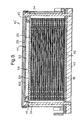
- a prior art fuel cell assembly 10 includes a fuel cell stack 12 comprising a plurality of individual fuel cell modules 14.
- a supporting structure or load frame 16 comprising a base plate 18; a spring holder 20 for transferring spring force to stack 12; a mechanical spring 22 having first and second leaves 24; and a spring retaining plate 26 providing a mechanical stop for spring 20.
- a current collector 28, power lead 30, and housing 32 is also shown in FIG. 1 .
- Bolts 34 extend through ears 36 on retaining plate 26 and through bores 38 in base plate 18 and are threadedly received in supply and exhaust manifold 40.
- the fuel cell stack, spring, and base plate are thus sandwiched between the retaining plate and the manifold. Tension on the bolts serves to provide compression of the stack, spring, and base plate.
- Passageways 39 formed by aligned apertures in supply and exhaust manifold 40, gasket element 42, base plate 18 and stack 12 serve to carry oxygen or hydrogen to active surfaces of fuel cell modules 14 as known in the art.
- the purpose of spring 20 is to keep the bolts under tension, and thus the stack under compression, at all conditions.
- Modules 14 are sealed to each other and to current collector 28 by thin glass seals (not visible in FIG. 1).
- Base plate 18 is sealed to manifold 40 by gasket element 42. For these seals to remain intact at all conditions, and for the integrity of the passageways to be retained, the assembly must be maintained in compression, by maintaining tension on bolts 34.
- Mechanical spring 22 is disposed between spring holder 20 and retaining plate 26. Deflection of leaves 24 is intended to provide a continuous compressive load despite differences in thermal growth between stack 12 and load frame 16.
- the entire assembly is held in a jig at predetermined elevated temperature and pressure for a predetermined time to sinter the various seals, and then the bolts are torqued by a predetermined amount to establish the preload on the spring and assembly.
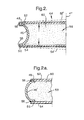
- Gas spring 44 comprises a closed frame element 46 having axis 47 and preferably is formed in a trough shape to resist radial deformation under load.
- Frame element 46,46' may be concave inwards as shown in FIG.2 or outwards as shown in FIG.2a to equal effect.
- Frame element 46,46' includes first and second axial surfaces 48,50 to which first and second membranes 52,54, respectively, are continuously attached as by laser welding 56 to form a flattened pillow enclosing a chamber 58.
- membranes 52,54 are formed of a flexible high-temperature metal alloy, for example, Haynes 160, 214, 230, 825, or 901; a Hastelloy; or Inconel DS, 625, or 718.
- membranes 52,54 are between about 0.005 inch and 0.010 inch in thickness.
- Chamber 58 is filled with a gas 60, preferably air, which may be installed in known fashion at any desired pressure above or below atmospheric for any specific application; one atmosphere is currently preferred for fuel cell uses.
- the operative principle of the invention is the use of a captive gas volume to maintain seal compression over a range of temperatures.
- a volume of gas in accordance with the invention may be captured in a wide variety of structures, all of which are comprehended by the invention.
- a separate gas spring structure 44 may be omitted and a chamber 58' created simply by flexibly sealing the space between spring holder 20 and spring retaining plate 26.
- a corrugated, flexible membrane 62 is attached continuously along a first edge 64 to spring holder 20 and along a second edge 66 to spring retaining plate 26 of the fuel cell stack.
- a simplified gas spring 44' in accordance with the invention may be formed for use in some applications by omitting frame element 46 from spring 44 and directly sealing membrane 52 to membrane 54 as by laser welds 56 to form a gas-filled pillow.
- a combined mechanical - gas spring 44" in accordance with the invention may be formed using mechanical spring 57 enclosed in two-part membrane spring of the type shown in FIG. 2b.
- mechanical spring 57 enclosed in two-part membrane spring of the type shown in FIG. 2b.
- Optional stop element 59 attached, for example, to the inside surface of membranes 52,54 serves to prevent excessive inward travel of membranes 52,54 under low temperature conditions and over-deflection of spring 57 beyond its yield limit.
- FIG. 2c discloses a particular type of spring, any spring means that applies a compressive load to the stacks, used in conjunction with a gas spring, is comprehended by this invention.
- FIG. 2c discloses a two-part membrane gas spring used in conjunction with a mechanical spring, it is understood that a mechanical spring can be used in conjunction with any of gas spring embodiments shown in FIGS. 2a, 2b and 4, and be in accordance with this invention.
- FIG. 2c discloses the gas and mechanical springs to be functionally in parallel with each other and one set of stops operating for both springs, it is understood that the gas and mechanical springs can be functionally in series with each other, such as by incorporating the mechanical spring outside of chamber 58, and for each spring to have its own set of stops.
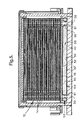
- FIG. 5 yet another embodiment of the current invention is shown wherein a gas spring such as, for example, one of the two part construction shown in FIG. 2b is positioned below the fuel cell stacks rather than above the fuel cell stacks, replacing gasket element 42. In this position, the gas spring provides compensation for both a loss of compression and lateral shear caused by the differing thermal growth of materials.
- a gas spring such as, for example, one of the two part construction shown in FIG. 2b is positioned below the fuel cell stacks rather than above the fuel cell stacks, replacing gasket element 42. In this position, the gas spring provides compensation for both a loss of compression and lateral shear caused by the differing thermal growth of materials.
- membrane 52 is first sealably joined to membrane 54, such as by laser welding 56.
- Chamber 58 formed therebetween is filled with gas 60, preferably air, to form a gas spring 144.
- Apertures 61, formed in edge regions of gas spring 144 align with similarly shaped apertures in supply and exhaust manifold 40, base plate 18, and stack 12, and provide passageways 39 for carrying oxygen and hydrogen to fuel modules 14.
- gas spring 144 serves both to add compressive force to the stack and to seal around oxygen or hydrogen passageways 39.
Landscapes
- Engineering & Computer Science (AREA)
- Life Sciences & Earth Sciences (AREA)
- Manufacturing & Machinery (AREA)
- Sustainable Development (AREA)
- Sustainable Energy (AREA)
- Chemical & Material Sciences (AREA)
- Chemical Kinetics & Catalysis (AREA)
- Electrochemistry (AREA)
- General Chemical & Material Sciences (AREA)
- General Engineering & Computer Science (AREA)
- Mechanical Engineering (AREA)
- Fuel Cell (AREA)
Abstract
Description
Claims (15)
- A gas spring having a spring force variable with temperature, comprising:a) a first membrane;b) a second membrane;c) means for sealing edges of said first and second membranes to define a closed chamber therebetween; andd) an amount of gas disposed within said chamber.
- A gas spring in accordance with Claim 1 wherein said means for sealing includes direct sealing of said first membrane to said second membrane to form a gas-filled pillow.
- A gas spring in accordance with Claim 1 wherein said means for sealing includes a rigid frame element disposed between said first and second membranes.
- A gas spring in accordance with Claim 3 wherein said frame element has a trough-shaped cross section.
- A gas spring in accordance with Claim 4 wherein said trough shape is concave radially outwards.
- A gas spring in accordance with Claim 4 wherein said trough shape is concave radially inwards.
- A gas spring in accordance with Claim 1, further including a mechanical spring.
- A gas spring in accordance with claim 7, wherein at least one of said gas spring and said mechanical spring includes a stop element.
- A gas spring in accordance with Claim 1, further including a mechanical spring disposed inside said chamber for applying a load against one of said first membrane and said second membrane.
- A fuel cell assembly, comprising:a) at least one fuel cell stack, said stack including a plurality of individual fuel cell modular elements;b) a supporting structure surrounding said fuel cell stack; andc) a gas spring disposed within said supporting structure for providing a compressive force against said fuel cell stack and said supporting structure.
- A fuel cell assembly in accordance with Claim 10 wherein said gas spring includes at least one flexible membrane and at least one gas-filled chamber.
- A fuel cell assembly in accordance with Claim 11 wherein said chamber is closed by said membrane.
- A fuel cell assembly in accordance with Claim 11 wherein said membrane is formed as a corrugated member.
- A fuel cell assembly in accordance with Claim 10 wherein at least one of said fuel cell modular elements is a solid-oxide fuel cell.
- A fuel cell assembly in accordance with Claim 10 further comprising a manifold for supplying a gas to said plurality of individual fuel cell modular elements wherein said gas spring is disposed between said manifold and said at least one fuel cell stack.
Applications Claiming Priority (4)
| Application Number | Priority Date | Filing Date | Title |
|---|---|---|---|
| US39102802P | 2002-06-24 | 2002-06-24 | |
| US391028P | 2002-06-24 | ||
| US10/388,129 US20030235723A1 (en) | 2002-06-24 | 2003-03-13 | Passive gas spring for solid-oxide fuel cell stack loading |
| US388129 | 2003-03-13 |
Publications (2)
| Publication Number | Publication Date |
|---|---|
| EP1416569A2 true EP1416569A2 (en) | 2004-05-06 |
| EP1416569A3 EP1416569A3 (en) | 2004-07-14 |
Family
ID=29739992
Family Applications (1)
| Application Number | Title | Priority Date | Filing Date |
|---|---|---|---|
| EP03076660A Withdrawn EP1416569A3 (en) | 2002-06-24 | 2003-05-28 | Passive gas spring for solid-oxide fuell cell stack loading |
Country Status (2)
| Country | Link |
|---|---|
| US (1) | US20030235723A1 (en) |
| EP (1) | EP1416569A3 (en) |
Cited By (4)
| Publication number | Priority date | Publication date | Assignee | Title |
|---|---|---|---|---|
| WO2006075050A1 (en) * | 2005-01-13 | 2006-07-20 | Wärtsilä Finland Oy | Arrangement for compressing fuel cells in a fuel cell stack |
| CN101994833A (en) * | 2009-08-25 | 2011-03-30 | 哈米尔顿森德斯特兰德公司 | Laminate assembly sealing method and arrangement |
| EP2330674A4 (en) * | 2008-10-02 | 2013-11-27 | Ngk Spark Plug Co | Solid oxide fuel battery |
| DE102016115828A1 (en) * | 2016-08-25 | 2018-03-01 | Audi Ag | Cell arrangement, in particular for a fuel cell or battery |
Families Citing this family (10)
| Publication number | Priority date | Publication date | Assignee | Title |
|---|---|---|---|---|
| US6797425B2 (en) * | 2002-12-24 | 2004-09-28 | Fuelcell Energy, Inc. | Fuel cell stack compressive loading system |
| US20040265659A1 (en) * | 2003-06-26 | 2004-12-30 | Richardson Curtis A. | Pressure control system for fuel cell gas spring |
| US7879503B2 (en) * | 2005-08-19 | 2011-02-01 | GM Global Technology Operations LLC | Fuel cell stack including bypass |
| US9153834B2 (en) | 2011-11-21 | 2015-10-06 | Delphi Technologies, Inc. | Fuel cell stack assembly with pressure balanced load mechanism |
| JP6025691B2 (en) * | 2013-11-05 | 2016-11-16 | 本田技研工業株式会社 | Differential pressure type high pressure water electrolyzer |
| GB2530022A (en) * | 2014-09-02 | 2016-03-16 | Intelligent Energy Ltd | Fuel cell compression |
| JP7423381B2 (en) * | 2020-03-27 | 2024-01-29 | 大阪瓦斯株式会社 | Electrochemical modules, electrochemical devices and energy systems |
| CN114566689B (en) * | 2022-02-10 | 2024-01-19 | 浙江氢邦科技有限公司 | Flat tube type cell stack air cavity packaging tool and cell stack air cavity packaging method thereof |
| FR3144426B1 (en) * | 2022-12-22 | 2025-12-19 | Genvia | SELF-CLAMPING SYSTEM FOR SOLID OXIDE STACK |
| EP4621892A1 (en) | 2024-03-21 | 2025-09-24 | SolydEra SA | A stack assembly with a load applying mechanism |
Family Cites Families (26)
| Publication number | Priority date | Publication date | Assignee | Title |
|---|---|---|---|---|
| GB915053A (en) * | 1958-05-03 | 1963-01-09 | Ridley Ind Ltd | Cushioning device |
| US2969974A (en) * | 1958-11-19 | 1961-01-31 | Universal Air Lift Inc | Spring booster device |
| DE1246013B (en) * | 1960-08-17 | 1967-08-03 | Maschf Augsburg Nuernberg Ag | Gas spring with small spring travel, especially for rail vehicles |
| US3599955A (en) * | 1969-10-08 | 1971-08-17 | Gen Motors Corp | Nested composite spring assembly with multiple auxiliary spring units |
| US3727899A (en) * | 1971-04-07 | 1973-04-17 | Air Lift Co | Spring suspension unit particularly for vehicle suspension systems |
| FR2224206A1 (en) * | 1973-04-06 | 1974-10-31 | Alsthom Cgee | Internally pressurised bellows arrangement - acting as electrode separator in electrochemical systems |
| DE2525333A1 (en) * | 1975-06-06 | 1976-12-16 | Arpad Dipl Ing Dr Bardocz | Damped and resilient vibration isolator - has metallic spring in pliable air bellows with opening to atmosphere in end cap |
| JPS5854246A (en) * | 1981-09-24 | 1983-03-31 | Junichi Isoda | Shock absorber |
| JPS59215676A (en) * | 1983-05-24 | 1984-12-05 | Hokuriku Electric Power Co Inc:The | Cell laminated body clamping device of fuel cell |
| US4604331A (en) * | 1984-05-29 | 1986-08-05 | The United States Of America As Represented By The United States Department Of Energy | Fuel cell separator plate with bellows-type sealing flanges |
| US4973531A (en) * | 1988-02-19 | 1990-11-27 | Ishikawajima-Harima Heavy Industries Co., Ltd. | Arrangement for tightening stack of fuel cell elements |
| DE3913912A1 (en) * | 1989-04-27 | 1990-10-31 | Karl Dr Ing Bittel | Hydraulic single pipe gas pressure shock absorber - has pressure slide valve piece, with packing cones, and piston with hole and choke and compression spring |
| US5185220A (en) * | 1991-10-25 | 1993-02-09 | M-C Power Corporation | Fuel cell clamping force equalizer |
| US5736269A (en) * | 1992-06-18 | 1998-04-07 | Honda Giken Kogyo Kabushiki Kaisha | Fuel cell stack and method of pressing together the same |
| DE4336850A1 (en) * | 1993-10-28 | 1995-05-04 | Solentec Ges Fuer Solare Und E | Method and device for compressing a stack of high-temperature fuel cells |
| US5532073A (en) * | 1993-11-29 | 1996-07-02 | Kabushiki Kaisha Toshiba | Fuel cell |
| US5441825A (en) * | 1994-01-24 | 1995-08-15 | Westinghouse Electric Corporation | Battery electrode compression mechanism |
| JPH07335243A (en) * | 1994-06-06 | 1995-12-22 | Toyota Motor Corp | Fuel cell |
| JPH09139225A (en) * | 1995-11-13 | 1997-05-27 | Toshiba Corp | Fuel cell tightening device |
| WO1997048921A1 (en) * | 1996-06-19 | 1997-12-24 | Howell William B | Pneumatic spring and method of manufacture |
| US5789091C1 (en) * | 1996-11-19 | 2001-02-27 | Ballard Power Systems | Electrochemical fuel cell stack with compression bands |
| DE19852363C1 (en) * | 1998-11-13 | 2000-05-18 | Mtu Friedrichshafen Gmbh | Fuel cell assembly has a two-phase pressure compensation system for maintaining a fuel cell stack under a constant predetermined pressure |
| US6200698B1 (en) * | 1999-08-11 | 2001-03-13 | Plug Power Inc. | End plate assembly having a two-phase fluid-filled bladder and method for compressing a fuel cell stack |
| DE20010282U1 (en) * | 2000-06-08 | 2000-08-31 | Arturo Salice S.P.A., Novedrate, Como | Device for damping impacts, preferably the impacts of furniture doors or drawers |
| US6332602B1 (en) * | 2001-03-30 | 2001-12-25 | Yuzuru Oishi | Vehicle suspension having annular air chamber |
| US7037618B2 (en) * | 2002-06-05 | 2006-05-02 | Lynntech, Inc. | Apparatus and method for compressing a stack of electrochemical cells |
-
2003
- 2003-03-13 US US10/388,129 patent/US20030235723A1/en not_active Abandoned
- 2003-05-28 EP EP03076660A patent/EP1416569A3/en not_active Withdrawn
Cited By (5)
| Publication number | Priority date | Publication date | Assignee | Title |
|---|---|---|---|---|
| WO2006075050A1 (en) * | 2005-01-13 | 2006-07-20 | Wärtsilä Finland Oy | Arrangement for compressing fuel cells in a fuel cell stack |
| EP2330674A4 (en) * | 2008-10-02 | 2013-11-27 | Ngk Spark Plug Co | Solid oxide fuel battery |
| US9123936B2 (en) | 2008-10-02 | 2015-09-01 | Ngk Spark Plug Co., Ltd. | Solid oxide fuel cell apparatus |
| CN101994833A (en) * | 2009-08-25 | 2011-03-30 | 哈米尔顿森德斯特兰德公司 | Laminate assembly sealing method and arrangement |
| DE102016115828A1 (en) * | 2016-08-25 | 2018-03-01 | Audi Ag | Cell arrangement, in particular for a fuel cell or battery |
Also Published As
| Publication number | Publication date |
|---|---|
| US20030235723A1 (en) | 2003-12-25 |
| EP1416569A3 (en) | 2004-07-14 |
Similar Documents
| Publication | Publication Date | Title |
|---|---|---|
| US7270906B2 (en) | Solid-oxide fuel cell module for a fuel cell stack | |
| US4345009A (en) | Fuel cell stack compressive loading system | |
| US6838202B2 (en) | Fuel cell bipolar plate having a conductive foam as a coolant layer | |
| US4839247A (en) | Static regenerative fuel cell system for use in space | |
| EP1879251B1 (en) | Compression assembly, solid oxide fuel cell stack, a process for compression of the solid oxide fuel cell stack and its use | |
| US20030235723A1 (en) | Passive gas spring for solid-oxide fuel cell stack loading | |
| US20070248855A1 (en) | Fuel-Cell Stack Comprising a Tensioning Device | |
| CA2690185A1 (en) | Fuel cell | |
| US20010008722A1 (en) | Integral screen/frame assembly for an electrochemical cell | |
| US7001685B2 (en) | Fuel cell stack assembly load frame with compression spring | |
| US20090114531A1 (en) | Electrochemical Cell Stack | |
| US11394039B2 (en) | Electro-chemical reaction unit having glass seal member composed of vertically long crystal grains, and electro-chemical reaction cell stack, and electro-chemical reaction unit production method comprising same | |
| US10476087B2 (en) | Fuel-cell power generation unit and fuel-cell stack | |
| US20040265659A1 (en) | Pressure control system for fuel cell gas spring | |
| US7402357B2 (en) | Gas-filled gasket for a solid-oxide fuel cell assembly | |
| KR20010060112A (en) | Polymer electrolyte fuel cell | |
| JP2019003795A (en) | Electrochemical reaction unit and electrochemical reaction cell stack | |
| US10665872B2 (en) | Fuel cell stack and method for manufacturing fuel cell stack | |
| US20250046847A1 (en) | Solid oxide electrochemical cell stack | |
| US20230282865A1 (en) | Fuel Cell Heat Treatment Method and Apparatus | |
| US20240194924A1 (en) | Fuel cell stack | |
| AU2011376555A1 (en) | Fuel cell stack with thin endplate with integrated gas distribution tubes | |
| JP2000067900A (en) | Polymer electrolyte fuel cell | |
| HK1124174B (en) | Compression assembly, solid oxide fuel cell stack, process for compression, and its use |
Legal Events
| Date | Code | Title | Description |
|---|---|---|---|
| PUAI | Public reference made under article 153(3) epc to a published international application that has entered the european phase |
Free format text: ORIGINAL CODE: 0009012 |
|
| AK | Designated contracting states |
Kind code of ref document: A2 Designated state(s): AT BE BG CH CY CZ DE DK EE ES FI FR GB GR HU IE IT LI LU MC NL PT RO SE SI SK TR |
|
| AX | Request for extension of the european patent |
Extension state: AL LT LV MK |
|
| PUAL | Search report despatched |
Free format text: ORIGINAL CODE: 0009013 |
|
| AK | Designated contracting states |
Kind code of ref document: A3 Designated state(s): AT BE BG CH CY CZ DE DK EE ES FI FR GB GR HU IE IT LI LU MC NL PT RO SE SI SK TR |
|
| AX | Request for extension of the european patent |
Extension state: AL LT LV MK |
|
| 17P | Request for examination filed |
Effective date: 20050114 |
|
| AKX | Designation fees paid |
Designated state(s): DE FR GB |
|
| STAA | Information on the status of an ep patent application or granted ep patent |
Free format text: STATUS: THE APPLICATION IS DEEMED TO BE WITHDRAWN |
|
| 18D | Application deemed to be withdrawn |
Effective date: 20060621 |