EP1414091A2 - Fuel cell system and related control method - Google Patents
Fuel cell system and related control method Download PDFInfo
- Publication number
- EP1414091A2 EP1414091A2 EP03023910A EP03023910A EP1414091A2 EP 1414091 A2 EP1414091 A2 EP 1414091A2 EP 03023910 A EP03023910 A EP 03023910A EP 03023910 A EP03023910 A EP 03023910A EP 1414091 A2 EP1414091 A2 EP 1414091A2
- Authority
- EP
- European Patent Office
- Prior art keywords
- electric power
- fuel cell
- cell stack
- level
- supplied
- Prior art date
- Legal status (The legal status is an assumption and is not a legal conclusion. Google has not performed a legal analysis and makes no representation as to the accuracy of the status listed.)
- Granted
Links
Images




Classifications
-
- H—ELECTRICITY
- H01—ELECTRIC ELEMENTS
- H01M—PROCESSES OR MEANS, e.g. BATTERIES, FOR THE DIRECT CONVERSION OF CHEMICAL ENERGY INTO ELECTRICAL ENERGY
- H01M8/00—Fuel cells; Manufacture thereof
- H01M8/04—Auxiliary arrangements, e.g. for control of pressure or for circulation of fluids
- H01M8/04298—Processes for controlling fuel cells or fuel cell systems
- H01M8/04313—Processes for controlling fuel cells or fuel cell systems characterised by the detection or assessment of variables; characterised by the detection or assessment of failure or abnormal function
- H01M8/04537—Electric variables
- H01M8/04544—Voltage
- H01M8/04559—Voltage of fuel cell stacks
-
- B—PERFORMING OPERATIONS; TRANSPORTING
- B60—VEHICLES IN GENERAL
- B60L—PROPULSION OF ELECTRICALLY-PROPELLED VEHICLES; SUPPLYING ELECTRIC POWER FOR AUXILIARY EQUIPMENT OF ELECTRICALLY-PROPELLED VEHICLES; ELECTRODYNAMIC BRAKE SYSTEMS FOR VEHICLES IN GENERAL; MAGNETIC SUSPENSION OR LEVITATION FOR VEHICLES; MONITORING OPERATING VARIABLES OF ELECTRICALLY-PROPELLED VEHICLES; ELECTRIC SAFETY DEVICES FOR ELECTRICALLY-PROPELLED VEHICLES
- B60L58/00—Methods or circuit arrangements for monitoring or controlling batteries or fuel cells, specially adapted for electric vehicles
- B60L58/30—Methods or circuit arrangements for monitoring or controlling batteries or fuel cells, specially adapted for electric vehicles for monitoring or controlling fuel cells
- B60L58/31—Methods or circuit arrangements for monitoring or controlling batteries or fuel cells, specially adapted for electric vehicles for monitoring or controlling fuel cells for starting of fuel cells
-
- B—PERFORMING OPERATIONS; TRANSPORTING
- B60—VEHICLES IN GENERAL
- B60L—PROPULSION OF ELECTRICALLY-PROPELLED VEHICLES; SUPPLYING ELECTRIC POWER FOR AUXILIARY EQUIPMENT OF ELECTRICALLY-PROPELLED VEHICLES; ELECTRODYNAMIC BRAKE SYSTEMS FOR VEHICLES IN GENERAL; MAGNETIC SUSPENSION OR LEVITATION FOR VEHICLES; MONITORING OPERATING VARIABLES OF ELECTRICALLY-PROPELLED VEHICLES; ELECTRIC SAFETY DEVICES FOR ELECTRICALLY-PROPELLED VEHICLES
- B60L58/00—Methods or circuit arrangements for monitoring or controlling batteries or fuel cells, specially adapted for electric vehicles
- B60L58/30—Methods or circuit arrangements for monitoring or controlling batteries or fuel cells, specially adapted for electric vehicles for monitoring or controlling fuel cells
- B60L58/32—Methods or circuit arrangements for monitoring or controlling batteries or fuel cells, specially adapted for electric vehicles for monitoring or controlling fuel cells for controlling the temperature of fuel cells, e.g. by controlling the electric load
- B60L58/33—Methods or circuit arrangements for monitoring or controlling batteries or fuel cells, specially adapted for electric vehicles for monitoring or controlling fuel cells for controlling the temperature of fuel cells, e.g. by controlling the electric load by cooling
-
- B—PERFORMING OPERATIONS; TRANSPORTING
- B60—VEHICLES IN GENERAL
- B60L—PROPULSION OF ELECTRICALLY-PROPELLED VEHICLES; SUPPLYING ELECTRIC POWER FOR AUXILIARY EQUIPMENT OF ELECTRICALLY-PROPELLED VEHICLES; ELECTRODYNAMIC BRAKE SYSTEMS FOR VEHICLES IN GENERAL; MAGNETIC SUSPENSION OR LEVITATION FOR VEHICLES; MONITORING OPERATING VARIABLES OF ELECTRICALLY-PROPELLED VEHICLES; ELECTRIC SAFETY DEVICES FOR ELECTRICALLY-PROPELLED VEHICLES
- B60L58/00—Methods or circuit arrangements for monitoring or controlling batteries or fuel cells, specially adapted for electric vehicles
- B60L58/30—Methods or circuit arrangements for monitoring or controlling batteries or fuel cells, specially adapted for electric vehicles for monitoring or controlling fuel cells
- B60L58/32—Methods or circuit arrangements for monitoring or controlling batteries or fuel cells, specially adapted for electric vehicles for monitoring or controlling fuel cells for controlling the temperature of fuel cells, e.g. by controlling the electric load
- B60L58/34—Methods or circuit arrangements for monitoring or controlling batteries or fuel cells, specially adapted for electric vehicles for monitoring or controlling fuel cells for controlling the temperature of fuel cells, e.g. by controlling the electric load by heating
-
- H—ELECTRICITY
- H01—ELECTRIC ELEMENTS
- H01M—PROCESSES OR MEANS, e.g. BATTERIES, FOR THE DIRECT CONVERSION OF CHEMICAL ENERGY INTO ELECTRICAL ENERGY
- H01M8/00—Fuel cells; Manufacture thereof
- H01M8/04—Auxiliary arrangements, e.g. for control of pressure or for circulation of fluids
- H01M8/04223—Auxiliary arrangements, e.g. for control of pressure or for circulation of fluids during start-up or shut-down; Depolarisation or activation, e.g. purging; Means for short-circuiting defective fuel cells
- H01M8/04268—Heating of fuel cells during the start-up of the fuel cells
-
- H—ELECTRICITY
- H01—ELECTRIC ELEMENTS
- H01M—PROCESSES OR MEANS, e.g. BATTERIES, FOR THE DIRECT CONVERSION OF CHEMICAL ENERGY INTO ELECTRICAL ENERGY
- H01M8/00—Fuel cells; Manufacture thereof
- H01M8/04—Auxiliary arrangements, e.g. for control of pressure or for circulation of fluids
- H01M8/04298—Processes for controlling fuel cells or fuel cell systems
-
- H—ELECTRICITY
- H01—ELECTRIC ELEMENTS
- H01M—PROCESSES OR MEANS, e.g. BATTERIES, FOR THE DIRECT CONVERSION OF CHEMICAL ENERGY INTO ELECTRICAL ENERGY
- H01M8/00—Fuel cells; Manufacture thereof
- H01M8/04—Auxiliary arrangements, e.g. for control of pressure or for circulation of fluids
- H01M8/04298—Processes for controlling fuel cells or fuel cell systems
- H01M8/04313—Processes for controlling fuel cells or fuel cell systems characterised by the detection or assessment of variables; characterised by the detection or assessment of failure or abnormal function
- H01M8/0432—Temperature; Ambient temperature
- H01M8/04328—Temperature; Ambient temperature of anode reactants at the inlet or inside the fuel cell
-
- H—ELECTRICITY
- H01—ELECTRIC ELEMENTS
- H01M—PROCESSES OR MEANS, e.g. BATTERIES, FOR THE DIRECT CONVERSION OF CHEMICAL ENERGY INTO ELECTRICAL ENERGY
- H01M8/00—Fuel cells; Manufacture thereof
- H01M8/04—Auxiliary arrangements, e.g. for control of pressure or for circulation of fluids
- H01M8/04298—Processes for controlling fuel cells or fuel cell systems
- H01M8/04313—Processes for controlling fuel cells or fuel cell systems characterised by the detection or assessment of variables; characterised by the detection or assessment of failure or abnormal function
- H01M8/0432—Temperature; Ambient temperature
- H01M8/04358—Temperature; Ambient temperature of the coolant
-
- H—ELECTRICITY
- H01—ELECTRIC ELEMENTS
- H01M—PROCESSES OR MEANS, e.g. BATTERIES, FOR THE DIRECT CONVERSION OF CHEMICAL ENERGY INTO ELECTRICAL ENERGY
- H01M8/00—Fuel cells; Manufacture thereof
- H01M8/04—Auxiliary arrangements, e.g. for control of pressure or for circulation of fluids
- H01M8/04298—Processes for controlling fuel cells or fuel cell systems
- H01M8/04313—Processes for controlling fuel cells or fuel cell systems characterised by the detection or assessment of variables; characterised by the detection or assessment of failure or abnormal function
- H01M8/0438—Pressure; Ambient pressure; Flow
- H01M8/04388—Pressure; Ambient pressure; Flow of anode reactants at the inlet or inside the fuel cell
-
- H—ELECTRICITY
- H01—ELECTRIC ELEMENTS
- H01M—PROCESSES OR MEANS, e.g. BATTERIES, FOR THE DIRECT CONVERSION OF CHEMICAL ENERGY INTO ELECTRICAL ENERGY
- H01M8/00—Fuel cells; Manufacture thereof
- H01M8/04—Auxiliary arrangements, e.g. for control of pressure or for circulation of fluids
- H01M8/04298—Processes for controlling fuel cells or fuel cell systems
- H01M8/04313—Processes for controlling fuel cells or fuel cell systems characterised by the detection or assessment of variables; characterised by the detection or assessment of failure or abnormal function
- H01M8/0438—Pressure; Ambient pressure; Flow
- H01M8/04395—Pressure; Ambient pressure; Flow of cathode reactants at the inlet or inside the fuel cell
-
- H—ELECTRICITY
- H01—ELECTRIC ELEMENTS
- H01M—PROCESSES OR MEANS, e.g. BATTERIES, FOR THE DIRECT CONVERSION OF CHEMICAL ENERGY INTO ELECTRICAL ENERGY
- H01M8/00—Fuel cells; Manufacture thereof
- H01M8/04—Auxiliary arrangements, e.g. for control of pressure or for circulation of fluids
- H01M8/04298—Processes for controlling fuel cells or fuel cell systems
- H01M8/04313—Processes for controlling fuel cells or fuel cell systems characterised by the detection or assessment of variables; characterised by the detection or assessment of failure or abnormal function
- H01M8/04537—Electric variables
- H01M8/04574—Current
- H01M8/04589—Current of fuel cell stacks
-
- H—ELECTRICITY
- H01—ELECTRIC ELEMENTS
- H01M—PROCESSES OR MEANS, e.g. BATTERIES, FOR THE DIRECT CONVERSION OF CHEMICAL ENERGY INTO ELECTRICAL ENERGY
- H01M8/00—Fuel cells; Manufacture thereof
- H01M8/04—Auxiliary arrangements, e.g. for control of pressure or for circulation of fluids
- H01M8/04298—Processes for controlling fuel cells or fuel cell systems
- H01M8/04694—Processes for controlling fuel cells or fuel cell systems characterised by variables to be controlled
- H01M8/04858—Electric variables
- H01M8/04925—Power, energy, capacity or load
- H01M8/0494—Power, energy, capacity or load of fuel cell stacks
-
- H—ELECTRICITY
- H01—ELECTRIC ELEMENTS
- H01M—PROCESSES OR MEANS, e.g. BATTERIES, FOR THE DIRECT CONVERSION OF CHEMICAL ENERGY INTO ELECTRICAL ENERGY
- H01M8/00—Fuel cells; Manufacture thereof
- H01M8/04—Auxiliary arrangements, e.g. for control of pressure or for circulation of fluids
- H01M8/04298—Processes for controlling fuel cells or fuel cell systems
- H01M8/04694—Processes for controlling fuel cells or fuel cell systems characterised by variables to be controlled
- H01M8/04955—Shut-off or shut-down of fuel cells
-
- B—PERFORMING OPERATIONS; TRANSPORTING
- B60—VEHICLES IN GENERAL
- B60L—PROPULSION OF ELECTRICALLY-PROPELLED VEHICLES; SUPPLYING ELECTRIC POWER FOR AUXILIARY EQUIPMENT OF ELECTRICALLY-PROPELLED VEHICLES; ELECTRODYNAMIC BRAKE SYSTEMS FOR VEHICLES IN GENERAL; MAGNETIC SUSPENSION OR LEVITATION FOR VEHICLES; MONITORING OPERATING VARIABLES OF ELECTRICALLY-PROPELLED VEHICLES; ELECTRIC SAFETY DEVICES FOR ELECTRICALLY-PROPELLED VEHICLES
- B60L2210/00—Converter types
- B60L2210/10—DC to DC converters
-
- H—ELECTRICITY
- H01—ELECTRIC ELEMENTS
- H01M—PROCESSES OR MEANS, e.g. BATTERIES, FOR THE DIRECT CONVERSION OF CHEMICAL ENERGY INTO ELECTRICAL ENERGY
- H01M8/00—Fuel cells; Manufacture thereof
- H01M8/10—Fuel cells with solid electrolytes
- H01M2008/1095—Fuel cells with polymeric electrolytes
-
- H—ELECTRICITY
- H01—ELECTRIC ELEMENTS
- H01M—PROCESSES OR MEANS, e.g. BATTERIES, FOR THE DIRECT CONVERSION OF CHEMICAL ENERGY INTO ELECTRICAL ENERGY
- H01M2250/00—Fuel cells for particular applications; Specific features of fuel cell system
- H01M2250/20—Fuel cells in motive systems, e.g. vehicle, ship, plane
-
- H—ELECTRICITY
- H01—ELECTRIC ELEMENTS
- H01M—PROCESSES OR MEANS, e.g. BATTERIES, FOR THE DIRECT CONVERSION OF CHEMICAL ENERGY INTO ELECTRICAL ENERGY
- H01M8/00—Fuel cells; Manufacture thereof
- H01M8/04—Auxiliary arrangements, e.g. for control of pressure or for circulation of fluids
- H01M8/04007—Auxiliary arrangements, e.g. for control of pressure or for circulation of fluids related to heat exchange
-
- Y—GENERAL TAGGING OF NEW TECHNOLOGICAL DEVELOPMENTS; GENERAL TAGGING OF CROSS-SECTIONAL TECHNOLOGIES SPANNING OVER SEVERAL SECTIONS OF THE IPC; TECHNICAL SUBJECTS COVERED BY FORMER USPC CROSS-REFERENCE ART COLLECTIONS [XRACs] AND DIGESTS
- Y02—TECHNOLOGIES OR APPLICATIONS FOR MITIGATION OR ADAPTATION AGAINST CLIMATE CHANGE
- Y02E—REDUCTION OF GREENHOUSE GAS [GHG] EMISSIONS, RELATED TO ENERGY GENERATION, TRANSMISSION OR DISTRIBUTION
- Y02E60/00—Enabling technologies; Technologies with a potential or indirect contribution to GHG emissions mitigation
- Y02E60/30—Hydrogen technology
- Y02E60/50—Fuel cells
-
- Y—GENERAL TAGGING OF NEW TECHNOLOGICAL DEVELOPMENTS; GENERAL TAGGING OF CROSS-SECTIONAL TECHNOLOGIES SPANNING OVER SEVERAL SECTIONS OF THE IPC; TECHNICAL SUBJECTS COVERED BY FORMER USPC CROSS-REFERENCE ART COLLECTIONS [XRACs] AND DIGESTS
- Y02—TECHNOLOGIES OR APPLICATIONS FOR MITIGATION OR ADAPTATION AGAINST CLIMATE CHANGE
- Y02T—CLIMATE CHANGE MITIGATION TECHNOLOGIES RELATED TO TRANSPORTATION
- Y02T10/00—Road transport of goods or passengers
- Y02T10/60—Other road transportation technologies with climate change mitigation effect
- Y02T10/72—Electric energy management in electromobility
-
- Y—GENERAL TAGGING OF NEW TECHNOLOGICAL DEVELOPMENTS; GENERAL TAGGING OF CROSS-SECTIONAL TECHNOLOGIES SPANNING OVER SEVERAL SECTIONS OF THE IPC; TECHNICAL SUBJECTS COVERED BY FORMER USPC CROSS-REFERENCE ART COLLECTIONS [XRACs] AND DIGESTS
- Y02—TECHNOLOGIES OR APPLICATIONS FOR MITIGATION OR ADAPTATION AGAINST CLIMATE CHANGE
- Y02T—CLIMATE CHANGE MITIGATION TECHNOLOGIES RELATED TO TRANSPORTATION
- Y02T90/00—Enabling technologies or technologies with a potential or indirect contribution to GHG emissions mitigation
- Y02T90/40—Application of hydrogen technology to transportation, e.g. using fuel cells
Definitions
- the present invention relates to a fuel cell system adapted to start up a fuel cell stack, mainly using an electric power charged in a secondary battery, which is installed on a fuel cell powered vehicle whereby, through the use of an electric power output generated by the fuel cell stack and the electric power charged in the secondary battery, auxiliary units associated with the fuel cell stack for electric power generation are driven while producing a vehicle drive torque output.
- an output voltage and an electric power output are arbitrarily controlled by a DC/DC converter.
- the DC/DC converter is configured such that, during start-up operation, the electric power available from the secondary battery is made to be sufficiently higher than the electric power generated by the fuel cell stack that is adequately warmed up to be available for obtaining a desired electric power output. And, an output voltage of the electric power generated by the fuel cell stack is clamped at an output voltage level of the DC/DC converter, thereby precluding the electric power of the fuel cell stack from exceeding a certain desired level.
- the above described fuel cell system takes the form of a structure wherein the electric power output to be supplied from the fuel cell stack to the load is managed merely in terms of the output voltage level of the DC/DC converter. For this reason, when fluctuation occurs in a characteristic of the fuel cell stack depending on temperatures, an electric current and voltage characteristic is apt to vary in a midcourse of warming up operation whereby even when the output voltage of the electric power generated by the fuel cell stack is clamped at the certain given level, a probability occurs where no desired voltage level is attained in the output of the fuel cell stack. Accordingly, with the above described fuel cell system, if the fuel cell stack is intended to operate in a certain range of an output in the midcourse of start-up operation, an issue arises in an inability of accurately managing the output of the fuel cell stack.
- the present invention has been completed with the above view in mind and has an object to provide a fuel cell system and a related control method which enable an electric power output to be taken out from a fuel cell stack in a stable fashion during start-up of the fuel cell stack.
- a fuel cell system comprising a fuel cell stack supplied with fuel gas and oxidant gas to generate an electric power which is supplied through a diode to a load installed on a fuel cell powered vehicle, a secondary battery by which an electric power is charged and discharged, an electric power converter connected to the fuel cell stack through the diode to convert an electric power level, charged in the secondary battery, and supplying a converted electric power to the load, and a controller operative to control the electric power converter in a way to allow a voltage level of the electric power, to be supplied from the secondary battery to the load, to lie at a value equal to or greater than an open voltage level of the fuel cell stack during start-up of the fuel cell stack, and to control the electric power converter in a way to allow an electric power level supplied to the load through the electric power converter to be detected for permitting the electric power to be supplied to the load from the secondary battery at an electric power level less than a detected electric power level.
- a method of controlling a fuel cell system which has a fuel cell stack supplied with fuel gas and oxidant gas to generate an electric power which is supplied through a diode to a load installed on a fuel cell powered vehicle, and a secondary battery by which an electric power is charged and discharged, the method comprising converting a level of an electric power of the secondary battery to supply the electric power from the secondary battery to the load at a converted electric power level, controlling such that, when starting up the fuel cell stack, a voltage level of the electric power to be supplied from the secondary battery to the load lies at a value equal to or greater than an open voltage level of the fuel cell stack, and controlling such that the level of the electric power supplied to the load is detected to permit the electric power to be supplied to the load from the secondary battery at an electric power level less than a detected electric power level.
- the present invention is applied to a fuel cell system of a first embodiment constructed as shown in Fig. 1.
- the fuel cell system is installed on an electric vehicle with a drive motor installed thereon as a load to receive an electric power output to provide a drive torque output for the electric vehicle.
- the fuel cell system includes a fuel cell stack 1 serving as a main power supply that is supplied with fuel gas and oxidant gas to generate the electric power output.
- the fuel cell stack 1 is comprised of a plurality of stacks of fuel cell structural bodies, that are sandwiched by separators, each of which includes an air electrode and a hydrogen electrode between which a solid polymer electrolyte membrane is sandwiched.
- the fuel electrode of the fuel cell stack 1 is supplied with hydrogen gas, as fuel gas, and the oxidizing electrode is supplied with air, involving oxygen as oxidant gas, to generate the electric power output.
- Fuel gas is supplied from a fuel gas supply section 2 to the fuel cell stack 1.
- the fuel gas supply section 2 stores fuel involving a large amount of hydrogen and, upon control through a controller section 21, the temperature and pressure of fuel gas are regulated.
- air is delivered under pressure by an air compressor 3 and is supplied to the fuel cell stack 1 through an air delivery pipe 4.
- a displacement stroke of the compressor 3 executed by the controller section 21, a flow rate of air to be supplied to the fuel cell stack 1 is controlled.
- a power conditioner section 5 serves to allow the electric power output generated by the fuel cell stack 1 to be delivered to a load 6, such as a drive motor, and the electric compressor 3. Also, the power conditioner section 5 serves to allow an electric power, charged in a secondary battery 7, to be delivered to the compressor 3 and the load 6 depending upon a control status of the controller section 21, while serving to allow a regenerative electric power resulting from the load 6 to be charged into the secondary battery 7 during deceleration of the electric vehicle.
- the secondary battery 7 is charged with the electric power, in excess thereof, resulting from the fuel cell stack 1 and the regenerative electric power resulting from the load 6 through the power conditioner section 5.
- the secondary battery 7 is so configured as to discharge the electric power, charged through control of the power conditioner section 5, at a higher voltage than that of the electric power output of the fuel cell stack 1.
- the power conditioner section 5 serves to permit the electric power, charged in the secondary battery 7, to be outputted for compensating inadequate electric power needed by the units of high power rate series.
- the power conditioner section 5 is comprised of a diode 11 adapted to avoid flow of electric current to the fuel cell stack 1, a voltmeter 12 that detects the output voltage of the fuel cell stack 1, a DC/DC converter 13 that converts a level of a DC power, and an ammeter 14 that detects electric current that flows to the air compressor 3 and the load 6 through the diode 11.
- the voltmeter 12 detects a voltage at an anode of the diode 11, i.e., a voltage level applied across the diode 11 and the fuel cell stack 1.
- the power conditioner section 5 is controlled by the controller section 21 such that, when permitting the electric power, charged in the secondary battery 7, to be supplied to the air compressor 3 and the load 6, the DC/DC converter 13 is operated so as to boost up the voltage level. Also, the power conditioner section 5 operates to allow the regenerative power resulting from the load 6 to be decreased to a voltage level, available to be charged to the secondary battery 7, whereupon the regenerative power is supplied to the secondary battery 7. Moreover, the voltage level detected by the voltmeter 12 and the current level detected by the ammeter 14 of the power conditioner section 5 is read in the controller section 21.
- a relay 8 is disposed between the power conditioner section 5, and the air compressor 3 and the load 6.
- the relay 8 is comprised of a suitable switch and is controlled to be turned on or turned off by the controller section 21 in a way to allow the electric power generated by the fuel cell stack 1 and the electric power, charged in the secondary battery 7, to be supplied to the air compressor 3 and the load 6 while permitting the regenerative power resulting from the load 6 to be delivered to the power conditioner section 5.
- the relay 8 functions as a power shut-off section of the fuel cell stack 1 and the secondary battery 7 with respect to the air compressor 3 and the load 6 and operates to shut off the supply of the electric power in a urgent status.
- the controller section 21 is comprised of a ROM (Read On Memory) that internally stores therein a start-up control program, and a RAM (Random Access Memory) that provides a work area during control to execute the start-up control program for controlling various parts set forth above during a start-up mode.
- ROM Read On Memory
- RAM Random Access Memory
- the controller section 21 operates to recognize operating statuses of the fuel gas supply section 2, the air compressor 3, the load 6 and the relay 8 for thereby controlling operations of these various parts.
- controller section 21 is operative to controllably shift the DC/DC converter 13 depending on the output voltage of the fuel cell stack 1 and a charged status of the secondary battery 7 in such a way to allow boost-up operation to be achieved for boosting up the output voltage resulting from the secondary battery 7 to permit the electric power to be supplied to the load 6 and the air compressor 3, or to allow the output voltages resulting from the fuel cell stack 1, the load 6 and the air compressor 3 to be stepped down to a level to be supplied as the electric power to the secondary battery 7.
- controller section 21 is operative to execute the start-up control program when in start-up operation of the fuel cell stack 1, thereby permitting boosting-up operation and step-down operation of the DC/DC converter 13 to be controlled. Also, a detailed content of this start-up control operation is described below.
- step S1 When in start-up control operation, operation subsequent to step S1 is commenced when start-up operation of the fuel cell system is initiated by a driver of a fuel cell powered vehicle.
- the controller section 21 operates to set a control mode of the DC/DC converter 13 in a voltage control mode to allow the output voltage to be controlled for supply of the electric power to the air compressor 3 (step S1). This renders the controller section 21 operative to remain in a status available to arbitrarily control the voltage level (the output voltage level of the DC/DC converter 13) appearing at an output terminal of the DC/DC converter 13.
- the controller section 21 operates to set a target value of the output voltage of the DC/DC converter 13 to a voltage level Vx greater than the maximum value of an open voltage level of V0 of the fuel cell stack 1 as shown in Fig. 3 (step S2).
- the controller section 21 precludes the electric current not to flow from the fuel cell stack 1 to the air compressor 3.
- a voltage potential at a junction between a cathode of the diode 11 and the DC/DC converter 13 is selected to be greater than the maximum value of the open voltage level of the fuel cell stack 1. Also, since it is probable for the output voltage level of the DC/DC converter 13 to fluctuate depending upon the operating condition of the fuel cell stack 1, the output voltage level of the DC/DC converter 13 may be settled to a value slightly higher than the open voltage level of the fuel cell stack 1 in an actual practice. Moreover, the open voltage level V0 of the fuel cell stack 1 is preliminarily obtained through experimental teats, and use is made of a value that is retained in the controller section 21.
- step S2 also, the controller section 21 begins to operate the fuel gas supply section 2 using the electric power delivered from the secondary battery 7. This allows the controller section 21 to render the fuel cell stack 1 to remain in a status operative for electric power generation.
- step S2 when the charged state of the secondary battery 7 is detected prior to execution of operation in step S2, if discrimination is made that no an ability exists in discharging the electric power at a rate greater than a certain given level, the controller section 21 operates to interrupt start-up operation of the fuel cell system. This precludes the secondary battery 7 from being degraded.
- operation to discriminate the charged status of the secondary battery 7 may be performed not only one time prior to execution of step S2 but may be necessarily executed prior to execution of step S2.
- the controller section 21 discriminates to find whether the given time interval has elapsed (step S3). That is, the controller section 21 operates to control the air compressor 2 and the fuel gas supply section 2 in step S2 and discriminates to find whether the given time interval has elapsed after hydrogen gas and air has been supplied to the fuel cell stack 1 to commence start-up operation. By supplying hydrogen gas and air for the given time interval in such a way, the fuel cell system 1 operates to exhaust impurity gas from the fuel cell stack 1 while warming up the fuel cell stack 1.
- the controller section 21 operates to read the sensor signal from the voltmeter 12 to measure the open voltage level of the fuel cell stack 1 (step S4). And, the controller section 21 operates to allow the open voltage level of the fuel cell stack 1, which is measured, to be set to a targeted output voltage level of the DC/DC converter 13 (step S5).
- step S2 has operated to allow the open voltage level of the fuel cell stack 1, that is preliminarily predicted in step S2, to be set to the output voltage level that is targeted for the DC/DC converter 13, by executing operation in step S5 to allow an actual open voltage level of the fuel cell stack 1 to be set to the targeted output voltage level of the DC/DC converter 13 again, a control accuracy of subsequent operation is improved.
- step S6 the controller section 21 operates to detect the output voltage level and the output electric current level of the DC/DC converter 13 to detect an output power level of the DC/DC converter 13 (step S6).
- step S5 no electric power is outputted from the fuel cell stack 1, and a situation stands in which auxiliary electric power for the air compressor 3 necessary for start-up is supplied from the secondary battery 7.
- step S6 upon detection of the electric power level converted by the DC/DC converter 13, the controller section 21 operates to identify the electric power consumed by the auxiliary units as a result of consumption during start-up of the fuel cell system.
- the controller section 21 measures the output electric current level and the output voltage level flowing through the DC/DC converter 13 and multiplies these parameters. Also, the electric power consumed during start-up of the fuel cell system 1 is regarded to be substantially constant regardless of the status of the fuel cell stack 1, operation in step S5 is omitted, and a preliminarily determined electric power level may be used.
- the controller section 21 shifts the control mode of the DC/DC converter13 from the voltage control mode, set in step S1, to the electric power control mode in which the output power of the DC/DC converter 13 is controlled and supplied to the air compressor 3. Then, the target of the electric power level of the DC/DC converter 13 is set to be equal to the electric power level detected in step S6 (step S7). That is, due to an ability of the controller section 21 permitting the electric power, that is actually consumed, to be equal to the target level of the output power of the DC/DC converter 13, an auxiliary electric power is entirely supplied from the secondary battery 7.
- the fuel cell stack 1 is prevented from outputting the electric power generated by the fuel cell stack 1 and, at the same time, the electric power to be consumed for start-up of the fuel cell stack 1 is identified.
- the controller section 21 controls the DC/DC converter 13 such that the target level of the output power of the DC/DC converter 13 decrease at a given rate (step S8).
- This allows the electric power to be supplied from the secondary battery 7 to decrease such that the voltage potential at the junction 15 is below the open voltage of the fuel cell stack 1 to begin supply of electric power from the fuel cell stack 1 to the air compressor 3.
- the output voltage of the fuel cell stack 1 decreases, resulting in an increase in the output electric current of the fuel cell stack 1.
- an actual current level of the fuel cell stack 1 is detected from the ammeter 14 (step S9) and discrimination is made to find whether the detected current level is below the given value (step S10). If the output electric current level, that is detected, of the fuel cell stack 1 is found to be less than the given value, operation is routed to step S11, and if found to be greater than the given value, operation is routed back to step S9 where operation is waited until the current level of the fuel cell stack 1 is decreased to the given value.
- step S9 and S10 are repeatedly executed plural times and no probability occurs in the output electric current level of the fuel cell stack 1 to drop below the given current level, then the controller section 21 discriminates that an abnormality occurs in the fuel cell system, whereupon the fuel cell system may be shut down.
- a voltage-current characteristic characteristic
- the presence of completion in start-up of the fuel cell stack 1 causes the output voltage of the fuel cell stack 1 to lie at a level of V 1 and the output electric current to lie at a level of I 1 (see the characteristic A).
- the absence of completion of start-up of the fuel cell stack 1 causes the output voltage of the fuel cell stack 1 to lie at a level of V 2 lower than V 1 and the current level I 1 to lie at a level greater than I 2 .
- the electric current level of the fuel cell stack 1 With no completion in start-up, becomes greater than that appearing when start-up has been completed.
- the controller section 21 determines a threshold value of the electric current level of the fuel cell stack 1 in terms of the electric power level of the DC/DC converter 13 subsequent to a phase in which the output electric current level of the DC/DC converter 13 is decreased in step S8, thereby permitting discrimination to be made to find whether the fuel cell stack 1 achieves and maintains a given performance.
- step S10 When discrimination is made that the electric current level detected in step S9 is less than a given electric current level (step S10), then judgment is made that the fuel cell stack 1 achieves and maintains the given performance whereupon further discrimination is made to find whether the output power to be targeted in the DC/DC converter 13 is decreased to a preset value (step S11). If the output power is found to be decreased to the preset value, operation for the control mode of the DC/DC converter 13 is routed back to the voltage control mode, thereby permitting the fuel cell stack 1 to remain in the normal electric power control mode and operation is terminated (step S12).
- step S10 when discrimination is made that the electric current level detected in step S9 is not less than the given level (step S10), then operation is routed back to step S9 and operations in step S9 and step S10 are repeatedly executed whereupon if the fuel cell stack 1 achieves the given performance, operations subsequent to step S11 are executed.
- step S11 When discrimination is made in step S11 that the output power to be targeted in the DC/DC converter 13 is not decreased to the preset value, operation is routed back to step S8 and operations subsequent to step S8 are repeatedly executed.
- the preset level for judgment in step S11 may be set to a value of "0" when shifting a source, from which electric power is supplied to the load 6, from the secondary battery 7 to the fuel cell stack 1, the preset level may be set to a given value greater than 0 for the purpose of shifting operation to normal control within a short length of time.
- step S12 a situation stands for the control mode of the DC/DC converter 13 to be returned to the voltage control mode. This is due to the fact that, when regenerative braking of the vehicle takes place to allow a regenerative electric power to be resulted from the load 6, a probability occurs for the voltage appearing at the DC/DC converter 13 at the terminal closer to the load 6 to increase and, thus, the voltage control mode is intended to avoid such an increase in the voltage.
- the output voltage (on a characteristic I) and the output electric current (on a characteristic II) of the fuel cell stack 1, the output power (on a characteristic III) of the fuel cell stack 1 and the output power (on a characteristic IV) of the secondary battery 2 are caused to vary.
- the control unit 21 By executing operations in steps S1 and step S2 to begin start-up control operation at time t0, the control unit 21 allows the output voltage of the secondary battery 7 to be set to a level higher than the maximum level of the open voltage of the fuel cell stack 1 at time t0 thereby to permit the secondary battery 7 to provide the electric power output (on a characteristic IV).
- step S3 to step S7 upon execution of operations in step S3 to step S7 to allow the control mode of the DC/DC converter 13 to be set to the electric power control mode while permitting operation in step S8 to be executed at time t2 on to cause the output power level of the DC/DC converter 13 to decrease such that the output power level of the secondary battery 7 decrease (on the characteristic IV), operation begins to take out the electric power output from the fuel cell stack 1.
- the output voltage of the fuel cell stack 1 decreases (on the characteristic I), and the output electric current of the fuel cell stack 1 increases (on the characteristic II).
- step S8 and step S9 are repeatedly executed.
- this phase represents that the source of electric power to be supplied to the air compressor 3 has been completely switched over from the secondary battery 7 to the fuel cell stack 1, and operation is returned to the voltage control mode again to be shifted in the normal control.
- the output voltage of the DC/DC converter 13 is selected to be higher than the open voltage of the fuel cell stackl whereupon the output electric current of the DC/DC converter 13 is detected to allow the DC/DC converter 13 to assume the electric power control mode so as to decrease the electric power to be supplied to the load 6 and the cir compressor 3, thereby permitting to begin the supply of the electric power output from the fuel cell stack 1. Accordingly, through utilization of only simplified electric power control, the source of electric power to be supplied to the load 6 and the air compressor 3 can be switched over from the secondary battery 7 to the fuel cell stack 1, enabling the electric power output to be taken out from the fuel cell stack 1 in a stable manner during start-up operation.
- the output voltage of the DC/DC converter 13 is selected to be greater than the maximum value of the open voltage of the fuel cell stack 1 and, subsequently, the actual open voltage of the fuel cell stack 1 is rendered to be equal to the output voltage of the DC/DC converter 13 so as to permit switch over to take place to the electric power control mode responsive to actually consumed electric power. Accordingly, it becomes possible to improve an accuracy of electric power control in the electric power mode and, additionally, to remove excess of or short of electric power during switch over between the sources of electric power supply, thereby enabling excess electric power to be precluded from being taken out from the fuel cell stack 1.
- the fuel cell system of the second embodiment executes start-up control operation as shown in Fig. 5 such that, in step S21 subsequent to achievement of the DC/DC converter 13 in reduction of the target value of the output electric power executed in step S8, the controller section 21 retrieves the sensor signal from the voltmeter 12 and detects the output voltage of the fuel cell stack 1.
- step S22 discrimination is made by the controller section 21 to find whether the output voltage of the fuel cell stack 1 detected in step S21 exceeds the given voltage level. If the output voltage level of the fuel cell stack 1 is found to exceed the given voltage level, operation proceeds to operation in step S11, and if the output voltage level of the fuel cell stack 1 is found to be less than the given voltage level, the fuel cell stack 1 is rendered to remain in the standby condition until the fuel cell stack 1 achieves the given performance.
- the "given voltage level” is determined in consideration of the characteristic A and the characteristic B in Fig. 2 similar to the given current level in step S9 which has been set forth above.
- the controller section 21 is so configured as to determine the threshold value for the voltage level of the fuel cell stack 1 in compliance with the electric power level of the DC/DC converter 13 subsequent to operation in reduction of the output electric current level of the Dc/DC converter 13 in step S8, thereby allowing discrimination to be made to find whether the fuel cell stack 1 achieves and maintains the given performance.
- the fuel cell system of the third embodiment features that, during switch over of the control mode of the DC/DC converter 13 from the voltage control mode to the electric power control mode, if the temperature of the fuel cell stack 1 is detected and it is discriminated that the fuel cell stack 1 performs the given performance, then operation is executed to be directly shifted to normal control.
- the DC/DC converter 13 is controlled in the voltage control mode in step S2 and, subsequent to the presence of a capability for supplying the electric power to the load 6, operation is executed to commence supply of hydrogen gas and air to the fuel cell stack 1.
- step S31 subsequent to operation in step S2, the controller section 21 is operative to drive a coolant pump (not shown) at a given drive rate to allow coolant to be circulated in the fuel cell stack 1.
- a coolant pump not shown
- temperature distribution of coolant is designed to be uniform to some extent, providing a status available for the temperature of the fuel cell stack 1 to be identified from the coolant temperature.
- the drive rate of the coolant pump may be selected to lie in an extent to preclude the occurrence of a non-uniformity in temperature distribution in a coolant circulation system, such as a coolant delivery conduit or a coolant flow passage, inside the fuel stack 1, and may be selected at a rate to provide an extremely small flow rate because of the absence of heat buildup in the fuel cell stack 1.
- a coolant circulation system such as a coolant delivery conduit or a coolant flow passage
- step S32 the controller section 21 retrieves the sensor signal from a coolant temperature sensor (not shown) and detects a coolant temperature whereupon discrimination is made to find whether the coolant temperature detected in step S33 exceeds a given value.
- step S12 When discrimination is made that the detected coolant temperature exceeds the given value and the fuel cell stack 1 is warmed up whereby the electric power can be adequately taken out from the fuel cell stack 1, operation proceeds to step S12 to shift operation to normal control whereupon operation is terminated.
- step S4 when discrimination is made that the detected coolant temperature does not exceed the given value and the fuel cell stack 1 remains in an insufficient warmed up condition whereby it is hard for the electric power to be adequately taken out from the fuel cell stack 1, operations subsequent to step S4 are executed. This allows the output electric power of the DC/DC converter 13 to be gradually decreased, thereby permitting the electric power being progressively taken out from the fuel cell stack 1.
- start-up control operation of the fuel cell stack 1 can be performed in a short time period.
- step S31 and step S32 operation has been described to predict the temperature of the fuel cell stack 1 responsive to the coolant temperature
- an alternative may be carried out to provide a sensor that directly detects the temperature of the fuel cell stack 1 to allow a value detected by such a sensor to be utilized.
- the fuel cell system of the fourth embodiment features that, when switching over the control mode of the DC/DC converter 13 from the voltage control mode to the normal electric power control mode, a way of rise up of the open voltage of the fuel cell stack 1 is detected to allow the DC/DC converter 13 to be switched over to the electric power control mode to permit a timing, at which the electric power is taken out from the fuel cell stack 1, to be controlled in dependence on the way of rise up of the detected opening voltage level of the fuel cell stack 1.
- step S41 subsequent to start-up control operation in step S2 wherein hydrogen gas and air are supplied to the fuel cell stack 1, the controller section 21 retrieves the sensor signal from the voltmeter 12 and measures the output voltage of the fuel cell stack 1.
- control unit 21 executes discrimination to find how the output voltage of the fuel cell stack 1 detected in step S42 rises up.
- the controller section 21 may execute comparison between a time constant, in which the output voltage of the fuel cell stack 1 rises up, and a time constant that is preliminarily determined on calculation, calculation between a measured time interval, in which the output voltage of the fuel cell stack 1 reaches a voltage level closer to the open voltage level, and a preliminarily determined preset time interval, or comparison between a calculated variant value of the detected voltage at a certain time and a voltage variant value that is preliminarily determined.
- the controller section 21 executes discrimination responsive to the way, in which the output voltage of the fuel cell stack 1 detected in step S41 rises up, to find whether a rise up speed of the output voltage exceeds a given speed whereupon, in the presence of discrimination with the rise up speed of the output voltage exceeding the given speed, discrimination is executed that the fuel cell stack 1 operates to generate the electric power output during start-up in a stable fashion and operations are shifted to operations subsequent to step S5.
- step S43 the electric power is supplied from the secondary battery 7 to allow the fuel cell stack 1 to stand in the standby condition under a condition available to be supplied with hydrogen gas and air whereupon operation proceeds to step S5.
Landscapes
- Engineering & Computer Science (AREA)
- Sustainable Energy (AREA)
- Life Sciences & Earth Sciences (AREA)
- Sustainable Development (AREA)
- Chemical Kinetics & Catalysis (AREA)
- Chemical & Material Sciences (AREA)
- Manufacturing & Machinery (AREA)
- Electrochemistry (AREA)
- General Chemical & Material Sciences (AREA)
- Power Engineering (AREA)
- Transportation (AREA)
- Mechanical Engineering (AREA)
- Fuel Cell (AREA)
Abstract
Description
- The present invention relates to a fuel cell system adapted to start up a fuel cell stack, mainly using an electric power charged in a secondary battery, which is installed on a fuel cell powered vehicle whereby, through the use of an electric power output generated by the fuel cell stack and the electric power charged in the secondary battery, auxiliary units associated with the fuel cell stack for electric power generation are driven while producing a vehicle drive torque output.
- An attempt has been made to start up a fuel cell system through the use of a technology wherein an electric power of a secondary battery other than a fuel cell stack is applied to an air compressor to allow oxidant gas to be supplied to the fuel cell stack to start up the same to be available for electric power generation whereupon a shift occurs from the secondary battery to the fuel cell stack made available for electric power generation to utilize the electric power output generated thereby as a driving power supply, as disclosed in Japanese Patent Application Laid-Open No. 2001-229943.
- With such a fuel cell system, during a mode in which the electric power output of the secondary battery is supplied to the air compressor as the driving power supply, an output voltage and an electric power output are arbitrarily controlled by a DC/DC converter. The DC/DC converter is configured such that, during start-up operation, the electric power available from the secondary battery is made to be sufficiently higher than the electric power generated by the fuel cell stack that is adequately warmed up to be available for obtaining a desired electric power output. And, an output voltage of the electric power generated by the fuel cell stack is clamped at an output voltage level of the DC/DC converter, thereby precluding the electric power of the fuel cell stack from exceeding a certain desired level.
- With such a fuel cell system, when discrimination is made the fuel cell stack is available for electric power generation, by decreasing the output voltage of the DC/DC converter while increasing the electric power to be supplied from the fuel cell stack, a source of electric power supply to the air compressor is made available to be smoothly shifted from the secondary battery to the fuel cell stack.
- However, the above described fuel cell system takes the form of a structure wherein the electric power output to be supplied from the fuel cell stack to the load is managed merely in terms of the output voltage level of the DC/DC converter. For this reason, when fluctuation occurs in a characteristic of the fuel cell stack depending on temperatures, an electric current and voltage characteristic is apt to vary in a midcourse of warming up operation whereby even when the output voltage of the electric power generated by the fuel cell stack is clamped at the certain given level, a probability occurs where no desired voltage level is attained in the output of the fuel cell stack. Accordingly, with the above described fuel cell system, if the fuel cell stack is intended to operate in a certain range of an output in the midcourse of start-up operation, an issue arises in an inability of accurately managing the output of the fuel cell stack.
- Therefore, the present invention has been completed with the above view in mind and has an object to provide a fuel cell system and a related control method which enable an electric power output to be taken out from a fuel cell stack in a stable fashion during start-up of the fuel cell stack.
- According to a first aspect of the present invention, there is provided a fuel cell system comprising a fuel cell stack supplied with fuel gas and oxidant gas to generate an electric power which is supplied through a diode to a load installed on a fuel cell powered vehicle, a secondary battery by which an electric power is charged and discharged, an electric power converter connected to the fuel cell stack through the diode to convert an electric power level, charged in the secondary battery, and supplying a converted electric power to the load, and a controller operative to control the electric power converter in a way to allow a voltage level of the electric power, to be supplied from the secondary battery to the load, to lie at a value equal to or greater than an open voltage level of the fuel cell stack during start-up of the fuel cell stack, and to control the electric power converter in a way to allow an electric power level supplied to the load through the electric power converter to be detected for permitting the electric power to be supplied to the load from the secondary battery at an electric power level less than a detected electric power level.
- According to a second aspect of the present invention, there is provided a method of controlling a fuel cell system, which has a fuel cell stack supplied with fuel gas and oxidant gas to generate an electric power which is supplied through a diode to a load installed on a fuel cell powered vehicle, and a secondary battery by which an electric power is charged and discharged, the method comprising converting a level of an electric power of the secondary battery to supply the electric power from the secondary battery to the load at a converted electric power level, controlling such that, when starting up the fuel cell stack, a voltage level of the electric power to be supplied from the secondary battery to the load lies at a value equal to or greater than an open voltage level of the fuel cell stack, and controlling such that the level of the electric power supplied to the load is detected to permit the electric power to be supplied to the load from the secondary battery at an electric power level less than a detected electric power level.
-
- Fig. 1 is a block diagram illustrating a structure of a fuel cell system to which the present invention is applied.
- Fig. 2 is a flowchart illustrating an operation sequence of start-up control operation of the fuel cell system of a first embodiment to which the present invention is applied.
- Fig. 3 is a view illustrating a voltage-current characteristic appearing when start-up of a fuel cell stack is completed and a voltage-current characteristic appearing when start-up of a fuel cell stack is not completed.
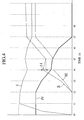
- Fig. 4 is a view illustrating variations in output voltage, output electric current and output electric power of the fuel cell stack, appearing when start-up control operation is executed in the fuel cell system to which the present invention is applied, and an output electric power of az secondary battery.
- Fig. 5 is a flowchart illustrating an operation sequence of start-up control operation of a fuel cell system of a second embodiment to which the present invention is applied.
- Fig. 6 is a flowchart illustrating an operation sequence of start-up control operation of a fuel cell system of a third embodiment to which the present invention is applied.
- Fig. 7 is a flowchart illustrating an operation sequence of start-up control operation of a fuel cell system of a fourth embodiment to which the present invention is applied.
- Hereinafter, first to fourth embodiments of the present invention are described in detail with reference to the attached drawings.
- The present invention is applied to a fuel cell system of a first embodiment constructed as shown in Fig. 1. The fuel cell system is installed on an electric vehicle with a drive motor installed thereon as a load to receive an electric power output to provide a drive torque output for the electric vehicle.
- The fuel cell system includes a
fuel cell stack 1 serving as a main power supply that is supplied with fuel gas and oxidant gas to generate the electric power output. - The
fuel cell stack 1 is comprised of a plurality of stacks of fuel cell structural bodies, that are sandwiched by separators, each of which includes an air electrode and a hydrogen electrode between which a solid polymer electrolyte membrane is sandwiched. With the fuel cell system of the present embodiment, the fuel electrode of thefuel cell stack 1 is supplied with hydrogen gas, as fuel gas, and the oxidizing electrode is supplied with air, involving oxygen as oxidant gas, to generate the electric power output. - Fuel gas is supplied from a fuel gas supply section 2 to the
fuel cell stack 1. The fuel gas supply section 2 stores fuel involving a large amount of hydrogen and, upon control through acontroller section 21, the temperature and pressure of fuel gas are regulated. - Further, air is delivered under pressure by an air compressor 3 and is supplied to the
fuel cell stack 1 through anair delivery pipe 4. Through control of a displacement stroke of the compressor 3 executed by thecontroller section 21, a flow rate of air to be supplied to thefuel cell stack 1 is controlled. - If the
fuel cell stack 1 is supplied with fuel gas and air to generate the electric power output, upon control of thecontroller section 21, apower conditioner section 5 serves to allow the electric power output generated by thefuel cell stack 1 to be delivered to aload 6, such as a drive motor, and the electric compressor 3. Also, thepower conditioner section 5 serves to allow an electric power, charged in asecondary battery 7, to be delivered to the compressor 3 and theload 6 depending upon a control status of thecontroller section 21, while serving to allow a regenerative electric power resulting from theload 6 to be charged into thesecondary battery 7 during deceleration of the electric vehicle. - The
secondary battery 7 is charged with the electric power, in excess thereof, resulting from thefuel cell stack 1 and the regenerative electric power resulting from theload 6 through thepower conditioner section 5. Thesecondary battery 7 is so configured as to discharge the electric power, charged through control of thepower conditioner section 5, at a higher voltage than that of the electric power output of thefuel cell stack 1. In an event that no adequate electric power output is generated by thefuel cell stack 1 at a rate insufficient to satisfy the electric power needed by units of a high power rate series, such as the load and the air compressor 3 which are driven at a high voltage, thepower conditioner section 5 serves to permit the electric power, charged in thesecondary battery 7, to be outputted for compensating inadequate electric power needed by the units of high power rate series. - The
power conditioner section 5 is comprised of adiode 11 adapted to avoid flow of electric current to thefuel cell stack 1, avoltmeter 12 that detects the output voltage of thefuel cell stack 1, a DC/DC converter 13 that converts a level of a DC power, and anammeter 14 that detects electric current that flows to the air compressor 3 and theload 6 through thediode 11. In this example, thevoltmeter 12 detects a voltage at an anode of thediode 11, i.e., a voltage level applied across thediode 11 and thefuel cell stack 1. - The
power conditioner section 5 is controlled by thecontroller section 21 such that, when permitting the electric power, charged in thesecondary battery 7, to be supplied to the air compressor 3 and theload 6, the DC/DC converter 13 is operated so as to boost up the voltage level. Also, thepower conditioner section 5 operates to allow the regenerative power resulting from theload 6 to be decreased to a voltage level, available to be charged to thesecondary battery 7, whereupon the regenerative power is supplied to thesecondary battery 7. Moreover, the voltage level detected by thevoltmeter 12 and the current level detected by theammeter 14 of thepower conditioner section 5 is read in thecontroller section 21. - Further, with such a fuel cell system, a
relay 8 is disposed between thepower conditioner section 5, and the air compressor 3 and theload 6. Therelay 8 is comprised of a suitable switch and is controlled to be turned on or turned off by thecontroller section 21 in a way to allow the electric power generated by thefuel cell stack 1 and the electric power, charged in thesecondary battery 7, to be supplied to the air compressor 3 and theload 6 while permitting the regenerative power resulting from theload 6 to be delivered to thepower conditioner section 5. Therelay 8 functions as a power shut-off section of thefuel cell stack 1 and thesecondary battery 7 with respect to the air compressor 3 and theload 6 and operates to shut off the supply of the electric power in a urgent status. - The
controller section 21 is comprised of a ROM (Read On Memory) that internally stores therein a start-up control program, and a RAM (Random Access Memory) that provides a work area during control to execute the start-up control program for controlling various parts set forth above during a start-up mode. This allows thecontroller section 21 to read in sensor signals delivered from thevoltmeter 12 and theammeter 14 such that the output voltage and the output electric current of thefuel cell stack 1 are recognized. Moreover, thecontroller section 21 operates to recognize operating statuses of the fuel gas supply section 2, the air compressor 3, theload 6 and therelay 8 for thereby controlling operations of these various parts. - In addition, the
controller section 21 is operative to controllably shift the DC/DC converter 13 depending on the output voltage of thefuel cell stack 1 and a charged status of thesecondary battery 7 in such a way to allow boost-up operation to be achieved for boosting up the output voltage resulting from thesecondary battery 7 to permit the electric power to be supplied to theload 6 and the air compressor 3, or to allow the output voltages resulting from thefuel cell stack 1, theload 6 and the air compressor 3 to be stepped down to a level to be supplied as the electric power to thesecondary battery 7. - Further, the
controller section 21 is operative to execute the start-up control program when in start-up operation of thefuel cell stack 1, thereby permitting boosting-up operation and step-down operation of the DC/DC converter 13 to be controlled. Also, a detailed content of this start-up control operation is described below. - Next, an operational sequence of start-up control operation to be executed by the controller section when in start-up operation of the
fuel cell stack 1 in the fuel cell system set forth above is described with reference to a flowchart of Fig. 2. - When in start-up control operation, operation subsequent to step S1 is commenced when start-up operation of the fuel cell system is initiated by a driver of a fuel cell powered vehicle.
- First, the
controller section 21 operates to set a control mode of the DC/DC converter 13 in a voltage control mode to allow the output voltage to be controlled for supply of the electric power to the air compressor 3 (step S1). This renders thecontroller section 21 operative to remain in a status available to arbitrarily control the voltage level (the output voltage level of the DC/DC converter 13) appearing at an output terminal of the DC/DC converter 13. - Subsequently, the
controller section 21 operates to set a target value of the output voltage of the DC/DC converter 13 to a voltage level Vx greater than the maximum value of an open voltage level of V0 of thefuel cell stack 1 as shown in Fig. 3 (step S2). Thus, upon selection of the output voltage level of the DC/DC converter 13 to be equal to or greater than the open voltage level V0 of thefuel cell stack 1, thecontroller section 21 precludes the electric current not to flow from thefuel cell stack 1 to the air compressor 3. - That is, a voltage potential at a junction between a cathode of the
diode 11 and the DC/DC converter 13 is selected to be greater than the maximum value of the open voltage level of thefuel cell stack 1. Also, since it is probable for the output voltage level of the DC/DC converter 13 to fluctuate depending upon the operating condition of thefuel cell stack 1, the output voltage level of the DC/DC converter 13 may be settled to a value slightly higher than the open voltage level of thefuel cell stack 1 in an actual practice. Moreover, the open voltage level V0 of thefuel cell stack 1 is preliminarily obtained through experimental teats, and use is made of a value that is retained in thecontroller section 21. - Under such a condition, no electric power is supplied from the
fuel cell stack 1 to the air compressor 3 to which the electric power is supplied from thesecondary battery 7 through the DC/DC converter 13. In step S2, also, thecontroller section 21 begins to operate the fuel gas supply section 2 using the electric power delivered from thesecondary battery 7. This allows thecontroller section 21 to render thefuel cell stack 1 to remain in a status operative for electric power generation. - Moreover, when the charged state of the
secondary battery 7 is detected prior to execution of operation in step S2, if discrimination is made that no an ability exists in discharging the electric power at a rate greater than a certain given level, thecontroller section 21 operates to interrupt start-up operation of the fuel cell system. This precludes thesecondary battery 7 from being degraded. Here, operation to discriminate the charged status of thesecondary battery 7 may be performed not only one time prior to execution of step S2 but may be necessarily executed prior to execution of step S2. - Next, after the output voltage level of the DC/
DC converter 13 has been stet to the value greater than the open voltage level, thecontroller section 21 discriminates to find whether the given time interval has elapsed (step S3). That is, thecontroller section 21 operates to control the air compressor 2 and the fuel gas supply section 2 in step S2 and discriminates to find whether the given time interval has elapsed after hydrogen gas and air has been supplied to thefuel cell stack 1 to commence start-up operation. By supplying hydrogen gas and air for the given time interval in such a way, thefuel cell system 1 operates to exhaust impurity gas from thefuel cell stack 1 while warming up thefuel cell stack 1. - And, when judgment has been made to find that the given time interval has elapsed from the time instant at which hydrogen gas and air have begun to be supplied to the
fuel cell stack 1, thecontroller section 21 operates to read the sensor signal from thevoltmeter 12 to measure the open voltage level of the fuel cell stack 1 (step S4). And, thecontroller section 21 operates to allow the open voltage level of thefuel cell stack 1, which is measured, to be set to a targeted output voltage level of the DC/DC converter 13 (step S5). - Thus, while the
controller section 21 has operated to allow the open voltage level of thefuel cell stack 1, that is preliminarily predicted in step S2, to be set to the output voltage level that is targeted for the DC/DC converter 13, by executing operation in step S5 to allow an actual open voltage level of thefuel cell stack 1 to be set to the targeted output voltage level of the DC/DC converter 13 again, a control accuracy of subsequent operation is improved. - Consecutively, after the output voltage of the DC/
DC converter 13 has been set in step S5 to be equal to the actual open voltage level of the fuel cell stack, thecontroller section 21 operates to detect the output voltage level and the output electric current level of the DC/DC converter 13 to detect an output power level of the DC/DC converter 13 (step S6). Here, in step S5, no electric power is outputted from thefuel cell stack 1, and a situation stands in which auxiliary electric power for the air compressor 3 necessary for start-up is supplied from thesecondary battery 7. Then, upon detection of the electric power level converted by the DC/DC converter 13, thecontroller section 21 operates to identify the electric power consumed by the auxiliary units as a result of consumption during start-up of the fuel cell system. - When this takes place, in order to detect the electric power level converted by the DC/
DC converter 13, thecontroller section 21 measures the output electric current level and the output voltage level flowing through the DC/DC converter 13 and multiplies these parameters. Also, the electric power consumed during start-up of thefuel cell system 1 is regarded to be substantially constant regardless of the status of thefuel cell stack 1, operation in step S5 is omitted, and a preliminarily determined electric power level may be used. - Subsequently, the
controller section 21 shifts the control mode of the DC/DC converter13 from the voltage control mode, set in step S1, to the electric power control mode in which the output power of the DC/DC converter 13 is controlled and supplied to the air compressor 3. Then, the target of the electric power level of the DC/DC converter 13 is set to be equal to the electric power level detected in step S6 (step S7). That is, due to an ability of thecontroller section 21 permitting the electric power, that is actually consumed, to be equal to the target level of the output power of the DC/DC converter 13, an auxiliary electric power is entirely supplied from thesecondary battery 7. - Thus, by executing operations in steps S6 and S7, the
fuel cell stack 1 is prevented from outputting the electric power generated by thefuel cell stack 1 and, at the same time, the electric power to be consumed for start-up of thefuel cell stack 1 is identified. - Next, the
controller section 21 controls the DC/DC converter 13 such that the target level of the output power of the DC/DC converter 13 decrease at a given rate (step S8). This allows the electric power to be supplied from thesecondary battery 7 to decrease such that the voltage potential at thejunction 15 is below the open voltage of thefuel cell stack 1 to begin supply of electric power from thefuel cell stack 1 to the air compressor 3. Thus, when supply of the electric power from thefuel cell stack 1 to the air compressor 3 is begun, the output voltage of thefuel cell stack 1 decreases, resulting in an increase in the output electric current of thefuel cell stack 1. - Consecutively, an actual current level of the
fuel cell stack 1 is detected from the ammeter 14 (step S9) and discrimination is made to find whether the detected current level is below the given value (step S10). If the output electric current level, that is detected, of thefuel cell stack 1 is found to be less than the given value, operation is routed to step S11, and if found to be greater than the given value, operation is routed back to step S9 where operation is waited until the current level of thefuel cell stack 1 is decreased to the given value. - Also, if operations in steps S9 and S10 are repeatedly executed plural times and no probability occurs in the output electric current level of the
fuel cell stack 1 to drop below the given current level, then thecontroller section 21 discriminates that an abnormality occurs in the fuel cell system, whereupon the fuel cell system may be shut down. - Here, the term "given current level" refers to a level that is determined through utilization of the presence of a difference in output electric current levels of the
fuel cell stack 1 between a voltage-current characteristic (characteristic A in Fig. 3) of thefuel cell stack 1, wherein when permitting the output electric current level of the DC/DC converter 13 to decrease in step S8, even if the same electric power levels as represented by (PA(=V1*I1) = PB(V2*I2)) appear as shown in Fig. 3, thefuel cell stack 1 is supplied with gases at higher flow rates than required while at the same time thefuel cell stack 1 remains at a sufficiently high temperature with thefuel cell stack 1 remaining in a completed start-up condition, and a voltage-current characteristic (characteristic B in Fig. 3) of thefuel cell stack 1 wherein thefuel cell stack 1 is supplied with gases at less flow rates than required or thefuel cell stack 1 is not elevated to the sufficiently high temperature with thefuel cell stack 1 remaining in a non-completed start-up condition. - That is, when permitting the output electric current level of the DC/
DC converter 13 to decrease, the presence of completion in start-up of thefuel cell stack 1 causes the output voltage of thefuel cell stack 1 to lie at a level of V1 and the output electric current to lie at a level of I1 (see the characteristic A). On the contrary, even in the presence of the same electric power levels, the absence of completion of start-up of thefuel cell stack 1 causes the output voltage of thefuel cell stack 1 to lie at a level of V2 lower than V1 and the current level I1 to lie at a level greater than I2. - Thus, the electric current level of the
fuel cell stack 1, with no completion in start-up, becomes greater than that appearing when start-up has been completed. Through the use of such a voltage-current characteristic of thefuel cell stack 1, thecontroller section 21 determines a threshold value of the electric current level of thefuel cell stack 1 in terms of the electric power level of the DC/DC converter 13 subsequent to a phase in which the output electric current level of the DC/DC converter 13 is decreased in step S8, thereby permitting discrimination to be made to find whether thefuel cell stack 1 achieves and maintains a given performance. - When discrimination is made that the electric current level detected in step S9 is less than a given electric current level (step S10), then judgment is made that the
fuel cell stack 1 achieves and maintains the given performance whereupon further discrimination is made to find whether the output power to be targeted in the DC/DC converter 13 is decreased to a preset value (step S11). If the output power is found to be decreased to the preset value, operation for the control mode of the DC/DC converter 13 is routed back to the voltage control mode, thereby permitting thefuel cell stack 1 to remain in the normal electric power control mode and operation is terminated (step S12). - On the contrary, when discrimination is made that the electric current level detected in step S9 is not less than the given level (step S10), then operation is routed back to step S9 and operations in step S9 and step S10 are repeatedly executed whereupon if the
fuel cell stack 1 achieves the given performance, operations subsequent to step S11 are executed. - When discrimination is made in step S11 that the output power to be targeted in the DC/
DC converter 13 is not decreased to the preset value, operation is routed back to step S8 and operations subsequent to step S8 are repeatedly executed. - Also, while it is preferable for the preset level for judgment in step S11 to be set to a value of "0" when shifting a source, from which electric power is supplied to the
load 6, from thesecondary battery 7 to thefuel cell stack 1, the preset level may be set to a given value greater than 0 for the purpose of shifting operation to normal control within a short length of time. - Further, during normal control in step S12, a situation stands for the control mode of the DC/
DC converter 13 to be returned to the voltage control mode. This is due to the fact that, when regenerative braking of the vehicle takes place to allow a regenerative electric power to be resulted from theload 6, a probability occurs for the voltage appearing at the DC/DC converter 13 at the terminal closer to theload 6 to increase and, thus, the voltage control mode is intended to avoid such an increase in the voltage. - By performing such start-up control operation, as shown in Fig. 4, the output voltage (on a characteristic I) and the output electric current (on a characteristic II) of the
fuel cell stack 1, the output power (on a characteristic III) of thefuel cell stack 1 and the output power (on a characteristic IV) of the secondary battery 2 are caused to vary. - By executing operations in steps S1 and step S2 to begin start-up control operation at time t0, the
control unit 21 allows the output voltage of thesecondary battery 7 to be set to a level higher than the maximum level of the open voltage of thefuel cell stack 1 at time t0 thereby to permit thesecondary battery 7 to provide the electric power output (on a characteristic IV). This permits the air compressor 3 and the fuel gas supply section 2 to be controllably driven with the electric power output delivered from thesecondary battery 7 so as to begin supply of hydrogen gas and air to thefuel cell stack 1 whereupon the output voltage of thefuel cell stack 1 is raised to the open voltage level for a time interval between times t0 and t1 (on the characteristic I). - And, upon execution of operations in step S3 to step S7 to allow the control mode of the DC/
DC converter 13 to be set to the electric power control mode while permitting operation in step S8 to be executed at time t2 on to cause the output power level of the DC/DC converter 13 to decrease such that the output power level of thesecondary battery 7 decrease (on the characteristic IV), operation begins to take out the electric power output from thefuel cell stack 1. When this takes place, the output voltage of thefuel cell stack 1 decreases (on the characteristic I), and the output electric current of thefuel cell stack 1 increases (on the characteristic II). - Here, under a situation where the output electric current of the
fuel cell stack 1 appearing between times t2 and t3 is detected to be less than the given current level whereupon the electric power output of thesecondary battery 7 is further decreased again, if the output electric current of thefuel cell stack 1, that has increased in the time interval between times t3 and t4, becomes larger in magnitude than an increased range between times t2 and t3 byΔ 1 and no discrimination is made in step S10 that the output electric current of thefuel cell stack 1 is less than the given current level, operations in step S8 and step S9 are repeatedly executed. - By so doing, during a time interval between time t4 and time t5, the electric power output to be taken out from the
secondary battery 7 through the DC/DC converter 13 is kept constant, and thefuel cell stack 1 remains in a standby condition until thefuel cell stack 1 achieves the given performance. And, when the output voltage of thefuel cell stack 1 is raised while the output electric current of thefuel cell stack 1 decreases, operation is repeated again so as to lower the electric power output of thesecondary battery 7 again. Then, at time t7, if the electric power output of thesecondary battery 7 reaches to a value of 0 (the preset level in step S11), this phase represents that the source of electric power to be supplied to the air compressor 3 has been completely switched over from thesecondary battery 7 to thefuel cell stack 1, and operation is returned to the voltage control mode again to be shifted in the normal control. - As previously described in detail, with the fuel cell system of the first embodiment, during start-up operation of the
fuel cell stack 1, the output voltage of the DC/DC converter 13 is selected to be higher than the open voltage of the fuel cell stackl whereupon the output electric current of the DC/DC converter 13 is detected to allow the DC/DC converter 13 to assume the electric power control mode so as to decrease the electric power to be supplied to theload 6 and the cir compressor 3, thereby permitting to begin the supply of the electric power output from thefuel cell stack 1. Accordingly, through utilization of only simplified electric power control, the source of electric power to be supplied to theload 6 and the air compressor 3 can be switched over from thesecondary battery 7 to thefuel cell stack 1, enabling the electric power output to be taken out from thefuel cell stack 1 in a stable manner during start-up operation. - Further, with such a fuel cell system, when in operation of the DC/
DC converter 13 in the voltage control mode, first, the output voltage of the DC/DC converter 13 is selected to be greater than the maximum value of the open voltage of thefuel cell stack 1 and, subsequently, the actual open voltage of thefuel cell stack 1 is rendered to be equal to the output voltage of the DC/DC converter 13 so as to permit switch over to take place to the electric power control mode responsive to actually consumed electric power. Accordingly, it becomes possible to improve an accuracy of electric power control in the electric power mode and, additionally, to remove excess of or short of electric power during switch over between the sources of electric power supply, thereby enabling excess electric power to be precluded from being taken out from thefuel cell stack 1. - Furthermore, with such a fuel cell system, in an event that when operation is made to decrease the electric power output of the DC/
DC converter 13, the output electric current of thefuel cell stack 1 is detected to be greater than the given current level, thefuel cell stack 1 remains in the standby status until the output electric current of thefuel cell stack 1 does not exceed the given current level. As a result of such control, the electric power output to be taken out from thefuel cell stack 1 can be gradually increased with the output electric current of thefuel cell stack 1 being managed. As a consequence, with such a fuel cell system, even during cold start-up prior to thefuel cell stack 1 being fully warmed up, it becomes possible to preclude the electric power output from being taken out at a rate in excess of a performance of thefuel cell system 1. - Here, when permitting the output electric power of the DC/
DC converter 13 to drop, it is probable for a way of decrease in the output voltage of thefuel cell stack 1 and a way of increase in the output electric current of thefuel cell stack 1 to differ depending upon the status of thefuel cell stack 1. There is a tendency wherein if the temperature of thefuel cell stack 1 remains at a low level, the output voltage of thefuel cell stack 1 drops to a lower value, with the same electric power being outputted, than that appearing when thefuel cell stack 1 has been fully warmed up and the output electric current level increases. In contrast, with the fuel cell system, since thefuel cell stack 1 is rendered to remain in the standby condition when the output electric current of thefuel cell stack 1 increases beyond the given value, deterioration in performance of thefuel cell stack 1 can be avoided. - Next, a fuel cell system of a second embodiment is described. Also, the same component parts as those of the first embodiment set forth above bear the same reference numerals and the same step numbers, and details of these components are herein omitted for simplicity. Moreover, the second embodiment has the same structure as that of the first embodiment, and a detail of such a structure is herein omitted for simplicity.
- The fuel cell system of the second embodiment executes start-up control operation as shown in Fig. 5 such that, in step S21 subsequent to achievement of the DC/
DC converter 13 in reduction of the target value of the output electric power executed in step S8, thecontroller section 21 retrieves the sensor signal from thevoltmeter 12 and detects the output voltage of thefuel cell stack 1. - Then in step S22, discrimination is made by the
controller section 21 to find whether the output voltage of thefuel cell stack 1 detected in step S21 exceeds the given voltage level. If the output voltage level of thefuel cell stack 1 is found to exceed the given voltage level, operation proceeds to operation in step S11, and if the output voltage level of thefuel cell stack 1 is found to be less than the given voltage level, thefuel cell stack 1 is rendered to remain in the standby condition until thefuel cell stack 1 achieves the given performance. - Here, the "given voltage level" is determined in consideration of the characteristic A and the characteristic B in Fig. 2 similar to the given current level in step S9 which has been set forth above. And, the
controller section 21 is so configured as to determine the threshold value for the voltage level of thefuel cell stack 1 in compliance with the electric power level of the DC/DC converter 13 subsequent to operation in reduction of the output electric current level of the Dc/DC converter 13 in step S8, thereby allowing discrimination to be made to find whether thefuel cell stack 1 achieves and maintains the given performance. - With such a fuel cell system adapted to perform start-up control operation, through management of the voltage of the
fuel cell stack 1 appearing when taking out the electric power from thefuel cell stack 1, it becomes possible for the electric power to be generated by thefuel cell stack 1 without exceeding the performance thereof even on cold start-up prior to thefuel cell stack 1 being fully warmed up. - Further, with such a fuel cell system, since the
fuel cell stack 1 is rendered to remain in the standby condition in the presence of a phase where the output voltage of thefuel cell stack 1 drops below the given value, degradation in performance of thefuel cell stack 1 can be avoided. - Next, a fuel cell system of a third embodiment is described. Also, the same component parts as those of the above embodiments set forth above bear the same reference numerals and the same step numbers, and details of these components are herein omitted for simplicity.
- The fuel cell system of the third embodiment features that, during switch over of the control mode of the DC/
DC converter 13 from the voltage control mode to the electric power control mode, if the temperature of thefuel cell stack 1 is detected and it is discriminated that thefuel cell stack 1 performs the given performance, then operation is executed to be directly shifted to normal control. - During start-up control operation of such a fuel cell system, as shown in Fig. 6, the DC/
DC converter 13 is controlled in the voltage control mode in step S2 and, subsequent to the presence of a capability for supplying the electric power to theload 6, operation is executed to commence supply of hydrogen gas and air to thefuel cell stack 1. - Then in step S31 subsequent to operation in step S2, the
controller section 21 is operative to drive a coolant pump (not shown) at a given drive rate to allow coolant to be circulated in thefuel cell stack 1. Thus, by permitting coolant to circulate through thefuel cell stack 1, temperature distribution of coolant is designed to be uniform to some extent, providing a status available for the temperature of thefuel cell stack 1 to be identified from the coolant temperature. Also, the drive rate of the coolant pump may be selected to lie in an extent to preclude the occurrence of a non-uniformity in temperature distribution in a coolant circulation system, such as a coolant delivery conduit or a coolant flow passage, inside thefuel stack 1, and may be selected at a rate to provide an extremely small flow rate because of the absence of heat buildup in thefuel cell stack 1. - In succeeding step S32, the
controller section 21 retrieves the sensor signal from a coolant temperature sensor (not shown) and detects a coolant temperature whereupon discrimination is made to find whether the coolant temperature detected in step S33 exceeds a given value. - When discrimination is made that the detected coolant temperature exceeds the given value and the
fuel cell stack 1 is warmed up whereby the electric power can be adequately taken out from thefuel cell stack 1, operation proceeds to step S12 to shift operation to normal control whereupon operation is terminated. - On the contrary, when discrimination is made that the detected coolant temperature does not exceed the given value and the
fuel cell stack 1 remains in an insufficient warmed up condition whereby it is hard for the electric power to be adequately taken out from thefuel cell stack 1, operations subsequent to step S4 are executed. This allows the output electric power of the DC/DC converter 13 to be gradually decreased, thereby permitting the electric power being progressively taken out from thefuel cell stack 1. - With such a fuel cell system to perform start-up control operation, in an event that the
fuel cell stack 1 is adequately warmed up immediately after start-up of thefuel cell stack 1, since operation can be executed to be shifted to normal control without executing operations in step S4 to step S11, start-up control operation of thefuel cell stack 1 can be performed in a short time period. - Moreover, while in step S31 and step S32, operation has been described to predict the temperature of the
fuel cell stack 1 responsive to the coolant temperature, an alternative may be carried out to provide a sensor that directly detects the temperature of thefuel cell stack 1 to allow a value detected by such a sensor to be utilized. - Next, a fuel cell system of a fourth embodiment is described. Also, the same component parts as those of the above embodiments set forth above bear the same reference numerals and the same step numbers, and details of these components are herein omitted for simplicity.
- The fuel cell system of the fourth embodiment features that, when switching over the control mode of the DC/
DC converter 13 from the voltage control mode to the normal electric power control mode, a way of rise up of the open voltage of thefuel cell stack 1 is detected to allow the DC/DC converter 13 to be switched over to the electric power control mode to permit a timing, at which the electric power is taken out from thefuel cell stack 1, to be controlled in dependence on the way of rise up of the detected opening voltage level of thefuel cell stack 1. - With such a fuel cell system, as shown in Fig. 7, in step S41 subsequent to start-up control operation in step S2 wherein hydrogen gas and air are supplied to the
fuel cell stack 1, thecontroller section 21 retrieves the sensor signal from thevoltmeter 12 and measures the output voltage of thefuel cell stack 1. - In consecutive step S42, the
control unit 21 executes discrimination to find how the output voltage of thefuel cell stack 1 detected in step S42 rises up. When this takes place, thecontroller section 21 may execute comparison between a time constant, in which the output voltage of thefuel cell stack 1 rises up, and a time constant that is preliminarily determined on calculation, calculation between a measured time interval, in which the output voltage of thefuel cell stack 1 reaches a voltage level closer to the open voltage level, and a preliminarily determined preset time interval, or comparison between a calculated variant value of the detected voltage at a certain time and a voltage variant value that is preliminarily determined. - And, the
controller section 21 executes discrimination responsive to the way, in which the output voltage of thefuel cell stack 1 detected in step S41 rises up, to find whether a rise up speed of the output voltage exceeds a given speed whereupon, in the presence of discrimination with the rise up speed of the output voltage exceeding the given speed, discrimination is executed that thefuel cell stack 1 operates to generate the electric power output during start-up in a stable fashion and operations are shifted to operations subsequent to step S5. - In contrast, if discrimination is made that the rise up speed of the output voltage does not exceed the given speed, operation proceeds to step S43 and, for a given time interval, the electric power is supplied from the
secondary battery 7 to allow thefuel cell stack 1 to stand in the standby condition under a condition available to be supplied with hydrogen gas and air whereupon operation proceeds to step S5. - With such a fuel cell system, if supply of hydrogen gas and air to the
fuel cell stack 1 is commenced and the way of rise up of the open voltage, when the open voltage of thefuel cell stack 1 increases, is slower than the given speed, then operation is executed to delay the timing at which the electric power can be taken out from thefuel cell stack 1, thereby enabling operation of thefuel cell stack 1 to be stabilized. - The entire content of Japanese Application No. P2002-307216 with a filing date of October 22, 2002 is herein incorporated by reference.
- Although the present invention has been described above by reference to certain embodiments of the invention, the invention is not limited to the embodiments described above and modifications will occur to those skilled in the art, in light of the teachings. The scope of the invention is defined with reference to the following claims.
Claims (6)
- A fuel cell system comprising:a fuel cell stack (1) supplied with fuel gas and oxidant gas to generate an electric power which is supplied through a diode (11) to a load (6) installed on a fuel cell powered vehicle;a secondary battery (7) by which an electric power is charged and discharged;an electric power converter (5) connected to the fuel cell stack through the diode to convert an electric power level, charged in the secondary battery, and supplying a converted electric power to the load; anda controller (21) operative to control the electric power converter (5) in a way to allow a voltage level of the electric power, to be supplied from the secondary battery (7) to the load, to lie at a value equal to or greater than an open voltage level of the fuel cell stack during start-up of the fuel cell stack, and to control the electric power converter (5) in a way to allow an electric power level supplied to the load through the electric power converter to be detected for permitting the electric power to be supplied to the load from the secondary battery at an electric power level less than a detected electric power level.
- The fuel cell system according to claim 1, wherein the controller (21) controls the electric power converter (5) in a way wherein, if an output electric current of the fuel cell stack (1), appearing when the electric power level supplied from the secondary battery (7) to the load is decreased, is greater than a given value, reduction in the electric power level is interrupted.
- The fuel cell system according to claim 1, wherein the controller (21) controls the electric power converter (5) in a way wherein, if an output voltage of the fuel cell stack (1), appearing when the electric power level supplied from the secondary battery (7) to the load is decreased, is less than a given value, reduction in the electric power level is interrupted.
- The fuel cell system according to claim 1, wherein the controller (21) controls the electric power converter (5) in a way to allow the temperature of the fuel cell stack, appearing when the voltage level of the electric power supplied from the secondary battery (7) to the load (6) is selected to lie at a value equal to the open voltage level of the fuel cell stack (1) or at a value greater than the open voltage level of the fuel cell stack, to be detected whereupon, if the detected temperature of the fuel cell stack is less than a given value, the electric power converter detects the electric power level supplied to the load to allow the secondary battery to supply the electric power to the load at an electric power level less than resulting detected electric power level.
- The fuel cell system according to claim 1, wherein the controller (21) controls the electric power converter (5) in away to allow the voltage level of the fuel cell stack (1), appearing when the voltage level of the electric power supplied from the secondary battery (7) to the load (6) is selected to lie at a value equal to the open voltage level of the fuel cell stack or at a value greater than the open voltage level of the fuel cell stack, to be detected whereupon a timing, at which the electric power level to be supplied to the load through the electric power converter, is controlled depending upon a rise-up condition of the detected voltage level of the fuel cell stack.
- A method of controlling a fuel cell system, which has a fuel cell stack (1) supplied with fuel gas and oxidant gas to generate an electric power which is supplied through a diode (11) to a load (6) installed on a fuel cell powered vehicle, and a secondary battery (7) by which an electric power is charged and discharged, the method comprising:converting a level of an electric power of the secondary battery (7) to supply the electric power from the secondary battery to the load (6) at a converted electric power level;controlling such that, when starting up the fuel cell stack, a voltage level of the electric power to be supplied from the secondary battery (7) to the load (6) lies at a value equal to or greater than an open voltage level of the fuel cell stack (1); andcontrolling such that the level of the electric power supplied to the load (6) is detected to permit the electric power to be supplied to the load from the secondary battery (7) at an electric power level less than a detected electric power level.
Applications Claiming Priority (2)
| Application Number | Priority Date | Filing Date | Title |
|---|---|---|---|
| JP2002307216A JP3832417B2 (en) | 2002-10-22 | 2002-10-22 | Fuel cell system |
| JP2002307216 | 2002-10-22 |
Publications (3)
| Publication Number | Publication Date |
|---|---|
| EP1414091A2 true EP1414091A2 (en) | 2004-04-28 |
| EP1414091A3 EP1414091A3 (en) | 2010-05-19 |
| EP1414091B1 EP1414091B1 (en) | 2019-04-03 |
Family
ID=32064311
Family Applications (1)
| Application Number | Title | Priority Date | Filing Date |
|---|---|---|---|
| EP03023910.7A Expired - Lifetime EP1414091B1 (en) | 2002-10-22 | 2003-10-21 | Fuel cell system and related control method |
Country Status (3)
| Country | Link |
|---|---|
| US (1) | US7371476B2 (en) |
| EP (1) | EP1414091B1 (en) |
| JP (1) | JP3832417B2 (en) |
Cited By (9)
| Publication number | Priority date | Publication date | Assignee | Title |
|---|---|---|---|---|
| WO2005060036A1 (en) * | 2003-12-15 | 2005-06-30 | Toyota Jidosha Kabushiki Kaisha | Fuel cell system and gas control method |
| WO2004114449A3 (en) * | 2003-06-20 | 2006-03-30 | Procedes Georges Claude L Air | Fuel cell protection |
| KR100637224B1 (en) | 2005-04-21 | 2006-10-20 | 삼성에스디아이 주식회사 | Power supply apparatus using fuel cell, method of controling the power supply apparatus, and computer readable recoding medium |
| EP1793442A1 (en) * | 2005-11-10 | 2007-06-06 | Samsung SDI Co., Ltd. | Method for controlling peripheral system and fuel cell system using the same |
| WO2010112995A1 (en) * | 2009-03-31 | 2010-10-07 | Toyota Jidosha Kabushiki Kaisha | Fuel cell system, and electric vehicle equipped with the fuel cell system |
| WO2010113000A1 (en) * | 2009-03-31 | 2010-10-07 | Toyota Jidosha Kabushiki Kaisha | Fuel cell system, and vehicle equipped with the fuel cell system |
| WO2012085307A1 (en) * | 2010-12-23 | 2012-06-28 | Abengoa Hidrógeno, S.A. | System for generating direct current |
| EP1962407A3 (en) * | 2007-01-30 | 2013-02-27 | Fujitsu Ltd. | Electronic device and system for DC voltage conversion |
| DE102020202330A1 (en) | 2020-02-24 | 2021-08-26 | Robert Bosch Gesellschaft mit beschränkter Haftung | Method for operating a fuel cell system, fuel cell system |
Families Citing this family (56)
| Publication number | Priority date | Publication date | Assignee | Title |
|---|---|---|---|---|
| DE10223117B4 (en) * | 2002-05-24 | 2014-04-30 | Nucellsys Gmbh | Method and arrangement for controlling the power supply of an electric drive with a hybrid power supply system in a vehicle |
| JP4136770B2 (en) * | 2003-04-22 | 2008-08-20 | トヨタ自動車株式会社 | Fuel cell system |
| US7642742B2 (en) * | 2003-12-01 | 2010-01-05 | Societe Bic | Fuel cell system with fuel supply monitoring system and method of use |
| US7381490B2 (en) | 2004-03-25 | 2008-06-03 | Matsushita Electric Industrial Co., Ltd. | Power system for fuel cell, electronic equipment and electric power feeding method |
| JP4131411B2 (en) * | 2004-05-27 | 2008-08-13 | トヨタ自動車株式会社 | Electric vehicle control device |
| CN100468851C (en) * | 2004-06-02 | 2009-03-11 | 丰田自动车株式会社 | Fault diagnosis device for exhaust valve |
| DE112005001278B4 (en) | 2004-06-02 | 2012-04-19 | Toyota Jidosha Kabushiki Kaisha | The fuel cell system |
| JP4969029B2 (en) * | 2004-08-16 | 2012-07-04 | 株式会社日立製作所 | Power supply device and control method thereof |
| US7626353B2 (en) * | 2004-10-19 | 2009-12-01 | Hitachi, Ltd. | Mobile type information terminal and self diagnosis method and operation method thereof |
| JP4979885B2 (en) * | 2004-11-02 | 2012-07-18 | パナソニック株式会社 | Power supply |
| JP4734939B2 (en) * | 2005-01-28 | 2011-07-27 | 株式会社デンソー | Secondary battery charging system |
| JP2006221864A (en) * | 2005-02-08 | 2006-08-24 | Denso Corp | Vehicle power generation system |
| JP4839698B2 (en) * | 2005-06-30 | 2011-12-21 | 株式会社エクォス・リサーチ | Fuel cell system |
| JP4824965B2 (en) * | 2005-07-27 | 2011-11-30 | 本田技研工業株式会社 | Fuel cell system |
| JP5032762B2 (en) * | 2005-10-31 | 2012-09-26 | キヤノン株式会社 | Electronics |
| US20070141428A1 (en) * | 2005-12-16 | 2007-06-21 | Skidmore Dustan L | Preventing backfeeding of current to a fuel cell stack from energy storage |
| US7915854B2 (en) * | 2005-12-16 | 2011-03-29 | Plug Power Inc. | Maximizing energy storage life in a fuel cell system using active temperature compensation |
| US20070141429A1 (en) * | 2005-12-16 | 2007-06-21 | Robertson David M | Storing energy in a fuel cell system |
| US8105724B2 (en) | 2006-01-28 | 2012-01-31 | Ford Global Technologies, Llc | Method for controlling fuel cell stack current |
| JP4964476B2 (en) * | 2006-02-21 | 2012-06-27 | 本田技研工業株式会社 | Fuel cell system and fuel cell startup method |
| JP4835222B2 (en) * | 2006-03-24 | 2011-12-14 | 株式会社デンソー | Vehicle power generation system |
| TW200743240A (en) * | 2006-05-04 | 2007-11-16 | Syspotek Corp | Fuel cell with power management |
| JP5007927B2 (en) * | 2006-10-27 | 2012-08-22 | トヨタ自動車株式会社 | Fuel cell system |
| JP4811301B2 (en) * | 2007-03-06 | 2011-11-09 | トヨタ自動車株式会社 | Secondary battery input / output control device and vehicle |
| JP4516093B2 (en) * | 2007-05-22 | 2010-08-04 | 本田技研工業株式会社 | Fuel cell system and starting method thereof |
| US9005785B2 (en) * | 2007-09-24 | 2015-04-14 | GM Global Technology Operations LLC | Open-loop system and method for fuel cell stack start-up with low-voltage source |
| JP4656539B2 (en) * | 2007-11-21 | 2011-03-23 | トヨタ自動車株式会社 | Fuel cell system |
| JP4852028B2 (en) * | 2007-12-21 | 2012-01-11 | 本田技研工業株式会社 | Hybrid DC power supply system and fuel cell vehicle |
| CA2710921C (en) * | 2007-12-28 | 2013-04-23 | Toyota Jidosha Kabushiki Kaisha | Power control system for a fuel cell |
| US8053122B2 (en) * | 2008-04-11 | 2011-11-08 | Bdf Ip Holdings Ltd. | System and method of starting a fuel cell system |
| JP5309855B2 (en) * | 2008-10-02 | 2013-10-09 | 日産自動車株式会社 | Fuel cell system |
| JP5434196B2 (en) * | 2009-03-31 | 2014-03-05 | トヨタ自動車株式会社 | Fuel cell system and vehicle equipped with the same |
| DE102009037725A1 (en) * | 2009-08-17 | 2011-02-24 | Li-Tec Battery Gmbh | Energy storage device with an energy storage device |
| IN2012DN00309A (en) * | 2009-08-28 | 2015-05-08 | Utc Power Corp | |
| JP5461221B2 (en) | 2010-02-12 | 2014-04-02 | 株式会社マキタ | Electric tool powered by multiple battery packs |
| JP5432761B2 (en) * | 2010-02-12 | 2014-03-05 | 株式会社マキタ | Electric tool powered by multiple battery packs |
| JP5772355B2 (en) * | 2011-08-01 | 2015-09-02 | トヨタ自動車株式会社 | Fuel cell system |
| EP2834868B1 (en) | 2012-04-02 | 2023-12-27 | Hydrogenics Corporation | Fuel cell start up method |
| CN102881956B (en) | 2012-09-28 | 2014-07-23 | 引峰新能源科技(上海)有限公司 | Hybrid power source energy management method of fuel battery |
| US9002531B2 (en) * | 2012-09-28 | 2015-04-07 | Sharp Laboratories Of America, Inc. | System and method for predictive peak load management via integrated load management |
| CN102862491B (en) * | 2012-09-28 | 2014-09-03 | 引峰新能源科技(上海)有限公司 | Compact type fuel battery power supply system |
| CN102951004A (en) * | 2012-11-20 | 2013-03-06 | 北京慧峰聚能科技有限公司 | Hybrid power system of fuel cell forklift |
| US11309556B2 (en) | 2013-10-02 | 2022-04-19 | Hydrogenics Corporation | Fast starting fuel cell |
| US10181610B2 (en) | 2013-10-02 | 2019-01-15 | Hydrogenics Corporation | Fast starting fuel cell |
| CN103671056A (en) * | 2013-12-20 | 2014-03-26 | 博耐尔汽车电气系统有限公司 | Controller of compressor of air conditioner of electric automobile |
| US10320202B2 (en) * | 2014-09-30 | 2019-06-11 | Johnson Controls Technology Company | Battery system bi-stable relay control |
| JP6581532B2 (en) * | 2016-03-22 | 2019-09-25 | 株式会社東芝 | Fuel cell power generation system |
| CN107193285B (en) * | 2017-04-20 | 2020-11-10 | 湖北工业大学 | Multi-rotor-wing fuel cell plant protection unmanned aerial vehicle control system and working method thereof |
| DE102017214972A1 (en) * | 2017-08-28 | 2019-02-28 | Audi Ag | Drive device for a motor vehicle and method for operating a drive device for a motor vehicle |
| KR102554937B1 (en) * | 2018-03-14 | 2023-07-11 | 현대자동차주식회사 | Shut down method for fuel cell vehicles |
| CN108482172B (en) * | 2018-05-23 | 2024-01-02 | 威腾电气集团股份有限公司 | Three-in-one vehicle-mounted DCDC integrated power supply |
| CN109713337B (en) * | 2018-12-28 | 2021-12-03 | 中科军联(张家港)新能源科技有限公司 | Direct methanol fuel cell and lithium ion battery hybrid output device and output method |
| CN112072145B (en) * | 2020-09-11 | 2021-06-18 | 北京亦嘉洁驱系统科技有限公司 | Hydrogen pressure reduction regulation and control system, method and equipment, battery system and design method |
| CN112290059A (en) * | 2020-11-11 | 2021-01-29 | 武汉格罗夫氢能汽车有限公司 | Control method and system for pre-charging DCDC in starting process of fuel cell |
| JP2023004277A (en) * | 2021-06-25 | 2023-01-17 | 本田技研工業株式会社 | Electric power system |
| KR20230126312A (en) * | 2022-02-22 | 2023-08-30 | 현대자동차주식회사 | Method and apparatus for driving of fuel cell based vehicle |
Family Cites Families (9)
| Publication number | Priority date | Publication date | Assignee | Title |
|---|---|---|---|---|
| FR2709873B1 (en) * | 1993-09-06 | 1995-10-20 | Imra Europe Sa | Fuel cell voltage generator. |
| JP3487952B2 (en) * | 1995-04-14 | 2004-01-19 | 株式会社日立製作所 | Drive device and drive control method for electric vehicle |
| JP3608017B2 (en) * | 1996-07-22 | 2005-01-05 | トヨタ自動車株式会社 | Power system |
| JP4244399B2 (en) * | 1998-05-14 | 2009-03-25 | トヨタ自動車株式会社 | FUEL CELL SYSTEM, ELECTRIC VEHICLE HAVING THE SAME AND FUEL CELL SYSTEM START-UP CONTROL METHOD |
| US5998885A (en) * | 1998-09-21 | 1999-12-07 | Ford Global Technologies, Inc. | Propulsion system for a motor vehicle using a bidirectional energy converter |
| DE19951584B4 (en) * | 1999-10-27 | 2005-09-15 | Ballard Power Systems Ag | Apparatus for generating electrical energy with a fuel cell associated with auxiliary units for starting and operating and method of operating the apparatus |
| JP2001229943A (en) | 2000-02-14 | 2001-08-24 | Nissan Motor Co Ltd | Fuel cell system |
| JP4545285B2 (en) * | 2000-06-12 | 2010-09-15 | 本田技研工業株式会社 | Fuel cell vehicle start control device |
| US6580977B2 (en) * | 2001-01-16 | 2003-06-17 | Ford Global Technologies, Llc | High efficiency fuel cell and battery for a hybrid powertrain |
-
2002
- 2002-10-22 JP JP2002307216A patent/JP3832417B2/en not_active Expired - Fee Related
-
2003
- 2003-09-26 US US10/670,508 patent/US7371476B2/en not_active Expired - Lifetime
- 2003-10-21 EP EP03023910.7A patent/EP1414091B1/en not_active Expired - Lifetime
Cited By (13)
| Publication number | Priority date | Publication date | Assignee | Title |
|---|---|---|---|---|
| WO2004114449A3 (en) * | 2003-06-20 | 2006-03-30 | Procedes Georges Claude L Air | Fuel cell protection |
| US7993789B2 (en) | 2003-12-15 | 2011-08-09 | Toyota Jidosha Kabushiki Kaisha | Fuel cell system and gas control method |
| WO2005060036A1 (en) * | 2003-12-15 | 2005-06-30 | Toyota Jidosha Kabushiki Kaisha | Fuel cell system and gas control method |
| KR100637224B1 (en) | 2005-04-21 | 2006-10-20 | 삼성에스디아이 주식회사 | Power supply apparatus using fuel cell, method of controling the power supply apparatus, and computer readable recoding medium |
| EP1793442A1 (en) * | 2005-11-10 | 2007-06-06 | Samsung SDI Co., Ltd. | Method for controlling peripheral system and fuel cell system using the same |
| US8142945B2 (en) | 2005-11-10 | 2012-03-27 | Samsung Sdi Co., Ltd. | Method for controlling peripheral system and fuel cell system using the same |
| EP1962407A3 (en) * | 2007-01-30 | 2013-02-27 | Fujitsu Ltd. | Electronic device and system for DC voltage conversion |
| WO2010113000A1 (en) * | 2009-03-31 | 2010-10-07 | Toyota Jidosha Kabushiki Kaisha | Fuel cell system, and vehicle equipped with the fuel cell system |
| WO2010112995A1 (en) * | 2009-03-31 | 2010-10-07 | Toyota Jidosha Kabushiki Kaisha | Fuel cell system, and electric vehicle equipped with the fuel cell system |
| US8710790B2 (en) | 2009-03-31 | 2014-04-29 | Toyota Jidosha Kabushiki Kaisha | Fuel cell system, and electric vehicle equipped with the fuel cell system |
| WO2012085307A1 (en) * | 2010-12-23 | 2012-06-28 | Abengoa Hidrógeno, S.A. | System for generating direct current |
| ES2385171A1 (en) * | 2010-12-23 | 2012-07-19 | Hynergreen Technologies, S.A. | System for generating direct current |
| DE102020202330A1 (en) | 2020-02-24 | 2021-08-26 | Robert Bosch Gesellschaft mit beschränkter Haftung | Method for operating a fuel cell system, fuel cell system |
Also Published As
| Publication number | Publication date |
|---|---|
| JP3832417B2 (en) | 2006-10-11 |
| US7371476B2 (en) | 2008-05-13 |
| JP2004146114A (en) | 2004-05-20 |
| EP1414091A3 (en) | 2010-05-19 |
| EP1414091B1 (en) | 2019-04-03 |
| US20040076860A1 (en) | 2004-04-22 |
Similar Documents
| Publication | Publication Date | Title |
|---|---|---|
| EP1414091B1 (en) | Fuel cell system and related control method | |
| EP2678895B1 (en) | Controlling pem fuel cell voltage during power transitions and idling | |
| US7196492B2 (en) | Power supply apparatus including fuel cell and capacitor, and operation method thereof | |
| US8343675B2 (en) | Fuel cell system | |
| KR101000703B1 (en) | Idle stop / release control method of fuel cell hybrid vehicle | |
| CN100534828C (en) | Fuel cell system and electric vehicle including the fuel cell system | |
| EP1658192B1 (en) | Control apparatus for vehicle having fuel cell mounted thereon | |
| KR101822245B1 (en) | Control method of cooling pump for fuel cell system | |
| US8084151B2 (en) | Fuel cell system and method therefor | |
| CN110015211B (en) | Control method of fuel cell system of hybrid electric vehicle | |
| KR100973761B1 (en) | Fuel cell system | |
| EP1556937B1 (en) | Electric power generation control system and electric power generation control method for fuel cell | |
| JP6859624B2 (en) | Fuel cell system and its control method | |
| JP4505489B2 (en) | Fuel cell system and starting method thereof | |
| WO2006054565A2 (en) | Output limiting device for fuel cell | |
| JP4992261B2 (en) | Fuel cell system | |
| KR101023618B1 (en) | Fuel cell system | |
| JP2004146118A (en) | Fuel cell system | |
| JP2002151121A (en) | Fuel cell power generation system | |
| JP6322925B2 (en) | Fuel cell system | |
| CN116176365A (en) | Systems and methods for controlling power to a fuel cell | |
| JP2006139935A (en) | Control device for fuel cell system | |
| KR102907039B1 (en) | Apparatus and method for driving control of fuel cell vehicle | |
| KR20230172684A (en) | System and method for improving starting of fuel vehicle | |
| KR20230086343A (en) | Power control system and method of fuelcell |
Legal Events
| Date | Code | Title | Description |
|---|---|---|---|
| PUAI | Public reference made under article 153(3) epc to a published international application that has entered the european phase |
Free format text: ORIGINAL CODE: 0009012 |
|
| 17P | Request for examination filed |
Effective date: 20031021 |
|
| AK | Designated contracting states |
Kind code of ref document: A2 Designated state(s): AT BE BG CH CY CZ DE DK EE ES FI FR GB GR HU IE IT LI LU MC NL PT RO SE SI SK TR |
|
| AX | Request for extension of the european patent |
Extension state: AL LT LV MK |
|
| PUAL | Search report despatched |
Free format text: ORIGINAL CODE: 0009013 |
|
| AK | Designated contracting states |
Kind code of ref document: A3 Designated state(s): AT BE BG CH CY CZ DE DK EE ES FI FR GB GR HU IE IT LI LU MC NL PT RO SE SI SK TR |
|
| AX | Request for extension of the european patent |
Extension state: AL LT LV MK |
|
| AKX | Designation fees paid |
Designated state(s): DE FR GB |
|
| 17Q | First examination report despatched |
Effective date: 20110322 |
|
| RIC1 | Information provided on ipc code assigned before grant |
Ipc: B60L 11/18 19680901ALI20180620BHEP Ipc: H01M 8/24 19740701ALI20180620BHEP Ipc: H01M 8/04223 20160101ALI20180620BHEP Ipc: H01M 8/04007 20160101ALI20180620BHEP Ipc: H01M 8/0432 20160101ALI20180620BHEP Ipc: H01M 8/0438 20160101ALI20180620BHEP Ipc: H01M 8/04828 20160101ALI20180620BHEP Ipc: H01M 8/04 19740701AFI20180620BHEP Ipc: H01M 8/1018 20160101ALI20180620BHEP Ipc: H01M 8/04298 20160101ALI20180620BHEP Ipc: H01M 8/04537 20160101ALI20180620BHEP Ipc: H01M 8/04955 20160101ALI20180620BHEP |
|
| GRAP | Despatch of communication of intention to grant a patent |
Free format text: ORIGINAL CODE: EPIDOSNIGR1 |
|
| INTG | Intention to grant announced |
Effective date: 20180907 |
|
| GRAJ | Information related to disapproval of communication of intention to grant by the applicant or resumption of examination proceedings by the epo deleted |
Free format text: ORIGINAL CODE: EPIDOSDIGR1 |
|
| INTC | Intention to grant announced (deleted) | ||
| GRAP | Despatch of communication of intention to grant a patent |
Free format text: ORIGINAL CODE: EPIDOSNIGR1 |
|
| INTG | Intention to grant announced |
Effective date: 20181211 |
|
| RIC1 | Information provided on ipc code assigned before grant |
Ipc: H01M 8/04 20160101AFI20180620BHEP Ipc: H01M 8/04955 20160101ALI20180620BHEP Ipc: H01M 8/04828 20160101ALI20180620BHEP Ipc: H01M 8/24 20160101ALI20180620BHEP Ipc: H01M 8/04223 20160101ALI20180620BHEP Ipc: H01M 8/1018 20160101ALI20180620BHEP Ipc: H01M 8/0438 20160101ALI20180620BHEP Ipc: H01M 8/04298 20160101ALI20180620BHEP Ipc: H01M 8/04537 20160101ALI20180620BHEP Ipc: H01M 8/0432 20160101ALI20180620BHEP Ipc: B60L 11/18 20060101ALI20180620BHEP Ipc: H01M 8/04007 20160101ALI20180620BHEP |
|
| GRAS | Grant fee paid |
Free format text: ORIGINAL CODE: EPIDOSNIGR3 |
|
| GRAA | (expected) grant |
Free format text: ORIGINAL CODE: 0009210 |
|
| AK | Designated contracting states |
Kind code of ref document: B1 Designated state(s): DE FR GB |
|
| REG | Reference to a national code |
Ref country code: GB Ref legal event code: FG4D |
|
| REG | Reference to a national code |
Ref country code: DE Ref legal event code: R096 Ref document number: 60351907 Country of ref document: DE |
|
| REG | Reference to a national code |
Ref country code: DE Ref legal event code: R097 Ref document number: 60351907 Country of ref document: DE |
|
| PGFP | Annual fee paid to national office [announced via postgrant information from national office to epo] |
Ref country code: DE Payment date: 20191024 Year of fee payment: 17 |
|
| PLBE | No opposition filed within time limit |
Free format text: ORIGINAL CODE: 0009261 |
|
| STAA | Information on the status of an ep patent application or granted ep patent |
Free format text: STATUS: NO OPPOSITION FILED WITHIN TIME LIMIT |
|
| PGFP | Annual fee paid to national office [announced via postgrant information from national office to epo] |
Ref country code: FR Payment date: 20191026 Year of fee payment: 17 |
|
| 26N | No opposition filed |
Effective date: 20200106 |
|
| PGFP | Annual fee paid to national office [announced via postgrant information from national office to epo] |
Ref country code: GB Payment date: 20191025 Year of fee payment: 17 |
|
| REG | Reference to a national code |
Ref country code: DE Ref legal event code: R119 Ref document number: 60351907 Country of ref document: DE |
|
| GBPC | Gb: european patent ceased through non-payment of renewal fee |
Effective date: 20201021 |
|
| PG25 | Lapsed in a contracting state [announced via postgrant information from national office to epo] |
Ref country code: FR Free format text: LAPSE BECAUSE OF NON-PAYMENT OF DUE FEES Effective date: 20201031 Ref country code: DE Free format text: LAPSE BECAUSE OF NON-PAYMENT OF DUE FEES Effective date: 20210501 |
|
| PG25 | Lapsed in a contracting state [announced via postgrant information from national office to epo] |
Ref country code: GB Free format text: LAPSE BECAUSE OF NON-PAYMENT OF DUE FEES Effective date: 20201021 |