EP1411386A1 - Antiglare anticlouding device and automotive outer mirror - Google Patents
Antiglare anticlouding device and automotive outer mirror Download PDFInfo
- Publication number
- EP1411386A1 EP1411386A1 EP01954342A EP01954342A EP1411386A1 EP 1411386 A1 EP1411386 A1 EP 1411386A1 EP 01954342 A EP01954342 A EP 01954342A EP 01954342 A EP01954342 A EP 01954342A EP 1411386 A1 EP1411386 A1 EP 1411386A1
- Authority
- EP
- European Patent Office
- Prior art keywords
- glare
- film
- fog
- substrate
- front side
- Prior art date
- Legal status (The legal status is an assumption and is not a legal conclusion. Google has not performed a legal analysis and makes no representation as to the accuracy of the status listed.)
- Withdrawn
Links
Images



Classifications
-
- C—CHEMISTRY; METALLURGY
- C03—GLASS; MINERAL OR SLAG WOOL
- C03C—CHEMICAL COMPOSITION OF GLASSES, GLAZES OR VITREOUS ENAMELS; SURFACE TREATMENT OF GLASS; SURFACE TREATMENT OF FIBRES OR FILAMENTS MADE FROM GLASS, MINERALS OR SLAGS; JOINING GLASS TO GLASS OR OTHER MATERIALS
- C03C17/00—Surface treatment of glass, not in the form of fibres or filaments, by coating
- C03C17/34—Surface treatment of glass, not in the form of fibres or filaments, by coating with at least two coatings having different compositions
- C03C17/36—Surface treatment of glass, not in the form of fibres or filaments, by coating with at least two coatings having different compositions at least one coating being a metal
- C03C17/3602—Surface treatment of glass, not in the form of fibres or filaments, by coating with at least two coatings having different compositions at least one coating being a metal the metal being present as a layer
- C03C17/3657—Surface treatment of glass, not in the form of fibres or filaments, by coating with at least two coatings having different compositions at least one coating being a metal the metal being present as a layer the multilayer coating having optical properties
- C03C17/3663—Surface treatment of glass, not in the form of fibres or filaments, by coating with at least two coatings having different compositions at least one coating being a metal the metal being present as a layer the multilayer coating having optical properties specially adapted for use as mirrors
-
- G—PHYSICS
- G02—OPTICS
- G02F—OPTICAL DEVICES OR ARRANGEMENTS FOR THE CONTROL OF LIGHT BY MODIFICATION OF THE OPTICAL PROPERTIES OF THE MEDIA OF THE ELEMENTS INVOLVED THEREIN; NON-LINEAR OPTICS; FREQUENCY-CHANGING OF LIGHT; OPTICAL LOGIC ELEMENTS; OPTICAL ANALOGUE/DIGITAL CONVERTERS
- G02F1/00—Devices or arrangements for the control of the intensity, colour, phase, polarisation or direction of light arriving from an independent light source, e.g. switching, gating or modulating; Non-linear optics
- G02F1/01—Devices or arrangements for the control of the intensity, colour, phase, polarisation or direction of light arriving from an independent light source, e.g. switching, gating or modulating; Non-linear optics for the control of the intensity, phase, polarisation or colour
- G02F1/15—Devices or arrangements for the control of the intensity, colour, phase, polarisation or direction of light arriving from an independent light source, e.g. switching, gating or modulating; Non-linear optics for the control of the intensity, phase, polarisation or colour based on an electrochromic effect
- G02F1/153—Constructional details
- G02F1/1533—Constructional details structural features not otherwise provided for
-
- B—PERFORMING OPERATIONS; TRANSPORTING
- B01—PHYSICAL OR CHEMICAL PROCESSES OR APPARATUS IN GENERAL
- B01J—CHEMICAL OR PHYSICAL PROCESSES, e.g. CATALYSIS OR COLLOID CHEMISTRY; THEIR RELEVANT APPARATUS
- B01J21/00—Catalysts comprising the elements, oxides, or hydroxides of magnesium, boron, aluminium, carbon, silicon, titanium, zirconium, or hafnium
- B01J21/06—Silicon, titanium, zirconium or hafnium; Oxides or hydroxides thereof
- B01J21/063—Titanium; Oxides or hydroxides thereof
-
- B—PERFORMING OPERATIONS; TRANSPORTING
- B01—PHYSICAL OR CHEMICAL PROCESSES OR APPARATUS IN GENERAL
- B01J—CHEMICAL OR PHYSICAL PROCESSES, e.g. CATALYSIS OR COLLOID CHEMISTRY; THEIR RELEVANT APPARATUS
- B01J35/00—Catalysts, in general, characterised by their form or physical properties
- B01J35/30—Catalysts, in general, characterised by their form or physical properties characterised by their physical properties
- B01J35/39—Photocatalytic properties
-
- B—PERFORMING OPERATIONS; TRANSPORTING
- B01—PHYSICAL OR CHEMICAL PROCESSES OR APPARATUS IN GENERAL
- B01J—CHEMICAL OR PHYSICAL PROCESSES, e.g. CATALYSIS OR COLLOID CHEMISTRY; THEIR RELEVANT APPARATUS
- B01J35/00—Catalysts, in general, characterised by their form or physical properties
- B01J35/30—Catalysts, in general, characterised by their form or physical properties characterised by their physical properties
- B01J35/391—Physical properties of the active metal ingredient
- B01J35/395—Thickness of the active catalytic layer
-
- B—PERFORMING OPERATIONS; TRANSPORTING
- B60—VEHICLES IN GENERAL
- B60R—VEHICLES, VEHICLE FITTINGS, OR VEHICLE PARTS, NOT OTHERWISE PROVIDED FOR
- B60R1/00—Optical viewing arrangements; Real-time viewing arrangements for drivers or passengers using optical image capturing systems, e.g. cameras or video systems specially adapted for use in or on vehicles
- B60R1/02—Rear-view mirror arrangements
- B60R1/08—Rear-view mirror arrangements involving special optical features, e.g. avoiding blind spots, e.g. convex mirrors; Side-by-side associations of rear-view and other mirrors
- B60R1/083—Anti-glare mirrors, e.g. "day-night" mirrors
- B60R1/088—Anti-glare mirrors, e.g. "day-night" mirrors using a cell of electrically changeable optical characteristic, e.g. liquid-crystal or electrochromic mirrors
-
- C—CHEMISTRY; METALLURGY
- C03—GLASS; MINERAL OR SLAG WOOL
- C03C—CHEMICAL COMPOSITION OF GLASSES, GLAZES OR VITREOUS ENAMELS; SURFACE TREATMENT OF GLASS; SURFACE TREATMENT OF FIBRES OR FILAMENTS MADE FROM GLASS, MINERALS OR SLAGS; JOINING GLASS TO GLASS OR OTHER MATERIALS
- C03C17/00—Surface treatment of glass, not in the form of fibres or filaments, by coating
- C03C17/34—Surface treatment of glass, not in the form of fibres or filaments, by coating with at least two coatings having different compositions
-
- C—CHEMISTRY; METALLURGY
- C03—GLASS; MINERAL OR SLAG WOOL
- C03C—CHEMICAL COMPOSITION OF GLASSES, GLAZES OR VITREOUS ENAMELS; SURFACE TREATMENT OF GLASS; SURFACE TREATMENT OF FIBRES OR FILAMENTS MADE FROM GLASS, MINERALS OR SLAGS; JOINING GLASS TO GLASS OR OTHER MATERIALS
- C03C17/00—Surface treatment of glass, not in the form of fibres or filaments, by coating
- C03C17/34—Surface treatment of glass, not in the form of fibres or filaments, by coating with at least two coatings having different compositions
- C03C17/3411—Surface treatment of glass, not in the form of fibres or filaments, by coating with at least two coatings having different compositions with at least two coatings of inorganic materials
- C03C17/3417—Surface treatment of glass, not in the form of fibres or filaments, by coating with at least two coatings having different compositions with at least two coatings of inorganic materials all coatings being oxide coatings
-
- C—CHEMISTRY; METALLURGY
- C03—GLASS; MINERAL OR SLAG WOOL
- C03C—CHEMICAL COMPOSITION OF GLASSES, GLAZES OR VITREOUS ENAMELS; SURFACE TREATMENT OF GLASS; SURFACE TREATMENT OF FIBRES OR FILAMENTS MADE FROM GLASS, MINERALS OR SLAGS; JOINING GLASS TO GLASS OR OTHER MATERIALS
- C03C17/00—Surface treatment of glass, not in the form of fibres or filaments, by coating
- C03C17/34—Surface treatment of glass, not in the form of fibres or filaments, by coating with at least two coatings having different compositions
- C03C17/36—Surface treatment of glass, not in the form of fibres or filaments, by coating with at least two coatings having different compositions at least one coating being a metal
-
- C—CHEMISTRY; METALLURGY
- C03—GLASS; MINERAL OR SLAG WOOL
- C03C—CHEMICAL COMPOSITION OF GLASSES, GLAZES OR VITREOUS ENAMELS; SURFACE TREATMENT OF GLASS; SURFACE TREATMENT OF FIBRES OR FILAMENTS MADE FROM GLASS, MINERALS OR SLAGS; JOINING GLASS TO GLASS OR OTHER MATERIALS
- C03C17/00—Surface treatment of glass, not in the form of fibres or filaments, by coating
- C03C17/34—Surface treatment of glass, not in the form of fibres or filaments, by coating with at least two coatings having different compositions
- C03C17/36—Surface treatment of glass, not in the form of fibres or filaments, by coating with at least two coatings having different compositions at least one coating being a metal
- C03C17/3602—Surface treatment of glass, not in the form of fibres or filaments, by coating with at least two coatings having different compositions at least one coating being a metal the metal being present as a layer
- C03C17/3668—Surface treatment of glass, not in the form of fibres or filaments, by coating with at least two coatings having different compositions at least one coating being a metal the metal being present as a layer the multilayer coating having electrical properties
- C03C17/3671—Surface treatment of glass, not in the form of fibres or filaments, by coating with at least two coatings having different compositions at least one coating being a metal the metal being present as a layer the multilayer coating having electrical properties specially adapted for use as electrodes
-
- C—CHEMISTRY; METALLURGY
- C03—GLASS; MINERAL OR SLAG WOOL
- C03C—CHEMICAL COMPOSITION OF GLASSES, GLAZES OR VITREOUS ENAMELS; SURFACE TREATMENT OF GLASS; SURFACE TREATMENT OF FIBRES OR FILAMENTS MADE FROM GLASS, MINERALS OR SLAGS; JOINING GLASS TO GLASS OR OTHER MATERIALS
- C03C2217/00—Coatings on glass
- C03C2217/40—Coatings comprising at least one inhomogeneous layer
- C03C2217/425—Coatings comprising at least one inhomogeneous layer consisting of a porous layer
-
- C—CHEMISTRY; METALLURGY
- C03—GLASS; MINERAL OR SLAG WOOL
- C03C—CHEMICAL COMPOSITION OF GLASSES, GLAZES OR VITREOUS ENAMELS; SURFACE TREATMENT OF GLASS; SURFACE TREATMENT OF FIBRES OR FILAMENTS MADE FROM GLASS, MINERALS OR SLAGS; JOINING GLASS TO GLASS OR OTHER MATERIALS
- C03C2217/00—Coatings on glass
- C03C2217/70—Properties of coatings
- C03C2217/71—Photocatalytic coatings
-
- C—CHEMISTRY; METALLURGY
- C03—GLASS; MINERAL OR SLAG WOOL
- C03C—CHEMICAL COMPOSITION OF GLASSES, GLAZES OR VITREOUS ENAMELS; SURFACE TREATMENT OF GLASS; SURFACE TREATMENT OF FIBRES OR FILAMENTS MADE FROM GLASS, MINERALS OR SLAGS; JOINING GLASS TO GLASS OR OTHER MATERIALS
- C03C2217/00—Coatings on glass
- C03C2217/70—Properties of coatings
- C03C2217/75—Hydrophilic and oleophilic coatings
Definitions
- This invention relates to an anti-glare and anti-fog element having an anti-glare function using an electrochromic phenomenon, and an anti-fog function by a hydrophilic functional film comprising a photocatalyst substance, and more particularly relates to an anti-glare and anti-fog element and an exterior mirror for automobiles, which utilize predetermined color phase at the time of un-operating of the anti-glare function.
- An anti-fog element or anti-fog mirror which causes an anti-fog function to be exhibited by a hydrophilic functional film comprising a photocatalyst substance is mentioned for example as conventionally known technology.
- a semiconductor photocatalyst substance and a photocatalyst composition which comprises oxide particle distributed in this semiconductor photocatalyst substance wherein the band gap of the photocatalyst composition is 0.05eV larger or more than the band gap of a simple semiconductor photocatalyst substance are produced.
- a photocatalyst composition excellent in photocatalyst activity, having an improved intensity of a photocatalyst film and a substrate with photocatalyst composition can be achieved and can be adapted to such as an anti-fog element.
- JP-A-10-36144 proposes an anti-fog element constituted in such a manner that a transparent photocatalytic reaction substance film such as TiO 2 , is formed on one surface of a transparent substrate member such as a glass substrate, and transparent inorganic oxide substance such as SiO 2 is formed thereon to transparently constitute the whole part.
- an anti-fog element is constituted in such a way that an inorganic oxide film in a porous state is formed on the surface of a substrate member such as a glass substrate so that the surface exhibits hydrophilicity. Fall of hydrophilicity can be thus prevented and an anti-fog element which can hold an expected anti-fog property over a long period of time can be achieved.
- an anti-glare element or anti-fog mirror those which exhibit the antiglare function by electrochromic substance can be mentioned, for example.
- a conventional anti-glare element or anti-fog mirror those which exhibit the antiglare function by electrochromic substance can be mentioned, for example.
- JP-09-120088 at least one kind of cathode electrochromic compound, at least one kind of anode electrochromic compound, and single block type self-erasure system solution phase electrochromic device and a device using the same are disclosed.
- This invention proposes an anti-glare mirror for automobiles serving as a reflection mirror wherein the light of the intensity permissible for a driver is reflected.
- these inventors produced an electrochromic element arranged in such a manner that electrochromic films comprising electochromic substance and electrolysis is arranged between a transparent electrode films provided on two glass substrates, a hydrophilic film coomprising a photocatalyst film and a porous inorganic substance are formed on the front surface of the glass substrate of the front side, and with this arrangement, an electrochromic element as a reflector with reflective film formed on the front surface of the backside substrate viewed from the front side substrate is produced.
- the surface is formed in hydrophilic state having a photocatalyst function, a photochromic phenomenon of electrochromic films are prevented as well as having an anti-fog function and anti-glare function.
- This permits an electrochromic element to be realized without adding an ultraviolet-rays absorbent to the aforementioned electrolysis liquid, or with a little bit of addition of the ultraviolet-rays absorbent.
- an electrochromic phenomenon is the general term of the phenomenon in which the color of a substance changes with an application of voltage.
- a “substance” and a “film” which exhibit such an electrochromic phenomenon are called an “electrochromic substance” and “electrochromic films”, respectively.
- Mirrors for automobiles usually include a driver's seat side mirror and a passenger seat side mirror.
- a driver's seat side mirror and a passenger seat side mirror having almost equal anti-glare function and an anti-fog function were conventionally and mainly in use.
- combination of the mirror having the function of necessary minimum for each side of a driver's seat and a passenger seat, or a different function is increasingly demanded, considering from economical efficiency in recent years.
- combination of the aforementioned mirrors for automobiles is considered to be variably carried out such as a combination of a driver's seat side mirror having the automatic anti-glare function which made reflectance variable, and a passenger seat side mirror having an anti-glare function with fixed reflectance (for example, anti-glare function colored blue) and an anti-fog function.
- a driver's seat side mirror having the automatic anti-glare function which made reflectance variable
- a passenger seat side mirror having an anti-glare function with fixed reflectance for example, anti-glare function colored blue
- an anti-fog function is not colored in comparatively bright state, that is, the state in which an anti-glare function is not needed, for example in the daytime, either of or both of color phase and color tone which each of a driver's seat side mirror and a passenger seat side mirror presents differs.
- a color tone generally means grades, such as a shade of color, strength, and contrast, and both of these are combined to be referred hereinafter as only "color phase".
- the object of this invention is to provide an anti-glare and anti-fog element which can be set so as to have both an anti-glare function and an anti-fog function and present a predetermined color phase at the time of un-operating of the aforementioned anti-glare function, and an exterior mirror for automobiles using this anti-glare and anti-fog element.
- an anti-glare and anti-fog element of this invention is arranged in such a manner that electrochromic films which exhibit an electrochromic phenomenon are intervened between a transparent substrate arranged in the front side, and a transparent substrate arranged in the backside so as to be provided with an anti-glare function, wherein transparent substrate of the front side comprises a substrate with a wave length selective property, and anti-fog function is given by forming a hydrophilic functional film including a photocatalyst film which comprises a photocatalyst substance and has light transmittivity, on the front surface of the transparent substrate of the front side.
- the above “wave length selective property” means the characteristic wherein the light of specific wavelength among the lights of carrying out incidence from the front side of the aforementioned anti-glare and anti-fog element is reflected or transmitted alternatively.
- the aforementioned “wave length selective property” is specified by spectral reflectance characteristics of the transparent substrate of the front side included in this invention as referred below, or a spectral transmittivity characteristics. Since there is a correlation between this spectral reflectance characteristics and spectral transmittance characteristics, the "wave length selective property" according to this invention is uniquely determined by the spectral reflectance characteristics or the spectral transmittance characteristic.
- a hydrophilic functional film by a photocatalyst film comprising a photocatalyst substance of titanium oxide independently.
- a hydrophilic functional film may be constituted including a photocatalyst film which comprises a photocatalyst substance of titanium oxide, and hydrophilic film which comprises a hydrophilic substance of silicon oxide.
- the hydrophilic film is preferably constituted by porous silicon oxide.
- surface coarseness (arithmetic average coarseness Ra) of this porous silicon oxide may be set as 2nm or more.
- a reflective film is preferably formed on the backside of the transparent substrate of back side viewed from the transparent substrate of the front side which has a wave length selective property.
- a reflective film may be formed on the front side of the transparent substrate of back side viewed from the transparent substrate of the front side which has a wave length selective property. And this reflective film may also serve as function of electrode to perform power feeding to the electrochromic films.
- an anti-glare and anti-fog element as anti-glare and anti-fog mirror thus described is preferably used for an exterior mirror for automobiles.
- An anti-glare and anti-fog element includes an electochromic film to exhibit an anti-glare function, and also hydrophilic functional film to exhibit the hydrophilic function, and further a substrate which has a wave length selective property so as to present a predetermined color phase at the time of un-operating of the anti-glare and anti-fog function.
- a transmitting type and a reflector type are included in the anti-glare and anti-fog element according to this invention.
- embodiments 1 to 4 are structured as a transmitting type anti-glare and anti-fog element
- embodiments 5 to 9 are structured as a reflective anti-glare and anti-fog element (anti-glare and anti-fog mirror).
- front side and "back side” are respectively based on the case viewed from the front side (side where light carries out incidence) of an anti-glare and anti-fog element.
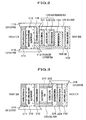
- Fig.2 is a cross-sectional view of the embodiment 1 of an anti-glare and anti-fog element according to this invention which is enlarged and shown in the thickness direction.
- this anti-glare and anti-fog element is structured in such a way that an opposing arrangement of the front side substrate 110 which comprises the substrate having a wave length selective property as a substrate and back side substrate 130 which comprises a transparent substrate (glass) is carried out, and electochromic film 120 which exhibits electrochromic phenomenon is interposed between these front side substrate 110 and back side substrate 130.
- hydrophilic functional film 111 is provided on the front side of the front side substrate 110.
- This hydrophilic functional film 111 comprises a photocatalyst substance (not shown) having photocatalyst functions such as titanium oxide, and a hydrophilic substance (not shown) having hydrophilicity such as silicon oxide.
- the photocatalyst substance (not shown) included in the hydrophilic functional film 111 can disassemble and remove organic matters, such as dirt adhering to the surface of this anti-glare and anti-fog element, it becomes possible to hold the hydrophilicity of the surface of this anti-glare and anti-fog element appropriately. Further, if the aforementioned hydrophilic substance is structured with a porous silicon oxide film, required hydrophilicity can be obtained comparatively easily.
- this hydrophilic functional film 111 may be structured with photocatalyst substance independently as needed, or may be structured with "laminates structure” comprising films of photocatalyst substance and other substance, or “mixed and distributed films.” of photocatalyst substance and other substance.
- electrochromic films 120 are included on the backside of the front side substrate 110 . These electrochromic films 120 are formed in such a way that transparent film 112 comprising such as indium tin oxide (ITO) and tin oxide (SnO 2 ), oxide coloring film 121 comprising such as iridium oxide (IrOx) and nickel oxide (NiOx), electrolyte film 122 comprising solid electrolytes such as tantalum oxide (Ta 2 O 5 ), and reductive coloring film 123 comprising such as tungsten oxide (WO 3 ) and molybdenum oxide (MoO 3 ), are laminated one by one.
- transparent film 112 comprising such as indium tin oxide (ITO) and tin oxide (SnO 2 )
- oxide coloring film 121 comprising such as iridium oxide (IrOx) and nickel oxide (NiOx
- electrolyte film 122 comprising solid electrolytes such as tantalum oxide (Ta 2 O 5 )
- seal agent 125 which is circumferentially arranged.
- this seal agent 125 is not construed as being limited thereto but may be substituted by, such as epoxy resin unless the effect of this invention can be presented.
- clip electrode 115 is put between one side of the front side substrate 110, and this clip electrode 115 is connected to the transparent electrode film 112.
- clip electrode 116 is put between the side of another side of the front side substrate 110, and this clip electrode 116 is connected to transparent electrode film 124 through transparent electrode film 113.
- processing of etching and the like is performed and a predetermined insulating film (not shown) is formed.
- a predetermined oxide coloring film (not shown) may be formed.
- electrochromic films 120 are colored in predetermined color phase.
- the colored electrochromic films 120 are decolorized by giving reverse polar voltage to these grip electrodes 115 and 116, or short-circuiting between the clip electrodes 115 and 116.
- an anti-glare and anti-fog element constituted as described in the foregoing, anti-glare effect by coloring of electrochromic films 120 is obtained. Moreover, since the water adhering to the surface of this anti-glare and anti-fog element is thinly damp in layer structure and spreads due to the hydrophilicity of hydrophilic functional film 111, formation of water-drip is prevented and the anti-fog effect is obtained. Further, if ultraviolet rays carry out incidence from the surface of this anti-glare and anti-fog element, these ultraviolet rays will be absorbed by the photocatalyst substance (not shown) included in the hydrophilic functional film 111, and will excite this photocatalyst substance to be energized.
- colored glass substrate colored so that it may have the alternative reflective characteristic as will be described hereunder, or a substrate wherein an interference film is formed on the transparent glass substrate can be used. Thickness of these substrates is used as predetermined thickness according to the purpose of use.
- colored glass substrate which causes the light of a predetermined region to be alternatively reflected can be used.
- a colored glass substrate wherein various kinds of colorants are added onto a transparent glass substrate can be used as such a colored glass.
- colored glass substrate as shown in Table 1 is mentioned.
- Table 1 shows various kinds of colorants and color phase presented by various kinds of colored glass substrates to which these colorants are added.
- the colored glass substrate colored in various colors can be obtained by adding any one sort of the aforementioned colorant independently to the transparent glass substrate, or by mixing and adding two or more colorants.
- a substrate having a wave length selective property used for an anti-glare and anti-fog element a substrate (referred as only an "interference substrate” henceforth) wherein an interference film presenting an interference color by the interference action of light is formed on a transparent substrate can be used.
- an interference substrate especially kinds of the aforementioned interference film are not limited. If adhesion property with a hydrophilic functional film included in this invention is good, and the anti-glare and anti-fog characteristic of this invention is not impeded, various kinds of interference films can be used. For example, various kinds of metal oxides as such an interference film are mentioned.
- the interference film formed by titanium oxide film independently or a silicon oxide film independently, formed by laminated films of titanium oxide and the silicon oxide, or formed by mixed films of the both are mentioned.
- Such an interference substrate comes to present color phase by various interference colors according to the thickness of the interference film formed on this substrate.
- a transparent substrate used by this invention as will be referred hereunder, a transparent substrate can be chosen out of conventionally known transparent glass substrates according to the purpose of use as needed.
- Fig.10 is a graph showing the reflective characteristic (wavelength dependability of reflectance) presented by the glass substrate which formed TiO 2 film having various thickness on a transparent glass substrate.
- Fig.10A is a view showing spectral reflectance characteristics of an interference substrate with 120nm thickness of already formed TiO 2 film. In this interference substrate, the alternative reflective characteristic wherein the reflectance of about 380 to 400nm region (purple) becomes higher is exhibited and color phase of purple tone is presented.
- Fig.10B is a view showing spectral reflectance characteristics of the interference substrate with 140nm thickness of already formed TiO 2 film. In this interference substrate, the alternative reflective characteristic wherein the reflectance of an about 430 to 450nm region (blue) becomes higher is exhibited, and color phase of green tone is presented.
- Fig.10C is a view showing spectral reflective characteristic of an interference substrate with 160nm thickness of already formed TiO 2 film.
- the alternative reflective characteristic such that the reflectance of the light of an about 480 to 500nm region (green) becomes higher is exhibited.
- Fig.10D is a view showing spectral reflectance characteristics of the interference substrate with 180nm thickness of already formed TiO 2 film.
- the alternative reflective characteristics such that the reflectance in the range of about 530 to 550nm region (yellow) becomes high is exhibited, and color phase of yellow tone is presented.
- a substrate having Titanium oxide (TiO 2 ) film independently was mentioned as an example here as an interference substrate according to this invention.
- an interference substrate which comprises both of titanium oxide film and silicon oxide film or silicon oxide film independently or other metal oxides may be included.
- the interference substrate according to this invention is constituted so that both of titanium oxide film and a porous silicon oxide film are included, the above-described spectral reflectance characteristics and a high hydrophilic function can be exhibited simultaneously. Whereby, the interference substrate which allows a coexistence of expected wave length selective property and an expected hydrophilic function is obtained.
- the formation method of the film used for an anti-glare and anti-fog element according to this invention is not construed as being limited thereto but may be substituted with other method which can form the film comprising titanium oxide film and silicon oxide film capable of exerting the effect of this invention, or a method of forming the film comprising other substances used as needed.
- a film formation method for example gaseous phase formation methods, which are conventionally known methods such as vacuum deposition method, a sputtering method, and a plasma CVD (CVD: Chemical vapor deposition, chemistry gaseous phase membrane formation) method, or liquid phase formation methods such as a sol gel process can be used.
- titanium oxide film and a silicon oxide film by gaseous phase formation methods, by controlling oxygen partial pressure in film formation atmosphere, chemistry quantum composition ration of titanium oxide film or a silicon oxide film can be suitably changed.
- a fine property of a silicon oxide film in the depth direction, and as a result, reflectance thereof can be suitably changed.
- the chemistry quantum composition ration in the depth direction of titanium oxide film or a silicon oxide film is controlled, and physical properties in the depth direction of these films is changed.
- This technique can be performed by deposition method or plasma CVD method, also.
- both or either of a refractive index or the number of films can be adjusted suitably. This allows titanium oxide film having a desired reflectance to be obtained.
- a hydrophilic functional film included in the anti-glare and anti-fog element of this invention is formed on a substrate having the aforementioned wave length selective property, so that the surface of the anti-glare and anti-fog element may exhibit hydrophlicity.
- water adhering to the surface of the anti-glare and anti-fog element having hydrophilicity is thinly damp in layer structure and spreads. This prevents this water from being formed in the surface of the anti-glare and anti-fog element in the shape of water-drip.
- organic matters such as dirt adhering to the surface of the anti-glare and anti-fog element are also disassembled and removed.
- a photocatalyst substance which comprises titanium oxide having a photocatalyst function independently, or a substance which is constituted including the aforementioned photocatalyst substance and the hydrophilic substance having hydophilicity such as silicon oxide are preferably used.
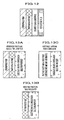
- the cross-sectional structure of the hydrophilic functional film included in this invention will be schematically shown in Fig.13A, B, and C.
- a hydrophilic film comprising a photocatalyst film structured with a photocatalyst substance, and other substance as shown in Fig.13A
- the aforementioned photocatalyst film single film
- a film with photocatalysis and other substance mixed and distributed may be constituted as composition films.
- hydrophilic functional film when ultraviolet rays are irradiated onto these electrochromic films, the aforementioned photocatalyst film is excited and activated, and dirt (or foreign substance), such as an organic matter adhering to the surface of the aforementioned hydrophilic film is disassembled and removed. Since the aforementioned photocatalyst film absorbs ultraviolet rays, photochromic phenomenon of the electrochromic films can also be suppressed. Further, if the aforementioned hydrophilic substance is structured with porous silicon oxide, hydrophilicity of the surface of the anti-glare and anti-fog element can be raised more.
- this hydrophilic functional film is structured with lamination structure having photocatalyst film comprising photocatalyst substance such as titanium oxide, and porous silicon oxide, photocatalyst function and hydrophilic function can be exhibited more greatly.
- the opening portion of hydrophilic film comprising such porous silicon oxide is constituted so that even the surface of a photocatalyst film may be reached, and direct contact of foreign substances such as an organic matter, NOx, which entered in the opening of porous silicon oxide, is possible in a photocatalyst film, photocatalyst effect over the aforementioned foreign substance is exhibited to the maximum extent resulting in full decomposition and removal of the aforementioned foreign substance.
- a hydrophilic functional film comprising porous silicon oxide and titanium oxide
- an excitation energy in case of the aforementioned titanium oxide, energy of an ultraviolet-rays region mainly
- the aforementioned electron and electron hole pair generated on the photocatalyst film also transmits this hydrophilic film comprising comparatively transparent porous silicon oxide, the aforementioned foreign substance which entered and adhered can be disassembled and removed from the opening of this porous silicon oxide.
- the surface coarseness (arithmetic average coarseness Ra) of this porous silicon oxide is set as 2nm or more, higher hydrophilicity can be given to the aforementioned anti-glare and anti-fog element.
- Transparent substrate included in an anti-glare and anti-fog element of this invention is not limited, and can be suitably chosen from conventionally known substrates, so as to be adapted corresponding to the purpose of use.
- a transparent substrate usual soda lime glass having a thickness according to the purpose of use can be used, for example.
- electrochromic films included in an anti-glare and anti-fog element of this invention if the effect of the anti-glare property of this invention can be exhibited, a conventionally known electrochromic substance can be used. Also any of various kinds of inorganic materials and organic materials can be used. Further, any of solid-like electrochromic substance film or solution comprising various kinds of electrochromic substances may be used. For example, the electrochromic substance having iridium oxide (IrOx) film which is an oxidized coloring film and tungsten oxide (WO 3 ) which is a reductive coloring film combined, can be used as a solid-like electrochromic substance film.
- IrOx iridium oxide
- WO 3 tungsten oxide
- hydrophilic functional film 211 comprising a photocatalyst substance (not shown) which comprises titanium oxide film, and a hydrophilic substance (not shown) which comprises silicon oxide, are formed on the front side of the front side substrate 210 having a wave length selective property and arranged in the front side (field where incidence of the light is carried out) of this element by a gaseous phase formation method.
- Transparent electrode film 212 by such as ITO is formed on the back side of this front side substrate 210.
- the electrochromic films 220 comprising such as WO 3 are formed on the backside of this transparent electrode film 212.
- Transparent electrode films 224 such as ITO or tin oxide, and the electrode protection films 226 such as silicon oxide, are formed one by one from this substrate side on the front side of the back side substrate 230 comprising a transparent glass substrate.
- electrolyte such as lithium iodide, lithium perchlorate or solvent such as ⁇ -butyrolactone, propylene carbonate, and electrolyte solution which comprises ultraviolet-rays absorbents such as benzophenone and a cyanoacrylate, and sealed by seal agent 225.
- electrolyte such as lithium iodide, lithium perchlorate or solvent such as ⁇ -butyrolactone, propylene carbonate
- electrolyte solution which comprises ultraviolet-rays absorbents such as benzophenone and a cyanoacrylate
- photochromic phenomenon means the phenomenon wherein a certain kind of substance is colored by irradiation of light (ultraviolet rays or visible light of short wavelength) in the state of a solid or solution, and returns to the original color again in a dark place.
- clip electrode 215 is put between one side of the front side substrate 210, and this clip electrode 215 is connected to transparent electrode film 212.
- the clip electrode 216 is put between one side of the backside substrate 230, and this clip electrode 216 is connected to transparent electrode film 224.
- electrochromic films 220 are colored by giving the voltage of negative polarity to the clip electrode 216.
- the colored electochromic film 220 is de-colored by giving respectively reverse polar voltage to these clip electrodes 215 and 216.
- electrolyte solution 222 comprises combination of such as ferrocene and lithium perchlorate
- electrolyte solution 222 comprises combination of such as ferrocene and lithium perchlorate
- this electrode protection film 226 is intended to prevent the situation that iodine ion is absorbed in the surface of the transparent electrode film 224 and is not seceded therefrom, when a driving method is set as positive voltage feeding at the time of coloring and set as negative voltage feeding at the time of de-coloring. In other setup, this electrode protection film 226 is not needed.
- third embodiment of an anti-glare and anti-fog element as shown in Fig.4 is constituted in such a way that transparent electrode film 212 and electrode protection film 227 such as silicon oxide by such as ITO are formed one by one on the backside of the front side substrate 210 having a wave length selective property.
- Transparent electrode film 224, such as ITO and tin oxide, and the electrochromic films 220 comprising such as WO 3 are formed one by one from this substrate side on the front side of the back side substrate 230 comprising a transparent glass substrate, and between the electrochromic films 220 and the electrode protection film 227 is filled up with electrolyte solution 222, and sealed by seal agent 225.
- the necessity for the electrode protection film 227 is compliant with embodiment 2.
- An anti-glare and anti-fog element of the embodiment 4 shown in Fig.5 is an example wherein electrochromic films 220 and electrolyte solution 222 in the structure shown in Fig.3 or Fig.4 (embodiment 2 or 3) are replaced with electrochromic substance such as viologen, or solvent such as ⁇ -butyrolactone propylene carbonate, and electrochromic solution 228 including ultraviolet-rays absorbents such as benzophenone and cyanoacrylate as needed, and other structure is compliant with the embodiment 2 or 3.
- electrochromic substance such as viologen, or solvent such as ⁇ -butyrolactone propylene carbonate
- electrochromic solution 228 including ultraviolet-rays absorbents such as benzophenone and cyanoacrylate as needed, and other structure is compliant with the embodiment 2 or 3.
- An anti-glare and anti-fog element of the embodiment 5 shown in Fig.6 provides and constitutes a reflective film on the backside of the transparent substrate 230 which is arranged on the backside in a structure shown in Fig.3 (embodiment 2). That is, Fig.5 is a view showing reflective film 340 comprising such as Cr and Al, and protection coat 342 for protecting this reflective film physically and chemically is formed from substrate 330, on the backside of backside substrate 330 comprising a transparent glass, to thereby constitute a reflector. Incidentally, especially when this anti-glare and anti-fog element is installed in the environment where corrosion of a reflective film is hard to be generated, this protection coat 342 is not necessarily provided.
- a material to allow a specular surface formation on a glass substrate and a relatively high reflectance, or a metal material to allow a specular surface formation on a predetermined part of the electrochromic films as will be referred below as needed, which is capable of power feeding thereto, are usable.
- passive metal such as Al and Cr or alloy comprising these metal as main composite substance are conveniently used for a reflective film.
- Such a reflective film can be formed using a gaseous phase formation methods such as a usual deposition method or a usual sputtering method, and the like. If such a gaseous phase formation method is used, two or more mutually different films which constitute electrochromic films can be formed continuously. This makes it possible to achieve a shortened manufacturing time and reduction in the cost of manufacture.
- a gaseous phase formation methods such as a usual deposition method or a usual sputtering method, and the like. If such a gaseous phase formation method is used, two or more mutually different films which constitute electrochromic films can be formed continuously. This makes it possible to achieve a shortened manufacturing time and reduction in the cost of manufacture.
- An anti-glare and anti-fog element of the embodiment 6 shown in Fig.7 provides and constitutes a reflective film in a structure shown in Fig.4 (embodiment 3) on the backside of the transparent substrate 230 which is arranged on the backside. That is, on the back side of the back side substrate 330 comprising transparent substrate (glass), reflective film 340 which comprises such as Cr, Al, from this substrate 330, protection coat 342 for protecting physically and chemically this reflective film 340, are formed, to thereby constitute a reflector.
- this protection coat 342 is not necessarily provided.
- An anti-glare and anti-fog element of embodiment 7 shown in Fig. 8 provides and constitutes a reflective film on the back side of the transparent substrate 230 which is arranged on the backside, in a structure shown in Fig.5 (Embodiment 4). That is, on the back side of the back side substrate 330 which comprises transparent substrate (glass), reflective film 340 from this substrate 330, and protection coat 342 for protecting physically and chemically this reflective film 340 are formed, to thereby constitute a reflector.
- this protection coat 342 is not necessarily provided.
- An anti-glare and anti-fog element of embodiment 8 of this invention shown in Fig.1 is a replaced example of transparent electrode film 124 in the structure of the transmitting type element shown in Fig.2 (embodiment 1) with electrode-cum-reflective film 40, to thereby constitute a reflector.
- the anti-glare and anti-fog element of this invention which is provided with the electrode-cum-reflective film 40 which serves both as an electrode and a reflective film, constituting a reflector as shown in Fig.1 is constituted in such a way that front side substrate 10 comprising a substrate having a wave length selective property as a substrate and backside substrate 30 comprising a transparent glass substrate are arranged in an opposing manner, and electrochromic films 20 which exhibit an electrochromic phenomenon are intervened between these front side substrate 10 and the back side substrate 30.
- Hydrophilic functional film 11 comprising photocatalyst film 11a which comprises a photocatalyst substance having photocatalyst functions such as titanium oxide, and hydrophilic film 11b which comprises a hydrophilic substance having hydrophilicity such as silicon oxide, are formed on the front side of the front side substrate 10.
- This hydrophilic functional film 11 produces hydrophilicity onto the surface of an element. Adhesion of water-drip is thus prevented and anti-fog effect is given to the element.
- photocatalyst film 11a included in the hydrophilic functional film 11 is effective in order to have the action to carry out decomposition removal of the organic matters such as dirt which adhered to the surface of the element, and the hydrophilicity of the surface of the element is held.
- this hydrophilic functional film 11 can be structured with a lamination structure which comprises a film of a photocatalyst substance and a film of other hydrophilic substances, and also may be structured with a photocatalyst substance independently, or with a film which mixes with other substances in a distributed manner.
- porous silicon oxide film serves as a composition substance preferably.
- transparent electrode film 12 and transparent electrode film 13 comprising such as indium tin oxide (ITO: Indium tin oxide), tin oxide (SnO2), are formed on the backside of front side substrate 10.
- ITO Indium tin oxide
- SnO2 tin oxide
- processing of etching and the like is performed between above both films, and a predetermined insulating film (not shown) or a predetermined oxidized coloring film (not shown) is formed.
- this oxidized coloring film 21 the electrolyte film 22 which comprises solid electrolytes such as tantalum oxide, and the reductive coloring film 23 which comprises such as tungstic oxide and molybdenum oxide, are formed one by one, to thereby constitute electrochromic films 20.
- an electrode-cum-reflective film 40 which is a reflective film serving as an electrode is formed on the backside of reductive coloring film 23, and this electrode-cum-reflective film 40 is connected to transparent electrode film 13.
- these electrochromic films 20 and the electrode-cum-reflective film 40 are sealed between this front side substrate 10 and the back side substrate 30 by seal agent 25 which is circumferentially arranged.
- this seal agent 25 is not construed as being limited thereto but may be substituted by epoxy resin, for example as seal agent 25 without impeding the effect of this invention.
- embodiment 8 which is a reflector type anti-glare and anti-fog element of this invention here is constituted as in the following. That is, photocatalyst film 11a is determined as anatase type TiO 2 with thickness of 140nm, and hydrophilic film 11b is determined as a porous SiO 2 with thickness of 10nm. Also, the colored glass substrate made in U.S. PPG (brand name; Solextra) is used as a front side substrate having a wave length selective property.
- composite substance of electrochromic films 20 is determined as transparent electrode films 12 and 13 comprising ITO with thickness of 200nm, an oxidized coloring film 21 comprising IrOx with thickness of 100nm, and a reductive coloring film 23 comprising Ta 2 O 5 with thickness of 600nm. Moreover, these electrochromic films 20 are sealed by a seal agent comprising epoxy system adhesives. Furthermore, electrode-cum-reflective film 40 is constituted by an Al metal film with thickness of 100nm, and the soda lime glass with thickness of 1.1mm is used as a backside substrate 30 comprising transparent glass substrate.
- clip electrodes 15 and 16 connected to the external power supply which is not shown is connected to transparent electrode film 12 and transparent electrode film 13 respectively, so as to electrically energize electrochromic films 20 to color or de-color these films. That is, by giving the voltage of negative polarity to the clip electrode 16 while giving the voltage of positive polarity to the clip electrode 15 from an external power supply (not shown), the electrochromic films 20 are colored. The colored electrochromic films 20 are decolorized by giving respectively reverse polar voltage to these clip electrodes 15 and 16, or by short-circuiting between the clip electrode 15 and 16.
- An anti-glare and anti-fog element of embodiment 9 of this invention shown in Fig.1 is a replaced example of transparent electrode film 224 in a structure of the transmitting type element shown in Fig.5 with electrode-cum-reflective film 341, to thereby constitute a reflector.
- spectral reflectance characteristics at the time of un-operating and spectral reflectance characteristics of a reflector having no anti-glare and anti-fog function in this structure of anti-glare and anti-fog element will next be compared to evaluate about a difference in color-phase of the both.
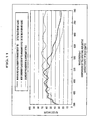
- Each spectral reflectance characteristics of commercial blue colored glass substrate (the product made in U.S. PPG, brand name: Solextra), and a usual transparent glass substrate (soda lime glass) applied respectively to a reflector type anti-glare and anti-fog element of this invention (the aforementioned embodiment 8) as shown in Fig.1 is compared and shown in Fig.11.
- spectral reflectance characteristics of an anti-glare and anti-fog element employing the aforementioned blue colored glass substrate shows that a reflectance near about 400-550nm is higher, presenting a color phase of blueness.
- spectral reflectance characteristics (thick line showing an anti-glare function (electrochromic function) at the time of un-operating.) of the reflector type anti-glare and anti-fog element (above embodiment 8) of this invention employing the aforementioned blue colored glass substrate as shown in Fig.1 was almost equivalent to the spectral reflectance characteristics (dotted line) of colored anti-fog mirror structured with hydrophilic film including a photocatalyst substance as shown in Fig.12 colored glass substrate and a reflective film, that is, with no anti-glare function.
- reflector type anti-glare and anti-fog element of this invention can be set to have almost same spectral reflectance characteristics as anti-fog mirror with no anti-glare function even at the time of un-operating.
- ultraviolet rays intensity: 1.0mW/cm2
- ultraviolet rays intensity: 1.0mW/cm2
- the oil is applied to the surface thereof to be subjected to the irradiation of the ultraviolet rays.
- the water-drip contact angle was also measured.
- the present invention is not limited to the above-explained various embodiments, but may be modified as needed without departing from the technical spirit and scope of the invention.
- the thickness of various films such as thickness of the substrate having the aforementioned wave length selective property, or transparent glass substrate, and a photocatalyst film, a hydrophilic functional film or electrochromic films, are not limited, but are determined as needed.
- an anti-glare and anti-fog element which is formed in such a way that a resistance heating element (for example, PTC (panel-like heater using a positive characteristic thermistor)) is electrically energized on the backside of this reflected film, may also be constituted.
- a resistance heating element for example, PTC (panel-like heater using a positive characteristic thermistor)
- PTC panel-like heater using a positive characteristic thermistor
- the anti-glare and anti-fog element of this invention thus constituted is preferable for an exterior mirror for automobiles.
- the exterior mirror for automobiles according to this invention it can be set up so that both an anti-glare function and an anti-fog function may be provided and predetermined color phase may be presented at the time of un-operating of the aforementioned anti-glare function.
- color phase of a driver's seat side mirror is set up so that the driver's side mirror may present equal color phase with a passenger seat side mirror at the time of un-operating of the anti-glare function of a driver's seat side mirror. That is, by choosing a substrate which has a wave length selective property included in a driver's seat side mirror, it becomes possible for a man not to have a sense of incongruity resulting from the difference in color phase between a driver's seat side mirror and a passenger seat side mirror.
- this invention is adapted to be used for the exterior mirror for automobiles, wherein a predetermined color phase is presented at the time of un-operating of the anti-glare and anti-fog function, provided with chemical stability and capability of disassembling the dirt adhering to the surface is fully exhibited, in order to achieve a high anti-fog property.
- this invention predetermines color phase of the mirrors which have a mutually different function among plurality of mirrors, and it is preferable for the exterior mirror for automobiles and it becomes possible to set this color phase to the same extent.
- combination of the mirrors which does not give a sense of incongruity visually can be achieved and adapted preferably to an exterior mirror for automobiles
Landscapes
- Chemical & Material Sciences (AREA)
- Engineering & Computer Science (AREA)
- Materials Engineering (AREA)
- Organic Chemistry (AREA)
- Chemical Kinetics & Catalysis (AREA)
- Life Sciences & Earth Sciences (AREA)
- General Chemical & Material Sciences (AREA)
- Geochemistry & Mineralogy (AREA)
- Physics & Mathematics (AREA)
- Nonlinear Science (AREA)
- Mechanical Engineering (AREA)
- Multimedia (AREA)
- Crystallography & Structural Chemistry (AREA)
- General Physics & Mathematics (AREA)
- Optics & Photonics (AREA)
- Surface Treatment Of Optical Elements (AREA)
- Optical Elements Other Than Lenses (AREA)
- Rear-View Mirror Devices That Are Mounted On The Exterior Of The Vehicle (AREA)
- Catalysts (AREA)
- Laminated Bodies (AREA)
Abstract
An anti-glare element provided with a front side substrate
comprising a substrate having a wave length selective property, and a back
side substrate comprising a transparent substrate and having
electrochromic films which exhibit an electrochromic phenomenon
interposed between the front side substrate and back side substrate,
wherein a photocatalyst film comprising a photocatalyst substance having
transmittivity and a hydrophilic functional film comprising a hydrophilic
film of a hydrophilic substance are formed on the front side of the front side
substrate comprising a substrate with said wave-length selective property,
to thereby give an anti-fog function. Or electrode-cum-reflective film is
formed on the backside film of the electrochromic film, to thereby achieve a
reflective mirror. An anti-glare and anti-fog element or an exterior mirror
for automobiles wherein spectral reflectance characteristics of the
anti-glare and anti-fog element can be set so that predetermined color
phase may be presented at the time of un-operating of an anti-glare
function by a substrate having wave length selective property, and along
with this surface dirt can be disassembled and economical efficiency and
chemical stability are satisfied, can be provided. Also, color phase of the
mirrors which have mutually different functions among plurality of mirrors
is determined as a predetermined color phase, and the color phase can be
set to the same extent, and the combination of the mirror which does not
give a sense of incongruity visually can be embodied.
Description
This invention relates to an anti-glare and anti-fog element having
an anti-glare function using an electrochromic phenomenon, and an
anti-fog function by a hydrophilic functional film comprising a
photocatalyst substance, and more particularly relates to an anti-glare and
anti-fog element and an exterior mirror for automobiles, which utilize
predetermined color phase at the time of un-operating of the anti-glare
function.
An anti-fog element or anti-fog mirror which causes an anti-fog
function to be exhibited by a hydrophilic functional film comprising a
photocatalyst substance is mentioned for example as conventionally known
technology. For example, in JP-A-09-225303 a semiconductor
photocatalyst substance and a photocatalyst composition which comprises
oxide particle distributed in this semiconductor photocatalyst substance
wherein the band gap of the photocatalyst composition is 0.05eV larger or
more than the band gap of a simple semiconductor photocatalyst substance,
are produced. In this invention, a photocatalyst composition excellent in
photocatalyst activity, having an improved intensity of a photocatalyst film
and a substrate with photocatalyst composition can be achieved and can be
adapted to such as an anti-fog element.
Further, JP-A-10-36144 proposes an anti-fog element constituted in
such a manner that a transparent photocatalytic reaction substance film
such as TiO2, is formed on one surface of a transparent substrate member
such as a glass substrate, and transparent inorganic oxide substance such
as SiO2 is formed thereon to transparently constitute the whole part. In
this invention, an anti-fog element is constituted in such a way that an
inorganic oxide film in a porous state is formed on the surface of a
substrate member such as a glass substrate so that the surface exhibits
hydrophilicity. Fall of hydrophilicity can be thus prevented and an
anti-fog element which can hold an expected anti-fog property over a long
period of time can be achieved.
On the other hand, as a conventional anti-glare element or anti-fog
mirror, those which exhibit the antiglare function by electrochromic
substance can be mentioned, for example. For example, in JP-09-120088,
at least one kind of cathode electrochromic compound, at least one kind of
anode electrochromic compound, and single block type self-erasure system
solution phase electrochromic device and a device using the same are
disclosed. This invention proposes an anti-glare mirror for automobiles
serving as a reflection mirror wherein the light of the intensity permissible
for a driver is reflected. As an element or a mirror, which allows a
coexistence of the above anti-fog function and the anti-glare function, these
inventors produced an electrochromic element arranged in such a manner
that electrochromic films comprising electochromic substance and
electrolysis is arranged between a transparent electrode films provided on
two glass substrates, a hydrophilic film coomprising a photocatalyst film
and a porous inorganic substance are formed on the front surface of the
glass substrate of the front side, and with this arrangement, an
electrochromic element as a reflector with reflective film formed on the
front surface of the backside substrate viewed from the front side substrate
is produced. According to this invention, since the surface is formed in
hydrophilic state having a photocatalyst function, a photochromic
phenomenon of electrochromic films are prevented as well as having an
anti-fog function and anti-glare function. This permits an electrochromic
element to be realized without adding an ultraviolet-rays absorbent to the
aforementioned electrolysis liquid, or with a little bit of addition of the
ultraviolet-rays absorbent.
Here, the aforementioned "an electrochromic phenomenon" is the
general term of the phenomenon in which the color of a substance changes
with an application of voltage. Here, a "substance" and a "film" which
exhibit such an electrochromic phenomenon are called an "electrochromic
substance" and "electrochromic films", respectively.
If the element or mirror which has an anti-glare function and an
anti-fog function thus described is applied to a mirror for such as
automobiles, dazzle of catoptric light and surface fog can be prevented, and
driver's visibility can be kept good. Mirrors for automobiles usually
include a driver's seat side mirror and a passenger seat side mirror. A
driver's seat side mirror and a passenger seat side mirror having almost
equal anti-glare function and an anti-fog function were conventionally and
mainly in use. However, in such a mirror for automobiles, combination of
the mirror having the function of necessary minimum for each side of a
driver's seat and a passenger seat, or a different function is increasingly
demanded, considering from economical efficiency in recent years.
For example, combination of the aforementioned mirrors for
automobiles is considered to be variably carried out such as a combination
of a driver's seat side mirror having the automatic anti-glare function
which made reflectance variable, and a passenger seat side mirror having
an anti-glare function with fixed reflectance (for example, anti-glare
function colored blue) and an anti-fog function. Since especially the
mirror having the aforementioned automatic anti-fog function is not
colored in comparatively bright state, that is, the state in which an
anti-glare function is not needed, for example in the daytime, either of or
both of color phase and color tone which each of a driver's seat side mirror
and a passenger seat side mirror presents differs. Especially, when the
anti-fog function is not operating in a driver's seat side mirror, the
difference between this color phase and color tone becomes remarkable.
Incidentally, generally the attribute of visual and sensory cognition of
colors such as red, yellow, green, blue, and purple is meant as the above
"color phase." The aforementioned "a color tone" generally means grades,
such as a shade of color, strength, and contrast, and both of these are
combined to be referred hereinafter as only "color phase".
Furthermore, difference in color phase between the mirror of the
aforementioned driver's seat side and the mirror of a passenger seat side is
emphasized in the daytime at the time of not operating of the mirror of the
aforementioned driver's seat side having anti-glare function and when the
degree of brightness is comparatively large. Consequently, a man is likely
to have comparatively strong sense of incongruity to the difference in color
phase between the mirrors caused by such a combination of mirrors. For
this reason, in an automobile having different function of mirrors of
driver's seat side and passenger seat side in a corresponding manner
respectively, the mirror of the aforementioned driver's seat side and the
mirror of passenger seat side present the almost same color phase. Thus,
it is demanded that the combination of the mirror in which a man does not
have a sense of incongruity is carried out.
In view of the above-described problems, the object of this invention
is to provide an anti-glare and anti-fog element which can be set so as to
have both an anti-glare function and an anti-fog function and present a
predetermined color phase at the time of un-operating of the
aforementioned anti-glare function, and an exterior mirror for automobiles
using this anti-glare and anti-fog element.
In order to solve the aforementioned problem, an anti-glare and
anti-fog element of this invention is arranged in such a manner that
electrochromic films which exhibit an electrochromic phenomenon are
intervened between a transparent substrate arranged in the front side, and
a transparent substrate arranged in the backside so as to be provided with
an anti-glare function, wherein transparent substrate of the front side
comprises a substrate with a wave length selective property, and anti-fog
function is given by forming a hydrophilic functional film including a
photocatalyst film which comprises a photocatalyst substance and has light
transmittivity, on the front surface of the transparent substrate of the front
side.
Incidentally, here, the above "wave length selective property"
means the characteristic wherein the light of specific wavelength among
the lights of carrying out incidence from the front side of the
aforementioned anti-glare and anti-fog element is reflected or transmitted
alternatively. Namely, the aforementioned "wave length selective
property" is specified by spectral reflectance characteristics of the
transparent substrate of the front side included in this invention as
referred below, or a spectral transmittivity characteristics. Since there is
a correlation between this spectral reflectance characteristics and spectral
transmittance characteristics, the "wave length selective property"
according to this invention is uniquely determined by the spectral
reflectance characteristics or the spectral transmittance characteristic.
In the aforementioned anti-glare and anti-fog element, it is
desirable to constitute a hydrophilic functional film by a photocatalyst film
comprising a photocatalyst substance of titanium oxide independently.
Further, in the aforementioned anti-glare and anti-fog element, a
hydrophilic functional film may be constituted including a photocatalyst
film which comprises a photocatalyst substance of titanium oxide, and
hydrophilic film which comprises a hydrophilic substance of silicon oxide.
Also, in the aforementioned anti-glare and anti-fog element, the
hydrophilic film is preferably constituted by porous silicon oxide.
Incidentally, surface coarseness (arithmetic average coarseness Ra)
of this porous silicon oxide may be set as 2nm or more.
And in the aforementioned anti-glare and anti-fog element, a
reflective film is preferably formed on the backside of the transparent
substrate of back side viewed from the transparent substrate of the front
side which has a wave length selective property.
Further, a reflective film may be formed on the front side of the
transparent substrate of back side viewed from the transparent substrate
of the front side which has a wave length selective property. And this
reflective film may also serve as function of electrode to perform power
feeding to the electrochromic films.
Furthermore, an anti-glare and anti-fog element as anti-glare and
anti-fog mirror thus described is preferably used for an exterior mirror for
automobiles.
Exemplary embodiment of this invention will now be specifically
explained in conjunction with the drawings. Incidentally, the portions of
the same designation as those in each embodiment used for the explanation
so far are designated the same numerals and signs, omitting and
simplifying the overlapping explanation.
An anti-glare and anti-fog element according to this invention
includes an electochromic film to exhibit an anti-glare function, and also
hydrophilic functional film to exhibit the hydrophilic function, and further
a substrate which has a wave length selective property so as to present a
predetermined color phase at the time of un-operating of the anti-glare and
anti-fog function. Also, a transmitting type and a reflector type are
included in the anti-glare and anti-fog element according to this invention.
As referred below, embodiments 1 to 4 are structured as a transmitting
type anti-glare and anti-fog element, and embodiments 5 to 9 are
structured as a reflective anti-glare and anti-fog element (anti-glare and
anti-fog mirror). Incidentally, in the explanation of these embodiments,
"front side" and "back side" are respectively based on the case viewed from
the front side (side where light carries out incidence) of an anti-glare and
anti-fog element.
Fig.2 is a cross-sectional view of the embodiment 1 of an anti-glare
and anti-fog element according to this invention which is enlarged and
shown in the thickness direction. As shown in Fig.2, this anti-glare and
anti-fog element is structured in such a way that an opposing arrangement
of the front side substrate 110 which comprises the substrate having a
wave length selective property as a substrate and back side substrate 130
which comprises a transparent substrate (glass) is carried out, and
electochromic film 120 which exhibits electrochromic phenomenon is
interposed between these front side substrate 110 and back side substrate
130.
Also, hydrophilic functional film 111 is provided on the front side
of the front side substrate 110. This hydrophilic functional film 111
comprises a photocatalyst substance (not shown) having photocatalyst
functions such as titanium oxide, and a hydrophilic substance (not shown)
having hydrophilicity such as silicon oxide. By this hydrophilic functional
film 111, the surface of this anti-glare and anti-fog element can present
hydrophilicity, and can prevent adhesion of the water-drip to the surface of
the anti-glare and anti-fog element. In addition, since the photocatalyst
substance (not shown) included in the hydrophilic functional film 111 can
disassemble and remove organic matters, such as dirt adhering to the
surface of this anti-glare and anti-fog element, it becomes possible to hold
the hydrophilicity of the surface of this anti-glare and anti-fog element
appropriately. Further, if the aforementioned hydrophilic substance is
structured with a porous silicon oxide film, required hydrophilicity can be
obtained comparatively easily.
Incidentally, this hydrophilic functional film 111 may be structured
with photocatalyst substance independently as needed, or may be
structured with "laminates structure" comprising films of photocatalyst
substance and other substance, or "mixed and distributed films." of
photocatalyst substance and other substance.
Also, on the backside of the front side substrate 110, electrochromic
films 120 are included. These electrochromic films 120 are formed in such
a way that transparent film 112 comprising such as indium tin oxide (ITO)
and tin oxide (SnO2), oxide coloring film 121 comprising such as iridium
oxide (IrOx) and nickel oxide (NiOx), electrolyte film 122 comprising solid
electrolytes such as tantalum oxide (Ta2O5), and reductive coloring film 123
comprising such as tungsten oxide (WO3) and molybdenum oxide (MoO3),
are laminated one by one. And these electrochromic films 120 are sealed
between this front side substrate 110 and the back side substrate 130 by
seal agent 125 which is circumferentially arranged. Incidentally, this seal
agent 125 is not construed as being limited thereto but may be substituted
by, such as epoxy resin unless the effect of this invention can be presented.
And clip electrode 115 is put between one side of the front side
substrate 110, and this clip electrode 115 is connected to the transparent
electrode film 112. Moreover, clip electrode 116 is put between the side of
another side of the front side substrate 110, and this clip electrode 116 is
connected to transparent electrode film 124 through transparent electrode
film 113. In addition, between the transparent electrode film 112 and the
transparent electrode film 113, processing of etching and the like is
performed and a predetermined insulating film (not shown) is formed. Or,
between the transparent electrode film 112 and the transparent electrode
film 113, such as etching may be processed and a predetermined oxide
coloring film (not shown) may be formed. And by giving a voltage of
negative polarity to the clip electrode 116 while giving the voltage of
positive polarity to the clip electrode 115 from an external power supply
(not shown), electrochromic films 120 are colored in predetermined color
phase. The colored electrochromic films 120 are decolorized by giving
reverse polar voltage to these grip electrodes 115 and 116, or
short-circuiting between the clip electrodes 115 and 116.
According to an anti-glare and anti-fog element constituted as
described in the foregoing, anti-glare effect by coloring of electrochromic
films 120 is obtained. Moreover, since the water adhering to the surface of
this anti-glare and anti-fog element is thinly damp in layer structure and
spreads due to the hydrophilicity of hydrophilic functional film 111,
formation of water-drip is prevented and the anti-fog effect is obtained.
Further, if ultraviolet rays carry out incidence from the surface of this
anti-glare and anti-fog element, these ultraviolet rays will be absorbed by
the photocatalyst substance (not shown) included in the hydrophilic
functional film 111, and will excite this photocatalyst substance to be
energized. Consequently, within this photocatalyst substance, the pair (an
electron and electron-hole pair) of an electron and an electron-hole occurs.
This electron and electron hole-pair react with air and water on the surface
of the hydrophilic functional film 111, and · O2- (super oxide an · ion ) which
is rich in oxidization power, and · OH (hydroxyl radical) are caused to be
generated. These · O2- and · OH may decompose and remove organic
matters such as a contaminant adhering to the surface of the hydrophilic
functional film 111 efficiently. Therefore, they act so as to prevent the
hydrophilicity fall of the surface of this anti-glare and anti-fog element.
Required condition of each composition element of the anti-glare
and anti-fog element according to this invention will be explained below.
As a substrate which has a wave length selective property used for
an anti-glare and anti-fog element according to this invention, colored glass
substrate colored so that it may have the alternative reflective
characteristic as will be described hereunder, or a substrate wherein an
interference film is formed on the transparent glass substrate can be used.
Thickness of these substrates is used as predetermined thickness according
to the purpose of use.
In an anti-glare and anti-fog element according to this invention,
colored glass substrate which causes the light of a predetermined region to
be alternatively reflected can be used. A colored glass substrate wherein
various kinds of colorants are added onto a transparent glass substrate can
be used as such a colored glass. For example, colored glass substrate as
shown in Table 1 is mentioned.
| Color of glass | Main colorants |
| Purple | A Mn+Cu system, Co system |
| Blue | Co system, Cu system |
| Green | Cr system, Fe system, Cu system |
| Green (Fluorescence color) | U (uranium) system |
| Yellow | Cu system, nickel system, Cr system, Cd system |
| Brown | Fe+S system (C is used together as a reducing agent.) |
| Yellowish red | Se+Cd system |
| Red | Au system, Cu system, Co system, a Se+Cd system |
| Reddish purple | Nd system, Mn system |
| Black | Mix of the various colorants such as Mn system, Cr system, nickel system, Co system, Fe system, and Cu system |
| Milky white | CaF2 system, a NaF system, CaPO4 system |
Table 1 shows various kinds of colorants and color phase presented
by various kinds of colored glass substrates to which these colorants are
added. As shown in Table 1, the colored glass substrate colored in various
colors can be obtained by adding any one sort of the aforementioned
colorant independently to the transparent glass substrate, or by mixing
and adding two or more colorants.
On the other hand, as a substrate having a wave length selective
property used for an anti-glare and anti-fog element according to this
invention, a substrate (referred as only an "interference substrate"
henceforth) wherein an interference film presenting an interference color
by the interference action of light is formed on a transparent substrate can
be used. In this invention, especially kinds of the aforementioned
interference film are not limited. If adhesion property with a hydrophilic
functional film included in this invention is good, and the anti-glare and
anti-fog characteristic of this invention is not impeded, various kinds of
interference films can be used. For example, various kinds of metal oxides
as such an interference film are mentioned. However, in view of a good
adhesion property with the hydrophilic functional film included in this
invention, for example the interference film formed by titanium oxide film
independently or a silicon oxide film independently, formed by laminated
films of titanium oxide and the silicon oxide, or formed by mixed films of
the both are mentioned. Such an interference substrate comes to present
color phase by various interference colors according to the thickness of the
interference film formed on this substrate. Also, as the transparent
substrate used by this invention, as will be referred hereunder, a
transparent substrate can be chosen out of conventionally known
transparent glass substrates according to the purpose of use as needed.
Fig.10 is a graph showing the reflective characteristic (wavelength
dependability of reflectance) presented by the glass substrate which formed
TiO2 film having various thickness on a transparent glass substrate.
Fig.10A is a view showing spectral reflectance characteristics of an
interference substrate with 120nm thickness of already formed TiO2 film.
In this interference substrate, the alternative reflective characteristic
wherein the reflectance of about 380 to 400nm region (purple) becomes
higher is exhibited and color phase of purple tone is presented. Also
Fig.10B is a view showing spectral reflectance characteristics of the
interference substrate with 140nm thickness of already formed TiO2 film.
In this interference substrate, the alternative reflective characteristic
wherein the reflectance of an about 430 to 450nm region (blue) becomes
higher is exhibited, and color phase of green tone is presented.
Further, Fig.10C is a view showing spectral reflective characteristic
of an interference substrate with 160nm thickness of already formed TiO2
film. In this interference substrate, the alternative reflective
characteristic such that the reflectance of the light of an about 480 to
500nm region (green) becomes higher is exhibited. And Fig.10D is a view
showing spectral reflectance characteristics of the interference substrate
with 180nm thickness of already formed TiO2 film. In this interference
substrate, the alternative reflective characteristics such that the
reflectance in the range of about 530 to 550nm region (yellow) becomes
high is exhibited, and color phase of yellow tone is presented.
A substrate having Titanium oxide (TiO2) film independently was
mentioned as an example here as an interference substrate according to
this invention. Other than this, an interference substrate which
comprises both of titanium oxide film and silicon oxide film or silicon oxide
film independently or other metal oxides may be included. Also, if the
interference substrate according to this invention is constituted so that
both of titanium oxide film and a porous silicon oxide film are included, the
above-described spectral reflectance characteristics and a high hydrophilic
function can be exhibited simultaneously. Whereby, the interference
substrate which allows a coexistence of expected wave length selective
property and an expected hydrophilic function is obtained.
In addition, especially the formation method of the film used for an
anti-glare and anti-fog element according to this invention is not construed
as being limited thereto but may be substituted with other method which
can form the film comprising titanium oxide film and silicon oxide film
capable of exerting the effect of this invention, or a method of forming the
film comprising other substances used as needed. As such a film
formation method, for example gaseous phase formation methods, which
are conventionally known methods such as vacuum deposition method, a
sputtering method, and a plasma CVD (CVD: Chemical vapor deposition,
chemistry gaseous phase membrane formation) method, or liquid phase
formation methods such as a sol gel process can be used.
Also, when forming the above-described titanium oxide film and a
silicon oxide film by gaseous phase formation methods, by controlling
oxygen partial pressure in film formation atmosphere, chemistry quantum
composition ration of titanium oxide film or a silicon oxide film can be
suitably changed.
Namely, it is conventionally known that when the general formula
of titanium oxide film is expressed as TiOx (0< x≦2) and the general
formula of a silicon oxide film is expressed as SiOy (0< y≦2), if oxygen
partial pressure in film formation atmosphere is made comparatively high
and the film formation is carried out, value of x or y in the aforementioned
general formula becomes large, and this allows the amount of oxygen
contained in these films to be increased, and also allows the fine property
of the film to be low. Moreover, it is conventionally known that if oxygen
partial pressure in film formation atmosphere is made low and film
formation is carried out, value of x or y in the aforementioned general
formula becomes low, and this allows the molecule of the amount of oxygen
of these oxides to be decreased, and also allows the fine property of the film
to be high.
Thus, based on the phenomenon in which a fine property of
titanium oxide film or a silicon oxide film changes depending on the size of
oxygen partial pressure in film formation atmosphere, by changing
gradually or continuously the fine property of the depth direction of
titanium oxide film or a silicon oxide film, it becomes possible to change the
refractive index of these films suitably in the film formation. For example,
when titanium oxide film is formed by a sputtering method on a glass
substrate, film forming process advnances in such a way that if oxygen
partial pressure in sputtering atmosphere is changed gradually or
continuously from higher pressure to lower pressure, fine property of the
formed film will increase from a glass substrate side towards the outermost
surface side. And corresponding to this, the refractive index of the
aforementioned film also will increase from a glass substrate side towards
the outermost surface side.
In a similar manner to the control of the chemistry quantum
composition ration of titanium oxide film, a fine property of a silicon oxide
film in the depth direction, and as a result, reflectance thereof can be
suitably changed. Incidentally, by suitably changing oxygen partial
pressure in film formation atmosphere during film formation as described
above, the chemistry quantum composition ration in the depth direction of
titanium oxide film or a silicon oxide film is controlled, and physical
properties in the depth direction of these films is changed. This technique
can be performed by deposition method or plasma CVD method, also.
Thus, by changing a refractive index in the depth direction of
titanium oxide film, if the 1/4-wave film of a high refractive index, and the
1/4-wave film of a low refractive index are laminated alternately, both or
either of a refractive index or the number of films can be adjusted suitably.
This allows titanium oxide film having a desired reflectance to be obtained.
A hydrophilic functional film included in the anti-glare and anti-fog
element of this invention is formed on a substrate having the
aforementioned wave length selective property, so that the surface of the
anti-glare and anti-fog element may exhibit hydrophlicity. Whereby,
water adhering to the surface of the anti-glare and anti-fog element having
hydrophilicity is thinly damp in layer structure and spreads. This
prevents this water from being formed in the surface of the anti-glare and
anti-fog element in the shape of water-drip. Along with this, organic
matters such as dirt adhering to the surface of the anti-glare and anti-fog
element are also disassembled and removed. In this invention, as such a
hydrophilic functional film, a photocatalyst substance which comprises
titanium oxide having a photocatalyst function independently, or a
substance which is constituted including the aforementioned photocatalyst
substance and the hydrophilic substance having hydophilicity such as
silicon oxide are preferably used.
The cross-sectional structure of the hydrophilic functional film
included in this invention will be schematically shown in Fig.13A, B, and C.
Namely, in this invention, other than laminated structure of two films
having a hydrophilic film comprising a photocatalyst film structured with a
photocatalyst substance, and other substance as shown in Fig.13A, the
aforementioned photocatalyst film (single film) independently as shown in
Fig.13B, or a film with photocatalysis and other substance mixed and
distributed (mixed film) may be constituted as composition films.
According to such a hydrophilic functional film, when ultraviolet
rays are irradiated onto these electrochromic films, the aforementioned
photocatalyst film is excited and activated, and dirt (or foreign substance),
such as an organic matter adhering to the surface of the aforementioned
hydrophilic film is disassembled and removed. Since the aforementioned
photocatalyst film absorbs ultraviolet rays, photochromic phenomenon of
the electrochromic films can also be suppressed. Further, if the
aforementioned hydrophilic substance is structured with porous silicon
oxide, hydrophilicity of the surface of the anti-glare and anti-fog element
can be raised more. That is, if this hydrophilic functional film is
structured with lamination structure having photocatalyst film comprising
photocatalyst substance such as titanium oxide, and porous silicon oxide,
photocatalyst function and hydrophilic function can be exhibited more
greatly.
If the opening portion of hydrophilic film comprising such porous
silicon oxide is constituted so that even the surface of a photocatalyst film
may be reached, and direct contact of foreign substances such as an organic
matter, NOx, which entered in the opening of porous silicon oxide, is
possible in a photocatalyst film, photocatalyst effect over the
aforementioned foreign substance is exhibited to the maximum extent
resulting in full decomposition and removal of the aforementioned foreign
substance. By the way in a hydrophilic functional film comprising porous
silicon oxide and titanium oxide, even if the porous opening has not
reached a photocatalyst film (that is, opening portion is intermediately
closed before the photocatalyst film is reached), an excitation energy (in
case of the aforementioned titanium oxide, energy of an ultraviolet-rays
region mainly) which causes a photocatalyst reaction, transmits
hydrophilic film comprising comparatively transparent porous silicon oxide.
Moreover, since the aforementioned electron and electron hole pair
generated on the photocatalyst film also transmits this hydrophilic film
comprising comparatively transparent porous silicon oxide, the
aforementioned foreign substance which entered and adhered can be
disassembled and removed from the opening of this porous silicon oxide.
In addition, if the surface coarseness (arithmetic average coarseness Ra) of
this porous silicon oxide is set as 2nm or more, higher hydrophilicity can be
given to the aforementioned anti-glare and anti-fog element.
Transparent substrate included in an anti-glare and anti-fog
element of this invention is not limited, and can be suitably chosen from
conventionally known substrates, so as to be adapted corresponding to the
purpose of use. As such a transparent substrate, usual soda lime glass
having a thickness according to the purpose of use can be used, for
example.
Referring to the electrochromic films included in an anti-glare and
anti-fog element of this invention, if the effect of the anti-glare property of
this invention can be exhibited, a conventionally known electrochromic
substance can be used. Also any of various kinds of inorganic materials
and organic materials can be used. Further, any of solid-like
electrochromic substance film or solution comprising various kinds of
electrochromic substances may be used. For example, the electrochromic
substance having iridium oxide (IrOx) film which is an oxidized coloring
film and tungsten oxide (WO3) which is a reductive coloring film combined,
can be used as a solid-like electrochromic substance film. Or as
electrochromic solution, an electrochromic substance which exhibits an
electrochromic phenomenon by the reaction mechanism of the chemical
formula (1) shown below and comprising solution of viologen, can be used.
 This is described in R=n-C7H15 as shown in the above formula (1).
As for an anti-glare and anti-fog element of the embodiment 2
according to this invention as shown in Fig.3, hydrophilic functional film
211 comprising a photocatalyst substance (not shown) which comprises
titanium oxide film, and a hydrophilic substance (not shown) which
comprises silicon oxide, are formed on the front side of the front side
substrate 210 having a wave length selective property and arranged in the
front side (field where incidence of the light is carried out) of this element
by a gaseous phase formation method. Transparent electrode film 212 by
such as ITO is formed on the back side of this front side substrate 210.
Furthermore, the electrochromic films 220 comprising such as WO3 are
formed on the backside of this transparent electrode film 212.
Transparent electrode films 224 such as ITO or tin oxide, and the electrode
protection films 226 such as silicon oxide, are formed one by one from this
substrate side on the front side of the back side substrate 230 comprising a
transparent glass substrate.
And between electrochromic films 220 and electrode protection film
226 is filled up with electrolyte such as lithium iodide, lithium perchlorate
or solvent such as γ-butyrolactone, propylene carbonate, and electrolyte
solution which comprises ultraviolet-rays absorbents such as benzophenone
and a cyanoacrylate, and sealed by seal agent 225. Incidentally, when a
photochromic phenomenon does not occur by an electrochromic substance,
it is not necessary to add this ultraviolet-rays absorbent. This
"photochromic phenomenon" means the phenomenon wherein a certain
kind of substance is colored by irradiation of light (ultraviolet rays or
visible light of short wavelength) in the state of a solid or solution, and
returns to the original color again in a dark place.
And clip electrode 215 is put between one side of the front side
substrate 210, and this clip electrode 215 is connected to transparent
electrode film 212. Moreover, the clip electrode 216 is put between one
side of the backside substrate 230, and this clip electrode 216 is connected
to transparent electrode film 224. And while giving the voltage of positive
polarity to the clip electrode 215 from the external power supply which is
not shown, electrochromic films 220 are colored by giving the voltage of
negative polarity to the clip electrode 216. And the colored electochromic
film 220 is de-colored by giving respectively reverse polar voltage to these
clip electrodes 215 and 216. Incidentally, when electrolyte solution 222
comprises combination of such as ferrocene and lithium perchlorate, it is
also possible to short-circuit the transparent electrode film 212 and the
transparent electrode film 224, and the colored elelctrochromic film 220 is
de-colored. In addition, this electrode protection film 226 is intended to
prevent the situation that iodine ion is absorbed in the surface of the
transparent electrode film 224 and is not seceded therefrom, when a
driving method is set as positive voltage feeding at the time of coloring and
set as negative voltage feeding at the time of de-coloring. In other setup,
this electrode protection film 226 is not needed.
In a structure as shown in Fig.3 (embodiment 2), third embodiment
of an anti-glare and anti-fog element as shown in Fig.4 is constituted in
such a way that transparent electrode film 212 and electrode protection
film 227 such as silicon oxide by such as ITO are formed one by one on the
backside of the front side substrate 210 having a wave length selective
property. Transparent electrode film 224, such as ITO and tin oxide, and
the electrochromic films 220 comprising such as WO3 are formed one by
one from this substrate side on the front side of the back side substrate 230
comprising a transparent glass substrate, and between the electrochromic
films 220 and the electrode protection film 227 is filled up with electrolyte
solution 222, and sealed by seal agent 225. The necessity for the electrode
protection film 227 is compliant with embodiment 2.
An anti-glare and anti-fog element of the embodiment 4 shown in
Fig.5 is an example wherein electrochromic films 220 and electrolyte
solution 222 in the structure shown in Fig.3 or Fig.4 (embodiment 2 or 3)
are replaced with electrochromic substance such as viologen, or solvent
such as γ-butyrolactone propylene carbonate, and electrochromic solution
228 including ultraviolet-rays absorbents such as benzophenone and
cyanoacrylate as needed, and other structure is compliant with the
embodiment 2 or 3.
An anti-glare and anti-fog element of the embodiment 5 shown in
Fig.6 provides and constitutes a reflective film on the backside of the
transparent substrate 230 which is arranged on the backside in a structure
shown in Fig.3 (embodiment 2). That is, Fig.5 is a view showing reflective
film 340 comprising such as Cr and Al, and protection coat 342 for
protecting this reflective film physically and chemically is formed from
substrate 330, on the backside of backside substrate 330 comprising a
transparent glass, to thereby constitute a reflector. Incidentally,
especially when this anti-glare and anti-fog element is installed in the
environment where corrosion of a reflective film is hard to be generated,
this protection coat 342 is not necessarily provided.
As for a reflective film included in an anti-glare and anti-fog
element of this invention, a material to allow a specular surface formation
on a glass substrate and a relatively high reflectance, or a metal material
to allow a specular surface formation on a predetermined part of the
electrochromic films as will be referred below as needed, which is capable
of power feeding thereto, are usable. In this invention, in view of good
adhesion property to a glass substrate and various kinds of oxide films, and
excellence in corrosion resistance of the very stable oxide film formed on
the surface and also excellence in economical efficiency, passive metal such
as Al and Cr or alloy comprising these metal as main composite substance
are conveniently used for a reflective film. Such a reflective film can be
formed using a gaseous phase formation methods such as a usual
deposition method or a usual sputtering method, and the like. If such a
gaseous phase formation method is used, two or more mutually different
films which constitute electrochromic films can be formed continuously.
This makes it possible to achieve a shortened manufacturing time and
reduction in the cost of manufacture.
An anti-glare and anti-fog element of the embodiment 6 shown in
Fig.7 provides and constitutes a reflective film in a structure shown in
Fig.4 (embodiment 3) on the backside of the transparent substrate 230
which is arranged on the backside. That is, on the back side of the back
side substrate 330 comprising transparent substrate (glass), reflective film
340 which comprises such as Cr, Al, from this substrate 330, protection coat
342 for protecting physically and chemically this reflective film 340, are
formed, to thereby constitute a reflector. Incidentally, as similarly to the
aforementioned embodiment 5, when this anti-glare and anti-fog element is
installed in the environment where corrosion of a reflective film is hard to
be generated, this protection coat 342 is not necessarily provided.
An anti-glare and anti-fog element of embodiment 7 shown in Fig. 8
provides and constitutes a reflective film on the back side of the
transparent substrate 230 which is arranged on the backside, in a
structure shown in Fig.5 (Embodiment 4). That is, on the back side of the
back side substrate 330 which comprises transparent substrate (glass),
reflective film 340 from this substrate 330, and protection coat 342 for
protecting physically and chemically this reflective film 340 are formed, to
thereby constitute a reflector. Incidentally, as similar to the
aforementioned embodiment 5, when this anti-glare and anti-fog element is
installed in the environment where corrosion of a reflective film is hard to
be generated, this protection coat 342 is not necessarily provided.
An anti-glare and anti-fog element of embodiment 8 of this
invention shown in Fig.1 is a replaced example of transparent electrode
film 124 in the structure of the transmitting type element shown in Fig.2
(embodiment 1) with electrode-cum-reflective film 40, to thereby constitute
a reflector. The anti-glare and anti-fog element of this invention which is
provided with the electrode-cum-reflective film 40 which serves both as an
electrode and a reflective film, constituting a reflector as shown in Fig.1 is
constituted in such a way that front side substrate 10 comprising a
substrate having a wave length selective property as a substrate and
backside substrate 30 comprising a transparent glass substrate are
arranged in an opposing manner, and electrochromic films 20 which exhibit
an electrochromic phenomenon are intervened between these front side
substrate 10 and the back side substrate 30.
Hydrophilic functional film 11 comprising photocatalyst film 11a
which comprises a photocatalyst substance having photocatalyst functions
such as titanium oxide, and hydrophilic film 11b which comprises a
hydrophilic substance having hydrophilicity such as silicon oxide, are
formed on the front side of the front side substrate 10. This hydrophilic
functional film 11 produces hydrophilicity onto the surface of an element.
Adhesion of water-drip is thus prevented and anti-fog effect is given to the
element. Also, photocatalyst film 11a included in the hydrophilic
functional film 11 is effective in order to have the action to carry out
decomposition removal of the organic matters such as dirt which adhered
to the surface of the element, and the hydrophilicity of the surface of the
element is held. Incidentally, in this way this hydrophilic functional film
11 can be structured with a lamination structure which comprises a film of
a photocatalyst substance and a film of other hydrophilic substances, and
also may be structured with a photocatalyst substance independently, or
with a film which mixes with other substances in a distributed manner.
In addition, as for the aforementioned hydrophilic substance, porous silicon
oxide film serves as a composition substance preferably.
Also, transparent electrode film 12 and transparent electrode film
13 comprising such as indium tin oxide (ITO: Indium tin oxide), tin oxide
(SnO2), are formed on the backside of front side substrate 10. In addition,
processing of etching and the like is performed between above both films,
and a predetermined insulating film (not shown) or a predetermined
oxidized coloring film (not shown) is formed. And this oxidized coloring
film 21, the electrolyte film 22 which comprises solid electrolytes such as
tantalum oxide, and the reductive coloring film 23 which comprises such as
tungstic oxide and molybdenum oxide, are formed one by one, to thereby
constitute electrochromic films 20.
Furthermore, an electrode-cum-reflective film 40 which is a
reflective film serving as an electrode is formed on the backside of
reductive coloring film 23, and this electrode-cum-reflective film 40 is
connected to transparent electrode film 13. In addition, these
electrochromic films 20 and the electrode-cum-reflective film 40 are sealed
between this front side substrate 10 and the back side substrate 30 by seal
agent 25 which is circumferentially arranged. Incidentally, this seal agent
25 is not construed as being limited thereto but may be substituted by
epoxy resin, for example as seal agent 25 without impeding the effect of
this invention.
In addition, embodiment 8 which is a reflector type anti-glare and
anti-fog element of this invention here is constituted as in the following.
That is, photocatalyst film 11a is determined as anatase type TiO2 with
thickness of 140nm, and hydrophilic film 11b is determined as a porous
SiO2 with thickness of 10nm. Also, the colored glass substrate made in
U.S. PPG (brand name; Solextra) is used as a front side substrate having a
wave length selective property. Furthermore, composite substance of
electrochromic films 20 is determined as transparent electrode films 12 and
13 comprising ITO with thickness of 200nm, an oxidized coloring film 21
comprising IrOx with thickness of 100nm, and a reductive coloring film 23
comprising Ta2O5 with thickness of 600nm. Moreover, these
electrochromic films 20 are sealed by a seal agent comprising epoxy system
adhesives. Furthermore, electrode-cum-reflective film 40 is constituted by
an Al metal film with thickness of 100nm, and the soda lime glass with
thickness of 1.1mm is used as a backside substrate 30 comprising
transparent glass substrate.
Furthermore, clip electrodes 15 and 16 connected to the external
power supply which is not shown is connected to transparent electrode film
12 and transparent electrode film 13 respectively, so as to electrically
energize electrochromic films 20 to color or de-color these films. That is,
by giving the voltage of negative polarity to the clip electrode 16 while
giving the voltage of positive polarity to the clip electrode 15 from an
external power supply (not shown), the electrochromic films 20 are colored.
The colored electrochromic films 20 are decolorized by giving respectively
reverse polar voltage to these clip electrodes 15 and 16, or by
short-circuiting between the clip electrode 15 and 16.
An anti-glare and anti-fog element of embodiment 9 of this
invention shown in Fig.1 is a replaced example of transparent electrode
film 224 in a structure of the transmitting type element shown in Fig.5
with electrode-cum-reflective film 341, to thereby constitute a reflector.
As for an anti-glare and anti-fog element of this invention, spectral
reflectance characteristics at the time of un-operating and spectral
reflectance characteristics of a reflector having no anti-glare and anti-fog
function in this structure of anti-glare and anti-fog element will next be
compared to evaluate about a difference in color-phase of the both. Each
spectral reflectance characteristics of commercial blue colored glass
substrate (the product made in U.S. PPG, brand name: Solextra), and a
usual transparent glass substrate (soda lime glass) applied respectively to
a reflector type anti-glare and anti-fog element of this invention (the
aforementioned embodiment 8) as shown in Fig.1 is compared and shown
in Fig.11. As shown in Fig.11, spectral reflectance characteristics of an
anti-glare and anti-fog element employing the aforementioned blue colored
glass substrate shows that a reflectance near about 400-550nm is higher,
presenting a color phase of blueness.
Also, as shown in Fig.11, spectral reflectance characteristics (thick
line showing an anti-glare function (electrochromic function) at the time of
un-operating.) of the reflector type anti-glare and anti-fog element (above
embodiment 8) of this invention employing the aforementioned blue colored
glass substrate as shown in Fig.1 was almost equivalent to the spectral
reflectance characteristics (dotted line) of colored anti-fog mirror
structured with hydrophilic film including a photocatalyst substance as
shown in Fig.12 colored glass substrate and a reflective film, that is, with
no anti-glare function. As for an exemplary embodiment other than
embodiment 8 shown here, when similar comparison experiment with this
was conducted, almost the same result as such embodiment 8 was obtained.
This elucidated that reflector type anti-glare and anti-fog element of this
invention can be set to have almost same spectral reflectance
characteristics as anti-fog mirror with no anti-glare function even at the
time of un-operating.
Further, in a case that oil was applied to the surfaces of the
samples of the embodiments 1 to 9 explained above ultraviolet rays
(intensity: 1.0mW/cm2) are irradiated thereon to check the change of a
water-drip contact angle which was formed in the predetermined size on
this surfaces of the samples, to thereby evaluate the anti-fog property on
each surface of a sample. Incidentally, in order to compare the above case,
samples with no photocatalyst film were fabricated, and the oil is applied
to the surface thereof to be subjected to the irradiation of the ultraviolet
rays. And the water-drip contact angle was also measured.
Consequently, as for each sample of the embodiments 1 to 9, it was checked
that as irradiation time of ultraviolet rays elapsed, the aforementioned
water-drip contact angle was decreased gradually and, the irradiation time
of ultraviolet rays elapsed 4 hours or more, the aforementioned water-drip
contact angle became 5 degrees or less, and water-drip formed on the
surface of the sample was getting damp and spreading in thin layered
structure. On the other hand, as for the sample having no photocatalyst
film in the embodiments 1 to 9, the aforementioned water-drip contact
angle was not decreased, and it was not be observed that water-drip which
was formed on the surface of the sample was getting damp and spreading.
As for the anti-glair and anti-fog element of this invention, above result
elucidated that an organic matter adhering to the surface is disassembled
by the photocatalyst action of a hydrophilic functional film, and anti-fog
property is exhibited.
Incidentally, the present invention is not limited to the
above-explained various embodiments, but may be modified as needed
without departing from the technical spirit and scope of the invention.
For example, especially the thickness of various films, such as thickness of
the substrate having the aforementioned wave length selective property, or
transparent glass substrate, and a photocatalyst film, a hydrophilic
functional film or electrochromic films, are not limited, but are determined
as needed.
Also, while a reflective film is formed on the backside of a backside
substrate viewed from the front side substrate of the aforementioned
anti-glare and anti-fog element, an anti-glare and anti-fog element which is
formed in such a way that a resistance heating element (for example, PTC
(panel-like heater using a positive characteristic thermistor)) is electrically
energized on the backside of this reflected film, may also be constituted.
By employment of this constitution, by electrically energizing to the
aforementioned resistance heating element for this to be heated, it becomes
possible to evaporate the water adhering to the surface of this element, and
raise visibility further.
And the anti-glare and anti-fog element of this invention thus
constituted is preferable for an exterior mirror for automobiles. In the
exterior mirror for automobiles according to this invention, it can be set up
so that both an anti-glare function and an anti-fog function may be
provided and predetermined color phase may be presented at the time of
un-operating of the aforementioned anti-glare function. For example,
when a car is constituted in such a way that the exterior mirror for
automobiles of this invention is used as a driver's seat side mirror of a car,
and a passenger seat side mirror has only an anti-fog function, color phase
of a driver's seat side mirror is set up so that the driver's side mirror
may present equal color phase with a passenger seat side mirror at the
time of un-operating of the anti-glare function of a driver's seat side mirror.
That is, by choosing a substrate which has a wave length selective property
included in a driver's seat side mirror, it becomes possible for a man not to
have a sense of incongruity resulting from the difference in color phase
between a driver's seat side mirror and a passenger seat side mirror.
In an exterior mirror for automobiles equipped with an anti-glare
and anti-fog function, this invention is adapted to be used for the exterior
mirror for automobiles, wherein a predetermined color phase is presented
at the time of un-operating of the anti-glare and anti-fog function, provided
with chemical stability and capability of disassembling the dirt adhering to
the surface is fully exhibited, in order to achieve a high anti-fog property.
Further, this invention predetermines color phase of the mirrors
which have a mutually different function among plurality of mirrors, and it
is preferable for the exterior mirror for automobiles and it becomes possible
to set this color phase to the same extent. Thus, combination of the
mirrors which does not give a sense of incongruity visually can be achieved
and adapted preferably to an exterior mirror for automobiles
Claims (20)
- An anti-glare and anti-fog element having an anti-glare function with an electrochromic film for exhibiting and electrochromic phenomenon interposed between a transparent substrate arranged on the front side and a transparent substrate arranged on the backside, wherein the transparent substrate of the front side comprises a substrate having a wave-length selective property, and a hydrophilic functional film including a photocatalyst film having light transmittivity comprising a photocatalyst substance is formed, to thereby give an anti-fog function.
- An anti-glare and anti-fog element as described in Claim 1, wherein said hydrophilic functional film is formed independently by a photocatalyst film comprising a photocalyst substance of titanium oxide.
- An anti-glare and anti-fog element as described in Claim 1, wherein said hydrophilic functional film includes a photocatalyst film comprising a photocatalyst substance of titanium oxide, and a hydrophilic film comprising a hydrophilic substance of silicon oxide.
- An anti-glare and anti-fog element as described in Claim 3, wherein said hydrophilic film comprises a porous silicon oxide.
- An anti-glare and anti-fog element as described in Claim 1, wherein a reflective film is formed on the backside of the backside substrate viewed from the front side transparent substrate having a wave-length selective property of said anti-glare and anti-fog element, to thereby constitute an anti-glare and anti-fog mirror.
- An anti-glare and anti-fog element as described in Claim 2, wherein a reflective film is formed on the backside of the backside substrate viewed from the front side transparent substrate having a wave-length selective property of said anti-glare and anti-fog element, to thereby constitute an anti-glare and anti-fog mirror.
- An anti-glare and anti-fog element as described in Claim 3, wherein a reflective film is formed on the backside of the backside substrate viewed from the front side transparent substrate having a wave-length selective property of said anti-glare and anti-fog element, to thereby constitute an anti-glare and anti-fog mirror.
- An anti-glare and anti-fog element as described in Claim 4, wherein a reflective film is formed on the backside of the backside substrate viewed from the front side transparent substrate having a wave-length selective property of said anti-glare and anti-fog element, to thereby constitute an anti-glare and anti-fog mirror.
- An anti-glare and anti-fog element as described in Claim 1, wherein a reflective film is formed on the front side of the backside substrate viewed form the front side transparent substrate having a wave-length selective property of said anti-glare and anti-fog element, wherein said reflective film serves also as an electrode for supplying power to said electrochromic films, to thereby constitute an anti-glare and anti-fog mirror.
- An anti-glare and anti-fog element as described in Claim 2, wherein a reflective film is formed on the front side of the backside substrate viewed form the front side transparent substrate having a wave-length selective property of said anti-glare and anti-fog element, wherein said reflective film serves also as an electrode for supplying power to said electrochromic films, to thereby constitute an anti-glare and anti-fog mirror.
- An anti-glare and anti-fog element as described in Claim 3, wherein a reflective film is formed on the front side of the backside substrate viewed form the front side transparent substrate having a wave-length selective property of said anti-glare and anti-fog element, wherein said reflective film serves also as an electrode for supplying power to said electrochromic films, to thereby constitute an anti-glare and anti-fog mirror.
- An anti-glare and anti-fog element as described in Claim 4, wherein a reflective film is formed on the front side of the backside substrate viewed form the front side transparent substrate having a wave-length selective property of said anti-glare and anti-fog element, wherein said reflective film serves also as an electrode for supplying power to said electrochromic films, to thereby constitute an anti-glare and anti-fog mirror.
- An exterior mirror for automobiles comprising an anti-glare and anti-fog element as described in Claim 5.
- An exterior mirror for automobiles comprising an anti-glare and anti-fog element as described in Claim 6.
- An exterior mirror for automobiles comprising an anti-glare and anti-fog element as described in Claim 7.
- An exterior mirror for automobiles comprising an anti-glare and anti-fog element as described in Claim 8.
- An exterior mirror for automobiles comprising an anti-glare and anti-fog element as described in Claim 9.
- An exterior mirror for automobiles comprising an anti-glare and anti-fog element as described in Claim 10.
- An exterior mirror for automobiles comprising an anti-glare and anti-fog element as described in Claim 11.
- An exterior mirror for automobiles comprising an anti-glare and anti-fog element as described in Claim 12.
Applications Claiming Priority (1)
| Application Number | Priority Date | Filing Date | Title |
|---|---|---|---|
| PCT/JP2001/006426 WO2003012540A1 (en) | 2001-07-26 | 2001-07-26 | Antiglare anticlouding device and automotive outer mirror |
Publications (2)
| Publication Number | Publication Date |
|---|---|
| EP1411386A1 true EP1411386A1 (en) | 2004-04-21 |
| EP1411386A4 EP1411386A4 (en) | 2005-02-09 |
Family
ID=11737586
Family Applications (1)
| Application Number | Title | Priority Date | Filing Date |
|---|---|---|---|
| EP01954342A Withdrawn EP1411386A4 (en) | 2001-07-26 | 2001-07-26 | ANTI-GLARE / ANTI-TERNIZATION DEVICE AND EXTERIOR VEHICLE MIRROR |
Country Status (6)
| Country | Link |
|---|---|
| US (1) | US6781738B2 (en) |
| EP (1) | EP1411386A4 (en) |
| JP (1) | JP3593682B2 (en) |
| KR (1) | KR20030034186A (en) |
| CN (1) | CN1261807C (en) |
| WO (1) | WO2003012540A1 (en) |
Cited By (3)
| Publication number | Priority date | Publication date | Assignee | Title |
|---|---|---|---|---|
| WO2007052951A1 (en) * | 2005-11-02 | 2007-05-10 | Lg Chem, Ltd. | An electrochromic device |
| US9738967B2 (en) | 2006-07-12 | 2017-08-22 | Cardinal Cg Company | Sputtering apparatus including target mounting and control |
| US10604442B2 (en) | 2016-11-17 | 2020-03-31 | Cardinal Cg Company | Static-dissipative coating technology |
Families Citing this family (85)
| Publication number | Priority date | Publication date | Assignee | Title |
|---|---|---|---|---|
| US5910854A (en) | 1993-02-26 | 1999-06-08 | Donnelly Corporation | Electrochromic polymeric solid films, manufacturing electrochromic devices using such solid films, and processes for making such solid films and devices |
| US5668663A (en) | 1994-05-05 | 1997-09-16 | Donnelly Corporation | Electrochromic mirrors and devices |
| US6124886A (en) | 1997-08-25 | 2000-09-26 | Donnelly Corporation | Modular rearview mirror assembly |
| US6326613B1 (en) | 1998-01-07 | 2001-12-04 | Donnelly Corporation | Vehicle interior mirror assembly adapted for containing a rain sensor |
| US6172613B1 (en) | 1998-02-18 | 2001-01-09 | Donnelly Corporation | Rearview mirror assembly incorporating vehicle information display |
| US8294975B2 (en) | 1997-08-25 | 2012-10-23 | Donnelly Corporation | Automotive rearview mirror assembly |
| US6445287B1 (en) | 2000-02-28 | 2002-09-03 | Donnelly Corporation | Tire inflation assistance monitoring system |
| US8288711B2 (en) | 1998-01-07 | 2012-10-16 | Donnelly Corporation | Interior rearview mirror system with forwardly-viewing camera and a control |
| US6693517B2 (en) | 2000-04-21 | 2004-02-17 | Donnelly Corporation | Vehicle mirror assembly communicating wirelessly with vehicle accessories and occupants |
| US6329925B1 (en) | 1999-11-24 | 2001-12-11 | Donnelly Corporation | Rearview mirror assembly with added feature modular display |
| US6477464B2 (en) | 2000-03-09 | 2002-11-05 | Donnelly Corporation | Complete mirror-based global-positioning system (GPS) navigation solution |
| US7064882B2 (en) * | 2002-09-30 | 2006-06-20 | Gentex Corporation | Electrochromic devices having no positional offset between substrates |
| US7167796B2 (en) | 2000-03-09 | 2007-01-23 | Donnelly Corporation | Vehicle navigation system for use with a telematics system |
| US7370983B2 (en) | 2000-03-02 | 2008-05-13 | Donnelly Corporation | Interior mirror assembly with display |
| WO2001064481A2 (en) | 2000-03-02 | 2001-09-07 | Donnelly Corporation | Video mirror systems incorporating an accessory module |
| WO2006124682A2 (en) | 2005-05-16 | 2006-11-23 | Donnelly Corporation | Vehicle mirror assembly with indicia at reflective element |
| US7581859B2 (en) | 2005-09-14 | 2009-09-01 | Donnelly Corp. | Display device for exterior rearview mirror |
| EP1363810B1 (en) | 2001-01-23 | 2007-05-30 | Donnelly Corporation | Improved vehicular lighting system |
| US6918674B2 (en) | 2002-05-03 | 2005-07-19 | Donnelly Corporation | Vehicle rearview mirror system |
| US7329013B2 (en) | 2002-06-06 | 2008-02-12 | Donnelly Corporation | Interior rearview mirror system with compass |
| AU2003237424A1 (en) | 2002-06-06 | 2003-12-22 | Donnelly Corporation | Interior rearview mirror system with compass |
| EP1543358A2 (en) | 2002-09-20 | 2005-06-22 | Donnelly Corporation | Mirror reflective element assembly |
| US7310177B2 (en) | 2002-09-20 | 2007-12-18 | Donnelly Corporation | Electro-optic reflective element assembly |
| US8004741B2 (en) | 2004-02-27 | 2011-08-23 | Gentex Corporation | Vehicular rearview mirror elements and assemblies incorporating these elements |
| US9346402B2 (en) | 2002-09-30 | 2016-05-24 | Gentex Corporation | Vehicular rearview mirror elements and assemblies incorporating these elements |
| US7372611B2 (en) * | 2002-09-30 | 2008-05-13 | Gentex Corporation | Vehicular rearview mirror elements and assemblies incorporating these elements |
| US9134585B2 (en) | 2002-09-30 | 2015-09-15 | Gentex Corporation | Automotive rearview mirror with capacitive switches |
| US8169684B2 (en) | 2002-09-30 | 2012-05-01 | Gentex Corporation | Vehicular rearview mirror elements and assemblies incorporating these elements |
| EP1608719A2 (en) | 2003-03-05 | 2005-12-28 | Electrochromix, Inc | Electrochromic mirrors and other electrooptic devices |
| US7289037B2 (en) | 2003-05-19 | 2007-10-30 | Donnelly Corporation | Mirror assembly for vehicle |
| US7446924B2 (en) | 2003-10-02 | 2008-11-04 | Donnelly Corporation | Mirror reflective element assembly including electronic component |
| US7308341B2 (en) | 2003-10-14 | 2007-12-11 | Donnelly Corporation | Vehicle communication system |
| US20050286132A1 (en) * | 2003-10-30 | 2005-12-29 | Tonar William L | Electrochromic device having a self-cleaning hydrophilic coating with a controlled surface morphology |
| US20050094279A1 (en) * | 2003-10-30 | 2005-05-05 | Tonar William L. | Electrochromic device having a self-cleaning hydrophilic coating with an acid resistant under layer |
| US7294404B2 (en) | 2003-12-22 | 2007-11-13 | Cardinal Cg Company | Graded photocatalytic coatings |
| JP5106095B2 (en) * | 2004-02-27 | 2012-12-26 | ジェンテックス コーポレイション | Vehicle rearview mirror elements and assemblies incorporating these elements |
| KR100581133B1 (en) * | 2004-04-16 | 2006-05-16 | 자동차부품연구원 | Photocatalyst oxide for automobile side mirror and manufacturing method thereof |
| EP1765740B1 (en) | 2004-07-12 | 2007-11-07 | Cardinal CG Company | Low-maintenance coatings |
| CA2583174A1 (en) * | 2004-10-04 | 2006-04-20 | Cardinal Cg Company | Thin film coating and temporary protection technology, insulating glazing units, and associated methods |
| EP1811318B1 (en) * | 2004-11-12 | 2011-01-12 | Murakami Corporation | Anti-fog device and outside mirror |
| US7923114B2 (en) | 2004-12-03 | 2011-04-12 | Cardinal Cg Company | Hydrophilic coatings, methods for depositing hydrophilic coatings, and improved deposition technology for thin films |
| US8092660B2 (en) * | 2004-12-03 | 2012-01-10 | Cardinal Cg Company | Methods and equipment for depositing hydrophilic coatings, and deposition technologies for thin films |
| EP1949666B1 (en) | 2005-11-01 | 2013-07-17 | Magna Mirrors of America, Inc. | Interior rearview mirror with display |
| US8231971B2 (en) * | 2005-11-16 | 2012-07-31 | UNIVERSITé LAVAL | Process for producing anti-fog coating |
| EP2013150B1 (en) | 2006-04-11 | 2018-02-28 | Cardinal CG Company | Photocatalytic coatings having improved low-maintenance properties |
| JP2009534563A (en) | 2006-04-19 | 2009-09-24 | 日本板硝子株式会社 | Opposing functional coating with equivalent single surface reflectivity |
| JP4981347B2 (en) * | 2006-04-19 | 2012-07-18 | 株式会社村上開明堂 | Colored anti-fog mirror |
| CA2664369A1 (en) | 2007-09-14 | 2009-03-19 | Cardinal Cg Company | Low-maintenance coatings, and methods for producing low-maintenance coatings |
| US8154418B2 (en) | 2008-03-31 | 2012-04-10 | Magna Mirrors Of America, Inc. | Interior rearview mirror system |
| US11325533B2 (en) | 2009-04-23 | 2022-05-10 | Magna Mirrors Of America, Inc. | Frameless interior rearview mirror assembly |
| EP2422227B1 (en) | 2009-04-23 | 2014-05-14 | Magna Mirrors Of America, Inc. | Mirror assembly for vehicle |
| US11498486B2 (en) | 2009-10-07 | 2022-11-15 | Magna Mirrors Of America, Inc. | Vehicular exterior rearview mirror assembly |
| ES2586107T3 (en) | 2009-10-07 | 2016-10-11 | Magna Mirrors Of America, Inc. | Frameless interior rearview mirror set |
| US9346403B2 (en) | 2009-10-07 | 2016-05-24 | Magna Mirrors Of America, Inc. | Rearview mirror assembly |
| US10261648B2 (en) | 2009-10-07 | 2019-04-16 | Magna Mirrors Of America, Inc. | Exterior rearview mirror assembly |
| US9827913B2 (en) | 2010-02-10 | 2017-11-28 | Magna Mirrors Of America, Inc. | Exterior rearview mirror assembly |
| US9969334B2 (en) | 2010-02-10 | 2018-05-15 | Magna Mirrors Of America, Inc. | Exterior rearview mirror assembly |
| US12115913B2 (en) | 2010-02-10 | 2024-10-15 | Magna Mirrors Of America, Inc. | Vehicular exterior rearview mirror system |
| US9056584B2 (en) | 2010-07-08 | 2015-06-16 | Gentex Corporation | Rearview assembly for a vehicle |
| JP5728011B2 (en) * | 2010-07-23 | 2015-06-03 | 石原産業株式会社 | Method for preventing decrease in hydrophilicity of photocatalyst |
| US9316347B2 (en) | 2012-01-24 | 2016-04-19 | Gentex Corporation | Rearview assembly with interchangeable rearward viewing device |
| US8879139B2 (en) | 2012-04-24 | 2014-11-04 | Gentex Corporation | Display mirror assembly |
| JP5764098B2 (en) * | 2012-07-17 | 2015-08-12 | 株式会社ホンダロック | Anti-glare mirror, vehicle and method of manufacturing anti-glare mirror |
| US8864322B2 (en) | 2012-08-24 | 2014-10-21 | Gentex Corporation | Shaped rearview mirror assembly |
| US9327648B2 (en) | 2013-01-04 | 2016-05-03 | Gentex Corporation | Rearview assembly with exposed carrier plate |
| WO2014110124A1 (en) | 2013-01-09 | 2014-07-17 | Gentex Corporation | Printed appliqué and method thereof |
| US9174578B2 (en) | 2013-04-22 | 2015-11-03 | Magna Mirrors Of America, Inc. | Interior rearview mirror assembly |
| EP3049286B1 (en) | 2013-09-24 | 2018-05-09 | Gentex Corporation | Display mirror assembly |
| US9454054B2 (en) | 2013-11-18 | 2016-09-27 | Magna Mirrors Of America, Inc. | Electro-optic mirror element and process of making same |
| WO2016044746A1 (en) | 2014-09-19 | 2016-03-24 | Gentex Corporation | Rearview assembly |
| WO2016073848A1 (en) | 2014-11-07 | 2016-05-12 | Gentex Corporation | Full display mirror actuator |
| WO2016077583A1 (en) | 2014-11-13 | 2016-05-19 | Gentex Corporation | Rearview mirror system with a display |
| EP3227143B1 (en) | 2014-12-03 | 2019-03-13 | Gentex Corporation | Display mirror assembly |
| USD746744S1 (en) | 2014-12-05 | 2016-01-05 | Gentex Corporation | Rearview device |
| CN107531183B (en) | 2015-04-20 | 2021-09-03 | 金泰克斯公司 | Rearview assembly with applique |
| CN107614324B (en) | 2015-05-18 | 2020-11-27 | 金泰克斯公司 | Full display rear view device |
| CN105539295B (en) * | 2015-08-07 | 2018-03-23 | 黄正冶 | Energy-conservation water removal rearview mirror |
| US9994156B2 (en) | 2015-10-30 | 2018-06-12 | Gentex Corporation | Rearview device |
| EP3368374B1 (en) | 2015-10-30 | 2023-12-27 | Gentex Corporation | Toggle paddle |
| USD845851S1 (en) | 2016-03-31 | 2019-04-16 | Gentex Corporation | Rearview device |
| USD817238S1 (en) | 2016-04-29 | 2018-05-08 | Gentex Corporation | Rearview device |
| US10025138B2 (en) | 2016-06-06 | 2018-07-17 | Gentex Corporation | Illuminating display with light gathering structure |
| USD809984S1 (en) | 2016-12-07 | 2018-02-13 | Gentex Corporation | Rearview assembly |
| USD854473S1 (en) | 2016-12-16 | 2019-07-23 | Gentex Corporation | Rearview assembly |
| CN106684261B (en) * | 2017-01-22 | 2019-01-18 | 昆山工研院新型平板显示技术中心有限公司 | Transparency adjusts unit and display device |
Family Cites Families (8)
| Publication number | Priority date | Publication date | Assignee | Title |
|---|---|---|---|---|
| US5239406A (en) * | 1988-02-12 | 1993-08-24 | Donnelly Corporation | Near-infrared reflecting, ultraviolet protected, safety protected, electrochromic vehicular glazing |
| JPH0312223A (en) | 1989-06-09 | 1991-01-21 | Asahi Chem Ind Co Ltd | Manufacture of hollow yarn-type filter |
| JPH0312223U (en) * | 1989-06-22 | 1991-02-07 | ||
| US5729379A (en) * | 1994-10-26 | 1998-03-17 | Donnelly Corporation | Electrochromic devices |
| ATE279490T1 (en) | 1995-03-20 | 2004-10-15 | Toto Ltd | USE OF A PHOTOCATALYTIC SUPERHYDROPHILIC SURFACE WITH ANTI-FOG EFFECT |
| JP3780592B2 (en) | 1995-12-21 | 2006-05-31 | 旭硝子株式会社 | Photocatalyst composition, method for producing the same, and substrate with photocatalyst composition |
| JP2901550B2 (en) * | 1996-07-26 | 1999-06-07 | 株式会社村上開明堂 | Anti-fog element |
| JP2000155344A (en) | 1998-11-20 | 2000-06-06 | Murakami Corp | Electrochromic device |
-
2001
- 2001-07-26 JP JP2003517666A patent/JP3593682B2/en not_active Expired - Fee Related
- 2001-07-26 EP EP01954342A patent/EP1411386A4/en not_active Withdrawn
- 2001-07-26 US US10/381,044 patent/US6781738B2/en not_active Expired - Fee Related
- 2001-07-26 KR KR10-2003-7003844A patent/KR20030034186A/en not_active Ceased
- 2001-07-26 WO PCT/JP2001/006426 patent/WO2003012540A1/en not_active Ceased
- 2001-07-26 CN CNB018162665A patent/CN1261807C/en not_active Expired - Fee Related
Cited By (5)
| Publication number | Priority date | Publication date | Assignee | Title |
|---|---|---|---|---|
| WO2007052951A1 (en) * | 2005-11-02 | 2007-05-10 | Lg Chem, Ltd. | An electrochromic device |
| US7697190B2 (en) | 2005-11-02 | 2010-04-13 | Lg Chem, Ltd. | Electrode structure of electrochromic device |
| US9738967B2 (en) | 2006-07-12 | 2017-08-22 | Cardinal Cg Company | Sputtering apparatus including target mounting and control |
| US10604442B2 (en) | 2016-11-17 | 2020-03-31 | Cardinal Cg Company | Static-dissipative coating technology |
| US11325859B2 (en) | 2016-11-17 | 2022-05-10 | Cardinal Cg Company | Static-dissipative coating technology |
Also Published As
| Publication number | Publication date |
|---|---|
| JP3593682B2 (en) | 2004-11-24 |
| WO2003012540A1 (en) | 2003-02-13 |
| KR20030034186A (en) | 2003-05-01 |
| JPWO2003012540A1 (en) | 2004-11-18 |
| US6781738B2 (en) | 2004-08-24 |
| CN1466704A (en) | 2004-01-07 |
| US20040032655A1 (en) | 2004-02-19 |
| EP1411386A4 (en) | 2005-02-09 |
| CN1261807C (en) | 2006-06-28 |
Similar Documents
| Publication | Publication Date | Title |
|---|---|---|
| US6781738B2 (en) | Antiglare anticlouding device and automotive outer mirror | |
| KR100667417B1 (en) | Electro-optic device with self-cleaning hydrophilic coating | |
| EP1350772A1 (en) | Barrier layer for photocatalytically active composite material | |
| US6185034B1 (en) | Electrochromic device | |
| US6055088A (en) | Glazing with variable optical and/or energetic properties | |
| TWI222530B (en) | Anti-glare and anti-fogging element | |
| JP2008541168A (en) | Electrochromic device with self-cleaning hydrophilic coating with controlled surface morphology | |
| CN100363173C (en) | composite material | |
| JP4184830B2 (en) | Composite | |
| JP2004309628A (en) | Reflector | |
| CN101044419A (en) | Anti-fog device and outside mirror | |
| JP2003294920A (en) | Reflector | |
| JP2000275413A (en) | Reflector |
Legal Events
| Date | Code | Title | Description |
|---|---|---|---|
| PUAI | Public reference made under article 153(3) epc to a published international application that has entered the european phase |
Free format text: ORIGINAL CODE: 0009012 |
|
| 17P | Request for examination filed |
Effective date: 20030227 |
|
| AK | Designated contracting states |
Kind code of ref document: A1 Designated state(s): AT BE CH CY DE DK ES FI FR GB GR IE IT LI LU MC NL PT SE TR |
|
| A4 | Supplementary search report drawn up and despatched |
Effective date: 20041223 |
|
| 17Q | First examination report despatched |
Effective date: 20050609 |
|
| STAA | Information on the status of an ep patent application or granted ep patent |
Free format text: STATUS: THE APPLICATION IS DEEMED TO BE WITHDRAWN |
|
| 18D | Application deemed to be withdrawn |
Effective date: 20060404 |