EP1411070A1 - Block copolymer - Google Patents
Block copolymer Download PDFInfo
- Publication number
- EP1411070A1 EP1411070A1 EP02741383A EP02741383A EP1411070A1 EP 1411070 A1 EP1411070 A1 EP 1411070A1 EP 02741383 A EP02741383 A EP 02741383A EP 02741383 A EP02741383 A EP 02741383A EP 1411070 A1 EP1411070 A1 EP 1411070A1
- Authority
- EP
- European Patent Office
- Prior art keywords
- group
- block copolymer
- polymer
- block
- copolymer according
- Prior art date
- Legal status (The legal status is an assumption and is not a legal conclusion. Google has not performed a legal analysis and makes no representation as to the accuracy of the status listed.)
- Withdrawn
Links
- 0 C*(*)SC(Oc(c(F)c(c(F)c1F)F)c1F)=S Chemical compound C*(*)SC(Oc(c(F)c(c(F)c1F)F)c1F)=S 0.000 description 3
- KOBJYYDWSKDEGY-UHFFFAOYSA-N CC(C)(c1ccccc1)SC(c1ccccc1)=S Chemical compound CC(C)(c1ccccc1)SC(c1ccccc1)=S KOBJYYDWSKDEGY-UHFFFAOYSA-N 0.000 description 3
- QTHNEJKDBHCKIM-UHFFFAOYSA-N CCN[NH+]([NH-])NC Chemical compound CCN[NH+]([NH-])NC QTHNEJKDBHCKIM-UHFFFAOYSA-N 0.000 description 1
- ZXLYYQUMYFHCLQ-UHFFFAOYSA-N CN(C(c1c2cccc1)=O)C2=O Chemical compound CN(C(c1c2cccc1)=O)C2=O ZXLYYQUMYFHCLQ-UHFFFAOYSA-N 0.000 description 1
- SECXISVLQFMRJM-UHFFFAOYSA-N CN(CCC1)C1=O Chemical compound CN(CCC1)C1=O SECXISVLQFMRJM-UHFFFAOYSA-N 0.000 description 1
Classifications
-
- C—CHEMISTRY; METALLURGY
- C08—ORGANIC MACROMOLECULAR COMPOUNDS; THEIR PREPARATION OR CHEMICAL WORKING-UP; COMPOSITIONS BASED THEREON
- C08L—COMPOSITIONS OF MACROMOLECULAR COMPOUNDS
- C08L53/00—Compositions of block copolymers containing at least one sequence of a polymer obtained by reactions only involving carbon-to-carbon unsaturated bonds; Compositions of derivatives of such polymers
-
- C—CHEMISTRY; METALLURGY
- C08—ORGANIC MACROMOLECULAR COMPOUNDS; THEIR PREPARATION OR CHEMICAL WORKING-UP; COMPOSITIONS BASED THEREON
- C08F—MACROMOLECULAR COMPOUNDS OBTAINED BY REACTIONS ONLY INVOLVING CARBON-TO-CARBON UNSATURATED BONDS
- C08F293/00—Macromolecular compounds obtained by polymerisation on to a macromolecule having groups capable of inducing the formation of new polymer chains bound exclusively at one or both ends of the starting macromolecule
-
- C—CHEMISTRY; METALLURGY
- C08—ORGANIC MACROMOLECULAR COMPOUNDS; THEIR PREPARATION OR CHEMICAL WORKING-UP; COMPOSITIONS BASED THEREON
- C08F—MACROMOLECULAR COMPOUNDS OBTAINED BY REACTIONS ONLY INVOLVING CARBON-TO-CARBON UNSATURATED BONDS
- C08F293/00—Macromolecular compounds obtained by polymerisation on to a macromolecule having groups capable of inducing the formation of new polymer chains bound exclusively at one or both ends of the starting macromolecule
- C08F293/005—Macromolecular compounds obtained by polymerisation on to a macromolecule having groups capable of inducing the formation of new polymer chains bound exclusively at one or both ends of the starting macromolecule using free radical "living" or "controlled" polymerisation, e.g. using a complexing agent
Definitions
- the present invention relates to block copolymers. More particularly, the invention relates to a block copolymer including a polymer block which contains a monomer selected from the group consisting of acrylonitrile and methacrylonitrile as a principal constituent. Furthermore, the present invention relates to a thermoplastic resin composition or elastomer composition containing the block copolymer as an essential component.
- acrylonitrile-styrene-acrylic rubber copolymer resins AAS
- AS acrylonitrile-ethylene-styrene copolymer resins
- AS acrylonitrile-styrene copolymer resins
- ABS acrylonitrile-butadiene-styrene copolymer resins
- ACS acrylonitrile-chlorinated polyethylene-styrene resins
- NBR acrylonitrile-butadiene copolymer rubber
- hydrogenated nitrile rubber AAS
- AS acrylonitrile-ethylene-styrene copolymer resins
- AS acrylonitrile-styrene copolymer resins
- ABS acrylonitrile-butadiene-styrene copolymer resins
- ACS acrylonitrile-chlorinated polyethylene-styrene resins
- NBR acrylonitrile-butadiene copolymer rubber
- living polymerization methods are usually used.
- living polymerization methods include living cationic polymerization methods, living anionic polymerization methods, and living radical polymerization methods.
- living radical polymerization methods are most useful because of the applicability to a wide variety of monomers and also because of the applicability to water-based polymerization.
- nitroxyl radicals such as 2,2,6,6-tetramethyl-1-piperidinyloxy (TEMPO) radicals, described in Junpo He et al., Polymer, 2000, 41, p.4573; and an atom transfer radical polymerization method described in Matyjaszewski et al., J. Am. Chem. Soc., 1995, 117, p.5614.
- TEMPO 2,2,6,6-tetramethyl-1-piperidinyloxy
- the polymerization temperature must be 120°C or more, this method is not economical for industrial production.
- the atom transfer radical polymerization since nitrile groups coordinate to a metal complex which is a catalyst, polymerization does not proceed satisfactorily. Furthermore, a complicated purification step is required in order to remove the metal complex from the polymer, thus being uneconomical.
- water-based polymerization such as emulsion polymerization or suspension polymerization. In the living radical polymerization methods described above, there are cases in which it is difficult to perform water-based polymerization, such as emulsion polymerization or suspension polymerization.
- the present invention has been achieved to overcome the problems associated with the conventional techniques. It is an object of the present invention to provide a block copolymer including a polymer block containing acrylonitrile or methacrylonitrile as a principal constituent, which is excellent in heat resistance, weatherability, oil resistance, flame retardancy, and low-temperature resistance and which can be economically produced. It is another object of the present invention to provide a thermoplastic resin composition or elastomer composition containing the block copolymer.
- a block copolymer of the present invention includes a polymer block (A) and a polymer block (B), the block copolymer being produced by forming the polymer block (A) by reversible addition-fragmentation chain transfer polymerization in the presence of a thiocarbonylthio group-containing compound, and then by forming the polymer block (B).
- the polymer block (A) is prepared by (co)polymerizing 50% to 100% by weight of at least one monomer selected from the group consisting of acrylonitrile and methacrylonitrile and 50% to 0% by weight of at least one monomer selected from the group consisting of methacrylate esters, styrene, and ⁇ -methylstyrene.
- the polymer block (B) is prepared by (co)polymerizing at least one monomer selected from the group consisting of acrylic acid, methacrylic acid, acrylate esters, methacrylate esters, vinyl acetate, styrene, ⁇ -methylstyrene, butadiene, isoprene, and vinyl chloride.
- a block copolymer of the present invention may be produced by separately forming the polymer block (A) and the polymer block (B), each by a reversible addition-fragmentation chain transfer polymerization method in the presence of a thiocarbonylthio group-containing compound, and then by coupling the polymer block (A) and the polymer block (B).
- the block copolymer of the present invention can be of various types. Examples of types include, but are not limited to, an A-B diblock copolymer including the polymer block (A) and the polymer block (B), an A-B-A triblock copolymer, a B-A-B triblock copolymer, an (A-B)n multiblock copolymer, and a branched block copolymer. Polymers produced by linking monomers other than the ones described above to such polymers may also be acceptable. Examples thereof include an A-B-C polymer including a polymer chain C formed by a monomer other than the ones described above.
- the block copolymer of the present invention is produced by a reversible addition-fragmentation chain transfer (RAFT) method in the presence of a thiocarbonylthio group-containing compound.
- RAFT polymerization methods are disclosed, for example, in PCT Publication No. WO98/01478; PCT Publication No. WO99/05099; PCT Publication No. WO99/31144; Macromolecules, 1998, 31, p.5559; Macromolecules, 1999, 32, p.2071; Macromolecules, 1999, 32, p.6977; and Macromolecules, 2000, 33, p.243.
- the monomers for forming the polymer block (A) are polymerized in the presence of a thiocarbonylthio group-containing compound to form the polymer block (A).
- the monomers for forming the polymer block (B) are then polymerized to form the polymer block (B) linked to the polymer block (A).
- a block copolymer including the polymer block (A) and the polymer block (B) is produced.
- the thiocarbonylthio group-containing compound functions as a chain transfer agent, and the resultant block copolymer contains at least one thiocarbonylthio group in each molecule.
- the block copolymers including the polymer blocks (A) and the polymer blocks (B) are, as necessary, subjected to a coupling reaction to produce a triblock copolymer, such as the A-B-A or B-A-B type; or a multiblock copolymer, such as the (A-B)n type. It is also possible to produce a block copolymer by forming the polymer block (A) and the polymer block (B) separately, each in the presence of a thiocarbonylthio group-containing compound, and then by coupling the polymer block (A) and the polymer block (B).
- the block copolymers When the block copolymers, or the polymer blocks (A) and (B), are coupled to each other, the block copolymers preferably have functional groups at the ends in view of the fact that coupling can be performed easily and reliably.
- the thiocarbonylthio groups introduced into the polymer by the method described above can be used as such functional groups.
- the copolymers are allowed to react with a processing agent composed of at least one compound selected from the group consisting of bases, acids, and hydrogen-nitrogen bond-containing compounds to convert the thiocarbonylthio groups of the copolymers into mercapto groups or mercaptide groups.
- a processing agent composed of at least one compound selected from the group consisting of bases, acids, and hydrogen-nitrogen bond-containing compounds to convert the thiocarbonylthio groups of the copolymers into mercapto groups or mercaptide groups.
- coupling of the copolymers is performed using the mercapto groups or mercaptide groups.
- the block copolymer with the desired type is thereby obtained.
- the polymer block (A) is prepared by (co)polymerizing 50% to 100% by weight of at least one monomer selected from the group consisting of acrylonitrile and methacrylonitrile and 50% to 0% by weight of at least one monomer selected from the group consisting of methacrylate esters, styrene, and ⁇ -methylstyrene.
- the polymer block (A) is prepared preferably by polymerizing 80% to 100% of at least one monomer selected from the group consisting of acrylonitrile and methacrylonitrile and 20% to 0% of at least one monomer selected from the group consisting of methacrylate esters, styrene, and ⁇ -methylstyrene, and more preferably by polymerizing 100% by weight of at least one monomer selected from the group consisting of acrylonitrile and methacrylonitrile.
- acrylonitrile and methacrylonitrile used, in view of availability and cost, preferably 50% by weight or more of acrylonitrile is polymerized, more preferably 80% by weight or more of acrylonitrile is polymerized, and most preferably 100% by weight of acrylonitrile is polymerized.
- the molecular weight distribution, which is determined by gel permeation chromatography analysis, of the polymer block (A) is preferably 1.8 or less, and more preferably 1.5 or less.
- the molecular weight distribution (Mw/Mn) is a value corresponding to the ratio of the weight-average molecular weight (Mw) to the number-average molecular weight (Mn) determined by gel permeation chromatography analysis.
- the number-average molecular weight of the polymer block (A) is preferably in the range of 1,000 to 500,000, and more preferably in the range of 3,000 to 100,000.
- the glass transition temperature of the polymer block (A) is preferably 50°C or more, and more preferably 80°C or more.
- methacrylate esters are preferable.
- methacrylate esters include, but are not limited to, alkyl esters, aryl esters, and aralkyl esters of methacrylic acid.
- methacrylate esters include, but are not limited to, methyl methacrylate, ethyl methacrylate, n-butyl methacrylate, isobutyl methacrylate, tert-butyl methacrylate, 2-ethylhexyl methacrylate, tridecyl methacrylate, stearyl methacrylate, cyclohexyl methacrylate, benzyl methacrylate, 2-hydroxyethyl methacrylate, 2-hydroxypropyl methacrylate, diethylaminoethyl methacrylate, glycidyl methacrylate, tetrahydrofurfuryl methacrylate, ethylene glycol dimethacrylate, triethylene glycol dimethacrylate, tetraethylene glycol dimethacrylate, 1,3-butylene glycol dimethacrylate, trimethylolpropane trimethacrylate, isopropyl methacrylate, pentyl
- methacrylate esters because of the excellence in heat resistance, weatherability, oil resistance, and strength of the resultant copolymers, methacrylate esters of alcohols containing 4 or less carbon atoms, such as methyl methacrylate, ethyl methacrylate, and n-butyl methacrylate, are preferable, and methyl methacrylate is particularly preferable.
- molded objects having excellent strength and compression set can be produced. It is also possible to produce molded objects having excellent compatibility with various resins and rubbers using the functional groups.
- functional groups include, but are not limited to, a hydroxyl group, an amino group, an epoxy group, a carboxyl group, and a crosslinkable silyl group.
- methacrylate esters containing such functional groups include, but are not limited to, hydroxyl group-containing methacrylate esters, such as 2-hydroxyethyl methacrylate and 2-hydroxypropyl methacrylate, amino group-containing methacrylate esters, such as 2-aminoethyl methacrylate and 3-aminopropyl methacrylate; epoxy group-containing methacrylate esters, such as glycidyl methacrylate; carboxyl group-containing methacrylate esters, such as 3-methacryloyloxypropanoic acid and 4-methacryloyloxybenzoic acid; and crosslinkable silyl group-containing methacrylate esters, such as 2-methacryloyloxypropyltrimethoxysilane and 2-methacryloyloxypropyldimethoxymethylsilane.
- hydroxyl group-containing methacrylate esters such as 2-hydroxyethyl methacrylate and 2-hydroxypropyl methacrylate
- carboxyl groups may be introduced by hydrolysis.
- These methacrylate esters may be used alone or in combination. If the content of the functional group-containing methacrylate ester is too high, it may be brittle when the block copolymer is formed and crosslinked. Therefore, the content of the functional group-containing methacrylate ester is preferably less than 10% by weight, and more preferably less than 5% by weight, of the polymer block (A). However, this does not apply to the case when functional groups are introduced in order to improve compatibility with various resins, rubbers, etc.
- the polymer block (B) in the block copolymer of the present invention is composed of at least one monomer selected from the group consisting of acrylic acid, methacrylic acid, acrylate esters, methacrylate esters, vinyl acetate, styrene, ⁇ -methylstyrene, butadiene, isoprene, and vinyl chloride. These monomers may be used alone or in combination. Additionally, after the polymerization, the vinyl acetate unit may be saponified, the butadiene unit or isoprene unit may be hydrogenated, or the butadiene unit, isoprene unit, or vinyl chloride unit may be chlorinated.
- examples of acrylate esters include, but are not limited to, alkyl esters, aryl esters, and aralkyl esters of acrylic acid.
- examples of acrylate esters include, but are not limited to, methyl acrylate, ethyl acrylate, n-propyl acrylate, isopropyl acrylate, n-butyl acrylate, hexyl acrylate, 2-ethylhexyl acrylate, cyclohexyl acrylate, octyl acrylate, decyl acrylate, dodecyl acrylate, phenyl acrylate, tolyl acrylate, benzyl acrylate, isobornyl acrylate, 2-methoxyethyl acrylate, 3-methoxybutyl acrylate, 2-hydroxyethyl acrylate, 2-hydroxypropyl acrylate, stearyl acrylate,
- the methacrylate ester is not particularly limited. Examples of methacrylate esters are the same as those described above with reference to the polymer block (A).
- acrylate esters and methacrylate esters are preferable; in view of flexibility, acrylate esters are preferable; and in view of availability and cost, acrylate esters of alcohols containing 4 or less carbon atoms, such as ethyl acrylate, n-propyl acrylate, n-butyl acrylate, and tert-butyl acrylate are more preferable.
- vinyl chloride is preferably used.
- preferred monomers for use are as follows: acrylic acid, methacrylic acid, functional group-containing acrylate esters and functional group-containing methacrylate esters, such as hydroxyl group-containing acrylate esters, hydroxyl group-containing methacrylate esters, amino group-containing acrylate esters, amino group-containing methacrylate esters, carboxyl group-containing acrylate esters, carboxyl group-containing methacrylate esters, epoxy group-containing acrylate esters, epoxy group-containing methacrylate esters, silyl group-containing acrylate esters, and silyl group-containing methacrylate esters.
- the monomers constituting the polymer block (B) are preferably selected based on the following criteria.
- the glass transition temperature of the polymer prepared by polymerizing the monomers only is 30°C or less, and more preferably 0°C or less.
- the glass transition temperature of the polymer block (B) is determined according to the Fox equation as in the polymer block (A).
- the molecular weight distribution, which is determined by gel permeation chromatography analysis, of the polymer prepared by polymerizing only the monomers constituting the polymer block (B) is preferably 1.8 or less, and more preferably 1.5 or less.
- the number-average molecular weight, which is determined by gel permeation chromatography analysis, of the polymer prepared by polymerizing only the monomers constituting the polymer block (B) is preferably in the range of 1,000 to 1,000,000, more preferably in the range of 3,000 to 500,000, and most preferably in the range of 5,000 to 200,000.
- the block copolymer of the present invention is produced by forming the polymer block (A) and then by forming the polymer block (B), and furthermore by coupling them to each other.
- the polymer block (A) and the polymer block (B) are formed separately, and then coupling is performed.
- the molecular weight distribution, which is determined by gel permeation chromatography analysis, of the block copolymer is preferably 1.8 or less, and more preferably 1.6 or less.
- the thiocarbonylthio group-containing compound used as a chain transfer agent in the radical polymerization described above is at least one compound selected from the group consisting of a compound represented by general formula (1): (wherein R 1 is a p-valent organic group of 1 or more carbon atoms which may contain one of nitrogen, oxygen, sulfur, halogen, silicon, phosphorus, and metal atoms, or which may be a polymer; Z 1 is a hydrogen atom, halogen atom, or monovalent organic group of 1 or more carbon atoms which may contain one of nitrogen, oxygen, sulfur, halogen, silicon, and phosphorus atoms, or which may be a polymer; when plural Z 1 s are present, the plural Z 1 s may be the same or different; and p is an integer of 1 or more), and a compound represented by general formula (2): (wherein R 2 is a monovalent organic group of 1 or more carbon atoms which may contain one of nitrogen, oxygen, sulfur, halogen, silicon, phosphorus, and
- R 1 is not particularly limited. In view of availability of the compound, preferably, R 1 has 1 to 20 carbon atoms, and p is 6 or less.
- R 1 include alkyl, substituted alkyl, aralkyl, substituted aralkyl, a polyvalent aliphatic hydrocarbon group, a polyvalent aromatic hydrocarbon group, a polyvalent aliphatic hydrocarbon group with an aromatic ring, a polyvalent aromatic hydrocarbon group with an aliphatic group, a polyvalent aliphatic hydrocarbon group containing a heteroatom, and a polyvalent aromatic substituted hydrocarbon group containing a heteroatom.
- R 1 is preferably benzyl, 1-phenylethyl, 2-(2-phenylpropyl), 1-acetoxyethyl, 1-(4-methoxyphenyl)ethyl, ethoxycarbonylmethyl, 2-(2-ethoxycarbonylpropyl), 2-(2-cyanopropyl), tert-butyl, 1,1,3,3-tetramethylbutyl, 2-(2-(p-chlorophenyl)propyl), vinylbenzyl, tert-butylsulfide, 2-carboxylethyl, carboxylmethyl, cyanomethyl, 1-cyanoethyl, 2-(2-cyanobutyl), or any one of organic groups represented by the following formulae.
- n is an integer of 1 or more, and r is an integer of 0 or more.
- R 4 is a divalent organic group of 1 or more carbon atoms; n is an integer of 1 or more; r is an integer of 0 or more; and plural r's may be the same or different.
- n is an integer of 1 or more; r is an integer of 0 or more; and plural r's may be the same or different.
- each of n and r is 500 or less.
- R 4 has 1 to 20 carbon atoms.
- Examples of R 4 structures include, but are not limited to, -(CH 2 ) n - (wherein n is an integer of 1 or more), -C 6 H 4 -, and -CH 2 -C 6 H 4 -CH 2 -.
- Z 1 is not particularly limited. In view of availability of the compound and polymerization activity, when Z 1 is an organic group, preferably, the organic group has 1 to 20 carbon atoms.
- Z 1 include alkyl, substituted alkyl, alkoxy, aryloxy, aryl, substituted aryl, aralkyl, substituted aralkyl, heterocyclic, N-aryl-N-alkylamino, N,N-diarylamino, N,N-dialkylamino, thioalkyl, and dialkylphosphinyl groups.
- Z 1 is preferably phenyl, methyl, ethyl, benzyl, 4-chlorophenyl, 1-naphthyl, 2-naphthyl, diethoxyphosphinyl, n-butyl, tert-butyl, methoxy, ethoxy, thiomethyl (methylsulfide), phenoxy, thiophenyl (phenylsulfide), N,N-dimethylamino, N,N-diethylamino, N-phenyl-N-methylamino, N-phenyl-N-ethylamino, thiobenzyl (benzylsulfide), pentafluorophenoxy, or any one of organic groups represented by formulae below.
- R 2 is not particularly limited. In view of availability of the compound and polymerization activity, preferably, R 2 has 1 to 20 carbon atoms. Examples of R 2 include alkyl, substituted alkyl, aralkyl, and substituted aralkyl.
- R 2 is preferably benzyl, 1-phenylethyl, 2-(2-phenylpropyl), 1-acetoxyethyl, 1-(4-methoxyphenyl)ethyl, ethoxycarbonylmethyl, 2-(2-ethoxycarbonylpropyl), 2-(2-cyanopropyl), tert-butyl, 1,1,3,3-tetramethylbutyl, 2-(2-(p-chlorophenyl)propyl), vinylbenzyl, tert-butylsulfide, 2-carboxylethyl, carboxylmethyl, cyanomethyl, 1-cyanoethyl, 2-(2-cyanobutyl), or any one of organic groups represented by formulae below, (wherein n is an integer of 1 or more, and r is an integer of 0 or more).
- each of n and r is preferably 500 or less in view of availability of the compound.
- Z 2 is not particularly limited.
- the organic group has 1 to 20 carbon atoms, and q is 6 or less.
- Z 2 include a polyvalent aliphatic hydrocarbon group, a polyvalent aromatic hydrocarbon group, a polyvalent aliphatic hydrocarbon group with an aromatic ring, a polyvalent aromatic hydrocarbon group with an aliphatic group, a polyvalent aliphatic hydrocarbon group containing a heteroatom, and a polyvalent aromatic substituted hydrocarbon group containing a heteroatom.
- Z 2 has any one of the structures represented by formulae below, (wherein n is an integer of 1 or more, and r is an integer of 0 or more).
- each of n and r is preferably 500 or less in view of availability of the compound.
- R 2 is a monovalent organic group of 1 or more carbon atoms which may contain one of nitrogen, oxygen, sulfur, halogen, silicon, phosphorus, and metal atoms, or which may be a polymer
- Z 1 is a hydrogen atom, halogen atom, or monovalent organic group of 1 or more carbon atoms which may contain one of nitrogen, oxygen, sulfur, halogen, silicon, and phosphorus atoms, or which may be a polymer
- R 2 has 1 to 20 carbon atoms.
- the specific examples of the structures of R 2 and Z 1 in the formula are the same as those described with reference to R 2 in general formula (2) and Z 1 in general formula (1), respectively.
- a compound represented by general formula (3) is used as the thiocarbonylthio group-containing compound used for the preparation of the polymer block (A); and a compound represented by general formula (4) below is used as the thiocarbonylthio group-containing compound used for the preparation of the polymer block (B):
- R 3 is a divalent organic group of 1 or more carbon atoms which may contain one of nitrogen, oxygen, sulfur, halogen, silicon, phosphorus, and metal atoms, or which may be a polymer
- each Z 1 is a hydrogen atom, halogen atom, or monovalent organic group of 1 or more carbon atoms which may contain one of nitrogen, oxygen, sulfur, halogen, silicon, and phosphorus atoms, or which may be a polymer
- two Z 1 s may be
- R 3 has 1 to 20 carbon atoms.
- R 3 is not particularly limited, in view of availability and polymerization activity, preferably, R 3 has any one of the structures represented by formulae below.
- R 4 is a divalent organic group of 1 or more carbon atoms; n is an integer of 1 or more; r is an integer of 0 or more; and plural r's may be the same or different.
- each of n and r is preferably 500 or less in view of availability of the compound.
- R 4 has 1 to 20 carbon atoms.
- R 4 structures include, but are not limited to, -(CH 2 ) n - (wherein n is an integer of 1 or more), -C 6 H 4 -, and -CH 2 -C 6 H 4 -CH 2 -.
- compounds having the thiocarbonylthio structures include, but are not limited to, compounds represented by formulae below, (wherein Me, Et, Ph, and Ac represent methyl, ethyl, phenyl, and acetyl, respectively; R 4 is a divalent organic group of 1 or more carbon atoms; n is an integer of 1 or more; r is an integer of 0 or more; and plural r's may be the same or different).
- each of n and r is preferably 500 or less in view of availability of the compound.
- R 4 has 1 to 20 carbon atoms.
- R 4 structures include, but are not limited to, -(CH 2 ) n - (wherein n is an integer of 1 or more), -C 6 H 4 -, and -CH 2 -C 6 H 4 -CH 2 -.
- the amount of the thiocarbonylthio group-containing compound used in the present invention is not particularly limited and can be stoichiometrically calculated based on the monomers used. In general, since the number of moles of the resultant polymer is substantially equal to the number of moles of the thiocarbonylthio group-containing compound, the molecular weight of the polymer can be controlled by adjusting the molar ratio of the monomers to the thiocarbonylthio group-containing compound.
- the theoretical molecular weight of the resultant polymer is represented by (x/y) ⁇ Mm + Mr, wherein Mm is the molecular weight of the monomers used, x is the number of moles of the monomers used, Mr is the molecular weight of the thiocarbonylthio group-containing compound, and y is the number of moles of the thiocarbonylthio group-containing compound used. Consequently, the amount of the thiocarbonylthio group-containing compound used may be calculated based on the number-average molecular weight of the desired polymer.
- the technique used for radical polymerization is not particularly limited when the block copolymer of the present invention is prepared. Any method commonly used in the art, such as bulk polymerization, solution polymerization, emulsion polymerization, suspension polymerization, or microsuspension polymerization, may be employed. Among them, in view of cost and safety, water-based polymerization, such as emulsion polymerization, suspension polymerization, or microsuspension polymerization, is preferred.
- solvents which may be used include, but are not limited to, hydrocarbon solvents, such as heptane, hexane, octane, and mineral spirit; ester solvents, such as ethyl acetate, n-butyl acetate, isobutyl acetate, ethylene glycol monomethyl ether acetate, and diethylene glycol monobutyl ether acetate; ketone solvents, such as acetone, methyl ethyl ketone, methyl isobutyl ketone, diisobutyl ketone, and cyclohexanone; alcohol solvents, such as methanol, ethanol, isopropanol, n-butanol, sec-butanol, and isobutanol; ether solvents, such as tetrahydrofuran, diethyl ether, dibutyl ether, dioxane, ethylene
- solvents may be used alone or in combination.
- the types and amounts of solvent used may be determined in consideration of the solubility of the monomers used, the solubility of the resultant polymer, the polymerization initiator concentration and the monomer concentration suitable for achieving a satisfactory reaction rate, the solubility of the thiocarbonylthio group-containing compound, effects on human body and environment, availability, cost, etc., and are not particularly limited. In view of solubility, availability, and cost, industrially, toluene, dimethylformamide, tetrahydrofuran, and acetone are preferable, and dimethylformamide and toluene are more preferable.
- examples of emulsifiers which may be used include, but are not limited to, anionic surfactants, such as fatty acid soap, rosin acid soap, sodium naphthalenesulfonate-formalin condensates, sodium alkylsulfonate (e.g., sodium dodecyl sulfonate), sodium alkylbenzene sulfonate, sodium alkylsulfate (e.g., sodium dodecyl sulfate), ammonium alkylsulfate, triethanolamine alkylsulfate, sodium dialkylsulfosuccinate, sodium alkyldiphenylether disulfonate, sodium polyoxyethylene alkyl ether sulfate, and sodium polyoxyethylene alkylphenyl ether sulfate; nonionic surfactants, such as polyoxyethylene alky
- emulsifiers may be used alone or in combination.
- a cationic surfactant such as an alkylamine hydrochloride, may be used, or a dispersant for suspension polymerization which will be described below may also be added.
- the amount of the emulsifier used is not particularly limited. Because of good emulsification state and the fact that polymerization proceeds smoothly, the amount of the emulsifier is preferably 0.1 to 20 parts by weight based on 100 parts by weight of the monomers.
- nonionic surfactants are preferable.
- various emulsifying aids may also be used.
- emulsifying aids include, but are not limited to, linear hydrocarbons, such as hexadecane; hydrocarbon polymers, such as polyethylene, polypropylene, polybutadiene, and hydrogenated polybutadiene; polar organic solvents, such as acetone, ethanol, and methanol; and higher alcohols, such as octyl alcohol, decyl alcohol, and lauryl alcohol.
- the amount of the emulsifying aid used is not particularly limited. Because of excellence in the balance between cost and effect, the amount of the emulsifying aid used is preferably 0.1 to 20 parts by weight, and more preferably 0.5 to 15 parts by weight, based on 100 parts by weight of the emulsifier.
- any dispersant commonly used may be used.
- dispersants include, but are not limited to, partially saponified poly(vinyl acetate), poly(vinyl alcohol), methyl cellulose, carboxymethyl cellulose, gelatin, poly(alkylene oxide), and combinations of anionic surfactants and dispersing agents. These may be used alone or in combination.
- the emulsifier used for emulsion polymerization described above may also be used as necessary.
- the amount of the dispersant used is not particularly limited. Because of the fact that polymerization proceeds smoothly, the amount of the dispersant is preferably 0.1 to 20 parts by weight based on 100 parts by weight of the monomers used.
- polymerization initiator or polymerization initiation method used for the radical polymerization is not particularly limited, and any polymerization initiator or polymerization initiation method commonly used may be employed.
- polymerization initiators include, but are not limited to, peroxide polymerization initiators, such as methyl ethyl ketone peroxide, methyl isobutyl ketone peroxide, cyclohexanone peroxide, methyl cyclohexanone peroxide, isobutyryl peroxide, 3,5,5-trimethylhexanoyl peroxide, lauroyl peroxide, benzoyl peroxide, tert-butyl hydroperoxide, cumene hydroperoxide, diisopropylbenzene hydroperoxide, p-menthane hydroperoxide, 1,1,3,3-tetramethylbutyl hydroperoxide, di-tert-butyl peroxide, tert-butyl- ⁇ -cumyl peroxide,
- polymerization initiators may be used alone or in combination. It may also be possible to use a polymerization initiation system by electron irradiation, X-ray irradiation, radiation irradiation, or the like. With respect to polymerization initiation methods using such initiators, the methods described in Moad and Solomon "The Chemistry of Free Radical Polymerization", Pergamon, London, 1995, pp. 53-95 may be employed.
- the amount of the polymerization initiator used is not particularly limited.
- the amount of radical species generated during polymerization is preferably 1 mole or less, and more preferably 0.5 moles or less, relative to 1 mole of thiocarbonylthio group in the thiocarbonylthio group-containing compound.
- temperature is controlled in the case of the polymerization initiator which causes thermal dissociation, or the amount of energy is controlled in the case of the polymerization initiation system which generates radicals by light or electron beams.
- the polymerization reaction is carried out preferably at temperatures which allow the polymerization initiator to have a half-life of 0.5 to 50 hours, more preferably at temperatures which allow the polymerization initiator to have a half-life of 1 to 20 hours, and most preferably at temperatures which allow the polymerization initiator to have a half-life of 5 to 15 hours.
- the block copolymer of the present invention is prepared using the solvent, emulsifier, polymerization initiator, etc., as will be described below.
- the thiocarbonylthio group-containing block copolymer is treated with a processing agent, as required, so that the thiocarbonylthio groups are converted into mercapto groups or mercaptide groups.
- the processing agent used in the process is not particularly limited.
- a method is employed in which the thiocarbonylthio group-containing compound is allowed to react with a processing agent composed of a compound selected from the group consisting of bases, acids, and hydrogen-nitrogen bond-containing compounds.
- a base or an acid in the presence of water, thiocarbonylthio groups are converted into mercapto groups by hydrolysis.
- a hydrogen-nitrogen bond-containing compound is used, the presence of water is not required, which is preferable.
- bases which may be used as processing agents include, but are not limited to, alkali metal hydroxides, such as sodium hydroxide, potassium hydroxide, and lithium hydroxide; alkaline-earth metal hydroxides, such as calcium hydroxide, magnesium hydroxide, barium hydroxide, and cesium hydroxide; transition metal hydroxides, such as aluminum hydroxide and zinc hydroxide; alkali metal alcoholates, such as sodium methylate, sodium ethylate, sodium phenylate, lithium ethylate, and lithium butylate; alkaline-earth metal alcoholates, such as magnesium methylate and magnesium ethylate; metal hydrides, such as sodium hydride, lithium hydride, calcium hydride, lithium aluminum hydride, and aluminum borohydride; and organometallic reagents, such as hydrosulfite, n-butyllithium, tert-butyllithium, ethylmagnesium bromide, and phenylmagnesium bro
- alkali metals such as metallic lithium, metallic sodium, and metallic potassium
- alkaline-earth metals such as metallic magnesium and metallic calcium
- these bases may be used alone or in combination.
- sodium hydroxide, potassium hydroxide, lithium hydroxide, calcium hydroxide, magnesium hydroxide, sodium methylate, sodium ethylate, sodium hydride, lithium hydride, metallic lithium, metallic sodium, and metallic potassium are preferred. Because of ease of handling, more preferred are sodium hydroxide, potassium hydroxide, lithium hydroxide, calcium hydroxide, magnesium hydroxide, sodium methylate, and sodium ethylate.
- acids which may be used as processing agents include, but are not limited to, inorganic acids, such as hydrochloric acid, nitric acid, sulfuric acid, phosphoric acid, hydrofluoric acid, hydrobromic acid, fluoroboric acid, chlorosulfonic acid, hydriodic acid, arsenic acid, and silicofluoric acid; organic acids, such as p-toluenesulfonic acid, trifluoromethyl sulfonic acid, acetic acid, trifluoroacetic acid, methylphosphoric acid, ethylphosphoric acid, n-propylphosphoric acid, isopropylphosphoric acid, n-butylphosphoric acid, laurylphosphoric acid, stearylphosphoric acid, 2-ethylhexylphosphoric acid, isodecylphosphoric acid, dimethyldithiophosphoric acid, diethyldithiophosphoric acid, diisopropyldithiophosphoric acid,
- compounds which show acidity in reaction with a small amount of water may also be used.
- examples of such compounds include acid anhydrides, such as acetic anhydride, propionic anhydride, trifluoroacetic anhydride, phthalic anhydride, and succinic anhydride; acyl halides; and metal halides, such as titanium tetrachloride, aluminum chloride, and silicon chloride. These acids may be used alone or in combination.
- hydrochloric acid in view of availability, cost, and reactivity, preferred are hydrochloric acid, nitric acid, sulfuric acid, phosphoric acid, aluminum chloride, titanium tetrachloride, chlorosulfonic acid, p-toluenesulfonic acid, trifluoromethyl sulfonic acid, acetic acid, and trifluoroacetic acid.
- hydrogen-nitrogen bond-containing compounds which may be used as processing agents include, but are not limited to, ammonia, hydrazine, primary amine compounds, secondary amine compounds, amide compounds, amine hydrochlorides, hydrogen-nitrogen bond-containing polymers, and hindered amine light stabilizers (HALSs).
- HALSs hindered amine light stabilizers
- primary amine compounds include, but are not limited to, N-(2-aminoethyl)ethanolamine, 12-aminododecanoic acid, 3-amino-1-propanol, allylamine, isopropylamine, 3,3'-iminobis(propylamine), monoethylamine, 2-ethylhexylamine, 3-(2-ethylhexyloxy)propylamine, 3-ethoxypropylamine, 3-(diethylamino)propylamine, 3-(dibutylamino)propylamine, n-butylamine, tert-butylamine, sec-butylamine, n-propylamine, 3-(methylamino)propylamine, 3-(dimethylamino)propylamine, N-methyl-3,3'-iminobis(propylamine), 3-methoxypropylamine, 2-aminoethanolamine, 12-aminododecanoic acid,
- secondary amine compounds include, but are not limited to, N-methylethanolamine, diallylamine, diisopropylamine, diethylamine, diisobutylamine, di-2-ethylhexylamine, iminodiacetic acid, 3,3'-iminodipropionitrile, bis(hydroxyethyl)amine, N-ethylethylenediamine, ethyleneimine, dicyclohexylamine, 1,1-dimethylhydrazine, di-n-butylamine, di-tert-butylamine, dimethylamine, sodium N-methylacetate, N-ethylaniline, diphenylamine, dibenzylamine, 7-anilino-4-hydroxy-2-naphthalenesulfonic acid, N-methylaniline, 2-methyl-4-methoxydiphenylamine, imidazole, 2-methylimidazole, 2-ethyl-4-methylimidazo
- amide compounds include, but are not limited to, 2-acrylamido-2-methylpropanesulfonic acid, dihydrazide adipate, N-isopropylacrylamide, N-t-octylacrylamide, carbohydrazides, guanylthiourea, glycylglycine, N-[3-(dimethylamino)propyl]acrylamide, N-[3-(dimethylamino)propyl]methacrylamide, N,N'-ethylenebis(stearoamide), amide oleate, amide stearate, N,N'-methylenebis(stearoamide), N-(hydroxymethyl)stearoamide, diacetone acrylamide, thioacetoamide, thiocarbohydrazide, thiosemicarbazide, thiourea, dihydrazide dodecanedioate, dihydrazide
- amine hydrochlorides include, but are not limited to, acetamidine hydrochloride, 2,2'-azobis-(2-amidinopropane)dihydrochloride, monomethylamine hydrochloride, dimethylamine hydrochloride, monoethylamine hydrochloride, diethylamine hydrochloride, monopropylamine hydrochloride, dipropylamine hydrochloride, monobutylamine hydrochloride, dibutylamine hydrochloride, semicarbazide hydrochloride, guanidine hydrochloride, aminoguanidine hydrochloride, 2-chloroethylamine hydrochloride, cysteamine hydrochloride, and tert-butyl hydrazine monohydrochloride.
- hydrogen-nitrogen bond-containing polymers include, but are not limited to, POLYMENT (manufactured by Nippon Shokubai Co., Ltd.), poly(ethylene imine), amino poly(acryl amide), nylon 6, nylon 66, nylon 610, nylon 612, nylon 11, nylon 12, nylon MXD6, nylon 46, polyamide-imide, polyarylamine, and polyurethane.
- HALSs include, but are not limited to, Adekasutabu LA-77 (manufactured by Asahi Denka Co., Ltd.), Chimassorb 944LD (manufactured by Ciba Specialty Chemicals), Tinuvin 144 (manufactured by Ciba Specialty Chemicals), Adekasutabu LA-57 (manufactured by Asahi Denka Co., Ltd.), Adekasutabu LA-67 (manufactured by Asahi Denka Co., Ltd.), Adekasutabu LA-68 (manufactured by Asahi Denka Co., Ltd.), Adekasutabu LA-87 (manufactured by Asahi Denka Co., Ltd.), and Goodrite UV-3034 (manufactured by Goodrich Corporation).
- Adekasutabu LA-77 manufactured by Asahi Denka Co., Ltd.
- Chimassorb 944LD manufactured by Ciba
- the amount of the processing agent used is not particularly limited.
- an acidic compound or basic compound is used as the processing agent, in view of ease of handling and reactivity, the amount used is preferably 0.01 to 100 parts by weight, more preferably 0.05 to 50 parts by weight, and most preferably 0.1 to 30 parts by weight based on 100 parts by weight of the polymer.
- the polymer is treated with an acidic compound or basic compound, in view of stability of the polymer, preferably, neutralization is carried out after treatment.
- the amount of the hydrogen-nitrogen bond-containing compound is preferably 0.5 to 1,000 moles, and more preferably 1 to 500 moles, based on 1 mole of thiocarbonylthio group in the polymer.
- the excess hydrogen-nitrogen bond-containing compound can be recovered and reused. It is also possible to remove the excess processing agent by passing it through a column packed with an adsorbent, such as silica or alumina.
- hydrogen-nitrogen bond-containing compounds in view of no corrosion of apparatus, the fact that neutralization is not required, and stability of crosslinkable silyl groups. More preferred are ammonia, primary amine compounds with a boiling point of 100°C or less, and secondary amine compounds with a boiling point of 100°C or less in view of the fact that the purification step after treatment can be simplified. Most preferred are ammonia, monomethylamine, dimethylamine, monoethylamine, and diethylamine in view of availability.
- the reaction conditions are not particularly limited.
- a method in which the polymer is dissolved in an organic solvent, and the processing agent is added thereto; a method in which the processing agent is added to a water-based dispersion or emulsion; or a method in which the processing agent is directly added to the solid or molten polymer itself may be employed.
- the treatment temperature is not particularly limited. In view of reactivity, the treatment temperature is preferably -50°C to 300°C, and more preferably -10°C to 200°C.
- the block copolymers of the present invention which have mercapto groups or mercaptide groups, are obtained.
- the block copolymers having mercapto groups or mercaptide groups at ends are formed by treatment with the processing agent. If necessary, the block copolymers thus obtained are subjected to a coupling reaction to produce a block copolymer of the desired type.
- A-B diblock copolymers each including a polymer block A and a polymer block B linked to the block A, are prepared, and by coupling the A-B diblock copolymers, block copolymers, such as A-B-A block copolymers and (A-B)n block copolymers, are prepared.
- Examples of coupling methods used for coupling the block copolymers having mercapto groups or mercaptide groups include, but are not limited to, methods (i) to (xi) for block copolymers having mercapto groups, and methods (xii) to (xv) for block copolymers having mercaptide groups.
- Examples of coupling methods for block copolymers having mercapto groups include (i) a method in which disulfide bonds are formed between block copolymers in the presence of an oxidizing agent, such as oxygen, lead dioxide, or calcium dioxide, and thereby the block copolymers are coupled; (ii) a method in which a compound having at least two isocyanato groups in each molecule is allowed to react with block copolymers, and thereby the block copolymers are coupled via thiourethane bonds (-NHCOS-); (iii) a method in which a compound having at least two isothiocyanato groups in each molecule is allowed to react with block copolymers, and thereby the block copolymers are coupled via dithiourethane bonds (-NHCSS-); (iv) a method in which a compound having at least two unsaturated bonds in each molecule is added to block copolymers, and thereby the block copolymers are coupled; (v) a method in which
- Examples of coupling methods for block copolymers having mercaptide groups include (xii) a method in which a compound having at least two halogen atoms in each molecule is allowed to react with block copolymers to form sulfide bonds (Williamson reaction), and thereby the block copolymers are coupled; (xiii) a method in which block copolymers are coupled by neutralization between a polyvalent carboxylic acid and the block copolymers; (xiv) a method in which block copolymers are coupled by a reaction between a polyvalent carboxylic acid halide and the block copolymers; and (xv) a method in which disulfide bonds are formed between block copolymers in the presence of an oxidizing agent, and thereby the block copolymers are coupled.
- compounds having different functional groups in each molecule include, but are not limited to, ketones having an isocyanato group in each molecule, compounds having an isocyanato group and an alkenyl group in each molecule, compounds having an isocyanato group and a halogen atom in each molecule, compounds having a hydroxyl group and a mercapto group in each molecule, compounds having an aromatic isocyanato group and an aliphatic isocyanato group in each molecule, compounds having a carboxyl group and a halogen atom in each molecule, compounds having a hydroxyl group and a halogen atom in each molecule, compounds having a mercapto group and a halogen atom in each molecule, compounds having a halogen atom and an alkenyl group in each molecule, compounds having an alkenyl group and a mercapto group in each molecule, and compounds having an isocyanato group and an
- oxidizing agents which may be used include, but are not limited to, chlorates, such as sodium chlorate, potassium chlorate, ammonium chlorate, barium chlorate, and calcium chlorate; perchlorates, such as sodium perchlorate, potassium perchlorate, and ammonium perchlorate; inorganic peroxides, such as lithium peroxide, sodium peroxide, potassium peroxide, rubidium peroxide, cesium peroxide, magnesium peroxide, calcium peroxide, strontium peroxide, and barium peroxide; chlorites, such as sodium chlorite, potassium chlorite, copper chlorite, and lead chlorite; bromates, such as sodium bromate, potassium bromate, magnesium bromate, and barium bromate; nitrates, such as sodium nitrate, potassium n
- examples of the compound having at least two isocyanato groups in each molecule which may be used include, but are not limited to, diisocyanate compounds, such as hexamethylene diisocyanate, 2,4-tolylene diisocyanate, diphenylmethane diisocyanate, isophorone diisocyanate, xylylene diisocyanate, methylenebis(cyclohexylisocyanate), bis(isocyanatemethyl)cyclohexane, 1,5-naphthylene diisocyanate, ethylene diisocyanate, methylene diisocyanate, propylene diisocyanate, and tetramethylene diisocyanate; triisocyanate compounds, such as hexamethylene diisocyanate, 2,4-tolylene diisocyanate, diphenylmethane diisocyanate, isophorone diisocyanate, xylylene diisocyanate, methylenebis(cyclo
- hexamethylene diisocyanate 2,4-tolylene diisocyanate, diphenylmethane diisocyanate, isophorone diisocyanate, xylylene diisocyanate, methylenebis(cyclohexylisocyanate), and bis(isocyanatemethyl)cyclohexane.
- a catalyst (urethane formation catalyst) may be used as necessary.
- the catalysts cited in Polyurethanes: Chemistry and Technology, Part I, Table 30, Chapter 4, Saunders and Frisch, Interscience Publishers, New York, 1963 may be used, but usable catalysts are not limited thereto.
- tin catalysts such as tin octylate, tin stearate, dibutyltin dioctoate, dibutyltin dioleylmaleate, dibutyltin dibutylmaleate, dibutyltin dilaurate, 1,1,3,3-tetrabutyl-1,3-dilauryloxycarbonyldistannoxane, dibutyltindiacetate, dibutyltin diacetylacetonate, dibutyltin bis(o-phenylphenoxide), dibutyltin oxide, dibutyltin bis(triethoxysilicate), dibutyltin distearate, dibutyltin bis(isononyl-3-mercaptopropionate), dibutyltin bis(isooctyl thiog
- the amount of the catalyst added in the reaction is not particularly limited, but is preferably 0.0001 to 3 parts by weight, more preferably 0.001 to 0.5 parts by weight, and most preferably 0.003 to 0.1 parts by weight, based on 100 parts by weight of the block copolymer having mercapto groups or mercaptide groups. If the amount is less than 0.0001 parts by weight, sufficient reactivity may not be obtained. If the amount exceeds 3 parts by weight, the properties of the resultant block copolymer, such as heat resistance, weatherability, and hydrolysis resistance, may be degraded.
- the compound having at least two isothiocyanato groups in each molecule used is not particularly limited. Examples thereof include compounds obtained by replacing the isocyanato groups of the compound having at least two isocyanato groups in each molecule described above with isothiocyanato groups.
- examples of compounds having at least two unsaturated bonds in each molecule which may be used include, but are not limited to, butadiene, isoprene, chloroprene, 1,4-heptadiene, 1,5-hexadiene, 1,6-heptadiene, 1,7-octadiene, divinyl ether, diallyl ether, vinyl acrylate, vinyl methacrylate, allyl acrylate, allyl methacrylate, 1,2-divinylbenzene, 1,4-divinylbenzene, 1,3,5-trivinylbenzene, bisphenol A divinyl ether, bisphenol A diallyl ether, trimethylolpropane divinyl ether, trimethylolpropane trivinyl ether, trimethylolpropane diallyl ether, trimethylololpropane diallyl ether, trimethylolpropane
- polyvalent carboxylic acids which may be used include, but are not limited to, adipic acid, itaconic acid, iminodiacetic acid, ethylenediaminetetraacetic acid, glutaric acid, citraconic acid, oxalic acid, tartaric acid, diparatoluoyltartaric acid, dibenzoyltartaric acid, sebacic acid, 3,3'-thiodipropionic acid, thiomaleic acid, dodecanedioic acid, 1,2-cyclohexanediaminetetraacetic acid, brassylic acid, malonic acid, phthalic acid, isophthalic acid, terephthalic acid, naphthalenedicarboxylic acid, 5-hydroxyisophthalic acid, 1-cyanoethyl-2-methyl
- any esterification catalyst commonly used may be used.
- the reaction can be carried out effectively.
- a method in which the resultant water is removed with a dehydrator, such as molecular sieves, a method in which the resultant water is removed by reaction with an orthocarboxylate ester or the like, or a method in which the resultant water is removed with an azeotropic solvent, such as toluene, is appropriately employed.
- esters of the polyvalent carboxylic acids described above may be used.
- carboxylate esters include, but are not limited to, methyl esters, ethyl esters, n-propyl esters, isopropyl esters, n-butyl esters, isobutyl esters, sec-butyl esters, tert-butyl esters, decyl esters, isodecyl esters, lauryl esters, vinyl esters, allyl esters, phenyl esters, benzyl esters, naphthyl esters, (4-hydroxyphenyl)esters, (4-methoxyphenyl)esters, and (4-vinylphenyl)esters. These esters may be used alone or in combination. When block copolymers are allowed to react with the polyvalent carboxylate esters, any transesterification catalyst commonly used may be used. In order to carry out the reaction efficiently, by-product alcohol is preferably removed by distillation under normal or reduced pressure.
- anhydrides of the polyvalent carboxylic acids described above may be used, but the anhydride which may be used is not limited thereto. These polyvalent carboxylic anhydrides may be used alone or in combination.
- any transesterification catalyst commonly used may be used. In this method, by removing water produced during reaction, the reaction can also be carried out effectively.
- a method in which the resultant water is removed with a dehydrator, such as molecular sieves, a method in which the resultant water is removed by reaction with an orthocarboxylate ester or the like, or a method in which the resultant water is removed with an azeotropic solvent, such as toluene, is appropriately employed.
- polyvalent acyl halides include, but are not limited to, chlorinated compounds, such as succinyl dichloride, adypinyl dichloride, itaconyl dichloride, oxalyl dichloride, tartaryl dichloride, malonyl dichloride, phthalyl dichloride, isophthalyl dichloride, terephthalyl dichloride, fumaryl dichloride, maleyl dichloride; compounds formed by replacing the chlorine atoms in the above-mentioned chlorinated compounds by bromine atoms; and compounds formed by replacing the chlorine atoms in the above-mentioned chlorinated compounds by iodine atoms.
- chlorinated compounds such as succinyl dichloride, adypinyl dichloride, itaconyl dichloride, oxalyl dichloride, tartaryl dichloride, malonyl dichloride, phthalyl dichloride, isophthalyl dichloride
- chlorinated compounds such as succinyl dichloride, malonyl dichloride, and fumaryl dichloride. These may be used alone or in combination.
- acids present in the system are removed by neutralization or distillation under reduced pressure. If the acids are not removed, corrosion may occur.
- carbonate compounds which may be used include, but are not limited to, dimethyl carbonate, diethyl carbonate, di-n-propyl carbonate, diisopropyl carbonate, di-n-butyl carbonate, diisobutyl carbonate, di-sec-butyl carbonate, di-tert-butyl carbonate, divinyl carbonate, diallyl carbonate, diphenyl carbonate, ethylene carbonate, and propylene carbonate. These may be used alone or in combination.
- any transesterification catalyst commonly used may be used in the reaction between block copolymers and the carbonate compounds.
- by-product alcohol is preferably removed by distillation under normal or reduced pressure.
- ketones which may be used include, but are not limited to, acetylacetone, acetone, isophorone, diisobutyl ketone, diisopropyl ketone, cyclohexanone, cyclopentanone, 1,3-dihydroxyacetone, 1,3-dihydroxyacetone dimethyl ether, 4,4-dimethoxy-2-butanone, diacetone acrylamide, diacetone alcohol, 4-hydroxy-2-butanone, methyl isobutyl ketone, methyl isopropyl ketone, methyl ethyl ketone, methylcyclohexanone, 3-methylpentenone, anthraquinone, chloranil, 1,4-diaminoanthraquinone, 1,4-dihydroxyanthraquinone,
- the reaction is preferably carried out in acidic conditions.
- the acid used for creating the acidic conditions is not particularly limited and any acid commonly used may be used.
- the acid is preferably neutralized after the reaction.
- examples of compounds having at least two hydroxyl groups in each molecule which may be used include, but are not limited to, 3,6-dimethyl-4-octyne-3,6-diol, 2,4,7,9-tetramethyl-5-decyne-4,7-diol, 2,5-dimethyl-3-hexyne-2,5-diol, 2,5-dimethyl-2,5-hexanediol, isoprene glycol, diisopropanolamine, triisopropanolamine, diethanolamine, triethanolamine, ethylene glycol, diethylene glycol, triethylene glycol, 2-ethyl-1,3-hexanediol, sodium gluconate, glycerol ⁇ -monochlorohydrin, 1,4-
- any esterification catalyst commonly used may be used.
- the reaction can be also carried out effectively.
- a method in which the resultant water is removed with a dehydrator, such as molecular sieves, a method in which the resultant water is removed by reaction with an orthocarboxylate ester or the like, or a method in which the resultant water is removed with an azeotropic solvent, such as toluene, is appropriately employed.
- polyvalent carboxylic acid in which block copolymers are coupled by a reaction between a polyvalent carboxylic acid and the block copolymers, as the polyvalent carboxylic acid, the same polyvalent carboxylic acids as those used in method (v) may be used.
- the usable polyvalent carboxylic acids are not limited thereto. These may be used alone or in combination. in view of the durability of the resultant polymer, by- produced bases are preferably neutralized during or after the reaction.
- organic solvents may be used.
- organic solvents which may be used in the present invention include, but are not limited to, hydrocarbon solvents, such as heptane, octane, and mineral spirit; ester solvents, such as ethyl acetate, n-butyl acetate, isobutyl acetate, ethylene glycol monomethyl ether acetate, and diethylene glycol monobutyl ether acetate; ketone solvents, such as acetone, methyl ethyl ketone, methyl isobutyl ketone, diisobutyl ketone, and cyclohexanone; ether solvents, such as tetrahydrofuran, diethyl ether, di-n-butyl ether, dioxane, ethylene glycol dimethyl ether, and ethylene glycol diethyl ether; and aromatic petroleum solvents, such as toluene, xy
- thermoplastic resin which is contained in the thermoplastic resin composition of the present invention
- various thermoplastic resins which are conventionally used may be used.
- thermoplastic resins include, but are not limited to, ionomer resins, such as SURLYN (manufactured by E. I.
- Du Pont de Nemours and Company and HIMILAN (manufactured by Du Pont-Mitsui Polychemicals Co., Ltd.); polyacrylic acid hydrazide, isobutylene-maleic anhydride copolymers, acrylonitrile-styrene-acrylic rubber copolymers (AAS), acrylonitrile-EPDM-styrene copolymers (AES), acrylonitrile-styrene copolymers (AS), acrylonitrile-butadiene-styrene copolymers (ABS), and ABS-vinyl chloride self-extinguishing resins, such as Kaneka Enplex (manufactured by Kaneka Corporation); ABS heat-resistant resins, such as Kaneka MUH (manufactured by Kaneka Corporation); acrylonitrile-chlorinated polyethylene-styrene resins (ACS), methyl methacrylate-butadiene-styrene
- At least one resin selected from the group consisting of poly(vinyl chloride), poly(methyl methacrylate), acrylonitrile-styrene copolymers, acrylonitrile-butadiene-styrene copolymers, polycarbonate, polyester resins, and polyamide resins is preferable.
- An elastomer composition of the present invention contains the block copolymer and a synthetic rubber.
- a synthetic rubber include, but are not limited to, styrene-butadiene rubber (SBR), butadiene rubber (BR), isoprene rubber (IR), ethylene-propylene copolymer rubber (EPM), ethylene-propylene-diene copolymer rubber (EPDM), acrylonitrile-butadiene copolymer rubber (NBR), chloroprene rubber, butyl rubber (IIR), urethane rubber, silicone rubber, polysulfide rubber, hydrogenated nitrile rubber, fluororubber, ethylene tetrafluoride-propylene rubber, ethylene tetrafluoride-propylene-vinylidene fluoride rubber, acrylic rubber (ACM), chlorosufonated polyethylene rubber, epichlorohydrin rubber (CO), ethylene-acrylic rubber, norbornene rubber, styrene-
- thermoplastic resin composition and the elastomer composition of the present invention may contain both a thermoplastic resin and a synthetic rubber besides the block copolymer.
- the composition may be dynamically crosslinked by a method which is commonly used.
- thermoplastic resin composition and elastomer composition of the present invention in order to adjust various physical properties, at least one type of additives may be compounded as necessary, besides the thermoplastic resin, the elastomer resin, and the block copolymer.
- At least one material selected from the group consisting of plasticizers, thixotropy-improving agents, heat resistance-improving agents, stabilizers, antioxidants, ultraviolet absorbers, hindered amine light stabilizers (HALSs), antistatic agents, fire retardants, colorants, blowing agents, lubricants, mildewproofing agents, nucleating additives, vulcanization accelerators, aging resisters, vulcanizing agents, antiscorching agents, peptizers, tackifiers, latex coagulants, processing aids, inorganic fillers, and natural rubber may be used.
- Optimum additives may be selected depending on the types and compositions of the thermoplastic resins and the elastomers, the compositions of the block copolymers, the applications of the compositions, etc.
- the block copolymers of the present invention have heat resistance, weatherability, oil resistance, and flame retardancy which are originally exhibited by the acrylonitrile and methacrylonitrile polymers, and furthermore are excellent in low-temperature resistance. Consequently, the block copolymers can be used in various applications, such as films, sheets, tapes, hoses, tubes, gaskets, packings, grips, various molded objects, sealants, damping materials, pressure-sensitive adhesives, adhesives, resin modifiers, coating materials, potting materials, textiles, materials for thermoplastic resin compositions, and materials for elastomers.
- thermoplastic resin compositions of the present invention contain the block copolymers and thermoplastic resins.
- the elastomer compositions of the present invention contain the block copolymers and synthetic rubbers. These compositions can be used widely in various applications, such as films, sheets, tapes, hoses, tubes, gaskets, packings, grips, containers, various molded objects, sealants, damping materials, pressure-sensitive adhesives, adhesives, coating materials, potting materials, and textiles.
- the weight-average molecular weight (Mw), number-average molecular weight (Mn), and molecular weight distribution (Mw/Mn) were determined by gel permeation chromatography (GPC).
- GPC gel permeation chromatography
- chloroform, tetrahydrofuran, or dimethylformamide was used as an eluent, and a polystyrene gel column was used.
- the analysis was carried out on the basis of a polystyrene standard sample.
- the diblock copolymer (50 g) was dissolved in 200 mL of toluene, and 15 g of monoethylamine was added thereinto, followed by stirring at 30°C for 8 hours.
- 1 H NMR analysis and IR analysis confirmed that the thiocarbonylthio groups at ends were quantitatively converted into mercapto groups.
- the toluene solution was washed with water and then poured into methanol to precipitate and isolate the block copolymer.
- the diblock copolymer (70 g) thus obtained was dissolved in 300 mL of toluene, and 18 g of monoethylamine was added thereinto, followed by stirring at 30°C for 16 hours.
- 1 H NMR analysis and IR confirmed that the thiocarbonylthio groups at ends were quantitatively converted into mercapto groups.
- the toluene solution was washed with water and then poured into methanol to precipitate and isolate the block copolymer.
- the diblock copolymer (30 g) thus obtained was dissolved in 100 mL of dehydrated toluene, and 4 g of sodium methylate was added thereinto, followed by stirring at 50°C for 2 hours.
- a toluene solution containing a mercaptide group-terminated (acrylonitrile/methyl methacrylate)-(n-butyl acrylate/2-hydroxyethyl acrylate) diblock copolymer was thereby prepared. A portion of the solution was collected as a sample and hydrolyzed, and then poured into hexane to precipitate and isolate the copolymer.
- Example 2 Calcium dioxide (1 part by weight) was added to the mercapto group-terminated methacrylonitrile-n-butyl acrylate diblock copolymer (100 parts by weight) synthesized in Example 2, and the mixture was roll-kneaded at 100°C and formed into a sheet. Furthermore, the sheet was heated at 100°C for 5 hours and matured at room temperature for 3 days.
- Toluene (200 parts by weight) was added to the mercapto group-terminated acrylonitrile-(n-butyl acrylate/ethyl acrylate) diblock copolymer (100 parts by weight) synthesized in Example 3, and the mixture was stirred at 90°C for 18 hours under blown air. Toluene was removed by distillation.
- Toluene (200 parts by weight) and diphenylmethane diisocyanate (0.4 parts by weight) were added to the mercapto group-terminated acrylonitrile-(n-butyl acrylate/ethyl acrylate) diblock copolymer (100 parts by weight) synthesized in Example 3, and the mixture was stirred at 100°C for 8 hours. Toluene was removed by distillation.
- the diblock copolymer (50 g) thus produced was dissolved in 200 mL of toluene, and 20 g of diethylamine was added thereinto, followed by stirring at 50°C for 8 hours.
- the reaction solution was purified with a silica gel column, and toluene was removed by distillation. 1 H NMR analysis and IR analysis confirmed that the thiocarbonylthio groups at ends were quantitatively converted into mercapto groups.
- Toluene (100 parts by weight), dimethylformamide (50 parts by weight), and lead dioxide (0.5 parts by weight) were added to the mercapto group-terminated acrylonitrile-n-butyl acrylate diblock copolymer (100 parts by weight) synthesized in Example 12, and thorough mixing was performed.
- the mixture was placed into a slab mold and dried in an air atmosphere at 80°C for 5 hours. Deaeration was performed under reduced pressure at 80°C to remove the solvent, and heating was further performed in an air atmosphere at 80°C for 10 hours.
- Monoethylamine (30 g) was added into the resultant toluene solution containing poly(n-butyl acrylate) having thiocarbonylthio groups at both ends, followed by stirring at 30°C for 5 hours. Sampling was performed, and 1 H NMR measurement confirmed the production of poly(n-butyl acrylate) having mercapto groups at both ends. The introduction rate of mercapto groups was 90% on the both-ends basis.
- the polymer having thiocarbonylthio group at both ends (180 g) was dissolved in 200 mL of toluene, and 20 g of monoethylamine was added thereinto, followed by stirring at 5°C for 10 hours. By removing excess monoethylamine and toluene, an n-butyl acrylate-2-methoxyethyl acrylate random copolymer having mercapto groups at both ends was produced.
- the resultant polyacrylonitrile (30 g) was dissolved in 300 mL of dimethylformamide, and 8 g of diethylamine was added thereinto, followed by stirring at 50°C for 10 hours.
- the reaction solution was concentrated and reprecipitated with methanol.
- Mercapto group-terminated polyacrylonitrile was thereby produced. NMR analysis confirmed that the introduction rate of mercapto groups was 91% on the single-end basis.
- the poly(n-butyl acrylate) (286 parts by weight) synthesized in Production Example 3, toluene (300 parts by weight), and lead dioxide (0.5 parts by weight) were added to the mercapto group-terminated polyacrylonitrile (100 parts by weight) synthesized in Production Example 1, and the mixture was stirred at 80°C for 10 hours in an air atmosphere.
- 1 H NMR analysis confirmed that an acrylonitrile-n-butyl acrylate diblock copolymer in which coupling was performed via disulfide bonds was produced.
- the mercapto group-terminated polyacrylonitrile (176 parts by weight) synthesized in Production Example 1 was added thereinto, and stirring was performed at 80°C for 16 hours.
- the mercapto group-terminated poly(n-butyl acrylate) (105 parts by weight) synthesized in Production Example 3 was added thereinto, and stirring was performed at 100°C for 8 hours in a nitrogen atmosphere.
- the mercapto group-terminated acrylonitrile-methyl methacrylate diblock copolymer (92 parts by weight) synthesized in Production Example 2 was added thereinto, and stirring was performed at 80°C for 16 hours.
- the mercapto group-terminated acrylonitrile/methyl methacrylate random copolymer (474 parts by weight) synthesized in Production Example 2 was added thereinto, and stirring was performed at 80°C for 15 hours.
- the mercapto group-terminated poly(vinyl chloride) (141 parts by weight) synthesized in Production Example 6, tetrahydrofuran (300 parts by weight), and lead dioxide (0.5 parts by weight) were added to the mercapto group-terminated acrylonitrile/methyl methacrylate random copolymer (100 parts by weight) synthesized in Production Example 2, and the mixture was stirred at 80°C for 10 hours in an air atmosphere.
- 1 H NMR analysis confirmed that an (acrylonitrile/methyl methacrylate)-vinyl chloride diblock copolymer in which coupling was performed via disulfide bonds was produced.
- the polyacrylonitrile (100 parts by weight) synthesized in Production Example 7 was dissolved in dimethylformamide (300 parts by weight), and 3-isocyanatopropyldimethylsilane (1.4 parts by weight) and dibutyltin bisacetylacetonate (0.01 parts by weight) were added thereinto, followed by stirring at 80°C for 6 hours.
- the reaction solution was concentrated and reprecipitated with methanol. Polyacrylonitrile having a hydrosilyl group at one end was thereby produced. NMR analysis confirmed that the introduction rate of hydrosilyl groups was 88% on the single-end basis.
- Dimethylformamide (300 parts by weight) was added to a mixture of the resultant polyacrylonitrile having the hydrosilyl group at one end (100 parts by weight) and the poly(n-butyl acrylate) having the allyl group at one end, and a 3% by weight xylene solution of platinum-1,3-divinyltetramethyldisiloxane complex (0.3 parts by weight) was added thereinto.
- dimethylformamide was removed by distillation.
- Toluene 200 parts by weight) was added thereto, and insolubles were removed.
- a polycarbonate resin LEXAN 141R-111 (manufactured by GE Plastics Japan, Ltd.) (100 parts by weight) as a thermoplastic resin, IRGANOX HP2215 (manufactured by Ciba Specialty Chemicals) (0.5 parts by weight) as a stabilizer, and the block copolymer synthesized in Example 1 (6 parts by weight) were compounded.
- the resultant pellets were dried at 80°C for 15 hours, and injection molding was then performed at 280°C to form a molded object (1/4 inch thick) for evaluating physical properties.
- the Izod impact strength at 0°C and flame retardancy of the resultant molded object were evaluated. The results thereof are shown in Table 1 below.
- Example 23 Molded objects were formed as in Example 23 except that the block copolymers synthesized in Examples 2 to 22 were used instead of the block copolymer synthesized in Example 1.
- the Izod impact strength at 0°C and flame retardancy were evaluated. The results thereof are shown in Table 1.
- a molded object was formed as in Example 23 except that the random copolymer synthesized in Comparative Production Example 1 was used instead of the block copolymer synthesized in Example 1.
- the Izod impact strength at 0°C and flame retardancy were evaluated. The results thereof are shown in Table 1.
- Example 2 A molded object was formed as in Example 23 without compounding the block copolymer synthesized in Example 1.
- the Izod impact strength at 0°C and flame retardancy were evaluated. The results thereof are shown in Table 1.
- Example Composition Izod impact strength (kJ/m 2 ) Flame retardancy Example 23
- Example 1 10.5 V-2
- Example 24 Example 2 9.7 V-2
- Example 25 Example 3 11.4 V-2
- Example 26 Example 4 11.5 V-1
- Example 27 Example 5 15.2 V-1
- Example 28 Example 6 16.1 V-1
- Example 29 Example 7 11.8 V-1
- Example 31 Example 9 14.9 V-1
- Example 32 Example 10 12.5 V-1
- Example 33 Example 11 10.1 V-0
- Example 34 Example 12 10.0 V-2
- Example 35 Example 13 14.7 V-2
- Example 36 Example 14 9.1 V-2
- Example 37 Example 15 13.3 V-2
- Example 38 Example 16 12.0 V-1
- Example 39 Example 17 7.2 V-0
- Example 40 Example 18 8.8 V-2
- Example 41
- thermoplastic resin compositions in which the block copolymers of the present invention are compounded are excellent in impact strength at low temperatures and flame retardancy.
- the resultant pellets were dried at 80°C for 15 hours, and injection molding was then performed at 250°C to form a molded object (1/4 inch thick) for evaluating physical properties.
- the Izod impact strength at 0°C of the resultant molded object was evaluated. The result thereof is shown in Table 2 below.
- Molded objects were formed as in Example 45 except that the block copolymers synthesized in Examples 2 to 22 were used instead of the block copolymer synthesized in Example 1.
- the Izod impact strength at 0°C of each resultant molded object was evaluated. The results thereof are shown in
- a molded object was formed as in Example 45 except that the random copolymer synthesized in Comparative Production Example 1 was used instead of the block copolymer synthesized in Example 1.
- the Izod impact strength at 0°C was evaluated. The result thereof is shown in Table 2.
- Example 45 A molded object was formed as in Example 45 without compounding the block copolymer synthesized in Example 1.
- the Izod impact strength at 0°C was evaluated. The result thereof is shown in Table 2.
- Example Composition Izod impact strength (kJ/m 2 ) Example 45
- Example 1 9.6
- Example 46 Example 2 8.5
- Example 47 Example 3 9.3
- Example 48 Example 4 10.1
- Example 5 Example 5
- Example 53 Example 9 12.5
- Example 54 Example 10 10.9
- Example 55 Example 11 9.1
- Example 56 Example 12 8.3 Example 57
- Example 13 11.1
- Example 58 Example 14 9.0
- Example 59 Example 15 10.8 Example 60
- Example 16 10.7
- Example 17 Example 17
- Example 62 Example 18 8.3
- Example 63 Example 19 13.2
- Example 64 Example 20 13.7
- Example 65 Example 21 7.8
- Example 66 Example 22 9.3 Comparative Example 3 Comparative Production Example 1 3.1 Comparative Example 4 -
- thermoplastic resin compositions in which the block copolymers of the present invention are compounded are excellent in impact strength at low temperatures.
- tensile strength at break and elongation at break were measured according to JIS K6251, at 0°C.
- oil resistance according to JIS C232, molded objects were immersed in transformer oil B at 70°C for 4 hours, and the oil resistance was measured based on the rates of change in weight.
- Molded objects were formed as in Example 67 except that the block copolymers synthesized in Examples 2 to 22 were used instead of the block copolymers synthesized in Example 1.
- the tensile strength at break and elongation at break at 0°C, and oil resistance were evaluated. The results thereof are shown in Table 3.
- Molded objects were formed as in Example 67 except that the random copolymer synthesized in Comparative Production Example 1 was used instead of the block copolymer synthesized in Example 1.
- the tensile strength at break and elongation at break at 0°C, and oil resistance were evaluated. The results thereof are shown in Table 3.
- Example 67 Example 1 4.1 340 11
- Example 68 Example 2 5.2 310 9
- Example 69 Example 3 4.8 300 7
- Example 70 Example 4 3.5 420 4
- Example 71 Example 5 7.1 220 12
- Example 72 Example 6 6.6 230 11
- Example 73 Example 7 5.9 280 10
- Example 74 Example 8 4.5 270 10
- Example 75 Example 9 6.0 240 6
- Example 76 Example 10 6.9 250 7
- Example 77 Example 11 8.1 200 4
- Example 79 Example 13 5.0 270 14
- Example 80 Example 14 3.7 360 14
- Example 81 Example 15 4.2 350 13
- Example 82 Example 16 4.5 330 11
- Example 83 Example 17 3.0 470 8
- Example 84 Example 18 3.9 370 15
- the elastomer compositions in which the block copolymers of the present invention are compounded are excellent in strength at low temperatures and oil resistance.
- (meth)acrylonitrile-based block copolymers which are excellent in heat resistance, weatherability, oil resistance, flame retardancy, and low-temperature resistance.
- the block copolymers can be prepared by water-based polymerization and the purification step can be simplified, and thus economical production is enabled.
- the thermoplastic resin compositions and elastomer compositions containing the block copolymers can be used in various applications, such as films, sheets, tapes, hoses, tubes, gaskets, packings, grips, containers, various molded objects, sealants, damping materials, pressure-sensitive adhesives, adhesives, coating materials, potting materials, and textiles.
Landscapes
- Chemical & Material Sciences (AREA)
- Health & Medical Sciences (AREA)
- Chemical Kinetics & Catalysis (AREA)
- Medicinal Chemistry (AREA)
- Polymers & Plastics (AREA)
- Organic Chemistry (AREA)
- Graft Or Block Polymers (AREA)
- Polymerisation Methods In General (AREA)
- Addition Polymer Or Copolymer, Post-Treatments, Or Chemical Modifications (AREA)
Abstract
Provided are a block copolymer including a polymer
block containing acrylonitrile or methacrylonitrile as a
principal constituent, which is excellent in heat resistance,
weatherability, oil resistance, flame retardancy, and low-temperature
resistance and which can be economically
produced; and a thermoplastic resin composition and an
elastomer composition each containing the block copolymer.
The block copolymer is produced by reversible addition-fragmentation
chain transfer polymerization in the presence
of a thiocarbonylthio group-containing compound.
Description
The present invention relates to block copolymers.
More particularly, the invention relates to a block
copolymer including a polymer block which contains a monomer
selected from the group consisting of acrylonitrile and
methacrylonitrile as a principal constituent. Furthermore,
the present invention relates to a thermoplastic resin
composition or elastomer composition containing the block
copolymer as an essential component.
Materials in which acrylonitrile or methacrylonitrile
is polymerized have been widely used because of their
excellent heat resistance, weatherability, oil resistance,
flame retardancy, etc. Commonly known examples thereof
include acrylonitrile-styrene-acrylic rubber copolymer
resins (AAS), acrylonitrile-ethylene-styrene copolymer
resins (AES), acrylonitrile-styrene copolymer resins (AS),
acrylonitrile-butadiene-styrene copolymer resins (ABS),
acrylonitrile-chlorinated polyethylene-styrene resins (ACS),
acrylonitrile-butadiene copolymer rubber (NBR), and
hydrogenated nitrile rubber.
However, all of these materials are formed by random
copolymerization of acrylonitrile and other monomers or by
graft copolymerization of acrylonitrile onto polymer chains.
With respect to block copolymers including polymer blocks
containing acrylonitrile and methacrylonitrile as principal
constituents, although research has been conducted on the
laboratory level, no production has been performed
industrially.
In general, in an acrylonitrile-containing polymer, as
the acrylonitrile content is increased, oil resistance, wear
resistance, heat resistance, and strength are improved,
while low-temperature resistance tends to be degraded. In
contrast, in a block copolymer in which a polymer block
containing acrylonitrile or methacrylonitrile as a principal
constituent and a flexible polymer block composed of other
constituents, low-temperature resistance is considered to be
improved while maintaining excellence in heat resistance,
oil resistance, etc.
As the methods for synthesizing block copolymers,
living polymerization methods are usually used. Examples of
living polymerization methods include living cationic
polymerization methods, living anionic polymerization
methods, and living radical polymerization methods. Among
them, living radical polymerization methods are most useful
because of the applicability to a wide variety of monomers
and also because of the applicability to water-based
polymerization. Commonly known examples of the living
radical polymerization methods include a method using
nitroxyl radicals, such as 2,2,6,6-tetramethyl-1-piperidinyloxy
(TEMPO) radicals, described in Junpo He et
al., Polymer, 2000, 41, p.4573; and an atom transfer radical
polymerization method described in Matyjaszewski et al., J.
Am. Chem. Soc., 1995, 117, p.5614. However, in the method
using nitroxyl radicals, little has been reported about the
polymerization of monomers other than styrene, and no
example has been known about the polymerization of
acrylonitrile. Furthermore, in general, since the
polymerization temperature must be 120°C or more, this
method is not economical for industrial production. On the
other hand, in the atom transfer radical polymerization,
since nitrile groups coordinate to a metal complex which is
a catalyst, polymerization does not proceed satisfactorily.
Furthermore, a complicated purification step is required in
order to remove the metal complex from the polymer, thus
being uneconomical. Additionally, in the living radical
polymerization methods described above, it is generally
difficult to perform water-based polymerization, such as
emulsion polymerization or suspension polymerization. In
the living radical polymerization methods described above,
there are cases in which it is difficult to perform water-based
polymerization, such as emulsion polymerization or
suspension polymerization.
The present invention has been achieved to overcome the
problems associated with the conventional techniques. It is
an object of the present invention to provide a block
copolymer including a polymer block containing acrylonitrile
or methacrylonitrile as a principal constituent, which is
excellent in heat resistance, weatherability, oil resistance,
flame retardancy, and low-temperature resistance and which
can be economically produced. It is another object of the
present invention to provide a thermoplastic resin
composition or elastomer composition containing the block
copolymer.
A block copolymer of the present invention includes a
polymer block (A) and a polymer block (B), the block
copolymer being produced by forming the polymer block (A) by
reversible addition-fragmentation chain transfer
polymerization in the presence of a thiocarbonylthio group-containing
compound, and then by forming the polymer block
(B).
The polymer block (A) is prepared by (co)polymerizing
50% to 100% by weight of at least one monomer selected from
the group consisting of acrylonitrile and methacrylonitrile
and 50% to 0% by weight of at least one monomer selected
from the group consisting of methacrylate esters, styrene,
and α-methylstyrene.
The polymer block (B) is prepared by (co)polymerizing
at least one monomer selected from the group consisting of
acrylic acid, methacrylic acid, acrylate esters,
methacrylate esters, vinyl acetate, styrene, α-methylstyrene,
butadiene, isoprene, and vinyl chloride.
A block copolymer of the present invention may be
produced by separately forming the polymer block (A) and the
polymer block (B), each by a reversible addition-fragmentation
chain transfer polymerization method in the
presence of a thiocarbonylthio group-containing compound,
and then by coupling the polymer block (A) and the polymer
block (B).
The block copolymer of the present invention can be of
various types. Examples of types include, but are not
limited to, an A-B diblock copolymer including the polymer
block (A) and the polymer block (B), an A-B-A triblock
copolymer, a B-A-B triblock copolymer, an (A-B)n multiblock
copolymer, and a branched block copolymer. Polymers
produced by linking monomers other than the ones described
above to such polymers may also be acceptable. Examples
thereof include an A-B-C polymer including a polymer chain C
formed by a monomer other than the ones described above.
The block copolymer of the present invention is
produced by a reversible addition-fragmentation chain
transfer (RAFT) method in the presence of a thiocarbonylthio
group-containing compound. RAFT polymerization methods are
disclosed, for example, in PCT Publication No. WO98/01478;
PCT Publication No. WO99/05099; PCT Publication No.
WO99/31144; Macromolecules, 1998, 31, p.5559; Macromolecules,
1999, 32, p.2071; Macromolecules, 1999, 32, p.6977; and
Macromolecules, 2000, 33, p.243.
That is, the monomers for forming the polymer block (A)
are polymerized in the presence of a thiocarbonylthio group-containing
compound to form the polymer block (A). The
monomers for forming the polymer block (B) are then
polymerized to form the polymer block (B) linked to the
polymer block (A). Thereby, a block copolymer including the
polymer block (A) and the polymer block (B) is produced. In
this method, the thiocarbonylthio group-containing compound
functions as a chain transfer agent, and the resultant block
copolymer contains at least one thiocarbonylthio group in
each molecule. The block copolymers including the polymer
blocks (A) and the polymer blocks (B) are, as necessary,
subjected to a coupling reaction to produce a triblock
copolymer, such as the A-B-A or B-A-B type; or a multiblock
copolymer, such as the (A-B)n type. It is also possible to
produce a block copolymer by forming the polymer block (A)
and the polymer block (B) separately, each in the presence
of a thiocarbonylthio group-containing compound, and then by
coupling the polymer block (A) and the polymer block (B).
When the block copolymers, or the polymer blocks (A)
and (B), are coupled to each other, the block copolymers
preferably have functional groups at the ends in view of the
fact that coupling can be performed easily and reliably. In
the present invention, the thiocarbonylthio groups
introduced into the polymer by the method described above
can be used as such functional groups.
When the thiocarbonylthio group-containing copolymers
are subjected to a coupling reaction, for example, first,
the copolymers are allowed to react with a processing agent
composed of at least one compound selected from the group
consisting of bases, acids, and hydrogen-nitrogen bond-containing
compounds to convert the thiocarbonylthio groups
of the copolymers into mercapto groups or mercaptide groups.
Next, coupling of the copolymers is performed using the
mercapto groups or mercaptide groups. The block copolymer
with the desired type is thereby obtained.
The polymer block (A) is prepared by (co)polymerizing
50% to 100% by weight of at least one monomer selected from
the group consisting of acrylonitrile and methacrylonitrile
and 50% to 0% by weight of at least one monomer selected
from the group consisting of methacrylate esters, styrene,
and α-methylstyrene.
Because of the excellence in oil resistance and flame
retardancy of the resultant block copolymer, the polymer
block (A) is prepared preferably by polymerizing 80% to 100%
of at least one monomer selected from the group consisting
of acrylonitrile and methacrylonitrile and 20% to 0% of at
least one monomer selected from the group consisting of
methacrylate esters, styrene, and α-methylstyrene, and more
preferably by polymerizing 100% by weight of at least one
monomer selected from the group consisting of acrylonitrile
and methacrylonitrile. With respect to the amounts of
acrylonitrile and methacrylonitrile used, in view of
availability and cost, preferably 50% by weight or more of
acrylonitrile is polymerized, more preferably 80% by weight
or more of acrylonitrile is polymerized, and most preferably
100% by weight of acrylonitrile is polymerized.
In view of the strength and workability of the
resultant block copolymer, the molecular weight distribution,
which is determined by gel permeation chromatography
analysis, of the polymer block (A) is preferably 1.8 or less,
and more preferably 1.5 or less. In the present invention,
the molecular weight distribution (Mw/Mn) is a value
corresponding to the ratio of the weight-average molecular
weight (Mw) to the number-average molecular weight (Mn)
determined by gel permeation chromatography analysis.
In view of the strength and workability of the
resultant block copolymer, the number-average molecular
weight of the polymer block (A) is preferably in the range
of 1,000 to 500,000, and more preferably in the range of
3,000 to 100,000.
Because of the excellence in heat resistance and
strength of the resultant block copolymer, the glass
transition temperature of the polymer block (A) is
preferably 50°C or more, and more preferably 80°C or more.
In the present invention, the glass transition temperature
(Tg) is determined according to the following equation:
(1/Tg) = (W1 /Tg1 ) + (W2 /Tg2 ) + ... + (Wm /Tgm )
(wherein Tg1, Tg2, ..., Tgm are the glass transition
temperatures correspond to monomers used for polymerization
when they are homopolymerized, respectively; W1, W2, ..., Wm
are the weight fractions of the monomer components used for
polymerization in the polymer block, respectively; and the
relationship W1 + W2 + ... Wm = 1 is satisfied).
Additionally, the above equation is generally known as the
Fox equation. With respect to the glass transition
temperatures of the individual homopolymers (Tg1, Tg2, ...;
Tgm), for example, the values described in Polymer Handbook
Third Edition (Wiley-Interscience, 1989) may be used.
Among the monomers constituting the polymer block (A),
as at least one monomer selected from the group consisting
of methacrylate esters, styrene, and α-methylstyrene,
because of the excellence in oil resistance, weatherability,
and heat resistance, methacrylate esters are preferable.
Examples of such methacrylate esters include, but are not
limited to, alkyl esters, aryl esters, and aralkyl esters of
methacrylic acid. Examples of methacrylate esters include,
but are not limited to, methyl methacrylate, ethyl
methacrylate, n-butyl methacrylate, isobutyl methacrylate,
tert-butyl methacrylate, 2-ethylhexyl methacrylate, tridecyl
methacrylate, stearyl methacrylate, cyclohexyl methacrylate,
benzyl methacrylate, 2-hydroxyethyl methacrylate, 2-hydroxypropyl
methacrylate, diethylaminoethyl methacrylate,
glycidyl methacrylate, tetrahydrofurfuryl methacrylate,
ethylene glycol dimethacrylate, triethylene glycol
dimethacrylate, tetraethylene glycol dimethacrylate, 1,3-butylene
glycol dimethacrylate, trimethylolpropane
trimethacrylate, isopropyl methacrylate, pentyl methacrylate,
hexyl methacrylate, heptyl methacrylate, octyl methacrylate,
nonyl methacrylate, decyl methacrylate, dodecyl methacrylate,
phenyl methacrylate, tolyl methacrylate, isobornyl
methacrylate, 2-methoxyethyl methacrylate, 3-methoxybutyl
methacrylate, 2-aminoethyl methacrylate, 2-methacryloyloxypropyltrimethoxysilane,
2-methacryloyloxypropyldimethoxymethylsilane,
trifluoromethyl
methacrylate, pentafluoroethyl methacrylate, 2-aminoethyl
methacrylate, 2-(N,N-dimethylamino)ethyl methacrylate, 3-aminopropyl
methacrylate, 3-(N,N-diethylamino)propyl
methacrylate, and 2,2,2-trifluoroethyl methacrylate. These
compounds may be used alone or in combination. Among these
methacrylate esters, because of the excellence in heat
resistance, weatherability, oil resistance, and strength of
the resultant copolymers, methacrylate esters of alcohols
containing 4 or less carbon atoms, such as methyl
methacrylate, ethyl methacrylate, and n-butyl methacrylate,
are preferable, and methyl methacrylate is particularly
preferable.
Additionally, by adding methacrylate esters having
functional groups, when the resultant block copolymers are
molded, crosslinking reactions can be carried out using the
functional groups. Thereby, molded objects having excellent
strength and compression set can be produced. It is also
possible to produce molded objects having excellent
compatibility with various resins and rubbers using the
functional groups. Examples of such functional groups
include, but are not limited to, a hydroxyl group, an amino
group, an epoxy group, a carboxyl group, and a crosslinkable
silyl group. Examples of the methacrylate esters containing
such functional groups include, but are not limited to,
hydroxyl group-containing methacrylate esters, such as 2-hydroxyethyl
methacrylate and 2-hydroxypropyl methacrylate,
amino group-containing methacrylate esters, such as 2-aminoethyl
methacrylate and 3-aminopropyl methacrylate;
epoxy group-containing methacrylate esters, such as glycidyl
methacrylate; carboxyl group-containing methacrylate esters,
such as 3-methacryloyloxypropanoic acid and 4-methacryloyloxybenzoic
acid; and crosslinkable silyl group-containing
methacrylate esters, such as 2-methacryloyloxypropyltrimethoxysilane
and 2-methacryloyloxypropyldimethoxymethylsilane.
Alternatively,
after the monomers are polymerized, carboxyl groups may be
introduced by hydrolysis. These methacrylate esters may be
used alone or in combination. If the content of the
functional group-containing methacrylate ester is too high,
it may be brittle when the block copolymer is formed and
crosslinked. Therefore, the content of the functional
group-containing methacrylate ester is preferably less than
10% by weight, and more preferably less than 5% by weight,
of the polymer block (A). However, this does not apply to
the case when functional groups are introduced in order to
improve compatibility with various resins, rubbers, etc.
As described above, the polymer block (B) in the block
copolymer of the present invention is composed of at least
one monomer selected from the group consisting of acrylic
acid, methacrylic acid, acrylate esters, methacrylate esters,
vinyl acetate, styrene, α-methylstyrene, butadiene, isoprene,
and vinyl chloride. These monomers may be used alone or in
combination. Additionally, after the polymerization, the
vinyl acetate unit may be saponified, the butadiene unit or
isoprene unit may be hydrogenated, or the butadiene unit,
isoprene unit, or vinyl chloride unit may be chlorinated.
Among the monomers constituting the polymer block (B),
examples of acrylate esters include, but are not limited to,
alkyl esters, aryl esters, and aralkyl esters of acrylic
acid. Examples of acrylate esters include, but are not
limited to, methyl acrylate, ethyl acrylate, n-propyl
acrylate, isopropyl acrylate, n-butyl acrylate, hexyl
acrylate, 2-ethylhexyl acrylate, cyclohexyl acrylate, octyl
acrylate, decyl acrylate, dodecyl acrylate, phenyl acrylate,
tolyl acrylate, benzyl acrylate, isobornyl acrylate, 2-methoxyethyl
acrylate, 3-methoxybutyl acrylate, 2-hydroxyethyl
acrylate, 2-hydroxypropyl acrylate, stearyl
acrylate, glycidyl acrylate, 2-acryloyloxypropyldimethoxymethylsilane,
2-acryloyloxypropyltrimethoxysilane,
trifluoromethyl acrylate,
pentafluoroethyl acrylate, 2,2,2-trifluoroethyl acrylate, 3-dimethylaminoethyl
acrylate, isobutyl acrylate, 4-hydroxybutyl
acrylate, tert-butyl acrylate, acrylate of
alkyl-modified dipentaerythritol, ethylene oxide-modified
bisphenol A diacrylate, carbitol acrylate, acrylate of ε-caprolactone-modified
dipentaerythritol, caprolactone-modified
tetrahydrofurfuryl acrylate, diacrylate of
caprolactone-modified neopentyl glycol hydroxypivalate,
ditrimethylolpropane tetraacrylate, dipentaerythritol
hexaacrylate, dipentaerythritol pentaacrylate, tetraethylene
glycol acrylate, tetrahydrofurfuryl acrylate, tripropylene
glycol acrylate, trimethylolpropane ethoxy triacrylate,
trimethylolpropane triacrylate, neopentyl glycol diacrylate,
diacrylate of neopentyl glycol hydroxypivalate, 1,9-nonandiol
acrylate, 1,4-butanediol acrylate, 2-propanoic
acid [2-[1,1-dimethyl-2-[(1-oxo-2-propenyl)oxy]ethyl]-5-ethyl-1,3-dioxane-5-yl]methyl
ester, 1,6-hexanediol acrylate,
pentaerythritol triacrylate, 2-acryloyloxypropylhydrogen
phthalate, methyl 3-methoxyacrylate, 2-aminoethyl acrylate,
2-(N,N-dimethylamino)ethyl acrylate, 3-aminopropyl acrylate,
3-(N,N-diethylamino)propyl acrylate, and allyl acrylate.
Among the monomers constituting the polymer block (B),
the methacrylate ester is not particularly limited.
Examples of methacrylate esters are the same as those
described above with reference to the polymer block (A).
Among the monomers constituting the polymer block (B),
in view of heat resistance and weatherability, acrylate
esters and methacrylate esters are preferable; in view of
flexibility, acrylate esters are preferable; and in view of
availability and cost, acrylate esters of alcohols
containing 4 or less carbon atoms, such as ethyl acrylate,
n-propyl acrylate, n-butyl acrylate, and tert-butyl acrylate
are more preferable. When the block copolymers of the
present invention are used as textiles, in view of texture,
surface properties, and flame retardancy, vinyl chloride is
preferably used. When the block copolymers of the present
invention are used as modifiers for polar resins, such as
polyester resins and polycarbonate resins, preferred
monomers for use are as follows: acrylic acid, methacrylic
acid, functional group-containing acrylate esters and
functional group-containing methacrylate esters, such as
hydroxyl group-containing acrylate esters, hydroxyl group-containing
methacrylate esters, amino group-containing
acrylate esters, amino group-containing methacrylate esters,
carboxyl group-containing acrylate esters, carboxyl group-containing
methacrylate esters, epoxy group-containing
acrylate esters, epoxy group-containing methacrylate esters,
silyl group-containing acrylate esters, and silyl group-containing
methacrylate esters.
The monomers constituting the polymer block (B) are
preferably selected based on the following criteria. For
example, because of the excellence in flexibility and low-temperature
resistance of the resultant block copolymer, the
glass transition temperature of the polymer prepared by
polymerizing the monomers only is 30°C or less, and more
preferably 0°C or less. The glass transition temperature of
the polymer block (B) is determined according to the Fox
equation as in the polymer block (A).
In view of the strength and workability of the
resultant block copolymer, the molecular weight distribution,
which is determined by gel permeation chromatography
analysis, of the polymer prepared by polymerizing only the
monomers constituting the polymer block (B) is preferably
1.8 or less, and more preferably 1.5 or less.
Furthermore, in view of flexibility and elasticity, the
number-average molecular weight, which is determined by gel
permeation chromatography analysis, of the polymer prepared
by polymerizing only the monomers constituting the polymer
block (B) is preferably in the range of 1,000 to 1,000,000,
more preferably in the range of 3,000 to 500,000, and most
preferably in the range of 5,000 to 200,000.
As described above, the block copolymer of the present
invention is produced by forming the polymer block (A) and
then by forming the polymer block (B), and furthermore by
coupling them to each other. Alternatively, the polymer
block (A) and the polymer block (B) are formed separately,
and then coupling is performed. In view of workability and
the excellence in compatibility when the block copolymer is
mixed with resins, rubbers, or the like, the molecular
weight distribution, which is determined by gel permeation
chromatography analysis, of the block copolymer is
preferably 1.8 or less, and more preferably 1.6 or less.
The thiocarbonylthio group-containing compound used as
a chain transfer agent in the radical polymerization
described above is at least one compound selected from the
group consisting of a compound represented by general
formula (1):
 (wherein R1 is a p-valent organic group of 1 or more carbon
atoms which may contain one of nitrogen, oxygen, sulfur,
halogen, silicon, phosphorus, and metal atoms, or which may
be a polymer; Z1 is a hydrogen atom, halogen atom, or
monovalent organic group of 1 or more carbon atoms which may
contain one of nitrogen, oxygen, sulfur, halogen, silicon,
and phosphorus atoms, or which may be a polymer; when plural
Z1s are present, the plural Z1s may be the same or different;
and p is an integer of 1 or more), and a compound
represented by general formula (2):
(wherein R1 is a p-valent organic group of 1 or more carbon
atoms which may contain one of nitrogen, oxygen, sulfur,
halogen, silicon, phosphorus, and metal atoms, or which may
be a polymer; Z1 is a hydrogen atom, halogen atom, or
monovalent organic group of 1 or more carbon atoms which may
contain one of nitrogen, oxygen, sulfur, halogen, silicon,
and phosphorus atoms, or which may be a polymer; when plural
Z1s are present, the plural Z1s may be the same or different;
and p is an integer of 1 or more), and a compound
represented by general formula (2):
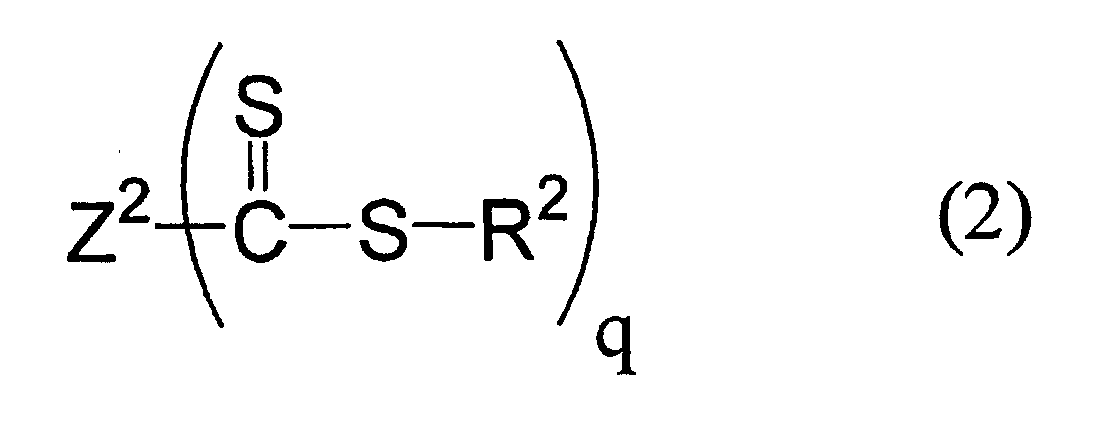 (wherein R2 is a monovalent organic group of 1 or more
carbon atoms which may contain one of nitrogen, oxygen,
sulfur, halogen, silicon, phosphorus, and metal atoms, or
which may be a polymer; Z2 is an oxygen atom (when q = 2),
sulfur atom (when q = 2), nitrogen atom (when q = 3), or q-valent
organic group of 1 or more carbon atoms which may
contain one of nitrogen, oxygen, sulfur, halogen, silicon,
and phosphorus atoms, or which may be a polymer; plural R2s
may be the same or different; and q is an integer of 2 or
more).
(wherein R2 is a monovalent organic group of 1 or more
carbon atoms which may contain one of nitrogen, oxygen,
sulfur, halogen, silicon, phosphorus, and metal atoms, or
which may be a polymer; Z2 is an oxygen atom (when q = 2),
sulfur atom (when q = 2), nitrogen atom (when q = 3), or q-valent
organic group of 1 or more carbon atoms which may
contain one of nitrogen, oxygen, sulfur, halogen, silicon,
and phosphorus atoms, or which may be a polymer; plural R2s
may be the same or different; and q is an integer of 2 or
more).
In the compound having the thiocarbonylthio structure
represented by general formula (1), R1 is not particularly
limited. In view of availability of the compound,
preferably, R1 has 1 to 20 carbon atoms, and p is 6 or less.
Examples of R1 include alkyl, substituted alkyl, aralkyl,
substituted aralkyl, a polyvalent aliphatic hydrocarbon
group, a polyvalent aromatic hydrocarbon group, a polyvalent
aliphatic hydrocarbon group with an aromatic ring, a
polyvalent aromatic hydrocarbon group with an aliphatic
group, a polyvalent aliphatic hydrocarbon group containing a
heteroatom, and a polyvalent aromatic substituted
hydrocarbon group containing a heteroatom. In view of
availability of the compound and polymerization activity, R1
is preferably benzyl, 1-phenylethyl, 2-(2-phenylpropyl), 1-acetoxyethyl,
1-(4-methoxyphenyl)ethyl, ethoxycarbonylmethyl,
2-(2-ethoxycarbonylpropyl), 2-(2-cyanopropyl), tert-butyl,
1,1,3,3-tetramethylbutyl, 2-(2-(p-chlorophenyl)propyl),
vinylbenzyl, tert-butylsulfide, 2-carboxylethyl,
carboxylmethyl, cyanomethyl, 1-cyanoethyl, 2-(2-cyanobutyl),
or any one of organic groups represented by the following
formulae.


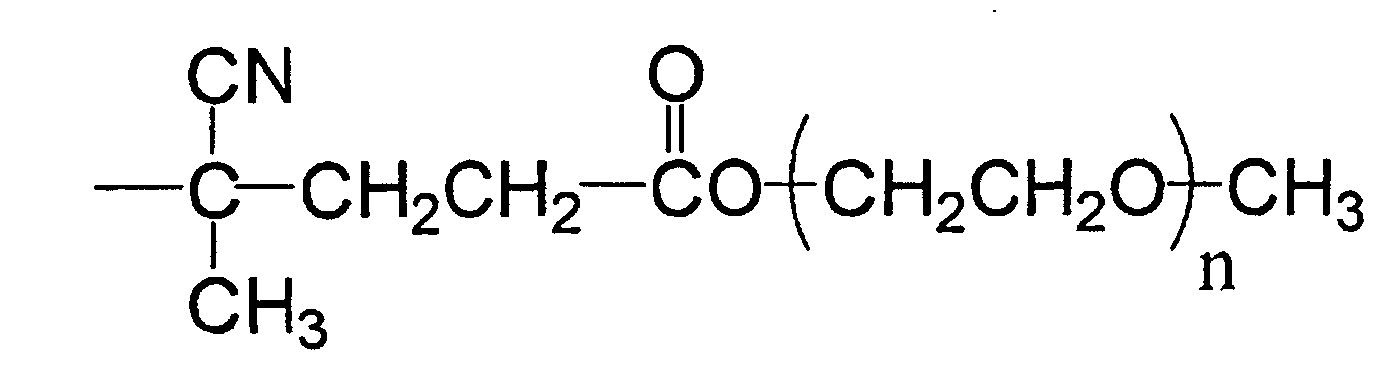

 (In the formulae, n is an integer of 1 or more, and r is an
integer of 0 or more.)
(In the formulae, n is an integer of 1 or more, and r is an
integer of 0 or more.)

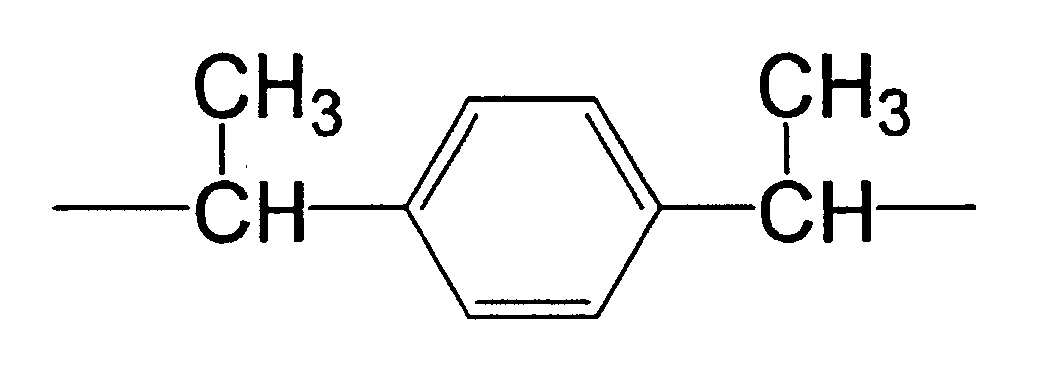



 (In the formulae, R4 is a divalent organic group of 1 or
more carbon atoms; n is an integer of 1 or more; r is an
integer of 0 or more; and plural r's may be the same or
different.)
(In the formulae, R4 is a divalent organic group of 1 or
more carbon atoms; n is an integer of 1 or more; r is an
integer of 0 or more; and plural r's may be the same or
different.)
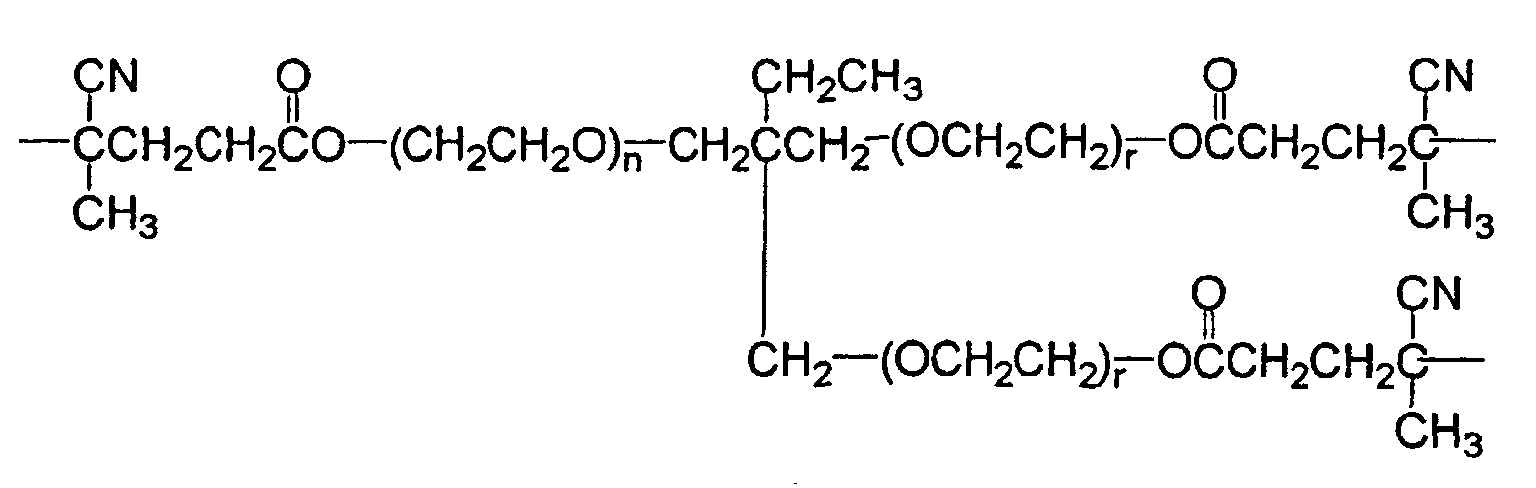
 (In the formulae, n is an integer of 1 or more; r is an
integer of 0 or more; and plural r's may be the same or
different.)
(In the formulae, n is an integer of 1 or more; r is an
integer of 0 or more; and plural r's may be the same or
different.)
In the above formulae, in view of availability of the
compound, preferably, each of n and r is 500 or less.
Preferably, R4 has 1 to 20 carbon atoms. Examples of R4
structures include, but are not limited to, -(CH2)n- (wherein
n is an integer of 1 or more), -C6H4-, and -CH2-C6H4-CH2-.
In the compound having the thiocarbonylthio structure
represented by general formula (1), Z1 is not particularly
limited. In view of availability of the compound and
polymerization activity, when Z1 is an organic group,
preferably, the organic group has 1 to 20 carbon atoms.
Examples of Z1 include alkyl, substituted alkyl, alkoxy,
aryloxy, aryl, substituted aryl, aralkyl, substituted
aralkyl, heterocyclic, N-aryl-N-alkylamino, N,N-diarylamino,
N,N-dialkylamino, thioalkyl, and dialkylphosphinyl groups.
In view of availability of the compound, Z1 is preferably
phenyl, methyl, ethyl, benzyl, 4-chlorophenyl, 1-naphthyl,
2-naphthyl, diethoxyphosphinyl, n-butyl, tert-butyl, methoxy,
ethoxy, thiomethyl (methylsulfide), phenoxy, thiophenyl
(phenylsulfide), N,N-dimethylamino, N,N-diethylamino, N-phenyl-N-methylamino,
N-phenyl-N-ethylamino, thiobenzyl
(benzylsulfide), pentafluorophenoxy, or any one of organic
groups represented by formulae below.
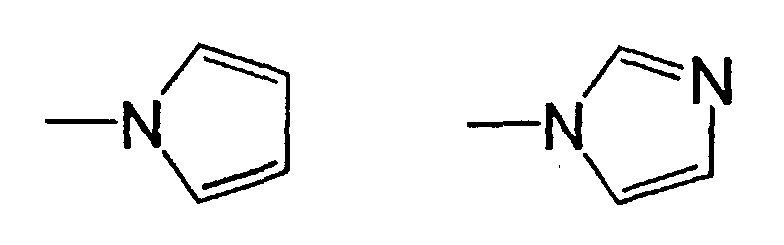


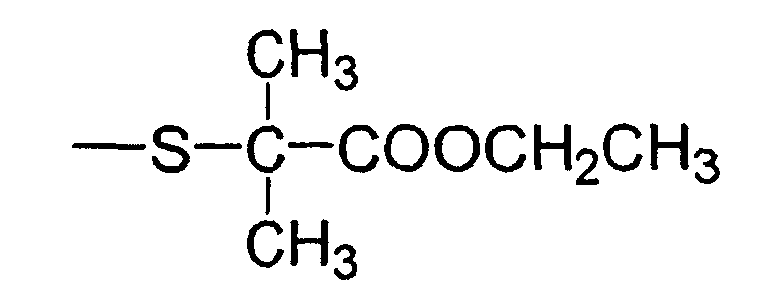
In the compound having the thiocarbonylthio structure
represented by general formula (2), R2 is not particularly
limited. In view of availability of the compound and
polymerization activity, preferably, R2 has 1 to 20 carbon
atoms. Examples of R2 include alkyl, substituted alkyl,
aralkyl, and substituted aralkyl. In view of availability
of the compound, R2 is preferably benzyl, 1-phenylethyl, 2-(2-phenylpropyl),
1-acetoxyethyl, 1-(4-methoxyphenyl)ethyl,
ethoxycarbonylmethyl, 2-(2-ethoxycarbonylpropyl), 2-(2-cyanopropyl),
tert-butyl, 1,1,3,3-tetramethylbutyl, 2-(2-(p-chlorophenyl)propyl),
vinylbenzyl, tert-butylsulfide, 2-carboxylethyl,
carboxylmethyl, cyanomethyl, 1-cyanoethyl, 2-(2-cyanobutyl),
or any one of organic groups represented by
formulae below, (wherein n is an integer of 1 or more, and r
is an integer of 0 or more).
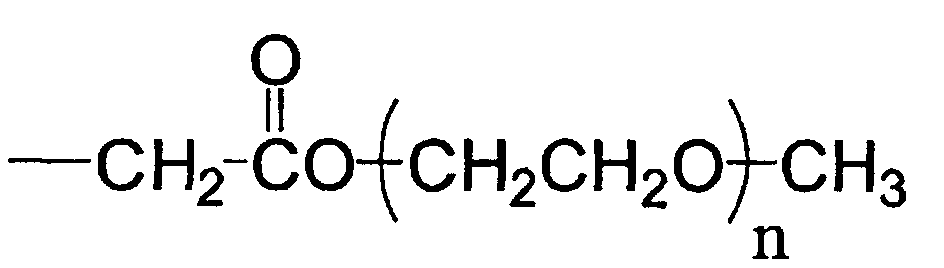
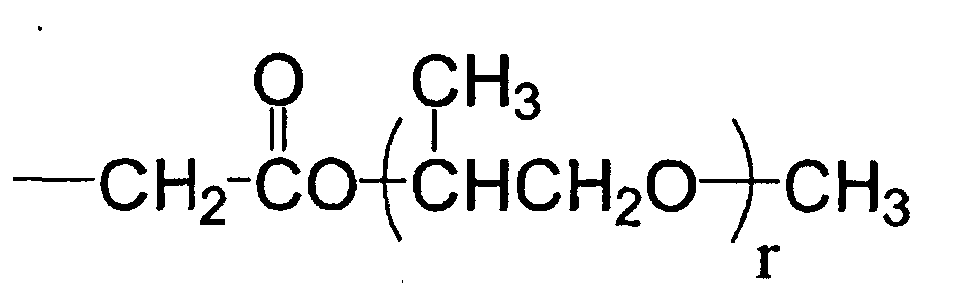


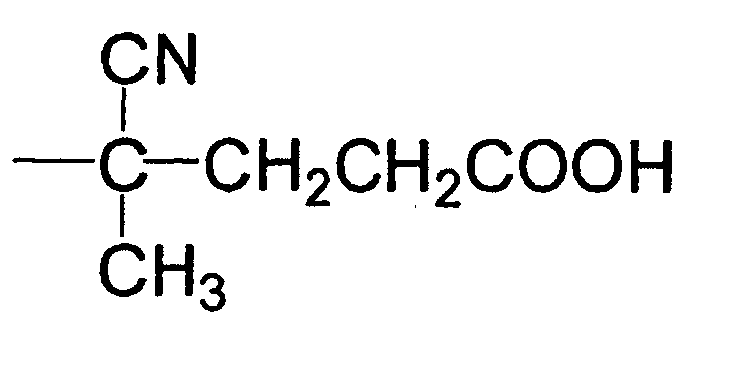
In the above formulae, each of n and r is preferably
500 or less in view of availability of the compound.
In the compound having the thiocarbonylthio structure
represented by general formula (2), Z2 is not particularly
limited. In view of availability of the compound and
polymerization activity, when Z2 is an organic group,
preferably, the organic group has 1 to 20 carbon atoms, and
q is 6 or less. Examples of Z2 include a polyvalent
aliphatic hydrocarbon group, a polyvalent aromatic
hydrocarbon group, a polyvalent aliphatic hydrocarbon group
with an aromatic ring, a polyvalent aromatic hydrocarbon
group with an aliphatic group, a polyvalent aliphatic
hydrocarbon group containing a heteroatom, and a polyvalent
aromatic substituted hydrocarbon group containing a
heteroatom. In view of availability of the compound,
preferably Z2 has any one of the structures represented by
formulae below, (wherein n is an integer of 1 or more, and r
is an integer of 0 or more).


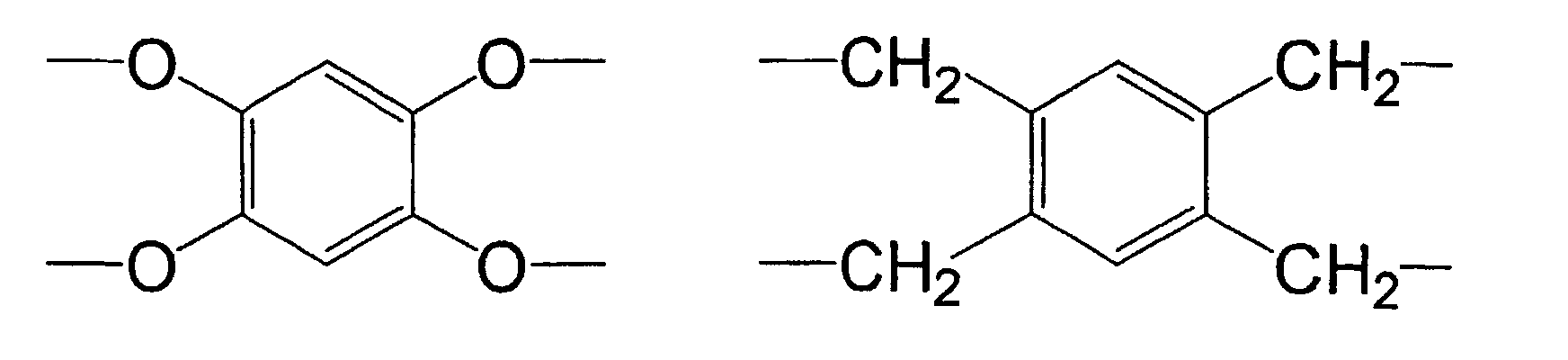


In the above formulae, each of n and r is preferably
500 or less in view of availability of the compound.
Among the thiocarbonylthio group-containing compounds
used in the present invention, in view of availability and
the fact that A-B diblock copolymers can be easily
synthesized, preferred is a compound represented by general
formula (3):
 (wherein R2 is a monovalent organic group of 1 or more
carbon atoms which may contain one of nitrogen, oxygen,
sulfur, halogen, silicon, phosphorus, and metal atoms, or
which may be a polymer; and Z1 is a hydrogen atom, halogen
atom, or monovalent organic group of 1 or more carbon atoms
which may contain one of nitrogen, oxygen, sulfur, halogen,
silicon, and phosphorus atoms, or which may be a polymer).
In view of availability of the compound and polymerization
activity, preferably, R2 has 1 to 20 carbon atoms. The
specific examples of the structures of R2 and Z1 in the
formula are the same as those described with reference to R2
in general formula (2) and Z1 in general formula (1),
respectively.
(wherein R2 is a monovalent organic group of 1 or more
carbon atoms which may contain one of nitrogen, oxygen,
sulfur, halogen, silicon, phosphorus, and metal atoms, or
which may be a polymer; and Z1 is a hydrogen atom, halogen
atom, or monovalent organic group of 1 or more carbon atoms
which may contain one of nitrogen, oxygen, sulfur, halogen,
silicon, and phosphorus atoms, or which may be a polymer).
In view of availability of the compound and polymerization
activity, preferably, R2 has 1 to 20 carbon atoms. The
specific examples of the structures of R2 and Z1 in the
formula are the same as those described with reference to R2
in general formula (2) and Z1 in general formula (1),
respectively.
In the present invention, when the polymer blocks (A)
and (B) are synthesized separately and then are coupled to
each other to produce an A-B-A triblock copolymer, because
of ease in production, preferably, a compound represented by
general formula (3) is used as the thiocarbonylthio group-containing
compound used for the preparation of the polymer
block (A); and a compound represented by general formula (4)
below is used as the thiocarbonylthio group-containing
compound used for the preparation of the polymer block (B):
 (wherein R3 is a divalent organic group of 1 or more carbon
atoms which may contain one of nitrogen, oxygen, sulfur,
halogen, silicon, phosphorus, and metal atoms, or which may
be a polymer; each Z1 is a hydrogen atom, halogen atom, or
monovalent organic group of 1 or more carbon atoms which may
contain one of nitrogen, oxygen, sulfur, halogen, silicon,
and phosphorus atoms, or which may be a polymer; and two Z1s
may be the same or different). Specific examples of Z1
structures in the formula are the same as those described
with reference to Z1 in general formula (1).
(wherein R3 is a divalent organic group of 1 or more carbon
atoms which may contain one of nitrogen, oxygen, sulfur,
halogen, silicon, phosphorus, and metal atoms, or which may
be a polymer; each Z1 is a hydrogen atom, halogen atom, or
monovalent organic group of 1 or more carbon atoms which may
contain one of nitrogen, oxygen, sulfur, halogen, silicon,
and phosphorus atoms, or which may be a polymer; and two Z1s
may be the same or different). Specific examples of Z1
structures in the formula are the same as those described
with reference to Z1 in general formula (1).
In the thiocarbonylthio group-containing compound
represented by general formula (4), preferably, R3 has 1 to
20 carbon atoms. Although R3 is not particularly limited,
in view of availability and polymerization activity,
preferably, R3 has any one of the structures represented by
formulae below.
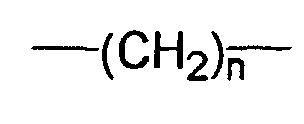



 (In the above formulae, R4 is a divalent organic group of 1
or more carbon atoms; n is an integer of 1 or more; r is an
integer of 0 or more; and plural r's may be the same or
different.)
(In the above formulae, R4 is a divalent organic group of 1
or more carbon atoms; n is an integer of 1 or more; r is an
integer of 0 or more; and plural r's may be the same or
different.)

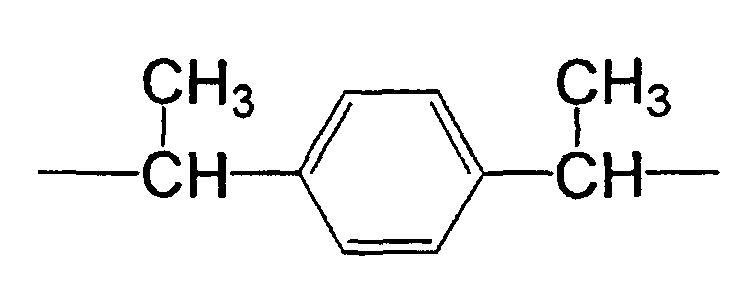
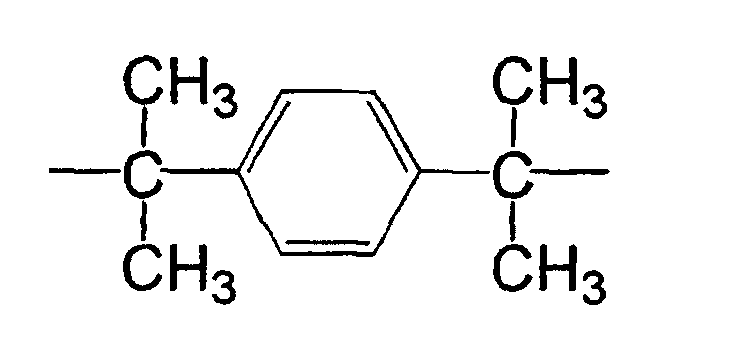
In the above formulae, each of n and r is preferably
500 or less in view of availability of the compound.
Preferably, R4 has 1 to 20 carbon atoms. Examples of R4
structures include, but are not limited to, -(CH2)n- (wherein
n is an integer of 1 or more), -C6H4-, and -CH2-C6H4-CH2-.
Specific examples of compounds having the
thiocarbonylthio structures, which are used in the present
invention, include, but are not limited to, compounds
represented by formulae below, (wherein Me, Et, Ph, and Ac
represent methyl, ethyl, phenyl, and acetyl, respectively;
R4 is a divalent organic group of 1 or more carbon atoms; n
is an integer of 1 or more; r is an integer of 0 or more;
and plural r's may be the same or different).

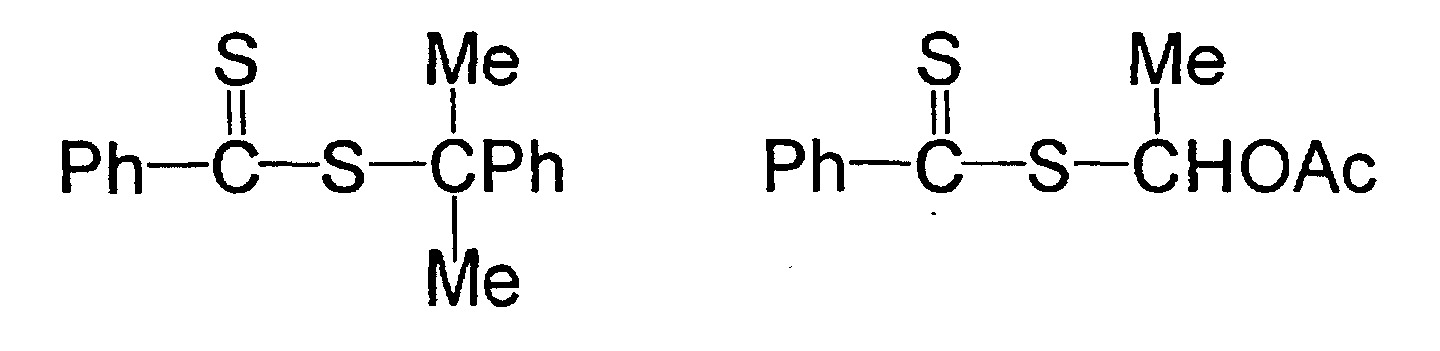




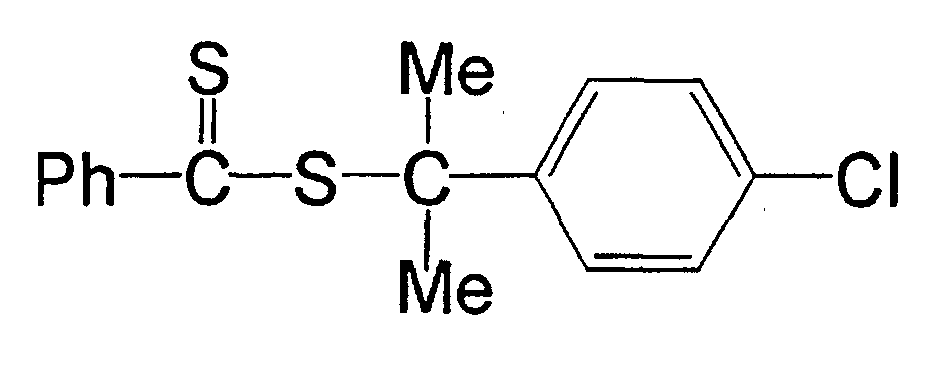


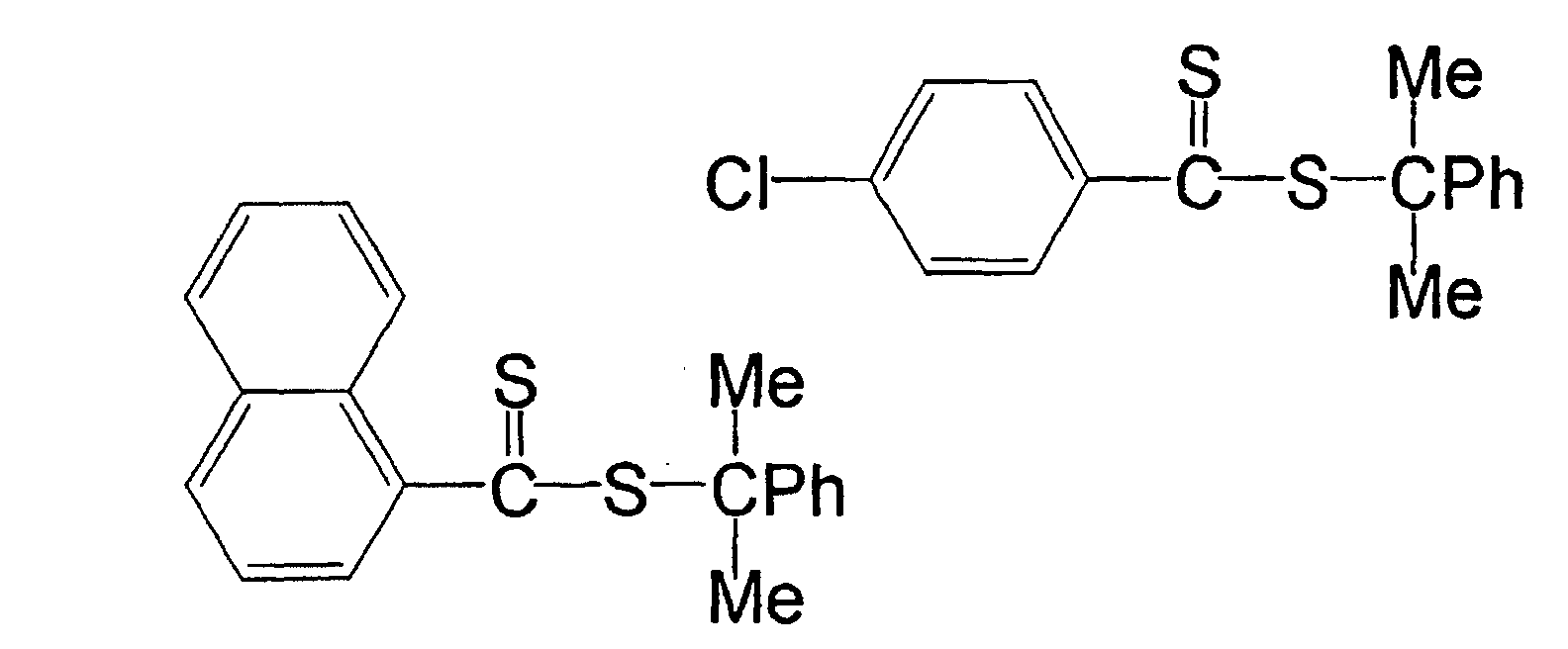

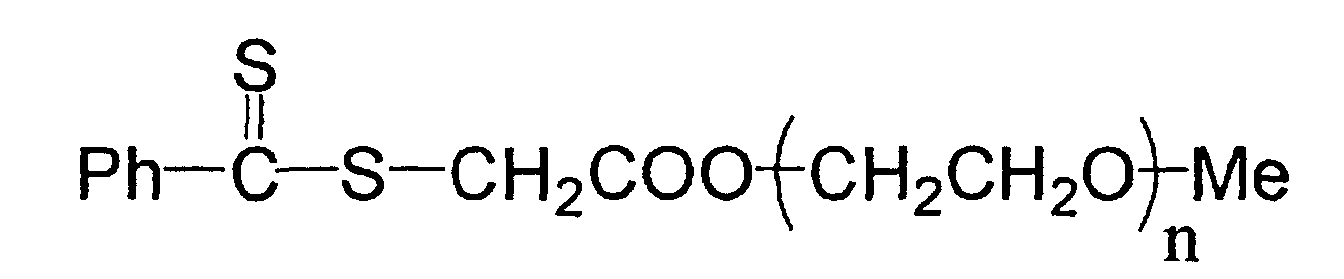


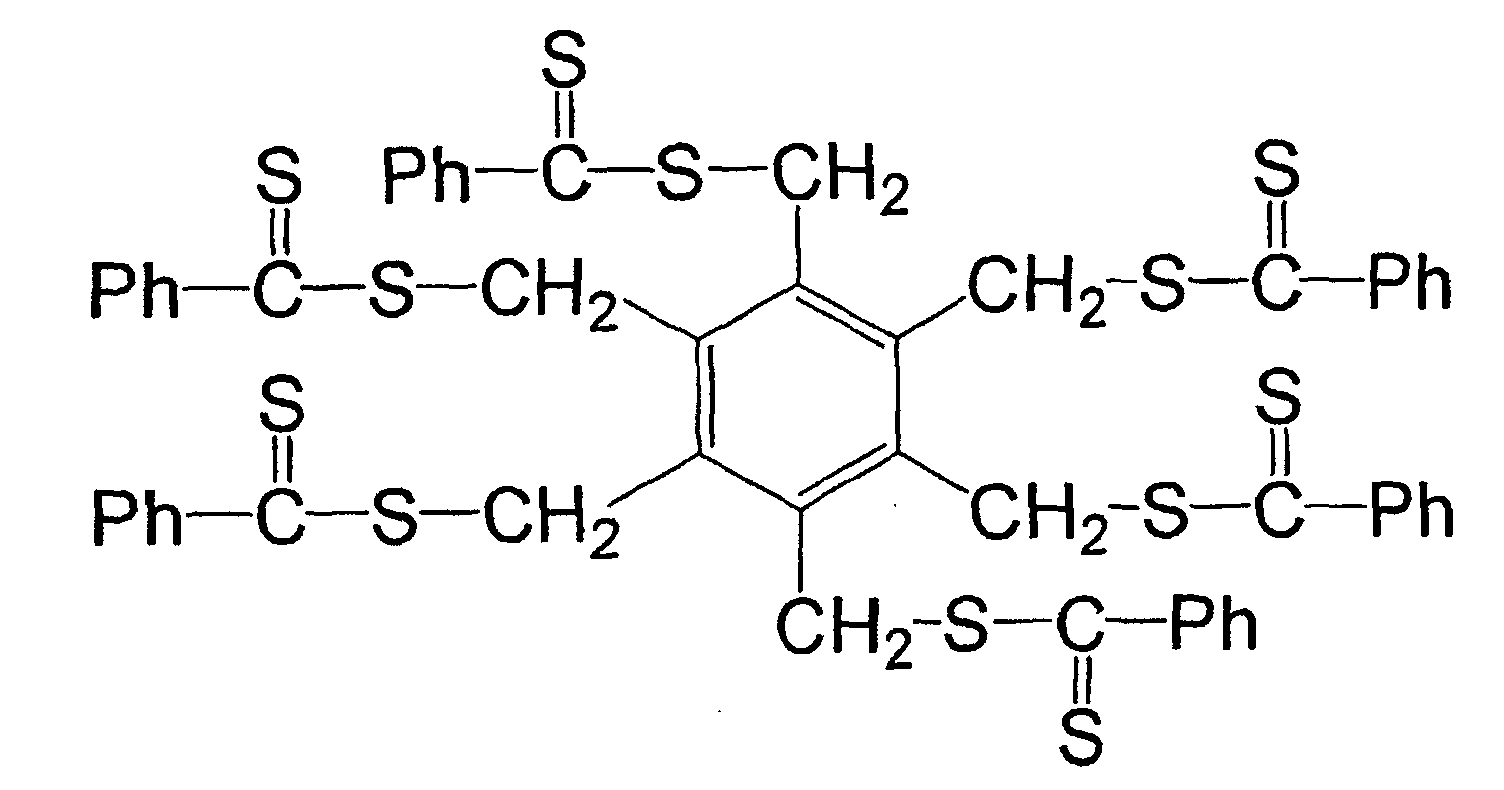


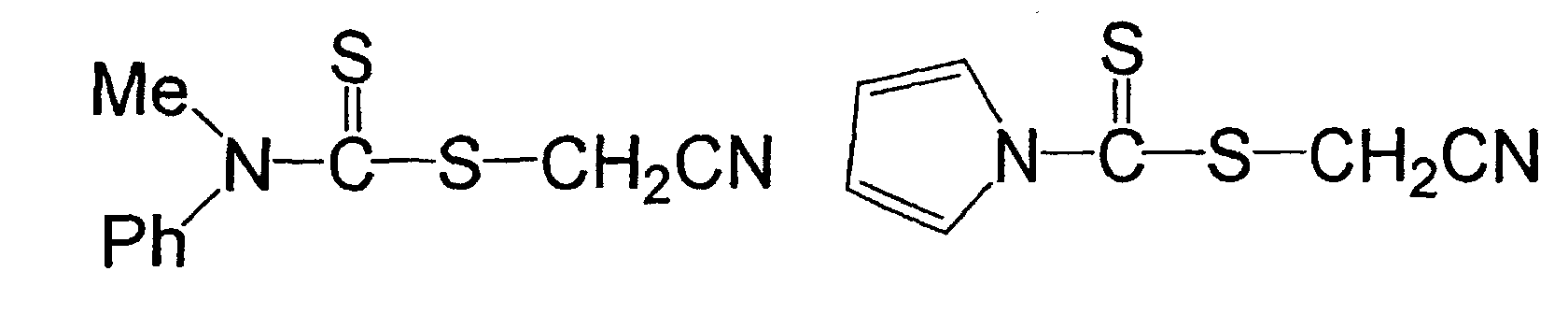





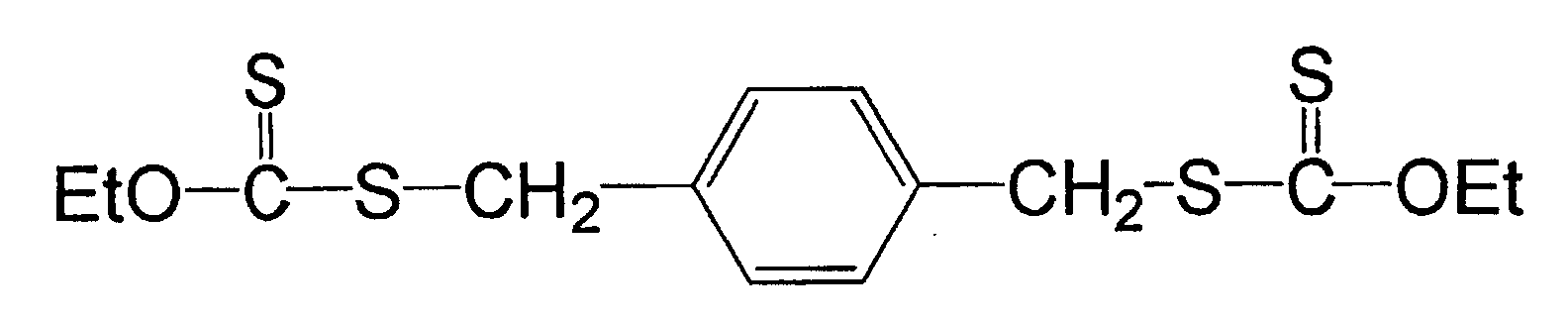
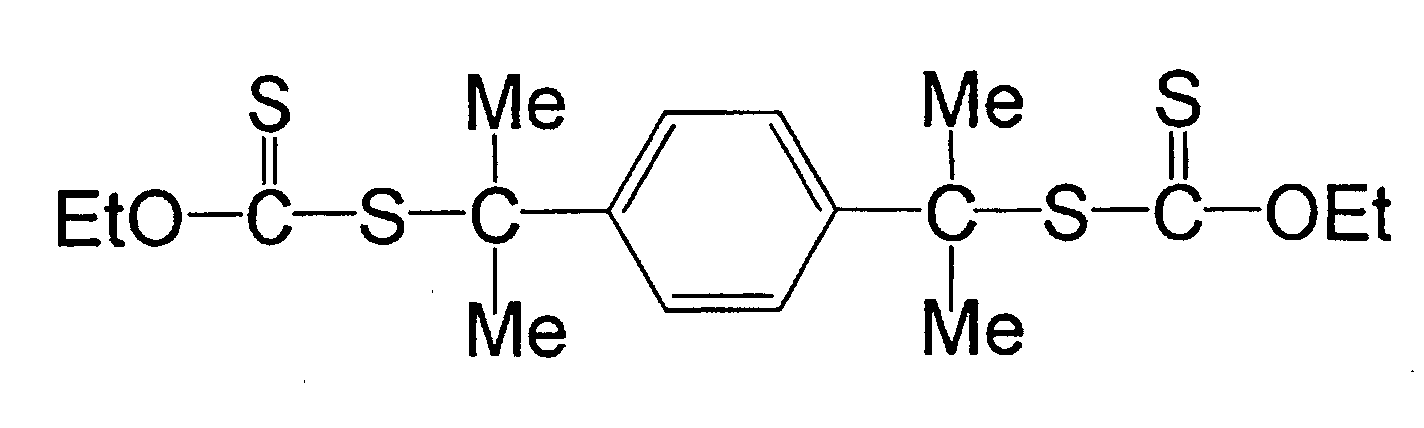





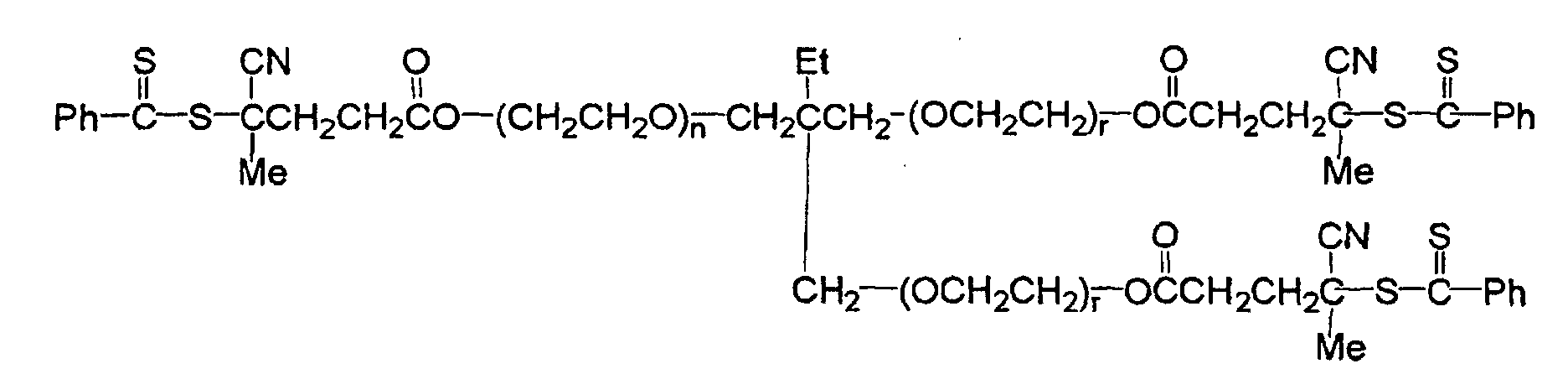
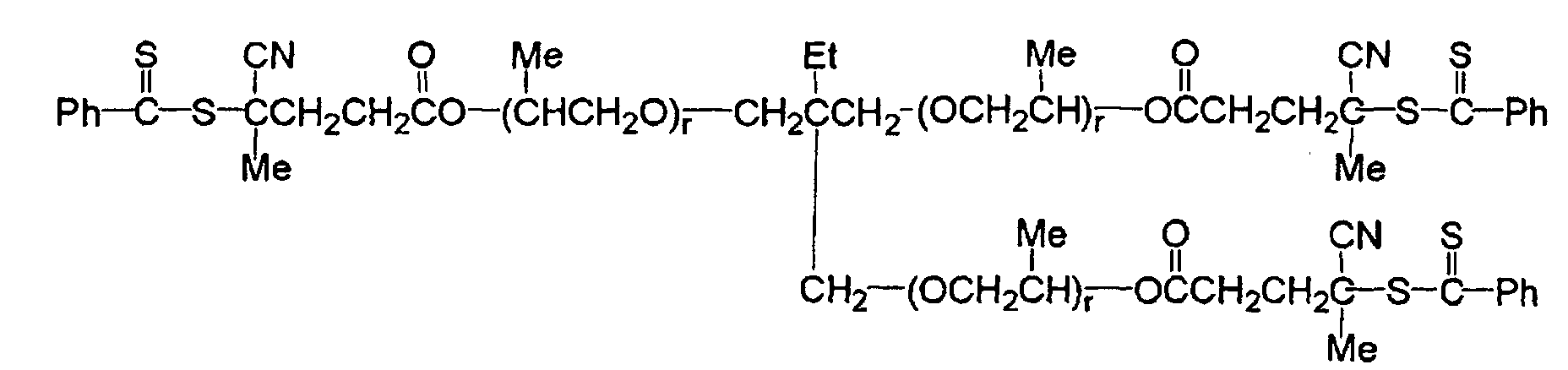
In the above formulae, each of n and r is preferably
500 or less in view of availability of the compound.
Preferably, R4 has 1 to 20 carbon atoms. Examples of R4
structures include, but are not limited to, -(CH2)n- (wherein
n is an integer of 1 or more), -C6H4-, and -CH2-C6H4-CH2-.
The amount of the thiocarbonylthio group-containing
compound used in the present invention is not particularly
limited and can be stoichiometrically calculated based on
the monomers used. In general, since the number of moles of
the resultant polymer is substantially equal to the number
of moles of the thiocarbonylthio group-containing compound,
the molecular weight of the polymer can be controlled by
adjusting the molar ratio of the monomers to the
thiocarbonylthio group-containing compound. When the rate
of reaction of the monomers is 100%, the theoretical
molecular weight of the resultant polymer is represented by
(x/y) × Mm + Mr, wherein Mm is the molecular weight of the
monomers used, x is the number of moles of the monomers used,
Mr is the molecular weight of the thiocarbonylthio group-containing
compound, and y is the number of moles of the
thiocarbonylthio group-containing compound used.
Consequently, the amount of the thiocarbonylthio group-containing
compound used may be calculated based on the
number-average molecular weight of the desired polymer.
The technique used for radical polymerization is not
particularly limited when the block copolymer of the present
invention is prepared. Any method commonly used in the art,
such as bulk polymerization, solution polymerization,
emulsion polymerization, suspension polymerization, or
microsuspension polymerization, may be employed. Among them,
in view of cost and safety, water-based polymerization, such
as emulsion polymerization, suspension polymerization, or
microsuspension polymerization, is preferred.
In the case of solution polymerization of the monomers,
examples of solvents which may be used include, but are not
limited to, hydrocarbon solvents, such as heptane, hexane,
octane, and mineral spirit; ester solvents, such as ethyl
acetate, n-butyl acetate, isobutyl acetate, ethylene glycol
monomethyl ether acetate, and diethylene glycol monobutyl
ether acetate; ketone solvents, such as acetone, methyl
ethyl ketone, methyl isobutyl ketone, diisobutyl ketone, and
cyclohexanone; alcohol solvents, such as methanol, ethanol,
isopropanol, n-butanol, sec-butanol, and isobutanol; ether
solvents, such as tetrahydrofuran, diethyl ether, dibutyl
ether, dioxane, ethylene glycol dimethyl ether, and ethylene
glycol diethyl ether; amide solvents, such as
dimethylformamide, diethylformamide, dimethylacetamide, and
diethylacetamide; and aromatic petroleum solvents, such as
toluene, xylene, benzene, Swasol 310 (manufactured by Cosmo
Oil Co., Ltd.), Swasol 1000 (manufactured by Cosmo Oil Co.,
Ltd.), and Swasol 1500 (manufactured by Cosmo Oil Co., Ltd.).
These solvents may be used alone or in combination. The
types and amounts of solvent used may be determined in
consideration of the solubility of the monomers used, the
solubility of the resultant polymer, the polymerization
initiator concentration and the monomer concentration
suitable for achieving a satisfactory reaction rate, the
solubility of the thiocarbonylthio group-containing compound,
effects on human body and environment, availability, cost,
etc., and are not particularly limited. In view of
solubility, availability, and cost, industrially, toluene,
dimethylformamide, tetrahydrofuran, and acetone are
preferable, and dimethylformamide and toluene are more
preferable.
In the present invention, in the case of emulsion
polymerization or microsuspension polymerization of the
monomers, examples of emulsifiers which may be used include,
but are not limited to, anionic surfactants, such as fatty
acid soap, rosin acid soap, sodium naphthalenesulfonate-formalin
condensates, sodium alkylsulfonate (e.g., sodium
dodecyl sulfonate), sodium alkylbenzene sulfonate, sodium
alkylsulfate (e.g., sodium dodecyl sulfate), ammonium
alkylsulfate, triethanolamine alkylsulfate, sodium
dialkylsulfosuccinate, sodium alkyldiphenylether disulfonate,
sodium polyoxyethylene alkyl ether sulfate, and sodium
polyoxyethylene alkylphenyl ether sulfate; nonionic
surfactants, such as polyoxyethylene alkyl ether,
polyoxyethylene higher alcohol ether, sorbitan fatty acid
ester, polyoxyethylene sorbitan fatty acid ester,
polyoxyethylene sorbitol fatty acid ester, glycerin fatty
acid ester, polyoxyethylene fatty acid ester,
polyoxyethylene aklylamine, and alkyl alkanolamide; and
cationic surfactants, such as alkyltrimethylammonium
chloride. These emulsifiers may be used alone or in
combination. As necessary, a cationic surfactant, such as
an alkylamine hydrochloride, may be used, or a dispersant
for suspension polymerization which will be described below
may also be added. The amount of the emulsifier used is not
particularly limited. Because of good emulsification state
and the fact that polymerization proceeds smoothly, the
amount of the emulsifier is preferably 0.1 to 20 parts by
weight based on 100 parts by weight of the monomers. Among
the emulsifiers described above, in view of stability of the
emulsification state, nonionic surfactants are preferable.
Additionally, in order to stabilize the emulsification state,
various emulsifying aids may also be used. Examples of
emulsifying aids include, but are not limited to, linear
hydrocarbons, such as hexadecane; hydrocarbon polymers, such
as polyethylene, polypropylene, polybutadiene, and
hydrogenated polybutadiene; polar organic solvents, such as
acetone, ethanol, and methanol; and higher alcohols, such as
octyl alcohol, decyl alcohol, and lauryl alcohol. The
amount of the emulsifying aid used is not particularly
limited. Because of excellence in the balance between cost
and effect, the amount of the emulsifying aid used is
preferably 0.1 to 20 parts by weight, and more preferably
0.5 to 15 parts by weight, based on 100 parts by weight of
the emulsifier.
In the case of suspension polymerization of the
monomers, any dispersant commonly used may be used.
Examples of dispersants include, but are not limited to,
partially saponified poly(vinyl acetate), poly(vinyl
alcohol), methyl cellulose, carboxymethyl cellulose, gelatin,
poly(alkylene oxide), and combinations of anionic
surfactants and dispersing agents. These may be used alone
or in combination. The emulsifier used for emulsion
polymerization described above may also be used as necessary.
The amount of the dispersant used is not particularly
limited. Because of the fact that polymerization proceeds
smoothly, the amount of the dispersant is preferably 0.1 to
20 parts by weight based on 100 parts by weight of the
monomers used.
The polymerization initiator or polymerization
initiation method used for the radical polymerization is not
particularly limited, and any polymerization initiator or
polymerization initiation method commonly used may be
employed. Examples of polymerization initiators include,
but are not limited to, peroxide polymerization initiators,
such as methyl ethyl ketone peroxide, methyl isobutyl ketone
peroxide, cyclohexanone peroxide, methyl cyclohexanone
peroxide, isobutyryl peroxide, 3,5,5-trimethylhexanoyl
peroxide, lauroyl peroxide, benzoyl peroxide, tert-butyl
hydroperoxide, cumene hydroperoxide, diisopropylbenzene
hydroperoxide, p-menthane hydroperoxide, 1,1,3,3-tetramethylbutyl
hydroperoxide, di-tert-butyl peroxide,
tert-butyl-α-cumyl peroxide, di-α-cumyl peroxide, 1,4-bis[(tert-butylperoxy)isopropyl]benzene,
1,3-bis[(tert-butylperoxy)isopropyl]benzene,
2,5-dimethyl-2,5-bis(tert-butylperoxy)hexane,
2,5-dimethyl-2,5-bis(tert-butylperoxy)-3-hexyne,
1,1-bis(tert-butylperoxy)-3,3,5-trimethylcyclohexane,
n-butyl-4,4-bis(tert-butylperoxy)valerate,
2,2-bis(tert-butylperoxy)butane, tert-butylperoxy
acetate, tert-butylperoxy isobutylate, tert-butylperoxy
octoate, tert-butylperoxy pivalate, tert-butylperoxy
neodecanoate, tert-butylperoxy-3,5,5-trimethyl
hexanoate, tert-butylperoxy benzoate, tert-butylperoxy
laurate, 2,5-dimethyl-2,5-bis(benzoylperoxy)hexane, bis(2-ethylhexyl)peroxy
dicarbonate, diisopropylperoxy dicarbonate,
di-sec-butylperoxy dicarbonate, di-n-propylperoxy
dicarbonate, bis(3-methoxybutyl)peroxy dicarbonate, bis(2-ethoxyethyl)peroxy
dicarbonate, bis(4-tert-butylcyclohexyl)peroxy
dicarbonate, O-tert-butyl-O-isopropylperoxy
carbonate, and succinic acid peroxide; azo
polymerization initiators, such as 2,2'-azobis-(2-amidinopropane)dihydrochloride,
dimethyl 2,2'-azobis(isobutyrate),
2,2'-azobis-(4-methoxy-2,4-dimethylvaleronitrile),
2,2'-azobis(isobutyronitrile), 1,1'-azobis(cyclohexane-1-carbonitrile),
azocumene, 2,2'-azobis(2-methylbutyronitrile),
2,2'-azobis-(2,4-dimethylvaleronitrile,
4,4'-azobis(4-cyanovaleric acid), 2-(tert-butylazo)-2-cyanopropane,
2,2'-azobis(2,4,4-trimethylpentane),
and 2,2'-azobis(2-methylpropane);
inorganic peroxides, such as potassium persulfate and sodium
persulfate; vinyl monomers which thermally generate radical
species, such as styrene; compounds which generate radical
species by light, such as benzoin derivatives, benzophenone,
acylphosphine oxide, and photo-redox systems; and redox
polymerization initiators including sodium sulfite, sodium
thiosulfate, sodium formaldehyde sulfoxylate, ascorbic acid,
ferrous sulfate, or the like, as a reducing agent, and
potassium peroxydisulfate, hydrogen peroxide, tert-butyl
hydroperoxide, or the like, as an oxidizing agent. These
polymerization initiators may be used alone or in
combination. It may also be possible to use a
polymerization initiation system by electron irradiation, X-ray
irradiation, radiation irradiation, or the like. With
respect to polymerization initiation methods using such
initiators, the methods described in Moad and Solomon "The
Chemistry of Free Radical Polymerization", Pergamon, London,
1995, pp. 53-95 may be employed.
In the present invention, the amount of the
polymerization initiator used is not particularly limited.
In order to produce a polymer with a narrow molecular weight
distribution, the amount of radical species generated during
polymerization is preferably 1 mole or less, and more
preferably 0.5 moles or less, relative to 1 mole of
thiocarbonylthio group in the thiocarbonylthio group-containing
compound. In order to control the amount of
radical species generated during polymerization, in addition
to the control of the amount of the polymerization initiator,
preferably, temperature is controlled in the case of the
polymerization initiator which causes thermal dissociation,
or the amount of energy is controlled in the case of the
polymerization initiation system which generates radicals by
light or electron beams. Because of ease of control of
polymerization, using a polymerization initiator which
causes thermal dissociation, the polymerization reaction is
carried out preferably at temperatures which allow the
polymerization initiator to have a half-life of 0.5 to 50
hours, more preferably at temperatures which allow the
polymerization initiator to have a half-life of 1 to 20
hours, and most preferably at temperatures which allow the
polymerization initiator to have a half-life of 5 to 15
hours.
The block copolymer of the present invention is
prepared using the solvent, emulsifier, polymerization
initiator, etc., as will be described below.
The thiocarbonylthio group-containing block copolymer
is treated with a processing agent, as required, so that the
thiocarbonylthio groups are converted into mercapto groups
or mercaptide groups. The processing agent used in the
process is not particularly limited. In view of high yield,
preferably, a method is employed in which the
thiocarbonylthio group-containing compound is allowed to
react with a processing agent composed of a compound
selected from the group consisting of bases, acids, and
hydrogen-nitrogen bond-containing compounds. Among them,
when a base or an acid is used, in the presence of water,
thiocarbonylthio groups are converted into mercapto groups
by hydrolysis. When a hydrogen-nitrogen bond-containing
compound is used, the presence of water is not required,
which is preferable.
Examples of bases which may be used as processing
agents include, but are not limited to, alkali metal
hydroxides, such as sodium hydroxide, potassium hydroxide,
and lithium hydroxide; alkaline-earth metal hydroxides, such
as calcium hydroxide, magnesium hydroxide, barium hydroxide,
and cesium hydroxide; transition metal hydroxides, such as
aluminum hydroxide and zinc hydroxide; alkali metal
alcoholates, such as sodium methylate, sodium ethylate,
sodium phenylate, lithium ethylate, and lithium butylate;
alkaline-earth metal alcoholates, such as magnesium
methylate and magnesium ethylate; metal hydrides, such as
sodium hydride, lithium hydride, calcium hydride, lithium
aluminum hydride, and aluminum borohydride; and
organometallic reagents, such as hydrosulfite, n-butyllithium,
tert-butyllithium, ethylmagnesium bromide, and
phenylmagnesium bromide. Furthermore, alkali metals, such
as metallic lithium, metallic sodium, and metallic
potassium; and alkaline-earth metals, such as metallic
magnesium and metallic calcium may also be used. These
bases may be used alone or in combination. Among them, in
view of availability, cost, and reactivity, preferred are
sodium hydroxide, potassium hydroxide, lithium hydroxide,
calcium hydroxide, magnesium hydroxide, sodium methylate,
sodium ethylate, sodium hydride, lithium hydride, metallic
lithium, metallic sodium, and metallic potassium. Because
of ease of handling, more preferred are sodium hydroxide,
potassium hydroxide, lithium hydroxide, calcium hydroxide,
magnesium hydroxide, sodium methylate, and sodium ethylate.
Examples of acids which may be used as processing
agents include, but are not limited to, inorganic acids,
such as hydrochloric acid, nitric acid, sulfuric acid,
phosphoric acid, hydrofluoric acid, hydrobromic acid,
fluoroboric acid, chlorosulfonic acid, hydriodic acid,
arsenic acid, and silicofluoric acid; organic acids, such as
p-toluenesulfonic acid, trifluoromethyl sulfonic acid,
acetic acid, trifluoroacetic acid, methylphosphoric acid,
ethylphosphoric acid, n-propylphosphoric acid,
isopropylphosphoric acid, n-butylphosphoric acid,
laurylphosphoric acid, stearylphosphoric acid, 2-ethylhexylphosphoric
acid, isodecylphosphoric acid,
dimethyldithiophosphoric acid, diethyldithiophosphoric acid,
diisopropyldithiophosphoric acid, and phenylphosphonic acid;
and strong acidic ion exchange resins and weak acidic ion
exchange resins. Furthermore, compounds which show acidity
in reaction with a small amount of water may also be used.
Examples of such compounds include acid anhydrides, such as
acetic anhydride, propionic anhydride, trifluoroacetic
anhydride, phthalic anhydride, and succinic anhydride; acyl
halides; and metal halides, such as titanium tetrachloride,
aluminum chloride, and silicon chloride. These acids may be
used alone or in combination. Among them, in view of
availability, cost, and reactivity, preferred are
hydrochloric acid, nitric acid, sulfuric acid, phosphoric
acid, aluminum chloride, titanium tetrachloride,
chlorosulfonic acid, p-toluenesulfonic acid, trifluoromethyl
sulfonic acid, acetic acid, and trifluoroacetic acid.
Examples of hydrogen-nitrogen bond-containing compounds
which may be used as processing agents include, but are not
limited to, ammonia, hydrazine, primary amine compounds,
secondary amine compounds, amide compounds, amine
hydrochlorides, hydrogen-nitrogen bond-containing polymers,
and hindered amine light stabilizers (HALSs).
Among the hydrogen-nitrogen bond-containing compounds,
specific examples of primary amine compounds include, but
are not limited to, N-(2-aminoethyl)ethanolamine, 12-aminododecanoic
acid, 3-amino-1-propanol, allylamine,
isopropylamine, 3,3'-iminobis(propylamine), monoethylamine,
2-ethylhexylamine, 3-(2-ethylhexyloxy)propylamine, 3-ethoxypropylamine,
3-(diethylamino)propylamine, 3-(dibutylamino)propylamine,
n-butylamine, tert-butylamine,
sec-butylamine, n-propylamine, 3-(methylamino)propylamine,
3-(dimethylamino)propylamine, N-methyl-3,3'-iminobis(propylamine),
3-methoxypropylamine, 2-aminoethanol,
ethylenediamine, diethylenetriamine, triethylenetetramine,
tetraethylenepentamine, pentaethylenehexamine, N-carboxy-4,4'-methylenebiscyclohexylamine,
1,4-diaminobutane, 1,2-diaminopropane,
1,3-diaminopropane, diaminomaleonitrile,
cyclohexylamine, ATU (manufactured by Ajinomoto Co., Inc.),
CTU Guanamine (manufactured by Ajinomoto Co., Inc.),
thiourea dioxide, 2-hydroxyethylaminopropylamine,
hexamethylenediamine, n-hexylamine, monomethylamine,
monomethylhydrazine, 3-(lauryloxy)propylamine, anisidine,
aniline, p-aminoacetanilide, p-aminobenzoic acid, ethyl p-aminobenzoate
ester, 2-amino-4-chlorophenol, 2-aminothiazole,
2-aminothiophenol, 2-amino-5-nitrobenzonitrile, aminophenol,
p-aminobenzaldehyde, 4-aminobenzonitrile, anthranilic acid,
3-isopropoxyaniline, 4-amino-5-hydroxy-2,7-naphthalenesulfonic
acid monosodium salt, 6-amino-4-hydroxy-2-naphthalenesulfonic
acid, xylidine, m-xylylenediamine, p-cresidine,
dianisidine, 4,4'-diaminostilbene-2,2'-disulfonic
acid, 2-amino-5-naphthol-7-sulfonic acid, 1,4-diaminoanthraquinone,
4,4'-diamino-3,3'-diethyldiphenylmethane,
4,4'-diaminobenzanilide,
diaminodiphenyl ether, 3,3'-dimethyl-4,4'-diaminodiphenylmethane,
sulfanilic acid, tobias acid, 2,4,5-trichloroaniline,
o-tolidine, toluidine, toluylenediamine,
sodium naphthionate, nitroaniline, m-nitro-p-toluidine, o-chloro-p-toluidine-m-sulfonic
acid, phenylhydrazine,
phenylenediamine, phenetidine, phenethylamine, benzylamine,
benzophenone hydrazine, mesidine, metanilic acid, 2-methyl-4-nitroaniline,
leuco-1,4-diaminoanthraquinone, paramine,
aminopyridine, 1-(2-aminoethyl)piperazine, N-(3-aminopropyl)morpholine,
1-amino-4-methylpiperazine,
bis(aminopropyl)piperazine, benzoguanamine, melamine, o-chloroaniline,
2,5-dichloroaniline, 3,4-dichloroaniline,
3,5-dichloroaniline, 2-amino-4-chlorobenzoic acid, o-chloro-p-nitroaniline,
5-chloro-2-nitroaniline, 2,6-dichloro-4-nitroaniline,
2-(2-chlorophenyl)ethylamine, 3,3'-dichloro-4,4'-diaminodiphenylmethane,
3,3'-dichloro-4,4'-diaminobiphenyl,
2,4-difluoroaniline, o-fluoroaniline, N-β-(aminoethyl)-γ-aminopropyltrimethoxysilane,
N-β-(aminoethyl)-γ-aminopropylmethyldimethoxysilane,
and γ-aminopropyltriethoxysilane.
Among the hydrogen-nitrogen bond-containing compounds,
specific examples of secondary amine compounds include, but
are not limited to, N-methylethanolamine, diallylamine,
diisopropylamine, diethylamine, diisobutylamine, di-2-ethylhexylamine,
iminodiacetic acid, 3,3'-iminodipropionitrile,
bis(hydroxyethyl)amine, N-ethylethylenediamine,
ethyleneimine, dicyclohexylamine, 1,1-dimethylhydrazine,
di-n-butylamine, di-tert-butylamine,
dimethylamine, sodium N-methylacetate, N-ethylaniline,
diphenylamine, dibenzylamine, 7-anilino-4-hydroxy-2-naphthalenesulfonic
acid, N-methylaniline, 2-methyl-4-methoxydiphenylamine,
imidazole, 2-methylimidazole, 2-ethyl-4-methylimidazole,
2-phenylimidazole, 2-undecylimidazole,
1,3-di(4-piperidyl)propane, 2,5-dimethylpiperazine, 2,6-dimethylpiperazine,
3,5-dimethylpyrazole, 5,5'-bi-1H-tetrazole,
5-phenyl-1H-tetrazole, 5-methyl-1H-tetrazole,
1,2,3,4-tetrahydroquinoline, (hydroxyethyl)piperazine,
pipecoline, 2-(1-piperazinyl)pyrimidine, piperazine,
piperidine, pyrrolidine, N-methylpiperazine, 2-methylpiperazine,
and morpholine.
Among the hydrogen-nitrogen bond-containing compounds,
specific examples of amide compounds include, but are not
limited to, 2-acrylamido-2-methylpropanesulfonic acid,
dihydrazide adipate, N-isopropylacrylamide, N-t-octylacrylamide,
carbohydrazides, guanylthiourea,
glycylglycine, N-[3-(dimethylamino)propyl]acrylamide, N-[3-(dimethylamino)propyl]methacrylamide,
N,N'-ethylenebis(stearoamide),
amide oleate, amide stearate,
N,N'-methylenebis(stearoamide), N-(hydroxymethyl)stearoamide,
diacetone acrylamide, thioacetoamide, thiocarbohydrazide,
thiosemicarbazide, thiourea, dihydrazide dodecanedioate,
dihydrazide adipate, dihydrazide sebacate, dihydrazide
isophthalate, 1,6-hexamethylenebis(N,N-dimethylsemicarbazide),
formamide, methacrylamide, N,N'-methylenebis(acrylamide),
N-methylolacrylamide, acetanilide,
acetoacet-o-anisidide, acetoacetanilide, acetoacet-m-xylidide,
acetoacet-o-chloroanilide, acetoacet-2,5-dimethoxy-4-chloroanilide,
acetoacetic toluidide, 1,1,1',1'-tetramethyl-4,4'-(methylenedi-p-phenylene)disemicarbazide,
toluene sulfonamide, p-hydroxyphenylacetamide, phthalimide,
isocyanuric acid, 3-carbamoyl-2-pyrazine carboxylic acid,
imide succinate, 5,5-dimethylhydantoin, 1,3-bis(hydrazinocarboethyl)-5-isopropylhydantoin,
hydantoin,
phenylpyrazolidone, 3-methyl-5-pyrazolone, 1-methylol-5,5-dimethylhydantoin,
3-(4-chlorophenyl)-1,1-dimethylurea,
bromovalerylurea, 2,6-difluorobenzamide, and 2,2,2-trifluoroacetamide.
Among the hydrogen-nitrogen bond-containing compounds,
specific examples of amine hydrochlorides include, but are
not limited to, acetamidine hydrochloride, 2,2'-azobis-(2-amidinopropane)dihydrochloride,
monomethylamine
hydrochloride, dimethylamine hydrochloride, monoethylamine
hydrochloride, diethylamine hydrochloride, monopropylamine
hydrochloride, dipropylamine hydrochloride, monobutylamine
hydrochloride, dibutylamine hydrochloride, semicarbazide
hydrochloride, guanidine hydrochloride, aminoguanidine
hydrochloride, 2-chloroethylamine hydrochloride, cysteamine
hydrochloride, and tert-butyl hydrazine monohydrochloride.
Among the hydrogen-nitrogen bond-containing compounds,
specific examples of hydrogen-nitrogen bond-containing
polymers include, but are not limited to, POLYMENT
(manufactured by Nippon Shokubai Co., Ltd.), poly(ethylene
imine), amino poly(acryl amide), nylon 6, nylon 66, nylon
610, nylon 612, nylon 11, nylon 12, nylon MXD6, nylon 46,
polyamide-imide, polyarylamine, and polyurethane.
Among the hydrogen-nitrogen bond-containing compounds,
examples of HALSs include, but are not limited to,
Adekasutabu LA-77 (manufactured by Asahi Denka Co., Ltd.),
Chimassorb 944LD (manufactured by Ciba Specialty Chemicals),
Tinuvin 144 (manufactured by Ciba Specialty Chemicals),
Adekasutabu LA-57 (manufactured by Asahi Denka Co., Ltd.),
Adekasutabu LA-67 (manufactured by Asahi Denka Co., Ltd.),
Adekasutabu LA-68 (manufactured by Asahi Denka Co., Ltd.),
Adekasutabu LA-87 (manufactured by Asahi Denka Co., Ltd.),
and Goodrite UV-3034 (manufactured by Goodrich Corporation).
When the thiocarbonylthio group-containing polymer is
treated with the processing agent, the amount of the
processing agent used is not particularly limited. When an
acidic compound or basic compound is used as the processing
agent, in view of ease of handling and reactivity, the
amount used is preferably 0.01 to 100 parts by weight, more
preferably 0.05 to 50 parts by weight, and most preferably
0.1 to 30 parts by weight based on 100 parts by weight of
the polymer. When the polymer is treated with an acidic
compound or basic compound, in view of stability of the
polymer, preferably, neutralization is carried out after
treatment. When a hydrogen-nitrogen bond-containing
compound is used as the processing agent, because of a high
introduction rate of mercapto groups, the amount of the
hydrogen-nitrogen bond-containing compound is preferably 0.5
to 1,000 moles, and more preferably 1 to 500 moles, based on
1 mole of thiocarbonylthio group in the polymer. The excess
hydrogen-nitrogen bond-containing compound can be recovered
and reused. It is also possible to remove the excess
processing agent by passing it through a column packed with
an adsorbent, such as silica or alumina.
Among the processing agents described above, preferred
are hydrogen-nitrogen bond-containing compounds in view of
no corrosion of apparatus, the fact that neutralization is
not required, and stability of crosslinkable silyl groups.
More preferred are ammonia, primary amine compounds with a
boiling point of 100°C or less, and secondary amine
compounds with a boiling point of 100°C or less in view of
the fact that the purification step after treatment can be
simplified. Most preferred are ammonia, monomethylamine,
dimethylamine, monoethylamine, and diethylamine in view of
availability.
In the present invention, when the thiocarbonylthio
group-containing vinyl polymer is treated with the
processing agent, the reaction conditions are not
particularly limited. For example, a method in which the
polymer is dissolved in an organic solvent, and the
processing agent is added thereto; a method in which the
processing agent is added to a water-based dispersion or
emulsion; or a method in which the processing agent is
directly added to the solid or molten polymer itself may be
employed. The treatment temperature is not particularly
limited. In view of reactivity, the treatment temperature
is preferably -50°C to 300°C, and more preferably -10°C to
200°C.
By using the processing agent, the block copolymers of
the present invention, which have mercapto groups or
mercaptide groups, are obtained.
The block copolymers having mercapto groups or
mercaptide groups at ends are formed by treatment with the
processing agent. If necessary, the block copolymers thus
obtained are subjected to a coupling reaction to produce a
block copolymer of the desired type. For example, A-B
diblock copolymers, each including a polymer block A and a
polymer block B linked to the block A, are prepared, and by
coupling the A-B diblock copolymers, block copolymers, such
as A-B-A block copolymers and (A-B)n block copolymers, are
prepared.
Examples of coupling methods used for coupling the
block copolymers having mercapto groups or mercaptide groups
include, but are not limited to, methods (i) to (xi) for
block copolymers having mercapto groups, and methods (xii)
to (xv) for block copolymers having mercaptide groups.
Examples of coupling methods for block copolymers having
mercapto groups include (i) a method in which disulfide
bonds are formed between block copolymers in the presence of
an oxidizing agent, such as oxygen, lead dioxide, or calcium
dioxide, and thereby the block copolymers are coupled; (ii)
a method in which a compound having at least two isocyanato
groups in each molecule is allowed to react with block
copolymers, and thereby the block copolymers are coupled via
thiourethane bonds (-NHCOS-); (iii) a method in which a
compound having at least two isothiocyanato groups in each
molecule is allowed to react with block copolymers, and
thereby the block copolymers are coupled via dithiourethane
bonds (-NHCSS-); (iv) a method in which a compound having at
least two unsaturated bonds in each molecule is added to
block copolymers, and thereby the block copolymers are
coupled; (v) a method in which dehydrocondensation is
performed between a polyvalent carboxylic acid and block
copolymers, and thereby the block copolymers are coupled via
thioester bonds; (vi) a method in which transesterification
is performed between a polyvalent carboxylate ester and
block copolymers, and thereby the block copolymers are
coupled via thioester bonds; (vii) a method in which
esterification is performed between a polyvalent carboxylic
anhydride and block copolymers, and thereby the block
copolymers are coupled via thioester bonds; (viii) a method
in which acylation is performed between a polyvalent acyl
halide and block copolymers, and thereby the block
copolymers are coupled via thioester bonds; (ix) a method in
which block copolymers are coupled by transesterification
between a carbonate compound and the block copolymers; (x) a
method in which a ketone is allowed to react with block
copolymers to form thioketal bonds, and thereby the block
copolymers are coupled; and (xi) a method in which block
copolymers are coupled by dehydrocondensation between a
compound having at least two hydroxyl groups in each
molecule and the block copolymers. Examples of coupling
methods for block copolymers having mercaptide groups
include (xii) a method in which a compound having at least
two halogen atoms in each molecule is allowed to react with
block copolymers to form sulfide bonds (Williamson reaction),
and thereby the block copolymers are coupled; (xiii) a
method in which block copolymers are coupled by
neutralization between a polyvalent carboxylic acid and the
block copolymers; (xiv) a method in which block copolymers
are coupled by a reaction between a polyvalent carboxylic
acid halide and the block copolymers; and (xv) a method in
which disulfide bonds are formed between block copolymers in
the presence of an oxidizing agent, and thereby the block
copolymers are coupled.
In addition, it is also possible to use compounds
having different functional groups in each molecule.
Examples of such compounds include, but are not limited to,
ketones having an isocyanato group in each molecule,
compounds having an isocyanato group and an alkenyl group in
each molecule, compounds having an isocyanato group and a
halogen atom in each molecule, compounds having a hydroxyl
group and a mercapto group in each molecule, compounds
having an aromatic isocyanato group and an aliphatic
isocyanato group in each molecule, compounds having a
carboxyl group and a halogen atom in each molecule,
compounds having a hydroxyl group and a halogen atom in each
molecule, compounds having a mercapto group and a halogen
atom in each molecule, compounds having a halogen atom and
an alkenyl group in each molecule, compounds having an
alkenyl group and a mercapto group in each molecule, and
compounds having an isocyanato group and an ethinyl group in
each molecule.
Among these methods, in view of ease of reaction and
coupling efficiency, methods (i), (iii), (xii), and (xv) are
preferred.
Among the coupling methods for block copolymers having
mercapto groups, when method (i), in which disulfide bonds
are formed between block copolymers in the presence of an
oxidizing agent, is employed, examples of oxidizing agents
which may be used include, but are not limited to, chlorates,
such as sodium chlorate, potassium chlorate, ammonium
chlorate, barium chlorate, and calcium chlorate;
perchlorates, such as sodium perchlorate, potassium
perchlorate, and ammonium perchlorate; inorganic peroxides,
such as lithium peroxide, sodium peroxide, potassium
peroxide, rubidium peroxide, cesium peroxide, magnesium
peroxide, calcium peroxide, strontium peroxide, and barium
peroxide; chlorites, such as sodium chlorite, potassium
chlorite, copper chlorite, and lead chlorite; bromates, such
as sodium bromate, potassium bromate, magnesium bromate, and
barium bromate; nitrates, such as sodium nitrate, potassium
nitrate, ammonium nitrate, barium nitrate, and silver
nitrate; iodates, such as sodium iodate, potassium iodate,
calcium iodate, and zinc iodate; permanganates, such as
potassium permanganate, sodium permanganate, and ammonium
permanganate; bichromates, such as sodium bichromate,
potassium bichromate, and ammonium bichromate; periodates,
such as sodium periodate; periodic acids, such as
metaperiodic acid; chromium oxides, such as chromic
anhydride (chromium trioxide); lead oxides, such as lead
dioxide; iodine oxides, such as diiodine pentoxide; nitrites,
such as sodium nitrite and potassium nitrite; hypochlorites,
such as calcium hypochlorite; chloroisocyanuric acids, such
as trichloroisocyanuric acid; peroxodisulfates, such as
ammonium peroxodisulfate; peroxoborates, such as ammonium
peroxoborate; perchloric acid; hydrogen peroxide; nitric
acid; halides, such as chlorine fluoride, bromine
trifluoride, bromine pentafluoride, and iodine
pentafluoride; iodine; and oxygen. These may be used alone
or in combination as long as no danger is involved. It is
also possible to use a compound which generates hydrogen
peroxide in reaction with water or moisture in air, such as
calcium dioxide. Among them, because of ease of reaction
and high efficiency, preferred are sodium chlorate, sodium
perchlorate, sodium peroxide, sodium chlorite, lead dioxide,
hydrogen peroxide, calcium dioxide, and oxygen.
When method (ii), in which a compound having at least
two isocyanato groups in each molecule is allowed to react
with block copolymers, and thereby coupling of the block
copolymers is performed via thiourethane bonds (-NHCOS-), is
employed, examples of the compound having at least two
isocyanato groups in each molecule which may be used include,
but are not limited to, diisocyanate compounds, such as
hexamethylene diisocyanate, 2,4-tolylene diisocyanate,
diphenylmethane diisocyanate, isophorone diisocyanate,
xylylene diisocyanate, methylenebis(cyclohexylisocyanate),
bis(isocyanatemethyl)cyclohexane, 1,5-naphthylene
diisocyanate, ethylene diisocyanate, methylene diisocyanate,
propylene diisocyanate, and tetramethylene diisocyanate;
triisocyanate compounds, such as 1,6,11-undecane
triisocyanate and triphenylmethane triisocyanate; polyvalent
isocyanate compounds formed by reaction of these compounds
with polyhydric alcohols; isocyanurate-modifications of
these compounds; and polyvalent isocyanate compounds formed
by reaction of these compounds with polyvalent amine
compounds. These may be used alone or in combination.
Among them, in view of availability and reactivity,
preferred are hexamethylene diisocyanate, 2,4-tolylene
diisocyanate, diphenylmethane diisocyanate, isophorone
diisocyanate, xylylene diisocyanate,
methylenebis(cyclohexylisocyanate), and
bis(isocyanatemethyl)cyclohexane.
In the reaction described above, a catalyst (urethane
formation catalyst) may be used as necessary. For example,
the catalysts cited in Polyurethanes: Chemistry and
Technology, Part I, Table 30, Chapter 4, Saunders and Frisch,
Interscience Publishers, New York, 1963 may be used, but
usable catalysts are not limited thereto. As the urethane
formation reaction catalysts which may be used in the
reaction described above, the following catalysts are
preferred because of their high activity: tin catalysts,
such as tin octylate, tin stearate, dibutyltin dioctoate,
dibutyltin dioleylmaleate, dibutyltin dibutylmaleate,
dibutyltin dilaurate, 1,1,3,3-tetrabutyl-1,3-dilauryloxycarbonyldistannoxane,
dibutyltindiacetate,
dibutyltin diacetylacetonate, dibutyltin bis(o-phenylphenoxide),
dibutyltin oxide, dibutyltin
bis(triethoxysilicate), dibutyltin distearate, dibutyltin
bis(isononyl-3-mercaptopropionate), dibutyltin bis(isooctyl
thioglycolate), dioctyltin oxide, dioctyltin dilaurate,
dioctyltin diacetate, and dioctyltin diversatate; and
tertiary amine compounds and their analogues, such as
triethylamine, triphenylamine, trimethylamine, N,N-dimethylaniline,
and pyridine.
The amount of the catalyst added in the reaction is not
particularly limited, but is preferably 0.0001 to 3 parts by
weight, more preferably 0.001 to 0.5 parts by weight, and
most preferably 0.003 to 0.1 parts by weight, based on 100
parts by weight of the block copolymer having mercapto
groups or mercaptide groups. If the amount is less than
0.0001 parts by weight, sufficient reactivity may not be
obtained. If the amount exceeds 3 parts by weight, the
properties of the resultant block copolymer, such as heat
resistance, weatherability, and hydrolysis resistance, may
be degraded.
In method (iii) in which a compound having at least two
isothiocyanato groups in each molecule is allowed to react
with block copolymers, and thereby the block copolymers are
coupled via dithiourethane bonds (-NHCSS-), the compound
having at least two isothiocyanato groups in each molecule
used is not particularly limited. Examples thereof include
compounds obtained by replacing the isocyanato groups of the
compound having at least two isocyanato groups in each
molecule described above with isothiocyanato groups.
In method (iv) in which a compound having at least two
unsaturated bonds in each molecule is added to block
copolymers, and thereby the block copolymers coupled,
examples of compounds having at least two unsaturated bonds
in each molecule which may be used include, but are not
limited to, butadiene, isoprene, chloroprene, 1,4-heptadiene,
1,5-hexadiene, 1,6-heptadiene, 1,7-octadiene, divinyl ether,
diallyl ether, vinyl acrylate, vinyl methacrylate, allyl
acrylate, allyl methacrylate, 1,2-divinylbenzene, 1,4-divinylbenzene,
1,3,5-trivinylbenzene, bisphenol A divinyl
ether, bisphenol A diallyl ether, trimethylolpropane divinyl
ether, trimethylolpropane trivinyl ether, trimethylolpropane
diallyl ether, trimethylolpropane triallyl ether, acrylate
of alkyl-modified dipentaerythritol, ethylene oxide-modified
bisphenol A diacrylate, acrylate of ε-caprolactone-modified
dipentaerythritol, diacrylate of caprolactone-modified
neopentyl glycol hydroxypivalate, ditrimethylolpropane
tetraacrylate, dipentaerythritol hexaacrylate,
dipentaerythritol pentaacrylate, tetraethylene glycol
diacrylate, tripropylene glycol diacrylate,
trimethylolpropane ethylene oxide-modified triacrylate,
trimethylolpropane triacrylate, neopentyl glycol diacrylate,
diacrylate of neopentyl glycol hydroxypivalate, 1,9-nonanediol
diacrylate, 1,4-butanediol diacrylate, 2-propenoic
acid [2-[1,1-dimethyl-2-[(1-oxo-2-propenyl)oxy]ethyl]-5-ethyl-1,3-dioxane-5-yl]methyl
ester,
1,6-hexanediol diacrylate, pentaerythritol triacrylate,
ethylene glycol dimethacrylate, tetraethylene glycol
dimethacrylate, triethylene glycol dimethacrylate, 1,3-butylene
glycol dimethacrylate, trimethylolpropane
trimethacrylate, pentaerythritol divinyl ether,
pentaerythritol trivinyl ether, pentaerythritol diallyl
ether, pentaerythritol triallyl ether, 1,4-butanediol
divinyl ether, 1,4-butanediol diallyl ether, 1,5-pentanediol
divinyl ether, 1,5-pentanediol diallyl ether, 1,6-hexanediol
divinyl ether, 1,6-hexanediol diallyl ether, diethylene
glycol divinyl ether, diethylene glycol diallyl ether,
tripropylene glycol divinyl ether, tripropylene glycol
diallyl ether, tetraethylene glycol divinyl ether,
tetraethylene glycol diallyl ether, poly(ethylene oxide)
divinyl ether, poly(ethylene oxide) diallyl ether,
poly(propylene oxide) divinyl ether, poly(propylene oxide)
diallyl ether, neopentyl glycol divinyl ether, neopentyl
glycol diallyl ether, divinyl trimellitate, trivinyl
trimellitate, diallyl trimellitate, triallyl trimellitate,
divinyl succinate, diallyl succinate, divinyl phthalate,
diallyl phthalate, divinyl maleate, diallyl maleate, divinyl
terephthalate, diallyl terephthalate, divinyl carbonate,
diallyl carbonate, 1,3,5-triacryloylhexahydro-1,3,5-triazine,
triallyl isocyanurate, triallyl cyanurate, trimethallyl
isocyanurate, furan, cyclopentadiene, dicyclopentadiene, and
a maleimide compound represented by general formula (5):
 (wherein R5 is a divalent organic group of 1 or more carbon
atoms). In view of availability, preferably, R5 has 1 to 20
carbon atoms. These compounds may be used alone or in
combination.
(wherein R5 is a divalent organic group of 1 or more carbon
atoms). In view of availability, preferably, R5 has 1 to 20
carbon atoms. These compounds may be used alone or in
combination.
In method (v) in which dehydrocondensation is performed
between a polyvalent carboxylic acid and block copolymers,
and thereby the block copolymers are coupled via thioester
bonds, examples of polyvalent carboxylic acids which may be
used include, but are not limited to, adipic acid, itaconic
acid, iminodiacetic acid, ethylenediaminetetraacetic acid,
glutaric acid, citraconic acid, oxalic acid, tartaric acid,
diparatoluoyltartaric acid, dibenzoyltartaric acid, sebacic
acid, 3,3'-thiodipropionic acid, thiomaleic acid,
dodecanedioic acid, 1,2-cyclohexanediaminetetraacetic acid,
brassylic acid, malonic acid, phthalic acid, isophthalic
acid, terephthalic acid, naphthalenedicarboxylic acid, 5-hydroxyisophthalic
acid, 1-cyanoethyl-2-methylimidazole
trimellitate, 1-cyanoethyl-2-phenylimidazole trimellitate,
1-cyanoethyl-2-ethyl-4-methylimidazole trimellitate, 1-cyanoethyl-2-undecylimidazole
trimellitate, imidazole-4,5-dicarboxylic
acid, chelidamic acid, 2,3-pyrazinedicarboxylic
acid, folic acid, citric acid, succinic acid, fumaric acid,
malic acid, glutamic acid, aspartic acid, cystine,
chlorendic acid, and trimellitic acid. These may be used
alone or in combination. When block copolymers are allowed
to react with these polyvalent carboxylic acids, any
esterification catalyst commonly used may be used. By
removing water produced during reaction, the reaction can be
carried out effectively. For example, a method in which the
resultant water is removed with a dehydrator, such as
molecular sieves, a method in which the resultant water is
removed by reaction with an orthocarboxylate ester or the
like, or a method in which the resultant water is removed
with an azeotropic solvent, such as toluene, is
appropriately employed.
In method (vi) in which transesterification is
performed between a polyvalent carboxylate ester and block
copolymers, and thereby the block copolymers are coupled, as
the polyvalent carboxylate ester, esters of the polyvalent
carboxylic acids described above may be used. Examples of
carboxylate esters include, but are not limited to, methyl
esters, ethyl esters, n-propyl esters, isopropyl esters, n-butyl
esters, isobutyl esters, sec-butyl esters, tert-butyl
esters, decyl esters, isodecyl esters, lauryl esters, vinyl
esters, allyl esters, phenyl esters, benzyl esters, naphthyl
esters, (4-hydroxyphenyl)esters, (4-methoxyphenyl)esters,
and (4-vinylphenyl)esters. These esters may be used alone
or in combination. When block copolymers are allowed to
react with the polyvalent carboxylate esters, any
transesterification catalyst commonly used may be used. In
order to carry out the reaction efficiently, by-product
alcohol is preferably removed by distillation under normal
or reduced pressure.
In method (vii) in which esterification is performed
between a polyvalent carboxylic anhydride and block
copolymers, and thereby the block copolymers are coupled, as
the polyvalent carboxylic anhydride, anhydrides of the
polyvalent carboxylic acids described above may be used, but
the anhydride which may be used is not limited thereto.
These polyvalent carboxylic anhydrides may be used alone or
in combination. In the reaction, any transesterification
catalyst commonly used may be used. In this method, by
removing water produced during reaction, the reaction can
also be carried out effectively. As in the case described
above, a method in which the resultant water is removed with
a dehydrator, such as molecular sieves, a method in which
the resultant water is removed by reaction with an
orthocarboxylate ester or the like, or a method in which the
resultant water is removed with an azeotropic solvent, such
as toluene, is appropriately employed.
In method (viii) in which dehydrohalogenation
(acylation) is performed between a polyvalent carboxylic
acid halide and block copolymers, and thereby the block
copolymers are coupled, as the polyvalent acyl halide,
halides of the polyvalent carboxylic acids described above
may be used. Specific examples of polyvalent acyl halides
include, but are not limited to, chlorinated compounds, such
as succinyl dichloride, adypinyl dichloride, itaconyl
dichloride, oxalyl dichloride, tartaryl dichloride, malonyl
dichloride, phthalyl dichloride, isophthalyl dichloride,
terephthalyl dichloride, fumaryl dichloride, maleyl
dichloride; compounds formed by replacing the chlorine atoms
in the above-mentioned chlorinated compounds by bromine
atoms; and compounds formed by replacing the chlorine atoms
in the above-mentioned chlorinated compounds by iodine atoms.
Among them, in view of availability and reactivity,
preferred are chlorinated compounds, such as succinyl
dichloride, malonyl dichloride, and fumaryl dichloride.
These may be used alone or in combination. After the
reaction, preferably, acids present in the system are
removed by neutralization or distillation under reduced
pressure. If the acids are not removed, corrosion may occur.
In method (ix) in which block copolymers are coupled by
transesterification between a carbonate compound and the
block copolymers, examples of carbonate compounds which may
be used include, but are not limited to, dimethyl carbonate,
diethyl carbonate, di-n-propyl carbonate, diisopropyl
carbonate, di-n-butyl carbonate, diisobutyl carbonate, di-sec-butyl
carbonate, di-tert-butyl carbonate, divinyl
carbonate, diallyl carbonate, diphenyl carbonate, ethylene
carbonate, and propylene carbonate. These may be used alone
or in combination. In the reaction between block copolymers
and the carbonate compounds, any transesterification
catalyst commonly used may be used. In order to carry out
the reaction efficiently, by-product alcohol is preferably
removed by distillation under normal or reduced pressure.
In method (x) in which a ketone is allowed to react
with block copolymers to form thioketal bonds, and thereby
the block copolymers are coupled, examples of ketones which
may be used include, but are not limited to, acetylacetone,
acetone, isophorone, diisobutyl ketone, diisopropyl ketone,
cyclohexanone, cyclopentanone, 1,3-dihydroxyacetone, 1,3-dihydroxyacetone
dimethyl ether, 4,4-dimethoxy-2-butanone,
diacetone acrylamide, diacetone alcohol, 4-hydroxy-2-butanone,
methyl isobutyl ketone, methyl isopropyl ketone,
methyl ethyl ketone, methylcyclohexanone, 3-methylpentenone,
anthraquinone, chloranil, 1,4-diaminoanthraquinone, 1,4-dihydroxyanthraquinone,
4,4'-dimethoxybenzophenone, 2,3,4-trihydroxybenzophenone,
1,4-naphthoquinone, quinone,
propiophenone, benzil, o-benzoylbenzoic acid, methyl o-benzoylbenzoate,
benzoin, benzoin isopropyl ether, benzoin
isobutyl ether, benzoin ethyl ether, benzophenone,
3,3',4,4'-benzophenonetetracarboxylic dianhydride, kojic
acid, diketene, methyl 4-chloroacetoacetate,
chloroacetophenone, 2,3-dichloro-5,6-dicyano-1,4-benzoquinone,
2,3-dichloro-1,4-naphthoquinone, and
hexafluoroacetone. These may be used alone or in
combination. In view of reactivity, the reaction is
preferably carried out in acidic conditions. The acid used
for creating the acidic conditions is not particularly
limited and any acid commonly used may be used. In view of
stability and corrosion resistance of the product, the acid
is preferably neutralized after the reaction.
In method (xi) in which block copolymers are coupled by
dehydrocondensation between a compound having at least two
hydroxyl groups in each molecule and the block copolymers,
examples of compounds having at least two hydroxyl groups in
each molecule which may be used include, but are not limited
to, 3,6-dimethyl-4-octyne-3,6-diol, 2,4,7,9-tetramethyl-5-decyne-4,7-diol,
2,5-dimethyl-3-hexyne-2,5-diol, 2,5-dimethyl-2,5-hexanediol,
isoprene glycol, diisopropanolamine,
triisopropanolamine, diethanolamine, triethanolamine,
ethylene glycol, diethylene glycol, triethylene glycol, 2-ethyl-1,3-hexanediol,
sodium gluconate, glycerol α-monochlorohydrin,
1,4-cyclohexanediol, 1,3-dihydroxyacetone,
1,4-dihydroxy-1,4-butanedisulfonic acid disodium salt,
tartaric acid, diisopropyl tartrate, 1-thioglycerol,
thiodiglycol, trimethylolethane, trimethylolpropane,
trimethylolpropane monoallyl ether, neopentyl glycol, 1,3-butanediol,
1,4-butanediol, 2-butyl-2-ethyl-1,3-propanediol,
propylene glycol, dipropylene glycol, tripropylene glycol,
1,6-hexanediol, 1,2,6-hexanetriol, hexylene glycol,
pentaerythritol, 1,5-pentanediol, polyethylene glycol,
polytetramethylene ether glycol, polypropylene glycol, 3-methyl-1,
5-pentanediol, catechol, 1,4-dihydroxyanthraquinone,
1,4-dihydroxynaphthalene, 2,3,4-trihydroxybenzophenone,
2,3,5-trimethylhydroquinone, hydroquinone, bis(2-hydroxyethyl)terephthalate,
bis(4-hydroxyphenyl)sulfone,
bisphenol A, p-hydroxyphenethyl alcohol, 4-tert-butylcatechol,
2-tert-butylhydroquinone, protocatechuic acid,
phloroglucinol, lauryl gallate, resorcin, leuco-1,4-dihydroxyanthraquinone,
1,1'-bi-2-naphthol, kojic acid, and
citrazinic acid. These may be used alone or in combination.
When block copolymers are allowed to react with the compound
having at least two hydroxyl groups in each molecule, any
esterification catalyst commonly used may be used. In this
method, by removing water produced during reaction, the
reaction can be also carried out effectively. As in the
case described above, a method in which the resultant water
is removed with a dehydrator, such as molecular sieves, a
method in which the resultant water is removed by reaction
with an orthocarboxylate ester or the like, or a method in
which the resultant water is removed with an azeotropic
solvent, such as toluene, is appropriately employed.
Among the coupling methods for coupling block
copolymers having mercaptide groups, in method (xii) in
which a compound having at least two halogen atoms in each
molecule is allowed to react with block copolymers to form
sulfide bonds (Williamson reaction), and thereby the block
copolymers are coupled, examples of compounds having at
least two halogen atoms in each molecule which may be used
include, but are not limited to, methylene chloride, 1,1,1-trichloroethane,
1,2-dichloroethane, chloroform,
trichloroethylene, tetrachloroethylene, 2,5-dichloroaniline,
3,4-dichloroaniline, 3,5-dichloroaniline, 2,4-dichlorobenzoic
acid, 2,3-dichlorotoluene, 2,4-dichlorotoluene,
2,6-dichlorotoluene, 3,4-dichlorotoluene,
2,6-dichloro-4-nitroaniline, 1,4-dichloro-2-nitrobenzene,
2,4-dichloro-1-nitrobenzene, o-chlorobenzyl chloride, p-chlorobenzyl
chloride, 2,6-dichlorobenzyl chloride, 3,4-dichlorobenzyl
chloride, 2,3-dichlorobenzaldehyde, 2,4-dichlorobenzaldehyde,
2,6-dichlorobenzaldehyde, o-dichlorobenzene,
m-dichlorobenzene, p-dichlorobenzene,
1,3,5-trichlorobenzene, 2,3-dichlorobenzoyl chloride, 2,4-dichlorobenzoyl
chloride, 2,6-dichlorobenzoyl chloride,
carbon tetrachloride, 3,3'-dichloro-4,4'-diaminodiphenylmethane,
3,3'-dichloro-4,4'-diaminobiphenyl,
2,3-dichloro-5,6-dicyano-1,4-benzoquinone, 2,3-dichloro-1,4-naphthoquinone,
2,6-dichlorobenzal chloride, 2,6-dichlorobenzonitrile,
octabromodiphenyl ether, 1,1,2,2-tetrabromoethane,
1,2-dibromo-4-(1,2-dibromoethyl)cyclohexane,
1,4-dibromobutane, 1,3-dibromopropane,
2,3-dibromo-1-propanol, 1,5-dibromopentane,
decabromodiphenyl ether, tetradecabromo-p-diphenoxybenzene,
tetrabromocyclooctane, tetramethylene chlorobromide, 2-(2-hydroxyethoxy)ethyl-2-hydroxypropyltetrabromophthalate,
1-bromo-2-chloroethane,
1-bromo-3-chloropropane, 1-bromo-6-chlorohexane,
bromochloromethane, hexabromobenzene,
pentamethylene chlorobromide, methylene dibromide,
dichloropentafluoropropane, 2,4-difluoroaniline, 2,6-difluorobenzonitrile,
2,6-difluorobenzamide, 2,2,3,3-tetrafluoropropanol,
2,2,2-trifluoroacetamide,
trifluoroacetaldehyde hydrate, trifluoroethanol,
trifluoroacetic acid, trifluoroacetic anhydride,
trifluoroacetic acid ethyl ester, trifluoromethanesulfonic
acid, trifluoromethanesulfonic acid anhydride, lithium
trifluoromethanesulfonate, 2-(trifluoromethyl)benzaldehyde,
4-(trifluoromethyl)benzaldehyde, 2-(trifluoromethyl)benzoyl
chloride, perfluorooctyl iodide, 2-perfluoroalkylethanol,
perfluoroalkylethyl acrylate, perfluoropropyl vinyl ether,
perfluoropolyalkenyl vinyl ether, 1,3-bis(trifluoromethyl)benzene,
1,4-bis(trifluoromethyl)benzene,
2,2-bis(4-hydroxyphenyl)hexafluoropropane, vinylidene
fluoride, hexafluoroacetone trihydrate, hexafluoro-2-propanol,
hexafluoropropylene, hexafluoropropylene oxide,
1,2-diiodoethane, and 1,4-diiodobenzene. These may be used
alone or in combination. When transparency is required,
produced salts are preferably removed by filtration or water
washing.
In method (xiii) in which block copolymers are coupled
by a reaction between a polyvalent carboxylic acid and the
block copolymers, as the polyvalent carboxylic acid, the
same polyvalent carboxylic acids as those used in method (v)
may be used. The usable polyvalent carboxylic acids are not
limited thereto. These may be used alone or in combination.
in view of the durability of the resultant polymer, by-
produced bases are preferably neutralized during or after
the reaction.
In method (xiv) in which block copolymers are coupled
by a reaction between a polyvalent acyl halide and the block
copolymers, as the polyvalent acyl halide, the same
compounds as those used in method (viii) may be used.
In method (xv) in which disulfide bonds are formed
between block copolymers, and thereby the block copolymers
are coupled, as the oxidizing agent, the same compounds as
those used in method (i) may be used.
When the block copolymers are coupled via the mercapto
groups or mercaptide groups, it is also possible to use a
compound having the groups contained in the compounds
described above. For example, compounds having carboxyl
groups (method (v) and method (xiii)) and hydroxyl groups
(method (xi)), such as salicylic acid and lactic acid; and
compounds having halogen atoms (method (xii)) and carboxyl
groups (method (v) and method (xiii), such as 4-chlorobenzoic
acid may be used to perform the coupling
reactions.
In order to carry out the coupling reactions
efficiently, organic solvents may be used. Examples of
organic solvents which may be used in the present invention
include, but are not limited to, hydrocarbon solvents, such
as heptane, octane, and mineral spirit; ester solvents, such
as ethyl acetate, n-butyl acetate, isobutyl acetate,
ethylene glycol monomethyl ether acetate, and diethylene
glycol monobutyl ether acetate; ketone solvents, such as
acetone, methyl ethyl ketone, methyl isobutyl ketone,
diisobutyl ketone, and cyclohexanone; ether solvents, such
as tetrahydrofuran, diethyl ether, di-n-butyl ether, dioxane,
ethylene glycol dimethyl ether, and ethylene glycol diethyl
ether; and aromatic petroleum solvents, such as toluene,
xylene, Swasol 310 (manufactured by Cosmo Oil Co., Ltd.),
Swasol 1000 (manufactured by Cosmo Oil Co., Ltd.), and
Swasol 1500 (manufactured by Cosmo Oil Co., Ltd.). These
solvents may be used alone or in combination. The reaction
temperature is not particularly limited. In view of
reactivity, the reaction temperature is preferably in the
range of 0°C to 200°C.
As the thermoplastic resin, which is contained in the
thermoplastic resin composition of the present invention,
various thermoplastic resins which are conventionally used
may be used. Examples of thermoplastic resins include, but
are not limited to, ionomer resins, such as SURLYN
(manufactured by E. I. Du Pont de Nemours and Company), and
HIMILAN (manufactured by Du Pont-Mitsui Polychemicals Co.,
Ltd.); polyacrylic acid hydrazide, isobutylene-maleic
anhydride copolymers, acrylonitrile-styrene-acrylic rubber
copolymers (AAS), acrylonitrile-EPDM-styrene copolymers
(AES), acrylonitrile-styrene copolymers (AS), acrylonitrile-butadiene-styrene
copolymers (ABS), and ABS-vinyl chloride
self-extinguishing resins, such as Kaneka Enplex
(manufactured by Kaneka Corporation); ABS heat-resistant
resins, such as Kaneka MUH (manufactured by Kaneka
Corporation); acrylonitrile-chlorinated polyethylene-styrene
resins (ACS), methyl methacrylate-butadiene-styrene
copolymers (MBS), ethylene-vinyl chloride copolymers,
ethylene-vinyl acetate copolymers (EVA), modified ethylene-vinyl
acetate copolymers, chlorinated ethylene-vinyl acetate
copolymers, ethylene-vinyl acetate-vinyl chloride graft
copolymers, ethylene-vinyl alcohol copolymers (EVOH),
chlorinated poly(vinyl chloride), chlorinated polyethylene,
chlorinated polypropylene, carboxyvinyl polymers, ketone
resins, norbornene resins, polytetrafluoroethylene (PTFE),
ethylene fluoride-propylene copolymers, tetrafluoroethylene-perfluoroalkyl
vinyl ether copolymers (PFA),
polychlorotrifluoroethylene, ethylene-tetrafluoroethylene
copolymers, low-melting-point ethylene-tetrafluoroethylene
copolymers, poly(vinylidene fluoride) (PVDF), poly(vinyl
fluoride), polyacetal, polyamide 6, polyamide 66, polyamide
610, polyamide 612, polyamide 11, polyamide 12,
copolymerized polyamides, polyamide MXD6, polyamide 46,
methoxymethylated polyamides, polyamideimides, polyarylates,
thermoplastic polyimides, polyether imides, polyether ether
ketones, polyethylene, poly(ethylene oxide), poly(ethylene
terephthalate) (PET), poly(ethylene naphthalate),
poly(vinylidene chloride), poly(vinyl chloride) (PVC),
polycarbonate, poly(vinyl acetate), polystyrene, polysulfone,
poly(ether sulfone), poly(amine sulfone),
polyparavinylphenol, polyparamethylstyrene, polyallylamine,
poly(vinyl alcohol) (PVA), polyvinyl ether, poly(vinyl
butyral) (PVB), poly(vinyl formal) (PVF), polyphenylene
ether, modified polyphenylene ether, poly(phenylene sulfide),
polybutadiene, poly(butylene terephthalate) (PBT),
polypropylene, polymethylpentene, poly(methyl methacrylate),
and various types of liquid crystal polymers. These may be
used alone or in combination. Among them, because of the
excellence in heat resistance, weatherability, and oil
resistance, at least one resin selected from the group
consisting of poly(vinyl chloride), poly(methyl
methacrylate), acrylonitrile-styrene copolymers,
acrylonitrile-butadiene-styrene copolymers, polycarbonate,
polyester resins, and polyamide resins is preferable.
An elastomer composition of the present invention
contains the block copolymer and a synthetic rubber.
Examples of such a synthetic rubber include, but are not
limited to, styrene-butadiene rubber (SBR), butadiene rubber
(BR), isoprene rubber (IR), ethylene-propylene copolymer
rubber (EPM), ethylene-propylene-diene copolymer rubber
(EPDM), acrylonitrile-butadiene copolymer rubber (NBR),
chloroprene rubber, butyl rubber (IIR), urethane rubber,
silicone rubber, polysulfide rubber, hydrogenated nitrile
rubber, fluororubber, ethylene tetrafluoride-propylene
rubber, ethylene tetrafluoride-propylene-vinylidene fluoride
rubber, acrylic rubber (ACM), chlorosufonated polyethylene
rubber, epichlorohydrin rubber (CO), ethylene-acrylic rubber,
norbornene rubber, styrene-based thermoplastic elastomers
(SBC), olefinic thermoplastic elastomers (TPO), urethane-based
thermoplastic elastomers (TPU), polyester-based
thermoplastic elastomers (TPEE), polyamide-based
thermoplastic elastomers (TPAE), 1,2-polybutadiene-based
thermoplastic elastomers, vinyl chloride-based thermoplastic
elastomers (TPVC), and fluorine-containing thermoplastic
elastomers. These may be used alone or in combination.
Each of the thermoplastic resin composition and the
elastomer composition of the present invention may contain
both a thermoplastic resin and a synthetic rubber besides
the block copolymer. The composition may be dynamically
crosslinked by a method which is commonly used.
In the thermoplastic resin composition and elastomer
composition of the present invention, in order to adjust
various physical properties, at least one type of additives
may be compounded as necessary, besides the thermoplastic
resin, the elastomer resin, and the block copolymer. As the
additive, at least one material selected from the group
consisting of plasticizers, thixotropy-improving agents,
heat resistance-improving agents, stabilizers, antioxidants,
ultraviolet absorbers, hindered amine light stabilizers
(HALSs), antistatic agents, fire retardants, colorants,
blowing agents, lubricants, mildewproofing agents,
nucleating additives, vulcanization accelerators, aging
resisters, vulcanizing agents, antiscorching agents,
peptizers, tackifiers, latex coagulants, processing aids,
inorganic fillers, and natural rubber may be used. Optimum
additives may be selected depending on the types and
compositions of the thermoplastic resins and the elastomers,
the compositions of the block copolymers, the applications
of the compositions, etc.
The block copolymers of the present invention have heat
resistance, weatherability, oil resistance, and flame
retardancy which are originally exhibited by the
acrylonitrile and methacrylonitrile polymers, and
furthermore are excellent in low-temperature resistance.
Consequently, the block copolymers can be used in various
applications, such as films, sheets, tapes, hoses, tubes,
gaskets, packings, grips, various molded objects, sealants,
damping materials, pressure-sensitive adhesives, adhesives,
resin modifiers, coating materials, potting materials,
textiles, materials for thermoplastic resin compositions,
and materials for elastomers.
The thermoplastic resin compositions of the present
invention contain the block copolymers and thermoplastic
resins. The elastomer compositions of the present invention
contain the block copolymers and synthetic rubbers. These
compositions can be used widely in various applications,
such as films, sheets, tapes, hoses, tubes, gaskets,
packings, grips, containers, various molded objects,
sealants, damping materials, pressure-sensitive adhesives,
adhesives, coating materials, potting materials, and
textiles.
While the present invention will be described based on
the examples below, it is to be understood that the
invention is not limited thereto.
In the examples below, the weight-average molecular
weight (Mw), number-average molecular weight (Mn), and
molecular weight distribution (Mw/Mn) were determined by gel
permeation chromatography (GPC). In the GPC, chloroform,
tetrahydrofuran, or dimethylformamide was used as an eluent,
and a polystyrene gel column was used. The analysis was
carried out on the basis of a polystyrene standard sample.
Into a 2 L reactor equipped with an agitator, a
thermometer, a nitrogen gas inlet tube, a dropping funnel,
and a reflux condenser, was placed 490 g of distilled water
and 0.56 g of sodium dodecyl sulfate, and the reactor was
nitrogen-purged while the reaction mixture was being stirred
at 80°C. A mixed solution of 8.8 g of acrylonitrile and
1.09 g of a compound represented by formula (6):
 was added into the reactor, and stirring was performed at
80°C for 20 minutes. Next, 0.93 g of 4,4'-azobis(4-cyanovaleric
acid) together with 25 g of distilled water was
added into the reactor. Stirring was performed at 80°C for
30 minutes, and then 45.0 g of acrylonitrile was dripped
from the dropping funnel for over 1 hour. After dripping
was completed, stirring was performed at 80°C for 5 hours,
and sampling was performed. Production of polyacrylonitrile
(Mw = 13,700, Mn = 10,300, and Mw/Mn = 1.33) was confirmed
by gel permeation chromatography analysis.
was added into the reactor, and stirring was performed at
80°C for 20 minutes. Next, 0.93 g of 4,4'-azobis(4-cyanovaleric
acid) together with 25 g of distilled water was
added into the reactor. Stirring was performed at 80°C for
30 minutes, and then 45.0 g of acrylonitrile was dripped
from the dropping funnel for over 1 hour. After dripping
was completed, stirring was performed at 80°C for 5 hours,
and sampling was performed. Production of polyacrylonitrile
(Mw = 13,700, Mn = 10,300, and Mw/Mn = 1.33) was confirmed
by gel permeation chromatography analysis.
Next, 20.0 g of n-butyl acrylate was added into the
reactor, and 0.40 g of 4,4'-azobis(4-cyanovaleric acid)
together with 10 g of distilled water was further added
thereinto. Stirring was performed at 80°C for 1 hour, and
then 80.0 g of n-butyl acrylate was dripped from the
dropping funnel for over 2 hours. After dripping was
completed, the mixture was stirred at 80°C for 5 hours and
then cooled to room temperature. A salting-out method was
performed, followed by filtration, washing, and drying.
Thereby, production of an acrylonitrile-n-butyl acrylate
diblock copolymer (Mw = 48,600, Mn = 34,500, and Mw/Mn =
1.41) was confirmed.
The diblock copolymer (50 g) was dissolved in 200 mL of
toluene, and 15 g of monoethylamine was added thereinto,
followed by stirring at 30°C for 8 hours. 1H NMR analysis
and IR analysis confirmed that the thiocarbonylthio groups
at ends were quantitatively converted into mercapto groups.
The toluene solution was washed with water and then poured
into methanol to precipitate and isolate the block copolymer.
Into a 2 L reactor equipped with an agitator, a
thermometer, a nitrogen gas inlet tube, a dropping funnel,
and a reflux condenser, was placed 490 g of distilled water
and 0.55 g of sodium dodecyl sulfate, and the reactor was
nitrogen-purged while the reaction mixture was being stirred
at 80°C. A mixed solution of 11.3 g of methacrylonitrile
and 1.08 g of a compound represented by formula (6):
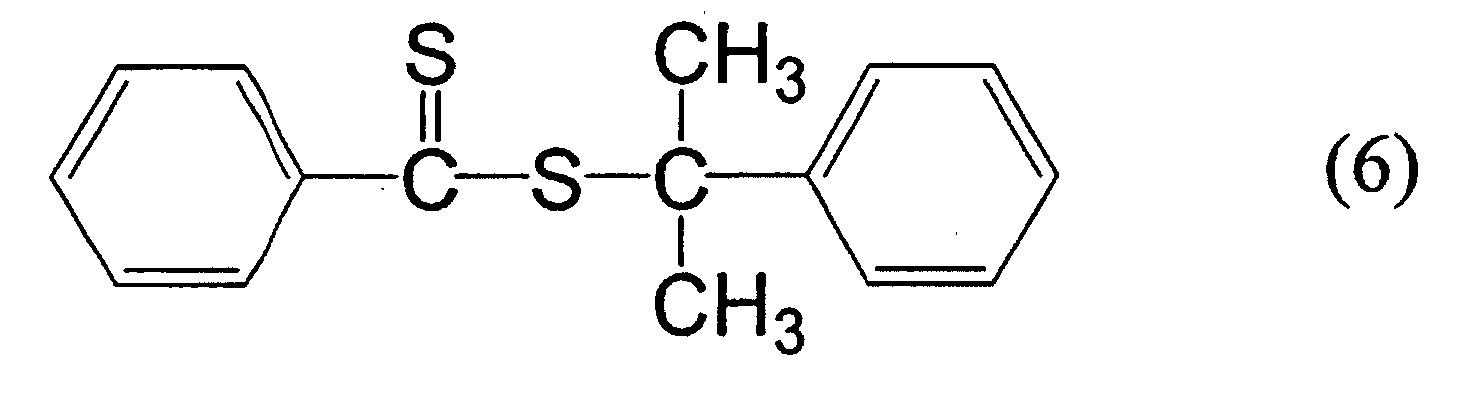 was added into the reactor, and stirring was performed at
80°C for 20 minutes. Next, 0.93 g of 4,4'-azobis(4-cyanovaleric
acid) together with 25 g of distilled water was
added into the reactor. Stirring was performed at 80°C for
30 minutes, and then 57.7 g of methacrylonitrile was dripped
from the dropping funnel for over 1 hour. After dripping
was completed, stirring was performed at 80°C for 5 hours,
and sampling was performed. Production of
polymethacrylonitrile (Mw = 16,400, Mn = 13,000, and Mw/Mn =
1.26) was confirmed by gel permeation chromatography
analysis.
was added into the reactor, and stirring was performed at
80°C for 20 minutes. Next, 0.93 g of 4,4'-azobis(4-cyanovaleric
acid) together with 25 g of distilled water was
added into the reactor. Stirring was performed at 80°C for
30 minutes, and then 57.7 g of methacrylonitrile was dripped
from the dropping funnel for over 1 hour. After dripping
was completed, stirring was performed at 80°C for 5 hours,
and sampling was performed. Production of
polymethacrylonitrile (Mw = 16,400, Mn = 13,000, and Mw/Mn =
1.26) was confirmed by gel permeation chromatography
analysis.
Next, 20.0 g of n-butyl acrylate was added into the
reactor, and 0.36 g of 4,4'-azobis(4-cyanovaleric acid)
together with 13 g of distilled water was further added
thereinto. Stirring was performed at 80°C for 1 hour, and
then 80.0 g of n-butyl acrylate was dripped from the
dropping funnel for over 2 hours. After dripping was
completed, the mixture was stirred at 80°C for 4 hours and
then cooled to room temperature. A salting-out method was
performed, followed by filtration, washing, and drying.
Thereby, production of a methacrylonitrile-n-butyl acrylate
diblock copolymer (Mw = 49,900, Mn = 36,300, and Mw/Mn =
1.37) was confirmed.
The diblock copolymer (70 g) thus obtained was
dissolved in 300 mL of toluene, and 18 g of monoethylamine
was added thereinto, followed by stirring at 30°C for 16
hours. 1H NMR analysis and IR confirmed that the
thiocarbonylthio groups at ends were quantitatively
converted into mercapto groups. The toluene solution was
washed with water and then poured into methanol to
precipitate and isolate the block copolymer.
Into a 300 mL reactor equipped with an agitator, a
thermometer, a nitrogen gas inlet tube, a dropping funnel,
and a reflux condenser, was placed 110 mg of sodium dodecyl
sulfonate and 100 g of distilled water, and the reactor was
nitrogen-purged while the reaction mixture was being stirred
at 80°C. A compound (217 mg) represented by formula (6):
 which was dissolved in 1.6 g of acrylonitrile, was added
into the reactor, and after 20 minutes, 185 mg of 4,4'-azobis(4-cyanovaleric
acid) together with 5 g of distilled
water was added into the reactor. Stirring was performed at
80°C for 20 minutes, and then 9.3 g of acrylonitrile was
dripped from the dropping funnel for over 50 minutes. After
dripping was completed, stirring was performed at 80°C for 3
hours, and sampling was performed. Production of
polyacrylonitrile (Mw = 18,100, Mn = 12,700, and Mw/Mn =
1.42) was confirmed by gel permeation chromatography
analysis.
which was dissolved in 1.6 g of acrylonitrile, was added
into the reactor, and after 20 minutes, 185 mg of 4,4'-azobis(4-cyanovaleric
acid) together with 5 g of distilled
water was added into the reactor. Stirring was performed at
80°C for 20 minutes, and then 9.3 g of acrylonitrile was
dripped from the dropping funnel for over 50 minutes. After
dripping was completed, stirring was performed at 80°C for 3
hours, and sampling was performed. Production of
polyacrylonitrile (Mw = 18,100, Mn = 12,700, and Mw/Mn =
1.42) was confirmed by gel permeation chromatography
analysis.
Next, a mixed solution of 10.0 g of n-butyl acrylate
and 7.8 g of ethyl acrylate was dripped from the dropping
funnel for over 1 hour. Stirring was performed at 80°C for
5 hours, and an emulsion was thereby prepared. Sampling was
performed and production of a thiocarbonylthio group-terminated
acrylonitrile-(n-butyl acrylate/ethyl acrylate)
diblock copolymer (Mw = 48,500, Mn = 31,600, and Mw/Mn =
1.53) was confirmed.
Diethylamine (20 g) was added into the emulsion, and
stirring was performed at 60°C for 5 hours. A salting-out
method was performed, followed by filtration, washing, and
drying, and a polymer was thereby produced. It was
confirmed that the polymer was a mercapto group-terminated
acrylonitrile-(n-butyl acrylate/ethyl acrylate) diblock
copolymer (Mw = 48,700, Mn = 31,300, and Mw/Mn = 1.56).
Into a 1 L reactor equipped with an agitator, a
thermometer, a nitrogen gas inlet tube, a dropping funnel,
and a reflux condenser, was placed 200 mg of sodium dodecyl
sulfonate and 200 g of distilled water, and the reactor was
nitrogen-purged while the reaction mixture was being stirred
at 80°C. A compound (651 mg) represented by formula (6):
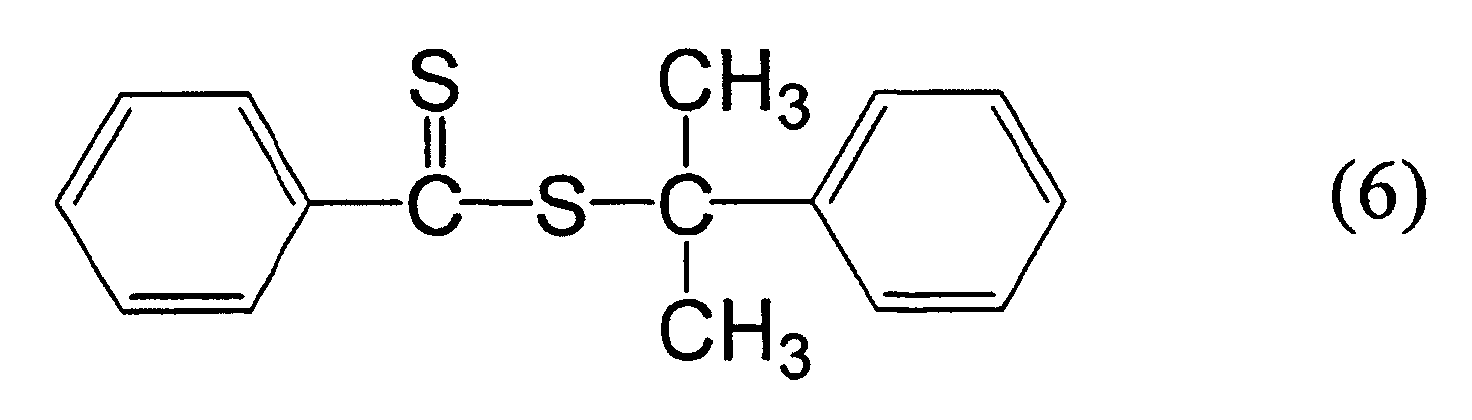 which was dissolved in 5.0 g of methyl methacrylate, was
added into the reactor, and after 20 minutes, 500 mg of
4,4'-azobis(4-cyanovaleric acid) together with 12 g of
distilled water was added into the reactor. Stirring was
performed at 80°C for 30 minutes, and then a mixed solution
of 18.6 g of acrylonitrile and 6.8 g of methyl methacrylate
was dripped from the dropping funnel for over 1 hour.
Stirring was then performed at 80°C for 6 hours, and
sampling was performed. Production of a thiocarbonylthio
group-terminated acrylonitrile/methyl methacrylate random
copolymer was confirmed.
which was dissolved in 5.0 g of methyl methacrylate, was
added into the reactor, and after 20 minutes, 500 mg of
4,4'-azobis(4-cyanovaleric acid) together with 12 g of
distilled water was added into the reactor. Stirring was
performed at 80°C for 30 minutes, and then a mixed solution
of 18.6 g of acrylonitrile and 6.8 g of methyl methacrylate
was dripped from the dropping funnel for over 1 hour.
Stirring was then performed at 80°C for 6 hours, and
sampling was performed. Production of a thiocarbonylthio
group-terminated acrylonitrile/methyl methacrylate random
copolymer was confirmed.
Next, 200 mg of 4,4'-azobis(4-cyanovaleric acid) was
added into the reactor, and a mixed solution of 50.0 g of n-butyl
acrylate and 18.6 g of 2-hydroxyethyl acrylate was
dripped from the dropping funnel for over 3 hours. Stirring
was performed at 80°C for 5 hours, and the resultant
emulsion was sampled. Production of a thiocarbonylthio
group-terminated (acrylonitrile/methyl methacrylate)-(n-butyl
acrylate/2-hydroxyethyl acrylate) diblock copolymer
was confirmed. The emulsion was salted out, followed by
filtration, washing, and drying, and the diblock copolymer
was thereby prepared.
The diblock copolymer (30 g) thus obtained was
dissolved in 100 mL of dehydrated toluene, and 4 g of sodium
methylate was added thereinto, followed by stirring at 50°C
for 2 hours. A toluene solution containing a mercaptide
group-terminated (acrylonitrile/methyl methacrylate)-(n-butyl
acrylate/2-hydroxyethyl acrylate) diblock copolymer
was thereby prepared. A portion of the solution was
collected as a sample and hydrolyzed, and then poured into
hexane to precipitate and isolate the copolymer. 1H NMR
analysis and GPC analysis confirmed the production of a
mercapto group-terminated (acrylonitrile/methyl
methacrylate)-(n-butyl acrylate/2-hydroxyethyl acrylate)
diblock copolymer (Mw = 52,100, Mn = 35,200, and Mw/Mn =
1.48).
Toluene (150 parts by weight) and lead dioxide (0.5
parts by weight) were added to the mercapto group-terminated
acrylonitrile-n-butyl acrylate diblock copolymer (100 parts
by weight) synthesized in Example 1, and thorough mixing was
performed. The mixture was placed into a slab mold and
dried in an air atmosphere at 80°C for 15 hours. 1H NMR
analysis, IR analysis, and gel permeation chromatography
analysis confirmed that the resultant sheet-shaped polymer
was an acrylonitrile-n-butyl acrylate-acrylonitrile triblock
copolymer having disulfide bonds in the main chain (Mw =
101,600, Mn = 67,300, and Mw/Mn = 1.51).
Dehydrated toluene (200 parts by weight), hexamethylene
diisocyanate (0.24 parts by weight), and dibutyltin
bis(isooctyl thioglycolate) (0.001 parts by weight) were
added to the mercapto group-terminated acrylonitrile-n-butyl
acrylate diblock copolymer (100 parts by weight) synthesized
in Example 1, and stirring was performed at 80°C for 10
hours. The solvent was removed by distillation. 1H NMR
analysis, IR analysis, and gel permeation chromatography
analysis confirmed that the resultant polymer was an
acrylonitrile-n-butyl acrylate-acrylonitrile triblock
copolymer having thiourethane bonds in the main chain (Mw =
99,700, Mn = 66,500, and Mw/Mn = 1.50).
Calcium dioxide (1 part by weight) was added to the
mercapto group-terminated methacrylonitrile-n-butyl acrylate
diblock copolymer (100 parts by weight) synthesized in
Example 2, and the mixture was roll-kneaded at 100°C and
formed into a sheet. Furthermore, the sheet was heated at
100°C for 5 hours and matured at room temperature for 3 days.
1H NMR analysis, IR analysis, and gel permeation
chromatography analysis confirmed that the resultant sheet-shaped
polymer was a methacrylonitrile-n-butyl acrylate-methacrylonitrile
triblock copolymer having disulfide bonds
in the main chain (Mw = 102,700, Mn = 71,400, and Mw/Mn =
1.44).
Dehydrated toluene (100 parts by weight), isophorone
diisocyanate (0.31 parts by weight), and dibutyltin
bisacetylacetonate (0.001 parts by weight) were added to the
mercapto group-terminated methacrylonitrile-n-butyl acrylate
diblock copolymer (100 parts by weight) synthesized in
Example 2, and the mixture was stirred at 80°C for 8 hours.
Toluene was then removed by distillation. 1H NMR analysis,
IR analysis, and gel permeation chromatography analysis
confirmed that the resultant polymer was a
methacrylonitrile-n-butyl acrylate-methacrylonitrile
triblock copolymer having thiourethane bonds in the main
chain (Mw = 98,500, Mn = 69,900, and Mw/Mn = 1.41).
Toluene (200 parts by weight) was added to the mercapto
group-terminated acrylonitrile-(n-butyl acrylate/ethyl
acrylate) diblock copolymer (100 parts by weight)
synthesized in Example 3, and the mixture was stirred at
90°C for 18 hours under blown air. Toluene was removed by
distillation. 1H NMR analysis, IR analysis, and gel
permeation chromatography analysis confirmed that the
resultant polymer was an acrylonitrile-(n-butyl
acrylate/ethyl acrylate)-acrylonitrile triblock copolymer
having disulfide bonds in the main chain (Mw = 102,400, Mn =
61,100, and Mw/Mn = 1.68).
Toluene (200 parts by weight) and diphenylmethane
diisocyanate (0.4 parts by weight) were added to the
mercapto group-terminated acrylonitrile-(n-butyl
acrylate/ethyl acrylate) diblock copolymer (100 parts by
weight) synthesized in Example 3, and the mixture was
stirred at 100°C for 8 hours. Toluene was removed by
distillation. 1H NMR analysis, IR analysis, and gel
permeation chromatography analysis confirmed that the
resultant polymer was an acrylonitrile-(n-butyl
acrylate/ethyl acrylate)-acrylonitrile triblock copolymer
having thiourethane bonds in the main chain (Mw = 100,700,
Mn = 60,900, and Mw/Mn = 1.65).
To a toluene solution containing the
(acrylonitrile/methyl methacrylate)-(n-butyl acrylate/2-hydroxyethyl
acrylate) diblock copolymer (100 parts by
weight on the basis of the polymer) was added 1,2-dichloroethane
(0.14 parts by weight), and the mixture was
stirred at 80°C for 20 hours. The resultant toluene
solution was washed with water and dried, and the solvent
was removed by distillation. 1H NMR analysis and GPC
analysis confirmed that the resultant polymer was an
(acrylonitrile/methyl methacrylate)-(n-butyl acrylate/2-hydroxyethyl
acrylate)-(acrylonitrile/methyl methacrylate)
triblock copolymer having sulfide bonds (Mw = 101,700, Mn =
65,100, and Mw/Mn = 1.56).
Into a 2 L reactor equipped with an agitator, a
thermometer, a nitrogen gas inlet tube, a dropping funnel,
and a reflux condenser, was placed 490 g of distilled water,
20 g of polyoxyethylene nonylphenyl ether as a nonionic
emulsifier, and 2 g of hexadecane as an emulsifying aid, and
the reactor was nitrogen-purged while the reaction mixture
was being stirred at 80°C. A mixed solution of 8.9 g of
acrylonitrile and 1.1 g of a compound represented by formula
(6):
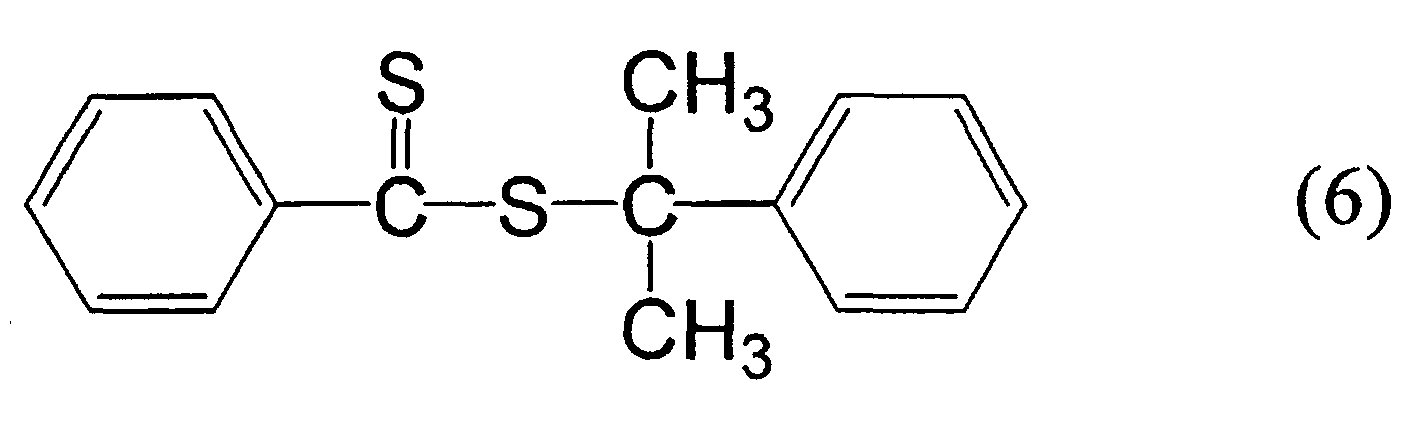 was added into the reactor, and stirring was performed at
70°C for 30 minutes. Next, 0.92 g of 4,4'-azobis(4-cyanovaleric
acid) together with 25 g of distilled water was
added into the reactor. Stirring was performed at 70°C for
1 hour, and then 45 g of acrylonitrile was dripped from the
dropping funnel for over 1 hour. As soon as dripping was
completed, the temperature was raised to 80°C and stirring
was performed for 5 hours. Sampling was then performed.
Production of polyacrylonitrile (Mw = 13,000, Mn = 10,000,
and Mw/Mn = 1.30) was confirmed by gel permeation
chromatography analysis.
was added into the reactor, and stirring was performed at
70°C for 30 minutes. Next, 0.92 g of 4,4'-azobis(4-cyanovaleric
acid) together with 25 g of distilled water was
added into the reactor. Stirring was performed at 70°C for
1 hour, and then 45 g of acrylonitrile was dripped from the
dropping funnel for over 1 hour. As soon as dripping was
completed, the temperature was raised to 80°C and stirring
was performed for 5 hours. Sampling was then performed.
Production of polyacrylonitrile (Mw = 13,000, Mn = 10,000,
and Mw/Mn = 1.30) was confirmed by gel permeation
chromatography analysis.
Next, 20 g of n-butyl acrylate was added into the
reactor, and 0.25 g of 4,4'-azobis(4-cyanovaleric acid)
together with 5 g of distilled water was further added
thereinto. Stirring was performed at 80°C for 1 hour, and
then 80 g of n-butyl acrylate was dripped from the dropping
funnel for over 2 hours. After dripping was completed, the
mixture was stirred at 80°C for 6 hours and then cooled to
room temperature. A salting-out method was performed,
followed by filtration, washing, and drying. Thereby,
production of an acrylonitrile-n-butyl acrylate diblock
copolymer (Mw = 47,500, Mn = 34,000, and Mw/Mn = 1.40) was
confirmed.
The diblock copolymer (50 g) thus produced was
dissolved in 200 mL of toluene, and 20 g of diethylamine was
added thereinto, followed by stirring at 50°C for 8 hours.
The reaction solution was purified with a silica gel column,
and toluene was removed by distillation. 1H NMR analysis
and IR analysis confirmed that the thiocarbonylthio groups
at ends were quantitatively converted into mercapto groups.
Toluene (100 parts by weight), dimethylformamide (50
parts by weight), and lead dioxide (0.5 parts by weight)
were added to the mercapto group-terminated acrylonitrile-n-butyl
acrylate diblock copolymer (100 parts by weight)
synthesized in Example 12, and thorough mixing was performed.
The mixture was placed into a slab mold and dried in an air
atmosphere at 80°C for 5 hours. Deaeration was performed
under reduced pressure at 80°C to remove the solvent, and
heating was further performed in an air atmosphere at 80°C
for 10 hours. 1H NMR analysis, IR analysis, and gel
permeation chromatography analysis confirmed that the
resultant polymer constituting the sheet was an
acrylonitrile-n-butyl acrylate-acrylonitrile triblock
copolymer having disulfide bonds in the main chain (Mw =
99,900, Mn = 66,500, and Mw/Mn = 1.50).
Into a 2 L reactor equipped with an agitator, a
thermometer, a nitrogen gas inlet tube, a dropping funnel,
and a reflux condenser, was placed 490 g of distilled water
and 0.56 g of sodium dodecyl sulfate, and the reactor was
nitrogen-purged while the reaction mixture was being stirred
at 80°C. A mixed solution of 8.8 g of acrylonitrile and
1.09 g of 2-(2-phenylpropyl) dithiobenzoate represented by
formula (6):
 was added into the reactor, and stirring was performed at
80°C for 15 minutes under nitrogen flow. Next, 0.93 g of
4,4'-azobis(4-cyanovaleric acid) together with 25 g of
distilled water was added into the reactor. Stirring was
performed at 80°C for 1 hour, and then 45.0 g of
acrylonitrile was dripped from the dropping funnel for over
2 hours. After dripping was completed, stirring was further
performed at 80°C for 5 hours. The resultant emulsion was
cooled to 30°C, and 30 g of monoethylamine was added
thereinto, followed by stirring at 30°C for 10 hours. The
emulsion was salted out, followed by filtration and washing.
Polyacrylonitrile having a mercapto group at one end was
thereby produced (Mw = 13,400, Mn = 10,800, and Mw/Mn =
1.24).
was added into the reactor, and stirring was performed at
80°C for 15 minutes under nitrogen flow. Next, 0.93 g of
4,4'-azobis(4-cyanovaleric acid) together with 25 g of
distilled water was added into the reactor. Stirring was
performed at 80°C for 1 hour, and then 45.0 g of
acrylonitrile was dripped from the dropping funnel for over
2 hours. After dripping was completed, stirring was further
performed at 80°C for 5 hours. The resultant emulsion was
cooled to 30°C, and 30 g of monoethylamine was added
thereinto, followed by stirring at 30°C for 10 hours. The
emulsion was salted out, followed by filtration and washing.
Polyacrylonitrile having a mercapto group at one end was
thereby produced (Mw = 13,400, Mn = 10,800, and Mw/Mn =
1.24).
Into a 1 L reactor equipped with an agitator, a
thermometer, a nitrogen gas inlet tube, a dropping funnel,
and a reflux condenser, was placed 200 mg of sodium dodecyl
sulfonate and 200 g of distilled water, and the reactor was
nitrogen-purged while the reaction mixture was being stirred
at 80°C. 2-(2-Phenylpropyl) dithiobenzoate (651 mg)
represented by formula (6):
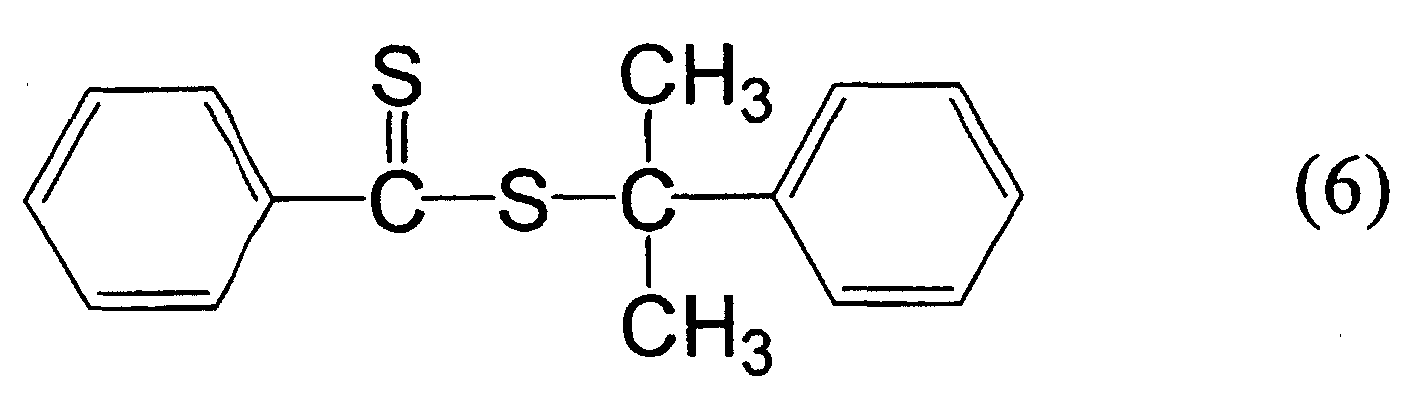 was dissolved in a mixed solution of 18.6 g of acrylonitrile
and 11.8 g of methyl methacrylate, and the solution was
dripped from the dropping funnel at one time. After 20
minutes, 500 mg of 4,4'-azobis(4-cyanovaleric acid) together
with 12 g of distilled water was added into the reactor.
Stirring was performed at 80°C for 4 hours, and the reaction
mixture was cooled to 30°C. Monoethylamine (10 g) was added
thereinto, and stirring was performed at 30°C for 10 hours.
The resultant emulsion was salted out, followed by
filtration and washing. An acrylonitrile-methyl
methacrylate random copolymer having a mercapto group at one
end was thereby produced (Mw = 11,100, Mn = 9,700, and Mw/Mn
= 1.14).
was dissolved in a mixed solution of 18.6 g of acrylonitrile
and 11.8 g of methyl methacrylate, and the solution was
dripped from the dropping funnel at one time. After 20
minutes, 500 mg of 4,4'-azobis(4-cyanovaleric acid) together
with 12 g of distilled water was added into the reactor.
Stirring was performed at 80°C for 4 hours, and the reaction
mixture was cooled to 30°C. Monoethylamine (10 g) was added
thereinto, and stirring was performed at 30°C for 10 hours.
The resultant emulsion was salted out, followed by
filtration and washing. An acrylonitrile-methyl
methacrylate random copolymer having a mercapto group at one
end was thereby produced (Mw = 11,100, Mn = 9,700, and Mw/Mn
= 1.14).
Into a 2 L reactor equipped with an agitator, a
thermometer, a nitrogen gas inlet tube, a dropping funnel,
and a reflux condenser, was placed 0.56 g of sodium dodecyl
sulfate and 490 g of distilled water, and the reactor was
nitrogen-purged while the reaction mixture was being stirred
at 80°C. 2-(2-Phenylpropyl) dithiobenzoate (1.09 g)
represented by formula (6):
 was dissolved in 16.5 g of n-butyl acrylate, and the
solution was dripped from the dropping funnel at one time.
After 20 minutes, 0.93 g of 4,4'-azobis(4-cyanovaleric acid)
together with 25 g of distilled water was added into the
reactor. Stirring was performed at 80°C for 30 minutes, and
then 100 g of n-butyl acrylate was dripped from the dropping
funnel for over 2 hours. Stirring was further performed at
80°C for 5 hours, and the reaction mixture was cooled to
30°C. Monoethylamine (30 g) was added thereinto, and
stirring was performed at 30°C for 10 hours. The resultant
emulsion was salted out, followed by filtration and washing.
Poly(n-butyl acrylate) having a mercapto group at one end
was thereby produced (Mw = 38,900, Mn = 30,900, and Mw/Mn =
1.26).
was dissolved in 16.5 g of n-butyl acrylate, and the
solution was dripped from the dropping funnel at one time.
After 20 minutes, 0.93 g of 4,4'-azobis(4-cyanovaleric acid)
together with 25 g of distilled water was added into the
reactor. Stirring was performed at 80°C for 30 minutes, and
then 100 g of n-butyl acrylate was dripped from the dropping
funnel for over 2 hours. Stirring was further performed at
80°C for 5 hours, and the reaction mixture was cooled to
30°C. Monoethylamine (30 g) was added thereinto, and
stirring was performed at 30°C for 10 hours. The resultant
emulsion was salted out, followed by filtration and washing.
Poly(n-butyl acrylate) having a mercapto group at one end
was thereby produced (Mw = 38,900, Mn = 30,900, and Mw/Mn =
1.26).
Into a 1 L reactor equipped with an agitator, a
thermometer, a nitrogen gas inlet tube, and a reflux
condenser tube, was placed 181 g of n-butyl acrylate, 40 mg
of 1,1'-azobis(1-cyclohexanecarbonitrile), 635 mg of 1,4-bis(thiobenzoylthiomethyl)benzene
represented by formula
(7) :
 and 300 mL of toluene, and the reactor was nitrogen-purged.
The reaction liquid was heated at 90°C for 5 hours while
being stirred. Sampling was performed, and GPC analysis
confirmed the production of a polymer (Mw = 77,000, Mn =
56,900, and Mw/Mn = 1.35). 1H NMR measurement confirmed
that thiocarbonylthio groups were introduced into both ends
of poly(n-butyl acrylate), and the introduction rate was 93%
on the both-ends basis. The conversion rate of n-butyl
acrylate was 55%.
and 300 mL of toluene, and the reactor was nitrogen-purged.
The reaction liquid was heated at 90°C for 5 hours while
being stirred. Sampling was performed, and GPC analysis
confirmed the production of a polymer (Mw = 77,000, Mn =
56,900, and Mw/Mn = 1.35). 1H NMR measurement confirmed
that thiocarbonylthio groups were introduced into both ends
of poly(n-butyl acrylate), and the introduction rate was 93%
on the both-ends basis. The conversion rate of n-butyl
acrylate was 55%.
Monoethylamine (30 g) was added into the resultant
toluene solution containing poly(n-butyl acrylate) having
thiocarbonylthio groups at both ends, followed by stirring
at 30°C for 5 hours. Sampling was performed, and 1H NMR
measurement confirmed the production of poly(n-butyl
acrylate) having mercapto groups at both ends. The
introduction rate of mercapto groups was 90% on the both-ends
basis.
Into a 1 L reactor equipped with an agitator, a
thermometer, a nitrogen gas inlet tube, a reflux condenser,
and a dropping funnel, was placed 410 mg of sodium dodecyl
sulfonate and 400 g of distilled water, and the reactor was
nitrogen-purged while the reaction mixture was being stirred
at 80°C. A compound (23.34 g) represented by formula (8):
 which was dissolved in 50 g of n-butyl acrylate, was added
into the reactor, and stirring was performed at 80°C for 20
minutes under nitrogen flow. Next, 7.0 g of 4,4'-azobis(4-cyanovaleric
acid) together with 25 g of distilled water was
added thereinto. Stirring was performed at 80°C for 30
minutes, and then a mixed solution of 100 g of n-butyl
acrylate and 50 g of 2-methoxyethyl acrylate was dripped
from the dropping funnel for over 1.5 hours. After dripping
was completed, the mixture was stirred at 80°C for 4 hours,
and the resultant emulsion was then cooled to room
temperature. A salting-out method was performed, followed
by filtration and washing. Thereby, an n-butyl acrylate-2-methoxyethyl
acrylate random copolymer having
thiocarbonylthio groups at both ends was produced. GPC
analysis and 1H NMR analysis confirmed that in the polymer,
Mw = 4,320, Mn = 3,970, and Mw/Mn = 1.09 and that the
introduction rate of thiocarbonylthio groups was 97% on the
both-ends basis.
which was dissolved in 50 g of n-butyl acrylate, was added
into the reactor, and stirring was performed at 80°C for 20
minutes under nitrogen flow. Next, 7.0 g of 4,4'-azobis(4-cyanovaleric
acid) together with 25 g of distilled water was
added thereinto. Stirring was performed at 80°C for 30
minutes, and then a mixed solution of 100 g of n-butyl
acrylate and 50 g of 2-methoxyethyl acrylate was dripped
from the dropping funnel for over 1.5 hours. After dripping
was completed, the mixture was stirred at 80°C for 4 hours,
and the resultant emulsion was then cooled to room
temperature. A salting-out method was performed, followed
by filtration and washing. Thereby, an n-butyl acrylate-2-methoxyethyl
acrylate random copolymer having
thiocarbonylthio groups at both ends was produced. GPC
analysis and 1H NMR analysis confirmed that in the polymer,
Mw = 4,320, Mn = 3,970, and Mw/Mn = 1.09 and that the
introduction rate of thiocarbonylthio groups was 97% on the
both-ends basis.
The polymer having thiocarbonylthio group at both ends
(180 g) was dissolved in 200 mL of toluene, and 20 g of
monoethylamine was added thereinto, followed by stirring at
5°C for 10 hours. By removing excess monoethylamine and
toluene, an n-butyl acrylate-2-methoxyethyl acrylate random
copolymer having mercapto groups at both ends was produced.
Into a 300 L stainless steel autoclave was placed 130
kg of ion-exchanged water, 100 kg of vinyl chloride monomer,
500 g of 2,2'-azobis(isobutylvaleronitrile), 400 g of sodium
lauryl sulfate, and 110 g of a compound represented by
formula (9) below.
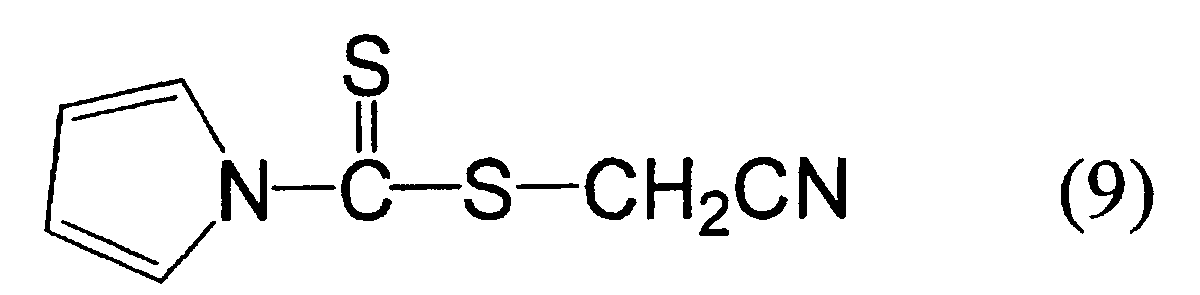
Homogenizing was performed for 90 minutes with a
homogenizer, and polymerization was then carried out at 50°C.
When the internal pressure of the reactor became lower than
the saturated vapor pressure of the vinyl chloride monomer
at 50°C by 1 kg/cm2, unreacted monomers were removed from
the reactor by distillation. A vinyl chloride polymer latex
was thereby produced. Excess vinyl chloride was removed,
and the reactor was filled with ammonia at a rate of 5
kg/cm2 (20°C). Stirring was performed at 50°C for 5 hours.
By spray drying the emulsion, mercapto group-terminated
poly(vinyl chloride) was produced (Mw = 61,000, Mn = 41,000,
and Mw/Mn = 1.49).
Into a 2 L reactor equipped with an agitator, a
thermometer, a nitrogen gas inlet tube, a dropping funnel,
and a reflux condenser, was placed 490 g of distilled water,
20 g of polyethylene glycol nonylphenyl ether as a nonionic
emulsifier, and 2 g of hexadecane as an emulsifying aid, and
the reactor was nitrogen-purged while the reaction mixture
was being stirred at 80°C. A mixed solution of 8.9 g of
acrylonitrile and 1.1 g of a compound represented by formula
(6) :
 was added into the reactor, and stirring was performed at
70°C for 30 minutes. Next, 0.92 g of 4,4'-azobis(4-cyanovaleric
acid) together with 25 g of distilled water was
added into the reactor. Stirring was performed at 70°C for
1 hour, and then 45 g of acrylonitrile was dripped from the
dropping funnel for over 1 hour. As soon as dripping was
completed, the temperature was raised to 80°C and stirring
was performed for 6 hours. The mixture was cooled to room
temperature, and an emulsion was prepared. The emulsion was
dried and washed with acetone, and then reprecipitation was
performed with dimethylformamide-acetone. Polyacrylonitrile
was thereby produced. Gel permeation chromatography
analysis confirmed that Mw = 13,100, Mn = 9,800, and Mw/Mn =
1.34.
was added into the reactor, and stirring was performed at
70°C for 30 minutes. Next, 0.92 g of 4,4'-azobis(4-cyanovaleric
acid) together with 25 g of distilled water was
added into the reactor. Stirring was performed at 70°C for
1 hour, and then 45 g of acrylonitrile was dripped from the
dropping funnel for over 1 hour. As soon as dripping was
completed, the temperature was raised to 80°C and stirring
was performed for 6 hours. The mixture was cooled to room
temperature, and an emulsion was prepared. The emulsion was
dried and washed with acetone, and then reprecipitation was
performed with dimethylformamide-acetone. Polyacrylonitrile
was thereby produced. Gel permeation chromatography
analysis confirmed that Mw = 13,100, Mn = 9,800, and Mw/Mn =
1.34.
The resultant polyacrylonitrile (30 g) was dissolved in
300 mL of dimethylformamide, and 8 g of diethylamine was
added thereinto, followed by stirring at 50°C for 10 hours.
The reaction solution was concentrated and reprecipitated
with methanol. Mercapto group-terminated polyacrylonitrile
was thereby produced. NMR analysis confirmed that the
introduction rate of mercapto groups was 91% on the single-end
basis.
The poly(n-butyl acrylate) (286 parts by weight)
synthesized in Production Example 3, toluene (300 parts by
weight), and lead dioxide (0.5 parts by weight) were added
to the mercapto group-terminated polyacrylonitrile (100
parts by weight) synthesized in Production Example 1, and
the mixture was stirred at 80°C for 10 hours in an air
atmosphere. 1H NMR analysis confirmed that an
acrylonitrile-n-butyl acrylate diblock copolymer in which
coupling was performed via disulfide bonds was produced.
GPC analysis confirmed that Mw = 61,400, Mn = 45,400, and
Mw/Mn = 1.35.
In a nitrogen atmosphere, dehydrated toluene (300 parts
by weight), isophorone diisocyanate (0.70 parts by weight),
and dibutyltin bis(isooctyl thioglycolate) (0.05 parts by
weight) were added to the poly(n-butyl acrylate) having
mercapto groups at both ends (100 parts by weight)
synthesized in Production Example 4, and the mixture was
stirred at 80°C for 8 hours to synthesize poly(n-butyl
acrylate) having isocyanato groups at both ends. The
mercapto group-terminated polyacrylonitrile (34 parts by
weight) synthesized in Production Example 1 was added
thereinto, and stirring was performed at 80°C for 16 hours.
1H NMR and GPC analysis confirmed that an acrylonitrile-n-butyl
acrylate-acrylonitrile triblock copolymer was produced
(Mw = 127,000, Mn = 84,500, and Mw/Mn = 1.50).
In a nitrogen atmosphere, dehydrated toluene (300 parts
by weight), isophorone diisocyanate (7.24 parts by weight),
and dibutyltin bis(isooctyl thioglycolate) (0.05 parts by
weight) were added to the n-butyl acrylate-2-methoxyethyl
acrylate random copolymer having mercapto groups at both
ends (100 parts by weight) synthesized in Production Example
5, and the mixture was stirred at 80°C for 10 hours to
synthesize an n-butyl acrylate/2-methoxyethyl acrylate
random copolymer having isocyanato groups at both ends. The
mercapto group-terminated polyacrylonitrile (176 parts by
weight) synthesized in Production Example 1 was added
thereinto, and stirring was performed at 80°C for 16 hours.
1H NMR and GPC analysis confirmed that an acrylonitrile-(n-butyl
acrylate/2-methoxyethyl acrylate)-acrylonitrile
triblock copolymer was produced (Mw = 76,700, Mn = 43,600,
and Mw/Mn = 1.76).
The mercapto group-terminated poly(vinyl chloride) (380
parts by weight) synthesized in Production Example 6 and
lead dioxide (1 part by weight) were added to the mercapto
group-terminated polyacrylonitrile (100 parts by weight)
synthesized in Production Example 1, and the mixture was
melt-kneaded with a twin-screw extruder (inlet temperature
80°C; outlet temperature 160°C) and formed into a strand.
The resultant strand was cut into pellets. The pellets were
dried by heating at 80°C for 30 hours in an air atmosphere.
1H NMR and GPC analysis confirmed that an acrylonitrile-vinyl
chloride diblock copolymer was produced (Mw = 71,100,
Mn = 49,400, and Mw/Mn = 1.44).
In a nitrogen atmosphere, dehydrated toluene (300 parts
by weight), hexamethylene diisocyanate (5.78 parts by
weight), and dibutyltin bis(isooctyl thioglycolate) (0.05
parts by weight) were added to the mercapto group-terminated
acrylonitrile/methyl methacrylate random copolymer (100
parts by weight) synthesized in Production Example 2, and
the mixture was stirred at 80°C for 10 hours to produce an
isocyanato group-terminated acrylonitrile/methyl
methacrylate random copolymer. The mercapto group-terminated
poly(n-butyl acrylate) (105 parts by weight)
synthesized in Production Example 3 was added thereinto, and
stirring was performed at 100°C for 8 hours in a nitrogen
atmosphere. 1H NMR and GPC analysis confirmed that an
(acrylonitrile/methyl methacrylate)-n-butyl acrylate diblock
copolymer was produced (Mw = 62,900, Mn = 45,200, and Mw/Mn
= 1.39).
In a nitrogen atmosphere, dehydrated toluene (500 parts
by weight), isophorone diisocyanate (0.70 parts by weight),
and dibutyltin bis(isooctyl thioglycolate) (0.05 parts by
weight) were added to the poly(n-butyl acrylate) having
mercapto groups at both ends (100 parts by weight)
synthesized in Production Example 4, and the mixture was
stirred at 80°C for 8 hours to synthesize poly(n-butyl
acrylate) having isocyanato groups at both ends. The
mercapto group-terminated acrylonitrile-methyl methacrylate
diblock copolymer (92 parts by weight) synthesized in
Production Example 2 was added thereinto, and stirring was
performed at 80°C for 16 hours. 1H NMR and GPC analysis
confirmed that an (acrylonitrile/methyl methacrylate)-n-butyl
acrylate-(acrylonitrile/methyl methacrylate) triblock
copolymer was produced (Mw = 122,100, Mn = 78,900, and Mw/Mn
= 1.55).
In a nitrogen atmosphere, dehydrated toluene (500 parts
by weight), isophorone diisocyanate (7.22 parts by weight),
and dibutyltin bis(isooctyl thioglycolate) (0.05 parts by
weight) were added to the n-butyl acrylate/2-methoxyethyl
acrylate random copolymer having mercapto groups at both
ends (100 parts by weight) synthesized in Production Example
5, and the mixture was stirred at 80°C for 10 hours to
synthesize an n-butyl acrylate/2-methoxyethyl acrylate
random copolymer having isocyanato groups at both ends. The
mercapto group-terminated acrylonitrile/methyl methacrylate
random copolymer (474 parts by weight) synthesized in
Production Example 2 was added thereinto, and stirring was
performed at 80°C for 15 hours. 1H NMR and GPC analysis
confirmed that an (acrylonitrile/methyl methacrylate)-(n-butyl
acrylate/2-methoxyethyl acrylate)-(acrylonitrile/methyl
methacrylate) triblock copolymer was
produced (Mw = 57,700, Mn = 35,500, and Mw/Mn = 1.63).
The mercapto group-terminated poly(vinyl chloride) (141
parts by weight) synthesized in Production Example 6,
tetrahydrofuran (300 parts by weight), and lead dioxide (0.5
parts by weight) were added to the mercapto group-terminated
acrylonitrile/methyl methacrylate random copolymer (100
parts by weight) synthesized in Production Example 2, and
the mixture was stirred at 80°C for 10 hours in an air
atmosphere. 1H NMR analysis confirmed that an
(acrylonitrile/methyl methacrylate)-vinyl chloride diblock
copolymer in which coupling was performed via disulfide
bonds was produced. GPC analysis confirmed that Mw = 68,200,
Mn = 46,200, and Mw/Mn = 1.48.
In a nitrogen atmosphere, dehydrated toluene (300 parts
by weight), allyl isocyanate (0.5 parts by weight), and
dibutyltin bis(isooctyl thioglycolate) (0.02 parts by
weight) were added to the poly(n-butyl acrylate) having
mercapto groups at both ends (100 parts by weight)
synthesized in Production Example 4, and the mixture was
stirred at 80°C for 5 hours. Dibutyltin bis(isooctyl
thioglycolate) and excess allyl isocyanate were removed
through a silica gel column (50 parts by weight), and
toluene was removed by distillation. Thereby, poly(n-butyl
acrylate) having allyl groups at both ends via thiourethane
bonds was produced. NMR analysis confirmed that the
introduction rate of allyl groups was 89% on the both-ends
basis.
On the other hand, the polyacrylonitrile (100 parts by
weight) synthesized in Production Example 7 was dissolved in
dimethylformamide (300 parts by weight), and 3-isocyanatopropyldimethylsilane
(1.4 parts by weight) and
dibutyltin bisacetylacetonate (0.01 parts by weight) were
added thereinto, followed by stirring at 80°C for 6 hours.
The reaction solution was concentrated and reprecipitated
with methanol. Polyacrylonitrile having a hydrosilyl group
at one end was thereby produced. NMR analysis confirmed
that the introduction rate of hydrosilyl groups was 88% on
the single-end basis.
Dimethylformamide (300 parts by weight) was added to a
mixture of the resultant polyacrylonitrile having the
hydrosilyl group at one end (100 parts by weight) and the
poly(n-butyl acrylate) having the allyl group at one end,
and a 3% by weight xylene solution of platinum-1,3-divinyltetramethyldisiloxane
complex (0.3 parts by weight)
was added thereinto. After the mixture was matured at 80°C
for 8 hours, dimethylformamide was removed by distillation.
Toluene (200 parts by weight) was added thereto, and
insolubles were removed. The solution was poured into
methanol (500 parts by weight), and reprecipitation was
performed. Thereby, an acrylonitrile-n-butyl acrylate-acrylonitrile
triblock copolymer was produced (Mw = 128,800,
Mn = 73,200, and Mw/Mn = 1.76).
Into a 2 L reactor equipped with an agitator, a
thermometer, a nitrogen gas inlet tube, a dropping funnel,
and a reflux condenser, was placed 600 g of distilled water,
0.71 g of sodium dodecyl sulfate as an emulsifier, and as
monomers, 70 g of acrylonitrile and 30 g of n-butyl acrylate,
and the reactor was nitrogen-purged while the reaction
mixture was being stirred at 80°C. Next, 1.6 g of 4,4'-azobis(4-cyanovaleric
acid) as a polymerization initiator
together with 30 g of distilled water was added into the
reactor, and a reaction was initiated. Stirring was
performed at 80°C for 10 hours, and an acrylonitrile/n-butyl
acrylate random copolymer was produced with a conversion
rate of monomers of 89%. GPC measurement confirmed that Mw
= 472,000, Mn = 214,000, and Mw/Mn = 2.21.
A polycarbonate resin LEXAN 141R-111 (manufactured by
GE Plastics Japan, Ltd.) (100 parts by weight) as a
thermoplastic resin, IRGANOX HP2215 (manufactured by Ciba
Specialty Chemicals) (0.5 parts by weight) as a stabilizer,
and the block copolymer synthesized in Example 1 (6 parts by
weight) were compounded. The resultant composition was
extrusion-kneaded at 280°C with a twin-screw extruder (32 mm,
L/D = 25.5) and pelletized. The resultant pellets were
dried at 80°C for 15 hours, and injection molding was then
performed at 280°C to form a molded object (1/4 inch thick)
for evaluating physical properties. The Izod impact
strength at 0°C and flame retardancy of the resultant molded
object were evaluated. The results thereof are shown in
Table 1 below.
Additionally, Izod impact strength was measured
according to ASTM D256-56, using V-notched specimens, and
average values measured at n = 5 were adopted. Flame
retardancy was measured according to UL-94 standard.
Molded objects were formed as in Example 23 except that
the block copolymers synthesized in Examples 2 to 22 were
used instead of the block copolymer synthesized in Example 1.
The Izod impact strength at 0°C and flame retardancy were
evaluated. The results thereof are shown in Table 1.
A molded object was formed as in Example 23 except that
the random copolymer synthesized in Comparative Production
Example 1 was used instead of the block copolymer
synthesized in Example 1. The Izod impact strength at 0°C
and flame retardancy were evaluated. The results thereof
are shown in Table 1.
A molded object was formed as in Example 23 without
compounding the block copolymer synthesized in Example 1.
The Izod impact strength at 0°C and flame retardancy were
evaluated. The results thereof are shown in Table 1.
| Example | Composition | Izod impact strength (kJ/m2) | Flame retardancy |
| Example 23 | Example 1 | 10.5 | V-2 |
| Example 24 | Example 2 | 9.7 | V-2 |
| Example 25 | Example 3 | 11.4 | V-2 |
| Example 26 | Example 4 | 11.5 | V-1 |
| Example 27 | Example 5 | 15.2 | V-1 |
| Example 28 | Example 6 | 16.1 | V-1 |
| Example 29 | Example 7 | 11.8 | V-1 |
| Example 30 | Example 8 | 11.8 | V-1 |
| Example 31 | Example 9 | 14.9 | V-1 |
| Example 32 | Example 10 | 12.5 | V-1 |
| Example 33 | Example 11 | 10.1 | V-0 |
| Example 34 | Example 12 | 10.0 | V-2 |
| Example 35 | Example 13 | 14.7 | V-2 |
| Example 36 | Example 14 | 9.1 | V-2 |
| Example 37 | Example 15 | 13.3 | V-2 |
| Example 38 | Example 16 | 12.0 | V-1 |
| Example 39 | Example 17 | 7.2 | V-0 |
| Example 40 | Example 18 | 8.8 | V-2 |
| Example 41 | Example 19 | 17.1 | V-1 |
| Example 42 | Example 20 | 16.1 | V-1 |
| Example 43 | Example 21 | 7.7 | V-0 |
| Example 44 | Example 22 | 10.2 | V-1 |
| Comparative Example 1 | Comparative Production Example 1 | 4.1 | notV |
| Comparative Example 2 | - | 2.9 | notV |
As is evident from Table 1, the thermoplastic resin
compositions in which the block copolymers of the present
invention are compounded are excellent in impact strength at
low temperatures and flame retardancy.
A poly(butylene terephthalate) resin DURANEX 2002
(manufactured by Polyplastic Co., Ltd.) (80 parts by weight)
as a thermoplastic resin, Topanol CA (manufactured by Lipre
Co., Ltd.) (0.3 parts by weight) as a phenolic antioxidant,
Adekasutabu PEP-36 (manufactured by Asahi Denka Co., Ltd.)
(0.3 parts by weight) as a HALS, and the block copolymer
synthesized in Example 1 (20 parts by weight) were
compounded. Using a twin-screw extruder (32 mm, L/D = 25.5),
the resultant composition was extrusion-kneaded at 245°C and
pelletized. The resultant pellets were dried at 80°C for 15
hours, and injection molding was then performed at 250°C to
form a molded object (1/4 inch thick) for evaluating
physical properties. The Izod impact strength at 0°C of the
resultant molded object was evaluated. The result thereof
is shown in Table 2 below.
Molded objects were formed as in Example 45 except that
the block copolymers synthesized in Examples 2 to 22 were
used instead of the block copolymer synthesized in Example 1.
The Izod impact strength at 0°C of each resultant molded
object was evaluated. The results thereof are shown in
A molded object was formed as in Example 45 except that
the random copolymer synthesized in Comparative Production
Example 1 was used instead of the block copolymer
synthesized in Example 1. The Izod impact strength at 0°C
was evaluated. The result thereof is shown in Table 2.
A molded object was formed as in Example 45 without
compounding the block copolymer synthesized in Example 1.
The Izod impact strength at 0°C was evaluated. The result
thereof is shown in Table 2.
| Example | Composition | Izod impact strength (kJ/m2) |
| Example 45 | Example 1 | 9.6 |
| Example 46 | Example 2 | 8.5 |
| Example 47 | Example 3 | 9.3 |
| Example 48 | Example 4 | 10.1 |
| Example 49 | Example 5 | 11.5 |
| Example 50 | Example 6 | 11.8 |
| Example 51 | Example 7 | 10.1 |
| Example 52 | Example 8 | 9.1 |
| Example 53 | Example 9 | 12.5 |
| Example 54 | Example 10 | 10.9 |
| Example 55 | Example 11 | 9.1 |
| Example 56 | Example 12 | 8.3 |
| Example 57 | Example 13 | 11.1 |
| Example 58 | Example 14 | 9.0 |
| Example 59 | Example 15 | 10.8 |
| Example 60 | Example 16 | 10.7 |
| Example 61 | Example 17 | 8.1 |
| Example 62 | Example 18 | 8.3 |
| Example 63 | Example 19 | 13.2 |
| Example 64 | Example 20 | 13.7 |
| Example 65 | Example 21 | 7.8 |
| Example 66 | Example 22 | 9.3 |
| Comparative Example 3 | Comparative Production Example 1 | 3.1 |
| Comparative Example 4 | - | 2.8 |
As is evident from Table 2, the thermoplastic resin
compositions in which the block copolymers of the present
invention are compounded are excellent in impact strength at
low temperatures.
An acrylic rubber AR42W (manufactured by ZEON
Corporation) (100 parts by weight) and the block copolymer
synthesized in Example 1 (100 parts by weight) were
compounded and melt-kneaded with a Laboplastomill at 190°C.
After 3 minutes, as a crosslinking agent, ammonium benzoate
(3 parts by weight) was added thereinto, and melt-kneading
was further performed with the Laboplastomill at 190°C. The
resultant sample block was thermopress-molded at 190°C, and
molded objects with a thickness of 2 mm for evaluating
physical properties were formed. The resultant molded
objects were crosslinked by heating at 150°C for 2 hours.
With respect to the molded objects, tensile strength at
break and elongation at break at 0°C, and oil resistance
were evaluated. The results thereof are shown in Table 3
below.
Additionally, tensile strength at break and elongation
at break were measured according to JIS K6251, at 0°C. With
respect to oil resistance, according to JIS C232, molded
objects were immersed in transformer oil B at 70°C for 4
hours, and the oil resistance was measured based on the
rates of change in weight.
Molded objects were formed as in Example 67 except that
the block copolymers synthesized in Examples 2 to 22 were
used instead of the block copolymers synthesized in Example
1. The tensile strength at break and elongation at break at
0°C, and oil resistance were evaluated. The results thereof
are shown in Table 3.
Molded objects were formed as in Example 67 except that
the random copolymer synthesized in Comparative Production
Example 1 was used instead of the block copolymer
synthesized in Example 1. The tensile strength at break and
elongation at break at 0°C, and oil resistance were
evaluated. The results thereof are shown in Table 3.
Molded objects were formed as in Example 67 without
compounding the block copolymer synthesized in Example 1.
The tensile strength at break and elongation at break at 0°C,
and oil resistance were evaluated. The results thereof are
shown in Table 3.
| Example | Composition | Tensile strength at break (MPa) | Elongation at break (%) | Oil resistance (%) |
| Example 67 | Example 1 | 4.1 | 340 | 11 |
| Example 68 | Example 2 | 5.2 | 310 | 9 |
| Example 69 | Example 3 | 4.8 | 300 | 7 |
| Example 70 | Example 4 | 3.5 | 420 | 4 |
| Example 71 | Example 5 | 7.1 | 220 | 12 |
| Example 72 | Example 6 | 6.6 | 230 | 11 |
| Example 73 | Example 7 | 5.9 | 280 | 10 |
| Example 74 | Example 8 | 4.5 | 270 | 10 |
| Example 75 | Example 9 | 6.0 | 240 | 6 |
| Example 76 | Example 10 | 6.9 | 250 | 7 |
| Example 77 | Example 11 | 8.1 | 200 | 4 |
| Example 78 | Example 12 | 4.0 | 300 | 13 |
| Example 79 | Example 13 | 5.0 | 270 | 14 |
| Example 80 | Example 14 | 3.7 | 360 | 14 |
| Example 81 | Example 15 | 4.2 | 350 | 13 |
| Example 82 | Example 16 | 4.5 | 330 | 11 |
| Example 83 | Example 17 | 3.0 | 470 | 8 |
| Example 84 | Example 18 | 3.9 | 370 | 15 |
| Example 85 | Example 19 | 4.0 | 370 | 14 |
| Example 86 | Example 20 | 6.2 | 210 | 16 |
| Example 87 | Example 21 | 3.3 | 440 | 8 |
| Example 88 | Example 22 | 3.7 | 420 | 11 |
| Comparative Example 5 | Comparative Production Example 1 | 1.4 | 500 | 28 |
| Comparative Example 6 | - | 1.6 | 490 | 21 |
As is evident from Table 3, the elastomer compositions
in which the block copolymers of the present invention are
compounded are excellent in strength at low temperatures and
oil resistance.
As described above, in accordance with the present
invention, it is possible to produce (meth)acrylonitrile-based
block copolymers which are excellent in heat
resistance, weatherability, oil resistance, flame retardancy,
and low-temperature resistance. The block copolymers can be
prepared by water-based polymerization and the purification
step can be simplified, and thus economical production is
enabled. The thermoplastic resin compositions and elastomer
compositions containing the block copolymers can be used in
various applications, such as films, sheets, tapes, hoses,
tubes, gaskets, packings, grips, containers, various molded
objects, sealants, damping materials, pressure-sensitive
adhesives, adhesives, coating materials, potting materials,
and textiles.
Claims (24)
- A block copolymer comprising a polymer block (A) and a polymer block (B), the block copolymer being produced by forming the polymer block (A) by reversible addition-fragmentation chain transfer polymerization in the presence of a thiocarbonylthio group-containing compound, and then by forming the polymer block (B),
wherein the polymer block (A) is prepared by (co)polymerizing 50% to 100% by weight of at least one monomer selected from the group consisting of acrylonitrile and methacrylonitrile and 50% to 0% by weight of at least one monomer selected from the group consisting of methacrylate esters, styrene, and α-methylstyrene, and the polymer block (B) is prepared by (co)polymerizing at least one monomer selected from the group consisting of acrylic acid, methacrylic acid, acrylate esters, methacrylate esters, vinyl acetate, styrene, α-methylstyrene, butadiene, isoprene, and vinyl chloride. - A block copolymer produced by separately forming the polymer block (A) and the polymer block (B) described above, each by reversible addition-fragmentation chain transfer polymerization in the presence of a thiocarbonylthio group-containing compound, and then by coupling the polymer block (A) and the polymer block (B).
- A block copolymer prepared by coupling of the block copolymer according to Claim 1.
- The block copolymer according to any one of Claims 1 to 3, wherein the thiocarbonylthio group-containing compound is at least one compound selected from the group consisting of a compound represented by general formula (1):(wherein R1 is a p-valent organic group of 1 or more carbon atoms which may contain one of nitrogen, oxygen, sulfur, halogen, silicon, phosphorus, and metal atoms, or which may be a polymer; Z1 is a hydrogen atom, halogen atom, or monovalent organic group of 1 or more carbon atoms which may contain one of nitrogen, oxygen, sulfur, halogen, silicon, and phosphorus atoms, or which may be a polymer; when plural Z1s are present, the plural Z1s may be the same or different; and p is an integer of 1 or more), and a compound represented by general formula (2):
 (wherein R2 is a monovalent organic group of 1 or more carbon atoms which may contain one of nitrogen, oxygen, sulfur, halogen, silicon, phosphorus, and metal atoms, or which may be a polymer; Z2 is an oxygen atom (when q = 2), sulfur atom (when q = 2), nitrogen atom (when q = 3), or q-valent organic group of 1 or more carbon atoms which may contain one of nitrogen, oxygen, sulfur, halogen, silicon, and phosphorus atoms, or which may be a polymer; plural R2s may be the same or different; and q is an integer of 2 or more).
- The block copolymer according to any one of Claims 1 to 4, wherein the thiocarbonylthio group-containing compound is a compound represented by general formula (3):(wherein R2 is a monovalent organic group of 1 or more carbon atoms which may contain one of nitrogen, oxygen, sulfur, halogen, silicon, phosphorus, and metal atoms, or which may be a polymer; and Z1 is a hydrogen atom, halogen atom, or monovalent organic group of 1 or more carbon atoms which may contain one of nitrogen, oxygen, sulfur, halogen, silicon, and phosphorus atoms, or which may be a polymer).
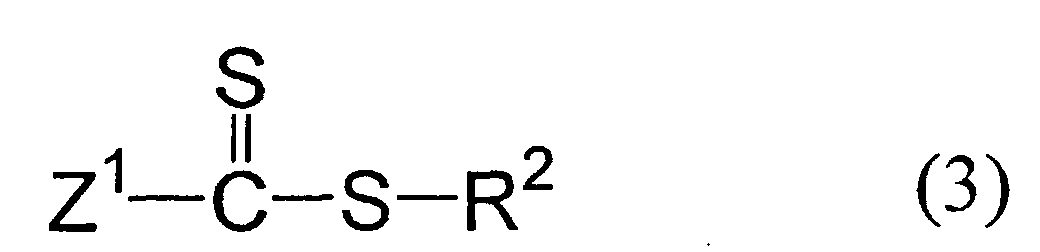
- The block copolymer according to Claim 2, wherein the polymerization reaction for forming the polymer block (A) is performed in the presence of the thiocarbonylthio group-containing compound represented by general formula (3) described above, and the polymerization reaction for forming the polymer block (B) is performed in the presence of a thiocarbonylthio group-containing compound represented by general formula (4):(wherein R3 is a divalent organic group of 1 or more carbon atoms which may contain one of nitrogen, oxygen, sulfur, halogen, silicon, phosphorus, and metal atoms, or which may be a polymer; each Z1 is a hydrogen atom, halogen atom, or monovalent organic group of 1 or more carbon atoms which may contain one of nitrogen, oxygen, sulfur, halogen, silicon, and phosphorus atoms, or which may be a polymer; and two Z1s may be the same or different).

- The block copolymer according to either Claim 2 or 6, wherein the molecular weight distribution of the polymer block (B) is 1.8 or less, the molecular weight distribution being determined by gel permeation chromatography analysis.
- The block copolymer according to any one of Claims 2, 3, 6, and 7, wherein the thiocarbonylthio group of the block copolymer is converted into a mercapto group or a mercaptide group, and said coupling is performed by a reaction of the mercapto group or the mercaptide group.
- The block copolymer according to Claim 8, wherein the thiocarbonylthio group of the thiocarbonylthio group-containing block copolymer is converted into the mercapto group or the mercaptide group by a reaction with a processing agent comprising at least one compound selected from the group consisting of bases, acids, and hydrogen-nitrogen bond-containing compounds.
- The block copolymer according to Claim 9, wherein the processing agent is at least one compound selected from the group consisting of ammonia, primary amine compounds with a boiling point of 100°C or less, secondary amine compounds with a boiling point of 100°C or less, and hindered amine light stabilizers (HALSs).
- The block copolymer according to any one of Claims 8 to 10, wherein said coupling is performed by the formation of disulfide bonds using an oxidizing agent.
- The block copolymer according to any one of Claims 8 to 10, wherein said coupling is performed using a compound having at least two groups in each molecule, each group reactive with the mercapto group or the mercaptide group to form a bond.
- The block copolymer according to Claim 12, wherein said coupling is performed using a compound having at least two isocyanato groups in each molecule.
- The block copolymer according to any one of Claims 8 to 10, wherein a functional group is introduced into the mercapto group or the mercaptide group for performing said coupling.
- The block copolymer according to Claim 14, wherein said coupling is performed using at least one functional group selected from the group consisting of a crosslinkable silyl group, unsaturated groups, and a hydroxyl group.
- The block copolymer according to any one of Claims 1 to 15, wherein the polymer block (A) is prepared by polymerizing 80% to 100% by weight of at least one monomer selected from the group consisting of acrylonitrile and methacrylonitrile and 20% to 0% by weight of at least one monomer selected from the group consisting of methacrylate esters, styrene, and α-methylstyrene.
- The block copolymer according to Claim 16, wherein the polymer block (A) is prepared by polymerizing 100% by weight of at least one monomer selected from the group consisting of acrylonitrile and methacrylonitrile.
- The block copolymer according to any one of Claims 1 to 17, wherein the polymer block (B) is prepared by polymerizing an acrylate ester.
- The block copolymer according to any one of Claims 1 to 18, wherein the molecular weight distribution of the polymer block (A) is 1.8 or less, the molecular weight distribution being determined by gel permeation chromatography analysis.
- The block copolymer according to any one of Claims 1 to 19, wherein the molecular weight distribution of the block copolymer comprising the polymer block (A) and the polymer block (B) is 1.8 or less, the molecular weight distribution being determined by gel permeation chromatography analysis.
- The block copolymer according to any one of Claims 1 to 20, wherein the glass transition temperature of the polymer block (A) is 50°C or more.
- The block copolymer according to any one of Claims 1 to 21, wherein the glass transition temperature of the polymer block (B) is 30°C or less.
- A thermoplastic resin composition comprising a thermoplastic resin and the block copolymer according to any one of Claims 1 to 22.
- An elastomer composition comprising a synthetic rubber and the block copolymer according to any one of Claims 1 to 22.
Applications Claiming Priority (5)
| Application Number | Priority Date | Filing Date | Title |
|---|---|---|---|
| JP2001215707 | 2001-07-16 | ||
| JP2001215707 | 2001-07-16 | ||
| JP2001230295 | 2001-07-30 | ||
| JP2001230295 | 2001-07-30 | ||
| PCT/JP2002/006656 WO2003008474A1 (en) | 2001-07-16 | 2002-07-01 | Block copolymer |
Publications (2)
| Publication Number | Publication Date |
|---|---|
| EP1411070A1 true EP1411070A1 (en) | 2004-04-21 |
| EP1411070A4 EP1411070A4 (en) | 2005-06-29 |
Family
ID=26618810
Family Applications (1)
| Application Number | Title | Priority Date | Filing Date |
|---|---|---|---|
| EP02741383A Withdrawn EP1411070A4 (en) | 2001-07-16 | 2002-07-01 | Block copolymer |
Country Status (3)
| Country | Link |
|---|---|
| US (1) | US7094833B2 (en) |
| EP (1) | EP1411070A4 (en) |
| WO (1) | WO2003008474A1 (en) |
Cited By (3)
| Publication number | Priority date | Publication date | Assignee | Title |
|---|---|---|---|---|
| US7655716B2 (en) | 2004-02-20 | 2010-02-02 | Toray Industries, Inc. | Solution containing flame-resistant polymer and carbon molding |
| CN110078860A (en) * | 2013-12-23 | 2019-08-02 | 塞特工业公司 | The carbon fiber that it is with low polydispersity index (PDI) polyacrylonitrile (PAN) polymer and is made from it |
| IT201900013836A1 (en) * | 2019-08-02 | 2021-02-02 | Eni Spa | LIPOPHILIC COPOLYMERS INCLUDING MULTI-POLAR BLOCKS, PROCEDURE FOR THEIR PREPARATION AND THEIR USE IN LUBRICANT COMPOSITIONS. |
Families Citing this family (16)
| Publication number | Priority date | Publication date | Assignee | Title |
|---|---|---|---|---|
| WO2002081561A1 (en) * | 2001-04-04 | 2002-10-17 | Kaneka Corporation | Thermoplastic resin composition and elastomer composition |
| US7547744B2 (en) * | 2003-05-02 | 2009-06-16 | Lg Chem, Ltd. | Thermoplastic resin composition having excellent resistance and low gloss |
| US7994236B2 (en) * | 2005-12-15 | 2011-08-09 | Firestone Polymers, Llc | Technique for purifying polymer compositions |
| US20090171049A1 (en) * | 2007-12-27 | 2009-07-02 | Linhardt Jeffrey G | Segmented reactive block copolymers |
| KR100995681B1 (en) | 2008-09-26 | 2010-11-22 | 주식회사 코오롱 | Polymerization Method and Polymers of Copolymers, Triblock Polymers, and Star Polymers Derived from Aromatic Vinyl Monomers and Conjugated Diene-based Monomers |
| EP2338935B1 (en) * | 2008-10-16 | 2012-12-12 | Asahi Glass Company, Limited | Fluorine-containing copolymer composition and process for production thereof |
| US9017305B2 (en) | 2010-11-12 | 2015-04-28 | The Procter Gamble Company | Elastomeric compositions that resist force loss and disintegration |
| US20120123369A1 (en) * | 2010-11-12 | 2012-05-17 | David Harry Melik | Elastomeric compositions that resist force loss and disintegration |
| FR2975100B1 (en) * | 2011-05-13 | 2014-09-26 | Oreal | POLYMER SEQUENCE COMPRISING ISOBUTYL ACRYLATE AND ACRYLIC ACID, COSMETIC COMPOSITION AND PROCESSING METHOD |
| TWI615460B (en) * | 2015-06-03 | 2018-02-21 | 羅門哈斯電子材料有限公司 | Compositions and methods for pattern processing |
| WO2018183261A1 (en) * | 2017-03-27 | 2018-10-04 | Iowa State University Research Foundation, Inc. | Macro-raft chain transfer agents as anionic polymerization terminators |
| WO2019123124A1 (en) * | 2017-12-19 | 2019-06-27 | 3M Innovative Properties Company | Polymeric materials formed using initiators with two thiocarbonylthio-containing groups |
| JPWO2021045072A1 (en) * | 2019-09-03 | 2021-03-11 | ||
| CN113372518B (en) * | 2021-05-27 | 2022-10-11 | 理工清科(重庆)先进材料研究院有限公司 | Flame-retardant smoke-inhibiting polyacrylonitrile material and preparation method thereof |
| CN115403719B (en) * | 2021-05-28 | 2025-12-02 | 中国石油化工股份有限公司 | A butadiene-nitrile copolymer containing multiple polyacrylonitrile blocks and its preparation method |
| CN119591812A (en) * | 2024-11-28 | 2025-03-11 | 万华化学集团股份有限公司 | Heat-resistant AMSAN resin with double-layer structure and preparation method and application thereof |
Family Cites Families (8)
| Publication number | Priority date | Publication date | Assignee | Title |
|---|---|---|---|---|
| EP0910587B1 (en) | 1996-07-10 | 2001-12-12 | E.I. Du Pont De Nemours And Company | Polymerization with living characteristics |
| FR2764892B1 (en) * | 1997-06-23 | 2000-03-03 | Rhodia Chimie Sa | PROCESS FOR THE SYNTHESIS OF BLOCK POLYMERS |
| IL139666A0 (en) * | 1997-07-21 | 2002-02-10 | Commw Scient Ind Res Org | Synthesis of dithioester chain transfer agents and use of bis (thioacyl) disulfides or dithioesters as chain transfer agents |
| ES2277678T3 (en) * | 1997-12-18 | 2007-07-16 | E.I. Du Pont De Nemours And Company | POLYMERIZATION PROCESS WITH LIVING CHARACTERISTICS AND POLYMERS OBTAINED BY THIS PROCESS. |
| JP2002520432A (en) * | 1998-07-10 | 2002-07-09 | イー・アイ・デュポン・ドウ・ヌムール・アンド・カンパニー | Microgel and method for preparing the same |
| JP2000154329A (en) * | 1998-09-16 | 2000-06-06 | Kanegafuchi Chem Ind Co Ltd | Thermoplastic resin composition |
| JP2002241568A (en) * | 2001-02-19 | 2002-08-28 | Kanegafuchi Chem Ind Co Ltd | Thermoplastic resin composition, and film or sheet |
| JP2004530751A (en) * | 2001-05-04 | 2004-10-07 | ローディア インコーポレイティド | Latex manufacturing process using block copolymer as surfactant |
-
2002
- 2002-07-01 WO PCT/JP2002/006656 patent/WO2003008474A1/en not_active Ceased
- 2002-07-01 US US10/482,963 patent/US7094833B2/en not_active Expired - Fee Related
- 2002-07-01 EP EP02741383A patent/EP1411070A4/en not_active Withdrawn
Cited By (7)
| Publication number | Priority date | Publication date | Assignee | Title |
|---|---|---|---|---|
| US7655716B2 (en) | 2004-02-20 | 2010-02-02 | Toray Industries, Inc. | Solution containing flame-resistant polymer and carbon molding |
| CN110078860A (en) * | 2013-12-23 | 2019-08-02 | 塞特工业公司 | The carbon fiber that it is with low polydispersity index (PDI) polyacrylonitrile (PAN) polymer and is made from it |
| US10647844B2 (en) | 2013-12-23 | 2020-05-12 | Cytec Industries Inc. | Polyacrylonitrile (PAN) polymers with low polydispersity index (PDI) and carbon fibers made therefrom |
| CN110078860B (en) * | 2013-12-23 | 2021-11-30 | 塞特工业公司 | Polyacrylonitrile (PAN) polymers having a low polydispersity index (PDI) and carbon fibers made therefrom |
| IT201900013836A1 (en) * | 2019-08-02 | 2021-02-02 | Eni Spa | LIPOPHILIC COPOLYMERS INCLUDING MULTI-POLAR BLOCKS, PROCEDURE FOR THEIR PREPARATION AND THEIR USE IN LUBRICANT COMPOSITIONS. |
| WO2021024100A1 (en) * | 2019-08-02 | 2021-02-11 | Eni S.P.A. | Lipophylic copolymers comprising polar multi-blocks, process for the preparation thereof and use in lubricating compositions |
| US12391785B2 (en) | 2019-08-02 | 2025-08-19 | Eni S.P.A. | Lipophylic copolymers comprising polar multi-blocks, process for the preparation thereof and use in lubricating compositions |
Also Published As
| Publication number | Publication date |
|---|---|
| EP1411070A4 (en) | 2005-06-29 |
| US7094833B2 (en) | 2006-08-22 |
| US20040236020A1 (en) | 2004-11-25 |
| WO2003008474A1 (en) | 2003-01-30 |
Similar Documents
| Publication | Publication Date | Title |
|---|---|---|
| US7094833B2 (en) | Block copolymer | |
| US7211625B2 (en) | Thermoplastic resin composition and elastomer composition | |
| JP4199666B2 (en) | Acrylonitrile-containing block copolymer and thermoplastic resin composition | |
| JP3676823B2 (en) | Perfluoroelastomer having improved processability and process for producing the same | |
| US6211319B1 (en) | Perfluoroelastomer composition having improved processability | |
| JPS63304009A (en) | Production of peroxide-curable fluorine-containing elastomer | |
| JPH05500070A (en) | Cyano-containing perfluoropolymers with iodine cure sites | |
| US20040249026A1 (en) | Curable composition | |
| WO1999048939A1 (en) | Perfluoroelastomer compositions | |
| EP2258733A1 (en) | Fluorine-containing elastic copolymer and method for producing the same | |
| JPS62260807A (en) | Fluorine-containing polymer and fluorine-containing polymer composition | |
| JPH05194667A (en) | Non-crosslinked copolymer containing fluoro-monomer and active double bond of non-conjugated diene, and its preparation | |
| US5824749A (en) | Fluorine-containing elastomer composition | |
| JP5122056B2 (en) | Fluoropolymer composition containing metal amine complex | |
| JP4082949B2 (en) | Block copolymer | |
| JPWO2003042256A1 (en) | Curable composition | |
| EP1783146B1 (en) | Elastomeric fluorocopolymer, composition containing the same, and crossliked rubbers | |
| JPH0157125B2 (en) | ||
| JP4027742B2 (en) | Block copolymer | |
| EP1950245A1 (en) | Alloyed fluorocopolymer | |
| JP2003292719A (en) | Elastomer composition containing block copolymer and molded article thereof | |
| EP1630179B1 (en) | Fluorocopolymer | |
| JPS62232407A (en) | Production of peroxide-vulcanizable fluoroelastomer | |
| JP4046552B2 (en) | Method for producing crosslinkable silyl group-containing polymer, and curable composition | |
| JP4242283B2 (en) | Silicone-containing block copolymer |
Legal Events
| Date | Code | Title | Description |
|---|---|---|---|
| PUAI | Public reference made under article 153(3) epc to a published international application that has entered the european phase |
Free format text: ORIGINAL CODE: 0009012 |
|
| 17P | Request for examination filed |
Effective date: 20040127 |
|
| AK | Designated contracting states |
Kind code of ref document: A1 Designated state(s): AT BE BG CH CY CZ DE DK EE ES FI FR GB GR IE IT LI LU MC NL PT SE SK TR |
|
| AX | Request for extension of the european patent |
Extension state: AL LT LV MK RO SI |
|
| A4 | Supplementary search report drawn up and despatched |
Effective date: 20050512 |
|
| STAA | Information on the status of an ep patent application or granted ep patent |
Free format text: STATUS: THE APPLICATION HAS BEEN WITHDRAWN |
|
| 18W | Application withdrawn |
Effective date: 20060629 |