EP1410197B1 - Systeme de messages extensible - Google Patents
Systeme de messages extensible Download PDFInfo
- Publication number
- EP1410197B1 EP1410197B1 EP01271941A EP01271941A EP1410197B1 EP 1410197 B1 EP1410197 B1 EP 1410197B1 EP 01271941 A EP01271941 A EP 01271941A EP 01271941 A EP01271941 A EP 01271941A EP 1410197 B1 EP1410197 B1 EP 1410197B1
- Authority
- EP
- European Patent Office
- Prior art keywords
- message
- client
- manager
- mmb
- mma
- Prior art date
- Legal status (The legal status is an assumption and is not a legal conclusion. Google has not performed a legal analysis and makes no representation as to the accuracy of the status listed.)
- Expired - Lifetime
Links
Images

Classifications
-
- G—PHYSICS
- G06—COMPUTING OR CALCULATING; COUNTING
- G06F—ELECTRIC DIGITAL DATA PROCESSING
- G06F9/00—Arrangements for program control, e.g. control units
- G06F9/06—Arrangements for program control, e.g. control units using stored programs, i.e. using an internal store of processing equipment to receive or retain programs
- G06F9/46—Multiprogramming arrangements
- G06F9/54—Interprogram communication
- G06F9/542—Event management; Broadcasting; Multicasting; Notifications
-
- G—PHYSICS
- G06—COMPUTING OR CALCULATING; COUNTING
- G06F—ELECTRIC DIGITAL DATA PROCESSING
- G06F9/00—Arrangements for program control, e.g. control units
- G06F9/06—Arrangements for program control, e.g. control units using stored programs, i.e. using an internal store of processing equipment to receive or retain programs
- G06F9/46—Multiprogramming arrangements
- G06F9/54—Interprogram communication
- G06F9/546—Message passing systems or structures, e.g. queues
Definitions
- the invention is in the field of methods and systems of delivering messages between computer programs via a message server.
- MOM Message Oriented Middleware
- CMOS Message Oriented Middleware
- MOM is not e-mail.
- E-mail is a system for moving text messages and attachments to human consumers.
- MOM is for moving messages containing arbitrary data between computer programs. An implementation of an E-mail system could be realized using MOM, however.
- This invention pertains specifically to the case where an intermediary message server in employed to store and distribute messages.
- the senders and receivers (collectively referred to as clients) are loosely coupled with each other when communicating via MOM, the intermediary message servers are normally required to communicate with these clients in a connection-oriented fashion.
- the server to be available at all times.
- all clients who may wish to exchange messages must be connected to the same server, or different servers which are capable or working together in a connection-oriented fashion to achieve the equivalent functionality of a single server, i.e. to serve as a single logical server.
- MOM is often used in systems in which a large number of servers have to serve as one logical server, as one of the reasons for employing MOM is to alleviate the requirement of defining which programs may exchange data with each other a priori.
- Security trading, live online auctions and chat rooms are examples of potential MOM applications that have restriction on the amount of time required to deliver messages.
- a cluster as a group of computers that work together to provide a single service with more speed and higher reliability than can be achieved using a single computer.
- Scalability can generally defined as the degree to which increased functionality is achieved by employing additional resources.
- the uniqueness of this invention is the way in which it addresses the scalability issues of message server clustering. The specific aspects of scalability that it addresses are:
- Messaging cluster implementations are mere extensions of servers architected to run on a single computer. Each computer in the cluster is a complete server, with extensions that allow it to work together with other servers in the cluster. In order to insure that all messages are available to all potential receivers, all servers in the cluster must share information about the existence of messages and/or the existence of receivers with all other servers in the cluster.
- the current state of the art in reliable network communications is unicast (point-to-point) network connections. The use of unicast to exchange data between all possible pairs of computers in the cluster results in inefficient usage of the communications network that severely limits Scalability.
- each piece of information that a server must share with all other servers in the cluster must be sent N-1 times across the same communication network. This means that adding additional servers to the cluster causes more communications network capacity to be used, even when the actual data rate does not change. This does not scale well, since adding large numbers of servers to a cluster will cause the communication network to become saturated, even with small numbers of senders and receivers, and low message volumes.
- the invention thus defined uses a unique cluster design to achieve a higher degree of scalability than has been previously possible with this type of server.
- the cluster is designed to scale well with respect to number of connections, message volume, and reliability. This means that the capacity of the cluster in each of these areas will increase as more machines are added to the cluster. In addition it is designed to be scaleable with respect to message size, in that it will not fail to operate with messages of arbitrarily large size.
- the cluster consists of two distinct types of nodes. These can be visualized as forming 2 layers, with each layer consisting exclusively on one type of node.
- the top layer is reachable by messaging clients and consists of Connection Manager (CM) nodes.
- CM's are responsible for managing all activities that are specific to client connections.
- the lower layer consists of nodes of type Message Manager (MM). MM's have no direct contact with clients and are responsible for managing all activities that are specific to message storage and distribution.
- CM's In order to connect to the cluster, a client must connect to one of the CM's. All of CM's in a cluster are interchangeable. A client will get the exact same service from the cluster, regardless of which CM is connects to.
- the CM is responsible for managing client connections, client authentication, access control, forwarding messages from producer clients to the MM and forwarding messages from the MM to a consuming client. As stated above, all of the CM's are interchangeable, and additional CM's can be added to increase the total number of clients that can be served by the cluster. If a CM fails, the clients that were previously connected to that CM may reconnect to another CM and continue functioning without any loss of service.
- Messages are stored in a destination until they are consumed.
- the destination can be a queue or a topic, depending on the actual service desired. These terms are defined in the JMS specification.
- Each destination exists on one or more MM's. When a destination exists on more than one MM, one of them is designated as the primary and is responsible for providing all of the services of the destination. All others MM's containing that destination are backups, which maintain the same state as the primary, but do not provide any services unless the primary fails to function.
- Increasing the number of MM's increases the capacity of the cluster to store messages and increases the number of destinations that can be accomidated.
- Increasing the number of MM's also permits an increase in the number of backup MM's, which decreases the likelihood of loosing data if multiple nodes fail simultaneously.
- CM's In order to assure that all clients can send messages to, and receive from, all destinations, it is necessary that all CM's can communicate with all MM's, and vice versa. It is not necessary for CM's to directly communicate with other CM's. It is not necessary for MM's to communicate with each other directly, except for communication between primaries and their corresponding backups. This reduces the number of connections that must be maintained between node by half, compared to traditional cluster designs that require all nodes to be connected to each other. As discussed below, the use of multicast communication removes the need for point to point connections between nodes entirely.
- Multicast protocols are different than unicast (point to point communication) protocols in that they enable one piece of data to be distributed to multiple machines across a network without have to send that same data over the same network multiple times. It is different than broadcast protocols in that it does not require the data to be distributed to all computers on the local network. Multicast is the most efficient means of distributing identical data to a limited number of computers on the same local area network.
- the preferred embodiment of this invention uses the reliable multicast communication protocol provided by the product iBus//MessageBus from Softwired.
- the primary and backup MM's can receive the same data without incurring significantly more network traffic than there would be if no backups were present. This means that the cluster can have as many backups as desired, resulting in no limit on the Scalability of storage redundancy. The cluster does not, however, require that all machines store all messages, which would limit the Scalability of cluster storage capacity.
- the unique aspect of this invention is its ability to provide the function of single logical message server, while providing a high degree of scalability in all of the following respects:
- An additional important feature of this invention is that it does not possess a single point of failure.
- the failure of any single function in the cluster will not cause the entire system to become inoperative.
- Many other systems that provide some form of fault tolerance still have dependencies on some system aspect whose failure will render the entire system unusable.
- the system and the method are set up in a design allowing to accommodate programs that send and receive messages using the Java Message Service (JMS) application programming interface published by Sun Microsystems Inc.
- JMS Java Message Service
- the definition of this interface is available at http://java.sun.com/products/jms/docs.html.
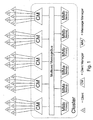
- the structure of a complete message system in shown in Drawing 1 The structure of a complete message system in shown in Drawing 1 .
- the cluster is represented by a dashed box.
- the cluster comprises a number of individual machines called nodes. Each node runs a program that constitutes one part of the cluster.
- a cluster consists of one or more CM's and one or more MM's.
- the CM's are responsible for managing client connections.
- the MM's are responsible for storing messages.
- the Message Managers of drawing 1 serve different functions. Some Message Managers (MMa Primary, MMb Primary in the drawing) serve as primaries and are responsible for providing all the services of the destination.
- MMa Backup MMb Backup
- Other Message Managers serve as backup servers and contain the same destinations as a primary server.
- the backup servers do not provide any services unless their primary server fails to function.
- Drawing 1 the network structure of the cluster is visible. This structure is in striking contrast to clusters according to the state of the art, where there are connections from every server to any other server, thus leading to a n 2 -scaling.
- a Multicast MessageBus is provided, which connects to every Client Manager and connects to every Message Manager. Therefore, the number of connections scales linearly with the number of servers.
- the Backup servers maintain the same state as their primary.
- the clients of which an arbitrary number can be present, are denoted in the Figure by a "C" enclosed by a triangle. Each of the clients C connects to one client server CM.
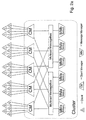
- Drawings 2a and 2b show two examples of the system of Drawing 1 with some modifications in the network structure. Here, only the differences are described. Instead of one Multicast MessageBus, two MessageBuses are present. This is of course only an example, in practice, any number of MessageBuses may be chosen, the number being adaptable to the specific system. As can be seen in the drawing, each Message Manager (drawing 2a) or each Client Manager (drawing 2b) is connected to but one MessageBus, respectively. On the other hand, each Client Manager (drawing 2b) or each Message Manager (drawing 2a) is connected to all MessageBuses.
- Network structures as the ones shown in drawing 2a and 2b allow to increase the network speed, since they eliminate the bottleneck of the single MessageBus. It should be noted that such network structures are only possible because not all nodes are required to communicate directly with each other, i.e. they are only possible in a structure according to the invention.
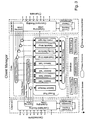
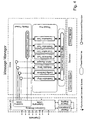
- diagrams 3 and 4 show block diagrams of both the CM and MM nodes, respectively.
- the architecture at the level shown in the diagrams is very similar for both node types, and they share many common components. Thus, elements occurring in both node types will be described only once.
- Much of the application specific functionality (the so called 'business logic') is encapsulated in the Session Task of the CM and the Destination Task of the MM. This functionality is well defined in the JMS specification and does not contribute significantly to the uniqueness of the invention, Therefore the internal structure of these blocks is not detailed.
- FIG. 3 shows the individual functional blocks in the node. These are designated by solid boxes.
- the functional blocks are divided into modules, which are designated by dashed lines.
- the drawings show the flow of control with arrows, and the thread structure with gray boxes.
- the module structure of the nodes is intended to subdivide each node into smaller pieces.
- Each module has well defined responsibilities and the interfaces between the modules are well defined and minimaL This approach helps to manage the complexity of the system and facilitates analysis, design, implementation and maintainability.
- the interaction between clients and CM's, as well as between CM's S and MM's is accomplished by sending commands.
- the most common type of command is one that contains a message to delivered to some other place in the cluster, but there commands to create new sessions, start and stop flow control, commit transactions, etc.
- the Core module contains the application specific functionality of the node. These are the session tasks in the drawing 3 and the destination tasks in the drawing 4. In addition the Core contains all other functions which are must respond to or initiate interaction with the clients or with other nodes. In drawing 3 these are the Session Management Tasl, Log Task, Admin Manager Task, Destination Manager Task, Reliability Manager Task and Config Distributer Task. In drawing 4 these are the Destination Manager Task, Admin Manger Task, Config Distributer Task, Reliability Manager Task, and Log Task. These functions are each described in detail in subsequent sections of this document.
- the Core is where the different threads of the node interact. The threading model is intended to provide optimal concurrency as described later. This is best illustrated by following the typical paths over which commands travel in the system.
- Command dispatchers are responsible for receiving incoming commands from clients or other nodes.
- the command dispatchers are designated by boxes with rounded corners. It is important to preserve the overall order of command arrival until the commands are routed to the individual tasks that will act upon them. This is because the order of command execution within each task must be well defined and repeatable. Commands are thus delivered to the command dispatchers in a single thread to preserve this ordering.
- the Core must be able to accept incoming commands at any time, so this thread has higher execution priority than others in the system, hence the designation Priority Thread.
- the command dispatcher does little more than placing the command in the synchronized command queue of the appropriate task. It then frees the thread so that it is available to deliver the next incoming command.
- the synchronized command queues (not to be confused with JMS queues which are a type of destination) are shown as thick arrows in the diagrams.
- the commands wait in the synchronized command queues until the corresponding thread task is ready to process them. They also provide a clean interface between threads. There is a danger of data corruption when two threads attempt to modify the same data at the same time. Synchronization refers to a lock mechanism that insures that only one thread at a time is accessing the command queue.
- the individual tasks in the Core modules are also required to send commands to other nodes, and in the case of CM to clients. In this case the commands are passed to the Client I/O or Cluster I/O module for transmission.
- the Inter-Task Dispatcher is provided for this purpose. It has synchronized command queues to and from each task, and eliminates the dangers associated with direct interaction across different threads.
- the Cluster I/O Module is contained in both the CM and MM.
- the Client I/O module is only contained in the CM.
- the Client I/O and Cluster I/O are responsible for all of the details of communicating with clients and other node, respectively.
- Each session is associated with a particular connection, and each destination is associated with a channel.
- the I/O modules contain Command Routers that accept incoming commands from channels and connections and pass them to the correct command dispatcher according to their type. When sending outgoing commands, the Core address the command using the session ID or destination ID of the intended recipient.
- each I/O module contains a table mapping Session ID's to Channel ID's (Client I/O) or Destination ID's to Channel ID's (Cluster).
- the ID's are unique identifiers that are assigned when each entity is created, and are used throughout the life of the entity to perform command routing.
- the Connection Management and Channel Management functions keep track of all existing connections and channels. If a connection is unexpectedly closed, or a channel member becomes unreachable for some reason, the Connection/Channel Manager can use the Connection/Channel Table to identify which sessions or destinations depend on that connection/channel, and create commands to notify the sessions/destinations of the event.
- FIG. 3 and 4 show a Services module. These modules contain a collection of generic services that are accessed by the other modules in the same node. In some cases, the services are accessed by so many other functions, that the control flow arrows stop at the module boundary instead of reaching to all of the individual functions. This is intended to keep the drawing from excessively cluttered.
- the Services module includes the functions Thread Pool Manager and Global ID Manager.
- the Services module contains the functions Thread Pool Manager, Global ID Manager, Access Control, Destination Service, and Transaction Manager. All of these functions are described in detail in other parts of this document.
- Concurrency refers to multiple activities taking place at the same time.
- a certain degree of concurrency is implicit in cluster because it consists of multiple computers operating at the same time.
- the messaging cluster described here requires a much higher degree of concurrency than that provided by multiple computers; it requires each CM session and each MM destination to have an independent flow of controL
- All modem operating systems support multi treading, which permits multiple threads of control within one program. Because there are practical limits on the number of threads that may be active in a program, and this limit will often be less than the number of sessions or destinations present in a node, a thread pooling scheme is employed.
- the thread pool manages of collection or pool of threads which will not exceed the number of threads the can efficiently coexist in one program. The threads in the pool will be distributed among the sessions or destinations on an as needed basis.
- the I/O subsystems serve to hide communication functionality from the core server and help divide functionality more cleanly into separate modules.
- the specific responsibilities of the I/O subsystems are:
- the core is the most central part of the node. It contains the command dispatchers, command queues and command handler tasks. It is the bridge between the single threaded world of command dispatching and the multithreaded world of the task objects that handle commands.
- the I/O modules are responsible for routing commands based on their type. For each command type, there is a command dispatcher. Many of these command dispatchers are very simple and do nothing more than take each command and enqueue it into a thread safe queue.
- the Session/Destination Command Dispatcher is a bit more complex. It dispatches to many session tasks, so it must examine the session ID contained in the command, and place the command in the correct queue.
- the Inter-task Dispatcher is similar to the Session Command Dispatcher, but adds the aspect that commands are submitted to the dispatcher via multiple thread safe queues. It allows the various tasks to send notifications to each other without requiring excessive synchronization or creating race conditions.
- the thread safe queues form a safe bridge to the pool of threads, which executes the collection of tasks.
- Each queue is configured with a 'high water mark'. This is the maximum number of commands that are allowed to accumulate in a queue before flow control will be engaged for that session or destination. See the section on flow control below for more information.
- the task collection consists primarily of a multitude of session tasks.
- each CM will have exactly one task responsible for each of: Session Management, Destination (Proxy) Management, Reliability Management, Configuration Data Distribution and Administration.
- Each MM will have exactly one task for responsible for each of: Destination Management, Reliability Management, Configuration Data Distribution and Administration All of these tasks are registered with the Thread Pool Manager, which will distribute a fixed number of threads among all of the tasks that have commands waiting to be handled. All tasks must implement the interface necessary to be run by the thread pool, but they need not be aware of the thread pool itself.
- the Destination Service The Destination Service:
- the Destination Service provides essential information about the destinations with which a CM interacts. It is responsible for:
- the Thread Pool Manager The Thread Pool Manager:
- the Thread Pool Manager maintains a list of tasks that are to be run in different threads. It maintains a collection of threads that may be smaller than the total number of tasks. It is able to detect if each task needs to run and it will distribute the available threads among these tasks, insuring that each task runs in only one thread at a time.
- a critical feature of embodiment of the invention described above is that it allows for a globally unique ID generation.
- ID's that are globally unique throughout the cluster. These ID will be used to uniquely identify these objects such as messages, sessions, destinations, consumers, and nodes. For example, when a destination decides to distribute a message, it must uniquely specify the consumer to which the message must be delivered using it's ID. Each message must have a unique ID so that it's identity is never confused with another message as it is routed through the nodes of the cluster. Generation of unique ID is trivial in a monolithic server, but complex in a cluster as no two nodes in the cluster may be permitted to assign the same ID. A unique ID can be generated locally by each node using a combination of the following values:
- One of the main advantages of the invention is that it allows for a system to handle very large messages.
- a short overview over very large message handling using a system and a method according to the invention is given.
- VLM Very Large Message
- VLM Very large messages must be sent from the client to the CM over the same connection that is used for other session commands.
- the VLM must be multiplexed with other connection data so that it does not block other sessions that use that connection. This can be achieved by fragmenting the VLM stream and sending each piece as a separate command. While small messages can be sent in a single command, VLM's will be sent as a chain of commands, each carrying the next part of the message.
- the CM will need to send these fragments to the MM in the same way over an iBus multicast channel. It must begin sending to the MM before the last one is received from the client, as it cannot assume that the message will fit in memory.
- the CM can also employ a disk buffer to temporarily store the VLM fragments and insure that the client session is freed as soon as possible.
- VLM's cannot be sent or received by a JMS client using the standard API, which implicitly assumes that messages can be passed as single objects.
- the use of VLM's would require a non standard client method, which pass or receive I/O streams, or a non-standard message type, which can embed a handle to the stream in the message object.
- the JMS conformant client library used for the embodiment of the invention described here is proprietary and specific to the server implementation according to the invention. As such it is an integral part of the messaging system described here.
- Flow control is an essential feature of a message server that allows it to maintain integrity under heavy load.
- Flow control refers to the ability of a cluster to instruct message producers to stop producing if system resources (particularly memory and persistent storage space) are running low. It also refers to the ability of clients to instruct the server to stop distributing messages to it until it has the capacity to accept more.
- the implementation of flow control must insure that system resources are never exceeded yet not it must not unnecessarily degrade system performance.
- Transport level flow control is provided by the communications protocols in use. In the case of the cluster these are tcp and iBus//MessageBus. It is undesirable to rely on transport level flow control, since there will be a variety of commands multiplexed over each connection or channel. One slow receiver would cause transport level flow control to block all traffic on the shared connection/channel. Also, when transport level flow control is triggered, then there is data stored in internal buffers that is no longer accessible to the sender and not yet available to the receiver. It is undesirable for this data to remain 'in transit' for an extended period of time until flow is resumed.
- Application level flow control also allows the application to have more specific knowledge of the flow state.
- a queue that knows that a particular consumer is blocked can choose to distribute messages to other consumer instead of blocking or allowing the consume command sit in intermediate buffers for an indefinite period of time.
- Application level flow control is implemented using additional commands that travel over the same routes as the data that they control. This makes it essential that these commands are sent proactively, e.g. early enough to reach their destination before low level flow control is invoked or system resources are exceeded.
- High availability refers to a guarantee that the services offered by the cluster will be available at all times.
- the most fundamental measures to insure high availability consist of designing server applications that can run continuously without the need to go offline for regular maintenance, and executing high quality implementation to reduce the possibility of unexpected downtime. Despite these measures, the possibility of hardware failures can never be completely eliminated. For this reason, the most ambitious high availability schemes always employ redundant hardware. The same service must either be provided simultaneously on multiple computers, or the service is provided on one machine with one or more additional machines configured as 'standby' replacements which can takeover at any time.
- High availability is achieved because the likelihood of multiple computers experiencing hardware failures within a given time period is significantly lower than the likelihood of a single computer experiencing a failure in that time period. Due to the communication overhead involved in co-coordinating the simultaneous distribution of messages from multiple computers, the invention described here implements the latter scheme (one primary, one or more standbys).
- One of the unique features of this inventions is the ability to support any number of backups for each primary, so that the likelihood of the primary and all backups failing within a given time period can be reduced to any degree desired.
- High availability is an issue primarily in the Message Manager, as this is the only part of the system that is responsible for storing messages persistently.
- the Client Manager does not store critical state information, so the failure of a CM is relatively easy to deal with.
- the fail-over procedure for a CM will be discussed first. All subsequent discussion will concern the MM.
- the CM stores only transient state information. Unlike the messages stored in the MM's, none of this state is expected to survive a node restart. For this reason it is not necessary to maintain redundant copies of this state on other CM's. If a CM fails, all clients connected to it will immediately detect that the connection is broken. The client library will automatically reconnect, and the connection balancing logic will reconnected it to any other CM that is still operating. After connection, the client must recreate each session. Parameters in the command to create a session can indicate that this is a session that ran previously on another CM and is being resumed. The client will provide information on the last messages that were acknowledged by each consumer, and the last sent messages or transactions that were completed by each publisher. The client must restart incomplete transactions and resend unconfirmed sent messages.
- CM When a CM fails, all MM's that had been interacting with that CM will be notified by the group membership protocol in the MessageBus. The MM must delete all consumer entries associated with the sessions on that CM so that it does not try to distribute messages to clients that are not reachable. These entries will be recreated when the client reconnects. The MM must also rollback any messages that were part of an uncommitted transaction of any sessions of the defunct CM.
- the use of a multicast protocol to transmit data across the network is essential to the High Availability scheme, as this permits data to be shared between a primary MM and all of it's backups without wasting network bandwidth.
- one iBus multicast channel will be shared among all of Destinations in one MM. This makes it logical to make the MM the basic unit of fail-over, and not the individual destinations.
- the embodiment of the invention should allow multiple MM's to exist within one JVM, so that fail-over can be used to selectively migrate part of the load from one machine to another.
- the cluster may contain one primary and any number of live backups. As each MM starts it must determine whether or not it is the primary. This can be explicitly specified, for example in a configuration file, however any fail-over scheme will cause a backup to become a primary if no other primary is found within a certain period of time. Likewise, if a backup becomes primary because the previous primary was temporarily isolated, then there will be 2 primaries as soon as the original primary is reachable again. In this case these 2 must negotiate to determine which will be demoted or stopped. This means that the fail-over scheme and the order of node startup will ultimately determine the role of a new MM node, and not the system configuration. See the discussion of fail-over below.
- Synchronization of a new backup Message Manager This scenario assumes that a primary and zero or more backups are already live. A new MM is started, determines that it is a backup, and must synchronize it's state (directly or indirectly) with the primary. Once it is synchronized, it can remain up to date by monitoring the multicast communication between the primary MM and the CM's.
- the target MM begins collecting, but not processing, destination commands as soon as it comes online. These are passed to the Command Dispatcher, which accumulates them in a generic queue until its Destination Tasks are created.
- the target makes a request to locate the primary and any backup that can provide synchronization. From the list it receives it selects one (for performance reasons, preference should be given to a backup over the primary).
- the target requests a list of destinations from that host. The target creates these destinations, with command processing disabled, and registers them with the Command Dispatcher so that it can begin accumulating commands in the input queues dedicated to each destination. The following process is then executed for each destination, one at time.
- Maintaining a synchronized backup Once a backup is in sync, it can process commands coming from sessions normally. It does not distribute messages however. It will also process incoming commands that were sent by the primary MM and update its state to remain in sync.
- a backup MM If a backup MM detects that it has lost synchronization due to excessive message loss (possible if it has been disconnected from the network and declared dead by the remaining members) it should change it's state to unsynchronized, and repeat the startup procedure.
- Fail-over is the process of promoting a backup MM to be primary when the original primary MM fails. It consists of the following steps:
- the original primary could reappear at any time.
- One of the primaries must then revert to backup mode.
- the primaries compare their state by exchanging the set of sequence numbers from all commands published on the MM channel. This gives them the chance to determine which primary is most up-to-date. The most up to date one remains, any others revert to backup mode. If multiple primaries are fully up-to-date, then the one with the lowest rank remains primary.
- the invention is intended to support transactions at the session level as described n the JMS specification.
- Transactions are commonly associated with, but not limited to, the field of databases.
- Transactions in the data processing sense, insure that a group of actions will be carried out atomically and that their results are persistent. Committing a transaction is the crucial last step when all of the individual actions that comprise the transaction are effectively carried out.
- results There are exactly two possible results of a commit: either all of the individual actions are carried out and their results are persistently recorded, or, in the case of exceptional conditions, none of the actions are carried out and the net effect is as though the whole transaction never occurred. The latter case is referred to as a rollback.
- the classic example is a bank account transfer, in which case there are legitimate circumstances in which the whole transfer may fail (insufficient funds, etc.), but under no circumstances may one account be credited without the other the other being debited.
- JMS messaging the sending and receiving of messages in one session within the bounds of one transaction are not effective until committed.
- published messages are never delivered, consumed topic messages are discarded, and consumed queue messaged are redistributed to other recipients.
- Clustering causes the implementation of transactions to become more complex than is the case in a monolithic server. This is true, because the atomic characteristics of the transaction must be enforced for actions that are distributed over several computers.
- a 2 phase commit protocol In a 2 phase commit, one entity acts as the transaction manager. In the first phase the transaction manager requests a guarantee that each of the transaction participants is capable of successfully executing the transaction. In the second phase, the transaction manager instructs the participants to actually perform the commit or, if not all participants were able to offer a guarantee of success, to rollback the transaction.
- JMS transactions must occur within one session, and they encompass all messaging activity that has occurred within that session since the last commit. For this reason the session tasks in the CM act as transactions managers. The transaction participants are all of the MM destinations with which that session has interacted during the current transaction. Transaction management is a common piece of functionality that may be employed by all session tasks. For this reason it is depicted as a separate box in the Services module in drawing 3 which shows the internal structure of the CM.
- a simple two phase commit protocol may be used to commit transactions across multiple destinations.
- the requirements of JMS transactions are less demanding than those of many other transactional systems. Transactions occurring in different session have no interdependencies and since one producer may not produce in more than one session, JMS sets no restrictions on the relative ordering of messages from different transactions.
- the CM which handles the session that is conducting the transaction, acts as the transaction manager.
- the steps of a 2-phase commit are:
- backup MMs can play the commit process. They range from the optimistic extreme of not including the backup in the commit procedure, to the conservative extreme of failing a commit if any backup fails.
- the conservative route incorporates a high risk of causing performance problems. It means that any backup MM, which is not contributing to the function of a normally running system, can cause a delay a transaction or cause it to fail if it is not functioning properly. This would mean that the increased redundancy that comes from multiple backups can detract from system performance and possibly make the system less reliable than a monolithic server.
- the optimistic route implies that an unlikely failure scenario could lead to message loss.
- a JMS client successfully returns from a commit that commit would be guaranteed successful on the primary, but not on the backup.
- Atomic multicast guarantees that the backup will receive all commands in the event of primary failure, as long as there is at least one surviving channel member that had received all commands. This means that the backup will eventually receive all commands.
- a primary commits a transaction and then fails it is very likely that the backups receive all command, but a resource problem on the backup, such as a full disk, could still lead to message loss.
- the optimum solution is to require some, but not all, of the redundant MMs to succeed with the commit. This means that the primary plus a least one of the backups must commit for the commit to be effective.
- the fail-over protocol will insure that only an up-to-date backup (one that has processed all transactions) is allowed to become primary.
- the ability to perform wildcard subscriptions is a very useful convenience. This is the ability to subscribe to a large number of topics in one step by simply specifying a text pattern that matches the names of all of the desired topics instead of subscribing to each topic individually. Users of a messaging API very often find this feature helpful, and sometimes even essential.
- the use of this technique can eliminate the need to make individual subscriptions to hundreds of individual topics, and can insure that new topics that match the subscription criteria will automatically be subscribed to on behalf of the client.
- Wildcarding can be implemented mostly in the CM.
- the consumer must send a subscription request to the CM that contains a wildcard string.
- the string can use a 'glob' style wildcard pattern (*?) or a regular expression (for power users - there needs to be an indication of which method is being used).
- the CM is not expected to maintain a list of all destinations in existence, just those with which it currently interacts.
- the CM must 'broadcast' a message to all MMs requesting the names of all destinations that match the pattern. This is a variation of the basic command required for a CM to locate a destination.
- the CM then generates normal subscriptions to all of the destinations returned.
- the wildcard functionality includes the ability to automatically merge in new destinations that are created after the original subscription was made, if their names match the subscription pattern. This means that each time a new destination is created, it must advertise itself to all of the CMs in so that they can compare its name to their list of wildcard subscriptions.
- a newly installed message server contains no destinations. Destinations are created to suite the needs of each individual server installation. In order to facilitate certain internal functions of the cluster, however, the invention defines certain special destinations which must exist in every installation. These destinations have pre-defined names, and are referred to here as 'well known' destination names, in that the internal functions that use them may begin to access them at any time whiout the need to explicitly create them or to test for their existence.
- Virtually all computer systems posses parameters that must be defined before the system can operate properly. Many of these parameters are used to tune the performance of a particular installation of the system to the specific purposes for which it is used. Often network address parameters specific to the installation must be supplied. For these reasons, such parameters must be configurable by the administrator of the system. This is often accomplished using data files containing values for the configurable parameters.
- System administration includes, but is not limited to, the setting and updating of these parameters. These two areas, configuration and administration are closely related, as online administration commands can override values specified in configuration files. Often such values must be updated in the configuration files so that changes made online persist after node restart. Many aspects of administration affect multiple cluster nodes simultaneously, which adds an extra degree of complexity compared to the case of a monolithic server. It is necessary to insure that updates that affect multiple nodes are carried out on all affected nodes, and that these changes are updated in their configuration files in a synchronized manner. The case of nodes which join the cluster late or are not live when updates are made are also considered
- the administration subsystem is a generalized framework for remote server administration. Any other subsystem in the server may register a handler with it and thereby expose its own set of administration commands to the administration client.
- the nature of administration commands is such that some commands are relevant only to an individual node, some are relevant to a subset of nodes, and some are relevant to all nodes.
- Some commands require a reply, which, in the distributed case, is actually a composite of the replies from many nodes; for example "get list of destinations”.
- Administration of the cluster is achieved by adding an Admin Manager to each cluster node.
- This Admin Manager will act like a session that is not associated with a client. When it is created it will create a consumer for special topic _ADMIN, and await administration commands on this topic. Since access control can be defined per destination, the_ADMIN topic may be a normal JMS topic.
- the Admin Managers will be 'internal clients' within the cluster.
- An administrative client application is an ordinary JMS client, and the lowest level of the client Admin API is the definition of a set of message formats.
- the sending of replies to the admin client can be handled by specifying a replyTo topic with each command that the client sends.
- the difficulty with receiving replies is that a JMS client cannot know how many nodes are active in the cluster, and thus not know how many replies to expect. Waiting for a time-out after each command is not practical.
- Either administration clients must be designed to function well despite an unknown number of asynchronous replies, or the replies must contain some cluster internal information indicating the total number of replies to expect.
- the former is not an attractive option, since the admin API will be available to customers and the semantics should be kept simple. The latter is possible, but the cluster design does not explicitly require most subsystems to know the overall structure of the cluster. Nevertheless, this information can be made available to the Admin Manager.
- the Admin Manager will act like a JMS client that lives inside the cluster. In this way, it can leverage the existing messaging infrastructure to communicate with the admin client.
- the Admin Manager can be implemented as a special subclass of a Session Task which is automatically created during node initialization and which is not associated with any client connection. Integrating the Admin Manger into the MM is a bit more complex, since MM's do not automatically listen for commands from other MM's. In this case an extra element is needed: an Admin Dispatcher that will listen for commands on the channel of the _ADMIN topic, and pass them to the input queue of the Admin Manager.
- Configuration data is generally required in the early stages of starting a node. For this reason is a good idea to use a local file to store configuration data which insures that a node can always (re)start and integrate itself into the cluster without depending on the operational state of any other server.
- the configuration system used in the cluster must recognize online changes made to configuration parameters via the admin API and update the configuration file to reflect these changes. Additionally, it must insure that the updates remain consistent across all nodes.
- Parameters in the each category should be stored in separate files.
- the files should be identical for all nodes, and should not be updated online by the Admin Manager.
- An administrative procedure should be in place to insure that all nodes have identical copies of this file.
- An example of this is editing only a master copy and using UNIX rdist or a similar utility to push it to the individual nodes. Storing the file on central network file system is not an acceptable option as this introduces a single point of failure.
- the cluster can support immediate detection of inconsistent configuration files using the following procedure:
- acquirable parameters In order to assure consistency across nodes, acquirable parameters should be updated either:
- nodes that are not online at the time will have 'stale' configuration files.
- a node should perform a consistency check similar to that described above for essential parameters. In the case that the node detects that it's configuration file is stale, it requests that the entire configuration file be sent to it from another node which was already online before the node in question started. It then uses this file for configuration, and rewrites it's local configuration files.
- Event logging is a common aspect of all server systems.
- the user of the system must be notified that certain events have expired. These event may include warnings of undesirable circumstances of confirmation that certain critical stages have been reach. They can include any information that may be of interest to the user.
- An interactive desktop application will usually print a message to the computer display.
- a server system in contrast, runs continuously day and night without a user constantly viewing the computer display. Often the computer has no display and is located in an isolated area. The most common practice is to write such notifications to a data file.
- a log task will be available in each node so that information about important events or error conditions can be recorded. As a minimum, this information should be written to a local file for each node. It is, however, difficult to track events that involve different nodes when each nodes log data is in a different file. Because of this, log messages are to be published to a well-known topic (_LOG), so that they are stored in a fault tolerant manner and can be monitored using a JMS client. All nodes should have well synchronized clocks, so that the consolidated log messages can be accurately ordered.
- _LOG well-known topic
- event logging is, from a logical point of view, a generic service, it is depicted in drawings 3 and 4 as part of the Core modules in both the CM and the MM, and not in the Services module. This is because the logging function is a task that should have its own thread. This is done for performance reasons, as logging will almost always concern writing data to disk, network or some other slow device. Doing this in a separate thread allows a large amount of information to be recorded without unnecessarily slowing down the task that generated the information.
- the Dead Message Queue is a well-known queue that is provided for use as the destination of messages for which the ultimate disposition is not clear. These may be messages that have remained undeliverable for an excessively long period of time, or are undeliverable due to error conditions. It may also be desirable for messages that exceed their normal time to live be sent here.
- the DMQ behaves like a normal queue, except for the fact that clients are restricted from publishing to it directly, and the messages contained in the DMQ must indicate their original destination and the reason for being sent to there.
Landscapes
- Engineering & Computer Science (AREA)
- Software Systems (AREA)
- Theoretical Computer Science (AREA)
- Physics & Mathematics (AREA)
- General Engineering & Computer Science (AREA)
- General Physics & Mathematics (AREA)
- Multimedia (AREA)
- Computer And Data Communications (AREA)
- Data Exchanges In Wide-Area Networks (AREA)
- Selective Calling Equipment (AREA)
- Mobile Radio Communication Systems (AREA)
- Alarm Systems (AREA)
- Small-Scale Networks (AREA)
Claims (23)
- Un système de messages pour délivrer les données sous forme de messages entre les clients de messages (C), qui se caractérise par le système de messages
composé d'un grappe de serveurs contenant un groupe de noeuds de gestion des clients (CM),
chaque noeud de gestion des clients (CM) dudit groupe de noeuds de gestion des clients (CM) contenant des moyens permettant de connecter les clients (C) et des moyens permettant de gérer les connexions des clients,
de plus, la grappe de serveurs contenant un groupe de noeuds de gestion des messages (MMa, MMb), avec une configuration interne du noeud de gestion des messages (MMa, MMb) étant différente de la configuration interne des noeuds de gestion des clients (CM),
chaque noeud de gestion des messages (MMa, MMb) contenant des moyens pour stocker et distribuer les messages,
de plus, le système comprenant une voie de communication destinée à assurer une multidiffusion entre au moins un noeud de gestion des clients (CM) et au moins un noeud de gestion des messages (MMa, MMb). - Un système de messages d'après la revendication 1 contenant plusieurs noeuds de gestion de messages (MMa, MMb) dans ledit groupe de noeuds de gestion de messages (MMa, MMb),
ledit noeud de gestion des messages (MMa, MMb) possédant des moyens pour être configuré de façon à contenir les destinations,
le système contenant de plus plusieurs noeuds de gestion des clients (CM),
chaque noeud de gestion des clients (CM) contenant des moyens permettant d'envoyer les données de message via ladite voie de communication multidiffusion,
les données de message contenant l'information sur la destination et ne contenant pas d'adresse individuelle du noeud de gestion des messages (MMa, MMb),
chaque noeud de gestion des messages (MMa, MMb) contenant des moyens pour réceptionner des données de message contenant l'information sur la destination correspondant à la destination du gestionnaire de messages (MMa, MMb). - Un système de messages d'après la revendication 2 où chaque noeud de gestion des messages (MMa, MMb) contient de plus des moyens pour stocker les données de message et des moyens pour envoyer les données de message, en fonction du contenu d'un signal request.
- Un système de messages d'après la revendication 1 où le nombre de noeuds de gestion des clients (CM) dudit groupe de noeuds de gestion des clients (CM) est indépendant du nombre de noeuds de gestion des messages (MMa, MMb) du groupe de gestionnaires de messages (MMa, MMb).
- Un système de messages d'après la revendication 1 dans lequel pas toutes les paires de noeuds dans la grappe de serveurs ont besoin d'échanger directement les données.
- Un système de messages d'après la revendication 1, dans lequel un protocole de communication multidiffusion sûr est utilisé pour le transfert des données entre les noeuds, dans lequel plusieurs noeuds de gestion des messages (MMa, MMb) sont fournis, desquels au moins deux noeuds de gestion de messages (MMa, MMb) sont configurés de façon à contenir des destinations identiques pour maintenir une ou plusieurs copies des données stockées provenant du même transfert de données qui maintient l'original des données stockées.
- Une méthode pour transmettre des données sous forme d'un message entre des clients de message (C) utilisant une grappe de serveurs, caractérisé en ce que la méthode comporte les étapes ci-dessous:- prévoir un groupe de gestionnaires de clients (CM) de la grappe de serveurs,- prévoir un groupe de gestionnaires de messages (MMa, MMb) de la grappe de serveurs, c'est-à-dire le groupe comprenant des gestionnaires de messages (MMa, MMb) ayant au moins une destination,- connecter un client (C) à un noeud de gestion de clients (CM) de ce groupe de gestionnaires de clients (CM) de la grappe de serveurs,- transmettre un message à partir de ce client (C) vers ledit noeud de gestion des clients (CM),- en fonction du contenu du message, envoyer les données de message par le gestionnaire de clients (CM) via au moins une voie de communication multidiffusion connectée au gestionnaire de clients (CM), lesdits données de message comprenant une information de destination indiquant une destination,- réceptionner lesdites données de message par tous les gestionnaires de messages (MMa, MMb) ayant cette destination indiquée dans l'information de destination et stockant ces données sur le support de stockage du gestionnaire de messages (MMa, MMb).
- Une méthode d'après la revendication 7, contenant de plus des étapes- en fonction de la liste des abonnements des clients du gestionnaire de messages (Mma, MMb), envoyer des données de message contenant des informations sur le client provenant d'un gestionnaire de messages (MMa, MMb) via au moins une voie de communication multidiffusion,- réceptionner les données de message par le gestionnaire de clients (CM) indiqué par ladite information sur le client- transmettre, en fonction du contenu des données de message, un message vers le client (C) indiqué dans l'information sur le client par le gestionnaire de clients (CM).
- Une méthode d'après la revendication 8 où dans le groupe de gestionnaires de messages (MMa, MMb) des gestionnaires de messages primaires et des gestionnaires de messages de sauvegarde sont prévus, chaque gestionnaire de messages de sauvegarde contenant les mêmes destinations qu'un gestionnaire de messages primaires associé et contrôlant si le gestionnaire de messages primaires fonctionne, où chaque gestionnaire de messages de sauvegarde surveille la communication multidiffusion dans la voie de communication multidiffusion et stocke les mêmes données de message que le gestionnaire de messages primaires associé, et où chaque gestionnaire de messages de sauvegarde n'envoie aucune donnée de message à moins que le gestionnaire de messages primaire associé ne cesse de fonctionner.
- Une méthode d'après la revendication 9 dans laquelle chaque gestionnaire de messages de sauvegarde est associé à une hiérarchie des voies et après une défaillance d'un gestionnaire de messages primaire, le gestionnaire de message de sauvegarde associé ayant la priorité maximale ou minimale change d'état et devient un gestionnaire de messages primaire.
- Une méthode d'après la revendication 7, dans laquelle, si la taille d'un message dépasse la valeur maximale, le message à transmettre entre le client (C) et le gestionnaire de messages (MMa, MMb) est divisé par le gestionnaire de messages (MMa, MMb) ou par le client (C) et envoyé en commande séparée.
- Une méthode d'après la revendication 1, dans laquelle au moins deux voies de communication multidiffusion sont présentes, et dans laquelle chaque noeud de gestion des clients (CM) est connecté à seulement une des voies de communication multidiffusion ou chaque noeud de gestion des messages (MMa, MMb) est connecté à toutes les voies de communication multidiffusion et chaque noeud de gestion des clients (CM) est connecté à seulement une voie de communication multidiffusion.
- Un produit "programme d'ordinateur" comprenant des instructions exécutables qui, après leur exécution sur un ordinateur, adaptent cet ordinateur pour servir de gestionnaire de clients (CM) dans une grappe de serveurs, les instructions exécutables adaptant l'ordinateur, étant une partie du système de messages de la revendication 1,- pour établir une connexion avec un client de message (C),- pour communiquer avec au moins un noeud de gestion des messages (MMa, MMb) avec des moyens pour stocker les messages et au moins une destination via une voie de communication multidiffusion,- pour réceptionner un message à partir du client (C), et- en fonction du contenu du message, pour transmettre les données de message via la voie de communication multidiffusion à au moins un noeud de gestion des messages (MMa, MMb), le message comprenant une information de destination indiquant une destination,et, de plus, des instructions exécutables adaptant l'ordinateur- pour réceptionner des données de message contenant une information sur le client provenant du noeud de gestion des messages (MMa, MMb), et- pour transmettre, en fonction du contenu des données de message, un message vers le client (C) indiqué par les données de message.
- Un produit "programme d'ordinateur" d'après la revendication 13, dans lequel un code pouvant être lu par ordinateur et destiné pour établir une connexion avec le client (C) contient les moyens utilisant une librairie écrite en langage Java et conformant avec le Java Message Service API.
- Un produit "programme d'ordinateur" d'après la revendication 13, doté d'un code pouvant être lu par ordinateur comprenant des éléments suivants:- un module de base contenant des répartiteurs de tâches et de commandes,- un module client E/S pour le routage des commandes, l'envoi des messages au client (C) et la réception des messages de la part du client (C), le module client E/S comprenant des moyens pour le routage des commandes et la gestion des connexions, et- un module grappe E/S pour le routage des commandes, l'envoi des messages au gestionnaire de messages (MMa, MMb) et réceptionner des messages de la part du gestionnaire de messages (MMa, MMb), le module grappe E/S comprenant les moyens pour le routage des commandes et la gestion des voies.
- Un produit "programme d'ordinateur" d'après la revendication 13, doté d'un code pouvant être lu par ordinateur comprenant des données de configuration, des moyens pour créer un résumé des données de configuration et des moyens pour envoyer ce résumé aux autres noeuds de gestion des clients (CM) et à recevoir un résumé des données de configuration à partir des autres noeuds de gestion des clients (CM), et aussi des moyens pour acquérir des données de configuration des autres noeuds de gestion des clients (CM) dans le cas où le résumé de ses données de configuration et un résumé des données de configuration reçu ne sont pas conformes.
- Un produit "programme d'ordinateur" contenant des instructions exécutables qui, après leur exécution sur un ordinateur, adaptent cet ordinateur pour servir de node de gestion des messages (MMa, MMb) dans une grappe de serveurs, des instructions exécutables adaptant l'ordinateur, étant une partie du système de messages de la revendication 1,- pour communiquer avec au moins un gestionnaire de clients (CM) via une voie de communication multidiffusion,- pour réceptionner des données de message à partir du noeud de gestion des clients (CM), ces données de message comprenant une information sur la destination,- en fonction de la destination de l'information, pour stocker les données de message,- pour maintenir une liste des abonnements client, et- pour comparer la liste des abonnements client aux messages disponibles, et, en cas de concordance, pour transmettre une information de message avec d'information sur le client au gestionnaire de clients (CM) via une voie de communication multidiffusion.
- Un produit "programme d'ordinateur" d'après la revendication 17, doté d'un code pouvant être lu par ordinateur comprend des éléments suivants :- un module de base comprenant un gestionnaire de tâches destination, un gestionnaire de tâches administrateur, un répartiteur de tâches configuration, un gestionnaire de tâches sûr, des tâches de destination, et au moins un répartiteur des commandes, et- un module grappe E/S pour le routage des commandes, l'envoi des messages au gestionnaire de clients (CM) et réceptionner des messages et des requêtes de la part du gestionnaire de clients (CM), le module grappe E/S contenant des moyens pour le routage des commandes et la gestion des voies.
- Un produit "programme d'ordinateur" d'après la revendication 17, doté d'un code pouvant être lu par ordinateur comprenant des données de configuration, des moyens pour créer un résumé des données de configuration et destiné à envoyer ce résumé aux autres noeuds de gestion des messages (MMa, MMb) et à recevoir le résumé des données de configuration à partir des autres noeuds de gestion des messages (MMa, MMb), et aussi destiné à acquérir des données de configuration à partir des autres noeuds de gestion des messages (MMa, MMb), dans le cas où le résumé de ses données de configuration et un résumé des données de configuration reçu ne sont pas conformes.
- Un produit "programme d'ordinateur" contenant des instructions exécutables qui, après leur exécution sur un ordinateur, adaptent cet ordinateur pour servir de client (C) du système de message de la revendication 1 et pouvant être connecté à une grappe de serveurs, la grappe de serveurs comprenant des noeuds de gestion des clients (CM) et des noeuds de gestion de messages (MMa, MMb), avec une configuration interne des noeuds de gestion des messages (MMa, MMb) étant différente de la configuration interne des noeuds de gestion des clients (CM), et comprenant une voie de communication destinée à assurer une communication multidiffusion entre les noeuds de gestion des clients (CM) et les noeuds de gestion des messages (MMa, MMb), les instructions exécutables adaptant l'ordinateur à- implémenter une librairie client écrite en langage Java et conforme à Java Message Service API,- établir une connexion à l'un des noeuds de gestion des clients (CM) de la grappe de serveurs,- réceptionner des messages à partir d'un noeud de gestion des clients (CM), età envoyer les messages à un noeud de gestion des clients (CM), le message contenant une information sur l'abonnement pour adresser une destination, et ne contenant pas d'information sur l'adresse d'un serveur des messages.
- Un support lisible par un ordinateur contenant des instructions exécutables qui, après leur exécution sur un ordinateur, adaptent cet ordinateur pour servir de gestionnaire de clients (CM) dans une grappe de serveurs, des instructions exécutables adaptant l'ordinateur, étant une partie du système de messages de la revendication 1,- pour établir une connexion avec un client de message (C),- pour communiquer avec au moins un noeud de gestion des messages (MMa, MMb) avec des moyens pour stocker des messages et au moins une destination via une voie de communication multidiffusion,- pour réceptionner un message à partir du client (C), et- en fonction du contenu du message, pour transmettre les données de message via la voie de communication multidiffusion à au moins un noeud de gestion des messages (MMa, MMb), le message contenant une information de destination indiquant une destination,et, de plus, des instructions exécutables adaptant l'ordinateur- pour réceptionner les données de message contenant une information sur le client provenant du noeud de gestion des messages (MMa, MMb), et- pour transmettre, en fonction du contenu des données de message, un message vers le client (C) indiqué par les données de message.
- Un support lisible par un ordinateur contenant des instructions exécutables qui, après leur exécution sur un ordinateur, adaptent cet ordinateur pour servir de noeud de gestion des messages (MMa, MMb) dans une grappe de serveurs, des instructions exécutables adaptant l'ordinateur, étant une partie du système de messages de la revendication 1,- pour communiquer avec au moins un gestionnaire de clients (CM) via une voie de communication multidiffusion,- pour réceptionner des données de message à partir du noeud de gestion des clients (CM), ces données de message comprenant une information sur la destination,- en fonction de la destination de l'information, pour stocker les données de message,- pour maintenir une liste des abonnements client, etpour comparer la liste des abonnements client aux messages disponibles, et, en cas de concordance, pour transmettre une information de message avec d'information sur le client au gestionnaire de clients (CM) via une voie de communication multidiffusion.
- Un support lisible par un ordinateur contenant des instructions exécutables qui, après leur exécution sur un ordinateur, adaptent cet ordinateur pour servir de client (C) (C) du système de message de la revendication 1 et pouvant être connecté à une grappe de serveurs, la grappe de serveurs comprenant des noeuds de gestion des clients (CM) et des noeuds de gestion de messages (MMa, MMb), avec une configuration interne des noeuds de gestion des messages (MMa, MMb) étant différente de la configuration interne des noeuds de gestion des clients (CM), et comprenant une voie de communication destinée à assurer une communication multidiffusion entre les noeuds de gestion des clients (CM) et les noeuds de gestion des messages (MMa, MMb), les instructions exécutables adaptant l'ordinateur à- implémenter une librairie client écrite en langage Java et conforme à Java Message Service API,- établir une connexion à l'un des noeuds de gestion des clients (CM) de la grappe de serveurs,- réceptionner des messages à partir d'un noeud de gestion des clients (CM), età envoyer les messages à un noeud de gestion des clients (CM), le message contenant une information sur l'abonnement pour adresser une destination, et ne contenant pas d'information sur l'adresse d'un serveur des messages.
Applications Claiming Priority (3)
| Application Number | Priority Date | Filing Date | Title |
|---|---|---|---|
| US750009 | 2000-12-27 | ||
| US09/750,009 US7177917B2 (en) | 2000-12-27 | 2000-12-27 | Scaleable message system |
| PCT/CH2001/000725 WO2002052413A2 (fr) | 2000-12-27 | 2001-12-18 | Systeme de messages extensible |
Publications (2)
| Publication Number | Publication Date |
|---|---|
| EP1410197A2 EP1410197A2 (fr) | 2004-04-21 |
| EP1410197B1 true EP1410197B1 (fr) | 2008-04-23 |
Family
ID=25016144
Family Applications (1)
| Application Number | Title | Priority Date | Filing Date |
|---|---|---|---|
| EP01271941A Expired - Lifetime EP1410197B1 (fr) | 2000-12-27 | 2001-12-18 | Systeme de messages extensible |
Country Status (5)
| Country | Link |
|---|---|
| US (1) | US7177917B2 (fr) |
| EP (1) | EP1410197B1 (fr) |
| AT (1) | ATE393430T1 (fr) |
| DE (1) | DE60133778D1 (fr) |
| WO (1) | WO2002052413A2 (fr) |
Families Citing this family (112)
| Publication number | Priority date | Publication date | Assignee | Title |
|---|---|---|---|---|
| US6473829B1 (en) * | 1999-05-28 | 2002-10-29 | International Business Machines Corporation | Data storage device providing communication between processing units |
| US7051070B2 (en) * | 2000-12-18 | 2006-05-23 | Timothy Tuttle | Asynchronous messaging using a node specialization architecture in the dynamic routing network |
| US7930362B2 (en) * | 2000-12-18 | 2011-04-19 | Shaw Parsing, Llc | Techniques for delivering personalized content with a real-time routing network |
| US8505024B2 (en) * | 2000-12-18 | 2013-08-06 | Shaw Parsing Llc | Storing state in a dynamic content routing network |
| US7209968B1 (en) * | 2001-05-29 | 2007-04-24 | Agilent Technologies, Inc. | System and method for recovering management of network element(s) responsive to failure of a distributed gateway |
| US6952731B2 (en) | 2001-08-14 | 2005-10-04 | Hewlett-Packard Development Company, L.P. | Remote control of a device over the internet |
| EP1296490A3 (fr) * | 2001-08-14 | 2004-04-14 | Hewlett-Packard Company | Courtier de messages |
| GB2378782B (en) * | 2001-08-16 | 2005-04-13 | Sun Microsystems Inc | Message brokering |
| GB2378781B (en) * | 2001-08-16 | 2005-06-01 | Sun Microsystems Inc | Message brokering |
| US7039671B2 (en) * | 2001-11-30 | 2006-05-02 | Sonic Software Corporation | Dynamically routing messages between software application programs using named routing nodes and named message queues |
| US7181489B2 (en) * | 2002-01-10 | 2007-02-20 | International Business Machines Corporation | Method, apparatus, and program for distributing a document object model in a web server cluster |
| US20040003007A1 (en) * | 2002-06-28 | 2004-01-01 | Prall John M. | Windows management instrument synchronized repository provider |
| US7747730B1 (en) | 2002-06-28 | 2010-06-29 | Netfuel, Inc. | Managing computer network resources |
| US20080301298A1 (en) * | 2002-07-29 | 2008-12-04 | Linda Bernardi | Identifying a computing device |
| US7716017B2 (en) * | 2002-08-16 | 2010-05-11 | Oracle America, Inc. | Distributed plug-and-play logging services |
| US7236973B2 (en) * | 2002-11-27 | 2007-06-26 | Sap Aktiengesellschaft | Collaborative master data management system for identifying similar objects including identical and non-identical attributes |
| CN100468340C (zh) * | 2002-11-07 | 2009-03-11 | 富士通西门子电脑公司 | 控制簇系统中事件消息递送的设备和方法 |
| US7376957B1 (en) | 2002-12-16 | 2008-05-20 | At&T Delaware Intellectual Property, Inc. | Method and system for recovering stranded outbound messages |
| US7509378B2 (en) * | 2003-03-11 | 2009-03-24 | Bea Systems, Inc. | System and method for message ordering in a message oriented network |
| US7839891B1 (en) * | 2003-03-11 | 2010-11-23 | Nortel Networks Limited | Method for using a knowledge digest to verify configuration information in a network |
| GB0306739D0 (en) * | 2003-03-24 | 2003-04-30 | British Telecomm | Mediator-based recovery mechanism for multi-agent system |
| US7400624B2 (en) * | 2003-05-27 | 2008-07-15 | Sun Microsystems, Inc. | Hashing based messaging approach to a cluster |
| US7318071B2 (en) * | 2003-05-27 | 2008-01-08 | Emc Corporation | System and method for transfering data from a source machine to a target machine |
| US7562154B2 (en) * | 2003-06-30 | 2009-07-14 | International Business Machines Corporation | System and method for filtering stale messages resulting from membership changes in a distributed computing environment |
| US7720973B2 (en) * | 2003-06-30 | 2010-05-18 | Microsoft Corporation | Message-based scalable data transport protocol |
| US20050071848A1 (en) * | 2003-09-29 | 2005-03-31 | Ellen Kempin | Automatic registration and deregistration of message queues |
| US7660846B2 (en) * | 2003-12-01 | 2010-02-09 | International Business Machines Corporation | Method for dynamically targeted instant messaging |
| US8312045B2 (en) * | 2003-12-30 | 2012-11-13 | Sap Ag | Configuration data content for a clustered system having multiple instances |
| US8190780B2 (en) * | 2003-12-30 | 2012-05-29 | Sap Ag | Cluster architecture having a star topology with centralized services |
| US7519600B1 (en) | 2003-12-30 | 2009-04-14 | Sap Aktiengesellschaft | System and method for managing multiple application server clusters using a hierarchical data object and a multi-parameter representation for each configuration property |
| US7584256B2 (en) * | 2004-04-12 | 2009-09-01 | Borderware Technologies Inc. | Replicating message queues between clustered email gateway systems |
| US7512668B2 (en) * | 2004-04-21 | 2009-03-31 | Sap Ag | Message-oriented middleware server instance failover |
| US8590019B2 (en) * | 2004-06-03 | 2013-11-19 | International Business Machines Corporation | Authentication with credentials in Java messaging service |
| US7657581B2 (en) * | 2004-07-29 | 2010-02-02 | Archivas, Inc. | Metadata management for fixed content distributed data storage |
| US8229893B2 (en) * | 2010-02-01 | 2012-07-24 | Hitachi Data Systems Corporation | Metadata management for fixed content distributed data storage |
| WO2006023506A1 (fr) * | 2004-08-17 | 2006-03-02 | Shaw Parsing Llc | Traitement modulaire commande par des evenements |
| CN101189852B (zh) * | 2004-08-17 | 2012-10-03 | 肖分析有限公司 | 用于上游故障检测和故障恢复的技术 |
| US7500200B2 (en) * | 2004-09-15 | 2009-03-03 | International Business Machines Corporation | System and method for instant messenger busy gauge |
| US7539732B2 (en) * | 2004-09-15 | 2009-05-26 | International Business Machines Corporation | Client based instant messenger queue limit |
| US7577955B2 (en) * | 2004-11-04 | 2009-08-18 | Pixar | Renderfarm monitoring system |
| US7310696B1 (en) * | 2004-12-03 | 2007-12-18 | Crossroads Systems, Inc. | Method and system for coordinating interoperability between devices of varying capabilities in a network |
| US7721292B2 (en) * | 2004-12-16 | 2010-05-18 | International Business Machines Corporation | System for adjusting resource allocation to a logical partition based on rate of page swaps and utilization by changing a boot configuration file |
| JP2008527848A (ja) * | 2005-01-06 | 2008-07-24 | テーベラ・インコーポレーテッド | ハードウェア・ベースのメッセージング・アプライアンス |
| JP2008527538A (ja) | 2005-01-06 | 2008-07-24 | テーベラ・インコーポレーテッド | メッセージング・システム内のキャッシング・エンジン |
| US7886295B2 (en) * | 2005-02-17 | 2011-02-08 | International Business Machines Corporation | Connection manager, method, system and program product for centrally managing computer applications |
| US20060200705A1 (en) * | 2005-03-07 | 2006-09-07 | International Business Machines Corporation | Method, system and program product for monitoring a heartbeat of a computer application |
| US20070005763A1 (en) * | 2005-07-01 | 2007-01-04 | Cisco Technology, Inc. | Method and system for using load information in an instant messaging system |
| US8484213B2 (en) * | 2005-08-31 | 2013-07-09 | International Business Machines Corporation | Heterogenous high availability cluster manager |
| US20070050471A1 (en) * | 2005-08-31 | 2007-03-01 | Microsoft Corporation | Portable Remoting Component With A Scaleable Feature Set |
| US8448182B2 (en) * | 2005-09-27 | 2013-05-21 | Oracle International Corporation | System and method for pause and resume message operations on destinations |
| US8763113B2 (en) | 2005-11-28 | 2014-06-24 | Threatmetrix Pty Ltd | Method and system for processing a stream of information from a computer network using node based reputation characteristics |
| US8141148B2 (en) * | 2005-11-28 | 2012-03-20 | Threatmetrix Pty Ltd | Method and system for tracking machines on a network using fuzzy GUID technology |
| US7739391B2 (en) * | 2006-02-16 | 2010-06-15 | Softwired Ag | Gateway for wireless mobile clients |
| US7512408B2 (en) * | 2006-02-16 | 2009-03-31 | Softwired Ag | Scalable wireless messaging system |
| US20080021955A1 (en) * | 2006-07-24 | 2008-01-24 | Raytheon Company | Message oriented middleware server pipeline architecture |
| GB0615508D0 (en) * | 2006-08-04 | 2006-09-13 | Ibm | A method, apparatus and computer program for redistributing messages in a clustered messaging environment |
| US9444839B1 (en) | 2006-10-17 | 2016-09-13 | Threatmetrix Pty Ltd | Method and system for uniquely identifying a user computer in real time for security violations using a plurality of processing parameters and servers |
| US8176178B2 (en) | 2007-01-29 | 2012-05-08 | Threatmetrix Pty Ltd | Method for tracking machines on a network using multivariable fingerprinting of passively available information |
| US8204057B2 (en) * | 2006-10-26 | 2012-06-19 | Tekelec Global, Inc. | Methods, systems, and computer program products for providing an enriched messaging service in a communications network |
| US8199892B2 (en) | 2006-10-26 | 2012-06-12 | Tekelec | Methods, systems, and computer program products for providing a call attempt triggered messaging service in a communications network |
| US7882061B1 (en) | 2006-12-21 | 2011-02-01 | Emc Corporation | Multi-thread replication across a network |
| US20080161028A1 (en) * | 2007-01-03 | 2008-07-03 | Tekelec | Methods, systems and computer program products for a redundant, geographically diverse, and independently scalable message service (MS) content store |
| US8346719B2 (en) | 2007-05-17 | 2013-01-01 | Novell, Inc. | Multi-node replication systems, devices and methods |
| US8018933B2 (en) | 2007-06-27 | 2011-09-13 | Microsoft Corporation | Reliable multicast with automatic session startup and client backfil support |
| US8612617B2 (en) * | 2007-06-28 | 2013-12-17 | Microsoft Corporation | Reliable multicast transport protocol |
| US8683065B2 (en) * | 2007-06-29 | 2014-03-25 | Microsoft Corporation | Multicast content provider |
| US8122089B2 (en) * | 2007-06-29 | 2012-02-21 | Microsoft Corporation | High availability transport |
| CA2732649A1 (fr) * | 2008-07-31 | 2010-02-04 | Juma Technology Corp. | Systeme et procede de routage de commandes dans un systeme logiciel modularise |
| US20100058355A1 (en) * | 2008-09-01 | 2010-03-04 | Microsoft Corporation | Firewall data transport broker |
| US9860383B2 (en) | 2008-12-12 | 2018-01-02 | Mitel Networks Corporation | Method and apparatus for managing voicemail in a communication session |
| US8681948B2 (en) * | 2008-12-12 | 2014-03-25 | Mitel Networks Corporation | Method and apparatus for managing voicemail in a communication session |
| US20100210292A1 (en) * | 2009-02-16 | 2010-08-19 | Eloy Johan Lambertus Nooren | Extending a text message with content |
| WO2010105099A2 (fr) | 2009-03-11 | 2010-09-16 | Tekelec | Systèmes, procédés et supports aptes à être lus par ordinateur pour détecter et limiter une mystification d'adresse dans des transactions de service de messagerie |
| WO2010105043A2 (fr) | 2009-03-11 | 2010-09-16 | Tekelec | Procédés, systèmes et supports lisibles par ordinateur pour un transfert de service de messages courts (sms) |
| JP5625998B2 (ja) * | 2011-02-23 | 2014-11-19 | 日本電気株式会社 | 情報処理システム |
| US9582384B2 (en) * | 2011-03-23 | 2017-02-28 | Stormagic Limited | Method and system for data replication |
| US8812034B2 (en) * | 2011-09-30 | 2014-08-19 | Qualcomm Incorporated | Methods and apparatuses for management of SMS message identifications in a multi-mode device |
| EP3249545B1 (fr) | 2011-12-14 | 2022-02-09 | Level 3 Communications, LLC | Réseau de fourniture de contenu |
| US10002033B2 (en) | 2012-02-07 | 2018-06-19 | Microsoft Technology Licensing, Llc | Efficiently receiving messages across a large number of messaging entities |
| US9020888B1 (en) | 2012-04-04 | 2015-04-28 | Nectar Services Corp. | Data replicating systems and data replication methods |
| US9634918B2 (en) | 2012-12-13 | 2017-04-25 | Level 3 Communications, Llc | Invalidation sequencing in a content delivery framework |
| US10701148B2 (en) | 2012-12-13 | 2020-06-30 | Level 3 Communications, Llc | Content delivery framework having storage services |
| US10652087B2 (en) | 2012-12-13 | 2020-05-12 | Level 3 Communications, Llc | Content delivery framework having fill services |
| US9628344B2 (en) * | 2012-12-13 | 2017-04-18 | Level 3 Communications, Llc | Framework supporting content delivery with reducer services network |
| US20140337472A1 (en) | 2012-12-13 | 2014-11-13 | Level 3 Communications, Llc | Beacon Services in a Content Delivery Framework |
| US10701149B2 (en) | 2012-12-13 | 2020-06-30 | Level 3 Communications, Llc | Content delivery framework having origin services |
| US10791050B2 (en) | 2012-12-13 | 2020-09-29 | Level 3 Communications, Llc | Geographic location determination in a content delivery framework |
| US10243869B2 (en) * | 2014-05-21 | 2019-03-26 | Oracle International Corporation | System and method for providing a distributed queue in a distributed data grid |
| US9535759B2 (en) * | 2014-05-23 | 2017-01-03 | Osr Open Systems Resources, Inc. | Work queue thread balancing |
| US10078497B2 (en) | 2015-07-24 | 2018-09-18 | Oracle International Corporation | Bridging a module system and a non-module system |
| US9626171B2 (en) | 2015-07-24 | 2017-04-18 | Oracle International Corporation | Composing a module system and a non-module system |
| US10104090B2 (en) * | 2015-08-25 | 2018-10-16 | Oracle International Corporation | Restrictive access control for modular reflection |
| US20170099248A1 (en) * | 2015-09-14 | 2017-04-06 | Familygram, Inc. | Systems and methods for generating a queue of messages for tramsission via a messaging protocol |
| US9734190B1 (en) * | 2015-12-07 | 2017-08-15 | Gravic, Inc. | Method of ensuring real-time transaction integrity |
| US9922074B1 (en) | 2015-12-07 | 2018-03-20 | Gravic, Inc. | Method of ensuring real-time transaction integrity in the indestructible scalable computing cloud |
| US10394798B1 (en) | 2015-12-07 | 2019-08-27 | Gravic, Inc. | Method of ensuring transactional integrity of a system that includes a first subsystem and a second subsystem |
| US10452648B1 (en) | 2015-12-07 | 2019-10-22 | Gravic, Inc. | Method of ensuring transactional integrity of a system that includes a plurality of subsystems, one of which takes an action upon a loss of transactional integrity |
| US10394528B2 (en) | 2016-03-30 | 2019-08-27 | Oracle International Corporation | Returning a runtime type loaded from an archive in a module system |
| US10191753B2 (en) | 2016-03-30 | 2019-01-29 | Oracle International Corporation | Generating verification metadata and verifying a runtime type based on verification metadata |
| US9591047B1 (en) | 2016-04-11 | 2017-03-07 | Level 3 Communications, Llc | Invalidation in a content delivery network (CDN) |
| US10360008B2 (en) | 2016-09-16 | 2019-07-23 | Oracle International Corporation | Metadata application constraints within a module system based on modular encapsulation |
| US10387142B2 (en) | 2016-09-16 | 2019-08-20 | Oracle International Corporation | Using annotation processors defined by modules with annotation processors defined by non-module code |
| US10848410B2 (en) | 2017-03-29 | 2020-11-24 | Oracle International Corporation | Ranking service implementations for a service interface |
| CN107911230B (zh) * | 2017-10-24 | 2020-08-28 | 丹露成都网络技术有限公司 | 基于metaq集群的自动监控恢复方法 |
| US10896077B2 (en) * | 2019-03-14 | 2021-01-19 | Dell Products L.P. | Messaging abstraction layer for integration with message oriented middleware platforms |
| CN111078422B (zh) * | 2019-11-19 | 2023-09-12 | 泰康保险集团股份有限公司 | 消息处理方法、消息处理装置、可读存储介质、电子设备 |
| US11509619B2 (en) * | 2020-01-14 | 2022-11-22 | Capital One Services, Llc | Techniques to provide streaming data resiliency utilizing a distributed message queue system |
| JP7458610B2 (ja) * | 2020-10-27 | 2024-04-01 | 株式会社日立製作所 | データベースシステム、及びクエリ実行方法 |
| CN112527520A (zh) * | 2020-12-01 | 2021-03-19 | 中国建设银行股份有限公司 | 一种部署消息中间件的方法和装置 |
| CN113254097B (zh) * | 2021-05-12 | 2024-09-13 | 北京金山云网络技术有限公司 | 配置信息的下发方法和装置、电子设备和存储介质 |
| WO2023014552A1 (fr) * | 2021-08-05 | 2023-02-09 | Nantstudios, Llc | Exécution d'instruction distribuée dans des environnements de studio multi-emplacement |
| CN115379401A (zh) * | 2022-08-05 | 2022-11-22 | 中国银行股份有限公司 | 一种异步银行消息的处理方法和装置 |
Family Cites Families (43)
| Publication number | Priority date | Publication date | Assignee | Title |
|---|---|---|---|---|
| JPH03113932A (ja) * | 1989-09-27 | 1991-05-15 | Toshiba Corp | 蓄積交換装置 |
| US5519707A (en) * | 1992-10-13 | 1996-05-21 | Synoptics Communications, Inc. | Multiplexing of communications services on a virtual service path in an ATM network or the like |
| US5694547A (en) * | 1992-10-13 | 1997-12-02 | Bay Networks, Inc. | System for registration of clients in an ATM network providing for communication of client registration messages to a central manager |
| US5345558A (en) * | 1992-11-23 | 1994-09-06 | Synoptics Communications, Inc. | Topology independent broadcast of cells in an ATM network or the like |
| EP0622922B1 (fr) * | 1993-04-29 | 2000-11-29 | International Business Machines Corporation | Procédé et dispositif pour la transmission de données à destinations multiples dans un système de communications |
| US6279029B1 (en) * | 1993-10-12 | 2001-08-21 | Intel Corporation | Server/client architecture and method for multicasting on a computer network |
| IL111154A0 (en) * | 1993-10-21 | 1994-12-29 | Martino Ii John A | Systems and methods for electronic messaging |
| US5581753A (en) * | 1994-09-28 | 1996-12-03 | Xerox Corporation | Method for providing session consistency guarantees |
| US5649103A (en) * | 1995-07-13 | 1997-07-15 | Cabletron Systems, Inc. | Method and apparatus for managing multiple server requests and collating reponses |
| US6157946A (en) * | 1996-02-28 | 2000-12-05 | Netzero Inc. | Communication system capable of providing user with picture meeting characteristics of user and terminal equipment and information providing device used for the same |
| JP3008850B2 (ja) * | 1996-06-11 | 2000-02-14 | 日本電気株式会社 | ネットワークサーバの冗長構成方式 |
| US5974449A (en) | 1997-05-09 | 1999-10-26 | Carmel Connection, Inc. | Apparatus and method for providing multimedia messaging between disparate messaging platforms |
| JP4134357B2 (ja) * | 1997-05-15 | 2008-08-20 | 株式会社日立製作所 | 分散データ管理方法 |
| US6038601A (en) * | 1997-07-21 | 2000-03-14 | Tibco, Inc. | Method and apparatus for storing and delivering documents on the internet |
| US6775692B1 (en) * | 1997-07-31 | 2004-08-10 | Cisco Technology, Inc. | Proxying and unproxying a connection using a forwarding agent |
| US6097723A (en) * | 1997-08-01 | 2000-08-01 | International Business Machines Corporation | Method and apparatus for controlling a mixed network of analog and digital switches |
| GB9722343D0 (en) * | 1997-10-22 | 1997-12-17 | British Telecomm | Distributed virtual environment |
| US6195345B1 (en) | 1997-12-03 | 2001-02-27 | Ericsson Messaging Systems, Inc. | High capacity multimedia messaging exchanges |
| US6078948A (en) * | 1998-02-03 | 2000-06-20 | Syracuse University | Platform-independent collaboration backbone and framework for forming virtual communities having virtual rooms with collaborative sessions |
| US6594693B1 (en) * | 1998-02-10 | 2003-07-15 | Nitin A. Borwankar | Method and apparatus for a structured, synchronized conversation using electronic messages over a computer network |
| US6205479B1 (en) * | 1998-04-14 | 2001-03-20 | Juno Online Services, Inc. | Two-tier authentication system where clients first authenticate with independent service providers and then automatically exchange messages with a client controller to gain network access |
| US6253230B1 (en) * | 1998-09-22 | 2001-06-26 | International Business Machines Corporation | Distributed scalable device for selecting a server from a server cluster and a switched path to the selected server |
| US20020169820A1 (en) * | 1998-11-20 | 2002-11-14 | Eugene Sayan | Process pool methods and apparatus |
| US6804818B1 (en) * | 1999-04-29 | 2004-10-12 | International Business Machines Corporation | Integration mechanism for object-oriented software and message-oriented software |
| US6859527B1 (en) * | 1999-04-30 | 2005-02-22 | Hewlett Packard/Limited | Communications arrangement and method using service system to facilitate the establishment of end-to-end communication over a network |
| US6628654B1 (en) * | 1999-07-01 | 2003-09-30 | Cisco Technology, Inc. | Dispatching packets from a forwarding agent using tag switching |
| US6633560B1 (en) * | 1999-07-02 | 2003-10-14 | Cisco Technology, Inc. | Distribution of network services among multiple service managers without client involvement |
| US6606315B1 (en) * | 1999-07-02 | 2003-08-12 | Cisco Technology, Inc. | Synchronizing service instructions among forwarding agents using a service manager |
| US6650641B1 (en) * | 1999-07-02 | 2003-11-18 | Cisco Technology, Inc. | Network address translation using a forwarding agent |
| US6970913B1 (en) * | 1999-07-02 | 2005-11-29 | Cisco Technology, Inc. | Load balancing using distributed forwarding agents with application based feedback for different virtual machines |
| US6735169B1 (en) * | 1999-07-02 | 2004-05-11 | Cisco Technology, Inc. | Cascading multiple services on a forwarding agent |
| US6704278B1 (en) * | 1999-07-02 | 2004-03-09 | Cisco Technology, Inc. | Stateful failover of service managers |
| US6687222B1 (en) * | 1999-07-02 | 2004-02-03 | Cisco Technology, Inc. | Backup service managers for providing reliable network services in a distributed environment |
| US6742045B1 (en) * | 1999-07-02 | 2004-05-25 | Cisco Technology, Inc. | Handling packet fragments in a distributed network service environment |
| US6606316B1 (en) * | 1999-07-02 | 2003-08-12 | Cisco Technology, Inc. | Gathering network statistics in a distributed network service environment |
| US6549516B1 (en) * | 1999-07-02 | 2003-04-15 | Cisco Technology, Inc. | Sending instructions from a service manager to forwarding agents on a need to know basis |
| US6466978B1 (en) * | 1999-07-28 | 2002-10-15 | Matsushita Electric Industrial Co., Ltd. | Multimedia file systems using file managers located on clients for managing network attached storage devices |
| US6557111B1 (en) * | 1999-11-29 | 2003-04-29 | Xerox Corporation | Multicast-enhanced update propagation in a weakly-consistant, replicated data storage system |
| US6678735B1 (en) * | 2000-01-26 | 2004-01-13 | Nortel Networks Limited | Method and apparatus for a sip client manager |
| US6877023B1 (en) | 2000-01-28 | 2005-04-05 | Softwired, Inc. | Messaging system for delivering data in the form of portable message formats between message clients |
| US6836462B1 (en) * | 2000-08-30 | 2004-12-28 | Cisco Technology, Inc. | Distributed, rule based packet redirection |
| US6802067B1 (en) * | 2000-10-27 | 2004-10-05 | Sprint Communications Company, L.P. | Computer software framework and method for logging messages |
| US6877107B2 (en) | 2001-07-05 | 2005-04-05 | Softwired Ag | Method for ensuring operation during node failures and network partitions in a clustered message passing server |
-
2000
- 2000-12-27 US US09/750,009 patent/US7177917B2/en not_active Expired - Lifetime
-
2001
- 2001-12-18 WO PCT/CH2001/000725 patent/WO2002052413A2/fr not_active Ceased
- 2001-12-18 AT AT01271941T patent/ATE393430T1/de not_active IP Right Cessation
- 2001-12-18 DE DE60133778T patent/DE60133778D1/de not_active Expired - Lifetime
- 2001-12-18 EP EP01271941A patent/EP1410197B1/fr not_active Expired - Lifetime
Also Published As
| Publication number | Publication date |
|---|---|
| US20020120717A1 (en) | 2002-08-29 |
| WO2002052413A3 (fr) | 2003-11-06 |
| US7177917B2 (en) | 2007-02-13 |
| ATE393430T1 (de) | 2008-05-15 |
| EP1410197A2 (fr) | 2004-04-21 |
| DE60133778D1 (de) | 2008-06-05 |
| WO2002052413A2 (fr) | 2002-07-04 |
Similar Documents
| Publication | Publication Date | Title |
|---|---|---|
| US7177917B2 (en) | Scaleable message system | |
| US10367852B2 (en) | Multiplexed demand signaled distributed messaging | |
| US6901447B2 (en) | Event driven communication system | |
| Rajkumar et al. | The real-time publisher/subscriber inter-process communication model for distributed real-time systems: design and implementation | |
| EP2031818B1 (fr) | Systèmes et/ou procédé pour fournir des déclencheurs propriétaires riches en fonctions et à base de normes dans un sous-système de déclencheur | |
| US7139809B2 (en) | System and method for providing virtual network attached storage using excess distributed storage capacity | |
| US6535917B1 (en) | Market data domain and enterprise system implemented by a master entitlement processor | |
| US20040153558A1 (en) | System and method for providing java based high availability clustering framework | |
| Fagg et al. | Scalable networked information processing environment (SNIPE) | |
| US20190104179A1 (en) | System and method for topics implementation in a distributed data computing environment | |
| US20140040401A1 (en) | Message delivery in messaging networks | |
| WO2004025466A2 (fr) | Infrastructure informatique repartie | |
| US20080195690A1 (en) | Subscription-based management and distribution of member-specific state data in a distributed computing system | |
| Saito et al. | Manageability, availability, and performance in porcupine: a highly scalable, cluster-based mail service | |
| CN118488060A (zh) | 分布式长连接集群服务系统 | |
| US6490586B1 (en) | Ordered sub-group messaging in a group communications system | |
| Ho et al. | An extended CORBA event service with support for load balancing and fault-tolerance | |
| US7788330B2 (en) | System and method for processing data associated with a transmission in a data communication system | |
| Goft et al. | The AS/400 cluster engine: A case study | |
| He et al. | Symmetric active/active metadata service for high availability parallel file systems | |
| Joshi | A Comparison and Mapping of Data Distribution Service (DDS) and Java Message Service (JMS) | |
| CA2597995C (fr) | Systeme et methode pour le traitement de donnees lie a une transmission dans un systeme de communication de donnees | |
| US20080005291A1 (en) | Coordinated information dispersion in a distributed computing system | |
| Jia et al. | A classification of multicast mechanisms: implementations and applications | |
| Kim et al. | ASYMMETRIC CASCADING FAILOVER WITH PRIMARY/BACKUP NODES FOR INTERNET SERVER CLUSTERS |
Legal Events
| Date | Code | Title | Description |
|---|---|---|---|
| PUAI | Public reference made under article 153(3) epc to a published international application that has entered the european phase |
Free format text: ORIGINAL CODE: 0009012 |
|
| 17P | Request for examination filed |
Effective date: 20040131 |
|
| AK | Designated contracting states |
Kind code of ref document: A2 Designated state(s): AT BE CH CY DE DK ES FI FR GB GR IE IT LI LU MC NL PT SE TR |
|
| 17Q | First examination report despatched |
Effective date: 20050114 |
|
| 17Q | First examination report despatched |
Effective date: 20050114 |
|
| GRAP | Despatch of communication of intention to grant a patent |
Free format text: ORIGINAL CODE: EPIDOSNIGR1 |
|
| GRAS | Grant fee paid |
Free format text: ORIGINAL CODE: EPIDOSNIGR3 |
|
| GRAA | (expected) grant |
Free format text: ORIGINAL CODE: 0009210 |
|
| AK | Designated contracting states |
Kind code of ref document: B1 Designated state(s): AT BE CH CY DE DK ES FI FR GB GR IE IT LI LU MC NL PT SE TR |
|
| REG | Reference to a national code |
Ref country code: GB Ref legal event code: FG4D |
|
| REG | Reference to a national code |
Ref country code: CH Ref legal event code: EP |
|
| REF | Corresponds to: |
Ref document number: 60133778 Country of ref document: DE Date of ref document: 20080605 Kind code of ref document: P |
|
| REG | Reference to a national code |
Ref country code: IE Ref legal event code: FG4D Free format text: LANGUAGE OF EP DOCUMENT: FRENCH |
|
| NLV1 | Nl: lapsed or annulled due to failure to fulfill the requirements of art. 29p and 29m of the patents act | ||
| PG25 | Lapsed in a contracting state [announced via postgrant information from national office to epo] |
Ref country code: ES Free format text: LAPSE BECAUSE OF FAILURE TO SUBMIT A TRANSLATION OF THE DESCRIPTION OR TO PAY THE FEE WITHIN THE PRESCRIBED TIME-LIMIT Effective date: 20080803 Ref country code: NL Free format text: LAPSE BECAUSE OF FAILURE TO SUBMIT A TRANSLATION OF THE DESCRIPTION OR TO PAY THE FEE WITHIN THE PRESCRIBED TIME-LIMIT Effective date: 20080423 Ref country code: FI Free format text: LAPSE BECAUSE OF FAILURE TO SUBMIT A TRANSLATION OF THE DESCRIPTION OR TO PAY THE FEE WITHIN THE PRESCRIBED TIME-LIMIT Effective date: 20080423 Ref country code: PT Free format text: LAPSE BECAUSE OF FAILURE TO SUBMIT A TRANSLATION OF THE DESCRIPTION OR TO PAY THE FEE WITHIN THE PRESCRIBED TIME-LIMIT Effective date: 20080923 |
|
| PG25 | Lapsed in a contracting state [announced via postgrant information from national office to epo] |
Ref country code: AT Free format text: LAPSE BECAUSE OF FAILURE TO SUBMIT A TRANSLATION OF THE DESCRIPTION OR TO PAY THE FEE WITHIN THE PRESCRIBED TIME-LIMIT Effective date: 20080423 |
|
| PG25 | Lapsed in a contracting state [announced via postgrant information from national office to epo] |
Ref country code: DK Free format text: LAPSE BECAUSE OF FAILURE TO SUBMIT A TRANSLATION OF THE DESCRIPTION OR TO PAY THE FEE WITHIN THE PRESCRIBED TIME-LIMIT Effective date: 20080423 Ref country code: SE Free format text: LAPSE BECAUSE OF FAILURE TO SUBMIT A TRANSLATION OF THE DESCRIPTION OR TO PAY THE FEE WITHIN THE PRESCRIBED TIME-LIMIT Effective date: 20080723 |
|
| EN | Fr: translation not filed | ||
| PG25 | Lapsed in a contracting state [announced via postgrant information from national office to epo] |
Ref country code: BE Free format text: LAPSE BECAUSE OF FAILURE TO SUBMIT A TRANSLATION OF THE DESCRIPTION OR TO PAY THE FEE WITHIN THE PRESCRIBED TIME-LIMIT Effective date: 20080423 |
|
| PLBE | No opposition filed within time limit |
Free format text: ORIGINAL CODE: 0009261 |
|
| STAA | Information on the status of an ep patent application or granted ep patent |
Free format text: STATUS: NO OPPOSITION FILED WITHIN TIME LIMIT |
|
| 26N | No opposition filed |
Effective date: 20090126 |
|
| PG25 | Lapsed in a contracting state [announced via postgrant information from national office to epo] |
Ref country code: DE Free format text: LAPSE BECAUSE OF FAILURE TO SUBMIT A TRANSLATION OF THE DESCRIPTION OR TO PAY THE FEE WITHIN THE PRESCRIBED TIME-LIMIT Effective date: 20080724 Ref country code: FR Free format text: LAPSE BECAUSE OF FAILURE TO SUBMIT A TRANSLATION OF THE DESCRIPTION OR TO PAY THE FEE WITHIN THE PRESCRIBED TIME-LIMIT Effective date: 20090227 |
|
| PG25 | Lapsed in a contracting state [announced via postgrant information from national office to epo] |
Ref country code: MC Free format text: LAPSE BECAUSE OF NON-PAYMENT OF DUE FEES Effective date: 20081231 |
|
| REG | Reference to a national code |
Ref country code: CH Ref legal event code: PL |
|
| GBPC | Gb: european patent ceased through non-payment of renewal fee |
Effective date: 20081218 |
|
| PG25 | Lapsed in a contracting state [announced via postgrant information from national office to epo] |
Ref country code: IT Free format text: LAPSE BECAUSE OF FAILURE TO SUBMIT A TRANSLATION OF THE DESCRIPTION OR TO PAY THE FEE WITHIN THE PRESCRIBED TIME-LIMIT Effective date: 20080423 |
|
| PG25 | Lapsed in a contracting state [announced via postgrant information from national office to epo] |
Ref country code: LI Free format text: LAPSE BECAUSE OF NON-PAYMENT OF DUE FEES Effective date: 20081231 Ref country code: CH Free format text: LAPSE BECAUSE OF NON-PAYMENT OF DUE FEES Effective date: 20081231 Ref country code: IE Free format text: LAPSE BECAUSE OF NON-PAYMENT OF DUE FEES Effective date: 20081218 |
|
| PG25 | Lapsed in a contracting state [announced via postgrant information from national office to epo] |
Ref country code: GB Free format text: LAPSE BECAUSE OF NON-PAYMENT OF DUE FEES Effective date: 20081218 |
|
| REG | Reference to a national code |
Ref country code: GB Ref legal event code: S28 Free format text: APPLICATION FILED |
|
| PG25 | Lapsed in a contracting state [announced via postgrant information from national office to epo] |
Ref country code: LU Free format text: LAPSE BECAUSE OF NON-PAYMENT OF DUE FEES Effective date: 20081218 Ref country code: CY Free format text: LAPSE BECAUSE OF FAILURE TO SUBMIT A TRANSLATION OF THE DESCRIPTION OR TO PAY THE FEE WITHIN THE PRESCRIBED TIME-LIMIT Effective date: 20080423 |
|
| PG25 | Lapsed in a contracting state [announced via postgrant information from national office to epo] |
Ref country code: TR Free format text: LAPSE BECAUSE OF FAILURE TO SUBMIT A TRANSLATION OF THE DESCRIPTION OR TO PAY THE FEE WITHIN THE PRESCRIBED TIME-LIMIT Effective date: 20080423 |
|
| PG25 | Lapsed in a contracting state [announced via postgrant information from national office to epo] |
Ref country code: GR Free format text: LAPSE BECAUSE OF FAILURE TO SUBMIT A TRANSLATION OF THE DESCRIPTION OR TO PAY THE FEE WITHIN THE PRESCRIBED TIME-LIMIT Effective date: 20080724 |
|
| REG | Reference to a national code |
Ref country code: GB Ref legal event code: S28 Free format text: RESTORATION ALLOWED Effective date: 20101203 |
|
| REG | Reference to a national code |
Ref country code: GB Ref legal event code: 732E Free format text: REGISTERED BETWEEN 20111124 AND 20111129 |
|
| PGFP | Annual fee paid to national office [announced via postgrant information from national office to epo] |
Ref country code: GB Payment date: 20201228 Year of fee payment: 20 |
|
| REG | Reference to a national code |
Ref country code: GB Ref legal event code: PE20 Expiry date: 20211217 |
|
| PG25 | Lapsed in a contracting state [announced via postgrant information from national office to epo] |
Ref country code: GB Free format text: LAPSE BECAUSE OF EXPIRATION OF PROTECTION Effective date: 20211217 |