EP1410040B1 - Verfahren zur identifizierung von substanzen, die die interleukin 4 (il-4) signalkette modulieren - Google Patents
Verfahren zur identifizierung von substanzen, die die interleukin 4 (il-4) signalkette modulieren Download PDFInfo
- Publication number
- EP1410040B1 EP1410040B1 EP02784827A EP02784827A EP1410040B1 EP 1410040 B1 EP1410040 B1 EP 1410040B1 EP 02784827 A EP02784827 A EP 02784827A EP 02784827 A EP02784827 A EP 02784827A EP 1410040 B1 EP1410040 B1 EP 1410040B1
- Authority
- EP
- European Patent Office
- Prior art keywords
- stat6
- ncoa
- amino acid
- seq
- polypeptide
- Prior art date
- Legal status (The legal status is an assumption and is not a legal conclusion. Google has not performed a legal analysis and makes no representation as to the accuracy of the status listed.)
- Expired - Lifetime
Links
- 239000000126 substance Substances 0.000 title claims abstract description 51
- 238000000034 method Methods 0.000 title claims abstract description 41
- 108090000978 Interleukin-4 Proteins 0.000 title abstract description 33
- 230000011664 signaling Effects 0.000 title abstract description 12
- 102000004388 Interleukin-4 Human genes 0.000 title description 32
- 229940028885 interleukin-4 Drugs 0.000 title description 30
- 108010011005 STAT6 Transcription Factor Proteins 0.000 claims abstract description 182
- 102000013968 STAT6 Transcription Factor Human genes 0.000 claims abstract description 182
- 230000003993 interaction Effects 0.000 claims abstract description 60
- 239000012634 fragment Substances 0.000 claims abstract description 47
- 108090001146 Nuclear Receptor Coactivator 1 Proteins 0.000 claims abstract description 25
- 102000004966 Nuclear Receptor Coactivator 1 Human genes 0.000 claims abstract description 23
- 150000001413 amino acids Chemical class 0.000 claims description 66
- 108090000765 processed proteins & peptides Proteins 0.000 claims description 65
- 102000004196 processed proteins & peptides Human genes 0.000 claims description 50
- 229920001184 polypeptide Polymers 0.000 claims description 47
- 238000009739 binding Methods 0.000 claims description 33
- 230000027455 binding Effects 0.000 claims description 30
- 238000012360 testing method Methods 0.000 claims description 19
- 239000012190 activator Substances 0.000 claims description 16
- 239000003112 inhibitor Substances 0.000 claims description 15
- FWMNVWWHGCHHJJ-SKKKGAJSSA-N 4-amino-1-[(2r)-6-amino-2-[[(2r)-2-[[(2r)-2-[[(2r)-2-amino-3-phenylpropanoyl]amino]-3-phenylpropanoyl]amino]-4-methylpentanoyl]amino]hexanoyl]piperidine-4-carboxylic acid Chemical compound C([C@H](C(=O)N[C@H](CC(C)C)C(=O)N[C@H](CCCCN)C(=O)N1CCC(N)(CC1)C(O)=O)NC(=O)[C@H](N)CC=1C=CC=CC=1)C1=CC=CC=C1 FWMNVWWHGCHHJJ-SKKKGAJSSA-N 0.000 claims description 9
- 238000006243 chemical reaction Methods 0.000 claims description 8
- HNDVDQJCIGZPNO-UHFFFAOYSA-N histidine Natural products OC(=O)C(N)CC1=CN=CN1 HNDVDQJCIGZPNO-UHFFFAOYSA-N 0.000 claims description 8
- 239000007787 solid Substances 0.000 claims description 5
- 239000002904 solvent Substances 0.000 claims description 5
- 125000000487 histidyl group Chemical group [H]N([H])C(C(=O)O*)C([H])([H])C1=C([H])N([H])C([H])=N1 0.000 claims description 4
- 210000004671 cell-free system Anatomy 0.000 claims description 3
- 230000001413 cellular effect Effects 0.000 claims description 3
- 102000004190 Enzymes Human genes 0.000 claims description 2
- 108090000790 Enzymes Proteins 0.000 claims description 2
- 238000013537 high throughput screening Methods 0.000 claims 1
- 230000002757 inflammatory effect Effects 0.000 abstract description 11
- 208000023504 respiratory system disease Diseases 0.000 abstract description 11
- 230000001419 dependent effect Effects 0.000 abstract description 7
- 230000023603 positive regulation of transcription initiation, DNA-dependent Effects 0.000 description 34
- 210000004027 cell Anatomy 0.000 description 28
- 230000000694 effects Effects 0.000 description 25
- 108020001507 fusion proteins Proteins 0.000 description 22
- 102000037865 fusion proteins Human genes 0.000 description 22
- 108090000623 proteins and genes Proteins 0.000 description 20
- 238000002474 experimental method Methods 0.000 description 19
- 102000004169 proteins and genes Human genes 0.000 description 18
- 210000004899 c-terminal region Anatomy 0.000 description 15
- OBMZMSLWNNWEJA-XNCRXQDQSA-N C1=CC=2C(C[C@@H]3NC(=O)[C@@H](NC(=O)[C@H](NC(=O)N(CC#CCN(CCCC[C@H](NC(=O)[C@@H](CC4=CC=CC=C4)NC3=O)C(=O)N)CC=C)NC(=O)[C@@H](N)C)CC3=CNC4=C3C=CC=C4)C)=CNC=2C=C1 Chemical compound C1=CC=2C(C[C@@H]3NC(=O)[C@@H](NC(=O)[C@H](NC(=O)N(CC#CCN(CCCC[C@H](NC(=O)[C@@H](CC4=CC=CC=C4)NC3=O)C(=O)N)CC=C)NC(=O)[C@@H](N)C)CC3=CNC4=C3C=CC=C4)C)=CNC=2C=C1 OBMZMSLWNNWEJA-XNCRXQDQSA-N 0.000 description 14
- 101710176384 Peptide 1 Proteins 0.000 description 14
- 206010028980 Neoplasm Diseases 0.000 description 12
- 102100022883 Nuclear receptor coactivator 3 Human genes 0.000 description 12
- 108060001084 Luciferase Proteins 0.000 description 11
- 108090001145 Nuclear Receptor Coactivator 3 Proteins 0.000 description 11
- 239000013604 expression vector Substances 0.000 description 11
- 238000000338 in vitro Methods 0.000 description 11
- 108010040163 CREB-Binding Protein Proteins 0.000 description 10
- 102100021975 CREB-binding protein Human genes 0.000 description 10
- 239000005089 Luciferase Substances 0.000 description 10
- 102100037226 Nuclear receptor coactivator 2 Human genes 0.000 description 10
- 229920002684 Sepharose Polymers 0.000 description 10
- 230000014509 gene expression Effects 0.000 description 10
- 238000013518 transcription Methods 0.000 description 10
- 230000035897 transcription Effects 0.000 description 10
- 108090001144 Nuclear receptor coactivator 2 Proteins 0.000 description 9
- 230000006870 function Effects 0.000 description 9
- 238000002415 sodium dodecyl sulfate polyacrylamide gel electrophoresis Methods 0.000 description 9
- 239000011534 wash buffer Substances 0.000 description 9
- 102100038885 Histone acetyltransferase p300 Human genes 0.000 description 8
- 101000882390 Homo sapiens Histone acetyltransferase p300 Proteins 0.000 description 8
- 101000978776 Mus musculus Neurogenic locus notch homolog protein 1 Proteins 0.000 description 8
- 102000007399 Nuclear hormone receptor Human genes 0.000 description 8
- 108020005497 Nuclear hormone receptor Proteins 0.000 description 8
- 108700008625 Reporter Genes Proteins 0.000 description 8
- 230000004071 biological effect Effects 0.000 description 8
- 239000000872 buffer Substances 0.000 description 8
- 108020004017 nuclear receptors Proteins 0.000 description 8
- 238000003556 assay Methods 0.000 description 7
- 230000003081 coactivator Effects 0.000 description 7
- 239000000463 material Substances 0.000 description 7
- 238000001890 transfection Methods 0.000 description 7
- 238000002965 ELISA Methods 0.000 description 6
- 241000588724 Escherichia coli Species 0.000 description 6
- 230000000903 blocking effect Effects 0.000 description 6
- 239000013613 expression plasmid Substances 0.000 description 6
- 230000000638 stimulation Effects 0.000 description 6
- 102100021935 C-C motif chemokine 26 Human genes 0.000 description 5
- 108010083698 Chemokine CCL26 Proteins 0.000 description 5
- 241000282414 Homo sapiens Species 0.000 description 5
- 238000001514 detection method Methods 0.000 description 5
- 238000001727 in vivo Methods 0.000 description 5
- 230000006698 induction Effects 0.000 description 5
- 239000013612 plasmid Substances 0.000 description 5
- 102000004127 Cytokines Human genes 0.000 description 4
- 108090000695 Cytokines Proteins 0.000 description 4
- 102100039556 Galectin-4 Human genes 0.000 description 4
- 101000617830 Homo sapiens Sterol O-acyltransferase 1 Proteins 0.000 description 4
- FFEARJCKVFRZRR-BYPYZUCNSA-N L-methionine Chemical compound CSCC[C@H](N)C(O)=O FFEARJCKVFRZRR-BYPYZUCNSA-N 0.000 description 4
- 230000010799 Receptor Interactions Effects 0.000 description 4
- 102100021993 Sterol O-acyltransferase 1 Human genes 0.000 description 4
- 101000697584 Streptomyces lavendulae Streptothricin acetyltransferase Proteins 0.000 description 4
- 230000004913 activation Effects 0.000 description 4
- 208000006673 asthma Diseases 0.000 description 4
- 230000004927 fusion Effects 0.000 description 4
- 238000011534 incubation Methods 0.000 description 4
- 230000001404 mediated effect Effects 0.000 description 4
- 230000035772 mutation Effects 0.000 description 4
- 230000029279 positive regulation of transcription, DNA-dependent Effects 0.000 description 4
- 239000000243 solution Substances 0.000 description 4
- 239000000758 substrate Substances 0.000 description 4
- 230000002103 transcriptional effect Effects 0.000 description 4
- 238000001262 western blot Methods 0.000 description 4
- 102100026189 Beta-galactosidase Human genes 0.000 description 3
- 230000004568 DNA-binding Effects 0.000 description 3
- 238000012286 ELISA Assay Methods 0.000 description 3
- 208000017604 Hodgkin disease Diseases 0.000 description 3
- 208000021519 Hodgkin lymphoma Diseases 0.000 description 3
- 208000010747 Hodgkins lymphoma Diseases 0.000 description 3
- 101000608765 Homo sapiens Galectin-4 Proteins 0.000 description 3
- 101000826387 Homo sapiens Signal transducer and activator of transcription 6 Proteins 0.000 description 3
- 241000699666 Mus <mouse, genus> Species 0.000 description 3
- 241000283973 Oryctolagus cuniculus Species 0.000 description 3
- 241001494479 Pecora Species 0.000 description 3
- 102000014400 SH2 domains Human genes 0.000 description 3
- 108050003452 SH2 domains Proteins 0.000 description 3
- 108010029477 STAT5 Transcription Factor Proteins 0.000 description 3
- 102000001712 STAT5 Transcription Factor Human genes 0.000 description 3
- 102000000887 Transcription factor STAT Human genes 0.000 description 3
- 108050007918 Transcription factor STAT Proteins 0.000 description 3
- 108010005774 beta-Galactosidase Proteins 0.000 description 3
- 239000011248 coating agent Substances 0.000 description 3
- 238000000576 coating method Methods 0.000 description 3
- 238000012217 deletion Methods 0.000 description 3
- 230000037430 deletion Effects 0.000 description 3
- 238000011161 development Methods 0.000 description 3
- 230000018109 developmental process Effects 0.000 description 3
- 239000000284 extract Substances 0.000 description 3
- 102000054044 human STAT6 Human genes 0.000 description 3
- 239000012133 immunoprecipitate Substances 0.000 description 3
- 239000006166 lysate Substances 0.000 description 3
- 210000004897 n-terminal region Anatomy 0.000 description 3
- 239000007981 phosphate-citrate buffer Substances 0.000 description 3
- 230000026731 phosphorylation Effects 0.000 description 3
- 238000006366 phosphorylation reaction Methods 0.000 description 3
- 238000010379 pull-down assay Methods 0.000 description 3
- 238000010186 staining Methods 0.000 description 3
- AZUYLZMQTIKGSC-UHFFFAOYSA-N 1-[6-[4-(5-chloro-6-methyl-1H-indazol-4-yl)-5-methyl-3-(1-methylindazol-5-yl)pyrazol-1-yl]-2-azaspiro[3.3]heptan-2-yl]prop-2-en-1-one Chemical compound ClC=1C(=C2C=NNC2=CC=1C)C=1C(=NN(C=1C)C1CC2(CN(C2)C(C=C)=O)C1)C=1C=C2C=NN(C2=CC=1)C AZUYLZMQTIKGSC-UHFFFAOYSA-N 0.000 description 2
- 108700028369 Alleles Proteins 0.000 description 2
- 102000014914 Carrier Proteins Human genes 0.000 description 2
- 108060003951 Immunoglobulin Proteins 0.000 description 2
- 102000015617 Janus Kinases Human genes 0.000 description 2
- 108010024121 Janus Kinases Proteins 0.000 description 2
- PXHVJJICTQNCMI-UHFFFAOYSA-N Nickel Chemical compound [Ni] PXHVJJICTQNCMI-UHFFFAOYSA-N 0.000 description 2
- 102100037223 Nuclear receptor coactivator 1 Human genes 0.000 description 2
- 102000003992 Peroxidases Human genes 0.000 description 2
- 229920001213 Polysorbate 20 Polymers 0.000 description 2
- 102000007056 Recombinant Fusion Proteins Human genes 0.000 description 2
- 108010008281 Recombinant Fusion Proteins Proteins 0.000 description 2
- 108091027981 Response element Proteins 0.000 description 2
- 108010044012 STAT1 Transcription Factor Proteins 0.000 description 2
- 102000006381 STAT1 Transcription Factor Human genes 0.000 description 2
- 108010081691 STAT2 Transcription Factor Proteins 0.000 description 2
- 102000004265 STAT2 Transcription Factor Human genes 0.000 description 2
- 108010017324 STAT3 Transcription Factor Proteins 0.000 description 2
- 102100024040 Signal transducer and activator of transcription 3 Human genes 0.000 description 2
- 102000040945 Transcription factor Human genes 0.000 description 2
- 108091023040 Transcription factor Proteins 0.000 description 2
- 230000003213 activating effect Effects 0.000 description 2
- 210000003719 b-lymphocyte Anatomy 0.000 description 2
- 230000001580 bacterial effect Effects 0.000 description 2
- 108091008324 binding proteins Proteins 0.000 description 2
- 238000000749 co-immunoprecipitation Methods 0.000 description 2
- 150000001875 compounds Chemical class 0.000 description 2
- 238000010790 dilution Methods 0.000 description 2
- 239000012895 dilution Substances 0.000 description 2
- 201000010099 disease Diseases 0.000 description 2
- 208000037265 diseases, disorders, signs and symptoms Diseases 0.000 description 2
- 229940079593 drug Drugs 0.000 description 2
- 239000003814 drug Substances 0.000 description 2
- 210000004602 germ cell Anatomy 0.000 description 2
- 102000018358 immunoglobulin Human genes 0.000 description 2
- 230000001939 inductive effect Effects 0.000 description 2
- 230000004054 inflammatory process Effects 0.000 description 2
- 230000002401 inhibitory effect Effects 0.000 description 2
- 210000004898 n-terminal fragment Anatomy 0.000 description 2
- 230000031990 negative regulation of inflammatory response Effects 0.000 description 2
- 210000004940 nucleus Anatomy 0.000 description 2
- 230000002018 overexpression Effects 0.000 description 2
- 108040007629 peroxidase activity proteins Proteins 0.000 description 2
- 235000010486 polyoxyethylene sorbitan monolaurate Nutrition 0.000 description 2
- 239000000256 polyoxyethylene sorbitan monolaurate Substances 0.000 description 2
- 230000003389 potentiating effect Effects 0.000 description 2
- 230000002285 radioactive effect Effects 0.000 description 2
- 102000005962 receptors Human genes 0.000 description 2
- 108020003175 receptors Proteins 0.000 description 2
- 230000007115 recruitment Effects 0.000 description 2
- 230000001105 regulatory effect Effects 0.000 description 2
- 230000004044 response Effects 0.000 description 2
- 239000000523 sample Substances 0.000 description 2
- 238000007423 screening assay Methods 0.000 description 2
- 208000024891 symptom Diseases 0.000 description 2
- 238000010998 test method Methods 0.000 description 2
- 238000003146 transient transfection Methods 0.000 description 2
- GEYOCULIXLDCMW-UHFFFAOYSA-N 1,2-phenylenediamine Chemical compound NC1=CC=CC=C1N GEYOCULIXLDCMW-UHFFFAOYSA-N 0.000 description 1
- FVFVNNKYKYZTJU-UHFFFAOYSA-N 6-chloro-1,3,5-triazine-2,4-diamine Chemical compound NC1=NC(N)=NC(Cl)=N1 FVFVNNKYKYZTJU-UHFFFAOYSA-N 0.000 description 1
- QNAYBMKLOCPYGJ-UHFFFAOYSA-N Alanine Chemical compound CC([NH3+])C([O-])=O QNAYBMKLOCPYGJ-UHFFFAOYSA-N 0.000 description 1
- 102100036849 C-C motif chemokine 24 Human genes 0.000 description 1
- 101710186200 CCAAT/enhancer-binding protein Proteins 0.000 description 1
- 108010083647 Chemokine CCL24 Proteins 0.000 description 1
- 108010077544 Chromatin Proteins 0.000 description 1
- 108020004414 DNA Proteins 0.000 description 1
- XCTGXGVGJYACEI-BYNFETKLSA-O Delphin Natural products O([C@H]1[C@@H](O)[C@H](O)[C@H](O)[C@H](CO)O1)c1c(-c2cc(O)c(O)c(O)c2)[o+]c2c(c(O[C@H]3[C@H](O)[C@@H](O)[C@H](O)[C@@H](CO)O3)cc(O)c2)c1 XCTGXGVGJYACEI-BYNFETKLSA-O 0.000 description 1
- 108010013369 Enteropeptidase Proteins 0.000 description 1
- 102100029727 Enteropeptidase Human genes 0.000 description 1
- 108010001515 Galectin 4 Proteins 0.000 description 1
- 108700039691 Genetic Promoter Regions Proteins 0.000 description 1
- 102000005720 Glutathione transferase Human genes 0.000 description 1
- 108010070675 Glutathione transferase Proteins 0.000 description 1
- 102100031181 Glyceraldehyde-3-phosphate dehydrogenase Human genes 0.000 description 1
- 102000003893 Histone acetyltransferases Human genes 0.000 description 1
- 108090000246 Histone acetyltransferases Proteins 0.000 description 1
- 101001051083 Homo sapiens Galectin-12 Proteins 0.000 description 1
- 101001034009 Homo sapiens Glutamate receptor-interacting protein 1 Proteins 0.000 description 1
- 101000878605 Homo sapiens Low affinity immunoglobulin epsilon Fc receptor Proteins 0.000 description 1
- 101000602930 Homo sapiens Nuclear receptor coactivator 2 Proteins 0.000 description 1
- 101000974356 Homo sapiens Nuclear receptor coactivator 3 Proteins 0.000 description 1
- 206010061218 Inflammation Diseases 0.000 description 1
- ONIBWKKTOPOVIA-BYPYZUCNSA-N L-Proline Chemical compound OC(=O)[C@@H]1CCCN1 ONIBWKKTOPOVIA-BYPYZUCNSA-N 0.000 description 1
- OUYCCCASQSFEME-QMMMGPOBSA-N L-tyrosine Chemical compound OC(=O)[C@@H](N)CC1=CC=C(O)C=C1 OUYCCCASQSFEME-QMMMGPOBSA-N 0.000 description 1
- 102100038007 Low affinity immunoglobulin epsilon Fc receptor Human genes 0.000 description 1
- 102000043131 MHC class II family Human genes 0.000 description 1
- 108091054438 MHC class II family Proteins 0.000 description 1
- 241001465754 Metazoa Species 0.000 description 1
- 241000699660 Mus musculus Species 0.000 description 1
- 241000699670 Mus sp. Species 0.000 description 1
- 102000011244 Nuclear receptor coactivator Human genes 0.000 description 1
- 108050001461 Nuclear receptor coactivator Proteins 0.000 description 1
- 108091028043 Nucleic acid sequence Proteins 0.000 description 1
- ONIBWKKTOPOVIA-UHFFFAOYSA-N Proline Natural products OC(=O)C1CCCN1 ONIBWKKTOPOVIA-UHFFFAOYSA-N 0.000 description 1
- 108010019992 STAT4 Transcription Factor Proteins 0.000 description 1
- 102000005886 STAT4 Transcription Factor Human genes 0.000 description 1
- MTCFGRXMJLQNBG-UHFFFAOYSA-N Serine Natural products OCC(N)C(O)=O MTCFGRXMJLQNBG-UHFFFAOYSA-N 0.000 description 1
- 108010085012 Steroid Receptors Proteins 0.000 description 1
- 102000007451 Steroid Receptors Human genes 0.000 description 1
- QAOWNCQODCNURD-UHFFFAOYSA-N Sulfuric acid Chemical compound OS(O)(=O)=O QAOWNCQODCNURD-UHFFFAOYSA-N 0.000 description 1
- AYFVYJQAPQTCCC-UHFFFAOYSA-N Threonine Natural products CC(O)C(N)C(O)=O AYFVYJQAPQTCCC-UHFFFAOYSA-N 0.000 description 1
- 239000004473 Threonine Substances 0.000 description 1
- 108090000190 Thrombin Proteins 0.000 description 1
- 102000004357 Transferases Human genes 0.000 description 1
- 108090000992 Transferases Proteins 0.000 description 1
- 239000013543 active substance Substances 0.000 description 1
- 238000013019 agitation Methods 0.000 description 1
- RIIWUGSYXOBDMC-UHFFFAOYSA-N benzene-1,2-diamine;hydron;dichloride Chemical compound Cl.Cl.NC1=CC=CC=C1N RIIWUGSYXOBDMC-UHFFFAOYSA-N 0.000 description 1
- 230000008033 biological extinction Effects 0.000 description 1
- 239000006227 byproduct Substances 0.000 description 1
- 239000013592 cell lysate Substances 0.000 description 1
- 238000012512 characterization method Methods 0.000 description 1
- 239000007795 chemical reaction product Substances 0.000 description 1
- 210000003483 chromatin Anatomy 0.000 description 1
- 238000003776 cleavage reaction Methods 0.000 description 1
- 230000006690 co-activation Effects 0.000 description 1
- 239000002131 composite material Substances 0.000 description 1
- 230000009146 cooperative binding Effects 0.000 description 1
- 210000004748 cultured cell Anatomy 0.000 description 1
- 102000003675 cytokine receptors Human genes 0.000 description 1
- 108010057085 cytokine receptors Proteins 0.000 description 1
- 230000003247 decreasing effect Effects 0.000 description 1
- 230000007547 defect Effects 0.000 description 1
- 230000007123 defense Effects 0.000 description 1
- 230000002950 deficient Effects 0.000 description 1
- XCTGXGVGJYACEI-LCENJUANSA-O delphinidin 3-O-beta-D-glucoside-5-O-beta-D-glucoside Chemical compound O[C@@H]1[C@@H](O)[C@H](O)[C@@H](CO)O[C@H]1OC(C(=[O+]C1=CC(O)=C2)C=3C=C(O)C(O)=C(O)C=3)=CC1=C2O[C@H]1[C@H](O)[C@@H](O)[C@H](O)[C@@H](CO)O1 XCTGXGVGJYACEI-LCENJUANSA-O 0.000 description 1
- 230000004069 differentiation Effects 0.000 description 1
- 238000006471 dimerization reaction Methods 0.000 description 1
- 239000003623 enhancer Substances 0.000 description 1
- 230000002708 enhancing effect Effects 0.000 description 1
- 229940088598 enzyme Drugs 0.000 description 1
- RWSXRVCMGQZWBV-WDSKDSINSA-N glutathione Chemical compound OC(=O)[C@@H](N)CCC(=O)N[C@@H](CS)C(=O)NCC(O)=O RWSXRVCMGQZWBV-WDSKDSINSA-N 0.000 description 1
- 235000003969 glutathione Nutrition 0.000 description 1
- 229960003180 glutathione Drugs 0.000 description 1
- 108020004445 glyceraldehyde-3-phosphate dehydrogenase Proteins 0.000 description 1
- 239000003102 growth factor Substances 0.000 description 1
- 230000003100 immobilizing effect Effects 0.000 description 1
- 230000028993 immune response Effects 0.000 description 1
- 150000002484 inorganic compounds Chemical class 0.000 description 1
- 229910010272 inorganic material Inorganic materials 0.000 description 1
- 230000002452 interceptive effect Effects 0.000 description 1
- 150000002611 lead compounds Chemical class 0.000 description 1
- 239000003446 ligand Substances 0.000 description 1
- 210000005229 liver cell Anatomy 0.000 description 1
- 230000003211 malignant effect Effects 0.000 description 1
- 230000007246 mechanism Effects 0.000 description 1
- 229930182817 methionine Natural products 0.000 description 1
- 230000009456 molecular mechanism Effects 0.000 description 1
- 229910052759 nickel Inorganic materials 0.000 description 1
- 230000003287 optical effect Effects 0.000 description 1
- 238000005457 optimization Methods 0.000 description 1
- 150000002894 organic compounds Chemical class 0.000 description 1
- 239000008194 pharmaceutical composition Substances 0.000 description 1
- 238000000053 physical method Methods 0.000 description 1
- 239000002244 precipitate Substances 0.000 description 1
- 239000002243 precursor Substances 0.000 description 1
- 238000002360 preparation method Methods 0.000 description 1
- 230000006916 protein interaction Effects 0.000 description 1
- 230000004850 protein–protein interaction Effects 0.000 description 1
- 230000006798 recombination Effects 0.000 description 1
- 238000005215 recombination Methods 0.000 description 1
- 230000012121 regulation of immune response Effects 0.000 description 1
- 238000007634 remodeling Methods 0.000 description 1
- 210000001995 reticulocyte Anatomy 0.000 description 1
- 238000003757 reverse transcription PCR Methods 0.000 description 1
- 230000007017 scission Effects 0.000 description 1
- 238000012216 screening Methods 0.000 description 1
- 238000012764 semi-quantitative analysis Methods 0.000 description 1
- 239000006228 supernatant Substances 0.000 description 1
- 238000002560 therapeutic procedure Methods 0.000 description 1
- 238000012546 transfer Methods 0.000 description 1
- 238000013519 translation Methods 0.000 description 1
- OUYCCCASQSFEME-UHFFFAOYSA-N tyrosine Natural products OC(=O)C(N)CC1=CC=C(O)C=C1 OUYCCCASQSFEME-UHFFFAOYSA-N 0.000 description 1
- 238000010200 validation analysis Methods 0.000 description 1
- 239000013598 vector Substances 0.000 description 1
- XLYOFNOQVPJJNP-UHFFFAOYSA-N water Substances O XLYOFNOQVPJJNP-UHFFFAOYSA-N 0.000 description 1
Images






Classifications
-
- G—PHYSICS
- G01—MEASURING; TESTING
- G01N—INVESTIGATING OR ANALYSING MATERIALS BY DETERMINING THEIR CHEMICAL OR PHYSICAL PROPERTIES
- G01N33/00—Investigating or analysing materials by specific methods not covered by groups G01N1/00 - G01N31/00
- G01N33/48—Biological material, e.g. blood, urine; Haemocytometers
- G01N33/50—Chemical analysis of biological material, e.g. blood, urine; Testing involving biospecific ligand binding methods; Immunological testing
- G01N33/68—Chemical analysis of biological material, e.g. blood, urine; Testing involving biospecific ligand binding methods; Immunological testing involving proteins, peptides or amino acids
- G01N33/6872—Intracellular protein regulatory factors and their receptors, e.g. including ion channels
-
- A—HUMAN NECESSITIES
- A61—MEDICAL OR VETERINARY SCIENCE; HYGIENE
- A61P—SPECIFIC THERAPEUTIC ACTIVITY OF CHEMICAL COMPOUNDS OR MEDICINAL PREPARATIONS
- A61P11/00—Drugs for disorders of the respiratory system
- A61P11/06—Antiasthmatics
-
- A—HUMAN NECESSITIES
- A61—MEDICAL OR VETERINARY SCIENCE; HYGIENE
- A61P—SPECIFIC THERAPEUTIC ACTIVITY OF CHEMICAL COMPOUNDS OR MEDICINAL PREPARATIONS
- A61P35/00—Antineoplastic agents
-
- G—PHYSICS
- G01—MEASURING; TESTING
- G01N—INVESTIGATING OR ANALYSING MATERIALS BY DETERMINING THEIR CHEMICAL OR PHYSICAL PROPERTIES
- G01N2500/00—Screening for compounds of potential therapeutic value
- G01N2500/02—Screening involving studying the effect of compounds C on the interaction between interacting molecules A and B (e.g. A = enzyme and B = substrate for A, or A = receptor and B = ligand for the receptor)
Definitions
- the present invention belongs to the field of identification of pharmaceutically active substances and the use of such substances in therapy, and in particular tumor diseases and preferably in inflammatory airway diseases.
- IL-4 dependent signaling plays an important role in tumor diseases and in regulation of immune and/or anti-inflammatory responses in inflammatory airway diseases, for example asthma.
- IL-4 regulates immune and anti-inflammatory responses. It promotes the differentiation of T helper precursors towards the Th2 lineage while inhibiting Th1 development.
- IL-4 stimulation of B cells triggers immunoglobulin class switching to IgE isotype. This recombination is thought to be initiated following the transcriptional activation of the germline ⁇ promoter which leads to the generation of the sterile ⁇ transcript.
- Most of the IL-4 regulated functions are mediated by the s ignal t ransducer and a ctivator of t ranscription 6 (STAT6).
- STAT6 belongs to the STAT protein family, which transmit signals from activated cytokine receptors to the nucleus. Following their cytokine-induced tyrosine phosphorylation exerted by Janus kinases (JAKs). STATs dimerize and move to the nucleus where they modulate transcription through specific DNA sequence elements (Darnell 1997; Darnell et al., 1994; Ihle 1996). So far, seven mammalian STATs have been identified (STAT1, STAT2, STAT3, STAT4, STAT5a, STAT5b, STAT6). They share the same structure of functional domains.
- the N-terminal portion mediates cooperative binding of multiple DNA sites (Vinkemeier et al., 1996; Xu et al., 1996).
- the region that determine the DNA binding site specificity is located between amino acids 400 and 500 (Horvath et al., 1995).
- the SH2 domain mediates association with the activated receptor (Greenlund et al., 1994; Stahl et al., 1995) and dimerization via reciprocal SH2-phospho-tyrosine interaction (Schindler et al., 19.9.5; Shuai et-al., 1994).
- the C-terminal part constitutes the transactivation domain (Darnell 1997; Hoey and Schindler 1998).
- STAT3 and STAT5 are expressed in most cell types and activated by a variety of cytokines and growth factors, other STAT proteins play specific roles in host defenses (Darnell 1997).
- STAT6 is activated in response to IL-4 (Hou et al., 1994) and IL-13.
- STAT6 deficient mice have defects in IL-4 mediated functions including Th2 development, induction of CD23 and MHC class II expression, immunoglobulin class switching to IgE, demonstrating the essential role of STAT6 in these IL-4 responsive induced functions (Kaplan et al., 1996; Shimoda et al., 1996).
- STAT6 binding sites have been identified in several of IL-4 responsive genes. They are best characterized in the Ig germline ⁇ promoter, which contains a composite binding element for STAT6 and the CAAT/enhancer-binding protein (C/EBP) (Delphin and Stavnezer 1995).
- the transactivation domain of STAT6 was characterized as a modular, proline-rich region in the C-terminus of the protein.
- Activation of transcription in general requires the recruitment of transcriptional co-activators, which are part of chromatin remodeling complexes possessing histone acetyl transferase activities and serve a bridge to the basal transcriptional apparatus (Hampsey and Reinberg 1999).
- transcriptional co-activators which are part of chromatin remodeling complexes possessing histone acetyl transferase activities and serve a bridge to the basal transcriptional apparatus (Hampsey and Reinberg 1999).
- Functionally conserved co-activators CREB binding protein (CBP) and p300 could be identified to be recruited by STAT6 and required for transcriptional induction by IL-4 (Gingras et al., 1999).
- p300/CBP are also recruited by different classes of transcription factors, including nuclear receptors (NR), AP-1, p53, p65 subunit of NFkB and STAT1, STAT2 and STATS (Goodman et al 2000; Pfitzner et al., 1998)
- NCoA nuclear co-activator
- SRC- steroid receptor co-activator
- NCoA-1/SRC-1 Onate et al., 1995; Kamei et al.1996); NCoA-2fTIF2/GRIP1 (Voegel et al., 1996; Hong et al., 1997) and p/CIP/ACTR/AIB1 (Torchia et al., 1997; Chen et al., 1997; Anzick et al., 1997) have been identified. NCoA factors can also associate with p300/CBP (Kamei et al., 1996; Yao et al., 1996).
- NCoA-1 nuclear coactivator 1
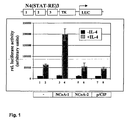
- STAT6 activating gene expression in response to IL-4 is strongly enhanced by and is depending on NCoA-1 (nuclear coactivator 1) in vivo and in vitro as set forth in example 2.
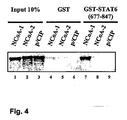
- NCoA-1 interacts directly with STAT6 whereas no other member of the NCoA co-activator family bind to STAT6.
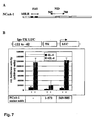
- Over-expression of the STAT6 interacting domain of NCoA-1 inhibits transactivation by STAT6 in a transdominant manner.
- NCoA-1 binds independently to a specific part of the STAT6 transactivation domain.
- the present invention provides a method and/or a test system to determine whether a substance can modulate, i.e. acts as an inhibitor or activator of IL-4 dependent signaling.
- a said substance can modulate, i.e. acts as an inhibitor or activator of a biological activity of STAT6.
- Use of the present invention can provide a basis for pharmaceutical compositions and methods for treating animals, or human beings suffering from a tumor disease or from an inflammatory airway disease, such as asthma.
- a "tumor disease” is any disease which is accompanied by a development of a malignant or benignant tumor such as Hodgkin Lymphoma.
- biological activity of STAT6 includes, for example, an interaction of STAT6 with as well as the binding of STAT6 to factors other than STAT6 which are necessary to induce transcription.
- the preferred meaning of the term "biological activity of STAT6" in the context of the invention is inducing transcription as a result of IL-4 signaling, the more preferred meaning is the interaction of STAT6 with and binding to NCoA-1 resulting in forming a complex as a prerequisite to induce transcription of genes with STAT6 responsive elements, preferably in a tumor disease or in an inflammatory airway disease.
- the invention also concerns functional equivalents, like naturally occurring alleles, derivatives, variants, mutants, and fragments of STAT6 having the ability to interact with as well as bind to NCoA-1.
- a fragment of STAT6 comprising at least amino acid 677 to 847 of STAT6 (SEQ ID NO:2), more preferred is a fragment comprising at least amino acids 792 to 847 (SEQ ID NO: 5).
- SEQ ID NO:2 a fragment comprising at least a fragment of SEQ ID NO:5 spanning amino acid 794 to 814 (in the numbering system of SEQ ID NO:5 spanning amino acid 3 to 23) as depicted in SEQ ID NO:6.
- Such a fragment may be fused to another amino acid sequence.
- such a derivative can be a fusion polypeptide comprising e.g. part of a glutathione S transferase fused to at least amino acid 677 to 847 of STAT6, as exemplified in SEQ ID No. 1.
- NCoA-1 i.e. enhancing a biological activity of STAT6 preferably in a tumor disease or in an inflammatory airway disease is dependent, for example, on interaction of NCoA-1 with STAT6, preferably direct binding of both proteins.
- the invention also concerns functional equivalents, like naturally occurring alleles, derivatives, variants for example the homologous human amino acid sequence, mutants and fragments of NCoA-1 having the ability to interact with as well as to bind to STAT6.
- the present invention relates to a fragment of NCoA-1 comprising at least amino acid 212 to 463 of NCoA-1 as depicted in SEQ ID NO: 4.
- Such a fragment may be fused to an other amino acid sequence.
- such a derivative can be a fusion polypeptide comprising e.g.
- NCoA-1 or a fragment thereof is labeled with a detectable label, for example fused to a histidine tag.
- the present invention concerns a method which can be performed in a cellular system as well as in a cell free system for determining whether a substance is able to modulate the interaction of STAT6 with NCoA-1, preferably a method for determining whether a substance is an activator i.e. promotes the interaction of both peptides or an inhibitor i.e. prevents said interaction.
- This method is characterized in that STAT6 or fragments or derivatives thereof having the ability to bind to NCoA-1 are brought into contact with NCoA-1 or fragments or derivatives of NCoA-1 having the ability to bind to STAT6 under conditions where STAT6 and NCoA-1 or said fragments or derivatives are capable of forming a complex, and said complex can be used to induce a measurable readout Said readout is measured in the absence or presence of the substance of interest and obtained readouts are compared. Equal readouts determine a substance which do not modulate the said interaction whereas a readout paralleling higher amounts of said complex when compared with the readout obtained in the absence of the substance indicates a substance which can act as an activator according to the invention.
- a readout paralleling lower amounts indicates a substance which can act as an inhibitor according to the invention.
- measuring a readout comprises techniques known in the art to detect that STAT6 and NCoA-1 or fragments or derivatives thereof according to the invention have been interacted according to the invention.
- direct detection of a formed complex according to the invention can be performed e.g. via physical methods or binding of an other molecule which recognizes the complex e.g. antibodies or the like.
- NCoA-1 or fragments or derivatives can be used, for example one of said interacting polypeptides can be labeled with e.g. a fused histidine tag, e.g.
- a method consisting of at least five consecutive histidine residues, and recognized by a molecule which specifically binds to the tag e.g. a histidine specific antibody.
- Said antibody can be detected by techniques well known in the art e.g. using a second antibody which itself is linked e.g. to an enzyme which is capable of catalyzing a measurable reaction, for example by detecting reaction products like modified substrates or by-products e.g. like emitting light.
- Such a method can comprise steps like:
- the present invention concerns a test method for determining whether a substance is an activator or inhibitor of said interaction according to the invention. Since an interaction of STAT6 with NCoA-1 triggering IL-4 signaling is involved in a tumor disease or in an inflammatory airway disease and plays a role in mediating inflammation, a substance modulating the biological activity of STAT6 and or of NCoA-1 can be used for treating a tumor disease, like Hodgkin Lymphoma or an inflammatory airway diseases, like asthma, or can be used as lead compound for optimization of the function of the substance in a way that the optimized substance is suitable for treating tumor disease, like Hodgkin Lymphoma or inflammatory airway diseases, like asthma.
- the present invention also concerns a test method for determining whether a substance is an activator or an inhibitor of the interaction of STAT6 with NCoA-1.
- a test system useful for performing a method of the invention may comprise a cellular or a cell-free system.
- one embodiment of the invention concerns a test system that is designed in a way to allow the testing of substances acting on the interaction of STAT6 with NCoA-1 or fragments or variants or derivatives thereof according to the invention, e.g. using expression of a reporter-gene, e.g. luciferase gene or the like, as a measurable readout regulated by a STAT6 responsive element.
- a method according to the invention can on the one hand be useful for high throughput testing suitable for determining whether a substance is an inhibitor or activator of the invention, but also e.g. for secondary testing or validation of a hit or lead substance identified in high throughput testing.
- test system for performing a method of the invention, a test system according to the invention can be used.
- a test system of the invention may comprises elements well known in the art. Said test system is designed in a way to measure the interaction of STAT6 with NCoA-1 or fragments or derivative according to the invention which can be performed by immobilizing one of the interacting polypeptides on a solid surface preferably on the bottom of a vessel more preferred on a ELISA plate.
- the other polypeptide preferably detectably labeled more preferred labeled with a histidine tag as well as the substance of interest or a mock control, optionally in a suitable solvent is added under conditions enabling both said polypeptides to bind to each other.
- Prior to detect the interaction of said polypeptides according to the invention i.e.
- test system for determining whether a substance is an activator or an inhibitor of the interaction of STAT6 with NCoA-1 can e.g. consist of
- a said test system can include a first polypeptide which comprises at least amino acid 677 to 847 of STAT6 according to SEQ ID NO: 2, more preferably at least amino acid 792 to 847 of STAT6 according to SEQ ID NO: 5 and a second polypeptide which comprises at least amino acid 212 to 463 of NCoA-1 according to SEQ ID NO: 4.
- the present invention can provide a basis for a substance determinable or determined in a method according to the invention to be an inhibitor or activator of the interaction of STAT6 with NCoA-1 according to the invention.
- a substance can be any compound which is capable of activating or preferably inhibiting a function of said interaction according to the invention.
- An example of a way to activate or inhibit a function of said interaction is by binding to one of respective polypeptides with a higher affinity and thereby blocking binding domain and/or a functional domain of at least one of said polypeptides, which can be done reversibly or irreversibly, depending on the nature of the substance applied.
- Such a substance can be an antibody or an organic or inorganic compound directly binding to or interfering with said interaction and thereby affecting STAT6's biological activity.
- Such a substance can be peptide 1 (SEQ ID NO: 6) or an antibody directed against the peptide 1.
- Example 1 is meant to illustrate the present invention, however, shall not be construed as limitation. However, the Example 1 describes most preferred embodiments of the invention.
- Example 1 is meant to illustrate the present invention, however, shall not be construed as limitation. However, the Example 1 describes most preferred embodiments of the invention.
- Coating buffer 1xPBS pH 7.2 Blocking buffer 1xPBS pH 7.2, 5% BSA, 0.1% Tween 20 Washing buffer 1xPBS pH 7.2, 0.1 % Tween 20
- Substrate solution dissolve a phosphate citrate buffer tablet (Sigma) in 100 ml water to obtain 0.05 M phosphate citrate buffer pH 5,5. Dissolve a tablet of o-Phenylendiamine dihydrochloride (Sigma) in 30 ml of phosphate citrate buffer in the dark. Prior to use add 30 ⁇ l of 30% H 2 O 2 .
- GST-STAT6 aa 677-847 and His-tagged NCoA-1 aa 212-463 are expressed in E. coli, purified by affinity-chromat connecting and dialyzed against 1xPBS according to the art.
- the obtained signal gives a measure of the amount of NCoA-1, which has bound to the STAT6. This is shown in table 1.
- Tab. 1. His-NCoA-1 (aa 212-463) bound to GST-STAT6 (aa 677-847) in an ELISA Assay. No. coated protein Added Partner protein 1. Antibody 2. Antibody Extinction 493 nm s. d. 1. GST-STAT6 (677-847) His-NCoA-1 (212-463) ⁇ -Penta-His ⁇ -mouse-HRP 0,795 0,036 2. - His-NCoA-1 (212-463) a-Penta-His ⁇ -mouse-HRP 0,097 0,036 3.
- GST-STAT6 (677-847) - ⁇ -Penta-His ⁇ -mouse-HRP 0,006 0,000 4. - - ⁇ -Penta-His ⁇ -mouse-HRP 0,005 0,001 5.
- GST-STAT6 (677-847) His-NCoA-1 (212-463) - ⁇ -mouse-HRP 0,006 0,000 6.
- His-NCoA-1 212-463) - ⁇ -mouse-HRP 0,005 0.001
- the signals in the presence of the test compounds can be compared to the control value e.g. in the absence of a test substance as exemplified in Example 1a) and 1b).
- Peptide 1 is a potent inhibitor for the interaction of STAT6 and NCoA-1
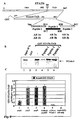
- Figure 8 A depicts the structure of i) human STAT6, ii) GST-STAT6 fusion protein (GST stands for Glutathion S Transferase), Amino acid position, DNA binding domain (DBD), SH2 domain, TAD and the cytokine-dependent phosphorylation site (Y) are indicated.
- GST stands for Glutathion S Transferase
- peptides derived from the trans-activation domain TAD: peptide1 (amino acid 794 to 814, SEQ ID NO: 6), peptide 2 (amino acid 817 to 830), and peptide 3 (amino acid 830 to 847), and iv) depicts the designation of polyclonal rabbit anti-sera raised against said peptides respectively (AB 1a, AB 1b; AB 2a, AB 2b; AB 3a, AB 3b).
- TAD trans-activation domain
- Results reveal less binding of GST-STAT6-TAD with NCoA-1 in presence of peptide 1(SEQ ID NO: 6) whilst presence of peptide 2 or peptide 3 does not alter the binding capacity of GST-STAT6-TAD with NCoA-1 significantly.
- Antisera raised against peptide 1 inhibit the interaction of STAT6 with NCoA-1.
- Figure 9 A gives results of a pull down assay: 4 ⁇ g GST or GST-STAT6-TAD fusion protein, bound to 20 ⁇ l glutathione-Sepharose, are incubated with 1.5 ⁇ l [ 35 S]-labeled His-tagged NCoA-1 fusion protein, comprising residues 213 to 462 (SEQ ID NO: 3).
- probes 4 to 10 binding reaction is carried out in the presence of 10 ⁇ l poly-clonal rabbit anti-sera raised against a unrelated peptide (lane 4), or raised against the peptide 1 (lane 5 and 6: AB 1a, AB 1b), or the peptide 2 (lane 7 and 8: AB 2a, AB 2b), or the peptide 3 (lane 9 and 10: AB 3a, AB 3b) as indicated.
- Bound proteins are analyzed by SDS-PAGE and fluorography (lanes 2-10).
- 10 % of the [ 35 S]-labeled protein used in the experiments is analyzed in parallel (lane 1). Results indicate less binding of said STAT6 fusion protein with said NcoA-1 fusion protein in the presence of anti-sera AB 1 a or AB 1b raised against the peptide 1. Remaining sera leave the protein interaction unaltered.
- results of an ELISA-Assay are given: 0,5 ⁇ l GST-STAT6-TAD fusion protein from bacterial crude lysate, which corresponds to 100 ng bound protein, are immobilized on plates which are coated with GST antibodies.
- Poly-clonal rabbit anti-sera raised against the peptide 1 (AB-1a, AB-1 b), or the peptide 2 (AB-2a, AB-2b), or the peptide 3 (AB-3a, AB-3b) are added in a 1:1000 dilution in blocking buffer.
- 250 ng His-tagged-NCoA-1 fusion protein comprising amino acids 213 to 462 (SEQ ID NO: 3) purified from E. coli. is added.
- Bound His-NCoA-1 is detected by Penta His antibody and a subsequent secondary antibody (HRP linked sheep anti mouse antibody). As control, the binding of secondary antibody to the plates is analyzed in parallel. Results parallel the findings of A).
- Figure 10 A show sequence of the peptide 1 (SEQ ID NO: 6) and its LXXLL motif. Alanin mutations introduced into the sequence are labeled by asterisk.
- B) results of a GST-pull-down assay are given: 4 ⁇ g GST or GST fusion proteins containing residues 642 to 847 of wildtype STAT6 (WT) or mutant STAT6 (mut; amino acid position 802 and 805 both L are mutated to A) are incubated with 1.5 ⁇ l [ 35 S]-labeled NCoA-1 fragment, comprising residues 213 to 462 (GEQ ID NO: 4) and incubated with 20 ⁇ l glutathione-Sepharose.
- Figure 11 A show the results of a transfection experiment and subsequent semiquantitative analysis of Eotaxin-2 induced by IL-4 treatment: 293T cells are transfected with expression vector encoding wildtype (WT, lane 3, 4) or mutant STAT6 (mut; mutations see above: lane 4, 5), or empty expression vector (mock, lane 1, 2). Cells are induced with IL-4 for 16 hours (+) or left untreated (-) as indicated. Total RNA is prepared and expression level of Eotaxin-3 and GAPDH is analysed by RT-PCR.
- Results reveal decreased expression of Eotaxin-3 after IL4 stimulation in cells transfected with mutant STAT6 when compared with WT STAT6 indicating amino acid at position 802 and 805 to be essential for Eotaxin-3 expression after IL4 stimulation.
- B) Amounts of secreted Eotaxin-3 from supernatants of cultured cells are determined in an ELISA type assay after transfection of 293T cells as described in A but induced with IL-4 for 48 hours (lane 2, 4, 6) or left untreated (lane 1, 3, 5). The average values with standard deviations of three independent experiments are given. Results parallel the findings of A).
- Example 2 IL-4 signaling inducing STAT 6 dependent transcription is enhanced by NCoA-1
- NCoA-1 as an important factor in IL-4 signaling
- NCoA-1 enhances the IL-4 induced transcription by STAT6
- NCoA-1 strongly enhances the transactivation potential of the C-terminal tansactivation domain of STAT6
- NCoA-1 enhances STAT6-mediated transactivation
- GAL4-DBD GAL-4 DNA binding domain
- Fig. 2A Two GAL4 fusion proteins, possessing either the main transactivation function of STAT6 (amino acids 677 to 791) and the extreme C terminus of STAT6 (amino acids 792 to 847) (Fig. 2A) are used to investigate, whether NCoA-1 is recruited to these domains.
- the various GAL4-STAT6 TAD constructs and a luciferase reporter construct containing three GAL4 response elements in its promoter region are transiently transfected into HepG2 with or without cotransfection of the coactivator NCoA-1. Expression of the isolated GAL4-DBD does not result in a significant enhancement of the luciferase reporter gene activity, which is also not effected by cotransfection of NCoA-1 (Fig.
- GAL4-STAT6 (677-791) strongly induces the reporter gene expression (lane 3). Cotransfection of NCoA-1 leads to a slight enhancement (lane 4). GAL4-STAT6 (792-847) does not significantly induce the reporter gene activity, indicating that this domain has a minor transactivation potential when fused to the GAL4 DBD. Surprisingly, cotransfection of NCoA-1 strongly enhances the transactivation function of the extreme C terminal domain of STAT6 to a level as high as the main transactivation domain of STAT6 (compare lane 6 and 4).
- NCoA-1 serves as a coactivator of the STAT6 transactivation domain.
- the cell type specific effect of NCoA-1 on the main transactivation domain of STAT6 (aa 677-791) might be due to an indirect recruitment of NCoA-1 to this domain by cell specific factors.
- NCoA-1 and STAT6 interact in vivo. The interaction depends on the presence of the far C-terminal region of STAT6.
- the transactivation domain of STAT6 interacts with NCoA-1, but not with NCoA-2 and p/CIP in vitro.
- NCoA-1 specifically interacts with STAT6 and serves as a coactivator for STAT6.
- the transactivation domain of STAT6 interacts directly with amino acids 212 to 462 of NCoA-1
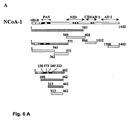
- NCoA-1 contains several structural and functional domains (Fig. 6A). To investigate, which domain in NCoA-1 mediates the interaction with STAT6, we test various fragments of NCoA-1 for interaction with STAT6 in pull-down experiments (Fig. 6A). We use GST STAT6 fusion protein comprising residues 677 to 847 to analyze the binding to various fragments of in vitro translated labeled NCoA-1. We observe specific interaction of an N-terminal fragment spanning amino acids 1 to 781 (Fig. 6B, lane 11) and the full length NCoA-1 protein (lane 15) with GST-STAT6 TAD, but no interaction with GST alone (lanes 6-10).
- Fig. 6A we dissect the N-terminal region of NCoA-1 and test different fragments in pulldown experiments (Fig. 6A).
- NCoA-1 The minimal fragment of NCoA-1, that is still able to interact with GST STAT6 possess the region from amino acids 213 to 462 which comprises the Per-Amt-Sim (PAS) domain B and part of the serine/threonine rich domain (lane 18). Further deletion of the N-terminus (313-462, lane 21) or the C-terminus (1-3S1, lane 6),abolish the binding. Strong interaction is also observed when GST STAT6 is incubated with purified Histidin-tagged NCoA-1 (212-462) (data not shown), confirming that the interaction between NCoA-1 and STAT6 is direct and does not depend on additional proteins
- NCoA-1 acts as a dominant negative for transcriptional activation by STAT6
Landscapes
- Health & Medical Sciences (AREA)
- Life Sciences & Earth Sciences (AREA)
- Chemical & Material Sciences (AREA)
- Engineering & Computer Science (AREA)
- Medicinal Chemistry (AREA)
- Molecular Biology (AREA)
- General Health & Medical Sciences (AREA)
- Nuclear Medicine, Radiotherapy & Molecular Imaging (AREA)
- Urology & Nephrology (AREA)
- Animal Behavior & Ethology (AREA)
- Organic Chemistry (AREA)
- Public Health (AREA)
- Veterinary Medicine (AREA)
- Cell Biology (AREA)
- Pharmacology & Pharmacy (AREA)
- Pulmonology (AREA)
- General Chemical & Material Sciences (AREA)
- Biomedical Technology (AREA)
- Chemical Kinetics & Catalysis (AREA)
- Hematology (AREA)
- Immunology (AREA)
- Biotechnology (AREA)
- Bioinformatics & Cheminformatics (AREA)
- Food Science & Technology (AREA)
- Physics & Mathematics (AREA)
- Analytical Chemistry (AREA)
- Biochemistry (AREA)
- General Physics & Mathematics (AREA)
- Pathology (AREA)
- Proteomics, Peptides & Aminoacids (AREA)
- Microbiology (AREA)
- Peptides Or Proteins (AREA)
- Medicines Containing Antibodies Or Antigens For Use As Internal Diagnostic Agents (AREA)
- Investigating Or Analysing Biological Materials (AREA)
- Medicines That Contain Protein Lipid Enzymes And Other Medicines (AREA)
- Measuring Or Testing Involving Enzymes Or Micro-Organisms (AREA)
- Acyclic And Carbocyclic Compounds In Medicinal Compositions (AREA)
- Preparation Of Compounds By Using Micro-Organisms (AREA)
Claims (23)
- Verfahren zur Bestimmung, ob eine Substanz die Wechselwirkung von STAT6 mit NCoA-1 modulieren kann, dadurch gekennzeichnet, dassa) STAT6 oder Fragmente oder Derivate davon mit der Fähigkeit zur Bindung an NCoA-1 in Kontakt mit NCoA-1 oder Fragmenten oder Derivaten von NCoA-1 mit der Fähigkeit zur Bindung an STAT6 unter Bedingungen in Kontakt gebracht werden, bei denen STAT6 und NCoA-1 oder die Fragmente oder Derivate befähigt sind, einen Komplex zu bilden, und der Komplex zur Herbeiführung eines messbaren Ergebnis verwendet werden kann;b) ein Ergebnis in Abwesenheit oder Gegenwart der Substanz von Interesse gemessen wird;c) das Ergebnis in Abwesenheit der Substanz von Interesse mit dem Ergebnis in Gegenwart der Substanz von Interesse verglichen wird.
- Verfahren nach Anspruch 1, wobei die Substanz die Wechselwirkung aktivieren kann.
- Verfahren nach Anspruch 1, wobei die Substanz die Wechselwirkung hemmen kann.
- Verfahren nach Anspruch 1, wobei die Analyse unter Verwendung eines zellulären Systems durchgeführt wird.
- Verfahren nach Anspruch 1, wobei die Analyse unter Verwendung eines zellfreien Systems durchgeführt wird.
- Verfahren nach den Ansprüchen 1 bis 5, wobei ein Polypeptid verwendet wird, das mindestens die Aminosäuren 677 bis 847 von STAT6 gemäß SEQ ID NO:2, gegebenenfalls fusioniert an eine andere Aminosäuresequenz, umfasst.
- Verfahren nach Anspruch 6, wobei ein Polypeptid verwendet wird, das mindestens die Aminosäuren 677 bis 847 von STAT6 gemäß SEQ ID NO:2, fusioniert an eine weitere Aminosäuresequenz gemäß SEQ ID NO:1, umfasst.
- Verfahren nach den Ansprüchen 1 bis 5, wobei ein Polypeptid verwendet wird, das mindestens die Aminosäuren 677 bis 847 von STAT6 gemäß SEQ ID NO:2 umfasst.
- Verfahren nach den Ansprüchen 1 bis 5, wobei ein Polypeptid verwendet wird, das mindestens die Aminosäuren 792 bis 847 von STAT6 gemäß SEQ ID NO:5 umfasst.
- Verfahren nach einem der Ansprüche 1 bis 9, wobei ein Polypeptid verwendet wird, das mindestens die Aminosäuren 212 bis 463 von NCoA-1 gemäß SEQ ID NO:4, gegebenenfalls fusioniert an eine weitere Aminosäuresequenz, umfasst.
- Verfahren nach Anspruch 10, wobei ein Polypeptid verwendet wird, das mindestens die Aminosäuren 212 bis 463 von NCoA-1 gemäß SEQ ID NO:4, fusioniert an weitere Aminosäuresequenzen gemäß SEQ ID NO:3, umfasst.
- Verfahren nach einem der Ansprüche 1 bis 9, wobei ein Polypeptid verwendet wird, das mindestens die Aminosäuren 212 bis 463 von NCoA-1 gemäß SEQ ID NO:4 umfasst.
- Verfahren nach einem der Ansprüche 1 bis 12, wobei das STAT6 oder das Fragment oder Derivat davon mit einer nachweisbaren Markierung verknüpft ist.
- Verfahren nach einem der Ansprüche 1 bis 12, wobei das NCoA-1 oder Fragment oder Derivat davon mit einer nachweisbaren Markierung verknüpft ist.
- Verfahren nach einem der Ansprüche 13 oder 14, wobei es sich bei der Markierung um eine Histidin-Markierung handelt, die aus mindestens 5 aufeinanderfolgenden Histidinresten besteht.
- Verfahren nach den Ansprüchen 1 bis 15, umfassend die folgenden Stufen:(a) das Binden eines ersten Polypeptids, das mindestens die Aminosäuren 677 bis 847 von STAT6 gemäß SEQ ID NO:2, vorzugsweise mindestens die Aminosäuren 792 bis 847 von STAT6 gemäß SEQ ID NO:5, umfasst, an einen festen Träger, der in einem Gefäß oder einem Teil des Gefäßes vorhanden ist;(b) das Zugeben einer Substanz von Interesse oder einer Scheinkontrolle, gegebenenfalls in einem geeigneten Lösungsmittel;(c) das Zugeben eines nachweisbar markierten zweiten Polypeptids, das mindestens die Aminosäuren 212 bis 463 von NCoA-1 gemäß SEQ ID NO:4 umfasst, unter Bedingungen, die es den beiden Polypeptiden ermöglichen, eine gegenseitige Bindung einzugehen;(d) das Entfernen von ungebundenem zweitem Polypeptid;(e) das Messen der Menge des nachweisbar markierten zweiten Polypeptids, das an das erste Polypeptid gebunden ist.
- Verfahren nach den Ansprüchen 1 bis 15, umfassend die folgenden Stufen:(a) das Binden eines ersten Polypeptids, das mindestens die Aminosäuren 212 bis 463 von NCoA-1 gemäß SEQ ID NO:4 umfasst, an einen festen Träger, der in einem Gefäß oder einem Teil des Gefäßes vorhanden ist;(b) das Zugeben einer Substanz von Interesse oder einer Scheinkontrolle, gegebenenfalls in einem geeigneten Lösungsmittel;(c) das Zugeben eines nachweisbar markierten zweiten Polypeptids, das mindestens die Aminosäuren 677 bis 847 von STAT6 gemäß SEQ ID NO:2, vorzugsweise mindestens die Aminosäuren 792 bis 847, von STAT6 gemäß SEQ ID NO:5 umfasst, unter Bedingungen, die es den beiden Polypeptiden ermöglichen, eine gegenseitige Bindung einzugehen;(d) das Entfernen von ungebundenem zweitem Polypeptid;(e) das Messen der Menge des nachweisbar markierten zweiten Polypeptids, das an das erste Polypeptid gebunden ist.
- Verfahren nach Anspruch 16 oder 17, wobei die Markierung durch Bindung eines für diese Markierung spezifischen Antikörpers nachgewiesen wird.
- Verfahren nach Anspruch 16 oder 17, wobei es sich bei der Markierung um eine Histidin-Markierung handelt, die mindestens 5 aufeinanderfolgende Histidinreste umfasst und der Antikörper für die Histidinmarkierung spezifisch ist.
- Verfahren nach Anspruch 18 oder 19, wobei der Antikörper durch Bindung eines zweiten Antikörpers an den ersten Antikörper nachgewiesen wird, wobei der zweite Antikörper mit einem Enzym verknüpft ist, das zur Katalyse einer messbaren Reaktion befähigt ist.
- Verfahren nach den Ansprüchen 1 bis 20, das bei einem Hochdurchsatz-Screening angewandt wird.
- Testsystem zur Bestimmung, ob es sich bei einer Substanz um einen Aktivator oder einen Inhibitor der Wechselwirkung von STAT6 mit NCoA-1 handelt, bestehend aus(a) STAT6 oder Fragmenten oder Derivaten davon mit der Fähigkeit zur Bindung an NCoA-1;(b) NCoA-1 oder Fragmenten oder Derivaten davon mit der Fähigkeit zur Bindung an STAT6;(c) einem Gefäß, worin das STAT6 oder Fragmente oder Derivate davon einen Komplex mit dem NCoA-1 oder Fragmenten oder Derivaten davon bilden können;(d) eine Vorrichtung zur Messung dieses Komplexes.
- Testsystem nach Anspruch 22, wobei ein erstes Polypeptid enthalten ist, das mindestens die Aminosäuren 677 bis 847 von STAT6 gemäß SEQ ID NO:2, vorzugsweise mindestens die Aminosäuren 792 bis 847 von STAT6 gemäß SEQ ID NO:5, umfasst und ein zweites Polypeptid enthalten ist, das mindestens die Aminosäuren 212 bis 463 von NCoA-1 gemäß SEQ ID NO:4 umfasst.
Priority Applications (1)
| Application Number | Priority Date | Filing Date | Title |
|---|---|---|---|
| EP02784827A EP1410040B1 (de) | 2001-07-13 | 2002-06-22 | Verfahren zur identifizierung von substanzen, die die interleukin 4 (il-4) signalkette modulieren |
Applications Claiming Priority (4)
| Application Number | Priority Date | Filing Date | Title |
|---|---|---|---|
| EP01117097A EP1275965A1 (de) | 2001-07-13 | 2001-07-13 | Verfahren zum Identifizieren von Substanzen, die die Interleukin-4 (IL-4) Signalkette beeinflussen |
| EP01117097 | 2001-07-13 | ||
| EP02784827A EP1410040B1 (de) | 2001-07-13 | 2002-06-22 | Verfahren zur identifizierung von substanzen, die die interleukin 4 (il-4) signalkette modulieren |
| PCT/EP2002/006920 WO2003006995A2 (en) | 2001-07-13 | 2002-06-22 | Method for identifying substances which modulate interleukin 4 (il-4) signaling |
Publications (2)
| Publication Number | Publication Date |
|---|---|
| EP1410040A2 EP1410040A2 (de) | 2004-04-21 |
| EP1410040B1 true EP1410040B1 (de) | 2006-11-15 |
Family
ID=8178039
Family Applications (2)
| Application Number | Title | Priority Date | Filing Date |
|---|---|---|---|
| EP01117097A Withdrawn EP1275965A1 (de) | 2001-07-13 | 2001-07-13 | Verfahren zum Identifizieren von Substanzen, die die Interleukin-4 (IL-4) Signalkette beeinflussen |
| EP02784827A Expired - Lifetime EP1410040B1 (de) | 2001-07-13 | 2002-06-22 | Verfahren zur identifizierung von substanzen, die die interleukin 4 (il-4) signalkette modulieren |
Family Applications Before (1)
| Application Number | Title | Priority Date | Filing Date |
|---|---|---|---|
| EP01117097A Withdrawn EP1275965A1 (de) | 2001-07-13 | 2001-07-13 | Verfahren zum Identifizieren von Substanzen, die die Interleukin-4 (IL-4) Signalkette beeinflussen |
Country Status (10)
| Country | Link |
|---|---|
| EP (2) | EP1275965A1 (de) |
| JP (1) | JP2005500046A (de) |
| AT (1) | ATE345505T1 (de) |
| AU (1) | AU2002354584A1 (de) |
| CA (1) | CA2450179C (de) |
| DE (1) | DE60216105T2 (de) |
| DK (1) | DK1410040T3 (de) |
| ES (1) | ES2275927T3 (de) |
| MX (1) | MXPA04000275A (de) |
| WO (1) | WO2003006995A2 (de) |
Family Cites Families (3)
| Publication number | Priority date | Publication date | Assignee | Title |
|---|---|---|---|---|
| AU9123898A (en) * | 1997-08-27 | 1999-03-16 | Government Of The United States Of America, As Represented By The Secretary Of The Department Of Health And Human Services, The | Attenuated and dominant negative variant cdnas of stat6: stat6b and stat6c |
| AU2533499A (en) * | 1998-02-12 | 1999-08-30 | Prolifix Limited | Interaction between cyclin d1 and steroid receptor co-activators and uses thereof in assays |
| US6207391B1 (en) * | 1998-03-31 | 2001-03-27 | Tularik Inc. | High-throughput screening assays for modulators of STAT4 and STAT6 activity |
-
2001
- 2001-07-13 EP EP01117097A patent/EP1275965A1/de not_active Withdrawn
-
2002
- 2002-06-22 JP JP2003512712A patent/JP2005500046A/ja active Pending
- 2002-06-22 MX MXPA04000275A patent/MXPA04000275A/es active IP Right Grant
- 2002-06-22 ES ES02784827T patent/ES2275927T3/es not_active Expired - Lifetime
- 2002-06-22 DE DE60216105T patent/DE60216105T2/de not_active Expired - Lifetime
- 2002-06-22 AT AT02784827T patent/ATE345505T1/de active
- 2002-06-22 EP EP02784827A patent/EP1410040B1/de not_active Expired - Lifetime
- 2002-06-22 DK DK02784827T patent/DK1410040T3/da active
- 2002-06-22 AU AU2002354584A patent/AU2002354584A1/en not_active Abandoned
- 2002-06-22 CA CA2450179A patent/CA2450179C/en not_active Expired - Fee Related
- 2002-06-22 WO PCT/EP2002/006920 patent/WO2003006995A2/en not_active Ceased
Also Published As
| Publication number | Publication date |
|---|---|
| EP1275965A1 (de) | 2003-01-15 |
| DE60216105T2 (de) | 2007-03-01 |
| MXPA04000275A (es) | 2005-07-25 |
| WO2003006995A3 (en) | 2003-11-27 |
| AU2002354584A1 (en) | 2003-01-29 |
| DK1410040T3 (da) | 2007-03-12 |
| ATE345505T1 (de) | 2006-12-15 |
| CA2450179A1 (en) | 2003-01-23 |
| EP1410040A2 (de) | 2004-04-21 |
| CA2450179C (en) | 2011-08-09 |
| JP2005500046A (ja) | 2005-01-06 |
| ES2275927T3 (es) | 2007-06-16 |
| DE60216105D1 (de) | 2006-12-28 |
| WO2003006995A2 (en) | 2003-01-23 |
Similar Documents
| Publication | Publication Date | Title |
|---|---|---|
| Sun et al. | Interaction of the Ski oncoprotein with Smad3 regulates TGF-β signaling | |
| Long et al. | Pc2-mediated sumoylation of Smad-interacting protein 1 attenuates transcriptional repression of E-cadherin | |
| Oelgeschläger et al. | Interaction of the co‐activator CBP with Myb proteins: effects on Myb‐specific transactivation and on the cooperativity with NF‐M. | |
| Teyssier et al. | Activation of nuclear receptor coactivator PGC-1α by arginine methylation | |
| Ray et al. | STAT3 NH2-terminal acetylation is activated by the hepatic acute-phase response and required for IL-6 induction of angiotensinogen | |
| Mcdonald et al. | Cooperation of the transcriptional coactivators CBP and p300 with Stat6 | |
| Ray et al. | Inducible STAT3 NH2 terminal mono-ubiquitination promotes BRD4 complex formation to regulate apoptosis | |
| Nakadai et al. | Two target gene activation pathways for orphan ERR nuclear receptors | |
| AU2001265947B9 (en) | Enzymatic assays for screening anti-cancer agents | |
| US7364870B2 (en) | MK2 interacting proteins | |
| AU2001265947A1 (en) | Enzymatic assays for screening anti-cancer agents | |
| EP1410040B1 (de) | Verfahren zur identifizierung von substanzen, die die interleukin 4 (il-4) signalkette modulieren | |
| US7226747B2 (en) | Method of identifying substances which modulate interleukin 4(IL-4) signaling | |
| Kong et al. | Hepatitis B virus X protein regulates transactivation activity and protein stability of the cancer‐amplified transcription coactivator ASC‐2 | |
| US7202024B2 (en) | bbc3 Gene promoter and methods for identifying modulators of apoptosis and bbc3 gene expression using a bbc3 gene promoter | |
| KR101250193B1 (ko) | Bcl3를 이용한 항-세포사멸 또는 세포사멸-유도 물질의 스크리닝 방법 | |
| JP3862703B2 (ja) | 物質のホルモン作用を判定する方法 | |
| US20080064027A1 (en) | TEL/Etv6-mediated inhibition of cell proliferation | |
| WO2001081587A1 (en) | Acetyltransferase and uses thereof | |
| Leo et al. | The Regulation and Function of Nuclear Receptor Corepressor SMRT in Human Breast Cancer Cells | |
| WO2004047852A1 (en) | PHARMACEUTICAL COMPOSITION FOR CONTROLING THE STABILITY OF HIF-1α | |
| AU2002315406A1 (en) | BBC3 gene promoter and methods for identifying modulators of apoptosis and BBC3 gene expression using a BBC3 gene promoter |
Legal Events
| Date | Code | Title | Description |
|---|---|---|---|
| PUAI | Public reference made under article 153(3) epc to a published international application that has entered the european phase |
Free format text: ORIGINAL CODE: 0009012 |
|
| AK | Designated contracting states |
Kind code of ref document: A2 Designated state(s): AT BE CH CY DE DK ES FI FR GB GR IE IT LI LU MC NL PT SE TR |
|
| AX | Request for extension of the european patent |
Extension state: AL LT LV MK RO SI |
|
| RIN1 | Information on inventor provided before grant (corrected) |
Inventor name: PFITZNER, EDITH Inventor name: LITTERST, CLAUDIA |
|
| 17P | Request for examination filed |
Effective date: 20040527 |
|
| 17Q | First examination report despatched |
Effective date: 20041223 |
|
| GRAP | Despatch of communication of intention to grant a patent |
Free format text: ORIGINAL CODE: EPIDOSNIGR1 |
|
| GRAS | Grant fee paid |
Free format text: ORIGINAL CODE: EPIDOSNIGR3 |
|
| GRAA | (expected) grant |
Free format text: ORIGINAL CODE: 0009210 |
|
| AK | Designated contracting states |
Kind code of ref document: B1 Designated state(s): AT BE CH CY DE DK ES FI FR GB GR IE IT LI LU MC NL PT SE TR |
|
| PG25 | Lapsed in a contracting state [announced via postgrant information from national office to epo] |
Ref country code: FI Free format text: LAPSE BECAUSE OF FAILURE TO SUBMIT A TRANSLATION OF THE DESCRIPTION OR TO PAY THE FEE WITHIN THE PRESCRIBED TIME-LIMIT Effective date: 20061115 Ref country code: BE Free format text: LAPSE BECAUSE OF FAILURE TO SUBMIT A TRANSLATION OF THE DESCRIPTION OR TO PAY THE FEE WITHIN THE PRESCRIBED TIME-LIMIT Effective date: 20061115 |
|
| REG | Reference to a national code |
Ref country code: GB Ref legal event code: FG4D |
|
| REG | Reference to a national code |
Ref country code: CH Ref legal event code: EP Ref country code: CH Ref legal event code: NV Representative=s name: SCHMAUDER & PARTNER AG PATENTANWALTSBUERO |
|
| REF | Corresponds to: |
Ref document number: 60216105 Country of ref document: DE Date of ref document: 20061228 Kind code of ref document: P |
|
| REG | Reference to a national code |
Ref country code: IE Ref legal event code: FG4D |
|
| REG | Reference to a national code |
Ref country code: SE Ref legal event code: TRGR |
|
| REG | Reference to a national code |
Ref country code: DK Ref legal event code: T3 |
|
| PG25 | Lapsed in a contracting state [announced via postgrant information from national office to epo] |
Ref country code: PT Free format text: LAPSE BECAUSE OF FAILURE TO SUBMIT A TRANSLATION OF THE DESCRIPTION OR TO PAY THE FEE WITHIN THE PRESCRIBED TIME-LIMIT Effective date: 20070416 |
|
| ET | Fr: translation filed | ||
| REG | Reference to a national code |
Ref country code: ES Ref legal event code: FG2A Ref document number: 2275927 Country of ref document: ES Kind code of ref document: T3 |
|
| PLBE | No opposition filed within time limit |
Free format text: ORIGINAL CODE: 0009261 |
|
| STAA | Information on the status of an ep patent application or granted ep patent |
Free format text: STATUS: NO OPPOSITION FILED WITHIN TIME LIMIT |
|
| 26N | No opposition filed |
Effective date: 20070817 |
|
| PG25 | Lapsed in a contracting state [announced via postgrant information from national office to epo] |
Ref country code: MC Free format text: LAPSE BECAUSE OF NON-PAYMENT OF DUE FEES Effective date: 20070630 |
|
| PG25 | Lapsed in a contracting state [announced via postgrant information from national office to epo] |
Ref country code: GR Free format text: LAPSE BECAUSE OF FAILURE TO SUBMIT A TRANSLATION OF THE DESCRIPTION OR TO PAY THE FEE WITHIN THE PRESCRIBED TIME-LIMIT Effective date: 20070216 |
|
| PG25 | Lapsed in a contracting state [announced via postgrant information from national office to epo] |
Ref country code: IE Free format text: LAPSE BECAUSE OF NON-PAYMENT OF DUE FEES Effective date: 20070622 |
|
| REG | Reference to a national code |
Ref country code: CH Ref legal event code: PCAR Free format text: SCHMAUDER & PARTNER AG PATENT- UND MARKENANWAELTE VSP;ZWAENGIWEG 7;8038 ZUERICH (CH) |
|
| PG25 | Lapsed in a contracting state [announced via postgrant information from national office to epo] |
Ref country code: LU Free format text: LAPSE BECAUSE OF NON-PAYMENT OF DUE FEES Effective date: 20070622 Ref country code: CY Free format text: LAPSE BECAUSE OF FAILURE TO SUBMIT A TRANSLATION OF THE DESCRIPTION OR TO PAY THE FEE WITHIN THE PRESCRIBED TIME-LIMIT Effective date: 20061115 |
|
| PG25 | Lapsed in a contracting state [announced via postgrant information from national office to epo] |
Ref country code: TR Free format text: LAPSE BECAUSE OF FAILURE TO SUBMIT A TRANSLATION OF THE DESCRIPTION OR TO PAY THE FEE WITHIN THE PRESCRIBED TIME-LIMIT Effective date: 20061115 |
|
| PGFP | Annual fee paid to national office [announced via postgrant information from national office to epo] |
Ref country code: IT Payment date: 20110623 Year of fee payment: 10 |
|
| PGFP | Annual fee paid to national office [announced via postgrant information from national office to epo] |
Ref country code: CH Payment date: 20121231 Year of fee payment: 11 |
|
| PG25 | Lapsed in a contracting state [announced via postgrant information from national office to epo] |
Ref country code: IT Free format text: LAPSE BECAUSE OF NON-PAYMENT OF DUE FEES Effective date: 20120622 |
|
| PGFP | Annual fee paid to national office [announced via postgrant information from national office to epo] |
Ref country code: GB Payment date: 20121231 Year of fee payment: 11 |
|
| PGFP | Annual fee paid to national office [announced via postgrant information from national office to epo] |
Ref country code: AT Payment date: 20130102 Year of fee payment: 11 |
|
| PGFP | Annual fee paid to national office [announced via postgrant information from national office to epo] |
Ref country code: DE Payment date: 20121231 Year of fee payment: 11 Ref country code: ES Payment date: 20130103 Year of fee payment: 11 Ref country code: SE Payment date: 20121231 Year of fee payment: 11 Ref country code: FR Payment date: 20130205 Year of fee payment: 11 Ref country code: DK Payment date: 20130102 Year of fee payment: 11 |
|
| PGFP | Annual fee paid to national office [announced via postgrant information from national office to epo] |
Ref country code: NL Payment date: 20121231 Year of fee payment: 11 |
|
| PGRI | Patent reinstated in contracting state [announced from national office to epo] |
Ref country code: IT Effective date: 20130301 |
|
| REG | Reference to a national code |
Ref country code: NL Ref legal event code: V1 Effective date: 20140101 |
|
| PG25 | Lapsed in a contracting state [announced via postgrant information from national office to epo] |
Ref country code: SE Free format text: LAPSE BECAUSE OF NON-PAYMENT OF DUE FEES Effective date: 20130623 |
|
| REG | Reference to a national code |
Ref country code: CH Ref legal event code: PL |
|
| REG | Reference to a national code |
Ref country code: SE Ref legal event code: EUG |
|
| REG | Reference to a national code |
Ref country code: DK Ref legal event code: EBP Effective date: 20130630 |
|
| REG | Reference to a national code |
Ref country code: AT Ref legal event code: MM01 Ref document number: 345505 Country of ref document: AT Kind code of ref document: T Effective date: 20130622 |
|
| GBPC | Gb: european patent ceased through non-payment of renewal fee |
Effective date: 20130622 |
|
| REG | Reference to a national code |
Ref country code: DE Ref legal event code: R119 Ref document number: 60216105 Country of ref document: DE Effective date: 20140101 |
|
| REG | Reference to a national code |
Ref country code: FR Ref legal event code: ST Effective date: 20140228 |
|
| PG25 | Lapsed in a contracting state [announced via postgrant information from national office to epo] |
Ref country code: GB Free format text: LAPSE BECAUSE OF NON-PAYMENT OF DUE FEES Effective date: 20130622 Ref country code: LI Free format text: LAPSE BECAUSE OF NON-PAYMENT OF DUE FEES Effective date: 20130630 Ref country code: CH Free format text: LAPSE BECAUSE OF NON-PAYMENT OF DUE FEES Effective date: 20130630 Ref country code: DE Free format text: LAPSE BECAUSE OF NON-PAYMENT OF DUE FEES Effective date: 20140101 Ref country code: NL Free format text: LAPSE BECAUSE OF NON-PAYMENT OF DUE FEES Effective date: 20140101 |
|
| PG25 | Lapsed in a contracting state [announced via postgrant information from national office to epo] |
Ref country code: IT Free format text: LAPSE BECAUSE OF NON-PAYMENT OF DUE FEES Effective date: 20130622 Ref country code: FR Free format text: LAPSE BECAUSE OF NON-PAYMENT OF DUE FEES Effective date: 20130701 Ref country code: AT Free format text: LAPSE BECAUSE OF NON-PAYMENT OF DUE FEES Effective date: 20130622 |
|
| PG25 | Lapsed in a contracting state [announced via postgrant information from national office to epo] |
Ref country code: DK Free format text: LAPSE BECAUSE OF NON-PAYMENT OF DUE FEES Effective date: 20130630 |
|
| REG | Reference to a national code |
Ref country code: ES Ref legal event code: FD2A Effective date: 20150709 |
|
| PG25 | Lapsed in a contracting state [announced via postgrant information from national office to epo] |
Ref country code: ES Free format text: LAPSE BECAUSE OF NON-PAYMENT OF DUE FEES Effective date: 20130623 |