EP1405901A1 - Detergent compositions - Google Patents
Detergent compositions Download PDFInfo
- Publication number
- EP1405901A1 EP1405901A1 EP20030077852 EP03077852A EP1405901A1 EP 1405901 A1 EP1405901 A1 EP 1405901A1 EP 20030077852 EP20030077852 EP 20030077852 EP 03077852 A EP03077852 A EP 03077852A EP 1405901 A1 EP1405901 A1 EP 1405901A1
- Authority
- EP
- European Patent Office
- Prior art keywords
- semi
- smooth
- tablet
- polyoxyethylene
- cleaning tablet
- Prior art date
- Legal status (The legal status is an assumption and is not a legal conclusion. Google has not performed a legal analysis and makes no representation as to the accuracy of the status listed.)
- Granted
Links
- 239000000203 mixture Substances 0.000 title claims description 52
- 239000003599 detergent Substances 0.000 title description 13
- 239000004094 surface-active agent Substances 0.000 claims abstract description 35
- 239000007790 solid phase Substances 0.000 claims abstract description 34
- 239000000344 soap Substances 0.000 claims abstract description 29
- 238000004140 cleaning Methods 0.000 claims abstract description 25
- 239000000463 material Substances 0.000 claims abstract description 21
- 125000000217 alkyl group Chemical group 0.000 claims abstract description 16
- XLYOFNOQVPJJNP-UHFFFAOYSA-N water Substances O XLYOFNOQVPJJNP-UHFFFAOYSA-N 0.000 claims abstract description 16
- 150000001720 carbohydrates Chemical class 0.000 claims abstract description 12
- 235000014633 carbohydrates Nutrition 0.000 claims abstract description 11
- 125000004432 carbon atom Chemical group C* 0.000 claims abstract description 9
- 238000005185 salting out Methods 0.000 claims abstract description 9
- 230000003019 stabilising effect Effects 0.000 claims abstract description 8
- 239000012071 phase Substances 0.000 claims description 26
- -1 polyoxyethylene glycerol Polymers 0.000 claims description 21
- DNIAPMSPPWPWGF-UHFFFAOYSA-N Propylene glycol Chemical compound CC(O)CO DNIAPMSPPWPWGF-UHFFFAOYSA-N 0.000 claims description 9
- 229910019142 PO4 Inorganic materials 0.000 claims description 6
- 229920001214 Polysorbate 60 Polymers 0.000 claims description 6
- 235000021317 phosphate Nutrition 0.000 claims description 6
- 239000003085 diluting agent Substances 0.000 claims description 5
- 150000003013 phosphoric acid derivatives Chemical class 0.000 claims description 5
- 239000000600 sorbitol Substances 0.000 claims description 5
- JNYAEWCLZODPBN-JGWLITMVSA-N (2r,3r,4s)-2-[(1r)-1,2-dihydroxyethyl]oxolane-3,4-diol Chemical compound OC[C@@H](O)[C@H]1OC[C@H](O)[C@H]1O JNYAEWCLZODPBN-JGWLITMVSA-N 0.000 claims description 4
- ULUAUXLGCMPNKK-UHFFFAOYSA-N Sulfobutanedioic acid Chemical class OC(=O)CC(C(O)=O)S(O)(=O)=O ULUAUXLGCMPNKK-UHFFFAOYSA-N 0.000 claims description 3
- SZXQTJUDPRGNJN-UHFFFAOYSA-N dipropylene glycol Chemical group OCCCOCCCO SZXQTJUDPRGNJN-UHFFFAOYSA-N 0.000 claims description 3
- 229940113120 dipropylene glycol Drugs 0.000 claims description 3
- 150000002148 esters Chemical class 0.000 claims description 3
- 229920003171 Poly (ethylene oxide) Polymers 0.000 claims description 2
- FGUZFFWTBWJBIL-XWVZOOPGSA-N [(1r)-1-[(2s,3r,4s)-3,4-dihydroxyoxolan-2-yl]-2-hydroxyethyl] 16-methylheptadecanoate Chemical compound CC(C)CCCCCCCCCCCCCCC(=O)O[C@H](CO)[C@H]1OC[C@H](O)[C@H]1O FGUZFFWTBWJBIL-XWVZOOPGSA-N 0.000 claims description 2
- 150000007942 carboxylates Chemical class 0.000 claims description 2
- USIUVYZYUHIAEV-UHFFFAOYSA-N diphenyl ether Chemical compound C=1C=CC=CC=1OC1=CC=CC=C1 USIUVYZYUHIAEV-UHFFFAOYSA-N 0.000 claims description 2
- 229920001282 polysaccharide Polymers 0.000 claims description 2
- 239000005017 polysaccharide Substances 0.000 claims description 2
- 229940057429 sorbitan isostearate Drugs 0.000 claims description 2
- JNYAEWCLZODPBN-UHFFFAOYSA-N 2-(1,2-dihydroxyethyl)oxolane-3,4-diol Polymers OCC(O)C1OCC(O)C1O JNYAEWCLZODPBN-UHFFFAOYSA-N 0.000 claims 1
- JNYAEWCLZODPBN-CTQIIAAMSA-N sorbitan Polymers OCC(O)C1OCC(O)[C@@H]1O JNYAEWCLZODPBN-CTQIIAAMSA-N 0.000 claims 1
- 239000007787 solid Substances 0.000 description 54
- 239000007844 bleaching agent Substances 0.000 description 14
- 238000001125 extrusion Methods 0.000 description 14
- 238000005406 washing Methods 0.000 description 13
- HEMHJVSKTPXQMS-UHFFFAOYSA-M Sodium hydroxide Chemical compound [OH-].[Na+] HEMHJVSKTPXQMS-UHFFFAOYSA-M 0.000 description 12
- 239000004744 fabric Substances 0.000 description 11
- 239000004615 ingredient Substances 0.000 description 10
- 239000011734 sodium Substances 0.000 description 10
- DGAQECJNVWCQMB-PUAWFVPOSA-M Ilexoside XXIX Chemical compound C[C@@H]1CC[C@@]2(CC[C@@]3(C(=CC[C@H]4[C@]3(CC[C@@H]5[C@@]4(CC[C@@H](C5(C)C)OS(=O)(=O)[O-])C)C)[C@@H]2[C@]1(C)O)C)C(=O)O[C@H]6[C@@H]([C@H]([C@@H]([C@H](O6)CO)O)O)O.[Na+] DGAQECJNVWCQMB-PUAWFVPOSA-M 0.000 description 9
- 239000003945 anionic surfactant Substances 0.000 description 9
- 238000006073 displacement reaction Methods 0.000 description 9
- 229910052708 sodium Inorganic materials 0.000 description 9
- 238000000034 method Methods 0.000 description 8
- 238000004851 dishwashing Methods 0.000 description 7
- 238000004519 manufacturing process Methods 0.000 description 7
- 239000000843 powder Substances 0.000 description 7
- 108090000790 Enzymes Proteins 0.000 description 6
- 102000004190 Enzymes Human genes 0.000 description 6
- PEDCQBHIVMGVHV-UHFFFAOYSA-N Glycerine Chemical compound OCC(O)CO PEDCQBHIVMGVHV-UHFFFAOYSA-N 0.000 description 6
- 229910052783 alkali metal Inorganic materials 0.000 description 6
- 150000001875 compounds Chemical class 0.000 description 6
- 229940088598 enzyme Drugs 0.000 description 6
- 239000008187 granular material Substances 0.000 description 6
- 239000002736 nonionic surfactant Substances 0.000 description 6
- 239000011236 particulate material Substances 0.000 description 6
- BPQQTUXANYXVAA-UHFFFAOYSA-N Orthosilicate Chemical compound [O-][Si]([O-])([O-])[O-] BPQQTUXANYXVAA-UHFFFAOYSA-N 0.000 description 5
- VYPSYNLAJGMNEJ-UHFFFAOYSA-N Silicium dioxide Chemical compound O=[Si]=O VYPSYNLAJGMNEJ-UHFFFAOYSA-N 0.000 description 5
- 239000012190 activator Substances 0.000 description 5
- 239000002518 antifoaming agent Substances 0.000 description 5
- 235000014113 dietary fatty acids Nutrition 0.000 description 5
- 238000004090 dissolution Methods 0.000 description 5
- 239000000194 fatty acid Substances 0.000 description 5
- 229930195729 fatty acid Natural products 0.000 description 5
- 125000002887 hydroxy group Chemical group [H]O* 0.000 description 5
- IAYPIBMASNFSPL-UHFFFAOYSA-N Ethylene oxide Chemical compound C1CO1 IAYPIBMASNFSPL-UHFFFAOYSA-N 0.000 description 4
- 150000001340 alkali metals Chemical class 0.000 description 4
- 150000004665 fatty acids Chemical class 0.000 description 4
- 239000002245 particle Substances 0.000 description 4
- 229920000136 polysorbate Polymers 0.000 description 4
- 239000002243 precursor Substances 0.000 description 4
- LYCAIKOWRPUZTN-UHFFFAOYSA-N Ethylene glycol Chemical compound OCCO LYCAIKOWRPUZTN-UHFFFAOYSA-N 0.000 description 3
- 229910000503 Na-aluminosilicate Inorganic materials 0.000 description 3
- DBMJMQXJHONAFJ-UHFFFAOYSA-M Sodium laurylsulphate Chemical compound [Na+].CCCCCCCCCCCCOS([O-])(=O)=O DBMJMQXJHONAFJ-UHFFFAOYSA-M 0.000 description 3
- 239000002253 acid Substances 0.000 description 3
- 125000000129 anionic group Chemical group 0.000 description 3
- 230000008901 benefit Effects 0.000 description 3
- 238000001816 cooling Methods 0.000 description 3
- 239000000499 gel Substances 0.000 description 3
- 229920005646 polycarboxylate Polymers 0.000 description 3
- 229920000642 polymer Polymers 0.000 description 3
- 150000003138 primary alcohols Chemical class 0.000 description 3
- 150000003333 secondary alcohols Chemical class 0.000 description 3
- 150000004760 silicates Chemical class 0.000 description 3
- 235000012217 sodium aluminium silicate Nutrition 0.000 description 3
- 238000003756 stirring Methods 0.000 description 3
- 229910021653 sulphate ion Inorganic materials 0.000 description 3
- 239000007916 tablet composition Substances 0.000 description 3
- 238000012360 testing method Methods 0.000 description 3
- FRPJTGXMTIIFIT-UHFFFAOYSA-N tetraacetylethylenediamine Chemical compound CC(=O)C(N)(C(C)=O)C(N)(C(C)=O)C(C)=O FRPJTGXMTIIFIT-UHFFFAOYSA-N 0.000 description 3
- 239000010457 zeolite Substances 0.000 description 3
- BVKZGUZCCUSVTD-UHFFFAOYSA-L Carbonate Chemical compound [O-]C([O-])=O BVKZGUZCCUSVTD-UHFFFAOYSA-L 0.000 description 2
- QXNVGIXVLWOKEQ-UHFFFAOYSA-N Disodium Chemical compound [Na][Na] QXNVGIXVLWOKEQ-UHFFFAOYSA-N 0.000 description 2
- KFZMGEQAYNKOFK-UHFFFAOYSA-N Isopropanol Chemical compound CC(C)O KFZMGEQAYNKOFK-UHFFFAOYSA-N 0.000 description 2
- 108091005804 Peptidases Proteins 0.000 description 2
- 102000035195 Peptidases Human genes 0.000 description 2
- KFSLWBXXFJQRDL-UHFFFAOYSA-N Peracetic acid Chemical compound CC(=O)OO KFSLWBXXFJQRDL-UHFFFAOYSA-N 0.000 description 2
- 229920001213 Polysorbate 20 Polymers 0.000 description 2
- 239000004365 Protease Substances 0.000 description 2
- CDBYLPFSWZWCQE-UHFFFAOYSA-L Sodium Carbonate Chemical compound [Na+].[Na+].[O-]C([O-])=O CDBYLPFSWZWCQE-UHFFFAOYSA-L 0.000 description 2
- 239000004115 Sodium Silicate Substances 0.000 description 2
- 108010056079 Subtilisins Proteins 0.000 description 2
- 102000005158 Subtilisins Human genes 0.000 description 2
- 229910021536 Zeolite Inorganic materials 0.000 description 2
- NWGKJDSIEKMTRX-BFWOXRRGSA-N [(2r)-2-[(3r,4s)-3,4-dihydroxyoxolan-2-yl]-2-hydroxyethyl] (z)-octadec-9-enoate Chemical compound CCCCCCCC\C=C/CCCCCCCC(=O)OC[C@@H](O)C1OC[C@H](O)[C@H]1O NWGKJDSIEKMTRX-BFWOXRRGSA-N 0.000 description 2
- NIXOWILDQLNWCW-UHFFFAOYSA-N acrylic acid group Chemical group C(C=C)(=O)O NIXOWILDQLNWCW-UHFFFAOYSA-N 0.000 description 2
- 229920006243 acrylic copolymer Polymers 0.000 description 2
- 229910052910 alkali metal silicate Inorganic materials 0.000 description 2
- 150000004996 alkyl benzenes Chemical class 0.000 description 2
- 229910000323 aluminium silicate Inorganic materials 0.000 description 2
- 150000004649 carbonic acid derivatives Chemical class 0.000 description 2
- 150000001768 cations Chemical class 0.000 description 2
- 239000007795 chemical reaction product Substances 0.000 description 2
- 238000005056 compaction Methods 0.000 description 2
- 238000007906 compression Methods 0.000 description 2
- 230000006835 compression Effects 0.000 description 2
- HNPSIPDUKPIQMN-UHFFFAOYSA-N dioxosilane;oxo(oxoalumanyloxy)alumane Chemical compound O=[Si]=O.O=[Al]O[Al]=O HNPSIPDUKPIQMN-UHFFFAOYSA-N 0.000 description 2
- PMPJQLCPEQFEJW-GNTLFSRWSA-L disodium;2-[(z)-2-[4-[4-[(z)-2-(2-sulfonatophenyl)ethenyl]phenyl]phenyl]ethenyl]benzenesulfonate Chemical compound [Na+].[Na+].[O-]S(=O)(=O)C1=CC=CC=C1\C=C/C1=CC=C(C=2C=CC(\C=C/C=3C(=CC=CC=3)S([O-])(=O)=O)=CC=2)C=C1 PMPJQLCPEQFEJW-GNTLFSRWSA-L 0.000 description 2
- 125000001301 ethoxy group Chemical group [H]C([H])([H])C([H])([H])O* 0.000 description 2
- 229910001385 heavy metal Inorganic materials 0.000 description 2
- 125000004435 hydrogen atom Chemical group [H]* 0.000 description 2
- 238000005342 ion exchange Methods 0.000 description 2
- 238000006386 neutralization reaction Methods 0.000 description 2
- 229920000058 polyacrylate Polymers 0.000 description 2
- 239000000256 polyoxyethylene sorbitan monolaurate Substances 0.000 description 2
- 235000010486 polyoxyethylene sorbitan monolaurate Nutrition 0.000 description 2
- 229920005996 polystyrene-poly(ethylene-butylene)-polystyrene Polymers 0.000 description 2
- BWHMMNNQKKPAPP-UHFFFAOYSA-L potassium carbonate Chemical compound [K+].[K+].[O-]C([O-])=O BWHMMNNQKKPAPP-UHFFFAOYSA-L 0.000 description 2
- 238000002360 preparation method Methods 0.000 description 2
- 239000000047 product Substances 0.000 description 2
- 150000003839 salts Chemical class 0.000 description 2
- 239000003352 sequestering agent Substances 0.000 description 2
- 239000000377 silicon dioxide Substances 0.000 description 2
- 229910052911 sodium silicate Inorganic materials 0.000 description 2
- NTHWMYGWWRZVTN-UHFFFAOYSA-N sodium silicate Chemical compound [Na+].[Na+].[O-][Si]([O-])=O NTHWMYGWWRZVTN-UHFFFAOYSA-N 0.000 description 2
- 235000019832 sodium triphosphate Nutrition 0.000 description 2
- 239000002689 soil Substances 0.000 description 2
- 239000002195 soluble material Substances 0.000 description 2
- 229910009112 xH2O Inorganic materials 0.000 description 2
- CIOXZGOUEYHNBF-UHFFFAOYSA-N (carboxymethoxy)succinic acid Chemical class OC(=O)COC(C(O)=O)CC(O)=O CIOXZGOUEYHNBF-UHFFFAOYSA-N 0.000 description 1
- CFPOJWPDQWJEMO-UHFFFAOYSA-N 2-(1,2-dicarboxyethoxy)butanedioic acid Chemical class OC(=O)CC(C(O)=O)OC(C(O)=O)CC(O)=O CFPOJWPDQWJEMO-UHFFFAOYSA-N 0.000 description 1
- LVVZBNKWTVZSIU-UHFFFAOYSA-N 2-(carboxymethoxy)propanedioic acid Chemical class OC(=O)COC(C(O)=O)C(O)=O LVVZBNKWTVZSIU-UHFFFAOYSA-N 0.000 description 1
- KXGOCXPKKMVOSB-UHFFFAOYSA-N 2-[2-[2-[2-(2-tetradecoxyethoxy)ethoxy]ethoxy]ethoxy]ethanol Chemical compound CCCCCCCCCCCCCCOCCOCCOCCOCCOCCO KXGOCXPKKMVOSB-UHFFFAOYSA-N 0.000 description 1
- ZTGKHKPZSMMHNM-UHFFFAOYSA-N 3-(2-phenylethenyl)benzene-1,2-disulfonic acid Chemical compound OS(=O)(=O)C1=CC=CC(C=CC=2C=CC=CC=2)=C1S(O)(=O)=O ZTGKHKPZSMMHNM-UHFFFAOYSA-N 0.000 description 1
- YNJSNEKCXVFDKW-UHFFFAOYSA-N 3-(5-amino-1h-indol-3-yl)-2-azaniumylpropanoate Chemical compound C1=C(N)C=C2C(CC(N)C(O)=O)=CNC2=C1 YNJSNEKCXVFDKW-UHFFFAOYSA-N 0.000 description 1
- ZXVONLUNISGICL-UHFFFAOYSA-N 4,6-dinitro-o-cresol Chemical compound CC1=CC([N+]([O-])=O)=CC([N+]([O-])=O)=C1O ZXVONLUNISGICL-UHFFFAOYSA-N 0.000 description 1
- YGUMVDWOQQJBGA-VAWYXSNFSA-N 5-[(4-anilino-6-morpholin-4-yl-1,3,5-triazin-2-yl)amino]-2-[(e)-2-[4-[(4-anilino-6-morpholin-4-yl-1,3,5-triazin-2-yl)amino]-2-sulfophenyl]ethenyl]benzenesulfonic acid Chemical compound C=1C=C(\C=C\C=2C(=CC(NC=3N=C(N=C(NC=4C=CC=CC=4)N=3)N3CCOCC3)=CC=2)S(O)(=O)=O)C(S(=O)(=O)O)=CC=1NC(N=C(N=1)N2CCOCC2)=NC=1NC1=CC=CC=C1 YGUMVDWOQQJBGA-VAWYXSNFSA-N 0.000 description 1
- XSVSPKKXQGNHMD-UHFFFAOYSA-N 5-bromo-3-methyl-1,2-thiazole Chemical compound CC=1C=C(Br)SN=1 XSVSPKKXQGNHMD-UHFFFAOYSA-N 0.000 description 1
- FJNCXZZQNBKEJT-UHFFFAOYSA-N 8beta-hydroxymarrubiin Natural products O1C(=O)C2(C)CCCC3(C)C2C1CC(C)(O)C3(O)CCC=1C=COC=1 FJNCXZZQNBKEJT-UHFFFAOYSA-N 0.000 description 1
- RZVAJINKPMORJF-UHFFFAOYSA-N Acetaminophen Chemical compound CC(=O)NC1=CC=C(O)C=C1 RZVAJINKPMORJF-UHFFFAOYSA-N 0.000 description 1
- 102000013142 Amylases Human genes 0.000 description 1
- 108010065511 Amylases Proteins 0.000 description 1
- BHPQYMZQTOCNFJ-UHFFFAOYSA-N Calcium cation Chemical group [Ca+2] BHPQYMZQTOCNFJ-UHFFFAOYSA-N 0.000 description 1
- 102000005575 Cellulases Human genes 0.000 description 1
- 108010084185 Cellulases Proteins 0.000 description 1
- OCUCCJIRFHNWBP-IYEMJOQQSA-L Copper gluconate Chemical class [Cu+2].OC[C@@H](O)[C@@H](O)[C@H](O)[C@@H](O)C([O-])=O.OC[C@@H](O)[C@@H](O)[C@H](O)[C@@H](O)C([O-])=O OCUCCJIRFHNWBP-IYEMJOQQSA-L 0.000 description 1
- FBPFZTCFMRRESA-FSIIMWSLSA-N D-Glucitol Natural products OC[C@H](O)[C@H](O)[C@@H](O)[C@H](O)CO FBPFZTCFMRRESA-FSIIMWSLSA-N 0.000 description 1
- KCXVZYZYPLLWCC-UHFFFAOYSA-N EDTA Chemical compound OC(=O)CN(CC(O)=O)CCN(CC(O)=O)CC(O)=O KCXVZYZYPLLWCC-UHFFFAOYSA-N 0.000 description 1
- LFQSCWFLJHTTHZ-UHFFFAOYSA-N Ethanol Chemical compound CCO LFQSCWFLJHTTHZ-UHFFFAOYSA-N 0.000 description 1
- 229920000896 Ethulose Polymers 0.000 description 1
- 239000001859 Ethyl hydroxyethyl cellulose Substances 0.000 description 1
- PIICEJLVQHRZGT-UHFFFAOYSA-N Ethylenediamine Chemical compound NCCN PIICEJLVQHRZGT-UHFFFAOYSA-N 0.000 description 1
- 244000020551 Helianthus annuus Species 0.000 description 1
- 235000003222 Helianthus annuus Nutrition 0.000 description 1
- 239000004367 Lipase Substances 0.000 description 1
- 102000004882 Lipase Human genes 0.000 description 1
- 108090001060 Lipase Proteins 0.000 description 1
- JYXGIOKAKDAARW-UHFFFAOYSA-N N-(2-hydroxyethyl)iminodiacetic acid Chemical class OCCN(CC(O)=O)CC(O)=O JYXGIOKAKDAARW-UHFFFAOYSA-N 0.000 description 1
- KKCBUQHMOMHUOY-UHFFFAOYSA-N Na2O Inorganic materials [O-2].[Na+].[Na+] KKCBUQHMOMHUOY-UHFFFAOYSA-N 0.000 description 1
- MQNVHUZWFZKETG-UHFFFAOYSA-N P1(OCCCCCO1)=O.NCCNCCN Chemical compound P1(OCCCCCO1)=O.NCCNCCN MQNVHUZWFZKETG-UHFFFAOYSA-N 0.000 description 1
- WFRXSOIFNFJAFL-UHFFFAOYSA-N P1(OCCCCO1)=O.C(CN)N Chemical compound P1(OCCCCO1)=O.C(CN)N WFRXSOIFNFJAFL-UHFFFAOYSA-N 0.000 description 1
- 239000002202 Polyethylene glycol Substances 0.000 description 1
- 229920000388 Polyphosphate Polymers 0.000 description 1
- ZLMJMSJWJFRBEC-UHFFFAOYSA-N Potassium Chemical compound [K] ZLMJMSJWJFRBEC-UHFFFAOYSA-N 0.000 description 1
- GOOHAUXETOMSMM-UHFFFAOYSA-N Propylene oxide Chemical compound CC1CO1 GOOHAUXETOMSMM-UHFFFAOYSA-N 0.000 description 1
- 235000019484 Rapeseed oil Nutrition 0.000 description 1
- GBFLZEXEOZUWRN-VKHMYHEASA-N S-carboxymethyl-L-cysteine Chemical compound OC(=O)[C@@H](N)CSCC(O)=O GBFLZEXEOZUWRN-VKHMYHEASA-N 0.000 description 1
- VMHLLURERBWHNL-UHFFFAOYSA-M Sodium acetate Chemical compound [Na+].CC([O-])=O VMHLLURERBWHNL-UHFFFAOYSA-M 0.000 description 1
- 239000004902 Softening Agent Substances 0.000 description 1
- DPXJVFZANSGRMM-UHFFFAOYSA-N acetic acid;2,3,4,5,6-pentahydroxyhexanal;sodium Chemical compound [Na].CC(O)=O.OCC(O)C(O)C(O)C(O)C=O DPXJVFZANSGRMM-UHFFFAOYSA-N 0.000 description 1
- 150000007513 acids Chemical class 0.000 description 1
- 239000011149 active material Substances 0.000 description 1
- 125000001931 aliphatic group Chemical group 0.000 description 1
- 125000003342 alkenyl group Chemical group 0.000 description 1
- 150000005215 alkyl ethers Chemical class 0.000 description 1
- 125000002947 alkylene group Chemical group 0.000 description 1
- PNEYBMLMFCGWSK-UHFFFAOYSA-N aluminium oxide Inorganic materials [O-2].[O-2].[O-2].[Al+3].[Al+3] PNEYBMLMFCGWSK-UHFFFAOYSA-N 0.000 description 1
- ANBBXQWFNXMHLD-UHFFFAOYSA-N aluminum;sodium;oxygen(2-) Chemical compound [O-2].[O-2].[Na+].[Al+3] ANBBXQWFNXMHLD-UHFFFAOYSA-N 0.000 description 1
- 150000001408 amides Chemical class 0.000 description 1
- 235000019418 amylase Nutrition 0.000 description 1
- 229940025131 amylases Drugs 0.000 description 1
- 235000015278 beef Nutrition 0.000 description 1
- 238000004061 bleaching Methods 0.000 description 1
- 230000000740 bleeding effect Effects 0.000 description 1
- 229910001424 calcium ion Inorganic materials 0.000 description 1
- 239000001768 carboxy methyl cellulose Substances 0.000 description 1
- 239000012876 carrier material Substances 0.000 description 1
- 239000003054 catalyst Substances 0.000 description 1
- 125000002091 cationic group Chemical group 0.000 description 1
- 239000003093 cationic surfactant Substances 0.000 description 1
- 229920003086 cellulose ether Polymers 0.000 description 1
- 238000006243 chemical reaction Methods 0.000 description 1
- 239000003795 chemical substances by application Substances 0.000 description 1
- 150000001860 citric acid derivatives Chemical class 0.000 description 1
- 235000019864 coconut oil Nutrition 0.000 description 1
- 239000003240 coconut oil Substances 0.000 description 1
- 229910052681 coesite Inorganic materials 0.000 description 1
- 239000003086 colorant Substances 0.000 description 1
- 238000009833 condensation Methods 0.000 description 1
- 230000005494 condensation Effects 0.000 description 1
- 239000007859 condensation product Substances 0.000 description 1
- 239000002826 coolant Substances 0.000 description 1
- 230000007797 corrosion Effects 0.000 description 1
- 238000005260 corrosion Methods 0.000 description 1
- 229910052593 corundum Inorganic materials 0.000 description 1
- 229910052906 cristobalite Inorganic materials 0.000 description 1
- 239000013078 crystal Substances 0.000 description 1
- 239000002178 crystalline material Substances 0.000 description 1
- 230000008021 deposition Effects 0.000 description 1
- 235000011180 diphosphates Nutrition 0.000 description 1
- VUJGKADZTYCLIL-YHPRVSEPSA-L disodium;5-[(4-anilino-6-morpholin-4-yl-1,3,5-triazin-2-yl)amino]-2-[(e)-2-[4-[(4-anilino-6-morpholin-4-yl-1,3,5-triazin-2-yl)amino]-2-sulfonatophenyl]ethenyl]benzenesulfonate Chemical compound [Na+].[Na+].C=1C=C(\C=C\C=2C(=CC(NC=3N=C(N=C(NC=4C=CC=CC=4)N=3)N3CCOCC3)=CC=2)S([O-])(=O)=O)C(S(=O)(=O)[O-])=CC=1NC(N=C(N=1)N2CCOCC2)=NC=1NC1=CC=CC=C1 VUJGKADZTYCLIL-YHPRVSEPSA-L 0.000 description 1
- VTIIJXUACCWYHX-UHFFFAOYSA-L disodium;carboxylatooxy carbonate Chemical compound [Na+].[Na+].[O-]C(=O)OOC([O-])=O VTIIJXUACCWYHX-UHFFFAOYSA-L 0.000 description 1
- 239000006185 dispersion Substances 0.000 description 1
- 238000009826 distribution Methods 0.000 description 1
- 230000000694 effects Effects 0.000 description 1
- 235000019326 ethyl hydroxyethyl cellulose Nutrition 0.000 description 1
- 229940012017 ethylenediamine Drugs 0.000 description 1
- 238000002474 experimental method Methods 0.000 description 1
- 125000005313 fatty acid group Chemical group 0.000 description 1
- 239000010419 fine particle Substances 0.000 description 1
- 238000009472 formulation Methods 0.000 description 1
- 238000010438 heat treatment Methods 0.000 description 1
- BHEPBYXIRTUNPN-UHFFFAOYSA-N hydridophosphorus(.) (triplet) Chemical compound [PH] BHEPBYXIRTUNPN-UHFFFAOYSA-N 0.000 description 1
- 229910052739 hydrogen Chemical group 0.000 description 1
- 239000001257 hydrogen Chemical group 0.000 description 1
- 230000003301 hydrolyzing effect Effects 0.000 description 1
- 230000002209 hydrophobic effect Effects 0.000 description 1
- 125000001165 hydrophobic group Chemical group 0.000 description 1
- 238000010348 incorporation Methods 0.000 description 1
- 229910052816 inorganic phosphate Inorganic materials 0.000 description 1
- 239000002198 insoluble material Substances 0.000 description 1
- 235000019421 lipase Nutrition 0.000 description 1
- 239000007788 liquid Substances 0.000 description 1
- 238000011068 loading method Methods 0.000 description 1
- 239000011159 matrix material Substances 0.000 description 1
- 238000005259 measurement Methods 0.000 description 1
- 229910052751 metal Inorganic materials 0.000 description 1
- 239000002184 metal Substances 0.000 description 1
- 125000005341 metaphosphate group Chemical group 0.000 description 1
- 229920000609 methyl cellulose Polymers 0.000 description 1
- 239000001923 methylcellulose Substances 0.000 description 1
- 235000010981 methylcellulose Nutrition 0.000 description 1
- 108010020132 microbial serine proteinases Proteins 0.000 description 1
- QIQXTHQIDYTFRH-UHFFFAOYSA-N octadecanoic acid Chemical compound CCCCCCCCCCCCCCCCCC(O)=O QIQXTHQIDYTFRH-UHFFFAOYSA-N 0.000 description 1
- JRZJOMJEPLMPRA-UHFFFAOYSA-N olefin Natural products CCCCCCCC=C JRZJOMJEPLMPRA-UHFFFAOYSA-N 0.000 description 1
- 230000003287 optical effect Effects 0.000 description 1
- 150000004967 organic peroxy acids Chemical class 0.000 description 1
- 238000004806 packaging method and process Methods 0.000 description 1
- 230000035515 penetration Effects 0.000 description 1
- 239000002304 perfume Substances 0.000 description 1
- 125000000864 peroxy group Chemical group O(O*)* 0.000 description 1
- 235000019271 petrolatum Nutrition 0.000 description 1
- 239000010452 phosphate Substances 0.000 description 1
- XYFCBTPGUUZFHI-UHFFFAOYSA-O phosphonium Chemical compound [PH4+] XYFCBTPGUUZFHI-UHFFFAOYSA-O 0.000 description 1
- 229920001223 polyethylene glycol Polymers 0.000 description 1
- 229920005862 polyol Polymers 0.000 description 1
- 150000003077 polyols Chemical class 0.000 description 1
- 239000001205 polyphosphate Substances 0.000 description 1
- 235000011176 polyphosphates Nutrition 0.000 description 1
- 229920001296 polysiloxane Polymers 0.000 description 1
- 239000001267 polyvinylpyrrolidone Substances 0.000 description 1
- 229920000036 polyvinylpyrrolidone Polymers 0.000 description 1
- 235000013855 polyvinylpyrrolidone Nutrition 0.000 description 1
- 229910052700 potassium Inorganic materials 0.000 description 1
- 239000011591 potassium Substances 0.000 description 1
- 229910000027 potassium carbonate Inorganic materials 0.000 description 1
- 238000012545 processing Methods 0.000 description 1
- 125000002572 propoxy group Chemical group [*]OC([H])([H])C(C([H])([H])[H])([H])[H] 0.000 description 1
- 229960004063 propylene glycol Drugs 0.000 description 1
- 235000013772 propylene glycol Nutrition 0.000 description 1
- 239000011253 protective coating Substances 0.000 description 1
- 125000001453 quaternary ammonium group Chemical group 0.000 description 1
- 239000012056 semi-solid material Substances 0.000 description 1
- 238000010008 shearing Methods 0.000 description 1
- 238000007873 sieving Methods 0.000 description 1
- 229920002545 silicone oil Polymers 0.000 description 1
- 239000001632 sodium acetate Substances 0.000 description 1
- 235000017281 sodium acetate Nutrition 0.000 description 1
- 229910001388 sodium aluminate Inorganic materials 0.000 description 1
- 239000000429 sodium aluminium silicate Substances 0.000 description 1
- URGAHOPLAPQHLN-UHFFFAOYSA-N sodium aluminosilicate Chemical compound [Na+].[Al+3].[O-][Si]([O-])=O.[O-][Si]([O-])=O URGAHOPLAPQHLN-UHFFFAOYSA-N 0.000 description 1
- 229910000029 sodium carbonate Inorganic materials 0.000 description 1
- 235000017550 sodium carbonate Nutrition 0.000 description 1
- 235000019812 sodium carboxymethyl cellulose Nutrition 0.000 description 1
- 229920001027 sodium carboxymethylcellulose Polymers 0.000 description 1
- 239000001509 sodium citrate Substances 0.000 description 1
- NLJMYIDDQXHKNR-UHFFFAOYSA-K sodium citrate Chemical compound O.O.[Na+].[Na+].[Na+].[O-]C(=O)CC(O)(CC([O-])=O)C([O-])=O NLJMYIDDQXHKNR-UHFFFAOYSA-K 0.000 description 1
- 229960001922 sodium perborate Drugs 0.000 description 1
- 229940045872 sodium percarbonate Drugs 0.000 description 1
- IBDSNZLUHYKHQP-UHFFFAOYSA-N sodium;3-oxidodioxaborirane;tetrahydrate Chemical compound O.O.O.O.[Na+].[O-]B1OO1 IBDSNZLUHYKHQP-UHFFFAOYSA-N 0.000 description 1
- MWNQXXOSWHCCOZ-UHFFFAOYSA-L sodium;oxido carbonate Chemical compound [Na+].[O-]OC([O-])=O MWNQXXOSWHCCOZ-UHFFFAOYSA-L 0.000 description 1
- YKLJGMBLPUQQOI-UHFFFAOYSA-M sodium;oxidooxy(oxo)borane Chemical compound [Na+].[O-]OB=O YKLJGMBLPUQQOI-UHFFFAOYSA-M 0.000 description 1
- 239000008247 solid mixture Substances 0.000 description 1
- 239000003381 stabilizer Substances 0.000 description 1
- 229910001220 stainless steel Inorganic materials 0.000 description 1
- 239000010935 stainless steel Substances 0.000 description 1
- 229910052682 stishovite Inorganic materials 0.000 description 1
- 238000003860 storage Methods 0.000 description 1
- 239000000126 substance Substances 0.000 description 1
- 235000000346 sugar Nutrition 0.000 description 1
- 150000008163 sugars Chemical class 0.000 description 1
- 239000003760 tallow Substances 0.000 description 1
- 239000008399 tap water Substances 0.000 description 1
- 235000020679 tap water Nutrition 0.000 description 1
- 238000004154 testing of material Methods 0.000 description 1
- 229910052723 transition metal Inorganic materials 0.000 description 1
- 150000003624 transition metals Chemical class 0.000 description 1
- 229910052905 tridymite Inorganic materials 0.000 description 1
- 229910001845 yogo sapphire Inorganic materials 0.000 description 1
Classifications
-
- C—CHEMISTRY; METALLURGY
- C11—ANIMAL OR VEGETABLE OILS, FATS, FATTY SUBSTANCES OR WAXES; FATTY ACIDS THEREFROM; DETERGENTS; CANDLES
- C11D—DETERGENT COMPOSITIONS; USE OF SINGLE SUBSTANCES AS DETERGENTS; SOAP OR SOAP-MAKING; RESIN SOAPS; RECOVERY OF GLYCEROL
- C11D1/00—Detergent compositions based essentially on surface-active compounds; Use of these compounds as a detergent
- C11D1/008—Polymeric surface-active agents
-
- C—CHEMISTRY; METALLURGY
- C11—ANIMAL OR VEGETABLE OILS, FATS, FATTY SUBSTANCES OR WAXES; FATTY ACIDS THEREFROM; DETERGENTS; CANDLES
- C11D—DETERGENT COMPOSITIONS; USE OF SINGLE SUBSTANCES AS DETERGENTS; SOAP OR SOAP-MAKING; RESIN SOAPS; RECOVERY OF GLYCEROL
- C11D10/00—Compositions of detergents, not provided for by one single preceding group
- C11D10/04—Compositions of detergents, not provided for by one single preceding group based on mixtures of surface-active non-soap compounds and soap
-
- C—CHEMISTRY; METALLURGY
- C11—ANIMAL OR VEGETABLE OILS, FATS, FATTY SUBSTANCES OR WAXES; FATTY ACIDS THEREFROM; DETERGENTS; CANDLES
- C11D—DETERGENT COMPOSITIONS; USE OF SINGLE SUBSTANCES AS DETERGENTS; SOAP OR SOAP-MAKING; RESIN SOAPS; RECOVERY OF GLYCEROL
- C11D17/00—Detergent materials or soaps characterised by their shape or physical properties
- C11D17/0047—Detergents in the form of bars or tablets
- C11D17/0065—Solid detergents containing builders
- C11D17/0073—Tablets
- C11D17/0086—Laundry tablets
-
- C—CHEMISTRY; METALLURGY
- C11—ANIMAL OR VEGETABLE OILS, FATS, FATTY SUBSTANCES OR WAXES; FATTY ACIDS THEREFROM; DETERGENTS; CANDLES
- C11D—DETERGENT COMPOSITIONS; USE OF SINGLE SUBSTANCES AS DETERGENTS; SOAP OR SOAP-MAKING; RESIN SOAPS; RECOVERY OF GLYCEROL
- C11D3/00—Other compounding ingredients of detergent compositions covered in group C11D1/00
- C11D3/16—Organic compounds
- C11D3/20—Organic compounds containing oxygen
- C11D3/2093—Esters; Carbonates
-
- C—CHEMISTRY; METALLURGY
- C11—ANIMAL OR VEGETABLE OILS, FATS, FATTY SUBSTANCES OR WAXES; FATTY ACIDS THEREFROM; DETERGENTS; CANDLES
- C11D—DETERGENT COMPOSITIONS; USE OF SINGLE SUBSTANCES AS DETERGENTS; SOAP OR SOAP-MAKING; RESIN SOAPS; RECOVERY OF GLYCEROL
- C11D3/00—Other compounding ingredients of detergent compositions covered in group C11D1/00
- C11D3/16—Organic compounds
- C11D3/20—Organic compounds containing oxygen
- C11D3/22—Carbohydrates or derivatives thereof
- C11D3/222—Natural or synthetic polysaccharides, e.g. cellulose, starch, gum, alginic acid or cyclodextrin
- C11D3/225—Natural or synthetic polysaccharides, e.g. cellulose, starch, gum, alginic acid or cyclodextrin etherified, e.g. CMC
Definitions
- Detergent compositions in tablet form have advantages over powdered products in that they do not require measuring and are thus easier to handle and dispense into the washload.
- Tablets of a cleaning composition are generally made by compressing or compacting a quantity of the composition in particulate form.
- WO 01/42416 describes the production of multi-phase moulded bodies comprising a combination of core moulded bodies and a particulate premix.
- WO 00/61717 describes a detergent tablet which is characterised in that at least part of its outer surface is semi-solid.
- WO 00/04129 describes a multi-phase detergent tablet comprising a first phase in the form of a shaped body having at least one mould therein and a second phase in the form of a particulate solid compressed within said mould.
- a further objective of the present invention is to provide a method to produce a smooth or semi-solid tablet or phase thereof wherein the choice of materials and the manufacturing method allows the low cost production of tablets of good performance and of good consistency and texture.
- a cleaning tablet which has a plurality of discrete regions with differing compositions, characterised in that at least one first region of the tablet is a smooth or semi-solid region and at least one second region of the tablet is a solid region of compacted particulate material.
- the invention relates to a cleaning tablet comprising a smooth or semi-solid phase wherein the smooth or semi-solid phase comprises:
- tablets of the invention are of cylindrical shape wherein the two main surfaces (upper side and bottom side) are substantially flat.
- tablets of the invention can be single phase tablets, which are predominantly constituted by the semi-solid phase as described above.
- a preferred embodiment of the invention relates to a multiphase tablet wherein the smooth or semi-solid phase is present and additionally one or more other phases are present.
- these additional phases can be smooth, semi-solid or solid.
- Particularly suitable are solid phases composed of compacted particulate solids.
- the regions of a multi-phase tablet are possibly separate layers within a tablet. However, a discrete region of a tablet could also have other forms for example one or more core(s) or insert(s).
- the first region is a smooth or semi-solid layer and the second region is a layer of compacted particulate material.
- the first region is a core or insert of smooth or semi-solid material embedded in the second region which is a layer of compacted particulate material.
- the weight of this tablet will be from 5 to 100 g, more preferably from 10 to 40 g, most preferably from 15 to 35 g.
- the tablet is a multi-phase tablet comprising the smooth or semi-solid phase of the invention then preferably the smooth or semi-solid phase is present as a distinctive region preferably having a weight of from 2 to 20 grammes, more preferred from 3 to 10 grammes.
- the other phases together have a weight of 10 to 50 grammes, more preferred 15 to 40 grammes.
- smooth phase refers to compositions which are on the one hand solid enough to retain their shape at ambient temperature and ot the other hand smooth in appearance. Smooth textures are generally of low or no porosity and have - at normal viewing distance - the appearance of a continuous phase for example as opposed to porous and particulate appearance of a compacted particulate material.
- semi-solid refers to compositions which are on the one hand solid enough to retain their shape at ambient temperature but which are not completely solid. Semi-solid phases generally have a smooth non-porous appearance.
- a suitable test to check if a composition can be considered as semi-solid can be described as follows.
- a cylindrical tablet with a diameter of 45 mm and a height of 20 mm is compressed radially between the plates of a material testing machine until the tablet fractures.
- the testing machine measures the applied force (F), and also the displacement (x) of the plates towards each other as the tablet is compressed.
- the distance (y) between the plates before force is applied which is the diameter of the tablet, is also known.
- the tablet cracks and the applied force, needed to maintain the displacement, drops. Measurement is discontinued when the applied force needed to maintain the displacement has dropped by 25% from its maximum value.
- the displacement at failure (x f ) is measured.
- a graph of force (F) against displacement (x) will be made.
- the maximum force is the force at failure (F f ).
- the break energy is the area under the graph of force against displacement, up to the point of break, is given by the equation: wherein E b is the break energy in mJoules, x is the displacement in metres and F is the applied force in Newtons at displacement x and x f is the displacement at failure.
- Semi-solid compositions are characterised by a ratio of F f to E b of less than 1.0, more preferred from 0.1 to 0.9, most preferred from 0.2 to 0.6, while traditional tablets of compacted particulate materials are generally characterised by a ratio of F f to E b of more than 1, more generally more than 1.25 or even more than 1.5 up to say 6.
- the tablets of the invention comprise a phase which is both smooth and semi-solid.
- a smooth (non semi-solid) phase may equally be suitable.
- the smooth or semi-solid phase comprises from 20-80 wt% of non-soap surfactants (based on the total weight of said semi-solid phase), more preferred from 25 to 75 wt%, most preferred 30 to 70 wt%. It has been found that the combination of a separate smooth or semi-solid first region and these high surfactant levels provide very good dispersing and cleaning properties to the tablet.
- the non-soap surfactants in the first region comprise a combination of anionic surfactants and non-ionic surfactants in a weight ratio of from 5 : 1 to 1 : 5, more preferred 3 : 1 to 1 : 3, more preferred 2 : 1 to 1: 2.
- Further surfactants for example cationic surfactants may equally be present for example at a level of 0.1 to 10 wt% based on the weight of the smooth or semi-solid part.
- the smooth or semi-solid region will comprise soap for example at a level of 2 to 90 wt% based on the weight of the smooth or semi-solid part, more preferred from 3 to 70 wt%, most preferred 5 to 40 wt%.
- the soap provides good structuring properties to the smooth or semi-solid phase, especially if this phase comprises relatively high levels of surfactants.
- This structuring leads on the one hand to a desired firm consistency of the semi-solid phase but on the other hand retains the smooth or semi-solid nature of the phase.
- the soap is capable of reducing the bleeding of the smooth or semi-solid phase.
- the smooth or semi-solid region of the tablet will also contain at least 5 wt% of a material selected from polyalkoxylated carbohydrates and stabilising surfactants having an average alkyl chain of more than 6 C atoms and having a salting out resistance greater than or equal to 3.0.
- suitable polyalkoxylated carbohydrates are carbohydrates comprising from 2 to 10 hydroxy groups (generally 2 to 8 hydroxy groups, more general 2 to 6 hydroxy groups) of which at least 2 are alkoxylated preferably ethoxylated or propoxylated or ethoxy/propoxylated (generally 2 to 4 hydroxy groups are alkoxylated) with on average 2-20 ethoxy and or propoxy groups (generally 4 to 14 groups per alkoxylated hydroxy group, more generally from 5 to 10).
- the carbohydrates may be advantageously be polyols such as glycerol, sugars and sugar-like materials such as sorbitol. Also the carbohydrates may be esterified with preferably one fatty acid groups.
- alkoxylated carbohydrate materials are polyoxyethylene-sorbitan mono-fatty esters (for example Tween 20, Tween 40 and Tween 60), polyoxyethylene-sorbitol fatty esters (for example Atlas G4895, Atlox 1045A), polyoxyethylene glycerol esters (for example Atlas G7074), polyoxyethylene glyceril sorbitan isostearate (for example Arlacel 582), polyoxyethylene-hexitan-fatty esters (for example Arlacel 121), polyoxyethylene sorbitan (for example obtainable by hydrolysing Tween 20, Tween 40 and Tween 60), polyoxyethylene-sorbitol, polyoxyethylene glycerol, polyoxyethylene glycerol sorbitan, polypropoxylated sorbitan (for example Atlas G2320, G2330 and G2401).
- polyoxyethylene-sorbitan mono-fatty esters for example Tween 20, Tween 40 and Tween 60
- stabilising surfactants having an average alkyl chain of more than 6 C atoms and having a salting out resistance greater than or equal to 3.0. are described in EP 328 177 and EP 359 308. Especially preferably the stabilising surfactants have a salting out resistance of greater than or equal to 4.0, most preferred greater than or equal to 5.0 generally the salting out resistance will be less than 40 or even 20. Especially preferred are alkyl poly alkoxylated carboxylates, alkyl polyalkoxylated phosphates, alkyl polyalkoxylated sulphosuccinates, dialkyl diphenyl oxide disulphonates and alkyl polysaccharides.
- the level of the material selected from polyalkoxylated carbohydrates and stabilising surfactants having an average alkyl chain of more than 6 C atoms and having a salting out resistance greater than or equal to 3.0 (based on the total weight of the semi-solid region is preferably from 5 to 50 wt%, more preferred 10 to 45 wt%, most preferred 15 to 40 wt%.
- the smooth or semi-solid region of the tablet may also contain diluent materials for example polyethyleneglycol preferably having a molecular weight of less than 5000 or even less than 1000, dipropyleneglycol, isopropanol or (mono-)propyleneglycol.
- diluent materials for example polyethyleneglycol preferably having a molecular weight of less than 5000 or even less than 1000, dipropyleneglycol, isopropanol or (mono-)propyleneglycol.
- the level of these diluents is from 0 to 50 wt%, more preferred 5 to 45, most preferred from 15 to 40 wt% based on the weight of the smooth or semi-solid phase.
- the smooth or semi-solid phase comprises no or only low levels of water.
- the level of water is less than 20 wt % based on the weight of the semi-solid phase, more preferred less than 15 wt%, most preferred from 5 to 12 wt%.
- the smooth or semi-solid phases are substantially free from water, which means that apart from low levels of moisture (e.g. for neutralisation or as crystal water) no additional added water is present.
- the total weight of surfactants in the smooth or semi-solid phase is from 2 to 20 grammes, more preferred from 3 to 10 grammes.
- the tablet may be a multi-phase tablet wherein the phases other than the smooth or semi-solid phase as described above comprise no or only low levels of surfactants.
- the level of surfactants in the the other phases is less than 10 wt%(based on the total weight of said phases), more preferred from 0 to 9 wt%, most preferred from 1 to 8 wt%.
- the cleaning tablets comprise a first smooth or semi-solid region (as described above) in combination with a second region of the tablet which is a solid region, for example prepared by compression of a particulate composition.
- the second region may comprise surfactant materials
- this region preferably comprises ingredients of the tablet other than surfactants.
- these ingredients are for example builders, bleach system, enzymes etc.
- the builders in the tablet are predominantly present in the second region.
- the bleach system is predominantly present in the second region.
- the enzymes are predominantly present in the second region.
- the term "predominantly present” refers to a situation wherein at least 90 wt% of an ingredient is present in the second region, more preferred more than 98 wt%, most preferred substantially 100 wt%.
- each of the regions may be composed of a limited number of discrete regions.
- the first smooth or semi-solid region may be a single discrete part of the tablet but may also be a limited number (say 1-5) discrete smooth or semi-solid parts.
- each of these smooth or semi-solid parts are at least 1 gramme, also preferably each of these smooth or semi-solid parts is substantially of the same composition. If reference is made to the composition or weight of the first region it is understood that this concerns the total weight and composition of these smooth or semi-solid parts.
- the solid second region may be composed of a limited number (say 1-5) of solid parts e.g. separate layers in the tablet.
- each of these parts has a weight of at least 10 grammes, also preferably each of the solid parts is substantially of the same composition. If reference is made to the composition or weight of the second region it is understood that this concerns the total weight and composition of these solid parts.
- the cleaning tablets of the invention may optionally comprise further regions, for example the tablet may be partly or wholly coated.
- Cleaning tablets according to the invention are preferably manufactured by firstly preparing a smooth or semi-solid part.
- the preparation of the smooth or semi-solid phase may include the heating of the ingredients followed by cooling.
- the preparation of the smooth or semi-solid phase may involve extrusion.
- Extrusion processes for washing articles are known, for example WO 01/02532 describes the extrusion of washing articles with a pressure of less than 10 bar.
- extrusion processes for preparing the smooth or semi-solid parts for use in tablets of the invention will involve the forming of an extrudable mass which is then subsequently extruded from an extrusion device and optionally then partioned into parts of the desired size and weight.
- the semi-solid parts may then be hardened.
- the extrudable mass preferably has an initial elevated temperature for example from 60 to 120 C, more preferred from 70 to 90 C.
- the extrudable mass is during the production of the smooth or semi-solid mass cooled e.g. to a final temperature of 20 C. If extrusion is used this low temperature may for example be the temperature at the extrusion die for example from 10 to 40, preferably from 15 to 25, most preferred at ambient temperature (20 C).
- the conditions for extrusion are carefully controlled.
- semi-solid parts which on the one hand contain relatively high levels of soap and non-soap surfactants and on the other hand have the right textural properties (i.e not too soft and of semi-solid character) can advantageously be produced by an extrusion process wherein no high-shear conditions are applied, in particular under cooling.
- the extrusion takes place under low-shear conditions in the extrusion device.
- Suitable extrusion devices for this purpose are for example free from extrusion screws.
- the feeding of the extrudable mass to a elongated chamber e.g a pipe provided with cooling means but not provided with stirring or shearing devices.
- the cleaning tablet of the invention may advantageously be made by a process comprising the steps of:
- the particulate composition is compressed at a force of 0.1 to 100 kN/cm 2 .
- Water soluble salts typically used in machine dishwashing compositions are phosphates (including condensed phosphates) carbonates and silicates, generally as alkali metal salts.
- Water soluble alkali metal salts selected from phosphates, carbonates and silicates may provide 60 wt% or more of a dishwashing composition.
- a tablet of this invention will be intended for fabric washing.
- the tablet will be likely to contain at least 2 wt%, probably at least 5 wt%, up to 40 or 50 wt% non-soap surfactant based on the whole tablet, and from 5 to 80 wt% detergency builder, based on the whole tablet.
- compositions which are used in tablets of the invention will contain one or more detergent surfactants.
- these preferably provide from 5 to 50% by weight of the overall tablet composition, more preferably from 8 or 9% by weight of the overall composition up to 40% or 50% by weight.
- Surfactant may be anionic (soap or non-soap), cationic, zwitterionic, amphoteric, nonionic or a combination of these.
- Anionic surfactant may be present in an amount from 0.5 to 50% by weight, preferably from 2% or 4% up to 30% or 40% by weight of the tablet composition.
- Synthetic (i.e. non-soap) anionic surfactants are well known to those skilled in the art.
- alkylbenzene sulphonates particularly sodium linear alkylbenzene sulphonates having an alkyl chain length of C 8 -C 15 ; olefin sulphonates; alkane sulphonates; dialkyl sulphosuccinates; and fatty acid ester sulphonates.
- Primary alkyl sulphate having the formula ROSO 3 - M + in which R is an alkyl or alkenyl chain of 8 to 18 carbon atoms especially 10 to 14 carbon atoms and M + is a solubilising cation, is commercially significant as an anionic surfactant.
- Linear alkyl benzene sulphonate of the formula where R is linear alkyl of 8 to 15 carbon atoms and M + is a solubilising cation, especially sodium, is also a commercially significant anionic surfactant.
- such linear alkyl benzene sulphonate or primary alkyl sulphate of the formula above, or a mixture thereof will be the desired anionic surfactant and may provide 75 to 100 wt% of any anionic non-soap surfactant in the composition.
- the amount of non-soap anionic surfactant lies in a range from 5 to 20 wt% of the tablet composition.
- Suitable nonionic surfactant compounds which may be used include in particular the reaction products of compounds having a hydrophobic group and a reactive hydrogen atom, for example, aliphatic alcohols, acids, amides or alkyl phenols with alkylene oxides, especially ethylene oxide.
- Nonionic surfactant compounds are alkyl (C 8-22 ) phenol-ethylene oxide condensates, the condensation products of linear or branched aliphatic C 8-20 primary or secondary alcohols with ethylene oxide, and products made by condensation of ethylene oxide with the reaction products of propylene oxide and ethylene-diamine.
- the primary and secondary alcohol ethoxylates especially the C 9-11 and C 12-15 primary and secondary alcohols ethoxylated with an average of from 5 to 20 moles of ethylene oxide per mole of alcohol.
- the amount of nonionic surfactant lies in a range from 4 to 40%, better 4 or 5 to 30% by weight of the whole tablet.
- nonionic surfactants are liquids. These may be absorbed onto particles of the composition.
- the surfactant may be wholly nonionic, in an amount below 5 wt% of the whole tablet although it is known to include some anionic surfactant and to use up to 10 wt% surfactant in total.
- a composition which is used in tablets of the invention will usually contain from 5 to 80%, more usually 15 to 60% by weight of detergency builder. This may be provided wholly by water soluble materials, or may be provided in large part or even entirely by water-insoluble material with water-softening properties. Water-insoluble detergency builder may be present as 5 to 80 wt%, better 5 to 60 wt% of the composition.
- Alkali metal aluminosilicates are strongly favoured as environmentally acceptable water-insoluble builders for fabric washing.
- Alkali metal (preferably sodium) aluminosilicates may be either crystalline or amorphous or mixtures thereof, having the general formula: 0.8 - 1.5 Na 2 O.Al 2 O 3 . 0.8 - 6 SiO 2 . xH 2 O
- xH2O xH2O
- xH2O calcium ion exchange capacity
- the preferred sodium aluminosilicates contain 1.5-3.5 SiO 2 units (in the formula above). Both the amorphous and the crystalline materials can be prepared readily by reaction between sodium silicate and sodium aluminate, as amply described in the literature.
- Suitable crystalline sodium aluminosilicate ion-exchange detergency builders are described, for example, in GB 1429143 (Procter & Gamble).
- the preferred sodium aluminosilicates of this type are the well known commercially available zeolites A and X, the novel zeolite P described and claimed in EP 384070 (Unilever) and mixtures thereof.
- a water-insoluble detergency builder could be a layered sodium silicate as described in US 4664839.
- NaSKS-6 is the trademark for a crystalline layered silicate marketed by Hoechst (commonly abbreviated as "SKS-6").
- KSKS-6 has the delta-Na 2 SiO 5 morphology form of layered silicate. It can be prepared by methods such as described in DE-A-3,417,649 and DE-A-3,742,043.
- layered silicates such as those having the general formula NaMSi x O 2x+1 ⁇ yH 2 O wherein M is sodium or hydrogen, x is a number from 1.9 to 4, preferably 2, and y is a number from 0 to 20, preferably 0 can be used.
- Water-soluble phosphorous-containing inorganic detergency builders include the alkali-metal orthophosphates, metaphosphates, pyrophosphates and polyphosphates.
- Specific examples of inorganic phosphate builders include sodium and potassium tripolyphosphates, orthophosphates and hexametaphosphates.
- Non-phosphorous water-soluble builders may be organic or inorganic.
- Inorganic builders that may be present include alkali metal (generally sodium) carbonate; while organic builders include polycarboxylate polymers, such as polyacrylates, acrylic/maleic copolymers, and acrylic phosphonates, monomeric polycarboxylates such as citrates, gluconates, oxydisuccinates, glycerol mono- di- and trisuccinates, carboxymethyloxysuccinates, carboxymethyloxymalonates, dipicolinates and hydroxyethyliminodiacetates.
- alkali metal generally sodium
- organic builders include polycarboxylate polymers, such as polyacrylates, acrylic/maleic copolymers, and acrylic phosphonates, monomeric polycarboxylates such as citrates, gluconates, oxydisuccinates, glycerol mono- di- and trisuccinates, carboxymethyloxysuccinates, carboxymethyloxymalonates, dip
- At least one region (preferably the second region) of a fabric washing tablet preferably include polycarboxylate polymers, more especially polyacrylates and acrylic/maleic copolymers which can function as builders and also inhibit unwanted deposition onto fabric from the wash liquor.
- Tablets according to the invention may contain a bleach system in at least one region of a tablet, preferably in the second region.
- This preferably comprises one or more peroxy bleach compounds, for example, inorganic persalts or organic peroxyacids, which may be employed in conjunction with activators to improve bleaching action at low wash temperatures. If any peroxygen compound is present, the amount is likely to lie in a range from 10 to 25% by weight of the composition.
- Preferred inorganic persalts are sodium perborate monohydrate and tetrahydrate, and sodium percarbonate, advantageously employed together with an activator.
- Bleach activators also referred to as bleach precursors
- Preferred examples include peracetic acid precursors, for example, tetraacetylethylene diamine (TAED), now in widespread commercial use in conjunction with sodium perborate; and perbenzoic acid precursors.
- TAED tetraacetylethylene diamine
- perbenzoic acid precursors perbenzoic acid precursors.
- the quaternary ammonium and phosphonium bleach activators disclosed in US 4751015 and US 4818426 are also of interest.
- bleach activator which may be used, but which is not a bleach precursor, is a transition metal catalyst as disclosed in EP-A-458397, EP-A-458398 and EP-A-549272.
- a bleach system may also include a bleach stabiliser (heavy metal sequestrant) such as ethylenediamine tetramethylene phosphonate and diethylenetriamine pentamethylene phosphonate.
- a bleach is present and is a water-soluble inorganic peroxygen bleach, the amount may well be from 10% to 25% by weight of the composition.
- the detergent tablets of the invention may also contain (preferably in the second region) one of the detergency enzymes well known in the art for their ability to degrade and aid in the removal of various soils and stains.
- Suitable enzymes include the various proteases, cellulases, lipases, amylases, and mixtures thereof, which are designed to remove a variety of soils and stains from fabrics.
- suitable proteases are Maxatase (Trade Mark), as supplied by Gist-Brocades N.V., Delft, Holland, and Alcalase (Trade Mark), and Savinase (Trade Mark), as supplied by Novo Industri A/S, Copenhagen, Denmark.
- Detergency enzymes are commonly employed in the form of granules or marumes, optionally with a protective coating, in amount of from about 0.1% to about 3.0% by weight of the composition; and these granules or marumes present no problems with respect to compaction to form a tablet.
- the detergent tablets of the invention may also contain (preferably in the second region) a fluorescer (optical brightener), for example, Tinopal (Trade Mark) DMS or Tinopal CBS available from Ciba-Geigy AG, Basel, Switzerland.
- a fluorescer optical brightener
- Tinopal DMS is disodium 4,4'bis-(2-morpholino-4-anilino-s-triazin-6-ylamino) stilbene disulphonate
- Tinopal CBS is disodium 2,2'-bis-(phenyl-styryl) disulphonate.
- An antifoam material is advantageously included (preferably in the second region), especially if a detergent tablet is primarily intended for use in front-loading drum-type automatic washing machines.
- Suitable antifoam materials are usually in granular form, such as those described in EP 266863A (Unilever).
- Such antifoam granules typically comprise a mixture of silicone oil, petroleum jelly, hydrophobic silica and alkyl phosphate as antifoam active material, absorbed onto a porous absorbed water-soluble carbonate-based inorganic carrier material.
- Antifoam granules may be present in an amount up to 5% by weight of the composition.
- a detergent tablet of the invention includes an amount of an alkali metal silicate, particularly sodium ortho-, meta- or disilicate.
- an alkali metal silicate particularly sodium ortho-, meta- or disilicate.
- the presence of such alkali metal silicates at levels, for example, of 0.1 to 10 wt%, may be advantageous in providing protection against the corrosion of metal parts in washing machines, besides providing some measure of building and giving processing benefits in manufacture of the particulate material which is compacted into tablets.
- a tablet for fabric washing will generally not contain more than 15 wt% silicate.
- a tablet for machine dishwashing will often contain more than 20 wt% silicate.
- the silicate is present in the second region of the tablet.
- ingredients which can optionally be employed in a region of a fabric washing detergent of the invention tablet include anti-redeposition agents such as sodium carboxymethylcellulose, straight-chain polyvinyl pyrrolidone and the cellulose ethers such as methyl cellulose and ethyl hydroxyethyl cellulose, fabric-softening agents; heavy metal sequestrants such as EDTA; perfumes; and colorants or coloured speckles.
- anti-redeposition agents such as sodium carboxymethylcellulose, straight-chain polyvinyl pyrrolidone and the cellulose ethers such as methyl cellulose and ethyl hydroxyethyl cellulose, fabric-softening agents
- heavy metal sequestrants such as EDTA
- perfumes and colorants or coloured speckles.
- dispersing aids are water-swellable polymers (e.g. SCMC) highly soluble materials (e.g. sodium citrate, potassium carbonate or sodium acetate) or sodium tripolyphospate with preferably at least 40% of the anhydrous phase I form.
- SCMC water-swellable polymers
- highly soluble materials e.g. sodium citrate, potassium carbonate or sodium acetate
- sodium tripolyphospate preferably at least 40% of the anhydrous phase I form.
- the second region of a detergent tablet of this invention is a preferably a matrix of compacted particles.
- the particulate composition has an average particle size in the range from 200 to 2000 ⁇ m, more preferably from 250 to 1400 ⁇ m. Fine particles, smaller than 180 ⁇ m or 200 ⁇ m may be eliminated by sieving before tableting, if desired, although we have observed that this is not always essential.
- the starting particulate composition may in principle have any bulk density
- the present invention is especially relevant to tablets made by compacting powders of relatively high bulk density, because of their greater tendency to exhibit disintegration and dispersion problems.
- Such tablets have the advantage that, as compared with a tablet derived from a low bulk density powder, a given dose of composition can be presented as a smaller tablet.
- the starting particulate composition may suitably have a bulk density of at least 400 g/litre, preferably at least 500 g/litre, and perhaps at least 600 g/litre.
- Tableting machinery able to carry out the manufacture of tablets of the invention is known, for example suitable tablet presses are available from Fette and from Korch.
- Tableting may be carried out at ambient temperature or at a temperature above ambient which may allow adequate strength to be achieved with less applied pressure during compaction.
- the particulate composition is preferably supplied to the tableting machinery at an elevated temperature. This will of course supply heat to the tableting machinery, but the machinery may be heated in some other way also.
- the size of a tablet will suitably range from 10 to 160 grams, preferably from 15 to 60 g, depending on the conditions of intended use, and whether it represents a dose for an average load in a fabric washing or dishwashing machine or a fractional part of such a dose.
- the tablets may be of any shape. However, for ease of packaging they are preferably blocks of substantially uniform cross-section, such as cylinders or cuboids.
- the overall density of a tablet preferably lies in a range from 1040 or 1050gm/litre up to 1600gm/litre.
- Soap fatty acid (ex Uniqema), diluent dipropylene glycol (ex Vopak) and ethoxylated materials were added to the mixture in the amounts as indicated in the table.
- the mixture was kept at a temperature around 80°C until the fatty acid had dissolved and then further neutralised with a 50% NaOH solution to a pH of 11.
- the extrusion was performed via die-head (with inner diameters of resp 24 and 32 mm), which was attached to the second tube.
- the mixture was pumped into the tubes at a temperature of 85°C at a throughput of 4 kg/hr.
- the first tube was cooled using a water bath at 40°C.
- the second tube was cooled using a 50:50 weight mixture of ethylene glycol and water.
- the coolant temperature was -15°C.
- the material coming out of the second tube had a temperature of about 20 C and was collected and divided into bars of around 0.5m.
- the dissolution of the slices was determined by immersing a piece into 500 ml tap water at 20 C, stirring at 200 rpm and measuring the remaining weight of the slices at 3 or 5 minute intervals. t80 (the time by which 80% of the mass of the test piece has dissolved was determined.
- a detergent powder was made of the following composition by pregranulating the granule ingredients, followed by post-dosing the rest of the ingredients Ingredient Parts by weight Granules Na-las 1.1 Nonionic 7EO 0.5 C12 soap 0.1 NaAc.3aq 0.3 Zeolite A24 2.4 Light soda ash 0.4 Moisture/minors 0.4 Post-dose EAG (17% silicone) 3.0 Fluorescer (15%) 2.2 STP 62.4 Na-disilicate (80%) 3.8 TAED (83%) 4.3 Percarbonate 16.9 Dequest 2047 1.9 Minors/ enzymes/colour to 100
- the tablets were made in 2 different ways:
- the selected co-surfactants were: Trade name/description Chemical description Supplier Used in example Empicol CBC Alkyl Ether Caboxylate, C12E4C Huntsmann A1 Empicol CBL Alkyl Ether Caboxylate, C10-16E13C Huntsmann A2 Daclor 70-3-23-AL Alkyl Ether Sulphate, C12-13E3S Daclor B1 Glucapon 600 CSUP Alkyl PolyGlucoside, C10-16 Cognis B2 C12-14 APG Alkyl PolyGlucoside, C12-14G1.7 Cognis B3
- the co-surfactants used in examples A1, A2, B1, B2 and B3 were freeze dried untill water activities Aw ⁇ 0.5 before incorporation into the mixture.
- the hardness of the Gels were quantified using Stevens LFRA Texture Analyser by measuring the resistance of a rod (diameter 12.7mm) pushed into the gel at a penetration speed of 1 mm/s at room temperature.
- the dissolution rate was measured by measuring the time of dissolution of ⁇ 5 grams of smooth part in 1 liter of demineralised water under stirring at 200 rpm at 20C, the time was taken after 80% of the weight of the smooth sample was dissolved (T80).
Landscapes
- Chemical & Material Sciences (AREA)
- Life Sciences & Earth Sciences (AREA)
- Engineering & Computer Science (AREA)
- Chemical Kinetics & Catalysis (AREA)
- Oil, Petroleum & Natural Gas (AREA)
- Wood Science & Technology (AREA)
- Organic Chemistry (AREA)
- Health & Medical Sciences (AREA)
- Emergency Medicine (AREA)
- Molecular Biology (AREA)
- Detergent Compositions (AREA)
- Woven Fabrics (AREA)
Abstract
Description
- This invention relates to cleaning compositions in the form of tablets for example, for use in fabric washing or machine dishwashing.
- Detergent compositions in tablet form have advantages over powdered products in that they do not require measuring and are thus easier to handle and dispense into the washload.
- Tablets of a cleaning composition are generally made by compressing or compacting a quantity of the composition in particulate form.
- Tablets comprising two or more separate regions have also been described. For example WO 01/42416 describes the production of multi-phase moulded bodies comprising a combination of core moulded bodies and a particulate premix. WO 00/61717 describes a detergent tablet which is characterised in that at least part of its outer surface is semi-solid. WO 00/04129 describes a multi-phase detergent tablet comprising a first phase in the form of a shaped body having at least one mould therein and a second phase in the form of a particulate solid compressed within said mould.
- It is an object of the present invention to provide a method to produce cleaning tablet comprising smooth or a semi-solid phase, wherein said smooth or semi-solid phase comprises surfactants and wherein said cleaning tablet has good dispersing properties of the smooth or the semi-solid phase and wherein the smooth or semi-solid phase has preferably a suitable texture (between soft and hard).
- A further objective of the present invention is to provide a method to produce a smooth or semi-solid tablet or phase thereof wherein the choice of materials and the manufacturing method allows the low cost production of tablets of good performance and of good consistency and texture.
- Although the invention can relate to a single phase smooth or semi-solid tablet, according to a preferred embodiment of the present invention there is provided a cleaning tablet which has a plurality of discrete regions with differing compositions, characterised in that at least one first region of the tablet is a smooth or semi-solid region and at least one second region of the tablet is a solid region of compacted particulate material.
- In a first aspect the invention relates to a cleaning tablet comprising a smooth or semi-solid phase wherein the smooth or semi-solid phase comprises:
- (a) from 10 to 90 wt% of non-soap surfactants; and
- (b) from 2 to 90 wt% of soap;
- (c) from 2 to 30 wt% of a material selected from polyoxyalkoxylated carbohydrates or stabilising surfactants having an average alkyl chain of more than 6 C atoms and having a salting out resistance greater than or equal to 3.0 and polyoxypropylated carbohydrates; and
- (d) from 0 to 20 wt% of water.
-
- Preferably tablets of the invention are of cylindrical shape wherein the two main surfaces (upper side and bottom side) are substantially flat.
- As indicated above, tablets of the invention can be single phase tablets, which are predominantly constituted by the semi-solid phase as described above. However a preferred embodiment of the invention relates to a multiphase tablet wherein the smooth or semi-solid phase is present and additionally one or more other phases are present. Suitably these additional phases can be smooth, semi-solid or solid. Particularly suitable are solid phases composed of compacted particulate solids.
- The regions of a multi-phase tablet are possibly separate layers within a tablet. However, a discrete region of a tablet could also have other forms for example one or more core(s) or insert(s). In a preferred embodiment the first region is a smooth or semi-solid layer and the second region is a layer of compacted particulate material. In a further advantageous embodiment the first region is a core or insert of smooth or semi-solid material embedded in the second region which is a layer of compacted particulate material.
- If the tablet is a single phase smooth or semi-solid tablet, then preferably the weight of this tablet will be from 5 to 100 g, more preferably from 10 to 40 g, most preferably from 15 to 35 g.
- If the tablet is a multi-phase tablet comprising the smooth or semi-solid phase of the invention then preferably the smooth or semi-solid phase is present as a distinctive region preferably having a weight of from 2 to 20 grammes, more preferred from 3 to 10 grammes. Preferably the other phases together have a weight of 10 to 50 grammes, more preferred 15 to 40 grammes.
- For the purpose of this invention the term smooth phase refers to compositions which are on the one hand solid enough to retain their shape at ambient temperature and ot the other hand smooth in appearance. Smooth textures are generally of low or no porosity and have - at normal viewing distance - the appearance of a continuous phase for example as opposed to porous and particulate appearance of a compacted particulate material.
- For the purpose of this invention the term semi-solid refers to compositions which are on the one hand solid enough to retain their shape at ambient temperature but which are not completely solid. Semi-solid phases generally have a smooth non-porous appearance.
- A suitable test to check if a composition can be considered as semi-solid can be described as follows.
- A cylindrical tablet with a diameter of 45 mm and a height of 20 mm is compressed radially between the plates of a material testing machine until the tablet fractures. At the starting position the plates contact the tablet but do not apply force to it. Force is applied to compress the tablet, the vertical speed of the upper plate is 25 mm/minute. The testing machine measures the applied force (F), and also the displacement (x) of the plates towards each other as the tablet is compressed. The distance (y) between the plates before force is applied, which is the diameter of the tablet, is also known. At failure, the tablet cracks and the applied force, needed to maintain the displacement, drops. Measurement is discontinued when the applied force needed to maintain the displacement has dropped by 25% from its maximum value. The displacement at failure (xf) is measured.
- A graph of force (F) against displacement (x) will be made. The maximum force is the force at failure (Ff). The break energy is the area under the graph of force against displacement, up to the point of break, is given by the equation:wherein Eb is the break energy in mJoules, x is the displacement in metres and F is the applied force in Newtons at displacement x and xf is the displacement at failure.
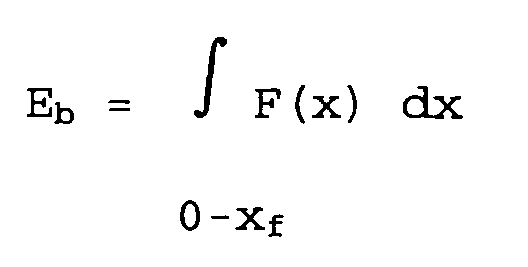
- Semi-solid compositions are characterised by a ratio of Ff to Eb of less than 1.0, more preferred from 0.1 to 0.9, most preferred from 0.2 to 0.6, while traditional tablets of compacted particulate materials are generally characterised by a ratio of Ff to Eb of more than 1, more generally more than 1.25 or even more than 1.5 up to say 6.
- Preferably the tablets of the invention comprise a phase which is both smooth and semi-solid. However sometimes a smooth (non semi-solid) phase may equally be suitable.
In an advantageous embodiment of the invention the smooth or semi-solid phase comprises from 20-80 wt% of non-soap surfactants (based on the total weight of said semi-solid phase), more preferred from 25 to 75 wt%, most preferred 30 to 70 wt%. It has been found that the combination of a separate smooth or semi-solid first region and these high surfactant levels provide very good dispersing and cleaning properties to the tablet. - Preferably the non-soap surfactants in the first region comprise a combination of anionic surfactants and non-ionic surfactants in a weight ratio of from 5 : 1 to 1 : 5, more preferred 3 : 1 to 1 : 3, more preferred 2 : 1 to 1: 2. Further surfactants, for example cationic surfactants may equally be present for example at a level of 0.1 to 10 wt% based on the weight of the smooth or semi-solid part.
- In addition to the non-soap surfactants the smooth or semi-solid region will comprise soap for example at a level of 2 to 90 wt% based on the weight of the smooth or semi-solid part, more preferred from 3 to 70 wt%, most preferred 5 to 40 wt%.
- It has been found that the soap provides good structuring properties to the smooth or semi-solid phase, especially if this phase comprises relatively high levels of surfactants. This structuring leads on the one hand to a desired firm consistency of the semi-solid phase but on the other hand retains the smooth or semi-solid nature of the phase. Furthermore the soap is capable of reducing the bleeding of the smooth or semi-solid phase.
- The smooth or semi-solid region of the tablet will also contain at least 5 wt% of a material selected from polyalkoxylated carbohydrates and stabilising surfactants having an average alkyl chain of more than 6 C atoms and having a salting out resistance greater than or equal to 3.0.
- Examples of suitable polyalkoxylated carbohydrates are carbohydrates comprising from 2 to 10 hydroxy groups (generally 2 to 8 hydroxy groups, more general 2 to 6 hydroxy groups) of which at least 2 are alkoxylated preferably ethoxylated or propoxylated or ethoxy/propoxylated (generally 2 to 4 hydroxy groups are alkoxylated) with on average 2-20 ethoxy and or propoxy groups (generally 4 to 14 groups per alkoxylated hydroxy group, more generally from 5 to 10). The carbohydrates may be advantageously be polyols such as glycerol, sugars and sugar-like materials such as sorbitol. Also the carbohydrates may be esterified with preferably one fatty acid groups.
- Examples of preferred alkoxylated carbohydrate materials are polyoxyethylene-sorbitan mono-fatty esters (for example Tween 20, Tween 40 and Tween 60), polyoxyethylene-sorbitol fatty esters (for example Atlas G4895, Atlox 1045A), polyoxyethylene glycerol esters (for example Atlas G7074), polyoxyethylene glyceril sorbitan isostearate (for example Arlacel 582), polyoxyethylene-hexitan-fatty esters (for example Arlacel 121), polyoxyethylene sorbitan (for example obtainable by hydrolysing Tween 20, Tween 40 and Tween 60), polyoxyethylene-sorbitol, polyoxyethylene glycerol, polyoxyethylene glycerol sorbitan, polypropoxylated sorbitan (for example Atlas G2320, G2330 and G2401).
- Examples of stabilising surfactants having an average alkyl chain of more than 6 C atoms and having a salting out resistance greater than or equal to 3.0. are described in EP 328 177 and EP 359 308. Especially preferably the stabilising surfactants have a salting out resistance of greater than or equal to 4.0, most preferred greater than or equal to 5.0 generally the salting out resistance will be less than 40 or even 20. Especially preferred are alkyl poly alkoxylated carboxylates, alkyl polyalkoxylated phosphates, alkyl polyalkoxylated sulphosuccinates, dialkyl diphenyl oxide disulphonates and alkyl polysaccharides.
- The level of the material selected from polyalkoxylated carbohydrates and stabilising surfactants having an average alkyl chain of more than 6 C atoms and having a salting out resistance greater than or equal to 3.0 (based on the total weight of the semi-solid region is preferably from 5 to 50 wt%, more preferred 10 to 45 wt%, most preferred 15 to 40 wt%.
- The smooth or semi-solid region of the tablet may also contain diluent materials for example polyethyleneglycol preferably having a molecular weight of less than 5000 or even less than 1000, dipropyleneglycol, isopropanol or (mono-)propyleneglycol. Preferably the level of these diluents is from 0 to 50 wt%, more preferred 5 to 45, most preferred from 15 to 40 wt% based on the weight of the smooth or semi-solid phase.
- The smooth or semi-solid phase comprises no or only low levels of water. Preferably the level of water is less than 20 wt % based on the weight of the semi-solid phase, more preferred less than 15 wt%, most preferred from 5 to 12 wt%. Most preferably the smooth or semi-solid phases are substantially free from water, which means that apart from low levels of moisture (e.g. for neutralisation or as crystal water) no additional added water is present.
- Preferably the total weight of surfactants in the smooth or semi-solid phase is from 2 to 20 grammes, more preferred from 3 to 10 grammes.
- In a preferred embodiment of the invention the tablet may be a multi-phase tablet wherein the phases other than the smooth or semi-solid phase as described above comprise no or only low levels of surfactants. Preferably the level of surfactants in the the other phases is less than 10 wt%(based on the total weight of said phases), more preferred from 0 to 9 wt%, most preferred from 1 to 8 wt%.
- In an advantageous embodiment of the invention the cleaning tablets comprise a first smooth or semi-solid region (as described above) in combination with a second region of the tablet which is a solid region, for example prepared by compression of a particulate composition.
- Although the second region may comprise surfactant materials, this region preferably comprises ingredients of the tablet other than surfactants. Examples of these ingredients are for example builders, bleach system, enzymes etc. Preferably the builders in the tablet are predominantly present in the second region. Preferably the bleach system is predominantly present in the second region. Preferably the enzymes are predominantly present in the second region. For the purpose of this invention, unless stated otherwise, the term "predominantly present" refers to a situation wherein at least 90 wt% of an ingredient is present in the second region, more preferred more than 98 wt%, most preferred substantially 100 wt%.
- The above description of the tablet has been given with reference to a tablet constituted by two regions. It will however be understood that each of the regions may be composed of a limited number of discrete regions. For example the first smooth or semi-solid region may be a single discrete part of the tablet but may also be a limited number (say 1-5) discrete smooth or semi-solid parts. Preferably each of these smooth or semi-solid parts are at least 1 gramme, also preferably each of these smooth or semi-solid parts is substantially of the same composition. If reference is made to the composition or weight of the first region it is understood that this concerns the total weight and composition of these smooth or semi-solid parts.
- Similarly the solid second region may be composed of a limited number (say 1-5) of solid parts e.g. separate layers in the tablet. Preferably each of these parts has a weight of at least 10 grammes, also preferably each of the solid parts is substantially of the same composition. If reference is made to the composition or weight of the second region it is understood that this concerns the total weight and composition of these solid parts.
- In addition to the smooth or semi-solid first region and the solid second region the cleaning tablets of the invention may optionally comprise further regions, for example the tablet may be partly or wholly coated.
- Cleaning tablets according to the invention are preferably manufactured by firstly preparing a smooth or semi-solid part. Advantageously the preparation of the smooth or semi-solid phase may include the heating of the ingredients followed by cooling. Advantageously the preparation of the smooth or semi-solid phase may involve extrusion.
- Extrusion processes for washing articles are known, for example WO 01/02532 describes the extrusion of washing articles with a pressure of less than 10 bar.
- Preferably extrusion processes for preparing the smooth or semi-solid parts for use in tablets of the invention will involve the forming of an extrudable mass which is then subsequently extruded from an extrusion device and optionally then partioned into parts of the desired size and weight. Optionally the semi-solid parts may then be hardened.
- The extrudable mass preferably has an initial elevated temperature for example from 60 to 120 C, more preferred from 70 to 90 C. Preferably the extrudable mass is during the production of the smooth or semi-solid mass cooled e.g. to a final temperature of 20 C. If extrusion is used this low temperature may for example be the temperature at the extrusion die for example from 10 to 40, preferably from 15 to 25, most preferred at ambient temperature (20 C).
- In a very preferred embodiment of the invention the conditions for extrusion are carefully controlled. In particular it has been found that semi-solid parts which on the one hand contain relatively high levels of soap and non-soap surfactants and on the other hand have the right textural properties (i.e not too soft and of semi-solid character) can advantageously be produced by an extrusion process wherein no high-shear conditions are applied, in particular under cooling. Particularly it is preferred that the the extrusion takes place under low-shear conditions in the extrusion device. Suitable extrusion devices for this purpose are for example free from extrusion screws. Especially preferred is the feeding of the extrudable mass to a elongated chamber e.g a pipe provided with cooling means but not provided with stirring or shearing devices.
- After the production of the smooth or semi-solid part the cleaning tablet of the invention may advantageously be made by a process comprising the steps of:
- (a) compressing a particulate composition int a tablet mould
- (b) combining one or more smooth or semi-solid parts with the compressed particulate composition.
-
- In a preferred embodiment of the invention the particulate composition is compressed at a force of 0.1 to 100 kN/cm2.
- A tablet of this invention may be intended for use in machine dishwashing. Such a tablet is likely to contain surfactant in a low concentration such as 0.5 to 2 wt% based on the whole tablet, although higher concentrations ranging up to 10 wt% may be used. Such will typically contain salts, such as over 60 wt%, often over 85 wt% of the tablet.
- Water soluble salts typically used in machine dishwashing compositions are phosphates (including condensed phosphates) carbonates and silicates, generally as alkali metal salts. Water soluble alkali metal salts selected from phosphates, carbonates and silicates may provide 60 wt% or more of a dishwashing composition.
- Another preferred possibility is that a tablet of this invention will be intended for fabric washing. In this event the tablet will be likely to contain at least 2 wt%, probably at least 5 wt%, up to 40 or 50 wt% non-soap surfactant based on the whole tablet, and from 5 to 80 wt% detergency builder, based on the whole tablet.
- Materials which may be used in tablets of this invention will now be discussed in more detail.
- Compositions which are used in tablets of the invention will contain one or more detergent surfactants. In a fabric washing composition, these preferably provide from 5 to 50% by weight of the overall tablet composition, more preferably from 8 or 9% by weight of the overall composition up to 40% or 50% by weight. Surfactant may be anionic (soap or non-soap), cationic, zwitterionic, amphoteric, nonionic or a combination of these.
- Anionic surfactant may be present in an amount from 0.5 to 50% by weight, preferably from 2% or 4% up to 30% or 40% by weight of the tablet composition.
- Synthetic (i.e. non-soap) anionic surfactants are well known to those skilled in the art. Examples include alkylbenzene sulphonates, particularly sodium linear alkylbenzene sulphonates having an alkyl chain length of C8-C15; olefin sulphonates; alkane sulphonates; dialkyl sulphosuccinates; and fatty acid ester sulphonates.
- Primary alkyl sulphate having the formulaLinear alkyl benzene sulphonate of the formula
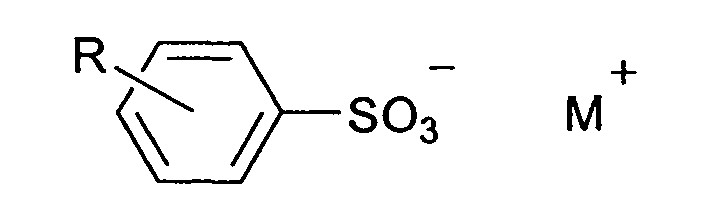
where R is linear alkyl of 8 to 15 carbon atoms and M+ is a solubilising cation, especially sodium, is also a commercially significant anionic surfactant. - Frequently, such linear alkyl benzene sulphonate or primary alkyl sulphate of the formula above, or a mixture thereof will be the desired anionic surfactant and may provide 75 to 100 wt% of any anionic non-soap surfactant in the composition.
- In some forms of this invention the amount of non-soap anionic surfactant lies in a range from 5 to 20 wt% of the tablet composition.
- Soaps for use in accordance to the invention are preferably sodium soaps derived from naturally occurring fatty acids, for example, the fatty acids from coconut oil, beef tallow, sunflower or hardened rapeseed oil. Especially preferably soaps are selected from C10 to C20 soaps for example from C16 to C18 or C12 soaps.
- Suitable nonionic surfactant compounds which may be used include in particular the reaction products of compounds having a hydrophobic group and a reactive hydrogen atom, for example, aliphatic alcohols, acids, amides or alkyl phenols with alkylene oxides, especially ethylene oxide.
- Specific nonionic surfactant compounds are alkyl (C8-22) phenol-ethylene oxide condensates, the condensation products of linear or branched aliphatic C8-20 primary or secondary alcohols with ethylene oxide, and products made by condensation of ethylene oxide with the reaction products of propylene oxide and ethylene-diamine.
- Especially preferred are the primary and secondary alcohol ethoxylates, especially the C9-11 and C12-15 primary and secondary alcohols ethoxylated with an average of from 5 to 20 moles of ethylene oxide per mole of alcohol.
- In some fabric washing tablets of this invention, the amount of nonionic surfactant lies in a range from 4 to 40%, better 4 or 5 to 30% by weight of the whole tablet.
- Many nonionic surfactants are liquids. These may be absorbed onto particles of the composition.
- In a machine dishwashing tablet the surfactant may be wholly nonionic, in an amount below 5 wt% of the whole tablet although it is known to include some anionic surfactant and to use up to 10 wt% surfactant in total.
- A composition which is used in tablets of the invention will usually contain from 5 to 80%, more usually 15 to 60% by weight of detergency builder. This may be provided wholly by water soluble materials, or may be provided in large part or even entirely by water-insoluble material with water-softening properties. Water-insoluble detergency builder may be present as 5 to 80 wt%, better 5 to 60 wt% of the composition.
- Alkali metal aluminosilicates are strongly favoured as environmentally acceptable water-insoluble builders for fabric washing. Alkali metal (preferably sodium) aluminosilicates may be either crystalline or amorphous or mixtures thereof, having the general formula:
- These materials contain some bound water (indicated as "xH2O") and are required to have a calcium ion exchange capacity of at least 50 mg CaO/g. The preferred sodium aluminosilicates contain 1.5-3.5 SiO2 units (in the formula above). Both the amorphous and the crystalline materials can be prepared readily by reaction between sodium silicate and sodium aluminate, as amply described in the literature.
- Suitable crystalline sodium aluminosilicate ion-exchange detergency builders are described, for example, in GB 1429143 (Procter & Gamble). The preferred sodium aluminosilicates of this type are the well known commercially available zeolites A and X, the novel zeolite P described and claimed in EP 384070 (Unilever) and mixtures thereof.
- Conceivably a water-insoluble detergency builder could be a layered sodium silicate as described in US 4664839.
NaSKS-6 is the trademark for a crystalline layered silicate marketed by Hoechst (commonly abbreviated as "SKS-6"). NaSKS-6 has the delta-Na2SiO5 morphology form of layered silicate. It can be prepared by methods such as described in DE-A-3,417,649 and DE-A-3,742,043. Other such layered silicates, such as those having the general formula NaMSixO2x+1·yH2O wherein M is sodium or hydrogen, x is a number from 1.9 to 4, preferably 2, and y is a number from 0 to 20, preferably 0 can be used. - Water-soluble phosphorous-containing inorganic detergency builders, include the alkali-metal orthophosphates, metaphosphates, pyrophosphates and polyphosphates. Specific examples of inorganic phosphate builders include sodium and potassium tripolyphosphates, orthophosphates and hexametaphosphates.
- Non-phosphorous water-soluble builders may be organic or inorganic. Inorganic builders that may be present include alkali metal (generally sodium) carbonate; while organic builders include polycarboxylate polymers, such as polyacrylates, acrylic/maleic copolymers, and acrylic phosphonates, monomeric polycarboxylates such as citrates, gluconates, oxydisuccinates, glycerol mono- di- and trisuccinates, carboxymethyloxysuccinates, carboxymethyloxymalonates, dipicolinates and hydroxyethyliminodiacetates.
- At least one region (preferably the second region) of a fabric washing tablet preferably include polycarboxylate polymers, more especially polyacrylates and acrylic/maleic copolymers which can function as builders and also inhibit unwanted deposition onto fabric from the wash liquor.
- Tablets according to the invention may contain a bleach system in at least one region of a tablet, preferably in the second region. This preferably comprises one or more peroxy bleach compounds, for example, inorganic persalts or organic peroxyacids, which may be employed in conjunction with activators to improve bleaching action at low wash temperatures. If any peroxygen compound is present, the amount is likely to lie in a range from 10 to 25% by weight of the composition.
- Preferred inorganic persalts are sodium perborate monohydrate and tetrahydrate, and sodium percarbonate, advantageously employed together with an activator. Bleach activators, also referred to as bleach precursors, have been widely disclosed in the art. Preferred examples include peracetic acid precursors, for example, tetraacetylethylene diamine (TAED), now in widespread commercial use in conjunction with sodium perborate; and perbenzoic acid precursors. The quaternary ammonium and phosphonium bleach activators disclosed in US 4751015 and US 4818426 (Lever Brothers Company) are also of interest. Another type of bleach activator which may be used, but which is not a bleach precursor, is a transition metal catalyst as disclosed in EP-A-458397, EP-A-458398 and EP-A-549272. A bleach system may also include a bleach stabiliser (heavy metal sequestrant) such as ethylenediamine tetramethylene phosphonate and diethylenetriamine pentamethylene phosphonate.
- As indicated above, if a bleach is present and is a water-soluble inorganic peroxygen bleach, the amount may well be from 10% to 25% by weight of the composition.
- The detergent tablets of the invention may also contain (preferably in the second region) one of the detergency enzymes well known in the art for their ability to degrade and aid in the removal of various soils and stains. Suitable enzymes include the various proteases, cellulases, lipases, amylases, and mixtures thereof, which are designed to remove a variety of soils and stains from fabrics. Examples of suitable proteases are Maxatase (Trade Mark), as supplied by Gist-Brocades N.V., Delft, Holland, and Alcalase (Trade Mark), and Savinase (Trade Mark), as supplied by Novo Industri A/S, Copenhagen, Denmark. Detergency enzymes are commonly employed in the form of granules or marumes, optionally with a protective coating, in amount of from about 0.1% to about 3.0% by weight of the composition; and these granules or marumes present no problems with respect to compaction to form a tablet.
- The detergent tablets of the invention may also contain (preferably in the second region) a fluorescer (optical brightener), for example, Tinopal (Trade Mark) DMS or Tinopal CBS available from Ciba-Geigy AG, Basel, Switzerland. Tinopal DMS is disodium 4,4'bis-(2-morpholino-4-anilino-s-triazin-6-ylamino) stilbene disulphonate; and Tinopal CBS is disodium 2,2'-bis-(phenyl-styryl) disulphonate.
- An antifoam material is advantageously included (preferably in the second region), especially if a detergent tablet is primarily intended for use in front-loading drum-type automatic washing machines. Suitable antifoam materials are usually in granular form, such as those described in EP 266863A (Unilever). Such antifoam granules typically comprise a mixture of silicone oil, petroleum jelly, hydrophobic silica and alkyl phosphate as antifoam active material, absorbed onto a porous absorbed water-soluble carbonate-based inorganic carrier material. Antifoam granules may be present in an amount up to 5% by weight of the composition.
- It may also be desirable that a detergent tablet of the invention includes an amount of an alkali metal silicate, particularly sodium ortho-, meta- or disilicate. The presence of such alkali metal silicates at levels, for example, of 0.1 to 10 wt%, may be advantageous in providing protection against the corrosion of metal parts in washing machines, besides providing some measure of building and giving processing benefits in manufacture of the particulate material which is compacted into tablets.
- A tablet for fabric washing will generally not contain more than 15 wt% silicate. A tablet for machine dishwashing will often contain more than 20 wt% silicate. Preferably the silicate is present in the second region of the tablet.
- Further ingredients which can optionally be employed in a region of a fabric washing detergent of the invention tablet (preferably the second region) include anti-redeposition agents such as sodium carboxymethylcellulose, straight-chain polyvinyl pyrrolidone and the cellulose ethers such as methyl cellulose and ethyl hydroxyethyl cellulose, fabric-softening agents; heavy metal sequestrants such as EDTA; perfumes; and colorants or coloured speckles.
- Further ingredients which can optionally be used in tablets of the invention, preferably in the second region are dispersing aids. Examples of suitable dispersing aids are water-swellable polymers (e.g. SCMC) highly soluble materials (e.g. sodium citrate, potassium carbonate or sodium acetate) or sodium tripolyphospate with preferably at least 40% of the anhydrous phase I form.
- The second region of a detergent tablet of this invention, is a preferably a matrix of compacted particles.
- Preferably the particulate composition has an average particle size in the range from 200 to 2000 µm, more preferably from 250 to 1400 µm. Fine particles, smaller than 180 µm or 200 µm may be eliminated by sieving before tableting, if desired, although we have observed that this is not always essential.
- While the starting particulate composition may in principle have any bulk density, the present invention is especially relevant to tablets made by compacting powders of relatively high bulk density, because of their greater tendency to exhibit disintegration and dispersion problems. Such tablets have the advantage that, as compared with a tablet derived from a low bulk density powder, a given dose of composition can be presented as a smaller tablet.
- Thus the starting particulate composition may suitably have a bulk density of at least 400 g/litre, preferably at least 500 g/litre, and perhaps at least 600 g/litre.
- Tableting machinery able to carry out the manufacture of tablets of the invention is known, for example suitable tablet presses are available from Fette and from Korch.
- Tableting may be carried out at ambient temperature or at a temperature above ambient which may allow adequate strength to be achieved with less applied pressure during compaction. In order to carry out the tableting at a temperature which is above ambient, the particulate composition is preferably supplied to the tableting machinery at an elevated temperature. This will of course supply heat to the tableting machinery, but the machinery may be heated in some other way also.
- The size of a tablet will suitably range from 10 to 160 grams, preferably from 15 to 60 g, depending on the conditions of intended use, and whether it represents a dose for an average load in a fabric washing or dishwashing machine or a fractional part of such a dose. The tablets may be of any shape. However, for ease of packaging they are preferably blocks of substantially uniform cross-section, such as cylinders or cuboids. The overall density of a tablet preferably lies in a range from 1040 or 1050gm/litre up to 1600gm/litre.
- 7 kg of anionic surfactant (Dobanic acid 103 ex Shell) and 6kg of nonionic surfactant (Neodol 1-5) were mixed and neutralised to a pH of 9 using a 50% NaOH solution.
- Soap fatty acid (ex Uniqema), diluent dipropylene glycol (ex Vopak) and ethoxylated materials were added to the mixture in the amounts as indicated in the table. The mixture was kept at a temperature around 80°C until the fatty acid had dissolved and then further neutralised with a 50% NaOH solution to a pH of 11.
- After neutralisation to pH of 11, the mixture was pumped into a sequence of 2 stainless steel tubes by a Maag Sinox P7 pump or a piston pump, type SIBa HK 05016SST4000M000 ex Prominent, Vleuten (NL). Both tubes were double jacketed. The first tube was 2.5m long and had an inner diameter of 73mm. The second tube was 1.5m long and had an inner diameter of 45mm. The tubes were connected by a 10cm long pipe.
- The extrusion was performed via die-head (with inner diameters of resp 24 and 32 mm), which was attached to the second tube.
- The mixture was pumped into the tubes at a temperature of 85°C at a throughput of 4 kg/hr. The first tube was cooled using a water bath at 40°C. The second tube was cooled using a 50:50 weight mixture of ethylene glycol and water. The coolant temperature was -15°C. The material coming out of the second tube had a temperature of about 20 C and was collected and divided into bars of around 0.5m.
- After storage the bars were cut into smooth and semi-solid cylindrical slices (18mm diameter) of comparable quality and 5 gramme each.
- The dissolution of the slices was determined by immersing a piece into 500 ml tap water at 20 C, stirring at 200 rpm and measuring the remaining weight of the slices at 3 or 5 minute intervals. t80 (the time by which 80% of the mass of the test piece has dissolved was determined.
- The following results were obtained.
Formulations (all levels are dosed on top of the anionic/nonionic mixture) and t80 in minutes. Adjunct (%) DPG (%) C12 soap(%) t80 (min) A (comp) 0 0 25 >35 B 50 (Tween 40) 0 25 25 C 25 (Tween 40) 25 25 18 D 25 (Atlas G2330) 25 25 27 - A detergent powder was made of the following composition by pregranulating the granule ingredients, followed by post-dosing the rest of the ingredients
Ingredient Parts by weight Granules Na-las 1.1 Nonionic 7EO 0.5 C12 soap 0.1 NaAc.3aq 0.3 Zeolite A24 2.4 Light soda ash 0.4 Moisture/minors 0.4 Post-dose EAG (17% silicone) 3.0 Fluorescer (15%) 2.2 STP 62.4 Na-disilicate (80%) 3.8 TAED (83%) 4.3 Percarbonate 16.9 Dequest 2047 1.9 Minors/ enzymes/colour to 100 - The tablets were made in 2 different ways:
- (I) 20 grammes of the powder are inserted into a 45 mm die of a tabletting machine, optionally followed by a flattening step, followed by addition of a single semi-solid part on top of the powder bed. After addition of the semi-solid onto the powder bed or flattened powder, the whole material is compressed at 30kN into a single tablet, followed by ejection of the tablet. This results in a tablet with a semi-solid part embedded in the cleaning tablet. The density of the powdered region is 1.5 kg/litre, the density of the semi-solid part is 1.0 kg/litre. The height of the semi-solid part after compression is 3.4 mm, of the powdered part 11 mm.
-
- Smooth cleaning tablet parts were made by the method of the previous examples. Each smooth part comprised:
Component parts by weight Ref
25/7Ref
50/16Sample
A1/A2Sample
B1/B2/B3LAS-acid/Lutensol AO5 = 7/6 100 100 100 100 NaOH (50%), pH to ∼11 13 13 13 13 Mono Propylene Glycol (MPG) 25 50 52.7 52.7 Pristerene 4916 6.9 16. 3 14.5 14.5 NaOH (50%), pH to ∼11 2 5 4.5 4.5 Co-surfactant - - 5 6.9 - The selected co-surfactants were:
Trade name/description Chemical description Supplier Used in example Empicol CBC Alkyl Ether Caboxylate, C12E4C Huntsmann A1 Empicol CBL Alkyl Ether Caboxylate, C10-16E13C Huntsmann A2 Daclor 70-3-23-AL Alkyl Ether Sulphate, C12-13E3S Daclor B1 Glucapon 600 CSUP Alkyl PolyGlucoside, C10-16 Cognis B2 C12-14 APG Alkyl PolyGlucoside, C12-14G1.7 Cognis B3 The co-surfactants used in examples A1, A2, B1, B2 and B3 were freeze dried untill water activities Aw<0.5 before incorporation into the mixture. - The hardness of the Gels were quantified using Stevens LFRA Texture Analyser by measuring the resistance of a rod (diameter 12.7mm) pushed into the gel at a penetration speed of 1 mm/s at room temperature.
- The dissolution rate was measured by measuring the time of dissolution of ∼5 grams of smooth part in 1 liter of demineralised water under stirring at 200 rpm at 20C, the time was taken after 80% of the weight of the smooth sample was dissolved (T80).
-
Hardness and Dissolution speed of the various Gels. Experiments Stevens Hardness force (g) Dissolution speed T80 (min) Reference 25/7 10057 54 Reference 50/16 13069 47 Empicol CBC 11091 35 Empicol CBL 11422 32 LES( Daclor 70-3-23-AL) 11395 33 Glucopon 600 CSUP 10989 32 C12-14 APG 13425 29
Claims (11)
- A cleaning tablet comprising a smooth or semi-solid phase wherein the smooth or semi-solid phase comprises:(a) from 10 to 90 wt% of non-soap surfactants; and(b) from 2 to 75 wt% of soap;(c) from 5 to 50 wt% a material selected from polyalkoxylated carbohydrates and stabilising surfactants having an average alkyl chain of more than 6 C atoms and having a salting out resistance greater than or equal to 3.0; and(c) from 0 to 20 wt% of water.
- A cleaning tablet according to claim 1, wherein the smooth or semi-solid phase has a weight of 2 to 20 grammes.
- A cleaning tablet according to claim 1 comprising 3 to 70 wt % soap based on the weight of the smooth or semi-solid phase.
- A cleaning tablet comprising according to one or more of the preceding claims wherein the smooth phase is a semi-solid phase characterised by a ratio of Ff to Eb of less than 1.0,
Ff being the failure force
Eb being the break energy. - A cleaning tablet according to one or more of the preceding claims wherein the material is selected from the group of polyoxyethylene-sorbitan mono-fatty esters, polyoxyethylene-sorbitol fatty esters, polyoxyethylene glycerol esters, polyoxyethylene glyceril sorbitan isostearate, polyoxyethylene-hexitan-fatty esters, polyoxyethylene sorbitan, polyoxyethylene-sorbitol, polyoxyethylene glycerol, polyoxyethylene glycerol sorbitan, polypropoxylated sorbitan alkyl polyalkoxylated carboxylates, alkyl polyalkoxylated phosphates, alkyl polyalkoxylated sulphosuccinates, dialkyl diphenyl oxide disulphonates and alkyl polysaccharides or mixtures thereof.
- A cleaning tablet according to claim 5, wherein the material is a polyethoxylated sorbitan or ester thereof.
- A cleaning tablet according to claim 5 or 6, wherein the level of the material is from 10 to 45 wt% based on the weight of the smooth or semi-solid phase.
- A cleaning tablet according to claim 1, wherein the material is a alkylpoly saccharide.
- A cleaning tablet according to one or more of the preceding claims comprising 5 To 50 wt% of diluent, based on the weight of the smooth or semi-solid phase.
- A cleaning tablet according to claim 8, wherein the diluent is dipropyleneglycol or mono propyleneglycol.
- A cleaning tablet according to claim 1, wherein the stabilising surfactant has a salting out resistance greater or equal to 4.0 more preferred more than 5.0.
Priority Applications (1)
| Application Number | Priority Date | Filing Date | Title |
|---|---|---|---|
| EP03077852A EP1405901B1 (en) | 2002-10-01 | 2003-09-11 | Detergent compositions |
Applications Claiming Priority (3)
| Application Number | Priority Date | Filing Date | Title |
|---|---|---|---|
| EP02256832 | 2002-10-01 | ||
| EP02256832 | 2002-10-01 | ||
| EP03077852A EP1405901B1 (en) | 2002-10-01 | 2003-09-11 | Detergent compositions |
Publications (2)
| Publication Number | Publication Date |
|---|---|
| EP1405901A1 true EP1405901A1 (en) | 2004-04-07 |
| EP1405901B1 EP1405901B1 (en) | 2007-06-13 |
Family
ID=38220035
Family Applications (1)
| Application Number | Title | Priority Date | Filing Date |
|---|---|---|---|
| EP03077852A Expired - Lifetime EP1405901B1 (en) | 2002-10-01 | 2003-09-11 | Detergent compositions |
Country Status (4)
| Country | Link |
|---|---|
| EP (1) | EP1405901B1 (en) |
| AT (1) | ATE364680T1 (en) |
| DE (1) | DE60314348T2 (en) |
| ES (1) | ES2287408T3 (en) |
Cited By (10)
| Publication number | Priority date | Publication date | Assignee | Title |
|---|---|---|---|---|
| EP1669438A1 (en) | 2004-12-08 | 2006-06-14 | Unilever N.V. | Detergent tablet |
| EP1676904A1 (en) | 2005-01-04 | 2006-07-05 | Unilever N.V. | Detergent tablets |
| EP1705240A1 (en) | 2005-03-23 | 2006-09-27 | Unilever N.V. | Detergent tablets |
| EP1705241A1 (en) | 2005-03-23 | 2006-09-27 | Unilever N.V. | Detergent compositions in tablet form |
| WO2006105863A1 (en) * | 2005-04-05 | 2006-10-12 | Unilever Plc | Dispensing device |
| EP1746152A1 (en) | 2005-07-20 | 2007-01-24 | Unilever N.V. | Detergent compositions |
| EP1746151A1 (en) | 2005-07-20 | 2007-01-24 | Unilever N.V. | Detergent tablet compositions |
| EP1903100A1 (en) * | 2006-09-19 | 2008-03-26 | Unilever N.V. | Detergent tablet compositions |
| WO2012069895A1 (en) | 2010-11-12 | 2012-05-31 | Dental Care Innovation Gmbh | Soluble tablet, containing abrasive media |
| US10959931B2 (en) | 2017-02-02 | 2021-03-30 | Water Pik, Inc. | Tablet including abrasive for dental cleaning |
Citations (3)
| Publication number | Priority date | Publication date | Assignee | Title |
|---|---|---|---|---|
| WO1999020730A1 (en) * | 1997-10-22 | 1999-04-29 | Unilever Plc | Detergent compositions in tablet form |
| US6083893A (en) * | 1994-05-16 | 2000-07-04 | The Proctor And Gamble Co. | Shaped semi-solid or solid dishwashing detergent |
| WO2000061717A1 (en) * | 1999-04-09 | 2000-10-19 | The Procter Gamble Company | Detergent tablet |
-
2003
- 2003-09-11 ES ES03077852T patent/ES2287408T3/en not_active Expired - Lifetime
- 2003-09-11 EP EP03077852A patent/EP1405901B1/en not_active Expired - Lifetime
- 2003-09-11 DE DE60314348T patent/DE60314348T2/en not_active Expired - Lifetime
- 2003-09-11 AT AT03077852T patent/ATE364680T1/en not_active IP Right Cessation
Patent Citations (3)
| Publication number | Priority date | Publication date | Assignee | Title |
|---|---|---|---|---|
| US6083893A (en) * | 1994-05-16 | 2000-07-04 | The Proctor And Gamble Co. | Shaped semi-solid or solid dishwashing detergent |
| WO1999020730A1 (en) * | 1997-10-22 | 1999-04-29 | Unilever Plc | Detergent compositions in tablet form |
| WO2000061717A1 (en) * | 1999-04-09 | 2000-10-19 | The Procter Gamble Company | Detergent tablet |
Cited By (13)
| Publication number | Priority date | Publication date | Assignee | Title |
|---|---|---|---|---|
| EP1669438A1 (en) | 2004-12-08 | 2006-06-14 | Unilever N.V. | Detergent tablet |
| EP1676904A1 (en) | 2005-01-04 | 2006-07-05 | Unilever N.V. | Detergent tablets |
| EP1705240A1 (en) | 2005-03-23 | 2006-09-27 | Unilever N.V. | Detergent tablets |
| EP1705241A1 (en) | 2005-03-23 | 2006-09-27 | Unilever N.V. | Detergent compositions in tablet form |
| WO2006105863A1 (en) * | 2005-04-05 | 2006-10-12 | Unilever Plc | Dispensing device |
| EP1746152A1 (en) | 2005-07-20 | 2007-01-24 | Unilever N.V. | Detergent compositions |
| EP1746151A1 (en) | 2005-07-20 | 2007-01-24 | Unilever N.V. | Detergent tablet compositions |
| EP1903100A1 (en) * | 2006-09-19 | 2008-03-26 | Unilever N.V. | Detergent tablet compositions |
| WO2012069895A1 (en) | 2010-11-12 | 2012-05-31 | Dental Care Innovation Gmbh | Soluble tablet, containing abrasive media |
| DE102010051226A1 (en) | 2010-11-12 | 2012-05-31 | Dental Care Innovation Gmbh | Rinse-off tray with abrasive components |
| US9493731B2 (en) | 2010-11-12 | 2016-11-15 | Dental Care Innovation Gmbh | Soluble tablet, containing abrasive media |
| US10959931B2 (en) | 2017-02-02 | 2021-03-30 | Water Pik, Inc. | Tablet including abrasive for dental cleaning |
| US11596587B2 (en) | 2017-02-02 | 2023-03-07 | Water Pik, Inc. | Tablet including abrasive for dental cleaning |
Also Published As
| Publication number | Publication date |
|---|---|
| DE60314348D1 (en) | 2007-07-26 |
| DE60314348T2 (en) | 2008-02-21 |
| ES2287408T3 (en) | 2007-12-16 |
| EP1405901B1 (en) | 2007-06-13 |
| ATE364680T1 (en) | 2007-07-15 |
Similar Documents
| Publication | Publication Date | Title |
|---|---|---|
| EP1705241B1 (en) | Detergent compositions in tablet form | |
| EP1382668B1 (en) | Detergent tablets | |
| EP1147172B1 (en) | Detergent tablets | |
| EP1027421B2 (en) | Detergent compositions in tablet form | |
| EP1511834B1 (en) | Detergent tablets | |
| EP1405901B1 (en) | Detergent compositions | |
| EP1418224B1 (en) | Method for producing a cleaning tablet | |
| EP1405902A1 (en) | Detergent compositions | |
| EP1375636B1 (en) | Detergent tablets | |
| EP0972007B1 (en) | Detergent compositions | |
| EP1405900B1 (en) | Detergent compositions | |
| EP1371720B1 (en) | Detergent tablets | |
| US6310028B1 (en) | Water-softening and detergent compositions containing partially hydrated Na acetate | |
| EP1491622B1 (en) | Detergent compositions | |
| EP1574563B1 (en) | Use of detergent tablets | |
| US20020068688A1 (en) | Cleaning compositions | |
| EP1469061B1 (en) | Method for the Preparation of multiphase cleaning tablet comprising a smooth phase | |
| EP1522575B1 (en) | Detergent compositions | |
| EP1676904B1 (en) | Detergent tablets | |
| EP1496105B1 (en) | Detergent compositions | |
| EP1516916A1 (en) | Detergent compositions | |
| EP1466964A1 (en) | Cleaning compositions | |
| EP1746151A1 (en) | Detergent tablet compositions | |
| EP1466965A1 (en) | Cleaning compositions | |
| EP1496106A1 (en) | Detergent compositions |
Legal Events
| Date | Code | Title | Description |
|---|---|---|---|
| PUAI | Public reference made under article 153(3) epc to a published international application that has entered the european phase |
Free format text: ORIGINAL CODE: 0009012 |
|
| 17P | Request for examination filed |
Effective date: 20031127 |
|
| AK | Designated contracting states |
Kind code of ref document: A1 Designated state(s): AT BE BG CH CY CZ DE DK EE ES FI FR GB GR HU IE IT LI LU MC NL PT RO SE SI SK TR |
|
| AX | Request for extension of the european patent |
Extension state: AL LT LV MK |
|
| AKX | Designation fees paid |
Designated state(s): AT BE BG CH CY CZ DE DK EE ES FI FR GB GR HU IE IT LI LU MC NL PT RO SE SI SK TR |
|
| 17Q | First examination report despatched |
Effective date: 20050711 |
|
| 17Q | First examination report despatched |
Effective date: 20050711 |
|
| GRAP | Despatch of communication of intention to grant a patent |
Free format text: ORIGINAL CODE: EPIDOSNIGR1 |
|
| GRAS | Grant fee paid |
Free format text: ORIGINAL CODE: EPIDOSNIGR3 |
|
| GRAA | (expected) grant |
Free format text: ORIGINAL CODE: 0009210 |
|
| AK | Designated contracting states |
Kind code of ref document: B1 Designated state(s): AT BE BG CH CY CZ DE DK EE ES FI FR GB GR HU IE IT LI LU MC NL PT RO SE SI SK TR |
|
| PG25 | Lapsed in a contracting state [announced via postgrant information from national office to epo] |
Ref country code: CH Free format text: LAPSE BECAUSE OF FAILURE TO SUBMIT A TRANSLATION OF THE DESCRIPTION OR TO PAY THE FEE WITHIN THE PRESCRIBED TIME-LIMIT Effective date: 20070613 Ref country code: LI Free format text: LAPSE BECAUSE OF FAILURE TO SUBMIT A TRANSLATION OF THE DESCRIPTION OR TO PAY THE FEE WITHIN THE PRESCRIBED TIME-LIMIT Effective date: 20070613 |
|
| REG | Reference to a national code |
Ref country code: GB Ref legal event code: FG4D |
|
| REG | Reference to a national code |
Ref country code: CH Ref legal event code: EP |
|
| REG | Reference to a national code |
Ref country code: IE Ref legal event code: FG4D |
|
| REF | Corresponds to: |
Ref document number: 60314348 Country of ref document: DE Date of ref document: 20070726 Kind code of ref document: P |
|
| PG25 | Lapsed in a contracting state [announced via postgrant information from national office to epo] |
Ref country code: SE Free format text: LAPSE BECAUSE OF FAILURE TO SUBMIT A TRANSLATION OF THE DESCRIPTION OR TO PAY THE FEE WITHIN THE PRESCRIBED TIME-LIMIT Effective date: 20070913 |
|
| ET | Fr: translation filed | ||
| PG25 | Lapsed in a contracting state [announced via postgrant information from national office to epo] |
Ref country code: AT Free format text: LAPSE BECAUSE OF FAILURE TO SUBMIT A TRANSLATION OF THE DESCRIPTION OR TO PAY THE FEE WITHIN THE PRESCRIBED TIME-LIMIT Effective date: 20070613 |
|
| NLV1 | Nl: lapsed or annulled due to failure to fulfill the requirements of art. 29p and 29m of the patents act | ||
| REG | Reference to a national code |
Ref country code: ES Ref legal event code: FG2A Ref document number: 2287408 Country of ref document: ES Kind code of ref document: T3 |
|
| REG | Reference to a national code |
Ref country code: CH Ref legal event code: PL |
|
| PG25 | Lapsed in a contracting state [announced via postgrant information from national office to epo] |
Ref country code: CZ Free format text: LAPSE BECAUSE OF FAILURE TO SUBMIT A TRANSLATION OF THE DESCRIPTION OR TO PAY THE FEE WITHIN THE PRESCRIBED TIME-LIMIT Effective date: 20070613 Ref country code: BG Free format text: LAPSE BECAUSE OF FAILURE TO SUBMIT A TRANSLATION OF THE DESCRIPTION OR TO PAY THE FEE WITHIN THE PRESCRIBED TIME-LIMIT Effective date: 20070913 Ref country code: NL Free format text: LAPSE BECAUSE OF FAILURE TO SUBMIT A TRANSLATION OF THE DESCRIPTION OR TO PAY THE FEE WITHIN THE PRESCRIBED TIME-LIMIT Effective date: 20070613 Ref country code: PT Free format text: LAPSE BECAUSE OF FAILURE TO SUBMIT A TRANSLATION OF THE DESCRIPTION OR TO PAY THE FEE WITHIN THE PRESCRIBED TIME-LIMIT Effective date: 20071113 Ref country code: SI Free format text: LAPSE BECAUSE OF FAILURE TO SUBMIT A TRANSLATION OF THE DESCRIPTION OR TO PAY THE FEE WITHIN THE PRESCRIBED TIME-LIMIT Effective date: 20070613 |
|
| PG25 | Lapsed in a contracting state [announced via postgrant information from national office to epo] |
Ref country code: SK Free format text: LAPSE BECAUSE OF FAILURE TO SUBMIT A TRANSLATION OF THE DESCRIPTION OR TO PAY THE FEE WITHIN THE PRESCRIBED TIME-LIMIT Effective date: 20070613 |
|
| PLBE | No opposition filed within time limit |
Free format text: ORIGINAL CODE: 0009261 |
|
| STAA | Information on the status of an ep patent application or granted ep patent |
Free format text: STATUS: NO OPPOSITION FILED WITHIN TIME LIMIT |
|
| PG25 | Lapsed in a contracting state [announced via postgrant information from national office to epo] |
Ref country code: MC Free format text: LAPSE BECAUSE OF NON-PAYMENT OF DUE FEES Effective date: 20070930 Ref country code: DK Free format text: LAPSE BECAUSE OF FAILURE TO SUBMIT A TRANSLATION OF THE DESCRIPTION OR TO PAY THE FEE WITHIN THE PRESCRIBED TIME-LIMIT Effective date: 20070613 Ref country code: GR Free format text: LAPSE BECAUSE OF FAILURE TO SUBMIT A TRANSLATION OF THE DESCRIPTION OR TO PAY THE FEE WITHIN THE PRESCRIBED TIME-LIMIT Effective date: 20070914 Ref country code: IT Free format text: LAPSE BECAUSE OF FAILURE TO SUBMIT A TRANSLATION OF THE DESCRIPTION OR TO PAY THE FEE WITHIN THE PRESCRIBED TIME-LIMIT Effective date: 20070613 |
|
| 26N | No opposition filed |
Effective date: 20080314 |
|
| PG25 | Lapsed in a contracting state [announced via postgrant information from national office to epo] |
Ref country code: RO Free format text: LAPSE BECAUSE OF FAILURE TO SUBMIT A TRANSLATION OF THE DESCRIPTION OR TO PAY THE FEE WITHIN THE PRESCRIBED TIME-LIMIT Effective date: 20070613 |
|
| PG25 | Lapsed in a contracting state [announced via postgrant information from national office to epo] |
Ref country code: IE Free format text: LAPSE BECAUSE OF NON-PAYMENT OF DUE FEES Effective date: 20070911 |
|
| PG25 | Lapsed in a contracting state [announced via postgrant information from national office to epo] |
Ref country code: EE Free format text: LAPSE BECAUSE OF FAILURE TO SUBMIT A TRANSLATION OF THE DESCRIPTION OR TO PAY THE FEE WITHIN THE PRESCRIBED TIME-LIMIT Effective date: 20070613 |
|
| PG25 | Lapsed in a contracting state [announced via postgrant information from national office to epo] |
Ref country code: FI Free format text: LAPSE BECAUSE OF FAILURE TO SUBMIT A TRANSLATION OF THE DESCRIPTION OR TO PAY THE FEE WITHIN THE PRESCRIBED TIME-LIMIT Effective date: 20070613 |
|
| PG25 | Lapsed in a contracting state [announced via postgrant information from national office to epo] |
Ref country code: CY Free format text: LAPSE BECAUSE OF FAILURE TO SUBMIT A TRANSLATION OF THE DESCRIPTION OR TO PAY THE FEE WITHIN THE PRESCRIBED TIME-LIMIT Effective date: 20070613 |
|
| PG25 | Lapsed in a contracting state [announced via postgrant information from national office to epo] |
Ref country code: LU Free format text: LAPSE BECAUSE OF NON-PAYMENT OF DUE FEES Effective date: 20070911 |
|
| PG25 | Lapsed in a contracting state [announced via postgrant information from national office to epo] |
Ref country code: HU Free format text: LAPSE BECAUSE OF FAILURE TO SUBMIT A TRANSLATION OF THE DESCRIPTION OR TO PAY THE FEE WITHIN THE PRESCRIBED TIME-LIMIT Effective date: 20071214 Ref country code: TR Free format text: LAPSE BECAUSE OF FAILURE TO SUBMIT A TRANSLATION OF THE DESCRIPTION OR TO PAY THE FEE WITHIN THE PRESCRIBED TIME-LIMIT Effective date: 20070613 |
|
| PGFP | Annual fee paid to national office [announced via postgrant information from national office to epo] |
Ref country code: ES Payment date: 20100927 Year of fee payment: 8 |
|
| PGFP | Annual fee paid to national office [announced via postgrant information from national office to epo] |
Ref country code: FR Payment date: 20100930 Year of fee payment: 8 |
|
| PGFP | Annual fee paid to national office [announced via postgrant information from national office to epo] |
Ref country code: GB Payment date: 20100927 Year of fee payment: 8 |
|
| PGFP | Annual fee paid to national office [announced via postgrant information from national office to epo] |
Ref country code: BE Payment date: 20100927 Year of fee payment: 8 Ref country code: DE Payment date: 20100929 Year of fee payment: 8 |
|
| BERE | Be: lapsed |
Owner name: UNILEVER N.V. Effective date: 20110930 |
|
| GBPC | Gb: european patent ceased through non-payment of renewal fee |
Effective date: 20110911 |
|
| REG | Reference to a national code |
Ref country code: FR Ref legal event code: ST Effective date: 20120531 |
|
| PG25 | Lapsed in a contracting state [announced via postgrant information from national office to epo] |
Ref country code: BE Free format text: LAPSE BECAUSE OF NON-PAYMENT OF DUE FEES Effective date: 20110930 |
|
| REG | Reference to a national code |
Ref country code: DE Ref legal event code: R119 Ref document number: 60314348 Country of ref document: DE Effective date: 20120403 |
|
| PG25 | Lapsed in a contracting state [announced via postgrant information from national office to epo] |
Ref country code: DE Free format text: LAPSE BECAUSE OF NON-PAYMENT OF DUE FEES Effective date: 20120403 |
|
| PG25 | Lapsed in a contracting state [announced via postgrant information from national office to epo] |
Ref country code: FR Free format text: LAPSE BECAUSE OF NON-PAYMENT OF DUE FEES Effective date: 20110930 Ref country code: GB Free format text: LAPSE BECAUSE OF NON-PAYMENT OF DUE FEES Effective date: 20110911 |
|
| REG | Reference to a national code |
Ref country code: ES Ref legal event code: FD2A Effective date: 20130605 |
|
| PG25 | Lapsed in a contracting state [announced via postgrant information from national office to epo] |
Ref country code: ES Free format text: LAPSE BECAUSE OF NON-PAYMENT OF DUE FEES Effective date: 20110912 |