EP0972007B1 - Detergent compositions - Google Patents
Detergent compositions Download PDFInfo
- Publication number
- EP0972007B1 EP0972007B1 EP98917084A EP98917084A EP0972007B1 EP 0972007 B1 EP0972007 B1 EP 0972007B1 EP 98917084 A EP98917084 A EP 98917084A EP 98917084 A EP98917084 A EP 98917084A EP 0972007 B1 EP0972007 B1 EP 0972007B1
- Authority
- EP
- European Patent Office
- Prior art keywords
- weight
- particles
- tablet
- water
- surfactant
- Prior art date
- Legal status (The legal status is an assumption and is not a legal conclusion. Google has not performed a legal analysis and makes no representation as to the accuracy of the status listed.)
- Expired - Lifetime
Links
- 239000000203 mixture Substances 0.000 title claims description 64
- 239000003599 detergent Substances 0.000 title claims description 24
- 239000002245 particle Substances 0.000 claims description 79
- 239000004094 surface-active agent Substances 0.000 claims description 49
- 239000000344 soap Substances 0.000 claims description 42
- XLYOFNOQVPJJNP-UHFFFAOYSA-N water Substances O XLYOFNOQVPJJNP-UHFFFAOYSA-N 0.000 claims description 32
- 239000000463 material Substances 0.000 claims description 30
- 239000002736 nonionic surfactant Substances 0.000 claims description 27
- 239000003945 anionic surfactant Substances 0.000 claims description 25
- 235000019832 sodium triphosphate Nutrition 0.000 claims description 23
- 125000000129 anionic group Chemical group 0.000 claims description 12
- -1 alkali metal salt Chemical class 0.000 claims description 9
- 239000002195 soluble material Substances 0.000 claims description 8
- 229910052708 sodium Inorganic materials 0.000 claims description 7
- 239000011734 sodium Substances 0.000 claims description 7
- 238000000034 method Methods 0.000 claims description 5
- 230000036571 hydration Effects 0.000 claims description 4
- 238000006703 hydration reaction Methods 0.000 claims description 4
- 230000008569 process Effects 0.000 claims description 4
- 229910019142 PO4 Inorganic materials 0.000 claims description 3
- 229910052783 alkali metal Inorganic materials 0.000 claims description 3
- 150000002191 fatty alcohols Chemical class 0.000 claims description 3
- 239000010452 phosphate Substances 0.000 claims description 3
- 239000000126 substance Substances 0.000 claims description 3
- 238000007906 compression Methods 0.000 claims description 2
- 230000006835 compression Effects 0.000 claims description 2
- 238000002156 mixing Methods 0.000 claims description 2
- 150000003839 salts Chemical class 0.000 claims description 2
- NBIIXXVUZAFLBC-UHFFFAOYSA-K phosphate Chemical compound [O-]P([O-])([O-])=O NBIIXXVUZAFLBC-UHFFFAOYSA-K 0.000 claims 2
- 235000014347 soups Nutrition 0.000 claims 1
- 238000012360 testing method Methods 0.000 description 15
- 238000006073 displacement reaction Methods 0.000 description 13
- 239000004615 ingredient Substances 0.000 description 11
- 239000007844 bleaching agent Substances 0.000 description 10
- 239000000843 powder Substances 0.000 description 10
- 239000002585 base Substances 0.000 description 9
- 238000005406 washing Methods 0.000 description 9
- 150000001875 compounds Chemical class 0.000 description 8
- 239000004744 fabric Substances 0.000 description 8
- 238000004090 dissolution Methods 0.000 description 7
- DGAQECJNVWCQMB-PUAWFVPOSA-M Ilexoside XXIX Chemical compound C[C@@H]1CC[C@@]2(CC[C@@]3(C(=CC[C@H]4[C@]3(CC[C@@H]5[C@@]4(CC[C@@H](C5(C)C)OS(=O)(=O)[O-])C)C)[C@@H]2[C@]1(C)O)C)C(=O)O[C@H]6[C@@H]([C@H]([C@@H]([C@H](O6)CO)O)O)O.[Na+] DGAQECJNVWCQMB-PUAWFVPOSA-M 0.000 description 6
- CDBYLPFSWZWCQE-UHFFFAOYSA-L Sodium Carbonate Chemical compound [Na+].[Na+].[O-]C([O-])=O CDBYLPFSWZWCQE-UHFFFAOYSA-L 0.000 description 5
- 239000012190 activator Substances 0.000 description 5
- 239000002518 antifoaming agent Substances 0.000 description 5
- 239000008187 granular material Substances 0.000 description 5
- 102000004190 Enzymes Human genes 0.000 description 4
- 108090000790 Enzymes Proteins 0.000 description 4
- IAYPIBMASNFSPL-UHFFFAOYSA-N Ethylene oxide Chemical compound C1CO1 IAYPIBMASNFSPL-UHFFFAOYSA-N 0.000 description 4
- XSQUKJJJFZCRTK-UHFFFAOYSA-N Urea Chemical compound NC(N)=O XSQUKJJJFZCRTK-UHFFFAOYSA-N 0.000 description 4
- 239000004202 carbamide Substances 0.000 description 4
- 238000005056 compaction Methods 0.000 description 4
- 235000014113 dietary fatty acids Nutrition 0.000 description 4
- 230000000694 effects Effects 0.000 description 4
- 229940088598 enzyme Drugs 0.000 description 4
- 239000000194 fatty acid Substances 0.000 description 4
- 229930195729 fatty acid Natural products 0.000 description 4
- 239000007916 tablet composition Substances 0.000 description 4
- UNXRWKVEANCORM-UHFFFAOYSA-I triphosphate(5-) Chemical compound [O-]P([O-])(=O)OP([O-])(=O)OP([O-])([O-])=O UNXRWKVEANCORM-UHFFFAOYSA-I 0.000 description 4
- PEDCQBHIVMGVHV-UHFFFAOYSA-N Glycerine Chemical compound OCC(O)CO PEDCQBHIVMGVHV-UHFFFAOYSA-N 0.000 description 3
- 125000000217 alkyl group Chemical group 0.000 description 3
- 230000008901 benefit Effects 0.000 description 3
- 125000004432 carbon atom Chemical group C* 0.000 description 3
- 230000008859 change Effects 0.000 description 3
- 238000000576 coating method Methods 0.000 description 3
- VTIIJXUACCWYHX-UHFFFAOYSA-L disodium;carboxylatooxy carbonate Chemical compound [Na+].[Na+].[O-]C(=O)OOC([O-])=O VTIIJXUACCWYHX-UHFFFAOYSA-L 0.000 description 3
- 150000004665 fatty acids Chemical class 0.000 description 3
- 230000006870 function Effects 0.000 description 3
- 238000005469 granulation Methods 0.000 description 3
- 230000003179 granulation Effects 0.000 description 3
- 238000004519 manufacturing process Methods 0.000 description 3
- 229920005646 polycarboxylate Polymers 0.000 description 3
- 239000002243 precursor Substances 0.000 description 3
- 150000003138 primary alcohols Chemical class 0.000 description 3
- 239000000047 product Substances 0.000 description 3
- 150000003333 secondary alcohols Chemical class 0.000 description 3
- 229940045872 sodium percarbonate Drugs 0.000 description 3
- FRPJTGXMTIIFIT-UHFFFAOYSA-N tetraacetylethylenediamine Chemical compound CC(=O)C(N)(C(C)=O)C(N)(C(C)=O)C(C)=O FRPJTGXMTIIFIT-UHFFFAOYSA-N 0.000 description 3
- BVKZGUZCCUSVTD-UHFFFAOYSA-L Carbonate Chemical compound [O-]C([O-])=O BVKZGUZCCUSVTD-UHFFFAOYSA-L 0.000 description 2
- QXNVGIXVLWOKEQ-UHFFFAOYSA-N Disodium Chemical compound [Na][Na] QXNVGIXVLWOKEQ-UHFFFAOYSA-N 0.000 description 2
- CSNNHWWHGAXBCP-UHFFFAOYSA-L Magnesium sulfate Chemical compound [Mg+2].[O-][S+2]([O-])([O-])[O-] CSNNHWWHGAXBCP-UHFFFAOYSA-L 0.000 description 2
- KFSLWBXXFJQRDL-UHFFFAOYSA-N Peracetic acid Chemical compound CC(=O)OO KFSLWBXXFJQRDL-UHFFFAOYSA-N 0.000 description 2
- VYPSYNLAJGMNEJ-UHFFFAOYSA-N Silicium dioxide Chemical compound O=[Si]=O VYPSYNLAJGMNEJ-UHFFFAOYSA-N 0.000 description 2
- PMZURENOXWZQFD-UHFFFAOYSA-L Sodium Sulfate Chemical compound [Na+].[Na+].[O-]S([O-])(=O)=O PMZURENOXWZQFD-UHFFFAOYSA-L 0.000 description 2
- FAPWRFPIFSIZLT-UHFFFAOYSA-M Sodium chloride Chemical compound [Na+].[Cl-] FAPWRFPIFSIZLT-UHFFFAOYSA-M 0.000 description 2
- NIXOWILDQLNWCW-UHFFFAOYSA-N acrylic acid group Chemical group C(C=C)(=O)O NIXOWILDQLNWCW-UHFFFAOYSA-N 0.000 description 2
- 229920006243 acrylic copolymer Polymers 0.000 description 2
- 229910052910 alkali metal silicate Inorganic materials 0.000 description 2
- 150000001340 alkali metals Chemical class 0.000 description 2
- 150000004996 alkyl benzenes Chemical class 0.000 description 2
- 230000009286 beneficial effect Effects 0.000 description 2
- 239000003054 catalyst Substances 0.000 description 2
- 150000001768 cations Chemical class 0.000 description 2
- 238000006243 chemical reaction Methods 0.000 description 2
- 239000007795 chemical reaction product Substances 0.000 description 2
- 238000000280 densification Methods 0.000 description 2
- 238000004851 dishwashing Methods 0.000 description 2
- PMPJQLCPEQFEJW-GNTLFSRWSA-L disodium;2-[(z)-2-[4-[4-[(z)-2-(2-sulfonatophenyl)ethenyl]phenyl]phenyl]ethenyl]benzenesulfonate Chemical compound [Na+].[Na+].[O-]S(=O)(=O)C1=CC=CC=C1\C=C/C1=CC=C(C=2C=CC(\C=C/C=3C(=CC=CC=3)S([O-])(=O)=O)=CC=2)C=C1 PMPJQLCPEQFEJW-GNTLFSRWSA-L 0.000 description 2
- 238000009472 formulation Methods 0.000 description 2
- 238000010438 heat treatment Methods 0.000 description 2
- 229910001385 heavy metal Inorganic materials 0.000 description 2
- 150000004677 hydrates Chemical class 0.000 description 2
- 238000005259 measurement Methods 0.000 description 2
- 239000002304 perfume Substances 0.000 description 2
- 229920003023 plastic Polymers 0.000 description 2
- 239000004033 plastic Substances 0.000 description 2
- 229920000058 polyacrylate Polymers 0.000 description 2
- 229920000642 polymer Polymers 0.000 description 2
- 229920005996 polystyrene-poly(ethylene-butylene)-polystyrene Polymers 0.000 description 2
- SCVFZCLFOSHCOH-UHFFFAOYSA-M potassium acetate Chemical compound [K+].CC([O-])=O SCVFZCLFOSHCOH-UHFFFAOYSA-M 0.000 description 2
- BWHMMNNQKKPAPP-UHFFFAOYSA-L potassium carbonate Chemical compound [K+].[K+].[O-]C([O-])=O BWHMMNNQKKPAPP-UHFFFAOYSA-L 0.000 description 2
- 230000003763 resistance to breakage Effects 0.000 description 2
- 239000003352 sequestering agent Substances 0.000 description 2
- 235000017281 sodium acetate Nutrition 0.000 description 2
- 229910000029 sodium carbonate Inorganic materials 0.000 description 2
- 239000002689 soil Substances 0.000 description 2
- 238000001694 spray drying Methods 0.000 description 2
- 229910021653 sulphate ion Inorganic materials 0.000 description 2
- 238000010998 test method Methods 0.000 description 2
- 229910052723 transition metal Inorganic materials 0.000 description 2
- 150000003624 transition metals Chemical class 0.000 description 2
- CIOXZGOUEYHNBF-UHFFFAOYSA-N (carboxymethoxy)succinic acid Chemical class OC(=O)COC(C(O)=O)CC(O)=O CIOXZGOUEYHNBF-UHFFFAOYSA-N 0.000 description 1
- CFPOJWPDQWJEMO-UHFFFAOYSA-N 2-(1,2-dicarboxyethoxy)butanedioic acid Chemical class OC(=O)CC(C(O)=O)OC(C(O)=O)CC(O)=O CFPOJWPDQWJEMO-UHFFFAOYSA-N 0.000 description 1
- BDKLKNJTMLIAFE-UHFFFAOYSA-N 2-(3-fluorophenyl)-1,3-oxazole-4-carbaldehyde Chemical compound FC1=CC=CC(C=2OC=C(C=O)N=2)=C1 BDKLKNJTMLIAFE-UHFFFAOYSA-N 0.000 description 1
- LVVZBNKWTVZSIU-UHFFFAOYSA-N 2-(carboxymethoxy)propanedioic acid Chemical class OC(=O)COC(C(O)=O)C(O)=O LVVZBNKWTVZSIU-UHFFFAOYSA-N 0.000 description 1
- ZTGKHKPZSMMHNM-UHFFFAOYSA-N 3-(2-phenylethenyl)benzene-1,2-disulfonic acid Chemical compound OS(=O)(=O)C1=CC=CC(C=CC=2C=CC=CC=2)=C1S(O)(=O)=O ZTGKHKPZSMMHNM-UHFFFAOYSA-N 0.000 description 1
- YNJSNEKCXVFDKW-UHFFFAOYSA-N 3-(5-amino-1h-indol-3-yl)-2-azaniumylpropanoate Chemical compound C1=C(N)C=C2C(CC(N)C(O)=O)=CNC2=C1 YNJSNEKCXVFDKW-UHFFFAOYSA-N 0.000 description 1
- YGUMVDWOQQJBGA-VAWYXSNFSA-N 5-[(4-anilino-6-morpholin-4-yl-1,3,5-triazin-2-yl)amino]-2-[(e)-2-[4-[(4-anilino-6-morpholin-4-yl-1,3,5-triazin-2-yl)amino]-2-sulfophenyl]ethenyl]benzenesulfonic acid Chemical compound C=1C=C(\C=C\C=2C(=CC(NC=3N=C(N=C(NC=4C=CC=CC=4)N=3)N3CCOCC3)=CC=2)S(O)(=O)=O)C(S(=O)(=O)O)=CC=1NC(N=C(N=1)N2CCOCC2)=NC=1NC1=CC=CC=C1 YGUMVDWOQQJBGA-VAWYXSNFSA-N 0.000 description 1
- XSVSPKKXQGNHMD-UHFFFAOYSA-N 5-bromo-3-methyl-1,2-thiazole Chemical compound CC=1C=C(Br)SN=1 XSVSPKKXQGNHMD-UHFFFAOYSA-N 0.000 description 1
- NIXOWILDQLNWCW-UHFFFAOYSA-M Acrylate Chemical compound [O-]C(=O)C=C NIXOWILDQLNWCW-UHFFFAOYSA-M 0.000 description 1
- 102000013142 Amylases Human genes 0.000 description 1
- 108010065511 Amylases Proteins 0.000 description 1
- 102000005575 Cellulases Human genes 0.000 description 1
- 108010084185 Cellulases Proteins 0.000 description 1
- OCUCCJIRFHNWBP-IYEMJOQQSA-L Copper gluconate Chemical class [Cu+2].OC[C@@H](O)[C@@H](O)[C@H](O)[C@@H](O)C([O-])=O.OC[C@@H](O)[C@@H](O)[C@H](O)[C@@H](O)C([O-])=O OCUCCJIRFHNWBP-IYEMJOQQSA-L 0.000 description 1
- KCXVZYZYPLLWCC-UHFFFAOYSA-N EDTA Chemical compound OC(=O)CN(CC(O)=O)CCN(CC(O)=O)CC(O)=O KCXVZYZYPLLWCC-UHFFFAOYSA-N 0.000 description 1
- LFQSCWFLJHTTHZ-UHFFFAOYSA-N Ethanol Chemical compound CCO LFQSCWFLJHTTHZ-UHFFFAOYSA-N 0.000 description 1
- 229920000896 Ethulose Polymers 0.000 description 1
- 239000001859 Ethyl hydroxyethyl cellulose Substances 0.000 description 1
- PIICEJLVQHRZGT-UHFFFAOYSA-N Ethylenediamine Chemical compound NCCN PIICEJLVQHRZGT-UHFFFAOYSA-N 0.000 description 1
- 244000020551 Helianthus annuus Species 0.000 description 1
- 235000003222 Helianthus annuus Nutrition 0.000 description 1
- 239000004367 Lipase Substances 0.000 description 1
- 102000004882 Lipase Human genes 0.000 description 1
- 108090001060 Lipase Proteins 0.000 description 1
- JYXGIOKAKDAARW-UHFFFAOYSA-N N-(2-hydroxyethyl)iminodiacetic acid Chemical class OCCN(CC(O)=O)CC(O)=O JYXGIOKAKDAARW-UHFFFAOYSA-N 0.000 description 1
- BPQQTUXANYXVAA-UHFFFAOYSA-N Orthosilicate Chemical compound [O-][Si]([O-])([O-])[O-] BPQQTUXANYXVAA-UHFFFAOYSA-N 0.000 description 1
- MQNVHUZWFZKETG-UHFFFAOYSA-N P1(OCCCCCO1)=O.NCCNCCN Chemical compound P1(OCCCCCO1)=O.NCCNCCN MQNVHUZWFZKETG-UHFFFAOYSA-N 0.000 description 1
- WFRXSOIFNFJAFL-UHFFFAOYSA-N P1(OCCCCO1)=O.C(CN)N Chemical compound P1(OCCCCO1)=O.C(CN)N WFRXSOIFNFJAFL-UHFFFAOYSA-N 0.000 description 1
- 241000282320 Panthera leo Species 0.000 description 1
- 102000035195 Peptidases Human genes 0.000 description 1
- 108091005804 Peptidases Proteins 0.000 description 1
- 229920000388 Polyphosphate Polymers 0.000 description 1
- ZLMJMSJWJFRBEC-UHFFFAOYSA-N Potassium Chemical compound [K] ZLMJMSJWJFRBEC-UHFFFAOYSA-N 0.000 description 1
- GOOHAUXETOMSMM-UHFFFAOYSA-N Propylene oxide Chemical compound CC1CO1 GOOHAUXETOMSMM-UHFFFAOYSA-N 0.000 description 1
- 239000004365 Protease Substances 0.000 description 1
- 235000019484 Rapeseed oil Nutrition 0.000 description 1
- 239000004115 Sodium Silicate Substances 0.000 description 1
- VMHLLURERBWHNL-UHFFFAOYSA-M Sodium acetate Chemical compound [Na+].CC([O-])=O VMHLLURERBWHNL-UHFFFAOYSA-M 0.000 description 1
- 239000004902 Softening Agent Substances 0.000 description 1
- ULUAUXLGCMPNKK-UHFFFAOYSA-N Sulfobutanedioic acid Chemical class OC(=O)CC(C(O)=O)S(O)(=O)=O ULUAUXLGCMPNKK-UHFFFAOYSA-N 0.000 description 1
- DPXJVFZANSGRMM-UHFFFAOYSA-N acetic acid;2,3,4,5,6-pentahydroxyhexanal;sodium Chemical compound [Na].CC(O)=O.OCC(O)C(O)C(O)C(O)C=O DPXJVFZANSGRMM-UHFFFAOYSA-N 0.000 description 1
- 239000002253 acid Substances 0.000 description 1
- 150000007513 acids Chemical class 0.000 description 1
- 230000009471 action Effects 0.000 description 1
- 239000011149 active material Substances 0.000 description 1
- 125000001931 aliphatic group Chemical group 0.000 description 1
- 125000003342 alkenyl group Chemical group 0.000 description 1
- 125000002947 alkylene group Chemical group 0.000 description 1
- 150000001408 amides Chemical class 0.000 description 1
- 235000019418 amylase Nutrition 0.000 description 1
- 229940025131 amylases Drugs 0.000 description 1
- 238000013459 approach Methods 0.000 description 1
- 235000015278 beef Nutrition 0.000 description 1
- 239000011230 binding agent Substances 0.000 description 1
- 238000004061 bleaching Methods 0.000 description 1
- 239000001768 carboxy methyl cellulose Substances 0.000 description 1
- 239000012876 carrier material Substances 0.000 description 1
- 229920003086 cellulose ether Polymers 0.000 description 1
- 239000003795 chemical substances by application Substances 0.000 description 1
- 150000001860 citric acid derivatives Chemical class 0.000 description 1
- 239000011248 coating agent Substances 0.000 description 1
- 235000019864 coconut oil Nutrition 0.000 description 1
- 239000003240 coconut oil Substances 0.000 description 1
- 239000003086 colorant Substances 0.000 description 1
- 230000000052 comparative effect Effects 0.000 description 1
- 238000009833 condensation Methods 0.000 description 1
- 230000005494 condensation Effects 0.000 description 1
- 239000007859 condensation product Substances 0.000 description 1
- 229920001577 copolymer Polymers 0.000 description 1
- 238000005260 corrosion Methods 0.000 description 1
- 230000007797 corrosion Effects 0.000 description 1
- 238000002425 crystallisation Methods 0.000 description 1
- 239000008367 deionised water Substances 0.000 description 1
- 230000008021 deposition Effects 0.000 description 1
- 235000011180 diphosphates Nutrition 0.000 description 1
- 239000007884 disintegrant Substances 0.000 description 1
- VUJGKADZTYCLIL-YHPRVSEPSA-L disodium;5-[(4-anilino-6-morpholin-4-yl-1,3,5-triazin-2-yl)amino]-2-[(e)-2-[4-[(4-anilino-6-morpholin-4-yl-1,3,5-triazin-2-yl)amino]-2-sulfonatophenyl]ethenyl]benzenesulfonate Chemical compound [Na+].[Na+].C=1C=C(\C=C\C=2C(=CC(NC=3N=C(N=C(NC=4C=CC=CC=4)N=3)N3CCOCC3)=CC=2)S([O-])(=O)=O)C(S(=O)(=O)[O-])=CC=1NC(N=C(N=1)N2CCOCC2)=NC=1NC1=CC=CC=C1 VUJGKADZTYCLIL-YHPRVSEPSA-L 0.000 description 1
- 239000006185 dispersion Substances 0.000 description 1
- 238000009826 distribution Methods 0.000 description 1
- 235000019326 ethyl hydroxyethyl cellulose Nutrition 0.000 description 1
- 229940012017 ethylenediamine Drugs 0.000 description 1
- 239000010419 fine particle Substances 0.000 description 1
- 150000004687 hexahydrates Chemical class 0.000 description 1
- BHEPBYXIRTUNPN-UHFFFAOYSA-N hydridophosphorus(.) (triplet) Chemical compound [PH] BHEPBYXIRTUNPN-UHFFFAOYSA-N 0.000 description 1
- 125000004435 hydrogen atom Chemical group [H]* 0.000 description 1
- 230000002209 hydrophobic effect Effects 0.000 description 1
- 125000001165 hydrophobic group Chemical group 0.000 description 1
- 229910052816 inorganic phosphate Inorganic materials 0.000 description 1
- 235000019421 lipase Nutrition 0.000 description 1
- 238000011068 loading method Methods 0.000 description 1
- 229910052943 magnesium sulfate Inorganic materials 0.000 description 1
- 235000019341 magnesium sulphate Nutrition 0.000 description 1
- 230000014759 maintenance of location Effects 0.000 description 1
- 239000011159 matrix material Substances 0.000 description 1
- 229910052751 metal Inorganic materials 0.000 description 1
- 239000002184 metal Substances 0.000 description 1
- 125000005341 metaphosphate group Chemical group 0.000 description 1
- 229920000609 methyl cellulose Polymers 0.000 description 1
- 239000001923 methylcellulose Substances 0.000 description 1
- 235000010981 methylcellulose Nutrition 0.000 description 1
- JRZJOMJEPLMPRA-UHFFFAOYSA-N olefin Natural products CCCCCCCC=C JRZJOMJEPLMPRA-UHFFFAOYSA-N 0.000 description 1
- 230000003287 optical effect Effects 0.000 description 1
- 150000004967 organic peroxy acids Chemical class 0.000 description 1
- 238000004806 packaging method and process Methods 0.000 description 1
- 230000008447 perception Effects 0.000 description 1
- 125000000864 peroxy group Chemical group O(O*)* 0.000 description 1
- 235000019271 petrolatum Nutrition 0.000 description 1
- XYFCBTPGUUZFHI-UHFFFAOYSA-O phosphonium Chemical compound [PH4+] XYFCBTPGUUZFHI-UHFFFAOYSA-O 0.000 description 1
- 239000001205 polyphosphate Substances 0.000 description 1
- 235000011176 polyphosphates Nutrition 0.000 description 1
- 239000001267 polyvinylpyrrolidone Substances 0.000 description 1
- 229920000036 polyvinylpyrrolidone Polymers 0.000 description 1
- 235000013855 polyvinylpyrrolidone Nutrition 0.000 description 1
- 229910052700 potassium Inorganic materials 0.000 description 1
- 239000011591 potassium Substances 0.000 description 1
- 235000011056 potassium acetate Nutrition 0.000 description 1
- 229910000027 potassium carbonate Inorganic materials 0.000 description 1
- 239000011253 protective coating Substances 0.000 description 1
- 125000001453 quaternary ammonium group Chemical group 0.000 description 1
- 238000011160 research Methods 0.000 description 1
- 239000012047 saturated solution Substances 0.000 description 1
- 238000007873 sieving Methods 0.000 description 1
- 239000000377 silicon dioxide Substances 0.000 description 1
- 229920002545 silicone oil Polymers 0.000 description 1
- 239000002002 slurry Substances 0.000 description 1
- 239000001632 sodium acetate Substances 0.000 description 1
- 229940087562 sodium acetate trihydrate Drugs 0.000 description 1
- 235000019812 sodium carboxymethyl cellulose Nutrition 0.000 description 1
- 229920001027 sodium carboxymethylcellulose Polymers 0.000 description 1
- 239000011780 sodium chloride Substances 0.000 description 1
- NLJMYIDDQXHKNR-UHFFFAOYSA-K sodium citrate Chemical compound O.O.[Na+].[Na+].[Na+].[O-]C(=O)CC(O)(CC([O-])=O)C([O-])=O NLJMYIDDQXHKNR-UHFFFAOYSA-K 0.000 description 1
- 239000001509 sodium citrate Substances 0.000 description 1
- 229960000999 sodium citrate dihydrate Drugs 0.000 description 1
- 229960001922 sodium perborate Drugs 0.000 description 1
- 229910052911 sodium silicate Inorganic materials 0.000 description 1
- NTHWMYGWWRZVTN-UHFFFAOYSA-N sodium silicate Chemical compound [Na+].[Na+].[O-][Si]([O-])=O NTHWMYGWWRZVTN-UHFFFAOYSA-N 0.000 description 1
- 229910052938 sodium sulfate Inorganic materials 0.000 description 1
- RSIJVJUOQBWMIM-UHFFFAOYSA-L sodium sulfate decahydrate Chemical compound O.O.O.O.O.O.O.O.O.O.[Na+].[Na+].[O-]S([O-])(=O)=O RSIJVJUOQBWMIM-UHFFFAOYSA-L 0.000 description 1
- 235000011152 sodium sulphate Nutrition 0.000 description 1
- IBDSNZLUHYKHQP-UHFFFAOYSA-N sodium;3-oxidodioxaborirane;tetrahydrate Chemical compound O.O.O.O.[Na+].[O-]B1OO1 IBDSNZLUHYKHQP-UHFFFAOYSA-N 0.000 description 1
- YKLJGMBLPUQQOI-UHFFFAOYSA-M sodium;oxidooxy(oxo)borane Chemical compound [Na+].[O-]OB=O YKLJGMBLPUQQOI-UHFFFAOYSA-M 0.000 description 1
- 239000007787 solid Substances 0.000 description 1
- 238000005507 spraying Methods 0.000 description 1
- 239000003381 stabilizer Substances 0.000 description 1
- 238000003860 storage Methods 0.000 description 1
- 238000004381 surface treatment Methods 0.000 description 1
- 239000003760 tallow Substances 0.000 description 1
- 238000012956 testing procedure Methods 0.000 description 1
- VZCYOOQTPOCHFL-UHFFFAOYSA-N trans-butenedioic acid Natural products OC(=O)C=CC(O)=O VZCYOOQTPOCHFL-UHFFFAOYSA-N 0.000 description 1
- 230000007704 transition Effects 0.000 description 1
- 238000011282 treatment Methods 0.000 description 1
- HRXKRNGNAMMEHJ-UHFFFAOYSA-K trisodium citrate Chemical compound [Na+].[Na+].[Na+].[O-]C(=O)CC(O)(CC([O-])=O)C([O-])=O HRXKRNGNAMMEHJ-UHFFFAOYSA-K 0.000 description 1
Images

Classifications
-
- C—CHEMISTRY; METALLURGY
- C11—ANIMAL OR VEGETABLE OILS, FATS, FATTY SUBSTANCES OR WAXES; FATTY ACIDS THEREFROM; DETERGENTS; CANDLES
- C11D—DETERGENT COMPOSITIONS; USE OF SINGLE SUBSTANCES AS DETERGENTS; SOAP OR SOAP-MAKING; RESIN SOAPS; RECOVERY OF GLYCEROL
- C11D17/00—Detergent materials or soaps characterised by their shape or physical properties
- C11D17/0047—Detergents in the form of bars or tablets
- C11D17/0065—Solid detergents containing builders
- C11D17/0073—Tablets
- C11D17/0086—Laundry tablets
Definitions
- This invention relates to detergent compositions in the form of tablets for use in fabric washing.
- Detergent compositions in tablet form have been described in, for example, GB 911204 (Unilever), US 3953350 (Kao), JP 60-015500A (Lion), and EP-A-711827 (Unilever) and are sold commercially in Spain. Tablets have several advantages over powdered products: they do not require measuring and are thus easier to handle and dispense into the washload, and they are more compact, hence facilitating more economical storage.
- Such tablets are generally made by compressing or compacting a quantity of detergent composition in particulate form. It is desirable that tablets should have adequate mechanical strength when dry, before use, yet disintegrate and disperse/dissolve quickly when added to wash water. It has not proved simple to achieve both properties simultaneously. As more pressure is used when a tablet is compacted, so the tablet density and strength rise, but the speed of disintegration/dissolution when the tablet comes into contact with wash water goes down.
- the compression pressure used in the Examples of this document was from 180 to 300 psi (approximately 1.2 to 2.1 MPa). Elsewhere in the document it is proposed that the pressure should not exceed 350 psi (approximately 2.5 MPa) to avoid slow disintegration encountered with higher pressures.
- Detergent compositions including tablet compositions, frequently contain a mixture of anionic and nonionic organic surfactants. It is often desirable to include both of these types of surfactant, for performance of the composition when washing fabrics.
- the surfactant is a mixture of non-soap anionic and nonionic detergent surfactants (preferably accompanied by soap) where both are present in significant amounts, but anionic is in the majority.
- the balance of the composition should then contain material, other than organic surfactant, which is water soluble. This approach to formulation is applied to the composition of a whole tablet.
- a detergent tablet of compressed particulate composition wherein the tablet comprises organic surfactant and water-soluble detergency builder, characterised in that the tablet contains from 30 to 65% by weight (of the tablet) of particles which contain from 25 to 80% by weight (of these particles) of water-soluble detergency builder and from 20 to 50% by weight (of these particles) of non-soap organic surfactant which is anionic and nonionic surfactants in a ratio from 5:1 to 1.5:1 and in that in addition to said particles the tablet contains at least 15% by weight (of the tablet) of substance which is other than soap or organic surfactant and which has a solubility in water of at least 10gm/litre at 20°C.
- surfactant as a binder material in the part of the composition outside the surfactant-rich particles. Excluding it from this part of the composition is advantageous, to avoid interference with the prompt dissolution of this part of the composition.
- the weight of the non-soap anionic surfactant in the particles is at least 1.7 times the weight of the nonionic surfactant in them. More preferably, this weight ratio of anionic surfactant to nonionic surfactant lies in a range from 2:1 up to 5:1, and more preferably from 2:1 to 4:1. Preferably these particles contain at least 80% by weight better at least 90% or even 95% of all the organic surfactant (including any soap) in the tablet.
- the water-soluble material which is present in the composition, externally to the surfactant-rich particles preferably comprises from 15 to 40% (better 16 or even 25% up to 35%) by weight (of the tablet) of one or more materials selected from
- the water-soluble material which is present in the composition, externally to the surfactant-rich particles is present as particles which are substantially free of surfactant, i.e. contain no more than 5% of their own weight of organic surfactant.
- a preferred form of this invention provides a detergent tablet of compressed particulate composition containing
- this invention provides a detergent tablet of compressed particulate composition wherein the tablet comprises particles which contain non-soap anionic surfactant, nonionic surfactant, preferably soap and other water-soluble ingredients, characterised in that the particles contain at least 20 wt% in total of the anionic and nonionic surfactants and in that a test tablet consisting of the said non-soap anionic surfactant, nonionic surfactant, and any soap in the same proportions, together with 15% by weight moisture has a breaking strength as herein defined of at least 0.4 MPa and a modulus as herein defined of not more than 10 MPa preferably not more than 8 MPa.
- this invention provides the use of particles containing a mixture of non-soap anionic and nonionic surfactants and detergency builder, where the concentration by weight of non-soap anionic surfactant is at least 1.5 times as great as the concentration by weight of nonionic surfactant and the total concentration of these surfactants is at least 20 wt% of the particles to provide improvements in tablet strength and elasticity versus speed of disintegration.
- the tablet of the invention is homogeneous.
- the term “homogeneous” is used to mean a tablet produced by compaction of a single particulate composition, but does not imply that all the particles of that composition will necessarily be of identical composition.
- the term “heterogeneous” is used to mean a tablet consisting of a plurality of discrete regions, for example layers, inserts or coatings, each derived by compaction from a particulate composition.
- a graph of force (F) against displacement (x) has the form illustrated by Fig 2.
- the maximum force is the force at failure (F f ).
- the force at failure divided by the area of a diametral plane through the tablet is the breaking strength, with units of Pascals.
- the break energy is the area under the graph of force against displacement, up to the point of break. It is shown shaded in Fig 2 and is given by the equation: where E b is the break energy in joules, x is the displacement in metres, F is the applied force in Newtons at displacement x and x f is the displacement at failure.
- the displacement at failure relative to the tablet diameter is the relative displacement x f /y.
- Breaking strength divided by relative displacement is a modulus, whose value is inverse to tablet elasticity.
- anionic surfactants are well known to those skilled in the art.
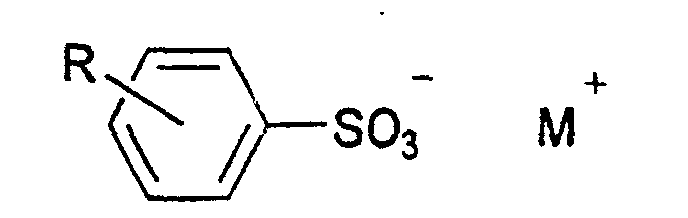
- the anionic surfactant may comprise, wholly or predominantly, linear alkyl benzene sulphonate of the formula where R is linear alkyl of 8 to 15 carbon atoms and M + is a solubilising cation, especially sodium.
- Primary alkyl sulphate having the formula ROSO 3 - M + in which R is an alkyl or alkenyl chain of 8 to 18 carbon atoms especially 10 to 14 carbon atoms and M + is a solubilising cation, is also commercially significant as an anionic surfactant and may be used in this invention.
- such linear alkyl benzene sulphonate or primary alkyl sulphate of the formula above, or a mixture thereof will be the desired non-soap anionic surfactant and may provide 75 to 100wt% of any anionic non-soap surfactant in the composition.
- non-soap anionic surfactants examples include olefin sulphonates; alkane sulphonates; dialkyl sulphosuccinates; and fatty acid ester sulphonates.
- One or more soaps of fatty acids may also be included in addition to the required non-soap anionic surfactant.
- Examples are sodium soaps derived from the fatty acids from coconut oil, beef tallow, sunflower or hardened rapeseed oil. These may be formed by adding fatty acid and a base such as sodium carbonate to a slurry which is spray-dried to form the surfactant-rich base particles.
- Nonionic surfactant compounds include in particular the reaction products of compounds having a hydrophobic group and a reactive hydrogen atom, for example, aliphatic alcohols, acids, amides or alkyl phenols with alkylene oxides, especially ethylene oxide.
- Nonionic surfactant compounds are alkyl (C 8-22 ) phenol-ethylene oxide condensates, the condensation products of linear or branched aliphatic C 8-20 primary or secondary alcohols with ethylene oxide, and products made by condensation of ethylene oxide with the reaction products of propylene oxide and ethylene-diamine.
- the primary and secondary alcohol ethoxylates especially the C 9-11 and C 12-15 primary and secondary alcohols ethoxylated with an average of from 3 to 20 moles of ethylene oxide per mole of alcohol.
- composition which is compacted to form tablets includes water-soluble detergency builder.
- Water-soluble phosphorous-containing inorganic detergency builders include the alkali-metal orthophosphates, metaphosphates, pyrophosphates and polyphosphates. Specific examples of inorganic phosphate builders include sodium and potassium tripolyphosphates, orthophosphates and hexametaphosphates.
- Non-phosphorous water-soluble builders may be organic or inorganic.
- Inorganic builders that may be present include alkali metal (generally sodium) carbonate; while organic builders include polycarboxylate polymers, such as polyacrylates and acrylic/maleic copolymers, monomeric polycarboxylates such as citrates, gluconates, oxydisuccinates, glycerol mono- di- and trisuccinates, carboxymethyloxysuccinates, carboxymethyloxymalonates, dipicolinates and hydroxyethyliminodiacetates.
- alkali metal generally sodium
- organic builders include polycarboxylate polymers, such as polyacrylates and acrylic/maleic copolymers, monomeric polycarboxylates such as citrates, gluconates, oxydisuccinates, glycerol mono- di- and trisuccinates, carboxymethyloxysuccinates, carboxymethyloxymalonates, dipicolinates and hydroxyethyliminodiacetate
- Tablet compositions preferably include polycarboxylate polymers, more especially polyacrylates and acrylic/maleic copolymers which can function as builders and also inhibit unwanted deposition onto fabric from the wash liquor.
- a tablet in accordance with this invention will contain overall from 2 or 5wt% up to 40 or 50wt% non-soap surfactant, and from 5 or 10wt% up to 60 or 80wt% detergency builder.
- the concentration of non-soap anionic surfactant in the tablet will generally be at least one and a half times the concentration of nonionic surfactant. It is preferably at least 3% by weight of the tablet, e.g. from 3wt% up to 30 or 40wt%.
- the concentration of nonionic surfactant is preferably at least 2% by weight of the tablet, such as 2 to 15wt% of the tablet.
- the quantity of soap in the tablet is preferably from 0.1 or 0.2 up to 1% or 2% by weight of the tablet. Higher proportions such as up to 4% are less preferred.
- anionic non-soap surfactant, nonionic surfactant water-soluble detergency builder and other materials which preferably include soap are made into particles such that the non-soap surfactant provides from 20 to 50% of the weight of these particles.
- the non-soap surfactant provides at least 22% or 24% of the weight of these particles, and more preferably at least 28%, desirably up to 45% of their weight.
- soap is desirably from 0.2 to 2%, and possibly more, up to 3% or 4% by weight of these particles, and in these particles the weight ratio of nonionic detergent to soap is preferably from 5:1 better 10:1 to 30:1.
- Such particles may be made by spray drying, or by a granulation process.
- they Preferably they contain water-soluble detergency builder in an amount which is from 30 to 80% of the weight of these particles, better 30 or 40 up to 60% of the weight of these particles.
- the surfactant mixture used in these particles can be tested mechanically in directly analogous manner to the testing of tablets, discussed above. To do this a mixture of the non-soap surfactants and any soap is made on a small scale, and cast into cylindrical form or some other shape from which a cylinder can be cut. If necessary this is dried to reduce the water content to 15% by weight (approximating to 5% moisture in the particles which contain this surfactant mixture). Next, it is tested on a materials testing machine in the manner described above for testing of tablets. This mechanical testing procedure can also be applied to tablets made from the surfactant-rich particles alone.
- anionic surfactant in these particles is to enhance elasticity without much effect on magnitude of the force to cause fracture.
- Nonionic surfactant tends to have some opposite effect. Soap when present, cooperates with the nonionic surfactant to reduce mobility of the nonionic surfactant and to increase tablet strength (as measured by force to cause failure).
- anionic non-soap surfactant nonionic surfactant and preferably soap we have found that it is possible to achieve adequate strength and elasticity of a test tablet which in turn signifies that the same mixture will give tablets with good strength and elasticity.
- Breaking strength is desirably at least 0.04MPa preferably at least 0.05MPa.
- the modulus is desirably no more than 10 MPa preferably no more than 8 or even 5 MPa.
- a tablet of this invention contains water-soluble material which serves to promote disintegration.
- this is provided as particles which are substantially free of organic surfactant.
- the said particles which promote disintegration are particles containing sodium tripolyphosphate with more than 50% of it (by weight of the particles) in the anhydrous phase I form.
- phase II which is the low temperature form
- phase I which is stable at high temperature.
- the conversion of phase II to phase I proceeds fairly rapidly on heating above the transition temperature, which is about 420°C but the reverse reaction is slow. Consequently phase I sodium tripolyphosphate is metastable at ambient temperature.
- phase I form of sodium tripolyphosphate will often contain the phase I form of sodium tripolyphosphate as at least 55% by weight of the tripolyphosphate in the particles.
- Other forms of sodium tripolyphosphate will usually be present to a lesser extent.
- Other salts may be included in the particles, although that is not preferred.
- a further preference is that the sodium tripolyphosphate is partially hydrated. The extent of hydration should be at least 1% by weight of the sodium tripolyphosphate in the particles. It may lie in a range from 2.5 to 4%, or it may be higher.
- Suitable material is commercially available. Suppliers include Rhone-Poulenc, France and Albright & Wilson, UK.
- Rhodiaphos HPA 3.5 from Rhone-Poulenc has been found particularly suitable. It is a characteristic of this grade of sodium tripolyphosphate that it hydrates very rapidly in a standard Olten test. We have found that it hydrates as quickly as anhydrous sodium tripolyphosphate, yet the prehydration appears to be beneficial in avoiding unwanted crystallisation of the hexahydrate when the material comes into contact with water at the time of use.
- these disintegration-promoting particles contain at least 50% of their own weight, better at least 80%, of a material which has a solubility in deionised water at 20°C of at least 50 grams per 100 grams of water.
- the said particles may provide material of such solubility in an amount which is at least 7 wt% or 12 wt% of the whole composition of the tablet.
- a solubility of at least 50 grams per 100 grams of water at 20°C is an exceptionally high solubility: many materials which are classified as water soluble are less soluble than this.
- this highly water soluble material is incorporated as particles of the material in a substantially pure form (i.e. each such particle contains over 95% by weight of the material).
- the said particles may contain material of such solubility in a mixture with other material, provided that material of the specified solubility provides at least 50% by weight of these particles.
- Detergent tablets according to the invention may contain a bleach system.
- This preferably comprises one or more peroxy bleach compounds, for example, inorganic persalts or organic peroxyacids, which may be employed in conjunction with activators to improve bleaching action at low wash temperatures. If any peroxygen compound is present, the amount is likely to lie in a range from 10 to 25% by weight of the tablet.
- Preferred inorganic persalts are sodium perborate monohydrate and tetrahydrate, and sodium percarbonate.
- Bleach activators have been widely disclosed in the art. Preferred examples include peracetic acid precursors, for example tetraacetylethylene diamine (TAED), and perbenzoic acid precursors.
- TAED tetraacetylethylene diamine
- the quaternary ammonium and phosphonium bleach activators disclosed in US 4751015 and US 4818426 (Lever Brothers Company) are also of interest.
- Another type of bleach activator which may be used, but which is not a bleach precursor is a transition metal catalyst as disclosed in EP-A-458397, EP-A-458398 and EP-A-549272.
- a bleach system may also include a bleach stabiliser (heavy metal sequestrant) such as ethylenediamine tetramethylene phosphonate and diethylenetriamine pentamethylene phosphonate.
- Bleach activator is usually present in an amount from 1 to 10% by weight of the tablet, possibly less in the case of a transition metal catalyst which may be used as 0.1% or more by weight of the tablet.
- the detergent tablets of the invention may also contain one of the detergency enzymes well known in the art for their ability to degrade various soils and stains and so aid in their removal. Suitable enzymes include the various proteases, cellulases, lipases, amylases, and mixtures thereof, which are designed to remove a variety of soils and stains from fabrics. Detergency enzymes are commonly employed in the form of granules or marumes, optionally with a protective coating, in amount of from about 0.1% to about 3.0% by weight of the tablet.
- the detergent tablets of the invention may also contain a fluorescer (optical brightener), for example, Tinopal (Trade Mark) DMS or Tinopal CBS available from Ciba-Geigy AG, Basel, Switzerland.
- Tinopal DMS is disodium 4,4'bis-(2-morpholino-4-anilino-s-triazin-6-ylamino) stilbene disulphonate
- Tinopal CBS is disodium 2,2'-bis-(phenyl-styryl) disulphonate.
- Antifoam material is advantageously included, especially if a detergent tablet is primarily intended for use in front-loading drum-type automatic washing machines.
- Antifoam materials in granular form are described in EP 266863A (Unilever).
- Such antifoam granules typically comprise a mixture of silicone oil, petroleum jelly, hydrophobic silica and alkyl phosphate as antifoam active material, sorbed onto a porous absorbed water-soluble carbonate-based inorganic carrier material.
- a detergent tablet of the invention includes an amount of an alkali metal silicate, particularly sodium ortho-, meta- or disilicate.
- an alkali metal silicate particularly sodium ortho-, meta- or disilicate.
- the presence of such alkali metal silicates may be advantageous in providing protection against the corrosion of metal parts in washing machines, besides providing some detergency building.
- the surfactant-rich particles contain from 5 to 15% silicate by weight of the particles. This improves the strength and free flow of these particles prior to tabletting.
- compositions which can optionally be employed in fabric washing detergent tablet of the invention include anti-redeposition agents such as sodium carboxymethylcellulose, straight-chain polyvinyl pyrrolidone and the cellulose ethers such as methyl cellulose and ethyl hydroxyethyl cellulose, fabric-softening agents; heavy metal sequestrants such as EDTA; perfumes; and colorants or coloured speckles.
- anti-redeposition agents such as sodium carboxymethylcellulose, straight-chain polyvinyl pyrrolidone and the cellulose ethers such as methyl cellulose and ethyl hydroxyethyl cellulose, fabric-softening agents
- heavy metal sequestrants such as EDTA
- perfumes and colorants or coloured speckles.
- a detergent tablet of this invention is a matrix of compacted particles.
- the particulate composition has an average particle size before compaction in the range from 200 to 2000 ⁇ m, more preferably from 250 to 1400 ⁇ m. Fine particles, smaller than 180 ⁇ m or 200 ⁇ m may be eliminated by sieving before tableting, if desired, although we have observed that this is not always essential.
- the starting particulate composition may in principle have any bulk density
- the present invention is especially relevant to tablets made by compacting powders of relatively high bulk density, because of their greater tendency to exhibit disintegration and dispersion problems.
- Such tablets have the advantage that, as compared with a tablet derived from a low bulk density powder, a given dose of composition can be presented as a smaller tablet.
- the starting particulate composition may suitably have a bulk density of at least 400 g/litre, preferably at least 550 g/litre, and perhaps at least 600 g/litre.
- Granular detergent compositions of high bulk density prepared by granulation and densification in a high-speed mixer/granulator, as described and claimed in EP 340013A (Unilever), EP 352135A (Unilever), and EP 425277A (Unilever), or by the continuous granulation/densification processes described and claimed in EP 367339A (Unilever) and EP 390251A (Unilever), are inherently suitable for use in the present invention.
- Tableting entails compaction of the particulate composition.
- a variety of tableting machinery is known, and can be used. Generally it will function by stamping a quantity of the particulate composition which is confined in a die.
- Tableting may be carried out without application of heat, so as to take place at ambient temperature or at a temperature above ambient.
- the particulate composition is preferably supplied to the tableting machinery at an elevated temperature. This will of course supply heat to the tableting machinery, but the machinery may be heated in some other way also.
- any heat is supplied, it is envisaged that this will be supplied conventionally, such as by passing the particulate composition through an oven, rather than by any application of microwave energy.
- the size of a tablet will suitably range from 10 to 160 grams, preferably from 15 to 60 g, depending on the conditions of intended use, and whether it represents a dose for an average load in a fabric washing or dishwashing machine or a fractional part of such a dose.
- the tablets may be of any shape. However, for ease of packaging they are preferably blocks of substantially uniform cross-section, such as cylinders or cuboids.
- the overall density of a tablet preferably lies in a range from 1040 or 1050gm/litre up to 1300gm/litre. The tablet density may well lie in a range up to no more than 1250 or even 1200gm/litre.
- Tablets for use in fabric washing were made, starting with spray-dried base powders of the following compositions: Ingredient Parts by Weight A B C Sodium linear alkylbenzene sulphonate 6.4 9.6 11.0 C 13-15 fatty alcohol 7EO 4.3 1.1 2.4 C 13-15 fatty alcohol 3EO 3.2 3.2 2.3 Sodium tripolyphosphate 24.3 24.3 18.0 Sodium silicate 6.4 5.9 4.0 Soap 0.3 0.3 0.21 Acrylate/maleate copolymer 1.2 1.2 1.5 Sodium sulphate, moisture and minor ingredients balance to 60 balance to 55 balance to 45;
- Particulate compositions were made by mixing this powder with other ingredients as tabulated below. These included particles of sodium tripolyphosphate specified to contain 70% phase I form and contain 3.5% water of hydration (Rhodia-Phos HPA 3.5 available from Rhone-Poulenc).
- compositions contained the following percentages by weight: Ingredient % by weight Ex 1 Ex2 Ex 3 Base powder A 60 Base powder B 55 Base powder C 45 Sodium percarbonate granules 14 15 15 TAED granules 3.4 3.4 3.4 Anti-foam granules 1.2 1.2 3.2 Perfume, enzymes and other minor ingredients 1.4 2.2 3.5 Rhodiaphos HPA3.5 tripolyphosphate 20 20 30 Sodium carbonate - 3.2 -
- each composition 40g portions of each composition were made into cylindrical tablets of 44 mm diameter, using a Carver hand press, with sufficient applied pressure to produce tablets which dissolved to 90% of complete dissolution within approximately equal times not exceeding four minutes, in water at 20°C. Applied forces in a range from 2 to 4 kN have usually been found to be enough when using this hand press.
- the force at fracture was measured and also the displacement at fracture.
- the break energy which as explained above is the area under a force-over-displacement graph up to failure, was calculated.
Landscapes
- Chemical & Material Sciences (AREA)
- Life Sciences & Earth Sciences (AREA)
- Engineering & Computer Science (AREA)
- Chemical Kinetics & Catalysis (AREA)
- Oil, Petroleum & Natural Gas (AREA)
- Wood Science & Technology (AREA)
- Organic Chemistry (AREA)
- Detergent Compositions (AREA)
Description
- This invention relates to detergent compositions in the form of tablets for use in fabric washing.
- Detergent compositions in tablet form have been described in, for example, GB 911204 (Unilever), US 3953350 (Kao), JP 60-015500A (Lion), and EP-A-711827 (Unilever) and are sold commercially in Spain. Tablets have several advantages over powdered products: they do not require measuring and are thus easier to handle and dispense into the washload, and they are more compact, hence facilitating more economical storage.
- Such tablets are generally made by compressing or compacting a quantity of detergent composition in particulate form. It is desirable that tablets should have adequate mechanical strength when dry, before use, yet disintegrate and disperse/dissolve quickly when added to wash water. It has not proved simple to achieve both properties simultaneously. As more pressure is used when a tablet is compacted, so the tablet density and strength rise, but the speed of disintegration/dissolution when the tablet comes into contact with wash water goes down.
- During the period from about 1960 to 1970 there was considerable research activity in connection with tablets for use in fabric washing. A number of patents were published by major detergent manufacturers. Detergent tablets were sold commercially in USA and some European countries.
- However, tablets disappeared from the market place in nearly all countries (Spain is the apparent exception) even though tablets have apparent advantages and have become known as a product form for machine dishwashing compositions which are characterised by a low content of organic surfactant.
- US-A-3018267 (Procter & Gamble) taught that the force, and hence pressure, applied when compacting a composition into tablets should be limited, or else the tablets would take too long to dissolve.
- The compression pressure used in the Examples of this document was from 180 to 300 psi (approximately 1.2 to 2.1 MPa). Elsewhere in the document it is proposed that the pressure should not exceed 350 psi (approximately 2.5 MPa) to avoid slow disintegration encountered with higher pressures.
- A number of proposals have been put forward as ways to improve the compromise between conflicting desiderata, but there still remains a desire to improve tablet strength without loss of speed of disintegration and vice versa.
- Some documents have proposed surface treatments or coatings to enhance tablet strength. For instance US-A-3451928 (Colgate) stated that the problem of strength versus speed of dissolution remained unsolved, and proposed a treatment of spraying on water, followed by flash heating.
US-A-3324038 (Procter) proposed the application of a coating containing urea. - It is known to include materials whose function is to enhance disintegration of tablets when placed in wash water. Some tablets which are sold commercially incorporate urea for this purpose. Urea has a very high solubility in water exceeding 100gms per 100ml water at 20°C. EP-A-711827 teaches the use of sodium citrate for the same purpose.
- Detergent compositions, including tablet compositions, frequently contain a mixture of anionic and nonionic organic surfactants. It is often desirable to include both of these types of surfactant, for performance of the composition when washing fabrics.
- We have now found that an improved compromise between tablet strength and speed of disintegration can be achieved by following certain principles concerning tablet formulation and manufacture.
- At the same time it is possible to incorporate materials which are desired to give good washing performance, and it is possible to formulate component ingredients of the tablet so that they are satisfactory in handling during tablet manufacture.
- Also, we have found that two different measures of tablet strength are relevant to properties observed by a consumer. Force to cause fracture is a direct assessment of strength and indicates the tablets' resistance to breakage when handled by a consumer at the time of use. The amount of energy (or mechanical work) put in prior to fracture is a measure of tablet deformability and is relevant to the tablets' resistance to breakage during transport.
- Both properties are relevant to consumers' perception of tablets: consumers will want tablets to be strong enough to handle, to reach them intact, and to disintegrate quickly and fully at the time of use. By following this invention's principles as to formulation, it is possible to achieve a good combination of these properties.
- In this invention, we have found it desirable to incorporate most (if not all) of the surfactants in particles which constitute a substantial part but by no means all the composition of a tablet. The organic surfactant in these particles provides a substantial part, but again by no means all, of their weight.
- Secondly, it is desirable that the surfactant is a mixture of non-soap anionic and nonionic detergent surfactants (preferably accompanied by soap) where both are present in significant amounts, but anionic is in the majority. Thirdly, the balance of the composition should then contain material, other than organic surfactant, which is water soluble. This approach to formulation is applied to the composition of a whole tablet.
- So, according to a first aspect of this invention, there is provided a detergent tablet of compressed particulate composition wherein the tablet comprises organic surfactant and water-soluble detergency builder, characterised in that the tablet contains from 30 to 65% by weight (of the tablet) of particles which contain from 25 to 80% by weight (of these particles) of water-soluble detergency builder and from 20 to 50% by weight (of these particles) of non-soap organic surfactant which is anionic and nonionic surfactants in a ratio from 5:1 to 1.5:1 and in that in addition to said particles the tablet contains at least 15% by weight (of the tablet) of substance which is other than soap or organic surfactant and which has a solubility in water of at least 10gm/litre at 20°C.
- We believe that concentrating most or all of the surfactant into surfactant-rich particles, and using a substantial proportion of anionic surfactant is beneficial in providing tablets which have both strength and elasticity, while allowing the remainder of the tablet composition to contain a substantial proportion of water-soluble material which assists disintegration of the tablets at the time of use.
- It is not necessary to include surfactant as a binder material in the part of the composition outside the surfactant-rich particles. Excluding it from this part of the composition is advantageous, to avoid interference with the prompt dissolution of this part of the composition.
- So, it is preferred that the weight of the non-soap anionic surfactant in the particles is at least 1.7 times the weight of the nonionic surfactant in them. More preferably, this weight ratio of anionic surfactant to nonionic surfactant lies in a range from 2:1 up to 5:1, and more preferably from 2:1 to 4:1. Preferably these particles contain at least 80% by weight better at least 90% or even 95% of all the organic surfactant (including any soap) in the tablet.
- The water-soluble material which is present in the composition, externally to the surfactant-rich particles, preferably comprises from 15 to 40% (better 16 or even 25% up to 35%) by weight (of the tablet) of one or more materials selected from
- compounds with a water-solubility exceeding 50 grams per 100 grams water;
- sodium tripolyphosphate containing at least 50% of its own weight of the phase I anhydrous form, and preferably partially hydrated so as to contain water of hydration in an amount which is at least 1% by weight of the sodium tripolyphosphate;
- mixtures thereof.
- It is strongly preferred that the water-soluble material which is present in the composition, externally to the surfactant-rich particles, is present as particles which are substantially free of surfactant, i.e. contain no more than 5% of their own weight of organic surfactant.
- A preferred form of this invention provides a detergent tablet of compressed particulate composition containing
- (i) from 35 to 60 wt% (and probably from 41 to 53, 56 or 60wt%) of particles which contain non-soap anionic surfactant, nonionic surfactant and water-soluble detergency builder,
- (ii) from 15 to 40 wt%( and probably from 16 or 1.7 to 35 wt%) of particles which are substantially free of surfactant, i.e. contain at least 95% of their own weight of water soluble material but contain no more than 5% of their own weight of organic surfactant, and
- (iii) from 0 to 50 wt% of further particulate ingredients, wherein the first said particles (i) contain at least 20% preferably at least 24% of their own weight of non-soap surfactant and the weight of anionic surfactant therein is from 1.5 to 5 times the weight of nonionic surfactant therein.
-
- In another aspect, this invention provides a detergent tablet of compressed particulate composition wherein the tablet comprises particles which contain non-soap anionic surfactant, nonionic surfactant, preferably soap and other water-soluble ingredients, characterised in that the particles contain at least 20 wt% in total of the anionic and nonionic surfactants and in that a test tablet consisting of the said non-soap anionic surfactant, nonionic surfactant, and any soap in the same proportions, together with 15% by weight moisture has a breaking strength as herein defined of at least 0.4 MPa and a modulus as herein defined of not more than 10 MPa preferably not more than 8 MPa.
- In a yet further aspect, this invention provides the use of particles containing a mixture of non-soap anionic and nonionic surfactants and detergency builder, where the concentration by weight of non-soap anionic surfactant is at least 1.5 times as great as the concentration by weight of nonionic surfactant and the total concentration of these surfactants is at least 20 wt% of the particles to provide improvements in tablet strength and elasticity versus speed of disintegration.
- The tablet of the invention is homogeneous. In the present specification, the term "homogeneous" is used to mean a tablet produced by compaction of a single particulate composition, but does not imply that all the particles of that composition will necessarily be of identical composition. The term "heterogeneous" is used to mean a tablet consisting of a plurality of discrete regions, for example layers, inserts or coatings, each derived by compaction from a particulate composition.
- The accompanying drawings diagrammatically illustrate the testing of a cylindrical tablet:
- Fig 1a shows a tablet when first contacted by the platens of a materials testing machine,
- Fig 1b shows the tablet at the point of failure,
- Fig 2 diagrammatically illustrates the form of a graph obtained during testing.
-
- We have tested the speed of disintegration of tablets by means of a test procedure in which a tablet was placed on a plastic sieve with 2mm mesh size which is immersed in 9 litres of demineralised water at ambient temperature of 20°C. The water conductivity is monitored until it reached a constant value. The time for dissolution of the tablets is taken as the time (T90) for change in the water conductivity to reach 90% of its final magnitude.
- We have tested tablet strength by a procedure illustrated by the accompanying drawings in which a
cylindrical tablet 10 is compressed radially between theplatens platens arrows 16 to compress the tablet. The testing machine measures the applied force (F), and also the displacement (x) of the platens towards each other as the tablet is compressed. The distance (y) between the platens before force is applied, which is the diameter of the tablet, is also known. At failure, illustrated in Fig 1b the tablet cracks (eg as shown at 18) and the applied force needed to maintain the displacement drops. Measurement is discontinued when the applied force needed to maintain the displacement has dropped by 25% from its maximum value (indicated as point D in Fig 2 below). - A graph of force (F) against displacement (x) has the form illustrated by Fig 2. The maximum force is the force at failure (Ff). From this measurement of force a test parameter called diametral fracture stress, which we have used in the past, can be calculated using the equation
- The force at failure divided by the area of a diametral plane through the tablet (approximately the area of the crack 18) is the breaking strength, with units of Pascals.
- The break energy is the area under the graph of force against displacement, up to the point of break. It is shown shaded in Fig 2 and is given by the equation:where Eb is the break energy in joules,

x is the displacement in metres,
F is the applied force in Newtons at displacement x and
xf is the displacement at failure. - The displacement at failure relative to the tablet diameter is the relative displacement xf/y.
- Breaking strength divided by relative displacement is a modulus, whose value is inverse to tablet elasticity.
- Materials which may be used in tablets of this invention will now be discussed in more detail.
- Synthetic (i.e. non-soap) anionic surfactants are well known to those skilled in the art. The anionic surfactant may comprise, wholly or predominantly, linear alkyl benzene sulphonate of the formulawhere R is linear alkyl of 8 to 15 carbon atoms and M+ is a solubilising cation, especially sodium.
- Primary alkyl sulphate having the formula
- Frequently, such linear alkyl benzene sulphonate or primary alkyl sulphate of the formula above, or a mixture thereof will be the desired non-soap anionic surfactant and may provide 75 to 100wt% of any anionic non-soap surfactant in the composition.
- Examples of other non-soap anionic surfactants include olefin sulphonates; alkane sulphonates; dialkyl sulphosuccinates; and fatty acid ester sulphonates.
- One or more soaps of fatty acids may also be included in addition to the required non-soap anionic surfactant. Examples are sodium soaps derived from the fatty acids from coconut oil, beef tallow, sunflower or hardened rapeseed oil. These may be formed by adding fatty acid and a base such as sodium carbonate to a slurry which is spray-dried to form the surfactant-rich base particles.
- Nonionic surfactant compounds include in particular the reaction products of compounds having a hydrophobic group and a reactive hydrogen atom, for example, aliphatic alcohols, acids, amides or alkyl phenols with alkylene oxides, especially ethylene oxide.
- Specific nonionic surfactant compounds are alkyl (C8-22) phenol-ethylene oxide condensates, the condensation products of linear or branched aliphatic C8-20 primary or secondary alcohols with ethylene oxide, and products made by condensation of ethylene oxide with the reaction products of propylene oxide and ethylene-diamine.
- Especially preferred are the primary and secondary alcohol ethoxylates, especially the C9-11 and C12-15 primary and secondary alcohols ethoxylated with an average of from 3 to 20 moles of ethylene oxide per mole of alcohol.
- The composition which is compacted to form tablets includes water-soluble detergency builder.
- Water-soluble phosphorous-containing inorganic detergency builders include the alkali-metal orthophosphates, metaphosphates, pyrophosphates and polyphosphates. Specific examples of inorganic phosphate builders include sodium and potassium tripolyphosphates, orthophosphates and hexametaphosphates.
- Non-phosphorous water-soluble builders may be organic or inorganic. Inorganic builders that may be present include alkali metal (generally sodium) carbonate; while organic builders include polycarboxylate polymers, such as polyacrylates and acrylic/maleic copolymers, monomeric polycarboxylates such as citrates, gluconates, oxydisuccinates, glycerol mono- di- and trisuccinates, carboxymethyloxysuccinates, carboxymethyloxymalonates, dipicolinates and hydroxyethyliminodiacetates.
- Tablet compositions preferably include polycarboxylate polymers, more especially polyacrylates and acrylic/maleic copolymers which can function as builders and also inhibit unwanted deposition onto fabric from the wash liquor.
- Generally, a tablet in accordance with this invention will contain overall from 2 or 5wt% up to 40 or 50wt% non-soap surfactant, and from 5 or 10wt% up to 60 or 80wt% detergency builder.
- The concentration of non-soap anionic surfactant in the tablet will generally be at least one and a half times the concentration of nonionic surfactant. It is preferably at least 3% by weight of the tablet, e.g. from 3wt% up to 30 or 40wt%. The concentration of nonionic surfactant is preferably at least 2% by weight of the tablet, such as 2 to 15wt% of the tablet.
- The quantity of soap in the tablet is preferably from 0.1 or 0.2 up to 1% or 2% by weight of the tablet. Higher proportions such as up to 4% are less preferred.
- In accordance with this invention, anionic non-soap surfactant, nonionic surfactant water-soluble detergency builder and other materials which preferably include soap are made into particles such that the non-soap surfactant provides from 20 to 50% of the weight of these particles. Preferably the non-soap surfactant provides at least 22% or 24% of the weight of these particles, and more preferably at least 28%, desirably up to 45% of their weight. When soap is present, it is desirably from 0.2 to 2%, and possibly more, up to 3% or 4% by weight of these particles, and in these particles the weight ratio of nonionic detergent to soap is preferably from 5:1 better 10:1 to 30:1.
- Such particles may be made by spray drying, or by a granulation process. Preferably they contain water-soluble detergency builder in an amount which is from 30 to 80% of the weight of these particles, better 30 or 40 up to 60% of the weight of these particles.
- The surfactant mixture used in these particles can be tested mechanically in directly analogous manner to the testing of tablets, discussed above. To do this a mixture of the non-soap surfactants and any soap is made on a small scale, and cast into cylindrical form or some other shape from which a cylinder can be cut. If necessary this is dried to reduce the water content to 15% by weight (approximating to 5% moisture in the particles which contain this surfactant mixture). Next, it is tested on a materials testing machine in the manner described above for testing of tablets. This mechanical testing procedure can also be applied to tablets made from the surfactant-rich particles alone.
- We have found that the effect of anionic surfactant in these particles is to enhance elasticity without much effect on magnitude of the force to cause fracture. Nonionic surfactant tends to have some opposite effect. Soap when present, cooperates with the nonionic surfactant to reduce mobility of the nonionic surfactant and to increase tablet strength (as measured by force to cause failure).
- By using sufficient quantities of anionic non-soap surfactant, nonionic surfactant and preferably soap we have found that it is possible to achieve adequate strength and elasticity of a test tablet which in turn signifies that the same mixture will give tablets with good strength and elasticity.
- Breaking strength is desirably at least 0.04MPa preferably at least 0.05MPa. The modulus is desirably no more than 10 MPa preferably no more than 8 or even 5 MPa.
- We have observed that a mixture of alkylbenzene sulphonate and nonionic surfactant in ratio 1.16:1 gave a modulus of about 15 MPa but when the proportions were changed to 2.2:1 (in accordance with this invention) the modulus dropped dramatically to about 4.0 to 4.5 MPa, indicating greater elasticity, with very little change in force at failure.
- In addition to the required particles containing surfactants and builder, a tablet of this invention contains water-soluble material which serves to promote disintegration. Preferably this is provided as particles which are substantially free of organic surfactant.
- One preferred possibility is that the said particles which promote disintegration are particles containing sodium tripolyphosphate with more than 50% of it (by weight of the particles) in the anhydrous phase I form.
- Sodium tripolyphosphate is very well known as a sequestering builder in detergent compositions. It exists in a hydrated form and two crystalline anhydrous forms. These are the normal crystalline anhydrous form, known as phase II which is the low temperature form, and phase I which is stable at high temperature. The conversion of phase II to phase I proceeds fairly rapidly on heating above the transition temperature, which is about 420°C but the reverse reaction is slow. Consequently phase I sodium tripolyphosphate is metastable at ambient temperature.
- A process for the manufacture of particles containing a high proportion of the phase I form of sodium tripolyphosphate by spray drying below 420°C is given in US-A-4536377.
- Particles which contain this phase I form will often contain the phase I form of sodium tripolyphosphate as at least 55% by weight of the tripolyphosphate in the particles. Other forms of sodium tripolyphosphate will usually be present to a lesser extent. Other salts may be included in the particles, although that is not preferred. A further preference is that the sodium tripolyphosphate is partially hydrated. The extent of hydration should be at least 1% by weight of the sodium tripolyphosphate in the particles. It may lie in a range from 2.5 to 4%, or it may be higher.
- Suitable material is commercially available. Suppliers include Rhone-Poulenc, France and Albright & Wilson, UK.
- "Rhodiaphos HPA 3.5" from Rhone-Poulenc has been found particularly suitable. It is a characteristic of this grade of sodium tripolyphosphate that it hydrates very rapidly in a standard Olten test. We have found that it hydrates as quickly as anhydrous sodium tripolyphosphate, yet the prehydration appears to be beneficial in avoiding unwanted crystallisation of the hexahydrate when the material comes into contact with water at the time of use.
- Another possibility which can be used instead of tripolyphosphate, or in a mixture with it, is that these disintegration-promoting particles contain at least 50% of their own weight, better at least 80%, of a material which has a solubility in deionised water at 20°C of at least 50 grams per 100 grams of water.
- The said particles may provide material of such solubility in an amount which is at least 7 wt% or 12 wt% of the whole composition of the tablet.
- A solubility of at least 50 grams per 100 grams of water at 20°C is an exceptionally high solubility: many materials which are classified as water soluble are less soluble than this.
- Some highly water-soluble materials which may be used are listed below, with their solubilities expressed as grams of solid to form a saturated solution in 100 grams of water at 20°C:-
Material Water Solubility (g/100g) Sodium citrate dihydrate 72 Potassium carbonate 112 Urea >100 Sodium acetate 119 Sodium acetate trihydrate 76 Magnesium sulphate 7H2O 71 Potassium acetate >200 - By contrast the solubilities of some other common materials at 20°C are:
Material Water Solubility (g/100g) Sodium chloride 36 Sodium sulphate decahydrate 21.5 Sodium carbonate anhydrous 8.0 Sodium percarbonate anhydrous 12 Sodium perborate anhydrous 3.7 Sodium tripolyphosphate anhydrous 15 - Preferably this highly water soluble material is incorporated as particles of the material in a substantially pure form (i.e. each such particle contains over 95% by weight of the material). However, the said particles may contain material of such solubility in a mixture with other material, provided that material of the specified solubility provides at least 50% by weight of these particles.
- Detergent tablets according to the invention may contain a bleach system. This preferably comprises one or more peroxy bleach compounds, for example, inorganic persalts or organic peroxyacids, which may be employed in conjunction with activators to improve bleaching action at low wash temperatures. If any peroxygen compound is present, the amount is likely to lie in a range from 10 to 25% by weight of the tablet.
- Preferred inorganic persalts are sodium perborate monohydrate and tetrahydrate, and sodium percarbonate. Bleach activators have been widely disclosed in the art. Preferred examples include peracetic acid precursors, for example tetraacetylethylene diamine (TAED), and perbenzoic acid precursors. The quaternary ammonium and phosphonium bleach activators disclosed in US 4751015 and US 4818426 (Lever Brothers Company) are also of interest. Another type of bleach activator which may be used, but which is not a bleach precursor, is a transition metal catalyst as disclosed in EP-A-458397, EP-A-458398 and EP-A-549272. A bleach system may also include a bleach stabiliser (heavy metal sequestrant) such as ethylenediamine tetramethylene phosphonate and diethylenetriamine pentamethylene phosphonate.
- Bleach activator is usually present in an amount from 1 to 10% by weight of the tablet, possibly less in the case of a transition metal catalyst which may be used as 0.1% or more by weight of the tablet.
- The detergent tablets of the invention may also contain one of the detergency enzymes well known in the art for their ability to degrade various soils and stains and so aid in their removal. Suitable enzymes include the various proteases, cellulases, lipases, amylases, and mixtures thereof, which are designed to remove a variety of soils and stains from fabrics. Detergency enzymes are commonly employed in the form of granules or marumes, optionally with a protective coating, in amount of from about 0.1% to about 3.0% by weight of the tablet.
- The detergent tablets of the invention may also contain a fluorescer (optical brightener), for example, Tinopal (Trade Mark) DMS or Tinopal CBS available from Ciba-Geigy AG, Basel, Switzerland. Tinopal DMS is disodium 4,4'bis-(2-morpholino-4-anilino-s-triazin-6-ylamino) stilbene disulphonate; and Tinopal CBS is disodium 2,2'-bis-(phenyl-styryl) disulphonate.
- An antifoam material is advantageously included, especially if a detergent tablet is primarily intended for use in front-loading drum-type automatic washing machines. Antifoam materials in granular form are described in EP 266863A (Unilever). Such antifoam granules typically comprise a mixture of silicone oil, petroleum jelly, hydrophobic silica and alkyl phosphate as antifoam active material, sorbed onto a porous absorbed water-soluble carbonate-based inorganic carrier material.
- It may also be desirable that a detergent tablet of the invention includes an amount of an alkali metal silicate, particularly sodium ortho-, meta- or disilicate. The presence of such alkali metal silicates may be advantageous in providing protection against the corrosion of metal parts in washing machines, besides providing some detergency building. Preferably the surfactant-rich particles contain from 5 to 15% silicate by weight of the particles. This improves the strength and free flow of these particles prior to tabletting.
- Further ingredients which can optionally be employed in fabric washing detergent tablet of the invention include anti-redeposition agents such as sodium carboxymethylcellulose, straight-chain polyvinyl pyrrolidone and the cellulose ethers such as methyl cellulose and ethyl hydroxyethyl cellulose, fabric-softening agents; heavy metal sequestrants such as EDTA; perfumes; and colorants or coloured speckles.
- These various other ingredients may be present in the surfactant-rich particles or in the balance of the composition outside them. It is preferred that any bleach is contained in the balance of the composition outside the surfactant-rich particles.
- A detergent tablet of this invention is a matrix of compacted particles.
- Preferably the particulate composition has an average particle size before compaction in the range from 200 to 2000 µm, more preferably from 250 to 1400 µm. Fine particles, smaller than 180 µm or 200 µm may be eliminated by sieving before tableting, if desired, although we have observed that this is not always essential.
- While the starting particulate composition may in principle have any bulk density, the present invention is especially relevant to tablets made by compacting powders of relatively high bulk density, because of their greater tendency to exhibit disintegration and dispersion problems. Such tablets have the advantage that, as compared with a tablet derived from a low bulk density powder, a given dose of composition can be presented as a smaller tablet.
- Thus the starting particulate composition may suitably have a bulk density of at least 400 g/litre, preferably at least 550 g/litre, and perhaps at least 600 g/litre.
- Granular detergent compositions of high bulk density prepared by granulation and densification in a high-speed mixer/granulator, as described and claimed in EP 340013A (Unilever), EP 352135A (Unilever), and EP 425277A (Unilever), or by the continuous granulation/densification processes described and claimed in EP 367339A (Unilever) and EP 390251A (Unilever), are inherently suitable for use in the present invention.
- Tableting entails compaction of the particulate composition. A variety of tableting machinery is known, and can be used. Generally it will function by stamping a quantity of the particulate composition which is confined in a die.
- Tableting may be carried out without application of heat, so as to take place at ambient temperature or at a temperature above ambient. In order to carry out the tableting at a temperature which is above ambient, the particulate composition is preferably supplied to the tableting machinery at an elevated temperature. This will of course supply heat to the tableting machinery, but the machinery may be heated in some other way also.
- If any heat is supplied, it is envisaged that this will be supplied conventionally, such as by passing the particulate composition through an oven, rather than by any application of microwave energy.
- The size of a tablet will suitably range from 10 to 160 grams, preferably from 15 to 60 g, depending on the conditions of intended use, and whether it represents a dose for an average load in a fabric washing or dishwashing machine or a fractional part of such a dose. The tablets may be of any shape. However, for ease of packaging they are preferably blocks of substantially uniform cross-section, such as cylinders or cuboids. The overall density of a tablet preferably lies in a range from 1040 or 1050gm/litre up to 1300gm/litre. The tablet density may well lie in a range up to no more than 1250 or even 1200gm/litre.
- Tablets for use in fabric washing were made, starting with spray-dried base powders of the following compositions:
Ingredient Parts by Weight A B C Sodium linear alkylbenzene sulphonate 6.4 9.6 11.0 C13-15 fatty alcohol 7EO 4.3 1.1 2.4 C13-15 fatty alcohol 3EO 3.2 3.2 2.3 Sodium tripolyphosphate 24.3 24.3 18.0 Sodium silicate 6.4 5.9 4.0 Soap 0.3 0.3 0.21 Acrylate/maleate copolymer 1.2 1.2 1.5 Sodium sulphate, moisture and minor ingredients balance to 60 balance to 55 balance to 45 - Particulate compositions were made by mixing this powder with other ingredients as tabulated below. These included particles of sodium tripolyphosphate specified to contain 70% phase I form and contain 3.5% water of hydration (Rhodia-Phos HPA 3.5 available from Rhone-Poulenc).
- The compositions contained the following percentages by weight:
Ingredient % by weight Ex 1 Ex2 Ex 3 Base powder A 60 Base powder B 55 Base powder C 45 Sodium percarbonate granules 14 15 15 TAED granules 3.4 3.4 3.4 Anti-foam granules 1.2 1.2 3.2 Perfume, enzymes and other minor ingredients 1.4 2.2 3.5 Rhodiaphos HPA3.5 tripolyphosphate 20 20 30 Sodium carbonate - 3.2 - - 40g portions of each composition were made into cylindrical tablets of 44 mm diameter, using a Carver hand press, with sufficient applied pressure to produce tablets which dissolved to 90% of complete dissolution within approximately equal times not exceeding four minutes, in water at 20°C. Applied forces in a range from 2 to 4 kN have usually been found to be enough when using this hand press.
- To test dissolution of tablets, a test procedure was used in which a tablet was placed on a plastic sieve with 2mm mesh size which was immersed in 9 litres of demineralised water at ambient temperature of 20°C. The water conductivity was monitored until it reached a constant value. The time for dissolution of the tablets was taken as the time (T90) for change in the water conductivity to reach 90% of its final magnitude.
- The strength of these tablets was measured by compressing them radially, between the platens of a universal materials testing machine until fracture of the tablet occurred.
- The force at fracture was measured and also the displacement at fracture. The break energy, which as explained above is the area under a force-over-displacement graph up to failure, was calculated.
- The following table gives the results obtained for tablets of Examples 2 and 3 embodying the invention, and comparative tablets of Example 1. It is apparent that tablets embodying the invention were stronger although they dissolved in a similar time. Included in the table are mechanical properties of the surfactant mixture used.
Ex 1 Ex2 Ex 3 Powder features active system anionic/nonionic 6/7 9/4 9/4 level of base powder [%] 60 55 45 active level in base [%] 23 25 35 active/tripolyphosphate in base powder 0.57 0.57 0.88 level of disintegrant [%] 20 20 30 Tablet properties force at failure [N] 30.5 35.0 69.5 break energy [m joules] 5.8 10.5 20.4 Properties of surfactant mix Breaking strength [MPa] 0.06 - 0.08 0.05 - 0.07 Modulus [MPa] 15 4.0 - 4.5
Claims (15)
- A detergent tablet of compressed particulate composition wherein the tablet is homogeneous and comprises organic surfactant and water-soluble detergency builder, characterised in that the tablet contains from 30 to 65% by weight of particles which contain from 25 to 80% by weight (of these particles) of water-soluble detergency builder and from 20 to 50% by weight (of these particles) of non-soap organic surfactant which is anionic and nonionic surfactants in a weight ratio from 5:1 to 1.5:1 and in that in addition to said particles the tablet contains 15% or more by weight (of the tablet) of material which is other than soap or organic surfactant and which has a solubility in water of at least 10 gm/litre at 20°C.
- A tablet according to claim 1 wherein the tablet contains the said particles in an amount from 41 to 56% by weight.
- A tablet according to claim 1 to 2 wherein the weight ratio of anionic surfactants to non-ionic surfactant lies in range from 1.7:1 to 5:1.
- A tablet according to any one of claims 1 to 3 wherein the weight ratio of non-ionic surfactant to soap in said particles lies in range from 10:1 to 30:1.
- A tablet according to any one of claims 1 to 4 wherein the amount of non-soap organic surfactant in the said particles is from 22 to 45% by weight of the particles.
- A tablet according to any one of claims 1 to 5 containing soup in the said particles in an amount for 0.2 to 2% by weight of the particles.
- A tablet according to any one of claims 1 to 6 herein the said particles contain from 30 to 80% by weight (of the particles) of water-soluble detergency builder which is an alkali metal salt of a condensed phosphate.
- A tablet according to claim 7 wherein the salt of a condensed phosphate is sodium tripolyphosphate.
- A tablet according to any one of claims 1 to 8 wherein the water-soluble material present in addition to the said particles comprises 15% or more (by weight of the tablet) in the form of further particles which contain no more than 5% of their own weight of organic surfactant.
- A tablet according to any one of claims 1 to 9 wherein the water-soluble substance present in addition to the said particles comprises 25 to 35% (by weight of the tablet) of material with a water solubility of at least 50 gm/litre at 20°C, or sodium tripolyphosphate containing more than 50% of its own weight of the phase I anhydrous form, or a mixture thereof.
- A tablet according to claim 10 wherein the water-soluble substance present in addition to the said particles comprises 15 to 35% (by weight of the tablet) of sodium tripolyphosphate containing more than 50% of its own weight of the phase I anhydrous form, which is partially hydrated so as to contain from 1 to 4% by weight of water of hydration.
- A tablet according to any one of claims 1 to 11 wherein said anionic surfactant is a majority of sodium alkyl benzene sulphonate, optionally accompanied by a smaller amount of other anionic surfactant.
- A tablet according to any one of claims 1 to 12 wherein said non-ionic surfactant is a majority of ethoxylated fatty alcohol, optionally accompanied by a smaller amount of other non-ionic surfactant.
- A tablet according to any one of claims 1 to 13 which is a formed by compression of a single particulate composition.
- A process for making a detergent tablet according to any one of claims 1 to 14 which comprises mixinga) 30 to 65% by weight of particles which contain from 25 to 80% by weight (of these particles) of water-soluble detergency builder and from 20 to 50% by weight (of these particles) of non-soap organic surfactant which is anionic and non-ionic surfactants in a weight ratio from 5:1 to 1.5:1 withb) 15% or more by weight of material which is other than soap or organic surfactant and which has a solubility in water of at least 10 gm/litre at 20°C, and compacting the mixture into a tablet.
Applications Claiming Priority (5)
| Application Number | Priority Date | Filing Date | Title |
|---|---|---|---|
| GB9706083 | 1997-03-24 | ||
| GBGB9706083.4A GB9706083D0 (en) | 1997-03-24 | 1997-03-24 | Detergent compositions |
| GB9722345 | 1997-10-22 | ||
| GBGB9722345.7A GB9722345D0 (en) | 1997-10-22 | 1997-10-22 | Detergent compositions |
| PCT/EP1998/001770 WO1998042817A1 (en) | 1997-03-24 | 1998-03-18 | Detergent compositions |
Publications (2)
| Publication Number | Publication Date |
|---|---|
| EP0972007A1 EP0972007A1 (en) | 2000-01-19 |
| EP0972007B1 true EP0972007B1 (en) | 2004-06-16 |
Family
ID=26311251
Family Applications (1)
| Application Number | Title | Priority Date | Filing Date |
|---|---|---|---|
| EP98917084A Expired - Lifetime EP0972007B1 (en) | 1997-03-24 | 1998-03-18 | Detergent compositions |
Country Status (10)
| Country | Link |
|---|---|
| EP (1) | EP0972007B1 (en) |
| CN (1) | CN1257536A (en) |
| AU (1) | AU742565B2 (en) |
| BR (1) | BR9808057A (en) |
| CA (1) | CA2284828A1 (en) |
| DE (1) | DE69824564T2 (en) |
| ES (1) | ES2222583T3 (en) |
| PL (1) | PL335883A1 (en) |
| TR (1) | TR199902317T2 (en) |
| WO (1) | WO1998042817A1 (en) |
Families Citing this family (11)
| Publication number | Priority date | Publication date | Assignee | Title |
|---|---|---|---|---|
| ZA984570B (en) | 1997-06-06 | 1999-11-29 | Unilever Plc | Cleaning compositions. |
| GB9711829D0 (en) | 1997-06-06 | 1997-08-06 | Unilever Plc | Detergent compositions |
| CN1276828A (en) * | 1997-10-22 | 2000-12-13 | 尤尼利弗公司 | Detergent compositions in tablet form |
| DE19818965A1 (en) * | 1998-04-28 | 1999-11-04 | Henkel Kgaa | Detergent tablets with improved disintegration properties |
| GB9822090D0 (en) * | 1998-10-09 | 1998-12-02 | Unilever Plc | Detergent Compositions |
| ID28151A (en) * | 1998-10-09 | 2001-05-10 | Unilever Nv | DETERGENT AND COMPOSITION COMPOSITIONS IN WATER |
| FR2784392B1 (en) * | 1998-10-09 | 2000-11-17 | Rhodia Chimie Sa | DETERGENT OR ANTI-CALCIUM COMPOSITION TABLETS AND THEIR IMPLEMENTATION IN DISHWASHER OR WASHING MACHINE |
| GB9826105D0 (en) * | 1998-11-27 | 1999-01-20 | Unilever Plc | Detergent compositions |
| GB9901688D0 (en) | 1999-01-26 | 1999-03-17 | Unilever Plc | Detergent compositions |
| PT1287107E (en) * | 2000-06-02 | 2005-11-30 | Unilever Nv | LOICA WASHING COMPOSITIONS |
| GB2367830A (en) * | 2000-10-12 | 2002-04-17 | Procter & Gamble | Process for preparing tablets |
Family Cites Families (11)
| Publication number | Priority date | Publication date | Assignee | Title |
|---|---|---|---|---|
| GB911204A (en) * | 1960-07-28 | 1962-11-21 | Unilever Ltd | Bleaching compositions |
| US3451928A (en) * | 1964-03-16 | 1969-06-24 | Colgate Palmolive Co | Process for production of detergent tablets |
| US3324038A (en) * | 1964-04-17 | 1967-06-06 | Procter & Gamble | Detergent composition |
| JPS5070286A (en) * | 1973-10-25 | 1975-06-11 | ||
| DE3417820A1 (en) * | 1984-05-14 | 1985-11-14 | Henkel KGaA, 4000 Düsseldorf | METHOD FOR PRODUCING A WASHING ADDITIVE IN TABLET FORM |
| GB9015503D0 (en) * | 1990-07-13 | 1990-08-29 | Unilever Plc | Detergent composition |
| GB9015504D0 (en) * | 1990-07-13 | 1990-08-29 | Unilever Plc | Detergents composition |
| GB9114184D0 (en) * | 1991-07-01 | 1991-08-21 | Unilever Plc | Detergent composition |
| GB9224015D0 (en) * | 1992-11-16 | 1993-01-06 | Unilever Plc | Detergent compositions |
| GB9422895D0 (en) * | 1994-11-14 | 1995-01-04 | Unilever Plc | Detergent compositions |
| GB9422924D0 (en) * | 1994-11-14 | 1995-01-04 | Unilever Plc | Detergent compositions |
-
1998
- 1998-03-18 BR BR9808057-1A patent/BR9808057A/en not_active IP Right Cessation
- 1998-03-18 AU AU70418/98A patent/AU742565B2/en not_active Ceased
- 1998-03-18 ES ES98917084T patent/ES2222583T3/en not_active Expired - Lifetime
- 1998-03-18 CA CA002284828A patent/CA2284828A1/en not_active Abandoned
- 1998-03-18 TR TR1999/02317T patent/TR199902317T2/en unknown
- 1998-03-18 CN CN 98805298 patent/CN1257536A/en active Pending
- 1998-03-18 EP EP98917084A patent/EP0972007B1/en not_active Expired - Lifetime
- 1998-03-18 DE DE69824564T patent/DE69824564T2/en not_active Expired - Fee Related
- 1998-03-18 PL PL33588398A patent/PL335883A1/en unknown
- 1998-03-18 WO PCT/EP1998/001770 patent/WO1998042817A1/en not_active Ceased
Also Published As
| Publication number | Publication date |
|---|---|
| WO1998042817A1 (en) | 1998-10-01 |
| AU7041898A (en) | 1998-10-20 |
| ES2222583T3 (en) | 2005-02-01 |
| TR199902317T2 (en) | 1999-12-21 |
| AU742565B2 (en) | 2002-01-10 |
| PL335883A1 (en) | 2000-05-22 |
| DE69824564D1 (en) | 2004-07-22 |
| CN1257536A (en) | 2000-06-21 |
| BR9808057A (en) | 2000-03-08 |
| DE69824564T2 (en) | 2005-06-09 |
| EP0972007A1 (en) | 2000-01-19 |
| CA2284828A1 (en) | 1998-10-01 |
Similar Documents
| Publication | Publication Date | Title |
|---|---|---|
| EP1236794B2 (en) | Detergent compositions in tablet form | |
| EP1019484B1 (en) | Cleaning compositions | |
| EP1705241B1 (en) | Detergent compositions in tablet form | |
| US6242403B1 (en) | Detergent compositions | |
| EP0986634B1 (en) | Cleaning compositions in tablet form | |
| EP0972007B1 (en) | Detergent compositions | |
| EP1511834B1 (en) | Detergent tablets | |
| EP0839906B1 (en) | Detergent composition | |
| WO1999053014A1 (en) | Water-softening and detergent compositions | |
| EP1375636B1 (en) | Detergent tablets | |
| EP1054947B1 (en) | Tablet detergent compositions | |
| EP1371719A1 (en) | Detergent tablets | |
| US20020068688A1 (en) | Cleaning compositions | |
| EP1496105B1 (en) | Detergent compositions | |
| EP1469061B1 (en) | Method for the Preparation of multiphase cleaning tablet comprising a smooth phase | |
| EP1466964A1 (en) | Cleaning compositions | |
| CZ9903402A3 (en) | Detergent composition | |
| EP1466965A1 (en) | Cleaning compositions | |
| EP1522575A1 (en) | Detergent compositions | |
| HUP0002074A2 (en) | Detergent compositions |
Legal Events
| Date | Code | Title | Description |
|---|---|---|---|
| PUAI | Public reference made under article 153(3) epc to a published international application that has entered the european phase |
Free format text: ORIGINAL CODE: 0009012 |
|
| 17P | Request for examination filed |
Effective date: 19990913 |
|
| AK | Designated contracting states |
Kind code of ref document: A1 Designated state(s): BE DE ES FR GB IE IT NL |
|
| AX | Request for extension of the european patent |
Free format text: RO PAYMENT 19990913 |
|
| 17Q | First examination report despatched |
Effective date: 20011213 |
|
| GRAP | Despatch of communication of intention to grant a patent |
Free format text: ORIGINAL CODE: EPIDOSNIGR1 |
|
| GRAS | Grant fee paid |
Free format text: ORIGINAL CODE: EPIDOSNIGR3 |
|
| GRAA | (expected) grant |
Free format text: ORIGINAL CODE: 0009210 |
|
| AK | Designated contracting states |
Kind code of ref document: B1 Designated state(s): BE DE ES FR GB IE IT NL |
|
| AX | Request for extension of the european patent |
Extension state: RO |
|
| PG25 | Lapsed in a contracting state [announced via postgrant information from national office to epo] |
Ref country code: NL Free format text: LAPSE BECAUSE OF FAILURE TO SUBMIT A TRANSLATION OF THE DESCRIPTION OR TO PAY THE FEE WITHIN THE PRESCRIBED TIME-LIMIT Effective date: 20040616 Ref country code: BE Free format text: LAPSE BECAUSE OF FAILURE TO SUBMIT A TRANSLATION OF THE DESCRIPTION OR TO PAY THE FEE WITHIN THE PRESCRIBED TIME-LIMIT Effective date: 20040616 |
|
| REG | Reference to a national code |
Ref country code: GB Ref legal event code: FG4D |
|
| REF | Corresponds to: |
Ref document number: 69824564 Country of ref document: DE Date of ref document: 20040722 Kind code of ref document: P |
|
| REG | Reference to a national code |
Ref country code: IE Ref legal event code: FG4D |
|
| NLV1 | Nl: lapsed or annulled due to failure to fulfill the requirements of art. 29p and 29m of the patents act | ||
| REG | Reference to a national code |
Ref country code: ES Ref legal event code: FG2A Ref document number: 2222583 Country of ref document: ES Kind code of ref document: T3 |
|
| ET | Fr: translation filed | ||
| PG25 | Lapsed in a contracting state [announced via postgrant information from national office to epo] |
Ref country code: IE Free format text: LAPSE BECAUSE OF NON-PAYMENT OF DUE FEES Effective date: 20050318 |
|
| PLBE | No opposition filed within time limit |
Free format text: ORIGINAL CODE: 0009261 |
|
| STAA | Information on the status of an ep patent application or granted ep patent |
Free format text: STATUS: NO OPPOSITION FILED WITHIN TIME LIMIT |
|
| 26N | No opposition filed |
Effective date: 20050317 |
|
| REG | Reference to a national code |
Ref country code: IE Ref legal event code: MM4A |
|
| PGFP | Annual fee paid to national office [announced via postgrant information from national office to epo] |
Ref country code: FR Payment date: 20060317 Year of fee payment: 9 |
|
| PGFP | Annual fee paid to national office [announced via postgrant information from national office to epo] |
Ref country code: IT Payment date: 20060331 Year of fee payment: 9 |
|
| PGFP | Annual fee paid to national office [announced via postgrant information from national office to epo] |
Ref country code: DE Payment date: 20060502 Year of fee payment: 9 |
|
| REG | Reference to a national code |
Ref country code: FR Ref legal event code: ST Effective date: 20071130 |
|
| PG25 | Lapsed in a contracting state [announced via postgrant information from national office to epo] |
Ref country code: DE Free format text: LAPSE BECAUSE OF NON-PAYMENT OF DUE FEES Effective date: 20071002 |
|
| PG25 | Lapsed in a contracting state [announced via postgrant information from national office to epo] |
Ref country code: FR Free format text: LAPSE BECAUSE OF NON-PAYMENT OF DUE FEES Effective date: 20070402 |
|
| PG25 | Lapsed in a contracting state [announced via postgrant information from national office to epo] |
Ref country code: IT Free format text: LAPSE BECAUSE OF NON-PAYMENT OF DUE FEES Effective date: 20070318 |
|
| PGFP | Annual fee paid to national office [announced via postgrant information from national office to epo] |
Ref country code: ES Payment date: 20100326 Year of fee payment: 13 |
|
| PGFP | Annual fee paid to national office [announced via postgrant information from national office to epo] |
Ref country code: GB Payment date: 20100326 Year of fee payment: 13 |
|
| GBPC | Gb: european patent ceased through non-payment of renewal fee |
Effective date: 20110318 |
|
| PG25 | Lapsed in a contracting state [announced via postgrant information from national office to epo] |
Ref country code: GB Free format text: LAPSE BECAUSE OF NON-PAYMENT OF DUE FEES Effective date: 20110318 |
|
| REG | Reference to a national code |
Ref country code: ES Ref legal event code: FD2A Effective date: 20120424 |
|
| PG25 | Lapsed in a contracting state [announced via postgrant information from national office to epo] |
Ref country code: ES Free format text: LAPSE BECAUSE OF NON-PAYMENT OF DUE FEES Effective date: 20110319 |