EP1405765A1 - Edge protector - Google Patents
Edge protector Download PDFInfo
- Publication number
- EP1405765A1 EP1405765A1 EP20020022027 EP02022027A EP1405765A1 EP 1405765 A1 EP1405765 A1 EP 1405765A1 EP 20020022027 EP20020022027 EP 20020022027 EP 02022027 A EP02022027 A EP 02022027A EP 1405765 A1 EP1405765 A1 EP 1405765A1
- Authority
- EP
- European Patent Office
- Prior art keywords
- edge
- section
- protector
- door
- vehicle door
- Prior art date
- Legal status (The legal status is an assumption and is not a legal conclusion. Google has not performed a legal analysis and makes no representation as to the accuracy of the status listed.)
- Withdrawn
Links
- 230000001012 protector Effects 0.000 title claims abstract description 57
- 239000000463 material Substances 0.000 claims abstract description 19
- 239000000853 adhesive Substances 0.000 claims abstract description 6
- 230000001070 adhesive effect Effects 0.000 claims abstract description 6
- 238000009434 installation Methods 0.000 claims description 11
- 239000002390 adhesive tape Substances 0.000 claims description 6
- 239000006260 foam Substances 0.000 claims description 4
- -1 polytherephthlate Polymers 0.000 claims description 4
- 239000004793 Polystyrene Substances 0.000 claims description 3
- 229920001577 copolymer Polymers 0.000 claims description 3
- 239000012943 hotmelt Substances 0.000 claims description 3
- 239000000203 mixture Substances 0.000 claims description 3
- 229920000098 polyolefin Polymers 0.000 claims description 3
- 229920002223 polystyrene Polymers 0.000 claims description 3
- 229920002635 polyurethane Polymers 0.000 claims description 3
- 239000004814 polyurethane Substances 0.000 claims description 3
- 239000004800 polyvinyl chloride Substances 0.000 claims description 3
- 229920000915 polyvinyl chloride Polymers 0.000 claims description 3
- 229920001684 low density polyethylene Polymers 0.000 claims description 2
- 239000004702 low-density polyethylene Substances 0.000 claims description 2
- 230000006378 damage Effects 0.000 description 3
- 239000002184 metal Substances 0.000 description 3
- 208000025940 Back injury Diseases 0.000 description 1
- 239000004698 Polyethylene Substances 0.000 description 1
- 239000000969 carrier Substances 0.000 description 1
- 230000006835 compression Effects 0.000 description 1
- 238000007906 compression Methods 0.000 description 1
- 238000010276 construction Methods 0.000 description 1
- 238000007796 conventional method Methods 0.000 description 1
- 229920001971 elastomer Polymers 0.000 description 1
- 238000001125 extrusion Methods 0.000 description 1
- 239000003973 paint Substances 0.000 description 1
- 239000004033 plastic Substances 0.000 description 1
- 229920003023 plastic Polymers 0.000 description 1
- 229920000573 polyethylene Polymers 0.000 description 1
- 230000001681 protective effect Effects 0.000 description 1
- 239000012858 resilient material Substances 0.000 description 1
Images
Classifications
-
- B—PERFORMING OPERATIONS; TRANSPORTING
- B60—VEHICLES IN GENERAL
- B60R—VEHICLES, VEHICLE FITTINGS, OR VEHICLE PARTS, NOT OTHERWISE PROVIDED FOR
- B60R13/00—Elements for body-finishing, identifying, or decorating; Arrangements or adaptations for advertising purposes
- B60R13/04—External Ornamental or guard strips; Ornamental inscriptive devices thereon
- B60R13/043—Door edge guards
Definitions
- This invention relates generally to protective guards for surface edges. Specifically, this invention relates to an edge protector for removable installation on the edge of a vehicle door or the like.
- the manufactures equip the doors or bumpers of the vehicle with a horizontal trim made of resilient material that is permanently fixed along the side of the doors of the vehicles so as to avoid dents and scratches when the doors are opened and bumped against a neighboring vehicle or another obstacle.
- These trims are however rather fragile and customers do not accept any damages in the paint when buying a new car.
- a variety of devices have been developed for permanent installation on the edge of vehicle doors or the like. These devices generally comprise a deformable metal carrier coated with rubber or plastic materials as in U.S. Pat. No. 4,581,807. These devices generally have a U-shaped cross section for receiving the edge of the vehicle door. The metal carrier is generally deformed so that the device resiliently grips the edge of the vehicle door.
- EP 1 209 034 A1 discloses an edge guard of polymeric material for removable installation on a vehicle door having a trim.
- the edge guard comprises a bumper section and two planar sections comprising means to removably install the guard on the edge of a vehicle door.
- the bumper section comprises a U-shaped tunnel conceived to bridge the trim of the vehicle door and extending over the edge of the vehicle door along the length of the edge guard.
- edge guard also covers the gap between the door and the body of the vehicle.
- the ideal edge protector for a vehicle door or the like must be capable of being rapidly installed and removed without having to open the doors of the vehicle and without damaging the edge or any other part of the vehicle door.
- edge protector before the door is mounted onto the body of the car on the assembly line.
- the gap between the door and the body of the car must remain visible to facilitate the adjustment of the door. This is however not possible with the above described edge protectors since they cover at least partially the edge of the vehicle doors and the gap. When the gap is covered, the adjustment of the door is more difficult.
- an edge protector for protection of a vehicle door or the like is disclosed.
- an edge protector of resilient polymeric material for removable installation on a vehicle door comprising:
- edge protector is primarily designed for the protection of the edge of a vehicle door, it can also be used to protect the bumpers and other exposed parts of body panels of vehicles.
- the bumper section is maintained at a certain angle and consequently does not touch the vehicle door and does not cover the gap between the edge of the door and the body of the car. It is thus possible to install the edge protector before the door is mounted onto the body of the car on the assembly line without impairing the adjustment of the door in its hinges. Back injuries may thus be avoided since the operator may install the edge protector on the assembly line when the door is in a raised position. The operator does not have to bend over as would be case when the edge protector is installed on the vehicle after it left the assembly line.
- the bumper section is pushed against the vehicle door and covers the edge. This is possible because the mid-section is flexible and allows the bumper section to be flattened against the door.
- the bumper section of the edge protector sticks out and is not in contact with the door.
- said means to removably install said protector on said edge of a vehicle door comprise an adhesive material.
- said means to removably install said protector on said edge of a vehicle door comprise a double backed adhesive tape or a simple adhesive tape which has been fixed to said protector by a hot melt type of adhesive.
- said edge protector is formed from a resilient, low-density polymeric material.
- polymeric materials may be used including polyurethane, polytherephthlate, polyvinylchloride, polystyrene, polyolefines, their copolymers and mixtures thereof.
- Low density polyethylene foam is particularly well suited for this application.
- the edge protector 10 comprises a bumper portion 12, a planar section 14, and a flexible mid-section 16 between said bumper section 12 and planar section 14.
- This flexible mid-section 16 maintains the bumper section 12 at an angle ⁇ , which is between about 160° and about 100°. In other words, the bumper section 12 is held away from the door and sticks out.
- the planar section 14 comprises for example a double backed adhesive tape with a release paper or a hot melt type of adhesive covered by a release paper. This release paper is peeled off prior to the installation on the vehicle door.
- the bumper section 12 comprising a nose 20 along its outer edge is pushed flat against the door.
- the bumper section 12 is positioned in such a way that the nose 20 is situated behind the edge 22 of the door.
- the nose 20 serves thus as a guide to position the edge protector 10 accurately on the door 18.
- the planar section 14 sticks out and the release paper can easily be removed.
- the planar section is subsequently pushed against the door and adheres to the door.
- the edge protector 10 is thus easily fixed to the door in such a way that in the flattened state, the bumper section 12 extends over the edge of the door and covers the gap 24 between the door and the body of the car.
- edge guard 10 Since the edge guard 10 is only fixed onto the door by the planar section 14 and since the flexible mid-section 16 as well as the bumper section 12 do not adhere to the door, the bumper section 12 will stick out and the edge 22 of the door and the gap 24 will become uncovered as soon as the edge protector is released.
- the bumper section 12 If the door is opened and bumped against an obstacle, the bumper section 12 is pushed flat against the door and extends over the edge 22, wraps around the edge 22 and protects not only the exterior surface of the vehicle door but also the lateral and the interior part of the edge.
- the edge protector 10 is formed from a resilient, low density foamed polymeric material.
- a variety of polymeric materials may be used including polyurethane, polytherephthlate, polyvinylchloride, polystyrene, polyolefines, their copolymers and mixtures thereof.
- the preferred embodiment of the edge protector 10 is formed from polyethylene, which provides the least damaging to the edge of the vehicle door or the like during installation and removal of the edge protector 10.
- the polymeric material protector is flexible and resilient.
- the polymeric material is a foam having a density of 25-35 kg/m 3 .
- the cell size of the foam is between 200 and 400 cells per cm 3 .
- the stress strain characteristic of such a foamed material is about 40% compression when a force of between 0.056 to 0.104 N/mm 2 is applied.
- the material is compressed to 50% respectively 70% of its initial thickness if a force of between 0.077 to 0.143 N/mm 2 respectively 0.154 to 0.286 N/mm 2 is applied.
- the relative dimensions of the edge protector 10 are first determined by the size of the extrusion die chosen.
- the edge protector 10 has an overall length of 150 to 600 mm.
- the overall width of the edge protector is about 50-70mm.
- the edge protector is made by conventional methods.
- the polymeric material is extruded and foamed, the double backed adhesive tape is applied onto the planar section and the extrudent is cut or punched into predetermined lengths to create a final polymeric edge protector 10.
- the polymeric edge protector 10 is then ready for removable installation on an edge of a vehicle door or the like.
Landscapes
- Engineering & Computer Science (AREA)
- Mechanical Engineering (AREA)
- Vehicle Interior And Exterior Ornaments, Soundproofing, And Insulation (AREA)
- Adhesive Tapes (AREA)
Abstract
An edge protector of polymeric material comprises a bumper section (12), a planar section (14) comprising an adhesive material to removably install the protector on an edge (22) of a vehicle door (18), and a flexible mid-section (16) between the bumper section and the planar section. The mid-section maintains the bumper section and the planar section at an angle alpha which is 160-100[deg].
Description
- This invention relates generally to protective guards for surface edges. Specifically, this invention relates to an edge protector for removable installation on the edge of a vehicle door or the like.
- It is becoming increasingly time consuming and expensive to repair even minor damages to the exterior body of automotive vehicles. As a result, manufacturers are interested in protecting automotive vehicles from all types of such damages prior to the delivery of the vehicle to the final customer. This also concerns minor dents or scratches to the edges of vehicle doors, hoods, or trunks, which can occur during shipment of the vehicles.
- The manufactures equip the doors or bumpers of the vehicle with a horizontal trim made of resilient material that is permanently fixed along the side of the doors of the vehicles so as to avoid dents and scratches when the doors are opened and bumped against a neighboring vehicle or another obstacle. These trims are however rather fragile and customers do not accept any damages in the paint when buying a new car.
- It is therefore necessary for the manufactures to protect the body panels of the cars during the shipment from the factory to the customers. During this shipment f.ex. by truck, train or ship, the cars are parked very close to one another. On the trucks or the trains, the space between the cars and the body of the truck or the train is very narrow so that dents or scratches in the doors of the vehicle during shipment are quite frequent.
- A variety of devices have been developed for permanent installation on the edge of vehicle doors or the like. These devices generally comprise a deformable metal carrier coated with rubber or plastic materials as in U.S. Pat. No. 4,581,807. These devices generally have a U-shaped cross section for receiving the edge of the vehicle door. The metal carrier is generally deformed so that the device resiliently grips the edge of the vehicle door.
- These prior art devices are generally designed with metal carriers so that they may be permanently affixed to the edge of the vehicle door. They are designed for permanent installation because they are generally used as decorative trim or for installation of weather stripping around the edge of the vehicle door as in U.S. Pat. No. 4,232,081 and U.S. Pat. No. 4,902,549. Once installed, these devices are difficult to remove without damaging the edge of the vehicle door. Moreover, when used as decorative trim or for installation of weather stripping, these devices generally must be of sufficient length to cover the entire edge of the vehicle door. A further disadvantage of these edge protectors is that the doors of the vehicle have to be opened in order to install the edge protectors.
- EP 1 209 034 A1 discloses an edge guard of polymeric material for removable installation on a vehicle door having a trim. The edge guard comprises a bumper section and two planar sections comprising means to removably install the guard on the edge of a vehicle door. The bumper section comprises a U-shaped tunnel conceived to bridge the trim of the vehicle door and extending over the edge of the vehicle door along the length of the edge guard.
- A disadvantage of this type of edge guard is that the edge guard also covers the gap between the door and the body of the vehicle.
- It is therefore an object of the invention to provide an edge protector for a vehicle door or the like providing maximum protection at strategic locations.
- The ideal edge protector for a vehicle door or the like must be capable of being rapidly installed and removed without having to open the doors of the vehicle and without damaging the edge or any other part of the vehicle door.
- Furthermore, it should be possible to install the edge protector before the door is mounted onto the body of the car on the assembly line. However, since the door must be adjusted in its hinges after it has been mounted to the car, the gap between the door and the body of the car must remain visible to facilitate the adjustment of the door. This is however not possible with the above described edge protectors since they cover at least partially the edge of the vehicle doors and the gap. When the gap is covered, the adjustment of the door is more difficult.
- According to the present invention, an edge protector for protection of a vehicle door or the like is disclosed.
- More specifically, an edge protector of resilient polymeric material for removable installation on a vehicle door, said edge protector comprising:
- a bumper section,
- a planar section, said planar section comprising means to removably install said protector on said edge of a vehicle door and
- a flexible mid-section between said bumper section and planar section,
- said mid-section maintaining the bumper section and the planar section at an angle α which is between about 160° and about 100°,
- It is understood that although the edge protector is primarily designed for the protection of the edge of a vehicle door, it can also be used to protect the bumpers and other exposed parts of body panels of vehicles.
- One of the main advantages of the edge protector according to the present invention is that the bumper section is maintained at a certain angle and consequently does not touch the vehicle door and does not cover the gap between the edge of the door and the body of the car. It is thus possible to install the edge protector before the door is mounted onto the body of the car on the assembly line without impairing the adjustment of the door in its hinges. Back injuries may thus be avoided since the operator may install the edge protector on the assembly line when the door is in a raised position. The operator does not have to bend over as would be case when the edge protector is installed on the vehicle after it left the assembly line.
- If the door with the edge protector is opened and touches an obstacle, the bumper section is pushed against the vehicle door and covers the edge. This is possible because the mid-section is flexible and allows the bumper section to be flattened against the door.
- As long as there are no constraints on the bumper section of the edge protector, the bumper section sticks out and is not in contact with the door.
- According to a first preferred embodiment said means to removably install said protector on said edge of a vehicle door comprise an adhesive material.
- Preferably, said means to removably install said protector on said edge of a vehicle door comprise a double backed adhesive tape or a simple adhesive tape which has been fixed to said protector by a hot melt type of adhesive.
- According to another preferred embodiment, said edge protector is formed from a resilient, low-density polymeric material. A variety of polymeric materials may be used including polyurethane, polytherephthlate, polyvinylchloride, polystyrene, polyolefines, their copolymers and mixtures thereof. Low density polyethylene foam is particularly well suited for this application.
- These and other objects and advantages will be apparent after consideration of the following detailed description and drawings.
-
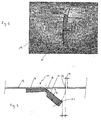
- FIG. 1 is a cross-sectional view of the edge protector.
- Fig. 2 is a picture of a vehicle comprising an edge protector installed on the edge of the vehicle door.
-
- Referring now to FIG. 1 and 2, a preferred embodiment of the
edge protector 10 of the present invention is pictured. Theedge protector 10 comprises abumper portion 12, aplanar section 14, and a flexible mid-section 16 between saidbumper section 12 andplanar section 14. This flexible mid-section 16 maintains thebumper section 12 at an angle α, which is between about 160° and about 100°. In other words, thebumper section 12 is held away from the door and sticks out. - To removably install the edge protector on a
door 18 of a vehicle, theplanar section 14 comprises for example a double backed adhesive tape with a release paper or a hot melt type of adhesive covered by a release paper. This release paper is peeled off prior to the installation on the vehicle door. - In order to position the
edge protector 10 accurately on thedoor 18, thebumper section 12 comprising anose 20 along its outer edge is pushed flat against the door. Thebumper section 12 is positioned in such a way that thenose 20 is situated behind theedge 22 of the door. Thenose 20 serves thus as a guide to position theedge protector 10 accurately on thedoor 18. - When the
bumper section 12 is pushed against the door, theplanar section 14 sticks out and the release paper can easily be removed. The planar section is subsequently pushed against the door and adheres to the door. - The
edge protector 10 is thus easily fixed to the door in such a way that in the flattened state, thebumper section 12 extends over the edge of the door and covers thegap 24 between the door and the body of the car. - Since the
edge guard 10 is only fixed onto the door by theplanar section 14 and since the flexible mid-section 16 as well as thebumper section 12 do not adhere to the door, thebumper section 12 will stick out and theedge 22 of the door and thegap 24 will become uncovered as soon as the edge protector is released. - If the door is opened and bumped against an obstacle, the
bumper section 12 is pushed flat against the door and extends over theedge 22, wraps around theedge 22 and protects not only the exterior surface of the vehicle door but also the lateral and the interior part of the edge. - The
edge protector 10 is formed from a resilient, low density foamed polymeric material. A variety of polymeric materials may be used including polyurethane, polytherephthlate, polyvinylchloride, polystyrene, polyolefines, their copolymers and mixtures thereof. The preferred embodiment of theedge protector 10 is formed from polyethylene, which provides the least damaging to the edge of the vehicle door or the like during installation and removal of theedge protector 10. - The polymeric material protector is flexible and resilient. Preferably, the polymeric material is a foam having a density of 25-35 kg/m3. The cell size of the foam is between 200 and 400 cells per cm3. The stress strain characteristic of such a foamed material is about 40% compression when a force of between 0.056 to 0.104 N/mm2 is applied. The material is compressed to 50% respectively 70% of its initial thickness if a force of between 0.077 to 0.143 N/mm2 respectively 0.154 to 0.286 N/mm2 is applied.
- The relative dimensions of the
edge protector 10 are first determined by the size of the extrusion die chosen. In the preferred embodiment, theedge protector 10 has an overall length of 150 to 600 mm. The overall width of the edge protector is about 50-70mm. By placing theedge protector 10 at strategic locations along the edge of a vehicle door or the like, such a length is sufficient to provide adequate protection to the edge of a vehicle door or the like. - The edge protector is made by conventional methods. The polymeric material is extruded and foamed, the double backed adhesive tape is applied onto the planar section and the extrudent is cut or punched into predetermined lengths to create a final
polymeric edge protector 10. Thepolymeric edge protector 10 is then ready for removable installation on an edge of a vehicle door or the like. - It is to be understood that the embodiments of this invention as shown and described are preferred examples and that the invention is not limited to the exact arrangements shown in the accompanying drawings or described in the specification. Various changes in the details of the construction and shape of the elements of the preferred embodiment may be made without departing from the spirit of the invention.
Reference list 10 edge protector 12 bumper portion 14 planar section 16 mid-section α angle 18 door 20 nose 22 edge 24 gap
Claims (6)
- An edge protector of polymeric material for removable installation on a vehicle door, said edge protector comprising:a bumper section,a planar section comprising means to removably install said protector on said edge of a vehicle door anda flexible mid-section between said bumper section and planar section,said mid-section maintaining the bumper section and the planar section at an angle α which is between 160° and 100°.
- The edge protector of claim 1, wherein said means to removably install said protector on said edge of said vehicle door comprise an adhesive material.
- The edge protector of claim 1, wherein said means to removably install said protector on said edge of said vehicle door comprise a double backed adhesive tape or a simple adhesive tape which has been fixed to said protector by a hot melt type of adhesive.
- The edge protector of claim 1, wherein the bumper section comprises a nose.
- The edge protector of claim 1, wherein said polymeric material is chosen from the group consisting of polyurethane, polytherephthlate, polyvinylchloride, polystyrene, polyolefines, their copolymers and mixtures thereof.
- The edge protector of claim 1, wherein said polymeric material comprises low-density polyethylene foam.
Priority Applications (4)
| Application Number | Priority Date | Filing Date | Title |
|---|---|---|---|
| EP20020022027 EP1405765A1 (en) | 2002-10-01 | 2002-10-01 | Edge protector |
| AU2003271760A AU2003271760A1 (en) | 2002-10-01 | 2003-09-04 | Edge protector |
| PCT/EP2003/050609 WO2004030992A1 (en) | 2002-10-01 | 2003-09-04 | Edge protector |
| DE10393379T DE10393379T5 (en) | 2002-10-01 | 2003-09-04 | edge protection |
Applications Claiming Priority (1)
| Application Number | Priority Date | Filing Date | Title |
|---|---|---|---|
| EP20020022027 EP1405765A1 (en) | 2002-10-01 | 2002-10-01 | Edge protector |
Publications (1)
| Publication Number | Publication Date |
|---|---|
| EP1405765A1 true EP1405765A1 (en) | 2004-04-07 |
Family
ID=31985031
Family Applications (1)
| Application Number | Title | Priority Date | Filing Date |
|---|---|---|---|
| EP20020022027 Withdrawn EP1405765A1 (en) | 2002-10-01 | 2002-10-01 | Edge protector |
Country Status (4)
| Country | Link |
|---|---|
| EP (1) | EP1405765A1 (en) |
| AU (1) | AU2003271760A1 (en) |
| DE (1) | DE10393379T5 (en) |
| WO (1) | WO2004030992A1 (en) |
Families Citing this family (1)
| Publication number | Priority date | Publication date | Assignee | Title |
|---|---|---|---|---|
| RU185785U1 (en) * | 2018-10-29 | 2018-12-19 | Общество с ограниченной ответственностью "ПРОММЕТЭКС" | REMOVABLE PROTECTIVE COVER |
Citations (3)
| Publication number | Priority date | Publication date | Assignee | Title |
|---|---|---|---|---|
| DE9003023U1 (en) * | 1990-03-13 | 1990-05-17 | Kuhlmann, Gerd, 4554 Ankum | Car door stopper |
| DE4030359A1 (en) * | 1990-09-26 | 1992-04-02 | Kuhlmann Gerd | Preventing damage to car door as it swings open - involves pad which can be clipped to edge of door |
| EP1209034A1 (en) * | 2000-11-27 | 2002-05-29 | Nmc S.A. | Edge guard |
-
2002
- 2002-10-01 EP EP20020022027 patent/EP1405765A1/en not_active Withdrawn
-
2003
- 2003-09-04 AU AU2003271760A patent/AU2003271760A1/en not_active Abandoned
- 2003-09-04 WO PCT/EP2003/050609 patent/WO2004030992A1/en not_active Ceased
- 2003-09-04 DE DE10393379T patent/DE10393379T5/en not_active Withdrawn
Patent Citations (3)
| Publication number | Priority date | Publication date | Assignee | Title |
|---|---|---|---|---|
| DE9003023U1 (en) * | 1990-03-13 | 1990-05-17 | Kuhlmann, Gerd, 4554 Ankum | Car door stopper |
| DE4030359A1 (en) * | 1990-09-26 | 1992-04-02 | Kuhlmann Gerd | Preventing damage to car door as it swings open - involves pad which can be clipped to edge of door |
| EP1209034A1 (en) * | 2000-11-27 | 2002-05-29 | Nmc S.A. | Edge guard |
Also Published As
| Publication number | Publication date |
|---|---|
| DE10393379T5 (en) | 2006-02-09 |
| WO2004030992A1 (en) | 2004-04-15 |
| AU2003271760A1 (en) | 2004-04-23 |
Similar Documents
| Publication | Publication Date | Title |
|---|---|---|
| EP1343659B1 (en) | Edge guard | |
| US10647280B2 (en) | Vehicle shield | |
| US5820201A (en) | High impact barrier for automobile body exterior components | |
| US5931522A (en) | Magnetic motor vehicle body protection apparatus and method of use of the same | |
| US5050925A (en) | Vehicle protective cover | |
| AU670633B2 (en) | Energy absorbing mounting systems for vehicle windows | |
| US5188407A (en) | Magnetic-strip door protector for automobiles | |
| US5090762A (en) | Automotive door trim panel protector and method of using the same | |
| CA2946911A1 (en) | Vehicle hood shield and bracket system | |
| AUPR148100A0 (en) | Automotive boot lip area protection flap | |
| GB9725568D0 (en) | Protection of vehicle windscreens | |
| US6692047B1 (en) | Add-on automobile bumper and sidewall protective strips made from reclaimed tire treads | |
| EP1308352B1 (en) | Method for mounting a shock absorbing and protecting material | |
| GB2078620A (en) | Protective trim strip | |
| EP1405765A1 (en) | Edge protector | |
| US4313987A (en) | Polystyrene vehicle body protector system | |
| US4437916A (en) | Method of manufacturing edge guards | |
| US9751232B2 (en) | Tape system with a longitudinal filament for slitting film | |
| WO2003078076A1 (en) | Trim masking tape | |
| CA2237246C (en) | Magnetic motor vehicle body protection apparatus and method of use of the same | |
| CA2000133C (en) | Automotive door trim panel protector and method of using the same | |
| GB2586588A (en) | Masking tape | |
| KR20170003106U (en) | A fender protect | |
| US20080145614A1 (en) | Apparatus and method of protecting a sheet of glass | |
| JPH07205858A (en) | Curing tape |
Legal Events
| Date | Code | Title | Description |
|---|---|---|---|
| PUAI | Public reference made under article 153(3) epc to a published international application that has entered the european phase |
Free format text: ORIGINAL CODE: 0009012 |
|
| AK | Designated contracting states |
Kind code of ref document: A1 Designated state(s): AT BE BG CH CY CZ DE DK EE ES FI FR GB GR IE IT LI LU MC NL PT SE SK TR |
|
| AX | Request for extension of the european patent |
Extension state: AL LT LV MK RO SI |
|
| AKX | Designation fees paid | ||
| REG | Reference to a national code |
Ref country code: DE Ref legal event code: 8566 |
|
| STAA | Information on the status of an ep patent application or granted ep patent |
Free format text: STATUS: THE APPLICATION IS DEEMED TO BE WITHDRAWN |
|
| 18D | Application deemed to be withdrawn |
Effective date: 20041008 |