EP1403516A2 - Capacity control valve for variable displacement compressor - Google Patents
Capacity control valve for variable displacement compressor Download PDFInfo
- Publication number
- EP1403516A2 EP1403516A2 EP20030021486 EP03021486A EP1403516A2 EP 1403516 A2 EP1403516 A2 EP 1403516A2 EP 20030021486 EP20030021486 EP 20030021486 EP 03021486 A EP03021486 A EP 03021486A EP 1403516 A2 EP1403516 A2 EP 1403516A2
- Authority
- EP
- European Patent Office
- Prior art keywords
- valve
- control valve
- downstream
- valve seat
- valve element
- Prior art date
- Legal status (The legal status is an assumption and is not a legal conclusion. Google has not performed a legal analysis and makes no representation as to the accuracy of the status listed.)
- Withdrawn
Links
Images








Classifications
-
- F—MECHANICAL ENGINEERING; LIGHTING; HEATING; WEAPONS; BLASTING
- F04—POSITIVE - DISPLACEMENT MACHINES FOR LIQUIDS; PUMPS FOR LIQUIDS OR ELASTIC FLUIDS
- F04B—POSITIVE-DISPLACEMENT MACHINES FOR LIQUIDS; PUMPS
- F04B27/00—Multi-cylinder pumps specially adapted for elastic fluids and characterised by number or arrangement of cylinders
- F04B27/08—Multi-cylinder pumps specially adapted for elastic fluids and characterised by number or arrangement of cylinders having cylinders coaxial with, or parallel or inclined to, main shaft axis
- F04B27/14—Control
- F04B27/16—Control of pumps with stationary cylinders
- F04B27/18—Control of pumps with stationary cylinders by varying the relative positions of a swash plate and a cylinder block
- F04B27/1804—Controlled by crankcase pressure
-
- F—MECHANICAL ENGINEERING; LIGHTING; HEATING; WEAPONS; BLASTING
- F04—POSITIVE - DISPLACEMENT MACHINES FOR LIQUIDS; PUMPS FOR LIQUIDS OR ELASTIC FLUIDS
- F04B—POSITIVE-DISPLACEMENT MACHINES FOR LIQUIDS; PUMPS
- F04B49/00—Control, e.g. of pump delivery, or pump pressure of, or safety measures for, machines, pumps, or pumping installations, not otherwise provided for, or of interest apart from, groups F04B1/00 - F04B47/00
- F04B49/22—Control, e.g. of pump delivery, or pump pressure of, or safety measures for, machines, pumps, or pumping installations, not otherwise provided for, or of interest apart from, groups F04B1/00 - F04B47/00 by means of valves
- F04B49/225—Control, e.g. of pump delivery, or pump pressure of, or safety measures for, machines, pumps, or pumping installations, not otherwise provided for, or of interest apart from, groups F04B1/00 - F04B47/00 by means of valves with throttling valves or valves varying the pump inlet opening or the outlet opening
-
- F—MECHANICAL ENGINEERING; LIGHTING; HEATING; WEAPONS; BLASTING
- F04—POSITIVE - DISPLACEMENT MACHINES FOR LIQUIDS; PUMPS FOR LIQUIDS OR ELASTIC FLUIDS
- F04B—POSITIVE-DISPLACEMENT MACHINES FOR LIQUIDS; PUMPS
- F04B27/00—Multi-cylinder pumps specially adapted for elastic fluids and characterised by number or arrangement of cylinders
- F04B27/08—Multi-cylinder pumps specially adapted for elastic fluids and characterised by number or arrangement of cylinders having cylinders coaxial with, or parallel or inclined to, main shaft axis
- F04B27/14—Control
- F04B27/16—Control of pumps with stationary cylinders
- F04B27/18—Control of pumps with stationary cylinders by varying the relative positions of a swash plate and a cylinder block
- F04B27/1804—Controlled by crankcase pressure
- F04B2027/1809—Controlled pressure
- F04B2027/1813—Crankcase pressure
-
- F—MECHANICAL ENGINEERING; LIGHTING; HEATING; WEAPONS; BLASTING
- F04—POSITIVE - DISPLACEMENT MACHINES FOR LIQUIDS; PUMPS FOR LIQUIDS OR ELASTIC FLUIDS
- F04B—POSITIVE-DISPLACEMENT MACHINES FOR LIQUIDS; PUMPS
- F04B27/00—Multi-cylinder pumps specially adapted for elastic fluids and characterised by number or arrangement of cylinders
- F04B27/08—Multi-cylinder pumps specially adapted for elastic fluids and characterised by number or arrangement of cylinders having cylinders coaxial with, or parallel or inclined to, main shaft axis
- F04B27/14—Control
- F04B27/16—Control of pumps with stationary cylinders
- F04B27/18—Control of pumps with stationary cylinders by varying the relative positions of a swash plate and a cylinder block
- F04B27/1804—Controlled by crankcase pressure
- F04B2027/1822—Valve-controlled fluid connection
- F04B2027/1827—Valve-controlled fluid connection between crankcase and discharge chamber
-
- F—MECHANICAL ENGINEERING; LIGHTING; HEATING; WEAPONS; BLASTING
- F04—POSITIVE - DISPLACEMENT MACHINES FOR LIQUIDS; PUMPS FOR LIQUIDS OR ELASTIC FLUIDS
- F04B—POSITIVE-DISPLACEMENT MACHINES FOR LIQUIDS; PUMPS
- F04B27/00—Multi-cylinder pumps specially adapted for elastic fluids and characterised by number or arrangement of cylinders
- F04B27/08—Multi-cylinder pumps specially adapted for elastic fluids and characterised by number or arrangement of cylinders having cylinders coaxial with, or parallel or inclined to, main shaft axis
- F04B27/14—Control
- F04B27/16—Control of pumps with stationary cylinders
- F04B27/18—Control of pumps with stationary cylinders by varying the relative positions of a swash plate and a cylinder block
- F04B27/1804—Controlled by crankcase pressure
- F04B2027/184—Valve controlling parameter
- F04B2027/185—Discharge pressure
-
- F—MECHANICAL ENGINEERING; LIGHTING; HEATING; WEAPONS; BLASTING
- F04—POSITIVE - DISPLACEMENT MACHINES FOR LIQUIDS; PUMPS FOR LIQUIDS OR ELASTIC FLUIDS
- F04B—POSITIVE-DISPLACEMENT MACHINES FOR LIQUIDS; PUMPS
- F04B27/00—Multi-cylinder pumps specially adapted for elastic fluids and characterised by number or arrangement of cylinders
- F04B27/08—Multi-cylinder pumps specially adapted for elastic fluids and characterised by number or arrangement of cylinders having cylinders coaxial with, or parallel or inclined to, main shaft axis
- F04B27/14—Control
- F04B27/16—Control of pumps with stationary cylinders
- F04B27/18—Control of pumps with stationary cylinders by varying the relative positions of a swash plate and a cylinder block
- F04B27/1804—Controlled by crankcase pressure
- F04B2027/184—Valve controlling parameter
- F04B2027/1854—External parameters
-
- F—MECHANICAL ENGINEERING; LIGHTING; HEATING; WEAPONS; BLASTING
- F04—POSITIVE - DISPLACEMENT MACHINES FOR LIQUIDS; PUMPS FOR LIQUIDS OR ELASTIC FLUIDS
- F04B—POSITIVE-DISPLACEMENT MACHINES FOR LIQUIDS; PUMPS
- F04B27/00—Multi-cylinder pumps specially adapted for elastic fluids and characterised by number or arrangement of cylinders
- F04B27/08—Multi-cylinder pumps specially adapted for elastic fluids and characterised by number or arrangement of cylinders having cylinders coaxial with, or parallel or inclined to, main shaft axis
- F04B27/14—Control
- F04B27/16—Control of pumps with stationary cylinders
- F04B27/18—Control of pumps with stationary cylinders by varying the relative positions of a swash plate and a cylinder block
- F04B27/1804—Controlled by crankcase pressure
- F04B2027/1863—Controlled by crankcase pressure with an auxiliary valve, controlled by
- F04B2027/1872—Discharge pressure
Definitions
- the present invention relates to a capacity control valve according to the preamble part of claim 1.
- Automotive air conditioning systems employ a compressor.
- a variable displacement compressor is used allowing to change the capacity independent from the engine speed.
- the rotation of an inclined wobble plate produces inclination depending piston strokes.
- the compressor capacity i.e., the amount of refrigerant being discharged from the compressor
- the compressor capacity can be varied by changing the wobble plate inclination angle by a part of the pressurized refrigerant introduced into the gastight crank chamber of the compressor.
- a change of the crank chamber pressure creates a state of balance between opposing pressures exerted on the both ends of each piston linked to the wobble plate and allows to vary the wobble plate inclination angle steplessly.
- a capacity control valve is installed either between the refrigerant outlet and the crank chamber or between the refrigerant inlet and the crank chamber.
- Known capacity control valves open or close such that a certain level of differential pressure between their inlet and outlet will be maintained. More specifically, one can set a desired differential pressure by supplying a capacity control valve with an appropriate control current from an external power source.
- the capacity control valve raises the pressure of refrigerant supplied to the crank chamber so as to reduce the compressor capacity.
- the capacity control valve decreases the crank chamber pressure so as to increase the compressor capacity.
- JP-A-2001-107854 (Fig. 3) describes a capacity control valve that regulates the flow of refrigerant being discharged from a variable displacement compressor.
- the known capacity control valve needs sensors to detect differential pressure, as well as a controller to control the capacity control valve accordingly. Those extra components push up the cost of variable displacement compressor.
- JP-A-2001-107854 describes that the flow of refrigerant that is taken into a suction chamber is determined indirectly by detecting differential pressure between two pressure monitoring points with sensors, and that the intake flow rate from the discharge chamber to the crank chamber is maintained at a constant level to regulate the flow discharged from the compressor.
- the present invention provides a capacity control valve containing the features of claim 1.
- the first control valve functions as a variable orifice for refrigerant, the cross-sectional area of which is set by the solenoid unit according to variations in a given external condition. Responsive to differential pressure developed across the variable orifice, the second control valve controls crank chamber pressure such that the differential pressure will be a specified level. By maintaining the level of differential pressure across the orifice with a certain cross-sectional area, the capacity control valve regulates the suction flow or discharge flow of the variable displacement compressor. Also, since its first and second control valves are formed in an integrated way, the capacity control valve detects differential pressure to control refrigerant flows without the need for extra pressure sensors. This feature enables to produce variable displacement compressors at lower costs.
- Another advantage is that a smaller solenoid can be used to set a required cross-sectional area of a refrigerant passageway because a small differential pressure will suffice.
- This feature eliminates the need for increased solenoid power even in a supercritical refrigeration cycle using high-pressure refrigerant, thus contributing to miniaturization of capacity control valves for variable displacement compressors.
- the proposed structure employs first and second control valves formed in an integrated way.
- the first control valve controls the cross-section area at a midway point between low-pressure refrigerant passage and suction chamber, or between discharge chamber and high-pressure refrigerant passage, according to a given external condition.
- the second control valve detects differential pressure between upstream end and downstream end of the first control valve and controls the crank chamber pressure in such a way that the differential pressure will be maintained at a specified level. This feature of the present invention enables us to construct a smaller variable displacement compressor at lower cost.
- the solenoid unit can drive the valve with a small power, and thus it is not necessary to increase its size to achieve the purpose.
- the present invention can easily be applied to refrigeration cycles using HFC-134a in a system that should operate with small differential pressure between discharge chamber and crank chamber, or crank chamber and suction chamber.
- the present invention can also be applied to those using high-pressure refrigerant in its supercritical region.
- a variable displacement compressor 1 as shown in Fig. 1 is composed of the following three sections: a driving section 100 that receives drive power from a vehicle engine (not shown); a refrigerant compressing section 200 including a gastight crank chamber 15; and a capacity controlling section 300 that controls discharge capacity.
- An outlet port 1a is connected to a condenser (or gas cooler) 3 through a high-pressure refrigerant line 2.
- the refrigerant is then routed from the condenser 3 to an expansion valve 4, an evaporator 5, and a low-pressure refrigerant line 6 in that order, and finally returns to an inlet port 1b (closed circuit for refrigeration cycle).
- a drive pulley 13 transmits rotational power to a bracket 14 and a shaft 12 protruding from a front housing 11.
- the crank chamber 15 is a closed space surrounded by the front housing 11 and by a cylinder block 16.
- the shaft 12 is rotatably installed in the crank chamber 15, across the length of the front housing 11 and the cylinder block 16.
- the drive pulley 13 is supported by an angular bearing 17 at the front housing 11.
- the rotation is directly transmitted to the variable displacement compressor 1, without an intervening clutch mechanisms (e.g., electromagnetic clutch).
- a lip seal 18 is placed between the front housing 11 and the front portion of the rotating shaft 12.
- a support member 19 is fixed to the shaft 12 in the crank chamber 15.
- a swash or wobble plate 20 is supported in such a way that it can be inclined at an oblique angle relative to the axis of the shaft 12.
- the swash plate 20 has a guide pin 22, whose spherical top portion is engaged with a support arm 21 protrudingly mounted on the rotational support member 19. The swash plate 20 rotates together with the rotating shaft 12.
- an inclination-reducing spring 23 urges the swash plate 20 in a direction to reduce the inclination angle.
- the maximum inclination is restricted by a protrusion 20a of the swash plate 20.
- the shaft 12 is rotatably supported at its rear end by a radial bearing 24 mounted into the cylinder block 16.
- the cylinder block 16 has a plurality of cylinder bores 16a housing single-headed pistons 25.
- the swash plate 20 engages with the head of each piston 25 via a shoe 26.
- a thrust bearing 28 Placed between the rotational support member 19 and the front housing 11 is a thrust bearing 28 which receives reaction forces caused by the compression and acting on the rotational support member 19 via the pistons 25 and the swash plate 20.
- the capacity controlling section 300 is separated from the refrigerant compressing section 200 by a valve plate 27.
- the capacity controlling section 300 has a rear housing 31 located next the valve plate 27 and a capacity control valve 30 in the rear housing 31.
- the rear housing 31 provides the following separate cavities adjacent to the valve plate 27: suction chambers 32, discharge chambers 33, and a communication passage 34.
- the suction chambers 32 are cavities containing a suction pressure Ps.
- the discharge chambers 33 contain a discharge pressure PdH and receive the refrigerant compressed by the refrigerant compressing section 200.
- the communication passage 34 communicates with the crank chamber 15, and contains a crank chamber pressure Pc.
- the rear housing 31 also provides the outlet and the inlet ports 1a, 1b as well as a cavity 35 for the capacity control valve 30.
- the rear housing 31 has several communication holes 36 to 39 formed in its body.
- the first communication hole 36 connects the inlet port 1b with the suction chambers 32.
- the second communication hole 37 connects the housing cavity 35 with the communication passage 34, which further leads to the crank chamber 15.
- the housing cavity 35 can also communicate with the discharge chambers 33 through the third communication hole 38.
- the fourth communication hole 39 permits the housing cavity 35 to communicate with the outlet port 1a.
- a suction relief valve 32v is placed at each cylinder port connecting to the suction chamber 32, on the side of the valve plate 27 adjacent to the cylinder bores 16a.
- a discharge relief valve 33v is placed similarly at each cylinder port connecting to its corresponding discharge chambers 33, but on the opposite side of the valve plate 27, remote from the cylinder bores 16a.
- the suction chambers 32, one for each cylinder bore 16a communicate with each other in the rear housing 31, as well as with the first communication hole 36.
- the discharge chambers 33 communicate with each other in the rear housing 31, as well as with the third communication hole 38.
- the refrigerant gas in the suction chamber 32 is sucked into each cylinder bore 16a through its corresponding suction relief valve 32v and then discharged from those cylinder bores 16a to their corresponding discharge chambers 33 through respective discharge relief valves 33v.
- crank chamber 15 While not shown in Fig. 1, there is an orifice of fixed cross-section between the crank chamber 15 and the suction chambers 32 to release refrigerant from the crank chamber 15 to the suction chambers 32.
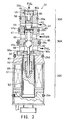
- the first embodiment of the capacity control valve 30 (Figs 1 and 2) is made up of a first control valve 30A, a second control valve 30B, and a solenoid unit 30C.
- the first control valve 30A has two ports 41 and 42 formed in a body 40.
- Port 41 receives the discharge pressure PdH from the discharge chambers 33 through the third communication hole 38 of the rear housing 31 shown in Fig. 1.
- Port 42 outputs refrigerant at discharge pressure PdL that has been reduced at the first control valve 30A, for delivery through the fourth communication hole 39 and a high-pressure refrigerant line 2.
- a bored valve hole 45 for communication of refrigerant, the upstream edge of which is intended to function as a first valve seat 45a.
- an e.g. ball-shaped first valve element (ball valve element) 46 is placed in an upstream space adjacent to the first valve seat 45a.
- the valve hole space communicating with the port 41 accommodates a coil spring 48 that urges the ball valve element 46 in the direction that it closes the passage, and the amount of that spring load can be adjusted by an adjustment screw 47 screwed into the body 40.
- the downstream side of the ball valve element 46 is in contact with one end of a shaft 49 that extends in the axial direction of the solenoid unit 30C through the valve hole of the first valve seat 45a.
- This shaft 49 is supported by a bearing 50a formed in the body 40, and the bearing 50a has a communication hole 50b to equalize the inside pressure of the solenoid unit 30C with the discharge pressure PdL.
- the solenoid unit 30C contains a solenoid coil 51 that has a cylindrical cavity, in which a sleeve 52 is fitted. A fixed core 53 is pressed into the sleeve 52.
- the sleeve 52 contains a plunger 54 that can slide in axial direction while being urged by a coil spring 55 in the downward direction in Fig. 2.
- the plunger 54 is fixed to the lower end of the shaft 49 running coaxially through the core 53.
- the plunger 54 When the solenoid coil 51 is in de-energized state, the plunger 54 is set away from the core 53 by coil spring 55, causing the shaft 49 extending from the plunger 54 to loose contact with the ball valve element 46.
- the first control valve 30A is fully closed because the freed ball valve element 46 is seated on the first valve seat 45a, being urged by another coil spring 48.
- the solenoid coil 51 When the solenoid coil 51 is energized, the plunger 54 is attracted by the magnetized core 53 to push the ball valve element 46 via the shaft 49 in the valve-opening direction.
- the amount of the thus caused movement, or the valve lift (or opening-degree) of the ball valve element 46 is proportional to the value of the supplied electrical current.
- control current determines the cross-sectional area of the refrigerant passageway of the first control valve 30A which functions as a variable orifice, and changes its cross-sectional size as specified by the control current to allow the discharged refrigerant to pass through.
- the solenoid unit 30C described above is intended, not for directly controlling a high-pressure refrigerant flow, but for controlling the first control valve 30A so that a small differential pressure will be produced depending on the discharge flow rate Qd of the refrigerant passing therethrough. Since only a small power is needed to achieve the purpose, it is possible to reduce the size of the solenoid unit 30C.
- the second control valve 30B has a body 40a screwed into the body 40 of the first control valve 30A so that the two control valves 30A and 30B are stacked in series.
- the body 40a has two ports 43 and 44.
- One port 43 is used to apply control pressure Pc to the crank chamber, and the other port 44 is used to introduce discharge pressure PdL that has been reduced at the first control valve 30A.
- the body 40a has an opening at its bottom end, which communicates with the port 41 to receive discharge pressure PdH of the discharge chambers 33 through a communication hole 47a formed on an adjustment screw 47.
- a second valve seat 56 is formed as an integral part of the body 40a. Placed opposite to this second valve seat 56 in the port 43 is a second valve element 57.
- the second valve element 57 is a taper-shaped member that is integrally formed with a cylindrical piston 58 which is axially movable within a cylinder that is bored on the axis of the body 40a.
- a coil spring 60 installed at an upper end portion of the piston 58 urges the second valve element 57 in the valve-closing direction.
- the respective spring load depends on how deep an adjustment screw 59 is screwed into the body 40a.
- the adjustment screw 59 has a central through hole 59a as a passage introducing the reduced discharge pressure PdL from the port 44 to the space above the piston 58.
- the second valve element 57 and the piston 58 thus receive different axial pressures at their both endfaces.
- the second valve element 57 receives discharge pressure PdH from the port 41, while the piston 58 receives discharge pressure PdL from the port 44.
- the then created differential pressure ⁇ P determines the lift of the second valve element 57. More specifically, the differential pressure ⁇ P is generated when refrigerant flows through a passage with a certain cross-sectional area as determined by the first control valve 30A. Then the second control valve 30B functions as a constant differential pressure valve that controls the amount of refrigerant flowing into the crank chamber 15 in such a way that the above differential pressure ⁇ P will be maintained at a constant level.
- O-rings are provided around the periphery of the capacity control valve 30, namely an O-ring 29a to seal the gap between the ports 44 and 43, an O-ring 29b between the ports 43 and 41, yet another O-ring 29c between the ports 41 and 42, another O-ring 29d between the port 42 and the solenoid unit 30C, and yet another O-ring 29e to seal the solenoid unit 30C against the surrounding atmosphere.
- the swash plate 20 When the shaft 12 is driven, the swash plate 20 will wobble to produce reciprocating motion of the pistons 25 linked to the outer regions of the swash plate 20. Refrigerant is sucked from the suction chambers 32 into the cylinder block 16, is compressed and is discharged into the discharge chambers 33.
- the solenoid unit 30C When the solenoid unit 30C is de-energized the first control valve 30A is fully closed. Refrigerant discharged to the discharge chambers 33 is entered to the crank chamber 15 in its entirety via the second control valve 30B. The variable displacement compressor 1 runs in the minimum capacity mode.
- the first control valve 30A When a predetermined amount of control current is supplied to the solenoid unit 30C, the first control valve 30A shows a predetermined opening degree (valve lift).
- the second valve element 57 and the piston 58 respond to the differential pressure ⁇ P across the first control valve 30A.
- the second control valve 30B controls the flow from the discharge chambers 33 to the crank chamber 15 such that the differential pressure ⁇ P will be maintained at a constant level. This control action may vary the capacity of the variable displacement compressor 1 as needed to regulate the discharge flow.
- the discharge flow rate is determined depending on how much refrigeration capacity is required in the present refrigeration cycle.
- the refrigeration capacity is calculated from various parameters, which include: engine rotation speed, vehicle speed, accelerator pedal position, indoor and outdoor temperatures, set temperatures, and monitoring signals supplied from various temperature and pressure sensors.
- the amount of the electrical current for the solenoid coil 51 is determined on the basis of this calculation result.
- the discharge flow rate is increased accordingly.
- This develops an increased differential pressure ⁇ P across the first control valve 30A.
- the second control valve 30B further lifts its valve element, so that more refrigerant will be supplied from the discharge chambers 33 to the crank chamber 15.
- the pressure Pc rises, and the variable displacement compressor 1 is controlled in an output-reducing condition.
- the compressor 1 now operates with a smaller discharge capacity, suppressing the discharge flow rate of refrigerant, and thus reducing the differential pressure ⁇ P.
- the discharge flow rate Qd of refrigerant is regulated by controlling the second control valve 30B so that the differential pressure across the orifice (i.e., the first control valve 30A being configured as a proportional solenoid valve) will be maintained at a constant level.
- the discharge flow rate will decrease and reduce the differential pressure across the first control valve 30A accordingly.
- the discharge pressure PdH falls, and the second control valve 30B operates such as to reduce the refrigerant flow from the discharge chambers 33 to the crank chamber 15.
- Pressure Pc in the crank chamber 15 falls and causes the compressor 1 to operate in a capacity-increasing condition, thus recovering the discharge. In this way, the discharge flow rate Qd of refrigerant is maintained at the constant level.
- the present invention combines the first control valve 30A that functions as a variable orifice controlled by the solenoid unit 30C and 'the second control valve 30B that controls the pressure in the crank chamber 15 in an integrated way, thus providing a compact, space-saving design for the capacity control functions (i.e., regulating the flow rate Qd of refrigerant discharged from the variable displacement compressor 1).
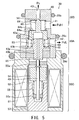
- the capacity control valve 30 of the second embodiment differs from the first embodiment of Fig. 2 in that the ball valve element 46 of its first control valve 30A is arranged such that it will allow more refrigerant to pass through when it is displaced following the stream of the refrigerant.
- the ball valve element 46, or the first valve element is placed on the downstream side of the first valve seat 45a.
- the plunger 54 and the core 53 have swapped their positions in the solenoid unit 30C.
- the first control valve 30A stays fully closed by the coil spring 55 when the solenoid unit 30C is not energized. Refrigerant entering the port 41 at discharge pressure PdH is led to the crank chamber 15 in its entirety through the second control valve 30B, meaning that the variable displacement compressor 1 now operates in the minimum capacity condition.
- the capacity control valve 30 of the third embodiment in Fig. 4 differs from Figs 2, 3 in that a taper-shaped valve element 61 is placed on the upstream side of the first valve seat 45a to receive a force in the valve-opening direction. Instead of port 44, the capacity control valve 30 in Fig. 4 has a communication hole 62 in the body 40 to serve the same purpose. For that reason, the port 41 for discharge pressure PdH and port 42 for discharge pressure PdL have swapped their positions in Fig. 4 compared to Fig. 3. Another difference is that the crank chamber 15 receives the discharge pressure PdL behind an orifice.
- the first control valve 30A in Fig. 4 has a port 41 formed in the body 40 to receive the discharge pressure PdH from the discharge chambers 33.
- Port 42 serves to supply the high-pressure refrigerant line 2 with discharge pressure PdL that is reduced by the first control valve 30A.
- the valve hole 45 communicates between the ports 41 and 42, and its upstream-side edge function as the first valve seat 45a.
- a taper-shaped first valve element 61 is placed in an upstream-side space, opposite to the first valve seat 45a.
- the first valve element 61 has an integrated circumferential flange 61 a.
- the flange 61a retains one end of a coil spring 48 that is placed around the first valve element 61 and abuts around the first valve seat 45a.
- the coil spring 48 urges the first valve element 61 in opening direction.
- the valve element 61 is coupled to an end of the axial shaft 49 of the solenoid unit 30C. With the solenoid unit 30C de-energized, the coil spring 55 seats the first valve element 61 on the first valve seat 45a.
- the shaft 49 is supported by a bearing 50a at its middle portion adjacent to the first control valve 30A, as well as by another bearing 50c at its bottom end.
- the bottom-end bearing 50c is press-fitted into the central bore of the fixed core 53.
- the second control valve 30B is coupled in series with the first control valve 30A, the space above the piston 58 being closed by a lid 59b.
- the body 40 has a communication hole 62 to communicate that space with the port 41, through which discharge pressure PdH acts on the back face of the piston 58. This arrangement reduces the needed number of ports of the body 40, thus making it easier to manufacture the capacity controlling section 300, and allows to eliminate some of the otherwise needed O-rings.
- the first control valve 30A sets a certain cross-sectional area for the refrigerant passageway in accordance with how much the solenoid unit 30C is energized.
- the second control valve 30B is responsive to differential pressure developed across the first control valve 30A to control the flow rate of refrigerant supplied from the discharge chambers 33 to the crank chamber 15.
- the capacity control valve 30 regulates the flow rate Qd that the variable displacement compressor 1 discharges.
- the capacity control valve 30 of Fig. 5 is distinct in the following points.
- the first control valve 30A employs a spool-shaped valve element 63 as the first valve element.
- the second control valve 30B uses a taper-shaped valve element 64 as a second valve element.
- a first valve seat 63a is provided as an integral part of the second valve element in the second control valve 30B.
- This first valve seat 63a is designed to set a required cross-section area for refrigerant passage while moving together with the second valve element.
- the second control valve 30B in Fig. 5 has a second valve seat 56 and its corresponding second valve element 64 with a tapered shape.
- the second valve seat 56 is formed as an integral part of the body 40, in the middle of a refrigerant passageway between the two ports 41 and 43, the former receiving refrigerant from the discharge chambers 33 and the latter delivering refrigerant to the crank chamber 15.
- the second valve element 64 is located in an upstream-side space (discharge pressure PdH).
- the second valve element 64 is urged by a coil spring 66 in the valve-opening direction.
- Integrally formed with the second valve element 64 is a pressure responsive member 64a, whose base portion detects differential pressure between two different discharge pressures PdH and PdL.
- the pressure responsive member 64a is installed inside the body 40 in a manner that it can come in contact with or move away from the second valve seat 56 according to the differential pressure acting thereon.
- the pressure responsive member 64a has a central cavity around its axis, the bottom end of which is open.
- the pressure responsive member 64a has also a hole 64b in its upper portion, which allows the discharge pressure PdH in the port 41 to reach the central cavity.
- the first control valve 30A has a first valve seat 63a at the rim of the bottom opening end of the pressure responsive member 64a.
- the value seat 63a cooperates with the spool-shaped valve element 63 located below the bottom opening.
- the first valve seat 63a and first valve element 63 set an appropriate cross-sectional area for a passageway that delivers refrigerant from one port 41 to another port 42 via the hole 64b of the pressure responsive member 64a.
- the valve element 63 is integrally formed with a pressure responsive piston 63p having the same cross-sectional area as the valve hole of the first valve seat 63a.
- a flange 63b is formed around this valve element 63, on a downstream-side portion remote from the first valve seat 63a. This flange 63b receives the force of the coil spring 48 urging the valve element 63 in the valve-opening direction.
- Another coil spring 60 is disposed between the pressure responsive piston 63p and the pressure responsive member 64a.
- the pressure responsive piston 63p is slidably supported in a plug 40b, which seals the bottom of the body 40.
- the pressure responsive piston 63p may also be pressed upward by the shaft 49 between the solenoid unit 30C and the bottom endface of the piston 63p.
- a pressure balancing hole 65 extends through the pressure responsive piston 63p to introduce the back pressure from the upstream-side cavity adjacent to the first valve seat 63a. This structure permits the discharge pressure PdH from the port 41 to act equally on both the bottom end of the pressure responsive piston 63p and the top end of the valve element 63. Those two opposing pressure forces cancel each other and the discharge pressure PdH never interferes with the operation of the solenoid unit 30C controlling the position of the valve element 63.
- the shaft 49 moves downward and allows the valve element 63 to leave the first valve seat 63a and to form a gap of a certain width around the first valve seat 63a.
- the refrigerant in the port 41 at discharge pressure PdH flows out of the port 42 through the first control valve 30A.
- the pressure responsive member 64a receives the differential pressure between discharge pressures PdH and PdL, which moves the second valve element 64 so that the differential pressure will become a predetermined level.
- the second control valve 30B controls the refrigerant being delivered from the port 43 to the crank chamber 15.
- the compressor 1 operates with a smaller displacement so as to recover the original discharge flow rate. If the refrigerant flow through the first control valve 30A decreases, the second control valve 30B is actuated in a valve-closing direction, thus reducing the refrigerant flow into the crank chamber 15. The compressor 1 operates with a larger displacement to regulate the discharge flow rate Qd.
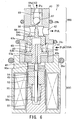
- the fifth embodiment of the capacity control valve 30 of Fig. 6 differs from the fourth embodiment (Fig. 5) in that the port 41 for discharge pressure PdH and the port 42 for discharge pressure PdL have swapped their positions.
- the fifth embodiment in Fig. 6 employs a ball valve element 67 for that purpose. This ball valve element 67 is located downstream of the second valve seat 56 and is loaded in valve-opening direction by a stem 68 extending through the valve hole and the first control valve 30A.
- the second control valve 30B has the second valve seat 56 formed as an integral part of the body 40.
- a ball valve element 67 is located in a downstream-side space adjacent to the second valve seat 56 and is urged by the coil spring 60 in valve-closing direction.
- the spring load can be adjusted by an adjustment screw 59 which has a central through hole 59a constituting the port 43 for delivery of refrigerant to the crank chamber 15 (control pressure Pc).
- the first control valve 30A has the first valve seat 63a at the bottom opening end of the pressure responsive member 64a which is integral with the shaft or stem 68.
- the upper end of the shaft or stem 68 contacts the ball valve element 67.
- the coil spring 55 urges the plunger 54 and shaft 49 in the upward direction to put the valve element 63 into the central opening of the pressure responsive member 64a.
- the first control valve 30A is fully closed, while the second control valve 30B is fully opened because of the differential pressure that acts on the pressure responsive member 64a.
- the shaft 49 moves downward and allows the valve element 63 to leave the first valve seat 63a and to form a gap of a certain width around the first valve seat 63a.
- the refrigerant in the port 41 at discharge pressure PdH flows out of the port 42 through the first control valve 30A.
- the pressure responsive member 64a receives differential pressure between discharge pressures PdH and PdL, which moves the ball valve element 67, relative to the second valve seat 56 so that the differential pressure will have a predetermined level.
- the second control valve 30B controls the flow rate of the refrigerant as delivered from the port 43 to the crank chamber 15.
- the compressor 1 operates with smaller displacement so as to recover its original discharge flow rate. If the refrigerant flow through the first control valve 30A decreases, the second control valve 30B is actuated in a valve-closing direction, thus reducing the refrigerant flow into the crank chamber 15. The compressor 1 operates with a larger displacement so as to regulate the discharge flow rate Qd.
- the capacity control valve 30 of the sixth embodiment in Fig. 7 differs from the fifth embodiment (Fig. 6) in that its first control valve 30A employs a taper-shaped valve element 61 as a first valve element located in an upstream-side space adjacent to the first valve seat 63a, being urged in the valve-opening direction.
- the coil spring 55 urges the plunger 54 and shaft 49 upward to seat the taper-shaped valve element 61 on the first valve seat 63a.
- the first control valve 30A is fully closed, while the second control valve 30B is fully opened because of the differential pressure that acts on the pressure responsive member 64a.
- the shaft 49 moves downward and allows the valve element 61 to leave the first valve seat 63a to form a gap of a certain width at the first valve seat 63a.
- the refrigerant from the port 41 at discharge pressure PdH flows out of the port 42 through the first control valve 30A.
- the pressure responsive member 64a receives the differential pressure between discharge pressures PdH and PdL, which moves the ball valve element 67 so that the differential pressure will have a predetermined level.
- the second control valve 30B controls the flow rate of the refrigerant being delivered from the port 43 to the crank chamber 15.
- valve element 67 opens further to supply more refrigerant into the crank chamber 15.
- the compressor 1 operates with a smaller displacement so as to recover its original discharge flow rate. If the refrigerant flow through the first control valve 30A decreases, the second control valve 30B is actuated in valve-closing direction reducing the refrigerant flow into the crank chamber 15. The compressor 1 operates with a larger displacement so as to regulate the discharge flow rate Qd.
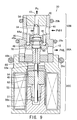
- the capacity control valve 30 of the seventh embodiment in Fig. 8 differs from the sixth embodiment (Fig. 7) in that its first valve element 61 is designed to cancel the back pressure in order to prevent the discharge pressure PdH from affecting operation of the first control valve 30A. This concept is described for the fifth embodiment (Fig. 6) already.
- the coil spring 55 urges the plunger 54 and shaft 49 in the upward direction to seat the taper-shaped valve element 61 on the first valve seat 63a.
- the first control valve 30A is fully closed, while the second control valve 30B is fully opened.
- the shaft 49 moves downward and allows the valve element 61 to leave the first valve seat 63a and form a gap of a certain width at the first valve seat 63a.
- the refrigerant at port 41 at discharge pressure PdH flows out of the port 42 through the first control valve 30A.
- the pressure responsive member 64a receives differential pressure between discharge pressures PdH and PdL and moves the valve element 67 so that the differential pressure will have a predetermined level.
- the second control valve 30B controls the flow rate at port 43 to the crank chamber 15.
- the compressor 1 operates with a smaller displacement so as to recover its original discharge flow rate. If the refrigerant flow through the first control valve 30A decreases, the second control valve 30B is actuated in a valve-closing direction to reduce the refrigerant flow into the crank chamber 15. The variable displacement compressor 1 operates with a larger displacement so as to regulate the discharge flow rate Qd.
- the capacity control valve 30 of the eighth embodiment in Fig. 9 differs from the fourth embodiment (Fig. 5) in that its first valve seat 45a is not designed to move, but is an integral part of the body 40 of the first control valve 30A. Another difference is that a plurality of ball valve elements 46 are employed to serve with several valve seats the function of the first valve element.
- the body 40 in Fig. 9 has a plurality of valve holes 45 bored along a pitch circle concentric with a cross section of the body 40 itself.
- the bottom-end edge of each valve hole 45 serves as the first valve seat 45a.
- Each ball valve element 46 is placed at a downstream-side space adjacent to each first valve seat 45a. All ball valve elements 46 rest on a downstream-side surface of a support member 70, which is urged by a coil spring 60 in the downward direction.
- the support member 70 also receives an upward force of the coil spring 55 in the solenoid unit 30C, via the plunger 54 and the shaft 49.
- the second control valve 30B has the pressure responsive member 64a urged upward by the coil spring 66. Since the pressure responsive member 64a is integral with the second valve element 64, the urging force of the coil spring 66 also acts on the second valve element 64 in the valve-closing direction.
- the pressure responsive member 64a, in combination with the second valve element 64, is supposed to be responsive to differential pressure ⁇ P between two different discharge pressures PdH and PdL, on the upstream and downstream ends of the first control valve 30A, respectively.
- the solenoid unit 30C When the solenoid unit 30C is de-energized, the coil spring 55 urges the plunger 54 and the shaft 49 in the upward direction and seats the ball valve elements 46 at the first valve seats 45a.
- the first control valve 30A is fully closed. With the discharge pressure PdH in the port 41, the maximum differential pressure acts on the pressure responsive member 64a, and fully opens the second control valve 30B.
- the compressor 1 operates in the minimum capacity condition.
- the compressor 1 operates with a smaller displacement so as to recover its original discharge flow rate. If the refrigerant flow through the first control valve 30A decreases, the second control valve 30B reduces the refrigerant flow into the crank chamber 15 because the pressure responsive member 64a impels the second valve element 64 in the valve-closing direction. The compressor 1 operates with a larger displacement so as to regulate the discharge flow rate Qd.
- the capacity control valve 30 of the ninth embodiment in Fig. 10 differs from the eighth embodiment (Fig. 9) in the structure of the first valve element and the first valve seat.
- the body 40 has a doughnut-shaped valve hole 45 hollowed along a circle that is concentric with a cross section of the body 40, and the bottom-end edge of the valve hole serves as the first valve seat 45a.
- the doughnut-shaped valve hole 45 does not go through the body 40 over the entire circumference, but some middle part of a floor of the body 40 remains solid at a few places. This measure connects the central portion of the floor to the circumferential portion of the body 40 in order to house the pressure responsive member 64a.
- a flat annular valve element 71 is disposed on the downstream side, together with a plug 40b that supports the flat valve element 71 axially movable.
- the solenoid unit 30C When the solenoid unit 30C is de-energized, the coil spring 55 urges the plunger 54 and the shaft 49 in the upward direction to abut the flat valve element 71 on the first valve seat 45a.
- the first control valve 30A is fully closed. With the discharge pressure PdH in the port 41, the maximum differential pressure acts on the pressure responsive member 64a fully opening the second control valve 30B.
- the compressor 1 operates in the minimum capacity condition.
- the compressor 1 operates with a smaller displacement so as to recover its original discharge flow rate. If the refrigerant flow through the first control valve 30A decreases, the second control valve 30B reduces the refrigerant flow into the crank chamber 15 because its pressure responsive member 64a impels the second valve element 64 in the valve-closing direction. The compressor 1 operates with a larger displacement so as to regulate the discharge flow rate Qd.
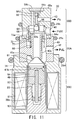
- the capacity control valve 30 of the tenth embodiment in Fig. 11 differs from the first embodiment (Fig. 2). The most prominent difference is that the tenth embodiment uses, in its first control valve 30A, a diaphragm 72 to detect differential pressure between upstream and downstream sides.
- an integral cylinder 40c is formed serving as the valve hole 45 interconnecting the ports 41 and 42.
- the bottom end of the cylinder 40c functions as the first valve seat 45a for the first control valve 30A.
- a taper-shaped valve element 61 is placed opposite the first valve seat 45a.
- This valve element 61 is integral with the plunger 54 of the solenoid unit 30C and has a circumferential groove 61b in the round periphery.
- the groove 61b receives a piston ring 74 slidably supporting the plunger 54 on the inner wall of the sleeve 52, and also centering the valve element 61 on the axis of the sleeve 52.
- a valve hole is bored between ports 41, 43.
- the bottom end of the valve hole is the second valve seat 56.
- the taper-shaped second valve element 64 is placed in the upstream-side space adjacent to the second valve seat 56.
- the taper-shaped second valve element 64 is placed in the upstream-side space adjacent to the second valve seat 56.
- Integrally formed on top of the second valve element 64 are a shaft 64c and a piston 64d.
- This piston 64d has the same outer diameter as the valve hole of the second valve seat 56.
- the endface of the piston 64d remote from the second valve element 64 receives, through a communication hole 62, discharge pressure PdH in the port 41, so that the second valve element 64 is actuated solely by the differential pressure between discharge pressures PdH and PdL, without being affected by the absolute value of discharge pressure PdH.
- the second valve element 64 is integral with a base member 64e, which is larger in diameter than the second valve element 64.
- the base member 64e has a hole 64
- a sliding member 73 surrounds the outer surface of the cylinder 40c in body 40 in a way that it can move in the vertical direction.
- This sliding member 73 is connected with the inner surface of the cavities of the bodies 40 and 40a via a diaphragm 72, which is a doughnut-shaped sheet with a center hole.
- the outer circumference of the diaphragm 72 is clamped between the bodies 40 and 40a.
- the body 40a is pressed into the body 40.
- the inner circumference of the diaphragm 72 is clamped between the sliding member 73 and a ring 73a.
- the base member 64e of the second valve element 64 may rest on the sliding member 73.
- Two coil springs 60 and 66 urge the members 64e and 73 such that they will keep contact.
- the diaphragm 72 receives differential pressure between the discharge pressure PdH at the port 41 and the discharge pressure PdL at the port 42. This differential pressure displaces the sliding member 73 in axial direction, causing the second valve element 64 to move toward or away from the second valve seat 56.
- the solenoid unit 30C When the solenoid unit 30C is de-energized, the coil spring 55 urges the plunger 54 upward to seat the valve element 61 sit on the first valve seat 45a.
- the first control valve 30A is fully closed. With the discharge pressure PdH present in the port 41, the maximum differential pressure acts on the diaphragm 72 to fully open the second control valve 30B.
- the compressor 1 operates in the minimum capacity condition.
- the plunger 54 moves downward allowing the valve element 61 to leave the first valve seat 45a and to form a gap of a certain width at the first valve seat 45a.
- Refrigerant in the port 41 at the discharge pressure PdH flows out of the port 42 through the hole 64b of the second valve element 64, the central cavity of the cylinder 40c, and the first control valve 30A.
- the diaphragm 72 receives the differential pressure between the two different discharge pressures PdH and PdL, and moves the sliding member 73 upward so that the differential pressure will reach a predetermined level.
- the second valve element 64 follows this movement of the sliding member 73, thus controlling the refrigerant at the discharge pressure PdH that flows through the second control valve 30B.
- the compressor 1 operates with a smaller displacement so as to recover its original discharge flow rate. If the refrigerant flow through the first control valve 30A decreases, the diaphragm 72 receives a reduced differential pressure and reduces the refrigerant flowing into the crank chamber 15 because its sliding member 73 impels the second valve element 64 in the valve-closing direction. The compressor 1 operates with a larger displacement so as to regulate the discharge flow rate Qd.
- the second control valve 30B is controlled to respond only to the differential pressure between the two different discharge pressures PdH and PdL, because the second valve element 64 is unaffected by variations of the discharge pressure PdH.
- the capacity control valve 30 of the eleventh embodiment of Fig. 12 differs from the tenth embodiment (Fig. 11) in that the taper-shaped valve element (first valve element) 61 in the first control valve 30A is disposed in an upstream-side space of the first valve seat 45b formed at the top end of the cylinder 40c. For this reason, in the solenoid unit 30C, the plunger 54 and core 53 have swapped their positions on the axis (relative to Fig. 11).
- the shaft 49 connects the first valve element 61 with the plunger 54 in the solenoid unit 30C.
- the first valve element 61 is urged by the coil spring 55 in the valve-closing direction.
- the eleventh embodiment operates basically in the same way as the tenth embodiment.
- the widened base member 64e of the second valve element 64 has at least one round hole 64f in a cylindrical skirt portion in addition to the hole 64b to deliver the discharge pressure PdH from the port 41 to the upstream side of the first valve element 61.
- variable displacement compressor 1 operates in the minimum capacity condition.
- the plunger 54 moves upward and allows the taper-shaped valve element 61 to leave the first valve seat 45b and form a gap of a certain width at the first valve seat 45b.
- Refrigerant in the port 41 at discharge pressure PdH flows out of the port 42 through the round hole 64f and the hole 64b of the second valve element 64, the first control valve 30A, and the central cavity of the cylinder 40c.
- the diaphragm 72 receives differential pressure between the two different discharge pressures PdH and PdL and moves the sliding member 73 upward so that the differential pressure will reach a predetermined level.
- the second valve element 64 follows this upward movement of the sliding member 73, thus controlling the flow rate of the refrigerant at discharge pressure PdH that flows through the second control valve 30B.
- the second valve element 64 is moved to further open and to supply more refrigerant into the crank chamber 15.
- the compressor 1 operates with a smaller displacement so as to recover its original discharge flow rate. If the refrigerant flow through the first control valve 30A decreases, the diaphragm 72 detects and responds to a reduced differential pressure.
- the sliding member 73 impels the second valve element 64 in the valve-closing direction.
- the second control valve 30B reduces the refrigerant supplied to the crank chamber 15, and the compressor 1 operates with a larger displacement so as to regulate the discharge flow rate Qd.
- the first control valve 30A is located between the discharge chambers 33 and crank chamber 15, and the pressure in the crank chamber 15 is controlled by varying the flow rate at discharge pressure PdL from the discharge chambers 33 into the crank chamber 15.
- the twelfth embodiment of Fig. 13 controls the flow rate returning from the crank chamber 15 back into the suction chambers 32.
- the variable displacement compressor 1 has an orifice of fixed cross-section in the middle of a passageway that delivers refrigerant from the discharge chambers 33 to the crank chamber 15.
- the first control valve 30A and solenoid unit 30C of the capacity control valve 30 of Fig. 13 have almost the same structure shown in the third embodiment of Fig. 4. An exception is that the first control valve 30A is designed to route the discharged refrigerant in the direction that the stream pushes the taper-shaped valve element 61 in opening direction away from the first valve seat 45a.
- two pistons 58 and 58a are integrally formed with the second valve element 57.
- the pistons 58 and 58a have the same outer diameter as the valve hole of the second valve seat 56.
- Discharge pressure PdH acts on the piston 58a and discharge pressure PdL propagates through a communication hole 62 and acts on one endface of the piston 58.
- Pressure Pc of the crank chamber 15 is led from the port 43 to an upstream-side cavity adjacent to the second valve element 57.
- the downstream-side room communicates with the suction chambers 32 at suction pressure Ps via the port 75.
- the second valve element 57 and piston 58 are responsive to the differential pressure ⁇ P developed across the first control valve 30A, which is functioning here as an orifice.
- the second control valve 30B thus controls the flow rate from the crank chamber 15 to the suction chambers 32 such that the differential pressure ⁇ P will be maintained at a constant level. This control action varies the capacity of the variable displacement compressor 1 so as to regulate the discharge flow rate.
- the coil spring 55 urges the plunger 54 and the shaft 49 upward to seat the first valve element 61 on the first valve seat 45a.
- the first control valve 30A is fully closed.
- the plunger 54 moves downward and allows the first valve element 61 to leave the first valve seat 45a and to form a gap of a certain width at the first valve seat 45a.
- Refrigerant in the port 41 at discharge pressure PdH flows out of the port 42 through the first control valve 30A.
- the second valve element 57 and the piston 58 receive differential pressure between the two different discharge pressures PdH and PdL, in addition to the force of the coil spring 60.
- the second valve element 57 moves to a point at which all those forces and pressures are in balance.
- the refrigerant in the crank chamber 15 at pressure Pc is allowed to flow back to the suction chambers 32.
- the second control valve 30B now may control the discharge capacity of the variable displacement compressor 1 by varying the crank chamber pressure Pc.
- the refrigerant flow through the first control valve 30A may increase due to, for example, sudden acceleration of the driving engine. Then, a larger differential pressure will occur across the valve 30A and will actuate the second control valve 30B to further close and to reduce the flow rate out of the crank chamber 15.
- the compressor 1 operates with a smaller displacement so as to recover its original discharge flow rate. If the refrigerant flow through the first control valve 30A decreases, the second control valve 30B is actuated in the valve-opening direction, thus increasing the flow rate out of the crank chamber 15.
- the compressor 1 operates with a larger displacement, thus regulating the discharge flow rate Qd.
- the third embodiment has a capacity control valve 30 controlling the flow rate into the crank chamber 15 (inflow control).
- the twelfth embodiment (Fig. 13) manipulates the flow rate out of the crank chamber 15 (outflow control).
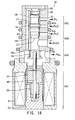
- the thirteenth embodiment of Fig. 14 relates to a capacity control valve 30 that employs both in-flow and out-flow control mechanisms.
- the capacity control valve 30 of Fig. 14 has a first control valve 30A placed in a passageway leading from the discharge chambers 33 to the solenoid unit 30C that governs the cross-sectional area of the passageway.
- the capacity control valve 30 of Fig. 14 has the second 30B and a third control valves 30D that both detect the differential pressure developed across the first control valve 30A and which control the pressure in the crank chamber 15 such that the differential pressure will reach a specified level.
- the second and third control valves 30B and 30D accommodate the following components in a common valve hole: a piston 58, a second valve element 57, and a third valve element 76, all integrally formed as a single member.
- One control edge formed in the valve hole serves as a third valve seat 77.
- the piston 58 has the same outer diameter as the valve seat 77.
- the second valve element 57 receives the discharge pressure PdH on its bottom endface, while the piston 58 receives the discharge pressure PdL through a communication hole 62 of the body 40.
- the upstream-side room adjacent to the second valve element 57 is at discharge pressure PdH introduced from the port 41.
- the downstream side communicates with the crank chamber 15 through another port 43a, the pressure at which is Pc1.
- the upstream-side space adjacent to the third valve element 76 receives pressure Pc2 from the crank chamber 15 via yet another port 43b.
- the downstream-side space adjacent to the third valve element 76 communicates with the suction chambers 32 at suction pressure Ps via still another port 75.
- the piston 58 and the second valve element 57 move together in response to the differential pressure ⁇ P across the first control valve 30A, which is functioning here as an orifice.
- the second and third control valves 30B and 30D act as a three-way valve that controls the inflow of refrigerant from the discharge chambers 33 into the crank chamber 15, simultaneously with the outflow from the crank chamber 15 to the suction chambers 32, so that the differential pressure ⁇ P will be maintained at a constant level.
- the capacity control valve 30 operates as follows. When the solenoid unit 30C is de-energized, the coil spring 55 urges the plunger 54 and the shaft 49 upward to seat the first valve element 61 on the first valve seat 45a. The first control valve 30A is fully closed.
- the plunger 54 moves downward causing the first valve element 61 to leave the first valve seat 45a and to form a gap of a certain width.
- Refrigerant in the port 41 at discharge pressure PdH flows out of the port 42 through the first control valve 30A.
- the unified valve member i.e., second valve element 57, third valve element 76, and the piston 58
- the second control valve 30B supplies the crank chamber 15 with refrigerant at discharge pressure PdH, and the third control valve 30D allows the refrigerant at pressure Pc to flow back into the suction chambers 32.
- the capacity control valve 30 varies the crank chamber pressure Pc in this way, thus being able to control the discharge capacity of the variable displacement compressor 1.
- the refrigerant flowing through the first control valve 30A may increase due to, for example, sudden acceleration of the driving engine. Then, a larger differential pressure will occur across the valve 30A. The increased differential pressure opens the second control valve 30B wider, while it actuates the third control valve 30D in valve-closing direction. This results in an increased inflow to the crank chamber 15, along with a decreased outflow from the crank chamber 15.
- the variable displacement compressor 1 operates with a smaller displacement so as to recover its original discharge flow rate. If the refrigerant flow through the first control valve 30A decreases, the second control valve 30B is actuated in valve-closing direction, thus producing a decreased inflow to the crank chamber 15. At the same time, the third control valve 30D is impelled in the valve-opening direction, increasing the outflow from the crank chamber 15.
- the compressor 1 now operates with a larger displacement, resulting in a regulated discharge flow rate Qd.
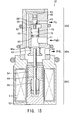
- the capacity control valve 30 of Fig. 15 is designed to control how much of the discharged refrigerant is supplied to the crank chamber 15. Another difference is that the second valve element 57 of the second control valve 30B is provided as a discrete component, and is not integrated with a pressure sensing member that responds to differential pressure across the first control valve 30A.
- a piston 58 is located inside the body 40.
- the communication hole 62 in the body 40 applies the discharge pressure PdL to the piston 58.
- a refrigerant passageway laterally branches halfway from the communication hole 62, to the port 43 for the crank chamber 15.
- the second valve seat 56 is formed as an integral part of the body 40.
- the second valve element 57 is integrally formed with the piston 58.
- the piston 58 receives the discharge pressure PdL on its distal end.
- a piston 78, a coil spring 79, and a spring seat 80 are installed coaxially with the second valve element 57 and the piston 58 in a space formed between the port 41 and the communication hole 62.
- the discharge pressure PdH is available in this space.
- a shaft integral with the second valve element 57 extends toward the piston 78 in a space that communicates with the communication hole 62.
- the piston 78 is forced against the shaft by the coil spring 79.
- Discharge pressure PdL does not affect the movement of the second valve element 57 and the piston 58 because their pressure-receiving areas are substantially equal.
- the piston 78 responds to the differential pressure ⁇ P developed across the first control valve 30A, which functions as an orifice.
- the second control valve 30B controls the flow rate from the discharge chambers 33 to the crank chamber 15 such that the differential pressure ⁇ P will be maintained at a constant level. This mechanism varies the capacity of the variable displacement compressor 1 so as to regulate the discharge flow rate.
- the coil spring 55 urges the plunger 54 and the shaft 49 to seat the first valve element 61 on the first valve seat 45a.
- the first control valve 30A is fully closed.
- the plunger 54 moves downward and allows the first valve element 61 to leave the first valve seat 45a and to form a gap of a certain width at the first valve seat 45a.
- Refrigerant in the port 41 at discharge pressure PdH flows out of the port 42 through the first control valve 30A.
- the piston 78 receives the differential pressure between the two different discharge pressures PdH and PdL while being pushed by two coil springs 60 and 79, and thus moves to a point at which all those forces and pressures are in balance.
- Refrigerant at discharge pressure PdH flows into the crank chamber 15.
- the second control valve 30B now controls the discharge capacity of the variable displacement compressor 1 by varying the crank chamber pressure Pc.
- the refrigerant flow through the first control valve 30A may increase due to, for example, sudden acceleration of the engine. Then, a larger differential pressure will occur across the valve 30A and will further open the second control valve 30B. This produces an increased inflow to the crank chamber 15, and as a result, the variable displacement compressor 1 operates with a smaller displacement, thus recovering its original discharge flow rate. If the refrigerant flow through the first control valve 30A decreases, the second control valve 30B is actuated in valve-closing direction to decreased the inflow to the crank chamber 15. The variable displacement compressor 1 operates with a larger displacement, resulting in a regulated discharge flow rate Qd.
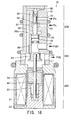
- the capacity control valve 30 of the fifteenth embodiment in Fig. 16 is similar to the twelfth embodiment (Fig. 13) and controls the outflow from the crank chamber 15 to the suction chambers 32, however, differs in that the second valve element 57 in its second control valve 30B is provided as a discrete component, not integrated with a pressure sensing member that responds to differential pressure across the first control valve 30A.
- the second control valve 30B employs the piston 78, the coil spring 79, and the spring seat 80.
- the ports 43 and 75 are disposed to communicate with the crank chamber 15 and suction chambers 32, respectively.
- a second valve seat 56 is formed as an integral part of the body 40.
- the second valve element 57 is installed in an upstream-side space near the port 43. Integrally formed with this second valve element 57 is the piston 58 with the same diameter as the valve hole of the second valve seat 56.
- Discharge pressure PdL propagates through the communication hole 62 of the body and acts on one endface of the piston 58.
- the second valve element 57 is integral with another piston 58a having nearly the same diameter as the valve hole of the second valve seat 56.
- This piston 58a is held in the body 40 in an airtight manner, movably in its axial direction, receiving discharge pressure PdL.
- the lower end of the piston 58a abuts on the piston 78.
- Discharge pressure PdL does not affect movement of the pistons 58a and 58 because their diameters are substantially the same.
- the piston 78 responds to the differential pressure ⁇ P across the first control valve 30A, functioning as an orifice.
- the second control valve 30B controls the outflow from the crank chamber 15 to the suction chambers 32 such that the differential pressure ⁇ P will be maintained at a constant level. This control action varies the capacity of the variable displacement compressor 1 to regulate the discharge flow rate.
- the coil spring 55 urges the plunger 54 and the shaft 49 to seat the first valve element 61 on the first valve seat 45a.
- the first control valve 30A is fully closed.
- the plunger 54 moves downward to allow the first valve element 61 to leave the first valve seat 45a and to form a gap of a certain width at the first valve seat 45a.
- Refrigerant in the port 41 at discharge pressure PdH flows out of the port 42 through the first control valve 30A.
- the piston 78 receives the differential pressure between discharge pressures PdH and PdL, while being pushed by the coil springs 60 and 79, and moves to a point at which all those forces and pressures are in balance.
- Refrigerant in the crank chamber 15 at pressure Pc is allowed to flow back into the suction chambers 32.
- the second control valve 30B now controls the discharge capacity of the variable displacement compressor 1 by varying the crank chamber pressure Pc.
- the refrigerant flow through the first control valve 30A may increase due to, for example, sudden acceleration of the driving engine. Then, a larger differential pressure will occur across the valve 30A and will actuate the second control valve 30B to further close and to reduce the flow rate out of the crank chamber 15 and to raise the crank chamber pressure Pc.
- the compressor 1 operates with a smaller displacement so as to recover its original discharge flow rate. If the refrigerant flow through the first control valve 30A decreases, the second control valve 30B is actuated in the valve-opening direction, increasing the outflow from the crank chamber 15. Since the crank chamber pressure Pc drops, the variable displacement compressor 1 now operates with a larger displacement, resulting in a regulated discharge flow rate Qd.
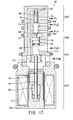
- the capacity control valve 30 of the sixteenth embodiment in Fig. 17 is similar to the thirteenth embodiment (Fig. 14), however, differs in that the second valve element 57 in the second control valve 30B is a discrete component, not integrated with a member that senses differential pressure across the first control valve 30A. As the pressure responsive member, the sixteenth embodiment in Fig. 17 has a similar structure to the fifteenth embodiment (Fig. 16).
- the piston 58, the second valve element 57, and the third valve element 76 are disposed in an integrated manner.
- the piston 58 has the same outer diameter as the valve holes of second and third valve seats 56 and 77 so as to avoid the effect of discharge pressure PdL acting thereon.
- the piston 58 and second valve element 57 move together in response to the differential pressure ⁇ P across the first control valve 30A, functioning as an orifice.
- the second and third control valves 30B and 30D serve as a three-way valve controlling the inflow from the discharge chambers 33 into the crank chamber 15, and simultaneously the outflow from the crank chamber 15 to the suction chambers 32, such that the differential pressure ⁇ P will be maintained at a constant level.
- the coil spring 55 urges the plunger 54 and the shaft 49 upward to seat the first valve element 61 on the first valve seat 45a.
- the first control valve 30A is fully closed.
- the plunger 54 moves downward to allow the first valve element 61 to leave the first valve seat 45a and to form a gap of a certain width.
- Refrigerant in the port 41 at discharge pressure PdH flows out of the port 42 through the first control valve 30A.
- the unified valve member i.e., second valve element 57, third valve element 76, and piston 58
- the second control valve 30B supplies refrigerant at pressure Pc1 to the crank chamber 15 by controlling the refrigerant at discharge pressure PdL, and at the same time, the third control valve 30D allows the refrigerant at pressure Pc2 in the crank chamber 15 to flow back into the suction chambers 32.
- the capacity control valve 30 varies the crank chamber pressure Pc in this way to control the discharge capacity of the variable displacement compressor 1.
- the refrigerant flow through the first control valve 30A may increase due to, for example, sudden acceleration of the driving engine. Then, a larger differential pressure will occur across that valve 30A which opens the second control valve 30B wider, while actuating the third control valve 30D in valve-closing direction. This control action produces an increased inflow to the crank chamber 15, together with a decreased outflow from the crank chamber 15.
- the compressor 1 operates with a smaller displacement so as to recover its original discharge flow rate. If the refrigerant flow through the first control valve 30A decreases, the second control valve 30B is actuated in the valve-closing direction, and the third control valve 30D in the valve-opening direction, thus producing a decreased inflow to the crank chamber 15 and an increased outflow from the crank chamber 15.
- the compressor 1 operates with a larger displacement, resulting in a regulated discharge flow rate Qd.
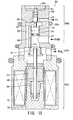
- the capacity control valve 30 of the seventeenth embodiment in Fig. 18 is designed to control how much of the discharged refrigerant to supply to the crank chamber 15.
- the second valve element 57 of the second control valve 30B is provided as a discrete component, not integrated with a member that responds to differential pressure across the first control valve 30A.
- the seventeenth embodiment is, however, different in that it has no back-pressure cancellation mechanism for the second valve element 57.
- the second control valve 30B in Fig. 18 is constructed as follows.
- the second valve element 57 is urged by the coil spring 60 in valve-closing direction.
- the discharge pressure PdL is routed through the communication hole 62 in the body 40 and acts only on the piston 78 and the second valve element 57.
- the upper end of the coil spring 60 is supported by a lid 59c having a vent.
- An O-ring 29b is used for sealing the capacity control valve 30 when installed in the variable displacement compressor 1.
- the upper space above the level of this O-ring 29b will be at pressure Pc, i.e., the pressure in the port 43, meaning that the same pressure Pc will be available in the cavity of the coil spring 60.
- the capacity control valve 30 of Fig. 18 bears close resemblance to the fourteenth embodiment (Fig. 15) in terms of the structure, except for the fact that the second valve element 57 is not free from back pressures.
- the capacity control valve 30 operates as the fourteenth embodiment. This similarity of the control operations also applies when the solenoid unit 30C is energized, or when the engine rotation speed varies.
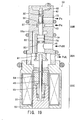
- the capacity control valve 30 of the eighteenth embodiment in Fig. 19 is designed to control the outflow of the crank chamber 15 to the suction chambers 32.
- the second valve element 57 of the second control valve 30B is a discrete component, not integrated with a member that senses differential pressure across the first control valve 30A.
- the eighteenth embodiments is, however, different in that it has no back-pressure cancellation mechanism for the second valve element 57.
- the second control valve 30B in Fig. 19 is constructed as follows.
- the second valve element 57 is urged against the piston 78 by the coil spring 60 in the valve-opening direction.
- the discharge pressure PdL is routed through the communication hole 62 such that it acts only on the piston 78 and on another piston that extends from the second valve element 57.
- the piston 58 is integrally formed with the second valve element 57, and the coil spring 60 is accommodated in a space between this piston 58 and the lid 59c having a vent.
- the coil spring space is pressurized at Ps through the vent in the lid 59c.
- the capacity control valve 30 of Fig. 19 bears close resemblance to the fifteenth embodiment (Fig. 16) in terms of the structure, except for the fact that the second valve element 57 is not free from back pressures.
- the solenoid unit 30C When the solenoid unit 30C is de-energized, the capacity control valve 30 operates in the same way as described in the fifteenth embodiment. This similarity in its control operations also applies when the solenoid unit 30C is energized and when the engine rotation speed varies.
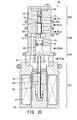
- the capacity control valve 30 of the nineteenth embodiment in Fig. 20 controls both inflow and outflow of refrigerant to/from the crank chamber 15, as the seventeenth embodiment (Fig. 18).
- the second and third control valves 30B and 30D are constructed as follows.
- the second valve element 57 and the third valve element 76 which constitute a three-way valve, are urged by the coil spring 60 in valve-closing direction and in the valve-opening direction, respectively, where discharge pressure PdL is routed through the communication hole 62 such that it acts only on the second valve element 57 and the piston 78.
- the piston 58 is integrally formed with the second and third valve elements 57 and 76.
- the coil spring 60 is accommodated in a space between the piston 58 and the lid 59c having a vent. The coil spring space is pressurized at Ps through the vent in the lid 59c.
- the capacity control valve 30 of Fig. 20 bears close resemblance to the sixteenth embodiment (Fig. 17) in terms of the structure, except for the fact that the second valve element 57 and third valve element 76 are not free from back pressures.
- the capacity control valve 30 of Fig. 20 operates as the sixteenth embodiment. This similarity also applies when the solenoid unit 30C is energized and as when the engine rotation speed varies.
- the capacity control valves 30 share a common concept.
- the first control valve 30A controls the cross-sectional area of a passageway for discharged refrigerant.
- the second control valve 30B (and the third control valve 30D if provided in several cases) controls the pressure Pc in the crank chamber 15 such that the differential pressure across the controlled passageway will be maintained at a specified level.
- the capacity control valves as described should not be limited to a structure that uses the differential pressure on the discharge side of the valves. Rather, there could be provided a structure using the differential pressure on the suction side.
- the first control valve 30A may control the cross-section area of a passageway into the compressor, and the second control valve 30B (and the third control valve 30D if provided) controls the pressure Pc in the crank chamber 15 such that the differential pressure across the controlled passageway will be maintained at a specified level.
Landscapes
- Engineering & Computer Science (AREA)
- Mechanical Engineering (AREA)
- General Engineering & Computer Science (AREA)
- Compressors, Vaccum Pumps And Other Relevant Systems (AREA)
- Air-Conditioning For Vehicles (AREA)
- Control Of Positive-Displacement Pumps (AREA)
Abstract
Description
- The present invention relates to a capacity control valve according to the preamble part of
claim 1. - Automotive air conditioning systems employ a compressor. To obtain a required cooling capacity without restriction by the speed of the driving engine a variable displacement compressor is used allowing to change the capacity independent from the engine speed. The rotation of an inclined wobble plate produces inclination depending piston strokes. The compressor capacity (i.e., the amount of refrigerant being discharged from the compressor) can be varied by changing the wobble plate inclination angle by a part of the pressurized refrigerant introduced into the gastight crank chamber of the compressor. A change of the crank chamber pressure creates a state of balance between opposing pressures exerted on the both ends of each piston linked to the wobble plate and allows to vary the wobble plate inclination angle steplessly. For changing the crank chamber pressure, a capacity control valve is installed either between the refrigerant outlet and the crank chamber or between the refrigerant inlet and the crank chamber. Known capacity control valves open or close such that a certain level of differential pressure between their inlet and outlet will be maintained. More specifically, one can set a desired differential pressure by supplying a capacity control valve with an appropriate control current from an external power source. When the engine speed rises, the capacity control valve raises the pressure of refrigerant supplied to the crank chamber so as to reduce the compressor capacity. When in turn the engine slows down, the capacity control valve decreases the crank chamber pressure so as to increase the compressor capacity.
- JP-A-2001-107854 (Fig. 3) describes a capacity control valve that regulates the flow of refrigerant being discharged from a variable displacement compressor. The known capacity control valve needs sensors to detect differential pressure, as well as a controller to control the capacity control valve accordingly. Those extra components push up the cost of variable displacement compressor.
- JP-A-2001-107854, describes that the flow of refrigerant that is taken into a suction chamber is determined indirectly by detecting differential pressure between two pressure monitoring points with sensors, and that the intake flow rate from the discharge chamber to the crank chamber is maintained at a constant level to regulate the flow discharged from the compressor.
- Another noteworthy aspect of automobile air conditioning systems is what kind of refrigerant to choose. While HFC-134a, a chlorofluorocarbon alternative, was widely used, the recent development of supercritical refrigeration cycles using, for example, carbon dioxide poses another challenge to the compressor design, because the refrigerant then has to function in a region exceeding its critical temperature. In a refrigeration cycle using carbon dioxide and a capacity control valve to control crank chamber pressure according to the compressor's discharge pressure, the differential pressure between the refrigerant outlet and crank chamber could become extremely high because the refrigerant has to be pressurized up to its supercritical region. Then, a high-power solenoid actuator will be needed to produce a sufficiently large force to deal with the high differential pressure, which leads to increased size and cost of the capacity control valve.
- It is an object of the invention to provide a compact capacity control valve for use with a flow-controlled variable displacement compressor, which can be applied not only to ordinary refrigeration cycles using HFC-134a, but also to those using supercritical high-pressure refrigerant, without the needs for high-power solenoids or extra pressure sensors.
- To solve the above-described problems, the present invention provides a capacity control valve containing the features of
claim 1. - The first control valve functions as a variable orifice for refrigerant, the cross-sectional area of which is set by the solenoid unit according to variations in a given external condition. Responsive to differential pressure developed across the variable orifice, the second control valve controls crank chamber pressure such that the differential pressure will be a specified level. By maintaining the level of differential pressure across the orifice with a certain cross-sectional area, the capacity control valve regulates the suction flow or discharge flow of the variable displacement compressor. Also, since its first and second control valves are formed in an integrated way, the capacity control valve detects differential pressure to control refrigerant flows without the need for extra pressure sensors. This feature enables to produce variable displacement compressors at lower costs. Another advantage is that a smaller solenoid can be used to set a required cross-sectional area of a refrigerant passageway because a small differential pressure will suffice. This feature eliminates the need for increased solenoid power even in a supercritical refrigeration cycle using high-pressure refrigerant, thus contributing to miniaturization of capacity control valves for variable displacement compressors.
- The proposed structure employs first and second control valves formed in an integrated way. Here, the first control valve controls the cross-section area at a midway point between low-pressure refrigerant passage and suction chamber, or between discharge chamber and high-pressure refrigerant passage, according to a given external condition. The second control valve, on the other hand, detects differential pressure between upstream end and downstream end of the first control valve and controls the crank chamber pressure in such a way that the differential pressure will be maintained at a specified level. This feature of the present invention enables us to construct a smaller variable displacement compressor at lower cost.
- Because the first control valve has only to produce a small amount of differential pressure, the solenoid unit can drive the valve with a small power, and thus it is not necessary to increase its size to achieve the purpose. The present invention can easily be applied to refrigeration cycles using HFC-134a in a system that should operate with small differential pressure between discharge chamber and crank chamber, or crank chamber and suction chamber. In addition, the present invention can also be applied to those using high-pressure refrigerant in its supercritical region.
- Embodiments of the present invention will be described with reference to the drawings. The description illustrates capacity control valves for a flow-controlled variable displacement compressor that is supposed to discharge refrigerant at a regulated flow rate. In the drawings is:
- Fig. 1
- a section of a variable displacement compressor, equipped with a first embodiment of a capacity control valve,
- Fig.2
- a detailed section of the capacity control valve of Fig. 1,
- Fig. 3
- a section of a second embodiment of a capacity control valve,
- Fig. 4
- a section of a third embodiment of a capacity control valve,
- Fig. 5
- a section of a fourth embodiment of a capacity control valve,
- Fig. 6
- a section of a fifth embodiment of a capacity control valve,
- Fig. 7
- a section of a sixth embodiment of a capacity control valve,
- Fig. 8
- a section of a seventh embodiment of a capacity control valve,
- Fig. 9
- a section of an eight embodiment of a capacity control valve,
- Fig. 10
- a section of a ninth embodiment of a capacity control valve,
- Fig. 11
- section of a tenth embodiment of a capacity control valve,
- Fig. 12
- a section of an eleventh embodiment of a capacity control valve,
- Fig. 13
- a section of a twelfth embodiment of a capacity control valve,
- Fig. 14
- a section of a thirteenth embodiment of a capacity control valve,
- Fig. 15
- a section of a fourteenth embodiment of a capacity control valve,
- Fig. 16
- a section of a fifteenth embodiment of a capacity control valve,
- Fig. 17
- a section of a sixteenth embodiment of a capacity control valve,
- Fig. 18
- a section of a seventeenth embodiment of a capacity control valve,
- Fig. 19
- a section of an eighteenth embodiment of a capacity control valve,
- Fig. 20
- a section of a nineteenth embodiment of a capacity control valve.
- A
variable displacement compressor 1 as shown in Fig. 1 is composed of the following three sections: a drivingsection 100 that receives drive power from a vehicle engine (not shown); arefrigerant compressing section 200 including a gastight crank chamber 15; and acapacity controlling section 300 that controls discharge capacity. Anoutlet port 1a is connected to a condenser (or gas cooler) 3 through a high-pressurerefrigerant line 2. The refrigerant is then routed from the condenser 3 to anexpansion valve 4, an evaporator 5, and a low-pressurerefrigerant line 6 in that order, and finally returns to aninlet port 1b (closed circuit for refrigeration cycle). - A
drive pulley 13 transmits rotational power to abracket 14 and ashaft 12 protruding from a front housing 11. The crank chamber 15 is a closed space surrounded by the front housing 11 and by acylinder block 16. Theshaft 12 is rotatably installed in the crank chamber 15, across the length of the front housing 11 and thecylinder block 16. - The
drive pulley 13 is supported by anangular bearing 17 at the front housing 11. The rotation is directly transmitted to thevariable displacement compressor 1, without an intervening clutch mechanisms (e.g., electromagnetic clutch). - A
lip seal 18 is placed between the front housing 11 and the front portion of therotating shaft 12. A support member 19 is fixed to theshaft 12 in the crank chamber 15. A swash orwobble plate 20 is supported in such a way that it can be inclined at an oblique angle relative to the axis of theshaft 12. Theswash plate 20 has aguide pin 22, whose spherical top portion is engaged with asupport arm 21 protrudingly mounted on the rotational support member 19. Theswash plate 20 rotates together with the rotatingshaft 12. - Interposed between the rotational support member 19 and the
swash plate 20 an inclination-reducingspring 23 urges theswash plate 20 in a direction to reduce the inclination angle. The maximum inclination is restricted by aprotrusion 20a of theswash plate 20. Theshaft 12 is rotatably supported at its rear end by aradial bearing 24 mounted into thecylinder block 16. - The
cylinder block 16 has a plurality of cylinder bores 16a housing single-headedpistons 25. Theswash plate 20 engages with the head of eachpiston 25 via ashoe 26. Placed between the rotational support member 19 and the front housing 11 is athrust bearing 28 which receives reaction forces caused by the compression and acting on the rotational support member 19 via thepistons 25 and theswash plate 20. - The
capacity controlling section 300 is separated from therefrigerant compressing section 200 by avalve plate 27. Thecapacity controlling section 300 has arear housing 31 located next thevalve plate 27 and acapacity control valve 30 in therear housing 31. Therear housing 31 provides the following separate cavities adjacent to the valve plate 27:suction chambers 32,discharge chambers 33, and acommunication passage 34. Thesuction chambers 32 are cavities containing a suction pressure Ps. Thedischarge chambers 33 contain a discharge pressure PdH and receive the refrigerant compressed by therefrigerant compressing section 200. Thecommunication passage 34 communicates with the crank chamber 15, and contains a crank chamber pressure Pc. Therear housing 31 also provides the outlet and theinlet ports cavity 35 for thecapacity control valve 30. Further, therear housing 31 hasseveral communication holes 36 to 39 formed in its body. Thefirst communication hole 36 connects theinlet port 1b with thesuction chambers 32. Thesecond communication hole 37 connects thehousing cavity 35 with thecommunication passage 34, which further leads to the crank chamber 15. Thehousing cavity 35 can also communicate with thedischarge chambers 33 through the third communication hole 38. The fourth communication hole 39 permits thehousing cavity 35 to communicate with theoutlet port 1a. - A
suction relief valve 32v is placed at each cylinder port connecting to thesuction chamber 32, on the side of thevalve plate 27 adjacent to the cylinder bores 16a. Adischarge relief valve 33v is placed similarly at each cylinder port connecting to itscorresponding discharge chambers 33, but on the opposite side of thevalve plate 27, remote from the cylinder bores 16a. Thesuction chambers 32, one for eachcylinder bore 16a, communicate with each other in therear housing 31, as well as with thefirst communication hole 36. Likewise, thedischarge chambers 33 communicate with each other in therear housing 31, as well as with the third communication hole 38. As thepistons 25 reciprocate, the refrigerant gas in thesuction chamber 32 is sucked into each cylinder bore 16a through its correspondingsuction relief valve 32v and then discharged from those cylinder bores 16a to theircorresponding discharge chambers 33 through respectivedischarge relief valves 33v. - While not shown in Fig. 1, there is an orifice of fixed cross-section between the crank chamber 15 and the
suction chambers 32 to release refrigerant from the crank chamber 15 to thesuction chambers 32. - The first embodiment of the capacity control valve 30 (Figs 1 and 2) is made up of a
first control valve 30A, asecond control valve 30B, and asolenoid unit 30C. - The
first control valve 30A has twoports body 40.Port 41 receives the discharge pressure PdH from thedischarge chambers 33 through the third communication hole 38 of therear housing 31 shown in Fig. 1.Port 42 outputs refrigerant at discharge pressure PdL that has been reduced at thefirst control valve 30A, for delivery through the fourth communication hole 39 and a high-pressurerefrigerant line 2. Betweenports bored valve hole 45 for communication of refrigerant, the upstream edge of which is intended to function as afirst valve seat 45a. In an upstream space adjacent to thefirst valve seat 45a, an e.g. ball-shaped first valve element (ball valve element) 46 is placed. The valve hole space communicating with theport 41 accommodates acoil spring 48 that urges theball valve element 46 in the direction that it closes the passage, and the amount of that spring load can be adjusted by anadjustment screw 47 screwed into thebody 40. - The downstream side of the
ball valve element 46 is in contact with one end of ashaft 49 that extends in the axial direction of thesolenoid unit 30C through the valve hole of thefirst valve seat 45a. Thisshaft 49 is supported by abearing 50a formed in thebody 40, and thebearing 50a has acommunication hole 50b to equalize the inside pressure of thesolenoid unit 30C with the discharge pressure PdL. - The
solenoid unit 30C contains asolenoid coil 51 that has a cylindrical cavity, in which asleeve 52 is fitted. A fixedcore 53 is pressed into thesleeve 52. Thesleeve 52 contains aplunger 54 that can slide in axial direction while being urged by acoil spring 55 in the downward direction in Fig. 2. Theplunger 54 is fixed to the lower end of theshaft 49 running coaxially through thecore 53. This arrangement permits thecapacity control valve 30 to operate as follows. - When the
solenoid coil 51 is in de-energized state, theplunger 54 is set away from the core 53 bycoil spring 55, causing theshaft 49 extending from theplunger 54 to loose contact with theball valve element 46. Thefirst control valve 30A is fully closed because the freedball valve element 46 is seated on thefirst valve seat 45a, being urged by anothercoil spring 48. When thesolenoid coil 51 is energized, theplunger 54 is attracted by themagnetized core 53 to push theball valve element 46 via theshaft 49 in the valve-opening direction. The amount of the thus caused movement, or the valve lift (or opening-degree) of theball valve element 46 is proportional to the value of the supplied electrical current. This means that the control current determines the cross-sectional area of the refrigerant passageway of thefirst control valve 30A which functions as a variable orifice, and changes its cross-sectional size as specified by the control current to allow the discharged refrigerant to pass through. - The
solenoid unit 30C described above is intended, not for directly controlling a high-pressure refrigerant flow, but for controlling thefirst control valve 30A so that a small differential pressure will be produced depending on the discharge flow rate Qd of the refrigerant passing therethrough. Since only a small power is needed to achieve the purpose, it is possible to reduce the size of thesolenoid unit 30C. - The
second control valve 30B has abody 40a screwed into thebody 40 of thefirst control valve 30A so that the twocontrol valves body 40a has twoports port 43 is used to apply control pressure Pc to the crank chamber, and theother port 44 is used to introduce discharge pressure PdL that has been reduced at thefirst control valve 30A. Thebody 40a has an opening at its bottom end, which communicates with theport 41 to receive discharge pressure PdH of thedischarge chambers 33 through acommunication hole 47a formed on anadjustment screw 47. Between the opening and theport 43, asecond valve seat 56 is formed as an integral part of thebody 40a. Placed opposite to thissecond valve seat 56 in theport 43 is asecond valve element 57. Thesecond valve element 57 is a taper-shaped member that is integrally formed with acylindrical piston 58 which is axially movable within a cylinder that is bored on the axis of thebody 40a. Acoil spring 60 installed at an upper end portion of thepiston 58 urges thesecond valve element 57 in the valve-closing direction. The respective spring load depends on how deep anadjustment screw 59 is screwed into thebody 40a. Theadjustment screw 59 has a central throughhole 59a as a passage introducing the reduced discharge pressure PdL from theport 44 to the space above thepiston 58. Thesecond valve element 57 and thepiston 58 thus receive different axial pressures at their both endfaces. That is, thesecond valve element 57 receives discharge pressure PdH from theport 41, while thepiston 58 receives discharge pressure PdL from theport 44. The then created differential pressure ΔP determines the lift of thesecond valve element 57. More specifically, the differential pressure ΔP is generated when refrigerant flows through a passage with a certain cross-sectional area as determined by thefirst control valve 30A. Then thesecond control valve 30B functions as a constant differential pressure valve that controls the amount of refrigerant flowing into the crank chamber 15 in such a way that the above differential pressure ΔP will be maintained at a constant level. - Several O-rings are provided around the periphery of the
capacity control valve 30, namely an O-ring 29a to seal the gap between theports ring 29b between theports ring 29c between theports ring 29d between theport 42 and thesolenoid unit 30C, and yet another O-ring 29e to seal thesolenoid unit 30C against the surrounding atmosphere. - When the
shaft 12 is driven, theswash plate 20 will wobble to produce reciprocating motion of thepistons 25 linked to the outer regions of theswash plate 20. Refrigerant is sucked from thesuction chambers 32 into thecylinder block 16, is compressed and is discharged into thedischarge chambers 33. - When the
solenoid unit 30C is de-energized thefirst control valve 30A is fully closed. Refrigerant discharged to thedischarge chambers 33 is entered to the crank chamber 15 in its entirety via thesecond control valve 30B. Thevariable displacement compressor 1 runs in the minimum capacity mode. - When a predetermined amount of control current is supplied to the
solenoid unit 30C, thefirst control valve 30A shows a predetermined opening degree (valve lift). Thefirst control valve 30A acts as an orifice with a certain cross-sectional size, allowing a flow of refrigerant through the high-pressurerefrigerant line 2 leading to the condenser 3. This develops a certain amount of differential pressure ΔP (=PdH-PdL) across the orifice, depending on the actual discharge flow rate Qd of the refrigerant passing through it. - In the
second control valve 30B, thesecond valve element 57 and thepiston 58 respond to the differential pressure ΔP across thefirst control valve 30A. Thesecond control valve 30B controls the flow from thedischarge chambers 33 to the crank chamber 15 such that the differential pressure ΔP will be maintained at a constant level. This control action may vary the capacity of thevariable displacement compressor 1 as needed to regulate the discharge flow. - The discharge flow rate is determined depending on how much refrigeration capacity is required in the present refrigeration cycle. Actually, the refrigeration capacity is calculated from various parameters, which include: engine rotation speed, vehicle speed, accelerator pedal position, indoor and outdoor temperatures, set temperatures, and monitoring signals supplied from various temperature and pressure sensors. The amount of the electrical current for the
solenoid coil 51 is determined on the basis of this calculation result. - When the engine speed rises, the discharge flow rate is increased accordingly. This develops an increased differential pressure ΔP across the
first control valve 30A. In response to ΔP, thesecond control valve 30B further lifts its valve element, so that more refrigerant will be supplied from thedischarge chambers 33 to the crank chamber 15. The pressure Pc rises, and thevariable displacement compressor 1 is controlled in an output-reducing condition. Thecompressor 1 now operates with a smaller discharge capacity, suppressing the discharge flow rate of refrigerant, and thus reducing the differential pressure ΔP. In this way, the discharge flow rate Qd of refrigerant is regulated by controlling thesecond control valve 30B so that the differential pressure across the orifice (i.e., thefirst control valve 30A being configured as a proportional solenoid valve) will be maintained at a constant level. - When the engine rotation speed drops, the discharge flow rate will decrease and reduce the differential pressure across the
first control valve 30A accordingly. The discharge pressure PdH falls, and thesecond control valve 30B operates such as to reduce the refrigerant flow from thedischarge chambers 33 to the crank chamber 15. Pressure Pc in the crank chamber 15 falls and causes thecompressor 1 to operate in a capacity-increasing condition, thus recovering the discharge. In this way, the discharge flow rate Qd of refrigerant is maintained at the constant level. - The present invention combines the
first control valve 30A that functions as a variable orifice controlled by thesolenoid unit 30C and 'thesecond control valve 30B that controls the pressure in the crank chamber 15 in an integrated way, thus providing a compact, space-saving design for the capacity control functions (i.e., regulating the flow rate Qd of refrigerant discharged from the variable displacement compressor 1). - The
capacity control valve 30 of the second embodiment (Fig. 3) differs from the first embodiment of Fig. 2 in that theball valve element 46 of itsfirst control valve 30A is arranged such that it will allow more refrigerant to pass through when it is displaced following the stream of the refrigerant. In other words, theball valve element 46, or the first valve element, is placed on the downstream side of thefirst valve seat 45a. Theplunger 54 and the core 53 have swapped their positions in thesolenoid unit 30C. - The
first control valve 30A stays fully closed by thecoil spring 55 when thesolenoid unit 30C is not energized. Refrigerant entering theport 41 at discharge pressure PdH is led to the crank chamber 15 in its entirety through thesecond control valve 30B, meaning that thevariable displacement compressor 1 now operates in the minimum capacity condition. - When a predetermined amount of control current is supplied to the
solenoid coil 51, theplunger 54 is attracted by thecore 53 and stops at the point where the attraction force comes into balance with the urging force of thecoil spring 55. In this state, theball valve element 46 is lifted, keeping contact with theshaft 49 due to the force of thecoil spring 48, and the consequent gap at the valve seat serves as an orifice with a designated size. - Variations of the engine speed affect the compressor discharge flow. Then, the
capacity control valve 30 operates in the same way as described earlier for Fig. 2. - The
capacity control valve 30 of the third embodiment in Fig. 4 differs from Figs 2, 3 in that a taper-shapedvalve element 61 is placed on the upstream side of thefirst valve seat 45a to receive a force in the valve-opening direction. Instead ofport 44, thecapacity control valve 30 in Fig. 4 has acommunication hole 62 in thebody 40 to serve the same purpose. For that reason, theport 41 for discharge pressure PdH andport 42 for discharge pressure PdL have swapped their positions in Fig. 4 compared to Fig. 3. Another difference is that the crank chamber 15 receives the discharge pressure PdL behind an orifice. - The
first control valve 30A in Fig. 4 has aport 41 formed in thebody 40 to receive the discharge pressure PdH from thedischarge chambers 33.Port 42 serves to supply the high-pressurerefrigerant line 2 with discharge pressure PdL that is reduced by thefirst control valve 30A. Thevalve hole 45 communicates between theports first valve seat 45a. A taper-shapedfirst valve element 61 is placed in an upstream-side space, opposite to thefirst valve seat 45a. Thefirst valve element 61 has an integratedcircumferential flange 61 a. - The
flange 61a retains one end of acoil spring 48 that is placed around thefirst valve element 61 and abuts around thefirst valve seat 45a. Thecoil spring 48 urges thefirst valve element 61 in opening direction. Thevalve element 61 is coupled to an end of theaxial shaft 49 of thesolenoid unit 30C. With thesolenoid unit 30C de-energized, thecoil spring 55 seats thefirst valve element 61 on thefirst valve seat 45a. Theshaft 49 is supported by abearing 50a at its middle portion adjacent to thefirst control valve 30A, as well as by anotherbearing 50c at its bottom end. The bottom-end bearing 50c is press-fitted into the central bore of the fixedcore 53. - The
second control valve 30B is coupled in series with thefirst control valve 30A, the space above thepiston 58 being closed by alid 59b. Thebody 40 has acommunication hole 62 to communicate that space with theport 41, through which discharge pressure PdH acts on the back face of thepiston 58. This arrangement reduces the needed number of ports of thebody 40, thus making it easier to manufacture thecapacity controlling section 300, and allows to eliminate some of the otherwise needed O-rings. - The
first control valve 30A sets a certain cross-sectional area for the refrigerant passageway in accordance with how much thesolenoid unit 30C is energized. Thesecond control valve 30B is responsive to differential pressure developed across thefirst control valve 30A to control the flow rate of refrigerant supplied from thedischarge chambers 33 to the crank chamber 15. Thecapacity control valve 30 regulates the flow rate Qd that thevariable displacement compressor 1 discharges. - Compared with the first embodiment of Fig. 2, the
capacity control valve 30 of Fig. 5 is distinct in the following points. Thefirst control valve 30A employs a spool-shapedvalve element 63 as the first valve element. Thesecond control valve 30B uses a taper-shapedvalve element 64 as a second valve element. As the counterpart of the spool-shapedvalve element 63 afirst valve seat 63a is provided as an integral part of the second valve element in thesecond control valve 30B. Thisfirst valve seat 63a is designed to set a required cross-section area for refrigerant passage while moving together with the second valve element. - The
second control valve 30B in Fig. 5 has asecond valve seat 56 and its correspondingsecond valve element 64 with a tapered shape. Thesecond valve seat 56 is formed as an integral part of thebody 40, in the middle of a refrigerant passageway between the twoports discharge chambers 33 and the latter delivering refrigerant to the crank chamber 15. Opposite thesecond valve seat 56, thesecond valve element 64 is located in an upstream-side space (discharge pressure PdH). Thesecond valve element 64 is urged by acoil spring 66 in the valve-opening direction. Integrally formed with thesecond valve element 64 is a pressureresponsive member 64a, whose base portion detects differential pressure between two different discharge pressures PdH and PdL. The pressureresponsive member 64a is installed inside thebody 40 in a manner that it can come in contact with or move away from thesecond valve seat 56 according to the differential pressure acting thereon. The pressureresponsive member 64a has a central cavity around its axis, the bottom end of which is open. The pressureresponsive member 64a has also ahole 64b in its upper portion, which allows the discharge pressure PdH in theport 41 to reach the central cavity. - The
first control valve 30A has afirst valve seat 63a at the rim of the bottom opening end of the pressureresponsive member 64a. Thevalue seat 63a cooperates with the spool-shapedvalve element 63 located below the bottom opening. Thefirst valve seat 63a andfirst valve element 63 set an appropriate cross-sectional area for a passageway that delivers refrigerant from oneport 41 to anotherport 42 via thehole 64b of the pressureresponsive member 64a. - The
valve element 63 is integrally formed with a pressureresponsive piston 63p having the same cross-sectional area as the valve hole of thefirst valve seat 63a. Aflange 63b is formed around thisvalve element 63, on a downstream-side portion remote from thefirst valve seat 63a. Thisflange 63b receives the force of thecoil spring 48 urging thevalve element 63 in the valve-opening direction. Anothercoil spring 60 is disposed between the pressureresponsive piston 63p and the pressureresponsive member 64a. The pressureresponsive piston 63p is slidably supported in aplug 40b, which seals the bottom of thebody 40. The pressureresponsive piston 63p may also be pressed upward by theshaft 49 between thesolenoid unit 30C and the bottom endface of thepiston 63p. Apressure balancing hole 65 extends through the pressureresponsive piston 63p to introduce the back pressure from the upstream-side cavity adjacent to thefirst valve seat 63a. This structure permits the discharge pressure PdH from theport 41 to act equally on both the bottom end of the pressureresponsive piston 63p and the top end of thevalve element 63. Those two opposing pressure forces cancel each other and the discharge pressure PdH never interferes with the operation of thesolenoid unit 30C controlling the position of thevalve element 63. - When the
solenoid unit 30C in Fig. 5 is de-energized, thecoil spring 55 urges theplunger 54 andshaft 49 upward and puts thevalve element 63 into the central opening of the pressureresponsive member 64a. Thefirst control valve 30A is fully closed, while thesecond control valve 30B fully opens in an attempt to obtain a predetermined differential pressure between discharge pressures PdH and PdL acting on the pressureresponsive member 64a. - When the
solenoid unit 30C in Fig. 5 is energized, theshaft 49 moves downward and allows thevalve element 63 to leave thefirst valve seat 63a and to form a gap of a certain width around thefirst valve seat 63a. The refrigerant in theport 41 at discharge pressure PdH flows out of theport 42 through thefirst control valve 30A. Then, in thesecond control valve 30B, the pressureresponsive member 64a receives the differential pressure between discharge pressures PdH and PdL, which moves thesecond valve element 64 so that the differential pressure will become a predetermined level. With this movement of thesecond valve element 64, thesecond control valve 30B controls the refrigerant being delivered from theport 43 to the crank chamber 15. - If the refrigerant flow through the
first control valve 30A increases, a larger differential pressure will be produced acrossvalve 30A, causing thesecond valve element 64 to move in the valve-opening direction, so that thesecond control valve 30B supplies more refrigerant into the crank chamber 15. Thecompressor 1 operates with a smaller displacement so as to recover the original discharge flow rate. If the refrigerant flow through thefirst control valve 30A decreases, thesecond control valve 30B is actuated in a valve-closing direction, thus reducing the refrigerant flow into the crank chamber 15. Thecompressor 1 operates with a larger displacement to regulate the discharge flow rate Qd. - The fifth embodiment of the
capacity control valve 30 of Fig. 6 differs from the fourth embodiment (Fig. 5) in that theport 41 for discharge pressure PdH and theport 42 for discharge pressure PdL have swapped their positions. Instead of the taper-shapedvalve element 64 as the second valve element, the fifth embodiment in Fig. 6 employs aball valve element 67 for that purpose. Thisball valve element 67 is located downstream of thesecond valve seat 56 and is loaded in valve-opening direction by astem 68 extending through the valve hole and thefirst control valve 30A. - The
second control valve 30B has thesecond valve seat 56 formed as an integral part of thebody 40. Aball valve element 67 is located in a downstream-side space adjacent to thesecond valve seat 56 and is urged by thecoil spring 60 in valve-closing direction. The spring load can be adjusted by anadjustment screw 59 which has a central throughhole 59a constituting theport 43 for delivery of refrigerant to the crank chamber 15 (control pressure Pc). - The
first control valve 30A has thefirst valve seat 63a at the bottom opening end of the pressureresponsive member 64a which is integral with the shaft orstem 68. The upper end of the shaft or stem 68 contacts theball valve element 67. - When the
solenoid unit 30C is de-energized, thecoil spring 55 urges theplunger 54 andshaft 49 in the upward direction to put thevalve element 63 into the central opening of the pressureresponsive member 64a. Thefirst control valve 30A is fully closed, while thesecond control valve 30B is fully opened because of the differential pressure that acts on the pressureresponsive member 64a. - When the
solenoid unit 30C is energized, theshaft 49 moves downward and allows thevalve element 63 to leave thefirst valve seat 63a and to form a gap of a certain width around thefirst valve seat 63a. The refrigerant in theport 41 at discharge pressure PdH flows out of theport 42 through thefirst control valve 30A. In thesecond control valve 30B, the pressureresponsive member 64a receives differential pressure between discharge pressures PdH and PdL, which moves theball valve element 67, relative to thesecond valve seat 56 so that the differential pressure will have a predetermined level. By the movement of theelement 67, thesecond control valve 30B controls the flow rate of the refrigerant as delivered from theport 43 to the crank chamber 15. - If the refrigerant flow through the
first control valve 30A increases, a larger differential pressure will be produced across thatvalve 30A. With the increased differential pressure, theball valve element 67 will open further so that thesecond control valve 30B supplies more refrigerant into the crank chamber 15. Thecompressor 1 operates with smaller displacement so as to recover its original discharge flow rate. If the refrigerant flow through thefirst control valve 30A decreases, thesecond control valve 30B is actuated in a valve-closing direction, thus reducing the refrigerant flow into the crank chamber 15. Thecompressor 1 operates with a larger displacement so as to regulate the discharge flow rate Qd. - The
capacity control valve 30 of the sixth embodiment in Fig. 7 differs from the fifth embodiment (Fig. 6) in that itsfirst control valve 30A employs a taper-shapedvalve element 61 as a first valve element located in an upstream-side space adjacent to thefirst valve seat 63a, being urged in the valve-opening direction. - When the
solenoid unit 30C is de-energized, thecoil spring 55 urges theplunger 54 andshaft 49 upward to seat the taper-shapedvalve element 61 on thefirst valve seat 63a. Thefirst control valve 30A is fully closed, while thesecond control valve 30B is fully opened because of the differential pressure that acts on the pressureresponsive member 64a. - When the
solenoid unit 30C is energized, theshaft 49 moves downward and allows thevalve element 61 to leave thefirst valve seat 63a to form a gap of a certain width at thefirst valve seat 63a. The refrigerant from theport 41 at discharge pressure PdH flows out of theport 42 through thefirst control valve 30A. The pressureresponsive member 64a receives the differential pressure between discharge pressures PdH and PdL, which moves theball valve element 67 so that the differential pressure will have a predetermined level. By movements of theelement 67, thesecond control valve 30B controls the flow rate of the refrigerant being delivered from theport 43 to the crank chamber 15. - If the refrigerant flow through the
first control valve 30A increases, a larger differential pressure will be generated across thevalve 30A andvalve element 67 opens further to supply more refrigerant into the crank chamber 15. Thecompressor 1 operates with a smaller displacement so as to recover its original discharge flow rate. If the refrigerant flow through thefirst control valve 30A decreases, thesecond control valve 30B is actuated in valve-closing direction reducing the refrigerant flow into the crank chamber 15. Thecompressor 1 operates with a larger displacement so as to regulate the discharge flow rate Qd. - The
capacity control valve 30 of the seventh embodiment in Fig. 8 differs from the sixth embodiment (Fig. 7) in that itsfirst valve element 61 is designed to cancel the back pressure in order to prevent the discharge pressure PdH from affecting operation of thefirst control valve 30A. This concept is described for the fifth embodiment (Fig. 6) already. - When the
solenoid unit 30C is de-energized, thecoil spring 55 urges theplunger 54 andshaft 49 in the upward direction to seat the taper-shapedvalve element 61 on thefirst valve seat 63a. Thefirst control valve 30A is fully closed, while thesecond control valve 30B is fully opened. - When the
solenoid unit 30C is energized, theshaft 49 moves downward and allows thevalve element 61 to leave thefirst valve seat 63a and form a gap of a certain width at thefirst valve seat 63a. The refrigerant atport 41 at discharge pressure PdH flows out of theport 42 through thefirst control valve 30A. The pressureresponsive member 64a receives differential pressure between discharge pressures PdH and PdL and moves thevalve element 67 so that the differential pressure will have a predetermined level. By the movements of theball valve element 67, thesecond control valve 30B controls the flow rate atport 43 to the crank chamber 15. - If the refrigerant flow through the
first control valve 30A increases, a larger differential pressure will be produced across thevalve 30A such that theball valve element 67 opens further until thesecond control valve 30B supplies more refrigerant into the crank chamber 15. Thecompressor 1 operates with a smaller displacement so as to recover its original discharge flow rate. If the refrigerant flow through thefirst control valve 30A decreases, thesecond control valve 30B is actuated in a valve-closing direction to reduce the refrigerant flow into the crank chamber 15. Thevariable displacement compressor 1 operates with a larger displacement so as to regulate the discharge flow rate Qd. - The
capacity control valve 30 of the eighth embodiment in Fig. 9 differs from the fourth embodiment (Fig. 5) in that itsfirst valve seat 45a is not designed to move, but is an integral part of thebody 40 of thefirst control valve 30A. Another difference is that a plurality ofball valve elements 46 are employed to serve with several valve seats the function of the first valve element. - The
body 40 in Fig. 9 has a plurality of valve holes 45 bored along a pitch circle concentric with a cross section of thebody 40 itself. The bottom-end edge of eachvalve hole 45 serves as thefirst valve seat 45a. Eachball valve element 46 is placed at a downstream-side space adjacent to eachfirst valve seat 45a. Allball valve elements 46 rest on a downstream-side surface of asupport member 70, which is urged by acoil spring 60 in the downward direction. Thesupport member 70 also receives an upward force of thecoil spring 55 in thesolenoid unit 30C, via theplunger 54 and theshaft 49. - The
second control valve 30B has the pressureresponsive member 64a urged upward by thecoil spring 66. Since the pressureresponsive member 64a is integral with thesecond valve element 64, the urging force of thecoil spring 66 also acts on thesecond valve element 64 in the valve-closing direction. The pressureresponsive member 64a, in combination with thesecond valve element 64, is supposed to be responsive to differential pressure ΔP between two different discharge pressures PdH and PdL, on the upstream and downstream ends of thefirst control valve 30A, respectively. - When the
solenoid unit 30C is de-energized, thecoil spring 55 urges theplunger 54 and theshaft 49 in the upward direction and seats theball valve elements 46 at thefirst valve seats 45a. Thefirst control valve 30A is fully closed. With the discharge pressure PdH in theport 41, the maximum differential pressure acts on the pressureresponsive member 64a, and fully opens thesecond control valve 30B. Thecompressor 1 operates in the minimum capacity condition. - When the
solenoid unit 30C is energized, theshaft 49 moves downward. In conjunction with the force of thecoil spring 60 thesupport member 70 follows in the same direction while keeping contact with theshaft 49. Eachball valve element 46 leaves the correspondingfirst valve seat 45a and maintains a gap of a certain width at thevalve seat 45a. Refrigerant in theport 41 at discharge pressure PdH flows out of theport 42 through thefirst control valve 30A. Then, the pressureresponsive member 64a adjacent to thesecond valve element 64 receives differential pressure between discharge pressures PdH and PdL and moves thesecond valve element 64 so that the differential pressure will have a predetermined level controlling the flow rate at discharge pressure PdH through thesecond control valve 30B. - If the refrigerant flow through the
first control valve 30A increases, a larger differential pressure will be produced across thevalve 30A acting on the pressureresponsive member 64a. Thesecond valve element 64 is moved to further open until thesecond control valve 30B supplies more refrigerant into the crank chamber 15. Thecompressor 1 operates with a smaller displacement so as to recover its original discharge flow rate. If the refrigerant flow through thefirst control valve 30A decreases, thesecond control valve 30B reduces the refrigerant flow into the crank chamber 15 because the pressureresponsive member 64a impels thesecond valve element 64 in the valve-closing direction. Thecompressor 1 operates with a larger displacement so as to regulate the discharge flow rate Qd. - The
capacity control valve 30 of the ninth embodiment in Fig. 10 differs from the eighth embodiment (Fig. 9) in the structure of the first valve element and the first valve seat. - The
body 40 has a doughnut-shapedvalve hole 45 hollowed along a circle that is concentric with a cross section of thebody 40, and the bottom-end edge of the valve hole serves as thefirst valve seat 45a. The doughnut-shapedvalve hole 45 does not go through thebody 40 over the entire circumference, but some middle part of a floor of thebody 40 remains solid at a few places. This measure connects the central portion of the floor to the circumferential portion of thebody 40 in order to house the pressureresponsive member 64a. As a counterpart of thefirst valve seat 45a, a flatannular valve element 71 is disposed on the downstream side, together with aplug 40b that supports theflat valve element 71 axially movable. - When the
solenoid unit 30C is de-energized, thecoil spring 55 urges theplunger 54 and theshaft 49 in the upward direction to abut theflat valve element 71 on thefirst valve seat 45a. Thefirst control valve 30A is fully closed. With the discharge pressure PdH in theport 41, the maximum differential pressure acts on the pressureresponsive member 64a fully opening thesecond control valve 30B. Thecompressor 1 operates in the minimum capacity condition. - When the
solenoid unit 30C is energized, theshaft 49 moves downward. This movement, in conjunction with the force of thecoil spring 60, allows theflat valve element 71 to follow in the same direction while keeping contact with theshaft 49. Thevalve element 71 leaves thefirst valve seat 45a and forms a gap of a certain width at thevalve seat 45a. Refrigerant in theport 41 at discharge pressure PdH flows out of theport 42 through thefirst control valve 30A. The pressureresponsive member 64a adjacent to thesecond valve element 64 receives differential pressure between discharge pressures PdH and PdL, which moves thesecond valve element 64 so that the differential pressure will reach a predetermined level controlling the flow rate at discharge pressure PdH through thesecond control valve 30B. - If the refrigerant flow through the
first control valve 30A increases, a larger differential pressure will be produced across thevalve 30A, acting on the pressureresponsive member 64a. Thesecond valve element 64 is moved to further open and to supply more refrigerant into the crank chamber 15. Thecompressor 1 operates with a smaller displacement so as to recover its original discharge flow rate. If the refrigerant flow through thefirst control valve 30A decreases, thesecond control valve 30B reduces the refrigerant flow into the crank chamber 15 because its pressureresponsive member 64a impels thesecond valve element 64 in the valve-closing direction. Thecompressor 1 operates with a larger displacement so as to regulate the discharge flow rate Qd. Thecapacity control valve 30 of the tenth embodiment in Fig. 11 differs from the first embodiment (Fig. 2). The most prominent difference is that the tenth embodiment uses, in itsfirst control valve 30A, adiaphragm 72 to detect differential pressure between upstream and downstream sides. - In a central region of the
body 40, anintegral cylinder 40c is formed serving as thevalve hole 45 interconnecting theports cylinder 40c functions as thefirst valve seat 45a for thefirst control valve 30A. In the downstream-side space communicating with theport 42, a taper-shapedvalve element 61 is placed opposite thefirst valve seat 45a. Thisvalve element 61 is integral with theplunger 54 of thesolenoid unit 30C and has acircumferential groove 61b in the round periphery. Thegroove 61b receives apiston ring 74 slidably supporting theplunger 54 on the inner wall of thesleeve 52, and also centering thevalve element 61 on the axis of thesleeve 52. - In the
second control valve 30B a valve hole is bored betweenports second valve seat 56. In the upstream-side space adjacent to thesecond valve seat 56, the taper-shapedsecond valve element 64 is placed. Integrally formed on top of thesecond valve element 64 are ashaft 64c and apiston 64d. Thispiston 64d has the same outer diameter as the valve hole of thesecond valve seat 56. The endface of thepiston 64d remote from thesecond valve element 64 receives, through acommunication hole 62, discharge pressure PdH in theport 41, so that thesecond valve element 64 is actuated solely by the differential pressure between discharge pressures PdH and PdL, without being affected by the absolute value of discharge pressure PdH. Thesecond valve element 64 is integral with abase member 64e, which is larger in diameter than thesecond valve element 64. Thebase member 64e has ahole 64b to introduce discharge pressure PdH from theport 41 into thecylinder 40c. - A sliding
member 73 surrounds the outer surface of thecylinder 40c inbody 40 in a way that it can move in the vertical direction. This slidingmember 73 is connected with the inner surface of the cavities of thebodies diaphragm 72, which is a doughnut-shaped sheet with a center hole. The outer circumference of thediaphragm 72 is clamped between thebodies body 40a is pressed into thebody 40. The inner circumference of thediaphragm 72 is clamped between the slidingmember 73 and aring 73a. Thebase member 64e of thesecond valve element 64 may rest on the slidingmember 73. Twocoil springs members diaphragm 72 receives differential pressure between the discharge pressure PdH at theport 41 and the discharge pressure PdL at theport 42. This differential pressure displaces the slidingmember 73 in axial direction, causing thesecond valve element 64 to move toward or away from thesecond valve seat 56. - When the
solenoid unit 30C is de-energized, thecoil spring 55 urges theplunger 54 upward to seat thevalve element 61 sit on thefirst valve seat 45a. Thefirst control valve 30A is fully closed. With the discharge pressure PdH present in theport 41, the maximum differential pressure acts on thediaphragm 72 to fully open thesecond control valve 30B. Thecompressor 1 operates in the minimum capacity condition. - When the
solenoid unit 30C is energized, theplunger 54 moves downward allowing thevalve element 61 to leave thefirst valve seat 45a and to form a gap of a certain width at thefirst valve seat 45a. Refrigerant in theport 41 at the discharge pressure PdH flows out of theport 42 through thehole 64b of thesecond valve element 64, the central cavity of thecylinder 40c, and thefirst control valve 30A. Thediaphragm 72 receives the differential pressure between the two different discharge pressures PdH and PdL, and moves the slidingmember 73 upward so that the differential pressure will reach a predetermined level. Thesecond valve element 64 follows this movement of the slidingmember 73, thus controlling the refrigerant at the discharge pressure PdH that flows through thesecond control valve 30B. - If the refrigerant flow through the
first control valve 30A increases, a larger differential pressure will be produced across thevalve 30A and acts on thediaphragm 72. Thesecond valve element 64 in thesecond control valve 30B is impelled in the direction to further open and to supply more refrigerant into the crank chamber 15. Thecompressor 1 operates with a smaller displacement so as to recover its original discharge flow rate. If the refrigerant flow through thefirst control valve 30A decreases, thediaphragm 72 receives a reduced differential pressure and reduces the refrigerant flowing into the crank chamber 15 because its slidingmember 73 impels thesecond valve element 64 in the valve-closing direction. Thecompressor 1 operates with a larger displacement so as to regulate the discharge flow rate Qd. Thesecond control valve 30B is controlled to respond only to the differential pressure between the two different discharge pressures PdH and PdL, because thesecond valve element 64 is unaffected by variations of the discharge pressure PdH. - The
capacity control valve 30 of the eleventh embodiment of Fig. 12 differs from the tenth embodiment (Fig. 11) in that the taper-shaped valve element (first valve element) 61 in thefirst control valve 30A is disposed in an upstream-side space of thefirst valve seat 45b formed at the top end of thecylinder 40c. For this reason, in thesolenoid unit 30C, theplunger 54 andcore 53 have swapped their positions on the axis (relative to Fig. 11). Theshaft 49 connects thefirst valve element 61 with theplunger 54 in thesolenoid unit 30C. Thefirst valve element 61 is urged by thecoil spring 55 in the valve-closing direction. - The eleventh embodiment operates basically in the same way as the tenth embodiment. However, the widened
base member 64e of thesecond valve element 64 has at least oneround hole 64f in a cylindrical skirt portion in addition to thehole 64b to deliver the discharge pressure PdH from theport 41 to the upstream side of thefirst valve element 61. - When the
solenoid unit 30C is de-energized, thecoil spring 55 urges theplunger 54 and theshaft 49 to seat thefirst valve element 61 on thefirst valve seat 45b. Thefirst control valve 30A is fully closed. With the discharge pressure PdH in theport 41, the maximum differential pressure acts on thediaphragm 72 which fully opens thesecond control valve 30B. Thevariable displacement compressor 1 operates in the minimum capacity condition. - When the
solenoid unit 30C is energized, theplunger 54 moves upward and allows the taper-shapedvalve element 61 to leave thefirst valve seat 45b and form a gap of a certain width at thefirst valve seat 45b. Refrigerant in theport 41 at discharge pressure PdH flows out of theport 42 through theround hole 64f and thehole 64b of thesecond valve element 64, thefirst control valve 30A, and the central cavity of thecylinder 40c. Thediaphragm 72 receives differential pressure between the two different discharge pressures PdH and PdL and moves the slidingmember 73 upward so that the differential pressure will reach a predetermined level. Thesecond valve element 64 follows this upward movement of the slidingmember 73, thus controlling the flow rate of the refrigerant at discharge pressure PdH that flows through thesecond control valve 30B. - If the refrigerant flow through the
first control valve 30A increases, a larger differential pressure will be produced across thevalve 30A acting on thediaphragm 72. Thesecond valve element 64 is moved to further open and to supply more refrigerant into the crank chamber 15. Thecompressor 1 operates with a smaller displacement so as to recover its original discharge flow rate. If the refrigerant flow through thefirst control valve 30A decreases, thediaphragm 72 detects and responds to a reduced differential pressure. The slidingmember 73 impels thesecond valve element 64 in the valve-closing direction. Thesecond control valve 30B reduces the refrigerant supplied to the crank chamber 15, and thecompressor 1 operates with a larger displacement so as to regulate the discharge flow rate Qd. - In the embodiment of Fig. 4 the
first control valve 30A is located between thedischarge chambers 33 and crank chamber 15, and the pressure in the crank chamber 15 is controlled by varying the flow rate at discharge pressure PdL from thedischarge chambers 33 into the crank chamber 15. Unlike the third embodiment of Fig. 4, the twelfth embodiment of Fig. 13 controls the flow rate returning from the crank chamber 15 back into thesuction chambers 32. In this alternative arrangement, thevariable displacement compressor 1 has an orifice of fixed cross-section in the middle of a passageway that delivers refrigerant from thedischarge chambers 33 to the crank chamber 15. - The
first control valve 30A andsolenoid unit 30C of thecapacity control valve 30 of Fig. 13 have almost the same structure shown in the third embodiment of Fig. 4. An exception is that thefirst control valve 30A is designed to route the discharged refrigerant in the direction that the stream pushes the taper-shapedvalve element 61 in opening direction away from thefirst valve seat 45a. - In the
second control valve 30B, twopistons second valve element 57. Thepistons second valve seat 56. Discharge pressure PdH acts on thepiston 58a and discharge pressure PdL propagates through acommunication hole 62 and acts on one endface of thepiston 58. Pressure Pc of the crank chamber 15 is led from theport 43 to an upstream-side cavity adjacent to thesecond valve element 57. The downstream-side room communicates with thesuction chambers 32 at suction pressure Ps via theport 75. With such an arrangement of thesecond control valve 30B, thesecond valve element 57 andpiston 58 are responsive to the differential pressure ΔP developed across thefirst control valve 30A, which is functioning here as an orifice. Thesecond control valve 30B thus controls the flow rate from the crank chamber 15 to thesuction chambers 32 such that the differential pressure ΔP will be maintained at a constant level. This control action varies the capacity of thevariable displacement compressor 1 so as to regulate the discharge flow rate. - When the
solenoid unit 30C is de-energized, thecoil spring 55 urges theplunger 54 and theshaft 49 upward to seat thefirst valve element 61 on thefirst valve seat 45a. Thefirst control valve 30A is fully closed. - When the
solenoid unit 30C is energized, theplunger 54 moves downward and allows thefirst valve element 61 to leave thefirst valve seat 45a and to form a gap of a certain width at thefirst valve seat 45a. Refrigerant in theport 41 at discharge pressure PdH flows out of theport 42 through thefirst control valve 30A. In thesecond control valve 30B, thesecond valve element 57 and the piston 58 (a single integrated member) receive differential pressure between the two different discharge pressures PdH and PdL, in addition to the force of thecoil spring 60. Thesecond valve element 57 moves to a point at which all those forces and pressures are in balance. The refrigerant in the crank chamber 15 at pressure Pc is allowed to flow back to thesuction chambers 32. Thesecond control valve 30B now may control the discharge capacity of thevariable displacement compressor 1 by varying the crank chamber pressure Pc. - The refrigerant flow through the
first control valve 30A may increase due to, for example, sudden acceleration of the driving engine. Then, a larger differential pressure will occur across thevalve 30A and will actuate thesecond control valve 30B to further close and to reduce the flow rate out of the crank chamber 15. Thecompressor 1 operates with a smaller displacement so as to recover its original discharge flow rate. If the refrigerant flow through thefirst control valve 30A decreases, thesecond control valve 30B is actuated in the valve-opening direction, thus increasing the flow rate out of the crank chamber 15. Thecompressor 1 operates with a larger displacement, thus regulating the discharge flow rate Qd. - The third embodiment (Fig. 4) has a
capacity control valve 30 controlling the flow rate into the crank chamber 15 (inflow control). The twelfth embodiment (Fig. 13) manipulates the flow rate out of the crank chamber 15 (outflow control). The thirteenth embodiment of Fig. 14 relates to acapacity control valve 30 that employs both in-flow and out-flow control mechanisms. Thecapacity control valve 30 of Fig. 14 has afirst control valve 30A placed in a passageway leading from thedischarge chambers 33 to thesolenoid unit 30C that governs the cross-sectional area of the passageway. In addition, thecapacity control valve 30 of Fig. 14 has the second 30B and athird control valves 30D that both detect the differential pressure developed across thefirst control valve 30A and which control the pressure in the crank chamber 15 such that the differential pressure will reach a specified level. - The second and
third control valves piston 58, asecond valve element 57, and athird valve element 76, all integrally formed as a single member. One control edge formed in the valve hole serves as athird valve seat 77. Thepiston 58 has the same outer diameter as thevalve seat 77. Thesecond valve element 57 receives the discharge pressure PdH on its bottom endface, while thepiston 58 receives the discharge pressure PdL through acommunication hole 62 of thebody 40. The upstream-side room adjacent to thesecond valve element 57 is at discharge pressure PdH introduced from theport 41. The downstream side communicates with the crank chamber 15 through anotherport 43a, the pressure at which is Pc1. The upstream-side space adjacent to thethird valve element 76 receives pressure Pc2 from the crank chamber 15 via yet anotherport 43b. The downstream-side space adjacent to thethird valve element 76 communicates with thesuction chambers 32 at suction pressure Ps via still anotherport 75. - The
piston 58 and thesecond valve element 57 move together in response to the differential pressure ΔP across thefirst control valve 30A, which is functioning here as an orifice. The second andthird control valves discharge chambers 33 into the crank chamber 15, simultaneously with the outflow from the crank chamber 15 to thesuction chambers 32, so that the differential pressure ΔP will be maintained at a constant level. - The
capacity control valve 30 with the above construction operates as follows. When thesolenoid unit 30C is de-energized, thecoil spring 55 urges theplunger 54 and theshaft 49 upward to seat thefirst valve element 61 on thefirst valve seat 45a. Thefirst control valve 30A is fully closed. - When the
solenoid unit 30C is energized, theplunger 54 moves downward causing thefirst valve element 61 to leave thefirst valve seat 45a and to form a gap of a certain width. Refrigerant in theport 41 at discharge pressure PdH flows out of theport 42 through thefirst control valve 30A. In thesecond control valve 30B, the unified valve member (i.e.,second valve element 57,third valve element 76, and the piston 58) receives the differential pressure between the two different discharge pressures PdH and PdL while being pushed downward by thecoil spring 60, and moves to a point at which all those forces and pressures are in balance. Thesecond control valve 30B supplies the crank chamber 15 with refrigerant at discharge pressure PdH, and thethird control valve 30D allows the refrigerant at pressure Pc to flow back into thesuction chambers 32. Thecapacity control valve 30 varies the crank chamber pressure Pc in this way, thus being able to control the discharge capacity of thevariable displacement compressor 1. - The refrigerant flowing through the
first control valve 30A may increase due to, for example, sudden acceleration of the driving engine. Then, a larger differential pressure will occur across thevalve 30A. The increased differential pressure opens thesecond control valve 30B wider, while it actuates thethird control valve 30D in valve-closing direction. This results in an increased inflow to the crank chamber 15, along with a decreased outflow from the crank chamber 15. Thevariable displacement compressor 1 operates with a smaller displacement so as to recover its original discharge flow rate. If the refrigerant flow through thefirst control valve 30A decreases, thesecond control valve 30B is actuated in valve-closing direction, thus producing a decreased inflow to the crank chamber 15. At the same time, thethird control valve 30D is impelled in the valve-opening direction, increasing the outflow from the crank chamber 15. Thecompressor 1 now operates with a larger displacement, resulting in a regulated discharge flow rate Qd. - Compared to the twelfth embodiment (Fig. 13), the
capacity control valve 30 of Fig. 15 is designed to control how much of the discharged refrigerant is supplied to the crank chamber 15. Another difference is that thesecond valve element 57 of thesecond control valve 30B is provided as a discrete component, and is not integrated with a pressure sensing member that responds to differential pressure across thefirst control valve 30A. - A
piston 58 is located inside thebody 40. Thecommunication hole 62 in thebody 40 applies the discharge pressure PdL to thepiston 58. A refrigerant passageway laterally branches halfway from thecommunication hole 62, to theport 43 for the crank chamber 15. In the middle of this passageway, thesecond valve seat 56 is formed as an integral part of thebody 40. Located downstream of thesecond valve seat 56 thesecond valve element 57 is integrally formed with thepiston 58. Thepiston 58 receives the discharge pressure PdL on its distal end. Apiston 78, acoil spring 79, and aspring seat 80 are installed coaxially with thesecond valve element 57 and thepiston 58 in a space formed between theport 41 and thecommunication hole 62. The discharge pressure PdH is available in this space. A shaft integral with thesecond valve element 57 extends toward thepiston 78 in a space that communicates with thecommunication hole 62. Thepiston 78 is forced against the shaft by thecoil spring 79. Discharge pressure PdL does not affect the movement of thesecond valve element 57 and thepiston 58 because their pressure-receiving areas are substantially equal. In thesecond control valve 30B, thepiston 78 responds to the differential pressure ΔP developed across thefirst control valve 30A, which functions as an orifice. Thesecond control valve 30B controls the flow rate from thedischarge chambers 33 to the crank chamber 15 such that the differential pressure ΔP will be maintained at a constant level. This mechanism varies the capacity of thevariable displacement compressor 1 so as to regulate the discharge flow rate. - When the
solenoid unit 30C is de-energized, thecoil spring 55 urges theplunger 54 and theshaft 49 to seat thefirst valve element 61 on thefirst valve seat 45a. Thefirst control valve 30A is fully closed. - When the
solenoid unit 30C is energized, theplunger 54 moves downward and allows thefirst valve element 61 to leave thefirst valve seat 45a and to form a gap of a certain width at thefirst valve seat 45a. Refrigerant in theport 41 at discharge pressure PdH flows out of theport 42 through thefirst control valve 30A. Thepiston 78 receives the differential pressure between the two different discharge pressures PdH and PdL while being pushed by twocoil springs second control valve 30B now controls the discharge capacity of thevariable displacement compressor 1 by varying the crank chamber pressure Pc. - The refrigerant flow through the
first control valve 30A may increase due to, for example, sudden acceleration of the engine. Then, a larger differential pressure will occur across thevalve 30A and will further open thesecond control valve 30B. This produces an increased inflow to the crank chamber 15, and as a result, thevariable displacement compressor 1 operates with a smaller displacement, thus recovering its original discharge flow rate. If the refrigerant flow through thefirst control valve 30A decreases, thesecond control valve 30B is actuated in valve-closing direction to decreased the inflow to the crank chamber 15. Thevariable displacement compressor 1 operates with a larger displacement, resulting in a regulated discharge flow rate Qd. - The
capacity control valve 30 of the fifteenth embodiment in Fig. 16 is similar to the twelfth embodiment (Fig. 13) and controls the outflow from the crank chamber 15 to thesuction chambers 32, however, differs in that thesecond valve element 57 in itssecond control valve 30B is provided as a discrete component, not integrated with a pressure sensing member that responds to differential pressure across thefirst control valve 30A. - To detect differential pressure across the
first control valve 30A in Fig. 16, thesecond control valve 30B employs thepiston 78, thecoil spring 79, and thespring seat 80. Theports suction chambers 32, respectively. Between theports second valve seat 56 is formed as an integral part of thebody 40. Thesecond valve element 57 is installed in an upstream-side space near theport 43. Integrally formed with thissecond valve element 57 is thepiston 58 with the same diameter as the valve hole of thesecond valve seat 56. Discharge pressure PdL propagates through thecommunication hole 62 of the body and acts on one endface of thepiston 58. Thesecond valve element 57 is integral with anotherpiston 58a having nearly the same diameter as the valve hole of thesecond valve seat 56. Thispiston 58a is held in thebody 40 in an airtight manner, movably in its axial direction, receiving discharge pressure PdL. The lower end of thepiston 58a abuts on thepiston 78. Discharge pressure PdL does not affect movement of thepistons piston 78 responds to the differential pressure ΔP across thefirst control valve 30A, functioning as an orifice. Thesecond control valve 30B controls the outflow from the crank chamber 15 to thesuction chambers 32 such that the differential pressure ΔP will be maintained at a constant level. This control action varies the capacity of thevariable displacement compressor 1 to regulate the discharge flow rate. - When the
solenoid unit 30C is de-energized, thecoil spring 55 urges theplunger 54 and theshaft 49 to seat thefirst valve element 61 on thefirst valve seat 45a. Thefirst control valve 30A is fully closed. - When the
solenoid unit 30C is energized, theplunger 54 moves downward to allow thefirst valve element 61 to leave thefirst valve seat 45a and to form a gap of a certain width at thefirst valve seat 45a. Refrigerant in theport 41 at discharge pressure PdH flows out of theport 42 through thefirst control valve 30A. Thepiston 78 receives the differential pressure between discharge pressures PdH and PdL, while being pushed by the coil springs 60 and 79, and moves to a point at which all those forces and pressures are in balance. Refrigerant in the crank chamber 15 at pressure Pc is allowed to flow back into thesuction chambers 32. Thesecond control valve 30B now controls the discharge capacity of thevariable displacement compressor 1 by varying the crank chamber pressure Pc. - The refrigerant flow through the
first control valve 30A may increase due to, for example, sudden acceleration of the driving engine. Then, a larger differential pressure will occur across thevalve 30A and will actuate thesecond control valve 30B to further close and to reduce the flow rate out of the crank chamber 15 and to raise the crank chamber pressure Pc. Thecompressor 1 operates with a smaller displacement so as to recover its original discharge flow rate. If the refrigerant flow through thefirst control valve 30A decreases, thesecond control valve 30B is actuated in the valve-opening direction, increasing the outflow from the crank chamber 15. Since the crank chamber pressure Pc drops, thevariable displacement compressor 1 now operates with a larger displacement, resulting in a regulated discharge flow rate Qd. - The
capacity control valve 30 of the sixteenth embodiment in Fig. 17 is similar to the thirteenth embodiment (Fig. 14), however, differs in that thesecond valve element 57 in thesecond control valve 30B is a discrete component, not integrated with a member that senses differential pressure across thefirst control valve 30A. As the pressure responsive member, the sixteenth embodiment in Fig. 17 has a similar structure to the fifteenth embodiment (Fig. 16). - Inside the second and
third control valves piston 58, thesecond valve element 57, and thethird valve element 76 are disposed in an integrated manner. Thepiston 58 has the same outer diameter as the valve holes of second and third valve seats 56 and 77 so as to avoid the effect of discharge pressure PdL acting thereon. Thepiston 58 andsecond valve element 57 move together in response to the differential pressure ΔP across thefirst control valve 30A, functioning as an orifice. The second andthird control valves discharge chambers 33 into the crank chamber 15, and simultaneously the outflow from the crank chamber 15 to thesuction chambers 32, such that the differential pressure ΔP will be maintained at a constant level. - When the
solenoid unit 30C is de-energized, thecoil spring 55 urges theplunger 54 and theshaft 49 upward to seat thefirst valve element 61 on thefirst valve seat 45a. Thefirst control valve 30A is fully closed. - When the
solenoid unit 30C is energized, theplunger 54 moves downward to allow thefirst valve element 61 to leave thefirst valve seat 45a and to form a gap of a certain width. Refrigerant in theport 41 at discharge pressure PdH flows out of theport 42 through thefirst control valve 30A. In thesecond control valve 30B, the unified valve member (i.e.,second valve element 57,third valve element 76, and piston 58) receives the differential pressure between discharge pressures PdH and PdL while being pushed by the coil springs 60 and 79, and thus moves to a point at which all those forces and pressures are balanced. Thesecond control valve 30B supplies refrigerant at pressure Pc1 to the crank chamber 15 by controlling the refrigerant at discharge pressure PdL, and at the same time, thethird control valve 30D allows the refrigerant at pressure Pc2 in the crank chamber 15 to flow back into thesuction chambers 32. Thecapacity control valve 30 varies the crank chamber pressure Pc in this way to control the discharge capacity of thevariable displacement compressor 1. - The refrigerant flow through the
first control valve 30A may increase due to, for example, sudden acceleration of the driving engine. Then, a larger differential pressure will occur across thatvalve 30A which opens thesecond control valve 30B wider, while actuating thethird control valve 30D in valve-closing direction. This control action produces an increased inflow to the crank chamber 15, together with a decreased outflow from the crank chamber 15. Thecompressor 1 operates with a smaller displacement so as to recover its original discharge flow rate. If the refrigerant flow through thefirst control valve 30A decreases, thesecond control valve 30B is actuated in the valve-closing direction, and thethird control valve 30D in the valve-opening direction, thus producing a decreased inflow to the crank chamber 15 and an increased outflow from the crank chamber 15. Thecompressor 1 operates with a larger displacement, resulting in a regulated discharge flow rate Qd. - As in the fourteenth embodiment (Fig. 15), the
capacity control valve 30 of the seventeenth embodiment in Fig. 18 is designed to control how much of the discharged refrigerant to supply to the crank chamber 15. Another similarity is that thesecond valve element 57 of thesecond control valve 30B is provided as a discrete component, not integrated with a member that responds to differential pressure across thefirst control valve 30A. The seventeenth embodiment is, however, different in that it has no back-pressure cancellation mechanism for thesecond valve element 57. - The
second control valve 30B in Fig. 18 is constructed as follows. Thesecond valve element 57 is urged by thecoil spring 60 in valve-closing direction. The discharge pressure PdL is routed through thecommunication hole 62 in thebody 40 and acts only on thepiston 78 and thesecond valve element 57. The upper end of thecoil spring 60 is supported by alid 59c having a vent. An O-ring 29b is used for sealing thecapacity control valve 30 when installed in thevariable displacement compressor 1. The upper space above the level of this O-ring 29b will be at pressure Pc, i.e., the pressure in theport 43, meaning that the same pressure Pc will be available in the cavity of thecoil spring 60. - The
capacity control valve 30 of Fig. 18 bears close resemblance to the fourteenth embodiment (Fig. 15) in terms of the structure, except for the fact that thesecond valve element 57 is not free from back pressures. When thesolenoid unit 30C is de-energized, thecapacity control valve 30 operates as the fourteenth embodiment. This similarity of the control operations also applies when thesolenoid unit 30C is energized, or when the engine rotation speed varies. - As in the fifteenth embodiment (Fig. 16), the
capacity control valve 30 of the eighteenth embodiment in Fig. 19 is designed to control the outflow of the crank chamber 15 to thesuction chambers 32. Thesecond valve element 57 of thesecond control valve 30B is a discrete component, not integrated with a member that senses differential pressure across thefirst control valve 30A. The eighteenth embodiments is, however, different in that it has no back-pressure cancellation mechanism for thesecond valve element 57. - The
second control valve 30B in Fig. 19 is constructed as follows. Thesecond valve element 57 is urged against thepiston 78 by thecoil spring 60 in the valve-opening direction. The discharge pressure PdL is routed through thecommunication hole 62 such that it acts only on thepiston 78 and on another piston that extends from thesecond valve element 57. Thepiston 58 is integrally formed with thesecond valve element 57, and thecoil spring 60 is accommodated in a space between thispiston 58 and thelid 59c having a vent. The coil spring space is pressurized at Ps through the vent in thelid 59c. - The
capacity control valve 30 of Fig. 19 bears close resemblance to the fifteenth embodiment (Fig. 16) in terms of the structure, except for the fact that thesecond valve element 57 is not free from back pressures. When thesolenoid unit 30C is de-energized, thecapacity control valve 30 operates in the same way as described in the fifteenth embodiment. This similarity in its control operations also applies when thesolenoid unit 30C is energized and when the engine rotation speed varies. - The
capacity control valve 30 of the nineteenth embodiment in Fig. 20 controls both inflow and outflow of refrigerant to/from the crank chamber 15, as the seventeenth embodiment (Fig. 18). - The second and
third control valves second valve element 57 and thethird valve element 76, which constitute a three-way valve, are urged by thecoil spring 60 in valve-closing direction and in the valve-opening direction, respectively, where discharge pressure PdL is routed through thecommunication hole 62 such that it acts only on thesecond valve element 57 and thepiston 78. Thepiston 58 is integrally formed with the second andthird valve elements coil spring 60 is accommodated in a space between thepiston 58 and thelid 59c having a vent. The coil spring space is pressurized at Ps through the vent in thelid 59c. - The
capacity control valve 30 of Fig. 20 bears close resemblance to the sixteenth embodiment (Fig. 17) in terms of the structure, except for the fact that thesecond valve element 57 andthird valve element 76 are not free from back pressures. When thesolenoid unit 30C is de-energized, thecapacity control valve 30 of Fig. 20 operates as the sixteenth embodiment. This similarity also applies when thesolenoid unit 30C is energized and as when the engine rotation speed varies. - All embodiments of the
capacity control valves 30 share a common concept. Thefirst control valve 30A controls the cross-sectional area of a passageway for discharged refrigerant. Thesecond control valve 30B (and thethird control valve 30D if provided in several cases) controls the pressure Pc in the crank chamber 15 such that the differential pressure across the controlled passageway will be maintained at a specified level. The capacity control valves as described should not be limited to a structure that uses the differential pressure on the discharge side of the valves. Rather, there could be provided a structure using the differential pressure on the suction side. That is, thefirst control valve 30A may control the cross-section area of a passageway into the compressor, and thesecond control valve 30B (and thethird control valve 30D if provided) controls the pressure Pc in the crank chamber 15 such that the differential pressure across the controlled passageway will be maintained at a specified level.
Claims (21)
- A capacity control valve (30) for a variable displacement compressor (1) that regulates a flow rate of refrigerant discharged by the compressor,
characterised by
a first control valve (30A) that sets a specific cross-sectional area of a passageway that leads to a suction chamber (32) or a discharge chamber (33) of the compressor (1);
at least a second control valve (30B) that senses a differential pressure developed across the first control valve (30A) and controls a flow rate supplied to or coming out of a crank chamber (15) of the compressor such that the differential pressure will be maintained at a specified level;
a solenoid unit (30C) for actuation of the first control valve (30A) to set the cross-sectional area of the refrigerant passageway according to variations in a given external condition, and by
the first control valve (30A) the, second control valve (30B), and the solenoid unit (30C) being formed integrally with each other. - A capacity control valve according to claim 1, characterised by
a third control valve (30D) that together with the second control valve (30B) senses the differential pressure developed across the first control valve (30A) and respectively control flow rates supplied to and coming out of the crank chamber (15) such that the differential pressure will be maintained at a specified level; and
by the first, second, and third control valves (30A, 30B, 30D) and the solenoid unit (30C) being formed integrally with each other. - The capacity control valve according to claim 1, characterised in that
the first control valve (30A) comprises:a first valve seat (45a) formed as part of the refrigerant passageway leading from the discharge chamber (33), anda first valve element (46) located opposite the first valve seat (45a) to set the cross-sectional area of the refrigerant passageway, the first valve element (46) being actuated by an upstream force produced and controlled by the solenoid unit (30C) while being urged by a downstream force in a valve-closing direction; and thatthe second control valve (30B) comprises:a second valve seat (56) formed as part of a passageway that leads from the upstream end of the first control valve (30A) to the crank chamber (15),that a second valve element (57) is located opposite the second valve seat (56), allowed to move upstream toward and downstream away from the second valve seat while being urged by upstream-end pressure of the first control valve (30A), andthat a piston (58) is provided for receiving downstream-end pressure of the first control valve (30A) and for impelling the second valve element (57) in a valve-closing direction with the received downstream-end pressure. - The capacity control valve according to claim 1, characterised in that
the first control valve (30A) comprises:a first valve seat (45a) formed as part of the refrigerant passageway leading from the discharge chamber (33), anda first valve element (46) located opposite the first valve seat (45a) to set the cross-sectional area of the refrigerant passageway, actuated by a downstream force that is produced and controlled by the solenoid unit (30C) while being urged in a valve-closing direction when the solenoid unit (30C) is de-energized; and thatthe second control valve (30B) comprises:a second valve seat (56) formed as part of a passageway that leads from the upstream end of the first control valve (30A) to the crank chamber (15),a second valve element (57) located opposite the second valve seat (56), allowed to move upstream toward and downstream away from the second valve seat while being urged by upstream-end pressure of the first control valve (30A), and thata piston (58) is provided for receiving downstream-end pressure of the first control valve (30A) and impelling the second valve element (57) in a valve-closing direction with the received downstream-end pressure. - The capacity control valve according to claim 1, characterised in that
the first control valve (30A) comprises:a first valve seat (45a) formed as part of the refrigerant passageway leading from the discharge chamber (33), anda first valve element (61) located opposite the first valve seat (45a) to set the cross-sectional area of the refrigerant passageway, allowed to move downstream toward and upstream away from. the first valve seat while being forced in a valve-opening direction, actuated by a force that is produced and controlled by the solenoid unit (30C);that the second control valve (30B) comprises:a second valve seat (56) formed as part of a passageway that leads from the downstream end of the first control valve (30A) to the crank chamber (15),a second valve element (57) located opposite the second valve seat, allowed to move upstream toward and downstream away from the second valve seat while receiving downstream-end pressure of the first control valve (30A), anda piston (58) is provided for receiving, on one endface thereof, the upstream-end pressure of the first control valve (30A) and thereby impelling the second valve element (57) in a valve-closing direction; andthat the capacity control valve (30) further comprises a communication hole (62) between the first and second control valves (30A, 30B) to connect a space adjacent to the pressure receiving endface of the piston (58) with an upstream-end space of the first control valve (30A). - The capacity control valve according to claim 1, characterised in that
the first control valve (30A) comprises:a spool valve disposed in the refrigerant passageway coming from the discharge chamber (33), comprising a spool-shaped first valve element (63), anda pressure responsive piston (63p) that is integrally formed with, and has the same diameter as, the first valve element (63) of the spool valve, having a pressure balancing hole (65) therethrough to cause an endface thereof remote from the first valve element (63) to receive valve hole pressure of the spool valve; and thatthe second control valve (30B) comprises:a second valve seat (56) formed as part of a passageway that leads from the upstream end of the first control valve (30A) to the crank chamber (15),a second valve element (64) located opposite the second valve seat, allowed to move downstream toward and upstream away from the second valve seat, and thata pressure responsive member (64a) is integrally formed with the second valve element (64), one end thereof serving as a first valve seat (63a) for receiving the first valve element (63) of the spool valve, and for impelling the second valve element (64) in response to a differentialpressure developed across the spool valve. - The capacity control valve according to claim 1, characterised in that
the first control valve (30A) comprises:a spool valve disposed in the refrigerant passageway coming from the discharge chamber (33), comprising a spool-shaped first valve element (63), anda pressure responsive piston (63p) that is integrally formed with, and has the same diameter as, the first valve element (63) of the spool valve, having a pressure balancing hole (65) therethrough to cause valve hole pressure of the spool valve to act on an endface of the pressure responsive piston (63) remote from the first valve element (63); thatthe second control valve (30B) comprises:a second valve seat (56) formed as part of a passageway that leads from the downstream end of the first control valve (30A) to the crank chamber (15),a second valve element (67) located opposite the second valve seat (56), allowed to move upstream toward and downstream away from the second valve seat while being forced in a valve-closing direction, and thata pressure responsive member (64a) is provided for impelling the second valve element (67) through a valve hole thereof in response to a differential pressure developed across the spool valve, one end of the pressure responsive member (64a) serving as a first valve seat (63) for receiving the first valve element (63) of the spool valve. - The capacity control valve according to claim 1, characterised in that
the first control valve (30A) comprises:a first valve element (61) with a taper-shaped end, disposed in the refrigerant passageway coming from the discharge chamber (33), being urged by a downstream force in a valve-closing direction that is produced by the solenoid unit (30C) in de-energized state; thatthe second control valve (30B) comprises:a second valve seat (56) formed as part of a passageway that leads from the downstream end of the first control valve (30A) to the crank chamber (15),a second valve element (67) located opposite the second valve seat, allowed to move upstream toward and downstream away from the second valve seat while being forced in a valve-closing direction, and thata pressure responsive member (64a) is provided for impelling the second valve element (67) through a valve hole thereof in response to a differential pressure developed across the first control valve (30A), one end of the pressure responsive member (64a) serving as a first valve seat (63a) for receiving the first valve element (61) of the first control valve (30A). - The capacity control valve according to claim 1, characterised in that the first control valve (30A) comprises:a taper valve with a first valve element (61) disposed in the refrigerant passageway coming from the discharge chamber (33), being urged by a downstream force that is produced by the solenoid unit (30C) in de-energized state and acts on the first valve element (61) in a valve-closing direction,a pressure responsive piston (61p) integrally formed with the first valve element (61), with the same diameter as a valve hole of the taper valve, having a pressure balancing hole (65) therethrough to cause valve hole pressure of the taper valve to act on an endface of the pressure responsive piston (61p) remote from the first valve element; thatthe second control valve (30B) comprises:a second valve seat (56) formed as part of a passageway that leads from the downstream end of the first control valve (30A) to the crank chamber (15),a second valve element (67) located opposite the second valve seat, allowed to move upstream toward and downstream away from the second valve seat while being forced in a valve-closing direction, and thata pressure responsive member (4a) is provided for impelling the second valve element (67) through a valve hole thereof in response to a differential pressure developed across the taper valve, one end of the pressure responsive member (64a) serving as a first valve seat (63a) for receiving the first valve element (61) of the taper valve.
- The capacity control valve according to claim 1, characterised in that
the first control valve (30A) comprises:a plurality of first valve seats (45a) formed as downstream-side edges of a plurality of valve holes (45), the valve holes (45) being arranged along a pitch circle so as to constitute a part of the refrigerant passageway coming from the discharge chamber (33), anda plurality of ball-shaped first valve elements (46) disposed in a downstream-side space adjacent to the respective first valve seats (45a), being urged by an upstream force in a valve-closing direction that is produced by the solenoid unit (30C) in de-energized state; thatthe second control valve (30B) comprises:a second valve seat (56) formed as part of a passageway that leads from the upstream end of the first control valve (30A) to the crank chamber (15),a second valve element (64) located opposite the second valve seat, allowed to move downstream toward and upstream away from the second valve seat, and thata pressure responsive member (64a) integrally formed with the second valve element is provided for impelling the second valve element (64) in response to a differential pressure developed across the first control valve (30A). - The capacity control valve according to claim 1, characterised in that
the first control valve (30A) comprises:a first valve seat (54a) formed as a downstream-side edge of a doughnut-shaped valve hole (45), the valve hole (45) being hollowed so as to constitute a part of the refrigerant passageway coming from the discharge chamber (33),a first valve element (71) located opposite the first valve seat (45a), being urged by an upstream force in a valve-closing direction that is produced by the solenoid unit (30C) in de-energized state; thatthe second control valve (30B) comprises:a second valve seat (56) formed as part of a passageway that leads from the upstream end of the first control valve (30A) to the crank chamber (15),a second valve element (64) located opposite the second valve seat (56), allowed to move downstream toward and upstream away from the second valve seat, and thata pressure responsive member (64a) integrally formed with the second valve element is provided for impelling the second valve element (64) in response to a differential pressure developed across the first control valve (30A). - The capacity control valve according to claim 1, characterised in that the first control valve (30A) comprises:a cylinder (40c) constituting a part of the refrigerant passageway coming from the discharge chamber (33), the downstream end the cylinder (40c) serving as a first valve seat (45), anda first valve element (61) located opposite the first valve seat (45a), integrally formed with a plunger (54) of the solenoid unit (30C), being urged by a force in a valve-closing direction that is produced by the solenoid unit (30C) in de-energized state; thatthe second control valve (30B) comprises:a second valve seat (56) formed as part of a passageway that leads from the upstream end of the first control valve (30A) to the crank chamber (15),a second valve element (64) located opposite the second valve seat, allowed to move downstream toward and upstream away from the second valve seat (56),a pressure responsive piston 64d) integrally formed with the second valve element (64), with the same diameter as a valve hole of the second valve seat (52),a communication hole (62) that propagates upstream-end pressure of the first control valve (30A) to an endface of the pressure responsive piston (64d) remote from the second valve element (64),a sliding member (73) slidably fitted on an outer surface of the cylinder, (40c) anda diaphragm (72) disposed between the sliding member (73) and a body (40, 40a), impelling the second valve element (64) in response to a differential pressure developed across the first control valve (30A).
- The capacity control valve according to claim 1, characterised in that
the first control valve (30A) comprises:a cylinder (40c) constituting a part of the refrigerant passageway coming from the discharge chamber (33), the upstream end the cylinder (40c) serving as a first valve seat (45b), anda first valve element (61) located opposite the first valve seat, being urged by a force in a valve-closing direction that is produced by the solenoid unit (30C) in de-energized state; thatthe second control valve (30B) comprises:a second valve seat (56) formed as part of a passageway that leads from the upstream end of the first control valve (30A) to the crank chamber (15),a second valve element (64) located opposite the second valve seat, allowed to move downstream toward and upstream away from the second valve seat (56),a sliding member (7) slidably fitted on an outer surface of the cylinder (40c), anda diaphragm (72) disposed between the sliding member and a body (40, 40a), impelling the second valve element (64) in response to a differential pressure developed across the first control valve (30A). - The capacity control valve according to claim 1, characterised in that
the first control valve (30A) comprises:a first valve seat (45a) formed as part of the refrigerant passageway leading from the discharge chamber (33), anda first valve element (61) located opposite the first valve seat to set the cross-sectional area of the refrigerant passageway, allowed to move upstream toward and downstream away from the first valve seat, actuated by a downstream force that is produced and controlled by the solenoid unit (30C) while being forced in a valve-closing direction; thatthe second control valve (30B) comprises:a second valve seat (56) formed as part of a passageway that leads from the crank chamber (15) to the suction chamber (32),a second valve element (57) located opposite the second valve seat (56), allowed to move downstream toward and upstream away from the second valve seat,a first piston (58a) integrally formed with the second valve element (57), receiving upstream-end pressure of the first control valve (30A) and impelling the second valve element (57) in valve-closing direction with the received upstream-end pressure, anda second piston (58) integrally formed with the second valve element (57), receiving downstream-end pressure of the first control valve (30A) and impelling the second valve element (57) in valve-opening direction with the received downstream-end pressure. - The capacity control valve according to claim 1, characterised in that
the first control valve (30A) comprises:a first valve seat (45a) formed as part of the refrigerant passageway coming from the discharge chamber (33), anda first valve element (61) located opposite the first valve seat to set the cross-sectional area of the refrigerant passageway, allowed to move upstream toward and downstream away from the first valve seat (45a), actuated by a downstream force that is produced and controlled by the solenoid unit (30C) while being forced in a valve-closing direction; and thatthe second control valve (30B) comprises:a second valve seat (56) formed as part of a passageway that leads from the downstream end of the first control valve (30A) to the crank chamber (15),a second valve element (57) located opposite the second valve seat, allowed to move upstream toward and downstream away from the second valve seat (56),a piston (58) integrally formed with the second valve element (57), having substantially the same diameter as a valve hole of the second valve seat (56), receiving downstream-end pressure of the first control valve (30A), anda pressure responsive piston (76) installed coaxially with the second valve element, causing the second valve element (57) to move in a valve-opening direction in response to upstream-end pressure of the first control valve (30A), also causing the second valve element (57) to move in a valve-closing direction in response to the downstream-end pressure of the first control valve (30A). - The capacity control valve according to claim 1, characterised in that
the first control valve (30A) comprises:a first valve seat (45a) formed as part of the refrigerant passageway coming from the discharge chamber (33), anda first valve element (61) located opposite the first valve seat to set the cross-sectional area of the refrigerant passageway, allowed to move upstream toward and downstream away from the first valve seat (45a), actuated by a downstream force that is produced and controlled by the solenoid unit (30C) while being forced in a valve-closing direction; and thatthe second control valve (30B) comprises:a second valve seat (56) formed as part of a passageway that leads from the crank chamber (15) to the suction chamber (32),a second valve element (57) located opposite the second valve seat, allowed to move downstream toward and upstream away from the second valve seat, andfirst and second pistons (58, 58a) formed integrally and coaxially with the second valve element (57) at both ends thereof, the distal endfaces of the first and second pistons having substantially equal areas to receive downstream-end pressure of the first control valve (30A), anda pressure responsive piston (78) installed coaxially with the second valve element (57), causing the second valve element to move in a valve-closing direction in response to upstream-end pressure of the first control valve (30A), also causing the second valve element (57) to move in a valve-opening direction in response to downstream-end pressure of the first control valve (30A). - The capacity control valve according to claim 1, characterised in that
the first control valve (30A) comprises:a first valve seat (45a) formed as part of the refrigerant passageway coming from the discharge chamber (33), anda first valve element (61) located opposite the first valve seat to set the cross-sectional area of the refrigerant passageway, allowed to move upstream toward and downstream away from the first valve seat, actuated by a downstream force that is produced and controlled by the solenoid unit (30C) while being forced in a valve-closing direction; and thatthe second control valve (30B) comprises:a second valve seat (56) formed as part of a passageway that leads from the downstream end of the first control valve (30A) to the crank chamber (15),a second valve element (57) located opposite the second valve seat, allowed to move upstream toward and downstream away from the second valve seat, anda pressure responsive piston (78) installed coaxially with the second valve element (57), causing the second valve element to move in a valve-opening direction in response to upstream-end pressure of the first control valve (30A), also causing the second valve element (57) to move in a valve-closing direction in response to downstream-end pressure of the first control valve (30A). - The capacity control valve according to claim 1, characterised in that the first control valve (30A) comprises:a first valve seat (45A) formed as part of the refrigerant passageway coming from the discharge chamber (33), anda first valve element (61) located opposite the first valve seat to set the cross-sectional area of the refrigerant passageway, allowed to move upstream toward and downstream away from the first valve seat, actuated by a downstream force that is produced and controlled by the solenoid unit (30C) while being forced in a valve-closing direction; and thatthe second control valve (30B) comprises:a second valve seat (56) formed as part of a passageway that leads from the crank chamber (15) to the suction chamber (32),a second valve element (57) located opposite the second valve seat, allowed to move downstream toward and upstream away from the second valve seat, anda pressure responsive piston (78) installed coaxially with the second valve element (57), causing the second valve element to move in a valve-closing direction in response to upstream-end pressure of the first control valve (30A), also causing the second valve element (57) to move in a valve-opening direction in response to downstream-end pressure of the first control valve (30A).
- The capacity control valve according to claim 2, characterised in that
the first control valve (30A) comprises:a first valve seat (45a) formed as part of the refrigerant passageway coming from the discharge chamber (33), anda first valve element (61) located opposite the first valve seat to set the cross-sectional area of the refrigerant passageway, allowed to move upstream toward and downstream away from the first valve seat, actuated by a downstream force that is produced and controlled by the solenoid unit (30C) while being forced in a valve-closing direction;that the second control valve (30B) comprises:a second valve seat (56) formed as part of a passageway that leads from the upstream end of the first control valve (30A) to the crank chamber (15), anda second valve element (57) located opposite the second valve seat, allowed to move upstream toward and downstream away from the second valve seat; and thatthe third control valve (30D) comprises:a third valve seat (77) formed as part of a passageway that leads from the crank chamber (15) to the suction chamber (32),a third valve element /76) integrally formed with the second valve element (57), located opposite the third valve seat, allowed to move downstream toward and upstream away from the third valve seat (77), anda piston (58) integrally formed with the third valve element (46), receiving downstream-end pressure of the first control valve (30A) and impelling the second valve element (57) in a valve-closing direction and the third valve element (76) in a valve-opening direction with the received downstream-end pressure. - The capacity control valve according to claim 2, characterised in that
the first control valve (30A) comprises:a first valve seat (45a) formed as part of the refrigerant passageway coming from the discharge chamber (33), anda first valve element (61) located opposite the first valve seat to set the cross-sectional area of the refrigerant passageway, allowed to move upstream toward and downstream away from the first valve seat, actuated by a downstream force that is produced and controlled by the solenoid unit (30C) while being forced in a valve-closing direction; thatthe second control valve (30B) comprises:a second valve seat (56) formed as part of a passageway that leads from the downstream end of the first control valve (30A) to the crank chamber (15), anda second valve element (57) located opposite the second valve seat, allowed to move upstream toward and downstream away from the second valve seat; and thatthe third control valve (30D) comprises:a third valve seat (77) formed as part of a passageway that leads from the crank chamber (15) to the suction chamber (32),a third valve element (76) integrally formed with the second valve element (57), located opposite the third valve seat, allowed to move downstream toward and upstream away from the third valve seat (77),a piston (58) integrally formed with the third valve element (76), receiving downstream-end pressure of the first control valve (30A) and impelling the second valve element (57) in a valve-closing direction and the third valve element (76) in a valve-opening direction with the received downstream-end pressure, anda pressure responsive piston (78) installed coaxially with the second and third valve elements (57, 76), actuating the second valve element (57) in a valve-opening direction and the third valve element (76) in a valve-closing direction in response to upstream-end pressure of the first control valve (30A), also actuating the second valve element (57) in the valve-closing direction and the third valve element (76) in the valve-opening direction in response to downstream-end pressure of the first control valve (30A). - The capacity control valve according to claim 2, characterised in that
the first control valve (30A) comprises:a first valve seat (45a) formed as part of the refrigerant passageway coming from the discharge chamber (33),a first valve element (61) located opposite the first valve seat to set the cross-sectional area of the refrigerant passageway, allowed to move upstream toward and downstream away from the first valve seat, actuated by a downstream force that is produced and controlled by the solenoid unit (30C) while being forced in a valve-closing direction; thatthe second control valve (30B) comprises:a second valve seat (56) formed as part of a passageway that leads from the downstream end of the first control valve (30A) to the crank chamber (15), anda second valve element (57) located opposite the second valve seat, allowed to move upstream toward and downstream away from the second valve seat (56); and thatthe third control valve (30D) comprises:a third valve seat (77) formed as part of a passageway that leads from the crank chamber (15) to the suction chamber,a third valve element (76) integrally formed with the second valve element (57), located opposite the third valve seat, allowed to move downstream toward and upstream away from the third valve seat (77), anda pressure responsive piston (78) installed coaxially with the second and third valve elements (57, 76), causing the second valve element (57) to move in a valve-opening direction and the third valve element (76) in a valve-closing direction in response to upstream-end pressure of the first control valve (30A), also causing the second valve element (57) to move in the valve-closing direction and the third valve element (76) in the valve-opening direction in response to downstream-end pressure of the first control valve (30A).
Applications Claiming Priority (2)
| Application Number | Priority Date | Filing Date | Title |
|---|---|---|---|
| JP2002278764A JP4130566B2 (en) | 2002-09-25 | 2002-09-25 | Capacity control valve for variable capacity compressor |
| JP2002278764 | 2002-09-25 |
Publications (2)
| Publication Number | Publication Date |
|---|---|
| EP1403516A2 true EP1403516A2 (en) | 2004-03-31 |
| EP1403516A3 EP1403516A3 (en) | 2009-03-18 |
Family
ID=31973268
Family Applications (1)
| Application Number | Title | Priority Date | Filing Date |
|---|---|---|---|
| EP03021486A Withdrawn EP1403516A3 (en) | 2002-09-25 | 2003-09-23 | Capacity control valve for variable displacement compressor |
Country Status (3)
| Country | Link |
|---|---|
| US (1) | US20040057840A1 (en) |
| EP (1) | EP1403516A3 (en) |
| JP (1) | JP4130566B2 (en) |
Cited By (1)
| Publication number | Priority date | Publication date | Assignee | Title |
|---|---|---|---|---|
| WO2007016486A1 (en) * | 2005-07-29 | 2007-02-08 | Wagner Spray Tech Corporation | Automatic inlet check valve release in a paint pump |
Families Citing this family (12)
| Publication number | Priority date | Publication date | Assignee | Title |
|---|---|---|---|---|
| JPWO2005024233A1 (en) * | 2003-09-02 | 2006-11-02 | 株式会社豊田自動織機 | Variable capacity swash plate compressor |
| JP2005351207A (en) * | 2004-06-11 | 2005-12-22 | Tgk Co Ltd | Control valve for variable displacement compressor |
| JP2006327386A (en) * | 2005-05-25 | 2006-12-07 | Calsonic Kansei Corp | Air-conditioner for vehicle |
| JP4580816B2 (en) * | 2005-05-25 | 2010-11-17 | カルソニックカンセイ株式会社 | Torque calculation device and torque calculation method for variable displacement compressor |
| JP4572272B2 (en) * | 2005-07-26 | 2010-11-04 | 株式会社テージーケー | Control valve for variable capacity compressor |
| JP4925800B2 (en) * | 2006-11-30 | 2012-05-09 | カルソニックカンセイ株式会社 | Control valve for variable displacement compressor |
| JP4833820B2 (en) * | 2006-12-25 | 2011-12-07 | 株式会社鷺宮製作所 | Capacity control valve, capacity variable compressor and air conditioner |
| FR2933471B1 (en) * | 2008-07-03 | 2013-02-15 | Vianney Rabhi | BALANCED ELECTRO-HYDRAULIC VALVE FOR A VARIABLE COMPRESSION RATE MOTOR HYDRAULIC CONTROL UNIT |
| US10006502B2 (en) * | 2016-03-01 | 2018-06-26 | Borgwarner Inc. | Position force controlled actuator |
| CN110462212B (en) * | 2017-03-28 | 2021-05-07 | 伊格尔工业股份有限公司 | volume control valve |
| KR102051661B1 (en) * | 2017-05-30 | 2019-12-04 | 한온시스템 주식회사 | Control valve and variable capacity type compressure |
| WO2019044759A1 (en) | 2017-08-28 | 2019-03-07 | イーグル工業株式会社 | Electromagnetic valve |
Citations (1)
| Publication number | Priority date | Publication date | Assignee | Title |
|---|---|---|---|---|
| JP2001107854A (en) | 1999-08-04 | 2001-04-17 | Toyota Autom Loom Works Ltd | Control method for air conditioner and capcity variable compressor, and control value |
Family Cites Families (34)
| Publication number | Priority date | Publication date | Assignee | Title |
|---|---|---|---|---|
| JPH0631614B2 (en) * | 1986-04-17 | 1994-04-27 | 株式会社豊田自動織機製作所 | Variable capacity compressor |
| JPH0216072Y2 (en) * | 1987-05-27 | 1990-05-01 | ||
| JPH0387573A (en) * | 1989-08-31 | 1991-04-12 | Saginomiya Seisakusho Inc | Refrigerant control valve |
| JPH03168484A (en) * | 1989-11-24 | 1991-07-22 | Toyota Autom Loom Works Ltd | Flow control valve |
| JP3089775B2 (en) * | 1991-12-16 | 2000-09-18 | 株式会社豊田自動織機製作所 | Variable capacity compressor |
| JPH0828742A (en) * | 1994-07-15 | 1996-02-02 | Japan Atom Energy Res Inst | High speed solenoid valve |
| US5702235A (en) * | 1995-10-31 | 1997-12-30 | Tgk Company, Ltd. | Capacity control device for valiable-capacity compressor |
| JPH09287798A (en) * | 1996-04-23 | 1997-11-04 | Chugoku Furoo Controls:Kk | Air conditioning unit and air conditioning system incorporating air conditioning unit |
| JP3616462B2 (en) * | 1996-07-30 | 2005-02-02 | 株式会社鷺宮製作所 | solenoid valve |
| JP3585150B2 (en) * | 1997-01-21 | 2004-11-04 | 株式会社豊田自動織機 | Control valve for variable displacement compressor |
| JP3582284B2 (en) * | 1997-03-13 | 2004-10-27 | 株式会社豊田自動織機 | Refrigeration circuit and compressor |
| JP4209522B2 (en) * | 1998-11-27 | 2009-01-14 | カルソニックカンセイ株式会社 | Swash plate type variable capacity compressor |
| JP3925006B2 (en) * | 1999-02-02 | 2007-06-06 | 株式会社豊田自動織機 | Control valve for variable capacity compressor |
| JP2000230481A (en) * | 1999-02-10 | 2000-08-22 | Toyota Autom Loom Works Ltd | Crank pressure control mechanism of variable capacity comperssor |
| JP3583951B2 (en) * | 1999-06-07 | 2004-11-04 | 株式会社豊田自動織機 | Capacity control valve |
| JP3413385B2 (en) * | 1999-08-18 | 2003-06-03 | 太平洋工業株式会社 | Switching valve for refrigerant flow path |
| JP2001153044A (en) * | 1999-09-10 | 2001-06-05 | Toyota Autom Loom Works Ltd | Control valve of variable displacement type compressor |
| JP3991556B2 (en) * | 1999-10-04 | 2007-10-17 | 株式会社豊田自動織機 | Control valve for variable capacity compressor |
| JP2001108138A (en) * | 1999-10-08 | 2001-04-20 | Kayaba Ind Co Ltd | Electromagnetic pressure control valve |
| JP2001132632A (en) * | 1999-11-10 | 2001-05-18 | Toyota Autom Loom Works Ltd | Control valve of variable displacement compressor |
| JP2001221158A (en) * | 1999-11-30 | 2001-08-17 | Toyota Autom Loom Works Ltd | Control valve for variable displacement compressor |
| JP3840354B2 (en) * | 1999-12-01 | 2006-11-01 | 株式会社テージーケー | Electrically controlled expansion valve |
| JP4221893B2 (en) * | 2000-02-28 | 2009-02-12 | 株式会社豊田自動織機 | Capacity control device and compressor module for variable capacity compressor |
| JP3735512B2 (en) * | 2000-05-10 | 2006-01-18 | 株式会社豊田自動織機 | Control valve for variable capacity compressor |
| JP4152567B2 (en) * | 2000-05-31 | 2008-09-17 | 株式会社テージーケー | Constant differential pressure valve |
| JP2001349624A (en) * | 2000-06-08 | 2001-12-21 | Toyota Industries Corp | Volume control valve for air conditioner and variable volume type compressor |
| JP4081965B2 (en) * | 2000-07-07 | 2008-04-30 | 株式会社豊田自動織機 | Capacity control mechanism of variable capacity compressor |
| JP2002285956A (en) * | 2000-08-07 | 2002-10-03 | Toyota Industries Corp | Control valve of variable displacement compressor |
| JP2002155858A (en) * | 2000-09-08 | 2002-05-31 | Toyota Industries Corp | Control valve for variable displacement compressor |
| JP2002219932A (en) * | 2001-01-24 | 2002-08-06 | Denso Corp | Refrigeration cycle apparatus for vehicle |
| JP2002250278A (en) * | 2001-02-23 | 2002-09-06 | Zexel Valeo Climate Control Corp | Variable displacement type compressor and cooling system provided with this variable displacement type compressor |
| EP1394412B1 (en) * | 2001-06-06 | 2007-03-07 | TGK Co., Ltd. | Variable displacement compressor |
| JP3943871B2 (en) * | 2001-07-25 | 2007-07-11 | 株式会社テージーケー | Variable capacity compressor and capacity control valve for variable capacity compressor |
| JP2003083243A (en) * | 2001-09-05 | 2003-03-19 | Toyota Industries Corp | Displacement control device for variable displacement compressor |
-
2002
- 2002-09-25 JP JP2002278764A patent/JP4130566B2/en not_active Expired - Fee Related
-
2003
- 2003-09-22 US US10/664,961 patent/US20040057840A1/en not_active Abandoned
- 2003-09-23 EP EP03021486A patent/EP1403516A3/en not_active Withdrawn
Patent Citations (1)
| Publication number | Priority date | Publication date | Assignee | Title |
|---|---|---|---|---|
| JP2001107854A (en) | 1999-08-04 | 2001-04-17 | Toyota Autom Loom Works Ltd | Control method for air conditioner and capcity variable compressor, and control value |
Cited By (6)
| Publication number | Priority date | Publication date | Assignee | Title |
|---|---|---|---|---|
| WO2007016486A1 (en) * | 2005-07-29 | 2007-02-08 | Wagner Spray Tech Corporation | Automatic inlet check valve release in a paint pump |
| GB2441490A (en) * | 2005-07-29 | 2008-03-05 | Wagner Spray Tech Corp | Automatic inlet check valve release in a paint pump |
| US7540721B2 (en) | 2005-07-29 | 2009-06-02 | Wagner Spray Tech Corporation | Automatic inlet check valve release |
| GB2441490B (en) * | 2005-07-29 | 2011-03-02 | Wagner Spray Tech Corp | Automatic inlet check valve release in a paint pump |
| CN101228355B (en) * | 2005-07-29 | 2012-09-26 | 瓦格纳喷涂技术有限公司 | Automatic inlet check valve release apparatus and method in a paint pump |
| DE112006001910B4 (en) | 2005-07-29 | 2021-12-23 | Wagner Spray Tech Corp. | Automatic release device for a paint pump with an inlet shut-off valve |
Also Published As
| Publication number | Publication date |
|---|---|
| JP4130566B2 (en) | 2008-08-06 |
| US20040057840A1 (en) | 2004-03-25 |
| EP1403516A3 (en) | 2009-03-18 |
| JP2004116349A (en) | 2004-04-15 |
Similar Documents
| Publication | Publication Date | Title |
|---|---|---|
| KR100233217B1 (en) | Control valve in variable displacememnt compressor | |
| KR100392121B1 (en) | capacity control system of capacity variable type compressor | |
| US6361283B1 (en) | Displacement control valve | |
| EP0848164B1 (en) | Control valve in variable displacement compressor | |
| US6626645B2 (en) | Control valve for variable capacity compressors | |
| US6234763B1 (en) | Variable displacement compressor | |
| US6354811B1 (en) | Control valve for variable displacement compressors | |
| US6398516B1 (en) | Variable displacement compressors and control valves for variable displacement compressors | |
| EP1403516A2 (en) | Capacity control valve for variable displacement compressor | |
| US6682314B2 (en) | Control valve for variable displacement type compressor | |
| US20060086918A1 (en) | Control valve for variable displacement compressor | |
| EP1561948A2 (en) | Control valve for variable displacement compressor | |
| JPH11218078A (en) | Control valve for variable displacement compressor | |
| JP3899719B2 (en) | Control valve for variable capacity compressor | |
| JP2002054561A (en) | Control valve of variable displacement compressor, and variable displacement compressor | |
| US6589020B2 (en) | Control valve for variable displacement compressor | |
| US6783332B2 (en) | Control valve of variable displacement compressor with pressure sensing member | |
| JP4333047B2 (en) | Control valve for variable capacity compressor | |
| JP4000767B2 (en) | Control device for variable capacity compressor | |
| EP1033490A2 (en) | Control valve for variable displacement compressor | |
| JPH10103249A (en) | Control valve |
Legal Events
| Date | Code | Title | Description |
|---|---|---|---|
| PUAI | Public reference made under article 153(3) epc to a published international application that has entered the european phase |
Free format text: ORIGINAL CODE: 0009012 |
|
| AK | Designated contracting states |
Kind code of ref document: A2 Designated state(s): AT BE BG CH CY CZ DE DK EE ES FI FR GB GR HU IE IT LI LU MC NL PT RO SE SI SK TR |
|
| AX | Request for extension of the european patent |
Extension state: AL LT LV MK |
|
| PUAL | Search report despatched |
Free format text: ORIGINAL CODE: 0009013 |
|
| AK | Designated contracting states |
Kind code of ref document: A3 Designated state(s): AT BE BG CH CY CZ DE DK EE ES FI FR GB GR HU IE IT LI LU MC NL PT RO SE SI SK TR |
|
| AX | Request for extension of the european patent |
Extension state: AL LT LV MK |
|
| AKX | Designation fees paid | ||
| STAA | Information on the status of an ep patent application or granted ep patent |
Free format text: STATUS: THE APPLICATION IS DEEMED TO BE WITHDRAWN |
|
| 18D | Application deemed to be withdrawn |
Effective date: 20090919 |
|
| REG | Reference to a national code |
Ref country code: DE Ref legal event code: 8566 |