EP1403251A1 - Bis(2-aryl-5-pyridyl) derivative - Google Patents
Bis(2-aryl-5-pyridyl) derivative Download PDFInfo
- Publication number
- EP1403251A1 EP1403251A1 EP02738821A EP02738821A EP1403251A1 EP 1403251 A1 EP1403251 A1 EP 1403251A1 EP 02738821 A EP02738821 A EP 02738821A EP 02738821 A EP02738821 A EP 02738821A EP 1403251 A1 EP1403251 A1 EP 1403251A1
- Authority
- EP
- European Patent Office
- Prior art keywords
- bis
- mmol
- pyridyl
- added
- groups
- Prior art date
- Legal status (The legal status is an assumption and is not a legal conclusion. Google has not performed a legal analysis and makes no representation as to the accuracy of the status listed.)
- Granted
Links
- 0 Cc1cc(CCS)c(*)c(O)c1 Chemical compound Cc1cc(CCS)c(*)c(O)c1 0.000 description 3
- NQTRDCUDMMXKJK-UHFFFAOYSA-N CC(CC1)=CC(N(C)CC(CN(C)c2ccc(-c(cc3OC)cc(OC)c3OC)nc2)OCc2ccccc2)=CC=C1c(cc1OC)cc(OC)c1OC Chemical compound CC(CC1)=CC(N(C)CC(CN(C)c2ccc(-c(cc3OC)cc(OC)c3OC)nc2)OCc2ccccc2)=CC=C1c(cc1OC)cc(OC)c1OC NQTRDCUDMMXKJK-UHFFFAOYSA-N 0.000 description 1
- MORPVVBBSYYDOB-UHFFFAOYSA-N COc1cc(-c(cc2)ncc2NC(CC2)CCC2Nc(cc2)cnc2-c(cc2OC)cc(OC)c2OC)cc(OC)c1OC Chemical compound COc1cc(-c(cc2)ncc2NC(CC2)CCC2Nc(cc2)cnc2-c(cc2OC)cc(OC)c2OC)cc(OC)c1OC MORPVVBBSYYDOB-UHFFFAOYSA-N 0.000 description 1
Classifications
-
- C—CHEMISTRY; METALLURGY
- C07—ORGANIC CHEMISTRY
- C07D—HETEROCYCLIC COMPOUNDS
- C07D213/00—Heterocyclic compounds containing six-membered rings, not condensed with other rings, with one nitrogen atom as the only ring hetero atom and three or more double bonds between ring members or between ring members and non-ring members
- C07D213/02—Heterocyclic compounds containing six-membered rings, not condensed with other rings, with one nitrogen atom as the only ring hetero atom and three or more double bonds between ring members or between ring members and non-ring members having three double bonds between ring members or between ring members and non-ring members
- C07D213/04—Heterocyclic compounds containing six-membered rings, not condensed with other rings, with one nitrogen atom as the only ring hetero atom and three or more double bonds between ring members or between ring members and non-ring members having three double bonds between ring members or between ring members and non-ring members having no bond between the ring nitrogen atom and a non-ring member or having only hydrogen or carbon atoms directly attached to the ring nitrogen atom
- C07D213/60—Heterocyclic compounds containing six-membered rings, not condensed with other rings, with one nitrogen atom as the only ring hetero atom and three or more double bonds between ring members or between ring members and non-ring members having three double bonds between ring members or between ring members and non-ring members having no bond between the ring nitrogen atom and a non-ring member or having only hydrogen or carbon atoms directly attached to the ring nitrogen atom with hetero atoms or with carbon atoms having three bonds to hetero atoms with at the most one bond to halogen, e.g. ester or nitrile radicals, directly attached to ring carbon atoms
- C07D213/72—Nitrogen atoms
- C07D213/74—Amino or imino radicals substituted by hydrocarbon or substituted hydrocarbon radicals
-
- A—HUMAN NECESSITIES
- A61—MEDICAL OR VETERINARY SCIENCE; HYGIENE
- A61P—SPECIFIC THERAPEUTIC ACTIVITY OF CHEMICAL COMPOUNDS OR MEDICINAL PREPARATIONS
- A61P1/00—Drugs for disorders of the alimentary tract or the digestive system
- A61P1/04—Drugs for disorders of the alimentary tract or the digestive system for ulcers, gastritis or reflux esophagitis, e.g. antacids, inhibitors of acid secretion, mucosal protectants
-
- A—HUMAN NECESSITIES
- A61—MEDICAL OR VETERINARY SCIENCE; HYGIENE
- A61P—SPECIFIC THERAPEUTIC ACTIVITY OF CHEMICAL COMPOUNDS OR MEDICINAL PREPARATIONS
- A61P11/00—Drugs for disorders of the respiratory system
- A61P11/06—Antiasthmatics
-
- A—HUMAN NECESSITIES
- A61—MEDICAL OR VETERINARY SCIENCE; HYGIENE
- A61P—SPECIFIC THERAPEUTIC ACTIVITY OF CHEMICAL COMPOUNDS OR MEDICINAL PREPARATIONS
- A61P17/00—Drugs for dermatological disorders
-
- A—HUMAN NECESSITIES
- A61—MEDICAL OR VETERINARY SCIENCE; HYGIENE
- A61P—SPECIFIC THERAPEUTIC ACTIVITY OF CHEMICAL COMPOUNDS OR MEDICINAL PREPARATIONS
- A61P27/00—Drugs for disorders of the senses
- A61P27/02—Ophthalmic agents
- A61P27/14—Decongestants or antiallergics
-
- A—HUMAN NECESSITIES
- A61—MEDICAL OR VETERINARY SCIENCE; HYGIENE
- A61P—SPECIFIC THERAPEUTIC ACTIVITY OF CHEMICAL COMPOUNDS OR MEDICINAL PREPARATIONS
- A61P27/00—Drugs for disorders of the senses
- A61P27/16—Otologicals
-
- A—HUMAN NECESSITIES
- A61—MEDICAL OR VETERINARY SCIENCE; HYGIENE
- A61P—SPECIFIC THERAPEUTIC ACTIVITY OF CHEMICAL COMPOUNDS OR MEDICINAL PREPARATIONS
- A61P37/00—Drugs for immunological or allergic disorders
-
- A—HUMAN NECESSITIES
- A61—MEDICAL OR VETERINARY SCIENCE; HYGIENE
- A61P—SPECIFIC THERAPEUTIC ACTIVITY OF CHEMICAL COMPOUNDS OR MEDICINAL PREPARATIONS
- A61P37/00—Drugs for immunological or allergic disorders
- A61P37/08—Antiallergic agents
-
- A—HUMAN NECESSITIES
- A61—MEDICAL OR VETERINARY SCIENCE; HYGIENE
- A61P—SPECIFIC THERAPEUTIC ACTIVITY OF CHEMICAL COMPOUNDS OR MEDICINAL PREPARATIONS
- A61P43/00—Drugs for specific purposes, not provided for in groups A61P1/00-A61P41/00
-
- C—CHEMISTRY; METALLURGY
- C07—ORGANIC CHEMISTRY
- C07D—HETEROCYCLIC COMPOUNDS
- C07D401/00—Heterocyclic compounds containing two or more hetero rings, having nitrogen atoms as the only ring hetero atoms, at least one ring being a six-membered ring with only one nitrogen atom
- C07D401/14—Heterocyclic compounds containing two or more hetero rings, having nitrogen atoms as the only ring hetero atoms, at least one ring being a six-membered ring with only one nitrogen atom containing three or more hetero rings
-
- C—CHEMISTRY; METALLURGY
- C07—ORGANIC CHEMISTRY
- C07D—HETEROCYCLIC COMPOUNDS
- C07D405/00—Heterocyclic compounds containing both one or more hetero rings having oxygen atoms as the only ring hetero atoms, and one or more rings having nitrogen as the only ring hetero atom
- C07D405/14—Heterocyclic compounds containing both one or more hetero rings having oxygen atoms as the only ring hetero atoms, and one or more rings having nitrogen as the only ring hetero atom containing three or more hetero rings
Definitions
- This invention relates to novel bis(2-aryl-5-pyridyl) derivatives or salts thereof, and also to medicines which comprise the bis (2-aryl-5-pyridyl) derivatives or salts thereof as active ingredients and are useful for the prevention or treatment of allergic immune diseases.
- IgE aclassofimmunoglobulin (Ig) isaallergen-specific molecule produced by IgE producing cells differentiated from B cells, when triggered by contact of immunocompetent cells with an allergen in the body.
- Ig aclassofimmunoglobulin
- IgE is produced in a target organ of allergy, and binds to a receptor on surfaces of mast cells or basophils as principal effector cells in an allergic reaction (sensitized state). From the mast cells stimulated as a result of intrusion of the allergen into the body after the sensitization and its reaction with the specific IgE, histamine, a leucotriene, a prostaglandin, an allergic chemical transmitter such as PAF, or a detrimental enzyme such as tryptase is released, and an immediate-response allergic reaction such as increased vasopermeability, smooth muscle constriction or vasodilation is provoked.
- a cytokine capable of directly activating other immune system cells such as IL-4
- IL-4 a cytokine capable of directly activating other immune system cells
- eosinophils, basophils or the like infiltrate tissues, and an allergic chemical transmitter or a histodetrimental protein such as MBP, which is secreted by these inflammatory cells, induces a delayed allergic reaction and protracts and worsen an allergic symptom.
- IgE is associated deeply with various allergic immune diseases, such as asthma, atopic dermatitis, allergic rhinitis, inflammatory colitis, contact-type dermatitis and allergic eye diseases.
- allergic immune diseases such as asthma, atopic dermatitis, allergic rhinitis, inflammatory colitis, contact-type dermatitis and allergic eye diseases.
- These diseases are widely known to be preventable and curable if such production is effectively blocked (Emerging therapeutic targets in asthma and allergy: modulation of IgE. Emerging Therapeutic Targets (1999) 3: 229-240 ; Anti-IgE as novel therapy for the treatment of asthma. Curr. Opin. Plum. Med. (1999) 5: 76-80 ; Treatment of allergic asthma with monoclonal anti-IgE antibody. N. Eng. J. Med. (1999) 341: 1966-1973 ; Anti-IgE antibody therapy for asthma. N. Eng. J. Med. (1999) 341: 2006-2008) .
- IgE is considered to be a substance which takes part at the stage of very beginning upon onset of an allergic disease.
- some lowmolecular compounds with IgE antibody production inhibiting activity have been found and reported to date [WO98/04058, WO98/07702, WO98/16497, JP10-324631A, WO99/19291, WO99/35140, WO99/38829, WO99/42446, JP11-269192A, WO00/05198, "Yakuri to Chiryo (Basic Pharmacology & Therapeutic)" 22 (3), 1369 (1994), JP1-106818A, JP7-17506B, JP8-92216A, JP8-109177A, WO96/11682, JP59-167564A].
- These compounds involve problems such as low water solubility, and it is the current circumstance that the aim has not been fully achieved.
- An object of the present invention is to provide a compound having excellent IgE antibody production inhibiting activity and also a medicine comprising the compound as an active ingredient.
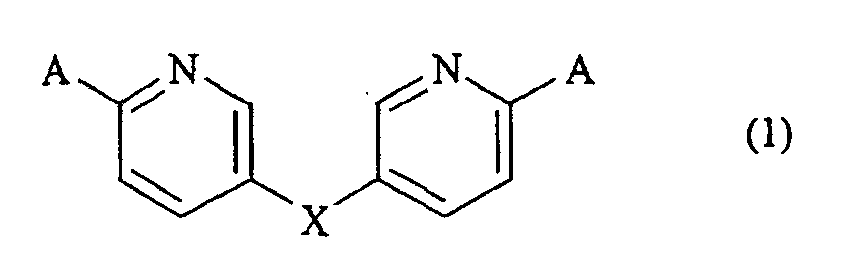
- the present invention provides a bis (2-aryl-5-pyridyl) derivative represented by the following formula (1) or a salt thereof: wherein A represents a substituted or unsubstituted aromatic hydrocarbon group, and X represents a group selected from the following formulas (2) to (4) : wherein in the formula (2), R 1 represents a hydrogen atom or a di (lower alkyl) amino (lower alkyl) group, and m stands for an integer of 1 or 2; in the formula (3), Y 1 and Y 2 represent a nitrogen atom or a CH group, and n stands for an integer of 0 to 6; in the formula (4), R 2 and R 3 represent a hydrogen atom or a lower alkyl group, Z represents a single bond, a substituted methylene group, a substituted imino group, an oxygen atom or a cycloalkylene group, and p and q stand for an integer of 0 to 6.
- the present invention also provides a medicine comprising as an active ingredient the bis (2-aryl-5-pyridyl) derivative or the salt thereof.
- the present invention also provides use of the bis (2-aryl-5-)pyridyl) derivative and the salt thereof for the manufacture of a medicine.
- the present invention also provides a medicinal composition
- a medicinal composition comprising the bis (2-aryl-5-pyridyl) derivative or the salt thereof and a pharmacologically acceptable carrier.
- the present invention also provides a treatment method for an allergic immune disease, which comprises administering the bis(2-aryl-5-pyridyl) derivative or the salt thereof.
- halogen atoms are fluorine atom, chlorine atom, bromine atom, and iodine atom.
- the aromatic hydrocarbon group represented by A may preferably be one having 6 to 14 carbon atoms, with a phenyl or naphthyl group being more preferred and a phenyl group being particularly preferred.
- substituents may contain 1 to 3 substituents.
- substituents can include lower alkyl groups, lower alkoxy groups, halogeno(lower alkoxy) groups, lower alkoxy(lower alkoxy) groups, hydroxy(lower alkoxy) groups, carboxyl groups, (lower alkoxy) carbonyl groups, unsubstituted or (lower alkyl)-and/or (lower alkoxy)-substituted carbamoyl groups, lower alkanoyl groups, formyl groups, lower alkanoyloxy groups, halogen atoms, hydroxy groups, cyano groups, (lower alkyl) thio groups, amino groups, mono- or di-(lower alkyl) amino groups, (lower alkyl)sufonylamino groups, pyrrolidinyl groups, and alkylenedioxy groups.
- substituents can include methyl, methoxy, ethoxy, n-propoxy, isopropoxy, trifluoroethoxy, methoxyethoxy, hydroxyethoxy, F, Cl, hydroxy, cyano, methylthio, dimethylamino, pyrrolidinyl, formyl, carboxy, ethoxycarbonyl, t-butoxycarbonyl, propionyloxy, N-methyl-N-methoxycarbamoyl, acetyl, and methylenedioxy.
- the group of the formula (2) contains the di(lower alkyl)amino(lower alkyl) group represented by R 1 .
- the di(lower alkyl)amino group in the di (lower alkyl) amino (lower alkyl) group a dimethylamino group or the like is particularly preferred.
- n may preferably range from 2 to 4.
- the substituted methylene group represented by Z contains one or two substituents, examples of which may include lower alkyl, hydroxy, pyrrolidinyl and benzyloxy groups.
- the substituted imino group represented by Z contains lower alkyl groups.
- Illustrative of the cycloalkylene represented by Z are cyclopentylene, cyclohexylene, and cycloheptylene.
- p and q may preferably range from 0 to 4.
- Preferred specific examples of the bis (2-aryl-5-pyridyl) derivative (1) according to the present invention can include N,N'-bis[2-(3,4,5-trimethoxyphenyl)-5-pyridyl]-N,N'-dimethy lethylenediamine dimethanesulfonate, N,N'-bis[2-(4-hydroxy-3,5-dimethoxyphenyl)-5-pyridyl]-N,N'-dimethyl-ethylenediamine dimethanesulfonate, 1,4-bis[2-(3,4,5-trimethoxyphenyl)-5-pyridyl]hexahydro-1,4-diazepine dimethanesulfonate, N,N'-bis[2-(3,4,5-trimethoxyphenyl)-5-pyridyl]-N,N'-diethyl ethylenediamine dimethanesulfonate, N,N'-bis[2-(3,4,5-
- the compound (1) according to the present invention can be produced, for example, in accordance with the reaction steps of the below-described production processes, although no particular limitation is imposed on its production process.
- W and W' represent a halogen atom or -OSO 2 (C r F 2r+1 ) in which r stands foran integer of 0 to 4, and M represents dihydroxyboron, di (lower alkoxy)boron, di(loweralkyl)boron, dihalo(loweralkyl)silicon, halogenated zinc, tri(lower alkyl)tin, halogenated magnesium or the like.
- the compound (1) according to the present invention can be produced by adding the compound (6) and a catalyst to a solution or suspension of the compound (5) , reacting these compounds optionally in the presence of a ligand and a base to obtain the compound (7) and then reacting the compound (7) with the compound (8).
- the compound (7) can be obtained by adding the compound (6), the catalyst and, if necessary, the ligand and the base to the solution or suspensionof the compound (5) and then reacting the compound (5) with the compound (6) at room temperature to 200°C for 0.5 to 100 hours [Metal-catalyzedReactions; Diederich, F., Stang, P.J., Eds.; Wiley-VHC: Weinheim (1998). Stanforth, S.P. Tetrahedron, 54 , 263-303 (1998)].
- a solvent usable in the above reaction are benzene, toluene, xylene, diethyl ether, tetrahydrofuran, dimethoxyethane, dioxane, acetonitrile, dimethylformamide, N-methylpiperidone, methanol, ethanol, and water.
- the catalyst can include tetrakis(triphenylphosphine)-palladium(0), tris(bisbenzylideneacetone)dipalladium(0), palladium acetate(II), palladium chloride(II), dichloro-bis(triphenylphosphine)palladium(II), dichloro[1,2-bis(diphenylphosphine)ethane]palladium(II), dichloro[1,4-bis(diphenylphosphino)butane]palladium(II), dichloro[1,1-bis(diphenylphosphino)ferrocene]palladium(II), tetrakis-triphenylphosphine nickel(0) and bis(acetylacetonato)nickel (II).
- Examples of the ligand can include tri(t-butyl)phosphine, triphenylphosphine, tri(o-tolyl)-phosphine, tri(2-furyl)phosphine, 2,2'-bis(diphenyl-phosphino)-1,1'-binaphthyl, 1,2-bis(diphenylphosphino)-ethane, 1,3-bis(diphenylphosphino)propane, 1,4-bis(diphenylphosphino)butane, and 1,1'-bis(diphenyl-phosphino)ferrocene.
- Examples of the base can include sodium acetate, potassium acetate, sodium carbonate, sodium hydrogencarbonate, potassium phosphate, sodium hydroxide, potassium hydroxide, barium hydroxide, sodium methoxide, sodium ethoxide, cesium fluoride, fluorinated tributyl-ammonium, and triethylamine.
- the reaction can be conducted preferably by following the report by Stille et al. [Stille, J.K., Angew. Chem. Int. Ed. Engl. 25 , 508-524 (1986)], the report by Suzuki et al. [Miyaura, N.; Suzuki, A. Chem. Rev., 95 , 2457-2483 (1995)] or the report by Mitchell et al. [Mitchell, M.B.
- the compound (1) can be obtained by adding the compound (8), a catalyst, a base and, if necessary, a ligand to a solution of the compound (7) and then reacting the compound (8) with the compound (7) at room temperature to 200°C for 0.5 to 100 hours, preferably at 80 to 120°C for 5 to 15 hours [Yang, B.H., Buchwald, S.L., J. Organomet. Chem., 576 , 125-146 (1999) ; Hartwig. J.F., Angew. Chem. Int. Ed. Engl., 37 , 2046-2067 (1998); Nishiyama, M., Yamamoto, T., Koike, Y., Tetrahedron Lett., 39 , 617-620 (1998)].
- solvents usable here are toluene, xylene, dimethoxyethane, tetrahydrofuran, and dioxane.
- the catalyst can include tetrakis(triphenylphosphine)-palladium(0), tris(bisbenzylideneacetone)dipalladium(0), palladium(II) acetate, and dichloro[1,1'-bis(diphenyl-phosphino)ferrocene]palladium(II ), with tetrakis(triphenyl-phosphine)palladium(0) and tris(bisbenzylideneacetone)-dipalladium(0) being particularly preferred.
- Examples of the base can include sodium t-butoxide, potassium t-butoxide, potassium phosphate, potassium carbonate, cesium carbonate, lithium tetramethyldisilazide, triethylamine, and 1,8-diazabicyclo[5,4,0]-undecene(DBU), with sodium t-butoxide, potassium t-butoxide andpotassium carbonate being particularly preferred.
- Examples of the ligand can include tri(t-butyl)phosphine, triphenylphosphine, tri(o-tolyl)-phosphine, tri(2-furyl)phosphine, 2,2'-bis(diphenyl-phosphino)-1,1'-binaphthyl, 1,2-bis(diphenylphosphine)-ethane, 1,3-bis(diphenylphosphino)propane, 1,4-bis(diphenylphosphino)butane, and 1,1'-bis(diphenyl-phosphino)ferrocene.
- the compound (1) can be produced by subjecting the compound (9) and the compound (8) to a condensation reaction to obtain the compound (10), debenzylating the compound (10) into the compound (11), converting the hydroxyl groups of the compound (11) to obtain the compound (12), and then reacting the compound (12) with the compound (6).
- the compound (10) can be obtained by reacting the 2-benzyloxy-5-halopyridine (9) with the compound (8) under similar conditions as in the reaction between the compound (7) and the compound (8) in the production process 1.
- the compound (11) can be obtained by adding an acid to a solution of the compound (10) and then reacting them at -20 to 100°C for 0.5 to 100 hours, preferably at 30 to 60°C for 1 to 6 hours.
- Illustrative of a solvent usable here are chloroform, methylene chloride, dichloromethane, and ethyl acetate.
- Examples of the acid can include hydrogen chloride and trifluoroacetic acid. It is also possible to use the acid as a solvent.
- the compound (12) can be obtained by adding a base and ClSO 2 (C s F 2s+1 ) or [SO 2 (C s F 2s+1 )] 2 (s: an integer of 0 to 4) to a solution or suspension of the compound (11) and stirring the resulting mixture at -78 to 100°C for 5 minutes to 10 hours, preferably at -78 to 0°C for 10 minutes to 2 hours.
- Illustrative of a solvent usable here are methylene chloride, chloroform, dichloroethane, benzene, toluene, xylene, diethyl ether, tetrahydrofuran, dimethoxyethane, dioxane, and acetonitrile.
- the base can include sodium acetate, potassium carbonate, sodium hydrogencarbonate, potassium phosphate, triethylamine, N,N-diisopropyl-ethylamine and pyridine, with triethylamine and N,N-diisopropylethylamine being preferred.
- the compound (12) can also be obtained by reacting the compound (11) with a halogenating agent at room temperature to 200°C for 0.5 minutes to 200 hours, preferably at 50 to 120°C for 5 to 12 hours.
- a solvent can also be used as needed.
- halogenating agent can include phosphorus pentachloride, phosphorus oxychloride, phosphorus tribromide, and phosphorus oxybromide, with phosphorus oxychloride-phosphorus pentachloride being particularly preferred.
- solvent can include chloroform, methylene chloride and dichloroethane.
- the compound (1) can be obtained by reacting the compound (12) with the compound (6) under similar conditions as in the cross-coupling between the compound (5) and the compound (6) in the production process 1.
- R 4 represents a lower alkyl group.
- the compounds (1') in each of which X is a group of the formula (4), p and q are 3, and Z is a substituted imino group can be produced in accordance with the reaction steps of the above-described production process 3.
- the compound (14) can be obtained by reacting the 2-halo-5-nitropyridine (13) with the compound (6) under similar conditions as in the cross-coupling reactionbetween the compound (5) and the compound (6) in the production process 1.
- the compound (15) can be obtained by reducing the compound (14) in a manner known per se in the art.
- a catalyst and a hydrogen source are added to a solution of the compound (14), followed by a reaction at room temperature to 100°C for 5 minutes to 100 hours, preferably at 50 to 100°C for 0.5 to 3 hours (process A) ; or an acid and a metal or metal salt are added to a solution or suspension of the compound (14), followed by a reaction at room temperature to 100°C for 5 minutes to 100 hours, preferably at 50 to 100°C for 0. 5 to 3 hours (process B).
- illustrative of a solvent are tetrahydrofuran, dimethoxyethane, dioxane, ethyl acetate, methanol, ethanol;
- illustrative of the catalyst are palladium on charcoal, platinum black, platinum, and Raney nickel;
- illustrative of the hydrogen source are hydrogen, ammonium formate, and hydrazine.
- illustrative of a solvent are ethanol and water; illustrative of the acid are hydrochloric acid and acetic acid; and illustrative of the metal or metal salt are zinc powder, tin powder, iron powder, and stannous chloride.
- the compound (16) can be obtained by adding a base and acryloyl chloride to a solution of the compound (15) and reacting them at -78 to 50°C for 5 minutes to 100 hours, preferably at - 30 to 30°C for 10 minutes to 1 hour.
- Illustrative of a solvent usable here are methylene chloride, chloroform, dichloroethane, benzene, toluene, xylene, diethyl ether, tetrahydrofuran, dimethoxyethane, dioxane, and acetonitrile, withmethylene chloride and tetrahydrofuran being particularly preferred.
- Illustrative of the base are sodium acetate, potassium carbonate, sodium hydrogencarbonate, potassium phosphate, triethylamine, and N,N-diisopropylethylamine, with triethylamine and N,N-diisopropylethylamine being particularly preferred.
- the compound (18) can be obtained by reacting the compound (16) with the amine (17) at 0 to 200°C for 0.5 to 100 hours, preferably at 20 to 100°C for 1 to 15 hours.
- a solvent may be used if necessary.
- Illustrative of the solvent are methylene chloride, chloroform, dichloroethane, benzene, toluene, xylene, diethyl ether, tetrahydrofuran, dimethoxyethane, dioxane, acetonitrile, and dimethylformamide.
- the compound (19) can be obtained by adding a reducing agent to a solution of the compound (18) and reacting them at 0 to 100°C for 5 minutes to 100 hours, preferably at 20 to 80°C for 30 minutes to 3 hours.
- Illustrative of a solvent usable here are toluene, diethyl ether, tetrahydrofuran, and dimethoxyethane.
- Illustrative of the reducing agent are lithium aluminum hydride, diisobutylaluminum hydride, and borane.
- the compound (1') can be obtained by adding a reducing agent and an acid to a solution of the compound (19) and a carbonyl compound and reacting them at -20 to 50°C for 0.5 to 100 hours, preferably at 0 to 30°C for 1 to 15 hours.
- Illustrative of the carbonyl compound employed here are formaldehyde, paraformaldehyde, lower alkylaldehydes, and di (lower alkyl) ketone.
- Illustrative of a solvent are methylene chloride, chloroform, tetrahydrofuran, dimethoxyethane, dioxane, acetonitrile, methanol, and ethanol.
- Illustrative of the reducing agent are lithium aluminum hydride, sodium borohydride, sodium cyanoborohydride, and borane
- Illustrative of the acid are hydrochloric acid, acetic acid, and trifluoroacetic acid.
- A, Z, R 2 and R 3 have the same meanings as defined above, and p' and q' denote an integer of 1 to 5.
- the compounds (1") and (1"') in each of which X is a group of the formula (4) and p and q are 2 to 6 can be produced in accordance with the reaction steps of the production process 4.
- the compound (21) can be obtained by condensing the intermediate (15) in the production process 3 and the dicarboxylic acid (20) in a manner known per se in the art.
- the intermediate and the dicarboxylic acid (2) can be reacted in a solvent, in the presence of a condensing agent, in the presence of a base added as needed, at 0 to 100°C for 0.5 to 30 hours (process A) ; or the intermediate (15) and a reactive derivative of the dicarboxylic acid (20) are reacted in a solvent, in the presence of a base added as needed, at 0 to 100°C for 0.5 to 30 hours (process B). In each of the process A and the process B, it is preferred to conduct the reaction at 0 to 50°C for 0.5 to 5 hours.
- Illustrative of the solvents employed in these reactions aredimethylformamide, tetrahydrofuran, dioxane, acetonitrile, methylene chloride, and dichloroethane.
- Illustrative of the bases are organic bases such as pyridine, triethylamine and N,N-diisopropylethylamine; and inorganic bases such as sodium carbonate and sodium hydrogencarbonate.
- examples of the condensing agent used in the process A can include 1,3-dicyclohexylcarbodiimide, 1-cyclohexyl-3-morpholinoethylcarbodiimide, 1-(3-dimethyl-aminopropyl)-3-ethylcarbodiimide, 1,1'-carbonyldiimidazole, diethyl phosphorocyanidate, diphenyl phophorylazide, bis(2-oxo-3-oxazolidine)phosphinyl chloride, and 2-chloro-1-methylpyridium iodide.
- Examples of the reactive derivative of the dicarboxylic acid (20) in the process B can include acid halogenides such as acid chlorides, acid azides, mixed acid anhydrides with pivalic acid or the like, and active esters such as cyanomethyl esters and p-nitrophenyl esters.
- acid halogenides such as acid chlorides, acid azides, mixed acid anhydrides with pivalic acid or the like
- active esters such as cyanomethyl esters and p-nitrophenyl esters.
- the compound (1") can be obtained by reacting the compound (21) under similar conditions as in the reducing reaction of the compound (18) in the process 3.
- the compound (1"') can be obtained by reacting the compound (1") under similar conditions as in the alkylation of the compound (19) in the process 3.
- the intermediate and target compound obtained in the above reactions can be isolated and purified by subjecting them to purification procedures commonly employed in organic synthesis chemistry, for example, filtration, extraction, washing, drying, concentration, recrystallization, one or more of various chromatographic treatments, and the like. Further, the intermediate can be provided for use in the next reaction without specifically purifying it.
- the compound (1) according to the present invention may include various isomers depending on the kinds and combination of the substituents. It is to be noted that the present invention encompasses all of such isomers.
- the compound (1) obtained as described above can be converted into an acid addition salt or a basic salt by a method known per se in the art. No particular limitation is imposed on such salts insofar as they are pharmacologically acceptable salts.
- examples of its pharmacologically acceptable salt can include mineral acid salts such as the hydrochloride, sulfate andnitrate; and organic acid salts such as the methanesulfonate, acetate, oxalate and citrate.
- examples of its pharmacologically acceptable salt can include alkali metal salts such as the sodium and potassium salts; alkaline earth metal salts such as the calcium and magnesium salts; and organic base salts such as the pyridine, picoline and triethylamine salts.
- the bis (2-aryl-5-pyridyl) derivative (1) according to the present invention has excellent IgE antibody production inhibiting activity and also, IL-4 production inhibiting activity and IL-5 production inhibiting activity as will be demonstrated in tests to be described subsequently herein, it is useful as medicines for the prevention or treatment of various allergic diseases - for example, asthma, atopic dermatitis, allergic rhinilis, inflammatory colitis, contact skin diseases and allergic eye diseases - and also as an IgE antibody production inhibitor.
- the medicine according to the present invention comprises as an active ingredient the bis(2-aryl-5-pyridyl) derivative or the salt thereof.
- the bis(2-aryl-5-pyridyl) derivative or the salt thereof can be formulated into medicinal compositions, for example, various oral preparations or parenteral preparations such as solid, semi-solid or liquid preparations by methods known per se in the art.
- preparations for oral administration are tablets, pills, granules, soft or hard capsules, triturates, subtilized granules, powders, emulsions, syrups, pellets, and elixirs.
- preparations for parenteral administration are injections, drips, infusions, ointments, lotions, tonics, sprays, suspensions, medicinal oils, emulsions, suppositories, and instillations.
- Active ingredients according to the present invention can be used in combination with pharma-cologically acceptable surfactants, excipients, coloring matters, flavoring agents, preservatives, stabilizers, buffering agents, suspending agents, isotonicities and the like as needed.
- the dosage of the medicine according to the present invention varies inter alia depending on the medicine, the target disease to be treated or prevented, the administration method, the treatment period, and the age, sex and weight of the patient. Nonetheless, it is preferred to administer the medicine at a daily dosage of from 0.01 to 1, 000 mg/kg ⁇ weight in terms of the compound represented by the formula (1). This dosage can be administered at once or in several portions, for example, 2 to 6 portions in a day.
- N,N'-Bis(2-hydroxy-5-pyridyl)-N,N'-dimethylethylene-d iamine ditrifluoroacetate (18.00 g, 35.8 mmol) was suspended in methylene chloride (350 mL), followed by the addition of N,N-diisopropylethylamine (48 mL, 280 mmol). The resulting mixture was cooled to -10°C, to which trifluoromethanesulfonic acid anhydride (21 mL, 120 mmol) was added.
- N,N-diisopropylethylamine (12 mL, 70 mmol) and trifluoromethanesulfonic acid anhydride (21 mL, 120 mmol) were added.
- N,N-diisopropylethylamine (5.0 mL, 29 mmol) and trifluoro-methanesulfonic acid anhydride (5.0 mL, 28 mmol) were added further, and the thus-obtained mixture was stirred for 1 hour in an ice bath.
- N-t-butoxycarbonyl-3,5-dimethoxy-4-(2,2,2-trifluoro-e thoxy) aniline (1.10 g, 3.13 mmol) was added to a 10% methanol solution of hydrogen chloride (20 mL, 55 mmol), and the resulting solution was stirred at 50°C for 30 minutes. The reaction mixture was concentrated under reduced pressure, whereby crude 3,5-dimethoxy-4-(2,2,2-trifluoroethoxy)aniline hydrochloride was obtained.
- lithium aluminum hydride (11.0 mg, 0.29 mmol) was added to a solution of the oil (155.0 mg, approx. 0.42 mmol), which had been obtained by the above-described procedures, in anhydrous diethyl ether (2.0 mL). After the resulting mixture was stirred at room temperature for 1 hour, 3.0 M hydrochloric acid was added to the reaction mixture, and the water layer was extracted with diethyl ether. The organic layer was washed with a saturated aqueous solution of sodium hydrogencarbonate and brine, dried over anhydrous sodiumsulfate, and then concentrated under reduced pressure.
- methyl iodide (0.010 mL, 0.16 mmol) and a 50% dispersion of sodium hydride in mineral oil (12.0 mg, 0.24 mmol) were added to a solution of 4-(2-hydroxyethoxy)-1-iodo-3,5-dimethoxybenzene (39.0 mg, 0.120 mmol) in anhydrous tetrahydrofuran (1.0 mL), and the resulting mixture was stirred at room temperature for 1 hour. Water was added to the reaction mixture, and the thus-obtained mixture was extracted with diethyl ether.
- Aluminumchloride (87.05g, 653.0 mmol) was gradually added to a solution of 3, 5-dimethoxyaniline (20.0 g, 131.0 mmol) and acetic anhydride (30.9 mL, 328 mmol) in methylene chloride (650 mL) , said solution having been held under stirring in a sodium chloride-ice bath.
- the resulting mixture was stirred in the sodium chloride-ice bath for 20 minutes and then at room temperature for 1 hour.
- the reaction mixture was poured into ice water, and the resulting mixture was extracted with chloroform.
- the organic layer was washed with a saturated aqueous solution of sodium hydrogencarbonate and brine, dried over anhydrous sodium sulfate, and then concentrated under reduced pressure.
- the residue was purified by chromatography on a silica gel column to obtain crude crystals.
- the crude crystals were recrystallized fromdiethyl ether-hexane, whereby 4-acetamido-2,6-dimethoxyacetophenone was obtained as pale yellow crystalline powder (melting point 184.0-187.0°C) (9.42 g, yield: 26%).
- hexamethylditin (609.0 mg, 1.86 mmol) and tetrakis(triphenylphosphine)palladium (215.0 mg, 0.190 mmol) were added to 4-iodo-2,6-dimethoxyacetophenone (287.0 mg, 1.86 mmol) in a solution of anhydride 1,4-dioxane, and the resulting mixture was stirred at 110°C for 4 hours. After the mixture was allowed to cool down, water was added. The resultant mixture was extracted with benzene. The organic layer was dried over anhydrous sodium sulfate and then concentrated under reduced pressure. The residue was purifiedby chromatography on a silica gel column, whereby the title compoundwas obtained as a colorless oil (450.0 mg, yield: 71%).
- N,N'-bis(2-hydroxy-5-pyridyl)-N,N'-dimethylethylenediamine ditrifluoroacetate (824.0 mg, 1.64 mmol) synthesized by the method described in Referential Example 1 and phosphorus pentachloride (171.0 mg, 0.820mmol) were added.
- the resulting mixture was stirred at 100°C for 8 hours. After allowed to cool down, the reaction mixture was poured into ice water. Sodium hydroxide was added to the resulting mixture to basify the same, followed by extraction with chloroform.
- lithium aluminum hydride (780.0 mg, 20.7 mmol) was added to a solution of the oil (1.95 g, approx. 6.5 mmol), which was obtained by the above-described procedures, in tetrahydrofuran (40 mL). An ice bath was removed, and the mixture was stirred at 80°C for 17 hours. The reaction mixture was allowed to cool down, followed by the addition of anhydrous sodium sulfate (25.0 g). Insoluble matter was filtered off using Celite, and the filtrate was concentrated under reduced pressure.
- N,N'-dibenzyl-N,N'-dimethyl-3-(1-pyrrolidinyl)glutaramide was obtained as a colorless oil (2.81 g, yield: 90% based on 6-chloro-2-pyrone) from 6-chloro-2-pyrone (1.00 g, 7.66 mmol) and N-methyl-benzylamine (3.71 g, 30.6 mmol) via crude N,N'-dibenzyl-N,N'-dimethylglutaconamide (2.67 g).
- lithium aluminum hydride (0.44 g, 12 mmol) was added to a solution of N,N'-dibenzyl-N,N'-dimethyl-3-(1-pyrrolidinyl)glutaramide (1.16 g) in anhydrous tetrahydrofuran (20 mL), said solution having been held under stirring in an ice bath, and the resulting mixture was stirred at 65°C for 2 hours.
- methanol (3.0 mL, 74 mmol) was added to the reaction mixture, and the ice bath was removed.
- N,N'-bis(2-trifluoromethane-sulfonyloxy-5-pyridyl)-N,N'-dimethylethylene diamine 108.0 mg, 0.200 mmol
- Referential Example 1 To a solution of N,N'-bis(2-trifluoromethane-sulfonyloxy-5-pyridyl)-N,N'-dimethylethylene diamine (108.0 mg, 0.200 mmol) , which had been synthesized in Referential Example 1, in ethanol-toluene (1 : 6, 3.5 mL) , 2, 4-dimethoxy-phenylboric acid (108.0 mg, 0. 200 mmol) , tetrakis-(triphenylphosphine)palladium (46.0 mg, 0.040 mmol) and a 2.0 M aqueous solution of sodium carbonate (0.20 mL, 0.40 mmol) were added.
- N,N'-bis[2-(2,3-dimethoxyphenyl)-5-pyridyl]-N,N'-dimethylethylene-diamine was obtained as a colorless oil (33.0 mg, yield: 31%) from N,N'-bis(2-trifluoromethanesulfonyloxy-5-pyridyl)-N,N'-dimethylethylenediamine (114.0 mg, 0.212 mmol) synthesized by similar procedures as in Referential Example 1 and 2,3-dimethoxyphenylboric acid (128.0 mg, 0.850 mmol).
- Example 2 Following the procedures of Example 1, an oil was obtained from N,N'-bis(2-trifluoromethanesulfonyloxy-5-pyridyl)-N,N'-dimethylethylenediamine (108.0 mg, 0.200 mmol) synthesized in Referential Example 1 and 2, 5-dimethoxy-phenylboric acid (91.0 mg, 0. 500 mmol). Chloroform-diethyl ether-hexane was added to the oil and the resulting precipitate was collected by filtration, whereby the title compound was obtained as pale yellow crystalline powder (melting point: 139.0-141.0°C) (41.2 mg, yield: 40%).
- N,N'-bis[2-(2,4,6-trimethoxyphenyl)-5-pyridyl]-N,N'-dimethyl-ethylenediamine was obtained as a colorless oil (20.1 mg, yield: 13%) from N,N'-bis(2-trifluoromethanesulfonyloxy-5-pyridyl)-N,N'-dimethylethylenediamine (150.3 mg, 0.279 mmol) synthesized in Referential Example 1 and 2,4,6-trimethoxy-phenylboric acid (124.5 mg, 0.692 mmol).
- tri-t-butylphosphine (101.0 mg, 0.500 mmol) was added to a solution of bis(dibenzylideneacetone)palladium (71.0 mg, 0.120 mmol) in o-xylene (3.0 mL).
- 5-chloro-2-(3,4,5-trimethoxyphenyl)pyridine (335.0 mg, 1.20 mmol) , which had been synthesized in Referential Example 2, and N,N'-dimethylethylenediamine (44.0 mg, 0.500 mmol) and sodium t-butoxide (106.0 mg, 1.10 mmol) were added.
- N,N'-bis[2-(4-ethoxy-3,5-dimethoxyphenyl)-5-pyridyl]-N,N'-dimethyl-ethylenediamine was obtained as a colorless oil (133.0 mg, yield: 79%) from N,N'-bis(2-trifluoromethanesulfonyloxy-5-pyridyl)-N,N'-dimethylethylenediamine (150.0 mg, 0.280 mmol) synthesized in Referential Example 1 and 4-ethoxy-3,5-dimethoxyphenylboric acid (140.0 mg, 0. 620 mmol) synthesized in Referential Example 3.
- N,N'-bis[2-(3,5-dimethoxy-4-propoxyphenyl)-5-pyridyl]-N,N'-dimethyl-ethylenediamine was obtained as a colorless oil (124.0 mg, yield: 98%) from N,N'-bis(2-trifluoromethanesulfonyloxy-5-pyridyl)-N,N'-dimethylethylenediamine (108.0 mg, 0.200 mmol) synthesized in Referential Example 1 and 4-propoxy-3,5-dimethoxyphenylboric acid (105.0 mg, 0.440 mmol) synthesized by similar procedures as in Referential Example 3.
- N,N'-bis[2-(4-isopropxy-3,5-dimethoxyphenyl)-5-pyridyl]-N, N'-dimethyl-ethylenediamine was obtained as a colorless oil (74.0 mg, yield: 92%) from N,N'-bis(2-trifluoromethanesulfonyloxy-5-pyridyl)-N,N'-dimethylethylenediamine (69.0 mg, 0.130 mmol) synthesized in Referential Example 1 and 4-isopropoxy-3,5-dimethoxyphenylboric acid (61.0 mg, 0.260 mmol) synthesizedbysimilarprocedures as in Referential Example 3.
- N,N'-bis[2-[3,5-dimethoxy-4-(2,2,2-trifluoroethoxy)phenyl]-5-pyridyl]-N,N'-dimethylethylenediamine was obtained (80.0 mg, yield: 46%) from N,N'-bis(2-trifluoromethanesulfonyloxy-5-pyridyl)-N,N'-dimethylethylenediamine (128.0 mg, 0.240 mmol) synthesized in Referential Example 1 and 3,5-dimethoxy-4-(2,2,2-trifluoroethoxy)phenylboric acid (146.0 mg, 0.530 mmol) synthesized in Referential Example 4.
- N,N'-bis[2-[4-(2-methoxyethoxy)-3,5-dimethoxyphenyl]-5-pyridyl]-N,N'-dimethylethylenediamine was obtained (139.0 mg, yield: 75%) from N,N'-bis(2-trifluoromethanesulfonyloxy-5-pyridyl)-N,N'-dimethylethylenediamine (150.0 mg, 0.280 mmol) synthesized in Referential Example 1 and 4-(2-methoxy-ethoxy)-3,5-dimethoxyphenylboric acid(158.0 mg, 0.620 mmol) synthesized in Referential Example 5.
- N,N'-bis[2-(4-benzyloxy-3,5-dimethoxyphenyl)-5-pyridyl]-N, N' -dimethyl-ethylenediamine was obtained (64.0 mg, yield: 63%) from N,N'-bis(2-trifluoromethanesulfonyloxy-5-pyridyl)-N,N'-dimethylethylenediamine (75.0 mg, 0.140 mmol) synthesized in Referential Example 1 and 4-benzyloxy-3,5-dimethoxyphenyl-boric acid (81.0 mg, 0.280 mmol).
- N,N'-bis[2-(3-methoxy-4,5-methylenedioxyphenyl)-5-pyridyl]-N,N'-dimethyl-ethylenediamine was obtained as a colorless oil (109.0 mg, yield: 72%) from N,N'-bis(2-trifluoromethanesulfonyloxy-5-pyridyl)-N,N'-dimethylethylenediamine (150.0 mg, 0.280 mmol) synthesized in Referential Example 1 and 3-methoxy-4, 5-methylenedioxyphenylboric acid (115.0 mg, 0.590 mmol).
- N,N'-bis[2-(3,4,5-triethoxyphenyl)-5-pyridyl]-N,N'-dimethylethylene-diamine was obtained as a pale yellow oil (123.0 mg, yield: 93%) from N,N'-bis(2-trifluoromethanesulfonyloxy-5-pyridyl)-N,N'-dimethylethylenediamine (108.0 mg, 0.200 mmol) synthesized in Referential Example 1 and 3,4,5-triethoxy-phenylboric acid (122.0 mg, 0.480 mmol).
- N,N'-bis[2-(3,5-dimethoxy-4-methylthiophenyl)-5-pyridyl]-N, N' -dimethylethylenediamine was obtained as a colorless viscous oil (61.0 mg, yield: 80%) from N,N'-bis(2-trifluoromethane-sulfonyloxy-5-pyridyl)-N,N'-dimethylethylenediamine (70.0 mg, 0.130 mmol) synthesized in Referential Example 1 and 3,5-dimethoxy-4-methylthiophenylboric acid (60.0 mg, 0.260 mmol).
- Example 2 Following the procedures of Example 1, an oil was obtained from N,N'-bis(2-trifluoromethanesulfonyloxy-5-pyridyl)-N,N'-dimethylethylenediamine (129.0 mg, 0.240 mmol) synthesized in Referential Example 1 and 4-dimethylamino-3,5-dimethoxyphenylboric acid (135.0 mg, 0.600 mmol). Methanol was added to the oil and the resulting precipitate was collected by filtration, whereby the title compound was obtained as pale brown crystalline powder (melting point: 194.0-196.0°C) (84.0 mg, yield: 58%).
- N,N'-bis[2-(3,5-dimethoxy-4-methylphenyl)-5-pyridyl]-N,N'-dimethyl-ethylenediamine was obtained as a colorless oil (37.0 mg, yield: 40%) from 5-chloro-2-(3,5-dimethoxy-4-methylphenyl)-pyridine (99.0 mg, 0. 370 mmol) synthesized by similar procedures as in Referential Example 2.
- Example 2 Following the procedures of Example 1, an oil was obtained from N,N'-bis(2-trifluoromethanesulfonyloxy-5-pyridyl)-N,N'-dimethylethylenediamine (150.0 mg, 0.280 mmol) synthesized in Referential Example 1 and 4-fluoro-3,5-dimethoxyphenylboric acid (167.0 mg, 0.840 mmol). Hexane was added to the oil and the resulting precipitate was collected by filtration, whereby N,N'-bis[2-(4-fluoro-3,5-dimethoxy-phenyl)-5-pyridyl]-N,N'-dimethylethylenediamine was obtained as yellow crystalline powder (160.0 mg; quantitative).
- N,N'-bis[2-(4-chloro-3,5-dimethoxyphenyl)-5-pyridyl]-N,N'-dimethyl-ethylenediamine was obtained as pale yellow amorphous powder (101.0 mg, yield: 86%) from N,N'-bis(2-trifluoromethane-sulfonyloxy-5-pyridyl)-N,N'-dimethylethylenediamine (108.0 mg, 0.200 mmol) synthesized in Referential Example 1 and 4-chloro-3,5-dimethoxyphenylboric acid (95.0 mg, 0.440 mmol).
- N,N'-bis[2-(4-cyano-3,5-dimethoxyphenyl)-5-pyridyl]-N,N'-dimethyl-ethylenediamine was obtained as a colorless oil (125.0 mg, yield: 79%) from N,N'-bis(2-trifluoromethanesulfonyloxy-5-pyridyl)-N,N'-dimethylethylenediamine (150.0 mg, 0.280 mmol) synthesized in Referential Example 1 and 4-cyano-3,5-dimethoxyphenylboric acid (145.0 mg, 0.700 mmol).
- Example 2 Following the procedures of Example 1, an oil was obtained from N,N'-bis(2-trifluoromethanesulfonyloxy-5-pyridyl)-N,N'-dimethylethylenediamine (76.0 mg, 0.140 mmol) synthesized in Referential Example 1 and 3,5-dimethoxy-4-(N-methoxy-N-methylcarbamoyl)phenylboric acid (91.0 mg, 0.340 mmol) synthesized in Referential Example 7. Chloroform-hexane was added to the oil and the resulting precipitate was collected by filtration, whereby the title compound was obtained as yellow crystalline powder (melting point: 217.0-220.0°C) (34.0 mg, yield: 36%).
- N,N'-bis[2-(3,4,5-trimethoxyphenyl)-5-pyridyl]-N,N'-diethylethylene-diamine was obtained as pale yellow crystalline powder (100.0 mg, yield: 33%) from 5-chloro-2-(3,4,5-trimethoxypheny)-pyridine (335.0 mg, 1.20 mmol) synthesized in Referential Example 2 and N,N'-diethylethylenediamine (58.0 mg, 0.500 mmol).
- N,N'-bis[2-(3,4,5-trimethoxyphenyl)-5-pyridyl]-N,N',2,2-tetramethyl-1,3-propanediamine was obtained as a pale yellow oil (210.0 mg, yield: 68%) from 5-chloro-2-(3,4,5-trimethoxypheny)pyridine (335.0 mg, 1.20 mmol) synthesized in Referential Example 2 and N,N',2,2-tetramethyl-1,3-propanediamine (65.0 mg, 0.500 mmol).
- lithium aluminum hydride (23.1 mg, 0.609 mmol) was added to a solution of N,N-bis[N-[2-(3,4,5-trimethoxyphenyl)-5-pyridyl] carbamoylmethyl]-methylamine (88.1 mg, 0.139 mmol) in anhydrous tetrahydrofuran (5.0 mL), and the resulting mixture was stirred at 65°C for 1 hour.
- Methanol (0.2 mL, 4.9 mmol) was added to the reaction mixture under ice cooling, and an ice bath was then removed.
- Paraformaldehyde (33.2 mg, 1.11 mmol) and sodium borohydride (24.0 mg, 0.634 mmol) were added in several portions, and the resulting mixture was stirred at room temperature for further 6 hours. Under ice cooling, a 2.5 M aqueous solution of sodium hydroxide (5.0 mL) was added to the reaction mixture. Themixture was extracted with chloroform, and the organic layer was dried over anhydrous sodium sulfate and then concentratedunder reduced pressure.
- lithium aluminum hydride (33.2 mg, 0.875 mmol) was added to a solution of bis[N-[2-(3,4,5-trimethoxyphenyl)-5-pyridyl]carbamoylmethyl ]ether (121.3 mg, 0.196 mmol) in anhydrous tetrahydrofuran (6 mL) , and the resulting mixture was stirred at 65°C for 2 hours.
- Methanol (0.2 mL, 4.9 mmol) was added to the reaction mixture under ice cooling, and an ice bath was then removed.
- Paraformaldehyde (25.0 mg, 0.833 mmol) and sodium borohydride (17.8 mg, 0.47 mmol) were added in several portions, and the resulting mixture was stirred for 20 hours. Under ice cooling, a 2.5 M aqueous solution of sodium hydroxide (5.0 mL) was added to the reaction mixture, and the mixture was extracted with chloroform. The organic layer was dried over anhydrous sodium sulfate and then concentrated under reduced pressure.
- N,N'-bis[2-(3,4,5-trimethoxyphenyl)-5-pyridyl]-N,N'-dimethyl-3-(1-pyrrolidinyl)-1,5-pentanediamine was obtained as a colorless oil (49.6 mg, yield: 27%) from 2-(3,4,5-trimethoxypheny)-5-chloropyridine (182.0 mg, 0.635 mmol) synthesized in Referential Example 2 and N,N'-dimethyl-3-(1-pyrrolidinyl)-1,5-pentanediamine (54.0 mg, 0.217 mmol).
- N,N'-bis[2-(3,4,5-trimethoxyphenyl)-5-pyridyl]-4,4'-piperidine was obtained as pale yellow crystalline powder (228.0 mg, yield: 69%) from 5-chloro-2-(3,4,5-trimethoxypheny)pyridine (335.0 mg, 1.20 mmol) synthesized in Referential Example 2 and 4, 4-piperidine (84.0 mg, 0.500 mmol).
- N,N'-bis[2-(3,4,5-trimethoxyphenyl)-5-pyridyl]-N,N'-dimethyl-1,6-hexanediamine was obtained as pale yellow crystalline powder (243.0 mg, yield: 75%) from 5-chloro-2-(3,4,5-trimethoxy-pheny)pyridine (335.0 mg, 1.20 mmol) synthesized in Referential Example 2 and N,N'-dimethyl-1,6-hexanediamine (72.0 mg, 0.500 mmol).
- N,N'-bis[2-(3,5-dimethoxyphenyl)-5-pyridyl]-N,N'-diethylethylene-diamine was obtained as a colorless oil (55.0 mg, yield: 42%) from N,N'-bis(2-trifluoromethanesulfonyloxy-5-pyridyl)-N,N'-diethylethylenediamine (136.0 mg, 0.240 mmol) , which had been synthesized by similar procedures as in Referential Example 1, and 3,5-dimethoxyphenylboric acid (80.0 mg, 0.530 mmol).
- N,N'-diethyl-N,N'-bis[2-(4-isopropoxy-3,5-dimethoxyphenyl)-5-pyridyl]-ethylenediamine was obtained as a colorless oil (129.0 mg, yield: 98%) from N,N'-bis(2-trifluoromethanesulfonyloxy-5-pyridyl)-N,N'-diethylethylenediamine (113.0 mg, 0.200 mmol), which had been synthesized by similar procedures as in Referential Example 1, and 4-isopropoxy-3,5-dimethoxy-phenyl-boric acid (106.0 mg, 0.440 mmol).
- N,N'-bis[2-(3,5-dimethoxyphenyl)-5-pyridyl]-N,N'-dimethyl-1 ,3-propanediamine was obtained as a colorless oil (35.0 mg, yield: 35%) from N,N'-bis(2-trifluoromethanesulfonyloxy-5-pyridyl)-N,N'-dimethyl-1,3-propanediamine (95.0 mg, 0.190 mmol), which had been synthesizedby similar procedures as in Referential Example 1, and 3,5-dimethoxyphenylboric acid (63.0 mg, 0.420 mmol).
- N,N'-bis[2-(4-isopropoxy-3,5-dimethoxyphenyl)-5-pyridyl]-N, N'-dimethyl-1,3-propanediamine was obtained as a colorless viscous oil (27.0 mg, yield: 33%) from N,N'-bis(2-trifluoromethane-sulfonyloxy-5-pyridyl)-N,N'-dimethyl-1,3-propanediamine (61.0 mg, 0.125 mmol), which had been synthesizedby similar procedures as in Referential Example 1, and 4-isopropoxy-3,5-dimethoxyphenylboric acid (66.0 mg, 0.275 mmol).
- N,N'-bis[2-[4-(4-methoxybenzyloxy)-3,5-dimethoxyphenyl]-5-pyridyl]-N,N'-dimethyl-1,3-propanediamine was obtained as a pale brown oil (75.0 mg, yield: 23%) from N,N'-bis(2-trifluoromethane-sulfonyloxy-5-pyridyl)-N,N'-dimethyl-1,3-propanediamine (220.0 mg, 0.400 mmol) synthesized by similar procedures as in Referential Example and 4-(4-methoxybenzyloxy)-3,5-dimethoxyphenylboric acid (308.0 mg, 0.970 mmol) synthesized by similar procedures as in Referential Example 3.
- N,N'-bis[2-(3-methoxy-4,5-methylenedioxyphenyl)-5-pyridyl]-N,N'-dimethyl-1,3-propanediamine was obtained as a colorless oil (46.0 mg, yield: 52%) from N,N'-dimethyl-N,N'-bis(2-trifluoromethane-sulfonyloxy-5-pyridyl)-1,3-propanediamine (78.0 mg, 0.160 mmol), which had been synthesized by similar procedures as in Referential Example 1, and 3-methoxy-4,5-methylenedioxy-phenylboric acid (66.0 mg, 0.340 mmol).
- N,N'-diethyl-N,N'-bis[2-(4-isopropoxy-3,5-dimethoxyphenyl)-5-pyridyl]-1,3-propanediamine was obtained as a pale yellow oil (78.0 mg, yield: 58%) from N,N'-diethyl-N,N'-bis(2-trifluoromethane-sulfonyloxy-5-pyridyl)-1,3-propanediamine (116.0 mg, 0.200 mmol), which had been synthesizedby similar procedures as in Referential Example 1, and 4-isopropoxy-3,5-dimethoxy-phenylboric acid (96.0 mg, 0.400 mmol).
- lithium aluminum hydride (4.28 g, 113 mmol) was added to an ice-cooled solution of N,N-bis[2-[N-[2-[3,5-dimethoxy-4-(2,2,2-trifluoro-ethoxy) phenyl]-5-pyridyl]carbamoyl]ethyl]methylamine (22.50 g, 28.3 mmol) in anhydrous tetrahydrofuran (500 mL). An ice bath was removed, and the reaction mixture was stirred at 65°C for 1 hour. Under ice cooling, methanol (20 mL, 490 mmol) was added to the reaction mixture, and the ice bath was removed.
- N,N-bis[2-[N-[2-(3,5-dimethoxy-4-methylthiophenyl)-5-pyridyl]carbamoyl]ethyl]methylamine (671.0 mg, 0.970 mmol)
- N,N-bis[N-[2-(3,5-dimethoxy-4-methylthiophenyl)-5-pyridyl]-3-aminopropyl]methylamine was obtained as a colorless oil (508.0 mg, yield: 79%).
- N,N-bis[N-[2-(3,5-dimethoxy-4-methylthiophenyl)-5-pyridyl]-3-aminopropyl]methylamine (67.0 mg, 0.100 mmol)
- N,N-bis[N-[2-(3,5-dimethoxy-4-methylthiophenyl)-5-pyridyl]-N-methyl-3-aminopropyl]methyl-amine was obtained as a colorless oil (44.0 mg, yield: 64%).
- Test 1 Evaluation of IgE antibody production inhibiting activity
- spleen was excised.
- the spleen was shredded in 10% FBS/RPMI 1640, and was then disintegrated into single cells through a 70-mesh screen. Those single cells were hemolyzed with the Gey' s solution, and using RPMI 1640 medium/25 M HEPES/0.3% BSA, a spleen cell suspension (1 x 10 7 cells/mL) was prepared. After an aliquot of the suspension was reacted with a rat anti-mouse Thy-1,2 monoclonal antibody (product of Cedarlane Laboratories Limited) at 4°C for 1 hour, centrifugation was conducted.
- Thy-1,2 monoclonal antibody product of Cedarlane Laboratories Limited
- Precipitated cells were suspended again (1 x 10 7 cells/mL, RPMI/HEPES/BSA) . After the suspension was next reacted with a low cytotoxic rabbit complement (product of Cedarlane Laboratories Limited) at 37°C for 1 hour, dead cells were removed by specific gravity centrifugation so that a B cell fraction was obtained as viable cells.
- a low cytotoxic rabbit complement product of Cedarlane Laboratories Limited
- the B cells (2x10 5 cells/0.2mL/well) was incubated together with LPS (E. coli 026:B6, product of DIFCO Laboratories, Inc.) for 1 day.
- Mouse IL-4 (product of Genzyme Corp.) was then added, followed by further incubation for 6 days.
- IgE antibody production inhibiting activity of each drug was calculated by adding the drug Day 1 of the incubation and assaying the quantity of IgE in the culture supernatant after the incubation. Inhibition activity (IC 50 ) is presented in Table 1.
- the bis(2-aryl-5-pyridyl) derivatives (1) according to the present invention and salts thereof have excellent IgE antibody production inhibiting activity and are useful as medicines for the prevention or treatment of allergic immune diseases.
Landscapes
- Chemical & Material Sciences (AREA)
- Organic Chemistry (AREA)
- Health & Medical Sciences (AREA)
- Life Sciences & Earth Sciences (AREA)
- General Health & Medical Sciences (AREA)
- General Chemical & Material Sciences (AREA)
- Medicinal Chemistry (AREA)
- Nuclear Medicine, Radiotherapy & Molecular Imaging (AREA)
- Bioinformatics & Cheminformatics (AREA)
- Pharmacology & Pharmacy (AREA)
- Engineering & Computer Science (AREA)
- Animal Behavior & Ethology (AREA)
- Chemical Kinetics & Catalysis (AREA)
- Public Health (AREA)
- Veterinary Medicine (AREA)
- Pulmonology (AREA)
- Immunology (AREA)
- Ophthalmology & Optometry (AREA)
- Dermatology (AREA)
- Pharmaceuticals Containing Other Organic And Inorganic Compounds (AREA)
- Pyridine Compounds (AREA)
- Plural Heterocyclic Compounds (AREA)
Abstract


Description
- This invention relates to novel bis(2-aryl-5-pyridyl) derivatives or salts thereof, and also to medicines which comprise the bis (2-aryl-5-pyridyl) derivatives or salts thereof as active ingredients and are useful for the prevention or treatment of allergic immune diseases.
- IgE, aclassofimmunoglobulin (Ig), isaallergen-specific molecule produced by IgE producing cells differentiated from B cells, when triggered by contact of immunocompetent cells with an allergen in the body.
- IgE is produced in a target organ of allergy, and binds to a receptor on surfaces of mast cells or basophils as principal effector cells in an allergic reaction (sensitized state). From the mast cells stimulated as a result of intrusion of the allergen into the body after the sensitization and its reaction with the specific IgE, histamine, a leucotriene, a prostaglandin, an allergic chemical transmitter such as PAF, or a detrimental enzyme such as tryptase is released, and an immediate-response allergic reaction such as increased vasopermeability, smooth muscle constriction or vasodilation is provoked. From the stimulated mast cells, a cytokine capable of directly activating other immune system cells, such as IL-4, is also secreted. As a result, eosinophils, basophils or the like infiltrate tissues, and an allergic chemical transmitter or a histodetrimental protein such as MBP, which is secreted by these inflammatory cells, induces a delayed allergic reaction and protracts and worsen an allergic symptom.
- Hence, the abnormal production of IgE is associated deeply with various allergic immune diseases, such as asthma, atopic dermatitis, allergic rhinitis, inflammatory colitis, contact-type dermatitis and allergic eye diseases. These diseases, however, are widely known to be preventable and curable if such production is effectively blocked (Emerging therapeutic targets in asthma and allergy: modulation of IgE. Emerging Therapeutic Targets (1999) 3: 229-240 ; Anti-IgE as novel therapy for the treatment of asthma. Curr. Opin. Plum. Med. (1999) 5: 76-80 ; Treatment of allergic asthma with monoclonal anti-IgE antibody. N. Eng. J. Med. (1999) 341: 1966-1973 ; Anti-IgE antibody therapy for asthma. N. Eng. J. Med. (1999) 341: 2006-2008) .
- From the foregoing, IgE is considered to be a substance which takes part at the stage of very beginning upon onset of an allergic disease. With the aim of developing antiallergic agents, some lowmolecular compounds with IgE antibody production inhibiting activity have been found and reported to date [WO98/04058, WO98/07702, WO98/16497, JP10-324631A, WO99/19291, WO99/35140, WO99/38829, WO99/42446, JP11-269192A, WO00/05198, "Yakuri to Chiryo (Basic Pharmacology & Therapeutic)" 22(3), 1369 (1994), JP1-106818A, JP7-17506B, JP8-92216A, JP8-109177A, WO96/11682, JP59-167564A]. These compounds, however, involve problems such as low water solubility, and it is the current circumstance that the aim has not been fully achieved.
- An object of the present invention, therefore, is to provide a compound having excellent IgE antibody production inhibiting activity and also a medicine comprising the compound as an active ingredient.
- Under such circumstances, the present inventors have proceeded with extensive research. As a result, it has been found that compounds representedby the below-described formula (1) have excellent IgE antibody production inhibiting activity and also good water solubility and hence, are useful as medicines for the prevention or treatment of allergic immune diseases, leading to the completion of the present invention.
- Accordingly, the present invention provides a bis (2-aryl-5-pyridyl) derivative represented by the following formula (1) or a salt thereof:


- The present invention also provides a medicine comprising as an active ingredient the bis (2-aryl-5-pyridyl) derivative or the salt thereof.
- The present invention also provides use of the bis (2-aryl-5-)pyridyl) derivative and the salt thereof for the manufacture of a medicine.
- The present invention also provides a medicinal composition comprising the bis (2-aryl-5-pyridyl) derivative or the salt thereof and a pharmacologically acceptable carrier.
- The present invention also provides a treatment method for an allergic immune disease, which comprises administering the bis(2-aryl-5-pyridyl) derivative or the salt thereof.
- Illustrative of the lower alkyl moieties in "lower alkyl groups", "lower alkoxy groups", "halogeno (lower alkoxy) groups", "lower alkoxy(lower alkoxy) groups", "hydroxy(lower alkoxy) groups", "(lower alkoxy)carbonyl groups", "lower alkanoyl groups", "lower alkanoyloxy groups", (lower alkyl) thio groups", "(lower alkyl) amino groups", "(lower alkyl)sufonylamino groups" as used herein are linear, branched or cyclic alkyl groups having 1 to 6 carbon atoms. Their examples can include methyl, ethyl, n-propyl, isopropyl, n-butyl, isobutyl, sec-butyl, tert-butyl, pentyl, hexyl, cyclopropyl, and cyclohexyl. On the other hand, illustrative of "halogen atoms" are fluorine atom, chlorine atom, bromine atom, and iodine atom.
- In the formula (1), the aromatic hydrocarbon group represented by A may preferably be one having 6 to 14 carbon atoms, with a phenyl or naphthyl group being more preferred and a phenyl group being particularly preferred.
- These groups may contain 1 to 3 substituents. Examples of such substituents can include lower alkyl groups, lower alkoxy groups, halogeno(lower alkoxy) groups, lower alkoxy(lower alkoxy) groups, hydroxy(lower alkoxy) groups, carboxyl groups, (lower alkoxy) carbonyl groups, unsubstituted or (lower alkyl)-and/or (lower alkoxy)-substituted carbamoyl groups, lower alkanoyl groups, formyl groups, lower alkanoyloxy groups, halogen atoms, hydroxy groups, cyano groups, (lower alkyl) thio groups, amino groups, mono- or di-(lower alkyl) amino groups, (lower alkyl)sufonylamino groups, pyrrolidinyl groups, and alkylenedioxy groups.
- Preferred specific examples of these substituents can include methyl, methoxy, ethoxy, n-propoxy, isopropoxy, trifluoroethoxy, methoxyethoxy, hydroxyethoxy, F, Cl, hydroxy, cyano, methylthio, dimethylamino, pyrrolidinyl, formyl, carboxy, ethoxycarbonyl, t-butoxycarbonyl, propionyloxy, N-methyl-N-methoxycarbamoyl, acetyl, and methylenedioxy.
- Among the groups represented by X, the group of the formula (2) contains the di(lower alkyl)amino(lower alkyl) group represented by R1. As the di(lower alkyl)amino group in the di (lower alkyl) amino (lower alkyl) group, a dimethylamino group or the like is particularly preferred.
- In the formula (3), n may preferably range from 2 to 4.
- In the formula (4), the substituted methylene group represented by Z contains one or two substituents, examples of which may include lower alkyl, hydroxy, pyrrolidinyl and benzyloxy groups. The substituted imino group represented by Z contains lower alkyl groups. Illustrative of the cycloalkylene represented by Z are cyclopentylene, cyclohexylene, and cycloheptylene.
- Further, p and q may preferably range from 0 to 4.
- Preferred specific examples of the bis (2-aryl-5-pyridyl) derivative (1) according to the present invention can include
N,N'-bis[2-(3,4,5-trimethoxyphenyl)-5-pyridyl]-N,N'-dimethy lethylenediamine dimethanesulfonate,
N,N'-bis[2-(4-hydroxy-3,5-dimethoxyphenyl)-5-pyridyl]-N,N'-dimethyl-ethylenediamine dimethanesulfonate,
1,4-bis[2-(3,4,5-trimethoxyphenyl)-5-pyridyl]hexahydro-1,4-diazepine dimethanesulfonate,
N,N'-bis[2-(3,4,5-trimethoxyphenyl)-5-pyridyl]-N,N'-diethyl ethylenediamine dimethanesulfonate,
N,N'-bis[2-(3,4,5-trimethoxyphenyl)-5-pyridyl]-N,N'-dimethy 1-1,3-propanediamine dimethanesulfonate,
N,N'-bis[2-(3,4,5-trimethoxyphenyl)-5-pyridyl]-N,N',2,2-tet ramethyl-1,3-propanediamine dimethanesulfonate,
2-hydroxy-N,N'-bis[2-(3,4,5-trimethoxyphenyl)-5-pyridyl]-N, N'-dimethyl-1,3-propanediamine,
N,N-bis[N-[2-(3,4,5-trimethoxyphenyl)-5-pyridyl]-N-methyl-2 - aminoethyl]methylamine trihydro-chloride,
N,N-bis[N-[2-(3,4,5-trimethoxyphenyl)-5-pyridyl]-N-methyl-3 - aminopropyl]methylamine,
bis[N-[2-(3,9,5-trimethoxyphenyl)-5-pyridyl]-2-aminoethyl] ether dimethane-sulfonate,
2-dimethylaminomethyl-1,9-bis[2-(3,4,5-trimethoxyphenyl)-5-pyridyl]piperazine trihydrochloride,
N,N'-bis[2-(3,4,5-trimethoxyphenyl)-5-pyridyl]-N,N'-dimethy 1-1,6-hexanediamine dimethanesulfonate,
N,N-bis[N-[2-[3,5-dimethoxy-4-(2,2,2-trifluoroethoxy)phenyl ]-5-pyridyl]-N-methyl-3-aminopropyl]methylamine trihydro-chloride. - The compound (1) according to the present invention can be produced, for example, in accordance with the reaction steps of the below-described production processes, although no particular limitation is imposed on its production process.
-
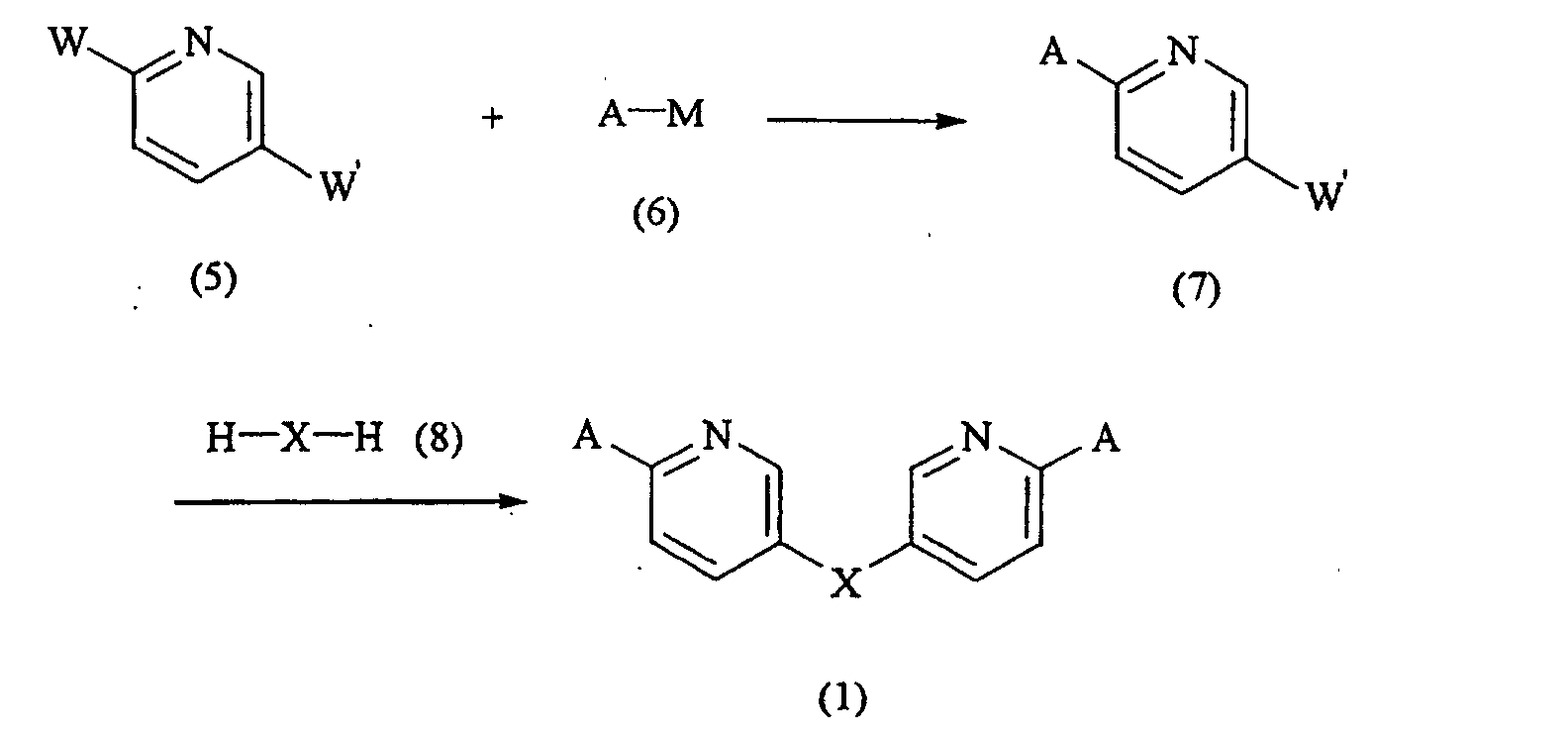
- Described specifically, the compound (1) according to the present invention can be produced by adding the compound (6) and a catalyst to a solution or suspension of the compound (5) , reacting these compounds optionally in the presence of a ligand and a base to obtain the compound (7) and then reacting the compound (7) with the compound (8).
- The compound (7) can be obtained by adding the compound (6), the catalyst and, if necessary, the ligand and the base to the solution or suspensionof the compound (5) and then reacting the compound (5) with the compound (6) at room temperature to 200°C for 0.5 to 100 hours [Metal-catalyzedReactions; Diederich, F., Stang, P.J., Eds.; Wiley-VHC: Weinheim (1998). Stanforth, S.P. Tetrahedron, 54, 263-303 (1998)].
- Illustrative of a solvent usable in the above reaction are benzene, toluene, xylene, diethyl ether, tetrahydrofuran, dimethoxyethane, dioxane, acetonitrile, dimethylformamide, N-methylpiperidone, methanol, ethanol, and water. Examples of the catalyst can include tetrakis(triphenylphosphine)-palladium(0), tris(bisbenzylideneacetone)dipalladium(0), palladium acetate(II), palladium chloride(II), dichloro-bis(triphenylphosphine)palladium(II), dichloro[1,2-bis(diphenylphosphine)ethane]palladium(II), dichloro[1,4-bis(diphenylphosphino)butane]palladium(II), dichloro[1,1-bis(diphenylphosphino)ferrocene]palladium(II), tetrakis-triphenylphosphine nickel(0) and bis(acetylacetonato)nickel (II).
- Examples of the ligand, on the other hand, can include tri(t-butyl)phosphine, triphenylphosphine, tri(o-tolyl)-phosphine, tri(2-furyl)phosphine, 2,2'-bis(diphenyl-phosphino)-1,1'-binaphthyl, 1,2-bis(diphenylphosphino)-ethane, 1,3-bis(diphenylphosphino)propane, 1,4-bis(diphenylphosphino)butane, and 1,1'-bis(diphenyl-phosphino)ferrocene. Examples of the base can include sodium acetate, potassium acetate, sodium carbonate, sodium hydrogencarbonate, potassium phosphate, sodium hydroxide, potassium hydroxide, barium hydroxide, sodium methoxide, sodium ethoxide, cesium fluoride, fluorinated tributyl-ammonium, and triethylamine.
- The reaction can be conducted preferably by following the report by Stille et al. [Stille, J.K., Angew. Chem. Int. Ed. Engl. 25, 508-524 (1986)], the report by Suzuki et al. [Miyaura, N.; Suzuki, A. Chem. Rev., 95, 2457-2483 (1995)] or the report by Mitchell et al. [Mitchell, M.B. ; Wallbank, P.J., Tetrahedron Lett., 32, 2273-2276 (1991)], that is, by using a compound (6) in which M is a tri (lower alkyl) tin and applying conditions of tetrakis(triphenylphosphine)palladium(0)/toluene/100 to 150°C /10 to 30 hours; byusing a compound (6) in which M is a dihydroboron and applying conditions of tetrakis(triphenyl-phosphine)palladium(0)/sodium carbonate (or potassium carbonate)/water-ethanol(or methanol)-toluene/60 to 100°C/0.5 to 3 hours; or by using a compound (6) in which M is a dihydroxyboron an applying conditions of dichloro[1,2-bis(diphenylphosphino)ethane]palladium(II)[or dichloro[1,4-bis(diphenylphosphino)butane]palladium(II)]/ sodium carbonate(or potassium carbonate)/water-ethanol(or methanol)-toluene/80 to 120°C/1 to 24 hours.
- The compound (1) can be obtained by adding the compound (8), a catalyst, a base and, if necessary, a ligand to a solution of the compound (7) and then reacting the compound (8) with the compound (7) at room temperature to 200°C for 0.5 to 100 hours, preferably at 80 to 120°C for 5 to 15 hours [Yang, B.H., Buchwald, S.L., J. Organomet. Chem., 576, 125-146 (1999) ; Hartwig. J.F., Angew. Chem. Int. Ed. Engl., 37, 2046-2067 (1998); Nishiyama, M., Yamamoto, T., Koike, Y., Tetrahedron Lett., 39, 617-620 (1998)].
- Illustrative of solvents usable here are toluene, xylene, dimethoxyethane, tetrahydrofuran, and dioxane. Examplesof the catalyst can include tetrakis(triphenylphosphine)-palladium(0), tris(bisbenzylideneacetone)dipalladium(0), palladium(II) acetate, and dichloro[1,1'-bis(diphenyl-phosphino)ferrocene]palladium(II ), with tetrakis(triphenyl-phosphine)palladium(0) and tris(bisbenzylideneacetone)-dipalladium(0) being particularly preferred. Examples of the base can include sodium t-butoxide, potassium t-butoxide, potassium phosphate, potassium carbonate, cesium carbonate, lithium tetramethyldisilazide, triethylamine, and 1,8-diazabicyclo[5,4,0]-undecene(DBU), with sodium t-butoxide, potassium t-butoxide andpotassium carbonate being particularly preferred. Examples of the ligand can include tri(t-butyl)phosphine, triphenylphosphine, tri(o-tolyl)-phosphine, tri(2-furyl)phosphine, 2,2'-bis(diphenyl-phosphino)-1,1'-binaphthyl, 1,2-bis(diphenylphosphine)-ethane, 1,3-bis(diphenylphosphino)propane, 1,4-bis(diphenylphosphino)butane, and 1,1'-bis(diphenyl-phosphino)ferrocene.
-

- Described specifically, the compound (1) can be produced by subjecting the compound (9) and the compound (8) to a condensation reaction to obtain the compound (10), debenzylating the compound (10) into the compound (11), converting the hydroxyl groups of the compound (11) to obtain the compound (12), and then reacting the compound (12) with the compound (6).
- The compound (10) can be obtained by reacting the 2-benzyloxy-5-halopyridine (9) with the compound (8) under similar conditions as in the reaction between the compound (7) and the compound (8) in the production process 1.
- The compound (11) can be obtained by adding an acid to a solution of the compound (10) and then reacting them at -20 to 100°C for 0.5 to 100 hours, preferably at 30 to 60°C for 1 to 6 hours.
- Illustrative of a solvent usable here are chloroform, methylene chloride, dichloromethane, and ethyl acetate. Examples of the acid can include hydrogen chloride and trifluoroacetic acid. It is also possible to use the acid as a solvent.
- The compound (12) can be obtained by adding a base and ClSO2(CsF2s+1) or [SO2(CsF2s+1)]2 (s: an integer of 0 to 4) to a solution or suspension of the compound (11) and stirring the resulting mixture at -78 to 100°C for 5 minutes to 10 hours, preferably at -78 to 0°C for 10 minutes to 2 hours.
- Illustrative of a solvent usable here are methylene chloride, chloroform, dichloroethane, benzene, toluene, xylene, diethyl ether, tetrahydrofuran, dimethoxyethane, dioxane, and acetonitrile. Examples of the base can include sodium acetate, potassium carbonate, sodium hydrogencarbonate, potassium phosphate, triethylamine, N,N-diisopropyl-ethylamine and pyridine, with triethylamine and N,N-diisopropylethylamine being preferred.
- As an alternative process, the compound (12) can also be obtained by reacting the compound (11) with a halogenating agent at room temperature to 200°C for 0.5 minutes to 200 hours, preferably at 50 to 120°C for 5 to 12 hours. A solvent can also be used as needed.
- Examples of the halogenating agent can include phosphorus pentachloride, phosphorus oxychloride, phosphorus tribromide, and phosphorus oxybromide, with phosphorus oxychloride-phosphorus pentachloride being particularly preferred. Examples of the solvent can include chloroform, methylene chloride and dichloroethane.
- The compound (1) can be obtained by reacting the compound (12) with the compound (6) under similar conditions as in the cross-coupling between the compound (5) and the compound (6) in the production process 1.
-

- Among the compounds (1), the compounds (1') in each of which X is a group of the formula (4), p and q are 3, and Z is a substituted imino group can be produced in accordance with the reaction steps of the above-described production process 3.
- The compound (14) can be obtained by reacting the 2-halo-5-nitropyridine (13) with the compound (6) under similar conditions as in the cross-coupling reactionbetween the compound (5) and the compound (6) in the production process 1.
- The compound (15) can be obtained by reducing the compound (14) in a manner known per se in the art. As a specific reducing reaction, a catalyst and a hydrogen source are added to a solution of the compound (14), followed by a reaction at room temperature to 100°C for 5 minutes to 100 hours, preferably at 50 to 100°C for 0.5 to 3 hours (process A) ; or an acid and a metal or metal salt are added to a solution or suspension of the compound (14), followed by a reaction at room temperature to 100°C for 5 minutes to 100 hours, preferably at 50 to 100°C for 0. 5 to 3 hours (process B).
- As specific conditions for the process A, illustrative of a solvent are tetrahydrofuran, dimethoxyethane, dioxane, ethyl acetate, methanol, ethanol; illustrative of the catalyst are palladium on charcoal, platinum black, platinum, and Raney nickel; and illustrative of the hydrogen source are hydrogen, ammonium formate, and hydrazine.
- As specific conditions for the process B, illustrative of a solvent are ethanol and water; illustrative of the acid are hydrochloric acid and acetic acid; and illustrative of the metal or metal salt are zinc powder, tin powder, iron powder, and stannous chloride.
- The compound (16) can be obtained by adding a base and acryloyl chloride to a solution of the compound (15) and reacting them at -78 to 50°C for 5 minutes to 100 hours, preferably at - 30 to 30°C for 10 minutes to 1 hour.
- Illustrative of a solvent usable here are methylene chloride, chloroform, dichloroethane, benzene, toluene, xylene, diethyl ether, tetrahydrofuran, dimethoxyethane, dioxane, and acetonitrile, withmethylene chloride and tetrahydrofuran being particularly preferred. Illustrative of the base are sodium acetate, potassium carbonate, sodium hydrogencarbonate, potassium phosphate, triethylamine, and N,N-diisopropylethylamine, with triethylamine and N,N-diisopropylethylamine being particularly preferred.
- The compound (18) can be obtained by reacting the compound (16) with the amine (17) at 0 to 200°C for 0.5 to 100 hours, preferably at 20 to 100°C for 1 to 15 hours.
- Here, a solvent may be used if necessary. Illustrative of the solvent are methylene chloride, chloroform, dichloroethane, benzene, toluene, xylene, diethyl ether, tetrahydrofuran, dimethoxyethane, dioxane, acetonitrile, and dimethylformamide.
- The compound (19) can be obtained by adding a reducing agent to a solution of the compound (18) and reacting them at 0 to 100°C for 5 minutes to 100 hours, preferably at 20 to 80°C for 30 minutes to 3 hours.
- Illustrative of a solvent usable here are toluene, diethyl ether, tetrahydrofuran, and dimethoxyethane. Illustrative of the reducing agent are lithium aluminum hydride, diisobutylaluminum hydride, and borane.
- The compound (1') can be obtained by adding a reducing agent and an acid to a solution of the compound (19) and a carbonyl compound and reacting them at -20 to 50°C for 0.5 to 100 hours, preferably at 0 to 30°C for 1 to 15 hours.
- Illustrative of the carbonyl compound employed here are formaldehyde, paraformaldehyde, lower alkylaldehydes, and di (lower alkyl) ketone. Illustrative of a solvent are methylene chloride, chloroform, tetrahydrofuran, dimethoxyethane, dioxane, acetonitrile, methanol, and ethanol. Illustrative of the reducing agent are lithium aluminum hydride, sodium borohydride, sodium cyanoborohydride, and borane, Illustrative of the acid are hydrochloric acid, acetic acid, and trifluoroacetic acid.
-

- Among the compound (1), the compounds (1") and (1"') in each of which X is a group of the formula (4) and p and q are 2 to 6 can be produced in accordance with the reaction steps of the production process 4.
- The compound (21) can be obtained by condensing the intermediate (15) in the production process 3 and the dicarboxylic acid (20) in a manner known per se in the art.
- Described specifically, the intermediate and the dicarboxylic acid (2) can be reacted in a solvent, in the presence of a condensing agent, in the presence of a base added as needed, at 0 to 100°C for 0.5 to 30 hours (process A) ; or the intermediate (15) and a reactive derivative of the dicarboxylic acid (20) are reacted in a solvent, in the presence of a base added as needed, at 0 to 100°C for 0.5 to 30 hours (process B). In each of the process A and the process B, it is preferred to conduct the reaction at 0 to 50°C for 0.5 to 5 hours.
- Illustrative of the solvents employed in these reactions aredimethylformamide, tetrahydrofuran, dioxane, acetonitrile, methylene chloride, and dichloroethane. Illustrative of the bases are organic bases such as pyridine, triethylamine and N,N-diisopropylethylamine; and inorganic bases such as sodium carbonate and sodium hydrogencarbonate.
- Further, examples of the condensing agent used in the process A can include 1,3-dicyclohexylcarbodiimide, 1-cyclohexyl-3-morpholinoethylcarbodiimide, 1-(3-dimethyl-aminopropyl)-3-ethylcarbodiimide, 1,1'-carbonyldiimidazole, diethyl phosphorocyanidate, diphenyl phophorylazide, bis(2-oxo-3-oxazolidine)phosphinyl chloride, and 2-chloro-1-methylpyridium iodide. Examples of the reactive derivative of the dicarboxylic acid (20) in the process B can include acid halogenides such as acid chlorides, acid azides, mixed acid anhydrides with pivalic acid or the like, and active esters such as cyanomethyl esters and p-nitrophenyl esters.
- The compound (1") can be obtained by reacting the compound (21) under similar conditions as in the reducing reaction of the compound (18) in the process 3.
- The compound (1"') can be obtained by reacting the compound (1") under similar conditions as in the alkylation of the compound (19) in the process 3.
- The intermediate and target compound obtained in the above reactions, respectively, can be isolated and purified by subjecting them to purification procedures commonly employed in organic synthesis chemistry, for example, filtration, extraction, washing, drying, concentration, recrystallization, one or more of various chromatographic treatments, and the like. Further, the intermediate can be provided for use in the next reaction without specifically purifying it.
- In addition, they may also be obtained in the form of solvates with reaction solvents, recrystallization solvents or the like, especially as hydrates. Further, the compound (1) according to the present invention may include various isomers depending on the kinds and combination of the substituents. It is to be noted that the present invention encompasses all of such isomers.
- The compound (1) obtained as described above can be converted into an acid addition salt or a basic salt by a method known per se in the art. No particular limitation is imposed on such salts insofar as they are pharmacologically acceptable salts. When the compound (1) is a basic compound, examples of its pharmacologically acceptable salt can include mineral acid salts such as the hydrochloride, sulfate andnitrate; and organic acid salts such as the methanesulfonate, acetate, oxalate and citrate. When the compound (1) is an acidic compound, on the other hand, examples of its pharmacologically acceptable salt can include alkali metal salts such as the sodium and potassium salts; alkaline earth metal salts such as the calcium and magnesium salts; and organic base salts such as the pyridine, picoline and triethylamine salts.
- As the bis (2-aryl-5-pyridyl) derivative (1) according to the present invention has excellent IgE antibody production inhibiting activity and also, IL-4 production inhibiting activity and IL-5 production inhibiting activity as will be demonstrated in tests to be described subsequently herein, it is useful as medicines for the prevention or treatment of various allergic diseases - for example, asthma, atopic dermatitis, allergic rhinilis, inflammatory colitis, contact skin diseases and allergic eye diseases - and also as an IgE antibody production inhibitor.
- The medicine according to the present invention comprises as an active ingredient the bis(2-aryl-5-pyridyl) derivative or the salt thereof. By adding pharmacologically acceptable, inorganic or organic carriers, the bis(2-aryl-5-pyridyl) derivative or the salt thereof can be formulated into medicinal compositions, for example, various oral preparations or parenteral preparations such as solid, semi-solid or liquid preparations by methods known per se in the art.
- Illustrative of preparations for oral administration are tablets, pills, granules, soft or hard capsules, triturates, subtilized granules, powders, emulsions, syrups, pellets, and elixirs. On the other hand, illustrative of preparations for parenteral administration are injections, drips, infusions, ointments, lotions, tonics, sprays, suspensions, medicinal oils, emulsions, suppositories, and instillations.
- To formulate such preparations, methods known per se in the art can be followed. Active ingredients according to the present invention can be used in combination with pharma-cologically acceptable surfactants, excipients, coloring matters, flavoring agents, preservatives, stabilizers, buffering agents, suspending agents, isotonicities and the like as needed.
- The dosage of the medicine according to the present invention varies inter alia depending on the medicine, the target disease to be treated or prevented, the administration method, the treatment period, and the age, sex and weight of the patient. Nonetheless, it is preferred to administer the medicine at a daily dosage of from 0.01 to 1, 000 mg/kg·weight in terms of the compound represented by the formula (1). This dosage can be administered at once or in several portions, for example, 2 to 6 portions in a day.
- The present invention will next be describe further based on Examples. It should, however, be borne in mind that the present invention is not limited to or by the following Examples.
- N,N'-bis(2-trifluoromethanesulfonyloxy-5-pyridyl)-N,N'-dimethylethylenediamine

- A solution of N,N'-bis(2-benzyloxy-5-pyridyl)-N,N'-dimethylethylenediamine (18.50 g, 400 mmol) in trifluoroacetic acid (105 mL) was stirred at 50°C for 4 hours. Under ice cooling, diethyl ether (630 mL) was added to the reaction mixture, followed by stirring for 1 hour. Precipitated crystals were collected by filtration and then washed with diethyl ether, whereby N,N'-bis(2-hydroxy-5-pyridyl)-N,N'-dimethyl-ethylenediamine ditrifluoroacetate was obtained as yellow crystalline powder (melting point: 180.0-182.0°C) (17.24 g, yield 86%).
- N,N'-Bis(2-hydroxy-5-pyridyl)-N,N'-dimethylethylene-d iamine ditrifluoroacetate (18.00 g, 35.8 mmol) was suspended in methylene chloride (350 mL), followed by the addition of N,N-diisopropylethylamine (48 mL, 280 mmol). The resulting mixture was cooled to -10°C, to which trifluoromethanesulfonic acid anhydride (21 mL, 120 mmol) was added. After stirred for 20 minutes, N,N-diisopropylethylamine (12 mL, 70 mmol) and trifluoromethanesulfonic acid anhydride (21 mL, 120 mmol) were added. After stirred further at -10°C for 30 minutes, N,N-diisopropylethylamine (5.0 mL, 29 mmol) and trifluoro-methanesulfonic acid anhydride (5.0 mL, 28 mmol) were added further, and the thus-obtained mixture was stirred for 1 hour in an ice bath. A saturated aqueous solution of sodium carbonate (180 mL) and sodium carbonate (18 g, 0.17 mmol) were added, and the resulting mixture was extracted with methylene chloride. The organic layer was washed with a saturated aqueous solution of sodium chloride (hereinafter called "brine"), dried over anhydrous sodium sulfate, and then concentrated under reduced pressure. The residue was purified by chromatography on a silica gel column to obtain crude crystals. The crude crystals were recrystallized from chloroform-hexane, whereby the title compound was obtained as pale brown needles (melting point: 146.0-148.0°C) (13.44 g, yield: 70%).
-

- Under an argon gas atmosphere, 3,4,5-trimethoxy-phenylboric acid (5.05 g, 24.0 mmol), dichloro(diphenylphosphino)ethane]palladium (574.0 mg, 1.00 mmol) and a 2.0 M aqueous solution of sodium carbonate (20 mL, 40 mmol) were added to a solution of 2.5-dichloropyridine (2.95 g, 20.0 mmol) in ethanol-toluene (1:5, 54.0mL). After stirred at 100°C for 3 hours, water was added, and the resulting mixture was extracted with ethyl acetate. The organic layer was dried over anhydrous sodium sul fate and then concentrated under reduced pressure. The residue was purifiedby chromatography on a silica gel column, whereby the title compound was obtained as colorless crystalline powder (melting point: 61.0-63.0°C) (4.13 g, yield: 73%).
-

- To a solution of 4-iodo-2,6-dimethoxyphenol (JP61-207432A) (100.0 mg, 0.360 mmol), ethyl iodide (84.0 mg, 0.540 mmol)and a 50% dispersion of sodium hydride in mineral oil (19.0 mg, 0.40 mmol) were added. After stirred at room temperature for 1 hour, the reaction mixture was poured into 0.10 M hydrochloric acid, and the resultingmixture was extracted with diethyl ether. The organic layerwas washedwith a saturated aqueous solution of sodium hydrogencarbonate and brine, dried with anhydrous sodium sulfate, and then concentrated under reduced pressure. The residue was purified by chromatography on a silica gel column, whereby 4-ethoxy-1-iodo-3,5-dimethoxybenzene was obtained as colorless amorphous powder (102.0 mg, yield: 93%).
- Under an argon atmosphere, a 1.60 M hexane solution of n-butyllithium (2.5 mL, 4.1 mmol) was added to anhydrous tetrahydrofuran (7. 0 mL) heldunder stirring in a dry ice-acetone bath, followed by gradual dropwise addition of a solution of 4-ethoxy-1-iodo-3,5-dimethoxybenzene (570.0 mg, 1.85 mmol) in anhydrous tetrahydrofuran (1.5 mL). After the thus-obtained mixture was stirred for 20 minutes in the dry ice-acetone bath, triisopropyl borate (0.50 mL, 2.2 mmol) was added, followed by stirring for further 20 minutes. The reaction mixture was stirred at room temperature for 1 hour, and then concentrated under reducedpressure. To the residue, a 0.1 M aqueous solution of sodium hydroxide (4.4 mL) was added. The thus-obtained aqueous solution was washed with chloroform. Concentrated hydrochloric acid was added to the solution to acidify the same, followed by extraction with chloroform. The organic layer was washed with brine, dried over anhydrous sodium sulfate, and then concentrated under reduced pressure. Chloroform-hexane was added to the residue and the resulting precipitate was collected by filtration, whereby the title compound was obtained as colorless amorphous powder (160.0 mg, yield: 39%).
-

- To a solution of methyl syringate (2.10 g, 9.90 mmol) in dimethylformamide (21.0 mL), potassium carbonate (13.60 g, 9.90 mmol) and 2,2,2-trifluoroethyl trifluoromethanesulfonate (purity: 25%) [J. Org. Chem., 30, 4322-4324 (1965)](10.90 g, 12 mmol) were added. After the resulting mixture was stirred at room temperature for 1 hour and then at 50°C for 3 hours, water was added. The resulting mixture was extracted with diethyl ether. The organic layer was washed with brine, dried over anhydrous sodium sulfate and then concentrated under reduced pressure, whereby an oil (2.69 g) containing methyl 3,5-dimethoxy-4-(2,2,2-trifluoroethoxy)benzoate was obtained.
- To a solution of the oil (2.69 g, 9.1 mmol), which had been obtained by the above-described procedures, in methanol (14 mL), a 5.0 M aqueous solution of sodium hydroxide (14 mL, 70 mmol) was added, and the resulting mixture was stirred at 80°C for 30 minutes. The reaction mixture was concentrated under reduced pressure to remove methanol. Concentrated hydrochloric acidwas added to the residue to acidify the same, and the resulting mixture was extracted with chloroform. The organic layer was washed with brine, dried over anhydrous sodium sulfate and then concentrated under reduced pressure, whereby an oil (2.56 g) containing 3,5-dimethoxy-4-(2,2,2-trifluoroethoxy)benzoic acid was obtained.
- To a solution of the oil (2.45 g, 7.8 mmol), which had been obtained by the above-described procedures, in t-butyl alcohol (37 mL), triethylamine (0.93 g, 9.2 mmol) and diphenylphosphoryl azide (2.53 g, 9.20 mmol) were added. After stirred at 100°C for 2 hours, the reaction mixture was concentrated under reduced pressure. A solution of the residue in ethyl acetate was washed with a saturated aqueous solution of sodium hydrogencarbonate and brine, dried over anhydrous sodium sulfate and then concentrated under reduced pressure. The residue was purifiedby chromatography on a silica gel column, whereby N-t-butoxycarbonyl-3,5-dimethoxy-4-(2,2,2-trifluoroethoxy)-aniline was obtained as a colorless oil (1.10 g, yield: 36% based on the methyl syringate).
- N-t-butoxycarbonyl-3,5-dimethoxy-4-(2,2,2-trifluoro-e thoxy) aniline (1.10 g, 3.13 mmol) was added to a 10% methanol solution of hydrogen chloride (20 mL, 55 mmol), and the resulting solution was stirred at 50°C for 30 minutes. The reaction mixture was concentrated under reduced pressure, whereby crude 3,5-dimethoxy-4-(2,2,2-trifluoroethoxy)aniline hydrochloride was obtained.
- The crude 3,5-dimethoxy-4-(2,2,2-trifluoroethoxy)-aniline hydrochloride obtained by the above-described procedures was suspended in water (16 mL), and to the resulting suspension, concentratedacid (0.26mL, 3.1mmol) was added under ice cooling. Under ice cooling, a solution of sodium nitrite (227.0 mg, 3.29 mmol) in water (2.0 mL) was added dropwise over about 5 minutes, and after the resulting mixture was stirred for 15 minutes, a solution of potassium iodide (562.0 mg, 3.44 mmol) in water (2.0 mL) was added. The reaction mixture was stirred at room temperature for 1 hour and then at 50°C for 15 minutes, followed by extraction with ethyl acetate. The organic layer was washed with brine, dried over anhydrous sodium sulfate, and then concentrated under reduced pressure. The residue was purified by chromatography on a silica gel column, whereby 1-iodo-3,5-dimethoxy-4-(2,2,2-trifluoro-ethoxy)benzene was obtained as a colorless oil [1.00 g, yield: 88% based on N-t-butoxycarbonyl-3,5-dimethoxy-4-(2,2,2-trifluoroethoxy) aniline].
- Applying the synthesis procedures of 4-ethoxy-3,5-dimethoxyphenylboric acid from 4-ethoxy-1-iodo-3,5-dimethoxybenzene in Referential Example 3, the title compound was obtained as colorless amorphous powder (369.0 mg, yield: 48%) from 1-iodo-3,5-dimethoxy-4-(2,2,2-trifluoroethoxy)-benzene (1.00 g, 2.76 mmol).
-

- To a solution of 4-iodo-2,6-dimethoxyphenol (JP61-207432A) (280.0 mg, 1.00mmol) indimethylformamide (3.0 mL), potassium carbonate (184.0 mg, 1.10 mmol) and ethyl bromoacetate (184.0 mg, 1.10 mmol) were added. After the resulting mixture was stirred at room temperature for 1 hour and then at 50°C for 1 hour, water was added to the reaction mixture. The resulting mixture wasextracted with diethylether. The organic layer was washed with brine, dried over anhydrous sodium sulfate and then concentrated under reduced pressure, whereby an oil (351.0 mg) containing 4-ethoxy-carbonylmethyloxy-1-iodo-3,5-dimethoxybenzene was obtained.
- Under ice cooling, lithium aluminum hydride (11.0 mg, 0.29 mmol) was added to a solution of the oil (155.0 mg, approx. 0.42 mmol), which had been obtained by the above-described procedures, in anhydrous diethyl ether (2.0 mL). After the resulting mixture was stirred at room temperature for 1 hour, 3.0 M hydrochloric acid was added to the reaction mixture, and the water layer was extracted with diethyl ether. The organic layer was washed with a saturated aqueous solution of sodium hydrogencarbonate and brine, dried over anhydrous sodiumsulfate, and then concentrated under reduced pressure. The residue was purified by chromatography on a silica gel column, whereby 4-(2-hydroxyethoxy)-1-iodo-3,5-dimethoxybenzene was obtained as a colorless oil (83.0 mg, yield: 59% based on 4-iodo-2,6-dimethoxyphenol).
- Under ice cooling, methyl iodide (0.010 mL, 0.16 mmol) and a 50% dispersion of sodium hydride in mineral oil (12.0 mg, 0.24 mmol) were added to a solution of 4-(2-hydroxyethoxy)-1-iodo-3,5-dimethoxybenzene (39.0 mg, 0.120 mmol) in anhydrous tetrahydrofuran (1.0 mL), and the resulting mixture was stirred at room temperature for 1 hour. Water was added to the reaction mixture, and the thus-obtained mixture was extracted with diethyl ether. The organic layer was washed with 3.0 M hydrochloric acid, a saturated aqueous solution of sodium hydrogencarbonate and brine, dried over anhydrous sodium sulfate, and then concentrated under reduced pressure. The residue was purifiedby chromatography on a silica gel column, whereby 1-iodo-3,5-dimethoxy-4-(2-methoxyethoxy)benzene was obtained as a colorless oil (40.0 mg, yield: 98%).
- Applying the synthesis procedures of 4-ethoxy-3,5-dimethoxyphenylboric acid from 4-ethoxy-1-iodo-3,5-dimethoxybenzene in Referential Example 3, the title compound was obtained as colorless amorphous powder (276.0 mg, yield: 54%) from 1-iodo-3,5-dimethoxy-4-(2-methoxyethoxy)benzene (673.0 mg, 2.00 mmol).
-

- To a solution of 4-(2-hydroxyethoxy)-1-iodo-3,5-dimethoxybenzene (2.76g, 8.52 mmol), which had been synthesized by the process shown in Referential Example 5, in dimethylformamide (25 mL), imidazole (1.16 g, 17.0 mmol) and t-butylchlorodimethylsilane (1.61 g, 10.7 mmol) were added, and the resulting mixture was stirred at 50°C for 3 hours. Water was added to the reaction mixture, followed by extraction with ethyl acetate-hexane (1:1). The organic layer was washed with water and brine, dried over anhydrous sodium sulfate, and then concentrated under reduced pressure. Theresiduewaspurifiedbychromatographyon silica gel column, whereby 4-[2-(t-butyldimethylsiloxy)ethoxy]-1-iodo-3,5-dimethoxyben zene was obtained as a colorless oil (3.56 g, yield: 95%).
- Applying the synthesis procedures of 4-ethoxy-3,5-dimethoxyphenylboric acid from 4-ethoxy-1-iodo-3,5-dimethoxybenzene in Referential Example 3, the title compound was obtained as colorless amorphous powder (1.15 mg; quantitative) from 4-[2-(t-butyldimethylsiloxy)ethoxy]-1-iodo-3,5-dimethoxybenzene (1.42 g, 3.24 mmol).
-

- To a solution of 4-iodo-2, 6-dimethoxybezoic acid (308. 0 mg, 1.00 mmol) inmethylenechloride (5.0 mL), dimethyl-formamide (0.020 mL, 0.26 mmol) and oxalyl chloride (0.13 mL, 1.5 mmol) were added, and the resulting mixture was stirred for 30 minutes. Under ice cooling, the reactionmixturewas poured into a solution of N,O-dimethylhydroxyamine hydrochloride (488.0 mg, 5.00 mmol) and N, N-diisopropylethylamine (1.74 mL, 10.0 mmol) in methylene chloride (5.0 mL). An ice bath was removed, and the mixture was stirred at room temperature for 30 minutes. 0.1 M Hydrochloric acid was added to the reaction mixture, and the resulting mixture was extracted with chloroform. The organic layer was washed with a 0.1 M aqueous solution of sodium hydroxide and brine, dried over anhydrous sodium sulfate, and then concentrated under reduced pressure. Hexane was added to the residue and the resultingprecipitatewas collectedby filtration, whereby crude 4-iodo-N,2,6-trimethoxy-N-methylbenzamide was obtained as pale yellow crystalline powder (305.0 mg, yield: approx. 87%).
- Applying the synthesis procedures of 4-ethoxy-3,5-dimethoxyphenylboric acid from 4-ethoxy-1-iodo-3,5-dimethoxybenzene in Referential Example 3, the title compound was obtained as pale yellow amorphous powder (91.0 mg, yield: 36% based on 4-iodo-2,6-dimethoxybenzoic acid) from the crude 4-1-iodo-N,2,6-trimethoxy-N-methylbenzamide (287.0 mg, approx. 0.82 mmol).
-

- Aluminumchloride (87.05g, 653.0 mmol) was gradually added to a solution of 3, 5-dimethoxyaniline (20.0 g, 131.0 mmol) and acetic anhydride (30.9 mL, 328 mmol) in methylene chloride (650 mL) , said solution having been held under stirring in a sodium chloride-ice bath. The resulting mixture was stirred in the sodium chloride-ice bath for 20 minutes and then at room temperature for 1 hour. The reaction mixture was poured into ice water, and the resulting mixture was extracted with chloroform. The organic layer was washed with a saturated aqueous solution of sodium hydrogencarbonate and brine, dried over anhydrous sodium sulfate, and then concentrated under reduced pressure. The residue was purified by chromatography on a silica gel column to obtain crude crystals. The crude crystals were recrystallized fromdiethyl ether-hexane, whereby 4-acetamido-2,6-dimethoxyacetophenone was obtained as pale yellow crystalline powder (melting point 184.0-187.0°C) (9.42 g, yield: 26%).
- To a suspension of 4-acetamido-2,6-dimethoxyaceto-phenone (9.42 g, 39.7 mmol) in ethanol (400 mL), a 5.0 M aqueous solution of sodium hydroxide (80 mL, 400 mL) was added, and the resulting mixture was stirred at 95°C for 3 hours. The reaction mixture was concentrated under reduced pressure, water was added to the residue, and the resulting mixture was extracted with chloroform. The organic layer was washed with brine, dried over anhydrous sodium sulfate, and then concentrated under reduced pressure. The residue was suspended in diethyl ether-hexane (1:4) and collected by filtration, whereby 4-amino-2,6-dimethoxyacetophenone was obtained as pale yellow crystalline powder (melting point: 155.0-158.0°C) (7.58 g, yield: 98%).
- To a suspension of 4-amino-2,6-dimethoxyacetophenone (7.58 g, 38.8 mmol) in water (155 mL), said suspension having been held under stirring in the sodium chloride-ice bath, concentrated hydrochloric acid (6.5 mL, 78 mmol) was added to provide a homogeneous solution. To the solution held under stirring in the sodium chloride-ice bath, a solution of sodium nitrite (2. 81 g, 40.7mmol) inwater (8. 0 mL) was gradually added, and the resultingmixturewas stirred in an icebath for 15 minutes. A solution of potassium iodide (7.08 g, 42.7 mmol) in water (8.0 mL) and ethyl acetate (48 mL) were added, and the thus-obtained mixture was stirred at room temperature for 1 hour and then at 50°C for 15 minutes. After the mixture was allowed to cool down, the water layer was extracted with ethyl acetate. The organic layers were combined, washed with a saturated aqueous solution of sodium hydrogencarbonate, a 10% aqueous solution of sodium thiosulfate and brine, dried over anhydrous sodium sulfate, and then concentrated under reduced pressure. The residue was purified by chromatography on a silica gel column, whereby 4-iodo-2,6-dimethoxyacetophenone was obtained as colorless crystalline powder (melting point: 124.0-129.0°C) (9.50g, yield: 80%).
- Under a nitrogen gas atmosphere, hexamethylditin (609.0 mg, 1.86 mmol) and tetrakis(triphenylphosphine)palladium (215.0 mg, 0.190 mmol) were added to 4-iodo-2,6-dimethoxyacetophenone (287.0 mg, 1.86 mmol) in a solution of anhydride 1,4-dioxane, and the resulting mixture was stirred at 110°C for 4 hours. After the mixture was allowed to cool down, water was added. The resultant mixture was extracted with benzene. The organic layer was dried over anhydrous sodium sulfate and then concentrated under reduced pressure. The residue was purifiedby chromatography on a silica gel column, whereby the title compoundwas obtained as a colorless oil (450.0 mg, yield: 71%).
-

- To phosphorus oxychloride (16.4 mL), N,N'-bis(2-hydroxy-5-pyridyl)-N,N'-dimethylethylenediamine ditrifluoroacetate (824.0 mg, 1.64 mmol) synthesized by the method described in Referential Example 1 and phosphorus pentachloride (171.0 mg, 0.820mmol) were added. The resulting mixture was stirred at 100°C for 8 hours. After allowed to cool down, the reaction mixture was poured into ice water. Sodium hydroxide was added to the resulting mixture to basify the same, followed by extraction with chloroform. The organic layer was dried over anhydrous sodium sulfate and then concentrated under reduced pressure, whereby crude crystals of the title compound was obtained as pale brown crystalline powder (melting point: 173.0-179.0°C) (439.0 mg, yield: approx. 86%).
-

- To a solution of 2-hydroxy-1,3-propanediamine (0.90 g, 10 mmol) in tetrahydrofuran (40 mL) , triethylamine (3. 94 g, 39 mmol) was added. To the resulting solution, Under ice cooling, a solution of ethyl chloroformate (3.58 g, 33 mmol) in tetrahydrofuran (10 mL) was added dropwise under ice cooling. The resulting mixture was stirred at room temperature for 15 hours, and was then filtered to remove insoluble matter. The filtrate was dried over anhydrous sodium sulfate and then concentrated under reduced pressure, whereby an oil (1.95 g) containing N,N'-bis(ethoxycarbonyl)-2-ethoxycarbonyloxy-1,3-propanediamine was obtained.
- Under ice cooling, lithium aluminum hydride (780.0 mg, 20.7 mmol) was added to a solution of the oil (1.95 g, approx. 6.5 mmol), which was obtained by the above-described procedures, in tetrahydrofuran (40 mL). An ice bath was removed, and the mixture was stirred at 80°C for 17 hours. The reaction mixture was allowed to cool down, followed by the addition of anhydrous sodium sulfate (25.0 g). Insoluble matter was filtered off using Celite, and the filtrate was concentrated under reduced pressure. The residue was purified by chromatography on a silica gel column, whereby 2-hydroxy-N,N'-dimethyl-1,3-propanediamine was obtained as a pale yellow oil (277.0 mg, yield: 23% based on 2-hydroxy-1,3-propanediamine).
- To a solution of 2-hydroxy-N,N'-dimethyl-1,3-propane-diamine (165.0 mg, 1.39 mmol) in acetonitrile (5.0 mL), triethylamine (564.0 mg, 5.58 mmol) and di-t-butyl dicarbonate (912.0 mg, 4.18 mmol) were added. After stirred at room temperature for 15 hours, 0.10 M hydrochloric acid was added. The thus-obtained mixture was extracted with chloroform. The organic layer was washed with brine, driedoveranhydroussodiumsulfate, and then concentrated under reduced pressure. The residue was purified by chromatography on a silica gel column, whereby N,N'-bis(t-butoxycarbonyl)-2-hydroxy-N,N'-dimehtyl-1,3-propanediamine was obtained as a pale yellow oil (163.0 mg, yield: 36%).
- Under ice cooling, benzyl bromide (230.0 mg, 1.35 mmol) and a 50% dispersion of sodium hydride in mineral oil (35.0 mg, 0.81 mmol) were added to a solution of N,N'-bis(t-butoxy-carbonyl)-2-hydroxy-N,N'-dimehtyl-1,3-propanediamine (87.0 mg, 0.27 mmol) in tetrahydrofuran (4.0 mL). The reaction mixture was stirred at room temperature for 15 hours and then concentrated under reduced pressure. Water was added to the residue, and the resulting mixture was extracted with ethyl acetate. The organic layer was washed with brine, dried over anhydrous sodium sulfate, and the concentrated under reduced pressure. The residue was purified by chromatography on a silica gel column, whereby 2-benzyloxy-N,N'-bis(t-butoxy-carbonyl)-N,N'-dimethyl-1,3-p ropanediamine was obtained as a colorless oil (54.0 mg, yield: 49%).
- To a solution of 2-benzyloxy-N,N'-bis(t-butoxy-carbonyl)-N,N'-dimethyl-1,3-propanediamine (73.0 mg, 0.17 mmol) in methylene chloride (2.0 mL), a 4.0 M ethyl acetate solution of hydrogen chloride (1.0 mL, 4.0 mmol) was added, and the resulting mixture was stirred at room temperature for 4 hours. The reaction mixture was concentrated under reduced pressure, ethanol (5.0 mL) was added to the residue, and the resulting mixture was concentrated under reduced pressure. An approx. 10% methanol solution of ammonia (2.0 mL, approx. 12 mmol) was added to the residue, insoluble matter was removed by filtration, and the filtrate was concentrated under reduced pressure. The residue was purified by chromatography on a silica gel column, whereby the title compound was obtained as a colorless oil (35.0 mg, yield: 98%).
-

- Under a nitrogen gas atmosphere, tetrakis(triphenyl-phosphine)palladium (504.6mg, 0.437 mmol) and a 2.0 M aqueous solution of sodium carbonate (25 mL, 50 mmol) were added to a solution of 2-bromo-5-nitropyridine (2.87 g, 14.1 mmol) and 3,4,5-trimethoxyphenylboric acid (3.00 g, 14.2 mmol) in ethanol-toluene (1:5, 90 mL) , and the resulting mixture was stirred at 70°C for 12 hours. Water was added to the reaction mixture, and the water layer was extracted with ethyl acetate. The organic layers were combined, dried over anhydrous sodium sulfate, and then concentrated under reduced pressure. The residue was purified by chromatography on a silica gel column to obtain crude crystals. The crude crystals were recrystallized from chloroform-hexane, whereby 5-nitro-2-(3,4,5-trimethoxyphenyl)pyridine was obtained as yellow needles (melting point: 134.0-136.5°C) (3.31 g, yield: 81%).
- To a solution of 5-nitro-2-(3,4,5-trimethoxyphenyl)-pyridine (1.50 g, 5.17 mmol) in methanol-ethyl acetate (1:4, 50 mL), 10% palladium on charcoal (158.6mg) was added, and under ahydrogen gas atmosphere, the resulting mixture was stirred at 45°C for 2 hours and 30 minutes. Insoluble matter was filtered off using Celite, and the filtrate was concentrated under reduced pressure. The residue was recrystallized from ethyl acetate-hexane, whereby the title compound was obtained as colorless needles (melting point: 153.5-155.5°C) (1.25 g, yield: 93%).
-

- Following the process described in the publication [J. Am. Chem. Soc., 110, 6127-6179 (1988)], N,N'-dibenzyl-N,N'-dimethyl-3-(1-pyrrolidinyl)glutaramide was obtained as a colorless oil (2.81 g, yield: 90% based on 6-chloro-2-pyrone) from 6-chloro-2-pyrone (1.00 g, 7.66 mmol) and N-methyl-benzylamine (3.71 g, 30.6 mmol) via crude N,N'-dibenzyl-N,N'-dimethylglutaconamide (2.67 g).
- Under a nitrogen gas atmosphere, lithium aluminum hydride (0.44 g, 12 mmol) was added to a solution of N,N'-dibenzyl-N,N'-dimethyl-3-(1-pyrrolidinyl)glutaramide (1.16 g) in anhydrous tetrahydrofuran (20 mL), said solution having been held under stirring in an ice bath, and the resulting mixture was stirred at 65°C for 2 hours. Under ice cooling, methanol (3.0 mL, 74 mmol) was added to the reaction mixture, and the ice bath was removed. Water (2.0 mL), diethyl ether (150 mL) and anhydrous magnesium sulfate (15 g) were added, and the thus-obtained mixture was stirred at room temperature for 1 hour. Insoluble matter was filtered off using Celite, an the filtrate was concentrated under reduced pressure. The residue was purified by chromatography on a silica gel column, whereby N,N'-dibenzyl-N,N'-dimethyl-3-(1-pyrrolidinyl)-1,5-pentane-diamine was obtained as a colorless oil (917.3 mg, yield: 85%). To a solution of N,N'-dibenzyl-N,N'-dimethyl-3-(1-pyrrolidinyl)-1,5-pentanediamine (249.1 mg, 0.657 mmol) in methanol (3.0 mL), concentrated hydrochloric acid (0.33 mL, 4.0 mmol) and 10% palladium on charcoal (50. 0 mg) were added, and under a hydrogen gas atmosphere, the resulting mixture was stirred at 50°C for 14 hours. Insoluble matter was filtered off using a membrane filter, and the filtrate was concentrated under reduced pressure. The residue was caused to be adsorbed on an alumina column by chromatography, and was eluted with methanol-chloroform (1:4). The eluate was concentrated under reduced pressure, whereby the title compound was obtained as a colorless oil (101. 9 mg, yield: 78%).
-

- To a solution of N,N'-bis(2-trifluoromethane-sulfonyloxy-5-pyridyl)-N,N'-dimethylethylene diamine (108.0 mg, 0.200 mmol) , which had been synthesized in Referential Example 1, in ethanol-toluene (1 : 6, 3.5 mL) , 2, 4-dimethoxy-phenylboric acid (108.0 mg, 0. 200 mmol) , tetrakis-(triphenylphosphine)palladium (46.0 mg, 0.040 mmol) and a 2.0 M aqueous solution of sodium carbonate (0.20 mL, 0.40 mmol) were added. After stirred at 80°C for 2 hours, brine was added, and the resulting mixture was extracted with chloroform. The organic layer was washed with brine, dried over anhydrous sodium sulfate, and then concentrated under reduced pressure. The residue was purified by silica gel chromatography, whereby N,N'-bis[2-(2,4-dimethoxyphenyl)-5-pyridyl]-N,N'-dimethylethylenediamine was obtained as colorless amorphous powder (109.0 mg; quantitative).
- To a solution of N,N'-bis[2-(2,4-dimethoxyphenyl)-5-pyridyl]-N,N'-dimethylethylenediamine (108.0 mg, 0.200mmol) inmethanol (2.0 mL) , a 1.0 M methanol solution of methane-sulfonic acid (0.44 mL, 0.44 mmol) was added, and the reaction mixture was concentrated under reduced pressure. The residue was recrystallized from methanol-diethyl ether, whereby the title compound was obtained as yellow crystalline powder (melting point: 195.0-197.0°C) (61.0 mg, yield: 43%).
1H-NMR (DMSO-d6, 120°C) (ammonium salt NH+ protons were not observed) δ: 2.38(s, 6H), 3.07(s, 6H), 3.75(s, 4H), 3.85(s, 12H), 6.70(dd, J=2.4, 8.5Hz, 2H), 6.74(d, J=2.4Hz, 2H) , 7.51(d, J=8.5Hz, 2H), 7.69(dd, J=2.9, 9.2Hz, 2H),7.8 2(d, J=9.2Hz, 2H), 8.01(d, J=2.9Hz, 2H). -

- Following the procedures of Example 1, N,N'-bis[2-(2,3-dimethoxyphenyl)-5-pyridyl]-N,N'-dimethylethylene-diamine was obtained as a colorless oil (33.0 mg, yield: 31%) from N,N'-bis(2-trifluoromethanesulfonyloxy-5-pyridyl)-N,N'-dimethylethylenediamine (114.0 mg, 0.212 mmol) synthesized by similar procedures as in Referential Example 1 and 2,3-dimethoxyphenylboric acid (128.0 mg, 0.850 mmol).
- To a solution of N,N'-bis[2-(2,3-dimethoxyphenyl)-5-pyridyl]-N,N'-dimethylethylenediamine (33.0 mg, 0.0641 mmol) in chloroform (3.0 mL), a 1.0 M methanol solution of methanesulfonic acid (0.13 mmol) was added, and the reaction mixture was concentrated under reduced pressure. Methanol-diethyl ether was added to the residue and the resulting precipitate was collected by filtration, whereby the title compound was obtained as yellow crystalline powder (melting point: 191.5-194.5°C)(39.5 mg, yield: 87%).
1H-NMR (CDCl3) (ammonium salt NH+ protons were not observed) δ: 2.85 (s, 6H) , 3.39 (s, 6H),3.79(s, 6H) , 3.83 (s, 4H) , 3.92 (s, 6H), 7.03-7.40(m, 6H), 7.61(br d, J=9.2Hz, 2H), 7.97(d, J=9.2Hz, 2H), 8.95(br s, 2H) -

- Following the procedures of Example 1, crude crystals were obtained from N,N'-bis(2-trifluoromethanesulfonyloxy-5-pyridyl)-N,N'-dimethylethylenediamine (150.0 mg, 0.279 mmol) synthesized in Referential Example 1 and 2, 6-dimethoxyphenylboric acid (150.7 mg, 1.00 mmol). The crude crystals were recrystallized from chloroform-diethyl ether-hexane, whereby N,N'-bis[2-(2,6-dimethoxyphenyl)-5-pyridyl]-N,N'-dimethylethylenediamine was obtained as colorless crystalline powder (77.3 mg, yield: 54%).
- To a solution of N,N'-bis[2-(2,6-dimethoxyphenyl)-5-pyridyl]-N,N'-dimethylethylenediamine (72.3 mg, 0.141 mmol) in methanol-chloroform (9:1, 10 mL), a 1.0 M aqueous solution of methanesulfonic acid (0.35 mL, 0.35 mmol) was added, and the reaction mixture was concentrated under reduced pressure. Ethanol (5.0 mL) was added to the residue, and the resulting mixture was concentrated under reduced pressure. The residue was recrystallized fromethanol-diethyl ether, whereby the title compound was obtained as pale yellow crystalline powder (melting point: 243.0-245.0°C) (94.1 mg, yield: 95%).
1H-NMR (CDCl3) (ammonium salt NH+ protons were not observed) δ : 2.79(s, 6H), 3.28(s, 6H), 3.79(s, 4H), 3.83(s, 12H), 6.65(d, J=8.5Hz, 4H), 7.39(t, J=8.5Hz, 2H), 7.52(br dd , J=3.1, 9.2Hz, 2H), 7.69(br d, J=9.2Hz, 2H), 8.91(br d, J=3.1Hz, 2H). -

- Following the procedures of Example 1, an oil was obtained from N,N'-bis(2-trifluoromethanesulfonyloxy-5-pyridyl)-N,N'-dimethylethylenediamine (108.0 mg, 0.200 mmol) synthesized in Referential Example 1 and 2, 5-dimethoxy-phenylboric acid (91.0 mg, 0. 500 mmol). Chloroform-diethyl ether-hexane was added to the oil and the resulting precipitate was collected by filtration, whereby the title compound was obtained as pale yellow crystalline powder (melting point: 139.0-141.0°C) (41.2 mg, yield: 40%).
1H-NMR (CDCl3) δ: 3.02(s, 6H), 3.66(s, 4H), 3.87(s, 12H), 6.4 6(br s, 2H), 6.99(br d, J=9.2Hz, 2H), 7.11(br s, 4H), 7.57(br d, J=9.2Hz, 2H), 8.22(br s, 2H). -

- Following the procedures of Example 1, crude crystals were obtained from N,N'-bis(2-trifluoromethanesulfonyloxy-5-pyridyl)-N,N'-dimethylethylenediamine (150.0 mg, 0.280 mmol) synthesized in Referential Example 1 and 2,3,5-trimethoxy-phenylboric acid (131.0 mg, 0.620 mmol). The crude crystals were recrystallized from chloroform-hexane, whereby the title compound was obtained as pale brown needles (melting point: 171.0-172.0°C) (37.0 mg, yield: 56%).
1H-NMR (CDCl3) δ: 3.05(s, 6H), 3.60(s, 6H), 3.67(s, 4H), 3.85 (s, 6H), 3.88(s, 6H), 6.50(d, J=2.9Hz, 2H), 6.95(d, J= 2.9Hz, 2H), 7.01(dd, J=2.9, 8.8Hz, 2H), 7.85(d, J=8.8H z, 2H), 8.25(d, J=2.9Hz, 2H). -

- Following the procedures of Example 1, N,N'-bis[2-(2,4,6-trimethoxyphenyl)-5-pyridyl]-N,N'-dimethyl-ethylenediamine was obtained as a colorless oil (20.1 mg, yield: 13%) from N,N'-bis(2-trifluoromethanesulfonyloxy-5-pyridyl)-N,N'-dimethylethylenediamine (150.3 mg, 0.279 mmol) synthesized in Referential Example 1 and 2,4,6-trimethoxy-phenylboric acid (124.5 mg, 0.692 mmol).
- To a solution of N,N'-bis[2-(2,4,6-trimethoxyphenyl)-5-pyridyl]-N,N'-dimethy lethylenediamine (20.1 mg, 0.0350 mmol) in methanol-chloroform (1:1, 5 mL), a 1.0 M aqueous solution of methanesulfonic acid (0.090 mL, 0.090 mmol) was added, and the reaction mixture was concentrated under reduced pressure. Ethanol (5.0 mL) was added to the residue, and the resulting mixture was concentrated under reduced pressure. The residue was recrystallized from methanol-diethyl ether, whereby the title compound was obtained as pale yellow fine scales (melting point: 264.0-265.0°C) (15.6 mg, yield: 59%).
1H-NMR [CD3OD-CDCl3(1:20)] (ammonium salt NH+ protons were not observed) δ: 2.77(s, 6H), 3.19(s, 6H), 3.80(s, 4H), 3 .82(s, 12H), 3.88(s, 6H), 6.21(s, 4H), 7.59(dd, J=3.1, 9.3Hz, 2H), 7.69(d, J=9.3Hz, 2H), 8.50(dd, J=3.1Hz, 2 H). -

- Under an argon atmosphere, tri-t-butylphosphine (101.0 mg, 0.500 mmol) was added to a solution of bis(dibenzylideneacetone)palladium (71.0 mg, 0.120 mmol) in o-xylene (3.0 mL). To the resulting solution, 5-chloro-2-(3,4,5-trimethoxyphenyl)pyridine (335.0 mg, 1.20 mmol) , which had been synthesized in Referential Example 2, and N,N'-dimethylethylenediamine (44.0 mg, 0.500 mmol) and sodium t-butoxide (106.0 mg, 1.10 mmol) were added. After stirred at 120°C for 12 hours, water was added to the reaction mixture, and the water layer was extracted with chloroform. The organic layers were combined, dried over anhydrous sodium sulfate, and then concentrated under reduced pressure. The residue was purified by chromatography on a silica gel column, whereby N,N'-bis[2-(3,4,5-trimethoxyphenyl)-5-pyridyl]-N,N'-dimethylethylenediamine was obtained as pale yellow amorphous powder (167.0 mg, yield: 58%).
- To a solution of N,N'-bis[2-(3,4,5-trimethoxyphenyl)-5-pyridyl]-N,N'-dimethylethylenediamine (140.0 mg, 0.240 mmol) in methanol-methylene chloroform (1:1, 6.0 mL), a 1.0 M aqueous solution of methanesulfonic acid (0. 48 mL, 0. 48 mmol) was added, and the reactionmixturewas concentrated under reducedpressure. Ethanol (5.0 mL) was added to the residue, and the resulting mixture was concentrated under reduced pressure. The residue was recrystallized from methanol-methylene chloride-diethyl ether, whereby the title compound was obtained as yellow crystalline powder (melting point: 247.0-249.0°C) (140.0 mg, yield: 76%).
1H-NMR [DMSO-d6, 120°C] (ammonium salt NH+ protons were not observed) δ: 2.43(s, 6H), 3.05(s, 6H), 3.73(s, 4H), 3.76(s, 6H), 3.86(s, 12H), 7.16(s, 4H), 7.47(dd, J=3.1, 9.0Hz, 2H), 7.86(d, J=9.0Hz, 2H), 8.07(d, J=3.1Hz, 2H). -

- Following the procedures of Example 1, N,N'-bis[2-(4-ethoxy-3,5-dimethoxyphenyl)-5-pyridyl]-N,N'-dimethyl-ethylenediamine was obtained as a colorless oil (133.0 mg, yield: 79%) from N,N'-bis(2-trifluoromethanesulfonyloxy-5-pyridyl)-N,N'-dimethylethylenediamine (150.0 mg, 0.280 mmol) synthesized in Referential Example 1 and 4-ethoxy-3,5-dimethoxyphenylboric acid (140.0 mg, 0. 620 mmol) synthesized in Referential Example 3.
- To a solution of N,N'-bis[2-(4-ethoxy-3,5-dimethoxy-phenyl)-5-pyridyl]-N,N'-dimethylethylenediamine (133.0 mg, 0.220 mmol) in methanol (2.0 mL), a 1.0 M aqueous solution of methanesulfonic acid (0.44 mL, 0.44 mmol) was added, and the reaction mixture was concentrated under reducedpressure. Ethanol (5.0 mL) was added to the residue, and the resulting mixture was concentrated under reduced pressure. The residue was recrystallized from methanol-diethyl ether, whereby the title compound was obtained as yellow crystalline powder (melting point: 232.0-234.0°C) (120.0 mg, yield: 54%).
1H-NMR [CDCl3] (ammonium salt NH+ protons were not observed) δ : 1.38(t, J=7.1Hz, 6H), 2.87(s, 6H), 3.32(s, 6H), 3.80 (s, 4H), 3.95(s, 12H), 4.12(q, J=7.1Hz, 4H), 7.05(s, 4 H), 7.70(dd, J=2.9, 9.3Hz, 2H), 7.88(d, J=9.3, Hz, 2H) , 8.71(d, J=2.9Hz, 2H). -

- Following the procedures of Example 1, N,N'-bis[2-(3,5-dimethoxy-4-propoxyphenyl)-5-pyridyl]-N,N'-dimethyl-ethylenediamine was obtained as a colorless oil (124.0 mg, yield: 98%) from N,N'-bis(2-trifluoromethanesulfonyloxy-5-pyridyl)-N,N'-dimethylethylenediamine (108.0 mg, 0.200 mmol) synthesized in Referential Example 1 and 4-propoxy-3,5-dimethoxyphenylboric acid (105.0 mg, 0.440 mmol) synthesized by similar procedures as in Referential Example 3.
- To a solution of N,N'-bis[2-(3,5-dimethoxy-4-propoxyphenyl)-5-pyridyl]-N,N'-dimethylethylenediamine (124.0 mg, 0.196 mmol) in methanol-chloroform (1:2, 3.0 mL), a 1.0 M aqueous solution of methanesulfonic acid (0.41 mL, 0.41 mmol) was added, and the reaction mixture was concentrated under reduced pressure. Ethanol (5.0 mL) was added to the residue, and the resulting mixture was concentrated under reduced pressure. The residue was recrystallized from ethanol-diethyl ether-hexane, whereby the title compound was obtained as yellow crystalline powder (melting point: 241.0-243.0°C) (91.0 mg, yield: 56%).
1H-NMR [MDSO-d6, 120°C] (ammonium salt NH+ protons were not observed) δ: 0.98(t, J=7.0Hz, 6H), 1.67(tq, J=7.0, 7.0Hz, 4H ), 2.44(s, 6H), 3.06(s, 6H), 3.73(s, 4H), 3.85(s, 12H) , 3.91(t, J=7.0Hz, 4H), 7.16(s, 4H), 7.47(dd, J=2.9, 9 .0Hz, 2H), 7.86(d, J=9.0Hz, 2H), 8.06(d, J=2.9Hz, 2H). -

- Following the procedures of Example 1, N,N'-bis[2-(4-isopropxy-3,5-dimethoxyphenyl)-5-pyridyl]-N, N'-dimethyl-ethylenediamine was obtained as a colorless oil (74.0 mg, yield: 92%) from N,N'-bis(2-trifluoromethanesulfonyloxy-5-pyridyl)-N,N'-dimethylethylenediamine (69.0 mg, 0.130 mmol) synthesized in Referential Example 1 and 4-isopropoxy-3,5-dimethoxyphenylboric acid (61.0 mg, 0.260 mmol) synthesizedbysimilarprocedures as in Referential Example 3.
- To a solution of N,N'-bis[2-(4-isopropoxy-3,5-dimethoxy-phenyl)-5-pyridyl]-N ,N'-dimethylethylenediamine (74.0 mg, 0.12 mmol) in methanol (2.0 mL), a 1.0 M aqueous solution of methanesulfonic acid (0.26 mL, 0.26 mmol) was added, and the reaction mixture was concentrated under reduced pressure. Ethanol (5.0 mL) was added to the residue, and the resulting mixture was concentrated under reduced pressure. The residue was recrystallized from methanol-diethyl ether, whereby the title compound was obtained as yellow crystalline powder (melting point: 250.0-253.0°C) (60.0 mg, yield: 57%).
1H-NMR [CDCl3] (ammonium salt NH+ protons were not observed) δ : 1.31(d, J=6.1Hz, 12H), 2.86(s, 6H), 3.32(s, 6H), 3.8 0(s, 4H), 3.94(s, 12H), 4.46(qq, J=6.1, 6.1Hz, 2H), 7. 06(s, 4H), 7.68(dd, J=3.2, 9.3Hz, 2H), 7.87(d, J=9.3Hz , 2H), 8.74(d, J=3.2Hz, 2H). -

- Following the procedures of Example 1, N,N'-bis[2-[3,5-dimethoxy-4-(2,2,2-trifluoroethoxy)phenyl]-5-pyridyl]-N,N'-dimethylethylenediamine was obtained (80.0 mg, yield: 46%) from N,N'-bis(2-trifluoromethanesulfonyloxy-5-pyridyl)-N,N'-dimethylethylenediamine (128.0 mg, 0.240 mmol) synthesized in Referential Example 1 and 3,5-dimethoxy-4-(2,2,2-trifluoroethoxy)phenylboric acid (146.0 mg, 0.530 mmol) synthesized in Referential Example 4.
- To a solution of N,N'-bis[2-[3,5-dimethoxy-4-(2,2,2-trifluoroethoxy)phenyl]-5-pyridyl]-N,N'-dimethylethylene-diamine (80.0 mg, 0.11 mmol) in methanol (2.0 mL), a 1.0 M aqueous solution of methanesulfonic acid (0.22 mL, 0.22 mmol) was added, and the reaction mixture was concentrated under reduced pressure. Ethanol (5.0 mL) was added to the residue, and the resulting mixture was concentrated under reduced pressure. The residue was recrystallized from methanol-diethyl ether, whereby the title compound was obtained as yellow crystalline powder (melting point: 253.0-257.0°C) (47.0 mg, yield: 22%).
1H-NMR [MDSO, 120°C] (ammonium salt NH+ protons were not observed) δ: 2.41(s, 6H), 3.04(s, 6H), 3.70(s, 4H), 3. 88(s, 12H), 4.46(q, 3JHF=9.0Hz, 4H), 7.22(s, 4H), 7.32( dd, J=3.2, 9.0Hz, 2H), 7.80(d, J=9.0Hz, 2H), 8.11(d, J =3.2Hz, 2H). -

- Following the procedures of Example 1, N,N'-bis[2-[4-(2-methoxyethoxy)-3,5-dimethoxyphenyl]-5-pyridyl]-N,N'-dimethylethylenediamine was obtained (139.0 mg, yield: 75%) from N,N'-bis(2-trifluoromethanesulfonyloxy-5-pyridyl)-N,N'-dimethylethylenediamine (150.0 mg, 0.280 mmol) synthesized in Referential Example 1 and 4-(2-methoxy-ethoxy)-3,5-dimethoxyphenylboric acid(158.0 mg, 0.620 mmol) synthesized in Referential Example 5.
- To a solution of N,N'-bis[2-[4-(2-methoxyethoxy)-3,5-dimethoxyphenyl]-5-pyridyl]-N,N'-dimethylethylenediamine (139.0 mg, 0.21mmol) in methanol (2. 0 mL) , a 1.0 M aqueous solution of methanesulfonic acid (0.42 mL, 0.42 mmol) was added, and the reaction mixture was concentrated under reduced pressure. Ethanol (5.0 mL) was added to the residue, and the resulting mixture was concentrated under reduced pressure. The residue was recrystallized from methanol-diethyl ether, whereby the title compound was obtained as yellow crystalline powder (melting point: 211.0-214.0°C) (127.0 mg, yield: 71%).
1H-NMR [CDCl3] (ammonium salt NH+ protons were not observed) δ : 2.86(s, 6H), 3.32(s, 6H), 3.44(s, 6H), 3.69-3.74(m, 4H), 3.80(s, 4H), 3.95(s, 12H), 4.16-4.21(m, 4H), 7.05 (s, 4H), 7.69(dd, J=2.9, 9.3Hz, 2H), 7.88(d, J=9.3Hz, 2H), 8.73(d, J=2.9Hz, 2H). -

- Following the procedures of Example 1, an oil (357.0 mg) which contained N,N'-bis[2-[4-[2-(t-butyldimethylsiloxy)-ethoxy]-3,5-dimethoxyphenyl]-5-pyridyl]-N,N'-dimethyl-ethylenediamine was obtained from N,N'-bis(2-trifluoro-methanesulfonyloxy-5-pyridyl)-N,N'-dimethylethylenediamine (162.0 mg, 0.300 mmol) synthesized in Referential Example 1 and 4-[2-(t-butyl-dimethylsiloxy)ethoxy]-3,5-dimethoxyphenylboric acid (374.0 mg, 1.05 mmol) synthesized in Referential Example 6.
- To a solution of the oil (357.0 mg) obtained by the above-described procedures in acetonitrile (19 mL), 46% hydrofluoric acid (1.0 mL) was added. After stirred for 3 hours, a 1.0 M aqueous solution of sodium hydroxide was added to the reaction mixture, and the resulting mixture was concentrated under reduced pressure to remove the organic solvent. The residue was extracted with chloroform. The organic layer was dried over anhydrous sodium sulfate and then concentrated under reduced pressure. The residue was purified by chromatography to obtain an oil. Methanol-chloroform-diethyl ether-hexane was added to the oil and the resulting precipitate was collected by filtration, whereby the title compound was obtained as yellow crystalline powder (melting point: 178.0-180.0°C) (141.0 mg, yield: 71% based on N,N'-bis(2-trifluoro-methane-sulfonyloxy-5-pyridyl)-N,N'-dimethylethylenediamine).
1H-NMR [CDCl3] δ: 3.03(s, 6H), 3.53(br s, 2H), 3.67(s, 4H), 3 .69-3.79(m, 4H), 3.96(s, 12H), 4.14-4.25(m, 4H), 6.99( dd, J=3.0, 8.8Hz, 2H), 7.18(s, 4H), 7.55(d, J=8.8Hz, 2 H), 8.21(d, J=3.0Hz, 2H). -

- Following the procedures of Example 1, N,N'-bis[2-(4-benzyloxy-3,5-dimethoxyphenyl)-5-pyridyl]-N, N' -dimethyl-ethylenediamine was obtained (64.0 mg, yield: 63%) from N,N'-bis(2-trifluoromethanesulfonyloxy-5-pyridyl)-N,N'-dimethylethylenediamine (75.0 mg, 0.140 mmol) synthesized in Referential Example 1 and 4-benzyloxy-3,5-dimethoxyphenyl-boric acid (81.0 mg, 0.280 mmol).
- To a solution of N,N'-bis[2-(4-benzyloxy-3,5-dimethoxyphenyl)-5-pyridyl]-N, N' -dimethylethylenediamine (64.0 mg, 0.090 mmol) in acetic acid (1.0 mL), 10% palladium on charcoal (43.0 mg) was added. Under a hydrogen gas atmosphere, the mixture was stirred at 50°C for 1 hour and 30 minutes. Insoluble matter was filtered off using Celite, and the filtrate was concentrated under reduced pressure. A solution of the residue in methanol-chloroform (1:10) was washed with a saturated aqueous solution of sodium hydrogencarbonate and brine,dried over anhydroussodiumsulfate, and then concentrated under reduced pressure. To a solution of the residue in methanol (2.0 mL), a 1.0 M aqueous solution of methanesulfonic acid (0.20 mL, 0.20 mmol) was added, and the reaction mixture was concentrated under reduced pressure. Ethanol (5.0 mL) was added to the residue, and the thus-obtained mixture was concentrated under reduced pressure. The residue was recrystallized from methanol-diethyl ether, whereby the title compoundwas obtained as yellowcrystalline powder (melting point: ≥ 300.0°C) (20.0 mg, yield: 31% based on N,N'-bis[2-(4-benzyloxy-3,5-dimethoxyphenyl)-5-pyridyl]-N, N'-dimethylethylenediamine).
1H-NMR [DMSO, 120°C] (neither ammonium salt NH+ protons nor phenol OH protons were observed) δ: 2.38(s, 6H), 3.04 ( s, 6H), 3.70(s, 4H), 3.85(s, 12H), 7.15(s, 4H), 7.43(d d, J=2.9, 9.0Hz, 2H), 7.80(d, J=9.0Hz, 2H), 7.99(d, J= 2.9Hz, 2H). -

- To a solution of N,N'-bis[2-(4-hydroxy-3,5-dimethoxyphenyl)-5-pyridyl]-N,N'-dimethylethylenediamine (74.0 mg, 0.135 mmol), which had been synthesized in Example 14, in pyridine (1.5 mL), butyric acid anhydride (101.0 mg, 0.640 mmol) was added. After stirred at room temperature for 12 hours, the reaction mixture was concentrated under reduced pressure. A saturated aqueous solution of sodium hydrogen-carbonate was added to the residue, and the resulting mixture was extracted with chloroform. The organic layer was washed with brine, dried over anhydrous sodium carbonate, and then concentrated under reduced pressure. To a solution of the residue in methanol (2. 0 mL) , a 1.0 M aqueous solution of methanesulfonic acid (0.27 mL, 0.27 mmol) was added, and the reaction mixture was concentrated under reduced pressure. Ethanol (5.0 mL) was added to the residue, and the thus-obtained mixture was concentrated under reduced pressure. The residue was recrystallized from chloroform-diethyl ether, whereby the title compoundwas obtained as yellow crystalline powder (melting point: 196.0-200.0°C) (70.0 mg, yield: 59%).
1H-NMR (CDCl3) (ammonium salt NH+ protons were not observed) δ : 1.07(t, J=7.3Hz, 6H), 1.82(tq, J=7.3, 7.3Hz, 4H), 2. 61(t, J=7.3Hz, 4 H), 2.85(s, 6H), 3.32(s, 6H), 3.81(s, 4H), 3.92(s, 12H), 7.08(s, 4H), 7.70(dd, J=2.9, 9.3Hz , 2H), 7.89(d, J=9.3Hz, 2H), 8.72(d, J=2.9Hz, 2H). -
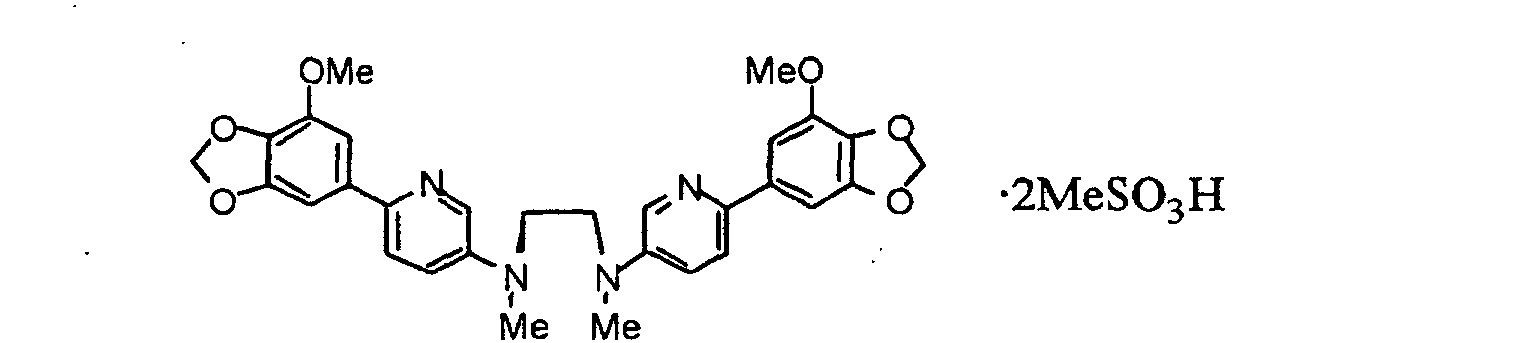
- Following the procedures of Example 1, N,N'-bis[2-(3-methoxy-4,5-methylenedioxyphenyl)-5-pyridyl]-N,N'-dimethyl-ethylenediamine was obtained as a colorless oil (109.0 mg, yield: 72%) from N,N'-bis(2-trifluoromethanesulfonyloxy-5-pyridyl)-N,N'-dimethylethylenediamine (150.0 mg, 0.280 mmol) synthesized in Referential Example 1 and 3-methoxy-4, 5-methylenedioxyphenylboric acid (115.0 mg, 0.590 mmol).
- To a solution of N,N'-bis[2-(3-methoxy-4,5-methylene-dioxyphenyl)-5-pyridyl] - N,N'-dimethylethylenediamine (109.0 mg, 0.200 mmol) in methanol (3.0 mL), a 1.0 M aqueous solution of methanesulfonic acid (0.40 mL, 0.40 mmol) was added, and the reaction mixture was concentrated under reduced pressure. Ethanol (5.0 mL) was added to the residue, and the resulting mixture was concentrated under reduced pressure. The residue was recrystallized from methanol-diethyl ether, whereby the title compound (109.0 mg) was obtained as yellow crystalline powder (melting point: 275.0-276.0°C) (yield: 79%).
1H-NMR [CD3OD-CDCl3(1:10)](ammonium salt NH+ protons were not observed) δ: 2.84(s, 6H), 3.20(s, 6H), 3.85(s, 4H), 4 .02(s, 6H), 6.09(s, 4H), 6.93(d, J=1.7Hz, 2H), 7.06(d, J=1.7Hz, 2H), 7.74(dd, J=2.9, 9.5Hz, 2H), 7.82(d, J=9 .5Hz, 2H), 8.34(d, J=2.9Hz, 2H). -

- Following the procedures of Example 1, N,N'-bis[2-(3,4,5-triethoxyphenyl)-5-pyridyl]-N,N'-dimethylethylene-diamine was obtained as a pale yellow oil (123.0 mg, yield: 93%) from N,N'-bis(2-trifluoromethanesulfonyloxy-5-pyridyl)-N,N'-dimethylethylenediamine (108.0 mg, 0.200 mmol) synthesized in Referential Example 1 and 3,4,5-triethoxy-phenylboric acid (122.0 mg, 0.480 mmol).
- To a solution of N,N'-bis[2-(3,4,5-triethoxyphenyl)-5-pyridyl]-N,N'-dimethylethylenediamine (123.0 mg, 0.186 mmol) in methanol (3.0 mL), a 1.0 M methanol solution of methanesulfonic acid (0.38 mL, 0.38 mmol) was added, and the reaction mixture was concentrated under reduced pressure. Chloroform-diethyl ether was added to the residue and the resulting precipitate was collected, whereby the title compound was obtained as yellow crystalline powder [melting point: 237.0°C(decomposed)] (110.0 mg, yield: 70%).
1H-NMR [CDCl3] (ammonium salt NH+ protons were not observed) δ : 1.37(t, J=7.0Hz, 6H), 1.46(t, J=6.8Hz, 12H), 2.87(s, 6H), 3.31(s, 6H), 3.79(s, 4H), 4.12(q, J=7.0Hz, 4H), 4.17 (q, J=6.8Hz, 8H), 7.01(s, 4H), 7.67(br d, J=9.0Hz, 2H), 7.82(d, J=9.0Hz, 2H), 8.69(br s, 2H). -

- Following the procedures of Example 1, N,N'-bis[2-(3,5-dimethoxy-4-methylthiophenyl)-5-pyridyl]-N, N' -dimethylethylenediamine was obtained as a colorless viscous oil (61.0 mg, yield: 80%) from N,N'-bis(2-trifluoromethane-sulfonyloxy-5-pyridyl)-N,N'-dimethylethylenediamine (70.0 mg, 0.130 mmol) synthesized in Referential Example 1 and 3,5-dimethoxy-4-methylthiophenylboric acid (60.0 mg, 0.260 mmol).
- To a solution of N,N'-bis[2-(3,5-dimethoxy-4-methyl-thiophenyl)-5-pyridyl]-N ,N'-dimethylethylenediamine (61.0mg, 0.100 mmol) inmethanol (2.0 mL), a 1.0 M aqueous solution of methanesulfonic acid (0.20 mL, 0.20 mmol) was added, and the reaction mixture was concentratedunderreducedpressure. Ethanol (5.0 mL) was added to the residue, and the resulting mixture was concentrated under reduced pressure. The residue was recrystallized from methanol-diethyl ether, whereby the title compound was obtained as yellow crystalline powder (melting point: 242.0-244.0°C) (41.0 mg, yield: 51%).
1H-NMR (CDCl3) (ammonium salt NH+ protons were not observed) δ : 2.42(s, 6H), 2.86(s, 6H), 3.34(s, 6H), 3.82(s, 4H), 4.00(s, 12H), 7.01(s, 4H), 7.72(dd, J=2.9, 9.3Hz, 2H), 7.93(d, J=9.3Hz, 2H), 8.79(d, J=2.9Hz, 2H). -

- Following the procedures as in Example 1, an oil was obtained from , N,N'-bis(2-trifluoromethanesulfonyloxy-5-pyridyl)-N,N'-dimethylethylenediamine (120.0 mg, 0.220 mmol) synthesized in Referential Example 1 and 3,5-dimethoxy-4-(1-pyrrolidinyl)phenylboric acid (138.0 mg, 0.550 mmol). Methanol was added to the oil and the resulting precipitate was collected by filtration, whereby the title compound was obtained as pale brown crystalline powder (melting point: 221.0-225.0°C) (81.0 mg, yield: 56%).
1H-NMR (CDCl3) δ: 1.89-1.97(m, 8H), 3.01(s, 6H), 3.28-3.37(m , 8H), 3.65(s, 4H), 3.91(s, 12H), 6.97(dd, J=2.9, 8.8H z, 2H), 7.14(s, 4H), 7.54(d, J=8.8Hz, 2H), 8.21(d, J=2 .9Hz, 2H). -

- Following the procedures of Example 1, an oil was obtained from N,N'-bis(2-trifluoromethanesulfonyloxy-5-pyridyl)-N,N'-dimethylethylenediamine (129.0 mg, 0.240 mmol) synthesized in Referential Example 1 and 4-dimethylamino-3,5-dimethoxyphenylboric acid (135.0 mg, 0.600 mmol). Methanol was added to the oil and the resulting precipitate was collected by filtration, whereby the title compound was obtained as pale brown crystalline powder (melting point: 194.0-196.0°C) (84.0 mg, yield: 58%).
1H-NMR (CDCl3) δ: 2.85(s, 12H), 3.02(s, 6H), 3.66(s, 4H), 3.9 3(s, 12H), 6.98(dd, J=2.9, 9.0Hz, 2H), 7.12(s, 4H), 7. 55(d, J=9.0Hz, 2H), 8.22(d, J=2.9Hz, 2H). -
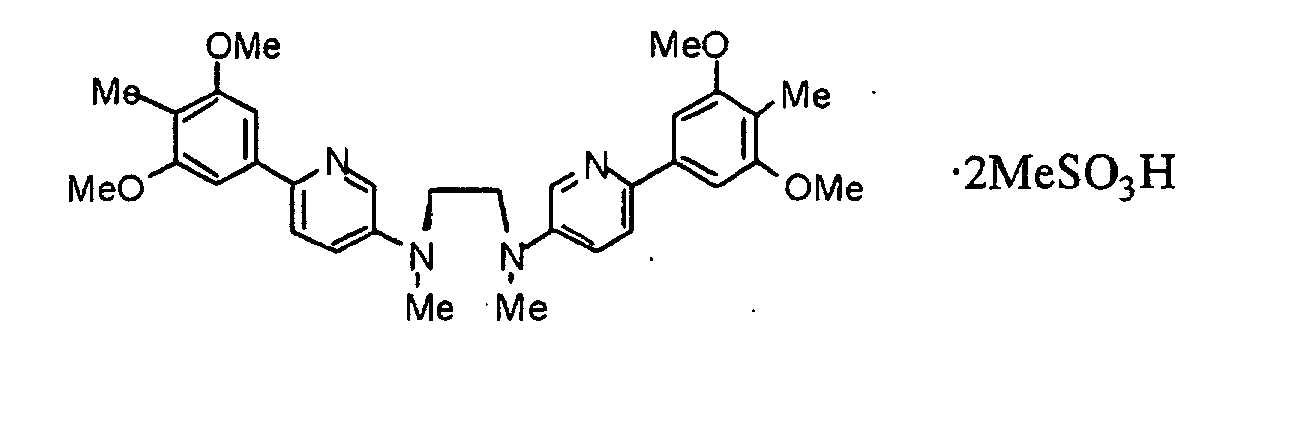
- Following the procedures of Example 7, N,N'-bis[2-(3,5-dimethoxy-4-methylphenyl)-5-pyridyl]-N,N'-dimethyl-ethylenediamine was obtained as a colorless oil (37.0 mg, yield: 40%) from 5-chloro-2-(3,5-dimethoxy-4-methylphenyl)-pyridine (99.0 mg, 0. 370 mmol) synthesized by similar procedures as in Referential Example 2.
- To a solution of N,N'-bis[2-(3,5-dimethoxy-4-methyphenyl)-5-pyridyl]-N,N'-dimethylethylenediamine (37.0 mg, 0.070 mmol) in methanol (2.0 mL), a 1.0 M aqueous solution of methanesulfonic acid (0. 15 mL, 0.15 mmol) was added, and the reaction mixture was concentrated under reduced pressure. Ethanol (5.0 mL) was added to the residue, and the resultingmixture was concentratedunder reduced pressure. The residue was recrystallized from methanol-chloroform, whereby the title compound was obtained as yellow crystalline powder (melting point: 272.0-274.0°C)(22.0 mg, yield: 44%).
1H-NMR [CD3OD-CDCl3(1:10)](ammonium salt NH+ protons were not observed) δ: 2.12(s, 6H), 2.83(s, 6H), 3.24(s, 6H), 3 .85(s, 4H), 3.91(s, 12H), 7.23(s, 4H), 7.76(dd, J=2.9, 9.3Hz, 2H), 7.94(d, J=9.3Hz, 2H), 8.45(d, J=2.9Hz, 2H ). -

- Following the procedures of Example 1, an oil was obtained from N,N'-bis(2-trifluoromethanesulfonyloxy-5-pyridyl)-N,N'-dimethylethylenediamine (150.0 mg, 0.280 mmol) synthesized in Referential Example 1 and 4-fluoro-3,5-dimethoxyphenylboric acid (167.0 mg, 0.840 mmol). Hexane was added to the oil and the resulting precipitate was collected by filtration, whereby N,N'-bis[2-(4-fluoro-3,5-dimethoxy-phenyl)-5-pyridyl]-N,N'-dimethylethylenediamine was obtained as yellow crystalline powder (160.0 mg; quantitative).
- To a solution of N,N'-bis[2-(4-fluoro-3,5-dimethoxy-phenyl)-5-pyridyl]-N,N'-dimethylethylenediamine (150.0 mg, 0.270 mmol) in chloroform (30 mL) , a 1. 0 M aqueous solution of methanesulfonic acid (0.60 mL, 0.60 mmol) was added, and the reaction mixture was concentrated under reduced pressure. Ethanol (5.0 mL) was added to the residue, and the resulting mixture was concentrated under reduced pressure. Diethyl ether was added to the residue and the resulting precipitate was collected by filtration, whereby the title compound was obtained as yellow crystalline powder (melting point: ≥300.0°C) (181.0 mg, yield: 90%).
1H-NMR, (DMSO-d6) (ammonium salt NH+ protons were not observed) δ: 2.33(s, 6H), 3.03(s, 6H), 3.77(br s, 4H), 3.89(s, 12H), 7.25(d, 4JHF=7.0Hz, 4H), 7.50-7.59 (m, 2H), 7.99-8 .06(m, 4H). -
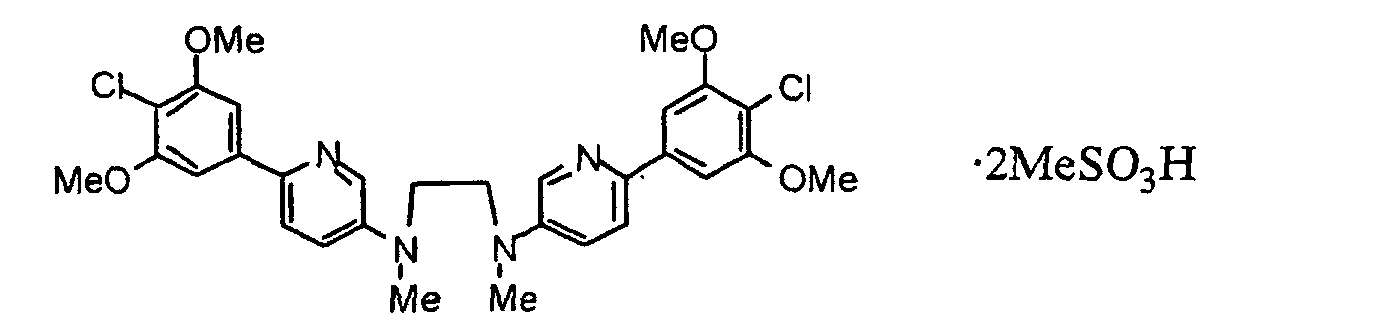
- Following the procedures of Example 1, N,N'-bis[2-(4-chloro-3,5-dimethoxyphenyl)-5-pyridyl]-N,N'-dimethyl-ethylenediamine was obtained as pale yellow amorphous powder (101.0 mg, yield: 86%) from N,N'-bis(2-trifluoromethane-sulfonyloxy-5-pyridyl)-N,N'-dimethylethylenediamine (108.0 mg, 0.200 mmol) synthesized in Referential Example 1 and 4-chloro-3,5-dimethoxyphenylboric acid (95.0 mg, 0.440 mmol).
- To a solution of N,N'-bis[2-(4-chloro-3,5-dimethoxy-phenyl)-5-pyridyl]-N,N'-dimethylethylenediamine (78.0 mg, 0.130 mmol) in methanol-chloroform (1:2, 50 mL), a 1.0 M aqueous solution of methanesulfonic acid (0.27 mL, 0.27 mmol) was added, and the reaction mixture was concentrated under reduced pressure. Ethanol (5.0 mL) was added to the residue, and the resulting mixture was concentrated under reduced pressure. The residue was recrystallized from methanol-chloroform-diethyl ether, whereby the title compound was obtained as yellow crystalline powder (melting point: 280.0-285.0°C) (83.0 mg, yield: 80%).
1H-NMR (DMSO-d6, 120°C) (ammonium salt NH+ protons were not observed) δ: 2.45(s, 6H), 3.05(s, 6H), 3.72(s, 4H), 3. 91(s, 12H), 7.26(s, 4H), 7.37(dd, J=3.1, 9.0Hz, 2H), 7 .87(d, J=9.0Hz, 2H), 8.14(d, J=3.1Hz, 2H). -
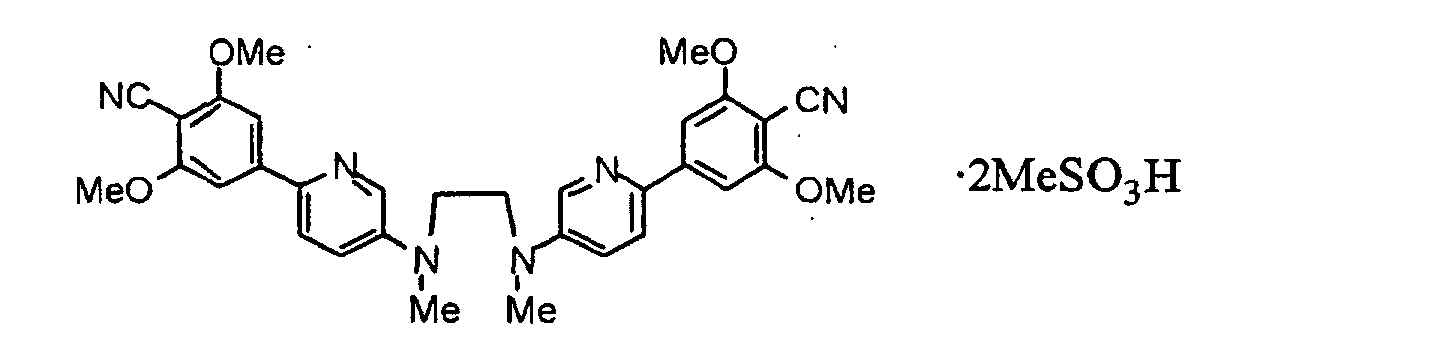
- Following the procedures of Example 1, N,N'-bis[2-(4-cyano-3,5-dimethoxyphenyl)-5-pyridyl]-N,N'-dimethyl-ethylenediamine was obtained as a colorless oil (125.0 mg, yield: 79%) from N,N'-bis(2-trifluoromethanesulfonyloxy-5-pyridyl)-N,N'-dimethylethylenediamine (150.0 mg, 0.280 mmol) synthesized in Referential Example 1 and 4-cyano-3,5-dimethoxyphenylboric acid (145.0 mg, 0.700 mmol).
- To a solution of N,N'-bis[2-(4-cyano-3,5-dimethoxy-phenyl)-5-pyridyl]-N,N'-dimethylethylenediamine (125.0 mg, 0.220 mmol) inmethanol (2.0 mL), a 1.0 M aqueous solution of methanesulfonic acid (0.44 mL, 0.44 mmol) was added, and the reaction mixture was concentrated under reduced pressure. Ethanol (5.0mL) was added to the residue, and the resulting mixture was concentrated under reduced pressure. Methanol (2.5 mL) was added to the residue. The resulting suspension was stirred in a bath maintained at 70°C, and then allowed to cool down. The resulting precipitate was collected by filtration, whereby the title compound was obtained as yellow crystalline powder (melting point: ≥300.0°C) (72.0 mg, yield: 43%).
1H-NMR [CD3OD-CDCl3(1:10)] (ammonium salt NH+ protons were not observed) δ: 2.35(s, 6H), 3.04(s, 6H), 3.77(s, 4H), 3 .97(s, 12H), 7.32(s, 4H), 7.28-7.34(m, 2H), 8.06(d, J= 9.0Hz, 2H), 8.19(d, J=3.2Hz, 2H). -
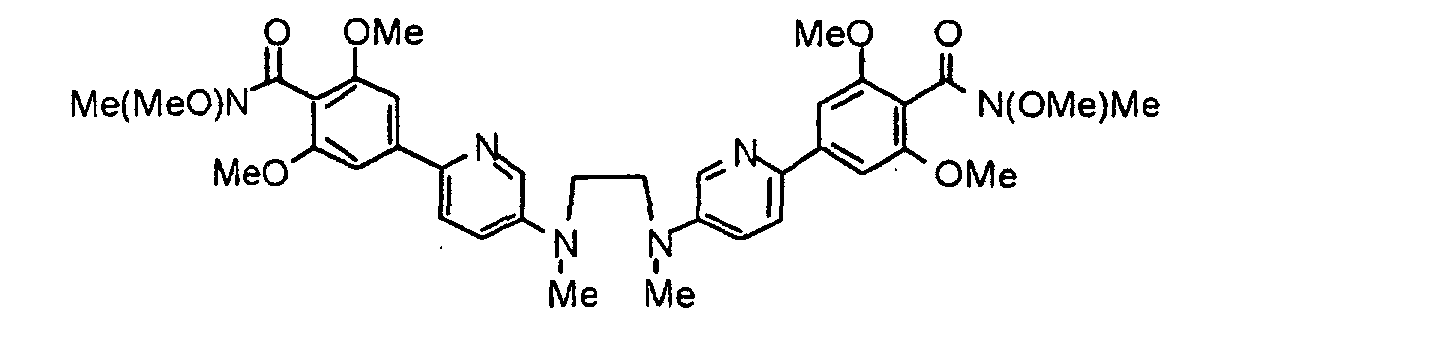
- Following the procedures of Example 1, an oil was obtained from N,N'-bis(2-trifluoromethanesulfonyloxy-5-pyridyl)-N,N'-dimethylethylenediamine (76.0 mg, 0.140 mmol) synthesized in Referential Example 1 and 3,5-dimethoxy-4-(N-methoxy-N-methylcarbamoyl)phenylboric acid (91.0 mg, 0.340 mmol) synthesized in Referential Example 7. Chloroform-hexane was added to the oil and the resulting precipitate was collected by filtration, whereby the title compound was obtained as yellow crystalline powder (melting point: 217.0-220.0°C) (34.0 mg, yield: 36%).
1H-NMR (CDCl3) (mixture of geometrical isomers at the amide, data of primary isomer) δ: 3.04(s, 6H), 3.40(s, 6H), 3 .51(s, 6H), 3.68(s, 4H), 3.91(s, 12H), 7.01(dd, J=2.5, 8.6Hz, 2H), 7.15(s, 4H), 7.59(d, J=8.6Hz, 2H), 8.23(d , J=2.5Hz, 2H). -

- Following the procedures of Example 1, crude crystals were obtained from N,N'-bis(2-trifluoromethanesulfonyloxy-5-pyridyl)-N,N'-dimethylethylenediamine (167.0 mg, 0.300 mmol) synthesized in Referential Example 1 and 4-t-butoxy-carbonyl-3,5-dimethoxyphenylboric acid (187.0 mg, 0.660 mmol). The crude crystals were recrystallized from methylene chloride-diethyl ether-hexane, whereby the title compound was obtained as colorless crystalline powder (melting point: 211.0-213.0°C) (195.0 mg, yield: 90%).
1H-NMR (CDCl3) δ: 1.59(s, 18H), 3.02(s, 6H), 3.66(s, 4H), 3.9 0(s, 12H), 6.98(dd, J=3.1, 8.7Hz, 2H), 7.11(s, 4H), 7. 55(d, J=8.7Hz, 2H), 8.22(d, J=3.1Hz, 2H). -

- To a solution of N,N'-bis[2-(4-t-butoxycarbonyl-3,5-dimethoxyphenyl)-5-pyridyl]-N,N'-dimethylethylenediamine (72.0 mg, 0.100 mmol), which had been synthesized in Example 26, in methylene chloride (1.0 mL), trifluoroacetic acid (1.0 mL) was added, and the resulting mixture was stirred for 3 hours. Under ice cooling, diethyl ether was added to the reaction mixture and the resulting precipitate was collected by filtration, whereby the title compound was obtained as pale yellow crystalline powder [melting point: 235.0 (decomposed)](72.0 mg, yield: 86%).
1H-NMR (DMSO-d6, 120°C) (neither ammonium salt NH+ protons nor carboxylic acid CO2H protons were observed) δ: 3.03(s , 6H), 3.68(s, 4H), 3.84(s, 12H), 7.19(dd, J=3.1, 8.7H z, 2H), 7.22(s, 4H), 7.76(d, J=8.7Hz, 2H), 8.18(d, J=3 .1Hz, 2H). -

- To a solution of N,N'-bis[2-(4-carboxy-3,5-dimethoxy-phenyl)-5-pyridyl]-N,N' - dimethylethylenediamine ditrifluoroacetate (42.0 mg, 0.050 mmol), which had been synthesized in Example 27, in methylene chloride (5.0 mL), dimethylformamide (0.1 mL, 1.29 mmol) and oxalyl chloride (0.21 mL, 2.5 mmol) were added. After the resulting mixture was stirred at room temperature for 30 minutes, ethanol (2.0 mL, 35 mmol) and N, N-diisopropylethylamine (0.51 mL, 3.0 mmol) were added. The reaction mixture was stirred for 1 hour, and then concentrated under reduced pressure. The residue was purified by chromatography on a silica gel column to obtain crude crystals. The crude crystals were recrystallized from methylene chloride-diethyl ether-hexane, whereby the title compound was obtained as pale yellow crystalline powder (melting point: 206.0-208.0°C) (30.0 mg, yield: 86%).
1H-NMR (CDCl3) δ: 1.38(t, J=7.0Hz, 6H), 3.03(s, 6H), 3.67(s, 4H), 3.91(s, 12H), 4.40(q, J=7.0Hz, 4H), 7.00(dd, J=2. 9, 8.7Hz, 2H), 7.14(s, 4H), 7.57(d, J=8.7Hz, 2H), 8.23 (d, J=2.9Hz, 2H). -
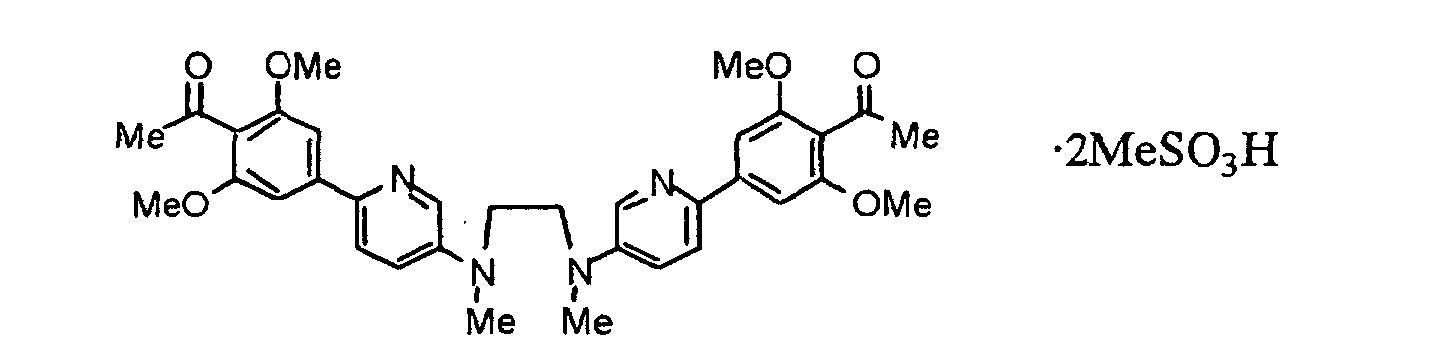
- Under a nitrogen gas atmosphere, crude N,N'-bis(2-chloro-5-pyridyl)-N,N'-dimethylethylenediamine(7 8.0 mg, approx. 0.25 mmol) synthesized in Referential Example 9 and tetrakis(triphenylphosphine)palladium, (116.0 mg, 0.100 mmol) were added a solution of (4-acetyl-3,5-dimethoxyphenyl)-trimethyltin (235.0 mg, 0.760 mmol), which had been synthesized in Referential Example 8, in toluene (10 mL). After stirred at 130°C for 22 hours, a saturated aqueous solution of potassium fluoride was added to the reaction mixture, followed by stirring for 1 hour. Insoluble matter was filtered off using Celite. The residue was washed with chloroform, and the water layer in the filtrate was extracted with chloroform. The washing and the organic layer were combined, dried over anhydrous sodium sulfate, and then concentrated under reduced pressure. The residue was purified by chromatography on a silica gel column, whereby N,N'-bis[2-(4-acetyl-3,5-dimethoxyphenyl)-5-pyridyl]-N,N'-dimethylethylenediamine was obtained as pale yellow crystalline powder (41.4 mg, yield: 23% based on N,N'-bis[2-hydroxy-5-pyridyl]-N,N'-dimethylethylenediamine ditrifluoroacetate).
- To a solution of N,N'-bis[2-(4-acetyl-3,5-dimethoxy-phenyl)-5-pyridyl]-N,N'-dimethylethylenediamine (76.4 mg, 0.128 mmol) in chloroform (5.0 mL), a 1.0 M methanol solution of methanesulfonic acid (0.32 mL, 0.32 mmol) was added, and the reaction mixture was concentrated under reduced pressure. Chloroform-diethyl ether was added to the residue and the resulting precipitate was collected by filtration, whereby the title compound was obtained as yellow crystalline powder (meltingpoint: 261.0-265.0°C) (75.1 mg, yield: 74%).
1H-NMR (CDCl3) (ammonium salt NH+ protons were not observed) δ : 2.49(s, 6H), 2.86(s, 6H), 3.35(s, 6H), 3.80(s, 4H), 3.92(s, 12H), 7.03(s, 4H), 7.72(br d, J=9.2Hz, 2H), 7. 94 (d, J=9.2Hz, 2H), 8.82(br s, 2H). -

- Following the procedures of Example 7, 1,4-bis[2-(3,4,5-trimethoxyphenyl)-5-pyridyl]hexahydro-1,4-diazepine was obtained as yellow amorphous powder (174.0 mg, yield: 59%) from 5-chloro-2-(3,4,5-trimethoxypheny)pyridine (335.0 mg, 1.20 mmol) synthesized in Referential Example 2 and hexahydro-1,4-diazepine (50.0 mg, 0.500 mmol).
- To a solution of 1,4-bis[2-(3,4,5-trimethoxyphenyl)-5-pyridyl]hexahydro-1,4-diazepine (88.0 mg, 0.150 mmol) in methanol-methylene chloride (1:1, 4.0mL), a 1.0 M aqueous solution of methanesulfonic acid (0.30 mL, 0.30 mmol) was added, and the reaction mixture was concentrated under reduced pressure. Ethanol (5.0 mL) was added to the residue, and the resulting mixture was concentrated under reduced pressure. The residue was recrystallized from methanol-methylene chloride-diethyl ether, whereby the title compound was obtained as yellow prisms (melting point: 246.0-248.0°C) (93.0 mg, yield: 79%).
1H-NMR (DMSO-d6, 120°C) (ammonium salt NH+ protons were not observed) δ: 2.04(tt, J=5.8, 5.8Hz, 2H), 2.42(s, 6H), 3.64(d d, J=5.8, 5.8Hz, 4H), 3.75(s, 6H), 3.83(s, 4H), 3.84(s , 12H), 7.14(s, 4H), 7.52(dd, J=3.1, 9.0Hz, 2H), 7.82( d, J=9.0Hz, 2H), 8.14(d, J=3.1Hz, 2H). -

- Following the procedures of Example 7, 1,4-bis[2-(3,4,5-trimethoxyphenyl)-5-pyridyl]piperazine was obtained as pale yellow needles (174.0 mg, yield: 61%) from 5-chloro-2-(3,4,5-trimethoxypheny)pyridine (335.0 mg, 1.20 mmol) synthesized in Referential Example 2 and piperazine (43.0 mg, 0.500 mmol).
- To a solution of 1,4-bis[2-(3,4,5-trimethoxyphenyl)-5-pyridyl]piperazine (143.0 mg, 0.250 mmol) in methanol-methylene chloride (1:2, 6.0 mL), a 1.0 M aqueous solution of methanesulfonic acid (0.50 mL, 0. 50 mmol) was added, and the reaction mixture was concentrated under reduced pressure. Ethanol (5.0 mL) was added to the residue, and the resulting mixture was concentrated under reduced pressure. The residue was recrystallized from methanol-chloroform-diethyl ether, whereby the title compound was obtained as yellow needles [melting point: 262.0°C (decomposed)](171.0 mg, yield: 89%).
1H-NMR (CDCl3) (data of the free base of the title compound) δ: 3.46(s, 8H), 3.89(s, 6H), 3.96(s, 12H), 7.19(s, 4H) , 7.32(dd, J=3.1, 8.7Hz, 2H), 7.63(d, J=8.7Hz, 2H), 8. 43(d, J=3.1Hz, 2H). -

- Following the procedures of Example 7, 1,3-bis[4-[2-(3,4,5-trimethoxyphenyl)-5-pyridyl]-1-piperazinyl]propane was obtained as a pale yellow oil (44.0 mg, yield: 25%) from 5-chloro-2-(3,4,5-trimethoxypheny)pyridine (166.0 mg, 0. 600 mmol) synthesized in Referential Example 2 and 1,3-bis(1-piperazinyl)propane (90.0 mg, 0.250.mmol).
- To a solution of 1,3-bis[4-[2-(3,4,5-trimethoxy-phenyl)-5-pyridyl]-1-piperazinyl]propane (44.0 mg, 0.060 mmol) in methanol-methylene chloride (1:2, 3.0mL), 1.0 M hydrochloric acid (0.30 mL, 0. 30 mmol) was added, and the reaction mixture was concentrated under reduced pressure. Ethanol (5.0 mL) was added to the residue, and the resulting mixture was concentrated under reduced pressure. The residue was recrystallized from methanol-diethyl ether, whereby the title compound was obtained as yellow crystalline powder [melting point: 264.0°C (decomposed)] (35.0 mg, yield: 69%).
1H-NMR (CDCl3) (ammonium salt NH+ protons were not observed) δ: 1.72-1.87(m, 2H), 2.46-2.56(m, 4H), 2.61-2.71(m, 8H ), 3.24-3.35(m, 8H), 3.88(s, 6H), 3.95(s, 12H), 7.16(s , 4H), 7.24(dd, J=2.9, 8.7Hz, 2H), 7.58(d, J=8.7Hz, 2H ), 8.37(d, J=2.9Hz, 2H). -

- Following the procedures of Example 7, the title compound was obtained as pale yellow amorphous powder (21.0 mg, yield: 7%) from 5-chloro-2-(3, 4, 5-trimethoxypheny)pyridine (335.0 mg, 1.20 mmol) synthesized in Referential Example 2 and ethylenediamine (30.0 mg, 0.500 mmol).
1H-NMR (CDCl3) δ: 3.50(s, 4H), 3.88(s, 6H), 3.95(s, 12H), 4.01-4.09 (br s, 2H), 7.01(dd, J=2.9, 8.5Hz, 2H), 7.14(s, 4H), 7.53(d, J=8.5Hz, 2H), 8.16(d, J=2.9Hz, 2H) -

- Following the procedures of Example 7, the title compound was obtained as pale yellow amorphous powder (37.0 mg, yield: 12%) from 5-chloro-2-(3,4,5-trimethoxypheny)pyridine (166.0mg, 0.600 mmol) synthesized in Referential Example 2 and cis-1,2-cyclohexanediamine (24.0 mg, 0.200 mmol).
1H-NMR (CDCl3) δ: 1.53-1.72(m, 6H), 1.79-1.91(m, 2H), 3.75-3 .85(m, 2H), 3.88(s, 6H), 3.94(s, 12H), 3.94-4.02(m, 2H ), 6.96(dd, J=2.6, 8.5Hz, 2H), 7.13(s, 4H), 7.48(d, J= 8.5Hz, 2H), 8.13(d, J=2.6Hz, 2H). -

- Following the procedures of Example 7, crude crystals was obtained (66.0 mg, yield: 21%) from 5-chloro-2-(3,4,5-trimethoxypheny)pyridine (335.0 mg, 1.20 mmol) synthesized in Referential Example 2 and trans-1, 4-cyclohexanediamine (57.0 mg, 0.500 mmol). The crude crystals were recrystallized from chloroform-diethyl ether-hexane, whereby the title compound was obtained as pale brown crystalline powder (melting point: 264.0-267.0°C)(27.0 mg, yield: 9%).
1H-NMR [CD3OD-CDCl3(1:10)] (amine NH protons were not observed) δ: 1.34-1.46(m, 4H), 2.19-2.31(m, 4H), 3.27-3.35(m, 2H), 3.87(s, 6H), 3.95(s, 12H), 7.00(dd, J=2.9 , 8.7Hz, 2H), 7.07(s, 4H), 7.51(d, J=8.7Hz, 2H), 8.03( d, J=2.9Hz, 2H). -

- Following the procedures of Example 7, N,N'-bis[2-(3,4,5-trimethoxyphenyl)-5-pyridyl]-N,N'-diethylethylene-diamine was obtained as pale yellow crystalline powder (100.0 mg, yield: 33%) from 5-chloro-2-(3,4,5-trimethoxypheny)-pyridine (335.0 mg, 1.20 mmol) synthesized in Referential Example 2 and N,N'-diethylethylenediamine (58.0 mg, 0.500 mmol).
- To a solution of N,N'-bis[2-(3,4,5-trimethoxy-phenyl)-5-pyridyl]-N,N'-diethylethylenediamine (100.0 mg, 0.165 mmol) in methanol-chloroform (1:1, 6. 0 mL) , a 1.0 M aqueous solution of methanesulfonic acid (0.33 mL, 0.33 mmol) was added, and the reaction mixture was concentrated under reduced pressure. Ethanol (5.0 mL) was added to the residue, and the resulting mixture was concentrated under reduced pressure. The residue was recrystallized from methanol-diethyl ether, whereby the title compound was obtained as yellow crystalline powder (melting point: 254.0-256.0°C).
1H-NMR (DMSO-d6,120°C) (ammonium salt NH+ protons were not observed) δ: 1.17(t, J=6.8Hz, 6H), 2.41(s, 6H), 3.50(q , J=6.8Hz, 4H), 3.66(s, 4H), 3.76(s, 6H), 3.86(s, 12H) , 7.18(s, 4H), 7.45(dd, J=2.9, 9.0Hz, 2H), 7.85(d, J=9 .0Hz, 2H), 8.09(d, J=2.9Hz, 2H). -

- Following the procedures of Example 7, crude N,N'-bis[2-(3,4,5-trimethoxyphenyl)-5-pyridyl]-N,N'-dimethyl-1,3-propanediamine was obtained as a pale brown oil (275.0 mg) from 5-chloro-2-(3,4,5-trimethoxypheny)pyridine (335.0 mg, 1.20 mmol) synthesized in Referential Example 2 and N,N'-dimethyl-1,3-propanediamine (65.0 mg, 0.500 mmol).
- To a solution of the crude N,N'-bis[2-(3,4,5-trimethoxyphenyl)-5-pyridyl]-N,N'-dimethyl-1,3-propane-diamine (275.0 mg, approx. 0.46 mmol) in methanol-chloroform (1:1, 6. 0 mL) , a 1.0 M aqueous solution of methanesulfonic acid (0.93 mL, 0.93 mmol) was added, and the reaction mixture was concentrated under reduced pressure. Ethanol (5.0 mL) was added to the residue, and the resulting mixture was concentrated under reduced pressure. The residue was recrystallized from methanol-diethyl ether, whereby the title compound was obtained as yellow needles (melting point: 216.0-219.0°C ) (255.0 mg, yield: 70% based on N,N'-dimethyl-1,3-propanediamine).
1H-NMR (DMSO-d6, 120°C) (ammonium salt NH+ protons were not observed) δ: 1.94(tt, J=7.3Hz, 2H), 2.43(s, 6H), 3.05( s, 6H), 3.52(t, J=7.3Hz, 4H), 3.76(s, 6H), 3.86(s, 12H ), 7.15(s, 4H), 7.53(dd, J=3.1, 9.2Hz, 2H), 7.88(d, J= 9.2Hz, 2H), 8.10(d, J=3.1Hz, 2H). -

- Following the procedures of Example 7, crude N,N'-bis[2-(3,4,5-trimethoxyphenyl)-5-pyridyl]-N,N'-diethyl -1,3-propanediamine was obtained as pale brown crystalline powder (160.0 mg) from 5-chloro-2-(3,4,5-trimethoxypheny)pyridine (335.0 mg, 1.20 mmol) synthesized in Referential Example 2 and N,N'-diethyl-1,3-propanediamine (65.0 mg, 0.500 mmol).
- To a solution of the crude N,N'-bis[2-(3,4,5-trimethoxyphenyl)-5-pyridyl]-N,N'-diethyl - 1,3-propane-diamine (160.0 mg, approx. 0.26 mmol) in methanol-chloroform (1:1, 6.0 mL), a 1.0 M aqueous solution of methanesulfonic acid (0.51 mL, 0.51 mmol) was added, and the reaction mixture was concentrated under reduced pressure. Ethanol (5.0 mL) was added to the residue, and the resulting mixture was concentrated under reduced pressure. The residue was recrystallized from methanol-methylene chloride-diethyl ether, whereby the title compound was obtained as yellow crystalline powder (melting point: 239.0-242.0°C ) (92.0 mg, yield: 45% based on N,N'-diethyl-1,3-propanediamine).
1H-NMR (DMSO-d6, 120°C) (ammonium salt NH+ protons were not observed) δ: 1.14-1.21(m, 6H), 1.88-1.97(m, 2H), 2.43( s, 6H), 3.44-3.54(m, 8H), 3.76(s, 6H), 3.86(s, 12H), 7 .16(s, 4H), 7.48-7.54(m, 2H), 7.83-7.90(m, 2H), 8.08-8 .14 (m, 2H). -

- Following the procedures of Example 7, N,N'-bis[2-(3,4,5-trimethoxyphenyl)-5-pyridyl]-N,N',2,2-tetramethyl-1,3-propanediamine was obtained as a pale yellow oil (210.0 mg, yield: 68%) from 5-chloro-2-(3,4,5-trimethoxypheny)pyridine (335.0 mg, 1.20 mmol) synthesized in Referential Example 2 and N,N',2,2-tetramethyl-1,3-propanediamine (65.0 mg, 0.500 mmol).
- To a solution of N,N'-bis[2-(3,4,5-trimethoxyphenyl)-5-pyridyl]-N,N',2,2-tetramethyl-1,3-propanediamine (210.0 mg, 0.340 mmol) in methanol-chloroform (1:1, 6.0 mL), a 1.0 M aqueous solution of methanesulfonic acid (0.68 mL, 0.68 mmol) was added, and the reaction mixture was concentrated under reduced pressure. Ethanol (5.0 mL) was added to the residue, and the resulting mixture was concentrated under reduced pressure. The residue was recrystallized from methanol-diethyl ether, whereby the title compound was obtained as yellow crystalline powder (melting point: 123.0-128.0°C )(161.0 mg, yield: 59%).
1H-NMR (DMSO-d6, 120°C) (ammonium salt NH+ protons were not observed) δ: 1.08(s, 6H), 2.44(s, 6H), 3.15 (s, 6H), 3. 49 (s, 4H), 3.76(s, 6H), 3.87(s, 12H), 7.18 (s, 4H), 7.6 5(dd, J=3.1, 9.2Hz, 2H), 7.90(d, J=9.2Hz, 2H), 8.19(d, J=3.1Hz, 2H). -
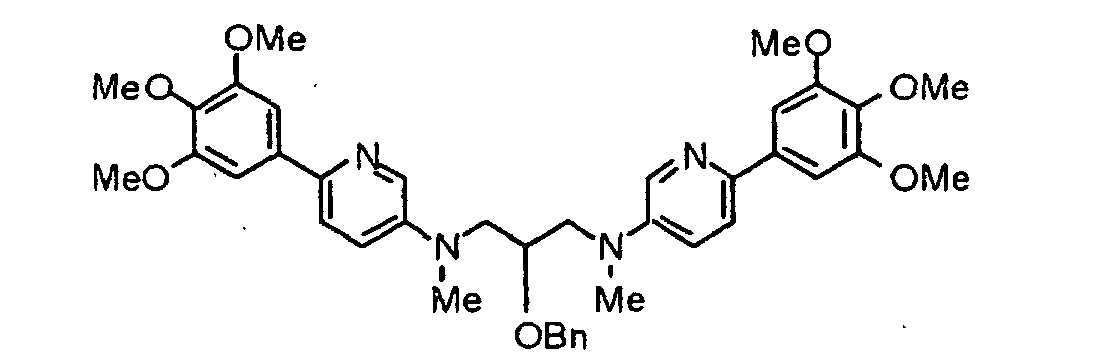
- Following the procedures of Example 7, the title compound was obtained as pale yellow amorphous powder (69.0 mg, yield: 59%) from 5-chloro-2-(3,4,5-trimethoxypheny) pyridine (113.0 mg, 0.400 mmol) synthesized in Referential Example 2 and 2-benzyloxy-N,N'-dimethyl-1,3-propanediamine (35.0 mg, 0.160 mmol) synthesized in Referential Example 10.
1H-NMR (CDCl3) δ: 3.04(s, 6H), 3.49-3.51(m, 4H), 3.88(s, 6H), 3.93(s, 12H), 4.03-4.11(m, 1H), 4.52(s, 2H), 7.00(dd, J=3.1, 8.7Hz, 2H), 7.11-7.16(m, 2H), 7.16(s, 4H), 7.2 3-7.26(m, 3H), 7.49(d, J=8.7Hz, 2H), 8.21(d, J=3.1Hz, 2H). -

- To a solution of 2-benzyloxy-N,N'-bis[2-(3,4,5-trimethoxyphenyl)-5-pyridyl]-N,N'-dimethyl-1,3-propane-diamine (40.0mg, 0.050 mmol), which had been synthesized in Example 40, in methanol (5.0 mL), 1.0 M hydrochloric acid (2.5 mL, 2.5 mmol) and 10% palladium on charcoal (25.0 mg) were added, and the resulting mixture was stirred at 45°C for 15 hours under a hydrogen gas atmosphere. Insoluble matter was filtered off using Celite. A saturated aqueous solution of sodium hydrogencarbonate was added to the filtrate to basify the same, and the resulting mixture was extracted with chloroform. The organic layer was washed with water, dried over anhydrous sodium sulfate, and then concentrated under reduced pressure. The residue was purified by chromatography on a silica gel column, whereby the title compound was obtained as pale yellow amorphous powder (27.0 mg, yield: 89%).
1H-NMR (CDCl3) (alcoholic OH protons were not observed) δ: 3. 08(s, 6H), 3.40-3.55(m, 4H), 3.88(s, 6H), 3.94(s, 12H) , 4.26-4.35(m, 1H), 7.12(dd, J=2.9, 9.0Hz, 2H), 7.14(s , 4H), 7.55(d, J=9.0Hz, 2H), 8.25(d, J=2.9Hz, 2H). -

- To a solution of methyliminodiacetic acid (74.0 mg, 0.503 mmol) in methylene chloride (2.5 mL), dimethylformamide (25 mg, 0.34 mmol) and oxalyl chloride (0.22 mL, 2.3 mmol) were added. The reaction mixture was stirred at room temperature for 2 hours and then concentrated under reduced pressure. To a solution of the residue in methylene chloride (5 mL), N,N-diisopropylethylamine (0.90 mL, 5.2 mmol) and 5-amino-2-(3,4,5-trimethoxyphenyl)pyridine (2 62 mg, 1.00 mmol), which had been synthesized in Referential Example 11, were added under ice cooling. After stirred under ice cooling for 2 hours, a saturated aqueous solution of sodium hydrogencarbonate was added, and the resulting mixture was extracted with chloroform. The organic layer was dried over anhydrous sodium sulfate and then concentrated under reduced pressure. The residue was purified by chromatography on a silica gel column, whereby N,N-bis[N-[2-(3,4,5-trimethoxyphenyl)-5-pyridyl]carbamoylmethyl]methylamine was obtained as a colorless oil (94.5 mg, yield: 30%).
- Under a nitrogen gas atmosphere, lithium aluminum hydride (23.1 mg, 0.609 mmol) was added to a solution of N,N-bis[N-[2-(3,4,5-trimethoxyphenyl)-5-pyridyl] carbamoylmethyl]-methylamine (88.1 mg, 0.139 mmol) in anhydrous tetrahydrofuran (5.0 mL), and the resulting mixture was stirred at 65°C for 1 hour. Methanol (0.2 mL, 4.9 mmol) was added to the reaction mixture under ice cooling, and an ice bath was then removed. Water (0.2 mL), diethyl ether (20 mL) and anhydrous magnesium sulfate (1.5 g) were added, and the thus-obtained mixture was stirred at room temperature for 2 hours. Insoluble matter was filtered off using Celite, and the filtrate was concentrated under reduced pressure. The residue was purified by chromatography on a silica gel column, whereby N,N-bis[N-[2-(3,4,5-trimethoxyphenyl)-5-pyridyl]-2-aminoethyl]-methylamine was obtained as a colorless oil (58.2 mg, yield: 69%).
- To a solution of N,N-bis[N-[2-(3,4,5-trimethoxy-phenyl)-5-pyridyl]-2-aminoethyl]methylamine (58.2 mg, 0.0964 mmol) in tetrahydrofuran (1.0 mL), paraformaldehyde (67.4mg, 2.24 mmol) and sodium borohydride (46.4 mg, 1.23 mmol) were added under ice cooling, followedby the gradual addition of trifluoroacetic acid (1.0 mL) over about 15 minutes. The ice bath was removed, and the mixture was stirred at room temperature for 16 hours. Paraformaldehyde (33.2 mg, 1.11 mmol) and sodium borohydride (24.0 mg, 0.634 mmol) were added in several portions, and the resulting mixture was stirred at room temperature for further 6 hours. Under ice cooling, a 2.5 M aqueous solution of sodium hydroxide (5.0 mL) was added to the reaction mixture. Themixture was extracted with chloroform, and the organic layer was dried over anhydrous sodium sulfate and then concentratedunder reduced pressure. The residue was purified by preparative thin-layer chromatography on silica gel, whereby N,N-bis[N-[2-(3,4,5-trimethoxyphenyl)-5-pyridyl]-N-methyl-2 -aminoethyl]methyl-amine was obtained as a colorless oil (37.2 mg, yield: 61%).
- To a solution of N,N-bis[N-[2-(3,4,5-trimethoxy-phenyl)-5-pyridyl]-N-methyl-2-aminoethyl]methyl-amine (42.0 mg, 0.059 mmol) in ethanol (10 mL), 1.0 M hydrochloric acid (0.30 mL, 0.30 mmol) was added, and the reaction mixture was concentrated under reduced pressure. Ethanol (10mL) was added to the residue, and the resulting mixture was concentrated under reduced pressure. The residue was recrystallized from ethanol-diethyl ether, whereby the title compound was obtained as yellow crystalline powder [melting point: 187.0°C (decomposed)] (37.1 mg, yield: 75%).
1H-NMR (CDCl3) (ammonium salt NH+ protons were not observed) δ : 3.07(br s, 3H), 3.19(br s, 6H), 3.49-3.70(m, 4H), 3. 87 (br s, 6H), 3.96(brs, 12H), 4.03-4.25(m, 4H), 7.17( br s, 4H), 7.83-7.97(m, 2H), 7.94-8.08(m, 2H), 8.16-8. 30 (m, 2H). -

- Following the procedures of Example 7, the title compound was obtained as pale yellow amorphous powder (94.0 mg, yield: 28%) from 5-chloro-2-(3,4,5-trimethoxypheny) pyridine (335.0 mg, 1.20 mmol) synthesized in Referential Example 2 and N,N-bis(N-methyl-3-aminopropyl)methylamine (87.0 mg, 0.500 mmol).
1H-NMR (CDCl3) δ: 1.75-1.85(m, 4H), 2.23(s, 3H), 2.35-2.45(m , 4H), 2.99(s, 6H), 3.39-3.48(m, 4H), 3.87(s, 6H), 3.9 3(s, 12H), 7.04(dd, J=2.9, 8.7Hz, 2H), 7.14(s, 4H), 7. 54(d, J=8.7Hz, 2H), 8.20(d, J=2.9Hz, 2H). -

- To a solution of 5-amino-2-(3, 4, 5-trimethoxyphenyl) -pyridine (203. 6 mg, 0.783 mmol), which had been synthesized in Referential Example 11, in methylene chloride (4 mL), N,N-diisopropylamine (0.20 mL, 1.1 mmol) and diglycolyl chloride (75.8 mg, 0.443 mmol) were added under ice cooling. After stirred under ice cooling for 30 minutes, water was added to the reaction mixture. The resulting solution was extracted with methanol-chloroform (1:20). The organic layer was dried over anhydrous sodium sulfate and then concentrated under reduced pressure. The residue was purified by chromatography on a silica gel column, whereby bis[N-[2-(3,4,5-trimethoxy-phenyl)-5-pyridyl] carbamoylmethyl]ether was obtained as a colorless oil (224.3 mg, yield: 93%).
- Under a nitrogen gas atmosphere, lithium aluminum hydride (33.2 mg, 0.875 mmol) was added to a solution of bis[N-[2-(3,4,5-trimethoxyphenyl)-5-pyridyl]carbamoylmethyl ]ether (121.3 mg, 0.196 mmol) in anhydrous tetrahydrofuran (6 mL) , and the resulting mixture was stirred at 65°C for 2 hours. Methanol (0.2 mL, 4.9 mmol) was added to the reaction mixture under ice cooling, and an ice bath was then removed. Water (0.2 mL), diethyl ether (20 mL) and anhydrous magnesium sulfate (1.5 g) were added, and the thus-obtained mixture was stirred at room temperature for 1 hour. Insoluble matter was filtered off using Celite, and the filtrate was concentrated under reduced pressure. The residue was purifiedby chromatographyon a silica gel column, whereby bis[N-[2-(3,4,5-trimethoxy-phenyl)-5-pyridyl]-2-aminoethyl] ether was obtained as a colorless oil (98.2 mg, yield: 85%).
- To a solution of bis[N-[2-(3,4,5-trimethoxyphenyl)-5-pyridyl]-2-aminoethyl] ether (53.1 mg, 0.0900 mmol) in ethanol (5.0 mL), a 1.0 M aqueous solution of methanesulfonic acid (0.20 mL, 0.20 mmol) was added, and the reactionmixturewas concentrated under reduced pressure. Ethanol (10 mL) was the residue, and the thus-obtained mixture was concentrated under reduced pressure. The residue was suspended in ethanol-diethyl ether and the resultingprecipitate was collected by filtration, whereby the title compound was obtained as pale brown amorphous powder (49.9 mg, yield: 71%).
1H-NMR (CDCl3) (ammonium salt NH+ protons were not observed) δ : 2.90(s, 6H), 3.38(br t, J=4.4Hz, 4H), 3.77(br t, J=4 .4Hz, 4H), 3.89(s, 6H), 3.93(s, 12H), 6.93(s, 4H), 7.4 4(d, J=9.1Hz, 2H), 7.73(br d, J=9.1Hz, 2H), 8.38(br s, 2H). -

- To a solution of bis[N-[2-(3,4,5-trimethoxyphenyl)-5-pyridyl]-2-aminoethyl] ether (23.6 mg, 0.0400 mmol) in tetrahydrofuran (0.5 mL), paraformaldehyde (25.9 mg, 0.862 mmol) and sodium borohydride (18.0 mg, 0.476 mmol) were added under ice cooling. After a solution of trifluoroacetic acid (0.25 mL) in tetrahydrofuran (0.50 mL) was gradually added over about 10 minutes, an ice bath was removed and the mixture was stirred at room temperature for 30 minutes. Paraformaldehyde (25.0 mg, 0.833 mmol) and sodium borohydride (17.8 mg, 0.47 mmol) were added in several portions, and the resulting mixture was stirred for 20 hours. Under ice cooling, a 2.5 M aqueous solution of sodium hydroxide (5.0 mL) was added to the reaction mixture, and the mixture was extracted with chloroform. The organic layer was dried over anhydrous sodium sulfate and then concentrated under reduced pressure. The residue was purified by preparative thin-layer chromatography on silica gel, whereby bis[N-(2-(3,4,5-trimethoxyphenyl)-5-pyridyl]-N-methyl-2-aminoethyl] ether was obtained as a colorless oil (18.8 mg, yield: 76%).
- To a solution of bis[N-[2-(3,4,5-trimethoxyphenyl)-5-pyridyl]-N-methyl-2-aminoethyl]ether (47.5 mg, 0.0769 mmol) in ethanol (5.0 mL), a 1.0 M aqueous solution of methanesulfonic acid (0.17 mL, 0.17 mmol) was added, and the reaction mixture was concentrated under reduced pressure. Ethanol (10 mL) was added to the residue, and the resulting mixture was concentrated under reduced pressure. The residue was recrystallized from ethanol-diethyl ether, whereby the title compound was obtained as yellow crystalline powder (melting point: 165.5-169.0°C) (38.8 mg, yield: 62%).
1H-NMR (CDCl3) (ammonium salt NH+ protons were not observed) δ : 2.89(s, 6H), 3.07(s, 6H), 3.63(br t, J=4.9Hz, 4H), 3 .77(br t, J=4.9Hz, 4H), 3.88(s, 6H), 3.94(s, 12H), 6.9 8(s, 4H), 7.74(br dd, J=2.9, 9.3Hz, 2H), 7.87(br d, J= 9.3Hz, 2H), 8.40(br s, 2H). -

- Following the procedures of Example 7, N,N'-bis[2-(3,4,5-trimethoxyphenyl)-5-pyridyl]-N,N'-dimethyl-3-(1-pyrrolidinyl)-1,5-pentanediamine was obtained as a colorless oil (49.6 mg, yield: 27%) from 2-(3,4,5-trimethoxypheny)-5-chloropyridine (182.0 mg, 0.635 mmol) synthesized in Referential Example 2 and N,N'-dimethyl-3-(1-pyrrolidinyl)-1,5-pentanediamine (54.0 mg, 0.217 mmol).
- To a solution of N,N'-bis[2-(3,4,5-trimethoxyphenyl)-5-pyridyl]-N,N'-dimethyl-3-(1-pyrrolidinyl)-1,5-pentanediamine (49.6 mg, 0.0724 mmol) in ethanol (5.0mL), 1.0 M hydrochloric acid (0.40 mL, 0.40 mmol) was added, and the reaction mixture was concentrated under reduced pressure. Ethanol (10 mL) was added to the residue, and the resulting mixture was concentrated under reduced pressure, whereby the title compound was obtained as pale yellow amorphous powder (46.0 mg, yield: 71%).
1H-NMR (CDCl3) (ammonium salt NH+ protons were not observed) δ : 2.00-2.35(m, 8H), 3.10-3.25(m, 2H), 3.17(br s, 6H), 3.65-3.80(m, 3H), 3.82-3.98(m, 4H), 3.90(s, 6H), 3.99( s, 12H), 7.24(s, 4H), 7.79(br d, J=8.8Hz, 2H), 7.90(br d, J=8.8Hz, 2H), 8.20(br s, 2H). -

- Following the procedures of Example 7, 2-dimethyl-aminomethyl-1,4-bis[2-(3,4,5-trimethoxyphenyl)-5 - pyridyl]-piperazine was obtained as a colorless oil (32.3 mg, yield: 20%) from 2-(3,4,5-trimethoxypheny)-5-chloropyridine (198.9 mg, 0.712 mmol) synthesized in Referential Example 2 and 2-(N,N'-dimethylaminomethyl)piperazine (37.0 mg, 0.259 mmol).
- To a solution of 2-dimethylaminomethyl-1,4-bis[2-(3,4,5-trimethoxyphenyl)-5-pyridyl]piperazine (32.3 mg, 0.0512 mmol) in ethanol (5.0 mL), 1.0 M hydrochloric acid (0.20 mL, 0.20 mmol) was added, and the reaction mixture was concentrated under reduced pressure. Ethanol (10 mL) was added to the residue, and the resulting mixture was concentrated under reduced pressure. The residue was recrystallized from ethanol-diethyl ether, whereby the title compound was obtained as pale yellow crystalline powder [melting point: 199.5°C (decomposed)] (25.7 mg, yield: 68%).
1H-NMR (CDCl3) (data of the free base of the title compound) δ : 2.21(br d, J=11.5Hz, 1H), 2.24-2.33(m, 1H), 2.27(s, 6H), 2.95(dd, J=11.5, 11.5Hz, 1H), 3.14(ddd, J=3.5, 11 .5, 11.5Hz, 1H), 3.18(dd, J=3.5, 11.5Hz, 1H), 3.34(ddd , J=3.5, 11.5, 11.5Hz, 1H), 3.57(br ddd, J=3.5, 3.5, 1 1.5Hz, 1H), 3.74(br d, J=11.5 Hz, 1H), 3.90(s, 6H), 3. 97(s, 12H), 4.11(br d, J=11.5Hz, 1H), 7.19(s, 2H), 7.1 9(s, 2H), 7.26(dd, J=2.9, 8.8Hz, 1H), 7.33(dd, J=2.9, 8.8Hz, 1H), 7.61(d, J=8.8Hz, 1H), 7.62(d, J=8.8Hz, 1H) , 8.38(d, J=2.9Hz, 1H), 8.43(d, J=2.9Hz, 1H). -

- Following the procedures of Example 7, N,N'-bis[2-(3,4,5-trimethoxyphenyl)-5-pyridyl]-4,4'-piperidine was obtained as pale yellow crystalline powder (228.0 mg, yield: 69%) from 5-chloro-2-(3,4,5-trimethoxypheny)pyridine (335.0 mg, 1.20 mmol) synthesized in Referential Example 2 and 4, 4-piperidine (84.0 mg, 0.500 mmol).
- To a solution of N,N'-bis[2-(3,4,5-trimethoxyphenyl)-5-pyridyl]-4,4'-piperidine (228.0 mg, 0.340 mmol) in methanol-chloroform(1:1, 6.0 mL), a 1.0 M aqueous solution of methanesulfonic acid ( 0 . 70 mL, 0.70 mmol) was added, and the reaction mixture was concentrated under reduced pressure. Ethanol (5.0 mL) was added to the residue, and the resulting mixture was concentrated under reduced pressure. The residue was recrystallized from methanol-methylene chloride-diethyl ether, whereby the title compound was obtained as yellow needles (melting point: 226.0-228.0°C) (170.0 mg, yield: 59%).
1H-NMR (DMSO-d6, 120°C) (ammonium salt NH+ protons were not observed) δ: 1.35-1.50(m, 6H), 1.81-1.92(m, 4H), 2.44( s, 6H), 2.81-2.97(m, 4H), 3.77(s, 6H), 3.88(s, 12H), 3 .90-3.92(m, 4H), 7.20(s, 4H), 7.73(dd, J=2.9, 9.0Hz, 2 H), 7.93(d, J=9.0Hz, 2H), 8.25(d, J=2.9Hz, 2H). -
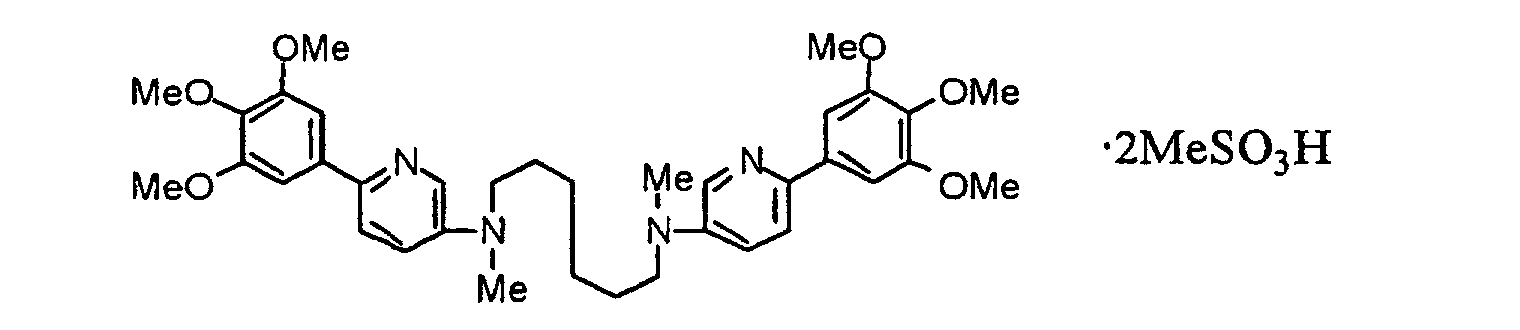
- Following the procedures of Example 7, N,N'-bis[2-(3,4,5-trimethoxyphenyl)-5-pyridyl]-N,N'-dimethyl-1,6-hexanediamine was obtained as pale yellow crystalline powder (243.0 mg, yield: 75%) from 5-chloro-2-(3,4,5-trimethoxy-pheny)pyridine (335.0 mg, 1.20 mmol) synthesized in Referential Example 2 and N,N'-dimethyl-1,6-hexanediamine (72.0 mg, 0.500 mmol).
- To a solution of N,N'-bis[2-(3,4,5-trimethoxyphenyl)-5-pyridyl]-N,N'-dimethyl-1,6-hexanediamine (243.0 mg, 0.370 mmol) in methanol-methylene chloride (6:1, 3.5 mL), a 1.0 M aqueous solution of methanesulfonic acid (0.76 mL, 0.76 mmol) was added, and the reactionmixturewas concentratedunder reducedpressure . Ethanol (5.0 mL) was added to the residue, and the resulting mixture was concentrated under reduced pressure. The residue was recrystallized from methanol-diethyl ether, whereby the title compound was obtained as yellow needles (melting point: 192.0-195.0°C) (251.0 mg, yield: 81%).
1H-NMR (DMSO-d6, 120°C) (ammonium salt NH+ protons were not obs erved) δ: 1.37-1.45(m, 4H), 1.56-1.67(m, 4H), 2.42(s, 6H), 3.02(s, 6H), 3.40-3.47(m, 4H), 3.76(s, 6H), 3.87( s, 12H), 7.17(s, 4H), 7.50(dd, J=3.1, 9.0Hz, 2H), 7.89 (d, J=9.0Hz, 2H), 8.04(d, J=3.1Hz, 2H). -

- Following the procedures of Example 1, N,N'-bis[2-(3,5-dimethoxyphenyl)-5-pyridyl]-N,N'-diethylethylene-diamine was obtained as a colorless oil (55.0 mg, yield: 42%) from N,N'-bis(2-trifluoromethanesulfonyloxy-5-pyridyl)-N,N'-diethylethylenediamine (136.0 mg, 0.240 mmol) , which had been synthesized by similar procedures as in Referential Example 1, and 3,5-dimethoxyphenylboric acid (80.0 mg, 0.530 mmol).
- To a solution of N,N'-bis[2-(3,5-dimethoxyphenyl)-5-pyridyl]-N,N'-diethylethylenediamine (55.0 mg, 0.100 mmol) in methanol (2.0 mL), a 1.0 M aqueous solution of methanesulfonic acid (0.20 mL, 0.20 mmol) was added, and the reaction mixture was concentrated underreducedpressure. Ethanol (5.0mL) was added to the residue, and the resulting mixture was concentrated under reduced pressure. The residue was recrystallized from methanol-diethyl ether, whereby the title compound was obtained as yellow crystalline powder (melting point: 280.0-282.0°C) (48.0 mg, yield: 64%).
1H-NMR [CD3OD-CDCl3, (1:10)] (ammonium salt NH+ protons were not observed) δ: 1.26(t, J=6.8Hz, 6H), 2.83(s, 6H), 3. 64(q, J=6.8Hz, 4H), 3.77(s, 4H), 3.89(s, 12H), 6.60(t, J=2.2Hz, 2H), 6.93(d, J=2.2Hz, 4H), 7.75(dd, J=2.9, 1 0.3Hz, 2H), 7.92(d, J=10.3Hz, 2H), 8.45(d, J=2.9Hz, 2H ) . -

- Following the procedures of Example 1, N,N'-diethyl-N,N'-bis[2-(4-isopropoxy-3,5-dimethoxyphenyl)-5-pyridyl]-ethylenediamine was obtained as a colorless oil (129.0 mg, yield: 98%) from N,N'-bis(2-trifluoromethanesulfonyloxy-5-pyridyl)-N,N'-diethylethylenediamine (113.0 mg, 0.200 mmol), which had been synthesized by similar procedures as in Referential Example 1, and 4-isopropoxy-3,5-dimethoxy-phenyl-boric acid (106.0 mg, 0.440 mmol).
- To a solution of N,N'-diethyl-N,N'-bis[2-(4-isopropoxy-3,5-dimethoxyphenyl)-5-pyridyl]ethylenediamine (129.0 mg, 0.200 mmol) in methanol (2.0 mL) , a 1.0 M aqueous solution of methanesulfonic acid (0.40 mL, 0.40 mmol) was added, and the reaction mixture was concentrated under reduced pressure. Ethanol (5.0 mL) was added to the residue, and the resulting mixture was concentrated under reduced pressure. The residue was recrystallized from methanol-diethyl ether, whereby the title compound was obtained as yellow crystalline powder (melting point: 260.0-261.0°C) (102.0 mg, yield: 60%).
1H-NMR (CDCl3) (ammonium salt NH+ protons were not observed) δ : 1.27(t, J=6.8Hz, 6H), 1.32(d, J=6.1Hz, 12H) , 2.85(s, 6H), 3.72(s, 4H), 3.76(q, J=6.8Hz, 4H), 3.94(s, 12H), 4.47(qq, J=6.1, 6.1Hz, 2H), 7.07(s, 4H), 7.69(dd, J=2 .9, 9.3Hz, 2H), 7.88(d, J=9.3Hz, 2H), 8.72(d, J=2.9Hz, 2H). -

- Following the procedures of Example 1, N,N'-bis[2-(3,5-dimethoxyphenyl)-5-pyridyl]-N,N'-dimethyl-1 ,3-propanediamine was obtained as a colorless oil (35.0 mg, yield: 35%) from N,N'-bis(2-trifluoromethanesulfonyloxy-5-pyridyl)-N,N'-dimethyl-1,3-propanediamine (95.0 mg, 0.190 mmol), which had been synthesizedby similar procedures as in Referential Example 1, and 3,5-dimethoxyphenylboric acid (63.0 mg, 0.420 mmol).
- To a solution of N,N'-bis[2-(3,5-dimethoxyphenyl)-5-pyridyl]-N,N'-dimethyl-1 ,3-propanediamine (35.0 mg, 0.070 mmol) in methanol (2.0 mL), a 1.0 M aqueous solution of methanesulfonic acid (0.15 mL, 0.15 mmol) was added, and the reaction mixture was concentrated under reduced pressure. Ethanol (5.0 mL) was added to the residue, and the resulting mixture was concentrated under reduced pressure. The residue was recrystallized from ethanol, whereby the title compound was obtained as yellow crystalline powder (melting point: 228.0-231.0°C) (21.0 mg, yield: 43%).
1H-NMR (CDCl3)(ammonium salt NH+ protons were not observed) δ : 2.07(tt, J=7.3, 7.3Hz, 2H), 2.90(s, 6H), 3.21(s, 6H) , 3.58(t, J=7.3Hz, 4H), 3.85(s, 12H), 6.78(t, J=2.2Hz, 2H), 6.86(d, J=2.2Hz, 4H), 7.81(dd, J=3.2, 9.3Hz, 2H) , 7.91(d, J=9.3Hz, 2H), 8.71(d, J=3.2Hz, 2H). -

- Following the procedures of Example 1, N,N'-bis[2-(4-isopropoxy-3,5-dimethoxyphenyl)-5-pyridyl]-N, N'-dimethyl-1,3-propanediamine was obtained as a colorless viscous oil (27.0 mg, yield: 33%) from N,N'-bis(2-trifluoromethane-sulfonyloxy-5-pyridyl)-N,N'-dimethyl-1,3-propanediamine (61.0 mg, 0.125 mmol), which had been synthesizedby similar procedures as in Referential Example 1, and 4-isopropoxy-3,5-dimethoxyphenylboric acid (66.0 mg, 0.275 mmol).
- To a solution of N,N'-bis[2-(4-isopropoxy-3,5-dimethoxyphenyl)-5-pyridyl]-N, N'-dimethyl-1,3-propane-diamine (27.0 mg, 0.040 mmol) in methanol (2. 0 mL) , a 1.0 M aqueous solution of methanesulfonic acid (0.10 mL, 0.10 mmol) was added, and the reaction mixture was concentrated under reduced pressure. Ethanol (5.0 mL) was added to the residue, and the resulting mixture was concentrated under reduced pressure. The residue was recrystallized from methanol-diethyl ether, whereby the title compound was obtained as yellowcrystallinepowder (meltingpoint: 191.0-192.0°C) (15.0 mg, yield: 42%).
1H-NMR (CDCl3) (ammonium salt NH+ protons were not observed) δ : 1.31(d, J=6.1Hz, 12H), 1.96(tt, J=7.6, 7.6Hz, 2H), 3 .01(s, 6H), 3.45(t, J=7.6 Hz, 4H), 3.91(s, 12H), 4.40( qq, J=6.1Hz, 2H), 7.14(s, 4H), 7.48(dd, J=2.9, 7.8Hz, 2H), 7.54(d, J=7.8Hz, 2H), 8.20(d, J=2.9Hz, 2H). -

- Following the procedures of Example 1, N,N'-bis[2-[4-(4-methoxybenzyloxy)-3,5-dimethoxyphenyl]-5-pyridyl]-N,N'-dimethyl-1,3-propanediamine was obtained as a pale brown oil (75.0 mg, yield: 23%) from N,N'-bis(2-trifluoromethane-sulfonyloxy-5-pyridyl)-N,N'-dimethyl-1,3-propanediamine (220.0 mg, 0.400 mmol) synthesized by similar procedures as in Referential Example and 4-(4-methoxybenzyloxy)-3,5-dimethoxyphenylboric acid (308.0 mg, 0.970 mmol) synthesized by similar procedures as in Referential Example 3.
- To a solution of N,N'-bis[2-[4-(4-methoxybenzyloxy)-3,5-dimethoxyphenyl]-5-pyridyl]-N,N'-dimethyl-1,3-propane-diamine (72.0 mg, 0.089 mmol) in methylene chloride (1.0 mL), trifluoroacetic acid (1. 0 mL) was added. The reaction mixture was stirred at room temperature for 30 minutes, and then concentrated under reduced pressure. A solution of the residue in chloroform was washed with a saturated aqueous solution of sodium hydrogencarbonate and brine, dried over anhydrous sodium sulfate, and then concentrated under reduced pressure. The residue was purified by chromatography on a silica gel column, whereby N,N'-bis[2-(4-hydroxy-3,5-dimethoxyphenyl)-5-pyridyl]-N,N'-dimethyl-1,3-propanediamine was obtained as a pale yellow oil (43.0 mg, yield: 86%).
- To a solution of N,N'-bis[2-(4-hydroxy-3,5-dimethoxyphenyl)-5-pyridyl]-N,N'-dimethyl-1,3-propane-diamine (43.0 mg, 0.076 mmol) in methanol-chloroform (1:2, 3.0 mL), a 1.0 M aqueous solution of methanesulfonic acid (0.16 mL, 0.16 mmol) was added, and the reaction mixture was concentrated under reduced pressure. Ethanol (5.0 mL) was added to the residue, and the resulting. mixture was concentrated under reduced pressure. The residue was recrystallized from ethanol-diethyl ether, whereby the title compound was obtained as yellow crystalline powder (melting point: 198.0-202.0°C)(17.0 mg, yield: 30%).
1H-NMR (DMSO-d6,120°C) (neither ammonium salt NH+ protons nor phenolic OH protons were observed) δ: 1.93(tt, J=7.0, 7.0Hz, 2H), 2.41(s, 6H), 3.05(s, 6H), 3.52(t, J=7.0Hz, 4H), 3.85(s, 12H), 7.15(s, 4H), 7.59(dd, J=2.9, 9.2Hz , 2H), 7.88(d, J=9.2Hz, 2H), 8.09(d, J=2.9Hz, 2H). -
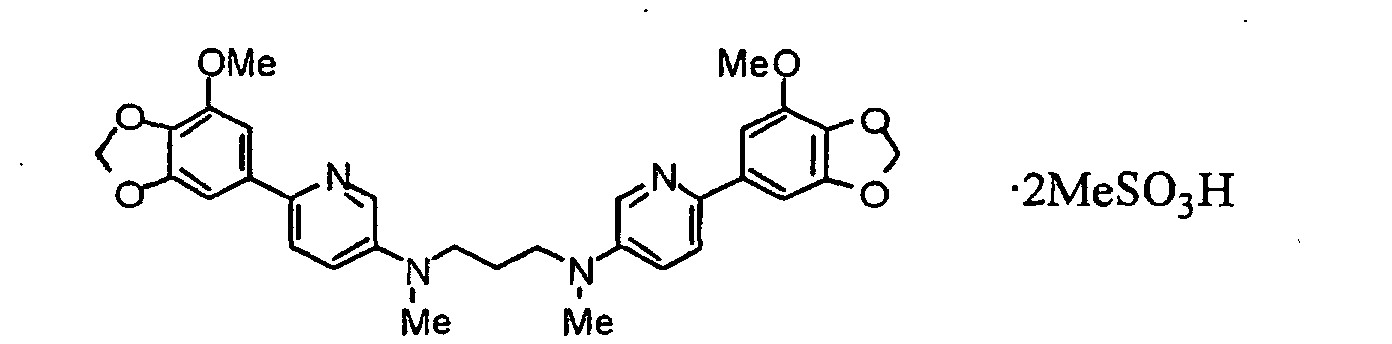
- Following the procedures of Example 1, N,N'-bis[2-(3-methoxy-4,5-methylenedioxyphenyl)-5-pyridyl]-N,N'-dimethyl-1,3-propanediamine was obtained as a colorless oil (46.0 mg, yield: 52%) from N,N'-dimethyl-N,N'-bis(2-trifluoromethane-sulfonyloxy-5-pyridyl)-1,3-propanediamine (78.0 mg, 0.160 mmol), which had been synthesized by similar procedures as in Referential Example 1, and 3-methoxy-4,5-methylenedioxy-phenylboric acid (66.0 mg, 0.340 mmol).
- To a solution of N,N'-bis[2-(3-methoxy-4,5-methylene-dioxyphenyl)-5-pyridyl] - N,N'-dimethyl-1,3-propanediamine (46.0 mg, 0.080 mmol) in methanol (2.0 mL), a 1.0 M aqueous solution of methanesulfonic acid (0.20 mL, 0.20 mmol) was added, and the reaction mixture was concentrated under reduced pressure. Ethanol (5.0 mL) was added to the residue, and the resulting mixture was concentrated under reduced pressure. Diethyl ether was added to a solution of the residue in methanol and insoluble matter was then filtered off, whereby the title compound was obtained as yellow amorphous powder (29.0 mg, yield: 46%).
1H-NMR [CD3OD-CDCl3(1:10)] (ammonium salt NH+ protons were not observed) δ: 2.04(tt, J=7.3, 7.3Hz, 2H), 2.86(s, 6H), 3.17(s, 6H), 3.58(t, J=7.3Hz, 4H), 3.99(s, 6H), 6.08( s, 4H), 6.87(d, J=1.7Hz, 2H), 6.97(d, J=1.7Hz, 2H), 7. 78(dd, J=3.2, 9.5Hz, 2H), 7.88(d, J=9.5Hz, 2H), 8.38(d , J=3.2Hz, 2H). -

- Following the procedures of Example 1, N,N'-diethyl-N,N'-bis[2-(4-isopropoxy-3,5-dimethoxyphenyl)-5-pyridyl]-1,3-propanediamine was obtained as a pale yellow oil (78.0 mg, yield: 58%) from N,N'-diethyl-N,N'-bis(2-trifluoromethane-sulfonyloxy-5-pyridyl)-1,3-propanediamine (116.0 mg, 0.200 mmol), which had been synthesizedby similar procedures as in Referential Example 1, and 4-isopropoxy-3,5-dimethoxy-phenylboric acid (96.0 mg, 0.400 mmol).
- To a solution of N,N'-diethyl-N,N'-bis[2-(4-isopropoxy-3,5-dimethoxyphenyl)-5-pyridyl]-1,3-propane-diamine (78.0 mg, 0.110 mmol) in methanol-chloroform (2:1, 3.0 mL), a 1.0 M aqueous solution of methanesulfonic acid (0.24 mL, 0.24 mmol) was added, and the reaction mixture was concentrated under reduced pressure. Ethanol (5.0 mL) was added to the residue, and the resulting mixture was concentrated under reduced pressure. The residue was recrystallized from methanol-diethyl ether-hexane, whereby the title compound was obtained as yellow scales (melting point: 173.0-175.0°C) (66.0 mg, yield: 66%).
1H-NMR (DMSO-d6, 120°C) (ammonium salt NH+ protons were not obs erved) δ: 1.18(t, J=7.0Hz, 6H), 1.23(d, J=6.0Hz, 12H), 1.93(tt, J=7.0, 7.0Hz, 2H), 2.42(s, 6H), 3.47-3.56(m, 4H), 3.50(q, J=7.0Hz, 4H), 3.85(s, 12H), 4.38(qq, J=6 .0, 6.0 Hz, 2H), 7.15(s, 4H), 7.56(dd, J=3.1, 9.0Hz, 2 H), 7.90(d, J=9.0Hz, 2H), 8.09(d, J=3.1Hz, 2H). -
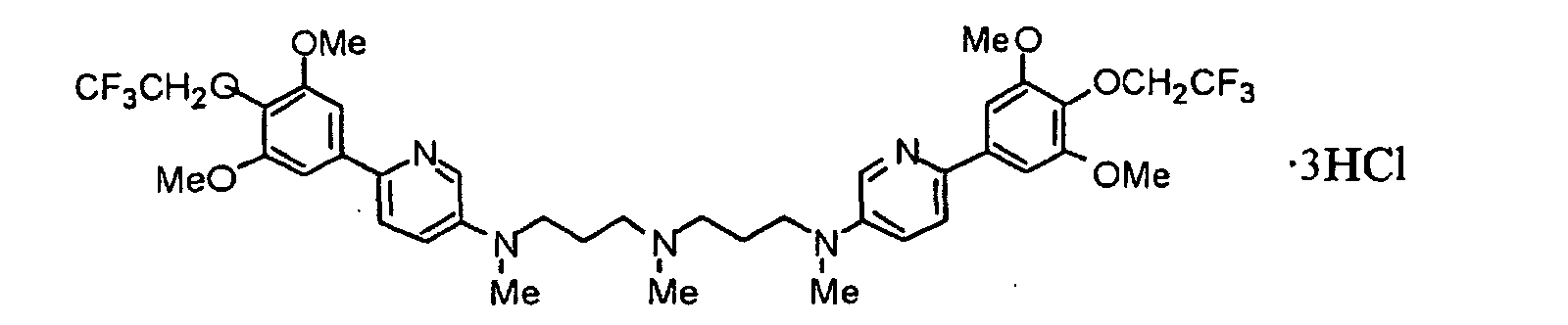
- To a solution of 5-amino-2-[3,5-dimethoxy-4-(2,2,2-trifluoroethoxy)phenyl] pyridine (melting point" 176.0-177.5°C) (28.2 g, 85.4 mmol), which had been synthesized by similar procedures as in Referential Example 11, in methylene chloride (550 mL), N,N-diisopropylethylamine (18.0 mL, 103 mmol) was added. To the resulting solution held under stirring and ice cooling, acryloyl chloride (7.00 mL, 86.0 mmol) was added dropwise over about 10 minutes. A saturated aqueous solution of sodium hydrogencarbonate was added, and the resulting mixture was extracted with chloroform. The organic layer was dried over anhydrous sodium sulfate and then concentrated under reduced pressure. Chloroform-hexane (1:2, 300 mL) was added to the residue and the resulting precipitate was collected by filtration, whereby crude 5-acryloylamino-2-[3,5-dimethoxy-4-(2,2,2-trifluoroethoxy) phenyl]pyridine was obtained as colorless needles (melting point: 207.0-209.0°C) (38.2 g).
- To a 30% ethanol solution of methylamine (100 mL, 970 mmol), the crude 5-acryloylamino-2-[3,5-dimethoxy-4-(2,2,2-trifluoroethoxy)p henyl]pyridine (19.2 g, approx. 50.2 mmol) obtained by the above-described procedures was added. After stirred at room temperature for 1 hour, the reaction mixture was concentrated under reduced pressure. Chloroform (100 mL) was added to the residue, and the resulting mixture was again concentrated under reduced pressure. To a solution of the residue in chloroform (100 mL), the crude 5-acryloylamino-2-[3,5-dimethoxy-4-(2,2,2-trifluoroethoxy) phenyl]pyridine (16.0 g, approx. 41.8 mmol) obtained by the above-described procedures was added, and the thus-obtained mixture was stirred at 60°C for 12 hours. The solidified reaction mixture was dissolved in chloroform (600 mL), and the resulting solution was heated at 80°C for 2 hours to distill off the solvent. The residue was again dissolved in chloroform (600 mL) and the solution so obtained was concentrated to about 200 mL. Under stirring at 80°C, hexane (100 mL) was added to the solution. The resulting mixture was allowed to cool down and the precipitated crystals were collected by filtration, whereby N,N-bis[2-[N-,[2-[3,5-dimethoxy-4-(2,2,2-trifluoroethoxy)-phenyl]-5-pyridyl]carbamoyl]ethyl]methylamine was obtained as colorless crystalline powder [melting point: 99.0°C (decomposed)] [22.67 g, yield: 72% based on 5-amino-2-[3,5-dimethoxy-4-(2,2,2-trifluoroethoxy)phenyl] pyridine].
- Under a nitrogen gas atmosphere, lithium aluminum hydride (4.28 g, 113 mmol) was added to an ice-cooled solution of N,N-bis[2-[N-[2-[3,5-dimethoxy-4-(2,2,2-trifluoro-ethoxy) phenyl]-5-pyridyl]carbamoyl]ethyl]methylamine (22.50 g, 28.3 mmol) in anhydrous tetrahydrofuran (500 mL). An ice bath was removed, and the reaction mixture was stirred at 65°C for 1 hour. Under ice cooling, methanol (20 mL, 490 mmol) was added to the reaction mixture, and the ice bath was removed. Water (20 mL) , diethyl ether (2 L) and anhydrous magnesium sulfate (130 g) were added, and the thus-obtained mixture was stirred overnight at room temperature. Insoluble matter was filtered off using Celite, and the filtrate was concentrated under reduced pressure. The residue was purified by chromatography on a silica gel column, whereby N,N-bis[N-[2-[3,5-dimethoxy-4-(2,2,2-trifluoroethoxy)phenyl ]-5-pyridyl]-3-aminopropyl]methylamine was obtained as a colorless oil (20.32 mg, yield: 94%).
- To a solution of N,N-bis[N-[2-[3,5-dimethoxy-4-(2,-2,2-trifluoro-ethoxy) phenyl]-5-pyridyl]-3-aminopropyl]-methylamine (2.11 g, 2.75 mmol) in acetonitrile (10 mL), formalin 2.1 mL (28 mmol) and sodium cyanoborohydride (0.55 g, 8.8 mmol) were added. The resulting mixture was added dropwise over about 10 minutes to a solution of acetic acid (0.6 mL) in acetonitrile (0.5 mL) over about 10 minutes, and the resulting mixture was stirred at room temperature for 1 hour. 1.0 M sodium hydroxide (100 mL) was added dropwise, the reaction mixture was extracted with methylene chloride, and the organic layer was concentrated under reduced pressure. A solution of the residue in pyridine (15 mL) was stirred at 45°C for 1 hour, and was then concentratedunder reduced pressure. Toluene was added to the residue, and the thus-obtained mixture was concentrated under reduced pressure. The residue was purified by chromatography on a silica gel column, whereby N,N-bis[N-[2-[3,5-dimethoxy-4-(2,2,2-trifluoroethoxy)phenyl ]-5-pyridyl]-N-methyl-3-aminopropyl]methylamine was obtained as a colorless oil (984 mg, yield: 45%).
- To a solution of N,N-bis[N-[2-[3,5-dimethoxy-4-(2,2,2-trifluoroethoxy)phenyl ]-5-pyridyl]-N-methyl-3-aminopropyl]methylamine (3.62 g, 4.55 mmol) in ethanol (50 mL), concentrated hydrochloric acid (1.4 mL, 17 mmol) was added, and the reaction mixture was concentrated underreducedpressure. Ethanol (50mL) was added to the residue, and the resulting mixture was concentrated under reduced pressure. Ethyl acetate (20 mL) was then added to the residue, followed by concentration of the resultant mixture under reduced pressure. The residue was suspended in ethyl acetate and the resulting suspension was filtered, whereby the title compoundwas obtained as yellow crystalline powder [melting point: 140°C (decomposed)](3.55 g, yield: 86%).
1H-NMR (CD3OD) (ammonium salt NH+ protons were not observed) δ : 2.17(br dddd, J=7.3, 7.3, 7.3, 7.3Hz, 4H), 2.94(s, 3 H), 3.20(s, 6H), 3.23-3.32(m, 2H), 3.34-3.44(m, 2H), 3 .65(dt, J=14.3, 7.3Hz, 2H), 3.70(dt, J=14.3, 7.3Hz, 2H ), 3. 97 (s, 12H), 4 45 (q, 3JHF=8.8Hz, 4H), 7.15(s, 4H), 8.00(br dd, J=3.0, 9.5Hz, 2H), 8.12(br d, J=3.0Hz, 2H) , 8.14 (br d, J=9.5Hz, 2H). -

- Following the procedures of Example 57, from 5-amino-2-(3,5-dimethoxy-4-methylthiophenyl)pyridine (182.0 mg, 0.660 mmol) synthesized by similar procedures as in Referential Example 11, N,N-bis[2-[N-[2-(3,5-dimethoxy-4-methylthio-phenyl)-5-pyridyl]carbamoyl]ethyl]methylamine was obtained as a colorless viscous oil [136.0 mg, yield: 61% based on 5-amino-2-(3,5-dimethoxy-4-methylthiophenyl)pyridine]. From N,N-bis[2-[N-[2-(3,5-dimethoxy-4-methylthiophenyl)-5-pyridyl]carbamoyl]ethyl]methylamine (671.0 mg, 0.970 mmol), N,N-bis[N-[2-(3,5-dimethoxy-4-methylthiophenyl)-5-pyridyl]-3-aminopropyl]methylamine was obtained as a colorless oil (508.0 mg, yield: 79%). From N,N-bis[N-[2-(3,5-dimethoxy-4-methylthiophenyl)-5-pyridyl]-3-aminopropyl]methylamine (67.0 mg, 0.100 mmol), N,N-bis[N-[2-(3,5-dimethoxy-4-methylthiophenyl)-5-pyridyl]-N-methyl-3-aminopropyl]methyl-amine was obtained as a colorless oil (44.0 mg, yield: 64%). From N,N-bis[N-[2-(3,5-dimethoxy-4-methylthiophenyl)-5-pyridyl]-N-methyl-3-aminopropyl]methylamine (67.0 mg, 0.100 mmol), the title compound was obtained as yellow amorphous powder (42.0 mg, yield: 52%).
1H-NMR (CDCl3) (data of the free base of the title compound) δ : 1.74-1.85(m, 4H), 2.23(s, 3H), 2.35-2.44(m, 4H), 2.3 9(s, 6H), 3.01(s, 6H), 3.45(t, J=7.3Hz, 4H), 3.98(s, 1 2H), 7.04(dd, J=2.9, 8.8Hz, 2H), 7.15(s, 4H), 7.59(d, J=8.8Hz, 2H), 8.22(d, J=2.9Hz, 2H). - From a mouse (Balb/C, male, 8 weeks old), the spleen was excised. The spleen was shredded in 10% FBS/RPMI 1640, and was then disintegrated into single cells through a 70-mesh screen. Those single cells were hemolyzed with the Gey' s solution, and using RPMI 1640 medium/25 M HEPES/0.3% BSA, a spleen cell suspension (1 x 10⁷ cells/mL) was prepared. After an aliquot of the suspension was reacted with a rat anti-mouse Thy-1,2 monoclonal antibody (product of Cedarlane Laboratories Limited) at 4°C for 1 hour, centrifugation was conducted. Precipitated cells were suspended again (1 x 10⁷ cells/mL, RPMI/HEPES/BSA) . After the suspension was next reacted with a low cytotoxic rabbit complement (product of Cedarlane Laboratories Limited) at 37°C for 1 hour, dead cells were removed by specific gravity centrifugation so that a B cell fraction was obtained as viable cells.
- Using a 96-well plate, the B cells (2x10⁵ cells/0.2mL/well) was incubated together with LPS (E. coli 026:B6, product of DIFCO Laboratories, Inc.) for 1 day. Mouse IL-4 (product of Genzyme Corp.) was then added, followed by further incubation for 6 days.
- The IgE antibody production inhibiting activity of each drug was calculated by adding the drug Day 1 of the incubation and assaying the quantity of IgE in the culture supernatant after the incubation. Inhibition activity (IC50) is presented in Table 1.
- Further, the water solubility (%) of each compound was also determined. The results are presented in Table 1.
Table 1 Compound
(Example No.)IC50 (µM) Water solubility
(%)7 0.04 5 14 0.04 0.1 30 0.10 0.1 36 0.03 10 37 0.10 10 39 0.08 10 41 0.05 0.1* 42 0.10 10 43 0.10 10* 44 0.10 10 47 0.05 0.1 49 0.04 10 57 0.10 1 * Solubility in 1 M hydrochloric acid - The bis(2-aryl-5-pyridyl) derivatives (1) according to the present invention and salts thereof have excellent IgE antibody production inhibiting activity and are useful as medicines for the prevention or treatment of allergic immune diseases.
Claims (13)
- Abis (2-aryl-5-pyridyl) derivative representedby the following formula (1) or a salt thereof:


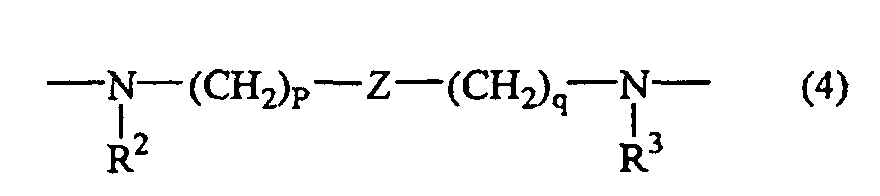
- A bis (2-aryl-5-pyridyl) derivative or a salt thereof according to claim 1, wherein in the formula (1) , A is a substituted or unsubstituted phenyl group.
- A bis (2-aryl-5-pyridyl) derivative or a salt thereof according to claim 1, wherein in the formula (1) , X is a group represented by the formula (4).
- A bis(2-aryl-5-pyridyl) derivative or a salt thereof according to claim 1, wherein said aromatic hydrocarbon group is substituted by 1 to 3 substituents selected from lower alkyl groups, lower alkoxy groups, halogeno(lower alkoxy) groups, lower alkoxy (lower alkoxy) groups, hydroxy (lower alkoxy) groups, carboxyl groups, (lower alkoxy)carbonyl groups, unsubstituted or (lower alkyl) - and/or (lower alkoxy) -substituted carbamoyl groups, lower alkanoyl groups, formyl groups, lower alkanoyloxy groups, halogen atoms, hydroxy groups, cyano groups, (lower alkyl) thio groups, amino groups, mono- or di- (lower alkyl) amino groups, (lower alkyl)sufonylamino groups, pyrrolidinyl groups, and alkylenedioxy groups.
- A medicine comprising as an active ingredient a bis(2-aryl-5-pyridyl) derivative or a salt thereof according to any one of claims 1-4.
- A medicine according to claim 5, which is a preventive or therapeutic for an allergic immune disease.
- A medicine according to claim 5, which is a preventive or therapeutic for asthma, atopic dermatitis, allergic rhinilis, inflammatory colitis, contact skin disease or an allergic eye disease.
- Use of bis(2-aryl-5-pyridyl)derivative or a salt thereof according to any one of claims 1-4 for the manufacture of a medicine.
- The use according to claim 8, wherein the medicine is a preventive or therapeutic for allergic immune diseases.
- The use according to claim 8, wherein the medicine is a preventive or therapeutic for asthma, atopic dermatitis, allergic rhinitis, inflammatory colitis, contact skin diseases or allertic eye diseases.
- An IgE antibody production inhibitor as an active ingredient a bis (2-aryl-5-pyridyl) derivative or a salt thereof according to any one of claims 1-4.
- A medicinal composition comprising a bis(2-aryl-5-pyridyl) derivative or a salt thereof according to any one of claims 1-4 and a pharmacologically acceptable carrier.
- A treatment method for an allergic immune disease, which comprises administering a bis(2-aryl-5-pyridyl) derivative or a salt thereof according to any one of claims 1-4.
Applications Claiming Priority (3)
| Application Number | Priority Date | Filing Date | Title |
|---|---|---|---|
| US09/893,680 US6890940B2 (en) | 2001-06-29 | 2001-06-29 | Bis(2-aryl-5-pyridyl) derivatives |
| US893680 | 2001-06-29 | ||
| PCT/JP2002/006493 WO2003002538A1 (en) | 2001-06-29 | 2002-06-27 | Bis(2-aryl-5-pyridyl) derivative |
Publications (3)
| Publication Number | Publication Date |
|---|---|
| EP1403251A1 true EP1403251A1 (en) | 2004-03-31 |
| EP1403251A4 EP1403251A4 (en) | 2005-04-13 |
| EP1403251B1 EP1403251B1 (en) | 2007-07-18 |
Family
ID=25401909
Family Applications (1)
| Application Number | Title | Priority Date | Filing Date |
|---|---|---|---|
| EP02738821A Expired - Lifetime EP1403251B1 (en) | 2001-06-29 | 2002-06-27 | Bis(2-aryl-5-pyridyl) derivative |
Country Status (6)
| Country | Link |
|---|---|
| US (1) | US6890940B2 (en) |
| EP (1) | EP1403251B1 (en) |
| JP (1) | JP4231405B2 (en) |
| AT (1) | ATE367378T1 (en) |
| DE (1) | DE60221251T2 (en) |
| WO (1) | WO2003002538A1 (en) |
Cited By (3)
| Publication number | Priority date | Publication date | Assignee | Title |
|---|---|---|---|---|
| EP4054583A4 (en) * | 2019-11-07 | 2023-10-25 | Crinetics Pharmaceuticals, Inc. | MELANOCORTIN SUBTYPE 2 RECEPTOR (MC2R) ANTAGONISTS AND USES THEREOF |
| US12280046B2 (en) | 2021-03-19 | 2025-04-22 | Crinetics Pharmaceuticals, Inc. | Melanocortin subtype-2 receptor (MC2R) antagonist for the treatment of disease |
| US12479828B2 (en) | 2018-06-05 | 2025-11-25 | Crinetics Pharmaceuticals, Inc. | Melanocortin subtype-2 receptor (MC2R) antagonists and uses thereof |
Families Citing this family (5)
| Publication number | Priority date | Publication date | Assignee | Title |
|---|---|---|---|---|
| US6395753B1 (en) * | 2001-08-30 | 2002-05-28 | Kowa Co., Ltd. | Cyclic amine compounds and pharmaceutical composition containing the same |
| EP1999492A4 (en) * | 2006-01-20 | 2011-05-18 | Landmark Graphics Corp | DYNAMIC MANAGEMENT METHOD OF A PRODUCTION SYSTEM |
| JO3598B1 (en) | 2006-10-10 | 2020-07-05 | Infinity Discovery Inc | Boronic acids and esters as inhibitors of fatty acid amide hydrolase |
| RU2015143910A (en) | 2010-02-03 | 2018-12-28 | Инфинити Фармасьютикалз, Инк. | FATTY ACID AMID HYDROLASE INHIBITORS |
| CN113292514B (en) * | 2021-04-07 | 2022-11-15 | 浙江华显光电科技有限公司 | Piperazine derivative and organic photoelectric device comprising same |
Family Cites Families (17)
| Publication number | Priority date | Publication date | Assignee | Title |
|---|---|---|---|---|
| JPS59167564A (en) | 1983-03-11 | 1984-09-21 | Taiho Yakuhin Kogyo Kk | Sulfonium compound and its preparation |
| JPH01106818A (en) | 1987-10-20 | 1989-04-24 | Teijin Ltd | Antiallergic agent |
| JP2991897B2 (en) | 1993-06-30 | 1999-12-20 | ハウス食品株式会社 | Gazette-type packaging bags for filling food |
| JPH08109177A (en) | 1994-08-18 | 1996-04-30 | Asahi Chem Ind Co Ltd | Cycloalkylalkylamine derivative and its use |
| JP3265134B2 (en) | 1994-09-20 | 2002-03-11 | 帝人株式会社 | Nitrogen-containing bicyclic heterocyclic derivative and pharmaceutical preparation containing the same |
| ATE194912T1 (en) | 1994-10-17 | 2000-08-15 | Aventis Pharma Ltd | AGENTS FOR THE PREVENTION AND CURE OF TYPE I ALLERGIC DISEASES |
| ES2212119T3 (en) | 1996-07-31 | 2004-07-16 | SHIONOGI & CO., LTD. | NEW P-TERFENILO COMPOUNDS. |
| US6340682B1 (en) | 1996-08-23 | 2002-01-22 | Kowa Co., Ltd. | Diamide compound and drugs containing the same |
| WO1998016497A1 (en) | 1996-10-11 | 1998-04-23 | Kowa Co., Ltd. | Novel diamide compounds and drugs containing the same |
| GB9622363D0 (en) * | 1996-10-28 | 1997-01-08 | Celltech Therapeutics Ltd | Chemical compounds |
| JPH10324631A (en) | 1997-05-22 | 1998-12-08 | Fujisawa Pharmaceut Co Ltd | Immunoglobulin e antibody formation inhibitor |
| US6376546B1 (en) | 1997-10-14 | 2002-04-23 | Asahi Kasei Kabushiki Kaisha | Biphenyl-5-alkanoic acid derivatives and use thereof |
| PE20000174A1 (en) | 1998-01-12 | 2000-03-17 | Novartis Ag | PYRIDINYLPYRIMIDINAMINES |
| ID24959A (en) * | 1998-01-28 | 2000-08-31 | Shionogi & Co | NEW TRISICLIC COMPOUNDS |
| AU747815B2 (en) | 1998-02-19 | 2002-05-23 | Kowa Co., Ltd. | Cyclic amide compounds |
| JPH11269192A (en) | 1998-03-24 | 1999-10-05 | The Nikka Wisky Distilling Co Ltd | Flavone glycosides |
| ES2230864T3 (en) | 1998-07-24 | 2005-05-01 | Teijin Limited | DERIVATIVES OF ANTRANILIC ACID. |
-
2001
- 2001-06-29 US US09/893,680 patent/US6890940B2/en not_active Expired - Fee Related
-
2002
- 2002-06-27 WO PCT/JP2002/006493 patent/WO2003002538A1/en not_active Ceased
- 2002-06-27 AT AT02738821T patent/ATE367378T1/en not_active IP Right Cessation
- 2002-06-27 EP EP02738821A patent/EP1403251B1/en not_active Expired - Lifetime
- 2002-06-27 JP JP2003508919A patent/JP4231405B2/en not_active Expired - Fee Related
- 2002-06-27 DE DE60221251T patent/DE60221251T2/en not_active Expired - Lifetime
Non-Patent Citations (2)
| Title |
|---|
| No further relevant documents disclosed * |
| See also references of WO03002538A1 * |
Cited By (4)
| Publication number | Priority date | Publication date | Assignee | Title |
|---|---|---|---|---|
| US12479828B2 (en) | 2018-06-05 | 2025-11-25 | Crinetics Pharmaceuticals, Inc. | Melanocortin subtype-2 receptor (MC2R) antagonists and uses thereof |
| EP4054583A4 (en) * | 2019-11-07 | 2023-10-25 | Crinetics Pharmaceuticals, Inc. | MELANOCORTIN SUBTYPE 2 RECEPTOR (MC2R) ANTAGONISTS AND USES THEREOF |
| US12479825B2 (en) | 2019-11-07 | 2025-11-25 | Crinetics Pharmaceuticals, Inc. | Melanocortin subtype-2 receptor (MC2R) antagonists and uses thereof |
| US12280046B2 (en) | 2021-03-19 | 2025-04-22 | Crinetics Pharmaceuticals, Inc. | Melanocortin subtype-2 receptor (MC2R) antagonist for the treatment of disease |
Also Published As
| Publication number | Publication date |
|---|---|
| US20030022886A1 (en) | 2003-01-30 |
| EP1403251B1 (en) | 2007-07-18 |
| EP1403251A4 (en) | 2005-04-13 |
| DE60221251D1 (en) | 2007-08-30 |
| ATE367378T1 (en) | 2007-08-15 |
| WO2003002538A1 (en) | 2003-01-09 |
| US6890940B2 (en) | 2005-05-10 |
| JP4231405B2 (en) | 2009-02-25 |
| JPWO2003002538A1 (en) | 2004-10-14 |
| DE60221251T2 (en) | 2008-04-10 |
Similar Documents
| Publication | Publication Date | Title |
|---|---|---|
| KR102075886B1 (en) | Novel pyrazolo [3,4-d] pyrimidine compounds or salts thereof | |
| AU2005332339B2 (en) | Furanopyridine derivatives as ACK1 and Lck modulators | |
| CN109020957B (en) | Heterocyclic compounds as MNK inhibitors | |
| US10662187B2 (en) | Bruton's tyrosine kinase inhibitors | |
| US7232825B2 (en) | Phenylaminopyrimidine derivatives and methods of use | |
| TW202019869A (en) | Immunosuppressive agent, preparation method therefor and pharmaceutical use thereof | |
| FR2921657A1 (en) | New nicotinamide derivatives useful for the preparation of a medicament for the treatment or prevention of cancer | |
| KR20060130126A (en) | Derivatives of 1-piperazine- and 1-homopiperazine-carboxylate, their preparation and therapeutic use | |
| CN114853672B (en) | Tacrine derivatives as CDKs inhibitors and their applications | |
| EP1403251B1 (en) | Bis(2-aryl-5-pyridyl) derivative | |
| WO2025218831A2 (en) | Thiadiazolidinone derivative with ptpn2/ptpn1 inhibitory activity, and preparation method therefor and use thereof | |
| US7906533B2 (en) | Nicotinamide pyridinureas as vascular endothelial growth factor (VEGF) receptor kinase inhibitors | |
| CN110105356B (en) | Azaindole compound and preparation method and application thereof | |
| EP1807416B1 (en) | Nicotinamide pyridinureas as vascular endothelial growth factor (VEGF) receptor kinase inhibitors | |
| US20130158040A1 (en) | Diazaindole inhibitors of crac | |
| EP1403250B1 (en) | Bis(5-aryl-2-pyridyl) derivative | |
| CN101910176A (en) | N-phenylimidazo [1,2-a ] pyridine-2-carboxamide derivatives, their preparation and their therapeutic use | |
| CN115073436A (en) | Quinazoline benzamide compound and derivative, pharmaceutical composition and application thereof | |
| CN112876456A (en) | Cinnoline compound PI3K kinase inhibitor, preparation method thereof and application thereof in pharmacy | |
| US6787653B2 (en) | Preparation process of biphenylcarboxylic acid amide derivatives | |
| CN117731658A (en) | Japanese encephalitis virus inhibitor | |
| WO2024061300A1 (en) | Inhibitors of trex1 and uses thereof | |
| TW202334097A (en) | Benzo[h]quinazoline-4-amine derivatives for the treatment of cancer | |
| WO2017056338A1 (en) | Method for producing pyrazole derivative | |
| US20240199625A1 (en) | Bicyclic heterocyclic fgfr4 inhibitor, pharmaceutical composition and preparation comprising same, and application thereof |
Legal Events
| Date | Code | Title | Description |
|---|---|---|---|
| PUAI | Public reference made under article 153(3) epc to a published international application that has entered the european phase |
Free format text: ORIGINAL CODE: 0009012 |
|
| 17P | Request for examination filed |
Effective date: 20040105 |
|
| AK | Designated contracting states |
Kind code of ref document: A1 Designated state(s): AT BE CH CY DE DK ES FI FR GB GR IE IT LI LU MC NL PT SE TR |
|
| AX | Request for extension of the european patent |
Extension state: AL LT LV MK RO SI |
|
| A4 | Supplementary search report drawn up and despatched |
Effective date: 20050224 |
|
| RIC1 | Information provided on ipc code assigned before grant |
Ipc: 7A 61K 31/4545 B Ipc: 7A 61K 31/496 B Ipc: 7A 61K 31/443 B Ipc: 7A 61K 31/44 B Ipc: 7C 07D 401/14 B Ipc: 7A 61K 31/4427 B Ipc: 7A 61K 31/4439 B Ipc: 7A 61K 31/4523 B Ipc: 7A 61K 31/551 B Ipc: 7C 07D 213/74 A Ipc: 7C 07D 405/14 B Ipc: 7A 61P 37/00 B |
|
| GRAP | Despatch of communication of intention to grant a patent |
Free format text: ORIGINAL CODE: EPIDOSNIGR1 |
|
| GRAS | Grant fee paid |
Free format text: ORIGINAL CODE: EPIDOSNIGR3 |
|
| GRAA | (expected) grant |
Free format text: ORIGINAL CODE: 0009210 |
|
| AK | Designated contracting states |
Kind code of ref document: B1 Designated state(s): AT BE CH CY DE DK ES FI FR GB GR IE IT LI LU MC NL PT SE TR |
|
| REG | Reference to a national code |
Ref country code: GB Ref legal event code: FG4D |
|
| REG | Reference to a national code |
Ref country code: CH Ref legal event code: EP |
|
| REF | Corresponds to: |
Ref document number: 60221251 Country of ref document: DE Date of ref document: 20070830 Kind code of ref document: P |
|
| REG | Reference to a national code |
Ref country code: IE Ref legal event code: FG4D |
|
| REG | Reference to a national code |
Ref country code: CH Ref legal event code: NV Representative=s name: BOVARD AG PATENTANWAELTE |
|
| ET | Fr: translation filed | ||
| PG25 | Lapsed in a contracting state [announced via postgrant information from national office to epo] |
Ref country code: PT Free format text: LAPSE BECAUSE OF FAILURE TO SUBMIT A TRANSLATION OF THE DESCRIPTION OR TO PAY THE FEE WITHIN THE PRESCRIBED TIME-LIMIT Effective date: 20071218 Ref country code: NL Free format text: LAPSE BECAUSE OF FAILURE TO SUBMIT A TRANSLATION OF THE DESCRIPTION OR TO PAY THE FEE WITHIN THE PRESCRIBED TIME-LIMIT Effective date: 20070718 Ref country code: ES Free format text: LAPSE BECAUSE OF FAILURE TO SUBMIT A TRANSLATION OF THE DESCRIPTION OR TO PAY THE FEE WITHIN THE PRESCRIBED TIME-LIMIT Effective date: 20071029 Ref country code: FI Free format text: LAPSE BECAUSE OF FAILURE TO SUBMIT A TRANSLATION OF THE DESCRIPTION OR TO PAY THE FEE WITHIN THE PRESCRIBED TIME-LIMIT Effective date: 20070718 |
|
| NLV1 | Nl: lapsed or annulled due to failure to fulfill the requirements of art. 29p and 29m of the patents act | ||
| PG25 | Lapsed in a contracting state [announced via postgrant information from national office to epo] |
Ref country code: AT Free format text: LAPSE BECAUSE OF FAILURE TO SUBMIT A TRANSLATION OF THE DESCRIPTION OR TO PAY THE FEE WITHIN THE PRESCRIBED TIME-LIMIT Effective date: 20070718 |
|
| PG25 | Lapsed in a contracting state [announced via postgrant information from national office to epo] |
Ref country code: BE Free format text: LAPSE BECAUSE OF FAILURE TO SUBMIT A TRANSLATION OF THE DESCRIPTION OR TO PAY THE FEE WITHIN THE PRESCRIBED TIME-LIMIT Effective date: 20070718 |
|
| PG25 | Lapsed in a contracting state [announced via postgrant information from national office to epo] |
Ref country code: GR Free format text: LAPSE BECAUSE OF FAILURE TO SUBMIT A TRANSLATION OF THE DESCRIPTION OR TO PAY THE FEE WITHIN THE PRESCRIBED TIME-LIMIT Effective date: 20071019 Ref country code: DK Free format text: LAPSE BECAUSE OF FAILURE TO SUBMIT A TRANSLATION OF THE DESCRIPTION OR TO PAY THE FEE WITHIN THE PRESCRIBED TIME-LIMIT Effective date: 20070718 |
|
| PLBE | No opposition filed within time limit |
Free format text: ORIGINAL CODE: 0009261 |
|
| STAA | Information on the status of an ep patent application or granted ep patent |
Free format text: STATUS: NO OPPOSITION FILED WITHIN TIME LIMIT |
|
| 26N | No opposition filed |
Effective date: 20080421 |
|
| PG25 | Lapsed in a contracting state [announced via postgrant information from national office to epo] |
Ref country code: SE Free format text: LAPSE BECAUSE OF FAILURE TO SUBMIT A TRANSLATION OF THE DESCRIPTION OR TO PAY THE FEE WITHIN THE PRESCRIBED TIME-LIMIT Effective date: 20071018 |
|
| PG25 | Lapsed in a contracting state [announced via postgrant information from national office to epo] |
Ref country code: MC Free format text: LAPSE BECAUSE OF NON-PAYMENT OF DUE FEES Effective date: 20080630 |
|
| PG25 | Lapsed in a contracting state [announced via postgrant information from national office to epo] |
Ref country code: IE Free format text: LAPSE BECAUSE OF NON-PAYMENT OF DUE FEES Effective date: 20080627 |
|
| PG25 | Lapsed in a contracting state [announced via postgrant information from national office to epo] |
Ref country code: CY Free format text: LAPSE BECAUSE OF FAILURE TO SUBMIT A TRANSLATION OF THE DESCRIPTION OR TO PAY THE FEE WITHIN THE PRESCRIBED TIME-LIMIT Effective date: 20070718 |
|
| PG25 | Lapsed in a contracting state [announced via postgrant information from national office to epo] |
Ref country code: LU Free format text: LAPSE BECAUSE OF NON-PAYMENT OF DUE FEES Effective date: 20080627 |
|
| PG25 | Lapsed in a contracting state [announced via postgrant information from national office to epo] |
Ref country code: TR Free format text: LAPSE BECAUSE OF FAILURE TO SUBMIT A TRANSLATION OF THE DESCRIPTION OR TO PAY THE FEE WITHIN THE PRESCRIBED TIME-LIMIT Effective date: 20070718 |
|
| REG | Reference to a national code |
Ref country code: CH Ref legal event code: PFA Owner name: KOWA CO., LTD. Free format text: KOWA CO., LTD.#6-29, NISHIKI 3-CHOME NAKA-KU#NAGOYA-SHI, AICHI 460-8625 (JP) -TRANSFER TO- KOWA CO., LTD.#6-29, NISHIKI 3-CHOME NAKA-KU#NAGOYA-SHI, AICHI 460-8625 (JP) |
|
| PGFP | Annual fee paid to national office [announced via postgrant information from national office to epo] |
Ref country code: CH Payment date: 20110623 Year of fee payment: 10 Ref country code: FR Payment date: 20110630 Year of fee payment: 10 |
|
| PGFP | Annual fee paid to national office [announced via postgrant information from national office to epo] |
Ref country code: GB Payment date: 20110621 Year of fee payment: 10 |
|
| PGFP | Annual fee paid to national office [announced via postgrant information from national office to epo] |
Ref country code: DE Payment date: 20110606 Year of fee payment: 10 |
|
| PGFP | Annual fee paid to national office [announced via postgrant information from national office to epo] |
Ref country code: IT Payment date: 20110627 Year of fee payment: 10 |
|
| REG | Reference to a national code |
Ref country code: CH Ref legal event code: PL |
|
| REG | Reference to a national code |
Ref country code: CH Ref legal event code: PL |
|
| GBPC | Gb: european patent ceased through non-payment of renewal fee |
Effective date: 20120627 |
|
| PG25 | Lapsed in a contracting state [announced via postgrant information from national office to epo] |
Ref country code: IT Free format text: LAPSE BECAUSE OF NON-PAYMENT OF DUE FEES Effective date: 20120627 |
|
| REG | Reference to a national code |
Ref country code: FR Ref legal event code: ST Effective date: 20130228 |
|
| REG | Reference to a national code |
Ref country code: DE Ref legal event code: R119 Ref document number: 60221251 Country of ref document: DE Effective date: 20130101 |
|
| PG25 | Lapsed in a contracting state [announced via postgrant information from national office to epo] |
Ref country code: CH Free format text: LAPSE BECAUSE OF NON-PAYMENT OF DUE FEES Effective date: 20120630 Ref country code: DE Free format text: LAPSE BECAUSE OF NON-PAYMENT OF DUE FEES Effective date: 20130101 Ref country code: GB Free format text: LAPSE BECAUSE OF NON-PAYMENT OF DUE FEES Effective date: 20120627 Ref country code: FR Free format text: LAPSE BECAUSE OF NON-PAYMENT OF DUE FEES Effective date: 20120702 Ref country code: LI Free format text: LAPSE BECAUSE OF NON-PAYMENT OF DUE FEES Effective date: 20120630 |