EP1403250A1 - Bis(5-aryl-2-pyridyl) derivative - Google Patents
Bis(5-aryl-2-pyridyl) derivative Download PDFInfo
- Publication number
- EP1403250A1 EP1403250A1 EP02736191A EP02736191A EP1403250A1 EP 1403250 A1 EP1403250 A1 EP 1403250A1 EP 02736191 A EP02736191 A EP 02736191A EP 02736191 A EP02736191 A EP 02736191A EP 1403250 A1 EP1403250 A1 EP 1403250A1
- Authority
- EP
- European Patent Office
- Prior art keywords
- bis
- pyridyl
- mmol
- hexahydro
- diazepine
- Prior art date
- Legal status (The legal status is an assumption and is not a legal conclusion. Google has not performed a legal analysis and makes no representation as to the accuracy of the status listed.)
- Granted
Links
- 0 COCc1cc(*)cc(*)c1 Chemical compound COCc1cc(*)cc(*)c1 0.000 description 4
Classifications
-
- C—CHEMISTRY; METALLURGY
- C07—ORGANIC CHEMISTRY
- C07D—HETEROCYCLIC COMPOUNDS
- C07D487/00—Heterocyclic compounds containing nitrogen atoms as the only ring hetero atoms in the condensed system, not provided for by groups C07D451/00 - C07D477/00
- C07D487/02—Heterocyclic compounds containing nitrogen atoms as the only ring hetero atoms in the condensed system, not provided for by groups C07D451/00 - C07D477/00 in which the condensed system contains two hetero rings
- C07D487/04—Ortho-condensed systems
-
- A—HUMAN NECESSITIES
- A61—MEDICAL OR VETERINARY SCIENCE; HYGIENE
- A61P—SPECIFIC THERAPEUTIC ACTIVITY OF CHEMICAL COMPOUNDS OR MEDICINAL PREPARATIONS
- A61P1/00—Drugs for disorders of the alimentary tract or the digestive system
- A61P1/04—Drugs for disorders of the alimentary tract or the digestive system for ulcers, gastritis or reflux esophagitis, e.g. antacids, inhibitors of acid secretion, mucosal protectants
-
- A—HUMAN NECESSITIES
- A61—MEDICAL OR VETERINARY SCIENCE; HYGIENE
- A61P—SPECIFIC THERAPEUTIC ACTIVITY OF CHEMICAL COMPOUNDS OR MEDICINAL PREPARATIONS
- A61P11/00—Drugs for disorders of the respiratory system
- A61P11/02—Nasal agents, e.g. decongestants
-
- A—HUMAN NECESSITIES
- A61—MEDICAL OR VETERINARY SCIENCE; HYGIENE
- A61P—SPECIFIC THERAPEUTIC ACTIVITY OF CHEMICAL COMPOUNDS OR MEDICINAL PREPARATIONS
- A61P11/00—Drugs for disorders of the respiratory system
- A61P11/06—Antiasthmatics
-
- A—HUMAN NECESSITIES
- A61—MEDICAL OR VETERINARY SCIENCE; HYGIENE
- A61P—SPECIFIC THERAPEUTIC ACTIVITY OF CHEMICAL COMPOUNDS OR MEDICINAL PREPARATIONS
- A61P17/00—Drugs for dermatological disorders
-
- A—HUMAN NECESSITIES
- A61—MEDICAL OR VETERINARY SCIENCE; HYGIENE
- A61P—SPECIFIC THERAPEUTIC ACTIVITY OF CHEMICAL COMPOUNDS OR MEDICINAL PREPARATIONS
- A61P17/00—Drugs for dermatological disorders
- A61P17/04—Antipruritics
-
- A—HUMAN NECESSITIES
- A61—MEDICAL OR VETERINARY SCIENCE; HYGIENE
- A61P—SPECIFIC THERAPEUTIC ACTIVITY OF CHEMICAL COMPOUNDS OR MEDICINAL PREPARATIONS
- A61P27/00—Drugs for disorders of the senses
- A61P27/02—Ophthalmic agents
- A61P27/14—Decongestants or antiallergics
-
- A—HUMAN NECESSITIES
- A61—MEDICAL OR VETERINARY SCIENCE; HYGIENE
- A61P—SPECIFIC THERAPEUTIC ACTIVITY OF CHEMICAL COMPOUNDS OR MEDICINAL PREPARATIONS
- A61P29/00—Non-central analgesic, antipyretic or antiinflammatory agents, e.g. antirheumatic agents; Non-steroidal antiinflammatory drugs [NSAID]
-
- A—HUMAN NECESSITIES
- A61—MEDICAL OR VETERINARY SCIENCE; HYGIENE
- A61P—SPECIFIC THERAPEUTIC ACTIVITY OF CHEMICAL COMPOUNDS OR MEDICINAL PREPARATIONS
- A61P37/00—Drugs for immunological or allergic disorders
-
- A—HUMAN NECESSITIES
- A61—MEDICAL OR VETERINARY SCIENCE; HYGIENE
- A61P—SPECIFIC THERAPEUTIC ACTIVITY OF CHEMICAL COMPOUNDS OR MEDICINAL PREPARATIONS
- A61P37/00—Drugs for immunological or allergic disorders
- A61P37/08—Antiallergic agents
-
- A—HUMAN NECESSITIES
- A61—MEDICAL OR VETERINARY SCIENCE; HYGIENE
- A61P—SPECIFIC THERAPEUTIC ACTIVITY OF CHEMICAL COMPOUNDS OR MEDICINAL PREPARATIONS
- A61P43/00—Drugs for specific purposes, not provided for in groups A61P1/00-A61P41/00
-
- A—HUMAN NECESSITIES
- A61—MEDICAL OR VETERINARY SCIENCE; HYGIENE
- A61P—SPECIFIC THERAPEUTIC ACTIVITY OF CHEMICAL COMPOUNDS OR MEDICINAL PREPARATIONS
- A61P9/00—Drugs for disorders of the cardiovascular system
- A61P9/10—Drugs for disorders of the cardiovascular system for treating ischaemic or atherosclerotic diseases, e.g. antianginal drugs, coronary vasodilators, drugs for myocardial infarction, retinopathy, cerebrovascula insufficiency, renal arteriosclerosis
-
- C—CHEMISTRY; METALLURGY
- C07—ORGANIC CHEMISTRY
- C07D—HETEROCYCLIC COMPOUNDS
- C07D213/00—Heterocyclic compounds containing six-membered rings, not condensed with other rings, with one nitrogen atom as the only ring hetero atom and three or more double bonds between ring members or between ring members and non-ring members
- C07D213/02—Heterocyclic compounds containing six-membered rings, not condensed with other rings, with one nitrogen atom as the only ring hetero atom and three or more double bonds between ring members or between ring members and non-ring members having three double bonds between ring members or between ring members and non-ring members
- C07D213/04—Heterocyclic compounds containing six-membered rings, not condensed with other rings, with one nitrogen atom as the only ring hetero atom and three or more double bonds between ring members or between ring members and non-ring members having three double bonds between ring members or between ring members and non-ring members having no bond between the ring nitrogen atom and a non-ring member or having only hydrogen or carbon atoms directly attached to the ring nitrogen atom
- C07D213/60—Heterocyclic compounds containing six-membered rings, not condensed with other rings, with one nitrogen atom as the only ring hetero atom and three or more double bonds between ring members or between ring members and non-ring members having three double bonds between ring members or between ring members and non-ring members having no bond between the ring nitrogen atom and a non-ring member or having only hydrogen or carbon atoms directly attached to the ring nitrogen atom with hetero atoms or with carbon atoms having three bonds to hetero atoms with at the most one bond to halogen, e.g. ester or nitrile radicals, directly attached to ring carbon atoms
- C07D213/72—Nitrogen atoms
- C07D213/74—Amino or imino radicals substituted by hydrocarbon or substituted hydrocarbon radicals
-
- C—CHEMISTRY; METALLURGY
- C07—ORGANIC CHEMISTRY
- C07D—HETEROCYCLIC COMPOUNDS
- C07D401/00—Heterocyclic compounds containing two or more hetero rings, having nitrogen atoms as the only ring hetero atoms, at least one ring being a six-membered ring with only one nitrogen atom
- C07D401/14—Heterocyclic compounds containing two or more hetero rings, having nitrogen atoms as the only ring hetero atoms, at least one ring being a six-membered ring with only one nitrogen atom containing three or more hetero rings
-
- C—CHEMISTRY; METALLURGY
- C07—ORGANIC CHEMISTRY
- C07D—HETEROCYCLIC COMPOUNDS
- C07D405/00—Heterocyclic compounds containing both one or more hetero rings having oxygen atoms as the only ring hetero atoms, and one or more rings having nitrogen as the only ring hetero atom
- C07D405/14—Heterocyclic compounds containing both one or more hetero rings having oxygen atoms as the only ring hetero atoms, and one or more rings having nitrogen as the only ring hetero atom containing three or more hetero rings
-
- C—CHEMISTRY; METALLURGY
- C07—ORGANIC CHEMISTRY
- C07D—HETEROCYCLIC COMPOUNDS
- C07D409/00—Heterocyclic compounds containing two or more hetero rings, at least one ring having sulfur atoms as the only ring hetero atoms
- C07D409/14—Heterocyclic compounds containing two or more hetero rings, at least one ring having sulfur atoms as the only ring hetero atoms containing three or more hetero rings
Definitions
- This invention relates to novel bis(5-aryl-2-pyridyl) derivatives or salts thereof, and also to medicines which comprise the bis (5-aryl-2-pyridyl) derivatives or salts thereof as active ingredients and are useful for the prevention or treatment of allergic immune diseases.
- IgE a class of immunoglobulin (Ig) , isaallergen-specific molecule produced by IgE producing cells differentiated from B cells, when triggered by contact of immunocompetent cells with an allergen in the body.
- Ig immunoglobulin
- IgE is produced in a target organ of allergy, and binds to a receptor on surfaces of mast cells or basophils as principal effector cells in an allergic reaction (sensitized state). From the mast cells stimulated as a result of intrusion of the allergen into the body after the sensitization and its reaction with the specific IgE, histamine, a leucotriene, a prostaglandin, an allergic chemical transmitter such as PAF, or a detrimental enzyme such as tryptase is released, and an immediate-response allergic reaction such as increased vasopermeability, smooth muscle constriction or vasodilation is provoked.
- a cytokine capable of directly activating other immune system cells such as IL-4
- IL-4 a cytokine capable of directly activating other immune system cells
- eosinophils, basophils or the like infiltrate tissues, and an allergic chemical transmitter or a histodetrimental protein such as MBP, which is secreted by these inflammatory cells, induces a delayed allergic reaction and protracts and worsen an allergic symptom.
- IgE is associated deeply with various allergic immune diseases, such as asthma, atopic dermatitis, allergic rhinitis, inflammatory colitis, contact-type dermatitis and allergic eye diseases.
- allergic immune diseases such as asthma, atopic dermatitis, allergic rhinitis, inflammatory colitis, contact-type dermatitis and allergic eye diseases.
- These diseases are widely known to be preventable and curable if suchproduction is effectively blocked (Emerging therapeutic targets in asthma and allergy: modulation of IgE. Emerging Therapeutic Targets (1999) 3: 229-240 ; Anti-IgE as novel therapy for the treatment of asthma. Curr. Opin. Plum. Med. (1999) 5: 76-80 ; Treatment of allergic asthma with monoclonal anti-IgE antibody. N. Eng. J. Med. (1999) 341: 1966-1973 ; Anti-IgE antibody therapy for asthma. N. Eng. J. Med.(1999) 341: 2006-2008) .
- IgE is considered to be a substance which takes part at the stage of very beginning upon onset of an allergic disease.
- some lowmolecularcompoundswith IgE antibodyproduction inhibiting activity have been found and reported to date [WO98/04058, WO98/07702, WO98/16497, JP10-324631A, WO99/19291, WO99/35140, WO99/38829, WO99/42446, JP11-269192A, WO00/05198, "Yakuri to Chiryo (Basic Pharmacology & Therapeutic)" 22 (3), 1369 (1994), JP1-106818A, JP7-17506B, JP8-92216A, JP8-109177A, WO96/11682, JP59-167564A].
- These compounds involve problems such as low water solubility, and it is the current circumstance that the aim has not been fully achieved.
- An object of the present invention is to provide a compound having excellent IgE antibody production inhibiting activity and also a medicine comprising the compound as an active ingredient.
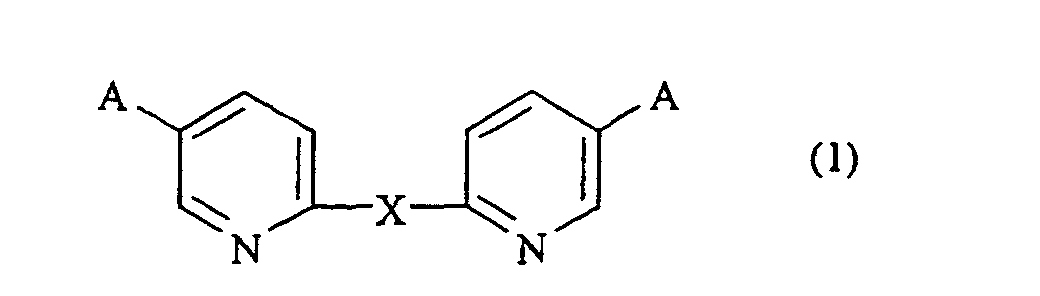
- the present invention provides a bis(5-aryl-2-pyridyl) derivative represented by the following formula (1) or a salt thereof: wherein A represents a substituted or unsubstituted aromatic hydrocarbon group or a substituted or unsubstituted aromatic heterocyclic group, and X represents a group selected from the following formulas (2) to (5): wherein in the formula (2), m stands for an integer of 1 or 2; in the formula (3), n stands for an integer of 1 to 6; in the formula (4), R represents a hydrogen atom or a lower alkyl group and p stands for an integer of 1 to 6.
- the present invention also provides a medicine comprising as an active ingredient the bis(5-aryl-2-pyridyl) derivative or the salt thereof.
- the present invention also provide use of the bis (5-aryl-2-pyridyl) derivative or the salt for the manufacture of a medicine.
- the present invention also provides a medicinal composition
- a medicinal composition comprising the bis (5-aryl-2-pyridyl) derivative or the salt thereof and a pharmacologically acceptable carrier.
- the present invention also provides a treatment method for an allergic immune disease, which comprises administering the bis(5-aryl-2-pyridyl) derivative or the salt thereof.
- halogen atoms are fluorine atom, chlorine atom, bromine atom, and iodine atom.
- the aromatic hydrocarbon group represented by A may preferably be one having 6 to 14 carbon atoms, with a phenyl or naphthyl group being more preferred and a phenyl group being particularly preferred.
- Preferred Examples of the aromatic heterocyclic group can include 5- to 10-membered heterocyclic groups each of which contains one or two nitrogen, oxygen or sulfur atoms, with pyridyl, thienyl, furyl, benzofuryl and benzothienyl groups being more preferred.
- substituents may contain 1 to 3 substituents.
- substituents can include lower alkyl groups, halogeno(lower alkyl) groups, hydroxy(lower alkyl) groups, lower alkoxy (lower alkyl) groups, lower alkoxy groups, halogen atoms, hydroxy group, cyano group, (lower alkyl)thio groups, amino group, mono- or di-(lower alkyl)amino groups, (lower alkyl)sufonylamino groups, formyl group, carboxyl group, (lower alkoxy)carbonyl groups, lower alkanoyl groups, pyrrolidinyl group, and alkylenedioxy groups.
- substituents can include methyl, t-butyl, trifluoromethyl, hydroxymethyl, methoxymethyl, methoxy, ethoxy, n-propoxy, isopropoxy, F, Cl, hydroxy, cyano, methylthio, amino, dimethylamino, methane-sulfonylamino, pyrrolidinyl, formyl, carboxy, methoxycarbonyl, ethoxycarbonyl, acetyl, and methylenedioxy.
- n ranges from 2 to 4
- p ranges form 2 to 4.
- Preferred specific examples of the bis (5-aryl-2-pyridyl) derivative (1) according to the present invention can include 1,4-bis[5-(3,4,5-trimethoxyphenyl)-2-pyridyl]hexahydro-1,4-diazepine dimethanesulfonate, 1,4-bis[5-(4-amino-3,5-dimethoxyphenyl)-2-pyridyl]hexahydro - 1,4-diazepine tetrahydrochloride, 1,4-bis[5-(4-dimethylamino-3,5-dimethoxyphenyl)-2-pyridyl]h exahydro-1,4-diazepine, 1,3-bis[4-[5-(3,4,5-trimethoxyphenyl)-2-pyridyl]-1-piperazi nyl]propane, and N,N'-bis[5-(3,4,5-trimethoxy-phen
- the compound (1) according to the present invention can be produced, for example, in accordance with the following reaction steps, although no particular limitation is imposed on its production process.
- a and X have the same meanings as defined above
- Y 1 and Y 2 represent a halogen atom or -OSO 2 (C q F 2q+1 ) in which q stands for an integer of 0 to 4, and Z represents dihydroxyboron, di (lower alkoxy)boron, di (loweralkyl)boron, dihalo(lower alkyl)silicon, halogenated zinc, tri(lower alkyl)tin, halogenated magnesium or the like.
- the compound (1) according to the present invention can be produced by reacting the compound (6) with the compound (7) in a solventless manner or in a solvent optionally in the presence of a base to obtain a compound (8) and then reacting the compound (8) with the compound (9).
- Examples of the solvent employed in the reaction (condensation reaction) between the compound (6) and the compound (7) can include toluene, tetrahydrofuran, dioxane and dimethylformamide, whereas examples of the base usable in the reaction can include potassium carbonate and sodium hydride.
- the reaction can be conducted preferably at room temperature to 200°C for 0.5 to 100 hours, notably at 80 to 120°C for 2 to 15 hours.
- the reaction (cross-coupling reaction) between the compound (8) and the compound (9) can be conducted by adding the compound (9) and a catalyst to a solution or suspension of the compound (8) and allowing the compound (8) to react with the compound (9) optionally in the presence of a ligand and a base [Metal-catalyzed Cross-coupling Reactions; Diederich, F., Stang, P.J., Eds.; Wiley-VHC: Weinheim (1998). Stanforth, S.P. Tetrahedron, 54, 263-303 (1998)].
- a solvent usable in the above reaction are benzene, toluene, xylene, diethyl ether, tetrahydrofuran, dimethoxyethane, dioxane, acetonitrile, dimethylformamide, N-methylpiperidone, methanol, ethanol, and water.
- the catalyst can include tetrakis(triphenylphosphine)-palladium(0), tris(bisbenzylideneacetone)dipalladium(0), palladium acetate(II), palladium chloride(II), dichloro-bis(triphenylphosphine)palladium(II), dichloro[1,2-bis(diphenylphosphine)ethane]palladium(II), dichloro[1,4-bis(diphenylphosphino)butane]palladium(II), dichloro[1,1-bis(diphenylphosphino)ferrocene]palladium(II), tetrakis-triphenylphosphine nickel(0) and bis(acetylacetonato)nickel (II).
- Examples of the ligand can include tri(t-butyl)phosphine, triphenylphosphine, tri(o-tolyl)-phosphine, tri(2-furyl)phosphine, 2,2'-bis(diphenyl-phosphino)-1,1'-binaphthyl, 1,2-bis(diphenylphosphino)-ethane, 1,3-bis(diphenylphosphino)propane, 1,4-bis(diphenylphosphino)butane, and 1,1'-bis(diphenyl-phosphino)ferrocene.
- Examples of the base can include sodium acetate, potassium acetate, sodium carbonate, sodium hydrogencarbonate, potassium phosphate, sodium hydroxide, potassium hydroxide, barium hydroxide, sodium methoxide, sodium ethoxide, cesium fluoride, fluorinated tributyl-ammonium, and triethylamine.
- the reaction may be conducted at room temperature to 150°C for 0.5 to 100 hours. It is, however, preferred to follow the report by Suzuki et al. [Miyaura, N.; Suzuki, A. Chem. Rev., 95, 2457-2483 (1995)], that is, to use a compound (9) in which Z is dihydroxyboron and to apply conditions of tetrakis(triphenylphosphine)palladium(0)/ potassium carbonate (or sodium carbonate)/water-methanol(or ethanol)-toluene/60 to 100°C/0.5 to 3 hours; or to use a compound (9) in which Z is di (lower alkoxy)boron and to apply conditions of dichloro[1,1]-bis(diphenylphosphino)ferrocene]palladium (II)/1,1'-bis(diphenylphosphino)ferrocene/sodium carbonate/ water-dimethylformamide/60 to 100°C/0.5 to 3 hours.
- the intermediate and target compound obtained in the above reactions can be isolated and purified by subjecting them to purification procedures commonly employed in organic synthesis chemistry, for example, filtration, extraction, washing, drying, concentration, recrystallization, one or more of various chromatographic treatments, and the like. Further, the intermediate can be provided for use in the next reaction without specifically purifying it.
- the compound (1) according to the present invention may include various isomers depending on the kinds and combination of the substituents. It is to be noted that the present invention encompasses all of such isomers.
- the compound (1) obtained as described above can be converted into an acid addition salt or a basic salt by a method known per se in the art. No particular limitation is imposed on such salts insofar as they are pharmacologically acceptable salts.
- examples of its pharmacologically acceptable salt can include mineral acid salts such as the hydrochloride, sulfate andnitrate; and organic acid salts such as the methanesulfonate, acetate, oxalate and citrate.
- examples of its pharmacologically acceptable salt can include alkali metal salts such as the sodium and potassium salts; alkaline earth metal salts such as the calcium and magnesium salts; and organic base salts such as the pyridine, picoline and triethylamine salts.
- the bis (5-aryl-2-pyridyl) derivative (1) according to the present invention has excellent IgE antibody production inhibiting activity and also, IL-4 production inhibiting activity and IL-5 production inhibiting activity as will be demonstrated in tests to be described subsequently herein, it is useful as medicines for the prevention or treatment of various allergic diseases - for example, asthma, atopic dermatitis, allergic rhinilis, inflammatory colitis, contact skin diseases and allergic eye diseases - and also as an IgE antibody production inhibitor.
- the medicine according to the present invention comprises as an active ingredient the bis(5-aryl-2-pyridyl) derivative or the salt thereof.
- the bis(5-aryl-2-pyridyl) derivative or the salt thereof can be formulated into medicinal compositions, for example, various oral preparations or parenteral preparations such as solid, semi-solid or liquid preparations by methods known per se in the art.
- preparations for oral administration are tablets, pills, granules, soft or hard capsules, triturates, subtilized granules, powders, emulsions, syrups, pellets, and elixirs.
- preparations for parenteral administration are injections, drips; infusions, ointments, lotions, tonics, sprays, suspensions, medicinal oils, emulsions, suppositories, and instillations.
- Active ingredients according to the present invention can be used in combination with pharma-cologically acceptable surfactants, excipients, coloring matters, flavoring agents, preservatives, stabilizers, buffering agents, suspending agents, isotonicities and the like as needed.
- the dosage of the medicine according to the present invention varies inter alia depending on the medicine, the target disease to be treated or prevented, the administration method, the treatment period, and the age, sex and weight of the patient. Nonetheless, it is preferred to administer the medicine at a daily dosage of from 0.01 to 1, 000 mg/kg ⁇ weight in terms of the compound represented by the formula (1). This dosage can be administered at once or in several portions, for example, 2 to 6 portions in a day.
- lithium aluminum hydride (1.00 g, 26.4 mmol) was added to a solution of the oil (3.22 g), which had been obtained by the above-described procedures, in anhydrous tetrahydrofuran (35 mL) , and the resultant mixture was stirred for 20 minutes.
- Methanol 7.0 mL, 170 mmol was added to the reaction mixture, and the ice bath was removed.
- Water (7.0mL), diethyl ether (150 mL) and anhydrous magnesium sulfate (30 g) were added. After the mixture was stirred at room temperature for 3 hours, insoluble matter was filtered off by using Celite. The residue was washed with chloroform.
- methyl iodide (0.80 mL, 13 mmol) and a 50% dispersion of sodium hydride (156.5 mg, 3.26 mmol) were added to a solution of 1-t-butyldiphyenylsiloxy-3,5-bis(hydroxymethyl)benzene (501.3 mg, 1.28 mmol) in dimethylformamide (5.0 mL), and the resulting mixture was stirred for 1 hour. Water was added to thereactionmixture, andthethus-obtainedmixturewas extracted with benzene-hexane (1:1).
- the oil (9.5 g, approx. 42.2 mmol) obtained by the above procedures was suspended in water (200 mL). Under ice cooling, concentrated sulfuric acid (7.3 mL, 88 mmol) was added to the suspension to provide a homogeneous solution. Under ice cooling, a solution of sodium nitrite (3.10 g, 44.0 mmol) in water (10 mL) was gradually added dropwise to the solution over approx. 10 minutes, and the solution was stirred for 15 minutes, followed by the addition of a solution of potassium iodide (7.70 g, 46.0 mmol) in water (10 mL).
- the reaction mixture was stirred at room temperature for 1 hour and at 50°C for 15 minutes, and was then extracted with ethyl acetate.
- the organic layer was washed with brine, dried over anhydrous sodium sulfate, and then concentrated under reduced pressure.
- the residue was purified by chromatography on a silica gel column, whereby 3,4,5-triethoxy-1-iodobenzene was obtained as pale yellow needles (melting point: 44.0-46.0°C)(11.60 g, yield: 75%).
- N,N,N',N'-tetramethyl-ethylenediamine (30.0mL, 0.199mol) and a 1.59 M hexane solution of n-butyl lithium (134.0 mL, 0.213 mol) were added dropwise to a solution of 2-(4-bromo-3,5-dimethoxyphenyl)-4,4-dimethyl-2-oxazoline (51.43 g, 0.164 mmol) in anhydrous tetrahydrofuran (1000 mL) which was held under stirring in a dry ice-methanol bath. After stirred for 10 minutes, dimethyl disulfide (18. 0 mL, 0.200 mmol) was added.
- phenylboric acid 130.0 mg, 1.07 mmol
- tetrakis(triphenylphosphine)palladium 56.0 mg, 0.050 mmol
- a 2.0 M aqueous solution of potassium carbonate 0.5 mL, 1.0 mmol
- 1,4-bis(5-bromo-2-pyridyl)hexahydro-1,4-diazepine 200 mg, 0.585 mmol
- 1,4-bis[5-(2,3-dimethoxyphenyl)-2-pyridyl]hexahydro-1,4-dia zepine was obtained as a colorless oil (28.0 mg, yield: 26%) from 1,4-bis(5-bromo-2-pyridyl)hexahydro-1,4-diazepine (82.0 mg,0.200 mmol) synthesized in Referential Example 1 and 2,3-dimethoxyphenylboric acid [Bull. Soc. Chim. Fr., 767-769 (1973)] (146.0 mg, 0.800 mmol) synthesized in a similar manner as in Referential Example 2.
- Example 2 Following the procedures of Example 1, an oil was obtained from 1,4-bis(5-bromo-2-pyridyl)hexahydro-1,4-diazepine (100.0 mg, 0.240 mmol) synthesized in Referential Example 1 and 2,4-dimethoxyphenylboric acid (Chem. Abs. 123, pr256679r.) (150.0 mg, 1.00 mmol). Methanol-chloroform-hexane was added to the oil, and the resulting precipitate was collected by filtration, whereby the title compound was obtained as pale yellow crystalline powder (melting point: ⁇ 300.0°C) (24.0 mg, yield: 19%).
- 1,4-bis[5-(3,5-dimethoxyphenyl)-2-pyridyl]hexahydro-1,4-dia zepine was obtained as a colorless oil (89.0 mg, yield: 71%) from 1,4-bis(5-bromo-2-pyridyl)hexahydro-1,4-diazepine (100.0 mg, 0.240 mmol) synthesized in Referential Example 1 and 3, 5-dimethoxyphenylboric acid (79. 0 mg, 0.530 mmol) synthesized in a similar manner as in Referential Example 2.
- 1,4-bis[5-(3,5-dimethylphenyl)-2-pyridyl]hexahydro-1,4-diaz epine was obtained as yellow crystalline powder (83.0 mg, yield: 89%) from 1,4-bis(5-bromo-2-pyridyl)hexahydro-1,4-diazepine (82.0 mg, 0.200 mmol) synthesized in Referential Example 1 and 3,5-dimethylphenylboric acid (90.0 mg, 0.600 mmol).
- Example 2 Following the procedures of Example 1, an oil was obtained from 1,4-bis(5-bromo-2-pyridyl)hexahydro-1,4-diazepine (120.0 mg, 0.290 mmol) synthesized in Referential Example 1 and 2,4,6-trimethoxyphenylboric acid [Tetrahedron Lett., 32,2229-2232 (1991)] (304.0 mg, 1.45 mmol). Chloroform-hexane was added to the oil, and the resulting precipitate was collected by filtration, whereby the title compound was obtained as yellow crystalline powder (melting point: 243.0-247.0°C) (29.0 mg, yield: 17%).
- Example 2 Following the procedures of Example 1, an oil was obtained from 1,4-bis(5-bromo-2-pyridyl)hexahydro-1,4-diazepine (109.0 mg, 0.264 mmol) synthesized in Referential Example 1 and 2,3,5-trimethoxyphenylboric acid (140.0 mg, 0.660 mmol) synthesized from 1-bromo-2,3,5-trimethoxybenzene [J. Am. Chem., 61 , 144-147 (1939) ] in a similar manner as in Referential Example 2.
- 1,4-bis[5-(3,4,5-triethoxylphenyl)-2-pyridyl]hexahydro-1,4-diazepine was obtained as a colorless oil (77 mg, yield: 48%) from 1,4-bis(5-bromo-2-pyridyl)hexahydro-1,4-diazepine (100.0 mg, 0.240 mmol) synthesized in Referential Example 1 and 3,4,5-triethoxylphenylboric acid (134.0 mg, 0.530 mmol) synthesized in Referential Example 5.
- Example 2 Following the procedures of Example 1, an oil was obtained from 1,4-bis(5-bromo-2-pyridyl)hexahydro-1,4-diazepine (100.0 mg, 0.240 mmol) synthesized in Referential Example 1 and 3,5-diisopropoxy-4-methoxyphenylboric acid (142.0 mg, 0.530 mmol) synthesized in Referential Example 6. The oil was recrystallized from chloroform-hexane, whereby the title compound was obtained as slightly brown needles (melting point: 164.0-165.0°C) (90.0 mg, yield: 53%).
- 1,4-bis[5-(4-isopropoxy-3.5-dimethoxyphenyl)-2-pyridyl] hexahydro-1-4-diazepine(107.0 mg, yield: 69%) was obtained as a sticky oil from 1,4-bis(5-bromo-2-pyridyl)hexahydro-1,4-diazepine (100.0 mg, 0.240 mmol) synthesized in Referential Example 1 and 4-isopropoxy-3,5-dimethoxyphenylboric acid (127.0 mg, 0.530 mmol) synthesized from methyl syringate in a similar manner as in Referential Example 6.
- Example 31 From 1,4-bis(5-bromo-2-pyridyl)hexahydro-1,4-diazepine (115.0 mg, 0.280 mmol) synthesized in Referential Example 1 and 3-benzyloxy-4,5-dimethoxyphenylboric acid (170.0 mg, 0.590 mmol) synthesized frommethyl 3-hydroxy-4,5-dimethoxybenzoate [Indian J.
- Example 2 Following the procedures of Example 1, the title compound was obtained as pale yellow amorphous powder (138.9 mg, yield: 93%) from 1,4-bis(5-bromo-2-pyridyl)hexahydro-1,4-diazepine (110.0 mg, 0.270 mmol) synthesized in Referential Example 1 and 4-fluoro-3,5-dimethoxyphenylboric acid (160.0 mg, 0.800 mmol) synthesized from 1-bromo-4-fluoro-3,5-dimethoxybenzene (JP10-87543A) synthesized by similar procedures as in Referential Example 2.
- Example 2 Following the procedures of Example 1, an oil was obtained from 1,4-bis(5-bromo-2-pyridyl)hexahydro-1,4-diazepine (124.0 mg, 0.300 mmol) synthesized in Referential Example 1 and 4-cyano-3,5-dimethoxyphenylboric acid (191.0 mg, 0.660 mmol) synthesized in Referential Example 11. Chloroform-hexane was added to the oil, and the resulting precipitate was collected by filtration, the title compound was obtained as pale brown crystalline powder (melting point: >300°C) (16.0mg, yield: 9%).
- 1,4-bis[5-(4-t-butoxycarbonyl-3,5-dimethoxyphenyl)-2-pyridyl]hexahydro-1,4-diazepine was obtained as a pale yellow oil(27.0 mg, yield: 25%) from 1,4-bis(5-bromo-2-pyridyl)hexahydro-1,4-diazepine (62.0 mg, 0.150 mmol) synthesized in Referential Example 1 and 4-t-butoxycarbonyl-3,5-dimethoxyphenylboric acid (102.0 mg, 0.360 mmol) synthesized in Referential Example 14.
- 1,4-bis[5-(4-methoxy-3,5-dimethylphenyl)-2-pyridyl] hexahydro-1,4-diazepine was obtained as colorless crystalline powder (130.0 mg, yield: 82%) from 1,4-bis(5-bromo-2-pyridyl)hexahydro-1,4-diazepine (123.0 mg, 0.300 mmol) synthesized in Referential Example 1 and 4-methoxy-3,5-dimethylphenylboric acid (152.0 mg, 0.900 mmol) synthesized from 1-bromo-4-methoxy-3,5-dimethylbenzene [Tetrahedron, Lett., 30 , 735-738 (1989)] by similar procedures as in Referential Example 2.
- Example 2 Following the procedures of Example 1, the title compound was obtained as brown amorphous powder (8.0 mg, yield: 9%) from 1,4-bis(5-bromo-2-pyridyl)hexahydro-1,4-diazepine (82.0 mg, 0.200 mmol) synthesized in Referential Example 1 and 3-formylfuran-2-boric acid (62.0 mg, 0.440 mmol).
- Example 2 Following the procedures of Example 1, the title compound was obtained as pale yellow amorphous powder (71.0 mg, yield: 74%) from 1,4-bis(5-bromo-2-pyridyl)hexahydro-1,4-diazepine (82.0 mg, 0.200 mmol) synthesized in Referential Example 1 and 2-formylthiophene-3-boric acid (69.0 mg, 0.44 mmol).
- Example 2 Following the procedures of Example 1, the title compound was obtained as yellow amorphous powder (12.0 mg, yield: 11%) from 1,4-bis(5-bromo-2-pyridyl)hexahydro-1,4-diazepine (82.0 mg, 0.200 mmol) synthesized in Referential Example 1 and 5-acetylthiophene-2-boric acid (75.0 mg, 0.44 mmol).
- 1,4-bis[5-(3,4,5-trimethoxyphenyl)-2-pyridyl]-piperazine was obtained as colorless crystalline powder (147.0 mg, yield: 52%) from 1,4-bis(5-bromo-2-pyridyl)piperazine (199.0mg, 0.500 mmol) synthesized in a similar manner as in Referential Example 1 and 3,4,5-trimethoxyphenylboric acid (318.0 mg, 1.50 mmol).
- Example 2 Following the procedures of Example 1, the title compound was obtained as pale brown amorphous powder (89.9 mg, yield: 71%) from 4,8-bis(5-bromo-2-pyridyl)-1,4,8-triazacyclo-[4.4.0]decane (91.7 mg, 0.202 mmol) synthesized in a similar manner as in Referential Example 1 and 3,4,5-trimethoxy-phenylboric acid (133.3 mg, 0.628 mmol).
- Example 2 Following the procedures of Example 1, an oil was obtained from 1,3-bis[4-(5-bromo-2-pyridyl)-1-piperazinyl]-propane (196.0 mg, 0.370 mmol) synthesized in a similar manner as in Referential Example 1 and 3,4,5-trimethoxyphenylboric acid (244.0 mg, 1.32 mmol). The oil was recrystallized from chloroform-hexane, whereby the title compound was obtained as colorless crystalline powder (melting point: 175.0-176.0°C) (78.4 mg, yield: 34%).
- N,N'-bis[5-(3,4,5-trimethoxyphenyl)-2-pyridyl]-N,N'-dimethylethylene-diamine was obtained as a pale yellow oil (40.0 mg, yield: 56%) from N,N'-bis(5-bromo-2-pyridyl)-N,N'-dimethylethylene-diamine (50.0 mg, 0.120 mmol) synthesized in a similar manner as in Referential Example 1 and 3,4,5-trimethoxy-phenylboric acid (79.5 mg, 0.375 mmol).
- Test 1 Evaluation of IgE antibody production inhibiting activity
- spleen was excised.
- the spleen was shredded in 0.3% BSA/HBSS, and was then disintegrated into single cells through a 70-mesh screen. Those single cells were hemolyzed with the Gey' s solution, and using RPMI 1640 medium/25 M HEPES/0.3% BSA, a spleen cell suspension (1 x 10 7 cells/mL) was prepared. After an aliquot of the suspension was reacted with a rat anti-mouse Thy-1, 2 monoclonal antibody (product of Cedarlane Laboratories Limited) at 4°C for 1 hour, centrifugation was conducted.
- Precipitated cells were suspended again (1 x 10 7 cells/mL, RPMI/HEPES/BSA). After the suspension was next reacted with a low cytotoxic rabbit complement (product of Cedarlane Laboratories Limited) at 37°C for 1 hour, dead cells were removed by specific gravity centrifugation so that a B cell fraction was obtained as viable cells.
- a low cytotoxic rabbit complement product of Cedarlane Laboratories Limited
- the B cells (10 5 cells/0.2 mL/well) was incubated together with LPS (E. coli 026:B6, product of DIFCO Laboratories, Inc.) for 1 day.
- Mouse IL-4 (product of Genzyme Corp.) was then added, followed by further incubation for 6 days.
- IgE antibody production inhibiting activity of each drug was calculated by adding the drug Day 1 of the incubation and assaying the quantity of IgE in the culture supernatant after the incubation. Inhibition activity (IC 50 ) is presented in Table 1.
- the bis(5-aryl-2-pyridyl) derivatives (1) according to the present invention and salts thereof have excellent IgE antibody production inhibiting activity and are useful as medicines for the prevention or treatment of allergic immune diseases.
Landscapes
- Chemical & Material Sciences (AREA)
- Organic Chemistry (AREA)
- Health & Medical Sciences (AREA)
- General Health & Medical Sciences (AREA)
- Veterinary Medicine (AREA)
- Bioinformatics & Cheminformatics (AREA)
- Chemical Kinetics & Catalysis (AREA)
- General Chemical & Material Sciences (AREA)
- Medicinal Chemistry (AREA)
- Nuclear Medicine, Radiotherapy & Molecular Imaging (AREA)
- Engineering & Computer Science (AREA)
- Pharmacology & Pharmacy (AREA)
- Life Sciences & Earth Sciences (AREA)
- Animal Behavior & Ethology (AREA)
- Public Health (AREA)
- Pulmonology (AREA)
- Immunology (AREA)
- Dermatology (AREA)
- Vascular Medicine (AREA)
- Cardiology (AREA)
- Heart & Thoracic Surgery (AREA)
- Pain & Pain Management (AREA)
- Rheumatology (AREA)
- Ophthalmology & Optometry (AREA)
- Urology & Nephrology (AREA)
- Otolaryngology (AREA)
- Pharmaceuticals Containing Other Organic And Inorganic Compounds (AREA)
- Pyridine Compounds (AREA)
- Nitrogen Condensed Heterocyclic Rings (AREA)
- Plural Heterocyclic Compounds (AREA)
Abstract
Description
- This invention relates to novel bis(5-aryl-2-pyridyl) derivatives or salts thereof, and also to medicines which comprise the bis (5-aryl-2-pyridyl) derivatives or salts thereof as active ingredients and are useful for the prevention or treatment of allergic immune diseases.
- IgE, a class of immunoglobulin (Ig) , isaallergen-specific molecule produced by IgE producing cells differentiated from B cells, when triggered by contact of immunocompetent cells with an allergen in the body.
- IgE is produced in a target organ of allergy, and binds to a receptor on surfaces of mast cells or basophils as principal effector cells in an allergic reaction (sensitized state). From the mast cells stimulated as a result of intrusion of the allergen into the body after the sensitization and its reaction with the specific IgE, histamine, a leucotriene, a prostaglandin, an allergic chemical transmitter such as PAF, or a detrimental enzyme such as tryptase is released, and an immediate-response allergic reaction such as increased vasopermeability, smooth muscle constriction or vasodilation is provoked. From the stimulated mast cells, a cytokine capable of directly activating other immune system cells, such as IL-4, is also secreted. As a result, eosinophils, basophils or the like infiltrate tissues, and an allergic chemical transmitter or a histodetrimental protein such as MBP, which is secreted by these inflammatory cells, induces a delayed allergic reaction and protracts and worsen an allergic symptom.
- Hence, the abnormal production of IgE is associated deeply with various allergic immune diseases, such as asthma, atopic dermatitis, allergic rhinitis, inflammatory colitis, contact-type dermatitis and allergic eye diseases. These diseases, however, are widely known to be preventable and curable if suchproduction is effectively blocked (Emerging therapeutic targets in asthma and allergy: modulation of IgE. Emerging Therapeutic Targets (1999) 3: 229-240 ; Anti-IgE as novel therapy for the treatment of asthma. Curr. Opin. Plum. Med. (1999) 5: 76-80 ; Treatment of allergic asthma with monoclonal anti-IgE antibody. N. Eng. J. Med. (1999) 341: 1966-1973 ; Anti-IgE antibody therapy for asthma. N. Eng. J. Med.(1999) 341: 2006-2008) .
- From the foregoing, IgE is considered to be a substance which takes part at the stage of very beginning upon onset of an allergic disease. With the aim of developing antiallergic agents, some lowmolecularcompoundswith IgE antibodyproduction inhibiting activity have been found and reported to date [WO98/04058, WO98/07702, WO98/16497, JP10-324631A, WO99/19291, WO99/35140, WO99/38829, WO99/42446, JP11-269192A, WO00/05198, "Yakuri to Chiryo (Basic Pharmacology & Therapeutic)" 22(3), 1369 (1994), JP1-106818A, JP7-17506B, JP8-92216A, JP8-109177A, WO96/11682, JP59-167564A]. These compounds, however, involve problems such as low water solubility, and it is the current circumstance that the aim has not been fully achieved.
- An object of the present invention, therefore, is to provide a compound having excellent IgE antibody production inhibiting activity and also a medicine comprising the compound as an active ingredient.
- Under such circumstances, the present inventors have proceeded with extensive research. As a result, it has been found that compounds represented by the below-described formula (1) have excellent IgE antibody production inhibiting activity and also good water solubility andhence, are useful as medicines for the prevention or treatment of allergic immune diseases, leading to the completion of the present invention.
- Accordingly, the present invention provides a bis(5-aryl-2-pyridyl) derivative represented by the following formula (1) or a salt thereof:


- The present invention also provides a medicine comprising as an active ingredient the bis(5-aryl-2-pyridyl) derivative or the salt thereof.
- The present invention also provide use of the bis (5-aryl-2-pyridyl) derivative or the salt for the manufacture of a medicine.
- The present invention also provides a medicinal composition comprising the bis (5-aryl-2-pyridyl) derivative or the salt thereof and a pharmacologically acceptable carrier.
- The present invention also provides a treatment method for an allergic immune disease, which comprises administering the bis(5-aryl-2-pyridyl) derivative or the salt thereof.
- Illustrative of the lower alkyl moieties in "lower alkyl groups", "halogeno(lower alkyl) groups", "hydroxy(lower alkyl) groups", "lower alkoxy(lower alkyl) groups", "lower alkoxy groups", "(lower alkyl)thio groups", "(lower alkyl)amino groups", "(lower alkyl)sufonylamino groups", "(lower alkoxy)carbonyl groups" and "lower alkanoyl groups" as used herein are linear, branched or cyclic alkyl groups having 1 to 6 carbon atoms. Their examples can include methyl, ethyl, n-propyl, isopropyl, n-butyl, isobutyl, sec-butyl, tert-butyl, pentyl, hexyl, cyclopropyl, and cyclohexyl. On the other hand, illustrative of "halogen atoms" are fluorine atom, chlorine atom, bromine atom, and iodine atom.
- In the formula (1), the aromatic hydrocarbon group represented by A may preferably be one having 6 to 14 carbon atoms, with a phenyl or naphthyl group being more preferred and a phenyl group being particularly preferred. Preferred Examples of the aromatic heterocyclic group can include 5- to 10-membered heterocyclic groups each of which contains one or two nitrogen, oxygen or sulfur atoms, with pyridyl, thienyl, furyl, benzofuryl and benzothienyl groups being more preferred.
- These groups may contain 1 to 3 substituents. Examples of such substituents can include lower alkyl groups, halogeno(lower alkyl) groups, hydroxy(lower alkyl) groups, lower alkoxy (lower alkyl) groups, lower alkoxy groups, halogen atoms, hydroxy group, cyano group, (lower alkyl)thio groups, amino group, mono- or di-(lower alkyl)amino groups, (lower alkyl)sufonylamino groups, formyl group, carboxyl group, (lower alkoxy)carbonyl groups, lower alkanoyl groups, pyrrolidinyl group, and alkylenedioxy groups.
- Preferred specific examples of these substituents can include methyl, t-butyl, trifluoromethyl, hydroxymethyl, methoxymethyl, methoxy, ethoxy, n-propoxy, isopropoxy, F, Cl, hydroxy, cyano, methylthio, amino, dimethylamino, methane-sulfonylamino, pyrrolidinyl, formyl, carboxy, methoxycarbonyl, ethoxycarbonyl, acetyl, and methylenedioxy.
- Among the groups represented by X, preferred are the group of the formula (3) in which n ranges from 2 to 4 and the group of the formula (4) in which p ranges form 2 to 4.
- Preferred specific examples of the bis (5-aryl-2-pyridyl) derivative (1) according to the present invention can include
1,4-bis[5-(3,4,5-trimethoxyphenyl)-2-pyridyl]hexahydro-1,4-diazepine dimethanesulfonate,
1,4-bis[5-(4-amino-3,5-dimethoxyphenyl)-2-pyridyl]hexahydro - 1,4-diazepine tetrahydrochloride,
1,4-bis[5-(4-dimethylamino-3,5-dimethoxyphenyl)-2-pyridyl]h exahydro-1,4-diazepine,
1,3-bis[4-[5-(3,4,5-trimethoxyphenyl)-2-pyridyl]-1-piperazi nyl]propane, and
N,N'-bis[5-(3,4,5-trimethoxy-phenyl)-2-pyridyl]-N,N'-dimeth ylethylenediamine dimethane-sulfonate. - The compound (1) according to the present invention can be produced, for example, in accordance with the following reaction steps, although no particular limitation is imposed on its production process.

- Described specifically, the compound (1) according to the present invention can be produced by reacting the compound (6) with the compound (7) in a solventless manner or in a solvent optionally in the presence of a base to obtain a compound (8) and then reacting the compound (8) with the compound (9).
- Examples of the solvent employed in the reaction (condensation reaction) between the compound (6) and the compound (7) can include toluene, tetrahydrofuran, dioxane and dimethylformamide, whereas examples of the base usable in the reaction can include potassium carbonate and sodium hydride. The reaction can be conducted preferably at room temperature to 200°C for 0.5 to 100 hours, notably at 80 to 120°C for 2 to 15 hours.
- To obtain the compound (1) according to the present invention, the reaction (cross-coupling reaction) between the compound (8) and the compound (9) can be conducted by adding the compound (9) and a catalyst to a solution or suspension of the compound (8) and allowing the compound (8) to react with the compound (9) optionally in the presence of a ligand and a base [Metal-catalyzed Cross-coupling Reactions; Diederich, F., Stang, P.J., Eds.; Wiley-VHC: Weinheim (1998). Stanforth, S.P. Tetrahedron, 54, 263-303 (1998)].
- Illustrative of a solvent usable in the above reaction are benzene, toluene, xylene, diethyl ether, tetrahydrofuran, dimethoxyethane, dioxane, acetonitrile, dimethylformamide, N-methylpiperidone, methanol, ethanol, and water. Examples of the catalyst can include
tetrakis(triphenylphosphine)-palladium(0),
tris(bisbenzylideneacetone)dipalladium(0), palladium
acetate(II), palladium chloride(II),
dichloro-bis(triphenylphosphine)palladium(II),
dichloro[1,2-bis(diphenylphosphine)ethane]palladium(II),
dichloro[1,4-bis(diphenylphosphino)butane]palladium(II),
dichloro[1,1-bis(diphenylphosphino)ferrocene]palladium(II),
tetrakis-triphenylphosphine nickel(0) and
bis(acetylacetonato)nickel (II). - Examples of the ligand, on the other hand, can include
tri(t-butyl)phosphine, triphenylphosphine,
tri(o-tolyl)-phosphine, tri(2-furyl)phosphine,
2,2'-bis(diphenyl-phosphino)-1,1'-binaphthyl,
1,2-bis(diphenylphosphino)-ethane,
1,3-bis(diphenylphosphino)propane,
1,4-bis(diphenylphosphino)butane, and
1,1'-bis(diphenyl-phosphino)ferrocene. Examples of the base can include sodium acetate, potassium acetate, sodium carbonate, sodium hydrogencarbonate, potassium phosphate, sodium hydroxide, potassium hydroxide, barium hydroxide, sodium methoxide, sodium ethoxide, cesium fluoride, fluorinated tributyl-ammonium, and triethylamine. - As reaction conditions, the reaction may be conducted at room temperature to 150°C for 0.5 to 100 hours. It is, however, preferred to follow the report by Suzuki et al. [Miyaura, N.; Suzuki, A. Chem. Rev., 95, 2457-2483 (1995)], that is, to use a compound (9) in which Z is dihydroxyboron and to apply conditions of tetrakis(triphenylphosphine)palladium(0)/ potassium carbonate (or sodium carbonate)/water-methanol(or ethanol)-toluene/60 to 100°C/0.5 to 3 hours; or to use a compound (9) in which Z is di (lower alkoxy)boron and to apply conditions of dichloro[1,1]-bis(diphenylphosphino)ferrocene]palladium (II)/1,1'-bis(diphenylphosphino)ferrocene/sodium carbonate/ water-dimethylformamide/60 to 100°C/0.5 to 3 hours.
- The intermediate and target compound obtained in the above reactions, respectively, can be isolated and purified by subjecting them to purification procedures commonly employed in organic synthesis chemistry, for example, filtration, extraction, washing, drying, concentration, recrystallization, one or more of various chromatographic treatments, and the like. Further, the intermediate can be provided for use in the next reaction without specifically purifying it.
- In addition, they may also be obtained in the form of solvates with reaction solvents, recrystallization solvents or the like, especially as hydrates. Further, the compound (1) according to the present invention may include various isomers depending on the kinds and combination of the substituents. It is to be noted that the present invention encompasses all of such isomers.
- The compound (1) obtained as described above can be converted into an acid addition salt or a basic salt by a method known per se in the art. No particular limitation is imposed on such salts insofar as they are pharmacologically acceptable salts. When the compound (1) is a basic compound, examples of its pharmacologically acceptable salt can include mineral acid salts such as the hydrochloride, sulfate andnitrate; and organic acid salts such as the methanesulfonate, acetate, oxalate and citrate. When the compound (1) is an acidic compound, on the other hand, examples of its pharmacologically acceptable salt can include alkali metal salts such as the sodium and potassium salts; alkaline earth metal salts such as the calcium and magnesium salts; and organic base salts such as the pyridine, picoline and triethylamine salts.
- As the bis (5-aryl-2-pyridyl) derivative (1) according to the present invention has excellent IgE antibody production inhibiting activity and also, IL-4 production inhibiting activity and IL-5 production inhibiting activity as will be demonstrated in tests to be described subsequently herein, it is useful as medicines for the prevention or treatment of various allergic diseases - for example, asthma, atopic dermatitis, allergic rhinilis, inflammatory colitis, contact skin diseases and allergic eye diseases - and also as an IgE antibody production inhibitor.
- The medicine according to the present invention comprises as an active ingredient the bis(5-aryl-2-pyridyl) derivative or the salt thereof. By adding pharmacologically acceptable, inorganic or organic carriers, the bis(5-aryl-2-pyridyl) derivative or the salt thereof can be formulated into medicinal compositions, for example, various oral preparations or parenteral preparations such as solid, semi-solid or liquid preparations by methods known per se in the art.
- Illustrative of preparations for oral administration are tablets, pills, granules, soft or hard capsules, triturates, subtilized granules, powders, emulsions, syrups, pellets, and elixirs. On the other hand, illustrative of preparations for parenteral administration are injections, drips; infusions, ointments, lotions, tonics, sprays, suspensions, medicinal oils, emulsions, suppositories, and instillations.
- To formulate such preparations, methods known per se in the art can be followed. Active ingredients according to the present invention can be used in combination with pharma-cologically acceptable surfactants, excipients, coloring matters, flavoring agents, preservatives, stabilizers, buffering agents, suspending agents, isotonicities and the like as needed.
- The dosage of the medicine according to the present invention varies inter alia depending on the medicine, the target disease to be treated or prevented, the administration method, the treatment period, and the age, sex and weight of the patient. Nonetheless, it is preferred to administer the medicine at a daily dosage of from 0.01 to 1, 000 mg/kg·weight in terms of the compound represented by the formula (1). This dosage can be administered at once or in several portions, for example, 2 to 6 portions in a day.
- The present invention will next be described further based on Examples. It should, however, be borne in mind that the present invention is not limited to or by the following Examples.
-

- To a solution of hexahydro-1,4-diazepine (2.84 g, 28.4 mmol) in dimethylformamide (14 mL), 2,5-dibromopyridine (16.23 g, 68.5 mmol) and potassium carbonate (8. 00 g, 57.9 mmol), said potassium carbonate having had been ground into powder in a mortar, were added, and the resultant mixture was stirred at 120°C for 15 hours. Water was added to the reaction mixture, followed by extraction with chloroform. The organic layer was dried over anhydrous sodium sulfate and then concentrated under reduced pressure. The residue was purifiedby chromatography on a silica gel column, and crude crystals of the title compoundwere obtained (7.67 g, yield: 66%). The crude crystals were recrystallized fromchloroform-hexane, whereby colorless fine needles (melting point: 178.0-181.0°C) were obtained.
-

- To anhydrous tetrahydrofuran (9. 0 mL) held under stirring in a dry ice-methanol bath, a 1.57 M hexane solution (3.9 mL, 5.9 mmol) of n-butyllithium was added dropwise under an argon gas atmosphere, followed by the gradual dropwise addition of a solution of 3,5-dimethoxyiodobenzene (713.0 mg, 2.70 mmol) in anhydrous hydrofuran (5.0 mL). After the resulting mixture was stirred for 20 minutes in the dry ice-methanol bath, triisopropyl borate (0.75 mL, 3.2 mmol) was added and then, the mixture was stirred for 20 minutes. The reaction mixture was stirred at room temperature for 1 hour and then concentrated under reduced pressure. To the residue, a 1.0 M aqueous solution of sodium hydroxide (7.0 mL) was added. The resulting aqueous solution was washed with chloroform, to which concentrated hydrochloric acid was added to acidify the same, followed by the extraction with chloroform. The organic layer was washed with a saturated aqueous solution of sodium chloride (hereinafter called "brine"), dried over anhydrous sodium sulfate, and then concentrated under reduced pressure. The residue was recrystallized from chloroform-hexane, whereby the title compound was obtained as colorless crystalline powder (melting point: 159.0-161.0°C) (367.0 mg, yield: 91%).
-

- To a solution of 3,5-diisopropoxyphenol [J. Chem. Soc. Perkin Trans 1, 17, 2939-2942 (1998)] (170.0 mg, 0.810 mmol) in methylene chloride (4.5 mL), N,N-diisopropylethylamine (195.0 mg, 1.50 mmol) was added. The resulting solution was cooled in a dry ice-methanol bath, followed by the gradual dropwise addition of trifluoromethanesulonic acid anhydride (367.0 mg, 1.30 mmol) over approx. 10 minutes. Subsequent to stirring for 3 hours, brine was added to the reaction mixture, and the mixture was extracted with chloroform. The organic layer was dried over anhydrous sodium sulfate and then concentrated under reduced pressure. The residue was purified by chromatography on a silica gel column, whereby the title compound was obtained as a pale yellow oil (261.0 mg, yield: 94%).
-
- To a solution of dimethyl 5-hydroxyphthalate [J. Org. Chem., 65, 5360-5370 (2000)] (1.25 g, 5.95 mmol) in anhydrous dimethylformamide (10 mL), said solution having had been stirred under ice cooling, imidazole (0.83 g, 12.2 mmol) and t-butylchlorodipyhenylsilane (2.2 mL, 8.5 mmol) were added. After the resultant mixture was stirred under ice cooling for 15 minutes and then at room temperature for 2 hours, water was added. The mixture was extracted with benzene-hexane (1:1). The organic layer was dried over anhydrous sodium sulfate and then concentrated under reduced pressure, whereby an oil (3.40 g) containing dimethyl 5-(t-butyldiphenylsiloxy)isophthalate was obtained.
- Under ice cooling, lithium aluminum hydride (1.00 g, 26.4 mmol) was added to a solution of the oil (3.22 g), which had been obtained by the above-described procedures, in anhydrous tetrahydrofuran (35 mL) , and the resultant mixture was stirred for 20 minutes. Methanol (7.0 mL, 170 mmol) was added to the reaction mixture, and the ice bath was removed. Water (7.0mL), diethyl ether (150 mL) and anhydrous magnesium sulfate (30 g) were added. After the mixture was stirred at room temperature for 3 hours, insoluble matter was filtered off by using Celite. The residue was washed with chloroform. The filtrate and the washing were combined, followed by concentration under reduced pressure. The residue was recrystallized from diethyl ether-hexane, whereby 1-t-butylphenylsiloxy-3,5-bis(hydroxymethyl)benzene was obtained as colorless needles (melting point: 132.0-133.0°C) (1.76 g, yield: 75% based on the dimethyl 5-hyroxyisophthalate).
- Under ice cooling, methyl iodide (0.80 mL, 13 mmol) and a 50% dispersion of sodium hydride (156.5 mg, 3.26 mmol) were added to a solution of 1-t-butyldiphyenylsiloxy-3,5-bis(hydroxymethyl)benzene (501.3 mg, 1.28 mmol) in dimethylformamide (5.0 mL), and the resulting mixture was stirred for 1 hour. Water was added to thereactionmixture, andthethus-obtainedmixturewas extracted with benzene-hexane (1:1). The organic layer was dried over anhydrous sodium sulfate and then concentrated under reduced pressure, whereby an oil (0.60 g) containing 1-t-butyldiphenylsiloxy-3,5-di(methoxymethyl)benzene was obtained.
- Under ice cooling, a 1.0 M tetrahydrofuran solution (2.0 mL) of tetrabutylammonium fluoride (2.0 mmol) was added to a solution of the oil (0.60 g), which had been obtained by the above-described procedures, in tetrahydrofuran (8.0 mL), and the resulting mixture was stirred for 15 minutes. An approx. 20% aqueous solution of ammonium chloride was added, and the mixture so obtained was extracted with diethyl ether. The organic layer was dried over anhydrous sodium sulfate and then concentrated under reduced pressure. The residue was purified by chromatography on a silica gel column, whereby 3,5-bis(methoxymethyl)phenol was obtained as a colorless oil [219.8 mg, yield: 94% based on the 1-t-butyldiphenylsiloxy-3,5-bis(hydroxymethyl)benzene].
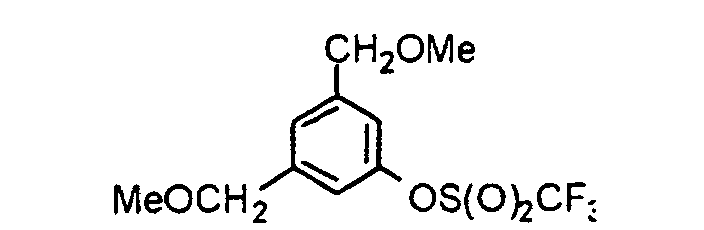
- By similar procedures as in Referential Example 3, the title compound was obtained as a colorless oil (343.9 mg, yield: 93%) from 3,5-bis(methoxymethyl)phenol (215.4 mg, 1.18 mmol).
-

- A solution of 3,4,5-triethoxybenzoic acid (20.0 g, 78.7 mmol) in acetic acid (68 mL) was stirred at 15°C, followed by the addition of concentrated nitric acid (d 1.38) (34 mL, 750 mmol). After stirred at room temperature for 1 hour, the reaction mixture was poured into ice water and then extracted with ethyl acetate. The organic layer was washed with a saturated aqueous solution of sodium-hydrogencarbonate and brine, dried over anhydrous sodium sulfate and then concentrated under reduced pressure. The residue was purified by chromatography on a silica gel column, whereby 3,4,5-triethoxy-1-nitrobenzene was obtained as a colorless oil (12.9 g, yield: 64%).
- To a solution of 3,4,5-triethoxy-1-nitrobenzene (12.9 g, 50.5 mmol) in methanol (445 mL) , 10% palladium on charcoal (6.7 g) and ammonium formate (16.2 g, 253 mmol) were added, and the resulting mixture was stirred at 70°C for 1 hour. Insoluble matter was filtered off by using Celite, and the filtrate was concentrated under reduced pressure. A solution of the residue in chloroform was washed with water and saturated brine, dried over anhydrous sodium sulfate and then concentrated under reduced pressure, whereby an oil (10.5 g) containing 3,4,5-triethoxyaniline was obtained.
- The oil (9.5 g, approx. 42.2 mmol) obtained by the above procedures was suspended in water (200 mL). Under ice cooling, concentrated sulfuric acid (7.3 mL, 88 mmol) was added to the suspension to provide a homogeneous solution. Under ice cooling, a solution of sodium nitrite (3.10 g, 44.0 mmol) in water (10 mL) was gradually added dropwise to the solution over approx. 10 minutes, and the solution was stirred for 15 minutes, followed by the addition of a solution of potassium iodide (7.70 g, 46.0 mmol) in water (10 mL). The reaction mixture was stirred at room temperature for 1 hour and at 50°C for 15 minutes, and was then extracted with ethyl acetate. The organic layer was washed with brine, dried over anhydrous sodium sulfate, and then concentrated under reduced pressure. The residue was purified by chromatography on a silica gel column, whereby 3,4,5-triethoxy-1-iodobenzene was obtained as pale yellow needles (melting point: 44.0-46.0°C)(11.60 g, yield: 75%).
- By similar procedures as in Referential Example 2, crude crystals were obtained from 3,4,5-triethoxy-1-iodobenzene (5.00 g, 14.9 mmol). The crude crystals were recrystallized from chloroform-hexane, whereby the title compound was obtained as colorless needles (melting point: 167.0-168.0°C) (1.80 g, yield: 48%).
-

- To a solution of methyl 3, 5-dihydroxy-4-methoxybenzoate [Ann. Chem., 544, 62-71 (1940)] (4.40 g, 22.2 mmol) in dimethylformamide (44.0 mL), potassium carbonate (10.20 g, 73.8 mmol) and isopropyl iodide (19.66 g, 115 mmol) were added. After stirred at 70°C for 3 hours, water was added to the reaction mixture. The resulting mixture was extracted with ethyl ether. The organic layer was dried over anhydrous sodium sulfate and then concentrated under reduced pressure. The residue was purified by chromatography on a silica gel column, whereby methyl 3,5-diisopropoxy-4-methoxybenzoate was obtained as a pale yellow oil (4.16 g, yield: 66%).
- To a solution of methyl 3,5-diisopropoxy-4-methoxy-benzoate (4.16 g, 14.7 mmol) in methanol (20 mL), a 5.0 M aqueous solution of sodium hydroxide (20.0 mL, 100 mmol) was added. After stirred at 80°C for 3 hours, the reaction mixture as concentrated under reduced pressure to remove methanol. Concentrated hydrochloric acid was added to the residue to acidify the same, and the resulting mixture was extracted with chloroform. The organic layer was washed with brine, dried over anhydrous sodium sulfate and then concentrated under reduced pressure, whereby an oil (4.00 g) containing 3,5-diisopropoxy-4-methoxybenzoic acid was obtained.
- The following synthesis procedures were conducted in accordance with the procedures of Referential Example 5. From the oil (3.70 g) obtained by the above-described procedures, 3,5-diisopropoxy-4-methoxy-1-nitrobenzene (1.70 g) was obtained as a pale yellow oil (yield: 46% based on the methyl 3,5-diisopropoxy-4-methoxybenzoate). From 3,5-diisopropoxy-4-methoxy-1-nitrobenzene (1.70g, 6.30 mmol), 1-iodo-3,5-diisopropoxy-4-methoxybenzene was obtained as a pale yellow oil (1.45 g, yield: 66%). From 1-iodo-3,5-diisopropoxy-4-methoxybenzene (700.0mg, 2.17 mmol), the title compound was obtained as colorless crystalline powder (melting point: 159.0-161.0°C) (367.0 mg, yield: 70%).
-

- To a solution of 3-hydroxy-4,5-methylenedioxybenzoic acid [Liebigs Ann. Chem., 361-364 (1994)], (3.90 g, 20.0 mmol) in dimethylformamide (20.0 mL), potassium carbonate (2.80 g, 20.0 mmol) and methyl iodide (4.30 g, 30.0 mmol) were added, and the resultant mixture was stirred at 50°C for 1 hour. Water was added to the reaction mixture, and the thus-obtained mixture was extracted with diethyl ether. The organic layer was dried over anhydrous sodium sulfate and then concentrated under reduced pressure. The residue was purified by chromatography on a silica gel column, whereby methyl 3-methoxy-4,5-methylenedioxybenzoate was obtained as a colorless viscous oil (4.30 g, yield: 98%).
- Synthesis of the title compound from methyl 3-methoxy-4,5-methylenedioxybenzoate was conducted by applying the synthesis procedures from methyl 3,5-diisopropoxy-4-methoxybenzoate to 3,5-diisopropoxy-4-methoxyphenylboric acid in Referential Example 6. From methyl 3-methoxy-4,5-methylenedioxybenzoate (4.30 g, 20.5 mmol), 3-methoxy-4,5-methylenedioxybenzoic acid (3.00 g) was obtained as colorless prisms (melting point: 215.0-216.0°C) (yield: 71%). From 3-methoxy-4,5-methylenedioxy-benzoic acid (2.50 g, 12.7 mmol), 3-methoxy-4,5-methylenedioxy-1-nitrobenzene was obtained as pale yellow amorphous powder (1.26 g, yield: 50%). From 3-methoxy-4,5-methylenedioxy-1-nitrobenzene (1.26 g, 16.4 mmol), 1-iodo-3-methoxy-4,5-methylenedioxybenzene was obtained as pale yellow crystals (melting point: 71.0-72.0°C) (1.08 g, yield: 61%). From 1-iodo-3-methoxy-4,5-methylene-dioxybenzene (750.0 mg, 2.70 mmol) , the title compound was obtained as colorless crystalline powder (melting point: 279.0-281.0°C) (347.0 mg, yield: 66%).
-

- To a solution of methyl syringate (6.00 g, 28.3 mmol) in dimethylformamide (61.0 mL), potassium carbonate (2.80 g, 20.3 mmol) and benzyl bromide (5.80 g, 33.9 mmol) were added, and the resulting mixture was stirred at 50°C for 2 hours. After the mixture was allowed to cool down, water was added, followed by the extraction of the resulting mixture with diethyl ether. The organic layer was washed with brine, dried over anhydrous sodium sulfate and then concentrated under reduced pressure, whereby an oil (7.90 g) containing methyl 4-benzyloxy-3,5-dimethoxybenzoate was obtained.
- To a solution of the oil (7.90 g) , which had been obtained by the above-described procedures, in methanol (40 mL), a 5.0 M aqueous solution of sodium hydroxide (40 mL, 200 mmol) was added. After stirred at 80°C for 30minutes, the reaction mixture was concentrated under reduced pressure to remove methanol. Concentrated hydrochloric acid was added to the residue to acidify the same, and the resulting mixture was extracted with chloroform. The organic layer was washed with brine, dried over anhydrous sodium sulfate and then concentrated under reduced pressure, whereby an oil (6.40 g) containing 4-benzyloxy-3,5-dimethoxybenzoic acid was obtained.
- To a solution of the oil (6.40 g), which had been obtained by the above-described procedures, in t-butyl alcohol (96 mL), triethylamine (2.43 g, 23. 6 mmol) and diphenylphosphoryl azide (6.40 g, 23.6 mmol) were added. After stirred at 100°C for 2 hours, the reaction mixture was concentrated under reduced pressure. A solution of the residue in ethyl acetate was washed with a saturated aqueous solution of sodium hydrogencarbonate and brine, dried over anhydrous sodium sulfate and then concentrated under reduced pressure. The residue was purified by chromatography on a silica gel column, whereby 4-benzyloxy-N-t-butoxycarbonyl-3,5-dimethoxyaniline was obtained as a colorless oil (4.56 g, yield: 44% based on the methyl syringate).
- To a solution of 4-benzyloxy-N-t-butoxycarbonyl-3,5-dimethoxyaniline (590.0 mg, 1.64 mmol) in methanol (2.0 mL), a 4.0 M ethyl acetate solution of hydrogen chloride (2.0 mL, 8.0 mmol) was added, and the resulting mixture was stirred at 50°C for 1 hour. The reaction mixture was concentrated under reduced pressure, a 8.0 M aqueous solution of sodium hydroxide (1.5 mL, 12 mmol) was added to the residue, and the thus-obtained mixture was extracted with chloroform. The organic layer was washed with brine, dried over anhydrous sodium sulfate and then concentrated under reduced pressure, whereby an oil (426.0 mg) containing 4-benzyloxy-3,5-dimethoxyaniline was obtained.
- Synthesis of the title compound from the oil obtained by the above-described procedures was conducted by applying the synthesis procedures from the oil, which contained 3,4,5-triethoxyaniline, into 3,4,5-triethoxyphenylboric acid in Referential Example 5. From the oil (426.0 mg, approx. 1.64 mmol) obtained by the above-described procedures, 4-benzyloxy-1-iodo-3,5-dimethoxybenzene was obtained as a colorless oil (447.0 mg, yield: 73% based on the 4-benzyloxy-N-t-butoxycarbonyl-3,5-dimethoxyaniline). From 4-benzyloxy-1-iodo-3,5-dimethoxybenzene (447.0mg, 1.21 mmol), the title compound was obtained as colorless crystalline powder (melting point: 180.0-183.0°C) (87.0 mg, yield: 25%).
-

- To a solution of 4-bromo-3,5-dimethoxybenzoic acid [Acta Chem. Scand., 2, 34-41, (1948)] (22.6 g, 86. 6 mmol) in methylene chloride (400 mL), dimethylformamide (1.5 mL, 19.4 mmol) was added. Under ice cooling, oxalyl chloride (13.0 g, 102.0 mmol) was gradually added to the solution, and the resulting mixture was stirred at room temperature for 1 hour and 30 minutes. The reaction mixture was concentrated under reduced pressure, whereby crude crystals of 4-bromo-3,5-dimethoxybenzoyl chloride were obtained. To an ice-cooled solution of 2-amino-2-methylpropanol (8.40 g, 94.2 mmol) in methylene chloride (100 mL), N,N-diisopropylethylamine (16.6 mL, 95.3 mmol) and a solution of the crude 4-bromo-3,5-dimethoxytbenzoyl chloride in methylene chloride (200 mL) were added. After the thus-obtained mixture was stirred at room temperature for 10 minutes, the mixture was washed successively with water, 8.0 M hydrochloric acid, a saturated aqueous solution of sodium hydrogencarbonateand brine,dried over anhydroussodium sulfate, and then concentrated under reduced pressure. Thionyl chloride (47.5 mL, 651.0 mmol) was added to the residue, and the resulting mixture was stirred at room temperature for 10 minutes. To the reaction mixture, ice water and an 2.5 M aqueous solution of sodium hydroxide (600 mL, 1500 mmol) were added, and the thus-obtained mixture was extracted with diethyl ether. The organic layer was washed with brine, dried over anhydrous sodium sulfate, and then concentrated under reduced pressure. The residue was recrystallized form diethyl ether-hexane, whereby 2-(4-bromo-3,5-dimethoxyphenyl)-4,4-dimethyl-2-oxazoline was obtained as colorless fine needles (melting point: 172.5 to 174.5°C) (20.9 g, yield: 77%).
- Under an argon gas atmosphere, N,N,N',N'-tetramethyl-ethylenediamine (30.0mL, 0.199mol) and a 1.59 M hexane solution of n-butyl lithium (134.0 mL, 0.213 mol) were added dropwise to a solution of 2-(4-bromo-3,5-dimethoxyphenyl)-4,4-dimethyl-2-oxazoline (51.43 g, 0.164 mmol) in anhydrous tetrahydrofuran (1000 mL) which was held under stirring in a dry ice-methanol bath. After stirred for 10 minutes, dimethyl disulfide (18. 0 mL, 0.200 mmol) was added. After stirred further for 1 hour, water was added to the reaction mixture, the organic solvent was removed by concentration under reduced pressure, and the residue was extracted with diethyl ether. The organic layer was washed with brine, dried over anhydrous sodium sulfate and then concentrated under reduced pressure. The residue was recrystallized form diethyl ether-hexane, whereby 2-(4-methylthio-3,5-dimthoxyphenyl)-4,4-dimethyl-2-oxazolin e was obtained as colorless fine needles (melting point: 82.5 to 84.5°C) (34.80 g, yield: 76%).
- A solution of 2-(4-methylthio-3,5-dimethoxyphenyl)-4,4-dimethyl-2-oxazoline (34.70 g, 0.123 mmol) in 3.0 M hydrochloric acid (450 mL) was stirred at 100°C for 3 hours, and the reaction mixture was extracted with methanol-chloroform (1:10). The organic layer was washedwithbrine, dried over anhydrous sodium sulfate, and then concentrated under reduced pressure. To a solution of the residue in methanol (50 mL), a 2.5 M aqueous solution of sodiumhydroxide (100mL, 0.25mol) was added, andthe resulting mixture was stirred at 100°C for 1 hour. Under ice cooling, concentrated hydrochloric acid was added to the reaction mixture to acidify the same, and the mixture was extracted with methanol-chloroform (1:10). The organic layer was washed with brine, dried over anhydrous sodium sulfate and then concentrated under reduced pressure, whereby an oil (30.72 g) containing 3,5-dimethoxy-4-methylthiobenzoic acid was obtained.
- Synthesis of the title compound from the oil obtained by the above-described procedures was conducted by applying the synthesis procedures from the oil, which contained 4-benzyloxy-3,5-dimethoxybenzoic acid, into 4-benzyloxy-3,5-dimethoxyphenylboric acid in Referential Example 8. Fromtheoil (30.72g) obtained by the above-described procedures, N-t-butoxycarbonyl-3,5-dimethoxy-4-methylthioaniline was obtained as colorless fine crystals (melting point: 123.5-125.5°C) [26.33 g, yield: 71% based on 2-(4-methylthio-3,5-dimethoxyphenyl)-4,4-dimethyl-2-oxazoline]. From N-t-butoxycarbonyl-3,5-dimethoxy-4-methylthioaniline (12.74 g, 42.6 mmol), 1-iodo-3,5-dimethoxy-4-methylthiobenzene was obtained as brown crystalline powder (melting point: 103.0-104.0°C) (8.90 g, yield: 67%). From 1-iodo-3,5-dimethoxy-4-methylthiobenzene (6.90 g, 22.2 mmol), the title compound was obtained as colorless crystalline powder (melting point: 262.0-265.0°C) (4.10 g, yield: 82%).
-

- Under ice cooling, a solution of sodium nitrite (97.0 mg, 1.40 mmol) in water (2.0 mL) was added dropwise to a suspension of 4-bromo-2,6-dimethoxyaniline [Z. Naturforsch., B24(5), 524-527 (1969)] (232.0 mg, 1.00 mmol) in 6.0 M hydrochloric acid (2.5 mL). After the resulting mixture was stirred under ice cooling for 30 minutes, a solution of cupric chloride (495.0 mg, 5.00 mmol) in concentrated hydrochloric acid (2.0 mL) was added. The reaction mixture was stirred at room temperature for 30 minutes and then at 100°C for 2 hours, and was then extracted with ethyl acetate. The organic layer was washed with a saturated aqueous solution of sodium hydrogencarbonate and water, dried over anhydrous sodium sulfate, and then concentrated under reduced pressure. The residue was purified by chromatography on a silica gel column, whereby 1-bromo-4-chloro-3,5-dimethoxybenzene was obtained as colorless amorphous powder (230.0 mg, yield: 92%).
- By similar procedures as in Referential Example 2, crude crystals were obtained from 1-bromo-4-chloro-3,5-dimethoxy-benzene (160.0mg, 0.630mmol). The crude crystals were purified by chromatography on a silica gel column, whereby the title compound was obtained as colorless amorphous powder (90.0 mg, yield: 66%).
-

- Following the procedures of the synthesis of 3,4,5-triethoxy-1-iodobenzene from the oil containing 3,4,5-triethoxyaniline in Referential Example 5, 1-iodo-3,5-dimethoxy-4-methylbenzene was obtained as pale yellow amorphous powder (7.59 g, yield: 87%) from 3,5-dimethoxy-4-methylanilin [J. Chem. Soc., 497-506 (1963)] (5.23 g, 31.3 mmol).
- To a solution of 1-iodo-3,5-dimethoxy-4-methylbenzene (8.05 g, 28.9 mmol) in pyridine (83 mL), potassium permanganate (27.4 g, 173.4 mmol) was added, and the resulting mixture was stirred at room temperature for 30 minutes and then at 50°C for 2 hours. Insoluble matter was filtered off by using Celite, and the residue was washed with a 0.1 M aqueous solution of sodium hydroxide. The filtrate and the washing were combined, followed by extraction with diethyl ether. Concentrated hydrochloric acid was added to the water layer to acidify the same, and the thus-obtained mixture was extracted with chloroform. The organic layer was washed with brine, dried over anhydrous sodium sulfate, and then concentrated under reduced pressure. The residue was suspended in hexane and filtration was then conducted, whereby 4-iodo-2,6-dimethoxybenzoic acid (5.57 g) was obtained as pale brown crystalline powder (melting point: 197.5-204.0°C) (5.57 g, yield: 63%).
- Under ice cooling, dimethylformamide (15 mg, 0.21 mmol) and oxalyl chloride (0. 90 mL, 9.8 mmol) were added to a solution of 4-iodo-2,6-dimethoxybenzoic acid (2.00 g, 6.50 mmol) in methylene chloride (10 mL). The resulting mixture was stirred for 20 minutes, followed by the addition of concentrated aqueous ammonia (20 mL, 450 mmol). The reaction mixture was stirred at room temperature for 20 minutes and then concentrated under reduced pressure, whereby an oil (2.00 g) containing 4-carbamoyl-1-iodo-3,5-dimethoxybenene was obtained.
- To a solution of the oil (2 .00 g) , which had been obtained by the above-described procedures, in tetrahydrofuran (20 mL), carbon tetrachloride (10.0 mL, 104 mmol) and triphenylphosphine (3.50 g, 13.00mmol) were added. The reactionmixture was stirred at 50°C for 20 hours, and then concentrated under reduced pressure. The residue was purifiedby chromatography on a silica gel column, whereby 4-cyano-1-iodo-3,5-dimethoxy-benzene was obtained as a colorless oil (1.55 g, yield: 82% based on the 4-iodo-2,6-dimethoxybenzoic acid).
- Following the procedures of Referential Example 2, the title compound was obtained as colorless amorphous powder (360.0 mg, yield: 72%) from 4-cyano-1-iodo-3,5-dimethoxy-benzene (700.0 mg, 2.42 mmol).
-

- To a solution of 3, 5-dimethoxyphenol (6.73 g, 43.7 mmol) in anhydrous dimethylformamide (50 mL), imidazole (5. 95 g, 87.4 mmol) and t-butylchlorodiphenylsilane (15.0 g, 54.6 mmol) were added, followed by stirring at 50°C for 4 hours. Water was added to the reaction mixture, and the resulting mixture was extracted with ethyl acetate-hexane (1:2). The organic layer was washed with water, dried over anhydrous sodium sulfate, and then concentrated under reduced pressure. The residue was purified by chromatography on a silica gel column, whereby 1-t-butyldiphenylsiloxy-3,5-dimethoxybenzene was obtained as colorless crystalline powder (melting point: 95.5-96.5°C) (16.14 g, yield: 94%).
- Under a nitrogen gas atmosphere, a 1.60 M hexane solution of n-butyl lithium (31 mL, 49 mmol) was added to a solution of 1-t-butyldiphenylsiloxy-3,5-dimethoxybenzene (14.68 g, 39.0 mmol) in anhydrous diethyl ether (200 mL) which was held under stirring in an ice bath. The reaction mixture was stirred at 35°C for 3 hours and was again cooled in the ice bath, followed by the addition of dimethylformamide (9.21 mL, 119.4 mmol). After stirred at room temperature for 1 hour, a saturate aqueous solution of ammonium chloride was added, and the resulting mixture was extracted with diethyl ether. The organic layer was dried over anhydrous magnesium sulfate, and then concentrated under reduced pressure. The residue was purified by chromatography on a silica gel column, whereby 4-t-butyldiphenylsiloxy-2,6-dimethoxybenzaldehyde was obtained as colorless crystalline powder (melting point: 177.5-120.0°C) (6.77 g, yield: 41%).
- Under ice cooling, sodium borohydride (519.0 mg, 13.73 mmol) was added to a solution of 4-t-butyldiphenylsiloxy-2,6-dimethoxybenzaldehyde (3.85 g, 9.15 mmol) in tetrahydrofuran (40 mL) , and the resulting mixture was stirred at room temperature for 2 hours and 30 minutes. Water was added to the reaction mixture, and the thus-obtained mixture was extracted with ethyl acetate. The organic layer was washed with brine, dried over anhydrous sodium sulfate and then concentrated under reduced pressure, whereby crude 4-t-butyldiphenylsiloxy-2,6-dimethoxybenzyl alcohol was obtained as colorless crystalline powder (melting point: 127.5-129.0°C) (4.01 g).
- To a solution of the crude 4-t-butyldiphenylsiloxy-2, 6-dimethoxybenzyl alcohol (4. 01 g), which had been obtained by the above-described procedures, in anhydrous dimethyl-formamide (30 mL), imidazole (1.29 g, 18.98 mmol) and t-butylchlorodimethylsilane (1.79g, 11.86 mmol) were added. After stirred at 50°C for 4 hours, water was added and the resulting mixture was extracted with ethyl acetate-hexane (1:2). The organic layer was washed with water, dried over anhydrous sodium sulfate and then concentrated under reduced pressure, whereby crude 4-(t-butyldimethylsiloxy)methyl-1-t-butyl-diphenylsiloxy-3, 5-dimethoxybenzene was obtained as colorless amorphous powder (5.33 g).
- To a solution of the crude 4-(t-butyldimethyl-siloxy)methyl-1-t-butyldiphenylsiloxy-3, 5-dimethoxybenzene (5.33 g), which had been obtained by the above-described procedures, in tetrahydrofuran (60 mL), a 1.0 M tetrahydrofuran solution of tetrabutylammonium fluoride (9.9 mL, 9.9 mmol) was added, After stirred at room temperature for 5 minutes, brine was added and the thus-obtained mixture was extracted with ethyl acetate. The organic layer was dried over magnesium sulfate and then concentrated under reduced pressure. The residue was purifiedby chromatography on a silica gel column, whereby 4-(t-butyldimethylsiloxy)methyl-3,5-dimethoxyphenol was obtained as colorless amorphous powder (1.93 g, yield: 75% based on the 4-(t-butyldiphenylsiloxy-2,6-dimethoxybenzaldehyde).
- Following the procedures procedures of Referential Example 3, the title compound was obtained as colorless amorphous powder from 4-(t-butyldimethylsiloxy)methyl-3,5-dimethoxy-phenol (1.93 g, 6.79 mmol)(1.57 g, yield: 54%).
-

- To a solution of 4-iodo-2, 6-dimethoxybenzoic acid (603.0 mg, 1.96 mmol), which had been synthesized by the process described in Referential Example 11, in methylene chloride (12 mL) , dimethylformamide (0.020 mL, 0.26 mmol) and oxalyl chloride (0.26mL, 3.0mmol) wereadded. After stirred at room temperature for 30 minutes, the resulting solution was poured into a solution of triethylamine (0.50 mL, 3.6 mmol) in ethanol (10 mL). The reaction mixture was stirred at room temperature for 30 minutes and then concentrated under reduced pressure. A solution of the residue in diethyl ether was washed successively with water, 0.1 M hydrochloric acid and brine, dried over anhydrous sodium sulfate, and then concentrated under reduced pressure. The residue was purified by chromatography on a silica gel column, whereby the title compound was obtained as a colorless oil (641.0 mg, yield: 97%).
-

- Following the procedures of in Referential Example 13, crude 4-t-butoxycarbonyl-1-iodo-3,5-dimethoxybenzene was obtained as colorless amorphous powder (2.33 g) from 4-iodo-2,6-dimethoxybenzoic acid (2.40 g, 7.79 mmol).
- Following the procedures of Referential Example 2, an oil was obtained from the crude 4-t-butoxycarbonyl-1-iodo-3,5-dimethoxybenzene (1.99 g, approx. 5.48 mmol) obtained by the above-described procedures. Diethyl ether-hexane was added to the oil and the resulting precipitate was collected by filtration, whereby the title compound was obtained as colorless crystalline powder (melting point: ≥300.0°C)(1.06 g, yield: 56% based on the 4-iodo-2,6-dimethoxybenzoic acid).
-

- Under a nitrogen gas atmosphere, a solution of the 1-t-butyldiphenylsiloxy-3,5-dimethoxybenene (7.85 g, 22.0 mmol) , which had been synthesized by the process described in Referential Example 12, in anhydrous diethyl ether (80 mL) was stirred in an ice bath, followed by the addition of a 1.59 M hexane solution of n-butyl lithium (16.6 mL, 26. 6 mmol). After the reactionmixture was stirred at 35°C for 1 hour and 30minutes, it was again stirred in the ice bath, followed by the addition of acetyl chloride (2. 34 mL, 33.0 mmol). The resulting mixture was stirred at room temperature for 30 minutes, followed by the addition of a saturated aqueous solution of ammonium chloride. The mixture so obtained was extracted with diethyl ether. The organic layer was washed with water, dried over anhydrous magnesium sulfate, and then concentrated under reducedpressure. The residue was purifiedby chromatography on a silica gel column, whereby 4-t-butyldiphenylsiloxy-2,6-dimethoxy-acetophenone was obtained as a colorless oil (2.07 g, yield: 22%).
- To a solution of 4-t-butyldiphenylsiloxy-2,6-dimethoxyacetophenone (2.07 g, 4.76 mmol) in tetrahydrofuran (42 mL), a 1.0 M tetrahydrofuran solution of tetrabutylammonium fluoride (5.2 mL, 5.2 mmol) was added. The reaction mixture was stirred at room temperature for 5 minute and then concentrated under reduced pressure. A solution of the residue in methylene chloride (63 mL) was stirred in a dry ice-methanol bath. Subsequent to the addition of N,N-diisopropylethylamine (2.1 mL, 12 mmol), trifluoromethanesulfonic acid anhydride (1.2 mL, 7.1 mmol) was gradually added dropwise. The reaction mixture was stirred for 30 minutes in the dry ice-methanol bath, washed with 1.0 M hydrochloric acid and brine, dried over anhydrous sodium sulfate, and then concentrated under reduced pressure. The residue was purified by chromatography on a silica gel column, whereby the title compound was obtained as a colorless oil (11.21 g, yield: 78%).
-

- Under a nitrogen gas atmosphere, phenylboric acid (130.0 mg, 1.07 mmol), tetrakis(triphenylphosphine)palladium (56.0 mg, 0.050 mmol) and a 2.0 M aqueous solution of potassium carbonate (0.5 mL, 1.0 mmol) were added to a solution of the 1,4-bis(5-bromo-2-pyridyl)hexahydro-1,4-diazepine (200 mg, 0.585 mmol) , which had been synthesized in Referential Example 1, in ethanol-toluene (2. 0 mL-2. 0 mL), and the resulting mixture was stirred at 80°C for 3 hours. After the reaction mixture was allowed cool down, the organic layer was collected and the water layer was extracted with chloroform. Those organic layers were combined, dried over anhydrous sodium sulfate, and then concentrated under reduced pressure. The residue was purified by chromatography on a silica gel column, and crude crystals were obtained. The crude crystals were recrystallized from chloroform-hexane, whereby the title compound was obtained as slightly yellow needles (melting point: 221.0-222.0°C) (61.0 mg, yield: 31%).
1H-NMR (CDCl3) δ: 2.17(tt,J=6.3,6.3Hz,2H), 3.65(dd,J=6.3,6.3Hz,4H), 3.96(s,4H), 6.64(d,J=8.8Hz,2H), 7.30(t,J=7.3Hz,2H), 7.42(t,J=7.3Hz,4H), 7.52(d,J=7.3Hz,4H), 7.70(dd,J=2.4,8.8Hz,2H), 8.43(d,J=2.4Hz,2H). -

- Following the procedures of Example 1, crude crystals were obtained from 1,4-bis(5-bromo-2-pyridyl)hexahydro-1,4-diazepine (206.0 mg, 0.500 mmol) synthesized in Referential Example 1 and 2-methoxyphenylboric acid (182.0 mg, 1.20 mmol). The crude crystals were recrystallized from methylene chloride-hexane, whereby the title compound was obtained as slightly yellow needles (melting point: 161.0-162.0°C) (215.0 mg, yield: 92%).
1H-NMR (CDCl3) δ: 2.16(tt,J=6.0,6.0Hz,2H), 3.64(dd,J=6.0,6.0Hz,4H), 3.83(s,6H), 3.95(s,4H), 6.60(d,J=8.7Hz,2H), 6.65-7.06(m,4H), 7.28-7.33(m,4H), 7.69(dd,J=2.4,8.7Hz,2H), 8.36(d,J=2.4Hz,2H). -

- Following the procedures of Example 1, crude crystals were obtained from 1,4-bis(5-bromo-2-pyridyl)hexahydro-1,4-diazepine (206.0 mg, 0.500 mmol) synthesized in Referential Example 1 and 3-methoxyphenylboric acid (182.0 mg, 1.20 mmol). The crude crystals were recrystallized from methylene chloride-hexane, whereby the title compound was obtained as slightly yellow scales (melting point: 146.0-149.0°C) (121.0 mg, yield: 52%).
1H-NMR (CDCl3) δ: 2.16(tt,J=6.0,6.0Hz,2H), 3.63(dd,J=6.0,6.0Hz,4H), 3.85(s,6H), 3.95(s,4H), 6.62(d,J=8.7Hz,2H), 6.84(ddd,J=1.9,2.4,8.0Hz,2H), 7.05(dd,J=1.9,2.4Hz,2H), 7.15(ddd,J=2.4,2.4,7.8Hz,2H), 7.33(dd,J=7.8,8.0Hz,2H), 7.68(dd,J=2.4,8.7Hz,2H), 8. 42 (d, J=2.4Hz,2H). -

- Following the procedures of Example 1, crude crystals were obtained from 1,4-bis(5-bromo-2-pyridyl)hexahydro-1,4-diazepine (206.0 mg, 0.500 mmol) synthesized in Referential Example 1 and 4-methoxyphenylboric acid (182.0 mg, 1.20 mmol). The crude crystals were recrystallized from chloroform-hexane, whereby the title compound was obtained as pale yellow needles (melting point: 254.0-256.0°C) (98.0 mg, yield: 42%).
1H-NMR (CDCl3) δ: 2.16(tt,J=6.0,6.0Hz,2H), 3.62(dd,J=6.0,6.0Hz,4H), 3.84(s,6H), 3.94(s,4H), 6.61(d,J=8.7Hz,2H), 6.96(d,J=8.7Hz,4H), 7.43(d,J=8.7Hz,4H), 7.64(dd,J=2.4,8.7Hz,2H), 8.37(d,J=2.4Hz,2H). -

- Following the procedures of Example 1, crude crystals were obtained from the 1,4-bis(5-bromo-2-pyridyl)hexahydro-1,4-diazepine (206.0 mg, 0.500 mmol) synthesized in Referential Example 1 and 4-methylthiophenylboric acid (202.0 mg, 1.20 mmol). The crude crystals were recrystallized from chloroform-hexane, whereby the title compound was obtained as pale yellow needles (melting point: 252.0-255.0°C)(109.0 mg, yield: 43%).
1H-NMR (CDCl3) δ: 2.16(tt,J=6.0,6.0Hz,2H), 2.51(s,6H), 3.63(dd,J=6.0,6.0Hz,4H), 3.94(s,4H), 6.61(d,J=8.7Hz,2H), 7.31(d,J=8.2Hz,4H), 7.43(d,J=8.2Hz,4H), 7.66(dd,J=2.4,8.7Hz,2H), 8.40(d,J=2.4Hz,2H). -

- Following the procedures of Example 1, crude crystals were obtained from the 1,4-bis(5-bromo-2-pyridyl)hexahydro-1,4-diazepine (206.0 mg, 0.500 mmol) synthesized in Referential Example 1 and 4-methylphenylboric acid (163.0 mg, 1.20 mmol). The crude crystals were recrystallized from chloroform-hexane, whereby the title compound was obtained as pale yellow needles (melting point: 245.0-247.0°C) (93.0 mg, yield: 42%).
1H-NMR (CDCl3) δ: 2.16(tt,J=6.0,6.0Hz,2H), 2.38(s,6H), 3.63(dd,J=6.0.6.0Hz,4H), 3.94(s,4H), 6.62(d,J=8.7Hz,2H), 7.22(d,J=8.0Hz,4H), 7.41(d,J=8.0Hz,4H), 7.67(dd,J=2.4,8.7Hz,2H), 8.40(d,J=2.4Hz,2H). -

- Following the procedures of Example 1, crude crystals were obtained from the 1,4-bis(5-bromo-2-pyridyl)hexahydro-1,4-diazepine (206.0 mg, 0.500 mmol) synthesized in Referential Example 1 and 4-t-butylphenylboric acid (226.0 mg, 1.20 mmol). The crude crystals were recrystallized from chloroform-hexane, whereby the title compound was obtained as colorless needles (melting point: 268.0-270.0°C) (117.0 mg, yield: 42%).
1H-NMR (CDCl3) δ: 1.35(s,18H), 2.17(tt,J=6.0,6.0Hz,2H), 3.64(dd,J=6.0,6.0Hz,4H), 3.96(s,4H), 6.63(d,J=8.7Hz,2H), 7.45(s,8H), 7.67(dd,J=2.4,8.7Hz,2H), 8.42(d,J=2.4Hz,2H). -
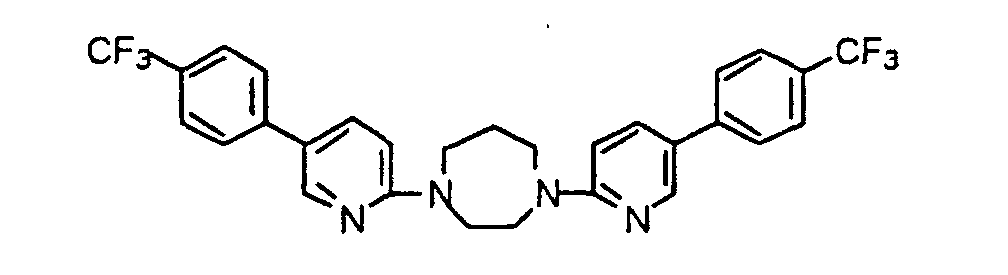
- Following the procedures of Example 1, crude crystals were obtained from the 1,4-bis(5-bromo-2-pyridyl)hexahydro-1,4-diazepine (206.0 mg, 0.500 mmol) synthesized in Referential Example 1 and 4-trifluoromethylphenylboric acid (227.0 mg, 1.20 mmol). The crude crystals were recrystallized from chloroform-hexane, whereby the title compound was obtained as colorless needles (melting point: 236.0-238.0°C) (110.0 mg, yield: 40%).
1H-NMR (CDCl3) δ: 2.16(tt,J=6.0,6.0Hz,2H), 3.66(dd,J=6.0,6.0Hz,4H), 3.97(s,4H), 6.65(d,J=8.7Hz,2H), 7.60(d,J=8.5Hz,4H), 7.66(d,J=8.5Hz,4H), 7.70(dd,J=2.4,8.7Hz,2H), 8.43(d,J=2.4Hz,2H). -
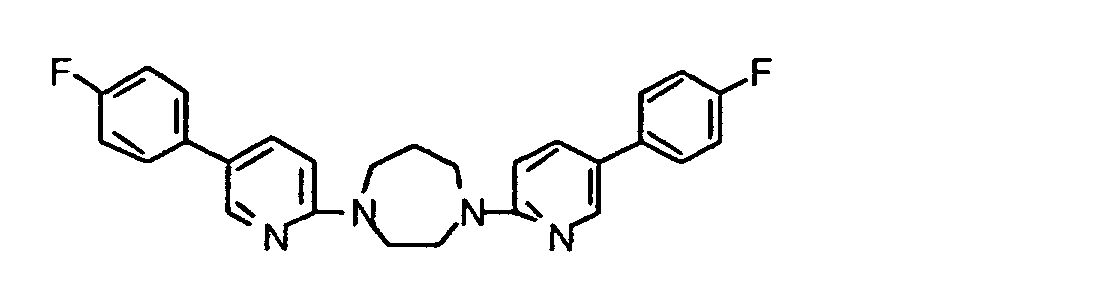
- Following the procedures of Example 1, crude crystals were obtained from 1,4-bis(5-bromo-2-pyridyl)hexahydro-1,4-diazepine (206.0 mg, 0.500 mmol) synthesized in Referential Example 1 and 4-fluorophenylboric acid (168.0 mg, 1.20 mmol). The crude crystals were recrystallized from chloroform-hexane, whereby the title compound was obtained as colorless needles (melting point: 268.0-270.0°C) (115.0 mg, yield: 52%).
1H-NMR (CDCl3) δ: 2.16(tt,J=6.0,6.0Hz,2H), 3.64(dd,J=6.0,6.0Hz,4H), 3.95(s,4H), 6. 62 (d, J=8.7Hz, 2H), 7.10(dd, J=8.7Hz, 3JHF=8.7Hz, 4H) , 7.45(dd,J=8.7Hz, 4JHF=5.3Hz, 4H), 7.63(d,J=2.4,8.7Hz,2H), 8.36(d,J=2.4Hz,2H). -

- Following the procedures of Example 1, crude crystals were obtained from 1,4-bis(5-bromo-2-pyridyl)hexahydro-1,4-diazepine (206.0 mg, 0.500 mmol) and 4-chlorophenylboric acid (188.0 mg, 1.20 mmol). The crude crystals were recrystallized from chloroform-hexane, whereby the title compound was obtained as colorless needles (melting point: 245.0-247.0°C) (105.0 mg, yield: 44%).
1H-NMR (CDCl3) δ: 2.15(tt,J=6.0,6.0Hz,2H), 3.63(dd,J=6.0,6.0Hz,4H), 3.95(s,4H), 6.62(d,J=8.7Hz,2H), 7.37(d,J=8.2Hz,4H), 7.43(d,J=8.2Hz,4H), 7.64(dd,J=2.4,8.7Hz,2H), 8.38(d,J=2.4Hz,2H). -

- Following the procedures of Example 1, 1,4-bis[5-(2,3-dimethoxyphenyl)-2-pyridyl]hexahydro-1,4-dia zepine was obtained as a colorless oil (28.0 mg, yield: 26%) from 1,4-bis(5-bromo-2-pyridyl)hexahydro-1,4-diazepine (82.0 mg,0.200 mmol) synthesized in Referential Example 1 and 2,3-dimethoxyphenylboric acid [Bull. Soc. Chim. Fr., 767-769 (1973)] (146.0 mg, 0.800 mmol) synthesized in a similar manner as in Referential Example 2.
- To a solution of 1,4-bis[5-(2,3-dimethoxyphenyl)-2-pyridyl]hexahydro-1,4-dia zepine (28.0 mg)(0.053 mmol) in chloroform (3.0 mL), a 1.0 M methanol solution of methane-sulfonic acid (0.11 mL, 0.11 mmol) was added, and the reaction mixture was concentrated under reduced pressure. The residue was recrystallized from methylene chloride-methanol-diethyl ether, whereby the title compound was obtained as pale brown crystalline powder (melting point: 199.5-202.0°C)(32.3 mg, yield: 86%).
1H-NMR (CDCl3) (ammonium salt NH+ protons were not observed) δ: 1.85-2.43(m,2H), 2.90(s,6H), 3.69(s,6H), 3.90(s,6H), 3.95-4.10(m,4H), 4.31(s,4H), 6.88(br.d,J=6.0Hz,2H), 6.97(br.d,J=6.0Hz,2H), 7.11(br.dd,J=6.0Hz,6.0Hz,2H), 7.26(br.d,J=7.6Hz,2H), 8.20(br.d,J=7.6Hz,2H), 8.35(br.s,2H). -

- Following the procedures of Example 1, crude crystals were obtained from 1,4-bis(5-bromo-2-pyridyl)hexahydro-1,4-diazepine (206.0 mg,0.500 mmol) synthesized in Referential Example 1 and 2,4-dimethoxyphenylboric acid (218.0 mg, 1.20 mmol). The crude crystals were recrystallized from chloroform-hexane, whereby the title compound was obtained as colorless needles (melting point: 161.0-163.0°C) (206.0 mg, yield: 78%).
1H-NMR (CDCl3) δ: 2.15(tt,J=6.0,6.0Hz,2H), 3.63(dd,J=6.0,6.0Hz,4H), 3.80(s,6H), 3.84(s,6H), 3.93(s,4H), 6.54-6.57(m,4H), 6.58(d,J=8.7Hz,2H), 7.21(d,J=9.0Hz,2H), 7.64(dd,J=2.4,8.7Hz,2H), 8.30(d,J=2.4Hz,2H). -

- Following the procedures of Example 1, an oil was obtained from 1,4-bis(5-bromo-2-pyridyl)hexahydro-1,4-diazepine (100.0 mg, 0.240 mmol) synthesized in Referential Example 1 and 2,4-dimethoxyphenylboric acid (Chem. Abs. 123, pr256679r.) (150.0 mg, 1.00 mmol). Methanol-chloroform-hexane was added to the oil, and the resulting precipitate was collected by filtration, whereby the title compound was obtained as pale yellow crystalline powder (melting point: ≥300.0°C) (24.0 mg, yield: 19%).
1H-NMR [CD3-CDCl3(1:19)] δ: 2.16(tt,J=6.1,6.1Hz,2H), 3.67(dd,J=6.1,6.1Hz,4H), 3.77(s,12H), 3.92(s,4H), 6.64(d,J=8.7Hz,2H), 6.66(d,J=8.5Hz,4H), 7.26(t,J=8.5Hz,2H), 7.54(dd,J=2.2,8.7Hz,2H), 8.15(d,J=2.2Hz,2H). -

- Following the procedures of Example 1, crude crystals were obtained from 1,4-bis(5-bromo-2-pyridyl)hexahydro-1,4-diazepine (206.0 mg, 0.500 mmol) synthesized in Referential Example 1 and 3,4-dimethoxyphenylboric acid (218.0 mg, 1.20 mmol). The crude crystals were recrystallized from chloroform-hexane, whereby the title compound was obtained as pale yellow needles (melting point: 190.0-192.0°C) (129.0 mg, yield: 48%).
1H-NMR (CDCl3) δ: 2.16(tt,J=6.0,6.0Hz,2H), 3.63(dd,J=6.0,6.0Hz,4H), 3.91(s,6H), 3.93(s,6H), 3.95(s,4H), 6.62(d,J=8.7Hz,2H), 6.93(d,J=8.2Hz,2H), 7.02(d,J=1.9Hz,2H), 7.05(dd,J=1.9,8.2Hz,2H), 7.65(dd,J=2.4,8.7Hz,2H), 8.39(d,J=2.4Hz,2H). -

- Following the procedures of Example 1, crude crystals were obtained from 1,4-bis(5-bromo-2-pyridyl)hexahydro-2,4-diazepine (206.0 mg,0.500 mmol) synthesized in Referential Example 1 and 3,4-methylenedioxyphenylboric acid (199.0 mg, 1.20 mmol). The crude crystals were recrystallized from chloroform-hexane, whereby the title compound was obtained as pale yellow needles (melting point: 235.0-237.0°C) (105.0 mg, yield: 42%).
1H-NMR (CDCl3) δ: 2.15(tt,J=6.0,6.0Hz,2H), 3.62(dd,J=6.0,6.0Hz,4H), 3.93(s,4H), 5.98(s,4H), 6.59(d,J=8.7Hz,2H), 6.86(d,J=8.0Hz,2H), 6.95(dd,J=1.7,8.0Hz,2H), 6.98(d,J=1.7Hz,2H), 7.60(dd,J=2.4,8.7Hz,2H), 8.32(d,J=2.4Hz,2H). -

- Following the procedures of Example 1, 1,4-bis[5-(3,5-dimethoxyphenyl)-2-pyridyl]hexahydro-1,4-dia zepine was obtained as a colorless oil (89.0 mg, yield: 71%) from 1,4-bis(5-bromo-2-pyridyl)hexahydro-1,4-diazepine (100.0 mg, 0.240 mmol) synthesized in Referential Example 1 and 3, 5-dimethoxyphenylboric acid (79. 0 mg, 0.530 mmol) synthesized in a similar manner as in Referential Example 2.
- To a solution of 1,4-bis[5-(3,5-dimethoxyphenyl)-2-pyridyl]hexahydro-1,4-dia zepine (89.0mg) (0.170 mmol) inmethanol (5.0mL), a 1.0M aqueous solution of methanesulfonic acid (0. 34 mL, 0.34 mmol) was added, and the reactionmixturewas concentrated under reducedpressure. Ethanol (5.0 mL) was added to the residue, and the resulting mixture was concentrated under reduced pressure. The residue was recrystallized from methanol-diethyl ether, whereby the title compound was obtained as pale yellow crystalline powder (melting point: 181.0-183.0°C)(81.0 mg, yield: 66%).
1H-NMR (CDCl3) (ammonium salt NH+ protons were not observed) δ: 2.35-2.45(m,2H), 2.91(s,6H), 3.81(s,12H), 3.95-4.10(m,4H), 4.31(s,4H), 6.47(t,J=2.2Hz,2H), 6.55(d,J=2.2Hz,4H), 7.34(d,J=9.6Hz,2H), 8.12(dd,J=2.2,9.6Hz,2H), 8.36(d,J=2.2Hz,2H). -

- Under a nitrogen gas atmosphere, bis(picolato)diboron (223.0 mg, 0.880 mmol), dichloro[1,1'-bis(diphenyl-phosphino)ferrocene]palladium(II ) dichloromethane complex (1:1) (19.6 mg, 0.024 mmol), 1,1'-bis(diphenylphosphino)-ferrocene (13.3 mg, 0.024 mmol) and potassium acetate (236.0 mg, 2.40 mmol) were added to a solution of 3,5-diethoxyphenyl trifluoromethanesulfonate (WO99/41224) (251.0 mg, 0.800 mmol) in dimethylformamide (6.5 mL) , and the resulting mixture was stirred at 80°C for 12 hours. To the reaction mixture, 1,4-bis(5-bromo-2-pyridyl)hexahydro-1,4-diazepine (110.0 mg, 0.270 mmol) synthesized by the process described in Referential Example 1, dichloro[1,1'-bis(diphenylphosphino)ferrocene]-palladium(II ) dichloro-methane complex (1:1) (19.6 mg, 0.024 mmol) and a 2.0 M aqueous solution of sodium carbonate (2.0 mL, 4.0 mmol) were added. The resulting mixture was stirred at 80°C for 1 hour. Water was added to the reaction mixture, followed by extraction with diethyl ether. The organic layer was dried over anhydrous sodium sulfate and then concentrated under reduced pressure. The residue was purifiedby chromatography on a silica gel column, whereby the title compound was obtained as colorless amorphous powder (70.0 mg, yield: 45%).
1H-NMR (CDCl3) δ: 1.43(t,J=7.0Hz,12H), 2.16(tt,J=6.2,6.2Hz,2H), 3.63(dd,J=6.2,6.2Hz,4H), 3.94(s,4H), 4.06(q,J=7.0Hz,8H), 6.40(t,J=2.2Hz,2H), 6.60(d,J=8.9Hz,2H), 6.64(d,J=2.2Hz,4H), 7.66(dd,J=2.6,8.9Hz,2H), 8.41(d,J=2.6Hz,2H). -

- Following the procedures of Example 17, an oil was obtained from 1,4-bis(5-bromo-2-pyridyl)hexahydro-1,4-diazepine (103.0 mg, 0.250 mmol) synthesized in Referential Example 1 and 3,5-diisopropoxyphenyl trifluoromethane-sulfonate (261.0 mg, 0.760 mmol) synthesized in Referential Example 3. Hexane was added to the oil, and the resulting precipitate was collected by filtration, whereby the title compound was obtained as colorless crystalline powder (melting point: 131.0-132.0°C) (78.0 mg, yield: 49%).
1H-NMR (CDCl3) δ: 1.36(d,J=6.0Hz,24H), 2.16(tt,J=6.2,6.2Hz,2H), 3.63(dd,J=6.2,6.2Hz,4H), 3.94(s,4H), 4.57(qq,J=6.0,6.0Hz,4H), 6.39(t,J=2.3Hz,2H), 6.60(d,J=8.9Hz,2H), 6.62(d,J=2.3Hz,4H), 7.66(dd,J=2.6,8.9Hz,2H), 8.40(d,J=2.6Hz,2H). -

- Following the procedures of Example 1, 1,4-bis[5-(3,5-dimethylphenyl)-2-pyridyl]hexahydro-1,4-diaz epine was obtained as yellow crystalline powder (83.0 mg, yield: 89%) from 1,4-bis(5-bromo-2-pyridyl)hexahydro-1,4-diazepine (82.0 mg, 0.200 mmol) synthesized in Referential Example 1 and 3,5-dimethylphenylboric acid (90.0 mg, 0.600 mmol).
- To a solution of 1,4-bis[5-(3,5-dimethylphenyl)-2-pyridyl]hexahydro-1,4-diazepine (83.0 mg) (0.170 mmol) in methanol (5.0 mL), a 1.0 M aqueous solution of methanesulfonic acid (0.37 mL, 0.37 mmol) was added, and the resulting mixture was concentrated under reduced pressure. Ethanol (5.0 mL) was added to the residue, and the resulting mixture was concentrated under reduced pressure. The residue was recrystallized from ethanol-diethyl ether-hexane, whereby the title compound was obtained as colorless needles (melting point: 188.0°C (decomposed)(101.0 mg, yield: 86%).
1H-NMR (DMSO-d6, 120°C) (ammonium salt NH+ protons were not observed) δ: 2.02(tt,J=5.8,5.8Hz,2H), 2.28(s,12H), 2.46(s,6H), 3.78(dd,J=5.8,5.8Hz,4H), 4.01(s,4H), 6.94(br.s,2H), 6.99(d,J=9.2Hz,2H), 7.09(br.s,4H), 7.88(dd,J=2.4,9.2Hz,2H), 8.19(d,J=2.4Hz,2H). -

- Following the procedures of Example 17, an oil was obtained from 1,4-bis(5-bromo-2-pyridyl)hexahydro-1,4-diazepine (207. 8 mg, 0.504 mmol) synthesized in Referential Example 1 and 3,5-bis(methoxycarbonyl)phenyl trifluoro-methanesulfonate [J. Org. Chem., 65, 5360-5370 (2000)] (474.4 mg, 1.39 mmol). Diethyl ether was added to the oil, and the resulting precipitate was collectedby filtration, whereby the title compound was obtained as colorless crystalline powder (melting point: 216.0-217.5°C) (92.8 mg, yield: 10%).
1H-NMR (CDCl3) δ: 2.17(tt,J=6.1,6.1Hz,2H), 3.66(dd,J=6.1,6.1Hz,4H), 3.97(s,12H), 3.98(s,4H), 6.66(d,J=8.9Hz,2H), 7.76(dd,J=2.5,8.9Hz,2H), 8.38(d,J=1.1Hz,4H), 8.49(d,J=2.5Hz,2H), 8.58(t,J=1.1Hz,2H). -

- Under a nitrogen gas atmosphere, a solution of 1,4-bis[5-3[3,5-bis(methoxycarbonyl)phenyl]-2-pyridyl]-hexa hydro-1,4-diazepine (17.0 mg, 0.0266 mmol), which had been synthesized in Example 20, in anhydrous tetrahydrofuran (1.0 mL) was cooled to -20°C. To the resulting solution, a 1.0 M toluene solution of diisobutylaluminum hydride (0.40 mL, 0.40 mmol) was added, and the resulting mixture was stirred for 1 hour. Methanol (0.2 mL, 4.9 mmol) was added to the mixture. A bath was removed, followed by the addition of 0.50 M hydrochloric acid (1.0 mL, 0.50 mmol). The thus-obtained mixture was stirred at room temperature for 1 hour, to which a 1.0 M aqueous solution of sodium hydroxide (1.0 mL, 1.0 mmol) and brine were added. The resulting mixture was extracted with chloroform, and the organic layer was dried over anhydrous sodium sulfate and then concentrated under reduced pressure. The residue was purified by preparative thin-layer chromatography on silica gel, whereby the title compound was obtained as colorless amorphous powder (7.4 mg, yield: 53%).
1H-NMR (CD3OD) δ: 2.31(tt,J=5.9,5.9Hz,2H), 3.86(dd,J=5.9,5.9Hz,4H), 4.14(s,4H), 4.83(s,8H), 6.98(d,J=8.9Hz,2H), 7.46(br.s,2H), 7.60(br.s,4H), 7.97(dd,J=2.3,8.9Hz,2H), 8.51(d,J=2.3Hz,2H). -

- Following the procedures of Example 17, 1,4-bis[5-[3,5-bis(methoxymethyl)-phenyl]-2-pyridyl]hexahydro-1,4-diazepine was obtained as a colorless oil (51.9 mg, yield: 33%) from 1,4-bis(5-bromo-2-pyridyl)hexahydro-1,4-diazepine (99.5 mg, 0.242 mmol) synthesized in Referential Example 1 and 3,5-bis(methoxymethyl)phenyl trifluoro-methanesulfonate (171.0 mg, 0.545 mmol) synthesized in Referential Example 4.
- To a solution of 1,4-bis[5-[3,5-bis(methoxymethyl)-phenyl]-2-pyridyl] hexahydro-1,4-diazepine (51.9 mg) (0.0892 mmol) in ethanol (5.0 mL), 1.0 M hydrochloric acid (0.21 mL, 0.21 mmol) was added, and the reactionmixture was concentrated under reducedpressure. Ethanol (5.0 mL) was added to the residue and the resultingmixture was concentrated under reduced pressure, whereby the title compound was obtained as colorless amorphous powder(47.8 mg, yield: 92%).
1H-NMR (CDCl3) (ammonium salt NH+ protons were not observed) δ: 2.36-2.50(m,2H), 3.42(br.s,12H), 4.02-4.22(m,4H), 3.96-4.52(m,4H), 4.48(br.s,8H), 7.14-7.32(m,2H), 7.33(br.s,2H), 7.39(br.s,4H), 8.09-8.12(m,2H), 8.38-8.44(m,2H). -

- Following the procedures of Example 1, an oil was obtained from 1,4-bis(5-bromo-2-pyridyl)hexahydro-1,4-diazepine (120.0 mg, 0.290 mmol) synthesized in Referential Example 1 and 2,4,6-trimethoxyphenylboric acid [Tetrahedron Lett., 32,2229-2232 (1991)] (304.0 mg, 1.45 mmol). Chloroform-hexane was added to the oil, and the resulting precipitate was collected by filtration, whereby the title compound was obtained as yellow crystalline powder (melting point: 243.0-247.0°C) (29.0 mg, yield: 17%).
1H-NMR (CDCl3) δ: 2.16(tt,J=6.1,6.1Hz,2H), 3.65(dd,J=6.1,6.1Hz,4H), 3.75(s,12H), 3.86(s,6H), 3.93(s,4H), 6.23(s,4H), 6.59(d,J=8.9Hz,2H), 7.48(dd,J=2.2,8.8Hz,2H), 8.17(d,J=2.2Hz,2H). -

- Following the procedures of Example 1, an oil was obtained from 1,4-bis(5-bromo-2-pyridyl)hexahydro-1,4-diazepine (115.0 mg, 0.280 mmol) synthesized in Referential Example 1 and 2,4,6-trimethoxyphenylboric acid (130.0 mg, 0.620 mmol) synthesized from 2,3,4-trimethoxybromobenzne [J. Org. Chem., 23, 16-17 (1958)] in a similar manner as in Referential Example 2. Chloroform-hexane was added to the oil, and the resulting precipitate was collected by filtration, whereby the title compound was obtained as yellow crystalline powder (melting point: 192.0-194.0°C)(57.0 mg, yield: 35%).
1H-NMR (CDCl3) δ: 2.17(tt,J=6.1,6.1Hz,2H), 3.65(dd,J=6.1,6.1Hz,4H), 3.72(s,6H), 3.89(s,6H), 3.92(s,6H), 3.96(s,4H), 6.60(d,J=8.8Hz,2H), 6.73(d,J=8.5Hz,2H), 7.00(d,J=8.5Hz,2H), 7.67(dd,J=2.4,8.8Hz,2H), 8.28(d,J=2.4Hz,2H). -

- Following the procedures of Example 1, an oil was obtained from 1,4-bis(5-bromo-2-pyridyl)hexahydro-1,4-diazepine (109.0 mg, 0.264 mmol) synthesized in Referential Example 1 and 2,3,5-trimethoxyphenylboric acid (140.0 mg, 0.660 mmol) synthesized from 1-bromo-2,3,5-trimethoxybenzene [J. Am. Chem., 61, 144-147 (1939) ] in a similar manner as in Referential Example 2. Methanol-diethyl ether was added to the oil, and the resulting precipitate was collected by filtration, whereby the title compound was obtained as pale brown crystalline powder (melting point: 155.0-160.0°C) (15.0 mg, yield: 10%).
1H-NMR (CDCl3) δ: 2.13-2.23(m,2H), 3.56(s,6H), 3.64-3.70(m,4H), 3. 81 (s, 6H) , 3. 88 (s, 6H) , 3. 97 (s, 4H) , 6.43(d,J=2.7Hz,2H), 6.48(d,J=2.7Hz,2H), 6.62(d,J=9.0Hz,2H), 7.76(dd,J=2.2,9.0Hz,2H), 8. 37 (d, J=2 .2Hz, 2H) . -

- Following the procedures of Example 1, 1,4-bis[5-(3,4,5-trimethoxylphenyl)-2-pyridyl]-hexahydro-1, 4-diazepine was obtained as a colorless oil (22.6 mg, yield: 53%) from 1,4-bis(5-bromo-2-pyridyl)hexahydro-1,4-diazepine (30.0 mg, 0.0730 mmol) synthesized in Referential Example 1 and 3,4,5-trimethoxylphenylboric acid (45.4 mg, 0.214 mmol).
- To a solution of 1,4-bis[5-(3,4,5-trimethoxylphenyl)-2-pyridyl]hexahydro-1,4 - diazepine (72.4 mg, 0.120 mmol) in ethanol-chloroform (1:3, 600 mL), methanesulfonic acid (24.9 g, 0.258 mmol) was added, and the reaction mixture was concentrated under reduced pressure. The concentration residue was recrystallized from methanol-diethyl ether, whereby the title compound was obtained as slightly yellow crystalline powder (melting point: 204.0-206.0°C (88.2 g, yield: 92%).
1H-NMR (DMSO-d6, 120°C) (ammonium salt NH+ protons were not observed) δ: 1.95-2.05(m,2H), 2.42(s,6H), 3.72(s,6H), 3.74-3.77(m,4H), 3.82(s,12H), 3.98(s,4H), 6.79(s,4H), 6.92(d,J=9.0Hz,2H), 7.88(dd,J=2.4,9.0Hz,2H), 8.26(d,J=2.4Hz,2H). -

- Following the procedures of Example 1, 1,4-bis[5-(3,4,5-triethoxylphenyl)-2-pyridyl]hexahydro-1,4-diazepine was obtained as a colorless oil (77 mg, yield: 48%) from 1,4-bis(5-bromo-2-pyridyl)hexahydro-1,4-diazepine (100.0 mg, 0.240 mmol) synthesized in Referential Example 1 and 3,4,5-triethoxylphenylboric acid (134.0 mg, 0.530 mmol) synthesized in Referential Example 5.
- To a solution of 1,4-bis[5-(3,4,5-triethoxylphenyl)-2-pyridyl]hexahydro-1,4-diazepine (77mg, 0.115mmol) inmethanol (5.0mL), a 1.0 M aqueous solution of methanesulfonic acid (0.23 mL, 0.23 mmol) was added, and the reactionmixturewas concentrated under reducedpressure. Ethanol (5.0 mL) was added to the residue, and the resulting mixture was concentrated under reduced pressure. The residue was recrystallized from methanol-diethyl ether, whereby the title compound was obtained as pale yellow crystalline powder (melting point: 235.0-237.0°C (74.0 mg, yield: 94%).
1H-NMR (DMSO-d6,120°C) (ammonium salt NH+ protons were not observed) δ: 1.26(t,J=7.1Hz,6H), 1.33(t,J=7.1Hz,12H), 2.01(tt,J=5.9,5.9Hz,2H), 2.40(s,6H), 3.74(dd,J=5.9,5.9Hz,4H), 3.96(s,4H), 3.99(q,J=7.1Hz,4H), 4.08(q,J=7.1Hz,8H), 6.75 (s, 4H) , 6.88(d,J=9.5Hz,2H), 7.83(dd,J=2.4,9.5Hz,2H), 8.23(d,J=2.4Hz,2H). -

- Following the procedures of Example 1, an oil was obtained from 1,4-bis(5-bromo-2-pyridyl)hexahydro-1,4-diazepine (100.0 mg, 0.240 mmol) synthesized in Referential Example 1 and 3,5-diisopropoxy-4-methoxyphenylboric acid (142.0 mg, 0.530 mmol) synthesized in Referential Example 6. The oil was recrystallized from chloroform-hexane, whereby the title compound was obtained as slightly brown needles (melting point: 164.0-165.0°C) (90.0 mg, yield: 53%).
1H-NMR (CDCl3) δ: 1.38(d,J=5.9Hz,24H), 2.16(tt,J=5.9,5.9Hz,2H), 3.63(dd,J=5.9,5.9Hz,4H), 3.85(s,6H), 3.95(s,4H), 4.57(qq,J=5.9,5.9Hz,4H), 6.61(d,J=9.0Hz,2H), 6.70(s,4H), 7.63(dd,J=2.4,9.0Hz,2H), 8.37(d,J=2.4Hz,2H). -

- Following the procedures of Example 1, 1,4-bis[5-(4-isopropoxy-3.5-dimethoxyphenyl)-2-pyridyl] hexahydro-1-4-diazepine(107.0 mg, yield: 69%) was obtained as a sticky oil from 1,4-bis(5-bromo-2-pyridyl)hexahydro-1,4-diazepine (100.0 mg, 0.240 mmol) synthesized in Referential Example 1 and 4-isopropoxy-3,5-dimethoxyphenylboric acid (127.0 mg, 0.530 mmol) synthesized from methyl syringate in a similar manner as in Referential Example 6. A 1.0M aqueous solution of methanesulfonic acid ((0.35 mL, 0.35 mmol) was added to the oil (107.0 mg, 0.166 mmol) in methanol (5.0 mL), and the resulting mixture was concentrated under reduced pressure. A preciptate was collected by adding methanol-diethyl ether to the residue, whereby the title compound was obtained as brown crystalline powder (melting point: 192.0-196.0°C) (100.0 mg, yield: 72%).
1H-NMR (DMSO-d6, 120°C) (ammonium salt NH+ protons were not observed) δ: 1.21(d,J=6.1Hz,12H), 2.02(tt,J=5.9,5.9Hz,2H), 2.41(s,6H), 3.75(dd,J=5.9,5.9Hz,4H), 3.80(s,12H), 3.97(s,4H), 4.30(qq,J=6.1,6.1Hz,2H), 6.78(s,4H), 6.90(d,J=9.3Hz,2H), 7.87(dd,J=2.4,9.3Hz,2H), 8.27(d,J=2.4Hz,2H). -

- Following the procedures of Example 1, 1,4-bis[5-(3-methoxy-4,5-methylenedioxyphenyl)-2-pyridyl]-hexahydro-1,4-diazepine was obtained as a colorless oil (92.0 mg, yield: 71%)from 1,4-bis (5-bromo-2-pyridyl)hexahydro-1,4-diazepine (100.0 mg, 0.240 mmol) synthesized in Referential Example 1 and 3-methoxy-4,5-methylenedioxyphenylboric acid (103.0 mg, 0.530 mmol) synthesized in Referential Example 7.
- To a solution of 1,4-bis[5-(3-methoxy-4,5-methylene-dioxyphenyl)-2-pyridyl] hexahydro-1,4-diazepine (92.0 mg, 0.170 mmol) in methanol (5.0 mL), a 1.0 M aqueous solution of methanesulfonic acid (0. 33 mL, 0. 33 mmol) was added, and the reaction mixture was concentrated under reducedpressure. Ethanol (5.0 mL) was added to the residue, and the resulting mixture was concentrated under reduced pressure. Methanol-diethyl ether was added to the residue, and the resulting precipitate was collected, whereby the title compound was obtained as pale yellow crystalline powder (melting point: 212.0-215.0°C (87.0 mg, yield: 68%).
1H-NMR (CDCl3) (data of free base of the title compound) δ: 2.15(tt,J=6.1,6.1Hz,2H), 3.63(dd,J=6.1,6.1Hz,4H), 3.94(s,4H), 3.95(s,6H), 6.00(s,4H), 6.60(d,J=8.8Hz,2H), 6.65(s,2H), 6.68(s,2H), 7.60(dd,J=2.4,8.8Hz,2H), 8.34 (d, J=2.4Hz, 2H). -

- Following the procedures of Example 1, 1,4-bis[5-(4-benzyloxy-3,5-dimethoxyphenyl)-2-pyridyl]hexahydro-1,4-diazepine was obtained as a colorless oil (61.0 mg, yield: 63%) from 1,4-bis(5-bromo-2-pyridyl)hexahydro-1,4-diazepine (54.0 mg, 0.130 mmol) synthesized in Referential Example 1 and 4-benzyloxy-3,5-dimethoxyphenylboric acid (80.0 mg, 0.280 mmol) synthesized in Referential Example 8.
- To a solution of 1,4-bis[5-(4-benzyloxy-3,5-dimethoxyphenyl)-2-pyridyl] hexahydro-1,4-diazepine (27.0 mg, 0.037 mmol) in methanol (1.0 mL), 10% palladium on charcoal (14.0 mg) and ammonium formate (14.0 mg, 0.220 mmol) were added, and the resulting mixture was stirred at 70°C for 2 hours. Insoluble matter was filtered off by using Celite, and the filtrate was concentrated under reduced pressure. A solution of the residue in chloroform was washed with water and brine, dried over anhydrous sodium sulfate, and then concentrated under reduced pressure. The residue was recrystallized from methanol-chloroform-diethyl ether, whereby the title compound was obtained as pale brown needles (melting point: 200.0-202.0°C) (17.0 mg, yield: 85%).
1H-NMR (CDCl3) δ: 2.16(tt,J=6.3,6.3Hz,2H), 3.63(dd,J=6.3,6.3Hz,4H), 3.94(s,12H), 3.95(s,4H), 5.50(s,2H), 6.61(d,J=8.8Hz,2H), 6.71(s,4H), 7.46(dd,J=2.2,8.8Hz,2H), 8.37(d,J=2.2Hz,2H). -

- The procedures described in Example 31 were applied. From 1,4-bis(5-bromo-2-pyridyl)hexahydro-1,4-diazepine (115.0 mg, 0.280 mmol) synthesized in Referential Example 1 and 3-benzyloxy-4,5-dimethoxyphenylboric acid (170.0 mg, 0.590 mmol) synthesized frommethyl 3-hydroxy-4,5-dimethoxybenzoate [Indian J. Chem., 21B, 27-29, (1982)] by similar procedures as in Referential Example 8, 1,4-bis[5-(3-benzyloxy-4,5-dimethoxyphenyl)-2-pyridyl] hexahydro-1,4-diazepine was obtained as a colorless viscous oil (173.0 mg, yield: 84%). From 1,4-bis[5-(3-benzyloxy-4,5-dimethoxyphenyl)-2-pyridyl]hexahydro-1,4-diazepine (157.0 mg, 0.210 mmol), 1,4-bis[5-(3-hydroxy-4,5-dimethoxyphenyl)-2-pyridyl]hexahydro-1,4-diazepine was obtained as a colorless oil (97.0 mg, yield: 84%).
- To a solution of 1,4-bis[5-(3-hydroxy-4,5-dimethoxy-phenyl)-2-pyridyl] hexahydro-1,4-diazepine (97.0 mg, 0.170 mmol) in methanol (5.0 mL), a 1.0 M aqueous solution of methanesulfonic acid (0. 35 mL, 0.35 mmol) was added, and the reaction mixture was concentrated underreducedpressure. Ethanol (5.0mL) was added to the residue, and the resulting mixture was concentrated under reduced pressure. The residue was recrystallized from methanol, whereby the title compound was obtained as colorless crystalline powder (melting point: 300.0-301.0°C (84.0 mg, yield: 63%).
1H-NMR (DMSO-d6,120°C) (neither ammonium salt NH+ protons nor phenol OH proton was observed) δ: 1.96-2.06(m,2H), 2.41(s,6H), 3.71-3.77(m,4H), 3.73(s,6H), 3.81(s,6H), 3.97(s,4H), 6.62(d,J=2.2Hz,2H), 6.65(d,J=2.2Hz,2H), 6.94(d,J=9.3Hz,2H), 7.83(dd,J=2.4,9.3Hz,2H), 8.17(d,J=2.4Hz,2H). -

- Following the procedures of Example 1, 1,4-bis[5-(3,5-dimethoxy-4-methylthiophenyl)-2-pyridyl]-hexahydro-1,4-diazepine was obtained as a colorless oil (72.0 mg, yield: 61%) from 1,4-bis(5-bromo-2-pyridyl)hexahydro-1,4-diazepine (80.0 mg, 0.192 mmol) synthesized in Referential Example 1 and 3,5-dimethoxy-4-methylthiophenylboric acid (96.0 mg, 0.422 mmol) synthesized in Referential Example 9.
- To a solution of 1,4-bis[5-(3,5-dimethoxy-4-methylthiophenyl)-2-pyridyl]hexa hydro-1,4-diazepine (72.0 mg, 0.120 mmol) in methanol (5.0 mL), a 1.0 M aqueous solution of methanesulfonic acid (0.24 mL, 0.24 mmol) was added, and the reaction mixture was concentrated under reduced pressure. Ethanol (5.0 mL) was added to the residue, and the resulting mixture was concentrated under reduced pressure. Methanol-diethyl ether was added to the residue, and the resulting precipitate was collected, whereby the title compound was obtained as pale yellow crystalline powder (melting point: 212.0-217.0°C (58.0 mg, yield: 61%).
1H-NMR (CDCl3) (ammonium salt NH+ protons were not observed) δ: 2.37-2.40(m,2H), 2.38(s,6H), 2.91(s,6H), 3.92(s, 12H), 4.00-4.05(m,4H), 4.32(s,4H), 6.61(s,4H), 7.40(d,J=9.4Hz,2H), 8.16(dd,J=2.2,9.4Hz,2H), 8.46(d,J=2.2Hz,2H). -

- Following the procedures of Example 17, 1,4-bis[5-(4-benzyloxycarbonylamino-3,5-dimethoxyphenyl)-2-pyridyl]-hexahydro-1,4-diazepine was obtained as a colorless oil (120.0 mg, yield: 26%) from 1,4-bis(5-bromo-2-pyridyl)hexahydro-1,4-diazepine (228.0 mg, 0.550 mmol) synthesized in Referential Example 1 and 4-benzyloxycarbonylamino-1-bromo-3,5-dimethoxybenzene (450.0 mg, 1.24 mmol).
- To a solution of 1,4-bis[5-(4-benzyloxycarbonylamino-3,5-dimethoxyphenyl)-2-pyridyl]hexahydro-1,4-diazepine (120.0 mg, 0.140 mmol) in acetic acid (2.0 mL), 10% palladium on charcoal (24.0 mg) was added, and under a hydrogen gas atmosphere, the resulting mixture was stirred at 50°C for 1.5 hours. Insoluble matter was filtered off by using Celite, and the filtrate was concentrated under reduced pressure. A solution of the residue in chloroform was washed with a saturated aqueous solution of sodium hydrogencarbonate andbrine, dried over anhydrous sodium sulfate, and then concentrated under reduced pressure. To a solution of the residue in chloroform (5.0 mL), a 4.0 M ethyl acetate solution of hydrogen chloride (0.14 mL, 0.56 mmol) was added, and the resulting mixture wasconcentrated under reduced pressure. Ethanol (5.0 mL) was added to the residue, and the resulting mixture was concentrated under reduced pressure. Diethyl ether was added to the residue, and the resulting precipitate was collected by filtration. The title compound was obtained as pale brown amorphous powder (84.0 mg, yield: 82%).
1H-NMR (CDCl3) (data of the free base of the title compound; amine NH2 protons were not observed) δ: 2.12-2.22(m,2H), 3.59-3.66(m,4H), 3.90(s, 12H), 3.94(s,4H), 6.60(d,J=8.8Hz,2H), 6.67(s,4H), 7.64(d,J=2.0,8.8Hz,2H), 8.38 (d, J=2.0Hz,2H). -

- Following the procedures of Example 17, crude crystals were obtained from 1,4-bis(5-bromo-2-pyridyl)hexahydro-1,4-diazepine (210.0 mg,0.510 mmol) synthesized in Referential Example 1 and 1-bromo-4-dimethylamino-3,5-dimethoxybenzene (300.0 mg, 1.14 mmol) synthesized from 4-bromo-2,6-dimethoxyaniline [Z. Naturforsch., B24 (5), 524-527(1969)],. Thecrudecrystalswere recrystallized from methanol, whereby the title compound was obtained as yellow crystalline powder (melting point: 211.0-213.0°C)(36.0 mg, yield: 12%).
1H-NMR (CDCl3) δ: 2.16(tt,J=6.3,6.3Hz,2H), 2.84(s,12H), 3.64(dd,J=6.3,6.3Hz,4H), 3.89(s,12H), 3.96(s,4H), 6.61(d,J=9.0Hz,2H), 6.66(s,4H), 7.66(dd,J=2.2,9.0Hz,2H), 8.41(d,J=2.2Hz,2H). -

- Following the procedures of Example 17, crude crystals were obtained from 1,4-bis(5-bromo-2-pyridyl)hexahydro-1,4-diazepine (280.0 mg,0.680 mmol) synthesized in Referential Example 1 and 1-bromo-3,5-dimethoxy-4-(1-pyrrolidinyl)-benzene (436.0 mg, 1.52 mmol) synthesized from 4-bromo-2,6-dimethoxyaniline [Z. Naturforsch., B24(5), 524-527(1969)]. The crude crystals were recrystallized from methanol, whereby the title compound was obtained as pale brown crystalline powder (melting point: 204.0-207.0°C) (40.0 mg, yield: 9%).
1H-NMR (CDCl3) δ: 1.91-1.97(m,8H), 2.16(tt,J=6.3,6.3Hz,2H), 3.26-3.33(m,8H), 3.64(dd,J=6.3,6.3Hz,4H), 3.87(s,12H), 3.95(s,4H), 6.61(d,J=8.8Hz,2H), 6.69(s,4H), 7.66(dd,J=2.2,8.8Hz,2H), 8.41(d,J=2.2Hz,2H). -

- To a solution of 1,4-bis[5-(4-amino-3,5-dimethoxy-phenyl)-2-pyridyl] hexahydro-1,4-diazepine tetrahydro-chloride (40.0 mg, 0.0570 mmol), which was synthesized in Example 34, in pyridine (1.0 mL), methanesulfonyl chloride (30.0 mg, 0.260 mmol) was added. The reaction mixture was stirred for 15 minutes, and then concentrated under reduced pressure. A solution of the residue inmethanol-chloroform (1:10) was washed with a saturated aqueous solution of sodium hydrogencarbonate and brine, dried over anhydrous sodium sulfate, and then concentrated under reduced pressure. The residue was recrystallized from chloroform-hexane, whereby the title compound was obtained as pale brown crystalline powder (melting point: 235.0-239.0°C) (28.0 mg, yield: 68%).
1H-NMR (CDCl3) δ: 2.10-2.22(m,2H), 3.27(s,6H), 3.60-3.70(m,4H), 3.93(s,12H), 3. 97 (s, 4H) , 6. 13 (s, 2H) , 6.63(d,J=8.8Hz,2H), 6.70(s,4H), 7.65(dd,J=2.2,8.8Hz,2H), 8.39(d,J=2.2Hz,2H). -

- Following the procedures of Example 1, the title compound was obtained as pale yellow amorphous powder (138.9 mg, yield: 93%) from 1,4-bis(5-bromo-2-pyridyl)hexahydro-1,4-diazepine (110.0 mg, 0.270 mmol) synthesized in Referential Example 1 and 4-fluoro-3,5-dimethoxyphenylboric acid (160.0 mg, 0.800 mmol) synthesized from 1-bromo-4-fluoro-3,5-dimethoxybenzene (JP10-87543A) synthesized by similar procedures as in Referential Example 2.
1H-NMR (CDCl3) δ: 2.16(tt,J=6.0,6.03Hz,2H), 3.64(dd,J=6.0,6.0Hz,4H), 3.93(s,12H), 3.95(s,4H), 6.62(d,J=9.0Hz,2H), 6.71(d,4JHF=6.0Hz,4H), 7.63(dd,J=3.0,9.0Hz,2H), 8.36(d,J=3.0Hz,2H). -

- Following the procedures of Example 1, 1,4-bis[5-(4-chloro-3,5-dimethoxyphenyl)-2-pyridyl] hexahydro-1,4-diazepine was obtained as colorless crystalline powder (98.0 mg, yield: 82%) from 1,4-bis(5-bromo-2-pyridyl)hexahydro-1,4-diazepine (82.0 mg, 0.200 mmol) synthesized in Referential Example 1 and 4-chloro-3,5-dimethoxyphenylboric acid (130.0 mg, 0.600 mmol) synthesized in Referential Example 10.
- To a solution of 1,4-bis[5-(4-chloro-3,5-dimethoxy-phenyl)-2-pyridyl] hexahydro-1,4-diazepine (130.0mg, 0.210mmol) in methanol (5.0 mL), a 1.0M aqueous solution of methanesulfonic acid (0.45 mL, 0. 45 mmol) was added, and the reaction mixture was concentrated under reducedpressure. Ethanol (5.0 mL) was added to the residue, and the resulting mixture was concentrated under reduced pressure. The residue was recrystallized from methanol-chloroform-diethyl ether, the title compound was obtained as colorless crystalline powder (melting point: 279.0-282.0°C) (138.0 mg, yield: 83%).
1H-NMR (DMSO-d6, 120°C) (ammonium salt NH+ protons were not observed) δ: 2.03(tt,J=5.8,5.8Hz,2H), 2.46(s,6H), 3.77(dd,J=5.8,5.8Hz,4H), 3.88(s,12H), 3.99(s,4H), 6.88(s,4H), 6.95(d,J=9.0Hz,2H), 7.94(dd,J=2.6,9.0Hz,2H), 8.35(d,J=2.6Hz,2H). -

- Following the procedures of Example 1, an oil was obtained from 1,4-bis(5-bromo-2-pyridyl)hexahydro-1,4-diazepine (124.0 mg, 0.300 mmol) synthesized in Referential Example 1 and 4-cyano-3,5-dimethoxyphenylboric acid (191.0 mg, 0.660 mmol) synthesized in Referential Example 11. Chloroform-hexane was added to the oil, and the resulting precipitate was collected by filtration, the title compound was obtained as pale brown crystalline powder (melting point: >300°C) (16.0mg, yield: 9%).
1H-NMR (CDCl3) δ: 2.16(tt,J=6.1,6.1Hz,2H), 3.66(dd,J=6.1,6.1Hz,4H), 3.96(s,12H), 3.97(s,4H), 6.64(d,J=8.9Hz,2H), 6.65(s,4H), 7.68(dd,J=2.4,8.9Hz,2H), 8.44(d,J=2.4Hz,2H). -

- Following the procedures of Referential Example 2, 3,5-dimethoxy-4-methylphenylboric acid was synthesized from 1-iodo-3,5-dimethoxy-4-methylbenzene which had been synthesized as an intermediate in Referential Example 11.
- Following the procedures of Example 1, 1,4-bis[5-(3,5-dimethoxy-4-methylphenyl)-2-pyridyl] hexahydro-1,4-diazepine was obtained as a pale yellow oil (77. 0 mg, yield: 58%) from 1,4-bis(5-bromo-2-pyridyl)hexahydro-1,4-diazepine (100.0 mg, 0.240 mmol) synthesized in Referential Example 1 and 3,5-dimethoxy-4-methylhenylboric acid (103.0 mg, 0.530 mmol)
- To a solution of 1,4-bis[5-(3,5-dimethoxy-4-methyl-phenyl)-2-pyridyl]hexahyd ro-1,4-diazepine (77.0 mg, 0.140 mmol) in methanol (5.0 mL), a 1.0 M aqueous solution of methanesulfonic acid (0.28 mL, 0.28 mmol) was added, and the reaction mixture was concentrated under reduced pressure. Ethanol (5.0 mL) was added to the residue, and the resulting mixture was concentrated under reduced pressure. The residue was recrystallized from methanol-chloroform-diethyl ether, the title compound was obtained as pale yellow crystalline powder (melting point: 235.0-237.0°C (67.0 mg, yield: 64%).
1H-NMR (CDCl3) (data of the free base of the title compound) δ: 2.12(s,6H), 2.17(tt,J=6.0,6.0Hz,2H), 3.64(dd,J=6.0,6.0Hz,4H), 3.87(s,12H), 3.96(s,4H), 6.62(d,J=9.0Hz,2H), 6.66(s,4H), 7.68(dd,J=2.2,9.0Hz,2H), 8.42(d,J=2.2Hz,2H). -

- Following the procedures of Example 17, an oil (192.0 mg) containing 1,4-bis[5-[4-(t-butyldimethylsiloxy)methyl-3,5-dimethoxyphe nyl]-2-pyridyl]hexahydro-1,4-diazepine was obtained from 1,4-bis(5-bromo-2-pyridyl)hexahydro-1,4-diazepine (128.0 mg, 0.310 mmol) synthesized in Referential Example 1 and 4-(5-butyldimethylsiloxy)methyl-3,5-dimethoxyphenyl trifluoromethanesulfonate (400.0 mg, 0.929 mmol) synthesized in Referential Example 12,
- To a solution of the oil (192.0mg), which had been obtained by the above procedures, in methanol (9.5 mL), 46% hydrofluoric acid (0.50 mL) was added, and the resulting mixture was stirred at room temperature for 30 minutes. A 5.0 M aqueous solution of sodium hydroxide (5.0 mL) was added to the reaction mixture. The thus-obtained mixture was extracted with chloroform, and the organic layer was concentrated under reduced pressure. The residue was purified by chromatography on a silica gel column, whereby an oil was obtained. The oil was recrystallized from methylene chloride-diethyl ether-hexane, whereby the title compound was obtained as slightly yellow crystalline powder (melting point: ≥300.0°C) (29.0 mg, yield: 16% based on the 1,4-bis(5-bromo-2-pyridyl)-hexahydro-1,4-diazepine).
1H-NMR (CDCl3) δ: 2.14-2.28(m,2H), 2.41(br.t,J=5.9Hz,2H), 3.89(s,12H), 3.55-4.15(m,8H), 4.80(br.d,J=5.9Hz,4H), 6.64(br.d,J=8.8Hz,2H), 6.67(s,4H), 7.69(br.d,J=8.8Hz,2H), 8.42(br.s,2H). -

- Following the procedures of Example 17, an oil was obtained from 1,4-bis(5-bromo-2-pyridyl)hexahydro-1,4-diazepine (243.0 mg, 0.590 mmol) synthesized in Referential Example 1 and 4-ethoxycarbonyl-1-iodo-3,5-dimethoxybenzene (595.0 mg, 0.929 mmol) synthesized in Referential Example 13. The oil was recrystallized from methylene chloride-diethyl ether-hexane, whereby the title compound was obtained as pale brown crystalline powder (melting point: 244.0-245.0°C) (75.1 mg, yield: 19%).
1H-NMR (CDCl3) δ: 1.38(br.t,J=7.0Hz,6H), 2.12-2.25(m,2H), 3.87(s,12H), 3.60-4.05(m,8H), 4.40(br.q,J=7.0Hz,4H), 6.62(br.d,J=8.8Hz,2H), 6.66(s,4H), 7.66(br.dd,J=2.4,8.8Hz,2H), 8.40(br.d,J=2.4Hz,2H). -

- Following the procedures of Example 1, 1,4-bis[5-(4-t-butoxycarbonyl-3,5-dimethoxyphenyl)-2-pyridyl]hexahydro-1,4-diazepine was obtained as a pale yellow oil(27.0 mg, yield: 25%) from 1,4-bis(5-bromo-2-pyridyl)hexahydro-1,4-diazepine (62.0 mg, 0.150 mmol) synthesized in Referential Example 1 and 4-t-butoxycarbonyl-3,5-dimethoxyphenylboric acid (102.0 mg, 0.360 mmol) synthesized in Referential Example 14.
- To a solution of 1,4-bis[5-(4-t-butoxycarbonyl-3,5-dimethoxyphenyl)-2-pyridyl]hexahydro-1,4-diazepine (27.0 mg, 0.037 mmol) in chloroform (4.0mL), trifluroroacetic acid (0.3 mL) was added, and the resulting mixture was stirred for 30 minutes. The reaction mixture was concentrated under reduced pressure. Methanol-chloroform-diethyl ether-hexane was added to the residue and the resulting precipitate was collected, whereby the title compound was obtained as pale yellow crystalline powder [melting point: 164.5°C (decomposed)](22.6 mg, yield: 72%).
1H-NMR [CD3OD-CDCl3(1:10)] (neither ammonium salt NH+ protons nor carboxylic acid CO2H protons were observed) δ: 2.12-2.28(m,2H), 3.89(br.s,12H), 3.70-4.07(m,8H), 6.69(br.s,4H), 6.82(br.d,J=9.8Hz,2H), 7.82(br.d,J=9.8Hz,2H), 8.34(br.s,2H). -

- Following the procedures of Example 17, 1,4-bis[5-(4-acetyl-3,5-dimethoxy-phenyl)-2-pyridyl] hexahydro-1,4-diazepine (162.0 mg) was obtained as colorless crystalline powder (yield: 53%) from 1,4-bis(5-bromo-2-pyridyl)-hexahydro-1,4-diazepine (206.0 mg, 0.500 mmol) synthesized in Referential Example 1 and 4-acetyl-3,5-dimethoxyphenyl trifluoro-methanesulfonate (410.0 mg, 1.250 mmol) synthesized in Referential Example 15.
- To a solution of 1,4-bis[5-(4-acetyl-3,5-dimethoxy-phenyl)-2-pyridyl] hexahydro-1,4-diazepine (80.0mg, 0.130mmol) inchloroform (5.0 mL), a 1.0 M methanol solution of methanesulfonic acid (0.33 mL, 0.33 mmol) was added, and the reaction mixture was concentrated under reduced pressure. The residue was recrystallized frommethanol-diethyl ether, whereby the title compound was obtained as colorless crystalline powder (melting point: 236.0-238.0°C)(94.8 mg, yield: 90%).
1H-NMR (CDCl3) (ammonium salt NH+ protons were not observed) δ: 2.34-2.42(m,2H), 2.48(s,6H), 2.91(s,6H), 3.84(s,12H), 3.98-4.07(m,4H), 4.31(s,4H), 6.61(s,4H), 7.41(br.d,J=9.4Hz,2H), 8.15(br.d,J=9.4Hz,2H), 8.43 (br. s, 2H). -

- Following the procedures of Example 1, 1,4-bis[5-(4-methoxy-3,5-dimethylphenyl)-2-pyridyl] hexahydro-1,4-diazepine was obtained as colorless crystalline powder (130.0 mg, yield: 82%) from 1,4-bis(5-bromo-2-pyridyl)hexahydro-1,4-diazepine (123.0 mg, 0.300 mmol) synthesized in Referential Example 1 and 4-methoxy-3,5-dimethylphenylboric acid (152.0 mg, 0.900 mmol) synthesized from 1-bromo-4-methoxy-3,5-dimethylbenzene [Tetrahedron, Lett., 30, 735-738 (1989)] by similar procedures as in Referential Example 2.
- To a solution of 1,4-bis[5-(4-methoxy-3,5-dimethyl-phenyl)-2-pyridyl] hexahydro-1,4-diazepine (126.0 mg, 0.240 mmol) in methanol (10 mL), a 1.0 M aqueous solution of methanesulfonic acid (0.50 mL, 0.50 mmol) was added, and the reaction mixture was then concentrated under reduced pressure. Ethanol (10 mL) was added to the concentration residue, and the resulting mixture was concentrated under reduced pressure. The residue was recrystallized from ethanol-diethyl ether-hexane, whereby the title compound was obtained as colorless crystalline powder (melting point: 250.0-253.0°C) (157.0 mg, yield: 91%).
1H-NMR (DMSO-d6, 120°C) (ammonium salt NH+ protons were not observed) δ: 2.01(tt,J=5.8,5.8Hz,2H), 2.24(s,12H), 2.45(s,6H), 3.68(s,6H), 3.77(dd,J=5.8,5.8Hz,4H), 4.00(s,4H), 6.98(d,J=9.0Hz,2H), 7.14(s,4H), 7.86(dd,J=2.4,9.0Hz,2H), 8.15(d,J=2.4Hz,2H). -

- Following the procedures of Example 1, the title compound was obtained as brown amorphous powder (8.0 mg, yield: 9%) from 1,4-bis(5-bromo-2-pyridyl)hexahydro-1,4-diazepine (82.0 mg, 0.200 mmol) synthesized in Referential Example 1 and 3-formylfuran-2-boric acid (62.0 mg, 0.440 mmol).
1H-NMR (CDCl3) δ: 2.15(tt,J=6.0,6.0Hz,2H), 3.68(dd,J=6.0,6.0Hz,4H), 3.99(s,4H), 6.65(d,J=9.0Hz,2H), 6.87(d,J=2.1Hz,2H), 7.42(d,J=2.1Hz,2H), 7.87(dd,J=2.4,9.0Hz,2H), 8.57(d,J=2.4Hz,2H), 10.04(s,2H). -

- Following the procedures of Example 1, crude crystals were obtained from 1,4-bis(5-bromo-2-pyridyl)hexahydro-1,4-diazepine (82.0 mg,0.200 mmol) synthesized in Referential Example 1 and thiophene-3-boric acid (56.0 mg, 0.44 mmol). Methanol-chloroform-diethyl ether was added to the crude crystals and the resulting precipitate was collected by filtration, whereby the title compound was obtained as brown needles (melting point: 234.0-236.0°C) (35.0 mg, yield: 42%).
1H-NMR (CDCl3) δ: 2.14(tt,J=6.3,6.3Hz,2H), 3.61(dd,J=6.3,6.3Hz,4H), 3.93(s,4H), 6.58(d,J=9.0Hz,2H), 7.28-7.33(m,4H), 7.36-7.39(m,2H), 7.66(dd,J=2.4,9.0Hz,2H), 8.44(d,J=2.4Hz,2H). -

- Following the procedures of Example 1, the title compound was obtained as pale yellow amorphous powder (71.0 mg, yield: 74%) from 1,4-bis(5-bromo-2-pyridyl)hexahydro-1,4-diazepine (82.0 mg, 0.200 mmol) synthesized in Referential Example 1 and 2-formylthiophene-3-boric acid (69.0 mg, 0.44 mmol).
1H-NMR (DMSO-d6, 120°C) δ: 2.02(tt,J=6.0,6.0Hz,2H), 3.71(dd,J=6.0,6.0Hz,4H), 3.94(s,4H), 6.77(d,J=8.7Hz,2H), 7.27(d,J=4.8Hz,2H), 7.65(dd,J=2.6,8.7Hz,2H), 7.97(dd,J=1.2,4.8Hz,2H), 8.25(d,J=2.6Hz,2H), 9.78(d,J=1.2Hz,2H). -

- Following the procedures of Example 1, crude crystals were obtained from 1,4-bis(5-bromo-2-pyridyl)hexahydro-1,4-diazepine (82.0 mg,0.200 mmol) synthesized in Referential Example 1 and thiophene-2-boric acid (56.0 mg, 0.44 mmol). Methanol-chloroform-diethyl ether was added to the crude crystals and the resulting precipitate was collected by filtration, whereby the title compound was obtained as brown crystalline powder (melting point: 170.0-172.0°C) (21.0 mg, yield: 25%).
1H-NMR (DMSO-d6,120°C) δ: 1.99(tt,J=6.0,6.0Hz,2H), 3.65(dd,J=6.0,6.0Hz,4H), 3.88(s,4H), 6.91(d,J=9.0Hz,2H), 7.03(dd,J=3.4,5.1Hz,2H), 7.19(dd,J=1.2,3.4Hz,2H), 7.30(dd,J=1.2,5.1Hz,2H), 7.65(dd,J=2.6,9.0Hz,2H), 8.31(d,J=2.6Hz,2H). -

- Following the procedures of Example 1, the title compound was obtained as yellow amorphous powder (12.0 mg, yield: 11%) from 1,4-bis(5-bromo-2-pyridyl)hexahydro-1,4-diazepine (82.0 mg, 0.200 mmol) synthesized in Referential Example 1 and 5-acetylthiophene-2-boric acid (75.0 mg, 0.44 mmol).
1H-NMR (DMSO-d6, 120°C) δ: 1.99(tt,J=6.0,6.0Hz,2H), 2.46(s, 6H), 3.67(dd,J=6.0,6.0Hz,4H), 3.91(s,4H), 6.72(d,J=9.0Hz,2H), 7.29(d,J=4.1Hz,2H), 7.72(dd,J=2.4,9.0Hz,2H), 7.73(d,J=4.1Hz,2H), 8.42(d,J=2.4Hz,2H). -

- Following the procedures of Example 1, crude crystals were obtained from 1,4-bis(5-bromo-2-pyridyl)hexahydro-1,4-diazepine (82.0 mg,0.200 mmol) synthesized in Referential Example 1 and pyridine-3-boric acid (54.0 mg, 0.44 mmol). The crude crystals were recrystallized from chloroform-hexane, whereby the title compound was obtained as colorless scales (melting point: 210.0-211.0°C) (38.0 mg, yield: 45%).
1H-NMR (CDCl3) δ: 2.17(tt,J=6.0,6.0Hz,2H), 3.65(dd,J=6.0,6.0Hz,4H), 3.97(s,4H), 6.66(d,J=9.0Hz,2H), 7.33(dd,J=4.8,7.8Hz,2H), 7.68(dd,J=2.4,9.0Hz,2H), 7.80(ddd,J-1.7,2.1,7.8Hz,2H), 8.41(d,J=2.4Hz,2H), 8.53(dd,J=1.7,4.8Hz,2H), 8.78(d,J=2.1Hz,2H). -

- Following the procedures of Example 1, crude crystals were obtained from 1,4-bis(5-bromo-2-pyridyl)hexahydro-1,4-diazepine (82.0 mg,0.200 mmol) synthesized in Referential Example 1 and benzo[b]furan-2-boric acid (71.0 mg, 0.44 mmol). Methanol-chloroform-diethyl ether was added to the crude crystals and the resulting precipitate was collected by filtration, whereby the title compound was obtained as colorless crystalline powder [melting point: 245.0°C (decomposed)](17.0 mg, yield: 17%).
1H-NMR (DMSO-d6, 120°C) δ: 2.02(tt,J=6.0,6.0Hz,2H), 3.70(dd,J=6.0,6.0Hz,4H), 3.94(s,4H), 6.77(d,J=9.0Hz,2H), 6.97-6.99(m,2H), 7.14-7.23(m,4H), 7.44-7.56(m,4H), 7.87(dd,J=2.4,9.0Hz,2H), 8.57 (d, J=2. 4Hz, 2H) . -
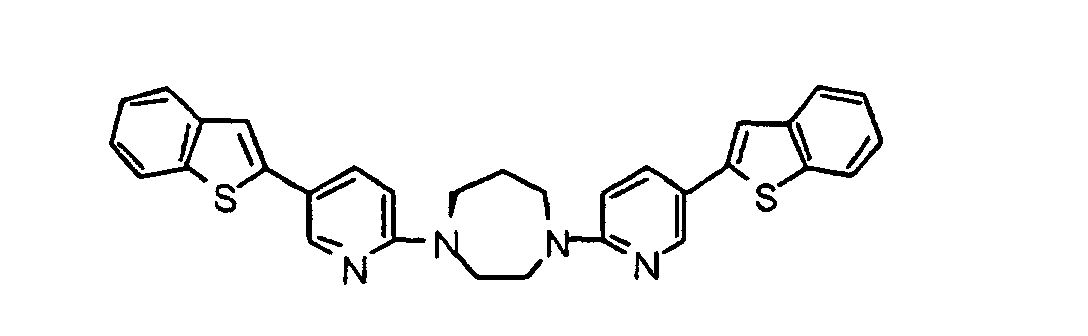
- Following the procedures of Example 1, crude crystals were obtained from 1,4-bis(5-bromo-2-pyridyl)hexahydro-1,4-diazepine (82.0 mg,0.200 mmol) synthesized in Referential Example 1 and benzo[b]thiophene-2-boric acid (78.0 mg, 0.44 mmol). Methanol-chloroform-diethyl ether was added to the crude crystals and the resulting precipitate was collected by filtration, whereby the title compoundwas obtained as colorless crystalline powder [melting point: 246.0°C (decomposed)] (41.0 mg, yield: 39%).
1H-NMR (DMSO-d6, 120°C) δ: 2.01(tt,J=6.0,6.0Hz,2H), 3.69(dd,J=6.0,6.0Hz,4H), 3.92(s,4H), 6.75(d,J=9.0Hz,2H), 7.20-7.35(m,4H), 7.49(s,2H), 7.67-7.75(m,2H), 7.77(dd,J=2.4,9.0Hz,2H), 7.80-7.84(m,2H), 8.43 (d, J=2.4Hz,2H). -

- Following the procedures of Example 1, 1,4-bis[5-(3,4,5-trimethoxyphenyl)-2-pyridyl]-piperazine was obtained as colorless crystalline powder (147.0 mg, yield: 52%) from 1,4-bis(5-bromo-2-pyridyl)piperazine (199.0mg, 0.500 mmol) synthesized in a similar manner as in Referential Example 1 and 3,4,5-trimethoxyphenylboric acid (318.0 mg, 1.50 mmol).
- To a solution of 1,4-bis[5-(3,4,5-trimethoxyphenyl)-2-pyridyl]piperazine (147.0 mg, 0.257 mmol) in methylene chloride (5.0 mL), a 1.0 M methanol solution of methanesul fonic acid (0.54 mL, 0.54 mmol) was added, and the reaction mixture was then concentrated under reduced pressure. The residue was recrystallized from methylene chloride-diethyl ether, whereby the title compound was obtained as pale yellow crystalline powder (melting point: 238.0-239.0°C) (160.8 mg, yield: 82%).
1H-NMR (CD3OD) (ammonium salt NH+ protons were not observed) δ: 2.72(s,6H), 3.82(s,6H), 3.93(s,12H), 4.09(s,8H), 6.89(s,4H), 7.44(d,J=9.5Hz,2H), 8.24(s,2H), 8.38(d,J=9.5Hz,2H). -

- Following the procedures of Example 1, the title compound was obtained as pale brown amorphous powder (89.9 mg, yield: 71%) from 4,8-bis(5-bromo-2-pyridyl)-1,4,8-triazacyclo-[4.4.0]decane (91.7 mg, 0.202 mmol) synthesized in a similar manner as in Referential Example 1 and 3,4,5-trimethoxy-phenylboric acid (133.3 mg, 0.628 mmol).
1H-NMR (CDCl3) δ: 2.37(br.tt,J=2.3,12.0Hz,1H), 2.43(ddd,J=3.2,12.0,12.0Hz,2H), 2.78(dd,J=12.0,12.0Hz,2H), 2.99(br.d,J=12.0Hz,2H), 3.15(ddd,J=2.7,12.0,12.0Hz,2H), 3.88(s,6H), 3.92(s,12H), 4.25(br.d,J=12.0Hz,2H), 4.33(br.d,J=12.0Hz,2H), 6.70(s,4H), 6.74(d,J=8.8Hz,2H), 7.70(dd,J=2.5,8.8Hz,2H), 8.42(d,J=2.5Hz,2H). -

- Following the procedures of Example 1, an oil was obtained from 1,3-bis[4-(5-bromo-2-pyridyl)-1-piperazinyl]-propane (196.0 mg, 0.370 mmol) synthesized in a similar manner as in Referential Example 1 and 3,4,5-trimethoxyphenylboric acid (244.0 mg, 1.32 mmol). The oil was recrystallized from chloroform-hexane, whereby the title compound was obtained as colorless crystalline powder (melting point: 175.0-176.0°C) (78.4 mg, yield: 34%).
1H-NMR (CDCl3) δ: 1.82(br.quint,J=7.4Hz,2H), 2.48(br.t,J=7.4Hz,4H), 2.61(br.dd,J=4.7,4.7Hz,8H), 3.62(br.dd,J=4.7,4.7Hz,8H), 3.88(s,6H), 3.91(s,12H), 6.70(s,4H), 6.72(d,J=8.9Hz,2H), 7.68(dd,J=2.5,8.9Hz,2H), 8.41(d,J=2.5Hz,2H). - N,N'-Bis[5-(3,4,5-trimethoxyphenyl)-2-pyridyl]-N,N'-dimethylethylenediamine dimethanesulfonate

- Following the procedures of Example 1, N,N'-bis[5-(3,4,5-trimethoxyphenyl)-2-pyridyl]-N,N'-dimethylethylene-diamine was obtained as a pale yellow oil (40.0 mg, yield: 56%) from N,N'-bis(5-bromo-2-pyridyl)-N,N'-dimethylethylene-diamine (50.0 mg, 0.120 mmol) synthesized in a similar manner as in Referential Example 1 and 3,4,5-trimethoxy-phenylboric acid (79.5 mg, 0.375 mmol).
- To a solution of N,N'-bis[5-(3,4,5-trimethoxyphenyl)-2-pyridyl]-N,N'-dimethylethylenediamine (40.0 mg, 0.070 mmol) in methanol (5.0 mL) , a 1.0 M aqueous solution of methanesulfonic acid (0.14 mL, 0. 14 mmol) was added, and the reaction mixture was concentrated under reducedpressure. Ethanol (5.0 mL) was added to the residue, and the mixture was concentrated under reduced pressure. The residue was recrystallized from methanol-diethyl ether, whereby the title compoundwas obtained as pale yellow crystalline powder (melting point: 204.0-206.0°C) (32.0 mg, yield: 60%).
1H-NMR (DMSO-d6, 120°C) (ammonium salt NH+ protons were not observed) δ: 2.41(s,6H), 3.15(s,6H), 3.73(s,6H), 3.84(s,12H), 3.88(s,4H), 6.83(s,4H), 6.91(d,J=9.0Hz,2H), 7.93(dd,J=2.4,9.0Hz,2H), 8.30(d,J=2.4Hz,2H). - From a mouse (Balb/C, male, 8 weeks old), the spleen was excised. The spleen was shredded in 0.3% BSA/HBSS, and was then disintegrated into single cells through a 70-mesh screen. Those single cells were hemolyzed with the Gey' s solution, and using RPMI 1640 medium/25 M HEPES/0.3% BSA, a spleen cell suspension (1 x 10⁷ cells/mL) was prepared. After an aliquot of the suspension was reacted with a rat anti-mouse Thy-1, 2 monoclonal antibody (product of Cedarlane Laboratories Limited) at 4°C for 1 hour, centrifugation was conducted. Precipitated cells were suspended again (1 x 10⁷ cells/mL, RPMI/HEPES/BSA). After the suspension was next reacted with a low cytotoxic rabbit complement (product of Cedarlane Laboratories Limited) at 37°C for 1 hour, dead cells were removed by specific gravity centrifugation so that a B cell fraction was obtained as viable cells.
- Using a 96-well plate, the B cells (105 cells/0.2 mL/well) was incubated together with LPS (E. coli 026:B6, product of DIFCO Laboratories, Inc.) for 1 day. Mouse IL-4 (product of Genzyme Corp.) was then added, followed by further incubation for 6 days.
- The IgE antibody production inhibiting activity of each drug was calculated by adding the drug Day 1 of the incubation and assaying the quantity of IgE in the culture supernatant after the incubation. Inhibition activity (IC50) is presented in Table 1.
- Further, the water solubility (%) of each compound was also determined. The results are presented in Table 1.
Table 1 Compound (Example No.) IC50 (µM) Water solubility (%) 26 0.2 5 34 0.3 5 35 0.2 5* 57 0.1 5* 58 0.2 5 * Solubility in 0.1 M hydrochloric acid - The bis(5-aryl-2-pyridyl) derivatives (1) according to the present invention and salts thereof have excellent IgE antibody production inhibiting activity and are useful as medicines for the prevention or treatment of allergic immune diseases.
Claims (14)
- Abis(5-aryl-2-pyridyl) derivative representedby the following formula (1) or a salt thereof:


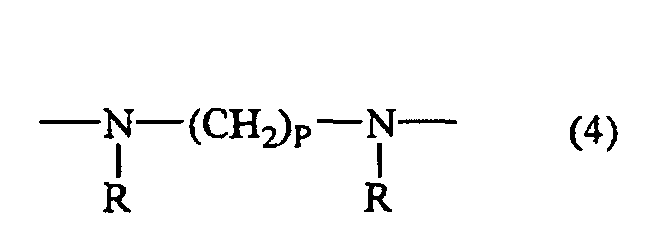

- A bis (5-aryl-2-pyridyl) derivative or a salt thereof according to claim 1, wherein in the formula (1), Ais a substituted or unsubstituted phenyl group, a substituted or unsubstituted pyridyl group, a substituted or unsubstituted thienyl group, a substituted or unsubstituted furyl group, a substituted or unsubstituted benzofuryl group, or a substituted or unsubstituted benzothienyl group.
- Abis(5-aryl-2-pyridyl) derivative or a salt thereof according to claim 1, wherein in the formula (1), A is a substituted or unsubstituted phenyl group.
- A bis(5-aryl-2-pyridyl) derivative or a salt thereof according to claim 1, wherein said aromatic hydrocarbon group or said aromatic heterocyclic group is substituted by 1 to 3 substituents selected from lower alkyl groups, halogeno (lower alkyl) groups, hydroxy (lower alkyl) groups, lower alkoxy (lower alkyl) groups, lower alkoxy groups, halogen atoms, hydroxy groups, cyano groups, (lower alkyl)thio groups, amino groups, mono- or di-(lower alkyl) amino groups, (lower alkyl)-sufonylamino groups, formyl groups, carboxyl groups, (lower alkoxy)carbonyl groups, lower alkanoyl groups, pyrrolidinyl groups, and alkylenedioxy groups.
- A bis (5-aryl-2-pyridyl) derivative or a salt thereof according to claim 1, wherein in the formula (1), X is the group represented by the formula (2).
- A medicine comprising as an active ingredient a bis(5-aryl-2-pyridyl) derivative or a salt thereof according to any one of claims 1-5.
- A medicine according to claim 6, which is a preventive or therapeutic for an allergic immune disease.
- Amedicine according to claim 6, which is a preventive or therapeutic for asthma, atopicdermatitis, allergic rhinilis, inflammatory colitis, contact skin disease or an allergic eye disease.
- Use of a bis(5-aryl-2-pyridyl)derivative or a salt thereof according to any one of claims 1-5 for the manufacture of a medicine.
- The use according to claim 9, wherein the medicine is a preventive or therapeutic for an allergic immune disease.
- The use according to claim 9, wherein the medicine is a preventive or therapeutic for asthma, atopic dermatitis, allergic rhinitis, inflammatory colitis, contact skin diseases or allergic eye diseases.
- An IgE antibody production inhibitor as an active ingredient a bis (5-aryl-2-pyridyl) derivative or a salt thereof according to any one of claims 1-5.
- A medicinal composition comprising a bis(5-aryl-2-pyridyl) derivative or a salt thereof according to any one of claims 1-5 and a pharmacologically acceptable carrier.
- A treatment method for an allergic immune disease, which comprises administering a bis(5-aryl-2-pyridyl) derivative or a salt thereof according to any one of claims 1-5.
Applications Claiming Priority (3)
| Application Number | Priority Date | Filing Date | Title |
|---|---|---|---|
| US893698 | 1986-08-06 | ||
| US09/893,698 US6706703B2 (en) | 2001-06-29 | 2001-06-29 | Bis(5-aryl-2-pyridyl) derivatives |
| PCT/JP2002/006492 WO2003002537A1 (en) | 2001-06-29 | 2002-06-27 | Bis(5-aryl-2-pyridyl) derivative |
Publications (3)
| Publication Number | Publication Date |
|---|---|
| EP1403250A1 true EP1403250A1 (en) | 2004-03-31 |
| EP1403250A4 EP1403250A4 (en) | 2005-04-13 |
| EP1403250B1 EP1403250B1 (en) | 2007-07-18 |
Family
ID=25401924
Family Applications (1)
| Application Number | Title | Priority Date | Filing Date |
|---|---|---|---|
| EP02736191A Expired - Lifetime EP1403250B1 (en) | 2001-06-29 | 2002-06-27 | Bis(5-aryl-2-pyridyl) derivative |
Country Status (6)
| Country | Link |
|---|---|
| US (2) | US6706703B2 (en) |
| EP (1) | EP1403250B1 (en) |
| JP (1) | JP4231404B2 (en) |
| AT (1) | ATE367377T1 (en) |
| DE (1) | DE60221250T2 (en) |
| WO (1) | WO2003002537A1 (en) |
Families Citing this family (4)
| Publication number | Priority date | Publication date | Assignee | Title |
|---|---|---|---|---|
| GB0329584D0 (en) * | 2003-12-20 | 2004-01-28 | Tanabe Seiyaku Co | Novel compounds |
| US8858912B2 (en) * | 2008-10-31 | 2014-10-14 | The Invention Science Fund I, Llc | Frozen compositions and methods for piercing a substrate |
| TW201041868A (en) * | 2009-03-20 | 2010-12-01 | Intervet Int Bv | Anthelmintic agents and their use |
| CN113292514B (en) * | 2021-04-07 | 2022-11-15 | 浙江华显光电科技有限公司 | Piperazine derivative and organic photoelectric device comprising same |
Family Cites Families (17)
| Publication number | Priority date | Publication date | Assignee | Title |
|---|---|---|---|---|
| JPS59167564A (en) | 1983-03-11 | 1984-09-21 | Taiho Yakuhin Kogyo Kk | Sulfonium compound and its preparation |
| JPH01106818A (en) | 1987-10-20 | 1989-04-24 | Teijin Ltd | Antiallergic agent |
| JP2991897B2 (en) | 1993-06-30 | 1999-12-20 | ハウス食品株式会社 | Gazette-type packaging bags for filling food |
| JPH08109177A (en) | 1994-08-18 | 1996-04-30 | Asahi Chem Ind Co Ltd | Cycloalkylalkylamine derivative and its use |
| JP3265134B2 (en) | 1994-09-20 | 2002-03-11 | 帝人株式会社 | Nitrogen-containing bicyclic heterocyclic derivative and pharmaceutical preparation containing the same |
| ATE194912T1 (en) | 1994-10-17 | 2000-08-15 | Aventis Pharma Ltd | AGENTS FOR THE PREVENTION AND CURE OF TYPE I ALLERGIC DISEASES |
| ES2212119T3 (en) | 1996-07-31 | 2004-07-16 | SHIONOGI & CO., LTD. | NEW P-TERFENILO COMPOUNDS. |
| US6340682B1 (en) | 1996-08-23 | 2002-01-22 | Kowa Co., Ltd. | Diamide compound and drugs containing the same |
| WO1998016497A1 (en) | 1996-10-11 | 1998-04-23 | Kowa Co., Ltd. | Novel diamide compounds and drugs containing the same |
| GB9622363D0 (en) * | 1996-10-28 | 1997-01-08 | Celltech Therapeutics Ltd | Chemical compounds |
| JPH10324631A (en) | 1997-05-22 | 1998-12-08 | Fujisawa Pharmaceut Co Ltd | Immunoglobulin e antibody formation inhibitor |
| US6376546B1 (en) | 1997-10-14 | 2002-04-23 | Asahi Kasei Kabushiki Kaisha | Biphenyl-5-alkanoic acid derivatives and use thereof |
| PE20000174A1 (en) | 1998-01-12 | 2000-03-17 | Novartis Ag | PYRIDINYLPYRIMIDINAMINES |
| ID24959A (en) * | 1998-01-28 | 2000-08-31 | Shionogi & Co | NEW TRISICLIC COMPOUNDS |
| AU747815B2 (en) | 1998-02-19 | 2002-05-23 | Kowa Co., Ltd. | Cyclic amide compounds |
| JPH11269192A (en) | 1998-03-24 | 1999-10-05 | The Nikka Wisky Distilling Co Ltd | Flavone glycosides |
| ES2230864T3 (en) | 1998-07-24 | 2005-05-01 | Teijin Limited | DERIVATIVES OF ANTRANILIC ACID. |
-
2001
- 2001-06-29 US US09/893,698 patent/US6706703B2/en not_active Expired - Fee Related
-
2002
- 2002-06-27 JP JP2003508918A patent/JP4231404B2/en not_active Expired - Fee Related
- 2002-06-27 EP EP02736191A patent/EP1403250B1/en not_active Expired - Lifetime
- 2002-06-27 AT AT02736191T patent/ATE367377T1/en not_active IP Right Cessation
- 2002-06-27 DE DE60221250T patent/DE60221250T2/en not_active Expired - Lifetime
- 2002-06-27 WO PCT/JP2002/006492 patent/WO2003002537A1/en not_active Ceased
-
2003
- 2003-10-23 US US10/690,671 patent/US7196101B2/en not_active Expired - Fee Related
Non-Patent Citations (2)
| Title |
|---|
| No further relevant documents disclosed * |
| See also references of WO03002537A1 * |
Also Published As
| Publication number | Publication date |
|---|---|
| JPWO2003002537A1 (en) | 2004-10-14 |
| WO2003002537A1 (en) | 2003-01-09 |
| US20030027814A1 (en) | 2003-02-06 |
| US7196101B2 (en) | 2007-03-27 |
| JP4231404B2 (en) | 2009-02-25 |
| EP1403250A4 (en) | 2005-04-13 |
| US6706703B2 (en) | 2004-03-16 |
| DE60221250D1 (en) | 2007-08-30 |
| ATE367377T1 (en) | 2007-08-15 |
| US20050101634A1 (en) | 2005-05-12 |
| DE60221250T2 (en) | 2008-03-20 |
| EP1403250B1 (en) | 2007-07-18 |
Similar Documents
| Publication | Publication Date | Title |
|---|---|---|
| KR102699906B1 (en) | Bruton's tyrosine kinase inhibitor | |
| CN102482218B (en) | Pyridine And Pyrazine Derivatives As Protein Kinase Modulators | |
| KR101697982B1 (en) | Novel pyrimidine and pyridine compounds and their usage | |
| EP2640702A1 (en) | 3-(aminoaryl)-pyridine compounds | |
| WO2012066065A1 (en) | Phenyl-heteroaryl amine compounds and their uses | |
| FR2921657A1 (en) | New nicotinamide derivatives useful for the preparation of a medicament for the treatment or prevention of cancer | |
| KR102873380B1 (en) | H4 antagonist compounds | |
| KR20210022646A (en) | Cyanotriazole compounds and uses thereof | |
| EP1403250B1 (en) | Bis(5-aryl-2-pyridyl) derivative | |
| Abarca et al. | Synthesis of novel triazolopyridylboronic acids and esters. Study of potential application to Suzuki-type reactions | |
| EP1403251B1 (en) | Bis(2-aryl-5-pyridyl) derivative | |
| CN116589462A (en) | Azaindolylpyridone compounds and diazaindolylpyridone compounds | |
| WO2017198734A1 (en) | Process for the manufacture of 6-alkynyl-pyridine derivatives | |
| WO2017056338A1 (en) | Method for producing pyrazole derivative | |
| CN108602834B (en) | A Bruton's tyrosine kinase inhibitor | |
| FR2965263A1 (en) | THIENOPYRIDINE NICOTINAMIDE DERIVATIVES, THEIR PREPARATION AND THEIR THERAPEUTIC USE | |
| HK1146046A (en) | Derivatives of n-phenyl-imidazo[1,2-a]pyridine-2-carboxamides, preparation thereof and therapeutic application thereof |
Legal Events
| Date | Code | Title | Description |
|---|---|---|---|
| PUAI | Public reference made under article 153(3) epc to a published international application that has entered the european phase |
Free format text: ORIGINAL CODE: 0009012 |
|
| 17P | Request for examination filed |
Effective date: 20040105 |
|
| AK | Designated contracting states |
Kind code of ref document: A1 Designated state(s): AT BE CH CY DE DK ES FI FR GB GR IE IT LI LU MC NL PT SE TR |
|
| AX | Request for extension of the european patent |
Extension state: AL LT LV MK RO SI |
|
| A4 | Supplementary search report drawn up and despatched |
Effective date: 20050228 |
|
| GRAP | Despatch of communication of intention to grant a patent |
Free format text: ORIGINAL CODE: EPIDOSNIGR1 |
|
| RIC1 | Information provided on ipc code assigned before grant |
Ipc: C07D 487/04 20060101ALI20070117BHEP Ipc: A61K 31/551 20060101ALI20070117BHEP Ipc: A61P 9/10 20060101ALI20070117BHEP Ipc: C07D 409/14 20060101ALI20070117BHEP Ipc: C07D 241/00 20060101ALN20070117BHEP Ipc: A61P 11/06 20060101ALI20070117BHEP Ipc: A61P 43/00 20060101ALI20070117BHEP Ipc: C07D 401/14 20060101ALI20070117BHEP Ipc: C07D 213/74 20060101AFI20070117BHEP Ipc: A61P 37/08 20060101ALI20070117BHEP Ipc: A61K 31/44 20060101ALI20070117BHEP Ipc: A61P 29/00 20060101ALI20070117BHEP Ipc: C07D 405/14 20060101ALI20070117BHEP |
|
| GRAS | Grant fee paid |
Free format text: ORIGINAL CODE: EPIDOSNIGR3 |
|
| GRAA | (expected) grant |
Free format text: ORIGINAL CODE: 0009210 |
|
| AK | Designated contracting states |
Kind code of ref document: B1 Designated state(s): AT BE CH CY DE DK ES FI FR GB GR IE IT LI LU MC NL PT SE TR |
|
| REG | Reference to a national code |
Ref country code: GB Ref legal event code: FG4D |
|
| REG | Reference to a national code |
Ref country code: CH Ref legal event code: EP |
|
| REF | Corresponds to: |
Ref document number: 60221250 Country of ref document: DE Date of ref document: 20070830 Kind code of ref document: P |
|
| REG | Reference to a national code |
Ref country code: IE Ref legal event code: FG4D |
|
| REG | Reference to a national code |
Ref country code: CH Ref legal event code: NV Representative=s name: BOVARD AG PATENTANWAELTE |
|
| ET | Fr: translation filed | ||
| PG25 | Lapsed in a contracting state [announced via postgrant information from national office to epo] |
Ref country code: PT Free format text: LAPSE BECAUSE OF FAILURE TO SUBMIT A TRANSLATION OF THE DESCRIPTION OR TO PAY THE FEE WITHIN THE PRESCRIBED TIME-LIMIT Effective date: 20071218 Ref country code: FI Free format text: LAPSE BECAUSE OF FAILURE TO SUBMIT A TRANSLATION OF THE DESCRIPTION OR TO PAY THE FEE WITHIN THE PRESCRIBED TIME-LIMIT Effective date: 20070718 Ref country code: ES Free format text: LAPSE BECAUSE OF FAILURE TO SUBMIT A TRANSLATION OF THE DESCRIPTION OR TO PAY THE FEE WITHIN THE PRESCRIBED TIME-LIMIT Effective date: 20071029 Ref country code: NL Free format text: LAPSE BECAUSE OF FAILURE TO SUBMIT A TRANSLATION OF THE DESCRIPTION OR TO PAY THE FEE WITHIN THE PRESCRIBED TIME-LIMIT Effective date: 20070718 |
|
| NLV1 | Nl: lapsed or annulled due to failure to fulfill the requirements of art. 29p and 29m of the patents act | ||
| PG25 | Lapsed in a contracting state [announced via postgrant information from national office to epo] |
Ref country code: AT Free format text: LAPSE BECAUSE OF FAILURE TO SUBMIT A TRANSLATION OF THE DESCRIPTION OR TO PAY THE FEE WITHIN THE PRESCRIBED TIME-LIMIT Effective date: 20070718 |
|
| PG25 | Lapsed in a contracting state [announced via postgrant information from national office to epo] |
Ref country code: BE Free format text: LAPSE BECAUSE OF FAILURE TO SUBMIT A TRANSLATION OF THE DESCRIPTION OR TO PAY THE FEE WITHIN THE PRESCRIBED TIME-LIMIT Effective date: 20070718 |
|
| PG25 | Lapsed in a contracting state [announced via postgrant information from national office to epo] |
Ref country code: GR Free format text: LAPSE BECAUSE OF FAILURE TO SUBMIT A TRANSLATION OF THE DESCRIPTION OR TO PAY THE FEE WITHIN THE PRESCRIBED TIME-LIMIT Effective date: 20071019 Ref country code: DK Free format text: LAPSE BECAUSE OF FAILURE TO SUBMIT A TRANSLATION OF THE DESCRIPTION OR TO PAY THE FEE WITHIN THE PRESCRIBED TIME-LIMIT Effective date: 20070718 |
|
| PLBE | No opposition filed within time limit |
Free format text: ORIGINAL CODE: 0009261 |
|
| STAA | Information on the status of an ep patent application or granted ep patent |
Free format text: STATUS: NO OPPOSITION FILED WITHIN TIME LIMIT |
|
| 26N | No opposition filed |
Effective date: 20080421 |
|
| PG25 | Lapsed in a contracting state [announced via postgrant information from national office to epo] |
Ref country code: SE Free format text: LAPSE BECAUSE OF FAILURE TO SUBMIT A TRANSLATION OF THE DESCRIPTION OR TO PAY THE FEE WITHIN THE PRESCRIBED TIME-LIMIT Effective date: 20071018 |
|
| PG25 | Lapsed in a contracting state [announced via postgrant information from national office to epo] |
Ref country code: MC Free format text: LAPSE BECAUSE OF NON-PAYMENT OF DUE FEES Effective date: 20080630 |
|
| PG25 | Lapsed in a contracting state [announced via postgrant information from national office to epo] |
Ref country code: IE Free format text: LAPSE BECAUSE OF NON-PAYMENT OF DUE FEES Effective date: 20080627 |
|
| PG25 | Lapsed in a contracting state [announced via postgrant information from national office to epo] |
Ref country code: CY Free format text: LAPSE BECAUSE OF FAILURE TO SUBMIT A TRANSLATION OF THE DESCRIPTION OR TO PAY THE FEE WITHIN THE PRESCRIBED TIME-LIMIT Effective date: 20070718 |
|
| PG25 | Lapsed in a contracting state [announced via postgrant information from national office to epo] |
Ref country code: LU Free format text: LAPSE BECAUSE OF NON-PAYMENT OF DUE FEES Effective date: 20080627 |
|
| PG25 | Lapsed in a contracting state [announced via postgrant information from national office to epo] |
Ref country code: TR Free format text: LAPSE BECAUSE OF FAILURE TO SUBMIT A TRANSLATION OF THE DESCRIPTION OR TO PAY THE FEE WITHIN THE PRESCRIBED TIME-LIMIT Effective date: 20070718 |
|
| REG | Reference to a national code |
Ref country code: CH Ref legal event code: PFA Owner name: KOWA CO., LTD. Free format text: KOWA CO., LTD.#6-29, NISHIKI 3-CHOME NAKA-KU#NAGOYA-SHI, AICHI 460-8625 (JP) -TRANSFER TO- KOWA CO., LTD.#6-29, NISHIKI 3-CHOME NAKA-KU#NAGOYA-SHI, AICHI 460-8625 (JP) |
|
| PGFP | Annual fee paid to national office [announced via postgrant information from national office to epo] |
Ref country code: FR Payment date: 20110630 Year of fee payment: 10 Ref country code: CH Payment date: 20110623 Year of fee payment: 10 |
|
| PGFP | Annual fee paid to national office [announced via postgrant information from national office to epo] |
Ref country code: GB Payment date: 20110621 Year of fee payment: 10 |
|
| PGFP | Annual fee paid to national office [announced via postgrant information from national office to epo] |
Ref country code: DE Payment date: 20110606 Year of fee payment: 10 |
|
| PGFP | Annual fee paid to national office [announced via postgrant information from national office to epo] |
Ref country code: IT Payment date: 20110627 Year of fee payment: 10 |
|
| REG | Reference to a national code |
Ref country code: CH Ref legal event code: PL |
|
| REG | Reference to a national code |
Ref country code: CH Ref legal event code: PL |
|
| GBPC | Gb: european patent ceased through non-payment of renewal fee |
Effective date: 20120627 |
|
| PG25 | Lapsed in a contracting state [announced via postgrant information from national office to epo] |
Ref country code: IT Free format text: LAPSE BECAUSE OF NON-PAYMENT OF DUE FEES Effective date: 20120627 |
|
| REG | Reference to a national code |
Ref country code: FR Ref legal event code: ST Effective date: 20130228 |
|
| REG | Reference to a national code |
Ref country code: DE Ref legal event code: R119 Ref document number: 60221250 Country of ref document: DE Effective date: 20130101 |
|
| PG25 | Lapsed in a contracting state [announced via postgrant information from national office to epo] |
Ref country code: DE Free format text: LAPSE BECAUSE OF NON-PAYMENT OF DUE FEES Effective date: 20130101 Ref country code: GB Free format text: LAPSE BECAUSE OF NON-PAYMENT OF DUE FEES Effective date: 20120627 Ref country code: LI Free format text: LAPSE BECAUSE OF NON-PAYMENT OF DUE FEES Effective date: 20120630 Ref country code: CH Free format text: LAPSE BECAUSE OF NON-PAYMENT OF DUE FEES Effective date: 20120630 Ref country code: FR Free format text: LAPSE BECAUSE OF NON-PAYMENT OF DUE FEES Effective date: 20120702 |