EP1401174A2 - Bicycle user information apparatus - Google Patents
Bicycle user information apparatus Download PDFInfo
- Publication number
- EP1401174A2 EP1401174A2 EP03021315A EP03021315A EP1401174A2 EP 1401174 A2 EP1401174 A2 EP 1401174A2 EP 03021315 A EP03021315 A EP 03021315A EP 03021315 A EP03021315 A EP 03021315A EP 1401174 A2 EP1401174 A2 EP 1401174A2
- Authority
- EP
- European Patent Office
- Prior art keywords
- information
- bicycle
- user
- unit
- computer
- Prior art date
- Legal status (The legal status is an assumption and is not a legal conclusion. Google has not performed a legal analysis and makes no representation as to the accuracy of the status listed.)
- Granted
Links
Images



Classifications
-
- H—ELECTRICITY
- H04—ELECTRIC COMMUNICATION TECHNIQUE
- H04L—TRANSMISSION OF DIGITAL INFORMATION, e.g. TELEGRAPHIC COMMUNICATION
- H04L67/00—Network arrangements or protocols for supporting network services or applications
- H04L67/2866—Architectures; Arrangements
- H04L67/30—Profiles
- H04L67/306—User profiles
-
- B—PERFORMING OPERATIONS; TRANSPORTING
- B62—LAND VEHICLES FOR TRAVELLING OTHERWISE THAN ON RAILS
- B62J—CYCLE SADDLES OR SEATS; AUXILIARY DEVICES OR ACCESSORIES SPECIALLY ADAPTED TO CYCLES AND NOT OTHERWISE PROVIDED FOR, e.g. ARTICLE CARRIERS OR CYCLE PROTECTORS
- B62J50/00—Arrangements specially adapted for use on cycles not provided for in main groups B62J1/00 - B62J45/00
- B62J50/20—Information-providing devices
- B62J50/21—Information-providing devices intended to provide information to rider or passenger
- B62J50/22—Information-providing devices intended to provide information to rider or passenger electronic, e.g. displays
-
- G—PHYSICS
- G01—MEASURING; TESTING
- G01C—MEASURING DISTANCES, LEVELS OR BEARINGS; SURVEYING; NAVIGATION; GYROSCOPIC INSTRUMENTS; PHOTOGRAMMETRY OR VIDEOGRAMMETRY
- G01C21/00—Navigation; Navigational instruments not provided for in groups G01C1/00 - G01C19/00
- G01C21/26—Navigation; Navigational instruments not provided for in groups G01C1/00 - G01C19/00 specially adapted for navigation in a road network
-
- H—ELECTRICITY
- H04—ELECTRIC COMMUNICATION TECHNIQUE
- H04L—TRANSMISSION OF DIGITAL INFORMATION, e.g. TELEGRAPHIC COMMUNICATION
- H04L67/00—Network arrangements or protocols for supporting network services or applications
- H04L67/50—Network services
- H04L67/52—Network services specially adapted for the location of the user terminal
-
- H—ELECTRICITY
- H04—ELECTRIC COMMUNICATION TECHNIQUE
- H04W—WIRELESS COMMUNICATION NETWORKS
- H04W4/00—Services specially adapted for wireless communication networks; Facilities therefor
- H04W4/02—Services making use of location information
-
- H—ELECTRICITY
- H04—ELECTRIC COMMUNICATION TECHNIQUE
- H04W—WIRELESS COMMUNICATION NETWORKS
- H04W4/00—Services specially adapted for wireless communication networks; Facilities therefor
- H04W4/02—Services making use of location information
- H04W4/029—Location-based management or tracking services
Definitions
- the present invention is directed to bicycles and, more particularly, to an apparatus for processing and sharing information relevant to a bicycle user.
- Bicycles are not limited just to practical uses. Bicycles often are used in competitive sports as well as in group recreation. Cycle computers commonly are installed on such bicycles, wherein the cycle computer receives signals from various sensors disposed on a bicycle and then calculates and displays information such as bicycling speed, distance traveled and the like. Unfortunately, such information usually is available only to the individual cyclist through his or her own cycle computer. Furthermore, information that may be useful to many cyclists such as information relating to bicycle components, the location of repair shops, characteristics of other riders and the like, is sometimes acquired through magazines and other sources, but not always in a manner that is easily shared among a group.
- a bicycle user information apparatus comprises an information receiver that receives information corresponding to the bicycle user through the Internet; and an administration control unit that manages the information received through the information receiver and enables external access to the managed information in response to predetermined criteria.
- the administration control unit includes a user registration unit that registers identifying information corresponding to the bicycle user.
- a bicycle computer comprises a control unit structured to be mounted to a bicycle; a memory card that stores data including data received through the data receiver, wherein the memory card is detachably coupled to the control unit; and a display unit that displays information corresponding to data received through the data receiver.
- a bicycle computer comprises a control unit structured to be mounted to a bicycle; a search signal transmitter that wirelessly transmits a search signal; a search signal receiver that receives a wirelessly transmitted search signal; and a notifying unit that notifies of the receipt of the wirelessly transmitted search signal.
- a bicycle computer comprises a control unit structured to be mounted to a bicycle; a location information detecting unit that detects information corresponding to a current location of the computer; a location information transmitter that transmits information corresponding to the current location of the bicycle; and a location information receiver that receives information corresponding to a current location of another bicycle.
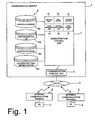
- Fig. 1 is a block diagram of a particular embodiment of a bicycle user information apparatus.
- the apparatus comprises an administration control unit in the form of an administration server 1 and a plurality cycle computers 2 interconnected via the Internet, wherein each cycle computer 2 typically is associated with a bicycle user such as a bicycle rider.
- Bicycle users are registered on the administration server 1, and information relating to cycling history or the like, which may be obtained from cycle computers 2 or from some other means, is administered by administration server 1.
- Administration server 1 also enables information of various kinds to be delivered to requesters such as registered bicycle users. Such information may be downloaded to one or more of the plurality of cycle computers 2 either conditionally or unconditionally.
- Administration server 1 displays web pages over the Internet 3 and communicates with users through such web pages.
- Administration server 1 comprises a communications control unit 5, various databases 6, and an administration control unit 7 that sends and receives information to and from databases 6, sends and receives information to and from communications control unit 5, and processes data.
- Databases 6 include a user registration database 6a, a user information database 6b, a ranking database 6c, and a geographical area information database 6d.
- Information identifying registered users is stored in user registration database 6a, and personal information such as cycling history data for individual registered users, bicycle components associated with the user, and so on, may be stored in user information database 6b.
- user information database 6b This means that user information need not be permanently stored in the user's cycle computer, thus making it possible to manufacture the cycle computer inexpensively with smaller capacity.
- a bicycle or component manufacturer may use the information stored in user information database 6b (if desired by the user) to provide better customer service. Cyclists also may share information among themselves, thus enhancing the group experience.
- Ranking information may be stored on a per-item basis for registered users (e.g. cycling distance, cycling time, etc.) in ranking database 6c, and geographical area information (e.g., weather information, transportation timetables, restaurant or bike shop information, etc.), which users may or may not have requested in the past, is stored in geographical area information database 6d.
- geographical area information database 6d may be data that has been downloaded from various web pages and processed.
- Administration control unit 7 includes a user registration unit 7a that registers users of the apparatus, a mail server 7b that sends and receives mail through the communications control unit 5 (typically to and from registered users), a training plan unit 7c that develops a training plan for a bicycle user (typically based on rider history data), a rank processing unit 7d that provides ranking information for characteristics of the users, a location processing unit 7e that processes current location information for the users, and an information delivery unit 7f that manages the delivery of information to a requesting user, such as a registered bicycle user. Information delivering unit 7f also can be used to calculate or process desired information. This relieves cycle computer 2 of the burden of calculating or processing such information itself.
- Training plan unit 7c may process a user's personal information stored in user information database 6b, for example, to develop training plans tailored for individual users. For example, body weight, height, percentage of body fat, etc. may be stored in user information database 6b, and training plan unit 7c may plan course settings and the like using further information sent from the user's cycle computer 2 (e.g., desired hear rate), as described below.
- Rank processing unit 7d may use data stored in user information database 6b to create item-by-item ranking data for cycling distance, cycling time, etc. for a plurality of users and store the resultant data in ranking database 6c. This allows users to compare their performance with other users.
- cycle computer 2 can access administration server 1 through the Internet 3 via an external communications terminal 9.
- external communications terminal 9 include a mobile phone or a PCI card-type transmitter, such as a wireless transmitter.
- cycle computer 2 comprises a communications control unit 10 that communicates with external communications terminal 9; an I/O interface 12 that receives sensor signals from various sensors 11 installed on a bicycle; a control input unit 13 used to input instruction and control information; a display unit 14 that displays information; and a control unit 15.
- Control unit 15 processes data obtained from communications control unit 10 and from sensors 11.
- Control unit 15 then transmits the processed data to communications control portion 10 and/or displays processed data on display unit 14 in response to an instruction from control input unit 13.
- Cycle computer 2 also has a location information detecting unit such as a GPS unit 16 for detecting and calculating a current position using signals from a number of satellites, a location information transmitter 17 that transmits information corresponding to the current location of the bicycle, and a location information receiver 18 that receives information corresponding to a current location of another bicycle.
- a location information detecting unit such as a GPS unit 16 for detecting and calculating a current position using signals from a number of satellites
- a location information transmitter 17 that transmits information corresponding to the current location of the bicycle
- a location information receiver 18 that receives information corresponding to a current location of another bicycle.
- a memory card 19 may be detachably coupled to control unit 15 for storing the information used by control unit 15, including information received from external communications terminal 9.
- memory card 19 is adapted to be coupled to a personal computer as well.
- a search/response signal transmitter 30 is provided for wirelessly transmitting a search or response signal
- a search/response signal receiver 31 is provided for receiving a wirelessly transmitted search or response signal
- a notifying unit 32 is provided for notifying of the receipt of a wirelessly transmitted search signal.
- Information input manually by the user into cycle computer 2 and then sent to the administration server 1 may include data identifying the user, body weight, height, percentage of body fat and other personal data. Shop information, photograph data and other information also may be sent to administration server 1. For example, when a user discovers a cycle repair shop, he or she may press a data send button to transmit current location data to the administration server 1, whereupon the current location information is stored in geographical area information database 6d.
- Information processed by cycle computer 2 may include cycling distance; elapsed cycling time; cycling location; current time; time spent in each gear; maximum, minimum and/or average speed, elevation, acceleration, crank rpm, heart rate, blood pressure, body temperature, barometric pressure, terrain slope, calories burned, etc. The above data also may be stored in a memory card 19.
- cycle computer 2 may access administration server 1 via the Internet 3.
- various information stored in memory card 19 may be transmitted to the administration server 1, and administration server 1 may store the transmitted information in the plurality of databases 6.
- a registered user may request desired information from administration server 1.
- Information delivery unit 7f then may transmit the requested information, and cycle computer 2 may process and/or display the requested information as desired.
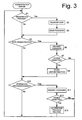
- Fig. 3 is a flow chart of a particular embodiment of an algorithm used in the bicycle user information apparatus. More specifically, Fig. 3 illustrates processing routines executed by administration server 1.
- administration server 1 executes a user registration process, a data administration process, and an information delivery process. While not shown in Fig. 3, typical mail server processes may be executed as well.
- Administration server 1 publishes on a web page a description of the system and other pertinent information, and solicits bicycle users wishing to register. If the administration server 1receives a registration request in a step S1 (e.g., from a bicycle user who transmits such a request using his or her cycle computer 2 and the Internet 3), then the user registration unit 7a performs a user registration routine in a step S2. In the user registration routine, an ID code is assigned to the requesting user, and the requesting user is then registered in the user database 6a. Next, the user is issued a password in a step S3. The password can be used by the registered user to access information stored in the plurality of databases 6 and/or calculated by the various modules in administration server 1.
- Information stored on memory card 19 may be transmitted to the administration server 1 and subsequently stored in user information database 6b. More specifically, if the administration server 1 receives a data administration request from a user in a step S5, administration server 1 requests a password in a step S6. It is then determined in a step S7 whether or not the user-entered password is valid. If a user is not registered, access is denied until the user is properly registered. If the user-entered password is valid, then the user data (such as cycling history data) may be communicated from the cycle computer 2 to the administration server 1, wherein administration server 1 processes and/or stores the communicated information in a step S8. The communicated data may be used to create item-by-item ranking data for cycling distance, cycling time, or the like, or to create a training plan.
- the user data such as cycling history data
- administration server 1 If the administration server 1 receives an information delivery request from a user in a step S10, administration server 1 requests a password in a step S11. It is then determined in a step S12 whether or not the user-entered password is valid in the same manner noted above. If a user is not registered, access is denied until the user is properly registered. If the user-entered password is valid, then the requested information is provided in a step S13.
- the types of information that may be provided may include ranking information, identification of users in the same geographic area, information about the geographical area in proximity to the user, training plan information, and other information.
- administration server 1 Since users can transmit location information from GPS unit 16 together with cycling history data, administration server 1 is aware of the location of each user. Accordingly, in the event of a request from a user for a "search for users in same geographic area," the location of the requesting user is identified, and the requesting user is provided with information about other users present within a predetermined distance range from his or her location, or present within a certain area such as within the same city or the like. Thus, a user who is cycling alone may, for example, readily search for other cyclists nearby.
- Geographical area information database 6d of administration server 1 stores information for geographical areas, such as weather information, transportation schedules, cycle shop information, and the like. Accordingly, in the event of a flat tire during cycling, for example, a user may access the administration server 1 using his or her cycle computer 2, and be provided with information about the closest cycle shop.
- training plan unit 7c of administration server 1 may create a training plan tailored to the individual user using cycling history data and other information sent by the user.
- the training plan thus created likewise is stored in the user information database 6b. Accordingly, such a training plan may be provided to the user upon request.
- Exemplary training plans could include the following:
- Training plan unit 7c develops an appropriate training plan from the cycling history data for the user, and information delivery unit 7f downloads a daily cycling plan that may be displayed on the user's cycle computer 2.
- Training plan unit 7c develops an appropriate training plan from the cycling history data for the user, and information delivery unit 7f downloads a proposed cycling plan that may be displayed on the user's cycle computer 2.
- Training plan unit 7c develops an appropriate training plan from the cycling history data for the user, and information delivery unit 7f downloads a proposed cycling plan that may be displayed on the user's cycle computer 2.
- Training plan unit 7c develops an appropriate training plan from the cycling history data for the user (e.g., on the basis of average speed history), and information delivery unit 7f downloads a proposed cycling plan that may be displayed on the user's cycle computer 2.
- Training plan unit 7c develops an appropriate training plan from the cycling history data for the user, and information delivery unit 7f downloads a proposed cycling plan that may be displayed on the user's cycle computer 2.
- administration server 1 is provided with a database such as a list of parts available from a manufacturer, parts information could be provided to requesting users.
- administration server 1 can be accessed directly via the Internet 3 from a cycle computer 2.
- cycle computer 2' has as a transceiver 21 (such as an infrared transceiver) for wirelessly transmitting and receiving data.
- a transceiver 21 such as an infrared transceiver
- Cycling history data stored in cycle computer 2' initially is stored on personal computer 20 via transceiver 21, and the data then may be transmitted from personal computer 20 to administration server 1 via the Internet 3.
- administration server 1 may be sent to personal computer 20 via the Internet 3 and thereafter sent to cycle computer 2' via transceiver 21.
- the arrangement is similar to the first embodiment.
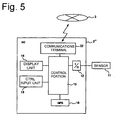
- a cycle computer 2 could be constructed with an internal communications terminal 22 as shown in Fig. 5.
- the arrangement is similar to the preceding embodiments.
- a cycle computer is designed to communicate with other cycle computers via administration server 1, but direct communication among cycle computers also is possible.
- the cycle computer may be of a type equipped with an external communications terminal as shown in Fig. 2, or with an internal communications terminal as shown in Fig. 4. In either case, a plurality of cycle computers may communicate using the basic algorithm shown in Fig. 6.
- a wireless search signal having a predetermined frequency is transmitted in a step S3 through search/response signal transmitter 30.
- the predetermined frequency of the search signal may be used to search for other cyclists having similar characteristics within the transmission range of the wireless signal, such as those who own the same type of cycle computer or those who have a particular group characteristic.
- a search signal has been received through search/response signal receiver 31. If so, the receiving user is notified in a step S4 through notifying unit 32 that a search signal has been received. Such notification may be accomplished by the emission of a sound or by lighting or flashing a "signal received" LED.
- a cyclist receiving a search signal may in turn similarly transmit a response signal through search/response signal transmitter 30, and thereby readily ascertain that another cyclist having the same characteristic is present in proximity to the geographical area where he or she is cycling.
- a response signal may be transmitted automatically. If desired, the response signal may have the same frequency as the search signal.
- the cyclist is simply notified of the presence of other cyclists nearby.
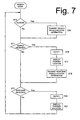
- the cycle computer may be switched into a search mode when searching for other cyclists. In this mode, a process similar to the one shown in Fig. 7 may be executed.
- the following description uses an example of a cyclist A who is searching for other cyclists and transmits a search signal, and a nearby cyclist B responds.
- a search signal is transmitted together with current location information for cyclist A (obtained by GPS unit 16) through search/response signal transmitter 30 and location information transmitter 17 in a step S15. It is then determined by cyclist B's cycle computer in a step S11 whether or not the search signal has been received from cyclist A through search/response signal receiver 31. If so, cyclist B is notified of the receipt of the search signal through notifying unit 32 in a step S16. Such a notification may take the form of a sound or a lit/flashing LED.
- the location of cyclist A may be displayed on the display unit 14 of cyclist B's cycle computer in a step S17.
- a map is displayed on the display unit 14 of the cycle computer, and the location of cyclist A is shown on the map.
- cyclist B may press a response button, for example, to transmit a response signal together with location information for cyclist B through search/response signal transmitter 30 and location information transmitter 17 in a step S 18. It is then determined by cyclist A's cycle computer in a step S12 whether or not a response signal has been received from cyclist B through search/response signal receiver 31. If so, cyclist A is notified of the receipt of the search signal through notifying unit 32 in a step S20. Such a notification may take the form of a sound or a lit/flashing LED. Using the location information from cyclist B received through location information receiver 18, the location of cyclist B may be displayed on the display unit 14 of cyclist A's cycle computer in a step S21. In this embodiment, a map is displayed on the display unit 14 of the cycle computer, and the location of cyclist B is shown on the map. Consequently, it is very easy to search for and locate other cycling companions.
Landscapes
- Engineering & Computer Science (AREA)
- Radar, Positioning & Navigation (AREA)
- Remote Sensing (AREA)
- Computer Networks & Wireless Communication (AREA)
- Signal Processing (AREA)
- Automation & Control Theory (AREA)
- Physics & Mathematics (AREA)
- General Physics & Mathematics (AREA)
- Mechanical Engineering (AREA)
- Traffic Control Systems (AREA)
- Management, Administration, Business Operations System, And Electronic Commerce (AREA)
Abstract
The bicycle user information apparatus comprises an information receiver that receives information corresponding to the bicycle user through the Internet (3); and an administration control unit (7) that manages the information received through the information receiver and enables external access to the managed information in response to predetermined criteria. The administration control unit (7) includes a user registration unit (7a) that registers identifying information corresponding to the bicycle user.
Description
Claims (33)
- A bicycle user information apparatus (1) comprising:wherein the administration control unit (7) comprises a user registration unit (7a) that registers identifying information corresponding to a bicycle user.an information receiver that receives information corresponding to the bicycle user through the Internet (3); andan administration control unit (7) that manages the information received through the information receiver and enables external access to the managed information in response to predetermined criteria;
- The apparatus according to claim 1 wherein the information receiver receives information from a cycle computer (2, 2', 2").
- The apparatus according to claim 1 wherein the information receiver receives information from a personal computer (20).
- The apparatus according to claim 1 wherein the managed information comprises at least one of geographical information, cycling condition information and physical information of the bicycle user.
- The apparatus according to claim 1 wherein the administration control unit (7) includes a rank processing unit (7d) that processes ranking information for a plurality of bicycle users.
- The apparatus according to claim 1 wherein the administration control unit (7) includes a location processing unit (7e) that processes information corresponding to a current location of a bicycle user when using the bicycle.
- The apparatus according to claim 1 wherein the administration control unit (7) includes a mail server (7b) that processes mail received through the information receiver.
- The apparatus according to claim 1 wherein the administration control unit (7) includes a training plan unit (7c) that develops a training plan for a bicycle user.
- The apparatus according to claim 8 wherein the training plan unit (7c) develops the training plan based on rider history data.
- The apparatus according to claim 1 wherein the administration control unit (7) includes an information delivery unit (7f) that delivers information to a requesting user.
- The apparatus according to claim 10 wherein the administration control unit (7) includes a location processing unit (7e) that processes information corresponding to a current location of a bicycle user when using the bicycle, and wherein the information delivery unit (7f) communicates information corresponding to the bicycle user to the requesting user.
- The apparatus according to claim 11 wherein the information delivery unit (7f) communicates the information to the requesting user though the Internet (3).
- The apparatus according to claim 12 wherein the information delivery unit (7f) communicates the information to the requesting user when the current location of the bicycle user is in proximity to a current location of the requesting user.
- The apparatus according to claim 10 wherein the administration control unit (7) manages geographical information corresponding to a current location of the bicycle user when using the bicycle, and wherein the information delivery unit (7f) communicates the geographical information to the requesting user.
- The apparatus according to claim 14 wherein the information delivery unit (7f) communicates the geographical information to the requesting user though the Internet (3).
- A bicycle computer (2) comprising:a control unit (15) structured to be mounted to a bicycle;an information receiver that receives information external to the control unit (15);a memory card (19) that stores information including information received through the information receiver, wherein the memory card (19) is detachably coupled to the control unit (15); anda display unit (14) that displays information corresponding to information received through the information receiver.
- The computer according to claim 16 wherein the information receiver receives information from a sensor (11) installed on the bicycle.
- The computer according to claim 16 wherein the information receiver receives information calculated from an external calculating means.
- The computer according to claim 16 wherein the information receiver receives information from a sensor (11) installed on the bicycle, and wherein the information receiver receives information calculated from an external calculating means.
- The computer according to claim 16 wherein the information receiver comprises a bidirectional communication unit (10, 21, 22) that receives external information and transmits information externally.
- The computer according to claim 20 wherein the bidirectional communication unit (10, 21, 22) transmits information stored on the memory card (19) externally.
- The computer according to claim 21 wherein the bidirectional communication unit (10) transmits information through the Internet (3).
- The computer according to claim 21 wherein the bidirectional communication unit (21) is structured to communicate with a personal computer (20).
- The computer according to claim 23 wherein the bidirectional communication unit (22) is structured to communicate with the personal computer (20) wirelessly.
- The computer according to claim 16 further comprising a location information detecting unit (16) that detects information corresponding to a current location of the computer (2).
- The computer according to claim 16 wherein the memory card (19) is structured to be coupled to a personal computer (20).
- A bicycle computer comprising:a control unit (15) structured to be mounted to a bicycle;a search signal transmitter (30) that wirelessly transmits a search signal;a search signal receiver (31) that receives a wirelessly transmitted search signal; anda notifying unit (32) that notifies of the receipt of the wirelessly transmitted search signal.
- The computer according to claim 27 further comprising a response signal transmitter (30) that wirelessly transmits a response signal in response to the receipt of the wirelessly transmitted search signal.
- The computer according to claim 27 wherein the notifying unit (32) audibly notifies of the receipt of the wirelessly transmitted search signal.
- A bicycle computer comprising:a control unit (15) structured to be mounted to a bicycle;a location information detecting unit (16) that detects information corresponding to a current location of the computer (2);a location information transmitter (17) that transmits information corresponding to the current location of the bicycle; anda location information receiver (18) that receives information corresponding to a current location of another bicycle.
- The computer according to claim 30 further comprising a display unit (14) that displays information corresponding to the current location of the bicycle.
- The computer according to claim 31 wherein the display unit (14) displays information corresponding to the current location of the other bicycle.
- The computer according to claim 30 wherein the display unit (14) displays at least one of the information corresponding to the current location of the bicycle and the information corresponding to the current location of the other bicycle on a map.
Applications Claiming Priority (2)
| Application Number | Priority Date | Filing Date | Title |
|---|---|---|---|
| JP2002274661 | 2002-09-20 | ||
| JP2002274661A JP2004110628A (en) | 2002-09-20 | 2002-09-20 | Bicycle user's information management device and cycle computer |
Publications (3)
| Publication Number | Publication Date |
|---|---|
| EP1401174A2 true EP1401174A2 (en) | 2004-03-24 |
| EP1401174A3 EP1401174A3 (en) | 2004-09-01 |
| EP1401174B1 EP1401174B1 (en) | 2007-06-13 |
Family
ID=31944592
Family Applications (1)
| Application Number | Title | Priority Date | Filing Date |
|---|---|---|---|
| EP03021315A Expired - Lifetime EP1401174B1 (en) | 2002-09-20 | 2003-09-19 | Bicycle user information apparatus |
Country Status (7)
| Country | Link |
|---|---|
| US (2) | US20040117072A1 (en) |
| EP (1) | EP1401174B1 (en) |
| JP (1) | JP2004110628A (en) |
| CN (3) | CN1272722C (en) |
| AT (1) | ATE364955T1 (en) |
| DE (1) | DE60314346T2 (en) |
| TW (1) | TWI228468B (en) |
Cited By (8)
| Publication number | Priority date | Publication date | Assignee | Title |
|---|---|---|---|---|
| EP1659531A1 (en) * | 2004-11-22 | 2006-05-24 | Jcdecaux SA | Procedure and system for management of a fleet of vehicles, and associated vehicle |
| FR2885685A1 (en) * | 2005-05-10 | 2006-11-17 | Thierry Lapousterle | Bike computer for use on handlebar to display e.g. speed, has calculating unit to calculate ratio between number of rotations of crank set and wheel, and digital screen to display ratio based on information relative to crank set |
| EP1883054A1 (en) * | 2006-07-25 | 2008-01-30 | JCDecaux SA | Bicycle, method of managing a fleet of bicycles and system for managing such a fleet |
| FR2904424A1 (en) * | 2006-07-28 | 2008-02-01 | Salomon Sa | SPEED MEASURING DEVICE, IN PARTICULAR FOR A CYCLE |
| EP2183613A4 (en) * | 2007-08-28 | 2012-07-11 | Garmin Switzerland Gmbh | Bicycle computer having position-determining functionality |
| CN111369820A (en) * | 2020-03-06 | 2020-07-03 | 上海钧正网络科技有限公司 | Vehicle driving state display method and device, computer equipment and storage medium |
| TWI785123B (en) * | 2017-10-06 | 2022-12-01 | 日商島野股份有限公司 | Wireless components for bicycles |
| US20240198999A1 (en) * | 2022-12-16 | 2024-06-20 | Foxconn Interconnect Technology Limited | Control device, power control system with the control device, and electric assist vehicle with the power control system |
Families Citing this family (46)
| Publication number | Priority date | Publication date | Assignee | Title |
|---|---|---|---|---|
| JP2004110628A (en) * | 2002-09-20 | 2004-04-08 | Shimano Inc | Bicycle user's information management device and cycle computer |
| CN103182175B (en) * | 2007-02-14 | 2015-09-16 | 耐克创新有限合伙公司 | The collection of movable information and display |
| JP5106959B2 (en) * | 2007-09-14 | 2012-12-26 | ブリヂストンサイクル株式会社 | Cycle computer |
| JP4939380B2 (en) * | 2007-11-08 | 2012-05-23 | パイオニア株式会社 | Information management server, navigation device, information management method, navigation method, information management program, navigation program, and recording medium |
| KR100989678B1 (en) * | 2009-06-11 | 2010-10-26 | 주식회사 위트콤 | Bicycle rack and terminal for bicycle, and power charge apparatus |
| KR101681312B1 (en) * | 2009-08-28 | 2016-12-02 | 삼성전자 주식회사 | Method and apparatus for recommending of course |
| US10314533B2 (en) | 2009-08-28 | 2019-06-11 | Samsung Electronics Co., Ltd | Method and apparatus for recommending a route |
| EP2508845B1 (en) * | 2009-12-02 | 2015-09-02 | Pioneer Corporation | Device, system, method and program for creating a bicycle map |
| KR101566897B1 (en) * | 2009-12-03 | 2015-11-06 | 엘지전자 주식회사 | Mobile terminal capable of receiving gesture input and control method thereof |
| US9027681B2 (en) * | 2009-12-04 | 2015-05-12 | Massachusetts Institute Of Technology | Hybrid sensor-enabled electric wheel and associated systems, multi-hub wheel spoking systems, and methods of manufacturing and installing wheel spokes |
| US10572721B2 (en) | 2010-08-09 | 2020-02-25 | Nike, Inc. | Monitoring fitness using a mobile device |
| KR101817048B1 (en) * | 2010-08-09 | 2018-01-09 | 나이키 이노베이트 씨.브이. | Monitoring fitness using a mobile device |
| US8649890B2 (en) * | 2011-05-31 | 2014-02-11 | Todd M. Martin | System and method for providing an athlete with a performance profile |
| JP2013032914A (en) * | 2011-07-29 | 2013-02-14 | Jvc Kenwood Corp | Information presentation device, server, information presentation method, and program |
| US9339691B2 (en) | 2012-01-05 | 2016-05-17 | Icon Health & Fitness, Inc. | System and method for controlling an exercise device |
| CN102637358B (en) * | 2012-04-19 | 2014-11-12 | 浙江大学 | Citizen-satisfaction-based public bicycle service system and scheduling and dispatching method |
| US9345948B2 (en) | 2012-10-19 | 2016-05-24 | Todd Martin | System for providing a coach with live training data of an athlete as the athlete is training |
| JP5904138B2 (en) * | 2013-02-14 | 2016-04-13 | マツダ株式会社 | Location information provision system |
| US9254409B2 (en) | 2013-03-14 | 2016-02-09 | Icon Health & Fitness, Inc. | Strength training apparatus with flywheel and related methods |
| JP6216160B2 (en) * | 2013-06-03 | 2017-10-18 | 株式会社堀場製作所 | Operation management system and operation recording device |
| CN103729724B (en) * | 2013-12-06 | 2017-02-08 | 浙江工业大学 | Natural-mixing scheduling method of public bike system |
| EP3623020B1 (en) | 2013-12-26 | 2024-05-01 | iFIT Inc. | Magnetic resistance mechanism in a cable machine |
| WO2015138339A1 (en) | 2014-03-10 | 2015-09-17 | Icon Health & Fitness, Inc. | Pressure sensor to quantify work |
| EP3126184B1 (en) | 2014-04-04 | 2019-09-04 | Superpedestrian, Inc. | Systems, methods, and devices for the operation of electrically motorized vehicles |
| US10308065B2 (en) | 2014-04-04 | 2019-06-04 | Superpedestrian, Inc. | Devices and methods for connecting a spoke to a hub |
| US10426989B2 (en) | 2014-06-09 | 2019-10-01 | Icon Health & Fitness, Inc. | Cable system incorporated into a treadmill |
| WO2015195965A1 (en) | 2014-06-20 | 2015-12-23 | Icon Health & Fitness, Inc. | Post workout massage device |
| TW201617583A (en) * | 2014-08-05 | 2016-05-16 | 福柏克智慧財產有限責任公司 | Bicycle. controller for use with a bicycle and method for controlling a transmission of a bicycle |
| CN107206907B (en) | 2014-11-24 | 2020-02-14 | 极步公司 | Apparatus and method for a motor vehicle wheel |
| US10391361B2 (en) | 2015-02-27 | 2019-08-27 | Icon Health & Fitness, Inc. | Simulating real-world terrain on an exercise device |
| US11801913B2 (en) * | 2015-03-05 | 2023-10-31 | Shimano Inc. | Bicycle electric component setting system |
| ITUB20152302A1 (en) * | 2015-07-20 | 2017-01-20 | Campagnolo Srl | Electronic bicycle system |
| EP3173796B1 (en) * | 2015-11-27 | 2019-06-05 | Deutsche Telekom AG | Sensor system for mounting on a bicycle |
| US10105574B2 (en) * | 2015-12-21 | 2018-10-23 | Intel Corporation | Technologies for managing user-specific workouts |
| ITUB20160057A1 (en) * | 2016-02-04 | 2017-08-04 | E Novia S P A | Assistance system for riding a bicycle by sending a haptic feedback to the cyclist |
| US10272317B2 (en) | 2016-03-18 | 2019-04-30 | Icon Health & Fitness, Inc. | Lighted pace feature in a treadmill |
| US10493349B2 (en) | 2016-03-18 | 2019-12-03 | Icon Health & Fitness, Inc. | Display on exercise device |
| US10625137B2 (en) | 2016-03-18 | 2020-04-21 | Icon Health & Fitness, Inc. | Coordinated displays in an exercise device |
| US10671705B2 (en) | 2016-09-28 | 2020-06-02 | Icon Health & Fitness, Inc. | Customizing recipe recommendations |
| CN108550255A (en) * | 2018-04-23 | 2018-09-18 | 施霖 | A kind of shared bicycle intelligence parking system and method |
| JP7312549B2 (en) * | 2018-12-18 | 2023-07-21 | 株式会社シマノ | Human-powered vehicle controller, electronic device, and human-powered vehicle control system |
| DE102019103231A1 (en) * | 2019-02-09 | 2020-08-13 | Dt Swiss Ag | Process for the acquisition and evaluation of sensor data and two-wheeler components |
| JP7370082B2 (en) * | 2019-05-21 | 2023-10-27 | 株式会社ユピテル | electronic equipment and programs |
| CN110473352B (en) * | 2019-05-25 | 2020-05-15 | 郑州轻工业大学 | Street throwing internet detection system |
| US12039502B2 (en) * | 2021-03-20 | 2024-07-16 | ArTheia E. Dingle | System, method and services for tracking, monitoring and transporting |
| DE102022209551A1 (en) * | 2022-09-13 | 2024-03-14 | Robert Bosch Gesellschaft mit beschränkter Haftung | Method for providing information to a large number of recipients |
Family Cites Families (63)
| Publication number | Priority date | Publication date | Assignee | Title |
|---|---|---|---|---|
| US3921351A (en) * | 1973-12-20 | 1975-11-25 | H F Henderson Ind | Segmented storage bin |
| JPH0526679A (en) * | 1991-07-17 | 1993-02-02 | Pioneer Electron Corp | Navigation device |
| US5591104A (en) * | 1993-01-27 | 1997-01-07 | Life Fitness | Physical exercise video system |
| JPH06289118A (en) * | 1993-03-31 | 1994-10-18 | Sega Enterp Ltd | Satellite navigation terminal device |
| US7397363B2 (en) * | 1993-06-08 | 2008-07-08 | Raymond Anthony Joao | Control and/or monitoring apparatus and method |
| US5335188A (en) * | 1993-08-10 | 1994-08-02 | Brisson Lawrence J | Bicycle computer with memory and means for comparing present and past performance in real time |
| JPH0894732A (en) * | 1994-09-26 | 1996-04-12 | Casio Comput Co Ltd | Display device |
| US6171218B1 (en) * | 1995-06-22 | 2001-01-09 | Michael J. Shea | Exercise apparatus |
| US5702323A (en) * | 1995-07-26 | 1997-12-30 | Poulton; Craig K. | Electronic exercise enhancer |
| US6059692A (en) * | 1996-12-13 | 2000-05-09 | Hickman; Paul L. | Apparatus for remote interactive exercise and health equipment |
| CA2291058A1 (en) * | 1996-07-02 | 1998-01-08 | Jeffrey Q. Nichols | Electronic exercise system |
| JP3088661B2 (en) * | 1996-07-23 | 2000-09-18 | 株式会社シマノ | Method and apparatus for transmitting detection signal in bicycle |
| US6463385B1 (en) * | 1996-11-01 | 2002-10-08 | William R. Fry | Sports computer with GPS receiver and performance tracking capabilities |
| US6002982A (en) * | 1996-11-01 | 1999-12-14 | Fry; William R. | Sports computer with GPS receiver and performance tracking capabilities |
| US6192300B1 (en) * | 1997-06-27 | 2001-02-20 | Echowell Electronic Ltd. | Bicycle computer |
| US6707421B1 (en) * | 1997-08-19 | 2004-03-16 | Siemens Vdo Automotive Corporation | Driver information system |
| US8650496B1 (en) * | 1998-08-21 | 2014-02-11 | U.S. Philips Corporation | Information exchange audio player |
| RU2144264C1 (en) * | 1998-11-05 | 2000-01-10 | ЯН Давид Евгеньевич | Method and portable computer for remote wireless transmission and reception of coded information (options) |
| US6373430B1 (en) * | 1999-05-07 | 2002-04-16 | Gamin Corporation | Combined global positioning system receiver and radio |
| JP2001012966A (en) * | 1999-06-29 | 2001-01-19 | Casio Comput Co Ltd | Portable electronic device system and portable electronic device |
| US6458060B1 (en) * | 1999-07-08 | 2002-10-01 | Icon Ip, Inc. | Systems and methods for interaction with exercise device |
| US6312363B1 (en) * | 1999-07-08 | 2001-11-06 | Icon Health & Fitness, Inc. | Systems and methods for providing an improved exercise device with motivational programming |
| US6344797B1 (en) * | 1999-07-21 | 2002-02-05 | Diaa M. Hosny | Digital electronic locator |
| WO2001028416A1 (en) * | 1999-09-24 | 2001-04-26 | Healthetech, Inc. | Physiological monitor and associated computation, display and communication unit |
| US6204752B1 (en) * | 1999-11-24 | 2001-03-20 | Shimano Inc. | Bicycle display unit with backlight |
| NL1014083C2 (en) * | 2000-01-17 | 2001-07-18 | Championchip B V | Method of offering information by telephone. |
| US6513532B2 (en) * | 2000-01-19 | 2003-02-04 | Healthetech, Inc. | Diet and activity-monitoring device |
| IT1320286B1 (en) * | 2000-03-29 | 2003-11-26 | Campagnolo Srl | MULTIPROCESSOR CONTROL SYSTEM FOR CYCLES, FOR EXAMPLE COMPETITION BICYCLES. |
| JP2001280992A (en) * | 2000-03-29 | 2001-10-10 | Hitachi Ltd | Geographic information output system |
| US6868074B1 (en) * | 2000-03-30 | 2005-03-15 | Mci, Inc. | Mobile data device and method of locating mobile data device |
| US6622018B1 (en) * | 2000-04-24 | 2003-09-16 | 3Com Corporation | Portable device control console with wireless connection |
| US7162199B1 (en) * | 2000-06-23 | 2007-01-09 | Lockheed Martin Corporation | Method for real-time team coordination with unrealiable communications between team members |
| JP2002017929A (en) * | 2000-07-11 | 2002-01-22 | Jatco Transtechnology Ltd | Game system |
| WO2002005702A2 (en) * | 2000-07-18 | 2002-01-24 | Healthetech, Inc. | Closed loop glycemic index system |
| JP2002133510A (en) * | 2000-07-27 | 2002-05-10 | Sony Corp | Mobile rental system, mobile management system, mobile device, mobile management device, mobile rental method, mobile management method, and recording medium |
| US20050203673A1 (en) * | 2000-08-18 | 2005-09-15 | Hassanayn Machlab El-Hajj | Wireless communication framework |
| US20020068587A1 (en) * | 2000-12-01 | 2002-06-06 | Chapman Robert W. | Method and apparatus for special alert response |
| JP2002176426A (en) * | 2000-12-06 | 2002-06-21 | Sharp Corp | Pedometer (registered trademark) server |
| US6812942B2 (en) * | 2000-12-28 | 2004-11-02 | International Business Machines Corporation | Context-responsive in-vehicle display system |
| US20020102989A1 (en) * | 2001-01-26 | 2002-08-01 | Calvert Brian Edward | Method and apparatus for accurately locating a communication device in a wireless communication system |
| US20020113185A1 (en) * | 2001-02-09 | 2002-08-22 | Ziegler David M. | Holder for a portable electronic device |
| US20020122410A1 (en) * | 2001-02-13 | 2002-09-05 | Cybiko Inc. | Method of wireless data exchange amongst devices of limited range |
| EP1251333A1 (en) * | 2001-04-20 | 2002-10-23 | CELTRAK RESEARCH LIMITED, IDA Industrial Estate | A method and apparatus for monitoring movement of a vehicle |
| US20020164998A1 (en) * | 2001-05-01 | 2002-11-07 | Saed Younis | System and method for providing position-based information to a user of a wireless device |
| CN1330937C (en) * | 2001-08-06 | 2007-08-08 | 松下电器产业株式会社 | Informaton providing method and information providing device |
| US6978162B2 (en) * | 2001-08-17 | 2005-12-20 | Hewlett-Packard Development Company, L.P. | Integrated portable entertainment, information and communication system linked to a wireless helmet |
| US7062895B1 (en) * | 2001-08-18 | 2006-06-20 | Sperie Cheryl L | Method of training equine athletes and apparatus therefor |
| US20030036428A1 (en) * | 2001-08-20 | 2003-02-20 | Christian Aasland | Method and apparatus for implementing multiplayer PDA games |
| DE20115816U1 (en) * | 2001-09-26 | 2002-03-07 | Merlaku, Kastriot, 80807 München | Mobile phone with bike computer and a light emitter for bike |
| US6921351B1 (en) * | 2001-10-19 | 2005-07-26 | Cybergym, Inc. | Method and apparatus for remote interactive exercise and health equipment |
| US6868338B1 (en) * | 2001-11-19 | 2005-03-15 | Bbnt Solutions Llc | Method and apparatus for recording and synthesizing position data |
| US6807464B2 (en) * | 2002-01-02 | 2004-10-19 | International Business Machines Corporation | Systems and methods for distributing information to an operator of a vehicle |
| US6932698B2 (en) * | 2002-01-31 | 2005-08-23 | Peter Sprogis | Treasure hunt game utilizing wireless communications devices and location positioning technology |
| US6871144B1 (en) * | 2002-03-13 | 2005-03-22 | Garmin Ltd. | Combined global positioning system receiver and radio with enhanced tracking features |
| US6850188B1 (en) * | 2002-04-05 | 2005-02-01 | Garmin Ltd. | Combined global positioning system receiver and radio with enhanced display features |
| US7116008B2 (en) * | 2002-04-23 | 2006-10-03 | Shimano, Inc. | Electrical communication system for a bicycle |
| US7024207B2 (en) * | 2002-04-30 | 2006-04-04 | Motorola, Inc. | Method of targeting a message to a communication device selected from among a set of communication devices |
| US6724299B2 (en) * | 2002-06-27 | 2004-04-20 | Shimano, Inc. | Bicycle data communication method and apparatus |
| JP2004110628A (en) * | 2002-09-20 | 2004-04-08 | Shimano Inc | Bicycle user's information management device and cycle computer |
| US6837827B1 (en) * | 2003-06-17 | 2005-01-04 | Garmin Ltd. | Personal training device using GPS data |
| US7191924B2 (en) * | 2004-01-28 | 2007-03-20 | Kilmer George M | Bicycle cell phone holder |
| US20090270689A1 (en) * | 2006-06-02 | 2009-10-29 | Cbb International Pty Ltd | Monitoring system |
| US8121785B2 (en) * | 2007-08-28 | 2012-02-21 | Garmin Switzerland Gmbh | Bicycle computer having position-determining functionality |
-
2002
- 2002-09-20 JP JP2002274661A patent/JP2004110628A/en active Pending
-
2003
- 2003-08-25 TW TW092123303A patent/TWI228468B/en not_active IP Right Cessation
- 2003-09-18 US US10/605,264 patent/US20040117072A1/en not_active Abandoned
- 2003-09-19 CN CNB031586694A patent/CN1272722C/en not_active Expired - Fee Related
- 2003-09-19 AT AT03021315T patent/ATE364955T1/en not_active IP Right Cessation
- 2003-09-19 DE DE60314346T patent/DE60314346T2/en not_active Expired - Lifetime
- 2003-09-19 EP EP03021315A patent/EP1401174B1/en not_active Expired - Lifetime
- 2003-09-19 CN CN2006100025930A patent/CN1818558B/en not_active Expired - Fee Related
- 2003-09-19 CN CNA2006100025748A patent/CN1818557A/en active Pending
-
2007
- 2007-12-21 US US11/963,728 patent/US8219263B2/en not_active Expired - Fee Related
Cited By (11)
| Publication number | Priority date | Publication date | Assignee | Title |
|---|---|---|---|---|
| EP1659531A1 (en) * | 2004-11-22 | 2006-05-24 | Jcdecaux SA | Procedure and system for management of a fleet of vehicles, and associated vehicle |
| FR2878349A1 (en) * | 2004-11-22 | 2006-05-26 | Jcdecaux Sa | METHOD AND SYSTEM FOR MANAGING A FLEET OF VEHICLES, AND VEHICLE THEREFOR |
| FR2885685A1 (en) * | 2005-05-10 | 2006-11-17 | Thierry Lapousterle | Bike computer for use on handlebar to display e.g. speed, has calculating unit to calculate ratio between number of rotations of crank set and wheel, and digital screen to display ratio based on information relative to crank set |
| EP1883054A1 (en) * | 2006-07-25 | 2008-01-30 | JCDecaux SA | Bicycle, method of managing a fleet of bicycles and system for managing such a fleet |
| FR2904456A1 (en) * | 2006-07-25 | 2008-02-01 | Jcdecaux Sa | BICYCLE, METHOD FOR MANAGING A FLEET OF BICYCLES AND SYSTEM FOR MANAGING SUCH A FLEET |
| FR2904424A1 (en) * | 2006-07-28 | 2008-02-01 | Salomon Sa | SPEED MEASURING DEVICE, IN PARTICULAR FOR A CYCLE |
| CN101113988B (en) * | 2006-07-28 | 2011-06-15 | 萨洛蒙股份有限公司 | Bicycle speed measuring device |
| EP2183613A4 (en) * | 2007-08-28 | 2012-07-11 | Garmin Switzerland Gmbh | Bicycle computer having position-determining functionality |
| TWI785123B (en) * | 2017-10-06 | 2022-12-01 | 日商島野股份有限公司 | Wireless components for bicycles |
| CN111369820A (en) * | 2020-03-06 | 2020-07-03 | 上海钧正网络科技有限公司 | Vehicle driving state display method and device, computer equipment and storage medium |
| US20240198999A1 (en) * | 2022-12-16 | 2024-06-20 | Foxconn Interconnect Technology Limited | Control device, power control system with the control device, and electric assist vehicle with the power control system |
Also Published As
| Publication number | Publication date |
|---|---|
| CN1492351A (en) | 2004-04-28 |
| EP1401174B1 (en) | 2007-06-13 |
| DE60314346D1 (en) | 2007-07-26 |
| TW200406329A (en) | 2004-05-01 |
| CN1818558A (en) | 2006-08-16 |
| CN1818557A (en) | 2006-08-16 |
| US20040117072A1 (en) | 2004-06-17 |
| ATE364955T1 (en) | 2007-07-15 |
| CN1272722C (en) | 2006-08-30 |
| CN1818558B (en) | 2012-05-30 |
| US8219263B2 (en) | 2012-07-10 |
| EP1401174A3 (en) | 2004-09-01 |
| JP2004110628A (en) | 2004-04-08 |
| US20080109121A1 (en) | 2008-05-08 |
| DE60314346T2 (en) | 2008-02-14 |
| TWI228468B (en) | 2005-03-01 |
Similar Documents
| Publication | Publication Date | Title |
|---|---|---|
| US8219263B2 (en) | Bicycle user information apparatus | |
| US12079253B2 (en) | System and method for processing location data | |
| JP6711958B2 (en) | Information management device, information processing device, system, and information management method | |
| KR101774120B1 (en) | Multi-activity platform and interface | |
| US20070288157A1 (en) | Method and apparatus for providing an alert utilizing geographic locations | |
| JP2019200606A (en) | Riding support device, riding support system, and riding support method | |
| JP2011120740A (en) | Device and method for supporting jogging, and program | |
| JP7070960B1 (en) | Running course display device and program | |
| JP2014230616A (en) | Sport supporting system, terminal device, server device, information providing method, information totaling method, information providing program, and information totaling program | |
| JP2018060299A (en) | Safety driving support device, two-wheel vehicle driving support system, safety driving support method, and safety driving support program | |
| US20200074883A1 (en) | Data aggregation, analysis, and results reporting network for fitness state management for users | |
| CN105521595B (en) | Pace speed suggestion method and device | |
| JP2008097365A (en) | Service information providing apparatus and service information providing method | |
| JP2010182230A (en) | Server apparatus, mobile communication apparatus, communication system, management method, and communication method | |
| JP2008309536A (en) | Portable route guiding device | |
| JP6551406B2 (en) | Information processing apparatus, control method, and program | |
| JP2018031699A (en) | Health-conscious navigation system, server and program | |
| JP2002073668A (en) | Information provision system | |
| US9922186B1 (en) | Wearable device for improved safety | |
| JP2020197458A (en) | Outing plan proposal system | |
| JP4712624B2 (en) | Information distribution apparatus, information distribution method, and information distribution program | |
| JP2007026262A (en) | Nutrition management system and product proposal server and portable terminal used therefor | |
| JP2018017542A (en) | Point guidance system, point guidance terminal and point guidance program | |
| JP7556216B2 (en) | Navigation system and navigation method | |
| JP2016143383A (en) | Eating and drinking information providing server, eating and drinking information providing system, printing apparatus, and eating and drinking information providing server control method |
Legal Events
| Date | Code | Title | Description |
|---|---|---|---|
| PUAI | Public reference made under article 153(3) epc to a published international application that has entered the european phase |
Free format text: ORIGINAL CODE: 0009012 |
|
| AK | Designated contracting states |
Kind code of ref document: A2 Designated state(s): AT BE BG CH CY CZ DE DK EE ES FI FR GB GR HU IE IT LI LU MC NL PT RO SE SI SK TR |
|
| AX | Request for extension of the european patent |
Extension state: AL LT LV MK |
|
| RIC1 | Information provided on ipc code assigned before grant |
Ipc: 7G 01C 22/00 B Ipc: 7H 04L 29/08 A Ipc: 7G 01P 1/07 B Ipc: 7B 62J 39/00 B Ipc: 7A 61B 5/00 B Ipc: 7G 06F 17/30 B Ipc: 7H 04L 29/06 B |
|
| PUAL | Search report despatched |
Free format text: ORIGINAL CODE: 0009013 |
|
| 17P | Request for examination filed |
Effective date: 20040521 |
|
| RIC1 | Information provided on ipc code assigned before grant |
Ipc: 7G 01S 5/14 B Ipc: 7B 62J 39/00 B Ipc: 7G 01S 1/04 B Ipc: 7A 61B 5/00 B Ipc: 7H 04L 29/08 A Ipc: 7G 01S 5/00 B Ipc: 7G 06F 17/30 B Ipc: 7H 04L 29/06 B Ipc: 7G 01C 22/00 B |
|
| AK | Designated contracting states |
Kind code of ref document: A3 Designated state(s): AT BE BG CH CY CZ DE DK EE ES FI FR GB GR HU IE IT LI LU MC NL PT RO SE SI SK TR |
|
| AX | Request for extension of the european patent |
Extension state: AL LT LV MK |
|
| 17Q | First examination report despatched |
Effective date: 20050224 |
|
| AKX | Designation fees paid |
Designated state(s): AT BE BG CH CY CZ DE DK EE ES FI FR GB GR HU IE IT LI LU MC NL PT RO SE SI SK TR |
|
| RAP1 | Party data changed (applicant data changed or rights of an application transferred) |
Owner name: SHIMANO INC. |
|
| 17Q | First examination report despatched |
Effective date: 20050224 |
|
| GRAP | Despatch of communication of intention to grant a patent |
Free format text: ORIGINAL CODE: EPIDOSNIGR1 |
|
| GRAS | Grant fee paid |
Free format text: ORIGINAL CODE: EPIDOSNIGR3 |
|
| GRAA | (expected) grant |
Free format text: ORIGINAL CODE: 0009210 |
|
| AK | Designated contracting states |
Kind code of ref document: B1 Designated state(s): AT BE BG CH CY CZ DE DK EE ES FI FR GB GR HU IE IT LI LU MC NL PT RO SE SI SK TR |
|
| PG25 | Lapsed in a contracting state [announced via postgrant information from national office to epo] |
Ref country code: CH Free format text: LAPSE BECAUSE OF FAILURE TO SUBMIT A TRANSLATION OF THE DESCRIPTION OR TO PAY THE FEE WITHIN THE PRESCRIBED TIME-LIMIT Effective date: 20070613 Ref country code: LI Free format text: LAPSE BECAUSE OF FAILURE TO SUBMIT A TRANSLATION OF THE DESCRIPTION OR TO PAY THE FEE WITHIN THE PRESCRIBED TIME-LIMIT Effective date: 20070613 |
|
| REG | Reference to a national code |
Ref country code: GB Ref legal event code: FG4D |
|
| REG | Reference to a national code |
Ref country code: CH Ref legal event code: EP |
|
| REG | Reference to a national code |
Ref country code: IE Ref legal event code: FG4D |
|
| REF | Corresponds to: |
Ref document number: 60314346 Country of ref document: DE Date of ref document: 20070726 Kind code of ref document: P |
|
| PG25 | Lapsed in a contracting state [announced via postgrant information from national office to epo] |
Ref country code: SE Free format text: LAPSE BECAUSE OF FAILURE TO SUBMIT A TRANSLATION OF THE DESCRIPTION OR TO PAY THE FEE WITHIN THE PRESCRIBED TIME-LIMIT Effective date: 20070913 |
|
| ET | Fr: translation filed | ||
| PG25 | Lapsed in a contracting state [announced via postgrant information from national office to epo] |
Ref country code: AT Free format text: LAPSE BECAUSE OF FAILURE TO SUBMIT A TRANSLATION OF THE DESCRIPTION OR TO PAY THE FEE WITHIN THE PRESCRIBED TIME-LIMIT Effective date: 20070613 |
|
| REG | Reference to a national code |
Ref country code: CH Ref legal event code: PL |
|
| PG25 | Lapsed in a contracting state [announced via postgrant information from national office to epo] |
Ref country code: BE Free format text: LAPSE BECAUSE OF FAILURE TO SUBMIT A TRANSLATION OF THE DESCRIPTION OR TO PAY THE FEE WITHIN THE PRESCRIBED TIME-LIMIT Effective date: 20070613 |
|
| PG25 | Lapsed in a contracting state [announced via postgrant information from national office to epo] |
Ref country code: CZ Free format text: LAPSE BECAUSE OF FAILURE TO SUBMIT A TRANSLATION OF THE DESCRIPTION OR TO PAY THE FEE WITHIN THE PRESCRIBED TIME-LIMIT Effective date: 20070613 Ref country code: SI Free format text: LAPSE BECAUSE OF FAILURE TO SUBMIT A TRANSLATION OF THE DESCRIPTION OR TO PAY THE FEE WITHIN THE PRESCRIBED TIME-LIMIT Effective date: 20070613 Ref country code: PT Free format text: LAPSE BECAUSE OF FAILURE TO SUBMIT A TRANSLATION OF THE DESCRIPTION OR TO PAY THE FEE WITHIN THE PRESCRIBED TIME-LIMIT Effective date: 20071113 Ref country code: ES Free format text: LAPSE BECAUSE OF FAILURE TO SUBMIT A TRANSLATION OF THE DESCRIPTION OR TO PAY THE FEE WITHIN THE PRESCRIBED TIME-LIMIT Effective date: 20070924 Ref country code: BG Free format text: LAPSE BECAUSE OF FAILURE TO SUBMIT A TRANSLATION OF THE DESCRIPTION OR TO PAY THE FEE WITHIN THE PRESCRIBED TIME-LIMIT Effective date: 20070913 |
|
| PGFP | Annual fee paid to national office [announced via postgrant information from national office to epo] |
Ref country code: IT Payment date: 20070926 Year of fee payment: 5 Ref country code: NL Payment date: 20070917 Year of fee payment: 5 |
|
| PG25 | Lapsed in a contracting state [announced via postgrant information from national office to epo] |
Ref country code: SK Free format text: LAPSE BECAUSE OF FAILURE TO SUBMIT A TRANSLATION OF THE DESCRIPTION OR TO PAY THE FEE WITHIN THE PRESCRIBED TIME-LIMIT Effective date: 20070613 |
|
| PLBE | No opposition filed within time limit |
Free format text: ORIGINAL CODE: 0009261 |
|
| STAA | Information on the status of an ep patent application or granted ep patent |
Free format text: STATUS: NO OPPOSITION FILED WITHIN TIME LIMIT |
|
| PG25 | Lapsed in a contracting state [announced via postgrant information from national office to epo] |
Ref country code: MC Free format text: LAPSE BECAUSE OF NON-PAYMENT OF DUE FEES Effective date: 20070930 Ref country code: DK Free format text: LAPSE BECAUSE OF FAILURE TO SUBMIT A TRANSLATION OF THE DESCRIPTION OR TO PAY THE FEE WITHIN THE PRESCRIBED TIME-LIMIT Effective date: 20070613 Ref country code: GR Free format text: LAPSE BECAUSE OF FAILURE TO SUBMIT A TRANSLATION OF THE DESCRIPTION OR TO PAY THE FEE WITHIN THE PRESCRIBED TIME-LIMIT Effective date: 20070914 |
|
| PGFP | Annual fee paid to national office [announced via postgrant information from national office to epo] |
Ref country code: FR Payment date: 20070926 Year of fee payment: 5 |
|
| 26N | No opposition filed |
Effective date: 20080314 |
|
| GBPC | Gb: european patent ceased through non-payment of renewal fee |
Effective date: 20070919 |
|
| PG25 | Lapsed in a contracting state [announced via postgrant information from national office to epo] |
Ref country code: RO Free format text: LAPSE BECAUSE OF FAILURE TO SUBMIT A TRANSLATION OF THE DESCRIPTION OR TO PAY THE FEE WITHIN THE PRESCRIBED TIME-LIMIT Effective date: 20070613 |
|
| PG25 | Lapsed in a contracting state [announced via postgrant information from national office to epo] |
Ref country code: IE Free format text: LAPSE BECAUSE OF NON-PAYMENT OF DUE FEES Effective date: 20070919 |
|
| PG25 | Lapsed in a contracting state [announced via postgrant information from national office to epo] |
Ref country code: GB Free format text: LAPSE BECAUSE OF NON-PAYMENT OF DUE FEES Effective date: 20070919 |
|
| PG25 | Lapsed in a contracting state [announced via postgrant information from national office to epo] |
Ref country code: EE Free format text: LAPSE BECAUSE OF FAILURE TO SUBMIT A TRANSLATION OF THE DESCRIPTION OR TO PAY THE FEE WITHIN THE PRESCRIBED TIME-LIMIT Effective date: 20070613 |
|
| PG25 | Lapsed in a contracting state [announced via postgrant information from national office to epo] |
Ref country code: FI Free format text: LAPSE BECAUSE OF FAILURE TO SUBMIT A TRANSLATION OF THE DESCRIPTION OR TO PAY THE FEE WITHIN THE PRESCRIBED TIME-LIMIT Effective date: 20070613 |
|
| PG25 | Lapsed in a contracting state [announced via postgrant information from national office to epo] |
Ref country code: NL Free format text: LAPSE BECAUSE OF NON-PAYMENT OF DUE FEES Effective date: 20090401 |
|
| NLV4 | Nl: lapsed or anulled due to non-payment of the annual fee |
Effective date: 20090401 |
|
| REG | Reference to a national code |
Ref country code: FR Ref legal event code: ST Effective date: 20090529 |
|
| PG25 | Lapsed in a contracting state [announced via postgrant information from national office to epo] |
Ref country code: CY Free format text: LAPSE BECAUSE OF FAILURE TO SUBMIT A TRANSLATION OF THE DESCRIPTION OR TO PAY THE FEE WITHIN THE PRESCRIBED TIME-LIMIT Effective date: 20070613 |
|
| PG25 | Lapsed in a contracting state [announced via postgrant information from national office to epo] |
Ref country code: LU Free format text: LAPSE BECAUSE OF NON-PAYMENT OF DUE FEES Effective date: 20070919 Ref country code: IT Free format text: LAPSE BECAUSE OF NON-PAYMENT OF DUE FEES Effective date: 20080919 |
|
| PG25 | Lapsed in a contracting state [announced via postgrant information from national office to epo] |
Ref country code: TR Free format text: LAPSE BECAUSE OF FAILURE TO SUBMIT A TRANSLATION OF THE DESCRIPTION OR TO PAY THE FEE WITHIN THE PRESCRIBED TIME-LIMIT Effective date: 20070613 Ref country code: HU Free format text: LAPSE BECAUSE OF FAILURE TO SUBMIT A TRANSLATION OF THE DESCRIPTION OR TO PAY THE FEE WITHIN THE PRESCRIBED TIME-LIMIT Effective date: 20071214 |
|
| PG25 | Lapsed in a contracting state [announced via postgrant information from national office to epo] |
Ref country code: FR Free format text: LAPSE BECAUSE OF NON-PAYMENT OF DUE FEES Effective date: 20080930 |
|
| PGFP | Annual fee paid to national office [announced via postgrant information from national office to epo] |
Ref country code: DE Payment date: 20180904 Year of fee payment: 16 |
|
| REG | Reference to a national code |
Ref country code: DE Ref legal event code: R119 Ref document number: 60314346 Country of ref document: DE |
|
| PG25 | Lapsed in a contracting state [announced via postgrant information from national office to epo] |
Ref country code: DE Free format text: LAPSE BECAUSE OF NON-PAYMENT OF DUE FEES Effective date: 20200401 |