EP1398171A1 - Thermal recording material - Google Patents
Thermal recording material Download PDFInfo
- Publication number
- EP1398171A1 EP1398171A1 EP20030020815 EP03020815A EP1398171A1 EP 1398171 A1 EP1398171 A1 EP 1398171A1 EP 20030020815 EP20030020815 EP 20030020815 EP 03020815 A EP03020815 A EP 03020815A EP 1398171 A1 EP1398171 A1 EP 1398171A1
- Authority
- EP
- European Patent Office
- Prior art keywords
- recording material
- thermal recording
- layer
- thermal
- polyvinyl alcohol
- Prior art date
- Legal status (The legal status is an assumption and is not a legal conclusion. Google has not performed a legal analysis and makes no representation as to the accuracy of the status listed.)
- Granted
Links
- 239000000463 material Substances 0.000 title claims abstract description 99
- 239000010410 layer Substances 0.000 claims abstract description 82
- 239000011241 protective layer Substances 0.000 claims abstract description 49
- 238000004040 coloring Methods 0.000 claims abstract description 46
- 229920002451 polyvinyl alcohol Polymers 0.000 claims abstract description 46
- 239000003431 cross linking reagent Substances 0.000 claims abstract description 39
- 239000004372 Polyvinyl alcohol Substances 0.000 claims abstract description 36
- 125000005372 silanol group Chemical group 0.000 claims abstract description 34
- 239000000758 substrate Substances 0.000 claims abstract description 34
- 229920005989 resin Polymers 0.000 claims abstract description 24
- 239000011347 resin Substances 0.000 claims abstract description 24
- 239000011230 binding agent Substances 0.000 claims abstract description 13
- JVTAAEKCZFNVCJ-UHFFFAOYSA-N lactic acid Chemical compound CC(O)C(O)=O JVTAAEKCZFNVCJ-UHFFFAOYSA-N 0.000 claims abstract description 12
- 239000000945 filler Substances 0.000 claims abstract description 8
- 150000003755 zirconium compounds Chemical class 0.000 claims abstract description 8
- 239000004310 lactic acid Substances 0.000 claims abstract description 6
- 235000014655 lactic acid Nutrition 0.000 claims abstract description 6
- 239000002245 particle Substances 0.000 claims description 21
- LFQSCWFLJHTTHZ-UHFFFAOYSA-N Ethanol Chemical compound CCO LFQSCWFLJHTTHZ-UHFFFAOYSA-N 0.000 claims description 13
- 239000005977 Ethylene Substances 0.000 claims description 10
- 229920001577 copolymer Polymers 0.000 claims description 9
- 239000000178 monomer Substances 0.000 claims description 9
- VGGSQFUCUMXWEO-UHFFFAOYSA-N Ethene Chemical group C=C VGGSQFUCUMXWEO-UHFFFAOYSA-N 0.000 claims description 7
- 125000004435 hydrogen atom Chemical group [H]* 0.000 claims description 6
- NLHHRLWOUZZQLW-UHFFFAOYSA-N Acrylonitrile Chemical group C=CC#N NLHHRLWOUZZQLW-UHFFFAOYSA-N 0.000 claims description 4
- GYCMBHHDWRMZGG-UHFFFAOYSA-N Methylacrylonitrile Chemical group CC(=C)C#N GYCMBHHDWRMZGG-UHFFFAOYSA-N 0.000 claims description 4
- 239000000853 adhesive Substances 0.000 claims description 2
- 125000002496 methyl group Chemical group [H]C([H])([H])* 0.000 claims description 2
- 235000019422 polyvinyl alcohol Nutrition 0.000 description 38
- 239000007788 liquid Substances 0.000 description 33
- 238000000576 coating method Methods 0.000 description 31
- 239000011248 coating agent Substances 0.000 description 30
- 238000002360 preparation method Methods 0.000 description 30
- 238000000034 method Methods 0.000 description 25
- XLYOFNOQVPJJNP-UHFFFAOYSA-N water Substances O XLYOFNOQVPJJNP-UHFFFAOYSA-N 0.000 description 25
- 239000007864 aqueous solution Substances 0.000 description 22
- 125000000914 phenoxymethylpenicillanyl group Chemical group CC1(S[C@H]2N([C@H]1C(=O)*)C([C@H]2NC(COC2=CC=CC=C2)=O)=O)C 0.000 description 19
- 239000000126 substance Substances 0.000 description 17
- YUBJXJZRBPKKFE-UHFFFAOYSA-J azanium;2-hydroxypropanoate;zirconium(4+) Chemical compound [NH4+].[Zr+4].CC(O)C([O-])=O.CC(O)C([O-])=O.CC(O)C([O-])=O.CC(O)C([O-])=O.CC(O)C([O-])=O YUBJXJZRBPKKFE-UHFFFAOYSA-J 0.000 description 16
- FWQHNLCNFPYBCA-UHFFFAOYSA-N fluoran Chemical compound C12=CC=CC=C2OC2=CC=CC=C2C11OC(=O)C2=CC=CC=C21 FWQHNLCNFPYBCA-UHFFFAOYSA-N 0.000 description 15
- 239000000243 solution Substances 0.000 description 14
- 230000001476 alcoholic effect Effects 0.000 description 13
- 230000000052 comparative effect Effects 0.000 description 13
- 239000000975 dye Substances 0.000 description 13
- 239000007787 solid Substances 0.000 description 10
- 150000001875 compounds Chemical class 0.000 description 8
- 239000006185 dispersion Substances 0.000 description 7
- 230000007935 neutral effect Effects 0.000 description 7
- -1 p-dimethylaminophenyl Chemical group 0.000 description 7
- VTYYLEPIZMXCLO-UHFFFAOYSA-L calcium carbonate Substances [Ca+2].[O-]C([O-])=O VTYYLEPIZMXCLO-UHFFFAOYSA-L 0.000 description 6
- 125000004432 carbon atom Chemical group C* 0.000 description 6
- 238000004132 cross linking Methods 0.000 description 6
- LYPJRFIBDHNQLY-UHFFFAOYSA-J 2-hydroxypropanoate;zirconium(4+) Chemical compound [Zr+4].CC(O)C([O-])=O.CC(O)C([O-])=O.CC(O)C([O-])=O.CC(O)C([O-])=O LYPJRFIBDHNQLY-UHFFFAOYSA-J 0.000 description 5
- 206010057040 Temperature intolerance Diseases 0.000 description 5
- 230000015572 biosynthetic process Effects 0.000 description 5
- 230000008543 heat sensitivity Effects 0.000 description 5
- CTTJWXVQRJUJQW-UHFFFAOYSA-N 2,2-dioctyl-3-sulfobutanedioic acid Chemical compound CCCCCCCCC(C(O)=O)(C(C(O)=O)S(O)(=O)=O)CCCCCCCC CTTJWXVQRJUJQW-UHFFFAOYSA-N 0.000 description 3
- OYPRJOBELJOOCE-UHFFFAOYSA-N Calcium Chemical class [Ca] OYPRJOBELJOOCE-UHFFFAOYSA-N 0.000 description 3
- 239000000654 additive Substances 0.000 description 3
- WNROFYMDJYEPJX-UHFFFAOYSA-K aluminium hydroxide Chemical compound [OH-].[OH-].[OH-].[Al+3] WNROFYMDJYEPJX-UHFFFAOYSA-K 0.000 description 3
- 235000010216 calcium carbonate Nutrition 0.000 description 3
- 238000003490 calendering Methods 0.000 description 3
- 239000003795 chemical substances by application Substances 0.000 description 3
- 239000003086 colorant Substances 0.000 description 3
- 230000008021 deposition Effects 0.000 description 3
- 235000014113 dietary fatty acids Nutrition 0.000 description 3
- 238000009826 distribution Methods 0.000 description 3
- 229960000878 docusate sodium Drugs 0.000 description 3
- 239000000194 fatty acid Substances 0.000 description 3
- 229930195729 fatty acid Natural products 0.000 description 3
- 150000004665 fatty acids Chemical class 0.000 description 3
- 125000000524 functional group Chemical group 0.000 description 3
- 238000011835 investigation Methods 0.000 description 3
- WNZQDUSMALZDQF-UHFFFAOYSA-N isobenzofuranone Natural products C1=CC=C2C(=O)OCC2=C1 WNZQDUSMALZDQF-UHFFFAOYSA-N 0.000 description 3
- 239000004014 plasticizer Substances 0.000 description 3
- 150000003754 zirconium Chemical class 0.000 description 3
- OERNJTNJEZOPIA-UHFFFAOYSA-N zirconium nitrate Chemical compound [Zr+4].[O-][N+]([O-])=O.[O-][N+]([O-])=O.[O-][N+]([O-])=O.[O-][N+]([O-])=O OERNJTNJEZOPIA-UHFFFAOYSA-N 0.000 description 3
- HRPVXLWXLXDGHG-UHFFFAOYSA-N Acrylamide Chemical compound NC(=O)C=C HRPVXLWXLXDGHG-UHFFFAOYSA-N 0.000 description 2
- WRAGBEWQGHCDDU-UHFFFAOYSA-M C([O-])([O-])=O.[NH4+].[Zr+] Chemical compound C([O-])([O-])=O.[NH4+].[Zr+] WRAGBEWQGHCDDU-UHFFFAOYSA-M 0.000 description 2
- OKTJSMMVPCPJKN-UHFFFAOYSA-N Carbon Chemical group [C] OKTJSMMVPCPJKN-UHFFFAOYSA-N 0.000 description 2
- BRLQWZUYTZBJKN-UHFFFAOYSA-N Epichlorohydrin Chemical compound ClCC1CO1 BRLQWZUYTZBJKN-UHFFFAOYSA-N 0.000 description 2
- ISWSIDIOOBJBQZ-UHFFFAOYSA-N Phenol Chemical compound OC1=CC=CC=C1 ISWSIDIOOBJBQZ-UHFFFAOYSA-N 0.000 description 2
- ATUOYWHBWRKTHZ-UHFFFAOYSA-N Propane Chemical compound CCC ATUOYWHBWRKTHZ-UHFFFAOYSA-N 0.000 description 2
- 229920002125 Sokalan® Polymers 0.000 description 2
- GWEVSGVZZGPLCZ-UHFFFAOYSA-N Titan oxide Chemical compound O=[Ti]=O GWEVSGVZZGPLCZ-UHFFFAOYSA-N 0.000 description 2
- XLOMVQKBTHCTTD-UHFFFAOYSA-N Zinc monoxide Chemical compound [Zn]=O XLOMVQKBTHCTTD-UHFFFAOYSA-N 0.000 description 2
- ZTHGHDMHYFHXKF-UHFFFAOYSA-L [O-]C([O-])=O.N.[Zr+4] Chemical compound [O-]C([O-])=O.N.[Zr+4] ZTHGHDMHYFHXKF-UHFFFAOYSA-L 0.000 description 2
- 239000002253 acid Substances 0.000 description 2
- 125000004423 acyloxy group Chemical group 0.000 description 2
- 230000000996 additive effect Effects 0.000 description 2
- 229910052783 alkali metal Inorganic materials 0.000 description 2
- 125000003545 alkoxy group Chemical group 0.000 description 2
- 125000002947 alkylene group Chemical group 0.000 description 2
- FPFZBTUMXCSRLU-UHFFFAOYSA-N bis[(4-methylphenyl)methyl] oxalate Chemical compound C1=CC(C)=CC=C1COC(=O)C(=O)OCC1=CC=C(C)C=C1 FPFZBTUMXCSRLU-UHFFFAOYSA-N 0.000 description 2
- 229910052791 calcium Inorganic materials 0.000 description 2
- 239000011575 calcium Substances 0.000 description 2
- 229910000019 calcium carbonate Inorganic materials 0.000 description 2
- IUFBBBDTDAHZOQ-UHFFFAOYSA-N carbonic acid;zirconium Chemical compound [Zr].OC(O)=O IUFBBBDTDAHZOQ-UHFFFAOYSA-N 0.000 description 2
- 125000002915 carbonyl group Chemical group [*:2]C([*:1])=O 0.000 description 2
- GVPWHKZIJBODOX-UHFFFAOYSA-N dibenzyl disulfide Chemical compound C=1C=CC=CC=1CSSCC1=CC=CC=C1 GVPWHKZIJBODOX-UHFFFAOYSA-N 0.000 description 2
- WOZVHXUHUFLZGK-UHFFFAOYSA-N dimethyl terephthalate Chemical compound COC(=O)C1=CC=C(C(=O)OC)C=C1 WOZVHXUHUFLZGK-UHFFFAOYSA-N 0.000 description 2
- UKMSUNONTOPOIO-UHFFFAOYSA-N docosanoic acid Chemical compound CCCCCCCCCCCCCCCCCCCCCC(O)=O UKMSUNONTOPOIO-UHFFFAOYSA-N 0.000 description 2
- 238000001035 drying Methods 0.000 description 2
- 230000000694 effects Effects 0.000 description 2
- 235000013305 food Nutrition 0.000 description 2
- LEQAOMBKQFMDFZ-UHFFFAOYSA-N glyoxal Chemical compound O=CC=O LEQAOMBKQFMDFZ-UHFFFAOYSA-N 0.000 description 2
- 239000004816 latex Substances 0.000 description 2
- 229920000126 latex Polymers 0.000 description 2
- 238000004519 manufacturing process Methods 0.000 description 2
- VNWKTOKETHGBQD-UHFFFAOYSA-N methane Chemical compound C VNWKTOKETHGBQD-UHFFFAOYSA-N 0.000 description 2
- 239000000203 mixture Substances 0.000 description 2
- 229910052757 nitrogen Inorganic materials 0.000 description 2
- 125000004433 nitrogen atom Chemical group N* 0.000 description 2
- 125000002347 octyl group Chemical group [H]C([*])([H])C([H])([H])C([H])([H])C([H])([H])C([H])([H])C([H])([H])C([H])([H])C([H])([H])[H] 0.000 description 2
- 125000004430 oxygen atom Chemical group O* 0.000 description 2
- 230000000149 penetrating effect Effects 0.000 description 2
- 230000035515 penetration Effects 0.000 description 2
- 229920000058 polyacrylate Polymers 0.000 description 2
- 239000004584 polyacrylic acid Substances 0.000 description 2
- 239000004800 polyvinyl chloride Substances 0.000 description 2
- 229920000915 polyvinyl chloride Polymers 0.000 description 2
- 230000008569 process Effects 0.000 description 2
- 150000003839 salts Chemical class 0.000 description 2
- 239000004576 sand Substances 0.000 description 2
- 238000004513 sizing Methods 0.000 description 2
- 229920003048 styrene butadiene rubber Polymers 0.000 description 2
- 235000012222 talc Nutrition 0.000 description 2
- AAAQKTZKLRYKHR-UHFFFAOYSA-N triphenylmethane Chemical compound C1=CC=CC=C1C(C=1C=CC=CC=1)C1=CC=CC=C1 AAAQKTZKLRYKHR-UHFFFAOYSA-N 0.000 description 2
- XOOUIPVCVHRTMJ-UHFFFAOYSA-L zinc stearate Chemical compound [Zn+2].CCCCCCCCCCCCCCCCCC([O-])=O.CCCCCCCCCCCCCCCCCC([O-])=O XOOUIPVCVHRTMJ-UHFFFAOYSA-L 0.000 description 2
- ZXAUZSQITFJWPS-UHFFFAOYSA-J zirconium(4+);disulfate Chemical compound [Zr+4].[O-]S([O-])(=O)=O.[O-]S([O-])(=O)=O ZXAUZSQITFJWPS-UHFFFAOYSA-J 0.000 description 2
- LIZLYZVAYZQVPG-UHFFFAOYSA-N (3-bromo-2-fluorophenyl)methanol Chemical compound OCC1=CC=CC(Br)=C1F LIZLYZVAYZQVPG-UHFFFAOYSA-N 0.000 description 1
- GIMDPFBLSKQRNP-UHFFFAOYSA-N 1,1-diphenylethanol Chemical compound C=1C=CC=CC=1C(O)(C)C1=CC=CC=C1 GIMDPFBLSKQRNP-UHFFFAOYSA-N 0.000 description 1
- OIYMUIUXMYAXIX-UHFFFAOYSA-N 1,1-diphenylpropan-1-ol Chemical compound C=1C=CC=CC=1C(O)(CC)C1=CC=CC=C1 OIYMUIUXMYAXIX-UHFFFAOYSA-N 0.000 description 1
- XYXJKPCGSGVSBO-UHFFFAOYSA-N 1,3,5-tris[(4-tert-butyl-3-hydroxy-2,6-dimethylphenyl)methyl]-1,3,5-triazinane-2,4,6-trione Chemical compound CC1=CC(C(C)(C)C)=C(O)C(C)=C1CN1C(=O)N(CC=2C(=C(O)C(=CC=2C)C(C)(C)C)C)C(=O)N(CC=2C(=C(O)C(=CC=2C)C(C)(C)C)C)C1=O XYXJKPCGSGVSBO-UHFFFAOYSA-N 0.000 description 1
- YJTKZCDBKVTVBY-UHFFFAOYSA-N 1,3-Diphenylbenzene Chemical group C1=CC=CC=C1C1=CC=CC(C=2C=CC=CC=2)=C1 YJTKZCDBKVTVBY-UHFFFAOYSA-N 0.000 description 1
- QFGQQQYBIDSQDV-UHFFFAOYSA-N 1,3-bis(2-ethenoxyethoxy)benzene Chemical compound C=COCCOC1=CC=CC(OCCOC=C)=C1 QFGQQQYBIDSQDV-UHFFFAOYSA-N 0.000 description 1
- DDMUCNBBNKTNCX-UHFFFAOYSA-N 1,3-bis(3-chlorophenyl)thiourea Chemical compound ClC1=CC=CC(NC(=S)NC=2C=C(Cl)C=CC=2)=C1 DDMUCNBBNKTNCX-UHFFFAOYSA-N 0.000 description 1
- USUVZXVXRBAIEE-UHFFFAOYSA-N 1,4-bis(2-ethenoxyethoxy)benzene Chemical compound C=COCCOC1=CC=C(OCCOC=C)C=C1 USUVZXVXRBAIEE-UHFFFAOYSA-N 0.000 description 1
- IBAQDKCEVPEJDU-UHFFFAOYSA-N 1,4-bis(phenylmethoxy)naphthalene Chemical compound C=1C=CC=CC=1COC(C1=CC=CC=C11)=CC=C1OCC1=CC=CC=C1 IBAQDKCEVPEJDU-UHFFFAOYSA-N 0.000 description 1
- LJSLYKNKVQMIJY-UHFFFAOYSA-N 1,4-diethoxynaphthalene Chemical compound C1=CC=C2C(OCC)=CC=C(OCC)C2=C1 LJSLYKNKVQMIJY-UHFFFAOYSA-N 0.000 description 1
- FWWRTYBQQDXLDD-UHFFFAOYSA-N 1,4-dimethoxynaphthalene Chemical compound C1=CC=C2C(OC)=CC=C(OC)C2=C1 FWWRTYBQQDXLDD-UHFFFAOYSA-N 0.000 description 1
- APQSQLNWAIULLK-UHFFFAOYSA-N 1,4-dimethoxynaphthalene Natural products C1=CC=C2C(C)=CC=C(C)C2=C1 APQSQLNWAIULLK-UHFFFAOYSA-N 0.000 description 1
- HDRRUNJJFKSXKE-UHFFFAOYSA-N 1-(2-ethenoxyethoxy)-4-phenylbenzene Chemical group C1=CC(OCCOC=C)=CC=C1C1=CC=CC=C1 HDRRUNJJFKSXKE-UHFFFAOYSA-N 0.000 description 1
- AGPLQTQFIZBOLI-UHFFFAOYSA-N 1-benzyl-4-phenylbenzene Chemical group C=1C=C(C=2C=CC=CC=2)C=CC=1CC1=CC=CC=C1 AGPLQTQFIZBOLI-UHFFFAOYSA-N 0.000 description 1
- ULIYBSVAAOHGHJ-UHFFFAOYSA-N 1-methoxy-4-[1-(4-methoxyphenoxy)propan-2-yloxy]benzene Chemical compound C1=CC(OC)=CC=C1OCC(C)OC1=CC=C(OC)C=C1 ULIYBSVAAOHGHJ-UHFFFAOYSA-N 0.000 description 1
- DZIMWCTUBBVQON-UHFFFAOYSA-N 1-methoxy-4-[2-(4-methoxyphenyl)sulfanylethylsulfanyl]benzene Chemical compound C1=CC(OC)=CC=C1SCCSC1=CC=C(OC)C=C1 DZIMWCTUBBVQON-UHFFFAOYSA-N 0.000 description 1
- AJXHXSKQHBJNPB-UHFFFAOYSA-N 1-methoxy-4-[2-[2-(4-methoxyphenoxy)ethoxy]ethoxy]benzene Chemical compound C1=CC(OC)=CC=C1OCCOCCOC1=CC=C(OC)C=C1 AJXHXSKQHBJNPB-UHFFFAOYSA-N 0.000 description 1
- IXPNQXFRVYWDDI-UHFFFAOYSA-N 1-methyl-2,4-dioxo-1,3-diazinane-5-carboximidamide Chemical compound CN1CC(C(N)=N)C(=O)NC1=O IXPNQXFRVYWDDI-UHFFFAOYSA-N 0.000 description 1
- OAGNKYSIOSDNIG-UHFFFAOYSA-N 1-methyl-3-[2-(3-methylphenoxy)ethoxy]benzene Chemical compound CC1=CC=CC(OCCOC=2C=C(C)C=CC=2)=C1 OAGNKYSIOSDNIG-UHFFFAOYSA-N 0.000 description 1
- UIFAEJQCFLEWCF-UHFFFAOYSA-N 1-methyl-4-[2-(4-methylphenoxy)ethoxy]benzene Chemical compound C1=CC(C)=CC=C1OCCOC1=CC=C(C)C=C1 UIFAEJQCFLEWCF-UHFFFAOYSA-N 0.000 description 1
- IBLKWZIFZMJLFL-UHFFFAOYSA-N 1-phenoxypropan-2-ol Chemical compound CC(O)COC1=CC=CC=C1 IBLKWZIFZMJLFL-UHFFFAOYSA-N 0.000 description 1
- WJFKNYWRSNBZNX-UHFFFAOYSA-N 10H-phenothiazine Chemical compound C1=CC=C2NC3=CC=CC=C3SC2=C1 WJFKNYWRSNBZNX-UHFFFAOYSA-N 0.000 description 1
- JFNWGAYGVJGNBG-UHFFFAOYSA-N 2'-anilino-3'-methyl-6'-pyrrolidin-1-ylspiro[2-benzofuran-3,9'-xanthene]-1-one Chemical compound CC1=CC=2OC3=CC(N4CCCC4)=CC=C3C3(C4=CC=CC=C4C(=O)O3)C=2C=C1NC1=CC=CC=C1 JFNWGAYGVJGNBG-UHFFFAOYSA-N 0.000 description 1
- XAAILNNJDMIMON-UHFFFAOYSA-N 2'-anilino-6'-(dibutylamino)-3'-methylspiro[2-benzofuran-3,9'-xanthene]-1-one Chemical compound C=1C(N(CCCC)CCCC)=CC=C(C2(C3=CC=CC=C3C(=O)O2)C2=C3)C=1OC2=CC(C)=C3NC1=CC=CC=C1 XAAILNNJDMIMON-UHFFFAOYSA-N 0.000 description 1
- HUOKHAMXPNSWBJ-UHFFFAOYSA-N 2'-chloro-6'-(diethylamino)-3'-methylspiro[2-benzofuran-3,9'-xanthene]-1-one Chemical compound O1C(=O)C2=CC=CC=C2C21C1=CC(Cl)=C(C)C=C1OC1=CC(N(CC)CC)=CC=C21 HUOKHAMXPNSWBJ-UHFFFAOYSA-N 0.000 description 1
- GSCLSACFHWKTQU-UHFFFAOYSA-N 2'-chloro-6'-(diethylamino)spiro[2-benzofuran-3,9'-xanthene]-1-one Chemical compound O1C(=O)C2=CC=CC=C2C21C1=CC(Cl)=CC=C1OC1=CC(N(CC)CC)=CC=C21 GSCLSACFHWKTQU-UHFFFAOYSA-N 0.000 description 1
- KGRVJHAUYBGFFP-UHFFFAOYSA-N 2,2'-Methylenebis(4-methyl-6-tert-butylphenol) Chemical compound CC(C)(C)C1=CC(C)=CC(CC=2C(=C(C=C(C)C=2)C(C)(C)C)O)=C1O KGRVJHAUYBGFFP-UHFFFAOYSA-N 0.000 description 1
- JHJUYGMZIWDHMO-UHFFFAOYSA-N 2,6-dibromo-4-(3,5-dibromo-4-hydroxyphenyl)sulfonylphenol Chemical compound C1=C(Br)C(O)=C(Br)C=C1S(=O)(=O)C1=CC(Br)=C(O)C(Br)=C1 JHJUYGMZIWDHMO-UHFFFAOYSA-N 0.000 description 1
- NWIBNQGTUBWBJE-UHFFFAOYSA-N 2-(2-chlorophenyl)-3',6'-bis(diethylamino)spiro[isoindole-3,9'-xanthene]-1-one Chemical compound C=1C(N(CC)CC)=CC=C2C=1OC1=CC(N(CC)CC)=CC=C1C2(C1=CC=CC=C1C1=O)N1C1=CC=CC=C1Cl NWIBNQGTUBWBJE-UHFFFAOYSA-N 0.000 description 1
- FUWXYOFDPKHAHV-UHFFFAOYSA-N 2-benzoyloxypropan-2-yl benzoate Chemical compound C=1C=CC=CC=1C(=O)OC(C)(C)OC(=O)C1=CC=CC=C1 FUWXYOFDPKHAHV-UHFFFAOYSA-N 0.000 description 1
- QKJAZPHKNWSXDF-UHFFFAOYSA-N 2-bromoquinoline Chemical compound C1=CC=CC2=NC(Br)=CC=C21 QKJAZPHKNWSXDF-UHFFFAOYSA-N 0.000 description 1
- BAYSHFQWTRUCAD-UHFFFAOYSA-N 2-chloro-4-(3-chloro-4-hydroxyphenyl)sulfanylphenol Chemical compound C1=C(Cl)C(O)=CC=C1SC1=CC=C(O)C(Cl)=C1 BAYSHFQWTRUCAD-UHFFFAOYSA-N 0.000 description 1
- XBQRPFBBTWXIFI-UHFFFAOYSA-N 2-chloro-4-[2-(3-chloro-4-hydroxyphenyl)propan-2-yl]phenol Chemical compound C=1C=C(O)C(Cl)=CC=1C(C)(C)C1=CC=C(O)C(Cl)=C1 XBQRPFBBTWXIFI-UHFFFAOYSA-N 0.000 description 1
- MDTCOHCLYIIHEY-UHFFFAOYSA-N 2-hydroxy-4-[2-(4-methoxyphenoxy)ethoxy]benzoic acid Chemical compound C1=CC(OC)=CC=C1OCCOC1=CC=C(C(O)=O)C(O)=C1 MDTCOHCLYIIHEY-UHFFFAOYSA-N 0.000 description 1
- AIFLGMNWQFPTAJ-UHFFFAOYSA-J 2-hydroxypropanoate;titanium(4+) Chemical compound [Ti+4].CC(O)C([O-])=O.CC(O)C([O-])=O.CC(O)C([O-])=O.CC(O)C([O-])=O AIFLGMNWQFPTAJ-UHFFFAOYSA-J 0.000 description 1
- XCSGHNKDXGYELG-UHFFFAOYSA-N 2-phenoxyethoxybenzene Chemical compound C=1C=CC=CC=1OCCOC1=CC=CC=C1 XCSGHNKDXGYELG-UHFFFAOYSA-N 0.000 description 1
- WLTCCDHHWYAMCG-UHFFFAOYSA-N 2-phenylmethoxynaphthalene Chemical compound C=1C=C2C=CC=CC2=CC=1OCC1=CC=CC=C1 WLTCCDHHWYAMCG-UHFFFAOYSA-N 0.000 description 1
- YFHKLSPMRRWLKI-UHFFFAOYSA-N 2-tert-butyl-4-(3-tert-butyl-4-hydroxy-5-methylphenyl)sulfanyl-6-methylphenol Chemical compound CC(C)(C)C1=C(O)C(C)=CC(SC=2C=C(C(O)=C(C)C=2)C(C)(C)C)=C1 YFHKLSPMRRWLKI-UHFFFAOYSA-N 0.000 description 1
- ZDRSNHRWLQQICP-UHFFFAOYSA-N 2-tert-butyl-4-[2-(3-tert-butyl-4-hydroxyphenyl)propan-2-yl]phenol Chemical compound C1=C(O)C(C(C)(C)C)=CC(C(C)(C)C=2C=C(C(O)=CC=2)C(C)(C)C)=C1 ZDRSNHRWLQQICP-UHFFFAOYSA-N 0.000 description 1
- VEORPZCZECFIRK-UHFFFAOYSA-N 3,3',5,5'-tetrabromobisphenol A Chemical compound C=1C(Br)=C(O)C(Br)=CC=1C(C)(C)C1=CC(Br)=C(O)C(Br)=C1 VEORPZCZECFIRK-UHFFFAOYSA-N 0.000 description 1
- YMTYZTXUZLQUSF-UHFFFAOYSA-N 3,3'-Dimethylbisphenol A Chemical compound C1=C(O)C(C)=CC(C(C)(C)C=2C=C(C)C(O)=CC=2)=C1 YMTYZTXUZLQUSF-UHFFFAOYSA-N 0.000 description 1
- ABJAMKKUHBSXDS-UHFFFAOYSA-N 3,3-bis(6-amino-1,4-dimethylcyclohexa-2,4-dien-1-yl)-2-benzofuran-1-one Chemical compound C1=CC(C)=CC(N)C1(C)C1(C2(C)C(C=C(C)C=C2)N)C2=CC=CC=C2C(=O)O1 ABJAMKKUHBSXDS-UHFFFAOYSA-N 0.000 description 1
- PGAAZCXJMPDCHO-UHFFFAOYSA-N 3-(4-chloro-2-hydroxy-5-methylphenyl)-3-[4-(dimethylamino)-2-methoxyphenyl]-2-benzofuran-1-one Chemical compound COC1=CC(N(C)C)=CC=C1C1(C=2C(=CC(Cl)=C(C)C=2)O)C2=CC=CC=C2C(=O)O1 PGAAZCXJMPDCHO-UHFFFAOYSA-N 0.000 description 1
- RHWGUGLTKRIMRC-UHFFFAOYSA-N 3-(5-chloro-2-methoxyphenyl)-3-[4-(dimethylamino)-2-hydroxyphenyl]-2-benzofuran-1-one Chemical compound COC1=CC=C(Cl)C=C1C1(C=2C(=CC(=CC=2)N(C)C)O)C2=CC=CC=C2C(=O)O1 RHWGUGLTKRIMRC-UHFFFAOYSA-N 0.000 description 1
- WMOULUHRMJQPDK-UHFFFAOYSA-N 3-[4-(diethylamino)-2-hydroxyphenyl]-3-(2-methoxy-5-methylphenyl)-2-benzofuran-1-one Chemical compound OC1=CC(N(CC)CC)=CC=C1C1(C=2C(=CC=C(C)C=2)OC)C2=CC=CC=C2C(=O)O1 WMOULUHRMJQPDK-UHFFFAOYSA-N 0.000 description 1
- LSYHVTSZEQZQNJ-UHFFFAOYSA-N 3-[4-(dimethylamino)-2-hydroxyphenyl]-3-(2-methoxy-5-nitrophenyl)-2-benzofuran-1-one Chemical compound COC1=CC=C([N+]([O-])=O)C=C1C1(C=2C(=CC(=CC=2)N(C)C)O)C2=CC=CC=C2C(=O)O1 LSYHVTSZEQZQNJ-UHFFFAOYSA-N 0.000 description 1
- NYMQRLJHQHVCAD-UHFFFAOYSA-N 4,5,6,7-tetrachloro-3,3-bis[2-[4-(dimethylamino)phenyl]-2-(4-methoxyphenyl)ethenyl]-2-benzofuran-1-one Chemical compound C1=CC(OC)=CC=C1C(C=1C=CC(=CC=1)N(C)C)=CC1(C=C(C=2C=CC(OC)=CC=2)C=2C=CC(=CC=2)N(C)C)C(C(Cl)=C(Cl)C(Cl)=C2Cl)=C2C(=O)O1 NYMQRLJHQHVCAD-UHFFFAOYSA-N 0.000 description 1
- IBNFPRMKLZDANU-UHFFFAOYSA-N 4-(4-hydroxy-3-methylphenyl)sulfanyl-2-methylphenol Chemical compound C1=C(O)C(C)=CC(SC=2C=C(C)C(O)=CC=2)=C1 IBNFPRMKLZDANU-UHFFFAOYSA-N 0.000 description 1
- UWPJWCBDMZHMTN-UHFFFAOYSA-N 4-(4-phenylmethoxyphenyl)sulfonylphenol Chemical compound C1=CC(O)=CC=C1S(=O)(=O)C(C=C1)=CC=C1OCC1=CC=CC=C1 UWPJWCBDMZHMTN-UHFFFAOYSA-N 0.000 description 1
- OEBIVOHKFYSBPE-UHFFFAOYSA-N 4-Benzyloxybenzyl alcohol Chemical compound C1=CC(CO)=CC=C1OCC1=CC=CC=C1 OEBIVOHKFYSBPE-UHFFFAOYSA-N 0.000 description 1
- QBZPUSKHVURBGP-UHFFFAOYSA-N 4-[2-[2-(4-hydroxyphenyl)sulfanylethoxymethoxy]ethylsulfanyl]phenol Chemical compound C1=CC(O)=CC=C1SCCOCOCCSC1=CC=C(O)C=C1 QBZPUSKHVURBGP-UHFFFAOYSA-N 0.000 description 1
- PVFQHGDIOXNKIC-UHFFFAOYSA-N 4-[2-[3-[2-(4-hydroxyphenyl)propan-2-yl]phenyl]propan-2-yl]phenol Chemical compound C=1C=CC(C(C)(C)C=2C=CC(O)=CC=2)=CC=1C(C)(C)C1=CC=C(O)C=C1 PVFQHGDIOXNKIC-UHFFFAOYSA-N 0.000 description 1
- FBEZGURIIDZGTJ-UHFFFAOYSA-N 4-[3-(4-hydroxyphenyl)sulfanylpropylsulfanyl]phenol Chemical compound C1=CC(O)=CC=C1SCCCSC1=CC=C(O)C=C1 FBEZGURIIDZGTJ-UHFFFAOYSA-N 0.000 description 1
- PRMDDINQJXOMDC-UHFFFAOYSA-N 4-[4,4-bis(5-cyclohexyl-4-hydroxy-2-methylphenyl)butan-2-yl]-2-cyclohexyl-5-methylphenol Chemical compound C=1C(C2CCCCC2)=C(O)C=C(C)C=1C(C)CC(C=1C(=CC(O)=C(C2CCCCC2)C=1)C)C(C(=CC=1O)C)=CC=1C1CCCCC1 PRMDDINQJXOMDC-UHFFFAOYSA-N 0.000 description 1
- PRWJPWSKLXYEPD-UHFFFAOYSA-N 4-[4,4-bis(5-tert-butyl-4-hydroxy-2-methylphenyl)butan-2-yl]-2-tert-butyl-5-methylphenol Chemical compound C=1C(C(C)(C)C)=C(O)C=C(C)C=1C(C)CC(C=1C(=CC(O)=C(C=1)C(C)(C)C)C)C1=CC(C(C)(C)C)=C(O)C=C1C PRWJPWSKLXYEPD-UHFFFAOYSA-N 0.000 description 1
- XBUFJZNLCHLWPS-UHFFFAOYSA-N 4-[4-(4-hydroxyphenyl)sulfanyloxybutylsulfanyl]phenol Chemical compound C1=CC(O)=CC=C1SCCCCOSC1=CC=C(O)C=C1 XBUFJZNLCHLWPS-UHFFFAOYSA-N 0.000 description 1
- JYAILDIIEZUWIC-UHFFFAOYSA-N 4-[5-[4-(dimethylamino)phenyl]-3-naphthalen-1-ylsulfonylpenta-1,4-dienyl]-n,n-dimethylaniline Chemical compound C1=CC(N(C)C)=CC=C1C=CC(S(=O)(=O)C=1C2=CC=CC=C2C=CC=1)C=CC1=CC=C(N(C)C)C=C1 JYAILDIIEZUWIC-UHFFFAOYSA-N 0.000 description 1
- 125000004203 4-hydroxyphenyl group Chemical group [H]OC1=C([H])C([H])=C(*)C([H])=C1[H] 0.000 description 1
- FJZPSPBGUQSOQX-UHFFFAOYSA-N 4-phenylsulfanylbut-2-enylsulfanylbenzene Chemical compound C=1C=CC=CC=1SCC=CCSC1=CC=CC=C1 FJZPSPBGUQSOQX-UHFFFAOYSA-N 0.000 description 1
- PRYWJRJCDPRFBO-UHFFFAOYSA-N 4-phenylsulfanylbutylsulfanylbenzene Chemical compound C=1C=CC=CC=1SCCCCSC1=CC=CC=C1 PRYWJRJCDPRFBO-UHFFFAOYSA-N 0.000 description 1
- GFGSEGIRJFDXFP-UHFFFAOYSA-N 6'-(diethylamino)-2'-(2,4-dimethylanilino)-3'-methylspiro[2-benzofuran-3,9'-xanthene]-1-one Chemical compound C=1C(N(CC)CC)=CC=C(C2(C3=CC=CC=C3C(=O)O2)C2=C3)C=1OC2=CC(C)=C3NC1=CC=C(C)C=C1C GFGSEGIRJFDXFP-UHFFFAOYSA-N 0.000 description 1
- LYCCNHVQBSOODL-UHFFFAOYSA-N 6-(diethylamino)-3,3-bis[4-(dimethylamino)phenyl]-2-benzofuran-1-one Chemical compound C=1C(N(CC)CC)=CC=C2C=1C(=O)OC2(C=1C=CC(=CC=1)N(C)C)C1=CC=C(N(C)C)C=C1 LYCCNHVQBSOODL-UHFFFAOYSA-N 0.000 description 1
- IZYZADIYCBRNDJ-UHFFFAOYSA-N 6-chloro-3,3-bis[4-(diethylamino)phenyl]-2-benzofuran-1-one Chemical compound C1=CC(N(CC)CC)=CC=C1C1(C=2C=CC(=CC=2)N(CC)CC)C2=CC=C(Cl)C=C2C(=O)O1 IZYZADIYCBRNDJ-UHFFFAOYSA-N 0.000 description 1
- RSWGJHLUYNHPMX-UHFFFAOYSA-N Abietic-Saeure Natural products C12CCC(C(C)C)=CC2=CCC2C1(C)CCCC2(C)C(O)=O RSWGJHLUYNHPMX-UHFFFAOYSA-N 0.000 description 1
- NIXOWILDQLNWCW-UHFFFAOYSA-M Acrylate Chemical compound [O-]C(=O)C=C NIXOWILDQLNWCW-UHFFFAOYSA-M 0.000 description 1
- RLFWWDJHLFCNIJ-UHFFFAOYSA-N Aminoantipyrine Natural products CN1C(C)=C(N)C(=O)N1C1=CC=CC=C1 RLFWWDJHLFCNIJ-UHFFFAOYSA-N 0.000 description 1
- 235000021357 Behenic acid Nutrition 0.000 description 1
- MOZDKDIOPSPTBH-UHFFFAOYSA-N Benzyl parahydroxybenzoate Chemical compound C1=CC(O)=CC=C1C(=O)OCC1=CC=CC=C1 MOZDKDIOPSPTBH-UHFFFAOYSA-N 0.000 description 1
- HTVITOHKHWFJKO-UHFFFAOYSA-N Bisphenol B Chemical compound C=1C=C(O)C=CC=1C(C)(CC)C1=CC=C(O)C=C1 HTVITOHKHWFJKO-UHFFFAOYSA-N 0.000 description 1
- GIXXQTYGFOHYPT-UHFFFAOYSA-N Bisphenol P Chemical compound C=1C=C(C(C)(C)C=2C=CC(O)=CC=2)C=CC=1C(C)(C)C1=CC=C(O)C=C1 GIXXQTYGFOHYPT-UHFFFAOYSA-N 0.000 description 1
- SDDLEVPIDBLVHC-UHFFFAOYSA-N Bisphenol Z Chemical compound C1=CC(O)=CC=C1C1(C=2C=CC(O)=CC=2)CCCCC1 SDDLEVPIDBLVHC-UHFFFAOYSA-N 0.000 description 1
- IKKPUAHEFFMYMH-UHFFFAOYSA-N C1(=O)OCC2=CC=CC=C12.N1C(CC2=CC=CC=C12)=O Chemical class C1(=O)OCC2=CC=CC=C12.N1C(CC2=CC=CC=C12)=O IKKPUAHEFFMYMH-UHFFFAOYSA-N 0.000 description 1
- 229920002134 Carboxymethyl cellulose Polymers 0.000 description 1
- IPAJDLMMTVZVPP-UHFFFAOYSA-N Crystal violet lactone Chemical compound C1=CC(N(C)C)=CC=C1C1(C=2C=CC(=CC=2)N(C)C)C2=CC=C(N(C)C)C=C2C(=O)O1 IPAJDLMMTVZVPP-UHFFFAOYSA-N 0.000 description 1
- RPWFJAMTCNSJKK-UHFFFAOYSA-N Dodecyl gallate Chemical compound CCCCCCCCCCCCOC(=O)C1=CC(O)=C(O)C(O)=C1 RPWFJAMTCNSJKK-UHFFFAOYSA-N 0.000 description 1
- 239000001856 Ethyl cellulose Substances 0.000 description 1
- ZZSNKZQZMQGXPY-UHFFFAOYSA-N Ethyl cellulose Chemical compound CCOCC1OC(OC)C(OCC)C(OCC)C1OC1C(O)C(O)C(OC)C(CO)O1 ZZSNKZQZMQGXPY-UHFFFAOYSA-N 0.000 description 1
- 108010010803 Gelatin Proteins 0.000 description 1
- 229920000663 Hydroxyethyl cellulose Polymers 0.000 description 1
- 239000004354 Hydroxyethyl cellulose Substances 0.000 description 1
- CMHMMKSPYOOVGI-UHFFFAOYSA-N Isopropylparaben Chemical compound CC(C)OC(=O)C1=CC=C(O)C=C1 CMHMMKSPYOOVGI-UHFFFAOYSA-N 0.000 description 1
- 229920000877 Melamine resin Polymers 0.000 description 1
- FCSHMCFRCYZTRQ-UHFFFAOYSA-N N,N'-diphenylthiourea Chemical compound C=1C=CC=CC=1NC(=S)NC1=CC=CC=C1 FCSHMCFRCYZTRQ-UHFFFAOYSA-N 0.000 description 1
- 239000004952 Polyamide Substances 0.000 description 1
- 229920001131 Pulp (paper) Polymers 0.000 description 1
- KHPCPRHQVVSZAH-HUOMCSJISA-N Rosin Natural products O(C/C=C/c1ccccc1)[C@H]1[C@H](O)[C@@H](O)[C@@H](O)[C@@H](CO)O1 KHPCPRHQVVSZAH-HUOMCSJISA-N 0.000 description 1
- 241000519995 Stachys sylvatica Species 0.000 description 1
- 229920002472 Starch Polymers 0.000 description 1
- 235000021355 Stearic acid Nutrition 0.000 description 1
- KDYFGRWQOYBRFD-UHFFFAOYSA-N Succinic acid Natural products OC(=O)CCC(O)=O KDYFGRWQOYBRFD-UHFFFAOYSA-N 0.000 description 1
- BZHJMEDXRYGGRV-UHFFFAOYSA-N Vinyl chloride Chemical compound ClC=C BZHJMEDXRYGGRV-UHFFFAOYSA-N 0.000 description 1
- QCWXUUIWCKQGHC-UHFFFAOYSA-N Zirconium Chemical compound [Zr] QCWXUUIWCKQGHC-UHFFFAOYSA-N 0.000 description 1
- GAYRSXIEXCUIOZ-BQYQJAHWSA-N [(e)-4-phenoxybut-2-enoxy]benzene Chemical compound C=1C=CC=CC=1OC/C=C/COC1=CC=CC=C1 GAYRSXIEXCUIOZ-BQYQJAHWSA-N 0.000 description 1
- ZKURGBYDCVNWKH-UHFFFAOYSA-N [3,7-bis(dimethylamino)phenothiazin-10-yl]-phenylmethanone Chemical compound C12=CC=C(N(C)C)C=C2SC2=CC(N(C)C)=CC=C2N1C(=O)C1=CC=CC=C1 ZKURGBYDCVNWKH-UHFFFAOYSA-N 0.000 description 1
- JLTVNTGBUCMQPC-UHFFFAOYSA-N [bis(4-hydroxyphenyl)-phenylmethyl] acetate Chemical compound C=1C=C(O)C=CC=1C(C=1C=CC(O)=CC=1)(OC(=O)C)C1=CC=CC=C1 JLTVNTGBUCMQPC-UHFFFAOYSA-N 0.000 description 1
- 239000000370 acceptor Substances 0.000 description 1
- 235000012211 aluminium silicate Nutrition 0.000 description 1
- CEGOLXSVJUTHNZ-UHFFFAOYSA-K aluminium tristearate Chemical compound [Al+3].CCCCCCCCCCCCCCCCCC([O-])=O.CCCCCCCCCCCCCCCCCC([O-])=O.CCCCCCCCCCCCCCCCCC([O-])=O CEGOLXSVJUTHNZ-UHFFFAOYSA-K 0.000 description 1
- 229940063655 aluminum stearate Drugs 0.000 description 1
- 150000003863 ammonium salts Chemical class 0.000 description 1
- VEQOALNAAJBPNY-UHFFFAOYSA-N antipyrine Chemical compound CN1C(C)=CC(=O)N1C1=CC=CC=C1 VEQOALNAAJBPNY-UHFFFAOYSA-N 0.000 description 1
- JPIYZTWMUGTEHX-UHFFFAOYSA-N auramine O free base Chemical compound C1=CC(N(C)C)=CC=C1C(=N)C1=CC=C(N(C)C)C=C1 JPIYZTWMUGTEHX-UHFFFAOYSA-N 0.000 description 1
- 150000001541 aziridines Chemical class 0.000 description 1
- TZCXTZWJZNENPQ-UHFFFAOYSA-L barium sulfate Chemical class [Ba+2].[O-]S([O-])(=O)=O TZCXTZWJZNENPQ-UHFFFAOYSA-L 0.000 description 1
- 229940116226 behenic acid Drugs 0.000 description 1
- BDDYZHKLKHFEBJ-UHFFFAOYSA-N benzoyloxymethyl benzoate Chemical compound C=1C=CC=CC=1C(=O)OCOC(=O)C1=CC=CC=C1 BDDYZHKLKHFEBJ-UHFFFAOYSA-N 0.000 description 1
- BPLKDVGMXNZCQO-UHFFFAOYSA-N benzyl 4-phenylmethoxybenzoate Chemical compound C=1C=C(OCC=2C=CC=CC=2)C=CC=1C(=O)OCC1=CC=CC=C1 BPLKDVGMXNZCQO-UHFFFAOYSA-N 0.000 description 1
- BANNVSAMHGFPAN-UHFFFAOYSA-N bis(4-hydroxyphenyl)methyl acetate Chemical compound C=1C=C(O)C=CC=1C(OC(=O)C)C1=CC=C(O)C=C1 BANNVSAMHGFPAN-UHFFFAOYSA-N 0.000 description 1
- QWHCTYYBLDCYIT-UHFFFAOYSA-N bis[(4-chlorophenyl)methyl] oxalate Chemical compound C1=CC(Cl)=CC=C1COC(=O)C(=O)OCC1=CC=C(Cl)C=C1 QWHCTYYBLDCYIT-UHFFFAOYSA-N 0.000 description 1
- IISBACLAFKSPIT-UHFFFAOYSA-N bisphenol A Chemical compound C=1C=C(O)C=CC=1C(C)(C)C1=CC=C(O)C=C1 IISBACLAFKSPIT-UHFFFAOYSA-N 0.000 description 1
- MTAZNLWOLGHBHU-UHFFFAOYSA-N butadiene-styrene rubber Chemical compound C=CC=C.C=CC1=CC=CC=C1 MTAZNLWOLGHBHU-UHFFFAOYSA-N 0.000 description 1
- CJZGTCYPCWQAJB-UHFFFAOYSA-L calcium stearate Chemical compound [Ca+2].CCCCCCCCCCCCCCCCCC([O-])=O.CCCCCCCCCCCCCCCCCC([O-])=O CJZGTCYPCWQAJB-UHFFFAOYSA-L 0.000 description 1
- 235000013539 calcium stearate Nutrition 0.000 description 1
- 239000008116 calcium stearate Substances 0.000 description 1
- 229940078456 calcium stearate Drugs 0.000 description 1
- BVKZGUZCCUSVTD-UHFFFAOYSA-N carbonic acid Chemical compound OC(O)=O BVKZGUZCCUSVTD-UHFFFAOYSA-N 0.000 description 1
- 239000001768 carboxy methyl cellulose Substances 0.000 description 1
- 235000010948 carboxy methyl cellulose Nutrition 0.000 description 1
- 239000008112 carboxymethyl-cellulose Substances 0.000 description 1
- 229940105329 carboxymethylcellulose Drugs 0.000 description 1
- 239000005018 casein Substances 0.000 description 1
- BECPQYXYKAMYBN-UHFFFAOYSA-N casein, tech. Chemical compound NCCCCC(C(O)=O)N=C(O)C(CC(O)=O)N=C(O)C(CCC(O)=N)N=C(O)C(CC(C)C)N=C(O)C(CCC(O)=O)N=C(O)C(CC(O)=O)N=C(O)C(CCC(O)=O)N=C(O)C(C(C)O)N=C(O)C(CCC(O)=N)N=C(O)C(CCC(O)=N)N=C(O)C(CCC(O)=N)N=C(O)C(CCC(O)=O)N=C(O)C(CCC(O)=O)N=C(O)C(COP(O)(O)=O)N=C(O)C(CCC(O)=N)N=C(O)C(N)CC1=CC=CC=C1 BECPQYXYKAMYBN-UHFFFAOYSA-N 0.000 description 1
- 235000021240 caseins Nutrition 0.000 description 1
- 239000001913 cellulose Substances 0.000 description 1
- 229920002678 cellulose Polymers 0.000 description 1
- 238000006243 chemical reaction Methods 0.000 description 1
- 239000003153 chemical reaction reagent Substances 0.000 description 1
- NZSLBYVEIXCMBT-UHFFFAOYSA-N chloro hypochlorite;zirconium Chemical compound [Zr].ClOCl NZSLBYVEIXCMBT-UHFFFAOYSA-N 0.000 description 1
- 239000004927 clay Substances 0.000 description 1
- 239000011162 core material Substances 0.000 description 1
- 230000007547 defect Effects 0.000 description 1
- 230000006866 deterioration Effects 0.000 description 1
- NZZIMKJIVMHWJC-UHFFFAOYSA-N dibenzoylmethane Chemical compound C=1C=CC=CC=1C(=O)CC(=O)C1=CC=CC=C1 NZZIMKJIVMHWJC-UHFFFAOYSA-N 0.000 description 1
- ROORDVPLFPIABK-UHFFFAOYSA-N diphenyl carbonate Chemical compound C=1C=CC=CC=1OC(=O)OC1=CC=CC=C1 ROORDVPLFPIABK-UHFFFAOYSA-N 0.000 description 1
- 235000010386 dodecyl gallate Nutrition 0.000 description 1
- 239000000839 emulsion Substances 0.000 description 1
- 230000007613 environmental effect Effects 0.000 description 1
- 229920001249 ethyl cellulose Polymers 0.000 description 1
- 235000019325 ethyl cellulose Nutrition 0.000 description 1
- 229960004667 ethyl cellulose Drugs 0.000 description 1
- 150000002171 ethylene diamines Chemical class 0.000 description 1
- 238000011156 evaluation Methods 0.000 description 1
- 238000005187 foaming Methods 0.000 description 1
- 229920000159 gelatin Polymers 0.000 description 1
- 239000008273 gelatin Substances 0.000 description 1
- 235000019322 gelatine Nutrition 0.000 description 1
- 235000011852 gelatine desserts Nutrition 0.000 description 1
- 229940015043 glyoxal Drugs 0.000 description 1
- ORUJFMPWKPVXLZ-UHFFFAOYSA-N guaiacol carbonate Chemical compound COC1=CC=CC=C1OC(=O)OC1=CC=CC=C1OC ORUJFMPWKPVXLZ-UHFFFAOYSA-N 0.000 description 1
- 229950010370 guaiacol carbonate Drugs 0.000 description 1
- HSEMFIZWXHQJAE-UHFFFAOYSA-N hexadecanamide Chemical compound CCCCCCCCCCCCCCCC(N)=O HSEMFIZWXHQJAE-UHFFFAOYSA-N 0.000 description 1
- 229940071826 hydroxyethyl cellulose Drugs 0.000 description 1
- 235000019447 hydroxyethyl cellulose Nutrition 0.000 description 1
- 229920003063 hydroxymethyl cellulose Polymers 0.000 description 1
- 229940031574 hydroxymethyl cellulose Drugs 0.000 description 1
- 230000006872 improvement Effects 0.000 description 1
- 230000010365 information processing Effects 0.000 description 1
- 239000001023 inorganic pigment Substances 0.000 description 1
- 239000011810 insulating material Substances 0.000 description 1
- 238000004093 laser heating Methods 0.000 description 1
- 231100000053 low toxicity Toxicity 0.000 description 1
- 239000000314 lubricant Substances 0.000 description 1
- 238000005259 measurement Methods 0.000 description 1
- 230000007246 mechanism Effects 0.000 description 1
- 150000007974 melamines Chemical class 0.000 description 1
- 229910052751 metal Inorganic materials 0.000 description 1
- 239000002184 metal Substances 0.000 description 1
- 229920003145 methacrylic acid copolymer Polymers 0.000 description 1
- HMIBDRSTVGFJPB-UHFFFAOYSA-N methyl 1-hydroxynaphthalene-2-carboxylate Chemical compound C1=CC=CC2=C(O)C(C(=O)OC)=CC=C21 HMIBDRSTVGFJPB-UHFFFAOYSA-N 0.000 description 1
- 229920000609 methyl cellulose Polymers 0.000 description 1
- 239000001923 methylcellulose Substances 0.000 description 1
- 235000010981 methylcellulose Nutrition 0.000 description 1
- 229960002900 methylcellulose Drugs 0.000 description 1
- 238000012986 modification Methods 0.000 description 1
- 230000004048 modification Effects 0.000 description 1
- XIKIUQUXDNHBFR-UHFFFAOYSA-N monobenzyl phthalate Chemical compound OC(=O)C1=CC=CC=C1C(=O)OCC1=CC=CC=C1 XIKIUQUXDNHBFR-UHFFFAOYSA-N 0.000 description 1
- RQAQWBFHPMSXKR-UHFFFAOYSA-N n-(4-chlorophenyl)-3-(phosphonooxy)naphthalene-2-carboxamide Chemical compound OP(O)(=O)OC1=CC2=CC=CC=C2C=C1C(=O)NC1=CC=C(Cl)C=C1 RQAQWBFHPMSXKR-UHFFFAOYSA-N 0.000 description 1
- QWVGKYWNOKOFNN-UHFFFAOYSA-N o-cresol Chemical compound CC1=CC=CC=C1O QWVGKYWNOKOFNN-UHFFFAOYSA-N 0.000 description 1
- LYRFLYHAGKPMFH-UHFFFAOYSA-N octadecanamide Chemical compound CCCCCCCCCCCCCCCCCC(N)=O LYRFLYHAGKPMFH-UHFFFAOYSA-N 0.000 description 1
- VRQWWCJWSIOWHG-UHFFFAOYSA-J octadecanoate;zirconium(4+) Chemical compound [Zr+4].CCCCCCCCCCCCCCCCCC([O-])=O.CCCCCCCCCCCCCCCCCC([O-])=O.CCCCCCCCCCCCCCCCCC([O-])=O.CCCCCCCCCCCCCCCCCC([O-])=O VRQWWCJWSIOWHG-UHFFFAOYSA-J 0.000 description 1
- QIQXTHQIDYTFRH-UHFFFAOYSA-N octadecanoic acid Chemical compound CCCCCCCCCCCCCCCCCC(O)=O QIQXTHQIDYTFRH-UHFFFAOYSA-N 0.000 description 1
- OQCDKBAXFALNLD-UHFFFAOYSA-N octadecanoic acid Natural products CCCCCCCC(C)CCCCCCCCC(O)=O OQCDKBAXFALNLD-UHFFFAOYSA-N 0.000 description 1
- XOVDLUSZVPYUOY-UHFFFAOYSA-N octadecanoic acid;zirconium Chemical compound [Zr].CCCCCCCCCCCCCCCCCC(O)=O XOVDLUSZVPYUOY-UHFFFAOYSA-N 0.000 description 1
- BRNPAEUKZMBRLQ-UHFFFAOYSA-N octadecyl 3,4,5-trihydroxybenzoate Chemical compound CCCCCCCCCCCCCCCCCCOC(=O)C1=CC(O)=C(O)C(O)=C1 BRNPAEUKZMBRLQ-UHFFFAOYSA-N 0.000 description 1
- NRPKURNSADTHLJ-UHFFFAOYSA-N octyl gallate Chemical compound CCCCCCCCOC(=O)C1=CC(O)=C(O)C(O)=C1 NRPKURNSADTHLJ-UHFFFAOYSA-N 0.000 description 1
- 235000010387 octyl gallate Nutrition 0.000 description 1
- 239000000574 octyl gallate Substances 0.000 description 1
- 235000014593 oils and fats Nutrition 0.000 description 1
- 239000012860 organic pigment Substances 0.000 description 1
- 230000001590 oxidative effect Effects 0.000 description 1
- TWNQGVIAIRXVLR-UHFFFAOYSA-N oxo(oxoalumanyloxy)alumane Chemical compound O=[Al]O[Al]=O TWNQGVIAIRXVLR-UHFFFAOYSA-N 0.000 description 1
- CMOAHYOGLLEOGO-UHFFFAOYSA-N oxozirconium;dihydrochloride Chemical compound Cl.Cl.[Zr]=O CMOAHYOGLLEOGO-UHFFFAOYSA-N 0.000 description 1
- ADGFKRMKSIAMAI-UHFFFAOYSA-L oxygen(2-);zirconium(4+);chloride;hydroxide Chemical compound [OH-].[O-2].[Cl-].[Zr+4] ADGFKRMKSIAMAI-UHFFFAOYSA-L 0.000 description 1
- 229960005222 phenazone Drugs 0.000 description 1
- 229950000688 phenothiazine Drugs 0.000 description 1
- QHDYIMWKSCJTIM-UHFFFAOYSA-N phenyl 1-hydroxynaphthalene-2-carboxylate Chemical compound C1=CC2=CC=CC=C2C(O)=C1C(=O)OC1=CC=CC=C1 QHDYIMWKSCJTIM-UHFFFAOYSA-N 0.000 description 1
- 239000000049 pigment Substances 0.000 description 1
- 229920001490 poly(butyl methacrylate) polymer Polymers 0.000 description 1
- 229920002401 polyacrylamide Polymers 0.000 description 1
- 229920002647 polyamide Polymers 0.000 description 1
- 229920000642 polymer Polymers 0.000 description 1
- 238000006116 polymerization reaction Methods 0.000 description 1
- 230000000379 polymerizing effect Effects 0.000 description 1
- 229920002635 polyurethane Polymers 0.000 description 1
- 239000004814 polyurethane Substances 0.000 description 1
- 229920002689 polyvinyl acetate Polymers 0.000 description 1
- 239000011118 polyvinyl acetate Substances 0.000 description 1
- 229920000036 polyvinylpyrrolidone Polymers 0.000 description 1
- 239000001267 polyvinylpyrrolidone Substances 0.000 description 1
- 235000013855 polyvinylpyrrolidone Nutrition 0.000 description 1
- 238000004321 preservation Methods 0.000 description 1
- 125000002924 primary amino group Chemical group [H]N([H])* 0.000 description 1
- 239000001294 propane Substances 0.000 description 1
- 238000001454 recorded image Methods 0.000 description 1
- WKEDVNSFRWHDNR-UHFFFAOYSA-N salicylanilide Chemical compound OC1=CC=CC=C1C(=O)NC1=CC=CC=C1 WKEDVNSFRWHDNR-UHFFFAOYSA-N 0.000 description 1
- 229950000975 salicylanilide Drugs 0.000 description 1
- 238000007127 saponification reaction Methods 0.000 description 1
- 230000035945 sensitivity Effects 0.000 description 1
- IMNMWKFKHDPTSB-UHFFFAOYSA-N silicic acid zirconium Chemical class [Zr].[Si](O)(O)(O)O IMNMWKFKHDPTSB-UHFFFAOYSA-N 0.000 description 1
- 239000002356 single layer Substances 0.000 description 1
- 239000000661 sodium alginate Substances 0.000 description 1
- 235000010413 sodium alginate Nutrition 0.000 description 1
- 229940005550 sodium alginate Drugs 0.000 description 1
- 159000000000 sodium salts Chemical class 0.000 description 1
- 239000002904 solvent Substances 0.000 description 1
- 239000008107 starch Substances 0.000 description 1
- 235000019698 starch Nutrition 0.000 description 1
- 239000008117 stearic acid Substances 0.000 description 1
- 239000001384 succinic acid Substances 0.000 description 1
- 230000008961 swelling Effects 0.000 description 1
- 239000000454 talc Substances 0.000 description 1
- 229910052623 talc Inorganic materials 0.000 description 1
- 238000012360 testing method Methods 0.000 description 1
- 229920001169 thermoplastic Polymers 0.000 description 1
- 150000003609 titanium compounds Chemical class 0.000 description 1
- 239000004408 titanium dioxide Substances 0.000 description 1
- KHPCPRHQVVSZAH-UHFFFAOYSA-N trans-cinnamyl beta-D-glucopyranoside Natural products OC1C(O)C(O)C(CO)OC1OCC=CC1=CC=CC=C1 KHPCPRHQVVSZAH-UHFFFAOYSA-N 0.000 description 1
- 229920003169 water-soluble polymer Polymers 0.000 description 1
- 238000004078 waterproofing Methods 0.000 description 1
- 239000002023 wood Substances 0.000 description 1
- 238000004383 yellowing Methods 0.000 description 1
- 239000011787 zinc oxide Substances 0.000 description 1
- 229940012185 zinc palmitate Drugs 0.000 description 1
- 229940057977 zinc stearate Drugs 0.000 description 1
- JSJRNOPWLMLETK-UHFFFAOYSA-L zinc;1-acetyloxynaphthalene-2-carboxylate Chemical compound [Zn+2].C1=CC=C2C(OC(=O)C)=C(C([O-])=O)C=CC2=C1.C1=CC=C2C(OC(=O)C)=C(C([O-])=O)C=CC2=C1 JSJRNOPWLMLETK-UHFFFAOYSA-L 0.000 description 1
- PYVUIQLDECPNNB-UHFFFAOYSA-L zinc;2-acetyloxynaphthalene-1-carboxylate Chemical compound [Zn+2].C1=CC=CC2=C(C([O-])=O)C(OC(=O)C)=CC=C21.C1=CC=CC2=C(C([O-])=O)C(OC(=O)C)=CC=C21 PYVUIQLDECPNNB-UHFFFAOYSA-L 0.000 description 1
- NDPSWYMNYJXGGH-UHFFFAOYSA-L zinc;3-acetyloxynaphthalene-2-carboxylate Chemical compound [Zn+2].C1=CC=C2C=C(C([O-])=O)C(OC(=O)C)=CC2=C1.C1=CC=C2C=C(C([O-])=O)C(OC(=O)C)=CC2=C1 NDPSWYMNYJXGGH-UHFFFAOYSA-L 0.000 description 1
- JFTNAXDYYMQUHC-UHFFFAOYSA-L zinc;4-nitrobenzoate Chemical compound [Zn+2].[O-]C(=O)C1=CC=C([N+]([O-])=O)C=C1.[O-]C(=O)C1=CC=C([N+]([O-])=O)C=C1 JFTNAXDYYMQUHC-UHFFFAOYSA-L 0.000 description 1
- MLVWCBYTEFCFSG-UHFFFAOYSA-L zinc;dithiocyanate Chemical compound [Zn+2].[S-]C#N.[S-]C#N MLVWCBYTEFCFSG-UHFFFAOYSA-L 0.000 description 1
- IJQXGKBNDNQWAT-UHFFFAOYSA-L zinc;docosanoate Chemical compound [Zn+2].CCCCCCCCCCCCCCCCCCCCCC([O-])=O.CCCCCCCCCCCCCCCCCCCCCC([O-])=O IJQXGKBNDNQWAT-UHFFFAOYSA-L 0.000 description 1
- GJAPSKMAVXDBIU-UHFFFAOYSA-L zinc;hexadecanoate Chemical compound [Zn+2].CCCCCCCCCCCCCCCC([O-])=O.CCCCCCCCCCCCCCCC([O-])=O GJAPSKMAVXDBIU-UHFFFAOYSA-L 0.000 description 1
- 229910052726 zirconium Inorganic materials 0.000 description 1
- XJUNLJFOHNHSAR-UHFFFAOYSA-J zirconium(4+);dicarbonate Chemical compound [Zr+4].[O-]C([O-])=O.[O-]C([O-])=O XJUNLJFOHNHSAR-UHFFFAOYSA-J 0.000 description 1
- GFQYVLUOOAAOGM-UHFFFAOYSA-N zirconium(iv) silicate Chemical compound [Zr+4].[O-][Si]([O-])([O-])[O-] GFQYVLUOOAAOGM-UHFFFAOYSA-N 0.000 description 1
- BNUDRLITYNMTPD-UHFFFAOYSA-M zirconium;acetate Chemical compound [Zr].CC([O-])=O BNUDRLITYNMTPD-UHFFFAOYSA-M 0.000 description 1
Classifications
-
- B—PERFORMING OPERATIONS; TRANSPORTING
- B41—PRINTING; LINING MACHINES; TYPEWRITERS; STAMPS
- B41M—PRINTING, DUPLICATING, MARKING, OR COPYING PROCESSES; COLOUR PRINTING
- B41M5/00—Duplicating or marking methods; Sheet materials for use therein
- B41M5/26—Thermography ; Marking by high energetic means, e.g. laser otherwise than by burning, and characterised by the material used
- B41M5/40—Thermography ; Marking by high energetic means, e.g. laser otherwise than by burning, and characterised by the material used characterised by the base backcoat, intermediate, or covering layers, e.g. for thermal transfer dye-donor or dye-receiver sheets; Heat, radiation filtering or absorbing means or layers; combined with other image registration layers or compositions; Special originals for reproduction by thermography
- B41M5/42—Intermediate, backcoat, or covering layers
-
- B—PERFORMING OPERATIONS; TRANSPORTING
- B41—PRINTING; LINING MACHINES; TYPEWRITERS; STAMPS
- B41M—PRINTING, DUPLICATING, MARKING, OR COPYING PROCESSES; COLOUR PRINTING
- B41M5/00—Duplicating or marking methods; Sheet materials for use therein
- B41M5/26—Thermography ; Marking by high energetic means, e.g. laser otherwise than by burning, and characterised by the material used
- B41M5/40—Thermography ; Marking by high energetic means, e.g. laser otherwise than by burning, and characterised by the material used characterised by the base backcoat, intermediate, or covering layers, e.g. for thermal transfer dye-donor or dye-receiver sheets; Heat, radiation filtering or absorbing means or layers; combined with other image registration layers or compositions; Special originals for reproduction by thermography
- B41M5/42—Intermediate, backcoat, or covering layers
- B41M5/426—Intermediate, backcoat, or covering layers characterised by inorganic compounds, e.g. metals, metal salts, metal complexes
-
- B—PERFORMING OPERATIONS; TRANSPORTING
- B41—PRINTING; LINING MACHINES; TYPEWRITERS; STAMPS
- B41M—PRINTING, DUPLICATING, MARKING, OR COPYING PROCESSES; COLOUR PRINTING
- B41M5/00—Duplicating or marking methods; Sheet materials for use therein
- B41M5/26—Thermography ; Marking by high energetic means, e.g. laser otherwise than by burning, and characterised by the material used
- B41M5/40—Thermography ; Marking by high energetic means, e.g. laser otherwise than by burning, and characterised by the material used characterised by the base backcoat, intermediate, or covering layers, e.g. for thermal transfer dye-donor or dye-receiver sheets; Heat, radiation filtering or absorbing means or layers; combined with other image registration layers or compositions; Special originals for reproduction by thermography
- B41M5/42—Intermediate, backcoat, or covering layers
- B41M5/44—Intermediate, backcoat, or covering layers characterised by the macromolecular compounds
- B41M5/443—Silicon-containing polymers, e.g. silicones, siloxanes
Definitions
- the present invention relates to a thermal recording material, and more particularly to a thermal recording material having an excellent resistance to alcoholic flexo graphic ink.
- thermal recording materials are widely used in an information processing field (output of a desk-top calculator, computer or the like), a medical measurement recorder field, a low or high speed facsimile field, an automatic ticket machine field (railway tickets, admission tickets or the like), a thermal copying machine field and a label field for a POS system because of having advantages such that (1) images can be recorded only by applying heat; (2) the mechanism of recording apparatus is simple so that the apparatus can be miniaturized, and a recording material is easy to handle and inexpensive.
- thermal recording material which quickly forms a color image having a high image density, wherein the image and the background have high durability.
- thermal recording materials are used in a large quantity in fields such as label printing, in which recorded images are required to have high reliability, and therefore there is a demand for a thermal recording material having a good preservation stability against plasticizers or oils and fats contained in an organic polymeric material used for a wrapping material.
- a protective layer has been conventionally located overlying a thermal recording layer.
- polyvinyl alcohol and modified polyvinyl alcohol are used as a resin in a protective layer, and a combination of these polyvinyl alcohols and a waterproof agent is used as a protective layer.
- the demand for the thermal recording material is shifting from POS labels for use in a food industry to labels for use in a distribution and a ticket industries.
- the thermal recording material is required to have good durability in a printing process and good qualities such as high speed printability (high heat sensitivity) rather than resistance to a plasticizer contained in a polyvinyl chloride wrapping film.
- the thin protective layer In order to meet the above quality requirements, not only investigation of dyes and developers and utilization of an intermediate layer, but also formation of a thin protective layer (about from 1 ⁇ m to 2 ⁇ m) are necessary. In particular, it is necessary for the thin protective layer to have excellent resistance to alcoholic flexo graphic ink.
- an object of the present invention is to provide a thermal recording material which is free from the above-mentioned drawbacks, namely, which has a good resistance to alcoholic flexo graphic ink and good resistance to water without causing background yellowing even under high humid conditions.
- the present invention contemplates the provision of a thermal recording material including:
- the polyvinyl alcohol is preferably an ethylene-modified polyvinyl alcohol having an ethylene unit and a silanol group.
- the crosslinking agent is preferably included in an amount of from 0.01 to 0.50 parts by weight per 1 part by weight of the binder resin.
- the thermal coloring layer further includes a polyvinyl alcohol having a silanol group.
- the thermal coloring layer preferably includes an ethylene-modified polyvinyl alcohol having an ethylene unit and a silanol group.
- the thermal recording material further includes a backcoat layer which is located overlying a side of the substrate opposite that bearing the thermal coloring layer and which includes a polyvinyl alcohol having a silanol group and a zirconium compound of lactic acid serving as a crosslinking agent.
- the thermal recording material further includes an intermediate layer which is located between the substrate and the thermal coloring layer and which includes a hollow particle of a copolymer including monomer units of acrylonitrile, methacrylonitrile and a monomer having the following formula (I): wherein R represents a hydrogen atom or a methyl group.
- the thermal recording material further includes an adhesive agent layer located overlying a side of the substrate opposite that bearing the thermal recording layer.
- the thermal recording material further includes an ink layer which is located overlying a surface of the protective layer using an ink including alcohol.
- PVAs containing a silanol group for use in the present invention contains a silanol group having the following formula in a structural unit.
- the PVA has the following structure unit: wherein R 1 , R 2 , R 3 and R 5 represent a hydrogen atom or a carbon hydride having not greater than 8 carbon atoms; R 4 represents an alkoxyl group having from 1 to 40 carbon atoms or an acyloxyl group; R 6 represents an alkylene group having not greater than 5 carbon atoms or a divalent organic residue group in which the carbon chain is interrupted by an oxygen atom or a nitrogen atom; n represents an integer of from 0 to 4, k represents an integer of from 0 to 2, m represents an integer of from 0 to 3, wherein k+m is not greater than 2; and X represents a hydrogen atom.
- the PVAs having a silanol group for use in the present invention preferably has a silanol group content of from 0.01 % by mole.
- PVAs containing a silanol group for use in the present invention contains a silanol group having the following formula in a structural unit.
- the PVA has the following structure unit: wherein R 1 , R 2 , R 3 and R 5 represent a hydrogen atom or a carbon hydride having not greater than 8 carbon atoms; R 4 represents an alkoxyl group having from 1 to 40 carbon atoms or an acyloxyl group; R 6 represents an alkylene group having not greater than 5 carbon atoms or a divalent organic residue group in which the carbon chain is interrupted by an oxygen atom or a nitrogen atom; n represents an integer of from 0 to 4, k represents an integer of from 0 to 2, m represents an integer of from 0 to 3, wherein k+m is not greater than 2; and X represents a hydrogen atom.
- the PVAs having a silanol group for use in the present invention preferably has a silanol group content of from 0.01 % by mole.
- ethylene-modified PVAs having a silanol group are PVAs which have the above-mentioned silanol group and which have an ethylene unit.
- the content of the silanol group is from 1 to 20 % by mole.
- the degree of polymerization of these PVAs is preferably from 300 to 3000 and more preferably from 500 to 2200.
- the degree of saponification thereof is preferably not less than 80 %.
- the crosslinking agent for use in the present invention is preferably zirconium compounds of lactic acid and more preferably zirconium lactate and ammonium salt thereof.
- a heat insulating layer containing a hollow particle as a filler is preferably provided as an intermediate layer between the substrate and the thermal coloring layer.
- the hollow filler is preferably a resin filler.
- the hollow resin particle for use in the present invention includes a shell including acrylonitrile, methacrylonitrile and a monomer having the below-mentioned formula as essential main component monomer units (in particular, the particle distribution of the hollow particle can be sharpened by including the monomer unit having formula (I) therein) , in addition, other proper monomers capable of polymerizing can be optionally used as an accessory component monomer.
- hollow particles including a volatile material as a core material of a polymer and an external layer made of a thermoplastic polymer is subjected to an evaporation-foaming treatment.
- the hollow degree of the hollow particle for use in the present invention is represented as a percentage (%) of volume of voids in the hollow particles.
- the hollow particles act as a heat insulating material while having an elasticity, the hollow particles efficiently use heat energy generated by a thermal head, resulting in improvement of coloring sensitivity.
- the hollow particles have a hollow degree of not less than 60 %, and preferably from 80 to 95 %. When the hollow degree is not greater than 60 %, the above-mentioned effect is hardly obtained, and when the hollow degree is not less than 95 %, strength thereof is inferior as the thickness of the film is thin.
- the diameter of the hollow particles is preferably not greater than 10 ⁇ m such that the surface of a thermal recording material has good uniformity.
- a coating defect (a portion where a coating liquid is not formed) is generated in a thermal coloring layer formed thereon and thereby white spots tends to be formed.
- the feature of the present invention is that a problem in that when alcoholic flexo graphic ink is printed on the surface of a thermal recording material and a backside thereof, an alcohol solvent penetrates into a thermal coloring layer, thereby causing coloring of the coloring layer can be avoided.
- the demand for the thermal recording material is shifting from POS labels for use in a food industry to labels for use in a distribution and a ticket industries.
- the thermal recording material is required to have good durability to a printing process and good qualities such as high speed printability (high heat sensitivity) rather than durability to a plasticizer contained in a polyvinyl chloride wrapping film.
- the thin protective layer In order to meet the above quality requirements, not only investigation of dyes and developers, and utilization of an intermediate layer, but also formation of a thin protective layer (about from 1 ⁇ m to 2 ⁇ m) are necessary. In particular, it is necessary for the thin protective layer to have excellent resistance to alcoholic flexo graphic ink.
- the present inventors did not particularly intend to search for a crosslinking agent improving resistance to alcoholic flexo graphic ink.
- the present inventors focus a fact in that silanol group modified PVA and metallic salt have good resistance to water and relatively low toxicity compared to crosslinking agents such as glyoxal or epichlorohydrin crosslinking agents.
- the present inventors investigated to search for a crosslinking agent having stronger resistance to water. As a result of the investigation focusing zirconium compounds, it is found that when zirconium lactate is used for silanol modified PVA not only strong resistance to water, but also good resistance to flexo alcohol property can be imparted to the resultant layer only.
- the present inventors suppose that the reason is as follows.
- Zirconium lactate has such a property as to be easy to dissolve in water and hardly dissolve in alcohol. Because of the water soluble property, zirconium lactate penetrates more deeply into a resin in a coating liquid and can be positioned closely to a functional group of the resin, resulting in formation of strong bonding with the functional group when it is dried. Because of the property such that zirconium lactate is hardly soluble in alcohol, the crosslinking structure is not changed and the resin is not swelled even when alcohol penetrates the resultant layer and thereby penetration of alcohol can be suppressed. In contrast, zirconium ammonium carbonate etc. dissolves in water and can have a strong crosslinking structure, but partially dissolves in alcohol. Therefore the crosslinking structure is damaged and then swelling and penetration occur when being contacted with alcohol.
- a zirconium compound forms a crosslinking structure with a -OH group of PVA.
- PVA poly(ethylene glycol)
- the resistance to water is unsatisfactory. Therefore it seems that the silanol group forms a strong crosslinking structure together with zirconium salt.
- the addition amount of the crosslinking agent of the present invention which depends on the modification degree of the resin and the kind of functional group of the resin, is preferably from 0.01 to 1 and more preferably from 0.01 to 0.5 per 1 of the resin.
- the ratio of the crosslinking agent is less than 0.01, the resultant layer cannot obtain good resistance to water, and the resistance to alcoholic flexo graphic ink of the layer deteriorates.
- the ratio is greater than 0.5, compounds which do not contribute towards formation of a crosslinking structure serve as foreign materials and deteriorate film formation property of the resin, resulting in deterioration of resistance to alcoholic flexo graphic ink.
- thermo coloring layer by a reaction of a crosslinking agent penetrating from a protective layer and a specific PVA included in the thermal coloring layer, water resistance of a thermal coloring layer is improved and not only water resistance of a thermal recording material is improved, but also resistance to flexo alcohol is improved probably because a dye and a developer are covered by the resin which has strong resistance to alcohol.
- the present invention by forming a back coat layer using a specific PVA and a specific crosslinking agent, background coloring can be prevented even when alcoholic flexo graphic ink is printed on the back surface of the substrate.
- the intermediate layer of the present invention is provided, resistance to alcoholic flexo graphic ink penetrating from the back surface of the substrate can be improved and heat sensitivity of the thermal recording material can also be improved even when the backcoat layer is not provided.
- the thickness of the backcoat layer is not specially limited, but is preferably from about 0.5 ⁇ m to 5 ⁇ m and more preferably from 1 ⁇ m to 2.5 ⁇ m.
- fillers can be included in the protective layer, backcoat layer and thermal coloring layer of the present invention.
- specific examples of the fillers include inorganic pigments such as calcium carbonates, zinc oxide, aluminum oxide, titanium dioxide, silicas, aluminum hydroxide, barium sulfates, talcs, kaolins, aluminas, clays or well known organic pigments, but are not specially limited thereto.
- crosslinking agents such as glyoxals, melamines, aziridine compounds, polyamide epichlorohydrin resins, carbonic acid zirconium ammons and ethylenediamines can be used in combination with the crosslinking agent of the present invention in such an amount as to keep the function of the crosslinking agent.
- leuco dyes are used in the thermal coloring layer of the present invention. Any leuco dyes for use in thermal materials can be used. Specific examples of such leuco dyes include leuco compounds of dyes such as triphenylmethane, fluoran, phenothiazine, auramine, spiropyran and indolinone phthalide compounds. Specific examples of such leuco dyes include the following.
- various electron acceptors oxidizing reagents, etc. which color the above-mentioned leuco dyes when being contacted therewith can be used as developers for use in the thermal coloring layer of the present invention.
- Such developers are well known and specific examples thereof include the following, but are not limited thereto.
- the developer is used in an amount of from 1 to 20 parts, and preferably from 2 to 10 parts, per 1 part of the coloring agent.
- the developers can be used alone or in combination.
- the coloring agents can also be used alone or in combination.
- polyvinyl alcohol containing a reactive carbonyl group is preferably used and common various binders can be optionally used with or without being combined with the polyvinyl alcohol. Specific examples of the binders include the following.
- thermofusible materials can be used as a heat sensitivity improver.
- specific examples of the heat sensitivity improvers include the following, but are not limited thereto.
- Fatty acids such as stearic acid and behenic acid, fatty acid amides such as stearic acid amide and palmitic acid amide, fatty acid metal salts such as zinc stearate, aluminum stearate, calcium stearate, zinc palmitate and zinc behenate, p-benzylbiphenyl, terphenyl, triphenyl methane, benzyl p-benzyloxybenzoate, ⁇ -benzyloxynaphthalene, phenyl ⁇ -naphthoate, phenyl 1-hydroxy-2-naphthoate, methyl 1-hydroxy -2-naphthoate, diphenyl carbonate, guaiacol carbonate, dibenzyl terephthalate, dimethyl terephthalate, 1,4-dimethoxynaphthalene, 1,4-diethoxynaphthalene, 1,4-dibenzyloxynaphthalene, 1,2-diphenoxy
- the thermal coloring layer is prepared by coating a coating liquid, which is prepared by dispersing or dissolving uniformly a coloring agent, a developer and a binder in water on a substrate and then drying the coated liquid, but the coating method is not specially limited.
- a diameter of particles dispersed in the coloring layer coating liquid is preferably not greater than 5 ⁇ m and more preferably not greater than 1 ⁇ m.
- the thickness of the coloring layer is determined depending upon the composition thereof and applications of the thermal recording material, but the thickness is from 1 to 50 ⁇ m, and more preferably from 3 to 20 ⁇ m.
- the coloring coating liquid can optionally include various additives used in normal thermal recording materials for the purpose of improving the coating property and recording property.
- a protective layer can be located overlying the back surface of the substrate of the thermal recording material of the present invention.
- a binder resin used in the protective layer located overlying the above-mentioned thermal coloring layer polyvinyl alcohol containing a reactive carbonyl group is preferably used as a binder resin of the protective layer.
- a pigment, a lubricant, a crosslinking agent, etc. can also be included in the protective layer formed on the back surface to improve anti-blocking property and drying property when coated.
- Both an acid paper and a neutral paper can be used as a substrate of the present invention.
- the calcium content of the above-mentioned neutral paper substrate and a released paper made of neutral paper is preferably as small as possible.
- Such neutral paper and released paper containing a small amount of calcium can be prepared by reducing the ratio of recycled paper used in paper production.
- calcium carbonate is used as an internal additive and alkyl ketene dimers or anhydrous alkenyl succinic acid are used as a sizing agent in neutral paper production.
- the internal additive is replaced with talc and clay, while using a neutral rosin sizing agent to prepare the neutral paper for use in the present invention.
- a thermal coloring layer is located overlying a substrate and a protective layer is located overlying the thermal coloring layer, and another protective layer is located overlying the back surface of the substrate.
- a thermal coloring layer does not need to be contacted with each other and an intermediate layer can be provided between the substrate and the thermal coloring layer, between the thermal coloring layer and the protective layer, and between the substrate and the protective layer on the back surface of the substrate.
- a heat insulating layer is preferably formed between the substrate and the thermal coloring layer.
- the heat insulating layer preferably uses a hollow resin particle having a hollow degree not less than 80 %.
- each of the above-mentioned layers can be a single layer or a multiple layer.
- a recording method of the thermal recording material of the present invention can be methods using a heat pen, a thermal head, laser heating or the like, which is determined depending on the application of the recording material, but the recording method is not specially limited thereto.
- a protective layer coating liquid aluminum hydroxide dispersion (solid content: 50%) 40 Parts zinc stearate dispersion (solid content: 30%) 6 parts aqueous solution of dioctyl sulfo succinic acid (solid content: 5%) 1 part 10 % solution of polyvinyl alcohol containing a silanol group (R1130 manufactured by Kuraray Co. , Ltd. ) 200 parts 10 % aqueous solution of zirconium ammonium lactate (Z-1185 manufactured by Matsumoto Chemical Industry Co. , Ltd.) (crosslinking agent) 20 parts water 43 parts
- the thermal coloring layer coating liquid was coated on a substrate (a wood free paper having a basis weight of about 60 g/m 2 ) and dried to form a thermal coloring layer having a deposition amount of about 0.6 g/m 2 on a dry basis. Furthermore, the protective layer coating liquid was coated on the thermal coloring layer and dried to form a protective layer having a deposition amount of about 1.6 g/m 2 on a dry basis. Then the surface of the substrate was subjected to a calendering treatment to smooth the surface thereof, and the substrate was subjected to a curing treatment at 40 ° C for 24 hours to prepare a thermal recording material.
- Example 1 The procedure for preparation of the thermal recording material in Example 1 was repeated except that the 10 % solution of polyvinyl alcohol containing a silanol group (R1130 manufactured by Kuraray Co., Ltd.) was replaced with an ethylene modified PVA modified with a silanol group (RS43 manufactured by Kuraray Co. , Ltd.) to prepare a thermal recording material.
- R1130 manufactured by Kuraray Co., Ltd.
- RS43 ethylene modified PVA modified with a silanol group
- Example 1 The procedure for preparation of the thermal recording material in Example 1 was repeated except that the addition quantity of the 10 % aqueous solution of zirconium ammonium lactate (Z-1185 manufactured by Matsumoto Chemical Industry Co., Ltd.) (crosslinking agent) was changed from 20 parts to 120 parts to prepare a thermal recording material.
- zirconium ammonium lactate Z-1185 manufactured by Matsumoto Chemical Industry Co., Ltd.
- Example 1 The procedure for preparation of the thermal recording material in Example 1 was repeated except that the addition quantity of the 10 % aqueous solution of zirconium ammonium lactate (Z-1185 manufactured by Matsumoto Chemical Industry Co., Ltd.) (crosslinking agent) was changed from 20 parts to 100 parts to prepare a thermal recording material.
- zirconium ammonium lactate Z-1185 manufactured by Matsumoto Chemical Industry Co., Ltd.
- Example 1 The procedure for preparation of the thermal recording material in Example 1 was repeated except that the addition quantity of the 10 % aqueous solution of zirconium ammonium lactate (Z-1185 manufactured by Matsumoto Chemical Industry Co., Ltd.) (crosslinking agent) was changed from 20 parts to 2 parts to prepare a thermal recording material.
- zirconium ammonium lactate Z-1185 manufactured by Matsumoto Chemical Industry Co., Ltd.
- Example 1 The procedure for preparation of the thermal recording material in Example 1 was repeated except that the carboxyl modified PVA (solid content: 10 %) was replaced with 10 % solution of polyvinyl alcohol containing a silanol group (R1130 manufactured by Kuraray Co., Ltd.) to prepare a thermal recording material.
- carboxyl modified PVA solid content: 10 %
- polyvinyl alcohol containing a silanol group R1130 manufactured by Kuraray Co., Ltd.
- Example 1 The procedure for preparation of the thermal recording material in Example 1 was repeated except that the carboxyl modified PVA (solid content: 10 %) was replaced with an ethylene modified PVA modified with a silanol group (RS43 manufactured by Kuraray Co. , Ltd.) to prepare a thermal recording material.
- carboxyl modified PVA solid content: 10 %
- ethylene modified PVA modified with a silanol group RS43 manufactured by Kuraray Co. , Ltd.
- a backcoat layer coating liquid aluminum hydroxide dispersion (solid content: 50%) 40 parts 5 % aqueous solution of dioctylsulfosuccinic acid 1 part 10 % solution of polyvinyl alcohol containing a silanol group (R1130 manufactured by Kuraray Co. , Ltd. ) 200 parts 10% aqueous solution of zirconium ammonium lactate (Z-1185 manufactured by Matsumoto Chemical Industry Co., Ltd.) (crosslinking agent) 20 parts Water 43 parts
- Example 2 After a thermal coloring layer and a protective layer are provided, the surface of the substrate was subjected to a calendering treatment to be smoothed, and then the substrate was subjected to a cure treatment at 40 °C for 24 hours to prepare a thermal recording material.
- Example 9 The procedure for preparation of the thermal recording material in Example 9 was repeated except that the 10 % solution of polyvinyl alcohol containing a silanol group (R1130 manufactured by Kuraray Co., Ltd.) used for preparing the backcoat layer coating liquid in Example 9 was replaced with an ethylene modified PVA modified with a silanol group (RS43 manufactured by Kuraray Co., Ltd.) to prepare a thermal recording material.
- the 10 % solution of polyvinyl alcohol containing a silanol group R1130 manufactured by Kuraray Co., Ltd.
- an ethylene modified PVA modified with a silanol group RS43 manufactured by Kuraray Co., Ltd.
- acrylonitrile/methacrylonitrile/isobonrylacrylate copolymer having a hollow degree of 90 %, a center particle diameter of 3 ⁇ m, a maximum particle diameter of 9 ⁇ m and a solid content of 30 % 30.0 parts styrene/butadiene copolymer latex (solid content: 47 %) 15.0 parts water 55 parts
- An intermediate layer (heat insulating layer) coating liquid was coated on a substrate and dried to form an intermediate layer (heat insulating layer) having a deposition amount of 2.5 g/m 2 on a dry basis.
- the surface of the substrate was subjected to a calendering treatment to be smoothed, and then the substrate was subj ected to a cure treatment at 40 °C for 24 hours to prepare a thermal recording material.
- Example 1 The procedure for preparation of the thermal recording material in Example 1 was repeated except that 20 parts of the 10 % aqueous solution of zirconium ammonium lactate (Z-1185 manufactured by Matsumoto Chemical Industry Co., Ltd.) (crosslinking agent) used for preparing the protective layer coating liquid in Example 1 was replaced with 20 parts of 10 % solution of zirconium oxychloride salt (ZIRCOSOL ZC-2 manufactured by Daiichi Kigenso Kagaku Kogyo Co., Ltd.) to prepare a thermal recording material.
- zirconium ammonium lactate Z-1185 manufactured by Matsumoto Chemical Industry Co., Ltd.
- crosslinking agent used for preparing the protective layer coating liquid in Example 1 was replaced with 20 parts of 10 % solution of zirconium oxychloride salt (ZIRCOSOL ZC-2 manufactured by Daiichi Kigenso Kagaku Kogyo Co., Ltd.) to prepare a thermal recording material.
- Example 1 The procedure for preparation of the thermal recording material in Example 1 was repeated except that 20 parts of the 10 % aqueous solution of zirconium ammonium lactate (Z-1185 manufactured by Matsumoto Chemical Industry Co., Ltd.) (crosslinking agent) used for preparing a protective layer coating liquid in Example 1 was replaced with 20 parts of 10 % solution of zirconium sulphate salt (ZIRCOSOL ZS manufactured by Daiichi Kigenso Kagaku Kogyo Co. , Ltd.) to prepare a thermal recording material.
- zirconium ammonium lactate Z-1185 manufactured by Matsumoto Chemical Industry Co., Ltd.
- crosslinking agent used for preparing a protective layer coating liquid in Example 1 was replaced with 20 parts of 10 % solution of zirconium sulphate salt (ZIRCOSOL ZS manufactured by Daiichi Kigenso Kagaku Kogyo Co. , Ltd.) to prepare a thermal recording material.
- Example 1 The procedure for preparation of the thermal recording material in Example 1 was repeated except that 20 parts of the 10 % aqueous solution of zirconium ammonium lactate (Z-1185 manufactured by Matsumoto Chemical Industry Co., Ltd.) (crosslinking agent) used for preparing a protective layer coating liquid in Example 1 was replaced with 20 parts of 10 % solution of zirconium nitrate salt (ZIRCOSOL ZN manufactured by Daiichi Kigenso Kagaku Kogyo Co. , Ltd.) to prepare a thermal recording material.
- zirconium ammonium lactate Z-1185 manufactured by Matsumoto Chemical Industry Co., Ltd.
- ZIRCOSOL ZN zirconium nitrate salt
- Example 1 The procedure for preparation of the thermal recording material in Example 1 was repeated except that 20 parts of the 10 % aqueous solution of zirconium ammonium lactate (Z-1185 manufactured by Matsumoto Chemical Industry Co., Ltd.) (crosslinking agent) used for preparing a protective layer coating liquid in Example 1 was replaced with 20 parts of 10 % solution of acetic acid zirconium salt (ZA manufactured by Daiichi Kigenso Kagaku Kogyo Co., Ltd.) to prepare a thermal recording material.
- zirconium ammonium lactate Z-1185 manufactured by Matsumoto Chemical Industry Co., Ltd.
- crosslinking agent crosslinking agent
- ZA acetic acid zirconium salt
- Example 1 The procedure for preparation of the thermal recording material in Example 1 was repeated except that 20 parts of the 10 % aqueous solution of zirconium ammonium lactate (Z-1185 manufactured by Matsumoto Chemical Industry Co., Ltd.) (crosslinking agent) aqueous solution used for preparing a protective layer coating liquid in Example 1 was replaced with 20 parts of 10 % solution of carbonic acid zirconium salt (carbonic acid zirconyl manufactured by Daiichi Kigenso Kagaku Kogyo Co., Ltd.) to prepare a thermal recording material.
- zirconium ammonium lactate Z-1185 manufactured by Matsumoto Chemical Industry Co., Ltd.
- crosslinking agent crosslinking agent
- Example 1 The procedure for preparation of the thermal recording material in Example 1 was repeated except that 20 parts of the 10 % aqueous solution of zirconium ammonium lactate (Z-1185 manufactured by Matsumoto Chemical Industry Co., Ltd.) (crosslinking agent) used for preparing a protective layer coating liquid in Example 1 was replaced with 20 parts of 10 % solution of carbonic acid zirconium ammonium salt (AC-7 manufactured by Daiichi Kigenso Kagaku Kogyo Co., Ltd.) to prepare a thermal recording material.
- zirconium ammonium lactate Z-1185 manufactured by Matsumoto Chemical Industry Co., Ltd.
- crosslinking agent used for preparing a protective layer coating liquid in Example 1 was replaced with 20 parts of 10 % solution of carbonic acid zirconium ammonium salt (AC-7 manufactured by Daiichi Kigenso Kagaku Kogyo Co., Ltd.
- Example 1 The procedure for preparation of the thermal recording material in Example 1 was repeated except that 20 parts of the 10 % aqueous solution of zirconium ammonium lactate (Z-1185 manufactured by Matsumoto Chemical Industry Co., Ltd.) (crosslinking agent) used for preparing a protective layer coating liquid in Example 1 was replaced with 20 parts of 10 % solution of stearic acid zirconium salt (manufactured by Daiichi Kigenso Kagaku Kogyo Co., Ltd.) to prepare a thermal recording material.
- zirconium ammonium lactate Z-1185 manufactured by Matsumoto Chemical Industry Co., Ltd.
- crosslinking agent crosslinking agent
- Example 1 The procedure for preparation of the thermal recording material in Example 1 was repeated except that 20 parts of the 10 % aqueous solution zirconium ammonium lactate (Z-1185 manufactured by Matsumoto Chemical Industry Co., Ltd.) (crosslinking agent) used for preparing a protective layer coating liquid in Example 1 was replaced with 20 parts of a 10 % dispersion of silicic acid zirconium salt (manufactured by Daiichi Kigenso Kagaku Kogyo Co., Ltd.) to prepare a thermal recording material.
- 20 parts of the 10 % aqueous solution zirconium ammonium lactate (Z-1185 manufactured by Matsumoto Chemical Industry Co., Ltd.) (crosslinking agent) used for preparing a protective layer coating liquid in Example 1 was replaced with 20 parts of a 10 % dispersion of silicic acid zirconium salt (manufactured by Daiichi Kigenso Kagaku Kogyo Co., Ltd.) to prepare a thermal recording material.
- Example 1 The procedure for preparation of the thermal recording material in Example 1 was repeated except that 20 parts of the 10 % aqueous solution zirconium ammonium lactate (Z-1185 manufactured by Matsumoto Chemical Industry Co., Ltd.) (crosslinking agent) used for preparing a protective layer coating liquid in Example 1 was replaced with 20 parts of a 10 % dispersion of titanium lactate (TC-310 manufactured by Matsumoto Chemical Industry Co., Ltd.) to prepare a thermal recording material.
- 20 parts of the 10 % aqueous solution zirconium ammonium lactate (Z-1185 manufactured by Matsumoto Chemical Industry Co., Ltd.) (crosslinking agent) used for preparing a protective layer coating liquid in Example 1 was replaced with 20 parts of a 10 % dispersion of titanium lactate (TC-310 manufactured by Matsumoto Chemical Industry Co., Ltd.) to prepare a thermal recording material.
- TC-310 manufactured by Matsumoto Chemical Industry Co., Ltd.
- Example 1 The procedure for preparation of the thermal recording material in Example 1 was repeated except that 10 % solution of polyvinyl alcohol containing a silanol group (R1130 manufactured by Kuraray Co., Ltd.) used for preparing a protective layer coating liquid in Example 1 was replaced with a carboxyl modified PVA (KL318 manufactured by Kuraray Co., Ltd.) to prepare a thermal recording material.
- 10 % solution of polyvinyl alcohol containing a silanol group R1130 manufactured by Kuraray Co., Ltd.
- a carboxyl modified PVA KL318 manufactured by Kuraray Co., Ltd.
- Samples of a thermal recording material were dipped in water at room temperature for 16 hours and then the surface or the back surface (only the samples with the backcoat layer were evaluated) of the recording material was rubbed 10 times to observe the condition of the surfaces.
- Samples of a thermal recording materials were kept 24 hours under an environmental condition of 40 °C 90 % for 24 hours. Then image density of non-image portions were measured using a blue filter (a filter for measuring yellow density) of a reflection density measuring apparatus manufactured by MacBeath.
- FLEXO ALCOHL INK 75100 manufactured by SICPA was coated on the surface or the back surface of the samples of a thermal recording materials at 0.1 WB and dried by DRYER. Then the background coloring density of the samples was measured by the reflection density measuring apparatus manufactured by MacBeath.
- the ink was coated on either the surface or the back surface of a sample in order to confirm the effect of each surface.
Landscapes
- Physics & Mathematics (AREA)
- Optics & Photonics (AREA)
- Heat Sensitive Colour Forming Recording (AREA)
Abstract
a protective layer which is located overlying the thermal coloring layer and which includes a binder resin, a crosslinking agent and a filler, wherein the binder resin in the protective layer includes a polyvinyl alcohol having a silanol group, and the crosslinking agent includes a zirconium compound of lactic acid.
Description
- The present invention relates to a thermal recording material, and more particularly to a thermal recording material having an excellent resistance to alcoholic flexo graphic ink.
- With diversification of information and expansion of needs, various types of recording materials have been researched and developed and is in practical use in the field of information recording. In particular, thermal recording materials are widely used in an information processing field (output of a desk-top calculator, computer or the like), a medical measurement recorder field, a low or high speed facsimile field, an automatic ticket machine field (railway tickets, admission tickets or the like), a thermal copying machine field and a label field for a POS system because of having advantages such that (1) images can be recorded only by applying heat; (2) the mechanism of recording apparatus is simple so that the apparatus can be miniaturized, and a recording material is easy to handle and inexpensive.
- A need exists for a thermal recording material which quickly forms a color image having a high image density, wherein the image and the background have high durability. In recent years, thermal recording materials are used in a large quantity in fields such as label printing, in which recorded images are required to have high reliability, and therefore there is a demand for a thermal recording material having a good preservation stability against plasticizers or oils and fats contained in an organic polymeric material used for a wrapping material.
- In order to overcome the drawbacks, a protective layer has been conventionally located overlying a thermal recording layer. In particular, it is proposed that polyvinyl alcohol and modified polyvinyl alcohol are used as a resin in a protective layer, and a combination of these polyvinyl alcohols and a waterproof agent is used as a protective layer.
- In addition, as a recent trend, the demand for the thermal recording material is shifting from POS labels for use in a food industry to labels for use in a distribution and a ticket industries. The thermal recording material is required to have good durability in a printing process and good qualities such as high speed printability (high heat sensitivity) rather than resistance to a plasticizer contained in a polyvinyl chloride wrapping film.
- In order to meet the above quality requirements, not only investigation of dyes and developers and utilization of an intermediate layer, but also formation of a thin protective layer (about from 1 µm to 2 µm) are necessary. In particular, it is necessary for the thin protective layer to have excellent resistance to alcoholic flexo graphic ink.
- In attempting to impart good waterproofing property to a protective layer, published unexamined Japanese Patent Applications Nos. S61-95978 and H11-302331 have disclosed that zirconium oxychloride, zirconium sulphate, zirconium nitrate, carbonic acid zirconium, stearic acid zirconium, octyl acid zirconium and silicic acid zirconium compounds are used in a protective layer. However, almost all the above-mentioned compounds cannot impart good resistance to water. In addition, compounds having resistance to water such as silanol modified PVA and carbonic acid zirconium ammonium are also proposed, but the compounds do not have good resistance to alcoholic flexo graphic ink. In addition, published unexamined Japanese Patent Application No. 2001-138637 discloses an organic titanium compound having good resistance to water, but the compound does not have good resistance to alcoholic flexo graphic ink. In addition, the thermal recording material causes a problem in that the background of images yellows under high humid conditions.
- Accordingly, an object of the present invention is to provide a thermal recording material which is free from the above-mentioned drawbacks, namely, which has a good resistance to alcoholic flexo graphic ink and good resistance to water without causing background yellowing even under high humid conditions.
- To achieve such an object, the present invention contemplates the provision of a thermal recording material including:
- a substrate;
- a thermal coloring layer which is located overlying the substrate and which includes a leuco dye and a developer for coloring the leuco dye upon application of heat; and
- a protective layer which is located overlying the thermal coloring layer and which includes a binder resin, a crosslinking agent and a filler, wherein the binder resin in the protective layer includes a polyvinyl alcohol having a silanol group, and the crosslinking agent includes a zirconium compound of lactic acid.
-
- The polyvinyl alcohol is preferably an ethylene-modified polyvinyl alcohol having an ethylene unit and a silanol group.
- The crosslinking agent is preferably included in an amount of from 0.01 to 0.50 parts by weight per 1 part by weight of the binder resin.
- The thermal coloring layer further includes a polyvinyl alcohol having a silanol group.
- The thermal coloring layer preferably includes an ethylene-modified polyvinyl alcohol having an ethylene unit and a silanol group.
- It is preferable that the thermal recording material further includes a backcoat layer which is located overlying a side of the substrate opposite that bearing the thermal coloring layer and which includes a polyvinyl alcohol having a silanol group and a zirconium compound of lactic acid serving as a crosslinking agent.
- In addition, the thermal recording material further includes an intermediate layer which is located between the substrate and the thermal coloring layer and which includes a hollow particle of a copolymer including monomer units of acrylonitrile, methacrylonitrile and a monomer having the following formula (I):wherein R represents a hydrogen atom or a methyl group.

- The thermal recording material further includes an adhesive agent layer located overlying a side of the substrate opposite that bearing the thermal recording layer.
- The thermal recording material further includes an ink layer which is located overlying a surface of the protective layer using an ink including alcohol.
- These and other objects, features and advantages of the present invention will become apparent upon consideration of the following description of the preferred embodiments of the present invention.
- PVAs containing a silanol group for use in the present invention contains a silanol group having the following formula in a structural unit. Specifically, the PVA has the following structure unit:wherein R1, R2, R3 and R5 represent a hydrogen atom or a carbon hydride having not greater than 8 carbon atoms; R4 represents an alkoxyl group having from 1 to 40 carbon atoms or an acyloxyl group; R6 represents an alkylene group having not greater than 5 carbon atoms or a divalent organic residue group in which the carbon chain is interrupted by an oxygen atom or a nitrogen atom; n represents an integer of from 0 to 4, k represents an integer of from 0 to 2, m represents an integer of from 0 to 3, wherein k+m is not greater than 2; and X represents a hydrogen atom.

- The above-mentioned modified PVAs have been already commercialized.
- The PVAs having a silanol group for use in the present invention preferably has a silanol group content of from 0.01 % by mole.
- PVAs containing a silanol group for use in the present invention contains a silanol group having the following formula in a structural unit. Specifically, the PVA has the following structure unit:wherein R1, R2, R3 and R5 represent a hydrogen atom or a carbon hydride having not greater than 8 carbon atoms; R4 represents an alkoxyl group having from 1 to 40 carbon atoms or an acyloxyl group; R6 represents an alkylene group having not greater than 5 carbon atoms or a divalent organic residue group in which the carbon chain is interrupted by an oxygen atom or a nitrogen atom; n represents an integer of from 0 to 4, k represents an integer of from 0 to 2, m represents an integer of from 0 to 3, wherein k+m is not greater than 2; and X represents a hydrogen atom.

- The above-mentioned modified PVAs have been already commercialized.
- The PVAs having a silanol group for use in the present invention preferably has a silanol group content of from 0.01 % by mole.
- In addition, ethylene-modified PVAs having a silanol group are PVAs which have the above-mentioned silanol group and which have an ethylene unit. The content of the silanol group is from 1 to 20 % by mole. In addition, the degree of polymerization of these PVAs is preferably from 300 to 3000 and more preferably from 500 to 2200. In addition, the degree of saponification thereof is preferably not less than 80 %.
- The crosslinking agent for use in the present invention is preferably zirconium compounds of lactic acid and more preferably zirconium lactate and ammonium salt thereof.
- In the thermal recording material of the present invention, a heat insulating layer containing a hollow particle as a filler is preferably provided as an intermediate layer between the substrate and the thermal coloring layer. The hollow filler is preferably a resin filler. The hollow resin particle for use in the present invention includes a shell including acrylonitrile, methacrylonitrile and a monomer having the below-mentioned formula as essential main component monomer units (in particular, the particle distribution of the hollow particle can be sharpened by including the monomer unit having formula (I) therein) , in addition, other proper monomers capable of polymerizing can be optionally used as an accessory component monomer.
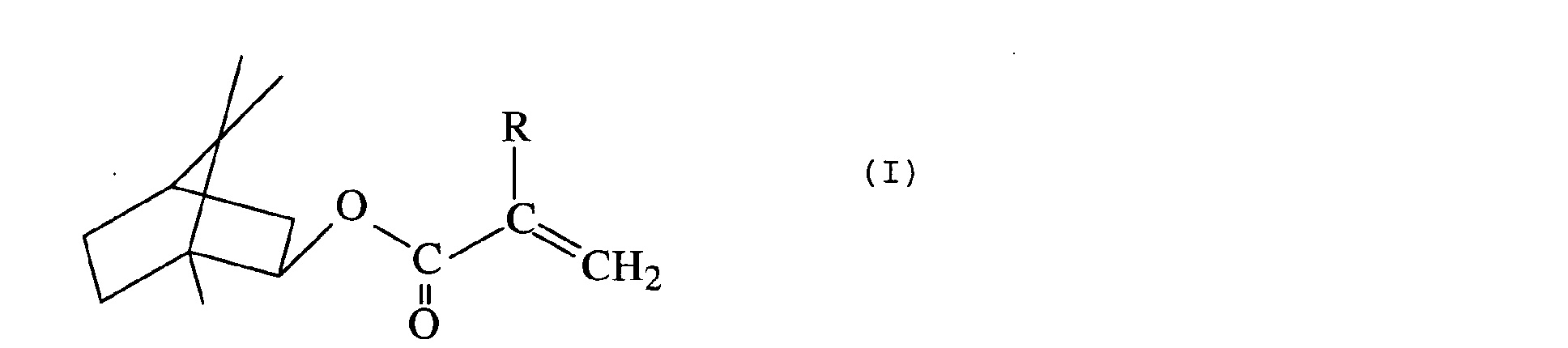
- Various preparation methods of hollow particles have been proposed. It is preferable in the present invention that hollow particles including a volatile material as a core material of a polymer and an external layer made of a thermoplastic polymer is subjected to an evaporation-foaming treatment.
- The hollow degree of the hollow particle for use in the present invention is represented as a percentage (%) of volume of voids in the hollow particles.
- Since the hollow particles act as a heat insulating material while having an elasticity, the hollow particles efficiently use heat energy generated by a thermal head, resulting in improvement of coloring sensitivity. The hollow particles have a hollow degree of not less than 60 %, and preferably from 80 to 95 %. When the hollow degree is not greater than 60 %, the above-mentioned effect is hardly obtained, and when the hollow degree is not less than 95 %, strength thereof is inferior as the thickness of the film is thin.
- The diameter of the hollow particles is preferably not greater than 10 µm such that the surface of a thermal recording material has good uniformity. When there is a particle having a diameter not less than 10 µm, a coating defect (a portion where a coating liquid is not formed) is generated in a thermal coloring layer formed thereon and thereby white spots tends to be formed.
- Next, a feature of the present invention will be explained. The feature of the present invention is that a problem in that when alcoholic flexo graphic ink is printed on the surface of a thermal recording material and a backside thereof, an alcohol solvent penetrates into a thermal coloring layer, thereby causing coloring of the coloring layer can be avoided.
- In particular, as a recent trend, the demand for the thermal recording material is shifting from POS labels for use in a food industry to labels for use in a distribution and a ticket industries. The thermal recording material is required to have good durability to a printing process and good qualities such as high speed printability (high heat sensitivity) rather than durability to a plasticizer contained in a polyvinyl chloride wrapping film.
- In order to meet the above quality requirements, not only investigation of dyes and developers, and utilization of an intermediate layer, but also formation of a thin protective layer (about from 1 µm to 2 µm) are necessary. In particular, it is necessary for the thin protective layer to have excellent resistance to alcoholic flexo graphic ink.
- The present inventors did not particularly intend to search for a crosslinking agent improving resistance to alcoholic flexo graphic ink. The present inventors focus a fact in that silanol group modified PVA and metallic salt have good resistance to water and relatively low toxicity compared to crosslinking agents such as glyoxal or epichlorohydrin crosslinking agents. The present inventors investigated to search for a crosslinking agent having stronger resistance to water. As a result of the investigation focusing zirconium compounds, it is found that when zirconium lactate is used for silanol modified PVA not only strong resistance to water, but also good resistance to flexo alcohol property can be imparted to the resultant layer only.
- Conventionally used zirconium salt was also investigated and as a result, a compound having good resistance to water such as carbonic acid zirconium ammonium was found. However a compound having good resistance to flexo alcohol property was not found. The reason therefor is unknown.
- The present inventors suppose that the reason is as follows.
- Zirconium lactate has such a property as to be easy to dissolve in water and hardly dissolve in alcohol. Because of the water soluble property, zirconium lactate penetrates more deeply into a resin in a coating liquid and can be positioned closely to a functional group of the resin, resulting in formation of strong bonding with the functional group when it is dried. Because of the property such that zirconium lactate is hardly soluble in alcohol, the crosslinking structure is not changed and the resin is not swelled even when alcohol penetrates the resultant layer and thereby penetration of alcohol can be suppressed. In contrast, zirconium ammonium carbonate etc. dissolves in water and can have a strong crosslinking structure, but partially dissolves in alcohol. Therefore the crosslinking structure is damaged and then swelling and penetration occur when being contacted with alcohol.
- In general, a zirconium compound forms a crosslinking structure with a -OH group of PVA. However, in reality, even when perfectly saponified PVA which has a largest number of -OH groups is used, the resistance to water is unsatisfactory. Therefore it seems that the silanol group forms a strong crosslinking structure together with zirconium salt.
- In addition, among PVAs having a silanol group, PVAs having an ethylene unit therein have high resistance to water since a water molecule hardly penetrates PVAs. The addition amount of the crosslinking agent of the present invention, which depends on the modification degree of the resin and the kind of functional group of the resin, is preferably from 0.01 to 1 and more preferably from 0.01 to 0.5 per 1 of the resin. When the ratio of the crosslinking agent is less than 0.01, the resultant layer cannot obtain good resistance to water, and the resistance to alcoholic flexo graphic ink of the layer deteriorates. When the ratio is greater than 0.5, compounds which do not contribute towards formation of a crosslinking structure serve as foreign materials and deteriorate film formation property of the resin, resulting in deterioration of resistance to alcoholic flexo graphic ink.
- In the present invention, by a reaction of a crosslinking agent penetrating from a protective layer and a specific PVA included in the thermal coloring layer, water resistance of a thermal coloring layer is improved and not only water resistance of a thermal recording material is improved, but also resistance to flexo alcohol is improved probably because a dye and a developer are covered by the resin which has strong resistance to alcohol.
- In the present invention, by forming a back coat layer using a specific PVA and a specific crosslinking agent, background coloring can be prevented even when alcoholic flexo graphic ink is printed on the back surface of the substrate. In addition, if the intermediate layer of the present invention is provided, resistance to alcoholic flexo graphic ink penetrating from the back surface of the substrate can be improved and heat sensitivity of the thermal recording material can also be improved even when the backcoat layer is not provided. The thickness of the backcoat layer is not specially limited, but is preferably from about 0.5 µm to 5 µm and more preferably from 1 µm to 2.5 µm.
- Conventionally used fillers can be included in the protective layer, backcoat layer and thermal coloring layer of the present invention. Specific examples of the fillers include inorganic pigments such as calcium carbonates, zinc oxide, aluminum oxide, titanium dioxide, silicas, aluminum hydroxide, barium sulfates, talcs, kaolins, aluminas, clays or well known organic pigments, but are not specially limited thereto.
- In the present invention, well known crosslinking agents such as glyoxals, melamines, aziridine compounds, polyamide epichlorohydrin resins, carbonic acid zirconium ammons and ethylenediamines can be used in combination with the crosslinking agent of the present invention in such an amount as to keep the function of the crosslinking agent.
- One or more kinds of leuco dyes are used in the thermal coloring layer of the present invention. Any leuco dyes for use in thermal materials can be used. Specific examples of such leuco dyes include leuco compounds of dyes such as triphenylmethane, fluoran, phenothiazine, auramine, spiropyran and indolinone phthalide compounds. Specific examples of such leuco dyes include the following.
- 3,3-bis(p-dimethylaminophenyl)phthalide, 3,3-bis(p-dimethylaminophenyl)-6-dimethylaminophthalide (i.e., crystal violet lactone), 3,3-bis(p-dimethylaminophenyl)-6-diethylaminophthalide, 3,3-bis(p-diethylaminophenyl)-6-chlorophthalide, 3-cyclohexylamino-6-chlorofluoran, 3-dimethylamino-5, 7-dimethylfluoran, 3-diethylamino-7-chlorofluoran, 3-diethylamino-7-methylfluoran, 3-diethylamino-7, 8-benzfluoran, 3-diethylamino-6-methyl - 7-chlorofluoran, 3-(N-p-tolyl-N-ethylamino)-6-methyl-7-anilinofluoran, 3-pyrrolidino-6-methyl-7-anilinofluoran, 2-{N-(3'-trifluoromethylphenyl)amino}-6-diethylamino-fluoran, 2-{3,6-bis(diethylamino)-9-(o-chloroanilino)xanthyl}-benzoic acid lactam, 3-diethylamino-6-methyl-7-(m-trichloromethylanilino)-fluoran, 3-diethylamino-7-(o-chloroanilino)fluoran, 3-di-n-butylamino-7-(o-chloroanilino)fluoran, 3-N-methyl-N-n-amylamino-6-methyl-7-anilinofluoran, 3-N-methyl-N-cyclohexylamino-6-methyl-7-anilinofluoran, 3-diethylamino-6-methyl-7-anilinofluoran, 3-(N,N-diethylamino)-5-methyl-7-(N,N-dibenzylamino)-fluoran, benzoyl leuco methylene blue, 6'-chloro-8'-methoxybenzoindolino-spiropyran, 6'-bromo-3'-methoxybenzoindolino-spiropyran, 3-(2'-hydroxy-4'-dimethylaminophenyl)-3-(2'-methoxy-5'-chlorophenyl) phthalide, 3-(2'-hydroxy-4'-dimethylaminophenyl)-3-(2'-methoxy-5'-nitrophenyl)phthalide, 3-(2'-hydroxy-4'-diethylaminophenyl)-3-(2'-methoxy-5'-methylphenyl) phthalide, 3-(2'-methoxy-4'-dimethylaminophenyl)-3-(2'-hydroxy-4'-chloro-5'-methylphenyl)phthalide, 3-N-ethyl-N-tetrahydrofurfurylamino-6-methyl-7-anilinofluoran, 3-N-ethyl-N-(2-ethoxypropyl)amino-6-methyl-7-anilinofluoran, 3-N-methyl-N-isobutyl-6-methyl-7-anilinofluoran, 3-morphorino - 7-(N-propyl-trifluoromethylanilino)-fluoran, 3-pyrrolidino - 7-trifluoromethylanilinofluoran, 3-diethylamino-5-chloro-7-(N-benzyl-trifluoromethylanilino)fluoran, 3-pyrrolidino-7-(di-p-chlorophenyl)methylaminofluoran, 3-diethylamino-5-chloro-7-(α-phenylethylamino)fluoran, 3-(N-ethyl-p-toluidino)-7-(α-phenylethylamino)fluoran, 3-diethylamino-7-(o-methoxycarbonylphenylamino)fluoran, 3-diethylamino-5-methyl-7α-phenylethylamino)fluoran, 3-diethylamino-7-piperidinofluoran, 2-chloro-3-(N-methyltoluidino)-7-(p-n-butylanilino)fluoran, 3-di-n-butylamino-6-methyl-7-anilinofluoran, 3,6-bis(dimethylamino)fluorenespiro(9,3')-6'-dimethylaminophthalide, 3-diethylamino-6-methyl-7-mesidino-4',5'-benzofluoran, 3-N-ethyl-N-isoamyl-6-methyl-7-anilinofluoran, 3-diethylamino-6-methyl-7-(2',4'-dimethylanilino)fluoran, 3-morphorino-7-(N-propyl-trifluoromethylanilino)-fluoran, 3-pyrrolidino-7-trifluoromethylanilinofluoran, 3-diethylamino-5-chloro-7-(N-benzyl-trifluoromethylanilino)fluoran, 3-pyrrolidino-7-(di-p-chlorophenyl)methylaminofluoran, 3-diethylamino-5-chloro-7-(α-phenylethylamino)fluoran, 3-(N-ethyl-p-toluidino)-7-(α-phenylethylamino)fluoran, 3-diethylamino - 7-(o-methoxycarbonylphenylamino)fluoran, 3-diethylamino-5-methyl-7-(α-phenylethylamino)fluoran, 3-diethylamino-7-piperidinofluoran, 2-chloro-3-(N-methyltoluidino)-7-(p-n-butylanilino)fluoran, 3,6-bis(dimethylamino)fluorenespiro (9,3')-6'-dimethylaminophthalide, 3-(N-benzyl-N-cyclohexylamino)-5,6-benzo-7-α-naphthylamino-4'-bromofluoran, 3-N-ethyl-N-(2-ethoxypropyl)amino-6-methyl-7-anilinofluoran, 3-N-ethyl-N-tetrahydrofurfurylamino-6-methyl-7-anilinofluoran, 3-diethylamino-6-methyl-7-mesidino - 4',5'-benzofluoran, 3-p-dimethylaminophenyl)-3-{1,1-bis(p-dimethylaminophenyl)ethylene-2-yl}phthalide, 3-(p-dimethylaminophenyl)-3-{1,1-bis(p-dimethylaminophenyl) ethylene-2-yl}-6-dimethylaminophthalide, 3-(p-dimethylaminophenyl)-3-(1-p-dimethylaminophenyl)-3-(p-dimethylaminophenyl-1-p-chlorophenylethylene-2-yl)-6-dimethylaminophtalide, 3-(4'-dimethylamino-2'-methoxy)-3-(1"-p-dimethylaminophenyl-1"-p-chlorophenyl-1",3"-butadiene-4"-yl)benzophthalide, 3-(4'-dimethylamino-2'-benzyloxy)-3-(1"-p-dimethylaminophenyl-1"-phenyl-1", 3"-butadiene-4"-yl)benzophthalide, 3-dimethylamino-6-dimethylamino-fluoren-9-spiro-3'-(6'-dimethylamino) phthalide, 3,3-bis{2-(p-dimethylaminophenyl)-2-(p-methoxyphenyl)ethenyl}-4,5,6,7-tetrachlorophthalide, 3-bis [1,1-bis(4-pyrrolidinophenyl)ethylene-2-yl]-5,6-dichloro-4, 7-dibromophthalide and bis(p-dimethylaminostyryl)-1-naphthalenesulfonylmethane.
- In addition, various electron acceptors oxidizing reagents, etc. which color the above-mentioned leuco dyes when being contacted therewith can be used as developers for use in the thermal coloring layer of the present invention. Such developers are well known and specific examples thereof include the following, but are not limited thereto.
- 4,4'-isopropylidenediphenol, 4,4'-isopropylidenebis (o-methylphenol), 4,4'-sec-butylidenebisphenol, 4,4'-isopropylidenebis(2-tert-butylphenol), zinc p-nitrobenzoate, 1,3, 5-tris(4-tert-butyl-3-hydroxy-2,6-dimethyl-benzyl) isocyanuric acid, 2,2-(3,4'-dihydroxyphenyl)propane, bis (4-hydroxy-3-methylphenyl) sulfide, 4-{β(p-methoxyphenoxy) ethoxy}salicylic acid, 1,7-bis(4-hydroxyphenylthio)-3,5-dioxaheptane, 1,5-bis(4-hydroxyphenylthio)-5-oxapentane, monocalcium salt of monobenzyl phthalate, 4,4'-cyclohexylidenediphenol, 4,4'-isopropylidenebis(2-chlorophenol), 2,2'-methylenebis(4-methyl-6-tert-butylphenol), 4,4'-butylidenebis(6-tert-butyl-2-methyl) phenol, 1,1,3-tris(2-methyl-4-hydroxy-5-tert-butylphenyl) butane, 1,1,3-tris(2-methyl-4-hydroxy-5-cyclohexylphenyl) - butane, 4,4'-thiobis(6-tert-butyl-2-methylphenol), 4,4'-diphenolsulfone, 4-isopropoxy-4'-hydroxydiphenylsulfone, 4-benzyloxy-4'-hydroxydiphenylsulfone, 4,4'-diphenolsulfoxide, isopropyl p-hydroxybenzoate, benzyl p-hydroxybenzoate, benzyl protocatechuate, stearyl gallate, lauryl gallate, octyl gallate, 1,3-bis(4-hydroxyphenylthio) propane, N,N'-diphenylthiourea, N, N'-di(m-chlorophenyl) thiourea, salicylanilide, bis(4-hydroxyphenyl)methyl acetate, bis(4-hydroxyphenyl)benzyl acetate, 1,3-bis(4-hydroxycumyl) benzene, 1,4-bis(4-hydroxycumyl)benzene, 2,4'-diphenolsulfone, 2,2'-diallyl-4,4'-diphenolsulfone,3,4-dihydroxyphenyl-4'-methyldiphenylsulfone, zinc 1-acetyloxy-2 - naphthoate, zinc 2-acetyloxy-1-naphthoate, zinc 2-acetyloxy -3-naphthoate, α,α-bis(4-hydroxyphenyl)-α-methyltoluene, antipyrine complex of zinc thiocyanate, tetrabromobisphenol A, tetrabromobisphenol S, 4,4'-thiobis(2-methyiphenol), and 4,4'-thiobis(2-chlorophenol).
- In the thermal recording material of the present invention, the developer is used in an amount of from 1 to 20 parts, and preferably from 2 to 10 parts, per 1 part of the coloring agent. The developers can be used alone or in combination. The coloring agents can also be used alone or in combination. When a combination of the leuco dyes and the developers is bonded with a substrate when preparing the thermal recording material of the present invention, polyvinyl alcohol containing a reactive carbonyl group is preferably used and common various binders can be optionally used with or without being combined with the polyvinyl alcohol. Specific examples of the binders include the following.
- Polyvinyl alcohol, starch and derivatives thereof, cellulose derivatives such as hydroxymethyl cellulose, hydroxy ethyl cellulose, carboxymethyl cellulose, methyl cellulose, ethyl cellulose, water-soluble polymers such as polyacrylic acid sodium salt, polyvinylpyrrolidone, acrylamide/acrylate copolymers, acrylamide/acrylate/methacrylic acid copolymers, alkali metal salts of styrene/maleic anhydride copolymers, alkali metal salts of isobutylene-maleic anhydride copolymers, polyacrylamide, sodium alginate, gelatin, casein, emulsions of resins such as polyvinyl acetate, polyurethane, polyacrylic acid, polyacrylate, vinyl chloride/vinyl acetate copolymers, polybutyl methacrylate, ethylene/vinyl acetate copolymers and latex etc such as styrene/butadiene copolymers, styrene/ butadiene/acryl copolymers and the like.
- In addition, in the present invention, various thermofusible materials can be used as a heat sensitivity improver. Specific examples of the heat sensitivity improvers include the following, but are not limited thereto.
- Fatty acids such as stearic acid and behenic acid, fatty acid amides such as stearic acid amide and palmitic acid amide, fatty acid metal salts such as zinc stearate, aluminum stearate, calcium stearate, zinc palmitate and zinc behenate, p-benzylbiphenyl, terphenyl, triphenyl methane, benzyl p-benzyloxybenzoate, β-benzyloxynaphthalene, phenyl β-naphthoate, phenyl 1-hydroxy-2-naphthoate, methyl 1-hydroxy -2-naphthoate, diphenyl carbonate, guaiacol carbonate, dibenzyl terephthalate, dimethyl terephthalate, 1,4-dimethoxynaphthalene, 1,4-diethoxynaphthalene, 1,4-dibenzyloxynaphthalene, 1,2-diphenoxyethane, 1,2-bis(3-methylphenoxy)ethane, 1,2-bis(4-methylphenoxy)ethane, 1,4-diphenoxy-2-butene, 1,2-bis(4-methoxyphenylthio)ethane, dibenzoylmethane, 1,4-diphenylthiobutane, 1,4-diphenylthio-2-butene, 1,3-bis(2-vinyloxyethoxy)benzene, 1,4-bis(2-vinyloxyethoxy)benzene, p-(2-vinyloxyethoxy)biphenyl, p-aryloxybiphenyl, p-propagyloxybiphenyl, dibenzoyloxymethane, dibenzoyloxypropane, dibenzyldisulfide, 1,1-diphenylethanol, 1,1-diphenylpropanol, p-benzyloxybenzylalcohol, 1,3-phenoxy-2-propanol, N-octadecylcarbamoyl-p-methoxycarbonylbenzene, N-octadecylcarbamoylbenzene, 1,2-bis(4-methoxyphenoxy) propane, 1,5-bis(4-methoxyphenoxy)-3-oxapentane, dibenzyl oxalate, bis(4-methylbenzyl)oxalate and bis(4-chlorobenzyl) oxalate.
- The thermal coloring layer is prepared by coating a coating liquid, which is prepared by dispersing or dissolving uniformly a coloring agent, a developer and a binder in water on a substrate and then drying the coated liquid, but the coating method is not specially limited. A diameter of particles dispersed in the coloring layer coating liquid is preferably not greater than 5 µm and more preferably not greater than 1 µm. The thickness of the coloring layer is determined depending upon the composition thereof and applications of the thermal recording material, but the thickness is from 1 to 50 µm, and more preferably from 3 to 20 µm. In addition, the coloring coating liquid can optionally include various additives used in normal thermal recording materials for the purpose of improving the coating property and recording property. In addition, a protective layer can be located overlying the back surface of the substrate of the thermal recording material of the present invention. Similarly to the binder resin used in the protective layer located overlying the above-mentioned thermal coloring layer, polyvinyl alcohol containing a reactive carbonyl group is preferably used as a binder resin of the protective layer. Furthermore, a pigment, a lubricant, a crosslinking agent, etc. can also be included in the protective layer formed on the back surface to improve anti-blocking property and drying property when coated.
- Both an acid paper and a neutral paper can be used as a substrate of the present invention. In addition, the calcium content of the above-mentioned neutral paper substrate and a released paper made of neutral paper is preferably as small as possible. Such neutral paper and released paper containing a small amount of calcium can be prepared by reducing the ratio of recycled paper used in paper production. Normally, calcium carbonate is used as an internal additive and alkyl ketene dimers or anhydrous alkenyl succinic acid are used as a sizing agent in neutral paper production. However, it is preferable that the internal additive is replaced with talc and clay, while using a neutral rosin sizing agent to prepare the neutral paper for use in the present invention.
- Regarding the layer structure of the thermal recording material of the present invention, a thermal coloring layer is located overlying a substrate and a protective layer is located overlying the thermal coloring layer, and another protective layer is located overlying the back surface of the substrate. Each layer does not need to be contacted with each other and an intermediate layer can be provided between the substrate and the thermal coloring layer, between the thermal coloring layer and the protective layer, and between the substrate and the protective layer on the back surface of the substrate. In particular, a heat insulating layer is preferably formed between the substrate and the thermal coloring layer. The heat insulating layer preferably uses a hollow resin particle having a hollow degree not less than 80 %. Furthermore, each of the above-mentioned layers can be a single layer or a multiple layer.
- A recording method of the thermal recording material of the present invention can be methods using a heat pen, a thermal head, laser heating or the like, which is determined depending on the application of the recording material, but the recording method is not specially limited thereto.
- The following components were mixed and dispersed with a sand mill until the components have an average particle diameter of 0.5 µm.
3-dibutylamino-6-methyl-7-anilinofluoran 20 parts 10 % aqueous solution of polyvinyl alcohol 20 parts Water 60 parts - The following components were mixed and dispersed with a sand mill until the components have an average particle diameter of 0.5 µm.
4-isopropoxy-4'-hydroxydiphenylsulfone 20 parts di-(p-methylbenzyl)oxalate 10 parts calcium carbonate 10 parts 10 % aqueous solution of polyvinyl alcohol 30 parts Water 30 parts - The following components were mixed to prepare a thermal coloring layer coating liquid.
Liquid A 20 parts Liquid B 60 parts Carboxyl group modified PVA (solid content: 10 %, KL318 manufactured by Kuraray Co., Ltd.) 30 parts aqueous solution of dioctyl sulfo succinic acid (solid content: 5 %) 1 part - The following components were mixed to prepare a protective layer coating liquid.
aluminum hydroxide dispersion (solid content: 50%) 40 Parts zinc stearate dispersion (solid content: 30%) 6 parts aqueous solution of dioctyl sulfo succinic acid (solid content: 5%) 1 part 10 % solution of polyvinyl alcohol containing a silanol group (R1130 manufactured by Kuraray Co. , Ltd. ) 200 parts 10 % aqueous solution of zirconium ammonium lactate (Z-1185 manufactured by Matsumoto Chemical Industry Co. , Ltd.) (crosslinking agent) 20 parts water 43 parts - The thermal coloring layer coating liquid was coated on a substrate (a wood free paper having a basis weight of about 60 g/m2) and dried to form a thermal coloring layer having a deposition amount of about 0.6 g/m2 on a dry basis. Furthermore, the protective layer coating liquid was coated on the thermal coloring layer and dried to form a protective layer having a deposition amount of about 1.6 g/m2 on a dry basis. Then the surface of the substrate was subjected to a calendering treatment to smooth the surface thereof, and the substrate was subjected to a curing treatment at 40 ° C for 24 hours to prepare a thermal recording material.
- The procedure for preparation of the thermal recording material in Example 1 was repeated except that the 10 % solution of polyvinyl alcohol containing a silanol group (R1130 manufactured by Kuraray Co., Ltd.) was replaced with an ethylene modified PVA modified with a silanol group (RS43 manufactured by Kuraray Co. , Ltd.) to prepare a thermal recording material.
- The procedure for preparation of the thermal recording material in Example 1 was repeated except that the addition quantity of the 10 % aqueous solution of zirconium ammonium lactate (Z-1185 manufactured by Matsumoto Chemical Industry Co., Ltd.) (crosslinking agent) was changed from 20 parts to 120 parts to prepare a thermal recording material.
- The procedure for preparation of the thermal recording material in Example 1 was repeated except that the addition quantity of the 10 % aqueous solution of zirconium ammonium lactate (Z-1185 manufactured by Matsumoto Chemical Industry Co., Ltd.) (crosslinking agent) was changed from 20 parts to 100 parts to prepare a thermal recording material.
- The procedure for preparation of the thermal recording material in Example 1 was repeated except that the addition quantity of the 10 % aqueous solution of zirconium ammonium lactate (Z-1185 manufactured by Matsumoto Chemical Industry Co., Ltd.) (crosslinking agent) was changed from 20 parts to 2 parts to prepare a thermal recording material.
- The procedure for preparation of the thermal recording material in Example 1 was repeated except that the addition quantity of the 10 % aqueous solution of zirconium ammonium lactate (Z-1185 manufactured by Matsumoto Chemical Industry Co., Ltd.) (crosslinking agent) was changed from 20 parts to 1 part to prepare a thermal recording material.
- The procedure for preparation of the thermal recording material in Example 1 was repeated except that the carboxyl modified PVA (solid content: 10 %) was replaced with 10 % solution of polyvinyl alcohol containing a silanol group (R1130 manufactured by Kuraray Co., Ltd.) to prepare a thermal recording material.
- The procedure for preparation of the thermal recording material in Example 1 was repeated except that the carboxyl modified PVA (solid content: 10 %) was replaced with an ethylene modified PVA modified with a silanol group (RS43 manufactured by Kuraray Co. , Ltd.) to prepare a thermal recording material.
- The following components were mixed to prepare a backcoat layer coating liquid.
aluminum hydroxide dispersion (solid content: 50%) 40 parts 5 % aqueous solution of dioctylsulfosuccinic acid 1 part 10 % solution of polyvinyl alcohol containing a silanol group (R1130 manufactured by Kuraray Co. , Ltd. ) 200 parts 10% aqueous solution of zirconium ammonium lactate (Z-1185 manufactured by Matsumoto Chemical Industry Co., Ltd.) (crosslinking agent) 20 parts Water 43 parts - Similarly to Example 1, after a thermal coloring layer and a protective layer are provided, the surface of the substrate was subjected to a calendering treatment to be smoothed, and then the substrate was subjected to a cure treatment at 40 °C for 24 hours to prepare a thermal recording material.
- The procedure for preparation of the thermal recording material in Example 9 was repeated except that the 10 % solution of polyvinyl alcohol containing a silanol group (R1130 manufactured by Kuraray Co., Ltd.) used for preparing the backcoat layer coating liquid in Example 9 was replaced with an ethylene modified PVA modified with a silanol group (RS43 manufactured by Kuraray Co., Ltd.) to prepare a thermal recording material.
- The following mixtures were agitated and dispersed to prepare an intermediate layer (heat insulating layer) forming liquid.
acrylonitrile/methacrylonitrile/isobonrylacrylate copolymer having a hollow degree of 90 %, a center particle diameter of 3 µm, a maximum particle diameter of 9 µm and a solid content of 30 % 30.0 parts styrene/butadiene copolymer latex (solid content: 47 %) 15.0 parts water 55 parts - An intermediate layer (heat insulating layer) coating liquid was coated on a substrate and dried to form an intermediate layer (heat insulating layer) having a deposition amount of 2.5 g/m2 on a dry basis. In addition, similarly to Example 1, after a thermal coloring layer and a protective layer are provided, the surface of the substrate was subjected to a calendering treatment to be smoothed, and then the substrate was subj ected to a cure treatment at 40 °C for 24 hours to prepare a thermal recording material.
- The procedure for preparation of the thermal recording material in Example 1 was repeated except that 20 parts of the 10 % aqueous solution of zirconium ammonium lactate (Z-1185 manufactured by Matsumoto Chemical Industry Co., Ltd.) (crosslinking agent) used for preparing the protective layer coating liquid in Example 1 was replaced with 20 parts of 10 % solution of zirconium oxychloride salt (ZIRCOSOL ZC-2 manufactured by Daiichi Kigenso Kagaku Kogyo Co., Ltd.) to prepare a thermal recording material.
- The procedure for preparation of the thermal recording material in Example 1 was repeated except that 20 parts of the 10 % aqueous solution of zirconium ammonium lactate (Z-1185 manufactured by Matsumoto Chemical Industry Co., Ltd.) (crosslinking agent) used for preparing a protective layer coating liquid in Example 1 was replaced with 20 parts of 10 % solution of zirconium sulphate salt (ZIRCOSOL ZS manufactured by Daiichi Kigenso Kagaku Kogyo Co. , Ltd.) to prepare a thermal recording material.
- The procedure for preparation of the thermal recording material in Example 1 was repeated except that 20 parts of the 10 % aqueous solution of zirconium ammonium lactate (Z-1185 manufactured by Matsumoto Chemical Industry Co., Ltd.) (crosslinking agent) used for preparing a protective layer coating liquid in Example 1 was replaced with 20 parts of 10 % solution of zirconium nitrate salt (ZIRCOSOL ZN manufactured by Daiichi Kigenso Kagaku Kogyo Co. , Ltd.) to prepare a thermal recording material.
- The procedure for preparation of the thermal recording material in Example 1 was repeated except that 20 parts of the 10 % aqueous solution of zirconium ammonium lactate (Z-1185 manufactured by Matsumoto Chemical Industry Co., Ltd.) (crosslinking agent) used for preparing a protective layer coating liquid in Example 1 was replaced with 20 parts of 10 % solution of acetic acid zirconium salt (ZA manufactured by Daiichi Kigenso Kagaku Kogyo Co., Ltd.) to prepare a thermal recording material.
- The procedure for preparation of the thermal recording material in Example 1 was repeated except that 20 parts of the 10 % aqueous solution of zirconium ammonium lactate (Z-1185 manufactured by Matsumoto Chemical Industry Co., Ltd.) (crosslinking agent) aqueous solution used for preparing a protective layer coating liquid in Example 1 was replaced with 20 parts of 10 % solution of carbonic acid zirconium salt (carbonic acid zirconyl manufactured by Daiichi Kigenso Kagaku Kogyo Co., Ltd.) to prepare a thermal recording material.
- The procedure for preparation of the thermal recording material in Example 1 was repeated except that 20 parts of the 10 % aqueous solution of zirconium ammonium lactate (Z-1185 manufactured by Matsumoto Chemical Industry Co., Ltd.) (crosslinking agent) used for preparing a protective layer coating liquid in Example 1 was replaced with 20 parts of 10 % solution of carbonic acid zirconium ammonium salt (AC-7 manufactured by Daiichi Kigenso Kagaku Kogyo Co., Ltd.) to prepare a thermal recording material.
- The procedure for preparation of the thermal recording material in Example 1 was repeated except that 20 parts of the 10 % aqueous solution of zirconium ammonium lactate (Z-1185 manufactured by Matsumoto Chemical Industry Co., Ltd.) (crosslinking agent) used for preparing a protective layer coating liquid in Example 1 was replaced with 20 parts of 10 % solution of stearic acid zirconium salt (manufactured by Daiichi Kigenso Kagaku Kogyo Co., Ltd.) to prepare a thermal recording material.
- The procedure for preparation of the thermal recording material in Example 1 was repeated except that 20 parts of the 10 % aqueous solution zirconium ammonium lactate (Z-1185 manufactured by Matsumoto Chemical Industry Co., Ltd.) (crosslinking agent) used for preparing a protective layer coating liquid in Example 1 was replaced with 20 parts of a 10 % dispersion of octyl acid zirconium salt (manufactured by Daiichi Kigenso Kagaku Kogyo Co., Ltd.) to prepare a thermal recording material.
- The procedure for preparation of the thermal recording material in Example 1 was repeated except that 20 parts of the 10 % aqueous solution zirconium ammonium lactate (Z-1185 manufactured by Matsumoto Chemical Industry Co., Ltd.) (crosslinking agent) used for preparing a protective layer coating liquid in Example 1 was replaced with 20 parts of a 10 % dispersion of silicic acid zirconium salt (manufactured by Daiichi Kigenso Kagaku Kogyo Co., Ltd.) to prepare a thermal recording material.
- The procedure for preparation of the thermal recording material in Example 1 was repeated except that 20 parts of the 10 % aqueous solution zirconium ammonium lactate (Z-1185 manufactured by Matsumoto Chemical Industry Co., Ltd.) (crosslinking agent) used for preparing a protective layer coating liquid in Example 1 was replaced with 20 parts of a 10 % dispersion of titanium lactate (TC-310 manufactured by Matsumoto Chemical Industry Co., Ltd.) to prepare a thermal recording material.
- The procedure for preparation of the thermal recording material in Example 1 was repeated except that the 10 % solution of polyvinyl alcohol containing a silanol group (R1130 manufactured by Kuraray Co., Ltd.) used for preparing a protective layer coating liquid in Example 1 was replaced with a perfectly saponified PVA (PVA117 manufactured by Kuraray Co., Ltd.) to prepare a thermal recording material.
- The procedure for preparation of the thermal recording material in Example 1 was repeated except that 10 % solution of polyvinyl alcohol containing a silanol group (R1130 manufactured by Kuraray Co., Ltd.) used for preparing a protective layer coating liquid in Example 1 was replaced with a carboxyl modified PVA (KL318 manufactured by Kuraray Co., Ltd.) to prepare a thermal recording material.
- Constitutions of Examples and Comparative Examples are shown in Table 1-1 and Table 1-2.
- The results are shown in Tables 2.
- Samples of a thermal recording material were dipped in water at room temperature for 16 hours and then the surface or the back surface (only the samples with the backcoat layer were evaluated) of the recording material was rubbed 10 times to observe the condition of the surfaces.
- o ○: the protective layer was not peeled at all.
- ○: the protective layer was not peeled but the surface thereof was slimy. (no problem for a practical use)
- Δ: the protective layer was slightly peeled.
- ×: the protective layer or the backcoat layer was melted.
-
- Samples of a thermal recording materials were kept 24 hours under an environmental condition of 40 °C 90 % for 24 hours. Then image density of non-image portions were measured using a blue filter (a filter for measuring yellow density) of a reflection density measuring apparatus manufactured by MacBeath.
- FLEXO ALCOHL INK 75100 manufactured by SICPA was coated on the surface or the back surface of the samples of a thermal recording materials at 0.1 WB and dried by DRYER. Then the background coloring density of the samples was measured by the reflection density measuring apparatus manufactured by MacBeath.
- The ink was coated on either the surface or the back surface of a sample in order to confirm the effect of each surface.


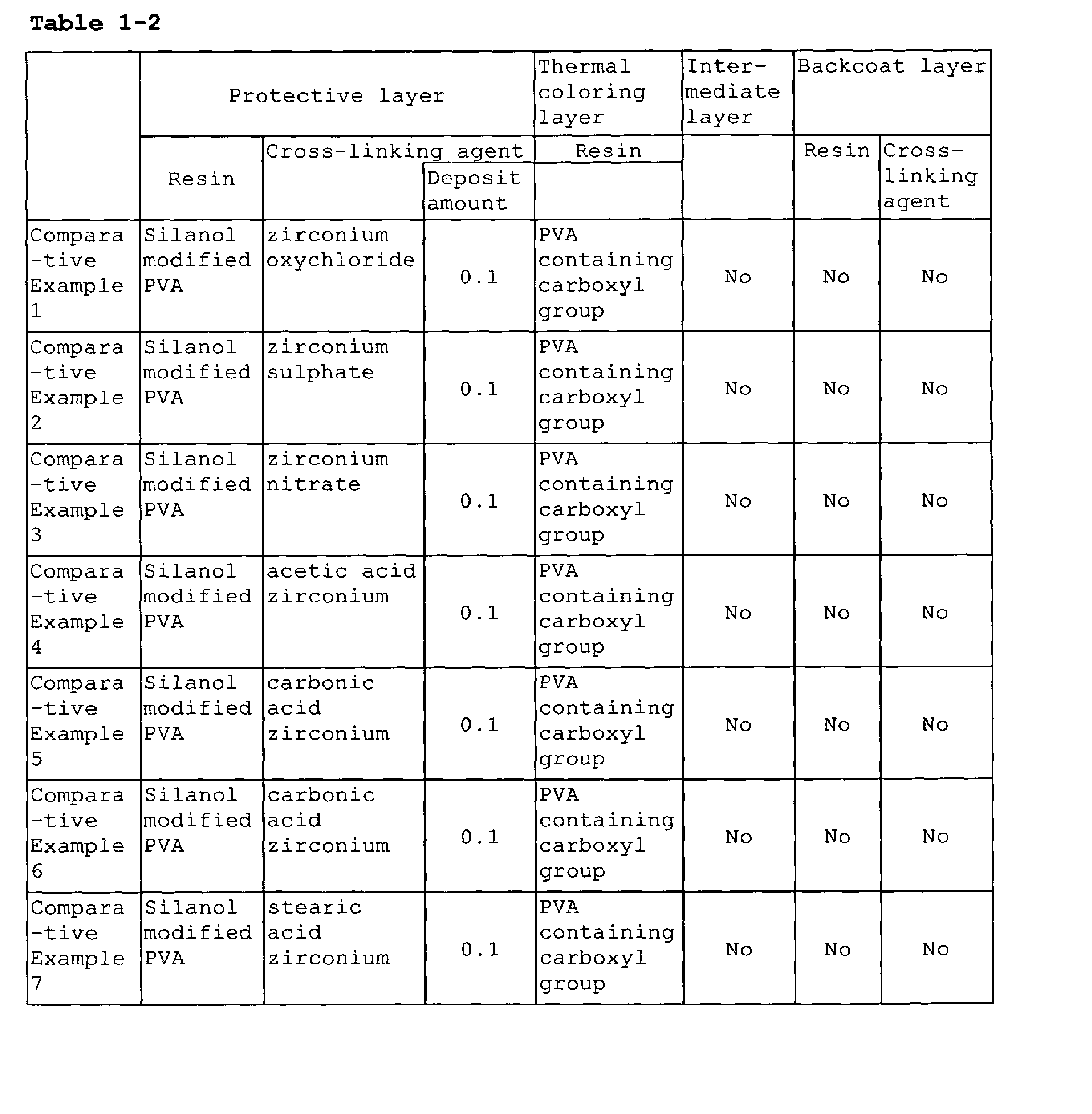


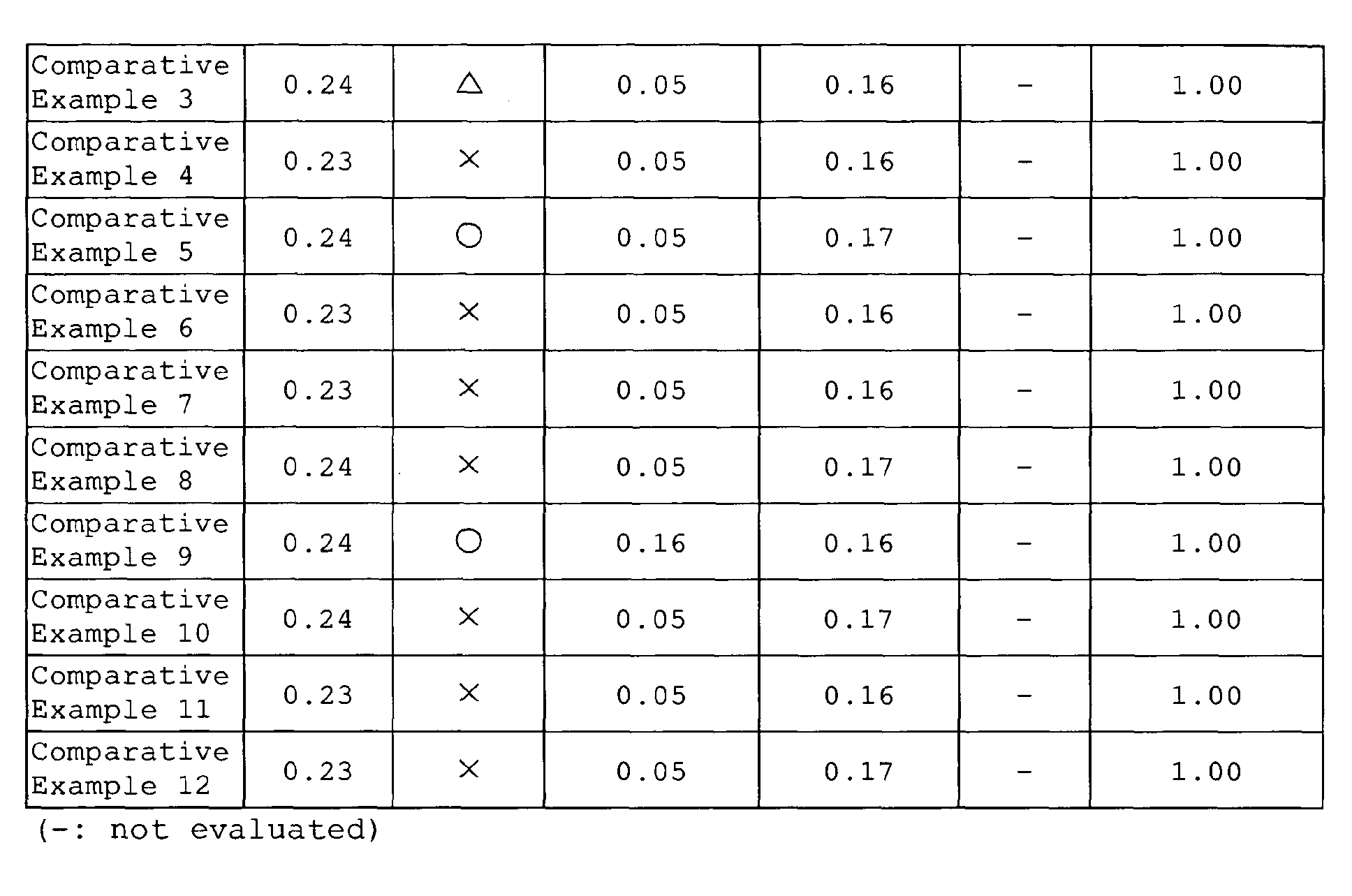
- This document claims priority and contains subj ect matter related to Japanese Patent Application No. 2002-268751 filed on September 13, 2002.
Claims (9)
- A thermal recording material comprising
a substrate;
a thermal coloring layer which is located overlying the substrate and which comprises a leuco dye and a developer for coloring the leuco dye upon application of heat; and
a protective layer which is located overlying the thermal coloring layer and which comprises a binder resin, a crosslinking agent and a filler,
wherein the binder resin in the protective layer comprises a polyvinyl alcohol having a silanol group, and the crosslinking agent comprises a zirconium compound of lactic acid. - The thermal recording material according to Claim 1,
wherein the polyvinyl alcohol is an ethylene-modified polyvinyl alcohol having an ethylene unit and a silanol group. - The thermal recording material according to Claim 1 or 2 , wherein the crosslinking agent is included in an amount of from 0.01 to 0.50 parts by weight per 1 part by weight of the binder resin.
- The thermal recording material according to any one of Claims 1 to 3, wherein the thermal coloring layer further comprises a polyvinyl alcohol having a silanol group.
- The thermal recording material according to any one of Claims 1 to 4, wherein the polyvinyl alcohol is an ethylene-modified polyvinyl alcohol having an ethylene unit and a silanol group.
- The thermal recording material according to any one of Claims 1 to 5, further comprising a backcoat layer which is located overlying a side of the substrate opposite that bearing the thermal coloring layer and which comprises a polyvinyl alcohol having a silanol group and a zirconium compound of lactic acid serving as a crosslinking agent.
- The thermal recording material according to any one of Claims 1 to 6, further comprising an intermediate layer which is located between the substrate and the thermal coloring layer and which comprises a hollow particle of a copolymer comprising monomer units of acrylonitrile , methacrylonitrile and a monomer having the following formula (I):wherein R represents a hydrogen atom or a methyl group.
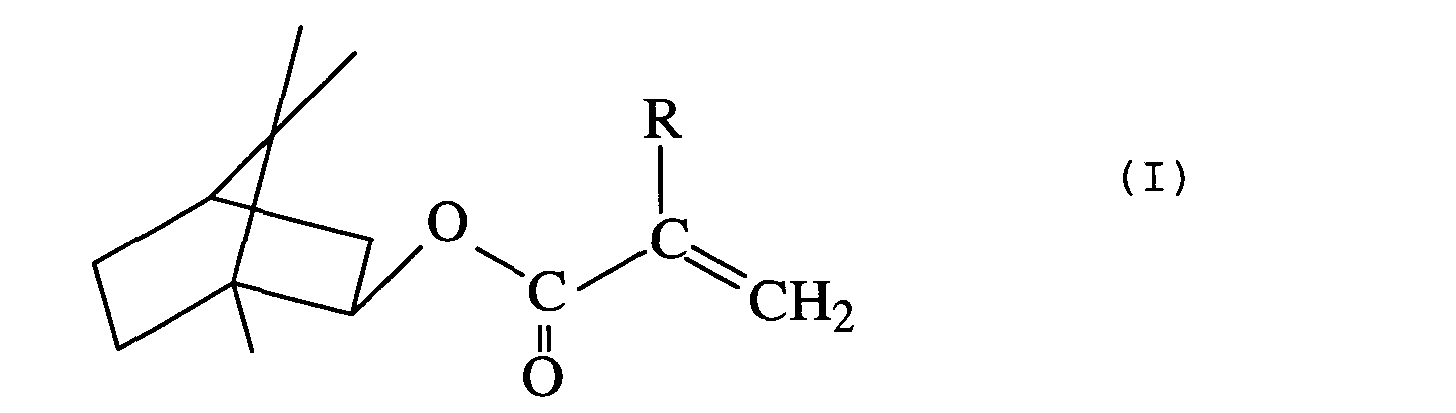
- The thermal recording material according to any one of Claims 1 to 7, further comprising an adhesive agent layer located overlying a side of the substrate opposite that bearing the thermal recording layer.
- The thermal recording material according to any one of Claims 1 to 8 , further comprising an ink layer which is located overlying a surface of the protective layer using an ink including alcohol.
Applications Claiming Priority (2)
| Application Number | Priority Date | Filing Date | Title |
|---|---|---|---|
| JP2002268751 | 2002-09-13 | ||
| JP2002268751A JP3891417B2 (en) | 2002-09-13 | 2002-09-13 | Thermal recording material |
Publications (2)
| Publication Number | Publication Date |
|---|---|
| EP1398171A1 true EP1398171A1 (en) | 2004-03-17 |
| EP1398171B1 EP1398171B1 (en) | 2005-02-16 |
Family
ID=31884820
Family Applications (1)
| Application Number | Title | Priority Date | Filing Date |
|---|---|---|---|
| EP03020815A Expired - Lifetime EP1398171B1 (en) | 2002-09-13 | 2003-09-12 | Thermal recording material |
Country Status (4)
| Country | Link |
|---|---|
| US (1) | US7071142B2 (en) |
| EP (1) | EP1398171B1 (en) |
| JP (1) | JP3891417B2 (en) |
| DE (1) | DE60300327T2 (en) |
Families Citing this family (6)
| Publication number | Priority date | Publication date | Assignee | Title |
|---|---|---|---|---|
| US7432223B2 (en) * | 2003-12-18 | 2008-10-07 | Ricoh Company, Ltd. | Reversible thermosensitive recording medium, information storage material, reversible thermosensitive recording label, image processing method and image processing device |
| US8598075B2 (en) | 2008-12-26 | 2013-12-03 | Mitsubishi Paper Mills Limited | Thermal recording material and method for producing the same |
| US8530377B2 (en) * | 2009-12-01 | 2013-09-10 | Ricoh Company, Ltd. | Thermoreversible recording medium, and thermoreversible recording member |
| JP2012210805A (en) * | 2011-03-18 | 2012-11-01 | Ricoh Co Ltd | Reversible thermosensitive recording medium and reversible thermosensitive recording member |
| JP6020185B2 (en) | 2013-01-17 | 2016-11-02 | 株式会社リコー | Ink jet recording ink, ink cartridge, ink jet recording method, ink jet recording apparatus, ink recorded matter, and method for producing ink recorded matter |
| JP7338185B2 (en) * | 2019-03-20 | 2023-09-05 | 株式会社リコー | thermal recording medium |
Citations (6)
| Publication number | Priority date | Publication date | Assignee | Title |
|---|---|---|---|---|
| JPS6195978A (en) | 1984-10-18 | 1986-05-14 | Ricoh Co Ltd | heat sensitive recording material |
| DE4022537A1 (en) * | 1989-07-17 | 1991-01-24 | Mitsubishi Paper Mills Ltd | Thermographic sheet with double protective resin coating - as thickener to increase chemical and storage stability without impairing copy |
| JPH11302331A (en) | 1998-04-20 | 1999-11-02 | Kuraray Co Ltd | Water-resistant composition |
| JP2001138637A (en) | 1999-08-31 | 2001-05-22 | Kuraray Co Ltd | Thermal recording material |
| EP1211094A2 (en) * | 2000-12-04 | 2002-06-05 | Fuji Photo Film Co., Ltd. | Thermal recording material |
| JP2002268751A (en) | 2001-03-14 | 2002-09-20 | Hitachi Via Mechanics Ltd | Servo controller |
Family Cites Families (21)
| Publication number | Priority date | Publication date | Assignee | Title |
|---|---|---|---|---|
| JP2632717B2 (en) * | 1988-06-23 | 1997-07-23 | 株式会社リコー | Novel phenolic compound and recording material using the compound |
| US4985345A (en) * | 1989-02-02 | 1991-01-15 | Ricoh Company, Ltd. | Recording material |
| US5409881A (en) * | 1991-12-27 | 1995-04-25 | Ricoh Company, Ltd. | Thermosensitive recording material |
| JP3156884B2 (en) * | 1992-04-17 | 2001-04-16 | 株式会社リコー | Thermal recording material |
| JPH07223371A (en) * | 1993-04-30 | 1995-08-22 | Ricoh Co Ltd | Thermal recording material |
| JPH08108633A (en) * | 1993-09-17 | 1996-04-30 | Ricoh Co Ltd | Thermal recording material |
| JP3458250B2 (en) * | 1993-10-18 | 2003-10-20 | 株式会社リコー | Recording material |
| JPH09183270A (en) * | 1995-09-21 | 1997-07-15 | Ricoh Co Ltd | Thermal recording release label |
| FR2742380B1 (en) * | 1995-12-15 | 1999-01-29 | Ricoh Kk | THERMOSENSITIVE RECORDING MEDIUM WITH PROTECTIVE LAYER |
| US5972836A (en) * | 1996-07-18 | 1999-10-26 | Ricoh Company, Ltd. | Thermosensitive recording medium |
| US6180560B1 (en) * | 1997-08-14 | 2001-01-30 | Ricoh Company, Ltd. | Thermosensitive recording material and color developer compound therefor |
| JP3616844B2 (en) * | 1997-08-15 | 2005-02-02 | 株式会社リコー | Thermal recording material |
| US6514328B1 (en) * | 1999-02-05 | 2003-02-04 | Ricoh Company, Ltd. | Marking ink composition and display medium using the same |
| US6395680B1 (en) * | 1999-04-16 | 2002-05-28 | Ricoh Company, Ltd. | Composition of aromatic carboxylic acid compounds and thermosensitive recording material using the same |
| JP2001056653A (en) * | 1999-06-11 | 2001-02-27 | Ricoh Co Ltd | Display liquid for electrophoretic display, display particles, and display medium, display device, display method, display card, recording sheet, display, reversible display signboard using them |
| JP2001132637A (en) | 1999-11-11 | 2001-05-18 | Daikin Ind Ltd | Compressors and refrigerators |
| US6816146B2 (en) * | 1999-12-21 | 2004-11-09 | Ricoh Company Limited | Electrophoretic display liquid and electrophoretic display medium and device using the liquid having predetermined different volume medium particle diameters |
| DE60201934T2 (en) * | 2001-03-23 | 2005-11-10 | Ricoh Co., Ltd. | Leuco dye dispersion and thermosensitive recording material using this dispersion |
| JP4221163B2 (en) * | 2001-03-23 | 2009-02-12 | 株式会社リコー | Thermal recording material and method for producing the same |
| EP1270257B1 (en) | 2001-06-25 | 2007-09-12 | Ricoh Company, Ltd. | Thermosensitive recording material |
| JP3907108B2 (en) * | 2001-09-25 | 2007-04-18 | 株式会社リコー | Method for synthesizing thermosensitive recording material and oligomer composition for recording material |
-
2002
- 2002-09-13 JP JP2002268751A patent/JP3891417B2/en not_active Expired - Fee Related
-
2003
- 2003-09-11 US US10/661,083 patent/US7071142B2/en not_active Expired - Lifetime
- 2003-09-12 EP EP03020815A patent/EP1398171B1/en not_active Expired - Lifetime
- 2003-09-12 DE DE60300327T patent/DE60300327T2/en not_active Expired - Lifetime
Patent Citations (6)
| Publication number | Priority date | Publication date | Assignee | Title |
|---|---|---|---|---|
| JPS6195978A (en) | 1984-10-18 | 1986-05-14 | Ricoh Co Ltd | heat sensitive recording material |
| DE4022537A1 (en) * | 1989-07-17 | 1991-01-24 | Mitsubishi Paper Mills Ltd | Thermographic sheet with double protective resin coating - as thickener to increase chemical and storage stability without impairing copy |
| JPH11302331A (en) | 1998-04-20 | 1999-11-02 | Kuraray Co Ltd | Water-resistant composition |
| JP2001138637A (en) | 1999-08-31 | 2001-05-22 | Kuraray Co Ltd | Thermal recording material |
| EP1211094A2 (en) * | 2000-12-04 | 2002-06-05 | Fuji Photo Film Co., Ltd. | Thermal recording material |
| JP2002268751A (en) | 2001-03-14 | 2002-09-20 | Hitachi Via Mechanics Ltd | Servo controller |
Non-Patent Citations (1)
| Title |
|---|
| PATENT ABSTRACTS OF JAPAN vol. 010, no. 273 (M - 518) 17 September 1986 (1986-09-17) * |
Also Published As
| Publication number | Publication date |
|---|---|
| EP1398171B1 (en) | 2005-02-16 |
| JP3891417B2 (en) | 2007-03-14 |
| JP2004106229A (en) | 2004-04-08 |
| US20040087444A1 (en) | 2004-05-06 |
| DE60300327T2 (en) | 2006-01-12 |
| DE60300327D1 (en) | 2005-03-24 |
| US7071142B2 (en) | 2006-07-04 |
Similar Documents
| Publication | Publication Date | Title |
|---|---|---|
| EP1243439B1 (en) | Thermosensitive recording material and method of production thereof | |
| US8003568B2 (en) | Thermosensitive recording material | |
| JP2901625B2 (en) | Thermal recording material | |
| EP0764548A2 (en) | Thermosensitive recording adhesive label sheet | |
| EP1398171B1 (en) | Thermal recording material | |
| US5194418A (en) | Thermosensitive recording material | |
| JP3750786B2 (en) | Thermal recording material | |
| JP2003019864A (en) | Thermal recording material | |
| JP3161774B2 (en) | Thermal recording material | |
| JP2700227B2 (en) | Thermal recording material | |
| JP2004284089A (en) | Thermal recording material | |
| JP2729255B2 (en) | Thermal recording material | |
| JP3314287B2 (en) | Thermal recording material | |
| JP3559113B2 (en) | Thermal recording material | |
| JPH11208115A (en) | Thermal recording material | |
| JP3611401B2 (en) | Thermal recording material | |
| JP3569043B2 (en) | Thermal recording material | |
| JP3119725B2 (en) | Thermal recording material | |
| JP3286664B2 (en) | Thermal recording material | |
| JP3245802B2 (en) | Thermal recording material | |
| JP4223644B2 (en) | Thermal recording material | |
| JP3190422B2 (en) | Thermal recording material | |
| JP3057297B2 (en) | Thermal recording material | |
| JP2009066852A (en) | Thermal recording material | |
| JPH10230679A (en) | Thermal recording material |
Legal Events
| Date | Code | Title | Description |
|---|---|---|---|
| PUAI | Public reference made under article 153(3) epc to a published international application that has entered the european phase |
Free format text: ORIGINAL CODE: 0009012 |
|
| AK | Designated contracting states |
Kind code of ref document: A1 Designated state(s): AT BE BG CH CY CZ DE DK EE ES FI FR GB GR HU IE IT LI LU MC NL PT RO SE SI SK TR |
|
| AX | Request for extension of the european patent |
Extension state: AL LT LV MK |
|
| 17P | Request for examination filed |
Effective date: 20040427 |
|
| GRAP | Despatch of communication of intention to grant a patent |
Free format text: ORIGINAL CODE: EPIDOSNIGR1 |
|
| AKX | Designation fees paid |
Designated state(s): DE FR GB |
|
| GRAS | Grant fee paid |
Free format text: ORIGINAL CODE: EPIDOSNIGR3 |
|
| GRAA | (expected) grant |
Free format text: ORIGINAL CODE: 0009210 |
|
| AK | Designated contracting states |
Kind code of ref document: B1 Designated state(s): DE FR GB |
|
| REG | Reference to a national code |
Ref country code: GB Ref legal event code: FG4D |
|
| REG | Reference to a national code |
Ref country code: IE Ref legal event code: FG4D |
|
| REF | Corresponds to: |
Ref document number: 60300327 Country of ref document: DE Date of ref document: 20050324 Kind code of ref document: P |
|
| ET | Fr: translation filed | ||
| PLBE | No opposition filed within time limit |
Free format text: ORIGINAL CODE: 0009261 |
|
| STAA | Information on the status of an ep patent application or granted ep patent |
Free format text: STATUS: NO OPPOSITION FILED WITHIN TIME LIMIT |
|
| 26N | No opposition filed |
Effective date: 20051117 |
|
| REG | Reference to a national code |
Ref country code: DE Ref legal event code: R082 Ref document number: 60300327 Country of ref document: DE Representative=s name: MEISSNER, BOLTE & PARTNER GBR, DE Ref country code: DE Ref legal event code: R082 Ref document number: 60300327 Country of ref document: DE Representative=s name: MEISSNER BOLTE PATENTANWAELTE RECHTSANWAELTE P, DE |
|
| REG | Reference to a national code |
Ref country code: DE Ref legal event code: R082 Ref document number: 60300327 Country of ref document: DE Representative=s name: MEISSNER, BOLTE & PARTNER GBR, DE |
|
| REG | Reference to a national code |
Ref country code: FR Ref legal event code: PLFP Year of fee payment: 14 |
|
| REG | Reference to a national code |
Ref country code: FR Ref legal event code: PLFP Year of fee payment: 15 |
|
| PGFP | Annual fee paid to national office [announced via postgrant information from national office to epo] |
Ref country code: GB Payment date: 20170921 Year of fee payment: 15 Ref country code: FR Payment date: 20170928 Year of fee payment: 15 Ref country code: DE Payment date: 20170928 Year of fee payment: 15 |
|
| REG | Reference to a national code |
Ref country code: DE Ref legal event code: R119 Ref document number: 60300327 Country of ref document: DE |
|
| GBPC | Gb: european patent ceased through non-payment of renewal fee |
Effective date: 20180912 |
|
| PG25 | Lapsed in a contracting state [announced via postgrant information from national office to epo] |
Ref country code: DE Free format text: LAPSE BECAUSE OF NON-PAYMENT OF DUE FEES Effective date: 20190402 |
|
| PG25 | Lapsed in a contracting state [announced via postgrant information from national office to epo] |
Ref country code: FR Free format text: LAPSE BECAUSE OF NON-PAYMENT OF DUE FEES Effective date: 20180930 |
|
| PG25 | Lapsed in a contracting state [announced via postgrant information from national office to epo] |
Ref country code: GB Free format text: LAPSE BECAUSE OF NON-PAYMENT OF DUE FEES Effective date: 20180912 |