EP1396368A2 - Vibration suppression apparatus and method for hybrid vehicle - Google Patents
Vibration suppression apparatus and method for hybrid vehicle Download PDFInfo
- Publication number
- EP1396368A2 EP1396368A2 EP03019194A EP03019194A EP1396368A2 EP 1396368 A2 EP1396368 A2 EP 1396368A2 EP 03019194 A EP03019194 A EP 03019194A EP 03019194 A EP03019194 A EP 03019194A EP 1396368 A2 EP1396368 A2 EP 1396368A2
- Authority
- EP
- European Patent Office
- Prior art keywords
- torque
- vibration suppression
- planetary gear
- gear mechanism
- displacement
- Prior art date
- Legal status (The legal status is an assumption and is not a legal conclusion. Google has not performed a legal analysis and makes no representation as to the accuracy of the status listed.)
- Granted
Links
Images



Classifications
-
- B—PERFORMING OPERATIONS; TRANSPORTING
- B60—VEHICLES IN GENERAL
- B60W—CONJOINT CONTROL OF VEHICLE SUB-UNITS OF DIFFERENT TYPE OR DIFFERENT FUNCTION; CONTROL SYSTEMS SPECIALLY ADAPTED FOR HYBRID VEHICLES; ROAD VEHICLE DRIVE CONTROL SYSTEMS FOR PURPOSES NOT RELATED TO THE CONTROL OF A PARTICULAR SUB-UNIT
- B60W30/00—Purposes of road vehicle drive control systems not related to the control of a particular sub-unit, e.g. of systems using conjoint control of vehicle sub-units
- B60W30/18—Propelling the vehicle
- B60W30/20—Reducing vibrations in the driveline
-
- B—PERFORMING OPERATIONS; TRANSPORTING
- B60—VEHICLES IN GENERAL
- B60K—ARRANGEMENT OR MOUNTING OF PROPULSION UNITS OR OF TRANSMISSIONS IN VEHICLES; ARRANGEMENT OR MOUNTING OF PLURAL DIVERSE PRIME-MOVERS IN VEHICLES; AUXILIARY DRIVES FOR VEHICLES; INSTRUMENTATION OR DASHBOARDS FOR VEHICLES; ARRANGEMENTS IN CONNECTION WITH COOLING, AIR INTAKE, GAS EXHAUST OR FUEL SUPPLY OF PROPULSION UNITS IN VEHICLES
- B60K6/00—Arrangement or mounting of plural diverse prime-movers for mutual or common propulsion, e.g. hybrid propulsion systems comprising electric motors and internal combustion engines
- B60K6/20—Arrangement or mounting of plural diverse prime-movers for mutual or common propulsion, e.g. hybrid propulsion systems comprising electric motors and internal combustion engines the prime-movers consisting of electric motors and internal combustion engines, e.g. HEVs
- B60K6/22—Arrangement or mounting of plural diverse prime-movers for mutual or common propulsion, e.g. hybrid propulsion systems comprising electric motors and internal combustion engines the prime-movers consisting of electric motors and internal combustion engines, e.g. HEVs characterised by apparatus, components or means specially adapted for HEVs
- B60K6/36—Arrangement or mounting of plural diverse prime-movers for mutual or common propulsion, e.g. hybrid propulsion systems comprising electric motors and internal combustion engines the prime-movers consisting of electric motors and internal combustion engines, e.g. HEVs characterised by apparatus, components or means specially adapted for HEVs characterised by the transmission gearings
- B60K6/365—Arrangement or mounting of plural diverse prime-movers for mutual or common propulsion, e.g. hybrid propulsion systems comprising electric motors and internal combustion engines the prime-movers consisting of electric motors and internal combustion engines, e.g. HEVs characterised by apparatus, components or means specially adapted for HEVs characterised by the transmission gearings with the gears having orbital motion
-
- B—PERFORMING OPERATIONS; TRANSPORTING
- B60—VEHICLES IN GENERAL
- B60K—ARRANGEMENT OR MOUNTING OF PROPULSION UNITS OR OF TRANSMISSIONS IN VEHICLES; ARRANGEMENT OR MOUNTING OF PLURAL DIVERSE PRIME-MOVERS IN VEHICLES; AUXILIARY DRIVES FOR VEHICLES; INSTRUMENTATION OR DASHBOARDS FOR VEHICLES; ARRANGEMENTS IN CONNECTION WITH COOLING, AIR INTAKE, GAS EXHAUST OR FUEL SUPPLY OF PROPULSION UNITS IN VEHICLES
- B60K6/00—Arrangement or mounting of plural diverse prime-movers for mutual or common propulsion, e.g. hybrid propulsion systems comprising electric motors and internal combustion engines
- B60K6/20—Arrangement or mounting of plural diverse prime-movers for mutual or common propulsion, e.g. hybrid propulsion systems comprising electric motors and internal combustion engines the prime-movers consisting of electric motors and internal combustion engines, e.g. HEVs
- B60K6/42—Arrangement or mounting of plural diverse prime-movers for mutual or common propulsion, e.g. hybrid propulsion systems comprising electric motors and internal combustion engines the prime-movers consisting of electric motors and internal combustion engines, e.g. HEVs characterised by the architecture of the hybrid electric vehicle
- B60K6/44—Series-parallel type
- B60K6/445—Differential gearing distribution type
-
- B—PERFORMING OPERATIONS; TRANSPORTING
- B60—VEHICLES IN GENERAL
- B60K—ARRANGEMENT OR MOUNTING OF PROPULSION UNITS OR OF TRANSMISSIONS IN VEHICLES; ARRANGEMENT OR MOUNTING OF PLURAL DIVERSE PRIME-MOVERS IN VEHICLES; AUXILIARY DRIVES FOR VEHICLES; INSTRUMENTATION OR DASHBOARDS FOR VEHICLES; ARRANGEMENTS IN CONNECTION WITH COOLING, AIR INTAKE, GAS EXHAUST OR FUEL SUPPLY OF PROPULSION UNITS IN VEHICLES
- B60K6/00—Arrangement or mounting of plural diverse prime-movers for mutual or common propulsion, e.g. hybrid propulsion systems comprising electric motors and internal combustion engines
- B60K6/20—Arrangement or mounting of plural diverse prime-movers for mutual or common propulsion, e.g. hybrid propulsion systems comprising electric motors and internal combustion engines the prime-movers consisting of electric motors and internal combustion engines, e.g. HEVs
- B60K6/50—Architecture of the driveline characterised by arrangement or kind of transmission units
- B60K6/54—Transmission for changing ratio
-
- B—PERFORMING OPERATIONS; TRANSPORTING
- B60—VEHICLES IN GENERAL
- B60L—PROPULSION OF ELECTRICALLY-PROPELLED VEHICLES; SUPPLYING ELECTRIC POWER FOR AUXILIARY EQUIPMENT OF ELECTRICALLY-PROPELLED VEHICLES; ELECTRODYNAMIC BRAKE SYSTEMS FOR VEHICLES IN GENERAL; MAGNETIC SUSPENSION OR LEVITATION FOR VEHICLES; MONITORING OPERATING VARIABLES OF ELECTRICALLY-PROPELLED VEHICLES; ELECTRIC SAFETY DEVICES FOR ELECTRICALLY-PROPELLED VEHICLES
- B60L50/00—Electric propulsion with power supplied within the vehicle
- B60L50/10—Electric propulsion with power supplied within the vehicle using propulsion power supplied by engine-driven generators, e.g. generators driven by combustion engines
- B60L50/16—Electric propulsion with power supplied within the vehicle using propulsion power supplied by engine-driven generators, e.g. generators driven by combustion engines with provision for separate direct mechanical propulsion
-
- B—PERFORMING OPERATIONS; TRANSPORTING
- B60—VEHICLES IN GENERAL
- B60W—CONJOINT CONTROL OF VEHICLE SUB-UNITS OF DIFFERENT TYPE OR DIFFERENT FUNCTION; CONTROL SYSTEMS SPECIALLY ADAPTED FOR HYBRID VEHICLES; ROAD VEHICLE DRIVE CONTROL SYSTEMS FOR PURPOSES NOT RELATED TO THE CONTROL OF A PARTICULAR SUB-UNIT
- B60W10/00—Conjoint control of vehicle sub-units of different type or different function
- B60W10/04—Conjoint control of vehicle sub-units of different type or different function including control of propulsion units
- B60W10/06—Conjoint control of vehicle sub-units of different type or different function including control of propulsion units including control of combustion engines
-
- B—PERFORMING OPERATIONS; TRANSPORTING
- B60—VEHICLES IN GENERAL
- B60W—CONJOINT CONTROL OF VEHICLE SUB-UNITS OF DIFFERENT TYPE OR DIFFERENT FUNCTION; CONTROL SYSTEMS SPECIALLY ADAPTED FOR HYBRID VEHICLES; ROAD VEHICLE DRIVE CONTROL SYSTEMS FOR PURPOSES NOT RELATED TO THE CONTROL OF A PARTICULAR SUB-UNIT
- B60W10/00—Conjoint control of vehicle sub-units of different type or different function
- B60W10/04—Conjoint control of vehicle sub-units of different type or different function including control of propulsion units
- B60W10/08—Conjoint control of vehicle sub-units of different type or different function including control of propulsion units including control of electric propulsion units, e.g. motors or generators
-
- B—PERFORMING OPERATIONS; TRANSPORTING
- B60—VEHICLES IN GENERAL
- B60W—CONJOINT CONTROL OF VEHICLE SUB-UNITS OF DIFFERENT TYPE OR DIFFERENT FUNCTION; CONTROL SYSTEMS SPECIALLY ADAPTED FOR HYBRID VEHICLES; ROAD VEHICLE DRIVE CONTROL SYSTEMS FOR PURPOSES NOT RELATED TO THE CONTROL OF A PARTICULAR SUB-UNIT
- B60W10/00—Conjoint control of vehicle sub-units of different type or different function
- B60W10/10—Conjoint control of vehicle sub-units of different type or different function including control of change-speed gearings
-
- B—PERFORMING OPERATIONS; TRANSPORTING
- B60—VEHICLES IN GENERAL
- B60W—CONJOINT CONTROL OF VEHICLE SUB-UNITS OF DIFFERENT TYPE OR DIFFERENT FUNCTION; CONTROL SYSTEMS SPECIALLY ADAPTED FOR HYBRID VEHICLES; ROAD VEHICLE DRIVE CONTROL SYSTEMS FOR PURPOSES NOT RELATED TO THE CONTROL OF A PARTICULAR SUB-UNIT
- B60W10/00—Conjoint control of vehicle sub-units of different type or different function
- B60W10/10—Conjoint control of vehicle sub-units of different type or different function including control of change-speed gearings
- B60W10/11—Stepped gearings
- B60W10/115—Stepped gearings with planetary gears
-
- B—PERFORMING OPERATIONS; TRANSPORTING
- B60—VEHICLES IN GENERAL
- B60W—CONJOINT CONTROL OF VEHICLE SUB-UNITS OF DIFFERENT TYPE OR DIFFERENT FUNCTION; CONTROL SYSTEMS SPECIALLY ADAPTED FOR HYBRID VEHICLES; ROAD VEHICLE DRIVE CONTROL SYSTEMS FOR PURPOSES NOT RELATED TO THE CONTROL OF A PARTICULAR SUB-UNIT
- B60W20/00—Control systems specially adapted for hybrid vehicles
-
- B—PERFORMING OPERATIONS; TRANSPORTING
- B60—VEHICLES IN GENERAL
- B60K—ARRANGEMENT OR MOUNTING OF PROPULSION UNITS OR OF TRANSMISSIONS IN VEHICLES; ARRANGEMENT OR MOUNTING OF PLURAL DIVERSE PRIME-MOVERS IN VEHICLES; AUXILIARY DRIVES FOR VEHICLES; INSTRUMENTATION OR DASHBOARDS FOR VEHICLES; ARRANGEMENTS IN CONNECTION WITH COOLING, AIR INTAKE, GAS EXHAUST OR FUEL SUPPLY OF PROPULSION UNITS IN VEHICLES
- B60K1/00—Arrangement or mounting of electrical propulsion units
- B60K1/02—Arrangement or mounting of electrical propulsion units comprising more than one electric motor
-
- B—PERFORMING OPERATIONS; TRANSPORTING
- B60—VEHICLES IN GENERAL
- B60L—PROPULSION OF ELECTRICALLY-PROPELLED VEHICLES; SUPPLYING ELECTRIC POWER FOR AUXILIARY EQUIPMENT OF ELECTRICALLY-PROPELLED VEHICLES; ELECTRODYNAMIC BRAKE SYSTEMS FOR VEHICLES IN GENERAL; MAGNETIC SUSPENSION OR LEVITATION FOR VEHICLES; MONITORING OPERATING VARIABLES OF ELECTRICALLY-PROPELLED VEHICLES; ELECTRIC SAFETY DEVICES FOR ELECTRICALLY-PROPELLED VEHICLES
- B60L2240/00—Control parameters of input or output; Target parameters
- B60L2240/40—Drive Train control parameters
- B60L2240/46—Drive Train control parameters related to wheels
- B60L2240/461—Speed
-
- B—PERFORMING OPERATIONS; TRANSPORTING
- B60—VEHICLES IN GENERAL
- B60L—PROPULSION OF ELECTRICALLY-PROPELLED VEHICLES; SUPPLYING ELECTRIC POWER FOR AUXILIARY EQUIPMENT OF ELECTRICALLY-PROPELLED VEHICLES; ELECTRODYNAMIC BRAKE SYSTEMS FOR VEHICLES IN GENERAL; MAGNETIC SUSPENSION OR LEVITATION FOR VEHICLES; MONITORING OPERATING VARIABLES OF ELECTRICALLY-PROPELLED VEHICLES; ELECTRIC SAFETY DEVICES FOR ELECTRICALLY-PROPELLED VEHICLES
- B60L2240/00—Control parameters of input or output; Target parameters
- B60L2240/40—Drive Train control parameters
- B60L2240/46—Drive Train control parameters related to wheels
- B60L2240/465—Slip
-
- B—PERFORMING OPERATIONS; TRANSPORTING
- B60—VEHICLES IN GENERAL
- B60W—CONJOINT CONTROL OF VEHICLE SUB-UNITS OF DIFFERENT TYPE OR DIFFERENT FUNCTION; CONTROL SYSTEMS SPECIALLY ADAPTED FOR HYBRID VEHICLES; ROAD VEHICLE DRIVE CONTROL SYSTEMS FOR PURPOSES NOT RELATED TO THE CONTROL OF A PARTICULAR SUB-UNIT
- B60W50/00—Details of control systems for road vehicle drive control not related to the control of a particular sub-unit, e.g. process diagnostic or vehicle driver interfaces
- B60W2050/0001—Details of the control system
- B60W2050/0002—Automatic control, details of type of controller or control system architecture
- B60W2050/0014—Adaptive controllers
-
- B—PERFORMING OPERATIONS; TRANSPORTING
- B60—VEHICLES IN GENERAL
- B60W—CONJOINT CONTROL OF VEHICLE SUB-UNITS OF DIFFERENT TYPE OR DIFFERENT FUNCTION; CONTROL SYSTEMS SPECIALLY ADAPTED FOR HYBRID VEHICLES; ROAD VEHICLE DRIVE CONTROL SYSTEMS FOR PURPOSES NOT RELATED TO THE CONTROL OF A PARTICULAR SUB-UNIT
- B60W50/00—Details of control systems for road vehicle drive control not related to the control of a particular sub-unit, e.g. process diagnostic or vehicle driver interfaces
- B60W2050/0001—Details of the control system
- B60W2050/0043—Signal treatments, identification of variables or parameters, parameter estimation or state estimation
- B60W2050/0052—Filtering, filters
-
- B—PERFORMING OPERATIONS; TRANSPORTING
- B60—VEHICLES IN GENERAL
- B60W—CONJOINT CONTROL OF VEHICLE SUB-UNITS OF DIFFERENT TYPE OR DIFFERENT FUNCTION; CONTROL SYSTEMS SPECIALLY ADAPTED FOR HYBRID VEHICLES; ROAD VEHICLE DRIVE CONTROL SYSTEMS FOR PURPOSES NOT RELATED TO THE CONTROL OF A PARTICULAR SUB-UNIT
- B60W2510/00—Input parameters relating to a particular sub-units
- B60W2510/08—Electric propulsion units
- B60W2510/083—Torque
-
- B—PERFORMING OPERATIONS; TRANSPORTING
- B60—VEHICLES IN GENERAL
- B60W—CONJOINT CONTROL OF VEHICLE SUB-UNITS OF DIFFERENT TYPE OR DIFFERENT FUNCTION; CONTROL SYSTEMS SPECIALLY ADAPTED FOR HYBRID VEHICLES; ROAD VEHICLE DRIVE CONTROL SYSTEMS FOR PURPOSES NOT RELATED TO THE CONTROL OF A PARTICULAR SUB-UNIT
- B60W2520/00—Input parameters relating to overall vehicle dynamics
- B60W2520/28—Wheel speed
-
- B—PERFORMING OPERATIONS; TRANSPORTING
- B60—VEHICLES IN GENERAL
- B60W—CONJOINT CONTROL OF VEHICLE SUB-UNITS OF DIFFERENT TYPE OR DIFFERENT FUNCTION; CONTROL SYSTEMS SPECIALLY ADAPTED FOR HYBRID VEHICLES; ROAD VEHICLE DRIVE CONTROL SYSTEMS FOR PURPOSES NOT RELATED TO THE CONTROL OF A PARTICULAR SUB-UNIT
- B60W2540/00—Input parameters relating to occupants
- B60W2540/10—Accelerator pedal position
-
- F—MECHANICAL ENGINEERING; LIGHTING; HEATING; WEAPONS; BLASTING
- F16—ENGINEERING ELEMENTS AND UNITS; GENERAL MEASURES FOR PRODUCING AND MAINTAINING EFFECTIVE FUNCTIONING OF MACHINES OR INSTALLATIONS; THERMAL INSULATION IN GENERAL
- F16H—GEARING
- F16H37/00—Combinations of mechanical gearings, not provided for in groups F16H1/00 - F16H35/00
- F16H37/02—Combinations of mechanical gearings, not provided for in groups F16H1/00 - F16H35/00 comprising essentially only toothed or friction gearings
- F16H37/06—Combinations of mechanical gearings, not provided for in groups F16H1/00 - F16H35/00 comprising essentially only toothed or friction gearings with a plurality of driving or driven shafts; with arrangements for dividing torque between two or more intermediate shafts
- F16H37/08—Combinations of mechanical gearings, not provided for in groups F16H1/00 - F16H35/00 comprising essentially only toothed or friction gearings with a plurality of driving or driven shafts; with arrangements for dividing torque between two or more intermediate shafts with differential gearing
- F16H37/10—Combinations of mechanical gearings, not provided for in groups F16H1/00 - F16H35/00 comprising essentially only toothed or friction gearings with a plurality of driving or driven shafts; with arrangements for dividing torque between two or more intermediate shafts with differential gearing at both ends of intermediate shafts
- F16H2037/103—Power-split transmissions with each end of a CVT connected or connectable to a planetary gear set having four or more connections, e.g. a Ravigneaux set
-
- Y—GENERAL TAGGING OF NEW TECHNOLOGICAL DEVELOPMENTS; GENERAL TAGGING OF CROSS-SECTIONAL TECHNOLOGIES SPANNING OVER SEVERAL SECTIONS OF THE IPC; TECHNICAL SUBJECTS COVERED BY FORMER USPC CROSS-REFERENCE ART COLLECTIONS [XRACs] AND DIGESTS
- Y02—TECHNOLOGIES OR APPLICATIONS FOR MITIGATION OR ADAPTATION AGAINST CLIMATE CHANGE
- Y02T—CLIMATE CHANGE MITIGATION TECHNOLOGIES RELATED TO TRANSPORTATION
- Y02T10/00—Road transport of goods or passengers
- Y02T10/60—Other road transportation technologies with climate change mitigation effect
- Y02T10/62—Hybrid vehicles
-
- Y—GENERAL TAGGING OF NEW TECHNOLOGICAL DEVELOPMENTS; GENERAL TAGGING OF CROSS-SECTIONAL TECHNOLOGIES SPANNING OVER SEVERAL SECTIONS OF THE IPC; TECHNICAL SUBJECTS COVERED BY FORMER USPC CROSS-REFERENCE ART COLLECTIONS [XRACs] AND DIGESTS
- Y02—TECHNOLOGIES OR APPLICATIONS FOR MITIGATION OR ADAPTATION AGAINST CLIMATE CHANGE
- Y02T—CLIMATE CHANGE MITIGATION TECHNOLOGIES RELATED TO TRANSPORTATION
- Y02T10/00—Road transport of goods or passengers
- Y02T10/60—Other road transportation technologies with climate change mitigation effect
- Y02T10/70—Energy storage systems for electromobility, e.g. batteries
-
- Y—GENERAL TAGGING OF NEW TECHNOLOGICAL DEVELOPMENTS; GENERAL TAGGING OF CROSS-SECTIONAL TECHNOLOGIES SPANNING OVER SEVERAL SECTIONS OF THE IPC; TECHNICAL SUBJECTS COVERED BY FORMER USPC CROSS-REFERENCE ART COLLECTIONS [XRACs] AND DIGESTS
- Y02—TECHNOLOGIES OR APPLICATIONS FOR MITIGATION OR ADAPTATION AGAINST CLIMATE CHANGE
- Y02T—CLIMATE CHANGE MITIGATION TECHNOLOGIES RELATED TO TRANSPORTATION
- Y02T10/00—Road transport of goods or passengers
- Y02T10/60—Other road transportation technologies with climate change mitigation effect
- Y02T10/7072—Electromobility specific charging systems or methods for batteries, ultracapacitors, supercapacitors or double-layer capacitors
Definitions
- the present invention relates to apparatus and method for suppressing vibrations for a hybrid vehicle having, for example, an engine and two motors as drive sources.
- a Japanese Patent Application First Publication No. 2000-217209 published on August 4, 2000 exemplifies a previously proposed vibration suppression apparatus for a vehicle having a motor as the drive source.
- an output error between an actual plant and a plant model is inversely calculated (since torque ⁇ rotation angle is double integrals, the inverse calculation is double differentiations) and this, the result of inverse calculation, is conditioned (extraction only from a signal having a predetermined frequency band) due to the output error being caused by only an external disturbance and is additively supplies as a correction torque command.
- each of the actual plant and its model is treated as one-degree-of-freedom motion (second order as a state equation).
- the vibration of the actual plant is suppressed as the one-degree-of-freedom motion.
- the vibration suppression is not effective, even if the technique of vibration suppression having one degree of freedom is applied.
- an object of the present invention to provide vibration suppression apparatus and method for a hybrid vehicle which are capable of effectively suppressing the vibrations of a second-degrees-of-freedom in the planetary gear mechanism, thereby the strength of the planetary gear mechanism being decreased without sacrifice of a durability in components of planetary gear mechanism and the manufacturing cost being reduced, and which are capable of reducing unpleasant vibrations and noises of a drive output torque.
- a vibration suppression apparatus for a hybrid vehicle, comprising: a main power source; a plurality of auxiliary power sources; a planetary gear mechanism to modify a gear ratio when an output of the main power source is transmitted to a drive output member; and a vibration suppression control section that selects two power sources whose torque controls are enabled to be performed and superposes a vibration suppression control signal onto each of torque commands supplied to the selected two power sources to suppress two-degrees-of-freedom vibrations of the planetary gear mechanism.
- a vibration suppression method for a hybrid vehicle comprising: a main power source; a plurality of auxiliary power sources; and a planetary gear mechanism to modify a gear ratio when an output of the main power source is transmitted to a drive output member
- the vibration suppression method comprising: selecting two power sources whose torque controls are enabled to be performed; and superposing a vibration suppression control signal onto each of torque commands supplied to the selected two power sources to suppress two-degrees-of-freedom vibrations of the planetary gear mechanism.
- the main power source corresponds to, for example, the engine or main motor.
- the plurality of auxiliary power sources correspond to, for example, two or more independent motors, and a single motor having a common stator and two rotors, in an appearance, but functionally having two motor functions.
- the planetary gear mechanism corresponds to Ravigneaux (or spelled Ravigneauwx) (type) compound planetary gear train constituted by a planetary gear train having at least four elements and two degrees of freedom, for example, to couple the four elements of the engine, the first motor, the second motor, and the drive output member.
- vibration suppression control signal damping purpose correction torque
- damping purpose vibration suppression control
- a steady-state component of each of the torque commands is determined from a torque balance of the planetary gear mechanism.
- the torque balance of the planetary gear mechanism is determined from the speed of each element of the planetary gear mechanism and the speed of each element is determined from other constraint conditions such as power performance optimization and fuel consumption optimization.
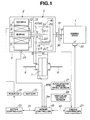
- Fig. 1 is a whole system configuration view of a hybrid drive system and its control system for a hybrid vehicle and its control system for a hybrid vehicle to which a vibration suppression apparatus in a first preferred embodiment is applicable.
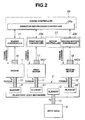
- Fig. 2 is a block diagram representing a vibration suppression control apparatus in the first embodiment according to the present invention.
- Fig. 3 is a control block diagram representing a vibration suppression controller in the vibration suppression apparatus in the first embodiment shown in Fig. 2.
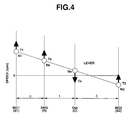
- Fig.4 is a lever diagram of Ravigneaux type compound planetary gear train used in the vibration suppression apparatus in the first embodiment shown in Fig. 2.
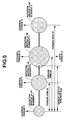
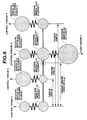
- Fig. 5 is a model view of a translation inertia M and rotation inertia J in a case where a planetary gear mechanism is a four-element, two-degrees-of-freedom planetary gear mechanism (transmission) and elements 1, 2, and 4 are power sources and element 3 is a (drive) output member.
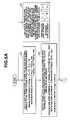
- Figs. 6A and 6B are an integrally flowchart representing a flow of the vibration suppression control operation executed in the vibration suppression controller in the first embodiment.
- Fig. 7 is a control block diagram representing the vibration suppression controller (or vibration suppression control section) in a case of the vibration suppression apparatus in a second preferred embodiment according to the present invention.
- Fig. 8 is a control block diagram representing the vibration suppression control apparatus in a third preferred embodiment according to the present invention.
- Fig. 9 is a vibration model'view of a four-element, two-degrees-of-freedom planetary gear mechanism (transmission) in a fourth preferred embodiment according to the present invention.
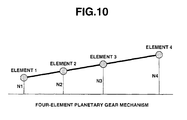
- Fig. 10 is a lever diagram representing the four-element planetary gear mechanism.
- Fig. 1 shows a whole system configuration view representing a hybrid drive system and its control system of a hybrid vehicle to which a vibration suppression apparatus according to the present invention in a first preferred embodiment is applicable.
- the hybrid drive system includes: an engine 1; a coaxial multi-layer motor 2; a Ravigneaux (type) compound planetary gear train 3; an output gear 4; a counter gear 5; a drive gear 6; a differential gear 7; drive axles 8 and 8; a motor and gear casing 9; an engine output axle 10; an output axle 11 of a first motor; an output axle 12 of a second motor (MG2); a motor chamber 13; a gear chamber 14; a drive output axle 15; and a clutch 16.
- MG2 Ravigneaux
- Coaxial multi-layer motor 2 is fixed to motor and gear casing 9 and includes: a stator S as a fixture (stationary) armature on which a coil is wound; an outer rotor OR arranged on an outside of stator S and into which a permanent magnet is buried; and an inner rotor IR arranged on an inside of stator S into which another permanent magnet is buried. These elements are arranged coaxially.
- stator S + Outer rotor OR is called first motor MG1 and stator S + inner rotor IR is called second motor MG2.
- Ravigneaux (type) compound planetary gear train 3 includes four rotary elements having a first pinion P1 meshed with each other; a common carrier C supporting a second pinion P2; and a ring gear R meshed with second pinion P2. It is noted that a double pinion (type) planetary gear is constituted by first sun gear S1, first pinion P1, second pinion P2, and ring gear R and a single pinion (type) planetary gear is constituted by second sun gear S2, second pinion P2, and ring gear R.
- the hybrid drive system links ring gear R and engine output axle 10 via clutch 16, links first sun gear S1 with first motor output axle 11, links second sun gear S2 with second motor output axle 12, and links common carrier C with output gear 4 (Out) via drive output axle 15.
- the output rotation and output torque from output gear 4 passes counter gear 5 ⁇ drive gear 6 ⁇ differential 7 so as to be transmitted from drive axles 8 and 8 to driven wheels (not shown).
- the control system of the hybrid vehicle will be described below with reference to Fig. 1. In Fig.
- the control system of the hybrid vehicle includes: an engine controller 21; a throttle valve actuator 22; a motor controller 23; an inverter 24; a battery 25; a hybrid controller 26; an accelerator opening angle sensor 27; a vehicular velocity sensor 28; a motor temperature sensor 29; an engine speed sensor 30; and bidirectional communications lines 31 and 32.
- Engine controller 21 outputs a command to command a throttle valve actuator 22 to control the engine torque in accordance with a corresponding command from hybrid controller 26.
- Motor controller 23 outputs a command to inverter 24'to control rotation speed N1 and torque T1 of first motor MG1 and to control rotation speed N2 and torque T2 of second motor MG2 respectively independently of each other.
- Inverter 24 is connected to a coil of stator S of coaxial multi-layer motor 3 and generates a compound current which is a composite current of both drive currents to be caused to flow into inner rotor IR and into outer rotor OR.
- a battery 25 is connected to inverter 24.
- Hybrid controller 26 inputs sensor signals from an accelerator opening angle sensor 27, a vehicle speed sensor 28, a motor temperature sensor 29, and an engine speed sensor 30.
- Hybrid controller 26 carries out a predetermined calculation processing.
- Bi-directional communication line 31 serves to connect between hybrid controller 26 and motor controller 23.
- Bi-directional communication line 32 serves to connect between hybrid controller 26 and engine controller 21.
- Fig. 2 shows a block diagram representing a vibration suppressive control system of the vibration suppression apparatus according to the present invention.
- engine 1 has engine output axle (coupling axle) 10 and an engine purpose speed-and-position detector 16 (a displacement measurement section (means)).
- First motor MG1 an auxiliary power source
- First motor MG1 has a first motor purpose speed-and-position detector 17 (the displacement measurement section (means)) and first motor output axle 11 (coupling axle).
- Second motor MG2 an auxiliary power source
- Second motor MG2 has second motor output axle 12 (a coupling axle) and a second motor purpose speed-and-position detector 18 (the displacement measurement section).
- a reference numeral 3 denotes a Ravigneaux (type) compound planetary gear train (planetary gear mechanism) having a ring gear (an element) R, a first sun gear S1 (element), a second sun gear S1 (element), and a common carrier C (element). Common carrier C is linked with drive axle 8 (a drive output member) via drive output axle 15 (coupling axle).
- reference numerals 21 denote engine controller, 23a a first motor controller, 23b a second motor controller, and 23 motor controller, 26 denotes hybrid controller, 26a denotes a vibration suppression controller (vibration suppression control section (means)).
- Motor controller 23 includes first motor controller 23a controlling rotation speed N1 and its torque T1 and second motor controller 23b controlling rotation speed N2 and its torque T2 of second motor 2.
- Each speed-and-position detector 16, 17, and 18 observes a vibration state of each element R, S1, and S2 in Ravigneaux (type) compound planetary gear train 3. These sensor signals are outputted to engine controller 21, first motor controller 23a, and second motor controller 23b.
- Hybrid controller 26 determines a target drive torque on the basis of the accelerator opening angle value (APS), the vehicular velocity detection value (Vsp) and a target drive torque map, determines a target torque by which engine 1 is shared and another target torque by which both of first and second motors MG1 and MG2 are shared, and outputs a target torque command to engine controller 21.
- APS accelerator opening angle value
- Vsp vehicular velocity detection value
- a target drive torque map determines a target torque by which engine 1 is shared and another target torque by which both of first and second motors MG1 and MG2 are shared, and outputs a target torque command to engine controller 21.
- a steady-state control for first and second motor torques T1 and T2 and a control (variable speed control) for first and second motor speeds N1 and N2 are carried out by first and second motor controllers 23a and 23b.
- Motor operating points (N1, T1, N2, and T2) are calculated using balance equations of (1) through (5) and a command to obtain the motor operating points (N1, T1, N2, and T2) is outputted by the hybrid controller 26.
- Vibration suppression controller 26a of hybrid controller 26 selects both of motors MG1 and MG2 as torque controllable two power sources from among the power source and superposes the torque command signal for vibration control purpose and superposes a vibration control purpose torque command signal onto a steady state torque command obtaining motor torques T1 and T2 supplied to both motors MG1 and MG2 so as to suppress a two-degrees-of-freedom vibration of Ravigneaux (type) compound planetary gear train 3, obtaining motor torques T1 and T2 supplied to both motors MG1 and MG2.
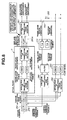
- Fig. 3 shows a control block diagram representing vibration suppression controller 26a in the first preferred embodiment.
- Vibration suppression controller 26a when Ravigneaux (type) compound planetary gear train 3 is called an actual plant (also called, a real plant) and a vibration dynamic model of Ravigneaux (type) compound planetary gear train 3 is called a plant model, inversely calculates a (an external) disturbance torque using an inverse model of the plant model.
- a (damping purpose) correction torque which partially or wholly cancels the inversely calculated disturbance torque is additively supplied to first and second motors MG1 and MG2 from among power sources connected to each element of the actual plant, thus performing a control to suppress two-degrees-of-freedom vibrations of the actual plant.
- reference numerals 261 denote an actual displacement calculating section (separation of translation from rotation)
- 262 denote a displacement separation section (separation of translation from rotation)
- 263 denote a model displacement section (plant model)
- 264 denotes a translation vibration calculation section (vibration displacement calculation section)
- 265 denote a rotation vibration calculation section (vibration displacement calculation section)
- 266 denote an external disturbance torque calculating section (inverse model of plant model)
- 267 denote a filter processing section (filtering section) to eliminate noises
- 268 denote a correction torque calculation section (synthesis of translation and rotation)
- 269 denotes a first correction torque adding section
- 270 denote a second correction torque adding section.
- Actual displacement calculating section 261 serves to calculate an actual rectilinear (or translation) displacement and actual rotation displacement at two selected elements S1 and S2 (refer to Fig. 4) of the actual plant 3 on the basis of the displacement measurement values (x1, x2).
- Displacement separation section 262 inputs a torque acted upon each of four element R, S1, S2, and C and separates the input respective torques into a translation torque total and a rotation torque total.
- Translation vibration calculating section 264 calculates a translation error between the translation model displacement from model displacement calculating section 263 and the translation actual displacement from actual displacement calculating section 261 (translation vibration displacement).
- Rotation vibration calculating section 265 calculates a rotation error between the rotation model displacement from the model displacement calculating section 263 and the rotation actual displacement from actual displacement calculating section 261.
- Disturbance torque calculating section 266 inversely calculates the external disturbance torques from the translation error and from the rotation error using the inverse model of the plant model of disturbance torque calculating section 266.
- Filter processing section (filtering section) 267 carries out a filter processing for the translation disturbance torque from external disturbance torque calculating section 266 and that for the rotation disturbance torque therefrom in order to eliminate noises included in the signals indicative of the external disturbance torques.
- Correction torque calculating section 268 synthesizes the translation disturbance torque from filter processing section 267 with the rotation disturbance torque filter processed value and calculates a sign inverted vibration suppression purpose (or damping purpose) correction torque 1 and a vibration suppression correction torque 2.
- First correction torque addition section 269 adds vibration suppression purpose correction torque 1 calculated by correction torque calculating section 268 to element S1 (first motor MG1).
- Second correction torque adding section 270 adds the calculated vibration suppression purpose correction torque 2 calculated by correction torque calculating section 268 to element S2 (second motor MG2) (refer to Fig. 3).
- a speed constraint between mutual elements of the planetary gear mechanism is present.
- degrees of freedom of motion are 2, this controls the revolution speed of the output axle and a gear ratio from the main power source to the output axle.
- a relationship in a velocity between each element can be represented by a speed diagram called a lever diagram.
- Ravigneaux type compound planetary gear train 3 adopted in the first preferred embodiment is an example of the planetary gear mechanism having four-element, two-degrees-of-freedom vibration.
- Fig. 4 shows the lever diagram of Ravigneaux (type) compound planetary gear train 3.
- the single pinion type planetary gear can draw a lever diagram such that, in a case where, with a carrier stopped, the sun gear is rotated in a normal direction, ring gear R is reversely rotated.
- the double pinion (type) planetary gear can draw another lever diagram such that, in a case where, with the carrier stopped and the sun gear rotated in the normal direction, ring gear R is rotated in the normal direction at a low revolution.
- Ravigneaux (type) compound planetary gear train 3 is constituted by first sun gear S1, first pinion P1, second pinion P2, and ring gear R.
- a lever diagram aligned in an order from a leftmost end of Fig. 4 is a first sun gear S1 (first motor MG1), ring gear R (engine 1), common carrier C (output gear 4), and a second sun gear S2 (second motor MG2) can be drawn. From among the rotation elements, if rotation speeds N1 and N2 of first sun gear S1 and second sun gear S2 are determined, the speeds of the remaining two ring gear R and common carrier C are determined.
- Two degrees of velocities can be expressed by independent two velocities or these arbitrary linear connections. It is easy to understand for the two-degrees-of-freedom or velocities to be analyzed into lever's translation (or rectilinear) mode and rotation mode without a dynamic (or mechanical) interference. In a case where other vehicles are selected, terms on the dynamic interference are only generated. In principle, the same result is obtained.
- a bracket representing the actual plant in Fig. 3 motions and vibrations of two-degrees-of-freedom power transmission mechanism are shown. In this bracket, two sections, each section representing an inertia, viz., 1/Ms 2 and 1/Js 2 are shown.
- FIG. 5 shows models of translation inertia and rotation inertia in a case of four-element, two-degrees-of-freedom planetary gear mechanism (transmission) and in a case where elements 1, 2, and 4 denote power sources and element 3 denote an output member.
- This model can be applied to a case where a coupling axle connecting each element of the planetary gear mechanism to the inertia of the power source is sufficiently rigid (or stiff or robust) in a frequency range to be controlled and a torsional vibration between the inertia of power source and the corresponding one of the elements of the planetary gear mechanism is not needed to be taken into consideration.
- an inertia of an element denote a total of the element inertia and associated power source inertia.
- steady-state torque commands are determined from a torque balance of the planetary gear mechanism.
- the torque balance of the planetary gear mechanism is determined from the velocity of each element of the planetary gear mechanism and the velocity of each element is determined from other constraint conditions such as power performance optimization and fuel consumption optimization (refer to the balance equations of (1) through (5) described above).
- a vibration suppression effect can be achieved by superposing the vibration suppression control (damping purpose) signal on the steady state torque commands without modification of the velocities determined according to each element determined by each kind of optimization.
- Figs. 6A and 6B show integrally an operational flowchart representing a flow of a vibration suppression control operation executed by vibration suppression controller 26a in the first preferred embodiment.
- actual displacement calculating section 261 calculates translation displacement and rotation displacement of actual plant 3 from at least two measurement values by means of speed (velocity) and position detectors 17 and 18 of first motor MG1 and second motor MG2 from among the displacements of the respective elements.
- the measurement values are x1 and x2 (element 1, element 2) and torque arms from their respective weight centers to their respective weight centers are a and b (element 1 to whole weight center and element 2 to whole weight center and element 1 to whole weight center).
- a calculation equation of each of translation displacement and rotation displacement is expressed in a matrix equation described in a bracket of step S1 in Fig. 6A. That is to say,
- step S2 translation torque total and rotation torque total are calculated from a torque acted upon each element at displacement separation section (separation of translation from rotation) 262 (refer to Fig. 3) and the routine goes to a step S3.
- step S3 model displacement calculating section (plant model) 263 calculates the translation displacement and rotation displacement with translation torque total and rotation torque total as inputs of the plant model.
- Each calculation equation is expressed as follows:
- translation vibration calculating section 264 and rotation vibration calculating section 265 derives differences (errors or vibration displacements) between each of the translation displacements of the plant model and the actual plant and of the rotation displacements thereof.
- (external) disturbance calculating section 266 (refer to Fig. 3) inversely calculates the difference in the translation displacement and the difference in the rotation displacement to their respectively corresponding disturbance torques (double differentiation).
- filter processing section 267 carries out the filter processing for the disturbance torque values, viz., the translation disturbance torque and the rotation disturbance torque from disturbance torque calculating section 267 in order to eliminate noises included in the signals.
- correction torque calculating section 268 inputs translation disturbance torque filtered value and synthesizes them to damping torques 1 and 2 for the selected two elements S1 and S2.
- a calculation equation on damping torques 1 and 2 is described in a bracket of step S7 in Fig. 6B. That is to say, wherein torque arms between the selected two elements and weight center are p and q.
- first correction torque calculating section 269 and second correction torque calculating section 270 add the synthesized damping torque 1 and synthesized damping torque 2 to their corresponding torques T1 and T2 of first motor MG1 and second motor MG2.
- the gear ratio is shifted so as to avoid the certain condition, specifically, a certain combination between the rotation speed (velocity) of the above-described power source(s) and torque thereof.
- the vibration cannot be suppressed while satisfying this demand. That is to say, in a state where even under any rotation speed and torque driving state of every power source, a part or all of the power sources provide the vibration sources, it becomes necessary to execute the driving state while suppressing positively the vibrations.
- the planetary gear itself may be considered to provide complex and non-linear vibration generation source or vibration amplifier.
- it is necessary not only to avoid a vibration generation region but also to avoid a vibration generation-and-amplification region of the whole power transmission mechanism. Accordingly, the degree of freedoms on the driving state is limited and a worsening of a target to be optimized such as the power performance of the vehicle or fuel consumption (economy) thereof is resulted.
- a positive vibration suppression method is adopted. That is to say, in this method, such a problem as will be described below is carried out.
- An output error between an actual plant (or real plant) and the plant model is caused by only the disturbance torque and is inversely calculated (since torque ⁇ translation displacement and rotation displacement are carried out under the double integrals, the inverse calculation is double differentiations) and the inversely calculated displacements are added (superposed) as the correction torque command to the steady state torque commands T1 and T21 of both of first and second motors MG1 and MG2 to each of which the corresponding one of the selected two power sources is coupled.
- vibration suppression controller 26a When the planetary gear mechanism is set to be the actual (or real) plant and the vibration dynamic (mechanical) model of the vibrations of the planetary gear mechanism is set to be the plant model, vibration suppression controller 26a inversely calculates the disturbance torque using the inverse model of the plant model and adds the correction torque which cancels a part or whole disturbance torque into two power sources from among the power sources coupled to each element of the actual plant to suppress the two degrees-of-freedom vibration of the actual plant.
- an acting force by which the vibration is caused to be generated from among the forces acted upon the planetary gear mechanism can be estimated with a high accuracy using the plant model and an inverse model of the plant model. Consequently, two-degrees-of-freedom vibrations in the planetary gear mechanism can effectively be suppressed.
- vibration suppression controller 26a includes: actual displacement calculating section 261 to calculate the actual displacements using the torques acted upon the respective elements and displacement measurement values; model displacement measurement values; model displacement calculating section 263 to calculate model displacement using the torque acted upon the respective elements and plant model; translation vibration calculating section 264 and rotation vibration calculating section 265 to calculate a vibration displacement which is the error between the actual plant displacement and the plant model displacement; disturbance torque calculating section 266 which inversely calculates the disturbance torque using the calculated vibration displacement and the inverse model of the plant model; a correction torque calculating section 268 to calculate the correction torque whose sign of the calculated disturbance torque is inverted; and correction torque addition sections 269 and 270 to add the calculated correction torque to the power sources to which the selected two elements are coupled.
- the vibration suppression controller 26a serves as a control damper generating a damping force for Ravigneaux (type) compound planetary gear train 3 which is a power transmission mechanism.
- the vibrations of Ravigneaux compound planetary gear train 3 can effectively be damped (attenuated).
- Vibration suppression controller 26a selects first motor MG1 and second motor MG2 each of which is superior in the torque control response from among torque controllable three power sources and superposes the vibration control (suppression control) purpose signal on the steady state torque commands T1 and T2 to be supplied to these two selected first and second motors MG1 and MG2 so that the two-degrees-of-freedom vibrations of the planetary gear mechanism are effectively suppressed. Even if a variation in the torque control response of each power source as an actuator to suppress the vibration is present, the two-degree-of-freedom vibrations generated on Ravigneaux (type) compound planetary gear train 3 of the transmission mechanism can speedily be suppressed.
- the planetary gear mechanism is the four-element, two-degrees-of-freedom planetary gear mechanism expressed in the lever diagram in which engine 1 and output gear 4 are aligned between two motors MG1 and MG2 (refer to Fig.
- vibration suppression controller 26a superposes the vibration control (suppression) signal onto steady state torque commands T1 and T2 to be supplied to the selected two motors of first and second motors MG1 and MG2 disposed on both ends of the lever diagram, particularly, the rotation mode vibrations from among the two-degrees-of-freedom vibrations developed on Ravigneaux (type) compound planetary gear train 3 which is the power transmission mechanism can effectively be suppressed, and the costs of engine mount damper and motor mount damper can be reduced. That is to say, it is usual practice that a damper constituted by a spring and a mass to reduce ripples of motor output axles 11 and 12 is installed on engine output axle 10.
- the rigidities of motor output axles 11 and 12 are larger than the rigidity of engine output axle 10.
- Ravigneaux (type) compound planetary gear train 3 is expressed in the lever diagram, motor output axles 11 and 12 to suppress the vibrations are coupled to both ends of the lever diagram.
- the vibrations in the rotation mode of Ravigneaux (type) compound planetary gear train 3 can effectively be suppressed.
- the strength thereof can be decreased and the manufacturing cost scan be reduced.
- the size and weight of spring and mass of the damper can be reduced, the cost of the engine damper can be reduced.
- the main power source is engine 1 and the plurality of auxiliary power sources are coaxial multi-layer motor 2 having a single stator S and two rotors IR and OR and Ravigneaux (type) compound planetary gear train 3 expressed in the lever diagram in which engine 1 and output gear 4 are aligned in the lever diagram between two motors MG1 and MG2, there are greater advantages in terms of the cost, the size, and the efficiency as compared with a case where two independent motors are adopted and the planetary gear can be compacted in its axial direction as compared with the case where the two independent motors are adopted.
- a compatibility of a combination of co-axial multi-layer motor 2 with Ravigneaux (type) compound planetary gear train 3 is favorable and can be constituted by a preferable hybrid drive system. That is to say, since two-rotor, one-stator coaxial multi-layer motor 2 is adopted, a current for inner motor IR and a current for outer motor OR are superposed to form a compound current and the compound current is caused to flow through the single stator coil so that two rotors IR and OR can respectively be controlled independently of each other.
- this is a single coaxial multi-layer motor 2 and this combination can be used as different or same kind of functions of motor function and generator function.
- Ravingneaux (type) compound planetary gear train 3 achieves the combination of four planetary gears (two parallel longitudinal planetary gears and two crossing forward-rearward direction planetary gears) although a width size is two-train planetary gears. Hence, for example, as compared with an axial alignment of four planetary gears, an axial directional size can be shortened.
- coaxial multi-layer motor 2 In a case where one of coaxial multi-layer motor 2 is used as a discharger (motor) and the other thereof is used as a generation (generator), it is possible to control the motor current via single inverter 24. A discharge from battery 25 can be reduced. For example, in a case of a direct power distribution control mode in which the balance equations (1) through (5) described above are established, theoretically, the discharge from battery 25 can be zeroed. In a case where both rotors IR and OR of coaxial multi-layer motor 2 are used as motors together with the single stator S, a range of the drive of the hybrid vehicle can be widened.
- the vibration disturbance torques causing the vibrations are directly cancelled by means of a, so-called, torque compensation method.
- the vibrations caused by the vibration disturbance torques are speedily damped (attenuated) by means of a controllable damping torque method. That is to say, vibration suppression controller 26a, as shown in Fig.
- actual displacement calculating section 261 that calculates the translation displacement and the rotation displacement of the actual plant using the torque acted upon each element in the actual plant and the displacement measurement values; a damping torque calculating section 271 that calculates a translation damping torque and a rotation torque damping torque using the actual translation and rotation displacements and an electrical damper (also called an electric damper or called an attenuator); filter processing (filtering) section 267 that eliminates noises from the translation damping torque and from the rotation damping torque; a correction torque calculating section 268 that synthesizes a filtered value of the translation damping torque and the filtered value of the rotation damping torque and calculates a vibration suppression (or damping purpose) correction torque 1 and a vibration suppression (damping purpose) correction torque 2, each sign of correction torques 1 and 2 being inverted with respect to the translation and rotation displacements; a first correction torque adding section 269 that additively supplies the vibration suppression (damping purpose) correction torque 1 to element S1 (first motor MG1); and a second correction torque adding section
- Actual displacement calculating section 261 calculates the translation displacement and the rotation displacement using the torque acted upon each element of the actual plant (Ravigneaux type compound planetary gear train 3) and displacement measurement values.
- damping torque calculating section 271 the translation and rotation damping torques are calculated using the translation displacement, rotation displacement, and the electrical (electric) damper.
- filtering (processing) section 267 the noises are eliminated from the translation damping torque and from the rotation damping torque.
- correction torque calculating section 268 the translation damping torque filtered value is synthesized to the rotation damping torque to calculate sign inverted vibration suppression (damping purpose) correction torques 1 and 2.
- Vibration suppressing correction torque 1 is additively supplied to element S1 (first motor MG1) at first correction torque adding section 269 and vibration suppressing correction torque 2 is additively supplied to element S2 (second motor MG2) at second correction torque adding section 270.
- damping torque calculating section 271 is disposed to calculate the translation damping torque and the rotation damping torque using the translation displacement, the rotation displacement, and the electrical (electric) damper, a simple vibration suppression controller 26a without use of the plant model can be achieved.
- the vibrations caused by the vibration disturbance torques can speedily be damped by means of the controllable damping torque (damping purpose correction torques).
- C M s and C J s described in block 271 denote transfer functions of the electrical (electric) damper.
- the translation and rotation damping torques are determined using the translation displacement, the rotation displacement, and the electrical (electric) damper.
- the translation and the rotation damping torques are determined using the errors in the translation and rotation displacements between the actual plant and plant model and the electrical (electric) damper (or attenuator described above).
- the vibration suppression controller 26a in the third embodiment includes: displacement separating section 262 that inputs (receives) torques acted upon respective elements R, S1, S2, and C of Ravigneaux (type) compound planetary gear train 3 and that separates the torques into translation torque total and the rotation torque total; a model displacement calculating section 263 that calculates a translation model displacement and a rotation model displacement at selected two elements S1 and S2 using the translation torque total and the rotation torque total both from displacement separation section 262 and the plant model; a translation vibration calculating section 264 that calculates the error in the translation (a translation vibration causing the displacement) which is an error between the translation model displacement from model displacement calculating section 263 and the actual translation displacement from actual displacement calculating section 261; and a rotation vibration calculating section 265 that calculates the error of the rotation (rotation vibration displacement) between the rotation model displacement from model displacement calculating section 263 and the rotation actual displacement from actual displacement calculating section 261, in addition to the structure in the case of the second
- a damping torque calculating section 271' calculates the translation damping torque and the rotation damping torque using the error in the translation displacement, the error in the rotation displacement, and the electrical (electric) damper.
- Filtering section 267 eliminates noises from the translation damping torque and the rotation damping torque.
- Correction torque calculating section 268 synthesizes the translation damping torque filtered value and rotation damping torque filtered value to calculate the sign inverted vibration suppression correction torque 1 and the sign inverted vibration suppression correction torque 2.
- First correction torque calculating section 269 additively supplies the vibration suppression correction torque 1 to element S1 (first motor MG1) and second correction torque calculating section 270 additively supplies the vibration suppression correction torque 2 to element S2 (second motor MG2).
- damping torque calculating section 271' to calculate the translation damping torque and the rotation damping torque using the translation displacement error described above, the rotation error described above, and the electrical (electric) damper is provided.
- the impediment of the velocity control of the planetary gear mechanism becomes a few as compared with the vibration suppression control method executed in the second embodiment.
- the vibration suppression apparatus in a fourth preferred embodiment according to the present invention will be described below.
- an example having such a high rigidity that torsional vibrations between each power source and its coupling axle and between each element of the planetary gear mechanism are negligible is supposed.
- Fig. 9 shows a vibration model of a four-element, two-degrees-of-freedom planetary gear mechanism (transmission).
- a control torque of one of the power sources connected to the selected two axles having high rigidities is used to suppress the vibrations.
- the vibration suppression apparatus can be executed using the control section of the vibration suppression controller 26a shown in each of Figs. 3, 7, and 8.
- J1 and J4 shown in Fig. 9 are replaced with J1 + Jm1 and with J4 + Jm4, respectively.
- a position of the above-described low pass filter may be placed in front of or behind of the section (for example, 261) in each of Figs. 3, 7, and 8 in which separation of translation from rotation is described.
- vibration suppression controller 26a selects the power sources to which the coupling axles having two high resonance frequencies from among the resonance frequencies on a torsional vibration system coupling between the respective elements of the planetary gear mechanism and each power source, superposes the vibration control purpose signals (damping purpose correction torques 1 and 2) on the torque commands given to the two elements to each of which the corresponding one of the two selected power sources is coupled via the corresponding one of the coupling axles to suppress the two-degrees-of-freedom vibrations of the planetary gear mechanism.
- the two-degrees-of-freedom vibrations developed on the planetary gear mechanism can speedily be suppressed up to a highest frequency within a range in which no excitation for the torsional vibration occurs. Consequently, without sacrifice of the durability of the elements of the planetary gear mechanism, the strength (intensity) can be lowered and the manufacturing cost thereof can accordingly be reduced. In addition, the vibrations of the drive output torque and unpleasant noises can be reduced.
- the vibration suppression apparatus for the hybrid vehicle according to the present invention has been described with reference to the first, second, third, and fourth preferred embodiments.
- a specific structure is not only limited to the first, second, third, and fourth embodiments.
- Various changes and modifications may be made without departing from the sprit and the scope of the present invention.
- the vibration suppression section is separated into the translation mode and rotation mode.
- the vibration suppression section may be separated into the displacement of element 1 and that of element 2.
- first motor MG1 and second motor MG2 are constituted by coaxial multi-layer motor 2 having common stator S and two rotors IR and OR and functionally achieving two motors although, in appearance, coaxial multi-layer motor 2 is a single motor.
- the planetary gear mechanism is constituted by, as an application example, Ravigneaux (type) compound planetary gear train 3.
- the planetary gear mechanism is not limited to Ravigneaux (type) planetary gear train 3 but may be constituted by the planetary gear having at least four elements and two degrees of freedom to couple the four elements of the engine, the first motor, the second motor, and the output member. That is to say, as shown by a lever diagram of Fig. 10, if any arbitrary two elements' velocities (revolutions per unit time) are determined, the remaining two element's velocities are determined.
Landscapes
- Engineering & Computer Science (AREA)
- Chemical & Material Sciences (AREA)
- Combustion & Propulsion (AREA)
- Transportation (AREA)
- Mechanical Engineering (AREA)
- Automation & Control Theory (AREA)
- Power Engineering (AREA)
- Hybrid Electric Vehicles (AREA)
- Electric Propulsion And Braking For Vehicles (AREA)
- Control Of Vehicle Engines Or Engines For Specific Uses (AREA)
Abstract
Description
In Fig. 2, a


Claims (19)
- A vibration suppression apparatus for a hybrid vehicle, comprising:a main power source (1);a plurality of auxiliary power sources (2);a planetary gear mechanism (3) to modify a gear ratio when an output of the main power source is transmitted to a drive output member; anda vibration suppression control section (26a) that selects two power sources whose torque controls are enabled to be performed and superposes a vibration suppression control signal onto each of torque commands supplied to the selected two power sources to suppress two-degrees-of-freedom vibrations of the planetary gear mechanism.
- A vibration suppression apparatus for a hybrid vehicle as claimed in claim 1, wherein the planetary gear mechanism is set to be an actual plant (3) and a dynamic model on the vibrations of the planetary gear mechanism is set to be a plant model (263) and wherein the vibration suppression control section (26a) inversely calculates an external disturbance torque that causes the vibrations to be developed in the planetary gear mechanism using an inverse model of the plant model and additively supplies correction torques which cancel at least a part of the two-degrees-of-freedom vibrations of the actual plant to two power sources from among the power sources coupled to the respective elements of the actual plant.
- A vibration suppression apparatus for a hybrid vehicle as claimed in claim 2, wherein the vibration suppression apparatus further comprises a displacement measurement section (16, 17, 18) that measures displacements of the respective elements of the actual plant developed according to torques acted upon the respective elements of the actual plant and the vibration suppression control section comprises: an actual displacement calculating section (261) that calculates actual displacements of the respective elements using the torques acted upon the respective elements of the actual plant and displacement measurement values of the displacement measurement section; a model displacement calculating section (263) that calculates displacements of the plant model using the torques acted upon the respective elements and using the plant model; a vibration displacement calculating section (264, 265) that calculates an error between each of the actual displacements of the actual plant and the corresponding one of the displacements of the plant model; a disturbance torque calculating section (266) that inversely calculates the external disturbance torques using the calculated error and an inverse model of the plant model; a correction torque calculating section (268) that calculates a correction torque whose sign is inverted to the calculated disturbance torque; and a correction torque adding section (269, 270) that additively supplies the calculated correction torque to each of the two power sources (MG1 and MG2) to each of which the corresponding one of the selected two elements (S1, S2) is coupled.
- A vibration suppression apparatus for a hybrid vehicle as claimed in claim 1, wherein the vibration suppression apparatus further comprises a displacement measurement section (16, 17, 18) that measures the displacements of the respective elements developed according to torques acted upon respective elements of the actual plant and the vibration suppression control section comprises: an actual displacement calculating section (261) that calculates actual displacements of the actual plant using torques acted upon the respective elements of the actual plant and displacement measurement values of the displacement measurement section; a damping torque calculating section (271) that calculates damping torques using the calculated actual displacements and an electrical damper; a correction torque calculating section (268) that calculates correction torques, each of their signs being inverted to that of the corresponding one of the calculated damping torques; and a correction torque adding section (269, 270) that additively supplies each of the calculated correction torques to the corresponding one of the power sources to which the selected two elements are respectively coupled.
- A vibration suppression apparatus for a hybrid vehicle as claimed in claim 1, wherein the vibration suppression apparatus further comprises: a displacement measuring section (16, 17, 18) that measures displacements of the respective elements of the actual plant developed according to torques acted upon the respective elements of the actual plant and the vibration suppression control section comprises: an actual displacement calculating section (261) that calculates actual displacements of the respective elements using the torques acted upon the respective elements of the actual plant and the displacement measurement values; a model displacement calculating section (262, 263) that calculates model placements using the torques acted upon the respective elements and a plant model; a vibration displacement calculating section (264, 265) that calculates an error between each the actual displacements of the actual plant and the corresponding one of the model displacements of the plant model; a damping toque calculating section (271') that calculates damping torques using the calculated errors and an electrical damper; a correction torque calculating section (268) that calculates correction torques, each of their signs being inverted to that of the calculated damping torque; and a correction torque adding section (269, 270) that additively supplies the calculated correction torque to the selected two power sources to each of which the corresponding one of the elements of the planetary gear mechanism is coupled.
- A vibration suppression apparatus for a hybrid vehicle as claimed in any one of the preceding claims 1 through 5, wherein the vibration suppression control section selects the two power sources (MG1, MG2), each selected power source being superior in a torque control response from among the power sources whose torque controls are enabled to be performed, superposes the vibration suppression control signal onto each of the torque commands supplied to the selected two power sources to suppress the two-degree-of-freedom vibrations of the planetary gear mechanism.
- A vibration suppression apparatus for a hybrid vehicle as claimed in any one of the preceding claims 1 through 5, wherein the vibration suppression control section (26a) selects the two power sources to which coupling axles (11, 12) having two higher frequencies from among resonance frequencies of a torsional system (10, 11, 12, 15) coupling the respective elements of the planetary gear mechanism to the respectively corresponding power sources and superposes the vibration suppression control signal onto each of the torque commands supplied to the selected two power sources (MG1 and MG2) to suppress the two-degrees-of-freedom vibrations of the planetary gear mechanism.
- A vibration suppression apparatus for a hybrid vehicle as claimed in any one of the preceding claims 1 through 7, wherein the main power source is an engine (1), the plurality of auxiliary power sources are two motors (MG1, MG2), and the planetary gear mechanism to modify the gear ratio when the output of the main power source is transmitted to the drive output member is a four-element, two-degrees-of-freedom planetary gear mechanism (3) expressed in a lever diagram in which the engine (1) and the drive output member (Out) are interposed between the two motors (MG1, MG2) and the vibration suppression control section superposes the vibration suppression signal onto each of the torque commands supplied to the two motors (MG1 and MG2) disposed on both ends of the lever diagram.
- A vibration suppression apparatus for a hybrid vehicle as claimed in claim 8, wherein the main power source is an engine (1), the plurality of auxiliary power sources are a coaxial multi-layer motor (2) having one stator (S) and two rotors (IR, OR), and the planetary gear mechanism to modify the gear ratio when the output of the main power source of the engine is transmitted to the drive output member is a Ravigneaux compound planetary gear train (3) expressed in the lever diagram in which the engine and drive output member are interposed between the two motors constituting the coaxial multi-layer motor (Fig.4).
- A vibration suppression apparatus for a hybrid vehicle as claimed in claim 3, wherein the actual displacement calculating section (261) calculates a translation displacement and a rotation displacement of the actual plant as follows:wherein x1 and x2 denote the actual translation of the selected one and other of the two elements to each of which the corresponding one of the selected respective two power sources is coupled and a and b denote torque arms between a weight center of a lever diagram of the planetary gear mechanism and that of each of the selected two elements, the model displacement calculating section (263) calculates a translation displacement of the plant model and a rotation displacement thereof using a translation torque total for the respective elements of the plant model and a rotation torque total thereof for the elements of the plant model and translation inertia (M) and rotation inertia (J) of the planetary gear mechanism, the vibration displacement calculating section (264, 265) calculates the errors between the actual translation displacement of the actual plant and the model translation displacement of the model plant and between the actual rotation displacement of the actual plant and the model rotation displacement of the plant model, the disturbance torque calculating section (266) inversely calculates their respectively corresponding translation disturbance torques using the respective errors and the inverse model of the plant model, and the correction torque calculating section (268) synthesizes damping torques for the two elements to which the selected two power sources are coupled as follows:
 wherein damping torques 1 and 2 denote correction torques 1 and 2 to be superposed on the respective torque commands 1 and 2 to be supplied to the respective two elements to each of which the corresponding one of the selected two power sources is coupled, p and q denote torque arms of the two elements for the selected two power sources in the lever diagram of the planetary gear mechanism, and translation and rotation torques denote translation and rotation disturbance torques.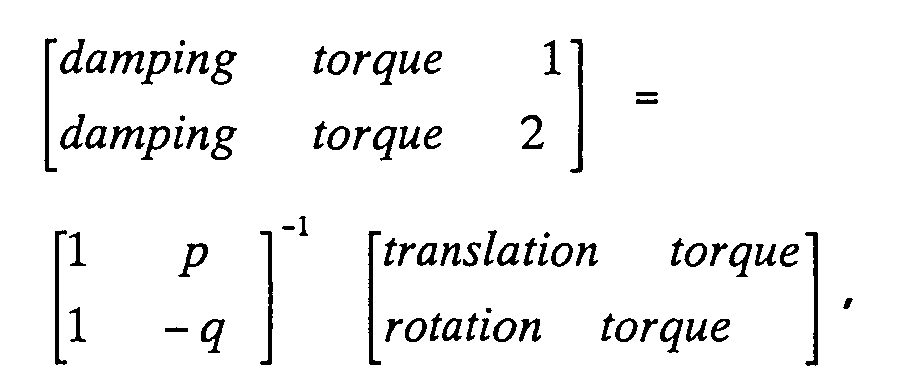
- A vibration suppression apparatus for a hybrid vehicle as claimed in claim 10, wherein the vibration suppression control section further comprises a filtering section (267) that filters the translation disturbance torque and the rotation disturbance torque calculated by the disturbance torque calculating section and outputs the filtered translation and rotation disturbance torques to the correction torque calculating section.
- A vibration suppression apparatus for a hybrid vehicle as claimed in claim 10, wherein the main power source is an engine (1), the plurality of auxiliary power sources are first and second motors (MG1 and MG2) couples to the selected two elements (S1 and S4), and the planetary gear mechanism to modify the gear ratio when an output of the engine is transmitted to the drive output member is a four-element, two-degrees-of-freedom planetary gear mechanism expressed in a lever diagram in which the engine and the drive output member are interposed between the two motors and the vibration suppression control section superposes the vibration suppression control signal onto each of the torque commands supplied to the two motors (MG1 and MG2) disposed on both ends of the lever diagram (Fig. 5).
- A vibration suppression apparatus for a hybrid vehicle as claimed in claim 12, wherein the translation torque total is expressed as T1 + T2 - TL3 + T4, wherein T1 denotes a torque acted upon the first element of the four-element, two-degrees-of-freedom planetary gear mechanism, T2 denotes a torque acted upon the second element thereof, TL3 denotes a load torque acted upon a third element of the drive output member thereof, T4 denotes a torque acted upon a fourth element thereof and the rotation torque total is expressed as T1Acg + T2(Acg -a2) - TL3(Acg - a3) + T4 (Acg -a4), wherein Acg denotes a position of the weight center of the planetary gear mechanism from a weight center position of the first element and expressed as (a2J2 + a3J3 + a4J4)/M wherein J2, J3, and J4 denote rotation inertia of the second, third, and fourth elements of the four-element, two-degrees-of-freedom planetary gear mechanism and M denotes a translation inertia of four-element, two-degrees-of-freedom planetary gear mechanism, torque arms of a2, a3, and a4 from the weight center of the first element are dimensionless values determined according to the gear ratio of the four-element, two-degrees-of-freedom planetary gear mechanism.
- A vibration suppression apparatus for a hybrid vehicle as claimed in claim 13, wherein M = J1 + J2 J3 + J4 and J = J1Acg2 + J2(Acg -a2)2 + J3(Acg -a3)2 +J4(Acg -a4)2, wherein J1 denotes the rotation inertia of the first element of the four-element, two-degrees-of-freedom planetary gear mechanism.
- A vibration suppression apparatus for a hybrid vehicle as claimed in claim 14, wherein the translation displacement of the plant model and the rotation displacement are expressed as follows; translation displacement = double integrals of the translation torque total/M with respect to time and rotation displacement = double integrals of the rotation torque total with respect to time.
- A vibration suppression apparatus for a hybrid vehicle as claimed in claim 15, wherein the inverse model of the plant model is expressed as Ms 2 and Js 2 wherein s denotes a Laplace transform operator.
- A vibration suppression apparatus for a hybrid vehicle as claimed in claim 10, wherein the damping torque calculating section (271') calculates the damping translation torque and the'damping rotation torque, respectively, using the errors and the electrical damper having transfer functions of CM s for the error between the translation displacements of the actual plant and the plant model and of CJ s for the error between the rotation displacements of the actual plant and the plant model.
- A vibration suppression apparatus for a hybrid vehicle as claimed in claim 13, wherein M = J1 + Jm1 + J2 + J3 + J4 + Jm4 and J = (J1+ Jm1)Acg2 + J2(Acg -a2)2 + J3(Acg -a3)2 + (J4 + Jm4) (Acg -a4)2, wherein J1, J2, J3, and J4 denote the rotation inertias of the first, second, third, and fourth elements of the four-element, two-degrees-of-freedom planetary gear mechanism and Jm1 denote a rotation inertia of the first motor (MG1) coupled to the first element of the four-element, two degrees-of-freedom planetary gear mechanism and Jm4 denotes a rotation inertia of the second motor (MG2) coupled to the fourth element of the two-degrees-of-freedom planetary gear mechanism.
- A vibration suppression method for a hybrid vehicle, the hybrid vehicle comprising:a main power source (1);a plurality of auxiliary power sources (2); anda planetary gear mechanism (3) to modify a gear ratio when an output of the main power source is transmitted to a drive output member and the vibration suppression method comprising:selecting (26a) two power sources whose torque controls are enabled to be performed; andsuperposing (26a) a vibration suppression control signal onto each of torque commands supplied to the selected two power sources to suppress two-degrees-of-freedom vibrations of the planetary gear mechanism.
Applications Claiming Priority (2)
| Application Number | Priority Date | Filing Date | Title |
|---|---|---|---|
| JP2002245722 | 2002-08-26 | ||
| JP2002245722 | 2002-08-26 |
Publications (3)
| Publication Number | Publication Date |
|---|---|
| EP1396368A2 true EP1396368A2 (en) | 2004-03-10 |
| EP1396368A3 EP1396368A3 (en) | 2004-12-15 |
| EP1396368B1 EP1396368B1 (en) | 2008-07-30 |
Family
ID=31712234
Family Applications (1)
| Application Number | Title | Priority Date | Filing Date |
|---|---|---|---|
| EP03019194A Expired - Lifetime EP1396368B1 (en) | 2002-08-26 | 2003-08-25 | Vibration suppression apparatus and method for hybrid vehicle |
Country Status (3)
| Country | Link |
|---|---|
| US (1) | US7110867B2 (en) |
| EP (1) | EP1396368B1 (en) |
| DE (1) | DE60322484D1 (en) |
Cited By (11)
| Publication number | Priority date | Publication date | Assignee | Title |
|---|---|---|---|---|
| EP1619063A2 (en) | 2004-07-21 | 2006-01-25 | Nissan Motor Company, Limited | Motor torque control apparatus and method for automotive vehicle |
| US7223202B2 (en) * | 2004-03-22 | 2007-05-29 | General Motors Corporation | Hydraulic circuit for torsional damper assembly of an electrically variable transmission |
| US7226384B2 (en) * | 2004-03-22 | 2007-06-05 | Gm Global Technology Operations, Inc. | Torsional damper for electrically-variable transmission with lock-out clutch assembly |
| US7232402B2 (en) * | 2004-03-22 | 2007-06-19 | General Motors Corporation | Motor driven auxiliary pump for electrically-variable transmission torsional damper |
| EP2017453A4 (en) * | 2006-05-09 | 2010-06-02 | Toyota Motor Co Ltd | INTERNAL COMBUSTION ENGINE DEVICE, AND IGNITION RATE EVALUATION METHOD FOR INTERNAL COMBUSTION ENGINE |
| US7739016B2 (en) * | 2006-03-22 | 2010-06-15 | Gm Global Technology Operations, Inc. | Parameter state estimation |
| US8010263B2 (en) * | 2006-03-22 | 2011-08-30 | GM Global Technology Operations LLC | Method and apparatus for multivariate active driveline damping |
| CN102405165A (en) * | 2010-04-09 | 2012-04-04 | 丰田自动车株式会社 | Vehicle driving force control device |
| CN102639351A (en) * | 2010-06-07 | 2012-08-15 | 丰田自动车株式会社 | Hybrid vehicle and method of controlling thereof |
| EP2716895A4 (en) * | 2011-05-26 | 2015-12-23 | Toyota Motor Co Ltd | DEVICE FOR CONTROLLING VIBRATION DAMPING |
| EP3052334A4 (en) * | 2013-10-02 | 2017-11-15 | The Regents of the University of Michigan | Regenerative differential powertrain with vibration absorption and isolation |
Families Citing this family (45)
| Publication number | Priority date | Publication date | Assignee | Title |
|---|---|---|---|---|
| JP3797354B2 (en) * | 2003-09-30 | 2006-07-19 | アイシン・エィ・ダブリュ株式会社 | Electric vehicle drive control device and electric vehicle drive control method |
| JP4176662B2 (en) * | 2004-03-11 | 2008-11-05 | 本田技研工業株式会社 | Vibration control method for hybrid vehicle |
| JP2005308104A (en) * | 2004-04-22 | 2005-11-04 | Jatco Ltd | Vehicle control device |
| US7653474B2 (en) * | 2004-05-14 | 2010-01-26 | Gm Global Technology Operations, Inc. | Method of determining engine output power in a hybrid electric vehicle |
| JP2006060936A (en) * | 2004-08-20 | 2006-03-02 | Denso Corp | Vehicle behavior control system |
| JP4179266B2 (en) * | 2004-11-08 | 2008-11-12 | 日産自動車株式会社 | Hybrid four-wheel drive system |
| EP1672769A3 (en) * | 2004-12-18 | 2009-07-08 | LuK Lamellen und Kupplungsbau Beteiligungs KG | Actuating device for vehicle components |
| FR2885106B1 (en) * | 2005-05-02 | 2007-08-10 | Peugeot Citroen Automobiles Sa | METHOD FOR BLOCKING WHEELS OF A HYBRID VEHICLE AT STOPPING AND TRANSMISSION DEVICE THEREFOR |
| JP4497057B2 (en) * | 2005-08-23 | 2010-07-07 | 日産自動車株式会社 | Vehicle shift control device |
| JP4835171B2 (en) * | 2006-01-27 | 2011-12-14 | トヨタ自動車株式会社 | Motor drive device |
| JP4174061B2 (en) * | 2006-03-23 | 2008-10-29 | 本田技研工業株式会社 | Active vibration control device for hybrid vehicle |
| JP2008141810A (en) * | 2006-11-30 | 2008-06-19 | Toyota Motor Corp | Power output device, automobile equipped with the same, and method for controlling power output device |
| US7918763B2 (en) * | 2007-04-12 | 2011-04-05 | Ford Global Technologies, Llc | Control strategy for multi-mode vehicle propulsion system |
| US7997363B2 (en) * | 2007-09-17 | 2011-08-16 | Denso Corporation | Vehicle control system and method |
| KR101090708B1 (en) * | 2009-03-16 | 2011-12-08 | 기아자동차주식회사 | Method for reducing vibration from gear backlash of hybrid vehicle |
| JP5438756B2 (en) * | 2009-03-30 | 2014-03-12 | 本田技研工業株式会社 | Active anti-vibration support device |
| KR101055837B1 (en) * | 2009-12-03 | 2011-08-09 | 현대자동차주식회사 | Apparatus and method for controlling a fuel cell vehicle having a multi-drive system |
| DE102011106530A1 (en) * | 2010-07-12 | 2012-01-12 | Schaeffler Technologies Gmbh & Co. Kg | Powertrain of a hybrid vehicle and hybrid vehicle |
| US8618752B2 (en) * | 2010-07-21 | 2013-12-31 | Superior Electron, Llc | System, architecture, and method for minimizing power consumption and increasing performance in electric vehicles |
| JP5573456B2 (en) * | 2010-07-23 | 2014-08-20 | 日産自動車株式会社 | Vibration control device for electric vehicle and vibration control method for electric vehicle |
| JP5423898B2 (en) * | 2010-09-03 | 2014-02-19 | トヨタ自動車株式会社 | Electric vehicle and control method thereof |
| US8560154B2 (en) * | 2010-09-14 | 2013-10-15 | GM Global Technology Operations LLC | Frequency splitting and independent limitation of vehicle torque control |
| US8731753B2 (en) * | 2010-09-30 | 2014-05-20 | GM Global Technology Operations LLC | Control of engine start for a hybrid system |
| DE112010005979T5 (en) * | 2010-11-04 | 2013-08-14 | Toyota Jidosha Kabushiki Kaisha | Dynamic damping device |
| JP5324623B2 (en) * | 2011-06-24 | 2013-10-23 | 本田技研工業株式会社 | Vehicle drive control device |
| WO2013057779A1 (en) * | 2011-10-17 | 2013-04-25 | トヨタ自動車株式会社 | Device for controlling hybrid vehicle |
| KR101416355B1 (en) * | 2011-12-09 | 2014-07-09 | 현대자동차 주식회사 | Method for controlling torque of engine |
| DE102011056820B4 (en) * | 2011-12-21 | 2021-06-24 | Magna powertrain gmbh & co kg | Drive train for a motor vehicle |
| US8849460B2 (en) * | 2012-05-30 | 2014-09-30 | GM Global Technology Operations LLC | Method and apparatus for determining engine pulse cancellation torque |
| US9102227B2 (en) * | 2012-07-30 | 2015-08-11 | Mcmaster University | Electro-mechanical double-rotor compound hybrid transmission |
| US9067484B2 (en) * | 2013-10-23 | 2015-06-30 | Dezhou David Zhao | Electric vehicle control systems |
| KR101510345B1 (en) * | 2013-10-29 | 2015-04-08 | 현대자동차 주식회사 | Power transmission system of hybrid electric vehicle |
| JP6090260B2 (en) * | 2014-08-19 | 2017-03-08 | 株式会社デンソー | Rotating electrical machine control device |
| DE102014222779A1 (en) * | 2014-11-07 | 2016-05-12 | Schaeffler Technologies AG & Co. KG | Method for vibration damping of a drive train by means of an electric machine |
| KR101628577B1 (en) | 2014-12-26 | 2016-06-08 | 현대자동차주식회사 | Vibraition control system of hybrid vehicle |
| US9482330B1 (en) * | 2015-05-12 | 2016-11-01 | GM Global Technology Operations LLC | Hybrid transmission |
| TWI545876B (en) * | 2015-06-26 | 2016-08-11 | 財團法人工業技術研究院 | Range extender and charging method, power generation equipment and power generation equipment control method thereof |
| JP6363585B2 (en) * | 2015-12-02 | 2018-07-25 | 本田技研工業株式会社 | vehicle |
| JP6640659B2 (en) * | 2016-06-14 | 2020-02-05 | 株式会社日立製作所 | Control device for power converter, power conversion system, compressor drive system, flywheel power generation system, and control method for power converter |
| US10017170B1 (en) * | 2017-01-05 | 2018-07-10 | GM Global Technology Operations LLC | System and method for propulsion system control |
| US10245971B2 (en) * | 2017-03-06 | 2019-04-02 | Gates Corporation | Motor-generator system |
| WO2021075415A1 (en) * | 2019-10-16 | 2021-04-22 | 三菱自動車工業株式会社 | Motor control device for electric vehicle |
| JP2021109551A (en) * | 2020-01-10 | 2021-08-02 | トヨタ自動車株式会社 | Drive force control device of vehicle |
| JP7468781B2 (en) * | 2021-03-30 | 2024-04-16 | 三菱自動車工業株式会社 | Driving force adjustment device and method for designing driving force adjustment device |
| US12459372B2 (en) | 2024-02-19 | 2025-11-04 | Ford Global Technologies, Llc | Vibration cancellation via electric motor torque control for a vehicle |
Family Cites Families (19)
| Publication number | Priority date | Publication date | Assignee | Title |
|---|---|---|---|---|
| JP3052844B2 (en) * | 1995-11-14 | 2000-06-19 | トヨタ自動車株式会社 | Power output device, control method therefor, and drive device |
| JP3250483B2 (en) * | 1996-07-18 | 2002-01-28 | トヨタ自動車株式会社 | Drive |
| JP3402236B2 (en) | 1999-01-13 | 2003-05-06 | トヨタ自動車株式会社 | Power output device, hybrid vehicle, and control method therefor |
| JP2000217209A (en) | 1999-01-22 | 2000-08-04 | Toyota Motor Corp | Vehicle damping device using electric motor as driving force source |
| JP2000224714A (en) * | 1999-02-03 | 2000-08-11 | Mitsubishi Motors Corp | Vehicle with electric motor |
| US6592484B1 (en) * | 1999-08-09 | 2003-07-15 | Gregory A. Schultz | Transmission gearbox for parallel hybrid electric vehicles |
| JP3613088B2 (en) * | 1999-09-10 | 2005-01-26 | 日産自動車株式会社 | Vehicle drive unit support device |
| JP3775562B2 (en) * | 2000-03-07 | 2006-05-17 | ジヤトコ株式会社 | Parallel hybrid vehicle |
| US6300735B1 (en) * | 2000-03-22 | 2001-10-09 | Caterpillar Inc. | Control for a two degree of freedom electromechanical transmission and associated method |
| JP4200635B2 (en) | 2000-05-02 | 2008-12-24 | トヨタ自動車株式会社 | Hybrid vehicle and control method thereof |
| JP3508742B2 (en) * | 2001-06-18 | 2004-03-22 | 日産自動車株式会社 | Vehicle vibration suppression control device using electric motor |
| JP3578451B2 (en) * | 2001-07-23 | 2004-10-20 | 日産自動車株式会社 | Drive |
| JP3803269B2 (en) * | 2001-08-07 | 2006-08-02 | ジヤトコ株式会社 | Parallel hybrid vehicle |
| JP3641245B2 (en) * | 2002-03-13 | 2005-04-20 | 日産自動車株式会社 | Shift control device for hybrid transmission |
| US7175555B2 (en) * | 2002-03-28 | 2007-02-13 | Ford Global Technologies, Llc | Hybrid automotive powertrain with torsional vibration damper |
| JP3699694B2 (en) * | 2002-05-31 | 2005-09-28 | 日産自動車株式会社 | Hybrid transmission |
| JP3626151B2 (en) * | 2002-06-17 | 2005-03-02 | 日産自動車株式会社 | Hybrid transmission |
| JP3466600B1 (en) * | 2002-07-16 | 2003-11-10 | 本田技研工業株式会社 | Control device for hybrid vehicle |
| US6806667B1 (en) * | 2003-05-23 | 2004-10-19 | Toyota Jidosha Kabushiki Kaisha | Control unit and control method for controlling vibration of an electric vehicle |
-
2003
- 2003-08-22 US US10/645,910 patent/US7110867B2/en not_active Expired - Fee Related
- 2003-08-25 EP EP03019194A patent/EP1396368B1/en not_active Expired - Lifetime
- 2003-08-25 DE DE60322484T patent/DE60322484D1/en not_active Expired - Lifetime
Cited By (17)
| Publication number | Priority date | Publication date | Assignee | Title |
|---|---|---|---|---|
| US7223202B2 (en) * | 2004-03-22 | 2007-05-29 | General Motors Corporation | Hydraulic circuit for torsional damper assembly of an electrically variable transmission |
| US7226384B2 (en) * | 2004-03-22 | 2007-06-05 | Gm Global Technology Operations, Inc. | Torsional damper for electrically-variable transmission with lock-out clutch assembly |
| US7232402B2 (en) * | 2004-03-22 | 2007-06-19 | General Motors Corporation | Motor driven auxiliary pump for electrically-variable transmission torsional damper |
| EP1619063A2 (en) | 2004-07-21 | 2006-01-25 | Nissan Motor Company, Limited | Motor torque control apparatus and method for automotive vehicle |
| EP1619063A3 (en) * | 2004-07-21 | 2007-12-05 | Nissan Motor Company, Limited | Motor torque control apparatus and method for automotive vehicle |
| US8010263B2 (en) * | 2006-03-22 | 2011-08-30 | GM Global Technology Operations LLC | Method and apparatus for multivariate active driveline damping |
| US7739016B2 (en) * | 2006-03-22 | 2010-06-15 | Gm Global Technology Operations, Inc. | Parameter state estimation |
| DE102007013337B4 (en) | 2006-03-22 | 2019-03-28 | GM Global Technology Operations LLC (n. d. Ges. d. Staates Delaware) | Method and control system for estimating parameter states |
| US7765857B2 (en) | 2006-05-09 | 2010-08-03 | Toyota Jidosha Kabushiki Kaisha | Internal combustion engine system and misfire determining method for internal combustion engine |
| EP2017453A4 (en) * | 2006-05-09 | 2010-06-02 | Toyota Motor Co Ltd | INTERNAL COMBUSTION ENGINE DEVICE, AND IGNITION RATE EVALUATION METHOD FOR INTERNAL COMBUSTION ENGINE |
| CN102405165A (en) * | 2010-04-09 | 2012-04-04 | 丰田自动车株式会社 | Vehicle driving force control device |
| CN102405165B (en) * | 2010-04-09 | 2015-04-08 | 丰田自动车株式会社 | Vehicle drive force control device |
| CN102639351A (en) * | 2010-06-07 | 2012-08-15 | 丰田自动车株式会社 | Hybrid vehicle and method of controlling thereof |
| EP2581284A4 (en) * | 2010-06-07 | 2014-03-12 | Toyota Motor Co Ltd | HYBRID VEHICLE AND ITS CONTROL METHOD |
| CN102639351B (en) * | 2010-06-07 | 2015-11-25 | 丰田自动车株式会社 | Motor vehicle driven by mixed power and control method thereof |
| EP2716895A4 (en) * | 2011-05-26 | 2015-12-23 | Toyota Motor Co Ltd | DEVICE FOR CONTROLLING VIBRATION DAMPING |
| EP3052334A4 (en) * | 2013-10-02 | 2017-11-15 | The Regents of the University of Michigan | Regenerative differential powertrain with vibration absorption and isolation |
Also Published As
| Publication number | Publication date |
|---|---|
| EP1396368A3 (en) | 2004-12-15 |
| DE60322484D1 (en) | 2008-09-11 |
| US7110867B2 (en) | 2006-09-19 |
| US20050247503A1 (en) | 2005-11-10 |
| EP1396368B1 (en) | 2008-07-30 |
Similar Documents
| Publication | Publication Date | Title |
|---|---|---|
| US7110867B2 (en) | Vibration suppression apparatus and method for hybrid vehicle | |
| US7117965B2 (en) | Control apparatus and method for taking failure countermeasure for hybrid vehicular drive system | |
| JP3823949B2 (en) | Hybrid vehicle mode transition control device | |
| JP4319185B2 (en) | Hybrid drive device and automobile equipped with the same | |
| US7001296B2 (en) | Hybrid transmission | |
| JP4858376B2 (en) | Vibration control device for hybrid vehicle | |
| CN104773160B (en) | It is controlled with the power distribution formula hybrid electric vehicle motor torsional moment of state estimation | |
| US9797470B2 (en) | Torsional vibration damper and torsional vibration damping method | |
| US20120083950A1 (en) | Enhanced stability control for an electric powertrain | |
| US9991760B2 (en) | Drive device for vehicle | |
| JP3935111B2 (en) | Vibration suppression device and vibration suppression method for hybrid vehicle | |
| CN116572721B (en) | Drive assembly, vehicle and control method | |
| US10673308B2 (en) | Drive motor, electric vehicle, and drive motor control method | |
| JP2000094973A (en) | Transmission and hybrid vehicle using the same | |
| WO2012114491A1 (en) | Hybrid vehicle power plant | |
| JP3981621B2 (en) | Control device for preventing over-rotation of motor in hybrid vehicle | |
| KR102256390B1 (en) | Dynamometer control device | |
| US20220126676A1 (en) | Hybrid Transmission Device and Motor Vehicle | |
| JP6200312B2 (en) | Control device for electric motor for vehicle | |
| US9688264B2 (en) | Regenerative differential powertrain with vibration absorption and isolation | |
| JP2023142012A (en) | Electric vehicle control method and electric vehicle control device | |
| JP4026629B2 (en) | Vehicle motor torque control device | |
| JP7391895B2 (en) | Method for controlling rotating electrical machines to compensate for torque vibrations in automotive traction chains | |
| US20210356360A1 (en) | Method for designing shaft torque controller and feedback controller of test system, and shaft torque controller designed on basis of same design method | |
| JPWO2020049845A1 (en) | Dynamometer controller |
Legal Events
| Date | Code | Title | Description |
|---|---|---|---|
| PUAI | Public reference made under article 153(3) epc to a published international application that has entered the european phase |
Free format text: ORIGINAL CODE: 0009012 |
|
| 17P | Request for examination filed |
Effective date: 20030825 |
|
| AK | Designated contracting states |
Kind code of ref document: A2 Designated state(s): AT BE BG CH CY CZ DE DK EE ES FI FR GB GR HU IE IT LI LU MC NL PT RO SE SI SK TR |
|
| AX | Request for extension of the european patent |
Extension state: AL LT LV MK |
|
| RAP1 | Party data changed (applicant data changed or rights of an application transferred) |
Owner name: RENAULT S.A.S. SOCIETE PAR ACTIONS SIMPLIFIEE Owner name: NISSAN MOTOR COMPANY, LIMITED |
|
| RIN1 | Information on inventor provided before grant (corrected) |
Inventor name: IMAZU, TOMOYA Inventor name: KARGAR, KEYVAN Inventor name: PICHON, YVES |
|
| PUAL | Search report despatched |
Free format text: ORIGINAL CODE: 0009013 |
|
| AK | Designated contracting states |
Kind code of ref document: A3 Designated state(s): AT BE BG CH CY CZ DE DK EE ES FI FR GB GR HU IE IT LI LU MC NL PT RO SE SI SK TR |
|
| AX | Request for extension of the european patent |
Extension state: AL LT LV MK |
|
| AKX | Designation fees paid |
Designated state(s): DE FR GB |
|
| 17Q | First examination report despatched |
Effective date: 20050812 |
|
| GRAP | Despatch of communication of intention to grant a patent |
Free format text: ORIGINAL CODE: EPIDOSNIGR1 |
|
| RIC1 | Information provided on ipc code assigned before grant |
Ipc: B60K 6/365 20071001AFI20071217BHEP |
|
| GRAS | Grant fee paid |
Free format text: ORIGINAL CODE: EPIDOSNIGR3 |
|
| GRAA | (expected) grant |
Free format text: ORIGINAL CODE: 0009210 |
|
| AK | Designated contracting states |
Kind code of ref document: B1 Designated state(s): DE FR GB |
|
| REG | Reference to a national code |
Ref country code: GB Ref legal event code: FG4D |
|
| REF | Corresponds to: |
Ref document number: 60322484 Country of ref document: DE Date of ref document: 20080911 Kind code of ref document: P |
|
| PLBE | No opposition filed within time limit |
Free format text: ORIGINAL CODE: 0009261 |
|
| STAA | Information on the status of an ep patent application or granted ep patent |
Free format text: STATUS: NO OPPOSITION FILED WITHIN TIME LIMIT |
|
| 26N | No opposition filed |
Effective date: 20090506 |
|
| REG | Reference to a national code |
Ref country code: FR Ref legal event code: PLFP Year of fee payment: 13 |
|
| PGFP | Annual fee paid to national office [announced via postgrant information from national office to epo] |
Ref country code: GB Payment date: 20150819 Year of fee payment: 13 Ref country code: DE Payment date: 20150818 Year of fee payment: 13 |
|
| PGFP | Annual fee paid to national office [announced via postgrant information from national office to epo] |
Ref country code: FR Payment date: 20150629 Year of fee payment: 13 |
|
| REG | Reference to a national code |
Ref country code: DE Ref legal event code: R119 Ref document number: 60322484 Country of ref document: DE |
|
| GBPC | Gb: european patent ceased through non-payment of renewal fee |
Effective date: 20160825 |
|
| REG | Reference to a national code |
Ref country code: FR Ref legal event code: ST Effective date: 20170428 |
|
| PG25 | Lapsed in a contracting state [announced via postgrant information from national office to epo] |
Ref country code: GB Free format text: LAPSE BECAUSE OF NON-PAYMENT OF DUE FEES Effective date: 20160825 Ref country code: FR Free format text: LAPSE BECAUSE OF NON-PAYMENT OF DUE FEES Effective date: 20160831 Ref country code: DE Free format text: LAPSE BECAUSE OF NON-PAYMENT OF DUE FEES Effective date: 20170301 |