EP1394816A1 - Liquid crystalline ion conductor and method for preparation thereof - Google Patents
Liquid crystalline ion conductor and method for preparation thereof Download PDFInfo
- Publication number
- EP1394816A1 EP1394816A1 EP02713279A EP02713279A EP1394816A1 EP 1394816 A1 EP1394816 A1 EP 1394816A1 EP 02713279 A EP02713279 A EP 02713279A EP 02713279 A EP02713279 A EP 02713279A EP 1394816 A1 EP1394816 A1 EP 1394816A1
- Authority
- EP
- European Patent Office
- Prior art keywords
- liquid
- crystalline
- molten salt
- organic molten
- ionic conductor
- Prior art date
- Legal status (The legal status is an assumption and is not a legal conclusion. Google has not performed a legal analysis and makes no representation as to the accuracy of the status listed.)
- Granted
Links
Images




Classifications
-
- H—ELECTRICITY
- H01—ELECTRIC ELEMENTS
- H01B—CABLES; CONDUCTORS; INSULATORS; SELECTION OF MATERIALS FOR THEIR CONDUCTIVE, INSULATING OR DIELECTRIC PROPERTIES
- H01B1/00—Conductors or conductive bodies characterised by the conductive materials; Selection of materials as conductors
- H01B1/20—Conductive material dispersed in non-conductive organic material
-
- C—CHEMISTRY; METALLURGY
- C09—DYES; PAINTS; POLISHES; NATURAL RESINS; ADHESIVES; COMPOSITIONS NOT OTHERWISE PROVIDED FOR; APPLICATIONS OF MATERIALS NOT OTHERWISE PROVIDED FOR
- C09K—MATERIALS FOR MISCELLANEOUS APPLICATIONS, NOT PROVIDED FOR ELSEWHERE
- C09K19/00—Liquid crystal materials
- C09K19/52—Liquid crystal materials characterised by components which are not liquid crystals, e.g. additives with special physical aspect: solvents, solid particles
- C09K19/58—Dopants or charge transfer agents
- C09K19/582—Electrically active dopants, e.g. charge transfer agents
-
- C—CHEMISTRY; METALLURGY
- C09—DYES; PAINTS; POLISHES; NATURAL RESINS; ADHESIVES; COMPOSITIONS NOT OTHERWISE PROVIDED FOR; APPLICATIONS OF MATERIALS NOT OTHERWISE PROVIDED FOR
- C09K—MATERIALS FOR MISCELLANEOUS APPLICATIONS, NOT PROVIDED FOR ELSEWHERE
- C09K19/00—Liquid crystal materials
-
- C—CHEMISTRY; METALLURGY
- C09—DYES; PAINTS; POLISHES; NATURAL RESINS; ADHESIVES; COMPOSITIONS NOT OTHERWISE PROVIDED FOR; APPLICATIONS OF MATERIALS NOT OTHERWISE PROVIDED FOR
- C09K—MATERIALS FOR MISCELLANEOUS APPLICATIONS, NOT PROVIDED FOR ELSEWHERE
- C09K19/00—Liquid crystal materials
- C09K19/02—Liquid crystal materials characterised by optical, electrical or physical properties of the components, in general
Definitions
- the invention of the present application relates to a liquid-crystalline ionic conductor and a method for producing the same. More specifically, the invention of the present application relates to a novel liquid-crystalline ionic conductor which is useful as an anisotropic reaction solvent, an ionic conductor, an electric field-responsive conductor or the like in various field such as the electric, electronic, chemical and bioengineering fields, and a method for producing the same.
- Organic molten salt which is an ionic liquid, is a liquid that is thermally, chemically and electrochemically stable, is made only of ions, cations and anions and show high ionic conductivity. It also shows excellent qualities such as incombustibility, nonvolatile, low solubility to water and organic solvent. Further, since there is a diverse combination of cations and anions, various organic molten salts and their applications have been reported so far.
- an organic molten salt designed so that a catalyst is easily dissolved therein, which enables the extraction of the product by simple separation procedures following the reaction, since the catalyst selectively migrates to the organic molten salt layer, has been reported.
- This method utilizes the low solubility of the organic molten salt to organic and aqueous layers, which thus enables the recovery and reuse of expensive catalysts.
- the organic molten salt is a liquid on its own and shows fluidity, a technologies such as the formation of organic molten salt into a film while maintaining its conductivity have been studied.
- the organic molten salt has also attracted much interest in the electrochemical field, and due to its high conductivity, its use as a new age-electrolyte is being expected.
- the invention of the present application has been made under these circumstances, and its aim is to provide, upon solving the problems of the prior art, a novel liquid-crystalline ionic conductor which is useful as an anisotropic reaction solvent, ionic conductor, electric field-responsible conductor or the like, in fields such as the electric, electronic, chemical and bioengineering fields, as well as a method for producing such liquid-crystalline ionic conductor.
- the invention of the present application provides firstly, a liquid-crystalline ionic conductor, comprising an organic molten salt and a liquid-crystalline molecule, which are mixed and assembled; secondly, the liquid-crystalline ionic conductor, wherein the organic molten salt is assembled between layers of the liquid-crystalline molecules; and thirdly, the liquid-crystalline ionic conductor, which is in the form of a cell or an oriented cell.
- the present invention fourthly provides the liquid-crystalline ionic conductor of any of the foregoing aspects of the invention, wherein the liquid-crystalline molecule comprises a moiety that is miscible to the organic molten salt and a moiety that shows liquid-crystalline orientation.
- the present invention provides the liquid-crystalline ionic conductor of any of the foregoing aspects of the invention, which form a smectic structure
- the present invention provides the liquid-crystalline ionic conductor of any of the foregoing aspects of the invention, which form a columnar structure or a cubic structure.
- the invention of the present application provides seventhly, a method for producing the aforementioned liquid-crystalline ionic conductor, which comprises mixing an organic molten salt with a liquid-crystalline molecule; eighthly, the method for producing a liquid-crystalline ionic conductor, wherein the organic molten salt and the liquid-crystalline molecule are each dissolved in an organic solvent and mixed in the form of a solution; ninthly, the method for producing a liquid-crystalline ionic conductor, wherein a cell or an oriented cell is formed; and tenthly, the method for producing a liquid-crystalline ionic conductor, wherein the organic molten salt is an imidazolium-type molten salt.
- the invention of the present application eleventhly provides the method for producing a liquid-crystalline ionic conductor, wherein the liquid-crystalline molecule forms a smectic structure; and twelfthly provides the method for producing a liquid-crystalline ionic conductor, wherein the liquid-crystalline molecule forms a columnar structure or a cubic structure.
- the inventors of the present application have focused on the fact that anisotropy, electric field responsiveness and self-assembling property ascribable to liquid-crystalline properties can be realized for organic molten salt, while maintaining qualities such as conductivity that are inherent to organic molten salt, when given liquid-crystalline properties.
- the inventors of the present application have assiduously conducted investigations in view of imparting liquid-crystalline characteristics to organic molten salts, and have consequently accomplished the invention of the present application. That is, the liquid-crystalline ionic conductor provided by the invention of the present application comprises an organic molten salt and a liquid-crystalline molecule mixed to form an assembly, and for its production, an organic molten salt and a liquid-crystalline molecule are mixed to form a liquid crystalline phase.
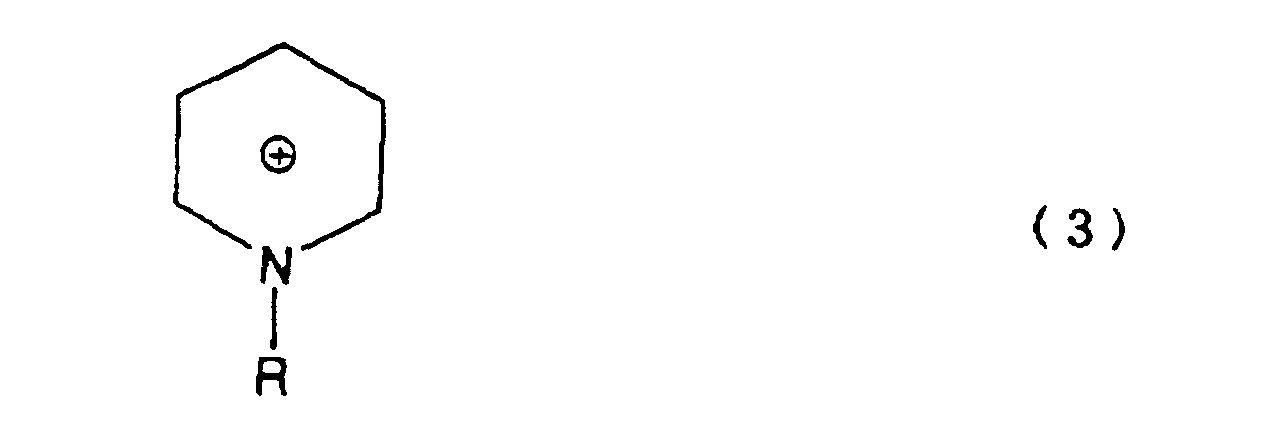
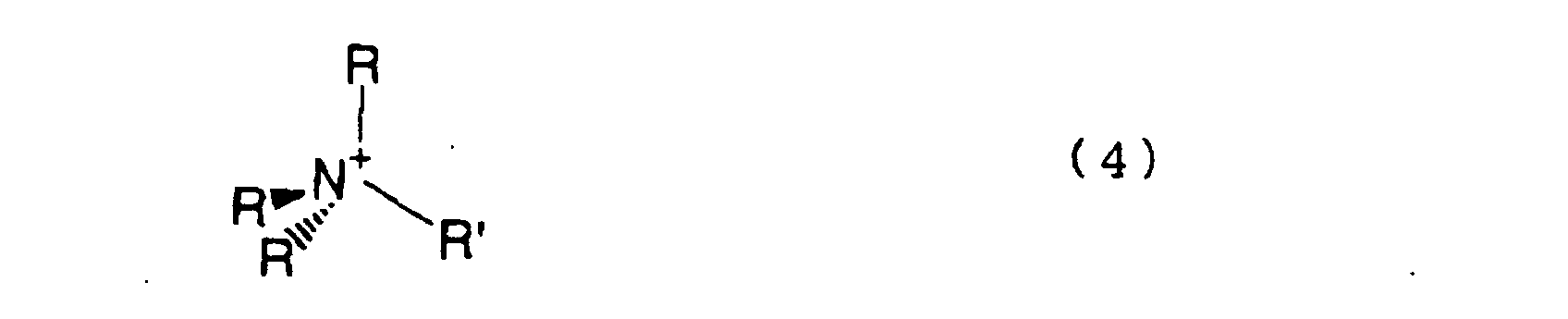
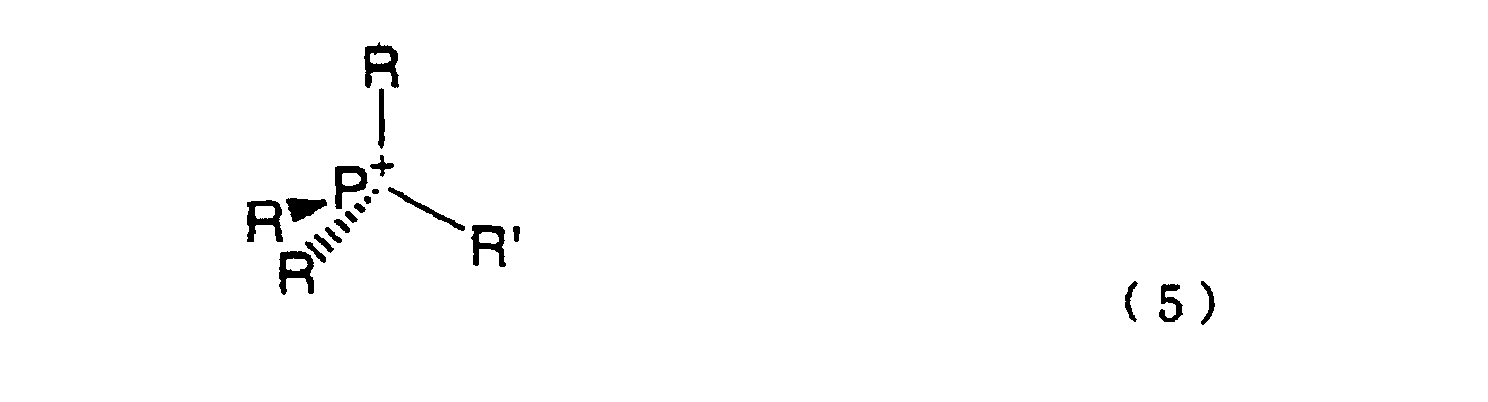
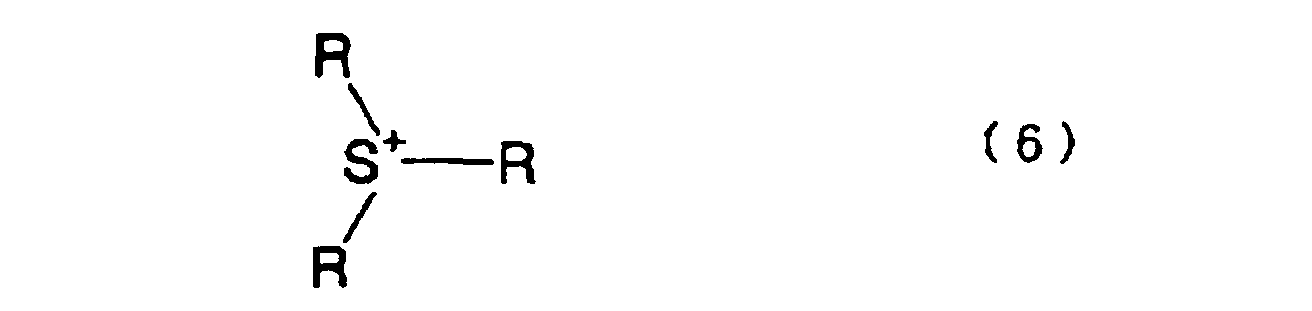
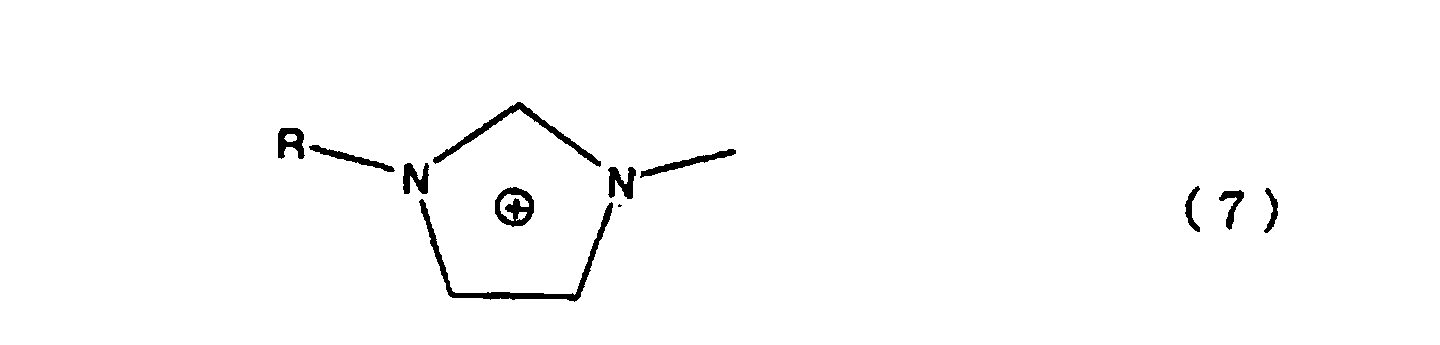
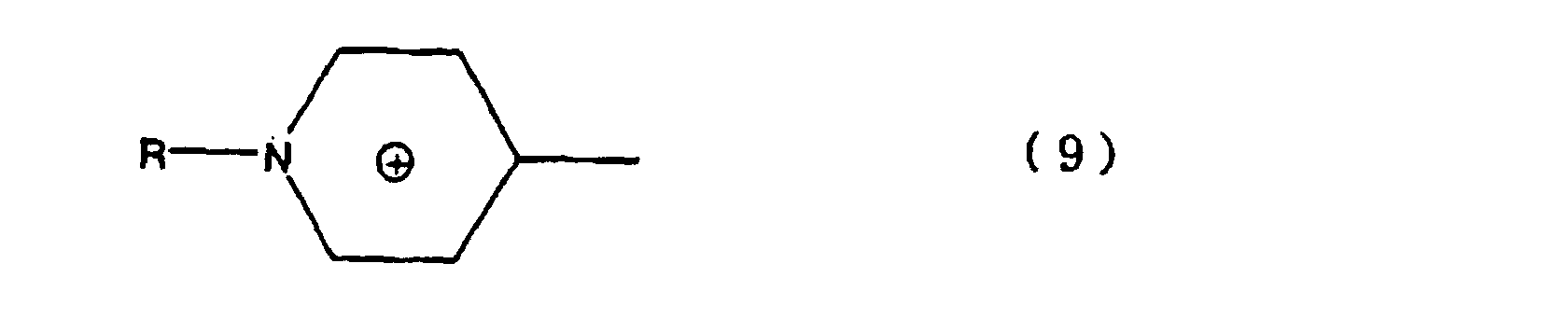
- organic molten salt various compounds may be used. Specifically, for example, organic molten salts in which cation structures such as imidazolium cation, pyridinium cation, pyrrolidinium cation, ammonium cation, phosphonium cation and sulfonium cation represented by the following formulas are combined with anions such as C 1 - , Br - , I - , NO 3 - , BF 4 - , PF 6 - , AsF 6 - , TFSI - and the like may be exemplified.
- R, R I , R II and R III may be the same or different, and represent an alkyl group, a perfluoroalkyl group, a halogen group, a nitro group or a cyano group.
- organic molten salts having chirality in the molecule may be applied.
- an imidazolium-type molten salt which is known to be stable in ambient atmosphere and low in moisture absorption, which also has a wide potential window as well as a high ionic conductivity, may be listed as a preferable example.
- liquid-crystalline molecule having a moiety that is miscible with the organic molten salt and a moiety that shows liquid crystal orientation may be used as the liquid-crystalline molecule.
- the liquid-crystalline molecule may be a polymer with a molecular weight of more than 10,000 or a small molecule with a molecular weight of less than or equal to several hundred, preferable are small molecules.
- the liquid-crystalline molecule may be an inorganic substance or an organic substance.
- the miscible moiety is a moiety that physically bonds to the organic molten salt, and such bond is formed by self-assembly.
- the miscible moiety may be any moiety as long as it exhibits miscibility to the organic molten salt used. Specifically, those represented by the following chemical formulas may be listed. (In the formula R represents an alkyl group, and X and Y represent any one of OH, COOH, NH 2 , SO 3 H and PO 4 H.)
- liquid-crystalline molecule used in the invention of the present application as the liquid crystal orientation moiety, those that exhibits liquid-crystalline properties such as anisotropy and electric field responsiveness when it is physically bonded to the organic molten salt may be used.
- the liquid-crystalline molecule may be a molecule that does or does not exhibit liquid-crystalline properties on its own.
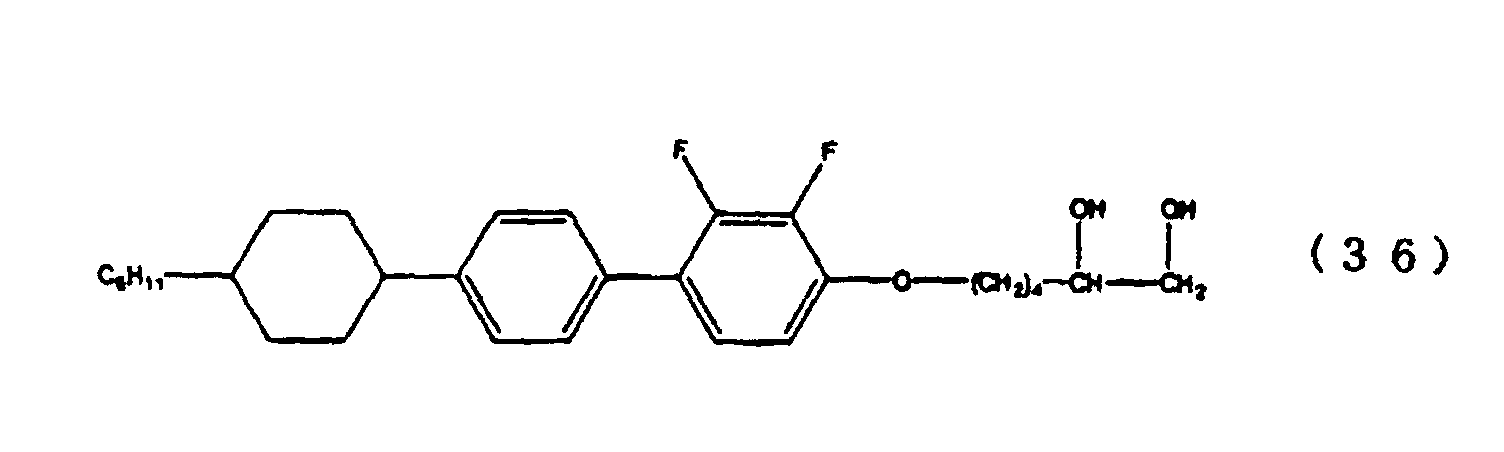
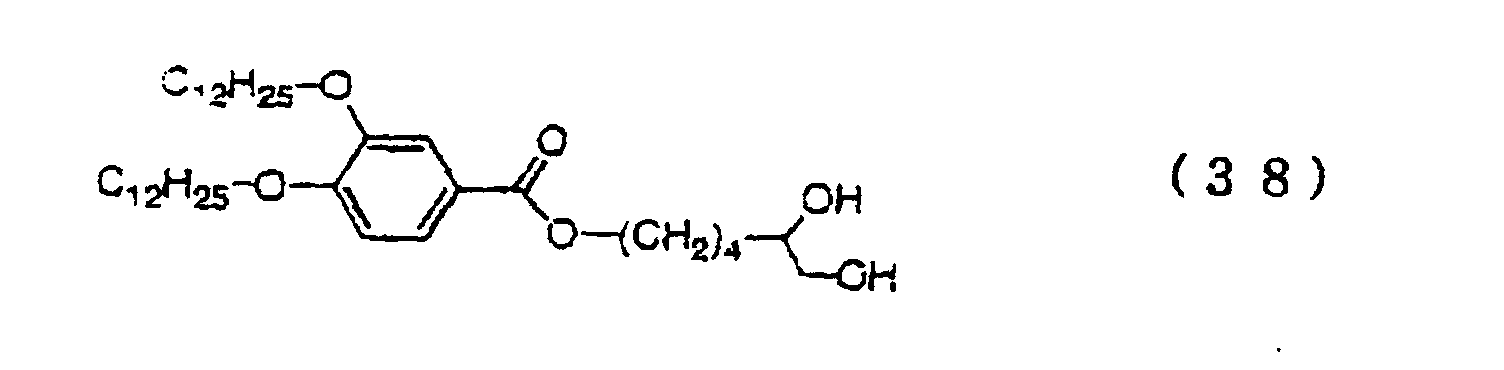
- liquid crystal orientation moiety those represented by the following chemical formulas may be exemplified. (In the formula p represents 0 to 2, X represents a substituent, and Y and Z my be the same or different and represent a carbon chain which may contain a single bond, a double bond or a triple bond.)
- liquid crystal orientation moieties form a nematic phase, a smectic phase, a hexagonal columnar phase or a cubic phase.
- the miscible moiety and the liquid crystal orientation moiety may be bound by an arbitrary organic chain such as those represented as (CH 2 CH 2 ) n or (CH 2 OCH 2 ) n (n represents a natural number). Further, in the liquid-crystalline molecule, the miscible moiety and the liquid crystal orientation moiety may be present as a side chain or may comprise the main chain within the molecular structure. Moreover, especially when the liquid-crystalline molecule consists of a polymer such as polysaccharide, two or more miscible moieties and liquid crystal orientation moieties that are the same or different may be present. Furthermore, the liquid-crystalline molecule may contain a polymerizable group such as methacryl group, acryl group or an epoxy group.
- the liquid crystalline phase can be formed spontaneously in the organic molten salt through self assembly.
- the miscible moieties of the liquid-crystalline molecules interact and assemble to spontaneously form a stable organization.
- the organic molten salt and the liquid-crystalline molecule may be mixed directly by fusion or may be mixed after being dissolved in a solvent.
- the liquid-crystalline ionic conductor is obtained as a mixture;
- the organic molten salt and the liquid-crystalline molecule are respectively dissolved in an organic solvent, for example, alcohols such as ethanol, or chloroform, and these solutions are mixed to expedite uniform mixing, after which the solvent of the mixed solution is removed by evaporation, and the residual product is dried to obtain a liquid-crystalline ionic conductor.
- the solvent may be removed by heating at an appropriate temperature. For example, when chloroform is used as an organic solvent, the solvent can be removed rapidly by heating at approximately 60°C. Further, vacuum drying is also effective. Consequently, the liquid-crystalline ionic conductor which comprises an organic molten salt to which liquid-crystalline properties are imparted is obtained.
- the liquid-crystalline ionic conductor of the present invention has a structure, wherein, for example, the organic molten salt is assembled between layers of various types formed by the liquid-crystalline molecules.
- FIG. 1 is a schematic view that exemplifies a liquid-crystalline ionic conductor with such a structure, in which a smectic phase is formed by the liquid-crystalline molecules and the organic molten salt is assembled between layers thereof.
- the long axes of the liquid-crystalline molecules orient in a specific direction and interact to form a layered structure.
- the spaces between the layers show ionic conductivity owing to the organic molten salt present therein.
- the present liquid-crystalline ionic conductor consists of an ionic conduction moiety (organic molten salt) and a non-ionic conduction moiety (liquid-crystalline molecule) assembled to form a layered structure in a nanometer level. Moreover, the liquid-crystalline ionic conductor exhibits anisotropy and the electric field responsiveness owing to the liquid-crystalline molecule.
- liquid-crystalline molecule exhibits liquid-crystalline properties. Even the liquid-crystalline molecules that do not exhibit liquid-crystalline properties on their own exhibit liquid-crystalline properties. Further, liquid-crystalline molecules that show liquid-crystalline properties on their own may show changes in their liquid-crystalline properties. For example, effects such as changing to a more thermally stable liquid crystalline phase, or broadening of the range of liquid crystal transition temperature, may be observed. Specifically, for example, a liquid-crystalline molecule that forms a columnar phase may form a layered structure when an organic molten salt is present in its cylinder, causing the liquid-crystalline properties of the liquid-crystalline ionic conductor to change. Further, with regard to the organic molten salt, its inherent properties such as high conductivity and free molecular mobility are not lost at all, even in the liquid-crystalline ionic conductor.
- a high anisotropic ionic conductivity may also be realized by the formation of a cell or an oriented cell. This characteristic is especially adjuvant to their application to batteries for electric automobiles and the like.
- R, R I and R II may each be
- the liquid-crystalline molecule compound represented by the foregoing formula 23 shows a group of amphiphilic molecules.
- the symbols R, R I and R II are alkyl group, an aralkyl group or a perfluoroalkyl group which act as the ion-phobic moiety
- the symbol Y is an ester bond or an amide bond
- the symbol Z is a hydroxyl group, an imidazole group, an imidazolium cationic group (including a polymerizable group) or a pyridinium cationic group (including a polymerizable group), which acts as the ion-philic moiety.
- liquid-crystalline ionic conductor of the smectic structure In the liquid-crystalline ionic conductor of the smectic structure, ionic conduction selectively appears in the layered organization only in the direction parallel to the layer. Meanwhile, in the liquid-crystalline ionic conductor of the columnar structure, ionic conduction selectively appears in the direction parallel to the column axis.
- an organic molten salt to which a desired liquid-crystalline property is imparted may be realized by the invention of the present application.
- many reactions including enzyme reaction, high activity, high selectivity, and shortening of reaction time are realized in a state where the substrate molecules are regularly arranged or arrayed.
- a reaction field that enables a regulated arrangement or array of the substrate molecules can be provided.
- the ionic conductivity can also be imparted to the liquid-crystalline material.
- liquid-crystalline ionic conductor of the invention of the present application can provide a functional material that is extremely useful in various fields associated with the chemical industry, the electrochemical industry, electronic engineering, bioengineering and the like, as for example,
- organic molten salt 1 Ethylmethylimidazolium tetrafluoroborate (hereinafter referred to as organic molten salt 1) was used as an organic molten salt, and 4,4'-bis(( ⁇ -imidazol-1-yl)alkoxy)biphenyl as a liquid-crystalline molecule to be assembled therewith.
- organic molten salt 1 Ethylmethylimidazolium tetrafluoroborate
- liquid-crystalline molecules 1, 2 and 3 three types of substances (hereinafter referred to as liquid-crystalline molecules 1, 2 and 3 respectively) in which the carbon number n for the hydrocarbon chain in the formula was 6, 9 and 10, were used. Further, the transition temperature was measured using a polarization microscope fitted with a temperature-variable stage and a differential scanning calorimeter (DSC) in combination.
- DSC differential scanning calorimeter
- symbol Cr indicates a crystal phase
- I an isotropic phase
- S A a smectic A phase
- S C a smectic C phase.
- Predetermined amounts of the above substances were measured and dissolved in chloroform respectively.
- the solution of organic molten salt 1 and the solutions of liquid-crystalline molecules 1 to 3 were respectively mixed and stirred to form a uniform solution.
- This mixture was heated at 60°C to remove the solvent by evaporation, and the residual paste-like substances were vacuum-dried for 2 hours to obtain assemblies 1 to 3.
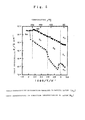
- FIG. 2 The relationship between the assembly formation ratio and the thermal phase transition temperature of the resulting assemblies 1 to 3 are shown in FIG. 2. It was identified that liquid-crystalline properties were exhibited for assembly 1 and assembly 3, even though they are comprised of liquid-crystalline molecule 1 or liquid-crystalline molecule 3 neither of which show liquid-crystalline properties on its own and organic molten salt 1. Further, it was found that assembly 2 that comprises liquid-crystalline molecule 2, which inherently shows liquid-crystalline properties, maintains its liquid-crystalline properties even after it is assembled with organic molten salt 1.
- assemblies 1 to 3 exhibit liquid-crystalline properties at any assembly formation ratio. Particularly, with respect to assembly 3, it was shown that liquid-crystalline properties were exhibited at a broader temperature range when the ratio of liquid-crystalline molecule 3 was smaller.
- liquid-crystalline properties can be imparted to the organic molten salt.
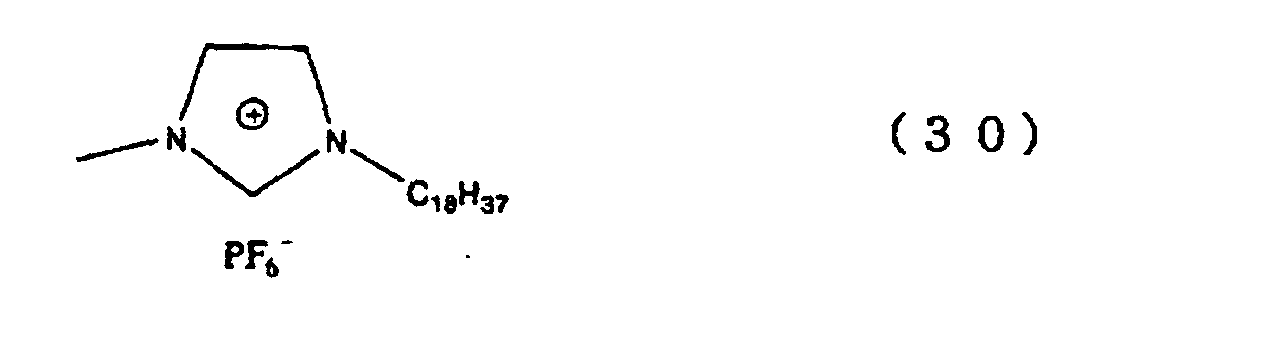
- Organic molten salt 1 in Example 1 and ethylmethylimidazolium hexafluorophosphate (hereinafter referred to as organic molten salt 2) were used as an organic molten salt, and two types of imidazolium-type surfactants (hereinafter referred to as liquid-crystalline molecule 4 and liquid-crystalline molecule 5) were used as liquid-crystalline molecules to be assembled therewith.
- the structures of organic molten salt 2, liquid-crystalline molecule 4 and liquid-crystalline molecule 5 are shown in the following [formula 28], [formula 29] and [formula 30], respectively.
- the transition temperatures of organic molten salt 2, liquid-crystalline molecule 4 and liquid-crystalline molecule 5 are shown in Table 2.
- Substance Transition temperature (°C) Organic molten salt 2 Heating step Cr ⁇ 59 ⁇ I Cooling step I ⁇ 6.5 ⁇ Cr Liquid-crystalline molecule 4 Heating step S X ⁇ 57 ⁇ S A ⁇ 205 ⁇ I Cooling step I ⁇ 203 ⁇ S A ⁇ 55 ⁇ S X Liquid-crystalline molecule 5 Heating step C ⁇ 81 ⁇ S A ⁇ 165 ⁇ I Cooling step I ⁇ 164 ⁇ S A ⁇ 70 ⁇ S X
- symbol Cr indicates a crystal phase
- I an isotropic phase
- S A a smectic A phase
- S X a smectic X phase that is a high-order smectic phase closer to a crystal phase.
- Liquid-crystalline molecule 4 [formula 29] and liquid-crystalline molecule 5 [formula 30] are substances that show smectic liquid-crystalline properties in a broad temperature range. Further, organic molten salt 2 [formula 28] does not show liquid-crystalline properties.
- liquid-crystalline molecule 4 has to be assembled at a molar ratio of 0.4 or more to exhibit liquid-crystalline properties. Further, it was shown that when the ratio of liquid-crystalline molecule 4 is 0.4 or more, the liquid crystal temperature range can be broadened even by a slight increase in its ratio. In assembly 5, it was found that liquid-crystalline molecule 5 has to be assembled at a molar ratio of 0.6 or more to exhibit liquid-crystalline properties.
- Organic molten salt 1 in Example 1 was used as an organic molten salt, and alkyl glycoside (liquid-crystalline molecule 6), ⁇ -hydroxyalkyl glycoside (liquid-crystalline molecule 7) and dialkyl glycoside (liquid-crystalline molecule 8) were used as liquid-crystalline molecules to be assembled therewith.
- alkyl glycoside liquid-crystalline molecule 6
- ⁇ -hydroxyalkyl glycoside liquid-crystalline molecule 7
- dialkyl glycoside liquid-crystalline molecule 8
- assembly 6 and assembly 7 show smectic liquid-crystalline properties and self-assemble to form a layered structure at the nanometer level.
- assembly 8 shows hexagonal columnar liquid-crystalline properties and has a specific structure in which organic molten salt 1 is positioned in the center of the columnar structure to form a layer.
- Organic molten salt 3 and liquid-crystalline molecule 9 represented by the following [formula 34] and [formula 35] respectively were mixed at various ratios to obtain assemblies.
- the liquid crystal transition temperature of liquid-crystalline molecule 9 is shown in Table 3.
- symbol Cr indicates a crystal phase
- I an isotropic phase
- SB a smectic B phase
- N a nematic phase
- FIG. 4 shows a schematic view of the system used for the measurement.
- a heat-molten assembly obtained by heating on a temperature-adjustable hot plate at 200°C was placed inside each of two types of glass cells A (top left in FIG. 4) and B (lower left in FIG. 4) fitted with electrodes as shown in FIG. 4.
- the assemblies were allowed to cool slowly to approximately 25°C, whereby the smectic liquid-crystalline assembly spontaneously formed homeotropic orientation (meaning the axes of liquid-crystalline molecules were arrayed optically positively perpendicularly on the bottom of the cell) inside the cell. This was identified by observation with an orthoscope and a conoscope in polarization microscope observation.
- An AC impedance method (method by which movement of ions is detected as a resistance value by applying AC electric fields of various frequency) was employed as a method of measuring ionic conductivity.
- the ionic conduction behavior inside a measurement sample can be evaluated quantitatively, and the effect of specific ionic conduction behavior that occurs in the vicinity of the electrode interface can be removed.
- the anisotropic conductivity behavior of the ionic conductor that characteristically shows liquid-crystalline properties
- the change in ionic conductivity caused by the liquid crystalline phase transition accompanied by changes in temperature was also evaluated.
- the anisotropic ionic conduction was measured for the smectic liquid-crystalline assembly obtained by mixing liquid-crystalline molecule 11 represented by the following [formula 37] with the foregoing organic molten salt 3 [formula 34] at a molar ratio of 1:1, .
- the measuring system was the same as that shown in FIG. 4 described in Example 5.
- the anisotropic ionic conduction was measured for the columnar liquid-crystalline assembly obtained by mixing a compound represented by the following formula as the liquid-crystalline molecule belonging to the foregoing [formula 24] (corresponding to a compound of [formula 24] in which symbols R and R I are C 12 H 25 , R II is H, Y is COO and Z is a hydroxyl group) with the organic molten salt of [formula 29] used in Example 2 at a molar ratio of 4:1.
- this invention provides a novel liquid-crystalline ionic conductor which is useful in the electric, electronic, chemical and bioengineering fields and the like as an anisotropic reaction solvent, ionic conductor, electric field-responsive conductor or the like, as well as a method for producing the same.
Landscapes
- Chemical & Material Sciences (AREA)
- Crystallography & Structural Chemistry (AREA)
- Engineering & Computer Science (AREA)
- Materials Engineering (AREA)
- Organic Chemistry (AREA)
- Physics & Mathematics (AREA)
- Dispersion Chemistry (AREA)
- Spectroscopy & Molecular Physics (AREA)
- Organic Low-Molecular-Weight Compounds And Preparation Thereof (AREA)
- Liquid Crystal Substances (AREA)
- Conductive Materials (AREA)
- Fuel Cell (AREA)
Abstract
Description







Furthermore, the liquid-crystalline molecule may contain a polymerizable group such as methacryl group, acryl group or an epoxy group.



| Substance | Transition temperature (°C) | |
| Organic | Heating step | Cr∼15∼I |
| Cooling step | I∼15∼Cr | |
| Liquid-crystalline molecule 1 (n=6) | Heating step | Cr∼91∼I |
| Cooling step | I∼68∼Cr | |
| Liquid-crystalline molecule 2 (n=9) | Heating step | Cr∼87∼I |
| Cooling step | I∼72∼SA∼68∼SC∼48∼Cr | |
| Liquid-crystalline molecule 3 (n=10) | Heating step | C∼102∼I |
| Cooling step | I∼88∼Cr |


| Substance | Transition temperature (°C) | |
| Organic | Heating step | Cr∼59∼I |
| Cooling step | I∼6.5∼Cr | |
| Liquid- | Heating step | SX∼57∼SA∼205∼I |
| Cooling step | I∼203∼SA∼55∼SX | |
| Liquid- | Heating step | C∼81∼SA∼165∼I |
| Cooling step | I∼164∼SA∼70∼SX |




| Substance | Transition temperature (°C) | |
| Liquid-crystalline molecule 9 | Heating step | Cr∼198∼SB∼204∼N∼207∼I |
| Cooling step | I∼208∼N∼202∼SB∼171∼Cr |

Claims (12)
- A liquid-crystalline ionic conductor, comprising an organic molten salt and a liquid-crystalline molecule, which are mixed and assembled.
- The liquid-crystalline ionic conductor of claim 1, wherein the organic molten salt is assembled between layers of the liquid-crystalline molecules.
- The liquid-crystalline ionic conductor of claim 1 or 2, which is in the form of a cell or an oriented cell.
- The liquid-crystalline ionic conductor of any one of claims 1 to 3, wherein the liquid-crystalline molecule comprises a moiety that is miscible to the organic molten salt and a moiety that shows liquid-crystalline orientation.
- The liquid-crystalline ionic conductor of any one of claims 1 to 4, which form a smectic structure.
- The liquid-crystalline ionic conductor of any one of claims 1 to 4, which form a columnar structure or a cubic structure.
- A method for producing the liquid-crystalline ionic conductor of any one of claims 1 to 6, which comprises mixing an organic molten salt with a liquid-crystalline molecule.
- The method for producing a liquid-crystalline ionic conductor of claim 7, wherein the organic molten salt and the liquid-crystalline molecule are each dissolved in an organic solvent and mixed in the form of a solution.
- The method for producing a liquid-crystalline ionic conductor of claim 7 or 8, wherein a cell or an oriented cell is formed.
- The method for producing a liquid-crystalline ionic conductor of any one of claims 7 to 9, wherein the organic molten salt is an imidazolium-type molten salt.
- The method for producing a liquid-crystalline ionic conductor of any one of claims 7 to 10, wherein the liquid-crystalline molecule forms a smectic structure.
- The method for producing a liquid-crystalline ionic conductor of any one of claims 7 to 10, wherein the liquid-crystalline molecule forms a columnar structure or a cubic structure.
Applications Claiming Priority (5)
| Application Number | Priority Date | Filing Date | Title |
|---|---|---|---|
| JP2001102386 | 2001-03-30 | ||
| JP2001102386 | 2001-03-30 | ||
| JP2002012234 | 2002-01-21 | ||
| JP2002012234A JP4033678B2 (en) | 2001-03-30 | 2002-01-21 | Liquid crystalline ion conductor and method for producing the same |
| PCT/JP2002/003262 WO2002080196A1 (en) | 2001-03-30 | 2002-04-01 | Liquid crystalline ion conductor and method for preparation thereof |
Publications (3)
| Publication Number | Publication Date |
|---|---|
| EP1394816A1 true EP1394816A1 (en) | 2004-03-03 |
| EP1394816A4 EP1394816A4 (en) | 2005-03-16 |
| EP1394816B1 EP1394816B1 (en) | 2007-03-28 |
Family
ID=26612903
Family Applications (1)
| Application Number | Title | Priority Date | Filing Date |
|---|---|---|---|
| EP02713279A Expired - Lifetime EP1394816B1 (en) | 2001-03-30 | 2002-04-01 | Liquid crystalline ion conductor and method for preparation thereof |
Country Status (6)
| Country | Link |
|---|---|
| US (2) | US20040169158A1 (en) |
| EP (1) | EP1394816B1 (en) |
| JP (1) | JP4033678B2 (en) |
| KR (1) | KR100579650B1 (en) |
| DE (1) | DE60219160T2 (en) |
| WO (1) | WO2002080196A1 (en) |
Families Citing this family (35)
| Publication number | Priority date | Publication date | Assignee | Title |
|---|---|---|---|---|
| AU2003901144A0 (en) * | 2003-03-13 | 2003-03-27 | Monash University School Of Chemistry | Room temperature ionic liquid electrolytes for lithium secondary batteries |
| KR101133867B1 (en) * | 2003-10-10 | 2012-04-06 | 시게유키 모리 | Lubricating oil |
| JP2005147394A (en) * | 2003-10-23 | 2005-06-09 | Sankyo Seiki Mfg Co Ltd | Dynamic-pressure bearing device and disc driving device |
| US7097888B2 (en) * | 2003-12-15 | 2006-08-29 | Eastman Kodak Company | Aligned liquid crystal layer containing azolium salts and process for increasing the tilt |
| JP4802478B2 (en) * | 2004-11-01 | 2011-10-26 | 東洋製罐株式会社 | Dye-sensitized solar cell |
| JP4896497B2 (en) * | 2004-11-08 | 2012-03-14 | 日東電工株式会社 | Liquid crystalline compound and ionic conductor using the same |
| GB0518611D0 (en) * | 2005-09-13 | 2005-10-19 | Eastman Kodak Co | Transparent conductive system |
| JP4976018B2 (en) * | 2006-01-31 | 2012-07-18 | 三洋化成工業株式会社 | Lubricant composition |
| USD628138S1 (en) | 2007-03-30 | 2010-11-30 | Airbus Sas | Aircraft cabin structure |
| US8507052B2 (en) * | 2010-03-03 | 2013-08-13 | Citizen Finetech Miyota Co., Ltd. | Ferroelectric liquid crystal mixture with organic ion pair compound |
| JP5593798B2 (en) * | 2010-04-08 | 2014-09-24 | トヨタ自動車株式会社 | Metal air battery |
| US8512820B2 (en) | 2011-06-14 | 2013-08-20 | Citizen Finetech Miyota Co., Ltd. | Organic ionic phenylpyrimidine compounds and displays formed thereof |
| CN104736672B (en) | 2012-10-16 | 2017-10-24 | 提克纳有限责任公司 | Antistatic Liquid Crystal Polymer Composition |
| WO2014088700A1 (en) | 2012-12-05 | 2014-06-12 | Ticona Llc | Conductive liquid crystalline polymer composition |
| KR102155924B1 (en) | 2013-03-13 | 2020-09-14 | 티코나 엘엘씨 | Antistatic liquid crystalline polymer composition |
| KR102305241B1 (en) | 2014-04-09 | 2021-09-24 | 티코나 엘엘씨 | Antistatic polymer composition |
| US9822254B2 (en) | 2014-04-09 | 2017-11-21 | Ticona Llc | Camera module |
| PT108205A (en) * | 2015-02-10 | 2016-08-10 | Faculdade Ciências E Tecnologia Da Univ Nova De Lisboa | COMPOSITE MATERIAL WITH RESPONSE TO STIMULUS AND RESPECTIVE PROCESS OF PRODUCTION AND APPLICATION AS A SENSITIVE FILM |
| KR101864927B1 (en) | 2015-03-31 | 2018-07-04 | 주식회사 엘지화학 | Liquid crystal device |
| DE102017005884A1 (en) | 2016-07-07 | 2018-01-11 | Merck Patent Gmbh | Electronic switching element |
| US10312132B2 (en) * | 2017-01-25 | 2019-06-04 | International Business Machines Corporation | Forming sacrificial endpoint layer for deep STI recess |
| JP6819336B2 (en) * | 2017-02-09 | 2021-01-27 | コニカミノルタ株式会社 | Electrophotographic toner and image formation method |
| US10829634B2 (en) | 2017-12-05 | 2020-11-10 | Ticona Llc | Aromatic polymer composition for use in a camera module |
| JPWO2019221267A1 (en) * | 2018-05-18 | 2021-06-17 | Eneos株式会社 | Liquid crystal compounds, ionic conductors, electrolyte films and secondary batteries |
| WO2020040129A1 (en) | 2018-08-20 | 2020-02-27 | 国立大学法人 東京大学 | Nanostructure composite semipermeable membrane |
| WO2020190568A1 (en) | 2019-03-20 | 2020-09-24 | Ticona Llc | Actuator assembly for a camera module |
| WO2020190569A1 (en) | 2019-03-20 | 2020-09-24 | Ticona Llc | Polymer composition for use in a camera module |
| KR20220147110A (en) | 2020-02-26 | 2022-11-02 | 티코나 엘엘씨 | Polymer Compositions for Electronic Devices |
| CN115700014A (en) | 2020-02-26 | 2023-02-03 | 提克纳有限责任公司 | Circuit structure |
| WO2021173408A1 (en) | 2020-02-26 | 2021-09-02 | Ticona Llc | Electronic device |
| JP2023515975A (en) | 2020-02-26 | 2023-04-17 | ティコナ・エルエルシー | electronic device |
| US11728065B2 (en) | 2020-07-28 | 2023-08-15 | Ticona Llc | Molded interconnect device |
| US12209163B2 (en) | 2021-05-06 | 2025-01-28 | Ticona Llc | Polymer composition for use in a camera module |
| JP2024546075A (en) | 2021-12-01 | 2024-12-17 | ティコナ・エルエルシー | Antenna Module |
| TW202340697A (en) | 2021-12-13 | 2023-10-16 | 美商堤康那責任有限公司 | Technique for testing the ball dent properties of a sample |
Family Cites Families (9)
| Publication number | Priority date | Publication date | Assignee | Title |
|---|---|---|---|---|
| US3882039A (en) * | 1973-06-21 | 1975-05-06 | Ibm | Additive for liquid crystal materials |
| JPS5039686A (en) * | 1973-08-15 | 1975-04-11 | ||
| JP2000297085A (en) * | 1999-02-10 | 2000-10-24 | Canon Inc | Crown ether derivative, method for producing the same, and electrolyte containing them |
| DE60029151T2 (en) * | 1999-03-01 | 2007-05-31 | Fuji Photo Film Co., Ltd., Minami-Ashigara | Photoelectrochemical cell with an electrolyte of liquid crystal compounds |
| JP3032828B1 (en) * | 1999-06-07 | 2000-04-17 | 工業技術院長 | Photoconductive silicon complex, liquid crystal material, composition thereof, and device using them |
| EP1119068B1 (en) * | 1999-06-30 | 2012-11-28 | JGC Catalysts and Chemicals Ltd. | Photoelectric cell |
| JP2001015182A (en) * | 1999-06-30 | 2001-01-19 | Catalysts & Chem Ind Co Ltd | Photoelectric cell |
| JP4636644B2 (en) * | 2000-01-17 | 2011-02-23 | 富士フイルム株式会社 | Electrolyte composition, electrochemical cell and ionic liquid crystal monomer |
| JP4799776B2 (en) * | 2000-08-22 | 2011-10-26 | 富士フイルム株式会社 | Electrolyte composition and electrochemical cell using the same |
-
2002
- 2002-01-21 JP JP2002012234A patent/JP4033678B2/en not_active Expired - Fee Related
- 2002-04-01 US US10/473,673 patent/US20040169158A1/en not_active Abandoned
- 2002-04-01 WO PCT/JP2002/003262 patent/WO2002080196A1/en not_active Ceased
- 2002-04-01 KR KR1020037012720A patent/KR100579650B1/en not_active Expired - Fee Related
- 2002-04-01 DE DE60219160T patent/DE60219160T2/en not_active Expired - Fee Related
- 2002-04-01 EP EP02713279A patent/EP1394816B1/en not_active Expired - Lifetime
-
2005
- 2005-09-14 US US11/225,000 patent/US7166238B2/en not_active Expired - Fee Related
Also Published As
| Publication number | Publication date |
|---|---|
| DE60219160D1 (en) | 2007-05-10 |
| JP4033678B2 (en) | 2008-01-16 |
| JP2002358821A (en) | 2002-12-13 |
| WO2002080196A1 (en) | 2002-10-10 |
| DE60219160T2 (en) | 2007-12-27 |
| KR100579650B1 (en) | 2006-05-15 |
| EP1394816A4 (en) | 2005-03-16 |
| KR20040030557A (en) | 2004-04-09 |
| US7166238B2 (en) | 2007-01-23 |
| US20040169158A1 (en) | 2004-09-02 |
| EP1394816B1 (en) | 2007-03-28 |
| US20060011887A1 (en) | 2006-01-19 |
Similar Documents
| Publication | Publication Date | Title |
|---|---|---|
| EP1394816B1 (en) | Liquid crystalline ion conductor and method for preparation thereof | |
| Salikolimi et al. | Functional ionic liquid crystals | |
| Kato et al. | Functional liquid-crystalline polymers and supramolecular liquid crystals | |
| Goossens et al. | Ionic liquid crystals: versatile materials | |
| US20080029735A1 (en) | Surfactants and polymerizable surfactants based on room-temperature ionic liquids that form lyotropic liquid crystal phases with water and room-temperature ionic liquids | |
| Ohno | Functional design of ionic liquids | |
| Yao et al. | Supramolecular polymerization and gel formation of bis (merocyanine) dyes driven by dipolar aggregation | |
| Binnemans | Ionic liquid crystals | |
| Ichikawa et al. | Induction of thermotropic bicontinuous cubic phases in liquid-crystalline ammonium and phosphonium salts | |
| Yoshio et al. | Layered ionic liquids: anisotropic ion conduction in new self‐organized liquid‐crystalline materials | |
| Soberats et al. | Ionic switch induced by a rectangular–hexagonal phase transition in benzenammonium columnar liquid crystals | |
| Wu et al. | Thermoresponsive polyoxometalate/ionic liquid supramolecular gel electrolytes for supercapacitors: fabrication, structure, and heteropolyanion structure effect | |
| Champagne et al. | Amphiphilic cyclodextrin-based liquid crystals for proton conduction | |
| Ster et al. | Synthesis and mesophase behaviour of ionic liquid crystals | |
| Yamashita et al. | Use of a protic salt for the formation of liquid-crystalline proton-conductive complexes with mesomorphic diols | |
| Chen et al. | Synthesis, self-assembly, metal binding properties of triazole azobenzene based polycatenar dyes through click chemistry | |
| Winter et al. | The supramolecular assemblies based on heteroatom-containing triangulenes | |
| Maekawa et al. | Gyroid nanostructured soft membranes formed by controlling the degree of crosslinking polymerization of bicontinuous cubic liquid-crystalline monomers | |
| Guo et al. | Room-temperature AIE ionic liquid crystals based on diphenylacrylonitrile-imidazole salts | |
| Wang et al. | Effect of counter ions on the mesogenic ionic N-phenylpyridiniums | |
| Yan et al. | An advanced method for preparation of helical carbon and graphitic films using a carbonization substrate | |
| Bubnov et al. | Thermal analysis of binary liquid crystalline mixtures: system of bent core and calamitic molecules | |
| Qiao et al. | Supramolecular thermotropic ionic liquid crystals formed via self-assembled zwitterionic ionic liquids | |
| Chaudhari et al. | Room temperature imidazolium linked chalcone based ionic LCs: Role of terminal position on mesomorphism | |
| Robertson et al. | Effect of an n-alkoxy-2, 4-hexadiene polymerizable tail system on the mesogenic properties and cross-linking of mono-imidazolium-based ionic liquid crystal monomers |
Legal Events
| Date | Code | Title | Description |
|---|---|---|---|
| PUAI | Public reference made under article 153(3) epc to a published international application that has entered the european phase |
Free format text: ORIGINAL CODE: 0009012 |
|
| 17P | Request for examination filed |
Effective date: 20031027 |
|
| AK | Designated contracting states |
Kind code of ref document: A1 Designated state(s): AT BE CH CY DE DK ES FI FR GB GR IE IT LI LU MC NL PT SE TR |
|
| RIN1 | Information on inventor provided before grant (corrected) |
Inventor name: YOSHIZAWA, MASAHIRO Inventor name: OHNO, HIROYUKI Inventor name: YOSHIO, MASAFUMI Inventor name: KANIE, KIYOSHI Inventor name: KATO, TAKASHI |
|
| RAP1 | Party data changed (applicant data changed or rights of an application transferred) |
Owner name: JAPAN SCIENCE AND TECHNOLOGY AGENCY |
|
| A4 | Supplementary search report drawn up and despatched |
Effective date: 20050202 |
|
| RIC1 | Information provided on ipc code assigned before grant |
Ipc: 7C 09K 19/02 B Ipc: 7C 09K 19/58 B Ipc: 7H 01B 1/06 A |
|
| GRAP | Despatch of communication of intention to grant a patent |
Free format text: ORIGINAL CODE: EPIDOSNIGR1 |
|
| RBV | Designated contracting states (corrected) |
Designated state(s): DE GB NL |
|
| GRAS | Grant fee paid |
Free format text: ORIGINAL CODE: EPIDOSNIGR3 |
|
| GRAA | (expected) grant |
Free format text: ORIGINAL CODE: 0009210 |
|
| AK | Designated contracting states |
Kind code of ref document: B1 Designated state(s): DE GB NL |
|
| REG | Reference to a national code |
Ref country code: GB Ref legal event code: FG4D |
|
| REF | Corresponds to: |
Ref document number: 60219160 Country of ref document: DE Date of ref document: 20070510 Kind code of ref document: P |
|
| PGFP | Annual fee paid to national office [announced via postgrant information from national office to epo] |
Ref country code: DE Payment date: 20070529 Year of fee payment: 6 |
|
| PGFP | Annual fee paid to national office [announced via postgrant information from national office to epo] |
Ref country code: NL Payment date: 20070530 Year of fee payment: 6 |
|
| PGFP | Annual fee paid to national office [announced via postgrant information from national office to epo] |
Ref country code: GB Payment date: 20070521 Year of fee payment: 6 |
|
| PLBE | No opposition filed within time limit |
Free format text: ORIGINAL CODE: 0009261 |
|
| STAA | Information on the status of an ep patent application or granted ep patent |
Free format text: STATUS: NO OPPOSITION FILED WITHIN TIME LIMIT |
|
| 26N | No opposition filed |
Effective date: 20080102 |
|
| GBPC | Gb: european patent ceased through non-payment of renewal fee |
Effective date: 20080401 |
|
| NLV4 | Nl: lapsed or anulled due to non-payment of the annual fee |
Effective date: 20081101 |
|
| PG25 | Lapsed in a contracting state [announced via postgrant information from national office to epo] |
Ref country code: NL Free format text: LAPSE BECAUSE OF NON-PAYMENT OF DUE FEES Effective date: 20081101 Ref country code: DE Free format text: LAPSE BECAUSE OF NON-PAYMENT OF DUE FEES Effective date: 20081101 |
|
| PG25 | Lapsed in a contracting state [announced via postgrant information from national office to epo] |
Ref country code: GB Free format text: LAPSE BECAUSE OF NON-PAYMENT OF DUE FEES Effective date: 20080401 |