EP1394119A1 - Method and apparatus for generating ozone by electrolysis - Google Patents
Method and apparatus for generating ozone by electrolysis Download PDFInfo
- Publication number
- EP1394119A1 EP1394119A1 EP02705088A EP02705088A EP1394119A1 EP 1394119 A1 EP1394119 A1 EP 1394119A1 EP 02705088 A EP02705088 A EP 02705088A EP 02705088 A EP02705088 A EP 02705088A EP 1394119 A1 EP1394119 A1 EP 1394119A1
- Authority
- EP
- European Patent Office
- Prior art keywords
- platinum
- treatment water
- ozone
- coated
- anode
- Prior art date
- Legal status (The legal status is an assumption and is not a legal conclusion. Google has not performed a legal analysis and makes no representation as to the accuracy of the status listed.)
- Withdrawn
Links
Images




Classifications
-
- C—CHEMISTRY; METALLURGY
- C02—TREATMENT OF WATER, WASTE WATER, SEWAGE, OR SLUDGE
- C02F—TREATMENT OF WATER, WASTE WATER, SEWAGE, OR SLUDGE
- C02F1/00—Treatment of water, waste water, or sewage
- C02F1/46—Treatment of water, waste water, or sewage by electrochemical methods
- C02F1/461—Treatment of water, waste water, or sewage by electrochemical methods by electrolysis
- C02F1/467—Treatment of water, waste water, or sewage by electrochemical methods by electrolysis by electrochemical disinfection; by electrooxydation or by electroreduction
- C02F1/4672—Treatment of water, waste water, or sewage by electrochemical methods by electrolysis by electrochemical disinfection; by electrooxydation or by electroreduction by electrooxydation
-
- C—CHEMISTRY; METALLURGY
- C02—TREATMENT OF WATER, WASTE WATER, SEWAGE, OR SLUDGE
- C02F—TREATMENT OF WATER, WASTE WATER, SEWAGE, OR SLUDGE
- C02F1/00—Treatment of water, waste water, or sewage
- C02F1/72—Treatment of water, waste water, or sewage by oxidation
- C02F1/78—Treatment of water, waste water, or sewage by oxidation with ozone
-
- C—CHEMISTRY; METALLURGY
- C02—TREATMENT OF WATER, WASTE WATER, SEWAGE, OR SLUDGE
- C02F—TREATMENT OF WATER, WASTE WATER, SEWAGE, OR SLUDGE
- C02F1/00—Treatment of water, waste water, or sewage
- C02F1/46—Treatment of water, waste water, or sewage by electrochemical methods
- C02F1/461—Treatment of water, waste water, or sewage by electrochemical methods by electrolysis
- C02F1/46104—Devices therefor; Their operating or servicing
- C02F1/46109—Electrodes
- C02F2001/46133—Electrodes characterised by the material
-
- C—CHEMISTRY; METALLURGY
- C02—TREATMENT OF WATER, WASTE WATER, SEWAGE, OR SLUDGE
- C02F—TREATMENT OF WATER, WASTE WATER, SEWAGE, OR SLUDGE
- C02F1/00—Treatment of water, waste water, or sewage
- C02F1/46—Treatment of water, waste water, or sewage by electrochemical methods
- C02F1/461—Treatment of water, waste water, or sewage by electrochemical methods by electrolysis
- C02F1/46104—Devices therefor; Their operating or servicing
- C02F1/46109—Electrodes
- C02F2001/46133—Electrodes characterised by the material
- C02F2001/46138—Electrodes comprising a substrate and a coating
-
- C—CHEMISTRY; METALLURGY
- C02—TREATMENT OF WATER, WASTE WATER, SEWAGE, OR SLUDGE
- C02F—TREATMENT OF WATER, WASTE WATER, SEWAGE, OR SLUDGE
- C02F2101/00—Nature of the contaminant
- C02F2101/30—Organic compounds
- C02F2101/305—Endocrine disruptive agents
-
- C—CHEMISTRY; METALLURGY
- C02—TREATMENT OF WATER, WASTE WATER, SEWAGE, OR SLUDGE
- C02F—TREATMENT OF WATER, WASTE WATER, SEWAGE, OR SLUDGE
- C02F2201/00—Apparatus for treatment of water, waste water or sewage
- C02F2201/46—Apparatus for electrochemical processes
- C02F2201/461—Electrolysis apparatus
- C02F2201/46105—Details relating to the electrolytic devices
- C02F2201/46115—Electrolytic cell with membranes or diaphragms
-
- C—CHEMISTRY; METALLURGY
- C02—TREATMENT OF WATER, WASTE WATER, SEWAGE, OR SLUDGE
- C02F—TREATMENT OF WATER, WASTE WATER, SEWAGE, OR SLUDGE
- C02F2201/00—Apparatus for treatment of water, waste water or sewage
- C02F2201/46—Apparatus for electrochemical processes
- C02F2201/461—Electrolysis apparatus
- C02F2201/46105—Details relating to the electrolytic devices
- C02F2201/46155—Heating or cooling
-
- C—CHEMISTRY; METALLURGY
- C02—TREATMENT OF WATER, WASTE WATER, SEWAGE, OR SLUDGE
- C02F—TREATMENT OF WATER, WASTE WATER, SEWAGE, OR SLUDGE
- C02F2303/00—Specific treatment goals
- C02F2303/04—Disinfection
Definitions
- the present invention relates to a method and apparatus for producing ozone in water to be treated (hereinafter, "water to be treated” will be referred to as “for-treatment water”) through electrolysis by passing current between an anode and a cathode.
- a method of removing bacteria, fungi and microorganisms such as a protozoan in for-treatment water to be used as drinking water for domestic use or in a kitchen a method comprising carrying out sterilization and purification by use of a chlorine-containing agent such as sodium hypochlorite has been used.
- a chlorine-containing agent such as sodium hypochlorite
- chlorine-resistant bacteria, spores and protozoans contained in the above for-treatment water are difficult to remove by use of only hypochlorous acid.
- a method comprising carrying out sterilization and purification by use of ozone is used.
- a method as described above which uses lead dioxide in electrodes cannot be used when the for-treatment water directly influences a human body, i.e., when it is used for cooking or washing vegetables or cooking utensils, and ozone-containing for-treatment water purified by the above method has been used only for applications in which the for-treatment water does not directly influence a human body, e.g., for cleaning a floor in a kitchen.
- sterilization and purification of the water are performed by, for example, applying a high voltage between electrodes in an atmosphere by means of a separate device so as to cause surface creepage on surfaces of the electrodes, producing ozone from oxygen by the creepage, and dissolving the produced ozone in the for-treatment water reserved in a treatment tank or the like.
- the method also has a problem that since the amount of the ozone dissolved in the for-treatment water decreases with the passage of time, the amount of the ozone becomes already very small when the for-treatment water is carried by means of a pipe or the like to where the water is to be used after dissolution of the ozone, so that the amount of the ozone remaining in the for-treatment water is short of an amount required for sterilization.
- the ozone producing method in the foregoing method has a problem that it is not suitable for practical use since its energy consumption is significant.
- An object of the present invention is to provide an ozone producing method and apparatus which are capable of significantly increasing an amount of ozone produced in for-treatment water.
- a method for producing ozone by electrolysis is a method for producing ozone in for-treatment water through electrolysis by passing current between an anode and a cathode, wherein a noble metal is used as a material constituting the anode, and the for-treatment water contains halogen ions or a compound containing halogen ions.
- the halogen ions are chloride ions.
- the anode is made of platinum, platinum-coated titanium, a platinum-coated titanium alloy, titanium coated with a platinum-iridium alloy, a titanium alloy coated with a platinum-iridium alloy, titanium coated with a platinum-iridium-tantalum alloy, or a titanium alloy coated with a platinum-iridium-tantalum alloy.
- a cation exchange film is disposed between the anode and the cathode.
- the for-treatment water is cooled.
- a value of the current passed between the anode and the cathode is controlled.
- An apparatus for producing ozone is an ozone producing apparatus having an anode and a cathode which are immersed in for-treatment water in an electrolysis vessel, wherein the anode is made of a noble metal, and current is passed between the anode and the cathode so as to electrolyze the for-treatment water containing halogen ions or a compound containing halogen ions, thereby producing ozone in the for-treatment water.
- the halogen ions are chloride ions.
- the anode is made of platinum, platinum-coated titanium, a platinum-coated titanium alloy, titanium coated with a platinum-iridium alloy, a titanium alloy coated with a platinum-iridium alloy, titanium coated with a platinum-iridium-tantalum alloy, or a titanium alloy coated with a platinum-iridium-tantalum alloy.
- a cation exchange film is disposed between the anode and the cathode.
- the ozone producing apparatus according to the present invention in addition to the ozone producing apparatuses of above inventions, has cooling means for cooling the for-treatment water.
- the ozone producing apparatus in addition to the ozone producing apparatuses of above inventions, has a controller for controlling a value of the current passed between the anode and the cathode.
- Fig. 1 is an explanatory diagram showing an outline of an ozone producing apparatus 1 for implementing an ozone producing method of the present invention.
- the ozone producing apparatus 1 in the present embodiment comprises an electrolysis vessel 2 which constitutes a treating chamber 4 having an inlet and an outlet for for-treatment water therein, the inlet and the outlet being not shown, a pair of electrodes, i.e., an anode 5 and a cathode 6, which are opposed to each other such that at least portions thereof are immersed in for-treatment water in the treating chamber 4, a power supply 7 for energizing the electrodes 5 and 6, and a controller 8 for controlling the electrodes 5 and 6 and an electric current value.
- an electrolysis vessel 2 which constitutes a treating chamber 4 having an inlet and an outlet for for-treatment water therein, the inlet and the outlet being not shown, a pair of electrodes, i.e., an anode 5 and a cathode 6, which are opposed to each other such that at least portions thereof are immer
- reference numeral 9 denotes a cation exchange film disposed between the anode 5 and the cathode 6 in the electrolysis vessel 2
- reference numerals 10 denote cooling devices for cooling the for-treatment water in the electrolysis vessel 2 which are disposed, for example, at the bottom of the electrolysis vessel 2.
- the anode 5 is made of a noble metal such as platinum, platinum-coated titanium, a platinum-coated titanium alloy, titanium coated with a platinum-iridium alloy, a titanium alloy coated with a platinum-iridium alloy, titanium coated with a platinum-iridium-tantalum alloy, or a titanium alloy coated with a platinum-iridium-tantalum alloy.
- the cathode 6 is made of the same noble metals as can be used in the anode 5 or an insoluble material or carbon.
- tap water containing chloride ions is used, for example.
- for-treatment water is reserved in the treating chamber 4 in the electrolysis vessel 2, and the controller 8 turns on the power supply 7 so as to energize the anode 5 and the cathode 6.
- microorganisms contained in the for-treatment water are attracted to the anode 5 which is positively charged since the microorganisms are generally negatively charged.
- chloride ions contained in the for-treatment water produce chlorine by discharging electrons.
- the chlorine dissolves in the water so as to produce hypochlorous acid.
- microorganisms in the for-treatment water which are present in the vicinity of the anode 5 are sterilized by the chlorine or hypochlorous acid.
- the anode 5 is made of platinum, platinum-coated titanium, a platinum-coated titanium alloy, titanium coated with a platinum-iridium alloy, a titanium alloy coated with a platinum-iridium alloy, titanium coated with a platinum-iridium-tantalum alloy, or a titanium alloy coated with a platinum-iridium-tantalum alloy as described above and the for-treatment water contains the chloride ions, the potential increases and ozone is produced.
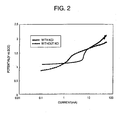
- Fig. 2 shows potentials with respect to currents when the chloride ions are contained and not contained, with a platinum-coated titanium electrode being used as the electrode.
- 1M sulfuric acid containing 10% of potassium chloride is used when the chloride ions are contained, and 1M sulfuric acid is used when the chloride ions are not contained.
- the potential sharply increases from 1.2 V to 1.5 V when a current of 6 to 8 mA is passed, and the potential increases to 2.1 V with a current of 60 mA. Meanwhile, in the case of for-treatment water containing no chloride ions, the potential is gently increased from 0.8 V to 1.8 V as current is gradually increased from 0.1 mA to 60 mA. Thereby, it is understood that when the chloride ions are contained in the for-treatment water, the potential is significantly increased, as compared with when the chloride ions are not contained in the for-treatment water.
- Fig. 3 is a diagram for illustrating an increase in potential with or without the chloride ions when a titanium electrode coated with platinum and iridium is used.
- Fig. 3 shows potentials with respect to currents when the chloride ions are contained and not contained, with titanium coated with platinum and iridium being used as the electrode.
- As the for-treatment water 1M sulfuric acid containing 10% of potassium chloride is used when the chloride ions are contained, and 1M sulfuric acid is used when the chloride ions are not contained.
- the potential increases to about 1.48 V when a current of 60 mA is passed, while in the case of for-treatment water containing no chloride ions, the potential is increased to about 1.4 V when a current of 60 mA is passed.
- the potential is increased, as compared with when the chloride ions are not contained in the for-treatment water.
- Fig. 4 is a diagram for illustrating an increase in potential with or without the chloride ions when a titanium electrode coated with platinum, iridium and tantalum is used.
- Fig. 4 shows potentials with respect to currents when the chloride ions are contained and not contained, with titanium coated with platinum, iridium and tantalum being used as the electrode.
- As the for-treatment water 1M sulfuric acid containing 10% of potassium chloride is used when the chloride ions are contained, and 1M sulfuric acid is used when the chloride ions are not contained.
- the potential increases to about 1.7 V when a current of 60 mA is passed, while in the case of for-treatment water containing no chloride ions, the potential is increased to about 1.6 V when a current of 60 mA is passed.
- a difference in potential between when the chloride ions are contained and when the chloride ions are not contained is not so significant.
- the potential is increased, as compared with when the chloride ions are not contained in the for-treatment water.
- ozone when for-treatment water containing the chloride ions is electrolyzed by means of a titanium electrode coated with platinum, a titanium electrode coated with platinum and iridium or a titanium electrode coated with platinum, iridium and tantalum, ozone can be produced with ease by an increase in potential. Thereby, since ozone can be produced with a relatively small current, microorganisms, chlorine-resistant bacteria, spores and protozoans contained in for-treatment water can be eliminated by ozone which exhibits a very powerful sterilizing effect.
- the electrode used in the present invention is a platinum-coated titanium electrode, chlorine or hypochlorous acid and ozone which exhibit an excellent sterilizing effect can be produced in the same electrolysis vessel 2, thereby making it possible to sterilize and purify for-treatment water efficiently.
- for-treatment water can be sterilized and purified while ozone is produced. Therefore, there is no longer need to carry out the step of dissolving ozone produced in a separate device into for-treatment water, and ozone can be contained in the for-treatment water in a significantly larger amount than a conventional amount of dissolved ozone. Thereby, sterilization and purification of for-treatment water can be carried out more securely and more efficiently.
- ozone is produced without use of lead dioxide. Therefore, sterilized and purified for-treatment water can be directly used for drinking or sterilization of cooking utensils without affecting human bodies.
- the cation exchange film 9 is disposed between the anode 5 and the cathode 6 in the electrolysis vessel 2.
- hydrogen ions produced by electrolysis are transferred from the anode 5 side to the cathode 6 side so as to promote production of hydrogen at the cathode 6.
- the potential can be increased, and the amount of ozone produced can also be increased along with an increase in the potential.
- the electrolysis vessel 2 electrolyzes for-treatment water while cooling the for-treatment water by means of the conventional cooling devices 10.
- Fig. 5 is a diagram showing amounts of contained ozone with respect to a for-treatment water temperature, and electrolysis was carried out with a current of 400 mA by use of a platinum-coated titanium electrode, a titanium electrode coated with platinum and iridium, or a titanium electrode coated with platinum, iridium and tantalum.
- the concentration of ozone is about 0.48 mg/dm 3 for the platinum-coated titanium electrode, about 0.10 mg/dm 3 for the titanium electrode coated with platinum and iridium, and about 0.18 mg/dm 3 for the titanium electrode coated with platinum, iridium and tantalum.
- the concentration of ozone is about 0.12 mg/dm 3 for the platinum-coated titanium electrode, about 0.01 mg/dm 3 for the titanium electrode coated with platinum and iridium, and about 0.05 mg/dm 3 for the titanium electrode coated with platinum, iridium and tantalum, at the for-treatment temperature of +22°C.
- ozone hardly exists for any of the electrodes at the for-treatment water temperature of +60°C.
- the concentration of ozone in for-treatment water is significantly increased, thereby making it possible to further improve the sterilizing/purifying effect.
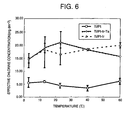
- Fig. 6 is a diagram showing effective chlorine concentrations on the above electrodes with respect to for-treatment water temperatures and shows the results of experiments conducted under the same conditions as those for the experiments whose results are shown in Fig. 5.
- effective chlorine concentration for the platinum-coated titanium electrode is significantly lower than effective chlorine concentrations for other electrodes. This is assumed to be because a reaction of producing ozone occurs preferentially.
- Fig. 7 is a diagram showing a decrease in concentration of an endocrine disruptor by electrolysis, which is currently considered as a problem. It is seen that when an endocrine disruptor such as di-2-ethylhexyl phthalate is contained in the foregoing for-treatment water, di-2-ethylhexyl phthalate is decreased with the passage of electrolysis time by ozone produced as described above. Thus, even if an endocrine disruptor such as di-2-ethylhexyl phthalate is contained in for-treatment water, the endocrine disruptor can be decomposed efficiently by ozone, thereby improving efficiency of purification of the for-treatment water.
- an endocrine disruptor such as di-2-ethylhexyl phthalate
- an electric current value can be controlled by the controller 8. Accordingly, an electric current value is controlled according to quality of for-treatment water, thereby making it possible to produce required ozone.
- purification of for-treatment water by ozone can be carried out efficiently while power consumption is kept low.
- the method of the present invention for producing ozone by means of electrolysis is a method for producing ozone in for-treatment water through electrolysis by passing current between an anode and a cathode, wherein a noble metal is used as a material constituting the anode, and the for-treatment water contains halogen ions or a compound containing halogen ions.
- a noble metal is used as a material constituting the anode
- the for-treatment water contains halogen ions or a compound containing halogen ions.
- the above halogen ions are chloride ions.
- hypochlorous acid can be produced along with production of ozone, and the for-treatment water can be sterilized effectively by ozone and hypochlorous acid.
- the above anode is made of platinum, platinum-coated titanium, a platinum-coated titanium alloy, titanium coated with a platinum-iridium alloy, a titanium alloy coated with a platinum-iridium alloy, titanium coated with a platinum-iridium-tantalum alloy, or a titanium alloy coated with a platinum-iridium-tantalum alloy.
- a cation exchange film is disposed between the above anode and cathode, hydrogen ions present on the anode side can be transferred to the cathode side efficiently so as to facilitate flow of current. Thereby, an increased amount of ozone can be produced.
- ozone produced as described above can be present in the for-treatment water over a relatively longer time period, so that more ozone can be present in the for-treatment water.
- a value of the current passed between the above anode and cathode is controlled. Thereby, the amount of ozone contained in the for-treatment water can be controlled.
- the apparatus of the present invention for producing ozone by electrolysis, it is an ozone producing apparatus having an anode and a cathode which are immersed in for-treatment water in an electrolysis vessel, wherein the anode is made of a noble metal, and current is passed between the anode and the cathode so as to electrolyze the for-treatment water containing halogen ions or a compound containing halogen ions, thereby producing ozone in the for-treatment water.
- ozone can be produced in an electrolysis vessel efficiently so as to sterilize the for-treatment water efficiently.
- chlorine-resistant bacteria and the like which are conventionally contained in the for-treatment water can be eliminated efficiently, and the resulting treated water can be used also as drinking water or the like.
- the halogen ions are chloride ions. Therefore, hypochlorous acid can be produced along with production of ozone, and the for-treatment water can be sterilized effectively by ozone and hypochlorous acid contained in the for-treatment water.
- the above anode is made of platinum, platinum-coated titanium, a platinum-coated titanium alloy, titanium coated with a platinum-iridium alloy, a titanium alloy coated with a platinum-iridium alloy, titanium coated with a platinum-iridium-tantalum alloy, or a titanium alloy coated with a platinum-iridium-tantalum alloy.
- ozone produced as described above can be present in the for-treatment water over a relatively longer time period, so that more ozone can be present in the for-treatment water.
- the amount of ozone contained in the for-treatment water can be controlled with ease.
Landscapes
- Chemical & Material Sciences (AREA)
- Chemical Kinetics & Catalysis (AREA)
- Electrochemistry (AREA)
- General Chemical & Material Sciences (AREA)
- Life Sciences & Earth Sciences (AREA)
- Hydrology & Water Resources (AREA)
- Engineering & Computer Science (AREA)
- Environmental & Geological Engineering (AREA)
- Water Supply & Treatment (AREA)
- Organic Chemistry (AREA)
- Water Treatment By Electricity Or Magnetism (AREA)
- Electrodes For Compound Or Non-Metal Manufacture (AREA)
- Treatment Of Water By Oxidation Or Reduction (AREA)
- Electrolytic Production Of Non-Metals, Compounds, Apparatuses Therefor (AREA)
Abstract
There are provided an ozone producing method and
apparatus capable of significantly increasing an amount of
ozone produced in for-treatment water. In the ozone
producing method of the present invention, a noble metal is
used as a material constituting the anode, and the for-treatment
water contains halogen ions or a compound
containing halogen ions.
Description
The present invention relates to a method and
apparatus for producing ozone in water to be treated
(hereinafter, "water to be treated" will be referred to as
"for-treatment water") through electrolysis by passing
current between an anode and a cathode.
Heretofore, as a method of removing bacteria, fungi
and microorganisms such as a protozoan in for-treatment water
to be used as drinking water for domestic use or in a kitchen,
a method comprising carrying out sterilization and
purification by use of a chlorine-containing agent such as
sodium hypochlorite has been used. However, chlorine-resistant
bacteria, spores and protozoans contained in the
above for-treatment water are difficult to remove by use of
only hypochlorous acid. Hence, a method comprising carrying
out sterilization and purification by use of ozone is used.
As a method of producing ozone in this case, it has
been commonly practiced to produce ozone by use of electrodes
made of lead dioxide.
However, in view of a detrimental effect of lead on
a person's health, a method as described above which uses
lead dioxide in electrodes cannot be used when the for-treatment
water directly influences a human body, i.e., when
it is used for cooking or washing vegetables or cooking
utensils, and ozone-containing for-treatment water purified
by the above method has been used only for applications in
which the for-treatment water does not directly influence a
human body, e.g., for cleaning a floor in a kitchen.
For this reason, to sterilize and purify drinking
water (for-treatment water) such as tap water in such a case
as described above where the water is used for cooking or
washing cooking utensils, sterilization and purification of
the water are performed by, for example, applying a high
voltage between electrodes in an atmosphere by means of a
separate device so as to cause surface creepage on surfaces
of the electrodes, producing ozone from oxygen by the
creepage, and dissolving the produced ozone in the for-treatment
water reserved in a treatment tank or the like.
However, in the case of the foregoing method of
sterilizing and purifying for-treatment water, since an
amount of ozone dissolved in the for-treatment water is small,
a sterilizing effect of the ozone is not at a satisfactory
level. Further, the method also has a problem that since the
amount of the ozone dissolved in the for-treatment water
decreases with the passage of time, the amount of the ozone
becomes already very small when the for-treatment water is
carried by means of a pipe or the like to where the water is
to be used after dissolution of the ozone, so that the amount
of the ozone remaining in the for-treatment water is short of
an amount required for sterilization.
Further, the ozone producing method in the foregoing
method has a problem that it is not suitable for practical
use since its energy consumption is significant.
Under the circumstances, the present invention has
been invented to solve the conventional technical problems.
An object of the present invention is to provide an ozone
producing method and apparatus which are capable of
significantly increasing an amount of ozone produced in for-treatment
water.
A method for producing ozone by electrolysis
according to the present invention is a method for producing
ozone in for-treatment water through electrolysis by passing
current between an anode and a cathode, wherein a noble metal
is used as a material constituting the anode, and the for-treatment
water contains halogen ions or a compound
containing halogen ions.
Further, in the method for producing ozone by
electrolysis according to the present invention, in addition
to the above invention, the halogen ions are chloride ions.
Further, in the method for producing ozone by
electrolysis according to the present invention, in addition
to the above inventions, the anode is made of platinum,
platinum-coated titanium, a platinum-coated titanium alloy,
titanium coated with a platinum-iridium alloy, a titanium
alloy coated with a platinum-iridium alloy, titanium coated
with a platinum-iridium-tantalum alloy, or a titanium alloy
coated with a platinum-iridium-tantalum alloy.
Further, in the method for producing ozone by
electrolysis according to the present invention, in addition
to the above inventions, a cation exchange film is disposed
between the anode and the cathode.
Further, in the method for producing ozone by
electrolysis according to the present invention, in addition
to the above inventions, the for-treatment water is cooled.
Further, in the method for producing ozone by
electrolysis according to the present invention, in addition
to the above inventions, a value of the current passed
between the anode and the cathode is controlled.
An apparatus for producing ozone according to the
present invention is an ozone producing apparatus having an
anode and a cathode which are immersed in for-treatment water
in an electrolysis vessel, wherein the anode is made of a
noble metal, and current is passed between the anode and the
cathode so as to electrolyze the for-treatment water
containing halogen ions or a compound containing halogen ions,
thereby producing ozone in the for-treatment water.
Further, in the ozone producing apparatus according
to the present invention, in addition to the above invention,
the halogen ions are chloride ions.
Further, in the ozone producing apparatus according
to the present invention, in addition to the ozone producing
apparatuses of above inventions, the anode is made of
platinum, platinum-coated titanium, a platinum-coated
titanium alloy, titanium coated with a platinum-iridium alloy,
a titanium alloy coated with a platinum-iridium alloy,
titanium coated with a platinum-iridium-tantalum alloy, or a
titanium alloy coated with a platinum-iridium-tantalum alloy.
Further, in the ozone producing apparatus according
to the present invention, in addition to the ozone producing
apparatuses of above inventions, a cation exchange film is
disposed between the anode and the cathode.
Further, the ozone producing apparatus according to
the present invention, in addition to the ozone producing
apparatuses of above inventions, has cooling means for
cooling the for-treatment water.
Further, the ozone producing apparatus according to
the present invention, in addition to the ozone producing
apparatuses of above inventions, has a controller for
controlling a value of the current passed between the anode
and the cathode.
Hereinafter, an embodiment of the present invention
will be described in detail with reference to the drawings.
Fig. 1 is an explanatory diagram showing an outline of an
ozone producing apparatus 1 for implementing an ozone
producing method of the present invention. The ozone
producing apparatus 1 in the present embodiment comprises an
electrolysis vessel 2 which constitutes a treating chamber 4
having an inlet and an outlet for for-treatment water therein,
the inlet and the outlet being not shown, a pair of
electrodes, i.e., an anode 5 and a cathode 6, which are
opposed to each other such that at least portions thereof are
immersed in for-treatment water in the treating chamber 4, a
power supply 7 for energizing the electrodes 5 and 6, and a
controller 8 for controlling the electrodes 5 and 6 and an
electric current value. In Fig. 1, reference numeral 9
denotes a cation exchange film disposed between the anode 5
and the cathode 6 in the electrolysis vessel 2, and reference
numerals 10 denote cooling devices for cooling the for-treatment
water in the electrolysis vessel 2 which are
disposed, for example, at the bottom of the electrolysis
vessel 2.
The anode 5 is made of a noble metal such as
platinum, platinum-coated titanium, a platinum-coated
titanium alloy, titanium coated with a platinum-iridium alloy,
a titanium alloy coated with a platinum-iridium alloy,
titanium coated with a platinum-iridium-tantalum alloy, or a
titanium alloy coated with a platinum-iridium-tantalum alloy.
Meanwhile, the cathode 6 is made of the same noble metals as
can be used in the anode 5 or an insoluble material or carbon.
Further, as the for-treatment water in the present
embodiment, tap water containing chloride ions is used, for
example.
With the arrangement described above, for-treatment
water is reserved in the treating chamber 4 in the
electrolysis vessel 2, and the controller 8 turns on the
power supply 7 so as to energize the anode 5 and the cathode
6. Thereby, microorganisms contained in the for-treatment
water are attracted to the anode 5 which is positively
charged since the microorganisms are generally negatively
charged. Further, at the anode 5, chloride ions contained in
the for-treatment water produce chlorine by discharging
electrons. Thereafter, the chlorine dissolves in the water
so as to produce hypochlorous acid. Thus, microorganisms in
the for-treatment water which are present in the vicinity of
the anode 5 are sterilized by the chlorine or hypochlorous
acid.
Further, since the anode 5 is made of platinum,
platinum-coated titanium, a platinum-coated titanium alloy,
titanium coated with a platinum-iridium alloy, a titanium
alloy coated with a platinum-iridium alloy, titanium coated
with a platinum-iridium-tantalum alloy, or a titanium alloy
coated with a platinum-iridium-tantalum alloy as described
above and the for-treatment water contains the chloride ions,
the potential increases and ozone is produced.
Next, an increase in the potential with or without
the above chloride ions will be described with reference to
Fig. 2. Fig. 2 shows potentials with respect to currents
when the chloride ions are contained and not contained, with
a platinum-coated titanium electrode being used as the
electrode. As the for-treatment water, 1M sulfuric acid
containing 10% of potassium chloride is used when the
chloride ions are contained, and 1M sulfuric acid is used
when the chloride ions are not contained.
Referring to Fig. 2, in the case of for-treatment
water containing the chloride ions, the potential sharply
increases from 1.2 V to 1.5 V when a current of 6 to 8 mA is
passed, and the potential increases to 2.1 V with a current
of 60 mA. Meanwhile, in the case of for-treatment water
containing no chloride ions, the potential is gently
increased from 0.8 V to 1.8 V as current is gradually
increased from 0.1 mA to 60 mA. Thereby, it is understood
that when the chloride ions are contained in the for-treatment
water, the potential is significantly increased, as
compared with when the chloride ions are not contained in the
for-treatment water.
Fig. 3 is a diagram for illustrating an increase in
potential with or without the chloride ions when a titanium
electrode coated with platinum and iridium is used. Fig. 3
shows potentials with respect to currents when the chloride
ions are contained and not contained, with titanium coated
with platinum and iridium being used as the electrode. As
the for-treatment water, 1M sulfuric acid containing 10% of
potassium chloride is used when the chloride ions are
contained, and 1M sulfuric acid is used when the chloride
ions are not contained.
Referring to Fig. 3, in the case of for-treatment
water containing the chloride ions, the potential increases
to about 1.48 V when a current of 60 mA is passed, while in
the case of for-treatment water containing no chloride ions,
the potential is increased to about 1.4 V when a current of
60 mA is passed. In this case as well, it is understood that
when the chloride ions are contained in the for-treatment
water, the potential is increased, as compared with when the
chloride ions are not contained in the for-treatment water.
Fig. 4 is a diagram for illustrating an increase in
potential with or without the chloride ions when a titanium
electrode coated with platinum, iridium and tantalum is used.
Fig. 4 shows potentials with respect to currents when the
chloride ions are contained and not contained, with titanium
coated with platinum, iridium and tantalum being used as the
electrode. As the for-treatment water, 1M sulfuric acid
containing 10% of potassium chloride is used when the
chloride ions are contained, and 1M sulfuric acid is used
when the chloride ions are not contained.
Referring to Fig. 4, in the case of for-treatment
water containing the chloride ions, the potential increases
to about 1.7 V when a current of 60 mA is passed, while in
the case of for-treatment water containing no chloride ions,
the potential is increased to about 1.6 V when a current of
60 mA is passed. In this case, a difference in potential
between when the chloride ions are contained and when the
chloride ions are not contained is not so significant. In
this case as well, it is understood that when the chloride
ions are contained in the for-treatment water, the potential
is increased, as compared with when the chloride ions are not
contained in the for-treatment water.
Although the present embodiment has been described
by using the chloride ions contained in tap water in
particular as an example, other halogen ions may be taken as
examples, in addition to the chloride ions.
As is understood from the above description, when
for-treatment water containing the chloride ions is
electrolyzed by means of a titanium electrode coated with
platinum, a titanium electrode coated with platinum and
iridium or a titanium electrode coated with platinum, iridium
and tantalum, ozone can be produced with ease by an increase
in potential. Thereby, since ozone can be produced with a
relatively small current, microorganisms, chlorine-resistant
bacteria, spores and protozoans contained in for-treatment
water can be eliminated by ozone which exhibits a very
powerful sterilizing effect.
Further, since the electrode used in the present
invention is a platinum-coated titanium electrode, chlorine
or hypochlorous acid and ozone which exhibit an excellent
sterilizing effect can be produced in the same electrolysis
vessel 2, thereby making it possible to sterilize and purify
for-treatment water efficiently.
Further, in the same electrolysis vessel 2, for-treatment
water can be sterilized and purified while ozone is
produced. Therefore, there is no longer need to carry out
the step of dissolving ozone produced in a separate device
into for-treatment water, and ozone can be contained in the
for-treatment water in a significantly larger amount than a
conventional amount of dissolved ozone. Thereby,
sterilization and purification of for-treatment water can be
carried out more securely and more efficiently.
Further, in the present invention, ozone is produced
without use of lead dioxide. Therefore, sterilized and
purified for-treatment water can be directly used for
drinking or sterilization of cooking utensils without
affecting human bodies.
In addition, in the present embodiment, since the
cation exchange film 9 is disposed between the anode 5 and
the cathode 6 in the electrolysis vessel 2. Thus, hydrogen
ions produced by electrolysis are transferred from the anode
5 side to the cathode 6 side so as to promote production of
hydrogen at the cathode 6. Thereby, the potential can be
increased, and the amount of ozone produced can also be
increased along with an increase in the potential.
Meanwhile, in the present embodiment, the
electrolysis vessel 2 electrolyzes for-treatment water while
cooling the for-treatment water by means of the conventional
cooling devices 10. The results of experiments showing an
effect resulting from carrying out electrolysis while for-treatment
water is being cooled.
Fig. 5 is a diagram showing amounts of contained
ozone with respect to a for-treatment water temperature, and
electrolysis was carried out with a current of 400 mA by use
of a platinum-coated titanium electrode, a titanium electrode
coated with platinum and iridium, or a titanium electrode
coated with platinum, iridium and tantalum.
According to Fig. 5, when the for-treatment water
temperature is +3°C, the concentration of ozone is about 0.48
mg/dm3 for the platinum-coated titanium electrode, about 0.10
mg/dm3 for the titanium electrode coated with platinum and
iridium, and about 0.18 mg/dm3 for the titanium electrode
coated with platinum, iridium and tantalum. Then, as the
for-treatment water temperature is increased for each of the
electrodes, the concentration of ozone is about 0.12 mg/dm3
for the platinum-coated titanium electrode, about 0.01 mg/dm3
for the titanium electrode coated with platinum and iridium,
and about 0.05 mg/dm3 for the titanium electrode coated with
platinum, iridium and tantalum, at the for-treatment
temperature of +22°C. Further, it is observed that as the
for-treatment water temperature is further increased for each
of the electrodes, ozone hardly exists for any of the
electrodes at the for-treatment water temperature of +60°C.
Thus, when electrolysis is carried out while the
electrolysis vessel 2 is cooled at, for example, +3°C, the
concentration of ozone in for-treatment water is
significantly increased, thereby making it possible to
further improve the sterilizing/purifying effect.
Fig. 6 is a diagram showing effective chlorine
concentrations on the above electrodes with respect to for-treatment
water temperatures and shows the results of
experiments conducted under the same conditions as those for
the experiments whose results are shown in Fig. 5. Referring
to Fig. 6, with respect to for-treatment water temperatures,
effective chlorine concentration for the platinum-coated
titanium electrode is significantly lower than effective
chlorine concentrations for other electrodes. This is
assumed to be because a reaction of producing ozone occurs
preferentially.
Fig. 7 is a diagram showing a decrease in
concentration of an endocrine disruptor by electrolysis,
which is currently considered as a problem. It is seen that
when an endocrine disruptor such as di-2-ethylhexyl phthalate
is contained in the foregoing for-treatment water, di-2-ethylhexyl
phthalate is decreased with the passage of
electrolysis time by ozone produced as described above. Thus,
even if an endocrine disruptor such as di-2-ethylhexyl
phthalate is contained in for-treatment water, the endocrine
disruptor can be decomposed efficiently by ozone, thereby
improving efficiency of purification of the for-treatment
water.
Further, in the present embodiment, an electric
current value can be controlled by the controller 8.
Accordingly, an electric current value is controlled
according to quality of for-treatment water, thereby making
it possible to produce required ozone.
Thus, in the ozone producing method and apparatus 1
of the present invention, purification of for-treatment water
by ozone can be carried out efficiently while power
consumption is kept low.
According to the method of the present invention for
producing ozone by means of electrolysis, it is a method for
producing ozone in for-treatment water through electrolysis
by passing current between an anode and a cathode, wherein a
noble metal is used as a material constituting the anode, and
the for-treatment water contains halogen ions or a compound
containing halogen ions. Thereby, ozone can be produced
efficiently. As for for-treatment water, even one containing
chlorine-resistant bacteria which have heretofore been
difficult to be sterilized can be sterilized efficiently by
ozone, and in particular, the resulting sterilized water can
be used as drinking water.
Further, according to the present invention, the
above halogen ions are chloride ions. Thus, hypochlorous
acid can be produced along with production of ozone, and the
for-treatment water can be sterilized effectively by ozone
and hypochlorous acid.
Further, the above anode is made of platinum,
platinum-coated titanium, a platinum-coated titanium alloy,
titanium coated with a platinum-iridium alloy, a titanium
alloy coated with a platinum-iridium alloy, titanium coated
with a platinum-iridium-tantalum alloy, or a titanium alloy
coated with a platinum-iridium-tantalum alloy. Thereby,
ozone can be produced more efficiently. In addition, unlike
the prior art, lead dioxide is not used in the anode.
Therefore, the treated water can be used for drinking or
sterilizing cooking utensils or the like.
Further, since a cation exchange film is disposed
between the above anode and cathode, hydrogen ions present on
the anode side can be transferred to the cathode side
efficiently so as to facilitate flow of current. Thereby, an
increased amount of ozone can be produced.
Further, since the above for-treatment water is
cooled, ozone produced as described above can be present in
the for-treatment water over a relatively longer time period,
so that more ozone can be present in the for-treatment water.
Further, a value of the current passed between the
above anode and cathode is controlled. Thereby, the amount
of ozone contained in the for-treatment water can be
controlled.
According to the apparatus of the present invention
for producing ozone by electrolysis, it is an ozone producing
apparatus having an anode and a cathode which are immersed in
for-treatment water in an electrolysis vessel, wherein the
anode is made of a noble metal, and current is passed between
the anode and the cathode so as to electrolyze the for-treatment
water containing halogen ions or a compound
containing halogen ions, thereby producing ozone in the for-treatment
water. Thereby, ozone can be produced in an
electrolysis vessel efficiently so as to sterilize the for-treatment
water efficiently. Further, chlorine-resistant
bacteria and the like which are conventionally contained in
the for-treatment water can be eliminated efficiently, and
the resulting treated water can be used also as drinking
water or the like.
Further, in the above ozone producing apparatus, the
halogen ions are chloride ions. Therefore, hypochlorous acid
can be produced along with production of ozone, and the for-treatment
water can be sterilized effectively by ozone and
hypochlorous acid contained in the for-treatment water.
Further, in the above ozone producing apparatus, the
above anode is made of platinum, platinum-coated titanium, a
platinum-coated titanium alloy, titanium coated with a
platinum-iridium alloy, a titanium alloy coated with a
platinum-iridium alloy, titanium coated with a platinum-iridium-tantalum
alloy, or a titanium alloy coated with a
platinum-iridium-tantalum alloy. Thereby, ozone can be
produced more efficiently. In addition, unlike the prior art,
lead dioxide is not used in the anode. Therefore, the
treated water can be used for drinking or sterilizing cooking
utensils or the like.
Further, in the above ozone producing apparatus,
since a cation exchange film is disposed between the anode
and the cathode, hydrogen ions present on the anode side can
be transferred to the cathode side efficiently so as to
facilitate flow of current. Thereby, an increased amount of
ozone can be produced.
Further, in the above ozone producing apparatus,
since cooling means for cooling the for-treatment water are
provided, ozone produced as described above can be present in
the for-treatment water over a relatively longer time period,
so that more ozone can be present in the for-treatment water.
Further, in the above ozone producing apparatus,
since a controller for controlling a value of the current
passed between the anode and the cathode is provided, the
amount of ozone contained in the for-treatment water can be
controlled with ease.
Claims (12)
- A method for producing ozone in for-treatment water through electrolysis by passing current between an anode and a cathode, wherein a noble metal is used as a material constituting the anode, and the for-treatment water contains halogen ions or a compound containing halogen ions.
- The method of claim 1, wherein the halogen ions are chloride ions.
- The method of claim 1 or 2, wherein the anode is made of platinum, platinum-coated titanium, a platinum-coated titanium alloy, titanium coated with a platinum-iridium alloy, a titanium alloy coated with a platinum-iridium alloy, titanium coated with a platinum-iridium-tantalum alloy, or a titanium alloy coated with a platinum-iridium-tantalum alloy.
- The method of claim 1, 2 or 3, wherein a cation exchange film is disposed between the anode and the cathode.
- The method of claim 1, 2, 3 or 4, wherein the for-treatment water is cooled.
- The method of claim 1, 2, 3, 4 or 5, wherein a value of the current passed between the anode and the cathode is controlled.
- An ozone producing apparatus having an anode and a cathode which are immersed in for-treatment water in an electrolysis vessel, wherein the anode is made of a noble metal, and current is passed between the anode and the cathode so as to electrolyze the for-treatment water containing halogen ions or a compound containing halogen ions, thereby producing ozone in the for-treatment water.
- The apparatus of claim 7, wherein the halogen ions are chloride ions.
- The apparatus of claim 7 or 8, wherein the anode is made of platinum, platinum-coated titanium, a platinum-coated titanium alloy, titanium coated with a platinum-iridium alloy, a titanium alloy coated with a platinum-iridium alloy, titanium coated with a platinum-iridium-tantalum alloy, or a titanium alloy coated with a platinum-iridium-tantalum alloy.
- The apparatus of claim 7, 8 or 9, wherein a cation exchange film is disposed between the anode and the cathode.
- The apparatus of claim 7, 8, 9 or 10, which has cooling means for cooling the for-treatment water.
- The apparatus of claim 7, 8, 9, 10 or 11, which has a controller for controlling a value of the current passed between the anode and the cathode.
Applications Claiming Priority (3)
| Application Number | Priority Date | Filing Date | Title |
|---|---|---|---|
| JP2001071895A JP2002263650A (en) | 2001-03-14 | 2001-03-14 | Ozone generation method and ozone generation device by electrolysis |
| JP2001071895 | 2001-03-14 | ||
| PCT/JP2002/002094 WO2002072481A1 (en) | 2001-03-14 | 2002-03-06 | Method and apparatus for generating ozone by electrolysis |
Publications (2)
| Publication Number | Publication Date |
|---|---|
| EP1394119A1 true EP1394119A1 (en) | 2004-03-03 |
| EP1394119A4 EP1394119A4 (en) | 2009-05-13 |
Family
ID=18929560
Family Applications (1)
| Application Number | Title | Priority Date | Filing Date |
|---|---|---|---|
| EP02705088A Withdrawn EP1394119A4 (en) | 2001-03-14 | 2002-03-06 | Method and apparatus for generating ozone by electrolysis |
Country Status (4)
| Country | Link |
|---|---|
| US (1) | US20030168348A1 (en) |
| EP (1) | EP1394119A4 (en) |
| JP (1) | JP2002263650A (en) |
| WO (1) | WO2002072481A1 (en) |
Families Citing this family (3)
| Publication number | Priority date | Publication date | Assignee | Title |
|---|---|---|---|---|
| CN101163644A (en) * | 2005-04-26 | 2008-04-16 | 费利克斯贝特彻有限两合公司 | Method and apparatus for controlling and limiting microbial contamination in a wetting agent cycle |
| CN103194765A (en) * | 2012-01-10 | 2013-07-10 | 石福金属兴业株式会社 | Sterilizing water generation apparatus |
| CN108483586B (en) * | 2018-05-03 | 2021-06-08 | 河海大学 | Device and method for removing estrogen in tail water of sewage plant |
Family Cites Families (13)
| Publication number | Priority date | Publication date | Assignee | Title |
|---|---|---|---|---|
| NL122179C (en) * | 1959-02-06 | 1966-12-15 | ||
| US4128768A (en) * | 1975-05-14 | 1978-12-05 | Mitsubishi Denki Kabushiki Kaisha | Ozone generating apparatus |
| US4171256A (en) * | 1978-11-03 | 1979-10-16 | Tim Themy | Chlorine generation apparatus |
| US4316787A (en) * | 1979-08-06 | 1982-02-23 | Themy Constantinos D | High voltage electrolytic cell |
| US4236992A (en) * | 1979-08-06 | 1980-12-02 | Themy Constantinos D | High voltage electrolytic cell |
| US4316782A (en) * | 1980-05-29 | 1982-02-23 | Regents Of The University Of California | Electrolytic process for the production of ozone |
| CH667867A5 (en) * | 1986-03-11 | 1988-11-15 | Bbc Brown Boveri & Cie | METHOD AND DEVICE FOR LOADING TAP WATER WITH OZONE USING AN OZONE GENERATING ELECTROLYSIS CELL EQUIPPED WITH A SOLID ELECTROLYTE. |
| US4761208A (en) * | 1986-09-29 | 1988-08-02 | Los Alamos Technical Associates, Inc. | Electrolytic method and cell for sterilizing water |
| JPS6436784A (en) * | 1987-04-08 | 1989-02-07 | Nippon Medix Kk | Ozone-producing mechanism |
| US5094734A (en) * | 1989-08-03 | 1992-03-10 | Torrado Santiago D | Water treatment unit |
| GB9017404D0 (en) * | 1990-08-08 | 1990-09-19 | Johnson Matthey Plc | Ozone generation |
| US5427667A (en) * | 1992-04-03 | 1995-06-27 | Bakhir; Vitold M. | Apparatus for electrochemical treatment of water |
| JP2743823B2 (en) * | 1994-03-25 | 1998-04-22 | 日本電気株式会社 | Semiconductor substrate wet treatment method |
-
2001
- 2001-03-14 JP JP2001071895A patent/JP2002263650A/en active Pending
-
2002
- 2002-03-06 US US10/239,171 patent/US20030168348A1/en not_active Abandoned
- 2002-03-06 EP EP02705088A patent/EP1394119A4/en not_active Withdrawn
- 2002-03-06 WO PCT/JP2002/002094 patent/WO2002072481A1/en not_active Ceased
Also Published As
| Publication number | Publication date |
|---|---|
| US20030168348A1 (en) | 2003-09-11 |
| JP2002263650A (en) | 2002-09-17 |
| WO2002072481A1 (en) | 2002-09-19 |
| EP1394119A4 (en) | 2009-05-13 |
Similar Documents
| Publication | Publication Date | Title |
|---|---|---|
| JP4116949B2 (en) | Electrochemical sterilization and sterilization method | |
| JP5595213B2 (en) | Disinfecting water manufacturing apparatus and disinfecting water manufacturing method | |
| ES2377945T3 (en) | Method and apparatus for producing water with negative and positive oxidation and reduction (ORP) potential | |
| US6761827B2 (en) | Method and apparatus for purifying water | |
| US8431008B2 (en) | Electrolytic disinfection system and method for purifying water | |
| JP3785219B2 (en) | Method for producing acidic water and alkaline water | |
| EP3103771B1 (en) | Method and apparatus for controlling concentration of free chlorine | |
| JP2004267956A (en) | Method for producing mixed electrolyzed water | |
| JP3520060B2 (en) | Hypochlorous acid generation method and apparatus | |
| JP2000226680A (en) | Method and apparatus for producing electrolyzed water having bactericidal properties | |
| KR101951448B1 (en) | Sterilizing water generating device capable of controlling concentration | |
| JP4098617B2 (en) | Sterilization method | |
| JP2003033425A (en) | Disinfection method and apparatus for metal appliances | |
| US20030168348A1 (en) | Method and apparatus for generating ozone by electrolysis | |
| JPH07155765A (en) | Method and apparatus for producing electrolyzed water | |
| KR20170021523A (en) | Method and apparatus of pipe cleaning by electrolysis | |
| JP3806626B2 (en) | Hypochlorous acid generator | |
| JP4013486B2 (en) | Cooling water slime prevention method | |
| JP2002219463A (en) | Electrolytic sterilization of water | |
| JP4038253B2 (en) | Electrolyzer for production of acidic water and alkaline water | |
| JPH11347558A (en) | Electrolytic treatment method and apparatus for water containing oxidized nitrogen | |
| RU2702650C1 (en) | Method of electrochemical treatment of water and device for its implementation | |
| KR101471126B1 (en) | Electrolytic water producing apparatus for providing enhanced cleaning | |
| JP3887969B2 (en) | Water purification equipment | |
| JP3521896B2 (en) | Water treatment method for cooling water system |
Legal Events
| Date | Code | Title | Description |
|---|---|---|---|
| PUAI | Public reference made under article 153(3) epc to a published international application that has entered the european phase |
Free format text: ORIGINAL CODE: 0009012 |
|
| 17P | Request for examination filed |
Effective date: 20021002 |
|
| AK | Designated contracting states |
Kind code of ref document: A1 Designated state(s): AT BE CH CY DE DK ES FI FR GB GR IE IT LI LU MC NL PT SE TR |
|
| A4 | Supplementary search report drawn up and despatched |
Effective date: 20090415 |
|
| STAA | Information on the status of an ep patent application or granted ep patent |
Free format text: STATUS: THE APPLICATION IS DEEMED TO BE WITHDRAWN |
|
| 18D | Application deemed to be withdrawn |
Effective date: 20090715 |