EP1391240A1 - Method for preparing a catalyst for preferential oxidation to remove carbon monoxide from a hydrogen-rich gas, a process for preferential oxidation to remove carbon monoxide from hydrogen-rich gas and a method for operating a fuel cell system - Google Patents
Method for preparing a catalyst for preferential oxidation to remove carbon monoxide from a hydrogen-rich gas, a process for preferential oxidation to remove carbon monoxide from hydrogen-rich gas and a method for operating a fuel cell system Download PDFInfo
- Publication number
- EP1391240A1 EP1391240A1 EP02015061A EP02015061A EP1391240A1 EP 1391240 A1 EP1391240 A1 EP 1391240A1 EP 02015061 A EP02015061 A EP 02015061A EP 02015061 A EP02015061 A EP 02015061A EP 1391240 A1 EP1391240 A1 EP 1391240A1
- Authority
- EP
- European Patent Office
- Prior art keywords
- hydrogen
- catalyst
- rich gas
- carbon monoxide
- gas stream
- Prior art date
- Legal status (The legal status is an assumption and is not a legal conclusion. Google has not performed a legal analysis and makes no representation as to the accuracy of the status listed.)
- Withdrawn
Links
Classifications
-
- H—ELECTRICITY
- H01—ELECTRIC ELEMENTS
- H01M—PROCESSES OR MEANS, e.g. BATTERIES, FOR THE DIRECT CONVERSION OF CHEMICAL ENERGY INTO ELECTRICAL ENERGY
- H01M8/00—Fuel cells; Manufacture thereof
- H01M8/06—Combination of fuel cells with means for production of reactants or for treatment of residues
- H01M8/0606—Combination of fuel cells with means for production of reactants or for treatment of residues with means for production of gaseous reactants
- H01M8/0612—Combination of fuel cells with means for production of reactants or for treatment of residues with means for production of gaseous reactants from carbon-containing material
-
- B—PERFORMING OPERATIONS; TRANSPORTING
- B01—PHYSICAL OR CHEMICAL PROCESSES OR APPARATUS IN GENERAL
- B01J—CHEMICAL OR PHYSICAL PROCESSES, e.g. CATALYSIS OR COLLOID CHEMISTRY; THEIR RELEVANT APPARATUS
- B01J23/00—Catalysts comprising metals or metal oxides or hydroxides, not provided for in group B01J21/00
- B01J23/38—Catalysts comprising metals or metal oxides or hydroxides, not provided for in group B01J21/00 of noble metals
- B01J23/54—Catalysts comprising metals or metal oxides or hydroxides, not provided for in group B01J21/00 of noble metals combined with metals, oxides or hydroxides provided for in groups B01J23/02 - B01J23/36
- B01J23/56—Platinum group metals
- B01J23/63—Platinum group metals with rare earths or actinides
-
- B—PERFORMING OPERATIONS; TRANSPORTING
- B01—PHYSICAL OR CHEMICAL PROCESSES OR APPARATUS IN GENERAL
- B01J—CHEMICAL OR PHYSICAL PROCESSES, e.g. CATALYSIS OR COLLOID CHEMISTRY; THEIR RELEVANT APPARATUS
- B01J37/00—Processes, in general, for preparing catalysts; Processes, in general, for activation of catalysts
- B01J37/02—Impregnation, coating or precipitation
- B01J37/0201—Impregnation
- B01J37/0205—Impregnation in several steps
-
- C—CHEMISTRY; METALLURGY
- C01—INORGANIC CHEMISTRY
- C01B—NON-METALLIC ELEMENTS; COMPOUNDS THEREOF; METALLOIDS OR COMPOUNDS THEREOF NOT COVERED BY SUBCLASS C01C
- C01B3/00—Hydrogen; Gaseous mixtures containing hydrogen; Separation of hydrogen from mixtures containing it; Purification of hydrogen; Reversible storage of hydrogen
- C01B3/02—Production of hydrogen; Production of gaseous mixtures containing hydrogen
- C01B3/32—Production of hydrogen; Production of gaseous mixtures containing hydrogen by reaction of gaseous or liquid organic compounds with gasifying agents, e.g. water, carbon dioxide or air
- C01B3/34—Production of hydrogen; Production of gaseous mixtures containing hydrogen by reaction of gaseous or liquid organic compounds with gasifying agents, e.g. water, carbon dioxide or air by reaction of hydrocarbons with gasifying agents
- C01B3/38—Production of hydrogen; Production of gaseous mixtures containing hydrogen by reaction of gaseous or liquid organic compounds with gasifying agents, e.g. water, carbon dioxide or air by reaction of hydrocarbons with gasifying agents using catalysts
- C01B3/386—Catalytic partial combustion
-
- C—CHEMISTRY; METALLURGY
- C01—INORGANIC CHEMISTRY
- C01B—NON-METALLIC ELEMENTS; COMPOUNDS THEREOF; METALLOIDS OR COMPOUNDS THEREOF NOT COVERED BY SUBCLASS C01C
- C01B3/00—Hydrogen; Gaseous mixtures containing hydrogen; Separation of hydrogen from mixtures containing it; Purification of hydrogen; Reversible storage of hydrogen
- C01B3/02—Production of hydrogen; Production of gaseous mixtures containing hydrogen
- C01B3/32—Production of hydrogen; Production of gaseous mixtures containing hydrogen by reaction of gaseous or liquid organic compounds with gasifying agents, e.g. water, carbon dioxide or air
- C01B3/34—Production of hydrogen; Production of gaseous mixtures containing hydrogen by reaction of gaseous or liquid organic compounds with gasifying agents, e.g. water, carbon dioxide or air by reaction of hydrocarbons with gasifying agents
- C01B3/38—Production of hydrogen; Production of gaseous mixtures containing hydrogen by reaction of gaseous or liquid organic compounds with gasifying agents, e.g. water, carbon dioxide or air by reaction of hydrocarbons with gasifying agents using catalysts
- C01B3/40—Production of hydrogen; Production of gaseous mixtures containing hydrogen by reaction of gaseous or liquid organic compounds with gasifying agents, e.g. water, carbon dioxide or air by reaction of hydrocarbons with gasifying agents using catalysts characterised by the catalyst
-
- C—CHEMISTRY; METALLURGY
- C01—INORGANIC CHEMISTRY
- C01B—NON-METALLIC ELEMENTS; COMPOUNDS THEREOF; METALLOIDS OR COMPOUNDS THEREOF NOT COVERED BY SUBCLASS C01C
- C01B3/00—Hydrogen; Gaseous mixtures containing hydrogen; Separation of hydrogen from mixtures containing it; Purification of hydrogen; Reversible storage of hydrogen
- C01B3/50—Separation of hydrogen or hydrogen-containing gases from gaseous mixtures, e.g. purification
- C01B3/56—Separation of hydrogen or hydrogen-containing gases from gaseous mixtures, e.g. purification by contacting with solids; Regeneration of used solids
- C01B3/58—Separation of hydrogen or hydrogen-containing gases from gaseous mixtures, e.g. purification by contacting with solids; Regeneration of used solids including a catalytic reaction
- C01B3/583—Separation of hydrogen or hydrogen-containing gases from gaseous mixtures, e.g. purification by contacting with solids; Regeneration of used solids including a catalytic reaction the reaction being the selective oxidation of carbon monoxide
-
- B—PERFORMING OPERATIONS; TRANSPORTING
- B01—PHYSICAL OR CHEMICAL PROCESSES OR APPARATUS IN GENERAL
- B01J—CHEMICAL OR PHYSICAL PROCESSES, e.g. CATALYSIS OR COLLOID CHEMISTRY; THEIR RELEVANT APPARATUS
- B01J21/00—Catalysts comprising the elements, oxides, or hydroxides of magnesium, boron, aluminium, carbon, silicon, titanium, zirconium, or hafnium
- B01J21/06—Silicon, titanium, zirconium or hafnium; Oxides or hydroxides thereof
-
- B—PERFORMING OPERATIONS; TRANSPORTING
- B01—PHYSICAL OR CHEMICAL PROCESSES OR APPARATUS IN GENERAL
- B01J—CHEMICAL OR PHYSICAL PROCESSES, e.g. CATALYSIS OR COLLOID CHEMISTRY; THEIR RELEVANT APPARATUS
- B01J37/00—Processes, in general, for preparing catalysts; Processes, in general, for activation of catalysts
- B01J37/02—Impregnation, coating or precipitation
- B01J37/0236—Drying, e.g. preparing a suspension, adding a soluble salt and drying
-
- C—CHEMISTRY; METALLURGY
- C01—INORGANIC CHEMISTRY
- C01B—NON-METALLIC ELEMENTS; COMPOUNDS THEREOF; METALLOIDS OR COMPOUNDS THEREOF NOT COVERED BY SUBCLASS C01C
- C01B2203/00—Integrated processes for the production of hydrogen or synthesis gas
- C01B2203/02—Processes for making hydrogen or synthesis gas
- C01B2203/0205—Processes for making hydrogen or synthesis gas containing a reforming step
- C01B2203/0227—Processes for making hydrogen or synthesis gas containing a reforming step containing a catalytic reforming step
- C01B2203/0233—Processes for making hydrogen or synthesis gas containing a reforming step containing a catalytic reforming step the reforming step being a steam reforming step
-
- C—CHEMISTRY; METALLURGY
- C01—INORGANIC CHEMISTRY
- C01B—NON-METALLIC ELEMENTS; COMPOUNDS THEREOF; METALLOIDS OR COMPOUNDS THEREOF NOT COVERED BY SUBCLASS C01C
- C01B2203/00—Integrated processes for the production of hydrogen or synthesis gas
- C01B2203/02—Processes for making hydrogen or synthesis gas
- C01B2203/025—Processes for making hydrogen or synthesis gas containing a partial oxidation step
- C01B2203/0261—Processes for making hydrogen or synthesis gas containing a partial oxidation step containing a catalytic partial oxidation step [CPO]
-
- C—CHEMISTRY; METALLURGY
- C01—INORGANIC CHEMISTRY
- C01B—NON-METALLIC ELEMENTS; COMPOUNDS THEREOF; METALLOIDS OR COMPOUNDS THEREOF NOT COVERED BY SUBCLASS C01C
- C01B2203/00—Integrated processes for the production of hydrogen or synthesis gas
- C01B2203/02—Processes for making hydrogen or synthesis gas
- C01B2203/0283—Processes for making hydrogen or synthesis gas containing a CO-shift step, i.e. a water gas shift step
-
- C—CHEMISTRY; METALLURGY
- C01—INORGANIC CHEMISTRY
- C01B—NON-METALLIC ELEMENTS; COMPOUNDS THEREOF; METALLOIDS OR COMPOUNDS THEREOF NOT COVERED BY SUBCLASS C01C
- C01B2203/00—Integrated processes for the production of hydrogen or synthesis gas
- C01B2203/04—Integrated processes for the production of hydrogen or synthesis gas containing a purification step for the hydrogen or the synthesis gas
- C01B2203/0435—Catalytic purification
- C01B2203/044—Selective oxidation of carbon monoxide
-
- C—CHEMISTRY; METALLURGY
- C01—INORGANIC CHEMISTRY
- C01B—NON-METALLIC ELEMENTS; COMPOUNDS THEREOF; METALLOIDS OR COMPOUNDS THEREOF NOT COVERED BY SUBCLASS C01C
- C01B2203/00—Integrated processes for the production of hydrogen or synthesis gas
- C01B2203/04—Integrated processes for the production of hydrogen or synthesis gas containing a purification step for the hydrogen or the synthesis gas
- C01B2203/0465—Composition of the impurity
- C01B2203/047—Composition of the impurity the impurity being carbon monoxide
-
- C—CHEMISTRY; METALLURGY
- C01—INORGANIC CHEMISTRY
- C01B—NON-METALLIC ELEMENTS; COMPOUNDS THEREOF; METALLOIDS OR COMPOUNDS THEREOF NOT COVERED BY SUBCLASS C01C
- C01B2203/00—Integrated processes for the production of hydrogen or synthesis gas
- C01B2203/06—Integration with other chemical processes
- C01B2203/066—Integration with other chemical processes with fuel cells
-
- C—CHEMISTRY; METALLURGY
- C01—INORGANIC CHEMISTRY
- C01B—NON-METALLIC ELEMENTS; COMPOUNDS THEREOF; METALLOIDS OR COMPOUNDS THEREOF NOT COVERED BY SUBCLASS C01C
- C01B2203/00—Integrated processes for the production of hydrogen or synthesis gas
- C01B2203/10—Catalysts for performing the hydrogen forming reactions
- C01B2203/1041—Composition of the catalyst
- C01B2203/1047—Group VIII metal catalysts
- C01B2203/1064—Platinum group metal catalysts
-
- C—CHEMISTRY; METALLURGY
- C01—INORGANIC CHEMISTRY
- C01B—NON-METALLIC ELEMENTS; COMPOUNDS THEREOF; METALLOIDS OR COMPOUNDS THEREOF NOT COVERED BY SUBCLASS C01C
- C01B2203/00—Integrated processes for the production of hydrogen or synthesis gas
- C01B2203/10—Catalysts for performing the hydrogen forming reactions
- C01B2203/1041—Composition of the catalyst
- C01B2203/1082—Composition of support materials
-
- C—CHEMISTRY; METALLURGY
- C01—INORGANIC CHEMISTRY
- C01B—NON-METALLIC ELEMENTS; COMPOUNDS THEREOF; METALLOIDS OR COMPOUNDS THEREOF NOT COVERED BY SUBCLASS C01C
- C01B2203/00—Integrated processes for the production of hydrogen or synthesis gas
- C01B2203/12—Feeding the process for making hydrogen or synthesis gas
- C01B2203/1205—Composition of the feed
- C01B2203/1211—Organic compounds or organic mixtures used in the process for making hydrogen or synthesis gas
- C01B2203/1235—Hydrocarbons
- C01B2203/1241—Natural gas or methane
-
- C—CHEMISTRY; METALLURGY
- C01—INORGANIC CHEMISTRY
- C01B—NON-METALLIC ELEMENTS; COMPOUNDS THEREOF; METALLOIDS OR COMPOUNDS THEREOF NOT COVERED BY SUBCLASS C01C
- C01B2203/00—Integrated processes for the production of hydrogen or synthesis gas
- C01B2203/12—Feeding the process for making hydrogen or synthesis gas
- C01B2203/1205—Composition of the feed
- C01B2203/1211—Organic compounds or organic mixtures used in the process for making hydrogen or synthesis gas
- C01B2203/1235—Hydrocarbons
- C01B2203/1247—Higher hydrocarbons
-
- Y—GENERAL TAGGING OF NEW TECHNOLOGICAL DEVELOPMENTS; GENERAL TAGGING OF CROSS-SECTIONAL TECHNOLOGIES SPANNING OVER SEVERAL SECTIONS OF THE IPC; TECHNICAL SUBJECTS COVERED BY FORMER USPC CROSS-REFERENCE ART COLLECTIONS [XRACs] AND DIGESTS
- Y02—TECHNOLOGIES OR APPLICATIONS FOR MITIGATION OR ADAPTATION AGAINST CLIMATE CHANGE
- Y02E—REDUCTION OF GREENHOUSE GAS [GHG] EMISSIONS, RELATED TO ENERGY GENERATION, TRANSMISSION OR DISTRIBUTION
- Y02E60/00—Enabling technologies; Technologies with a potential or indirect contribution to GHG emissions mitigation
- Y02E60/30—Hydrogen technology
- Y02E60/50—Fuel cells
-
- Y—GENERAL TAGGING OF NEW TECHNOLOGICAL DEVELOPMENTS; GENERAL TAGGING OF CROSS-SECTIONAL TECHNOLOGIES SPANNING OVER SEVERAL SECTIONS OF THE IPC; TECHNICAL SUBJECTS COVERED BY FORMER USPC CROSS-REFERENCE ART COLLECTIONS [XRACs] AND DIGESTS
- Y02—TECHNOLOGIES OR APPLICATIONS FOR MITIGATION OR ADAPTATION AGAINST CLIMATE CHANGE
- Y02P—CLIMATE CHANGE MITIGATION TECHNOLOGIES IN THE PRODUCTION OR PROCESSING OF GOODS
- Y02P20/00—Technologies relating to chemical industry
- Y02P20/50—Improvements relating to the production of bulk chemicals
- Y02P20/52—Improvements relating to the production of bulk chemicals using catalysts, e.g. selective catalysts
-
- Y—GENERAL TAGGING OF NEW TECHNOLOGICAL DEVELOPMENTS; GENERAL TAGGING OF CROSS-SECTIONAL TECHNOLOGIES SPANNING OVER SEVERAL SECTIONS OF THE IPC; TECHNICAL SUBJECTS COVERED BY FORMER USPC CROSS-REFERENCE ART COLLECTIONS [XRACs] AND DIGESTS
- Y02—TECHNOLOGIES OR APPLICATIONS FOR MITIGATION OR ADAPTATION AGAINST CLIMATE CHANGE
- Y02P—CLIMATE CHANGE MITIGATION TECHNOLOGIES IN THE PRODUCTION OR PROCESSING OF GOODS
- Y02P70/00—Climate change mitigation technologies in the production process for final industrial or consumer products
- Y02P70/50—Manufacturing or production processes characterised by the final manufactured product
Definitions
- the invention relates to a method for preparing a catalyst for preferential oxidation to remove carbon monoxide from a hydrogen-rich gas, a process for preferential oxidation to remove carbon monoxide from a hydrogen-rich gas and and a method for operating a fuel cell system.
- Hydrogen is currently used mainly in industry, in activities such as the manufacture of fertilizers, petroleum processing, methanol synthesis, annealing of metals and producing electronic materials. In the foreseeable future, the emergence of fuel cell technology will extend the use of hydrogen to domestic and vehicle applications.
- PEM proton exchange membrane
- the first automobile manufacturers have successfully launched prototype vehicles comprising PEM fuel cell stacks not larger than a conventional combustion engine. These stacks offer a permanent power of about 40 to 50 kW while operating with neat hydrogen. Advanced experiences from powering submarines with PEM fuel cells show for the PEM fuel cell system technology a rapid development whereby the choice of fuel for a passenger vehicle did not so far keep pace.
- CO + 1 ⁇ 2 O 2 CO 2
- Adsorption processes typically require unacceptably large volumes of adsorbent.
- catalytic materials including noble metals (Pt, Pd, Rh and Ru) and base metals, such as Co/Cu, Ni/Co/Fe, Ag, Cr, Fe and Mn, were evaluated in a laboratory reactor feedstream containing CO, H 2 , in order to identify alternate catalysts which are more effective than currently used Pt/Al 2 O 3 in selectively oxidizing CO in the presence of excess hydrogen.
- Ru/Al 2 O 3 and Rh/Al 2 O 3 are among the most active catalysts for CO oxidation, achieving nearly complete CO conversion at temperatures as low as 100°C as compared to approx. 200°C required for currently used Pt/Al 2 O 3 .
- the Ru/Al 2 O 3 and Rh/Al 2 O 3 catalysts were found to be exceptionally selective for CO oxidation, making it possible to purify the fuel cell feedstream with a minimum loss of the energy content associated with the hydrogen content.
- this aim with respect to the method for preparing a catalyst for preferential oxidation to remove carbon monoxide from a hydrogen-rich gas stream, comprising:
- possible materials as refractory support material can be at least one of the group containing titania, zirconia and silica.
- cerium-salt As a compound capable to be prepared for the impregnation process step, there may be employed, for example, cerium hydroxide, a cerium halide, a cerium oxyhalide, cerium nitrate,cerium ammonium nitrate cerium carbonite, cerium acetate, cerium oxalate, a cerium alkoxide such as cerium methoxide, cerium ethoxide, cerium propoxide, cerium isopropoxide or cerium butoxide, or the like. Among these compounds, the cerium alkoxide may be preferably employed.
- a cerium compound also a compound or a mixture of compounds from at least one rare earth metal selected from the group containing Praseodym, Neodym and Gadolinium.
- the dispersion of the precious metal or the mixture of precious metals can be reached by impregnating the impregnated support material with a soluble precious metal compound or with a soluble mixture of precious metal compounds.
- rhodium or ruthenium is rhodium or ruthenium.
- a raw material of rhodium there may be mentioned, for example, a rhodium halide such as rhodium chloride or the like; a halogenated rhodinate such as sodium chlororhodinate, ammoniumchlororhodinate or the like; a halogenated rhodinic acid such as chlororhodinic acid or the like; a rhodiumhydroxide such as rhodium (III) hydroxide, rhodium (IV) hydroxide or the like; rhodium nitrate; rhodium oxide; or an organic rhodium compound such as rhodium carbonyl or the like.
- a rhodium halide such as rhodium chloride or the like
- a halogenated rhodinate such as sodium chlororhodinate,
- the raw material of ruthenium there may be mentioned, for example, a ruthenium halide such as ruthenium iodide, ruthenium chloride or the like; a halogenated ruthenate such as ammonium chlororuthenate or the like; a halogenated ruthenic acid such as chloro-ruthenic acid or the like; a ruthenate such as potassium ruthenate or the like; or an organic ruthenium compound such as ruthenium carbonyl or the like.
- ruthenium trichloride or ruthenium nitrosylnitrate is preferably employed.
- these raw materials for the precious metal ingredient of the catalyst may be employed singly or in combination of two or more.
- the amount of precious metal is 0.01 to 10, preferably 0.05 to 5 weight per cent of the total weight of the catalyst which is also advantageous with respect to the manufacturing costs.
- the process for preferential oxidation for removing carbon monoxide from a hydrogen-rich gas stream, the process comprises:
- a suitable hydrogen-rich gas stream can be attained by passing a feed stream comprising a hydrocarbon or an oxygenate to a fuel processor comprising an integrated steam reforming and water gas shift conversion zone; said hydrogen-rich gas stream then comprises hydrogen, carbon monoxide, carbon dioxide, oxygen and water vapor.
- the offer of oxygen has to be controlled to find both a maximum for oxidizing carbon monoxide and to cut down the supply for the undesired hydrogen oxidation. Therefore, the concentration of oxygen in the hydrogen-rich gas stream should be maintained between 1 to 10 times, preferably 2.5 to 5.0 times, of the stoichiometric requirement for the maximum conversion of CO to CO 2 and the minimum conversion of H 2 .
- the figure shows that essentially 100% CO conversion is attained for 2.5 ⁇ lambda ⁇ 4.0 while maintaining not more than 5-10% of the undesired H 2 conversion.
- the data given in figure 1 have been measured with a catalyst and the micro reactor data condition as set out below in the description of some illustrative examples.
- the concentration of water vapor in the hydrogen-rich gas stream should be maintained between 0.1 to 10%, preferably 0.3 to 3%, as compared to the total feed gas flow.
- the oxygen in the auxiliary air reoxidises the Ru(0) which is required again to be reduced to allow the carbon monoxide to be oxidized to the desired carbon dioxide.
- the invention comprises a process for preferential oxidation for removing carbon monoxide from a hydrogen-rich gas stream being performed under the conditions as described above.
- a feed stream comprising a hydrocarbon or an oxygenate to a fuel processor comprising a catalyst forming an integrated steam reformation and water gas shift conversion zone to produce a fuel stream, i.e. a hydrogen-rich gas, at a catalyst temperature lower than 700°C followed by passing the fuel stream over a catalyst for preferential oxidation to produce a purified fuel gas at least approximately free from carbon monoxide.
- a fuel stream i.e. a hydrogen-rich gas
- An excellent efficiency for the removal of the carbon monoxide can be achieved by a fuel stream containing about 50 to 50.000 ppm carbon monoxide.
- a high longterm reliability, i.e. a longterm activity of the anode of a PEM fuel cell, is reached by supplying a purified fuel gas containing less than 10 ppm carbon monoxide.
- the present invention is further described by way of the following illustrative examples with respect to the preparation of the preferential oxidation catalyst and the micro reactor data.
- the experimental data gained with these catalysts is compared to the experimental data disclosed in the prior art, i.e. published patents and/or patent applications and scientific literature.
- Example 1 CO preferential oxidation (PROX) catalyst
- a batch of catalyst with a nominal composition of 5%Ru/5%CeO/Al 2 O 3 (based on the proportion of the precursors) was prepared by first impregnating the crushed alumina support material with an aqueous Ce-salt solution to form a slurry; drying the slurry by the rotavap method and calcining the product in an airflow oven to provide a cerium doped support (CeO/Al 2 O 3 ).
- this cerium doped alumina support material was impregnated with an aqueous Ruthenium salt solution to form a slurry followed by drying the slurry by the rotavap method and afterwards calcining the product in an airflow oven to give the nominal compositions 5%Ru/5%CeO/Al 2 O 3 (hereinafter referred to as PSI Ex.1).
- Cerium doped support 1 gram of crushed alumina support was impregnated with stirring for three hours with 4.0 ml of cerium(IV) ammonium nitrate (12.78 mg Ce/ml). The resulting slurry was transferred to a rotavap apparatus and dried at 85°C and 100 mbar pressure. Drying was completed in a drying oven overnight at 120°C and 100 mbar vacuum. Calcination with an airflow of 100 ml/min at 500°C for three hours completed the preparation of the cerium doped support (CeO/Al 2 O 3 ).
- PROX catalyst 3.6 ml ruthenium nitrosylnitrate (14 mg Ru/ml) was added to the cerium doped support with stirring for three hours. The slurry was transferred to a rotavap apparatus and dried at 85°C and 100 mbar pressure. Drying was completed in a drying oven overnight at 120°C. Calcination with an airflow of 100 ml/min at 550°C for three hours completed the preparation of the PROX catalyst with a nominal composition of 5%Ru/5%Ce/Al 2 O 3 .
- Catalyst activation takes place in the reactor by heating up in N 2 to 200°C for outgassing, 1 ⁇ 2 hour hold, reduction in H 2 between 250 and 400°C, two hour hold, cool to 200°C in H 2 , purge with N 2 to 120°C.
- the support material may be in all other reasonable form suitable for fixed bed reactor applications, such as spheres, extrudates, cylinders, tablets, rings and half-rings. It could be alternatively also in the form of monoliths or other structured support packings, such as ceramic honeycomb bodies, stacks of juxtaposed metallic plate-type catalysts having the catalytic material coated on the surfaces of the metallic plates, for fixed bed applications.
- the CO is removed from reformate gas to levels below 10 ppm implying conversions of 99.9%, allowing its use for PEM fuel cell operation without deactivating the fuel cell anode catalyst.
- the concomitant H 2 conversion should be far below 10% to maintain the overall efficiency of the reformer-PROX connection and facilitate heat management in the reactor.
- the PSI catalyst of 5 wt.% Ruthenium on a cerium doped alumina support is approximately 75 to 142 times more active than the prior art catalyst UOP and Toyota resp. Additionally, the stability of the PSI catalyst was demonstrated by continuous operation at various conditions for 1200 hours.
- the surprising feature of the PSI catalyst is that the increased activity is not due to an additional metal promoter such as lithium (Toyota) or to an significantly higher content of a noble metal but the promotion of the support alumina with cerium oxide, presumably increasing its oxygen adsorption and dissociation properties. In detail, this higher activity is presumably caused by the nano-distribution of the cerium on the alumina support.
- the catalyst prepared under impregnation with the aqueous cerium-salt solution does not show any peaks for ceria in an XRG analysis implying that both the ceria and the noble metal content are dispersed that far that grains over 50 Angstrom have not been built and as a consequence peaks for ceria and the noble metal could not be observed.
- Cat.Tod The second catalyst referred to as "Cat.Tod.” is the catalyst which is disclosed in the article “Selective catalytic oxidation of CO in H 2 : fuel cell applications” from Olga Korothikh and Robert Farrauto, published in Catalysis Today 62 (2000) 249 to 254.
- the PSI Ex.1 catalyst with a 5 wt.% ruthenium content on a cerium doped alumina support in comparison with the Appl.Cat.B. catalyst and the Cat.Tod. catalyst is 10 times and 32 times, resp., more active than these catalysts taken from the recently published scientific literature. Comparison of PROX reactor data versus patent literature Parameter Appl.Cat.B. Cat.Tod.
- Table 3 shows the prox data with hydrocarbon derived reformats from both gaseous and liquid pox feeds. The data shows that with the C 1 to C 3 feeds the high selectivity for CO conversion is maintained with low H 2 conversions what is considered to be most desirable.
- the nano-distribution of the cerium compound on the alumina lead to the significant increase of the catalytic activity of the catalyst.
- this nano-distribution of a rare earth metal compound not only serves as a stabilizing compound for the metal oxide support compound by contributes in a non-negligible manner already to the catalytic activity of the catalyst.
- the use of other noble metal compounds such as platinum, iridium but also compounds from tungsten, molybdenum can be considered in a reasonable manner.
- the cerium might be changed with or supplemented with another or a group of other rare earth metal compounds, such as the oxides of praseodym, neodym and gadolinium.
Landscapes
- Chemical & Material Sciences (AREA)
- Chemical Kinetics & Catalysis (AREA)
- Organic Chemistry (AREA)
- Engineering & Computer Science (AREA)
- Combustion & Propulsion (AREA)
- Inorganic Chemistry (AREA)
- Health & Medical Sciences (AREA)
- General Health & Medical Sciences (AREA)
- Materials Engineering (AREA)
- Life Sciences & Earth Sciences (AREA)
- Manufacturing & Machinery (AREA)
- Sustainable Development (AREA)
- Sustainable Energy (AREA)
- Electrochemistry (AREA)
- General Chemical & Material Sciences (AREA)
- Catalysts (AREA)
- Hydrogen, Water And Hydrids (AREA)
Abstract
A method for preparing a catalyst for preferential oxidation
to remove carbon monoxide from a hydrogen-rich gas stream,
comprising:
Further, a process for preferential oxidation to remove
carbon monoxide from a hydrogen-rich gas stream, is
disclosed, the process comprises:
Furthermore, a method for operating a fuel cell system is
disclosed comprising a process for preferential oxidation to
remove carbon monoxide from a hydrogen-rich gas stream being
performed under the conditions as described above. This
process is successively performed after a process combining
steam reforming and water gas shift reaction of a gas stream
containing initially a hydrocarbon or an oxygenate.
Description
- The invention relates to a method for preparing a catalyst for preferential oxidation to remove carbon monoxide from a hydrogen-rich gas, a process for preferential oxidation to remove carbon monoxide from a hydrogen-rich gas and and a method for operating a fuel cell system.
- Hydrogen is currently used mainly in industry, in activities such as the manufacture of fertilizers, petroleum processing, methanol synthesis, annealing of metals and producing electronic materials. In the foreseeable future, the emergence of fuel cell technology will extend the use of hydrogen to domestic and vehicle applications.
- With respect to vehicle applications the proton exchange membrane (PEM) fuel cell vehicle is expected to be the most promising one for private and public transportation. The first automobile manufacturers have successfully launched prototype vehicles comprising PEM fuel cell stacks not larger than a conventional combustion engine. These stacks offer a permanent power of about 40 to 50 kW while operating with neat hydrogen. Advanced experiences from powering submarines with PEM fuel cells show for the PEM fuel cell system technology a rapid development whereby the choice of fuel for a passenger vehicle did not so far keep pace.
- Generally, three possible fuel options are discussed. They are hydrogen, methanol and gasoline whereby for both the latter, high temperature fuel processors are required onboard instead of the appropriate means for the storage of neat hydrogen. This is still a task to be resolved satisfactorily, since the storage of liquid hydrogen is connected with the technical challenge of the logistics and cryogenics.
- Currently, fuel processing technologies tend to generate hydrogen instantly onboard based either on steam-reforming, on partial oxidation or autothermal reforming. Each approach has its merits. While partial oxidation is a fast exothermic process resulting in rapid start-up and short respose times, steam reforming is endothermic and very efficient, producing hydrogen from both the fuel and the steam. Autothermal reforming is a combination of the two above methods.
- As shown in the prior art an ideal fuel processor is a likely combination of partial oxidation and steam reforming (see EP 0 217 532, EP 0 262 947). These documents show that the two reactions can be carried out simultaneously with a catalyst that has been described according to the European patent application EP 0 495 534 as comprising a ceria stabilized zirconia carrier promoted with Rhodium and/or Ruthenium thereon. This catalyst led to a considerable yield of hydrogen but the problem that a certain amount of carbon monoxide is generated unavoidably during the hydrogen generation process has to be resolved in order to decrease the concentration of the carbon monoxide significantly. Otherwise, the reliability and life time of the catalytic material of the anode of the connecting PEM fuel cell will suffer significantly from carbon monoxide poisoning.
- The article "Carbon Monoxide removal from hydrogen-rich fuel cell feedstreams by selective catalytic Oxidation" from Se H. Oh and Robert M. Sinkevitch, published in Journal of Catalysis 142, 254 to 262 (1993) discloses that the product stream from a typical fuel processing system that performs as a steam reformer and water gas shifter typically contains 0.5 to 1 vol% of CO, which severely degrades the fuel cell performance due to the poisoning of the anode oxidation rates. Thus, a viable fuel cell system requires that CO should be removed from the hydrogen-rich reformed gas down to concentration levels below 0.1 vol%, preferably 0.01 vol% for extended operation while minimizing the consumption of hydrogen.
- Possible strategies to accomplish this task include CO removal by adsorption, reduction or oxidation. Among these, selective CO removal by catalytic oxidation (i.e. CO + ½ O2 = CO2) appears to be the most promising approach. Adsorption processes typically require unacceptably large volumes of adsorbent. Reduction steps, such as methanation (CO + 3 H2 = CH4 + H2O), appear attractive; however, the presence of CO2 in the gas stream severely compromises the processes by generating additional CO as a result of a "shift" of CO2. Further, the authors indicate that previous works have shown Pt/Al2O3 catalysts to be effective in selectively oxidizing CO in the presence of excess H2, but close control of the reactor temperature and the oxygen injection rate is required. Recent efforts in this area have been directed toward improving the selectivity of Pt/Al2O3 for CO conversion in a hydrogen-rich reformed gas stream through optimization of the design and operation of the so-called "preferential oxidation reactor" (PROX). Among the designs evaluated is a concept of a multiple-stage PROX, where the amount of oxygen injected and the temperature level for each stage are optimized to effectively remove CO while minimizing hydrogen oxidation. It can be easily understood that the multiple-stage PROX requires a non trivial combination of sensors, valves and the respective control hard- and software.
- Therefore, a variety of catalytic materials, including noble metals (Pt, Pd, Rh and Ru) and base metals, such as Co/Cu, Ni/Co/Fe, Ag, Cr, Fe and Mn, were evaluated in a laboratory reactor feedstream containing CO, H2, in order to identify alternate catalysts which are more effective than currently used Pt/Al2O3 in selectively oxidizing CO in the presence of excess hydrogen. Both Ru/Al2O3 and Rh/Al2O3 are among the most active catalysts for CO oxidation, achieving nearly complete CO conversion at temperatures as low as 100°C as compared to approx. 200°C required for currently used Pt/Al2O3. Furthermore, the Ru/Al2O3 and Rh/Al2O3 catalysts were found to be exceptionally selective for CO oxidation, making it possible to purify the fuel cell feedstream with a minimum loss of the energy content associated with the hydrogen content.
- Nevertheless, in early 2002 the results of a recent experimental work with Pt/Al2O3 catalyst have been published under the title "Selective CO Oxidation over Pt/alumina catalyst for fuel cell applications" from Akkarat Manasilp and Erdogan Gulari in Applied Catalysis B: Environmental 37 (2002) 17 to 25. They showed that single step sol-gel made Pt/alumina catalysts have a high level of activity and selectivity necessary for catalyzing preferential oxidation of 1 % or less CO in the hydrogen-rich processor gas all the way down to a single digit amount of ppm CO. Addition of water vapour to the feed has a significant positive effect. It reduces the activation energy for both CO oxidation and hydrogen oxidation, thus conversion is increased significantly, unfortunately without changing the selectivity.
- In comparison to the positive effect of water vapor it is disclosed that on the other hand the presence of realistic amounts of CO2 in the feed has a detrimental effect on the activity of the catalysts. In order to achieve final CO conversion in the single digit ppm range the harmful water gas shift reaction is far away from equilibrium when there is water vapor and oxygen in the feed. Further, the results depict that the performance of the single-step sol-gel catalyst is defeated in comparison with an impregnation catalyst starting with a sol-gel alumina support for both the forward and reverse water gas shift reaction.
- Nevertheless, it is still the aim of the invention to increase both the conversion rate and the selectivity of a catalyst for preferential oxidation purposes to annihilate the CO content in the feed for a fuel cell system. It is further an object of the invention to provide a process for preferential oxidation to remove carbon monoxide from a hydrogen-rich gas stream and to provide a process for operating a fuel cell system taking advantage, with respect to the harmful carbon monoxide content, of the purified feed.
- According to the invention this aim with respect to the method for preparing a catalyst for preferential oxidation to remove carbon monoxide from a hydrogen-rich gas stream, comprising:
- a) forming an impregnated support material by impregnating a metal oxide or a mixture of metal oxides with a soluble rare earth metal compound or with a soluble mixture of rare earth metal compounds;
- b) drying the impregnated support material; and
- c) forming the catalyst by dispersing a precious metal or a mixture of precious metals on the impregnated support material.
-
- The achievable results have indicated much higher CO selectivity when impregnating the metal oxide with a soluble rare earth metal compound and afterwards dispersing the promoter metal. Due to the improved nano-distribution (the impregnated support material did not show in XRD analyses any peak for the rare earth metal compound) the catalytic activity of the catalyst has been increased significantly.
- It could be found that excellent results are achieved when the metal oxide is alumina. In addition or alternatively, possible materials as refractory support material can be at least one of the group containing titania, zirconia and silica.
- With respect to a suitable rare earth metal compound excellent carbon monoxide conversion rates result from using a cerium-salt as a rare earth compound. As a compound capable to be prepared for the impregnation process step, there may be employed, for example, cerium hydroxide, a cerium halide, a cerium oxyhalide, cerium nitrate,cerium ammonium nitrate cerium carbonite, cerium acetate, cerium oxalate, a cerium alkoxide such as cerium methoxide, cerium ethoxide, cerium propoxide, cerium isopropoxide or cerium butoxide, or the like. Among these compounds, the cerium alkoxide may be preferably employed.
- Beside using a cerium compound, also a compound or a mixture of compounds from at least one rare earth metal selected from the group containing Praseodym, Neodym and Gadolinium.
- For achieving an excellent micro-distribution of the precious metal the dispersion of the precious metal or the mixture of precious metals can be reached by impregnating the impregnated support material with a soluble precious metal compound or with a soluble mixture of precious metal compounds.
- One of the most preferred precious metals is rhodium or ruthenium. As a raw material of rhodium, there may be mentioned, for example, a rhodium halide such as rhodium chloride or the like; a halogenated rhodinate such as sodium chlororhodinate, ammoniumchlororhodinate or the like; a halogenated rhodinic acid such as chlororhodinic acid or the like; a rhodiumhydroxide such as rhodium (III) hydroxide, rhodium (IV) hydroxide or the like; rhodium nitrate; rhodium oxide; or an organic rhodium compound such as rhodium carbonyl or the like. The raw material of ruthenium, there may be mentioned, for example, a ruthenium halide such as ruthenium iodide, ruthenium chloride or the like; a halogenated ruthenate such as ammonium chlororuthenate or the like; a halogenated ruthenic acid such as chloro-ruthenic acid or the like; a ruthenate such as potassium ruthenate or the like; or an organic ruthenium compound such as ruthenium carbonyl or the like. Among these raw materials for the precious metal ingredients of the catalyst, ruthenium trichloride or ruthenium nitrosylnitrate is preferably employed.
- Furthermore, these raw materials for the precious metal ingredient of the catalyst may be employed singly or in combination of two or more.
- In order to gain a longterm stabile refractory support material an amount of rare earth metal compound from 0.1 to 20, preferably 0.5 to 10 weight per cent of the total weight of the catalyst is highly recommended.
- In order to support the catalytic activity in a sufficient manner and owing to the impregnation process step, the amount of precious metal is 0.01 to 10, preferably 0.05 to 5 weight per cent of the total weight of the catalyst which is also advantageous with respect to the manufacturing costs.
- According to the invention for the process for preferential oxidation for removing carbon monoxide from a hydrogen-rich gas stream, the process comprises:
- contacting the hydrogen-rich gas stream with a catalyst, manufactured according the method given above, under the condition of elevated temperature and pressure as compared with standard condition (20°C, 1 bar).
-
- A suitable hydrogen-rich gas stream can be attained by passing a feed stream comprising a hydrocarbon or an oxygenate to a fuel processor comprising an integrated steam reforming and water gas shift conversion zone; said hydrogen-rich gas stream then comprises hydrogen, carbon monoxide, carbon dioxide, oxygen and water vapor.
- In order to support the catalysts behaviour and process capabilities for selectively oxidizing carbon monoxide as desired and to avoid relevant oxidizing hydrogen as undesired in this context, the offer of oxygen has to be controlled to find both a maximum for oxidizing carbon monoxide and to cut down the supply for the undesired hydrogen oxidation. Therefore, the concentration of oxygen in the hydrogen-rich gas stream should be maintained between 1 to 10 times, preferably 2.5 to 5.0 times, of the stoichiometric requirement for the maximum conversion of CO to CO2 and the minimum conversion of H2.
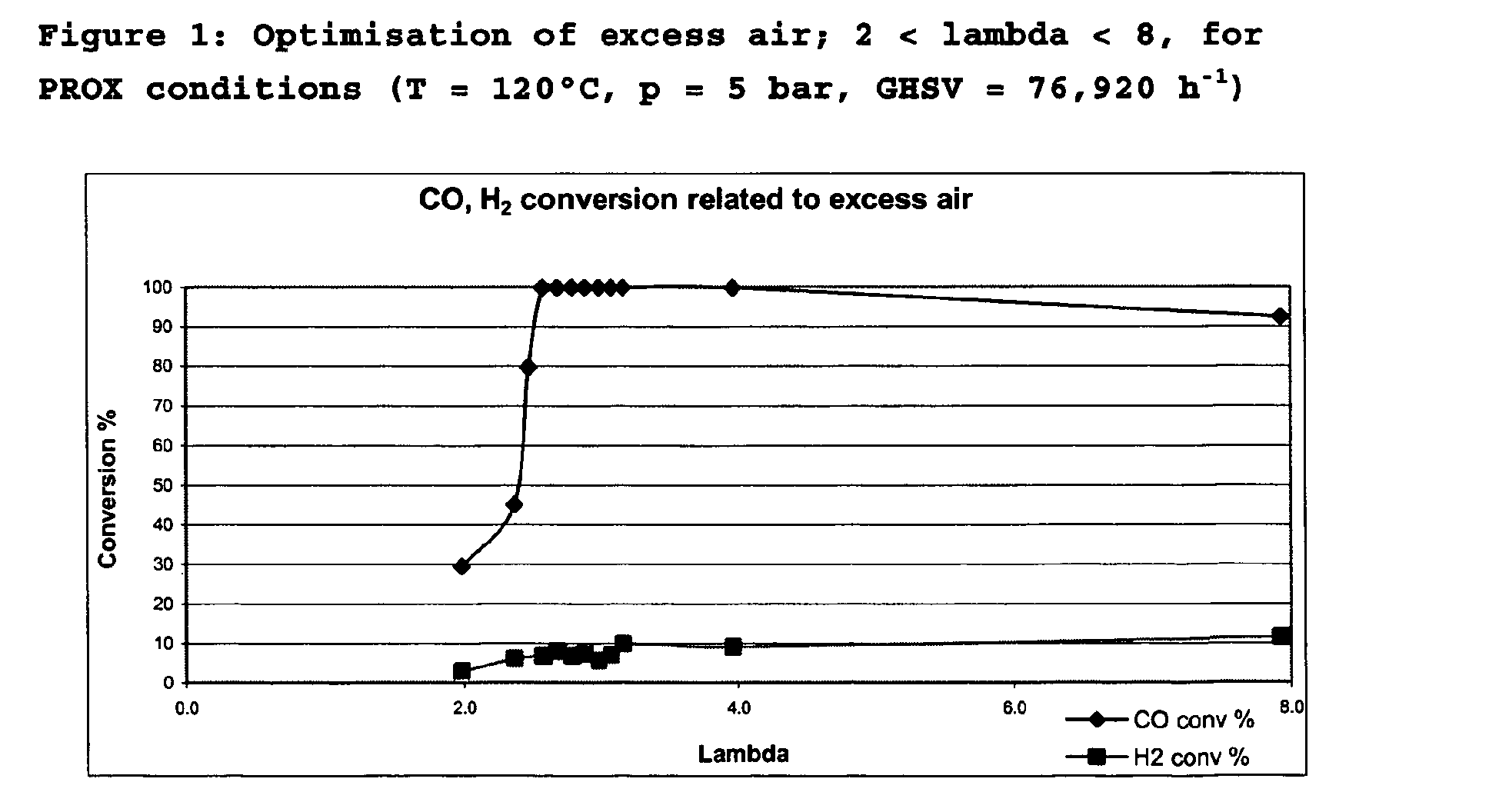
- The figure shows that essentially 100% CO conversion is attained for 2.5 < lambda < 4.0 while maintaining not more than 5-10% of the undesired H2 conversion. The data given in figure 1 have been measured with a catalyst and the micro reactor data condition as set out below in the description of some illustrative examples.
- Additionally, since the concentration of water vapor offered to the catalyst has a significant impact on the performance of the process, the concentration of water vapor in the hydrogen-rich gas stream should be maintained between 0.1 to 10%, preferably 0.3 to 3%, as compared to the total feed gas flow.
- From experimental observations, a two step mechanism of reaction is suggested showing the importance of water in the initial reduction of ruthenium and oxidation of CO:
- 1) H2O + RuCl2 + CO = CO2 + Ru(0) + 2 HCl
- 2) Ru(0) + 2 HCl + ½ O2 = RuCl2 + H2O
-
- The oxygen in the auxiliary air (lambda) reoxidises the Ru(0) which is required again to be reduced to allow the carbon monoxide to be oxidized to the desired carbon dioxide.
- Other preferred process conditions are:
- a) the temperature is between 60 and 250°C, preferably between 80 and 150°C; and/or
- b) the pressure is between 1 to 10 bar, preferably between 2 to 5 bar; and/or
- c) the gas hourly space velocity(litres of feed gas at standard condition/hour/litre reactor volume) is between 20,000 to 200,000 per hour, preferably between 50,000 and 150,000 per hour.
-
- With respect to the method for operating a fuel cell system the invention comprises a process for preferential oxidation for removing carbon monoxide from a hydrogen-rich gas stream being performed under the conditions as described above.
- In order to decrease the complexity of the fuel cell system it is foreseen to pass a feed stream comprising a hydrocarbon or an oxygenate to a fuel processor comprising a catalyst forming an integrated steam reformation and water gas shift conversion zone to produce a fuel stream, i.e. a hydrogen-rich gas, at a catalyst temperature lower than 700°C followed by passing the fuel stream over a catalyst for preferential oxidation to produce a purified fuel gas at least approximately free from carbon monoxide. It is the benefit of the invention that the use of a high temperature shift reactor and a low temperature shift reactor downstream of the integrated steam reformation and water gas shift conversion zone can be abandoned.
- An excellent efficiency for the removal of the carbon monoxide can be achieved by a fuel stream containing about 50 to 50.000 ppm carbon monoxide. A high longterm reliability, i.e. a longterm activity of the anode of a PEM fuel cell, is reached by supplying a purified fuel gas containing less than 10 ppm carbon monoxide.
- Additional advantageous variations of the inventions may be derived from the other dependent claims.
- The present invention is further described by way of the following illustrative examples with respect to the preparation of the preferential oxidation catalyst and the micro reactor data. The experimental data gained with these catalysts is compared to the experimental data disclosed in the prior art, i.e. published patents and/or patent applications and scientific literature.
- A batch of catalyst with a nominal composition of 5%Ru/5%CeO/Al2O3 (based on the proportion of the precursors) was prepared by first impregnating the crushed alumina support material with an aqueous Ce-salt solution to form a slurry; drying the slurry by the rotavap method and calcining the product in an airflow oven to provide a cerium doped support (CeO/Al2O3). Secondly, this cerium doped alumina support material was impregnated with an aqueous Ruthenium salt solution to form a slurry followed by drying the slurry by the rotavap method and afterwards calcining the product in an airflow oven to give the nominal compositions 5%Ru/5%CeO/Al2O3 (hereinafter referred to as PSI Ex.1).
- Cerium doped support: 1 gram of crushed alumina support was impregnated with stirring for three hours with 4.0 ml of cerium(IV) ammonium nitrate (12.78 mg Ce/ml). The resulting slurry was transferred to a rotavap apparatus and dried at 85°C and 100 mbar pressure. Drying was completed in a drying oven overnight at 120°C and 100 mbar vacuum. Calcination with an airflow of 100 ml/min at 500°C for three hours completed the preparation of the cerium doped support (CeO/Al2O3).
- PROX catalyst: 3.6 ml ruthenium nitrosylnitrate (14 mg Ru/ml) was added to the cerium doped support with stirring for three hours. The slurry was transferred to a rotavap apparatus and dried at 85°C and 100 mbar pressure. Drying was completed in a drying oven overnight at 120°C. Calcination with an airflow of 100 ml/min at 550°C for three hours completed the preparation of the PROX catalyst with a nominal composition of 5%Ru/5%Ce/Al2O3. Catalyst activation takes place in the reactor by heating up in N2 to 200°C for outgassing, ½ hour hold, reduction in H2 between 250 and 400°C, two hour hold, cool to 200°C in H2, purge with N2 to 120°C.
- It should be pointed out at this occasion that the support material may be in all other reasonable form suitable for fixed bed reactor applications, such as spheres, extrudates, cylinders, tablets, rings and half-rings. It could be alternatively also in the form of monoliths or other structured support packings, such as ceramic honeycomb bodies, stacks of juxtaposed metallic plate-type catalysts having the catalytic material coated on the surfaces of the metallic plates, for fixed bed applications.
- Microreactor Data versus CO oxidation data from the patent literature
- A small bed of granulated catalyst (0.2 g) in the size range of 0.125 to 0.250 mm, nominal composition 5%Ru/5%Ce/Al2O3, was placed in a glass lined steel reactor and positioned at the center of an electrically heated oven. At a pressure of 5 bar absolute, the catalyst was activated by degassing in flowing nitrogen at 300°C, followed by a catalyst reduction at 550°C. The equation for the exothermic preferential oxidation of CO (desired reaction) in a synthetic reformate gas mixture with high hydrogen content (20 to 50%) with the addition of auxiliary oxygen in the form of air, is
- The CO is removed from reformate gas to levels below 10 ppm implying conversions of 99.9%, allowing its use for PEM fuel cell operation without deactivating the fuel cell anode catalyst. The concomitant H2 conversion should be far below 10% to maintain the overall efficiency of the reformer-PROX connection and facilitate heat management in the reactor.
- The following table shows the experimental PROX results with the PSI Ex.1 catalyst and a comparison with the PROX results from prior art catalysts in the patent literature, i.e. US 6,299,995 - hereinafter referred to as UOP - and US 6,350,423 - hereinafter referred to as Toyota.
Experimental PROX catalyst data Parameter UOP Toyota PSI Ex.1 Temp., °C 90 140 120 Pressure, bar 2 to 5 GHSV, h-1 5,000 4,800 133,320 Inlet, %CO 0.47 0.5 2.5 Inlet, %O2 3.7 Inlet, %H2 46.8 75 34.3 Inlet, %CO2 12.0 24.5 16.3 Inlet, %N2/rest 4.0/36.7 -/- 43.2/- Wt.% Ru/n.n. 3.1/- 0.4/0.003%Li 5.0/4.0%Ce CO conv., % 100 99.9 99.9 H2 conv., % 7.7 Reaction rate 1.9 1.0 142 - Thus, at similar conditions, the PSI catalyst of 5 wt.% Ruthenium on a cerium doped alumina support is approximately 75 to 142 times more active than the prior art catalyst UOP and Toyota resp. Additionally, the stability of the PSI catalyst was demonstrated by continuous operation at various conditions for 1200 hours. The surprising feature of the PSI catalyst is that the increased activity is not due to an additional metal promoter such as lithium (Toyota) or to an significantly higher content of a noble metal but the promotion of the support alumina with cerium oxide, presumably increasing its oxygen adsorption and dissociation properties. In detail, this higher activity is presumably caused by the nano-distribution of the cerium on the alumina support. In comparing the different catalysts, the catalyst prepared under impregnation with the aqueous cerium-salt solution does not show any peaks for ceria in an XRG analysis implying that both the ceria and the noble metal content are dispersed that far that grains over 50 Angstrom have not been built and as a consequence peaks for ceria and the noble metal could not be observed.
- The results from the comparison of the PSI Ex.1 catalyst with two catalysts from the recent published scientific literature are shown in table 2. In this table 2, the first catalyst referred to as "Appl.Cat.B" is the catalyst disclosed in the article "Selective CO Oxidation over Pt/alumina catalyst for fuel cell applications" from Akkarat Manasilp and Erdogan Gulari in Applied Catalysis B: Environmental 37 (2002) 17 to 25, on page 18, right column, 2.1 catalyst preparation, containing 2 wt.% platinum. The second catalyst referred to as "Cat.Tod." is the catalyst which is disclosed in the article "Selective catalytic oxidation of CO in H2: fuel cell applications" from Olga Korothikh and Robert Farrauto, published in Catalysis Today 62 (2000) 249 to 254.
- Again, at very similar conditions, the PSI Ex.1 catalyst with a 5 wt.% ruthenium content on a cerium doped alumina support in comparison with the Appl.Cat.B. catalyst and the Cat.Tod. catalyst is 10 times and 32 times, resp., more active than these catalysts taken from the recently published scientific literature.
Comparison of PROX reactor data versus patent literature Parameter Appl.Cat.B. Cat.Tod. PSI Ex.1 Temp., °C 140 90 120 Press., bar 2 to 5 GHSV, h-1 34, 000 120,000 133,320 Inlet % CO 1.0 0.1 2.5 Inlet % O2 1.35 0.075 3.7 Inlet % H2 60 20 34.3 Inlet % CO2 25 - 16.3 Inlet % H2O 10 10 - Inlet % N2/He -/2.65 69.8/- 43.2/- Wt.% Metal/Al2O3 2% Pt 5% Pt/MO 5% Ru/4% Ce CO conversion, % 100 90 99.9 H2 conv., % 7.7 Hotspot, °C 210 Reaction rate 3.2 1.0 32.7 - The catalyst used for this experimental observation was prepared according to the PSI Ex.1 catalyst and used under the same micro reactor conditions as described under Example 1 above. Now, figure 2 shows a comparison of the CO conversion at lambda = 2.6 and lambda = 3.0 with a 3% inlet CO at PROX conditions (T = 120°C, p = 5 bar). Surprisingly, it can be learned from these studies that a wide GHSV operating window exists for lambda = 3 while simultaneously achieving a superior CO conversion rate of more than 99.999%.

- The figure shows a wide operating window for the gas hourly space velocity starting from appr. 25,000 h-1 and ending close to 170,000 h-1 with a CO conversion larger than by keeping lambda = 3. Nevertheless, figure 2 indicates that already very satisfying results are also achievable with a lambda = 2.6 water vapor content.
- Table 3 shows the prox data with hydrocarbon derived reformats from both gaseous and liquid pox feeds. The data shows that with the C1 to C3 feeds the high selectivity for CO conversion is maintained with low H2 conversions what is considered to be most desirable.
- With iso-octane feed (i-C8) and platformate (refinery feed) pox, high conversion rates for carbon monoxide are again observed with satisfactory H2 conversions. Especially, when an active carbon adsorbent is placed between the pox and the prox reactor, the conversion rates for the undesired oxidation of hydrogen is significantly decreased from close to 30 % to less than 20 %.
Experimental data for the PSI Ex.1 catalyst with different feeds Feed CH4 pox C1-C3 pox Platformate i-C8 pox i-C8 pox i-C8pox CO inlet, % 1.50 1.52 1.25 2.4 3.0+C 3.0+C* Temp., °C 130 130 140 140 120 120 Press., bar 2 2 2 2 2 2 GHSV, h-1 45,960 46,200 18,000 58,320 77,550 71,640 CO Conv., % 99.7 99.7 99.8 99.9 99.9 99.9 H2 Conv., % 4.6 5.0 10.0 28.0 19.1 17.5 Hotspot, °C 136 136 160 170 170 - As pointed out by the interpretation of the results from the different examples the nano-distribution of the cerium compound on the alumina lead to the significant increase of the catalytic activity of the catalyst. As far as results for comparison catalysts containing other rare earth metal compounds than cerium compounds do not exist in the prior art it should be pointed out that this nano-distribution of a rare earth metal compound not only serves as a stabilizing compound for the metal oxide support compound by contributes in a non-negligible manner already to the catalytic activity of the catalyst. Further, it has to be pointed out that the use of other noble metal compounds such as platinum, iridium but also compounds from tungsten, molybdenum can be considered in a reasonable manner. Additionally, the cerium might be changed with or supplemented with another or a group of other rare earth metal compounds, such as the oxides of praseodym, neodym and gadolinium.
Claims (23)
- A method for preparing a catalyst for preferential oxidation to remove carbon monoxide from a hydrogen-rich gas stream, comprising:forming an impregnated support material by impregnating a metal oxide or a mixture of metal oxides with a soluble rare earth metal compound or with a soluble mixture of rare earth metal compounds;drying the impregnated support material; andforming the catalyst by dispersing a precious metal or a mixture of precious metals on the impregnated support material.
- The method according to claim 1,
characterized in that
the metal oxide is alumina. - The method according to claim 1 or 2,
characterized in that
the metal oxide is at least one from the group consisting of titania, zirconia and silica. - The method according to any one of the preceeding claims,
characterized in that
the rare earth metal compound is a Cerium-salt. - The method according to any one of the preceeding claims,
characterized in that
the rare earth metal compound is a Gadolinium-salt. - The method according to any one of the preceeding claims,
characterized in that
the dispersion of the precious metal or the mixture of precious metals is achieved by impregnating the impregnated support material with a soluble precious metal compound or with a soluble mixture of precious metal compounds. - The method according to any one of the preceeding claims,
characterized in that
the precious metal is Rhodium. - The method according to any one of the preceeding claims,
characterized in that
the precious metal is Ruthenium. - The method according to any one of the preceeding claims,
characterized in that
the amount of rare earth metal compound is 0.1 to 20, preferably 0.5 to 5 weight per cent of the total weight of the catalyst. - The method according to any one of the preceeding claims,
characterized in that
the amount of precious metal is 0.01 to 10, preferably 0.05 to 5 weight per cent of the total weight of the catalyst. - The method according to any one of the preceding claims,
characterized in that
the support material is in the form suitable for fixed bed reactor applications, such as granules, spheres, extrudates, cylinders, tablets, rings and half-rings. - The method according to any one of the preceding claims except claim 11,
characterized in that,
the support is in the form of monoliths or other structured support packings, such as ceramic honeycomb bodies, stacks of juxtaposed metallic plate-type catalysts having the catalytic material coated on the surfaces of the metallic plates, for fixed bed applications. - A process for preferential oxidation to remove carbon monoxide from a hydrogen-rich gas stream, comprising:contacting the hydrogen-rich gas stream with a catalyst, manufactured according the method given in any one of the claims 1 to 12, under the condition of elevated temperature and pressure as compared with standard condition (20°C, 1 bar).
- The process according to claim 13,
characterized in that
the hydrogen-rich gas stream is attained by passing a feed stream comprising a hydrocarbon or an oxygenate to a fuel processor comprising an integrated steam reforming and water gas shift conversion zone; said hydrogen-rich gas stream comprises hydrogen, carbon monoxide, carbon dioxide, oxygen and water. - The process according to claim 13 or 14,
characterized in that
the concentration of oxygen in the hydrogen-rich gas stream is maintained between 1 to 10, preferably 2.5 to 5.0 times of the stoichiometric requirement for the maximum conversion of CO to CO2. - The process according to any one of the claims 13 to 15,
characterized in that
the temperature is between 60 and 250°C, preferably between 80 and 150°C. - The process according to any one of the claims 13 to 16,
characterized in that
the pressure is between 1 to 10 bar, preferably between 2 to 5 bar. - The process according to any one of the claims 13 to 17,
characterized in that
the gas hourly space velocity is between 20.000 to 200.000 per hour, preferably between 50.000 and 150.000 per hour. - The process according to any one of the claims 13 to 18,
characterized in that
the concentration of water vapour in the hydrogen-rich gas stream is maintained between 1 and 5 times, preferably 2 to 4 times, of the volume of the hydrogen-rich gas stream. - A method for operating a fuel cell system comprising a process for preferential oxidation to remove carbon monoxide from a hydrogen-rich gas stream according to any one of the claims 13 to 19.
- The method according to claim 20,
characterized in that
passing a feed stream comprising a hydrocarbon or an oxygenate to a fuel processor comprising a catalyst forming an integrated steam reformation and water gas shift conversion zone to produce a fuel stream, i.e. a hydrogen-rich gas, at a catalyst temperature lower than 700°C followed by passing the fuel stream over a catalyst for preferential oxidation to produce a purified fuel gas at least approximately free from carbon monoxide. - The method according to claim 20 or 21,
characterized in that
the fuel stream contains about 50 to 50.000 ppm carbon monoxide. - The method according to any one of the claims 20 to 22,
characterized in that
the purified fuel gas contains less than 10 ppm carbon monoxide.
Priority Applications (3)
| Application Number | Priority Date | Filing Date | Title |
|---|---|---|---|
| EP02015061A EP1391240A1 (en) | 2002-06-03 | 2002-07-05 | Method for preparing a catalyst for preferential oxidation to remove carbon monoxide from a hydrogen-rich gas, a process for preferential oxidation to remove carbon monoxide from hydrogen-rich gas and a method for operating a fuel cell system |
| AU2003249906A AU2003249906A1 (en) | 2002-07-05 | 2003-06-30 | Method for preparing a catalyst for preferential oxidation and a process thereof |
| PCT/EP2003/006931 WO2004004895A1 (en) | 2002-07-05 | 2003-06-30 | Method for preparing a catalyst for preferential oxidation and a process thereof |
Applications Claiming Priority (3)
| Application Number | Priority Date | Filing Date | Title |
|---|---|---|---|
| EP02012172 | 2002-06-03 | ||
| EP02012172A EP1369176A1 (en) | 2002-06-03 | 2002-06-03 | Method for preparing a catalyst for the catalytic production of hydrogen, a process for the catalytic generation of hydrogen and a method for operating a fuel cell system |
| EP02015061A EP1391240A1 (en) | 2002-06-03 | 2002-07-05 | Method for preparing a catalyst for preferential oxidation to remove carbon monoxide from a hydrogen-rich gas, a process for preferential oxidation to remove carbon monoxide from hydrogen-rich gas and a method for operating a fuel cell system |
Publications (1)
| Publication Number | Publication Date |
|---|---|
| EP1391240A1 true EP1391240A1 (en) | 2004-02-25 |
Family
ID=31189518
Family Applications (1)
| Application Number | Title | Priority Date | Filing Date |
|---|---|---|---|
| EP02015061A Withdrawn EP1391240A1 (en) | 2002-06-03 | 2002-07-05 | Method for preparing a catalyst for preferential oxidation to remove carbon monoxide from a hydrogen-rich gas, a process for preferential oxidation to remove carbon monoxide from hydrogen-rich gas and a method for operating a fuel cell system |
Country Status (1)
| Country | Link |
|---|---|
| EP (1) | EP1391240A1 (en) |
Cited By (4)
| Publication number | Priority date | Publication date | Assignee | Title |
|---|---|---|---|---|
| EP1707261A1 (en) * | 2005-03-29 | 2006-10-04 | N.E. Chemcat Corporation | Catalyst for removal of carbon monoxide from hydrogen gas |
| US7666383B2 (en) | 2005-04-06 | 2010-02-23 | Cabot Corporation | Method to produce hydrogen or synthesis gas and carbon black |
| CN114289033A (en) * | 2021-12-13 | 2022-04-08 | 湖南大学 | Platinum catalyst loaded on flower-like cerium-iron oxide and application of platinum catalyst in catalyzing preferential oxidation of carbon monoxide in hydrogen-rich gas |
| CN114515580A (en) * | 2022-03-09 | 2022-05-20 | 嘉庚创新实验室 | Supported catalyst for CO oxidation reaction and preparation method and application thereof |
Citations (6)
| Publication number | Priority date | Publication date | Assignee | Title |
|---|---|---|---|---|
| US4367166A (en) * | 1980-07-17 | 1983-01-04 | Kabushiki Kaisha Toyota Chuo Kenkyusho | Steam reforming catalyst and a method of preparing the same |
| EP0503653A1 (en) * | 1991-03-12 | 1992-09-16 | Nippon Oil Company, Limited | Catalysts for the high-temperature steam reforming of hydrocarbons |
| WO1998035908A1 (en) * | 1997-02-14 | 1998-08-20 | Shell Internationale Research Maatschappij B.V. | Catalytic partial oxidation of hydrocarbons |
| DE10053989A1 (en) * | 1999-11-04 | 2001-05-23 | N E Chemcat Corp | Catalyst for selective oxidation of carbon monoxide in gas containing hydrogen, useful in solid polymer electrolyte fuel cell system, consists of ruthenium on hydrated alumina, e.g. as coating on monolithic support |
| EP1138383A1 (en) * | 1998-11-26 | 2001-10-04 | Idemitsu Kosan Company Limited | Carbon monoxide oxidation catalyst, method for preparation of carbon monoxide oxidation catalyst and method for production of hydrogen-containing gas |
| US6299995B1 (en) * | 2000-05-31 | 2001-10-09 | Uop Llc | Process for carbon monoxide preferential oxidation for use with fuel cells |
-
2002
- 2002-07-05 EP EP02015061A patent/EP1391240A1/en not_active Withdrawn
Patent Citations (6)
| Publication number | Priority date | Publication date | Assignee | Title |
|---|---|---|---|---|
| US4367166A (en) * | 1980-07-17 | 1983-01-04 | Kabushiki Kaisha Toyota Chuo Kenkyusho | Steam reforming catalyst and a method of preparing the same |
| EP0503653A1 (en) * | 1991-03-12 | 1992-09-16 | Nippon Oil Company, Limited | Catalysts for the high-temperature steam reforming of hydrocarbons |
| WO1998035908A1 (en) * | 1997-02-14 | 1998-08-20 | Shell Internationale Research Maatschappij B.V. | Catalytic partial oxidation of hydrocarbons |
| EP1138383A1 (en) * | 1998-11-26 | 2001-10-04 | Idemitsu Kosan Company Limited | Carbon monoxide oxidation catalyst, method for preparation of carbon monoxide oxidation catalyst and method for production of hydrogen-containing gas |
| DE10053989A1 (en) * | 1999-11-04 | 2001-05-23 | N E Chemcat Corp | Catalyst for selective oxidation of carbon monoxide in gas containing hydrogen, useful in solid polymer electrolyte fuel cell system, consists of ruthenium on hydrated alumina, e.g. as coating on monolithic support |
| US6299995B1 (en) * | 2000-05-31 | 2001-10-09 | Uop Llc | Process for carbon monoxide preferential oxidation for use with fuel cells |
Cited By (5)
| Publication number | Priority date | Publication date | Assignee | Title |
|---|---|---|---|---|
| EP1707261A1 (en) * | 2005-03-29 | 2006-10-04 | N.E. Chemcat Corporation | Catalyst for removal of carbon monoxide from hydrogen gas |
| US7666383B2 (en) | 2005-04-06 | 2010-02-23 | Cabot Corporation | Method to produce hydrogen or synthesis gas and carbon black |
| CN114289033A (en) * | 2021-12-13 | 2022-04-08 | 湖南大学 | Platinum catalyst loaded on flower-like cerium-iron oxide and application of platinum catalyst in catalyzing preferential oxidation of carbon monoxide in hydrogen-rich gas |
| CN114515580A (en) * | 2022-03-09 | 2022-05-20 | 嘉庚创新实验室 | Supported catalyst for CO oxidation reaction and preparation method and application thereof |
| CN114515580B (en) * | 2022-03-09 | 2023-07-11 | 嘉庚创新实验室 | Supported catalyst for CO oxidation reaction and preparation method and application thereof |
Similar Documents
| Publication | Publication Date | Title |
|---|---|---|
| US6913739B2 (en) | Platinum group metal promoted copper oxidation catalysts and methods for carbon monoxide remediation | |
| KR100981517B1 (en) | Carbon Monoxide Removal Reactor | |
| KR100811585B1 (en) | A method for catalytic conversion of carbon monoxide in a hydrogen-containing gas mixture with improved cold start behavior | |
| JP4819235B2 (en) | Method for catalytic conversion of carbon monoxide using water in a hydrogen-containing gas mixture | |
| US20040063577A1 (en) | Catalyst for autothermal reforming of hydrocarbons with increased water gas shift activity | |
| JP2001232203A (en) | Methanol reforming catalyst and methanol reforming method | |
| US6949683B2 (en) | Process for catalytic autothermal steam reforming of alcohols | |
| WO2000030745A1 (en) | Carbon monoxide oxidation catalyst, method for preparation of carbon monoxide oxidation catalyst and method for production of hydrogen-containing gas | |
| KR20020079612A (en) | A catalyst and process for removing carbon monoxide from a reformate gas | |
| CA2629078C (en) | Process conditions for pt-re bimetallic water gas shift catalysts | |
| WO2003051493A2 (en) | Platinum group metal promoted copper oxidation catalysts and methods for carbon monoxide remediation | |
| EP1391240A1 (en) | Method for preparing a catalyst for preferential oxidation to remove carbon monoxide from a hydrogen-rich gas, a process for preferential oxidation to remove carbon monoxide from hydrogen-rich gas and a method for operating a fuel cell system | |
| JPH07315825A (en) | Method for oxidizing CO to CO2 and method for producing hydrogen-containing gas for fuel cell | |
| JPH0748101A (en) | Method for producing hydrogen-containing gas for fuel cell | |
| WO2004004895A1 (en) | Method for preparing a catalyst for preferential oxidation and a process thereof | |
| JP4227777B2 (en) | Water gas shift reaction method, hydrogen production apparatus and fuel cell system using the method | |
| EP1535661A1 (en) | Catalyst for selective oxidation of carbon monoxide in reformed gas | |
| KR100448683B1 (en) | POX reforming catalysts of gasoline for fuel-cell powered vehicles applications and methods for preparing catalysts | |
| KR100460433B1 (en) | Catalyst for Purifying Reformate Gas and Process for Selectively Removing Carbon Monoxide Contained in Hydrogen-enriched Reformate Gas Using the Same | |
| JP2000169107A (en) | Method for producing hydrogen-containing gas with reduced carbon monoxide | |
| JP3943606B2 (en) | Method for selective removal of carbon monoxide | |
| EP1369176A1 (en) | Method for preparing a catalyst for the catalytic production of hydrogen, a process for the catalytic generation of hydrogen and a method for operating a fuel cell system | |
| JP4083556B2 (en) | Selective oxidation catalyst for carbon monoxide in reformed gas | |
| KR100440907B1 (en) | Process for Selectively Removing Carbon Monoxide Contained in Hydrogen-enriched Reformate Gas Using Natural Manganese Ore | |
| JP4463914B2 (en) | Method for producing hydrogen-containing gas for fuel cell |
Legal Events
| Date | Code | Title | Description |
|---|---|---|---|
| PUAI | Public reference made under article 153(3) epc to a published international application that has entered the european phase |
Free format text: ORIGINAL CODE: 0009012 |
|
| AK | Designated contracting states |
Kind code of ref document: A1 Designated state(s): AT BE BG CH CY CZ DE DK EE ES FI FR GB GR IE IT LI LU MC NL PT SE SK TR |
|
| AX | Request for extension of the european patent |
Extension state: AL LT LV MK RO SI |
|
| AKX | Designation fees paid | ||
| REG | Reference to a national code |
Ref country code: DE Ref legal event code: 8566 |
|
| STAA | Information on the status of an ep patent application or granted ep patent |
Free format text: STATUS: THE APPLICATION IS DEEMED TO BE WITHDRAWN |
|
| 18D | Application deemed to be withdrawn |
Effective date: 20040826 |