EP1389831A2 - Verfahren und System zur dezimation eines indexierten Datensatz - Google Patents
Verfahren und System zur dezimation eines indexierten Datensatz Download PDFInfo
- Publication number
- EP1389831A2 EP1389831A2 EP03018309A EP03018309A EP1389831A2 EP 1389831 A2 EP1389831 A2 EP 1389831A2 EP 03018309 A EP03018309 A EP 03018309A EP 03018309 A EP03018309 A EP 03018309A EP 1389831 A2 EP1389831 A2 EP 1389831A2
- Authority
- EP
- European Patent Office
- Prior art keywords
- data elements
- data
- decimated
- lut
- decimation
- Prior art date
- Legal status (The legal status is an assumption and is not a legal conclusion. Google has not performed a legal analysis and makes no representation as to the accuracy of the status listed.)
- Ceased
Links
Images


Classifications
-
- H—ELECTRICITY
- H03—ELECTRONIC CIRCUITRY
- H03H—IMPEDANCE NETWORKS, e.g. RESONANT CIRCUITS; RESONATORS
- H03H17/00—Networks using digital techniques
- H03H17/02—Frequency selective networks
- H03H17/06—Non-recursive filters
- H03H17/0607—Non-recursive filters comprising a ROM addressed by the input data signals
-
- H—ELECTRICITY
- H03—ELECTRONIC CIRCUITRY
- H03H—IMPEDANCE NETWORKS, e.g. RESONANT CIRCUITS; RESONATORS
- H03H17/00—Networks using digital techniques
- H03H17/02—Frequency selective networks
- H03H17/06—Non-recursive filters
- H03H17/0621—Non-recursive filters with input-sampling frequency and output-delivery frequency which differ, e.g. extrapolation; Anti-aliasing
- H03H17/0635—Non-recursive filters with input-sampling frequency and output-delivery frequency which differ, e.g. extrapolation; Anti-aliasing characterized by the ratio between the input-sampling and output-delivery frequencies
- H03H17/065—Non-recursive filters with input-sampling frequency and output-delivery frequency which differ, e.g. extrapolation; Anti-aliasing characterized by the ratio between the input-sampling and output-delivery frequencies the ratio being integer
- H03H17/0664—Non-recursive filters with input-sampling frequency and output-delivery frequency which differ, e.g. extrapolation; Anti-aliasing characterized by the ratio between the input-sampling and output-delivery frequencies the ratio being integer where the output-delivery frequency is lower than the input sampling frequency, i.e. decimation
Definitions
- Embodiments of the present invention relate generally to a method and system for performing data decimation, and more particularly for decimating along at least one dimension of an array of video pixels in a video processing system and/or graphics subsystem.
- Decimation of a frame of pixels to scale the frame is a common function in a video processing system. In particular, decimation along the horizontal dimension of the frame is often performed.
- the decimation function is performed in hardware using a digital filter to effectively collapse groups of two or more pixels, along the horizontal dimension of the frame of pixels, into a single pixel per group.
- the digital filter is often implemented using hardware elements such as multipliers, adders, and multiplexers.
- a 2-tap digital filter is commonly used to average pairs of pixels to accomplish 2-to-1 decimation.
- Such traditional hardware implementations may be inflexible and limit the types of decimation that may be performed and the types of video formats that may be used such as, for example, the YUVA digital video format.
- Certain embodiments of the present invention provide a method and system for decimating an indexed set of data elements.
- a method of the present invention provides for decimating an indexed set of data elements to generate a decimated set of data elements.
- the indexed set of data elements are arranged into groups of at least two data elements per group.
- the indexes of the data elements in each group are used to address a look-up-table (LUT) that is pre-programmed to perform the decimation operation.
- LUT look-up-table
- the decimated data value is a function of the data values of the corresponding data elements addressing the LUT.
- a system of the present invention provides a memory module storing an indexed set of data elements and a programmable memory device storing a decimation look-up-table (LUT). At least one FIFO is used to pipeline at least two sets of index values from the memory module to address lines of the programmable memory device.
- a host processor generates the decimation LUT according to a decimation algorithm and downloads the decimation LUT to the programmable memory device.
- the programmable memory device outputs a set of decimation data values as the programmable memory device is addressed by the at least two sets of index values corresponding to said indexed set of data elements.
- Certain embodiments of the present invention afford an approach for decimating along at least one dimension of an array of pixels in a video processing system by indexing into a pre-programmed decimation LUT.
- a method to decimate an indexed set of data elements comprising:
- the method further comprises pre-programming said LUT to output said decimated data value when addressed by said at least two index values.
- said indexed set of data elements is decimated by an integer factor to generate said decimated set of data elements.
- said indexed set of data elements is decimated by a non-integer factor to generate said decimated set of data elements.
- said decimated data value comprises a filtered data value corresponding to said LUT being pre-programmed to filter data values of said at least two data elements.
- said decimated data value comprises an average data value corresponding to said LUT being pre-programmed to average data values of said at least two data elements.
- said decimated data value comprises at least two components, and wherein each of said at least two components is a function of corresponding components of data values of said at least two data elements.
- each data element of said at least two data elements comprises a data value in a YUVA format.
- said decimated data value is in a YUVA format.
- each index value of said at least two index values comprises 4 bits.
- said decimated data value comprises 32 bits.
- each data value of each of said at least two data elements comprises 32 bits.
- said decimated data value changes when at least one of said at least two index values changes.
- said indexed set of data elements is decimated along a horizontal dimension of said indexed set of data elements to generate said decimated set of data elements.
- said indexed set of data elements is decimated along a vertical dimension of said indexed set of data elements to generate said decimated set of data elements.
- said LUT comprises a programmable memory device.
- said LUT stores at least 256 decimated data values.
- said indexed set of data elements comprise video pixel data.
- a system to decimate an indexed set of data elements comprising:
- said host processor includes a decimation algorithm used to generate said decimation LUT from a pre-defined set of indexed data values.
- said indexed set of data elements comprises video pixel data and corresponding index values.
- said at least two sets of index values correspond to groups of at least two data elements of said indexed set of data elements.
- said programmable memory device outputs a decimated data value when addressed by at least two index values from said at least two sets of index values.
- said indexed set of data elements is decimated by an integer factor to generate a decimated set of data elements.
- said indexed set of data elements is decimated by a non-integer factor to generate a decimated set of data elements.
- each index value of said at least two sets of index values comprises 4 bits.
- said programmable memory device outputs a 32-bit decimation value in a YUVA format when addressed by at least two index values from said at least two sets of index values.
- each data value corresponding to each data element of said indexed set of data elements comprises a 32-bit word in a YUVA format.
- said programmable memory device outputs a 32-bit decimation value that is a function of the data values corresponding to at least two index values from said at least two sets of index values.
- said indexed set of data elements is decimated along a horizontal dimension of said indexed set of data elements to generate a decimated set of data elements.
- said indexed set of data elements is decimated along a vertical dimension of said indexed set of data elements to generate a decimated set of data elements.
- said programmable memory device stores at least 256 32-bit decimation values.
- output values of said programmable memory device comprise filtered data values corresponding to said decimation LUT being pre-programmed to filter data values corresponding to said at least two sets of index values.
- output values of said programmable memory device comprise averaged data values corresponding to said decimation LUT being pre-programmed to average data values corresponding to said at least two sets of index values.
- Fig. 1 is a schematic block diagram of a system 100 for decimating an indexed set of data elements in accordance with an embodiment of the present invention.
- the system 100 comprises a memory module 110, a FIFO 120, a programmable memory device 130, and a host processor 140.
- the memory module 110 interfaces to the input of the FIFO 120.
- the output of the FIFO 120 interfaces to the address inputs of the programmable memory device 130.
- the host processor 140 interfaces to the programmable memory device 130 and the memory module 110.
- the memory module 110 stores an indexed set of data elements such as a frame of video pixel data.
- the memory module 110 may store a single frame of video pixel data or multiple frames of video pixel data.
- Associated with each element of the indexed set of data elements is an index value and a data value stored in memory module 110.
- each element in the indexed set of data elements may take on one of 16 possible data values and each possible data value has a unique index value (0x0 to 0xF in hex).
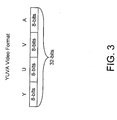
- the data values represent colors in a YUVA video format (see Fig. 3).
- Each data value comprises a 32-bit word and each 32-bit word comprises 4 components of 8 bits each.
- the first 8-bit component corresponds to the Y component and represents the luminance of the color.
- the second 8-bit component corresponds to the U component and represents the color difference (blue) of the color.
- the third 8-bit component corresponds to the V component and represents the color difference (red) of the color.
- the fourth 8-bit component corresponds to the A component and represents the alpha value of the color.
- other video formats such as, for example, RGB, YUV, or RGBA may be used.
- the memory module 110 pipelines index values of the indexed set of data elements to FIFO 120 as grouped pairs of index values.
- Each index value comprises 4 bits (corresponding to one of the 16 possible data values or colors).
- Each pair of index values output from the FIFO 120 serve as an address to programmable memory device 130.
- a decimated output value 32-bits
- the programmable memory device comprises a SRAM.
- step 210 of method 200 the indexed set of data elements are grouped based on a decimation factor (2:1, 3:2, 3:1, etc.).
- step 220 the index values of the grouped data elements are pipelined through the FIFO 120 to address a decimation look-up-table (LUT) stored in programmable memory device 130.
- LUT decimation look-up-table
- the programmable memory device 130 For each grouped pair of index values addressing the decimation LUT, the programmable memory device 130 outputs a decimation output value in step 230.
- the decimated output values are a function of the decimation LUT stored in programmable memory device 130.
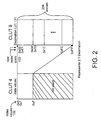
- the decimation LUT is generated from the 16 possible data values indexed by 0x0 to 0xF hex (CLUT 4 data) (see Fig. 2).
- a decimation algorithm 141 in host processor 140 is used to generate the decimation LUT.
- a decimation LUT 131 1 (CLUT 8) having 256 32-bit entries may be generated to allow, for example, 2-to-1 decimation of the indexed set of data elements. Any two data elements of the indexed set of data elements may be grouped together and collapsed into a single data element using the decimation LUT 131 and the index values 132 of the 16 possible data values.
- a new address or index value 133 may be formed as Ox3F which is the combination of the two index values.
- the new index value Ox3F may serve as one of the 256 address locations in the decimation LUT.
- the 32-bit value stored in address Ox3F of the decimation LUT may be, for example, the simple average of the data values corresponding to index value 0x3 and index value OxF.
- all 256 entries of the decimation LUT may be generated by averaging the data values from all of the possible combinations of the 16 original possible data values with index values 132 (0x0 to OxF).
- pairs of index values 133 of the indexed set of data elements are presented as addresses to programmable memory device 130, decimated output values are generated corresponding to the average of the data values of the pairs of index values.
- the effective decimation factor depends on the way the elements of the indexed set of data elements are grouped. For example, in an embodiment of the present invention, if the data elements are simply grouped as pairs with each data element appearing in just one group, then 2-to-1 decimation is achieved. That is, every grouped pair is collapsed into a single output data element. For example, for four adjacent pixels in the indexed set of data elements (P1, P2, P3, and P4), then [P1, P2] may form a paired group and [P3, P4] may form a paired group.
- the decimation LUT outputs a decimation value for the group [P1, P2] and another decimation value for the group [P3, P4], thus collapsing four pixels into two pixels (i.e. 2-to-1 decimation).
- 3-to-1 decimation may be achieved if the indexed set of data elements are grouped into groups of three pixels each and the system architecture is designed to support three index values addressing the programmable memory device 130 (i.e. 4 address inputs per index value, etc.).
- the decimation algorithm 141 may support many different groupings of data elements and decimation schemes.
- the decimation algorithm 141 may be programmed to generate a decimation LUT that effectively performs low-pass filtering on groups of 3 data elements at a time to achieve 3-to-1 compression instead of just doing a simple averaging.
- Other complex functions may be applied as well in other embodiments.
- the decimation algorithm 141 may be programmed to process each component of the YUVA format separately. For example, if a simple averaging of pairs of pixels is performed to achieve 2-to-1 decimation, the averaging may be performed separately on each 8-bit component of the YUVA data elements such that no spill-over or overlap occurs between the various components.
- embodiments of the present invention are not limited to the decimation of video pixel data.
- an alternative embodiment of the present invention may be used to decimate an indexed set of data elements representing digital audio data.
- the programmable memory device 130 may be separated into two programmable memory devices with each device being addressed by a single 4-bit index value pipelined from a single FIFO in accordance with an embodiment of the present invention (i.e. use two FIFO's).
- the programmable memory device 130 may not be programmed within system 100 by host processor 140. Instead, the programmable memory device may be an EEPROM that is programmed before installation into the system 100.
- the memory module 110 may only store index values of the indexed set of data values and not the data values themselves.
- the relationship between the index values and the data values may be established offline outside of the system 100 and, therefore, the actual data values of the frames of video pixel data may not need to be stored in the system 100.
- decimation may take place in two dimensions (e.g. horizontal and vertical) by using two FIFO's.
- a first FIFO may be used to pipeline horizontal groups of index values to the programmable memory device 130 and a second FIFO may be used to pipeline vertical groups of index values to the programmable memory device 130.
- certain embodiments of the present invention afford an approach for decimating frames of video pixels in a video processing system by indexing into a pre-programmed decimation LUT.
Landscapes
- Physics & Mathematics (AREA)
- Engineering & Computer Science (AREA)
- Computer Hardware Design (AREA)
- Mathematical Physics (AREA)
- Image Processing (AREA)
- Processing Of Color Television Signals (AREA)
- Compression Or Coding Systems Of Tv Signals (AREA)
- Color Image Communication Systems (AREA)
- Information Retrieval, Db Structures And Fs Structures Therefor (AREA)
Applications Claiming Priority (2)
| Application Number | Priority Date | Filing Date | Title |
|---|---|---|---|
| US217973 | 1998-12-18 | ||
| US10/217,973 US7755641B2 (en) | 2002-08-13 | 2002-08-13 | Method and system for decimating an indexed set of data elements |
Publications (2)
| Publication Number | Publication Date |
|---|---|
| EP1389831A2 true EP1389831A2 (de) | 2004-02-18 |
| EP1389831A3 EP1389831A3 (de) | 2004-12-22 |
Family
ID=30770623
Family Applications (1)
| Application Number | Title | Priority Date | Filing Date |
|---|---|---|---|
| EP03018309A Ceased EP1389831A3 (de) | 2002-08-13 | 2003-08-12 | Verfahren und System zur Dezimierung eines indexierten Datensatzes |
Country Status (2)
| Country | Link |
|---|---|
| US (1) | US7755641B2 (de) |
| EP (1) | EP1389831A3 (de) |
Cited By (1)
| Publication number | Priority date | Publication date | Assignee | Title |
|---|---|---|---|---|
| US10119996B2 (en) | 2014-03-25 | 2018-11-06 | Eaton Intelligent Power Limited | Data decimation system and method for facilitating transmission and viewing of waveforms generated by an electrical device |
Family Cites Families (37)
| Publication number | Priority date | Publication date | Assignee | Title |
|---|---|---|---|---|
| US4484187A (en) | 1982-06-25 | 1984-11-20 | At&T Bell Laboratories | Video overlay system having interactive color addressing |
| GB2193069B (en) * | 1986-07-17 | 1990-08-29 | Toshiba Kk | Image frame composing circuit utilizing color look-up table |
| US5146592A (en) * | 1987-09-14 | 1992-09-08 | Visual Information Technologies, Inc. | High speed image processing computer with overlapping windows-div |
| US4999626A (en) * | 1989-10-30 | 1991-03-12 | Advanced Micro Devices, Inc. | Apparatus having a modular decimation architecture |
| US5204664A (en) | 1990-05-16 | 1993-04-20 | Sanyo Electric Co., Ltd. | Display apparatus having a look-up table for converting pixel data to color data |
| JPH04246690A (ja) * | 1990-08-29 | 1992-09-02 | Xerox Corp | 高品質のイメージを並みの解像度で表示する方法 |
| US5172227A (en) * | 1990-12-10 | 1992-12-15 | Eastman Kodak Company | Image compression with color interpolation for a single sensor image system |
| US5319473A (en) * | 1991-11-27 | 1994-06-07 | Xerox Corporation | Methods and apparatus for performing real time color gamut compressions |
| US5606632A (en) * | 1992-05-28 | 1997-02-25 | Fujitsu Limited | Device and method for reducing the size of a color image to display separate color images simultaneously on a screen |
| US6384838B1 (en) * | 1992-06-19 | 2002-05-07 | Intel Corporation | Optimized lookup table method for converting Yuv pixel values to RGB pixel values |
| US5455782A (en) * | 1992-08-14 | 1995-10-03 | Harris Corporation | Decimation filter and method |
| US5455681A (en) * | 1992-11-16 | 1995-10-03 | Eastman Kodak Company | Low resolution grey level printing method from high resolution binary input file |
| US5572536A (en) * | 1994-05-26 | 1996-11-05 | Texas Instruments Incorporated | Digital circuitry with improved parallel signature analysis capability |
| US5778102A (en) * | 1995-05-17 | 1998-07-07 | The Regents Of The University Of California, Office Of Technology Transfer | Compression embedding |
| US5930387A (en) * | 1995-06-05 | 1999-07-27 | Apple Computer, Inc. | Method and apparatus for encoding color image data using dynamic color matching |
| US6016360A (en) * | 1995-06-05 | 2000-01-18 | Apple Computer, Inc. | Method and apparatus for encoding color image data |
| US6747644B1 (en) * | 1995-08-04 | 2004-06-08 | Sun Microsystems, Inc. | Decompression of surface normals in three-dimensional graphics data |
| JP2861890B2 (ja) * | 1995-09-28 | 1999-02-24 | 日本電気株式会社 | カラー画像表示装置 |
| US5655061A (en) | 1995-11-15 | 1997-08-05 | Xerox Corporation | System and method for providing a high addressable printing system |
| US7003168B1 (en) * | 1997-03-11 | 2006-02-21 | Vianet Technologies, Inc. | Image compression and decompression based on an integer wavelet transform using a lifting scheme and a correction method |
| US5991788A (en) * | 1997-03-14 | 1999-11-23 | Xilinx, Inc. | Method for configuring an FPGA for large FFTs and other vector rotation computations |
| US6167416A (en) * | 1997-09-26 | 2000-12-26 | Xilinx, Inc. | System and method for RAM-partitioning to exploit parallelism of radix-2 elements in FPGAS |
| GB2335326B (en) * | 1997-10-31 | 2002-04-17 | Sony Corp | Image processing apparatus and method and providing medium. |
| US6073154A (en) * | 1998-06-26 | 2000-06-06 | Xilinx, Inc. | Computing multidimensional DFTs in FPGA |
| US6958772B1 (en) * | 1999-01-20 | 2005-10-25 | Canon Kabushiki Kaisha | Image sensing apparatus and image processing method therefor |
| JP2003513538A (ja) * | 1999-10-22 | 2003-04-08 | アクティブスカイ,インコーポレイテッド | オブジェクト指向ビデオシステム |
| US6618500B1 (en) * | 1999-12-07 | 2003-09-09 | Sony Corporation | Color conversion matrix based on minimal surface theory |
| US20010035976A1 (en) * | 2000-02-15 | 2001-11-01 | Andrew Poon | Method and system for online presentations of writings and line drawings |
| US6483343B1 (en) * | 2000-12-29 | 2002-11-19 | Quicklogic Corporation | Configurable computational unit embedded in a programmable device |
| US20020191104A1 (en) * | 2001-03-26 | 2002-12-19 | Mega Chips Corporation | Image conversion device, image conversion method and data conversion circuit as well as digital camera |
| US7076595B1 (en) * | 2001-05-18 | 2006-07-11 | Xilinx, Inc. | Programmable logic device including programmable interface core and central processing unit |
| US6801672B1 (en) * | 2001-06-01 | 2004-10-05 | Bruce A. Thomas | Removing noise from a color image using wavelets |
| US6792329B2 (en) * | 2001-08-22 | 2004-09-14 | Milliken & Company | Construction of colored images on absorbent substrates using a computer-aided design system |
| US6704610B2 (en) * | 2001-08-22 | 2004-03-09 | Milliken & Company | Reproduction of colored images on absorbent substrates using color blending techniques |
| KR100425418B1 (ko) * | 2001-09-07 | 2004-03-30 | 삼성탈레스 주식회사 | 룩업 테이블을 이용한 블록 보간 필터 구조 |
| US7034849B1 (en) * | 2001-12-31 | 2006-04-25 | Apple Computer, Inc. | Method and apparatus for image blending |
| US7196648B1 (en) * | 2005-12-23 | 2007-03-27 | Cirrus Logic, Inc. | Non-integer decimation using cascaded intergrator-comb filter |
-
2002
- 2002-08-13 US US10/217,973 patent/US7755641B2/en not_active Expired - Fee Related
-
2003
- 2003-08-12 EP EP03018309A patent/EP1389831A3/de not_active Ceased
Non-Patent Citations (1)
| Title |
|---|
| None * |
Cited By (1)
| Publication number | Priority date | Publication date | Assignee | Title |
|---|---|---|---|---|
| US10119996B2 (en) | 2014-03-25 | 2018-11-06 | Eaton Intelligent Power Limited | Data decimation system and method for facilitating transmission and viewing of waveforms generated by an electrical device |
Also Published As
| Publication number | Publication date |
|---|---|
| US7755641B2 (en) | 2010-07-13 |
| US20040034641A1 (en) | 2004-02-19 |
| EP1389831A3 (de) | 2004-12-22 |
Similar Documents
| Publication | Publication Date | Title |
|---|---|---|
| US8717462B1 (en) | Camera with color correction after luminance and chrominance separation | |
| US7477323B2 (en) | Method and system for digital image magnification and reduction | |
| KR0142263B1 (ko) | 디지탈 감마 보정방법 및 그 장치 | |
| US6201530B1 (en) | Method and system of optimizing a digital imaging processing chain | |
| CN100525470C (zh) | 组合彩色空间矩阵变换和有限冲击响应滤波器 | |
| JPH07255067A (ja) | ビデオプロセッサーにおけるデータパッキングシステムおよび方法 | |
| WO2006119302A2 (en) | System for scaling, yc adjustment, and color conversion in a display controller | |
| JP2009225286A (ja) | 画像撮像装置 | |
| EP0773683B1 (de) | Steuerung von Abwärts-Videoformatumwandlung | |
| US20020186223A1 (en) | Image processing apparatus and image processing system | |
| US8089490B2 (en) | Correction arithmetic circuit | |
| EP1389831A2 (de) | Verfahren und System zur dezimation eines indexierten Datensatz | |
| KR100382135B1 (ko) | 신호처리장치,비디오신호처리장치,비디오카메라및비디오저장장치 | |
| EP0773684B1 (de) | Abwärts-Videoformatumwandlung | |
| KR100480569B1 (ko) | 다기능 비디오 디코더 | |
| US5822009A (en) | Video down-conversion | |
| US8786637B2 (en) | Method for processing image and devices using the method | |
| US8064709B2 (en) | Method and apparatus for buffering output pixel data of a joint photographic experts group image | |
| US20120246361A1 (en) | Data processing apparatus and data processing method | |
| KR100339401B1 (ko) | 포맷 변환 장치 | |
| US20070103568A1 (en) | Method of enlarging an image by interpolation means and a related digital camera using the same | |
| JPH07141499A (ja) | 色変換装置 | |
| JPH1141539A (ja) | ビデオ信号処理装置及びビデオ信号処理システム | |
| JPH08320676A (ja) | ディザ画像表示装置 | |
| JPH02312486A (ja) | 画像データ処理装置 |
Legal Events
| Date | Code | Title | Description |
|---|---|---|---|
| PUAI | Public reference made under article 153(3) epc to a published international application that has entered the european phase |
Free format text: ORIGINAL CODE: 0009012 |
|
| AK | Designated contracting states |
Kind code of ref document: A2 Designated state(s): AT BE BG CH CY CZ DE DK EE ES FI FR GB GR HU IE IT LI LU MC NL PT RO SE SI SK TR |
|
| AX | Request for extension of the european patent |
Extension state: AL LT LV MK |
|
| PUAL | Search report despatched |
Free format text: ORIGINAL CODE: 0009013 |
|
| AK | Designated contracting states |
Kind code of ref document: A3 Designated state(s): AT BE BG CH CY CZ DE DK EE ES FI FR GB GR HU IE IT LI LU MC NL PT RO SE SI SK TR |
|
| AX | Request for extension of the european patent |
Extension state: AL LT LV MK |
|
| RIC1 | Information provided on ipc code assigned before grant |
Ipc: 7G 09G 5/391 B Ipc: 7G 06T 3/40 B Ipc: 7H 03H 17/06 A |
|
| 17P | Request for examination filed |
Effective date: 20050622 |
|
| AKX | Designation fees paid |
Designated state(s): DE FR GB |
|
| APBN | Date of receipt of notice of appeal recorded |
Free format text: ORIGINAL CODE: EPIDOSNNOA2E |
|
| RAP1 | Party data changed (applicant data changed or rights of an application transferred) |
Owner name: BROADCOM CORPORATION |
|
| APBR | Date of receipt of statement of grounds of appeal recorded |
Free format text: ORIGINAL CODE: EPIDOSNNOA3E |
|
| APAF | Appeal reference modified |
Free format text: ORIGINAL CODE: EPIDOSCREFNE |
|
| APBT | Appeal procedure closed |
Free format text: ORIGINAL CODE: EPIDOSNNOA9E |
|
| STAA | Information on the status of an ep patent application or granted ep patent |
Free format text: STATUS: THE APPLICATION HAS BEEN REFUSED |
|
| 18R | Application refused |
Effective date: 20100113 |