EP1389540A1 - Rubber-fiber composite material and rubber article using the same - Google Patents
Rubber-fiber composite material and rubber article using the same Download PDFInfo
- Publication number
- EP1389540A1 EP1389540A1 EP02728145A EP02728145A EP1389540A1 EP 1389540 A1 EP1389540 A1 EP 1389540A1 EP 02728145 A EP02728145 A EP 02728145A EP 02728145 A EP02728145 A EP 02728145A EP 1389540 A1 EP1389540 A1 EP 1389540A1
- Authority
- EP
- European Patent Office
- Prior art keywords
- rubber
- woven fabric
- fiber
- composite material
- tire
- Prior art date
- Legal status (The legal status is an assumption and is not a legal conclusion. Google has not performed a legal analysis and makes no representation as to the accuracy of the status listed.)
- Granted
Links
- 239000000835 fiber Substances 0.000 title claims abstract description 157
- 239000002131 composite material Substances 0.000 title claims abstract description 66
- 229920001971 elastomer Polymers 0.000 title claims abstract description 52
- 239000005060 rubber Substances 0.000 title claims abstract description 51
- 239000004745 nonwoven fabric Substances 0.000 claims abstract description 77
- 230000003014 reinforcing effect Effects 0.000 claims description 39
- 239000011324 bead Substances 0.000 claims description 6
- 239000004760 aramid Substances 0.000 claims description 5
- 239000004642 Polyimide Substances 0.000 claims description 4
- 150000002576 ketones Chemical class 0.000 claims description 4
- 229920001721 polyimide Polymers 0.000 claims description 4
- 229920000098 polyolefin Polymers 0.000 claims description 4
- WRDNCFQZLUCIRH-UHFFFAOYSA-N 4-(7-azabicyclo[2.2.1]hepta-1,3,5-triene-7-carbonyl)benzamide Chemical compound C1=CC(C(=O)N)=CC=C1C(=O)N1C2=CC=C1C=C2 WRDNCFQZLUCIRH-UHFFFAOYSA-N 0.000 claims description 3
- 230000007423 decrease Effects 0.000 claims description 2
- 229920003235 aromatic polyamide Polymers 0.000 claims 5
- 238000005470 impregnation Methods 0.000 abstract description 10
- 239000012779 reinforcing material Substances 0.000 abstract description 10
- 238000004519 manufacturing process Methods 0.000 abstract description 5
- 238000000034 method Methods 0.000 description 17
- 230000000052 comparative effect Effects 0.000 description 9
- 238000012360 testing method Methods 0.000 description 8
- 239000004927 clay Substances 0.000 description 5
- 230000001965 increasing effect Effects 0.000 description 5
- 229920000139 polyethylene terephthalate Polymers 0.000 description 5
- 239000005020 polyethylene terephthalate Substances 0.000 description 5
- 239000000565 sealant Substances 0.000 description 5
- 229920006231 aramid fiber Polymers 0.000 description 4
- -1 ethylene, propylene, butene Chemical class 0.000 description 4
- 230000001747 exhibiting effect Effects 0.000 description 4
- 239000000446 fuel Substances 0.000 description 4
- XLYOFNOQVPJJNP-UHFFFAOYSA-N water Substances O XLYOFNOQVPJJNP-UHFFFAOYSA-N 0.000 description 4
- 238000007664 blowing Methods 0.000 description 3
- 239000011248 coating agent Substances 0.000 description 3
- 238000000576 coating method Methods 0.000 description 3
- 230000002708 enhancing effect Effects 0.000 description 3
- 229920001778 nylon Polymers 0.000 description 3
- 238000005096 rolling process Methods 0.000 description 3
- JRZJOMJEPLMPRA-UHFFFAOYSA-N 1-nonene Chemical compound CCCCCCCC=C JRZJOMJEPLMPRA-UHFFFAOYSA-N 0.000 description 2
- 239000004677 Nylon Substances 0.000 description 2
- 229910000831 Steel Inorganic materials 0.000 description 2
- 238000005229 chemical vapour deposition Methods 0.000 description 2
- 239000006185 dispersion Substances 0.000 description 2
- 239000000463 material Substances 0.000 description 2
- ZGEGCLOFRBLKSE-UHFFFAOYSA-N methylene hexane Natural products CCCCCC=C ZGEGCLOFRBLKSE-UHFFFAOYSA-N 0.000 description 2
- 239000000203 mixture Substances 0.000 description 2
- 230000002093 peripheral effect Effects 0.000 description 2
- 238000005240 physical vapour deposition Methods 0.000 description 2
- 229920000728 polyester Polymers 0.000 description 2
- 229920000642 polymer Polymers 0.000 description 2
- 238000004080 punching Methods 0.000 description 2
- 239000010959 steel Substances 0.000 description 2
- CRSBERNSMYQZNG-UHFFFAOYSA-N 1 -dodecene Natural products CCCCCCCCCCC=C CRSBERNSMYQZNG-UHFFFAOYSA-N 0.000 description 1
- LIKMAJRDDDTEIG-UHFFFAOYSA-N 1-hexene Chemical compound CCCCC=C LIKMAJRDDDTEIG-UHFFFAOYSA-N 0.000 description 1
- KWKAKUADMBZCLK-UHFFFAOYSA-N 1-octene Chemical compound CCCCCCC=C KWKAKUADMBZCLK-UHFFFAOYSA-N 0.000 description 1
- ICXAPFWGVRTEKV-UHFFFAOYSA-N 2-[4-(1,3-benzoxazol-2-yl)phenyl]-1,3-benzoxazole Chemical compound C1=CC=C2OC(C3=CC=C(C=C3)C=3OC4=CC=CC=C4N=3)=NC2=C1 ICXAPFWGVRTEKV-UHFFFAOYSA-N 0.000 description 1
- 241000195940 Bryophyta Species 0.000 description 1
- 229920000049 Carbon (fiber) Polymers 0.000 description 1
- UGFAIRIUMAVXCW-UHFFFAOYSA-N Carbon monoxide Chemical compound [O+]#[C-] UGFAIRIUMAVXCW-UHFFFAOYSA-N 0.000 description 1
- SNRUBQQJIBEYMU-UHFFFAOYSA-N Dodecane Natural products CCCCCCCCCCCC SNRUBQQJIBEYMU-UHFFFAOYSA-N 0.000 description 1
- 244000043261 Hevea brasiliensis Species 0.000 description 1
- 229920000271 Kevlar® Polymers 0.000 description 1
- 239000005062 Polybutadiene Substances 0.000 description 1
- NINIDFKCEFEMDL-UHFFFAOYSA-N Sulfur Chemical compound [S] NINIDFKCEFEMDL-UHFFFAOYSA-N 0.000 description 1
- 229920001494 Technora Polymers 0.000 description 1
- 150000001336 alkenes Chemical class 0.000 description 1
- 239000011230 binding agent Substances 0.000 description 1
- 239000004917 carbon fiber Substances 0.000 description 1
- 229910002091 carbon monoxide Inorganic materials 0.000 description 1
- 238000009960 carding Methods 0.000 description 1
- 230000008859 change Effects 0.000 description 1
- 239000002734 clay mineral Substances 0.000 description 1
- 238000010073 coating (rubber) Methods 0.000 description 1
- 238000010276 construction Methods 0.000 description 1
- 229920001577 copolymer Polymers 0.000 description 1
- 238000013461 design Methods 0.000 description 1
- 230000006866 deterioration Effects 0.000 description 1
- 230000002542 deteriorative effect Effects 0.000 description 1
- 229940069096 dodecene Drugs 0.000 description 1
- 230000000694 effects Effects 0.000 description 1
- 230000005489 elastic deformation Effects 0.000 description 1
- 239000000806 elastomer Substances 0.000 description 1
- 238000011156 evaluation Methods 0.000 description 1
- 239000004744 fabric Substances 0.000 description 1
- 239000000945 filler Substances 0.000 description 1
- 230000004927 fusion Effects 0.000 description 1
- 230000001771 impaired effect Effects 0.000 description 1
- 229910010272 inorganic material Inorganic materials 0.000 description 1
- 239000011147 inorganic material Substances 0.000 description 1
- 230000002687 intercalation Effects 0.000 description 1
- 238000009830 intercalation Methods 0.000 description 1
- 229920003049 isoprene rubber Polymers 0.000 description 1
- 239000004761 kevlar Substances 0.000 description 1
- 238000010030 laminating Methods 0.000 description 1
- 239000007788 liquid Substances 0.000 description 1
- 239000011159 matrix material Substances 0.000 description 1
- 238000005259 measurement Methods 0.000 description 1
- 229910052751 metal Inorganic materials 0.000 description 1
- 239000002184 metal Substances 0.000 description 1
- 229910044991 metal oxide Inorganic materials 0.000 description 1
- 150000004706 metal oxides Chemical class 0.000 description 1
- 235000011929 mousse Nutrition 0.000 description 1
- AFFLGGQVNFXPEV-UHFFFAOYSA-N n-decene Natural products CCCCCCCCC=C AFFLGGQVNFXPEV-UHFFFAOYSA-N 0.000 description 1
- 229920003052 natural elastomer Polymers 0.000 description 1
- 229920001194 natural rubber Polymers 0.000 description 1
- YWAKXRMUMFPDSH-UHFFFAOYSA-N pentene Chemical compound CCCC=C YWAKXRMUMFPDSH-UHFFFAOYSA-N 0.000 description 1
- 239000004033 plastic Substances 0.000 description 1
- 229920003023 plastic Polymers 0.000 description 1
- 229920001643 poly(ether ketone) Polymers 0.000 description 1
- 229920003207 poly(ethylene-2,6-naphthalate) Polymers 0.000 description 1
- 229920002577 polybenzoxazole Polymers 0.000 description 1
- 229920002857 polybutadiene Polymers 0.000 description 1
- 239000011112 polyethylene naphthalate Substances 0.000 description 1
- 238000003825 pressing Methods 0.000 description 1
- 230000009467 reduction Effects 0.000 description 1
- 230000008439 repair process Effects 0.000 description 1
- 239000012812 sealant material Substances 0.000 description 1
- 239000002904 solvent Substances 0.000 description 1
- 238000004544 sputter deposition Methods 0.000 description 1
- 229920003048 styrene butadiene rubber Polymers 0.000 description 1
- 229910052717 sulfur Inorganic materials 0.000 description 1
- 239000011593 sulfur Substances 0.000 description 1
- 239000004950 technora Substances 0.000 description 1
- 238000004073 vulcanization Methods 0.000 description 1
Images
Classifications
-
- B—PERFORMING OPERATIONS; TRANSPORTING
- B32—LAYERED PRODUCTS
- B32B—LAYERED PRODUCTS, i.e. PRODUCTS BUILT-UP OF STRATA OF FLAT OR NON-FLAT, e.g. CELLULAR OR HONEYCOMB, FORM
- B32B25/00—Layered products comprising a layer of natural or synthetic rubber
- B32B25/10—Layered products comprising a layer of natural or synthetic rubber next to a fibrous or filamentary layer
-
- B—PERFORMING OPERATIONS; TRANSPORTING
- B32—LAYERED PRODUCTS
- B32B—LAYERED PRODUCTS, i.e. PRODUCTS BUILT-UP OF STRATA OF FLAT OR NON-FLAT, e.g. CELLULAR OR HONEYCOMB, FORM
- B32B5/00—Layered products characterised by the non- homogeneity or physical structure, i.e. comprising a fibrous, filamentary, particulate or foam layer; Layered products characterised by having a layer differing constitutionally or physically in different parts
- B32B5/02—Layered products characterised by the non- homogeneity or physical structure, i.e. comprising a fibrous, filamentary, particulate or foam layer; Layered products characterised by having a layer differing constitutionally or physically in different parts characterised by structural features of a fibrous or filamentary layer
-
- B—PERFORMING OPERATIONS; TRANSPORTING
- B32—LAYERED PRODUCTS
- B32B—LAYERED PRODUCTS, i.e. PRODUCTS BUILT-UP OF STRATA OF FLAT OR NON-FLAT, e.g. CELLULAR OR HONEYCOMB, FORM
- B32B5/00—Layered products characterised by the non- homogeneity or physical structure, i.e. comprising a fibrous, filamentary, particulate or foam layer; Layered products characterised by having a layer differing constitutionally or physically in different parts
- B32B5/02—Layered products characterised by the non- homogeneity or physical structure, i.e. comprising a fibrous, filamentary, particulate or foam layer; Layered products characterised by having a layer differing constitutionally or physically in different parts characterised by structural features of a fibrous or filamentary layer
- B32B5/022—Non-woven fabric
-
- B—PERFORMING OPERATIONS; TRANSPORTING
- B60—VEHICLES IN GENERAL
- B60C—VEHICLE TYRES; TYRE INFLATION; TYRE CHANGING; CONNECTING VALVES TO INFLATABLE ELASTIC BODIES IN GENERAL; DEVICES OR ARRANGEMENTS RELATED TO TYRES
- B60C17/00—Tyres characterised by means enabling restricted operation in damaged or deflated condition; Accessories therefor
- B60C17/01—Tyres characterised by means enabling restricted operation in damaged or deflated condition; Accessories therefor utilising additional inflatable supports which become load-supporting in emergency
- B60C17/02—Tyres characterised by means enabling restricted operation in damaged or deflated condition; Accessories therefor utilising additional inflatable supports which become load-supporting in emergency inflated or expanded in emergency only
-
- B—PERFORMING OPERATIONS; TRANSPORTING
- B60—VEHICLES IN GENERAL
- B60C—VEHICLE TYRES; TYRE INFLATION; TYRE CHANGING; CONNECTING VALVES TO INFLATABLE ELASTIC BODIES IN GENERAL; DEVICES OR ARRANGEMENTS RELATED TO TYRES
- B60C5/00—Inflatable pneumatic tyres or inner tubes
- B60C5/02—Inflatable pneumatic tyres or inner tubes having separate inflatable inserts, e.g. with inner tubes; Means for lubricating, venting, preventing relative movement between tyre and inner tube
- B60C5/04—Shape or construction of inflatable inserts
- B60C5/08—Shape or construction of inflatable inserts having reinforcing means
-
- C—CHEMISTRY; METALLURGY
- C08—ORGANIC MACROMOLECULAR COMPOUNDS; THEIR PREPARATION OR CHEMICAL WORKING-UP; COMPOSITIONS BASED THEREON
- C08J—WORKING-UP; GENERAL PROCESSES OF COMPOUNDING; AFTER-TREATMENT NOT COVERED BY SUBCLASSES C08B, C08C, C08F, C08G or C08H
- C08J5/00—Manufacture of articles or shaped materials containing macromolecular substances
- C08J5/04—Reinforcing macromolecular compounds with loose or coherent fibrous material
- C08J5/046—Reinforcing macromolecular compounds with loose or coherent fibrous material with synthetic macromolecular fibrous material
-
- D—TEXTILES; PAPER
- D04—BRAIDING; LACE-MAKING; KNITTING; TRIMMINGS; NON-WOVEN FABRICS
- D04H—MAKING TEXTILE FABRICS, e.g. FROM FIBRES OR FILAMENTARY MATERIAL; FABRICS MADE BY SUCH PROCESSES OR APPARATUS, e.g. FELTS, NON-WOVEN FABRICS; COTTON-WOOL; WADDING ; NON-WOVEN FABRICS FROM STAPLE FIBRES, FILAMENTS OR YARNS, BONDED WITH AT LEAST ONE WEB-LIKE MATERIAL DURING THEIR CONSOLIDATION
- D04H1/00—Non-woven fabrics formed wholly or mainly of staple fibres or like relatively short fibres
- D04H1/40—Non-woven fabrics formed wholly or mainly of staple fibres or like relatively short fibres from fleeces or layers composed of fibres without existing or potential cohesive properties
- D04H1/42—Non-woven fabrics formed wholly or mainly of staple fibres or like relatively short fibres from fleeces or layers composed of fibres without existing or potential cohesive properties characterised by the use of certain kinds of fibres insofar as this use has no preponderant influence on the consolidation of the fleece
- D04H1/4326—Condensation or reaction polymers
- D04H1/4334—Polyamides
- D04H1/4342—Aromatic polyamides
-
- B—PERFORMING OPERATIONS; TRANSPORTING
- B32—LAYERED PRODUCTS
- B32B—LAYERED PRODUCTS, i.e. PRODUCTS BUILT-UP OF STRATA OF FLAT OR NON-FLAT, e.g. CELLULAR OR HONEYCOMB, FORM
- B32B2262/00—Composition or structural features of fibres which form a fibrous or filamentary layer or are present as additives
- B32B2262/02—Synthetic macromolecular fibres
- B32B2262/0276—Polyester fibres
-
- B—PERFORMING OPERATIONS; TRANSPORTING
- B32—LAYERED PRODUCTS
- B32B—LAYERED PRODUCTS, i.e. PRODUCTS BUILT-UP OF STRATA OF FLAT OR NON-FLAT, e.g. CELLULAR OR HONEYCOMB, FORM
- B32B2605/00—Vehicles
- B32B2605/08—Cars
-
- C—CHEMISTRY; METALLURGY
- C08—ORGANIC MACROMOLECULAR COMPOUNDS; THEIR PREPARATION OR CHEMICAL WORKING-UP; COMPOSITIONS BASED THEREON
- C08J—WORKING-UP; GENERAL PROCESSES OF COMPOUNDING; AFTER-TREATMENT NOT COVERED BY SUBCLASSES C08B, C08C, C08F, C08G or C08H
- C08J2321/00—Characterised by the use of unspecified rubbers
-
- Y—GENERAL TAGGING OF NEW TECHNOLOGICAL DEVELOPMENTS; GENERAL TAGGING OF CROSS-SECTIONAL TECHNOLOGIES SPANNING OVER SEVERAL SECTIONS OF THE IPC; TECHNICAL SUBJECTS COVERED BY FORMER USPC CROSS-REFERENCE ART COLLECTIONS [XRACs] AND DIGESTS
- Y10—TECHNICAL SUBJECTS COVERED BY FORMER USPC
- Y10T—TECHNICAL SUBJECTS COVERED BY FORMER US CLASSIFICATION
- Y10T152/00—Resilient tires and wheels
- Y10T152/10—Tires, resilient
- Y10T152/10495—Pneumatic tire or inner tube
- Y10T152/10522—Multiple chamber
- Y10T152/10576—Annular chambers
- Y10T152/10594—Mutually free walls
-
- Y—GENERAL TAGGING OF NEW TECHNOLOGICAL DEVELOPMENTS; GENERAL TAGGING OF CROSS-SECTIONAL TECHNOLOGIES SPANNING OVER SEVERAL SECTIONS OF THE IPC; TECHNICAL SUBJECTS COVERED BY FORMER USPC CROSS-REFERENCE ART COLLECTIONS [XRACs] AND DIGESTS
- Y10—TECHNICAL SUBJECTS COVERED BY FORMER USPC
- Y10T—TECHNICAL SUBJECTS COVERED BY FORMER US CLASSIFICATION
- Y10T428/00—Stock material or miscellaneous articles
- Y10T428/249921—Web or sheet containing structurally defined element or component
- Y10T428/249924—Noninterengaged fiber-containing paper-free web or sheet which is not of specified porosity
- Y10T428/249933—Fiber embedded in or on the surface of a natural or synthetic rubber matrix
-
- Y—GENERAL TAGGING OF NEW TECHNOLOGICAL DEVELOPMENTS; GENERAL TAGGING OF CROSS-SECTIONAL TECHNOLOGIES SPANNING OVER SEVERAL SECTIONS OF THE IPC; TECHNICAL SUBJECTS COVERED BY FORMER USPC CROSS-REFERENCE ART COLLECTIONS [XRACs] AND DIGESTS
- Y10—TECHNICAL SUBJECTS COVERED BY FORMER USPC
- Y10T—TECHNICAL SUBJECTS COVERED BY FORMER US CLASSIFICATION
- Y10T442/00—Fabric [woven, knitted, or nonwoven textile or cloth, etc.]
- Y10T442/20—Coated or impregnated woven, knit, or nonwoven fabric which is not [a] associated with another preformed layer or fiber layer or, [b] with respect to woven and knit, characterized, respectively, by a particular or differential weave or knit, wherein the coating or impregnation is neither a foamed material nor a free metal or alloy layer
- Y10T442/2008—Fabric composed of a fiber or strand which is of specific structural definition
-
- Y—GENERAL TAGGING OF NEW TECHNOLOGICAL DEVELOPMENTS; GENERAL TAGGING OF CROSS-SECTIONAL TECHNOLOGIES SPANNING OVER SEVERAL SECTIONS OF THE IPC; TECHNICAL SUBJECTS COVERED BY FORMER USPC CROSS-REFERENCE ART COLLECTIONS [XRACs] AND DIGESTS
- Y10—TECHNICAL SUBJECTS COVERED BY FORMER USPC
- Y10T—TECHNICAL SUBJECTS COVERED BY FORMER US CLASSIFICATION
- Y10T442/00—Fabric [woven, knitted, or nonwoven textile or cloth, etc.]
- Y10T442/20—Coated or impregnated woven, knit, or nonwoven fabric which is not [a] associated with another preformed layer or fiber layer or, [b] with respect to woven and knit, characterized, respectively, by a particular or differential weave or knit, wherein the coating or impregnation is neither a foamed material nor a free metal or alloy layer
- Y10T442/2861—Coated or impregnated synthetic organic fiber fabric
Definitions
- the present invention relates to a rubber-fiber composite material and a rubber article comprising the rubber-fiber composite material, and more particularly to a rubber-fiber composite material that is capable, when used as a reinforcing material for rubber articles such as tires and belts, of enhancing the durability and reducing the weight thereof, and to a rubber article, especially a tire, produced by using the rubber-fiber composite material.
- Non-woven fabric has been noticed because of its good reinforcing capability, and the application of the non-woven fabric to rubber articles other than tire which are required to be stiff and durable has been recently studied.
- conventional rubber composite materials containing no reinforcing material it is also expected that the design freedom can be extended and a high durability can be achieved by using the non-woven fabric reinforcing material.
- An object of the present invention is to solve the above problems and provide a reinforcing material exhibiting a high stiffness while ensuring sufficient impregnation of rubber into the inside of non-woven fabric, more specifically, to provide a rubber-fiber composite material capable, when used as a reinforcing material for rubber articles such as tires and belts, of improving the durability by enhancing the stiffness thereof and reducing the weight thereof, and a rubber article using the rubber-fiber composite material.
- Another object of the present invention is to provide a pneumatic safety tire to which the rubber-fiber composite material is applied, having advantages that (1) the production thereof is easy because of its simple structure, (2) the fitting to rim is easy and economical materials can be used, (3) the low fuel consumption is not impaired, and (4) the durability under normal running condition and the run-flat durability are excellent.
- the inventors have made extensive study on the relationship between the single fiber diameter and stiffness of filaments constituting non-woven fabric, the impregnation of rubber into the non-woven fabric, and the stiffness. As a result thereof, the inventors have found that when the single fiber diameter and the elastic modulus of filaments constituting the non-woven fabric are increased, the basis weight becomes considerably increased and the impregnation of rubber into the inside of the non-woven fabric is not lowered, thereby capable of producing a rubber-fiber composite material exhibiting a high stiffness.
- the present invention provides a rubber-fiber composite material comprising a non-woven fabric and a rubber which coats the non-woven fabric, at least a part of the non-woven fabric being made of an organic fiber having a single fiber diameter of 10 to 35 ⁇ m, a fiber length of 30 to 100 mm, and a tensile modulus of 50 GPa or higher.
- the present invention also provides a rubber article, especially a tire, which is reinforced by the rubber-fiber composite material.
- the rubber-fiber composite material of the present invention reinforces rubber articles to increase the stiffness thereof without deteriorating the durability of the rubber articles.
- a radial tire having its sidewall portion reinforced by the rubber-fiber composite material is effectively enhanced in the stiffness at the sidewall portion, resulting in improved operation stability of tire.
- the present invention provides a safety pneumatic tire comprising a tire assembly having (A) a tubeless tire comprising an annular tread having a pair of sidewalls respectively extending radially inwardly from opposite ends of the tread, and beads each embedded in a radially inner end of the sidewall; (B) a tube disposed within the tubeless tire; and (C) a reinforcing layer covering at least a top portion of the tube, wherein a space is formed between an outer surface of the tube and an inner surface of a crown portion of the tubeless tire in inflated conditions; wherein the reinforcing layer is disposed so as to extend radially outwardly to come into close contact with an inner surface of the tread of the tubeless tire when an inner pressure of the tire decreases, thereby enabling run-flat running; and wherein the reinforcing layer is made of a rubber-fiber composite material comprising a non-woven fabric and a rubber, at least a part of the non-woven fabric being made of an organic fiber having a single fiber diameter
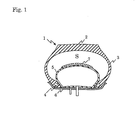
- FIG. 1 is a schematic cross-sectional view showing one embodiment of a safety pneumatic tire according to the present invention.
- the non-woven fabrics used in the present invention are not particularly limited, and those produced by any methods are usable.
- non-woven fabrics produced by web-making methods such as carding, paper-making, air-laying, and melt-blowing/spun-bonding may be used.
- the web fiber-bonding methods other than the melt-blowing method and the spun-bonding method may include methods by heat fusion or binder and methods for entangling fibers by water jet or needle such as a water-jet entanglement and a needle punching method.
- Preferred are non-woven fabrics which are produced by the water-jet entanglement and the needle punching method, in which fibers are entangled.by water jet or needle, and the melt-blowing/spun-bonding method.
- the non-woven fabric it is important for the non-woven fabric to have a structure which allows rubber to sufficiently impregnate between the filament fibers (organic fibers), and a structure which allows the filaments and the rubber to mutually form continuous layers over a relatively large distance and broad range.
- the diameter or major diameter of single filament fibers is needed to be 10 to 35 ⁇ m and more preferably 20 to 30 ⁇ m. If less than 10 ⁇ m, the space between the filament fibers is not sufficient to make the impregnation of rubber into the inside of the non-woven fabric difficult. Therefore, the resultant rubber-fiber. composite material fails to exhibit its intended function sufficiently. If more than 35 ⁇ m, the filament fibers acquire an excessively high flexural stiffness, making the production of a non-woven fabric of fibers sufficiently entangled difficult. As a result, the resultant rubber-fiber composite material fails to sufficiently exhibit the intended function.
- the cross-sectional shape of filament fibers is not particularly limited, and may be circular, non-circular or may be of a hollow shape.
- the length of filament fibers is preferably 30 to 100 mm and more preferably 40 to 60 mm. If less than 30 mm, the filament fiber-to-filament fiber entanglement is insufficient, resulting in the failure of the reinforcing layer made of the resultant rubber-fiber composite material to maintain its stiffness in some cases. If more than 100 mm, since the number of filament fiber ends is too small, the filament fiber-to-filament fiber entanglement is also insufficient, resulting in the failure of the reinforcing layer to maintain its stiffness in some cases.
- the non-woven fabric used in the present invention contains the organic fibers having a tensile modulus of 50 GPa or higher at least partly and preferably in an amount of 50% by weight or more. If a non-woven fabric contains organic fibers having a tensile modulus of less than 50 GPa in an excessively large amount or a non-woven fabric contains organic fibers having a tensile modulus of 50 GPa or higher in an excessively small amount, the basis weight should be increased to obtain a rubber-fiber composite material having a high stiffness.
- the increasing of the basis weight narrows the space between the filament fibers in the non-woven fabric to make the impregnation of rubber into the inside of the non-woven fabric difficult, resulting in the failure of resultant rubber-fiber composite material to sufficiently exhibit its intended function in some cases.
- the basis weight of the non-woven fabric is preferably 30 to 120 g/m 2 and more preferably 40 to 80 g/m 2 . If less than 30 g/m 2 , the unevenness of non-woven fabric is promoted to likely cause the failure of resultant rubber-fiber composite material to show a uniform stiffness. If more than 120 g/m 2 , a sufficient space cannot be attained between the filament fibers in the non-woven fabric even if the diameter of the filament fibers is increased. Therefore, the impregnation of rubber into the inside of the non-woven fabric becomes difficult to likely cause the failure of resultant rubber-fiber composite material to sufficiently exhibit its intended function.
- the non-woven fabric prefferably has a thickness D1 of 1.2 to 4.0 mm when measured under a pressure of 10 gf/cm 2 (about 981 Pa) and a thickness D2 of 0.3 to 1.2 mm when measured under a pressure of 200 gf/cm 2 (about 19,613 Pa), with a ratio D1/D2 of 2 or more. If the ratio is less than 2, the impregnation of rubber when formed into a composite material by rolling, etc. may be poor, thereby likely to make the stiffness of the rubber-fiber composite material insufficient.
- organic fibers examples include aramid fibers, polyolefin ketone fibers, polybenzazole fibers, polyimide fibers, polyester fibers, carbon fibers, and polyether ketone fibers, with at least one fiber selected from the group consisting of p-aramid fibers, polyolefin ketone fibers, polybenzazole fibers and polyimide fibers being preferred.
- p-aramid fibers examples include copoly-p-phenylene-3,4'-oxydiphenylene terephthalamide fibers and poly-p-phenylene terephthalamide fibers, with copoly-p-phenylene-3,4'-oxydiphenylene terephthalamide being preferred.
- the p-aramid fibers may be commercially available under the trademark "Technora” from Teijin Limited and under the trademark "Kevlar” from Du Pont Corp.
- the polyolefin ketone fiber comprises a copolymer of carbon monoxide and olefins such as ethylene, propylene, butene, pentene, hexene, heptene, octene, nonene, decene, and dodecene.
- olefins such as ethylene, propylene, butene, pentene, hexene, heptene, octene, nonene, decene, and dodecene.
- the polybenzazole fibers are exemplified by poly-p-phenylenebenzobisoxazole fibers and commercially available, for example, under the trademark "Zylon” from Toyobo Co., Ltd.
- the polyimide fibers are commercially available, for example, under the product name "P84” from Inspecfibers Inc.
- examples of the polyester fibers include polyethylene terephthalate fibers and polyethylene naphthalate fibers.
- the organic fiber may contain a certain amount of clay (clay mineral) which is micro-dispersed therein to enhance its elastic modulus and simultaneously reduce its heat shrinkage, thereby further improving the rubber-fiber composite material.
- clay clay mineral
- the dispersion of inorganic materials such as clay into the organic fiber, etc. in molecular level is accomplished by the intercalation of clay (i.e., dispersion into a matrix polymer of surface organized clay) for dispersing the clay into the polymer of fibers in micron or nano order.
- the rubber component for the rubber-fiber composite material of the present invention is not particularly limited, and preferably natural rubbers, butadiene rubber, styrene-butadiene rubber and isoprene rubber.
- the 100% modulus of the rubber component may be appropriately controlled according to the applications.
- the 100% modulus is preferably 1.0 to 5.0 MPa, and when intended to be used as a reinforcing material for the sidewall and tube, the 100% modulus is preferably 0.3 to 0.5 MPa.
- the surface of the organic fiber may be coated with a film of metal or metal oxide that is reactive with sulfur by physical vapor deposition (PVD) or chemical vapor deposition (CVD), preferably by sputtering.
- PVD physical vapor deposition
- CVD chemical vapor deposition
- the non-woven fabric and rubber are relatively easily made into a composite material by using an apparatus which is conventionally used in rubberizing organic fiber cords or steel cords.
- a sheet or sheets of an unvulcanized rubber composition are pressed to one or both surfaces of the non-woven fabric by a pressing machine or rolls to replace the air inside the non-woven fabric with the rubber.
- a liquid unvulcanized rubber composition in solvent is applied to the non-woven fabric.
- a raw tire is prepared and then formed under vulcanization into a tire.
- the rubber-fiber composite material of the present invention produced in the manner mentioned above preferably has a tensile modulus of 2 to 20 GPa.
- Japanese Patent Application Laid-Open No. 10-53010 discloses to dispose a sidewall reinforcing layer made of a rubber/filament fiber composite between a carcass ply and the sidewall of a pneumatic radial tire so as to cover at least 35% or more of a portion extending from an upper end of a bead filler to an peripheral end of a belt portion having a maximum width.
- the rubber-fiber composite material of the present invention is suitably used as the sidewall reinforcing layer, particularly to remarkably enhance the operation stability and drum durability.
- the rubber-fiber composite material of the present invention is also suitably applied to a safety pneumatic tire, which will be explained below in more detail.
- the tube is reinforced by a reinforcing layer which covers at least a top portion of the tube (an upper surface of the tube facing an inner wall of a tread of the outer tire).
- a reinforcing layer which covers at least a top portion of the tube (an upper surface of the tube facing an inner wall of a tread of the outer tire).
- the reinforcing layer prevents the tube from stretching to come into contact with the radially inner surface of the tire, by resisting the centrifugal force due to tire rolling and a tensile force due to difference between the inner pressures of the tube and the tire (e.g., 50 kPa when the inner pressures is 900 kPa for the tube and 950 kPa for the tire).
- the reinforcing layer stretches to the radially inner surface of the tire to prevent the tire from being deflected.
- the stretching of the reinforcing layer may be elastic deformation or plastic deformation.
- the reinforcing layer for the tube is made of the rubber-fiber composite material of the present invention as described in detail above.
- the diameter or major diameter of the organic single fibers constituting the non-woven fabric is also needed to be 10 to 35 ⁇ m.
- the rubber-fiber composite material constituting the reinforcing layer is basically required to prevent the tube from stretching by resisting the centrifugal force due to tire rolling during normal running and the tensile force due to the difference between the inner pressures of the tube and the tire.
- at least a part of the non-woven fabric should be made of the organic fibers having a tensile modulus of 50 GPa or higher.
- the content of organic fibers having a tensile modulus of 50 GPa or higher is preferably 50% by weight or higher and more preferably 100% by weight of the non-woven fabric.
- a rubber-fiber composite material comprising a rubber and a non-woven fabric which is mainly made of filament fibers having a tensile modulus of less than 50 GPa is applied to the reinforcing layer for the tube, a sufficient tensile modulus cannot be obtained.
- it is required, for example, to make the reinforcing layer into a laminate with a large number of layers. As a result, the weight of the safety tire assembly increases, resulting in remarkable deterioration in normal running performance such as low fuel consumption.
- the basis weight of the non-woven fabric for use in the rubber-fiber composite material is preferably 30 to 120 g/cm 2 , as described above. When less than 30 g/cm 2 , the stretching of the tube is difficult to be prevented. When exceeding 120 g/cm 2 , the stretching of the tube under reduced tire pressure may be insufficient.
- the thickness of the non-woven fabric is preferably 0.2 to 1.4 mm when measured under a pressure of 20 gf/cm 2 (about 1,961 Pa).
- the tensile modulus of the rubber-fiber composite material of the present invention, when intended to be used as the reinforcing layer for the tube, is preferably 2 to 20 GPa. Further, the reinforcing layer is preferably a laminate of 3 to 6 layers composed of the rubber-fiber composite material.
- FIG. 1 is a schematic cross-sectional view showing one embodiment of the safety pneumatic tire according to the present invention.
- a tubeless tire 1 has an annular tread 2, a pair of sidewalls 3 extending radially inwardly from opposite ends of the tread 2, and bead portions 4 formed at a radially inner end of each sidewall 3.
- the bead portions 4 are mounted to a rim 6, and a tube 5 is disposed within the tubeless tire 1.
- a reinforcing layer 7 is formed so as to cover at least a top portion of the tube 5.
- a large space S is formed between an outer surface of the tube 5 and an inner wall of a crown portion of the tubeless tire 1.
- the tube is arranged so as to bring its right and left side portions into close contact with an inner surface of the bead portions 4 of the tubeless tire 1.
- an inner pressure P 2 of the tube 5 is kept higher than an inner pressure P 1 of the space S, usually by 20 to 100 kPa.
- the performance of tire was measured by the following methods.
- Test tires were mounted to a motor vehicle (domestic car: FF 2,000 cc) and subjected to practical running test by straight run and lane change at a speed of 40 to 120 km/h.
- the operation stability was evaluated according to the feelings received by the driver, and the evaluation results were classified into the following ranks by comparing with that of Control Example 1:
- the total of the rank points was expressed by an index number taking that of Control Example 1 as 100.
- test tire was inflated to a maximum air pressure prescribed in JATMA Standard and allowed to stand for 24 h at a laboratory temperature of 25 ⁇ 2°C. Then, the test tire was loaded with two times a maximum load prescribed in JATMA Standard and subjected to a running test on a drum having a diameter of 1.7 m at a speed of 60 km/h to measure a running distance until causing tire collapsing. The results are expressed by index numbers taking the running distance of Control Example 1 as 100.
- a load of 50 or 1,000 gf/5 cm 2 was applied onto an upper surface of a non-woven fabric cut into an appropriate size, and the thickness was measured at 10 points using a thickness gauge "Model ID-F125" available from Mitsutoyo Corp. The measured values were averaged.
- a test tire was mounted to a rim (9.00 x 22.5) at a predetermined inner pressure.
- the tire was pressed to a drum rotating at a peripheral speed of 60 km/h under a load of 34.81 kN and the running distance until causing tire collapsing was measured.
- the results are expressed by index numbers taking the result of Control Example 4 as 100. The larger the index number, the more excellent the normal running durability.
- a test tire was mounted to a rim (9.00 x 22.5) at a predetermined inner pressure.
- a valve core was removed from the tire to reduce the inner pressure to atmospheric pressure, thereby allowing a tube to expand and come into contact with the inner surface of the tire.
- the drum running test was performed under the conditions: a load of 34.81 kN, a speed of 60 km/h, and a laboratory temperature of 38°C.
- the run-flat durability was evaluated by the running distance until causing tire collapsing and expressed by an index number taking the result of Control Example 4 as 100. The larger the index number, the more excellent the run-flat durability.
- Non-woven fabrics used in respective Examples and Comparative Examples were prepared by a water jet entanglement method.
- Comparative Example 1 the non-woven fabric produced by the water jet entanglement method was pressed under 10 kgf/cm 2 at 150°C for one minute.
- the kind of fiber, fiber length, single fiber diameter and basis weight of the non-woven fabric are shown in Table 1.
- Unvulcanized rubber was pressed to both the upper and lower surfaces of the non-woven fabric by rolls to prepare a rubber-fiber composite material, which was used as the reinforcing layer for sidewalls to produce a radial tire having a size of 195/65 R15 by an ordinary method.
- the radial tire was evaluated for the operation stability and the drum durability by the above methods. The results are shown in Table 1.
- Example 1 The same procedure as in Example 1 was repeated except that a rubber-coated cord fabric composed of 1,670 dtex two-ply polyethylene terephthalate (PET) yarns was used as the reinforcing layer for sidewalls, thereby producing radial tires having the reinforcing layers with different coating widths.
- PET polyethylene terephthalate
- a tire for trucks and buses (315/60R22.5) was mounted to a rim to produce a tire/rim assembly having a reinforcing layer 7 for tube as shown in Fig. 1.
- the reinforcing layer 7 was prepared by laminating 4 layers of a rubber-fiber composite material each obtained by rubber-coating a non-woven fabric having a basis weight of 50 g/m 2 and being made of fibers whose kind and single fiber diameter are shown in Table 2.
- the tire/rim assembly was evaluated for the normal running durability and the run-flat durability under a tire inner pressure of 900 kPa and a tube inner pressure of 950 or 1,000 kPa. The results are shown in Table 2
- a tire/rim assembly was produced and then evaluated in the same manner as in Example 6 except that no reinforcing layer was provided. The results are shown in Table 2.
- the durability of the rubber articles can be enhanced together with the reduction of their weight.
- the rubber-fiber composite material as a reinforcing member for sidewalls of tire, the operation stability and the drum durability, in particular, are remarkably improved.
- the inner pressure of the tube can be set higher than that of the tire. This increases the air volume of expanded tube when the tire is punctured, thereby preventing the deflection during run-flat running to greatly improve the run-flat durability. In addition, an excessive increase of the weight of the safety pneumatic tire can be avoided to improve the normal running performance such as low fuel consumption.
Landscapes
- Engineering & Computer Science (AREA)
- Chemical & Material Sciences (AREA)
- Chemical Kinetics & Catalysis (AREA)
- Mechanical Engineering (AREA)
- Textile Engineering (AREA)
- Manufacturing & Machinery (AREA)
- Health & Medical Sciences (AREA)
- Medicinal Chemistry (AREA)
- Polymers & Plastics (AREA)
- Organic Chemistry (AREA)
- Materials Engineering (AREA)
- Tires In General (AREA)
- Moulding By Coating Moulds (AREA)
- Reinforced Plastic Materials (AREA)
Abstract
Description
| Examples | |||||
| 1 | 2 | 3 | 4 | 5 | |
| Non-woven fabric | |||||
| Kind of fiber*1 | *1 | *1 | *1 | *1 | *1 |
| Fiber length (mm) | 50 | 50 | 50 | 30 | 100 |
| Single fiber diameter (µm) | 20 | 20 | 20 | 12 | 30 |
| Fiber tensile modulus (GPa) | 74 | 74 | 74 | 74 | 74 |
| Basis weight (g/cm2) | 50 | 50 | 50 | 40 | 80 |
| Thickness D1 under a load of 10 gf/cm2 (mm) | 2.1 | 2.1 | 2.1 | 1.4 | 3.1 |
| Thickness D2 under a load of 200 gf/cm2 (mm) | 0.55 | 0.55 | 0.55 | 0.49 | 0.88 |
| D1/D2 | 3.8 | 3.8 | 3.8 | 2.8 | 3.5 |
| Tire | |||||
| Coating width (mm) | 30 | 60 | 80 | 30 | 30 |
| Operation stability (index) | 110 | 125 | 191 | 104 | 141 |
| Drum durability (index) | 124 | 154 | 206 | 106 | 172 |
| Comparative Examples | Control Examples | ||||
| 1 | 2 | 3 | 1 | 2 | |
| Non-woven fabric | |||||
| Kind of fiber | 6,6-nylon | 6,6-nylon | |||
| Fiber length (mm) | 50 | 50 | 50 | - | - |
| Single fiber diameter (µm) | 20 | 20 | 20 | - | - |
| Fiber tensile modulus (GPa) | 74 | 2.6 | 2.6 | 7.4 | 7.4 |
| Basis weight (g/cm2) | 50 | 50 | 240 | - | - |
| Thickness D1 under a load of 10 gf/cm2 (mm) | 0.96 | 2.8 | 11.6 | - | - |
| Thickness D2 under a load of 200 gf/cm2 (mm) | 0.55 | 0.54 | 2.6 | - | - |
| D1/D2 | 1.7 | 5.1 | 4.4 | - | - |
| Tire | |||||
| Coating width (mm) | 30 | 30 | 30 | 60 | 80 |
| Operation stability (index) | 98 | 80 | 83 | 100 | 124 |
| Drum durability (index) | 96 | 76 | 54 | 100 | 62 |
| Examples | |||||
| 6 | 7 | 8 | 9 | 10 | |
| Reinforcing layer | |||||
| Non-woven fabric | |||||
| Kind of fiber | *1 | *1 | *1 | *3 | *1 |
| Single fiber diameter (µm) | 20 | 10 | 35 | 12 | 20 |
| Fiber tensile modulus (GPa) | 70 | 70 | 70 | 68 | 70 |
| Number of laminated layers | 4 | 4 | 4 | 4 | 4 |
| Tube weight (index)*5 | 120 | 120 | 120 | 120 | 120 |
| Inner pressure | |||||
| Tire (kPa) | 900 | 900 | 900 | 900 | 900 |
| Tube (kPa) | 950 | 950 | 950 | 950 | 1000 |
| Performance | |||||
| Normal running durability (index) | 196 | 178 | 159 | 169 | 174 |
| Run-flat durability (index) | 166 | 131 | 159 | 137 | 206 |
| Comparative Examples | ||||
| 4 | 5 | 6 | 7 | |
| Reinforcing layer | ||||
| Non-woven fabric | ||||
| Kind of fiber | - | PET | PET | Nylon |
| Single fiber diameter (µm) | - | 25 | 25 | 25 |
| Fiber tensile modulus (GPa) | - | 18 | 18 | 4 |
| Number of laminated layers | None | 4 | 8 | 4 |
| Tube weight (index) | 100 | 120 | 140 | 120 |
| Inner pressure | ||||
| Tire (kPa) | 900 | 900 | 900 | 900 |
| Tube (kPa) | 950 | 950 | 950 | 950 |
| Performance | ||||
| Normal running durability (index) | 100 | 103 | 109 | 107 |
| Run-flat durability (index) | 100 | 126 | 78 | 122 |
Claims (17)
- A rubber-fiber composite material comprising a non-woven fabric and a rubber which coats the non-woven fabric, at least a part of the non-woven fabric being made of an organic fiber having a single fiber diameter of 10 to 35 µm, a fiber length of 30 to 100 mm, and a tensile modulus of 50 GPa or higher.
- The rubber-fiber composite material according to claim 1, wherein the non-woven fabric has a basis weight of 30 to 120 g/m2.
- The rubber-fiber composite material according to claim 1 or claim 2, wherein the non-woven fabric has a ratio D1/D2 of 2 or more, wherein D1 is a thickness of the non-woven fabric when measured under a pressure of 10 gf/cm2 (about 981 Pa), and D2 is a thickness of the non-woven fabric when measured under a pressure of 200 gf/cm2 (about 19,613 Pa).
- The rubber-fiber composite material according to any one of claims 1 to 3, wherein the organic fiber is at least one fiber selected from the group consisting of para-aramid fibers, polyolefin ketone fibers, polybenzazole fibers and polyimide fibers.
- The rubber-fiber composite material according to claim 4, wherein the organic fiber is at least one para-aramid fiber selected from the group consisting of copoly-p-phenylene-3,4'-oxydiphenylene terephthalamide and poly-p-phenylene terephthalamide.
- A rubber article reinforced with the rubber-fiber composite material as set forth in any one of claims 1 to 5.
- A tire reinforced with the rubber-fiber composite material as set forth in any one of claims 1 to 5.
- A safety pneumatic tire comprising a tire assembly having:wherein a space is formed between an outer surface of the tube and an inner surface of a crown portion of the tubeless tire in inflated conditions;(A) a tubeless tire comprising an annular tread having a pair of sidewalls respectively extending radially inwardly from opposite ends of the tread, and beads each embedded in a radially inner end of the sidewall;(B) a tube disposed within the tubeless tire; and(C) a reinforcing layer covering at least a top portion of the tube,
wherein the reinforcing layer is disposed so as to extend radially outwardly to come into close contact with an inner surface of the tread of the tubeless tire when an inner pressure of the tire decreases, thereby enabling run-flat running; and
wherein the reinforcing layer is made of a rubber-fiber composite material comprising a non-woven fabric and a rubber, at least a part of the non-woven fabric being made of an organic fiber having a single fiber diameter of 10 to 35 µm and a tensile modulus of 50 GPa or higher. - The safety pneumatic tire according to claim 8, wherein the organic fiber has a fiber length of 30 to 100 mm.
- The safety pneumatic tire according to claim 8 or 9, wherein the organic fiber is para-aramid fiber.
- The safety pneumatic tire according to claim 10, wherein the para-aramid fiber is contained in an amount of 50% by weight or more based on the total weight of the organic fiber constituting the non-woven fabric.
- The safety pneumatic tire according to claim 10 or 11, wherein the para-aramid fiber is copoly-p-phenylene-3,4'-oxydiphenylene terephthalamide or poly-p-phenylene terephthalamide.
- The safety pneumatic tire according to any one of claims 8 to 12, wherein the non-woven fabric has a basis weight of 30 to 120 g/m2.
- The safety pneumatic tire according to any one of claims 8 to 13, wherein the non-woven fabric has a ratio D1/D2 of 2 or more, wherein D1 is a thickness of the non-woven fabric when measured under a pressure of 10 gf/cm2 (about 981 Pa), and D2 is a thickness of the non-woven fabric when measured under a pressure of 200 gf/cm2 (about 19,613 Pa).
- The safety pneumatic tire according to any one of claims 8 to 14, wherein the non-woven fabric has a thickness of 0.2 to 1.4 mm when measured under a pressure of 20 gf/cm2 (about 1,961 Pa).
- The safety pneumatic tire according to any one of claims 8 to 15, wherein the reinforcing layer is made of a laminate having 3 to 6 layers of the rubber-fiber composite material.
- The safety pneumatic tire according to any one of claims 8 to 16, wherein an inner pressure of the tube is kept 20 to 100 kPa higher than that of the tire.
Applications Claiming Priority (5)
| Application Number | Priority Date | Filing Date | Title |
|---|---|---|---|
| JP2001154892 | 2001-05-24 | ||
| JP2001154892 | 2001-05-24 | ||
| JP2001310462A JP4358467B2 (en) | 2001-05-24 | 2001-10-05 | Rubber-fiber composite material and rubber article using the same |
| JP2001310462 | 2001-10-05 | ||
| PCT/JP2002/005073 WO2002094586A1 (en) | 2001-05-24 | 2002-05-24 | Rubber-fiber composite material and rubber article using the same |
Publications (3)
| Publication Number | Publication Date |
|---|---|
| EP1389540A1 true EP1389540A1 (en) | 2004-02-18 |
| EP1389540A4 EP1389540A4 (en) | 2004-09-29 |
| EP1389540B1 EP1389540B1 (en) | 2010-03-03 |
Family
ID=26615611
Family Applications (1)
| Application Number | Title | Priority Date | Filing Date |
|---|---|---|---|
| EP20020728145 Expired - Lifetime EP1389540B1 (en) | 2001-05-24 | 2002-05-24 | Rubber-fiber composite material and rubber article using the same |
Country Status (7)
| Country | Link |
|---|---|
| US (2) | US20040154719A1 (en) |
| EP (1) | EP1389540B1 (en) |
| JP (1) | JP4358467B2 (en) |
| CN (1) | CN100421976C (en) |
| DE (1) | DE60235537D1 (en) |
| ES (1) | ES2339535T3 (en) |
| WO (1) | WO2002094586A1 (en) |
Cited By (2)
| Publication number | Priority date | Publication date | Assignee | Title |
|---|---|---|---|---|
| EP1637361A4 (en) * | 2003-06-06 | 2006-06-14 | Bridgestone Corp | Air bladder for safety tire |
| IT202000005185A1 (en) * | 2020-03-11 | 2021-09-11 | Cnh Ind Italia Spa | WHEEL FOR VEHICLE INCLUDING AN IMPROVED SAFETY SYSTEM |
Families Citing this family (19)
| Publication number | Priority date | Publication date | Assignee | Title |
|---|---|---|---|---|
| EP1398183B1 (en) * | 2001-05-29 | 2008-06-11 | Bridgestone Corporation | Reinforced air bladder for safety tire, method of manufacturing the air bladder and method of manufacturing reinforced layer formed body |
| US6837104B2 (en) * | 2002-10-08 | 2005-01-04 | Itzhak Sapir | Tire safety system |
| FR2867107B1 (en) * | 2004-03-04 | 2006-04-28 | Michelin Soc Tech | BODY FOR SUPPORTING A TIRE IN CASE OF DEFLATION AND PNEUMATIC ASSEMBLY EQUIPPED WITH SUCH A BODY. |
| CN100473550C (en) * | 2004-06-02 | 2009-04-01 | 株式会社普利司通 | Reinforcing air envelope for safety tire |
| KR100582003B1 (en) * | 2005-06-03 | 2006-05-22 | 한국타이어 주식회사 | Rubber composition for tread of studless tire |
| CN100551725C (en) * | 2006-12-30 | 2009-10-21 | 伍必胜 | A kind of safety burst-proof tyre |
| KR100823897B1 (en) | 2007-03-28 | 2008-04-21 | 금호타이어 주식회사 | Rubber composition for snow tires |
| WO2009103252A2 (en) * | 2008-02-21 | 2009-08-27 | Coda Development, S.R.O. | A device for adjustment of pressure in tires. |
| KR101342702B1 (en) * | 2010-12-14 | 2013-12-17 | 한국타이어 주식회사 | Tire cord and tire comprising the same |
| US8758167B2 (en) | 2011-09-15 | 2014-06-24 | Acushnet Company | Compositions for golf balls based on oriented nanostructures |
| FR2984228B1 (en) * | 2011-12-16 | 2016-09-30 | Soc De Tech Michelin | TREAD BAND HAVING SCULPTURE ELEMENTS COVERED WITH AN IMPREGNATED FIBER ASSEMBLY |
| US9394430B2 (en) | 2012-04-13 | 2016-07-19 | Ticona Llc | Continuous fiber reinforced polyarylene sulfide |
| JP6338291B2 (en) * | 2012-10-26 | 2018-06-06 | イー・アイ・デュポン・ドウ・ヌムール・アンド・カンパニーE.I.Du Pont De Nemours And Company | Composite layer for reinforcement of objects such as tires or belts |
| GB2522038A (en) * | 2014-01-10 | 2015-07-15 | Caterpillar Inc | Tyre apparatus |
| CN104908525A (en) * | 2014-03-10 | 2015-09-16 | 陈永星 | Inner-tube-free tire with inflatable inner tube inside |
| KR102548811B1 (en) * | 2014-06-18 | 2023-06-28 | 코다 이노베이션스 에스.알.오. | A chamber with shape memory for adjusting the pressure in tires |
| US10493806B1 (en) * | 2017-06-27 | 2019-12-03 | Harry Lewellyn | Beadlock assembly |
| US11376895B2 (en) | 2017-06-27 | 2022-07-05 | Harry Lewellyn | Beadlock assembly |
| JP7157700B2 (en) | 2019-05-29 | 2022-10-20 | 株式会社ブリヂストン | tire |
Family Cites Families (4)
| Publication number | Priority date | Publication date | Assignee | Title |
|---|---|---|---|---|
| US3724521A (en) * | 1971-05-06 | 1973-04-03 | Exxon Research Engineering Co | Anti-flat device |
| US4008743A (en) * | 1975-08-27 | 1977-02-22 | The General Tire & Rubber Company | Pneumatic tire with puncture resistance internal safety structure |
| US6209604B1 (en) | 1997-12-22 | 2001-04-03 | Bridgestone Corporation | Pneumatic tire for passenger cars with sidewall portions having a rubber reinforcing layer and a rubber-filament fiber composite |
| EP1190846B1 (en) | 2000-09-26 | 2009-01-14 | Bridgestone Corporation | Tire comprising a rubber-based composite material |
-
2001
- 2001-10-05 JP JP2001310462A patent/JP4358467B2/en not_active Expired - Fee Related
-
2002
- 2002-05-24 WO PCT/JP2002/005073 patent/WO2002094586A1/en not_active Ceased
- 2002-05-24 EP EP20020728145 patent/EP1389540B1/en not_active Expired - Lifetime
- 2002-05-24 US US10/478,672 patent/US20040154719A1/en not_active Abandoned
- 2002-05-24 DE DE60235537T patent/DE60235537D1/en not_active Expired - Lifetime
- 2002-05-24 CN CNB028015088A patent/CN100421976C/en not_active Expired - Fee Related
- 2002-05-24 ES ES02728145T patent/ES2339535T3/en not_active Expired - Lifetime
-
2006
- 2006-08-18 US US11/505,892 patent/US7469734B2/en not_active Expired - Fee Related
Cited By (3)
| Publication number | Priority date | Publication date | Assignee | Title |
|---|---|---|---|---|
| EP1637361A4 (en) * | 2003-06-06 | 2006-06-14 | Bridgestone Corp | Air bladder for safety tire |
| IT202000005185A1 (en) * | 2020-03-11 | 2021-09-11 | Cnh Ind Italia Spa | WHEEL FOR VEHICLE INCLUDING AN IMPROVED SAFETY SYSTEM |
| EP3878668A1 (en) * | 2020-03-11 | 2021-09-15 | CNH Industrial Italia S.p.A. | Wheel for a vehicle comprising an improved safety system |
Also Published As
| Publication number | Publication date |
|---|---|
| US20040154719A1 (en) | 2004-08-12 |
| CN100421976C (en) | 2008-10-01 |
| CN1462245A (en) | 2003-12-17 |
| JP2003039912A (en) | 2003-02-13 |
| ES2339535T3 (en) | 2010-05-21 |
| EP1389540A4 (en) | 2004-09-29 |
| DE60235537D1 (en) | 2010-04-15 |
| JP4358467B2 (en) | 2009-11-04 |
| US20060283533A1 (en) | 2006-12-21 |
| US7469734B2 (en) | 2008-12-30 |
| EP1389540B1 (en) | 2010-03-03 |
| WO2002094586A1 (en) | 2002-11-28 |
Similar Documents
| Publication | Publication Date | Title |
|---|---|---|
| US7469734B2 (en) | Rubber-fiber composite material and rubber article using the same | |
| EP1260385A1 (en) | Pneumatic tyre | |
| EP0922593B1 (en) | Pneumatic safety tire | |
| KR20010013458A (en) | Light weight fiberglass belted radial tire | |
| US20200122508A1 (en) | Rubber reinforcing material with reduced weight, method for preparing the same and tire comprising the same | |
| WO1998056600A1 (en) | Light weight aramid belted radial tire | |
| US20120085475A1 (en) | Pneumatic tire with a knitted flipper | |
| KR20010080337A (en) | Tire and method of making same | |
| JP4015745B2 (en) | Pneumatic safety tire | |
| US6209604B1 (en) | Pneumatic tire for passenger cars with sidewall portions having a rubber reinforcing layer and a rubber-filament fiber composite | |
| CN101765521A (en) | Pneumatic tire | |
| JP4257723B2 (en) | Tire and rim assembly | |
| JPH11348512A (en) | Pneumatic safe tire | |
| JP2002172918A (en) | Safety pneumatic tire | |
| JP4497602B2 (en) | Pneumatic tires for passenger cars | |
| JP2000025423A (en) | Pneumatic tire for passenger car | |
| JP4531932B2 (en) | Pneumatic radial tire | |
| JPH11129712A (en) | Pneumatic safety tire | |
| JP2004090808A (en) | Safety tire | |
| JP2005067363A (en) | Safety pneumatic tire | |
| EP4313626B1 (en) | Tyre for vehicle wheels | |
| JP2001010305A (en) | Bicycle tire | |
| JP2004217157A (en) | Pneumatic radial tire | |
| JP2003146032A (en) | Rubber-fiber composite material and rubber article using the same | |
| JP2009286273A (en) | Pneumatic tire |
Legal Events
| Date | Code | Title | Description |
|---|---|---|---|
| PUAI | Public reference made under article 153(3) epc to a published international application that has entered the european phase |
Free format text: ORIGINAL CODE: 0009012 |
|
| 17P | Request for examination filed |
Effective date: 20031125 |
|
| AK | Designated contracting states |
Kind code of ref document: A1 Designated state(s): AT BE CH CY DE DK ES FI FR GB GR IE IT LI LU MC NL PT SE TR |
|
| A4 | Supplementary search report drawn up and despatched |
Effective date: 20040816 |
|
| RIC1 | Information provided on ipc code assigned before grant |
Ipc: 7D 04H 1/42 B Ipc: 7B 32B 5/28 B Ipc: 7B 32B 5/02 B Ipc: 7B 60C 5/08 B Ipc: 7B 60C 17/02 A |
|
| 17Q | First examination report despatched |
Effective date: 20050218 |
|
| GRAP | Despatch of communication of intention to grant a patent |
Free format text: ORIGINAL CODE: EPIDOSNIGR1 |
|
| GRAS | Grant fee paid |
Free format text: ORIGINAL CODE: EPIDOSNIGR3 |
|
| GRAA | (expected) grant |
Free format text: ORIGINAL CODE: 0009210 |
|
| AK | Designated contracting states |
Kind code of ref document: B1 Designated state(s): DE ES FR GB IT |
|
| REG | Reference to a national code |
Ref country code: GB Ref legal event code: FG4D |
|
| REF | Corresponds to: |
Ref document number: 60235537 Country of ref document: DE Date of ref document: 20100415 Kind code of ref document: P |
|
| REG | Reference to a national code |
Ref country code: ES Ref legal event code: FG2A Ref document number: 2339535 Country of ref document: ES Kind code of ref document: T3 |
|
| PLBE | No opposition filed within time limit |
Free format text: ORIGINAL CODE: 0009261 |
|
| STAA | Information on the status of an ep patent application or granted ep patent |
Free format text: STATUS: NO OPPOSITION FILED WITHIN TIME LIMIT |
|
| 26N | No opposition filed |
Effective date: 20101206 |
|
| REG | Reference to a national code |
Ref country code: DE Ref legal event code: R082 Ref document number: 60235537 Country of ref document: DE Representative=s name: MARKS & CLERK (LUXEMBOURG) LLP, LU |
|
| REG | Reference to a national code |
Ref country code: FR Ref legal event code: CA Effective date: 20140812 |
|
| REG | Reference to a national code |
Ref country code: DE Ref legal event code: R082 Ref document number: 60235537 Country of ref document: DE Representative=s name: MARKS & CLERK (LUXEMBOURG) LLP, LU Effective date: 20140828 Ref country code: DE Ref legal event code: R081 Ref document number: 60235537 Country of ref document: DE Owner name: BRIDGESTONE CORPORATION, JP Free format text: FORMER OWNER: BRIDGESTONE CORP., TOKIO/TOKYO, JP Effective date: 20140828 |
|
| REG | Reference to a national code |
Ref country code: FR Ref legal event code: PLFP Year of fee payment: 15 |
|
| PGFP | Annual fee paid to national office [announced via postgrant information from national office to epo] |
Ref country code: GB Payment date: 20160520 Year of fee payment: 15 Ref country code: ES Payment date: 20160512 Year of fee payment: 15 |
|
| PGFP | Annual fee paid to national office [announced via postgrant information from national office to epo] |
Ref country code: IT Payment date: 20160524 Year of fee payment: 15 |
|
| REG | Reference to a national code |
Ref country code: FR Ref legal event code: PLFP Year of fee payment: 16 |
|
| GBPC | Gb: european patent ceased through non-payment of renewal fee |
Effective date: 20170524 |
|
| PG25 | Lapsed in a contracting state [announced via postgrant information from national office to epo] |
Ref country code: GB Free format text: LAPSE BECAUSE OF NON-PAYMENT OF DUE FEES Effective date: 20170524 |
|
| REG | Reference to a national code |
Ref country code: FR Ref legal event code: PLFP Year of fee payment: 17 |
|
| PG25 | Lapsed in a contracting state [announced via postgrant information from national office to epo] |
Ref country code: IT Free format text: LAPSE BECAUSE OF NON-PAYMENT OF DUE FEES Effective date: 20170524 |
|
| REG | Reference to a national code |
Ref country code: ES Ref legal event code: FD2A Effective date: 20180703 |
|
| PG25 | Lapsed in a contracting state [announced via postgrant information from national office to epo] |
Ref country code: ES Free format text: LAPSE BECAUSE OF NON-PAYMENT OF DUE FEES Effective date: 20170525 |
|
| PGFP | Annual fee paid to national office [announced via postgrant information from national office to epo] |
Ref country code: DE Payment date: 20190521 Year of fee payment: 18 |
|
| PGFP | Annual fee paid to national office [announced via postgrant information from national office to epo] |
Ref country code: FR Payment date: 20200522 Year of fee payment: 19 |
|
| REG | Reference to a national code |
Ref country code: DE Ref legal event code: R119 Ref document number: 60235537 Country of ref document: DE |
|
| PG25 | Lapsed in a contracting state [announced via postgrant information from national office to epo] |
Ref country code: DE Free format text: LAPSE BECAUSE OF NON-PAYMENT OF DUE FEES Effective date: 20201201 |
|
| PG25 | Lapsed in a contracting state [announced via postgrant information from national office to epo] |
Ref country code: FR Free format text: LAPSE BECAUSE OF NON-PAYMENT OF DUE FEES Effective date: 20210531 |